E-bike conversion kits: product safety regulatory guidance
Regulatory guidance clarifying the product safety requirements for e-bike conversion kits placed on the UK market.
About this guidance
This guidance is produced by the Office for Product Safety and Standards (OPSS), the UK’s national product regulator, part of the Department for Business, Innovation, Science and Trade. The guidance is intended to clarify how e-bike conversion kits are regulated under existing product safety laws, to give greater certainty to businesses and to assist them in complying with their legal obligations. It does not create any new legal obligations.
1. Who this guidance is for
This guidance is primarily for businesses that place e-bike conversion kits on the UK market. The guidance may also be useful to Local Authorities, businesses or professionals that modify, maintain or repair e-bikes, retailers, others in the supply chain, and consumers, when assessing whether an e-bike conversion kit may be unsafe. The guidance should be read alongside the Government’s statutory guidelines on lithium-ion battery safety for e-bikes. We recommend any individual wanting to purchase an e-bike conversion kit also considers the advice in the Government’s Buy Safe, Be Safe: avoid e-bike and e-scooter fires - GOV.UK safety campaign.
2. The purpose of this guidance
The purpose of this guidance is to provide clarity on the product safety requirements that apply when placing an e-bike conversion kit on the UK market, and the responsibility for ensuring an e-bike conversion kit is compliant and a safe product. The guidance aims to provide confidence and certainty to the market, to strengthen protections for consumers, and to support compliant businesses to grow.
Converted e-bikes may pose a greater fire risk as they are formed following the installation of an e-bike conversion kit, or separately sourced parts combined to provide the same electrical assist function, to a pedal bike. Growing evidence from stakeholders, including fire and rescue services, and research commissioned by OPSS, points to incompatible products, such as batteries and chargers with mismatched voltage ratings, being more likely to fail when used together, and potentially lead to explosion or fire.
3. Products in scope of this guidance
All variations of e-bike conversion kits that include an electric motor are in scope of this guidance. For the purpose of this guidance, and the application of relevant product safety regulations, OPSS considers an e-bike conversion kit to be:
An assembly of components, one of which is or includes an electric motor, whose function is to electrically power or electrically assist the movement of a pedal bike.
The guidance applies to all e-bike conversion kits captured by the above definition, regardless of whether a battery and/or charger are included as components. This can apply to, but is not limited to, the following types of design:
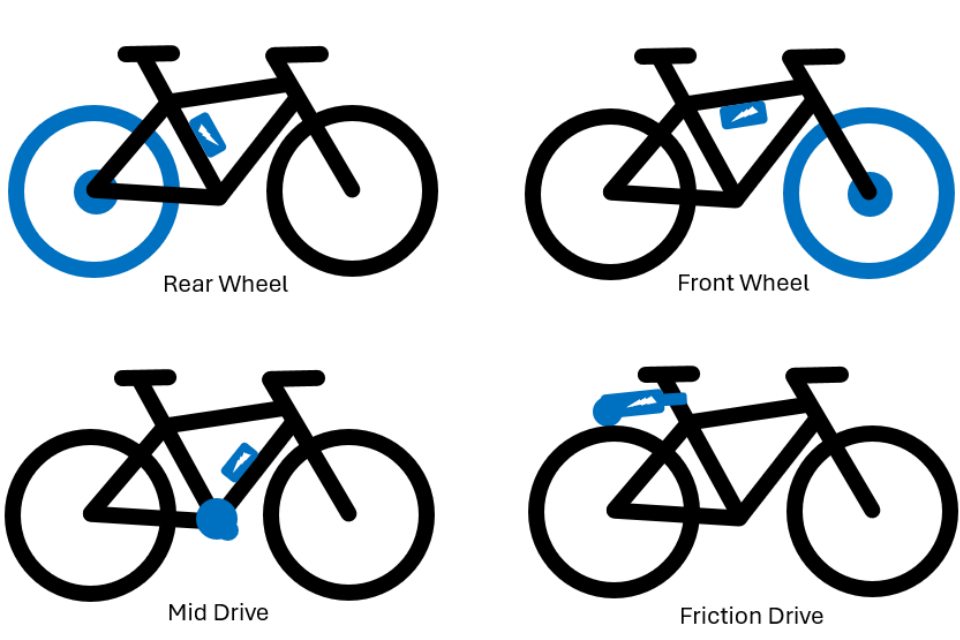
E-bike conversion kits designed to electrically power or assist the movement of a pedal bike above the continuous rated power limit (250 watts) and maximum powered speed (15.5mph) set out in the Electrically Assisted Pedal Cycle Regulations 1983 (as amended) are also in scope of this guidance.
Take note: Once installed, kits that enable a continuous rated power output above 250 watts and / or speeds above 15.5mph create a motor vehicle which is illegal to use on the road and public land, unless it meets the normal motor vehicle laws that apply to electric motorcycles.
The guidance does not apply to electric powertrains or drive systems containing an electric motor which are intended to form part of a manufactured e-bike.
4. Supply of Machinery (Safety) Regulations 2008
Any business that places an e-bike conversion kit on the UK market must ensure it complies with the Supply of Machinery (Safety) Regulations 2008 (the Regulations). The purpose of the Regulations is to ensure that machinery is safe, by requiring businesses to demonstrate their machinery meets the essential health and safety requirements in the Regulations. Other regulations can also apply (see section 7).
E-bike conversion kits are ‘machinery’ as defined in Regulation 4(2)(a)(iii) of the Regulations as they constitute an assembly of linked components, one of which moves, designed to perform a specific function only when mounted on a means of transport, in this case a pedal bike.
Regulation 7 requires machinery that is placed on the UK market or put into service is safe when it is properly installed and maintained, and when it is used for its intended purpose(s), or under conditions which can reasonably be foreseen.
The obligations on businesses placing e-bike conversion kits on the market include:
- Ensuring the e-bike conversion kit meets the essential health and safety requirements in the Regulations;
- Compiling, and making available to an enforcement authority, a technical file for the e-bike conversion kit, in accordance with Annex VII (Part 7 of Schedule 2, part A of the Regulations;
- Providing the information necessary to operate the e-bike conversion kit safely, such as instructions for installing and using the kit with a pedal bike;
- Following the appropriate conformity assessment procedure(s);
- Drawing up a Declaration of Conformity in accordance with Annex II (Part 2 of Schedule 2, section A, part 1 of the Regulations;
- Affixing the UK marking to the conversion kit or an accompanying document.
The obligations apply when an e-bike conversion kit is first placed on the UK market. This means the ‘responsible person’ (see section 5) who places an e-bike conversion kit on the market is responsible for fulfilling these obligations, ensuring that the conversion kit will not, during its intended and foreseeable uses, lead to harm, injury or death to any person or domestic animals, or damage property. This responsibility extends to the safe use of a conversion kit which, after it has been placed on the market, is subsequently installed by a business, professional or competent person who follows the kit manufacturer’s instructions and makes no additional or alternative modifications.
Businesses should ensure they are familiar with these requirements, seeking legal advice if necessary, to ensure an e-bike conversion kit placed on the market complies and is a safe product.
Please see further guidance for support: Supply of Machinery (Safety) Regulations 2008 - GOV.UK
Meeting the necessary information requirement in the Regulations
For an e-bike conversion kit to be safe, OPSS would expect to see appropriate, clear and accessible information that enables an e-bike conversion kit to be installed on to a pedal bike safely, used safely, and charged safely, whether or not a battery is one of the components forming the e-bike conversion kit placed on the market.
Necessary information that will support safe installation, use and charging is likely to include:
- The types and condition of pedal bikes that are compatible with the e-bike conversion kit to ensure it functions safely when in use;
- Any types or condition of pedal bikes that should not be used with the e-bike conversion kit;
- How to install the product via instructions that are clear, complete and accessible;
- The recommended batteries and chargers that are safe to use with the e-bike conversion kit, including the safe voltage and power ratings (or minimum and maximum ranges of these) of a lithium-ion battery that can be used with the e-bike conversion kit, and the safe voltage and power ratings (or minimum and maximum ranges of these) of compatible chargers;
- How to safely charge the battery supplied with, or a battery that is compatible with, the e-bike conversion kit.
The responsible person must hold relevant documentation to support the product’s safety, which includes a risk assessment, and may include, for example, test results, certification and research that forms part of the technical file required by Schedule 2 Part 7 of the Regulations.
Information regarding batteries and chargers as set out above will support the safe use of an e-bike conversion kit, whether it is placed on the market with or without a battery or charger. A user may purchase a separate battery or charger to use with an e-bike conversion kit where that component has not been originally supplied, or when a replacement part is required.
Information regarding types and conditions of compatible pedal bikes mentioned above will support safe installations in relation to a pedal bike’s mechanical and structural properties, and its general wear and tear.
This is not an exhaustive list of necessary information. The responsible person must provide all relevant information for the conversion kit to be safely installed and used in its intended and foreseeable uses, and to enable consumers to make fully informed purchasing decisions. Instructions provided with conversion kits should recommend that all users should seek professional assistance.
5. Responsibility to comply with the Regulations
Regulation 7 places obligations on ‘responsible persons’ to ensure the safety of machinery placed on the market or put into service, including machinery designed or manufactured for own use. ‘Responsible person’ means the manufacturer of the machinery, or the manufacturer’s authorised representative in the UK. An ‘authorised representative’ can be appointed to fulfil these obligations on a manufacturer’s behalf.
‘Manufacturer’ means the person who designs or manufactures the machinery under that person’s own name or trademark or for that person’s own use or, in the absence of such a person, the person who places that machinery on the market or puts it into service in the UK.
The Regulations apply to an e-bike conversion kit when it is first placed on the UK market by a responsible person or their authorised representative, or if it has not been placed on the UK market previously, when it is first put into service by a responsible person or their authorised representative.
Businesses who are not covered by the ‘responsible person’ definition but have a role in the supply chain for e-bike conversion kits should have regard to this guidance during their activities.
6. Non-compliance with the Regulations and enforcement
Enforcement authorities, which include OPSS (acting as the Secretary of State), Local Authority Trading Standards, Environmental Health in Northern Ireland, and the Health and Safety Executive, have powers to enforce the requirements in the Regulations. Powers include suspending the supply of non-compliant products and issuing legal notices for non-compliance with UK markings. Where it is appropriate and proportionate to the non-compliance, enforcement authorities may initiate prosecution proceedings and, if found guilty of an offence, those responsible could face imprisonment and/or a financial penalty. The Regulators’ Code sets out the principles of good, proportionate and transparent regulation which national and local UK regulators must have regard to when undertaking enforcement activity.
7. Other regulatory requirements
E-bikes, including converted e-bikes, used on the road are treated as conventional pedal cycles (with a minimum rider age of 14), providing they can be classified as an Electrically Assisted Pedal Cycle (EAPC) under the Electrically Assisted Pedal Cycle Regulations 1983 (as amended). An EAPC must comply with the Pedal Cycle (Construction and Use) Regulation 1983 (as amended). Their use on public roads is subject to the Road Traffic Regulation Act 1984 and the Road Traffic Act 1988, which are the responsibility of the Department for Transport and enforced by the police. More information is available in the resources below.
Other regulations may apply to conversion kits placed on the UK market. For example, there are specific rules in relation to waste battery disposal and waste electrical products. Products placed on the market that contain certain chemicals must comply with regulations concerning chemical safety. Equally, products that may emit or be affected by radio waves and/or electromagnetic frequencies need to comply with the relevant requirements governing radio equipment or electromagnetic compatibility. EU regulations that relate to batteries for personal transport devices such as e-bikes also apply in Northern Ireland.
Businesses that place e-bike conversion kits on the market should ensure they are aware of all relevant regulations that may apply to their products, and seek legal advice if they are unsure. A business may also seek advice from trade associations and consider entering into a Primary Authority partnership with a single, local regulator to obtain tailored regulatory advice.
8. Further information
For the full legislation, please refer to:
The Supply of Machinery (Safety) Regulations 2008
For further guidance on the Regulations, please refer to:
Supply of Machinery (Safety) Regulations 2008 - GOV.UK
For OPSS’ enforcement policy, please refer to:
OPSS Enforcement Policy - GOV.UK
For statutory guidelines related to placing safe lithium-ion e-bike batteries on the market in Great Britain, please refer to:
Statutory guidelines on lithium-ion battery safety for e-bikes - GOV.UK
For consumer advice on purchasing safe products, please refer to the Government’s Buy Safe, Be Safe campaign:
Buy Safe, Be Safe: avoid e-bike and e-scooter fires - GOV.UK
For consumer advice videos translated into a range of languages, please refer to:
OPSS translations for e-bike user safety videos - GOV.UK
For fire safety advice covering safe charging and storing of lithium-ion batteries, please refer to:
Safely using and charging e-bikes and e-scooters - Fire Kills
For classifications of EAPCs and their use on public roads, please refer to:
EAPC standards and legal requirements - GOV.UK and Riding an electric bike: the rules - GOV.UK
For OPSS statistics on e-bike fires, please refer to:
Fires in e-bikes and e-scooters - 2025 - GOV.UK
For information on restrictions of hazardous substances (RoHS), please refer to:
Regulations: restriction of hazardous substances (RoHS) - GOV.UK
For information about takeback requirements for electrical waste, please refer to:
Electrical waste: retailer and distributor responsibilities - GOV.UK
For information about handling waste batteries, please refer to: