Create a UK catch certificate
Use the Fish Export Service to create a UK catch certificate for fish and shellfish caught by UK flagged vessels for export.
To create a catch certificate, you’ll need to register on the Fish Export Service. The certificate allows you to export fishery products to:
- The EU
- Iceland
- Ivory Coast
- Japan (required for mackerel, sardines, pacific saury, squid and cuttlefish)
- Kuwait
- Madagascar
- Norway
- Thailand
- Tunisia
- Ukraine
The Catch Certificate also allows you to export to any other country if all or part of the product will return to the UK or go to the EU.
If you have registered your business for another Department for Environment, Food and Rural Affairs (Defra) service, you can register for the Fish Export Service by signing into your service. Go to your ‘manage account’ screen and register on the Fish Export Service by using the ‘register for more services’ button.
Before starting registration, decide who is the responsible person to register your business.
You can use an existing Government Gateway account or create a new one. Each person must have a Government Gateway account that is personal to them. Do not share Gateway accounts.
If you’re the first person to register the business, you automatically become the administrator for that business. You’ll then have permission to invite and remove other team members. Make sure that you allocate at least one other team member to an administrator account role so you can share the account management.
You’ll need a separate catch certificate for each export.
Find out how to register a business for the Fish Export Service.
Which IUU documents are required for exporting fisheries products?
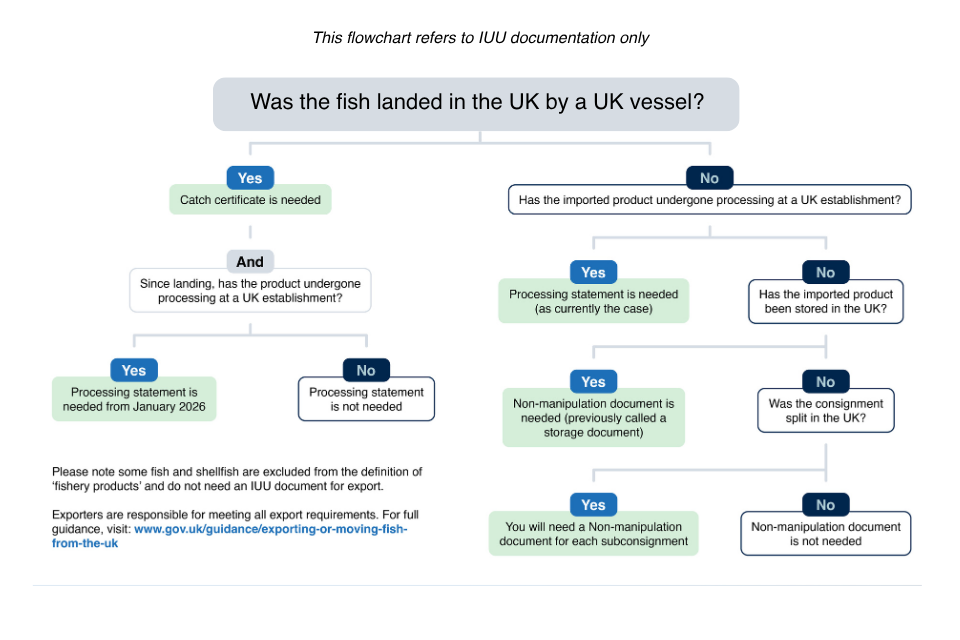
If you land fish directly into EU ports, you’ll also need to complete:
What you need to create a UK Catch Certificate:
- a Government Gateway user ID and password
- the company name and address of the exporter
- the name of the person responsible for the export
- the species (or Food and Agriculture Organisation (FAO) code) List of common species codes for fish landed in the United Kingdom - GOV.UK
- its state and its presentation
- the names or Port Letters and Numbers (PLNs) of the vessels that caught the species
- the fishing trip start dates and landing dates for each species
- the fishing gear used to catch each species
- to specify whose waters the species were caught in - the FAO area and the EEZ or High seas area
- applicable RFMO areas
- transport details for how the export will leave the UK and where it will leave from
- the identification numbers of the containers used to export the product (if applicable)
Catch Certificate sections explained:
Some fish and shellfish produce are excluded from the definition of ‘fishery products’ and do not need any IUU documents for export. Exemptions are listed in Annex II of the EU regulation Regulation – 1005/2008 – EN – EUR-Lex.
Exporters are responsible for assuring themselves that the information they have entered is accurate.
Fishing Trip Dates
Exporters must provide:
- Start date of fishing trip – This is the date the vessel left port on the trip the fish was landed. In the case of store pots, the start date will be the date the vessel left port to collect the pots, NOT the date the pots were deployed.
- Date Landed - The date the catch was landed (or the first day of landing where this is not completed within a single day).
Gear Type
Exporters need to provide the category of gear and the type of gear within that category, used to catch each fishery product. There is a predefined list provided for exporters to select the gear category and type from.
A list of gear codes is available on GOV.UK guidance here: Gear Type – GOV.UK. These codes are standardised for use in the system.
Catch Areas
Exporters must provide the catch area for each product, including:
- The FAO area in which each species was caught.
- The Exclusive Economic Zone (EEZ) in which the species was caught
- If the catch did not occur within an EEZ, confirmation whether it was caught in the high seas
- Confirmation whether the species, and the area it was caught in, is covered by a Regional Fisheries Management Organisation (RFMO) where applicable.
Definitions of each of these requirements can be found here: Fishing area.
Transport details
The requirements regarding the transport details on the catch certificate:
-
The exporter is responsible for filling in the details of the first transport from point of export indicating the port or place of departure and the means of transport. This section is not applicable for direct landing applications.
- This section cannot be left blank
-
Exporters can provide the details known to them at the time of creating the catch certificate if the transport from the point of export is not known.
- Where additional modes of transport are known, these can be added manually to the catch certificate. If no further transport details are known by the exporter at the point of creating the catch certificate the importer can be requested to provide it.
-
The point of destination must also be included on the catch certificate.
- If the point of destination is not known when creating a catch certificate, the first point of entry into the EU can be used.
For each method of transport used to export the consignment (e.g. road, sea, air), exporters will need to provide a form of transport identification.
- Road transport: The registration number of the truck or tractor unit must be entered.
- For other transport modes, such as sea or air, a relevant identifier (e.g. vessel name, IMO number, flight number) will be required.
There are optional fields to capture freight bill and container identification numbers. Ferry details will not be required.
Data Upload Journey
Exporters using the data upload facility must update each line of their CSV files to the following structure:
Product ID / Start date / Date landed / Catch area / High Seas area / EEZ / RFMO / Vessel PLN / Gear type / Export weight
For further guidance please see: Upload guidance