Tax relief statistics (January 2026)
Published 22 January 2026

© Crown copyright 2026
This publication is licensed under the terms of the Open Government Licence v3.0 except where otherwise stated. To view this licence, visit nationalarchives.gov.uk/doc/open-government-licence/version/3 or write to the Information Policy Team, The National Archives, Kew, London TW9 4DU, or email: psi@nationalarchives.gov.uk.
Where we have identified any third party copyright information you will need to obtain permission from the copyright holders concerned.
This publication is available at https://www.gov.uk/government/statistics/tax-reliefs/tax-relief-statistics-january-2026
1. About this publication
This publication provides the latest estimates of the costs of structural and non-structural reliefs in the UK tax system. Tax reliefs reduce the amount of tax payable by a person or company if they meet certain conditions. HM Revenue and Customs (HMRC) defines reliefs as either ‘structural’ or ‘non-structural’:
-
‘non-structural’ tax reliefs are designed to advance economic or social objectives
-
‘structural’ tax reliefs are integral parts of the tax system and have various purposes, such as to define the scope of the tax or calculate income or profits correctly
The publication is set out in the following sections:
-
section 1 sets out what’s new in this publication. It includes the changes we have made in response to our 2025 statistics consultation, external recommendations and our progress in costing ‘non-structural’ reliefs
-
section 2 sets out high-level statistics on the overall tax reliefs system and recent trends. The section also sets out high-level statistics on the cost of non-structural tax reliefs and sources of change over time
-
section 3 presents in-depth analysis for the largest 40 non-structural reliefs. For each relief we set out: how the costs have changed over time, distributional analysis and any evaluative evidence or external data sources which are relevant
-
sections 4, 5 and 6 set out our approach to monitoring the outturn costs of tax reliefs compared to policy costings and to previous forecasts
For a full list of structural and non-structural reliefs we have investigated and their associated cost (where available), see the accompanying statistical tables:
1.1 Key Methodological Information
The figures in this publication are estimates of the amount of relief which is claimed and subsequently granted each tax year in £ million. The figures do not represent the gain to the Exchequer should a relief be abolished. The figures do not explicitly model additional behavioural responses and wider economic impacts which could result from changes to the reliefs, nor do they consider interactions with other reliefs.
For information on the data and methods used to produce estimates within this bulletin and the accompanying statistical tables, see the accompanying quality and methodology information report. We also published a background quality report for the tax relief statistics detailing our quality assurance processes and information on the quality of our estimates.
1.2 What’s new?
The main update in this publication reflects updated cost estimates for 115 multi-year non-structural reliefs (where data is available across multiple tax years) and 82 structural reliefs. These costings, descriptions, and objectives have been updated as follows:
-
most multi-year costings have been extended to the 2025 to 2026 tax year
-
the costings have been updated for the latest administrative and external data as well as the Spring Forecast 2025 OBR economic determinants unless stated otherwise
-
the impacts of new Government policy decisions up to and including Spring Statement 2025 have been included. Most of the announcements in Budget 2025 (announced on 26 November 2025) take effect from April 2026 onwards and so are out of scope for this publication. Where published years are affected, details of implemented or planned changes are included in the notes found in the statistical tables and in section 3 where relevant
Since the December 2024 publication 4 new costings have been added to the publication, detailed in table 1 below.
Table 1: New costings for previously uncosted non-structural tax reliefs
| Relief name(s) | Tax head(s) | Costing type | Note |
|---|---|---|---|
| Crown Employee Relief from the non-resident surcharge of SDLT | Stamp Duty Land Tax | Single-year | Crown Employee Relief was introduced from April 2021 alongside the SDLT non-resident surcharge. Claimant figures are not available. |
| Capital allowances: Structures and buildings allowance | Income Tax and Corporation Tax | Multi-year | The Structures and Buildings Allowance was introduced from October 2018. Claimant figures are not currently available. |
| Passengers carried on flights departing from airports in the Scottish Highlands and Islands | Air Passenger Duty | Multi-year | APD relief available for passengers carried on flights departing from airports in the Scottish Highlands and Islands was introduced from January 2018. Claimant figures are not available. |
| Relief for Freeport tax sites | NICs, Income Tax, Stamp Duty Land Tax and Corporation Tax | Multi-year | Freeports tax reliefs were introduced from 2022 to 2023 for the 10 English Freeports. Claimant figures are not currently available. |
Due to the changes to the taxation of non-UK domiciled individuals announced in Spring 2024 and modified in Autumn 2024, we have removed the following uncosted relief from our list:
- Capital Gains Tax, Income Tax and Inheritance Tax: Trust protections for deemed domiciled individuals
We will look to add 2025 to 2026 estimates for the new reliefs in 2027, or when data is available.
We have also assigned uncosted relief reason code A: ‘Information on the usage of this relief is not required in tax returns and cannot be reliably estimated from other data sources, and the cost of collection for statistical purposes is disproportionate’ to the following non-structural reliefs which were previously not investigated:
-
Stamp Duty Land Tax: Acquisition by a property trader from an individual acquiring a new dwelling
-
Stamp Duty Land Tax: Acquisitions by property traders from an individual where chain of transactions breaks down
-
Income Tax and Corporation Tax: Charitable trading income
We are combining the following reliefs with the previously published ‘Relief on employer National Insurance contributions for freeport employees’ to publish a single estimate for all tax reliefs in English Freeports. This is to avoid issues with Statistical Disclosure Control rules which arise from publishing the individual reliefs separately:
-
Stamp Duty Land Tax: Relief for Freeport tax sites
-
Corporation Tax: Enhanced capital allowance for plant and machinery in Freeports
-
Corporation Tax and Income Tax: Capital allowances - enhanced structures and buildings allowance in Freeports
HM Revenue and Customs (HMRC) is committed to producing high value and good quality statistical publications that users need while using our resources in the most effective ways. In our 2025 consultation, we engaged users of these statistics and made the following proposals, which are being incorporated into this release:
-
in 2026, we are no longer releasing separate non-structural and structural tax relief publications. We now produce a combined publication covering all tax reliefs, making clear which reliefs are considered non-structural and which are considered structural. We will thus only publish one annual Tax reliefs statistical publication going forward
-
we have reviewed the number of additional downloadable files and combined them into a single file which is clearer and more accessible
-
we have also introduced more visualisations to help users better interpret the reliefs data
If you would like to comment, provide feedback or make other suggestions about these statistics, please email HMRC.
1.3 Progress costing non-structural reliefs
Since 2019, HMRC has dedicated additional resources to costing previously uncosted tax reliefs prioritising non-structural reliefs. The project started in 2019 and is run in 2 stages:
-
Stage 1 attempts to estimate costs for each non-structural tax relief based on the data currently available
-
as many reliefs are designed to minimise admin burdens, customers do not always have to inform HMRC that they are using them. Where HMRC would need to collect or purchase additional data to cost a relief, it moves to stage 2. In stage 2, HMRC will consider further options available to cost these reliefs. These considerations will balance the costs of further data collection, admin burdens and the expected benefits of estimating a relief cost
Figure 1 shows the current number of costed and uncosted non-structural tax reliefs and table 2 provides the costing status of reliefs since October 2020. They take into account the updates described in the section above. The number of reliefs in this publication reflects the way they have been costed and published. In some cases, individual reliefs have been grouped to ease costing and administrative oversight. For example, as described above, although there are 4 different tax reliefs available in Freeports they have been combined to comply with Statistical Disclosure Control rules and thus are counted as one relief in this publication.
The figures below reflect the number of non-structural reliefs investigated and costed as of the 2024 to 2025 tax year and the changes described in the section above. Any changes to this total beyond April 2025 will be reflected in future publications. HMRC have now investigated 335 (99%) non-structural reliefs and published costings for 270 of them. A further 28 cannot be disclosed. 5 reliefs are still to be investigated as part of stage 1, and 37 reliefs have moved to stage 2.
Figure 1: Proportion of costed and uncosted non-structural reliefs
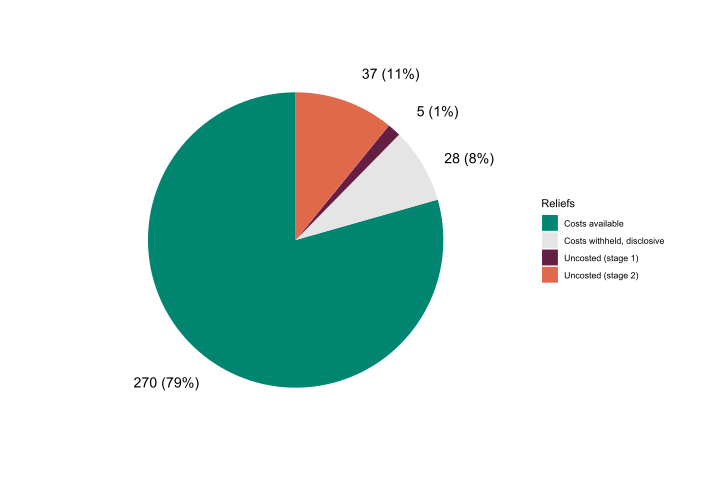
Table 2: Relief costing status since October 2020 publication
| Relief status | October 2020 | December 2021 | December 2024 | January 2026 |
|---|---|---|---|---|
| Costs available | 176 | 221 | 268 | 270 |
| Of which single year | 73 | 118 | 155 | 155 |
| Of which multi year | 103 | 103 | 113 | 115 |
| Costs withheld, disclosive | 11 | 26 | 28 | 28 |
| Uncosted | 148 | 86 | 48 | 42 |
| Of which unable to cost | 72 | 48 | 37 | 37 |
| Of which yet to investigate | 76 | 38 | 11 | 5 |
| Total | 335 | 333 | 344 | 340 |
Please note some smaller changes such as combining reliefs and moving negligible estimates to single years also influence these numbers.
1.4 Developing and expanding commentary on the cost and impact of reliefs
Following recommendations from the Public Accounts Committee (PAC) in July 2020, HMRC has committed to:
-
‘improving the available information about the groups and sectors benefitting from significant reliefs’
-
‘identify and explain significant cost variances within reliefs’
HMRC has confirmed that it has satisfied PAC’s recommendations in the June 2022 Treasury Minutes progress report.
HMRC has continued to make progress in this area in the statistics publication this year by including:
-
links to and summaries of existing published analysis that may shed light on the distributional impacts and effectiveness of the most significant reliefs
-
summary statistics highlighting key trends and findings from across the relief costings
2. Summary
Estimates for 2025 to 2026 are almost entirely based on forecasts and are included in the detailed tables. Therefore, we focus on the 2024 to 2025 tax year which are less reliant on forecast assumptions. The key points from this year’s statistical publication are:
Number of costed tax reliefs
-
HMRC has costed 380 tax reliefs and investigated a further 189
-
of the 380 tax reliefs that have been costed, 298 are non-structural (including disclosive estimates) and 82 are structural
-
where the data doesn’t allow us to produce ‘multi-year’ estimates, we produce a ‘single-year’ estimate. This publication includes 155 single-year non-structural relief estimates
-
28 reliefs have cost estimates but cannot be disclosed, to avoid issues with Statistical Disclosure Control rules
-
the rest of the non-structural tax relief estimates (115) have multi-year costings and 103 currently have estimates for the latest tax year (2024 to 2025). This is due to some reliefs having ceased or others being too new to forecast reliably
Value of costed non-structural tax reliefs
-
non-structural tax reliefs for which we have estimates in the previous tax year (2023 to 2024) were updated for latest outturn. That estimate is now £202 billion, down by about £5 billion (2%) compared to the December 2024 publication. This is due mainly to outturn data updates to large Capital Gains Tax, Income Tax, Corporation Tax and VAT reliefs
-
the 103 non-structural tax reliefs for which we have estimates in the latest tax year (2024 to 2025) cost £218 billion
-
the above totals excludes ‘single-year’ estimates and other reliefs which have not yet been costed, so they do not reflect the overall value of non-structural tax reliefs
-
the overall cost of these reliefs has increased, with the aggregate cost up by about £16 billion (8%) in the tax year 2024 to 2025 from £202 billion in the previous tax year
-
this is higher than tax receipts growth for the same year of 4% according to the OBR public finances databank - November 2025. This means the costed reliefs have increased as a share of receipts in the 2024 to 2025 tax year, compared to that proportion having fallen in previous years
-
this rise partly reflects the wider growth in Income Tax (IT) receipts. IT receipts rose by £29 billion (10%) over the same period, in part reflecting the strength in nominal wages and policy changes. This is reflected in the larger than previously expected increase in the Income Tax: Registered Pensions Scheme relief
-
the rise also reflects strong growth in some large reliefs such as Business Assets Disposal relief and Individual Savings Accounts. For more detailed information, see section 2.1 and section 3
Composition of non-structural tax reliefs
-
most of the cost is driven by the largest five non-structural reliefs, which make up 59% (£128 billion) of all costed non-structural reliefs (see section 3)
-
figure 2 shows that in the last 5 tax years up to 2024 to 2025 VAT was the tax head with the highest cost of tax relief (£70 billion for the latest year). VAT accounts for about a third of the value of costed non-structural reliefs, followed by Capital Taxes (£47 billion) and Income Tax (£49 billion). Corporation Tax (£21 billion) and NICs (£28 billion) show the lowest tax relief cost
Figure 2: the aggregate cost (£ billion) of non-structural reliefs with multi-year estimates available in each year by tax head
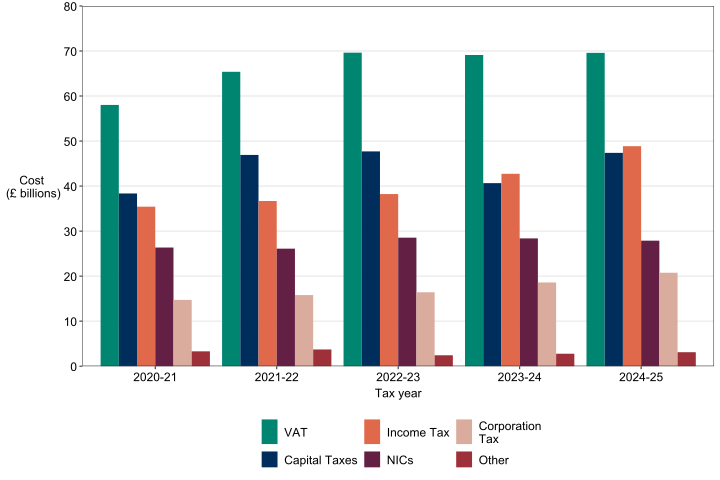
Please note, this graph does not include single-year costings. The cost changes in earlier years may be due to the increase in the number of estimates (see table 2) more so than economic determinants or policy.
2.1 Change in the cost of non-structural reliefs over time
Although total non-structural relief for which we have estimates stay relatively stable year-to-year, individual reliefs can change significantly over time.
Table 3 shows that where comparisons are available and looking at costs over the previous 5 years as % of GDP, 36 reliefs increased in cost by more than 10%. For 41 reliefs costs decreased by more than 10% and for 21 reliefs costs remained stable with variation of less than 10% in the previous 5 years.
Overall, Corporation Tax reliefs were more likely to have risen over the past 5 years. In part, these increases reflect policy changes, such as the rise in the Main Rate of Corporation Tax from 19 to 25 per cent from April 2023. Changing economic activity can also contribute to the changes in costs for example where rising prices increase the total amount of VAT relief.
Table 3: changes in the non-structural reliefs’ proportion of GDP from tax year 2020 to 2021 to tax year 2024 to 2025
| Tax type | Reduced by more than 10% | Changed by less than 10% | Increased by more than 10% | Total |
|---|---|---|---|---|
| Income Tax | 11 | 4 | 5 | 20 |
| Capital taxes | 9 | 4 | 5 | 18 |
| Corporation Tax | 3 | 2 | 13 | 18 |
| VAT | 6 | 6 | 5 | 17 |
| Other | 8 | 3 | 3 | 14 |
| Multiple tax heads | 3 | 1 | 2 | 6 |
| NICs | 1 | 1 | 3 | 5 |
Table 4 shows the 10 non-structural reliefs with the largest percentage increases in cost over the previous 5 years. The 5 year period covers tax year 2020 to 2021 to tax year 2024 to 2025, where in many cases 2020 to 2021 saw decreases to relief use due to COVID-19 impacts on the economy and day-to-day life. These 10 reliefs amount to a change of £18 billion and are generally due to changes in the economic activity that drives them and/or changes in policy.
For example, the largest percentage increases over the 5 years are the Reduced rate of VAT on energy saving materials with 260% (£520 million) and Business Asset Disposal Relief with 209% (£2.3 billion). The increase in the VAT relief of energy saving materials reflects the increased generosity of the relief and rising uptake of energy saving materials. Meanwhile the increase in BADR mainly reflects taxpayer behavior as taxpayers brought forward eligible disposals from future years in anticipation of tax rate changes. In addition, the increase in the main CGT rates means that in the tax year 2024 to 2025 the difference between the main rates of CGT and the BADR rate increased, further increasing the relief value.
The largest increase in money terms is £5.7 billion (185%) for Individual Savings Accounts, which is driven mainly by the increase in interest rates in recent years. For further information, please see section 3: Detailed analysis for the most significant non-structural tax reliefs.
Table 4: largest percentage changes in the cost of large reliefs in the period 2020 to 2021 to 2024 to 2025
| Relief name | Cost change (%) |
|---|---|
| VAT: Reduced rate of VAT on energy saving materials (£520 million increase) | 260 |
| CGT: Business Asset Disposal Relief (£2.3 billion increase) | 209 |
| IT: Personal Savings Allowance (PSA) (£500 million increase) | 185 |
| CT: High-End TV Tax Relief (£640 million increase) | 178 |
| VAT: Domestic passenger transport (£3.5 billion increase) | 167 |
| Multiple tax types: Individual Savings Accounts (£5.7 billion increase) | 138 |
| CT: Research and development tax relief: R&D Expenditure Credit (£2.6 billion increase) | 96 |
| NICs: Relief on employer National Insurance contributions for employees under 21 (£540 million increase) | 96 |
| IHT: Agricultural property relief (£340 million increase) | 94 |
| CT: Patent box (£1.1 billion increase) | 92 |
The 1 large relief where costs fell significantly over the period was Hydrocarbon Oil Duties: Duty rate for marked gas oil and kerosene for heating. The fall in costs over the 5 year period was £1.2 billion. As set out in section 3, this fall reflects policy measures to remove the entitlement to use red diesel from most users from April 2022.
2.2 Single-year cost estimates
Where HMRC cannot produce multi-year estimates of a tax relief due to lack of data or forecast uncertainty, we instead look at whether a single-year estimate is possible. Since committing in 2019 to publish cost information for more reliefs, we have published 155 single-year non-structural cost estimates where reliefs were previously uncosted. Around half of these cost estimates are negligible, see table 5.
Each cost estimate has been assigned an uncertainty level. Our assessment of the uncertainty level is broad-based and considers the quality of the data used and the assumptions made. See the accompanying quality and methodology information report for more details.
Table 5: number of reliefs estimates with a single-year costing by uncertainty rating
| Cost band | Low | Medium | High | Total |
|---|---|---|---|---|
| Negligible (<£3 million) | 34 | 22 | 26 | 82 |
| £3 million < x ≤ £25 million | 5 | 15 | 13 | 33 |
| £25 million < x ≤ £50 million | 3 | 2 | 10 | 15 |
| £50 million < x ≤ £75 million | 1 | 1 | 0 | 2 |
| £75 million < x ≤ £100 million | 0 | 0 | 5 | 5 |
| £100 million < x ≤ £250 million | 2 | 4 | 2 | 8 |
| £250 million < x ≤ £500 million | 0 | 2 | 1 | 3 |
| £500 million < x ≤ £1 billion | 0 | 1 | 3 | 4 |
| >£1 billion | 0 | 2 | 1 | 3 |
3. Detailed analysis for the most significant non-structural tax reliefs
In the next section we set out a more detailed analysis of the largest 40 non-structural reliefs. In the latest year of data 2024 to 2025 the largest 40 non-structural tax reliefs:
-
were worth £211 billion or 97% of costed non-structural reliefs
-
are mostly driven by the five largest reliefs that account for £128 billion or 59% of costed non-structural reliefs
-
the tax head with most large reliefs is VAT with 11 reliefs, followed by 7 Income Tax, 6 Corporation Tax and 5 Inheritance Tax
Figure 3: cost change over time for the top 5 largest non-structural reliefs
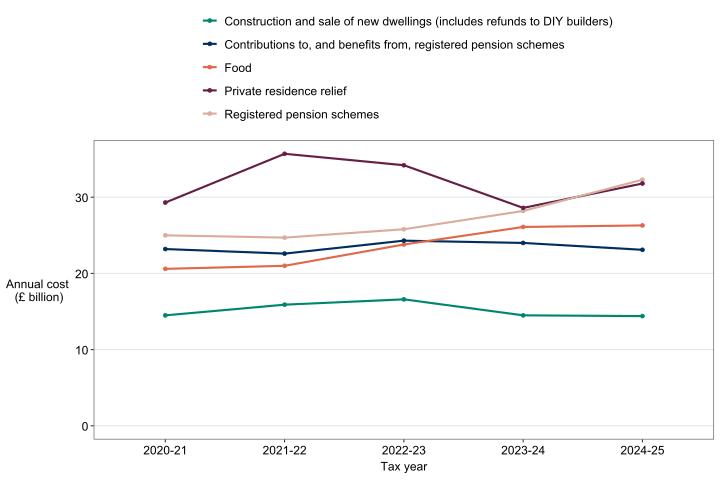
Figure 3 shows the largest 5 reliefs have grown by £15.3 billion relative to 2020 to 2021. Registered Pension Schemes and Private Residence Relief are the largest (about £32 billion each in 2024 to 2025). Registered Pensions Schemes and VAT Food have grown the most over the period, up by £7.3 billion and £5.7 billion respectively since 2020 to 2021.
The following section explores the changes in costs over time for the largest 40 non-structural reliefs. Costs are presented in cash terms and as a share of nominal GDP, as the cash cost will tend to rise and fall in line with the underlying economic activity. The section sets out:
- a commentary on how the costs have changed over time
- distributional analysis
- any published evaluative summaries or external data sources
- any relevant forecast information
In November 2021, HMRC published a list of non-structural tax reliefs available to taxpayers. This list sets out the objective of each non-structural relief.
Detailed analysis is available for the following reliefs:
Table 6: Large reliefs with detailed analysis within this publication
As we do not currently have forecasts for Employee Share Schemes the above ranking for Save As You Earn and Enterprise Management Incentives (EMI) is based on the latest outturn for 2023 to 2024.
The GDP data is taken from Table 1.4 of the November 2025 Office for Budget Responsibility Economic and fiscal outlook - supplementary economy tables.
The cost (£ million) and number of claimants estimates given in the following tables are outturn data except where followed by an asterisk (*). This indicates that the estimate is a forecast.
The figures in this publication are estimates of the amount of relief which is claimed and subsequently granted each tax year in £ million. The figures do not represent the gain to the Exchequer should a relief be abolished.
Forecast information is provided where available. For some reliefs the original policy costing estimate period does not overlap with the period for which we publish outturn costs and forecasts in this publication. Where available we set out differences to the forecast in section 5.
3.1 Capital Gains Tax - private residence relief
Description
Gains on the disposal of a residence is exempt from CGT to the extent it has been used as the person’s only or main residence.
| Tax year | 2020 to 2021 | 2021 to 2022 | 2022 to 2023 | 2023 to 2024 | 2024 to 2025 | 2025 to 2026 |
|---|---|---|---|---|---|---|
| Cost (£ million) | 29,300 | 35,700 | 34,200 | 28,600 | 31,800 | 32,900* |
| Cost (% GDP) | 1.389% | 1.488% | 1.298% | 1.025% | 1.086% | 1.081%* |
Figure 4: nominal annual cost (£ million) and cost as a share of GDP (%)
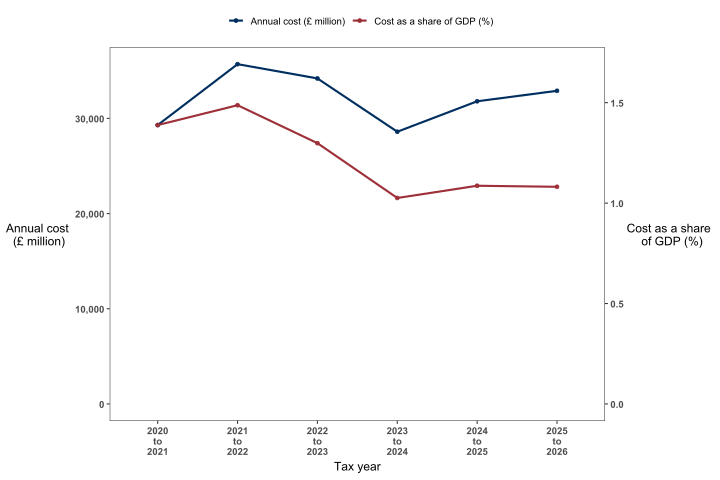
The information in the chart is represented in the preceding table.
Commentary on cost change over time
The outturn cost of this relief (up to 2024 to 2025) is estimated using outturn data on the value of UK property transactions, alongside a range of uncertain assumptions about the distribution and value of property disposals. The 2024 to 2025 estimate is grown in line with OBR forecasts for property prices and transactions to derive the 2025 to 2026 figure.
For transactions that completed a SDLT return, total SDLT liable residential property values fell in 2022 to 2023 and 2023 to 2024, with a subsequent recovery in 2024 to 2025 with a corresponding impact on the cost of this relief.
The forecast for 2025 to 2026 remains fairly stable compared to prior years.
The estimated cost of this exemption from capital gains tax does not represent the yield if this exemption were to be abolished, as consequential behavioural effects would substantially reduce yield.
Distributional analysis
Homeowners receive this relief when they sell their main home. The Ministry of Housing, Communities and Local Government’s(MHCLG) English Housing Survey (EHS) for 2023 to 2024 shows that 16million out of a total 24.7 million households (65%) in England were owner-occupiers and this has remained generally stable over recent years.
The EHS also reported that respondents aged 16 to 24 were more likely to be in private rented accommodation whilst owner occupation was more likely for older respondents.
Statistics published by the Office for National Statistics (ONS) show that property ownership rates increase as income increases.
Evaluative summary
The Office of Tax Simplification’s 2021 report, Capital Gains Tax – second report: Simplifying practical, technical and administrative issues, discusses this relief.
3.2 Income Tax - registered pension schemes
Description
Covers net relief including relief on contributions, relief on investment returns, and tax paid in retirement (net of 25% lump sum).
| Tax year | 2020 to 2021 | 2021 to 2022 | 2022 to 2023 | 2023 to 2024 | 2024 to 2025 | 2025 to 2026 |
|---|---|---|---|---|---|---|
| Cost (£ million) | 25,000 | 24,700 | 25,800 | 28,200 | 32,300* | 33,500* |
| Cost (% GDP) | 1.185% | 1.029% | 0.979% | 1.011% | 1.104%* | 1.101%* |
Figure 5: nominal annual cost (£ million) and cost as a share of GDP (%)
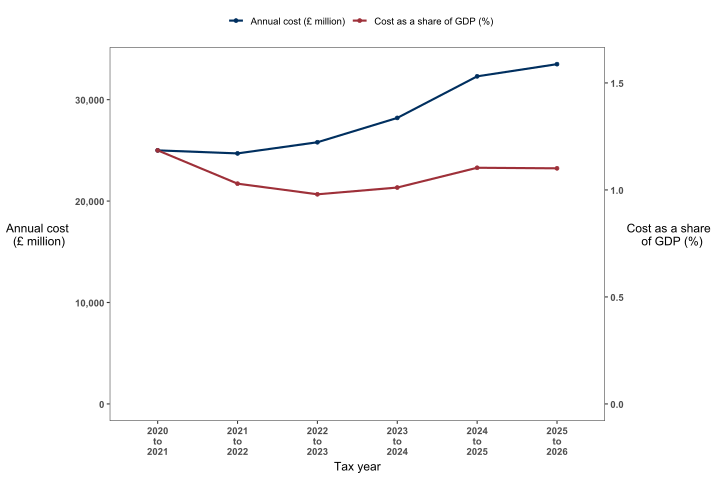
The information in the chart is represented in the preceding table.
Commentary on cost change over time
The methodology used to produce these estimates aligns with that used for Table 6 of the Private pensions statistics publication. There is an accompanying quality report for the Private pension statistics publication. The forecasts for 2024 to 2025 and 2025 to 2026 incorporate the effects of policy changes, including the abolition of the Lifetime allowance and the increase to the Annual allowance announced at Spring Budget 2023. They do not include changes to salary sacrifice announced at Budget 2025.
The estimated cost of income tax relief on registered pension schemes has increased in cash terms from 2020 to 2021 to 2024 to 2025. One driver of the cost of Income Tax relief on registered pension schemes is the aggregate value of pension contributions, which tends to move in line with wider labour market income. Growth in labour income over recent years may have supported the rise in the estimated cost of this relief.
The increase to the annual allowance and the abolition of the lifetime allowance has likely increased contributions and decreased pension tax charges over this period, which will increase net tax relief on pensions. The lowering of the additional rate threshold in 2023 to 2024 will also increase net tax relief on pensions by bringing more people into the top income tax band.
The full methodology for Table 6 can be found in section 5.2 of the background and methodology document.
Distributional analysis
ONS workplace pensions statistics show that nearly eight out of ten of UK employees had a workplace pension in April 2021.
HMRC Private pension statistics (Table 6) estimate that in 2023 to 2024, 68% of Income Tax relief on total pension contributions was relieved on contributions to personal or private sector occupational schemes, and 54% was relieved on contributions to defined contribution schemes. It is estimated that 7% of Income Tax relief on total pension contributions was relieved at the additional rate of Income Tax, 56% at the higher rate, and 37% at the basic rate.
Evaluative summary
HM Treasury published a consultation document in 2015 to seek views on whether pension tax relief should be reformed. The responses to the consultation have also been published.
HMRC commissioned independent research with individuals and employers on pension tax relief in 2015. The research concluded that only 41% of adults correctly believed that the government tops up people’s pension contributions through tax relief. Many people underestimated the amount of tax relief the government provided on pension contributions. Given their lack of awareness, most people were willing to consider an alternative pension tax system, although this would not necessarily change the amount they saved.
Forecast information
Forecasted relief cost figures for 2022 to 2023 and 2023 to 2024 may be revised in the 2026 private pensions publication as further outturn data becomes available. In particular, 2023 to 2024 is currently based partially on both forecasted data and outturn data; further information can be found in Table 6 of the Private pension statistics.
3.3 VAT - food
Description
Zero rating of most food (including cold food for takeaway).
| Tax year | 2020 to 2021 | 2021 to 2022 | 2022 to 2023 | 2023 to 2024 | 2024 to 2025 | 2025 to 2026 |
|---|---|---|---|---|---|---|
| Cost (£ million) | 20,600 | 21,000 | 23,800 | 26,100 | 26,300 | 27,400* |
| Cost (% GDP) | 0.976% | 0.875% | 0.904% | 0.936% | 0.899% | 0.9%* |
Figure 6: nominal annual cost (£ million) and cost as a share of GDP (%)
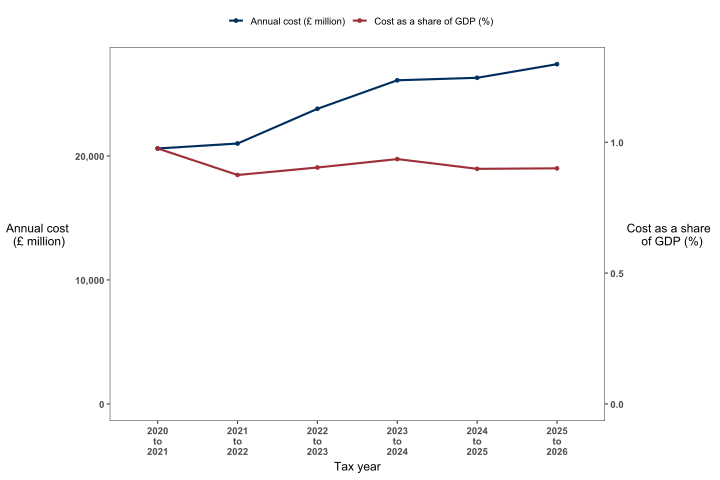
The information in the chart is represented in the preceding table.
Commentary on cost change over time
The cost of the relief has risen gradually in nominal terms, including during the COVID-19 period in 2020 to 2021 as consumers maintained expenditure on food purchases, and even increased expenditure during the closure of much of the hospitality sector.
As a proportion of GDP, the cost has remained broadly static except during COVID-19 in 2020 to 2021 when expenditure on food did not follow the downturn of the wider economy. Inflationary pressures, which have been greater for food, increased the nominal cost of the relief in recent years.
Distributional analysis
The ONS Family spending workbook 1: detailed expenditure and trends (table 3.1, table 1.1 and tab 3.2, table 1.1) show that people living in households with lower incomes spend more on food as a proportion of total expenditure. However, higher income deciles spend more on food in absolute terms.
3.4 NICs - contributions to, and benefits from, registered pension schemes
Description
Payments by way of an employer’s contribution towards a registered pension scheme or by way of any benefit pursuant to a registered pension scheme are disregarded in the calculation of earnings for the purposes of earnings-related contributions.
| Tax year | 2020 to 2021 | 2021 to 2022 | 2022 to 2023 | 2023 to 2024 | 2024 to 2025 | 2025 to 2026 |
|---|---|---|---|---|---|---|
| Cost (£ million) | 23,200 | 22,600 | 24,300 | 24,000 | 23,100* | 25,600* |
| Cost (% GDP) | 1.1% | 0.942% | 0.923% | 0.861% | 0.789%* | 0.841%* |
Figure 7: nominal annual cost (£ million) and cost as a share of GDP (%)
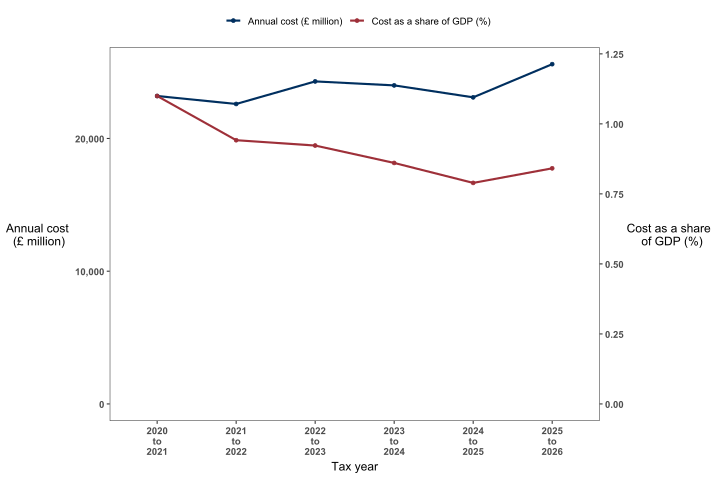
The information in the chart is represented in the preceding table.
Commentary on cost change over time
The methodology used to produce these estimates aligns with that used for Table 6 of the Private pensions statistics publication. There is an accompanying quality report for the Private pension statistics publication. The forecasts for 2024 to 2025 and 2025 to 2026 incorporate the effects of policy changes, including the abolition of the Lifetime allowance and the increase to the Annual allowance announced at Spring Budget 2023. The do not include changes to salary sacrifice announced at Budget 2025.
The estimated cost of National Insurance Contribution relief on registered pension schemes has remained broadly stable from 2020 to 2021 to 2024 to 2025. The estimated value of relief increased in 2020 to 2021 and 2022 to 2023, however, the value of relief decreased in the subsequent years from 2021 to 2022 to 2024 to 2025. The relief consists of primary (employee) and secondary (employer) National Insurance Contributions (NICs) relief, on both employer contributions and salary sacrificed contributions.
One driver of costs during this period could be wage growth. The OBR’s labour market forecast shows strong wage growth between 2021 to 2022 and 2023 to 2024, averaging 4.6% over those 3 tax years, which could feed into higher pensions contributions and, in the absence of other changes, increase the cost of relief.
The Class 1 Primary NICs rate applied between the Primary Threshold and Upper Earnings Limit was reduced from 12% to 10% in 2023 to 2024 and then to 8% in 2024 to 2025, resulting in a decrease in the forecasted cost of NICs relief in those years.
The Class 1 Secondary NICs rate applied above the Secondary Threshold will increase from 13.8% to 15% in 2025 to 2026, and the threshold will be lowered from £9,100 to £5,000, resulting in an increase in the forecasted cost of NICs relief in that year.
The estimated cost of National Insurance Contribution relief on registered pension schemes as a proportion of GDP has decreased between 2020 to 2021 and 2024 to 2025.
The full methodology for Table 6 can be found in section 5.2 of the background and methodology document.
Distributional analysis
ONS workplace pensions statistics show that nearly eight in ten UK employees had a workplace pension in April 2021.
HMRC Private pension statistics (Table 6) estimate that in 2022 to 2023, Class 1 Primary National Insurance relief on contributions to defined benefit schemes accounted for 54% of National Insurance relief on contributions, the remaining 46% of relief was on contributions to defined contribution schemes.
Evaluative summary
HM Treasury published a consultation document in 2015 to seek views on whether pension tax relief should be reformed. The responses to the consultation have also been published.
HMRC commissioned independent research with individuals and employers on pension tax relief in 2015. The research concluded that only 41% of adults correctly believed that the government tops up people’s pension contributions through tax relief. Many people underestimated the amount of tax relief the government provided on pension contributions. The governments policy of providing tax relief worth over £50bn annually plays a significant role in encouraging higher savings to support individuals’ retirement.
Forecast information
Forecasted relief cost figures for 2022 to 2023 and 2023 to 2024 may be revised in the 2025 private pensions publication as further outturn data becomes available. In particular, 2023 to 2024 is currently based partially on both forecasted data and outturn data; further information can be found in Table 6 of the private pension statistics publication.
3.5 VAT - construction and sale of new dwellings (includes refunds to DIY builders)
Description
Zero rating of construction and sale of new relevant residential and relevant charitable buildings.
| Tax year | 2020 to 2021 | 2021 to 2022 | 2022 to 2023 | 2023 to 2024 | 2024 to 2025 | 2025 to 2026 |
|---|---|---|---|---|---|---|
| Cost (£ million) | 14,500 | 15,900 | 16,600 | 14,500* | 14,400* | 14,600* |
| Cost (% GDP) | 0.687% | 0.662% | 0.63% | 0.52%* | 0.492%* | 0.48%* |
Figure 8: nominal annual cost (£ million) and cost as a share of GDP (%)
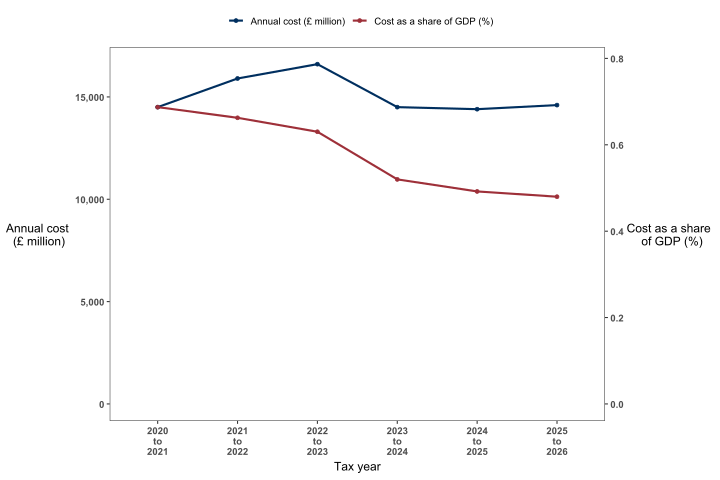
The information in the chart is represented in the preceding table.
Commentary on cost change over time
The cost of this relief is driven by the number and average value of houses built.
According to Office for National Statistics (ONS) data (Table 15), the average new dwelling price increased by 1% between 2021 Q2 and 2025 Q2 (£328,000 to £332,000 respectively).
The number of net additional dwellings completed in England decreased by 11% from 2023-24 to 2024-25 according to statistics from the Department for Levelling Up, Housing and Communities (table 1): Housing supply: indicators of new supply, England: April to June 2025 - GOV.UK.
As the construction and sale of new dwellings makes up most of the relief, these changes are the main causes of cost changes over time.
Distributional analysis
The ONS House Price Dataset (Table 15) shows that for 2025 Q2 the average price for newly built dwellings in the United Kingdom was £332,000 compared to £315,000 for all dwellings.
The ONS Construction statistics annual tables (tables 3.3 and 3.6) show that in 2023, the construction industry in Great Britain was made up of around 365,000 firms and employed around 1.44 million workers.
3.6 Income Tax and Capital Gains Tax - individual savings accounts
Description
Individuals do not pay tax on any income (i.e., dividends, interest and bonuses) they receive from their ISA savings and investments. Individuals do not pay tax on capital gains arising on their ISA investments. Providers do not pay tax on income or capital gains on investments used to back ISA policies. From 2017, not just a relief, but also a government bonus (Lifetime ISA).
| Tax year | 2020 to 2021 | 2021 to 2022 | 2022 to 2023 | 2023 to 2024 | 2024 to 2025 | 2025 to 2026 |
|---|---|---|---|---|---|---|
| Cost (£ million) | 4,100 | 4,300 | 4,950 | 6,650 | 9,750 | 9,650* |
| Cost (% GDP) | 0.194% | 0.179% | 0.188% | 0.238% | 0.333% | 0.317%* |
| Number of claimants | 22,221,000 | 22,267,000 | 21,299,000 | Not available | Not available | Not available |
Figure 9: nominal annual cost (£ million) and cost as a share of GDP (%)
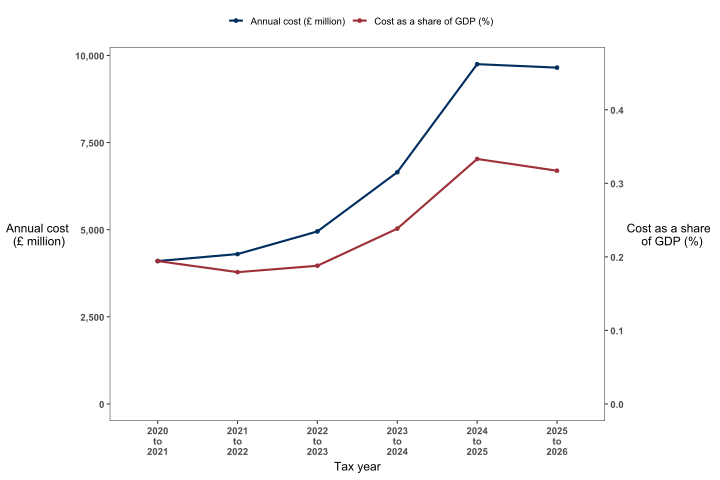
The information in the chart is represented in the preceding table.
Commentary on cost change over time
The cost of Individual Savings Accounts (ISAs) has generally increased over time, with large increases in recent years. The large increases are due to rising interest rates, and policy decisions to decrease the dividend allowance from £2,000 to £500 and the capital gains annual exempt amount from £12,300 to £3,000. The longer-term increase in the cost of ISAs over time is generally driven by increased overall accumulated wealth in ISAs.
The number of claimants appears to have fluctuated over time. Due to the calibration done to equalise the individual and aggregate ISA returns received from providers, the reported number of ISA accounts can fluctuate due to large differences between these two datasets.
Distributional analysis
HMRC Annual Savings Statistics reported that in 2023 to 2024 approximately 15 million adult ISAs were subscribed to, with subscriptions totaling around £103 billion. The average subscription was £6,863. The total market value of all adult ISAs was around £871.9 billion at the end of 2023 to 2024.
In 2022 to 2023, the median ISA holder (by income) had annual income of between £20,000 and £29,999, the average ISA market value of this income group was £31,536. For individuals with an income of £150,000 or more, the average ISA holdings was £94,894. Savers in higher income groups generally preferred stocks and shares ISAs over cash ISAs while those in lower income groups strongly preferred cash ISAs.
The greatest number of ISA holders in 2022 to 2023 were in the 65 and over age group; this group also had the highest average ISA market value of £64,386 compared to £8,288 for under 25s and £10,556 for those aged 25 to 34.
In 2022 to 2023, 51.6% of investors with ISA holdings worth £50,000 or more were female, and 51.5% of investors with ISA holdings worth up to £2,499 were female. The proportion of UK adults that held an ISA was 39%. The South East and South West regions have among the highest proportion of adults holding ISAs at 43% and 44% each, while Northern Ireland has the lowest at 29%.
Evaluative summary
A 2007 HMRC report explored the levels of Individual Saving Account (ISA) ownership.
Forecast information
The published forecast cost for Individual Savings Accounts from its introduction at Budget 1998 covers the years 1998 to 1999 to 2000 to 2001. This time period does not overlap with the period for which we publish outturn costs in this publication, and the two sets of figures are not comparable.
3.7 Income Tax and Corporation Tax - capital allowances - annual investment allowance
Description
Annual Investment Allowance provides 100% income tax/corporation tax relief on qualifying capital expenditure up to a limit of £200,000. This limit has been temporarily increased to £1 million per annum for the period 1 January 2019 to 31 March 2023 and then permanently set at £1 million at Autumn Budget 2022 from 1 April 2023 onwards.
| Tax year | 2020 to 2021 | 2021 to 2022 | 2022 to 2023 | 2023 to 2024 | 2024 to 2025 | 2025 to 2026 |
|---|---|---|---|---|---|---|
| Cost (£ million) | 4,100 | 3,300 | 2,500 | 4,500 | 5,000* | 5,000* |
| Cost (% GDP) | 0.194% | 0.138% | 0.095% | 0.161% | 0.171%* | 0.164%* |
| Number of claimants | 1,300,000 | 1,120,000 | 800,000 | Not available | Not available | Not available |
Figure 10: nominal annual cost (£ million) and cost as a share of GDP (%)
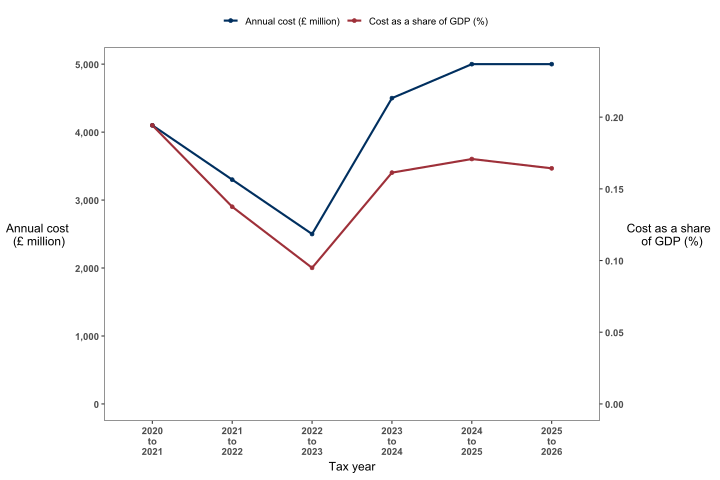
The information in the chart is represented in the preceding table.
Commentary on cost change over time
At Autumn Budget 2018 the government announced a temporary increase from £200,000 to the AIA threshold of £1 million from January 2019. This was made permanent at the Autumn Statement 2022. The higher AIA threshold is reflected in the marked increase in 2019 to 2020 and 2020 to 2021 compared to prior years.
In 2021 to 2022 and 2022 to 2023 the cost of the AIA has fallen, as some of the expenditure that would usually claim the 100% AIA has instead claimed the 130% Super-Deduction which was introduced in April 2021. In 2023 to 2024 the cost nearly doubles and continues to rise in 2024 to 2025 and 2025 to 2026, due to the end of the super-deduction and the increased Corporation Tax main rate from 19% to 25%
Distributional analysis
HMRC’s Corporation Tax statistics (table 12b) shows that in 2019 to 2020 the sector which claimed the highest amount of AIA claimed was Manufacturing (£3.7 billion) followed by Wholesale and Retail Trade, Repairs (£3.4 billion). The sector with the lowest amount of AIA claimed was Mining and Quarrying (£115 million).
A TIIN published in 2023 explains the permanent increase of AIA to £1,000,000. The assessment of the impact on small and micro businesses concluded that the temporary increase is expected to benefit the largest small and micro businesses.
Evaluative summary
An Ipsos evaluation report on the Capital Allowances: ring-fence oil business trades, first-year capital allowances for plant or machinery was published in May 2025.
Forecast information
The published forecast cost for the Annual Investment Allowance scheme when announced at Budget 2007 covers the years 2007 to 2008 up to 2009 to 2010. This time period does not overlap with the period for which we publish outturn costs in this publication, therefore the two sets of figures are not comparable.
3.8 VAT - domestic fuel and power
Description
Reduced rate of VAT on supplies of domestic fuel and power.
| Tax year | 2020 to 2021 | 2021 to 2022 | 2022 to 2023 | 2023 to 2024 | 2024 to 2025 | 2025 to 2026 |
|---|---|---|---|---|---|---|
| Cost (£ million) | 4,900 | 5,400 | 8,800 | 7,600 | 6,800 | 7,000* |
| Cost (% GDP) | 0.232% | 0.225% | 0.334% | 0.272% | 0.232% | 0.23%* |
Figure 11: nominal annual cost (£ million) and cost as a share of GDP (%)
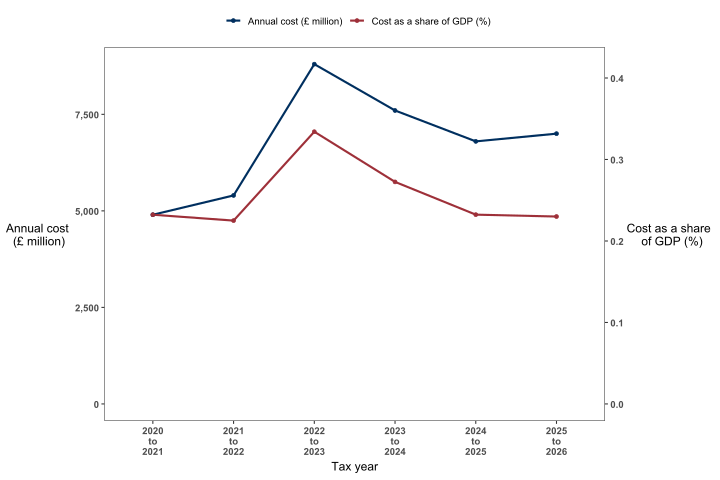
The information in the chart is represented in the preceding table.
Commentary on cost change over time
The cost of the reduced rate for domestic fuel and power remained relatively stable up to 2021 to 2022. Variations in individual years were mainly a reflection of fluctuating energy prices charged by suppliers.
The increase in 2022 to 2023 reflects the increase in the Ofgem Default Tariff Cap and the government’s Energy Price Guarantee introduced from 1 October 2022.
In 2023 to 2024 continued operation of the Guarantee until 30 June 2023 and the Cap thereafter meant the level remained high but it then began to fall following the gradual normalisation of energy prices.
Distributional analysis
The ONS Family spending workbook 1: detailed expenditure and trends (tab 3.1, table 4.4 and tab 3.2, table 4.4) show that, on average, expenditure on fuel and power by people living in households that are further down the income distribution is larger as a proportion of their total expenditure. However, higher income deciles spend more on fuel and power in absolute terms.
3.9 Corporation Tax - research and development tax relief: R&D expenditure credit
Description
Mainly for larger companies this relief allows them a taxable credit depending on their qualifying R&D expenditure.
| Tax year | 2020 to 2021 | 2021 to 2022 | 2022 to 2023 | 2023 to 2024 | 2024 to 2025 | 2025 to 2026 |
|---|---|---|---|---|---|---|
| Cost (£ million) | 2,700 | 3,000 | 3,200 | 4,400 | 5,300* | 5,400* |
| Cost (% GDP) | 0.128% | 0.125% | 0.121% | 0.158% | 0.181%* | 0.177%* |
| Number of claimants | 10,800 | 11,100 | 10,400 | 9,960 | Not available | Not available |
Figure 12: nominal annual cost (£ million) and cost as a share of GDP (%)
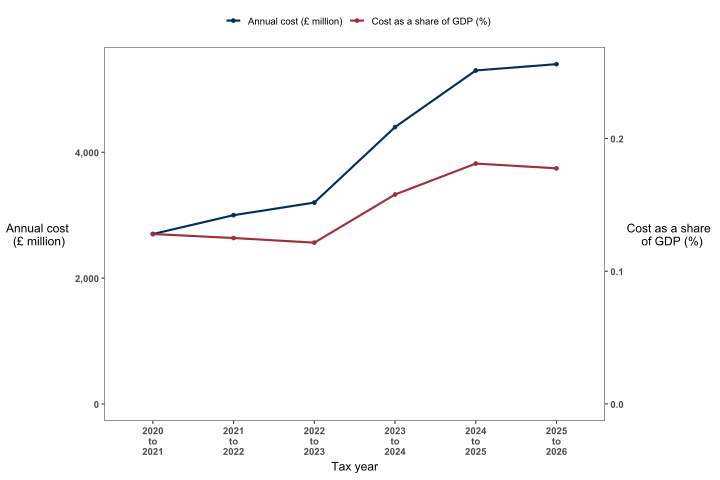
The information in the chart is represented in the preceding table.
Commentary on cost change over time
From 2020-21 to 2022-23 the cost of RDEC grew steadily at roughly 10% per year. This is due to a rise in the rates of relief, going from 12% to 13% in April 2020, and a small recovery from COVID-19 impacts.
Costs jump significantly in 2023-24 and 2024-25 due to the increased rate for RDEC, which is now 20%. This applies to R&D expenditure incurred from 1 April 2023.
The merged scheme R&D expenditure credit (RDEC) and enhanced R&D intensive support (ERIS) replace the old RDEC and small and medium-sized enterprise (SME) schemes for accounting periods beginning on or after 1 April 2024.
Both schemes feature restrictions on claiming for overseas expenditure, and new rules governing who can claim in contracting situations.
The RDEC figures in this publication cover legacy RDEC claims, and merged RDEC claims made by large companies or SMEs who previously claimed the legacy RDEC scheme (e.g. as subcontractors).
Distributional analysis
HMRC’s [Research and Development Tax Credits statistics (2025)] (https://www.gov.uk/government/statistics/corporate-tax-research-and-development-tax-credit) provide distributional analysis relevant to the R&D RDEC relief, breaking down the number of claims and the amount of relief claimed by UK region, company size and sector.
Evaluative summary
HMRC’s Evaluation of the RDEC report (2020) studied the effectiveness of RDEC and found that for every pound spent on RDEC, between £2.40 and £2.70 is additionally invested in R&D by UK companies
Forecast information
RDEC is included in the OBR’s corporation tax credits forecast in the Economic and fiscal outlook but the RDEC forecast is not published separately
3.10 VAT - domestic passenger transport
Description
Zero rating applies to the transport of passengers where the mode of transport takes more than 10 passengers, by Post Bus or on the UK portion of scheduled flights.
| Tax year | 2020 to 2021 | 2021 to 2022 | 2022 to 2023 | 2023 to 2024 | 2024 to 2025 | 2025 to 2026 |
|---|---|---|---|---|---|---|
| Cost (£ million) | 2,100 | 3,500 | 5,700 | 5,200 | 5,600 | 5,800* |
| Cost (% GDP) | 0.1% | 0.146% | 0.216% | 0.186% | 0.191% | 0.191%* |
Figure 13: nominal annual cost (£ million) and cost as a share of GDP (%)
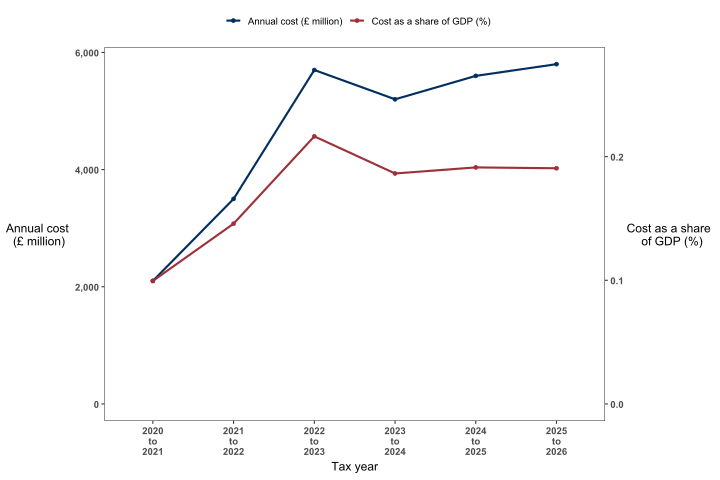
The information in the chart is represented in the preceding table.
Commentary on cost change over time
The estimate for 2020 to 2021 reflects the sharp reduction in use of public transport during COVID-19. There was a partial recovery in 2021 to 2022. By 2022 to 2023, the recovery from the pandemic was complete, and since then the trend in the annual cost has been broadly level, with a slight fall as a % of GDP.
Distributional analysis
The ONS Family spending workbook 1: detailed expenditure and trends (tab 3.1, table 7.3 and tab 3.2 table 7.3) show that average household spend on transport services increases with income decile, both as a proportion of household expenditure and in monetary terms.
3.11 Inheritance Tax - transfers between spouses and civil partners
Description
Transfer of any asset to a spouse/civil partner is exempt from IHT.
| Tax year | 2020 to 2021 | 2021 to 2022 | 2022 to 2023 | 2023 to 2024 | 2024 to 2025 | 2025 to 2026 |
|---|---|---|---|---|---|---|
| Cost (£ million) | 3,250 | 4,240 | 5,170 | 4,500* | 4,920* | 5,220* |
| Cost (% GDP) | 0.154% | 0.177% | 0.196% | 0.161%* | 0.168%* | 0.172%* |
| Number of claimants | 24,000 | 30,400 | 37,600 | Not available | Not available | Not available |
Figure 14: nominal annual cost (£ million) and cost as a share of GDP (%)
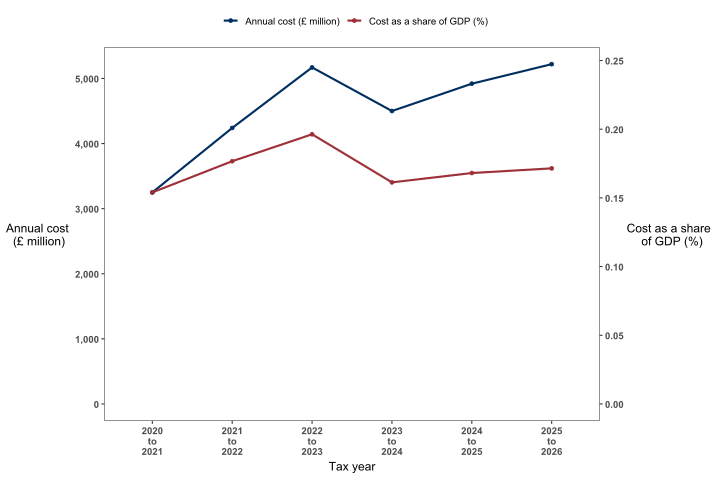
The information in the chart is represented in the preceding table.
Commentary on cost change over time
In 2020 to 2021, the number of estates and the total estate value exempted of transfers on death to surviving spouses and/or civil partners increased, leading to an increase in the cost of the exemption.
In 2021 to 2022 the number of estates and the total estate value exempted fell back slightly, resulting in a small decrease in the cost of the exemption compared to the previous year.
In 2022 to 2023 following reporting requirement changes, while the average claim per estate stayed relatively constant, the number of estates above the NRB estimated to have claimed the spouse exemption rose, resulting in an increase in the cost of the exemption.
Distributional analysis
Reporting requirements changed in early 2022 for both excepted estates and for estates required to complete an IHT400 account. For more information, please see the relevant policy paper on gov.uk. This means that the number of estates above the NRB making claims for this exemption and the total value of assets exempted detailed in Table 12.2 of HMRC’s Inheritance Tax Liabilities Statistics have reduced coverage. It also means that from that time, some further minor assumptions are required to estimate the tax cost of this exemption for this publication.
In 2022 to 2023, we estimate this exemption was used by 37,600 estates above the NRB and £25.2 billion of qualifying property was exempted.
HMRC does not publish separate distributional analysis for estates using the spouse and civil partner exemption, and the exemption is a long-standing feature of the IHT system. However, in general those who benefit from this exemption are likely to be aged 65 and above at the time of their death. Also, the estate that benefits tends to be the estate of someone who is male.
This is because only married or civil partnered individuals are able to benefit from the exemption by definition, and males have shorter life expectancies than females. As such, given the majority of marriages and civil partnerships are currently between opposite-sex individuals in the UK, females have a higher probability of living longer than their male spouse or civil partner and of receiving the latter’s exempted transferred assets.
Evaluative summary
HMRC commissioned research on inheritance tax from IFF Research.
3.12 VAT - drugs and supplies on prescription
Description
Zero rating applies to drugs dispensed by a pharmacist for personal use.
| Tax year | 2020 to 2021 | 2021 to 2022 | 2022 to 2023 | 2023 to 2024 | 2024 to 2025 | 2025 to 2026 |
|---|---|---|---|---|---|---|
| Cost (£ million) | 3,300 | 3,300 | 3,500 | 3,600* | 3,800* | 4,000* |
| Cost (% GDP) | 0.156% | 0.138% | 0.133% | 0.129%* | 0.13%* | 0.131%* |
Figure 15: nominal annual cost (£ million) and cost as a share of GDP (%)
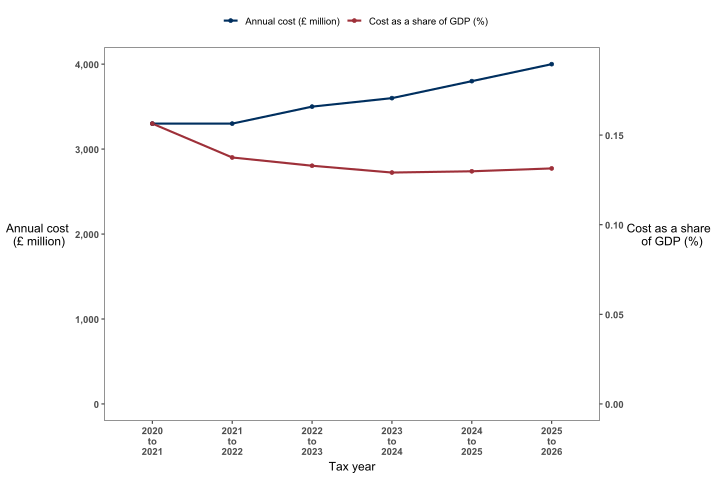
The information in the chart is represented in the preceding table.
Commentary on cost change over time
The cost of drugs and supplies on prescription has gradually increased in nominal terms but has fallen slightly as a proportion of GDP; it is noted that this ratio was distorted by the coronavirus (COVID-19) pandemic in 2020 to 2021.
Distributional analysis
The NHS England’s prescription cost analysis (Additional tables A4) shows that in 2023 to 2024, 95.42% of prescription items dispensed in the community were free of charge. However, where the prescription is free of charge, the relief still has a cost as it includes the cost to the NHS of the prescription.
3.13 Capital Gains Tax - business asset disposal relief
Description
Certain disposals chargeable to CGT by individuals and qualifying trustees of all or part of a business are charged at 10% for gains up to April 2025, 14% for gains between April 2025 and April 2026 and 18% thereafter. Qualifying gains for each individual are subject to a £1 million lifetime limit. The relief is typically available when disposing of all or part of your business. Cost estimates and volumes for BADR also include claims for Investors’ Relief as the two reliefs cannot be separated in the data at present. Investors’ Relief claims make up only a very small proportion of the totals presented in the tables.
| Tax year | 2020 to 2021 | 2021 to 2022 | 2022 to 2023 | 2023 to 2024 | 2024 to 2025 | 2025 to 2026 |
|---|---|---|---|---|---|---|
| Cost (£ million) | 1,100 | 1,200 | 1,200 | 1,000 | 3,400* | 800* |
| Cost (% GDP) | 0.052% | 0.05% | 0.046% | 0.036% | 0.116%* | 0.026%* |
| Number of claimants | 47,000 | 48,000 | 45,000 | 39,000 | Not available | Not available |
Figure 16: nominal annual cost (£ million) and cost as a share of GDP (%)
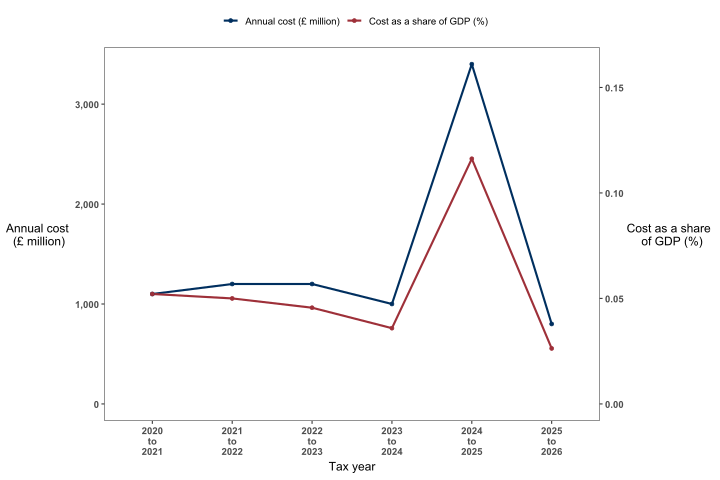
The information in the chart is represented in the preceding table.
Commentary on cost change over time
At Autumn Budget 2024 the following Capital Gains Tax (CGT) rate increases were announced:
-
the main rates of CGT that apply to assets other than residential property and carried interest were increased from 10% and 20% to 18% and 24% respectively, for disposals made on or after 30 October 2024
-
the rate of Capital Gains Tax that applies to Business Asset Disposal Relief and Investors’ Relief was increased from 10% to 14% for disposals made on or after 6 April 2025, and from 14% to 18% for disposals made on or after 6 April 2026
A large increase in the cost of BADR is forecast for the 2024 to 2025 tax year to reflect taxpayers bringing forward BADR-eligible disposals from future years in anticipation of these tax rate changes.
In addition, the increase in the main CGT rates which would be charged in the absence of the relief means that between 30 October 2024 and 6 April 2025 the difference between the main rates of CGT and the BADR rate will be larger than in the preceding years. This further increases the cost of the relief in the 2024 to 2025 tax year.
The sharp fall in the cost of the relief in the 2025 to 2026 tax year is due to BADR-eligible disposals that would have taken place in that year having been brought forward to the 2024 to 2025 tax year.
The 2024 to 2025 and 2025 to 2026 costings are a forecast based on previous years’ actual data and the profile of the latest CGT OBR forecast.
Distributional analysis
HMRC’s Capital Gains Tax accredited official statistics show that 8% of CGT came from disposals that qualified for BADR, unchanged from the previous year. BADR was claimed by 39,000 taxpayers on £10.3 billion of gains in the 2023 to 2024 tax year, resulting in a total tax charge of £1 billion.
Gains eligible for BADR are concentrated amongst individuals who have larger gains. Around two thirds of gains and tax paid at the BADR rate came from the 21% of individuals with qualifying gains of £500,000 or more.
Evaluative summary
Two reports commissioned by HMRC are available about this relief:
Forecast information
There is no published forecast cost for BADR or Investors’ Relief alone. When the new tax rate for entrepreneurs was announced at Spring Budget 2008, the published forecast cost of Business Asset Disposal Relief (then Entrepreneurs’ Relief) was combined with several other Capital Gains Tax reforms. These figures are not comparable to current estimates of the outturn cost of the relief.
3.14 NICs - employment allowance
Description
Allows eligible employers to reduce their annual National Insurance by up to £4,000 from April 2020, up to £5,000 from April 2022, and up to £10,500 from April 2025.
| Tax year | 2020 to 2021 | 2021 to 2022 | 2022 to 2023 | 2023 to 2024 | 2024 to 2025 | 2025 to 2026 |
|---|---|---|---|---|---|---|
| Cost (£ million) | 2,400 | 2,600 | 3,100 | 3,100 | 3,300 | 7,400* |
| Cost (% GDP) | 0.114% | 0.108% | 0.118% | 0.111% | 0.113% | 0.243%* |
| Number of claimants | 1,086,000 | 1,153,000 | 1,171,000 | 1,173,000 | 1,223,000 | Not available |
Figure 17: nominal annual cost (£ million) and cost as a share of GDP (%)
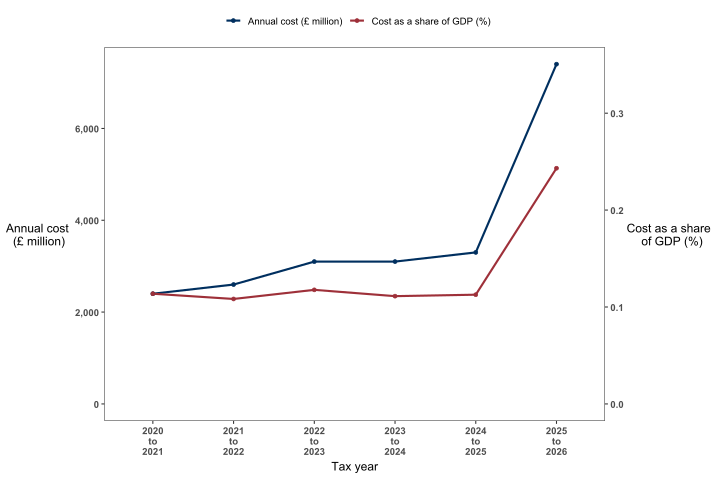
The information in the chart is represented in the preceding table.
Commentary on cost change over time
The cost of Employment Allowance has steadily increased over time.
The growth in cost for 2022 to 2023 is partly due to the temporary rise in employer NICs rate, between 6th April 2022 and 5th November 2022, and partly due to the allowance increasing from £4,000 to £5,000.
The larger than usual increase in cost presented in the 2025-26 forecast is expected due to the employer NICs changes which came into effect on April 2025, namely the reduction of the secondary threshold from £9,100 to £5,000, the increase of the employer NICs rate from 13.8% to 15%, the increase of the allowance from £5,000 to £10,500 and the lifting of the £100,000 employer NICs liability, in the year immediately prior to the claim, eligibility restriction from the Employment Allowance.
Distributional analysis
HMRC’s Employment Allowance take-up statistics show that approximately 1,223,000 employers had benefitted from this relief in 2024 to 2025.
The largest three sectors accounted for 42% of claimants, with ‘Wholesale and retail trade; repair of motor vehicles and motorcycles’ being the largest at 17% (205,000). This is followed by ‘Construction’ at 13% (160,000) and ‘Professional, scientific and technical activities’ at 12% (147,000).
This report also shows that the largest three regions accounted for 43% of claimants, with London being the largest at 18% (219,000). This is followed by the South East at 14% (173,000) and the North West at 11% (130,000). Furthermore, 86% of the claimants were ‘Micro’ employers (1 to 9 employees).
Evaluative summary
HMRC commissioned Ipsos to undertake a thorough and independent evaluation of the impact of the Employment Allowance, including the effect it had on employment and business growth. The evaluation comprised 3 strands of research which included a quantitative survey, econometric analysis, and qualitative in-depth interviews. The research was conducted in 2022, prior to the changes to Employment Allowance which came into force in April 2025 and was published in 2025.
Forecast information
The larger than usual increase in cost presented in the 2025-26 forecast is expected due to the employer NICs changes which came into effect in April 2025, namely the reduction of the secondary threshold from £9,100 to £5,000 and the increase of the employer NICs rate from 13.8% to 15%.
3.15 Corporation Tax - research and development tax relief: small and medium companies scheme
Description
This is a 130% corporation tax super-deduction for small or medium-sized companies based on qualifying R&D expenditure. Loss-makers can surrender all or part of their losses for a payable credit at a rate of 14.5% of the surrendered losses.
| Tax year | 2020 to 2021 | 2021 to 2022 | 2022 to 2023 | 2023 to 2024 | 2024 to 2025 | 2025 to 2026 |
|---|---|---|---|---|---|---|
| Cost (£ million) | 4,200 | 4,600 | 4,400 | 3,100 | 3,400* | 3,200* |
| Cost (% GDP) | 0.199% | 0.192% | 0.167% | 0.111% | 0.116%* | 0.105%* |
| Number of claimants | 73,700 | 69,600 | 51,580 | 35,990 | Not available | Not available |
Figure 18: nominal annual cost (£ million) and cost as a share of GDP (%)
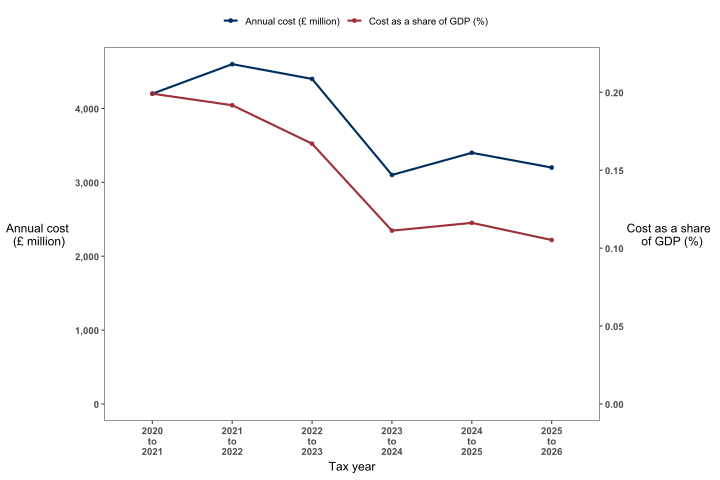
The information in the chart is represented in the preceding table.
Commentary on cost change over time
Prior to 2023, the R&D SME scheme allowed companies to apply a 130% super-deduction to their qualifying R&D expenditure and claim a 14.5% payable credit on some or all of their losses. From April 2023, these rates were reduced to 86% and 10% respectively. A 14.5% credit rate was available to loss-making SMEs who are considered R&D intensive.
The number of claimants has begun to fall from 2021-22 following the introduction of the mandatory additional information online form (AIF). To make a valid R&D claim customers must provide further information to support their claim. This requirement was introduced to reduce levels of error and fraud in the R&D schemes and was made mandatory for all R&D claims on 8th August 2023.
The cost of the SME scheme remained steady from 2020-21 to 2022-23, then fell as expected in 2023-24 when the lower relief rates took effect.
The merged scheme R&D expenditure credit (RDEC) and enhanced R&D intensive support (ERIS) replace the old RDEC and small and medium-sized enterprise (SME) schemes for accounting periods beginning on or after 1 April 2024.
Both schemes feature restrictions on claiming for overseas expenditure, and new rules governing who can claim in contracting situations.
The SME scheme figures in this publication cover claims for the legacy SME scheme, merged RDEC claims made by companies who were previously able to claim under the legacy SME scheme, and ERIS claims.
Distributional analysis
HMRC’s [Research and Development Tax Credits statistics (2025)] (https://www.gov.uk/government/statistics/corporate-tax-research-and-development-tax-credit) provide distributional analysis relevant to the R&D SME relief, breaking down the number of claims and the amount of relief claimed by UK region, company size and sector.
Evaluative summary
The HMRC-commissioned, London Economics Evaluation of the R&D tax relief for SMEs (2020) assessed the direct impacts of this scheme by calculating an ‘additionality ratio’ (the R&D expenditure that would be generated by an increase in the generosity of the scheme relative to the additional cost incurred by Exchequer).
In HMRC’s 2024 annual report an updated estimate of error and fraud for claims received in 2021-22 was published. For illustrative purposes HMRC also considered the possible error and fraud position for the tax year 2023 to 2024 following the implementation of several administrative changes. Details can be found on page 243 of HMRC’s annual report and accounts 2023 to 2024. HMRC has also published a paper on the department’s approach to the Research and Development tax reliefs.
Forecast information
The R&D SME scheme is included in the OBR’s corporation tax credits forecast in the Economic and fiscal outlook but the R&D SME forecast is not published separately.
3.16 VAT - VAT registration threshold
Description
Exception from compulsory registration for VAT for traders with taxable supplies below the registration threshold.
| Tax year | 2020 to 2021 | 2021 to 2022 | 2022 to 2023 | 2023 to 2024 | 2024 to 2025 | 2025 to 2026 |
|---|---|---|---|---|---|---|
| Cost (£ million) | 2,600 | 3,200 | 2,900 | 2,900 | 3,000* | 3,100* |
| Cost (% GDP) | 0.123% | 0.133% | 0.11% | 0.104% | 0.102%* | 0.102%* |
Figure 19: nominal annual cost (£ million) and cost as a share of GDP (%)
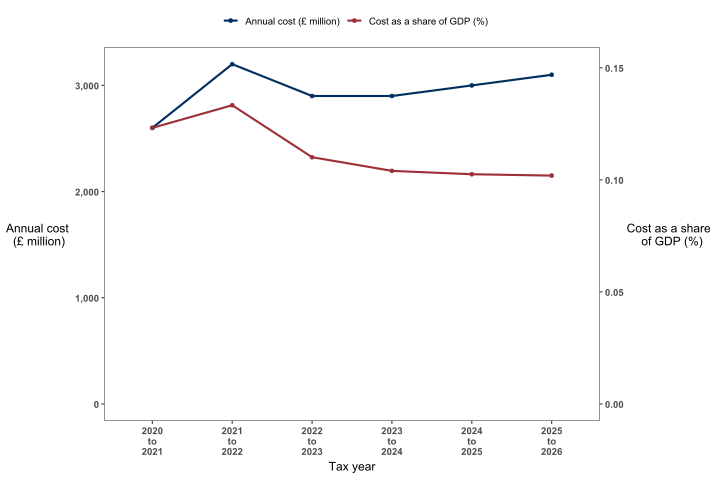
The information in the chart is represented in the preceding table.
Commentary on cost change over time
From 2020 to 2021 to 2023 to 2024 the VAT registration threshold was frozen rather than being increased in line with the Retail Prices Index (measures announced at Autumn Budget 2018, Budget 2021 and Autumn Statement 2022). This has had the effect of drawing more businesses into VAT registration, thereby reducing the cost of the relief as a proportion of GDP.
In 2020 to 2021 there was a reduction in the cost of the relief owing to a reduction in the number of businesses operating at below the threshold and a reduction in their income, and relative to this the cost rose in the following year given recovery following the pandemic.
The threshold freeze had a larger downward effect on cost in 2023 to 2024 due to rising inflation. For 2024 to 2025 the VAT registration threshold was increased from £85,000 to £90,000; this increases the estimate of the cost of the relief.
Distributional analysis
The BEIS Business population estimates for the UK and regions 2025 statistics state that the number of businesses (whole economy) at the start of 2025 was 5.8 million (see Detailed Table 2).
The Annual Value Added Tax (VAT) annual statistics ODS table (tab T2_VAT_pop, table 2a) shows that 2.3 million businesses were registered for VAT in 2024-25.
This indicates that there were around 3.5 million businesses that were not registered for VAT, as a result of this relief.
In 2024 to 2025 some 38% (895,000 ) of VAT registered businesses had turnover below the registration threshold. These businesses are not required to register as a result of the relief, but have opted to register voluntarily (see Table 5a in the The Annual Value Added Tax (VAT) annual statistics ODS table ).
Evaluative summary
HM Treasury published a consultation document in 2018 to explore the VAT registration threshold. The responses to the consultation have also been published.
3.17 VAT - water and sewerage services
Description
Zero rating applies to the supply of sewerage services and water (otherwise than for use in an industrial business activity).
| Tax year | 2020 to 2021 | 2021 to 2022 | 2022 to 2023 | 2023 to 2024 | 2024 to 2025 | 2025 to 2026 |
|---|---|---|---|---|---|---|
| Cost (£ million) | 2,400 | 2,400 | 2,400 | 2,700 | 2,900* | 3,700* |
| Cost (% GDP) | 0.114% | 0.1% | 0.091% | 0.097% | 0.099%* | 0.122%* |
Figure 20: nominal annual cost (£ million) and cost as a share of GDP (%)
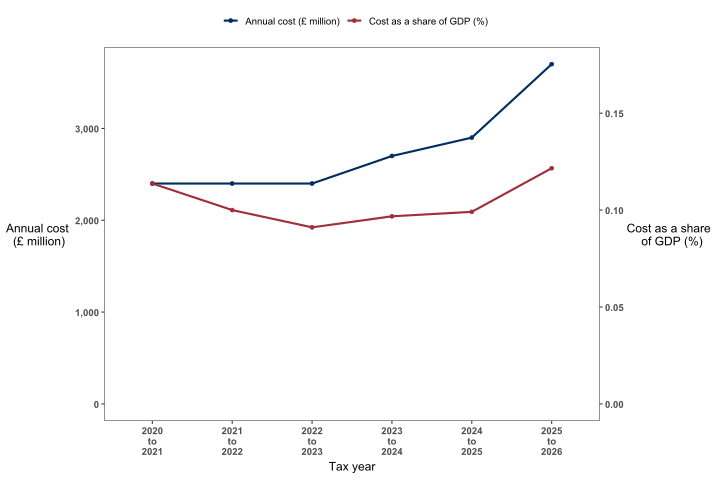
The information in the chart is represented in the preceding table.
Commentary on cost change over time
During this period the nominal cost of the water and sewerage services tax relief has increased, though the cost as a share of GDP has remained broadly flat (except in 2020-21 when this ratio was distorted by the impact of COVID-19 on GDP). The cost of the relief is driven by (regulated) water prices, and to a lesser extent by population growth. The forecast for 2025-26 is based on the 26% average annual increase forecast by Ofwat in January 2025.
Distributional analysis
The Family spending workbook 1: detailed expenditure and trends (tab 3.1, table 4.3 and tab 3.2, table 4.3) show that spending on water supply as a proportion of income is higher for people living in households with lower incomes as a proportion of total expenditure. However, the amount of money spent on water supply by those living in households further up the income distribution is high.
Family spending workbook 3: expenditure by region - Office for National Statistics (TabA35 table 4.3) shows that average weekly spend on water supply is highest in London and the South West, when compared to other UK regions.
3.18 Income Tax - charitable donations
Description
Exempts charitable donations from income tax (Higher Rate Relief, Payroll Giving, Gifts of Shares and Property, and Tax Repayments (including individual gift aid).
| Tax year | 2020 to 2021 | 2021 to 2022 | 2022 to 2023 | 2023 to 2024 | 2024 to 2025 | 2025 to 2026 |
|---|---|---|---|---|---|---|
| Cost (£ million) | 2,080 | 2,140 | 2,430 | 2,470 | 2,670 | 2,860* |
| Cost (% GDP) | 0.099% | 0.089% | 0.092% | 0.089% | 0.091% | 0.094%* |
Figure 21: nominal annual cost (£ million) and cost as a share of GDP (%)
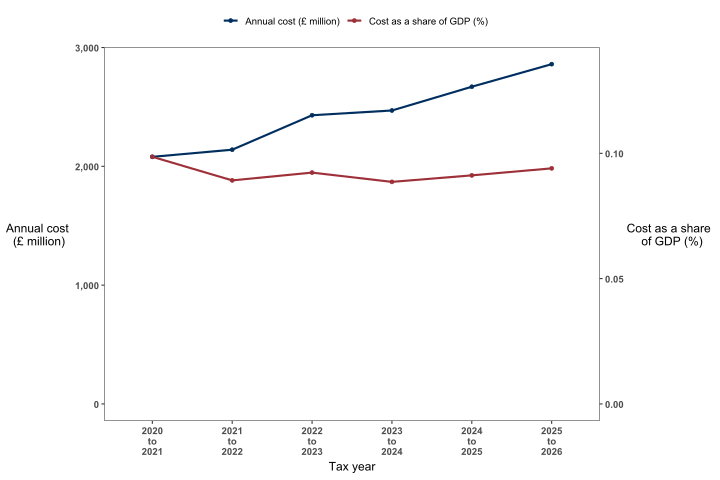
The information in the chart is represented in the preceding table.
Commentary on cost change over time
The cost of this relief generally increases over time. In the tax year ending April 2021, the cost of relief fell slightly due to COVID-19. Since then, the trend of increasing over time has returned.
Distributional analysis
A 2016 research report from Quadrangle, commissioned by HMRC, estimates that 95% of the UK population donated to charity within the 12 months prior to interview. The research report goes into further detail about those who do and do not claim Gift Aid, which is the biggest component of this relief.
Evaluative summary
The 2016 research report from Quadrangle found that Gift Aid was added to 52% of UK individuals’ donations by value.
Forecast information
The final year is a forecast based on the year to approximately September. The previous year’s totals are mostly actuals, with some minor elements forecasted, for example, relief on higher rates of Income Tax and Gifts of Shares and Property, which is mostly claimed in arrears.
3.19 Corporation Tax - patent box
Description
A reduced corporation tax rate for profits from patents etc.
| Tax year | 2020 to 2021 | 2021 to 2022 | 2022 to 2023 | 2023 to 2024 | 2024 to 2025 | 2025 to 2026 |
|---|---|---|---|---|---|---|
| Cost (£ million) | 1,200 | 1,300 | 1,400 | 2,000* | 2,300* | 2,300* |
| Cost (% GDP) | 0.057% | 0.054% | 0.053% | 0.072%* | 0.079%* | 0.076%* |
| Number of claimants | 1,610* | 1,630* | 1,640* | Not available | Not available | Not available |
Figure 22: nominal annual cost (£ million) and cost as a share of GDP (%)
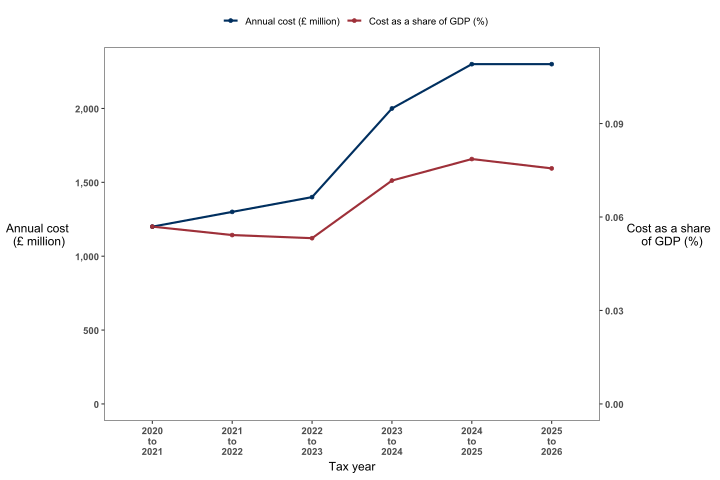
The information in the chart is represented in the preceding table.
Commentary on cost change over time
The relief was phased in gradually from 2013 to 2014 to 2017 to 2018. In 2016, the government made changes to the design of the Patent Box to comply with new OECD rules for Intellectual Property regimes (the so-called ‘Nexus’ changes). Grandfathering’ rules (GF) allowed companies to claim under the pre-2016 rules in certain circumstances up until July 2021. But businesses will now have to use the profit streaming method and R&D Fraction when calculating the relevant intellectual property profit. This is reflected in the outturn from 2021 to 2022 onwards and in the forecast from 2024 to 2025 onwards. The impact will be monitored and updated accordingly.
The increase in the cost for 2023 to 2024 is due to the change in the main rate of Corporation Tax, from 19% to 25%.
Distributional analysis
HMRC’s [Patent Box Statistics] (https://www.gov.uk/government/statistics/patent-box-reliefs-statistics/patent-box-relief-statistics-september-2025) provisionally estimate that 1,650 companies elected into the Patent Box regime in financial year 2023 to 2024. This is broadly consistent with the previous year where 1,640 companies elected into Patent Box. The value of relief claimed under the Patent Box is estimated to have increased to £1,977 million in financial year 2023 to 2024, from £1,449 million in financial year 2022 to 2023. This was driven by the change in the main rate of Corporation Tax from 19% to 25% on 1 April 2023.
Of the companies that elected into Patent Box in financial year 2023 to 2024, it is estimated that 28% were classified as ‘Large’ and accounted for most of the relief claimed (95%).
The number of companies claiming relief varies significantly across UK regions. The area with the fewest number of companies is estimated to have been the North East (2% of the total in financial year 2023 to 2024), and the area with the most companies was London and East England (21%). It is estimated that London and East England-based companies claimed the largest amount of relief as well (65%). This is based on addresses given to HMRC for tax purposes so may not represent where the economic activity takes place.
Evaluative summary
Some information on the use of this relief can be found in HMRC’s Patent Box Evaluation (2020).
Responses to HM Treasury’s 2011 consultation on the Patent Box are available.
3.20 Inheritance Tax - residence nil rate band
Description
An additional threshold when a residence is being passed on to a direct descendant.
| Tax year | 2020 to 2021 | 2021 to 2022 | 2022 to 2023 | 2023 to 2024 | 2024 to 2025 | 2025 to 2026 |
|---|---|---|---|---|---|---|
| Cost (£ million) | 1,650 | 2,060 | 2,370 | 2,190* | 2,340* | 2,440* |
| Cost (% GDP) | 0.078% | 0.086% | 0.09% | 0.079%* | 0.08%* | 0.08%* |
| Number of claimants | 25,200 | 25,800 | 30,600 | Not available | Not available | Not available |
Figure 23: nominal annual cost (£ million) and cost as a share of GDP (%)
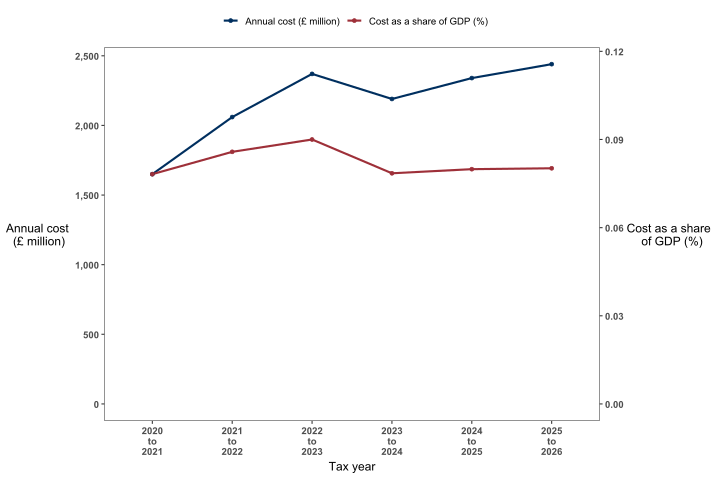
The information in the chart is represented in the preceding table.
Commentary on cost change over time
The residence nil rate band (RNRB) was introduced in the tax year 2017 to 2018. The nominal cost of the RNRB showed consistent growth into the 2019 to 2020 and 2020 to 2021 tax years, in line with the planned increase in the generosity of the threshold. The nominal value of the RNRB increased from £125,000 in 2018 to 2019 to £150,000 in 2019 to 2020.
In 2020 to 2021, both the nominal cost and the number of claimants increased as the nominal value of the RNRB increased from £150,000 to £175,000 and the number of estates transferring qualifying wealth also rose.
In 2021 to 2022, both the number of claimants and the value exempted rose when compared to the previous year. However, this was due to an overall increase in the number of estates making use of the RNRB, since the nominal value of the RNRB remained unchanged between the 2020 to 2021 and 2021 to 2022 tax years.
The cost of the relief increased again in 2022 to 2023, driven by an increase in the number of claimants.
Distributional analysis
The tax year 2022 to 2023 was the sixth year in which the new RNRB tax-free threshold could be used. This threshold provides an additional allowance to qualifying estates so that more property wealth can be transferred to direct descendants before inheritance tax could be due. The threshold was set at £175,000 for the tax year 2022 to 2023.
In the tax year 2022 to 2023, Table 12.2 of HMRC’s Inheritance Tax Liabilities Statistics show that 30,600 estates used the RNRB, and £7.7 billion of chargeable estate value was sheltered from an inheritance tax charge as a result. This was a rise of £1.2 billion compared to the tax year 2021 to 2022.
Had the threshold not been available, the value of those assets would have been included within the chargeable estate for IHT purposes, and after the application of available tax-free allowances, would face the relevant marginal tax rate. This determines the tax cost of the threshold to the Exchequer.
The latest available tax year for which complete information is available is 2022 to 2023, and an estate can make more than one relief claim. For more information, please see the background quality report accompanying the statistics.
Evaluative summary
The Office of Tax Simplification published a report on simplifying the design of Inheritance Tax.
Forecast information
RNRB is included in the OBR’s inheritance tax receipts forecast in the Economic and Fiscal outlook but the forecast for the cost of the RNRB is not published separately. The original forecast costs for the RNRB were never separately published when the policy was announced in the 2015 Summer Budget. Instead, the numbers published reflected the freeze of the Nil Rate Band from the 2017 to 2018 to 2020 to 2021 tax years, the introduction of RNRB from the 2017 to 2018 tax year, and the introduction of the RNRB taper. As a result, comparing RNRB outturn costs to the forecasted impact of the published policy package would be inappropriate as the published forecast does not solely capture the original forecasted costs of the RNRB.
3.21 VAT - the VAT zero rate for children’s clothing and protective footwear and helmets
Description
Zero rating of children’s clothing and footwear and protective boots and helmets (including motorcycle and bicycle helmets).
| Tax year | 2020 to 2021 | 2021 to 2022 | 2022 to 2023 | 2023 to 2024 | 2024 to 2025 | 2025 to 2026 |
|---|---|---|---|---|---|---|
| Cost (£ million) | 1,500 | 1,800 | 2,100 | 2,200 | 2,200 | 2,300* |
| Cost (% GDP) | 0.071% | 0.075% | 0.08% | 0.079% | 0.075% | 0.076%* |
Figure 24: nominal annual cost (£ million) and cost as a share of GDP (%)
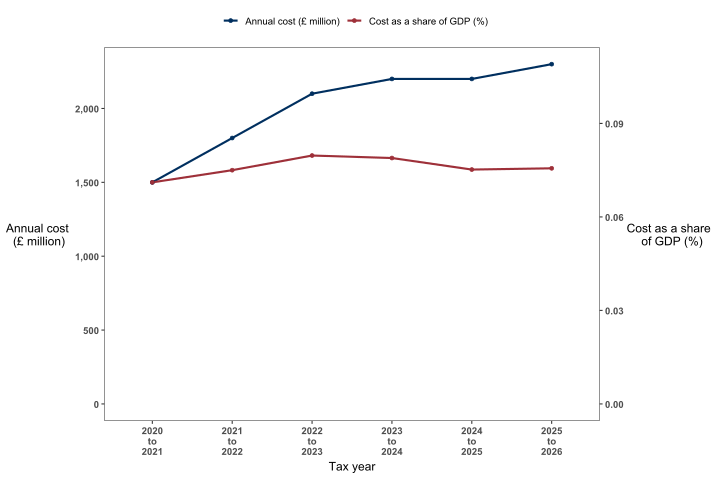
The information in the chart is represented in the preceding table.
Commentary on cost change over time
The nominal annual cost of the relief for children’s clothing has risen in nominal terms, but has been fairly stable as a share of GDP, except that it was depressed during the COVID-19 pandemic in 2020 to 2021.
Distributional analysis
The ONS Family spending workbook 1: detailed expenditure and trends (tab 3.1, table 3.1 and tab 3.2, table 3.1) show that, on average, household spending on children’s clothing as a proportion of total household expenditure is relatively flat across the income distribution. However, the amount of money spent on children’s clothing by higher income deciles is typically higher.
3.22 VAT - zero rate for printed matter and e-publications
Description
Zero rating applies to supplies of books, newspapers, magazines etc. in printed form and when supplied electronically.
| Tax year | 2020 to 2021 | 2021 to 2022 | 2022 to 2023 | 2023 to 2024 | 2024 to 2025 | 2025 to 2026 |
|---|---|---|---|---|---|---|
| Cost (£ million) | 1,600 | 1,700 | 1,700 | 1,700 | 1,700 | 1,700* |
| Cost (% GDP) | 0.076% | 0.071% | 0.065% | 0.061% | 0.058% | 0.056%* |
Figure 25: nominal annual cost (£ million) and cost as a share of GDP (%)
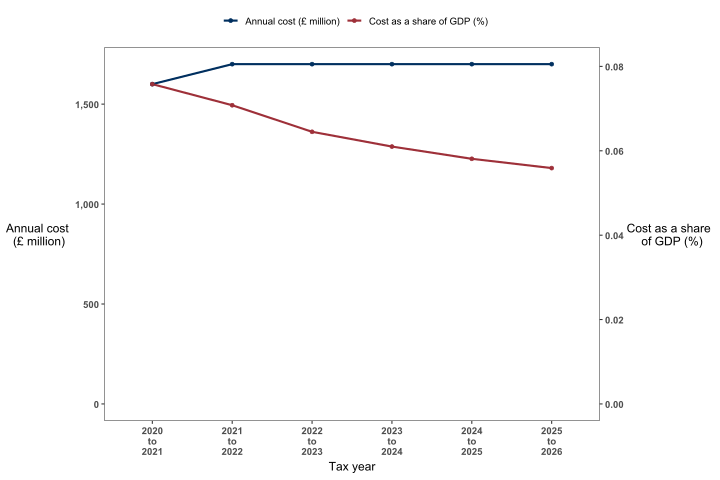
The information in the chart is represented in the preceding table.
Commentary on cost change over time
The cost of this relief has remained broadly static in nominal terms but has been falling as a proportion of GDP.
The cost estimates reflect the extension of the relief to e-publications with effect from 1 May 2020, which adds approximately £200 million to the cost in a full year. However, consumption was generally weak in 2020 to 2021 because of COVID-19, offsetting the increase in cost due to the change of policy in that year.
Distributional analysis
The Family spending workbook 1: detailed expenditure and trends (tab 3.1, table 9.5 and tab 3.2, table 9.5) show that, on average, expenditure on newspapers and magazines by people living in households with lower incomes is larger as a proportion of their total household expenditure. On average, spending on books as a proportion of total expenditure rises across the income distribution.
3.23 Corporation Tax - capital allowances: ring-fence oil business trades, first-year capital allowances for plant or machinery
Description
Accelerated rate (100%) of capital allowance for expenditure by a company on plant or machinery for use wholly in a ring-fence trade.
| Tax year | 2020 to 2021 | 2021 to 2022 | 2022 to 2023 | 2023 to 2024 | 2024 to 2025 | 2025 to 2026 |
|---|---|---|---|---|---|---|
| Cost (£ million) | 1,200 | 1,200 | 1,900 | 1,700 | 1,900* | 1,700* |
| Cost (% GDP) | 0.057% | 0.05% | 0.072% | 0.061% | 0.065%* | 0.056%* |
| Number of claimants | 150 | 150 | 150 | 150 | Not available | Not available |
Figure 26: nominal annual cost (£ million) and cost as a share of GDP (%)
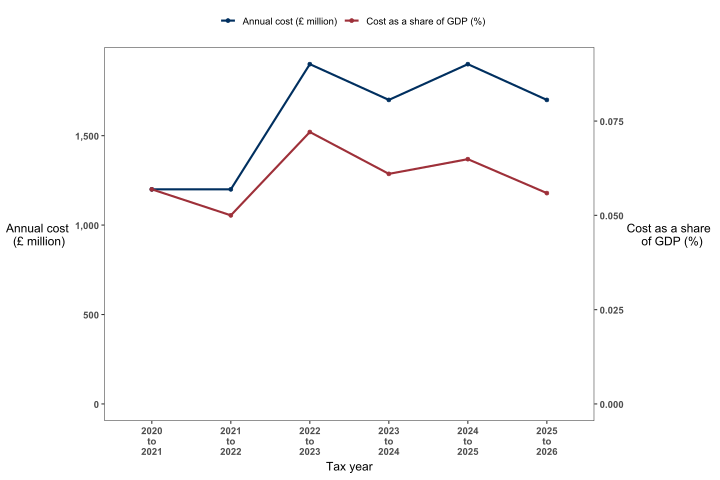
The information in the chart is represented in the preceding table.
Commentary on cost change over time
The costings show the impact of capital allowances used to reduce taxable profits - hence they do not include capital allowances that generate taxable losses which can be carried forwards or backwards against profits from other years or surrendered as group relief. The profile reflects changes in energy prices and hence profitability of relief claimants but also the changes made in capital investment. Energy prices collapsed in 2020 due to Covid before recovering again from mid-2021. They spiked in early 2022, particularly for gas, following the Russian invasion of Ukraine but have since fallen back. But they remain above long term ‘normal’ levels. Capital investment was flat from 2017 to 2019, dropped by a third in 2020 and fell further in 2021. This reduction partially offset the impact of a higher proportion of capex being set against profits due to the improved profitability seen in 2021. The external data sources used to calculate this estimate are World Bank Commodity Markets for oil prices and North Sea Transition Authority data centre for information on North Sea investment data.
Evaluative summary
An IFF and Frontier Economics evaluation report on the Annual Investment Allowance was published in May 2025.
Forecast information
The published forecast cost for first-year plant and machinery capital allowances for Oil and Gas Ring Fence trades from its introduction at Budget 2002 covers the years 2002 to 2003 to 2004 to 2005. This period does not overlap with the period for which we publish outturn costs in this publication, therefore the two sets of figures are not comparable. In addition, the forecast cost of the relief when it was introduced was combined with the revenue impact of introducing the 10 per cent supplementary charge, and therefore the forecast figures are not equivalent to current estimates of the outturn cost of the relief.
3.24 Inheritance Tax - business and agricultural property relief (BPR and APR)
Description
BPR: Relief from IHT on the transfer of relevant business property.
APR: Relief from IHT on a transfer of agricultural property.
Business Property Relief (BPR)
| Tax year | 2020 to 2021 | 2021 to 2022 | 2022 to 2023 | 2023 to 2024 | 2024 to 2025 | 2025 to 2026 |
|---|---|---|---|---|---|---|
| Cost (£ million) | 1,210 | 1,050 | 1,260 | 1,220* | 1,340* | 1,400* |
| Cost (% GDP) | 0.057% | 0.044% | 0.048% | 0.044%* | 0.046%* | 0.046%* |
| Number of claimants | 3,380 | 4,170 | 3,840 | Not available | Not available | Not available |
Figure 27: nominal annual cost (£ million) and cost as a share of GDP (%)
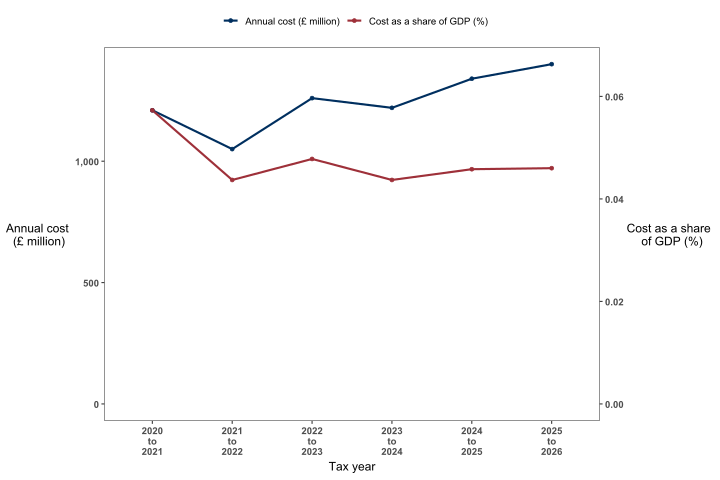
The information in the chart is represented in the preceding table.
Agricultural Property Relief (APR)
| Tax year | 2020 to 2021 | 2021 to 2022 | 2022 to 2023 | 2023 to 2024 | 2024 to 2025 | 2025 to 2026 |
|---|---|---|---|---|---|---|
| Cost (£ million) | 360 | 550 | 660 | 660* | 700* | 725* |
| Cost (% GDP) | 0.017% | 0.023% | 0.025% | 0.024%* | 0.024%* | 0.024%* |
| Number of claimants | 1,300 | 1,730 | 1,730 | Not available | Not available | Not available |
Figure 28: nominal annual cost (£ million) and cost as a share of GDP (%)
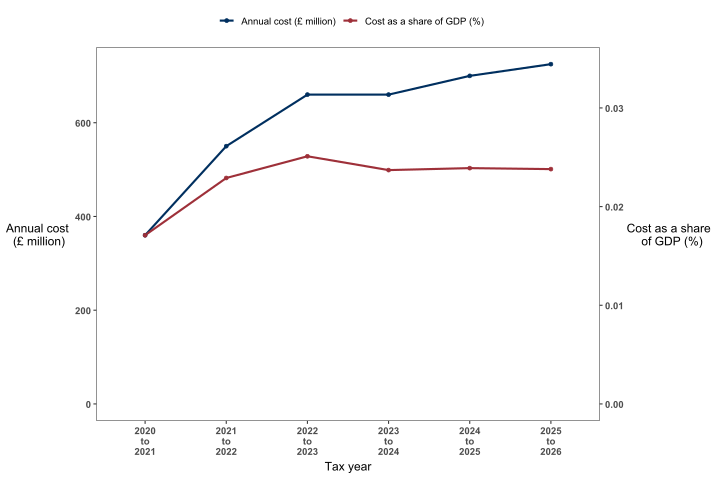
Commentary on cost change over time
For BPR, in 2021 to 2022, while the number of estates making claims rose when compared to the previous year, the size of the average qualifying relief per claimant fell, resulting in the total value of relieved transfers decreasing. In 2022 to 2023 the number of estates making claims fell, while the total value of relieved transfers rose, meaning there was an increase in the average relief amount. The overall tax cost of the relief to the Exchequer therefore rose when compared to the previous tax year.
For APR, in 2021 to 2022, the number of estates making claims rose when compared to the previous year, the size of the average qualifying relief per claimant also rose, resulting in the total value of relieved transfers increasing significantly. In 2022 to 2023, the number of estates claiming APR remained the same while the total value of relieved transfers increased pointing to a higher average relief per claimant. The overall tax cost of the relief to the Exchequer therefore increased compared to the previous tax year.
Distributional analysis
For BPR, table 12.2 of HMRC’s Inheritance Tax Liabilities Statistics show that the total amount of estate value relieved in 2022 to 2023 was £3.34 billion, of which £2.21 billion was on unquoted shares (claimed by 2,470 estates) and £1.1 billion (claimed by 1,590 estates) was on other business property.
For APR, table 12.2 of HMRC’s Inheritance Tax Liabilities Statistics show that the total amount of estate value relieved in 2022 to 2023 was £1.94 billion (claimed by 1,730 estates). It is important to note here that the values being relieved are not the same as the cost to the Exchequer of the relief. This is because the value of assets qualifying for the relief are not included in the chargeable estate for IHT purposes.
Had the reliefs not been available, the value of those assets would have been included within the chargeable estate for IHT purposes, and after the application of available tax-free allowances, would face the relevant marginal tax rate. This determines the cost of the relief to the Exchequer.
The latest available tax year for which complete information is available is 2022 to 2023, and an estate can make more than one relief claim. For more information, please see the background quality report accompanying the statistics.
Evaluative summary
HMRC commissioned research from IFF Research in 2017.
3.25 VAT - vehicles and other supplies to disabled people [vehicles only]
Description
Zero rating of certain aids and qualifying motor vehicles to the disabled.
| Tax year | 2020 to 2021 | 2021 to 2022 | 2022 to 2023 | 2023 to 2024 | 2024 to 2025 | 2025 to 2026 |
|---|---|---|---|---|---|---|
| Cost (£ million) | 860 | 930 | 1,040 | 1,250 | 1,430* | 1,490* |
| Cost (% GDP) | 0.041% | 0.039% | 0.039% | 0.045% | 0.049%* | 0.049%* |
Figure 29: nominal annual cost (£ million) and cost as a share of GDP (%)
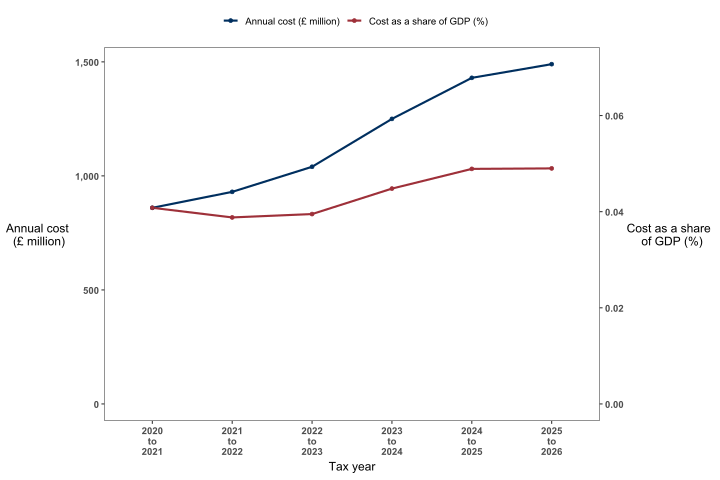
The information in the chart is represented in the preceding table.
Commentary on cost change over time
The nominal cost of vehicles supplied to disabled people tax relief has risen over time, with the cost as a share of GDP also increasing marginally in more recent years.
The cost of the relief for supplies other than vehicles is provided as a single year estimate. The cost for vehicles includes the Zero Rate on the lease and sale of vehicles by Motability, which accounts for most of the cost. These costs are estimated from information in the published accounts of Motability Operations Group plc.
Distributional analysis
The cost of this relief includes the VAT zero rating of leases of cars through the Motability scheme and the sale of the cars at the end of the leases. A 2018 NAO report into the Motability scheme reviewed the tax concessions provided by the government which include the VAT zero rating, and the impact of this on lease prices offered by Motability.
3.26 Corporation Tax - high-end TV tax relief
Description
Television production companies can claim additional corporation tax relief on producing high-end TV programmes in the UK. Companies not making a profit may be able to surrender the loss and receive a tax credit.
| Tax year | 2020 to 2021 | 2021 to 2022 | 2022 to 2023 | 2023 to 2024 | 2024 to 2025 | 2025 to 2026 |
|---|---|---|---|---|---|---|
| Cost (£ million) | 360 | 990 | 1,100 | 1,100 | 1,000* | 1,100* |
| Cost (% GDP) | 0.017% | 0.041% | 0.042% | 0.039% | 0.034%* | 0.036%* |
| Number of claimants | 295 | 410 | 500 | 570 | Not available | Not available |
Figure 30: nominal annual cost (£ million) and cost as a share of GDP (%)
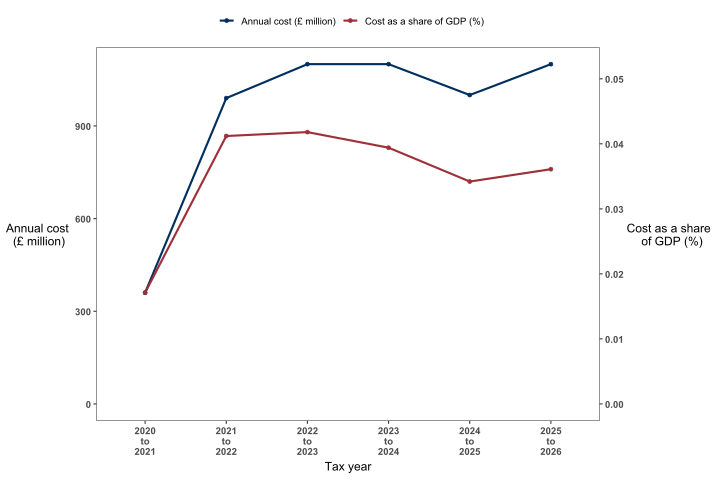
The information in the chart is represented in the preceding table.
Commentary on cost change over time
The number of high-end TV (HETV) claimants and amount of relief paid was low in the 2020-21 tax year, primarily due to the effects of the Covid-19 pandemic. The amount of HETV tax relief paid increased sharply the year afterwards (2021-22) and has risen steadily until 2024-25 where it is expected to plateau. The sharp increase was in part due to a recovery from the COVID-19 pandemic, which caused a number of projects to be pushed back to the following year. There has also been an increase in claims for high-value TV productions, including single-episodic shows produced for streaming platforms. This trend is in line with statistics published by the BFI, which has shown a substantial increase in TV production expenditure in the UK as a result of inward investment in recent years.
Recent trends in the cost of relief are also in line with the latest BFI statistics which show that the spend on HETV has levelled out.
The population of claimants for HETV has been steady from 2017-18 to 2020-21 after which it increased significantly in both 2021-22 and 2022-23 in line with the cost of the relief.
Distributional analysis
HMRC’s Creative Industries official statistics provides information about the number of High-End TV claims, number of companies and amount paid out each year.
The statistics show that in recent years more than three-quarters of the total amount paid has come from a small number of large claims over £2m.
Evaluative summary
A recent evaluation of the impacts of Creative Industry tax reliefs, including HETV Tax Relief, was published in November 2022.
Forecast information
High-End TV tax relief is included in the OBR’s corporation tax credits forecast in the Economic-and-fiscal-outlook.
3.27 Inheritance Tax - gifts to charities
Description
Gifts to charities and property held on trust for charitable purposes are exempt from IHT.
| Tax year | 2020 to 2021 | 2021 to 2022 | 2022 to 2023 | 2023 to 2024 | 2024 to 2025 | 2025 to 2026 |
|---|---|---|---|---|---|---|
| Cost (£ million) | 630 | 855 | 1,170 | 1,070* | 1,160* | 1,220* |
| Cost (% GDP) | 0.03% | 0.036% | 0.044% | 0.038%* | 0.04%* | 0.04%* |
| Number of claimants | 9,680 | 10,600 | 14,700 | Not available | Not available | Not available |
Figure 31: nominal annual cost (£ million) and cost as a share of GDP (%)
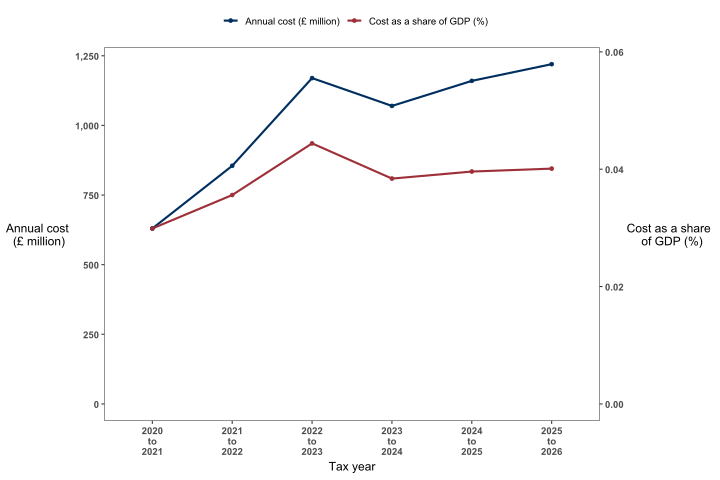
The information in the chart is represented in the preceding table.
Commentary on cost change over time
In 2020 to 2021, both the number of estates and the total value of exempted transfers increased.
In 2021 to 2022, again, both the number of estates using the exemption and the total cost of the exemption increased marginally compared to the previous year.
In 2022 to 2023 following reporting requirement changes, while the average claim per estate stayed relatively constant, the number of estates above the NRB estimated to have claimed the charity exemption rose, resulting in an increase in the cost of the exemption.
Distributional analysis
Reporting requirements changed in early 2022 for both excepted estates and for estates required to complete an IHT400 account. For more information, please see the relevant policy paper on gov.uk. This means that the number of estates above the NRB making claims for this exemption and the total value of assets exempted detailed in Table 12.2 of HMRC’s Inheritance Tax Liabilities Statistics have reduced coverage. It also means that from that time, some further minor assumptions are required to estimate the tax cost of this exemption for this publication.
In 2022 to 2023, we estimate this exemption was used by 14,700 estates above the NRB and £3.74 billion of qualifying property was exempted.
It is important to note here that the values being relieved are not the same as the cost to the Exchequer of the relief. This is because the value of assets qualifying for the relief are not included in the chargeable estate for IHT purposes.
Had the relief not been available, the value of those assets would have been included within the chargeable estate for IHT purposes, and after the application of available tax-free allowances, would face the relevant marginal tax rate. This determines the tax cost of the relief to the Exchequer.
The latest available tax year for which complete information is available is 2022 to 2023, and an estate can make more than one relief claim. For more information, please see the background quality report accompanying the statistics.
Evaluative summary
HMRC commissioned a report from IFF Research and the Office of Tax Simplification published a report on simplifying the design of Inheritance Tax.
3.28 NICs - relief on employer NICs for employees under 21
Description
A zero rate of Class 1 secondary NICs for employees under 21 up to the upper earnings limit
| Tax year | 2020 to 2021 | 2021 to 2022 | 2022 to 2023 | 2023 to 2024 | 2024 to 2025 | 2025 to 2026 |
|---|---|---|---|---|---|---|
| Cost (£ million) | 560 | 670 | 850 | 960 | 1,100 | 1,900* |
| Cost (% GDP) | 0.027% | 0.028% | 0.032% | 0.034% | 0.038% | 0.062%* |
| Number of claimants | 270,000 | 321,000 | 326,000 | 330,000 | 340,000 | Not available |
Figure 32: nominal annual cost (£ million) and cost as a share of GDP (%)
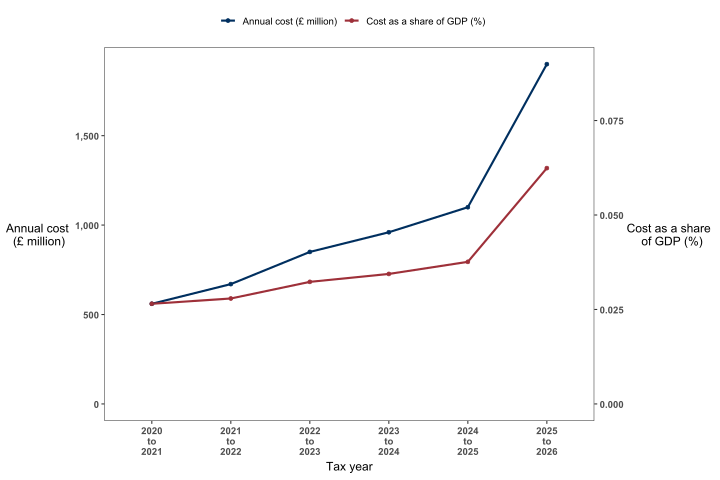
The information in the chart is represented in the preceding table.
Commentary on cost change over time
Costs are affected by changes to the number of employees under the age of 21, and changes to their wages between the Secondary Threshold and Upper Secondary Threshold.
The large growth in cost for 2022 to 2023 is partly due to the temporary rise in employer NICs rate between 6th April 2022 and 5th November 2022.
As this is a relief for the employer, we report the number of employers claiming the relief.
Distributional analysis
The relief can be claimed across all sectors for all qualifying employees; therefore, trends reflect general employment and wage patterns, rather than linking to any specific sector.
Evaluative summary
HMRC commissioned research from Kantar to evaluate employer NICs reliefs, assessing whether NICs reliefs were supporting and encouraging the employment and retention of young people and apprentices, published in 2023. Previous research from Kantar was published in 2018.
Forecast information
The larger than usual increase in cost presented in the 2025-26 forecast is expected due to the employer NICs changes which came into effect in April 2025, namely the reduction of the secondary threshold from £9,100 to £5,000 and the increase of the employer NICs rate from 13.8% to 15%.
3.29 Income Tax - exemption for the first £30,000 of a termination award that would otherwise be chargeable as specific employment income
Description
Where payments and benefits on termination of employment are below £30,000, they will not be taxed as employment income. The £30,000 threshold does not apply to any element of the payment that is post-employment notice pay (which is chargeable to income tax).
| Tax year | 2020 to 2021 | 2021 to 2022 | 2022 to 2023 | 2023 to 2024 | 2024 to 2025 | 2025 to 2026 |
|---|---|---|---|---|---|---|
| Cost (£ million) | 1,400 | 1,100 | 700 | 700 | 700* | 800* |
| Cost (% GDP) | 0.066% | 0.046% | 0.027% | 0.025% | 0.024%* | 0.026%* |
| Number of claimants | 585,000 | 335,000 | 185,000 | 215,000 | 235,000 | 275,000 |
Figure 33: nominal annual cost (£ million) and cost as a share of GDP (%)
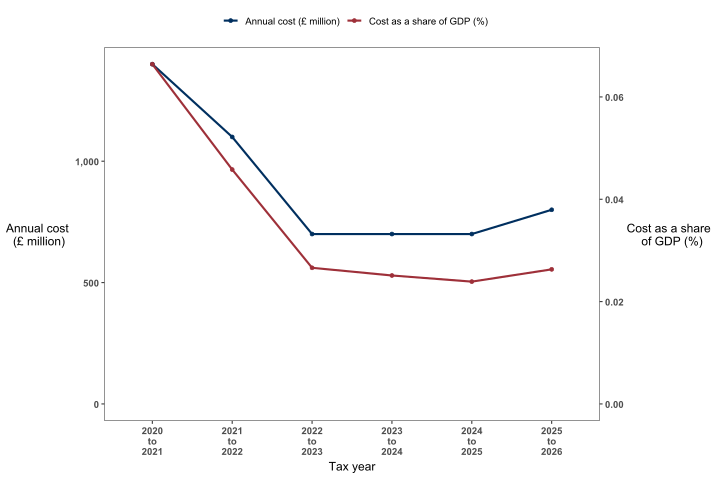
The information in the chart is represented in the preceding table.
Commentary on cost change over time
The nominal cost of the relief showed a large fall in 2018 to 2019, driven by falls in the number, and average level, of eligible redundancy payments. In April 2018 the Government also tightened the scope of the exemption, lowering relief further. The very large spike in the cost and recipients of the relief in 2020 to 2021 and fall thereafter reflects a spike in redundancies during 2020 to 2021 reflecting in part the impact of COVID-19.
Forecast information
New outturn for 2023 to 2024 replaces the previous projection and revises down the estimate for that year and projections beyond it compared to previous published estimates.
3.30 Hydrocarbon Oil Duties - duty rate for marked gas oil and kerosene used as fuel in an engine, other than in a road vehicle or for heating
Description
Use of gas oil as motor fuel other than in road vehicles is included in the scope of the partial rebate that also applies to heating use. A partial rebate applies to kerosene used as motor fuel other than in a road vehicle. Includes use in off-road vehicles, rail, inland waterways, transport refrigeration units, generating sets etc.
| Tax year | 2020 to 2021 | 2021 to 2022 | 2022 to 2023 | 2023 to 2024 | 2024 to 2025 | 2025 to 2026 |
|---|---|---|---|---|---|---|
| Cost (£ million) | 2,200 | 2,400 | 890 | 850 | 930 | 1,000* |
| Cost (% GDP) | 0.104% | 0.1% | 0.034% | 0.03% | 0.032% | 0.033%* |
Figure 34: nominal annual cost (£ million) and cost as a share of GDP (%)
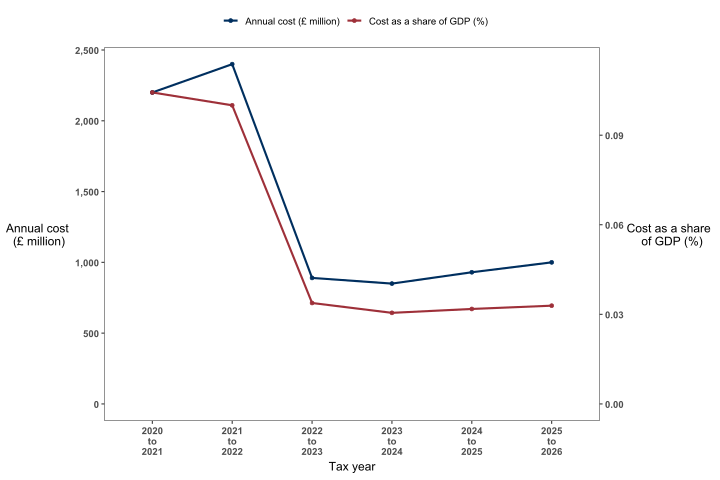
The information in the chart is represented in the preceding table.
Commentary on cost change over time
The cost of this relief has remained stable until 2021 to 2022, reflecting relatively flat consumption.
As detailed in an HMRC policy paper, the entitlement to use red diesel has been removed from most users from April 2022. As a result of this, the cost of relief in 2022-23 has fallen substantially.
The cost of the relief in 2024-25 is higher than estimated previously. This is because outturn gas oil receipts exceeded the OBR forecast in 2024-25. The cost of the relief is expected to increase in 2025-26 but remain steady as a % of GDP, in line with the OBR gas oil forecast.
Distributional analysis
Domestic users of the relief are likely to be off the gas grid. 2013 research from the Department for Energy and Climate Change (now DESNZ) shows that homes off the gas grid are more likely to be in rural areas.
Evaluative summary
Some oils and fuels are taxed at a lower (rebated) rate, historically because fuel duty was intended to be a tax on road vehicles. At Budget 2020, the government announced that it would remove the entitlement to use gas oil (known as red diesel) from most sectors from April 2022. The tax changes mean most users of gas oil will move to paying the standard rate for diesel from April 2022, like motorists. This more fairly reflects the harmful impact of the emissions they produce.
Removing most gas oil entitlements will also help to ensure that the tax system incentivises users of polluting fuels like diesel to improve the energy efficiency of their vehicles and machinery, invest in cleaner alternatives, or use less fuel.
3.31 Stamp Duty Land Tax - first time buyers relief
Description
Relief from SDLT for first time buyers (as defined) of purchases of residential property for £500,000 or less, provided the purchaser intends to occupy the property as their only or main residence. The relief applies to purchases from 22 November 2017.
| Tax year | 2020 to 2021 | 2021 to 2022 | 2022 to 2023 | 2023 to 2024 | 2024 to 2025 | 2025 to 2026 |
|---|---|---|---|---|---|---|
| Cost (£ million) | 90 | 370 | 710 | 540 | 770 | 750* |
| Cost (% GDP) | 0.004% | 0.015% | 0.027% | 0.019% | 0.026% | 0.025%* |
| Number of claimants | 36,900 | 151,900 | 203,600 | 113,100 | 155,400 | Not available |
Figure 35: nominal annual cost (£ million) and cost as a share of GDP (%)
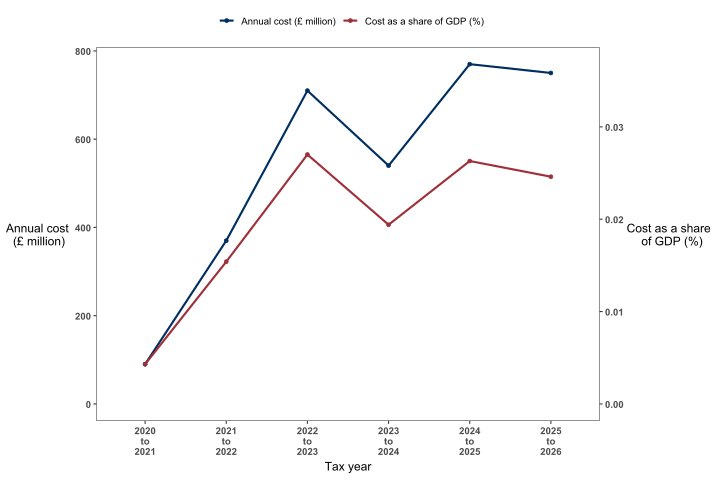
The information in the chart is represented in the preceding table.
Commentary on cost change over time
The cost of First Time Buyers’ Relief (FTBR) decreased sharply in 2020 to 2021 due to COVID-19 and the introduction of the Stamp Duty Land Tax (SDLT) holiday between July 2020 to September 2021. Following this there was a partial rebound in the number of relief claims and the amounts relieved in 2021 to 2022.
The cost of this relief in 2022 to 2023 was impacted by several factors. Firstly, economic recovery from COVID-19 and the conclusion of the SDLT holiday led to an increase in the cost of this relief. Further, on 23 September 2022, higher thresholds were introduced, allowing no tax to be payable on the first £425,000 of the purchase price. This change also increased the cost of the relief for the year, although it was somewhat offset by the impact of a higher nil-rate band introduced on the same date.
The drop in the cost in 2023 to 2024 and the rebound in 2024 to 2025 reflects wider trends in property transactions with some of the rebound attributable to individuals bringing forward their transactions to benefit from the more generous thresholds prior to the change to thresholds from 1 April 2025.
Thresholds for this relief were lowered to the previous thresholds (no tax payable on up to the first £300,000 of the purchase price) from 1 April 2025. The increase in expected cost of this relief in 2025 to 2026 is likely due to the lowering of the main rates nil rate band threshold resulting in increased property transactions benefiting from this relief and wider trends in property transactions.
Distributional analysis
Distributional analysis will be available in HMRC’s Annual Stamp Tax statistics (Table 9) which was reported in December 2025.
Evaluative summary
HMRC published an evaluation of the impact of the relief in May 2023.
A similar, temporary, relief was introduced in March 2010 (covering homes between £125,001 and £250,000), detailed in analysis by HMRC.
3.32 Income Tax - marriage allowance
Description
Gives a tax reduction to a person whose spouse or civil partner has elected for a reduced Personal Allowance.
| Tax year | 2020 to 2021 | 2021 to 2022 | 2022 to 2023 | 2023 to 2024 | 2024 to 2025 | 2025 to 2026 |
|---|---|---|---|---|---|---|
| Cost (£ million) | 560 | 560 | 580 | 580* | 580* | 590* |
| Cost (% GDP) | 0.027% | 0.023% | 0.022% | 0.021%* | 0.02%* | 0.019%* |
| Number of claimants | 2,170,000 | 2,280,000 | 2,350,000 | 2,440,000 | Not available | Not available |
Figure 36: nominal annual cost (£ million) and cost as a share of GDP (%)
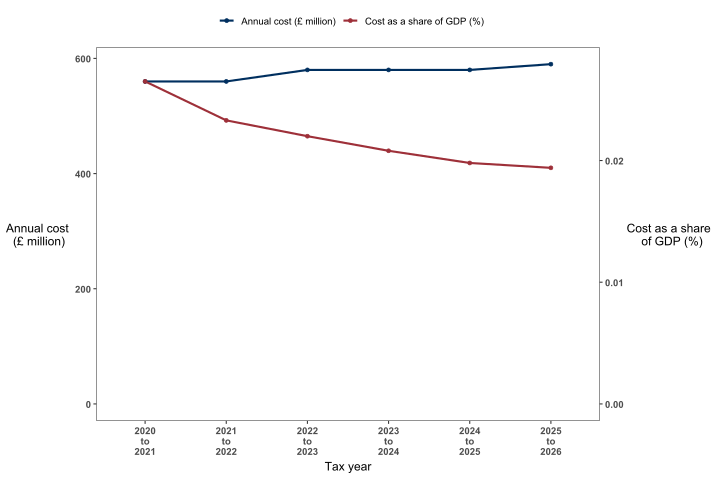
The information in the chart is represented in the preceding table.
Commentary on cost change over time
The cost of Marriage Allowance has shown consistent steady increases each year as the number of claimants has increased. The estimated cost figures reflect the anticipated take up of the allowance when all backdated claims have been made in future tax years (up to 4 years later).
Estimates of the number of claimants are the latest available and reflect only successful claimants up to that point in time and not the anticipated full take up when all backdated claims have been made in future tax years (up to 4 years later).
Forecast information
Outturn data for 2023 to 2024 and projections beyond replace previous projections using 2022 to 2023 outturn data, with small revisions including to outturn years due to retrospective claims accrued to earlier outturn years.
3.33 Corporation Tax - film tax relief
Description
Film production companies can claim additional corporation tax on tax relief for film production expenditure in the UK. Companies not making a profit may be able to surrender the relief and receive tax credit.
| Tax year | 2020 to 2021 | 2021 to 2022 | 2022 to 2023 | 2023 to 2024 | 2024 to 2025 | 2025 to 2026 |
|---|---|---|---|---|---|---|
| Cost (£ million) | 420 | 520 | 555 | 535 | 570* | 635* |
| Cost (% GDP) | 0.02% | 0.022% | 0.021% | 0.019% | 0.019%* | 0.021%* |
| Number of claimants | 675 | 720 | 785 | 830 | Not available | Not available |
Figure 37: nominal annual cost (£ million) and cost as a share of GDP (%)
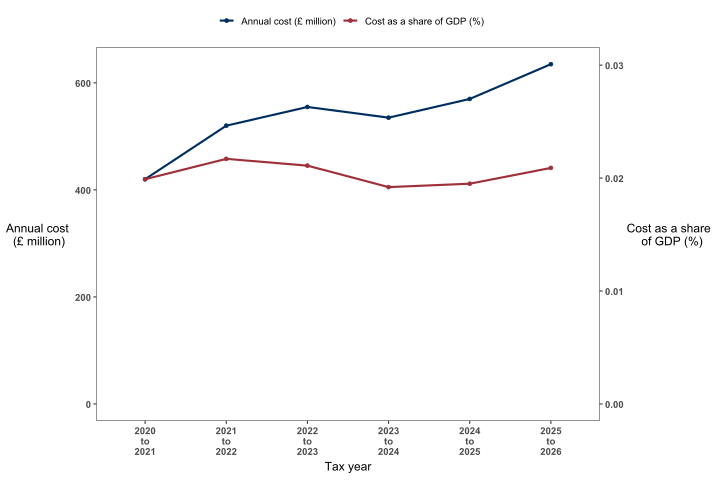
The information in the chart is represented in the preceding table.
Commentary on cost change over time
The number of Film Tax Relief (FTR) claimants and amount of relief paid was low in the 2020-21 tax year, primarily due to the effects of the Covid-19 pandemic.
There has been some recovery in both the amount paid and number of claimants in the following years. However, the amount of relief paid out remains below its pre-COVID peak. This is partly due to the increase in the number of feature length films produced for streaming services, many of which claim High-end TV relief instead of FTR.
FTR is predicted to reach its pre-COVID levels in 2025-26, in part due to the higher rates of relief available under Independent Film Tax Credit in the new AVEC scheme.
Distributional analysis
HMRC’s Creative Industries official statistics provides information about the number of claims, number of companies and amount of relief paid out each year.
In 2023-24 64% of claims were for £100k or less, the same as previous year. 2% of claims in 2023-24 were over £5m, accounting for 61% of the total paid.
Evaluative summary
A recent evaluation of the impacts of Creative Industry tax reliefs, includingFilm Tax Relief, was published in November 2022.
Forecast information
Film Tax Relief is included in the OBR’s corporation tax credits forecast in the Economic-and-fiscal-outlook.
3.34 Income Tax - personal savings allowance (PSA)
Description
0% tax rate on taxable savings income. Most taxpayers get PSA of £1000, Higher Rate taxpayers get £500 PSA and PSA is not available to additional rate taxpayers.
| Tax year | 2020 to 2021 | 2021 to 2022 | 2022 to 2023 | 2023 to 2024 | 2024 to 2025 | 2025 to 2026 |
|---|---|---|---|---|---|---|
| Cost (£ million) | 270 | 200 | 440 | 690* | 770* | 800* |
| Cost (% GDP) | 0.013% | 0.008% | 0.017% | 0.025%* | 0.026%* | 0.026%* |
| Number of claimants | 8,430,000 | 8,630,000 | 12,200,000 | 13,200,000 | 13,900,000 | 14,400,000 |
Figure 38: nominal annual cost (£ million) and cost as a share of GDP (%)
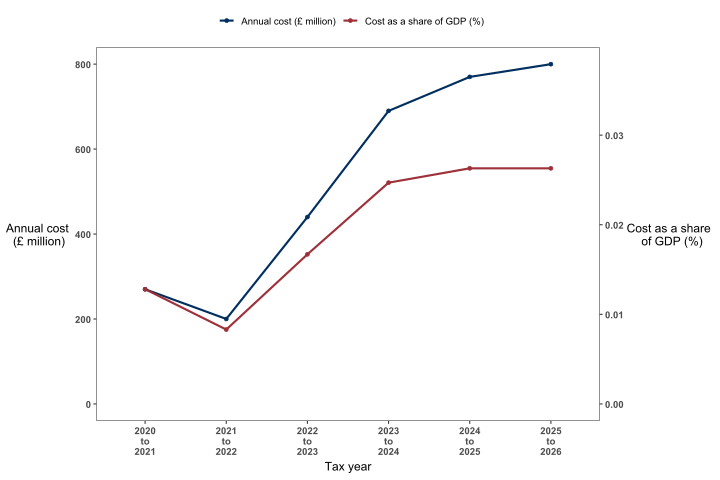
The information in the chart is represented in the preceding table.
Commentary on cost change over time
Individuals do not have to report small amounts of savings which do not exceed the PSA. The number of individuals with savings income in excess of their PSA will decrease if interest rates or investment returns decrease. Therefore, changes in interest rates or investment returns have a significant impact on the cost of the PSA. This can be seen in 2022 to 2023 and 2023 to 2024 as interest rates have risen and is reflected in the forecast for subsequent years.
Forecast information
New outturn estimates for 2022 to 2023 replace the previous projection, showing a significant increase in the cost of the PSA and results in increased estimates for the projections years as well.
3.35 Income Tax and NICs - save as you earn
Description
All employee share option scheme where employees can save up to £500 per month for 3 or 5 years out of net pay. At the end of the period they can take savings in cash plus bonus or use funds to exercise options over shares in the company at a discount of up to 20%. There is no income tax/NICs on grant, and gain on exercise is free of income tax/NICs.
| Tax year | 2020 to 2021 | 2021 to 2022 | 2022 to 2023 | 2023 to 2024 | 2024 to 2025 | 2025 to 2026 |
|---|---|---|---|---|---|---|
| Cost (£ million) | Not available | 250 | 160 | 490 | Not available | Not available |
| Cost (% GDP) | Not available | 0.01% | 0.006% | 0.018% | Not available | Not available |
| Number of claimants | Not available | 180,000 | 130,000 | 210,000 | Not available | Not available |
Figure 39: nominal annual cost (£ million) and cost as a share of GDP (%)
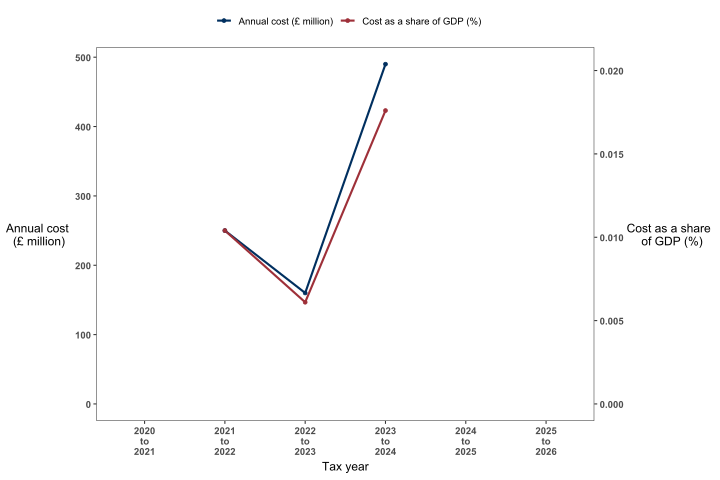
The information in the chart is represented in the preceding table.
Commentary on cost change over time
The nominal cost of the relief and the share of GDP are based on Employment Related Securities (ERS) data submitted to HMRC by companies who operated the tax-advantaged Save As You Earn scheme from tax year 2021 to 2022 to tax year 2023 to 2024. The data reflects the Income Tax and National Insurance Contributions (NICs) relief on the value of the gains made by employees who were granted options to buy shares and subsequently exercised those shares.
In 2023 to 2024 SAYE overtook EMI to become the largest employee scheme in terms of relief, likely due to greater participation in schemes during the Covid-19 pandemic and an increase in listed share prices since that time. SAYE contracts typically last 3 or 5 years, with 3 years being most common. Therefore, exercises in the 2024 tax year mostly relate to options granted in 2021, when equity prices were lower due to the pandemic—resulting in higher gains and greater tax relief.
The estimated cost of this exemption from Income Tax and NICs does not represent the yield if this tax-advantaged share scheme were to be abolished, as consequential behavioural effects may reduce yield. For example, there are three other tax-advantaged share schemes that companies may increase usage of if SAYE were removed.
Distributional analysis
The SAYE scheme allows employees to save monthly over 3 or 5 years to buy company shares at a discounted price, with the option to withdraw savings tax-free if they choose not to buy. It offers tax advantages, including no Income Tax or National Insurance on the discount
HMRC’s Employee Share Scheme (ESS) statistics show that the average gain made on share options exercised by employees in 2023 to 2024 was £4,620. A detailed commentary on SAYE statistics can be found in that publication.
Evaluative summary
HMRC commissioned an evaluation of Save As You Earn and other share schemes and the findings were published in June 2023.
Forecast information
There is no published SAYE tax relief forecast. The relieved Income Tax and NICs liabilities and receipts will be baselined within the Office for Budget Responsibility’s (OBR) forecasts.
3.36 Income Tax - enterprise investment scheme (EIS) - income tax relief
Description
Tax relief against the income tax liability for individuals of 30% of the amounts subscribed for shares in early stage qualifying trading companies. The maximum amount subscribed in a tax year on which relief can be claimed is £2 million, but any amount over £1 million must be for shares issued by one or more knowledge-intensive companies.
| Tax year | 2020 to 2021 | 2021 to 2022 | 2022 to 2023 | 2023 to 2024 | 2024 to 2025 | 2025 to 2026 |
|---|---|---|---|---|---|---|
| Cost (£ million) | 460 | 640 | 550 | 440 | 480* | 470* |
| Cost (% GDP) | 0.022% | 0.027% | 0.021% | 0.016% | 0.016%* | 0.015%* |
| Number of claimants | 39,035 | 44,575 | 40,470 | 35,150 | Not available | Not available |
Figure 40: nominal annual cost (£ million) and cost as a share of GDP (%)
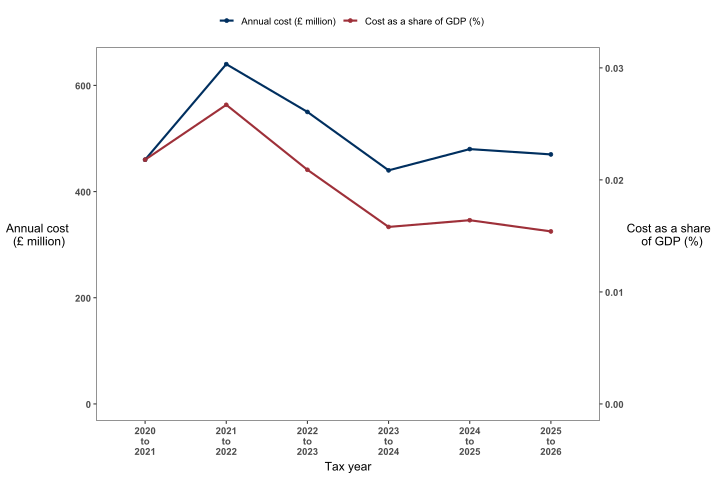
The information in the chart is represented in the preceding table.
Commentary on cost change over time
The cost of EIS has fluctuated slightly in recent years, with the values in 2020 to 2021 reflecting the impact of COVID-19. Costs then increased sharply in 2021 to 2022 as a result of a strong post-Covid rebound. This is reflective of general strong performance in the wider venture capital markets. Costs saw a slight reduction from the previous year in 2022 to 2023 due to rising interest rates affecting the venture capital market. Similar declines were noted across the other Venture Capital Tax Reliefs. In 2023 to 2024, we saw a further decline in costs that were reflective of the wider market and as a result of policy changes to expand the investment limits of the Seed Enterprise Investment Scheme (SEIS) scheme. We observed that some investment was redirected from EIS into SEIS now that these limits have increased due to its more favourable tax incentives.
Whilst there are fluctuations in the number of investors year to year, National Statistics for EIS show that there were 21,835 investors in 2012 to 2013, rising to 44,575 investors in 2021 to 2022 with a reduction to 40,470 in 2022 to 2023 and further still to 35,150 in 2023 to 2024.
Over the period covered in this publication, venture capital schemes (EIS, SEIS, SITR, VCTs) have had a number of legislative changes to incentivize uptake or to manage abuse and avoidance, with corresponding effects on the cost of the schemes.
Distributional analysis
Tables 9 and 10 of HMRC’s EIS statistical tables show that in 2023 to 2024, the total amount of investment on which relief was claimed through Self-Assessment tax returns was approximately £1.33 billion by 35,150 investors.
Around 93% of investors invested less than £100,000, with the remaining 7% investing amounts up to £2 million. Those investing less than £100,000 represent around 45% of the total amount of investment. These estimates are provisional and subject to revision in future publications.
Evaluative summary
The latest evaluation of the EIS and other Venture Capital Schemes can be found on GOV.UK.
3.37 VAT - reduced rate of VAT on energy saving materials
Description
Reduced rate of VAT on supplies of installing energy saving materials in residential accommodation.
| Tax year | 2020 to 2021 | 2021 to 2022 | 2022 to 2023 | 2023 to 2024 | 2024 to 2025 | 2025 to 2026 |
|---|---|---|---|---|---|---|
| Cost (£ million) | 200 | 300 | 570 | 680 | 720 | 800* |
| Cost (% GDP) | 0.009% | 0.013% | 0.022% | 0.024% | 0.025% | 0.026%* |
Figure 41: nominal annual cost (£ million) and cost as a share of GDP (%)
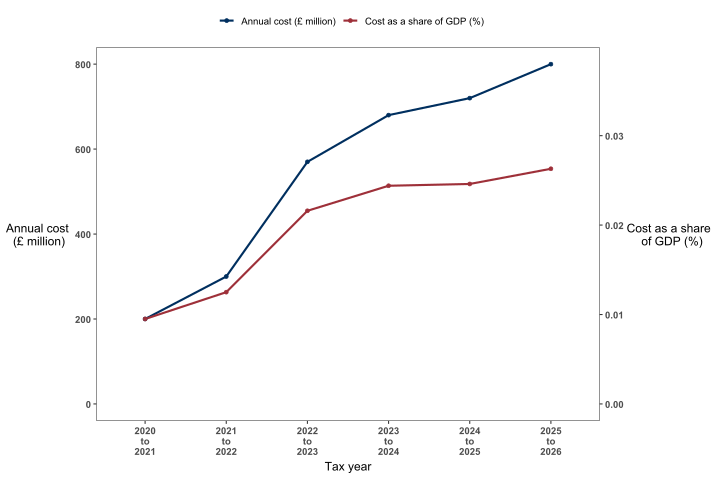
The information in the chart is represented in the preceding table.
Commentary on cost change over time
The cost of this relief has been steadily increasing over time and as a proportion to GDP. This is mainly due to increasing numbers of installations of renewable energy technologies. In addition, the relief changed from a Reduced Rate to a Zero rate of VAT from 1 May 2023; the estimates for 2023 to 2024 onwards reflect this change.
The increases in 2022-23 and 2023-24 also reflect a recovery in the volume and increase in the average cost of installations of solar panels. From 2024-25, the cost is further increased as a result of growth in battery storage installations.
Distributional analysis
The Household Energy Efficiency Statistics ODS table T1.1 show that energy company obligation measures have started to increase but not to the levels of late 2023 and early 2024.
3.38 Income Tax and NICs - enterprise management incentives (EMI)
Description
If an employee holds options to qualifying EMI shares (maximum £250k) there is no income tax/NICs on grant or on exercise (as long as option not issued at a discount).
| Tax year | 2020 to 2021 | 2021 to 2022 | 2022 to 2023 | 2023 to 2024 | 2024 to 2025 | 2025 to 2026 |
|---|---|---|---|---|---|---|
| Cost (£ million) | Not available | 680 | 510 | 400 | Not available | Not available |
| Cost (% GDP) | Not available | 0.028% | 0.019% | 0.014% | Not available | Not available |
| Number of claimants | Not available | 13,000 | 11,000 | 11,000 | Not available | Not available |
Figure 42: nominal annual cost (£ million) and cost as a share of GDP (%)
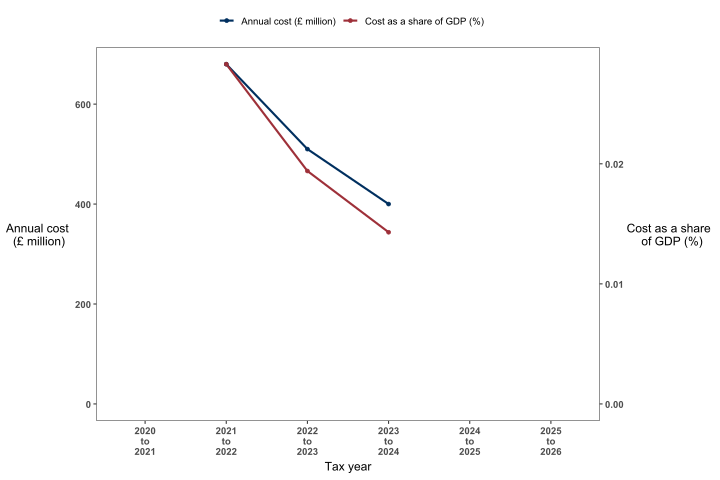
The information in the chart is represented in the preceding table.
Commentary on cost change over time
The nominal cost of the relief and the share of GDP are based on Employment Related Securities (ERS) data submitted to HMRC by companies who operated the tax-advantaged Enterprise Management Incentives (EMI) scheme in 2021 to 2022 and 2023 to 2024. The data reflects the Income Tax and National Insurance Contributions (NICs) relief on the value of the gains made by employees who were granted options to buy shares and subsequently exercised those shares.
A reduction in the cost of relief between 2021 to 2022 and 2022 to 2023 in part reflects approximately 2,000 fewer employees exercising shares in the latter year. In the tax year 2023 to 2024 the number of employees remained stable while the total amount of relief fell, reflecting a lower average value of options exercised by employees.
The estimated cost of this exemption from Income Tax and NICs does not represent the yield if this tax-advantaged share scheme were to be abolished, as consequential behavioural effects may reduce yield. For example, there are three other tax-advantaged share schemes that companies may increase usage of if EMI were removed.
Distributional analysis
For the years published the EMI scheme is restricted to small companies that have fewer than 250 full time equivalent employees and less than £30m of gross assets. The scheme is discretionary and allows companies to choose which employees to offer the scheme to.
The maximum value of share options that can be granted to employees is £250,000. HMRC’s Employee Share Scheme (ESS) statistics show that the average gain made on share options exercised by employees in 2023 to 2024 was £81,800. A detailed commentary on EMI statistics can be found in that publication.
Evaluative summary
HMRC commissioned an evaluation of the Enterprise Management Incentive (EMI) scheme and the findings were published in June 2018.
Forecast information
There is no published EMI tax relief forecast. The relieved Income Tax and NICs liabilities and receipts will be baselined within the Office for Budget Responsibility’s (OBR) forecasts.
3.39 Income Tax - seafarers’ earnings deduction
Description
100% deduction for earnings from employment as a seafarer.
| Tax year | 2020 to 2021 | 2021 to 2022 | 2022 to 2023 | 2023 to 2024 | 2024 to 2025 | 2025 to 2026 |
|---|---|---|---|---|---|---|
| Cost (£ million) | 240 | 270 | 320 | 370 | 393* | Not available |
| Cost (% GDP) | 0.011% | 0.011% | 0.012% | 0.013% | 0.013%* | Not available |
| Number of claimants | 17,000 | 19,000 | 21,000 | 23,000 | Not available | Not available |
Figure 43: nominal annual cost (£ million) and cost as a share of GDP (%)
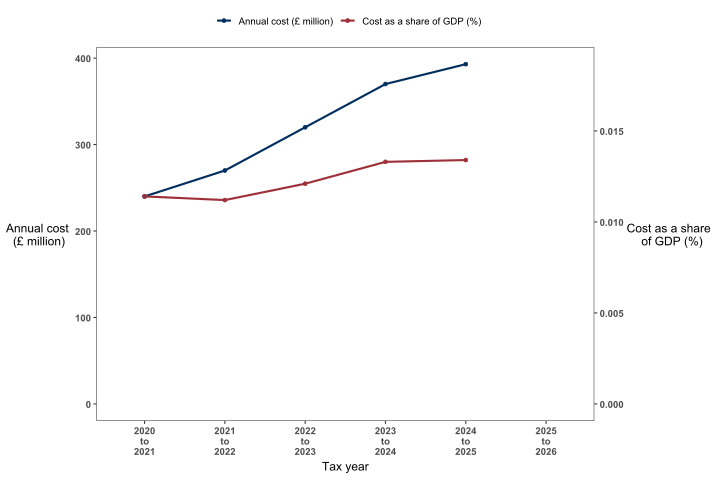
The information in the chart is represented in the preceding table.
Commentary on cost change over time
The cost of this relief had a trough during COVID years (2020 to 2021 and 2021 to 2022) and increased since showing a bounce back with the general economic recovery. In the latest outturn data (2023 to 2024), the relief shows a higher increase than in previous years due to several factors, including a larger claimant count and greater value of amounts claimed, as well as higher average tax rate. We have implemented improved methodology which increases forecast accuracy. Some data is now available for the forecast year 2024 to 2025 which indicates further increases in cost.
4. Monitoring the outturn cost of tax reliefs
Since 2019, we have made significant progress towards estimating a cost for all non-structural tax reliefs. We are also working to improve our monitoring of these costs through time, as recommended by the NAO.
In January 2024 report on Reliefs the NAO recommended that HMRC should improve the transparency of relief costs by committing to provide comparisons of forecast and outturn costs compiled on the same basis.
This should also inform internal reporting and analysis:
a. HMRC should report where tax reliefs greatly exceed the initial expected costs
b. HMRC should investigate differences, using robust evidence to form conclusions
This section sets out two approaches to monitoring where the costs of tax reliefs are different to the expected costs. One approach we have been using for some time and a second approach which is new in this publication.
Additionally to comparing the outturn to forecasts, HMRC regularly evaluates tax relief HMRC published a tax relief evaluation plan in December 2021 and updated a list of planned evaluations in April 2023.
4.1 Our monitoring approach
We regularly publish comparisons of the announced policy costs of a tax relief (the policy costing) to estimated outturns. This comparison is not available for all reliefs, as we do not have announced policy costs for many reliefs.
We now also regularly publish comparisons of our estimated outturns to the forecasts published in the previous version of this publication.
4.2 Estimating Outturns
A forecast is an estimation of the future. Outturn is an observation of the past. With tax reliefs often we cannot observe the outturn. Instead, we use data from a variety of sources to produce an estimated outturn cost of tax reliefs.
The reason that we do not directly measure the cost of many tax reliefs is that tax reliefs reduce, or remove, the requirement to pay taxes. To minimise the burden on customers, in many cases, customers do not have to inform HMRC that they are using a tax relief. For instance, customers renting a furnished room in their main home pay no tax if the gross rents do not exceed £7,500 a year. They also do not have to inform HMRC that they are renting the room unless they have other property income.
Such conditions reduce the need to interact with HMRC, encourage economic activity, and reduce potential for accidental non-compliance. However, minimising reporting also makes observing the cost difficult, so HMRC must estimate the cost.
5. Comparison of forecasts in policy costings with estimated outturn
This section shows comparisons of the estimated outturn costs of tax reliefs with the cost that was published when the policy was announced. This is updated analysis of information we have been publishing for several years. We have focused on non-structural tax reliefs which have been announced since the introduction of the OBR in 2010. This analysis is available for the following reliefs:
Table 7: Table of reliefs with announcement forecast vs outturn analysis within this publication
| Tax head | Relief |
|---|---|
| Corporation Tax | Museums and Galleries exhibition tax relief (MGETR) |
| NICs | Relief on employer National Insurance contributions for veterans |
| NICs, Income Tax, Stamp Duty Land Tax and Corporation Tax | Relief for Freeport tax sites |
| Stamp Duty Land Tax | First Time Buyers Relief |
5.1 Policy costings
At each fiscal event, the Government publishes a set of Policy Costings. More detail on this process can be found in OBR’s briefing paper: Policy Costings and our Forecast.
While we can, and do, compare forecasts published in Policy Costings to estimated outturn where possible, there are several important differences between Policy Costings and the outturn Tax Relief Cost Estimates in this publication:
-
Policy basis: Fiscal Event Policy Costings reflect Government policy at the time of announcement, however the policy may change, for example following consultation.
-
Forecast basis: Fiscal Event Policy Costings will reflect the OBR’s forecast and judgements at the time of the fiscal event.
Links to costing notes published at the fiscal events when these reliefs were introduced are provided, which show the original forecast numbers and explain the costing methodology. It is difficult to compare the costs of all tax reliefs with published government forecasts for a number of reasons:
- original projections cover a maximum of 5 years and might not overlap with the period covered in this publication
- cost forecasts published at budget often represent the cost of policy changes to reliefs rather than the whole cost of a relief
- wider economic changes and technological developments affect the outturn cost of the relief and are unforeseeable when they are announced
- the forecast cost of some reliefs are estimated as a package along with other changes, and cannot be isolated
5.2 Museums and galleries exhibition tax relief (MGETR)
Description
Charitable museum companies can claim additional corporation tax relief for UK or European Economic Area (EEA) expenditure incurred on producing exhibitions. Companies not making a profit may be able to surrender the loss and receive a payable tax credit.
| Metric | 2020 to 2021 | 2021 to 2022 | 2022 to 2023 | 2023 to 2024 | 2024 to 2025 | 2025 to 2026 |
|---|---|---|---|---|---|---|
| Forecast cost (£ million) | 30 | 30 | Not available | Not available | Not available | Not available |
| Cost Estimate (£ million) | 15 | 10 | Not available | Not available | Not available | Not available |
| Difference (£ million) | -15 | -20 | Not available | Not available | Not available | Not available |
| Percentage difference | -50% | -67% | Not available | Not available | Not available | Not available |
Commentary on differences between outturn cost and original forecast
The cost estimates provided above are on a cash basis (rather than the accruals figures in the published tables), to be more comparable to the forecast cost. Outturn cost is consistently below forecast. Take-up of the relief has grown more slowly than originally anticipated. This is exacerbated by COVID impacts on the sector in 2020-21 and 2021-22. See the policy costing for more information.
5.3 Relief on employer national insurance contributions for veterans
Description
A zero rate of Class 1 secondary NICs for qualifying veterans up to the veterans upper secondary threshold
| Metric | 2020 to 2021 | 2021 to 2022 | 2022 to 2023 | 2023 to 2024 | 2024 to 2025 | 2025 to 2026 |
|---|---|---|---|---|---|---|
| Forecast cost (£ million) | Not available | 15 | 20 | 25 | 5 | 5 |
| Cost Estimate (£ million) | Not available | Not available | Negligible | 5 | 5 | 5 |
| Difference (£ million) | Not available | Not available | Not available | -20 | 0 | 0 |
| Percentage difference | Not available | Not available | Not available | -80% | 0% | 0% |
Commentary on differences between outturn cost and original forecast
The outturn cost up to 2023 to 2024 is consistently lower than the forecast. The outturn is estimated using a near-complete view of employees and their monthly wages from HMRC’s Real Time Information which was not available at the time of the forecast. There is a lower number of service leavers being claimed for than the original number of individuals that were expected to take up the relief. Forecast costs from 2024 to 2025 were calculated using available administrative data after the relief was extended. Cost estimates for 2021 to 2022 are not available.
5.4 Relief for freeport tax sites
Description
The following reliefs are available in English Freeport tax sites: 1. A zero rate of Class 1 secondary NICs for eligible employees up to the freeports upper secondary threshold; 2. A 100% first-year allowance for expenditure by companies on certain new plant or machinery for use within Freeport tax sites. 3. An enhanced structures and buildings capital allowance providing relief for investment in qualifying construction costs of non-residential buildings or structures, and renovation or conversion costs of existing ones. 4. Relief from SDLT for purchases of non-residential land and property.
| Metric | 2020 to 2021 | 2021 to 2022 | 2022 to 2023 | 2023 to 2024 | 2024 to 2025 | 2025 to 2026 |
|---|---|---|---|---|---|---|
| Forecast cost (£ million) | Not available | Not available | 10 | 25 | Not available | Not available |
| Cost Estimate (£ million) | Not available | Not available | 10 | 20 | Not available | Not available |
| Difference (£ million) | Not available | Not available | 0 | -5 | Not available | Not available |
| Percentage difference | Not available | Not available | 0% | -20% | Not available | Not available |
Commentary on differences between outturn cost and original forecast
The outturn cost is generally in line with the forecast. The outturn is estimated using HMRC’s Real Time Information, Corporation tax and SDLT tax returns. Freeports sites were designated later than expected resulting in a delay to the costs.
5.5 First time buyers relief
Description
Relief from SDLT for first time buyers (as defined) of purchases of residential property for £500,000 or less (£625,000 or less from 23 September 2022), provided the purchaser intends to occupy the property as their only or main residence. The relief applies to purchases from 22 November 2017.
| Metric | 2020 to 2021 | 2021 to 2022 | 2022 to 2023 | 2023 to 2024 | 2024 to 2025 | 2025 to 2026 |
|---|---|---|---|---|---|---|
| Forecast cost (£ million) | 610 | 640 | 670 | Not available | Not available | Not available |
| Cost Estimate (£ million) | 90 | 370 | 710 | Not available | Not available | Not available |
| Difference (£ million) | -520 | -270 | 40 | Not available | Not available | Not available |
| Percentage difference | -85% | -42% | 6% | Not available | Not available | Not available |
Commentary on differences between outturn cost and original forecast
The outturn is relatively close to the forecast for 2018 to 2019 and 2019 to 2020. In 2020 to 2021 the SDLT holiday was introduced which meant that there was no tax payable on purchases below £500,000 and First Time Buyers relief did not apply between 8th July 2020 and 30th June 2021. From 1st July 2021 up to 30th September 2021 and from 23rd September 2022 onwards, there was no tax payable on the first £250,000 of the purchase price so relief claims would have been limited during these periods. The cost of the relief in 2020 to 2021 and 2021 to 2022 is therefore much lower than originally forecast. The revised higher thresholds for this relief (now no tax payable on up to the first £425,000 of the purchase price) that were introduced on 23 September 2022 has had the effect of increasing the value of this relief in 2022 to 2023. However, this is counteracted by the effect of a higher nil-rate band resulting from changes introduced on the same date and resulted in a 2022-23 projection below forecast. See the policy costing for more information.
6. Comparing our tax relief cost forecasts against estimated outturn
Each tax reliefs publication includes forecasted cost estimates for the following tax year. In the December 2024 publication, we published forecasted costs for the 2024 to 2025 tax year for 91 non-structural tax reliefs. This section evaluates how these forecast costs compare to the estimated outturn costing for 2024 to 2025 presented in this year’s publication.
As we are part way through the 2025 to 2026 tax year, we have more data for some reliefs and adjust our estimated outturn costs accordingly. However, the tax year is not over meaning there are reliefs with reported use for which we do not have observed outturn data.
Table 8 shows the percentage difference from our December 2024 forecast to our December 2025 estimated outturn costings. The difference is expressed as a percentage of the December 2024 forecast. For example, if a forecast were 100, and the estimated outturn 110, the percentage difference would be 10%.
Table 8: Percentage difference from our forecast to our estimated outturn costings for tax year: 2024 to 2025
| Difference: Forecast to Estimated Outturn | Count |
|---|---|
| 50% less than expected or lower | 2 |
| Between 25 and 50% less than expected | 4 |
| Between 5 and 25% less than expected | 17 |
| Within 5% of expectation | 38 |
| Between 5 and 25% more than expected | 19 |
| Between 25 and 50% more than expected | 7 |
| 50% more than expected or higher | 3 |
For most reliefs the forecast at last publication differs little from the estimated outturn in this publication. More significant differences between forecast and estimated outturn often partly reflect wider economic factors.