Separated families statistics: April 2014 to March 2025
Published 26 March 2026
Applies to England, Scotland and Wales

© Crown copyright 2026
This publication is licensed under the terms of the Open Government Licence v3.0 except where otherwise stated. To view this licence, visit nationalarchives.gov.uk/doc/open-government-licence/version/3 or write to the Information Policy Team, The National Archives, Kew, London TW9 4DU, or email: psi@nationalarchives.gov.uk.
Where we have identified any third party copyright information you will need to obtain permission from the copyright holders concerned.
This publication is available at https://www.gov.uk/government/statistics/separated-families-statistics-april-2014-to-march-2025/separated-families-statistics-april-2014-to-march-2025
This is the latest release of annual statistics on separated families in Great Britain.
This publication contains new estimates covering the financial year ending 2025. Further information is available in the Background Information and Methodology note.
The next release is planned for March 2027.
1. Introduction
This publication uses the Family Resources Survey (FRS) and Households Below Average Income (HBAI) data. It provides new statistical estimates relating to separated families and their child maintenance arrangements for the financial year ending 2025.
In this period:
- the FRS achieved sample was just over 16,000 households
- survey fieldwork operations used face-to-face interviewing as the predominant way of completing the survey
These statistics provide estimates of the following:
- the number of separated families in Great Britain and the number of children in those families
- the proportion of separated families with a child maintenance arrangement and whether this arrangement is statutory or non-statutory
- the total amount of child maintenance received by parents with care, by arrangement type
- the net impact of child maintenance payments on the number of children in low-income households
- the impacts of child maintenance payments on where their households are represented in the income distribution
- characteristics of parents with care and non-resident parents, by child maintenance arrangement type
This release contains changes to data linking and the absolute low-income reference year.
Integrating survey responses with administrative data
Following changes to the FRS and HBAI data on which these statistics are based, income from the major state benefits and tax credits will be based on administrative data rather than survey responses. This change will improve the overall quality of our statistics. The following tables are affected:
- Tables 5a and 5b: The net impact of child maintenance payments on the number of children in low-income households
- Tables 6-9: The position of separated parent households in the Great Britain income distribution
- Table 10: The percentage of children in parent with care households who remain in low income after child maintenance payments
Updating the absolute low-income reference year
From the March 2026 publication, the absolute low-income reference year will change to financial year ending 2025. It will remain at financial year ending 2011 for previous publications. The absolute low-income threshold is 60% of median income in the reference year, adjusted for inflation. This change is needed because of the improvements to income data resulting from integrating survey responses on major state benefits and tax credits with administrative data. The following tables are affected:
- Tables 5a and 5b: The net impact of child maintenance payments on the number of children in low-income households
- Table 10: The percentage of children in parent with care households who remain in low income after child maintenance payments
Please refer to the Background Information and Methodology note for more information on both of these changes.
It should be noted that there is no requirement for separated families to have a child maintenance arrangement and some families may not want an arrangement. If parents do want an arrangement, they may be able to agree this themselves without the involvement of the Child Maintenance Service (CMS). Arrangements made in this way are called non-statutory arrangements or ‘family-based arrangements’. Where parents want an arrangement but need help with this, support is available through the digital service ‘Get Help Arranging Child Maintenance’.
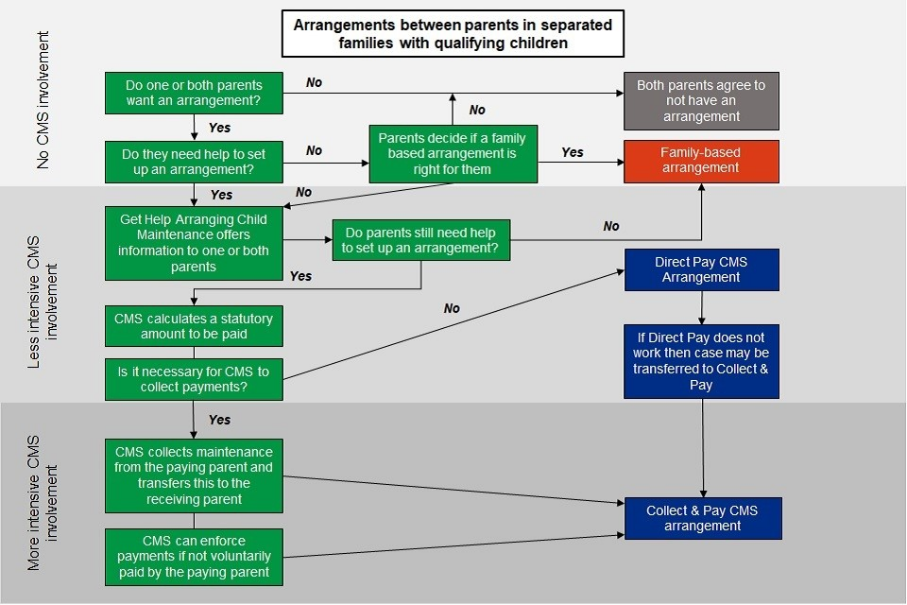
A flowchart shows the different child maintenance arrangement routes for separated parents. It begins with whether parents want an arrangement and whether they need help. If no help is needed, parents may independently form a family‑based arrangement. If help is required, the flow moves through the Get Help Arranging service and then either to the CMS or a family-based arrangement. CMS calculate payments, and parents either use Direct Pay or, if collection or enforcement is needed, the Collect and Pay service. For more details please refer to section one of the Background Information and Methodology note.
2. Main stories
In the financial year ending 2025, it is estimated that:
- there were 2.4 million separated families in Great Britain and 3.9million children in those separated families
- 65% of separated families had a child maintenance arrangement
In the 3-year period covering the financial years ending 2023 to 2025, it is estimated that:
- parents with care in separated families received a total of £2.9 billion annually in child maintenance payments
- 88% of parents with care were female, 86% were under the age of 50, 34% were disabled, 82% were white and 10% were married or in a civil partnership
- 86% of non-resident parents were male, 77% were under the age of 50, 30% were disabled, 84% were white and 24% were married or in a civil partnership
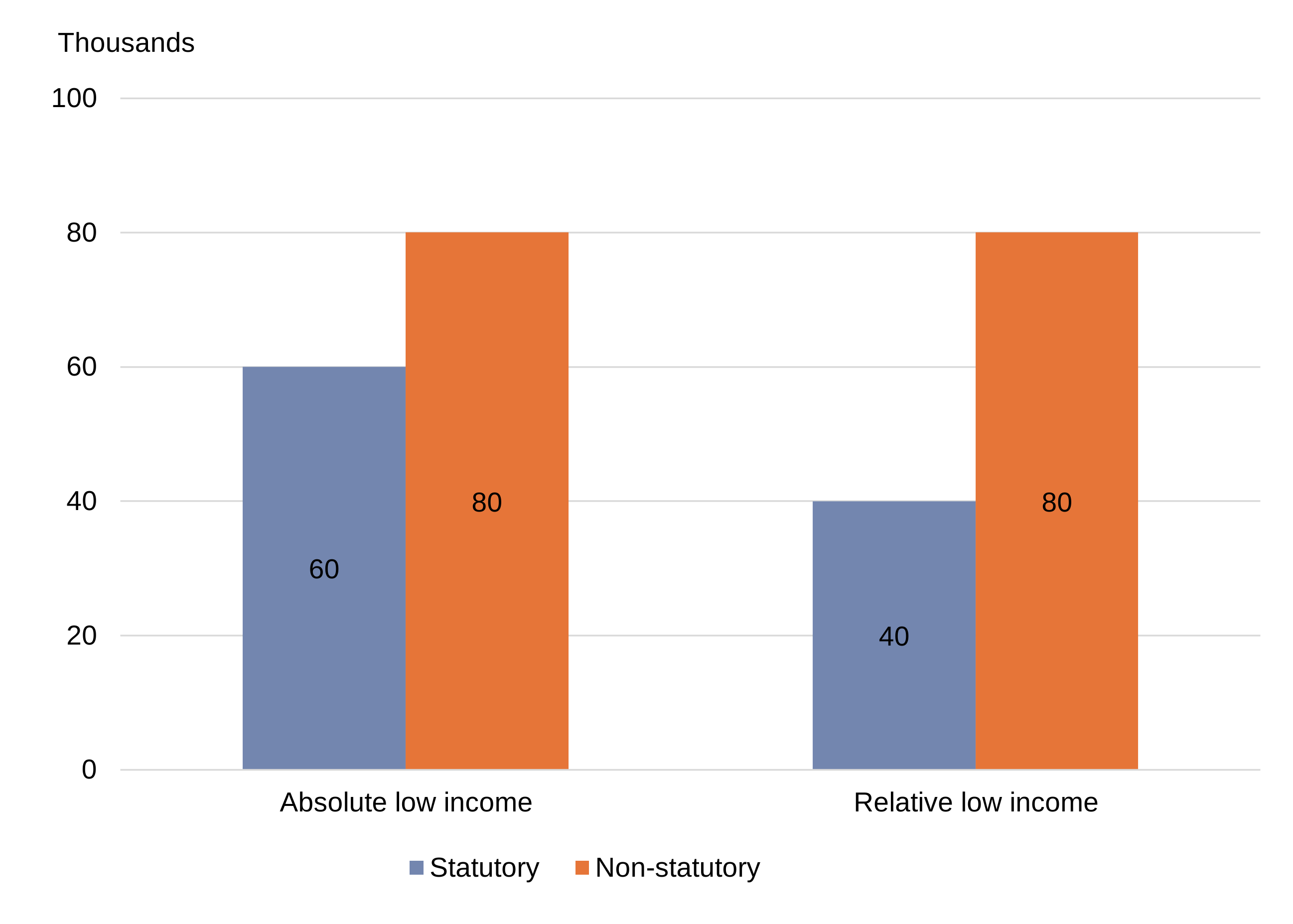
- child maintenance payments reduced the number of children living in low-income households annually. Overall, as a result of these payments, 120,000 children were kept out of relative low income on an after housing costs basis, and 140,000 children were kept out of absolute low income on an after housing costs basis
- of the 120,000 children kept out of relative low income each year on an after housing costs basis:
- 40,000 were in households with a statutory arrangement
- 80,000 were in households with a non-statutory arrangement
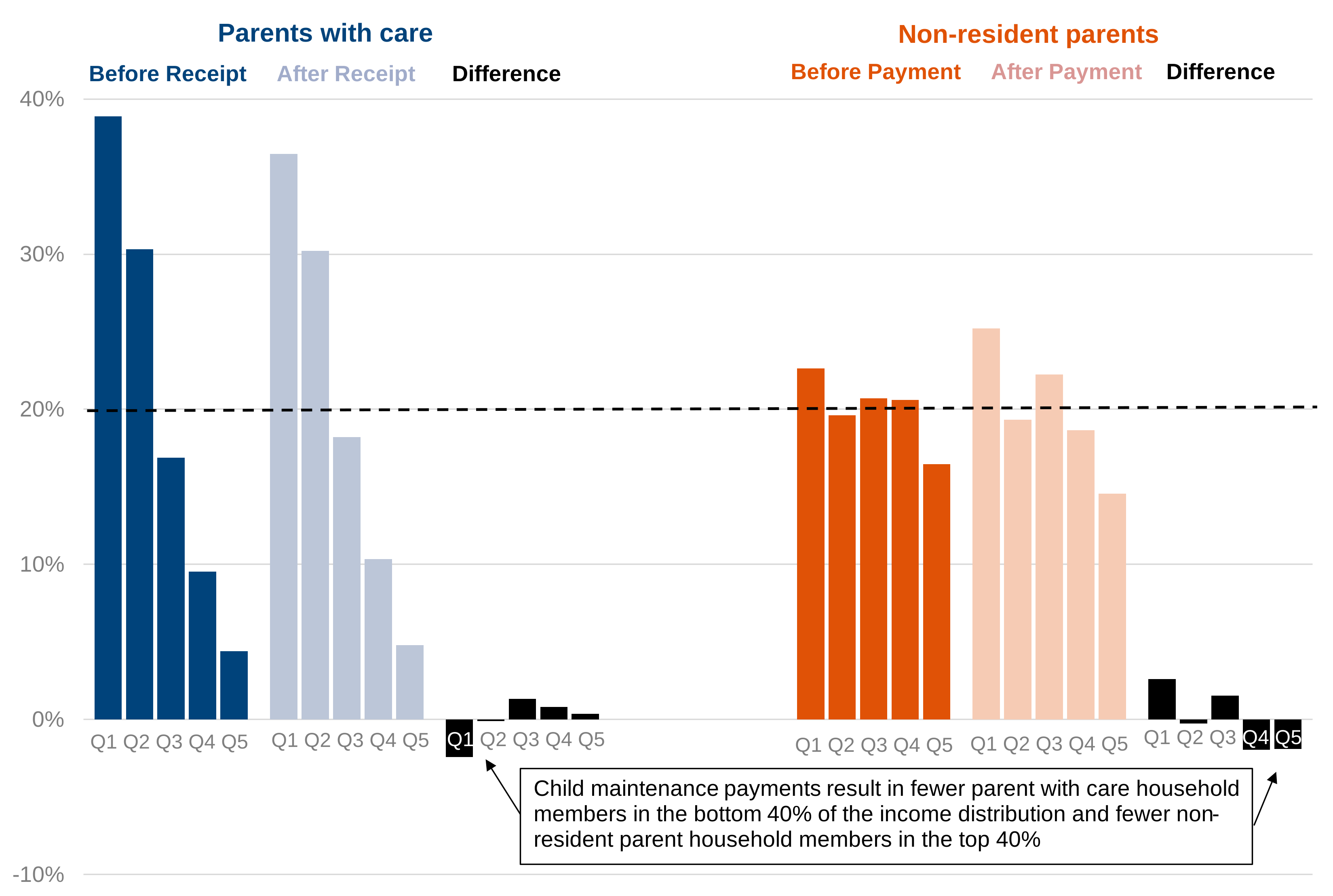
- child maintenance receipts reduced the percentage of individuals in parent with care households who are in the lowest 40% of the after housing costs income distribution by 3 percentage points
- child maintenance payments reduced the percentage of individuals in non-resident parent households who are in the highest 40% of the after housing costs income distribution by 4 percentage points
- The income distributions of parent with care households after housing costs and after child maintenance:
- with no arrangement tend to be heavily skewed towards the bottom of the Great Britain income distribution
- with a statutory or a non-statutory arrangement also tend to be skewed towards the bottom of the distribution, but to a slightly lesser extent
- The income distributions of non-resident parent households after housing costs and after child maintenance:
- with a statutory arrangement or no arrangement tend to be skewed towards the bottom of the Great Britain income distribution
- with a non-statutory arrangement tend largely to be more evenly distributed across the income distribution
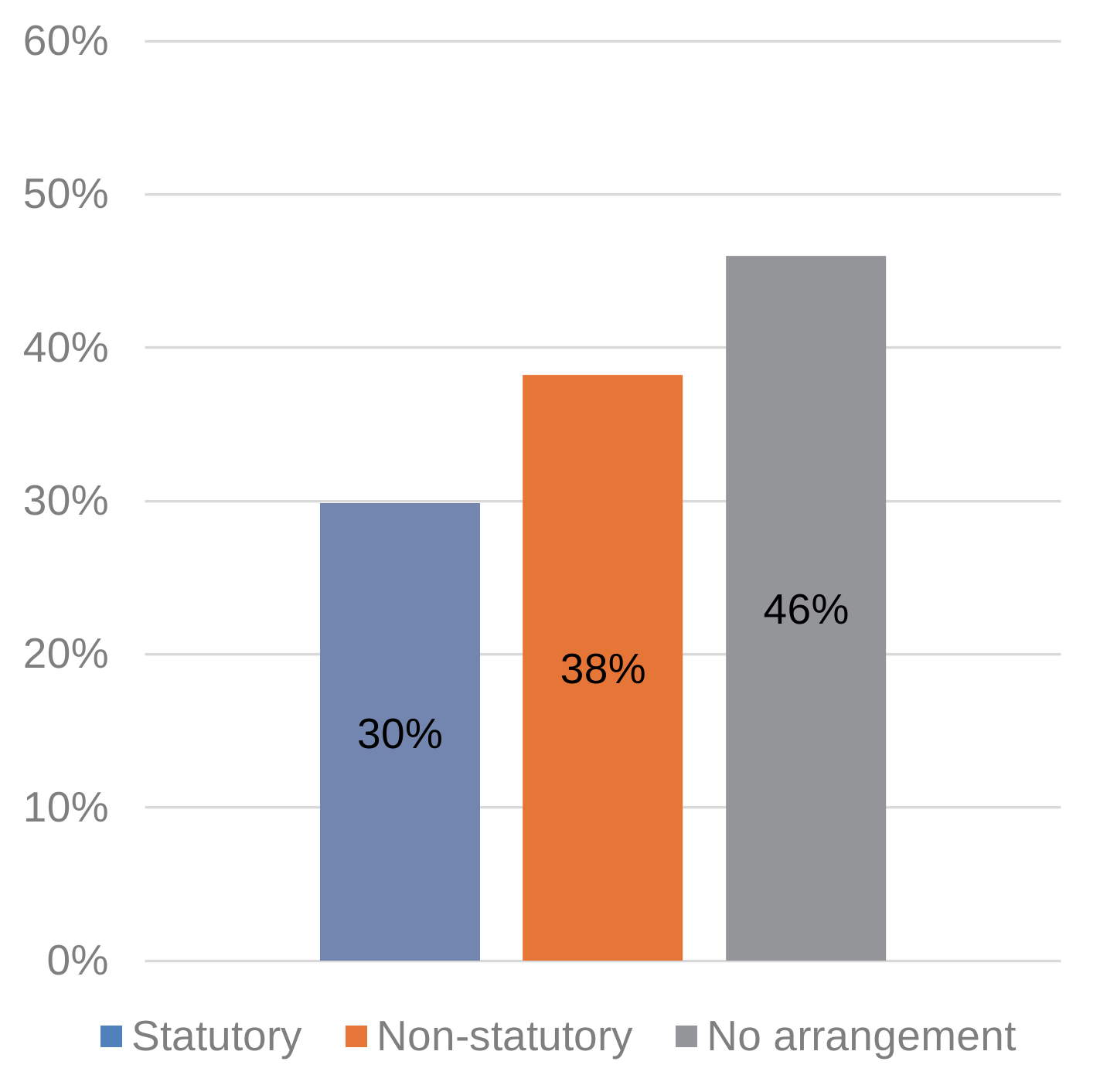
- The percentage of children in parent with care households who remain in relative low income after housing costs and after child maintenance is 30% for children in households with a statutory arrangement, 38% for children in households with a non-statutory arrangement, and 46% for children in households with no arrangement
3. What you need to know
Parent with care
A parent with care is the parent who has sole or main day-to-day care of any relevant children and who may potentially be eligible to receive child maintenance.
Non-resident parent
A non-resident parent is the parent who does not have sole or main day-to-day care of any relevant children and who may be required to pay child maintenance.
Separated family
A separated family is defined as one parent with care, one non-resident parent and any biological or adopted children they have between them who are either under 16 or under 20 and in full-time non-tertiary education.
Child maintenance arrangement
There are 2 main types of child maintenance arrangement: statutory arrangements and non-statutory arrangements (see ‘non-statutory arrangements’ below). Separated families may have more than one type of arrangement.
Statutory child maintenance arrangements
Statutory child maintenance arrangements are those which have been arranged with the help of the CMS.
Non-statutory arrangements
Non-statutory arrangements include all other arrangements such as:
- voluntary financial arrangements which involve direct monetary payments between parents where the CMS have not been involved
- voluntary non-financial arrangements involving payments in kind
- other types of arrangements including shared care arrangements
- court orders requiring parents to make financial payments
Get Help Arranging Child Maintenance
Get Help Arranging Child Maintenance is a digital service for child maintenance applications and information about the choices available to parents to either make their own (non-statutory) arrangement or use the CMS. This service replaced the Child Maintenance Options service from 1 April 2022.
Child Maintenance Service (CMS)
The CMS was introduced in December 2012. It replaced the Child Support Agency (CSA) and is for separated parents who cannot arrange child maintenance between themselves. Parents can ask the CMS to calculate the amount of maintenance to be paid and, if necessary, to help manage and collect payments. Since the end of 2018, all CSA cases with on-going liabilities closed. Parents now have the option of setting up a statutory arrangement with the CMS, a non-statutory, family-based arrangement, or choosing not to have an arrangement at all.
Disability
The definition of disability used in this publication is consistent with the core definition of disability under the Equality Act 2010. A person is considered to have a disability if they “have a physical or mental impairment that has a ‘substantial’ and ‘long-term’ negative effect on their ability to do normal daily activities”. Whereby ‘substantial’ means more than minor or trivial, and ‘long-term’ means 12 months or more.
Ethnic group
The ethnic group to which respondents consider that they belong. Ethnicity representation rates are now calculated from known declarations and exclude ‘choose not to declare’ and ‘unknown’. Around 0.1% of separated parents within the survey did not declare their ethnic group for the financial years ending 2023 to 2025. Due to smaller sample sizes, this publication has condensed “Asian or Asian British”, “Indian”, “Pakistani”, “Bangladeshi”, “Chinese” and “Any other Asian Background” into the group “Asian/Asian British”. “Other ethnic group” includes respondents who selected “Arab”.
Marital status
This is the person’s de facto marital status:
- married or civil partnership: currently married or in a civil partnership, and not separated from spouse (excludes temporary absences)
- cohabiting: not married nor in a civil partnership, but living as a couple
- single: is not currently cohabiting and has never been married nor in a civil partnership
- widowed: widowed and not currently cohabiting
- separated: married or in a civil partnership, but separated from spouse and is not currently cohabiting
- divorced or civil partnership dissolved: marriage or civil partnership legally dissolved and is not currently cohabiting
Due to smaller sample sizes, this publication has included the “widowed” group with the “single group”.
Equivalised household income
If a household’s income is equivalised, it means that it has been adjusted for household size and composition to make it comparable with other household incomes.
Low income
A household is said to be in relative low income if their equivalised income is below 60% of median household income, while they are said to be in absolute low income if their equivalised income is below 60% of the median household income adjusted for inflation for the financial year ending 2025. For publications prior to financial year ending 2025, the reference year used for absolute low income was the financial year ending 2011. For comparative purposes, both relative and absolute low income are estimated before and after taking housing costs into account.
Income deciles and quintiles
In this publication deciles divide the population, when ranked by equivalised household income, into 10 equal sized groups, and are indicated by 1 to 10, while quintiles divide the population into 5 groups.
Income distribution
This shows how equivalised household income is shared throughout a population. Comparisons to the equivalised household income percentiles of a reference population allow the income distributions of different groups to be compared. In this publication we show the distribution of equivalised household incomes of individuals in parent with care and non-resident parent households relative to the equivalised household income quintiles of all individuals in Great Britain.
4. Separated families and their child maintenance arrangements
It is estimated that in the financial year ending 2025, there were approximately 2.4 million separated families in Great Britain, including 3.9 million children in those separated families. These estimates represent decreases of 0.1 million in the number of separated families and 0.1 million in the number of children in separated families since the financial year ending 2024.
In financial year ending 2025, 65% of separated families had a child maintenance arrangement. Around two thirds of these were non-statutory arrangements and around one third were statutory arrangements. The proportion of separated families with a statutory arrangement has increased by 2 percentage points since the financial year ending 2024, while the proportion of separated families with no arrangement has decreased by 2 percentage points. Since the financial year ending 2023, there has been a 2-percentage point increase in the proportion of separated families with a statutory arrangement, a 2-percentage point increase in the proportion of separated families with a non-statutory arrangement and a 3-percentage point decrease in the proportion of separated families with no arrangement.
The percentage of separated families reporting a child maintenance arrangement has increased slightly since financial year ending 2023.
Separated families by child maintenance arrangement type, for the financial years ending 2023 to 2025
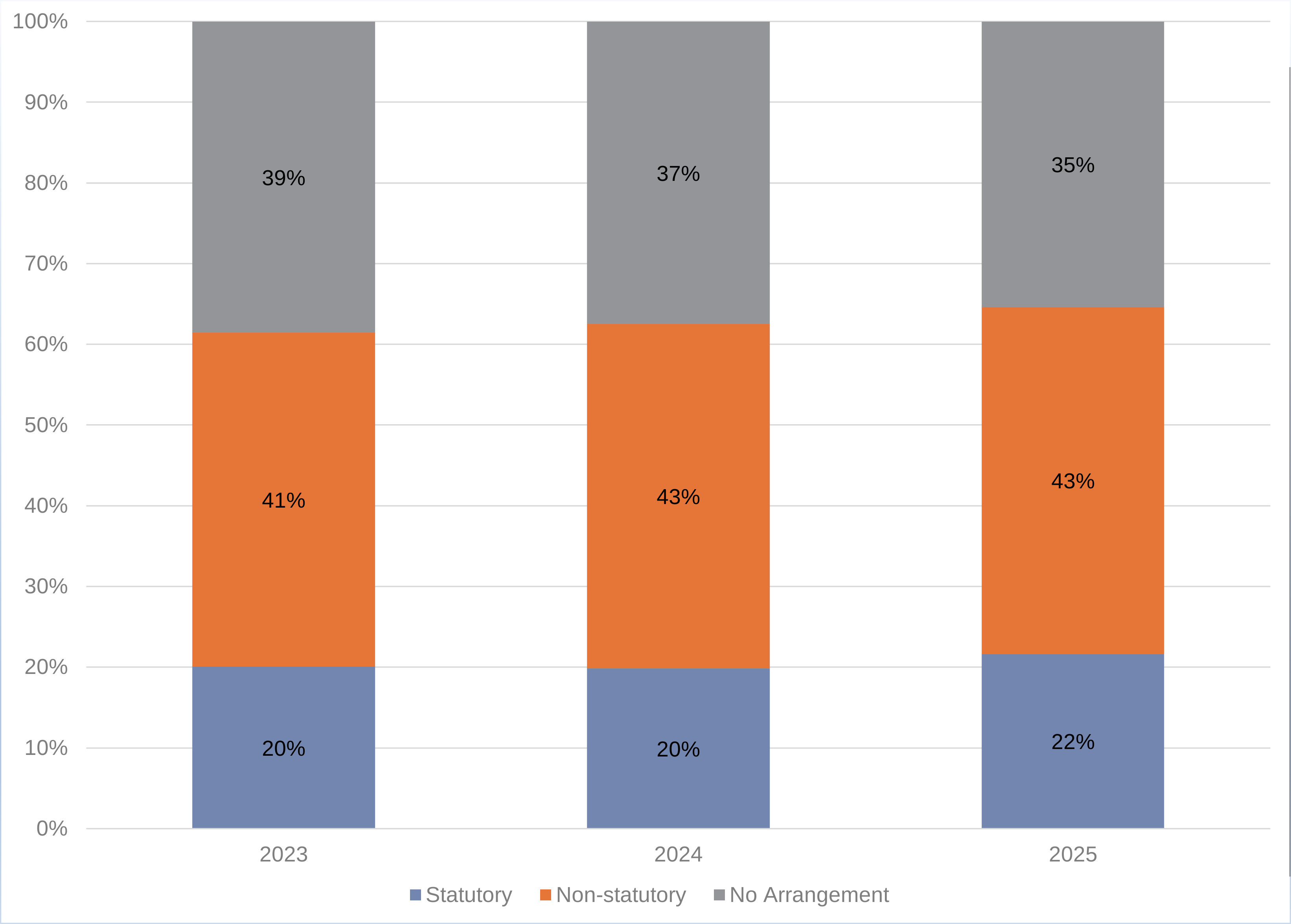
Sources: FRS and CMS administrative database (see the accompanying tables for full data).
Notes about these statistics:
- Totals may not sum to 100% due to rounding. Percentages are calculated using figures prior to rounding and are rounded to the nearest integer.
- For simplicity, parents who have both statutory and non-statutory arrangements are included in the statutory arrangement group. (See the accompanying tables for full data).
- Measures of uncertainty to assess statistical significance of year-on-year changes are currently unavailable but are being explored for future publications.
Parents with care are female in the majority of cases, less likely to be aged 50 or older, more likely to be disabled, and less likely to be married or in a civil partnership than non-resident parents.
The characteristics of parents with care and non-resident parents, for the financial years ending 2023 to 2025
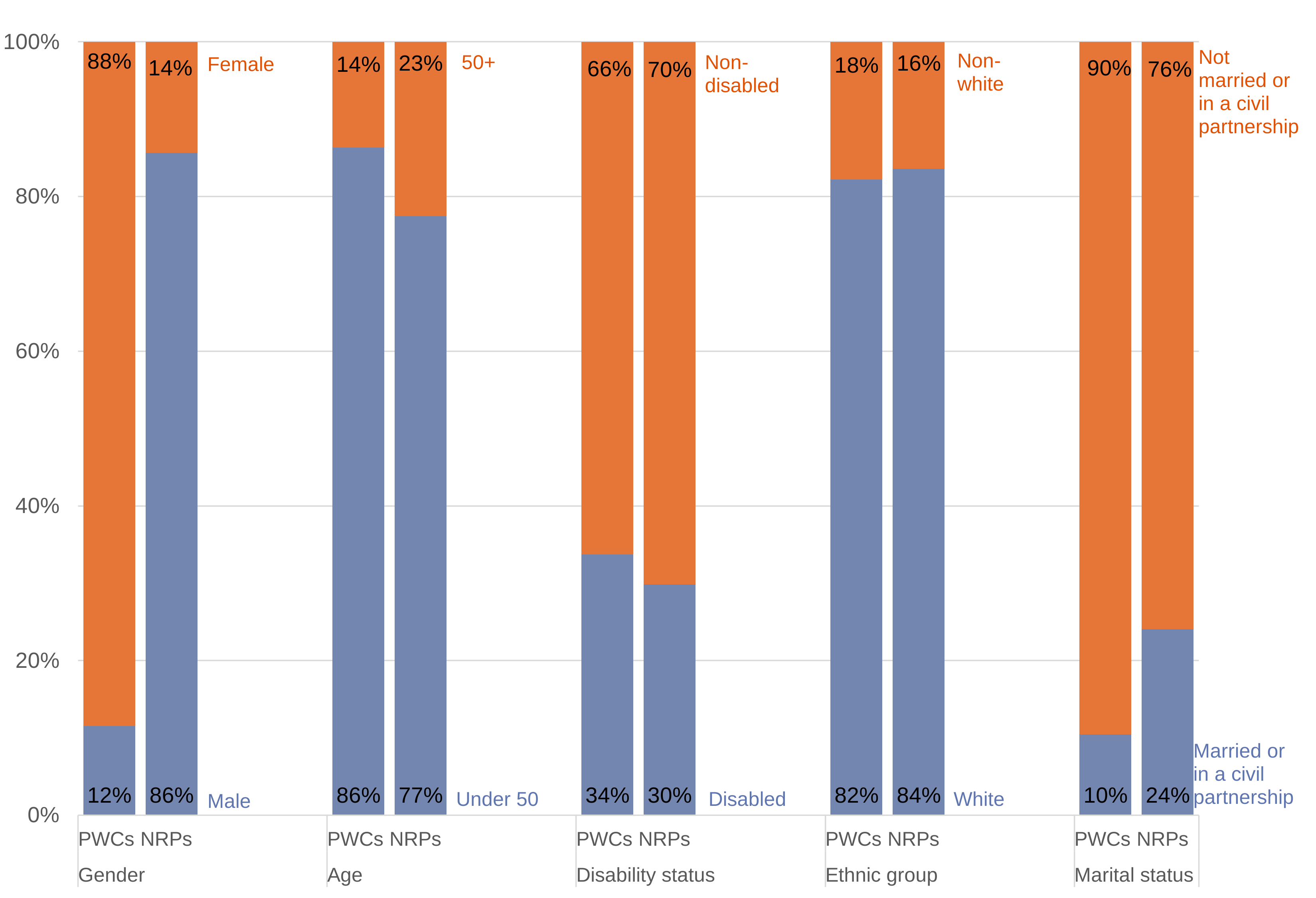
Sources: FRS; CMS administrative data. See the accompanying tables for full data.
Notes about these statistics:
-
The number of non-resident parents that we find on the FRS is lower than expected when comparing to the number of parents with care. Non-resident parents with no arrangement are particularly underrepresented in the FRS when compared with parents with care. This may drive some of the differences in the characteristic breakdowns for parents with care and non-resident parents. Further information is available in the Background Information and Methodology note.
-
There is also a known effect where non-resident parents and parents with care have differing opinions on whether they have a child maintenance arrangement. For example, a non-resident parent may consider that they have a non-statutory arrangement while the parent with care may think that the agreement they have with their ex-partner is insufficient to qualify as an arrangement at all. These factors can lead to some discrepancies when comparing non-resident parents and parents with care of the same arrangement type.
-
In this chart those who are separated are counted as not married.
Further analysis of characteristics by arrangement type is available in the publication tables. Among other things, the analysis highlights that those with no arrangement are more likely to have characteristics protected under the Equality Act 2010, including:
- separated parents with no arrangement are more likely to be aged 50+ than those with arrangements
- non-resident parents with no arrangement are more likely to be disabled than non-resident parents with arrangements
- non-resident parents with no arrangement are more likely to be female than those with arrangements
- separated parents with no arrangement are more likely to be non-white than those with arrangements
5. The impact of child maintenance payments on the number of children in low-income households
On average, it is estimated that £2.9 billion in child maintenance payments was received each year by parents with care in separated families in the financial years ending 2023 to 2025. Around 65% of these payments related to non-statutory child maintenance arrangements, with around 35% related to statutory arrangements.
The majority of child maintenance payments relate to non-statutory arrangements.
The total amount of child maintenance received by parents with care, by arrangement type for the financial years ending 2023 to 2025
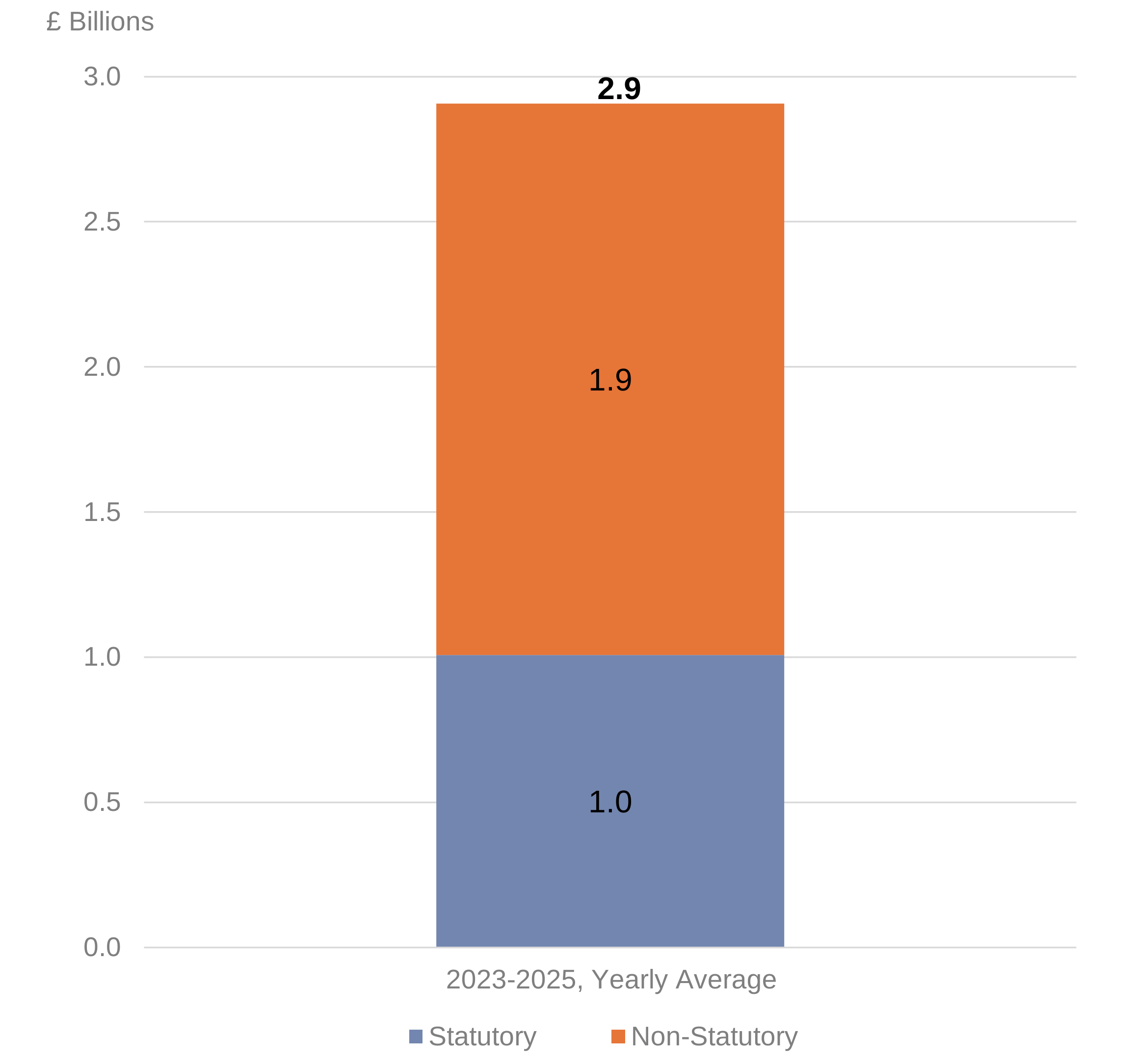
Sources: FRS; CMS administrative data. See the accompanying tables for full data.
Notes about these statistics:
- Child maintenance receipts for each year are converted to financial year ending 2025 prices before averaging receipts over the 3 financial years.
Child maintenance payments reduced the net number of children living in low-income households. Overall, 120,000 children were kept out of low income on the relative low income after housing costs measure, and 140,000 children were kept out of low income on the absolute low income after housing cost measure. Most of this impact related to single parent families. This year, survey responses in the FRS for the major state benefits and tax credits were integrated with administrative data. This change affects income‑related measures in the Separated Families Statistics. The introduction of administrative data does not change the estimated overall number of children kept out of low income by child maintenance, but it does affect the impacts across different arrangement types. Further information is provided in the Background Information and Methodology note.
Table 1: The annual impact of child maintenance payments on the number of children in low-income households, for the financial years ending 2023 to 2025
| Definition of low income | Net impact on the number of children in low-income households (thousands) |
|---|---|
| Relative low income (before housing costs) – below 60% of contemporary median household income | -120 |
| Relative low income (after housing costs) – below 60% of contemporary median household income | -120 |
| Absolute low income (before housing costs) – below 60% of median household income in financial year ending 2025 | -140 |
| Absolute low income (after housing costs) – below 60% of median household income in financial year ending 2025 | -140 |
Source: FRS; HBAI data. See the accompanying tables for full data.
Notes about Table:
- Estimates are rounded to the nearest 20,000.
- For data from financial year ending 2025, the reference year for absolute low income moved from financial year ending 2011 to financial year ending 2025.
- While the new absolute low-income threshold is the same as the contemporary median in financial year ending 2025, the relative and absolute low-income measures in the table differ both because they are 3-year averages and because the absolute and relative measures of the impact of child maintenance on the number of children in low income differ in their construction. Further detail is available in the Background Information and Methodology note.
The impact of statutory and non-statutory child maintenance arrangements on numbers of children in low-income households roughly reflects the proportion of these arrangement types.
The annual impact of child maintenance payments on the net number of children in low-income households, after housing costs, by child maintenance arrangement type, for the financial years ending 2023 to 2025
Source: FRS; HBAI data. See the accompanying tables for full data.
Of the 140,000 children kept out of absolute low income on an after housing costs basis, around 60,000 were in households with a statutory arrangement and 80,000 in households with a non-statutory arrangement. Of the 120,000 children kept out of relative low income on an after housing costs basis, around 40,000 were in households with a statutory arrangement and 80,000 in households with a non-statutory arrangement.
Children in separated families with a child maintenance arrangement are less likely to remain in low income than those without an arrangement.
The percentage of children in parent with care households who remain in relative low income after housing costs and child maintenance payments, by child maintenance arrangement type, for the financial years ending 2023 to 2025
Source: FRS; HBAI data. See the accompanying tables for full data.
The percentage of children in parent with care households who remain in relative low income after housing costs and after child maintenance is lower for those with child maintenance arrangements, with 30% of children in households with a statutory and 38%of children in households with a non-statutory arrangement remaining in low income, compared with 46% of children in households with no arrangement.
Relative to the financial year ending 2024 publication, the percentage of children remaining in relative low income after housing costs and child maintenance payments has fallen by 7 percentage points for parents with care with statutory arrangements and by 5 percentage points for parents with care with no arrangement. For parents with a non-statutory arrangement, the percentage of children who remain in low income has increased by 2 percentage points. The reductions for statutory and no arrangement families reflect a combination of the effects of administrative data linking and year on year changes. Non‑statutory arrangements were less affected by administrative data linking. Refer to the Background Information and Methodology note for more details.
6. Estimates of the position of separated parent households in the Great Britain income distribution (and where they would be had they not paid or received child maintenance)
Considering an after housing costs basis, the equivalised incomes of individuals in non-resident parent households are more evenly spread across the equivalised income distribution for Great Britain compared with parent with care households. The equivalised income distribution of individuals in parent with care households is more skewed towards the lowest income quintiles. This situation remains largely unchanged even after child maintenance has been paid from the non-resident parent to the parent with care.
Child maintenance payments are broadly redistributive.
Position of parent with care and non-resident parent households in the Great Britain income distributions before and after child maintenance, after housing costs, for the financial years ending 2023 to 2025
Source: FRS; HBAI; CMS data. See the accompanying tables for full data.
Notes about these statistics:
- In an even distribution, each quintile would equal 20% of the population. Quintiles containing more than 20% of the population show that the population is overly represented in that part of the income distribution. For instance, a value of 39% in Q1 for parents with care before child maintenance means that 39% of this group are in the bottom 20% of the income distribution.
After child maintenance has been paid, we estimate that the percentage of individuals in parent with care households in the bottom 2 quintiles is 3 percentage points lower and the proportion of individuals in non-resident parent households in the top 2 quintiles is 4 percentage points lower. While child maintenance payments result in a 3-percentage point rise in the proportion of individuals in non-resident parent households in the lowest quintile to 25%, over a third (36%) of individuals in parent with care households remain in the lowest quintile, even after child maintenance is received.
For all arrangement types, parent with care equivalised household incomes are more skewed towards the bottom of the income distribution than their non-resident parent counterparts.
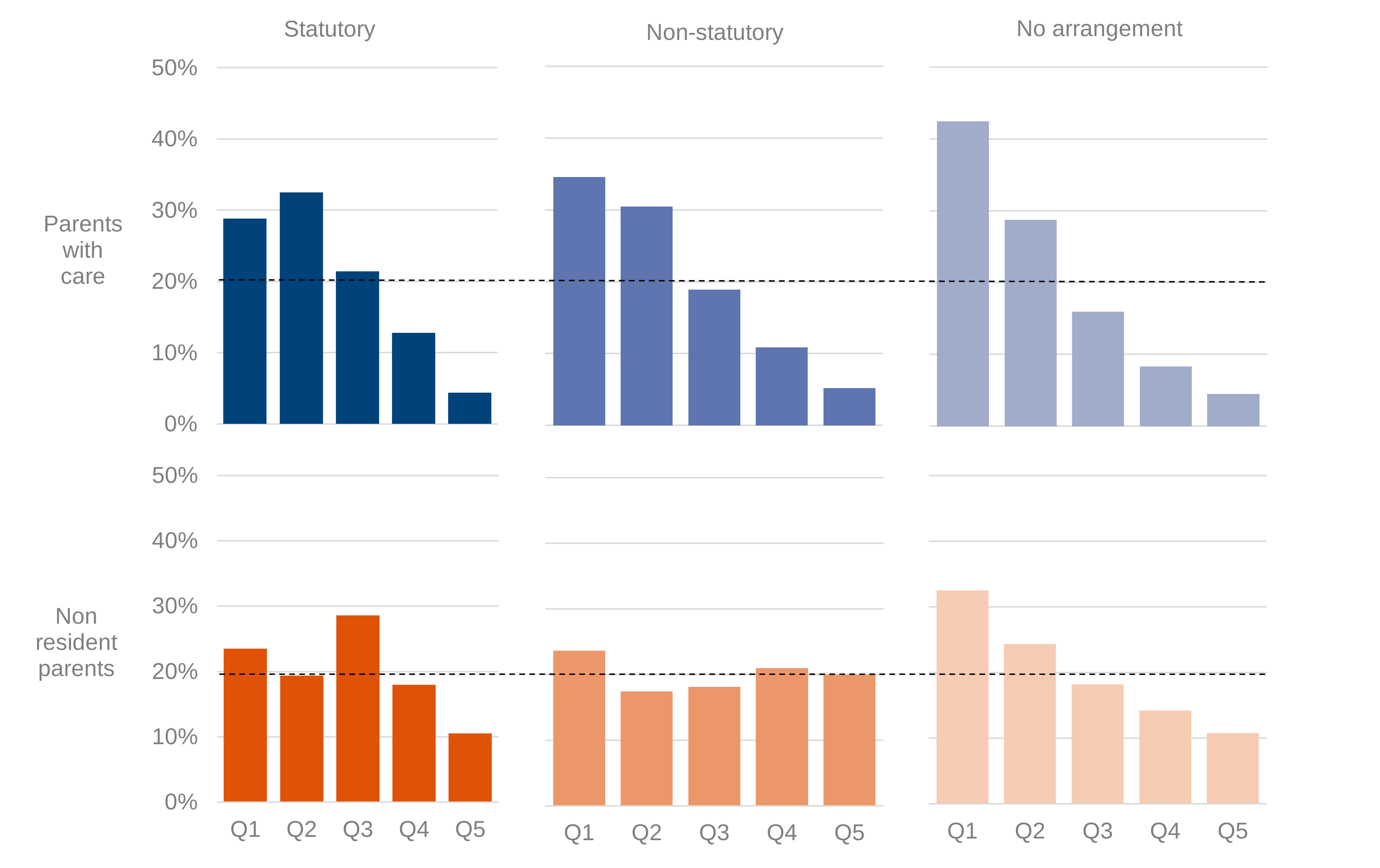
Position of parent with care and non-resident parent households in the Great Britain income distributions, after housing costs and after child maintenance, by arrangement type, for the financial years ending 2023 to 2025
Source: FRS; HBAI; CMS data. See the accompanying tables for full data.
The income distributions of parent with care households after housing costs and after child maintenance:
- with no arrangement tend to be heavily skewed towards the bottom of the Great Britain income distribution, with 71% in the bottom 40%
- with statutory and non-statutory arrangements also tend to be skewed towards the bottom of the distribution, but to a slightly lesser extent
The income distributions of non-resident parent households after housing costs and after child maintenance:
- with a statutory arrangement or no arrangement tend to be skewed towards the bottom of the Great Britain income distribution
- with a non-statutory arrangement tend largely to be evenly distributed across the Great Britain income distribution
7. About these statistics
These statistics are classed as ‘official statistics’ and are produced in line with the principles of the Code of Practice for Statistics.
Our statistical practice is regulated by the Office for Statistics Regulation (OSR). OSR sets the standards of trustworthiness, quality and value in the Code of Practice for Statistics that all producers of official statistics should adhere to.
We publish these statistics on an annual basis and will continue to expand their scope to help to meet user needs where reliable estimates can be obtained.
These Great Britain–level statistics are estimates based primarily on data from the Family Resources Survey (FRS). The FRS is based on a representative sample of private households, historically comprising around 20,000 United Kingdom (UK) households. The achieved sample for the financial year ending 2025 was just over 16,000 households. This is lower than the achieved sample in financial year ending 2024, which achieved almost 17,000 responses. The target of 20,000 households remained the same across these years.
During the financial year ending 2025, survey fieldwork operations continued with face-to-face interviewing as the predominant way of completing the survey, as was the case for FRS financial year ending 2024. Telephone interviewing was retained as an alternative based on household preference and interviewer availability. Across the UK achieved sample overall, 89% of FRS households were interviewed face-to-face during financial year ending 2025 which was a slight increase compared to financial year ending 2024.
More information can be found in the Separated Families Statistics Background Information and Methodology note and the Family Resources Survey. The FRS is a continuous survey which collects information on the income, characteristics and circumstances of individuals living in a representative sample of private households in the UK. FRS respondents are asked about the relationships within their household and any child maintenance arrangements they may have. Their responses are used to determine whether they are members of a separated family, how many children are in that family, the types of child maintenance arrangements they have (if any) and the amount of maintenance they receive.
Where feasible and appropriate, FRS responses regarding child maintenance arrangements are checked for accuracy against the DWP’s CMS, and historically against CSA, administrative databases and amended in line with the administrative data.
Estimates of the total amount of child maintenance payments received by parents with care are based on a combination of administrative data and adjusted FRS data.
The HBAI methodology and data, together with FRS information on child maintenance payments, are used to obtain estimates of:
- the impact of child maintenance payments on the net number of children in low-income households
- the percentage of children who remain in low income after child maintenance
- the position of separated parent households in the Great Britain income distribution.
More information about the methodology used to produce these statistics and its limitations can be found in the accompanying Background Information and Methodology note.
Rounding
Figures are rounded to the nearest 100,000, except those relating to the impact of child maintenance payments on the number of children in low-income households which are rounded to the nearest 20,000. Monetary amounts are rounded to the nearest hundred million pounds. Percentages are calculated using figures prior to rounding and are rounded to the nearest integer. Totals may not sum due to rounding.
Changes made to this publication
In this release for the financial year ending 2025, 2 updates were introduced. Firstly, the FRS and HBAI data have been updated so that income from the major state benefits and tax credits is now derived from administrative sources rather than survey responses. This change improves the overall quality of the statistics. Secondly, the reference year for absolute low income has been updated from the financial year ending 2011 to the financial year ending 2025. The absolute low-income threshold remains defined as 60 per cent of median income in the reference year, adjusted for inflation. This update is required to align the low-income threshold with the improved income data resulting from the use of administrative sources. Note that this change is a reclassification to a more up-to-date absolute low-income date, rather than a correction of an error in previous estimates.
These changes affect income‑related measures in the Separated families statistics, including estimates of the number of children kept out of poverty by child maintenance, the percentage of children in low‑income households, and the position of separated parent households within the income distribution.
For publications in March 2026, administrative data linking for both the FRS and HBAI was backdated to cover the financial years ending 2022 to 2024. Earlier Separated families statistics publications will not be revised; however, updated administrative data-linked datasets covering the financial years ending 2023 and 2024 have been incorporated into 3-year averages in this publication. In addition, updated administrative data‑linked headline figures for the financial year ending 2024 are provided in the Background Information and Methodology note to illustrate the impact of the methodology change.
The following tables have been affected by the changes:
- Tables 5a and 5b: The net impact of child maintenance payments on the number of children in low-income households. There is no difference in the rounded overall net figures for relative or absolute low income before or after housing costs due to the methodological change. Variations appear in the rounded figures when the results are broken down by family or arrangement type.
- Tables 6a to 9b: The position of separated parent households in the Great Britain income distribution before and after housing costs, by arrangement type. The income distribution tables show varied impacts. Overall, the change in the decile position of separated‑parent households within the Great Britain income distribution is around one to 2 percentage points when comparing unlinked with linked data for the financial year ending 2024. Changes are bigger at arrangement type level, with movements up to 5 percentage points.
- Table 10: The percentage of children in parent with care households who remain in low income after child maintenance payments by child maintenance arrangement type. Absolute low-income measures increase by up to 7 percentage points overall due to the methodological changes and up to 9 percentage points at the arrangement type level. Relative low-income measures decrease by up to 3 percentage points overall due to methodological changes and up to 5 percentage points at arrangement type level.
More information on revisions and methodological changes can be found in the accompanying Background Information and Methodology note.
Planned changes
Estimates are based primarily on data from the FRS. For the survey year 2025 to 2026, the base FRS developments which impact on Separated families statistics include plans to produce a back series of grossing factors.
Separated families statistics which include these developments are expected to be published in March 2027.
For information on FRS developments refer to the FRS Release Strategy.
Any future revisions will be notified via the Separated Families Collection Pages and also in the DWP Statistical Work Programme and clearly indicated and explained in the relevant publication.
8. Where to find out more
More information about these statistics can be found in the accompanying Background Information and Methodology note and accompanying tables.
Official statistics on the statutory child maintenance arrangements administered by the Child Maintenance Service.
Experimental statistics on the Child Support Agency’s 1993 and 2003 statutory child maintenance schemes and on Child Support Agency case closure.
More information about the Child Maintenance Service.
Experimental statistics on the child maintenance arrangements made by parents who contacted Child Maintenance Options.
More information about the Family Resources Survey.
More information about the Households Below Average Income.
Feedback
Users are invited to send feedback on these statistics to: cm.analysis.research@dwp.gov.uk
ISBN number: 978-1-78659-962-9