Sea passenger statistics: overview 2025
Published 29 July 2026

© Crown copyright 2026
This publication is licensed under the terms of the Open Government Licence v3.0 except where otherwise stated. To view this licence, visit nationalarchives.gov.uk/doc/open-government-licence/version/3 or write to the Information Policy Team, The National Archives, Kew, London TW9 4DU, or email: psi@nationalarchives.gov.uk.
Where we have identified any third party copyright information you will need to obtain permission from the copyright holders concerned.
This publication is available at https://www.gov.uk/government/statistics/sea-passenger-statistics-all-routes-2025/sea-passenger-statistics-overview-2025
About this release
This statistical release presents final statistics of sea passengers on both international and domestic routes to and from the UK for 2025.
These statistics include all vehicle drivers (including Heavy Goods Vehicle drivers), their passengers and foot passengers on ferries.
You can use our maritime interactive dashboard to further explore international sea passenger trends.
Definitions
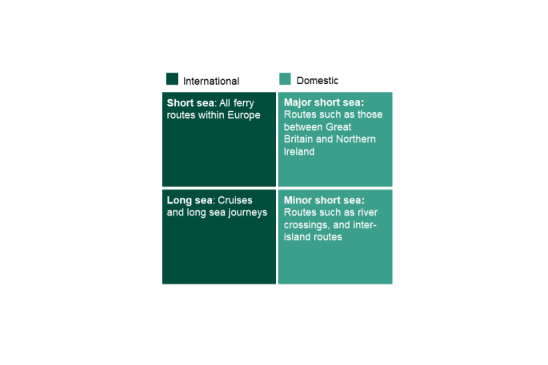
This statistical release presents the complete statistics on all sea passengers to and from the UK in 2025. It includes (infographic 1):
International passengers: These include all passengers travelling on international short sea routes, cruises and long sea journeys to and from the UK.
Domestic passengers: All other short sea passenger routes, including routes between Great Britain and the Orkney and Shetland Islands, domestic cruises, domestic river crossings and inter-island routes.
Infographic 1: Breakdown of types of sea passenger routes
Summary of sea passenger statistics
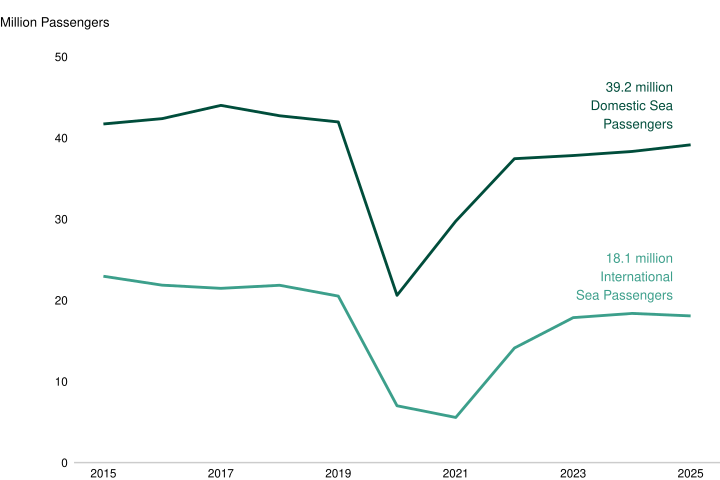
International sea passenger numbers decreased to 18.1 million in 2025, 2% lower than 2024. Domestic sea passenger numbers increased by 2% from 38.3 million in 2024 to 39.2 million in 2025.
After the sharp decrease from 2019 to 2021 due to the coronavirus pandemic, total sea passenger figures recovered sharply initially but this increase has slowed year on year. In 2025, numbers for international and domestic sea passengers remained respectively 12% and 7% below 2019 levels.
Chart 1: UK domestic and international sea passengers, 2015 to 2025
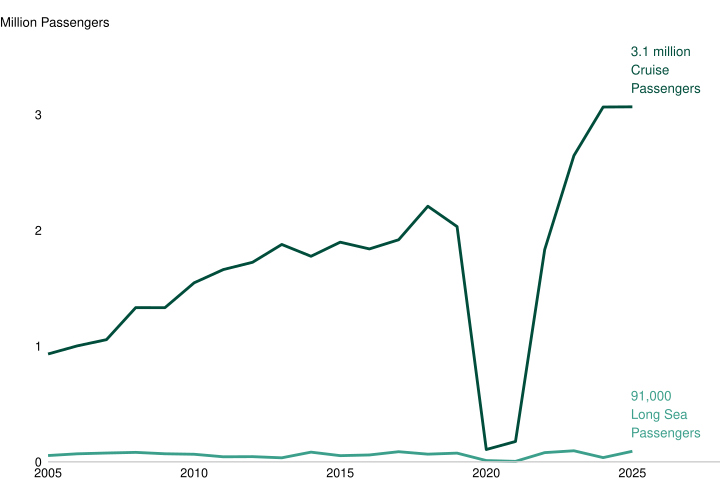
Within international passengers in 2025, the total number of short sea passengers (on ferry routes) decreased by 2% to 14.9 million, suggesting a levelling of the trend at 19% below 2019 levels. International cruise passenger numbers followed a different trend, recovering strongly since the coronavirus pandemic and exceeding 2019 levels in 2023. In 2025, they remained stable at 3.1 million (chart 2), unchanged from 2024, but 51% higher than 2019 levels.
Chart 2: Cruise and long sea passengers, 2005 to 2025 (SPAS0101, SPAS0107)
For domestic passengers in 2025:
-
the total number of passengers on domestic sea crossings decreased by 2%, from 3.8 million in 2024 to 3.7 million in 2025, but remained 8% higher than in 2019
-
the number of inter-island passengers increased by 1% compared with 2024, but remained 12% lower than in 2019
-
the number of passengers on river ferries increased 4% compared with 2024, but remained 4% lower than in 2019
Useful information
We would welcome any feedback on these statistics by sea-passenger.stats@dft.gov.uk. We will attempt to address any comments in a subsequent release.
The data tables for sea passenger statistics are available.
Provisional summary totals for international sea passenger traffic are released monthly in SPAS0107.
Full guidance on the methods used in the publication of these releases, and the quality of the data, and known users and uses of the statistics are available.
The sea passenger statistics are accredited official statistics. The statistics presented in this release were independently reviewed by the Office for Statistics Regulation in February 2013 and are therefore labelled ‘accredited official statistics’.
Details of ministers and officials who receive pre-release access to these statistics up to 24 hours before release are available.
Instructions for printing and saving
Depending on which browser you use and the type of device you use (such as a mobile or laptop) these instructions may vary.
You will find your print and save options in your browser’s menu. You may also have other options available on your device. Tablets and mobile device instructions will be specific to the make and model of the device.
How to search
Select Ctrl and F on a Windows laptop or Command and F on a Mac
This will open a search box in the top right-hand corner of the page. Type the word you are looking for in the search bar and press enter.
Your browser will highlight the word, usually in yellow, wherever it appears on the page. Press enter to move to the next place it appears.
Contact us
To hear more about DfT statistical publications as they are released, follow us on X at DfTstats.