Sea passenger statistics: international sea passengers 2025
Published 29 July 2026

© Crown copyright 2026
This publication is licensed under the terms of the Open Government Licence v3.0 except where otherwise stated. To view this licence, visit nationalarchives.gov.uk/doc/open-government-licence/version/3 or write to the Information Policy Team, The National Archives, Kew, London TW9 4DU, or email: psi@nationalarchives.gov.uk.
Where we have identified any third party copyright information you will need to obtain permission from the copyright holders concerned.
This publication is available at https://www.gov.uk/government/statistics/sea-passenger-statistics-all-routes-2025/sea-passenger-statistics-international-sea-passengers-2025
This statistical release presents final statistics on sea passengers on international routes to and from the UK for 2025.
International passengers are those that travel on international routes. These are broken down into short sea (ferry) routes and passengers on cruises and long sea journeys.
These statistics include all vehicle drivers (including Heavy Goods Vehicle drivers), their passengers and foot passengers on ferries.
You can use our maritime interactive dashboard to further explore international sea passenger trends.
2025 release
Comparisons have been made with figures from 2024, as well as 2019, the last full year before the coronavirus pandemic started.
Definitions
Short sea passenger figures include all passengers on short sea routes between the UK and the rest of Europe.
Cruise passenger figures include all passengers on international cruise journeys who embark and/or disembark their cruise journey at a UK port. Cruise passengers are included at both departure and arrival if their journey begins and ends at a UK seaport. Passengers passing through on transit calls, where they return to the ship and continue their cruise, are not included in these figures.
Long sea voyage passengers are those travelling on one-way scheduled voyages to and from ports outside Europe and Mediterranean, that either embark or disembark from a UK port. This type of journey includes transatlantic cruises and repositioning cruises.
Headline figures
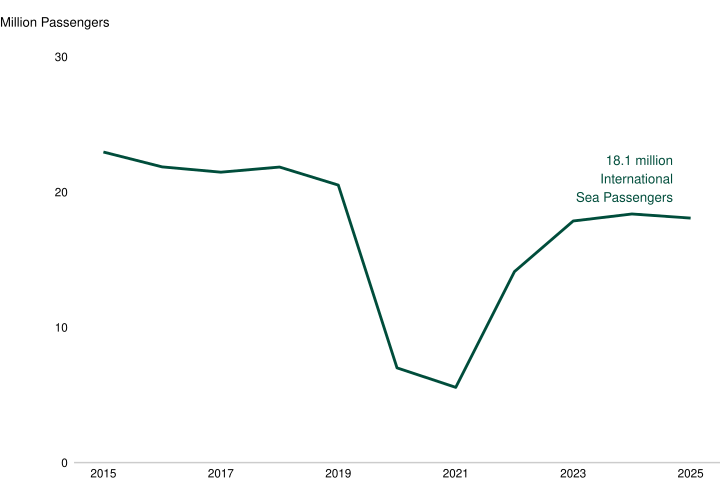
International sea passenger numbers decreased to 18.1 million in 2025, a 2% decrease compared to 2024.
This follows several years of growth after the sharp decrease in 2020 during the coronavirus pandemic. Despite the recovery seen from 2021 to 2024, passenger numbers remain 12% below pre-pandemic levels in 2019.
Chart 1: UK international sea passengers, 2015 to 2025 (SPAS0101, SPAS0107)
For international passengers in 2025:
-
the total number of international short sea passengers (on ferry routes) decreased by 2% to 14.9 million and remained 19% below 2019 levels
-
cruise passengers stayed stable in 2025 at 3.1 million, but have increased by 51% compared to 2.0 million in 2019
Chart 2: UK international sea passengers by type of route, 2015 to 2025 (SPAS0101)
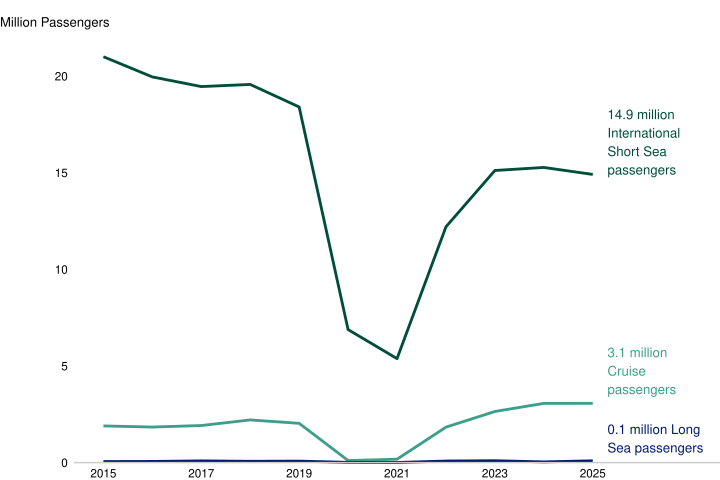
In 2025 there were 18.1 million international sea passengers. Of this total:
-
14.9 million (83%) were short sea passengers
-
3.1 million (17%) were cruise passengers
-
91,000 (1%) were long sea passengers
International short sea passengers
Monthly trends (SPAS0107)
In 2025, the number of short sea passengers on international routes decreased by 2%, from 15.3 million in 2024 to 14.9 million in 2025. Chart 3 breaks down the totals by month.
Chart 3: International short sea passengers by month, 2025 (SPAS0107)
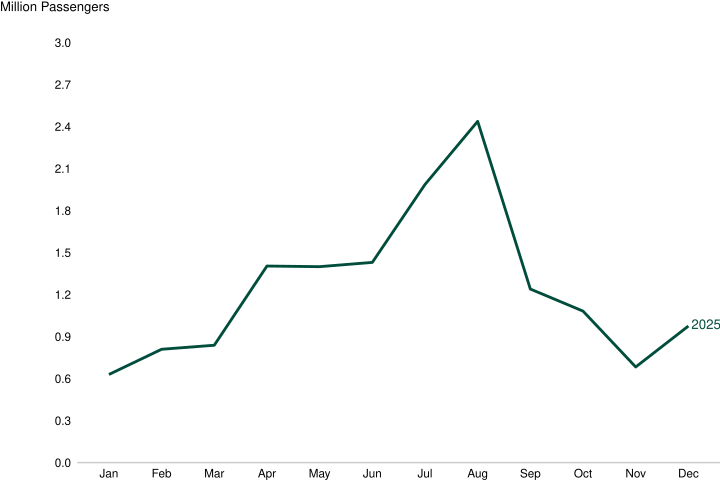
International passenger numbers tend to follow a seasonal pattern, excluding the pandemic period of 2020-2021. The trend is characterized by lower passenger figures during the winter and autumn periods, and higher numbers in spring and summer.
In 2025, the month with the lowest passenger level was January, with 629,00 passengers. Numbers then steadily increased through spring, reaching 1.4 million in April, coinciding with the Easter period. Numbers continued to rise over the summer, peaking in August, when passenger numbers reached 2.4 million. From August onwards, numbers decreased again throughout autumn, back to winter levels. Numbers then slightly increased during the Christmas period to 1.0 million in December. This is driven by an increase in short sea ferry crossings as people travel for Christmas.
International cruise and long sea passengers
Passengers on international cruises
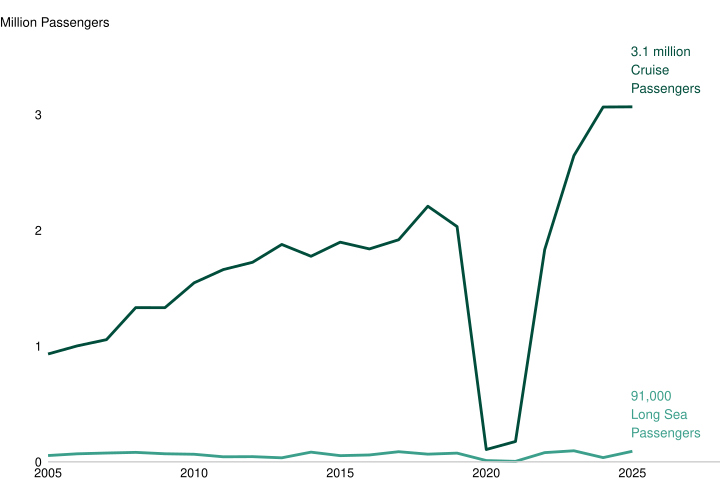
In 2025, international cruise passenger numbers stayed stable with 2024 levels, at 3.1 million, 51% higher than 2019, showing that the cruise sector grew post-covid. This is the highest number of international cruise passengers recorded and follows the upward trend that was established before the coronavirus pandemic (chart 4).
Of these 3.1 million cruise passengers, 2.6 million (86%) passed through Southampton and 102,000 (3%) through Dover. The ports of Liverpool, London and Portsmouth had 70,000, 131,000, and 61,000 passengers respectively starting or ending a cruise journey in 2025.
An additional 57,000 cruise passengers (2%) passed through other ports including Forth, Tyne and Dundee.
Passenger numbers for domestic cruises can be found in Sea Passenger Statistics: Domestic Sea Passengers 2025.
Passengers on long sea voyages
In 2025, the number of long sea passengers increased from 37,000 in 2024 to 91,000 in 2025. This represents an increase of 151%. The number of long sea passengers can vary greatly each year, in part because operators can use these trips to reposition vessels around the world as needed, such as trans-Atlantic voyages between Caribbean and European itineraries (chart 4). These numbers are small, and the 2025 figure has returned to levels seen in previous years.
Detailed statistics on cruise and long sea passengers by port group can be found in the data table SPAS0101.
Chart 4: Cruise and long sea passengers, 2005 to 2025 (SPAS0101, SPAS0107)
Annex: timeline of coronavirus events affecting sea travel
A timeline of events during the coronavirus pandemic that affected sea travel since March 2020 until March 2022 can be found in the Notes and definitions section.
Related statistics
These sea passenger statistics do not provide further information about the individuals travelling through UK ports. Additional information on the origin of passengers is available from the ONS International Passenger Survey monthly figures.
The ONS International Passenger Survey publish overseas residents’ visits to the UK by month with a breakdown of geographical areas (for example, EU15 including all countries that joined the EU prior to 2004), as well as information on UK residents visits abroad and where their destination is, again segmented using the same geographical areas. This survey also produces a table on the earnings in the UK and expenditure abroad.
Background information
We would welcome any feedback on these statistics by sea-passenger.stats@dft.gov.uk. We will attempt to address any comments in a subsequent release.
The data tables for sea passenger statistics are available.
Provisional summary totals for international sea passenger traffic are released monthly in SPAS0107.
Full guidance on the methods used in the publication of these releases, and the quality of the data, and known users and uses of the statistics are available.
The sea passenger statistics are accredited official statistics. The statistics presented in this release were independently reviewed by the Office for Statistics Regulation in February 2013 and are therefore labelled ‘accredited official statistics’.
Details of ministers and officials who receive pre-release access to these statistics up to 24 hours before release are available.
Instructions for printing and saving
Depending on which browser you use and the type of device you use (such as a mobile or laptop) these instructions may vary.
You will find your print and save options in your browser’s menu. You may also have other options available on your device. Tablets and mobile device instructions will be specific to the make and model of the device.
How to search
Select Ctrl and F on a Windows laptop or Command and F on a Mac
This will open a search box in the top right-hand corner of the page. Type the word you are looking for in the search bar and press enter.
Your browser will highlight the word, usually in yellow, wherever it appears on the page. Press enter to move to the next place it appears.
Contact us
To hear more about DfT statistical publications as they are released, follow us on X at DfTstats.