MOD Civil Servant Diversity Statistics: April 2026
Published 21 May 2026

© Crown copyright 2026
This publication is licensed under the terms of the Open Government Licence v3.0 except where otherwise stated. To view this licence, visit nationalarchives.gov.uk/doc/open-government-licence/version/3 or write to the Information Policy Team, The National Archives, Kew, London TW9 4DU, or email: psi@nationalarchives.gov.uk.
Where we have identified any third party copyright information you will need to obtain permission from the copyright holders concerned.
This publication is available at https://www.gov.uk/government/statistics/mod-civil-servant-diversity-statistics-april-2026/mod-civil-servant-diversity-statistics-april-2026
1. Introduction
This statistical release presents figures on the current numbers and proportions for diversity characteristics of civil servants employed by the Ministry of Defence (MOD). Six protected characteristics are covered in this report: age, sex, ethnicity, sexual orientation, religion and belief and disability, as well as grade and working pattern. This report does not include civil servants in the Royal Fleet Auxiliary.
From April 2026 onwards, the report title has changed from ‘MOD Civil Servants Biannual Diversity Dashboard’ to ‘MOD Civil Servant Diversity Statistics’.
This statistical release is produced as part of the transparency and accountability of the Ministry of Defence to Parliament and the public. The information has a wide range of users including the media, politicians, academic researchers and the general public who use the information to:
-
understand the size and distribution of MOD civil servants by individual diversity categories
-
assist in understanding the effect of changes in MOD policy, for instance, changes to diversity within recruiting
For further information on the MOD Civil Servant Diversity Statistics please visit:
Our statistical practice is regulated by the Office for Statistics Regulation (OSR). OSR sets the standards of trustworthiness, quality and value in the Code of Practice for Statistics that all producers of official statistics should adhere to.
You are welcome to contact us directly with any comments about how we meet these standards. Please contact us at Analysis-Civilian-Enquiries@mod.gov.uk. Alternatively, you can contact OSR by emailing regulation@statistics.gov.uk or via the OSR website.
Updates to the publication
In line with the Code of Practice, to ensure our statistics provide maximum value, the following changes have been introduced for this edition of the MOD Civil Servant Diversity Statistics at 1 April 2026. These changes will help ensure the report remains relevant to users and representative of diversity within the MOD Civil Service workforce.
-
The report has been expanded to present information for all MOD civil servants. Prior editions covered only civil servants within the central government department (MOD Main). Now, civil servants within the MOD Executive Agencies are included (DE&S, SDA, UKHO and Dstl). Some diversity rates may change (both increase and decrease) because the report covers a broader population.
-
Provide Civil Service grade equivalence for all MOD civil servants. The industrial grade category covered in the previous reports has been replaced with their equivalent grades.
2. Main Points and Trends
At 1 April 2026, the headcount of MOD civil servants was 55,761. Of these:
43.2% were female, a rise of 0.3 percentage points compared with 1 April 2025. ————————————————————————————————————————————— 7.1% were ethnic minorities (excluding white minorities), a rise of 0.3 percentage points compared with 1 April 2025. ————————————————————————————————————————————— 3.8% identified as being lesbian, gay & bisexual (LGB), a rise of 0.2 percentage points compared with 1 April 2025. ————————————————————————————————————————————— 18.4% declared a disability, an increase of 1.9 percentage points compared with 1 April 2025. ————————————————————————————————————————————— 11.8% were part time, an increase of 0.3 percentage points compared with 1 April 2025. ————————————————————————————————————————————— 53.0% declared a religion or belief, a fall of 0.8 percentage points compared with 1 April 2025. ————————————————————————————————————————————— The average age was 46.1 years, 0.1 years older than that at 1 April 2025. —————————————————————————————————————————————
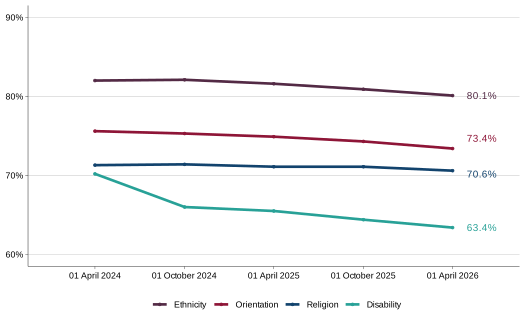
Declaration rates for self-declared diversity fields have been decreasing over time (figure 1.1). Though having decreased by 1.9% since April 2024, at 1 April 2026 ethnicity had the highest declaration rate at 80.1% among the self-declared protected characteristics presented in the report. The declaration rates of sexual orientation and religion and belief were both above 70%. However, disability declaration rate was 63.4%, and had a greater fall by 6.8% since April 2024 than the other three diversity categories.
Figure 1.1 Declaration rates for ethnicity, sexual orientation, religion and belief and disability status, 1 April 2024 to 1 April 2026
The declaration rates at 1 April 2026 for the age group 16-29 were below 60% for the self-declared diversity fields: sexual orientation, religion and belief and disability status. Therefore, the representation rates for these diversity fields have not been presented. Further information can be found in the comments below and accompanying Excel ODS tables.
Declaration Rates are calculated for self-declared diversity fields including ethnicity, sexual orientation, religion and belief and disability status. Declaration rates are calculated from the number of civil servants who make an ‘active declaration’ as a proportion of the total civil servants. An active declaration excludes unknown and undeclared records, such as ‘prefer not to say’.
Representation Rates for self-declared diversity fields are calculated from the number of civil servants who select a particular active diversity option as a proportion of the total civil servants within ‘active declaration’. To ensure meaningful representation rates for a diversity field, a minimum 60% declaration level is required.
3. Age and grade
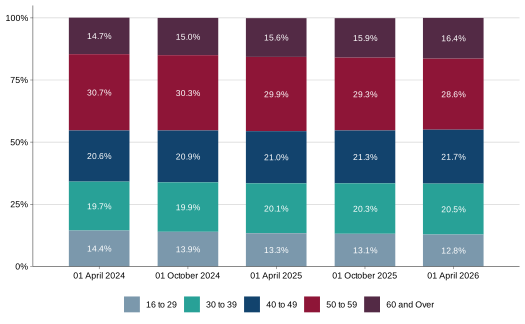
At 1 April 2026, the average age of MOD civil servants was 46.1 years, an increase by 0.4 years since April 2024. 50 to 59 was the largest age band: it included more than a quarter (28.6%) of MOD civil servants (figure 2.1). The age bands 30 to 39 and 40 to 49 each accounted for just over 20% of MOD civil servants. Age bands 60 and over and 16 to 29 had smaller proportions at 16.4% and 12.8%, respectively.
Between 1 April 2024 and 1 April 2026, age band 50 to 59 was consistently the largest age band, and 16 to 29 the smallest; and both were slowly reducing. In comparison, age bands 30 to 39, 40 to 49 and 60 and over increased.
Figure 2.1 – Age band distribution, 1 April 2024 to 1 April 2026
At 1 April 2026, 42.2% of MOD civil servants were in grade bands Higher Executive Officer to Senior Executive Officer (HEO to SEO). Administrative Assistant to Administrative Officer (AA to AO) accounted for about a quarter (26.2%) of MOD civil servants (figure 2.2). Executive Officer (EO) and G7 to G6 each represented about 15% of MOD civil servants. SCS was the smallest grade group at 1%.
From 1 April 2024 to 1 April 2026, the proportions of civil servants in grade bands HEO to SEO, G7 to G6 and SCS slightly increased whilst the proportions of civil servants within grade bands AA to AO and EO decreased.
Figure 2.2 – Grade band distribution, 1 April 2024 to 1 April 2026
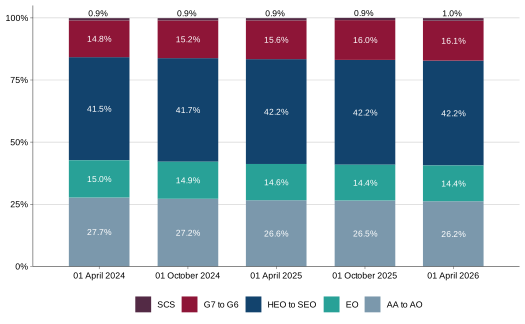
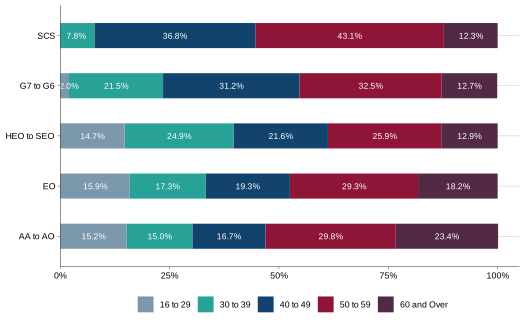
Figure 2.3 presents the age distribution within grade bands. At 1 April 2026, more than half of civil servants in grade bands HEO to SEO (61.3%), G7 to G6 (54.7%), and EO (52.5%) were younger than 50 years old. Conversely, less than half in grade bands SCS (44.6%) and AA to AO (46.9%) were younger than 50.
Figure 2.3 – Age band distribution by grade band, 1 April 2026
4. Sex
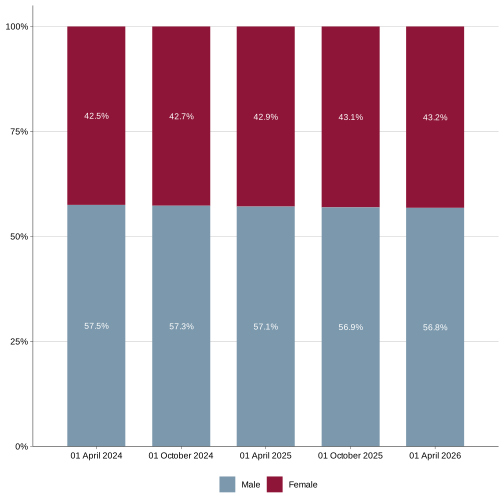
At 1 April 2026, 43.2% of MOD civil servants were female (figure 3.1). Over time the proportion of females slowly increased. The gap between the proportions of males and females gradually narrowed from 15.0 percentage points at 1 April 2024 to 13.5 percentage points at 1 April 2026.
Figure 3.1 – Percentage of MOD civil servants by sex, 1 April 2024 to 1 April 2026
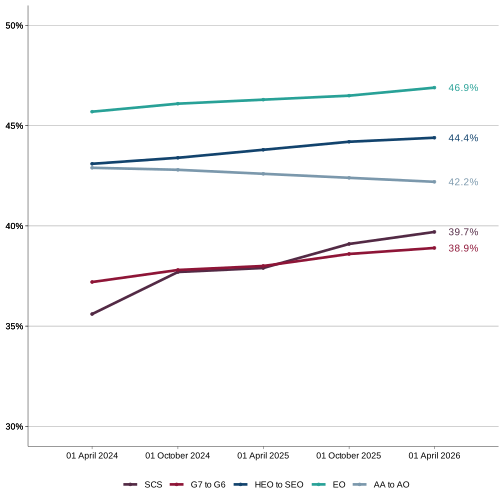
The percentage of females within each grade band was gradually increasing from 1 April 2024 to 1 April 2026, except AA to AO where there has been a continued slight decrease over time (figure 3.2). SCS gained a 4.1 percentage point increase, the greatest rise among all grades. At 1 April 2026, EO had the highest female ratio at 46.9% while G7 to G6 had the lowest at 38.9%.
Figure 3.2 – Percentage of females by grade band, 1 April 2024 to 1 April 2026
Grade Charts
Charts by grade band for each diversity category have been compiled based on analysis within the grade band. For instance, for each grade band, the number of female civil servants is divided by the total population and multiplied by 100 to get the percentage of distribution. This means that female and male proportions split by grade band will add up to 100%. The resulting chart represents the proportion (%) of females within a grade. For self-declared diversity fields, the number will be divided by the total active declaration for that grade band, excluding unknown and undeclared civil servants. ‘Other’ grades have been excluded from the charts.
Further information may be found in the accompanying Excel ODS tables.
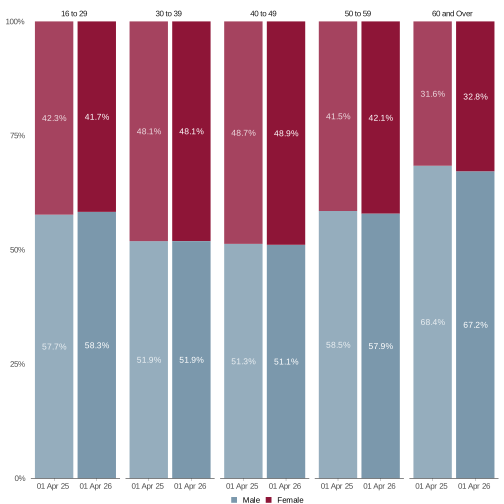
At 1 April 2026, the age band with the lowest proportion of females was 60 and over at just about a third (32.8%); whilst 40 to 49 had the highest female ratio at 48.9% (figure 3.3). Between 1 April 2025 and 1 April 2026, the proportion of females in age bands aged 40 years and above slightly increased; but female proportions for the younger age groups decreased (16 to 29 years old) or remained unchanged (30 to 39 years old).
Figure 3.3 – Percentage of females and males by age band, 1 April 2025 to 1 April 2026
Age Band Charts
Charts by age band for each diversity category have been compiled based on analysis within the age band. For instance, for each age band, the number of female civil servants is divided by the total population and multiplied by 100 to get the percentage of the distribution. This means that the female and male proportions split by age will add up to 100%. The resulting chart will represent the proportion (%) of males and females within an age band. For self-declared diversity fields, the number will be divided by the total active declaration for that age band, excluding unknown and undeclared civil servants.
5. Ethnicity
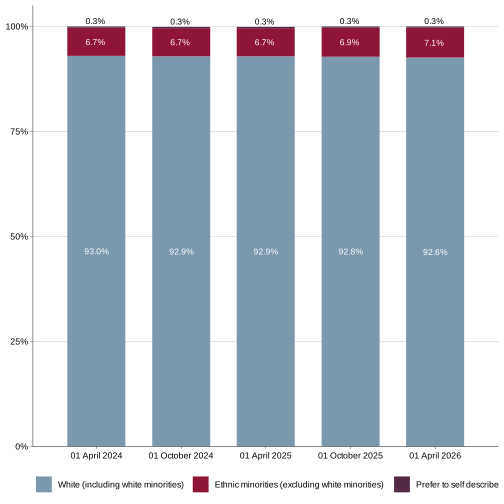
Of those with a known ethnicity, the representation rate of MOD civil servants from an ethnic minority background (excluding white minorities) slowly increased by 0.3 percentage points from 6.7% at 1 April 2024 to 7.1% at 1 April 2026, corresponding with a decline of 0.3 percentage points for white (including white minorities) (figure 4.1).
At 1 April 2026, among the 3,158 MOD civil servants with an ethnic minority background, about half (1,617) were Asian or Asian British; about a quarter (768) were Black, Black British, Caribbean or African and 744 civil servants were from Mixed or multiple ethnic groups. For further details please see Excel ODS tables 4.1 and 4.2.
Figure 4.1 – Representation rate of MOD civil servants by ethnicity, 1 April 2024 to 1 April 2026
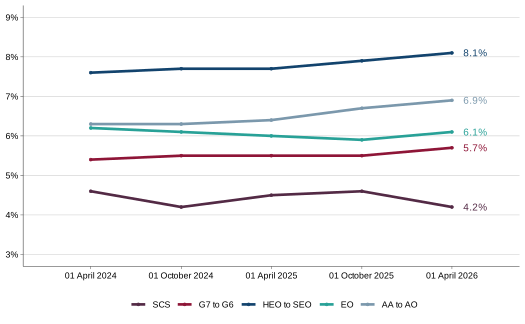
At 1 April 2026, the grade bands HEO to SEO had the highest representation rate of ethnic minorities at 8.1% and SCS had the lowest rate at 4.2% (figure 4.2). From April 2024 to April 2026, the representation rates of ethnic minorities (excluding white minorities) for G7 to G6, HEO to SEO and AA to AO slightly increased; whilst those for SCS and EO slightly decreased.
Please note, the time series for SCS should be interpreted with caution as the small population size of the SCS means rates are more likely to be volatile.
Figure 4.2 – Ethnic minority representation by grade band, 1 April 2024 to 1 April 2026
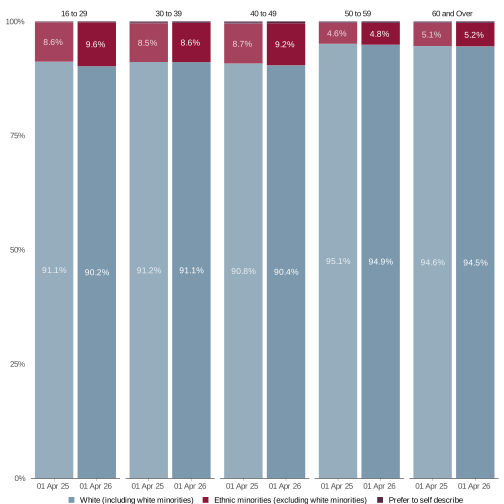
The proportion of MOD civil servants from an ethnic background increased for all age bands from April 2025 to April 2026 (figure 4.3). The age band 16 to 29 had the highest ethnic minority proportion at 9.6%, followed by age band 40 to 49 at 9.2% and 30 to 39 had 8.6%. The age bands 50 to 59 and 60 and over had smaller minority ratios at 4.8% and 5.2%, respectively. Further information on ethnicity and age can be found in the accompanying Excel ODS tables 4.5 and 4.6.
Figure 4.3 – Ethnic minority representation by age band, 1 April 2025 to 1 April 2026
6. Sexual Orientation
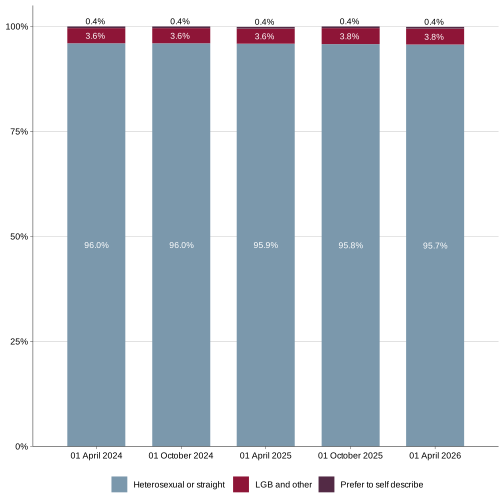
At April 2026, of those with a known sexual orientation, 3.8% of MOD civil servants identified themselves as LGB and other (figure 5.1). Between 1 April 2024 and 1 April 2026, the representation rates of LGB increased by 0.2 percentage points.
Figure 5.1 – Representation rate of MOD civil servants by sexual orientation, 1 April 2024 to 1 April 2026
Lesbian, Gay & Bisexual (LGB)
Refers to those who self-identify their sexual orientation as being other than heterosexual, including lesbian, gay, bisexual, asexual and other orientations.
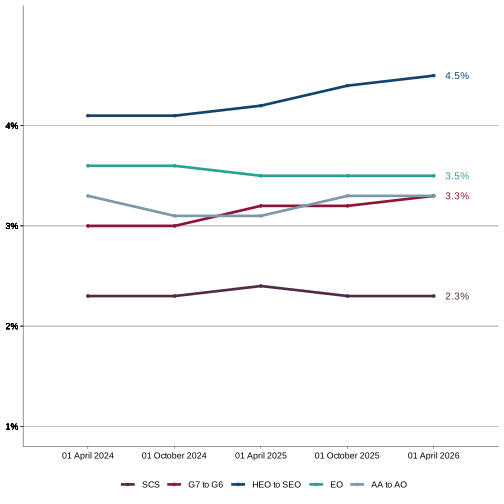
From 1 April 2024 to 1 April 2026, LGB representation rates for civil servants in grade bands HEO to SEO and G7 to G6 increased; while rates for the other grade bands did not undergo noticeable change (figure 5.2). Grade band HEO to SEO had the highest LGB representation rate at 4.5% and SCS had the lowest at 2.3%. Please note that the time series for LGB representation rates by grade should be interpreted with caution as the small population declaring their sexual orientation as LGB and other meant its rate may be volatile.
Figure 5.2 – LGB representation by grade band, 1 April 2024 to 1 April 2026
The sexual orientation declaration rate for civil servants aged 16 to 29 was below 60%; therefore, the representation rates have not been presented. Further information on sexual orientation and age can be found in the accompanying Excel ODS tables 5.5 and 5.6.
7. Religion and Belief
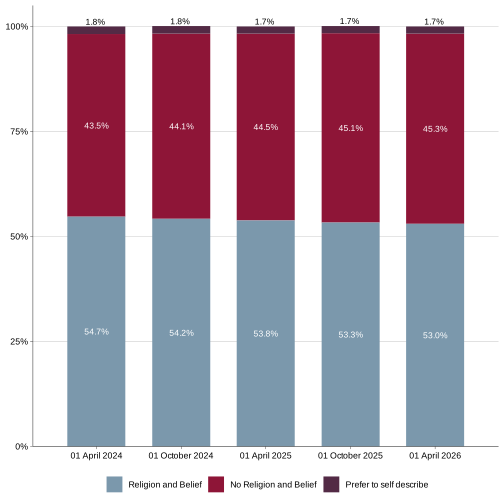
At 1 April 2026 the representation rate of MOD civil servants reporting a religion or belief was 53.0%, whilst that for no religion or belief was 45.3% (figure 6.1). From 1 April 2024 to 1 April 2026, the proportion of those reporting a religion and belief were gradually decreasing, corresponding to a growth in no religion and belief declaration rate.
The most reported religion or belief was Christianity 19,261 MOD civil servants declared a religion and belief of Christianity. This accounted for 48.9% of MOD civil servants who actively made their religion declaration. Hindu (515), Muslim (434) and Buddhist (198) were the three subsequent most declared religion and beliefs. For further information on religion and belief, please see Excel ODS, tables 6.1 and 6.2.
Figure 6.1 – Representation rate of MOD civil servants by religion and belief, 1 April 2024 to 1 April 2026
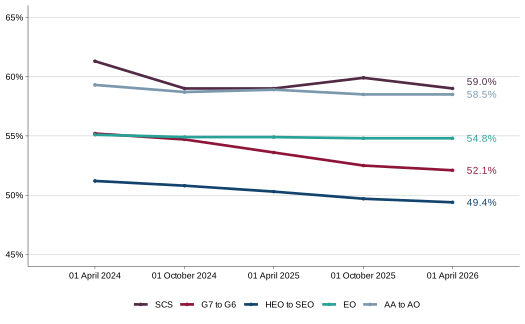
The representation rate of civil servants reporting a religion and belief in all grade bands was slowly decreasing from 1 April 2024 to 1 April 2026 (figure 6.2). The grade band G7 to G6 had greater fall at 3.1 percentage points than the other grades. At 1 April 2026, SCS had the highest representation rate in religion and belief at 59.0% whilst HEO to SEO had the lowest proportion at 49.4%.
Please note, the time series for SCS should be interpreted with caution as the small population size of the SCS means rates are more likely to be volatile.
Figure 6.2 – Religion and belief representation by grade band, 1 April 2024 to 1 April 2026
The religion and belief declaration rate for civil servants aged 16 to 29 was below 60%. Therefore, representation rates have not been presented. Further information on religion and belief and age can be found in the accompanying Excel ODS tables 6.5 and 6.6.
8. Disability
The representation rate of MOD civil servants who declared themselves as disabled was 18.4% at 1 April 2026 (figure 7.1), a 4 percentage point increase since 1 April 2024. Refer to the statistical notes for further information.
The declaration rate of MOD civil servants decreased by 6.8 percentage points to 63.4% (table 1, figure 1) from 1 April 2024 to 1 April 2026. To ensure meaningful representation rates for a diversity field, high declaration rates are required. Refer to the statistical notes for further information.
Statistical Note
Disability declaration and representation rates should be treated with caution as we suspect that the reported trends are due to the introduction of the HR system in February 2022, which has introduced bias to disability representation rates. We expect that disability representation rates are lower than is reported on the HR system and presented within this report. Disability rates since February 2022, and recent trends, should therefore be used with caution. Please see Section 6.1 Overall Accuracy of the BQR for further information.
Figure 7.1 – Representation rate of MOD civil servants by disability status, 1 April 2024 to 1 April 2026
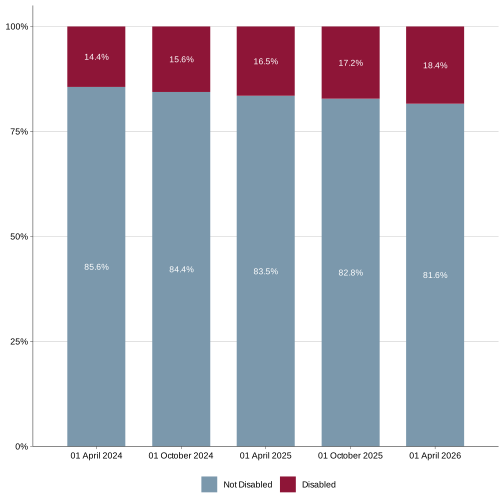
Table 1 – Declaration and representation of disability status of MOD civil servants, 1 April 2024 to 1 April 2026
| 1 April 2024 | 1 October 2024 | 1 April 2025 | 1 October 2025 | 1 April 2026 | |
|---|---|---|---|---|---|
| Declaration Rate (%) | 70.2 | 66.0 | 65.5 | 64.4 | 63.4 |
| Unknown (%) | 29.8 | 34.0 | 34.5 | 35.6 | 36.6 |
| Disabled Representation Proportion (%) |
14.4 | 15.6 | 16.5 | 17.2 | 18.4 |
The disability declaration rates for various grade and age breakdowns were less than 60%. Therefore, representation rates have not been presented. Further information on disability status by grade band, and disability status by age band can be found in the accompanying Excel ODS tables (Section 7).
9. Working Pattern
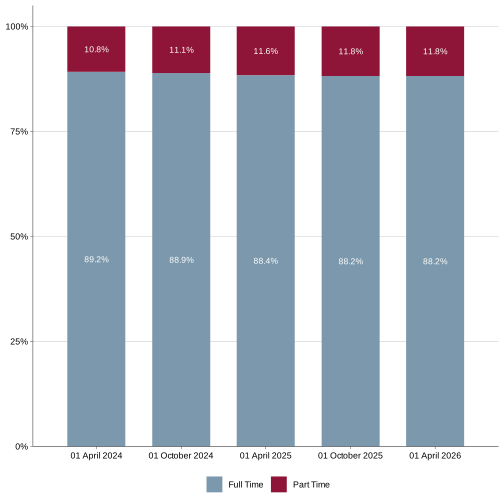
At 1 April 2026 the proportion of MOD civil servants working part time was 11.8%, an increase of 1 percentage point since 1 April 2024 (figure 8.1).
Figure 8.1 – Percentage of MOD civil servants by working pattern, 1 April 2024 to 1 April 2026
Full-time employees are those working 37 hours a week, excluding breaks.
Part-time employees are those working fewer than 37 hours a week, excluding breaks.
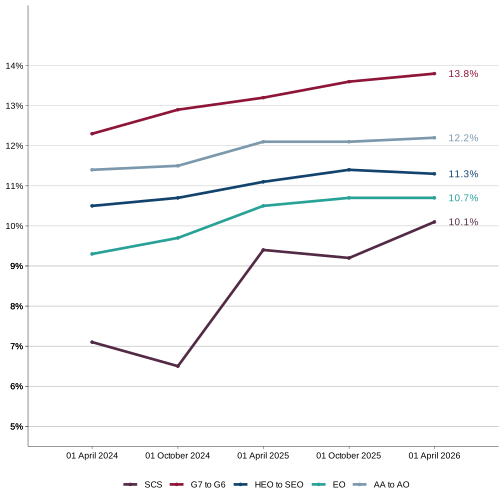
From 1 April 2024 to 1 April 2026, the proportion of part time MOD civil servants increased across all grade groups (figure 8.2). At 1 April 2026, grade band G7 to G6 had the greatest proportion of part-time civil servants at 13.8%; followed by AA to AO, which had 12.2%. The lowest part time ratio was with SCS at 10.1% although the percentage of part-time SCS increased by the highest percentage points from 1 October 2024 to 1 April 2026.
Please note, the time series for SCS should be interpreted with caution as the small population size of the SCS means rates are more likely to be volatile.
Figure 8.2 – Part time representation by grade band, 1 April 2024 to 1 April 2026
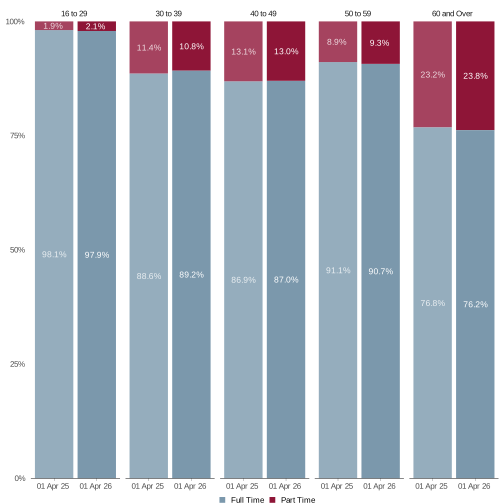
At 1 April 2026, only 2.1% of 16 to 29 years old MOD civil servants worked part time (figure 8.3). The age groups 30 to 39 and 50 to 59 each had about 10% part-time civil servants, and 40 to 49 had 13% part-time civil servants. The part-time proportion of 60 and over was close to a quarter at 23.8%, the highest among all age groups. From 1 April 2025 to 1 April 2026 the part time proportion reduced for those aged 30 to 39; whilst it increased among MOD civil servants of the age bands 16 to 29, 50 to 59 and 60 and over.
Figure 8.3 – Working pattern by age band, 1 April 2025 to 1 April 2026
Statistical Note
At February 2025, the process for calculating working pattern was updated following an improvement in data collection methodology. This resulted in an adjustment of ~50 FTE reduction.
10. Further Information
10.1 Declaration Rates
The declaration rates for the diversity fields of ethnicity, sexual orientation, religion and belief and disability status are calculated based on self-declaration. Each civil servant can choose from the following options:
-
One of the available diversity data fields (an active declaration)
-
Prefer to self-describe (text field option to self-describe, an active declaration)
-
Prefer not to say (no declaration)
-
No response (no declaration)
Declaration Rate is the number of civil servants who make an ‘active declaration’ as a proportion of the total civil servants. An active declaration excludes unknown or undeclared records, such as ‘prefer not to say’. ‘Prefer to self-describe’ is included within calculation for active declarations.
10.2 Representation Rates
Representation Rate is calculated from the number of civil servants who select a particular active diversity option as a proportion of the total civil servants within ‘active declaration’. To ensure meaningful representation rates for a diversity field, a minimum 60% declaration level is required to allow calculation of representation rates.
For example, from 100 civil servants, 80 civil servants declare as either disabled or not disabled, and the remaining 20 select prefer not to say or no option selected; this produces a declaration rate of 80%. Of the 80 civil servants who have actively declared their disability status, 8 declare as disabled, and 72 as not disabled; this produces a representation rate of 10% for disabled civil servants. If representation rate was calculated across the whole population including the 20 undeclared, representation rate would be calculated as 8% and understated.
Table 2 - Declaration rates, 1 April 2024 to 1 April 2026
| 1 April 2024 | 1 October 2024 | 1 April 2025 | 1 October 2025 | 1 April 2026 | 12 months Change | 24 Months Change | |
|---|---|---|---|---|---|---|---|
| Ethnicity | 82.0 | 82.1 | 81.6 | 80.9 | 80.1 | -1.5 | -1.9 |
| Sexual Orientation | 75.6 | 75.3 | 74.9 | 74.3 | 73.4 | -1.5 | -2.2 |
| Religion and Belief | 71.3 | 71.4 | 71.1 | 71.1 | 70.6 | -0.5 | -0.7 |
| Disability | 70.2 | 66.0 | 65.5 | 64.4 | 63.4 | -2.1 | -6.8 |
From 1 April 2024 to 1 April 2026 the proportion of active declarations reduced in the self-declared diversity attributes presented in this report (table 2). The option to positively opt-out of providing details by selecting ‘Prefer not to say’ is available.
10.3 Rounding
Percentages and related change in percentage points across time periods are calculated from unrounded data and rounded to one decimal place.
10.4 Revisions
Occasionally errors can occur in statistical processes. Procedures are constantly reviewed to minimize this risk. Should a significant error be found, the publication on the website will be updated; and an errata slip will be published documenting the revision.
Contact Us:
Responsible statistician Analysis Civilian Head of Branch
Further information/mailing list Analysis-Civilian-Enquiries@mod.gov.uk
Would you like to be added to our contact list, so that we can inform you about updates to these statistics and consult you if we are thinking of making changes? You can subscribe to updates by emailing us.
If you require information which is not available within this or other available publications, you may wish to submit a Request for Information under the Freedom of Information Act 2000 to the Ministry of Defence. For more information, see: