MOD biannual civilian personnel report: April 2026
Published 21 May 2026

© Crown copyright 2026
This publication is licensed under the terms of the Open Government Licence v3.0 except where otherwise stated. To view this licence, visit nationalarchives.gov.uk/doc/open-government-licence/version/3 or write to the Information Policy Team, The National Archives, Kew, London TW9 4DU, or email: psi@nationalarchives.gov.uk.
Where we have identified any third party copyright information you will need to obtain permission from the copyright holders concerned.
This publication is available at https://www.gov.uk/government/statistics/mod-biannual-civilian-personnel-report-april-2026/mod-biannual-civilian-personnel-report-april-2026
This statistical release presents figures on the strengths, inflow and outflow of civil servants employed by the Ministry of Defence (MOD). Definitions of terms used in this publication are present throughout.
For further data and information on the MOD Biannual Civilian Personnel Report, please visit:
- MOD Biannual Civilian Personnel Excel ODS table
- MOD Biannual Civilian Personnel Report statistics
- MOD Biannual Civilian Personnel Background Quality Report
Accredited Official Statistics publication
Accredited Official Statistics are called National Statistics in the Statistics and Registration Service Act 2007.
They comply with the standards of trustworthiness, quality and value in the Code of Practice for Statistics and should be labelled ‘Accredited Official Statistics’.
Accreditation can be broadly interpreted to mean that the statistics:
- meet the needs of the identified users;
- are well explained and readily accessible;
- are produced according to sound methods; and
- are managed impartially and objectively in the public interest.
Further information on the accreditation process can be found here: Accreditation explanation web page
Once statistics have been designated as Accredited Official Statistics it is a statutory requirement that the Code of Practice shall continue to be observed. Further details about how this report has been developed since its confirmation as an Accredited Official Statistic can be found in the Background Quality Report.
Our statistical practice is regulated by the Office for Statistics Regulation (OSR). OSR sets the standards of trustworthiness, quality and value in the Code of Practice for Statistics that all producers of official statistics should adhere to.
You are welcome to contact us directly with any comments about how we meet these standards. Alternatively, you can contact OSR by emailing regulation@statistics.gov.uk or via the OSR website
Updates to the publication
-
In line with the Code of Practice, to ensure our statistics provide maximum value, the following changes have been introduced for this edition of the MOD Biannual Civilian Personnel Report at 1 April 2026. These changes will help ensure the report remains relevant to users and representative of the MOD Civil Service workforce.
-
MOD civil servants have been presented and organised within the four areas introduced within Defence Reform: Department of State (DOS), Defence Nuclear Enterprise (DNE), Military Strategic Headquarters (MSHQ) and the National Armaments Director (NAD) Group. This replaces MOD TLBs.
-
The grade section has been expanded to present Civil Service equivalent grades for all MOD civil servants. The industrial grade category covered in the previous reports has been replaced with their equivalent grades.
-
Method of entry and reason for leaving categories have been presented for all MOD civil servants. In prior editions, these were only presented for civil servants within the central government department (MOD Main TLBs).
1. Main Points
At 1 April 2026 the MOD civil servant FTE total was 55,351 a decrease of 451 (0.8%) compared with 1 April 2025. The headcount was 57,445, a decrease of 409 (0.7%) compared with 1 April 2025.
The decrease in both FTE and headcount strength reflects the Department’s continued focus on affordability and value for money within workforce plans.
For the 12 months from 1 April 2025 to 31 March 2026, 4,034 civil servants inflowed to the MOD, an increase of 856 (26.9%) compared with the previous 12 months.
For the 12 months from 1 April 2025 to 31 March 2026, 4,485 civil servants left the MOD, a decrease of 684 (13.2%) compared with the previous 12 months.
2. MOD Civil Servants
The MOD civil servant FTE at 1 April 2026 was 55,351, a decrease of 451 (0.8%) compared with 1 April 2025 (55,802).
The MOD civil servant headcount at 1 April 2026 was 57,445, a decrease of 409 (0.7%) compared with 1 April 2025 (57,854).
Strength: Total number of personnel employed at a specific time point.
Headcount: A measure of the size of the workforce based on the number of personnel employed rather than by their FTE proportion.
Full Time Equivalence (FTE): A figure that allows part-time workers’ hours to be put into the same units as full-time workers.
The Secretary of State for Defence, Rt Hon John Healey MP, launched Defence Reform initiatives to change the way that Defence operates: establishing a new Military Strategic Headquarters (MSHQ) and new National Armaments Director (NAD) Group; and strengthening the Department of State (DOS) and Defence Nuclear Enterprise (DNE). For more information on each area, please see the glossary.
At 1 April 2026, the Military Strategic Headquarters (MSHQ) had the largest FTE share of MOD civil servants at 46.6%, followed by National Armaments Director (NAD) Group with 42.9%, Defence Nuclear Enterprise (DNE) 6.0%, and Department of State (DOS) at 4.5%.
Figure 1: Proportion of MOD Civil Servants by Area (FTE), 1 April 2026
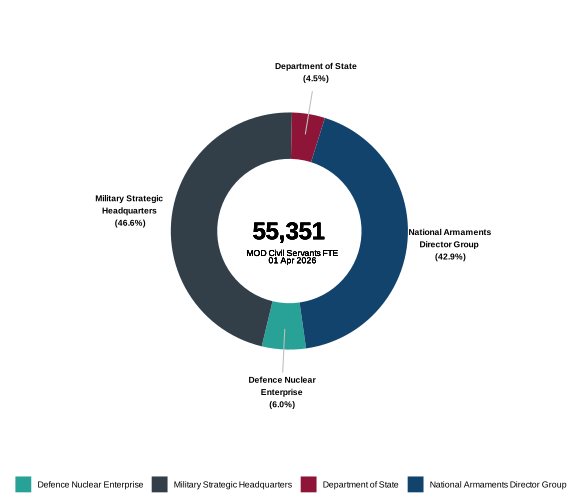
Table 1 shows the current FTE of MOD civil servants at 1 April 2026. Due to the change in departmental structure at 1 April 2026, comparisons are not yet available to previous data points.
Table 1: MOD Civil Servants by Area (FTE)
| 1 April 2026 | |
|---|---|
| Defence Nuclear Enterprise | 3,316 |
| Department Of State | 2,493 |
| Military Strategic Headquarters | 25,820 |
| National Armaments Director Group | 23,723 |
| MOD Civil Servants | 55,351 |
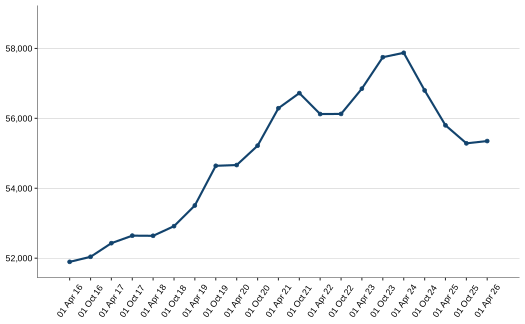
The MOD civil servant FTE workforce showed an overall increasing trend from 1 April 2019, peaking in strength at 1 January 2024 (Figure 2). Since 1 April 2024, the number of MOD civil servants has been steadily decreasing, returning to levels similar to 1 October 2020.
The decrease in both FTE and headcount strength reflects the Department’s continued focus on affordability and value for money within our workforce plans. The Strategic Defence Review sets out ambitions for the Defence Civil Service workforce, including achieving a cost reduction of at least 10% by 2030 through reshaping the workforce with an emphasis on performance, productivity, and skills. Defence remains committed to delivering both government’s and Department’s priorities.
Figure 2: MOD Civil Servants FTE, 1 April 2016 to 1 April 2026
3. MOD Civil Servants by Grade
At 1 April 2026, Higher Executive Officers accounted for the highest proportion of MOD civil servants at 22.4%, followed by Administrative Officers at 20.2%, and Senior Executive Officers at 20.0% (figure 3). The remaining proportions in order were shared between Executive Officers (14.5%), Grade 7 (12.6%), Administrative Assistants (5.8%), Grade 6 (3.4%) and the smallest section: SCS at 1.0%.
Figure 3: Proportion of MOD Civil Servants by Grade* (FTE), 1 April 2026
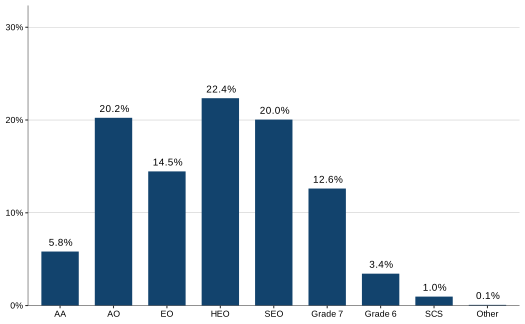
* Excludes RFA personnel.
Please note, calculations for grade proportions are based on reported grade including unknown grade data at 1 April 2026.
The grade section has been expanded to present Civil Service equivalent grades for all MOD civil servants, excluding RFA. The industrial grade category covered in the previous reports has been replaced with their equivalent grades.
4. Inflow and Outflow
The total annual inflow of MOD civil servants in the 12 months from 1 April 2025 to 31 March 2026 was 4,034, a 26.9% increase (856) compared with that in the previous 12 months. While the annual outflow of MOD civil servants in the 12 months from 1 April 2025 to 31 March 2026 was 4,485, a 13.2% decrease (684) compared with the previous 12 months resulting in a negative 451 net flow (Table 2).
In March 26, 83 civil servants from the UK Defence and Security Exports (UKDSE) moved from the Department for Business and Trade to the MOD, as a Machinery of Government change.
Table 2: Flow analysis of MOD Civil Servants (Headcount)
| 1 April 2024 to 31 March 2025 |
1 April 2025 to 31 March 2026 |
Difference (number) |
Difference (% change) |
|
|---|---|---|---|---|
| Inflow | 3,178 | 4,034 | 856 | 26.9% |
| Outflow | 5,169 | 4,485 | -684 | -13.2% |
| Net flow | -1,991 | -451 |
Inflow The number of personnel joining the department within a monthly, quarterly or financial year period.
Outflow The number of personnel leaving the department within a monthly, quarterly or financial year period.
Inflow and outflow figures exclude any movement of personnel within the department. Inflow and outflow of Royal Fleet Auxiliary are also excluded.
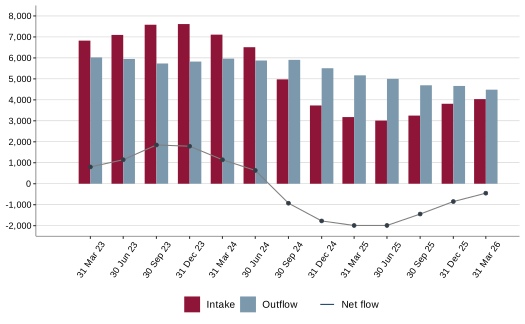
From 1 April 2022 through to 31 December 2023 net flow rates were neutral or positive, peaking at 1 January 2024 (figure 4). Since then, the net flow began decreasing before finally turning negative by September 2024, resulting in decreasing numbers of overall MOD civil servants. This negative net flow reflects the Department’s continued focus on affordability and value for money within our workforce plans. Since 1 July 2025 the net flow, while still negative, has been increasing.
Figure 4: Inflow, Outflow and Net Flow of MOD Civil Servants (Headcount), 1 April 2022 to 31 March 2026
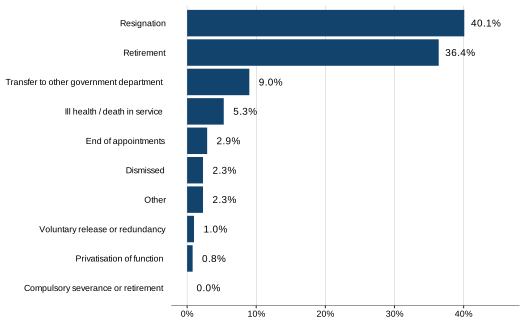
The two most common reasons for leaving the MOD from 1 April 2025 to 31 March 2026 were resignation and retirement, accounting for 40.1% and 36.4%, respectively (Figure 5).
Figure 5: Outflow by Reason for Leaving Proportions of MOD Civil Servants, 1 April 2025 to 31 March 2026
5. Glossary
Civil Servants: Staff employed by the Crown (appointed by departments or executive agencies). Their roles, grades and salaries are broadly comparable and whilst they usually work for one specific department or agency, and they are able to apply for postings across most other areas of government.
Defence Reform: Following the election in July 2024, the Secretary of State for Defence, the Right Honourable John Healey MP, launched reforms to enable UK Defence to match increasing threats, tackle waste and strengthen the Armed Forces. Signalled as ‘a new era for Defence’ and the deepest reforms for 50 years, “Defence Reform” is fundamentally changing the way Defence operates, speeding up decision making, focusing on outcomes, rapidly delivering cutting edge capabilities to UK Armed Forces while achieving the best value for taxpayers. It will change the way Defence operates. It will ensure that we are ready for the challenges ahead, including delivering the Strategic Defence Review, ensuring value for money from the budget settlements and setting Defence at the heart of future security and success of the UK. On 1 April 2025, the Secretary of State announced a significant step in reforms: establishing a new Military Strategic Headquarters and new National Armaments Director Group; and strengthening the Department of State and Defence Nuclear Enterprise.
Department of State: The Department of State (DOS) area is responsible for providing policy advice and clear strategic direction to ensure that Defence is focused on outcomes and delivery. It contains a streamlined set of Director Generals, reporting to the Permanent Secretary, focused on: strategy and transformation; people; policy; finance; science and safety. In line with wider Civil Service Reform, this area will be lean and highly skilled, unleashing the exceptional capabilities within Defence by making the systems and processes more efficient and empowering.
Defence Nuclear Enterprise: The Chief of Defence Nuclear (CDN) is responsible for cohering across the Defence Nuclear Enterprise (DNE), which comprises the organisations that operate, maintain, renew and sustain the UK’s nuclear deterrent and brings together the core organisations of the Defence Nuclear Organisation (DNO), the Royal Navy, UK Strategic Command, the Submarine Delivery Agency (SDA), and AWE Nuclear Security Technologies (“AWE”). The financial nuclear ringfence ensures nuclear spending is prioritised and allows a strong focus on delivery and outcomes. Under Defence Reform, the Chief of Defence Nuclear will act as the clear point of accountability for the ringfence, working closely with industry and the Military Strategic Headquarters finance teams to ensure effective management. The Executive Agency the Submarine Delivery Agency (SDA) sit within DNE.
MOD Executive Agencies: An executive agency is a clearly designated unit of a central government department. It is administratively distinct, but legally remains a part of it. Within MOD, these are UK Hydrographic Office (UKHO), Defence Science & Technology Laboratory (DSTL), Submarine Delivery Agency (SDA), and Defence Equipment & Support (DE&S).
Military Strategic Headquarters: The Military Strategic Headquarters (MSHQ) acts as the focal point for the design of the integrated force, to improve warfighting readiness and lethality, and coordinates the strategic planning of UK Defence activity worldwide. The Military Strategic Headquarters will support the journey from a ‘joint’ to an ‘integrated’ force that better harnesses the five warfighting domains of maritime, air, land, cyber, and space. The Royal Fleet Auxiliary are included within MSHQ.
National Armaments Director Group: The National Armaments Director will lead a reformed end-to-end defence procurement system and make Defence an engine for economic growth in every corner of the UK. The new structure will enable collaboration between teams delivering the national ‘arsenal’ and the Government’s Defence Industrial Strategy into a single group. It will enable collaboration by bringing together: Defence Equipment & Support (DE&S), Defence Infrastructure Organisation, Defence Science and Technology Laboratory (DSTL), Defence Digital, and Defence Support, along with roles focused on international collaboration and exports, supporting UK Defence Industry. These roles and organisations will work together, alongside industry, academia, international allies and partners to develop, deliver and support innovative, world-beating military capabilities. The Executive Agencies of Defence Equipment & Support (DE&S), Defence Science and Technology Laboratory (DSTL) and the UK Hydrographic Office (UKHO) sit within the NAD Group.
Royal Fleet Auxiliary are a civilian-manned fleet, owned by the MOD, which supports Royal Navy ships around the world, supplying warships with fuel, ammunition and supplies.
6. Further Information
6.1 Rounding
Tables and Charts within this document
Percentages and related change in percentage points across time periods are calculated from unrounded data and rounded to one decimal place. Totals and sub-totals are rounded separately and so may not equal the sums of their rounded parts. This also applies to data expressed in terms of Full-Time Equivalents (FTE).
Excel tables accompanying this publication
An updated MOD Disclosure Control and Rounding policy has been published on GOV.UK and we have applied this policy to the statistics in the accompanying Excel tables. The policy is available here.
Disclosure control will still be applied to statistical or numeric information to safeguard the confidentiality of individuals. ‘Disclosure control’ refers to the efforts made to reduce the risk of disclosure, such as applying statistical methods to protect ‘personally identifiable information’ (PII) in aggregated data tables. These safeguards can take many forms (e.g. data suppression, rounding, recoding etc.).
6.2 Revisions
Occasionally errors can occur in statistical processes. Procedures are constantly reviewed to minimise this risk. Should a significant error be found, or if figures change due to improvements to methodologies or changes of definitions then a correction may be required. Corrections which would have a significant impact on the utility of the statistics will be corrected as soon as possible, by reissuing the publication. Minor errors will also be corrected, but for convenience these corrections may be timed to coincide with the next release of the publication.
All corrected figures will be identified by the symbol [r]. Corrections will only be marked in the first edition of each publication that the corrected figures appear in. If the figures appear again in future editions they will not be marked as corrected.
6.3 Background Quality Report
The background quality report provides more detailed information about the quality of data used to produce this publication and any statistics derived from that data. MOD civilian personnel statistics: background quality reports
Contact us:
Responsible statistician: Analysis Civilian Head of Branch Further information/mailing list: Analysis-Civilian-Enquiries@mod.gov.uk Background quality report: Background quality report
Would you like to be added to our contact list, so that we can inform you about updates to these statistics and consult you if we are thinking of making changes? You can subscribe to updates by emailing:
Analysis-Civilian-Enquiries@mod.gov.uk