MHCLG enabled spend statistics, 2024-25
Published 28 May 2026

© Crown copyright 2026
This publication is licensed under the terms of the Open Government Licence v3.0 except where otherwise stated. To view this licence, visit nationalarchives.gov.uk/doc/open-government-licence/version/3 or write to the Information Policy Team, The National Archives, Kew, London TW9 4DU, or email: psi@nationalarchives.gov.uk.
Where we have identified any third party copyright information you will need to obtain permission from the copyright holders concerned.
This publication is available at https://www.gov.uk/government/statistics/mhclg-enabled-spend-statistics-2024-25/mhclg-enabled-spend-statistics-2024-25
About our statistics
This is the annual release of statistics on the Ministry of Housing, Communities and Local Government’s (MHCLG’s) enabled spend. These statistics are official statistics in development.
This publication provides estimates of MHCLG’s enabled spend by local authority district in the United Kingdom (UK) for the financial year 2024-25. Enabled spend includes direct expenditure by MHCLG and selected arm’s length bodies (ALBs), as well as funding provided to local government through the local government finance system (general funding) and through MHCLG grants (specific funding).
Further information on the methodology used to apportion spend data to local authority districts is provided in the accompanying technical notes.
In this release
-
MHCLG enabled spend across the UK was £76.8 billion in the 2024-25 financial year which amounts to £1,342 per person in England. This was an increase of 8% in MHCLG’s UK enabled spend compared to 2023-24. The majority (73%) of MHCLG enabled spend was delivered as non-ringfenced general funding delegated to local authorities. This represents local government income that is delivered through MHCLG’s local government finance system.
-
The Classifications of the Functions of Government (COFOG) has been used to break down expenditure. Across the UK, 83% of direct MHCLG and ALB spend supported Housing and Community Amenities. In contrast, 98% of specific funding supported Social Protection, delivered through MHCLG grants delegated to local authorities.
-
At a regional level in England, London has the highest overall direct MHCLG spend and specific funding delegated to local authorities, both in total and per person spend. When expenditure is broken down using COFOG, this shows that London’s higher spend was primarily due to Housing and Community Amenities spend, which was highest in London on both a total and per-person basis. For Social Protection spend, however, while London had the highest total expenditure, its per-person spending ranked fifth among regions, with highest per-person spend observed in the North East and North West.
-
Higher area costs and greater funding for housing programmes push up total MHCLG enabled spend in London. Spend per person in London was £457 higher than the average of other regions in England but was more consistent with other regions when adjusted to reflect higher area costs and spend from Affordable Homes Programme and Building Safety Fund is excluded.
-
Patterns of MHCLG enabled spend vary more at local authority level than at regional level. Total MHCLG enabled spend per person in England was highest in Westminster (£2,412) while the lowest in England was in Windsor and Maidenhead (£898) – the difference in spend per person between these authorities is £1,514.
-
Local authorities which are part of a combined authority in England typically have a higher MHCLG enabled spend per person than local authorities in a non-combined authority.
-
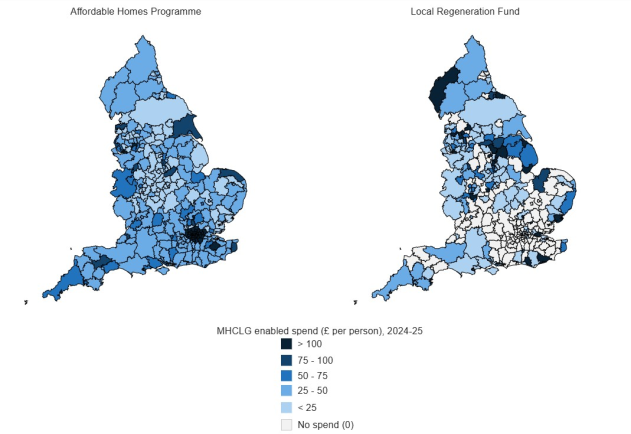
In England, the two highest programmes of direct spend was the Affordable Homes Programme, followed by the Local Regeneration Fund. This pattern varied across regions and local authorities, with the highest programme spend in the North East and Yorkshire and the Humber being the Local Regeneration Fund.
Things you need to know about this release
-
These are official statistics in development, designed to improve the collective understanding of how MHCLG spends money across the UK. They build on the previous publications starting from 2021, and assign individual items of spend to the local authorities that the spend is located in.
-
The methodology used is set out in the Technical Notes including assumptions used to apportion funding to local authorities where it has been allocated at different levels of geography. This methodology will continue to be refined for future publications, and the conclusions drawn may change as a result.
-
The figures in this publication should be treated as best estimates.
-
‘Central spend’ in this publication is where spend for a segment, project or recipient relates solely to core functions such as administration, commercial, travel service provider, etc. or spend that doesn’t benefit a specific geographical location and facilitates the provision of a nation-wide service e.g. telephone helplines. For all these types of spend lines we have set the geography to “Central / Non geography specific”. This spend is therefore not assigned to any local authority district.
-
Year on year comparisons at a granular level (i.e. by individual spending segments and local authorities) will not be meaningful. This is due to refinements in apportionment methodology year to year to more accurately reflect spend in a local authority, and changes within spending segments and geography boundaries.
-
As a result of the methodology used – which is based on actual payments made – estimated programme-specific spend figures may differ from published allocations, which set out the maximum funding set aside for a programme to provide its services. This is especially the case where payments are made in one financial year to provide services in another.
-
We use Core Spending Power data as a measure of the ringfenced and non-ringfenced spending by local authorities, in accordance with MHCLG’s local government finance framework.
-
Many MHCLG functions in England are devolved in Scotland, Wales and Northern Ireland, and are therefore funded by the devolved administrations’ block grants. Consequently, MHCLG enabled spend per person for Scotland, Wales and Northern Ireland is additional to that already received via their block grants. Therefore, direct comparison with spend in England will not be meaningful.
-
To aid meaningful comparison of spend across place and spending segment, we have derived and published levels of spend per person. This is not reflective of, nor a statement on, how funding is or should be allocated. Funding streams seek to deliver different outcomes, which informs the distribution methodologies for each funding stream. These methodologies may not necessarily consider spend per person. Spend per person is unlikely to be an appropriate method for determining how best to fund local authorities because it does not take account of the needs of the local population.
-
City of London and Isles of Scilly have atypically small populations and owing to their unique statuses as local authorities are often excluded from local authority comparisons.
Uses and limitations
Correct use
- comparing English local authorities
- understanding MHCLG spend at a local level
Incorrect use
- comparing local authorities’ funding across years
- comparing local authorities across the UK
- as a reflection of total government spending at a local level
- identifying how or where local government spends funding
- understanding how central government determines allocations
Main findings
MHCLG enabled spend includes direct expenditure by MHCLG and selected arm’s-length bodies[footnote 1], together with funding provided to local government through the local government finance system and MHCLG grants.
MHCLG enabled spend in 2024-25 was £76.8 billion, of which £76.5 billion can be attributed to a specific local authority; the remaining £0.3 billion is central spend which cannot be attributed to a local authority. This publication explores the MHCLG subnational spend data, providing insight on the department’s largest categories of spend, as listed below, and how spend is distributed at a local authority level.
Overall, MHCLG supports 3 broad mechanisms of spending:
1. General funding delegated to local authorities - Local government income that is made available through MHCLG’s local government finance system. This non-ringfenced funding is delegated to local authorities, for the provision of general services. The local government finance system (which includes council tax raising powers and the settlement funding assessment as core components) considers differences in tax raising abilities and need to spend between local areas in determining allocations.[footnote 2] This mechanism accounts for by far the largest share of MHCLG enabled spending across the UK, and so forms a critical part of the geographic picture captured in this data.
2. Direct MHCLG spend - Direct central government spend in local areas by MHCLG and two of its arm’s-length bodies (ALBs), Homes England and the Planning Inspectorate[footnote 3] to provide services like housing supply (e.g. Affordable Homes Programme) and local regeneration (e.g. Local Regeneration Fund and Local Growth Fund).[footnote 4], [footnote 5]
3. Specific funding delegated to local authorities - Local government income that is delivered through MHCLG grants, which local authorities can only spend on specific services, like social care (e.g. Social Care Grant and Improved Better Care Fund).
Total MHCLG spend, the sum of these 3 mechanisms of spending, is referred to as ‘MHCLG enabled spend’ throughout this publication.
As shown below in Figure 1 in 2024-25, MHCLG enabled spend was:
- £55.9 billion on general (non-ringfenced) funding delegated to local authorities
- £11.9 billion on direct MHCLG (including Homes England and Planning Inspectorate) spend, of which £0.3 billion on central spend[footnote 6] that cannot be attributed to a local authority district
- £8.9 billion on specific funding delegated to local authorities
Figure 1: Scale of direct MHCLG and ALB spending, specific and general funding delegated to local authorities, UK, 2024-25
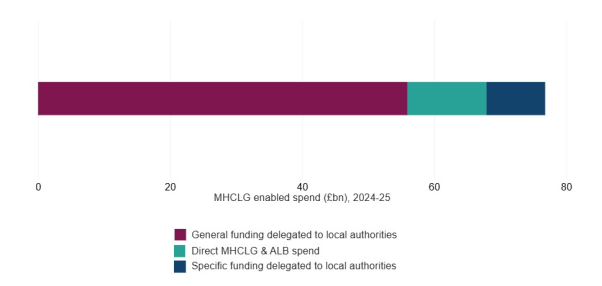
General funding delegated to local authorities represents the majority of MHCLG enabled spend in almost every local authority in England. Of the £55.9 billion total, the main way MHCLG delegates general funding to local authorities is through the council tax system, which represented £36.1 billion in 2024-25.
Of the £11.9 billion direct spending by MHCLG and two of its ALBs across the UK, the largest programme of spend was the Affordable Homes Programme[footnote 7], accounting for £2.4 billion (20%) of MHCLG and ALB direct local spend in 2024-25.
The total MHCLG enabled spend for Wales, Scotland and Northern Ireland only includes direct MHCLG and ALB spend as local authority funding is devolved.
Direct MHCLG spend and specific funding delegated to local authorities supports housing, social care and health
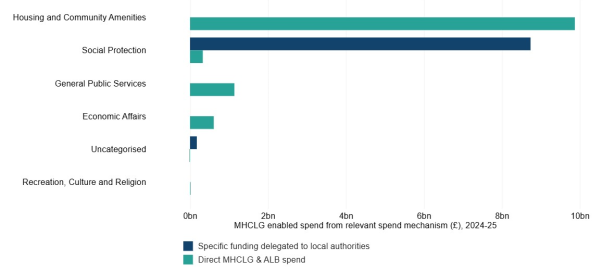
Government activities and spend (both direct and specific) can be categorised by the Classification of the Functions of Government (COFOG).[footnote 8] This indicates the broad themes and purposes that government spends money on. Figure 2 shows a comparison of how direct MHCLG spend and specific funding delegated to local authorities is distributed among the COFOG classifications.
The majority of direct MHCLG and ALB spend supported Housing and Community Amenities (83% or £9.9 billion). In contrast, specific funding delegated to local authorities which is delivered through MHCLG grants, primarily supported Social Protection (98% or £8.7 billion). General funding delegated to local authorities is non-ringfenced funding and is, by definition, used for many purposes, and so we cannot classify it by its ultimate function.[footnote 9]
Figure 2: The functions of government supported by direct MHCLG and ALB spend and specific funding delegated to local authorities, UK, 2024-25
Patterns of MHCLG enabled spend per person vary across regions in England
MHCLG enabled spend per person in England was £1,342 in 2024-25, but this varies significantly by region. Spend per person was highest in London (£1,738), followed by the North East (£1,447) and the North West (£1,397), as shown below in Figure 3.
Figure 3: Regional spend per person by mechanism of MHCLG enabled spend, England, 2024-25
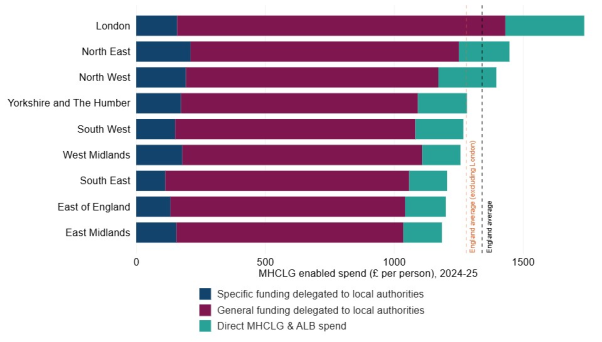
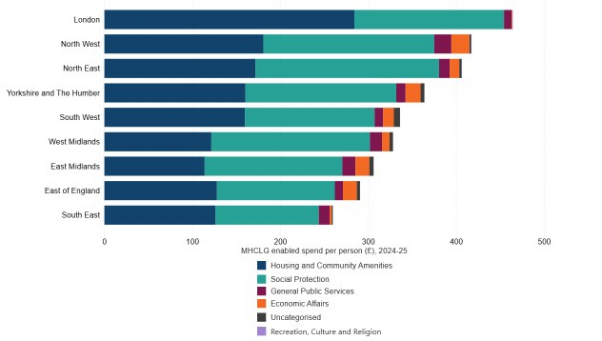
Figure 4 illustrates, on a per person basis, the functions of government supported by region for direct MHCLG and ALB spend (a subset of the above), and specific funding delegated to local authorities. General funding delegated to local authorities is, by definition, used for many purposes, and so we cannot classify it by function.
Spending per person for direct spend and specific funding is highest in London (£464), followed by the North West (£417), and then the North East (£406). Conversely, the South East (£260) records the lowest spending.
The higher spending in London is primarily attributed to the per person allocation towards housing (£284), which is £103 higher than the next region, the North West (£181). We see less significant variance with the allocation towards social protection with the North East receiving the highest spend per person (£209) followed by North West (£194) and then West Midlands (£180).
Figure 4: Direct MHCLG and ALB spend and specific funding delegated to local authorities, by region and COFOG, 2024-25
Why is spend higher in London?
London has higher levels of general (non-ringfenced) funding delegated to local authorities and higher direct MHCLG and ALB spend, as shown in Figure 3. This is consistent with HM Treasury Country and regional analysis: 2025, where London spend has been historically higher than other regions.
A key driver of this is the higher cost of delivering services in London. The Area Cost Adjustment index (ACA) is used to measure the variation in the costs of delivering services across the country. MHCLG uses the ACA to account for differences in cost by applying it to the formulas used in the Local Government Finance system.
Before using ACA to adjust for area costs, the difference between spend per person in London and the average of every other region in England is £457. After adjusting for ACA this falls from £457 to £290.
Higher spend in London is also driven by greater funding for housing programmes. The Affordable Homes Programme[footnote 7] is the largest programme in most regions, with spend per person highest in London (£70), followed by the South West region (£50). London also has the largest share of the Building Safety Fund[footnote 10] with over 93% of the spend.
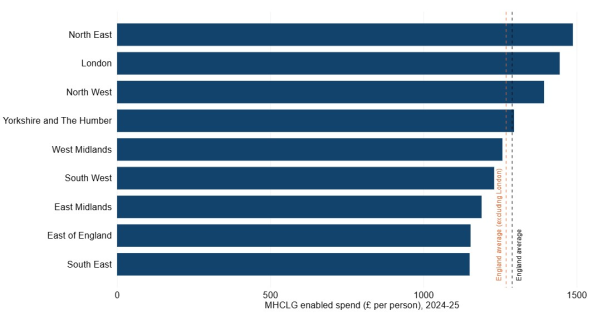
These programmes are excluded in Figure 5 as their funding is heavily concentrated in London and reflects specific housing and safety pressures, rather than the general distribution of MHCLG funding. Excluding them allows for a clearer comparison of underlying spend across regions.
Spend per person is highest in North East (£1,488) after accounting for higher area costs and excluding Affordable Homes Programme and Building Safety Fund spend, followed closely by London (£1,445).
Figure 5: Regional spend per person adjusted for area costs and excluding Affordable Homes Programme and Building Safety Fund, England, 2024-25
The majority of MHCLG programme spend is directed towards English regions as many MHCLG functions for England are devolved in Scotland, Wales and Northern Ireland. Funding for the devolved administrations is therefore provided through the block grant (based on the Barnett formula) and allocated in line with devolved priorities.
MHCLG enabled spend in Scotland, Wales and Northern Ireland (total spend of £229.9 million, £390.7 million and £97.2 million respectively in 2024-25) is in addition to that already received via their block grants. In 2024-25 MHCLG provided direct funding for UK-wide programmes such as the UK Shared Prosperity Fund and Homes for Ukraine.
Overall MHCLG enabled spend per person in England has increased by £94 (8%) between 2023-24 and 2024-25. This was primarily due to an increase of £2.9 billion in the non-ringfenced funding delegated to local authorities in England during this period. This increase was driven by a combination of growth in the council tax base, increases in council tax levels and an increase in the settlement funding assessment.
Specific funding delegated to local authorities also increased in England between 2023-24 and 2024-25 by £1.8 billion. This was partly driven by an increase for social care services including the Social Care Grant, the Market Sustainability and Improvement Fund and the Discharge Fund. More detail can be found in the Final local government finance settlement: England, 2024 to 2025.
All regions in England saw an increase in MHCLG enabled spend between 2023-24 and 2024-25 of at least £69 per person. The largest increases in MHCLG enabled spend were in the North West, London and South East (increases of £112, £111 and £97 respectively).[footnote 11]
Patterns of MHCLG enabled spend per person vary more significantly at local authority than at regional level
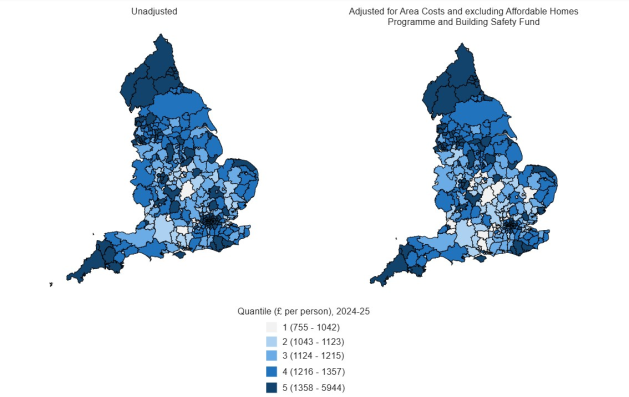
Excluding City of London and Isles of Scilly, which have very different spending patterns and are treated as outliers in this analysis[footnote 12], MHCLG enabled spend per person in England was highest in Westminster (£2,412), Kensington and Chelsea (£2,393) and Camden (£2,355); and lowest in England in Windsor and Maidenhead (£898), Oadby and Wigston (£948) and Blaby (£974).
After applying the area cost adjustment which is used to measure the variation in the costs of delivering services across the country, Camden had the highest enabled spend per person in England (£1,972), while Windsor and Maidenhead remained the lowest (£852). The area cost adjustment narrows the gap between highest and lowest spend per person at a local authority level from £1,514 to £1,120.
Figure 6: MHCLG enabled spend per person by local authority, before and after adjusting for area costs and excluding the Affordable Homes Programme and the Building Safety Fund, England, 2024-25
In this bulletin we have used spend per person as the standard measure to compare the amount of MHCLG enabled spend between areas. This enables consistent comparison of spending and standardises spend data across different size populations, local authorities with different area sizes and varying levels of housing density. However, there are multiple ways in which the data can be presented and alternative comparative measures can be used:
- Total MHCLG enabled spend in England was highest in Birmingham (£1.6 billion), followed by Leeds (£976 million) and was lowest in the Isles of Scilly (£13.6 million), reflecting differences in their populations.
- Spend per square metre [footnote 13] in England was highest in Islington (£31.66 per m2) and lowest in West Devon (£0.07 per m2), reflecting differences in area size and population density.
- Spend per dwelling [footnote 13] was £2,866 in England excluding the City of London and the Isles of Scilly. It was highest in Newham (£5,295 per dwelling) and Barking and Dagenham (£5,088 per dwelling). It was lowest in Windsor and Maidenhead (£2,046 per dwelling) and Havant (£2,155 per dwelling).
There is a strong positive correlation between spend per dwelling and spend per person in England. Local authorities which have higher levels of MHCLG enabled spend per dwelling also tend to have higher levels of spend per person.
MHCLG enabled spend per person by local authority devolution status in England
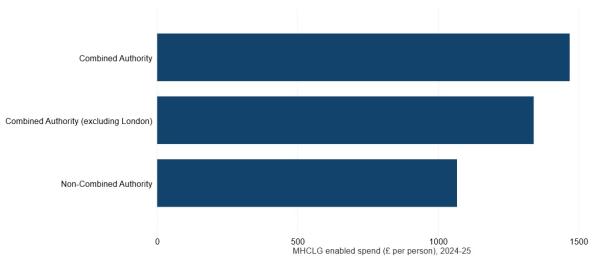
In 2024-25, average MHCLG enabled spend per person was £1,468 in mayoral combined authorities (MCAs), £1,342 in MCAs excluding the Greater London Authority and £1,067 in local authorities without devolution deals. These values are based on MHCLG enabled spend only and do not reflect the full extent of funding devolved from across central government. They are descriptive comparisons and do not account for differences in the characteristics of areas covered by combined authorities, such as deprivation levels or the concentration of large urban centres.
Figure 7: Average MHCLG enabled spend per person by local authority devolution status, England, 2024-25
There are local authority hotspots outside of the London region with relatively higher direct MHCLG and ALB spend per person
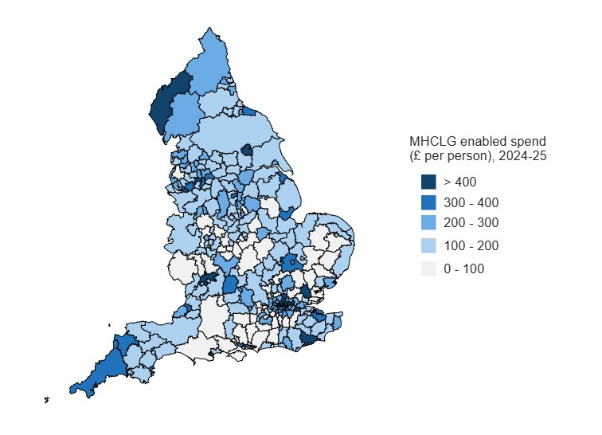
In 2024-25, direct MHCLG and ALB spend per person in England was highest in Isles of Scilly (£3,230), followed by City of London (£1,053). These locations are outliers due to their spending patterns and particularly small populations.
Excluding these outliers, the next highest direct MHCLG and ALB spend per person in England was Chelmsford (£719) followed by Newham (£665). The lowest spend was in Windsor and Maidenhead (£49).
Although direct MHCLG and ALB spend per person is highest within the London region, there are local authorities with relatively higher spend. For example in the North West local authority of Cumberland (£537) and South East local authority of Rother (£438). Of the 20 local authorities with the highest spend per person, 15 of these are local authorities outside of the London region.
Figure 8: Direct MHCLG and ALB spend per person by local authority, England, 2024-25
The Affordable Homes Programme[footnote 7] had higher levels of spend per person in London than other areas. Conversely, several other programmes had higher spend per person outside of London, including the Local Regeneration Fund[footnote 14], UK Shared Prosperity Fund[footnote 15] and the Housing Infrastructure Fund[footnote 16]. These programmes support regeneration, infrastructure and wider local growth. The Housing Infrastructure Fund is one of the largest programmes outside of London, with the highest spend per person in the East of England (£28).
Figure 9: Spend per person on Affordable Homes Programme and Local Regeneration Fund by local authority, England, 2024-25
Official statistics in development
The MHCLG enabled spend statistics are published as official statistics in development. These are official statistics that are undergoing development with scope to improve their trustworthiness, quality and value. See further technical details about these statistics, their methodology and development plans.
Accompanying tables and open data
Tables
Accompanying tables are available to download alongside this release.
Machine readable data
These statistics are available in a machine readable, ‘tidy data’ format.
Technical notes
Please see the accompanying technical notes document for further details.
Information on Official Statistics is available via the UK Statistics Authority website.
Information about statistics at MHCLG is available via the department’s website.
Release information and contact
Release date: 28 May 2026
Date of next release: March 2027
Contact: Robert Green and David Barkshire subnationalexpenditure@communities.gov.uk
Media enquiries: 0303 444 1209 / NewsDesk@communities.gov.uk
-
MHCLG enabled spend captures the direct spend of are Homes England and Planning Inspectorate (two of MHCLGs arms length bodies). ↩
-
Specific and general funding is delegated to local authorities as enabled by MHCLG’s local government finance system. This includes grants from MHCLG, redistribution between councils and funding raised by councils themselves via council tax and business rates. We include all of this funding as MHCLG enabled local authority spending in this analysis, to ensure fair comparison of total public spend geographically across the UK. We use Core Spending Power data as a measure of the ringfenced and non-ringfenced spending by local authorities, which MHCLG’s local government finance framework supports. These 2024-25 figures are based on the final 2024-25 settlement. For more detail on this system, see Final local government finance settlement: England, 2024 to 2025. ↩
-
Of the ALBs associated with MHCLG in 2024-25: some are self-funded and do not appear in the data, some received grant-in-aid from MHCLG and appear as recipients of central spend. Two, Homes England and Planning Inspectorate, have place based policy spend that is categorised as direct MHCLG and ALB spend that can be apportioned to granular geographies. As HM Land Registry are not within MHCLG’s financial reporting boundaries, they are excluded them from any financial figures within the MHCLG annual report and accounts and are outside of the scope of this publication. ↩
-
This measure of direct MHCLG spend excludes payroll expenses. ↩
-
Spend via other government departments such as Cabinet Office has been excluded from direct MHCLG spend and any spend which is covered by the two ALBs (Homes England and Planning Inspectorate) has also been excluded to remove double counting of spend. ↩
-
Less spend has been attributed to the geography “Central / Non geography specific” in 2024-25 compared to previous years due an improved apportionment methodology which included the Inter-Departmental Business Register (IDBR) dataset. The IDBR data was used to reapportion business spend to a local authority and reduce headquartering effects. For further information please refer to the Technical Notes accompanying this bulletin. ↩
-
Affordable Homes Programme refers to the segment: “X085A951-HCA-AFFORDABLE HOMES 2021-26 PROGRAMME DEL PROG VOT” within the statistical tables. ↩ ↩2 ↩3
-
The Classification of the Functions of Government (COFOG) classifies government expenditure data from the System of National Accounts by the purpose for which the funds are used. COFOG was developed by the OECD (Organisation for Economic Co‑operation and Development). Where the COFOG code could not be identified, a category of “uncategorised” is used. ↩
-
Revenue Outturn data on how local authorities spend funding. ↩
-
Building Safety Fund refers to the segment “S085A438-BSP REMEDIATION & STEWARDSHIP” within the statistical tables. ↩
-
MHCLG enabled spend data included within this publication is recorded on a cash basis. As a result, dates and financial periods may not accurately represent when the funding was utilised on the ground. Caution should therefore be taken when looking at year-on-year changes. For more information, see Technical Notes. ↩
-
City of London and Isles of Scilly have atypically small populations and owing to their unique statuses as local authorities, are often excluded from local authority comparisons. ↩
-
These figures are for illustration to demonstrate how standardising it in a different way (e.g. per dwelling or per square metre) will change the estimates. The data used for Dwellings is 2021 ONS Census data and for per square metre is 2025 ONS Boundaries Data. ↩ ↩2
-
Local Regeneration Fund refers to the segments “S085A510-LEVELLING UP”, “S085A263-TOWNS REGENERATION” and “S085A568-LEVELLING UP PARTNERSHIPS” within the statistical tables. ↩
-
UK Shared Prosperity Fund refers to the segment “S085A532-UK SHARED PROSPERITY FUND” within the statistical tables. ↩
-
Housing Infrastructure Fund refers to the segment “S085A441-HCA - HOUSING INFRASTRUCTURE FUND” within the statistical tables. ↩