2. Tax gaps: Value Added Tax
Published 18 December 2012

© Crown copyright 2012
This publication is licensed under the terms of the Open Government Licence v3.0 except where otherwise stated. To view this licence, visit nationalarchives.gov.uk/doc/open-government-licence/version/3 or write to the Information Policy Team, The National Archives, Kew, London TW9 4DU, or email: psi@nationalarchives.gov.uk.
Where we have identified any third party copyright information you will need to obtain permission from the copyright holders concerned.
This publication is available at https://www.gov.uk/government/statistics/measuring-tax-gaps-methodological-annex/2-tax-gaps-value-added-tax
Introduction
This chapter explains the VAT gap by outlining the main components and how they are estimated, as well as describing the key methods, model adjustments, data sources and uncertainty ratings.
Overview
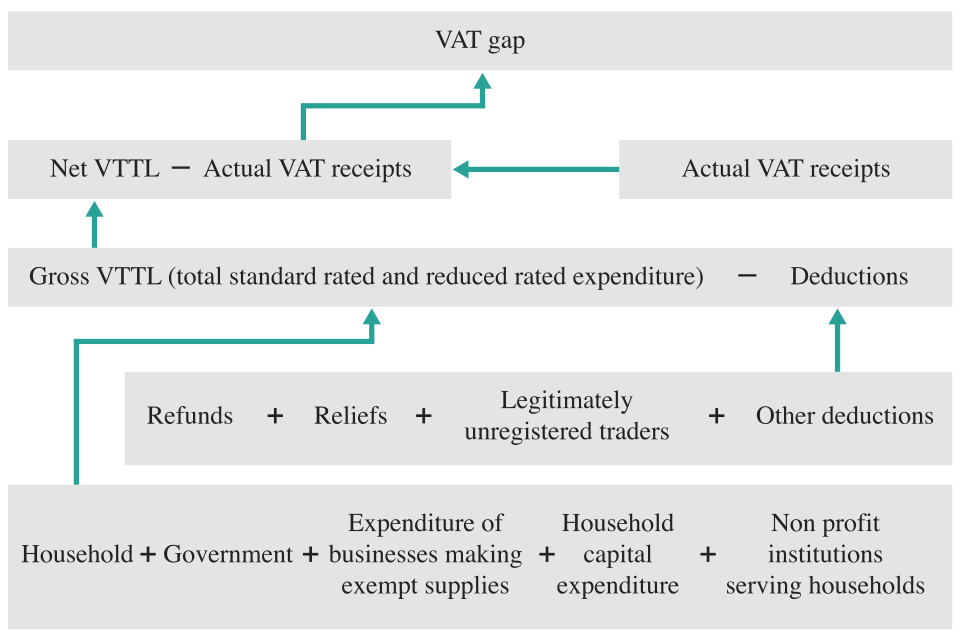
The top-down VAT gap model estimates the tax gap by comparing the total theoretical VAT liability with the amount of VAT received by HMRC. The VAT Total Theoretical Liability (VTTL) is calculated using independent macroeconomic data, primarily from the Office for National Statistics (ONS), on expenditure that is subject to VAT. VAT rates are applied to this expenditure data, using detailed commodity breakdowns, to derive the amount of VAT that should be collected in theory, assuming full compliance.
The VAT gap model covers the full VAT system and includes VAT on final consumption that is irrecoverable, such as VAT paid by households, unregistered traders and exempt or partially exempt organisations. Legitimate deductions and reliefs, including refunds and adjustments required by the VAT system, are subtracted from the gross VTTL to arrive at the net VTTL. Actual VAT receipts are then subtracted from this net VTTL, with the remaining difference representing the VAT gap.
The VAT gap is updated and revised as and when new data become available, or new methodologies are developed. HMRC publishes a revised historical VAT gap series once a year in the ‘Measuring tax gaps’ publication, incorporating both new and updated data and methodological improvements together. The VAT gap preliminary estimate for tax year 2024 to 2025 was published at Autumn Budget 2025 and a second estimate was published alongside Spring Statement 2026.
This top-down approach provides an objective and internationally comparable measure of the overall VAT tax gap and produces a long, consistent time series. However, because it is based on aggregate data, it does not directly identify the underlying behaviours or customer groups driving non-compliance.
Step by step calculation
-
Assess the total amount of expenditure in the UK economy, by estimating the total final consumption of taxable goods and services.
-
Estimate the gross VAT total theoretical liability (VTTL), gathering data detailing the total amount of expenditure in the economy that is subject to VAT.
-
Deduct any legitimate reductions occurring through schemes and reliefs (to derive the net VTTL), subtracting any legitimate refunds.
-
Calculation of VAT receipts.
-
Subtract actual VAT receipts from the net VTTL. The residual is the estimated net tax gap.
-
Calculation of the portion of the VAT gap that is non-payment.
Methodology
Stage 1: Assess the total amount of expenditure in the UK economy
The VAT gap model adopts a top-down approach to measuring total expenditure by drawing on independent macroeconomic data from the ONS, primarily sourced from the National Accounts.
This data provides a comprehensive measure of final consumption expenditure across the UK economy, disaggregated by commodity and sector. The VAT gap model uses these expenditure series as the starting point for estimating the VAT base, identifying those components of expenditure that are subject to VAT.
The net VTTL is the amount of VAT that should be collected in theory, assuming that there is no fraud, avoidance, or losses due to errors or non-compliance.
The net VTTL includes irrecoverable VAT, which is the VAT paid on ‘finally taxed expenditure’ which cannot be reclaimed, for example by those not registered for VAT.
The expenditure data series used in the calculation are mainly constituents of National Accounts macroeconomic aggregates. All National Accounts data used to construct VTTL estimates are consistent with the ONS Blue Book 2025.
The ONS do not provide a single measure of ‘total VAT-liable expenditure’. Instead, the model draws on a range of National Accounts components, primarily household final consumption expenditure, alongside spending by government, non-profit institutions serving households (NPISH) and elements of capital expenditure and combines these to construct a comprehensive measure of total expenditure in the UK economy.
A number of streams of expenditure contribute to the tax base, with most VAT deriving from consumers’ expenditure (that is, household consumption). The main expenditure categories that comprehensively cover VAT liabilities are:
-
household consumption
-
non-profit institutions serving households
-
government capital and current expenditure
-
capital and current expenditure from the VAT traders in the VAT exempt sector
-
housing capital expenditure
This data is available at a detailed commodity level (for example through Consumer Trends and Supply-Use tables), which allows expenditure to be mapped to the VAT system.
In practice, this means that ‘total expenditure’ in the VAT gap model is not a directly observed series, but a constructed aggregate derived from multiple National Accounts inputs, adjusted to reflect the scope of the VAT base.
More information about the consumer expenditure data sources can be found on the Office for National Statistics website.
Stage 2: Estimate the gross VAT Total Theoretical Liability
The gross VTTL is calculated by multiplying the total amount of expenditure in the economy (also known as VAT-able expenditure) by the appropriate VAT rates.
Appropriate VAT rates are applied to this expenditure to derive the gross VTTL. Subsequent adjustments are made to reflect the structure of the VAT system, including exemptions, zero-rating and legitimate refunds, to arrive at the net VTTL. This represents the amount of VAT that would be expected in the absence of non-compliance. For the purposes of calculating the gross VTTL, only the standard and reduced rated expenditure are used. Subsequent adjustments are then made to account for the specific features of the VAT system, including exemptions, reliefs and refund mechanisms to arrive at the net VTTL, the amount of VAT that would be expected in the absence of non-compliance.
The total VAT-able expenditure for each sector is combined to represent an overall annual figure for the economy.
To derive the amount of VAT within the VAT-able expenditure, the expenditure is multiplied by the VAT fraction (the ratio of the VAT charged on the VAT-able expenditure to the total expenditure).
Stage 3: Deduct any legitimate reductions occurring through schemes and reliefs (to derive the net VTTL)
The net VTTL is calculated by deducting any legitimate reductions from the gross VTTL.
The net VTTL is the difference between VAT due on taxable supplies made by registered traders (‘output tax’) and VAT recoverable by traders on supplies made to them (‘input tax’).
The VAT liability for the relevant categories can be estimated directly from ONS National Accounts data. The main exception is the VAT exempt sector. Businesses making exempt supplies are generally unable to reclaim all the VAT they incur on outputs. To account for this irrecoverable input tax, the model uses a separate, internal HMRC survey to refine the accuracy of VAT captured in intermediate consumption for exempt sectors. This is used to estimate the proportion of VAT that cannot be recovered.
A further adjustment is made for businesses which are not registered for VAT and cannot reclaim input tax. This uses a combination of data from the Department for Business and Trade and HMRC information on the distribution of turnover below the VAT threshold to estimate the relevant level of expenditure. This forms part of the ‘Deductions’ within the VAT gap model, detailed in the following section.
Since the calculation of irrecoverable input tax is complex, the level of uncertainty around input tax adjustments is larger than for the other elements.
The sum of the VAT liability arising from each of the expenditure categories gives an estimate of the gross VTTL in each year. However, there are several legitimate reasons why part of this theoretical VAT is not actually collected. These can be grouped into 3 broad categories:
-
VAT refunds
-
expenditure of traders legitimately not registered for VAT
-
other deductions
VAT refunds are made primarily to government departments, NHS Trusts and regional health authorities for specified contracted out services acquired for non-business purposes. Several other categories of expenditure for which VAT can be refunded cannot be separately identified in the calculation of the gross VTTL. The value of these refunds is taken directly from audited HMRC accounts data as part of the net VTTL calculation.
Traders who trade below the VAT threshold can legitimately exclude VAT on their sales. Expenditure on the output of these businesses will have been picked up in the total theoretical liability.
Other deductions will capture other legitimate schemes and reliefs.
Stage 4: Calculation of VAT receipts
Figures for actual VAT receipts are taken from HMRC’s published tax receipts figures. The receipts are adjusted to reflect timing effects within each tax year, before being used in the model. A summary of HMRC’s tax receipts can be found on GOV.UK.
For the tax years 2019 to 2020 through to 2022 to 2023 the receipts figures include an adjustment for the payments which were deferred in 2020 under the VAT Payments Deferral Scheme, and those later further deferred under the VAT Deferral New Payment Scheme. This adjustment ensures that all payments (those already received and those expected to be paid) in respect of liabilities related to these years are properly captured in the VAT gap estimates.
Stage 5: Residual element to give the VAT gap
Finally, subtracting the net VAT receipts from the net VTTL gives the VAT gap. The percentage gap is calculated by dividing the VAT gap by the net VTTL. Receipts for the tax year (April to March) are compared with the total theoretical liability for the calendar year, assuming an average 3-month lag between an economic activity and the payment of the corresponding VAT to HMRC. Calculations for net VTTL assume a 3-month lag between expenditure and actual VAT receipts. Hence, calendar year expenditure data equates to tax year receipts.
Stage 6: Attribute portion of VAT gap to non-payment
HMRC produce an estimate of non-payment and apportion this as part of the overall VAT gap. In ‘Measuring tax gaps 2025 edition’ we improved the methodology for the estimate of non-payment for VAT for all tax years since 2018 to 2019. The new methodology is an estimate of eventual non-payment attributable to the year of tax debt creation. These methodological improvements do not extend back beyond 2018 to 2019.
Prior to 2018 to 2019 non-payment refers to tax debts that are written off or remitted in a tax year by HMRC and result in a permanent loss of tax.
Timing
There are inherent timing factors that affect the latest top‑down VAT gap estimates. The model relies on National Accounts expenditure data, which are published with a lag and subsequently revised as more complete information becomes available. For the most recent year, the VTTL is largely based on observed data from Blue Book 2025, but the data remains subject to revision. As a result, the latest estimates do not represent fully settled outturns.
In addition, VAT receipts data used in the model is published monthly but may be revised as accounting adjustments, repayments or corrections are processed. Aligning receipts data with the relevant expenditure period requires timing adjustments, particularly around yearend, which adds further uncertainty for the latest estimates.
Data issues and limitations
While the top-down VAT gap model provides comprehensive coverage of the VAT system, it has several inherent limitations. The estimates rely heavily on National Accounts expenditure data, which are compiled for macroeconomic purposes rather than tax measurement. As a result, expenditure categories do not always align closely with VAT liability, and assumptions are required when applying VAT rates to aggregated data.
This data is subject to regular updates and revisions by the Office for National Statistics (ONS), including those arising from annual Blue Book and Consumer Trends publications. Such revisions can have a material impact on VAT gap estimates, particularly for more recent years. While these revisions improve accuracy over time, they are an important consideration when interpreting movements in the series.
The model produces a single aggregate estimate of the VAT gap and does not directly identify the behaviours, sectors or customer groups responsible for non‑compliance. This limits its usefulness for operational decision-making and means it cannot on its own explain the drivers of changes in the VAT gap.
Revisions are an inherent feature of the model. Updates to ONS data, methodological improvements and changes to expenditure classification can all lead to revisions to historical estimates. Although these enhance coherence and accuracy, they mean that published figures are not fixed at first release.
The calculation of the VTTL is therefore kept under continuous review. However, it is not possible to produce a precise confidence interval for the VAT revenue loss estimates. This is because the VTTL is largely derived from ONS National Accounts data, which is based mainly on sample surveys and is subject to both sampling and non‑sampling errors. As ONS does not publish error margins for the relevant input series, the impact of these uncertainties on the VAT gap estimates cannot be quantified.
Finally, because the VAT gap model is residual in nature, calculating the gap as the difference between theoretical liability and receipts. Any measurement error in either component feeds directly into the VAT gap estimate. This makes the model sensitive to changes in both expenditure data and receipts.
Sources of error
There are 2 main sources of error that may cause the true VAT gap to differ from the top-down VAT gap model estimates. The first arises from uncertainty in the underlying data. Measurement error or revision in expenditure data or VAT receipts directly affects the calculated theoretical liability and, therefore, the estimated VAT gap.
The second source of error is structural uncertainty arising from the assumptions required to map macroeconomic expenditure data to VAT liability. This includes assumptions about the application of VAT rates, the treatment of exemptions and reduced rates, and the allocation of expenditure between taxable and non‑taxable categories. Small changes in these assumptions can have a material effect on the resulting estimates.
Since the VAT gap model is a residual measure, calculated as the difference between VTTL and receipts, it does not distinguish between different forms of non‑compliance, such as error, evasion or debt. Any discrepancy between theoretical liability and receipts is captured in the VAT gap, regardless of the underlying cause. This limits the interpretability of short‑term movements and reinforces the importance of considering longer‑term trends.
Uncertainty ratings
The uncertainty rating for the top-down VAT tax gap estimate is ‘medium’. This reflects the model’s comprehensive coverage of the VAT base, its reliance on independent and well‑established National Accounts data, and its long and consistent time series. The methodology is transparent, internationally recognised and less sensitive to sampling variation than bottom‑up approaches.
However, some uncertainty remains, particularly for the most recent years, due to the impact of subsequent data revisions. The residual nature of the model also means that it is sensitive to measurement error in both expenditure and receipts. The overall uncertainty assessment remains unchanged from the previous edition.