Legal aid statistics England and Wales bulletin Oct to Dec 2025
Published 26 March 2026
Applies to England and Wales

© Crown copyright 2026
This publication is licensed under the terms of the Open Government Licence v3.0 except where otherwise stated. To view this licence, visit nationalarchives.gov.uk/doc/open-government-licence/version/3 or write to the Information Policy Team, The National Archives, Kew, London TW9 4DU, or email: psi@nationalarchives.gov.uk.
Where we have identified any third party copyright information you will need to obtain permission from the copyright holders concerned.
This publication is available at https://www.gov.uk/government/statistics/legal-aid-statistics-quarterly-october-to-december-2025/legal-aid-statistics-england-and-wales-bulletin-oct-to-dec-2025
The widely reported cyber-attack on LAA systems has impacted data collection across all schemes. During this period, we halted publication of these statistics while working hard with data providers to enable this release to go ahead to best address user needs. We recognise that there are gaps for some series at present and are now in a position where we can reintroduce the following continuous series, which continue the official statistics series and will not substantially change, and aim to add those unavailable currently to future releases.
| Continuous series | Crime representation orders, Litigator fee scheme, Advocate fee scheme, Central Funds, Higher Courts and Exceptional case funding |
| Currently unavailable | Crime Lower, Civil Representation, Legal Help and Mediation |
The LAA put in place contingency plans to ensure that those in need of legal support could access the help that they required and those providing legal services continued to receive payments whilst systems were offline.
In this release we include, under management information, details of the overall payments made during this period for each scheme and contingency payments made. Comparisons have been made between the closed claim total expenditure usually released and these payments. This shows that across all schemes the total payments are of the same magnitude but while similar it is not possible to further breakdown payments information. The two numbers are not strictly comparable and so caution should be taken in interpretation of these numbers.
Further information on contingency payments can be found on the LAA’s dedicated cyber security incident webpage.
Main points
| Representation orders granted in magistrates’ court increased by 12% while Crown Court increased by 1% when compared to the same period in 2024. | ⬈ | The early indicators for court workload and eventual legal aid payments show increasing trends across the two courts. |
| Figures for the police station, magistrates’ court and prison law are not available. Payments for the whole period Apr-Dec are shown to give an indication of magnitude for contingency payments. | £255m overall payments made in crime lower during Apr-Dec 2025; this compares to £237m closed claim expenditure in the same period the year before. | |
| Crown Court expenditure in both litigator and advocate fee schemes was lower this quarter compared with the same period of the previous year. | ⬊ | The prioritising of payments for Crown Court work can be seen across quarters released, with a larger fall in the first quarter (Apr-Jun 2025), then an increase for quarter 2 but falls of only 1% and 3% respectively for each scheme this quarter. |
| Figures for civil representation are given for the average payment contingency within the MI and also within the bulletin based on an estimate for when work was completed. | £639m overall payments made in civil representation during Apr-Dec 2025; this compares to £695m closed claim expenditure in the same period the year before. | |
| Figures for legal help and controlled legal representation are not available. Payments for the whole period Apr-Dec are shown to give an indication of magnitude for contingency payments. | £97m overall payments made in legal help during Apr-Dec 2025; this compares to £88m closed claim expenditure in the same period the year before. | |
| Figures for mediation starts, assessments and outcomes are not available. Payments for the whole period Apr-Dec are shown to give an indication of magnitude for contingency payments. | £5.4m overall payments made for mediation during Apr-Dec 2025; this compares to £4.8m closed claim expenditure in the same period the year before. | |
| 914 applications for Exceptional Case Funding were received in the last quarter. | ⬈ | This was a 11% increase from the same quarter last year. This is driven by an increase in the inquest category. |
This edition comprises the first release of official statistics for the three-month period from January to March 2025 and the latest statement of all figures for previous periods. For technical detail, please refer to our user guide for these statistics.
Statistician’s comment
This publication, the first since June 2025, provides figures across legal aid schemes where available. In areas that currently have no available claim data there is a new management information release showing the contingency payments provided under each scheme. These vary with an average payment system instituted for civil representation payments and for schemes using the claim bulk upload method (crime lower, legal help and mediation) the payments, based on locally recorded data, provided for each month between June 2025 and January 2026.
Comparisons have been made between the closed claim total expenditure usually released and these payments. This shows that across all schemes the total payments are of the same magnitude but while similar it is not possible to further breakdown payments information. The two numbers are not strictly comparable and so caution should be taken in interpretation of these numbers.
At the Crown Court the relatively unchanged workload during the period of contingency has shown the prioritisation of these claims and payments made for each. After the initial fall in the first quarter, a recovery in the second quarter with payments covering the shortfall seen the final quarter shows a scheme that has returned to its initial state with slight falls seen in both fee schemes only.
Due to unavailability of systems within civil representation figures have not been given in this release. Actual claims have been entered from December 2025 onwards only and this can be seen with much reduced volumes for applications and grants in this area for quarter one and two of 2025/26 with a large influx in the latest quarter. As time progresses more recoupments will be made from the average payments setup and billing data used. As this occurs the statistics will place these payments in the time period when the work was completed with a rising set of expenditure figures between April and December 2025 in subsequent publications.
Things you need to know
We publish a number of resources alongside the quarterly statistical bulletin. You will see the phrases below at the start of each chapter with a link to the relevant resource:
| Data visualisation tool | Help | Tables |
|---|---|---|
| Use our data visualisation tools to view and customise charts and tables | See our user guide for definitions and information about our data sources | Download our data tables for the entire period |
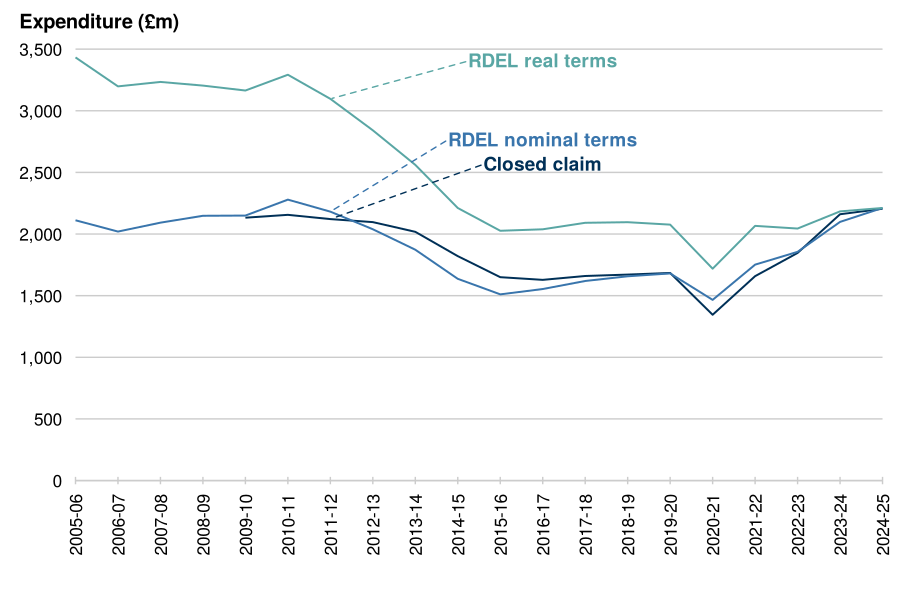
To understand trends in legal aid as a whole, it is best to begin by looking at annual expenditure figures and then look at trends in both workload and expenditure for each category of legal aid. Summarising workload activity across the whole legal aid system meaningfully within a single number is difficult because of the diversity of services included and different stages in delivery. For example, legal aid work can be measured at the point when an order for legal aid is granted, or after all the legal aid work is completed and the provider has been paid. Expenditure on legal aid is measured differently for different purposes. The three most commonly used measures, shown in Figure 1, are:
-
Closed-case expenditure is the measure used for expenditure figures throughout these legal aid statistics. It represents the total value of payments made to legal aid providers in relation to pieces of work that are completed in the period. This basis is comparable to volumes of completed work to which it relates, and to the same fine level of detail. This does not include income received or expenditure in relation to debt write-offs.
-
RDEL (Resource Departmental Expenditure Limits) nominal is the main budgeting measure used by government to control current spending, both to set budgets for future years and report on how much has been spent. It represents the value of work carried out in the period better than the closed-case measure but cannot be broken down to such a fine level of detail. This measure does incorporate income and expenditure in relation to debt. ‘Nominal’ here means not adjusted for inflation.
-
RDEL real is the RDEL measure adjusted for inflation to make the value of spending in previous years directly comparable with the specified year. These measures show a large reduction in legal aid expenditure from around 2010-11, mostly due to changes to the scope of civil legal aid introduced by the Legal Aid, Sentencing and Punishment of Offenders (LASPO) Act from 2013-14, as well as reductions in criminal legal aid workloads and fees payable to legal aid providers.
Figure 1: Overall annual legal aid expenditure, by closed-case and RDEL nominal and real terms measures (£m), 2005-06 to 2024-25
See interactive breakdown here.
Criminal legal aid
| Data visualisation tool | Help | Tables |
Criminal legal aid can be categorised into Crime Lower and Crime Higher. Crime Lower (covered in our data visualisation tool) includes police station advice, magistrates’ court and prison law. Meanwhile, Crime Higher (also covered in our data visualisation tool) relates to work in the Crown and Higher Courts.
Figure 2: Crime overview, closed case volumes and expenditure for October to December 2025 compared with October to December 2024
| Crime Lower category | Workload | Expenditure |
|---|---|---|
| Figures for Crime Lower are not available. | N/A | £ N/A |
| Crown Court category | Workload | Expenditure |
|---|---|---|
| Advocate Graduated Fee Scheme | 23,640 (2%⬈) | £ 71.6m (-1%⬊) |
| Litigator Graduated Fee Scheme | 25,234 (1%⬈) | £116.0m (-1%⬊) |
See interactive breakdown here.
Although Crown Court work comprises a relatively small portion of criminal legal aid in terms of volume, it accounts for around two thirds of all criminal legal aid expenditure. Conversely, advice relating to the police station makes up around two thirds of workload, but only around a half of expenditure.
Since the cyber-attack figures for Crime Lower have not been available. Figures have been released under management information for all payments made during the contingency period and these can be found on the following web page Legal aid management information - GOV.UK
Overall payments made in crime lower for Apr-Dec 2025 was £255m and this compares to closed claim expenditure in the same period the year before of £237m although care should be taken as while similar they do not represent the exact same expenditure.
Police station advice
Workload and expenditure are not currently available at the police station level of breakdown.
Applications and grants for representation in the criminal courts
These figures should be interpreted with caution as they may be revised in subsequent quarters as cases move into the Crown Court. Figures for the first half of 2025-26 were lower than usual due to the cyber-attack and a loss of access to systems.
The number of orders granted for legally-aided representation in the magistrates’ court increased by 9% this quarter compared to the same quarter of the previous year. This continues the reversal of the downward trend of the last 3 years.
Orders granted for legally-aided representation in the Crown Court increased by 6% this quarter compared to last year. Within the legal aid figure, orders relating to either-way offences increased by 7%, while those relating to indictable offences increased by 15%. The proportion of Crown Court applications granted for the latest quarter is 99%.
Magistrates’ court completed work
Legally-aided representation in the magistrates’ court workload and expenditure figures are not available currently.
Crown Court completed work
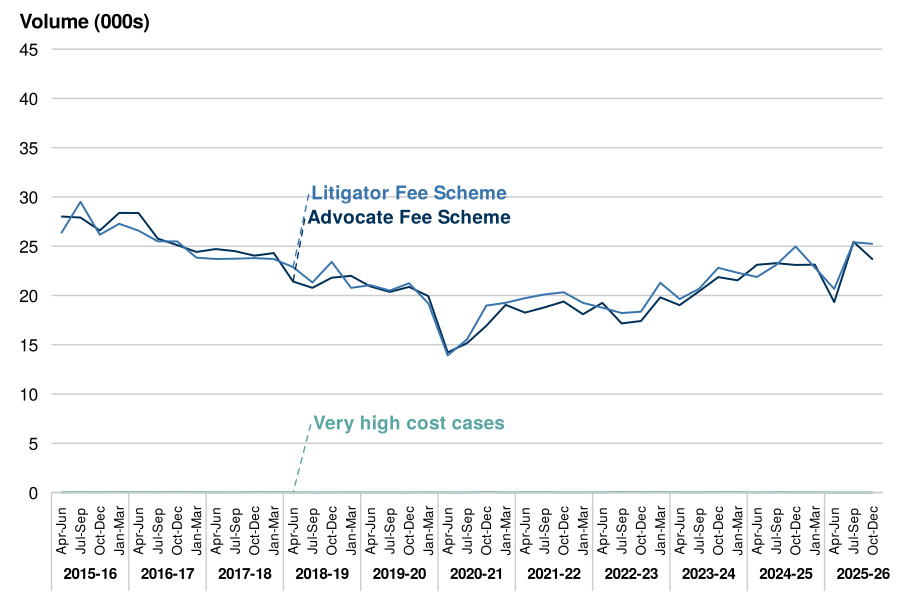
At the Crown Court workload during the period of contingency has shown the prioritisation of these claims. After the initial fall in the first quarter there was a recovery in the second quarter with volumes increasing to cover the shortall from the first quarter. The final quarter shows a scheme that has returned to its initial state with slight increases in workload seen in both fee schemes.
Completed workload volumes within the litigator (solicitor) fee scheme increased by 1% in October to December 2025 compared to the same period of the previous year. In the advocate fee scheme, completed claims increased by 2% compared to the same period last year. This follows the same workload changes as per the litigator scheme.
Figure 3: Workload in the Crown Court, April to June 2015 to October to December 2025
See interactive breakdown here.
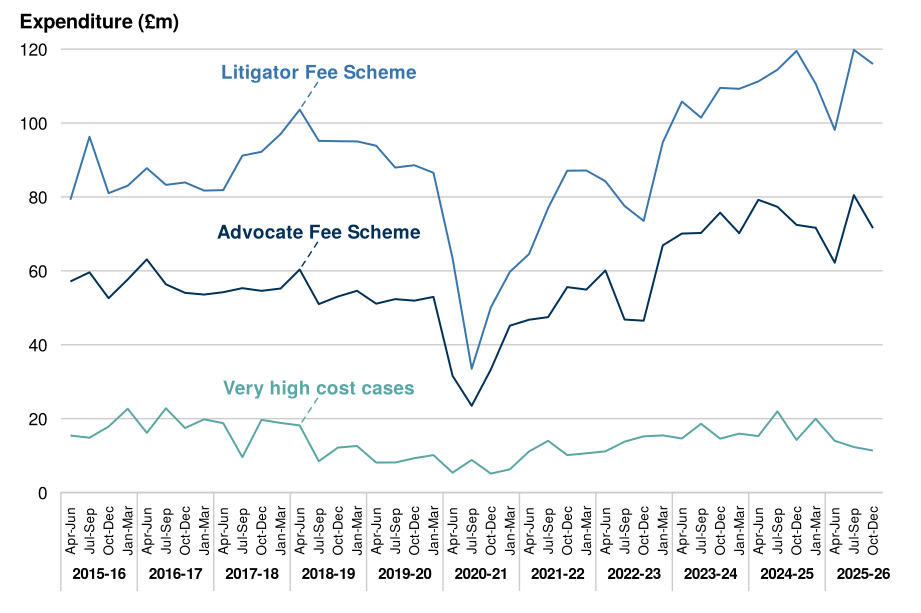
In the litigator fee scheme, expenditure decreased by 3% in October to December 2025 compared to the same period of the previous year. In the advocate fee scheme, the value of payments fell by 1% compared to the same period of the previous year. Figures for expenditure on work completed in the Crown Court should be interpreted with caution as they may be revised in subsequent quarters as claims are assessed further on appeal and further payments added to the value of some completed claims.
The Very High-Cost Case (VHCC) scheme covers those Crown Court cases which would likely last more than 60 days if they were to proceed to trial. Such cases can span several years and, while they may involve small numbers of defendants, the associated expenditure is high in comparison. Due to the cyber-attack figures on the closed case basis are not available. There was £14.8m of expenditure during the latest period across all ongoing claims within the VHCC scheme.
Figure 4: Expenditure in the Crown Court, April to June 2015 to October to December 2025
See interactive breakdown here.
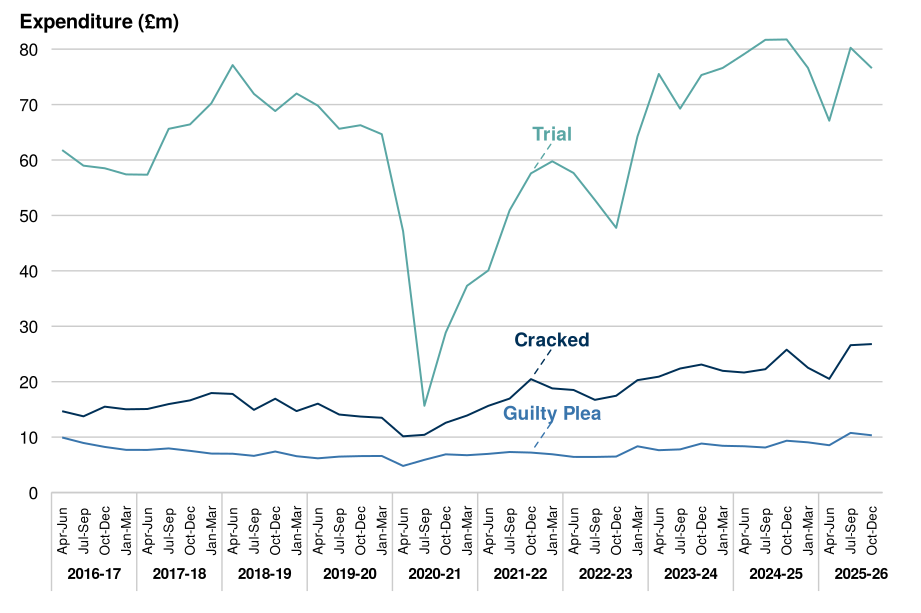
The large falls in completed expenditure in 2020-21 are a consequence of fewer jury trials completing in the Crown Court. Figure 5 below, looking at the litigator fee scheme only, but true of both schemes, shows the impact of falling trials on expenditure. These types of cases are particularly affected, because they need more courtroom space. Trial completed expenditure was more adversely affected than guilty pleas and cracked trials (where, for legal aid this differs from the HMCTS definition, it is where a defendant changes their plea before the trial date), with litigator fee expenditure much lower.
Figure 5: Litigator Fee Scheme Crown Court expenditure by claim type, April to June 2016 to October to December 2025
See interactive breakdown here.
Prison Law
Workload and expenditure are not available for prison law level of breakdown currently.
Civil legal aid
| Data visualisation tool | Help | Tables |
Civil legal aid can be categorised by area of law into family and non-family. The category of family legal aid covers all work on both private and public family law and includes work associated with the Children Act, domestic abuse, financial provision and family mediation. Non-family legal aid encompasses all work related to immigration, mental health, housing and other non-family law.
Legal help and controlled legal representation
Workload and expenditure are not currently available at the legal help and controlled legal representation level of breakdown. In the newly released management information on overall payments expenditure across legal help for the whole period Apr-Dec 2025 was £97m, and this compares to closed claim expenditure in the same period the year before of £88m.
Mediation
Family mediation involves an independent and impartial professionally-accredited mediator discussing problems with a divorcing or separating couple. A Mediation Information and Assessment Meeting (MIAMs) is an initial meeting between one or both parties and a mediator to see if family mediation could be used to reach agreement without using the courts.
Workload and expenditure are not currently available at the mediation level of breakdown. However overall payments on mediation for Apr-Dec 2025 were £5.4m and this compares to closed claim expenditure in the same period the year before of £4.8m.
Civil representation
Due to the previous unavailability of systems within civil representation, and the estimated average payment plan during the intervening period, claims have been entered from December 2025 onwards only.
This can be seen with much reduced volumes for applications and grants in this area for quarter one and two of 2025/26 with a large influx in the latest quarter.
There were £639m overall payments made in civil representation during Apr-Dec 2025; this compares to £695m closed claim expenditure in the same period the year before.
Claims completed and their overall expenditure at the time the work was finalised are being added to the system and as time progresses more recoupments will be made from the average payments setup and billing data published. As this occurs the statistics will place these payments in the time period when the work was completed with an approximated back series.
Exceptional Case Funding (ECF)
The Exceptional Case Funding (ECF) scheme was introduced as part of LASPO. An ECF application for civil legal services is made where a case falls outside the scope of civil legal aid but the client or conducting solicitor believes failure to provide funding would be a breach of the Human Rights Act 1998.
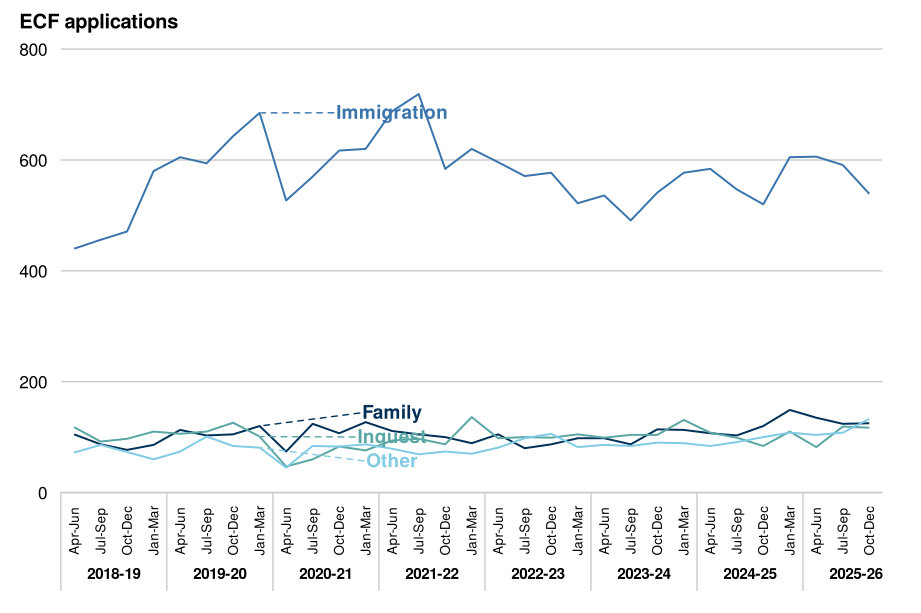
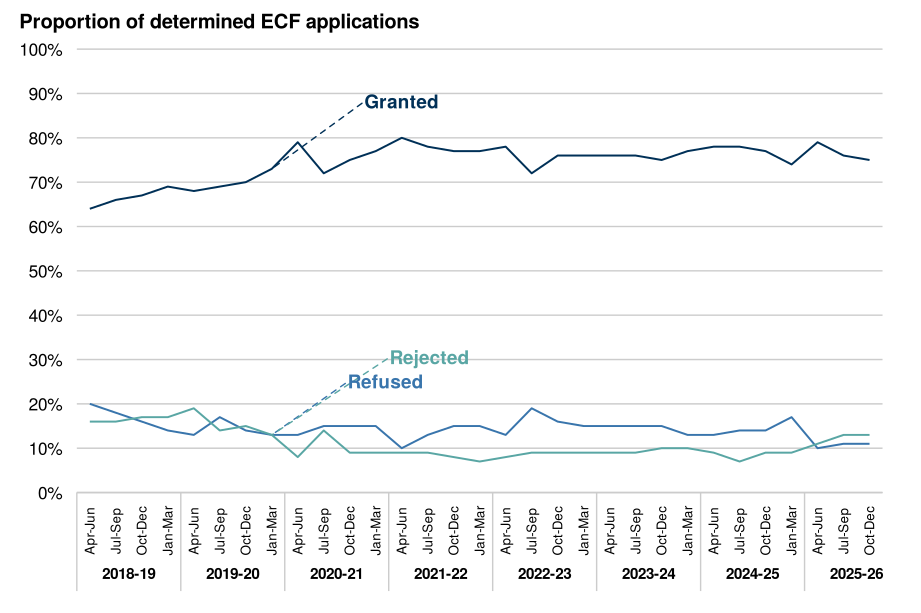
There were 914 applications for ECF received from October to December 2025. This is a 11% increase from the same quarter last year. 861 (94%) of these were new applications. Of the 914 ECF applications received between October to December 2025, 89% (814) had been determined by the LAA as of 01 February 2026. 73% (597) of these were granted, 11% (90) were refused and 13% (105) rejected.
Figure 6: Volume of ECF applications received, April to June 2018 to October to December 2025
See interactive breakdown here.
Among the ECF applications received between October to December 2025, immigration (59%), inquest (13%), and family (14%) remained the most requested categories of law. The increase in ECF applications over the last four years is mainly driven by an increase in immigration applications.
Figure 7: Proportion of ECF determinations by outcome, April to June 2018 to October to December 2025
See interactive breakdown here.
Official statistics: Legal aid provider contracts
| Data visualisation tool | Help | Tables |
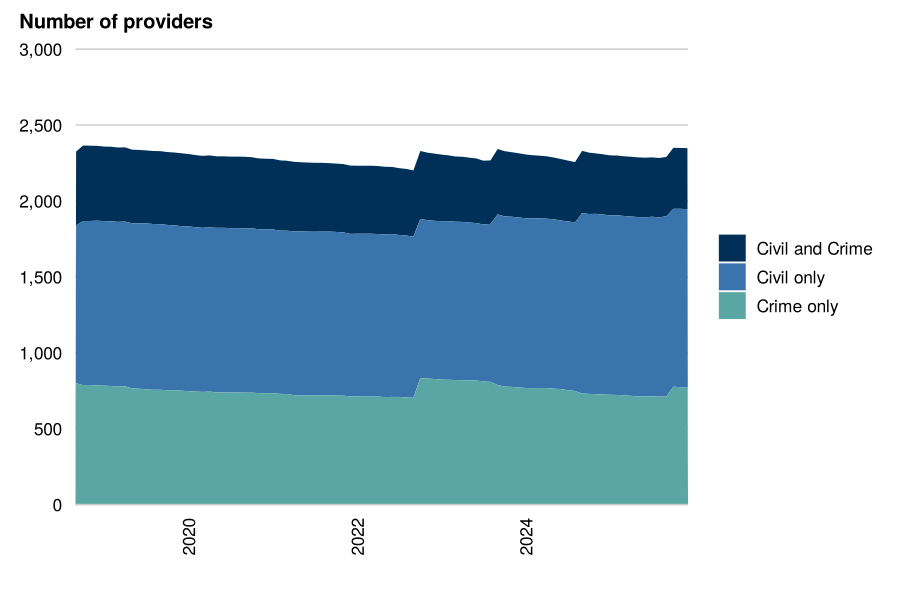
At the start of Dec 2025, there were 1,973 providers and 3,303 offices contracted to deliver legal aid services.
1,270 of these providers and 1,596 of these offices were contracted to deliver criminal legal aid. Meanwhile, 1,270 providers and 2,182 offices were contracted to deliver civil legal aid. Changes in these statistics are driven by the commencement of new contracts, where typically we see a peak in provider numbers, which then taper off during the lifetime of the contract. Figures may also change for previous months to reflect changes in contract holders that are processed in retrospect.
Figure 8: Number of providers contracted to deliver legal aid services by area of law, September 2018 to Dec 2025
See interactive breakdown here.
Like our latest annual legal aid provider statistics, these statistics relate to the number of legal aid providers in England and Wales. However, instead of reporting the number of providers starting and completing cases, this chapter shows the number of legal aid providers and offices that hold either a crime and/or civil contract in each month. As some providers bill their work in months when they do not hold a contract, these numbers are slightly lower than those presented in the previous chapter. These statistics do not include non-contracted providers who may be operating under an Individual Case Contract. The number of legal aid providers and offices is accurate as at the start of each month.
The LAA uses these statistics to monitor the availability of legal aid services over time, in different areas of law and different regions of England Wales. They are nonetheless a proxy measure of capacity only, since they do not indicate the number of practitioners at a given time.
The underlying anonymised data files and an interactive data dashboard are published quarterly alongside this bulletin. This tool additionally shows the number of members and offices for each police station duty solicitor scheme. For the number of civil legal aid providers reported in Table 9.7, definitions of each category of law under the Standard civil contract 2024 can be found on the gov.uk website. Geographical figures in the interactive data dashboard are based on the provider office location and not the location of the client. A provider may serve clients from other geographic areas as well as that in which the office is located. As this data reflects only the location of the provider office it cannot be used as a reliable indicator of the distribution of the clients or benefits of legal aid, or as a precise picture of coverage of legal aid services.
Official statistics: Criminal Legal Aid data share
As part of the Independent Review of Criminal Legal Aid covering a complete picture of the legal services provider base (advocacy and litigation) for the publicly-funded criminal justice system in England and Wales, this section discusses the analytical findings from the data sharing agreements between The Law Society, the Bar Council, the Legal Aid Agency, the Crown Prosecution Service and the Ministry of Justice. The commentary on the analysis is built upon the Summary Information on Publicly Funded Criminal Legal Services. The figures provide an analysis of the publicly-funded criminal legal system, detailing insights into the characteristics of law firms, their solicitors and barristers that received publicly-funded legal aid case payments. The analysis covers financial year 2014-15 to 2024-25 (solicitor) and 2024-25 (barrister) and are summarised in tables 12.1 to 12.3. The data collected cover solicitor firms (see interactive dashboard), trainees and solicitor (see interactive dashboard), duty solicitors (see interactive dashboard) and barristers (see interactive dashboard).
Firms that were identified, through the data matching, as receiving criminal legal aid payments during the financial years covered are referred to as criminal legal aid firms. The criminal legal aid fee income shown in the tables includes disbursements and VAT when applicable for the matched criminal legal aid firms.
For more detailed breakdowns and information on criminal legal aid firms see the interactive dashboard.
Further information
National Statistics status
National Statistics are accredited official statistics. These accredited official statistics were independently reviewed by the Office for Statistics Regulation in December 2016. They comply with the highest standards of trustworthiness, quality and value in the Code of Practice for Statistics and should be labelled ‘accredited official statistics’. Note that accredited official statistics are called National Statistics in the Statistics and Registration Service Act 2007.
Our statistical practice is regulated by the Office for Statistics Regulation (OSR). OSR sets the standards of trustworthiness, quality and value in the Code of Practice for Statistics that all producers of official statistics should adhere to. You are welcome to contact us directly with any comments about how we meet these standards. Alternatively, you can contact OSR by emailing regulation@statistics.gov.uk or via the OSR website.
Official Statistics
Our statistical practice is regulated by the Office for Statistics Regulation (OSR). OSR sets the standards of trustworthiness, quality and value in the Code of Practice for Statistics that all producers of official statistics should adhere to. You are welcome to contact us directly with any comments about how we meet these standards. Alternatively, you can contact OSR by emailing regulation@statistics.gov.uk or via the OSR website.
Contact
Press enquiries should be directed to the Ministry of Justice press office:
Other enquiries about these statistics should be directed to the Analysis directorate of the Ministry of Justice:
Legal Aid statistics team
Access to Justice Data and Statistics
Email: statistics@justice.gov.uk
Telephone: +44 7784 275495
Tables and data
We publish a number of resources alongside the quarterly statistical bulletin:
-
A set of interactive tables, which give further detail and full time-series for each scheme under both crime and civil
-
An ods spreadsheet download for all tables, which provide full time-series for each scheme.
-
Also an accessible version of the ods spreadsheet download for all tables, which also provide full time-series for each scheme.
-
Main data and Civil detailed data: Detailed files to enable independent analysis, provided in .csv (Comma delimited) format.
-
Provider contracts data: Criminal and Civil legal aid provider contracts data are provided in .csv (Comma delimited) format.
-
Data Share data: Criminal legal aid data share data provided in .csv (Comma delimited) format.
-
Diversity data and Provider data: Client characteristics data and Providers starts and completions by area and legal aid schemes are provided in .csv (Comma delimited) format, please refer to the latest annual publication.
-
To accompany this information a set of management information is also released. These cover the Criminal legal aid review data, civil data on trafficking and modern slavery and payments during the contingency period following the cyber-attack in 2025. These can be found at https://www.gov.uk/government/statistical-data-sets/legal-aid-management-information
Help
Further information about these statistics is available at the following links:
-
Index of data in Legal aid statistics: An index to the more detailed data published in the .ods file format, lists of available data from Legal Aid systems and guidance on how to work with the more detailed data.
-
User Guide to legal aid statistics: This provides comprehensive information about data sources and quality as well as key legislative changes.
-
Quality Statement: This provides detail on how legal aid statistics meet user needs.
Web tools
Our interactive data visualisation tools can be found at the following links:
-
List of data visualisation tools: A list of the web-based tools across the legal aid statistics release.
-
Main visualisation tool: A web-based tool allowing the user to view and customise charts and tables based on the published statistics.
Next update: 25 June 2026
URL: https://www.gov.uk/government/collections/legal-aid-statistics
© Crown copyright Produced by the Ministry of Justice
Alternative formats are available on request from statistics@justice.gov.uk.