The impact of Additional Work Coach Support on the employment outcomes of LCWRA participants: an extended impact assessment at 24 months after first participation
Published 25 March 2026
Applies to England, Scotland and Wales

© Crown copyright 2026
This publication is licensed under the terms of the Open Government Licence v3.0 except where otherwise stated. To view this licence, visit nationalarchives.gov.uk/doc/open-government-licence/version/3 or write to the Information Policy Team, The National Archives, Kew, London TW9 4DU, or email: psi@nationalarchives.gov.uk.
Where we have identified any third party copyright information you will need to obtain permission from the copyright holders concerned.
This publication is available at https://www.gov.uk/government/statistics/impact-of-additional-work-coach-support-on-the-sustained-employment-outcomes-of-disabled-participants-and-those-with-health-conditions/the-impact-of-additional-work-coach-support-on-the-employment-outcomes-of-lcwra-participants-an-extended-impact-assessment-at-24-months-after-first-p
Statement of application of the Code of Practice for Statistics
The analysis in this report has been produced as far as possible in line with the Code of Practice for Statistics. The code is built around 3 main concepts, or pillars, trustworthiness, quality and value:
- trustworthiness – is about having confidence in the people and organisations that publish statistics
- quality – is about using data and methods that produce assured statistics
- value – is about publishing statistics that support society’s needs for information
The following explains how we have applied the pillars of the Code in a proportionate way.
Trustworthiness
DWP analysts work to a professional competency framework and Civil Service core values of integrity, honesty, objectivity, and impartiality. Analysts have produced these statistics and conducted rigorous quality assurance in line to the standards usually applied to ad hoc releases. Background and methodology information is also included in the release.
The analysis has been signed off by the expert lead analyst and the Department’s Head of Profession for Statistics was consulted on the production and publication process and the timing of the publication was pre-announced.
Care has been taken to ensure only those who needed to see the analysis prior to publication had access to it.
The detailed methodology, data sources and approach taken in this research are set out in this report alongside the findings. The approach used builds on the methodology used for previous labour market programme evaluations.
Quality
The process to produce the analysis in this report was conducted by professional analysts taking account of the latest administrative data and applying methods using their professional judgement. The analysis has been through a rigorous quality-assurance and sign-off process by other DWP analysts.
Value
The publication of this release ensures the information are equally available to all users as well as providing transparency. This research provides important new evidence for Ministers, policy makers and external stakeholders.
Key findings
This note presents an extension to previously published analysis on the employment impact of voluntary Additional Work Coach Support for customers in the limited capability for work and work-related activity (LCWRA) group. This extension tracks the employment impacts of the support for a further 12 months.
- Previous analysis found that 12 months after the intervention, 11% of participants were in work compared to 8.2% of the comparison group – a 2.8%-point employment impact. This impact was statistically significant.
- This new analysis finds that 24 months after the intervention, 11.4% of participants were in work compared to 8.1% of the comparison group – an increase from 12 months to a 3.3%-point employment impact. The impact remains statistically significant at 24 months.
Introduction
Additional Work Coach Support provides increased work coach appointment time for new and existing Universal Credit (UC) and Employment and Support Allowance (ESA) customers with health conditions or disabilities. It provides regular and normally mandatory (subject to eligibility and suitability) appointment time of 30 minutes every fortnight for customers awaiting their work capability assessment (pre-WCA) or in the limited capability for work (LCW) group. For customers who have been found to have limited capability for work and work-related activity following a Work Capability Assessment the support is voluntary and appointments are 30 minutes per month. The impacts in this note relate only to the voluntary LCWRA group.
Impact analysis was not possible for the LCW and pre-WCA groups, for reasons outlined in the previous impact analysis[footnote 1]. However, the previous analysis did show that additional JCP support provided to the ESA WRAG group (equivalent to UC LCW) did result in sustained employment impacts.
Alongside the impact analysis, a research report “The customer experience of Additional Work Coach Support: Findings from qualitative interviews with customers” was published last year, providing qualitative findings from in-depth interviews with participants. A final version of the report, including findings from a two-wave quantitative survey, is due to be published this year.
Expansion of Additional Work Coach Support
In March 2025 the deployment of 1000 Pathway to Work Advisers was announced, to help people with health conditions and disabled people towards and into work, building on and expanding existing evidenced measures like Additional Work Coach Support[footnote 2]. Since July 2025, there have been around 1000 (full-time equivalent) Pathways to Work Advisers in place in Jobcentres across England, Scotland and Wales .
A key focus of the Pathways to Work Advisers is offering voluntary support to Universal Credit customers with the Limited Capability for Work and Work-Related Activity (LCWRA) element. Since April 2025, over 65,000 LCWRA customers have started on this support[footnote 3]. This compares to 12,000 LCWRA customers starting support between June 2022 and February 2025[footnote 4].
The expansion of support offered to LCWRA customers highlights the need for robust analysis of the employment impacts. This is why we have conducted this extension of the previous impact analysis, to help us better understand if the employment impacts of the support are sustained beyond 12 months. It should be noted that this analysis has been conducted on 3,600 participants who started support between June 2022 and February 2023, not on those onboarded since the expansion.
Research question
The previous published 12 month impact analysis of AWCS for the LCWRA group sought to answer the research question: “Did Additional Work Coach Support improve employment outcomes and referrals to provision for participants in the LCWRA group?”. This extension answers a follow up research question: “were these improvements in employment outcomes sustained beyond 12 months?”
This is not reporting on an extension of the support received by people in the initial treatment group but looking to see whether the impacts of AWCS on that group last for longer than 12 months. Participants had, on average, 4 AWCS appointments.
Non-technical summary
Previously, a method called Propensity Score Matching (PSM) was used to estimate the employment impact of Additional Work Coach Support for LCWRA participants. This created two groups: one who received support and who did not, who were matched on a number of characteristics to ensure they were as similar as possible. This analysis found that 12 months after support, AWCS had led to a statistically significant 2.8%-point employment impact.
Updated data has now been added for the same groups, allowing us to extend the analysis, using the same methodology as in the previous publication, to see if the employment impact has sustained. These new findings show that 24 months after support the employment impact has increased to 3.3%-pts (and remains statistically significant).
Technical Summary
Methodology and Data
Figure 1: A timeline of the roll out of AWCS
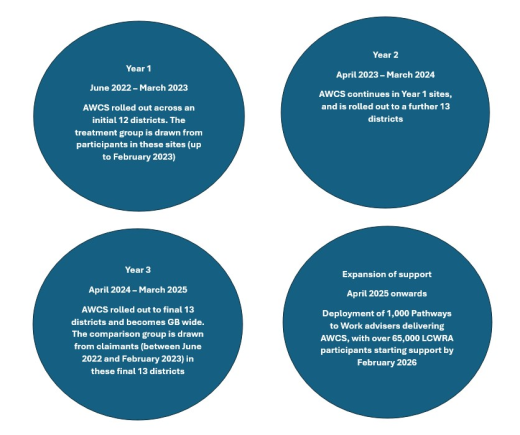
Year 1 June 2022 to March 2023
AWCS rolled out across an initial 12 districts. The treatment group is drawn from participants in these sites (up to February 2023).
Year 2 April 2023 to March 2024
AWCS continues in Year 1 sites and is rolled out to a further 13 districts.
Year 3 April 2024 to March 2025
AWCS is rolled out to final 13 districts and becomes GB wide. The comparison group is drawn from claimants (between June 2022 and February 2023) in these final 13 districts
Expansion of support April 2025 onwards
Deployment of 1,000 Pathways to Work advisers delivering AWCS, with over 65,000 LCWRA participants starting support by February 2026.
The impact analysis in this note extends previously published employment outcomes, which were calculated using PSM. Additional Work Coach Support (AWCS) was rolled out over 3 years (starting June 2022) with a third of districts being added each year, so that by April 2024 the offer of support was nationally available. A timeline of this roll out is given in Figure 1. The staggered roll out of AWCS was exploited to create a treatment group (LCWRA participants in Year 1 sites) and a comparison group (similar LCWRA customers in Year 3 sites, where AWCS had not yet been rolled out). PSM was used to construct these groups, ensuring they were as similar as possible. A full explanation of the methodology can be found in the previous publication, including a list of the matching variables.
For this extension, the same treatment and comparison groups are used. We were able to use updated Real Time Information (RTI) earnings data from employment, supplied by HMRC, to create a binary employment variable for months 13-24 after their start date (or pseudo start-date for the comparison group). This binary employment variable is designed in the same way as in the previous analysis: it is equal to 1 if the individual had positive earnings from employment in a calendar month, 0 if the individual had zero earnings. Self-employment earnings are excluded from the RTI data.
A robustness check was made to ensure that the comparison group had not been contaminated in months 13-24 i.e. members of the comparison group had not taken up AWCS support. This contamination was not expected to be high, as the comparison group came from Year 3 sites and so roll-out of AWCS would likely only just have started 24 months after Year 1 sites. Analysis was done confirming that less than 3% of the comparison group had gone on to take-up AWCS, meaning the risk of contamination was deemed to be low.
Results
24 months after the intervention, LCWRA AWCS participants are 3.3% pts more likely to be in work.
Figure 2: The probability of employment, by month, of LCWRA AWCS participants and a comparison group of non-participants
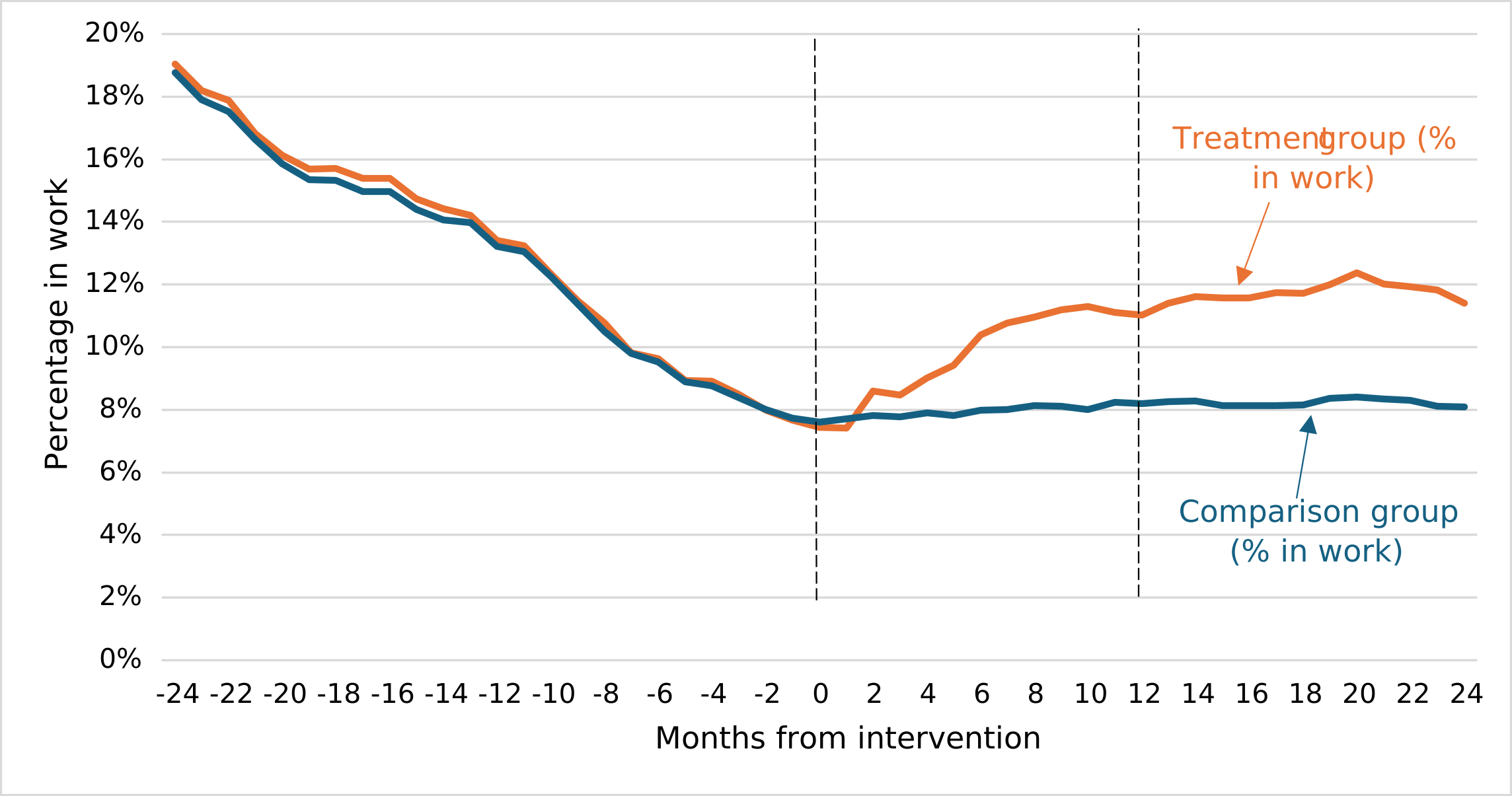
Figure 3: The impact of Additional Work Coach Support on employment, by month
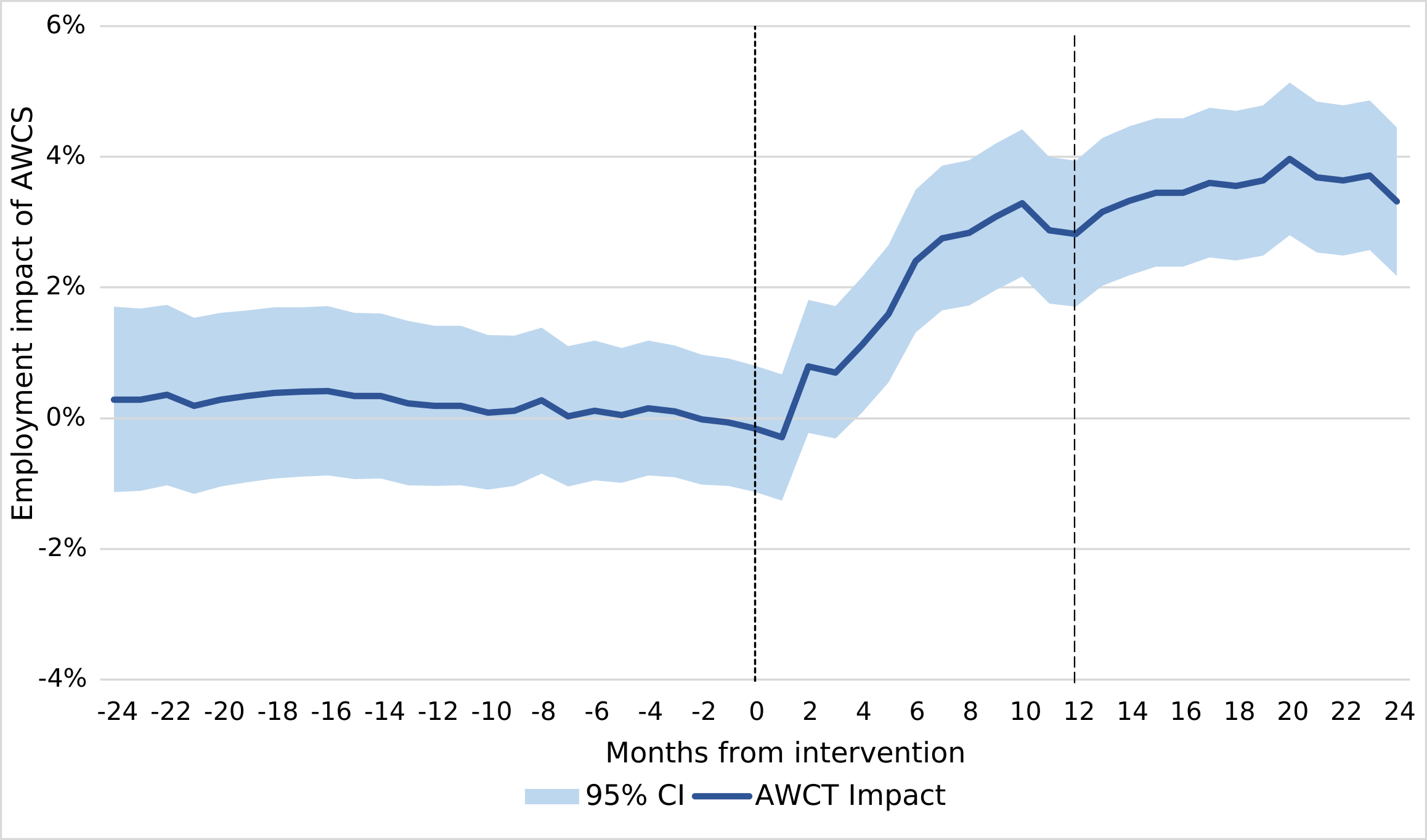
Figures 2 and 3 show the sustained impact of Additional Work Coach Support on employment. Month indicates the month in relation to the intervention - negative numbers indicate before the intervention and positive numbers indicate after the intervention. In figure 2, the orange line indicates the employment rate of the treatment group and the blue line indicates the same for the comparison group. The difference between the lines shows the impact of the intervention. This percentage-point difference is shown in figure 3. The 95% confidence intervals of this impact are shown as well.
a. In the 24 months prior to the intervention (months -24 to -1 in above figures), the groups have similar average outcomes[footnote 5] - this is reassuring and indicates that the matching worked reasonably well to align the employment trends of the 2 groups.
b. The impact of the intervention grows over time and is statistically significant from month 5 onwards. After 12 months, there is an employment impact of 2.8%-pts.
c. The employment impact grows after 12 months, peaking at 3.9%-pts 20 months after the intervention. 24 months after the intervention, 11.4% of the treatment group were in work compared to 8.1% of the comparison group – an employment impact of 3.3%-pts.
-
See “Research Question” section, under chapter “Additional Work Coach Support Impact Evaluation” of previous analysis ↩
-
See Government bolsters employment support to unlock work for sick and disabled people - GOV.UK ↩
-
A start is defined as having attended a first Additional Work Coach time appointment ↩
-
See The impact of additional Jobcentre Plus support on the employment outcomes of disabled people - GOV.UK ↩
-
The participants have slightly better outcomes overall (though these differences are not statistically significant) and decline close to the start date ↩