How many people are detained under immigration powers in the UK?
Published 26 November 2026

© Crown copyright 2026
This publication is licensed under the terms of the Open Government Licence v3.0 except where otherwise stated. To view this licence, visit nationalarchives.gov.uk/doc/open-government-licence/version/3 or write to the Information Policy Team, The National Archives, Kew, London TW9 4DU, or email: psi@nationalarchives.gov.uk.
Where we have identified any third party copyright information you will need to obtain permission from the copyright holders concerned.
This publication is available at https://www.gov.uk/government/statistics/immigration-system-statistics-year-ending-september-2026/how-many-people-are-detained-under-immigration-powers-in-the-uk
Back to ‘Immigration system statistics, year ending September 2026’ contents page.
This release goes up to the year ending (YE) September 2026. The “year ending” period includes the 12 months up to and including the YE month. For example, YE September 2026 includes the 12 months between 1 October 2025 and 30 September 2026.
Additional information is provided in the ‘About the statistics’ section and in the user guide.
An individual may be detained under immigration powers under certain circumstances. This includes detention in support of the return of the individual with no legal right to be in the UK. In some cases, individuals may be detained whilst their identity is being established or where there is a risk of absconding.
1. Entries into immigration detention
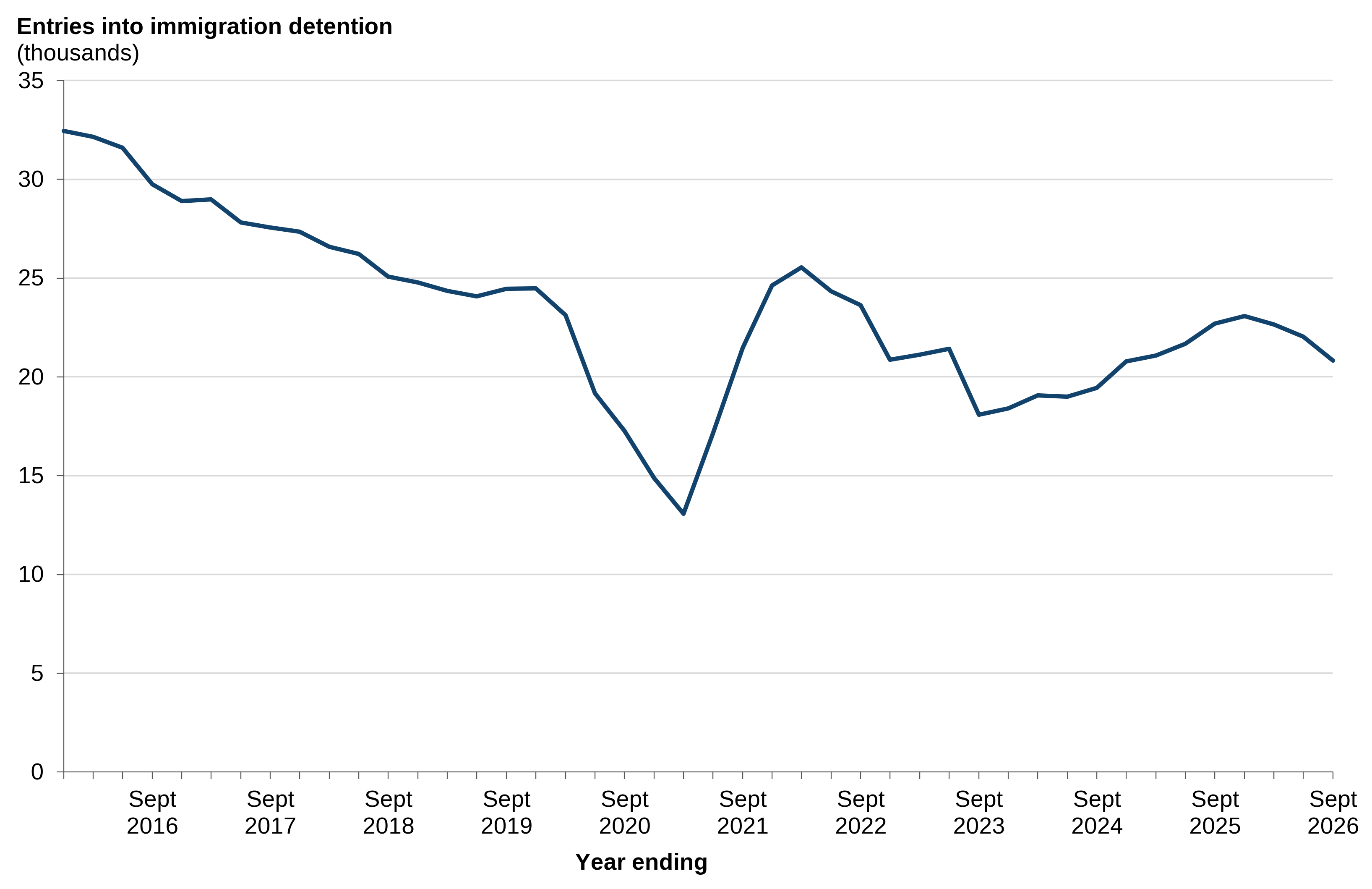
Entries into immigration detention fell in the YE September 2026, following 2 years of increases.
There was a total of 20,834 entries into immigration detention in the YE September 2026, 8% fewer than the previous year.
This fall coincided with a period where use of the detention estate was prioritised for individuals under the UK-France agreement (more details in the policy timeline). This resulted in an increase in the intake of certain nationalities commonly returned to France after arriving to the UK by small boat (including Eritreans, Afghans, Iranians and Sudanese), offset by falls in the intake of nationalities commonly entering detention in previous years (including Albanians, Indians and Brazilians). These changes were observed alongside an increase in greater lengths of detention in the YE September 2026 compared to previous years, which may have constrained numbers entering in the latest year. Despite changes, the volume of returns from detention was maintained compared to the previous year (more information about detention durations and reasons for leaving detention in section 3).
The fall in overall intake follows an increase from YE September 2023 to YE December 2025, as shown in Figure 1, partly enabled by increasing capacity within the detention estate to facilitate removals from the UK. While other factors have impacted intake over the last year, the detention estate has continued to expand over this time, with Campsfield House IRC reopening in December 2025, and a doubling of spaces in prison for those under immigration powers at the end of 2025 (see section 2).
Longer term, the number of entries into immigration detention fell from 32,447 in 2015 to 24,480 in 2019 alongside changes in the use of immigration detention and greater use of alternatives following the 2016 Stephen Shaw review. Although the COVID-19 pandemic impacted detention use in 2020 and 2021, the downward trend continued up to the YE September 2023 as more individuals were managed in the community. This decline occurred against the backdrop of detained individuals more commonly raising issues while in detention (such as asylum or modern slavery claims).
Figure 1: Entries into immigration detention in the UK, from the YE December 2015 to the YE September 2026
Source: Immigration detention - Det_D01
The profile of people entering and leaving detention reflects a range of factors, including wider migration trends, the characteristics and circumstances of people subject to immigration control, and changes in policy and operational activity.
In the YE September 2026, around two-thirds (64%) of entries into immigration detention were people who had been recorded in the asylum system either prior to or since entering detention. This is a greater proportion compared to the year ending September 2025 (60%) partially reflecting the circumstances of individuals detained under the UK-France agreement. Despite this, the volume of asylum-related cases entering detention fell from 13,556 in the YE September 2025 to 13,280 in the latest year, mirroring the total fall in intake volumes.
In addition, there were 8,530 cases of foreign national offenders (FNOs) entering detention, accounting for 41% of overall entries. Changes to the Early Removal Scheme (ERS) in September 2025 resulted in a number of FNOs in prisons becoming immediately eligible for removal, often facilitated via the detention estate. Further details can be found in the policy timeline accompanying this release.
The most common nationalities entering immigration detention were Albanians, Indians and Romanians.
Albanians remain the most common nationality entering detention (18%), followed by Indians (10%), Romanians (8%), Brazilians (6%) and Polish (4%). Albanian intake (3,682) has fallen steadily year-on-year since YE September 2024 (6,282), reflecting a declining population of Albanians eligible for removal. Intake of Indian and Brazilian nationals fell by 34% and 56% respectively in the latest year. This was mainly due to changes in the use of detention under the UK-France agreement, which has led to detention spaces being prioritised for use by small boat arrivals being prepared for return under the scheme. Accordingly, intake of Eritreans, Afghans, Sudanese, Iranian and Somalian nationals – the top nationalities arriving by small boat in the latest year – increased substantially compared to the previous year.
2. People in immigration detention
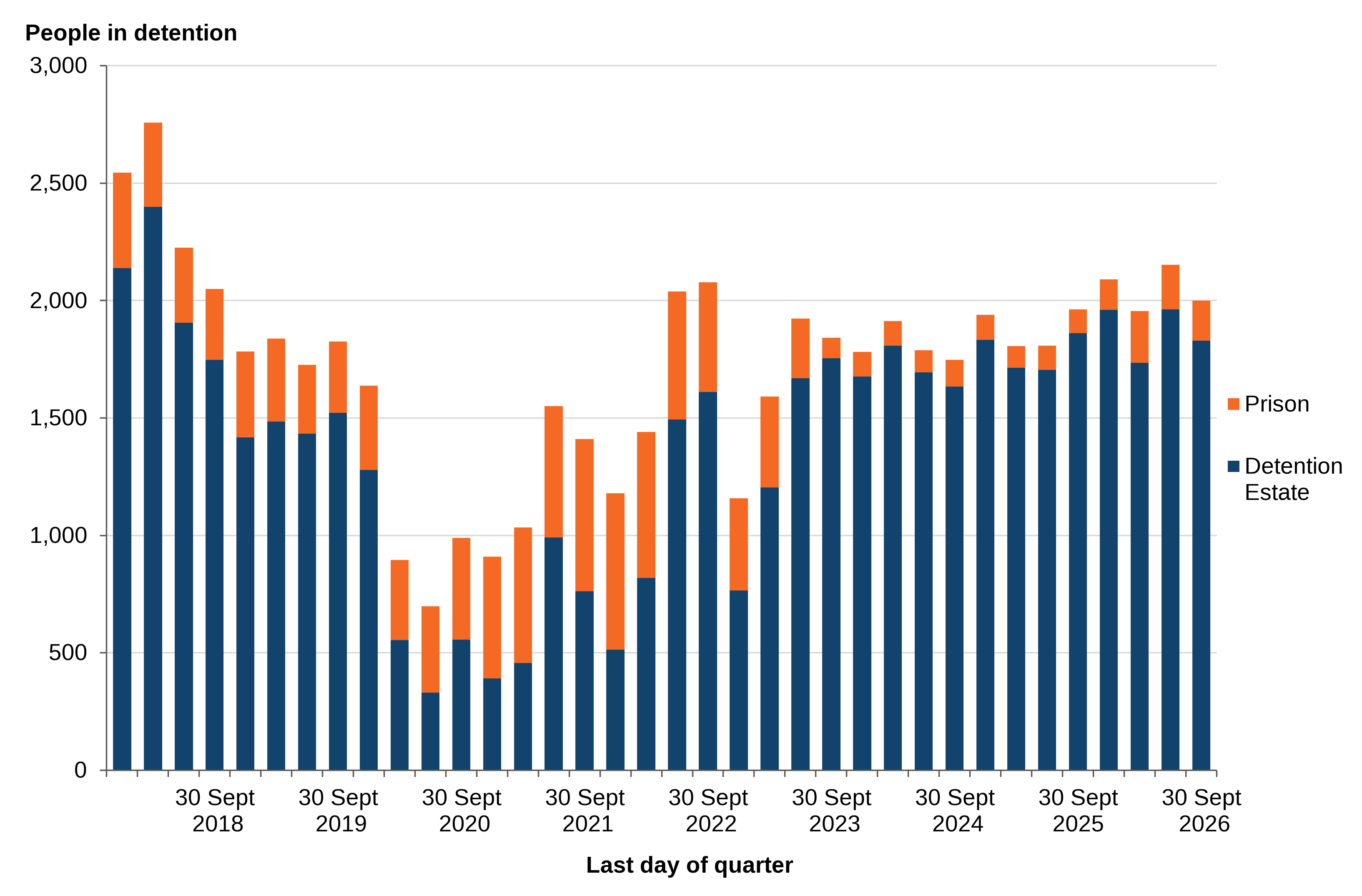
The number of people held in immigration detention under immigration powers at the end of September 2026 remained stable compared to a year prior.
There were 1,999 people being held in detention (at an immigration detention facility or in prisons under immigration powers) at the end of September 2026, 2% more than on 30 September 2025. While the vast majority of people detained under immigration powers are held in the detention estate rather than prisons (92% at the end of September 2026), the amount of people detained in prison under immigration powers increased 67% in the latest year to 169. This additional bed space supports efforts to reduce pressure on prison capacity by expediting the removal of FNOs from the UK via schemes like the ERS. For more information on FNOs leaving the detention estate, see section 3.3.
While many FNOs subject to removal are detained in the detention estate and prisons, many are also managed in the community. For data on those managed in the community, see the Immigration Enforcement Transparency statistics.
The total number of foreign nationals held in prison for criminal offences can be found in the latest prison population statistics, published by the Ministry of Justice and HM Prison and Probation Service.
Figure 2: People detained under immigration powers in the UK, on the last day of the quarter, 31 December 2017 to 30 September 20261,2
Source: Immigration detention - Det_D02
Notes:
- The ‘detention estate’ comprises Immigration Removal Centres (IRC), Short-Term Holding Facilities (STHF) and Pre-departure Accommodation (PDA). It is separate to those who are detained under immigration powers in prisons – these are shown separately on the chart.
- Prisons data from 31 December 2022 includes prisons in England and Wales only.
The number of people in detention is a snapshot relating to a single point in time, therefore, numbers fluctuate daily. If a large number of people entered detention just before the end of a reporting period, the number of people in detention would be higher than if the same people entered a few days later.
3. Exits from immigration detention
3.1 Reasons for leaving immigration detention
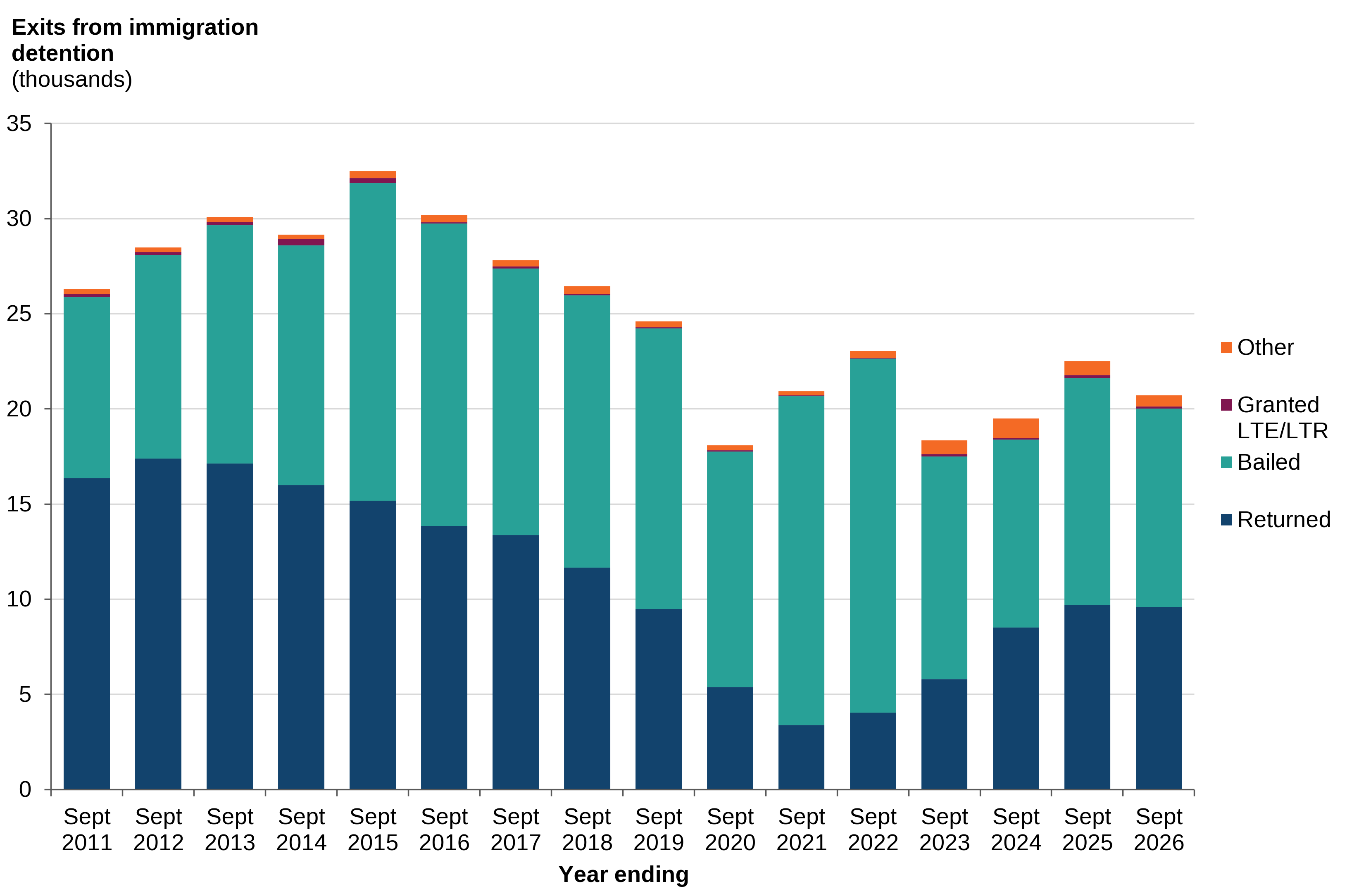
The most common reason for leaving detention in the YE September 2026 was bail.
Figure 3 shows that half (50%) of the 20,705 exits from detention in YE September 2026 were due to bail, compared to 53% in the previous year. Volumes of exits due to bail fell 13% in the latest year.
Bail has been the most common reason for leaving detention since 2015 with the proportion leaving detention on bail remaining fairly consistent over the last 3 years. Prior to 2015 the most common reason for leaving detention was to be returned.
People are bailed for a variety of reasons, including where there is no immediate prospect for their removal from the UK, or while their asylum claim is being considered, if they have made one.
Detained individuals who claim asylum, or raise other claims (for example, modern slavery or human trafficking) or appeals which prevent progress of their removal, may be granted bail into the community. While on bail, individuals are subject to conditions while their claims are concluded. If a claim is refused, the individual may depart the country voluntarily or re-enter detention if required to facilitate enforced removal.
Figure 3: Exits from immigration detention by reason for leaving1 from the YE September 2011 to the YE September 2026
Source: Immigration detention - Det_D03
Notes:
- Other reasons for leaving detention include being sectioned under the Mental Health Act, entering criminal detention and being detained in error. See the user guide for more details.
Numbers of exits from immigration detention to be removed from the UK were relatively unchanged, despite the fall in numbers bailed.
In the YE September 2026, 9,608, or just under half (46%) of exits, were to be returned from the UK – a slightly higher proportion than the previous year (43%). Enforced returns from detention are the most common type of enforced return and have generally been rising steadily since the pandemic in 2020 and 2021, as shown in Figure 3. For more information about this trend, and the reasons behind it, see the ‘How many people are returned from the UK?’ topic.
Reasons for leaving detention are considered on a case-by-case basis and often vary across nationalities. Romanian and Polish nationals, among the most common nationalities of FNOs leaving detention in the latest year, had a higher proportion returned on leaving detention (86% and 61% respectively) than leaving on bail. This reflects established FNO return schemes and other returns agreements contributing to higher levels of returns to some European countries. Some nationalities featuring more prominently in asylum claim statistics, including Indian and Pakistani nationals, were more commonly reported leaving detention on bail (both 74%).
Albanians, who were the most common nationality leaving detention, are prominent across both the FNO and asylum claiming cohorts with a similar number returned from detention and leaving on bail.
For more information about asylum claim statistics, see the ‘How many people claim asylum in the UK?’ topic.
3.2 Length of immigration detention
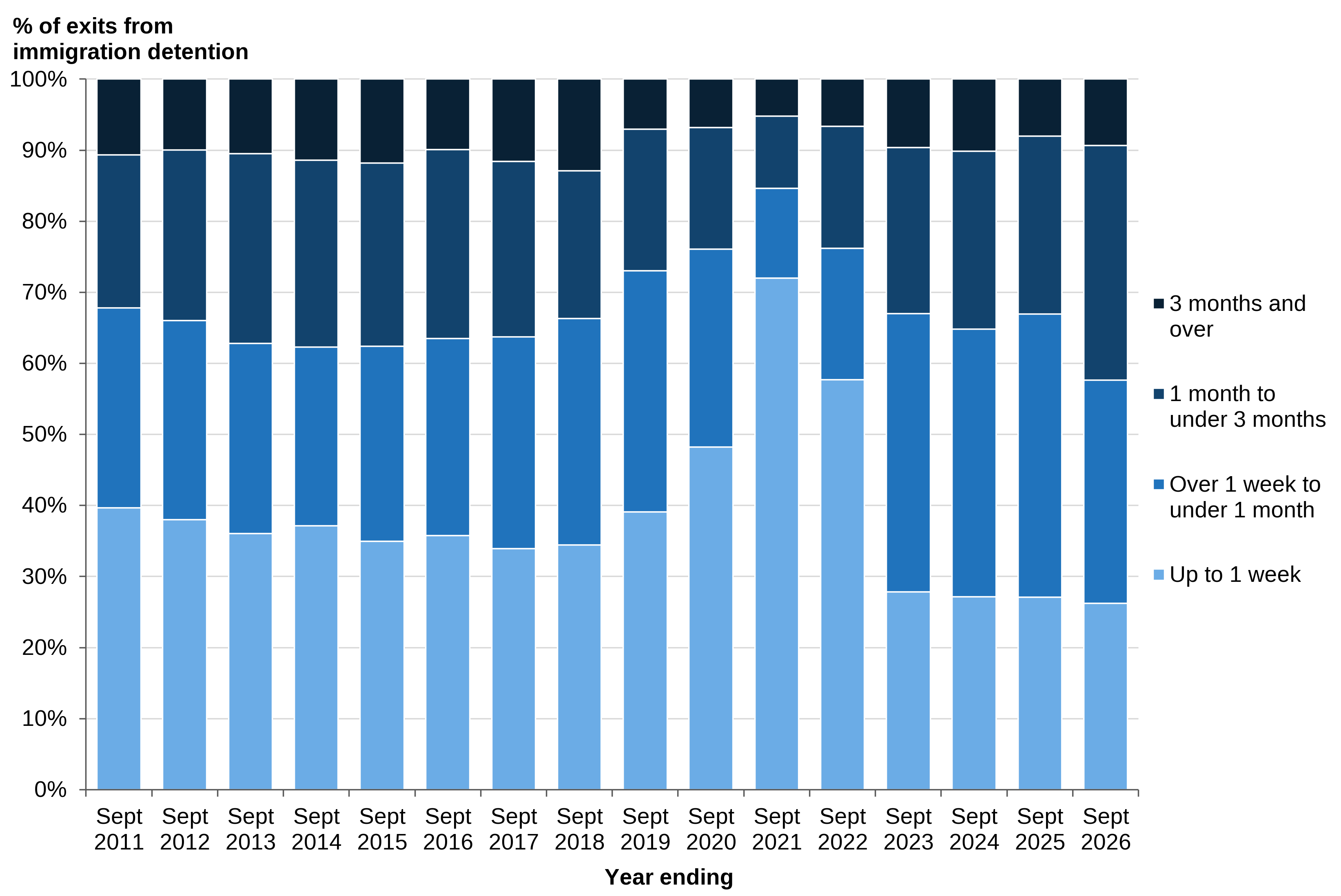
A greater proportion of exits from immigration detention in the latest year involved people detained for longer periods.
More than half (58%) of exits from detention in the YE September 2026 followed less than one month detained, though this had fallen from 67% the previous year. There was also an increase in the proportion of detentions between 1 and 3 months from 25% to 33%.
Those returned from detention are more commonly detained for shorter periods compared to those being bailed. Around one-third (37%) of those returned from the UK via detention spent under a week detained (61% under a month). For those bailed, only 14% of detainees left detention within a week (53% under a month).
A change in the make-up of nationalities using immigration detention appears to have impacted detention durations in the latest year. Volumes of typically shorter-detained nationals from Albania, Brazil, India and Romania have declined whilst intake of typically longer-detained Eritrean, Afghan, Sudanese, Iranian and Somalian nationals have increased. Durations may be determined by a number of factors, including type of return, ease of return administration and propensity to claim asylum – all of which can vary greatly between nationalities.
Longer stays in detention (3 months and over) have accounted for between 8% and 10% of exits over the last 4 years. In the YE September 2026, 9% of detentions lasted over 3 months.
Figure 4 shows short detentions up to one week were more common between the YE September 2020 and the YE September 2022, during which time small boat arrivals were undergoing initial processing in the detention estate, and the COVID-19 pandemic disrupted normal detention estate operations.
Figure 4: Exits from immigration detention, by length of detention1, proportions of rolling annual totals, from the YE September 2011 to the YE September 2026
Source: Immigration detention - Det_D03
Notes:
- Month duration refers to a period of 30 days.
3.3 Foreign National Offenders (FNOs) leaving immigration detention
In YE September 2026, there were 8,473 cases of FNOs exiting immigration detention.
Two-fifths (41%) of exits from immigration detention in the YE September 2026 were FNOs. The most common nationalities among these FNOs were Albanian (1,893), Romanian (1,071) and Polish nationals (747).
Information about offence groups and sentence lengths of FNOs leaving immigration detention is published annually in the immigration detention summary tables. The latest data is for the YE June 2026.
FNOs leaving detention to be returned from the UK will appear in the FNO returns statistics reported in the ‘How many people are returned from the UK?’ chapter. Those for whom there is no immediate prospect of their removal from the UK, or while an additional claim is being considered which creates a barrier to their return (for example, asylum claim) may leave detention on bail and be managed in the community. These individuals are among those reported in the ‘FNOs in the Community’ statistics, published in the quarterly ‘Immigration Enforcement transparency statistics’.
The latest statistics on ‘FNOs in the Community’ show there were 22,571 FNOs subject to deportation being monitored in the community at the end of September 2026, which is an increase of 17% from end September 2025 (19,322), and an increase of 4% from end June 2026 (21,629). The substantial increase since last year mainly occurred since March 2026, coinciding with changes introduced through the Sentencing Act 2026. The changes may have impacted on numbers in 2 ways, firstly by expanding the issuance of suspended sentences, as an alternative to custodial sentences, so that many FNOs who would previously have served their time in prisons will now be serving it in the community. Secondly, the act also broadened the duty to deport foreign national offenders to include those given a suspended sentence of 12 months or more, bringing more foreign nationals into the monitored population.
4. About the statistics
The statistics in this section relate to detention under immigration powers.
One individual may enter or leave immigration detention multiple times in a given period and on such occasions would therefore be counted multiple times in the statistics.
Data on FNOs entering and leaving immigration detention is classified as ‘official statistics in development’. The reporting period is limited to the year ending September 2026. See the user guide for more details.
5. Data tables
Data referred to here can be found in the following tables:
We welcome your feedback
If you have any comments or suggestions for the development of this report, please provide feedback by emailing MigrationStatsEnquiries@homeoffice.gov.uk. Please include the words ‘PUBLICATION FEEDBACK’ in the subject of your email.
We’re always looking to improve the accessibility of our documents. If you find any problems or have any feedback relating to accessibility, please email us.
See Section 6 of the ‘About this release’ section for more details.