Heat pump deployment statistics: June 2026 – summary
Published 10 September 2026

© Crown copyright 2026
This publication is licensed under the terms of the Open Government Licence v3.0 except where otherwise stated. To view this licence, visit nationalarchives.gov.uk/doc/open-government-licence/version/3 or write to the Information Policy Team, The National Archives, Kew, London TW9 4DU, or email: psi@nationalarchives.gov.uk.
Where we have identified any third party copyright information you will need to obtain permission from the copyright holders concerned.
This publication is available at https://www.gov.uk/government/statistics/heat-pump-deployment-statistics-june-2026/heat-pump-deployment-statistics-june-2026-summary
Introduction
This statistics publication presents heat pump installations. This publication is produced by the Department for Energy Security and Net Zero (DESNZ) and has been developed in collaboration with the Welsh Government, Scottish Government and the Department for the Economy Northern Ireland. The data presented show the total volume of heat pumps installed in existing properties (retrofit). The statistics are assembled from the collation of a number of different data sources and we will look to fill gaps in this data over future releases.
Background
In October 2021, the previous government published its ‘Heat and Buildings Strategy’, which set out their plans to decarbonise buildings and grow heat pump deployment.
In March 2024, the National Audit Office published a report, ‘Decarbonising home heating, looking at the progress DESNZ has made in decarbonising home heating since the Heat and Buildings Strategy was published. One of their recommendations was to establish a single measure for the number of heat pumps installed regardless of policy. The launch of this publication started to address that recommendation by giving a view of the number of government-supported heat pumps installed through DESNZ-led schemes. For more information on how these statistics have developed, see the ‘What you need to know about these statistics’ and ‘Methodology’ sections.
The ‘Warm Homes Plan’ was subsequently published in January 2026, which included details of the government’s aim to achieve 450,000 heat pump installations per year by 2030.
What you need to know about these statistics
This is the first release of these statistics in HTML format, previous releases were published in Excel format. The accompanying tables continue to be published in Excel format.
These statistics are published to inform users about the number of heat pumps installed in the UK. As a statistical series still undergoing methodological development, they are published as ‘Official Statistics in development’. Their status will be kept under review.
These statistics initially covered DESNZ government-supported heat pump installations only, up until December 2025. We have progressed work to develop and test new methodology to link different data in order to expand the coverage of heat pumps installed. Since March 2026, the tables in this release have been expanded to cover all retrofit installations. The statistics do not include installations in new-build properties or retrofit installations that are not Microgeneration Certification Scheme (MCS) certified.
We will continue to work to fill these gaps in future releases and work towards providing a more complete picture of total heat pump deployment in the UK, including incorporating the number of installations in new-build properties.
About the official statistics in development designation.
Key statistics
This release presents the latest statistics on heat pump deployment up to the end of Q2 2026. It should be noted that Q2 represents quarter 2 (April to June) within these statistics.
There has been a general upward trend in the number of retrofit heat pump installations; as the last full calendar year, 2025 volumes are a 9% increase on the previous year (2024; 48,857) and are over 4 and a half times higher than 5 years ago (2020, 11,327).
However, the number of installations in the current year so far (2026 up to the end of Q2; 20,895) is a 22% fall compared to the same period in 2025 (26,768). When compared to the same period 5 years ago (2021 up to the end of Q2), we continue to see an upward trend, with nearly double the number of heat pump installations (10,605). (See Table 1.1).
Figure 1: Number of retrofit heat pump installations in domestic properties, by year, UK
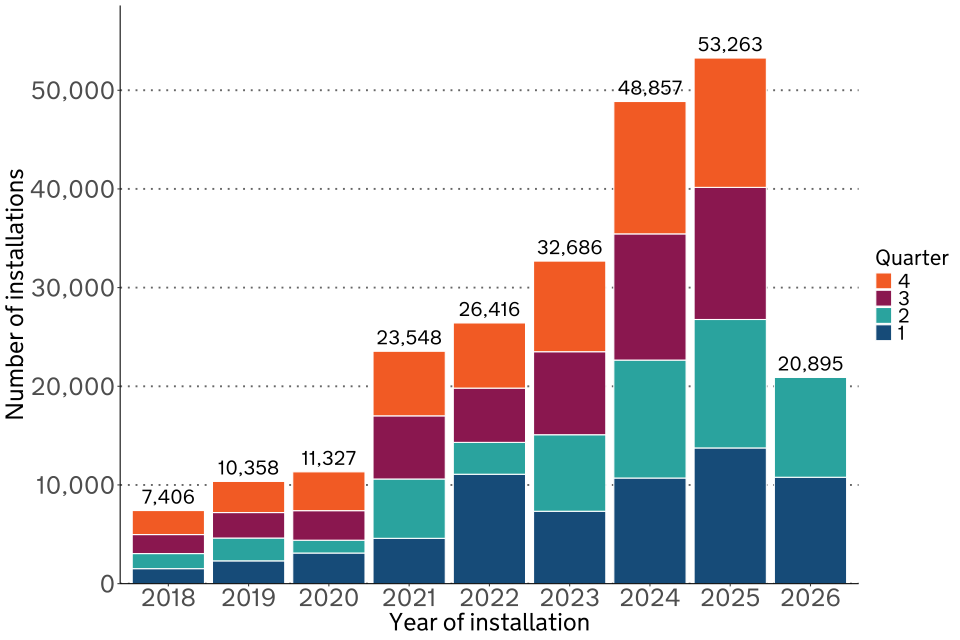
The data used in Figure 1 can be found in Table 1 of the accompanying tables.
The majority of retrofit heat pump installations in 2026 up to the end of Q2 were of Air-to-Water Heat Pumps (AWHPs) (99%), which has increased from 93% of installations when compared to the same period 5 years ago (2021 up to the end of Q2). (See Table 1.1).
Of the 20,895 retrofit heat pump installations in 2026 up to the end of Q2, the largest proportion took place in the South East (18%), followed by the South West (14%) and the East of England (13%). (See Table 1.2).
Only Northern Ireland and London saw growth when comparing 2026 up to the end of Q2 and the same period in 2025 in the number of retrofit heat pumps installed. However, for Northern Ireland, this was from low volumes compared to the other regions; from 9 installations in 2025 up to the end of Q2, compared to 36 in the same period in 2026. (See Table 1.2).
London has seen the biggest growth in the number of retrofit heat pump installations over the last 5 years. However, this was from a low base; an increase of 557% when comparing 2026 up to the end of Q2 (1,065) to the same period 5 years ago (2021 up to the end of Q2; 162). This is followed by the South East with an increase of 226% over the same period (from 1,126 to 3,673 installations). (See Table 1.2).
There are different numbers of properties in each area, which will be a factor that influences the variation in the number of installations in the different regions.
Where relevant, figures are compared with those from 5 years earlier to provide context on longer-term trends in heat pump deployment.
Further information
Next publication date
The next release date for these quarterly statistics is December 2026.
Future release dates will be announced at least 4 weeks in advance on the DESNZ Research and Statistics publication page.
Accompanying tables
Tables providing statistics on the number of retrofit heat pump installations in the United Kingdom were published alongside the release. See the accompanying tables.
Methodology
- This publication uses data on installations certified through the Microgeneration Certification Scheme (MCS). The MCS data includes some installations in new-build and non-domestic properties, but since MCS data does not have complete coverage of installations in these types of properties they have not been included in these statistics. What remains provides us with our best estimate of the total number of retrofit heat pump installations, which will include installations that both receive funding through government support as well as those that are self-funded. Those installations in new dwellings and non-domestic buildings have been removed from the data by:
- (a) Energy Performance Certificate (EPC) records for England and Wales that have a heat pump recorded as a heating system have been matched to MCS to identify and remove installations in new dwellings prior to 2023 Q4. This method does not yet incorporate EPC records for Scotland and Northern Ireland, so a small proportion of new-build installations in Scotland and Northern Ireland pre-2023 Q4 may have incorrectly been classified as retrofit, but will be reassigned in future when this data is acquired. For the statistics presented for 2023 Q4 onwards, due to the availability of a new-build ‘flag’ in the MCS data, this has been used instead of the EPC data matching method as it is considered to be a more accurate way to isolate and remove installations in new-build properties. Official Statistics on the number of new dwellings with heat pumps are published by the Ministry of Housing, Communities and Local Government (MHCLG) in ‘Energy efficiency characteristics of new dwellings’, which we will look to incorporate into this release in future, along with equivalent estimates from Wales, Scotland and Northern Ireland.
- (b) The method for removing installations in non-domestic properties varies due to changes in the availability of information in the MCS data over time that enables these to be identified. Information on the property type, installation contract and matched EPC records are all used to identify and remove installations in non-domestic properties.
Where address matching has been used, the methodology includes matching using Unique Property Reference Numbers (UPRNs). Ordnance Survey maintains the AddressBase database of all addresses in Great Britain, in which a unique UPRN is assigned to each address. The address of each heat pump installation is matched to the addresses in AddressBase so that the UPRN can be retrieved for each record. The assigned UPRN can then be linked across datasets. However, as addresses are not recorded in a consistent way across datasets, address matching has some limitations. There are some addresses which cannot be matched confidently to AddressBase, and a proportion of matches that are made are likely to be incorrect. The address matching algorithm being used is estimated to have an error rate of around 1% for domestic addresses. In general, there can be a trade-off whereby accepting matches more readily can admit more incorrect matches and thereby increase the error rate. For this reason, UPRN matching has been used in combination with fuzzy address matching methodology to both increase match rates and to verify the UPRN matching.
Comparability with other statistics:
These statistics will include some installations that are self-funded, as well as those that receive financial support through government schemes; covering both policies owned by DESNZ, as well as those in the devolved administrations. Links to the Official Statistics for the DESNZ-owned schemes are provided below. Please note that the statistics presented here are not directly comparable to the individual scheme statistics releases, and so should not be combined or compared. This is because these statistics are recorded against quarters based on the installation date of the heat pump, whilst scheme statistics use administrative dates which may not align. Furthermore, some heat pumps installed through DESNZ schemes are not in scope of these statistics, such as those installed in non-domestic properties and new dwellings.
The numbers presented in this statistics release will be similar to, but may be smaller than, those that can be accessed through the MCS Dashboard. This is due to the addition of some installations in new-build and non-domestic properties in the MCS Dashboard that are not included in this release. The method for removing these cases has been described above, with these statistics presenting total retrofit heat pump installations.
Technology types:
Air-to-water heat pumps and ground/water source heat pump technologies are in scope of this release. That includes both those that are installed as standalone systems, as well as ‘hybrids’ where they are installed alongside another type of heating system.
Property type:
Domestic
Geographical coverage:
UK
Revisions policy
The department’s statistics revisions policy sets out the revisions policy for these statistics, which has been developed in accordance with the UK Statistics Authority ‘Code of Practice for Statistics’.
In this release, testing and improvements have been made to the underlying address matching methodology to enable more accurate data matching, alongside improvements to the identification of domestic properties. These methodological improvements have resulted in small upward revisions to the estimated number of heat pumps installed across the reported time series.
User engagement
It is crucial we engage with users to ensure the statistics are suitable to meet their needs. During our ongoing development of these statistics, we welcome comments to understand how these statistics are used, and to test the suitability of the statistical methods and outputs.
Email: EnergyEfficiency.Stats@energysecurity.gov.uk
Pre-release access
Some ministers and officials receive access to these statistics up to 24 hours before release. Details of the arrangements for doing this and a list of the ministers and officials that receive pre-release access to these statistics can be found in the Statistics release policy with the Pre-Release Access to Official Statistics Order 2008.
Code of Practice for Statistics
The ‘Code of Practice for Statistics’ (‘the code’) sets the standards that producers of official statistics should commit to, giving users confidence in published statistics. Statistics published by the Department for Energy Security and Net Zero – including the Quarterly Heat Pump Deployment statistics – are produced in accordance with the standards set out in the code. See our statistics policies for more information.
Supporting statistics
Official Statistics for government policies supporting heat pump installations:
- Boiler Upgrade Scheme statistics
- Local Authority Delivery, Green Homes Grant Vouchers and Home Upgrade Grant statistics
- Social Housing Decarbonising Fund statistics
- Energy Company Obligation statistics
- Domestic and Non Domestic Renewable Heat Incentive statistics
- Warm Homes: Local Grant statistics
- Warm Homes: Social Housing Fund statistics
Related content
- Warm Homes Plan, DESNZ (published January 2026)
- Energy efficiency characteristics of new dwellings, MHCLG (published February 2026, updated quarterly)
- Microgeneration Certification Scheme dashboard (sign-up required)
- Heat Strategy for Wales, Welsh Government (published July 2024)
- Fuel Poverty in Wales: interactive dashboard, Welsh Government
- Scottish Government Heat in Buildings Strategy
- Scottish Government Heat in Buildings: Progress Report 2025
Contact details
Email: EnergyEfficiency.Stats@energysecurity.gov.uk
Media enquiries: 020 7215 1000