Summary of the Great British Insulation Scheme: March 2026
Published 26 March 2026
Applies to England, Scotland and Wales

© Crown copyright 2026
This publication is licensed under the terms of the Open Government Licence v3.0 except where otherwise stated. To view this licence, visit nationalarchives.gov.uk/doc/open-government-licence/version/3 or write to the Information Policy Team, The National Archives, Kew, London TW9 4DU, or email: psi@nationalarchives.gov.uk.
Where we have identified any third party copyright information you will need to obtain permission from the copyright holders concerned.
This publication is available at https://www.gov.uk/government/statistics/great-british-insulation-scheme-release-march-2026/summary-of-the-great-british-insulation-scheme-march-2026
Introduction
The Great British Insulation Scheme (GBIS) is a government scheme to help people insulate their homes, make them more energy efficient and save money on their energy bills.
The Government announced the scheme at the end of March 2023. The £1 billion scheme aims to help the least energy efficient households across the country with the cost of installing new home insulation. The GOV.UK referral service for the Great British Insulation Scheme (GBIS) has now closed. Closing the service prior to the end of the scheme allows energy suppliers sufficient time to process applications and complete installations before the scheme officially ends on 31 March 2026.
What you need to know about these statistics
These statistics are based on data provided by Ofgem covering installations of measures since the start of the scheme at the end of March 2023 up to the end of January 2026. Data on associated costs to the end of December 2025 (Tables 9 and 10) are based on quarterly GBIS cost reports submitted by energy suppliers.
Data are based on the date of completed installation of measures as recorded in the Ofgem register.
All figures are provisional and subject to revision.
Key statistics
Delivery by month
Since the start of GBIS, there have been 130,800 measures installed in 95,500 households up to the end of January 2026.
There were 4,700 measures installed in 2,800 households during January 2026. This was a decrease of 15% in measure delivery compared to December 2025.
Average measure delivery per month in the last three months (November 2025 to January 2026) was 5,600.
Figure 1: Number of Measures Installed and Households Upgraded by Installation Month
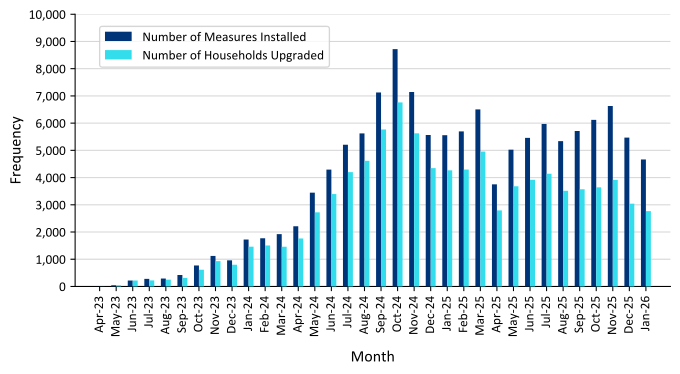
The data used in Figure 1 can be found in Tables 1 and 2 of the Accompanying Tables.
GBIS targets two eligibility groups: a low-income group, similar to the Help to Heat Group in ECO4, and a general eligibility group. Within the low-income group, Local Authorities can identify and refer on to the scheme households that are low-income, fuel-poor or vulnerable to the effects of living in a cold home through a mechanism called Flexible eligibility. More information on these eligibilities can be found in the GBIS delivery guidance.
To the end of January 2026, around 69,600 (53%) of the measures installed under GBIS were delivered to households in the low-income eligibility group. Of these measures, around 11,100 were delivered under the Flexible Eligibility mechanism.
To the end of January 2026, around 36,400 (38%) of the households upgraded under GBIS were in the low-income eligibility group. Of those, around 4,200 were upgraded under the Flexible Eligibility mechanism.
Innovation measures are measures that can demonstrate an improvement over comparable measures currently deliverable under the scheme. To the end of January 2026, around 9,900 innovation measures were installed.
Delivery by measure type
The most common measure so far has been cavity wall insulation, accounting for 48,500 (37%) of the total 130,800 measures. This was followed by loft insulation which accounted for 36,900 measures (28%) and heating controls which accounted for 32,700 measures (25%).
Figure 2: Number of Measures Installed by Measure Type (April 2023 to January 2026)
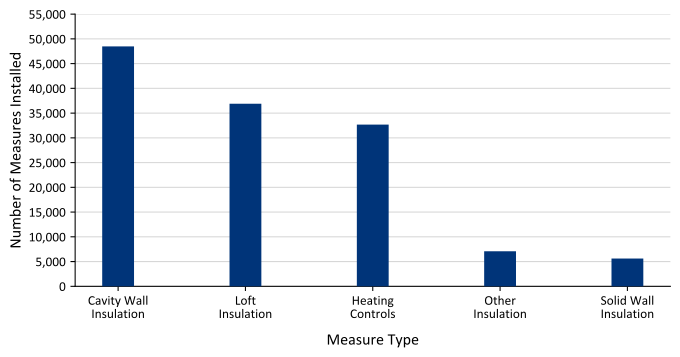
The data used in Figure 2 can be found in Table 3 of the Accompanying Tables.
Following the ECO/GBIS mid-scheme changes, which came into effect in Spring 2025 for measures installed from mid-November 2024 onwards, households have been able to receive two primary measures under GBIS in certain circumstances. So far, there have provisionally been around 2,600 households in receipt of two primary measures between January 2025 and end of January 2026. This was 5.3% of households upgraded since the first household with two primary measures appeared in the data in January 2025.
Delivery by region
The highest regional delivery of measure installations has been in the North West and the West Midlands (both 15%), followed by the North East (13%).
Figure 3: Proportion of Total Measures Installed and Total Households Upgraded by Geographic Region (April 2023 to January 2026)
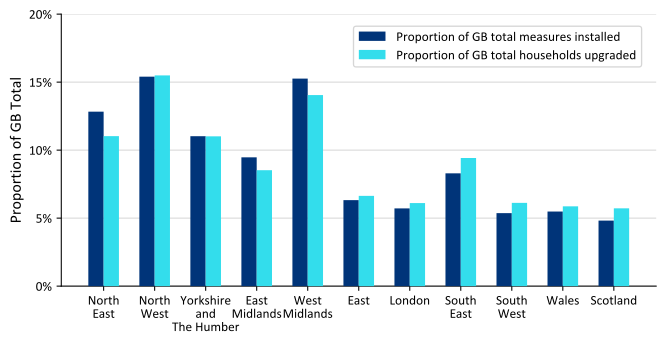
The data used in Figure 3 can be found in the ‘Percentage of Total Measures Installed’ and ‘Percentage of Total Households Upgraded’ columns of Table 4 in the Accompanying Tables.
The regional breakdown of upgraded households is largely the same as the regional breakdown of measures installed, as the majority of households (around 76,700 out of 95,500) have had only one measure installed under the scheme up to the end of January 2026. Most of the remaining households have had one or more heating control measures installed (these are secondary measures that can only be installed in households in the low-income eligibility group under the scheme).
There have been 95,500 households upgraded under GBIS up to the end of January 2026, meaning they have had at least one measure installed under the scheme. This is around 336 households upgraded per 100,000 households in Great Britain (based on estimated household levels for 2025). The rate of upgrades is higher in Wales at around 400 per 100,000. In England, the rate is closer to that of Great Britain at around 346 upgrades per 100,000. Scotland has seen a lower rate of around 212 upgrades per 100,000. The region with the highest rate of upgrades is the North East with 862 households upgraded per 100,000.
Delivery by local authority area
GBIS measure delivery, upgrades and estimated rates per 100,000 households are provided at the local-authority level in Table 5 of the Accompanying Tables. The estimated rate of upgrades per 100,000 households is also presented in Map 1.
The level of delivery under GBIS varies at the local authority level. The local authorities with the highest rate of upgrades so far are West Lindsey (2,165 per 100,000 households), Stoke-on-Trent (2,140 per 100,000 households) and Barking and Dagenham (1,585 per 100,000 households).
Map 1: Households upgraded under GBIS per 100,000 households by Local Authority (April 2023 to January 2026)
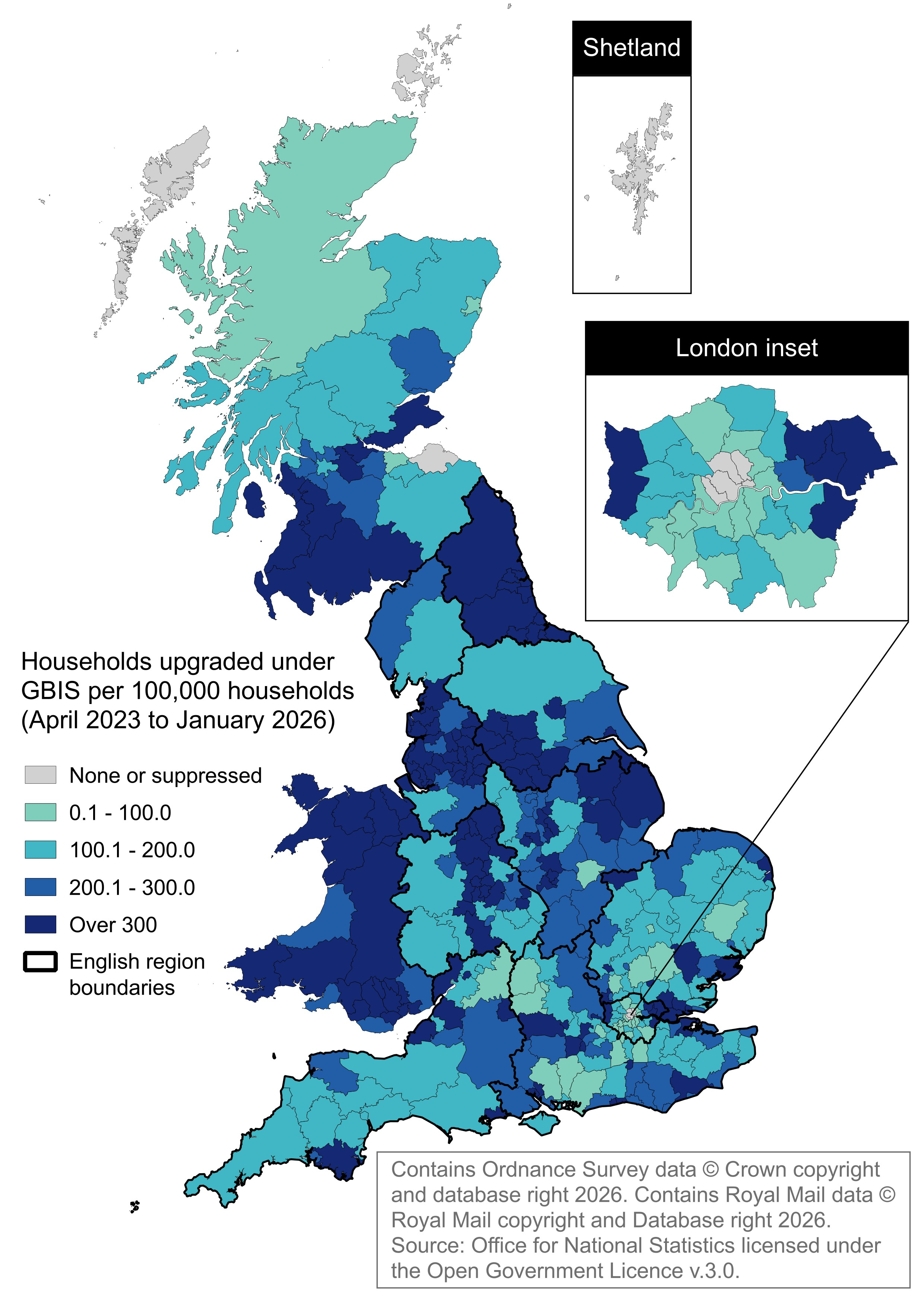
The data used in Map 1 can be found in the ‘GBIS households upgraded per 100,000 households’ column of Table 5 in the Accompanying Tables.
Delivery by property type and tenure
Data on the property type and tenure of properties receiving measures under GBIS (Tables 7 and 8 of the Accompanying Tables) were last updated in the earlier release published on 19 February 2026, covering quarterly data on the property type and tenure type of households upgraded under GBIS to the end of December 2025. The next update to Tables 7 and 8 will be in the 21 May 2026 release.
Houses were the most common property type upgraded under GBIS to the end of December 2025, accounting for around 74,200 (80%) of the upgraded households. This was followed by Bungalows, which accounted for 15%, Flats, which accounted for 5%, and Maisonettes, which accounted for less than 1%.
The most common tenure of households upgraded under GBIS to the end of December 2025 was owner-occupied, making up around 74,800 (81%) of the upgraded households. This was followed by socially rented households, which accounted for 11% and private rented households, which accounted for 8%.
GBIS costs
This month’s release provides an update to quarterly data on associated costs in Tables 9 and 10 of the Accompanying Tables. Tables 9 and 10 cover quarterly GBIS costs data to the end of December 2025 and are based on quarterly GBIS cost reports submitted by energy suppliers. The date of the next update is yet to be confirmed.
GBIS delivery costs are the purchase costs of a GBIS measure in a property which may include the costs associated with searching for properties, installation costs and marketing costs by delivery partners involved with promoting the scheme. These costs exclude VAT.
GBIS administrative costs include direct administrative costs (IT set up and maintenance, lead generation and marketing, delivery, commercial strategy and policy, processing, reporting and compliance, and technical monitoring) and indirect administrative costs (legal, finance and HR costs, accommodation and ‘other’).
Total GBIS delivery costs up to the end of December 2025 were around £366.0 million, with an additional £22.1 million in administrative costs. This made the total cost of the scheme to the end of December 2025 £388.1 million.
Up to the end of December 2025, the average cost of delivering the GBIS obligation was £25.44 per £ annual bill savings. This was similar to the end of September 2025 where the cost was £25.43 per £ annual bill savings.
The date of the next update to the quarterly GBIS costs data is yet to be confirmed.
Annex: Further Information
Next publication date
The next publication will be at 09:30am on Thursday 23 April 2026.
Scheme Information
More information on the GBIS scheme can be found at the Department’s website and at Ofgem.
Accompanying tables
Tables showing the number of measures installed and households upgraded under GBIS are available.
Revisions policy
The Department’s statistical revisions policy sets out the revisions policy for these statistics, which has been developed in accordance with the UK Statistics Authority Code of Practice for Statistics.
User engagement
Users are encouraged to provide comments and feedback on how these statistics are used and how well they meet user needs. Comments on any issues relating to this statistical release are welcomed and should be sent to: EnergyEfficiency.Stats@energysecurity.gov.uk. The Department’s statement on statistical public engagement and data standards sets out the department’s commitments on public engagement and data standards as outlined by the Code of Practice for Statistics.
Pre-release access to statistics
Some ministers and officials receive access to these Official Statistics up to 24 hours before release. Details of the arrangements for doing this and a list of the ministers and officials that receive pre-release access to these statistics can be found in the Department’s statement of compliance with the Pre-Release Access to Official Statistics Order 2008.
Contact
Responsible statisticians: Darren Stillwell and Mark Piatek
Email: EnergyEfficiency.Stats@energysecurity.gov.uk
Media enquiries: 020 7215 1000
Public enquiries: 07860 511211