Fire and rescue workforce and pensions statistics: England, year ending March 2025
Published 4 December 2025
Applies to England

© Crown copyright 2025
This publication is licensed under the terms of the Open Government Licence v3.0 except where otherwise stated. To view this licence, visit nationalarchives.gov.uk/doc/open-government-licence/version/3 or write to the Information Policy Team, The National Archives, Kew, London TW9 4DU, or email: psi@nationalarchives.gov.uk.
Where we have identified any third party copyright information you will need to obtain permission from the copyright holders concerned.
This publication is available at https://www.gov.uk/government/statistics/fire-workforce-and-pension-statistics-year-ending-march-2025/fire-and-rescue-workforce-and-pensions-statistics-england-year-ending-march-2025
Frequency of release: Annual
Forthcoming releases: Ministry of Housing, Communities and Local Government statistics release calendar
MHCLG responsible statistician: Paul Gaught-Allen
Press enquiries: newsdesk@communities.gov.uk
Public enquiries: firestatistics@communities.gov.uk
All fire-related Ministerial responsibilities moved from the Home Office to the Ministry of Housing, Communities and Local Government (MHCLG) on 1 April 2025. This change followed a recommendation from the Phase 2 report of the Grenfell Tower Inquiry, to bring all fire safety functions under one department. Therefore, as part of this move, all statistical publications and analysis on fire functions were also subject to the Machinery of Government (MoG) change.
The statistics in this release inform the government, fire and rescue services, and local authorities to plan and prioritise policies around workforce and workforce safety. The data are used to inform national fire policy, allocate resources effectively, and support decisions on funding.
This release presents workforce and pensions statistics for Fire and Rescue Services (FRSs) in England for the year ending March 2025. The release includes information on total workforce numbers, workforce diversity, leavers and joiners, firefighter injuries, attacks on firefighters, pension fund income and expenditure and pension schemes membership. We are mindful of the importance of protecting personal data, which is particularly relevent in the workforce diversity section. There is accompanying documentation on personal data and other issues on the fire statistics guidance page.
Key results
FRSs employed 30,601 full-time equivalent (FTE) firefighters on 31 March 2025[footnote 1]. This is a decrease of 0.5% compared with the previous year (30,769). Over the past decade, the number of firefighters has decreased by 14%.
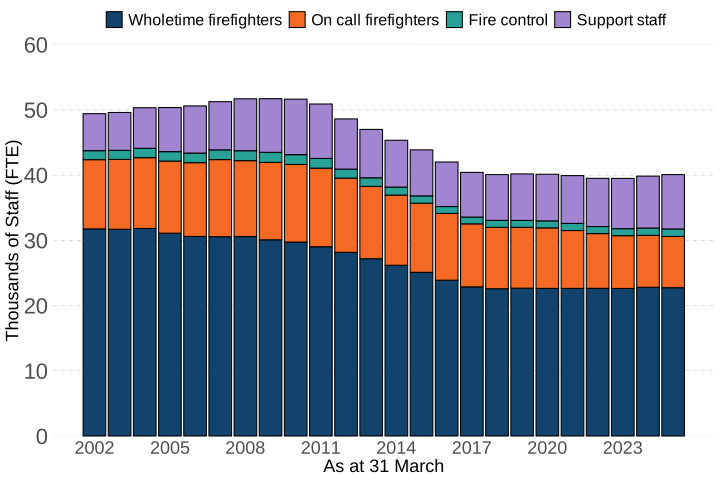
Figure KR.1: Total staff employed (FTE) by FRSs by role, England; year ending March 2002 to year ending March 2025
Note: X axis labelling is every 3 years starting 2002
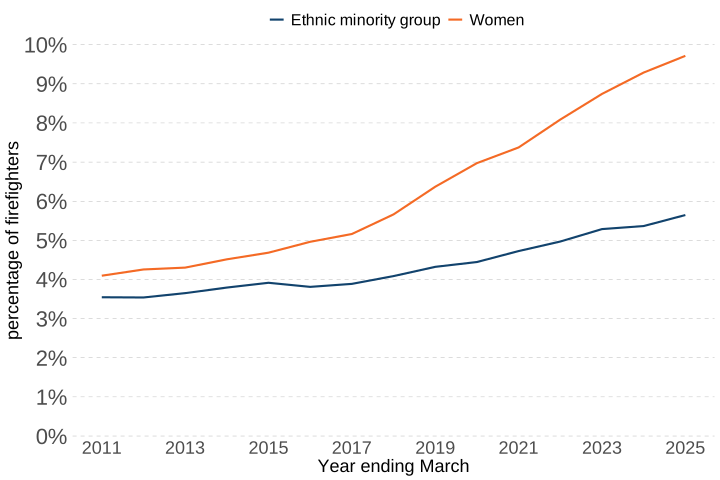
As of 31 March 2025, 9.7% (3,310) of firefighters employed by FRSs were women, compared with 9.3% (3,184) in the previous year, and 7.0% (2,461) 5 years ago. This compares to 36% of police officers[footnote 2] and 51% of the English population[footnote 3].
On the same day, 5.6% (1,793) of firefighters employed by FRSs who stated their ethnicity were from an ethnic minority, compared with 5.4% (1,701) in the previous year and 4.4% (1,410) 5 years ago. This compares to 8.8% of police officers and 26% of the English population.
Figure KR.2: Proportion of firefighters who are women or from an ethnic minority group, England; the year ending March 2011 to the year ending March 2025
Note: X axis labelling is every other year starting 2011
1. Total workforce
This section covers information on the total FRS workforce, leavers, joiners and apprentices. The total workforce subsection covers FTE figures as of 31 March 2025. The leavers, joiners and apprentices’ subsections provide headcount figures that cover the year ending March 2025 and the position on 31 March 2025.
Key results
As of 31 March 2025:
- FRSs employed 30,601 FTE firefighters - this is a decrease of 0.5% compared with the previous year (30,769), a decrease of 4.1% compared to 5 years ago (31,912) and a decrease of 14% compared to 10 years ago (35,699)
- FRSs employed 1,149 FTE fire control staff on 31 March 2025 - this is an increase of 2.6% compared with the previous year (1,120), an increase of 6.6% compared to 5 years ago (1,078) and an increase of 2.5% compared to 10 years ago (1,120)
- FRSs employed 8,333 FTE support staff on 31 March 2025 - this is an increase of 4.7% compared with the previous year (7,962), an increase of 17% compared to 5 years ago (7,144) and an increase of 18% compared to 10 years ago (7,056)
- FRSs employed 40,082 FTE staff on 31 March 2025 - this is an increase of 0.6% compared with the previous year (39,851), virtually unchanged compared to 5 years ago (40,135) and a decrease of 8.6% compared to 10 years ago (43,876)
During the year ending March 2025:
- 3,814 staff (measured by headcount[footnote 4]) left FRSs (8.5% of the total number of staff, measured by headcount, at the start of year), compared to 3,814 (8.5%) in the previous year, 4,194 (9.5%) 5 years ago and 4,213 (8.6%) 10 years previously
- 4,109 staff (measured by headcount) joined FRSs (9.1% of the total headcount at the start of year), compared to 4,192 (9.4%) in the previous year and 4,048 (9.2%) 5 years ago
- of the 4,109 new staff, 875 were new apprentices (measured by headcount), compared to 931 in the previous year
Workforce trends
This section mainly uses FTE, as it is deemed the better measure of staffing levels because it accounts for part-time staffing. Where this is difficult (for instance where the data collection involves diversity information) the headcount measure (total numbers, not accounting for part-time staffing) is used. A full list of definitions used in this section is available in the Fire statistics definitions guidance document.
Figure KR.1 shows that the total FTE workforce gradually increased from around 49,400 in 2002 to a peak of around 51,700 in 2009. This was an average increase of 0.7% per year. Over this same time period, the total number of firefighters (FTE) was broadly stable (decreasing by around 400), while support staff (FTE) increased by around 2,600. Since the peak in 2009, the total workforce (FTE) decreased to around 40,100 in 2018. This was an average decrease of 2.8% per year, with the number of firefighters (FTE) decreasing by 3.0% per year and fire control staff decreasing by 4.1% per year. Since 2018 the figures have been relatively stable.
Figure 1.1 below is a map that shows the the number of firefighters per 100,000 population by FRS, comparing the latest year of data (2025) with a decade previously. The areas with greater proportions tend to be in rural areas, as greater numbers of firefighters are required to the cover the larger areas. The proportions are, in general, lower in the year ending March 2025 as in the decade prior the number of firefighters has decreased and the population increased.
Figure 1.1: The number of firefighters per 100,000 population by FRS for the year ending March 2015 and 2025

Incidents and fires attended comparison
Over the last decade the number of firefighters has decreased by 14%; however, the rate of this decrease has reduced in recent years. Over the last 5 years, the number of firefighters decreased by 4.1% to 30,601, and over the last year it decreased by 0.5%. The decrease over the last decade was driven by a decrease of 26% in on-call firefighters compared to a decrease of 9.4% in wholetime firefighters. However, in more recent years, while the reduction in on-call firefighters has continued (a decrease of 15% on 5 years ago and 1.3% on 1 year ago), there was a small increase for wholetime firefighters (0.5%) over those 5 years.
The size of the workforce and trends in the size of the workforce, are often linked to trends in incidents. Over the last 10 years, as shown in Figure 1.2, the number of incidents attended by FRSs increased by 22%, while in the last 5 years this increased by 8.2%. However, the number of fire incidents attended decreased by 8.1% over 10 years and decreased by 7.6% over 5 years. Over the last decade, there has been a change in the incident mix, with fires accounting for a lower proportion of incidents attended down from 31% to 24%, with non-fire incidents accounting for a higher proportion of incidents attended increasing from 25% to 35%. Additionally, the impact of extreme weather should be considered, to give context to incident trends, given the hot, dry summer of 2022 resulted in a large increase in the number of outdoor fires for that year (year ending March 2023).
Figure 1.2: Total firefighters and total incidents attended, England; the year ending March 2002 to the year ending March 2025

Source: FIRE1101
Note: X axis labelling is every 3 years starting 2002
On 31 March 2025, FRSs employed 40,082 FTE staff. Table 6.1 shows that this is similar to the totals for 1 year previous (an increase of 0.6%) and 5 years ago (virtually unchanged) and a decrease of 8.6% compared to 2015.
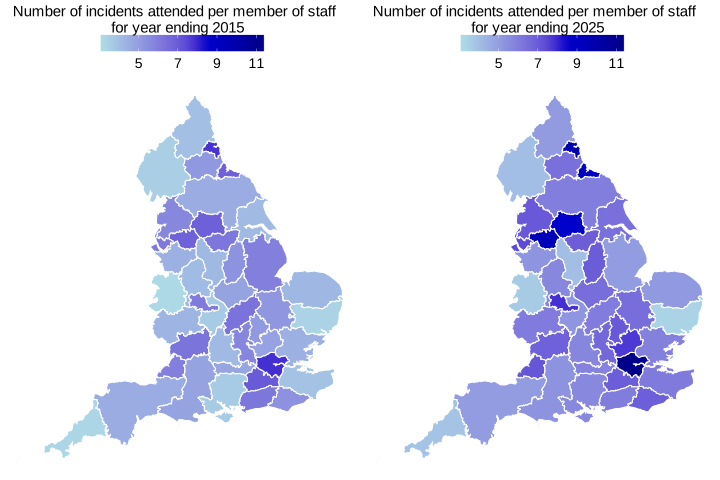
Figure 1.3 below is a map that shows the average number of incidents attended per member of staff (not just firefighters) by FRS, comparing the latest year of data (2025) with a decade previously. The areas with greater averages tend to be in rural areas, as greater numbers of firefighters are required to cover the larger areas. The proportions are, in general, higher in the year ending March 2025 as in the decade prior the number of staff showed a decrease of 8.6%, while the number of incidents showed an increase of 22%.
Figure 1.3: Average number of incidents attended per member of staff by FRS for year ending March 2015 and 2025
Rank of staff
Broadly the percentage in the non-managerial rank has remained consistent over time for each role type:
- 60% of all wholetime firefighters (using FTE) were “non-managerial” on 31 March 2025, this percentage has been remarkably consistent since this information was first collected in 2011
- it’s a similar story with on-call firefighters, but with higher percentages - 72% of all on-call firefighters (using FTE) were “non-managerial” on 31 March 2025
- fire control ranks were again relatively consistent, but this time with lower percentages in the “non-managerial” rank - 52% of all fire control (using FTE) were “non-managerial” on 31 March 2025
FRSs employed 1,843 apprentices (measured by headcount) on 31 March 2025, compared to 1,885 in the previous year. Of these, 875 joined within the year to March 2025.
The percentage of firefighters who were on-call firefighters (using FTE) was 25% in 2002 (the earliest year these data are available). This percentage showed a slow upward trend to 30% in 2016. Since then, the percentage has decreased with it being 26% in 2025.
The ratio of FTE to headcount for on-call firefighters was stable between 2002 (the earliest year these data are available) and 2016 at between 0.81 to 0.85. After then, the ratio decreased notably. It was 0.7 5 years ago in 2020 and 0.7 on 31 March 2025.
Staff leaving and joining FRSs
Information on leavers and joiners are collected on a headcount (that is an individual rather than FTE) basis. The proportion of FRS staff who left or joined is calculated as the number of FRS staff who left or joined in each year as a proportion of the headcount from the previous year, that is the start of the current year. Whilst data covering leavers became available for the year ending March 2010, data covering new joiners became available for the year ending March 2017; however, 8 FRSs were unable to provide new joiner data that year and hence the new joiner figures (2,262 total staff and 1,484 firefighters) were not fully representative. It is worth noting that a staff member can both join and leave FRSs in the same year.
Figure 1.4 shows that the percentages of staff leaving and joining FRSs have been relatively stable since the earliest year for which these data are available.
Consistent high-quality data on leavers and joiners are available from the year ending March 2018 and show that in the year ending March 2025, there were 3,814 (8.5%) leavers and 4,109 (9.1%) joiners. Figure 1.2 shows that 5 of the 8 years had similar percentages of staff leaving and joining FRSs. The exceptions were in 2022, where leavers (4,640 or 10%) clearly exceeded joiners (3,843 or 8.6%), in 2024, where joiners (4,192 or 9.4%) clearly exceeded leavers (3,814 or 8.5%), in 2025, where joiners (4,109 or 9.1%) clearly exceeded leavers (3,814 or 8.5%).
Figure 1.4: Percentage of leavers and new staff, England; year ending March 2018 to year ending March 2025

Source: FIRE1101, FIRE1110 and FIRE1120
Note: Percentages based on the headcount figures at the end of the previous year
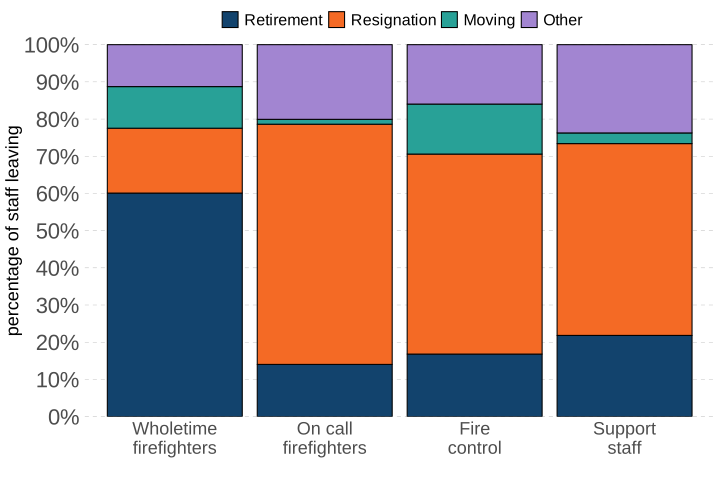
Figure 1.5 shows the main reason staff leave FRSs varies depending on their role. For wholetime firefighters, the most common reason for leaving in the year ending March 2025 was retirement, accounting for 60% or 907; however, for the other role types, it was less than one-fifth of staff - on-call firefighters (14% or 160), fire control (17% or 20) and support staff (22% or 228). In contrast, 17% of wholetime firefighters (263) left FRSs due to resignation in the year ending March 2025, whereas this was the most common category for on-call firefighters (65%, 737), fire control (54%, 64) and support staff (52%, 539). The difference in reason has been broadly consistent for all years that data is available for.
Figure 1.5: Staff leaving FRS by role and reason for leaving, England; year ending March 2025
Source: FIRE1111
2. Diversity of the workforce
Due to concerns with low numbers, and the possible identification of individuals, the breakdowns are not always available by FRS.
Some tables in this section, particularly FIRE1113, FIRE1114 and FIRE1115, are included in response to recommendations 29 and 30 set by HMICFRS in their values and culture in FRSs report from 2023
Key results
On 31 March 2025:
- 9.7% (3,310) of firefighters were women, compared to 9.3% (3,184) in the previous year, 7.0% (2,461) 5 years ago and 4.7% (1,783) 10 years ago - by comparison 36% of police officers in England were women
- 5.6% (1,793) of firefighters were from an ethnic minority[footnote 5], compared to 5.4% (1,701) in the previous year, 4.4% (1,410) 5 years ago and 3.9% (1,321) 10 years ago - by comparison 8.8% of police officers in England and 26%[footnote 6] of the English population were from an ethnic minority
- the average age[footnote 7] of firefighters was 40, this has been broadly stable over the past 10 years, and was 41 10 years ago
- official statistics in development show that 5.6% (1,436) of firefighters declared they were from “other religious groups”[footnote 8], compared to 6.3% (1,486) in the previous year, 6.2% (1,320) 5 years ago and 6.7% (1,114) 10 years ago - in comparison to 11.9%[footnote 9] of the English population
- official statistics in development show that 5.0% (1,263) of firefighters declared as lesbian, gay, bisexual or other (LGB+)[footnote 10], compared to 4.9% (1179) in the previous year, 3.3% (668) 5 years ago and 2.7% (398) 10 years ago - slightly more than the 3.1%[footnote 11] of the English population who reported being LGB+
- official statistics in development show that 5.9% (1,627) of firefighters declared they were disabled, compared to 5.0% (1,360) in the previous year, 4.0% (980) 5 years ago and 2.6% (695) 10 years ago - by comparison 17.4% of the English population stated they were disabled
2.1 Gender
Since 2021, the gender category ‘Other’ and from 2023 the gender category ‘Unknown’ have been included in the data collection. In earlier years, some FRSs would provide this information outside of the returns and these data are now fully incorporated into the tables. In the percentages calculated below, the percentage of women staff is the number of women divided by the number of women, men and other. Unknown gender is not included in the denominator as per the calculations in the other personal characteristics.
Further statistics on FRS workforce diversity regarding gender can be found in tables FIRE1103, FIRE1113, FIRE1120 and FIRE1123.
The number and proportion of firefighters who are women has slowly increased since 2002 (the first year for which comparable data are available) from 1.7% (753) to 9.7% (3,310) on 31 March 2025. For comparison, the percentage of police officers in England on the same day that were women was 36%. While the percentage of firefighters who are women was clearly below levels seen in the police and the population as a whole, as Figure 2.1 shows the percentage of fire control staff who are women (76%) was clearly higher and has been since these data were first collected. The figure also shows the percentage of on-call firefighters who were women was higher in 2002 than the percentage of wholetime firefighters (2.5% compared to 1.3%), this was reversed in 2010 and has been so ever since. On 31 March 2025, the percentage of wholetime firefighters who were women had reached 10% while it was 8.3% for on-call firefighters.
Figure 2.1: Proportion of staff who are women, England; as at 31 March 2002 to 31 March 2025

Source: FIRE1103
Note: X axis labelling is every 3 years starting 2002
The proportion of firefighters recruited in year ending March 2025 who were women was 15% (395), higher than the proportion of all firefighters, and therefore partly responsible for that overall firefighter proportion increasing. However, this figure is still well below levels seen in the police and the population for the percentage of women. Similarly, 15% of apprentice firefighters on 31 March 2025 were women, while higher percentages of apprentice fire control staff (74%) and apprentice support staff (63%) were women.
The proportion of firefighters leaving FRSs in year ending March 2025 who were women was 9.7% (254) - this is the second year this information has been collected and it was 7.2% (190) in the previous year. The other reason the percentage of firefighters that are women has increased is the number of firefighters who are men (30,714) has decreased by 356 in the past year (since 2024).
Brigade Manager (the highest rank of staff) and firefighter (the lowest rank of staff) were the only ranks to show percentages of firefighters that were women higher than the all firefighter figure of 9.7%, with 16% and 12% respectively. The 5 ranks in between (Area Manager, Group Manager, Station Manager, Watch Manager and Crew Manager) showed percentages lower than 9.7%. We have seen this narrative over the past 5 years, and it should be noted that figures for higher ranks are based on relatively small numbers, so are more prone to fluctuation.
Figure 2.2: The proportion of firefighters who are female by FRS in the year ending March 2015 and 2025

2.2 Ethnicity
Since ethnicity is a multifaceted and changing phenomenon, various possible ways of measuring ethnic groups are available. The statistics in this release use the ONS 2021 5+1 classification (where the ethnic groups are “White”, “Mixed”, “Asian or Asian British”, “Black or Black British”, “Other Ethnicity” and “Ethnic origin not stated”). Most of our tables use the same classification and can be found in tables FIRE1104, FIRE1109, FIRE1114, FIRE1121 and FIRE1124. An ad hoc release using the ONS 2021 19+1 classification will be published in our ad hoc statistics section.
The number and proportion of firefighters who are from an ethnic minority has slowly increased since 2011 (the first year for which comparable data are available) from 3.5% (1,385) to 5.6% (1,793) on 31 March 2025. For comparison, the percentage of police officers in England on the same day that were from an ethnic minority was 8.8% and the equivalent figure from the 2021 Census was 26%.
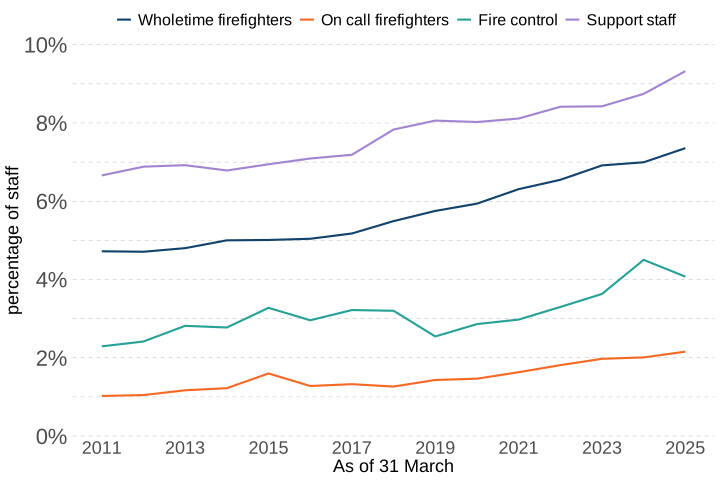
As Figure 2.3 shows, the percentage of all 4 roles from an ethnic minority has been on a slow upward trend. However, in 2025 the percentages of staff who are from an ethnic minority (7.4% for wholetime firefighters, 2.2% for on-call firefighters, 4.1% for fire control and 9.3% for support staff) were also clearly lower than the figure for the general population. This has been the case since these data were collected.
Figure 2.3: Proportion of FRS staff (of known ethnicity) from an ethnic minority group, England; as at 31 March 2011 to 31 March 2025
Source: FIRE1104
Note: X axis labelling is every other year starting 2011
In the year ending March 2025, ethnic minorities accounted for 7.9% of firefighters recruited, a higher proportion than for all firefighters (5.6%), and therefore partly responsible for the increase in the percentage of firefighters from an ethnic minority in the latest year. This figure is still well below levels seen in the police and the England-wide population for the percentage of people from an ethnic minority. The proportion of firefighters leaving FRSs in year ending March 2025 who were from ethnic minorities was 4.6% (109) - this is the second year this information has been collected and it was 4.3% (100) in the previous year. Similarly on 31 March 2025, 11% of apprentice firefighters, 0.0% of apprentice fire control staff and 10% apprentice support staff were from an ethnic minority.
The percentage of firefighters not stating an ethnicity on 31 March 2025 was 8.5%, a figure in line with previous years. A high not stated percentage may affect the robustness of the estimates or could indicate that the value of this ethnic diversity information is not well understood or communicated within FRSs. Northumberland had a percentage of all staff not stating an ethnicity over 50%.
Firefighter (the lowest and most common rank of staff) was the only rank to show a percentage of firefighters that are from an ethnic minority (6.7%) higher than the all firefighter figure of 5.6%. The 6 ranks above (Brigade Manager, Area Manager, Group Manager, Station Manager, Watch Manager and Crew Manager) all showed percentages lower than 5.6%. We have seen this broad story over the past 5 years, and it should be noted that figures for higher ranks are based on relatively small numbers, so are prone to fluctuation.
Figure 2.4: The proportion of firefighters from an ethnic minority by FRS in the year ending March 2025 and in the resident population in 2021

2.3 Age
Further statistics on FRS workforce diversity regarding age can be found in tables FIRE1105, FIRE1115, FIRE1122 and FIRE1125.
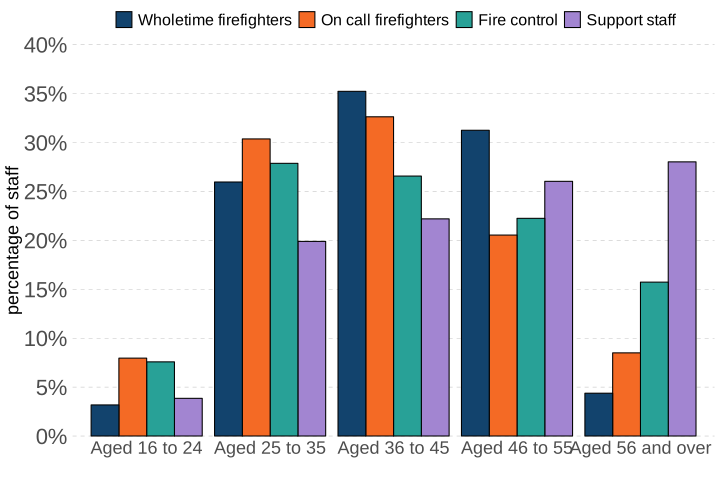
As of 31 March 2025, being aged between 36 and 45 years was the most common age category for firefighters. This age category made up 34% (11,918) of all firefighters. This is broadly consistent with recent years, with 34% (12,040) in the previous year, 33% (11,697) 5 years ago and 35% (13,362) 10 years ago. For context, 20% of the working age population was aged between 35 and 44 years of age, according to the 2021 Census[footnote 12]. Aged between 36 and 45 years has been the most common age category for firefighters since 2021, aged between 46 and 55 years was the most common category for the 4 years before that and between 36 and 45 years the most common category between 2011 and 2016.
As Figure 2.5 shows, on 31 March 2025 the percentage of FRS staff aged 24 years and under was relatively low for all 4 roles, while the percentage of FRS staff aged 56 years and over was relatively high for support staff (28%) and fire control (16%) but low for on-call firefighters (8.5%) and wholetime firefighters (4.4%). This narrative is repeated from previous years.
Figure 2.5: Proportion of staff by age category and role, England; as at 31 March 2025
Source: FIRE1105
2.4 Religion
These statistics are designated as official statistics in development.
Further statistics on FRS workforce diversity regarding religion can be found in tables FIRE1106 and FIRE1109.
Data for the religion of FRS staff have been collected since 2011. The most common religions for FRS staff, like the general population, have always been Christian and ‘no religion’. In 2022, more firefighters declared as having ‘no religion’ than Christian for the first time in the series, and this has continued each year since.
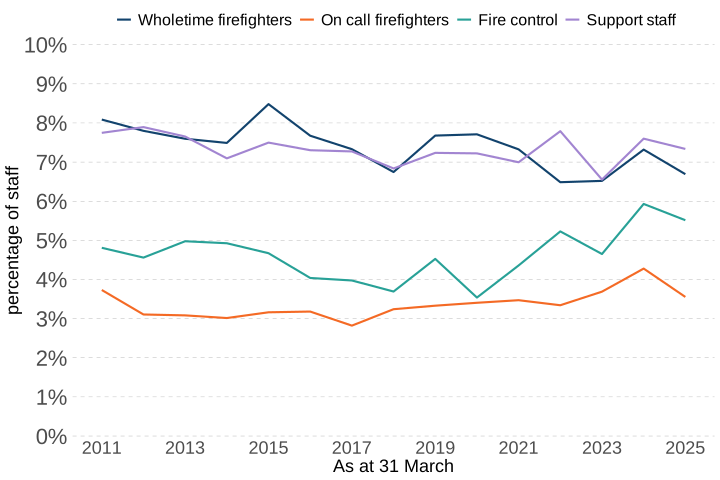
The proportion of firefighters who are from other religious groups (Buddhist, Hindu, Jewish, Muslim, Sikh or Other religions) has been broadly stable from 2011 at 6.8% (1,046) to 5.6% (1,436) in 2025. For comparison, the equivalent figure from the 2021 Census was 11.9%. As Figure 2.6 shows, the percentage of fire control staff and support staff who declared that they were from other religious groups were 5.5% and 7.3% respectively in 2025. All 4 roles have shown percentages substantially lower than the percentage for the general population and they have been clearly lower since these data were first collected.
Figure 2.6: Proportion of FRS staff stating other religious groups as their religion, England; as at 31 March 2011 to 31 March 2025
Source: FIRE1106
Note: X axis labelling is every other year starting 2011
The percentage of all staff (not just firefighters) not stating a religion (either because the FRS does not collect the information or because the staff member has opted to not state) on 31 March 2025 was 25%. This figure was 55% 10 years ago and has been on a downward trend since it was first collected in 2011. A high not stated percentage may affect the robustness of the estimates or could indicate that the value of this religious diversity information is not well understood or communicated within FRSs. Berkshire, Isles of Scilly and Northumberland all had percentages of all staff not stating a religion over 80%.
2.5 Sexual orientation
These statistics are designated as official statistics in development. The sexual orientation options of ‘Bisexual’, ‘Gay/Lesbian’, ‘Heterosexual’, ‘Other’ or ‘Sexual Orientation Not Stated’ are available in our data collection. The percentage of staff who report as LGB+ is calculated by dividing the number of LGB+ (lesbian, gay, bisexual or other) staff by the sum of all stated orientations. Not stated and not collected sexual orientations are not included in the denominator. The 2021 Census has further sexual orientation categories, which are not included in our data collection. We shall consider including these in future collections as we have with ‘Other’ in recent years.
Further statistics on FRS workforce diversity regarding sexual orientation can be found in tables FIRE1107 and FIRE1109.
Data for the sexual orientation of FRS staff have been collected since 2011. The proportion of firefighters who declared as LGB+ was broadly stable from 3.0% (379) in 2011 to 3.4% (750) in 2021, then the past 4 years have shown increases to reach 5.0% in 2025. For comparison, the equivalent figure from the 2021 Census was 3.1%. As Figure 2.7 shows, the percentage of fire control staff and support staff who report as LGB+ were broadly similar to firefighters, 7.2% and 4.7% respectively in 2025. These figures were either in line with or slightly above the figure for the general population and have been since these data were collected.
Figure 2.7: Proportion of FRS staff reporting as LGB+, England; as at 31 March 2011 to 31 March 2025

Source: FIRE1107
Note: X axis labelling is every other year starting 2011
The percentage of all staff (not just firefighters) not stating a sexual orientation (either because the FRS does not collect the information or because the staff member has opted to not state) on 31 March 2025 was 26%. This figure was 60% 10 years ago and has been on a downward trend since it was first collected in 2011. A high not stated percentage may affect the robustness of the estimates or could indicate that the value of this religious diversity information is not well understood or communicated within FRSs. Cornwall (70%), Northumberland (63%), Suffolk (55%), Oxfordshire (55%) and Cumbria (52%) all had percentages of all staff not stating a sexual orientation over 50%.
2.6 Disability
These statistics are designated as official statistics in development.
Further statistics on FRS workforce diversity regarding disability status can be found in tables FIRE1108 and FIRE1109.
Data for the disability status of FRS staff have been collected since 2011. The proportion of firefighters who declared as disabled has shown a broad upward trend from 2011 at 2.1% (662) to 5.9% (1,627) in 2025. For comparison, the equivalent figure from the 2021 Census was 17%. As Figure 2.8, shows the percentages of fire control staff and support staff who report as disabled were higher, at 11% and 11% respectively in 2025.
Figure 2.8: Proportion of FRS staff stating they are disabled, England; as at 31 March 2011 to 31 March 2025

Source: FIRE1108
Note: X axis labelling is every other year starting 2011
The percentage of firefighters not stating a disability status (either because the FRS does not collect the information or because the staff member has opted to not state) on 31 March 2025 was 21%, this figure was 29% 10 years ago and has been broadly similar since it was first collected in 2011. A high not stated percentage may affect the robustness of the estimates or could indicate that the value of this disability diversity information is not well understood or communicated within FRSs. Northumberland, Isles of Scilly and Cornwall all had percentages of all staff not stating a disability status over 80%.
The percentage of all staff (not just firefighters) not stating a disability status (either because the FRS does not collect the information or because the staff member has opted to not state) on 31 March 2025 was 20%. This figure was 28% 10 years ago and has been on a downward trend since it was first collected in 2011. A high not stated percentage may affect the robustness of the estimates or could indicate that the value of this disability diversity information is not well understood or communicated within FRSs. Cornwall, Isles of Scilly and Northumberland all had percentages of all staff not stating a disability status over 80%.
3. Firefighters’ health and safety
Data on injuries sustained by on-duty firefighters and whether they were sustained during operational incidents (at fires, road traffic collisions or at other special service incidents) or during training (operational or fitness) and routine activities are collected in the Operational Statistics collection. The collection asks for the total number of personnel injured, the number of ‘over 7-day injuries’, the number of RIDDOR[footnote 13] major injuries, and the number of fatalities.
Data on vehicle incidents are also collected in the Operational Statistics collection. FRSs are asked to provide the number of accidents involving their vehicles in the latest year. More detail on the data collection is provided in the Further Information section.
Key results
During the year to March 2025:
- there were 2,631 firefighter personnel injured on duty, an increase of 9.3% compared to the previous year (2,408), an increase of 6.7% compared to 5 years ago (2,466) and virtually unchanged compared to 10 years previously (2,627)
- there was 1 firefighter fatality while on-duty, there have been 3 in the past decade
- 53 of the 2,631 firefighter personnel injured were classified as having “major injuries”[footnote 14], which compares to 35 in the previous year, 52 5 years ago and 81 10 years previously
- 1,120 of the 2,631 firefighter personnel injured (43%) were injured during operational incidents, which compares to 987 (41%) in the previous year, 963 (39%) 5 years ago and 1,037 (39%) 10 years previously - all other personnel injured occurred during training or routine activities
- there were 2,859 accidents involving FRS vehicles compared to 2,926 in the previous year (a decrease of 2.3%), 2,904 5 years ago (a decrease of 1.5%) and 2,831 10 years ago (an increase of 1.0%)
Firefighter fatalities
The number of firefighter fatalities on-duty are small, however the trend since the mid-1980s has been downwards. In the 10 years to March 1996 (the first 10 years for which consistent data are available), there were 30 such fatalities, in the most recent 10 years (to March 2025) there were 3.
Firefighter personnel injured
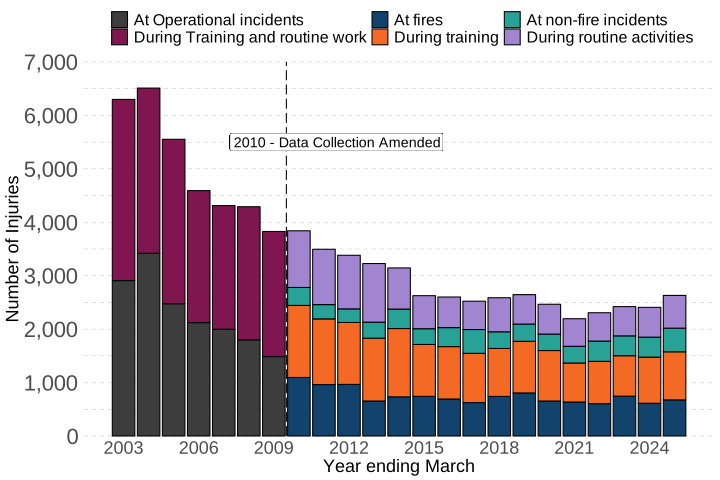
Figure 3.1 shows from the year to March 2003 (the earliest year for which consistent data are available) the number of firefighter personnel injured was on a downward trend. This downward trend was faster in the first decade of 2000s. In the past decade, the trend has declined very slowly. The proportion of these firefighter personnel injured during operational incidents has increased over the past 10 years, from 39% 10 years ago to 43% in the year to March 2025.
Figure 3.1: Total firefighter personnel injured by activity type, England; year ending March 2003 to year ending March 2025
Source: FIRE0508
Note: X axis labelling is every 3 years starting 2003
Accidents involving FRS vehicles
The number of accidents involving all types of FRS vehicles generally declined from around 3,750 in the year ending March 2011 (when comparable data became available) to around 2,760 in the year ending March 2016. Since then, the number of accidents has fluctuated year-on-year. There was a notable decrease in the year ending March 2021 to around 2,240 accidents, likely due to the impact of COVID-19 restrictions on traffic levels and incident numbers. In the year ending March 2025, there were 2,859 accidents involving all types of FRS vehicles.
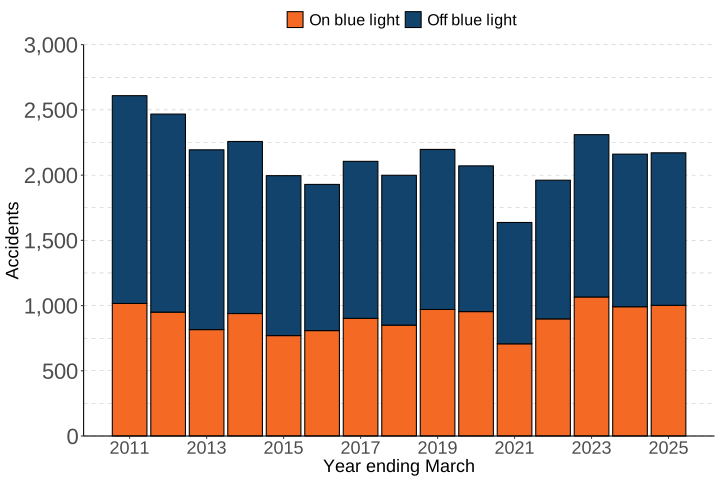
Figure 3.2 shows accidents involving just fire appliances, which generally declined from around 2,610 in the year ending March 2011 (when comparable data became available) to around 1,930 in the year ending March 2016. Since then, the number of accidents has fluctuated year-on-year. There was a notable decrease in the year ending March 2021 to around 1,640 accidents, likely due to the impact of COVID-19 restrictions on traffic levels and incident numbers. In the year ending March 2025, there were 2,171 accidents involving just fire appliances.
Figure 3.2: Total road vehicle accidents in fire appliances on/off blue light, England; year ending March 2011 to year ending March 2025
Source: FIRE1402
Note: X axis labelling is every other year starting 2011
4. Attacks on firefighters
This section summarises the number of incidents attended by FRSs in England involving an attack on firefighters. The statistics are sourced from the MHCLG Recording System. It should be noted that the system does not provide a complete picture of attacks on firefighters, as it only covers incidents attended by firefighters through an emergency call. It does not cover attacks occurring on training or routine activities. In addition, it provides a count of the number of incidents that involved an attack not the number of attacks, as more than 1 firefighter could have been attacked at 1 incident. The system only allows 1 option of type of attack to be coded and FRSs record the 1 that best describes it, so there may be an undercount of some types of attacks, and it may be possible for verbal attacks to include an injury and vice versa.
Key results
During the year to March 2025:
- there were 933 incidents involving an attack on firefighters (including verbal abuse), a decrease of 3.7% (or 36 incidents) on the previous year
- these incidents resulted in 129 injuries to firefighters, of which 116 were classed as slight and 13 as serious (requiring a hospital stay)
- the majority of incidents involving an attack were categorised as verbal abuse (62%, 574 incidents)
As Figure 4.1 shows, since consistent figures became available in 2011, the number of incidents involving an attack on firefighters reached a low of 578 incidents in the year ending March 2015. There was a rapid increase to 931 over the following 3 years. Since the year ending March 2018, the number of attacks on firefighters has plateaued at a level higher than previously including the highest figure, since consistent figures became available in 2011, of 1,030 in the year ending March 2023. During the year to March 2025 there were 933 incidents involving an attack on firefighters.
Figure 4.1: The number of incidents involving an attack on firefighters, England; year ending March 2011 to year ending March 2025

Source: FIRE0510
Note: X axis labelling is every other year starting 2011
The number of injuries sustained in these attacks are more liable to fluctuation because of the relatively small numbers involved. In the year ending March 2025, there were 129 injuries in total, 13 of these were classed as serious and 116 were classed as slight. This compares to 96 injuries (14 serious and 82 slight) injuries in the previous year.
5. Firefighters’ pensions
This section provides income, expenditure and membership data submitted by all 44 FRSs in England. This includes data from 1 April 2024 to 31 March 2025. A full list of definitions used in this section is available in the Fire statistics definitions guidance document.
Key results
During the financial year 2024 to 2025:
- the Firefighters’ Pension Scheme total expenditure was around £1,159 million, an increase of 11% compared with the previous year (£1,041 million in financial year 2023 to 2024), an increase of 28% on 5 years previously (£909 million in financial year 2019 to 2020) and an increase of 55% on 10 years previously (£747 million in financial year 2014 to 2015)
- 84% of expenditure was ‘recurring outgoing payments’, 15% was ‘commutation payments’, while ‘transfers’ and ‘miscellaneous expenditure’ together totalled 0.5%
- the Firefighters’ Pension Scheme total income was around £560 million, an increase of 28% compared with the previous year (£438 million in financial year 2023 to 2024), an increase of 44% on 5 years previously (£388 million in financial year 2019 to 2020) and an increase of 85% on 10 years previously (£303 million in financial year 2014 to 2015)
- employer contributions increased by 36% to £396 million, from £292 million in financial year 2023 to 2024, increased by 53% compared to £259 million in financial year 2019 to 2020 but increased by 134% compared to £169 million in financial year 2014 to 2015, this large increase was due to changes to the discount rate set by HM Treasury from April 2019
- 71% of income was ‘employer contributions’, 26% was ‘employee contributions’ and the remaining 2.8% comprised a combination of transfers, miscellaneous income and ill-health charges
- the Firefighters’ Pension scheme deficit was around £-600 million, virtually unchanged compared with the previous year (£-602 million in financial year 2023 to 2024), an increase of 15% on 5 years previously (£-521 million in financial year 2019 to 2020) and an increase of 35% on 10 years previously (£-444 million in financial year 2014 to 2015)
5.1 Pension scheme expenditure and income
As Figure 5.1 shows, the firefighters’ pension scheme expenditure has been on a broad upward trend, from around £604 million in the financial year 2010 to 2011 (the earliest year for which comparable data are available) to a peak of £892 million in the financial year 2015 to 2016. The Firefighters’ Pension Scheme total expenditure decreased in the year following but then continued to rise, reaching £1,159 million in the financial year 2024 to 2025.
Figure 5.1: Firefighters’ pension scheme expenditure in England, financial year 2010 to 2011 to financial year 2024 to 2025

Source: FIRE1301
Note: X axis labelling is every other year starting 2011
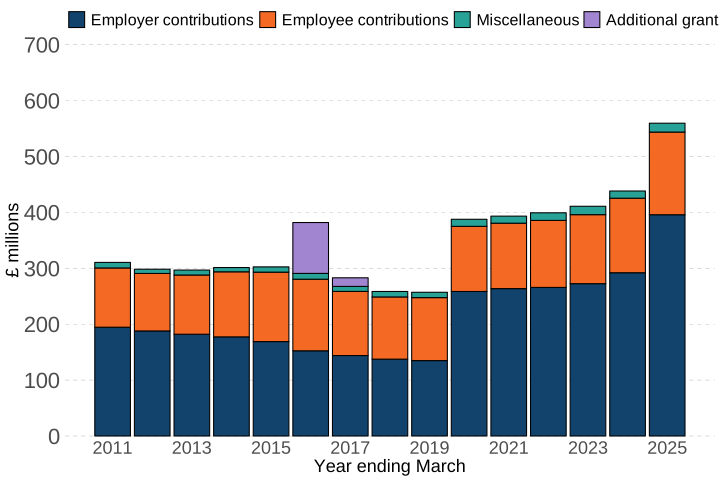
The Firefighters’ pension scheme income was broadly stable from financial year 2010 to 2011 (the first year for which comparable data are available), until financial year 2014 to 2015, at around £300 million per year. Since then, excluding the additional grant payments received by FRSs from central government following the Government Actuary Department (GAD) v Milne case[footnote 15] and the employee contributions holiday, income decreased gradually to a low of £257 million in financial year 2018 to 2019. However, in financial year 2019 to 2020, income increased by 51% to £388 million, mainly due to employer contributions nearly doubling to £259 million from £135 million in the previous year, following changes in the discount rate set by HM Treasury from April 2019. For more information, see the House of Commons Library ‘Public service pensions - employer contributions’ briefing. As Figure 5.2 shows, pension scheme income has continued to rise, reaching £560 million in the financial year 2024 to 2025.
Figure 5.2: Firefighters’ pension scheme income in England, financial year 2010 to 2011 to financial year 2024 to 2025
Source: FIRE1302
Note: X axis labelling is every other year starting 2011
There were 8 consecutive years of rising deficits in the firefighters’ pension scheme between financial year 2010 to 2011 and financial year 2018 to 2019, due to the general trend of increasing expenditure and decreasing income. However, in financial year 2019 to 2020, a nearly doubled employer contribution reversed this trend, resulting in the first deficit reduction, since comparable data became available. This trend continued in financial year 2020 to 2021, although at a slower rate. Since then, the firefighters’ pension scheme deficit has increased, due to the large increases in expenditure. The Firefighters’ Pension scheme deficit was around £-600 million in the financial year 2024 to 2025.
5.2 Pension scheme membership
The membership data refer to 2016 to 2025 only. This is due to a change in the way Firefighters’ Pension Fund (FPF) forms collected data on membership, which means that data are not directly comparable with previous years.
As of 31 March 2025:
- there were 52,052 pensioner members and of these 86% (44,828) were members who have retired and were in receipt of benefits from the 1992 Scheme
- 5.3% of pensioner members were in the 2015 Scheme, an increase from the 14% in the previous year, and the remaining 8.6% were part of the 2005 Scheme
- there were 28,082 deferred members, of which 20% were still employed as a firefighter
- there were 22,796 active regular members and 13,036 active retained members of firefighter pension schemes, all of who belonged to the 2015 Scheme (as the 1992 and 2006 Schemes closed to accrual on 1 April 2022).
MHCLG is no longer collecting information on pension scheme membership opt-outs. For the most recent figures on these, please see Fire and rescue workforce and pensions statistics: England, April 2017 to March 2018.
Further information on fire pension scheme membership can be found in fire data tables FIRE1304 and FIRE1305 (where FIRE1305 is no longer updated).
6. Summary of changes over time
Table 6.1: FRS workforce totals (FTE), comparing the year ending March 2025 with 1, 5 and 10 years previously
| Role | Year ending March 2025 | Year ending March 2024 | 1-year change | Year ending March 2020 | 5-year change | Year ending March 2015 | 10-year change |
|---|---|---|---|---|---|---|---|
| All Staff | 40,082 | 39,851 | 0.6% | 40,135 | -0.1% | 43,876 | -8.6% |
| Total Firefighters | 30,601 | 30,769 | -0.5% | 31,912 | -4.1% | 35,699 | -14% |
| Wholetime firefighters | 22,740 | 22,802 | -0.3% | 22,638 | 0.5% | 25,098 | -9.4% |
| On-call firefighters | 7,860 | 7,967 | -1.3% | 9,275 | -15% | 10,602 | -26% |
| Fire control | 1,149 | 1,120 | 2.6% | 1,078 | 6.6% | 1,120 | 2.5% |
| Support staff | 8,333 | 7,962 | 4.7% | 7,144 | 17% | 7,056 | 18% |
Table 6.2: Firefighter diversity, comparing the year ending March 2025 with 1, 5 and 10 years previously
| Diversity Characteristic | Year ending March 2025 | Year ending March 2024 | 1-year change | Year ending March 2020 | 5-year change | Year ending March 2015 | 10-year change |
|---|---|---|---|---|---|---|---|
| Women | 9.7% | 9.3% | 0.4pp | 7.0% | 2.7pp | 4.7% | 5.0pp |
| Ethnic minority group | 5.6% | 5.4% | 0.3pp | 4.4% | 1.2pp | 3.9% | 1.7pp |
| Other religious groups | 5.6% | 6.3% | -0.7pp | 6.2% | -0.6pp | 6.7% | -1.1pp |
| LGB+ | 5.0% | 4.9% | 0.1pp | 3.3% | 1.8pp | 2.7% | 2.3pp |
Note:
- pp in this instance means percentage points
Table 6.3: Fire Pensions, comparing the year ending March 2025 with 1, 5 and 10 years previously (in £m)
| Financial component | Year ending March 2025 | Year ending March 2024 | 1-year change | Year ending March 2020 | 5-year change | Year ending March 2015 | 10-year change |
|---|---|---|---|---|---|---|---|
| Income | 560 | 438 | 28% | 388 | 44% | 303 | 85% |
| Expenditure | 1159 | 1041 | 11% | 909 | 28% | 747 | 55% |
| Surplus/ Deficit | -600 | -602 | -0.5% | -521 | 15% | -444 | 35% |
Note:
- In Surplus/Deficit row “+” refers to surplus and “-“ refers to deficit
Source: Fire statistics data tables
7. Further information
This release contains administrative statistics about workforce and pensions for fire and rescue services (FRSs) in England. This release also contains statistics from the MHCLG’s online Recording System for incidents attended by FRSs where there were attacks on firefighters.
Fire and rescue incident statistics and other MHCLG statistical releases are available via the Ministry of Housing, Communities and Local Government statistics release calendar pages pages on the GOV.UK website.
Data tables linked to this release and all other fire statistics releases can be found on the MHCLG’s Fire statistics data tables page. The most relevant tables for each topic are signposted at the end of each section in this release.
Guidance for using these statistics and other fire statistics outputs is available on the fire statistics collection page.
The information published in this release is kept under review, taking into account the needs of users and burdens on suppliers and producers, in line with the Code of Practice for Statistics. If you have any comments, suggestions or enquiries, please contact the team via email using firestatistics@communities.gov.uk.
All fire-related Ministerial responsibilities moved from the Home Office to the Ministry of Housing, Communities and Local Government (MHCLG) on 1 April 2025. This change followed a recommendation from the Phase 2 report of the Grenfell Tower Inquiry, to bring all fire safety functions under one department. Therefore, as part of this move, all statistical publications and analysis on fire functions were also subject to the Machinery of Government (MoG) change.
Official statistics in development
Statistics on religion, sexual orientation and disability are included as Official statistics in development (previously known as experimental statistics) due to some quality limitations and other issues which users should be aware of, for example:
- some FRSs do not collect these data
- the data contain a relatively high proportion of ‘not stated’ entries; the proportion varies significantly across different FRSs, 25% of data for religion, 26% of data for sexual orientation and 20% for disability are either not collected or not stated in 2025 (hence the figures may not be fully representative of FRSs as a whole)
The statistics serve a public good in understanding the diversity of the FRS workforce but given the current quality limitations they are published as ‘official statistics in development’. Official statistics in development are statistics which are published in order to involve users and stakeholders in their development and as a means to build in quality at an early stage. Statisticians have been working, and will continue to work with the FRSs who do not collect these data and with those with the highest proportions of ‘not stated’ to try to improve the data.
Revisions
The figures in this release refer to activity that occurred in the year ending 2025. The statistics published may not match those held locally by FRSs and revisions may occur in the future.
The analysis of attacks on firefighters, which use data from the IRS, are based on records of incidents that occurred up to and including the year ending 31 March 2025. This includes incident records that were submitted to the IRS by 1 May 2025, when a snapshot of the database was taken for the purpose of analysis. As a snapshot of the database was taken, the statistics published may not match those held locally by FRSs, and revisions may occur in future.
Other related publications
MHCLG publish 5 other statistical releases covering fire and rescue services.
These are:
- Fire and rescue incident statistics: National Statistics on fires, casualties, false alarms and non-fire incidents attended by the fire and rescue services in England.
- Detailed analysis of fires and response times attended by fire and rescue services in England: focuses on fires attended by fire and rescue services across England, fire-related fatalities and non-fatal casualties in those fires; including analyses of the causes of fires, smoke alarm ownership and operation, average response times to fires attended by fire and rescue services
- Detailed analysis of non-fire incidents attended by fire and rescue services, England: focuses on non-fire incidents attended by fire and rescue services across England, including analysis on overall trends, fatalities and non-fatal casualties in non-fire incidents, and further detailed analysis of different categories of non-fire incidents
- Fire prevention and protection statistics, England: focuses on trends in smoke alarm ownership, fire prevention and protection activities by fire and rescue services
- the English Housing Survey: fire and fire safety report focuses on the extent to which the existence of fire and fire safety features vary by household and dwelling type and this report focuses on whether people felt safe from fire in their homes by household and dwelling type
Fire statistics are published by the other UK nations:
Scottish fire statistics and Welsh fire statistics are published based on the IRS. Fire statistics for Northern Ireland are published by the Northern Ireland Fire and Rescue Service using data from a system similar to the IRS, which means that it is not directly comparable to English, Welsh and Scottish data.
-
Full-time equivalent (FTE) is the stronger measure of total staff as it accounts for level of part-time staff. A member of staff working full-time would be considered as 1 in FTE, a member of staff working 80% of full-time hours would be considered as 0.8 in FTE. Headcount measures purely the number of staff. ↩
-
Taken from Police Workforce statistics, it should be remembered that the headline figures in the Police release are for England AND Wales, whereas the figures in this release are for just England. ↩
-
Gender data for England are taken from the 2011 and 2021 Censuses. ↩
-
Headcount is a simple measure of the number of staff, not accounting for whether staff are full or part time. In our statistics headcount is used when collecting diversity data ↩
-
Since ethnicity is a multifaceted and changing phenomenon, various possible ways of measuring ethnic groups are available and have been used over time. Work continues to align with the harmonisation standard. ↩
-
The source for this is the 2021 Census. ↩
-
This figure is indicative. It is calculated using average ages for each age band collected and therefore should be used with caution. ↩
-
“Other religious groups” are any religion that is not Christian or ‘No religion’. This would include Buddhist, Hindu, Jewish, Muslim, Sikh and other religions and follows the categorisation used by the Office for National Statistics for the 2021 Census. ↩
-
The source for this is the 2021 Census. ↩
-
MHCLG only collects LGB and ‘Other’ sexual orientation information but aim to collect a wider range of sexual orientation information in the future. ↩
-
The source for this is the 2021 Census. ↩
-
See 2021 Census data by age bands here - Population and household estimates, England and Wales - Office for National Statistics (ons.gov.uk) ↩
-
Reporting of Injuries, Diseases and Dangerous Occurrences Regulations (RIDDOR) ↩
-
Reportable major injuries are: fracture other than to fingers, thumbs or toes; amputation; dislocation of the shoulder, hip, knee or spine; loss of sight (temporary or permanent); chemical or hot metal burn to the eye or any penetrating injury to the eye; injury resulting from an electric shock or electrical burn leading to unconsciousness or requiring resuscitation or admittance to hospital for more than 24 hours; any other injury: leading to hypothermia, heat-induced illness or unconsciousness; or requiring resuscitation; or requiring admittance to hospital for more than 24 hours; unconsciousness caused by asphyxia or exposure to harmful substance or biological agent; acute illness requiring medical treatment, or loss of consciousness arising from absorption of any substance by inhalation, ingestion or through the skin; acute illness requiring medical treatment where there is reason to believe that this resulted from exposure to a biological agent or its toxins or infected material. ↩
-
For further information on the GAD v Milne case see Firefighters’ pension scheme: additional payments in respect of past commutations. ↩