Children in low income families: local area statistics, financial year ending 2025
Published 26 March 2026

© Crown copyright 2026
This publication is licensed under the terms of the Open Government Licence v3.0 except where otherwise stated. To view this licence, visit nationalarchives.gov.uk/doc/open-government-licence/version/3 or write to the Information Policy Team, The National Archives, Kew, London TW9 4DU, or email: psi@nationalarchives.gov.uk.
Where we have identified any third party copyright information you will need to obtain permission from the copyright holders concerned.
This publication is available at https://www.gov.uk/government/statistics/children-in-low-income-families-local-area-statistics-2022-to-2025/children-in-low-income-families-local-area-statistics-financial-year-ending-2025
This bulletin contains Official Statistics on the number and proportion of children living in low income families, After Housing Costs (AHC) and Before Housing Costs (BHC), across the United Kingdom by local area for the financial year ending (FYE) 2025. This is an annual release and the next release will be in Spring 2027.
Feedback and queries about the statistics are welcome and can be sent to stats.consultation-2018@dwp.gov.uk.
1. Main stories
The headline statistics for this release are:
After Housing Costs
- In financial year ending (FYE) 2025, there were 3.27 million children aged 0 to 15 (26%) in families in Relative low income, a small decrease (27 thousand) from the previous year
- The West Midlands has the highest proportion of children aged under 16 in Relative low income families (32%) and Scotland the lowest (15%)
- At a local level, the proportion of children aged under 16 living in Relative low income families ranges from 8% in East Dunbartonshire (Scotland) to 50% in Tower Hamlets (London)
Before Housing Costs
- In financial year ending (FYE) 2025, there were 2.43 million children aged 0 to 15 (19%) in families in Relative low income, an increase of 3% over the year and an increase of 7% from FYE 2022
- The West Midlands and Yorkshire and the Humber have the highest proportion of children aged under 16 in Relative low income families (both 27%) and Scotland the lowest (12%)
- At a local level, the proportion of children aged under 16 living in Relative low income families ranges from 5% in Richmond upon Thames (London) to 41% in Pendle (North West)
2. What you need to know
As the preferred measure amongst the majority of users, commentary in this Bulletin focuses mainly on Relative low income, however the full range of statistics for Relative and Absolute low income Before Housing Costs and for Relative low income After Housing Costs are available in the accompanying tables alongside proportions of children in low income, and on Stat-Xplore.
New After Housing Costs (AHC) series
Following the successful completion of discovery work and a consultation paper, this statistical release includes AHC statistics for local area child poverty. Data is available for FYE 2024 and FYE 2025 for Relative low income. Figures prior to this are not available as the proportion of families with unknown housing costs is higher than the threshold for which reliable statistics can be derived.
Further information is available in the Background Information and Methodology on the administrative sources of housing costs data and on the methodology deployed to develop these new AHC series across the UK.
Revisions
There are revisions to the back-series at UK, regional and local area level due to changes in HBAI estimates as a result of an improved approach to using administrative data in place of Family Resources Survey (FRS) responses, and a change to the absolute low income reference year (moving from FYE 2011 to FYE 2025). Further information on the HBAI statistics is available.
These changes mean that data prior to FYE 2022 is not available on a consistent basis in this release.
Comparisons to Households Below Average Incomes Survey
This statistical series calibrates figures to HBAI single-year UK estimates. Further information is available in the Background Information and Methodology on differences between these statistics and HBAI statistics at regional level, and advice on when to use each series.
3. Proportion of children living in low income families
Figures are presented for After and Before Housing costs Relative low income for children aged under 16, unless stated otherwise. Numbers for children in Absolute low income families, including those aged 16 to 19, can be found on Stat-Xplore.
After Housing Costs (AHC)
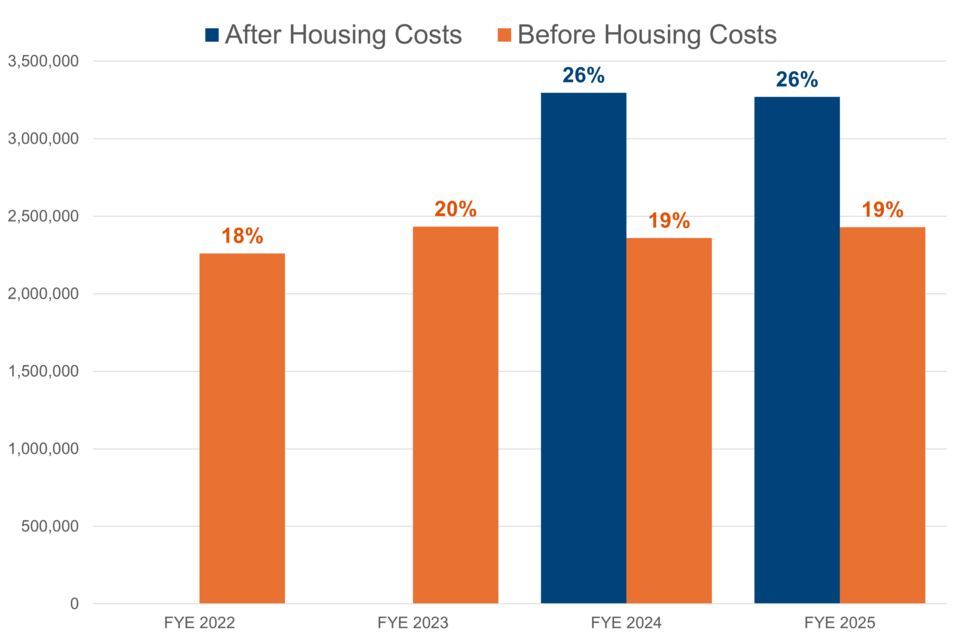
In the FYE 2025, there were 3.27 million children (aged 0 to 15) in families in Relative low income across the United Kingdom. This is a decrease of 27 thousand (1%) on the previous year. The proportion of children aged under 16 in Relative low income families was 26%, no substantial change from the previous year.
Before Housing Costs (BHC)
In the FYE 2025, there were 2.43 million children (aged 0 to 15) in families in Relative low income across the United Kingdom. This is an increase of 70 thousand (3%) on the previous year and an increase of 169 thousand (7%) from FYE 2022. The proportion of children aged under 16 in Relative low income families was 19%, no substantial change on the previous year and an increase of 1 percentage points from FYE 2022.
Figure 1: Number and proportion of children aged under 16 in Relative low income families United Kingdom, After and Before Housing Costs, FYE 2022 to 2025
The proportion of children in low income families has remained broadly stable over the last 4 years.
Source: DWP Stat-Xplore, Children in Low Income Families, local authority by age and ONS Nomis, Population Estimates
4. At a regional level
Figure 2: Proportion of children in low income families by region, After and Before Housing Costs, United Kingdom, FYE 2025
London is the region with the greatest difference between the proportion of children in low income families After and Before Housing Costs.
| Region | After Housing Costs | Before Housing Costs |
|---|---|---|
| United Kingdom | 26.0% | 19.3% |
| North East | 28.9% | 25.1% |
| North West | 29.1% | 24.5% |
| Yorkshire and The Humber | 30.8% | 27.0% |
| East Midlands | 26.5% | 21.5% |
| West Midlands | 32.2% | 27.1% |
| East of England | 23.4% | 16.1% |
| London | 30.7% | 15.6% |
| South East | 20.8% | 13.0% |
| South West | 23.1% | 16.3% |
| Wales | 26.1% | 21.2% |
| Scotland | 14.8% | 12.3% |
| Northern Ireland | 20.5% | 18.9% |
Source: DWP Stat-Xplore, Children in Low Income Families, local authority by age and ONS Nomis, Population Estimates
After Housing Costs, West Midlands (32%) followed by Yorkshire and the Humber and London (both 31%) regions have the highest proportion of children in low income families. Scotland (15%) and Northern Ireland (20%) have the lowest.
Before Housing Costs, West Midlands and Yorkshire and the Humber (both 27%) have the highest proportion of children in low income families. Scotland (12%) and the South East (13%) have the lowest.
Figure 3: Percentage of Local Authorities where the proportion of children in Low Income families is greater than the United Kingdom average, by region, FYE 2025
After Housing Costs in the North East, for 8 out of 10 Local Authorities (LAs) the proportion of children in (relative) low income families is greater than the UK average (26%).

Source: DWP Stat-Xplore, Children in Low Income Families, local authority by age and ONS Nomis, Population Estimates, local authority by age
The impact of housing costs on the proportion of children in low-income families can vary across regions. After Housing Costs, all LAs within Scotland and Northern Ireland are lower than the UK average of 26%. Before Housing Costs, Scotland has 3% of LAs and Northern Ireland has 55% of LAs higher than the UK average of 19%. Within London, 76% of LAs are higher than the UK average After Housing Costs, but only 15% are above the UK average Before Housing Costs.
While child poverty rates within regions is a useful indicator, it can mask substantial variation within countries and regions; if a region contains areas with both very high and very low rates of poverty, the average rate for that region will not reflect this variation. This is where statistics at lower levels of geography can provide valuable additional insights.
5. At a Local Authority level
Figure 4: Proportion of children aged under 16 in Relative low income families by local authority (quintiles), United Kingdom, FYE 2025
At a local authority level, After Housing Costs, the proportion of children aged under 16 living in Relative low income families ranges from 8% in East Dunbartonshire (Scotland) to 50% in Tower Hamlets (London).

Source: DWP Stat-Xplore, Children in Low Income Families, local authority by age and ONS Nomis, Population Estimates, local authority by age
The proportion of children in low income families across LAs is classified using quintiles where the top quintile is shown in the darkest shade, and the bottom quintile in the lightest. Group ranges are calculated to split LAs evenly into 5 bands, so approximately 20% of local authorities fit into each group.
Highest proportions
Table 1: The 10 local authorities with the highest proportions of children aged under 16 in Relative low income families, United Kingdom, FYE 2025
| Rank | Region | Local Authority | Proportion (AHC) | Region | Local Authority | Proportion (BHC) |
|---|---|---|---|---|---|---|
| 1 | London | Tower Hamlets | 50.3% | North West | Pendle | 40.6% |
| 2 | London | Hackney | 50.1% | West Midlands | Birmingham | 39.5% |
| 3 | London | Newham | 44.9% | Yorkshire and The Humber | Bradford | 39.3% |
| 4 | West Midlands | Birmingham | 44.4% | North West | Oldham | 38.2% |
| 5 | North West | Pendle | 42.5% | North West | Burnley | 37.2% |
| 6 | London | Brent | 42.3% | North West | Hyndburn | 37.0% |
| 7 | North West | Manchester | 42.3% | North West | Blackburn with Darwen | 36.2% |
| 8 | North West | Oldham | 41.8% | West Midlands | Sandwell | 35.5% |
| 9 | Yorkshire and the Humber | Bradford | 41.8% | North West | Manchester | 35.5% |
| 10 | East of England | Luton | 40.4% | West Midlands | Stoke-on-Trent | 35.0% |
Source: DWP Stat-Xplore, Children in Low Income Families, local authority by age and ONS Nomis, Population Estimates, local authority by age
Lowest proportions
Table 2: The 10 local authorities with the lowest proportions of children aged under 16 in Relative low income families, United Kingdom, FYE 2025
| Rank | Region | Local Authority | Proportion (AHC) | Region | Local Authority | Proportion (BHC) |
|---|---|---|---|---|---|---|
| 1 | Scotland | East Dunbartonshire | 7.8% | London | Richmond upon Thames | 5.2% |
| 2 | Scotland | East Renfrewshire | 8.5% | South East | Elmbridge | 5.6% |
| 3 | Scotland | Shetland Islands | 9.3% | Scotland | East Dunbartonshire | 6.2% |
| 4 | Scotland | Aberdeenshire | 10.0% | South East | Waverley | 6.4% |
| 5 | London | Richmond upon Thames | 10.6% | South East | Wokingham | 6.4% |
| 6 | South East | Wokingham | 10.7% | South East | Epsom and Ewell | 6.6% |
| 7 | Scotland | Stirling | 10.9% | South East | Hart | 6.8% |
| 8 | South East | Waverley | 11.1% | London | City of London | 6.9% |
| 9 | South East | Elmbridge | 11.3% | East of England | St Albans | 7.3% |
| 10 | East Midlands | Rushcliffe | 11.3% | Scotland | East Renfrewshire | 7.4% |
Source: DWP Stat-Xplore, Children in Low Income Families, local authority by age and ONS Nomis, Population Estimates, local authority by age
Figures on rates for children under 16 by local authority, Westminster Parliamentary constituency, and ward can be found as a timeseries going back to FYE 2022 via supporting data tables.
More detailed statistics are available on Stat-Xplore which allows users to produce bespoke tabulations showing local area analyses by a range of breakdowns over time.
6. About these statistics
DWP has a statutory obligation to publish measures of Absolute and Relative low income, and low income and material deprivation for children under section 4 of the Welfare Reform and Work Act 2016 and this is provided through the annual HBAI and Income Dynamics publications. HBAI provides estimates of children in low income at a national level, however there is significant demand for local area estimates (local authority, Westminster Parliamentary constituency, ward for example) met through this release.
The Background Information and Methodology provides further information on the composition, sources, definitions, uses and limitations of the series.
Key definitions are:
Definitions
| Term | Definition |
|---|---|
| Children | Dependent individuals aged under 16; or aged 16 to 19 in full-time non-advanced education or in unwaged government training. Child age is derived as the duration from date of birth to 31 March in each year. |
| Family | A single adult; or a married or cohabitating couple; or a Civil Partnership; and any dependent children. |
| Equivalised income | Income is gross income Before Housing Costs (BHC) and includes contributions from earnings, state support and pensions. Equivalisation adjusts incomes for family size and composition; taking an adult couple with no children as the reference point. |
| Relative low income | A family in low income After and Before Housing Costs in the reference year. A family must have claimed Child Benefit and at least one other household benefit (Universal Credit, tax credits or Housing Benefit) at any point in the year to be classed as low income in these statistics. |
| Absolute low income | A family in low income Before Housing Costs (BHC) in the reference year in comparison with incomes in financial year ending (FYE) 2011. A family must have claimed Child Benefit and at least one other household benefit (Universal Credit, tax credits or Housing Benefit) at any point in the year to be classed as low income in these statistics. |
| Work status | A family is defined as ‘in-work’ if they have an accumulated period of at least 26 weeks paid employment or self-employment within the 52-week tax year. Employment activity is accumulated from either (or both) the adult claimant of Child Benefit and any partner(s) in the tax year. |
| Family type | Family type accounts for changes in family composition throughout the year (for example, re-partnering, multiple partners). A lone parent family type means the parent/guardian has had no partnerships at any point in the year. |
Rounding policy
Numbers over 1 million are rounded to the nearest 10,000. Numbers less than 1 million are rounded to the nearest 1,000. Percentages are rounded to the nearest whole number, with the exception of the tables and maps which are shown to 1 decimal place. Unrounded figures, with statistical disclosure control applied, can be obtained from Stat-Xplore. Perturbed figures from the underlying data available on Stat-Xplore or in accompanying tables may not sum exactly to the rounded totals accordingly. The statistics released on Stat-Xplore can be broken down by age and gender of child, family type, work status, and a range of geographies (including Westminster Parliamentary constituency, ward, and lower super output area). Stat-Xplore allows users to analyse the number of children in low income families within and across small areas since FYE 2015.
Contact information and feedback
DWP would like to hear your views on these statistics. We would be interested in hearing what you use them for and how well they meet your requirements. Feedback and queries about the statistics can be sent to stats.consultation-2018@dwp.gov.uk.
Press enquiries should be directed to the DWP Press Office.
Lead Statisticians: Steve Watkins and Russ Bentley
7. Related statistics
Estimates of numbers in low income in a single year from Households Below Average Income (HBAI). Other related DWP statistics include Family Resources Survey and Income Dynamics.
Historic indices of multiple deprivation by country are available:
- English Indices of Deprivation
- Welsh Index of Multiple Deprivation
- Scottish Index of Multiple Deprivation
Details of other National and Official Statistics produced by the Department for Work and Pensions can be found on the statistics at DWP page with a schedule of statistical releases over the next 12 months and a list of the most recent releases. This also includes the statistical work programme which outlines developments to DWP official statistics and any changes to statistical methodology. In accordance with the Code of Practice for Statistics, all DWP statistics are also announced on the research and statistics page.
ISBN: 978-1-78659-944-5