Main findings: childcare providers and inspections as at 31 March 2026
Published 9 July 2026
Applies to England

© Crown copyright 2026
This publication is licensed under the terms of the Open Government Licence v3.0 except where otherwise stated. To view this licence, visit nationalarchives.gov.uk/doc/open-government-licence/version/3 or write to the Information Policy Team, The National Archives, Kew, London TW9 4DU, or email: psi@nationalarchives.gov.uk.
Where we have identified any third party copyright information you will need to obtain permission from the copyright holders concerned.
This publication is available at https://www.gov.uk/government/statistics/childcare-providers-and-inspections-as-at-31-march-2026/main-findings-childcare-providers-and-inspections-as-at-31-march-2026
This is the first official statistics release covering the renewed education inspection framework, which came into effect on 10 November 2025. Therefore, these statistics are published as official statistics in development. Please see the methodology document for further details.
Your feedback will help us improve future publications. Please share your views by using this survey feedback form.
Data produced under the previous version of the framework remain available on the Early years and childcare statistics page for reference.
This is the main findings report for the childcare providers and inspections as at 31 March 2026 release. The following are also available:
- underlying data
- methodology
- pre-release access list
This release includes:
- the number of Ofsted-registered childcare providers on 31 March 2026
- data on inspections and regulatory activity carried out between 1 September 2025 and 31 March 2026
Summary of findings
On 31 March 2026:
- 59,700 childcare providers were registered with Ofsted, down by 720 (1%) since 31 March 2025. Most of this decline was due to a fall in the number of childminders
- the number of childminders registered with Ofsted had decreased by 630 (2%) since 31 March 2025, to 24,700 childminders – this percentage decline was lower than the previous reporting year
- 1.31 million childcare places were offered by providers registered on the Early Years Register (EYR), up by 26,500 (2%) since 31 March 2025 – most of this increase was due to a rise in the number of places offered by childcare on non-domestic premises providers, such as nurseries and pre-schools
- 46,600 (78%) Ofsted-registered childcare providers were on the EYR; the remaining 13,000 (22%) were only registered on the Childcare Register (CR)
- since the introduction of the renewed education inspection framework (EIF) on 10 November 2025, we have carried out 2,050 inspections of providers on the EYR
Introduction
The early years and childcare sector is primarily made up of private nurseries, pre-schools and childminders. Most of the childcare provision is registered directly with Ofsted, and the aggregated figures represent this. Data on provision registered with childminder agencies can be found in the childminder agencies section of this page.
Childcare in early years is also provided in the schools sector. It is offered in state-funded schools and independent schools and is not covered in this publication. For more information, see the early years provision in the schools sector section of this page.
In this publication, we refer to 4 types of early years provision:
Childcare on non-domestic premises
These are nurseries, pre-schools, holiday clubs and other group-based settings.
Childminders
These are people who look after children for payment or reward.
In this report, ‘childminders’ includes childminders both with and without domestic premises; they are called ‘childminders’ and ‘childminders without domestic premises’, respectively, in our data files.
Home childcarers
These are individuals who care for children wholly or mainly in the child’s own home (for example, nannies).
Childcare on domestic premises
These are providers where 5 or more people look after children together in a home that is not the child’s.
Further information about provider types is available in the glossary.
Providers, places and registers
Number of providers
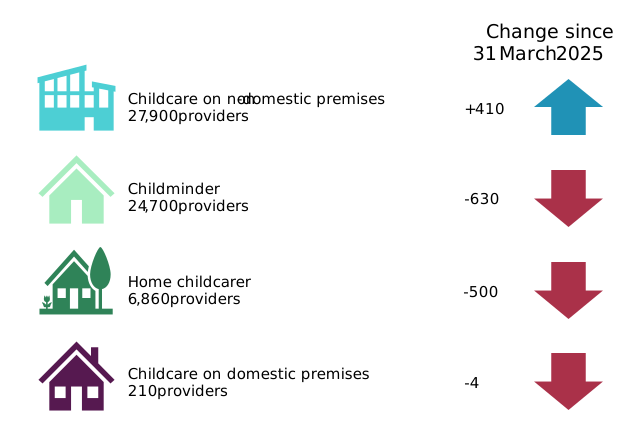
As at 31 March 2026, there were 59,700 childcare providers registered with Ofsted, down by 720 (1%) since last year.
The percentage decrease in the number of providers from 31 March 2025 to 31 March 2026 is lower than that of the previous year (31 March 2024 to 31 March 2025).
Figure 1: Childcare providers registered with Ofsted as at 31 March 2026, by provider type
1. See the notes section for rounding guidelines.
View data in an accessible table format.
Joiners and leavers in the childcare sector over time
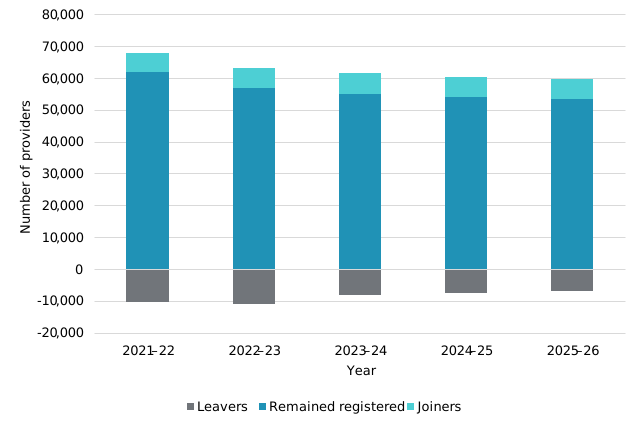
The number of active providers on our registers has been falling for over a decade. This is because more providers are leaving the childcare sector than joining (see Figure 2). The provider type that has seen the largest decline is childminders.
From 31 March 2025 to 31 March 2026, 6,780 childcare providers left the sector and 6,060 joined, resulting in a net decrease of 720 providers (1%). This decline is lower than in the previous year (31 March 2024 to 31 March 2025), where there was a net decrease of 1,370 providers (2%).
From 31 March 2025 to 31 March 2026, 1,690 childminders joined Ofsted’s registers and 2,320 left, giving a net decrease of 630 (2%). Comparatively, fewer childminders joined (1,620) and more left (2,870) between 31 March 2024 and 31 March 2025, with a higher net percentage decrease of 1,250 (5%).
The number of childcare on non-domestic premises providers registered has increased by 410 (1%) since 31 March 2025.
The number of leavers also includes providers that have had their registration cancelled. If a provider is unable to meet the requirements of registration or fails to pay the annual fee, we will cancel its registration.
Figure 2: Joiners and leavers in the childcare sector, by reporting year
1. Most joiners are new provider registrations and most leavers are resignations. See methodology for the definition of joiners and leavers.
View data in an accessible table format.
Places
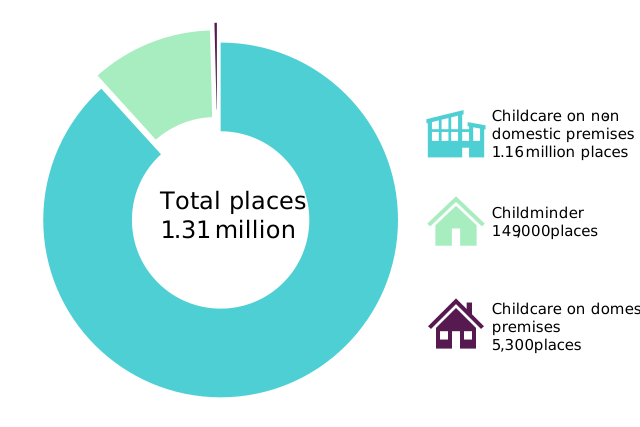
As at 31 March 2026, 1.31 million childcare places were offered by providers registered on the EYR, an increase of 26,500 (2%) since last year.
1.16 million of these childcare places were offered by providers of childcare on non-domestic premises, up by 30,500 (3%) since last year.
Data on places is reported for the 46,600 providers registered on the EYR and is first gathered at registration and updated at inspection.
If we suspend a provider’s registration, their places are not available during the suspension period. Suspension is an interim measure that we take to protect children from risk of harm.
The number of childcare places has not changed at the same rate as the number of providers. This is because the declining number of providers is mostly due to the falling number of childminders, and childminders offer fewer childcare places than other providers on average. While the number of providers has decreased by 1% since 31 March 2025, the number of places has increased by 2%.
For methodological notes on places data, see the methodology document that accompanies this release.
Figure 3: Number of childcare places offered by providers on the EYR as at 31 March 2026, by provider type
1. See the notes section for rounding guidelines. Places include children up to their eighth birthday where providers are registered on both the EYR and the CR.
View data in an accessible table format.
Registers
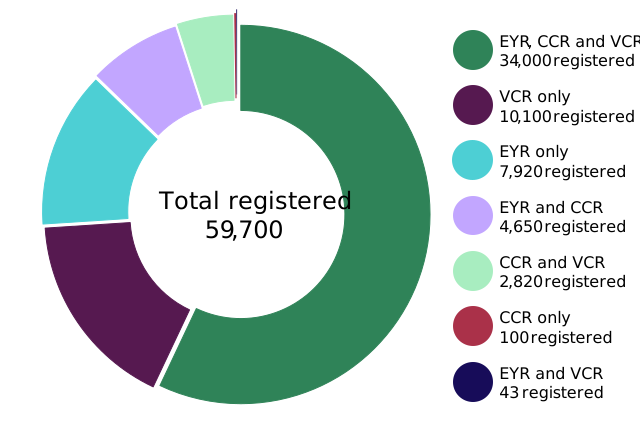
On 31 March 2026, 46,600 (78%) Ofsted-registered childcare providers were on the EYR. The remaining 13,000 (22%) were only registered on the CR.
There are 59,700 providers registered with Ofsted. Providers can be registered on one or more of the following registers:
- Early Years Register (EYR)
- Childcare Register (CR), which is divided into 2 parts:
- compulsory
- voluntary
Most providers are registered on the EYR and both parts of the CR (57%).
More than half (53%) of providers registered only on the CR are home childcarers on the voluntary part of the register.
Further information about these registers is provided in the glossary.
Figure 4: Number of Ofsted-registered childcare providers by registration type as at 31 March 2026
1. See the notes section for rounding guidelines.
View data in an accessible table format.
Inspections and regulatory activity between 1 September 2025 and 31 March 2026
Early Years Register inspections
Ofsted began inspecting under a renewed EIF for early years providers in November 2025. This introduced new evaluation areas and a new 5-point grading scale. For details of the changes, see Education inspection framework (EIF).
We paused EYR inspections under the original EIF in October 2025. We then recommenced inspections under the renewed EIF on 10 November 2025. The pause allowed time for inspector training and for the sector to adjust to the changes.
From 1 September 2025 to 31 March 2026, we completed 3,390 inspections of providers registered on the EYR. Of these:
- 2,850 (84%) were full inspections
- 280 (8%) were inspections of out-of-school day care providers
- 260 (8%) were inspections of providers with no children on roll or with none present at the time of the inspection
Of the EYR inspections carried out in this period, 24% were first inspections.
There were 290 (9%) inspections without notice. Of the 1,510 inspections of childcare on non-domestic premises providers, 230 (15%) were without notice. In comparison, of the 1,860 inspections of childminders, 68 (4%) were without notice.
Between 1 September 2025 and 30 September 2025, 1,340 inspections were carried out under the original EIF. The other 2,050 inspections that were carried out within the reporting period, beginning on 10 November 2025, were under the renewed EIF.
Childcare Register inspections
From 1 September 2025 to 31 March 2026, we completed 940 inspections of providers registered only on the CR:
- 710 (76%) were inspections under the voluntary childcare register (VCR) only – 73% of these were home childcarers
- 8 (1%) were inspections under the compulsory childcare register (CCR) only
- 210 (23%) were inspections under the CCR and VCR
These inspections found that 700 (75%) providers met the requirements of the CR.
Each year, we inspect 10% of all providers on the CR to check that they are meeting the requirements.
Regulatory events
Regulatory events take place either in person or over the telephone.
From 1 September 2025 to 31 March 2026, we carried out 7,270 regulatory events; of these, 65% were for childcare on non-domestic premises. This is a 42% increase compared to the same period last year, when there were 5,110 regulatory events. During the pause to routine EYR inspections, we continued to carry out regulatory events to follow up on concerns.
Registration visits
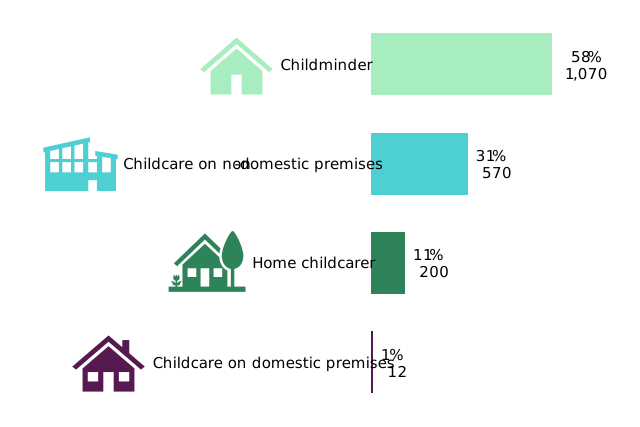
From 1 September 2025 to 31 March 2026, we carried out 1,850 registration visits.
Childminder visits made up 58% of all registration visits during this period.
Figure 5: Number and percentage of registration visits by provision type, from 1 September 2025 to 31 March 2026
1. See the notes section for rounding guidelines.
View data in an accessible table format.
Early Years Register inspection outcomes
Inspection outcomes in any single academic year are unlikely to be representative of all early years provision in England. Since we introduced the renewed EIF, we have only inspected a small proportion at this stage.
Outcomes of EYR inspections from 10 November 2025 to 31 March 2026
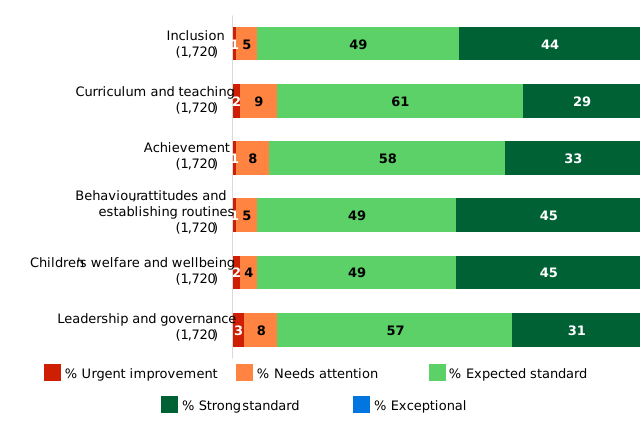
Of the 1,720 full EYR inspections (excluding out-of-school day care inspections), the following proportion were ‘expected standard’ or better for each evaluation area:
- 93% inclusion
- 90% curriculum and teaching
- 91% achievement
- 94% behaviour, attitudes and establishing routines
- 94% children’s welfare and wellbeing
- 89% leadership and governance
The ‘behaviour, attitudes and establishing routines’ evaluation area had the highest proportion of ‘strong standard’ grades (45%).
Less than 1% of inspections had an ‘exceptional’ grade. ‘Inclusion’, and ‘leadership and governance’, were the only evaluation areas graded ‘exceptional’.
The ‘leadership and governance’ evaluation area had the highest proportion of providers graded ‘urgent improvement’ or ‘needs attention’ (11%). This is higher because settings with a history of non-compliance with statutory early years foundation stage (EYFS) requirements in any evaluation area are graded below ‘expected standard’ for ‘leadership and governance’.
In over half (52%) of full inspections, the grades matched. The most common scenario was where all 6 evaluation areas were graded ‘expected standard’, accounting for 27% of all full inspections.
‘Curriculum and teaching’ and ‘achievement’ had the highest percentage of evaluation areas that mostly aligned with each other (94%).
If any evaluation area is graded ‘needs attention’, settings will usually be inspected again within 12 months. Settings will usually be reinspected within 6 months if any evaluation area is graded ‘urgent improvement’. A grade of ‘not met’ for the safeguarding evaluation area (see the safeguarding standards grades below) does not automatically mean the setting will be graded ‘urgent improvement’ in other evaluation areas. The setting will likely be reinspected within 6 months if safeguarding is graded ‘not met’, but there can be enforcement activity in between if required.
Figure 6: Full EYR inspection outcomes by evaluation area, from 10 November 2025 to 31 March 2026
1. Percentages are rounded and may not add to 100. Does not include inspection outcomes of out-of-school day care provision.
View data in an accessible table format.
Outcomes of out-of-school day care EYR inspections from 10 November 2025 to 31 March 2026
Under the renewed EIF, inspections of out-of-school day care providers are a type of full inspection. However, these providers do not need to meet the ‘learning and development’ requirements of the EYFS. Therefore, the evaluation areas of ‘curriculum and teaching’ or ‘achievement’ are not assessed.
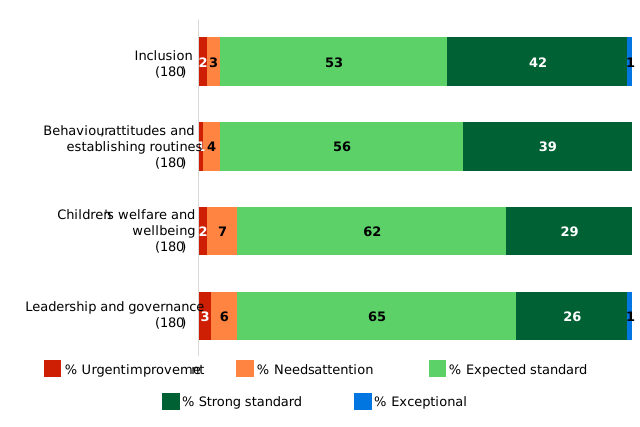
Of the 180 out-of-school day care EYR inspections, the following proportion were graded either ‘expected standard’ or better for each evaluation area:
- 95% inclusion
- 95% behaviour, attitudes and establishing routines
- 91% children’s welfare and wellbeing
- 91% leadership and governance
The ‘inclusion’ evaluation area had the highest proportion of inspections graded ‘strong standard’ or ‘exceptional’ (42%).
Only the evaluation areas of ‘inclusion’ and ‘leadership and governance’ had inspections graded ‘exceptional’ (both 1%).
The ‘children’s welfare and wellbeing’ evaluation area and the ‘leadership and governance’ evaluation area both had the highest proportion of providers graded urgent improvement or needs attention (both 9%).
Figure 7: EYR out-of-school day care inspection outcomes by evaluation area, from 10 November 2025 to 31 March 2026
1. Percentages are rounded and may not add to 100.
View data in an accessible table format.
Safeguarding outcomes for EYR inspections from 10 November 2025 to 1 March 2026
Inspections of providers on the EYR, except for those where there are no children on roll or none present, include an evaluation of safeguarding.
Of the 1,910 EYR inspections, safeguarding standards were graded ‘not met’ in 2%.
Figure 8: EYR inspection safeguarding outcomes, from 10 November 2025 to 31 March 2026
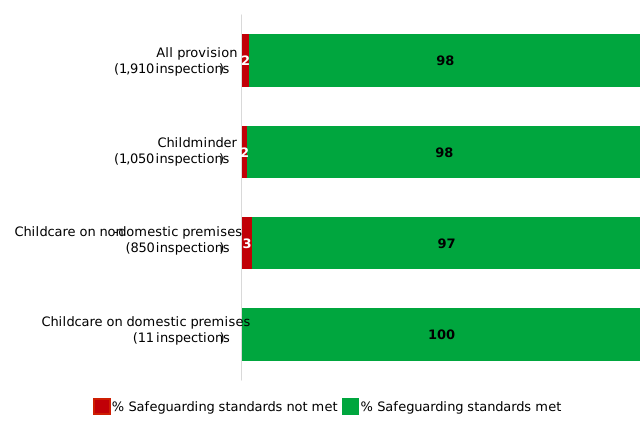
1. Percentages are rounded and may not add to 100.
View data in an accessible table format.
EYR inspections with actions from 10 November 2025 to 31 March 2026
There were 760 EYR inspections between 10 November 2025 and 31 March 2026 where actions were issued:
-
220 (29%) had actions relating to learning and development requirements
-
540 (71%) had actions relating to safeguarding and welfare requirements
Outcomes of EYR inspections with no children on roll or present from 10 November 2025 to 31 March 2026
Where no children in the early years age range are present or on roll, we only inspect providers under the ‘leadership and governance’ evaluation area. This is to determine if the provider is meeting the requirements of the EYFS and the CR (if applicable). These providers can only be graded as ‘urgent improvement’, ‘needs attention’, or ‘expected standard’.
We carried out 150 of these inspections, with 7% graded as ‘urgent improvement’, 7% as ‘needs attention’, and 86% as ‘expected standard’.
Childminder agencies
Childminders and childcare on domestic premises providers can choose to register with Ofsted or with a childminder agency.
On 31 March 2026, there were 7 childminder agencies registered with Ofsted, 4 of which reported they had a combined total of 1,790 providers on roll.
The number of providers on roll at childminder agencies was previously reported as 1,750 as at 31 March 2025, a net increase of 3%.
The childminder agencies are responsible for carrying out annual quality assurance visits to the providers who are registered with them.
Ofsted inspects childminder agencies, but they are only eligible for inspection when they have providers on roll. Inspected childminder agencies are given an overall effectiveness inspection outcome of either ‘effective’ or ‘ineffective’.
As at 31 March 2026, we had inspected 5 of the childminding agencies and all were judged to be ‘effective’. One of these childminding agencies no longer has providers on roll.
Early years provision in the schools sector
All the schools inspection toolkit evaluation areas apply to the early years. When a school takes 2- and 3-year-olds as part of its early years provision, inspectors consider these children proportionately when grading each evaluation area. To consider the early years provision as a whole, a separate ‘early years’ evaluation area is graded. There is no separate ‘early years’ grade for maintained nursery schools, as this evaluation area is relevant only for a school population that includes children in the early years as well as others.
Only a small proportion of inspections of both early years registered and school-based provision have been completed under the renewed EIF. They are not representative of the sector and will not reflect the full national picture.
For more information on inspections and outcomes of school-based provision not registered with Ofsted, see our statistics on state-funded school inspections and outcomes.
For more information on non-association independent school inspections and outcomes, see our statistics on non-association independent schools.
Please note that Ofsted only inspects non-association independent schools. The Independent Schools Inspectorate inspects association independent schools.
Notes
We explain the main uses of this data and the arrangements for quality assurance, and provide further contextual information, in the methodology document accompanying this release.
The methodology document also provides information on the strengths and limitations of the statistics.
Rounding
Numbers in this report are rounded as follows:
- numbers under 100 are not rounded
- numbers between 100 and 1,000 are rounded to 2 significant figures
- numbers over 1,000 are rounded to 3 significant figures
Glossary
Definitions of terms are in our statistical glossary.
Further information
We publish the following information on the inspection and regulation of early years providers:
- early years and childcare statistics
- EIF
- framework for the regulation of providers on the Childcare Register
- early years: regulation
Contact for comments or feedback
If you have any comments or feedback on this publication, contact Alison Merrett (03000 130 729 or Alison.Merrett@ofsted.gov.uk), or the early years data and analysis team (childcaredataqueries@ofsted.gov.uk).
Acknowledgements
Thanks to the following for their contribution to this statistical release: Olivia Ford, Nustret Hoxia, Chloe Ainger, Richard Smith, Austen Norris, James Jordan.
Annex: data tables for figures
This section contains the underlying data in an accessible table format for all figures.
Data for Figure 1: Childcare providers registered with Ofsted as at 31 March 2026, by provider type
| Provision type | Number of providers on 31 March 2026 | Change in providers since 31 March 2025 |
|---|---|---|
| All provision | 59,700 | -720 |
| Childcare on non-domestic premises | 27,900 | 410 |
| Childminder | 24,700 | -630 |
| Home childcarer | 6,860 | -500 |
| Childcare on domestic premises | 210 | -4 |
See Figure 1.
Data for Figure 2: Joiners and leavers in the childcare sector, by reporting year
| Reporting period | Year | Joiners | Remained registered | Leavers |
|---|---|---|---|---|
| 31 March 2025 to 31 March 2026 | 2025–26 | 6,060 | 53,600 | 6,780 |
| 31 March 2024 to 31 March 2025 | 2024–25 | 6,090 | 54,300 | 7,460 |
| 31 March 2023 to 31 March 2024 | 2023–24 | 6,630 | 55,100 | 8,070 |
| 31 March 2022 to 31 March 2023 | 2022–23 | 6,090 | 57,100 | 10,900 |
| 31 March 2021 to 31 March 2022 | 2021–22 | 6,090 | 61,900 | 10,100 |
See Figure 2.
Data for Figure 3: Number of childcare places offered by providers on the EYR as at 31 March 2026, by provider type
| Provision type | Number of EYR places |
|---|---|
| All provision | 1,310,000 |
| Childcare on non-domestic premises | 1,160,000 |
| Childminder | 149,000 |
| Childcare on domestic premises | 5,300 |
See Figure 3.
Data for Figure 4: Number of Ofsted-registered childcare providers by registration type
| Register summary | Number of providers |
|---|---|
| All providers | 59,700 |
| EYR, CCR and VCR | 34,000 |
| VCR only | 10,100 |
| EYR only | 7,920 |
| EYR and CCR | 4,650 |
| CCR and VCR | 2,820 |
| CCR only | 100 |
| EYR and VCR | 43 |
See Figure 4.
Data for Figure 5: Number and percentage of registration visits by provision type, from 1 September 2025 to 31 March 2026
| Provision type | Number of registration visits | Percentage of all provision (%) |
|---|---|---|
| All provision | 1,850 | 100 |
| Childminder | 1,070 | 58 |
| Childcare on non-domestic premises | 570 | 31 |
| Home childcarer | 200 | 11 |
| Childcare on domestic premises | 12 | 1 |
See Figure 5.
Data for Figure 6: Full EYR inspection outcomes by evaluation area, from 10 November 2025 to 31 March 2026
| Evaluation area | Total number inspected | % Urgent improvement | % Needs attention | % Expected standard | % Strong standard | % Exceptional |
|---|---|---|---|---|---|---|
| Inclusion | 1,720 | 1 | 5 | 49 | 44 | 0 |
| Curriculum and teaching | 1,720 | 2 | 9 | 61 | 29 | 0 |
| Achievement | 1,720 | 1 | 8 | 58 | 33 | 0 |
| Behaviour, attitudes and establishing routines | 1,720 | 1 | 5 | 49 | 45 | 0 |
| Children’s welfare and wellbeing | 1,720 | 2 | 4 | 49 | 45 | 0 |
| Leadership and governance | 1,720 | 3 | 8 | 57 | 31 | 0 |
See Figure 6.
Data for Figure 7: EYR out-of-school day care inspection outcomes by evaluation area, from 10 November 2025 to 31 March 2026
| Evaluation area | Total number inspected | % Urgent improvement | % Needs attention | % Expected standard | % Strong standard | % Exceptional |
|---|---|---|---|---|---|---|
| Inclusion | 180 | 2 | 3 | 53 | 42 | 1 |
| Behaviour, attitudes and establishing routines | 180 | 1 | 4 | 56 | 39 | 0 |
| Children’s welfare and wellbeing | 180 | 2 | 7 | 62 | 29 | 0 |
| Leadership and governance | 180 | 3 | 6 | 65 | 26 | 1 |
See Figure 7.
Data for Figure 8: EYR inspection safeguarding standards outcomes, from 10 November 2025 to 31 March 2026
| Provision type | Total number inspected | % Safeguarding standards not met | % Safeguarding standards met |
|---|---|---|---|
| All provision | 1,910 | 2 | 98 |
| Childminder | 1,050 | 2 | 98 |
| Childcare on non-domestic premises | 850 | 3 | 97 |
| Childcare on domestic premises | 11 | 0 | 100 |
See Figure 8.