Bioenergy Crops in England and the UK: 2008-2024
Updated 12 February 2026

© Crown copyright 2026
This publication is licensed under the terms of the Open Government Licence v3.0 except where otherwise stated. To view this licence, visit nationalarchives.gov.uk/doc/open-government-licence/version/3 or write to the Information Policy Team, The National Archives, Kew, London TW9 4DU, or email: psi@nationalarchives.gov.uk.
Where we have identified any third party copyright information you will need to obtain permission from the copyright holders concerned.
This publication is available at https://www.gov.uk/government/statistics/bioenergy-crops-in-england-and-the-uk-2008-2024/bioenergy-crops-in-england-and-the-uk-2008-2024
Key messages
-
In 2024, 142 thousand hectares of agricultural land in the UK were used to grow crops for bioenergy. This area represents 2.3% of the arable land in the UK.
-
In 2024, 30% of land used for bioenergy was for biofuel (biodiesel and bioethanol) in the UK road transport market with the remainder mostly used for heat and power production.
-
In 2024, 148 million litres of biofuel for the UK road transport market were produced from UK grown crops (mainly wheat and sugar beet).
Note: This 2024 release will be the last update of Bioenergy Crops in England and the UK, and only key sections have been updated. For the latest publicly available data on additional relevant topics, please see section 4.3 Future Publications. We are no longer producing production estimates for miscanthus and short rotation coppice, but yield estimates can be found in the Nix Farm Management Pocketbook.
Section 1. Agricultural area for bioenergy crops
Figure 1 Agricultural area used for bioenergy crops (thousand ha)
| Year | Wheat | Sugar beet | Maize | Short rotation coppice | Miscanthus | Total |
|---|---|---|---|---|---|---|
| 2018 | 22 | 7 | 57 | 3 | 7 | 96 |
| 2019 | 11 | 8 | 67 | 2 | 8 | 96 |
| 2020 | 30 | 7 | 75 | 2 | 8 | 122 |
| 2021 | 20 | 6 | 80 | 4 | 8 | 117 |
| 2022 | 43 | 8 | 68 | 3 | 8 | 131 |
| 2023 | 65 | 6 | 73 | 4 | 9 | 157 |
| 2024 | 35 | 7 | 88 | 5 | 7 | 142 |
Source: Department for Transport RTFO data, UK Agricultural Departments June Survey/Census of Agriculture.
Notes:
- Maize, Short Rotation Coppice and Miscanthus areas are for England only.
In 2024, 142 thousand hectares (ha) of agricultural land was used for bioenergy crops in the UK comprising:
-
35 thousand ha of wheat and 7 thousand ha of sugar beet used for biofuels.
-
88 thousand ha of maize used for anaerobic digestion.
-
7.4 thousand ha of miscanthus and 5.2 thousand ha of short rotation coppice used in biomass.
Arable area is defined as the area of arable crops, uncropped arable land and temporary grassland. In 2024 arable land used for bioenergy crops in the UK equated to 2.3% of the total arable area, similar to the 2.6% seen in 2023. 30% of land used for bioenergy in 2024 was for biofuel (biodiesel and bioethanol) crops for the UK road transport market, with the remainder used mostly for heat and power production.
Section 2. Biofuels
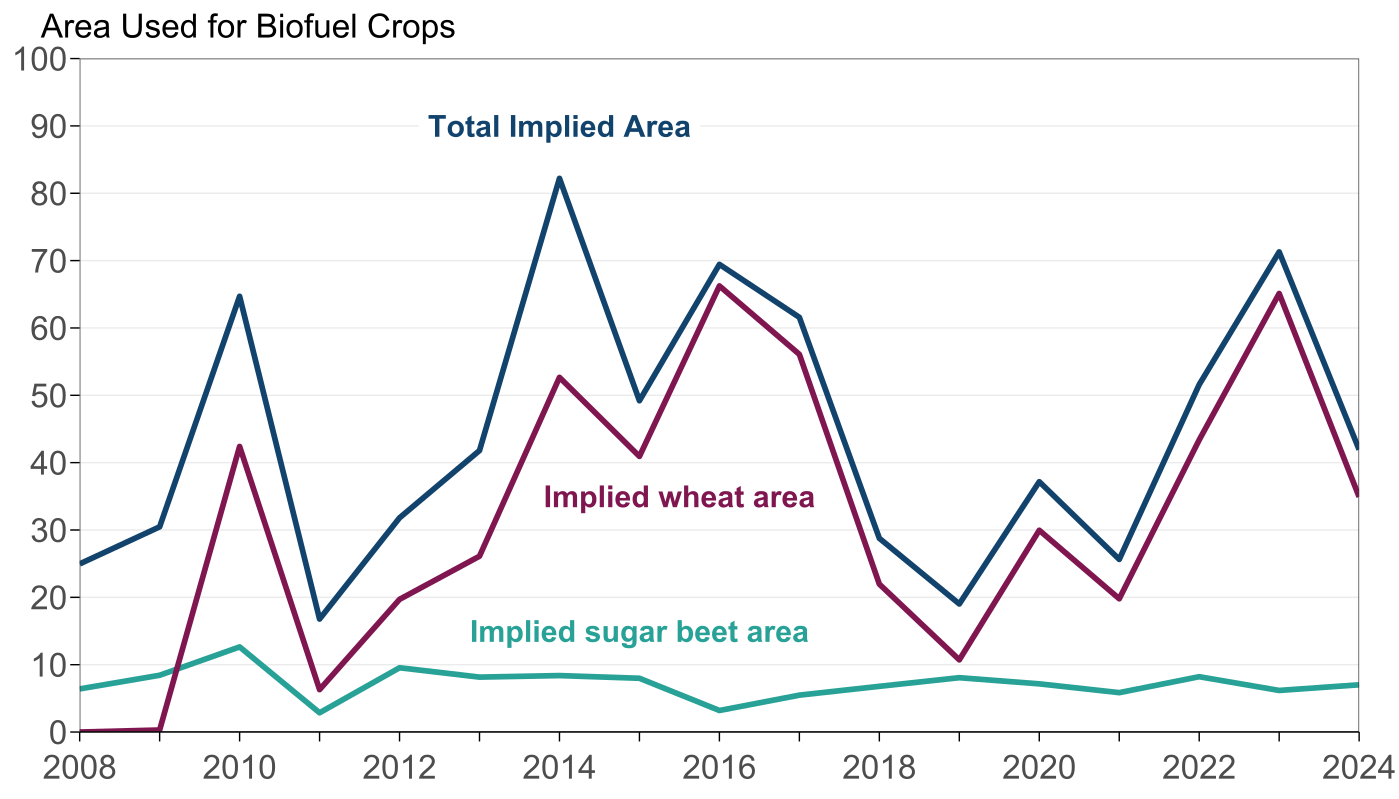
Figure 2 and Table 1 focus on the arable crops used as feedstocks and convert the biofuel volumes reported under the Renewable Transport Fuels Obligation (RTFO) into equivalent UK crop areas. These crop areas are based only on biofuel from UK grown crops sold into the UK road fuel market, and therefore do not include UK grown crops which are processed into biofuels and then exported (and not re imported), those which go to markets other than road transport, or those that are exported to be processed into biofuels elsewhere. Due to changes to the RTFO dataset, 2018 covers 15th April to 31st December 2018 and is not directly comparable to previous years which covered a time period from April to April. From 2019 onwards RTFO data is representative of full calendar years. Conversion factors for litres to tonne of crop can be found in Section 3.2 Conversions.
Figure 2 Total UK crop areas used for biofuels (biodiesel and bioethanol) supplied to road transport market (Thousand ha)
Source: Department for Transport RTFO data, Agriculture in the UK](https://www.gov.uk/government/collections/agriculture-in-the-united-kingdom).
Table 1 Total UK crop areas used for bioethanol supplied to the UK road transport market, 2023 - 2024
Table 1a: Total UK wheat area used for bioethanol supplied to the UK road transport market
| 2023 | 2024 | Change 23-24 | % Change 23-24 | |
|---|---|---|---|---|
| Total volume of bioethanol from UK grown wheat (million litres) | 194.5 | 93.4 | -101.1 | -52.0% |
| Implied tonnage of wheat (‘000 tonnes) | 529.2 | 254.2 | -275.1 | -52.0% |
| Implied area of wheat (‘000 ha) | 65.1 | 34.9 | -30.2 | -46.4% |
| % of total UK wheat area | 3.8% | 2.3% | -1.5pp | [z] |
Table 1b: Total UK sugar beet area used for bioethanol supplied to the UK road transport market
| 2023 | 2024 | Change 23-24 | % Change 23-24 | |
|---|---|---|---|---|
| Total volume of bioethanol from UK grown sugar beet (million litres) | 49.0 | 54.3 | 5.3 | 10.8% |
| Implied tonnage of sugar beet (‘000 tonnes) | 483.1 | 535.5 | 52.4 | 10.8% |
| Implied area of sugar beet (‘000 ha) | 6.2 | 7.0 | 0.8 | 13.6% |
| % of total UK sugar beet area | 6.2% | 6.8% | -0.6pp | [z] |
Source: Department for Transport RTFO data, Agriculture in the UK.
Notes:
- [z] indicates where information is not applicable.
In 2024 42 thousand hectares of UK crops (wheat and sugar beet) were used for bioethanol supplied to the UK road transport market, which equates to 0.7% of the total arable area of the UK. In 2024 7 thousand hectares of sugar beet were used in the production of bioethanol for the road transport market, a 14% increase from 2023. In 2024 35 thousand hectares of wheat were used for bioethanol. This is a 46% decrease in implied area from 2023 and 3.3% higher than the five-year average (2019 – 2023).
2.2 DESNZ Annual Liquid Biofuel Producer Survey
The Department for Energy Security and Net Zero conduct an annual (calendar year) survey of large-scale biofuel production (see Section 3.4 Data Sources for more details). The survey aims to determine total UK production of biofuels and, from 2012, included questions on the quantity and origin of crops used in UK biofuel production. Because the survey covers all biofuel production (including that subsequently exported and for markets other than road transport) the data can help build a more complete picture of usage of UK crops for biofuel. Figure 3 gives an estimate of the end use breakdown for biodiesel and bioethanol from UK feedstocks.
Figure 3 Estimated UK biofuel supply (from UK production) 2024
| UK road transport | Exported | Other | UK Heat and Power | UK non-road transport | Total | |
|---|---|---|---|---|---|---|
| Estimated UK biodiesel supply | 28% | 61% | 9% | 2% | 0% | 100% |
| Estimated UK bioethanol supply | 63% | 37% | 0% | 0% | 0% | 100% |
Source: Digest of UK Energy Statistics.
Notes:
- Data represents fuel that is produced in the UK and using UK grown feedstocks.
In 2024, an estimated 25% of biodiesel produced in the UK was supplied to the UK road transport market, with 61% being exported. In contrast, an estimated 63% of the bioethanol supply was used in UK road transport in 2024, with 37% being exported.
Section 3. About these statistics
3.1 Glossary of terms
Definition of biodiesel and bioethanol (Source: Annexes A to J, page 1 of DUKES 2025)
In the UK biodiesel is defined for taxation purposes as diesel quality liquid fuel produced from biomass or waste vegetable and animal oils and fats, the ester content of which is not less than 96.5 per cent by weight and the sulphur content of which does not exceed 0.005 per cent by weight. [footnote 1] Biodiesel can be blended in low proportions with fossil diesel for use in diesel engines. Diesel fuel currently sold at retail outlets in the UK can contain up to 7 per cent biodiesel. Bioethanol is a liquid fuel consisting of ethanol produced from biomass. Bioethanol can be blended with petrol at low proportions for use in petrol engines. Petrol currently sold in at retail outlets in the UK can contain up to 5% bioethanol. Since March 2013 a revised petrol standard (EN228) allows retailers to sell petrol containing up to 10% ethanol by volume (E10), if appropriately labelled.
3.2 Conversions
-
Tonnes of oil equivalent to gigajoules. 1 tonne of oil equivalent = 41.868 gigajoules Source: DUKES Chapter 1 (Energy) paragraph 1.28
-
Calorific values of fuels to convert gigajoules to tonnes are available at Annex A of DUKES
-
Megajoules to litres Bioethanol= 26.8 megajoules per litre, Biodiesel= 37.2 megajoules per litre. Source: DUKES A.1-1.3 (https://www.gov.uk/government/statistics/dukes-calorific-values)
-
Litres to tonnes 429 litres biodiesel = 1 tonne oilseed rape 101 litres bioethanol = 1 tonne sugar beet 367 litres bioethanol = 1 tonne wheat grain 317 litres of bioethanol = 1 tonne of barley 418 litres of bioethanol = I tonne of maize
Source: Department for Transport and Alder BioInsights (formerly The National Non-Food Crops Centre (NNFCC)).
3.3 Use of statistics
Annual estimates of crop areas of oilseed rape, sugar beet, wheat, maize, miscanthus and short rotation coppice grown in the UK for use as bioenergy are used by government policy advisors, non-food crop promoters and processors.
3.4 Data sources
These statistics, which are from a range of sources, are a secondary analysis of data that have already been published. Although much of the source data are published as Accredited Official Statistics, there are limitations to these statistics and these are described within each section.
The June Survey of Agriculture and Horticulture
The June Survey of Agriculture and Horticulture collects information from farmers on the area of crops grown in the UK at the 1st June each year. In general farmers are not asked about their intended end use for the crops. For crops such as oilseed rape, wheat and sugar beet, where there are multiple end uses, reference has been made to other existing data sources on usage in order to try and establish the crop production and area associated with crops grown for bioenergy by applying appropriate conversion factors to the data collected on biofuel production. From 2014 the June Survey asked farmers to indicate the intended end use of their maize to help determine the proportion intended for used as an anaerobic digestion feedstock.
Renewable Transport Fuels Obligation (RTFO)
The Department for Transport (and the Renewable Fuels Agency pre-2011) produce statistics on the volumes of biofuels supplied to the UK road market under the Renewable Transport Fuels Obligation (RTFO). Published reports include information on the volumes of fuel supplied to the UK road market:
-
by fuel type (e.g. biodiesel, bioethanol);
-
by feedstock (e.g. oilseed rape, used cooking oil, sugar beet);
-
by country of origin (e.g. UK); and whether it meets sustainability standards and the lifecycle greenhouse gas savings of fuels.
Therefore, it is possible to derive information on the volumes of UK grown crops and equivalent crop areas which have been used to supply biofuel to the UK road transport market. The RTFO data include:
-
Biofuels from UK grown and imported crops (these are presented separately in the tables)
-
Biofuels supplied to the UK road transport sector.
-
Data from organisations that supply more than 450,000 litres of road transport fuel in a given year. These obligated companies supply more than 95% of the biofuels in the UK market.
-
Data from suppliers of less than 450,000 litres a year where they have chosen to apply for Renewable Transport Fuel Certificates.
The RTFO data exclude:
-
UK biofuel or biofuel feedstock production which may subsequently be exported.
-
Producers of less than 450,000 litres of road transport fuel per year who do not claim Renewable Transport Fuel Certificates (RTFCs). However, it is not expected that there are many small producers excluded from the RTFO statistics.
DESNZ Annual Liquid Biofuel Producer Survey
From 2010, to estimate the volume of biofuels produced in the UK, an annual liquid biofuel producer survey has been carried out by the Department for Energy Security & Net Zero (DESNZ). Neither HMRC nor RTFO figures can be used for this purpose since they include both UK produced fuels and imports. The data include estimates for very small scale production (for personal use), though this makes a very small contribution to the totals. The reports include UK production of biodiesel and bioethanol; the proportion supplied to the UK road market and the percent of biofuel from UK sources together with information on production capacity. Further details are available on page 7 of the Liquid Biofuels survey methodology.
Data from the survey also feeds into the Digest of UK Energy Statistics (DUKES), which is produced by DESNZ. The digest is a comprehensive source of energy information.
3.5 Revisions
Minor revisions have been made to the historic data to reflect improved data availability and/or data updates since earlier publications.
Section 4. What you need to know about this release
4.1 Contact details
Responsible statistician: Andrew Fletcher
Email address: agri.environmentstatistics@defra.gov.uk
For media queries between 9am and 6pm on weekdays:
-
Telephone: 0330 041 6560
-
Email address: newsdesk@defra.gov.uk (monitored 9am to 6pm on weekdays)
4.2 Official Statistics
Our statistical practice is regulated by the Office for Statistics Regulation (OSR). OSR sets the standards of trustworthiness, quality and value in the Code of Practice for Statistics that all producers of official statistics should adhere to. You can read about how Official Statistics in Defra comply with these standards on the Defra Statistics website.
You are welcome to contact us directly with any comments about how we meet these standards using the contact details above. Alternatively, you can contact OSR by emailing regulation@statistics.gov.uk or via the OSR website.
4.3 Future publications
There are no further planned updates to the Bio Energy Crops Report. Please see the following publications for relevant updates concerning Bio Energy Crops topics:
Renewable Transport Fuel Obligation (RTFO) statistics, provide data on the source and supply of renewable fuels provided to road and non-road mobile machinery. RF_105 tables in the RTFO dataset provide feedstock, country and volume data for various bio-fuel types. Latest RTFO figures for 2024 will be available here when released.
Renewables Obligation (RO) data sourced from the Office of Gas and Electricity Markets (OFGEM), provides data on the RO scheme to produce electricity through renewable sources, including bio-fuels. the RO biomass sustainability datasets provide information on the use of bio-fuels for the generation of electricity covered by the RO scheme.
Chapter 6 of the Digest of UK Energy Statistics (DUKES) report sourced from the Department for Energy Security and Net Zero (DESNZ) provides information on the use of renewables sources, including bio-fuels, used in the UK. The section 6.4 dataset houses data on how various renewable sources, including bio-fuels, split by type and use.
Renewable Heat Incentive (RHI) scheme data sourced from the Office of Gas and Electricity Markets (OFGEM), provides data on the generation of renewable heat by household, including the use of bio-fuels to do so.
Alder BioInsights (formerly The National Non-Food Crops Centre (NNFCC)), reports on both deployment of anaerobic digestion (AD) and composting capacity in the UK. The report outlines detailed information on installed capacity and feedstock requirements for AD plants and composting facilities.