Summary of latest statistics
Updated 15 September 2026
Applies to England, Northern Ireland and Wales

© Crown copyright 2026
This publication is licensed under the terms of the Open Government Licence v3.0 except where otherwise stated. To view this licence, visit nationalarchives.gov.uk/doc/open-government-licence/version/3 or write to the Information Policy Team, The National Archives, Kew, London TW9 4DU, or email: psi@nationalarchives.gov.uk.
Where we have identified any third party copyright information you will need to obtain permission from the copyright holders concerned.
This publication is available at https://www.gov.uk/government/statistics/asset-recovery-statistics-financial-years-ending-2021-to-2026/summary-of-latest-statistics
This Official Statistics publication provides comprehensive statistics on assets denied and recovered through the Proceeds of Crime Act.
The Proceeds of Crime Act (POCA 2002) enables law enforcement agencies to deprive criminals of their money, or other property connected to criminal activity, and recover the proceeds of crime. This legislative framework encompasses several asset-focussed interventions, including asset denial through restraint (restraint orders), seizures (cash, listed assets or cryptoassets) and freezing orders (account freezing orders); and asset recovery through criminal confiscations, civil forfeitures, and civil recovery powers. Recovered criminal proceeds can subsequently be returned in compensation to victims (following criminal conviction) or reinvested for use in tackling crime through the Asset Recovery Incentivisation Scheme (ARIS).
These tools support the disruption of criminal activity and act as a supplementary mechanism or as an alternative to criminal prosecution and conviction. The ‘Economic Crime Plan 2, 2023 to 2026’ and the Anti-Money Laundering and Asset Recovery (AMLAR) strategy (due for publication September 2026) further highlight the importance and practical use of asset denial and asset recovery tools in tackling economic crime.
This release contains official statistics on the value and volume of proceeds of crime restrained, seized, frozen (the ‘denial’ phase) and subsequently recovered and receipted (the ‘recovery’ phase). The release also includes statistics on:
- the value and volume of proceeds of crime by the associated criminal offence types
- the value of compensation paid to victims
- the amount of funds distributed to POCA agencies through ARIS
- the use of funds received by POCA agencies through ARIS
- the amount awarded to projects via ARIS Top Slice Funding
- statistics on international asset recovery, including asset sharing and the denial, recovery and return of the proceeds of grand corruption
- cryptocurrency seizures and realisations.
This release refers to data covering the financial years ending March 2021 to March 2026, for the jurisdictions of England and Wales and Northern Ireland. The release does not include data covering Scotland. The statistics are presented as nominal values, that is, not adjusted for inflation, unless stated otherwise and any comparisons to previous years do not account for inflation. Figures included in the latest statistical release supersede previous officially reported figures. Therefore, any direct comparisons of changes should not be made between the latest and previous releases of the asset recovery annual statistical bulletin.
Further information on methodology, data sources, data and statistics quality, background information on POCA legislation, and adherence to the Code of Practice for Statistics can be found in the accompanying User guide to Asset recovery statistics.
1. Asset recovery
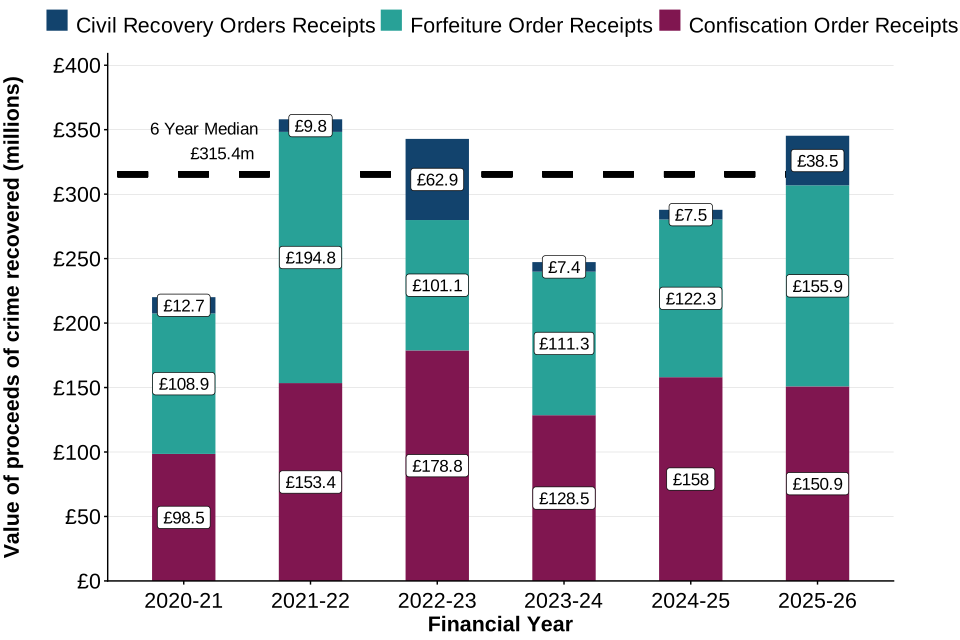
Asset recovery reached £345.3 million in the financial year ending March 2026, driven by increased forfeiture and civil recovery order performance.
There were £345.3 million of assets recovered from confiscation, forfeiture and civil recovery orders in the financial year ending March 2026. This represents an increase of 20% compared to financial year ending March 2025, a 57% increase compared to financial year ending March 2021 and is 9% above the 6-year median of £315.4 million.
The increase in receipts compared to the previous year has been driven by increased forfeiture order receipt and civil recovery performance.
Figure 1: The value of proceeds of crime recovered from confiscation order, forfeiture order, and civil recovery order receipts, from financial year ending March 2021 until financial year ending March 2026, in England and Wales and Northern Ireland
Source: JARD (confiscation order and forfeiture order receipts) and NCA (civil recovery order receipts)
Figure 1 shows that:
- forfeiture order receipts rose by 28% to £155.9 million in the financial year ending March 2026
- this increase was driven by higher receipts from bank account forfeitures, which increased from £65.0 million in financial year ending 2025 to £100.4 million in financial year ending 2026, with growth observed in both high-value and low-value cases
- civil recovery order receipts increased substantially to £38.5 million in the financial year ending March 2026, more than 5 times the value recovered in the previous financial year (£7.5 million), and the highest value recorded in the last 3 financial years
- confiscation order receipts totalled £150.9 million in the financial year ending March 2026, a slight decrease of 5% compared with the previous financial year (£158.0 million)
- despite this decline, confiscation order receipts continued to account for a substantial proportion of total assets recovered, representing 44% of the total value recovered
Additionally, £367.3 million in confiscation orders was imposed in the financial year ending March 2026, an increase of 64% compared with the previous financial year (£223.9 million). This was the highest annual value of confiscation order impositions recorded during the 6-year reporting period.
Confiscation impositions are not included in the asset denial total, as they do not restrain or freeze assets.
2. Asset denial
The total value of assets denied increased to £1.1 billion in the financial year ending March 2026.
In the financial year ending March 2026, the asset recovery system denied access to £1.1 billion in criminal assets through restraint and forfeiture powers, representing an increase of 30% compared to £807.6 million in the previous financial year.
Figure 2: The value of proceeds of crime denied from restraint orders and asset seizures from financial year ending March 2021 until financial year ending March 2026, in England and Wales and Northern Ireland

Source: JARD
Figure 2 shows that:
- £677.0 million in restraint orders were granted – a 37% increase from £493.2 million in the previous year
- this increase was primarily driven by a rise in the value of high-value restraint orders, which increased by 51% from £319.5 million to £484.0 million
- £376.4 million was seized or frozen under forfeiture powers, with account freezing orders (AFOs) contributing 74% of the value seized and frozen under forfeiture powers. Listed asset orders and AFOs reached 6-year highs in value seized and frozen
3. Victim compensation
£26.1 million in compensation was paid to victims in the financial year ending March 2026.
£26.1 million was paid in compensation to victims from the proceeds of crime recovered through confiscation order receipts in financial year ending March 2026, decreasing by 45% from the previous financial year. This was largely driven by lower compensation payments from local police-led confiscation orders following exceptionally strong performance in the previous financial year. Despite this decrease, compensation payments remained 29% above the 6-year median of £20.3 million.
The compensation figures included within this statistical series only includes compensation paid through confiscation order receipts and does not represent the full value of compensation paid to victims across the criminal justice system.
Data on wider criminal courts and criminal justice statistics, including compensation, can be found in the criminal justice statistics publication Criminal justice statistics quarterly - GOV.UK (www.gov.uk) and Criminal court statistics - GOV.UK (www.gov.uk).
4. Asset Recovery Incentivisation Scheme (ARIS) funding
£129.6 million of ARIS funding was distributed to POCA agencies in the financial year ending March 2026.
This represents a 19% decrease compared with the previous financial year. However, this was primarily driven by a delayed ARIS payment arising from an exceptional high-value asset recovery case, which resulted in unusually high payments in the financial year ending March 2025. Excluding this outlier, ARIS funding increased by 3%, from £125.6 million to £129.6 million, indicating that funding levels remained broadly stable.
Eighteen projects were awarded £12.8 million through the ARIS Top Slice budget in the financial year ending March 2026, supporting investment in asset recovery capability, including confiscation enforcement, cryptocurrency capability and border asset recovery activity.
Due to the process involved in calculating, assuring and distributing funds, ARIS payments are distributed a quarter in arrears with the final 2 quarterly payments made in the following financial year.
5. System snapshot for the year ending March 2026
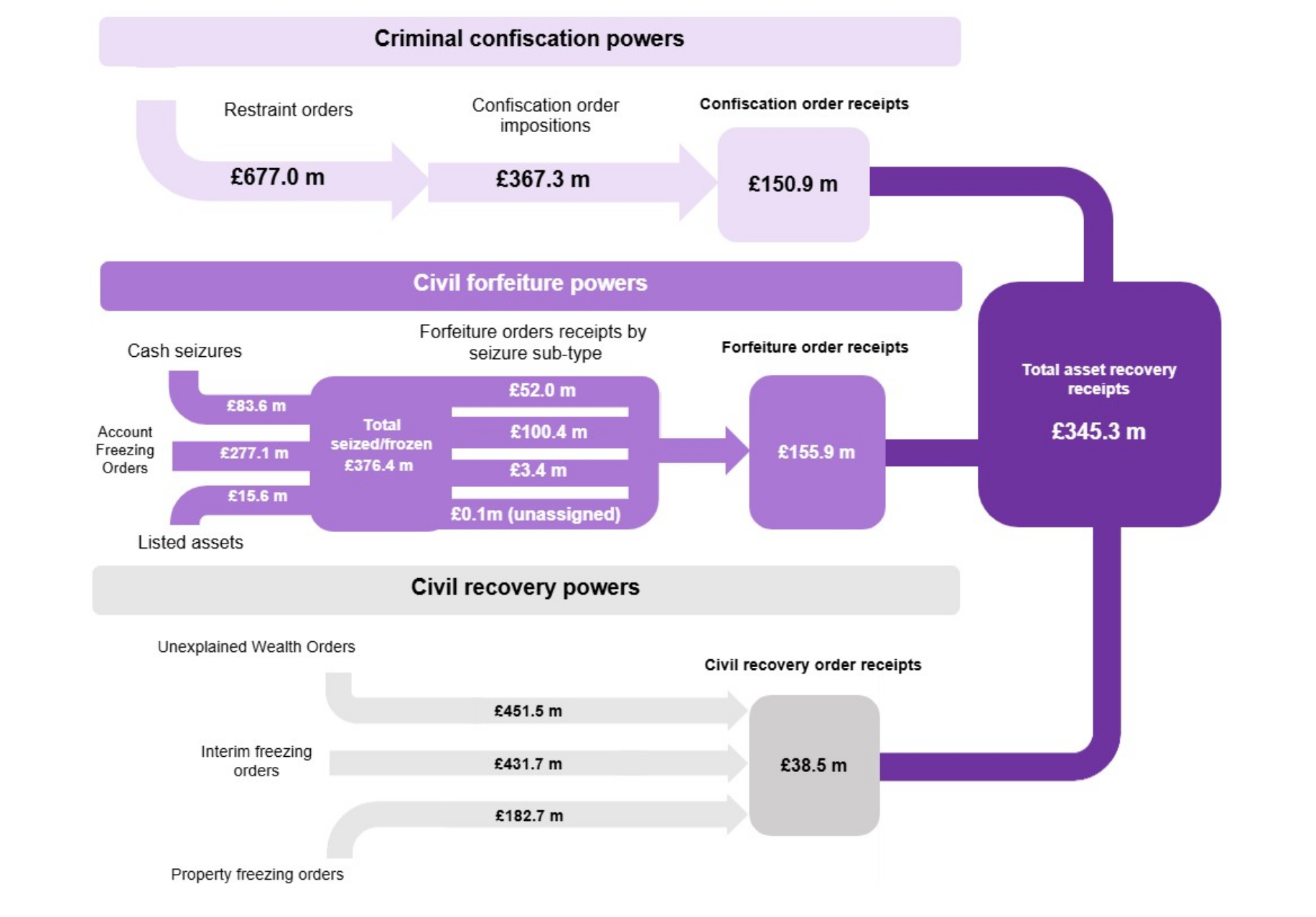
Figure 3 below provides an overview of the asset recovery system, providing summary statistics on the proceeds of crime denied, imposed, and recovered through criminal confiscation POCA powers and civil forfeiture POCA powers.
A full breakdown of the asset recovery system in the financial year ending March 2026 is presented in the chapters Proceeds of crime denied and Proceeds of crime recovered.
Figure 3: Overview of the asset recovery system in the financial year ending March 2026 in England and Wales and Northern Ireland
Source: JARD
Notes:
- Data presented in figure 3 includes the proceeds of crime restrained, imposed, seized, frozen and then recovered (through a confiscation order, forfeiture order and civil recovery order) in financial year ending March 2026.
- Figure 3 does not represent the entire asset recovery system, the figure only includes powers that are reported on within this statistical release, there may be other mechanisms to deny or recover assets that are not captured.
- Restraint orders are only used in certain circumstances or where dissipation of assets is likely, and not all the proceeds of crime recovered at the end of the criminal proceedings will have been subject to a restraint order earlier in the process. Users should be cautious when making comparisons between the data reported for restraint orders and confiscation orders impositions for this reason.
- Unexplained wealth orders, interim freezing orders and property freezing orders are investigatory or freezing powers that may support civil recovery proceedings. The values shown do not represent receipts recovered through civil recovery orders.
- The total asset recovery receipts may not equal the sum of the value of the proceeds of crime identified for each individual power for reasons that include: (a) a proportion of total asset recovery receipts will relate to restraint orders, confiscation order impositions and seizures made in previous years; (b) some proceeds of crime restrained or seized may not be recovered or released or they may be returned to the individual if their legitimacy is subsequently proven; (c) rounding.
6. Real terms comparison
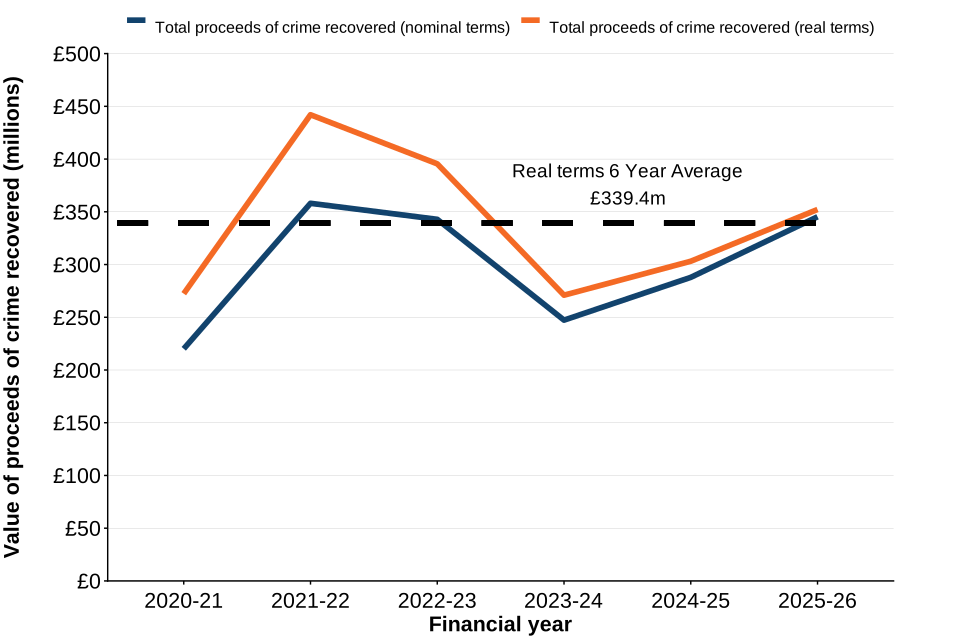
The statistics in this section are presented in real terms, adjusted for inflation to current prices (financial year 2026 to 2027). Figures have been converted to real terms using the latest GDP deflators available at time of data extraction (published March 2026).
Since the financial year ending March 2021, the total proceeds of crime recovered increased by 29% in real terms, from £272.4 million to £352.2 million in the financial year ending March 2026. Over the same period, nominal recoveries increased by 57%, from £220.1 million to £345.3 million. This demonstrates that proceeds of crime recovered increased not only in nominal terms but also in real terms, indicating growth even after accounting for inflation.
Figure 4: Total value of the proceeds of crime recovered, split by nominal and real terms, from financial year ending March 2021 until financial year ending March 2026, in England and Wales and Northern Ireland
Source: JARD
Further detail on real term figures can be found in table 1 of the Asset recovery statistics, financial years ending 2021 to 2026: data tables accompanying this bulletin.
7. About these statistics
Future releases of this statistical publication are pre-announced on the statistics release calendar on the GOV.UK website. The accompanying User guide to Asset recovery statistics provides information on the different data sources used and the processes for this statistical release, as well as other statistical information about the Bulletin.
Tables and data
Asset recovery statistics, financial years ending 2021 to 2026: data tables provides 6-year time-series data for each POCA Power, ARIS allocations, data collected by the Home Office on the use of ARIS, cryptocurrency and proceeds of crime from international cooperation.
Feedback
Home Office is keen to receive feedback on its statistical publications to maintain their relevance for users.
Any feedback should be directed to the Asset Recovery Performance team through email: POCAPerformance@homeoffice.gov.uk.
Press enquiries for this release should be directed to telephone number: 0300 123 3535.
Other enquiries on these statistics should be directed by email to: CriminalFinancesandAssetRecoveryUnit@homeoffice.gov.uk.