User guide to Asset recovery statistics
Updated 15 September 2026
Applies to England, Northern Ireland and Wales

© Crown copyright 2026
This publication is licensed under the terms of the Open Government Licence v3.0 except where otherwise stated. To view this licence, visit nationalarchives.gov.uk/doc/open-government-licence/version/3 or write to the Information Policy Team, The National Archives, Kew, London TW9 4DU, or email: psi@nationalarchives.gov.uk.
Where we have identified any third party copyright information you will need to obtain permission from the copyright holders concerned.
This publication is available at https://www.gov.uk/government/statistics/asset-recovery-statistics-financial-years-ending-2021-to-2026/user-guide-to-asset-recovery-statistics
1. Introduction
Asset recovery statistics are published annually, presenting official statistics on the value and volume of proceeds of crime restrained, seized, frozen and subsequently recovered and receipted. The release also includes statistics on:
- the value and volume of proceeds of crime by the associated criminal offence groups and types
- the value of compensation paid to victims through confiscation orders
- the amount of funds distributed to agencies through the Asset Recovery Incentivisation Scheme (ARIS)
- the use of funds received by agencies through ARIS
- the amount awarded to projects via ARIS top slice funding
- statistics on international asset recovery
- annexes covering data on cryptocurrency, modern slavery, bribery and corruption and organised immigration crime offences
This publication provides a comprehensive guide to the asset recovery system, focusing on legislative background and definitions to enhance the statistics published in the Annual statistical bulletin for Asset recovery. It also outlines the scope of the statistics, methodology employed to produce the statistics, information on the quality of the data sources and outputs and a quality statement on how this release meets the standards set out by the Code of Practice for Statistics.
This report is regularly reviewed and updated annually to reflect additions, changes to legislation and changes to the reporting of the statistics.
2. Overview of the asset recovery system
Asset denial by restraint (restraint orders), seizures (cash, listed assets) and freezing orders (account freezing orders) and asset recovery through criminal confiscation, civil forfeiture, and civil recovery are used to deprive criminals of their money, or other property connected to criminal activity, and recover the proceeds of crime. They represent important tools in the disruption of criminal activity and an alternative, or supplementary, mechanism to criminal prosecution and conviction. Retrieved criminal proceeds can subsequently be reinvested for use in tackling crime and in some cases be returned in compensation to victims.
Figure 1 shows an overview of the process of the asset recovery system for the proceeds of crime under POCA using the criminal confiscation system and the civil system.
Figure 1: Overview of the process of the asset recovery system for Proceeds of Crime under the Proceeds of Crime Act (POCA)
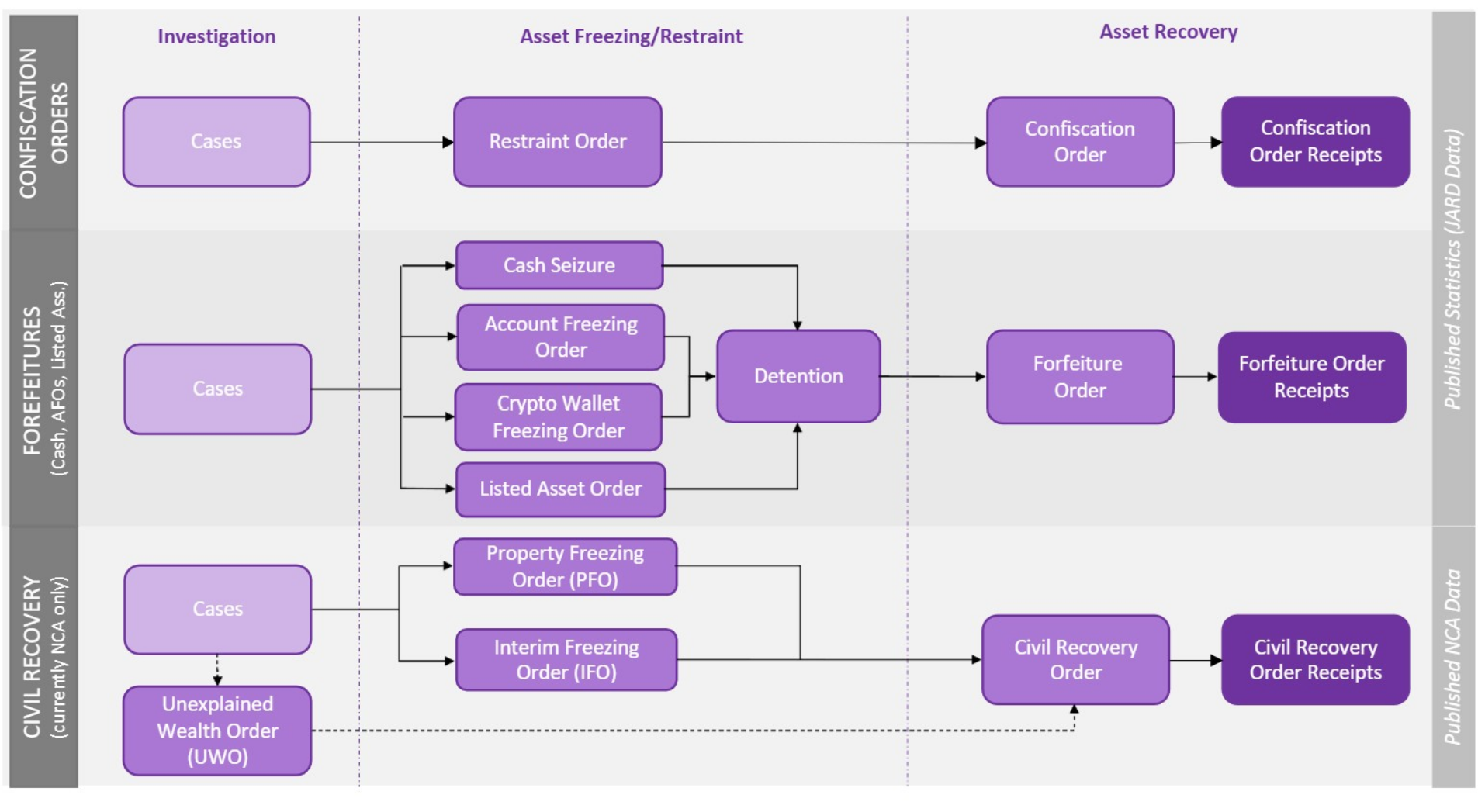
Notes:
- Money held in accounts maintained with relevant financial institutions can be frozen; it cannot be detained.
- The asset recovery options following an unexplained wealth order (UWO) would not necessarily just be a civil recovery order, they could be any of the other part 5 forfeiture powers (the statutory presumption would only apply for civil recovery applications).
3. Asset recovery legislation
An overview of the different legislative processes and powers that are applied by law enforcement agencies (LEAs) to deny and recover assets are briefly outlined below.
3.1 Proceeds of Crime Act (POCA) 2002
The Proceeds of Crime Act 2002 outlines the statutory framework used to enable investigation and prosecution of crimes relating to benefit from criminal conduct; or crimes relating to property obtained through unlawful conduct or which is intended to be used in unlawful conduct. It is also used to deprive criminals of their money or other property connected to criminal activity.
Detailed within the section below is the legislation within POCA 2002 that allows different powers used by law enforcement agencies to deprive criminals of their criminal assets. The asset recovery powers utilised under POCA 2002 can be applied through criminal confiscation, civil forfeiture, and civil recovery.
The Proceeds of Crime Act 2002 is the legislation most often utilised by law enforcement agencies for recovery of illicit finances and is therefore explained in more detail compared to other legislations.
Criminal powers
Explanations of the POCA criminal legislative powers are outlined below. An illustrative example of the asset recovery process by criminal confiscation powers is given in figure 1 and figure 2.
Restraint orders
Part 2 (and Part 3 for Northern Ireland) of POCA contains powers to restrain, and/or seize and detain property. These powers are available to prevent a suspect or defendant from making certain property unavailable for satisfying a confiscation that has been or may be made against them.
Restraint orders are granted against a person within the Crown Court and grant the prosecutor the ability to freeze ‘realisable property’ so that the value may be preserved to satisfy a potential confiscation order at a later date. Restraint orders still allow the defendant to claim reasonable living expenses from the frozen assets, the scope of reasonable living expenses is decided by the court, which can include carrying on a business, trade, profession or occupation.
Once a restraint order has been granted the Crown Prosecution Service (CPS) will become the lead enforcement agency.
A restraint order can be applied for at any point within the investigation, including during the criminal investigation (pre-arrest) and after a confiscation order has been granted (post-arrest). The order can be granted by the Crown Court without any notice to the suspect provided the statutory conditions for the making of an order are fulfilled. The threshold to get a restraint order granted is higher than the threshold for civil denials. The prosecution must show the defendant gained these assets illegally and that they are likely to dissipate their assets without a restraint order in place.
It is not compulsory to issue a restraint order before a confiscation order can be granted.
There is no upper limit for the length of time a restraint order can be in place for or the value of assets that can be restrained. The value is usually equal to the amount the defendant has been determined to have benefitted from their crime.
The value of a restraint order is determined by the estimated value of assets that the person against whom the restraint order was granted. Restraint orders are categorised into range value bandings in order to encapsulate any additional assets that the courts and LEAs are made aware of once the restraint order is in place, before a confiscation order is imposed. Below is a list of the restraint order bandings used.
| Restraint order banding value |
|---|
| Up to £50,000 |
| £50,000 to £100,000 |
| £100,000 to £250,000 |
| £250,000 to £500,000 |
| £500,000 to £1 million |
| £1 million to £5 million |
| £5 million to £10 million |
| £10 million to £100 million |
| £100 million to £1,000 million |
| Over £1,000 million |
For the purpose of the analysis within the publication, the mid-point of the banding is used as the estimated value of the restraint order to produce the total value.
Restraint order volumes by the banding value have also been included in the data tables.
Confiscation orders
Part 2 (and Part 3 for Northern Ireland) of POCA makes provisions for the confiscation of a person’s benefit from criminal conduct, following a criminal conviction. If the relevant statutory conditions are satisfied, the Crown Court must decide the benefit amount and recoverable amount for the defendant and make a confiscation order requiring them to pay that amount.
When the relevant statutory conditions for the making of a confiscation order are met, and an order is made the defendant will be liable to pay the full amount by a date set by the court. Confiscation orders usually have to be paid within 6 months of being enforced; however, this can be extended for a multitude of reasons. Once the deadline to pay the order has elapsed, interest will start to accrue on the remaining balance.
Payment towards the confiscation order can come from the proceeds of crime restrained (under a restraint order) or from other assets, whether determined to be the proceeds of crime or not. Other individuals can pay the order on the defendant’s behalf. If a restraint order was in place, this will not end when a confiscation order is granted but will instead end when the full amount has been paid by the defendant.
The value of the confiscation order can be varied (increased or decreased) based on re-evaluation of the defendants’ assets. If the confiscation order value is lower than the benefit amount, the case can be revisited, and the confiscation order uplifted (increased) if agencies become aware of further assets the defendant possesses. If a defendant is deemed to be uncooperative in confiscation proceedings and not actively trying to pay their order then a default sentence will be activated, this can be on top of a custodial sentence the defendant might already be serving for their offence. The length of the default sentence is based off the value owed by the defendant.
Compensation ordered through confiscation orders
A court imposing a confiscation order can also order an offender to pay compensation to the victim/victims of their crime. If the offender does not have the means to satisfy both their confiscation order and compensation order, the court can order the compensation order to be paid from the sums recovered as part of the confiscation order. This is paid before the rest of the order is fulfilled.
Civil powers
Explanations of the individual non-conviction based powers available under POCA are outlined below, including forfeiture and civil recovery. An illustrative example of the asset recovery process by civil powers is given in figure 1, figure 3, and figure 4.
Civil freezing orders
Part 5 of POCA contains powers that allow law enforcement agencies to apply to the High Court for freezing orders in support of civil recovery proceedings. Property freezing orders (PFOs) and interim freezing orders (IFOs) are used to preserve property while an investigation or civil recovery case is ongoing. These powers can be used without a criminal conviction and are intended to prevent property from being sold, transferred, hidden or otherwise dissipated before the conclusion of proceedings.
Civil forfeiture
Part 5 of POCA contains powers that enable the seizure, detention and forfeiture of cash and listed assets as well as powers for freezing, and forfeiture of monies held in relevant bank accounts without a criminal conviction. The Economic Crime and Corporate Transparency Act 2023 also introduced additional powers to recover more illicit cryptoassets, including Crypto Wallet Freezing Orders (CWFOs) which enabled law enforcement agencies to freeze and seize cryptoassets. These were introduced in April 2024.
Powers can be only used to seize/freeze and forfeit assets if they are determined on the balance of probability to be or to represent property obtained through unlawful conduct or property intended for use by any person in unlawful conduct. A forfeiture order can be granted by a Magistrate’s Court following an application by His Majesty’s Revenue and Customs (HMRC) officers, constables, Serious Fraud Office (SFO) officers or accredited financial investigators (FIs) for forfeiture of cash, monies within a relevant account or certain listed assets that have been seized and detained under POCA.
Cash seizures
Cash seizure powers under POCA enable the seizure of cash with a minimum value of £1,000. Once initial seizure has occurred an application has to be made to the Magistrates Court within 48 hours for further detention and forfeiture of the cash. Applications for the detention of cash can be granted for 6 months at a time for a total of 2 years whilst the investigation is ongoing.
Cash seizure does not require a criminal prosecution or conviction. As a result, the cash seizure detention provisions effectively prohibit the respondent from accessing or using the seized cash during the investigation up to the completion of the application to forfeit the cash on the basis that there are reasonable grounds to suspect that the cash is recoverable property or property that was intended for use in unlawful conduct.
A cash seizure does not just refer to physical coins and notes but also for bonds and cheques. Often once cash has been seized it is placed within interest accruing bank accounts so the value detained can increase throughout the investigation.
Change introduced under Criminal Finances Act 2017
The Criminal Finances Act 2017 (CFA) amended POCA legislation, most notably introducing 2 new forfeiture powers allowing law enforcement agencies to forfeit bank and building society accounts (account freezing orders (AFOs) and listed assets). CFA also introduced unexplained wealth orders (UWOs), an investigative tool to give law enforcement agencies (LEA) and partners new powers for tracing and recovering: the proceeds of crime; property obtained through unlawful conduct; or property intended for use in unlawful conduct. UWOs fall under civil recovery power whereas AFOs and listed assets fall under civil forfeiture powers.
UWOs, listed assets and AFOs came into effect from 31 January 2018 in England and Wales and 28 June 2021 in Northern Ireland. These powers significantly improved LEA’s ability to tackle economic crime by being able to seize and forfeit a wider remit of assets and disrupt criminal activity.
Account freezing orders (AFO)
AFOs were introduced as part of the CFA 2017 amendments to POCA powers. It allows provisions for senior HMRC officers, constables, SFO officers and accredited FIs to apply to the Magistrates’ Court for the freezing of money in a relevant account with a minimum value of £1,000. This is another civil power and therefore a criminal conviction is not required for an AFO to be granted. AFOs can be granted for 6 months at a time for a maximum 2-year period.
AFOs prevent any persons from accessing or otherwise using the money in the bank or building society account until the AFO is discharged or the completion of the application to forfeit.
Non-senior enforcement officers can exercise this power with prior approval from a judicial office or a senior officer. AFO applications can be made without giving the affected parties notice if this would prejudice any steps to secure forfeiture of the money. An AFO is a compulsory order that has to be granted before forfeiture of funds held in a bank or building society account can be applied for.
Listed assets
Listed asset orders were introduced as part of the CFA 2017 amendment to POCA powers. A listed asset order grants HMRC officers, constables, SFO officers or accredited FIs the powers to seize certain items of personal property. Under listed assets only precious metals, precious stones, watches, artistic works, face-value vouchers and postages stamps with a minimum value of £1,000 can be seized. The assets listed above can be seized if there are reasonable grounds to suspect that it is recoverable property or intended for the use in unlawful conduct.
Any seized property can initially be detained for a 6-hour period, but this detention period can be extended by a further 42 hours with the approval of a senior officer. Following an application to the Magistrates’ Court the property can be detained for 6 months at a time for a maximum period of 2 years. A listed asset seizure is a mandatory order before a listed asset forfeiture can be granted.
Settlements
The Secretary of State (Home Office), the Treasury, the Attorney General and Advocate General for Northern Ireland have issued guidance to the relevant authorities in the UK on the use of the asset recovery powers in the Proceeds of Crime (POCA), including reaching settlement with Defendants.
The guidance confirms that, under POCA 2002, a relevant authority may agree to accept by way of a settlement a reduced sum in satisfaction of a civil recovery claim if satisfied that:
- The sum is reasonable, having regard to all relevant circumstances including the chances of recovering the full amount claimed and the time and public funds likely to be expended in attempting to do so; and
- Accepting the reduced sum would not damage public confidence
While the guidance is aimed at UK relevant authorities, it has clear resonance when the said authorities are conducting investigations and proceedings on international referrals.
Settlements are defined as a voluntary agreement between law enforcement agencies and the individual suspected of benefitting from criminal conduct. The terms of a settlement, often outlined in a Consent Order, must be agreed by both parties and a Judge in the High Court or a Magistrate in the lower courts.
Settlements can be used as an alternative method to traditional asset recovery for depriving an individual of their suspected proceeds of crime. They are used to resolve investigations at an early stage without the time and expense associated with a trial. While unlawful conduct is at the heart of POCA, settlements do not constitute a finding of guilt in respect of a criminal offence. The primary aim is to recover funds from those involved in unlawful conduct as efficiently as possible in a manner which maintains public confidence
3.2 Other legislation
Although the most common method of seizing/denying and recovering proceeds of crime is through using POCA 2002, there are other legislations that can be used and are included within the asset recovery annual statistical bulletin figures. These include:
- Anti-terrorism and Security Act 2001
- Criminal Justice Act 1988
- Drug Trafficking Offences Act 1986
- Drug Trafficking Act 1994
- Police and Criminal Evidence Act (PACE) 1984
- Crime and Courts Act 2013
There are many reasons that other legislations other than POCA 2002 are used (for example, case pre-dates POCA 2002 legislation, timeliness of orders being granted), however the majority reported on within this statistical series use powers granted through POCA 2002 legislation.
4. International asset recovery
4.1 International asset sharing
International asset sharing refers to when the UK assists another country or another country assists the UK on an investigation. This might be due to assets being held in different countries, the defendant fleeing or victims of the crime being in another jurisdiction. International asset sharing can occur through mutual legal assistance and the process is outlined below.
Mutual legal assistance
Mutual legal assistance (MLA) is a method of international asset sharing between states for obtaining assistance in the investigation or prosecution of criminal offences. This includes requests for criminal or civil asset denial and recovery.
Property and assets held by a defendant internationally can be recovered using mutual legal assistance with foreign states and then the assets recovered can be shared between the participating countries.
For the purposes of the asset recovery statistical bulletin, international asset sharing is defined as asset recovery orders that are:
- executed in England and Wales, or Northern Ireland following the receipt of a mutual legal assistance request from another country which resulted in an asset share
- executed abroad following the receipt of a mutual legal assistance request from England and Wales, and Northern Ireland which resulted in an asset share
4.2 Grand corruption
Grand corruption is often defined as acts of corruption involving the misuse or abuse of high-level entrusted power by senior public officials as defined by reference to the United Nations Convention Against Corruption (UNCAC). Grand corruption threatens political stability and sustainable development. Acts that might fall into this category include bribery of public or private officials, embezzlement, illicit enrichment, abuse of function or the laundering of the proceeds of crime. When individuals commit acts of grand corruption LEAs work to detain and recover assets that are deemed to have originated from their criminal activities and where possible return them to victims.
Within this iteration of the annual statistical bulletin, Deferred Prosecution Agreements that relate to grand corruption under the Crime and Courts Act 2013 are also included along with grand corruption cases that have been conducted utilising POCA legislation.
For the purposes of the asset recovery statistical bulletin grand corruption is defined as asset recovery orders that are:
- executed in England and Wales, or Northern Ireland
- executed abroad following receipt of a mutual legal assistance request from England and Wales, and Northern Ireland
- executed in England and Wales or Northern Ireland following the receipt of a mutual legal assistance from another country
4.3 International settlements
Settlements are defined as a voluntary agreement between law enforcement agencies and the individual suspected of benefitting from criminal conduct. The terms of a settlement, often outlined in a Consent Order, must be agreed by both parties and a Judge in the High Court or a Magistrate in the lower courts.
Settlements can be used as an alternative method to traditional asset recovery for depriving individual of their suspected proceeds of crime. They are used to resolve investigations at an early stage without the time and expense associated with a trial. While unlawful conduct is at the heart of POCA, settlements do not constitute a finding of guilt in respect of a criminal offence. The primary aim is to recover funds from those involved in unlawful conduct as efficiently as possible in a manner which maintains public confidence
For the purpose of the annual statistical bulletin. It only includes settlements where one of the following applies:
- the investigation originated within England and Wales and Northern Ireland with mutual legal assistance provided from another country
- the investigation originated from another country with mutual legal assistance provided by England and Wales and Northern Ireland
5. Asset Recovery Incentivisation Scheme (ARIS)
ARIS was introduced in 2006 to allow a proportion of the proceeds of crime recovered under POCA, to be redistributed to agencies based on their relative contribution to recovering assets, and central government (Home Office and HM Treasury). Prior to funds being redistributed under ARIS, around £14 million is set aside to fund the ARIS top slice grant scheme.
The Home Office’s share of ARIS receipts represents core funding that would otherwise be paid by HM Treasury as part of the regular Spending Review. This funding supports Home Office investment in priority front line activity, including supporting and safeguarding victims, delivering the policy response to economic crime and the national cyber strategy and delivering statutory obligations.
5.1 ARIS payments to agencies
The use of ARIS allocations is decided by each agency receiving payment. The Home Office encourages agencies to invest ARIS funds into areas that will increase asset recovery or where appropriate to fund local crime fighting priorities for the benefit of the community. See figure 2, figure 3, and figure 4 below for the proportional split of ARIS receipts amongst agencies.
Figure 2: Overview of the criminal confiscation system process for proceeds of crime under POCA
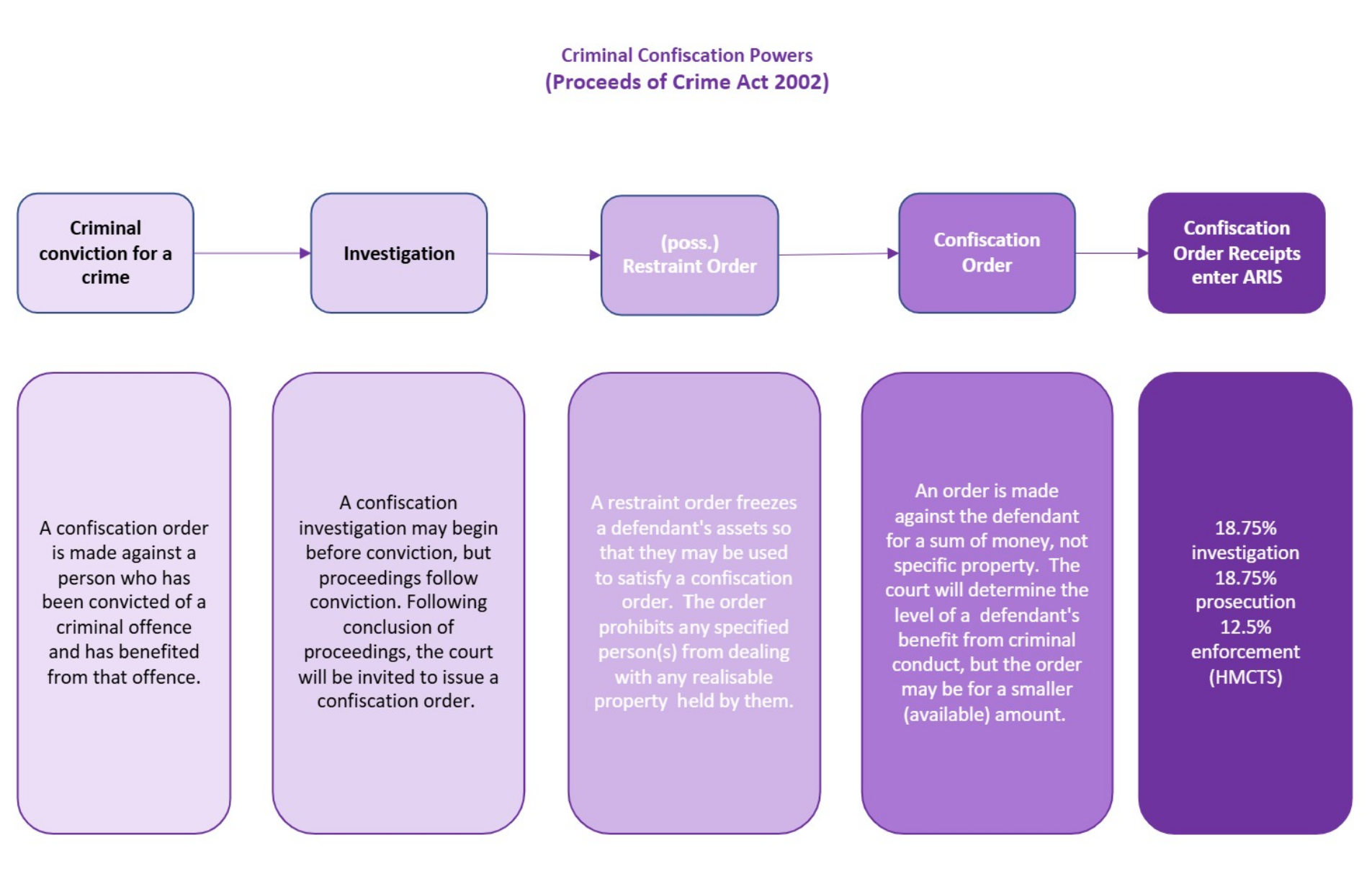
The chart in figure 2 shows an overview of the criminal confiscation system process of the asset recovery system for the proceeds of crime under POCA.
Figure 3: Overview of the civil system process for proceeds of crime – forfeitures under POCA
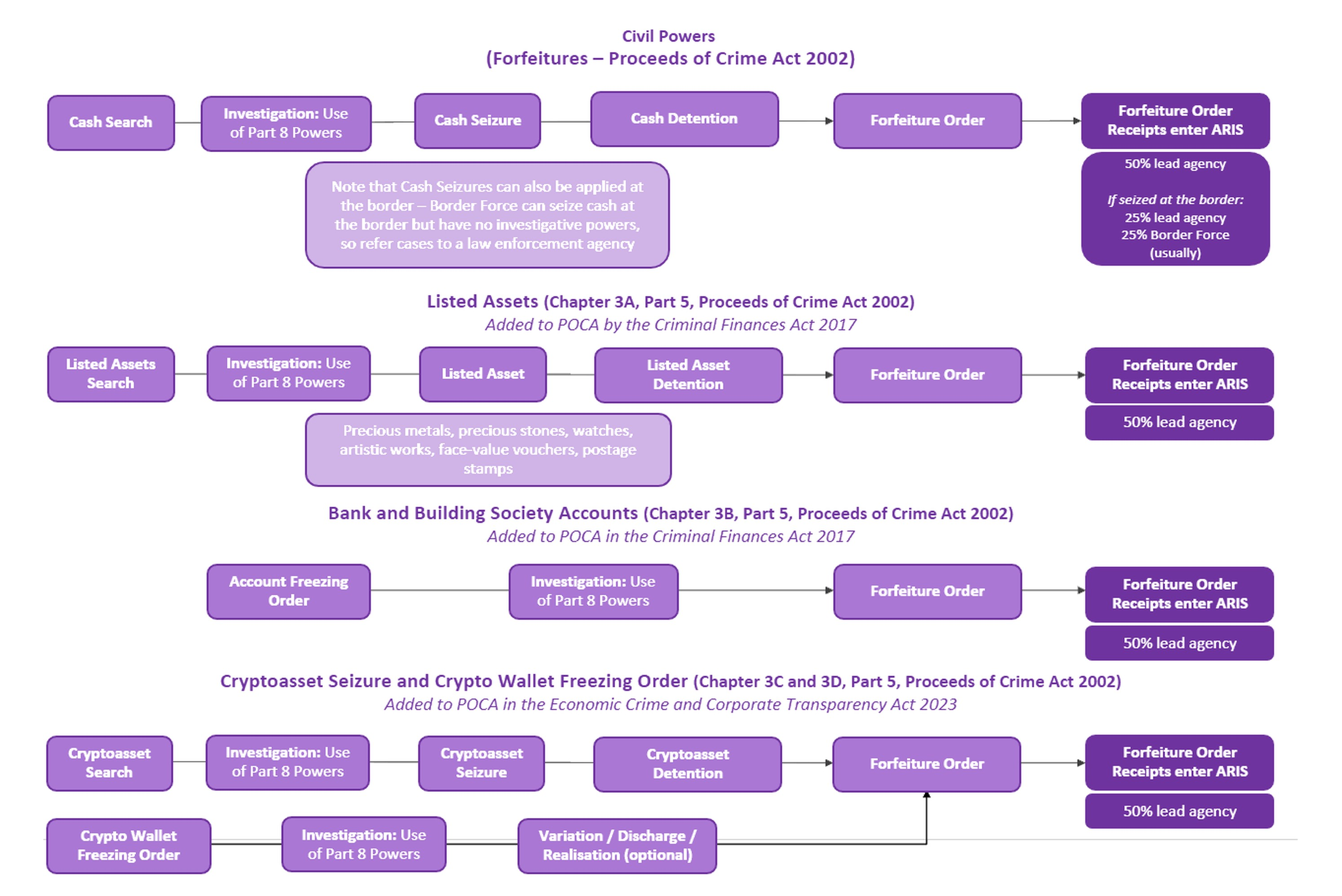
Figure 3 shows an overview of the civil system process of the asset recovery system for the proceeds of crime under POCA using forfeiture powers.
Figure 4: Overview of the civil system process for proceeds of crime – civil recovery under POCA
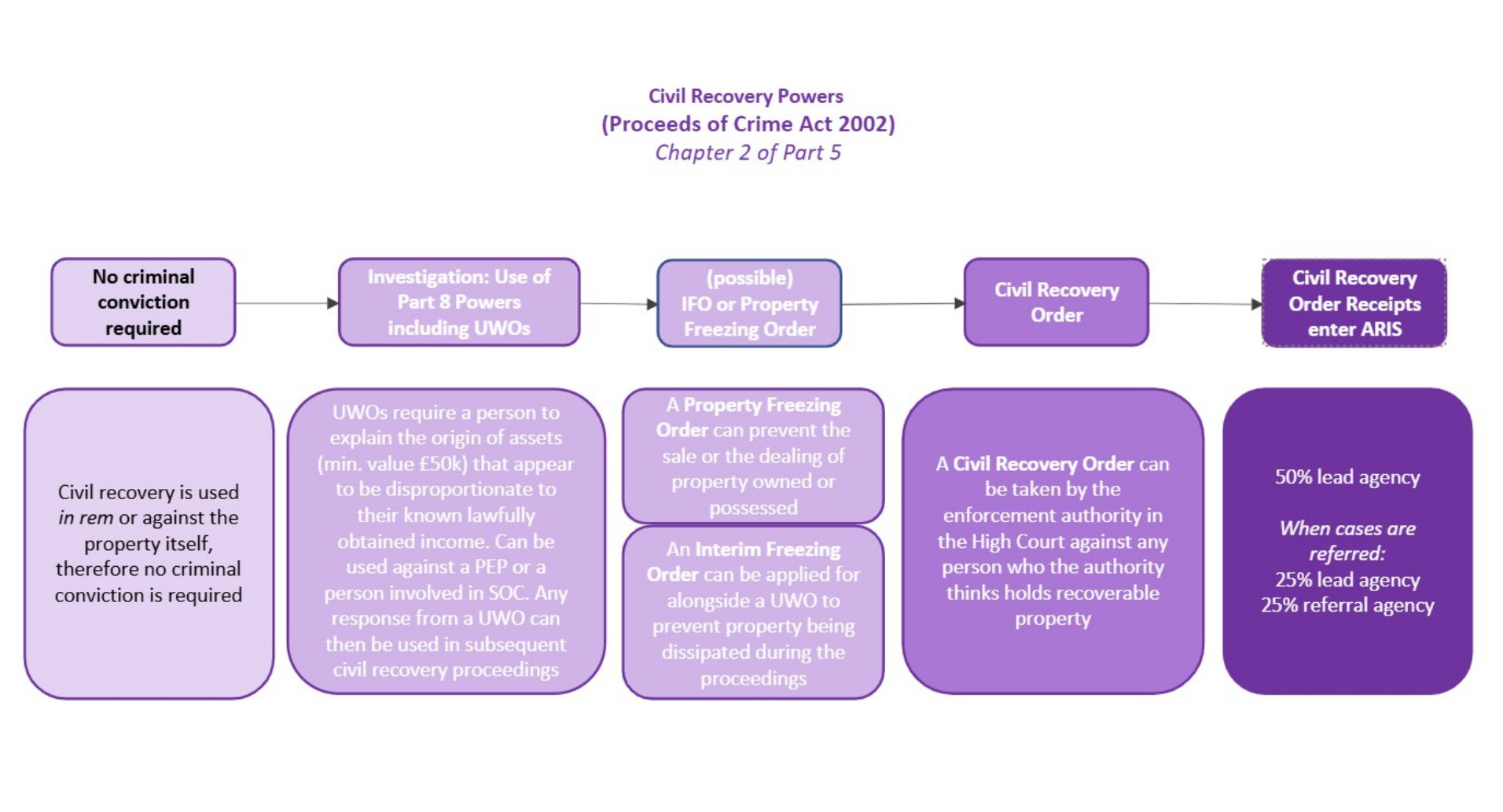
Figure 4 shows an overview of the civil system process of the asset recovery system for the proceeds of crime under POCA using civil recovery powers.
5.2 ARIS top slice
The ARIS top slice is a competed grant launched in 2015, available to all POCA empowered agencies, to support investment in key national and regional capabilities or to test innovative new approaches to improve asset recovery processes and performance. The funds for the grant come from a small deduction from ARIS receipts prior to their distribution to POCA agencies and the Home Office. Decisions on funding allocations are made by Ministers from the Home Office, Ministry of Justice, and Attorney General’s Office.
6. Crypto assets
6.1 overview
Cryptoassets are digital representation of value that relies on a cryptographically secured distributed ledger (DLT) or similar technology to validate and secure transactions. At its simplest, DLT is a system for storing and managing information distributed across participants in a network. The type of DLT cryptoassets typically use is called a blockchain because the information is stored in blocks linked by cryptographic (basically complex mathematical processes) techniques. This keeps data secure for storage and/or transmission. The Financial Conduct Authority (FCA) research identified that as of August 2024, 12% of UK adults own cryptoassets.
With public, and decentralised blockchains that don’t require authorisation - like the one Bitcoin and many other cryptos use - there is no one single central data storage point or one central authority that grants participants permission to access and participate in the network. Instead, all information is publicly available.
Cryptoassets provide a pseudo‑anonymous, low‑cost, and relatively fast means of moving funds globally. There are low barriers to entry, users merely need an internet-connected device to buy and transact with cryptoassets. Given these characteristics, this technology is being exploited by criminals. Criminals are shifting to using less regulated exchanges and services to launder criminal funds, due to the increased regulation in the UK and other jurisdictions. Cryptoassets are increasingly used for laundering all forms of proceeds of crime, with a large proportion facilitated by service providers based outside the UK. The international nature of the blockchain and cryptoasset transactions present unique difficulties in conducting effective enforcement against criminal actors. The top identified categories of illicit activity on the blockchain are still from sanctioned entities (33% of illicit volume), and scams and fraud (24% of illicit volume) according to the National risk assessment of money laundering and terrorist financing, 2025.
6.2 Legislation
The Economic Crime and Corporate Transparency Act 2023 (ECCTA), which came into force on 26 April 2024, expands the UK’s ability to investigate, freeze, seize, recover and realise cryptoassets linked to criminal activity. By amending the Proceeds of Crime Act 2002 (POCA), the Act modernises the asset recovery framework and equips law enforcement agencies with enhanced powers to identify, restrain, seize, recover and forfeit cryptoassets and related access devices. A notable change is that when relevant POCA conditions are met and necessary judicial authorisations secured, law enforcement officers can secure and seize cryptoassets without first arresting anyone. These reforms address challenges posed by digital assets and enable more effective action against their use in fraud, money laundering, sanctions evasion, terrorist financing and other forms of economic crime.
7. Asset recovery statistics coverage
7.1 Overview, time period and geographic regions
The asset recovery annual statistical bulletin provides data on the value and volume of proceeds of crime restrained, seized, detained, obtained and recovered through criminal confiscations, forfeitures and civil recovery. It also includes statistics on the value of compensation paid to victims, the use of funds by LEAs received through ARIS, the ARIS allocations distributed to these agencies and the value of international asset recovery.
The bulletin series provides data from financial year 2011 to 2012 to present and covers asset recovery performance in England and Wales and Northern Ireland. This release does not include data covering Scotland. This bulletin will cover the latest 6 financial years, from financial year ending March 2021 to financial year ending March 2026.
The bulletin is published on a yearly basis, information on the publication calendar can be found in section 14.
7.2 Data splits provided in the publication
The statistics provide the following breakdowns on the value and volume of proceeds of crime recovered by:
- asset recovery power
- location of jurisdiction
- financial year
- offence type
- agency sector
Statistics on the ARIS payments distributed to POCA agencies are broken down by:
- financial year
- law enforcement agency
Official statistics in development on international asset sharing are broken down by:
- financial year
- total value and volume recovered and or retained by the UK government
- value recovered split by incoming and outgoing
- total value and volume in victim compensation
Official statistics in development on grand corruption are broken down by:
- financial year
- asset recovery stage (denial, recovery, return)
- asset recovery power (criminal versus civil)
Further information on official statistics in development can be found in section 13.
7.3 Other asset recovery statistics
There are other published sources of asset recovery statistics that may be of interest, including: the collection of civil recovery and taxation published by HMRC, the annual report and accounts published by NCA and the annual unexplained wealth order report published by Home Office. This unexplained wealth order report is a statutory requirement under the Economic Crime (Transparency and Enforcement) Act 2022 to report annually on the number of UWOs applied for and obtained each year.
8. Uses of the reported statistics
The statistics are used by law enforcement and prosecution agencies to inform operational decisions and the Home Office alongside other government departments to inform asset recovery policy decisions with the aim of contributing to an increase in the value of proceeds of crime recovered.
It should be noted that these statistics are also used to respond to parliamentary questions and requests submitted under the Freedom of Information Act.
We are interested in developing these statistics to meet user needs and welcome feedback from users. Further information on providing feedback can be found in section 18.
9. Data sources and limitations
The data used to create these statistics are obtained from several administrative and operational databases, which are covered below. It should be noted the accuracy of the statistics are dependent on the recording and management of information stored on these databases.
9.1 Joint Asset Recovery Database (JARD) data
Data on values and volumes of proceeds of crime (excluding civil recovery and international asset recovery) included in the statistical release are taken from JARD which is an operational database that is managed by the NCA. It is a central database which stores information on the seizure, detention, and recovery of the proceeds of crime across all LEAs. JARD is funded through ARIS top-slice.
Data is entered by accredited FIs within LEAs which includes the Police, the CPS, the SFO and local authorities. The operational nature of the data means that it is entered each day by these agencies. This in turn means that JARD data entries are adjusted to reflect changes in the progress and resolution of orders and the addition of new orders.
JARD data includes all orders reported in England, Wales, Northern Ireland, and Scotland; however, as noted above this release does not include data covering Scotland, as Scotland has its own separate asset recovery system. The orders recorded under JARD represent those which have been processed under all legislation which is available for recovering the proceeds of crime including POCA 2002. These legislations are outlined in section 3.2.
Limitations
As the data is directly entered by law enforcement officers onto the live database, any errors in the input of data may therefore impact the accuracy of statistics produced for the value and volumes of proceeds of crime for each respective power. Where known errors have been identified, corrective measures have been applied.
The statistics may not report timely figures on orders which are still active from previous historical years because it can take several years for an order to proceed from the asset denial stage to the asset recovery stage. For example, when an order is at the asset recovery stage, a criminal can make payments towards the order over several years after the initial seizure was made. Thus, the statistics presented might not report the asset denial and asset recovery stages for one order within a given period.
Moreover, the data recorded in JARD by law enforcement officers for the criminal offence types under the ‘Primary offence type’ field does not always provide a representative figure of the true criminal offence type for a given order. This is due to officers selecting an approximate offence type when recording an order on JARD, if there is no specific criminal offence or if an order has multiple offences linked to it selecting only one of them. Therefore, the statistics presented for criminal offence types might not report the true criminal offence type for a given order.
Following the release of the September 2022 edition of the bulletin, further work on understanding trends observed for cash seizures was undertaken by the Home Office and NCA. This work established that cash seizures were underreported, for both the volume and value of assets seized. Subsequent conversations have confirmed this reporting issue is prevalent across law enforcement agencies, primarily impacting just this seizure sub type, with the initial proceeds of crime seized being recorded under different legislation and the associated forfeiture order being recorded under POCA.
As of this publication (September 2026), the main metric for the value of proceeds of crime seized from cash seizures has been revised to address this underreporting. These changes are outlined in section 10.1.
Variations
It should be noted there will be variations in the data recorded for each financial year due to revisions made in retrospection of the live administrative JARD system. Figures included in the latest statistical release supersede previous officially reported figures. Therefore, any direct comparisons of changes in asset recovery performance should not be made between the latest and previous releases of the asset recovery annual statistical bulletin.
Data extraction
Data used in the release was extracted in June 2026.
9.2 Civil freezing and recovery data
The data presented on civil freezing and recovery orders is provided by the NCA. It includes the value of proceeds of crime frozen through interim and property freezing orders, as well as value recovered through civil recovery orders.
Data provided includes orders obtained by all agencies with civil freezing and recovery powers including the NCA.
Data is collated by the NCA and is updated regularly to reflect changes in the progress of orders, the resolution of orders and addition of new orders.
Limitations
The data provided by the NCA does not provide breakdown on the individual value of civil recovery orders. The data provided includes one figure for the value recovered for each financial year and does not provide data on the volume of cases. This means that within this publication civil recovery orders do not have a recorded volume.
9.3 ARIS payments data
The data presented for ARIS payments is extracted from an administrative database managed by Home Office. This database uses data recorded on JARD for confiscation orders and METIS data for forfeiture orders. This includes information on orders that have been processed under the POCA 2002 legislation within a given financial year and provides details such as lead agency and amount of assets recovered.
Data has been cleansed by the ARIS team and the Home Office finance team as part of the processes undertaken each quarter for calculating ARIS payments.
The statistics have been produced using a combination of live operational data recorded in JARD and financial data in METIS. Data which is recorded on both data sources are entered by either law enforcement officers or finance colleagues, which means there could be errors made at the imputation stage. Any errors in these original data sources, which have been identified by POCA agencies or the ARIS team during the payment process, will have had corrections implemented.
These statistics may not include figures for a POCA agency in every financial year because they might not have processed any orders which fall under the remit of the ARIS scheme. Hence, it might not be possible to make comparisons over time for a given agency.
9.4 Use of ARIS Funds data collection
The Use of ARIS Funds data collection is run by the Home Office and distributed by email to POCA-enabled agencies that participate in the ARIS scheme. The data collection is designed to develop insights into how agencies use the ARIS funds that are allocated to them. The questionnaire asks agencies to outline how they used their ARIS funds in the previous financial year. The lag of one financial year allows time for the agencies to collate the necessary information. Limitations of the Use of ARIS Funds data collection are discussed in section 10.4.
9.5 ARIS Top Slice data
The data presented for ARIS Top Slice is extracted from an administrative database managed by the Home Office. This database includes information on agencies that have been allocated ARIS Top Slice funding for projects that support national and regional capabilities or improve asset recovery processes and performance.
This data is entered regularly by the Home Office and reflects projects and funding as and when there are any changes.
This release of ARIS Top Slice data will cover the reporting period beginning from financial year ending March 2023 to present. Data from previous financial years has not been included, due to data quality issues.
9.6 International asset sharing data
The data presented on international asset sharing and asset return is taken from administrative databases which are managed by the Home Office. The data provides information on the orders executed by law enforcement in England and Wales, or Northern Ireland on behalf of another country, or vice versa. Data is also recorded on orders where funds recovered in the UK are returned to another country.
This data is entered regularly by the Home Office and reflects the progress of orders as and when there are any changes. The data entered on the database has been, where possible, quality assured against other data sources managed by POCA agencies including JARD.
Limitations
The data set only includes international cases where there has been an asset share the Home Office has been made aware of, there will be other international asset recovery cases where the UK has not assisted and is therefore not captured within the Home Office database.
9.7 Grand corruption data
To supplement the internally managed administrative data, data presented in this report on grand corruption has been requested from agencies in a reporting exercise conducted by the Home Office. This exercise involved requesting a return on grand corruption workload from all agencies known to have seized and / or recovered assets from grand corruption cases in the previous financial years. Data was returned to Home Office by NCA’s International Corruption Unit, NCA’s International Anti-Corruption Coordination Centre, SFO and CPS. The grand corruption data submitted, where possible, has been quality assured against other data sources managed by POCA agencies including JARD.
This is the fourth iteration of the annual statistical bulletin that grand corruption statistics have been included. The dataset has been expanded year on year, please see below what has been captured in previous iterations
- September 2023 publication only included statistics from financial year 2022 to 2023
- September 2024 publication included statistics from financial year 2019 to 2020 to financial year 2023 to 2024.
- September 2025 publication included both asset recovery under POCA 2002 and deferred prosecution agreements under the Crime and Courts Act 2013 relating to grand corruption.
This section is badged as Official statistics in development.
Limitations
The statistics presented will only represent those agencies which have provided a return for this reporting exercise and not necessarily the entire group of agencies who engage in this work. The accuracy of the statistics is dependent on the recording and management of information held by the respective agencies. Therefore, there can be fluctuation between iterations as agencies update their data cleansing and collecting processes. This means users should always refer to the most recent iteration of the publication.
Some assets were denied/recovered in currencies other than pounds sterling, where this has been the case, where possible the value has been checked on JARD. If this was not possible, conversion into pounds sterling was completed by the team prior to publication.
Some cases have been omitted due to ongoing sensitivities. Where possible, cases will be included once these sensitivities have been resolved and subject to review.
9.8 International settlements
This is the second year international settlements are being included within the publication. The decision to include them was to provide greater transparency in relation to disrupting suspected criminal activity. The data presented has been requested from the National Crime Agency through a data collection exercise and has been reviewed and quality assured. The data provided was the value the settlement was agreed for.
Limitations
The statistics presented only represent the settlements conducted by the NCA for the latest financial year that are not under reporting restrictions. This does not necessarily represent the entire value of settlements pursued.
9.9 Cryptoasset data
The data presented on cryptoassets are compiled using information provided by law enforcement agencies and partner organisations. The dataset includes information on cryptoasset seizures, crypto wallet freezing orders, restraint and confiscation orders related to cryptoassets. Prior to publication, agencies are invited to review and verify the data held for their cases and provide updates where additional information has become available.
Limitations
Data prior to the financial year ending March 2025 are not included within this publication. This is because the relevant cryptoasset powers introduced through the Economic Crime and Corporate Transparency Act 2023 came into force during April 2024. Comparisons with earlier financial years would therefore not provide a representative assessment of trends in cryptoasset denial and recovery activity
The cryptoasset seizure figures represent the estimated value of cryptoassets seized, frozen or restrained during the financial year. Values may be affected by changes in underlying cryptoasset prices which are often volatile and should therefore be interpreted with caution.
The cryptoasset recovery represents the value of cryptoassets recovered after conversion or realisation into fiat currency. Annual figures may fluctuate depending on the timing of individual cases and asset realisations as cryptocurrency exchange rates are often volatile.
The accuracy of the statistics is dependent on the recording and management of information by the respective agencies. As reporting processes for cryptoassets continue to develop, the completeness and quality of data may vary between agencies and over time. Consequently, figures presented in the latest publication supersede those reported previously.
10. Methodology
The information below outlines the main processes involved in producing the statistics used in the asset recovery annual statistical bulletin including data extraction, statistics production, and quality assurance. This section details the method used to produce the statistics for criminal confiscation and civil system for asset recovery.
Any revisions to these figures will be announced in line with the Code of Practice for Statistics, once a solution to this issue has been identified.
In summary, it is important that users take into consideration the following limitations:
Coverage: Reported statistics on the proceeds of crime in the bulletin are for England and Wales and Northern Ireland. Therefore, we do not capture any Scotland orders in the bulletin on asset recovery.
Accuracy: There are a number of users who can update entries of orders on JARD, so current orders and those which are still ongoing from previous historical years may be subject to revisions to correct for data errors, to update the scale of alleged proceeds of crime and the scale of recovered proceeds of crime following successful or unsuccessful criminal or civil procedural outcomes
10.1 Value and volume of proceeds of crime statistics
The statistics presented on the value and volume of proceeds of crime restrained, seized, detained, frozen and recovered through criminal confiscation or civil powers are produced using aggregations of live operational data recorded in JARD, except for civil recovery, taxation, and international asset recovery.
The main methodology is summarised below.
Criminal confiscation statistics
The value of proceeds of crime restrained from restraint orders is based on the estimated order value. This represents the predicted amount of monies to be restrained from the defendant once a restraint order is imposed. It is calculated using the amount of monies which the defendant is deemed to have benefited from criminal activity.
The value of proceeds of crime imposed from a confiscation order imposition is based on the order amount. It represents the amount of monies which the defendant is ordered to pay once a confiscation order has been imposed.
The main measure for the value of proceeds of crime confiscated is based on the distributed amount associated with a confiscation order. The distributed amount represents the value of proceeds of crime in receipts which have been recovered from the defendant following a confiscation order being imposed.
In September 2021, the report included statistics on the volume of payments recovered from confiscation orders, where the measure used for this was based on a proxy estimate of the volume of proceeds of crime imposed from confiscation order impositions. However, this measure has no direct correlation with the volume of proceeds of crime recovered from confiscation orders.
The data available on JARD for confiscation orders can include multiple payments made against an order for a given period. As these payments are against all orders, not just those imposed within the reporting period, this is therefore an ineffective measure of performance and does not directly link to orders imposed within the reporting period. For this reason, releases from September 2022 do not report statistics on the volume of proceeds of crime (payments) recovered from confiscation orders, only the values. Previous releases before September 2021 will not be affected, as the volume of payments recovered from confiscation orders was not previously presented.
Civil forfeiture statistics
The value of proceeds of crime seized from AFOs, cash seizures and listed asset orders is based on the finalised order amount. It represents the value of proceeds of crime that will be seized from the defendant given the civil proceedings have been completed.
From September 2022, the value and volume of proceeds of crime seized from AFOs, cash seizures and listed asset orders are presented in financial years, based on the date when the seizure took place, unless this field is not recorded. For orders where this field is not recorded, the date when the order is granted will be used to determine which financial year the proceeds of crime were seized. An assessment has been undertaken to determine this for quality assurance.
From September 2022, the ‘Order (decision) date’ field is used for cases with no recorded ‘Cash seizure date’ for all seizure powers. This approach that has been approved with operational partners.
From September 2025, the ‘(Cash) Actual Amount’ field is used as the main metric for the value of proceeds of crime seized from cash seizures. For orders where this field is not recorded, the ‘(Cash) Estimated Amount’ field will be used instead, replacing the previously used ‘CDO/CFO Order amount’ variable. This approach aims to capture additional cases that were previously excluded due to administrative error. This approach has been approved with operational partners.
A number of methodology changes have also been made in previous publications in relation to the value of proceeds of crime recovered from forfeiture orders. These changes have been listed below in order of date:
Table 1: Overview of previous methodology changes from previous publications in relation to forfeiture orders
| Date of publication | Summary of change |
|---|---|
| September 2017 to 2020 | The main measure for the value of proceeds of crime recovered from forfeiture orders was based on the current order amount associated with forfeiture order. This represented the value of proceeds of crime deemed to be recoverable from the defendant whilst the civil proceedings are being completed. The current order amount is a figure which could change following the completion of civil proceedings. |
| September 2021 | The main measure for the value of proceeds of crime recovered from forfeiture orders was based on the order amount under a detention order. This represented the value of proceeds of crime seized from the defendant whilst civil proceedings were ongoing. The order amount under a detention order could change following the completion of civil proceedings. |
| September 2022 | The main measure for the value of proceeds of crime recovered from forfeiture orders will be based on the original order amount for a forfeiture order once it has been granted. The original order amount represented the value of proceeds of crime in receipts which will be recovered from the defendant at the point where the civil proceedings have been completed. The original order amount replaced the ‘CDO/CFO Order amount’ variable to record the value of cases under forfeiture orders. |
| September 2023 | This statistical release implemented the use of ‘Case Jurisdiction’ variable to record the location of jurisdiction for cases under forfeiture orders where no ‘Jurisdiction of Court Making Order’ is recorded. This approach was approved with operational partners. |
The main measure for the volume of proceeds of crime seized, frozen, and recovered from a type of order, such as a seizure, freezing order or forfeiture order is based on the number of orders where a type of order has been seized, frozen or recovered. The volume of orders represents the number of processed orders where proceeds of crime will be seized, frozen, and recovered from the defendant given the civil proceedings have been completed.
Civil freezing statistics
The main measure for the value of proceeds of crime frozen under civil freezing powers is based on the value of property subject to a property freezing order (PFO) or interim freezing order (IFO). This represents the estimated value of proceeds of crime that have been frozen whilst civil recovery proceedings, or associated investigations, are ongoing.
The main measure for the volume of proceeds of crime frozen under civil freezing powers represents the number of processed property freezing orders and interim freezing orders, where property has been frozen pending the outcome of civil recovery proceedings or associated investigations.
Statistics on the proceeds of crime frozen under civil freezing powers were extracted from an operational NCA database in July 2026. These statistics are reported on a financial year basis, covering the financial years 2020 to 2021 until 2025 to 2026.
Civil recovery statistics
The main measure for the value of proceeds of crime recovered from civil recovery orders is based on the finalised order amount. The finalised order amount represents the value of the proceeds of crime in receipts, which will be recovered from the defendant given the civil proceedings have been completed.
The main measure for the volume of proceeds of crime recovered from civil recovery orders represents the number of processed orders, where proceeds of crime will be recovered from the defendant given the civil proceedings have been completed.
Statistics on the proceeds of crime recovered from civil recovery order receipts were extracted from an operational NCA database in July 2026. These statistics are reported on a financial year basis covering the years 2020 to 2021 until 2025 to 2026.
International asset sharing statistics
Official Statistics in development on international asset sharing were extracted from an administrative Home Office database in July 2026. These statistics relate to cases where the UK has assisted another country, or another country has assisted the UK, in the recovery of proceeds of crime, which subsequently resulted in an asset share. These statistics are reported on a financial year basis covering the financial years ending March 2021 to financial year ending March 2026.
International asset sharing statistics are reported according to the financial year in which the asset sharing case was concluded. Only closed cases are included within the published statistics. This approach reflects the completion of the asset sharing process, including the agreement of asset sharing arrangements between participating jurisdictions. For some cases, assets may be recovered before asset sharing negotiations have concluded. Reporting statistics according to the financial year in which a case is closed ensures that the final value recovered, the value shared with the UK government, and any compensation payments are based on completed rather than provisional arrangements.
The data presented includes the total value of proceeds of crime recovered through international asset sharing, together with information on incoming asset shares, outgoing asset shares, the value of proceeds of crime shared with the UK government, and compensation returned to victims. Incoming asset shares relate to cases where another jurisdiction has shared recovered assets with the UK, whilst outgoing asset shares relate to cases where assets recovered by the UK have been shared with another jurisdiction. The value shared with the UK government represents the portion of recovered assets ultimately retained by the UK following asset sharing arrangements between participating jurisdictions. Compensation figures represent funds returned to victims through international asset sharing arrangements. These values may differ from the total value recovered due to asset sharing agreements, compensation payments, and case-specific arrangements between participating jurisdictions.
Where assets are recovered in a currency other than pounds sterling, values are converted or derived, where necessary, to enable consistent reporting in pounds sterling. Where appropriate, the total value recovered may be derived using the value shared with the UK and the agreed asset sharing arrangement.
The data is updated on an ongoing basis to reflect changes in asset sharing arrangements, receipts received from foreign jurisdictions, and revisions identified during quality assurance. As a result, figures presented in the latest release supersede those published previously.
Grand corruption statistics
The value of proceeds of crime restrained, seized or frozen from grand corruption cases is based on the estimated order value for restraint orders associated with grand corruption and the finalised order amount for AFOs, cash seizures and listed asset orders associated with grand corruption.
The value of prohibition orders is the estimated value of assets at the time the order was granted and does not include interest incurred on the associated assets. Figures are presented in financial years based on the date when the seizure took place, unless this field is not recorded, then the date when the order is granted, or for cases outside of court, the date of the agreement will be used to determine which financial year the proceeds of crime were restrained, seized or frozen.
The value of proceeds of crime recovered from grand corruption cases is based on the distributed amount associated with a confiscation order presented in the financial year that receipts were recovered from the defendant. For forfeiture orders, this value presents the value of proceeds of crime in receipts which will be recovered from the defendant at the point where the civil proceedings have been completed, presented in financial years based on the date the original order amount is granted. Civil recovery orders are based on the finalised order amount.
The value of proceeds of crime returned to foreign governments is based on the total amount transferred to the foreign state and presented in the financial year the funds were transferred.
The value of agreed payment for Deferred Prosecution Agreements (DPA) is based on the total DPA settlement, including the fines, engorgement of profits, costs and compensation. The value returned relates only to the portion of funds that were outlined in the DPA, as compensation and then the UK Home Office has facilitated an asset return under a memorandum of understanding. Any DPAs under court proceedings for non-compliance, but not formally terminated by the courts, will still be included in this publication.
International settlement statistics
The value of the settlement is recorded in whole; this relates to the total value that was agreed in the terms of the settlement that has been approved by both parties and by a judge in either the high court or magistrate’s court.
The data and information presented was provided by the NCA after a data collection exercise was completed. The data provided therefore only represents settlements concluded by the NCA and may not encompass all settlements for the reporting period.
Financial year statistics
These reported statistics are presented on a financial year basis. In a financial year, the recorded data covers the time period between the 1 April until the 31 March. For example, the financial year ending 2015, reports the period starting from the 1 April 2014 until 31 March 2015.
Offence type statistics
A breakdown of the 7 main defined criminal offence type groups for the purposes of asset recovery reporting in relation to economic crime is provided in Table 2 below.
The criminal offence type groups are based on the JARD ‘Primary Offence type’ field for entries by criminal offence types for orders submitted by FIs. Orders without a recorded entry for the criminal offence type have been grouped under the ‘Unassigned’ group.
Table 2: Primary criminal offence type group on JARD and the defined criminal offence type group
| Primary criminal offence type group on JARD | Defined criminal offence type group |
|---|---|
| Drug trafficking | Drugs |
| Money laundering - drugs | Drugs |
| Other fraud/embezzlement/deception/crime of dishonesty | Fraud |
| Tax and benefit fraud | Fraud |
| VAT fraud | Fraud |
| Excise duty fraud | Fraud |
| Trading standards offences | Fraud |
| Money laundering - other | Money Laundering |
| Burglary/theft | Theft |
| Robbery | Theft |
| Handling stolen goods | Theft |
| Human trafficking | Modern slavery |
| Slavery/servitude/forced or compulsory labour | Modern slavery |
| Organised immigration crime (OIC) | Other |
| Other crime | Other |
| Counterfeiting/intellectual property/forgery | Other |
| Pimps and brothels/prostitution/pornography | Other |
| Arms trafficking | Other |
| Unknown | Other |
| Bribery and corruption | Other |
| Terrorism | Other |
| Vehicle offences | Other |
| Blank | Unassigned |
Agency sector statistics
A breakdown of the 5 law enforcement agency groups for the purpose of asset recovery reporting in relation to economic crime is provided in Table 3 below. The 5 groups are:
- local police forces
- regional police forces
- local authorities
- departments, agencies and public bodies
- unassigned
These agency groups are based off conversations with agency representatives and the JARD field ‘Case Law Enforcement Agency Agency’ for entries submitted by FIs within law enforcement agencies. Orders without a recorded entry for the law enforcement agency type have been grouped under the unassigned group.
Table 3: List of enforcement agencies by sector
| Agency Sector | Agency |
|---|---|
| Local police forces | Avon and Somerset Constabulary, Bedfordshire Police, British Transport Police, Cambridgeshire Constabulary, Cheshire Constabulary, City of London Police, Cleveland Police, Cumbria Constabulary, Derbyshire Constabulary, Devon and Cornwall Police, Dorset Police, Durham Constabulary, Dyfed-Powys Police, Essex Police, Gloucestershire Constabulary, Greater Manchester Police, Gwent Police, Hampshire Constabulary, Hertfordshire Constabulary, Humberside Police, Kent Police, Lancashire Constabulary, Leicestershire Constabulary, Lincolnshire Police, Merseyside Police, Metropolitan Police Service, Norfolk Constabulary, North Wales Police, North Yorkshire Police, Northamptonshire Police, Northumbria Police, Nottinghamshire Police, Police Service of Northern Ireland, South Wales Police, South Yorkshire Police, Staffordshire Police, Suffolk Constabulary, Surrey Police, Sussex Police, Thames Valley Police, Warwickshire Police, West Mercia Constabulary, West Midlands Police, West Yorkshire Police, Wiltshire Constabulary |
| Regional police forces | East Midlands RART, East Midlands Special Operation Unit (EMSOU FFI), ERSOU CFT (X7), ERSOU FIT (X5), ERSOU PECT (X7), ERSOU POCU (X5), London RART, NE ROCU (North East Regional Organised Crime Unit), North East RECU, North West RART, South East RART, South West RART, Wales Regional Economic Crime Unit (RECU), Welsh Extremism and Counter Terrorism Unit, West Midlands RART (Top Tier), Yorkshire and Humber Regional Unit |
| Departments, agencies and public bodies | Crown Prosecution Service (CPS), Department for Business and Trade (DBT), Department for Environment, Food and Rural Affairs (DEFRA), Department for Social Development Northern Ireland (DSDNI), Department for Work and Pensions (DWP), Driver and Vehicle Standards Agency (DVSA), Environment Agency, Financial Conduct Authority (FCA), Food Standards Agency (FSA), HM Courts and Tribunal Service/Ministry of Justice (HMCTS), HM Revenue and Customs (HMRC), HMPPS, Home Office Immigration Enforcement, Information Commissioner’s Office, Maritime and Coastguard Agency, Medicines and Healthcare Products Regulatory Agency, Ministry of Defence, Ministry of Defence Police, National Crime Agency (NCA), National Investigation Service (NATIS), National Rural Crime Unit (NRCU), Natural Resources Body for Wales, NHS Counter Fraud Authority, Northern Ireland Environment Agency, Post Office Ltd, Royal Mail Group, Security Industry Authority, Serious Fraud Office (SFO), The Insolvency Service, The Pensions Regulator, UK Border Force (BF), Velindre NHS Trust (NHS Counter Fraud Service Wales) |
| Local authorities | Data in the local authorities category includes those forces which are recorded as local authority on JARD. These include enforcement teams within local councils. |
Average metrics used for long term comparisons
The statistical release includes an average metric which is used to understand trends within the data over a longer period. This metric is presented for the values and volumes for the respective POCA powers. It provides a measure of whether current performance is in line with the overall trend observed for the respective POCA power. An average metric can remove some volatility observed in a given financial year and provide a measure more reflective of the data.
In releases prior to September 2021, the mean average was used for comparisons on performance over the longer term. After a review by the statistical team and consultation with users, the decision was taken to use the median average in subsequent releases. This is because the median is less impacted by outliers in the underlying data.
Furthermore, there have been changes to the metric used when making comparisons over the long term. Statistical releases prior to September 2021 used the mean value or volumes under the respective POCA powers for the previous 6 financial years.
From September 2022, statistical releases use the median as the metric for long-term comparisons on value and volumes under the respective POCA powers. This decision has been taken because the median can better account for outliers in the underlying data sources. Further updates on how future releases of the Bulletin will be further developed will be included within this Asset recovery statistics user guide.
10.2 Accounting for inflation
Following a review of current methodologies, the statistical team have provided figures in real values for the following sections: Main Headlines, Use of ARIS Funds and ARIS payments. These statistics have been included to reflect changes in the wider economy that affect the value of money which can be invested into the system by POCA agencies. Prior to this release, there were consultations with stakeholders on the presentation of these figures to ensure that they were necessary and clear for users of this product.
The latest GDP Deflator series produced by HM Treasury at the time of production for this statistical release are used to produce figures presented in real terms.
10.3 ARIS payment statistics
Statistics presented on ARIS allocations were extracted from an administrative Home Office database in June 2026. It includes information on the allocations under the ARIS Scheme which are distributed across LEAs within a given financial year. These statistics are reported on a financial year basis covering the financial years 2020 to 2021 until 2025 to 2026.
10.4 Use of ARIS funds statistics
The data presented on the use of ARIS funds is taken from the annual “Use of ARIS Funds” data collection questionnaire. This year’s questionnaire ran from the end of May to mid-June 2026 and asked POCA-enabled agencies how they used their ARIS funds in the financial year ending March 2025.
The accuracy of survey returns is dependent on the recording and management information held by the respective agencies, and whether the respondents interpret questions as intended.
The total amount of ARIS funds reported on for the financial year ending March 2025 (£121.5 million) is lower than the total ARIS allocations given to all agencies for that year (£125.6 million, excluding SFO’s payments). However, these 2 figures are incomparable for the following reasons:
- some agencies spent ARIS funds in the financial year ending March 2025, which had been carried over from previous years
- due to an occasional time-lag between allocation and receipt, some ARIS funds allocated by the Home Office in the year ending March 2025 will not appear in agency reporting until the year ending March 2026
- there were gaps in the use of ARIS funds reported by some agencies
- not all agencies responded to the survey to tell us how they used the ARIS funds they received in the financial year ending March 2025; the figures do not, therefore, reflect the use of ARIS funds by all POCA-enabled agencies in England, Wales and Northern Ireland
Changes to the data collection
Several changes were made to the “Use of ARIS Funds” data collection questionnaire for the previous financial year (ending March 2024), which improved the response rate and quality of data provided by agencies. Further opportunities to improve data quality and completeness were identified for the current data collection round. To inform this, a consultation exercise was held with a sample of POCA agencies that had received the highest average amounts of ARIS funding over the previous five years. This explored how they used their ARIS funds and tracked and reported on spending. As a result, several updates were introduced for the questionnaire covering the financial year ending March 2025:
Revised categories: The agencies who were consulted reported various uses of ARIS funds which went beyond the 2 previous categories of spending related to asset recovery and spending unrelated to asset recovery. The way in which funds were used also had implications for the agencies’ abilities to track and report on spending. Seven new categories covering the wider use of ARIS funds were therefore introduced. Follow-up questions exploring the breakdown of spending on work related and unrelated to asset recovery (the first 3 categories asked about) were also expanded from last year’s survey to include more areas of spending (for example, commissioning services).
Increased guidance: Agencies were provided with access to a blog and demonstration video outlining the key survey changes and information to note when completing their response.
Personalised invites: To support complete reporting on ARIS funds received and spent in the financial year ending March 2025, agencies were provided with details of their personalised ARIS allocations for that year in the invitation email.
Due to these changes, data for the financial year ending March 2025 is not directly comparable with previous years. While historical data (2018 to 2019 until 2023 to 2024) remains available in the published tables, it will not be included in this or future releases.
Response rates
Following on from last year’s increase in response rate to the “Use of ARIS funds” data collection survey (99 responses), the total number of agencies responding this year increased to 113 out of 172 (66% response rate). Note that the SFO was not sent a survey due to the unique ARIS funding arrangements in place.
Efforts were focussed on gaining survey completions from the 36 agencies, which received 90% of the £125.6 million ARIS allocations in the financial year ending March 2025. Of these, 34 agencies returned a completed survey (94% response rate).
The POCA-enabled agencies responding to this year’s data collection included: 51 local authorities; 41 local police forces; 16 government departments, agencies, and public bodies; and 5 Regional Organised Crime Units.
Non-responding agencies typically receive little or no ARIS funding. Of the non-respondents to the survey request for the financial year ending March 2025 (n=59):
- 16 (27%) did not receive any ARIS funding that financial year
- 18 (31%) each received less than 0.00% of ARIS allocations that financial year (together totalling £18k of ARIS funds)
- 25 (42%) each received between 0.01% - 0.47% of ARIS funds (together totalling £4.6 million of ARIS funds)
Accuracy of the data
The amount of ARIS funding reported by each agency was compared with their ARIS allocation for the financial year ending March 2025. Where discrepancies were identified, efforts were made to contact all agencies to verify the figures or provide further information. To prioritise resources, follow-up was undertaken only when the discrepancy exceeded £10,000. Most agencies responded, and any necessary amendments to financial figures were made before analysis. Not all discrepancies reflected inaccuracies in agency reporting; several agencies reported that the additional spending was funded through ARIS allocations carried over from previous years, while others highlighted variances between Home Office funding allocations and the amounts received. Where no agency response was received, data was analysed as submitted, meaning some misreporting may remain.
Scrutiny of some survey returns also suggested agencies occasionally entered financial information in the wrong survey box. Where it was clear from the additional detail provided in a survey return that this was the case, the financial figures were edited prior to analysis.
Responding agencies
We asked agencies for their consent to publish their name in a list of organisations that responded to the data collection for the financial year ending March 2025.
The publication of this list is intended to:
- provide context for the findings presented
- acknowledge agencies’ contribution to the data collection process
- recognise agencies’ commitment to transparency in the use of ARIS funds
- support wider engagement with, and participation in, future Use of ARIS Funds data collections
The following list contains the names of 96 of the 113 agencies who responded to the data collection request and consented to having their name published:
Table 4 List of enforcement agencies by sector which provided a response to the Use of ARIS funds data collection and consented for their agency’s name to be published
| Agency Sector | Agency |
|---|---|
| Local police forces | British Transport Police, Cambridgeshire Constabulary, Cheshire Constabulary, City of London Police, Cumbria Constabulary, Derbyshire Constabulary, Devon and Cornwall Police, Dorset Police, Durham Constabulary, Essex Police, Gloucestershire Constabulary, Gwent Police, Hampshire and Isle of Wight Constabulary, Hertfordshire Constabulary, Humberside Police, Kent Police, Lancashire Constabulary, Leicestershire Constabulary, Lincolnshire Police, Metropolitan Police Service, Norfolk Constabulary, North Wales Police, North Yorkshire Police, Northamptonshire Police, Police Service of Northern Ireland, South Wales Police, South Yorkshire Police, Staffordshire Police, Suffolk Constabulary, Surrey Police, Sussex Police, Thames Valley Police, Warwickshire Police, West Mercia Constabulary, West Midlands Police, West Yorkshire Police, Wiltshire Constabulary |
| Regional police forces | North East RECU, South East RART, West Midlands RART, Yorkshire and Humber Regional Unit |
| Departments, agencies and public bodies | Crown Prosecution Service (CPS), Driver and Vehicle Standards Agency (DVSA), Financial Conduct Authority (FCA), Food Standards Agency (FSA), HM Courts and Tribunal Service/ Ministry of Justice (HMCTS), HM Revenue and Customs (HMRC), Information Commissioner’s Office, Ministry of Defence Police, National Crime Agency (NCA), NHS Counter Fraud Authority, Security Industry Authority, Home Office Immigration Enforcement, The Insolvency Service, UK Border Force (BF) |
| Local authorities | Bournemouth, Christchurch and Poole Council, Birmingham City Council, London Borough of Brent and Harrow, Carmarthenshire County Council, Cheshire West and Chester Council, City and County of Swansea, City of York Council, Cornwall County Council, Darlington Borough Council, Derby City Council, Devon County Council, Dorset County Council, Dudley Metropolitan Borough Council, Essex County Council, Gloucestershire County Council, Hampshire County Council, Kent County Council, Knowsley Metropolitan Borough Council, Lancashire County Council, London Borough of Croydon, London Borough of Hammersmith and Fulham, London Borough of Lambeth, London Borough of Sutton, London Borough of Southwark, London Borough of Waltham Forest, Nottinghamshire County Council, Oxfordshire County Council, Portsmouth City Council, Reigate and Banstead Borough Council, Royal Borough of Kensington and Chelsea, Salford City Council, Sheffield City Council, Slough Borough Council, Staffordshire County Council, Stockton-on-Tees Borough Council, Suffolk County Council, Surrey Council, Warrington Borough Council, West Yorkshire County Council, Wiltshire Council, Wrexham City Borough Council |
Note:
- This table only includes agencies who consented to their agency name being published in the ASB. There were 17 additional agencies who provided a response but did not want their name to be published.
10.5 International asset sharing statistics
Official Statistics in development on assets realised from cooperating with other countries were extracted from an administrative Home Office database. These statistics are reported on a financial year basis covering the financial years 2020 to 2021 and 2025 to 2026.
When the Home Office receives the UK’s share from another jurisdiction, the value is converted to GBP automatically. The UK often only retains a portion of asset share funds. When seeking assistance in proceeds of crime investigations abroad assets can be recovered in other currencies. This value is recorded in its original currency to ensure accuracy during asset share negotiations. During the data collection and cleansing for this publication, any assets that have been recovered in another currency have the exchange rate applied to them converting the value recovered to GBP for reporting purposes.
10.6 Grand corruption statistics
Official statistics in development for the value of proceeds of crime restrained, seized or frozen from grand corruption cases and total value of proceeds of crime recovered and returned from grand corruption cases were provided using several administrative databases managed by Home Office and operational partners.
Data relating to deferred prosecution agreements under the Crime and Courts Act 2013 was also provided to expand transparency relating to suspected grand corruption.
Data was returned to Home Office by NCA International Corruption Unit, NCA International Anti-Corruption Coordination Centre, NCA, SFO and CPS.
Data presented in this report was requested from Agencies in a reporting exercise conducted by the Home Office between May and July. This exercise is conducted on an annual basis and involves all agencies known to conduct grand corruption work.
Official statistics in development on the funds returned to other countries were extracted from an administrative Home Office database.
10.7 International Settlements
Official Statistics in development for the value recovered via international settlements for financial year ending March 2026 was provided using administrative databases within the NCA. Data presented in this report was requested by the Home Office between June and July 2026. This exercise is conducted on an annual basis.
11. Quality assurance
There are a number of quality assurance procedures which are completed for each annual statistical release which involves checking:
- consistency in data recorded across different systems and management information (MI) data
- reliability and completeness of specific variables
- trends and variations in specific variables, timeseries and the geographical breakdowns
- checks for retrospection against previous annual datasets
- identification of outliers within the data
- updates from policy and operational stakeholders on changes to legislation and reporting procedures that might affect the data
Further to these checks, several rounds of quality assurance are undertaken by the statistics team and external analysts who are required to complete a quality assurance (QA) checklist, to ensure the statistics reported are of high quality.
12. Presentation of data and revisions
Rounding
Figures presented in the ODS tables will be unrounded.
Figures presented in the statistical bulletin on the value and volume of proceeds of crime a restrained, detained, seized, and recovered from orders are rounded. The rounding applied to these figures is dependent on the magnitude of the figure shown and is presented in the table below.
In instances where rounded data is presented, users should be aware that the individual figures might not sum to the total figures shown due to rounding. Any associated percentages will be capped at 100% of the total.
Percentages have been rounded to the nearest per cent based on the round-half-away-from-zero method. It should be noted that percentages are calculated using figures that were not rounded.
Table 5: Statistical release rounding policy range
| Statistical release rounding policy range | Rounded to the nearest |
|---|---|
| 0 to 1,000 | 10 |
| 1,001 to 10,000 | 100 |
| 10,001 to 100,000 | 1,000 |
| 100,001 to 1,000,000 | 10,000 |
| 1,000,001 to 10,000,000 | 100,000 |
| 10,000,001 to 100,000,000 | 1,000,000 |
Revisions
The Departmental approach to revisions and corrections for all of its statistical releases can be found here.
The statistics presented may be revised because the criminal and civil orders are subject to retrospective revision. This could be due to proceeds of crime being re-frozen to reflect changes in the value /or volumes of proceeds of crime that can be recovered from the offender. Revisions can also occur when the proceeds of crime restrained, seized, or recovered have been recorded in retrospection by a FI following an outcome. This means earlier statistics would not include those figures and would not capture the total proceeds of crime restrained, detained, seized, and recovered in that time period.
It should be noted the latest time periods are most likely to have revisions applied to them than those time periods which are further back in time.
13. Status of the statistics
Official statistics
Official statistics, including the subsets of Accredited Official Statistics and Official Statistics in Development, are produced in a way which is compliant with the Statistics and Registration Service Act 2007. In the development of the annual statistical bulletin on asset recovery, the Home Office has acted in accordance with the Code of Practice for Statistics and its supporting Principles.
Official statistics in development
The statistics on the Use of ARIS are considered as “in development” due to the quality of the data collection from which the statistics have been produced. The Home Office made a number of changes to the most recent Use of ARIS data collection with aims of improving both the response rate and quality of the data returned (see section 10.4). The design and reporting of the collection will remain under review following these changes, to see whether any further adjustments are required.
The statistics on international asset recovery are badged as “in development” because they are not fully developed. It is anticipated as the systems for recording international asset recovery are introduced and become stable, these statistics will provide better coverage and a fixed methodology.
The Home Office together with partners in the international proceeds of crime (IPOC) Group plan to develop these statistics to provide a sufficient level of better coverage and a methodology compliant with the Code of Practice for Statistics. The plans to develop these statistics will also depend on the wider developments on a new informational technology system for asset recovery.
The statistics on cryptoassets seized and recovered as considered as “in development” due to this publication being the first time these statistics have been released. As the collection develops over time there is an expectation that methodology and data collection processes may change in the short term.
What are official statistics in development?
Official statistics in development are statistics that are in the testing phase and not yet fully developed, which may be due to the following reasons:
- they are being produced part way through a well-defined development programme, whether these statistics are new or changed versions of existing statistics
- the statistics are new but still subject to testing in terms of their volatility and ability to meet customer needs
- the statistics do not yet meet the rigorous quality standards of National Statistics
A rich variety of new measures is available from a new set of statistics, with components that have considerable immediate value to users; these users are aware of the statistics’ theoretical quality and can use them before we have completed all operational testing – the testing is designed to fully validate the measures to the standard expected of National Statistics.
Further information on official statistics in development can be found on the UK Statistics Authority’s website
14. Future publications
Publications will be released on the second Thursday of September every year.
Future releases of this Statistical Bulletin are pre-announced on the Statistics release calendar. These releases are produced and released in accordance with the Code of Practice for Statistics.
15. Pre-release access
This Statistical Bulletin is compliant with the Code of Practice for Statistics in line with other Home Office publications. Details on pre-release access for Home Office statistical publications can be found here.
The pre-release access list for this statistical release can be found here.
16. Accessibility and previous releases of this bulletin
Previous releases of this Bulletin covering the financial years ending 2012 to 2025 can be found here. It should be noted that previous releases might not be in accessible formats because they were released before 23 September 2020.
Any subsequent releases of this Bulletin after September 2020 will be published in an accessible format. This is in line with The Public Sector Bodies Accessibility Regulations 2018 legislation.
Users which are interested in receiving a specific Statistical Bulletin in a different format this can be requested. If you have any enquiries please email public.enquiries@homeoffice.gov.uk.
17. Development of these statistics
The asset recovery annual statistical bulletin was developed to improve the level of transparency on Asset Recovery legislation by the Home Office. It was produced in response to a report published by the Public Account Committee (PAC) in July 2016 which outlined recommendations focused on developing information published on government performance for confiscation of property associated with criminal activity.
18. Further information, contacts, and feedback
The Home Office welcomes feedback from users on its statistical releases and we are always looking to improve the accessibility of our documents.
If you have any feedback or enquiries about this statistical release, please contact the Asset Recovery Statistics team by email POCAPerformance@homeoffice.gov.uk.
19. Quality statement
This quality statement relates to the Asset recovery annual statistical bulletin. It was developed to provide users with information on how this release meets the standards set out in the Code of Practice for Statistics.
19.1 Relevance
Relevance refers to the degree to which the statistical product meets user needs in both coverage and content.
The asset recovery annual statistical bulletin includes data on the proceeds of crime restrained, denied, imposed and recovered over the previous 6 financial years, broken down by jurisdiction, financial year and legislative powers under POCA.
Statistics for orders by criminal offence types provided over the previous 6 financial years are available in the accompanying ODS tables.
Statistics on the use of ARIS funds by POCA agencies, ARIS Top Slice allocations distributed to POCA agencies, and international asset recovery cover different reporting periods. This is due to differences in recording processes and availability of data means these statistics are presented over differing time periods.
The asset recovery annual statistical bulletin is used by law enforcement and prosecution agencies to inform operational decisions, and the Home Office alongside other government departments to inform asset recovery policy decisions with the aim to increase the value of the proceeds of crime recovered.
There is regular engagement with users on the commentary and content of the bulletin to ensure it reflects the needs of end users. The release of this statistical bulletin involved internal and external stakeholder consultations on the new structure and content developed for the bulletin.
19.2 Accuracy and reliability
Accuracy and reliability relate to the proximity between an estimate and the unknown true value.
This section outlines the different data sources used within this publication and the acknowledged limitations with them.
Joint Asset Recovery Database
The data used to produce statistics on values and volumes of proceeds of crime in this bulletin are extracted from the Joint Asset Recovery Database (JARD). It is a central database which has records for orders where proceeds of crime are restrained, frozen, imposed and recovered across all POCA agencies and legislations.
Data is entered by accredited financial investigators (FIs) within POCA agencies which includes the police, the CPS, the SFO and local authorities. The operational nature of the data means that it is updated on daily basis by these agencies as FIs create or update entries for each defendant’s respective order. Therefore, statistics reported in the latest bulletin, which refer to current orders, may be subject to revisions in future editions.
Civil recovery data
The data presented on civil recovery order receipts is collated and provided by the NCA. It includes orders on proceeds of crime seized, detained, and recovered through civil recovery order powers. This data is regularly updated to reflect changes in the progress of orders and addition of new orders. The database includes orders undertaken by all agencies including the NCA, that have civil recovery powers.
JARD cannot be used to present data on civil recovery due to limited reporting of these orders within this system.
ARIS payments data
The data presented for ARIS payments is extracted from an administrative database managed by Home Office. This database uses data recorded on JARD for confiscation orders and the Home Office internal finance system’s (METIS) data for forfeiture orders. It includes information on orders that have been processed under the POCA 2002 legislation within a given financial year and provides details such as the lead agency and amount of assets recovered.
Data has been cleansed by the ARIS team and the Home Office Finance team as part of the processes undertaken for each quarter for calculating ARIS payments.
Data on the Use of ARIS Funds
The data used to produce statistics on the Use of ARIS Funds is based on a data collection managed by the Home Office. The questionnaire is distributed on an annual basis to all POCA-enabled agencies who are involved with the ARIS scheme. It is designed to develop an understanding of how these agencies spend the ARIS funds which are allocated to them.
International asset recovery data
There are several different data sources used for different parts of the statistics produced on international asset recovery.
The data used to produce statistics on international asset sharing and asset return are taken from administrative databases managed by the Home Office. They provide information on the orders executed by law enforcement in England and Wales, or Northern Ireland on behalf of another country, or vice versa.
Data is also recorded on orders where funds recovered in the UK are returned to another country. The data are updated regularly by the Home Office and will reflect the progress of orders as and when there are any changes.
Data presented in this report on grand corruption has been requested from agencies (SFO, NCA International Corruption Unit, NCA International anti-corruption coordination centre, CPS) in a reporting tracker exercise conducted by the Home Office. The statistics presented will only represent those agencies which have provided a return for this reporting exercise and not necessarily the entire group of agencies who engage in this work.
The quality of these data sources are managed and assured using the best practice guidance published by the UK Statistics Authority. This quality management includes:
- working with data suppliers to understand their data collection and validation methods and the operational context
- understanding how the data is used in an operational environment and any bias that may be created where the data is also used for performance metrics or other requirements
- considering how any changes to data definitions or sources may have affected statistics over time
- communicating to users about the quality of the statistics
An explanation of the data sources used and the quality of the statistics for each can be found earlier in this document in section 9.
The statistical team responsible for producing this bulletin have implemented quality assurance checks for the various data sources to ensure any missing entries are cleansed from data. If there is a known error identified for a data source the statistical team will have taken measures to correct these and provide an explanation in supporting documents.
19.3 Timeliness and punctuality
Timeliness refers to the time gap between publication and the reference period. Punctuality refers to the gap between planned and actual publication dates.
The asset recovery annual statistical bulletin is released 5 months after the end of the reporting period for the latest financial year. The statistics included in the bulletin on the proceeds of crime restrained, seized, frozen, imposed and recovered is reported on a financial year basis, which covers the period between April until March in the following year. Hence, the annual bulletin released in September presents data collected up to the most recent financial year.
Data on the proceeds of crime as at the end of March is available in April. The statistical team takes data extracts around the end of June to allow sufficient time for revisions on current orders processed towards the end of the financial year by POCA agencies.
The bulletin takes several weeks to produce due to the collation of data from several administrative and operational databases. Once the data is collated, there are several assurance rounds conducted by analysts within the Home Office to ensure the reported statistics meet the appropriate quality standards. Each release of the bulletin in September will also be approved in advance by senior stakeholders.
The publication dates for the asset recovery annual statistical bulletin are pre-announced on the release calendar available on GOV.UK which is in line with the Code of Practice for Statistics. If there are any changes to a pre-announced release date, there will be an announcement made on the Home Office website and an explanation provided on the reasons behind the delay.
There have been no incidents where the statistical bulletin has been released late for all releases to date.
19.4 Accessibility and clarity
Accessibility is the ease with which users are able to access the data, also reflecting the format in which the data are available and the availability of supporting information. Clarity refers to the quality and sufficiency of the metadata, illustrations and accompanying advice.
The statistical bulletin is published on the Asset recovery statistics section of GOV.UK at 9:30am on the second Thursday which falls in September.
Commentary included in the asset recovery annual statistical bulletin is published using the Hypertext Markup Language (HTML) format, that is produced using internal UK government HTML Markdown software. There are accompanying data tables published with the bulletin and are provided in the Open Document Spreadsheet (ODS) format.
From September 2020, the asset recovery annual statistical bulletin has been published in an accessible format which is in line with accessibility regulations for digital content from public bodies outlined in The Public Sector Bodies Accessibility Regulations 2018 legislation. It involved converting statistical commentary files previously published in Portable Document Format (PDF) into the HTML documents and migrating the data tables from Microsoft Excel to ODS format.
19.5 Coherence and comparability
Coherence is the degree to which data that are derived from different sources or methods, but refer to the same topic, are similar. Comparability is the degree to which data can be compared over time and domain.
The asset recovery annual statistical bulletin is produced using data from various data sources. The data sources used in the bulletin are outlined below:
- JARD is used to extract data for proceeds of crime
- NCA operational data is used to extract data for civil recovery orders
- Data collection on the Use of ARIS Funds is used to extract data for the Use of ARIS funds
- Home Office administrative database is used to extract data for international asset recovery
- Reporting exercise conducted by the Home Office to collate data on international grand corruption
- Home Office administrative database is used to extract data for ARIS payments
- Reporting exercise conducted by the Home Office to collect data on international settlements
For these respective data sources with exception to JARD, there is no additional data which consistently records data for orders on the proceeds of crime restrained, seized, frozen, imposed and recovered by POCA agencies that can be used to make comparisons against the figures presented in the bulletin.
Data extracted from JARD can be compared with agency specific administrative databases that record orders involving the recovery of proceeds of crime under powers available under POCA. These databases are subject to limitations due to data coverage.
Data within the bulletin is presented for the following jurisdictions: England and Wales and Northern Ireland. Data recorded for Scotland is excluded from the statistical release as it has a separate asset recovery system. This data cannot be broken down into lower geographical breakdowns which means any amendments to geographies has no impact to the reported statistics.
Each release of this bulletin provides comparisons on statistics reported over a period of the previous 6 financial years.
19.6 Trade-offs between output quality components
Trade-offs are the extent to which different aspects of quality are balanced against each other.
The operational nature of JARD means that FI can make amendments to an order within a given financial year after it has finalised, mainly to update the proceeds of crime associated with an order after their recovery. The data collection process for this bulletin accommodates for this by extracting data at a later point to minimise the number of missing values recorded for orders. This trade-off ensures users are provided with high quality data as close to the period of interest.
Statistics presented on international asset recovery is produced using the latest data available for orders completed where the proceeds of crime have been recovered in a financial year. There might be ongoing orders within the same financial year where an agreement has been reached between the involved foreign states, but the proceeds of crime are due to be recovered. These orders are recorded on a basis determined by the date where the proceeds of crime are recovered and distributed to the UK state.
The associated data quality issues with these statistics are outlined clearly in the statistical bulletin with them being badged as official statistics in development.
19.7 Assessment of user needs and perceptions
Assessment of user needs and perceptions refers to the processes for finding out about users and uses, and their views on the statistical products.
The asset recovery annual statistical bulletin has been developed in line with the relevant customers of this product. It has consisted of regular discussions with policy customers in the Home Office and with wider operational partners such as National Economic Crime Centre, National Police Chiefs’ Council and Department of Justice Northern Ireland. This ensures customers have opportunities to provide feedback on changes they would like to see implemented in the following release where possible.
In advance of the release in September 2022, an internal consultation was held with different groups of customers including policy and analysts within the Home Office. The intention of this consultation was to understand how the statistical bulletin is used currently for these different groups and identify areas where the bulletin required future improvements.
An internal consultation was also held in advance of the latest release in September 2026 on proposed structural changes to the statistical bulletin and to obtain user feedback ahead of production and publication.
The bulletin includes a section which provides contact details for external users to provide feedback on the statistical bulletin. These details can also be used by users to ask for clarification on information in the bulletin.
The asset recovery annual statistical bulletin has no further public consultation planned to date.
19.8 Performance, cost and respondent burden
Performance, cost and respondent burden covers the effectiveness, efficiency and economy of the statistical output.
The annual statistical bulletin for asset recovery uses various administrative databases which the Home Office has access to because they are either managed internally or there is a data sharing agreement with the relevant agency. It means there are no direct costs associated with the production of the statistical bulletin.
The release of the asset recovery annual statistical bulletin takes 12 weeks for the lead analyst to collate data and undertake the appropriate quality assurance within a team of additional analysts. This includes the lead analyst extracting data from various data sources which can involve lengthy procedures.
As part of the statistical release, the Principal Statistician and the Senior Responsible Statistician provide sign off on the statistical bulletin, which requires additional time. These sign offs form part of the overall checks on data presented in this release.
There is a respondent burden on law enforcement agencies who are requested to provide information on how they spend funds allocated through the ARIS scheme in a separate data collection generated by the statistical team. This burden is reduced for these agencies as the data collection remains live for an extended period of time. There is also a respondent burden on law enforcement agencies (SFO, CPS, NCA ICU, NCA ICCC), who are requested to provide information on grand corruption cases. This burden is reduced for these agencies by giving them 4 weeks to respond.
19.9 Confidentiality, transparency and security
Confidentiality, transparency and security relate to the procedures and policy used to ensure sound confidentiality, security and transparent practices.
In advance of each release, the bulletin is treated under the pre-release conditions which are outlined in the Code of Practice for Statistics. These conditions require the bulletin and supporting documents to be circulated to only those listed on the pre-release access list with the appropriate protective marking applied.
The statistics presented in the bulletin use a rounding policy where the orders are rounded to the nearest integer dependent on the scale for the relevant statistic. It is a measure which ensures individual orders can remain confidential to end users particularly as some orders are sensitive.