The UK's points-based immigration system: an introduction for employers (accessible version)
Updated 25 February 2022

© Crown copyright 2022
This publication is licensed under the terms of the Open Government Licence v3.0 except where otherwise stated. To view this licence, visit nationalarchives.gov.uk/doc/open-government-licence/version/3 or write to the Information Policy Team, The National Archives, Kew, London TW9 4DU, or email: psi@nationalarchives.gov.uk.
Where we have identified any third party copyright information you will need to obtain permission from the copyright holders concerned.
This publication is available at https://www.gov.uk/government/publications/uk-points-based-immigration-system-employer-information/the-uks-points-based-immigration-system-an-introduction-for-employers
Under the points-based immigration system, with the exception of Irish citizens, anyone coming to the UK for work must meet a specific set of requirements for which they will score points. Visas are then awarded to those who gain enough points.
This system provides flexible arrangements for UK employers to recruit skilled workers from around the world through a number of different immigration routes.
You will need a sponsor licence to hire most eligible employees from outside the UK. Before applying to be a sponsor you should check that the jobs you want to hire people for will meet the requirements for sponsoring work visas.
This guide provides an overview of the points-based immigration system and sets out the steps employers should take to adapt their business.
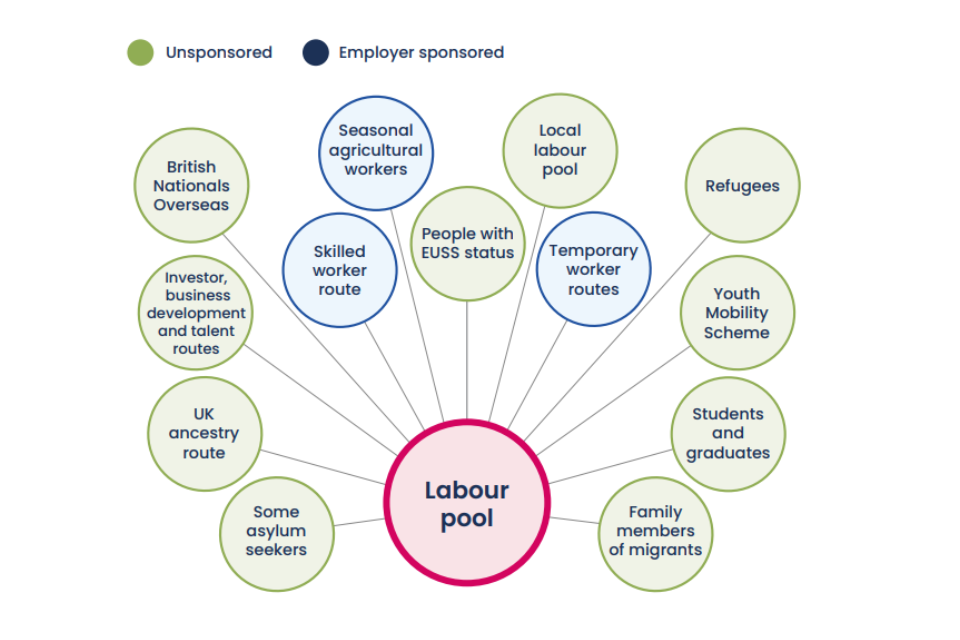
Labour pool diagram
The UK labour market
The points-based system supports a wider package of interventions that make up our long-term approach to the labour market and our strategy to rebuild our economy, supporting the growth of your business and helping people get back to work.
The points-based system provides you with the ability to access people and talent from around the world. We encourage employers to first consider domestic recruitment options within the UK. Our Plan for Jobs encompasses a range of programmes, some of which offer financial incentives, available to employers who considering hiring employees, offering work experience or upskilling their existing staff.
Examples include:
- Apprenticeships: combining practical on-the-job skills training with sustained off-the-job learning, available from entry level to master’s degree-equivalent.
- T Levels: new 2-year qualifications for 16 to 19 year olds. At the heart of each course is a 45-day industry placement, giving you early access to the brightest talent entering your market.
- Kickstart Scheme: offering six-month work placements in new jobs created using grant funding from the scheme, for 16 to 24 year olds at risk of long-term unemployment. 100% of their time is spent in the workplace with in-work training to help develop transferable skills aimed at increasing their chances of sustained employment.
- National Careers Service: exploring work and skills opportunities for your workforce including those offered as part of the skills recovery package and helping to find skilled people to fill current vacancies in your organisation
- Sector-based work academy programme (SWAP): recruit staff with the right training and skills from the outset, developed through fully-funded pre-employment training and providing an easy way to see job candidates in action.
- Traineeships: skills development programmes that include a work placement. The full programme can last from 6 weeks up to 1 year, though most traineeships last for less than 6 months.
- Free qualifications for adults: As part of the Plan for Jobs, any adult aged 19 and over, who does not have a level 3 qualification (equivalent to an advanced technical certificate or diploma, or A levels) or higher, now has the opportunity to access a fully funded course.
- Skills Bootcamps: putting employers at the heart of the further education system, Skills Bootcamps will support your immediate labour market needs by helping you to fill much-needed vacancies. These are available across regions of the country and include a range of digital courses, technical training in skills like construction or engineering, and green skills like electrical vehicle maintenance.
You need to have a sponsor licence to hire most workers from outside the UK. This does not apply when hiring Irish citizens or EU citizens with status under the EU Settlement Scheme.
Skilled Worker route
The Skilled Worker route encompasses the majority of UK jobs eligible for overseas recruitment, providing a simple and flexible process for accessing the global talent pool.
Under the Skilled Worker route, anyone you want to hire from outside the UK will need to demonstrate that:
- they have a job offer from a Home Office licensed sponsor (you)
- the job offer is at the required skill level – RQF 3 or above (A Level and equivalent)
- they speak English to the required standard
In addition to this, the job you are offering must meet the applicable minimum salary threshold. This is the higher of either:
- the general salary threshold of £25,600, or
- the specific salary requirement for their occupation, known as the ‘going rate’
All applicants will be able to trade characteristics, such as their qualifications, against a lower salary to get the required number of points. If the job offer is less than the minimum salary requirement, but no less than £20,480, an applicant may still be eligible if they have:
- a job offer in a specific shortage occupation
- a PhD relevant to the job
- a PhD in a STEM subject relevant to the job
There are different salary rules for workers in certain health or education jobs, and for ’new entrants’ at the start of their careers.
For further information on the ‘going rate’ for specific occupations and further exemptions, see Skilled Worker visa: going rates for eligible occupation codes.
A total of 70 points is needed to be able to apply to work in the UK
| Characteristics | Mandatory/Tradeable | Points |
|---|---|---|
| Offer of job by approved sponsor | Mandatory | 20 |
| Job at appropriate skill level | Mandatory | 20 |
| Speaks English at required level | Mandatory | 10 |
| Salary of £20,480 to £23,039 or at least 80% of the going rate for the profession (whichever is higher) | Tradeable | 0 |
| Salary of £23,040 to £25,599 or at least 90% of the going rate for the profession (whichever is higher) | Tradeable | 10 |
| Salary of £25,600 or above or at least the going rate for the profession (whichever is higher) | Tradeable | 20 |
| Job in a shortage occupation as designated by the Migration Advisory Committee | Tradeable | 20 |
| Education qualification: PhD in a subject relevant to the job | Tradeable | 10 |
| Education qualification: PhD in a STEM subject relevant to the job | Tradeable | 20 |
Identify whether a job meets the required skill level
All jobs have a corresponding Standard Occupational Classification (SOC) code. Each SOC code has a designated skill level. This determines whether the job meets the requirements of the Skilled Worker route.
To help you match jobs to the correct occupation code, the Office for National Statistics has created an Occupation Coding Tool , which is available online.
Shortage Occupation List
The Shortage Occupation List, which is recommended by the independent Migration Advisory Committee, is comprised of skilled jobs where there is an identified national shortage which is sensible to fill, at least in part, through immigration.
An occupation on the Shortage Occupation List results in lower application fees and reduced salary requirements, for skilled workers filling jobs which are in shortage. This does not, however, exempt jobs from the wider mandatory requirements of the Skilled Worker Route, including the skills threshold and the English language requirement.
Skilled Worker case studies
Lab technician with a STEM PhD coming to the UK with salary offer of £21,000. The general salary threshold applies.
| General salary threshold: £25,600 | Points |
|---|---|
| Job offer | 20 |
| RQF 3 or above | 20 |
| English language | 10 |
| Salary | 0 |
| Education qualification: STEM PhD | 20 |
| Total | 70 |
Mechanical engineer coming to the UK with salary offer of £26,750. The “going rate” salary threshold for the profession applies.
| General salary threshold: £33,400 | Points |
|---|---|
| Job offer | 20 |
| RQF 3 or above | 20 |
| English language | 10 |
| Salary | 0 |
| Job offer in a shortage occupation | 20 |
| Total | 70 |
Alongside the Skilled Worker route, there are a number of other immigration routes to provide businesses with the flexibility they need. Some of these routes do not require you to be a sponsor.
Global Talent route
The Global Talent route enables the most highly skilled individuals, who can achieve the required number of points, to enter the UK without a job offer if they are endorsed by a recognised UK body, as approved by the Home Office.
Applicants can also work in the UK on a Global Talent visa if they’ve won an eligible award. These prizes have been identified by the Global Talent endorsing bodies as demonstrating exceptional talent.
You do not need to be a licensed sponsor to employ a migrant under the Global Talent route.
This route is designed to attract recognised global leaders and promising individuals in science, humanities, engineering, the arts and digital technology. Top scientists and researchers can benefit from a quicker endorsement process as part of a fast track STEM scheme.
As of January 2021, the current list of approved endorsing bodies is as follows:
- The Royal Society, for science and medicine
- The Royal Academy of Engineering, for engineering
- The British Academy, for humanities
- UK Research and Innovation, for science and research
- Tech Nation, for digital technology
- Arts Council England, for arts and culture
Graduate route
The Graduate route enables international students who have been awarded their degree to stay in the UK and work, or look for work, at any skill level for two years, or three years for doctoral students. It is an unsponsored route, meaning you do not need a sponsor licence to hire someone with a Graduate visa.
Graduate visa holders are able to work flexibly, switch jobs and develop their career as required. They cannot extend their visa, however they can switch to a different visa, for example a Skilled Worker visa, once they have found a suitable job.
Intra-company Transfer
The Intra-company visa allows multinational organisations to facilitate temporary moves into the UK for key business personnel through their subsidiary branches, subject to ICT sponsorship requirements being met. The route requires applicants to be in roles skilled to RQF 6 (graduate level equivalent), and subject to a different minimum salary threshold from the main Skilled Worker route.
Intra-company Graduate Trainee visa
The Intra-Company Graduate Trainee route is for workers who are being transferred by the business they work for to undertake a role in the UK as part of a structured graduate training programme, with clearly defined progression towards a managerial or specialist role within the organisation.
The Intra-company routes will be replaced by a single, sponsored Global Business Mobility route. We aim to deliver the new route by spring 2022.
Start-up and Innovator
The Start-up and Innovator routes are designed to attract entrepreneurial talent and innovative, scalable business ideas to the UK. Start-up is for those setting up an innovative business for the first time, and Innovator is for those with industry experience and at least £50,000 funding. Applicants can be individuals or teams.
Health and Care visa
The Health and Care visa is part of the Skilled Worker route. It enables individuals to come to the UK to work if they are working in eligible health occupations, with a job offer from the NHS, adult social care sector or organisations that provide services to the NHS. Applicants benefit from a lower application fee, and are exempt from paying the Immigration Health Charge which applies to most other types of visa.
Creative route
This route is for applicants in the creative industry who are entering the United Kingdom for short-term contracts or engagements for up to 12 months. Applicants must have a confirmed job offer and their employment sponsored by a UK employer licensed by the Home Office.
Sporting routes
International sportspeople must also have a confirmed job offer and their employment sponsored by a UK employer licenced by the Home Office. Additionally, they must have an endorsement from the relevant governing sports body.
Seasonal Workers Pilot
The Seasonal Workers Pilot is currently running until the end of 2021 enabling the recruitment of 30,000 temporary workers to come to the UK for a period of up to 6 months to work in the horticulture sector only. For 2021 only, of the 30,000, up to 800 visas will be ringfenced for foreign butchers.
In addition, time-limited visas are being offered to 4,700 HGV drivers in food distribution and 5,500 poultry workers in the run-up to Christmas 2021 to ease pressures caused by disruptions in the global supply chain.
Youth Mobility Scheme
Employers can also benefit from the youth mobility scheme. The UK has arrangements in place with ten countries and territories to enable around 20,000 young people to come to the UK to work and travel each year. Applicants must be 18 to 30 years old and can stay up to two years.
EU citizens and applications to the EU Settlement Scheme
The EU Settlement Scheme was established to enable EU, EEA and Swiss citizens resident in the UK by 31 December 2020, and their family members, to get the immigration status they need to continue to live, work and study in the UK.
For those citizens resident in the UK by 31 December 2020, the deadline for applications was 30 June 2021.
As an employer you are not responsible for making sure your EU employees have applied. However, for many organisations the scheme has been an important aspect of workforce planning and retention.
Where an EU citizen has reasonable grounds for missing the EU Settlement Scheme application deadline, they will be given a further opportunity to apply. Full guidance has been published on the steps you should take as an employer if this situation arises. You should advise them that they must make an application within 28 days.
Individuals with settled status can spend up to five years in a row outside the UK, the Channel Islands or the Isle of Man without losing this status.
Frontier workers
A frontier worker is someone from the EU who is employed, or self-employed in the UK, but lives elsewhere. Anyone frontier working in the UK by 31 December 2020 will be able to keep their status, but they will need to apply for a permit. Irish citizens who are frontier working into the UK do not need to apply for a permit, but they can if they want to.
Right to work checks
Employers should check job applicants have the right to work in the UK before hiring them, to avoid being liable for a civil penalty.
There are two types of right-to-work check: a manual check and an online check. The type of check you conduct will depend on the status of the individual you intend to employ, and in some circumstances, the individual’s preference.
A manual check can be completed for UK and Irish citizens who can, for example, use their passport as proof of right-to-work. You will also need to complete a manual check for individuals if they do not have an immigration status that can be shared with you online (eVisa).
An online check is required for individuals who only hold an eVisa. This applies to most EU citizens, including those with settled or pre-settled status, anyone with a Hong Kong BNO visa and some other nationalities who have moved to the UK more recently under the points-based immigration system.
As of 1 July 2021, you can no longer accept an EU citizen’s passport or ID card alone as evidence of their right to work and will have to check their right to work online (with the exception of Irish citizens).
To carry out an online right to work check, you’ll need:
- the applicant’s date of birth
- their share code which they will have obtained online
You must not discriminate when conducting right to work checks. The Home Office has published statutory codes of practice for employers on how to avoid unlawful discrimination when undertaking checks. This guidance clearly stipulates that employers should provide individuals with every opportunity to demonstrate their right to work and must not discriminate on the basis of race or any of the other protected characteristics.
To assist you in carrying out right to work checks, we have developed a right to work check video:
Becoming a licensed sponsor
If you are not already a licensed sponsor and you think you will want to sponsor migrants through the Skilled Worker route, you should apply now.
Before applying you should check that the people you want to hire will meet the requirements for coming to the UK for work.
The standard processing time for an application is usually eight weeks and will start when we receive your application. As a licensed sponsor, you will be able to hire eligible employees from anywhere in the world.
Some immigration routes, such as Graduate or Global Talent, are ‘unsponsored’. You don’t need a licence to hire employees with an unsponsored visa.
You do not need to be a sponsor to recruit Irish citizens or anyone from the resident labour market with an existing right to work in the UK. This includes EU citizens with settled or pre-settled status, and non-EU citizens with indefinite leave to remain in the UK.
You will need to:
1. Check your business is eligible
To get a licence, you cannot have unspent criminal convictions for immigration offences or certain other crimes, such as fraud or money laundering.
2. Choose the type of skilled worker licence you want to apply for
This will depend on whether you are sponsoring a job applicant for general purposes, or for the purpose of an ICT. You can apply for a licence covering either or both.
3. Decide who will manage sponsorship within your business
You need to appoint people within your business to manage the sponsorship process when you apply for a licence. The main tool they’ll use is the sponsorship management system (SMS). The roles are:
- authorising officer – a senior and competent person responsible for the actions of staff and representatives who use the SMS
- key contact – your main point of contact with UK Visas and Immigration (UKVI)
- level 1 user – responsible for all day-to-day management of your licence using the SMS
These roles can be filled by the same person or different people
4. Apply online and pay a fee
| Type of licence | Fee for small or charitable sponsors | Fee for medium or large sponsors |
|---|---|---|
| Worker Sponsor Licence | £536 | £1,476 |
| Temporary Worker | £536 | £536 |
| Worker and Temporary Worker | £536 | £1,476 |
| Adding a Worker licence to an existing Temporary Worker licence | No fee | £940 |
| Adding a Temporary Worker licence to an existing Worker licence | No fee | No fee |
The fees stated are current as of July 2021. Fees are kept under review and may be subject to change. Please check GOV.UK.
You’re usually a small business if:
- your annual turnover is £10.2 million or less
- you have 50 employees or fewer
Contact the Business Helpdesk if you’re unsure which category your business fits into: businesshelpdesk@homeoffice.gov.uk
Immigration skills charge
The immigration skills charge is a fee paid by a UK employer for each skilled migrant worker they employ through the Skilled Worker and Intra-company Transfer routes. The charge is intended to act as an incentive for employers to recruit and train resident workers rather than migrant workers. Funds raised by the charge are used to support skills and training programmes in the UK. You will need to pay the charge when sponsoring both EU and non-EU migrant workers.
| Period | Small or charitable sponsors | Medium or large sponsors |
|---|---|---|
| First 12 months | £364 | £1,000 |
| Each additional 6 months | £182 | £500 |
For full guidance on becoming a sponsor or to begin your application, visit GOV.UK.
For more information on the points-based immigration system and to sign up for email alerts, visit GOV.UK/HiringFromTheEU.