UK City of Culture 2029: Economic and social outputs datasheet information guide
Updated 28 July 2026

© Crown copyright 2026
This publication is licensed under the terms of the Open Government Licence v3.0 except where otherwise stated. To view this licence, visit nationalarchives.gov.uk/doc/open-government-licence/version/3 or write to the Information Policy Team, The National Archives, Kew, London TW9 4DU, or email: psi@nationalarchives.gov.uk.
Where we have identified any third party copyright information you will need to obtain permission from the copyright holders concerned.
This publication is available at https://www.gov.uk/government/publications/uk-city-of-culture-2029-full-application-guidance/uk-city-of-culture-2029-economic-and-social-outputs-datasheet-information-guide
Overview
Bidders are required to complete the ‘Economic and social outputs datasheet’ as part of making a full application to the UK City of Culture (UKCoC) 2029 competition. The information collected through the datasheet will be used to help the Panel understand the economic and social impact of your bid and supplement the information in your main bid document. This information guide is intended to help applicants in completing each section of the datasheet and gives an overview of what information should be provided in each section. Please include as much information as possible in your answers. If you need to add additional lines to the datasheet to provide a full response please do so. Figures provided should be proportionate, realistic and based on clearly stated assumptions, and should align with the narrative set out in the application form.
Guidance on formatting and submitting the datasheet can be found in the UK City of Culture 2029 Full application: Guidance for bidders.
The datasheet is split into five tabs:
- Economic Impact
- Engagement Impact
- Qualitative evidence
- Job definitions
- List of areas definitions
Please complete the first three tabs.
You may add lines to the spreadsheet if you need to however please note some sections carry a word limit of 3000 characters. The ‘Job definitions’ tab is for reference when completing the local employment impact section. The list of Local Authorities in England is required for some of the drop downs used in the datasheet.
Applicants should note that the projections requested in the datasheet should be treated as order-of-magnitude estimates based on reasonable assumptions, rather than precise forecasts. We understand that many of the figures requested, particularly employment, visitor numbers and legacy impacts will inevitably involve uncertainty at the bid stage, bidders should be realistic in their estimates and avoid false precision in these projections. At this stage the aim is to provide credible ranges and assumptions rather than highly specified forecasts.
Where you are unable to due to capacity to provide detailed impact forecasts from modelling you should provide your best estimates and set out how these were calculated and the evidence on which these are based. You can also use the Evidence and Assumptions sections and the qualitative evidence tab to provide additional information, where you are unable to fill out the data cells.
The framework assumes a five-year legacy period for forecasting. There is no expectation the winning applicant will be expected to deliver an evaluation covering this whole period. Although a robust evaluation of the in-year programme (2029) and some legacy impacts is expected.
You may also find it helpful to look at previous evaluations and UKCoC research when completing the spreadsheet. Previous UK Cities of Culture have published evaluation reports for their programmes:
- Derry/Londonderry UK City of Culture 2013 evaluation
- Hull UK City of Culture 2017 evaluation
- Coventry UK City of Culture 2021 evaluation
Bidding places may also wish to refer to the following evidence reviews which explore the impacts of winning and bidding in the competition:
- Evidence review: UK City of Culture programme
- UK Cities of Culture: Stakeholder interviews with runner-up applicants
Tab 1: Economic impact
Part A: Local Employment Impact
1. What is the area covered by your bid where you expect to show economic impacts, please clearly state the geographical classifications you have used to provide data. Please also select from the categories in the drop down list which official geographies you expect to see economic impacts from your bid (you can select multiple choices if necessary) What is the population of this area (please use the most recent population figures available and provide a link to your data source in your answer).
Please select from the drop-downs the geographic area that jobs will be directly created or safeguarded in. The drop-down does not allow for multiple areas to be selected. Therefore if the drop-down options do not fully capture your intended geographical impact, please add additional areas on the next line. In addition please specify where the primary impact will be realised and identify any areas beyond the bidding city that will also be affected in the ‘Evidence and Assumptions’ box.
To help us understand the economic impact, please provide details of the direct jobs created or safeguarded due to UKCoC funding. The number of jobs created and safeguarded are one way in which we can assess economic impact. You will also be asked about employment impacts in the supply chain.
2. Number of direct new jobs created by job type
Only include direct jobs created as a result of UKCoC investment. Do NOT include indirect (or induced) jobs. See Box 1 for guidance on the distinction between direct and indirect jobs. New direct jobs created as part of training schemes should be included here as the skills section only picks up those that are trained not those that are then employed. Definitions of the different job type categories are included in the ‘Job definitions’ tab. You can add more rows, for additional job types.
To help us understand the sustainability of economic activity please provide data on the numbers of jobs created for five years after UKCoC funding will end. The number of jobs should be provided in Full Time Equivalent (FTE) terms, and should be recorded in the table for every year the job exists.
A ‘new job’ here is one which would not have otherwise been created without UKCoC funding.
Place-based analysis assesses how the benefits, costs and risks of a proposal are distributed between different places in the United Kingdom. Bidders should think carefully about additionality and deadweight, and assess the potential for displacement using credible, objective evidence. Displacement is the extent to which improved outcomes in one place are offset by reduced outcomes in nearby areas.
Please provide evidence supporting the expected level of displacement (%) in your target area, justifying why the new jobs created as a result of the proposed investment are additional, and not just shifting people from one job to another. This may include data on the local labour market, local employment across sectors and unemployment rates. Please specify the evidence sources used. Where a specific estimate is not available for your area, please make reference to the criteria from the HCA displacement ready reckoner.
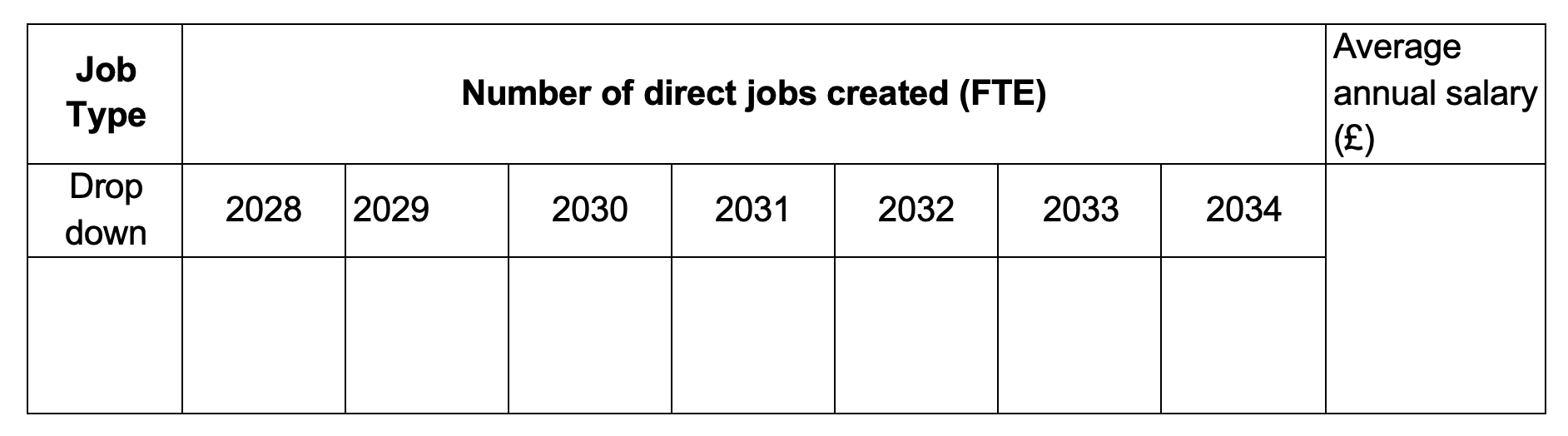
To help us understand the sustainability of economic activity please provide data on the numbers of jobs created for five years after UKCoC funding ends. Please also provide the number of direct jobs and average annual salary broken down by high level job type. Job types are provided as a drop down in the datasheet, with additional details of the definitions of different job types in the ‘Job definitions’ tab.
The number of jobs should include only direct jobs created as a result of UKCoC investment. You may mention indirect or induced jobs created, alongside any evidence to justify your response to the second question (Question 16) of the qualitative evidence section (tab 3), ‘How will UKCoC funding help improve economic conditions and strengthen the local economy?’
Box 1 provides more information on these types of jobs.
Box 1: Direct, Indirect and Induced Jobs
Direct Jobs
Direct Jobs are those that are a primary output of the programme itself. An example may be new construction workers hired to build new creative spaces as part of a culture-led regeneration project, or new staff hired to operate a new or expanded cultural venue.
Indirect Jobs
Indirect Jobs (supply chain) are those that are an output of additional activities made possible by the Programme, through the supply chain, but not as a direct output of the programme itself. In the example above of the Government funded programme to provide new creative spaces, the programme may lead to increased demand for building supplies, which means that suppliers may hire new factory workers.
Induced Jobs
Induced Jobs are those additional jobs flowing from the wider beneficial effects of the programme that fall outside the direct and indirect definitions above. For example, new retail jobs created as construction workers hired as part of the Government project spend their wages in shops.
To ensure data is comparable all job figures should be expressed in full time equivalent terms (FTE). Table 1 below provides guidance below on the use of FTE.
Table 2: Further Information on FTEs
Full-time equivalent (FTE)
An FTE is the hours worked by one employee on a full-time basis. The concept is used to convert the hours worked by several part-time employees into the hours worked by full-time employees. The concept can also be applied to self-employed when the number of hours is stipulated in the contract.
On an annual basis, an FTE is often considered to be 2,080 hours, which is calculated as:
- 8 hours per day
- 5 work days per week
- 52 weeks per year
- This equals 2,080 hours per year
However, the exact number of hours for an FTE may vary from sector to sector. The Office for National Statistics classifies anyone working over 30 hours a week as full time, anyone working less than 30 hours a week as part time.
You may differ from the ‘standard’ 40 hours per week in your calculation of FTEs, as long as you make this clear in your response and provide a justification. But in no case should you consider less than 30 hours to constitute an FTE in your calculations.
Examples of the Calculation of FTEs (using 40 hours per week)
Here are several examples of how the FTE concept is calculated:
- There are 168 working hours in January, and the ABC Company staff works 7,056 hours during the month. When 168 hours are divided into 7,056 hours, the result is 42 FTEs.
- There are 8 working hours in the day on Monday, and the DEF Company staff works 136 hours during that day. When 8 working hours are divided into 136 hours, the result is 17 FTEs.
There are 2,080 working hours in the year, and the GHI Company staff works 22,880 hours during that year. When 2,080 working hours are divided into 22,880 hours, the result is 11 FTEs.
Salary
This should be the gross annual basic salary (excluding any overtime, commission, expenses, bonus and shift pay and excluding employer contributions).
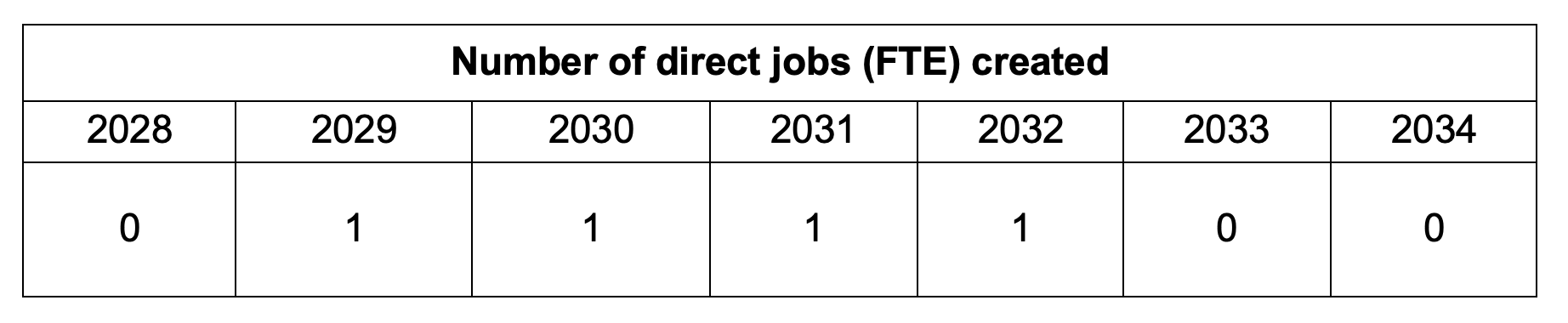
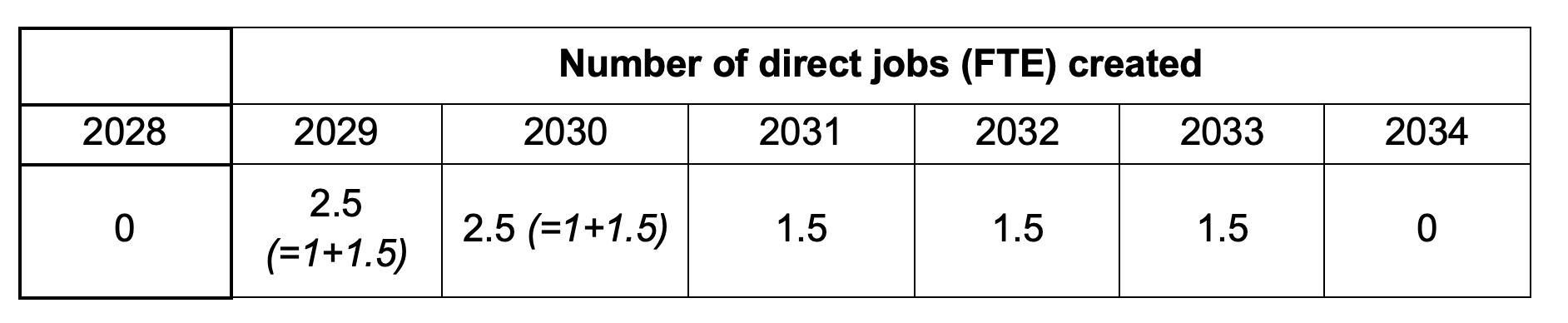
The table in the template asks you to record new jobs created every year, starting in 2028 and continuing for five years after the end of the UKCoC (up to 2034). You should clearly identify in the table the period over which these jobs will continue. We provide some examples below of how this may be done:
- Example 1: 1 new FTE direct job is created in the year 2029 and lasts at least until the year 2032. This should be reflected in the table as:
- Example 2: 1 new FTE direct job is created in the year 2029 for two years; separately, 3 part-time jobs equivalent to 1.5 FTE direct jobs are also created in 2029 lasting at least until 2033.
Displacement (%). Place-based analysis assesses how the benefits, costs and risks of a proposal are distributed between different places in the United Kingdom. Bidders should think carefully about additionality and deadweight, and assess the potential for displacement using credible, objective evidence. Displacement is the extent to which improved outcomes in one place are offset by reduced outcomes in nearby areas. Please provide evidence supporting the expected level of displacement (%) in your target area, justifying why the new jobs created as a result of the proposed investment are additional, and not just shifting people from one job to another. This may include data on the local labour market, local employment across sectors and unemployment rates. Please specify the evidence sources used. Where a specific estimate is not available for your area, please make reference to the criteria from the HCA displacement ready reckoner (Table 3 of the information guide) and justify using evidence the expected level of displacement.
This question has been asked to help us understand if there is any potential negative impact on other businesses that may arise as a result of UKCoC funding. A comprehensive answer should:
- Set out the capacity of the target area to provide labour for UK CoC without hurting other local firms.
- Provide evidence on activity in neighbouring areas, and where there is duplication of activity, explain how that impact is mitigated.
- Where a specific estimate is not available for your area, please make reference to the criteria in the displacement ready reckoner (Table 3), justifying the expected level of displacement using evidence.
- Evidence may include information/ data on the local labour market, local employment in sectors which will be directly affected, and unemployment rates.
Please answer the displacement question for direct new jobs and direct safeguarded jobs (see next section) separately. Please provide evidence in your response to justify that the new jobs created/ safeguarded are additional, rather than shifting economic activity across areas/ sectors. Please see the latest HMT Green Book for further information.
Table 3: Displacement ready reckoner
| Level | Description | Displacement effect |
|---|---|---|
| None | No other firms/ demand affected | 0% |
| Low | There are expected to be some displacement effects, although only to a limited extent | 25% |
| Medium | About half of the activity would be displaced | 50% |
| High | A high level of displacement is expected to arise | 75% |
| Total | All of the activity generated will be displaced | 100% |
Source: Homes and Communities Agency Additionality Guidance- Table 4.8 (2014)
You should also set out your evidence and assumptions in the box provided.
3. Number of direct jobs safeguarded
We consider ‘safeguarded jobs’ as direct jobs (i.e. the primary output of the programme itself), undertaken by existing employees rather than new created jobs, which existed before the investment, but without the investment would otherwise have ended.
Please provide the number of direct safeguarded jobs and average annual salary broken down by high level job type. Job types are provided as a drop down in the spreadsheet, with additional guidance on the definition of different job types in the ‘Job definitions’ tab.
As with the section above on ‘direct jobs created’, safeguarded jobs should be direct jobs only (not indirect or induced); they should be recorded as FTE; and recorded in the table following similar instructions to those for the ‘direct jobs created’ question set out above.
Place-based analysis assesses how the benefits, costs and risks of a proposal are distributed between different places in the United Kingdom. Bidders should think carefully about additionality and deadweight, and assess the potential for displacement using credible, objective evidence. Displacement is the extent to which improved outcomes in one place are offset by reduced outcomes in nearby areas.
Please provide evidence supporting the expected level of displacement (%) in your target area, justifying why the new jobs created as a result of the proposed investment are additional, and not just shifting people from one job to another. This may include data on the local labour market, local employment across sectors and unemployment rates. Please specify the evidence sources used. Where a specific estimate is not available for your area, please make reference to the criteria from the HCA displacement ready reckoner (Table 3 of this information guide) and justify using evidence the expected level of displacement.

You should also set out your evidence and assumptions in the box provided.
Number of new jobs created in the supply chain. Estimating supply chain jobs may prove difficult if access to economic modelling tools is difficult. This section should be treated as optional.
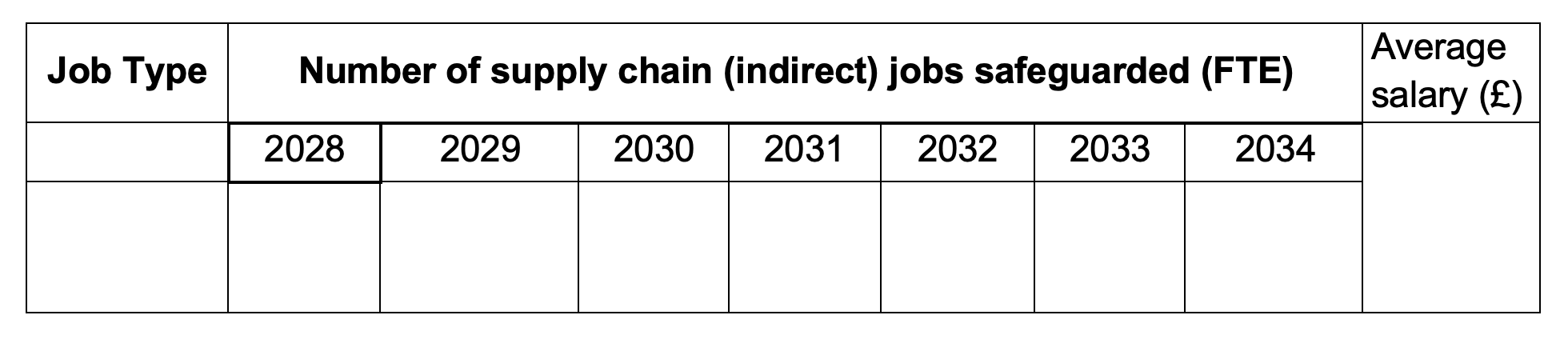
4. Number of new jobs created in the supply chain (optional)
These are new jobs that are an output of additional activities made possible by the UKCoC, through the supply chain, but not as a direct output of the programme itself. Please do not include these jobs in sections 2 and 3.
Place-based analysis assesses how the benefits, costs and risks of a proposal are distributed between different places in the United Kingdom. Bidders should think carefully about additionality and deadweight, and assess the potential for displacement using credible, objective evidence. Displacement is the extent to which improved outcomes in one place are offset by reduced outcomes in nearby areas.
Please provide evidence supporting the expected level of displacement (%) in your target area, justifying why the new jobs created as a result of the proposed investment are additional, and not just shifting people from one job to another. This may include data on the local labour market, local employment across sectors and unemployment rates. Please specify the evidence sources used. Where a specific estimate is not available for your area, please make reference to the criteria from the HCA displacement ready reckoner (Table 3) and justify using evidence the expected level of displacement.
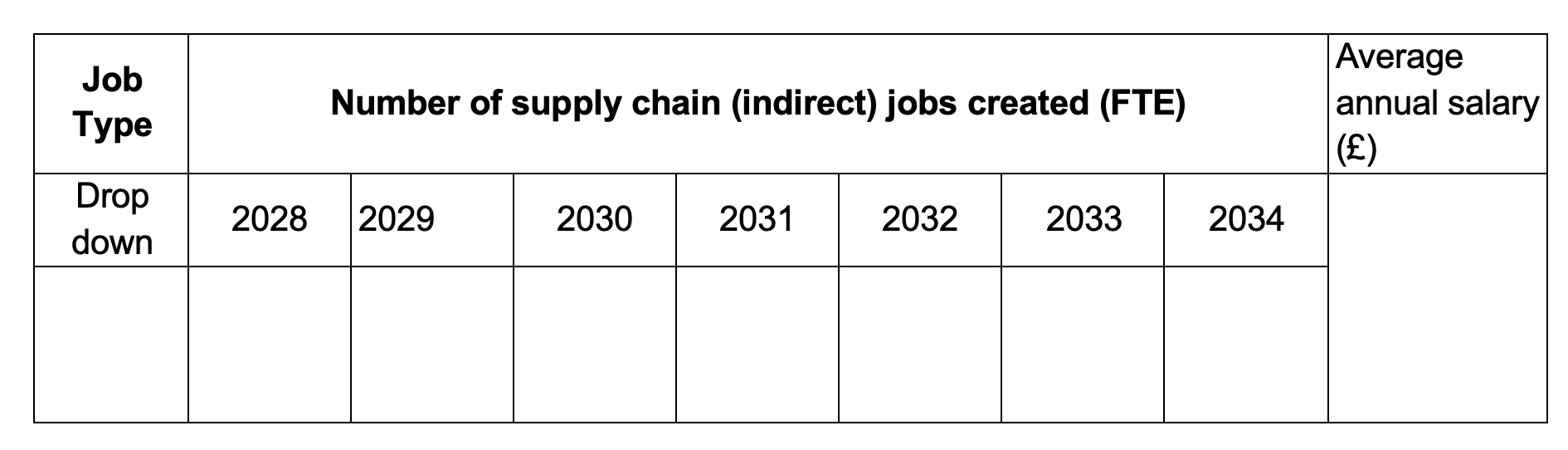
The response should include jobs in the supply chain - they should be recorded as FTE and recorded in the table following similar instructions to those for the questions set out above.
You should also set out your evidence and assumptions in the box provided.
5. Number of jobs safeguarded in the supply chain (optional)
Safeguarded jobs are undertaken by existing employees through the supply chain rather than new created jobs, which existed before the investment, but without the investment would otherwise have ended. Please do not include these jobs in sections 2 and 3.
Place-based analysis assesses how the benefits, costs and risks of a proposal are distributed between different places in the United Kingdom. Bidders should think carefully about additionality and deadweight, and assess the potential for displacement using credible, objective evidence. Displacement is the extent to which improved outcomes in one place are offset by reduced outcomes in nearby areas.
Please provide evidence supporting the expected level of displacement (%), justifying why the new jobs created as a result of the proposed investment are additional, and not just shifting people from one job to another. This may include data on the local labour market, local employment across sectors and unemployment rates. Please specify the evidence sources used. Where a specific estimate is not available for your area, please make reference to the criteria from the HCA displacement ready reckoner (Table 3) and justify using evidence the expected level of displacement.
You should also set out your evidence and assumptions in the box provided.
6. Number of Businesses supported
Please provide the number of businesses supported by the UK CoC by sub-sector. The drop down is based on categories that align with the UK SIC framework and the higher level groups therein.
You should also set out your evidence and assumptions in the box provided.
Part B: Skills Impact
7. Number of Trainees
Please provide data on the additional number of people who will be trained as a direct result of the UKCoC funding by qualification level ie. new training positions linked directly to the investment that would not have been created otherwise. For example, this would exclude people in existing positions of an established training programme, even if they would carry out some training linked to UKCoC, as they would have undertaken the training anyway in the absence of the UKCoC investment, but in partnership with another project.
It has been assumed that all new training programmes start during the year of UKCoC investment. For more detail, read the following:
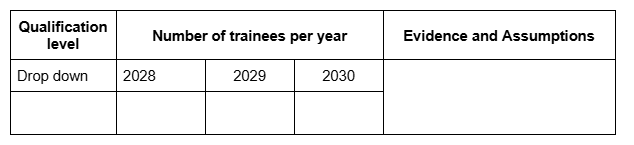
You should also set out your evidence and assumptions in the box provided.
Part C: Visitor Economy
8. Visitor growth
Please provide data on the number of visitors and spend you expect as a direct result of the UKCoC in each year.
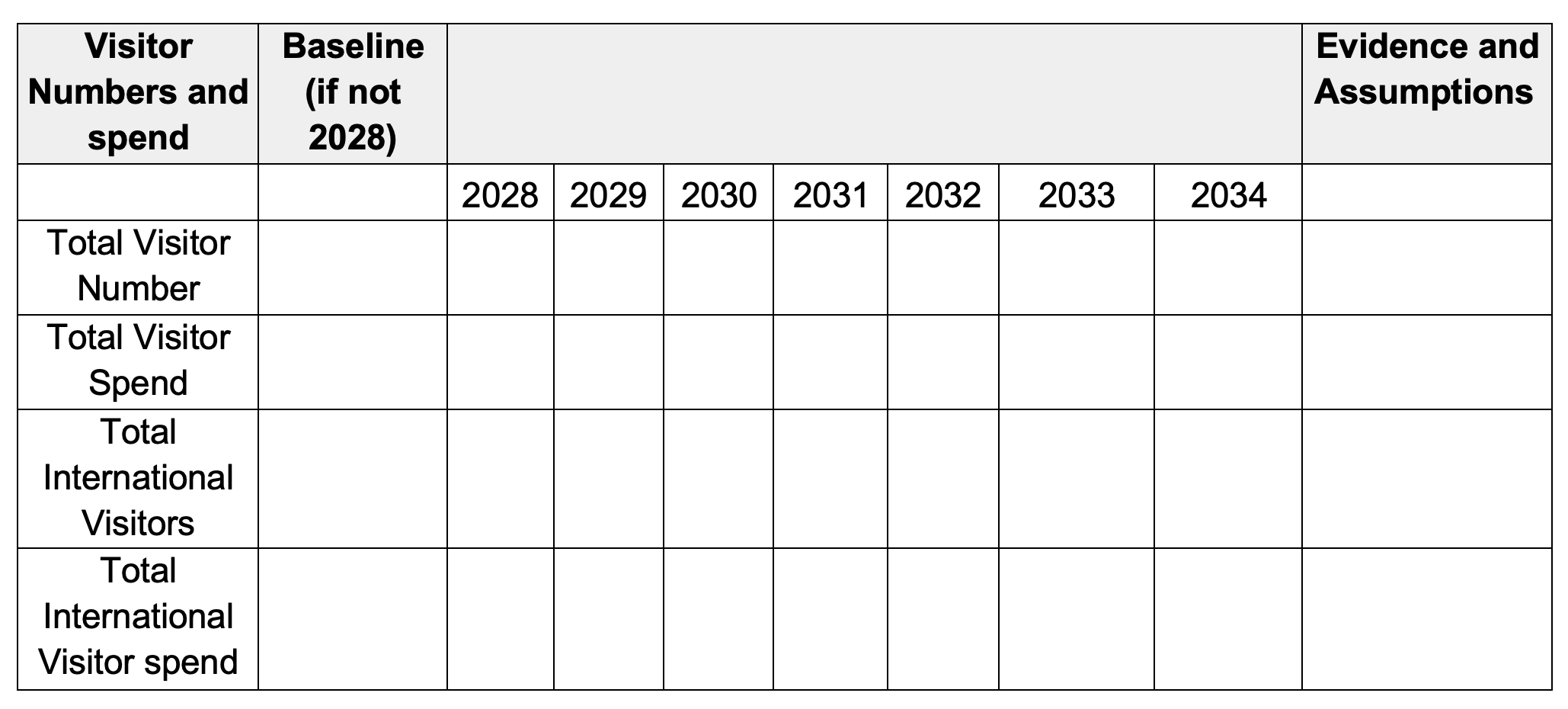
When completing this part of the datasheet you have been asked to include a 2028 baseline. If you have recent tourism data and an earlier baseline would be more appropriate please insert your data in the first column.
When describing your data sources you should also specify what form of modelling was used i.e., STEAM, Oxford Tourism Model etc. Where data on local tourism is limited, England domestic tourism: regional and subregional data may be helpful as a starting point.
You should also set out your evidence and assumptions in the box provided.
Part D: Private Investment
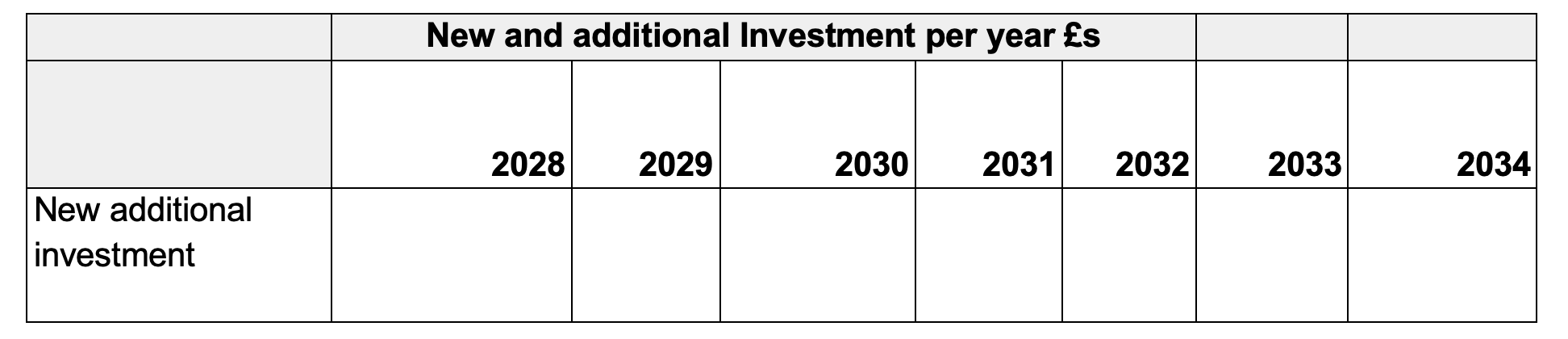
9. New and additional investment
Please estimate the new and additional private investment you expect to leverage as a result of UK CoC.You should also set out your evidence and assumptions in the box provided.
Tab 2: Engagement impact
Local Engagement Impact
10. What is the geographical area that you expect to see changes to engagement, please clearly state the geographical classifications you have used to provide data. Please also select from the categories in the drop down list where you expect to see engagement impacts from your bid (you can select multiple choices if necessary) What is the population of this area (please use the most recent population figures available and provide a link to your data source in your answer.
Please use the drop-down to indicate the geographical area you expect to see changes in engagement. The drop-down does not allow for multiple areas to be selected. Therefore if the drop-down options do not fully capture your intended geographical impact, please add additional areas on the next line. In addition please specify where the primary impact will be realised and identify any areas beyond the bidding city that will also be affected in the ‘Evidence and Assumptions’ box.
The section allows you to demonstrate the engagement impact of your proposal considering both attendance and participation. Participation refers to events where individuals that take part play a more active role as participants, rather than pure spectators (audience). Box 2 below provides further guidance on the definition of an attendee and participant.
Please provide evidence that supports the number of attendances or participation that you expect to attract to the event/programme. This may include attendance figures for similar events/ programmes that have taken place in the past. Use the evidence section to provide details of any assumptions and indicate the expected proportion of the audiences that will come from the target area.
Box 2: Attendees, participants and volunteers
Attendees
Attendees are those who go to an arts/culture event where you passively engage in the activity as an audience member/observer/spectator.
Participants
Participants are those who go to an arts/culture event where you engage in the activity through active engagement e.g. performance, making or creating, processing or promoting.
Formal volunteering
Formal volunteering refers to those who have given unpaid help to groups or clubs, for example, leading a group, administrative support, mutual aid groups or befriending or mentoring people.
11. Attendance number
Attendees are those who go to an arts/culture event where you passively engage in the activity as an audience member/observer/spectator. Please provide:
Expected number of attendees that would have occurred without UKCoC
Additional Attendees: Please provide the total expected number of attendees which would not have otherwise have taken place without UK CoC funding.
For existing events/ programmes which will benefit from UKCoC investment, please provide the additional number of attendees above what you would expect to achieve without UKCoC funding. For example, if an annual event gets 10,000 attendees on average and you expect that with UKCoC funding this will allow you to expand to 15,000 attendees per year, please enter 5,000 for every year the event receives UKCoC funding. A proportion of the additional number of attendees may continue after UKCoC funding has finished if there is evidence that the increased number of attendees will persist beyond the funding period.
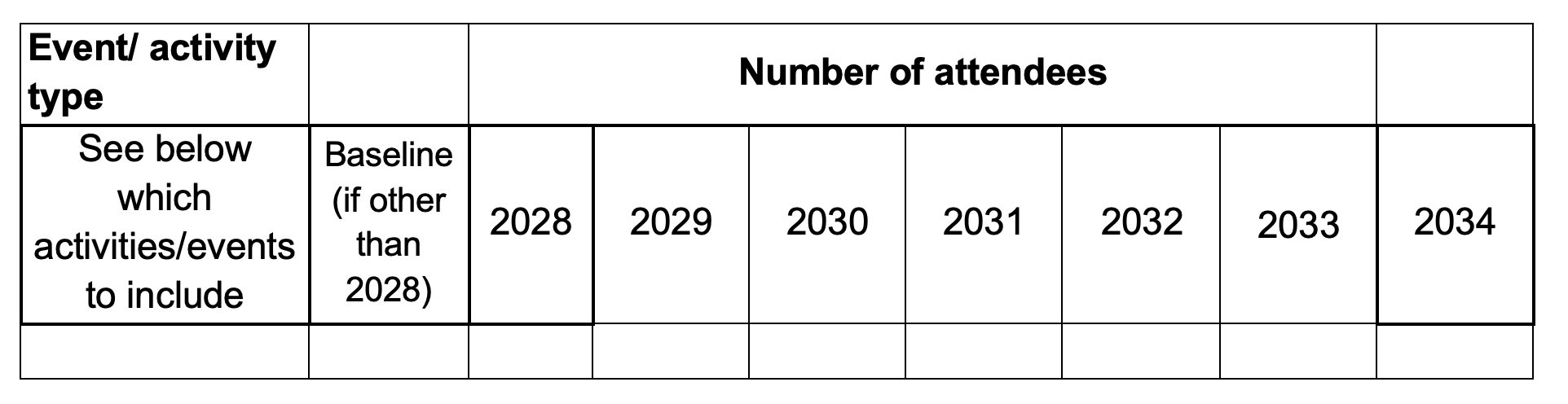
You should include any of the following activities/events in your response. Attending an exhibition of art, photography or sculptures: a theatre play, drama, musical, Pantomime, Ballet or Opera: an event connected with literature, books, reading, poetry reading or writing; a cinema screening of a film or movie; a craft exhibition (not a crafts market; crafts include for example textiles, woodworking or ceramics); a live music event (for example, pop, jazz, electronic, choral, orchestra or folk): an arts festival and or carnival (for example, a food, craft or other cultural event); a street art event; a live dance event (for example, contemporary, world, street or ballroom); a fashion show; a comedy event; an in-person sports contest or video game competition event; a library, museum or gallery, historical place, archive or record centre.
The above is a guide and applicants should adapt to meet the definitions of attendance used by your local population, but please make this clear in the evidence and assumptions sections.
Please ensure your numbers show the expected additional increase in attendance each year.
You should also set out your ‘evidence and assumptions’ in the box provided. If you expect your baseline to decline over time without UKCoC funding, please provide any evidence of this in the ‘evidence and assumptions section’.
12. Digital Engagement
Please provide in this section the number of digital engagements you expect from UKCoC.
Please provide in this section the number of digital engagements you expect from UKCoC. Digital engagement should include the following: a live arts event including theatre, visual arts or literature; a pre-recorded arts event including theatre, visual arts or literature; a live music or dance event, watched as it was happening; a pre-recorded music or dance event; a virtual walking tour of a historic town or city, heritage site, castle or monument (Not including drone flights); researched your local history online; viewed documents from an archive online; engaged with text, image, audio, video, or animation, games, or podcast content from heritage sites; viewed or participated in an online event or activity organised by the library; taken a virtual tour of a museum or gallery; researched items from a museum or gallery collection online; engaged with text, image, audio, video, or animation, games, or podcast content from museums. As the definition of digital engagement is evolving please indicate in the data sheet if you have included other types of digital engagement not included in the list above, which has been taken from the DCMS Participation Survey.
Please ensure your numbers show the expected additional increase in engagement each year.
You should also set out your ‘evidence and assumptions’ in the box provided. If you expect your baseline to decline over time without UKCoC funding, please provide any evidence of this in the ‘evidence and assumptions section’.
13. Participation number
Participants are those who go to an arts/culture event where you engage in the activity through active participation e.g. performing, making or creating, processing or promoting.
Please provide the expected participation numbers that would have occurred without UKCoC.Please also provide the total expected number of participants to UKCoC events/ activities which would not otherwise have taken place without UKCoC funding.
For existing events/programmes which will benefit from UKCoC investment, please provide the additional number of participants above what you would expect to achieve without UKCoC funding. For example, if an annual event gets 10,000 participants on average and you expect that with UKCoC funding this will allow you to expand to 15,000 attendees per year, please enter 5,000 for every year the event receives UKCoC funding.
A proportion of the additional number of participants may continue after UKCoC funding has finished if there is evidence that the increased number of participants will persist beyond the UKCoC funding period.
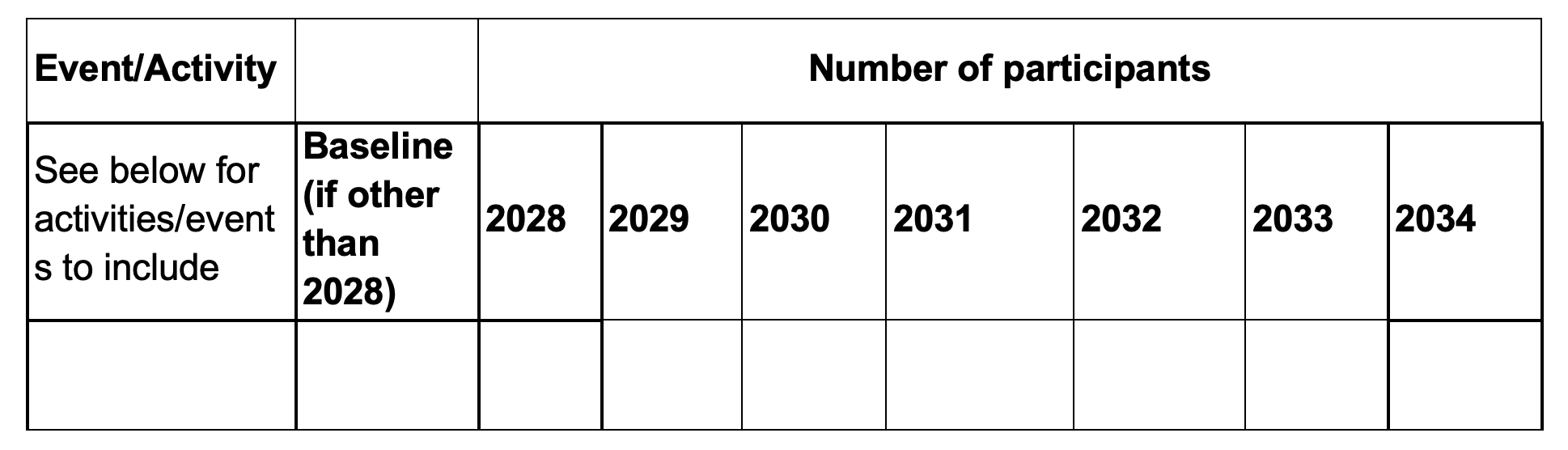
Participation can include any of the following activities/events: written stories, plays, or poetry; read books or magazines; written or performed music; painting, drawing, printmaking, calligraphy; crafts (textile, ceramic, sculpting, carving, woodwork); choreographed or performed a drama or dance routine; designed or programmed video games including on a smartphone or tablet; played video games including on a smartphone or tablet; made films or videos as a hobby including original animations; photography as a hobby; other arts, crafts, or creative activities at home; visited a public library building or mobile library in-person in my leisure time; visited by a home library service ; used another library outreach services; a historic, non-religious building open to the public; a historic place of worship attended as a visitor (not to worship); a park or garden open to the public with historic or artistic features; a place connected with industrial history (such as an old factory, mine or railway); an ancient monument or archaeological site (such as a castle, fort, burial site); a site connected with sports visited for its heritage; a site connected with maritime or underwater heritage (such as shipwrecks); a historic landscape or habitat (such as coastline, countryside); some other heritage site or historic place; community event where the library staff or volunteers were present); visiting a museum or gallery in person.
The above is a guide and applicants should adapt to meet the definitions of participation used by your local population, but please make this clear in the evidence and assumptions sections.
Please ensure your numbers show the expected additional increase in participants each year.
You should also set out your ‘evidence and assumptions’ in the box provided. If you expect your baseline to decline over time without UKCoC funding, please provide any evidence of this in the ‘evidence and assumptions section’.
Part C: Volunteering Impact
14. Number of Volunteers
In the Community Life Survey, formal volunteering refers to those who have given unpaid help to groups or clubs, for example, leading a group, administrative support, mutual aid groups or befriending or mentoring people. Note that the Community Life is being replaced with the Community and Engagement Survey which brings Community Life together with the Participation Survey and that within that the Community Life module will still be available at the local authority level to help with long-term tracking of volunteering.
Please provide data on the number of additional people you expect to take part in volunteering as a direct result of the investment, by the frequency of volunteering activity, in each year an individual volunteers. A proportion of the additional number of volunteers may continue after UKCoC funding has finished if there is evidence that increases in volunteering will persist beyond the UKCoC funding.
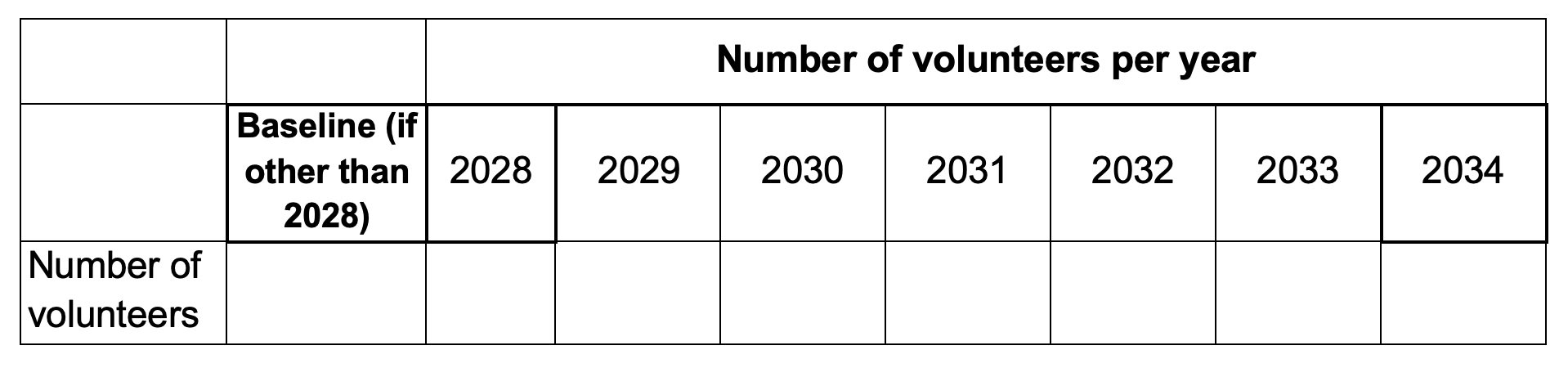
This section allows you to provide evidence on the impact of the proposed programme on volunteering opportunities in your local area.
Please provide additional evidence to support your estimates of volunteer numbers. This may include current engagement in volunteering in your local area, and participation in similar volunteering activities.
Tab 3: Qualitative Evidence
Part A: Economic impact
15. Please provide evidence on the current ECONOMIC conditions of the target area. Please provide evidence of the barriers to economic growth in your local area, highlighting the key priorities and challenges or gaps that will help you demonstrate the level of need and demand that your proposal will help address?
16. How will UKCoC funding help improve economic conditions and strengthen the local economy? Please describe how your proposal is expected to contribute to local economic conditions and growth. This should complement the Economic Impact data tab and help explain the assumptions behind the figures you have provided.
Focus on the main routes through which impact will be generated (for example supply chains, business networks, or knowledge spill-overs), and how these relate to your estimates in the datasheet. Estimates should be proportionate, realistic and grounded in local context and evidence — we are more interested in credible, deliverable improvements than ambitious or speculative claims.
If your bid includes an estimate of Gross Value Added (GVA) impact, please provide an explanation of how it was estimated. A GVA estimate is optional, recognising that such estimates can be resource intensive and highly speculative.
Figures provided should be proportionate, realistic and based on clearly stated assumptions, and should align with the narrative set out in the application form
This question allows you to provide contextual quantitative and qualitative evidence in addition to questions asked in the following sections that help you demonstrate how your proposal will help support local growth. Here, you may include evidence about indirect or induced jobs created as a result of the direct jobs that you are being asked to record in the local employment impacts table in Part A of the Economic Impact tab. This could include, but is not limited to, evidence on the impact on local economic growth and local employment, as well as the impact on other businesses and the local supply chain. Please provide evidence which supports the scale of these impacts, for example how significant these impacts will be compared to business as usual. You may want to highlight how the cultural sector, including the supply chain, may benefit from your proposals.
Part B: Local Employment Impact
17. Underrepresentation. What strategies will you put in place to ensure that your programmes of job creation, business support, and skills development will address underrepresentation in the context of your place. (up to 3000 characters)
The information you provide will allow us to gauge how your proposal will set up strategies to ensure that your programmes of job creation, business support, and skills development will address underrepresentation in the context of your place.
18. Sustainability. Please provide information and supporting evidence to help demonstrate the sustainability (over time) of the jobs supported by your proposal beyond the life of your proposal. (up to 3000 characters)
The question above allows you to set out any supporting evidence to demonstrate the sustainability over the time of the jobs safeguarded or created. Your evidence will need to show to what extent the jobs created as part of the proposal will still continue to be viable once the direct funding finishes.
19. Productivity. Please provide information and supporting evidence to help demonstrate how UKCOC will improve productivity and growth of the local area.
This question allows you to provide supporting evidence of the level of productivity and growth that your proposal will provide.
Part C: Regional Growth
20. Please explain how your UKCoC proposals align with the growth plan of your wider region and how your proposals will unlock longer term economic potential.
This question provides an opportunity for applicants to highlight how their proposals are strategically aligned to other regional growth plans in their area. You should make a link to local growth strategies (how UKCoC funding is being used in areas facing economic challenges).
Part D: Skills Impact
21. Skill Level Improvements addressing skill gaps. Please provide any additional relevant quantitative or qualitative evidence to help illustrate the impact of your proposal on improving skill levels and addressing skills gaps in your area. For example, this may include information about the type of skills that trainees will gain. You may also provide evidence of demand from employers in the area about these skills. Where robust evidence exists please provide the expected increase in salaries that can be expected from undertaking training. What will be the impact on underrepresented groups? (up to 3000 characters)
These questions have been asked to give applicants the opportunity to evidence how the type of skills provided by the proposal will help address an existing skills gap in the area. Also, how such skills might lead to higher-skilled workers. A comprehensive answer to these questions should:
- provide a robust estimate of the expected number of people that may benefit from training
- provide evidence of the level and type of skills
- provide data and evidence of skills gaps that exist in the area and that there is a current or future demand for these skills offered
- provide evidence that the types of skills being offered meet the needs of local business
- Explain the impact on underrepresented groups
- the types of skills provided lead to high-skilled employment (for instance, any evidence of how similar training has led to increased salaries)
Note: you should consider skills development that does not necessarily lead to a qualification, for example the visitor service and hosting training in both Hull and Coventry made a contributing impact to the visitor economy and upskilled existing workers.
Part E: General Social Impacts
22. Please provide evidence on the current social conditions of the target area, highlighting the key priorities and challenges or gaps that will help you demonstrate the level of need and demand that your proposal will help address. The information guide provides further guidance about indicators, such as Indices of Deprivation, that might help with this. (up to 3000 characters)
23. How will UKCoC funding help improve social conditions of the local area? Please set out here any qualitative (or quantitative) information that can complement the quantitative information being asked in the Engagement impact data sheet to help illustrate the social impacts of your proposal and how UKCoC in particular will help support social change. For example what social impacts will UK City of Culture help you to achieve in your area such as civic pride and belonging, community cohesion and wellbeing? (up to 3000 characters)
These questions allow you to provide information and supporting evidence to help you demonstrate the social conditions in your target area that are relevant to the aims of your UKCoC proposal, and how you will address the priority needs set out in your bid.
Examples of social indicators you should consider, and provide illustrative data on, could include:
- details of (un)employment, income levels, deprivation (see the Multiple Deprivation Index box below) and wellbeing
- levels of cultural engagement
- levels of cultural provision e.g. number of cultural businesses/ organisations and events/ activities
- levels of civic participation
- levels of community cohesion and pride
Box 3
The Index of Multiple Deprivation (IMD) is the official measure of relative deprivation in England and is part of a suite of outputs that form the Indices of Deprivation (IoD). It follows an established methodological framework in broadly defining deprivation to encompass a wide range of an individual’s living conditions. People may be considered to be living in poverty if they lack the financial resources to meet their needs, whereas people can be regarded as deprived if they lack any kind of resources, not just income. Access the English indices of deprivation.
The 7 individual domains of deprivation include:
- Income Deprivation (22.5%)
- Employment Deprivation (22.5%)
- Education, Skills and Training Deprivation (13.5%)
- Health Deprivation and Disability (13.5%)
- Crime (9.3%)
- Barriers to Housing and Services (9.3%)
- Living Environment Deprivation (9.3%)
All 7 combine (weighted as indicated) to create the IMD, the official measure of deprivation in England.
The Scottish Index of Multiple Deprivation (SIMD) 2020 is the official tool used by the Scottish Government to identify concentrations of deprivation across 6,976 small, localized areas (data zones).
The Northern Ireland deprivation index is the Northern Ireland Multiple Deprivation Measure (NIMDM), with NIMDM 2017 being the official measure.
Part F: Engagement Impact
Box 2 provides further guidance on the definition of an attendee and participant. This section allows you to highlight if disadvantaged groups (meaning those with lower engagement in culture or other disadvantaged characteristics) will particularly benefit from your proposal.
24. Attendance Diversity. Certain events may particularly target or have a disproportionate impact on disadvantaged groups; please give details of this impact if applicable. Also, you may highlight whether audiences will come from within the local area or from outside and how you will target any specific groups in your community. Provide evidence that supports your response. (up to 3000 characters)
25. Participation Diversity. Certain events/activities may particularly target or have a disproportionate impact on disadvantaged groups; please give details of this impact if applicable. Also, you may highlight whether participants will come from within the local area or from outside. Provide evidence that supports your response. (up to 3000 characters)
Part G: Qualitative Environmental Impact
These questions have been asked to help us understand the overall impact on the environment as a result of UKCoC funding. This includes both positive and negative impacts, as well as the scale and significance of the impact.
When answering the following questions, please think about environmental impacts with respect to changes in environmental quality that would happen anyway in the scenario without UKCoC funding.
26. What are the expected environmental outcomes as a direct result of UKCoC funding? Please only include outcomes which are as a direct result of the UKCoC funding, and would not have otherwise occurred in the absence of UKCoC. Please refer to the accompanying information guide for specific examples and guidance on answering this question.
- Example 1: If UKCoC funding allows you to upgrade the specification of a new building which would have been built otherwise, so that it is more environmentally friendly than it would have been without UKCoC funding, this would count as ‘Buildings are more energy efficient’.
- Example 2: If the upgraded specification meant that the building required more energy to operate (for example, if it is bigger than it would have been in the absence of UKCoC funding), this would also count as ‘Increased energy consumption to run and maintain new/ upgraded buildings’. New buildings which would not have been constructed without UKCoC funding would also fall under this category, as in the absence of UKCoC funding the total level of energy consumption would have been lower, as there would be fewer buildings to operate. New buildings also increase demand for raw materials.
27. What are the expected environmental impacts as a direct result of UKCoC funding, and will they be positive or negative? Please only consider the net impacts which are as a direct result of the UKCoC funding, and would not have otherwise have occurred in the absence of UKCoC . This is the additional environmental impact of your programme as a result of the UKCoC funding. If your programme would not have gone ahead at all in the absence of UKCoC funding, the additional impact will be equal to the total impact. If your programme would have gone ahead without the UKCoC funding, please only include the additional impacts directly as a result of the UKCoC funding. Please refer to the accompanying information guide for specific examples and guidance on answering this question. If you are able to provide quantitative data on environmental impact, please do so in the additional details section.

- Example 1: If the investment will enable an upgrade of the specification of a new building that is already due to be built (even in the absence of UKCoC funding) to be more environmentally friendly than in the absence of funding, this will have a positive impact on emissions. This is because even though the new building means that emissions will be higher than if it wasn’t built, the additional benefit of the UKCoC funding is to reduce the emissions that would otherwise occur if the building was built without the UKCoC funding.
- Example 2: If the UKCoC funding is enabling the building of a new building that would not otherwise have be constructed in an area which is currently open space, this would have a negative impact on emissions, air quality, land use and, if the land was previously accessible to the public, opportunities for recreation in the natural environment. This is because the new building results in higher emissions than there would otherwise have been without the construction taking place, the removal of vegetation results in poorer air quality, there is a loss of green space in the local area and reduced opportunities for recreational use of green space.
The scale of impacts refers to the size (in terms of number of people and/or the size of the area impacted), while the significance refers to the severity of the consequences (e.g. how long the impacts will last for, whether the impacts are reversible or if there will be knock-on environmental impacts).
Box 4: Environmental Impacts
Emissions
Changes in greenhouse gas emissions as a direct result of UKCoC investment may be due to, for example:
- changes in energy consumption from running new/ existing buildings
- changes in energy consumption from running events/ programmes
- demolishing existing buildings/ constructing new buildings
Air quality
Changes in air quality as a direct result of UKCoC investment may be due to, for example:
- changes in traffic levels as a result of changes in footfall in the local area
- changes in the amount of green space/ vegetation in the local area
Water quality
Changes in water quality as a direct result of UKCoC investment may be due to, for example:
- changes in land use whereby polluted water runs into local watercourses
- new development/ infrastructure puts pressure on local water supplies
Land use
Changes in the way land is used as a direct result of UKCoC investment may be due to, for example:
- changes in the amount of green space in your local area, for example building on green space or returning a previously developed site to green space
- changes in the quality of the natural environment in your local area, for example planting more vegetation, repurposing a site previously developed or used for industrial activity (‘brownfield’)
Recreation in the natural environment
Changes in opportunities for recreation as a direct result of UKCoC investment may be due to, for example:
- changes in access to existing green space for public recreation
- changes to the amount of green space for recreation in your local area.