
Round 3 funded projects
Updated 25 February 2026
Applies to England

© Crown copyright 2026
This publication is licensed under the terms of the Open Government Licence v3.0 except where otherwise stated. To view this licence, visit nationalarchives.gov.uk/doc/open-government-licence/version/3 or write to the Information Policy Team, The National Archives, Kew, London TW9 4DU, or email: psi@nationalarchives.gov.uk.
Where we have identified any third party copyright information you will need to obtain permission from the copyright holders concerned.
This publication is available at https://www.gov.uk/government/publications/tree-production-innovation-fund-funded-projects/round-3-funded-projects
The Tree Production Innovation Fund (TPIF) supports projects that will enhance or facilitate tree production methods used in the UK. Grant recipients aim to develop new technologies that will overcome barriers to domestic tree production.
Summary of round 3 funding
- total funding allocated: over £2.3 million
- number of projects funded: 12 projects across 11 organisations
- geographic spread: projects were located across England
- project duration: projects ran from 2023 to 2025
Funded projects
Increasing drought tolerance in elder
- organisation: University of Nottingham
- organisation type: university
- location: Nottinghamshire
This project aims to improve growth and drought tolerance in elder propagation and establishment using abiotic stress priming. The project will make use of innovative knowledge from crop species to apply stress priming at seed and hardwood cutting propagation stages.
Growing diversity
- organisation: Woodland Trust
- organisation type: woodland conservation charity
- location: across England
The Woodland Trust and the Fellowship of the Tree CIC are partnering with community tree nurseries within England to identify provenance zones in which there is little or no seed collection and map areas in which hard-to-source native species grow.
The project will identify barriers for community tree nurseries and develop a plan to overcome them by providing support to deliver training sessions and resources on seed collections, propagation, hard-to-grow species and biosecurity.
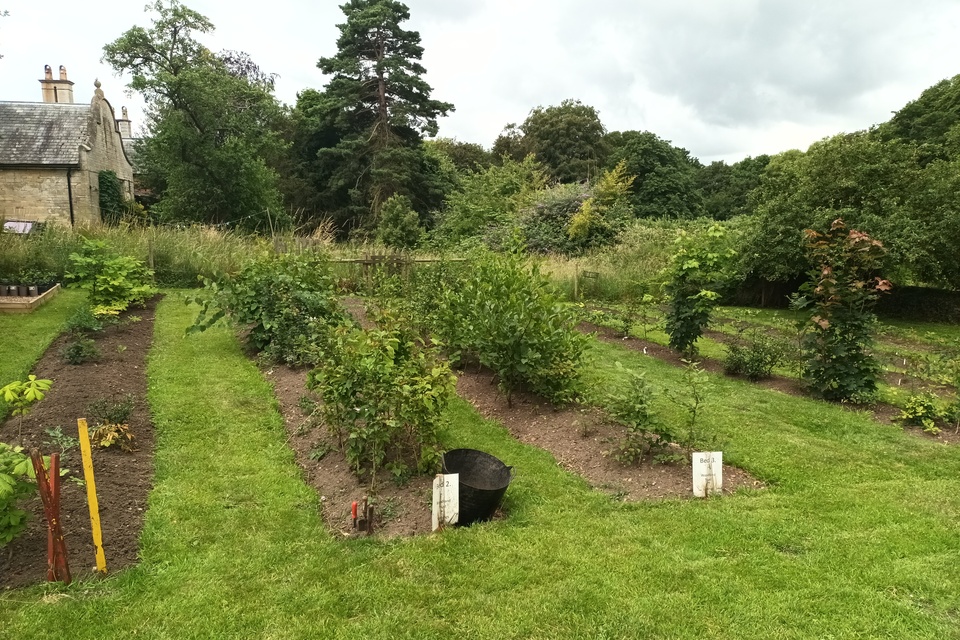
Londonthorpe Community Tree Nursery. Credit: Aaron Benson
Scots pine for England – reinvigorating the Scots pine breeding programme with a southern bias
- organisation: Conifer Breeding Co-op
- organisation type: tree breeding co-operative
- location: UK (various)
This project aims to assemble the foundational breeding resources to create Scots pine forest reproductive material specifically tailored to the needs of English forestry. The project will result in increased knowledge on breeding values and genetic diversity for Scots pine.
Climate matching and resilience trial in Sitka spruce – future proofing productive forestry in England
- organisation: Conifer Breeding Co-op
- organisation type: tree breeding co-operative
- location: UK (various)
The Conifer Breeding Coop aims to establish a large-scale field trial of 100 improved Sitka spruce families to:
- Directly identify responses to climate, pests and diseases.
- Allow resilient breeding lines to be identified for rapid diversification of forest reproductive material.
- Allow recommendations to be made on breeding lines for regional conditions, especially drier sites in England.
BioPeat – peat free growing media system from sewage biomass
- organisation: Betley Court Ltd
- organisation type: estate
- location: Cheshire
This project aims to develop a self-supporting growing media system based on sewage sludge to eliminate peat use and allow enhanced automation in forest nurseries.
Autonomous smart spot-precision application of herbicide (ASPA)
- organisation: University of Warwick
- organisation type: university
- location: Warwickshire
This project aims to develop an autonomous weed control AI-based robot for smart spot-precision application of herbicide. It aims to reduce reliance on synthetic chemicals by more than 90%, contributing to a more sustainable environment and better farming practices. The project will develop two AI models and a robotic platform for weed elimination.
Herbicide free weed control for tree production
- organisation: Earth Rover Ltd
- organisation type: farming and food production machinery manufacturer
- location: Shropshire
This project aims to build an autonomous agri-robot prototype based on Earth Rover concentrated light autonomous weeding and scouting (CLAWS). This technology is currently under development for controlling weeds using AI and concentrated light in brassica crops.
The project will acquire on-farm data and train AI algorithms specifically for tree and hedge seedlings. They will verify the effectiveness of weed control through field trials.
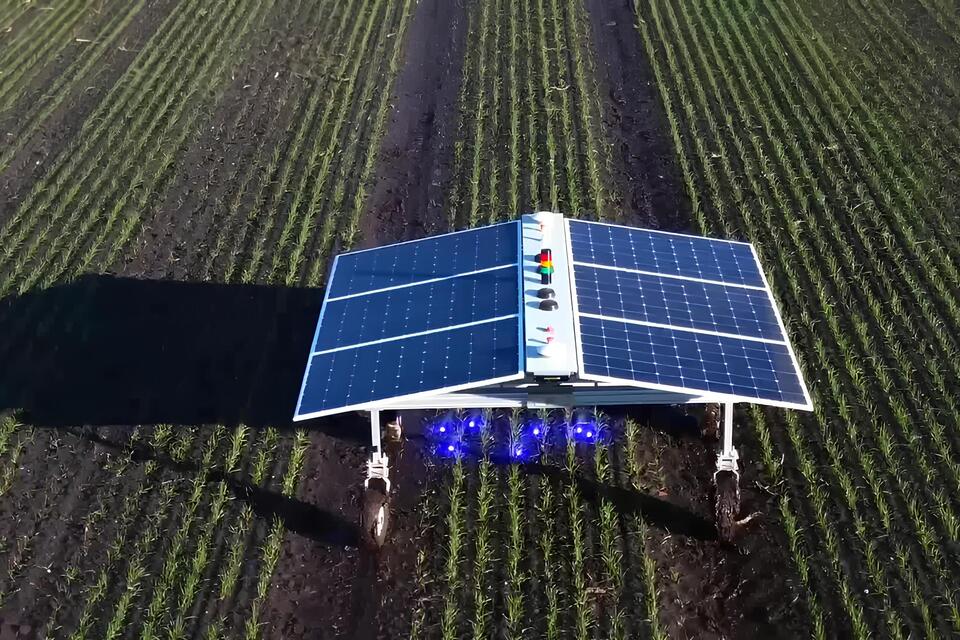
CLAWS in operation. Credit: Earth Rover Ltd
Developing a regenerative tree nursery practice
- organisation: Bangor University
- organisation type: university
- location: Gwynedd
This project aims to investigate composted municipal green waste as an alternative to peat-based growing media to address perceived issues in compost quality and consistency, and to increase the sustainability of tree nurseries.
It aims to determine if green waste compost can be used with mycorrhizal inoculation and probiotic enrichment to produce healthy and resilient saplings through increased functionality of soil microbiota and the suppression of soil borne pathogens.
eWeeding for liverwort control in containerized propagation systems
- organisation: RSK ADAS Ltd
- organisation type: agricultural and environmental consultancy
- location: West Midlands
This project aims to conduct a proof-of-concept study for the use of electric weeding (eWeeding) for non-chemical liverwort weed control in containerised tree nurseries as part of an integrated weed management strategy.
The treatment parameters will be explored through replicated randomised trials to find an optimal treatment regime that kills weeds and minimises regrowth. A nursery trial will test the technology in an industry setting.
Priming tree seed for enhanced germination and stress resilience
- organisation: Lancaster University
- organisation type: university
- location: Lancashire
This project aims to demonstrate how new and established seed treatment technologies can be used to improve tree seed germination rates and sapling resilience to climate change related stress.
Lancaster University will test the ability of both jasmonic acid seed treatment and light-based seed priming approaches to enhance germination across a range of commercially valuable UK tree species.
Developing seed enhancement techniques for successful establishment of valuable tree seed stocks
- organisation: Elsoms Seeds Ltd
- organisation type: seed specialist and plant breeder
- location: Lincolnshire
This project aims to develop and trial a novel seed enhancement technique based on non-thermal gas plasma technology for improving seed germination, establishment and quality in tree seedling production.
This project combines scientific expertise from Loughborough University and Zayndu Ltd along with the seed industry knowledge and commercial application of Elsoms Seeds and Elsoms Trees.
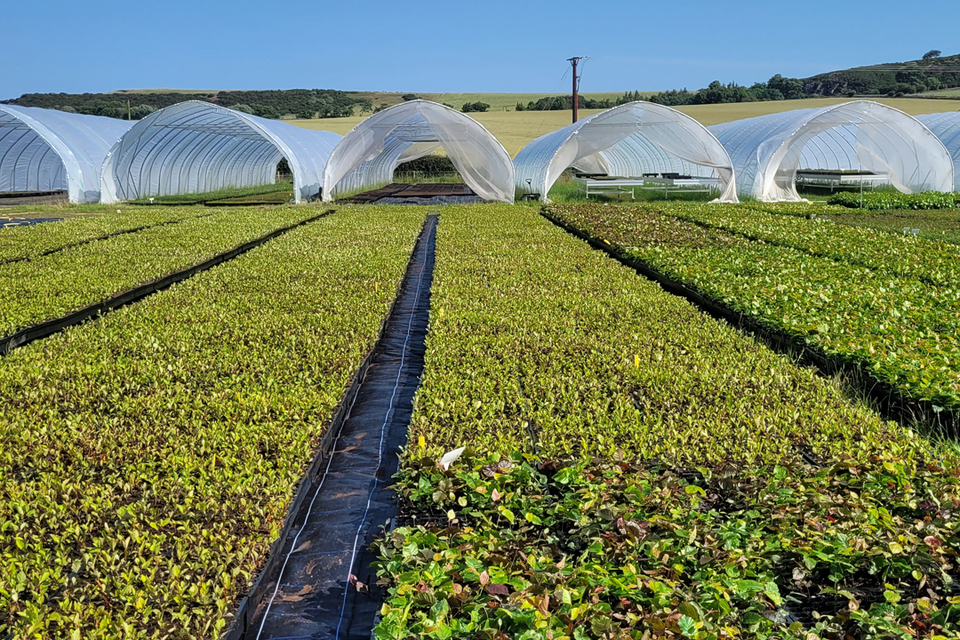
Polytunnels and saplings at Elsoms Nursery. Credit: Elsoms Seeds Ltd
Plasma and phenotyping technologies for improved seed quality for tree production
- organisation: Royal Botanical Gardens, Kew
- organisation type: charity and public body
- location: Sussex
This project aims to use high-throughput 3D X-ray phenotyping to assess the effects of innovative plasma-based methods for breaking seed dormancy and improving germination and storage of 6 UK native tree species. The project will result in improved knowledge of dormancy mechanisms and germination requirements of tree seed to enable improved propagation of trees from seeds.
Find out about more TPIF funded projects.