
Round 2 funded projects
Updated 25 February 2026
Applies to England

© Crown copyright 2026
This publication is licensed under the terms of the Open Government Licence v3.0 except where otherwise stated. To view this licence, visit nationalarchives.gov.uk/doc/open-government-licence/version/3 or write to the Information Policy Team, The National Archives, Kew, London TW9 4DU, or email: psi@nationalarchives.gov.uk.
Where we have identified any third party copyright information you will need to obtain permission from the copyright holders concerned.
This publication is available at https://www.gov.uk/government/publications/tree-production-innovation-fund-funded-projects/round-2-funded-projects
The Tree Production Innovation Fund (TPIF) supports projects that will enhance or facilitate tree production methods used in the UK. Grant recipients aim to develop new technologies that will overcome barriers to domestic tree production.
Summary of round 2 funding
- total funding allocated: over £4.5 million
- number of projects funded: 13 projects across 13 organisations
- geographic spread: projects were located across England, Scotland and Wales
- project duration: projects ran from 2022 to 2025
Funded projects
Improving the growth, health and resiliency of forests through locally sourced mycorrhizal fungi
- organisation: Rhizocore Technologies Ltd
- organisation type: biotechnology manufacturer
- location: Midlothian
This project aims to assess how different ectomycorrhizal species enhance tree growth, sapling survival and carbon sequestration in newly planted woodlands. The project will also generate data on efficacy of different mycorrhizal species in different soil types and their effect on aiding establishment of multiple tree species.
Cryopreservation of elite cell lines to increase genetic diversity in forests
- organisation: Maelor Forest Nurseries
- organisation type: tree nursery
- location: Wrexham
This project aims to develop a cryopreservation process for the long-term storage of cell lines and determine recovery rate and genetic fidelity of stored cell lines using next generation DNA technologies. It aims to form a living library to underpin future breeding programmes.
Intelligent singulating and labelling of developing trees using robotics (ISILDUR)
- organisation: University of Lincoln
- organisation type: university
- location: Lincolnshire
This project aims to address endemic labour shortages in the forest nursery sector by developing an intelligent robotics solution focussed on plant processing tasks. In partnership with J&A Growers, the project will involve the design and prototype demonstration of a novel 2-robot solution.
They will use flexible robotic manipulation combined with intelligent machine vision to develop a system capable of performing singulating, grading, counting and packaging.
Injecting diversity and quality assurance into alternative conifers
- organisation: Conifer Breeding Co-op
- organisation type: tree breeding co-operative
- location: UK (various)
This project aims to diversify, improve and assure the quality of Douglas fir and Norway spruce genetic resources to consolidate the seed supply and enable resilience to changing conditions.
The project will create full breeding populations of Norway spruce and Douglas fir from UK forest reproductive material, create a platform for future quality and diversity selection through DNA analysis and analyse existing Douglas fir trial data.
Smart Tree Production System (STPS)
- organisation: University of Warwick
- organisation type: university
- location: Warwickshire
This project aims to develop a smart, automated production system for the singulation, grading, counting and packaging of bare-root tree seedlings.
In collaboration with a consortium of growers, the project aims to develop a system capable of improving process productivity by at least 100% relative to the current manual process and achieving at least a 50% reduction in the need for seasonal labour.
Tree cutting Ps and Qs: propagation quality and production quantity
- organisation: University of Nottingham
- organisation type: university
- location: Nottinghamshire
This project aims to create new optimised protocols for cutting propagation of ash and oaks. They will use new knowledge on the use of auxin for optimal rooting to develop timed-release capsules and trial new mycorrhizal fungi treatment to improve propagation success.
Supersizing broadleaves
- organisation: Future Trees Trust
- organisation type: tree breeding charity
- location: Oxfordshire
This project aims to maximise the potential of broadleaves to establish quickly. The project will use genetically diverse seed selected for high growth and form and explore different nursery protocols and silvicultural interventions compared to standard practice. Research will involve field trials and will be guided by a literature review.
Growing connections: innovations in community nursery tree production
- organisation: Coventry University
- organisation type: university
- location: West Midlands
This project aims to study the valuable contribution that innovative community tree nurseries make to the diversity of quality tree stocks available for planting projects locally. With stakeholder involvement, they will develop ‘how-to’ and best practice resources to strengthen community nurseries’ contribution to the tree production sector nationally.
Seed traits for tree production: science-led innovation in the screening and germination of native tree seed
- organisation: Royal Botanic Gardens, Kew / Elsoms Seeds Ltd / Elsoms Trees Ltd
- organisation type: multiple
- location: UK (various)
This project aims to combine research, technical development and cross-sectoral collaboration and outreach to investigate seed morphological and germination traits in UK native trees. Kew seeks to understand how these traits vary between wild populations and commercial seed batches.
They will explore how this variation relates to environmental conditions and apply this knowledge to support ‘climate-smart’ seed sourcing and optimise seed quality and germinability via innovative high-throughput screening techniques.
Improving efficiency and resilience of water management in tree nurseries
- organisation: University Centre Myerscough
- organisation type: university
- location: Lancashire
This project aims to develop an Internet of Things infrastructure (physical and digital) to monitor real-time tree water use and support irrigation protocols. Novel evidence-based models and decision-support tools will be deployed to enable managers to predict and manage field-scale tree water use.
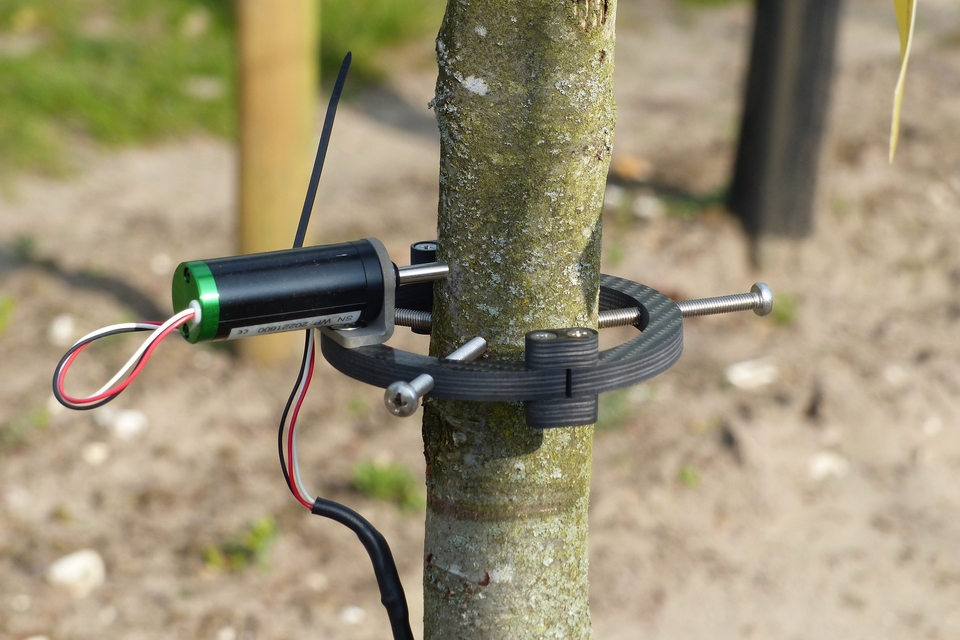
A dendrometer installed on the trunk of a field-grown tree. Credit: University Centre Myerscough
Efficient and sustainable peat-free tree production
- organisation: RSK ADAS Ltd
- organisation type: agricultural and environmental consultancy
- location: West Midlands
This project aims to develop and test prototype peat-free growing media blends for use in automated containerised tree propagation. The project will evaluate both miniplug to bare root and miniplug to root training cell options using Douglas fir and Sitka spruce, creating substrates that offer plant support and mechanical handling capabilities.
Living soil – from seed to established woodland
- organisation: SAF Woodland Management
- organisation type: consultancy and tree nursery
- location: Pembrokeshire
This project aims to develop microbially beneficial compost as part of a holistic nutrition programme for tree nurseries. This ‘living soil’ will mimic the functional aspects of a healthy woodland environment to vastly improve stock quality, performance, and cost-benefits.
Gathering scientific data and acquiring necessary certification through the project will enable the forest industry to adopt the approach with confidence.
PeatNoMore: improving peat-free media for cell-grown tree production
- organisation: SilviBio
- organisation type: biotechnology manufacturer
- location: West Lothian
This project aims to improve peat-free media using a biobased moisture and nutrient retaining additive. The project will involve laboratory, glasshouse and forest nursery trials to test its effect on seedling quality, required irrigation frequency and fertiliser leaching in mini-cell and cell production.
Find out about more TPIF funded projects.