Traded carbon values used for modelling purposes, 2025
Published 3 February 2026

© Crown copyright 2026
This publication is licensed under the terms of the Open Government Licence v3.0 except where otherwise stated. To view this licence, visit nationalarchives.gov.uk/doc/open-government-licence/version/3 or write to the Information Policy Team, The National Archives, Kew, London TW9 4DU, or email: psi@nationalarchives.gov.uk.
Where we have identified any third party copyright information you will need to obtain permission from the copyright holders concerned.
This publication is available at https://www.gov.uk/government/publications/traded-carbon-values-used-for-modelling-purposes-2025/traded-carbon-values-used-for-modelling-purposes-2025
Background
The Department for Energy Security and Net Zero’s (DESNZ) traded carbon values for modelling purposes are used to estimate the financial cost of purchasing allowances in the United Kingdom Emissions Trading Scheme (UK ETS) under different scenarios. The UK ETS Authority governs the UK ETS – the work herein has no connection to the UK ETS Authority or any of the work or decisions of that Authority. Traded carbon values quoted in this paper correspond to the period up to 2050. They should not be considered as forecasts of prices of UK ETS allowances, rather independent scenario-based projections and the actual price of allowances may fall outside of the range included in this publication.
These traded carbon values reflect the current standalone UK ETS and the scope of emissions covered by the UK ETS as of the start of 2025, and do not account for UK-EU linking negotiations. Future changes, which may include linking with the European Union Emissions Trading System (EU ETS) and scope expansion, will be incorporated into future traded carbon values publications when there is greater certainty on these changes and their impact on traded carbon values.
Scenarios
The projections are all based on assumptions and the range of emissions planned to reach Net Zero in 2050. There is a range, rather than one series, as the pathway will be affected by elements such as Gross Domestic Product (GDP) growth and fossil fuel prices which are impacted by issues outside of Government control (e.g. world energy prices, etc).
The set of four trajectories is an update of the set published last year [footnote 1]:
- The central trajectory is based on Net Zero Strategy [footnote 2] projected emissions and assumes a level of decarbonisation achieved through other policies to achieve net zero in 2050.
- The high trajectory reflects the state of the world where fossil fuel prices are relatively lower, which make fossil fuels more competitive in comparisons with renewables, whilst the economic growth is also high. This results in higher emissions relative to the central scenario, and thus higher traded carbon values are needed to incentivise more abatement to meet the cap.
- The low trajectory reflects the state of the world where fossil fuel prices are relatively higher, which make fossil fuels less competitive in comparisons with renewables, whilst the economic growth is also low. This results in lower emissions relative to the central scenario, and thus lower traded carbon values are needed to incentivise more abatement to meet the cap.
- The market trajectory assumes that, in the first few years of the projections, there are some unobservable market factors that affect the carbon value (transaction costs, liquidity, market inertia etc). It assumes the effects of these will dissipate over four years, the extent of foresight in the models, returning to the underlying fundamentals reflected above.
Methodology
DESNZ uses a fundamentals-based approach to estimate UK traded carbon values. Its Carbon Markets Model (CMM) finds the equilibrium between demand for and supply of abatement over a chosen period. The CMM utilises information about future abatement costs, emissions and caps to derive traded carbon values. However, it uses the scope of the UK ETS as at the start of 2025, as noted earlier.
The 2025 traded carbon values are based on methodology using two data sets:
- Business As Usual (BAU) emissions projections and corresponding Marginal Abatement Cost Curves (MACCs). These have been commissioned from consultants Enerdata and produced by them using their POLES (Prospective Outlook on Long-term Energy Systems) model, a top-down global sectoral model of the world energy system [footnote 3]. These BAU emissions projections and MACCs use the Department’s fossil fuel price assumptions and underlying economic growth projections.
- Market prices of UKA futures contracts. This includes data on daily settlement prices of UKA futures contracts with traded on the Intercontinental Exchange (ICE) for the first five months of 2025. Observed market prices are the best source of information when projecting the price of traded carbon. However, the futures market provided prices for liquid contracts only for December 2025, so these data are used for the start of the market trajectory only.
Background to the Carbon Markets Model
The CMM is the model used to produced DESNZ traded carbon values. The CMM has been developed over many years and originally was created as the UK BEIS Carbon Price Model (UK BCPM) which was first developed in 2018 for the purpose of supporting policy development on the design of a UK ETS from its launch in 2021. It was initially designed using the older BEIS Carbon Price Model (BCPM) as a template; the BCPM was used to project carbon values in the EU ETS.
The most recent revision was in 2024, when the internal calculations of the CMM were updated to perform foresight computations through an iterative process. This allowed for better projections of banking and hedging. As part of this update, additional features to limit between-year banking were added to the model.
The following sections provide more detail on the methodology used, the key inputs’ assumptions that influence the model outputs, and some of the risks and limitations of the model.
Modelling methodology
The CMM is a demand and supply model, where the carbon values are estimated as the equilibrium point where demand for allowances (the business-as-usual emissions minus abatement incentivised by carbon prices) is matched by the supply of allowances available: yearly cap, plus banked allowances, minus allowances saved for future use.
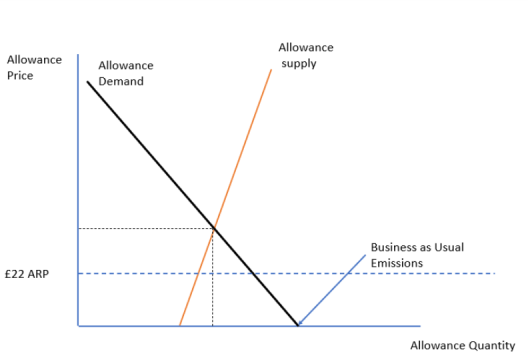
The demand for allowances is estimated as the business-as-usual emissions [footnote 4] (the emissions that would occur in the absence of the UK ETS), minus the amount of abatement ETS participants undertake due to the decarbonisation incentive of the carbon value. As the carbon value rises, more abatement occurs and thus less carbon allowances are needed for compliance.
The allowance supply is set by the UK ETS cap. [footnote 5] The number of allowances available for use in a given year will also be affected by the number of allowances banked (saved from previous years). More allowances banked from previous years increases the supply for this year, and saving more allowances for future years reduces supply for this year. Banking is affected by hedging assumption and based on model foresight and projections on whether the market will be relatively tighter or looser in the future.
The CMM loops for each year consecutively, with a four-year foresight. Each year the model looks at the next four years allowances supply, BAU emissions and abatement technologies. The model makes an optimisation for this year’s abatement, carbon value and resulting emissions. The model does this for each year out to 2050.
Additional details on the model can be found in the description of the previous version of the model from 2023 (when it was named the UK BCPM), in the modelling annex of the impact assessment accompany the Developing the UK ETS Authority Response [footnote 6].
Overview of assumptions:
- The current scope of the UK ETS is assumed to remain in place until 2050. This modelling assumption reflects an extension of the existing legislated policy and does not anticipate or prejudge any future changes to the UK ETS scope. Additionally, the modelling excludes potential UK–EU ETS linking negotiations and instead considers a standalone UK ETS.
- Foresight is set as four years (until 2047, from which it reduced one year each year to one year in 2050), this is the timeframe in which participants assess the degree of scarcity in the market and, consequently, their future abatement and carbon trading strategies.
- The cost of carry is set at 3.25%, this is the rate in the model at which firms discount future investments in abatement and is sometimes called the discount rate.
- Hedging is based on future emission projections. This takes a percentage of a future year’s emission projections and the percentage which changes over time. This captures that as the power sector decarbonises a smaller hedge is required.
- A greater starting surplus was recorded for 2025 of 67m allowances (nearest million) and incorporated into the model. The starting surplus for the 2024 traded carbon values was 62m allowances.
2025 modelling traded carbon values
The following estimates for UK traded carbon values have been used in the latest update to the department’s Energy and Emissions projections [footnote 7] and are recommended to be used in other models across Government. These traded carbon values can be used as the annual average carbon prices in those models; however, UKA carbon prices are financial instruments whose price fluctuates on a daily basis, based on market movements. The 2025 traded carbon values are shown in Figure 1 and Table 2 replacing the 2024 set published in December 2024.
The traded carbon values for modelling projections initially range between £22 and £44 in 2025. The trajectories increase steadily across the next decade to roughly double by 2035. They then increase at a higher rate for the remainder of the period reaching a range of £167 to £298 in 2050. These trajectories reflect the abatement available and the steeper trajectories for the later years are a consequence of projections of the power grid having decarbonised and abatement elsewhere being more expensive.
Figure 1: Traded carbon values for modelling purposes, £/tCO2e (real 2025)
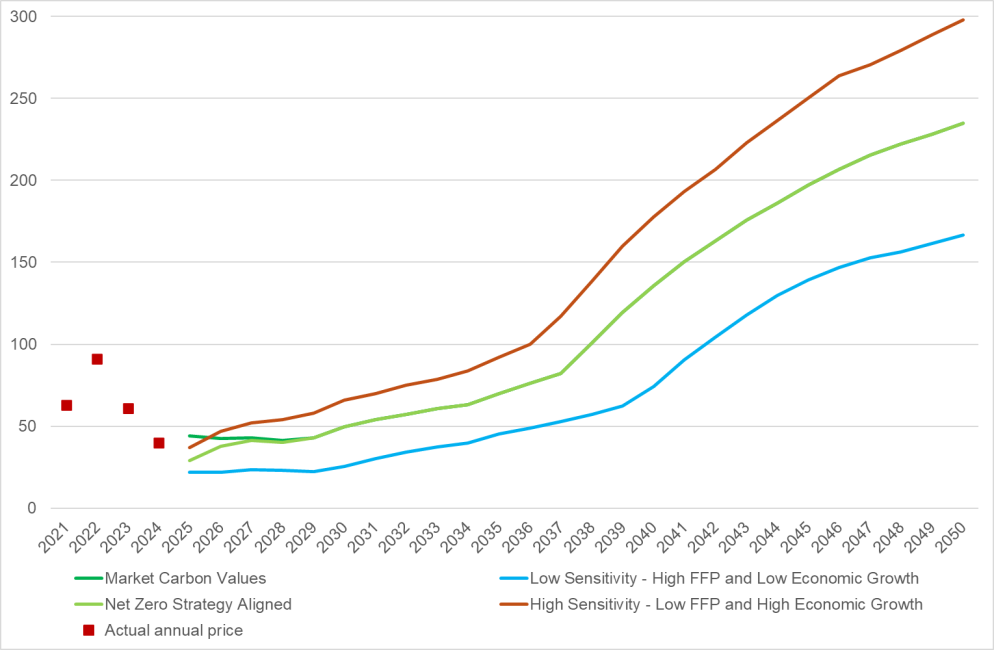
Table 1: Traded carbon values for modelling purposes, £/tCO2e (real 2025)
| Year | Market Traded Carbon Values | Low Sensitivity - High Fossil Fuel Prices and Low Economic Growth | Net Zero Strategy Aligned | High Sensitivity – Low Fossil Fuel Prices and High Economic Growth |
|---|---|---|---|---|
| (2025 GBP) | (2025 GBP) | (2025 GBP) | (2025 GBP) | |
| 2025 | 44 | 22 | 29 | 37 |
| 2026 | 42 | 22 | 38 | 47 |
| 2027 | 43 | 23 | 41 | 52 |
| 2028 | 41 | 23 | 40 | 54 |
| 2029 | 43 | 22 | 43 | 58 |
| 2030 | 50 | 25 | 50 | 66 |
| 2031 | 54 | 30 | 54 | 70 |
| 2032 | 57 | 34 | 57 | 75 |
| 2033 | 61 | 37 | 61 | 79 |
| 2034 | 63 | 40 | 63 | 84 |
| 2035 | 70 | 45 | 70 | 92 |
| 2036 | 76 | 49 | 76 | 100 |
| 2037 | 82 | 53 | 82 | 117 |
| 2038 | 101 | 57 | 101 | 138 |
| 2039 | 120 | 62 | 120 | 160 |
| 2040 | 136 | 74 | 136 | 178 |
| 2041 | 150 | 91 | 150 | 193 |
| 2042 | 163 | 104 | 163 | 207 |
| 2043 | 176 | 118 | 176 | 223 |
| 2044 | 186 | 130 | 186 | 237 |
| 2045 | 197 | 139 | 197 | 250 |
| 2046 | 207 | 147 | 207 | 264 |
| 2047 | 215 | 153 | 215 | 271 |
| 2048 | 222 | 156 | 222 | 279 |
| 2049 | 228 | 161 | 228 | 289 |
| 2050 | 235 | 167 | 235 | 298 |
Changes compared to 2024 publication
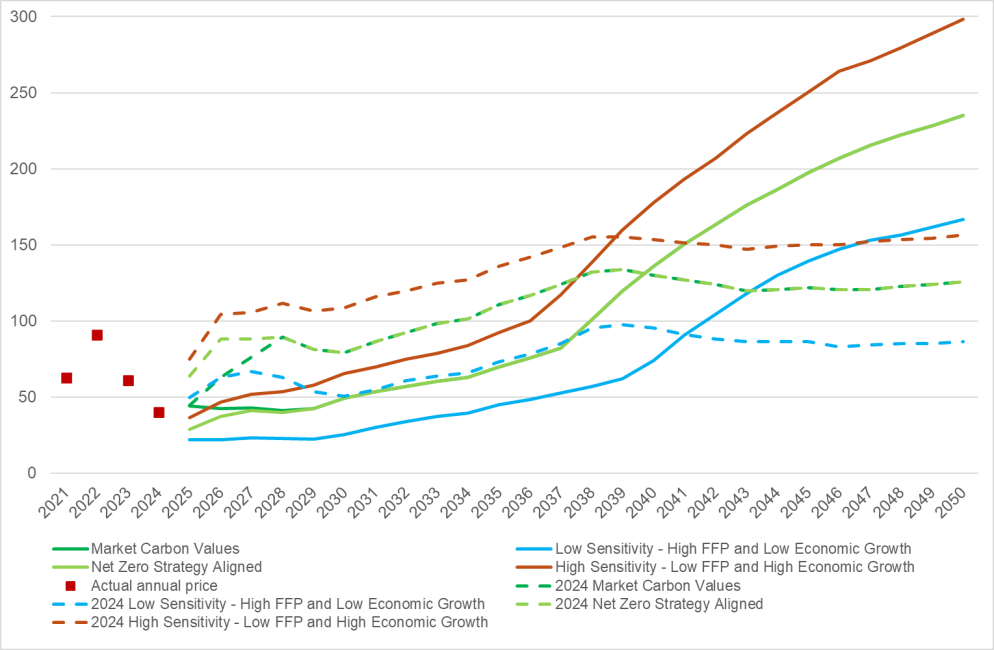
There is a significant difference between 2025-based trajectories presented here when comparing with the trajectories published last year. For the early years of the projections, the 2024 trajectories are higher than the 2025 values, but whilst last year’s trajectories remained flat in the 2040s, the 2025 values increase in that period. The new values and range for 2050 are higher than the projections published last year for 2050, almost double the previous value.
Figure 2: 2025 traded carbon values for modelling purposes compared to 2024, £/tCO2e (real 2025)
This is a result of changes to the data and assumptions for the 2025 traded carbon values. The two main modelling updates that change the traded carbon values from the 2024 publication to this year’s publication are:
- MACC and BAU adjustment – to account for installation and operator closures, the most significant being the Port Talbot blast furnace closures, and to align with latest DESNZ models and data about the Net Zero pathway. Site closures reduce emissions and thus demand for allowances, leading to lower carbon values.
- Power sector and Interconnectors – projections of the traded carbon values are affected by the interconnectors, that is the flow of electricity between the GB [footnote 8] and elsewhere, which can travel in either direction in different years depending on respective prices. Interconnectors flows affect the amount of GB power generation and power demand for carbon allowances. Assumptions for the projected use of interconnectors were updated to reflect the modelling assumptions for DESNZ Energy and Emissions Projections (EEP), wider DESNZ power assumptions in line with NZS and more accurately project interconnector flows.
As noted above, in the first decade of the projections, the 2025 traded carbon values for modelling are significantly lower than last year’s figures. This is driven mainly by the MACC and BAU adjustments to industry, aviation, and power. However, moving towards 2040, this gap reduces and eventually disappears. This is because the MACC and BAU adjustments are mainly focused pre-2037 and, later in the projection, the interconnector MACC begins to deliver lower levels of abatement in comparison to those used in 2024.
In the 2040s, these new 2025 carbon values are higher than those published last year. This is being driven by interconnector changes which are now reflecting a higher level of decarbonisation in the power grid than previously assumed. This causes higher carbon values as there is less “cheap” abatement remaining in the power sector, so higher carbon values are required to drive more expensive abatement in industry and aviation.
Caveats and limitations
Please note these traded carbon values are based on a specific set of assumptions with respect to the policy mix, cost of fuels, level of emissions etc. They are also based on the UK ETS remaining a standalone scheme with the scope as existed at the start of 2025. Consequently, these should not be considered as “forecasts” of future prices and DESNZ accepts no responsibility for any outcomes arising from the use of these figures.
The modelled trajectories reflect “what if” scenarios based on specific sets of assumptions that are chosen to produce a plausible and meaningful range for sensitivity analysis. As such, they are not meant to depict a likely outcome. Instead, these values represent our best understanding of fundamentals-based value of carbon allowances in UK ETS.
Fundamentals-based trajectories are also subject to numerous modelling assumptions in the CMM (including perfect foresight and discount rate) and in the POLES model (including cost of abatement technologies, deployment rates etc.) that attempt to simulate market participants’ behaviour in future states of the world and as a result are subject to considerable uncertainty.
-
Traded carbon values used for modelling purposes, 2024 - GOV.UK. ↩
-
Further information on the POLES model: POLES: Prospective Outlook on Long-term Energy Systems. ↩
-
Business as Usual emissions are what emissions would be in the absence of carbon pricing. Therefore, where carbon price = £0, is also equal to the BAU emission level. ↩
-
GOV.UK: Developing the UK Emissions Trading Scheme (UK ETS). ↩
-
GOV.UK: Developing the UK Emissions Trading Scheme (UK ETS). ↩
-
These are available at: Energy and emissions projections. ↩
-
NI power producers are covered by the EU ETS, so our modelling only captures GB electricity sector. ↩