Final report of the Timms Review of Personal Independence Payment
Published 24 November 2026

© Crown copyright 2026
This publication is licensed under the terms of the Open Government Licence v3.0 except where otherwise stated. To view this licence, visit nationalarchives.gov.uk/doc/open-government-licence/version/3 or write to the Information Policy Team, The National Archives, Kew, London TW9 4DU, or email: psi@nationalarchives.gov.uk.
Where we have identified any third party copyright information you will need to obtain permission from the copyright holders concerned.
This publication is available at https://www.gov.uk/government/publications/the-timms-review-final-report/final-report-of-the-timms-review-of-personal-independence-payment
Foreword from the co-chairs on behalf of the steering group
D/deaf and disabled people and people with long-term health conditions want the same opportunities as everyone else. They want the right to live independently, with choice, control and dignity. They want to be included in, and valued by, their communities and feel a sense of belonging, with opportunities to learn, sustain relationships, care, create, work and take part in everyday life in a way that matters to them, allowing them to make choices about their future.
Yet too often they are trying to build those lives while facing additional costs, inaccessible environments, difficulty accessing essential services and greater demands on their time and energy. Too often, these barriers limit opportunities to participate in society and to live with the freedom, choice and control that many other people take for granted.
We grounded this review in our agreed aim that the purpose of Personal Independence Payment (PIP) is to assist D/deaf and disabled people and people with long-term health conditions, and to reduce the inequalities they face in participating in everyday life through a contribution towards the extra costs of being disabled or living with a long-term health condition.
This purpose shaped how we engaged with people throughout this review process, how we considered evidence and how we developed our recommendations.
Throughout the process, we continued to ask the question: is PIP delivering the outcomes that it is intended to support?
The answer we heard was complex, highlighting a gap between policy intent and people’s lived experience and real-life outcomes.
As set out in our interim report, people consistently told us that PIP is highly valued. We heard through our call for evidence that, for many people, PIP provides essential financial support and helps them manage the additional costs arising from their disability or long-term health condition and the barriers that they face. We also heard that the process of accessing this support is hard to understand and navigate and that the experience felt stressful, frustrating and dehumanising. We heard that a benefit intended to support independence can often discourage it. People report feeling scared to undertake physical activity, volunteer, work, or even meet with friends for fear of losing their PIP.
Our interim report reached a clear conclusion: PIP remains a valued and important benefit, but the system through which it is delivered is no longer fit for purpose.
The consistency and strength of the evidence we heard left little doubt that reform is needed.
As the case for reform was strengthened by the evidence gathered and the breadth of voices and experiences heard throughout this review, these findings formed the foundation of our final recommendations for creating a PIP system that is fit for purpose.
Co-production and extensive engagement were central to this review. The composition of the steering group brought together a wide range of lived and learned experience. However, we were clear from the outset that this review could only succeed if it was shaped by reaching the voices and experiences of D/deaf and disabled people and people with long-term health conditions far beyond the group itself.
We drew on the views and experiences of more than 40,000 people across multiple evidence strands which were designed to offer different ways to take part in this review to increase inclusivity and diversity of perspectives. The lived experience, expertise and insights shared have shaped not only our recommendations, but the values, principles and direction that underpin this report.
We are immensely grateful to everyone who contributed their time, expertise, and lived experience to this work.
People did not agree on every policy solution. However, there was remarkable consistency on the outcomes they wanted to see. They wanted a system that treats people with dignity, builds trust and recognises individuality and equity.
Ultimately, this review is about more than just improving a benefit. It is about improving the relationship between the state and D/deaf and disabled people and people with long-term health conditions.
The question is not whether people can adapt to the system, but how the system should recognise, respond and adapt to the diverse needs of the people it exists to support. A reformed benefit should support the right to independent living and enable D/deaf and disabled people to participate in society on their own terms.
Our recommendations set out the change needed to ensure the system better recognises the extra costs people face and how their impairment, long-term health conditions and wider societal disabling barriers affect everyday life. At their core is a clear position: PIP should continue to provide a cash award, and remain a non-means-tested, non-taxable benefit available to people both in and out of work, with an improved process that ensures the right support goes to the people who need it.
This position applies both to the system people experience today, and to our call for a reformed benefit for the future, so our recommendations focus on 2 goals: fixing the system people experience today and setting a new direction for the future.
We agreed 6 tests that the recommendations must meet in order to be implemented, set as questions to assess whether a proposal and its delivery meet the intended commitments and outcomes. These tests should ensure our recommendations deliver better outcomes for D/deaf and disabled people, and people with long-term health conditions, while remaining fair, practical, evidence-based and sustainable.
We recognise that a new future benefit will take time to implement, but given the evidence we heard about how dehumanising the current process can feel, we must not wait to improve the process for those currently going through it. We should make the system more accessible and supportive, simpler to understand and navigate, less burdensome and more responsive to the needs of D/deaf and disabled people and people with long-term health conditions, while ensuring the process no longer feels dehumanising.
We should build a reformed benefit founded on dignity, choice and control, built around 3 core priorities:
- providing a more accessible, consistent and transparent experience, improving how D/deaf and disabled people and people with long-term health conditions interact and build trust with DWP
- better recognising and helping meet the extra costs of disability and associated need, ensuring financial support remains at the centre of the system
- providing a better and more comprehensive optional support offer, combining financial support with access to support and services, delivered closer to people in their communities, where they need and want them
Under these priorities, we must move from the current system that only focuses on what people cannot do, to a new PIP that develops a rounded understanding of people’s lives, including what they can and want to do, the barriers they face and the extra costs they experience. It should be proportionate: simpler where needs are clear and more thorough where circumstances are complex. Reform should be designed, tested and co-produced by D/deaf and disabled people and people with long-term health conditions. It should focus on equitably supporting the right to independent living and enable people to participate in society on their own terms.
This report sets out how these ambitions can be achieved to create a fairer foundation for everyday life, rehumanising the PIP application process and ensuring it works with people, rather than creating additional barriers for them.
Investing in D/deaf and disabled people and people with long-term health conditions underpins their ability to make a powerful contribution to the UK’s economy and society. Almost 17 million disabled people live in the UK (Department for Work and Pensions (DWP), 2025a), with disabled households contributing £274 billion in annual spending power through the ‘purple pound’ (Scope, 2023a), alongside significant contributions through culture, innovation, work, volunteering, advocacy and civil rights. The steering group recognises the value and support PIP offers to people as part of collective social security and a rights-based approach to independent living.
The recommendations in this report are those of the steering group and do not constitute government policy. It is for the government to decide its response. However, having considered the evidence, and having heard directly from D/deaf and disabled people and people with long-term health conditions, we believe there is a compelling case for change. We present this report to the Secretary of State for Work and Pensions and encourage the government to respond with the urgency and ambition that the issues demand.
Sharon Brennan
Dr Clenton Farquharson CBE
Rt Hon. Sir Stephen Timms MP
Co-chairs of the Timms Review, on behalf of the steering group
Executive summary
Making PIP fit for purpose: a new vision
Introduction
1. PIP is a non-taxable cash benefit that is not means-tested, which is intended to contribute towards the additional costs faced by D/deaf and disabled people and people with long-term health conditions (see annex A). Throughout this report, we may use the term ‘disabled people’ as a shorthand term for D/deaf and disabled people and people with long-term health conditions (see Glossary). Consistent with the social model of disability, we may also refer to a person’s ‘impairment’ when describing an individual’s physical, sensory, cognitive, mental health, learning disability or other health-related condition. This reflects the distinction made within the social model between impairment (a person’s condition or difference) and disability (the barriers created by society, environments, systems and attitudes). The use of this terminology does not indicate, and should not be interpreted as, any change to PIP eligibility criteria.
2. In the 13 years since its introduction, PIP has never been fully reviewed. The Timms Review was established to ensure that PIP remains fair, effective and fit for the future. The Timms Review was co-produced by 3 co-chairs and 12 steering group members, bringing together diverse perspectives through professional expertise, lived and living experience. Through this co-produced approach, the Timms Review gathered evidence from over 40,000 people and organisations across the United Kingdom.
Why change is needed
3. The steering group agreed a clear statement of purpose for PIP: to assist D/deaf and disabled people and people with long-term health conditions and to reduce the inequalities they face in participating in everyday life through a contribution towards the extra costs of living with an impairment or long-term health condition.
4. The Timms Review found strong external support for that purpose. Throughout the evidence gathered, PIP was consistently described as a valued and important benefit. People told the Timms Review that it helps them meet disability-related costs, maintain independence, participate in their communities and live their lives with greater choice and control.
5. However, whilst many people support the purpose of PIP, they also said that the current system is no longer fit for purpose. The evidence heard by this review highlighted persistent concerns about people’s experience of claiming and receiving PIP. Many described the application, assessment, review and appeals processes as complex, hard to navigate, burdensome and, at times, dehumanising.
6. The Timms Review also heard concerns that too often the system focuses on what people cannot do, rather than understanding what they can and want to do alongside their needs, aspirations, barriers and additional costs. A system that lacked dignity and fairness emerged as recurring themes throughout the evidence. The Timms Review heard concerns that the current PIP assessment can inadvertently discourage participation in society, as some people fear that efforts to improve their health, volunteer, work or engage in community life may be treated as evidence of a lower support need.
7. The context in which PIP operates has changed significantly since 2013, strengthening the case for reform. More working-age people report being disabled or living with long-term health conditions, patterns of need have evolved, and wider pressures across health, social care, housing, transport and employment support have affected the support people require.
8. The interim report concluded that the current system is no longer fit for purpose. The evidence gathered during the second phase of the Timms Review reinforced that conclusion.
Making PIP fit for purpose
9. This final report sets out how PIP can be made fit for purpose for the future. The Timms Review recognises the value that D/deaf and disabled people and people with long-term health conditions bring to their families, communities, workplaces and wider society. A future system should start from a recognition of people’s strengths, contributions and aspirations, rather than being defined solely by the challenges that they face. It should support people to live the lives that matter to them, while responding more effectively to their real-life needs.
10. The ambition is a system that is more personalised, flexible and responsive: one that better recognises extra costs associated with being disabled or living with a long-term health condition, reduces barriers to participation and independent living, and enables people to exercise greater control over the support they receive and the life they lead. Financial support should remain central, supplemented by access to optional wider support and services where these would help people achieve their aspirations.
11. The Timms Review’s vision is built around 3 big ideas: a better experience of the system, better recognition of the extra costs of disability and related needs, and a better support offer. Together, they represent a shift from a current system focused primarily on what D/deaf and disabled people and people with long-term health conditions cannot do (which we often heard felt dehumanising to recount), to one that keeps financial support at the centre but better understands people’s needs, barriers and aspirations and helps provide support to participate in society and live the life they want to lead.
12. The steering group’s vision for reform is built around 3 core priorities:
- provide a more accessible, consistent and transparent experience, improving how D/deaf and disabled people and people with long-term health conditions interact and build trust with DWP
- improve recognition of, and help meet, the extra costs of disability and associated needs, ensuring that financial support remains at the centre of the system
- provide a better and more comprehensive optional support offer, combining financial support with optional access to support and services, delivered closer to people in their communities, where they need and want them
Principles for reform
13. The steering group’s vision for reform is founded on 8 core principles. These principles underpin both improvements to the current benefit as well as longer-term reform, ensuring that change is guided by what matters to D/deaf and disabled people and people with long-term health conditions. The principles are:
- dignity – every individual should be treated with respect and recognised for their inherent worth
- trust – policy and delivery should begin from a presumption of good faith rather than suspicion
- equity – fairness requires recognising and responding to different starting points, and different needs, costs and barriers
- accessibility – services should be designed so that everyone can use them and implemented in a way that ensures this happens in reality
- participation – everyone should have the freedom, resources, and support to take part in everyday life in ways that matter to them. PIP should remain a non-conditional benefit, available in and out of work. Entitlement to the award should not be conditional on engagement with support or different levels of participation.
- choice and control – people should have greater agency over their lives and the support they receive
- independent living – support should expand opportunities and enable people to live the lives they choose. The concept of independent living is based on what that means for the individual, without any expectation that people aim to live without any support at all.
- sustainability – the system should command public confidence and remain effective for future generations
The recommendations
14. In deciding on a final set of recommendations, the group agreed to apply 6 tests to assess whether its recommendations deliver better outcomes for D/deaf and disabled people, and people with long-term health conditions, while remaining fair, practical, evidence-based and sustainable. A reformed benefit must also retain the confidence of the people who rely on it and command the confidence of the wider public by being demonstrably fair, transparent, and effective. These tests were questions used to assess whether a proposal and its delivery meet the intended commitments and outcomes. These are the:
- Reality test: does the recommendation reflect the reality of D/deaf and disabled people, and people with long-term health conditions’, lives and lived experiences?
- Barrier test: does the recommendation reduce unnecessary barriers and make the system easier to access and navigate?
- Equity test: does the recommendation support and produce fair outcomes across all different groups?
- Dignity test: does the recommendation improve how people are treated and reduce fear and anxiety?
- Independent living test: does the recommendation support participation, independence, choice, control and quality of life?
- Deliverability test: can the recommendation be delivered effectively, consistently and at scale?
15. The steering group emphasises that its 6 tests must sit alongside the government’s statutory equality obligations, particularly the Public Sector Equality Duty (PSED) under section 149 of the Equality Act 2010, as well as the UK’s commitments under the UN Convention on the Rights of Persons with Disabilities (UNCRPD). The PSED requires public authorities to have due regard to the need to eliminate discrimination, advance equality of opportunity and foster good relations.
16. These obligations must inform the design, appraisal, and implementation of reforms from the outset, through rigorous and timely consideration of equality impacts through Equality Impact Assessments. This should include engagement and co-production with D/deaf and disabled people and people with long-term health conditions, transparent decision-making and appropriate scrutiny.
Strategic overarching recommendations
17. The steering group’s recommendations are underpinned by a set of strategic overarching recommendations to help ensure successful implementation. These are set out in detail in chapter 5. In summary, the steering group recommends that the government should:
- build trust in the system and DWP
- deliver sustained culture change in DWP and contracted providers
- co-produce design and implementation with D/deaf and disabled people and people with long-term health conditions
- apply the steering group’s tests transparently during implementation
- use new technology transparently, with human oversight and individual rights preserved
Recommendations to improve the current benefit
18. The recommendations for the current benefit are designed to improve people’s experience of the current PIP system. They focus on practical changes that can be implemented within existing structures to reduce unnecessary burden, and for some, harm, as well as improve accessibility and decision-making and help rebuild trust and confidence in the system while longer-term reforms are developed and tested.
Recommendation 1
Reduce unnecessary award reviews for people with lifelong or degenerative conditions and change award reviews to focus on what has changed in a person’s circumstances and functional impact.
Recommendation 2
Improve the PIP2 (How your disability affects you) form and guidance to ensure it is simpler to complete and better captures fluctuating conditions.
Recommendation 3
Improve the tone and language of DWP communications to be more respectful and easier to understand.
Recommendation 4
Improve the identification, implementation and monitoring of reasonable adjustments to ensure individual access needs are consistently met.
Recommendation 5
Ensure that people who need help to navigate the PIP process can access independent advocacy services.
Recommendation 6
Introduce designated case management teams for individuals with the greatest needs for support, to ensure a more personalised and joined-up approach.
Recommendation 7
Review and improve the 28-day hospitalisation rule to reduce stress and ensure that people receive the support they need.
Recommendation 8
Improve the quality and fairness of PIP assessments through a clear framework of administrative justice.
Recommendation 9
Improve the assessment process by ensuring that assessors have sufficient training and skills to improve the quality, consistency and transparency of assessments.
Recommendation 10
Review the PIP Mandatory Reconsideration (MR) process to identify areas for improvement and strengthen feedback mechanisms to apply learning from MRs and appeals across the PIP process to improve consistency in decision-making.
Recommendation 11
Review how supporting evidence is used and strengthen processes for gathering, sharing and considering relevant evidence.
Recommendation 12
Improve how PIP assesses and accounts for fluctuating conditions.
Recommendation 13
Ensure that people have access to the right assessment method to meet their needs, including increased capacity for face-to-face assessments.
Recommendation 14
Increase the availability of accessible digital services across the PIP journey to streamline the process and improve accessibility, including the development of an online portal.
Recommendation 15
Understand inequities in the experience and outcomes for different groups of people by improving data collection and reporting on people applying for PIP, and take action to address this.
Recommendations for a reformed benefit
19. The reformed benefit recommendations set out a vision for a reformed disability benefit that builds on the strengths of PIP while addressing the fundamental challenges identified through the evidence.
20. The steering group recommends that the reformed benefit is underpinned by the following key features:
- A light touch initial PIP gateway that should begin to understand and gather evidence on the person’s circumstances and inform the rest of their journey through the process, including whether a person meets basic eligibility criteria.
- A single digital profile. The information established in the initial PIP gateway should begin to build a secure personalised digital profile for each applicant, designed to give them control over how their information is shared and reused. This profile should develop throughout their journey, following a ‘Tell Us Once’ approach so that applicants are not asked to explain the same information repeatedly. A non-digital offer would also remain available.
- An approach that reflects individual circumstances. There should be different, proportionate routes through the process, rather than expecting everyone to go through the same process in the same way. The process will also avoid unnecessary reassessment.
- Fast-tracked decisions where further assessment is not needed. There should be 2 fast-track pathways: one for people with serious, well-evidenced conditions whose impact on their daily life is clear, and a quicker route for people receiving end-of-life care. People on these pathways should receive an award without a full assessment.
- Introduce an impact assessment. Those who are not on the fast-track pathway should undergo an impact assessment, which should review how a person’s condition affects their daily life and determine entitlement to the cash award. Where appropriate, people should also receive information on, and referrals to, relevant optional support and services.
- An award that is cash first. Both the fast-track and impact assessment should provide an award for those eligible, which should consist of cash plus optional services or support where appropriate.
- Recognition of extra costs. The impact assessment should include an extra costs element, which should use an improved set of questions that seek to understand better the person’s additional costs, but does not ask people to calculate their costs or provide receipts.
- Flexible combination of payment types. The cash award should be more responsive to individual needs and reflect both ongoing and occasional costs appropriately.
- Optional offer of services and support. The award should also include services and offers of support, alongside cash or in exchange for cash.
- Offer of a supportive conversation. After completing either the fast-track pathway or the impact assessment pathway, those who need it should be offered an optional locally led supportive conversation to help them identify and access relevant local services.
- A person-centred process. Each part of the process should place the individual, their experiences and the impact of their condition at the centre of communications, decisions and support.
- A process with end-to-end support where needed. The process should be designed to be accessible from the outset and, where needed, people should be supported through reasonable adjustments, peer support and advocacy.
- An award that is responsive to need. The Terms of Reference (annex B) state that PIP spend must remain within the Office for Budget Responsibility’s (OBR) forecast. Eligibility criteria should ensure that the benefit is fit for purpose and better responds to real-life need. This is likely to require a rebalancing process to ensure that awards more accurately reflect individual needs. The development of any new criteria should be subject to independent advice and scrutiny. It must be subject to careful and rigorous testing to ensure that the benefit is fit for purpose and provides the right support to the people who need it, working with those with lived experience and other experts. Any change should be introduced carefully, with appropriate transitional protections, following testing with D/deaf and disabled people and people with long-term health conditions.
Work Capability Assessment
21. The Pathways to Work Green Paper (DWP, 2025b) set out the government’s aim to abolish the Work Capability Assessment (WCA). This policy decision is a pre-existing government commitment that formed part of the Timms Review terms of reference. The steering group is clear the WCA should only be abolished if robust safeguards are put in place to ensure that D/deaf and disabled people and people with long-term health conditions who are unable to work are not subject to work-related requirements in Universal Credit.
Wider system reform
22. Better information sharing. The government should adopt a ‘Tell Us Once’ approach so that, with the person’s permission, relevant information can be shared more effectively across government departments and services, reducing the administrative burden on D/deaf and disabled people and people with long-term health conditions.
23. More joined-up government support. Government departments, local services and other public bodies should work together more effectively to provide more coordinated, coherent and easier-to-navigate and access wider disability support that shifts the administrative burden away from D/deaf and disabled people and people with long-term health conditions.
Frameworks informing the Timms Review
24. The Timms Review was informed by frameworks and principles that aim to uphold the human and civil rights of disabled people, including the 2006 UNCRPD and the 12 Pillars of Independent Living. Both are rooted in the social and affirmative models of disability, which understand independent living as enabling people to have choice and control over the support they need to participate in society. The steering group also drew on principles of disability justice, an approach developed by disabled people that recognises disability alongside other forms of inequality. It did so only in so far as these principles relate to the design of PIP and the support that disabled people receive. The recommendations and language used in this report aim to reflect these frameworks.
25. The recommendations, principles and frameworks set out in this report represent the majority view of the steering group. Where steering group members fundamentally disagreed with a recommendation or principle, their position is set out in the report.[footnote 1]
Chapter 1: Introduction
About the Timms Review
26. The Timms Review was commissioned in response to a parliamentary debate on PIP eligibility changes during the passage of the Universal Credit Act in July 2025 (UK Parliament, 2025). There was widespread concern and opposition from D/deaf and disabled people, people with long-term health conditions, D/deaf and Disabled People’s Organisations (DDPOs), representative organisations and parliamentarians to the government’s proposed changes to PIP. These concerns highlighted not only the potential consequences of the proposed reforms, but also the need for a more fundamental examination of whether PIP adequately reflects the realities, needs and rights of disabled people. In response, the government agreed to undertake a co-produced review to examine how PIP could be made fairer, more effective and fit for the future.
27. Over the summer of 2025, the Minister for Social Security and Disability, Sir Stephen Timms, met with over 50 organisations and experts, with expertise in disability, welfare and co-production, to discuss how the Timms Review would best be co-produced. The minister tested proposals and invited input on the structure and chairing of this review, the composition and recruitment of the steering group, external expertise on co-production and the scope and parameters of this review.
28. In October 2025, Dr Clenton Farquharson CBE and Sharon Brennan were appointed as co-chairs of the Timms Review, to work alongside the minister. Together, the co-chairs brought lived and living experience of disability and long-term health conditions, and professional experience of health, social care, disability benefits and employment and transport policy, alongside diverse first-hand experience of navigating these services and systems. The co-chairs were appointed in advance of the steering group to establish the co-production process, and to run the expression of interest campaign to recruit the other 12 members of the steering group.
29. There were over 340 applications for the steering group from which 12 members were appointed in January 2026 against published criteria designed to bring together a broad range of lived experience, professional expertise and perspectives including members with direct experience of working within DDPOs. These members gave the steering group a diverse membership, representing a range of characteristics, including geographical location, gender and ethnicity. Almost all steering group members brought lived experience of being D/deaf, disabled or living with long-term health conditions, alongside experience drawn from work in policy development, advocacy, service delivery, research, trade unions, social care and the voluntary sector. A full list of members, along with short biographies, can be found in annex C.
30. The steering group arranged its activity into a workplan, with the timeline for the Timms Review fixed by its terms of reference, which were published before the steering group was appointed. The workplan was based on the steering group’s agreed ‘ways of working’, critical success factors, and the steering group’s preferences for methods of evidence gathering and engagement. The findings from each evidence strand, including what the steering group heard, are set out in more detail in chapter 3.
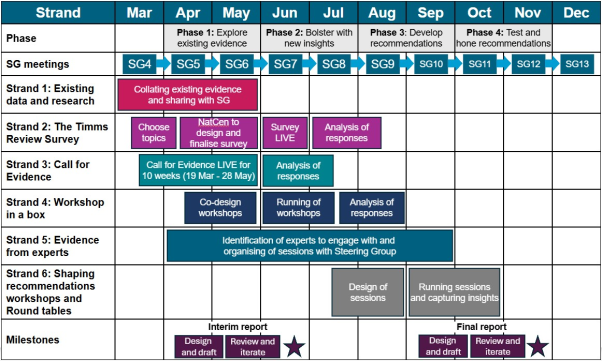
Gantt chart showing the Timms Review work programme from March to December. Four phases cover exploring existing evidence (April to May), gathering new insights (June to July), developing recommendations (August to September), and testing and refining them (October to November). Six strands cover existing research, the Timms Review survey, call for evidence, workshop in a box, expert evidence, and shaping recommendations workshops and roundtables. Steering group meetings (SG4 to SG13) run throughout. Key milestones are development of the interim report in May to June and the final report in September to October.
31. The Timms Review was established with a commitment to co-production. The Public Service Consultants (PSC), working in partnership with West of England Centre for Inclusive Living (WECIL), were appointed to support and facilitate the delivery of co-production for this review.
32. Throughout this review, D/deaf and disabled people and people with long-term health conditions contributed their experiences, expertise and perspectives through a wide range of evidence gathering and engagement activities. Their contributions informed the steering group’s discussions, challenged assumptions, shaped emerging thinking and influenced the development of the recommendations contained in this report.
What we said in the interim report
33. In July 2026, the steering group published its interim report setting out the background to the Timms Review, the approach to co-production, the themes to address, the workplan and key messages from the steering group’s call for evidence (Timms Review Steering Group, 2026a; 2026b).
34. The headline findings of the interim report showed that since the introduction of PIP in 2013, the context around it has changed substantially. More people are now reporting that they are living with a disability or long-term health condition. The nature of disability and ill health has also changed, with a substantial growth in claims linked to mental health conditions, autism and attention deficit hyperactivity disorder (ADHD). More information on trends in working-age disability benefits can be found in the supplementary evidence pack in annex D.
35. The COVID-19 pandemic, the cost-of-living crisis, the impact of austerity, changes in NHS waiting lists, social care, technology, the wider benefits system, education, demographics, and the state pension age, all point to growing pressures on both the benefits system and wider public services. These patterns create a strong case for reviewing how disability support is delivered and how it can better meet the needs of D/deaf and disabled people and people with long-term health conditions, while remaining sustainable for the future.
36. In the interim report, the steering group considered the overall role and purpose of PIP, particularly as the government has stated its intention for the PIP assessment to become the main gateway to health-related and disability benefits in the future.
37. This review is taking place in a wider context, and the interim report stated how it would examine the links between health, work, inequities and participation. This included taking account of related work that raised similar questions about how systems can better support participation and address the barriers people face.
38. This related work includes the:
- independent commission into adult social care chaired by Baroness Louise Casey (DHSC, 2026a)
- review into ‘Young People and Work’ chaired by Alan Milburn (DWP, 2026a)
- review into ‘Mental health conditions, ADHD and Autism’ chaired by Professor Peter Fonagy (DHSC, 2026b)
- ‘Keep Britain Working’ review chaired by Sir Charlie Mayfield (DWP, 2025c)
- government’s commitment to removing the Work Capability Assessment (WCA); DWP’s Health Transformation Programme (HTP)
- DWP’s Independent Disability Advisory Panel led by Zara Todd (DWP, 2026b).
39. Overall, the steering group heard that PIP plays a vital role in helping people meet the extra costs associated with being disabled, maintain independent living, participate in society and, for many, access or remain in work. The interim report concluded that, while PIP remains highly valued by D/deaf and disabled people and people with long-term health conditions, the current system is no longer fit for purpose.
Chapter 2: How we conducted the Timms Review
Introduction
40. Co-production is at the core of the Timms Review. The Timms Review was co-produced with a steering group that brought together a diverse range of lived and living experience, expertise and perspectives. Wider engagement with D/deaf and disabled people and people with long-term health conditions, DDPOs, organisations that advocate for people with long-term health conditions, experts and other stakeholders informed the evidence considered by the steering group.
41. The steering group’s recommendations were developed through a multi-stage process. Evidence and emerging ideas were explored, challenged and refined as this review progressed, including through wider engagement and dedicated workshops and roundtables. Where this identified gaps, risks or potential unintended consequences, proposals were reconsidered and developed further.
42. Throughout this review, the co-chairs have written a series of monthly letters to share up-to-date progress and information transparently.
43. This chapter explains how the steering group worked, how evidence and engagement informed its thinking, how emerging recommendations were tested and refined, and how final decisions were reached.
How the steering group worked
44. The steering group met in person monthly throughout the Timms Review, supported by online working groups, evidence sessions, policy workshops and engagement activities between meetings.
45. Members played an active role in shaping the direction of the Timms Review, including identifying the evidence that should be gathered, issues requiring further exploration and questions to examine through engagement. Evidence from different strands was regularly considered by the group and used to identify where further perspectives or analysis were needed. Members of the steering group formed smaller working groups to oversee the work of evidence and engagement strands.
46. Members often revisited issues as new evidence emerged or engagement highlighted areas requiring further consideration. In this way, ideas and emerging recommendations were explored, challenged and refined as the steering group’s understanding developed. Where different sources of evidence pointed in different directions, members considered the reasons for those differences and what conclusions could reasonably be drawn from the evidence as a whole.
Principles that guided the steering group’s work
47. At the beginning of the Timms Review, steering group members agreed a set of internal shared principles that guided both how they worked together and how they approached this review itself. These principles reflected a commitment to:
- recognising people as individuals first
- valuing lived experience, professional expertise and evidence equally
- acknowledging and reducing barriers to participation
- creating conditions that support meaningful participation
- encouraging respectful challenge and curiosity
- considering a broad range of perspectives
- being transparent about decision-making
- learning and adapting throughout the process
These principles shaped how meetings were conducted, how evidence was considered and how decisions were reached throughout this review.
48. The Timms Review was informed by frameworks and principles that aim to uphold the human and civil rights of disabled people, including the United Nations (2006) UNCRPD and the 12 Pillars of Independent Living. Both are rooted in the social and affirmative models of disability, which understand independent living as enabling people to have choice and control over the support they need to participate equally in society.
49. The steering group also drew on principles of disability justice, an approach developed by disabled people that recognises disability alongside other forms of inequality. It did so only in so far as these principles relate to the design of PIP and the support that disabled people receive.
Supporting co-production
50. Steering group members consistently highlighted that co-production requires more than simply inviting people into a room. It requires creating conditions that enable people to participate fully and confidently.
51. To support this, the PSC, WECIL and DWP provided support for reasonable adjustments and accessibility.
52. Examples of adjustments made within the time available for the Timms Review included:
- providing equipment to ensure accessibility
- ensuring meeting venues met the access needs of the group
- producing printed materials using specific coloured paper and formatting requirements
- developing Easy Read versions of key documents, including annotated agendas, pre-reading materials and meeting minutes
- providing regular one-to-one support sessions to discuss meeting content, upcoming tasks and key deadlines
- adapting communication and engagement approaches to meet individual needs where required
53. The steering group recognises that accessibility is an area from which further learning can be drawn. It therefore considers it important that any evaluation of this review examines accessibility and the extent to which members’ requirements were met, so that lessons can inform future co-production.
Building the evidence base through wider engagement
54. The steering group recognised that its members alone could not represent the diversity of experiences of D/deaf and disabled people and people with long-term health conditions across the United Kingdom. The Timms Review therefore combined co-production through the steering group with a wider programme of evidence-gathering and engagement.
55. Broad opportunities to participate were complemented by targeted engagement intended to hear from people whose experiences may be less frequently reflected in policy development. This included people with fluctuating and progressive conditions, neurodivergent people, people with communication impairments, people with learning disabilities, people from ethnic minority backgrounds, young people and older people.
56. Evidence from the call for evidence, workshop in a box, survey research, expert sessions, workshops and roundtables was regularly brought back to the steering group. This enabled members to test their emerging thinking against what people were telling this review, identify areas requiring further exploration and consider different perspectives.
57. Across these activities, participants did not always agree on the solutions. However, common themes emerged about the barriers and challenges within the current system and the outcomes people wanted reform to achieve.
58. Taken together with research, analysis and expert evidence, this engagement provided the steering group with a broad evidence base from which to develop its recommendations.
Developing the recommendations
59. The steering group used this evidence to move from understanding people’s experiences of the current system towards considering what a reformed system should seek to achieve.
60. Through policy development meetings and online workshops, members explored key aspects of a future benefit system, including assessments, awards, support, accessibility and the wider claimant experience.
61. These sessions were deliberately exploratory. Members considered potential approaches, tested ideas and assumptions, examined issues from different perspectives and identified where further evidence or expertise was needed. Emerging proposals could therefore be revisited as the evidence developed.
62. Through this process, potential recommendations began to emerge. These were not developed in isolation: they drew on the experiences and priorities identified through wider engagement alongside research, analysis, expert contributions and the knowledge and experience within the steering group.
Testing and refining the recommendations
63. As recommendations developed, the steering group undertook a further phase of engagement specifically to test and refine them.
64. Emerging recommendations were explored through shaping recommendations workshops with members of the public and targeted shaping recommendation roundtables with DDPOs and other advocacy and policy experts. These provided an opportunity to consider whether proposals responded to issues raised throughout the Timms Review and where they might need to be strengthened, clarified or reconsidered.
65. Participants identified potential unintended consequences, implementation challenges and areas requiring greater clarity. The process also helped the steering group consider individual recommendations as part of the wider package of reform, rather than solely in isolation.
66. This stage was not intended to secure agreement on every proposal. Its purpose was to expose emerging recommendations to further challenge, test assumptions and identify areas requiring additional safeguards, flexibility or development.
67. Following the shaping recommendations workshops and roundtables, the recommendations were further refined and amended to ensure that they reflected the discussions had with participants. For further information on what was suggested at shaping recommendations workshops and roundtables, please see annexes E and F.
Reaching final decisions
68. The steering group shared a collective vision for the future of PIP and agreement on the outcomes that reform should achieve. This report reflects the collective voice of steering group members in developing that vision and the recommendations needed to support it.
69. The steering group recognises that differing views are a natural and valuable part of co-production. Bringing together diverse perspectives strengthened discussion, informed the development of the report, and helped ensure that the recommendations were shaped through challenge, debate and lived experience.
70. Throughout the Timms Review, the steering group sought, wherever possible, to reach shared positions through discussion and deliberation. Members did not agree on every issue, and constructive challenge formed an important part of the process.
71. Where a shared position could not be reached through discussion alone, or where a formal decision was required under the Timms Review’s governance arrangements, the steering group could vote.
72. Decision-making arrangements were designed so that each steering group member’s vote carried equal weight. Although the co-chairs held additional responsibilities, they did not have any greater authority in voting or final decision-making than other members.
73. The steering group agreed a quorum of 8 members and used a two-thirds majority threshold for decisions taken by vote. Members had opportunities to discuss proposals, consider different perspectives and reflect on the implications before votes were taken.
74. Voting was therefore one part of the wider decision-making process, rather than a substitute for co-production, discussion and deliberation.
Chapter 3: Why change is needed
Introduction
75. This chapter sets out a summary of key messages heard by the steering group through each of the Timms Review’s evidence and engagement strands – a more detailed summary of the findings from each work strand is included in the annexes.
What the steering group heard
Call for evidence
76. As set out in this review’s interim report, the steering group launched a call for evidence on 19 March 2026 which remained open for 10 weeks, closing on 28 May 2026. It was published in a range of accessible versions including British Sign Language (BSL), Braille, large print, audio, Welsh and web-accessible PDF.
77. The call for evidence was based on the themes agreed by the steering group and was intentionally broad in its scope – the steering group was keen to ensure that respondents were able to provide insight and feedback on any of the areas covered in the terms of reference for the Timms Review, as well as on the themes identified by the group: the role and purpose of PIP; eligibility, fairness and equity in the award of PIP; experience of claiming PIP; and the changing context and the impact on PIP.
78. The call for evidence received 38,713 responses from a range of people including D/deaf and disabled people and people with long-term health conditions; carers for disabled people; organisations and charities that support disabled people; clinicians and other experts and academics and thinktanks.
79. Respondents to the call for evidence can be broken down into the broad categories set out in the following table – these categories are not mutually exclusive, and some respondents identified with more than one group. Percentages should therefore be treated as indicative rather than cumulative.
Respondents to the call for evidence
| Respondent group | Approximate proportion of responses |
|---|---|
| Individuals with lived experience | 70-75% |
| Carers | 9-12% |
| Organisations | 5-7% |
| Clinicians | 2-4% |
| Academics | ~1% |
| Thinktanks | 0.3-0.5% |
| MPs | 0.05% |
| Unknown / not identifiable | 8-10% |
Table showing the approximate proportion of call for evidence responses received from different respondent groups. Individuals with lived experience provided the majority of responses, accounting for around 70% to 75%. Carers accounted for around 9% to 12%, organisations 5% to 7%, clinicians 2% to 4%, academics around 1%, thinktanks 0.3% to 0.5%, Members of Parliament 0.05%, and between 8% and 10% of responses could not be identified by respondent group.
80. More information about the call for evidence findings was published alongside the interim report. A more comprehensive summary of responses and the methodology used to analyse them is set out in annex G.
Headline findings
81. The following findings summarise responses to the call for evidence. Direct quotes illustrate individual respondents’ experiences and should not be read as representative of all respondents, nor should responses be read as representative of all PIP claimants.
- PIP is widely valued and seen as essential: around 50% to 58% of respondents expressed positive feelings about the benefit. Respondents described how it helps meet additional costs associated with being disabled, maintain dignity and autonomy, access services, sustain relationships and participate in community life and work. Many felt that without PIP they would struggle to remain in work or become more dependent on family, carers and public services.
“My PIP award enables me to have independence and autonomy, allows me to fund my own car in which I drive a short distance to my place of part-time employment, to have a modicum of a social life, and to have the freedom to make my own spending decisions.” - An individual responding to the Timms Review call for evidence.
-
Many respondents felt PIP does not adequately reflect the additional costs they face: around 50% of responses (approximately 19,350 submissions) raised concerns about the adequacy of financial support. Costs such as transport, energy, equipment and care were described as persistent, cumulative and variable, while support levels often remain fixed.
-
The system can create anxiety about participation: some respondents feared that exercising, managing their condition, working, volunteering or using coping strategies could be interpreted as evidence of reduced need and affect their entitlement. They felt this could discourage activities that support independence, wellbeing and participation.
“The process also creates fear around improvement and recovery. I often feel pressure not to appear “too capable” because adaptive behaviours, treatment, therapy progress, exercise, driving, or visible attempts at recovery and participation in society may later be interpreted as evidence that I am less disabled. My therapist eventually encouraged me to begin leaving the house again because I was developing a severe fear of going outside. I now leave the house approximately twice a week: once for church and once socially. While this has helped my mental health, I still fear these activities could later be used against me.” - An individual responding to the Timms Review call for evidence.
- Assessments were the most commonly raised concern: around 70% of responses (approximately 27,100 submissions) raised issues about the assessment and its application. Respondents felt descriptors did not adequately capture fluctuating conditions, mental health conditions, neurodivergence, fatigue, pain or the combined impact of multiple conditions. Approximately 45% of responses (around 17,400 submissions) raised difficulties in capturing fluctuation. Many respondents felt assessments focused on whether an activity could be performed at all, rather than safely, reliably, repeatedly and within a reasonable time.
“The process completely dehumanises the individual and makes them feel like garbage regardless of the outcome.” - An individual responding to the Timms Review call for evidence.
-
Less visible conditions were often felt to be poorly understood: around 35% of responses referred to mental health and less visible conditions in the context of assessment and decision-making. Respondents felt that outward appearance and brief observations could receive greater weight than their accounts of day-to-day impacts and support needs.
-
Decision-making was seen as inconsistent and insufficiently transparent: respondents described similar cases receiving different outcomes and felt awards could depend too heavily on the individual assessor rather than consistent application of the criteria. Approximately 25% to 30% of responses (around 9,700 to 11,600 submissions) referred to the need to challenge decisions through MR or appeal.
-
Respondents raised concerns about evidence handling and assessment accuracy: medical evidence and specialist knowledge were often described as overlooked, undervalued or poorly interpreted, particularly for complex, rare or less visible conditions. Some felt decisions relied too heavily on a single assessment rather than a rounded understanding of their circumstances.
-
Many respondents described assessments as confrontational rather than supportive: they reported feeling tested, judged or “caught out”, rather than listened to and understood. A small proportion (approximately 5%) described positive assessment experiences.
“I felt like I was being cross examined, not supported. Every answer I gave felt like it was being used against me.” - An individual responding to the Timms Review call for evidence.
- The claiming process was widely described as burdensome and distressing: more than 90% of responses relating to the process described it negatively, including as stressful, complex, dehumanising or psychologically damaging. Around 28% of responses (approximately 10,800 submissions) referred to administrative burdens, while around 60% (approximately 23,200 submissions) described psychological or emotional impacts. Long forms, repeated evidence gathering, assessments, inconsistent outcomes, reconsiderations and appeals were cited as sources of distress.
“The whole system needs to be digitalised. It is ridiculous to expect people with disabilities to fill in paper-based forms and print off copies of their evidence to send in. This is not accessible at all.” - An individual responding to the Timms Review call for evidence.
- Inaccessible processes and unequal access to support created additional barriers: respondents felt access could depend on confidence, literacy, persistence, advocacy and support networks rather than need alone. Barriers within forms and communication routes were highlighted for neurodivergent people, D/deaf people, people with learning disabilities, people experiencing fatigue or cognitive difficulties, and people with limited literacy or English as a second language. Some delayed or abandoned claims, while others reported that reasonable adjustments were not consistently offered or implemented.
“The process is mentally and physically exhausting and relies heavily on your ability to write and advocate for yourself.” - An individual responding to the Timms Review call for evidence.
- Many respondents linked growing reliance on PIP to gaps in wider services: difficulties accessing healthcare, social care, housing and other support meant PIP was increasingly being used to meet needs not supported elsewhere.
“I have to buy my own wheelchair and walking stick, because the waiting lists for Occupational Therapists or anyone to prescribe it is impossible.” - An individual responding to the Timms Review call for evidence.
- Respondents felt the system had not kept pace with change: they highlighted changes in the conditions people live with and in society’s understanding of disability since PIP was introduced, which they felt were not sufficiently reflected in the current system.
Workshop in a box summary
Overview
82. The workshop in a box exercise offered a publicly available and adaptable set of resources developed by a working group drawn from the steering group. These materials could be used by organisations to run their own workshops to capture more in-depth qualitative insights on people’s lived experience of disability and PIP. This approach was designed to ensure we heard from a diverse range of communities – particularly individuals who may not wish to engage through formal government routes or written consultation processes. The steering group also shortlisted a small number of organisations to offer financial support to deliver accessible workshops with local groups and communities in their networks. These organisations were selected either on the basis of their known work across a range of conditions, geography or work with individuals at most risk of being missed by other evidence gathering through the work of this review.
83. Workshop materials were editable and included guidance for facilitators and forms to capture information about participants, organisations’ submissions and their feedback.
84. Workshops were run by a variety of organisations, including DDPOs, offices of Members of Parliament and organisations providing advice or support to people claiming or applying for PIP. Workshops covered 3 key areas: what PIP is for; what it is like to apply for PIP; and how decisions are made about PIP.
85. This activity ran from 8 June 2026 to 17 July 2026 and received 126 submissions from 109 organisations. It captured discussions from 138 workshops across the country with approximately 1,240 participants. The reach can be summarised as follows:
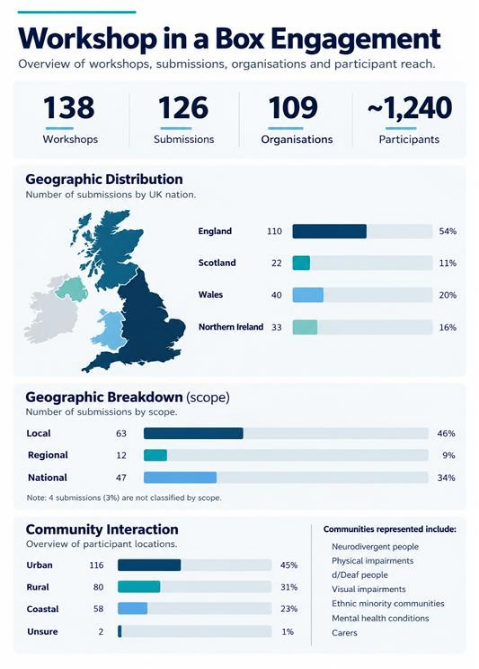
Workshop in a box engagement summary. There were 138 workshops, 126 submissions from 109 organisations, reaching approximately 1,240 participants. Submissions by UK nation were England 110 (54%), Scotland 22 (11%), Wales 40 (20%) and Northern Ireland 33 (16%). By scope, 63 submissions were local (46%), 12 regional (9%) and 47 national (34%); 4 submissions (3%) were not classified by scope. Participant locations included urban 116 (45%), rural 80 (31%), coastal 58 (23%) and unsure 2 (1%). Communities represented included neurodivergent people, people with physical impairments, d/Deaf people, people with visual impairments, ethnic minority communities, people with mental health conditions and carers.
86. The findings, reach of the workshops and how responses were analysed are set out in more detail in annex H.
Headline findings
87. In summary, responses for the workshops show that:
-
PIP is seen as essential: around 89% of submissions described it as a lifeline that helps meet additional costs associated with being disabled and supports dignity, independence, autonomy and quality of life. Participants highlighted its role in enabling mobility and participation in family and community life, education and work. Many felt that rising living costs and gaps in support elsewhere meant PIP was increasingly being stretched to cover unmet costs.
-
The application process is difficult and burdensome: around 90% of submissions raised concerns about complex forms, evidence gathering, inaccessible communication, deadlines and repeated administrative requirements. Many participants reported needing substantial help from family members, carers or advice organisations to complete a claim, while reasonable adjustments were not consistently provided or implemented.
-
The process causes significant distress and undermines trust: around 85% of submissions described stress, anxiety, uncertainty or feeling disbelieved. Some participants felt interactions focused on questioning the legitimacy of their circumstances rather than understanding their support needs and the barriers they face. They described feeling judged or “caught out”, raising concerns about dignity, fairness and consistency.
“What I always come back to is the suspicion. We’re disabled people, and we shouldn’t have to prove ourselves, you know, I’ve got reams and reams of medical evidence, as have a lot of people, but they don’t seem to take notice of that” - Workshop in a box participant.
-
Assessments often fail to reflect people’s lived experience: around 90% of submissions raised concerns about what is assessed and how decisions are made, particularly for fluctuating or less visible conditions, mental health conditions, neurodivergence and multiple or interacting conditions. Participants felt assessments could provide only a snapshot, rather than a rounded understanding of their circumstances, the combined impacts they experience and their support needs.
-
Participants questioned the quality and consistency of assessments and decisions: concerns included assessors lacking relevant knowledge, inconsistent use of evidence, insensitive or abrupt questioning, and people’s accounts not always being accurately reflected in assessment reports. Some described repeatedly having to explain or justify their circumstances, without feeling listened to or understood.
-
Inaccessible processes and unequal access to support create additional barriers: participants highlighted difficulties with forms and communication for neurodivergent people, inaccessible information for people with learning disabilities or sensory impairments and anxiety and emotional impacts for people. Carers reported taking on much of the administrative burden, while rural communities highlighted travel costs and access barriers. Additional challenges were also raised for young people and people without strong support networks.
-
Participants called for simpler, more accessible and transparent processes: common suggestions included clearer forms and communication, improved accessibility, consistent provision of reasonable adjustments, and greater transparency about assessments and decisions. Participants wanted a more ‘person-shaped system’, aligned with the social model of disability, that better recognises fluctuating and cumulative needs and the barriers people face.
-
Better use of evidence and fewer unnecessary reassessments were key priorities: participants called for greater use of existing medical and non-medical evidence, assessors with relevant specialist knowledge and no or fewer reassessments for lifelong or progressive conditions.
-
Some submissions proposed more transformative reform: suggestions included a disability passport, holistic assessments, specialist assessment pathways, integrated disability support systems, accessible digital services and healthcare-initiated claims. Some also proposed using AI to support applications and decision-making while retaining human oversight. These were proposals raised in some submissions, rather than views shared by all participants.
Overall, participants wanted PIP’s essential support retained alongside substantial improvements to how it operates: they called for a system that remains financially supportive while becoming more accessible, trusted, person-centred and responsive to people’s circumstances, support needs and barriers to independent living and participation.
88. The design of the workshops ensured that a wide range of voices were heard through this activity, including from groups that the steering group had identified as being harder to reach through traditional engagement routes. Valuable insight from workshops highlighted specific issues faced by particular groups, such as travel and access issues faced by rural communities and the impact of snapshot assessments on people with fluctuating health conditions.
The Timms Review survey
Overview
89. The Timms Review survey is a quantitative survey of 2,039 working age D/deaf and disabled people and people with long-term health conditions aged 18 to 67 in England and Wales conducted by NatCen. More detail can be found in annex I.
90. The survey was developed with a working group drawn from the steering group and looked to explore gaps in existing evidence. This research aimed to explore independent living for D/deaf and disabled people and people with long-term health conditions and the role of PIP, take-up of PIP and equity, take-up of government support and disability services, fluctuating conditions and D/deaf and disabled people and people with long-term health conditions’ views of benefit reform.
91. The steering group ensured that the survey development was guided by rights-based principles, including the 12 Pillars of Independent Living and the social model of disability. For the survey questionnaire, the 12 Pillars of Independent Living were reframed as 12 outcomes and participants were asked how often they felt able to achieve them in their day-to-day lives.
92. All respondents reported a long-term condition affecting daily activities: 47% said their condition affects them “a lot”, 53% said their condition affects them “a little”.
93. 38% of respondents were currently receiving PIP whilst 62% were non-recipients, having either never received PIP or were former PIP recipients or unsuccessful applicants.
94. Responses were independently analysed by NatCen and shared back with the steering group. For a more detailed report of the findings, including who responded and the methodology used, please see annex I.
Headline findings
95. In summary, responses to the survey show that:
-
PIP was widely valued as a source of support: among current PIP recipients 82% said PIP had helped them in the previous 12 months, the same proportion who said they had been helped by family and friends. PIP was used to support different aspects of independent living, most commonly travel (32%), equipment and aids (26%) and personal assistance (18%).
-
Respondents valued cash support, while many also supported access to additional services: 41% wanted PIP to remain solely a cash benefit, while 55% favoured different combinations of cash and services. Only 4% preferred support through services alone. Preferences differed according to PIP status, with current recipients more likely to favour retaining cash support than non-recipients.
-
The types of support PIP recipients most frequently said they would find helpful were healthcare referrals (58%), travel support (50%), advice on disability services (45%) and access to disability aids and equipment (43%). Non-PIP recipients had slightly different preferences for support, although healthcare referrals still scored the highest percentage. Younger PIP claimants have been shown in other polling to be more interested in services than older PIP claimants (The Good Growth Foundation, 2026). In the Timms survey, we also saw that younger non-recipients had different preferences to older respondents, with more desire for advice on disability services and social participation, but less for disability aids and equipment.
-
Understanding of PIP eligibility was a barrier to take-up: among respondents not receiving PIP or DLA, 64% had never applied. The main reason was a belief that they were not eligible, including perceptions about employment, income, savings, fluctuating symptoms or the nature of their condition that did not necessarily reflect the eligibility criteria.
-
Experiences of independent living varied considerably across different areas of life: respondents were much more likely to report being able to access information in the format they needed (68%) and afford essentials (61%) all or most of the time, than to report access to health and social care that met their needs (38%), work in a way that supported their needs (38%) or share experiences and knowledge with people with similar needs (22%). This suggests that independent living depends on access to a range of support and opportunities beyond financial support alone.
-
Long waiting times and complex processes were significant barriers to accessing support: 70% identified long waiting times as a barrier and 58% cited complicated processes. Other commonly reported barriers included cost or lack of funding (45%), unsupportive views and behaviours from others (45%), application or administrative processes (42%) and a lack of suitable choices or alternatives (40%).
-
PIP and wider support were seen as interconnected in enabling independent living: recipients and non-recipients recognised a role for PIP alongside accessible public services and practical assistance, including health and social care. At the same time, the findings identified gaps in awareness of PIP and in access to wider support.
-
People’s experiences of independent living varied substantially: NatCen’s segmentation analysis identified 4 groups based on respondents’ experiences of the independent living outcomes. These comprised 36% who were “isolated and struggling”, 20% who were “less connected to work and education”, 32% who were “broadly living independently”, and 12% who were “living independently with lower needs”. The groups differed in their access to independent living outcomes and in characteristics including health needs, financial circumstances, employment and education.
Evidence from experts
Overview
96. The evidence from experts strand was designed to complement the steering group’s wider evidence-gathering programme by bringing together professional expertise, lived experience and specialist knowledge of disability, health and social security. The strand provided a focused forum to consider how PIP might be redesigned, the outcomes it should seek to achieve and the practical implications of potential reform.
97. The work was overseen by a working group comprising members from the Timms Review’s steering group. Between July and September 2026, it held 26 sessions involving 83 participants. Sessions generally brought together between 1 and 8 experts and were chaired by steering group members. Most discussions were structured around a common question: what would PIP look like if it were redesigned and what outcomes it should achieve? Additional questions were used to explore particular areas in greater depth, including assessments, fluctuating conditions, appeals, wider support, co-production, international approaches and lessons from the devolved nations.
98. The participant mix demonstrates substantial breadth of reach across sectors. It included:
- regional and national D/deaf and Disabled People’s Organisations and people bringing direct lived experience
- disability, welfare and carers charities
- thinktanks, policy researchers and academics
- GPs, occupational therapists, clinical policy educators and other healthcare professionals
- PIP assessment providers; local government and adult social care representatives
- advice, appeals and tribunal specialists
- Motability representatives
- spokespeople from the Conservative, Liberal Democrat and Green parties. Reform representatives were invited to take part.
- ministers and independent experts from Scotland, Wales and Northern Ireland
- officials from overseas administrations, including Australia, the Netherlands and France
99. The sessions also included expertise focused on particular experiences and conditions, such as fluctuating conditions, mental health, neurodivergence and disability-related barriers affecting minoritised groups.
100. Further detail about the strand, including how the sessions were conducted and outputs compiled, is set out in annex J.
Headline findings
101. In summary, the expert sessions show that:
- PIP’s core purpose should be retained: experts broadly agreed that PIP should remain a cash benefit that is not means-tested that helps meet additional costs associated with being disabled and supports independence, participation and autonomy. They emphasised that debate about reform should begin with a clear understanding of this purpose and the outcomes the benefit should seek to achieve.
- The claimant journey needs fundamental improvement: the application, assessment, review and appeals processes were widely seen as complex, stressful and adversarial. Experts called for simpler forms, accessible communications, better use and sharing of existing evidence, reduced duplication and fewer unnecessary reassessments.
- Trust, dignity and co-production should underpin reform: experts emphasised that reform should create a system that D/deaf and disabled people and people with long-term health conditions experience as fair, transparent and respectful. Co-production should be embedded in the design, implementation and evaluation of future changes, alongside clear communication about their purpose and implications.
- Assessments should be more person-centred and reflect people’s lives better: experts considered the current approach too rigid and deficit-focused, particularly for people with fluctuating or multiple conditions. They supported greater consideration of fluctuating needs, cumulative barriers and the support people require to participate in society, alongside modernised descriptors and specialist training.
- Decision-making and appeals should be clearer and more consistent: experts highlighted the importance of better-quality and more timely evidence, clearer and more individualised decision explanations, and greater opportunities to resolve cases when new evidence becomes available. Experts, including the Judiciary and tribunal members, identified opportunities to learn more systematically from overturned decisions and recurring issues in appealed cases.
- Implementation is as important as policy design: experts stressed that reform needs to work effectively in practice. They highlighted opportunities to improve data-sharing, make better use of existing evidence, reduce duplication for claimants and create more seamless interactions between government and public services.
- PIP reform cannot succeed in isolation: experts stressed that pressures on PIP need to be understood alongside wider challenges across health, social care, housing, employment support, advice and local services. They cautioned that changes to PIP alone would not address these wider pressures and called for better join-up, early intervention and improved signposting.
- The wider impacts and unintended consequences of reform need careful consideration: experts emphasised the importance of understanding the potential effects of reform on poverty, health outcomes, employment, carers, public services and devolved administrations. There was a clear view that reforms should be assessed by the outcomes they deliver for D/deaf and disabled people and people with long-term health conditions, rather than solely by changes in expenditure or caseload.
- The Timms Review also heard from members of the judiciary and the tribunal. The judiciary is independent of the government and the views expressed are intended only to support this review’s understanding of recurring problems in the PIP system. The judiciary’s observations reflect their experiences of appealed cases and are not intended to represent the PIP caseload as a whole. The judiciary and tribunal members raised concerns about the quality and completeness of evidence available at PIP appeals, including gaps between the evidence claimants expect DWP to consider and what is actually available. They noted that tribunals can be the first opportunity to explore a claimant’s circumstances in detail, while missing evidence can contribute to adjournments and delays. They suggested clearer and more individualised decision explanations, greater opportunities to resolve cases before a hearing where new evidence supports a revised decision, and greater analysis of overturned decisions to identify recurring issues.
Shaping recommendations workshops
Overview
102. The shaping recommendations workshops were designed to test and refine the steering group’s emerging recommendations with D/deaf and disabled people, people with long-term health conditions, and their carers, families and supporters. They provided an opportunity to explore not only whether participants supported the proposals, but also the changes, safeguards and clarifications they considered necessary. The work was overseen by a working group drawn from the Timms Review’s steering group.
103. Fifteen workshops took place across the UK between 15 September and 7 October 2026, comprising 7 in-person and 8 online sessions. A total of 224 people attended, bringing a broad range of experiences. More than three-quarters described themselves as disabled people or people with long-term health conditions and many had direct experience of applying for PIP or Adult Disability Payment, including MRs and appeals.
104. Participants were recruited through a public call for participation, which received nearly 4,000 applications. Selection combined geographical grouping and random selection, with additional checks to ensure a broad range of experiences and characteristics were included. Most participants had not previously engaged with this review.
105. Each workshop lasted a full day and was split into 2 sessions. In the first, participants scored and discussed 14 emerging recommendations for improving the current benefit. In the second, they rated and discussed 24 emerging principles for a reformed benefit. Participants could also propose additional ideas. Facilitator notes and transcripts were analysed alongside the scores and ratings to identify areas of agreement, concern and conditions attached to support.
106. The working group ensured participant accessibility was prioritised at workshops. All workshops were attended by palantypists for live captioning and a graphic facilitator who produced a visual representation of the workshop discussions. Materials were available in multiple formats, including Easy Read versions. Additional accessibility needs were met where requested including BSL interpreters, specific seating, breaks, notetaking and mobility support. Personal assistants and carers for attendees were also invited. Participants were remunerated for their valuable insights and time they kindly volunteered in addition to reasonable expenses.
107. The workshops were co-hosted by DDPOs where possible and facilitated by the PSC and WECIL. Members of the steering group attended every workshop to hear insights from participants first-hand. DWP did not attend the workshops to ensure participant insight was not impacted.
108. The findings reflect the views of those who attended the workshops and should not be interpreted as representative of all D/deaf and disabled people and people with long-term health conditions or PIP claimants. Further information about participation, the approach to analysis and the detailed findings is provided in annex E.
Headline findings
109. In summary, the workshops show that:
- There was strong support for improving the current benefit: a clear majority of participants rated the proposals for improving the current benefit highly. Support was particularly strong for reducing unnecessary reviews for lifelong or degenerative conditions and improving the PIP2 form, with participants calling for clearer questions and guidance that better enable people to explain complex and changing impacts.
- Assessments should reflect people’s lives over time better: participants wanted assessments to develop a rounded understanding of people’s lives, recognising fluctuating and cumulative impacts, including pain, fatigue, effort and recovery time, rather than relying on a snapshot of someone’s circumstances. They also called for assessors with relevant knowledge and training and greater transparency about how evidence informs decisions and for a recognition that carers may play in managing the application process.
- Evidence gathering should be less burdensome: participants described difficulties obtaining supporting evidence, particularly where access to healthcare was limited or there had been little recent medical contact. They wanted better use of medical and non-medical evidence, greater responsibility on DWP to gather the evidence it requires with the person’s consent, and appropriate weight given to evidence from individuals and those who know them best. Where information is reused, participants wanted to be able to see, correct and control it.
- Choice, accessibility and support should be built into the process: participants wanted accessible communications and reasonable adjustments to be available from the outset, alongside access to independent advocacy where needed. Digital services were welcomed as an additional option, but participants strongly supported retaining paper, telephone and in-person routes and genuine choice over communication and assessment methods.
- Cash and non-means-testing were strongly supported: almost all participants supported an award that is not means-tested and cash was valued for the dignity, choice and control it provides. Wider services and support were more positively viewed where they would build on rather than replace or reduce the cash award and were voluntary, with no penalty for declining them.
- Some elements of a reformed benefit needed greater clarity and safeguards: participants raised particular questions about what an award would cover, how the amount would be decided, how people would initially access the benefit, its relationship with wider support and how participation would be recognised. Participants wanted participation to be defined by the individual and expressed concern that references to volunteering, work or other activities could become conditions of entitlement or be used against a claim.
- Support for change depended on effective implementation: participants questioned whether proposals would lead to meaningful improvements without sufficient funding, capacity, staff training and accountability, alongside wider cultural change within DWP. Trust was seen as something that would need to be built through demonstrable improvements in people’s experiences, clearer and more consistent decisions and effective accountability, rather than through changes in language alone.
- Reform should recognise differences across the UK: participants highlighted differences in administration, legislation, terminology and access to evidence, advocacy and wider support across the UK. Experiences of Adult Disability Payment in Scotland provided examples of different approaches to interactions and assessments, although participants’ experiences were not uniformly positive.
110. The following images are examples of graphic illustrations used to reflect workshop outputs:
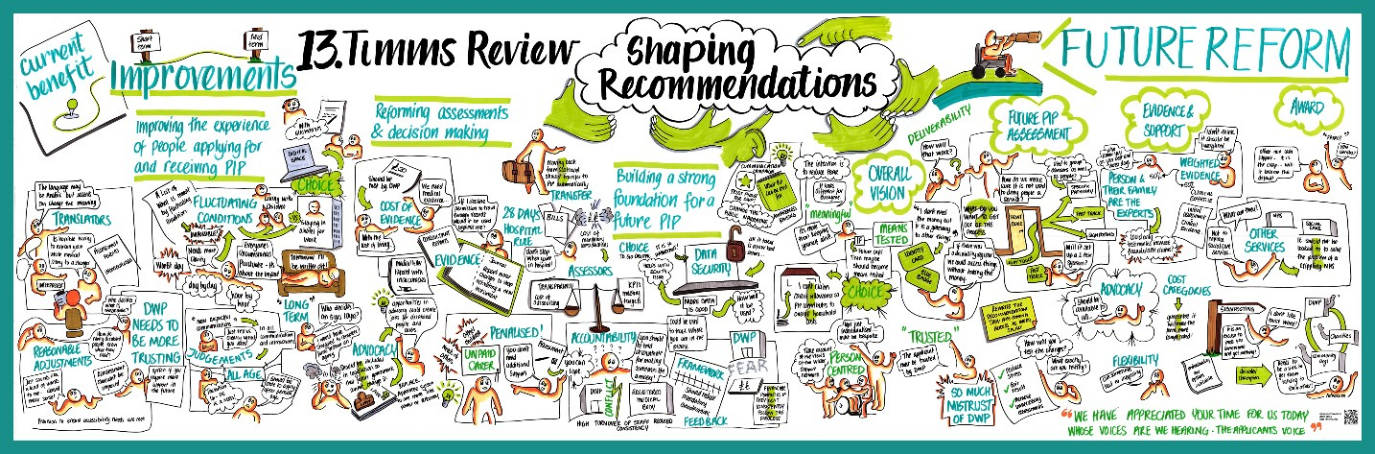
Graphic recording from a Timms Review shaping recommendations workshops in Sheffield on 2 October 2026. The illustration maps discussion from improvements to the current benefit, through building a strong foundation for a future PIP, to longer-term reform. Key themes include improving the experience of applying for and receiving PIP; communication, accessibility and reasonable adjustments; reforming assessments and decision-making; evidence requirements; accountability and advocacy; data security and feedback; choice and person-centred support; rebuilding trust; future PIP assessments; evidence and support; flexibility; and the relationship between PIP and other services. Developed by New Possibilities.
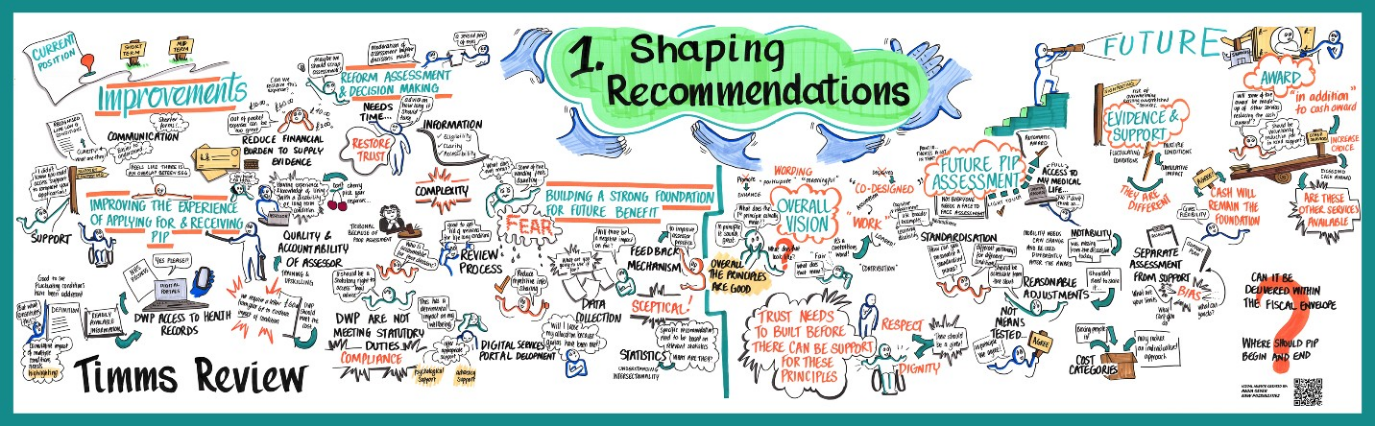
Graphic recording from the Timms Review shaping recommendations workshop in London on 15 September 2026. The illustration maps discussion from the current position, through potential improvements and the development of recommendations, to the future. Key themes include improving the experience of applying for and receiving PIP, reforming assessment and decision-making, reducing the burden of supplying evidence, improving communication and access to information, strengthening accountability and trust, co-design and meaningful participation, dignity and respect, reasonable adjustments, and considering the future role and design of PIP. Developed by New Possibilities.
Shaping recommendations roundtables and discussions
Overview
111. The shaping recommendations roundtables and stakeholder discussions were a series of stakeholder engagement sessions for organisations and experts, designed to supplement the shaping recommendations workshops, and test and refine the steering group’s emerging recommendations.
112. The roundtables and discussions were intended to gather expert views on the evidence, with participants invited to challenge, strengthen and improve proposals, helping to ensure the Timms Review is informed by a wide range of professional and sector expertise.
113. Five 2 hour roundtables were conducted online and chaired by a member of the steering group. 40 stakeholders attended across the 5 sessions. Invitees primarily included DDPOs, disability charities, welfare and anti-poverty organisations, thinktanks, academics and other people with expertise in disability, health and social security. Participants were selected to ensure a broad range of perspectives and experiences were represented.
114. A further 9 discussions with individual stakeholders took place. Invitees included devolved administrations, elected representatives and disability stakeholder advisory bodies.
115. All participants received materials in advance and discussed a focused set of questions to maximise meaningful discussion and feedback. Further detail about this engagement strand is set out in annex F.
Headline findings
116. In summary, stakeholders who attended the roundtables and discussions said that:
- Dignity, trust and claimant experience should be central to reform: stakeholders broadly supported a disability benefit system built around dignity, trust, choice, control and independent living. They described the current system as stressful and difficult to navigate, with complex processes and inconsistent decision-making sometimes leaving people feeling disbelieved or misunderstood. Trust was closely linked to a system being fair, transparent, proportionate and supportive.
- Accessibility, choice and personalised support should underpin the claimant journey: stakeholders emphasised that accessibility should extend beyond digital access to include accessible communications, reasonable adjustments, advocacy and specialist support. While there was support for greater use of digital services, stakeholders wanted non-digital routes to remain available and people to have choice over how they access and engage with the system.
- Assessments should reflect people’s lives over time better: stakeholders called for greater recognition of fluctuating, complex and multiple conditions and questioned approaches that assess need at a single point in time. They wanted assessments to recognise cumulative impacts, variation over time, fatigue, recovery periods and the effort involved in daily activities, providing a fuller understanding of people’s lives and longer-term needs.
- Evidence, decision-making and accountability should be improved: stakeholders supported better use of existing evidence, clearer evidential processes and explanations of decisions, and stronger learning from complaints, challenges and appeals. Improving the quality and consistency of decision-making was seen as important both for reducing unnecessary administrative burdens and increasing confidence in the system.
- Avoidable interactions and burdens should be reduced: stakeholders supported reducing repeated evidence requests and unnecessary reviews and reassessments, particularly where people’s circumstances are unlikely to change. They favoured processes that are proportionate to individual circumstances, alongside appropriate safeguards and stronger access to advocacy and support. They also recognised the importance PIP plays in passporting to other services and benefits such as Carer’s Allowance.
- Independent living, participation and financial flexibility should be central to a reformed benefit: stakeholders strongly supported retaining cash payments to provide flexibility, autonomy and choice in meeting diverse disability-related costs, with complementary services and support supplementing rather than replacing financial assistance. They also emphasised that participation should be understood broadly, recognising the many ways disabled people participate in society, including family life, caring, volunteering, education and community engagement.
- Co-design and effective implementation are essential to successful reform: stakeholders stressed that disabled people and their representative organisations should be meaningfully involved in the development, delivery and evaluation of reforms. They also emphasised that successful reform would depend on implementation as well as policy design, including specialist expertise, staff training, clear governance, effective accountability, adequate resources and ongoing evaluation. Some questioned how the proposed changes would fit within the OBR projections as set out in the Timms Review’s terms of reference.
Key messages from across the evidence
117. While participants brought a wide range of experiences, perspectives and expertise, several themes emerged consistently across the evidence.
The importance of PIP
118. Across the evidence, PIP was valued for helping meet additional costs associated with being disabled and barriers faced by disabled people, while supporting independence and participation in family, community, education and working life. Participants particularly valued the choice and flexibility provided by direct financial support.
A simpler, more supportive claimant experience
119. Across all strands, participants described claiming PIP as complex, time-consuming and stressful, with difficulties completing forms, gathering evidence and navigating assessments, reviews and appeals. They called for a simpler, more accessible system that reduces unnecessary burden and provides appropriate support throughout the claimant journey.
Better reflecting disabled people’s lives
120. Participants wanted the system to recognise individual circumstances and the barriers people experience better, including how these may vary over time. Particular concerns related to fluctuating conditions, less visible impairments, mental health conditions, neurodivergence and the cumulative impact of multiple impairments or conditions.
Trust, dignity and fairness
121. Trust was closely linked to people feeling understood and respected, clear communication, appropriate use of evidence and fair and consistent decision-making. Participants wanted a system that treats people with dignity and reduces experiences of feeling disbelieved or misunderstood.
Independent living requires wider support
122. Participants emphasised that PIP does not operate in isolation. While it can help meet costs (associated with transport, equipment, energy, communication and personal support), inaccessible or insufficient health, social care, advocacy and employment support can create additional barriers. Reform should therefore consider PIP alongside the wider services and support that enable disabled people to live independently and participate in society.
The impact on individuals
123. The following case study is an illustrative example which shows the potential impact of the challenges described in the steering group’s evidence. It draws on real life examples described in response to the steering group’s evidence and engagement activity.
Maya is a 34-year-old sales executive and lives with Multiple Sclerosis, chronic pain and anxiety. Her conditions are not always visible and their effects vary considerably. On some days Maya can prepare a simple meal or make a short journey; on others, fatigue, pain and difficulties concentrating mean she needs help with basic daily activities. She works part-time from home, with adjustments from her employer, and carefully manages her limited energy.
Maya faces additional costs as a result of her impairments. When pain or fatigue make public transport difficult, she needs taxis to get to appointments, see family and take part in community life. She needs to have the heating on for extended periods of time as the cold makes her symptoms worse. She sometimes pays for help with household tasks that she cannot reliably manage herself. At times, she goes without help or cuts back on journeys because she cannot afford everything she needs.
Maya applies for PIP to help with the additional costs of accessible transport, specialist equipment and occasional practical support. She finds the application form long and difficult to interpret. It asks whether she can complete individual activities, but she struggles to explain that she may be able to do something once while being unable to do it safely, repeatedly, to an acceptable standard or within a reasonable time. Gathering supporting evidence from several healthcare professionals is time-consuming, and some evidence is unavailable before the deadline. She relies heavily on a family member and a local advice organisation to complete the claim.
During her assessment, Maya answers questions based partly on what she can do on a better day. The assessor notes that she appeared composed, communicated clearly and works part-time. Maya feels these brief observations do not reflect the preparation, recovery time and support that enable her to function, or the cumulative impact of her impairments. Specialist evidence describing her fluctuating symptoms appears to receive limited weight.
Maya is initially found ineligible for PIP. The decision letter does not clearly explain how her evidence was considered, leaving her feeling like she was not believed and unsure about what evidence is missing. She requests an MR which agrees with the original decision, and so she chooses to appeal the decision, repeating details she has already provided. The process takes almost a year and increases her anxiety. During this period, she reduces journeys, social contact and other activities because she cannot afford the extra costs of taking a taxi to places.
With support from a local adviser, Maya eventually receives an award at tribunal. The outcome helps her maintain her independence and continue working part-time. Maya would like to increase her working hours in the future, but she worries that demonstrating independence, working more hours or managing her condition effectively could count against her at a future review of her PIP award.
The wider context
124. The steering group recognises that disability is not experienced in isolation from wider social and economic factors. There have been marked changes in the trends for both disability benefits and the wider landscape, which have been impacted by a number of factors including wider economic pressures such as COVID-19, austerity, the cost of living and geo-political factors.
The disability benefit landscape
125. Over the last 15 years, the number of people receiving disability benefits has increased across every age group, for both men and women. Most of this growth occurred in the last 5 years, with growth between 2019 and 2024 almost double that seen during the previous decade (Timms Review Steering Group, 2026a). The sharpest increases have been among young people aged 16 to 19, people in their thirties, and women, whose rates of benefit receipt have risen faster than men’s.
(Source: Chart 2.1 of The Timms Review of Personal Independence Payment: interim report)
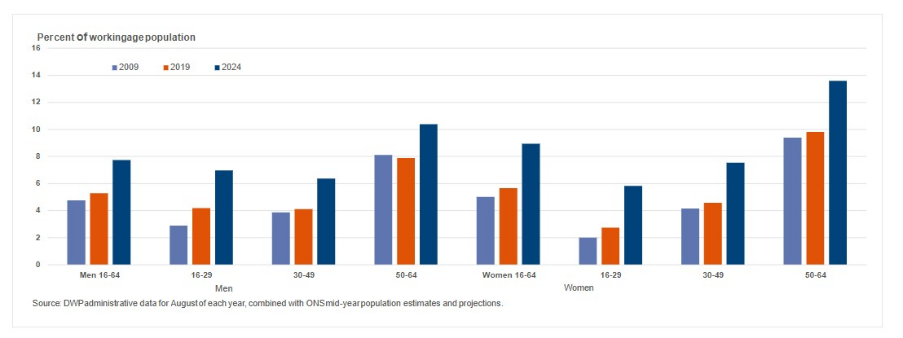
Alternative text: Bar chart showing the percentage of the working-age population receiving disability benefits in 2009, 2019 and 2024, broken down by age and sex. Rates increased across all groups between 2009 and 2024. The highest proportions were among people aged 50 to 64, reaching around 11% for men and 14% for women in 2024. The lowest proportions were among people aged 16 to 29. Overall, disability benefit receipt increased over time for both men and women across all age groups.
Rise in spending on PIP
126. PIP expenditure has grown rapidly and is forecast to continue increasing – this rise has occurred alongside a reduction in expenditure on other working-age welfare benefits since the 2010s, when measured in percentage of Gross Domestic Product (GDP) terms (Geiger, 2024).
127. The evidence shows that spending on working-age disability benefits, particularly PIP, accelerated significantly following the COVID-19 pandemic and is projected to continue rising over the coming years. In the financial year ending (FYE) 2020, disability benefit expenditure was around £14.5 billion for working-age claimants in 2026 to 2027 prices (Timms Review Steering Group, 2026a). As of autumn 2026, this spending is forecast to increase to over £34.6 billion for working-age claimants in FYE 2032 (Timms Review Steering Group, 2026a).
128. Expenditure is forecast for FYE 2027 up to FYE 2032. Forecasts are based on Autumn Budget 2026 data, published in ‘Benefit expenditure and caseload tables 2026’ (DWP, 2026c), and summarised in ‘Economic and fiscal outlook’ (OBR, 2026).
Changes in health
129. The nature of disability itself has also changed. It has been widely observed, especially in the Fonagy Report, that there has been a significant growth in mental health conditions and in the diagnosis of ADHD and autism spectrum disorders in recent decades, although the underlying levels of ADHD and autism in the population are believed to have remained relatively stable (DHSC, 2026b; DWP, 2026d, chapter 2). Meanwhile, DWP data seen by the steering group has shown increases in these conditions as primary conditions in PIP claims (DWP, 2026d, chapter 3). Increases in claims linked to musculoskeletal conditions such as arthritis and back pain have been relatively modest and can be largely explained by population ageing and the increase in the state pension age.
(Source: Chart 3.7 of The Timms Review of Personal Independence Payment: interim report)
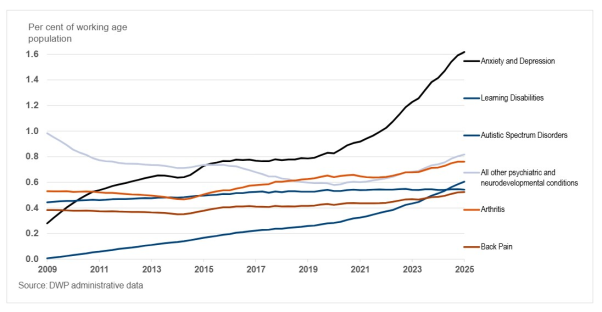
Alternative text: Line graph showing changes in the percentage of the working-age population receiving disability benefits for selected health conditions between 2009 and 2025. The proportion of claimants with anxiety and depression increased substantially over the period, rising from around 0.3% to around 1.6% of the working-age population and becoming the most common condition shown. Rates also increased for autistic spectrum disorders, learning disabilities, and other psychiatric and neurodevelopmental conditions. By contrast, rates for arthritis and back pain changed more gradually, while learning disabilities remained comparatively stable. Overall, the graph shows increasing disability benefit receipt across several health conditions, particularly mental health and neurodevelopmental conditions.
Multiple health conditions
130. New analysis by DWP has shown how most PIP customers have multiple health conditions. Since October 2024, around 1 in 5 awarded claims have only one associated health condition group. The remaining 4 in 5 are associated with conditions spanning multiple condition groups, indicating that most PIP customers have a combination of different health conditions. This is somewhat different to data for working age people as a whole, where over 2 in 5 report only one health condition (see annex D, supplements to chapter 5).
Customer experience
131. Evidence on customer satisfaction is mixed but highlights important areas for improvement. Qualitative research by charities, academics and DWP consistently identifies poor experiences during application and emotional impacts on claimants (see annex D, updated chapter 6). Of people who responded to the call for evidence, 90% reported a poor experience of PIP (Timms Review Steering Group, 2026b). These sources often highlight the experiences of those who have most motivation to feedback, which can tend to emphasise strong experiences and underrepresent the views of those whose experiences are less remarkable.
132. Official surveys provide a more systematic, though narrower, perspective. In 2025/26, 85% of PIP customers surveyed were satisfied overall, compared with 88% across DWP services (DWP, 2026e). The survey covers people with an active PIP award who had recent contact with DWP, excluding those who did not receive an award. Separately, Health Assessment Advisory Service surveys recorded average satisfaction of 93% between September 2024 and August 2026. This measures the assessment experience before respondents know the outcome, rather than the award decision or wider claim journey. Further evidence is set out in chapter 6 of the supplementary evidence pack (annex D).
An academic study assessed the broader concept of ‘bureaucratic justice’: whether the process was usable and helpful, treated claimants as individuals and with dignity, and appeared committed to ensuring eligible people received support (Halliday and others 2026). Individualised treatment had the strongest positive association with overall perceptions of bureaucratic justice, compared to the other factors. This research highlights the importance of procedural fairness alongside satisfaction with individual interactions.
133. Adult Disability Payment (ADP) was rated less negatively than PIP across these dimensions and overall bureaucratic justice. Fewer ADP respondents reported that the claims process worsened their mental health (34%, compared with 57% of PIP respondents). Further evidence on ADP is set out in chapter 9 of annex D.
134. These sources measure different aspects of experience and are not directly comparable. Satisfaction is relatively high among the groups surveyed, while wider evidence identifies challenges around emotional impact, feeling listened to and treated as an individual, understanding decisions, and accessing support. Taken together, there remains considerable scope to make the PIP claim process more supportive, comprehensible and procedurally fair.
PIP and extra costs
135. PIP is intended to contribute towards the additional costs associated with being disabled or having a long-term health condition. Life is more expensive for many D/deaf and disabled people, people with long-term health conditions, and their families who may need to pay for support, equipment, goods and services to reduce the barriers that they face (Extra Costs Commission, 2015).
136. Evidence shows that these costs can arise in many different ways and across many areas of everyday life, including (but not limited to) equipment and aids, housing, personal assistance and care, healthcare, medication, transport, food, clothing and bedding, energy and utilities. The type and level of cost can also vary considerably amongst disabled people, including according to the nature and severity of their impairment or health condition. (DWP, 2023; Evans and others, 2023; Scope, 2023b; Scope, 2024a).
137. The evidence also shows that people meet these costs through different combinations of their own income, including disability benefits, and formal and informal support such as health and social care services, family and friends and voluntary organisations. Access to these sources of support varies between individuals, and not all costs and needs associated with being disabled or having a long-term health condition are necessarily met. Some people report borrowing or cutting back on other spending to meet their disability-related costs. (DWP, 2023; Scope, 2023b; Scope, 2024b). Currently, PIP entitlement and award levels are determined by how a person’s condition affects their ability to undertake specified daily living and mobility activities, rather than through a direct assessment of the additional costs that they face.
138. A Resolution Foundation report found that 16% of working-age PIP recipients surveyed were not aware of having higher costs as a result of their impairment (Judge and Murphy, 2026). Disabled people can face additional costs across many areas of everyday life, and these can be difficult to distinguish from ordinary household expenditure. The Resolution Foundation itself recognises that understanding and articulating additional costs can be difficult, particularly where someone has been disabled throughout their life and may not know what their costs would otherwise have been.
139. DWP’s Areas of Extra Cost research (DWP, 2026f) aimed to understand how far PIP was focusing financial support onto those with the highest costs associated with being disabled. The findings suggest that PIP is not currently targeting support as effectively as intended. While higher PIP awards were generally associated with higher disability-related needs (that drive extra costs) in several areas, award level is not a consistent or precise proxy for extra-cost need. While some types of cost did show an association between higher awards and higher needs (equipment and aids, housing, personal assistance and care, and transport), for other disability-needs (food, energy and personally funded healthcare) there was an unclear relationship.
140. For example, the need for care is one of the main drivers of extra costs for D/deaf and disabled people and people with long-term health conditions and is a key part of what the Daily Living component of PIP is designed to support. Those who get enhanced/higher daily living awards are more likely to have the highest care needs. Of those who get the enhanced rate of daily living, 24% are in the bottom third for care needs among PIP claimants, while 4% reported no care need at all (DWP, 2026f). Conversely, among those who get a nil award on daily living, 16% are in the top third for care needs (DWP, 2026f). This implies that the higher rates of PIP award are not focused as well as they could be on those with higher extra costs.
Disabled people and household income
141. People living in families where someone is disabled are slightly more likely to be in relative low income than those living in families where no one is disabled. In FYE 2025, 21% of individuals in families where someone was disabled were in relative low income after housing costs, compared with 19% of those in families where no one was disabled (DWP, 2026g). However, changes in low-income rates over time should not necessarily be attributed to disability alone, as they can also reflect changes in the characteristics of the group and sources of income. On outcome-based poverty measures, which account for not only income and housing costs, but additional costs, debt and savings, people in families with disability tend to fare worse. For example, for working age people, rates of material deprivation in FYE 2025 were 34% for someone in a family where someone is disabled versus 14% for someone in a family without a disabled person (DWP, 2026g).
PIP and employment
142. Employment outcomes for D/deaf and disabled people and people with long-term health conditions remain significantly below those of non-disabled people. In 2025, 5.5 million disabled people were in employment, with a disability employment rate of 52.8%, compared with 82.5% for non-disabled people (DWP, 2025d). This represents a disability employment gap of 29.7 percentage points. While PIP is not a work-related benefit and is available irrespective of employment status, fewer than 20% of working-age recipients are in employment, see annex D for more information.
143. Evidence reviewed by the steering group indicates that many recipients of health and disability benefits aspire to work but face substantial barriers to employment. The ‘Work aspirations and support needs of health and disability customers’ survey (DWP, 2025e) found that a small proportion of health and disability benefit recipients (5%) believed they could work immediately if appropriate employment opportunities or support were available, while over a quarter (27%) considered that they may be able to work in the future if their health improved. However, around half (49%) felt they would never be able to work again. Among those who considered work a possibility either now or in the future, the overwhelming majority expressed a willingness to engage in paid employment.
144. As set out in the interim report, respondents to the call for evidence describe mixed experiences of PIP and employment. Some reported that PIP enables engagement with work by offsetting the additional costs associated with being disabled such as specialist equipment, accessible spaces for working from home, support workers and the cost of taxis for commuting to a place of work. Others said employment activity is perceived as affecting entitlement, particularly where it is interpreted as evidence of reduced need.
145. The DWP evidence pack published alongside the interim report reviewed the analytical evidence on the impact of PIP receipt on employment (DWP, 2026d). This included a large amount of qualitative research highlighting ways people used PIP to support work, as well as other areas of their lives. Recently, Inclusion London commissioned a survey of PIP recipients who are in work, which explored the ways that PIP helped support them to stay in employment (Inclusion London, 2025). This found 70% used PIP for transport to work; 52% for aids and appliances to support their job; and 43% for therapies to manage the impact on work on health. The same research highlighted concerns that losing PIP would force people to leave work; with 35% saying they would leave their job and claim social security if they lost access to PIP. Conversely, research has highlighted that as well as supporting some people in work, for others the income from PIP might support people to reduce their hours or give up working all together (for example research commissioned by Trussell Trust by Biggs and others, 2023; DWP 2023; for full discussion see evidence pack chapter 8, DWP, 2026d). Inclusion London’s survey (2025) highlighted 27% thought they might have to increase their working hours if they lost their PIP award - noting they thought it would be detrimental to their health - while 18% thought they would reduce their working hours.
146. The interim evidence pack summarised analysis that tried to measure what the average impact of PIP on employment is (see chapter 8.1 annex D DWP evidence pack, DWP 2026d). There is not a clear consensus, but various studies show either no significant overall impact, or a small impact that showed receiving PIP reduces the chance of being employed. It should be noted that disability benefits in other countries have larger negative impacts on employment, with some academics noting this is positive by comparison, arguing that this is a relatively positive picture compared to other systems (Klein Tesselink and Melios, 2025).
147. The work aspirations survey also highlights the central role of health and access to appropriate healthcare in shaping employment outcomes. Health-related factors were identified as the primary barrier to work for many recipients of health and disability benefits. A significant proportion (41%) reported being on waiting lists for treatment, while around half (50%) indicated that their ability to enter or remain in employment was dependent on receiving appropriate healthcare interventions. These findings underline the close relationship between health, access to treatment and participation in the labour market.
148. The steering group also heard how barriers in the workplace and a lack of reasonable adjustments impact employment outcomes for D/deaf and disabled people and people with long-term health conditions. This is further impacted by difficulties accessing services such as Access to Work.
PIP and fear of participating
149. PIP is an extra cost benefit which is not means-tested. Eligibility for the benefit is not based on whether someone is in or out of work. However, a recurring theme from the evidence was that the system can unintentionally discourage participation. Some respondents felt that exercising, volunteering, working, managing their condition effectively, or demonstrating coping strategies could be interpreted as evidence of reduced need. This created anxiety that participation or improvement might negatively impact entitlement.
“PIP sits as a constant, looming threat over people with dynamic disabilities. There is a persistent feeling of being watched and judged, where any attempt to improve your condition risks being used against you. Instead of supporting people to live as well as possible, the system creates anxiety around doing so.” - An individual responding to the Timms Review call for evidence.
150. This issue has been highlighted in a range of research reports; these studies consistently find people who say they would benefit from being more physically active, but fear that doing so would reduce their entitlement to PIP. The study with the strongest methodological claim to be representative of D/deaf and disabled people and people with long-term health conditions estimated 37% having that fear; other studies have estimated higher proportions. (Activity Alliance, 2023; Disability Rights UK, 2026).
Pressures across the wider system
151. While expenditure on PIP has increased over time, expenditure on other working-age welfare benefits has reduced, when measured in percentage of GDP terms, and a range of services and support systems have operated within a challenging economic environment over recent years.
152. The steering group has heard, from the call for evidence, that D/deaf and disabled people and people with long-term health conditions struggle to access vital services such as community mental health services and wider support. For example, NHS Continuing Healthcare (CHC) (a package of health and social care intended to support people outside of hospital and often in their own home) has become seemingly more difficult to secure, with almost half (49%) of adult social services directors seeing fewer people qualifying for CHC, despite a recognition that need was getting increasingly complex (Hutchings, 2025).
153. The Timms Review’s evidence also indicates that PIP now operates within a broader environment of heightened public and political scrutiny. Some respondents from the call for evidence pointed to negative narratives around disability, including perceptions of benefit misuse and fraud. Respondents who discussed these issues frequently linked them to stigma and a culture of disbelief. The steering group recognises that the public narrative around disability benefits has often been adversarial and fuelled negative perceptions of PIP, which directly impacts the people who receive it. It believes more should be done to highlight the benefits to wider society of investing in D/deaf and disabled people and people with long-term health conditions and to recognise the social and economic value of disabled people. Disabled people make a powerful contribution to the UK’s economy and society. Almost 17 million disabled people live in the UK (DWP, 2025a), with disabled households contributing £274 billion in annual spending power through the ‘purple pound’ (Scope, 2023a), alongside significant contributions through culture, innovation, volunteering, work, advocacy and civil rights.
Conclusion: why change is needed
154. The steering group has heard that PIP provides essential support to D/deaf and disabled people and people with long-term health conditions. It helps people meet some of the additional disability-related costs, maintain independence and dignity, access services, participate in family and community life and, for some, remain in or secure work.
155. At the same time, the evidence heard by the steering group shows that the current system too often places avoidable burdens on the people it is intended to support and is often experienced by many disabled people as adversarial and “dehumanising”. Complex processes, inaccessible communication and repeated requirements to explain or demonstrate the impact of a condition can be difficult and distressing. People’s chances of receiving the right outcome may also be influenced by factors such as literacy, persistence or access to advocacy, and assessor approaches to assessments, rather than solely by the impact of their impairment or health condition.
156. Rather than supporting independent living and participation in society, the current PIP system can unintentionally discourage people from undertaking activity to improve their health or take part in work, as they may be concerned that this could be unfairly interpreted as evidence of reduced need.
157. The evidence also shows marked shifts in who is seeking support, changes in health and pressures on the wider system. These changing patterns matter because people’s ability to live independently and participate in everyday life, such as in family and community life, education and work, is shaped not only by their impairment or health condition but also by the support available around them.
158. Claimants today are navigating a world shaped by longer NHS waiting lists, pressures in social care, rising living costs, housing challenges, changes in employment and technology, and greater awareness and recognition of mental health conditions and neurodivergence. Yet the current PIP framework was not developed within this context.
159. In summary, the evidence and data suggest a growing mismatch between a rapidly changing society and a benefit system that is no longer fit for purpose.
160. The steering group’s case for change is about reforming the benefit to ensure PIP remains capable of fulfilling its intended purpose and reflects better the realities of being disabled or living with a long-term health condition and the costs associated with it.
Chapter 4: Vision for the future
Introduction
161. The preceding chapters have set out the importance of PIP, the experiences of people who receive it and the steering group’s case for reform.
162. This chapter describes the steering group’s vision for an improved benefit and the principles that should underpin it. This vision provides the foundation for the pathway to reform and the recommendations set out in the chapters that follow.
The future the steering group seeks to support
163. At the centre of steering group discussions was a straightforward question – what role should a reformed benefit play in supporting people to live the lives they want to lead?
164. The steering group’s vision is that D/deaf and disabled people and people with long-term health conditions should have the same opportunities as anyone else to participate in society and make choices about their own lives. This requires recognising and responding to the barriers, additional costs and challenges that some people face.
165. It also recognises that disabled people play a valuable role in society and this should be supported and invested in.
166. The steering group has agreed that the purpose of PIP is to assist D/deaf and disabled people and people with long-term conditions to reduce the inequalities they face in participating in everyday life through a contribution towards the additional costs associated with being disabled.
167. The steering group recognises that PIP cannot solve this problem alone and that disabled people face inequalities and barriers across health, social care, housing, employment support and local services. It is therefore essential that these systems become better connected, to support individuals in a way that helps reduce the inequalities and inequities they face.
168. The steering group’s recommendations, set out in chapter 5, are intended to support that future.
Supporting the lives people want to lead
169. The steering group heard consistently throughout its evidence gathering that disabled people want the freedom to pursue what matters to them. They want choice, independence and control over their own lives, to maintain independence and have the freedom to make plans and participate in aspects of life that matter most to them.
170. The steering group believes that PIP should recognise the additional barriers and costs that many D/deaf and disabled people and people with long-term health conditions face and provide the foundation from which people can pursue the lives they want to lead.
171. PIP may support people in education, volunteering, employment, caring responsibilities, physical activity, family life or the right to independent living. The key objective is not that people follow a particular path in life, but that they have the freedom to pursue the path that is right for them.
‘Rehumanising’ the process of claiming PIP
172. A consistent message heard throughout the steering group’s evidence was that many people feel that the current system has become overly focused on processes rather than people and the assessment is often experienced as dehumanising.
173. The steering group heard accounts from individuals who felt reduced to a diagnosis, a score or a decision, rather than being recognised as a whole person.
174. The steering group’s vision is for a person-centred approach, founded on dignity, trust and respect. This approach recognises the complexity of people’s lives and the many ways that impairments and long-term health conditions can affect day-to-day experiences, opportunities and participation.
A renewed understanding of PIP
175. PIP exists to help address some of the additional costs that can arise from being disabled or living with a long-term health condition through flexible, non-means-tested financial support.
176. The steering group believes that PIP should provide greater security, greater choice, greater control and greater opportunity to participate. These are measures of the system’s effectiveness, not conditions that individuals must meet.
A better relationship between the state and D/deaf and disabled people and people with long-term health conditions
177. The Timms Review heard evidence that many people experience interactions with the current system as burdensome, adversarial and overly focused on a process that works for DWP. As a result, trust in the PIP system and in DWP is low.
178. The steering group believes that trust must be earned back through consistent, fair and respectful interactions and by a system with high-quality and transparent decision-making.
179. The steering group believes the PIP system should seek to understand as well as assess and give people confidence that they will be treated fairly, consistently and compassionately.
180. It is also a system that reflects a rights-based principle that D/deaf and disabled people and people with long-term health conditions have equal worth, equal rights and equal opportunities to participate in society, in line with obligations under the UNCRPD.
The principles underpinning the steering group’s vision
181. The steering group’s vision is founded on a number of core principles:
- dignity: every individual should be treated with respect and recognised for their inherent worth
- trust: policy and delivery should begin from a presumption of good faith rather than suspicion
- equity: fairness requires recognising and responding to different starting points, and different needs, costs and barriers
- accessibility: services should be designed so that everyone can use them and implemented in a way that ensures this happens in reality
- participation: everyone should have the freedom, resources and support to take part in everyday life in ways that matter to them. PIP should remain a non-conditional benefit, available in and out of work. Entitlement to the award should not be conditional on engagement with support or different levels of participation.
- choice and control: people should have greater agency over their lives and the support they receive
- independent living: support should expand opportunities and enable people to live the lives they choose – the concept of independent living is based on what that means for the individual, without any expectation that people aim to live without any support at all.
- sustainability: the system should command public confidence and remain effective for future generations
Chapter 5: The steering group’s recommendations
Introduction
182. As set out in chapter 3, the evidence gathered by the steering group throughout this review presents a clear case for reform. PIP provides vital support with the extra costs associated with being disabled and helps enable independent living and participation in everyday life. However, for some people the process of claiming and receiving it is complex and stressful, while for others the award is a poor reflection of the extra costs that they incur.
183. The steering group’s recommendations respond directly to what D/deaf and disabled people, people with long-term health conditions and DDPOs have told the Timms Review. They combine practical improvements to the current system, making it fairer, more accessible and more person-centred; with a longer-term vision for a reformed benefit that reflects people’s lives and needs better. The recommendations are divided into 2 categories:
- improvements to the current benefit
- building the reformed benefit
184. This chapter sets out the recommendations within each category, as well as a set of strategic overarching recommendations that underpin them. It outlines the evidence which substantiates each recommendation and explains how the recommendations fit together to support lasting reform that is intended to make a real difference to the lives of D/deaf and disabled people and people with long-term health conditions. It also explains why the steering group thinks each recommendation will work.
Our approach to recommendations
185. The steering group considered a number of recommendations based on the evidence it heard throughout this review. In deciding on a final set of recommendations, the group agreed on the need to apply a consistent set of tests to help assess whether the recommendations deliver better outcomes for D/deaf and disabled people and people with long-term health conditions while remaining fair, practical, evidence-based and sustainable.
186. The steering group assessed each recommendation against the following six-test framework:
- Reality test: does the recommendation reflect the reality of D/deaf and disabled people’s and people with long-term health conditions’ lives and lived experiences?
- Barrier test: does the recommendation reduce unnecessary barriers and make the system easier to access and navigate?
- Equity test: does the recommendation support and produce fair outcomes across all different groups?
- Dignity test: does the recommendation improve how people are treated and reduce fear and anxiety?
- Independent living test: does the recommendation support participation, independence, choice, and quality of life?
- Deliverability test: can the recommendation be delivered effectively, consistently and at scale?
187. The steering group recognises that more in-depth work must be carried out to move from these recommendations to implementation as each recommendation is tested and developed against the 6 tests.
Recommendations: strategic overarching recommendations for successful reform
188. The steering group’s recommendations for improvements to both the current system and the reformed benefit are underpinned by a set of strategic overarching recommendations to help guide successful implementation. These are set out below:
- Build Trust. DWP should recognise that building trust between the Department and D/deaf and disabled people and people with long-term health conditions must be earned through demonstrable, sustained improvements in how people are treated and how the system operates, ensuring that the right decision is made the first time. It will require ensuring that communication and guidance is clear, honest, respectful and accessible to all with reasonable adjustments proactively offered and embedded throughout. Reform should be supported by clear transparency and accountability.
- Deliver sustained culture change. DWP should commit to a culture change across the Department and its contracted providers, moving toward a less adversarial approach that respects the dignity and rights of D/deaf and disabled people and people with long-term health conditions. This change should be embedded through a clear set of standards underpinning communications and interactions with people claiming and receiving PIP, alongside relevant training. Training should be designed and delivered by professionals with lived experience and should cover the disability frameworks that underpin this report.
- Co-produce implementation. The detailed design and implementation of proposed changes should be co-produced with D/deaf and disabled people and people with long-term health conditions, and the organisations that represent them, with genuine power sharing central to this process.
- Apply the steering group’s tests transparently. The steering group’s 6 tests should guide the design and implementation of every recommendation. The government should publish its assessment against the tests and explain how this has informed its decisions. Where appropriate, recommendations should be piloted to determine feasibility and gather learning before wider roll-out.
- Use new technology transparently and with human oversight. As new technology is introduced, such as artificial intelligence and other automated systems, DWP should ensure that any adoption is subject to clear human oversight, governance and independent scrutiny. People should be told when and how these technologies have been used and what safeguards are in place to protect people’s rights, privacy and accessibility. New technology must not become a backdoor to creating a digital ID for D/deaf and disabled people or people with long-term health conditions or be used for purposes beyond those to which the person has consented. Data or evidence submitted by claimants should remain wholly owned and controlled by them with explicit consent sought for sharing data.
189. The steering group considers these strategic overarching recommendations as intrinsic to the success of the recommendations relating to current system improvements and the reformed benefit.
Recommendations: improvements to the current benefit
190. Whilst the steering group is clear on the need for a reformed benefit, it also recognises that this will take time to implement and deliver. As the evidence received from the call for evidence, workshop in a box, and evidence from experts sessions show, there is an urgent need to improve the experience of people claiming PIP now to reduce the harm the current system is causing. The steering group is therefore making a set of recommendations which seek to improve the experience of people engaging with the PIP system now and in the future. Not only will these changes seek to improve PIP, but they will also act as building blocks to support the development of the reformed benefit.
191. The ‘improvements to the current benefit’ recommendations have been divided into 3 groups of distinct but complementary building blocks:
- building block 1: improving the experience for people applying for and receiving PIP – making the system simpler, more accessible, personalised and less stressful
- building block 2: reforming assessments and decision-making – improving the quality, fairness and consistency of assessments and decisions
- building block 3: building a strong foundation for a future benefit – strengthening the infrastructure, learning and continuous improvement of the system
192. The report draws out examples of how each recommendation meets particular tests in the six-test framework. No one test is more important than the others and recommendations should only be implemented if they meet every test. The steering group considers that all these recommendations meet the independent living test, by enabling the current PIP system to deliver better on its aim of supporting independent living.
193. For each recommendation, the report sets out what the group has heard and considered how these recommendations should be implemented once the government has responded to them. These are not intended to be read as agreed next steps from the steering group as implementation was outside the scope of the group’s work. The government must consider the 6 tests when determining how to implement any of these recommendations and it will be essential to meet the deliverability test and the requirement in the Terms of Reference to deliver against the OBR projections.
194. The steering group expects that changes made to the current system as a result of its recommendations are evaluated after a 12-month period to ensure they achieve their intended objectives. Throughout testing, there should be robust and transparent evaluation to ensure that there are no unintended consequences, and that the risk of inequity is reduced.
Building block 1: Improving the experience for people applying for and receiving PIP - making the system simpler, more accessible, personalised and less stressful
Recommendation 1
The problem we are trying to solve
195. Where an individual receives a fixed-term PIP award with a review date, DWP undertakes a review before the award expires. Ongoing awards are used for those with long-term conditions or impairments where the needs arising are unlikely to change and for those with the highest level of support whose needs will not change or may increase. As of March 2026, around 32% of the PIP caseload had an ‘ongoing award’, which means they have an award period of 10 years or more (see annex D). The steering group heard that repeated award reviews are unnecessary and stressful for claimants with lifelong, stable or degenerative conditions where improvement is not expected. People described the cumulative negative impact of having to engage with the process repeatedly and the administrative burden this presents. The stress and fear caused by award reviews was raised by a lot of respondents who said it was important to introduce more certainty and security into the process, so people know what to expect.
Our recommendation
Reduce unnecessary award reviews for people with lifelong or degenerative conditions and change award reviews to focus on what has changed in a person’s circumstances and functional impact.
196. The steering group recommends that DWP improves the award review process in 2 main ways:
- Reduce unnecessary award reviews for people with lifelong or degenerative conditions to ensure that people with lifelong or degenerative conditions or impairments are not being subject to award reviews where no change or a worsening in their condition is expected over time, giving people more confidence that they are not going to lose their payments and more security over their lives as a result. People must still be able to request an award review if their needs have changed.
- Change award reviews to focus on what has changed in a person’s circumstances and functional impact, rather than doing a full review against all activities and descriptors. This should reduce some of the burden of an award review and may remove the need for another assessment or shorten the assessment at the award review.
197. Communications about these changes, award reviews and light-touch reviews for those on ongoing awards should be accessible, clear, timely and respectful.
Why we think it will work
198. The steering group has heard consistently that the award review process causes significant stress and anxiety. A more proportionate review process would avoid requiring people with severe and lifelong conditions to demonstrate needs repeatedly that are already well evidenced and unlikely to change or to worsen if they do change. This should reduce stress and administrative burden for individuals, while allowing DWP to focus assessment resources on cases where a change in needs is more likely.
199. In considering the six-test framework, the steering group found that this recommendation is particularly aligned to the dignity test by reducing stress and anxiety related to the fear of losing essential support. It also meets the reality test, recognising that greater stability and confidence in an ongoing award should support people to plan for the future and participate more fully in everyday life.
Key evidence the steering group has heard
200. Award reviews are either planned, which DWP initiates based on the suggested award duration from the initial assessment, or they can be triggered by a claimant if they report a change of circumstances. DWP analysis has shown planned reviews have grown over time and now account for 85% of review activity. Over the same time period, award reviews that result in no change to award have increased from 40% in FYE 2018 to 75% of claims in FYE 2026. There has been a reduction in award decreases and award disallowances. See annex D, supplements to chapter 3 for more information.
201. Research by the thinktank Pro Bono Economics (PBE) for anti-poverty charity Z2K has argued that not enough people are put on ongoing awards, leading to too many claimants facing “unnecessary” reassessments including for health conditions that would not be expected to improve (Rodriguez Cabrera, 2025).
202. Across the evidence, participants consistently raised concerns about the impact of award reviews on people with lifelong, progressive or otherwise stable conditions. Reviews were often described as a source of stress, uncertainty and administrative burden, with calls for processes to reflect better the likelihood of circumstances changing over time.
203. The steering group heard strong support for reducing unnecessary reviews where they are unlikely to add value. Around 70% of workshop in a box responses identifying process improvements referred to changes to the review process, with participants highlighting opportunities to reduce reassessments for people with long-term, lifelong and progressive conditions. Contributors linked this to themes of proportionality, certainty and claimant experience.
204. Contributors also emphasised the need to improve review communications. The steering group heard examples of communications arriving unexpectedly and concerns that people were not always supported to understand what was required, the implications of a review or how to report changes in circumstances. Participants linked review communications to wider issues of trust, transparency and confidence in the system.
205. Strong support for change was evident in the shaping recommendations workshops, where 95% of participants supported reducing award reviews for people with lifelong or degenerative conditions. Participants described reviews as a major source of anxiety and argued that repeated reassessments can be unnecessary where conditions are unlikely to improve. Contributors also warned that fear of reassessment may discourage some people from reporting deteriorating conditions and seeking additional support.
206. Similar themes emerged through the shaping recommendations roundtables. Contributors argued that lighter touch review arrangements should be supported by clear, accessible and responsive routes for reporting changes in circumstances and requesting reassessment where appropriate. The steering group heard a consistent view that reforms should reduce unnecessary burden and anxiety while ensuring access to additional support when needs change.
Delivering this recommendation in practice
207. To implement the first part of this recommendation (reducing unnecessary award reviews):
- people with lifelong or degenerative conditions should have ongoing or indefinite awards with a light touch check-in after an agreed period to understand if their needs have changed
- people must still be able to request an award review if their needs have changed and DWP must ensure the communications about requesting an award review are clear and accessible
- steps should be taken to clarify exactly what is meant by ‘lifelong and degenerative conditions’ and to ensure ongoing awards are applied consistently to those that meet the appropriate criteria.
208. Delivery of the above should be subject to the multiple forms of accountability mechanisms set out in recommendation 8.
209. To implement the second part of this recommendation (a different approach to reviews):
- Minimising the need for assessments: Where possible, existing and newly submitted evidence should be used to make a decision, instead of a consultation with a health assessor. Where a consultation is required, there should be a specific assessment report focusing on what, if anything, has changed.
- Focus assessments on areas of change: Reviews should not require repetition of information that has already been submitted. Review forms should be focused on what has changed and pre-filled with previous information to support people in completing their award review.
Recommendation 2
The problem we are trying to solve
210. The steering group heard that people found the current ‘PIP2 (How your disability affects you)’ form, the detailed application form for PIP, too rigid, difficult to navigate and burdensome. Across the evidence received, people frequently questioned whether assessments fully capture the realities of living with fluctuating conditions. Participants and respondents suggested shortening and simplifying the PIP2 form and highlighted that the current form doesn’t sufficiently capture fluctuating conditions. The steering group also heard that guidance on completing the PIP2 form needs to be improved, as some people are unclear about what evidence they can provide.
Our recommendation
Improve the PIP2 form and guidance to ensure it is easier to complete and better captures fluctuating conditions.
211. The completion of the PIP2 (how your disability affects you) form is an integral part of the current PIP claim journey. The steering group recommends that DWP makes changes to the PIP2 form and the accompanying guidance to ensure that it facilitates better decision making and supports people to explain how their condition fluctuates over time better. An improved PIP2 form should explain what evidence is most relevant while ensuring it still captures the necessary information to support decision making.
Why we think it will work
212. An improved PIP2 form and clearer guidance should reduce confusion and administrative burden while enabling people to describe fluctuating impacts more accurately. This should give case managers clearer and more relevant information at an earlier stage, supporting more accurate and consistent decisions. There may be a reduction in the need for further evidence gathering, MRs and appeals.
213. The steering group found that this recommendation particularly aligned to the reality test by making it simpler for people to explain how their condition affects their daily life. It would also meet the barrier test by making the system simpler to access and navigate.
Key evidence the steering group has heard:
214. Across the evidence, participants described the current PIP2 form as lengthy, complex and difficult to complete, creating barriers to engagement.
215. The steering group heard concerns that the form and guidance do not always allow people to explain their circumstances effectively. Around 45% (approximately 17,400) of call for evidence responses raised issues relating to fluctuating conditions.
216. Participants across several engagement activities felt the application process focuses too heavily on a single point in time, making it harder to explain fluctuations, cumulative impacts and day-to-day variation.
217. Strong support for change was evident in the shaping recommendations workshops, where 96% of participants strongly supported improvements to the form and guidance. Participants said the current form is long, demanding and does not always capture the full impact of conditions.
218. Research has highlighted concerns with the length of the form and the intimidating nature of completing it for applicants, particularly for those with barriers relating to literacy or trauma related to discussing the impact of their conditions. Some applicants feel that the form doesn’t enable them to portray the full and complex impacts of their conditions, including fluctuating conditions (see annex D, updated chapter 6).
219. The Timms Review survey (annex I) highlighted that successful PIP recipients were less likely to have fluctuating conditions (44%) than those who had applied and been disallowed, or who used to receive PIP and had since been disallowed (62%) or those who had never received PIP (68%). Of PIP recipients with fluctuating conditions, just over three-quarters (76%) reported that their symptoms affected them ‘a great deal’ or ‘a fair amount’ for more than half the time, compared with more than a quarter (30%) of those with fluctuating conditions who had never received PIP.
220. The steering group heard suggestions including simplifying the form, improving guidance, providing accessible formats such as Easy Read and BSL and creating better opportunities for people to explain how their needs change over time. Contributors felt these changes would help the PIP2 form reflect lived experience better.
Delivering this recommendation in practice
221. The PIP2 form should be amended to be written in plainer language, with examples and guidance in the form, including guidance on describing fluctuating conditions. It should be provided in a range of accessible formats and languages. More detail is provided on how the form could better capture fluctuating conditions in recommendation 12.
222. DWP should review the examples provided in the PIP2 form and guidance to ensure that claimants are aware of the types of evidence that can be provided and clearly state what DWP will obtain, what it will not, and what the claimant is responsible for providing. This complements other recommendations about supporting evidence in recommendation 11.
223. The form should include questions that reflect mental health, neurodivergent, hidden, fluctuating and multiple conditions. The questions should be reframed to include what a person can do, not only what they cannot do.
224. The form should ask about aids and adaptations in the context of everyday life so that DWP understands both the impairments that people have and their ways of coping with them.
225. There should be multiple ways to complete the form including online and paper versions, typed or spoken answers, video, video relay service and the option to complete it in stages.
226. When using an improved digital service, ensure that people are able to retain a copy of their submitted application. The service should confirm receipt of any application and provide an estimated processing time. We provide more detail on an improved digital interface in recommendation 14.
227. There should be an improved process of working with experts with experience to improve the PIP2 form and other forms. In particular, changes to the form should be tested with people who currently face the greatest barriers in applying for PIP and people with fluctuating conditions.
Recommendation 3
The problem we are trying to solve
228. The steering group consistently heard how people had low levels of trust in the system. This included experiences of stress, uncertainty and feeling disbelieved. People highlighted the importance of clear, timely, accessible information to improve the transparency of the process to give people more confidence in the system.
229. Many people said that understanding how decisions have been reached, regardless of the outcome, was critical to increasing people’s trust in the process.
Our recommendation
Improve the tone and language of DWP communications to be more respectful and easier to understand.
Why we think it will work
230. Using clearer, more accessible and respectful language would help people understand what is required of them, how their claim is progressing and how decisions have been reached. More transparent communications should reduce uncertainty and make it simpler for people to provide information and evidence, respond to requests and exercise their right to challenge a decision. Over time, clearer explanations and more positive interactions should strengthen confidence and trust in the PIP system.
231. The steering group found that this recommendation particularly aligned to the dignity test, by using language to help people feel heard and treated respectfully and reducing the sense that the process is impersonal or adversarial. In addition, addressing inaccessible formats and unclear wording meets the barrier test.
Key evidence the steering group has heard
232. Research evidence highlighted challenges understanding decision award letters in particular, with people often reporting an ability to understand what decision had been made but not the reasons for that decision (annex D, updated chapter 6).
233. Across the evidence, participants highlighted the importance of clear, accessible and respectful communication throughout the PIP journey.
234. The steering group heard that people do not always understand how decisions are reached or what actions are required of them. Around 55% of workshop in a box submissions identifying process improvements referred to communication and transparency with participants linking clearer explanations to greater confidence in decision-making.
235. Contributors emphasised the need for accessible formats and simpler language to help people navigate the application process, understand decisions and engage confidently with the system.
236. Strong support for change was evident in the shaping recommendations workshops, where 91% of participants strongly supported this recommendation. Participants described letters, telephone calls and assessment communications as sometimes suspicious, accusatory or difficult to understand, and argued improvements should apply across all claimant communications and be designed with disabled people.
237. Similar themes emerged through the shaping recommendations roundtables. Contributors highlighted unexpected communications and concerns that people did not always understand the implications of decisions or entitlement changes. The steering group heard that improving communications should support wider aims of trust, transparency and claimant confidence throughout the PIP process.
Delivering this recommendation in practice
238. Communications should be clear, respectful and easy to understand, using plain language without unnecessary jargon or legal terms. This recommendation should cover all contact DWP and assessment providers have with people applying for and claiming PIP, whether written, online, by phone or in-person. DWP and assessment providers should ensure that information is provided in a range of accessible formats and languages and enable people to communicate and provide information in ways that meet their needs.
239. There are 2 practical considerations to note:
- In order to carry out its legal obligations, DWP must lay out for people the implications of action or failure to act. DWP will need to ensure these obligations are met but there is scope to do this whilst also revising the tone and language of existing communications.
- Currently, updating letters takes a lot of administrative processing time. To implement this recommendation successfully, DWP needs to improve this.
240. DWP should improve transparency by providing clear explanations as to how decisions have been reached including the evidence considered, how that evidence was assessed and the reasons for decisions on entitlement and assessment channels.
241. Communications should be designed and tested with D/deaf and disabled people and people with long-term health conditions including DDPOs and advocacy organisations to ensure that they are fully accessible, non-stigmatising and effective.
242. A culture change within DWP and its assessment providers, as laid out under the report’s strategic overarching recommendations, will be required to ensure that this recommendation is fully embedded. DWP should provide more feedback mechanisms, regularly review their communications and hold regular and impactful conversations with experts by experience to ensure that there is clear accountability for these changes. Other forms of accountability are discussed in recommendations 8 and 9.
Recommendation 4
The problem we are trying to solve
243. DWP and assessment providers have a legal duty to make reasonable adjustments to meet their obligations under the Equality Act 2010 and the Disability Discrimination Act 1995 in Northern Ireland. Many people highlighted the importance of embedding accessibility and reasonable adjustments by default including communication formats and timelines. Specifically, workshop in a box and shaping recommendations workshops participants described how some groups face additional barriers and may have a wide range of needs relating to communication, information provision, flexibility in the process and methods of engagement.
Our recommendation
Improve the identification, implementation and monitoring of reasonable adjustments to ensure individual access needs are consistently met.
244. Reasonable adjustments are a key factor in ensuring the PIP process is fair and accessible. The steering group recommends that DWP improves the process for requesting and anticipating reasonable adjustments across DWP and assessment providers, ensuring that adjustments are identified, delivered and monitored more effectively so that individual needs are consistently met. The steering group recommends that a ‘Tell Us Once’ approach is used for reasonable adjustments, so claimants are not required to notify DWP and assessment providers of reasonable adjustments repeatedly unless claimants do not want that information shared.
Why we think it will work
245. Improving how reasonable adjustments are identified, delivered and monitored would enable more people to engage with the PIP process on an equal basis. Recording and sharing agreed adjustments across DWP and assessment providers should reduce the need for people to repeat requests and help ensure that their needs are met consistently throughout their claim. This should reduce accessibility barriers, missed deadlines and avoidable distress, while enabling people to provide the information needed for an accurate decision.
246. When considering this recommendation against the six-test framework, the steering group found that it particularly aligns with the barrier and equity tests by ensuring that those people most at risk of disadvantage from standard processes can access and navigate the system, in turn supporting fairer outcomes.
Key evidence the steering group has heard
247. Across the evidence, participants argued that accessibility and reasonable adjustments should be embedded throughout the PIP process, with support tailored to individual needs.
248. The steering group heard that people face barriers when applying for, managing or reviewing a claim. Contributors highlighted the need for accessible information and communication support, including Easy Read, BSL materials and video relay services.
249. Contributors raised concerns that existing processes do not always meet the needs of people with learning disabilities, neurodivergent conditions, sensory impairments and mental health conditions, making it harder to access information, understand requirements and engage with the process.
250. Strong support for change was evident in the shaping recommendations workshops, where 83% of participants strongly supported this recommendation. Participants stressed the importance of awareness, consistent identification and reliable delivery of reasonable adjustments.
251. Similar themes emerged through the shaping recommendations roundtables. Contributors described reasonable adjustments as a core accessibility issue and argued they should be identified early, recorded effectively and applied consistently across applications, assessments and reviews. Participants linked this to wider goals of accessibility, dignity, trust and equal access.
Delivering this recommendation in practice
252. At the start of someone’s interaction with the PIP process, DWP should provide a list of example reasonable adjustments to help people understand what type of adjustment they could ask for. Any adjustments, which should not have to be solely from the list, should then be agreed with the person claiming PIP rather than chosen for them. Reasonable adjustments should include BSL interpreters, Braille, large print and Easy Read versions, extra time and breaks.
253. DWP should ensure that accessible communication and engagement options are available as standard throughout the PIP process including digital, paper, telephone, typed and spoken channels, and that claimants are able to choose the method that best meets their needs.
254. DWP should ensure reasonable adjustments are consistently implemented and monitored through a clear accountability framework. When requests for reasonable adjustments are denied on the grounds that DWP believe they do not meet the legal test of being ‘reasonable’, a clear rationale should be provided to the claimant. For adjustments that have been agreed, there should be a clear, easily accessible way to report when reasonable adjustments are not being followed, with DWP having a clear process to resolve concerns.
255. DWP should ensure specific needs are recorded once on the individual’s file rather than having to be repeated. This should be built into all digital systems in the PIP service.
Recommendation 5
The problem we are trying to solve
256. The steering group heard that often people had to rely on family, carers, advocacy or advice services to help navigate the system. The steering group has heard that existing support or advocacy services are stretched, underfunded and difficult to find with availability depending on where a person lives. The evidence told us that navigation of the PIP system can depend on access to informal support, advocacy and advice services, creating inequalities between those who can and those who cannot access such support. Additionally, the steering group has heard that people may not be aware of what services are available to them to support them through their PIP claim.
Our recommendation
Ensure that people who need help to navigate the PIP process can access independent advocacy services.
257. The steering group recommends introducing an independent advocacy service to support people who struggle to articulate the impacts of their condition throughout the claims process. This independent service should be explicitly flagged to people at the start of their PIP claim so that they are aware of what support is available to them. The support should be available throughout the PIP process including MRs and appeals. It also recommends creating clear guidance, available in multiple formats, to explain the PIP process and what is expected at each stage to support people who do not wish to access advocacy services.
258. The steering group recommends that advocacy should be delivered by experienced professionals including people with lived experience. Sufficient funding should be offered to support this service for all who need to access it. Learning from the PIP advocacy service should be shared widely to support a future cross-government approach to advocacy services.
Why we think it will work
259. Providing access to independent advocacy would help some people who find it difficult to navigate the process or explain how their condition affects them to participate more effectively in their claim journey. Advocates would help individuals understand requirements, identify and communicate relevant information and evidence and engage with assessments. This should reduce the extent to which PIP outcomes depend on a person’s confidence, literacy and communication skills or access to informal support.
260. When considering this recommendation against the six-test framework, the steering group found that it would particularly align with the barrier and equity tests by removing unnecessary barriers and supporting more accurate and equitable decisions by ensuring case managers receive a clearer account of the individual’s circumstances. It also meets the dignity test, by providing independent assistance without replacing the person’s voice or choices.
Key evidence the steering group has heard
261. Across the evidence, participants highlighted the importance of independent advocacy and support for people who may struggle to navigate the PIP process.
262. The steering group heard that support from carers, advocates, advice services and community organisations often plays an important role in helping people access and navigate the process. Participants argued that access to trusted support can improve understanding, accessibility and engagement throughout the claimant journey. Several contributors suggested that people should be signposted to available support at the earliest opportunity and throughout their claim.
263. Contributors also raised concerns about unequal access to support. Participants argued that advocacy and advice should be available regardless of where someone lives and not depend on existing networks or ability to seek help independently.
264. Strong support for change was evident in the shaping recommendations workshops, where 97% of participants supported this recommendation. Participants argued that advocacy should be available from the earliest stages of a claim and delivered through trusted local organisations and services.
265. Similar themes emerged through the shaping recommendations roundtables. Contributors described advocacy as helping people navigate a complex system, communicate evidence effectively and access appropriate support. The steering group heard that advocacy could promote fairness and equal access by addressing inequalities in confidence, resources and ability to engage with the process.
266. The Timms Review survey found clear evidence of a substantial population that could benefit from advocacy services with 23% of D/deaf and disabled people saying they rarely or never felt confident that they understood their rights or could exercise them or that someone else could do so on their behalf (Timms Review survey, annex I, chapter 2).
267. Academic evidence has highlighted the importance of access to assistance in navigating disability benefit claims (Halliday and others, 2026). Claimants who wanted assistance but did not receive it were more likely to report having their claim denied (28%) than those who received assistance (12%) or did not want assistance (14%), suggesting that people who need but cannot access support may face particular barriers to successfully navigating the claims process.
Delivering this recommendation in practice
268. DWP should ensure that information on advocacy and other support available in local areas is available from the start of someone’s claim, for example being provided alongside the initial claim form. Accessing advocacy should not form part of any entitlement decision and declining to take up the service should not adversely affect the assessment of anyone’s claim.
269. DWP should ensure that independent advocacy is available from the start of a claim and throughout the PIP journey including MR and appeal stages.
270. Advocacy should be funded by (but independent from) DWP and delivered by properly trained professionals with a clear understanding of the system. DWP should ensure that there is not a postcode lottery to access advocacy services.
271. DWP should pilot independent advocacy services for claimants most likely to benefit from additional support, evaluate their impact on claimant experience and outcomes, and use the findings to inform decisions on future national rollout.
Recommendation 6
The problem we are trying to solve
272. Across the evidence, participants and respondents often highlighted how challenging it was to navigate the PIP process. People told us that outcomes may vary depending upon an individual’s ability to engage with the process, and that the administrative process can be difficult for some to navigate. They described experiences of stress, anxiety and uncertainty, and how this can place a considerable burden on people who need additional support through the PIP process, which DWP does not currently provide.
Our recommendation
Introduce designated case management teams for individuals with the greatest needs for support, to ensure a more personalised and joined-up approach.
273. The steering group recommends that DWP reforms the process for managing people’s PIP claims, enabling individuals with the highest support needs to access tailored support from DWP to engage with the PIP process. This should include designated case management teams to provide continuity and ensure a consistent approach throughout someone’s PIP application and claim. A case manager is the person in DWP that handles PIP claims, reviews evidence and makes formal entitlement decisions.
Why we think it will work
274. Providing tailored, joined-up support for people who need additional support would make the PIP process simpler to navigate and more responsive to individual circumstances. This should reduce the risk that outcomes are affected by a person’s ability to manage complex administrative processes and enable people to participate more effectively. Case managers should engage with people who are unable to use the internet and therefore cannot benefit from accessing the digital PIP service.
275. The steering group found that this recommendation will particularly meet the barrier test by introducing more personalised case management to help navigate the system for those who need additional support. It would also meet the equity test, supporting more equitable decisions across different groups of people, and the dignity test by improving how people are treated and reducing fear and anxiety.
Key evidence the steering group has heard
276. Across the evidence, participants consistently argued that some people face significant challenges navigating the PIP process, particularly those with complex needs, multiple barriers or limited support networks. Contributors suggested that outcomes can be influenced by an individual’s ability to understand requirements, engage with processes and provide information about their circumstances.
277. The steering group heard that applications, evidence gathering, communications, accessibility requirements and administrative processes can be difficult to navigate, especially for people requiring additional support. Contributors argued that these demands can be particularly difficult for people who require additional support and may increase the risk of disengagement from the process.
278. Contributors highlighted the need for more personalised support throughout a claim. Participants argued that administrative barriers can limit access to support and that support should be proactive, coordinated and responsive to individual circumstances.
279. Strong support for change was evident in the shaping recommendations workshops, where 91% of participants strongly supported this recommendation. Participants frequently supported a single point of contact for people requiring additional support, arguing that it could improve continuity, reduce duplication and ensure needs are recognised throughout the claimant journey.
How this could be delivered in practice
280. DWP should proactively identify and offer additional support to claimants who may face barriers in navigating the PIP process and publish clear and transparent eligibility criteria for accessing enhanced support services.
281. DWP should establish dedicated case management teams for claimants requiring additional support. These teams should provide a consistent point of contact throughout the claim journey, tailored to the needs of the person applying for PIP. This would include helping individuals navigate the PIP process, providing updates on claim progress and reducing the need for claimants to explain their circumstances, health conditions and support needs repeatedly.
Recommendation 7
The problem we are trying to solve
282. There is evidence to demonstrate that some D/deaf and disabled people and people with long-term health conditions have ongoing costs whilst in hospital that are not being met by the NHS, for example the need to use personal assistants or carers because nursing staff are not able to provide the support they need at the right level. There is also evidence of hospital discharge delays because of delays in local authorities implementing social care packages. In addition, the steering group heard throughout the evidence that people found interactions with the system stressful and overly focused on processes rather than people. In light of this, the steering group agreed that the 28-day hospitalisation rule should be reviewed.
Our recommendation
Review and improve the 28-day hospitalisation rule to reduce stress and ensure that people receive the support they need .
283. For claimants aged 18 or over, the 28-day hospitalisation rule means that PIP payments are suspended after they have been in hospital as an inpatient for 28 days. The claimant’s entitlement to PIP does not stop. PIP claimants are required to notify DWP as soon as possible if they go into hospital for one night or longer and are required to notify DWP when they are discharged.
284. The steering group recommends that DWP review the implementation of, and guidance surrounding, the 28-day hospitalisation rule to reduce unnecessary stress for people admitted to hospital, particularly during periods of serious illness or recovery. It also recommends changing the rule to adopt a more flexible, personalised approach to ensure that people are not made worse-off financially by reason of being in hospital.
Why we think it will work
285. Reviewing the implementation of, and guidance for, the 28-day hospitalisation rule would help ensure that it operates fairly and takes appropriate account of people’s circumstances during serious illness or recovery. Clearer information about the rule should reduce uncertainty and the stress caused by unexpected interruptions to payment. Changing the rule to make it more flexible would prevent the process from adding avoidable financial and administrative pressure at a time when people may have limited capacity to manage their claim.
286. The steering group understand that some costs continue during hospital stays, for example those whose PIP is used to pay for personal assistants and care workers who cater for needs beyond that which the NHS can cover.
287. When considering this recommendation against the six-test framework, the steering group found that it would particularly meet the dignity test, ensuring that the system responds compassionately and consistently when people are admitted to hospital and reducing fear and anxiety at an already stressful time in their lives.
Key evidence the steering group has heard
288. Across the evidence, participants argued that the current 28-day hospitalisation rule does not always reflect people’s circumstances during extended hospital stays. Contributors highlighted that many costs and support needs associated with being disabled can continue while someone is in hospital and in some cases may increase.
289. The steering group heard concerns about the wider impact of losing entitlement after hospital admission including effects on claimants, carers and support arrangements.
290. Strong support for change was evident in the shaping recommendations workshops, where 87% of participants strongly supported this recommendation. Contributors argued that the current rules can create uncertainty and stress during periods of hospitalisation.
291. Similar themes emerged through the shaping recommendations roundtables. Contributors emphasised that support needs often continue during hospital stays, particularly where family members or carers remain involved in providing assistance and coordinating care.
292. More broadly, contributors saw this recommendation as part of a wider objective to ensure the benefit system responds to changing circumstances without creating unnecessary stress or disruption during periods of ill health.
Delivering this recommendation
293. DWP should review the 28-day hospitalisation rule and, where people continue to face disability-related costs during extended hospital stays, bring forward legislative changes required to allow some level of support to continue. The steering group recognises that this may require a longer term to take effect but other improvements to the rule should be pursued in the meantime.
294. DWP should take a flexible approach to determining if or when PIP should be suspended when somebody is in hospital.
295. DWP should improve communications about hospitalisation rules, reporting requirements and the potential impact on claim payment, ensuring that claimants receive clear information before a hospital admission occurs wherever possible.
296. DWP should simplify hospital admission reporting requirements by removing unnecessary reporting obligations where a hospital stay does not affect entitlement and by ensuring that any requirements are proportionate and easy to understand.
297. DWP should introduce simpler ways for claimants to report hospital admissions and discharges, including digital reporting options, and explore opportunities for information sharing with the NHS, subject to claimant consent and appropriate safeguards.
298. DWP should abolish the ‘linking rule’ that means hospital stays are counted together if they are separated by 28 days or less.
Building block 2: reform assessments and decision making - improving the quality, fairness and consistency of assessments and decisions
Recommendation 8
The problem we are trying to solve
299. Participants and respondents frequently told us their concerns about the lack of consistency in both assessment processes and outcomes. The steering group heard that people were concerned about whether the process accurately reflects the reality of living with an impairment or long-term health condition. Particularly, respondents found the process both highly subjective and unpredictable, and expressed a desire for increased transparency around the decision-making process.
Our recommendation
Improve the quality and fairness of PIP assessments through a clear framework of administrative justice.
300. Administrative justice is the system that ensures everyday decisions made by government bodies and public authorities are fair, lawful and open to review when things go wrong. It is about considering how decisions are made and reconsidered, and ensuring a process that people find simpler to use. For the PIP assessment process, this includes the healthcare professional’s assessment, the DWP decision making process and the appeals process. The steering group recommends that DWP develops and introduces a framework of administrative justice to govern how decisions are made and challenged. The introduction of this framework must not increase the administrative burden on people or waiting times for a decision.
Why we think it will work
301. Introducing a clear framework of administrative justice across the full PIP assessment and decision-making process would establish consistent standards for how decisions are made, challenged and corrected. Greater transparency and accountability would give case managers and providers clearer expectations while helping people understand how outcomes have been reached.
302. When considering this recommendation against the six-test framework, the steering group found that it would particularly align with the equity and barrier tests. Improved oversight and consistency should support more fair and accurate decisions, strengthen trust and confidence in the PIP system and reduce unnecessary barriers by decreasing the need for MRs and appeals.
Key evidence the steering group has heard
303. Across the evidence, participants raised concerns about the quality and consistency of assessments and decision-making. Around 70% of call for evidence responses referred to assessments making this one of the most frequently discussed aspects of the PIP process.
304. The steering group heard that people do not always understand how decisions are made or how evidence is weighed. Participants linked greater transparency to improved trust, confidence and perceived fairness in the system.
305. Contributors also highlighted concerns about the consistency of assessment outcomes and the mechanisms used to assure quality. The steering group heard suggestions that audit, quality assurance and oversight processes could be strengthened to provide better support for good practice, learning and accountability across the assessment process.
306. Strong support for change was evident in the shaping recommendations workshops, where 89% of participants strongly supported this recommendation. Participants emphasised the importance of decisions being consistent, evidence-based and transparent. Contributors described experiences where assessment reports did not accurately reflect the information provided and raised concerns about assessors’ understanding or knowledge of the conditions they were assessing.
307. Contributors viewed this recommendation as part of a wider objective to improve accountability across the PIP assessment process. The steering group heard that clearer decision-making, effective routes for challenge and correction, and stronger quality assurance could improve confidence and fairness.
Delivering this recommendation in practice
308. DWP should implement and monitor agreed timelines for DWP decisions to be made and communicated. This should include responses to initial applications, as well as any subsequent MR or appeal. Any delay to these timelines should be communicated clearly.
309. Case managers should provide clear justification when their decisions depart from medical evidence, claimants’ testimonies or other supporting evidence. DWP should also consider how much weight is given to one-off informal observations when making decisions on PIP entitlement.
310. DWP should provide clear and personalised explanations in decision letters of how entitlement decisions (including award lengths) have been reached including the evidence considered, how that evidence was weighed and the reasons for the final decision, to ensure people understand how the decision has been reached. In recommendation 12, the steering group also recommends that this includes clear statements of how fluctuations in people’s impairments have been considered.
311. DWP should automatically provide claimants with access to assessment reports and assessment recordings following an assessment, unless an individual chooses not to receive them. Currently, assessments are already recorded as standard, with recordings only shared on request.
312. DWP should ensure that there are multiple forms of accountability for assessors, assessment providers and case managers to ensure this administrative justice framework is implemented. These are:
- Build on existing customer satisfaction measures by ensuring people’s feedback is effectively used to identify and address poor assessment practices.
- Introduce a clear and accessible route for claimants to provide feedback on their experience of the PIP process, making it clear that this will have no impact on entitlement decisions or existing awards.
- Introduce an integrated complaints process covering all complaint routes, enabling oversight and learning across the system, down to individual assessors.
- Introduce a programme of random quality assurance checks using recorded assessments to verify that assessment reports accurately reflect what people said rather than only auditing the quality of the written reports.
- Assign unique anonymised IDs to every case, assessor and DWP case manager so performance can be tracked across the system. Use that data and analytics to find causes of incorrect initial decisions and repeated errors, benchmark performance, improve training of assessors and case managers and reduce unnecessary appeals. A further form of accountability is also covered in recommendation 10, on learning from MRs and appeals.
- Increasing accountability must also come alongside better training support and career recognition for assessors (particularly given the challenges in recruitment and retention), as is discussed in recommendation 9.
Recommendation 9
The problem we are trying to solve
313. The current administration of health assessments contributes to a mistrust of the PIP assessment process, with stakeholders raising concerns about the quality, consistency and transparency of assessments. All assessors are registered healthcare professionals and are required to have training and knowledge of the clinical aspects and overall functional effects of a wide range of health conditions and impairments. However, there are concerns that some lack sufficient knowledge of complex, fluctuating or progressive conditions, which leads to inaccurate assessments and decisions. There are also concerns that some lack an understanding of the impact of disabilities on individuals’ daily lives.
314. Attrition rates of assessors are high and more could be done to improve their job satisfaction to ensure that high-quality assessors continue working for assessment providers. There are also concerns around how some assessors approach the process, with the PIP assessment described by some as confrontational and interrogative.
Our recommendation
Improve the assessment process by ensuring that assessors have sufficient training and skills to improve the quality, consistency and transparency of assessments.
315. The steering group recommends that DWP improves the assessment process through the following main 2 ways:
- establish the role of PIP assessor as a recognised professional specialism, supported by a structured training and development pathway comparable to other public service assessment professions, to improve recruitment, retention and professional standards
- improve assessors’ training and skills, including on the models of disability and trauma-informed practice, to ensure a more supportive assessment process, while improving the quality and consistency of decisions
Why we think this will work
316. The steering group has heard that people want to feel they are being understood, listened to and supported by their assessor. Improving the way the assessors approach the assessment, by improving their training and ensuring they have knowledge of the social and affirmative models of disability, will ensure that people have a more positive assessment experience.
317. The steering group has suggested that improving job satisfaction by offering a professional specialism route for the PIP assessor should reduce attrition rates and improve the overall quality of assessments.
318. The steering group has heard stakeholders’ recommendations to introduce specialist assessors but acknowledges that DWP has previously explored this option. It is unlikely to be deliverable due to the prevalence of multiple conditions, issues with specialist costs and availability and associated impacts on customer journey times.
319. The steering group has also heard suggestions to end contracted assessments and instead move to deliver assessments within DWP. However, it recognises that DWP would similarly have to recruit external clinicians to deliver the assessment and therefore this may have a limited impact as there are a limited number of assessors to recruit from. It has therefore focussed on other proposals that will improve people’s confidence within the contracted assessment process and retain high-quality assessors.
320. The steering group acknowledges that all training and guidance materials for assessors have recently undergone a comprehensive review and update. As the steering group cannot know at this early stage whether the updated guidance will result in the outcomes they aim to achieve, it has decided to proceed with this recommendation for consideration by DWP but awaits any findings on the impact of the updated training on customer experience. It also recognises that training materials may not offer the foundational overview on disability models the steering group recommends.
321. The steering group found that this recommendation would particularly meet the reality and equity tests. Increasing PIP assessors’ understanding of how disabilities and health conditions affect the reality of people’s lives will enable them to make better recommendations that influence more robust decisions and help build trust and confidence in the assessment process and its outcomes.
Key evidence the steering group has heard
322. Call for evidence respondents raised concerns about their experience during PIP assessments. While a small number of respondents characterised their experience as positive (approximately 5%), many said they felt tested, judged or “caught out”, rather than listened to or understood.
323. Conversely, the customer satisfaction survey filled out by claimants after their assessment reflects high levels of satisfaction (consistently over 90%). The steering group has discussed the fact that this survey is completed before people know their award outcome. As a result, this survey is measuring a specific experience as opposed to a more comprehensive view of the PIP assessment (see annex D, updated chapter 6).
324. Workshop in a box participants raised concerns about assessor knowledge and consistency, with around 90% saying that assessments do not accurately reflect the realities of living with an impairment or long-term health conditions. They called for improved training and assessors with expertise relevant to the conditions being assessed.
325. Evidence from experts highlighted the importance of improving the quality and consistency of assessments, including stronger specialist training and clearer professional development routes for assessors. There was also support for more person-centred and trauma-informed assessment approaches.
326. At the shaping recommendations workshops, participants called for greater expertise and improved training. Some participants proposed a UK-wide expert panel on rare conditions that assessors could consult and suggested employing more D/deaf and disabled people, people with long-term health conditions and carers in assessor roles so lived experience helps shape assessments. Some participants proposed ending contracted-out assessments.
327. At the shaping recommendations roundtables, elected representatives frequently emphasised the importance of trauma-informed approaches and ensuring that case managers understand impairments that may not be immediately visible.
Delivering this recommendation in practice
328. DWP should review procurement and commissioning arrangements to ensure incentives support quality, consistency and claimant experience.
329. DWP and assessment providers should improve training, guidance and continuous professional development for Health Professionals delivering assessments.
330. DWP and assessment providers should introduce a formal professionalism route for assessors, aligned to other public service assessment professions, to make the role more attractive and encourage staff retention.
331. DWP and assessment providers should strengthen assessor guidance and training on disability models, customer engagement, empathy and trauma-informed communication.
332. DWP should ensure that people and organisations with lived experience and other relevant expertise are involved in developing training material on trauma-informed assessments and disability models.
Recommendation 10
The problem we are trying to solve
333. Across the evidence, some people told us that they had to go to MRs and appeal to get the right decision. The steering group heard that people believe there are inconsistencies in decision-making, describing cases where people in similar circumstances received different outcomes. The steering group heard that the process was time consuming and stressful, with many respondents and participants highlighting a desire for better consistency and stronger feedback mechanisms to improve decision-making and ensure that DWP gets the decision right the first time.
Our recommendation
Review the PIP MR process to identify areas for improvement, and strengthen feedback mechanisms to apply learning from MRs and appeals across the PIP process to improve consistency in decision-making.
334. The steering group recommends that DWP establishes robust feedback and quality assurance mechanisms to identify and apply learning from MRs and appeals. This would improve consistency in assessment outcomes, decision-making and claimant experience across the PIP process, and ensure provider performance measurements reflect people’s experiences.
335. DWP should conduct a review of the PIP MR process to identify opportunities to improve efficiency, transparency and decision quality, with the aim of reducing the proportion of decisions subsequently overturned at appeal. Learnings from this work should be applied to other DWP benefit lines to improve the MR process more broadly.
Why we think it will work
336. Capturing and applying learning from MRs and appeals in a structured and consistent way would help DWP and assessment providers identify missed opportunities to improve the quality of assessments and initial decisions, reducing the need for people to pursue lengthy appeals. In turn, stronger feedback from the MR and appeal process to assessors and DWP case managers should increase accountability, improve people’s experiences and build confidence that the system learns when decisions are changed.
337. Reviewing the PIP MRs process should provide learning on its effectiveness. This learning should then be examined to understand areas of improvement across MRs, helping DWP to improve the process across all benefit lines. This should improve the experience for people applying for MR, while improving decision-making in DWP.
338. When considering this recommendation against the six-test framework, the steering group found that it would particularly align with the equity test, improving the accuracy, fairness and consistency of decisions across different groups at the earliest possible stage.
Key evidence the steering group has heard
339. PIP Statistics to January 2026 show that for initial PIP decisions following an assessment during the period October 2020 to September 2025 (DWP, 2026h):
- there were 3.5 million initial decisions following a PIP assessment and 54% were awarded PIP
- 700,000 MRs have been registered regarding these initial decisions (20% of decisions) - of these, 560,000 were from claims that were initially disallowed, amounting to 35% of disallowed claims
- 17% of completed MRs resulted in a change to the award (excluding withdrawn). 15% of initially disallowed decisions registering an MR resulted in a change in award, increasing the PIP assessment decision award rate to approximately 57%
- 230,000 (33%) of completed MRs (excluding withdrawn) then lodged an appeal. Of these, 190,000 were from claims that were unchanged at MR
- 20% of appeals lodged were ‘lapsed’ (which is where DWP changed the decision in the customer’s favour after an appeal was lodged but before it was heard at tribunal)
- 65% of the DWP decisions cleared at a tribunal hearing were ‘overturned’ (which is where the decision is revised in favour of the customer)
- overall, 7% of initial decisions following a PIP assessment have been appealed and 3% have been overturned at a tribunal hearing
- after the appeals stage was completed, approximately 2.1 million (59%) of PIP assessment decisions were awarded PIP
340. Contributors highlighted the importance of stronger feedback loops between MRs, appeals and frontline decision-making. The steering group heard that learning from appeal outcomes could improve decision quality, consistency and early decision-making. Experts argued that findings from reconsiderations and appeals should be systematically analysed and fed back into assessment guidance, quality assurance processes and case manager learning.
341. Strong support for change was evident in the shaping recommendations workshops, where 87% of participants strongly supported this recommendation. Participants frequently pointed to decisions being changed later in the process as evidence that earlier decision-making could be improved.
342. Contributors also noted that appeal decisions provide valuable insight into how legislation, guidance and assessment criteria are applied in practice. The steering group heard suggestions to make greater use of learning from tribunal judgments and appeal outcomes.
343. Similar themes emerged through the shaping recommendations roundtables. Contributors argued that MRs, appeals and corrections should support organisational learning as well as case resolution. The steering group heard a common desire for the system to identify recurring issues, learn from mistakes and improve the quality, consistency and transparency of decision-making.
Delivering this recommendation in practice
344. DWP should establish a systematic feedback process so that the outcomes of MRs and appeals are shared with assessment providers, assessors and DWP case managers to support learning, improve decision-making and reduce the recurrence of avoidable errors.
345. DWP should use claimant feedback, complaints (with a new integrated complaints process implemented as laid out in recommendation 8), MR outcomes and appeal outcomes to identify poor practice, improve service quality and strengthen provider performance management.
346. DWP should strengthen quality assurance arrangements by systematically analysing decisions that are revised at MR or appeal and using the findings to identify trends, improve consistency, inform guidance and target training where it is most needed.
347. DWP should work with HM Courts and Tribunals Service (HMCTS) to ensure Tribunal directions and requests for information are responded to promptly and consistently, supported by clear service standards and performance monitoring arrangements.
348. The DWP and HMCTS should publish more comprehensive data regarding the performance of the system, for example percentage of instances where a lapsed appeal results in a change in award, in order to isolate discrepancies and to create greater trust in the accuracy of the process.
349. DWP should review the PIP MR process to assess its effectiveness, accessibility, timeliness and role in resolving disputes, and use the findings to inform improvements across other benefit lines that utilise MRs.
Recommendation 11
The problem we are trying to solve
350. Across the evidence the steering group heard concerns about how medical and specialist evidence is considered, and how there is a desire for greater use of information that already exists within health, care and support systems. The steering group also heard that people felt that decisions relied too heavily on a single assessment, rather than a wider understanding of their individual circumstances.
Our recommendation
Review how supporting evidence is used and strengthen processes for gathering, sharing and considering relevant evidence.
351. The steering group recommends that DWP improves the use of supporting evidence and strengthening processes for gathering, sharing and considering relevant evidence, to support better decision-making. This includes the use of paper-based decisions, where a decision is made on the evidence without the person undergoing a functional assessment, where appropriate. If evidence is to be gathered more proactively on behalf of the person, this will require consent and appropriate safeguards put in place. DWP should provide greater clarity about what evidence DWP will obtain, what it will not and what the claimant is responsible for providing to improve transparency in the process.
352. Ahead of any assessment, the steering group expects assessors to read the evidence submissions in full and to have an understanding of the applicant’s impairment or health condition.
353. The steering group welcomes the ongoing exploratory work between DWP, the Department for Health and Social Care (DHSC) and National Health Service England (NHSE) on digitally accessing or transferring relevant health information, with the person’s explicit consent.
Why we think it will work
354. Making better use of existing medical, specialist and other relevant personal evidence, including from people who best know the claimant, should reduce reliance on a single ‘snapshot’ assessment and avoid asking people to provide the same information repeatedly. In turn, more consistent and proportionate use of evidence should support earlier, more accurate decisions and reduce the need for MRs and appeals, as well as unnecessary assessments at both the new claims and award review stage.
355. When considering this recommendation against the six-test framework, the steering group found that it would, in particular, meet the barrier test and the reality test. Improving how supporting evidence is gathered, shared and considered would make the assessment process less burdensome and enable decisions to be based on a fuller and more accurate understanding of each person’s circumstances and experiences.
Key evidence the steering group has heard
356. Across the evidence, participants consistently raised concerns about how supporting evidence is gathered and used within the PIP process. Contributors described challenges completing applications, obtaining supporting information and ensuring that relevant medical, care and specialist evidence is appropriately considered during decision-making.
357. The steering group heard that claimants are often asked to provide information already held elsewhere. Participants argued that greater use of existing evidence could reduce duplication and administrative burden.
358. Contributors also suggested that a broader range of evidence sources should be routinely considered when assessing a person’s circumstances. The steering group heard concerns that current approaches do not always make effective use of available information and can require individuals to provide evidence or explain the impact of their condition repeatedly.
359. Strong support for change was evident in the shaping recommendations workshops, where 88% of participants strongly supported this recommendation. Participants argued that greater use of existing evidence could reduce the burden of repeatedly evidencing and justifying their condition.
360. Similar themes emerged through the shaping recommendations roundtables. Contributors argued that responsibility for gathering and considering evidence should be shared more effectively across the system. However, concerns were raised that increased reliance on supporting evidence could disadvantage people with limited access to diagnoses, specialist services or formal documentation.
361. Contributors viewed this recommendation as part of a wider objective to improve the quality of evidence used in decision-making while reducing unnecessary burden and supporting a fairer process.
Delivering this recommendation in practice
362. DWP should revise the PIP2 form and supporting guidance to explain: what evidence is most relevant, how different types of evidence are considered, what evidence DWP may obtain directly, and what evidence claimants are responsible for providing. This is in line with recommendation 2 about improving the PIP2 form.
363. DWP should amend guidance to make clear to GPs what evidence is most appropriate for a PIP claim. For example, evidence of function, as opposed to diagnosis alone.
364. People applying for PIP should have the option of asking DWP to obtain relevant information directly from healthcare professionals and other appropriate sources where this would reduce burden on claimants and support more accurate decision-making.
365. It should be made clearer to people applying for PIP that they should not pay GPs to provide additional evidence and that they can apply with different, non-medical forms of evidence without this reducing their chances of receiving PIP.
366. DWP should make better, consistent use of evidence already held by professionals involved in a person’s care, such as support workers, as well as testimony from people who know the individual well, such as friends and family members involved in their care. In recommendation 8, the steering group also recommends ways of improving the use of supporting information in making PIP decisions.
367. DWP should provide templates to help claimants collect supporting evidence from health professionals, carers or family members. Recommendation 12 provides additional information on how fluctuating conditions should be evidenced.
368. DWP should develop systems that enable evidence provided with a claimant’s consent to be securely shared, reused and updated throughout the PIP journey, reducing the need for people to provide the same information repeatedly. In recommendation 14, the steering group recommends a new online portal for PIP where people can choose to upload supporting information digitally and which also discusses the safeguards that are needed around this to ensure accessibility, accuracy and digital security.
Recommendation 12
The problem we are trying to solve
369. The impact of most health conditions and impairments can fluctuate over time. PIP currently considers impacts across a 12-month period, assessing where their condition(s) affect their ability to complete an activity on more than 50% of days. Across the evidence a significant number of experts stated the current assessment approach does not work for those who have fluctuating conditions. Respondents from workshops consistently described the challenge of representing experiences that change over time, noting that the ‘snapshot’ nature of the current assessment needs to change.
Our recommendation
Improve how PIP assesses and accounts for fluctuating conditions.
370. The steering group recommends that DWP makes changes to the way that PIP assesses and accounts for fluctuating conditions, to ensure it adequately captures the impact of conditions that vary over time and does not just take a snapshot view.
Why we think it will work
371. A more nuanced assessment should help people explain both variation in their needs and the impact and consequences of carrying out activities repeatedly, safely and reliably. Developing this more nuanced assessment will require careful work with input from people with lived experience, as well as medical professionals. This should provide case managers with a fuller understanding of how a condition affects everyday life, supporting more accurate and consistent awards. In turn, people should be less likely to feel misunderstood or need to challenge decisions that do not reflect their day-to-day functional ability.
372. Other recommendations from the steering group that seek to improve the assessment process may also deliver improvements in the assessment of fluctuating conditions.
373. The steering group found that this recommendation would particularly align with the reality and equity tests, enabling people to describe the pattern, frequency, severity and cumulative impact of their symptoms over time and in turn supporting fairer outcomes for people with fluctuating conditions.
Key evidence the steering group has heard
374. Evidence from the call for evidence, workshops in a box and evidence from experts highlighted concerns that the current assessment process does not adequately capture fluctuating or less visible conditions.
375. Workshop in a box participants and experts described the difficulty of reflecting needs that change over time, with experts noting that the current approach can disadvantage people with fluctuating conditions. Suggestions included improving how assessments consider the impact of conditions over time and addressing concerns about the application of existing assessment rules and criteria.
376. There was strong evidence for change at the shaping recommendations workshops, 95% of participants indicated strong support for this recommendation, with participants widely feeling that the current PIP process relies too heavily on a snapshot of someone’s circumstances or a single good or bad day.
377. Similar themes emerged at the shaping recommendation roundtables participants suggested offering people the option to submit longitudinal evidence in the form of written or video diaries. Many contributors supported changes aimed at improving how fluctuating conditions, cumulative impacts and day-to-day functioning are reflected within assessments.
378. DWP research on the impact of fluctuating health conditions on assessment (DWP, 2024) describes fluctuation as an ongoing cycle: an underlying condition, triggers that bring on or worsen symptoms, the steps people take to manage them and the resulting changes in physical, cognitive and emotional ability, which affect daily living, work and social life.
379. The Timms Review survey found that 58% of all D/deaf and disabled people had fluctuating symptoms or impacts, as opposed to stable impacts. PIP recipients were less likely to have fluctuating conditions at 44% and were more likely to have stable impacts. For those who had fluctuating impacts, changes were more often unpredictable than predictable and almost half said their impacts had worsened over the previous 12 months (Annex I).
Delivering this recommendation in practice
380. It is unclear from the evidence whether the issues lie with the criteria for assessing fluctuating conditions, or how they are applied in practice by assessors and case managers. The evidence suggests that in the first instance, improvements should be made to ensure that the current criteria are being applied correctly and that the impact of these changes is evaluated. This includes:
- Changes to the PIP2 information booklet to ensure people are clear about how fluctuating conditions are assessed. This should include information to help claimants describe variability, flare-ups, recovery periods and the cumulative impact of their condition. Recommendation 2 also provides ways the PIP2 form could be improved.
- Training for assessors on how to apply the existing rules for assessing fluctuating conditions should be improved, in particular highlighting the impact of fatigue, pain, cumulative impact, recovery time and other factors that may affect a person’s ability to carry out activities reliably. Recommendation 9 provides more information on improving assessor training and skills.
- The revised training should promote a shift in approach from assessors asking people to describe their ‘best and worst’ days and instead allow people to describe and document fluctuations in the way that they experience them, e.g. variations within a day, better days, typical days, flare-ups, and recovery days. Recommendation 11 provides more information on how evidence can be gathered.
- Where relevant, assessors should be required to account for their findings on fluctuations through an additional section added to the assessment report. Recommendation 8 provides more information on ways the assessment process could be more transparent.
- If these changes do not result in more accurate assessment of fluctuating conditions following evaluation, DWP should undertake a review of the current criteria, including the 50% rule.
Recommendation 13
The problem we are trying to solve
381. Many participants and respondents highlighted clear concerns around accessibility of the assessments. The steering group heard that there needs to be greater flexibility in assessment methods including consideration of increased options for assessments for people living in rural areas - such as the option to request a remote assessment and more local face-to-face assessments.
Our recommendation
Ensure that people have access to the right assessment method to meet their needs, including increased capacity for face-to-face assessments.
382. The steering group recommends that people should have the ability to choose which assessment method best meets their needs, with no disadvantage arising from the method chosen. In cases where evidence is limited, contradictory or would benefit from further exploration, assessment providers should make face-to-face assessments available to support consistent decision-making. Where a face-to-face assessment is selected, the assessment centre must be accessible. The steering group recommends ensuring that assessment providers make a variety of assessment formats available to meet different needs including a standard offer of video calls and clear recognition of reasonable adjustments within this process. Paper-based decisions should always be made where there is sufficient supporting evidence.
Why we think it will work
383. Offering a range of assessment formats would enable the method used to be matched more closely to the person’s needs and the evidence available. A more flexible and proportionate approach should support better evidence gathering, more consistent decisions and greater confidence in the assessment process.
384. When considering this recommendation against the six-test framework, the steering group found that it would particularly align with the barrier test, making the assessment more accessible for claimants. It would also meet the dignity test by reducing anxiety about participating in the assessment.
Key evidence the steering group has heard
385. Across the evidence, participants raised concerns about both the accessibility and consistency of the assessment process. Contributors argued that a single approach does not work equally well for all claimants and highlighted the importance of ensuring assessment methods are responsive to individual circumstances and needs.
386. The steering group heard that the assessment process can be experienced as burdensome and, for some people, may act as a barrier to accessing support. Participants described difficulties engaging with assessments where the format did not align with their communication needs, health condition or personal circumstances.
387. Contributors frequently emphasised the importance of flexibility and choice in assessment delivery. The steering group heard that different assessment methods may be more appropriate for different people, including those with mental health conditions, sensory impairments and people living in rural areas. Participants argued that claimants should be able to access the assessment method that best enables them to explain their circumstances and participate effectively in the process.
388. Strong support for change was evident in the shaping recommendations workshops, where 85% of participants strongly supported this recommendation. Participants frequently highlighted the importance of claimant choice and argued that people should have greater influence over how they engage with the assessment process.
389. Similar themes emerged through the shaping recommendations roundtables. Contributors argued that no single assessment format should automatically be regarded as the most reliable or appropriate in all circumstances. While some participants supported increasing access to face-to-face assessments, others cautioned against assumptions that one format is inherently more credible than another. We heard a consistent view that the most appropriate assessment method should be determined by individual circumstances, needs and preferences.
390. DWP conducted a health assessment channels trial in 2022 (DWP, 2026i) which aimed to discover differences between remote or face-to-face assessments. It did not identify clear evidence that one channel led to higher or lower awards, meaning one mode of assessment isn’t systematically more generous than another. While there are differences between the average award rates of claimants who go through different channels, these are explained by the different characteristics of people who go through those channels (see annex D).
Delivering this recommendation in practice
391. DWP should ensure that claimants are offered an assessment method that best meets their needs and circumstances including face-to-face, telephone, video and paper-based channels where appropriate, while taking account of operational and delivery considerations.
392. DWP should instruct providers to increase capacity for face-to-face assessments to ensure they are available where they are the most appropriate method of gathering evidence and understanding the impact of a person’s condition.
393. DWP should ensure that where a claimant’s preferred assessment method cannot be accommodated, the reasons are explained clearly, accessibly and in a timely manner. An alternative assessment method should only be offered where it can appropriately meet the claimant’s needs and reasonable adjustment requirements.
394. DWP should support informed choice by providing claimants with clear information about the potential advantages and limitations of different assessment methods and, where relevant, explain why a particular assessment channel may support a more complete and accurate understanding of their needs.
395. Capacity, waiting times, quality and outcomes of different assessment methods should be monitored so that choice is genuine and equitable.
396. Where assessment centres become temporarily inaccessible, due to a broken lift for example, this should be urgently communicated to the claimant and an alternative, timely assessment format should be provided. DWP should set and oversee clear expectations of when accessibility services should be reinstated.
Building block 3: building a strong foundation for a future benefit - strengthening the infrastructure, learning and continuous improvement of the system
Recommendation 14
The problem we are trying to solve
397. Across the evidence, respondents criticised the reliance on telephone contact and paper forms during the PIP journey. The steering group heard this presented difficulties for people with barriers to communication and information, cognitive impairments, limited literacy or English as an additional language. D/deaf and disabled people and people with long-term health conditions, organisations and steering group members have raised the need for more accessible application routes, including expanding accessible digital processes for both the assessment and review processes. Evidence also highlighted the need for alternative, high-quality routes to prevent digital exclusion.
Our recommendation
Increase the availability of accessible digital services across the PIP journey to streamline the process and improve accessibility, including the development of a secure online portal.
398. The steering group recommends increasing the availability of digital options for people claiming and receiving PIP to make the process more accessible for everybody, including the development of an online portal, with personal data owned by the individual. The digital portal should allow people to apply and upload supporting information online.
399. Digital should be a choice, not a default. Paper-based and phone-based processes need to be maintained so that PIP is available to everyone, without disadvantaging the person applying.
400. Extremely strong data security is essential, as are transparency and control. People applying for PIP need to be confident about how their information will be used and who will have access to it, and they need to be able to control what information is shared. There must be a thorough Data Protection Impact Assessment and substantial data protection governance arrangements, including compliance with GDPR obligations, to ensure that personal data is protected.
401. This digital portal should not turn into a digital ID for D/deaf, disabled people and people with long-term health conditions, nor be used for purposes beyond those that the person has consented to.
Why we think it will work
402. Increasing the availability of accessible digital services, including an online portal, would give people greater choice and control over how and when they manage their PIP claim. A single portal should make it simpler to submit and review evidence, track progress and update information, reducing reliance on telephone and paper-based processes. Retaining accessible, high-quality offline alternatives would ensure these benefits are achieved without excluding people who cannot, or prefer not to, use digital services.
403. When considering this recommendation against the six-test framework, the steering group found that it would particularly align with the barrier test by improving accessibility, transparency and efficiency while reducing delays and duplication. It would also meet the reality test, allowing people to navigate the process in a way most appropriate for them.
Key evidence the steering group has heard
404. Across the evidence, participants highlighted the potential for digital services to make the PIP process easier to navigate and less administratively burdensome. Contributors argued that people should be able to access information, submit evidence and manage their claim through channels that best meet their needs.
405. The steering group heard that existing application and communication channels do not always meet people’s needs. Around 40% of workshop in a box submissions identifying process improvements referred to the need for an online or digital application process.
406. Contributors frequently supported a fully accessible digital application and review process, including the ability to submit information, track progress and manage claims online. The steering group heard that this could reduce duplication and improve transparency.
407. However, support for greater digitalisation was consistently accompanied by concerns about accessibility and inclusion. Experts and participants emphasised that digital services should complement, not replace, paper, telephone and face-to-face channels, and that there should be no disadvantage for people who choose or require non-digital options.
408. Strong support for change was evident in the shaping recommendations workshops, where 81% of participants strongly supported the development of accessible digital services with some speaking favourably of the Universal Credit digital system. Participants stressed the importance of accessibility, security and appropriate safeguards for personal information.
409. Similar themes emerged through the shaping recommendations roundtables. Contributors highlighted the potential for digital services and improved information sharing to simplify interactions and reduce claimant burden, while emphasising the need to address accessibility, transparency, digital exclusion and claimant control over personal information. Participants argued that success would depend on improving accessibility and choice rather than creating new barriers.
Delivering this recommendation in practice
410. DWP should develop a secure online claimant portal that enables people to track the progress of their claim, view key milestones, understand outstanding actions, access indicative timescales, and retain copies of submitted information, correspondence, supporting evidence and decisions.
411. DWP should ensure that all digital services meet recognised accessibility standards, are compatible with assistive technologies and are co-designed and tested with disabled people, including users of screen readers, speech-to-text software and other accessibility tools.
412. DWP should enable claimants to provide consent for nominated representatives, carers, advocates or other trusted individuals to access relevant information through the portal, monitor progress and, where appropriate, provide information or updates on their behalf.
413. DWP should enable claimants to voluntarily share information held within their digital profile with other government services and support providers, where this would improve access to support and reduce the need to provide the same information multiple times, subject to appropriate consent, security and data protection safeguards.
414. To prevent digital exclusion, DWP should ensure that all digital improvements are accompanied by high-quality, accessible, non-digital alternatives, including telephone, paper and face-to-face support.
Recommendation 15
The problem we are trying to solve
415. The steering group highlighted that limitations with PIP condition data (that only allows statistical analysis by DWP to use the person’s primary condition), prevents understanding how different groups of people experience the system. The steering group also highlighted concerns on the lack of equity data available in PIP, and therefore the inability to know if the process is creating intersectional barriers for some people. Suggestions on better data collection, sharing, and reporting were raised consistently during the evidence gathering process.
Our recommendation
Understand inequities in the experience and outcomes for different groups of people by improving data collection and reporting on people applying for PIP and take action to address.
416. The steering group recommends collecting more comprehensive data about people applying for PIP, including protected characteristics, health data beyond primary conditions and data on the number of people who claim with no medical evidence, to support a better understanding of how different groups of people experience the system and any impact on outcomes. An understanding of co-occurring conditions and barriers to equity should be acknowledged and inform every step of the process. There must also be a thorough Data Protection Impact Assessment and substantial data protection governance arrangements to ensure that personal data is protected. DWP should set out clear guidance on what, how and why data will be collected and how it will be used and reported.
417. DWP should ensure data protocols that have been developed by Office for National Statistics are utilised to provide better consistency between different data sets.
Why we think it will work
418. Collecting more comprehensive data on protected characteristics and health conditions has been highlighted as key to building a better system. Understanding how different groups experience the PIP system must inform targeted improvements and allow progress towards more equitable outcomes to be monitored over time. Building in appropriate data protection safeguards would help ensure that information is collected and used lawfully, securely and transparently.
419. The steering group agreed that this recommendation would particularly align with the equity and barrier tests. A clearer understanding of where inequities arise will enable targeted improvements to be made to ensure different groups have an equitable experience of the PIP system and in turn support fairer outcomes.
Key evidence the steering group has heard
420. Across the evidence, participants highlighted the importance of understanding how different groups experience the PIP process and whether outcomes vary between groups. Contributors argued that improving the quality and completeness of data could help identify barriers, inequalities and areas where additional action may be required.
421. The steering group heard that current data does not always provide sufficient insight into the experiences and outcomes of different groups of claimants. Participants argued that improved data collection and monitoring could help identify barriers, inequalities and areas for improvement.
422. Contributors argued that better data is essential to understanding and addressing inequalities within the system. Experts suggested improved data collection and digital capability could help identify where particular groups face barriers or experience different outcomes.
423. Strong support for change was evident in the shaping recommendations workshops, where 83% of participants strongly supported this recommendation. Participants supported collecting more comprehensive information including on multiple conditions where it would improve understanding of experiences and outcomes.
424. However, contributors also emphasised the importance of trust, consent and privacy. The steering group heard that any expansion of data collection should be proportionate, secure, transparent, and by default, anonymised.
425. Contributors viewed this recommendation as part of a wider objective of identifying and addressing inequalities within the PIP system. Participants argued that improved data should inform practical action to improve fairness, accessibility and consistency.
426. DWP analysts have developed new data which shows multiple conditions for some PIP claimants; this provides a first step towards improving PIP data and sets an improved basis for statistical representation of the multiple conditions that most PIP claimants experience (supplementary evidence pack).
Delivering this recommendation in practice
427. DWP should collect voluntary equality, demographic and customer experience data throughout the PIP journey to understand barriers to access, differences in claimant experience and variations in outcomes for different groups of people. Claimants should be provided with clear information about why data is being collected and how it will be used.
428. DWP should ensure that all personal information collected for monitoring and evaluation purposes is subject to robust data protection, security and governance arrangements, including clear safeguards on access, storage, retention and use.
429. DWP should routinely analyse claimant experience, decision-making and outcomes data to identify disparities between different groups and understand the causes of any inequities identified.
430. Where inequities are identified, DWP should develop, implement and evaluate targeted actions to address them, including changes to policy, guidance, communications, training or service delivery where appropriate.
431. DWP should publish regular, anonymised data and analysis on claimant experiences and outcomes to promote transparency, accountability and continuous improvement across the PIP system.
Intended outcome of the recommendations
432. The steering group has explored the problems with PIP through the lens of preserving people’s lived and learned experiences, diverse characteristics and backgrounds.
433. Taken together, these recommendations would improve the experience, fairness and effectiveness of the current system, while laying the foundations for more fundamental change. The intention of these recommendations is to help shape the development of a reformed benefit that reflects better the lives and needs of D/deaf and disabled people, and people with long-term health conditions.
Further considerations
434. Across the recommendations, the steering group heard several implementation considerations. These include the need to:
- co-design, co-produce and test changes with D/deaf and disabled people and people with long-term health conditions
- provide clear, accessible guidance and communications
- define responsibilities, eligibility and service standards
- improve coordination, information-sharing and use of existing evidence
- ensure appropriate workforce capability, oversight and accountability
The recommendations should align with the strategic overarching recommendations set out at the start of this chapter.
435. Implementation should be phased and piloted where necessary, adequately resourced and supported by robust monitoring and evaluation, with particular attention to equity, digital exclusion, data protection, administrative burden and the risk of unintended consequences. All recommendations should also adhere to the Terms of Reference commitment to remain within the OBR’s forecast for PIP spending.
Recommendations: building the reformed benefit
436. In its interim report, the steering group concluded that PIP is valued but the process is no longer fit for purpose: improving the current system is necessary, but not enough. The reformed benefit recommendations are the steering group’s longer-term vision to reform the benefit more fundamentally, built on maintaining what people value about PIP while responding to the evidence the steering group has considered. The reformed benefit builds on the steering group’s recommendations to improve the current benefit, which should be seen as a foundation for the reformed benefit.
437. At its heart is the ambition that D/deaf and disabled people and people with long-term health conditions are empowered to live lives with greater choice, security and control. That means having the practical freedom, support and resources to take part in everyday life, on an equal basis with others, in the ways that matter to them. The reformed benefit should also command public confidence as a fair, transparent and effective system that directs support according to need and can be sustained for future generations.
438. The recommendations that follow are grounded in the strategic overarching recommendations set out in chapter 5 and have been considered against the Timms Review’s six-test framework: the reality, barrier, equity, dignity, independent living and deliverability tests. Together, these principles and tests provide the foundation for building a reformed benefit. As with the recommendations for the current PIP system, each element of the reformed benefit will need to satisfy all 6 tests as they are developed and tested, and before implementation. Where an element does not satisfy the tests, it should be amended, tested further or not proceed to implementation.
The steering group’s vision for a reformed system
439. The steering group recognises that the extra costs associated with being disabled arise regardless of income, location, education, savings or work history. The steering group therefore envisions that a reformed benefit would remain not means-tested, would continue to provide a cash award and would remain available to people regardless of whether they are in or out of work.
440. A reformed benefit should support, not hinder, participation and give people confidence that keeping active, volunteering, working or managing their condition effectively will not in itself negatively affect their award. Entitlement, award level and decisions at review should reflect a person’s needs, barriers and additional costs, rather than whether they participate in employment, accept treatment or access support services.
441. The steering group has set out their recommendations for the high level design of the reformed benefit, and what the journey would look like for the people who use it.
Recommendations: the initial gateway
A light touch initial PIP gateway
Under the reformed benefit, everyone should start with a light touch initial PIP gateway, using a simple form available digitally, over the telephone and in paper form. Reasonable adjustments, and flexible options for inputting information, should be available from the start of the process. The gateway should begin to understand the person’s circumstances, gather evidence and inform the rest of their journey through the process, including whether they meet basic eligibility criteria and which pathway would be most appropriate for them. The gateway should also seek to gather evidence and ask what other support people may need, such as a blue badge.
Recommendations: the assessment framework
An approach that reflects individual circumstances
The needs, barriers and circumstances of D/deaf and disabled people and people with long-term health conditions vary widely, and different people will need different kinds of support. The reformed system should recognise this and respond to differing needs, rather than expecting everyone to go through the same process in the same way. It should contain proportionate routes through the process to reduce unnecessary assessment where evidence is clear.
A person-centred process
The process should place the individual, their experiences and the impact of their condition at the centre of communications, decisions and support. The assessment should start from the person’s own account of their condition, looking at how someone is affected over time, not just on a single day, including fluctuating and cumulative impacts. This should ensure that decisions are fairer reflections of people’s lives.
Fast-tracked decisions where further assessment is not needed
There should be 2 fast-track pathways. The first, for people receiving end of life care, should be the fastest route to an award, maintaining the existing standard of service for people eligible under the Special Rules for End of Life. The second would be for people with serious, well evidenced conditions whose impact on their daily life is clear, including people with lifelong conditions where needs are unlikely to reduce. People on these pathways should receive an award without a full assessment and any subsequent review should avoid unnecessary reassessment. Optional referrals to services and support will also be offered where appropriate.
Introduce an impact assessment
Those who are not on either the fast-track pathway should undergo an impact assessment. This assessment should review how a person’s condition affects their daily life, including their aspirations, function, barriers, personal circumstances, extra costs and needs, including needs that currently go unmet. The assessment should determine entitlement and the level of the cash award. To maximise the value of the impact assessment, optional referrals or signposting on to services and wider support should also be offered where appropriate, however, engagement with this support should not affect entitlement.
Recognition of extra costs
The impact assessment should include an extra costs element, which should use an improved set of questions to understand the extra costs a person faces, regardless of whether they are currently able to meet them but does not ask people to calculate their costs or provide receipts. It should also ask about their circumstances, barriers and needs, including unmet needs. It should recognise fluctuating and cumulative needs and how these may change over time, without lengthening the assessment or causing unnecessary administrative burden.
The steering group has agreed a set of principles that the extra costs element of the impact assessment should meet:
- Needs, not spending. The assessment should ask what a person’s needs are, rather than what they spend, and should recognise needs whether or not they are being met. This recognises that people cannot always identify all additional costs associated with being disabled, for example people who are newly diagnosed, whose condition has recently changed or whose costs have become normalised.
- Barriers, not deficits. The approach should reflect the social model of disability, focusing on barriers rather than deficits.
- Independent Living. Areas of extra cost should take account of the 12 Pillars of Independent Living.
- Dignity, rights and participation. The extra costs element should recognise the extra costs that people face to live with dignity, exercise their rights and participate in everyday life.
- Fair and robust. Any approach developed should produce consistent decisions and be robust against misuse.
- No receipts. The impact assessment will not ask direct questions about people’s actual costs and will not require receipts.
- Tried and tested. Before wider rollout, any approach will be co-designed and tested with experts, D/deaf and disabled people, people with long-term health conditions, and the organisations that represent them. The reformed system should not introduce new barriers or increase inequities, including for the most disadvantaged and marginalised groups. The assessment should be kept under periodic review so that it remains fair, responsive to an ever-changing world, reflects lived experience, and more fairly recognises the additional costs that D/deaf and disabled people and people with long-term health conditions face.
Recommendations: managing information
A single digital profile
The information established in the initial PIP gateway should begin to build a personalised digital profile, which develops throughout an applicant’s journey. It should follow a ‘tell us once’ approach so people are not asked to provide the same information repeatedly. A single online platform should allow applicants to access all of the evidence they have provided, add additional evidence and follow the progress of their application. With the person’s explicit permission, relevant information from the profile could be shared with other services, such as social care, and in future, the National Care Service, to support applications and reduce administrative burden. Dedicated case managers will ensure the same level of service for those who are unable to use the internet.
Recommendations: award and support
An award that is cash first
Both the fast-track and impact assessment should provide an award for those eligible. The cash element of the award should be responsive to individual needs and give people choice and control over how they meet the extra costs of living with an impairment or long-term health condition. Receiving services instead of cash should be voluntary, and declining or withdrawing from a support offer should not affect entitlement. As with the current benefit, the reformed benefit should continue to include appropriate safeguards for people who may need extra support to manage their award, such as people with substance use disorders and other vulnerabilities. Vouchers should not form part of the award.
Flexible combination of payment types
The cash award should reflect both ongoing and occasional costs and respond to individual needs with appropriate safeguards in place. Potential payment options could include core regular payments, payment bands more closely linked to extra costs and need, and one-off payments to assist with larger costs. Some steering group members raised safeguarding concerns about one-off payments, noting that they might not be appropriate for all recipients and questioned how such payments would be treated by other systems supporting disabled people. The steering group has not had time to explore these options in detail, and so more work is needed to determine the most appropriate and fair payment structure within the reformed system.
Offer of services and support
Depending on the person’s choices and circumstances, the award could consist of cash, services and support, or a combination of these. The steering group explored several ways that support could be offered under the reformed benefit, although further work and testing, including piloting, will be required:
a) Tailored pathways for people who want to understand what support options are available to them, with help to navigate and take up existing support to address specific barriers. This could involve signposting to education, employment support or peer support schemes. The steering group recognised these should be responsive and personal. Any increased signposting to Voluntary, Community and Social Enterprise (VCSE) organisations should include additional funding to manage additional demand.
b) A voluntary service exchange scheme, following a similar model to the Motability scheme, where a person can choose to exchange part of their cash award for a service. The scheme would require informed consent, should allow people to reverse an exchange without undue delay, and set clear minimum expectations for support provided, alongside robust scrutiny, monitoring and oversight. The scheme should not provide services that other government departments are responsible for providing.
c) Referral to other government services or local provision, for example to the NHS or social care. The receiving service should remain responsible for determining eligibility, priority and provision, and referral through PIP should not mean that someone would be able to skip any existing waiting lists. However, the steering group recognises that long waiting times pose a significant barrier to accessing support.
Offer of a supportive conversation
After completing either the fast-track pathway or the impact assessment, people who need it should be offered an optional supportive conversation which would help them identify and access additional relevant support. This should be delivered locally, recognising that local areas are best placed to direct people to the most appropriate available support. Depending on the person’s needs and preferences, the conversation could provide personalised signposting to support they may wish to pursue, or, with their informed consent, take active steps to refer them to a relevant local service. Where possible, services should be connected locally, building on existing organisations such as Centres for Independent Living, to coordinate support around the person, rather than establishing new structures. Declining the offer of a supportive conversation should not affect entitlement. There should be safeguards, monitoring and agreed national minimum standards in place to ensure quality and equity in provision across different areas. Government should establish clear accountability, including responsibility for convening relevant services and coordinating support, alongside an accessible point of contact and clear arrangements for making and following up on referrals.
A process with end-to-end support where needed
The process should be designed to be accessible from the outset. Building on current system recommendations 3 to 6, people should be supported during their application through the implementation of reasonable adjustments, peer support and advocacy, available throughout the process. Improved communication and greater transparency should also help people to understand better what is expected of them throughout the process.
Eligibility criteria
442. Eligibility criteria should ensure that the benefit is fit for purpose and provides the right support to the people who need it. The terms of reference state that PIP spend must remain within the OBR’s forecast. Under a reformed benefit designed to respond better to real-life needs and the additional costs associated with being disabled there is likely to be a rebalancing process to ensure that people receive an award more responsive to their needs. The development of any new criteria should be subject to independent advice and scrutiny. It must be subject to careful and rigorous testing to ensure that the benefit is fit for purpose and provides the right support to the people who need it, working with those with lived experience and other experts.
443. To guide the development of these criteria, the steering group has agreed the following set of principles:
- Eligibility should be based on the impact of a person’s impairment or long-term health condition on their daily life, including cumulative and fluctuating impacts, as well as their extra costs.
- Eligibility criteria must assess barriers, additional costs and the reality of living with an impairment or long-term health condition. People’s additional costs should be understood through their needs, as opposed to what they currently spend, and without focusing exclusively on what they cannot do. Taking part in family and community life, education, volunteering or work should not, in itself, be treated as evidence that a person’s needs or extra costs have reduced or count against their eligibility for an award.
- Eligibility criteria should be periodically reviewed to ensure that the benefit is fit for purpose in our ever-changing world.
- People should receive an award that is responsive to their needs. Those with the highest additional costs, and so the most significant needs, should receive the most support. Conversely, this benefit is not appropriate for those who do not incur any additional costs associated with being disabled. As set out above, the steering group recognises that additional costs are not always easy to identify. They include not only significant individual expenses, but also the many smaller ways in which life can be more expensive for disabled people and people with long-term health conditions, which can add up to substantial additional costs.
444. Changes to how eligibility is assessed could also affect who can access the Motability Scheme or other benefits such as Carers Allowance. As the impact assessment is designed, its effect on passporting to other benefits and services would need to be considered.
Intended outcome
445. Together, these changes would create a better system overall. It would be simpler for people whose needs are clear, more thorough and supportive for people whose lives are more complex and better joined up with the wider support people rely on. The steering group has designed these changes to create a system that is more responsive to individual experiences and circumstances, focusing more support on those who need it most, while protecting independent living, dignity and control over their lives. It should also give people confidence to participate in everyday life without fearing that keeping active, volunteering or working would, in itself, negatively affect their award. Above all, it would help D/deaf and disabled people and people with long-term conditions to live independent and fulfilling lives, in a system that everyone can have confidence in.
What good looks like
446. In chapter 3, an illustrative case study about Maya set out how the challenges in the current system may impact an individual’s life. The steering group believes that, subject to effective implementation of its recommendations, in a reformed system, Maya’s experience and outcomes would look different.
447. The following case study illustrates what Maya’s journey could look like in a system where the steering group’s vision is implemented successfully:
Maya is 34 and lives with Multiple Sclerosis, chronic pain and anxiety. Her health varies from day to day, and her conditions mean that she has additional costs in order to work, travel and manage everyday tasks.
When Maya applies for support, she has a choice of how to apply and decides to do so online. She completes a simple application form that uses clearer language and is designed to help people explain how their condition affects them over time, including the impact of fluctuations in her MS. She is able to save her progress, return to the application when she is able to and upload evidence to her own personal, secure digital profile. When she requests reasonable adjustments, these are recorded and applied consistently from the start and throughout the process.
Her submitted evidence is stored in her digital profile which is developed and re-used throughout the process with her permission. Her GP practice is sent clear forms that explain what evidence they are looking for and why, to ensure that DWP is given the right information from the start. Maya has access to clear guides that explain the PIP process and why certain questions are being asked.
Maya’s assessment focuses on the overall impact of her condition on her daily life, the barriers she faces, the additional costs she experiences, her aspirations and how her needs vary over time. The discussion recognises that being able to complete an activity occasionally is not the same as being able to do it safely, repeatedly and reliably. She feels listened to and understood, rather than challenged to prove what she cannot do.
Maya receives a cash award that reflects the impact of her conditions and helps meet the additional costs that she faces. She has confidence that any future review will be proportionate, based on her circumstances and can start from the evidence already uploaded to her digital profile.
In addition to financial support, Maya is offered, with her consent, a referral to NHS pain management services and an optional supportive conversation that helps connect her to wider services available in her local area so she can understand what might help her live the life she aspires to.
This helps her explore peer support groups, accessible transport options and specialist employment advice. The support she receives is tailored to her goals rather than based on assumptions about what she should do.
As a result, Maya spends less time navigating administrative processes or researching what support she might be entitled to and more time focused on achieving her aspirations. The support helps her manage the additional costs associated with her condition, maintain her independence, continue working part-time and participate more in community life. She no longer worries that taking steps to improve her health, increasing her hours at work or participating more fully in her community will be viewed as evidence that she no longer needs support. Instead, her participation in society is recognised as one of the intended outcomes of receiving support.
448. For D/deaf and disabled people and people with long-term health conditions like Maya, the reformed system will be more responsive to their actual needs, and better able to recognise and address the barriers that they face. It will focus resources on those with higher needs, who are currently facing significant gaps in their support. The support people receive will provide greater security, choice and control, helping them to build the lives they want and participate in society on their own terms.
Wider system reform
449. The steering group recognises that PIP does not operate in isolation. Many of the themes identified in the steering group’s evidence reach beyond PIP and cannot be addressed by changes to the benefit alone.
450. The steering group has therefore considered changes to the wider system which would further improve the experience of, and opportunities for, D/deaf and disabled people and people with long-term health conditions. The steering group recommends:
- The adoption of a ‘tell us once’ approach within DWP and across other government departments, with more robust information sharing across DWP, NHS, social care and other local systems and services. This would mean that people do not need to repeat their story to every part of the system. To build and maintain trust, ownership and control of an individual’s information must always sit with the individual, and applicants should give explicit consent before their information is shared with wider departments or for new assessments processes.
- Systems and services should learn from those with lived experience, DDPOs, advocacy organisations and Centres for Independent Living to ensure the provision of better support and to create stronger connections between government and the communities it serves. This should include clearer signposting to support and always ensure these services are properly funded to meet increased need.
- A more joined up system, where departments and services work together, so that support is better coordinated around the person. The steering group heard repeatedly that the support disabled people need is spread across national and local services which too often operate in siloes. Where relevant services are devolved locally, they should be convened and connected at a local level, drawing on the knowledge and networks of local organisations including Centres for Independent Living where they exist, rather than creating new structures. In the longer term, government should work with D/deaf and disabled people, people with long-term health conditions and their organisations, to develop a better connected approach across these systems which is centred around the individual, so that people do not have to navigate each one separately or prove the same needs to each of them.
Abolishing the WCA and the single gateway
451. The Pathways to Work green paper (DWP, 2025b) set out the government’s aim to abolish the Work Capability Assessment (WCA), which currently determines work-related conditionality and entitlement to additional money for people claiming Employment and Support Allowance (ESA) or Universal Credit (UC) who declare a disability or health condition. Instead, entitlement to the daily living component of PIP would passport people to the UC health element, making PIP the single gateway to health-related financial support. The government’s aims are to simplify the benefits system, reduce the need for multiple assessments and decouple access to the UC health element from work status, so people will no longer have to prove that they cannot work to receive the UC health element and can take steps toward employment without risking their benefit entitlement.
452. This policy decision is a pre-existing government commitment that formed part of the Timms Review Terms of Reference. The steering group recognises that a single gateway approach could offer potential benefits including reducing the burden of providing evidence twice and going through 2 assessments. However, not all of the steering group endorse this commitment and further work is needed to consider fully the implications and the new approach.
453. The WCA should only be abolished if robust safeguards are put in place to ensure that D/deaf and disabled people and people with health conditions who are unable to work, or whose conditions would be made worse by working, are not subject to work-related requirements in UC. As per the reforms to the existing system, a strong framework of administrative justice would be required as part of this safeguarding work.
454. There should be a clear impact assessment to understand who may no longer be eligible for additional, health-related financial support through UC if PIP becomes the single gateway and what additional protections may be required to ensure that the needs of these people are appropriately addressed.
455. There must be a clear, fair and proportionate way to assess who would meet the severe conditions criteria through PIP as a single gateway. As of April 2026, anyone who meets the severe conditions criteria is entitled to the higher rate of Limited Capability for Work and Work-Related Activity and exempt from DWP-led reassessments.
456. More broadly, there is a risk that PIP is currently being asked to do too much and asking it to act as a single gateway may place too much additional burden on the process, as well as risk making assessments too long. The steering group recommends that the development of a single gateway should be co-produced with D/deaf and disabled people, and people with long-term health conditions - it should only proceed to implementation if it can demonstrably meet the steering group’s 6 tests, accurately recognise need and command the confidence of D/deaf and disabled people and people with long-term health conditions.
Changes to the Motability Scheme
457. The Motability Scheme is independent of government. It is overseen by the Motability Foundation, a charity regulated by the Charity Commission, and delivered by Motability Operations, a company contracted exclusively to the Foundation. Motability is responsible for the terms of the Scheme, such as the vehicles offered, advance payments and mileage allowances. The DWP is responsible for administering the benefits that give access to the scheme – the entitlement criteria for these benefits are set out in legislation.
458. PIP is a cash benefit and people decide how best to use it. People who receive the enhanced rate of the mobility component can choose to use some or all of it to lease a car, wheelchair accessible vehicle, powered wheelchair or scooter through the Motability Scheme. When someone chooses to use Motability, DWP pays their mobility component directly to Motability Operations. The Secretary of State for Work and Pensions is accountable to Parliament for setting the eligibility criteria, assessing claims and making entitlement decisions and payments for PIP.
459. Motability is an important part of the support that many D/deaf and disabled people and people with health conditions rely on. For many people who use it, it enables them to get to work, places of education and healthcare appointments, care for others and take part in family and community life. It is an important part of how PIP supports disabled people to participate in everyday life.
460. This means that changes to Motability can have a real effect on the lives of D/deaf and disabled people and people with long-term health conditions. Changes to aspects of the Scheme can affect whether people are able to make the journeys they need. This is especially true for people with higher and more complex needs, such as those who need a wheelchair accessible or adapted vehicle. Some members of the steering group have raised concerns about the combined effect of recent changes to the scheme. It is important that the impact on D/deaf and disabled people and people with long-term health conditions is understood and taken into account when decisions that affect Motability are made. Safeguards should ensure that changes do not disproportionately disadvantage disabled people, undermine affordability or restrict access to suitable mobility.
461. It is vital that Motability remains voluntary. This reflects the steering group’s wider view that the award should be one that is cash first, with any other support offered on a voluntary basis.
462. The link between the mobility component and Motability also means PIP decisions can have consequences beyond the cash award. For people using the scheme, losing the enhanced rate of the mobility component can mean losing their vehicle. This makes it even more important to get decisions right the first time, to have a fair and timely way to challenge them and to have proper routes to redress when a challenge is successful.
463. Any future changes to PIP would need to take account of this link. As the reformed benefit is developed, tested and implemented, the impact on the Motability Scheme would need to be considered. Any changes should pass the 6 tests the steering group has set for the reformed benefit and include the right safeguards, so that the Scheme continues to work for those who need it.
464. The Timms Review has not examined in detail how the Motability Scheme is governed or funded, as this sits outside its terms of reference. Given the scheme’s relationship with publicly funded disability benefits and its importance to independent living, the steering group considers there would be value in further work, through co-production with disabled people, to explore how the Scheme can continue to meet the needs of disabled people in the future. This should include examination of concerns raised by steering group members regarding Motability’s monopoly position within the vehicle leasing market for disabled people, and the implications this may have for consumer choice, competition, accountability and value for money. Further work should also consider how existing arrangements support transparency, independent oversight and scrutiny, accountability and routes for challenge and redress, particularly where changes to the Scheme may affect disabled people.
Areas of disagreement
465. Jean-André Prager dissented from the principle that PIP should remain a non-conditional benefit, with entitlement not contingent on engagement with support or levels of participation. He believes that for certain groups who access PIP, the benefit should be conditional on engagement and participation in society, where reasonable, to ensure that the system actively promotes independent living and opportunity.
466. Jean-André Prager dissented from strategic overarching recommendation 3 (co-produce implementation). He believes that disabled people should be involved in the process of policy making and inform the direction of travel. At the same time, he considers that there are limits to the questions that co-production can resolve. These include fundamental decisions about eligibility and implementation, as well as trade-offs between competing priorities, fiscal sustainability and the allocation of finite public resource.
467. Jean-André Prager dissented from the use of disability justice as a framework. He believes disability justice prescribes a set of social and political principles which are not universally accepted by disabled people.
468. Dr Mark Fosbrook highlighted disagreement with certain aspects of the recommendation on flexible cash payments, citing concerns about how it would support disabled people experiencing poverty. He believes that additional safeguards may be needed for some vulnerable individuals if payments are made upfront.
Chapter 6: Delivering reform
Introduction
469. The steering group’s recommendations set out both improvements that should be made within the current PIP system and a longer-term vision for a reformed benefit. Delivering that vision will require careful sequencing, further design and testing, and continued involvement of D/deaf and disabled people and people with long-term health conditions and the organisations that represent or advocate for them. Reform should be sufficiently ambitious to address the problems identified by the Timms Review, while being introduced in a way that is practical, sustainable and protects the people who rely on PIP.
470. Following submission of the final report, it will be for the Secretary of State for Work and Pensions to consider the recommendations.
471. This chapter sets out the steering group’s view of the principles and approach that should guide the next stage of delivery.
From recommendations to an implementation programme
472. The steering group recommends that the immediate next step for DWP should be to translate the accepted recommendations into a clear implementation programme. This should distinguish between improvements that can be progressed within the existing system and changes that require legislation, new delivery arrangements or the development of a reformed benefit. It should also identify dependencies between recommendations, so that immediate improvements act as building blocks for longer-term reform rather than as isolated changes.
473. Some improvements to the current benefit may be capable of being delivered without primary legislation, following appropriate design work, operational preparation and testing. Others will require legislative change. Given the steering group has consistently heard concerns that the current process is dehumanising, DWP should prioritise changes that can reduce avoidable burden and improve people’s experience in the near term, while ensuring that early action is consistent with the direction of longer-term reform.
474. In recognition of the significant efforts of tens of thousands of people to submit evidence and participate in the Timms Review, implementation should retain and build on the evidence gathered throughout the Timms Review.
475. The steering group is also aware that the responsibility for health and disability benefits is shared between the UK government and the devolved governments, resulting in some differences in approach across the UK. PIP is delivered by DWP in England and Wales, by the Department for Communities in Northern Ireland, and PIP has been replaced by the ADP in Scotland, administered by Social Security Scotland. The steering group therefore recognises the need for the government to consider the implications of its recommendations across the devolved governments.
476. There will need to be a clear join up of the findings of the Fonagy Review, Casey Commission, the Keep Britain Working Review, and the Milburn Review with the Timms Review. This is to ensure that implementation is coordinated, reflects lived experience, and supports D/deaf and disabled people, and people with long-term health conditions to live the lives they choose. However, joined up coordination does not suggest endorsement from the steering group. The steering group is clear that the implementation of other reviews should learn from the Timms Review’s focus on co-production principles, lived experience and the evidence that it has gathered.
Co-production going forward
477. The majority of the steering group recommends that co-production continues beyond the publication of this report. D/deaf and disabled people and people with long-term health conditions should be involved in the design, testing, implementation and evaluation of the reforms. This should include people with a wide range of conditions and experiences, including those who may be less likely to participate through conventional consultation routes and people facing the greatest barriers. It should also recognise the skills, expertise and experience of the Timms Review’s steering group members.
478. Where appropriate, government should utilise co-production and other participatory methods when delivering these recommendations. The steering group has also discussed that co-production will not be appropriate for every stage in the delivery of reform. Lessons learnt from the co-production of the Timms Review should be recognised and applied to support the government in developing an iterative, long-term co-production process that can be used across its departments.
479. DWP should also work with DDPOs, local partners such as Centres for Independent Living, carers, advice organisations, clinicians, local government and other delivery partners. These organisations hold practical knowledge about the barriers people face and the forms of support that work in different communities. Their involvement will be important in testing whether proposals are accessible, workable and likely to deliver the outcomes intended.
Independent evaluation
480. As the first central government co-produced review, the Timms Review provides an important opportunity for learning about how co-production can be conducted effectively in the future.
481. The steering group therefore recommends that the Secretary of State for Work and Pensions commission an independent evaluation of the Timms Review as soon as practicable, following consideration of the final report.
482. The evaluation should provide an independent account of this review’s achievements, limitations and impact, and practical lessons for meaningful co-production across government. Its ultimate test should be whether learning is translated into more accountable policymaking and better experiences and outcomes for D/deaf and disabled people and people with long-term health conditions.
483. The evaluation should examine this review’s design, delivery and outcomes, the quality and influence of co-production, and the government’s response to its recommendations.
484. The evaluation should address 5 connected, but distinct, areas:
- Review design and delivery: it should assess governance, accessibility, evidence use, decision-making, participation and delivery, including barriers faced by people who disengaged or withdrew.
- Quality and influence of co-production: it should examine how power was shared, whose contributions changed options and recommendations, how dissenting views were handled, and whose perspectives were underrepresented. It should consider differences across impairments and demographic and socioeconomic circumstances.
- Government learning and cultural change to date: it should assess what DWP and wider government learned during this review about sharing power, recognising lived experience and adapting ways of working.
- Government response and implementation: it should assess the government’s response, including accepted, amended, delayed and rejected recommendations and the reasons given, and where appropriate within the evaluation’s agreed timeframe, progress in implementing recommendations. It should consider any available early evidence of effects on assessment burden, financial security, trust, choice and control, independent living, participation, unintended harms and inequalities, without requiring the evaluation to remain open until longer-term impacts can be established.
- Learning for future government practice: it should identify transferable improvements for future reviews and policymaking, drawing proportionately on relevant co-production approaches elsewhere, including Scottish and Welsh government practice and, where useful, local and international examples, while recognising differences in context.
485. Independence, participation by D/deaf and disabled people and people with long-term health conditions on their own terms, phased assessment and public accountability should be secured through the commissioning arrangements and co-produced terms of reference of the independent evaluation.
486. Before the review concludes, DWP should identify responsibility for preserving relevant records, including meeting materials, recordings and Timms Review-related correspondence and email records where lawful and appropriate. It should offer participants a voluntary, accessible and confidential means of recording reflections. Preservation and access must respect consent, privacy and information governance requirements.
487. Following consideration of the final report, government should publish its commissioning decision and if agreed, the evaluation timetable. The evaluation should have agreed, time-bound phases: an early phase examining process and co-production, and subsequent phases examining government decisions, implementation progress and outcomes where evidence is available within the agreed timetable. Longer-term effects may require separate subsequent monitoring and scrutiny, rather than extending the independent evaluation indefinitely.
488. The independent evaluation should complement, not replace, parliamentary scrutiny, including by relevant select committees, and other mechanisms for holding government to account. Each published phase should receive a government response and action plan identifying responsibilities, timescales and progress reporting.
Designing and testing change
489. The steering group recognises that PIP reform cannot be designed in isolation and will need to be considered alongside any related work. This includes the government’s commitment to removing the WCA and DWP’s Health Transformation Programme.
490. Recommendations should be developed through an iterative process of design, testing and refinement before they are implemented at scale. Testing should examine not only whether new processes can be administered, but whether they are accessible, understandable and fair; whether benefit awards and outcomes are equitable across different communities; whether they reduce administrative burden rather than transfer it to another part of the system or onto the claimant; and whether they improve the quality and consistency of decisions.
491. The reformed benefit will require more extensive development. Eligibility criteria, assessment pathways and criteria, financial awards, wider services and support, digital and non-digital routes, and arrangements for local delivery will all need careful design and rigorous testing. The design, implementation, piloting and roll out of the reformed benefit should be tested on an ongoing basis against the steering group’s 6 tests. This should be undertaken with DDPOs and organisations representing people with long-term health conditions. The steering group suggests that particular attention is given to the experiences of people with fluctuating, less visible, multiple or complex conditions, and to groups who currently face additional barriers and need reasonable adjustments when engaging with the system.
492. When designing and testing the system recognition should be given to the terms of reference commitment to remaining within the OBR budget.
Phased and safe implementation
493. Recommendations for the reformed benefit will need to be introduced gradually and carefully. A phased approach would allow DWP to learn from early delivery, address problems before wider rollout and build the workforce, systems and partnerships needed to support change. The pace of implementation should be determined by readiness and evidence from testing, rather than by an arbitrary deadline.
494. Clear safeguards will be needed for both existing PIP recipients and new claimants. Transition arrangements should minimise uncertainty, avoid unnecessary reassessment and ensure that people understand what is changing, when it will affect them and how they can access advice or challenge a decision. Communications should be timely, accessible and available through a range of channels. Northern Ireland introduced transition payments for those who faced a reduction in benefits. The steering group supports learning from this approach when designing safeguards and mitigation measures to protect people from financial hardship and any loss of independence during reform.
Working across government and with local services
495. The steering group is clear that the reformed benefit cannot be delivered successfully by DWP alone. The recommendations interact with health, social care, employment, housing, transport and other forms of national and local support. DWP should therefore work across government and with devolved and local partners to understand these interactions, align reforms where appropriate and avoid creating new gaps, duplication or unintended consequences.
496. Local organisations can play an important role in connecting people to support and in shaping services around local needs. This includes Centres for Independent Living, which help to connect people to relevant local services. However, the steering group recognises that the availability and quality of local provision varies widely. Where elements of the reformed system depend on local support, this should be properly designed, piloted and tested before being rolled out, with nationally guaranteed standards and appropriate funding for local services to ensure that people can expect a meaningful and effective offer wherever they live. Consideration should also be given to the portability of services, where appropriate, when people move area and across devolved nations.
Accountability, learning and evaluation
497. Delivery should be transparent and supported by clear governance. DWP should set out how accepted recommendations will be taken forward, including the intended sequence of reform, the outcomes sought and how progress will be reported. This should make clear where further decisions or legislation are required, and how D/deaf and disabled people and people with long-term health conditions and other stakeholders will continue to be involved.
498. Evaluation should be built into implementation from the outset. Success should be assessed against the outcomes described in this report, including whether reform improves accessibility, fairness, trust and consistency; reduces avoidable burden; enables people to receive the right support in a timely way; and supports greater choice, independence and, improves participation in society. Evidence from complaints, MRs, appeals, service data and people’s direct experiences should be used to identify problems and support continuous improvement.
499. The steering group is clear that delivering reform will require sustained commitment over time. Careful design, co-production, testing, piloting, phased implementation and transparent evaluation will be essential to turning the recommendations in this report into lasting improvement.
Conclusion
500. The evidence gathered through the Timms Review makes a compelling case for change. PIP provides essential support, but the system must better recognise people’s real lives, the extra costs they face and the barriers to participation. The steering group’s recommendations offer a pathway to improve people’s experience now while developing and testing a reformed benefit founded on dignity, equity, trust, choice and control.
501. Turning this vision into lasting change will require careful implementation, meaningful involvement of D/deaf and disabled people and people with long-term health conditions, and safeguards that provide security during reform. PIP cannot address wider inequalities alone; better coordination across public services is also essential.
502. It is now for the government to respond. The steering group recognises the value and support that PIP offers to people as part of collective social security and a rights-based approach to independent living and urges the government to consider its future messaging around PIP.
503. The government should begin by prioritising those recommendations that can be implemented immediately, while developing clear plans for those that require further design, testing or legislative change. The government should publish a formal response to this report, setting out which recommendations it accepts, how they will be taken forward and indicative timescales for delivery. D/deaf and disabled people and people with long-term health conditions should remain closely involved throughout design, implementation, monitoring and evaluation to ensure that reforms continue to reflect lived experience and achieve meaningful change.
504. Early action should focus on addressing the most significant shortcomings in the current system. Priority should be given to reducing unnecessary burden, anxiety and distress, improving accessibility and communication, strengthening the effective use of evidence including for fluctuating conditions and improving the quality and consistency of assessments and decision-making. These changes should be viewed as the first steps towards wider reform rather than as standalone improvements.
505. The steering group recognises that some recommendations will require more substantial change over a longer period. Further work will be needed in areas such as eligibility criteria, assessment approaches, financial awards, wider services and support and the interaction between national and local provision. In taking this work forward, the government should ensure that reform is informed by a clear understanding of its potential impact on D/deaf and disabled people and people with long-term health conditions, including those with fluctuating, less visible, multiple or complex conditions and those facing wider inequalities.
506. The Timms Review has sought to place the experiences of D/deaf and disabled people and people with long-term health conditions at the centre of the debate about the future of PIP. While this report marks the conclusion of the Timms Review itself, the steering group hopes its recommendations will help shape a disability benefits system that better reflects the realities of D/deaf and disabled people’s lives and their right to have the same opportunities as everyone else to live the life that has value to them.
Acknowledgments
507. As part of the Timms Review’s commitment to being shaped by lived and learned experience, this review engaged widely with D/deaf and disabled people and people with long-term health conditions, as well as carers, representative organisations, academics, thinktanks and policy experts, as part of its evidence gathering activity. The Timms Review steering group recognises the extent and depth of engagement from people across the country and would like to thank those who spent time, emotional energy and thought in strengthening the Timms Review.
508. The range of lived experience, expertise and insights that have fed into this report have been crucial in enabling this review to make recommendations that set out how to deliver the change that is needed to ensure that PIP enables D/deaf and disabled people and people with long-term health conditions to live independently and participate in society on their own terms.
509. The Timms Review steering group would like to thank the thousands of members of the public and hundreds of organisations who submitted to the Timms Review call for evidence. The call for evidence received over 38,000 responses and shaped the interim report, which set out the problems with PIP. Due to the scale of the call for evidence and the method used for collecting responses, names of contributors were not collected. While we cannot name these contributors in this report, we are as grateful to them as to those we have been able to name.
510. The call for evidence received responses from a broad range of organisations across the disability, health, social security and wider support sectors. Contributors included DDPOs, disability rights, equality and user-led organisations, disability charities, organisations representing people with specific health conditions, impairments and disabilities, advice and advocacy services, welfare-rights organisations, law centres, financial inclusion and debt advice organisations, as well as organisations supporting people experiencing poverty, homelessness, financial hardship and other forms of disadvantage. Responses were also received from organisations representing carers, families and local communities, alongside local government, trade unions, professional bodies, academics, researchers and policy organisations.
511. Collectively, these organisations brought lived experience, specialist expertise, frontline service knowledge and wider research and policy perspectives.
512. The Timms Review steering group would also like to thank the charities, representative organisations, academics, thinktanks, policy experts and advisory groups who engaged and contributed to the other evidence and engagement activities: the workshop in a box exercise, evidence from experts sessions and shaping recommendations workshops and roundtables.
514. The participating organisations that gave permission to be named are listed below:
- Access Dorset
- Action on Disability
- Advice NI
- Aphasia Support
- Asian Peoples Disability Alliance
- Association of Directors of Adult Social Services
- Bedworth Rugby and Nuneaton Citizens Advice Bureau
- Bexley Mencap
- Bournemouth Gateway Club
- British Sign Language Advisory Board
- Business Disability Forum
- Caia Park Partnership
- Capita
- Cardiff Business School, Cardiff University
- Caribbean & African Health Network
- Central Dorset Citizens Advice
- Centre for Social Justice
- Chapeltown Citizens Advice
- Charlie’s Journey
- Cheshire West Voluntary Action
- Choice in Hackney
- Choices and Rights Disability Coalition Hull
- Church of England’s Disability Task Group and Deaf Ministry Task Group
- Citizens Advice
- Citizens Advice Cardiff and Vale
- Citizens Advice Eastleigh
- Citizens Advice Hull and East Riding
- Citizens Advice in East Dorset and Purbeck
- Citizens Advice Liverpool City Region
- Citizens Advice Middlesbrough
- Citizens Advice North Lancashire
- Citizens Advice Somerset
- Citizens Advice Wirral
- Citizens Advice Wokingham
- Citizens Advice Wrexham
- Contact Cymru
- Conwy Gwynedd Citizens Advice
- Co-operative Party (dis)Ability Network
- Coventry Citizens Advice
- Croydon Mencap
- Cystic Fibrosis Trust
- Deafblind UK
- Department of Health, Disability and Ageing, Australian Government
- Department of Social Services, Australian Government
- Difference North East
- Disability Action Haringey
- Disability Action NI
- Disability Assist
- Disability Benefits Consortium
- Disability Equality (north-west) Ltd
- Disability North
- Disability Resource Centre
- Disability Rights UK
- Disability Stockport
- Disability Unit Regional Stakeholder Network Chairs
- Disability Wales
- Down’s Syndrome Association
- Equal Lives Norfolk
- Family Fund
- Good Company (Surrey)
- Greater Manchester Coalition of Disabled People
- Health Foundation
- Headway Gloucestershire
- Headway – the brain injury association
- Help for Heroes
- Hft
- HM Courts and Tribunals Service
- Imperial College London
- Inclusion Barnet
- Independent Disability Advisory Panel
- Independent Review of Adult Disability Payment
- Ingeus
- Institute for Crime and Justice Policy Research, Birkbeck, University of London
- Institute for Fiscal Studies
- Joseph Rowntree Foundation
- Keep Britain Working Review
- KeyRing Living Support Networks
- Learning Disability England working with Cloverleaf
- Leonard Cheshire
- Local Government Association
- London School of Economics and Political Science
- Long Covid UK
- Luton Irish Forum
- Maximus
- Mencap
- Mencap - Northern Ireland
- Mencap - Power and Influence Group
- Mencap - Voices Council
- Mind
- Ministry of Health, Welfare and Sport, Government of the Netherlands
- Mission Remission
- Motability Foundation
- Motability Operations
- MS Society
- National Autistic Society
- ND Hub Gloucestershire
- Northamptonshire Disabled Resistance
- North Wales Regional Advice Network
- Northern Ireland Executive
- Nottinghamshire Deaf Society
- Our Space Youth Club
- Parkinson’s UK
- Pennine Mencap
- Policy Connect
- Re:State
- Resolution Foundation
- Royal National Institute of Blind People
- Ryedale Special Families
- Scarborough Disability Action Group
- School of Health and Social Care, Swansea University
- Scope
- Scottish Government
- Sense
- Serco
- Shaping the Future Self-Advocacy Group, part of the Lancashire Peer Advocacy Network, supported by People First
- Shine Cancer Support
- Sickle Cell Society
- Social Care Institute for Excellence
- Social Security Advisory Committee
- Society of Occupational Medicine
- Solihull Action Through Advocacy
- South Gloucestershire Disability Equality Network
- SPECTRUM Centre for Independent Living CIC
- Spinal Injuries Association
- Stepping Stones Learning and Leisure
- Stockton Citizens Advice
- Taraki
- Tenovus Cancer Care
- The Administrative Fairness Lab
- The Delicate Mind CIC
- The Good Growth Foundation
- Tony Blair Institute
- Touretteshero
- Trades Union Congress (TUC)
- Trussell
- Turn2us
- UNISON
- University of Stirling
- We Care Campaign
- Welfare Benefits Unit
- Welsh Government
- West Cheshire Foodbank
- West Cheshire Poverty Truth Advisory Board
- Wrexham Salvation Army
- Z2K
References
Activity Alliance and IFF Research (2023) Annual Disability and Activity Survey 2022 – 23. Manchester: Activity Alliance. Available at: Annual Disability and Activity Survey: 2022-23
Biggs, H., Wildman, J., Hamid, A. and MacGregor, A. (2023) Disability and financial hardship: how disability benefits contribute to the need for food banks in the UK. London: The Trussell Trust. Available at: Disability and financial hardship: How disability benefits contribute to the need for food banks in the UK
Department of Health and Social Care (2026a) Independent commission into adult social care: terms of reference. Available at: Independent commission into adult social care: terms of reference
Department of Health and Social Care (2026b) Independent review into mental health conditions, ADHD and autism. Available at: Independent review into mental health conditions, ADHD and autism
Department for Work and Pensions (2023) Uses of health and disability benefits. London: DWP. Available at: Uses of Health and Disability Benefits
Department for Work and Pensions (2024) The Impact of Fluctuating Health Conditions on Assessment. London: DWP. Available at: The Impact of Fluctuating Health Conditions on Assessment
Department for Work and Pensions (2025a) Family Resources Survey: financial year 2023 to 2024. London: DWP. Available at: Family Resources Survey: financial year 2023 to 2024
Department for Work and Pensions (2025b) Pathways to Work: Reforming Benefits and Support to Get Britain Working Green Paper. London: DWP. Available at: Pathways to Work: Reforming Benefits and Support to Get Britain Working Green Paper
Department for Work and Pensions (2025c) Keep Britain Working Review: Final report. London: DWP. Available at: Keep Britain Working Review: Final report
Department for Work and Pensions (2025d) The employment of disabled people 2025. London: DWP. Available at: The employment of disabled people 2025
Department for Work and Pensions (2025e) Work aspirations and support needs of health and disability customers: Final findings report. Research Report 1102. London: DWP. Available at: Work aspirations and support needs of health and disability customers: Final findings report
Department for Work and Pensions (2026a) Young people and work: interim report. London: DWP. Available at: Young people and work: interim report
Department for Work and Pensions (2026b) Independent Disability Advisory Panel: terms of reference. London: DWP. Available at: Independent Disability Advisory Panel: terms of reference
Department for Work and Pensions (2026c) Benefit expenditure and caseload tables 2026. London: DWP. Available at: Benefit expenditure and caseload tables 2026
Department for Work and Pensions (2026d) Annex B – DWP evidence pack. London: DWP. Available at: Annex B – DWP evidence pack
Department for Work and Pensions (2026e) DWP Customer Experience Survey: Benefit Customers 2025 to 2026. London: DWP. Available at: DWP Customer Experience Survey: Benefit Customers 2025 to 2026
Department for Work and Pensions (2026f) Areas of Extra Cost: Understanding the disability-related needs that create additional living costs. Findings from a mixed-method research study with working-age PIP customers. London: DWP. Available at: Areas of Extra Cost Survey of PIP Customers
Department for Work and Pensions (2026g) Households Below Average Income: An analysis of the UK income distribution: FYE 1995 to FYE 2025. London: DWP. Available at: Households Below Average Income: An analysis of the UK income distribution: FYE 1995 to FYE 2025
Department for Work and Pensions (2026h) Personal Independence Payment: Official Statistics to January 2026. London: DWP. Available at: Personal Independence Payment: Official Statistics to January 2026
Department for Work and Pensions (2026i) Health Assessment Channels Trial. London: DWP. Available at: Health Assessment Channels Trial
Disability Rights UK (2026) Dismantling the Activity Trap. Available at: Dismantling the Activity Trap
Evans, J., Collard, S., Fruijtier, E., Dawson, H., Campos Ferreira, L. and Harris, E. (2023) The financial wellbeing of disabled people: The extra costs of disability. Bristol: University of Bristol. Available at: The financial wellbeing of disabled people: The extra costs of disability
Extra Costs Commission (2015) Driving down the extra costs disabled people face. Available at Driving down the extra costs disabled people face
Geiger, B. (2024) ‘Is welfare spending ‘out of control’?’. Available at: Is welfare spending ‘out of control’?
Halliday, S., Csoban, T., Friskney, R., Macintyre, G., Meers, J., Seyd, B. and Tomlinson, J. (2026) Bureaucratic Justice in Disability Benefits. Administrative Fairness Lab. Available at: Bureaucratic Justice in Disability Benefits.
Hutchings, R. (2025) ‘NHS continuing health care: consigned to the too difficult box?’, Nuffield Trust blog. Available at: NHS continuing health care: consigned to the too difficult box?
Inclusion London (2025) Understanding the impact of Government’s proposed changes to the PIP assessment process on those in paid employment and receiving PIP. Research Institute for Disabled Consumers. Available at: Understanding the impact of Government’s proposed changes to the PIP assessment process on those in paid employment and receiving PIP
Judge, L. and Murphy, L. (2026) Hard truths: Rethinking Personal Independence Payment. Resolution Foundation. Available at: Hard truths
Klein Teeselink, B. and Melios, G. (2025) The Employment Effects of Disability Benefits Without Work Restrictions. Available at: The Employment Effects of Disability Benefits Without Work Restrictions
Office for Budget Responsibility (2026) Economic and fiscal outlook – October 2026. London: OBR. Available at: Economic and fiscal outlook – October 2026
Rodriguez Cabrera, K. (2025) More than money: The lifelong wellbeing impact of disability benefits. London: Pro Bono Economics. Available at: More than money: The lifelong wellbeing impact of disability benefits
Scope (2023a) ‘Attracting more disabled customers and the Purple Pound’. Available at: Attracting more disabled customers and the Purple Pound
Scope (2023b) The disability price tag 2023. London: Scope. Available at: The disability price tag 2023
Scope (2024a) Disability price tag 2024. London: Scope. Available at: Disability price tag 2024
Scope (2024b) Disabled people’s extra burden of essentials: A WPI Economics report for Scope. London: Scope. Available at: Disabled people’s extra burden of essentials: A WPI Economics report for Scope
Timms Review Steering Group (2026a) The Timms Review of Personal Independence Payment: interim report. Available at: The Timms Review of Personal Independence Payment: interim report
Timms Review Steering Group (2026b) Timms Review of Personal Independence Payment: call for evidence. Available at: Timms Review of Personal Independence Payment: call for evidence
The Good Growth Foundation (2026) Investing in Agency: A Menu of Options for Health Benefits Claimants. Available at: Investing in Agency: A Menu of Options for Health Benefits Claimants — The Good Growth Foundation
UK Parliament (2025) Universal Credit Act 2025. Available at: Universal Credit Act 2025 - Parliamentary Bills - UK Parliament
United Nations (2006) Convention on the Rights of Persons with Disabilities and Optional Protocol. Available at: Convention on the Rights of Persons with Disabilities and Optional Protocol
-
Dissenting views from Jean-André Prager on Disability Justice, conditionality and co-production, and from Dr Mark Fosbrook in relation to flexible cash payments are set out at paragraph 465 to 468 below. ↩