The Blood Safety and Quality Common Framework
Published 19 March 2026

© Crown copyright 2026
This publication is licensed under the terms of the Open Government Licence v3.0 except where otherwise stated. To view this licence, visit nationalarchives.gov.uk/doc/open-government-licence/version/3 or write to the Information Policy Team, The National Archives, Kew, London TW9 4DU, or email: psi@nationalarchives.gov.uk.
Where we have identified any third party copyright information you will need to obtain permission from the copyright holders concerned.
This publication is available at https://www.gov.uk/government/publications/the-blood-safety-and-quality-common-framework/the-blood-safety-and-quality-common-framework
Outline
Section 1: what we are talking about
This framework outline agreement (FOA) should be read alongside the concordat (see annex A). Together, the concordat and FOA establish a common framework for blood safety and quality (henceforth referred to as ‘the framework’).
1. Policy area
Blood safety and quality
1.1. The Joint Ministerial Committee (EU Negotiations) agreed that officials should work together to develop arrangements for common frameworks (see appendix A). This framework relates to blood safety policy. It encompasses elements of Directive 2002/98/EC (‘The Blood Directive’) and the implementing acts, which relate to the safety and quality of blood and blood components. This framework sets out arrangements for co-operation between officials in the United Kingdom government (UKG), Scottish Government (SG), Welsh Government (WG) and Department of Health Northern Ireland (DoH NI).
1.2. The Blood Directive aims to establish minimum safety and quality standards for human blood and its components to ensure a high level of health protection. It covers blood collection (including donation) and testing, as well as the processing, storage and distribution of blood when it is used in transfusions. The EU directives that intersect with devolved competence in this policy area are listed in section 2.4 below.
1.3. In accordance with the assimilated law that implements the Blood Directive, the UKG, SG, WG and DoH NI are obliged to ensure that safety and quality standards are maintained.
1.4. To note: the safety and quality of blood products is regulated under separate legislation and is covered by the human medicines policy. More information about this can be found in paragraph 2.10.
2. Scope
Intersection with devolved competence
2.1. This policy area (blood safety and quality) was previously governed by harmonised EU directives (set out below). The EU directives are implemented in domestic legislation applicable across the whole of the UK. Enforcement of the implementing legislation is delegated to the UK-wide regulator, the Medicines and Healthcare products Regulatory Agency (MHRA).
2.2. Following the UK’s departure from the EU, the different governments have a wider scope to use their powers to make changes to the Blood Safety and Quality Regulations 2005.
2.3. This framework will ensure recognition of the economic and social linkages between Northern Ireland (NI) and Ireland, and that NI will be the only part of the UK that shares a land frontier with the EU. It will also adhere to the Belfast Agreement.
EU legislation
2.4. EU legislation was implemented on a UK-wide basis and is now assimilated law. The main piece of EU legislation that intersects with devolved competence in this policy area is the Blood Directive. The Blood Directive sets the safety and quality standards that relate to blood and blood components. The implementing directives that intersect with devolved competence (for DoH NI, SG and WG) in this policy area are as follows:
- Directive 2004/33/EC as regards certain technical requirements for blood and blood components
- Directive 2005/61/EC as regards traceability requirements and notification responsibilities in case of serious adverse reactions and events
- Directive 2005/62/EC as regards EU standards and specifications relating to the quality system for blood establishments
- Directive 2009/135/EC which allows for temporary exemptions from the requirements set out in Directive 2004/33/EC in light of a risk of shortage of blood and blood components caused by the Influenza A (H1N1) pandemic
- Directives 2011/38/EU, 2014/110/EU and 2016/1214 which make amendments to the implementing directives referred to above
Quality and safety standards
2.5. Broadly, the assimilated law in this area:
- sets the standard for the safety and quality of blood and blood components
- sets the technical requirements for blood and blood donation and the traceability requirements and notification responsibilities in case of serious adverse events or reactions (SAERs)
- sets out community standards and specifications relating to the quality system for hospital blood banks and facilities
- addresses quality system standards and specifications for blood establishments and sets some further specific technical requirements
Transfer of Commission powers
2.6. The safety and quality of blood is an area of devolved competence. Statutory instruments made in 2019 under powers in the European Union (Withdrawal) Act 2018 (the 2018 Act) transferred to the UKG, SG, WG and the DoH NI powers to make regulations on matters previously included in implementing directives made by the European Commission. This includes powers to update technical requirements, for example, requirements to ensure traceability in line with scientific and technical developments. These powers are limited to authorities in Great Britain (GB) by statutory instruments made in order to implement the Windsor Framework, as the 2018 Act confers the necessary powers on the DoH NI.
Competence
2.7. Legislative competence for the safety and quality of blood and blood components is devolved to Northern Ireland, Scotland and Wales. Therefore, the framework has been made on a UK-wide basis with the agreement of the UKG, SG, WG and DoH NI. This will facilitate the continuity of good working relations, open communication and the maintenance of a compatible minimum set of high standards of safety and quality for blood and blood components. The UKG, SG, WG and DoH NI are in agreement with the principles that govern the framework.
Extent
2.8. This framework is UK-wide (covering England, Northern Ireland, Scotland and Wales), but does not cover the Crown Dependencies or Overseas Territories.
Scope within rules for different parts of the UK to do things differently
2.9. Maintaining a compatible minimum set of safety and quality standards between the UKG, SG, WG and DoH NI will make it easier for blood to continue to be shared across the UK. This framework agreement sets out a process by which a government can suggest future changes to the standards and how such a proposal will be collectively considered before one or more governments introduce a change. It will allow for necessary divergence by one or more governments as required, in order to respond to respective needs, such as location-dependent public health concerns.
Out of scope
2.10. Blood products or plasma derivatives are covered by human medicines regulations. The manufacture of plasma-derived blood products is subject to pharmaceutical legislation as they are classified as medicines, while the donation, collection and testing of plasma is regulated by the same legislation as blood and blood components. Donated plasma, a component of blood, can be used to manufacture medicinal products including immunoglobulins, albumins, and non- recombinant clotting factors (for example, Factor VIII).
Interdependencies
2.11. Interdependencies include:
- the common framework for the safety and quality of organs, tissues and cells: there are joint UK-wide groups that advise ministers and health departments on the most appropriate ways to ensure the safety of blood, cells, tissues and organs for transfusion and/or transplantation
- human medicines regulation: UK plasma can be used for fractionation in order to produce some plasma-derived medicines, so there are also some interdependencies between the requirements of the Blood Safety and Quality Regulations 2005, which continue to govern the collection of plasma, and the Human Medicines Regulations 2012, which govern the manufacture of medicinal products from plasma
- medical devices legislation: as reagents (medical devices) are used in the collection and processing of blood and blood components
3. Definitions
Blood components
3.1. A therapeutic constituent of human blood (red cells, white cells, platelets and plasma) that can be prepared by various methods.
Blood products
3.2. Any therapeutic product derived from human blood or plasma, including plasma derivatives manufactured from pooled plasma donations in plasma fractionation centres (such as albumin, coagulation factors and immunoglobulins). Plasma derivatives are covered by the Medicines Act and, like any other drug, must be prescribed by a licensed practitioner.
Memorandum of Understanding (MoU) on Devolution
3.3. The overarching MoU between the UK government and the devolved governments in Scotland, Wales and Northern Ireland was agreed in September 2012. It sets out the principles that underlie relations between these governments. This is separate from the Joint Ministerial Committee (EU Negotiations) Communique of October 2017.
Joint Ministerial Committee (EU Negotiations) (JMC(EN)) Communique October 2017
3.4. The committee members included representatives from the UKG, SG, WG and the NI Executive (NIE). The group was established to provide a means for the devolved governments to be fully engaged in determining the UK’s approach to EU and trade-related issues. On 16 October 2017, an agreement was reached on the principles and definitions for the common frameworks for areas where EU law intersects with devolved competence. In June 2020, NIE ministers agreed to the principles set out in the communique, following the restoration of the NIE in January 2020.
Concordat
3.5. Joint non-legislative agreement that gives effect to the common framework.
2019 Blood Statutory Instrument (SI)
3.6. The Blood Safety and Quality (Amendment) (EU Exit) Regulations 2019 (as amended by The Blood Safety and Quality (Amendment) (EU Exit) Regulations 2020).
Section 2: proposed breakdown of policy area and framework
4. Summary of the proposed approach
Purpose and general principles
4.1. In 2018, it was agreed that a common framework in this area would be desirable across the UK. The JMC(EN) principles are described in the Joint Ministerial Committee’s communique of 16 October 2017. The communique sets out that common frameworks will be established where they are necessary in order to:
- enable the functioning of the UK internal market, while acknowledging policy divergence: for blood, this will make it easier for blood and blood components to be shared around the UK
- ensure compliance with international obligations
- ensure the UK can negotiate, enter into and implement new trade agreements and international treaties
- enable the management of common resources
- administer and provide access to justice in cases with a cross-border element
- safeguard the security of the UK: for blood, the sharing of serious adverse events or reactions (SAERs) information to maintain patient safety
4.2. The outcomes of the intergovernmental review and appropriate intergovernmental structures are reflected in this common framework.
4.3. A level of commonality would be beneficial particularly for organisations that operate across UK borders, and therefore, as is currently the case, close collaboration between the governments should continue.
4.4. There is currently good information sharing and collaboration across the UK. This framework supports the continuation of this.
4.5. In line with the JMC(EN) principles in section 2 of this common framework, the 4 UK governments will continue to work together on international engagement and meeting the relevant international obligations.
EU Exit Statutory Instruments (SIs)
4.6. Although competence in respect of blood is devolved, it was agreed that there would be UK-wide legislation regarding the safety and quality standards for blood in the event of a ‘no-deal’ EU exit (The Blood Safety and Quality (Amendment) (EU Exit) Regulations 2019 (2019 Blood SI)). The legislation was made to ensure that the regulatory framework for blood could operate as intended following the UK’s departure from the EU, as well as to retain the safety and quality standards for blood. The legislation also transfers power to update certain aspects of the quality and safety regulations (such as updating safety and quality standards in response to technological advances) to either the Secretary of State for Health and Social Care on behalf of the UK (with the consent of Scottish and Welsh Ministers and the Department of Health in Northern Ireland) or to each of the ministers in relation to their respective part of the UK.
4.7. The 2019 Blood SI (The Blood Safety and Quality (Amendment) (EU Exit) Regulations 2019/4) was amended by the Blood Safety and Quality (Amendment) (EU Exit) Regulations 2020 (2020 Blood SI) (The Blood Safety and Quality (Amendment) (EU Exit) Regulations 2020/1304). The 2020 Blood SI limits the regulation-making powers in the 2019 Blood SI to Great Britain, as the EU (Withdrawal) Act 2018 now contains regulation-making powers (Section 8C and paragraph 11M of Schedule 2), enabling the Secretary of State for Health and the DoH NI to make regulations to implement the Protocol on Ireland/Northern Ireland including in response to future changes in EU law.
Non-legislative
4.8. As the UKG, SG, WG and DoH NI will have the power to diverge from the UK Regulations should they choose, a concordat (annex A) between the
4 governments will be put in place to formally agree on the ways of working set out in this framework.
Collaborative working between the 4 governments
4.9. The governments agree not to introduce changes to safety and quality standards legislation without first discussing proposals with each other and considering the UK-wide impact of such changes. They will follow the approach in this framework to support collaborative decision making with a view to supporting continued sharing of blood and blood components across the UK.
4.10. There is a need for continued robust policy development encompassing policy and technical expertise from all 4 governments, including the need to fully assess the potential impacts of legislative changes on all affected stakeholders. Governments may wish to do this work individually or in collaboration before initiating a UK-wide discussion of a potential change to the standards.
Risk assessment and management
4.11. As stated above, maintaining a compatible minimum set of safety and quality standards between the UKG, SG, WG and DoH NI will make it easier for blood and blood components to continue to be shared across the UK.
4.12. One or more governments may initiate the risk assessment process, which should include discussions with the national blood services and the regulator, as appropriate. The assessment should include seeking advice from relevant scientific advisory bodies. Final decisions at the end of the risk assessment process (for example, legislative or operational changes) should require collective signoff by all ministers across the UK. While the ability to diverge is always available to any individual government, it will be important for any diverging government to consider the impact on patient safety and confidence, and compatibility with the JMC(EN) common frameworks principles.
4.13. Where appropriate, joint recommendations may be made to ministers. Ministers will ultimately retain the right to make individual decisions for their government. For areas within scope of the framework, ministers and officials should first seek a consensus and/or discuss matters and inform the other parties.
4.14. The dispute resolution process is outlined in section 13 of this document.
Divergence
4.15. Maintaining a compatible minimum set of quality and safety standards between the UKG, SG, WG and DoH NI will make it easier for blood and blood components to continue to be shared across the UK. The framework sets out a process by which any government can suggest changes to the standards and how such a proposal will be collectively considered before one or more governments introduce a change. It will allow for necessary divergence by one or more governments as required, in order to respond to needs such as location-dependent health concerns.
Dispute resolution
4.16. All 4 governments will retain the ability to diverge from generally harmonised rules within their part of the UK. Where divergence is not considered acceptable by one or more governments in the UK, every effort will be made to address disagreement at the lowest possible level. Only when all opportunities for avoiding a dispute at the policy level have been sought will the dispute resolution mechanism be engaged. Dispute resolution is anticipated to be required only in a very small number of cases and is set out in section 13 of this agreement should it be needed.
Windsor Framework
4.17. On 27 February 2023 the UK and EU agreed the Windsor Framework, which provides for a new set of arrangements to restore the smooth flow of trade within the UK internal market. Following this, on 24 March 2023, a Joint Declaration of the EU and the UK government set out that the Northern Ireland Protocol should now be known as the Windsor Framework.
4.18. The Windsor Framework (Implementation) Regulations 2024 came into force on 12 April 2024, conferring powers upon the Secretary of State in relation to Articles 5, 6 and 7 and Annex 2 of the Windsor Framework. The Windsor Framework (Implementation) Regulations 2024 statutory guidance which underpins these arrangements can be found on the Safeguarding the Union page.
4.19. The Windsor Framework applies specific EU instruments listed in Annex 2 on agri-food products and manufactured goods in Northern Ireland, subject to the democratic scrutiny and consent provisions of the Windsor Framework. They also apply, under the conditions set out in the annex, to and in the UK in respect of NI.
4.20. The following chapters of Annex 2 of the Windsor Framework are relevant to this framework:
- paragraph 22 - substances of human origin
4.21. This common framework reflects the specific circumstances in Northern Ireland that arise as a result of the Windsor Framework and remains UK wide in its scope. As such decision making and information sharing will always respect the competence of all parties to the common framework.
4.22. Where one or more of UK government, the Scottish Government, the Welsh Government or the Northern Ireland Executive propose to change rules in a way that has policy or regulatory implications for the rest of the UK, or where rules in Northern Ireland change as a result of the Windsor Framework, the common framework is intended to provide governance structures and consensus-based processes for considering and managing the impact of these changes.
4.23. As rules evolve to meet the emerging regulatory needs of the UK, Scottish and Welsh Governments and Northern Ireland Executive, this framework will ensure the full participation of Northern Ireland in discussions such that the views of the relevant Northern Ireland Executive Minister(s) are taken into account in reaching any policy or regulatory decisions by the UK, Scottish or Welsh governments. This should include, where appropriate, consulting and seeking views from the Office for the Internal Market on the effect of proposed changes on GB-NI trade.
4.24. Where rules in Northern Ireland change as a result of the Windsor Framework or policy choices of the Northern Ireland Executive, the common framework will form the basis of a mechanism to ensure consideration by the 4 governments of any changes and will enable them to determine any impacts and subsequent actions arising from these changes. In any event qualifying Northern Ireland goods will continue to benefit from the protections afforded by their unfettered access to the rest of the UK internal market.
4.25. Where issues or concerns that fall within this common framework in respect of GB-only proposals are raised by relevant Northern Ireland Executive minister(s), they can be escalated to the dispute avoidance and resolution mechanism within this common framework (section 13). In respect of GB-only proposals that have not been satisfactorily addressed, they will have the right to trigger a review of the issue as set out in the dispute resolution process in section 13 of this document. They also have the right, as appropriate, to consult and seek the views of the Office for the Internal Market on the impacts arising on GB-NI trade, where the policy disputes involve the proposals for changes to policy in GB which NI is unable to mirror, due to the application of relevant EU law under the Windsor Framework.
The UK and EU Trade and Cooperation Agreement (TCA)
4.26. The area of policy covered by this common framework does not fall directly within the provisions of the Trade and Cooperation Agreement, although both the common framework and that agreement will impact significantly on devolved and reserved responsibilities.
5. Detailed overview of the proposed framework: legislation (primary or secondary)
5.1. Not applicable - no legislation to support this framework is considered necessary.
6. Detailed overview of the proposed framework: non-legislative arrangements
6.1. A concordat between UKG, SG, WG and DoH NI provides the basis for managing and maintaining the collaborative ways of working set out in this framework. Adopting a non-legislative approach maintains the existing good working relationships between the governments and allows for flexibility to adapt where change is needed.
6.2. The underlying principle is that the governments agree not to introduce changes to safety and quality standards legislation without first discussing proposals with each other and allowing sufficient scope for UK-wide discussion and decision making.
6.3. If one or more government(s) wish to diverge from the UK-wide standards for safety and quality, it is agreed that this should be done after consultation with the other governments and after consideration of the impact on the existing standards of safety and quality for blood and blood components.
7. Detailed overview of areas where no further action is thought to be needed
7.1. Not applicable.
Operational detail
Section 3: proposed operational elements of the framework
8. Decision making
8.1. Individual governments will be able to make decisions (at the ministerial level in relation to proposals for legislative change or other significant policy issues) on the safety and quality standards for blood and blood components. This includes, but is not limited to, the following:
- standards and requirements relating to a quality system for blood establishments
- information to be provided to donors
- information to be obtained from donors
- blood quality and safety requirements
- storage, transport and distribution requirements
- quality and safety requirements
- traceability requirements
- deferral criteria for donors of blood and blood components. Deferral is defined in the Blood Safety and Quality Regulations 2005 and refers to the suspension (either permanent or temporary) of the eligibility of an individual to donate blood or blood components
- requirements applicable to autologous transfusions
- the procedure for notifying serious adverse reactions and events
8.2. If a government wants to make a change to blood safety and quality legislation, they will:
- notify all governments setting out details of the proposal and invite comments
- arrange a meeting with policy officials to discuss the details of the proposals, if a government requests this
- seek to agree a way forward on the issue
- depending on the issue, seek input from the following:
- advice from an advisory body or the regulator
- consultation with stakeholders
8.3. Officials will share scientific, technical and policy information, advice and views (at the earliest opportunity) so that each government can advise their ministers on the proposal and its impacts and seek ministerial decisions.
8.4. If agreement is not reached on a way forward, to assess a proposal or on the factual information within the advice to ministers, any government can escalate the issue so that it can be discussed at senior official level. If an agreement is not reached at senior official level and all alternatives have been exhausted, the proposal can be escalated to be discussed at ministerial level.
Roles and responsibilities of each party to the framework
9.1. The following sets out the role and responsibilities of officials and ministers in this framework.
Officials
9.2. Regular meetings will be arranged by the Blood Safety team to take place around the Advisory Committee on the Safety of Blood, Tissues and Organs (SaBTO) meetings. This will provide an opportunity to discuss blood policy, share updates, and consider the short-term and long-term impact of any developments. Advice will be shared with ministers containing the rationale for the approach taken (for example, a UK-GB-wide approach), or why divergent policies may be necessary.
9.3. Specific ad hoc meetings and day-to-day discussions on the policy covered by this framework will continue. Advice will be put to ministers outlining the rationale for the approach taken within this policy area (for example, a UK-GB-wide approach), or why divergent policies may be arranged if or when a proposal arises. Officials across governments will convene to discuss policy issues as appropriate and keep colleagues regularly informed of any ramifications the policy may have on governments.
9.4. As previously mentioned, if officials do not agree when making decisions, issues discussed at a working level can be escalated to senior officials in line with the framework’s dispute avoidance and resolution mechanism (see appendix B).
Senior officials
9.5. Senior officials (such as deputy directors and directors) will provide strategic direction on the policy governed by this framework. They may review an issue as per a framework’s dispute avoidance and resolution mechanism if officials are not able to agree on an approach in another attempt to reach agreement. Senior officials should convene to discuss issues as appropriate where there is a dispute, either by meeting regularly or on an ad hoc basis.
Ministers
9.6. Ministers may receive advice from their officials either concurrently across governments as issues arise or in the course of business-as-usual work for individual governments. If work is remitted to senior officials and an issue remains unresolved, the issue may be escalated to ministers. Where ministers are considering issues as part of the framework’s dispute avoidance and resolution mechanism, this could be by several media, including inter-ministerial meetings or by correspondence.
Senior ministers
9.7. Terminology distinguishing ministerial hierarchy is not universal across governments. Where there is a distinction, it is likely that advice presented to a minister who is not a senior minister will be copied to a senior minister who may provide additional input if needed. In some circumstances, the senior minister will also be the most appropriate minister to make a decision, and therefore the distinction between senior minister and minister will not be relevant. In the case of the UKG, a senior minister would be a Secretary of State (SofS).
Information sharing
9.8. As previously mentioned, each government will aim to provide each other with full and open (as possible) access to scientific, technical and policy information, including statistics and research and, where appropriate, representations from third parties.
10. Roles and responsibilities of existing or new bodies
10.1. The current scientific advisory bodies are:
Joint United Kingdom (UK) Blood Transfusion and Tissue Transplantation Services Professional Advisory Committee (JPAC)
The purpose of JPAC is:
- to ensure that all relevant aspects dealing with the safety of blood and tissues in the UK are covered, and that the professional advice emanating from JPAC is communicated appropriately and in a timely fashion
- to prepare detailed service guidelines for the United Kingdom Blood Transfusion Services, taking into account the Blood Safety and Quality Regulations (2005), the Human Tissue (Quality and Safety for Human Application) Regulations 2007, and future UK legislation affecting blood and tissue services, for example, the Tissue Donor Selection Guidelines for Deceased Donors
- to be an advisory committee to the United Kingdom Blood Transfusion Services, normally by reporting to the medical directors of the individual services, who are themselves individually accountable to the chief executives or directors of the services. Decisions on policy and implementation would be vested in the individual chief executives or directors and their service boards and, where appropriate, their respective health departments
Advisory Committee on the Safety of Blood, Tissues, and Organs (SaBTO)
10.2. SaBTO provides policy advice to ministers in the 4 governments of the UK on the most appropriate ways to ensure the safety of blood, cells, tissues and organs for transfusion and/or transplantation.
10.3. Both of the groups above are independent from the UKG, SG, WG and DoH NI and provide advice for the whole of the UK.
UK Blood Services Forum
10.4. The UK Blood Transfusion Services have a body to coordinate co-operation - the UK Blood Forum. The forum comprises the chief executives and medical directors of the 4 services. JPAC are accountable to the medical directors, who themselves are accountable to their chief executives. Both the UK Blood Forum and JPAC ensure consistency in professional matters.
Official-level blood safety and quality meetings
10.5. As previously mentioned in sections 8 and 9, all parties will continue to regularly share information with one another in relation to the scope of this agreement. This is in order to maintain public health and patient safety and allow for effective collaborative working and consideration of the framework principles, while acknowledging policy divergence.
10.6. Official level blood safety and quality meetings will continue to discuss the following:
- the impact of decisions on other governments, including any impacts on cross-cutting issues
- prospective policy changes
- emerging issues and intelligence
10.7. As mentioned in section 9, senior official meetings will be convened to provide strategic direction and to discuss issues as appropriate where there is a dispute, either by meeting regularly or on an ad hoc basis. Officials or senior officials will then report to the relevant ministers if necessary to provide an update or to escalate an issue.
10.8. The official level meetings will be arranged by the Department for Health and Social Care (DHSC) blood safety team and will include colleagues from the devolved governments.
11. Monitoring and enforcement
11.1. Official level blood safety and quality meetings between policy teams across the 4 UK governments will take place around SaBTO meetings to monitor the framework, when not monitoring in the course of routine business. The purpose of monitoring is to assess:
- intergovernmental co-operation and collaboration as a result of the framework
- whether parties are implementing and complying with the framework
- whether divergence has taken place in contravention of the common framework principles
- whether divergence has taken place in contravention of the principles of the intergovernmental relations review
- whether divergence has taken place that impacts the policy area covered by the framework
11.2. The outcome of this monitoring will be used to inform joint decision making going forward and the next review and amendment process. If there is an unresolved disagreement, the dispute avoidance and resolution mechanisms should be used.
12. Review and amendment
Process
12.1. The review and amendment mechanism (RAM) ensures that the framework can adapt to changing policy and governance environments in the future.
There are 2 types of reviews, which are outlined below. The process for agreeing to amendments should be identical regardless of the type of review.
The RAM relies on consensus at each stage of the process from the ministers responsible for the policy areas covered by the non-legislative agreement.
Third parties can be used by any party to the framework to provide advice at any stage in the process. These include other government departments or bodies as well as external stakeholders, such as non-governmental organisations (NGOs) and interest groups.
At the outset of the review stage, parties to the framework must agree timelines for the process, including the possible amendment stage.
If agreement is not reached in either the review or amendment stage, parties to the framework can raise it as a dispute through the framework’s dispute avoidance and resolution mechanism.
Review stage
12.2. An initial review will take place one year after the framework comes into effect; it will be used to determine whether the arrangements are functional.
Following the initial review, a periodic review of the framework will take place every 3 years and will be in line with official or, if required, ministerial-level meetings.
The period of 3 years starts from the conclusion of a periodic review and any amendment stages that follow.
During the periodic review, parties to the framework will discuss whether the governance and operational aspects of the framework are working effectively, and whether decisions made over the previous 3 years need to be reflected in an updated non-legislative agreement.
An exceptional review of the framework is triggered by a ‘significant issue’.
A significant issue must be time sensitive and fundamentally impact the operation and/or the scope of the framework.
The exceptional review may include a review of governance structures if all parties agree that it is required. Otherwise, these issues will be handled in the periodic review.
The same significant issue cannot be discussed within 6 months of the closing of that issue.
The amendment stage can only be triggered through unanimous agreement by ministers. If all parties agree that no amendment is required, the relevant time period begins again for both review types (for example, it will be 3 years until the next periodic review and at least 6 months until the same significant issue can trigger an exceptional review).
Amendment stage
12.3. Following the agreement that all parties wish to enter the amendment stage, parties will enter into discussion around the exact nature of the amendment. This can be led by either one party to the framework or all.
If an amendment is deemed necessary during either type of review, the existing framework will remain in place until a final amendment has been agreed.
All amendments to the framework must be agreed upon by all parties and a new non-legislative agreement signed by all parties.
If parties cannot agree whether or how a framework should be amended, this may become a disagreement and as such could be raised through the framework’s dispute avoidance and resolution mechanism.
12.4. Changes to the framework and concordat will be communicated to stakeholders by the current communication channels.
13. Dispute resolution
13.1. The goal of the dispute avoidance and resolution mechanism is to avoid escalation to formal processes through the appropriate intergovernmental structures by resolving any disagreements at the lowest possible level. A disagreement between parties to this framework becomes a ‘dispute’ when it enters the formal dispute avoidance and resolution process through the appropriate intergovernmental structures.
13.2. This mechanism will only be utilised when genuine agreement cannot be reached, and divergence would negatively impact on the ability to meet the common frameworks principles (as defined by the appropriate intergovernmental structures). In those areas where a common approach is not needed in order to meet these principles, an ‘agreement to disagree’ could be considered an acceptable resolution.
Process
13.3. Figure 1 depicts the levels of escalation of a disagreement to a dispute and the interaction between each level.
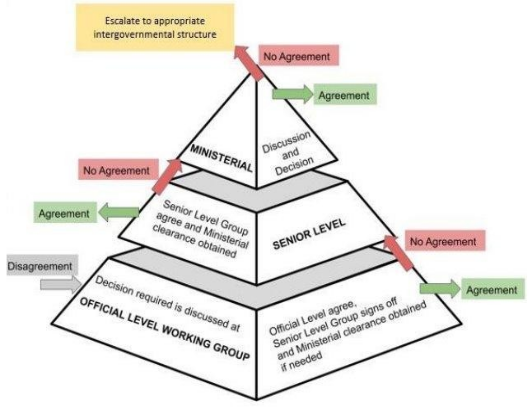
Figure 1: the levels of escalation for disagreements and disputes
This diagram shows the agreed escalation and decision‑making process used to resolve issues across the UK, including how disagreements are handled, across official, senior official and ministerial level.
Official level
13.3.1. Following the approach set out in sections 8 and 9 and appendix B of this common framework and within the spirit of the concordat, the 4 governments will seek every opportunity to resolve differences and reach agreement, either to recommend a UK-wide approach or to accept divergence at official level through discussions. Regular official level meetings will continue to provide an opportunity to discuss blood safety and quality policy, share updates, and consider the short-term and long-term impact of any developments. Policy leads (for example, team leaders) will provide strategic direction on the policy governed by this framework and take key operational decisions.
13.3.2. Where officials become aware of proposals, potential issues or areas of disagreement by any means, the first step will be to seek to resolve this among policy leads without escalation. This will usually be resolved through discussion with policy colleagues in each government, to determine the source of the disagreement, to examine evidence, to establish whether it is a significant concern and to work through possible solutions to the satisfaction of all parties. It is expected that most disagreements will be resolved at this point.
Senior official level
13.3.3. Where it has not been possible to resolve any disagreement at official level, this will initially be referred to senior officials for resolution. At this stage, senior officials can decide whether it would be appropriate to arrange a meeting with counterparts across governments. Alternatively, or after such a meeting, senior officials may determine that the issue cannot be resolved at this stage, at which point the involvement of ministers will be required.
Ministerial level
13.3.4. Any continuing disagreement, which cannot be resolved at the official level in the ways set out above, will be referred to portfolio ministers for resolution, and as set out in the Blood Safety and Quality Common Framework, the making of legislation may need to be postponed until all 4 governments are in agreement on how to proceed. The parties may conclude, having considered potential impacts on patient safety, the JMC(EN) principles and the finalised principles for intergovernmental relations, that divergence is appropriate.
Resolution through the appropriate intergovernmental structure
13.3.5. When no satisfactory resolution to a disagreement is found, despite the best endeavours of the parties to do so through the procedures set out in the common framework, a dispute may be referred to the Intergovernmental Relations Secretariat, who will consider whether it meets the criteria for escalation to the Inter-Ministerial Standing Committee.
Timescales for escalation
13.4. When a proposal is raised at official level, consideration will be given to the urgency of the proposal (specifically, how quickly a decision is required). This assessment will guide timescales for escalation of disagreement within the governance structure, with decisions requiring a more immediate resolution being escalated more quickly.
Evidence gathering
13.5. At each stage, further evidence may be requested from the preceding forum before the disagreement is discussed.
Third parties
13.6. JPAC and SaBTO may be used to provide scientific or technical advice to the UKG, SG, WG and the DoH NI.
Section 4: practical next steps and related issues
14. Implementation
14.1. This framework will take effect once agreed upon by all parties and approved by ministers. The common framework will only be put in place once there is a final ministerial signoff from all 4 governments.
Appendix A: Joint Ministerial Committee (EU Negotiations) Communique - October 2017
The fifth Joint Ministerial Committee (EU Negotiations) met today in 70 Whitehall. The meeting was chaired by the Rt Hon Damian Green MP, First Secretary of State and Minister for the Cabinet Office.
The attending Ministers were:
From the UK Government: the First Secretary of State and Minister for the Cabinet Office, Rt Hon Damian Green MP; the Secretary of State for Exiting the EU, Rt Hon David Davis MP; the Secretary of State for Wales, Rt Hon Alun Cairns MP; the Secretary of State for Scotland, Rt Hon David Mundell MP; and, Parliamentary Under Secretary of State for Northern Ireland, Lord Bourne of Aberystwyth.
From the Welsh Government: Cabinet Secretary for Finance and Local Government, Mark Drakeford AM.
From the Scottish Government: the Minister for UK Negotiations on Scotland’s Place in Europe, Michael Russell MSP.
In the absence of ministers from the Northern Ireland Executive, a senior civil servant from the Northern Ireland Civil Service was in attendance.
The chair opened the meeting by summarising the bilateral engagement and political developments that had taken place since JMC(EN) last met. The Secretary of State for Exiting the EU provided an update on the previous rounds of negotiations with the EU and the Committee discussed forthcoming priorities and the future relationship with the EU. The Committee discussed the establishment of common frameworks.
Ministers noted the positive progress being made on consideration of common frameworks and agreed the principles that will underpin that work (attached).
Common frameworks: definition and principles
Definition
As the UK leaves the European Union, the government of the United Kingdom and the devolved administrations agree to work together to establish common approaches in some areas that are currently governed by EU law, but that are otherwise within areas of competence of the devolved administrations or legislatures. A framework will set out a common UK, or GB, approach and how it will be operated and governed. This may consist of common goals, minimum or maximum standards, harmonisation, limits on action, or mutual recognition, depending on the policy area and the objectives being pursued. Frameworks may be implemented by legislation, by executive action, by memorandums of understanding, or by other means depending on the context in which the framework is intended to operate.
Context
The following principles apply to common frameworks in areas where EU law currently intersects with devolved competence. There will also be close working between the UK government and the devolved administrations on reserved and excepted matters that impact significantly on devolved responsibilities.
Discussions will be either multilateral or bilateral between the UK government and the devolved administrations. It will be the aim of all parties to agree where there is a need for common frameworks and the content of them.
The outcomes from these discussions on common frameworks will be without prejudice to the UK’s negotiations and future relationship with the EU.
Principles
Common frameworks will be established where they are necessary in order to:
- enable the functioning of the UK internal market, while acknowledging policy divergence
- ensure compliance with international obligations
- ensure the UK can negotiate, enter into and implement new trade agreements and international treaties
- enable the management of common resources
- administer and provide access to justice in cases with a cross-border element
- safeguard the security of the UK
- Frameworks will respect the devolution settlements and the democratic accountability of the devolved legislatures, and will therefore:
- be based on established conventions and practices, including that the competence of the devolved institutions will not normally be adjusted without their consent
- maintain, as a minimum, equivalent flexibility for tailoring policies to the specific needs of each territory as is afforded by current EU rules
- lead to a significant increase in decision-making powers for the devolved administrations
2. Frameworks will ensure recognition of the economic and social linkages between Northern Ireland and Ireland and that Northern Ireland will be the only part of the UK that shares a land frontier with the EU. They will also adhere to the Belfast Agreement.
Appendix B: joint decision-making dispute avoidance and dispute resolution process
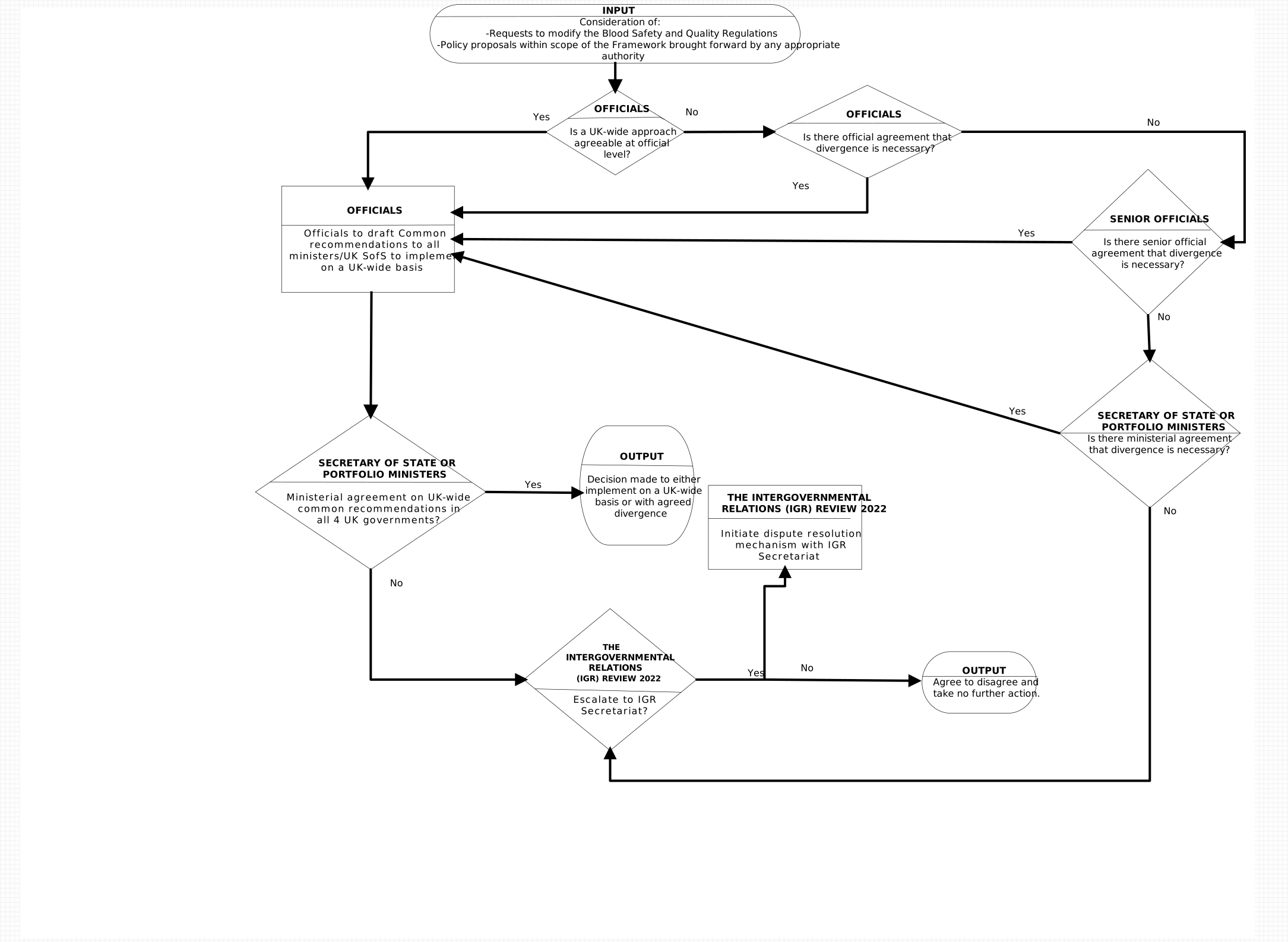
Figure 2: joint decision-making dispute avoidance and dispute resolution process
The processes outlined in figure 2 are detailed in the joint decision making, dispute avoidance and dispute resolution (The Intergovernmental Relations (IGR) Review 2022) sections below.
Joint decision making
1. Framework process
In accordance with section 9 of the framework outline agreement policy, colleagues will meet regularly. Requests to modify legislation and policy proposals within the scope of the framework may be brought forward by the appropriate authority.
2. Decisions on divergence
Scientific advice and wider risk management issues are considered with the aim of reaching a consensus on a common recommendation to ministers.
All 4 governments submit the same common recommendations to ministers for a decision (either for common approaches across the UK or divergent approaches).
Where agreement cannot be reached at official level, issues are referred to senior officials for consideration.
3. Ministerial review of the recommendations
Ministers review recommendations and seek decisions. Officials will be asking ministers to agree to the recommended approach.
4. Agree approach
Ministers reach agreed decision on common recommendations.
Dispute avoidance
1. Further discussions
Further discussions at official and senior official levels.
2. Dispute avoidance initiated
Dispute avoidance is initiated where necessary, including pausing work progressing implementation of ministerial decision until differences are resolved.
Senior officials from all 4 governments meet to consider ministerial views and determine whether there is any additional information available to support an agreed-upon approach and revert to consider any alternative approach.
Officials submit risk management and common recommendations, informing ministers of the revisions with rationale for the approaches now being recommended across all 4 governments.
3. Recommendations made to ministers in the 4 governments
Officials submit further and/or revised common recommendations, informing ministers of the approaches being recommended across all 4 governments.
If the recommended approach differs across the UK, officials provide explanations and a summary rationale setting out why it is appropriate to diverge.
If the approach being recommended is not agreed upon by ministers and officials from the 4 governments, they then meet again.
4. Ministers receive risk management and common recommendations, seeking a decision
Each minister considers the common recommendation individually and provides a response.
If the approach being recommended is not agreed across the UK, senior officials meet to discuss the issues.
5. Ministers reach agreed decision on common recommendations
If the approach being recommended (either for common approaches across the UK or divergent approaches) is agreed upon across the UK, Private offices inform officials in their own respective governments of the decision to implement agreed approach. Policy officials in all 4 governments also share information on the ministers’ decisions.
Dispute resolution (The Intergovernmental Relations (IGR) Review 2022)
1. Further discussions
Further discussion of issues.
2. Dispute avoidance initiated
Issues are escalated to highest level and the dispute resolution process is initiated.
Pause work to progress the implementation of Secretary of State, cabinet secretary and/or permanent secretary level decision until differences are resolved.
Officials submit further and/or revised common recommendations informing the appropriate intergovernmental structures of the approaches being recommended across all 4 governments. The appropriate intergovernmental structures then consider common recommendations and Secretary of State, cabinet secretary and/or permanent secretary views and consider any additional information available to support decision making.
If the approach being recommended is not the same across the UK, officials provide an explanation of the different approaches being recommended and a summary rationale setting out why it is appropriate to diverge and why agreement has not been reached to date. If the approach being recommended is agreed across the UK, proceed to a ministerial decision.
The appropriate intergovernmental structures consider the common recommendation individually and provide a response to Secretary of State, ministers and/or permanent secretary private offices.
3. Secretary of State, ministers and/or permanent secretary decisions
Secretary of State, ministers and/or permanent secretary reach an agreed decision on common recommendation.
Private offices inform officials in their own respective governments of the decision.
Policy officials in all 4 governments share information on Secretary of State, ministers and/or permanent secretary decisions.
Annex A: concordat on blood (and blood components) safety and quality
Introduction
1. This concordat is an agreement between the UK government (UKG), Scottish Government (SG), Welsh Government (WG) and Northern Ireland Department of Health in the area of blood safety and quality. It gives effect to the Blood Safety and Quality Common Framework. It also sets out the continuation of good working relations, open communication; the maintenance of a compatible minimum set of high standards of safety and quality for blood and blood components; a dispute avoidance and resolution mechanism; and a review and amendment mechanism.
2. This agreement is a political commitment and is not intended to be legally binding or enforceable. It is in accordance with the overarching Memorandum of Understanding (MoU) on Devolution and the common frameworks principles agreed upon by the Joint Ministerial Committee (EU Negotiations) (JMC(EN)) on 16 October 2017.
Scope
3. This agreement covers the subject matter of the EU Blood Directive (2002/98/EC) and the implementing acts. The Blood Safety and Quality (Amendment) (EU Exit) Regulations 2019 retain the UK’s safety and quality standards for blood and blood components and amend the regulations to ensure that they will operate as intended following the UK’s departure from the EU. The 2019 Blood Safety and Quality EU Exit SI was amended by the Blood (Safety and Quality) (Amendment) (EU Exit) Regulations 2020.
Principles for working together
4. This agreement will ensure recognition of the economic and social linkages between Northern Ireland and Ireland, and that Northern Ireland will be the only part of the UK that shares a land frontier with the EU. It will also adhere to the Belfast Agreement.
5. The parties affirm their mutual commitment to work together on the application of assimilated law in relation to blood safety and quality policy and their respective responsibilities. This cooperation is intended to give all parties the assurance that working relationships will be conducted in a manner that is both collaborative and helpful, aiming, where possible and appropriate, to achieve an agreement on policy. In addition, all parties agree that regular contact will continue to discuss ongoing business of mutual interest.
6. This concordat is intended to provide the basis for the management and maintenance of a compatible minimum set of safety and quality standards by setting out governance arrangements and a dispute resolution process. All parties to the concordat agree that a common framework approach, which recognises the common frameworks principles agreed upon at JMC(EN) in 2017 and the finalised principles for intergovernmental relations, is highly desirable across the UK. The outcomes of the intergovernmental relations review and the appropriate intergovernmental structures are reflected in this concordat.
7. Open communications will be maintained and information shared, to the extent permitted by law, at the earliest opportunity. This may include, but is not confined to, policy issues, stakeholder views, preparations for and outcome of consultations and research, media interest and lines to take, and emerging issues and intelligence (UK/EU/international).
8. The parties acknowledge that there may be a need for their separate responsibilities to be tackled with uniformity. For example, events could transpire that would require urgent action (such as, but not limited to, responding to emerging diseases). Each party shall promptly and thoroughly consider any concerns raised by others. Where all agree that consistency is needed, consultation on a common approach shall be undertaken.
9. The parties shall inform each other at the earliest opportunity of any new policy proposals before they are made public to allow full consideration and a common approach to be reached wherever possible. Each party will also appraise the others of the ongoing development of such proposals. Where this is not be possible, each party will inform the others as soon as possible.
10. The parties to this agreement commit to resolving any issues at the lowest possible level and recognise that agreement to disagree can be an acceptable outcome, provided the JMC(EN) common frameworks principles remain upheld.
11. Where common recommendations may be made, ministers will retain the right to take individual decisions for their government. For those areas within the scope of the Blood Safety and Quality Common Framework, the opportunity for consistency of approach across governments will be sought in the first instance. The ability for divergence must be retained, while taking into account its impact on patient safety and confidence, and the functioning of the UK internal market. Every effort will be made at working level to resolve any disagreements in difference of approach. Where a consensus cannot be reached by these arrangements (whether that is agreement to a UK-wide approach or to accept divergence), the dispute avoidance and resolution mechanism would come into play.
Dispute avoidance and resolution
12. The goal of the dispute avoidance and resolution mechanism is to avoid escalation to formal processes through the appropriate intergovernmental structures by resolving any disagreements at the lowest possible level. A disagreement between parties to the concordat becomes a ‘dispute’ when it enters the formal dispute avoidance and resolution process through appropriate intergovernmental structures.
13. This mechanism will only be utilised when genuine agreement cannot be reached, and divergence would negatively impact the ability to meet the JMC(EN) common frameworks principles. In those areas where a common approach is not needed in order to meet these principles, an ‘agreement to disagree’ could be considered an acceptable resolution.
Process
14. Figure 1 depicts the levels of escalation of a disagreement to a dispute and the interaction between each level.
15. Following the approach set out in sections 8 and 9 and appendix B of the Blood Safety and Quality Common Framework and within the spirit of this concordat, all governments will seek every opportunity to resolve differences and reach agreement; either to recommend a UK-wide approach or to accept divergence, at the official level through discussions.
16. Where it has not been possible to resolve any disagreement in approach at the official level, this will initially be referred to senior officials for resolution.
17. Any continuing disagreement, which cannot be resolved at the official level in the ways set out above, will be referred to portfolio ministers for resolution and as set out in the Blood Safety and Quality Common Framework. The parties may conclude, having considered potential impacts on patient safety and the JMC principles and reflecting the appropriate intergovernmental structures, that divergence is appropriate.
18. As a last resort, where the above steps for resolving a disagreement have been unsuccessful, the issue will be escalated to the appropriate intergovernmental structures for resolution under the dispute resolution process set out in the appropriate intergovernmental structures.
Timescales for escalation
19. When a proposal is raised at official level, consideration will be given to the urgency of the proposal (specifically, how quickly a decision is required). This assessment will guide timescales for escalation of disagreement within the governance structure, with decisions requiring a more immediate resolution being escalated more quickly.
Evidence gathering
20. At each stage, further evidence may be requested from officials at the preceding level, or from stakeholders (listed in section 21), before the disagreement is discussed.
Third parties
21. During policy development and dispute resolution, the Medicines and Healthcare products Regulatory Agency (MHRA), the Advisory Committee on the Safety of Blood, Tissues, and Organs (SaBTO), and the Joint United Kingdom (UK) Blood Transfusion and Tissue Transplantation Services Professional Advisory Committee (JPAC) may be used to provide scientific or technical advice on the most appropriate ways to ensure the safety of blood for transfusion.
Official level meetings
Official level blood safety and quality meetings
22. All parties will continue to regularly share information with one another in relation to the scope of this agreement and will continue to discuss:
- the impact of decisions on other governments, including any impacts on cross-cutting issues
- prospective policy changes
- emerging issues and intelligence
23. As previously mentioned, senior official meetings will be convened to provide strategic direction and to discuss issues as appropriate where there is a dispute, either by meeting regularly or on an ad hoc basis. Senior officials will then report to the relevant ministers as necessary to provide an update or to escalate an issue.
Review and amendment mechanism
Process
24. The review and amendment mechanism (RAM) ensures that the framework can adapt to changing policy and governance environments in the future.
25. There are 2 types of reviews, which are outlined below. The process for agreeing to amendments should be identical regardless of the type of review.
26. The RAM relies on consensus at each stage of the process from the ministers responsible for the policy areas covered by this non-legislative agreement.
27. Third parties can be used by any party to the FOA and concordat to provide advice at any stage of the process. These include other government departments or bodies, as well as external stakeholders, such as NGOs and interest groups.
28. At the outset of the review stage, parties to the FOA and concordat must agree on timelines for the process, including the possible amendment stage.
29. If agreement is not reached in either the review or amendment stage, parties to the framework can raise this as a dispute through the framework’s dispute avoidance and resolution mechanism.
Review stage
30. An initial review will take place one year after the concordat comes into effect. This will be used to determine if the arrangements are functional.
31. Following the initial review, a periodic review of the concordat will take place every 3 years.
The period of 3 years starts from the conclusion of a periodic review and any amendment stages that follow.
During the periodic review, parties to the concordat will discuss whether the governance and operational aspects of the framework are working effectively, and whether decisions made over the previous 3 years need to be reflected in an updated non-legislative agreement.
32. An exceptional review of the concordat is triggered by a ‘significant issue’.
A significant issue must be time sensitive and fundamentally impact the operation and/or the scope of the framework.
The exceptional review may include a review of governance structures if all parties agree that it is required. Otherwise, these issues are to be handled in the periodic review.
The same significant issue cannot be discussed within 6 months of the closing of that issue.
33. The amendment stage can only be triggered through unanimous agreement by ministers. If parties agree that no amendment is required, the relevant time period begins again for both review types (for example, it will be 3 years until the next periodic review and at least 6 months until the same significant issue can trigger an exceptional review).
Amendment stage
34. Following agreement that all parties wish to enter the amendment stage, parties will enter into discussion around the exact nature of the amendment. This can either be led by one or more parties to the framework (framework agreement and concordat) or all.
35. If an amendment is deemed necessary during either type of review, the existing framework will remain in place until a final amendment has been agreed.
36. All amendments to the framework must be agreed upon by all parties and a new non-legislative agreement signed by all parties.
37. If parties cannot agree whether or how a framework should be amended, this may become a disagreement and as such could be raised through the framework’s dispute avoidance and resolution mechanism.
38. Changes to the framework will be communicated to stakeholders through the current communication channels.
The Windsor Framework
39. On 27 February 2023 the UK and EU agreed the Windsor Framework, which provides for a new set of arrangements to restore the smooth flow of trade within the UK internal market. Following this, on 24 March 2023, a Joint Declaration of the EU and the UK government set out that the Northern Ireland Protocol should now be known as the Windsor Framework.
40. The Windsor Framework (Implementation) Regulations 2024 came into force on 12 April 2024, conferring powers upon the Secretary of State in relation to Articles 5, 6 and 7 and Annex 2 of the Windsor Framework. The statutory guidance which underpins these arrangements can be found on the Safeguarding the Union page.
41. The Windsor Framework applies specific EU instruments listed in Annex 2 on agri-food products and manufactured goods in Northern Ireland, subject to the democratic scrutiny and consent provisions of the Windsor Framework. They also apply, under the conditions set out in the annex, to and in the UK in respect of NI.
42. The following chapters of Annex 2 of the Windsor Framework are relevant to this framework:
- paragraph 22 - substances of human origin
43. This common framework reflects the specific circumstances in Northern Ireland that arise as a result of the Windsor Framework and remains UK wide in its scope. As such decision making and information sharing will always respect the competence of all parties to the common framework.
44. Where one or more of UK government, the Scottish Government, the Welsh Government or the Northern Ireland Executive propose to change rules in a way that has policy or regulatory implications for the rest of the UK, or where rules in Northern Ireland change as a result of the Windsor Framework, the common framework is intended to provide governance structures and consensus-based processes for considering and managing the impact of these changes.
45. As rules evolve to meet the emerging regulatory needs of the UK, Scottish and Welsh Governments and Northern Ireland Executive, this framework will ensure the full participation of Northern Ireland in discussions such that the views of the relevant Northern Ireland Executive minister(s) are taken into account in reaching any policy or regulatory decisions by the UK, Scottish or Welsh governments. This should include, where appropriate, consulting and seeking views from the Office for the Internal Market on the effect of proposed changes on GB-NI trade.
46. Where rules in Northern Ireland change as a result of the Windsor Framework or policy choices of the Northern Ireland Executive, the common framework will form the basis of a mechanism to ensure consideration by the 4 governments of any changes and will enable them to determine any impacts and subsequent actions arising from these changes. In any event qualifying Northern Ireland goods will continue to benefit from the protections afforded by their unfettered access to the rest of the UK internal market.
47. Where issues or concerns that fall within this common framework in respect of GB-only proposals are raised by relevant Northern Ireland Executive minister(s), they can be escalated to the dispute avoidance and resolution mechanism within this common framework (section 2). In respect of GB-only proposals that have not been satisfactorily addressed, they will have the right to trigger a review of the issue as set out in the dispute resolution process in section 13 of this document. They also have the right, as appropriate, to consult and seek the views of the Office for the Internal Market on the impacts arising on GB-NI trade, where the policy disputes involve the proposals for changes to policy in GB which NI is unable to mirror, due to the application of relevant EU law under the Windsor Framework.