Tactical Power: Challenge Document
Published 15 October 2026

© Crown copyright 2026
This publication is licensed under the terms of the Open Government Licence v3.0 except where otherwise stated. To view this licence, visit nationalarchives.gov.uk/doc/open-government-licence/version/3 or write to the Information Policy Team, The National Archives, Kew, London TW9 4DU, or email: psi@nationalarchives.gov.uk.
Where we have identified any third party copyright information you will need to obtain permission from the copyright holders concerned.
This publication is available at https://www.gov.uk/government/publications/tactical-power-challenge/tactical-power-challenge-document
1. Introduction
This UK Defence Innovation (UKDI) challenge is run on behalf of the Army. It is seeking proposals that will help the Army meet the demand for electricity at the unit tactical level on exercises or operations.
There are two opportunities available within this challenge:
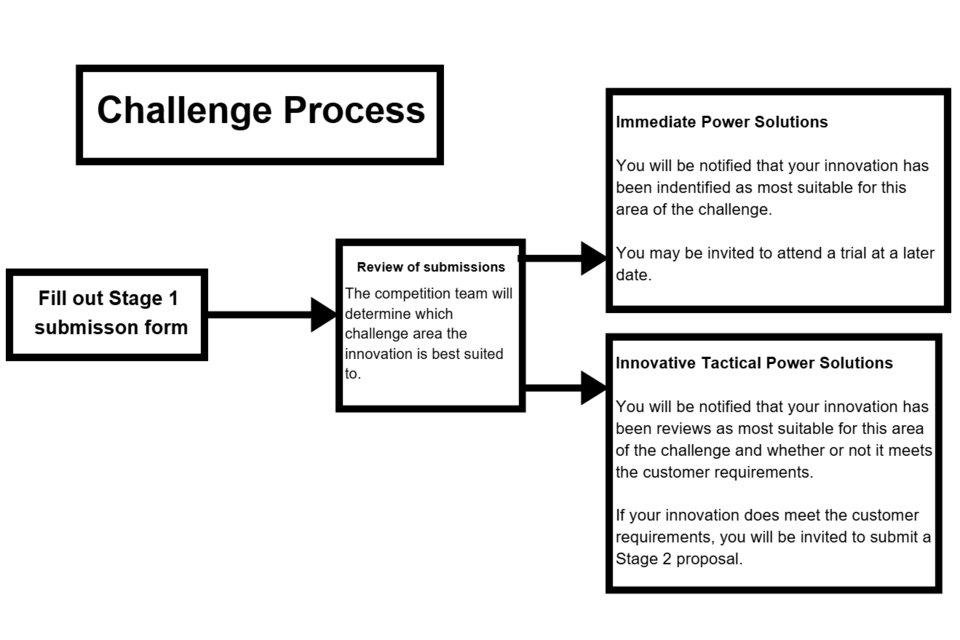
- Innovative Tactical Power Solutions: The Army is inviting proposals for development from TRL 4 up to TRL6 to meet the future power demand. This will be a two stage competition with a contract awarded to those that are successful in the assessment process. This approach helps innovators quickly understand whether their idea is a good fit for the competition, saving time and effort when applying. The table below summarises the differences and expectations of the 2 stages. Please note that all Stage 2 instructions in this document only apply to Innovative Tactical Power Solutions. Funding of £2.45M is available for this.
| STAGE | PURPOSE | EXPECTED CONTENT |
|---|---|---|
| Submission Stage 1 | Initial innovation screening | Idea overview with outline technical plan |
| Submission Stage 2 | Full detailed proposal review (by invitation only) | Detailed proposal with full technical description, detailed project plan and finance breakdown |
- Immediate Power Problem: Additionally, the Army would like to better understand the technology that is currently available to help solve the immediate power demand. Technology must be at TRL 6 or above with a strong chance of commercialisation within the next 12 months. This is a market engagement activity. Those that are of greatest interest may be invited by the Army to a demonstration opportunity in the UK (location likely to be Warminster, Wiltshire led by the Army’s Experimentation and Trials Group). There will only be one stage to this aspect of the challenge. Stage 2 instructions do not apply to Immediate Power Problem.
All submissions will be carefully reviewed by the challenge team. They will look for ideas that align well with the challenge, demonstrate a strong chance of successful delivery, and meet the customer’s needs.
This activity is being run in partnership with Australia’s Advanced Strategic Capabilities Accelerator (ASCA). Submissions may be shared with the Australian government for assessment. Outputs of projects funded under Innovative Tactical Power Solutions may be shared with both the Australian and United States government. Information sharing will be conducted under the appropriate international agreement. Australian and US government representatives may observe demonstrations and challenge progress.
2. Challenge key information
| Innovative Tactical Power Solutions: | |
|---|---|
| This element of the challenge invites innovative solutions for development on contract up to TRL 6. The key dates are as follows: | |
| Key Information | Challenge Details |
| Stage 1 submission deadline | 12:00 Midday on 10 November 2026 (GMT) |
| Stage 1 decision release | 17 November 2026 (GMT) |
| Stage 2 open (by invitation) | 12:00 Midday on 17 November 2026 (GMT) |
| Stage 2 submission deadline | 12:00 Midday on 15 December 2026 |
| Total funding available | £2.45M (excluding VAT). A number of proposals may be funded |
| Technology Readiness Level (TRL) | Starting at TRL 4, ending at TRL 6 |
| Contract start month | Aim to start March 2027 |
| Project duration | Projects to complete no later than 31 March 2028 |
| Risk Assessment Reference | RAR-ZBQTZRW |
| Stage 2 feedback release date | No later than 23 February 2027 |
| Stage 1 and 2 pre-sift criteria | See Section 12 Pre-sift Criteria |
| Immediate Power Problem: | |
|---|---|
| This aspect of the challenge is a market engagement activity that will have just one stage: | |
| There will be no individual feedback from this activity. | |
| Key Information | Challenge Details |
| Market Engagement submission deadline | 12:00 Midday on 10 November 2026 (GMT) |
Submissions for both aspects of the challenge will be submitted into the same form and the challenge team will determine where your innovation is best suited . You will be notified of which aspect of the challenge your innovation was most appropriate for.
2.1 Challenge Specific Requirements
Please note that this challenge has specific requirements as part of its pre-sift criteria for both Stage 1 and Stage 2; only those proposals submitted that demonstrate compliance with the UKDI pre-sift criteria at each stage will be taken forward to full review at Stage 1 and assessment at Stage 2 (Innovative Tactical Power Solutions competition only).
For the full list of criteria, please see Section 12.
2.2 Where do I submit my proposal?
Forms are to be submitted via the UKDI Online Submission Service where you will need to register for an account. Only proposals submitted through the UKDI Online Submission Service will be accepted.
Innovators are strongly advised to submit their proposal at least one hour before the deadline. Proposals submitted close to the deadline risk encountering issues that cannot be resolved in time.
Responsibility for timely submission rests entirely with the innovator, no extensions will be made. If you are having problems submitting your proposal, email us prior to the deadline on accelerator@dstl.gov.uk or call 01980 950000 option 3 (Monday to Friday 0900-1200 only).
2.3 Information sharing
When submitting your Stage 1 and 2 proposals, you will be required to include a title and solution overview . This information will be used by UKDI, and Partners Across Government (PAG), to describe your project and its intended outcomes and benefits. It may also be shared with Australian and United States governments through the appropriate MOU. They may be included at UKDI events in relation to this challenge and in documentation such as brochures. As this information can be shared, it should not contain information that may compromise Intellectual Property.
The title and abstract must be the same in both your Stage 1 and Stage 2 proposals, this is a pre-sift requirement.
2.4 Further guidance
For further guidance on what to expect during the submission process and how your proposal will be assessed, please see the following GOV.UK pages and forms:
- Submit a proposal
- Assessment process and criteria
- How to work with UK Defence Innovation (UKDI)
- Advice for UK Defence Innovation (UKDI) Prospective Applicants
- UK Defence Innovation (UKDI) Bid Writing Guidance
- Defence and Security Accelerator: ethical, legal and regulatory guidance
- MODREC Guidance for Suppliers
- Competition Terms and Conditions
- UKDI contracting guidance
- Cyber Security Model
3. Clarification Process
All clarification queries must be raised through the relevant UKDI Point of Contact, copying accelerator@dstl.gov.uk. Queries that do not copy this address may not receive a response. For Stage 1, queries received after 4 November may not be answered in time to support submissions. Stage 1 clarification responses will be published as a Q&A log on the GOV.UK challenge page.
Stage 2 clarifications will close on 1 December, with responses issued periodically, and at least weekly, up to the submission deadline. Stage 2 responses will be shared only with Stage 2 participants. Information submitted through the clarification process must therefore be suitable for wider circulation; UKDI will redact organisation and product names from published or shared responses.
While all reasonable efforts will be made to answer queries, UKDI reserves the right to impose management controls if volumes of queries restrict fair access of information to all potential innovators.
3.1 Innovation Partner
UKDI has a team of locally based Innovation Partners that can provide support in working with UKDI. If you are a UK businesses, SMEs, start-up, sole trader, academic institution or research organisation, it is strongly recommended that you contact your local Innovation Partner to discuss your idea for any aspect of this challenge.
3.2 UKDI Help Centre
Challenge queries including on process, application, commercial, technical and intellectual property aspects should be sent to the UKDI Help Centre at accelerator@dstl.gov.uk, quoting the challenge title.
UKDI cannot guarantee a response before the submission deadline if the query is received within two weeks of the Stage 1 submission deadline or within three weeks of the Stage 2 submission deadline. This applies to both Innovation Partners and Help Centre.
4. Tactical Power Challenge Webinar
Watch the webinar to find out more about the challenges we are tackling and how to work with UKDI. Please watch the webinar before you submit any questions.
UKDI: Tactical Power Challenge Webinar
5. Challenge scope
5.1 Background
The Australian and British Army in-service power generation systems do not support distributed and electrified force elements operating modern and future capabilities (such as Robotic Autonomous Systems (RAS), directed energy weapons, remote sensors, edge compute etc.). Current in-service solutions rely solely on combustible fuels and are heavy, bulky and noisy, and unable to meet the increasing demand. Where stored, electrical power (if available) is in the form of various commercial power banks bought individually and off-the-shelf. This is inconsistent, not based on a reliable supply chain for replacement and is not suitable to account for the planned capability and power increases of the future.
Experimentation conducted by both armies has identified a significant increase in the Watt hours (Wh) at the soldier, platoon and company levels as detailed in Table 1. Additionally, both armies have observed that after a short period of tactical action, the stored electrical power supply may require up to 12 hours of charge time; which is impractical. Additionally, generators cannot be used when moving. There are plans for power distribution from vehicles (such as from batteries, alternators or hybrid platforms) in the future, however this is not to be relied upon for the purpose of this challenge.
5.2 Exploitation
This challenge will review submissions from industry based on their ability to meet the requirements outlined in this challenge. The activities will be MOD commercially supported throughout.
For Innovative Tactical Power Solutions, MOD has the intention of completing concept demonstration no later than the end of March 2028. The demonstration phase, supported by a formal benefit assessment document, will inform Defence’s Manoeuvre Power Programme and potential further development.
For Immediate Power Problem Solutions, the British Army’s rapid procurement team, Project RAPSTONE, as well as the Royal Marines procurement team will be informed of the outcomes of this activity. Products that seem suitable may then be subject to follow on procurements to rapidly modernise our current power provision to deployed forces across the globe, especially those in Continental Europe. Scale of Procurement.
The British Army’s in-service tactical power generator, the Lightweight Field Generator (LFG) has a total fleet requirement of over 4,000. Whilst the British Army may not procure at that scale by rapid procurement, aspirations exist for a significant procurement in 2027, and this challenge is linked to end-of-life upgrades.
6. The challenge
In this challenge, innovations are sought that include but are not limited to:
· Safer chemistry for the same or improved energy density.
· High speed charging of equipment and recharge of batteries.
· Traditional and non-traditional means of providing electrical power.
· Enable silent running.
· Power provided at a small scale (on the person or localised) generation
Both whole systems and components are of interest.
Innovative Tactical Power Solutions aim to demonstrate capabilities by March 2028, that improve provision, storage, recharge, distribution and management of electrical power across the tactical battlespace.
7. Illustrative Vignette
A dismounted infantry company is deployed on the front line. The company consists of 110 soldiers, organised into: an enabling component of 10 personnel, traditionally equipped with 2 kW power generation; a headquarters element of 10 personnel; and three platoons, each with 30 personnel. The company is dispersed across approximately 3 kilometres, with limited ability to move batteries and electronic systems to the enabling component for centralised charging. Only the enabling component has vehicles. The company can draw power from multiple sources, including small military-grade generators; the local civilian electrical grid; a small number of vehicles, and alternative non-traditional sources. Hydrocarbons provide resilience, but alternative generation provides silent power without the vulnerability of fuel resupply.
A smart management system located at headquarters coordinates these power sources to recharge technology and stored power systems. When necessary, the system can conduct power scavenging, enabling continuous command and control by powering communications and data systems, and charging modular batteries through hot swapping. An Uninterruptible Power Supply (UPS) is integrated into the management system to maintain control elements if power generation is interrupted, continue recharging modular batteries until generation is restored, and enable silent operations and fuel-saving opportunities in high-threat environments.
In very high-threat environments, individual power generation and storage allow the company headquarters to operate independently for up to 72 hours without accessing the company’s central power management system.
In very high-threat environments, individual power generation and storage allow platoons and small teams to operate independently for up to 48 hours without accessing the company’s central power management system.
8. General System Requirements
The solution shall support distributed operations and provide commanders with the ability to manage electrical power as a deployable commodity. The priority is speed of charging (fast charging) and signature management rather than optimising for efficiency. Solutions must enable rapid replenishment of power to support operational tempo and minimise downtime.
| Level | Power Requirement | Duration |
|---|---|---|
| Individual Soldier | 180 Wh / 24 hrs | Storage & silent distribution to support 48hr without accessing the company’s central power management system |
| Platoon (~30) | 69,000 Wh / day | Prioritise and charge team systems (UAV / Jamming) |
| Company (~110) | 260,000 Wh / day | Routine fuel resupply every 24hr, but should be able to maintain essential operations up to 48hr without resupply |
| Company HQ (Part of the Coy figures) | 50,000 Wh / day | 72 hours silent power without accessing the company’s central power management system |
Table 1: Indicative power demand
9. Essential Requirements
The following requirements are the end-state essential criteria for the fully deployable energy system. Progression through this challenge is dependent on the maturity defined below:
9.1 Innovative Power Solutions
The goal is a system that meets these requirement by TRL9. It is not expected all these requirements will be met at the TRL6 demonstration phase, or necessarily by a single product. There must be reasonable expectation they can be met by collaboration or short-term further development.
9.2 Immediate Power Challenge:
Promising products that meet a number of these criteria may be selected for the Immediate Power Challenge.
9.3 Operational Requirements:
- Battery chemistries that have high inherent safety and operating temp range (-10oC to +40oC).
- Fast charging and recharge of batteries.
- Power generation, storage, management and distribution functionality.
- Open architecture electrical, mechanical and software interfaces.
- Power monitoring (Wh (Voltage and current)) with exportable CSV data.
- Compatible with existing military equipment and connectors[1].
- Usable by non-specialists and safe by design.
9.4 Power Generation Requirements.
- Minimum 3kW continuous and 6kW peak output at company level.
- Preference for Generation from F-54 (diesel) but alternatives in scope if benefit outweighs logistical burden.
- Storage to have option to be powered by
- AC national grid power
- Inservice generators Field Electrical Power Supplies (FEPS), Lightweight Field Generator (LFG), Light and Power Distribution System (LAPDS)
9.5 Power Distribution Requirements. Weighting to speed of charge over efficiency.
- AC 230V 50Hz
- DC 24V & 12V
- USB-C PD (60W threshold, 100W objective)
9.6 Physical and Environmental Requirements
- IP67 protection for on the person equipment, ruggedised construction and operation from -10C to +40C.
- Generate and manage power within a NATO 1.2T trailer footprint.
- Individual modules can be assembled into the full system without need of tools in less than 10 mins.
- No single component greater than 80kg[2].
- Energy storage modules less than 20kg.
- On the soldier components less than 5kg.
- Minimum 1,000 recharge cycles and five-year service life.
- Resistant to mud, sand, immersion and transport shock in storage and use case.
9.7 Interface Requirements.
There are several standards being developed by NATO, the UK & AUKUS to enable interoperability. Demonstrators do not have to interface at tender, but must be able to achieve interface during development.
- Tactical Microgrid Standard based on US MIL-STAN 3071
- DEFSTAN 23-12 (Generic Soldier Architecture)
- NATO STANAG 4133 (Field Power)
- NATO STANAG 4695 (Dismounted Soldier Power Interface)
10. Indicative equipment
Table 2 gives indicative equipment at the soldier, platoon and company level that will need recharging. The number of each is deliberately excluded as this will change with mission and nature of the troops.
| System / Equipment | Indicative Power Requirement | Remarks |
|---|---|---|
| Company Command Post | 2-3kW or 75kWh/day | Radio, computers, Starlink |
| Individual Radio | 35W 1kWh/day | Bespoke charge cables |
| Situational Awareness tools | 1-5kW | Android, USB-C |
| Thermal Sights | 5-10W | |
| Night Vision Goggles | 1W | |
| Uncrewed Air Systems (UAS) | 2-3kWh/day | |
| Counter UAS systems | 2-3kWh/day | |
| Uncrewed Ground Vehicle | 10kWh/day | |
| EW Equipment | 5-10 kW | |
| Counter Battery Radar | 10-20 kW |
Table 2: Indicative Equipment Demand
10.1 We are interested in…
We want novel ideas to benefit end-users working in UK defence and security and we are interested in both whole systems and components. Your proposal should include evidence of:
- A reliable supply chain of components. It is preferred that solutions use technology and components manufactured in NATO and/or Five Eyes countries and/or Japan and South Korea however this should not stifle innovation. It is expected that any future procurement will have a greater focus on component sourcing in relation to sovereign manufacturing and supply chains.
- Any functionality enhancements will be looked on favourably, such as indicators for time remaining at current use.
- the potential for your innovation to be translated into a practical demonstration in a relevant environment
- innovation or a creative approach
- how the proposed work applies to any defence and/or security context
10.2 We are not interested in…
We are not interested in proposals that:
- are Lithium-ion based solutions.
- are Power systems mounted on UGVs.
- result in Vendor lock-in for batteries, storage or software.
- constitute consultancy, paper-based studies or literature reviews which just summarise the existing literature without any view of future innovation
- are an unsolicited resubmission of a previous DASA or UKDI bid
- offer demonstrations of off-the-shelf products requiring no experimental development (unless applied in a novel way to the challenge)
- offer no real long-term prospect of integration into defence and security capabilities
- offer no real prospect of out-competing existing technological solutions
11. Critical elements to include
11.1 Stage 1 (applicable to both challenges)
Stage 1 submissions must include the following elements:
- A description of what you propose to develop, demonstrating alignment with the scope
- A summary of how your technology works, being specific on expected performance parameters. Where possible include any evidence to support your claims (open-source literature, test results etc.)
- Any constraints on the use of your technology (e.g. a minimum size of satellite, large power requirements, etc.)
- Demonstrating how your proposal is new and innovative
11.2 Stage 2 (Invite ONLY - not applicable for the Immediate Power Problem)
If invited to submit a Stage 2 proposal, ensure you have:
- used exactly the same title and abstract and included the relevant ACC number to those provided to us at Stage 1
- focused on the challenge requirements but also included a brief (un-costed) outline of the next stages of work required for exploitation
- included a list of other government funding you have received in this area. Making it clear how this proposal differs from that work
- included a detailed project plan with clear milestones and deliverables. Deliverables need to be well defined and designed to provide evidence of progress against the project plan. Your deliverables must include a written interim report, final report and demonstration
- prepared to engage fully with the benefits mapping team, so we can quantify and qualify outcomes during the demonstration phase.
- planned (and costed) attendance at the following meetings, which will all be in the UK. - a kick off meeting via Microsoft Teams - attendance at a full day workshop at the start of the contract (likely in Warminster) - a mid-project in-person check-in - regular reviews (likely monthly via Microsoft Teams) with the appointed Army team, Technical Partner, Project Manager, and other Government Officials including potentially from Australia or the USA. - In person demonstration towards the end of the project and no later than end February 2028, with a stakeholder audience. This is likely to be in the UK but please submit costs for both a UK demonstration and up to 2 weeks demonstrating in Australia. - close down meeting at the end of the project
These activities may take place virtually.
Slides presented at these meetings should be appropriately marked and made available along with meeting minutes including an action log.
- identified any ethical / legal / regulatory factors. Associated risks should have been added to the Risk Register in Step 5 of the submission service along with details of how they will be managed, including break points in the project if approvals are not received
- included any requirements for access to Government Furnished X (GFX). GFX is the preferred nondescript term for anything that the Government provides in which the ‘X’ could be artefacts such as information or equipment. UKDI cannot guarantee that GFX will be made available. You should have included an alternative plan in your proposal in case it is not available.
- if you plan to use Artificial Intelligence (AI) to assist in writing your bid, please refer to the guidance on our UKDI Standard Terms and Conditions - GOV.UK
12. Accelerating and exploiting your innovation
Ensure your Stage 2 deliverables are designed with the aim of making it as easy as possible for assessors to recognise expected development in technology maturity of the potential solution over the lifetime of the project. Specifically, how this demonstrates improved capability against the current known (or presumed) solutions.
Over the lifetime of UKDI awarded projects, ideas may mature and accelerate under the guidance of appropriate stakeholders, toward being functional capabilities. How long this takes, and how far towards a deployable capability the innovations progress, will depend on any future exploitation after the completion of the UKDI project.
Low TRL research and development may not be able to articulate exploitation in great detail, but it should be clear that there is credible advantage to be gained from the technology development.
12.1 Exploitation beyond your project plan
Include the following information within the Desirability question within the UKDI Online Submission Service application form at Stage 2 to help the assessors understand your exploitation intentions:
- expected additional work required beyond the end of the contract to develop an operationally deployable commercial product (for example, “scaling up” for manufacture, cyber security, integration with existing technologies, environmental operating conditions)
- additional future applications and wider markets for exploitation
- wider collaborations and networks you have already developed or any additional relationships you see as a requirement to support exploitation
- how your product could be tested in a representative environment in later phases
- any specific legal, ethical, commercial or regulatory considerations for exploitation
- whether advice from the MOD (technical or tactical) is required to develop innovative power solutions
At the close of the projects, successful solutions will be scored and assessed in order to assist in determining the most suitable solution available to us.
13. Pre-sift Criteria
Before your proposal is assessed, all proposals will be checked for compliance with the UKDI pre-sift criteria. Proposals will be rejected before full assessment if they do not comply.
We may use a UKDI-approved AI tool to assist in the pre-sifting of innovator submissions. The use of AI will not alter our existing approach to protecting innovators’ intellectual property, confidentiality, or data. All submissions will continue to be handled in accordance with the same security, confidentiality, and intellectual property safeguards that currently apply to the challenge process.
The AI tool will be used solely to support the evaluation process and will not make autonomous decisions. Any outputs generated by the AI tool will be reviewed by a human decision-maker, who will make the final determination regarding progression through the pre-sift stages.
13.1 Stage 1
To progress to a review of your idea, proposals must pass all Stage 1 pre-sift criteria. Failure against any single criterion will result in the proposal being excluded from further review.
| Stage 1 Criteria | Measure - Within scope (Pass) / Out of scope (Fail) |
|---|---|
| The Proposal has been received from a UK-based organisation, or from the UK-registered entity of an international organisation, with work being undertaken in the UK. | Pass / Fail |
| The innovation is currently at least TRL 4 | Pass / Fail |
| Pass / Fail |
13.2 Stage 2 (not applicable for Immediate Power Problem)
To progress to full assessment, proposals must pass all Stage 2 pre-sift criteria. Failure against any single criterion will result in the proposal being excluded from further assessment.
| Stage 2 Criteria | Measure - Within scope (Pass) / Out of scope (Fail) |
|---|---|
| The Proposal was invited to submit into Stage 2 Cycle, and includes the Stage 1 ACC number in the Proposal (Step 3) | Pass / Fail |
| The Proposal contains exactly the same title and abstract as the Stage 1 submission | Pass / Fail |
| The Stage 2 Proposal is submitted by the same organisation as the invited Stage 1 submission | Pass / Fail |
| The proposal outlines how it meets the scope of the challenge | Pass / Fail |
| The proposal explains how it meets the UKDI criteria (Desirability, Feasibility, and Viability) in the relevant questions in Step 3 of the submission service | Pass / Fail |
| The proposal must contain a financial plan, a project plan and a resourcing plan which demonstrate how the work proposed will be completed | Pass / Fail |
| The delivery schedule within your proposal includes evidence of a written final report | Pass / Fail |
| The proposal confirms there is no need for MODREC | Pass / Fail |
| The proposal confirms there is no need for GFX | Pass / Fail |
| The final deliverable must complete no later than 31 March 2028 | Pass / Fail |
| The project must complete at minimum TRL 6. | Pass / Fail |
| To be eligible to submit a proposal into this challenge you must be a UK registered business listed at Companies House. You must be based in the UK and intending to carry out project development activity within the UK. There is no requirement for the business to be UK‑owned | Pass/Fail |
| The proposal includes plans for an in person workshop, mid-project in-person check-in and a TRL 6 demonstration as well as monthly virtual check-ins. | Pass / Fail |
| The proposal does not contain attachments that have been used for additional text data over the stated word counts in Desirability, Feasibility, Viability and Additional Information | Pass / Fail |
| If the proposal is a resubmission of a previous one, it adheres to the resubmission guidelines | Pass / Fail |
| Proposed resources are assessed as capable of obtaining the required security clearances. | Pass/Fail |
If you plan to submit multiple proposals, please read this guidance carefully, as there is a limit on the number that can be submitted.
The proposal limit for this competition is 3. Any proposals submitted above the limit will be sifted out based on the order in which they were received.
14. How your proposal will be assessed
14.1 Stage 1
Submissions into Stage 1 of this competition will be reviewed by the customer and competition team.
Submissions will be allocated to either the Immediate Power Problem or Innovative Power Solution area of the challenge. You will be notified of which area your submission was best suited to. For Innovative Power Solutions, those that meet the customer requirements will be invited to submit a more detailed proposal into Stage 2 .
Those not selected will receive an email notifying them along with an indication of which of the review factors detailed in the introduction (alignment, delivery potential and meeting needs), was the main reason for not being invited into Stage 2.
No further feedback will be provided.
14.2 Stage 2 (not applicable for Immediate Power Problem)
Proposals that are compliant at pre-sift in Stage 2 will be assessed against the standard UKDI assessment criteria (Desirability, Feasibility and Viability) by subject matter experts from the MOD (including Dstl), PAG, the front-line military commands and the Australian Government. You will not have the opportunity to view or comment on assessors’ recommendations.
UKDI reserves the right to disclose on a confidential basis any information it receives from innovators during the procurement process, which includes the full proposal, to any third party engaged by UKDI for the specific purpose of evaluating or assisting UKDI in the evaluation of your proposal. In providing such information you consent to such disclosure. Appropriate confidentiality agreements will be put in place.
After assessment, scoring will be moderated at a Decision Conference where funding decisions are made based on the assessments, budget and wider strategic considerations.
Innovators are not permitted to attend the Decision Conference.
15. UKDI Terms and Conditions
Please read the UKDI contracting guidance which contain important information for innovators. For this competition we will be using the Innovation Standard Contract (ISC), Terms and Conditions. Information on the relevant DEFCONs can be found by registering on the Knowledge in Defence site.
We require unqualified acceptance of the Terms and Conditions. Where innovator organisations have a commercial department they will need to provide acceptance.
We will use deliverables from UKDI contracts in accordance with our rights detailed in the contract Terms and Conditions. This includes sharing deliverables with Australian and United States government under the relevant international agreement.
15.1 Stage 2 Feedback
Proposals that are unsuccessful at Stage 2 will receive feedback in the form of bullet points and a couple of short paragraphs after the Decision Conference.
Where a proposal meets the fundable requirements for a competition at Stage 2, but is not funded, UKDI may continue to seek funding and shall consider your proposal fundable for 12 months from the date of the feedback release.
We will share the abstract, Proposal Value Proposition Statement (PVPS) and title of your proposal with partners across His Majesty’s Government and the parties referenced in Information Sharing section, that may express an interest in funding the proposal, in accordance with the challenge document. We may also share this information on our cross-government Ideas Marketplace platform to foster collaboration and attempt to elicit funding. If partners across His Majesty’s Government wish to read the full proposal to decide if they will fund it, we will share the full proposal with them without seeking your permission if it is within 60 days of the feedback release date. If it is over 60 days since the feedback release date we will seek your permission before sharing the full proposal with them.
For other potential funders, we will seek your permission before sharing the full proposal regardless of the number of days since the feedback release date.
In the event that funding becomes available, UKDI may ask whether you would still be prepared to undertake the work outlined in your proposal under the same terms. Your official UKDI feedback will indicate if your proposal was deemed fundable, but not awarded funding at the time.
16. If your proposal is recommended for funding
Funded projects will be allocated a Project Manager (to monitor the project) and a Technical Partner (as a technical point of contact). In addition, the UKDI team may work with an innovator to support delivery and exploitation including, when appropriate, introductions to end-users and business support to help develop their business.
For funded projects, UKDI will endeavour to provide access to the UKDI Workspace within the I-Hub, Imperial College Campus, London, as part of its wider service provision. Subject to successful vetting, Baseline Personnel Security Standard (BPSS) minimum.
This access is intended for ad hoc use only by Small and Medium-sized Enterprises (SMEs) and does not constitute a dedicated or permanent workspace. Access will be available during the term of the contract and for six months following its completion, subject to capacity and availability. Access is granted on a first come first served basis.
16.1 Cyber Security Model
The Cyber Security Model (CSM) is how Defence builds cyber security into its supply chain.
On receipt of a FUND decision, successful innovators (and their sub-contractors) must prove cyber resilience before the contract is awarded. The start of this process is the submission of a Supplier Assurance Questionnaire (SAQ). The SAQ allows innovators to demonstrate compliance with the specified risk level and the corresponding profile in Def Stan 05-138, and the level of control required will depend on this risk level.
To expedite the contracting time of successful innovators we ask all innovators to complete the SAQ before they submit their proposal (this is not mandated). The SAQ must be completed using the Risk Assessment number RAR- ZBQTZRW (Level 1).
The SAQ will be automatically scored against the Cyber Risk Profile (CRP) and you will be immediately informed of the outcome, compliant or not compliant.
If non-compliant, you will be required to complete a Cyber Improvement Plan (CIP) before the contract is placed which will need to be reviewed and agreed with the relevant project manager. The CIP template can be found here.
Before you start your SAQ you will need:
- the Risk Assessment Reference (RAR) RAR- ZBQTZRW (Level 1)
- a D-U-N-S number (a unique identifier for your organisation)
- a GOV.UK One Login
16.2 Export control for overseas partners
All relevant export control regulations will apply if a company ultimately wants to sell a developed solution to a foreign entity. All innovators must ensure that they can obtain, if required, the necessary export licences for their proposals and developments, such that they can be supplied to the UK and other countries. If you cannot confirm you can obtain the necessary licences as part of your proposal, you will be required to provide this information prior to contract award, should your proposal be selected for funding.