Smart metering roll-out: evaluation plan (accessible webpage)
Published 2 April 2026

© Crown copyright 2026
This publication is licensed under the terms of the Open Government Licence v3.0 except where otherwise stated. To view this licence, visit nationalarchives.gov.uk/doc/open-government-licence/version/3 or write to the Information Policy Team, The National Archives, Kew, London TW9 4DU, or email: psi@nationalarchives.gov.uk.
Where we have identified any third party copyright information you will need to obtain permission from the copyright holders concerned.
This publication is available at https://www.gov.uk/government/publications/smart-metering-roll-out-evaluation/smart-metering-roll-out-evaluation-plan-accessible-webpage
Introduction
Smart meters are replacing analogue gas and electricity meters as part of a national infrastructure upgrade. They enable accurate billing by automatically recording consumers’ energy use in every half-hour period, allowing suppliers to bill based on consumers’ actual rather than estimated usage, as well as ending the need for manual meter reads. They are helping households to manage their energy use so that they can improve their efficiency and save money on their bills. Smart meters are also a vital part of achieving the government’s mission to build a flexible and decarbonised power system by 2030. As of the end of December 2025, there were 41 million smart and advanced meters in domestic and smaller non-domestic premises across Great Britain; over two-thirds of all eligible meters[footnote 1].
The successful delivery of smart metering benefits depends upon coordinated effort from a wide range of organisations. The rollout is led by the Smart Metering Implementation Programme (SMIP) within the Department for Energy Security and Net Zero (DESNZ), regulated by the Office of Gas and Electricity Markets (Ofgem), and delivered by energy companies. SMIP is a major infrastructure programme which is digitising the energy market through the creation and management of the operational smart metering system. This system now carries around 3 billion messages a month, and the programme works to manage and mitigate significant risks across the system and to optimise safe and secure smart services, create enduring regulatory/governance frameworks, future proof technology and ensure consumer interests (and bills) are prioritised.
In March 2026 the department introduced a policy framework[footnote 2] to drive the completion of the rollout by 2030 to support the transition to Clean Power. The framework aims to ensure that meters operate as they should and that the vast majority of consumers benefit from a smart meter by the end of 2030, while also delivering continuity of smart meter services through the transition of the smart meter network to use 4G communications before the 2G and 3G communications networks are switched off by 2033.
The Smart Meter Early Learning Project (ELP) was a cross-cutting early evaluation of the roll-out which, alongside early evidence on programme impacts and areas for further development, provided the basis for a follow-up programme of research and evaluation. This document provides an overview of the projects carried out as part of this work and outlines the next phase of evaluation being carried out from 2025.
Overview of the anticipated costs and benefits of the smart meter roll-out
The costs and benefits of the Smart Metering Implementation Programme (SMIP) have been reviewed regularly since the programme began, with the most recent Cost Benefit Assessment (CBA) being published in 2019. This CBA aimed to quantify all the costs incurred and benefits to the whole of society that will be realised due to the initial rollout of smart meters in Great Britain. Table 1 shows the Cost and Benefit areas identified in the 2019 CBA.
Table 1: Costs and Benefits areas of the 2019 CBA
| Costs/Benefits | Explanation |
|---|---|
| In-premises costs | All costs relating to the installation and ongoing operation of smart meters, including meter asset and communications hub costs as well as the costs of installation visits. |
| DCC costs | Costs relating to the core smart metering offer that the DCC (Data Communications Company) is required to provide, which ensures the secure transmission of smart meter data and messages. |
| Energy suppliers’ and others’ IT system costs | IT capital and operating costs experienced by suppliers and other stakeholders relating to the rollout of smart meters. |
| Other costs | A group of costs including energy consumption of the smart meters and Smart Energy GB costs. Smart Energy GB is the independent, non-profit organisation that campaigns to help households and small businesses to understand and realise the benefits of smart meters. |
| Projected future costs | In the 2019 CBA 3 future projects were included here: (1) Enduring Change of Supplier Programme (now in DCC costs); (2) SEGB costs post-2019 (now in “Other” costs); (3) a contingency cost for Alt HAN.[footnote 3] |
| Customer benefits | The majority of customer benefits are derived from the reduction in consumer energy use enabled by smart meters, with benefits from time savings (due to no longer needing to submit readings or topping up remotely) also included. |
| Supplier benefits | A collection of benefits that suppliers will realise due to the rollout of smart meters (e.g. fewer site visits for reading meters). |
| Demand-shifting benefits | Demand-shifting benefits are seen as smart meters enable incentives for consumers to shift electricity demand away from peak time towards off-peak or towards periods when cheap, low-carbon generation is available. |
| Network benefits | Network benefits are realised due to data from smart meters, allowing Distribution Network Operators (DNOs) to identify faults in the network, restore electricity supply more quickly when outages occur and take better informed investment decisions. |
| Carbon and air quality benefits | Benefits of avoided carbon emissions and improved air quality due to reduced energy consumption. |
Evaluation of the smart meter roll-out carried out between 2011 and 2024
The department carried out early evaluation of the domestic and non-domestic roll-outs, which then informed follow-up process and impact evaluation projects that have iteratively built on the resulting findings and theory of change, as well as responding to new developments and innovation around the roll-out.
Overarching approach
Evaluation of the smart meter roll-out to date has not used a single methodology, with a range of approaches adopted depending on the relevant research question. Examples include questions around energy consumption impacts where quasi-experimental and randomised control trial methodologies have been used, and early cross-cutting evaluation, which used mixed methods and theory-based approaches to comprehensively develop and test the department’s understanding of whether and how the roll-out had to led to observed impacts. A brief summary of individual projects, and the methods they employed is included underneath and summarised in Figure 1.
Figure 1: Overview of smart metering roll-out evaluation 2011-2024[footnote 4]
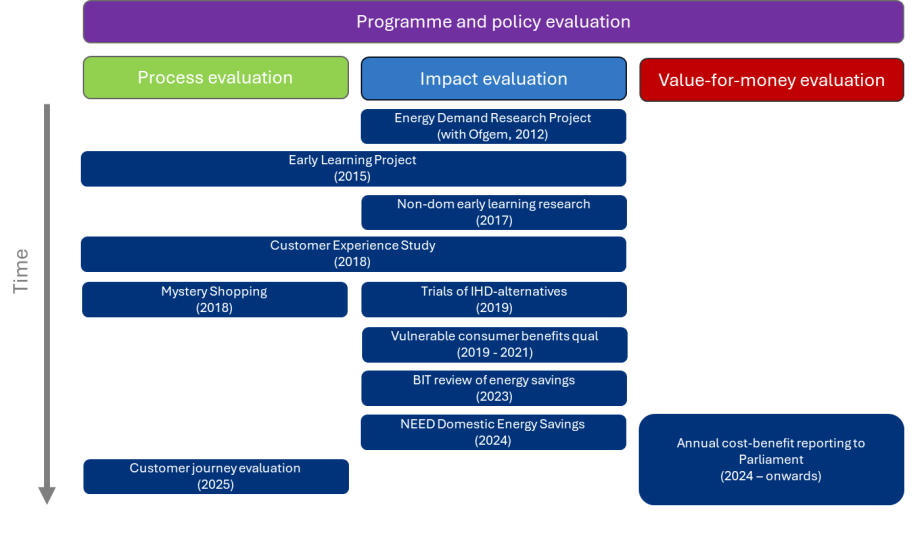
Description of Figure 1: A diagram that categorises various evaluation projects carried out over time into 3 main types: process evaluation, value-for-money evaluation, and impact evaluation, spanning from 2012 to beyond 2024. Coloured bars represent specific projects with labels indicating names and years, highlighting milestones such as the Energy Demand Research Project (2012), the Early Learning Project (2015), NEED Domestic Energy Savings (2024), and ongoing annual cost-benefit reporting to parliament (2024 onwards).
Early evaluation
The department carried out early evaluation of the roll-out in domestic sites (homes) via the Early Learning Project (ELP)[footnote 5]. The ELP used a theory-based evaluation approach, drawing on literature, primary research with customers who had received installations over 2011-2013 and a control group of traditionally metered customers, and anonymised household energy consumption data from 2 energy suppliers. In addition to measuring energy savings, the ELP identified how consumer engagement with energy feedback and adoption of energy saving behaviours could be maximised under the rollout.
Early experiences and perceptions of the non-domestic roll-out were explored through case studies of smart metered sites and telephone interviews with decision-makers across a range of organisations. This research (Smart metering in non-domestic premises: early research findings, 2017)[footnote 6], set out the ways in which organisations currently use and manage energy, the role of smart meter data in energy management, and the pathways, enablers and barriers to energy-saving via the use of such data.
Process evaluation
Following this early evaluation and research, the department has carried out primary research alongside industry data collection to monitor and assess the ongoing implementation of the roll-out. This has included:
1. The customer experience study[footnote 7] (2017), a mixed methodology (survey and qualitative) research project that aimed to test, update and further validate the evidence base generated by the Early Learning Project, as well as capture the impact of policy developments since that project.
2. Two waves of mystery shopping[footnote 8],[footnote 9] carried out in 2018 (domestic consumers) and 2023 (domestic and non-domestic consumers), which provided high-quality real-world data on actual consumer experiences of booking and receiving a smart meter installation.
Findings from these and other projects have been embedded through ongoing monitoring of indicators collected from energy suppliers, stakeholders and third-party research. This monitoring provides the department with evidence on key stages of the customer journey as well as leading indicators of longer-term benefits (where outcomes may not immediately be measurable). An example of this is the domestic customer journey, where early evaluation identified the importance of energy efficiency advice provision and consumer engagement with the smart meter In-Home-Display, which are now monitored through a range of industry and third-party data.
Impact evaluation and cost and benefits reporting
As the roll-out has progressed, the department has continued to collect updated evidence on impacts, including research to test existing benefits (i.e. those identified in the original Cost-Benefit Analysis) and explore new areas, for example where innovation is building on the platform offered by smart metering. Recently, the department has also started publishing annual estimates of the net cost and benefit impact of smart meters installed to date.
Energy consumption impacts
While the Early Learning Project assessed energy consumption impacts for consumers who had meters installed in the programme’s foundation stage (2011-2013), as these customers were potential early adopters, and following changes to the policy framework, additional evidence in this area was collected. The department commissioned an independent review and synthesis of quasi experimental studies on energy consumption impacts carried out by energy suppliers[footnote 10], and subsequently carried out and published in house analysis of the National Energy Efficiency Data-Framework (NEED) database exploring the same question[footnote 11].
Wider consumer benefits
While energy savings are a significant anticipated benefit of the smart meter roll-out, there are a range of additional benefits experienced by consumers (for example convenience resulting from easily available energy feedback), including some that were not included in the original Cost-Benefit Analysis. To identify these, and gather evidence on their realisation, the department carried out large scale qualitative research,[footnote 12] to supplement quantitative insights from surveys, with consumers who might experience barriers to realising benefits from smart metering (also referred to as vulnerable consumers).
Innovation
The department has supported innovation building on the platform offered by smart metering in the domestic (Smart Energy Savings, SENS[footnote 13]) and non-domestic (Non-Domestic Smart Energy Management Innovation Competition, NDSEMIC[footnote 14]) sectors. These projects have included evaluation of consumer impacts. In addition, the department worked with the Behavioural Insights Team and energy suppliers to evaluate (through a programme of randomised control trials) whether energy feedback apps could deliver equivalent energy consumption reductions to In-Home-Displays[footnote 15]. Most recently the SMETER[footnote 16] Innovation competition has funded the development and testing (through a technical evaluation) of new methods for measuring the thermal performance of homes using smart meter and other data. Follow-up work is now considering options for wider implementation of in-use monitoring, and the department will review how evaluation can support this in due course.
Costs and benefits reporting
Since 2024, the department has provided annual reporting to Parliament on the costs and benefits of the rollout to date. This analysis uses a ‘dead-stop’ scenario, which uses the programme’s 2019 Cost Benefit Analysis (2019 CBA) as an underlying framework, adjusted for observed data and evidence, to assess the Net Present Value (NPV) resulting from already completed installations. The most recent report[footnote 17]covered the costs and benefits of meters installed up to the end of 2024.
Future evaluation plans (2025 onwards)
The roll-out has coincided with significant changes in the energy market as well an evolving policy landscape, including the introduction of the Clean Power 2030 target which will accelerate decarbonisation of electricity in Great Britain. Of direct relevance, flexibility is an increasing feature of the energy market, with consumer uptake of low-carbon (and potentially flexible) technologies growing and new tariffs being offered by energy suppliers that are only available on smart meters.
To ensure the department continues to have robust evidence to support the realisation of benefits, as well as to provide updated evidence on the impacts of the roll-out, a new phase of cross-cutting evaluation has started that will investigate current consumer experiences, as well as explore emerging benefits across consumers and other market participants.
Objectives and scope
The new phase of evaluation has been developed with the following high-level objectives.
- Improve and re-baseline SMIP’s understanding of the impacts of smart metering on domestic consumers, in the context of a mature rollout with high levels of national coverage.
- Improve SMIP’s understanding of emerging impacts of the smart metering system, including system-level impacts in the areas of networks and flexibility which require wide smart meter coverage to be realised.
- Build SMIP’s evidence base on the shape, attitudes, experiences and future of the smart meter installer workforce.
- Improve and re-baseline SMIP’s understanding of impacts on non-domestic consumers.
The planned evaluation will address these objectives within the following 5 themes:
-
Domestic consumer impacts. Smart metering has changed the information landscape and the consumer experience for households, allowing them to monitor their energy consumption in real time and improving consumer protection and convenience in various ways. Consumers are starting to realise benefits from smart-enabled products and services.
-
Flexibility and network management. Smart metering is an enabler of the growing market in flexibility and demand-side response, particularly in the context of low-carbon technologies like electric vehicles. The additional data and functionality provided by smart metering is also changing how electricity networks conduct their day-to-day business.
-
Installers and workforce. In order to deliver the rollout and maintain smart services into the future, energy suppliers have needed to build and maintain a skilled workforce of smart meter installers.
-
Wider individual and social benefits. Emerging evidence suggests smart metering is having benefits and impacts beyond those which were included in the 2019 Cost Benefit Analysis.
-
Non-domestic consumer impacts. Like domestic consumers, non-domestic consumers benefit from the ability to monitor their energy consumption using fine-grained consumption data. However, the policy framework which allows them to do so has only recently been strengthened, and as a result the theory of change for non-domestic benefits is less mature.
Planned approach
Data collection activities in this phase of evaluation are anticipated to address multiple themes and objectives, although some will be weighted towards particular areas. The following primary research will be carried out:
- A survey of smart metered and traditionally metered domestic consumers (allowing comparisons between the 2 groups).
- Qualitative interviews with domestic consumers (who participated in the survey).
- A survey of smart metered and traditionally metered non-domestic consumers.
- Qualitative interviews with non-domestic consumers (who participated in the survey).
- Qualitative research with networks and other flexibility and smart data market participants.
Given the challenges of assessing causality in a complex environment and where the intervention is well established (making representative control groups or counterfactuals challenging to obtain) this evaluation is expected to use a theory-based mixed-methods approach, though this may be supplemented by matched comparisons carried out using the consumer survey.
Data collection will take place over Q3 2025 to Q2 2026, with final analysis and reporting to the department anticipated to be complete by Q4 2026.
-
DESNZ (2026) ‘Smart metering policy framework post 2025: government response’ ↩
-
Alt HAN programme delivers a technical solution to properties where smart meters and the In-Home Display (IHD) are too far apart from each other to communicate using standard smart metering equipment. ↩
-
In addition, the department has completed a number of Cost Benefit Assessments on the smart metering roll-out since the programme’s inception, with the most recent completed in 2019. ↩
-
DECC (2015) ‘Smart Metering Early Learning Project and Small-Scale Behaviour Trials’ ↩
-
BEIS (2017) ‘Smart metering non-domestic ‘early learning’ research’ ↩
-
BEIS (2018) ‘Smart meter customer experience study 2017 - GOV.UK’ ↩
-
BEIS (2019) ‘Smart meters: progress on realising benefits for consumers - GOV.UK’ ↩
-
BEIS (2019) ‘Smart Meter Booking and Installation Process: evaluation’ ↩
-
Behavioural Insights Team (2023) Independent review of energy supplier evidence on the impacts of the smart metering roll-out on household energy use ↩
-
DESNZ (2024) ‘Monitoring smart meter energy savings using the National Energy Efficiency Data-Framework’ ↩
-
NatCen (2021) ‘Maximising the benefits of smart metering for consumers - National Centre for Social Research’ ↩
-
BEIS (2019) ‘Non-Domestic Smart Energy Management Innovation Competition: interim research and evaluation’ ↩
-
BEIS (2019) ‘Alternatives to smart meter In-Home Displays (IHDs): trials and conclusions’ ↩
-
BEIS (2022) ‘Smart meter enabled thermal efficiency ratings (SMETER) technologies project: technical evaluation’ ↩
-
DESNZ (2025) ‘Smart metering implementation programme: costs and benefits report, Parliamentary Report - 2025’ (PDF) ↩