Regulatory activity in all types of children’s homes and supported accommodation providers between 1 April 2025 and 31 March 2026
Updated 18 August 2026
Applies to England

© Crown copyright 2026
This publication is licensed under the terms of the Open Government Licence v3.0 except where otherwise stated. To view this licence, visit nationalarchives.gov.uk/doc/open-government-licence/version/3 or write to the Information Policy Team, The National Archives, Kew, London TW9 4DU, or email: psi@nationalarchives.gov.uk.
Where we have identified any third party copyright information you will need to obtain permission from the copyright holders concerned.
This publication is available at https://www.gov.uk/government/publications/regulatory-activity-in-all-types-of-childrens-homes/regulatory-activity-in-all-types-of-childrens-homes-and-supported-accommodation-providers-between-1-april-2025-and-31-march-2026
Introduction
An important part of Ofsted’s work is the regulation of children’s social care settings. At the end of March 2026, there were 6,700 active or suspended children’s social care providers in England. In addition, 153 local authorities provide children’s social care. Most of the active or suspended providers were children’s homes (4,800) and supported accommodation providers (1,220).
This annual transparency data covers regulatory activity in children’s social care settings, with a focus on children’s homes and supported accommodation.
Types of regulatory activity
We investigate children’s social care settings when we have evidence that there is cause for concern or that they may not be compliant with the regulations that govern their provision of care. In these cases, we take action where appropriate. You can read more about the regulations for children’s homes and supported accommodation.
Actions include, but are not limited to: logging a key line of enquiry for the next inspection, continuing to monitor the case, and bringing forward the next inspection. In more serious cases, enforcement action may take the form of restrictions on accommodation, or suspension or cancellation of the provider. You can read more about our social care enforcement policy.
Providers must notify Ofsted, as the regulator for children’s homes and supported accommodation in England, about certain types of serious incident that happen to children living with them and what they have done in response. (The list of notifiable incidents differs for children’s homes and supported accommodation.)
By law, all children’s homes must have a registered manager, and all supported accommodation providers must have a registered service manager. Some operate with a manager who is not registered, or with no manager at all. This is illegal, and can affect their inspection judgement. More information on the role and responsibilities of a children’s home manager can be found in the relevant guidance.
We assess any information we receive about potential unregistered children’s homes and supported accommodation settings. Most of these cases are opened when we receive information about a placement from the placing local authority (the local authority responsible for finding a suitable place for a child to live), although placing local authorities are not legally obliged to tell Ofsted about these placements. More context around unregistered children’s homes can be found in our unregistered children’s homes transparency data.
Children’s homes of all types
Three-month condition in children’s homes of all types
When a children’s home has no immediate intention of operating for at least 3 months, we can impose a condition requiring it to give us 3 months’ notice if it intends to admit a child. This means that we do not have to inspect the setting routinely. As at 31 March 2026, we had imposed this condition on 71 children’s homes (1%). This represents a potential capacity of 273 places. The number of children’s homes subject to the 3-month condition has increased since last year, when it was 52, although the proportion has remained stable at 1%.
Compliance, investigation and enforcement
Cases
Between 1 April 2025 and 31 March 2026, we investigated 3,440 cases relating to 1,990 children’s homes of all types that held a registered status during the reporting year. In this period, there were one or more cases logged against 40% of all children’s homes that were active during the year.
Some of these cases fell into the category of ‘child protection concerns’. Between 1 April 2025 and 31 March 2026, we recorded 610 child protection concerns, relating to 510 children’s homes of all types that were active during the year.
Actions
Of the 3,440 total cases, 2,480 (72%) had one or more actions recorded by the end of March 2026. Table 1 shows the number and type of actions recorded in 2025–26.
Table 1: Number and type of actions taken in children’s homes of all types in 2025–26
| Action taken | Number of actions in 2025–26 |
|---|---|
| Continued monitoring by allocated inspector | 1,000 |
| Key line of enquiry for next inspection | 830 |
| Other action taken not included in other categories | 750 |
| Compliance and enforcement action | 420 |
| Inspection brought forward | 400 |
| Monitoring visit | 270 |
| Provider-led investigation | 210 |
| Referred to child protection team in the relevant local authority | 84 |
| Referred to another agency | 77 |
| Total actions taken | 4,050 |
As at 31 March 2026, 28% of the cases had no actions logged, indicating that responses were pending.
Multiple actions can be taken against an individual case, so the total number of actions may add up to more than the total number of cases with actions logged against them.
Enforcement
Between 1 April 2025 and 31 March 2026, we carried out the following enforcement actions across all children’s homes:
-
140 restrictions of accommodation
-
62 suspensions
-
8 notices of cancellation
Of the 61 homes that had received suspensions at some point during the year, 14 have since resigned, 1 has closed, 3 have been cancelled, 29 have become active and 14 remained suspended as at 31 March 2026.
Additionally, 650 compliance notices were issued to a total of 250 providers.
Incident notifications
Between 1 April 2025 and 31 March 2026, we received 55,800 notifications from children’s homes. These came from a total of 4,540 providers.
The most common classification for these, accounting for 59% of all notification reasons from children’s homes, was ‘other incident relating to a child which the registered person considers to be serious’. ‘Other’ notifications cover any incident that the registered person considers to be serious but that does not fit under one of the existing categories. The next highest category was ‘incident requiring police involvement’ (24%). Police may be called because a child has gone missing, has been a victim of sexual or criminal exploitation or another crime, has disclosed a historical safeguarding concern, or is suspected of committing a crime.
Figure 1: A breakdown of the types of events contained in notifications made by children’s homes from 1 April 2025 to 31 March 2026
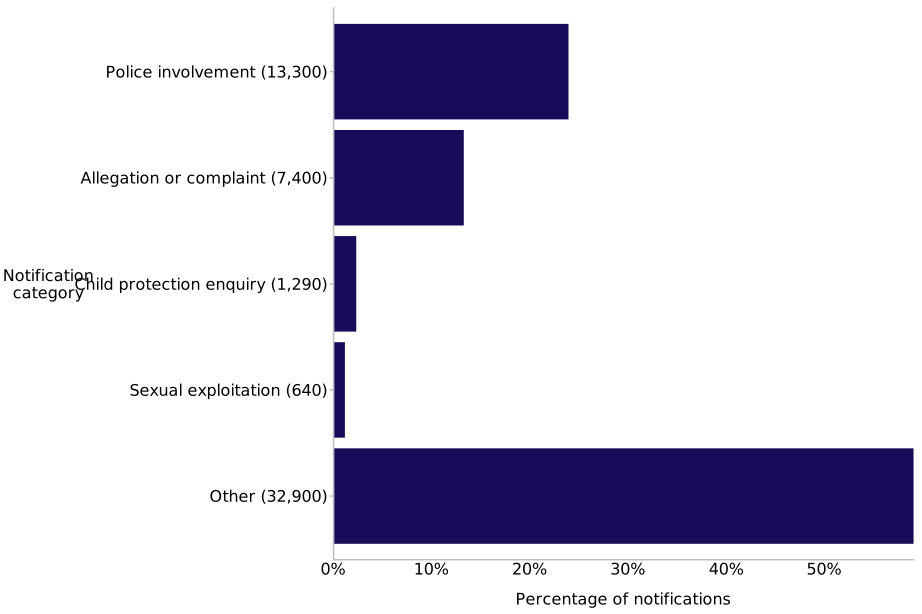
Note: The following categories each accounted for less than 1% of all notifications and have not been included in the above chart: referral, death of a child, unauthorised contact, missing, serious illness or accident.
View data in an accessible format.
Registered managers
As at 31 March 2026, 970 (20%) children’s homes in England that were active or suspended no longer had a registered manager in post. Last year, the figure was 740 (19%). Of the children’s homes without a registered manager in post as at 31 March 2026, 36% had no manager in post at all and 64% had a manager in post who was unregistered or not yet fully registered. Last year, 46% of children’s homes without a registered manager had no manager at all in post.
Figure 2: Percentage of active or suspended children’s homes without a registered manager or manager in post by region, as at 31 March 2026
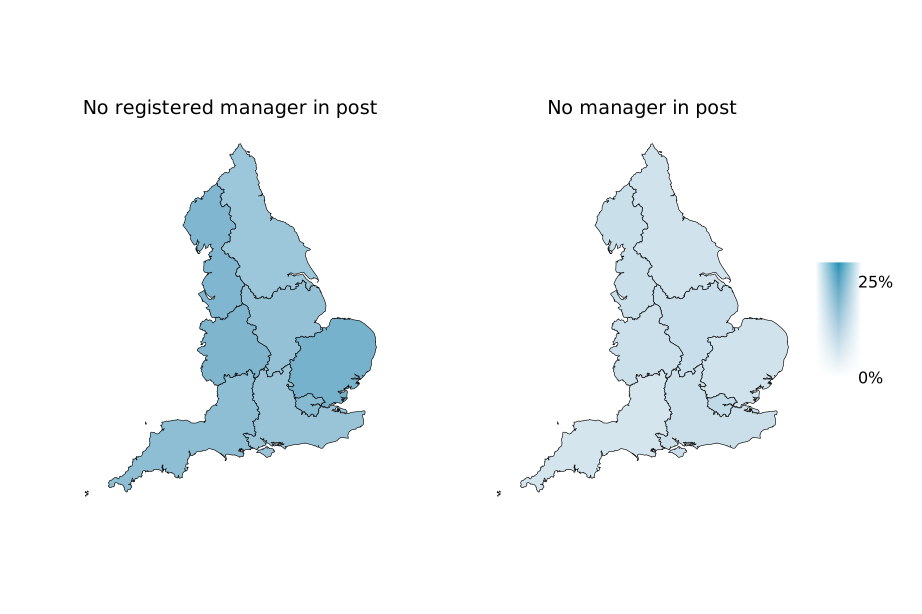
Note: In both maps, a lighter hue indicates a lower percentage.
View data in an accessible format.
Supported accommodation
Compliance, investigation and enforcement
Cases
Between 1 April 2025 and 31 March 2026, we investigated 830 cases about 400 supported accommodation providers that held a registered status during the reporting year. In this period, there were one or more cases logged against 32% of all supported accommodation providers that were active during the time.
Some of these cases fell into the category of ‘child protection concerns’. Between 1 April 2025 and 31 March 2026, we recorded 210 child protection concerns, relating to 120 supported accommodation providers.
Actions
Of the 830 total cases, 700 (84%) had one or more actions recorded by the end of March 2026. Table 2 shows the number and type of actions recorded during 2025–26.
Table 2: Number and type of actions taken in supported accommodation in 2025–26
| Action taken | Number of actions in 2025–26 |
|---|---|
| Continued monitoring by allocated inspector | 560 |
| Key line of enquiry for next inspection | 160 |
| Other action taken not included in other categories | 120 |
| Inspection brought forward | 38 |
| Compliance and enforcement action | 33 |
| Monitoring visit | 18 |
| Referred to child protection team in the relevant local authority | 17 |
| Provider-led investigation | 13 |
| Referred to another agency | 12 |
| Total actions taken | 960 |
As at 31 March 2026, 16% of the cases had no actions logged, indicating that responses were pending.
Multiple actions can be taken against an individual case, so the total number of actions may add up to more than the total number of cases with actions logged against them.
Enforcement
Between 1 April 2025 and 31 March 2026, there were:
- 21 restrictions of accommodation
- 10 suspensions
- 2 notices of cancellation
As at 31 March 2026, of the 10 supported accommodation providers that had received suspensions during the year, 3 have since resigned, 1 has been cancelled, 3 have become active and 3 remained suspended.
Additionally, we issued 170 compliance notices to a total of 56 providers.
Incident notifications
Between 1 April 2025 and 31 March 2026, we received 7,830 notifications. These came from a total of 740 providers.
The most common classification for these, accounting for 46% of all notification reasons from supported accommodation providers, was ‘other incident relating to a child which the registered person considers to be serious’. The next highest category was ‘incident requiring police involvement’ (35%).
Figure 3: A breakdown of the types of events contained in notifications made by supported accommodation providers from 1 April 2025 to 31 March 2026
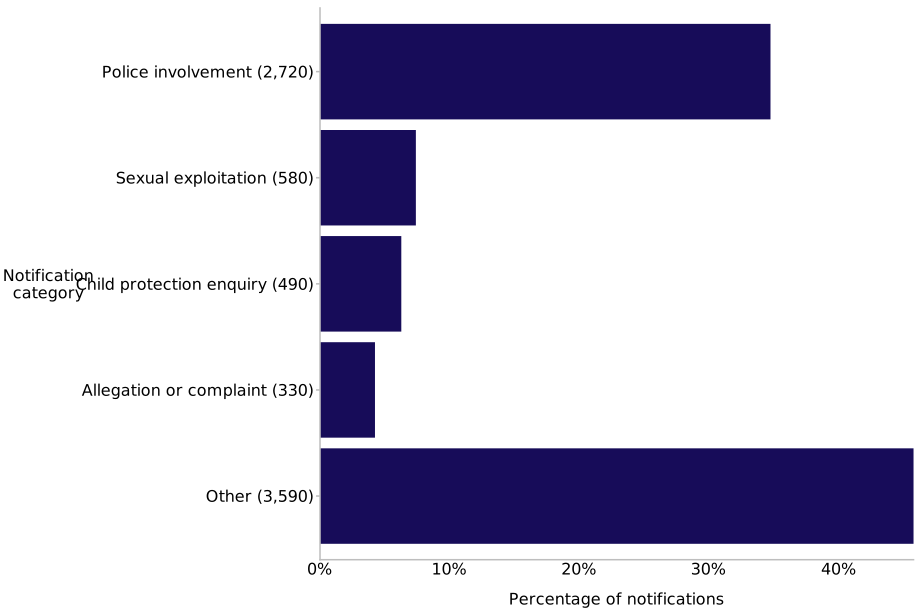
Note: The following categories each accounted for less than 1% of all notifications and have not been included in the above chart: restraint, referral, death of a child.
View data in an accessible format.
Registered service managers
As at 31 March 2026, 141 (12%) supported accommodation providers who were active or suspended no longer had a registered service manager in post. Of the supported accommodation providers without a registered service manager as at 31 March, 58 no longer had a manager in post at all, accounting for 5% of supported accommodation providers in England.
Figure 4: Percentage of active or suspended supported accommodation providers without a registered manager or manager in post, by region, as at 31 March 2026
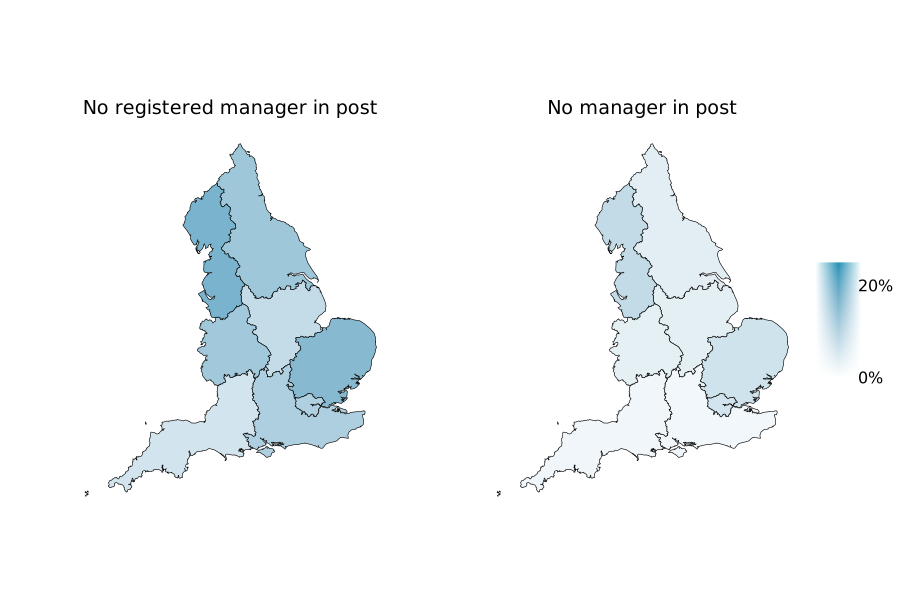
Note: There is 1 supported accommodation provider located in Scotland. This has been excluded from the above visualisation. In both maps, a lighter hue indicates a lower percentage.
View data in an accessible format.
Unregistered provision between 1 April 2025 and 31 March 2026
Between 1 April 2025 and 31 March 2026, we opened 850 cases into potential unregistered children’s homes and supported accommodation settings. In 2025–26, the placing local authority was the source of information for 57% of the cases that we opened.
Of the 850 potentially unregistered opened cases in 2025–26, 20 (2%) did not need to be registered, and 710 (84%) should have been registered, with the remaining 120 (14%) not yet determined. Settings that have been identified as unregistered settings have received warning letters. As at 31 March, of the 850 cases of potential unregistered settings opened in 2025–26, 457 (54%) cases had been closed.
Regulatory activity in other types of children’s social care providers between 1 April 2025 and 31 March 2026
We also regulate and register other types of children’s social care provision. Between 1 April 2025 and 31 March 2026, there were 4 restrictions of accommodation issued to 4 residential family centres, 4 suspensions issued to 4 providers (1 independent fostering agency and 3 residential family centres) and 1 cancellation issued to an independent fostering agency. During this period, we investigated 460 cases about 260 providers of other types.
Of these cases, 200, from 120 providers, were in the category of ‘child protection concerns’.
Notes and methodology
Data source
The data for regulatory activity in all types of children’s homes and supported accommodation providers between 1 April 2025 and 31 March 2026 was extracted from Ofsted’s administrative systems on 31 March 2026. Some information relating to this period is received and processed after this date and, as such, is not reflected in this publication.
Our reporting is accurate to the administrative systems that we report from. Errors in recording data and manual data entry may affect the quality of the source data. We make every effort to ensure that the data is produced without any errors.
Regions
Regional totals in this publication are based on the provider’s Ofsted region, which is an operational category and does not always align precisely with a provider’s geographical location. As a result, figures may not be directly comparable with analyses that use other regional boundaries, such as government office regions.
Supported accommodation
Supported accommodation became a regulated form of provision in April 2023. Supported accommodation providers that applied to register before the deadline were allowed to continue operating legally while their application was processed. Those that missed the registration deadline and continue to operate while awaiting registrations are operating illegally.
Methodology
Users can find out more about how Ofsted applies the code of practice for statistics to our statistical releases on our Ofsted standards for official statistics page.
Rounding
Numbers in this report are rounded as follows:
- numbers under 100 are not rounded
- numbers between 100 and 1,000 are rounded to 2 significant figures
- numbers over 1,000 are rounded to 3 significant figures
Contacts
If you are a member of the public and have any comments or feedback on this publication, please contact Clare Wilkinson at socialcaredata@ofsted.gov.uk.
Acknowledgments
Thanks to Jonny Shine for his contribution to this statistical release.
Glossary
Definitions of terms are in the statistical glossary.
Annex: data tables for figures
This section contains the underlying data in an accessible table format for all figures.
Data for Figure 1: A breakdown of the types of events contained in notifications made by children’s homes from 1 April 2025 to 31 March 2026
| Type of event | Percentage |
|---|---|
| Police involvement (13,300) | 24% |
| Allegation or complaint (7,400) | 13% |
| Child protection enquiry (1,290) | 2% |
| Sexual exploitation (640) | 1% |
| Other (32,900) | 59% |
See Figure 1.
Data for Figure 2: Percentage of children’s homes without a registered manager in post, by region, as at 31 March 2026
| Region | Percentage with no registered manager | Percentage with no manager |
|---|---|---|
| East of England | 23% | 7% |
| East Midlands | 19% | 8% |
| London | 20% | 8% |
| North East, Yorkshire and Humber | 17% | 7% |
| North West | 22% | 7% |
| South East | 18% | 8% |
| South West | 21% | 6% |
| West Midlands | 23% | 7% |
See Figure 2.
Data for Figure 3: A breakdown of the types of events contained in notifications made by supported accommodation providers from 1 April 2025 to 31 March 2026
| Type of event | Percentage |
|---|---|
| Police involvement (2,720) | 35% |
| Sexual exploitation (580) | 7% |
| Child protection enquiry (490) | 6% |
| Allegation or complaint (330) | 4% |
| Other (3,590) | 46% |
See Figure 3.
Data for Figure 4: Percentage of supported accommodation providers without a registered service manager in post, by region, as at 31 March 2026
| Region | Percentage with no registered manager | Percentage with no manager |
|---|---|---|
| East of England | 16% | 6% |
| East Midlands | 8% | 4% |
| London | 11% | 6% |
| North East, Yorkshire and Humber | 13% | 4% |
| North West | 17% | 8% |
| South East | 11% | 2% |
| South West | 6% | 2% |
| West Midlands | 12% | 3% |
See Figure 4.