Fisheries management plan for queen scallop
Updated 16 December 2025
Applies to England

© Crown copyright 2025
This publication is licensed under the terms of the Open Government Licence v3.0 except where otherwise stated. To view this licence, visit nationalarchives.gov.uk/doc/open-government-licence/version/3 or write to the Information Policy Team, The National Archives, Kew, London TW9 4DU, or email: psi@nationalarchives.gov.uk.
Where we have identified any third party copyright information you will need to obtain permission from the copyright holders concerned.
This publication is available at https://www.gov.uk/government/publications/queen-scallop-fisheries-management-plan-fmp/queen-scallop-fisheries-management-plan
Executive summary
This fisheries management plan (FMP) covers queen scallops (Aequipecten opercularis) in English waters only.
The queen scallop FMP was developed by the non-quota species Shellfish team in the Department for Environment, Food and Rural Affairs (Defra) in consultation with industry, through the Queen Scallop Management Group, and other interest parties. Defra has also drawn on a report produced by consultants ABPmer as a key evidence source, which collated information on the queen scallop fishery in English waters and considered potential management options that could be applied.
What is an FMP?
An FMP is an evidence-based action plan that charts a course to sustainable fisheries. They are long-term plans that must be reviewed and, if necessary, revised at least every 6 years. An FMP sets out goals for the target fishery (or fisheries), together with the policies and management interventions necessary to achieve these goals. FMPs will be reviewed and updated to ensure they respond to new evidence and practical experience to remain effective.
Why an FMP for queen scallops?
Queen scallop fisheries contribute to coastal communities through employment but there is currently a lack of management in English and wider UK waters to protect stocks from overexploitation. Additional management action is therefore needed to ensure queen scallop fishing is sustainable. This will be achieved by conserving the stocks to secure their future and the future of the industry that depends on them.
Queen scallops have been prioritised for an FMP due to the stocks’ vulnerability to over-exploitation, lack of evidence to assess and monitor the state of the stock, and the potential environmental effects of the fishery.
Queen scallops are found around the British Isles, with the main UK queen scallop fishery based in the Irish Sea and around the northern Welsh waters and the Isle of Man (IOM). Similarly, the north-eastern Irish Sea is the location of the main queen scallop grounds in English waters. Landings of queen scallops have also been reported in the western English Channel in some years, although it is likely that this is an opportunistic fishery rather than a targeted fishery, as the landings were low and inconsistent.
There is currently little queen scallop-specific management in the UK, and for several years there has been concern from the catching sector about the potential for fishing effort to increase if the market value of queen scallops increases. This has been a contributing factor to queen scallops having been prioritised for an FMP in English waters.
At present, there is insufficient evidence to determine maximum sustainable yield (MSY) for queen scallop stocks in English waters, as set out in section 6(3) of the Fisheries Act 2020. The International Council for the Exploration of the Sea (ICES) does not assess or provide advice for queen scallops, and no formal stock assessment units have been agreed in English waters or around the UK. Available information on queen scallops in English waters is currently restricted to fishing activity data, which on their own, do not provide sufficient evidence for the determination of sustainable catches. Landings have decreased in recent years compared to a peak in 2013, but not enough information is currently available to understand the current state of the stocks.
Queen scallops are known to have a patchy distribution, even within individual fishing grounds, and currently insufficient information exists about their biology and ecology to allow a scientific identification of distinct populations.
FMP vision and policy goals
The overarching aim of this FMP is to set out steps to obtain the scientific evidence necessary to enable an assessment of the stock’s maximum sustainable yield (section 6(3)(b)(ii) of the Act), and to inform the development of management for the long-term sustainability of UK queen scallop fisheries
Five policy goals have been identified to help achieve the overall aim of the FMP and these link to the Act objectives. As noted in this FMP, there is currently insufficient evidence to determine MSY for queen scallop stocks in English Waters.
The 5 policy goals are as follows.
-
Develop proposals for a comprehensive data collection programme for UK-wide queen scallop fisheries, which supports a data-rich future and results in the establishment of a reliable time series that facilitates well-informed, sustainable management.
-
Seek opportunities for strengthening existing measures in English waters to increase stock protection while the evidence base improves.
-
Assess the interactions with the marine environment and potential impacts associated with queen scallop fisheries, and develop an action plan setting out appropriate measures to reduce damaging impacts.
-
Explore the impacts of changes in marine spatial use on queen scallop fisheries from an environmental, economic, and social perspective.
-
Develop climate change mitigation and adaptation measures for shared UK queen scallop fisheries.
Opportunities to increase protection to stocks while the evidence base improves will also be explored. There are 6 measures that will contribute towards achieving these aims.
-
Review existing queen scallop data collection programmes and approaches applied across the UK, and identify key information gaps and evidence requirements.
-
Consider increasing MCRS for queen scallops in English waters from 40mm to 55mm.
-
Consider exploring potential options for introducing gear specifications for queen scallop fishing in English waters.
-
Review existing queen scallop management measures applied across the UK and consider replicating measures in English waters to increase stock protection.
-
Consider developing a scientifically based fisheries management framework, based on output or input controls.
-
Management framework: assess and mitigate the effects of queen scallop fishing on seafloor integrity.
Introduction
This Queen Scallop FMP has been prepared and published for the purposes of the Fisheries Act 2020 (‘the Act’), in accordance with the policies and proposals in the Joint Fisheries Statement (JFS) and to meet the requirements of the Environmental Assessment of Plans and Programmes Regulations 2004 (the SEA regulations). The relevant authority for this FMP is Defra.
In addition to meeting the requirements of the Act for FMPs, this FMP also supports the implementation of wider commitments on protecting the marine environment, restoring biodiversity, and addressing climate change. In particular, the Environmental Improvement Plan 2025 restated the commitment to deliver FMPs. Each FMP also supports commitments under the UK Marine Policy Statement, the UK Marine Strategy, the marine wildlife bycatch mitigation initiative and the Climate Change Act 2008.
The long-term aim of this plan is to ensure future fisheries management maintains or increases levels of the English queen scallop stocks at or above maximum sustainable yield (MSY) in accordance with section 6(3) of the Act. Policy goals and management measures are designed to achieve and maintain this vision. This plan brings together existing measures for queen scallops and begins to identify where evidence gaps exist and what is required to fill those gaps, to enable the necessary protection for stocks now and in the long term.
Fishing for queen scallops has an impact on the environment, particularly the seabed. This FMP includes goals to ensure that the environmental impacts associated with queen scallop fishing are understood. Where queen scallop fisheries are considered to have an adverse impact on the marine environment, action will be taken to avoid, remedy or mitigate such impacts.
The Act includes a precautionary objective where the absence of sufficient scientific information should not be used to justify postponing or failing to take management measures to conserve target species, associated or dependent species, non-target species or their environment.
When applying the precautionary approach, the risk of unintended consequences, such as fishing effort being limited unnecessarily, will be considered and mitigated where possible.
This FMP will adopt an evidence-based approach, with management measures developed and implemented based on the best available evidence. It will also identify evidence gaps and how these will be addressed. Additional information on the fishery, existing measures and evidence gaps has been included in a supporting evidence statement which was published at the end of 2024.
Scope of the queen scallop FMP and description of the fishery
This FMP applies to queen scallop in English waters only.
Description of the fishery
This section includes information on the biology, distribution and fleet characteristics of the UK queen scallop fishery.
Biology and lifecycle
Queen scallops are a filter-feeding bivalve mollusc which usually grow to a maximum shell height of around 90mm (Schmidt and others, 2008). It is commonly found on sand or gravel along the British and Irish coasts, up to a depth of about 100 metres (m) (Carter, 2008) but predominantly at depths between 20m to 45m (Brand, 2006b).
Queen scallops have a natural life expectancy of 6 to 10 years. Common predators are starfish, demersal fish and crabs (Hayward and Ryland, 1995). Queen scallops reach sexual maturity when they are about 1 year old (Hayward & Ryland, 1995). However, at this time the gonads are very small and do not make a significant contribution to total egg production until the later years. As with all scallops, fecundity of the adult queen scallop is high and increases with age (Andrews and others, 2011). Spawning occurs in the spring (March to May), although secondary spawning can occur later in the year (autumn), and also periodically throughout the summer.
Stock distribution
Figure 1 shows recorded distribution of queen scallops around the British Isles since the late 1960s, where queen scallops have been or are still found within International Council for the Exploration of the Sea (ICES) divisions 4b (Central North Sea), 4c (Southern North Sea), 7a (Irish Sea), 7d (Eastern English Channel), 7e (Western English Channel), 7f (Bristol Channel),7g (Northern Celtic Sea), 7h (Southern Celtic Sea) and 7j (Southwest of Ireland).
All scallop species have a highly aggregated spatial distribution within their geographical range (Brand, 2006a), referred to as beds. Some beds are essentially permanent, being fairly distinct in their location and separated by clearly demarked areas that are unsuitable for scallops, while others vary in their location from year to year, resulting from sporadic settlement or differences in early survival (Andrews and others, 2011).
Irish Sea
The main UK queen scallop fishery is in the Irish Sea, based around the northern Welsh waters and the Isle of Man (IOM). Similarly, the north-eastern Irish Sea is the location of the main queen scallop grounds in English waters.
Queen scallops are present and fished across UK waters (Figure 2). While the scope of this FMP is English waters, data and descriptions of assessments and management measures in other parts of the UK Exclusive Economic Zone (EEZ) have been included due to the lack of information on queen scallop fisheries in English waters only, and to provide a wider overview given the shared nature of the main queen scallop fishery in the Irish Sea.
English Channel
In some years landings of queen scallops have also been reported in the Western English Channel. It is likely that this is an opportunistic fishery rather than a targeted fishery, as the landings were low and not constant throughout time (Stott and others, 2020).
In recent years there have also been reported landings of scallop as bycatch in the Fal oyster fishery in the south-west of England, locally referred to as ‘queenies’. These landings consisted of a different species of scallop (‘Mimachlamys varia’ or the variegated scallop) to that which is caught further offshore. Such landings have reduced significantly with Fal fishery licence holders returning to targeting and landing oysters. The fishery for both species is very discrete in size and scale and exists only in the Fal Fishery Order area, which is managed by the Cornwall IFCA.

Figure 1: Queen scallop fishing activity by gear type for the period 2018 to 2022.
Figure 1 description: a map showing the recorded areas of queen scallop fishing activity using various gear types around the British Isles, with Marine Protected Areas (MPAs) overlaid. The main areas of activity are in the Irish Sea, with some activity in the English Channel. The gear types shown on the map are dredgers, pots, handlines, bottom otter trawls, otter twin trawls, beam trawls and other miscellaneous types. The main gear types shown to be active are dredgers and otter trawls in the Irish Sea and beam trawls in the Channel.
Landings: UK vessels
Over the period 2012 to 2022, the volume and value of landings within the UK queen scallop fishery peaked in 2013 (Figures 2 and 3), and combined with a high market value, this led to an increase of vessels active in the fishery. By 2014 the stock size had significantly reduced, leading to a decrease in landings. The low point for both volume and value of landings for the fishery across the UK, as well as specifically in English waters, was in 2020, which was likely to reflect COVID-19 restrictions. Overall, landings volume and value were relatively low during the period 2018 to 2022 compared to previous years.
In 2022 the volume of landings in the UK queen scallop fishery was 2,979 tonnes, which included 865 tonnes (29% of the total) caught in English waters by UK vessels.
| Year | UK volume (tonnes) | England volume (tonnes) |
|---|---|---|
| 2012 | 16364.18 | 3349.77 |
| 2013 | 16548.95 | 2447.39 |
| 2014 | 9695.87 | 2069.65 |
| 2015 | 12293.45 | 3298.35 |
| 2016 | 8747.31 | 3090.17 |
| 2017 | 5281.13 | 2062.89 |
| 2018 | 2685.82 | 555.27 |
| 2019 | 2781.03 | 527.80 |
| 2020 | 1773.94 | 225.84 |
| 2021 | 2762.22 | 919.71 |
| 2022 | 2978.65 | 864.74 |
Figure 2: estimated queen scallop landings by live weight for all UK vessels fishing in UK waters and fishing in English waters only.
Figure 2 description: a bar chart showing estimated total volumes, in tonnes, of live weight queen scallops landed by UK vessels from 2012 to 2022. For each year, the graph shows the volumes which were fished in UK waters and in English waters only.
| Year | UK value (£ thousands) | England value (£ thousands) |
|---|---|---|
| 2012 | 6375852 | 1273926 |
| 2013 | 7824321 | 1054188 |
| 2014 | 4598614 | 916343 |
| 2015 | 7058273 | 1729360 |
| 2016 | 6794170 | 2139116 |
| 2017 | 5079084 | 1574970 |
| 2018 | 3553926 | 669425 |
| 2019 | 3077751 | 621514 |
| 2020 | 1133541 | 194179 |
| 2021 | 1753155 | 598485 |
| 2022 | 1838388 | 535548 |
Figure 3: estimated queen scallop landings by value for all UK vessels fishing in UK waters and fishing in English waters only.
Figure 3 description: a bar chart showing estimated values of live weight queen scallops landed by UK vessels from 2012 to 2022. For each year, the graph shows the values of the catch fished in UK waters and in English waters only.
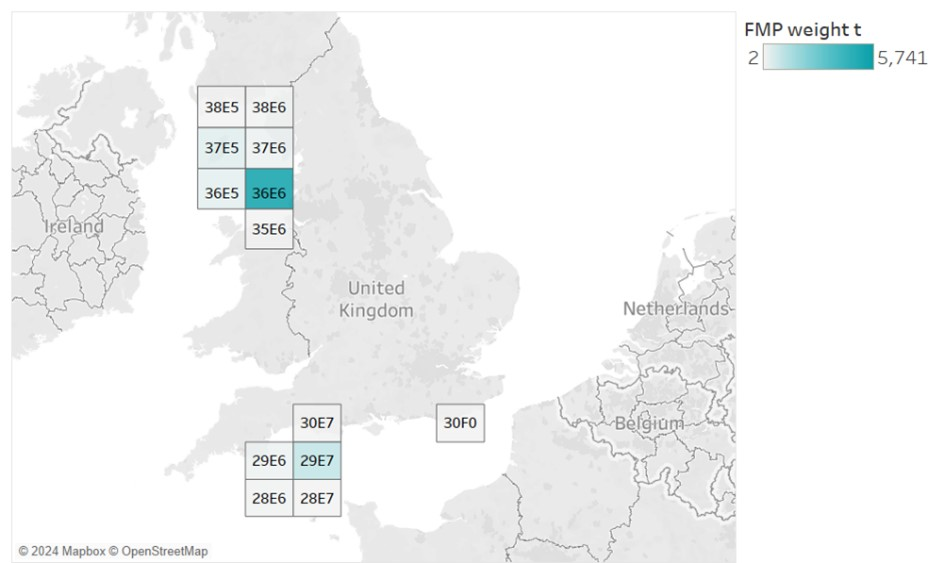
Figure 4: Spatial distribution of queen scallop landings by UK vessels in English waters, by ICES rectangle, for the period 2016 to 2022.
Cumulative landings of queen scallops amounting to less than one tonne have been removed, to highlight the main fishing areas.
Figure 4 description: a map showing the weight of queen scallop landings by UK fishing vessels in English waters, broken down by ICES rectangle, for the period 2016 to 2022. The highest amount of queen scallop landed are from the Irish Sea.
This information shows that when looking specifically at activity in English waters, a significant proportion of landings are coming from the north-eastern Irish Sea. However, since 2021 vessels have been required to specify their catch location in more detail, meaning that data is now available to separate fishing activity in the IOM waters from activity in UK waters.
This data on total landings in English waters since 2021 suggests that a significant proportion of historic landings that were proportionally allocated to UK waters were, in fact, caught in IOM waters. The area that produces the most queen scallop landings is in ICES rectangle 36E6, which is located north of Wales. The second largest volume landed was from ICES rectangle 29E7, in the English Channel.
Landings: EU vessels
On average, landings of queen scallops by EU vessels make up 15% of the total landings from English waters. EU vessel activity shows a similar pattern to UK vessels, decreasing significantly since 2012, although for EU vessels the lowest landings were recorded in 2015. Unexpectedly, there was a peak in landings from EU vessels in 2019, which coincides with some of the lowest historical landings for UK vessels. This may be a result of altered fishing activity in anticipation of the UK leaving the EU and the expected impact that new legislation might have for vessels without a historical track record. This also coincides with an increase in the value of landings of queen scallop by EU vessels.
Vessel numbers
Since 2012 the total number of UK vessels landing queen scallops from UK waters has declined from 82 vessels in 2012 to 42 vessels in 2022. The number of vessels fishing in English waters declined significantly in 2020 (due to a reduction in English and Northern Irish vessels). There was a further reduction in 2021 (as improved reporting provided a more realistic picture of the activity of IOM vessels) to the lowest recorded number of vessels on record (23).
In 2022 there were 29 vessels that reported landings of queen scallops from English waters, but of these, only 19 vessels landed more than one tonne in total. This further demonstrates the opportunistic nature of the fishery, where there are several vessels actively targeting queen scallops, but most catch it as bycatch or more sporadically.
Data seems to show that this opportunistic fishery applies more to English vessels than to any other nationality, as the total number of English vessels is more variable each year and there are only a small number catching more than one tonne. This opportunistic approach to fishing queen scallops in English waters was also documented by Stott and others (2020) and Lawler (2020).
The fluctuation in vessel numbers in the fishery may also be a result of the ‘boom and bust’ nature of the fishery, in which the biomass naturally fluctuates as a result of queen scallops being a short-lived species, with populations heavily reliant on recruitment levels. It may also be a result of changes in the market demand for and value of queen scallops.
Fleet characteristics
The queen scallop fishery in English waters is primarily targeted by vessels that are over 18m and less than 24m in length. During the period 2013 to 2017 there were also significant landings from vessels between 24.01m and 40m in length. Historical landings from under 12m vessels are small, while Marine Management Organisation (MMO) data shows that vessels over 15m landed on average 80% of queen scallops from English waters since 2012. Fishing effort of vessels 15m or above harvesting queen scallops is generally higher than that of under 15m vessels (Stott and others, 2020).
Gear type
Queen scallops in English waters are primarily fished using dredge gear (84%), except for IOM-registered vessels, which predominantly use otter trawls. Some English and Northern Irish vessels are also licensed to use otter trawls to fish for queen scallops in IOM waters. Landings of queen scallop using beam trawl and other mobile gears are also recorded from English waters, which are likely a result of bycatch from other fisheries, given the low landings of queen scallop seen by these gear types.
The Scallop Fishing (England) Order 2012 defines the legal specifications and maximum number of dredges that can be deployed for the capture of king scallops. There is no equivalent legislation applied in English waters for queen scallops. The number of nets or dredges deployed during fishing operations varies, depending on the size and power of the vessel.
Recreational fishing for queen scallops, predominantly dive fishing, is managed by the IFCAs through issuing of licences, and is understood to be minimal in comparison with the trawl and dredge fishery.
Further information on the species, fishery and fleet characteristics, including fishing gears, has been included in a supporting evidence statement which will be published alongside the FMP at the end of 2024.
Economic and social importance
This section includes information on the economic importance and port reliance of the queen scallop fishery for vessels.
Economic dependence by fleet segment
Seafish economics data shows that queen scallops make up less than 5% of revenue for most vessels in the fishery, and there have been no vessels relying on queen scallops to make up more than 40% of their revenue since 2017.
Recently, most landings by weight have been caught by vessels that rely on queen scallops for less than 20% of their revenue, with only one vessel in 2021 with a dependency over 20% on queen scallop. However, that vessel landed 59% of the total weight of queen scallops from English waters, representing between 20% to 40% of its revenue.
The queen scallop fishery does not operate year-round, and even the largest operators switch to targeting king scallops for part of the year to maintain their income. The importance of queen scallop as a target species varies between boats, with some fishing queen scallops as a target species, whereas others land the species infrequently or land small amounts when the opportunity arises (Marine Scotland 2017).
Since 2016 there has been a steady decline in the number of vessels dependent on the queen scallop fishery for over 20% of their income. Most of these vessels are over 18m, with only one 12m to 18m vessel more than 20% economically dependent on queen scallops in 2017. Since 2016 there have been no vessels under 12m that are more than 20% economically dependent on the queen scallop fishery in English waters.
Port reliance on the queen scallop fishery
Queen scallops from English waters do not make up a significant proportion of the total value of overall landings into any UK port, suggesting that no UK ports are overly dependent on landings of queen scallops.
MMO data has shown that in 2022 the largest proportion of landings of queen scallops by UK vessels from English waters was in Kirkcudbright (Scotland). Three of the top five ports for queen scallop landings from English waters were on the IOM (Peel, Port St Mary and Douglas). Landings into ports in England were small, and only Whitehaven had landings of more than 5 tonnes of queen scallops in 2022. Reeves (2020a) also concluded that there are only minor landings of queen scallop from English waters going into English ports, further reiterating the sporadic and opportunistic nature of the queen scallop fishery in English waters.
Current status of the fishery
At present, there is insufficient evidence to determine MSY, or a proxy for MSY, for queen scallop stocks in English waters.
Formal stock assessments
ICES does not assess or provide advice for queen scallops, and no formal stock assessment units have been agreed for queen scallops in English waters or around the UK. The queen scallop fishery in UK waters is considered data poor, with the only published stock assessment for this region being in IOM territorial seas. A summary of the latest queen scallop stock assessment carried out by Bangor University in the IOM Territorial Sea on behalf of the Department of Environment, Food and Agriculture (DEFRA) is included in a supporting evidence statement, which was published at the end of 2024 (Fisheries Management Plans Evidence Statements - MF1298). This provides wider context for the abundance of queen scallops in parts of the UK EEZ outside the FMP area.
Scientific surveys
Despite a lack of formal stock assessment, there are both fishery-dependent and independent data sources available for queen scallops around the UK. A few regular surveys provide information about biology, as well as temporal changes in stock size and population structure. For example, queen scallops have sporadically been monitored on some of the Centre for Environment, Fisheries and Aquaculture Science (Cefas) annual fishing surveys, such as beam trawl, otter trawl and ground fish surveys. Such surveys are designed for other species, such as flatfish, and are therefore not best suited to sample scallops but have provided some data such as queen scallop size samples.
Surveys capturing queen scallop data are also carried out by Northern Ireland and Scotland. The Agri-Food and Biosciences Institute (AFBI) carries out annual fishery independent surveys in the North Channel of the Irish Sea, on behalf of the Northern Irish Department of Agriculture, Environment and Rural Affairs (DAERA), with additional sites surveyed to the south-east of the IOM and within the IOM territorial seas in collaboration with Bangor University.
In Scotland, annual scallop surveys have been carried out by Marine Scotland around the Scottish coast with 3 annual dredge surveys undertaken, during which queen and king scallops are routinely measured and aged.
Evidence gaps
Significant knowledge gaps remain that limit the reliability of potential stock assessment models within English waters. Several studies (Lawler 2020, Stott and others. 2020, Reeves 2020a) have reviewed the current data and identified knowledge gaps which this FMP will seek to review and build on where required (proposed measure 4, below).
Available information on queen scallops in English waters is currently restricted to fishing activity data, which on their own are unlikely to provide sufficient evidence for the determination of sustainable catches.
Insufficient information exists about the biology and ecology of queen scallops, including information on genetic differences, larval dispersal, adult migration, and the locations of nursery habitats in exploited and unexploited areas. This information would enable population dynamics and stock boundaries to be identified. There is also limited information available on size and age distributions, total live weight, total meat weight including gonads, and gonad weight. Collecting this information would allow an assessment of general health and would help to determine maturity-at-age relationships, the size of the spawning population, and the timing of the spawning season within different fishing grounds. This improved knowledge of the stock-recruitment relationship would be necessary to inform fisheries management measures.
While fishing activity for queen scallops in the Irish Sea is structured around the seasonal quality of meat, the fishery in the rest of English waters (English Channel and North Sea) is considered opportunistic, which may make regular sampling difficult and limit data available to undertake an accurate stock assessment. Reeves (2020a) suggested that in these areas fishing activity data and landings should be collected, and technical measures implemented as a baseline for fisheries management. As the queen scallop stock in UK waters is the responsibility of the devolved administrations, data collection and analysis would be most effective if coordinated across these jurisdictions to support the development and implementation of a stock level assessment (Lawler 2020)
Stock distribution
Queen scallops are known to have a patchy distribution, even within individual fishing grounds, and currently insufficient information exists about their biology and ecology to allow a scientific identification of distinct populations.
It has not been determined whether the stocks in English waters belong to a single population or comprise sub populations (Stott 2021). If it is one population, the large removal of one part of the biomass will have a knock-on effect on the biomass of the whole area and therefore may lead to an overall decrease in population (stock-recruitment relationship). If there are sub-populations, the large removal of one part of the biomass may have more or less of an impact depending on the migration patterns (Stott 2021). Understanding the stock structure is a key evidence gap that will have significant impact on the approach taken to manage the fishery as proposed in this FMP .
Further information on stock assessments and existing data collection has been included in a supporting evidence statement which will be published alongside the FMP at the end of 2024.
Current fishery management
Fisheries management in the UK is the responsibility of the devolved administrations. The queen scallop fishery in England is managed by Defra through the MMO outside of 6 nautical miles (nm), and by the regional IFCAs inside of 6nm.
The Trade and Cooperation Agreement (TCA) between the UK and the EU outlines access arrangements for EU vessels fishing in English waters. There is currently little queen scallop-specific management in the UK. For several years there has been concern from the catching sector about the potential for fishing effort to increase if the market value of queen scallops increases, while there is insufficient management in place to ensure stocks are fished sustainably. This has been a contributing factor to queen scallops having been prioritised for an FMP in English waters.
Current management within the FMP area (English waters)
These are the current measures regulating English queen scallop fisheries.
-
Any vessel fishing in UK waters must have a commercial fishing licence. However, unlike king scallops, vessels landing queen scallops do not require a dredge permit.
-
Vessels of 15m or over in length are managed at a UK level by a ‘days at sea’ (DAS) scheme through the assimilated legislation EU Western Waters effort regime – although effort for king and queen scallops is combined.
-
There is a minimum conservation reference size (MCRS) of 40mm in place for UK waters (from assimilated EU legislation) and queen scallops must be landed whole.
-
Since 2018, there has been a seasonal closure between April and July in ICES divisions 6a and 7a, designed to protect queen scallops during part of their spawning season and support future growth in the population. The closure applies to all EU, IOM and UK vessels via fishing licence conditions.
Inshore management measures, within the 6nm zone, vary depending on the IFCA area. All IFCAs have general byelaws restricting the size and power of vessels permitted to fish within their 6nm zone. All IFCA areas have a MCRS for queen scallops of 40mm. Other IFCA management measures include seasonal and spatial closures for dredge gear, permit requirements for dredge gear, requirements for catch returns, requirements to minimise shell damage, and limits on the number of dredges towed.
These measures are not currently aligned across IFCA districts and are not specific to the queen scallop fishery. The North-West IFCA manages the English inshore area of the Irish Sea and operates a permit system for dredge vessels but does not have any other scallop specific byelaws.
Current management outside of the FMP area
Within the IOM territorial sea (0 to 12nm from the coast), a range of management measures for queen scallops are in place, which are covered under the Isle of Man Fisheries Act 2012 (Fisheries Act 2012), various secondary legislation, and restrictive licensing conditions. These measures include:
-
a requirement to hold an IOM sea fishing licence to fish for queen scallops within the IOM territorial sea
-
annual catch quotas
-
closed areas and seasons
-
technical measures for gears
-
area-specific gear limitations
-
vessel power restrictions
-
a MCRS of 55mm (higher than the UK MCRS of 40mm)
UK queen scallop management consultation 2016
In 2016 the Scottish Government led a consultation on behalf of all UK fisheries administrations on proposed management measures for the Irish Sea queen scallop fishery. Feedback was sought on:
-
increasing the MCRS
-
introducing an annual closed season
-
introducing limits on the number of vessels able to prosecute the fishery, specifically via entry restrictions, such as permits
-
effort reduction measures (restricting the time that vessels can fish)
-
catch-based limits
-
closed areas
-
gear-specific management
There was a high level of support for the introduction of management measures and for the proposed measures. Read more information on the UK consultation, including a summary of responses.
FMP policies
Five policy goals have been identified to help achieve the overall aim of the FMP, and these link to the Act objectives. As noted in this FMP, there is currently insufficient evidence to determine MSY for queen scallop stocks in English Waters.
The overarching aim of this first iteration of the FMP is to set out steps to obtain the scientific evidence necessary to enable an assessment of the stock’s maximum sustainable yield (section 6(3)(b)(ii) of the Act), and to inform the development of management for the long-term sustainability of UK queen scallop fisheries.
Opportunities have also been identified which could provide increased protection to queen scallop stocks in English waters in the short term. These could contribute to increasing or maintaining stocks at sustainable levels.
It is recognised that a UK-wide approach to queen scallop fishery data collection and management is required to increase protection of shared stocks, such as in the Irish Sea, and to avoid adverse effects to the wider stock. The priority FMP goal is to develop and introduce a comprehensive data collection programme for UK-wide queen scallop fisheries and seek opportunities to increase stock protection in the short term as evidence improves.
Where an England-only approach may still be applicable, such as in the Channel, a proportionate approach to developing and introducing new management measures will be taken to ensure any future measures are effective and potential impacts, including on the wider queen scallop fishery, are understood.
The policy goals and actions set out for managing queen scallop in English waters have and will be developed considering the requirements of the TCA and cooperation with other coastal States for stocks that occur jointly in our respective waters.
The FMP sets out policies by way of overarching goals with actions and initial measures to achieve them, which are described below, along with:
-
the rationale for the policy goal
-
potential activities that will help to deliver it
-
how it links to the Fisheries Act objectives
There is currently insufficient evidence to assess MSY for queen scallop stocks in English waters. The purpose of the proposed FMP goals is to:
-
specify policies of the relevant authority or authorities for maintaining or increasing levels of the stock (section 6(3)(b)(i) and (4) of the Act)
-
specify the steps that the relevant authority or authorities propose to take to obtain the scientific evidence necessary to enable an assessment of the stock’s MSY (section 6(3)(b)(ii) of the Act)
Where no such steps are proposed, the FMP will state the reasons for that (section 6(3)(b)(iii) of the Act).
The queen scallop FMP in English waters sets out 5 overarching goals across the following four themes:
-
evidence
-
sustainable fisheries (fisheries management and wider environment)
-
social and economic factors
-
climate change
Initial estimates of the time required to deliver the actions set out below have been included, and are defined as follows:
-
short term – within 1 to 2 years of publication of the plan
-
medium term – in the next 3 to 5 years
-
long term – more than 5 years (to reflect the more complex work required to develop them)
The 5 overarching goals are set out below.
Policy goal 1: Develop proposals for improved data collection
Policy goal 1 is to develop proposals for a comprehensive data collection programme for UK-wide queen scallop fisheries, which supports a data-rich future and results in the establishment of a reliable time series that facilitates well-informed, sustainable management.
Rationale
The available scientific evidence is insufficient to make an assessment of queen scallop stock’s MSY in English waters, therefore this policy goal and associated actions are designed to develop proposals to obtain the scientific evidence necessary to enable an assessment of the stock’s MSY.
Provision of better stock data allows for improved fisheries management as scientists, regulators, managers and industry have access to the information they need to make evidence-based decisions. Better data moves us away from precautionary management and further towards achieving MSY for these fisheries.
While it is recognised that there are both fishery-dependent and independent data sources available for queen scallops around the UK, significant knowledge gaps remain that limit the reliability of potential stock assessment models within English waters only.
Evidence requirements
Cefas recommended that future work on queen scallop stock assessments be undertaken through the ICES Scallop Working Group due to the level of international collaboration required to manage shared resources (Lawler and Laptikhovsky 2020). In 2020 the ICES Scallop Working Group updated its terms of reference and is starting to look specifically at queen scallop stocks and fisheries in more detail for the first time. The working group received landings and effort data on queen scallops during a data call issued in 2019 and aims to continue doing this annually (Stott 2021). A biological sampling program within the working group will be set up to collect samples via surveys or processors from each ICES area to enable age, growth and other biological parameters to be assessed and compared across the distribution area (ICES WG Scallop 2020).
Actions
To begin to obtain the scientific evidence necessary to enable an assessment of the stock’s maximum sustainable yield we will:
-
identify and map current gaps in the evidence base and consider actions required to fill them (short term)
-
support the ICES Scallop Working Group in developing stock assessment methods suitable for the queen scallop stock in the Irish Sea (short-medium term)
-
develop a more structured approach to stock surveys in collaboration with scientists from around the UK (medium term)
-
explore and encourage opportunities for investment in the development of evidence to support appropriate management decisions (medium term)
-
explore opportunities for piloting data collection approaches in English waters (medium term)
Relevant Fisheries Act 2020 objective
The relevant Fisheries Act objectives are the:
-
scientific evidence objective
-
sustainability objective
Policy goal 2: Explore strengthening existing measures
Policy goal 2 is to seek opportunities for strengthening existing measures in English waters to increase stock protection while the evidence base improves.
Rationale
Considering the evidence in the FMP about the fishery and the stock, the existing management measures as detailed above will continue. These will be reviewed while we look to improve the evidence base to underpin any future decisions. In the short term the fishery can be managed (for example to deal with fluctuations in fishing pressure) through the existing measures while the evidence base for long-term management improves. In addition, other potential additional measures which could further enhance the protection of the stock will be considered.
Evidence requirements
Captured as actions below.
The following evidence sources will also be used to support this goal:
-
previous work carried out, and consulted upon, by UK administrations and the Queen Scallop Management Group to develop management for the Irish Sea queen scallop fishery
-
proposed actions under management measure 4 (below)
Read more information on the UK consultation, including a summary of responses.
Actions
Timeframe: short to medium term
To maintain or increase levels of the stock, we will continue with and carry out a review of existing measures and seek opportunities for strengthening and expanding measures (where appropriate).
We will also develop proposals for potential management measures to be introduced in the short term, building on previous work carried out and consulted upon by UK administrations on potential queen scallop measures, for example:
-
consideration of increased MCRS for queen scallop in UK waters
-
consideration of gear specifications,
-
newly emerging management proposals or measures introduced in other areas (as set out in management approaches)
Any potential management measures will be implemented in line with our legal obligations under the TCA.
Relevant Fisheries Act 2020 objectives
The relevant Fisheries Act objectives are the:
-
sustainability objective
-
precautionary objective
-
scientific objective
Policy goal 3: Assess impacts on the marine environment
Policy goal 3 is to assess the interactions with the marine environment and potential impacts associated with queen scallop fisheries and develop an action plan setting out appropriate measures to reduce damaging impacts.
Rationale
Improve understanding of the wider environmental interactions of queen scallop fishing activities, in particular:
-
the scale and footprint of the fishery allows for more sustainable management which will contribute to the maintenance and increase of the stock
-
steps to contribute to the achievement of good environmental status (GES)
-
adoption of best practice for reducing the environmental footprint of queen scallop fishing
Evidence requirements
Scallop fisheries have the potential to impact the wider marine environment, which can cause disruption to ecosystem state and function, in relation to both seafloor disturbance and bycatch of non-target species. Assessment of the impact of bottom-towed gears and other fishing activity taking place within Marine Protected Areas (MPAs) is carried out by the IFCAs or the MMO in English waters. The relevant regulator will then introduce appropriate management where necessary to ensure any fishing is compatible with the MPA’s conservation objectives.
Planned wind farms in the Irish Sea not only have significant overlap with the main queen scallop fishing grounds but may also cause disturbances that alter the preferred settlement location for spat.
ICES rectangle 36E6 has the most queen scallop fishing activity in English waters, and the ABPmer findings also highlighted the significant number of spatial restrictions taking place there. For the purposes of this FMP, we will consider the impacts of spatial squeeze and potential displacement issues when we develop longer-term measures for queen scallop management.
Actions
Timeframe: long term
In conjunction with work for the king scallop FMP (where applicable), we will consider proposed actions to:
-
improve understanding of the spatial and temporal extent of queen scallop fisheries in English waters, both for dredging and otter trawling
-
improve understanding of the impact that queen scallop vessels have on the marine environment, through collaborative studies
-
identify key information gaps and evidence requirements relating to abandoned, lost and discarded fishing gear in English and shared UK queen scallop fisheries
-
identify barriers and workable solutions to reduce the environmental footprint of the queen scallop sector, while considering economic sustainability, which should positively contribute towards the achievement of descriptor D6 on seafloor integrity, under the UK Marine Strategy (UKMS)
-
continue steps towards stewardship, over the longer term, to ensure compliance with the UKMS and contribute to considerations around MPA and highly protected marine area (HPMA) management measures
-
develop a plan to provide combined spatial data to support evidence-based MPA designation and management decisions, and ecosystem management for all sectors (acknowledging potential confidentiality issues)
-
mitigate the potential risk caused by scallop dredging on the bycatch of mobile species by aligning the queen scallop FMP with the actions set out in the published king scallop FMP
The work to improve the understanding of the extent of fisheries will help to improve confidence around the assessments of wider environmental risks associated with queen scallop fishing. It also positively contributes towards achieving good environmental status (GES) under the UKMS, particularly in relation to:
-
biodiversity (descriptor D1)
-
commercial fish and shellfish (descriptor D3)
-
seafloor integrity (descriptor D6)
The work to understand impacts on the environment includes on:
-
seabed
-
food webs
-
other commercial species
-
blue carbon
-
carbon dioxide (CO2) emissions
-
marine litter
This impacts work should positively contribute to achieving GES, particularly in relation to:
-
biodiversity (descriptor D1)
-
food webs (descriptor D4)
-
marine litter (descriptor D10)
The work to align with the king scallop FMP will focus on implementing a bycatch monitoring and reporting plan. This will enable listed mobile species bycatch to be properly understood, and for effective management measures to be put in place. Proposed interventions to develop better evidence on bycatch and the contribution of scallop fishing related litter should positively contribute to achieving GES for descriptors:
-
D1 (biodiversity)
-
D4 (food webs)
-
D6 (seafloor integrity)
-
D10 (marine litter)
Relevant Fisheries Act 2020 objectives
The relevant Fisheries Act objectives are the:
-
ecosystem objective
-
scientific evidence objective
-
precautionary objective
-
sustainability objective
-
bycatch objective
-
climate change objective
Policy goal 4: Explore impacts of changes in marine spatial use
Policy goal 4 is to explore the impacts of changes in marine spatial use on queen scallop fisheries from an environmental, economic, and social perspective.
Rationale
The issue of increasing spatial pressures, due to ongoing changes in marine spatial use, and the challenges it can pose to fisheries needs to be considered. Maintaining constructive engagement and communication between the UK queen scallop sector and other potential marine users ensures the interests and potential impacts (economic, environment and social) of future marine uses are understood and considered.
Evidence requirements
Captured as actions below.
Actions
Timeframe: long term
In conjunction with work for the king scallop FMP (where applicable), we will consider proposed actions to:
-
undertake a desk-based review of current and proposed future marine space use to better understand the social and economic importance of English queen scallop fisheries
-
seek to ensure outputs of the queen scallop FMP feed into the cross-government MSPri programme, to link to current and proposed future marine space use in English waters
-
encourage proactive and inclusive engagement with the queen scallop sector when developing management measures within MPAs or HPMAs, and offshore renewables
-
identify and address evidence gaps, to ensure the queen scallop sector has the appropriate data, evidence, narrative and means of engaging with regulators and potential marine users on marine spatial planning (feeding into the MSPri programme in England) and access issues (linked to FMP research plan)
-
improve understanding of engagement options to ensure the queen scallop sector can provide input on spatial issues
-
develop a plan to combine available spatial data to support MPA and ecosystem management for all sectors, for example remote electronic monitoring (REM) data (while acknowledging potential confidentiality issues)
Relevant Fisheries Act 2020 objectives
The relevant Fisheries Act objectives are the:
-
ecosystem objective
-
sustainability objective
-
climate change objective
Policy goal 5: Develop climate change mitigation and adaptation measures
Policy goal 5 is to develop climate change mitigation and adaptation measures for shared UK queen scallop fisheries.
Rationale
Scallop stocks and fisheries are sensitive to the environmental change brought about by climate change such as ocean warming and ocean acidification. While these stocks and fisheries are affected by this change, they are also one of the contributors. All fishing activity leaves a carbon footprint, which can further exacerbate the environmental impacts of climate change. The contribution of carbon emissions from scallop fisheries comes from vessel emissions, as well as potentially through the disruption and release of stored carbon from the marine environment via fishing gears impacting the seafloor.
To support the scallop fisheries to continue to sustainably harvest their stocks under changing climate, while also reducing their contribution to the cause, there is a need to move towards climate adaptive fisheries management. This would be in accordance with the climate change objective found in the Act.
Evidence requirements
Scallop larvae are particularly sensitive to the changes in ocean acidification, with experiments of predicted ocean acidification levels demonstrating deformity in larval shell formation and increased mortality. These impacts could have significant economic implications for the scallop fisheries.
Impact of queen scallop fishery on net zero targets: queen scallops in English waters are primarily fished using dredge gear (84%), apart from IOM vessels which use otter trawls. Recent analysis has shown that the total UK scallop dredge fishing fleet segment (which comprises 209 vessels fishing queen and king scallops) produced 10.2% of the total carbon emissions (85 kilo tonnes of carbon dioxide equivalent – CO2e) at sea each year across the UK’s fishing fleets (Engelhard, GH. Harrod, OL., Pinnegar, JK. 2022).
Actions
Timeframe: long term
In conjunction with work for the king scallop FMP (where applicable), we will consider proposed actions to:
-
improve understanding of the impact that queen scallop vessels have on the marine environment (including seabed, blue carbon and CO2 emissions) through collaborative studies
-
ask industry and government to consider reducing overall CO2 emissions
-
develop carbon hot spot and climate ‘refugia’ maps to identify and inform reducing potential overlap with the queen scallop fishing footprint
-
develop understanding of the likely impacts of climate change on the queen scallop status (plus ecosystem links) and fisheries, to inform adaptive management and long-term sustainability for queen scallop stocks, the environment and the industry
-
collate relevant evidence generated from existing monitoring and research programmes
Ways we will propose industry and government can reduce overall CO2 emissions include:
-
smart fishing
-
reduced fuel emissions
-
prospecting
-
fishing times
-
more efficient gear
-
imposed effort limitations
Relevant Fisheries Act 2020 objective
The relevant Fisheries Act objectives are the:
-
climate change objective
-
scientific objective
-
ecosystem objective
Management approaches
Various factors will be considered as management approaches are developed, including their effectiveness, potential impacts of measures and existing evidence.
Considerations when developing management approaches for English queen scallop fisheries
This FMP will build on the work carried out previously at a UK level to develop management approaches and will be informed by the consultation feedback already received as part of this process. This will support the FMP’s aim to further develop effective measures for managing queen scallop fisheries sustainability.
Any such management applied by Defra would only be applicable to vessels fishing in English waters. For management measures to apply at a wider UK level, UK Fisheries Authorities would need to apply the measures to their respective waters or consent to UK wide measures being applied. Data showing the number of UK vessels active in each national management jurisdiction indicates that in 2022 most vessels were fishing at least part of their time in English waters (29 vessels out of the 42 UK vessels that landed queen scallops from anywhere in the UK). This could have two potential impacts which need to be considered and explored further if developing and applying management to English queen scallop fisheries, particularly where there are shared UK stocks. These potential impacts are that if:
-
access to English waters is restricted, vessels may look to fish elsewhere in the Irish Sea and increase the fishing pressure on the stock outside of English waters (in Welsh, Scottish or Northern Irish waters)
-
vessels need to make changes in their fishing practices to access stocks in English waters, they may continue to use these methods when fishing outside of English waters, which could have conservation benefits for the wider Irish Sea
The opportunistic and seasonal nature of the queen scallop fishery, as well as the cross-border fishing patterns, suggests that a harmonised UK-wide approach to managing the fishery in the Irish Sea is required. Uncoordinated management could result in contrasting regulations creating practical difficulties for fishers and increasing the risk of non-compliance.
Regulatory differences across management jurisdictions may also result in displacement, as vessels will be attracted to less strictly managed grounds or pushed into other areas when catch limits are reached. It may take a combination of measures to achieve a sustainable queen scallop fishery in English and UK waters.
Given the lack of available data at a UK level of the status of queen scallop fisheries and the need for a new more coordinated data collection programme to be introduced, consideration will be needed as to the level and availability of resources required to implement effective data collection and management approaches. Aligning the development of management for queen scallops with the process for introducing management in the king scallop fishery, as set out in the king scallop FMP for English and Welsh waters, may help to streamline resource requirements. This may also help to limit stakeholder fatigue, as there is overlap in the vessels landing both species.
Purpose and aims
Management of queen scallop fisheries in English and UK waters aims to achieve environmental, social and economic sustainability, benefitting coastal communities and wider society. A key priority of the FMP is to ensure these stocks are being fished sustainably and to maintain or increase stocks in order to enable assessment of MSY in accordance with section 6(3) of the Act.
Decisions for the effective management of the queen scallop fishery must be underpinned by the best available scientific evidence, to ensure the long-term sustainability of stocks.
Proposed management approaches to achieve priority FMP sustainability objectives
To support the long-term sustainability of the queen scallop fishery and consider the application of the precautionary approach, consideration of 6 initial management approaches is proposed at English and UK level (for shared queen scallop stocks in the Irish Sea), as well as assessing the environmental impacts of fishing for queen scallops and an overarching framework for management in the longer term.
Proposed early interventions, as listed below, are intended to increase protection for stocks in order to maintain or increase them while more information is being gathered to inform the necessary components for responsive management in the future. This also supports the requirement of the Act to consider a precautionary approach to stock management while the evidence base improves. Although the stocks are data limited and landings data has shown a decline in recent years, there is no existing evidence which leads to concern that these stocks are declining at a rate in need of immediate attention. Consideration of proposed measures and further development, including approaches to implementation, will be taken ahead of decisions being made.
As the queen scallop evidence base improves, the focus will be on delivering more tailored management to ensure stock status remains at or above an agreed MSY target. Below is an overview of management approaches that could be used to manage effort in queen scallop fisheries. The precautionary objective of the Act stresses the need to take management action even in the absence of sufficient scientific information. We will therefore consider whether this it is appropriate to take action on a precautionary basis.
Initial management approaches
The actions set out in this FMP will commence in 2026, particularly those identified as a high priority which are set out below and referred to as ‘measures’. To support this, detailed work plans setting out the required actions, time and resource (at each work stage) to deliver future measures will be developed in collaboration with relevant stakeholders. This will feed into implementation planning across the wider suite of FMPs, which will support the introduction of precautionary measures to provide increased protection to stocks.
Ahead of detailed work plans being developed and agreed, the following provides an initial estimate of the time required to deliver actions set out for the various approaches:
-
short term – within 1 to 2 years of publication of the plan
-
medium term – in the next 3 to 5 years
-
long term – more than 5 years (to reflect the more complex work required to develop them)
Further work and analysis will be required to develop priority measures. An initial assessment of the stages in policy development are set out as actions under the FMP measures.
Measure 1: Review of existing queen scallop data collection
Measure 1 is to review existing queen scallop data collection programmes and approaches applied across the UK, and identify key information gaps and evidence requirements.
Timeframe: short to medium term
Rationale
The measure will contribute to achieving policy goal 1 to develop proposals for a comprehensive data collection programme for UK-wide queen scallop fisheries, to obtain the scientific evidence necessary to enable an assessment of the stock’s MSY.
Although a data-poor species, there are currently both fishery-dependent data (collected directly by fishers) and fishery independent data (collected by scientific surveys) sources available for queen scallops around the UK. Although queen scallops are known to have patchy distribution, surveys are carried out in certain areas which provide information about biology, as well as temporal changes in stock size and population structure.
To ensure sufficient stock data is available on which to make evidence-based fishery management decisions, there is a need to understand the type, scope and purpose of queen scallop stock data already being collected and analysed around the UK. This will help to understand where the key evidence gaps may lie and whether data to fill these is already available or if additional data collection approaches are needed.
Several studies (Lawler 2020, Stott and others 2020, Reeves 2020a) have reviewed the current data and identified knowledge gaps, which can provide an effective starting point for this work.
Desired outcomes
The desired outcomes of this measure are:
-
increased understanding of existing scientific and fishery data, how and where it is collected, how it’s used and why
-
identification of key evidence gaps and requirements, including provision of scientific and fishing data
Initial actions
Three important actions have been identified. These are to:
-
identify and collate information from existing data gathering and scientific forums to inform work on queen scallop data collection in UK and English waters
-
map out existing data and stock assessment approaches
-
map out likely important evidence gaps
The likely important evidence gaps include:
-
size and age distributions
-
genetic differences
-
larval dispersal
-
adult migration
-
the locations of nursery habitats in exploited and unexploited areas
-
annual amounts of commercial discards of queen scallops,
-
discard survival rates
-
mortality levels associated with mobile fishing gear
Measure 2: Consider increasing MCRS
Measure 2 is to consider increasing the MCRS for queen scallops in English waters from 40mm to 55mm.
Timeframe: short to medium term
Rationale
The measure will contribute to achieving policy goal 2 to seek opportunities for strengthening existing measures in English waters with a view to maintaining and increasing the stock.
The current MCRS specified in assimilated legislation for queen scallop is 40mm, which applies in all UK waters, although in the IOM territorial sea the MCRS is 55mm.
MCRS is a commonly used fishery management tool that helps ensure that a proportion of animals are reproductively mature and have spawned before being harvested. This helps ensure that recruitment of juveniles is maintained, and that the population remains healthy.
For queen scallops, scientific information indicates that size at maturity is between 22mm and 45mm and varies according to area, due to different growth rates. Therefore, with a MCRS of 40mm it is likely that most animals caught and retained have matured, but it may not ensure that most animals have spawned at least once in all areas. Additionally, it has been shown that smaller scallops, for example those in their first spawning years, have a lower reproductive output which may be of lower quality. Larger animals produce more larvae of better quality and have had more opportunity to spawn (multiple years), so protecting scallops until they are larger is likely to be beneficial to the recruitment process.
The option to increase the MCRS was included in the 2016 UK queen scallop management consultation and was supported by 94% of respondents. Read more information on the UK consultation, including a summary of responses. This relates to historic information and views, but it is still indicative of the current fishery. Most vessels are landing at a higher size already, because it is less economical to process queen scallops smaller than that. Recent conversations with the catching sector indicate they are still supportive of this measure in principle, providing there is clear rationale for doing so and the benefits and impacts have been assessed prior to its introduction
Desired outcomes
The desired outcomes of this measure are to:
-
provide increased protection to queen scallop stocks in English waters by allowing animals increased opportunities to spawn
-
provide greater protection to wider stock areas by aligning the MCRS in English waters with adjacent, wider stock areas, for example, IOM territorial waters
Initial actions
Four important initial actions have been identified. These are to:
-
review existing scientific evidence relating to size at maturity for queen scallops in the Irish Sea and English Channel and assess the likely benefits and impacts of increasing MCRS
-
review and take into consideration responses and evidence received as part of the 2016 UK queen scallop management consultation and queen scallop FMP consultation, relating to a proposed increase to MCRS
-
work with industry to identify likely economic impacts of increasing MCRS, for example percentage of landings reduction and, changes to gear requirements, as well as likely impacts and benefits where queen scallop are landed as bycatch
-
explore options around implementation to mitigate impacts, for example, the use of longer lead-in times or a phased approach to allow fishers to prepare for changes
Implementation
Consider the use of licence conditions or legislation to increase MCRS in specified areas. We will explore whether to amend the assimilated Technical Conservation Regulations. Any such measures will be carried out in accordance with obligations under the TCA.
Measure 3: Consider exploring options for gear specifications
Measure 3 is to consider exploring options for introducing gear specifications for queen scallop fishing in English waters.
Timeframe: medium term
Rationale
The measure will contribute to achieving policy goal 2 to seek opportunities for strengthening existing measures in English waters. Queen scallops in English waters are primarily fished using dredge gear, but there are currently no legal specifications around the type and configuration of dredges that can be used to target queen scallops. The Scallop Fishing (England) Order 2012 defines the legal specifications and maximum number of dredges that can be deployed for the capture of king scallops, but there is no equivalent legislation applied in English waters for queen scallops.
Consideration is needed around whether appropriate technical specifications should be explored and applied to queen scallop fishing, both to minimise bycatch of undersized queen scallops (particularly if MCRS is increased, as proposed above) or of other species, as well as minimising the potential impact of gear on the wider environment.
Desired outcomes
The desired outcomes of this measure are:
-
improved understanding of gear types and specifications which catch queen scallops, both targeted and as bycatch
-
improved understanding of potential regional variations that could be incorporated into gear specifications due to differences in growth rates
-
to identify whether development of potential gear specification options could be beneficial
-
assessment of the environmental and economic impacts of potential gear specification measures
Actions
Four important actions have been identified. These are to:
-
collate information on all current gear types and specifications used to catch queen scallops, to build a comprehensive picture of the gears being used in different areas around the UK, and catch compositions, including the species and sizes being caught (both targeted and as bycatch)
-
identify and collate available scientific evidence on queen scallop growth rates, and other scientific evidence where relevant, in areas where queen scallop is found in English waters
-
in collaboration with scientists, industry and fishery managers, consider developing options for potential gear specifications
-
assess the likely environmental and economic benefits and impacts of any initial gear specification proposals that may be developed
Measure 4: Review existing queen scallop management measures
Measure 4 is to review existing queen scallop management measures applied across the UK and consider replicating measures in English waters to increase stock protection.
Timeframe: short to medium term
Rationale
The measure will contribute to achieving policy goal 2 to seek opportunities for strengthening existing measures in English waters with a view to maintaining and increasing the stock. Although data is showing that landings of queen scallops and vessel numbers (both in UK and English waters) have declined since 2013, increases in biomass of the fishery or changes in the market demand and value for queen scallops could lead to a possible increase in vessels and fishing effort, as seen in 2013 when the value and volume of queen scallop landings peaked.
Consideration is needed around managing the risk of increased fishing pressure on stock sustainability. While the evidence base to underpin future decisions is developed, this will be supported by:
-
a review of existing measures to ensure they are fit for purpose
-
exploring opportunities and the likely effectiveness of introducing measures in English waters only
Given the breadth of measures already applied to queen scallop fisheries in other areas, for example IOM, and evidence acquired from the previous UK queen scallop management consultation, there could be opportunities to increase protection for queen scallops in English waters as a short-term measure. As mentioned above, a review of existing measures will also be required, in parallel with the development of a new overarching management framework. This will ensure that existing measures are fit for purpose to achieve stock sustainability under the new management framework, and opportunities for broad alignment of measures (where appropriate) are explored.
Desired outcomes
The desired outcomes of this measure are to:
-
consider current and new measures in English waters to ensure they are applied at the most appropriate level
-
consider a broad alignment of measures where there are benefits (environmental, social or economic) to doing so
-
review existing measures, as proposed under actions below, which will enable this work to progress
Actions
Two stages have been identified.
Stage 1 actions are to:
-
collate information on existing measures applying to queen scallop fisheries in English, UK and IOM waters
-
identify where measures differ across areas and explore opportunities for broad alignment or expansion into English waters
-
assess where there may be social, economic or environmental impacts from broadly aligning or expanding specific measures in various areas
-
estimate how measures will contribute to achieving stock sustainability and overarching FMP goals, and likely timeframes
-
identify potential implementation options and timings, for example, legislation, use of existing powers and, if relevant, whether piloting a proposed approach could be beneficial
-
regularly seek wider stakeholder views to inform the development of approaches
The stage 1 implementation action is the continuation of existing measures as well as opportunities for strengthening identified measures, based on above analysis and stakeholder input (to be kept under review).
Stage 2 actions are:
-
to continue to develop and maintain a log of all existing management measures applied to queen scallops in English, UK and IOM waters, as a source of up-to-date information
-
ongoing consideration of where there are benefits to broadly aligning or expanding new management approaches or whether measures should be region specific
-
ongoing consideration of the potential for existing management measures to be strengthened in parallel with the development of new measures
-
to review available catch per unit effort (CPUE) data to determine how it varies seasonally and consider whether restrictions to the fishery at particular times of the year that maximise CPUE should be considered
Measure 5: Consider developing a scientifically based fisheries management framework
Measure 5 is to consider developing a scientifically based fisheries management framework, based on output or input controls.
Timescale: long term
Rationale
The measure will contribute to achieving policy goal 2 to seek opportunities for strengthening existing measures in English waters. Fisheries management frameworks are generally based on output or input controls. Output-based controls limit the amount of stock that can be caught and landed. These limits are based on scientifically based estimations of stock MSY. Input controls seek to limit fishing activity through controls on fishing effort. This may take the form of limiting the amount of time that vessels can spend fishing, such as by setting a maximum number of days at sea.
Controlling fishing activity has been identified as a key management approach to ensuring stocks are fished sustainably. It is acknowledged that one measure cannot work alone to achieve this. A future approach must combine a suite of measures, with a framework supported by a range of management measures (or interventions), including input or output controls.
Similar considerations are being taken through the implementation of the king scallop FMP in English and Welsh waters, to develop an overarching framework for king scallop fishery management. Both the king and queen scallop fisheries have shared aims and are affected by common issues and are already partly managed together under the retained EU Western Waters effort regime.
The proposed approach to developing output or input controls for queen scallops would ideally be progressed alongside development of an overarching framework for king scallops. However, it is recognised that queen scallops are further behind in terms of available evidence and data on which to start building a management framework. Rather than delay progress to implementing the king scallop FMP, development of a queen scallop management framework will take place over a longer timeframe, informed by key lessons and considerations from the king scallop work.
Any application of output or input controls to the English queen scallop fishery may be considered on a precautionary basis, at least to begin with, due to the lack of an available time series of scientific data on queen scallop stocks, even once suitable data collection programmes are in place (as set out in goal 1)
A proposed suite of measures for consideration, including an overarching framework, is set out below. Any management measures taken forward during the implementation phase will be subject to the usual cost benefit assessment before they are introduced. Any potential effects on business and government will be determined for each measure at this stage in their development. We will also ensure that implementation of any new management measures is compliant with our obligations under the TCA.
The proposed overarching management framework could include:
-
scientifically based output controls (for example, catch limits)
-
scientifically based input controls (for example, days at sea limits)
The measures which could be considered include:
-
potential entry restrictions such as permits, to manage the number of vessels targeting queen scallops
-
possible area-based closures, to protect spawning stocks and the seabed during settlement phase
-
consideration of technical measures, such as gear specifications
While the proposed approaches are high level considerations at this stage, they do provide options for developing potential management measures. This will require a UK approach for shared stocks and detailed analysis by fishery managers, industry and scientists, through a collaborative approach, to cover areas such as:
-
the provisions included under each proposed measure
-
the type and level of scientific evidence required to underpin and inform measures and consideration of the application of the precautionary approach
-
the benefits to stock sustainability, including likely effectiveness of applying measures to English only waters (where applicable)
-
potential implementation of measures
-
potential methods for allocation of fishing opportunities across all sectors and fleets
-
monitoring compliance and effectiveness of the measures
-
ensuring compliance with our legal obligations including the TCA
Desired outcomes
The desired outcomes of this measure are to consider:
-
the pros and cons of output and input control measures, in order to inform evidence-based development of measures that support sustainable fishing (both approaches will be analysed and considered in equal measure)
-
the extent to which such measures could effectively be applied to the English queen scallop fishery, and the level of precautionary action that may be required due to a lack of data on which to inform or set new limits
This will inform consultations on proposals for the implementation of new queen scallop fisheries management measures.
Actions
There are 3 main stages that have been identified, along with an additional ongoing action and implementation action.
The stage 1 action is to identify and collate existing information on output and input control measures applied to other fisheries (including queen scallop fisheries) and associated environmental, social and economic benefits or issues
Stage 2 actions are to:
-
develop a potential approach to how output or input controls could be applied to queen scallop fisheries – including options for the method by which limits may be set, the allocation method and criteria for fishing opportunities, and the monitoring required to measure effectiveness
-
identify relevant data required, including appropriate time series of data, to underpin output or input controls, and understand if this is collected already or if new methods for data collection are needed
Stage 3 actions are to:
-
assess the environmental, social and economic impacts of applying output or input control limits
-
estimate how measures will contribute to achieving stock sustainability and overarching FMP goals, and likely timeframes
-
scope potential implementation options and timing, for example legislation and use of existing powers
An ongoing action will be to seek wider stakeholder views on approach to inform development and assess benefits and impacts.
The implementation action will be informed by above analysis and stakeholder input. It will consider a phased approach and trials across stock areas and sectors, with results to be reported on as appropriate to inform the measures.
Measure 6: management framework: assess and mitigate the effects of queen scallop fishing on seafloor integrity
Timeframe: short to medium term
The measure will contribute to achieving policy goal 3 to develop an action plan to reduce damaging impacts of queen scallop fishing.
Rationale
This FMP includes goals to ensure that the environmental impacts associated with queen scallop fishing are understood and mitigated where possible, to support ambitions in the JFS to achieve a healthy marine environment and sustainable stocks.
Where queen scallop dredge fisheries are considered to have an adverse impact on the marine environment, action will be taken to avoid, remedy or mitigate such impacts.
We recognise concerns around not only the impact of scallop dredging on seafloor integrity, but also around the potential impacts of bottom-towed gears on non-target species and fisheries, and on the wider marine environment.
The FMP includes an overarching goal (goal 3) which aims to understand and mitigate issues associated with gear conflict, as well as improved understanding of the impact queen scallop vessels have on the marine environment, including other, non-targeted, commercial species, such as lobster and brown crab.
This work will consider the potential effects of fishing activities within the wider context of ongoing changes in marine spatial use, as well as the level of environmental protection needed to achieve the objective of GES under the UKMS.
Desired outcomes
The desired outcomes of this measure are:
-
that the FMP will feed into and influence the work of a Benthic Impact Working Group, in which evidence will be used to develop further recommendations on how to manage the potential effects of fishing activities (alongside other activities) on seafloor integrity and the state of benthic habitats
-
an improved understanding of the wider environmental interactions of queen scallop fishing activities, in particular the environmental and carbon footprint of the fishery
-
to develop and implement an action plan for reducing damaging impacts
Actions
Initial actions are:
-
to feed into wider work around exploring the potential of a focused Benthic Impact Working Group, complementing existing groups considering pressures on benthic habitats, with a remit to help progress achievement of the FMP and wider objectives relating to queen scallop fishing impacts
-
to map current fished areas alongside areas where queen scallop stocks are present, but fishing is not permitted or feasible, such as in some MPAs and offshore windfarms, to improve understanding of the overall footprint of the fishery
-
to identify and collate information on existing evidence and data required to map the interactions of queen scallop fishing with other fisheries and non-target species and the wider environment, including identification of potential evidence gaps and plans to address them
-
as a priority, for the Benthic Impact Working Group to look to carry out a review of the fishing methods used to fish for queen scallops, the evidence required to assess the environmental impacts of the different methods, and opportunities for innovations in catching methods
We will use the Benthic Impact Working Group as a route to support and drive further stages and actions. We will work with the Benthic Impact Working Group to ensure there are tangible mechanisms for delivering identified actions exists and a comprehensive action plan is developed and implemented in due course.
Environmental considerations
All FMPs are subject to legal obligations for environmental protection arising from the Conservation of Habitats and Species Regulations 2017, the Conservation of Offshore Marine Habitats and Species Regulations 2017, the Marine and Coastal Access Act 2009 (MaCAA), the Marine Strategy Regulations 2010, the Environmental Assessment of Plans and Programmes Regulations 2004 (the SEA regulations), the biodiversity duty of the Environment Act 2021 and the Environmental Principles policy statement for the Environment Act 2021.
The queen scallop FMP will contribute to the commitments to improve our marine ecosystem set out in the Environmental Improvement Plan 2025 and the UK Marine Strategy.
Screening advice provided by Natural England and Joint Nature Conservation Committee (JNCC) identified two key areas of risk to the marine environment associated with the queen scallop fisheries. These are risks related to:
-
the designated features of MPAs in English waters
-
UK Marine Strategy descriptors
Marine protected areas (MPAs)
Inside the boundaries of English MPAs, the MMO and IFCAs assess human activities that could interact with the designated features of MPAs and introduce management where required. Therefore, the existing assessment and management pathways mitigate risks arising from fishing activity within English MPA boundaries, and no additional action is suggested for the FMP within MPA site boundaries. Of the pressures identified those that impact habitat are thought to primarily operate inside site boundaries. Instead, this advice focuses on risks to MPA features from fishing activities occurring outside site boundaries.
Wider sea evidence: beyond MPAs
Under the UK Marine Strategy Regulations 2010, the UK has a responsibility to take the necessary measures to achieve or maintain good environmental status (GES). The UK Marine Strategy (UKMS) provides the policy framework for delivering marine policy at the UK level and sets out how the vision of clean, healthy, safe, productive and biologically diverse oceans and seas will be achieved. The target for GES is measured through 11 qualitative descriptors, which describe what the environment will look like once GES has been achieved. In addition to ensuring stocks are fished sustainably, the queen scallop FMP includes goals to ensure that the environmental impacts associated with queen scallop fishing are understood. Where queen scallop fisheries are considered to have an adverse impact on the marine environment, action is taken to avoid, remedy or mitigate such impacts.
Natural England investigated the impact of the pressures associated with fishing activities across all 11 descriptors of GES. This identified risks arising from queen scallop fishing to 5 of the 11 UKMS descriptors of most immediate concern:
-
D1 biodiversity
-
D3 commercial fish and shellfish
-
D4 food webs
-
D6 seafloor integrity
-
D10 marine litter
The main risks arising from queen scallop fishing to UKMS descriptors are summarised below.
There is a moderate risk associated with otter trawls to D1 and D4 cetaceans, D1 and D4 seals, and D1 and D4 birds.
There is a high risk to D1, D6 seafloor integrity due to benthic disturbance caused by scallop dredges and otter trawls.
There is a moderate risk that the queen scallop fishery contributes to marine litter (D10) through part or whole gear loss.
Bycatch of protected mobile species for MPAs
In English waters, the MMO and IFCAs assess the impacts of fisheries in MPAs and bring in management where required. However, there remains the potential for fishing activity occurring outside of an MPA to have impacts on designated features.
As Cefas does not undertake surveys specifically for queen scallops, it does not hold data on the catch composition and subsequent bycatch for the queen scallop fishery. Howarth and Stewart (2014) studied the efficiency and environmental impacts of otter trawls, dredges and modified queen scallop dredges, and determined that queen scallop skid dredges and otter trawls have similar target catch efficiency but varied in their bycatch species (otter trawl bycatch comprised fish, and queen scallop dredge bycatch comprised invertebrates). Both have comparatively lower incidence of bycatch than the traditional dredge.
There is a moderate risk of bycatch of mobile species that are designated features of MPAs in otter trawls in queen scallop fisheries. This UKMS descriptor rating is considered precautionary due to the significant gaps in the available evidence, especially regarding designated fish and seabird bycatch in otter trawls. An improved monitoring regime on benthic trawlers will help fill the current data gaps and therefore reduce the uncertainties. This could potentially be done by adapting or expanding existing observer programmes, or through the appropriate use of REM or REM data. These actions are incorporated in policy goal 3.
Marine litter
Marine litter is described as any persistent, manufactured or processed solid material discarded, disposed or abandoned in the marine and coastal environment. Marine litter consists of any items that have been:
-
made or used by people and deliberately discarded into the sea or rivers or on beaches
-
brought indirectly to the sea by rivers, sewage, storm water or winds
-
accidentally lost, including material lost at sea in bad weather (fishing gear, cargo)
-
deliberately left by people on beaches and shores
Due to the nature of the gear used, which is largely metal, scallop dredging is considered unlikely to be a major contributor to marine litter (UKMS descriptor 10). As a result of this, it is considered a low risk at this stage.
Actions set out in goal 3 include reviewing evidence being generated through existing monitoring programmes over the next two years. An evidence plan will be set out in a future iteration of the FMP to assess the scale of impact generated by scallop dredge and otter trawl litter, along with any required research to support mitigating any risks identified.
Seafloor integrity
The fishing methods primarily used to target queen scallops are trawling (IOM waters) and dredging. Of all fishing gears, dredging is considered to cause the most damage to non-target benthic communities and seafloor habitats. The level of damage caused varies greatly between different types of seabed and groups of organisms, with biogenic reefs and benthic epifauna being the most vulnerable. This damage can have severe consequences for biodiversity, due to removing structurally complex species like hydroids, and negatively impact recruitment, including for scallops. This is because these habitats are key nursery and feeding areas for a wide range of species. There can also be physical impacts to the seabed, such as homogenisation and resuspension of sediments, causing alterations in seabed topography and nutrient cycling.
Understanding the efficiency of scallop dredges is important for understanding the impact of dredging on the seabed, as it has been shown that dredges with a catch efficiency higher than the benthic depletion rate would cause a greater environmental impact.
Goal 3 of the FMP sets out actions to assess the interactions with the marine environment and potential impacts associated with king scallop fisheries, and to develop an action plan setting out appropriate measures to reduce damaging impacts. This will contribute to addressing the issue of seabed disturbance associated with the queen scallop fishery and will positively contribute to achieving GES for UKMS descriptor 1 (biological diversity) and descriptor 6 (seafloor integrity) in English waters.
Actions for mitigating risks to seafloor integrity
Seafloor integrity in this context refers to the extent of physical disturbance due to human activity. The risk to seafloor integrity as a result of scallop dredging is considered high, due to the benthic pressure and disturbances associated with the towed dredge and otter trawls.
This FMP recognises the need for its strong engagement in a strategic approach to:
-
reduce the impacts of fishing on the seafloor
-
identify actions that will help to reduce the impacts of fishing on seafloor integrity, including through a Benthic Impact Working Group
In the update to UK Marine Strategy Part 3 (2025) Defra made a commitment to assess the feasibility of setting up a partnership working group, referred to as the Benthic Impact Working Group. The group would involve key stakeholders working together to identify solutions for reducing the impacts of fishing on seafloor integrity. Once convened, this group should provide strategic oversight and direction for delivering future advice. This could include identifying, developing and trialling possible mitigation or management options, in partnership. This FMP will make a significant contribution to the creation and coordination of the Benthic Impact Working Group.
This FMP will facilitate work across queen scallop fisheries to support the scale of the action required to mitigate the seafloor integrity impacts. This will include working in partnership to map current fished areas alongside areas where queen scallop fishing is not permitted or feasible, such as in some MPAs and offshore windfarms. This will improve understanding of the overall footprint of the fishery. The work of the group will also consider where further changes to queen scallop fishing grounds may occur in the future, for example new offshore developments, or an increased MPA network. Detailed aims and objectives of the group are set out in management measure 4.
An evidence-based assessment of the interactions between the queen scallop fishery and the marine environment will be carried out to:
-
inform the development of an action plan for reducing damaging impacts (as set out in FMP goal 5) and in the published king scallop FMP and environmental report
-
consider these aspects within the wider context of spatial pressure from other marine activities
Further details on additional environmental risks are set out in the environmental report of the strategic environmental assessment (SEA) consulted on alongside this draft FMP.
Climate change
To support the transition towards climate smart fisheries in England (and the UK) there is a need to ensure climate change risks, opportunities and adaptative measures are incorporated into all fisheries management and sustainability measures, policies and negotiations. Enhancing the evidence base to inform climate adaptive management measures is a priority.
Goal 5 of the FMP sets out the actions to:
-
improve understanding of the impact that queen scallop vessels have on the marine environment (including the seabed, blue carbon and CO2 emissions) through collaborative studies
-
consider evidence generated by existing research programmes and the work undertaken to deliver mitigations through the king scallop FMP
Implementation, monitoring and review
Implementation
The English queen scallop FMP sets out goals for queen scallop fisheries, together with the policies and management interventions necessary to achieve these goals. This FMP proposes a new management framework. The measures developed under this framework will undergo a subsequent implementation phase where appropriate mechanisms will be required to deliver them. Such mechanisms could include:
-
voluntary measures
-
licence conditions
-
national and regional byelaws
-
statutory instruments
This implementation phase will build on:
-
the existing evidence base
-
any action taken throughout the development of the FMP
-
the options discussed with stakeholders
This will be subject to regular monitoring and review to ensure sufficient progress. Ongoing consideration around compliance with our legal obligations, including the TCA, will also be taken. The queen scallop FMP is subject to a statutory review process at a maximum of 6 years after publication. After this point it will be necessary to evidence what has been achieved through the implementation of those actions and measures. This review process will also build in monitoring for potential environmental effects, to help establish whether any changes are needed in the management of queen scallop fisheries.
Monitoring performance
This is the first version of this FMP, which sets out the first steps and longer-term aims necessary for sustainable management of this fishery. These plans will take time to develop and implement. They are intended to allow an adaptive approach and will be reviewed and improved over time as we collect more evidence and collaborate with the fishing sector and wider interests on the sustainable management of these fisheries.
Delivery of the actions and measures for the queen scallop FMP will be monitored. At present, there is insufficient evidence to determine MSY, or a proxy for MSY, for queen scallop stocks in English waters.
This FMP sets out the proposed steps to begin developing an evidence base for these data limited stocks to support progress towards defining and measuring stock status and reporting on stock sustainability. Identification of the available evidence to define and measure stock status and key evidence gaps will be an indicator of the effectiveness of this plan for these stocks.
Other indicators to measure the effectiveness of the policies for restoring or maintaining queen scallop stock at sustainable levels will include completed reviews of:
-
existing measures, within and outside of the FMP area, and opportunities for strengthening and aligning the measures identified
-
an overarching management framework based on input and output controls, which will develop fisheries management measures that are responsive to signals and trends in stock levels, as well as contribute to the evidence base for the queen scallop fishery
Review and revision of the queen scallop FMP
As set out in the Fisheries Act 2020, this FMP will be reviewed at least every 6 years. This formal review will assess how the FMP has performed in terms of delivering against Fisheries Act 2020 objectives. However, further reviews of the FMP could be carried out within the 6-year period if the responsible authority feels there is a need to do so based on the evidence and monitoring of effectiveness of the plan. The findings of this review will also inform the development of any subsequent iterations of the FMP. The FMP will also be reported on as part of the report on the JFS every 3 years.
References
Andrews J and others, 2011. ‘MSC Assessment Report for Isle of Man Queen Scallop Trawl and Dredge Fishery’. Other authors Brand A and Holt T
Brand AR, 2006a. ‘Scallop ecology: distributions and behaviour’ in Scallops: Biology, Ecology and Aquaculture 2nd edition, pages 651 to 744. Edited by SE Shumway and GJ Parsons, published by Elsevier Amsterdam
Brand AR, 2006b. ‘The European scallop fisheries for Pecten maximus, Aequipecten opercularis and Mimachlamys varia’ in Scallops: Biology, Ecology and Aquaculture, 2nd edition, pages 991 to 1058. Edited by SE Shumway and GJ Parsons, published by Elsevier, Amsterdam
Carter MC, 2008. ‘Aequipecten opercularis queen scallop’ in Tyler-Walters H and Hiscock K Marine Life Information Network: Biology and Sensitivity Key Information Reviews’, Plymouth: Marine Biological Association of the United Kingdom (viewed on 13 September 2023)
Engelhard GH and others, 2022. ‘Carbon emissions in UK fisheries: recent trends, current levels, and pathways to Net Zero’. Defra project – in review. Other authors Harrod OL, Pinnegar JK
Hayward, PJ and Ryland JS, 1995. ‘Handbook of the marine fauna of North-West Europe’. Published by Oxford University Press
Howarth LM and Stewart BD, 2014. ‘The dredge fishery for scallops in the United Kingdom (UK): effects on marine ecosystems and proposals for future management’ in Report to the Sustainable Inshore Fisheries Trust, Marine Ecosystem Management Report number 5, page 54. Published by University of York
Lawler A, 2020. ‘Preliminary review of queen scallop fisheries in the UK: data availability and potential for stock assessment’
Lawler and Laptikhovsky, Cefas, 2020. ‘BX031: An exploratory assessment of the queen scallop fishery’. Prepared for Defra
Queen scallop consultation by Marine Scotland: ‘Consultation on new controls in the queen scallop fishery in ICES divisions VIa and VIIa’
Reeves S, 2020a. ‘A literature review of management approaches for crab and scallop fisheries’. Defra funded project
Schmidt M and others, 2008. ‘Age dependent change of escape response from predator attack in the queen scallop Aequipecten opercularis’. Marine Biology Research. Other authors Philipp E and Abele D
Stott S and others, 2020. ‘Characterisation of the scallop and crab fishery operating under the Western Waters effort regime’. Other authors Muench A, Reeves S, Cefas
Stott S, 2021. ‘Assessment of the potential to conduct stock assessments of queen scallop stocks in UK waters, including proposed data collection programs’. Cefas technical report, page 35