Mental health professionals: your role under Prevent
Published 19 October 2026
Applies to England

© Crown copyright 2026
This publication is licensed under the terms of the Open Government Licence v3.0 except where otherwise stated. To view this licence, visit nationalarchives.gov.uk/doc/open-government-licence/version/3 or write to the Information Policy Team, The National Archives, Kew, London TW9 4DU, or email: psi@nationalarchives.gov.uk.
Where we have identified any third party copyright information you will need to obtain permission from the copyright holders concerned.
This publication is available at https://www.gov.uk/government/publications/prevent-guidance-for-nhs-mental-health-services/mental-health-professionals-your-role-under-prevent
About Prevent
Prevent is part of the UK government’s Counter-terrorism strategy (CONTEST) 2023. Prevent aims to stop people from becoming terrorists or supporting terrorism.
Your role
As a professional working in a mental health service, Prevent sits alongside your safeguarding responsibilities to your patients and the public, as well as being a legal requirement for NHS trusts and foundation trusts as set out in section 26 of the Counter-Terrorism and Security Act 2015.
You should know:
- what to do if you are concerned someone may be susceptible to radicalisation
- who your organisation’s Prevent lead is and what the referral process is
When you should consider making a referral
If you believe there is an immediate or high-risk threat, contact 999 straight away.
You should be aware that radicalisation can take many different forms, and anyone, regardless of background, can be susceptible. A referral should be made if you have a concern that a person may be at risk of becoming a terrorist or supporting terrorism.
Each person should be considered on a case-by-case basis using the guidance below and your professional judgement. Like any safeguarding mechanism, it is far better to make a referral that turns out not to be of concern than for someone who genuinely needs support to be missed.
When assessing the potential susceptibility of someone and whether you should refer or not, consider the Notice, check, share framework:
- Notice: be alert to signs of concern or changes in behaviour.
- Check: gather all available information to inform your decision. Discuss with your Prevent lead.
- Share: make a referral by completing the national referral form, which you can download from the Get help for radicalisation concerns guidance page. Keep your Prevent lead engaged - they will help you with this and send the completed form to the relevant local counter-terrorism contact. Regardless of whether you make a referral or not, you should record your rationale in the person’s patient care record.
There is no established causal link between having a mental health condition and radicalisation. Mental health conditions should be considered alongside all other aspects of someone’s personal context, including their:
- background
- social circumstances
- childhood experiences
- personal characteristics
Likewise, there is no established causal link between neurodivergence and radicalisation. Although neurodivergence and mental health conditions can co-occur, they are distinct.
Mental health conditions and/or neurodivergence can impact ‘push’ or ‘pull’ factors towards terrorism, meaning they may - or may not - affect a person’s risk.
If you are ever unsure, discuss with colleagues and your organisation’s Prevent lead.
For further guidance on making referrals, you should refer to the Key principles of prevent and ‘Get help for radicalisation concerns’ guidance, and your organisation’s Prevent training.
Process for making a referral
If you decide to make a referral, follow this process:
- inform your organisation’s Prevent lead and complete the national referral form with them. They will then send it on to the relevant local counter-terrorism police contact
- record your rationale for doing so on the patient care record system, including the issues considered, advice received and whether consent was sought and given
Next steps
You may be asked to support subsequent stages of the Prevent case management process, such as by:
- providing additional information on specific referrals
- attending a Channel panel meeting to discuss whether counter-radicalisation intervention is necessary and, if so, what type of intervention
- facilitating follow-on support for people you have referred
Your Prevent lead should support you through this process, which is outlined in figure 1 below.
Figure 1: the full Prevent referral case management process
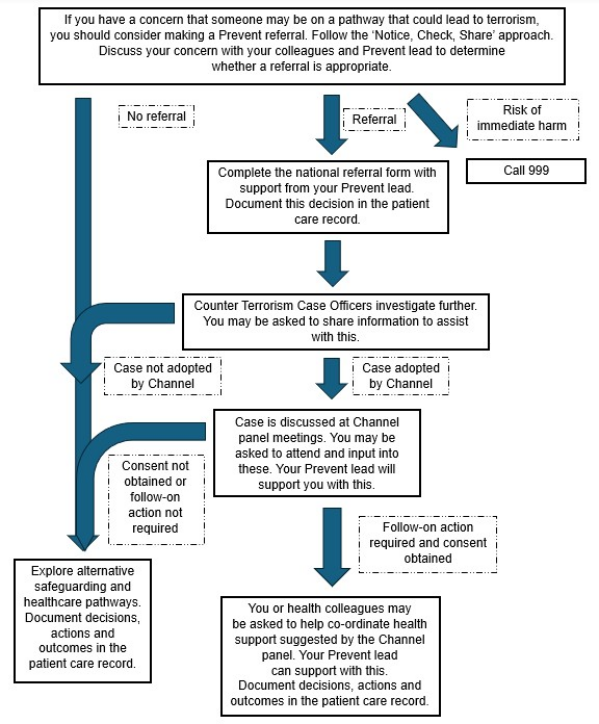
A text alternative to figure 1 follows:
If you have a concern that someone may be on a pathway that could lead to terrorism, you should consider making a Prevent referral. Follow the ‘Notice, Check, Share’ approach. Discuss your concern with your colleagues and Prevent lead to determine whether a referral is appropriate.
1. Is there a risk of immediate harm?
- No: go to question 2
- Yes: call 999
2. Does a referral need to be made?
- No: explore alternative safeguarding and healthcare pathways. Document decisions, actions and outcomes in the patient care record
- Yes: complete the national referral form with support from your Prevent lead. Document this decision in the patient care record. Counter Terrorism Case Officers will investigate further. You may be asked to share information to assist with this. Go to question 3
3. Was the case adopted by Channel?
- No: explore alternative safeguarding and healthcare pathways. Document decisions, actions and outcomes in the patient care record
- Yes: case is discussed at Channel panel meetings. You may be asked to attend and input into these. Your Prevent lead will support you with this. Go to question 4
4. Was follow-on action required and consent obtained?
- No: explore alternative safeguarding and healthcare pathways. Document decisions, actions and outcomes in the patient care record
- Yes: you or health colleagues may be asked to help co-ordinate health support suggested by the Channel panel. Your Prevent lead can support with this. Document decisions, actions and outcomes in the patient care record