Pensions and economic status among the 1958 birth cohort prior to reaching State Pension age (SPa)
Published 24 February 2026

© Crown copyright 2026
This publication is licensed under the terms of the Open Government Licence v3.0 except where otherwise stated. To view this licence, visit nationalarchives.gov.uk/doc/open-government-licence/version/3 or write to the Information Policy Team, The National Archives, Kew, London TW9 4DU, or email: psi@nationalarchives.gov.uk.
Where we have identified any third party copyright information you will need to obtain permission from the copyright holders concerned.
This publication is available at https://www.gov.uk/government/publications/pensions-and-economic-status-among-the-1958-birth-cohort-prior-to-reaching-state-pension-age/pensions-and-economic-status-among-the-1958-birth-cohort-prior-to-reaching-state-pension-age-spa
DWP research report no. 1115
A report of research carried out by Vanessa Moulton, Sam Parsons, Bożena Wielgoszewska, and George Ploubidis at the Centre for Longitudinal Studies on behalf of the Department for Work and Pensions.
Crown copyright 2026.
You may re-use this information (not including logos) free of charge in any format or medium, under the terms of the Open Government Licence. To view this licence, visit The National Archives.
Or write to:
The Information Policy Team
The National Archives
Kew
London
TW9 4DU
or email psi@nationalarchives.gov.uk.
This publication is also available at: Research at DWP - Department for Work and Pensions - GOV.UK
If you would like to know more about DWP research, email socialresearch@dwp.gov.uk
First published January 2026.
ISBN 978-1-78659-910-0
Views expressed in this report are not necessarily those of the Department for Work and Pensions or any other government department.
Executive summary
In the UK, extensive legislation introduced in the last 20 years has transformed the retirement and pension landscape. Key changes include reforms to the State Pension (SP) eligibility age and structure, the introduction of automatic enrolment into a workplace pension scheme, and greater flexibility in how and when individuals can access their private pensions. While these reforms aimed to improve pension provision, their consequences for different groups of society and people at different stages of the lifecourse remain underexplored. With further reforms on the horizon, including the forthcoming Pension Schemes Bill 2025 and the launch of a new Pensions Commission, this report has also highlighted key areas requiring attention.
The National Child Development Study, which follows the lives of 17,415 babies born in 1958, offers a unique opportunity to explore how life experiences relate to retirement outcomes as this cohort approaches State Pension age (SPa). The most recent survey, conducted at age 62 to 65, included detailed information on pension provision. Ten earlier waves of interviews conducted at key stages of the lifecourse collected extensive information on various life domains, including detailed work histories. Drawing on this rich, nationally representative cohort study, this report offers a comprehensive account of how individuals affected by recent legislative reforms are navigating the transition from work to retirement, establishing a benchmark for comparisons with future generations.
Across 6 substantive chapters, this report examines how retirement outcomes vary based on study members’ current characteristics and their experiences over the lifecourse, illuminating several disadvantaged groups. These include: women, who were more likely to be undersavers and whose average pension savings were much lower than men’s; those who spent the majority of their working lives between age 20 and 55 as self-employed, many of whom expected to still be in paid employment at age 68 or later; and those who spent time out of work due to poor health and caring responsibilities, many of whom did not reach the minimum Retirement Living Standards (RLS) and were expected to rely on the SP for most of their retirement income.
The report covers:
Accumulation of financial resources
The vast majority of study members (8 in 10) had a private pension, with this more likely to be a Defined Contribution (DC) than a Defined Benefit (DB) pension (1 in 2 vs. 1 in 3). However, there were large gender inequalities: on average men’s DB annual pensions were worth nearly twice the value of women’s (£13,900 to £7,500) and their DC pensions more than three times (£90,000 to £28,500) the value. Those with no pension were the most disadvantaged across a range of socio-economic indicators. They were more likely than those with a pension to have no or low level (NVQ1) qualifications, to be living in rented Local Authority/Housing Association housing, to be single or divorced, and not be working (excluding fully retired), with the majority of these being currently out of work due to poor health or with home-care responsibilities.
Decumulation of financial resources
People had or planned to access their private pension on average at age 61, 5 years before SPa and three-quarters had accessed or intended to access by SPa. The majority of study members with a DC pension (2-in-3) withdrew a tax-free lump sum, and an adjustable income was more popular than purchasing an annuity (1 in 3 versus 1 in 6).
Self-employment
Over the 35-year period between age 20 to 55, study members spent on average more than 27 year in paid work. Moves between employment and self-employment were common and a sizable group (1 in 3) had been self-employed at some point during this time. Compared to those who spent the majority of their working lives employed (1 in 2), those who spent the majority of their working life self-employed (1 in 8) were far more likely to remain economically active in their early 60s and nearly three times as many expected to still be in paid employment at age 68 or later. They were also three times more likely not to have any private pension. However, nearly twice as many owned two or more properties and, on average, had higher levels of housing wealth.
Working in later life
At age 55, three-quarters of study members were economically active. Half of this group were still economically active at age 62 and a fifth had fully retired. Full retirement and part-time work by age 62 were associated with financial security. Households where both partners had retired were the most advantaged of all groups analysed - almost all of these households owned their home outright and twice as many had savings over £100,000. In comparison to households where both partners remained economically active, they were more likely to have a pension, particularly a DB pension, and less likely to have experienced low income over their lifecourse.
Adequacy of retirement savings
Based on the Target Replacement Rates (TRR), it was estimated that around half of study members did not have enough pension income to maintain a similar standard of living as during pre-retirement. Based on single household Retirement Living Standards (RLS), 6 in 10 study members not living with a partner did not meet the minimum RLS. Cohabiting study members not reaching the minimum RLS were more likely to have experienced symptoms associated with depression, longstanding limiting illness, experience persistent low household income and on average spent less time in paid work.
State Pension awareness and reliance
Very few (1 in 25) study members did not expect to receive a SP. Among those that did, the majority (4 in 5) correctly expected to receive it at age 66. The proportion not knowing their SPa reduced among those interviewed closer to retirement age. Furthermore, a third did not know the value of the new State Pension (nSP) they would receive. Half of all study members were classified to be mostly reliant on the SP, with the nSP accounting for between 67 and 100% of their total expected pension income. Those mostly reliant were more likely to be women, self-employed, had lived in persistently low-income households and had spent less time in paid work, often due to poor health.
Glossary
| Term | Definition |
|---|---|
| 1958 National Child Development Study (1958NCDS) | A longitudinal cohort study that follows the lives of 17,415 babies born in England, Scotland and Wales in a single week in March 1958, which captured 98% of the total births in Great Britain in the target week. Since the initial birth sweep, study members have been followed up a further 11 times, most recently at age 62. |
| Accessed a private pension | The study member has taken money from their private pension by receiving a regular income (including purchasing an annuity), withdrawing their entire funds, withdrawing a lump sum, taking an adjustable income (flexible access drawdown), or any combinations of these. |
| Accumulation | The phase during a working life during when an individual saves into a pension pot to build up funds for retirement. |
| Annuity | A form of insurance policy that consumers can buy with their pension pot, which typically provides a guaranteed income for life, or for a fixed number of years. |
| Automatic Enrolment | An employer must enrol eligible employees into a pension scheme. Unless the employee opts-out, both the employee and employer contribute to the pension. Those eligible for auto-enrolment are not already in a workplace pension scheme, are aged between 22 and SPa, and earning above a given earnings level. Employers have gradually enrolled all eligible workers into qualifying pension schemes since auto-enrolment was first introduced in October 2012. |
| Debts | These include money owed (which are not fully paid off in the current month) on credit cards, store cards, car finance, other hire purchase agreement(s), personal loan(s) (from bank, building society or other financial institution), catalogue or mail order purchase agreement(s), DWP Social Fund loan, overdrafts, other loan(s) from a private individual, student loan and other debts not listed here (excluding outstanding mortgages). |
| Decumulation | The process of converting or using pension savings to fund later life, often converting pension savings into a retirement income. |
| Defined Benefit (DB) | A pension based on a formula involving age, years of service, and salary. The amount received in retirement is guaranteed and underwritten by the sponsoring employer. The pension pays out a secure income for life. These are also known as ‘final salary’ or ‘career average’ pension schemes. The benefits are guaranteed and underwritten by the sponsoring employer. |
| Defined Contribution (DC) | A pension defined as either a personal DC pension (a personally provided scheme) or an employer’s DC pension (employers provided scheme) where the fund can grow (or fall) in value over time. |
| Employer’s DC pension | A pension where contributions are put into a fund which can grows over time, with its size depending on the fund accumulated by retirement. |
| Employer’s pension | A pension that includes all private pension schemes which have been provided by the study members’ employer. These include both DB and DC pensions. |
| Financial wealth | The total value of all savings and investments minus the total value of debts at the household level. |
| Household | The study member and partner, where applicable. It does not include any other adults who might be living in the household. |
| Housing wealth | The house value on all properties owned by the household at the time of interview minus the amount of mortgage that remained outstanding. |
| new State Pension (nSP) | SP for people who reached SPa on or after 6 April 2016. The nSP is based on people’s National Insurance records, with the minimum of 10 qualifying years needed. On reaching SPa, in most cases, the nSP will take account of National Insurance records before and after 6 April 2016. A full rate of the nSP in 2024 to 2025 is £221.20 a week. |
| Normal Minimum Pension Age (NMPA) | The earliest age at which individuals can access their DC pension savings, currently age 55. |
| Pension Freedoms | Introduced in April 2015, these allow flexible access to the money saved in a DC pension typically from NMPA. |
| Retirement Living Standards (RLS) | As defined by the Pensions UK, these state a level of income that might be deemed adequate based on three levels of expenditure: minimum, moderate and comfortable, to help savers understand how much money they’ll need to live the lifestyle they want in retirement. Pensions UK was formerly the Pension and Lifetime Savings Association (PLSA). |
| Personal DC pension | A pension defined as a personally provided scheme (i.e. not by an employer), including self-invested personal pensions, individual personal pensions and individual stakeholder pensions. |
| Private pensions: | All pension schemes the study member currently or previously belonged to including pensions they or their employer are currently contributing to, pensions they or their employer have contributed to in the past, pensions they are currently receiving an income from and pension schemes from which they have withdrawn all funds. They do not include SP or pensions they have inherited from another individual such as a deceased partner or parents. |
| Protected Pension Age (PPA) | Allows people, in limited and specified circumstances, to access their workplace pension before the NMPA. |
| Savings | Include monies in an account at a bank, building society or elsewhere, Premium Bonds or National Savings Accounts or Certificates, ISA – Cash or Tessa, ISA – Stocks and shares or PEPS, Stocks and/or Shares which are not part of an ISA (including share options, employee share ownership or share clubs), Unit or Investment Trusts/Bonds and Gilts which are not part of an ISA (government or corporate) or other savings or investments. Savings do not include pensions. |
| State Pension (SP) | A regular payment from the UK government to individuals who have reached SPa. |
| State Pension age (SPa) | The earliest age an individual is eligible to start receiving their SP. For those born in 1958 SPa is 66, but it is set to increase to age 67 in 2028. |
| Target Replacement Rates (TRR) | As defined by the Pensions Commission, the percentage of pre-retirement earnings an individual would need to replace to have an adequate income in retirement. The rates vary by gross earnings ranging from 80% for earners in the lowest band to 50% for earners in the highest band. |
| Transitional arrangements | Temporary rules or measures put in place to help manage the changeover from the old SP to nSP, ensuring that people affected by the change are treated fairly and consistently. For individuals who have made National Insurance contributions both prior to and post April 2016, these protect the higher entitlement as calculated based on the new rules or the old rules. |
Chapter 1: Introduction
In the UK extensive legislation introduced in the last 20 years has changed the landscape for retirement and pension provision. In this report we examine provision of and access to private pensions and other financial resources prior to reaching the State Pension age (SPa), together with knowledge of the SPa in light of the changes made to the SPa and its funding structure. We see how this varies by economic activity and other key characteristics – both current and over the lifecourse – among the men and women who are members of the 1958 National Child Development Study (1958NCDS), a British birth cohort. The 1958NCDS study members were in midlife and moving into later working-life when much of this pension and retirement legislation was enacted, therefore directly impacting their lives and retirement outcomes.
1.1 Background
The most recent sweep of the 1958NCDS has captured information about the study members at age 62 to 65, before they reach SPa at age 66. This provides a unique opportunity to investigate how individuals’ lives and work histories influence their economic activity and pension provision in later life. The 1958NCDS is uniquely placed to inform on the full life course contributors to outcomes pre-SPa such as work, and preparations for retirement. These include both early life circumstances but also health and socio-economic situation across the full adult lifecourse. For example, by using information from this cohort we can assess how health and other factors across the life course determines labour market transitions and retirement outcomes pre-SPa. Also, as a study of one specific cohort it provides an unusually large sample at this life stage, enabling more strongly powered and detailed analyses of this age group.
Given the importance of this subject matter, the Department for Work and Pensions (DWP) provided additional funding for the age 62 to 65 sweep, extending the scope of the survey to include specific questions on study members’ pension provision and expectations for retirement.
1.2 Policy context
State Pension
Prior to new legislation in 1995, the earliest age at which a State Pension could be claimed in the UK was 60 for women and 65 for men. This was in place until April 2010 when the Pensions Act 1995 (fifteen years before its introduction) legislated to increase the SPa for women from 60 to 65 over a decade, equalising the SPa for men and women at 65 in April 2020. This reform directly affected all women born after April 1950. Additional legislation (Pension Act, 2011) brought forward the increase in the female SPa to 65 and also subsequently increased the SPa for both men and women to 66 by October 2020 – the SPa of the 1958 cohort.
In April 2016 further significant reform changed the structure of the State Pension to a single tier flat rate, with entitlement dependent on an individual’s National Insurance record and their date of birth. This in essence introduced a new State Pension related only to years of economic activity, from a two-tier system comprising a basic State Pension and a second State Pension related to earnings.
Alongside changes to the age of eligibility and the rules of entitlement of the State Pension, the Employment Equality Regulations (EER) (2011) abolished the Default Retirement Age (DRA) of 65 effectively removing the upper age limits on employment.
Private Pensions
The private pensions landscape has also changed over the last 20 years including a shift from Defined Benefit (DB) to Defined Contribution (DC) pensions, Pension Freedoms, and the introduction of automatic enrolment (AE), thereby increasing the number of people with DC wealth. This has meant a fundamental change in how people save for retirement and receive their retirement income – including greater responsibility on the individual in choosing how to access their pension and managing their money over their retirement.
Pension Freedoms, brought in from 2015 ended the requirement to purchase an annuity with accumulated DC saving, giving individuals from April 2015 freedom to withdraw funds up to their entire private pension wealth as cash from the age of 55. Thus, enabling those with DC pensions access to funds at an earlier age, albeit subject to income tax alongside other forms of income.
In the private sector, in 2008 the government introduced legislation mandating employers to enrol eligible employees (aged 22 or more, earning above a given earnings level and employed with them for more than three months) automatically into a workplace pension scheme – Automatic Enrolment. Enrolment was rolled out by employer size, the largest from October 2012 to the smallest in 2017, with minimum total and employer contributions, leading to a very large increase in workplace pension coverage.
1.3 Outline of the Report
This report uses the 1958NCDS to equip policymakers with robust evidence on the impact of what these recent changes to both State and Private Pensions has on the retirement outcomes and financial wellbeing of a cohort of the British population nearing SPa.
After outlining key methodological considerations in Chapter 2, the following 6 substantive chapters focus on different aspects of retirement income, pension access and economic activity, concentrating on how these different outcomes vary by study members’ characteristics, experiences over the lifecourse and financial resources.
Chapter 3 focuses on sources of retirement income, identifying whether the study member has any private pensions, the type of private pension they have, the estimated value of DB and DC pensions, and the amount of savings they have at the household level.
Chapter 4 moves on to access of private pension income, identifying whether the study member has accessed or expects to access any private pension they have before reaching SPa, and whether this differs by type of private pension. We also investigate the type of access used or intend to use to withdraw any DC pensions.
Chapter 5 places the self-employed centre stage, and we see how their retirement outcomes and financial resources differ compared to study members who have spent much of their working life as employees.
Chapter 6 explores employment in later life, examining differences in the characteristics and financial resources of study members based on whether they had retired or remained in work at age 62 and also changes in economic activity between ages 55 (age at last interview) and 62.
Chapter 7 focuses on the adequacy of study members expected pension provision and other possible income in retirement, exploring how close study members’ expected pension income at the time of interview is to the Pension Commission Target Retirement Rates (TRRs) and the Pensions UK Retirement Living Standards (RLS). We also examine the likelihood of receiving an inheritance or not, and the relationship between housing tenure and pensions. And lastly,
Chapter 8 examines State Pension (SP) literacy. Specifically, whether study members expect to receive a SP, and if so, the accuracy of their knowledge regarding when they would first qualify to get the SP and how much they expected to receive, and importantly how this varies across key characteristics.
Chapter 2: Methods
2.1 The data
The 1958NCDS follows the lives of 17,415 babies born in England, Scotland and Wales in a single week in March 1958, which captured 98% of the total births in Great Britain in the target week. The cohort has been followed up ten times between ages 7 and 55 (Power & Elliott, 2006) and most recently at age 62 to 65. For further details of the study see the CLS website.
The 1958NCDS commenced as the Perinatal Mortality Survey, which was designed to examine the social and obstetric factors associated with stillbirth and infant mortality. Since this initial birth sweep, the scope of enquiry has broadened from a strictly medical focus at birth, to encompass physical and educational development at ages seven (1965), 11 (1969) and 16 (1974), and then to include economic development, children and other wider factors at ages 23 (1981) and 33 (1991), transitioning into midlife and to further focus on issues such as health, caring responsibilities and pension planning at 42 (2000), 44 (2002), 46 (2004), 50 (2008), 55 (2013) and 62 (2020).
This report focuses on the age 62 survey, utilising data collected in the main survey interview and self-completion questionnaire. From the main survey interview we draw on questions providing information on employment, housing and sources of income including from pensions, inheritances and savings; from the self-completion questionnaire questions on retirement and expectations for the future. The age 62 questionnaires are available on the CLS website.
Participants at age 62
The initial issued sample for the age 62 survey consisted of 11,493 study members in total. Participants were issued the survey unless they were either: known to be deceased; had permanently withdrawn from the study; lived outside of Great Britain; were long-term untraced; or in prison.
The sample included all participants who responded to the age 62 main survey (n=7,809)[footnote 1]. For further details of the age 62 sweep see the user guide.
Fieldwork and timings
Interviews took place over four and a half years between February 2019 to November 2023. Following a period of consultation and questionnaire development, pilot fieldwork took place during February 2019, and the mainstage fieldwork began in January 2020 but was paused due to the COVID19 pandemic in March 2020. Data collection restarted in November 2021 via online interviews and web-based self-completion questionnaires and continued until November 2023. In this report we use tax-year to categorise when study members’ interviews were completed. Table 2.1 shows the proportion of interviews in our analytic sample conducted in each tax-year between the dates February 2019 to November 2023.
Table 2.1: Tax year of interview
| Tax year | Number of interviews | Percentage % |
|---|---|---|
| 2018 to 2019 | 79 | 1% |
| 2019 to 2020 | 1,583 | 20.3% |
| 2020 to 2021 | - | - |
| 2021 to 2022 | 1,422 | 18.2% |
| 2022 to 2023 | 4,003 | 51.3% |
| 2023 to 2024 | 715 | 9.2% |
| Total | 7,802 | 100% |
Base: all study members (n=7802)
2.2 Analytic approach
In the analyses we deal with both item non-response i.e. missing data on individual variables used in this report, and attrition i.e. non-response by study members to the age 62 survey. For study members who took part in the main survey (our analytic sample n=7,802), we first conducted Multiple Imputation (MI) to account for item non-response in the data and then applied non-response weights to our analyses to account for non-response to the age 62 survey.
Multiple imputation
The general approach adopted by CLS to handling missing data in the cohorts is outlined in the missing data user guide (Silverwood et al., 2024). This approach has been shown to mitigate bias despite selective attrition and restore sample representativeness (Mostafa et al., 2021). To maximise the use of the age 62 data for this report, the following process was required. To deal with item non-response we used MI with chained equations, imputing five data sets. Each chapter was imputed separately and included the main outcomes and predictor variables appropriate to the chapter, as well as a set of auxiliary variables to inform non-response on the covariates and reduce bias due to missing data (Mostafa et al., 2021). The auxiliary variables used in the MI for each chapter included a wide range of measures from the study members’ early life from birth to age 16 that captured aspects of family socio-economic circumstances, parental characteristics, child behaviour, cognitive ability and health, and also savings and pensions information collected during their adult years from age 33 to 55.
Prior to this imputation process, we additionally used MI to deal with missing values on our key financial measures at age 62: pensions, savings, debts, earnings, housing value and mortgage value. For each financial measure the study member was asked an overall question to identify whether they had any pensions etc, and if so, they were asked a series of follow-on questions. These questions identified the specific type and value of each financial resource they had at the time of interview. Where the value was not given, the study member was asked a series of unfolding-bracket questions to elicit a minimum and maximum value within which the actual value lies. For values that remained missing, we used predictive mean matching, with imputed values drawn from five closest observations (nearest neighbours). We imputed five datasets, averaging the values across the five datasets, and where appropriate summed the individual components to obtain a total value for that pension or earnings. These imputed variables were included in the main imputation as complete data.
Weights
Inverse Probability Weights (IPW) have been calculated to correct for non-response in the age 62 survey[footnote 2]. These are available in the deposited dataset for both the main survey interview and the self-completion questionnaire. In this report we applied non-response weights dependent on which questionnaire the outcome variable was administered, with the majority of our outcomes coming from the main survey interview.
Descriptive analyses
This report used descriptive analysis – percentages, means and medians – to examine patterns and relationships within the data. To determine whether any differences in our descriptives were statistically significant we compared the 95% confidence intervals for these groups. Any differences reported can be assumed to be statistically significant at the 5% level unless stated otherwise. In a few instances, for example when reporting on key groups of interest with small sample sizes, differences were not statistically significant, but this has been clearly noted in the text. Appendix Tables are provided for each chapter which give the complete results including 95% confidence intervals.
All descriptive statistics are reported to zero decimal places. Due to rounding, percentages do not always sum to a 100. For results displayed graphically, small percentages ( less than 5%) are removed to enhance readability.
2.3 Key Measures
Outcomes
As highlighted in Chapter 1, this report examines private pension provision (including type and value of pension(s) and access to pensions) and retirement outcomes that incorporate a range of financial resources and economic activity status. Most outcomes are chapter specific, and the derivation of these measures is included in each of the chapters where they first appear. For measures that feature as both outcomes and covariates in some chapters, the derivation of these measures are included below under ‘Pensions and Financial Resources’.
Covariates
We have a set of key covariates – 7 current and 6 longitudinal lifecourse measures – that we report on in each chapter. In some chapters (as noted above) we include (a few) additional covariates specific to the chapter and describe their derivation within the chapter. We also have 3 measures of study members’ financial resources together with their private pension provision. The key current, lifecourse and financial covariates are described below.
Current circumstances
The current status covariates are sex, highest qualification, marital status, economic activity, housing tenure, properties owned and household income.
Sex
Study members are coded as male or female.
Highest qualification
The highest qualifications that a study member has achieved over the lifecourse have been classified into 6 ‘levels’. The classification reflects the National Qualification Framework first used in 2000[footnote 3]. The six levels are:
-
no qualifications
-
level 1 (for example, GCSE grades 1 to 3 or G to D)
-
level 2 (for example, GCSE grades 4 to 9 or C to A*)
-
level 3 (for example, AS level, A level, T level)
-
level 4 (for example, Degree)
-
level 5+ (for example, Master degree, PhD)
Due to small numbers in some categories, the six levels were collapsed into three groups
-
no qualifications + level 1
-
level 2 + level 3
-
level 4 or higher
Marital status
Marital status consisted of four categories:
-
married or civil partnership
-
single
-
divorced or former civil partnership
-
widowed
Economic activity
A total of 12 different economic activity status categories were recorded. These were:
-
employee (full-time or part-time)
-
self-employed (full-time or part-time)
-
unemployed
-
apprenticeships or education
-
out of work due to sickness or poor health (permanently or temporarily)
-
home-care role (looking after the home or caring for a member of their household)
-
retired (fully)
-
other
We use the full set of categories detailed above as the main covariate, but the categories were collapsed and reported on in a number of different ways across chapters. For example,
-
all in paid work (employed or self-employed on a full-time or part-time basis)
-
all economically active (employed or self-employed on a full-time or part-time basis, and unemployed)
-
all economically inactive (out of work due to sickness or poor health (permanently or temporarily), in a home-care role, in education/training or (fully) retired)
Housing tenure
Study members were asked a series of questions about their current accommodation: whether they were living in a private residence or other place (for example, hostel for homeless, boarding house, room at a workplace, etc); whether they owned, rented, lived rent-free, were squatting or had another arrangement. There were seven housing tenure categories which were collapsed into five categories
-
own outright
-
own with a mortgage
-
rent (from a Local Authority or Housing Association: LA/HA)
-
rent (from a private landlord)
-
other (living rent free [for example, with friends or family], squatting, other [for example, mobile home])
Own any properties
As well as housing tenure, study members were asked if they or their cohabiting partner currently own any (or other) property either outright or with a mortgage. This combined with housing tenure was used to create household property ownership (outright or with a mortgage):
-
no properties owned
-
one property owned
-
two or more properties owned
Current household income
Study members were asked to provide their total take home household income, after tax and other deductions across sixteen grouped income bands. They could report weekly, monthly or annual amounts. The reported banded values were categorised into three weekly net income amounts, based on the bottom 25%, mid 50% and the top 25% of banded net weekly household income:
-
less than £330
-
between £330 and £900
-
more than £900
Lifecourse experiences
The longitudinal lifecourse measures include four economic activity measures, number of partnerships (marriage and cohabitation) and if they had divorced, number of times study members reported a longstanding limiting illness or poor psychological distress when interviewed at age 23, 33, 42 and 50, and the number of times they were assessed as being part of a low income household when interviewed at age 23, 33, 42, 50 and 55.
Economic activity
Study members have provided information on each economic activity they have had at each interview they participated in from age 23, including the start and end date (if applicable) of each activity. From this information, an economic activity status can be derived for each month back to 1974, when this cohort could have first left school (age 16). In this report we have focused on economic activity over 35 years (420 months) from January 1978 to December 2012, the year they turned 20 to just before their 55th birthday (March 2013). Economic activity history information after 2012 (age 55) has been collected in the age 62 wave of data collection and will be made available at the UK dataservice when processed.
We calculated the number of months spent in paid work (employed or self-employed on a full-time or part-time basis), in a home-care role, out of work due to poor health [sick], and doing other activities [education, training, unemployment, retired, other] over 35 years.
Partnerships and divorce
Study members have provided information on each partnership they have had at each interview they participated in from age 23, including the start and end date (if applicable) of each partnership. Partnerships include any cohabitation or marriage.
We calculated the number of different partnerships a study member had and the number of times they had divorced since age 16. The measures were then grouped.
Partnerships
-
never lived with a partner
-
lived with one partner only
-
lived with 2 different partners
-
lived with 3 or more different partners
Divorce
-
never experienced a divorce
-
had one or more divorces
Longstanding limiting illness
Longstanding limiting illness (LSLI) questions were included at age 23, 33, 42 and 50. The question wording has differed slightly over time but provides the same information. From age 33 the question asks first about whether the study member has a longstanding illness and then a follow-on question asks whether the condition limits their daily activities. We count the number of times a LSLI was reported in the four surveys from age 23 to 50 surveys and group responses into three categories:
-
never had a LSLI
-
had a LSLI on one occasion
-
had a LSLI on two – four occasions
Psychological distress (Malaise)
The Malaise Inventory (Rutter et al., 1970; Ploubidis et al., 2019) has been included in the age 23, 33, 42 and 50 sweeps of data collection. The original questionnaire had 24-items, with a shortened 9-item version of the scale being subsequently created, with both being used to measure psychological distress (anxiety and depression). Here we use the 9-item version. Each question is coded no = 0; yes = 1, giving a total score of 0-9. A score of 4 or higher is indicative of symptoms of depression. We count the number of times a score of 4 or more was reported in the four surveys from age 23 to 50 surveys and group responses into three categories:
-
never reported 4 or more symptoms
-
4 or more symptoms reported on one occasion
-
4 or more symptoms reported on 2 to 4 occasions
Low income household
Here, a low income household is defined as the study member being in the bottom 20% of the household income distribution within each cohort sweep of data collection. This is measured at age 23, 33, 42, 50 and 55. This is a within-cohort definition of low household income, which provides a measure of low income relative to the circumstances of same-age peers. If referenced against a national measure of average household income, far more younger than older study members would be identified as being part of a low income household, as average earnings and income levels (generally) increase with age between 23 to 55 years.
The number of times a study member was part of a low income household was summed across the five occurrences and then split into the following groups:
-
never part of a low income household
-
intermittent low income household (a study member has been in the bottom 20% less than 66% of observations, for example, had a low household income 1,2 or 3 times)
-
persistent low income household (a study member has been in the bottom 20%, for more than 66% of observations, for example, part of a low income household on 4 or 5 times)
Private pensions and financial resources
Private pensions are central to this report and are discussed throughout, but definitions and use of pension wealth and individual pensions varies across the different chapters. A brief description of the main pension measures is provided below, with specific derivations described in the relevant chapters. Three measures of household financial resources and wealth also appear in a number of chapters as both outcomes and covariates: household savings, household financial wealth, and housing wealth. Household savings and household financial wealth do not include any pension estimates.
Private pensions
Study members were asked a series of questions about private pensions. Starting with, did they have a private pension and if so, how many private pensions. For each private pension (up to 6), they were asked whether the private pension is an employer or personal pension, and if an employer pension whether it is a DB or DC pension. From these responses we construct whether they have any employer (DB or DC), any DB and any DC pensions. For each private pension, study members were asked whether they have accessed (received or withdrawn) or intend to access the pension, and for DC pensions the type of access (for example, withdrawn the entire fund, bought an annuity, etc.). From these responses, we construct whether they have received a DB pension or not, and accessed any DC pension or not, including the type of access. In addition, for each pension a series of questions ask the value of each pension. In this report we took a snapshot of their current situation, based on the values given for each private pension at the time of interviewing and construct different pension values, for example, total pension value – the sum of all the study members’ private pensions, total DB value – the sum of all DB pensions received per annum and total DC value – the sum of all DC funds.
Household savings
Each study member was asked whether they or their cohabiting partner have any savings of a certain type i.e. in a bank or building society account, Premium Bonds, various Individual Savings Accounts (ISAs), Stocks and/or Shares (various types), or other Savings or Investments. For each of the saving type mentioned they were also asked the specific amount, and in cases where they were not able to provide these, a series of unfolding bracket questions were asked that aim at estimating the amount of savings[footnote 4]. Each saving type is summed, and total household savings are grouped into four categories. The first category includes study members with no savings, the remaining study members with savings are evenly grouped into thirds which fall into the following savings categories:
-
zero savings
-
less than £25,000
-
£25,000 and less than £100,000
-
£100,000 or more
Household financial wealth
Financial wealth is defined as total household savings (as described above) minus total household debt. Study members were shown a list of financial commitments and asked which ones they or their cohabiting partner had. For each debt type mentioned they were also asked the specific amount, and in cases where they are not able to provide these, a series of unfolding bracket questions were asked that aim at estimating the amount of debt[footnote 5]. Total household financial wealth was grouped into the same four categories used to group household savings:
-
no financial wealth
-
less than £25,000
-
£25,000 and less than £100,000
-
£100,000 or more
Household housing wealth
Housing wealth is defined as property value(s) minus the amount still outstanding on all mortgages and property loans. The study member was asked how much they would expect to get if they sold all the property they own at time of interview. To elicit the amount still outstanding, the study member was asked how much they still have to pay off on all the property they and their cohabiting partner own. In cases where they were not able to provide the property value and/or mortgage outstanding a series of unfolding bracket questions were asked that aim at estimating these amounts[footnote 6]. Housing wealth was divided into five groups, based on the distribution of housing wealth, where the middle category encompassed the median of approximately £300,000, with broad bandings at a multiple of £200,000 defined as follows:
-
zero housing wealth
-
less than £200,000
-
£200,000 to less than £400,000
-
£400,000 to less than £600,000
-
£600,000 or more
2.4 Sample Descriptives
In this section we describe the characteristics of our weighted analytic sample across the main current and lifecourse covariates we include in the report, as described above. (See Appendix Table A2.1 for the full set of results.)
Current status
Table 2.2 details the current characteristics of study members. Over half were men (52%), 1 in 4 (26%) had no or low level (NVQ 1) qualifications whereas a third (33%) had a NVQ 4 or higher level (degree or higher) qualification. Nearly two-thirds were currently married (63%) and 1 in 5 (19%) were divorced. Over half (53%) were in paid work (full-time or part-time employee or self-employed), 1 in 4 (24%) had fully retired, and 1 in 8 (12%) were out of work due to poor health. Three-quarters were homeowners (61% outright, 16% mortgage) and 1 in 5 rented their property from their local authority or housing association (14%) or privately (7%). 1 in 5 (21%) did not own any property and a further 1 in 5 (18%) owned two or more properties.
Table 2.2: Current characteristics of study members
| Key Measures | Current characteristics | Percent |
|---|---|---|
| Sex | Men | 52% |
| Sex | Women | 48% |
| Qualifications | No/NVQ 1 | 26% |
| Qualifications | NVQ 2 or 3 | 41% |
| Qualifications | NVQ 4 or above | 33% |
| Marital status | Married / Civil Partnership [CP] | 63% |
| Marital status | Single | 13% |
| Marital status | Divorced/Former CP | 19% |
| Marital status | Widowed | 5% |
| Economic activity | Full Time (FT) employee | 25% |
| Economic activity | Part Time (PT) employee | 14% |
| Economic activity | FT self-employed | 9% |
| Economic activity | PT self-employed | 5% |
| Economic activity | Unemployed | 2% |
| Economic activity | Sick | 12% |
| Economic activity | Home-care | 7% |
| Economic activity | Retired (fully) | 24% |
| Economic activity | Other | 2% |
| Housing tenure | Own Outright | 61% |
| Housing tenure | Mortgage | 16% |
| Housing tenure | Rent LA/HA | 14% |
| Housing tenure | Rent Private | 7% |
| Housing tenure | Other | 2% |
| Own any properties | None | 21% |
| Own any properties | One | 61% |
| Own any properties | Two or more | 18% |
| Household income | Low Weekly Income: less than £330 | 26% |
| Household income | Middle Weekly Income: between £330 to £900 | 51% |
| Household income | High Weekly Income: more than £900 | 22% |
Base: all study members (n=7802)
Lifecourse experiences
Table 2.3 shows the lifecourse experiences of study members. Over the 35 years between age 20 to 55, study members had spent (on average) 27.6 years in paid work (employed or self-employed), 2.6 years out of work due to poor health and 3.3 years in a home-care role. In terms of partnerships (married or cohabiting) the majority (58%) had only lived with one partner whereas 1 in 14 (7%) had never lived with a partner. In terms of health and wellbeing, 7 in 10 (70%) study members had not experienced a longstanding limiting illness, and more than three-quarters (78%) had never experienced (a high number of) symptoms of depression. Moving to low income households, we see that although nearly 4 in 10 (39%) had never been part of a low income household, more than 2 in 10 (23%) study members had been in a persistent low income household over the life course.
Table 2.3 Lifecourse experiences of study members
| Key Measures | Lifecourse experiences | Mean |
|---|---|---|
| Economic activity | Mean months in paid work: age 20 to 55 | 331 (27.6 years) |
| Economic activity | Mean months out of work due to poor health: age 20 to 55 | 31 (2.6 years) |
| Economic activity | Mean months in a home-care role: age 20 to 55 | 39 (3.3 years) |
| Economic activity | Mean months in other activities: age 20 to 55 | 21 (1.8 years) |
| Key Measures | Lifecourse experiences | Percent |
|---|---|---|
| Partnerships | No partner ever | 7% |
| Partnerships | One Partner | 58% |
| Partnerships | Two Partners | 23% |
| Partnerships | Three+ Partners | 12% |
| Divorce | No divorce | 81% |
| Divorce | One+ divorce | 19% |
| Longstanding illness | No LSLI | 70% |
| Longstanding illness | LSLI x 1 | 18% |
| Longstanding illness | LSLI x 2 to 4 | 12% |
| Psychological distress | No Malaise | 78% |
| Psychological distress | Malaise x 1 | 14% |
| Psychological distress | Malaise 2 to 4 | 8% |
| Low income household | Never low income household | 39% |
| Low income household | Intermittent low income household | 38% |
| Low income household | Persistent low income household | 23% |
Base: all study members (n=7802)
Chapter 3: Accumulation of financial resources
This chapter focuses on sources of retirement income, identifying whether the study member and their partner (if living with the study member) have any private pensions, the type of private pension they have, the estimated value of study members’ pensions and the amount of savings they have at the household level. The chapter is divided into three sections: 3.1 Sources of retirement income details the different sources of retirement income and how they vary for men and women; 3.2 Who is not saving for retirement? describes the other key socioeconomic characteristics that are associated with having or not having private pensions or savings; and 3.3 Retirement and financial resources examines how pensions, savings and other characteristics differ between men and women who have fully retired or remain in paid work in their early 60s.
Key Findings
Private pension provision
-
8 in 10 (78%) study members have a private pension; 1 in 3 (35%) have a DB pension and 1 in 2 (47%) a DC pension
-
more women than men have a DB pension (37% to 33%), more men than women a DC pension (55% to 39%). However, on average:
-
the value of a DB pension for men is (around) twice the value for women (£13,900 to £7,500)
-
the value of a DC pension for men is (around) three times the value for women (£90,000 to £28,500)
-
Household savings
- 1 in 2 study members have either no (16%) or very low (33%) household savings
Those with no private pension are the most likely to have no household savings:
-
1 in 13 (8%) study members have no private pension and no savings, increasing to
-
1 in 6 (16%) study members when we additionally include only having household savings less than £25k.
Characteristics and lifecourse findings
Study members without a private pension or any household savings are the most disadvantaged across a range of indicators. For example, compared to those with a pension:
-
twice as many have had a limiting illness over the lifecourse (51% to 24%)
-
four times as many rented their home from a local authority or housing association (35% to 8%)
Those without a private pension also spent:
-
over 9 years (115 months) less in paid work over the lifecourse
-
over 4 years (51 months) longer out of work due to home-care responsibilities
-
4 years (48 months) longer out of work due to poor health
Retirement and private pensions
1 in 4 (24%) study members had fully retired by their early 60s and were more financially advantaged compared to their peers in paid work:
-
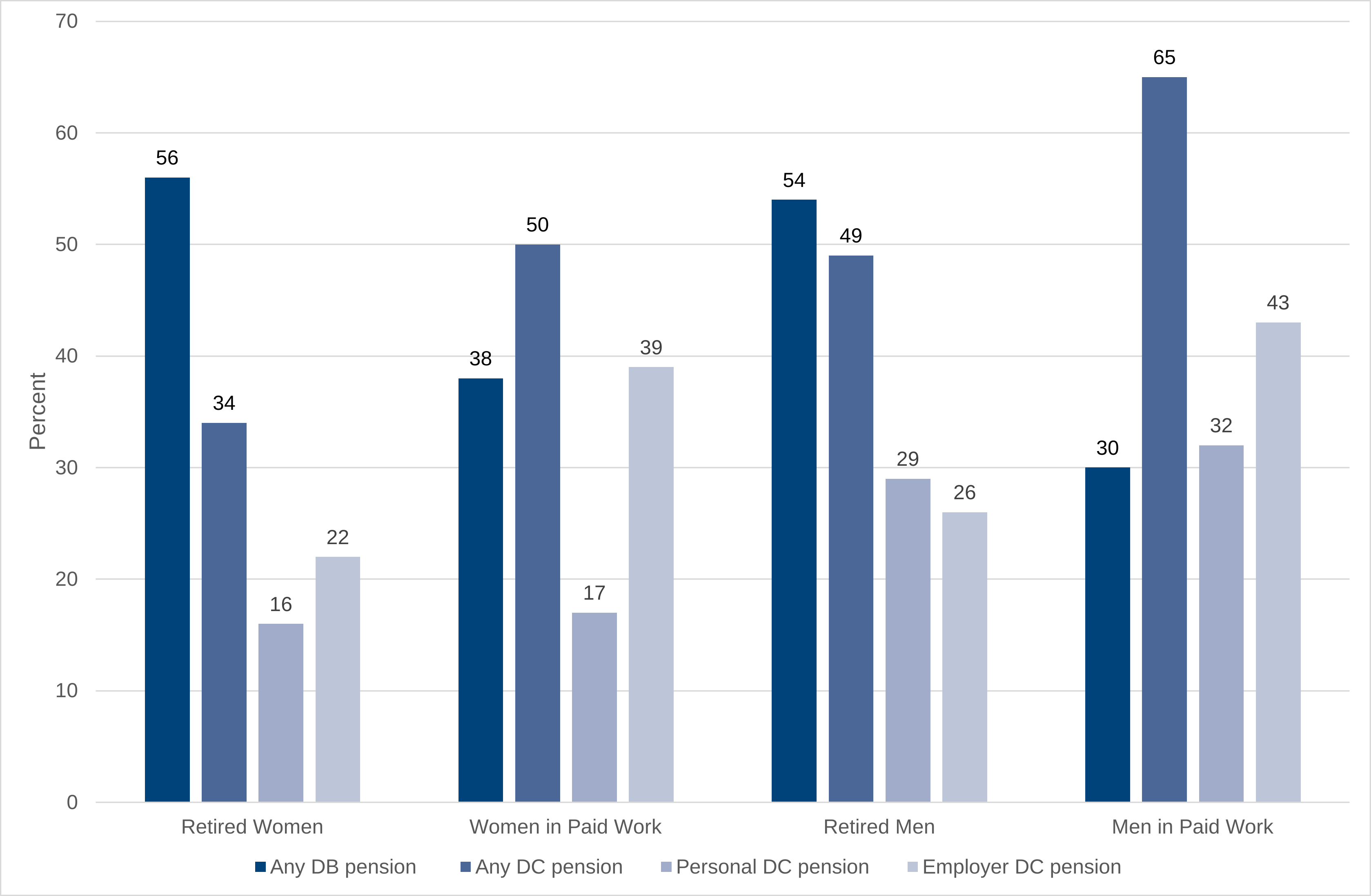
twice as many retirees had a DB pension than an employer’s DC pension (54% to 26% men; 56% to 22% women)
-
4 in 10 (41%) retirees had household savings over £100,000 compared to 2 in 10 (22%) of those in paid work
3.1 Sources of retirement income
We firstly examine individual private pensions as sources of retirement income and compare individual private pensions for men and women. We also look at whether the study members’ current partners have any private pensions, as well as household savings to identify other possible household resources which could be used as retirement income. The complete set of results are included in Appendix Table A3.1.
Individual private pensions
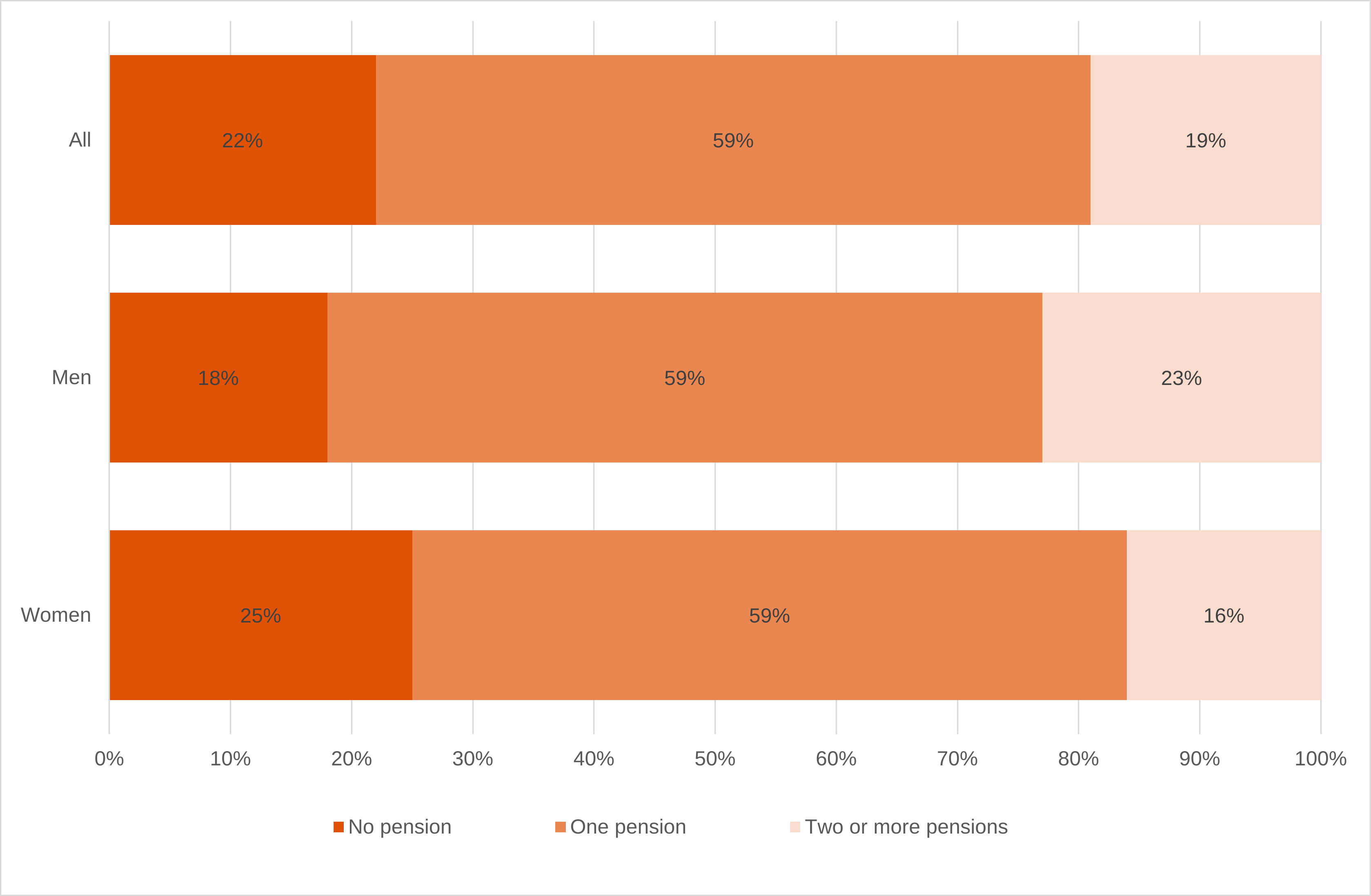
Figure 3.1 shows that nearly 8 in 10 (78%) of all study members had a private pension, with this being slightly higher among men (82%) than women (75%). Around 6 in 10 (59%) men and women only had one private pension[footnote 7], while nearly 1 in 4 (23%) men had two or more private pensions, compared to 1 in 6 (16%) women.
Figure 3.1: 8 in 10 study members had a private pension, being slightly higher for men than women with men being more likely to have 2+ private pensions
Base: all study members (n=7802)
Overall, 6 in 10 (60%) men and women had an employer’s pension, which for 1 in 3 (35%) this was an employer’s DB pension. Although, a slightly higher proportion of women (37%) than men (33%) had an employer’s DB pension, the value of women’s DB pensions were lower than the value of men’s DB pensions. Figure 3.2 shows that on average (median), the actual or expected net annual DB pension[footnote 8] income of all those with a DB pension was approximately £10,300 per annum, with a range of approximately £4,900 to £18,000 from the 25th to the 75th percentile. The median actual or expected net annual DB pension was higher at £13,900 per annum for men and lower at £7,500 per annum for women.
Figure 3.2: The average net value of DB pensions was nearly twice as much per annum for men than women
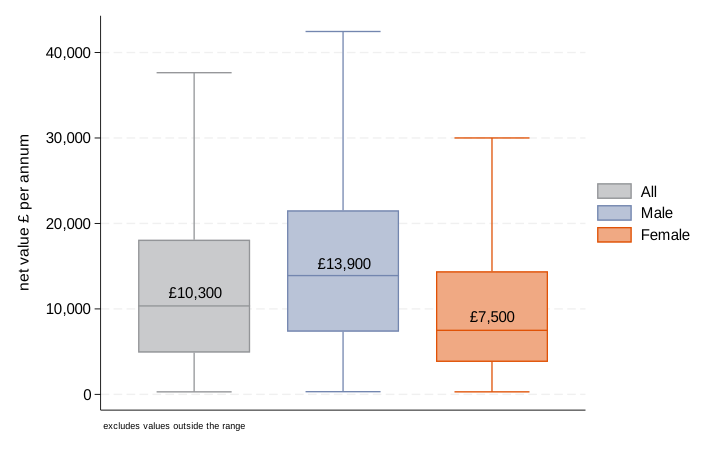
Note: The boxplot shows the distribution of the net value of DB pensions per annum overall, and for men and women. The centre line in the box shows the median, and the bottom and top of the boxes show the 25th and 75th percentiles. The whiskers (the lines extending from the box) show the tails of the distribution. The longer whiskers indicate the heterogeneity of the value of DB pensions for men compared to women at the higher end.
Base: all study members (n=7802)
Just under 1 in 2 (47%) of all study members had a DC pension, with 1 in 3 (31%) having an employer’s DC pension and 1 in 5 (22%) a personal DC pension. Figure 3.3 shows that more men than women had a DC pension, with a higher proportion of men having an employer (DB and DC) pension (34% to 28%) and twice as many men than women having a personal DC pension (29% to 15%).
Figure 3.3: 1 in 2 study members had a DC pension, with more men than women having either an employer or personal DC pension
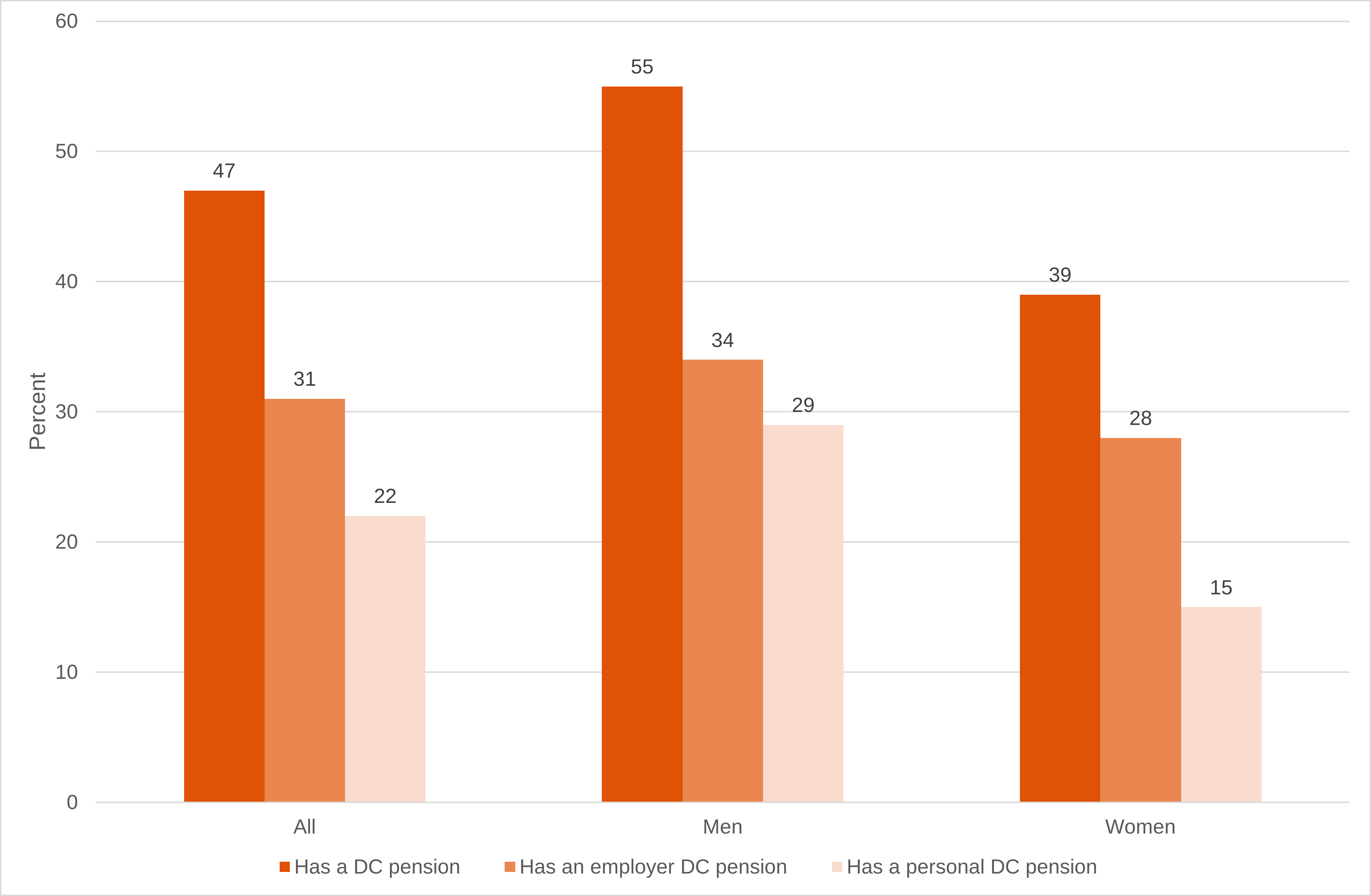
Note: Percent with a DC pension does not equal sum of ‘an employer DC pension’ and ‘a personal DC pension’, as some study members have both an employer and a personal DC pension.
Base: all study members (n=7802)
Of all those with a DC pension the median fund value[footnote 9] was £60,000 and ranged from £16,500 at the 25th to £160,000 at the 75th percentile. The size of the DC fund was again larger for men than women across the whole distribution. Figure 3.4 shows that at the median, the average DC fund size for men was over three times the average value of the DC fund for women (£90,000 compared to £28,500).
Figure 3.4: The average value of DC funds was over three times as much for men than women
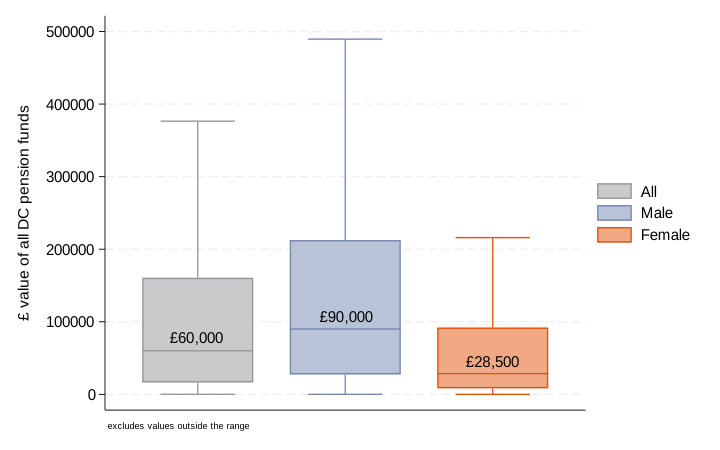
Note: The boxplot shows the distribution of the £ value of all DC pension funds overall, and for men and women. The centre line in the box shows the median, and the bottom and top of the boxes show the 25th and 75th percentiles. The whiskers (the lines extending from the box) show the tails of the distribution. The longer whiskers indicate the heterogeneity of the value of DC funds for men at the higher end.
Base: all study members (n=7802)
On average, personal DC funds were larger than employer DC funds. At the 50th percentile the average personal DC fund was twice that of the employer DC funds – £97,000 compared to £51,000. Again, on average, men had more in their personal and employer DC funds than women. Focusing on the median, men had more than twice as much in their personal DC pension funds than women (£116,000 compared to £55,700) and over three times as much in their employers DC pension fund (£85,000 compared to £24,000).
Household private pension provision
To understand if study members might potentially have household sources of retirement income, we examined whether their partner (currently living with the study member), had some private pension provision[footnote 10]. We reported whether both the study member and their partner, only the study member (this included study members with no partner living in the household), only the partner or neither the study member nor partner had private pension(s). See Appendix Table A3.2.
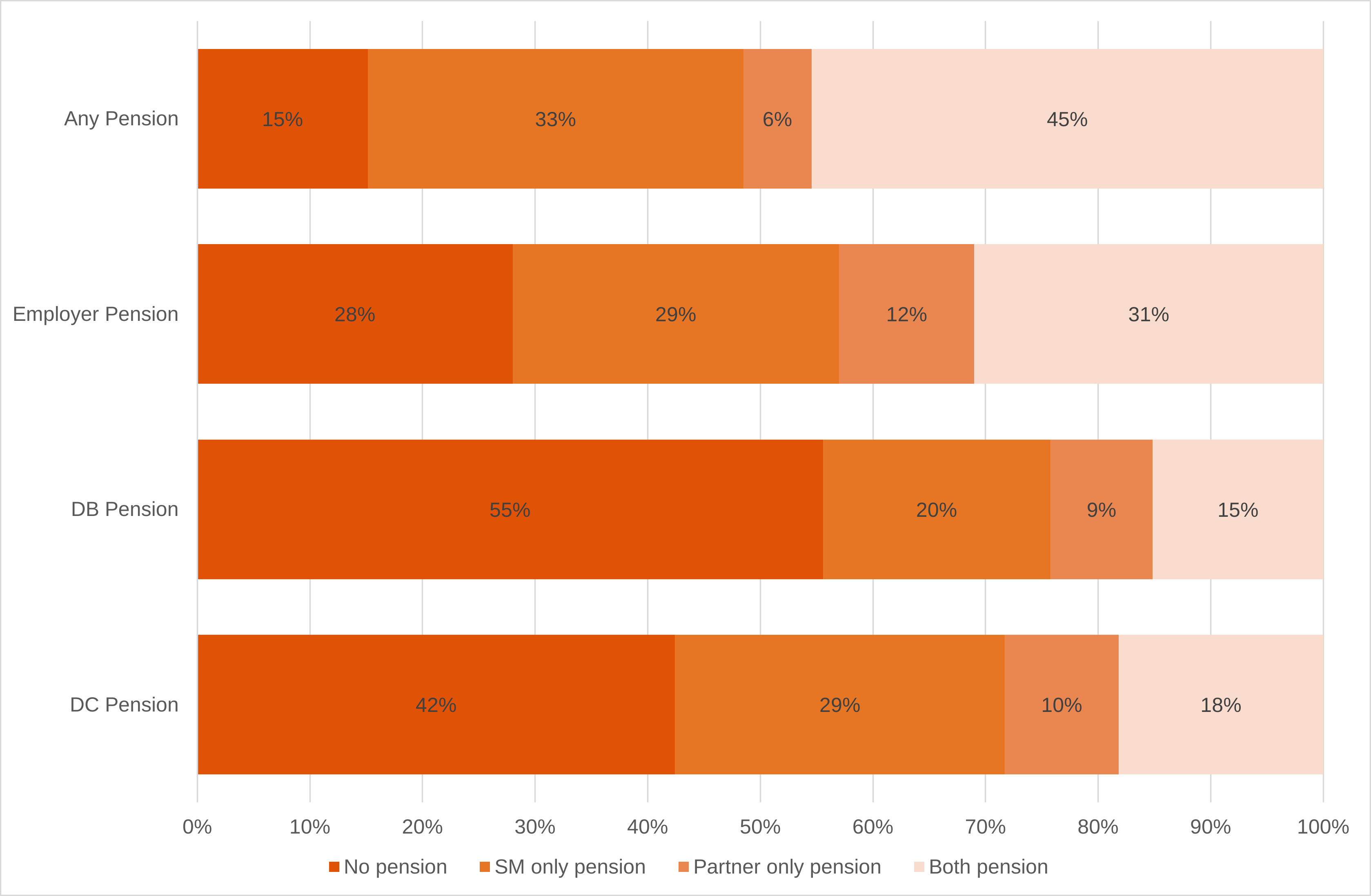
We found that although 1 in 7 (15%) households had no private pensions, most households (85%) had some private pension provision. Specifically:
-
in nearly 1 in 2 (45%) households both the study member and their partner had a private pension
-
in 1 in 3 (33%) households only the study member had a private pension
-
very few (6%) households relied only on a partners’ private pension, but this was three times more likely for women than men (10% to 3%)
Figure 3.5 shows that in 1 in 3 (31%) households both the study member and their partner had an employer’s (DB or DC) pension, and in a further 1 in 3 (29%) households only the study member had an employer’s (DB or DC) pension. For 1 in 8 (12%) households, study members were potentially reliant on their partners’ employer’s (DB or DC) pension for private pension income, although this was no different for men or women, and over a quarter (28%) of households had no employer’s (DB or DC) pension.
Turning to DB and any DC pensions, over 1 in 2 (55%) households had no DB pensions and 4 in 10 (42%) had no DC pensions. In a further 1 in 10 households, the study member did not have their own DB or DC pension, only having a partner with either a DB or DC pension (9% and 10% respectively).
Figure 3.5: 1 in 2 households have two adults with private pensions, while over 1 in 7 households have none
Note: SM = study member.
Base: all study members (n=7802)
Household savings
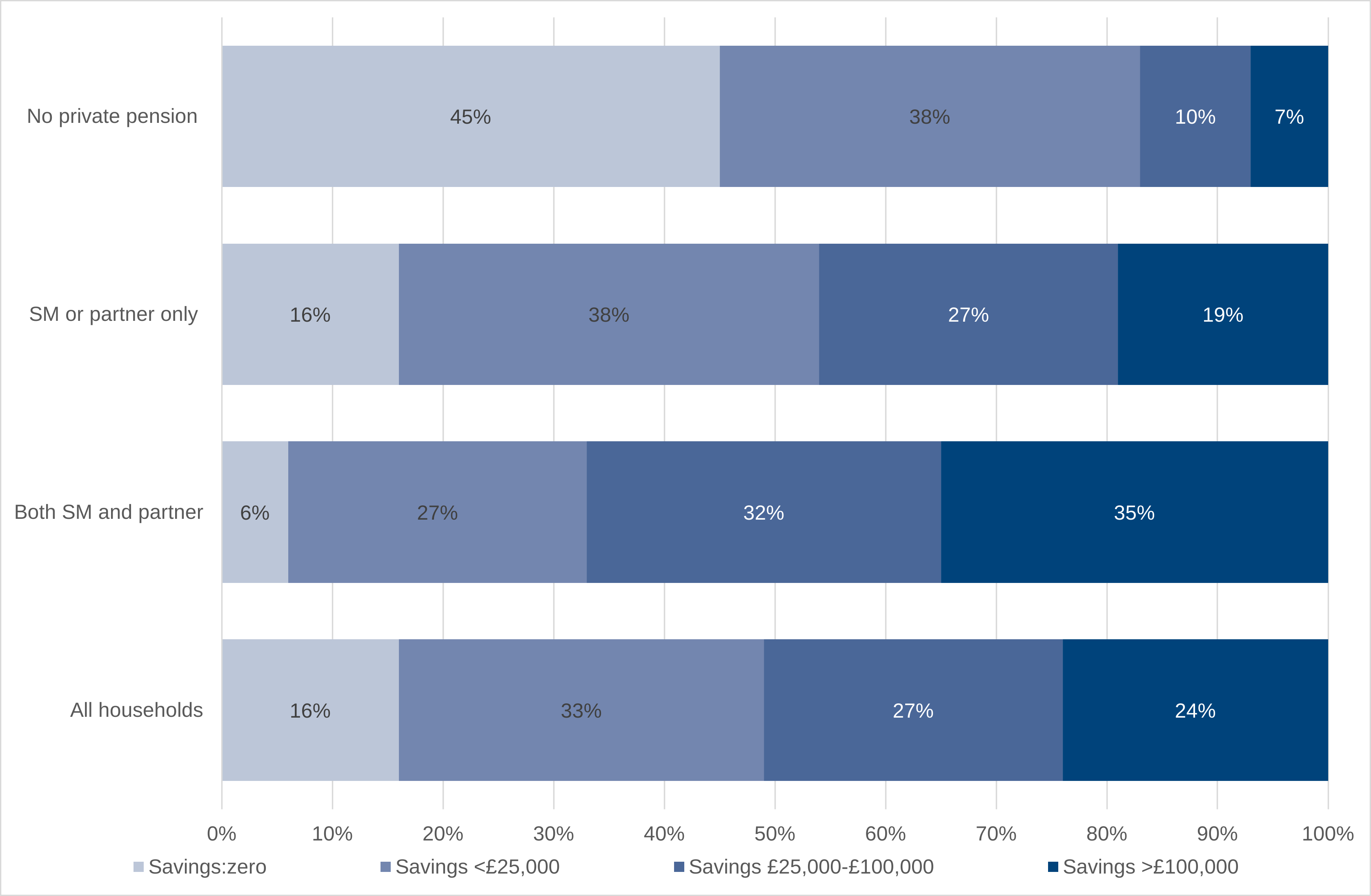
Overall, 1 in 2 (49%) study members had no (16%) or less than £25,000 (33%) in household savings. A quarter, 1 in 4 (27%) had between £25,000, but less than £100,000 and 1 in 4 (24%) had more than £100,000 of savings.
Figure 3.6 shows that households with private pensions were also more likely to have household savings. Nearly half (45%) of households with no private pensions did not have any household savings either and almost two-fifths (38%) had savings of less than £25,000. If both the study member and their partner had a pension, 1 in 3 (35%) also had household savings of over £100,000. Among households where only the study member or their partner had private pensions just 1 in 5 (19%) had household savings over £100,000.
Figure 3.6: 1 in 2 had no or less than £25,000 in household savings, rising to more than 8 in 10 for households with no pensions
Note: SM = study member
Base: all study members (n=7802)
To further illustrate the strong association between having a private pension and household savings described above, 1 in 13 (8%) study members have no private pension and no household savings, with there being no differences between men (7%) and women (8%). When we additionally include household savings less than £25k, the rate increases to 1 in 6 (16%) study members, with this being higher among women (14% men, 18% women).
3.2 Who is not saving for retirement
Section 3.1 showed that more than 1 in 5 (22%) of all study members do not have a private pension (employer or personal) and when we additionally include those who have a low value pension – calculated here as a pension of less than £2,500 per annum – the proportion increases to almost half (46%) of all study members. Looking at household savings, 1 in 6 (16%) have no savings at all and a further 1 in 3 (33%) have less than £25,000 in savings. We now look into how the characteristics of study members without pensions or savings differ from those who do.
What characteristics distinguish study members who do not have a pension or only a low value pension and those that have a pension?
Current circumstances
More women than men are in the no pension or low value pension groups (56% to 44%), with those characterised across a range of socio-economically disadvantaged groups over-represented in the no or low value pension groups. We focus on describing the differences between the study members with or without a pension, but Table 3.1 shows these differences are also apparent between study members with a low or higher value pension. For example, study members in the no pension group are far more likely than those with a pension to have no or low level (NVQ 1) qualifications, to be living in rented Local Authority or Housing Association housing, to be single or divorced [including former civil partnership], and not be working [excluding being fully retired], with the majority of these being currently out of work due to poor health or with home-care responsibilities. Among those in paid work, study members with no pension were more likely to be a low earner (less than £330 a week) and those with a pension to be a high earner (more than £900 per week). The complete set of results are included in Tables A3.3 to A3.4.
Table 3.1: Current circumstances by private pension status
| Current circumstances | Qualifications / Economic Activity / Housing / Marital status | Has a pension: No | Has a pension: Yes | Pension value: Low value | Pension value: Higher value |
|---|---|---|---|---|---|
| Highest qualification | No/NVQ 1 | 46%* | 21%* | 39%* | 15%* |
| Highest qualification | NVQ 4 or above | 14%* | 38%* | 18%* | 46%* |
| Economic Activity | FT employee | 6%* | 30%* | 21%* | 29%* |
| Economic Activity | PT employee | 8%* | 15%* | 14% | 14% |
| Economic Activity | FT self-emp | 12%* | 8%* | 11%* | 7%* |
| Economic Activity | Unemployed | 5%* | 2%* | 4%* | 1%* |
| Economic Activity | Sick | 34%* | 6%* | 21%* | 4%* |
| Economic Activity | Home-Care | 16%* | 5%* | 11%* | 4%* |
| Economic Activity | Retired | 13%* | 27%* | 13%* | 33%* |
| Housing Tenure | Own Outright | 40%* | 66%* | 48%* | 72%* |
| Housing Tenure | Mortgage | 11%* | 17%* | 14%* | 18%* |
| Housing Tenure | Rent LA/HA | 35%* | 8%* | 25%* | 5%* |
| Housing Tenure | Rent Private | 10%* | 6%* | 11%* | 4%* |
| Marital Status | Married or Civil Partnership | 47%* | 68%* | 55%* | 71%* |
| Marital Status | Single | 20%* | 11%* | 16%* | 10%* |
| Marital Status | Divorced or Former Civil Partnership | 26%* | 17%* | 23%* | 15%* |
Note: selected categories only – categories with no significant differences were omitted. An asterisk * indicates differences are significant.
Base: all study members (n=7802)
Lifecourse experiences
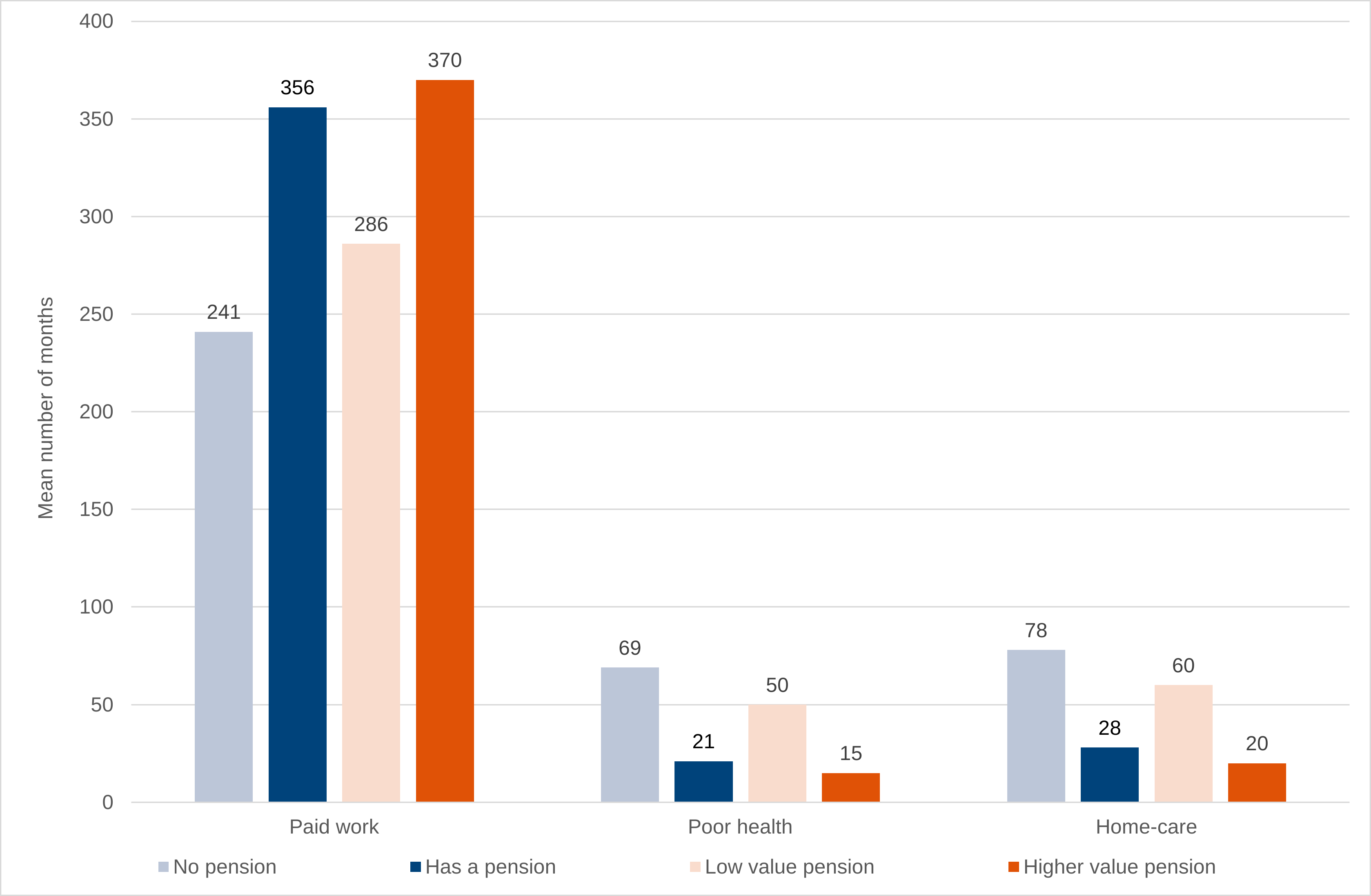
Looking over the study members’ lifecourse, Figure 3.7 shows that those without a pension or with a low value pension have spent less time in paid work and far more time not working, either due to home-care responsibilities or poor health. For example, compared to study members with a pension, between age 20 to age 55 those with no pension have spent (on average):
-
over 9 years (115 months) less in paid work
-
over 4 years (51 months) longer out of work due to home-care responsibilities
-
4 years (48 months) longer out of work due to poor health
Figure 3.7: Those with no pension have spent the least months in paid work and the most not working, either in a home-care role or due to poor health
Note: low value pension = no pension or a pension <£2,500 per annum; higher value pension = £2,500 or more per annum.
Base: all study members (n=7802)
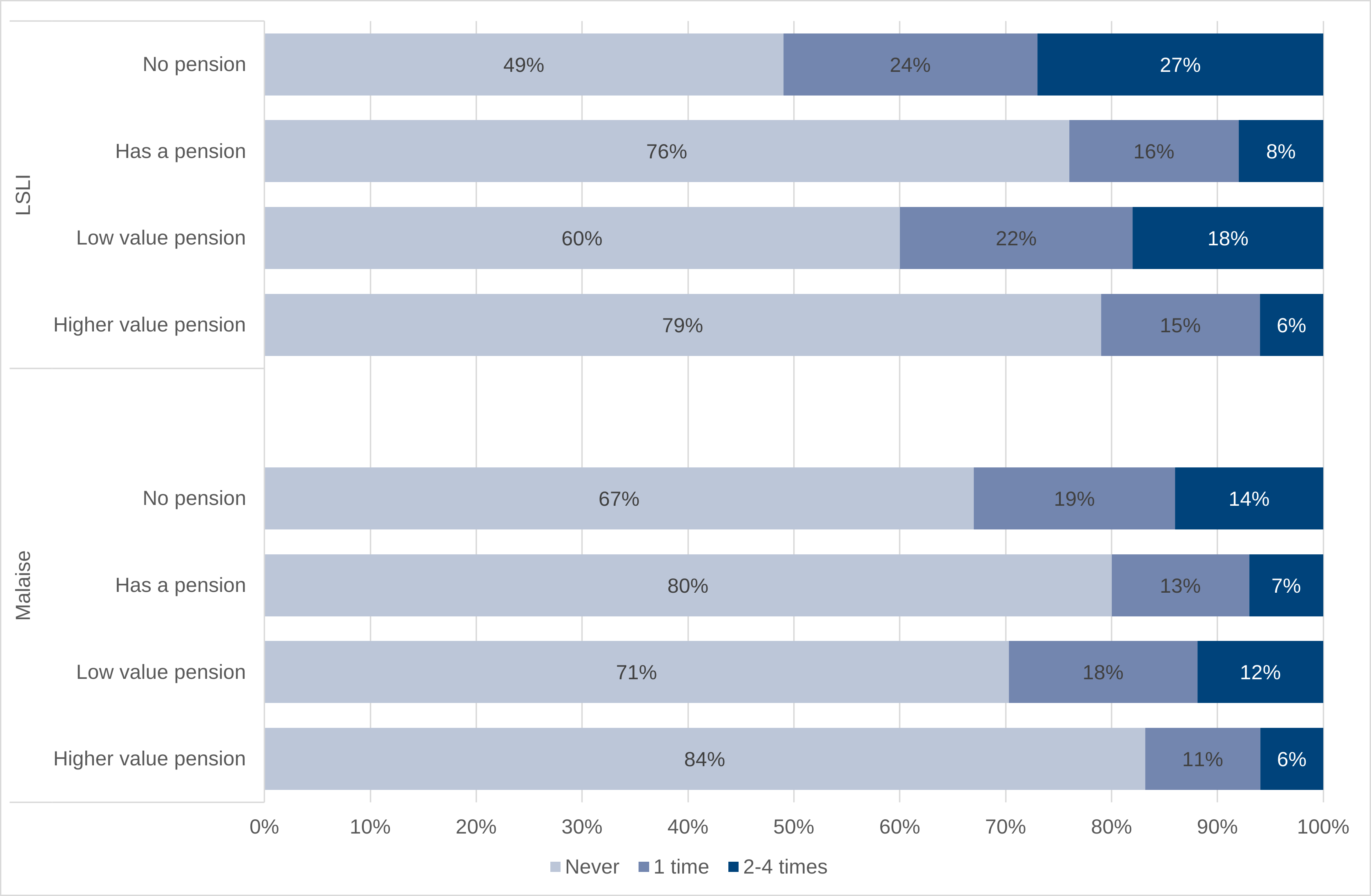
Looking further into health differences by pension status, compared to those with a pension, a higher proportion of those with no pension have experienced symptoms of depression (14% to 7%) or a longstanding limiting illness (27% to 8%) on two or more occasions over the lifecourse. These differences – including for those with a low or higher value pension – are reported in Figure 3.8.
Figure 3.8: Half of adults with no pension have had a limiting illness and a third have experienced poor mental health over the lifecourse
Note: low value pension = no pension or a pension less than £2,500 per annum; higher value pension = £2,500 or more per annum.
Base: all study members (n=7802)
Adults with no pension were also far more likely than those with a pension to have experienced persistently low household income over their adult life (55% to 14%) and to have not accumulated any savings (36% to 10%). Figure 3.9 shows that three-quarters (74%) of adults with no pension also have no or only a low amount of savings (less than £25,000).
Figure 3.9: Three-quarters (74%) of adults with no pension also have no or only a low amount of savings (less than £25,000)
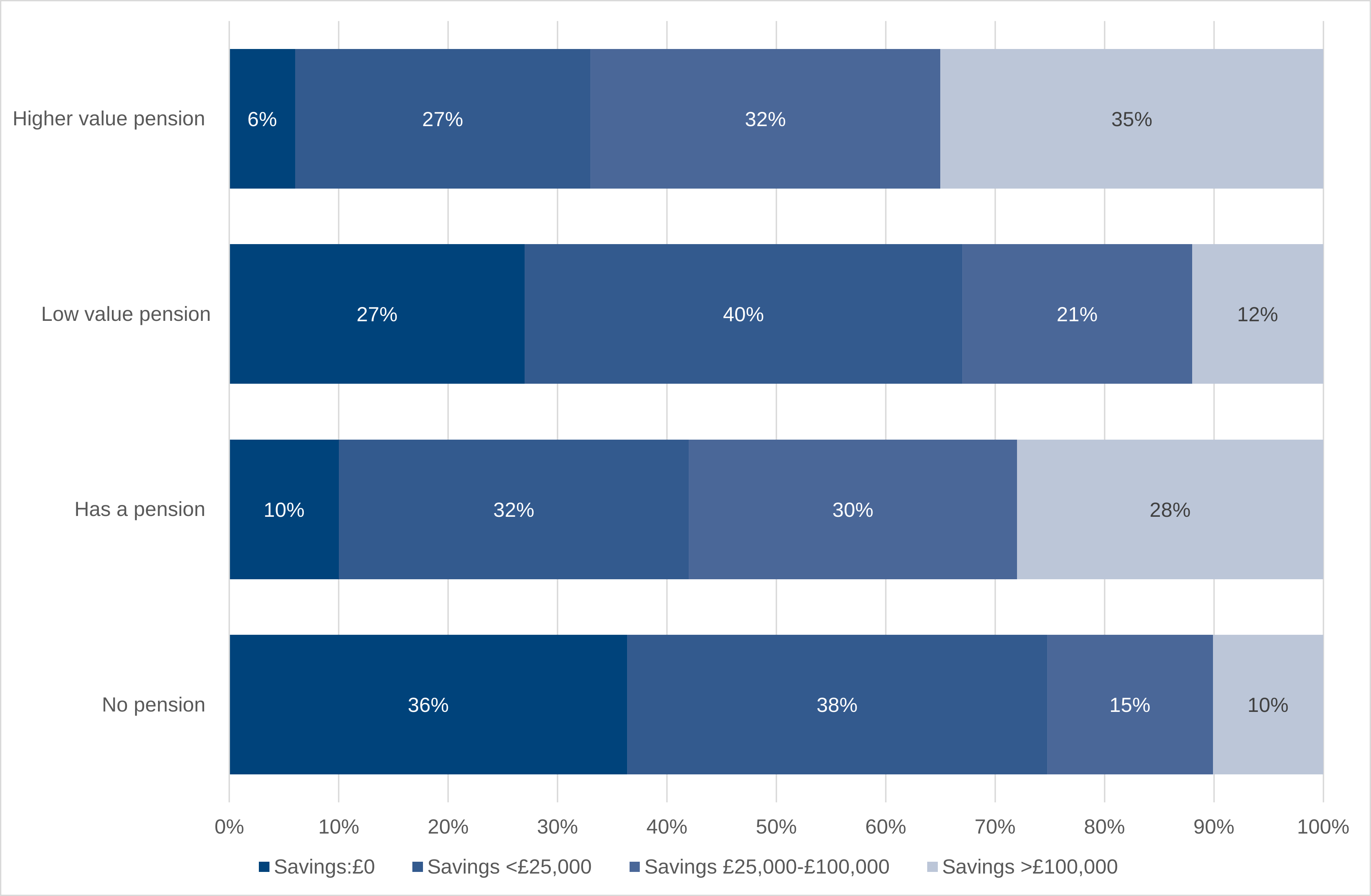
Note: low value pension = no pension or a pension <£2,500; higher value pension = £2,500 or more per annum.
Base: all study members (n=7802)
What characteristics differentiate study members who have and do not have any household savings?
Looking at differences by the level of household savings, a similar set of socio-economic disadvantages emerged for study members with no savings compared to those with savings (at the household level), as was found with study members with no pensions compared to those having some pension provision. (See Appendix Table A3.5.)
Current circumstances
Table 3.2 shows that those without any or just low level (NVQ 1) qualifications made up the highest proportion of those with no savings (48%) and the lowest proportion of those with more than £100,000 of savings (11%); for those with a degree of higher (NVQ 4 or above) the opposite was found (14% and 54% respectively).
We also see that the proportion who owned their home outright increased along with the level of household savings, from 26% among those with no savings to 86% among those with more than £100,000 of savings. Conversely, the proportion in a home rented from their local authority or a housing association increased as savings declined: 37% among those with no savings to 1% with more than £100,000 of savings.
Marital status also differed across saving groups. Compared to those with more than £100,000 of savings, study members with no savings were the least likely to be currently married or in a civil partnership (41% to 77%) and the most likely to be either single (23% to 8%) or divorced (29% to 10%).
In terms of current economic activity, half (52%) of those with no household savings were not in paid work (excluding fully retired) and a further 8% had fully retired. The proportion who had fully retired increased along with household savings and the proportion not currently in paid work (excluding fully retired) decreased as the level of household savings rose. Among study members with more than £100,000 of household savings 4 in 10 (40%) were fully retired and just 1 in 8 (13%) were not currently in paid work (excluding fully retired).
Table 3.2: Current circumstances by level of household savings
| Highest qualification / Housing tenure / Marital status / Economic activity | Current circumstances | Level of savings £0 | Level of savings less than £25,000 | Level of savings £25,000 to £100,000 | Level of savings more than £100,000 |
|---|---|---|---|---|---|
| Highest qualification | No/NVQ 1 | 48%* | 32%* | 20%* | 11%* |
| Highest qualification | NVQ 4 or above | 14%* | 25%* | 36%* | 54%* |
| Housing tenure | Own Outright | 26%* | 47%* | 75%* | 86%* |
| Housing tenure | Mortgage | 16%* | 21%* | 15%* | 9%* |
| Housing tenure | Rent LA/HA | 37%* | 20%* | 5%* | 1%* |
| Housing tenure | Rent Private | 16%* | 9%* | 3% | 2%* |
| Housing tenure | Other | 4% | 2% | 1% | 2% |
| Marital status | Married/Civil Partnership (CP) | 41%* | 57%* | 72%* | 77%* |
| Marital status | Single | 23%* | 14%* | 9% | 8%* |
| Marital status | Divorced/Former CP | 29%* | 24%* | 14%* | 10%* |
| Marital status | Widowed | 8% | 5% | 5% | 5% |
| Economic activity | In paid work | 30% | 60%* | 55%* | 47%* |
| Economic activity | Not in paid work | 52%* | 25%* | 16% | 13%* |
| Economic activity | Retired | 8%* | 15%* | 30%* | 40%* |
Note: selected categories. An asterisk * indicates differences are significant (from >£100k).
Base: all study members (n=7802)
Lifecourse experiences
Looking over the study members’ lifecourse, those without household savings had spent the least amount of time in paid work and the longest not working, particularly due to poor health. Compared to those with more than £100,000 savings, between age 20 – age 55 those with no savings have spent (on average):
-
over 7 years (89 months) less in paid work
-
over 4 years (50 months) longer out of work due to poor health
-
over 2 years (28 months) longer out of work due to home-care responsibilities
Looking further into health differences by level of savings, compared to those with more than £100,000 savings a higher proportion of those with no savings have experienced symptoms of depression (31% to 15%) and a longstanding limiting illness (48% to 19%) on one or more occasions. Figure 3.10 shows adults with no savings were also far more likely than those with any level of savings to have experienced low household income – and in particular a persistently low household income – over their adult life.
Figure 3.10: More than half of those with no savings have experienced persistently low household income
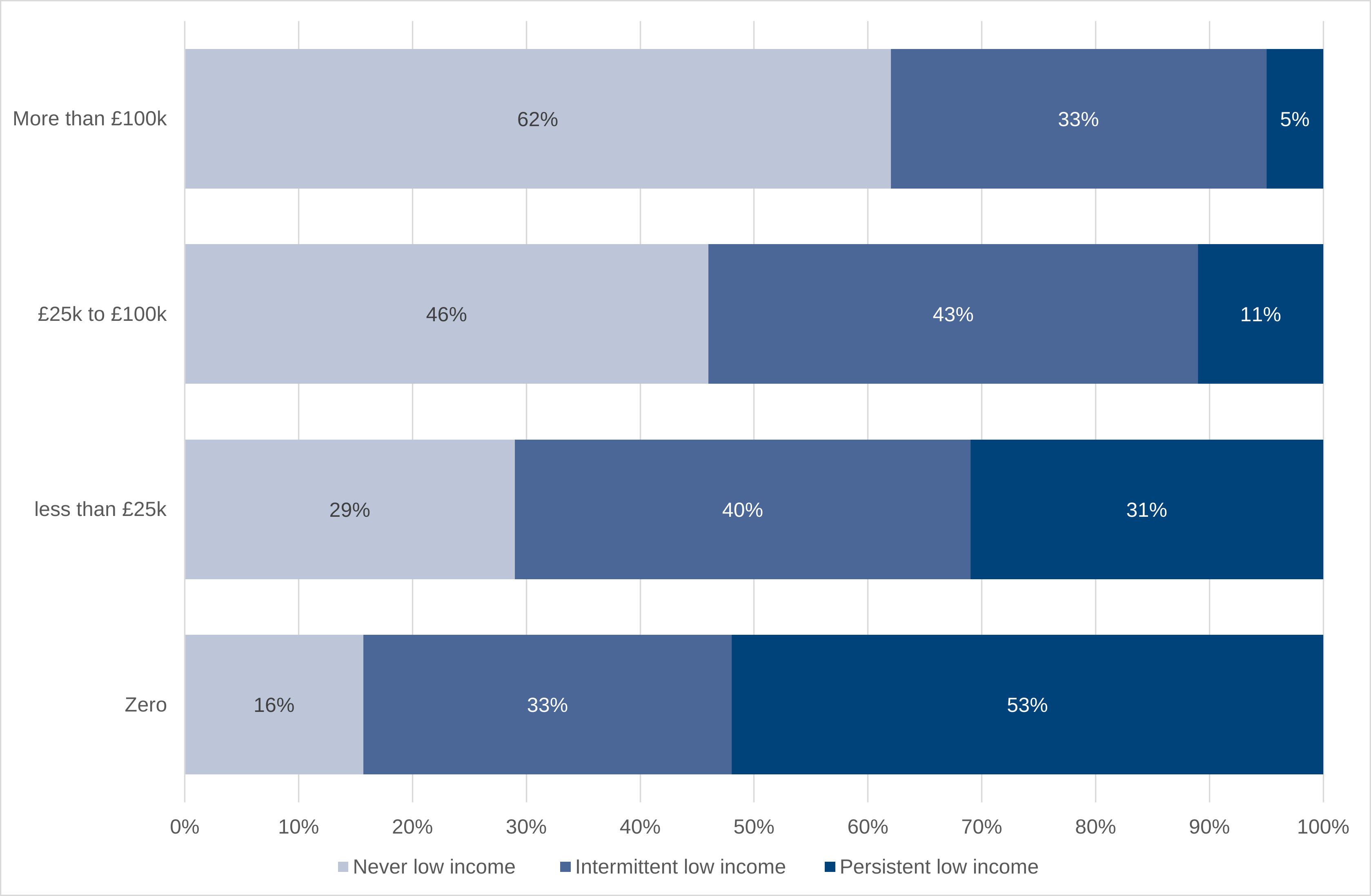
Base: all study members (n=7802)
3.3 Retirement and financial resources
The focus of this section is on how pension accumulation and financial resources differ for men and women as they enter their retirement years. We compare those who are fully retired with those who remain in paid work for men and women separately. The complete set of results are included in Appendix Tables A3.6 to A3.7.
What characteristics differ between study members who have fully retired compared to those who remain in paid work?
A quarter (24%) of both men and women had fully retired when interviewed, with 57% of men and 47% of women remaining in paid work. Of those in paid work, 4 in 5 men were working full-time (55% employee, 24% self-employed), whereas women were more evenly split between full-time (39% employee, 6% self-employed) and part-time (44% employee, 10% self-employed) paid work.
Current circumstances
The men and women who had fully retired were advantaged compared to their peers in paid work. For example, more:
-
were educated (to degree level or higher), and
-
owned their home outright
Figure 3.11 shows that among those in paid work, 1 in 11 (9%) of both men and women lived in private rented homes compared to just 1 in 50 (2%) of those who were fully retired.
Figure 3.11: More than 8 in 10 men and women who had fully retired in their early 60s owned their home outright
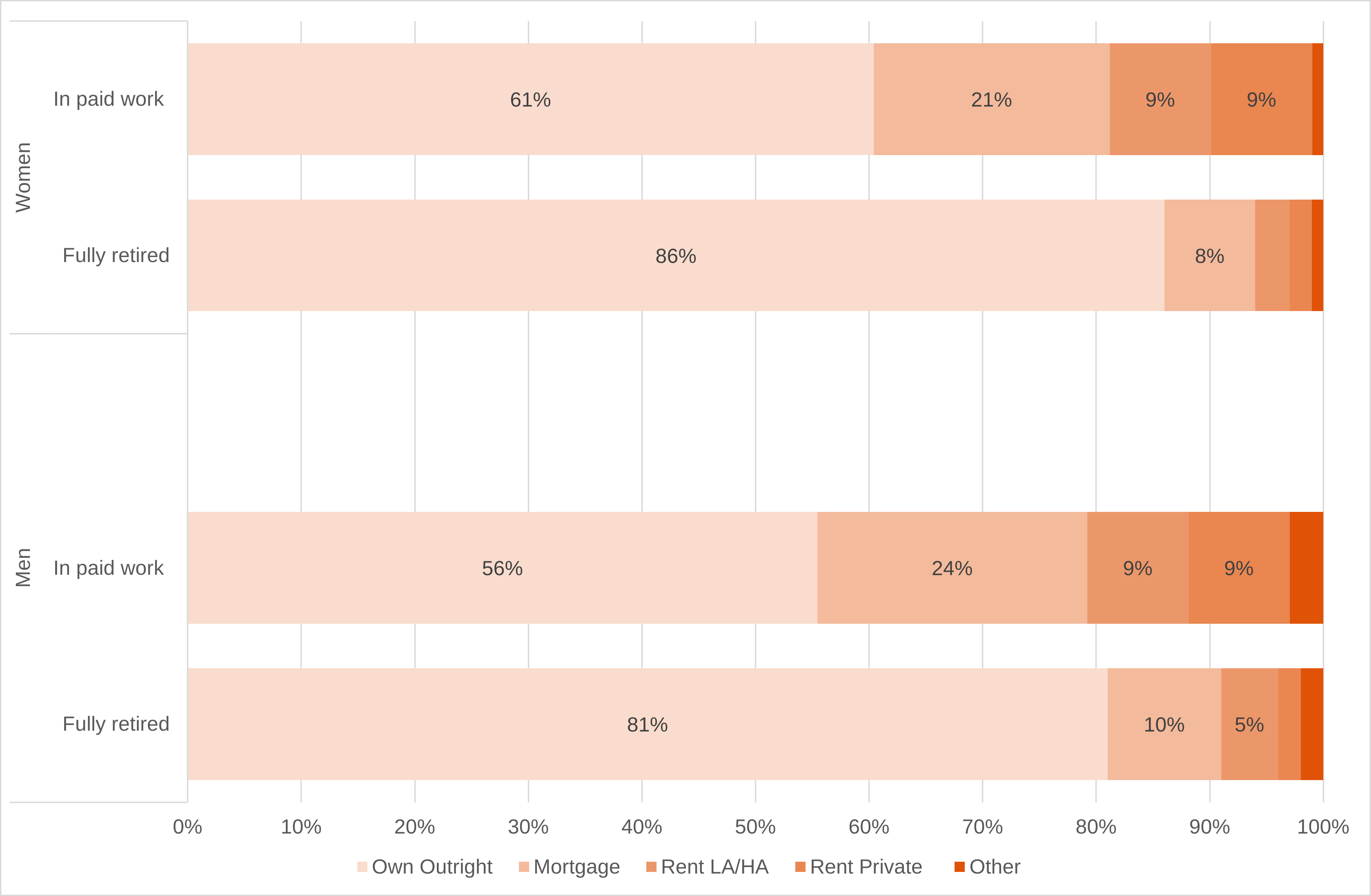
Base: study members who have fully retired or in paid work (n=6344)
Compared to those in paid work, early retirement was associated with marriage or being in a civil partnership among women, but not men.
-
6 in 10 (59%) women in paid work were married or in a civil partnership compared to more than 7 in 10 (73%) fully retired women
-
more than 1 in 5 (22%) women in paid work were currently divorced compared to 1 in 7 (13%) of fully retired women
Among men, a similar proportion of fully retired (74%) or working men (70%) were currently married or in a civil partnership.
Of those with a partner, if the study member had fully retired then their partner was also more likely to be fully retired; if the study member was in paid work, then the partner was also far more likely to be in paid work. Figure 3.12 shows this pattern was very similar for both men and women.
Figure 3.12: Fully retired study members are more likely to have a partner who has also fully retired
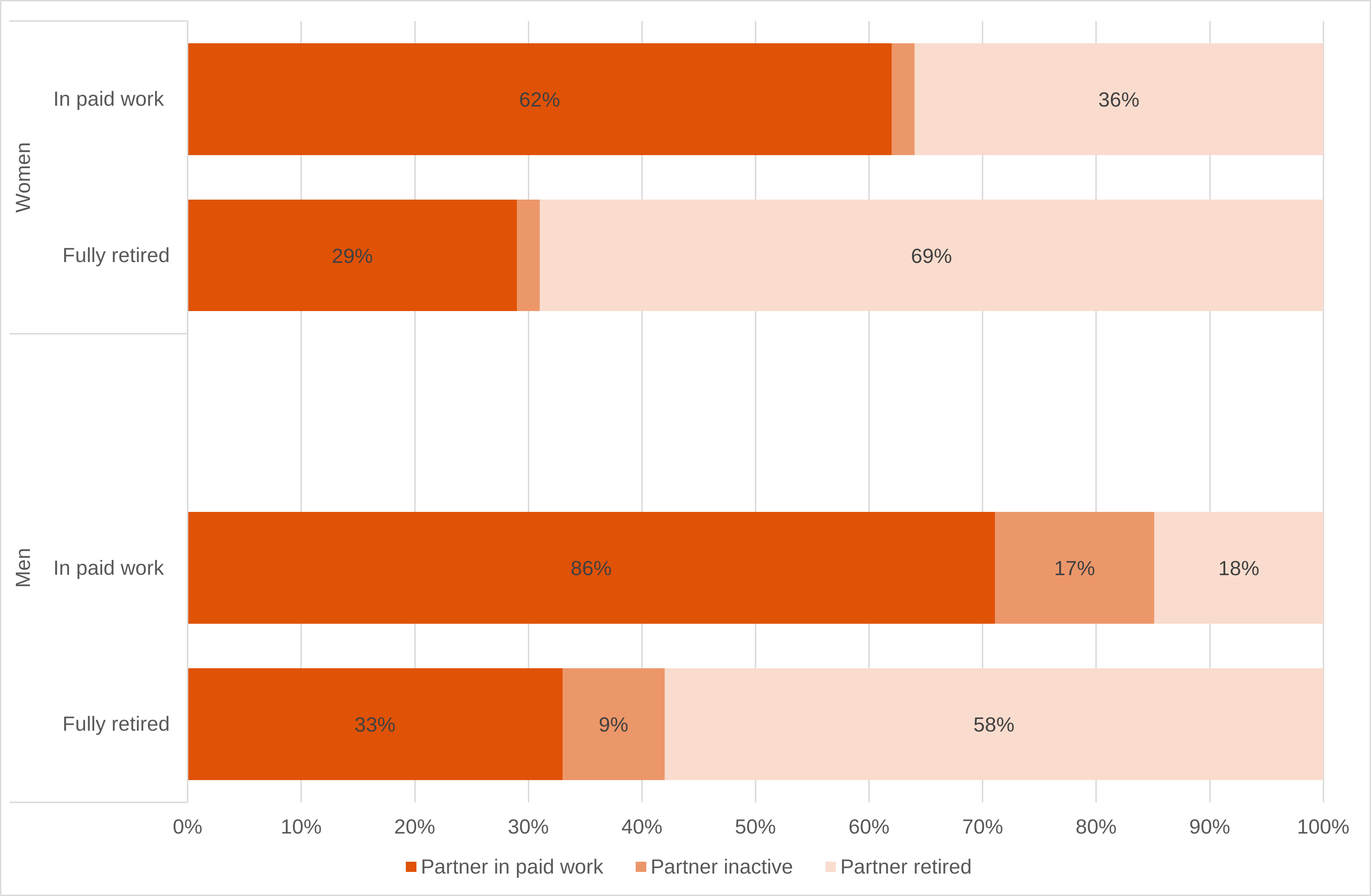
Lifecourse experiences
There were no differences in the experience of a limiting illness or poor mental health over the lifecourse between men or women. Amongst men there were also no differences in the (average) time spent in paid work, out of work due to sickness, or in a home-care role between age 20 and 55 by whether they had fully retired or were in paid work. Among women, those who had fully retired had spent more time (on average) in paid work (14 months) and less time with home-care responsibilities (10 months). Fewer men and women who had fully retired had experienced intermittent or persistently low household income over the lifecourse compared to their peers in paid work (46% to 57% men; 46% to 60% women).
How does pension accumulation differ between study members who have fully retired compared to those who remain in paid work?
Around 9 in 10 men and women had a pension, whether they had fully retired or were in paid work in their early 60s[footnote 11]. More men who had fully retired had an employer’s (DB or DC) pension (73%) compared to those in paid work (65%), but differences were not notable for women (73% fully retired, 70% in paid work).
Figure 3.13 shows that over half of men and women who had fully retired had a DB pension (54% men and 56% women), compared to approximately a third of those in paid work (30% of men and 38% of women). Those in paid work were more likely to have a DC pension – particularly men with 2 in 3 (65%), compared to 1 in 2 (50%) women in paid work. For both sexes, at least twice as many retirees had an employer’s DB pension than an employer’s DC pension (men 54% compared to 26%; women 56% compared to 22%).
Figure 3.13: More than 1 in 2 fully retired men and women have a DB pension
Base: study members who have retired or in paid work (n=6344)
Turning to marriage and partnerships, compared to those in paid work, more of the fully retired men and women (with a partner) had a partner with a private pension:
-
men: 77% (fully retired) to 67% (paid work)
-
women: 87% (fully retired) to 77% (paid work)
-
7 in 10 (71%) fully retired women had a partner with an employer’s (DB or DC) pension, compared to 6 in 10 (60%) who were in paid work (this difference was not so apparent for men: 67% to 60%)
A higher proportion of retired men and women had a partner with a DB pension:
- more than 4 in 10 retirees (45% men, 49% women) compared to a third in paid work (31% women, 30% men)
How do other financial resources differ between study members who have retired compared to those who remain in paid work?
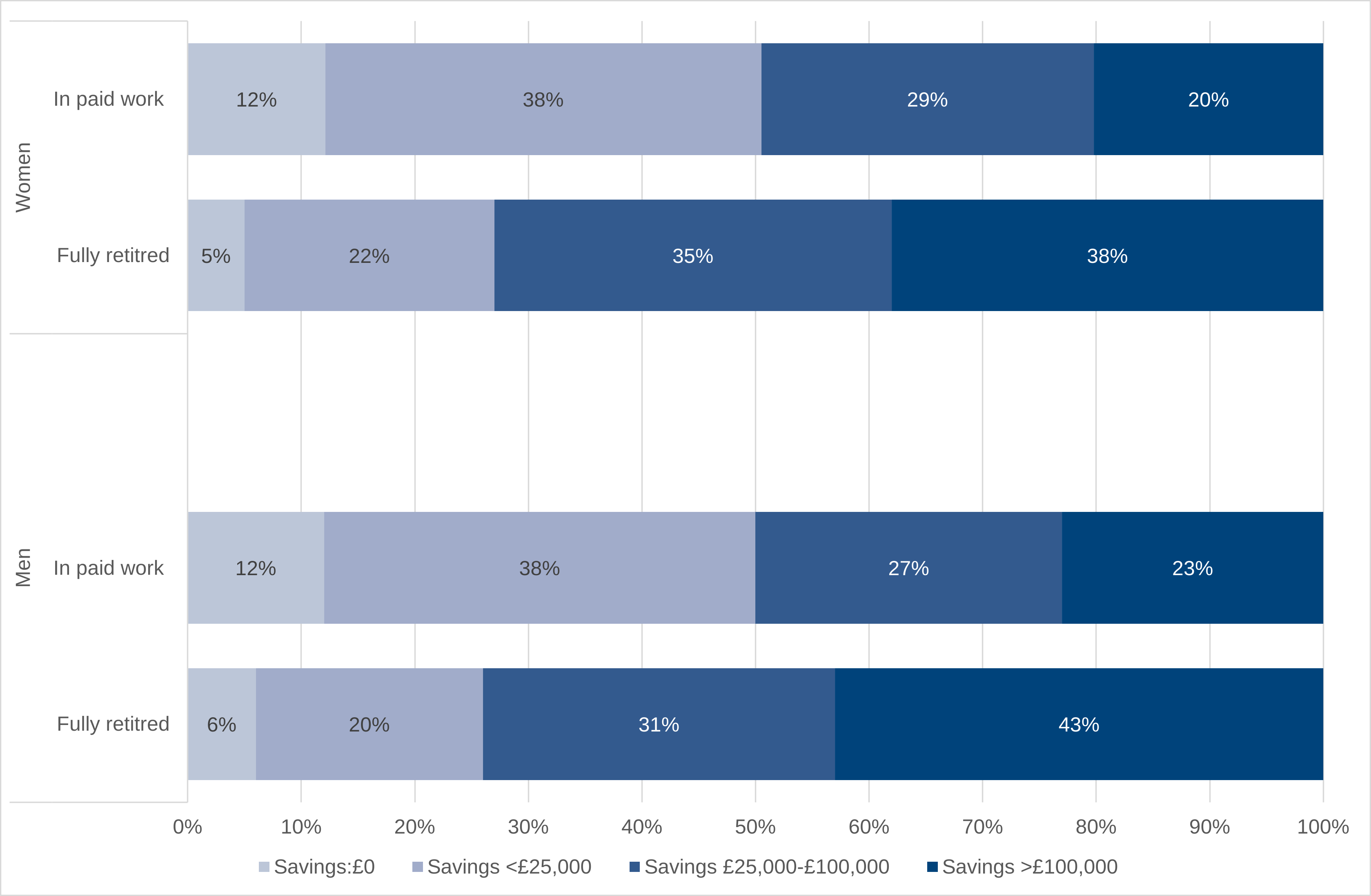
Figure 3.14 shows that men and women who had fully retired had far more savings than men and women who remained in paid work.
-
nearly twice as many men and women who had fully retired had more than £100,000 in household savings, and
-
half of those in paid work had either no savings or savings less than £25,000
Figure 3.14: Half of those in paid work in their early 60s had either no savings or savings less than £25,000
Base: study members who have retired or in paid work (n=6344)
More retirees had also personally received an inheritance, with differences being particularly marked for women: 38% fully retired compared to 27% in paid work. Proportions who had received an inheritance for men were 35% to 30% respectively.
Chapter 4: Decumulation of financial resources
This chapter focuses on study members with a private pension and access to their private pension income. We identify whether the study member has accessed or intends to access any private pension they have before reaching SPa, and whether this differs by type of private pension. We also investigate the type of access used to withdraw any private pensions. The chapter is divided into two sections: 4.1 Access to private pensions before SPa details the prevalence of access or intended access before SPa, and describes the key socioeconomic characteristics that are associated with accessing or intention to access private pensions before SPa, and 4.2 Type of access to private pensions outlines the approach taken to access private pensions before SPa and the key characteristics associated with each type of withdrawal.
Key Findings
Age access private pensions
-
the average (median) age to access or intention to access any pension is 61, being slightly younger (60) for a DB pension, and slightly older for a DC pension (64)
-
three-quarters (76%) of those with a pension have already accessed or intend to access (one of) their private pensions before SPa. This was higher for those with a DB (84%) than a DC (66%) pension
Of those that had accessed their DB pension:
- more than 8 in 10 (85%) had taken a lump sum in addition to their pension income
Of those that had accessed their DC pension:
-
nearly two-thirds (63%) had withdrawn a tax-free lump sum
-
twice as many had taken an adjustable income than had purchased an annuity (33% to 17%)
-
15% had withdrawn their entire pension fund in one lump sum – being higher among women than men (19% to 13%)
Amongst those that had not yet accessed their DC pension
-
6 in 10 (60%) did not know the type of access they might use, and
-
of those that knew what type of access they might choose, more than 3 times as many intend to take an adjustable income (25%) than buy an annuity (7%)
Those who have accessed their pension (DB or DC) were more likely than those who had not to
-
have fully retired (34% to 6%)
-
have savings of £100,000 or more (31% to 19%)
-
own their home outright (70% to 56%)
-
have a partner who is receiving a DB pension (44% to 25%), and
-
have spent two more years (on average) in paid work, and less time out of paid work due to poor health and in a home-care role
4.1 Access to private pensions before SPa
As outlined in Chapter 3, 78% of study members had at least one private pension and 1 in 5 (19%) had 2 or more private pensions. For each private pension, study members were asked a series of questions including:
-
the type of private pension – DB, DC or unknown (around 1 in 10 (11%) study members don’t know or refused to say whether the pension was a DB or DC pension)
-
whether at time of interview they had already accessed the private pension, and if so when this happened and how they had accessed each pension, and
-
if they had not already accessed the private pension, when they intended to, and how they intended to access each pension
To examine access to private pensions before SPa we include study members who had already accessed a private pension and those who intended to access a private pension[footnote 12] before SPa, at age 65 or earlier, compared to study members who had any private pension, but did not intend to access until age 66 or older. We analyse three groups: those who had accessed or intend to access before SPa:
-
any private pension (this includes DB, DC and any pensions where type of pension was unknown)
-
any DB pension
-
any DC pension
If the study member had more than one pension in any of the categories discussed, we prioritise any access which has already occurred. In establishing the age at which the study member had or intend to access any private pension, we prioritised the earliest age of withdrawal, regardless of the type of access used.
Before focusing on age of access or intention to access before SPa, we look at earliest average age of or intention to withdraw.
-
the average age (median) to access or intend to access any pension is 61 (ranging from 58 to 65 at the 25th and 75th percentile respectively)
-
the average age (median) to access or intend to access a DB pension is 60 (ranging from 57 to 64 at the 25th and 75th percentile respectively)
-
the average age (median) to access or intend to access a DC pension is 64 (ranging from 60 to 66 at the 25th and 75th percentile respectively)
Figure 4.1 shows there is a steep peak in access or intention to access up until SPa (age 66). At SPa most (92%) study members will have accessed or intend to access a private pension if they have one, compared to three-quarters (76%) by age 65. By age 60 twice as many study members had accessed DB pensions for the first time (60%), compared to a DC pension (31%). Few (11%) study members had accessed their private pensions before age 55, as access to private pensions before this age is generally only possible in exceptional circumstances. For example, due to ill-health or having a Protected Pension Age of less than aged 55.
Figure 4.1: Almost half of study members had accessed their private pension by age 60, being twice as high among those with a DB than a DC pension
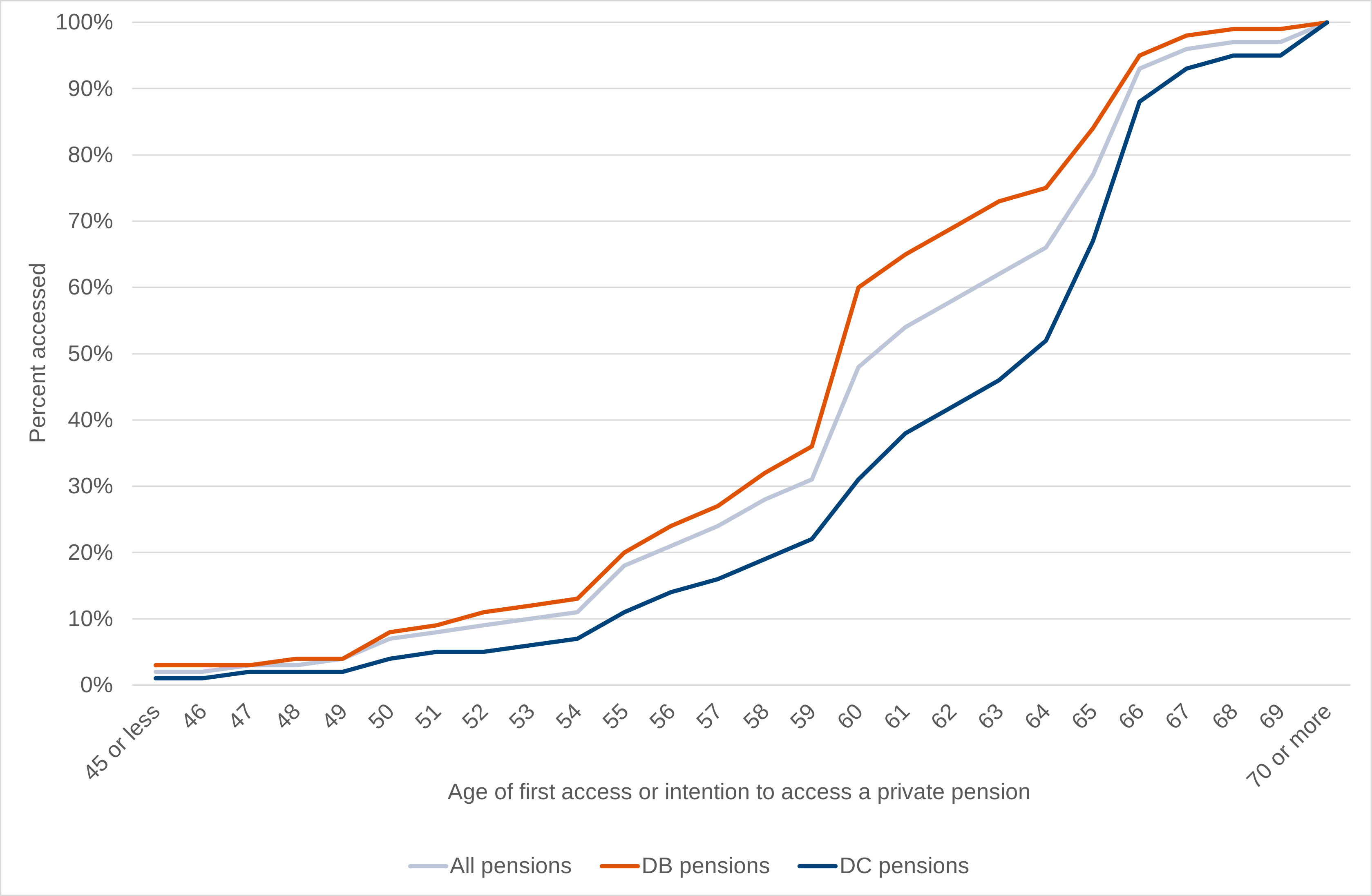
Note: age of access or intention to access may be in part influenced by the study members’ interview date.
Base: study members who have a private pension (n=6521)
We now focus on study members with a private pension by whether they have accessed or intend to access private pensions before SPa or not.
All types of private pensions (any DB, DC or unknown)
Among the 8 in 10 (78%) study members with a private pension, Figure 4.2 shows that three-quarters (76%) have already accessed or intend to access (one of) their private pensions before SPa. The median average age of access is aged 60. More specifically, 6 in 10 (60%) have already accessed their (or at least one of their) private pension(s), with 59 years being the median average age when their pension was first accessed. Among those who had a private pension they had not yet accessed, 42% expect to do so before reaching SPa.
DB Pension
Among the 1 in 3 (35%) study members with a DB pension, 8 in 10 (84%) have already accessed or intend to access their DB pension before SPa at an average median age of 60. More specifically, 7 in 10 (71%) have already accessed their DB pension, with 59 years being the average median age when their DB pension was first accessed. Among those who have a DB pension but had not already accessed, 43% intend to do so before reaching SPa.
DC Pension
Among the 1 in 2 (47%) study members with a DC pension, two-thirds (66%) have already accessed or intend to access their DC pension before SPa at an average median age of 61. More specifically, 4 in 10 (44%) have already accessed their DC pension, with 60 years being the average age when their DC pension was first accessed. Among those who have a DC pension they have not already accessed, 43% intend to do so before reaching SPa.
Figure 4.2: 3 in 4 study members already have or intend to access a private pension before SPa; DB pensions were more likely to have been accessed than DC pensions
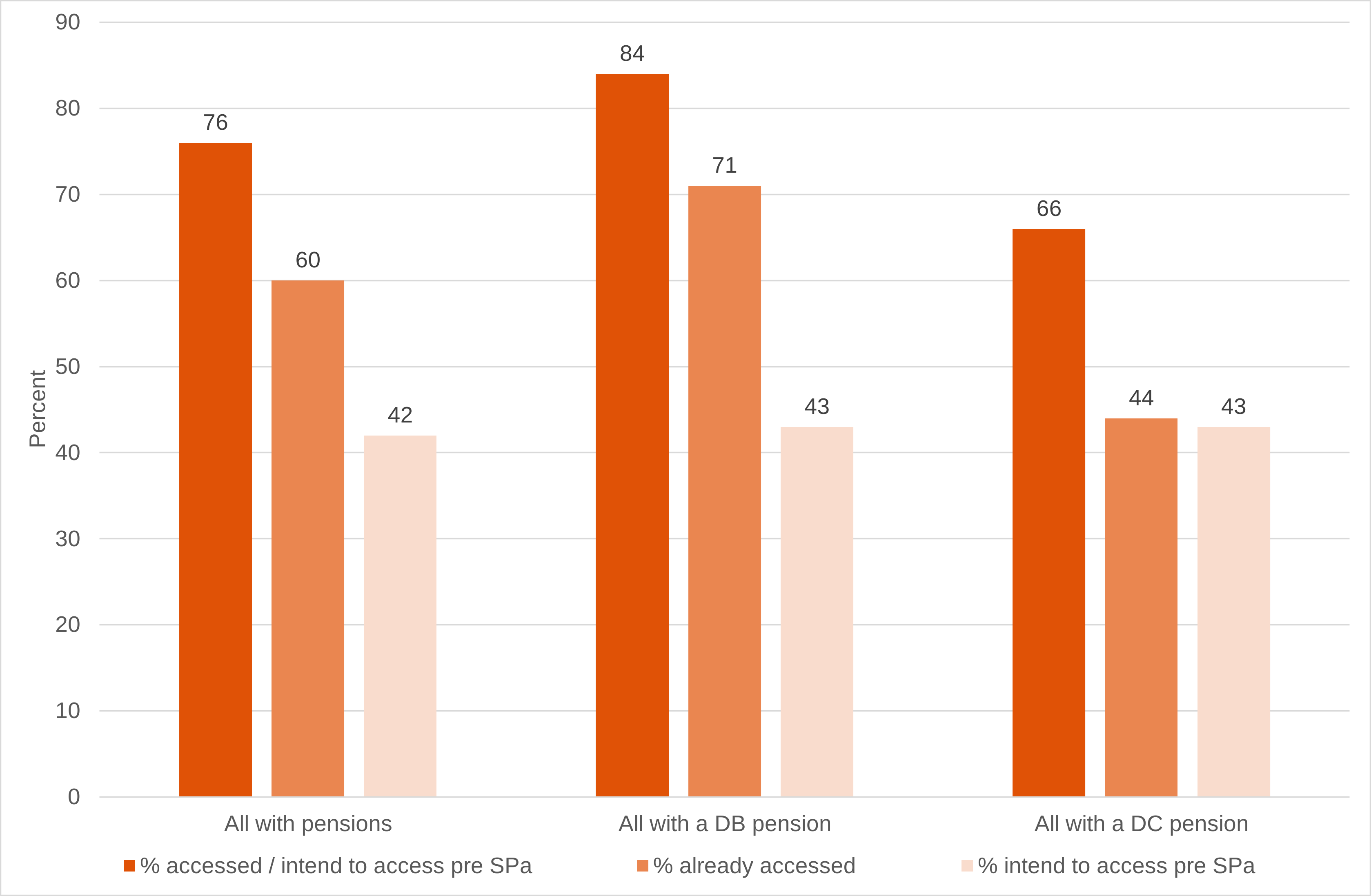
Who has accessed their private pension before SPa?
Here we explore differences in the characteristics of study members with a private pension who had accessed or intend to access any private pension before SPa - [those who have] compared to those who do not intend to access any private pension before SPa [those who have not]. We then note any further specific differences in study members’ characteristics by access or not among those with a DB pension or a DC pension. (Full results are available in Appendix Tables A4.1 to A4.3).
Accessed any pension: (any, DB, DC or unknown)
Current circumstances There was no difference in the percentage of men and women who had accessed a private pension (76% both), but study members who have accessed a private pension were more socio-economically advantaged across a range of indicators than study members who had not. Specifically, those who have accessed were more likely than those who have not to:
-
be educated to degree (or higher) level (41% to 32%)
-
own their home outright (70% to 56%)
-
have fully retired (34% to 6%)
-
have savings of £100,000 or more (31% to 19%)
-
be married or in a civil partnership (70% to 61%), and
-
have a partner who is receiving a DB pension (44% to 25%)
Table 4.1 shows that these differences were more pronounced when looking at access to a DB pension before SPa, with far fewer differences emerging when examining access to a DC pension before SPa. Those who have accessed were also less likely to be a full-time (23% to 51%) employee, with those who have accessed a DB pension also being more likely to currently be self-employed on a part-time basis (6% compared to 1%).
Table 4.1: Characteristics of study members by access to their pensions before SPa
| Characteristics of study members | Any Access: No % | Any Access: Yes % | DB Access: No % | DB Access: Yes % | DC Access: No % | DC Access: Yes % |
|---|---|---|---|---|---|---|
| Highest qualification NVQ 4 or above | 32%* | 41%* | 42%* | 51%* | 35% | 35% |
| Fully retired | 6%* | 34%* | 5%* | 43%* | 9%* | 28%* |
| Full-time employee | 51%* | 23%* | 58%* | 19%* | 48%* | 28%* |
| Part-time self-employed | 3% | 6%* | 1%* | 6% | 5% | 5% |
| Own house outright | 56%* | 70%* | 58%* | 76%* | 60% | 68% |
| Savings: more than £100,000 | 19% * | 31%* | 20%* | 38%* | 26% | 30% |
| Married/Civil Partnership | 61%* | 70%* | 62%* | 73%* | 64% | 71% |
| Partner receiving DB pension | 25%* | 44%* | 28%* | 51%* | 26%* | 38%* |
Note: selected categories. An asterisk * indicates differences are significant.
Base: study members who have a private pension (n=6521)
Given 1 in 3 (34%) study members who had accessed a private pension had fully retired and retirement from economic activity is a key driver to accessing pension funds, we looked further into differences in the characteristics of study members by whether they had fully retired or remained in paid work. See Box 4.1.
Box 4.1: Accessing private pensions before SPa by those who had fully retired or remained in paid work.
We found that almost all (95%) of fully retired study members with a pension had accessed their pension before SPa compared to two-thirds (66%) of those with a pension who remained in paid work. There was no difference in the percentage of men and women who had accessed their private pension within these two groups.
Among the study members who had accessed a private pension, those who had fully retired were more socio-economically advantaged than those who remained in paid work. For example, greater proportions had:
-
a degree or higher qualification (48% to 39%), fewer had no qualifications (13% to 19%)
-
owned their home outright (85% to 62%), fewer had a mortgage to pay off (9% to 23%)
-
one partner (67% to 59%), fewer were currently divorced (11% to 16%)
-
no experience of low household income (59% to 49%)
-
savings of £100,000 or more (44% to 26%), and
-
a partner receiving a DB pension (57% to 34%)
Among the study members who remained in paid work, those who had accessed their pension were less likely to be working as a full-time employee compared to those who had not accessed their pension (47% to 61%) and more likely to be self-employed on a part-time basis (11% compared to 4%). This could be an indication that they had started thinking about retirement and had started to reduce the hours they were in paid work. There were no differences in the experience of a longstanding limiting illness (LSLI) or symptoms of depression over the lifecourse by pension access, with around 8 in 10 in both groups never having had a LSLI or depression.
Lifecourse experiences
Looking over the lifecourse, Figure 4.3 shows that those who have accessed any private pension had spent two years more (on average) in paid work between age 20 and 55 (363 compared to 339 months), with these differences more pronounced by access to a DB than a DC pension. Those who had accessed a pension had also spent less time out of paid work due to poor health (17 compared to 30 months) or in a home-care role (25 compared to 34 months). They were also more likely to have never been part of a low income household (50% compared to 36%) and less likely to have persistently been in a low income household (11% compared to 20%). Again, these differences were more pronounced by access to a DB than a DC pension.
Figure 4.3: Those who have accessed a pension have spent more time in paid work over the lifecourse
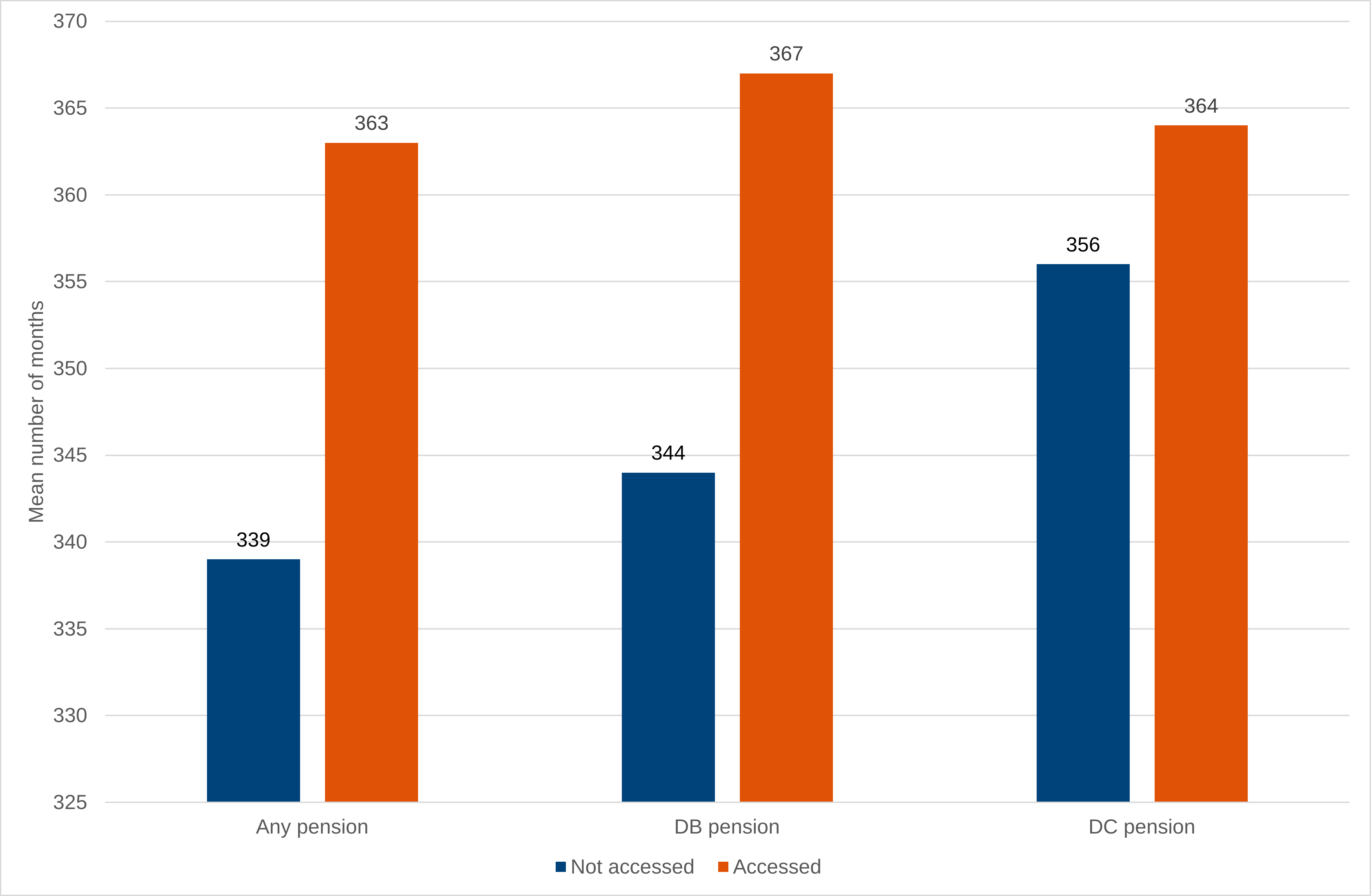
Base: study members who have a private pension (n=6521)
4.2 Type of access to private pensions
In this section we examine the type of access study members used to withdraw funds from their private pensions. We focus on study members who had already accessed their pensions, and particularly their DC pensions, where individuals had more options on type of access. We then investigate study members who had not yet taken their DC pension. For each DC pension, study members were asked how the fund was accessed – one or more options could apply to each pension they had accessed. The descriptives below show if they had used these methods of access to withdraw funds or take an income for any pension they had accessed. We highlight any key characteristics associated by type of withdrawal. Note, we concentrate here on first access to a DC pension, but not the value of their pension(s) or how this might relate to type of withdrawal.
DC Pension
For the 4 in 10 (44%) who had already accessed their DC pension, Figure 4.4 shows that 15% had withdrawn their entire pension fund in one lump sum; 63% had withdrawn a tax-free lump sum; 33% had taken an adjustable income e.g. flexible access drawdown; and 17% had purchased an annuity.
Figure 4.4: 2 in 3 accessed a DC pension by withdrawing a tax-free lump sum, and twice as many took an adjustable income than purchased an annuity
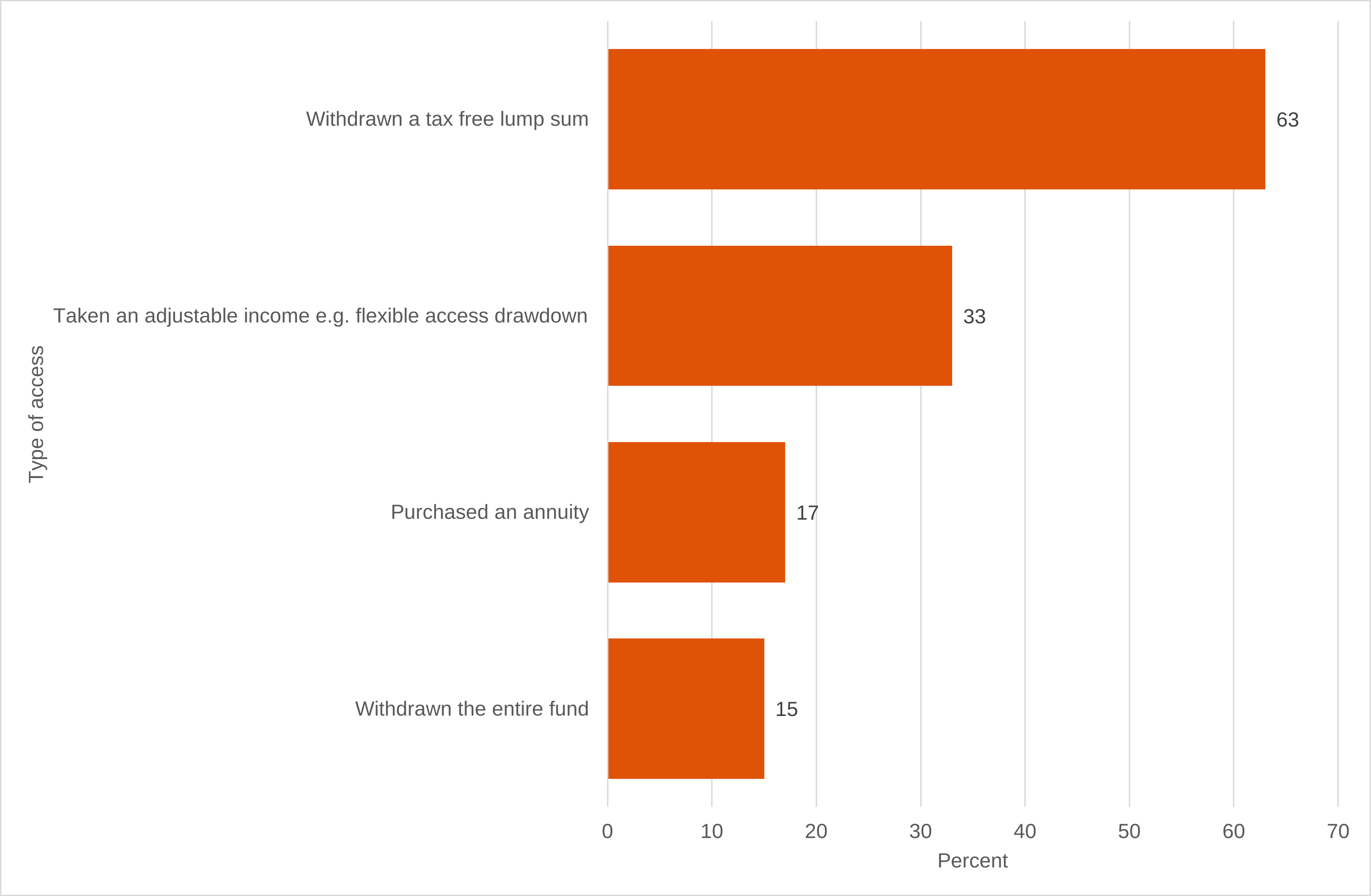
Base: study members who have accessed their DC pension (n=2121)
Looking at the combinations of type of access a study member had used to access their DC pension, very few study members had:
-
received an annuity and were also taking an adjustable income (e.g. drawing down) on one or more DC pensions (6%)
-
taken all their pension fund in one lump sum and accessed other DC pensions in different ways (i.e. an annuity (4%); an adjustable income e.g. drawdown (5%); a tax-free lump sum (7%))
However, half (51%) of those in receipt of an annuity had also withdrawn a tax-free lump sum from this or another DC pension and half (53%) of those drawing down on their DC pension had also received a tax-free lump sum.
When examining characteristics of study members by type of access, we found little consistency in their characteristics across types of access. For example, whereas more women than men had withdrawn their entire DC pension fund in one lump sum (19% to 13%), the proportion of men and women who had withdrawn a tax-free lump sum, an adjustable income or purchased an annuity was very similar. It is important to note, however, that in addition to specific characteristics of the study member, decisions on type of access may also be related to the size of DC pension fund which is not covered here. We now detail other differences by type of access.
Withdrawn all DC Pension in one lump sum
Compared to those who had not withdrawn their entire DC pension, more of those who had withdrawn their entire DC pension were currently in a home-care role (10% to 5%) and had spent more months in a home-care role over the lifecourse (35 to 21 months).
Fewer of those who had withdrawn their entire DC pension had a degree (or equivalent) level of qualification (23% compared to 38%) and had a partner receiving a DB pension (30% compared to 43%).
Withdrawn a tax-free lump sum
Compared to those who had not withdrawn a tax-free lump-sum from their DC pension, those who had were more likely to be a full-time employee (25% to 17%) and had spent less time in a home-care role over the lifecourse (20 to 29 months).
Taken a flexible access drawdown
Compared to those who had not taken an adjustable income, those who had were more likely to be fully retired (43% to 29%), married (77% to 69%), have a partner receiving a DB pension (52% to 36%), have savings of £100,000 plus (35% to 26%).
They were also less likely to be self-employed on a full-time basis (4% to 12%).
Purchased an annuity
There were no substantive differences between those who had and had not purchased an annuity.
Defined Contribution pension intentions
Here we investigate people’s future intentions for their DC pensions. Study members who had not yet accessed any (one) of their DC pensions were asked what they intended to do with their funds.
Figure 4.5 shows that over half (60%) had not yet decided what they were going to do with (at least one of) their DC pension(s) they had not already accessed. 1 in 4 (25%) intend to take an adjustable income e.g. flexible access drawdown, while taking an annuity was the least popular option (7%).
Figure 4.5: 6 in 10 don’t know what they’ll do with their DC pension(s)
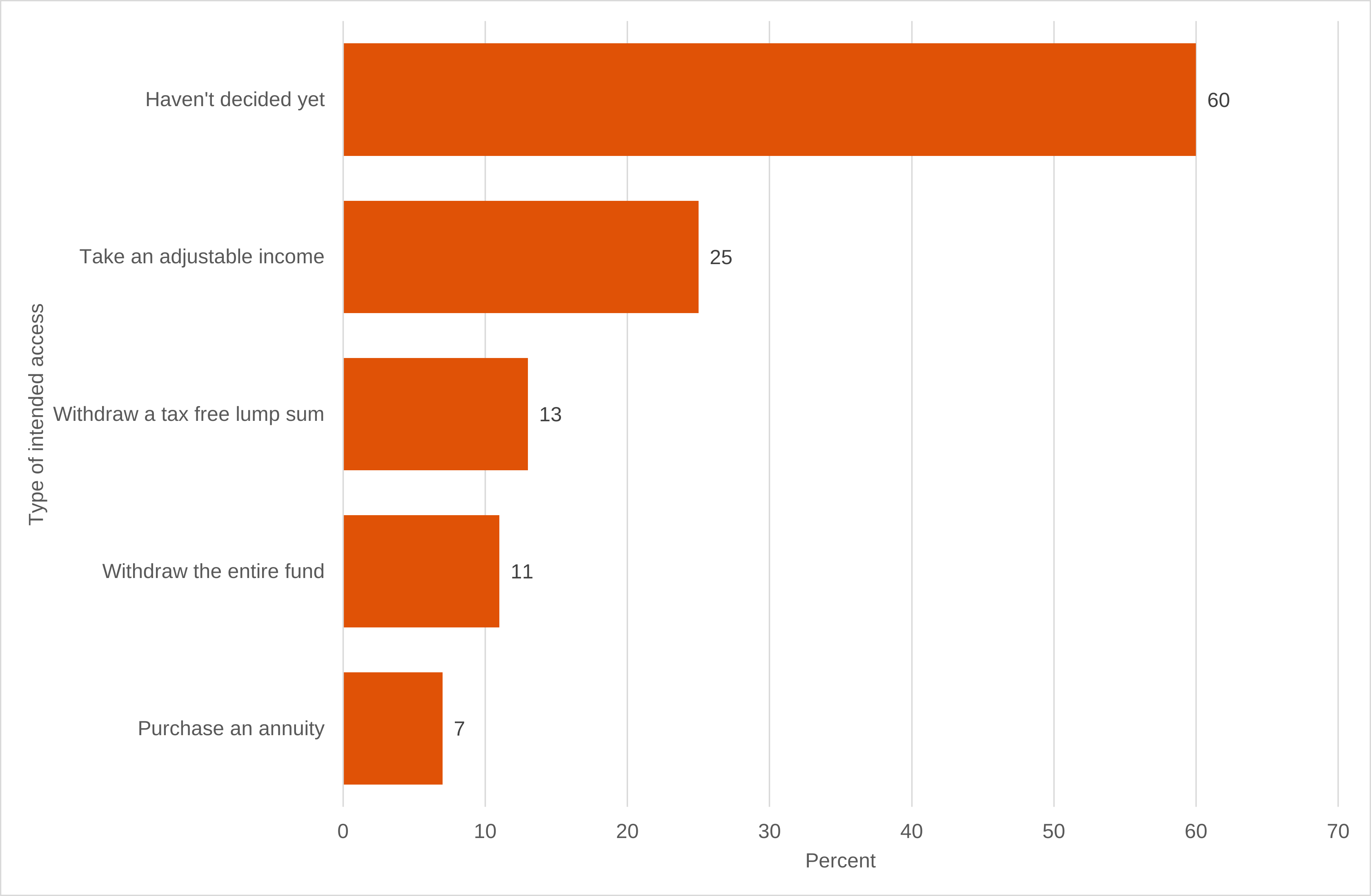
Base: study members who have not yet accessed their DC pension (n=501)
DB Pension
For the 7 in 10 (71%) who had already accessed their DB pension, 85% had taken a lump sum in addition to their pension income.
Chapter 5: Self Employment and Retirement
The self-employed are the central focus of this chapter, which is divided into three sections. In section 5.1 we first detail the proportion of men and women who were self-employed or employed in each year between age 20 to 55 and then define three self-employment groups and one employment group using this economic activity data collected over a 35-year period. In section 5.2 we describe differences in the current characteristics and lifecourse experiences between the self-employment an employment groups, before focusing on financial resources including financial and housing wealth together with private pension provision and pension values. In section 5.3 we examine differences in retirement outcomes as the study members approach State Pension age (SPa).
Key Findings
Self-employment over the lifecourse
Men made up the majority of the self-employed, but entrance into later self-employment was more of an equal gender split.
-
1 in 8 (12%) study members had spent the majority of their working life (18 plus years) from age 20 to 54 self-employed
-
1 in 5 (20%) study members had spent 10+ years self-employed; and
-
1 in 25 (4%) study members were self-employed for the first time in their 50s
Economic activity pre- and post-SPa
The majority self-employed were far more likely than the majority employed to remain economically active in their early 60s.
-
just 1 in 7 (14%) self-employed were fully retired compared to 1 in 3 (32%) of the majority employed, and
-
nearly three times as many self-employed expected to still be in paid employment at age 68 or later (40% to 14%)
Self-employment and Pensions
Fewer of the majority self-employed had any private pension provision, and if they did it was more likely to be a DC than a DB pension. Compared to the majority employed, they were
-
3 times more likely to not have any private pension: 29% to 10%
-
nearly 4 times less likely to have a DB pension: 13% to 48%
-
more than twice as likely to have a personal DC pension: 45% to 18%
Self-employment and home-ownership
Although fewer majority self-employed than the majority employed owned their home outright (57% to 69%), nearly twice as many owned (either outright or with a mortgage) two or more properties (30% to 17%) and had housing wealth of more than £600,000 (30% to 15%).
5.1 Self-employment over the lifecourse
We make full use of the economic activity history data that has been collected from study members over their (adult) lifecourse[footnote 13], focusing on 35 years of information from January 1978 to December 2012, the year they turned 20, to just before their 55th birthday (March 2013). For each year we coded whether a study member had spent most of the year self-employed, full-time employed, part-time employed or engaged in ‘other’ activities. Due to small numbers in part-time self-employment, we combined these study members with those self-employed on a full-time basis. Figures 5.1a and 5.1b show the proportion of men and women in each activity in each year respectively. The proportion of self-employed men in any given year ranged from a low of 8% (1978) to 26% (2012), to first reaching 20% in 1989 (age 31). For women, the proportion self-employed in any given year ranged from 6% (1978) to a high of 13%, which was first reached in 2009 (age 51).
Over the 35 years, 1 in 3 (34%) of our sample of men and women interviewed at age 62 had been self-employed at some point over their working life, with 1 in 8 (12%) having been self-employed for more than half of their working life (between 18 to 35 years). See Box 5.1 for details.
Box 5.1: Derivation of the lifecourse self-employed and employed groups
For each calendar year from January 1978 to December 2012 (the latest data currently available), we counted the number of months a study member had been in self-employment, full-time-employment or part-time employment. Within a calendar year we could not differentiate between full-time and part-time self-employment due to small numbers in part-time self-employment in any one year. For the purposes of this chapter all other economic activity statuses were grouped together. This included education or training, temporary or permanent sickness, unemployment, home-care and fully retired.
The economic activity status attributed to a study member was based on the highest number of months spent in one activity in any one year. On the rare occasion when there were equal numbers of months for any employment category a hierarchical approach to allocation was used as follows:
-
if an equal number of months had been spent in self-employment or other – the self-employment category was awarded; likewise if an equal number of months had been spent employed or other, an employed status was awarded
-
if an equal number of months was spent in self-employment and (either) full-time or part-time employment, a self-employment status was ascribed
Figure 5.1a: More men move into self-employment over their working life, increasing from 1 in 13 (8%) at age 20 to 1 in 4 (26%) by age 54
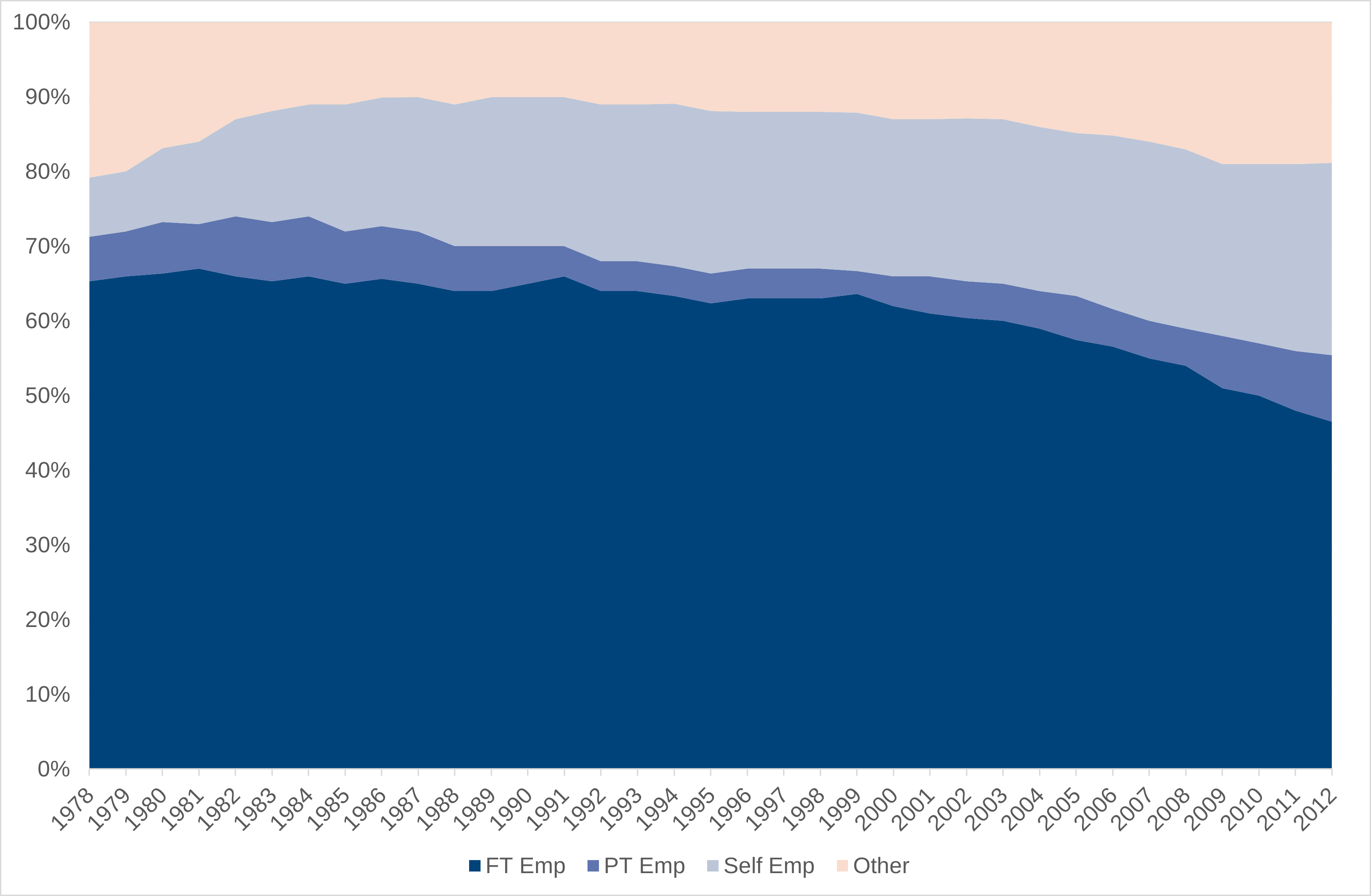
Base: all male study members (n=3879)
Figure 5.1b: The proportion of self-employed women doubled over 30 years, increasing from 1 in 17 (6%) at age 20 to first reaching 1 in 8 (13%) at age 51
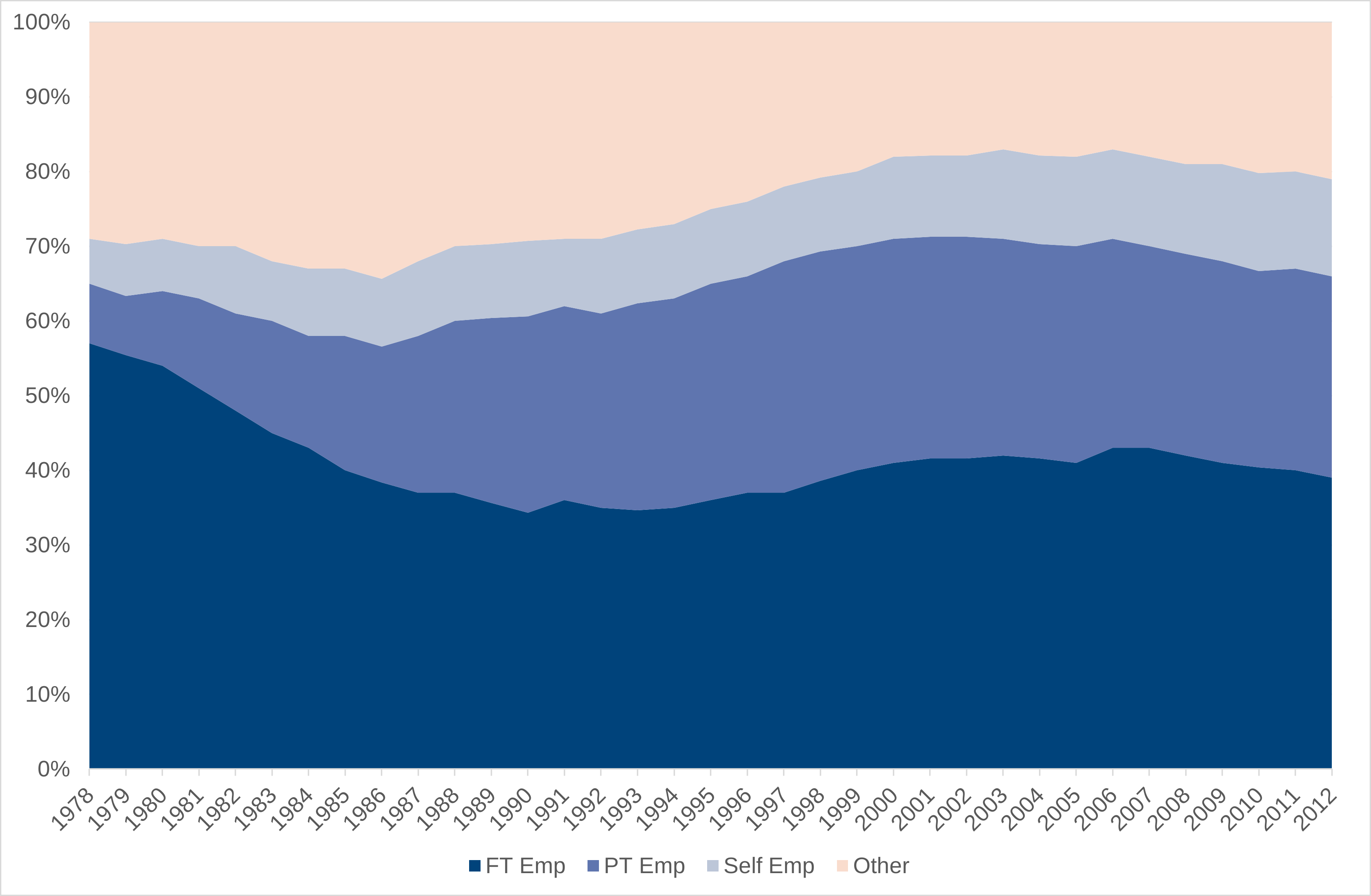
Base: all female study members (n=3923)
Analytic Groups
Over the 35-year period between age 20 to 55, study members spent on average more than 27 year in paid work. Our main analysis focuses on the comparison of characteristics and outcomes between those who had spent the majority of their time self-employed (18 plus years) (majority self-employed),and those who spent the majority of their working life employed (18 plus years) (majority employed) between age 20 and 55. We also highlight where we find any further specific differences in the characteristics of those who had spent more than 10 years self-employed (self-employed) and those who entered self-employment for the first time in their 50s (later self-employed). The profile of the majority self-employed and the self-employed was very similar, given the majority self-employed are a subset of the self-employed. The majority employed and the later self-employed are mutually exclusive from each other and the other two self-employed groups. Study members who have had very heterogeneous combinations of being self-employed, employed and in other economic activity status groups over their lifecourse were excluded from our analyses in this chapter[footnote 14]. The complete set of results are included in Appendix Tables A5.1 to A5.3. In summary, the four analytic groups are:
-
majority self-employed: the 1 in 8 (12%) who had spent 18+ years self-employed
-
majority employed: the 1 in 2 (50%) who had spent 18+ years employed
-
self-employed: the 1 in 5 (20%) who had spent between 10-35 years self-employed
-
later self-employed: the 1 in 25 (4%) who became self-employed for the first time in their early to mid-50s (50 to 54)
Figure 5.2: Percent of overall sample in each of our analytic groups
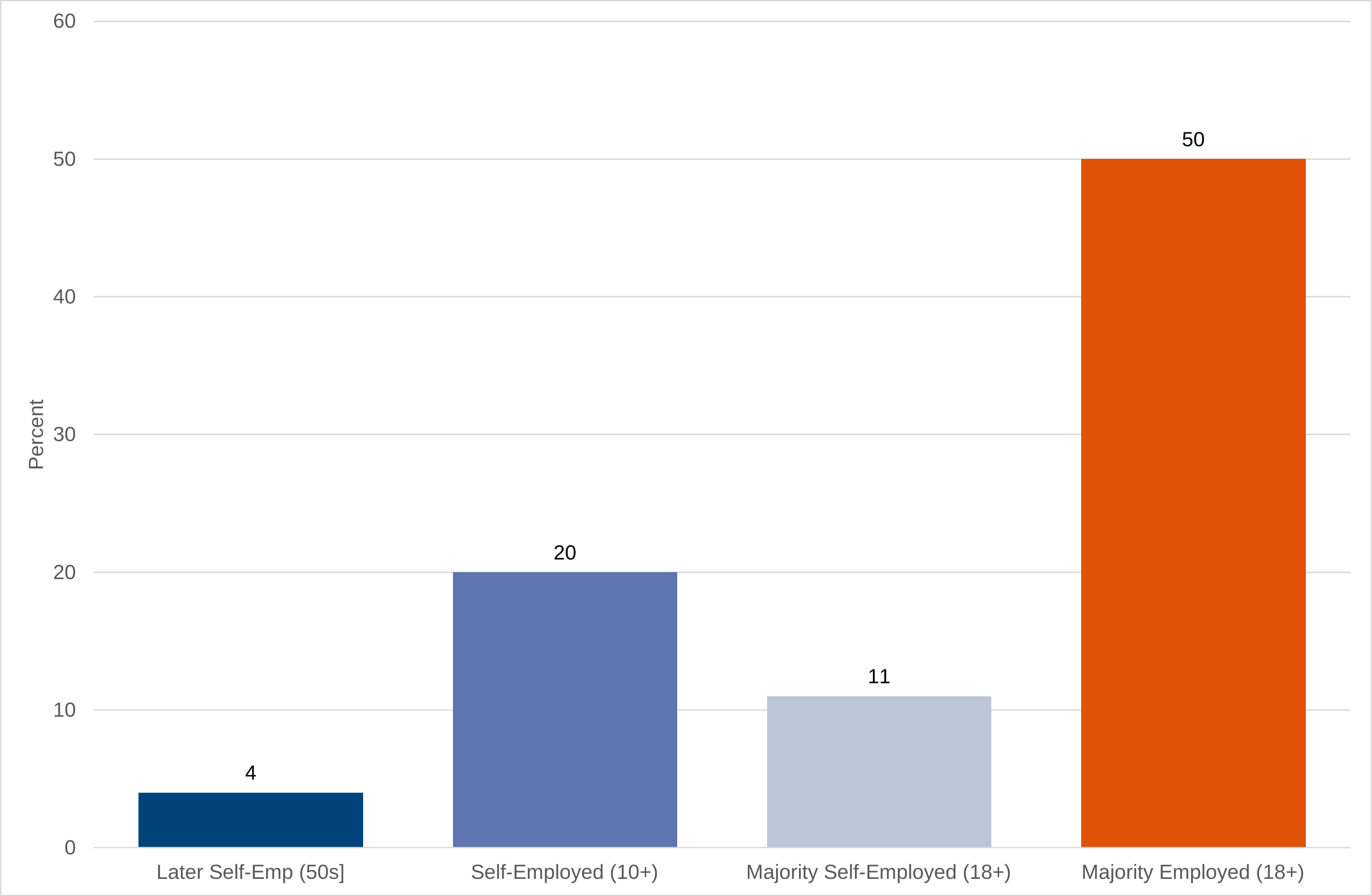
Note: The 18+ self-employed are included in the 10+ self-employed group; Later self-employed are not included in 10+ or 18+ self-employed groups as they could have only accrued a maximum of 5 years. No study member in any self-employed group was included in the majority employed group.
Base: study members self-employed or majority employed (n=4422)
5.2 Characteristics that differ between the majority self-employed and the majority employed
Current circumstances
Men made up three-quarters (77%) of those who had been majority self-employed between age 20 to 55, whereas the majority employed group was split more equally between men (46%) and women (54%). In comparison to the majority employed, the majority self-employed were:
-
less likely to be educated to degree or equivalent (NVQ 4 or above) level (29% to 37%)
-
less likely to be homeowners (78% to 84%), with differences being most apparent among those who owned their home outright (57% to 69%). However, more owned two or more properties (either outright or with a mortgage) (30% to 17%)
-
more likely to be in the top income group (33% to 21%)
-
two-thirds (69%) of the majority self-employed remained in paid work at age 62 compared to half (51%) of the majority employed
-
nearly half of the majority self-employed remained in self-employment at age 62 (47%), and 1 in 4 were now employed (23%)
-
just 1 in 7 (14%) of the majority self-employed had fully retired compared to 1 in 3 (32%) of the majority employed
Lifecourse experiences
Looking at prevalence of being part of a low income household over the lifecourse,
-
1 in 2 (46%) of the majority employed had never been part of a low income household compared to 1 in 3 in the majority self-employed (37%) and self-employed (34%) groups
-
1 in 5 (22%) of the self-employed had persistently been part of a low income household, compared to 1 in 7 (15%) of the majority employed
In terms of long-term health, there were no differences in the number of times a longstanding limiting illness had been reported over the lifecourse between the two majority groups, though symptoms associated with depression on two or more occasions was half as likely to be reported among the majority self-employed than the majority employed (4% to 8%).
Financial resources
In this section we look at savings, financial and housing wealth, together with private pension provision and pension values.
Financial and Housing Wealth
Housing wealth was defined as the house value on all properties owned by the individual and their partner (if applicable) at the time of interview minus the amount of mortgage that remained outstanding. Figure 5.3 shows that the self-employed groups were less likely to have financial wealth compared to the majority employed.
-
1 in 4 (25%) of the majority self-employed or self-employed had no financial wealth, compared to 1 in 6 (17%) of the majority employed
-
Although 1 in 3 (34%) of the self-employed had financial wealth over £100,000, this increased to 4 in 10 (41%) of the majority employed
Figure 5.3: The self-employed were more likely to have no financial wealth.
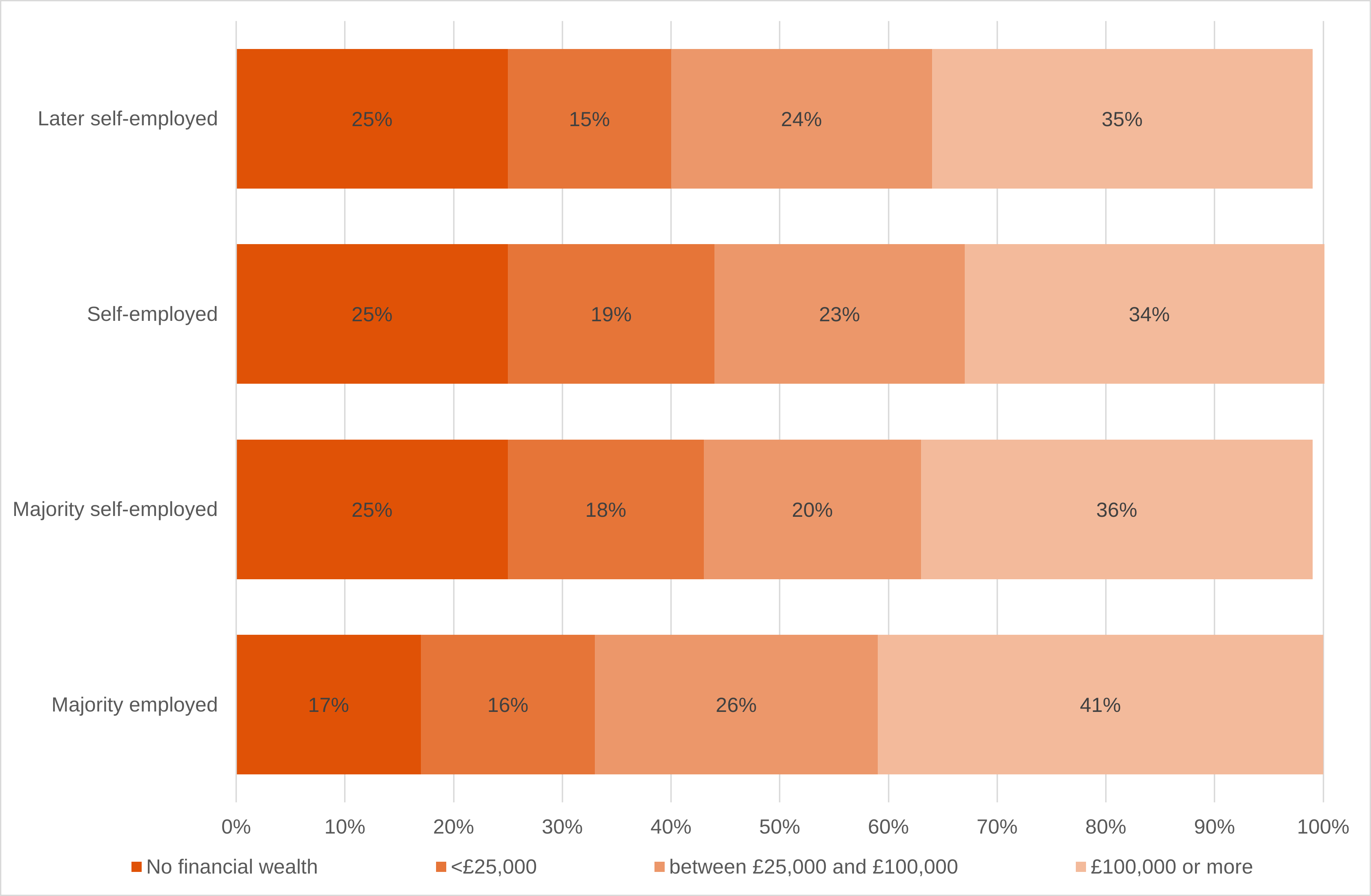
Base: study members either self-employed or majority employed (n=4422)
Figure 5.4 shows that the majority self-employed (and the self-employed) had more housing wealth than the majority employed. They were:
-
twice as likely to have housing wealth of £600,000 or more (30% to 15%)
-
less likely to have housing wealth greater than zero, but under £200,000 (15% to 23%) or between £200,000-£400,000 (25% to 33%)
Figure 5.4: The self-employed had higher levels of housing wealth
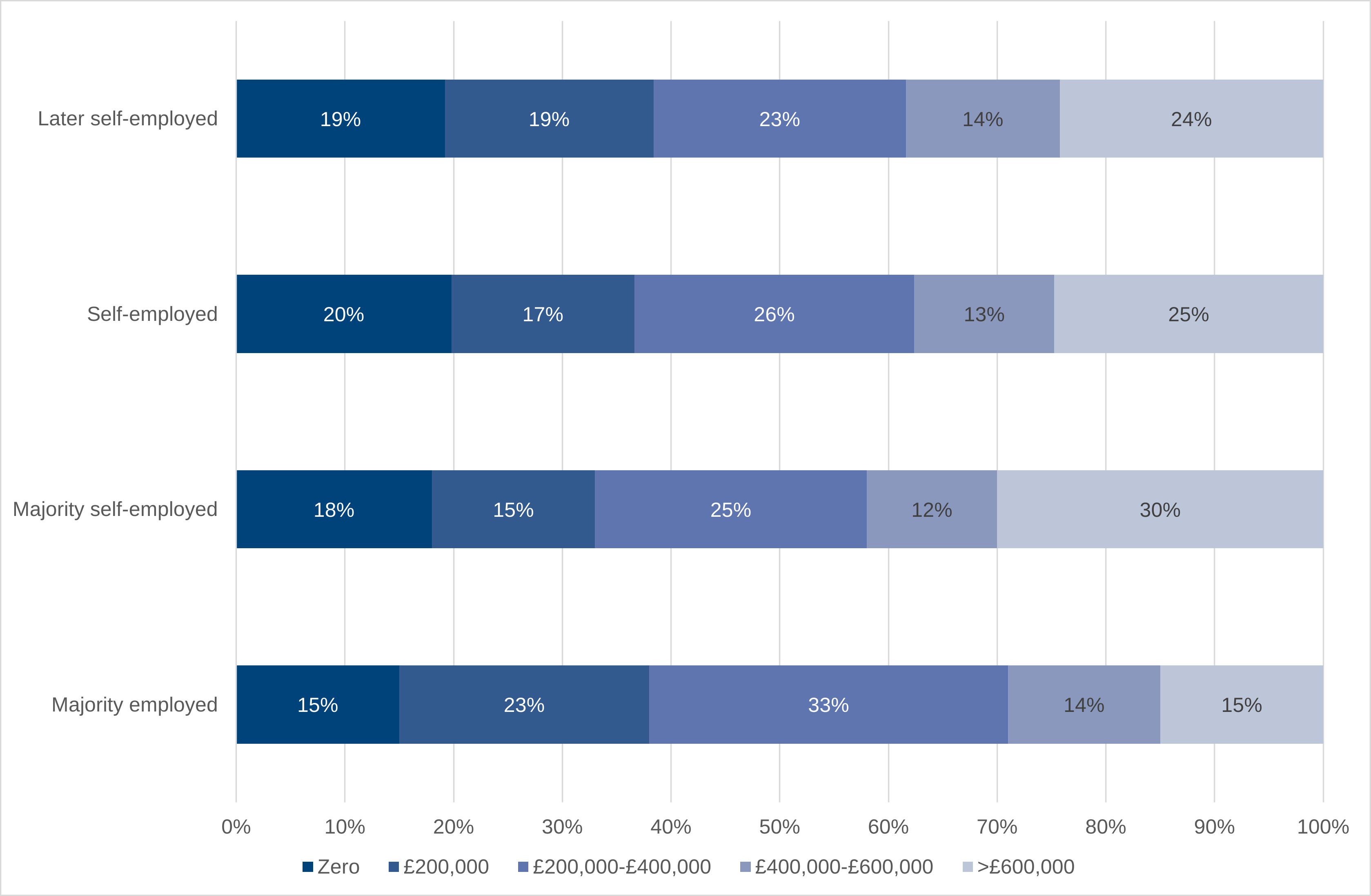
Base: study members either self-employed or majority employed (n=4422)
Private pensions
Although 7 in 10 (71%) of the majority self-employed had a private pension, they were three times more likely than the majority employed to not have a private pension (29% to 10%). Furthermore, Figure 5.5 shows that whereas 1 in 4 (23%) of the majority employed have two or more pensions, only 1 in 7 (14%) of the majority self-employed and 1 in 6 (16%) of the self-employed do so.
Figure 5.5: 3 in 10 of the majority self-employed do not have a private pension
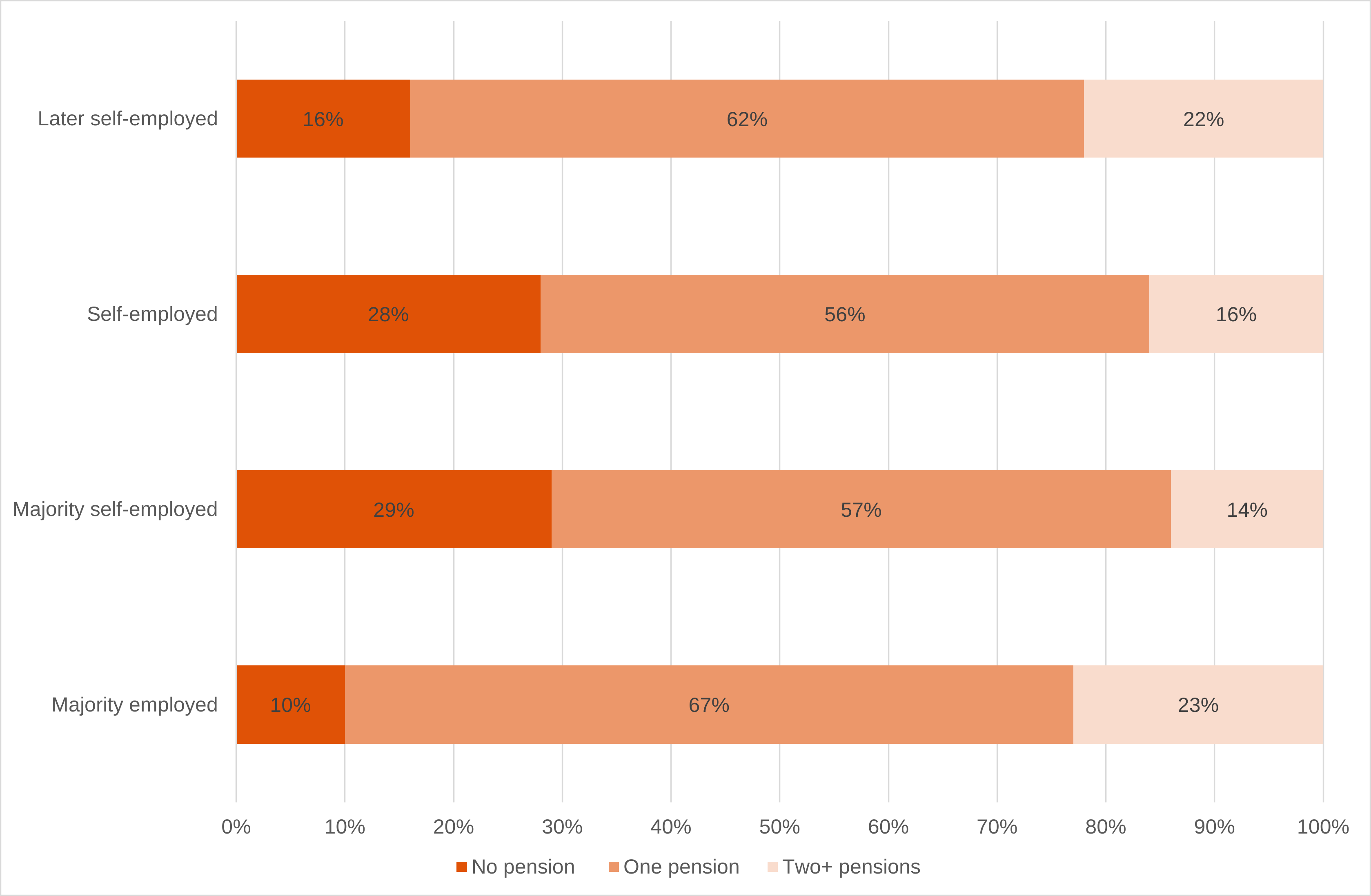
Base: study members either self-employed or majority employed (n=4422)
Six in 10 of the majority self-employed (59%) have a DC pension compared to half of the majority employed (49%). However, there were expected differences between whether these DC pensions were personal (i.e. not part of an employer scheme), or employer provided as part of a scheme. As shown in Figure 5.6:
-
1 in 5 (20%) of the majority self-employed have an employer provided DC pension compared to a third (37%) of the majority employed
-
in contrast, nearly 1 in 2 (45%) of the majority self-employed compared with 1 in 6 (18%) of the majority employed have a personal DC pension
However, it is important to note that despite the differences in the proportion with employer and personal DC pensions within the majority self-employed and majority employed groups, for those with any DC pensions the current total value of their DC pensions was broadly similar. The value of study members DC Pensions was divided into 4 groups based on the distribution: less than £25,000; £25,000 to £100,000; more than £100,000 to £250,0000; more than £250,000. This is the total summed value of all DC pension funds the SM recorded at time of interview. When comparing those with DC funds of more than £250,000, 14% of the majority self-employed compared to 17% of the majority employed had funds of this size or greater.
Turning to DB pensions, here we observe big differences in the proportion with or without a DB pension by majority self-employed and majority employed status.
-
just 1 in 8 (13%) of the majority self-employed had a DB pension, compared to 1 in 2 (48%) of the majority employed
-
the later self-employed were the most likely (38%) self-employed group to have a DB pension
Figure 5.6: The majority self-employed were the most likely to have a personal DC pension, the majority employed to have a DB pension or an employer DC pension
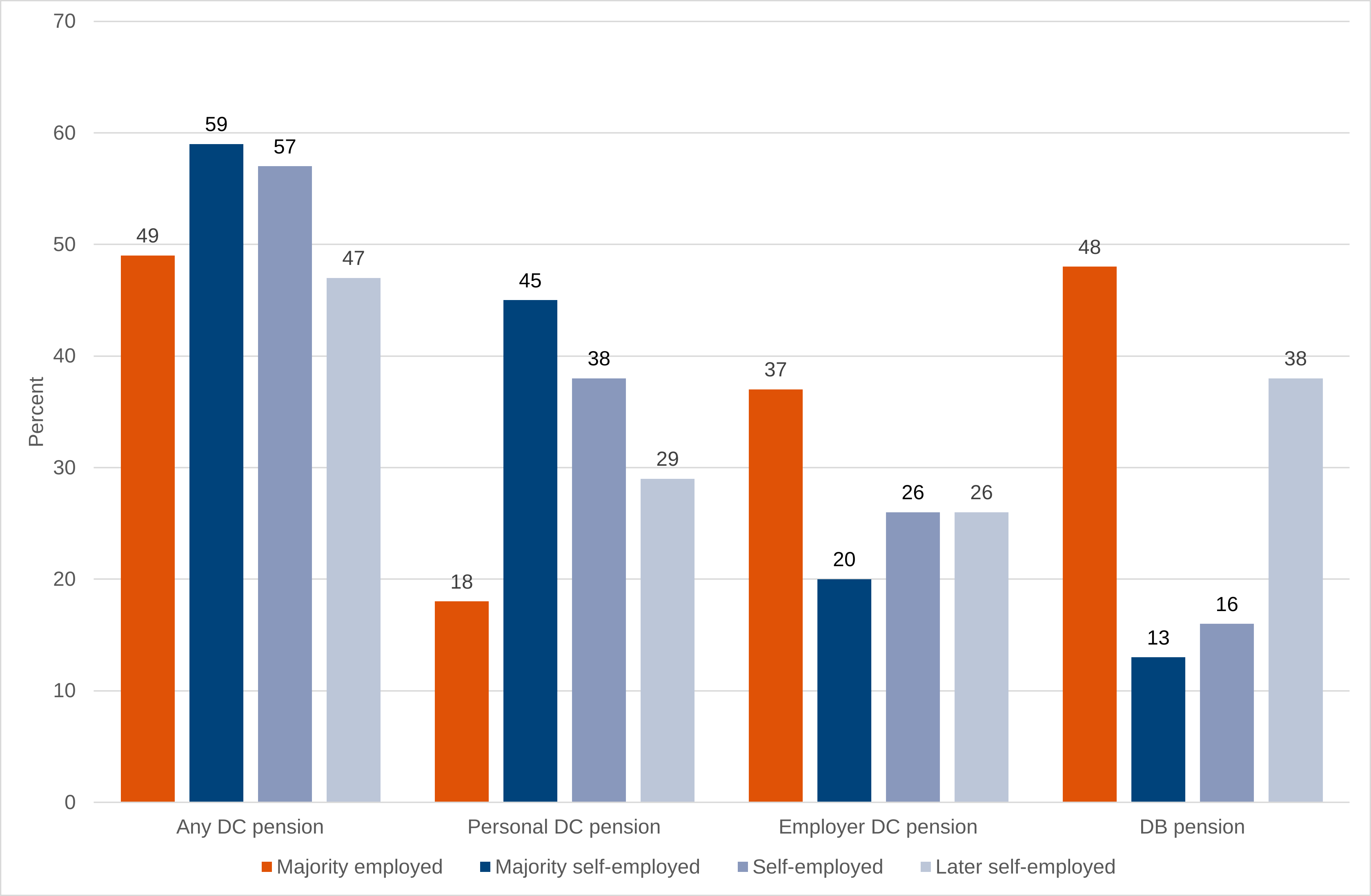
Base: study members either self-employed or majority employed (n=4422)
The value of study members DB Pensions was divided into 2 groups, again based on the distribution: less than £10,000; £10,000 plus. This is the total summed value of all DB pensions per annum the SM recorded at time of interview. It includes DB pensions currently receiving or expected to receive when accessed. Of those with a DB pension the proportion with a current or expected DB value of more than £10,000 per annum was lower among the majority self-employed than the majority employed: around 3 in 10 of the majority self-employed (34%) and the self-employed (29%) had a DB pension valued at £10,000 p.a. or more compared to half (50%) of the majority employed. (A similar proportion (59%) was found in the later self-employed group.)
5.3 Retirement Outcomes
We investigated study members’ retirement outcomes across two measures assessed in their early 60s. The first based on current economic activity and the second on age of, or expected age of, retirement.
-
Current economic activity status was collapsed into three groups: fully retired, economically active (employed, self-employed or unemployed) or economically inactive excluding retired (sick or disabled, home or family care, in education or training or something else), and
-
Study members were asked whether they had retired from all forms of paid work, and if so at what age. If they had not, they were asked at what age did they expect to retire from all forms of paid work. The ages when they retired or expected to retire were banded into 4 groups: very early (before age 60), early (60 to 64), within one year of SPa (65 to 67) and late (age 68 or later).
Based on their current economic activity status, we found that fewer of the majority self-employed compared to the majority employed had fully retired (14% to 32%), with 7 in 10 (71%) of the majority self-employed remaining economically active compared to half (53%) of the majority employed.
The SPa for this cohort is age 66, and we looked in more detail at the actual age study members had fully retired or expected to fully retire from all forms of paid work, Figure 5.7 shows that 4 in 10 (40%) of the majority self-employed, and 1 in 3 (37%) of the self-employed and later self-employed (32%) expected to still be in paid employment at age 68 or later, compared to only 1 in 7 (14%) of the majority employed. Conversely, just 2 in 10 (22%) of the majority self-employed had, or, expected to fully retire by the age of 64, compared to more than 4 in 10 (45%) of the majority employed.
Figure 5.7: 4 in 10 of the majority self-employed expected to be in paid employment at age 68 or later.
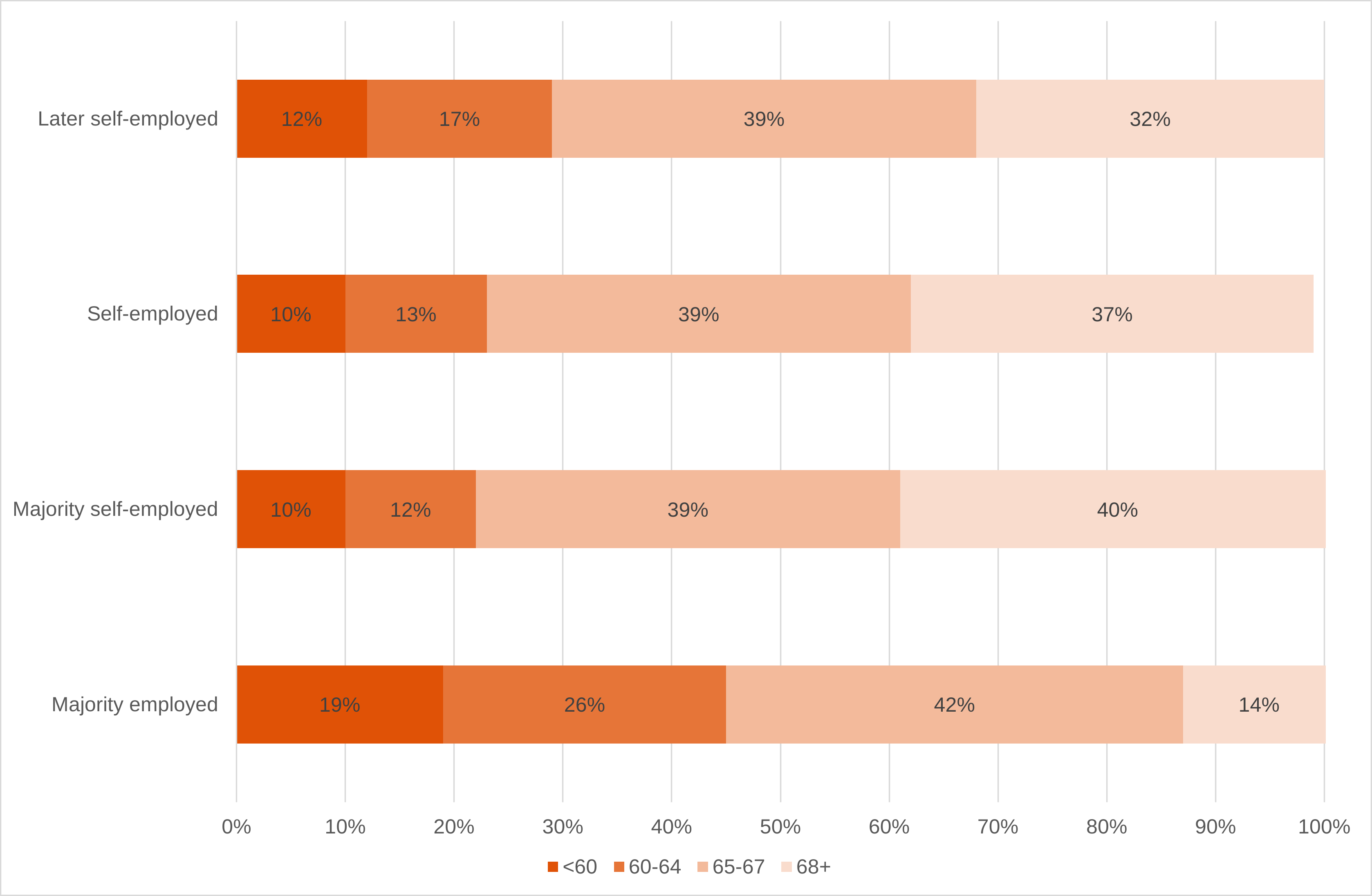
Base: study members either self-employed or majority employed (n=4422)
Chapter 6: Working in Later Life
This chapter explores employment in later life, examining differences in the current characteristics, lifecourse experiences and financial resources of study members based on whether they had fully retired or remained in work. It considers their economic status at age 62 and traces changes in their economic activity between ages 55 and 62. The chapter is divided into two sections: 6.1 Economic activity and retirement and 6.2 Employment in later life.
Section 6.1 has three sub-sections. Section 6.1.1 Moving from economically active to retirement focuses on study members who were economically active at age 55 and who had fully retired or remained economically active at age 62. Section 6.1.2 Moving from early retirement back into employment profiles the few study members who had fully retired from work at an earlier age (by age 55) but returned to paid work at age 62, and section 6.1.3 Economic activity and retirement at the household level looks at retirement and economic activity at the household level for study members who were living with or without a partner at age 62.
Section 6.2 has two sub-sections. Section 6.2.1 Working full-time or part-time examines differences in study members working full-time or part-time at age 62 and 6.2.2 Changes in working full-time and part-time from age 55 to age 62 focuses on change from working full-time at age 55 to part-time at age 62 and vice versa.
Key Findings
The focus here is on study members who were economically active at age 55. We found that:
-
single or cohabiting study members who had fully retired by age 62 experienced a more advantaged set of circumstances than those who remained economically active or in paid work
-
study members living with a partner who had also fully retired were the most advantaged of all economic activity status groups. See figures 6a and 6b
Concentrating on retirement and economic activity at the household level, compared to households where study members and partners remained economically active (2A), a greater proportion of households where both partners were fully retired (2R):
-
owned their home outright (92% to 56%) and had savings of more than £100,000 (51% to 23%)
-
had a pension(s), particularly a DB pension (61% to 34%)
-
were better educated (50% to 33% had a degree or higher)
-
had no experience of low income over the lifecourse, (67% to 48%), and
-
had one partner over the lifecourse (75% to 58%)
Figure 6a: Outright home ownership and having savings greater than £100,000 were associated with retirement
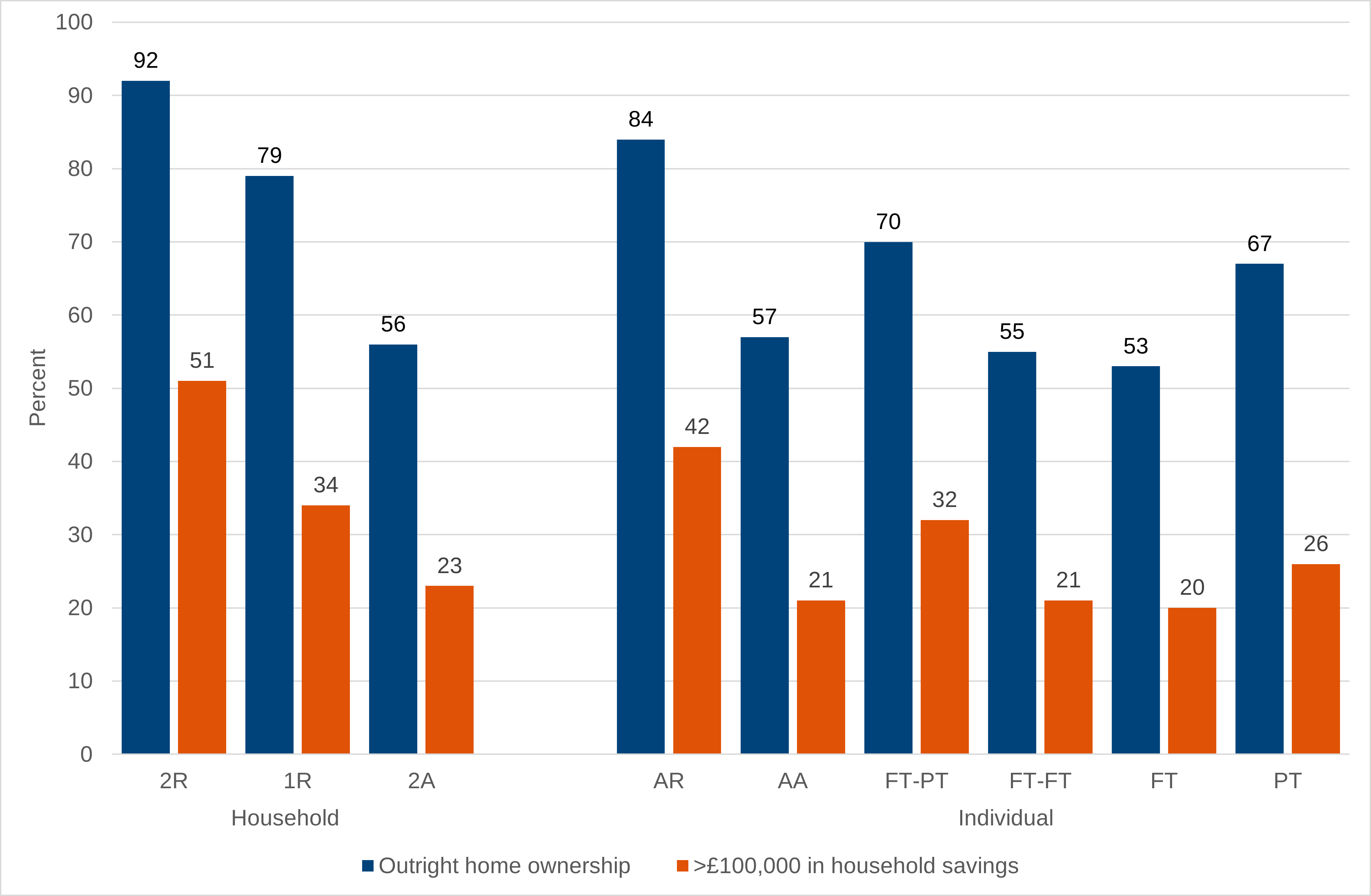
| Household level | Individual |
|---|---|
| 2R: both fully retired (62) | AR: economically active to retirement (55 to 62) |
| 1R: one fully retired (62) | AA: remained economically active (55 to 62) |
| 2A: both economically active (62) | FT-PT: full-time to part-time (55 to 62) |
| - | FT-FT: remained in full-time (55 to 62) |
| - | FT: working full-time (62) |
| - | PT: working part-time (62) |
Figure 6b: Having a DB pension was related to retirement, whilst DC pensions were associated more with being currently employed
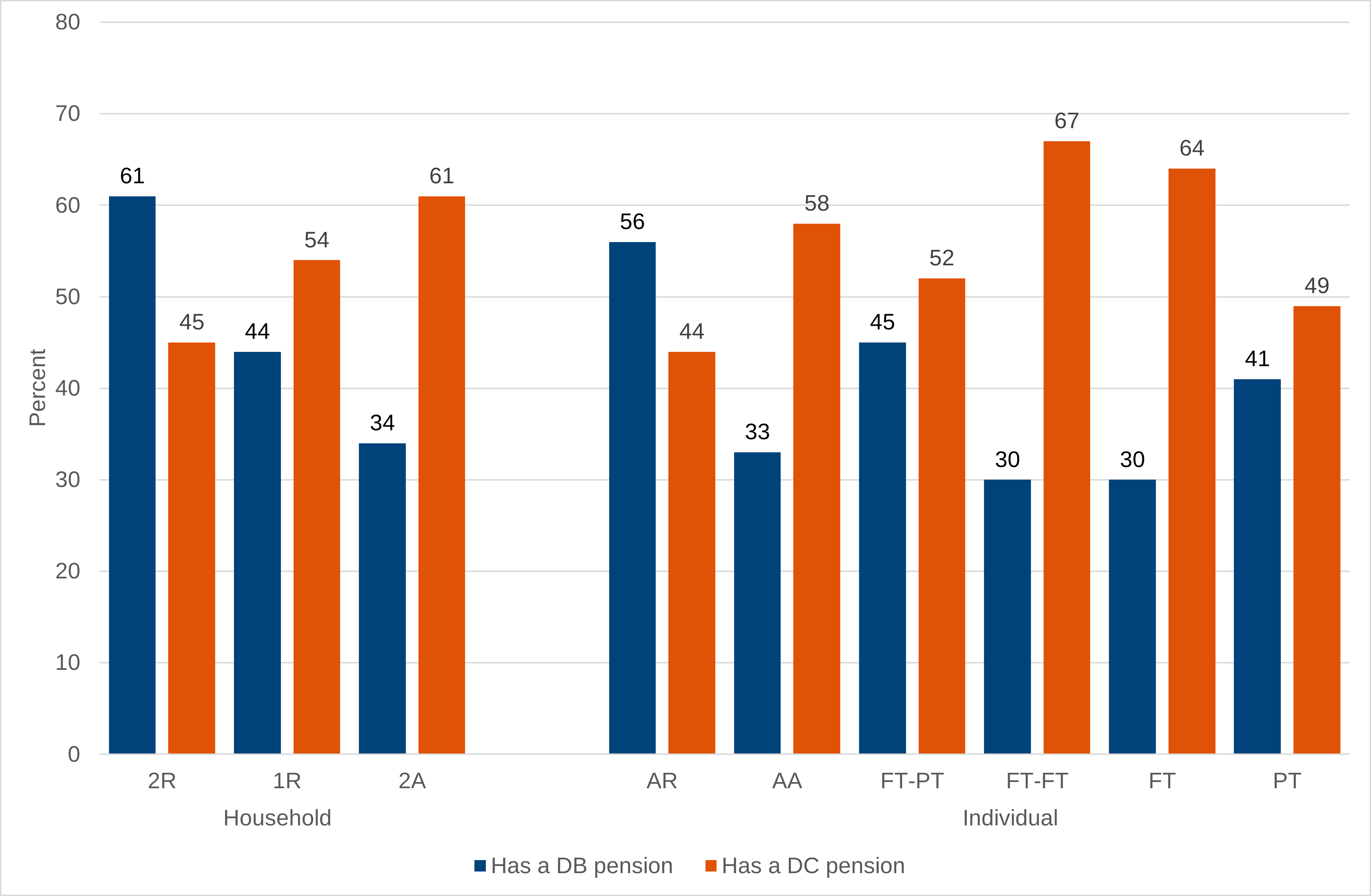
| Household level | Individual |
|---|---|
| 2R: both fully retired (62) | AR: economically active to retirement (55 to 62) |
| 1R: one fully retired (62) | AA: remained economically active (55 to 62) |
| 2A: both economically active (62) | FT-PT: full-time to part-time (55 to 62) |
| - | FT-FT: remained in full-time (55 to 62) |
| - | FT: working full-time (62) |
| - | PT: working part-time (62) |
Very few early retirees returned to paid work (8% of the 3% who had fully retired at age 55), and very few working part-time moved into full-time employment (5% of those employed at age 55 and 62).
6.1 Economic activity and retirement
6.1.1: Moving from economically active to retirement
In this section we compare differences in study members who were economically active at age 55 (73%), by whether they remained economically active (52%) or had fully retired (21%) by age 62 (27% were in other economic activity groups). We examine current circumstances, lifecourse experiences and financial resources. The full set of results are included in Appendix Table A6.1.
Current circumstances
Compared to study members who remained economically active, a greater proportion of those who had recently fully retired were:
-
better educated: nearly half (46%) had a degree [or higher qualification], compared to 1 in 3 (33%) of the economically active
-
outright homeowners: more than 8 in 10 (84%) owned their home outright compared to just over half (57%) of those who remained economically active, who were more likely than the fully retired to rent (20% to 6%) or to have an outstanding mortgage (22% to 8%)
-
currently married: three-quarters (75%) compared to two-thirds (63%) of the economically active were currently married
Given income levels generally reduce following retirement, a lower proportion of the retired had a high household income compared to the economically active (18% to 28%). However, the fully retired had other financial resources to draw on.
Figure 6.1: 8 in 10 study members who have moved into retirement between ages 55 and 62 own their home outright
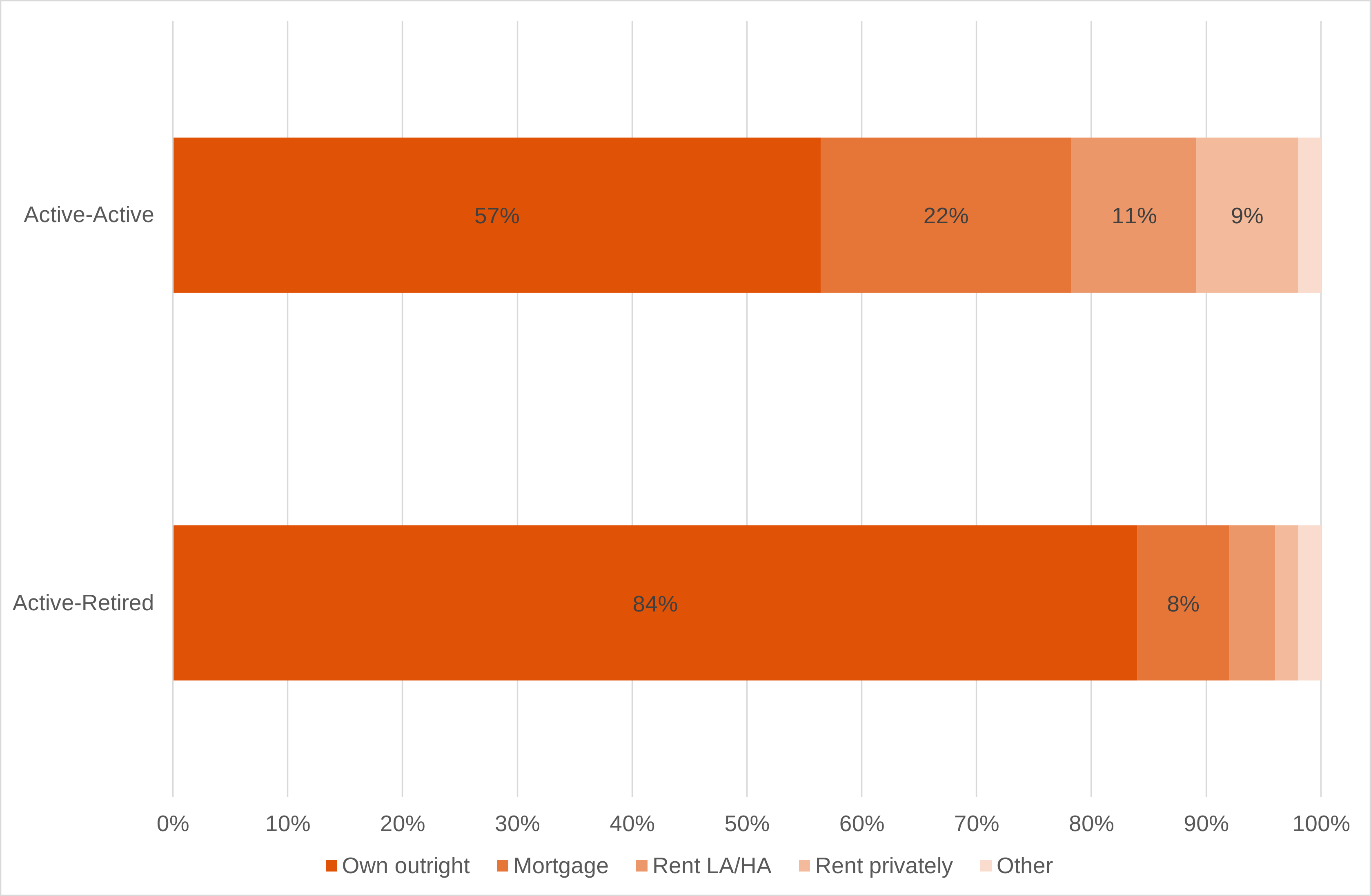
Base: study members economically active at age 55 who remained economically active or had retired (n=5719)
Lifecourse experiences
When examining economic activity histories between age 20 to age 55, on average, the fully retired had spent:
-
16 more months in paid work than the economically active (372 to 356), and
-
8 fewer months out of work due to poor health (12 to 20)
In terms of partnerships:
-
greater proportion of the fully retired (66%) had only lived with one partner compared to the economically active (57%), and
-
the economically active were more likely to have lived with three or more partners (13% to 8% fully retired) and to have experienced divorce (20% to 15% fully retired)
The fully retired were also less likely than the economically active to have been part of a low income household:
-
58% had no experience of low household income compared to 41% of the economically active, and
-
just 1 in 14 (7%) experienced persistent low household income compared to just under 1 in 5 (19%) of the economically active
Financial resources
The fully retired were more likely than the economically active to have a range of financial resources to draw on. For example, they had more savings and even when taking any debt into consideration
-
4 in 10 (41%) retirees had financial wealth exceeding £100,000 compared to 2 in 10 (21%) of the economically active, and
-
just 1 in 13 (8%) had zero (or less) financial wealth compared to 1 in 4 (23%) of the economically active
Figure 6.2: Study members who have moved into retirement between 55 and 62 were twice as likely to have financial wealth of more than £100,000
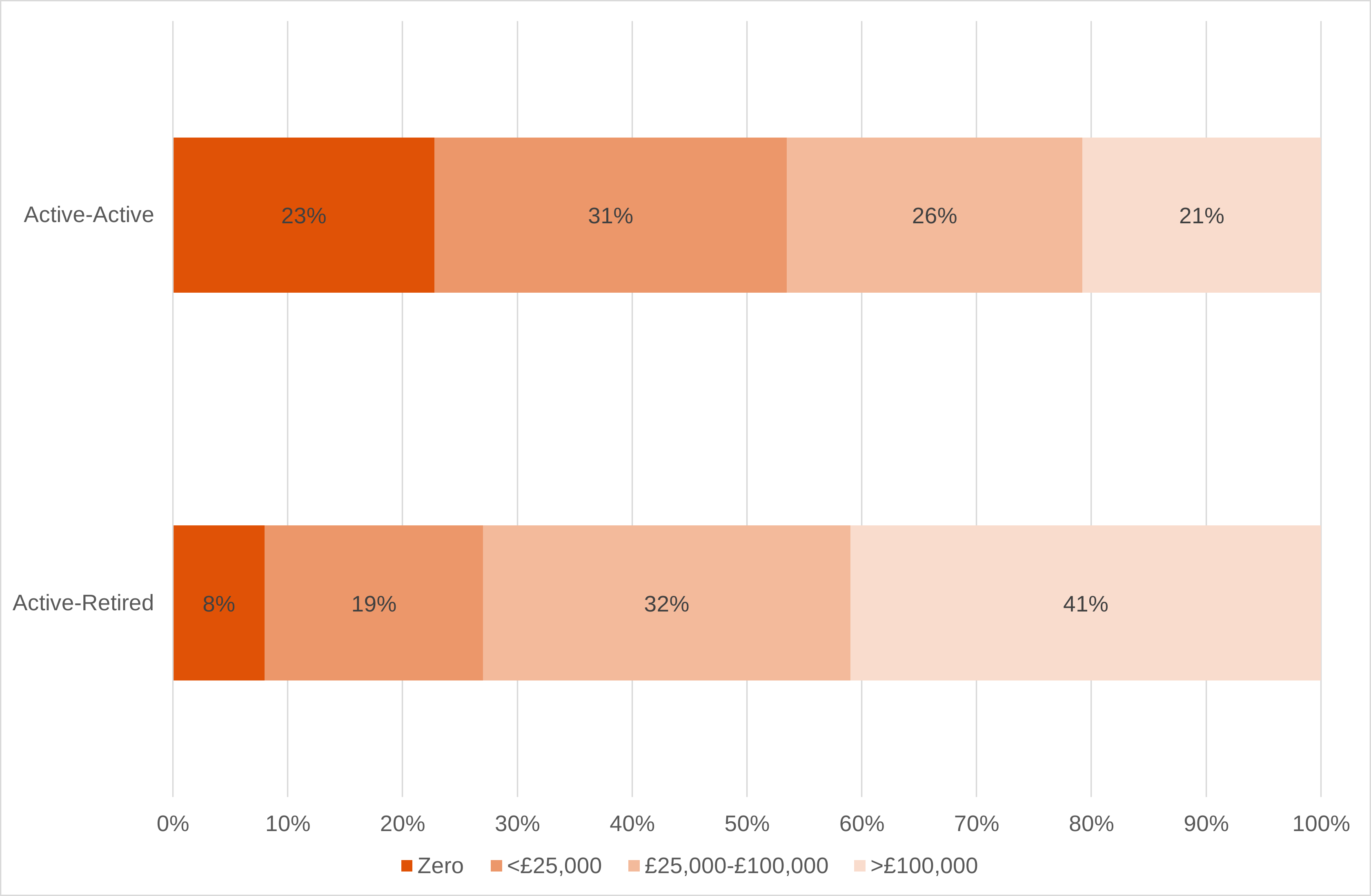
Base: study members economically active at age 55 who remained economically active or had retired (n=5719)
Given the high proportions who owned their home outright, the fully retired were more likely than the economically active to have higher levels of housing wealth:
-
17% to 13% had housing wealth between £400,000 to £600,000, and
-
22% to 17% had housing wealth over £600,000
In terms of private pensions, although roughly 9 in 10 study members in both groups had a private pension, this was higher among the fully retired than the economically active (91% to 85%). However,
-
the fully retired were more likely to have an employer (DB or DC) pension (75% to 65%) and particularly a DB (56% to 33%) pension, whereas
-
the economically active more likely to have a DC pension (58% to 43%)
Figure 6.3: Study members who have moved into retirement between age 55 and 62 were more likely to have any employer (DB or DC) or a DB pension
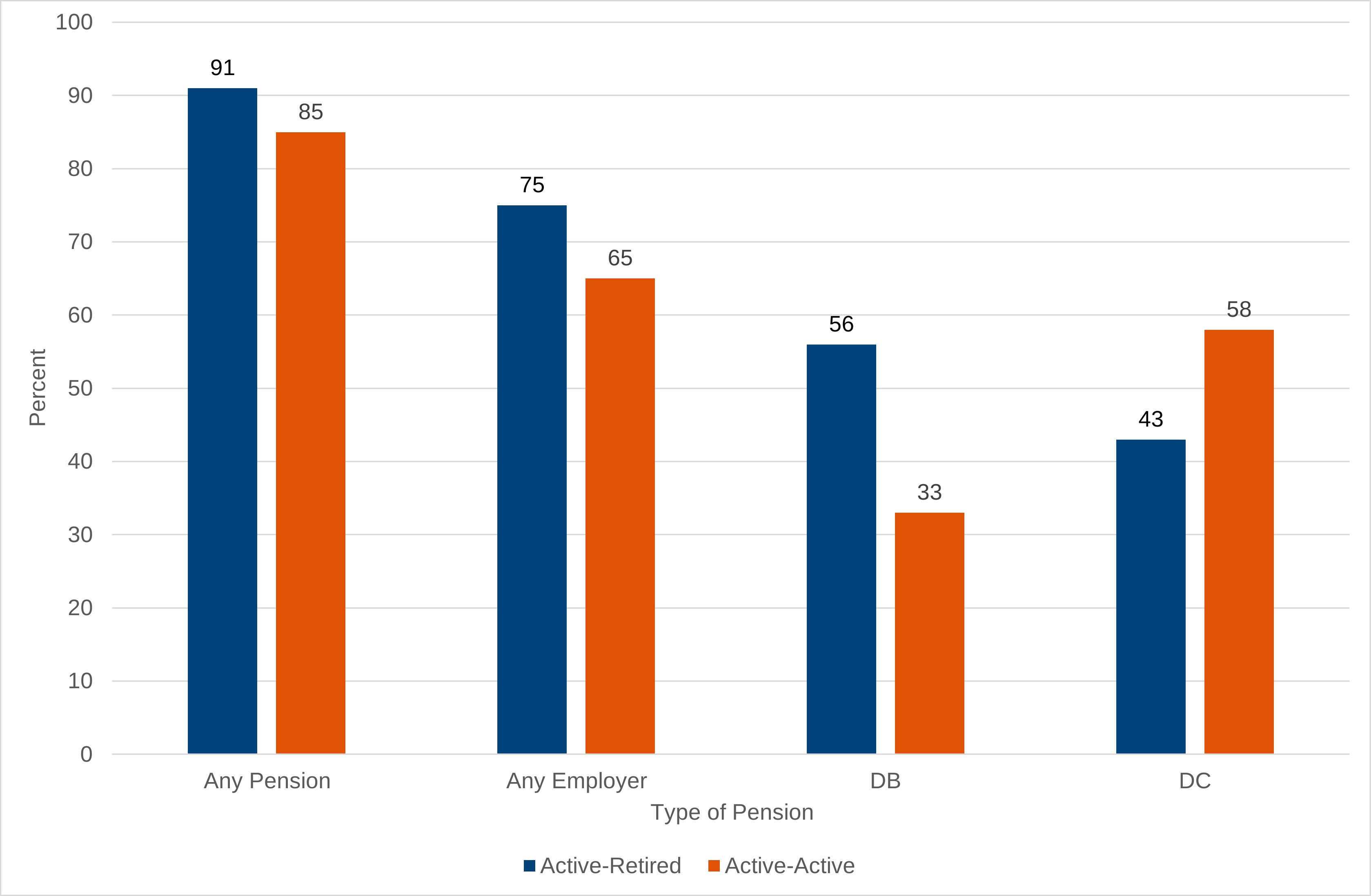
Base: study members economically active at age 55 who remained economically active or had retired (n=5719)
Among those with a DB or a DC pension, the fully retired were more likely than the economically active to be receiving
-
a DB pension (52% to 17%)
-
a DC pension (29% to 20%)
Of those currently living with a partner, the fully retired were more likely than the economically active to have:
-
a partner with a pension (82% to 72%)
-
a partner who is receiving a private pension (64% to 39%)
Health and wellbeing status over the lifecourse did not differ between those who had fully retired between age 55 to 62 and those who remained economically active.
6.1.2: Moving from early retirement back into employment
At age 55, just 3% (n=206) of study members had fully retired and of these, 92% remained fully retired and just 8% had returned to paid work at age 62. The small number of returners prevent any substantial reporting of differences between the two groups as differences were not statistically significance.
6.1.3: Economic activity and retirement at the household level
We now turn to economic activity and retirement at the household level. We first concentrate on households where study members were married or living with a partner and then examine economic activity and retirement among study members who did not live with a partner.
Looking first at the overall sample, 71% of study members lived with a partner. The household level economic activity of those study members with a partner was:
-
14% both fully retired (2R)
-
22% one fully retired, one economically active (1R)
-
36% both economically active (2A), and
-
27% other combinations (not included in this analyses)
Households with co-habiting partners
In the following sections we compare the characteristics and circumstances of study members in fully retired households (2R), households with one person fully retired (1R) or where both remained economically active (2A). The full set of results are included in Table A6.2 in the appendix.
Current circumstances
The advantages we observed among study members who had moved from paid work into retirement in section 6.1.1 were most apparent in fully retired households (2R) and least apparent in households where both partners remained economically active (2A). For example, study members in fully retired households (2R) were:
-
better educated: 1 in 2 (50%) study members had a degree [or higher], compared to around 1 in 3 in 1R (39%) or 2A (33%) households
-
outright homeowners: more than 9 in 10 (92%) owned their home outright compared to 8 in 10 (79%) in 1R households just over half (56%) of those in 2A households, who were more likely to have an outstanding mortgage (29% 2A, 14% 1R, 5% 2R)
-
currently married: 93% were currently married compared to 86% in 1R and 2A households; 2A households were most likely to be divorced, 9% compared to 4% in 2R households
Figure 6.4: More than 9 in 10 fully retired households own their home outright
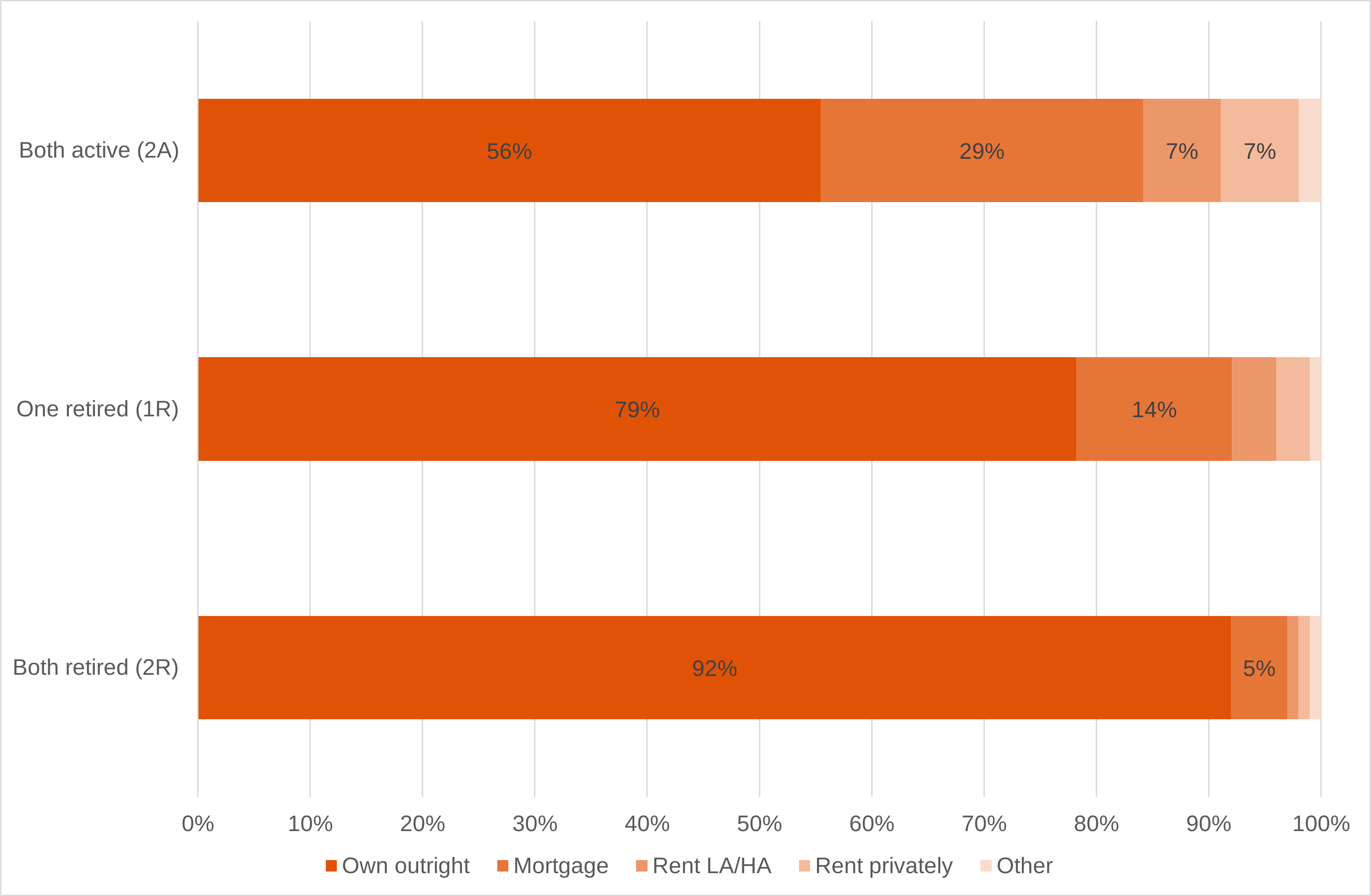
Base: study members and partner who were economic active or retired (n=4399)
As we found in section 6.1.1, more of those in 2R households had a low household income (17% 2R, 13% 1R, 7% 2A) and fewer had a high household income (17% 2R, 28% 1R, 42% 2A).
Lifecourse experiences
Study members in 2R fully retired households had spent (on average):
-
more months in paid work (375) compared to those in 2A (364), and 1R (362) households
-
fewer months out of work due to poor health (7) compared to those in 2A (19) and 1R (16) households
In terms of partnerships:
-
three-quarters (75%) of study members in 2R households had only had one partner compared to two-thirds (66%) in 1R and less than 6 in 10 (58%) in 2A households
-
study members in 2A households were the most likely to have had three or more partners (13% 2A, 9% 1R, 6% 2R) and to have experienced divorce (20% 2A, 14% 1R, 12% 2R)
Study members in 2R households were also the least likely to have experience of a low household income:
-
67% had no experience of being in a low income household compared to 54% in 1R and 48% in 2A households, and
-
were nearly three times less likely to have experienced a persistently low household income compared to those in 2A households (4% to 11%)
Figure 6.5: Three-quarters of study members in fully retired households have only had one partner
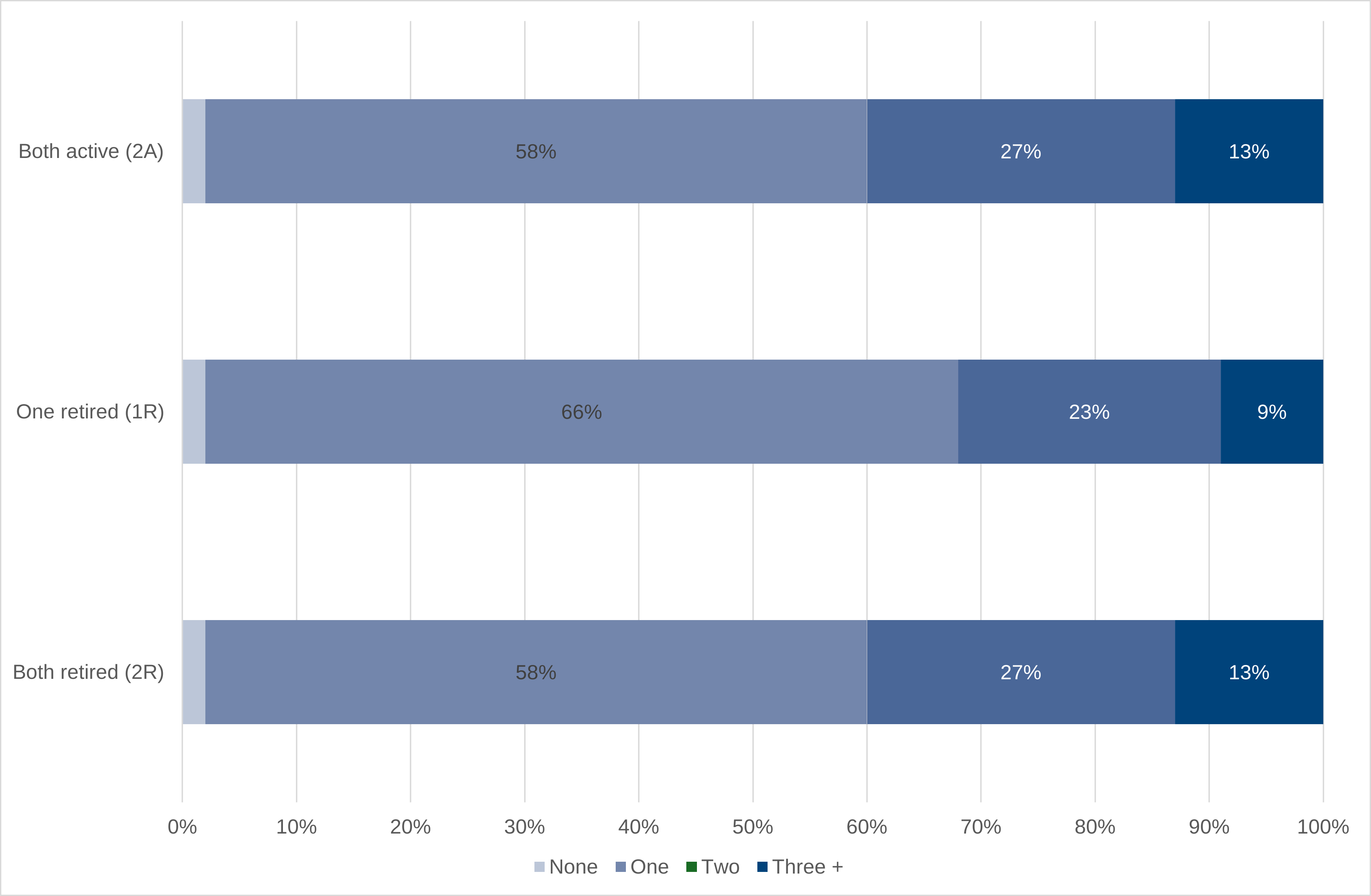
Base: study members and partner who were economic active or retired (n=4399)
Financial resources
As we found in section 6.1.1, retirement was associated with advantaged access to a range of financial resources with 2R households being the most advantaged. For example, Figure 6.6 shows that:
-
half (51%) of 2R households had savings of more than £100,000 compared to 1 in 3 (34%) in 1R and less than 1 in 4 (23%) in 2A households. Conversely
-
nearly half (47%) of 2A households had no savings or savings less than £25,000, compared to 1 in 3 (32%) 1R and less than 1 in 5 (18%) 2R households
-
just 1 in 50 (2%) of 2R households had no housing wealth, compared to 7% in 1R and 13% in 2A households
Figure 6.6: Half of study members in fully retired households have more than £100,000 in savings
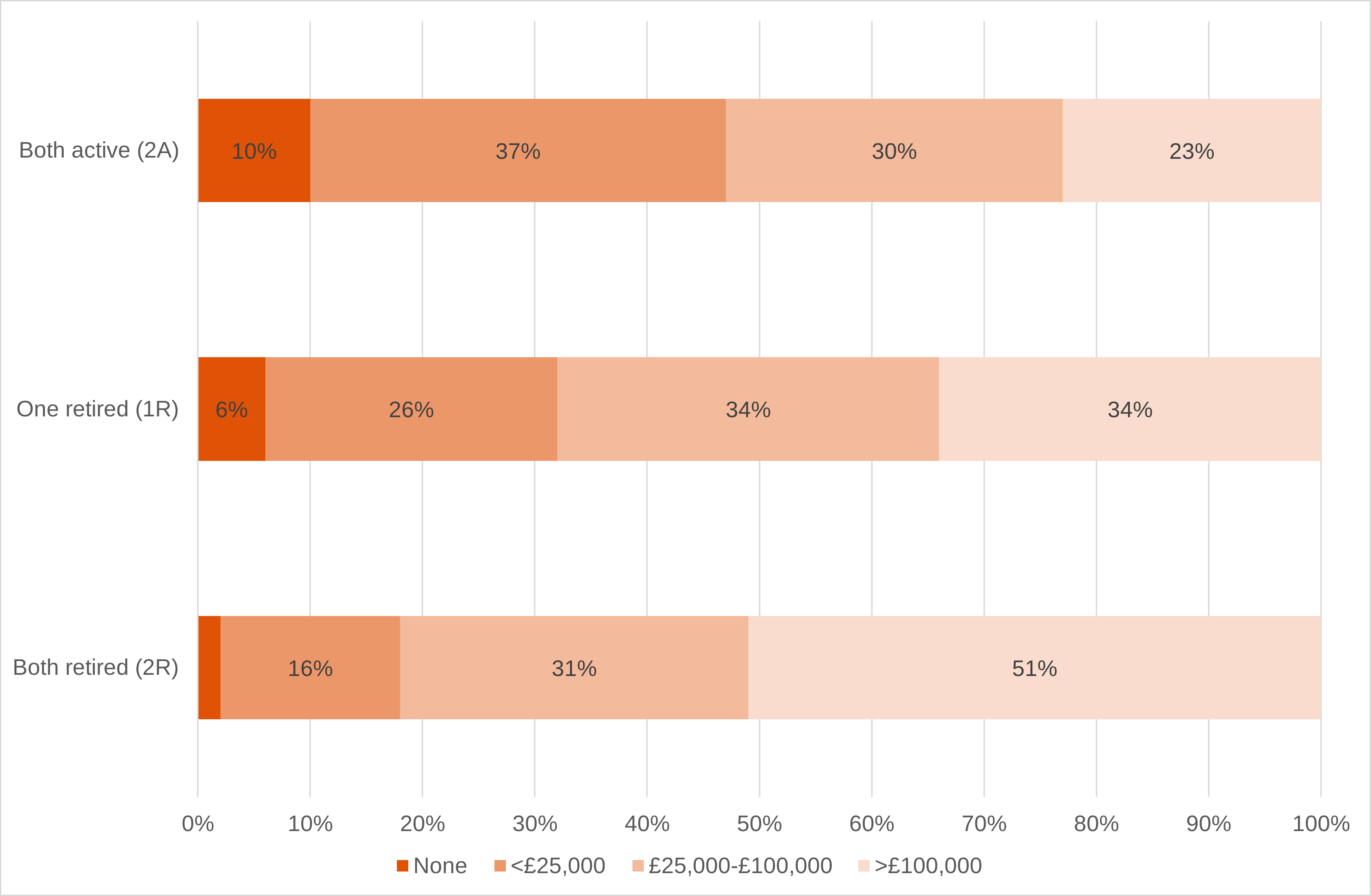
Base: study members and partner who were economic active or retired (n=4399)
In terms of private pensions, around 9 in 10 study members in each group had a personal pension. However, as shown in Figure 6.7, study members in retired households were the most likely to have any employer pension, with 2R households being more likely than 1R households to have a DB pension. Study members in 2A households were the most likely to have a DC pension.
Figure 6.7: Study members in fully retired households are the most likely to have a DB and least likely to have a DC pension
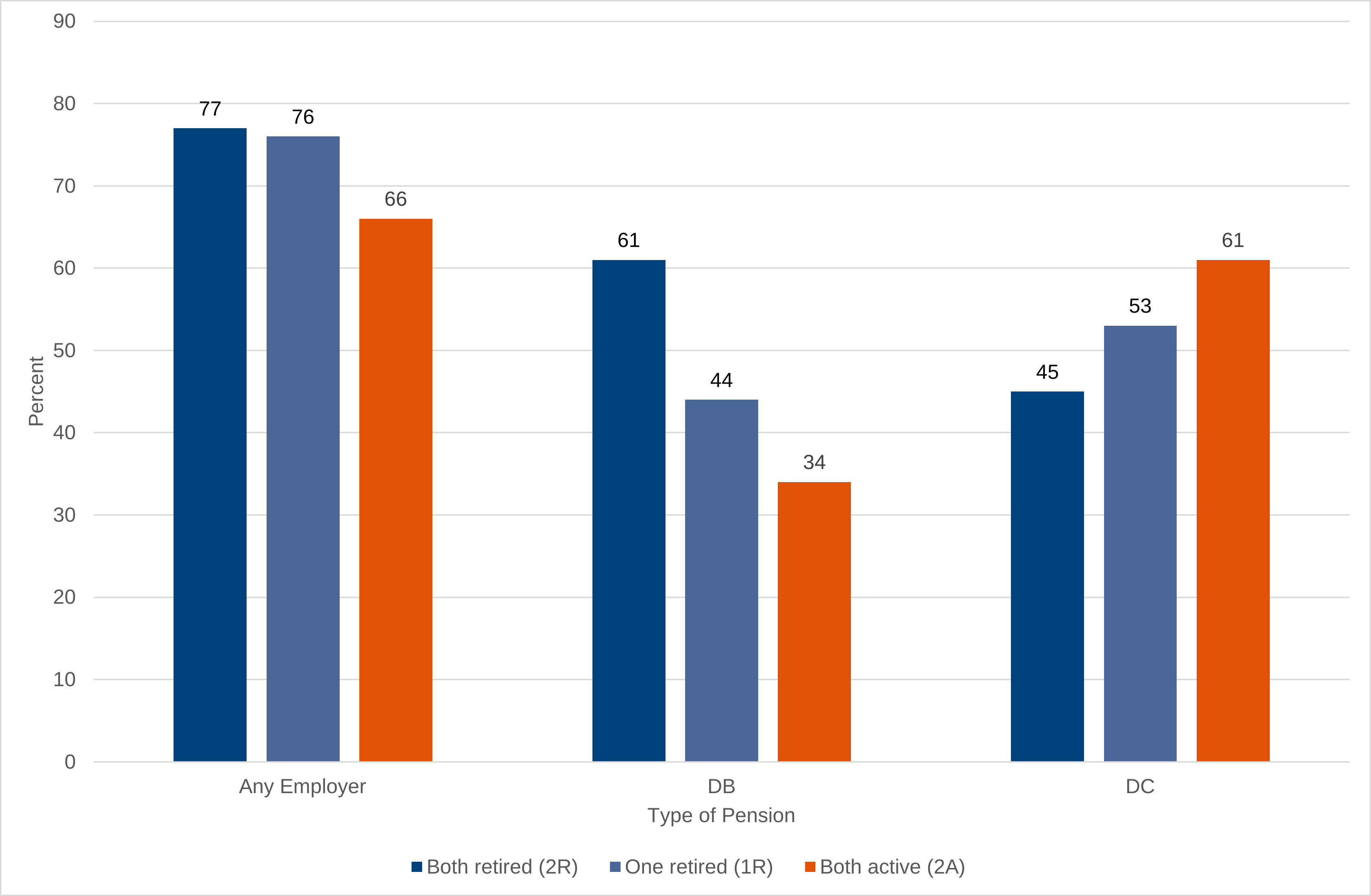
Base: study members and partner who were economic active or retired (n=4399)
Among those with a DB or a DC pension, study members in 2R households were more likely than those in 1R or 2A households to be receiving
-
a DB pension (58% to 32% 1R, 17% 2A), and
-
a DC pension (30% to 27% 1R, 21% 2A)
Study members in 2R households were also the more likely to have
-
a Partner with a pension (85% to 79% 1R, 76% 2A), and
-
a Partner who is receiving their private pension (86% to 62% 1R, 23% 2A)
Study members not living with a partner
Of the 29% of study members who were not living with a partner:
-
51% were economically active
-
17% were fully retired
-
32% were ‘other not working’, of which 79% were not working due to poor health
As found for study members with a partner, more fully retired study members who did not live with a partner were more likely than the economically active to be advantaged in terms of current circumstances, lifecourse experiences and financial resources. (See Appendix Table A6.3.)
6.2 Employment in later life
In this section we examined differences in the characteristics of study members who were working full-time (FT) to those working part-time (PT) at age 62. As men and women’s employment trajectories across the life course are distinctive, we highlight any differences by sex. (The results are included in Appendix Tables A6.4 to A6.6.) We then look at differences in the characteristics of those who moved from full-time to part-time employment, and vice versa between age 55 to age 62. (See Appendix Table A6.7.)
6.2.1 Working full-time or part-time
Of those in paid work at age 62, Figure 6.8 shows that 2 in 3 (65%) were employed full-time and 1 in 3 (35%) part-time. This differed by men and women, with 79% of men working full-time, compared to 45% of women.
Figure 6.8: 2 in 3 of those in paid work at age 62 were working full-time, with big differences by sex
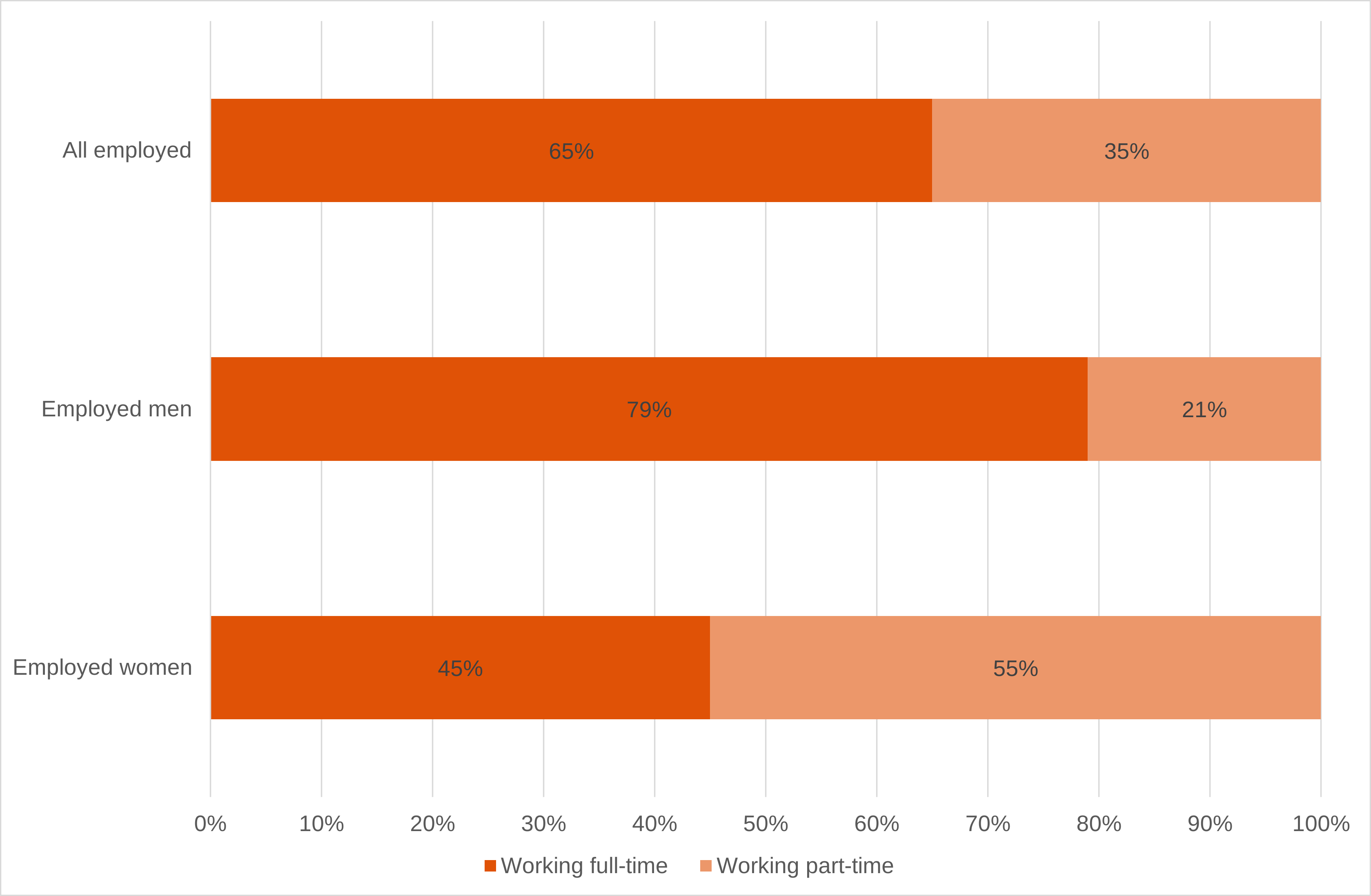
Base: study members employed at age 62 (n=4112)
Current circumstances
Comparing study members who were working FT to those working PT at age 62, those who were working FT were more likely to:
-
have a mortgage (25% compared to 17%), or be renting privately (10% to 5%)
-
have a higher current household income (33% to 24%)
-
have a partner who was economically inactive (10% to 5%)
Those who were working PT were more likely to:
-
own their home outright (67% to 53%)
-
have a low household income (22% to 12%)
-
have a partner who is fully retired (26% to 14%)
Looking at specific differences by sex, we found that:
-
Men working FT were less likely to have a degree (or higher) qualification than those working PT (30% to 43%), and were more likely to be in the high household income bracket than those working PT (36% to 27%)
-
Women working PT were more likely to be married (64% to 52%), while women working FT were more likely to be divorced (27% to 17%)
- Women working PT were more likely than women working FT to be in the low household income bracket (25% to 14%)
Lifecourse experiences
Over the lifecourse, those working FT at age 62 had spent (on average) two-plus years more in paid work (365 to 337 months), and two-plus years less in a home-care role (19 compared to 45 months). Fewer of those working FT had experienced a poor mental health episode (16% compared to 24%).
Looking at economic activity across the lifecourse by sex, the average number of months spent in a home-care role was higher for women working PT (63) compared to those working FT (49). There were no other lifecourse differences by sex.
Financial resources
Study members who were working PT hours had better financial resources than those working FT. More had savings over £100,000 (26% to 20%) and there were marked differences in the type and receipt of private pension provision by whether study members were working FT or PT. Those working PT were more likely to have a DB pension (41% to 30%), and to have accessed their DB pension (29% to 12%). Those working FT were more likely to have a DC pension (64% to 49%).
If study members had a partner, partners of those working FT were less likely than those working PT to have any pension (69% to 77%) and to not have received their private pension(s) (65% to 51%). When examining differences by sex, we found that men working FT were less likely than men working PT to have a DB pension (27% to 43%).
6.2.2 Changes in working full-time and part-time from age 55 to age 62
Of those who were in paid work at age 55 and age 62, Figure 6.9 shows that 3 in 5 (59%) stayed in full-time work, 1 in 5 (19%) had moved from full-time to part-time work, 16% stayed in part-time work, while 1 in 17 (6%) had changed from working part-time to full-time.
Figure 6.9: 1 in 5 of those employed at age 55 moved from FT to PT work at age 62, few increased their working hours
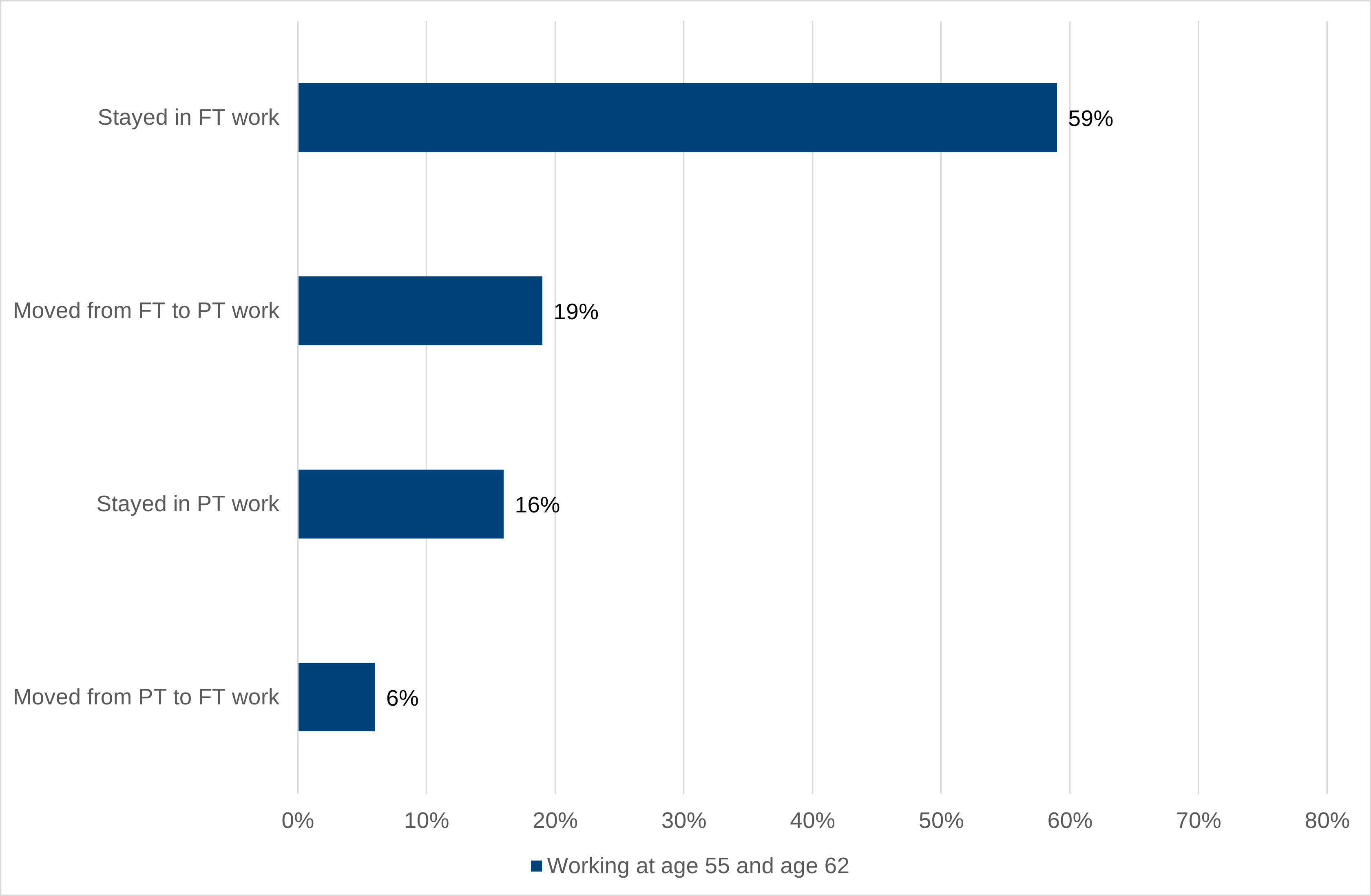
Base: study members in paid work at age 55 and age 62 (n=3480)
Moving from FT to PT work
We first compare the characteristics of those who changed from full-time to part-time paid work to those who remained in full-time work. Those who reduced their working hours were more likely to:
-
be women (57% to 28%)
-
own their home outright (70% to 55%)
-
have a low current household income (20% to 11%)
-
have a partner who was fully retired (27% to 15%)
Financial resources
As we found for those working PT at age 62, more study members who moved from FT to PT work had savings of £100,000 or more than those remaining FT (32% to 21%). There were also differences in the types and receipt of private pension provision:
-
more of those moving from FT to PT had a DB pension (45% to 30%)
-
more of those still in FT employment had a DC pension (67% to 53%)
Figure 6.10 shows that although the same proportion in each group had accessed their DC pension(s) (23% to 21%), those reducing their hours of work from FT to PT were more likely to have accessed their DB pension(s) (32% to 12%).
In addition, if they had a partner half (52%) of those moving from FT to PT had a partner who had accessed their DB pension, compared to a third (34%) of study members (with a partner) who were still working FT.
Figure 6.10: 1 in 2 of those moving from FT to PT had a DB pension, and 1 in 3 had accessed a DB pension
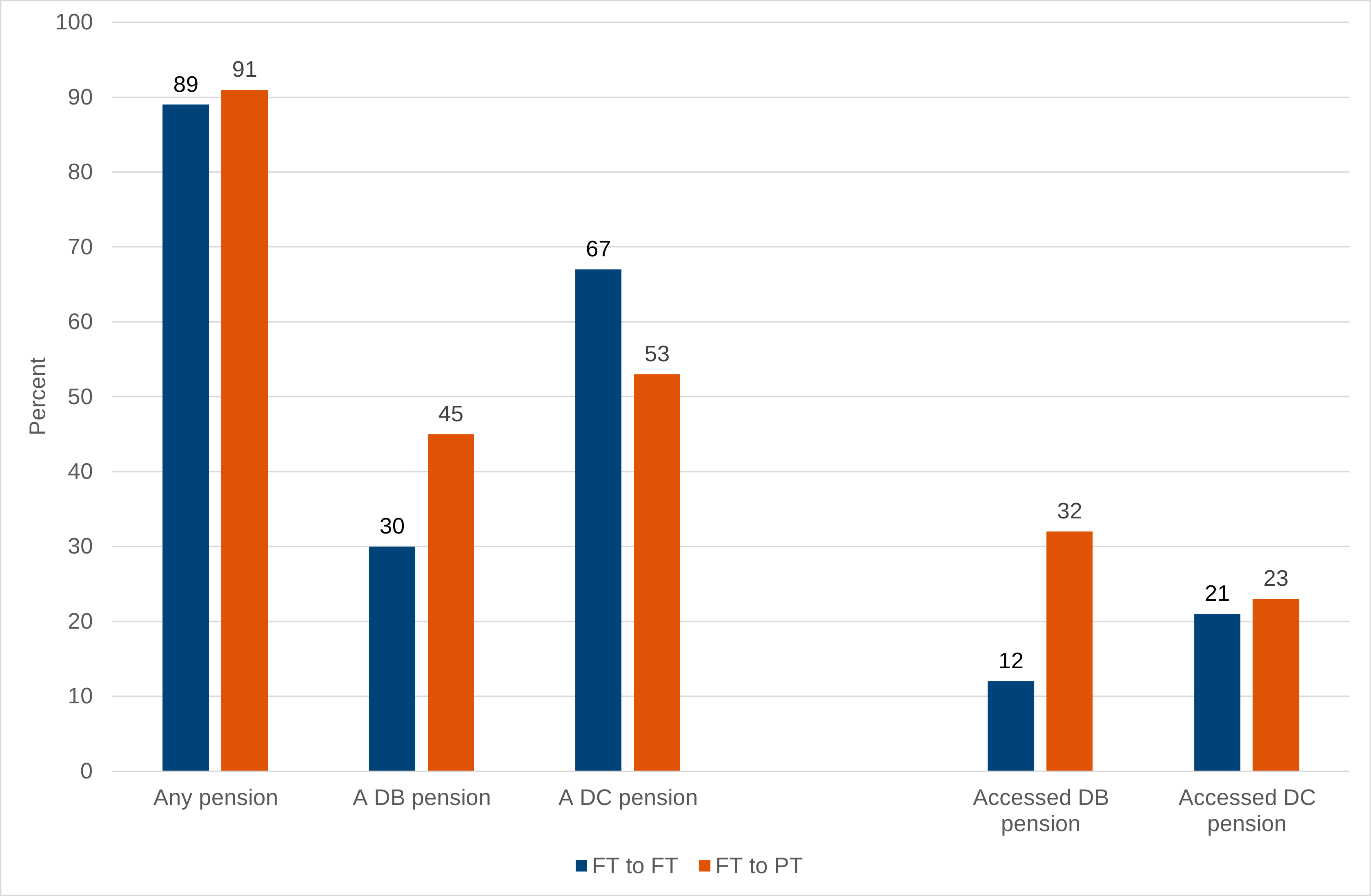
Base: study members working FT at age 55 and FT or PT at age 62 (n=2752)
Moving from PT to FT work
As mentioned, very few (6%) study members moved from PT to FT work in later life. The sample size of this group is very small, and as a result there were no significant findings when comparing these study members to those who stayed in PT work. However, compared to study members who remained in PT work, more of those moving from PT to FT work were male, and fewer owned their home outright or had accessed a DB pension.
Chapter 7: Adequacy
This chapter focuses on the adequacy of study members’ expected pension provision and other aspects of possible wealth in retirement. The chapter is divided into three sections: 7.1 How close are expected pension income and total income to the Pension Commission Target Replacement Rates (TRRs) and Pensions UK Retirement Living Standards (RLS), details the proportion who do not meet the TRR and RLS and how this differs by study members’ characteristics, experiences over the lifecourse, and financial resources. Section 7.2 Inheritance focuses on how likely study members think they will be to receive an inheritance in the future, and again how this differs by individual characteristics, lifecourse experiences, and other financial resources. Lastly, section 7.3 Relationship between housing tenure and pensions, looks specifically at the strength of the association between private pensions and housing tenure and also how this is influenced by economic activity over the lifecourse.
Key Findings
TRR and RLS
-
1 in 2 (49%) study members had a total expected pension income which was less than their TRR; this decreased to 43% when financial wealth was included
-
1 in 2 (48%) cohabiting study members and 2 in 3 (66%) not living with a partner did not meet the minimum one person RLS of £13,400; furthermore, 4 in 10 (40%) cohabitees and 1 in 4 (28%) not living with a partner were above the minimum but did not reach the moderate one person RLS of £31,700
Study members who had not met their TRR or the moderate one person RLS of £31,700 were socio-economically disadvantaged. For example, they were more likely to:
-
have no or lower level qualifications, rent their home, have no savings, not have a DB pension, and
-
have experienced persistent low household income and spent fewer months in paid work over the lifecourse
Furthermore, those not reaching a moderate RLS were far more likely to:
-
be women and to be single, and to experience further disadvantages
-
have worse health – both physical and mental – and spent far more time out of work due to poor health
Inheritance
-
1 in 4 (23%) study members felt very certain they will receive an inheritance
-
More than half (58%) felt it was very unlikely they will receive an inheritance
Those who felt very certain they will receive an inheritance:
-
Were socio-economically and financially advantaged across a range of measures, and
-
Had experienced better health and wellbeing over the lifecourse
Housing tenure and private pensions
-
More than 8 in 10 homeowners – whether owned outright or with an outstanding mortgage – have a private pension
-
Fewer renters have a private pension (68% private, 46% local authority/housing association [LA/HA]). Differences were apparent across both DB and DC pensions
7.1 How close are expected pension income and total retirement income to TRRs and RLS
Total expected pension income[footnote 15] was based on a snapshot of study members annualised private pension values at the time of interview with the average value of the new State Pension then added to it. There were three stages to the calculation:
-
The value of each type of private pension was transformed to an annual figure and summed to calculate a total private pension income value. Private pension income was calculated as gross pension income when compared to TRRs and net pension income when compared to the RLS[footnote 16]
-
The summed private pension income was then converted to 2022 to 2023 tax year prices using the ONS Consumer Prices Index. (The study members would have reached their 65th birthday in this tax year.)
-
The new State Pension was added using the mean value of the new State Pension for men and women, averaged over four quarters from May 2022 to February 2023 (tax year 2022 to 2023)
Total expected retirement income[footnote 17] was calculated by summing the total expected pension income value as described above, plus the addition of their financial wealth, again converted to 2022 to 2023 tax year prices. No other income was included.
The adequacy measures used to compare the total expected pension and total retirement incomes were, DWP, 2023):
-
The Pension Commission TRRs – a percentage of pre-retirement earnings an individual would need to replace an adequate income in retirement, and
-
Pensions UK (RLS – a level of income that might be deemed adequate based on expenditure.
7.1.1 Target Replacement Rates
Gross earnings[footnote 18] were computed using the age 50 sweep (2008)[footnote 19] which might in general be considered a peak earnings age and include both self-employed and employees and main as well as second job where appropriate. Total gross annual pre-retirement earnings were inflated to 2021 prices using the ONS average weekly earnings in Great Britain. Study members’ earnings were then grouped into the five TRR bandings[footnote 20], as shown in Table 7.1.
Table 7.1: The five Target Replacement Rate bandings
| Gross Pre-retirement earnings | BHC Thresholds 2021 earnings | BHC Target RR | % in each earnings band |
|---|---|---|---|
| Band 1 | Less than £14,500 | 80% | 30.5% |
| Band 2 | £14,500 to £26,999 | 70% | 21.5% |
| Band 3 | £27,000 to £38,499 | 67% | 15.4% |
| Band 4 | £38,500 to £61,499 | 60% | 19.2% |
| Band 5 | £61,500 or more | 50% | 13.5% |
Note: Those not in paid work at age 50 included in calculations, constituting 52% of Band 1.
Note: BHC threshold 2021 earnings based on Table 7 in DWP (2023)
Base: all study members (n=7802)
We calculated binary measures to indicate whether study members had reached the targets for their banding, if the:
-
total expected pension income was greater or equal to the proportion of earnings in the given band (1), or lower (0)
-
total expected retirement income (pension and financial wealth) was greater or equal to the proportion of earnings in the given band TRR (1), or lower (0)
Overall, half (49%) of study members’ total expected pension income did not reach their TRR. This varied from less than 1 in 10 (7%) of study members in band 1 (less than £14,500) to 7 in 10 (70% to 72%) of those in bands 3 (£27,000 to £38,499), 4 (£38,500 to £61,499) and 5 (£61,500 or more). This reduced slightly to just over 4 in 10 (43%) study members overall when financial wealth was included to their retirement income. Just 5% of study members in band 1 did not reach the TRR, when including financial wealth, while half (52%) in band 2 and around 2 in 3 (61% to 64%) study members in bands 3 to 5.
Figure 7.1: 1 in 2 study members did not reach their expected TRR
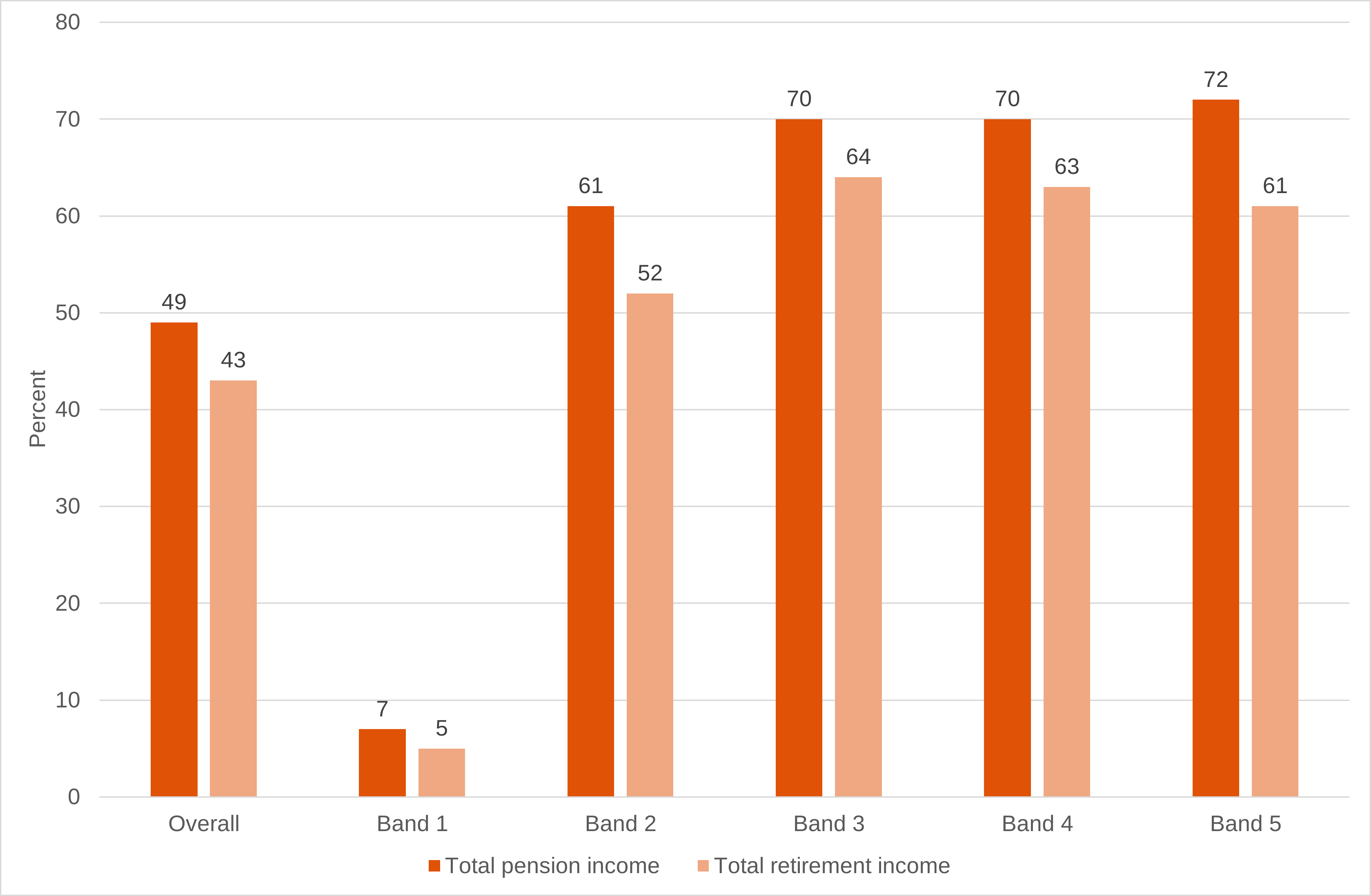
Base: all study members (n=7802)
While a substantial proportion of study members do not reach their TRRs, there is a gradient in how much they fall short of their targets by. Figure 7.2 demonstrates this by dividing those classified as ‘undersavers’ based on the total pension income, into mild (80% to 100% of their TRR), moderate (50% to 80% of their TRR) or substantial (below 50% of their TRR). The proportions of those who fall substantially below their target is the smallest (0%) in the lowest earnings band (Band 1), where the targets are replaced almost entirely by the average nSP, to the largest (28%) in the highest earnings band (Band 5), where the average nSP constitutes only a small proportion of the study members target.
Figure 7.2: Substantial undersavers range from 0% in the lowest to 28% in the highest earnings band
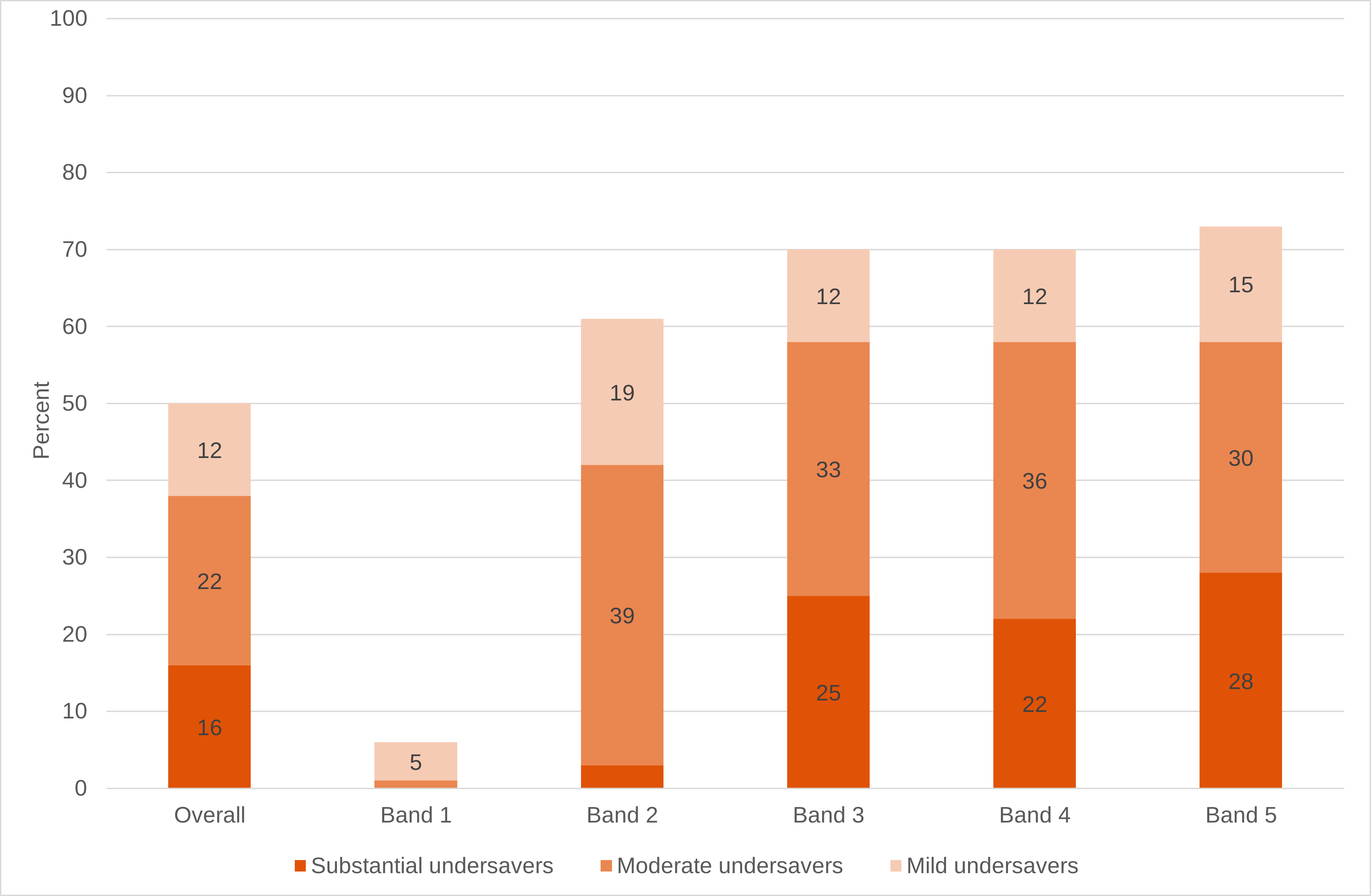
Base: all study members (n=7802)
We focus here on total expected pension income throughout the chapter. We first examined the characteristics of study members in each of the five bands separately, and although the actual percentage levels with a given characteristic differed across TRR bands few distinct differences emerged when comparing those that had and had not reached the TRR across bands 2 to band 5. As such, we combined the four bands and compared the characteristics of study members whose total expected pension income had and had not reached TRR. We discuss the characteristics of study members in Band 1 at the end of this section. All tables of results for the individual and combined bands for both expected pension income and expected retirement income are included in the Appendix (Tables A7.1 to A7.12).
Current circumstances
Compared to study members who had reached the TRR in Bands 2 to 5 (32%), more of those who had not reached the TRR (68%) were:
-
less educated: nearly 1 in 4 (23%) had no or low level [NVQ 1 qualifications], compared to 1 in 8 (13%) of those who had reached TRR
-
self-employed: three times as likely to be self-employed on a full-time basis (13% to 4%)
-
sick: nearly three times as likely to be out of work due to poor health (8% to 3%)
-
renters: more likely to be renting (17% to 9%), and not own any property (18% to 9%)
-
divorced: 1 in 5 (19%) compared to 1 in 7 (14%) were currently divorced
They were also far less likely to be fully retired (22% to 39%)
Lifecourse experiences
-
study members in bands 2 to 5, who had not reached the TRR had spent (on average) 17 fewer months in paid work between age 20 and age 55 (361 months to 378 months) than those who had reached the TRR
-
twice as many study members not reaching the TRR (14%), had experienced persistent low household income than those who reached the TRR (7%)
Financial resources Study members in bands 2 to 5 who had not reached the TRR had fewer financial resources available to them. Compared to study members who had reached the TRR they were more likely to have:
-
no household savings, and even when taking any debt into consideration, 1 in 2 had financial wealth of zero or less (21%) or less than £25,000 (28%) compared to 1 in 3 of those who had reached the TRR (11% zero or less; 22% less than £25,000)
-
no housing wealth (18% to 9%)
In terms of private pensions, although 8 in 10 (80%) of study members who had not reached the TRR had a private pension, this contrasted to all of those who had reached the TRR having a private pension. Those who had not reached the TRR were also,
-
less likely to have any employer (DB or DC) pension (61% to 88%)
-
less likely to have a DB pension (26% to 75%), but
-
more likely to have a DC pension (59% to 41%)
Characteristics of study members in Band 1
As shown in Figure 7.1, just 1 in 14 (7%) of study members in Band 1 had not reached TRR for total expected pension income and 1 in 20 (5%) for total expected retirement income. However, when comparing study members in Band 1 by whether they had or had not reached the TRR, the comparison profile differed from study members who had or had not reached the TRR in Band 2 to Band 5. Concentrating on total expected pension income, in comparison to the majority in Band 1 who had reached TRR, the few (7%) who had not reached the TRR had spent four additional years in paid work (298 months to 246 months) and three years less out of work due to poor health (30 months to 66 months). They were also more likely to have a partner who was economically active (40% to 32%), and less likely to have a DB pension (5% to 21%)[footnote 21].
7.1.2 Retirement Living Standards
We used the 2024 to 2025 national RLS for single one-person households as follows – minimum £13,400, moderate £31,700 and comfortable £43,900. Study members were grouped into four categories based first on their total expected net pension income value and secondly on their total net expected retirement income[footnote 22] as follows:
-
below minimum RLS (less than £13,400)
-
minimum but less than moderate RLS (£13,400 to 31,699)
-
moderate but less than comfortable RLS (£31,700 to £43,899), and
-
comfortable or above RLS (£43,900 or more)
As we use the thresholds for single one-person households, we examine the RLS categories separately for single (not living with a partner) and cohabiting (all living with a partner) study members.
As shown in Figure 7.3, the expected pension income of nearly half (48%) cohabiting and two-thirds (66%) of study members not living with a partner did not meet the minimum RLS of £13,400. This fell to 39% and 59% respectively for cohabitees and study members not living with a partner when financial wealth was included. Around a further 4 in 10 of cohabitees (40% to 44%) and 3 in 10 (28% to 31%) of study members not living with a partner expected (pension or retirement) incomes were above the minimum RLS but did not reach the moderate RLS. Therefore, relatively few study members expected pension income or retirement income was in the ‘moderate’ (£31,700 or more) RLS or above. Ranging from 6% to 10% of study members not living with a partner and 12% to 18% of cohabiting study members (when based on a single person’s threshold).
Figure 7.3: Few study members’ expected pension income or expected retirement income reached the moderate RLS of £31,700 or more (based on the single persons threshold)
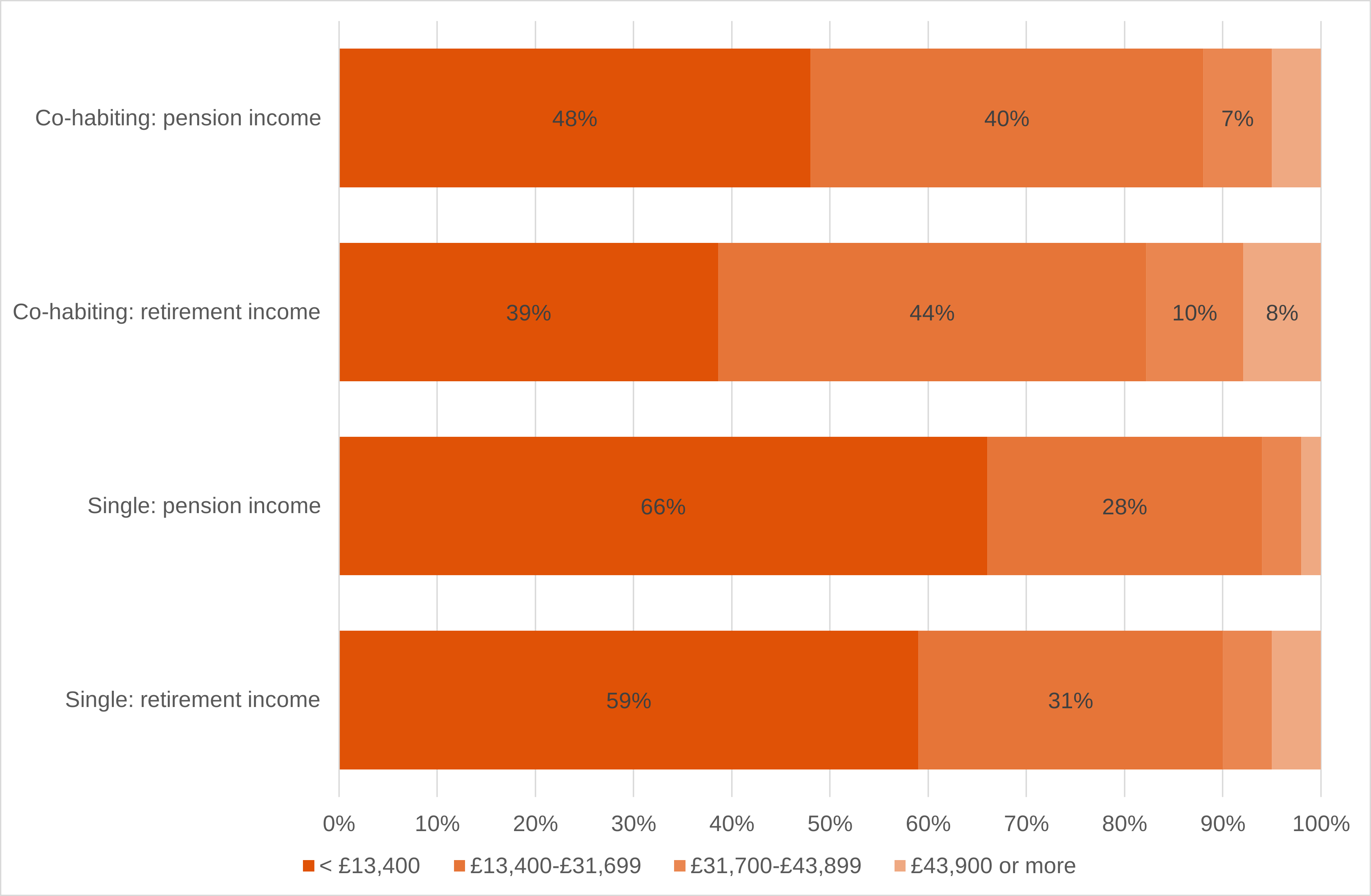
Base: all study members (n=7802)
As the proportions of study members with a moderate and comfortable (or above) RLS were (relatively) small, for the following comparisons we combine the moderate and comfortable groupings together, to give 3 groups: below minimum (less than £13,400;), minimum to moderate (£13,400 to £31,699) moderate or better (£31,700 or more) RLS. We first investigate the characteristics of cohabiting study members (71%) with different RLS based on their expected pension income, before examining differences among study members not living with a partner. We use the moderate or better RLS as the comparison group. The full set of results are available in the Appendix (Tables A7.13 to A7.16).
Study members with cohabiting partners
Current circumstances
Compared to cohabiting study members with expected moderate or better RLS, more of those cohabiting study members not reaching this RLS were more likely to be:
-
women: nearly 6 in 10 (57%) of the below minimum and 4 in 10 (41%) of the minimum to moderate were women, compared to 1 in 5 (19%) of the moderate or better RLS
-
have lower level qualifications: 32% of the below minimum and 14% of the minimum to moderate had no or low level (NVQ 1) qualifications, compared to only 6% of the moderate or better
-
renters: the below minimum were far more likely to rent from a LA/HA (14% to 4% minimum to moderates, 1% moderate or better) or a private landlord (7% to 3% minimum to moderates or 1% moderate or better)
-
not living with a fully retired partner: 1 in 3 (33%) of the below minimum had a fully retired partner, compared to 39% of the minimum to moderates and 47% of the moderate or better
Lifecourse experiences
Looking at health across the lifecourse, more of those in the below minimum RLS had experienced poor health, low household income and spent less time in paid work:
-
a quarter (26%) of those below minimum had experience of a high number of symptoms associated with depression compared to 16% of the minimum to moderate and 10% of the moderate or better
-
3 times (13%) as many below minimum had a longstanding limiting illness (LSLI) on 2 or more occasions compared to the moderate or better (4%)
-
1 in 4 (24%) of the below minimum and 6% of the minimum to moderate had experienced persistent low household income compared to 1% of the moderate or better
-
the below minimum had spent (on average) 6 years less in paid work compared to the moderate or better (314 to 389 months), and almost 5 years less than the minimum to moderate (374 months). They had also spent (on average) nearly 3 years (34 months) out of paid work due to poor health or more than 4 years (54 months) in a home-care role
Financial resources
The below minimum and minimum to moderate were less likely than the moderate or better to have a range of financial resources to draw on. They were more likely to have:
-
no household savings or savings of less than £25,000 (55% below minimum, 32% minimum to moderate, 15% moderate or better), and less likely to have savings of more than £100,000 (18% below minimum, 34% minimum to moderate, 59% moderate or better)
-
no or less than £200,000 housing wealth: 4 in 10 (44%) below minimum, 25% of minimum to moderate and 11% moderate or better
In terms of private pensions, all minimum to moderate and moderate or better cohabiting study members had a private pension compared to only two-thirds (65%) of the below minimum RLS group. Around 1 in 2 of study members in all three RLS groups had a DC pension, but:
-
the below minimum were less likely to have any employer (DB or DC) pension (46% compared to 81% minimum to moderate and 86% moderate or better), and
-
the below minimum (14%) and minimum to moderate (60%) were less likely to have a DB pension than the moderate or better (72%)
Study members not living with a partner
Now turning to study members not living with a partner, the pattern of results across the three RLS groups for current, lifecourse and financial resource factors were very similar to the cohabiting study members outlined above. The main difference was study members not living with a partner were even more disadvantaged. For example, within each RLS grouping:
-
a higher proportion had a lower household income (63% below minimum, 38% minimum to moderate, 11% moderate or better)
-
a higher proportion had no household savings or savings of less than £25,000 (81% below minimum, 49% minimum to moderate, 24% moderate or better)
-
they were more likely not to own any property (56% below minimum, 21% minimum to moderate, 10% moderate or better) and
-
more likely to have experienced persistent low household income across the lifecourse (57% below minimum, 14% minimum to moderate, 3% moderate or better)
Many of the disadvantages were particularly extreme for study members not living with a partner in the below minimum RLS group as highlighted below:
-
more were renting from a LA/HA (37% to 10% minimum to moderates, 6% moderate or better) or a private landlord (15% to 5% moderate or better and 9% minimum to moderates)
-
the below minimum had spent (on average) 9 years less in paid work than the moderate or better (258 to 371 months) and nearly 8 years less than the minimum to moderate (258 to 353 months)
-
they had spent around 4 years more out of paid work due to poor health compared to the minimum to moderate (67 to 21 months), or the moderate or better (67 to 12 months); and they had also spent more than 5 years (66 months) in a home-care role, compared to just over two years (27 months) for the minimum to moderate, and just 10 months for those moderate or better
-
only 1 in 11 (9%) of the below minimum have a DB pension, compared to 1 in 2 (55%) of the minimum to moderate and 7 in 10 (72%) of the moderate or better
-
1 in 3 (33%) have a DC pension, compared to nearly 1 in 2 of the minimum to moderates (47%) and moderate or better (45%).
7.2 Inheritance
In this section we compare differences in study members who felt they were very certain or that it was very unlikely they would receive a future inheritance[footnote 23]. We examine current circumstances, lifecourse events and financial resources.
Study members were asked how likely (0% to 100%) they thought it was that they would receive any inheritance in the future, where 0% meant there is absolutely no chance of it happening, and 100% means that they are absolutely certain that it will happen. Based on the distribution, scores were grouped into three categories: 0% to 19% [very unlikely]; 20 to 80% [middle]; 81 to 100% [very certain]. More than half (58%) of study members felt it was very unlikely they would receive an inheritance, around 1 in 5 were in the middle (19%) and 1 in 4 were very certain (23%). Follow on questions asked about the likelihood of receiving an inheritance over the value of £100,000 or £250,000. We again grouped responses into ‘very unlikely’ ‘middle’ and ‘very certain’. (The full set of results are included in Appendix Tables A7.17 to A7.19.) As expected, Figure 7.4 shows that more study members felt it was ‘very unlikely’ they would receive an inheritance as the value went up and fewer were ‘very certain’ of receiving an inheritance as the value increased.
Figure 7.4: 1 in 4 study members feel very certain they will receive an inheritance
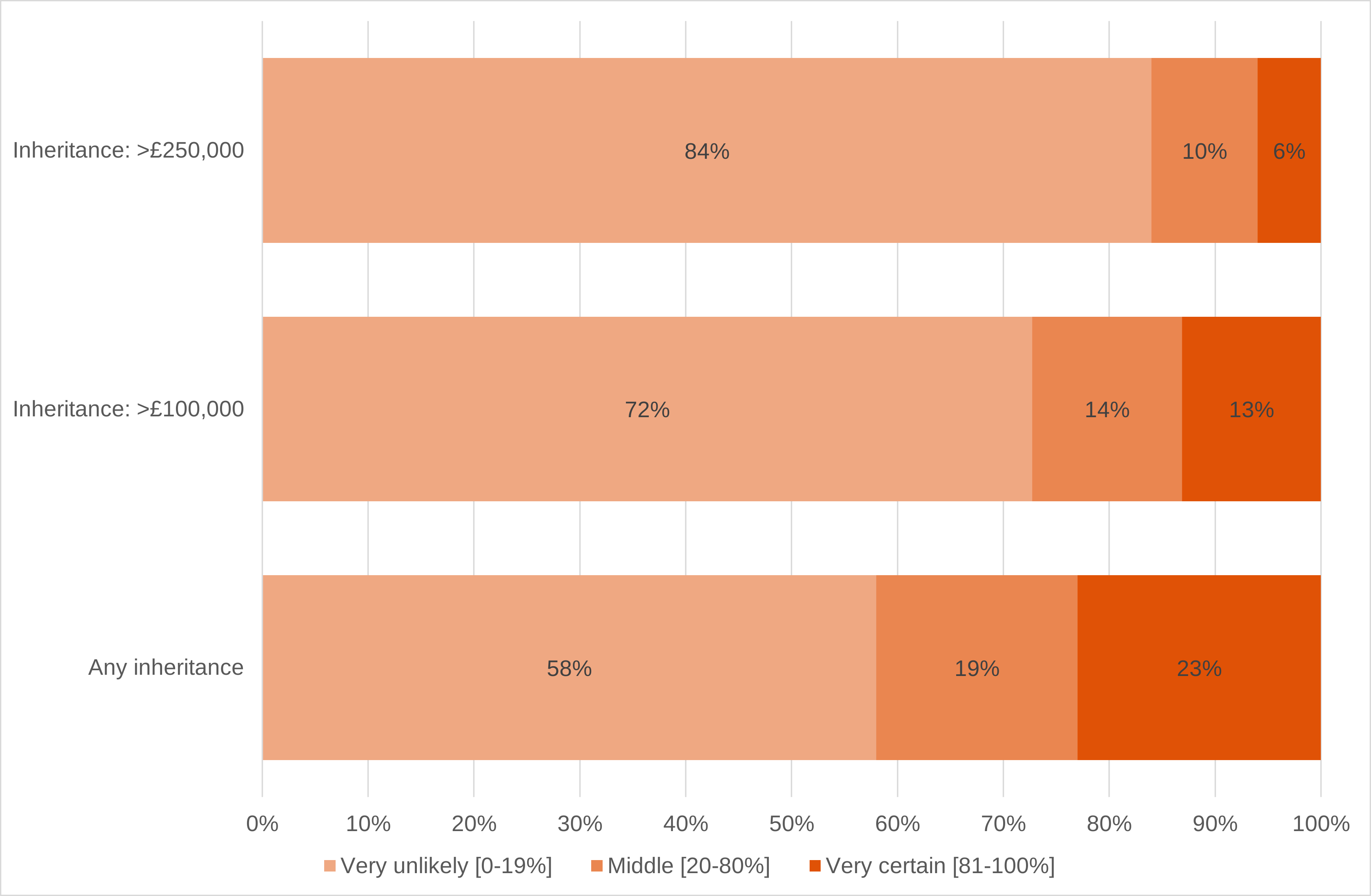
Base: all study members (n=7802)
It is important to note here that nearly 1 in 3 (28%) of study members had already received an inheritance by the time they were interviewed – 14% during the last 10 years (from 2014), 14% at some point between 1977 to 2013. Study members who were very certain they would receive an inheritance in the future were also the more likely to have already received an inheritance, those who felt it was very unlikely they would receive a future inheritance were less likely to have already received one (34% to 27%).
Turning to current circumstances, lifecourse events and financial resources, study members who were very certain they would inherit were very advantaged compared to those who felt it was very unlikely.
Current circumstances
-
better educated: more than 4 in 10 (42%) of the very certain had a degree [or higher] qualification, compared to less than 3 in 10 (29%) of the very unlikely
-
outright homeowners: more than 7 in 10 (72%) of the very certain owned their home outright compared to just under 6 in 10 (58%) of the very unlikely, and they were also more likely to own two or more properties (26% to 15%)
-
currently married: three-quarters (76%) of the very certain compared to two-thirds (67%) of the middle group and less than 6 in 10 (59%) of the very unlikely were currently married. The very unlikely were twice as likely to be currently single (14% to 7%) and more were currently divorced (22% to 13%)
Lifecourse experiences
-
8 in 10 (83%) of the very certain had no experience of a high number of symptoms associated with depression compared to three-quarters of the very unlikely (75%)
-
three-quarters (77%) of the very certain had never had a longstanding limiting illness (LSLI) compared to two thirds of the very unlikely (66%)
-
just 1 in 10 (10%) of the very certain experienced persistent low household income compared to more than 1 in 4 (27%) of the very unlikely to inherit
Financial resources
The very certain to inherit were more likely than the very unlikely to inherit to have a range of financial resources to draw on. They were more likely to have:
-
a high household income (30% to 19%)
-
savings of more than £100,000 (35% to 21%), and less likely to have no savings (7% to 18%) or savings of less than £25,000 (27% to 35%)
-
housing wealth over £600,000 (26% to 13%)
In terms of private pensions, nearly 9 in 10 (88%) of study members in the very certain to inherit group had a private pension compared to three-quarters (76%) of the very unlikely to inherit group. Those in the very certain to inherit group were also more likely to have:
-
any employer (DB or DC) pension (69% to 59%)
-
a DB pension (44% to 33%)
-
a DC pension (54% to 46%)
The same pattern of results was generally found when looking at differences in characteristics of study members who felt they were very certain or very unlikely to get an inheritance with a value over £100,000 or over £250,000.
7.3 Relationship between housing tenure and pensions
There was a strong association between housing tenure and having a private pension (see Appendix Table A7.20). As shown in Figure 7.5, study members were far more likely to have a private pension if they owned their home – either outright or with a mortgage – compared to those in rented accommodation, whether they rented from a private landlord or from a local authority or housing association (LA/HA). Specifically,
-
any pension: more than 8 in 10 study members who owned outright (86%) or had a mortgage (85%) had a private pension, this fell to two-thirds (68%) among those who rented privately and further still to just under half (46%) for those in LA/HA rented accommodation
-
DC Pension: around half of study members who owned outright (50%), had a mortgage (54%) or rented privately (45%) had a DC pension, compared to just over a quarter (27%) of those in LA/HA rented accommodation
-
DB Pension: more than 4 in 10 study members who owned outright (43%) had a DB pension, falling to 1 in 3 (35%) among those with a mortgage, 1 in 5 (21%) who rented privately pension, and 1 in 8 (13%) in LA/HA rented accommodation
Figure 7.5: Study members who own their home are more likely to have a private pension than those in rented accommodation
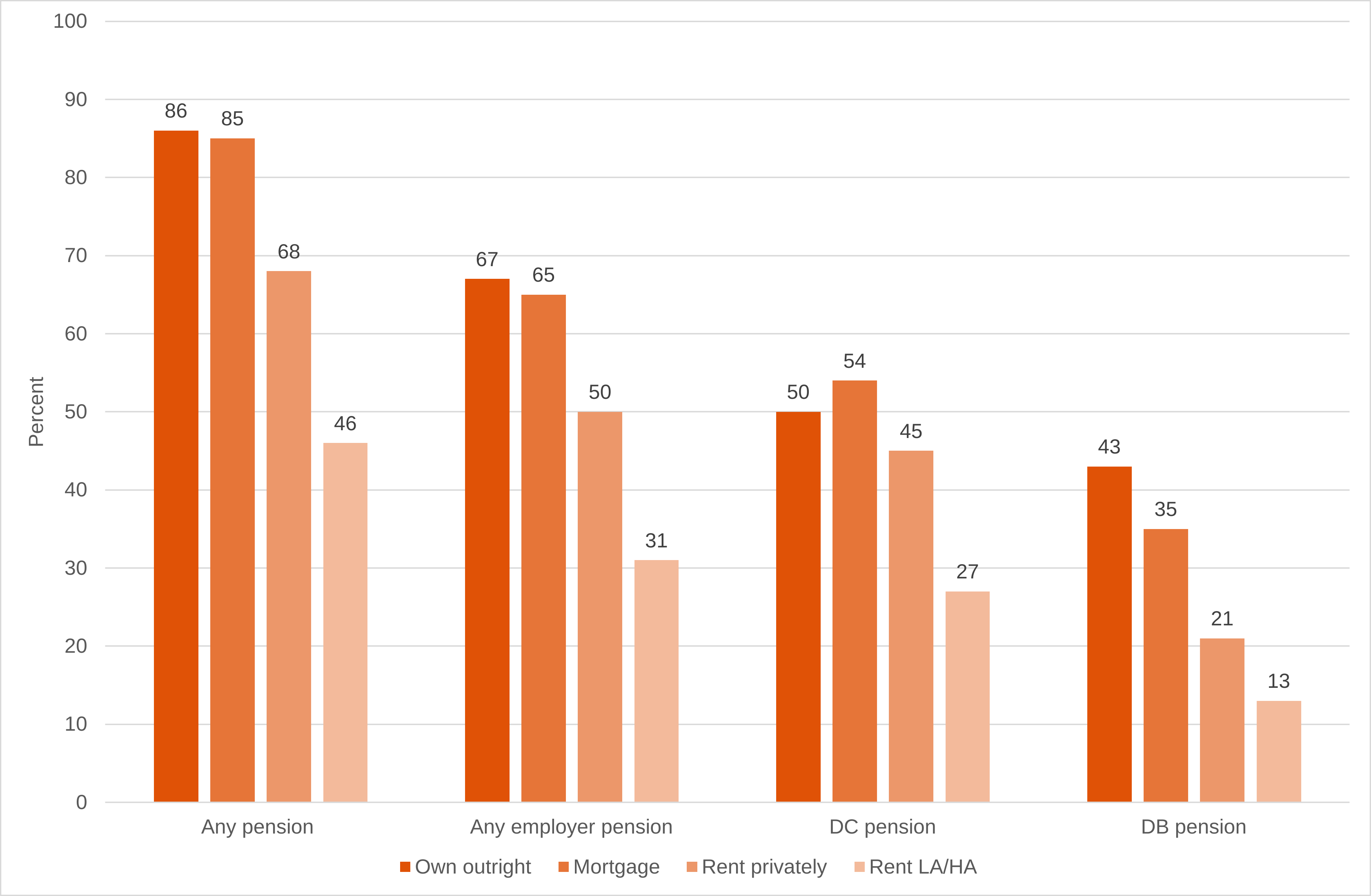
Base: all study members with a private pension (n=6624)
7.3.1 How is this association influenced by economic activity over the lifecourse?
We looked further into the association between housing tenure and private pensions by additionally considering time spent in paid work and out of paid work due to poor health or a home care role over the lifecourse. (See Appendix Table A7.20.) We found that regardless of housing tenure, compared to study members who had no private pension, those with a private pension had spent:
-
more time in paid work: e.g. 10 and a half more years among those renting from a LA/HA (297 to 174 months:); 7 more years among study members who owned their home outright (364 to 277 months) (see Figure 7.6)
-
fewer months out of work due to poor health: e.g. 56 fewer months (53 to 109) among those renting from a LA/HA (see Figure 7.7), and
-
fewer months out of work in a home-care role: e.g. 56 fewer months among study members who owned their home outright (27 to 83) and 36 fewer months among those with an outstanding mortgage (24 to 60)
Figure 7.6: Those with a private pension have spent more months (on average) in paid work over the lifecourse irrespective of housing tenure
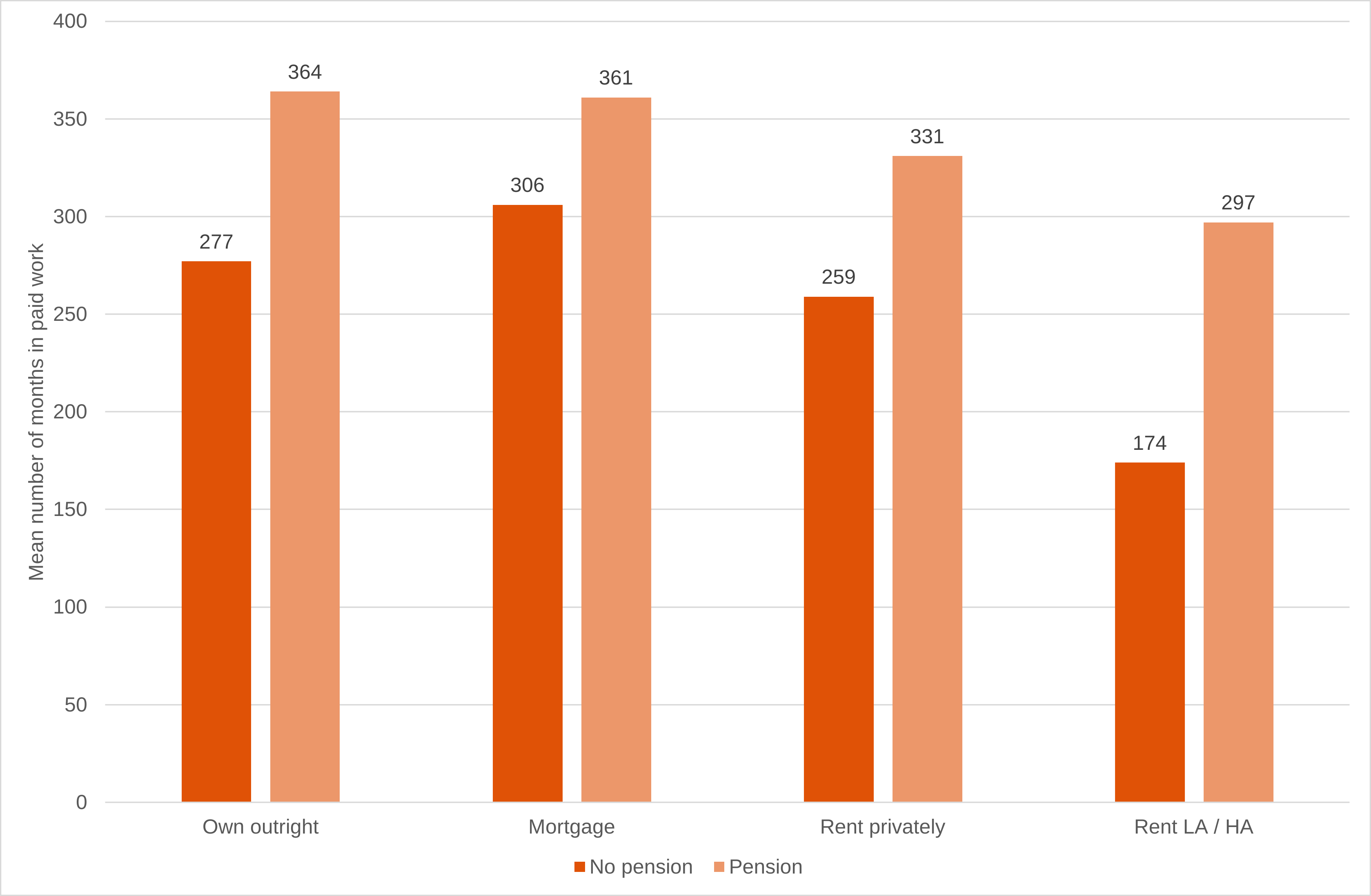
Base: all study members (n=7802)
Figure 7.7: Those with a private pension have spent fewer months (on average) out of paid work due to poor health over the lifecourse irrespective of housing tenure
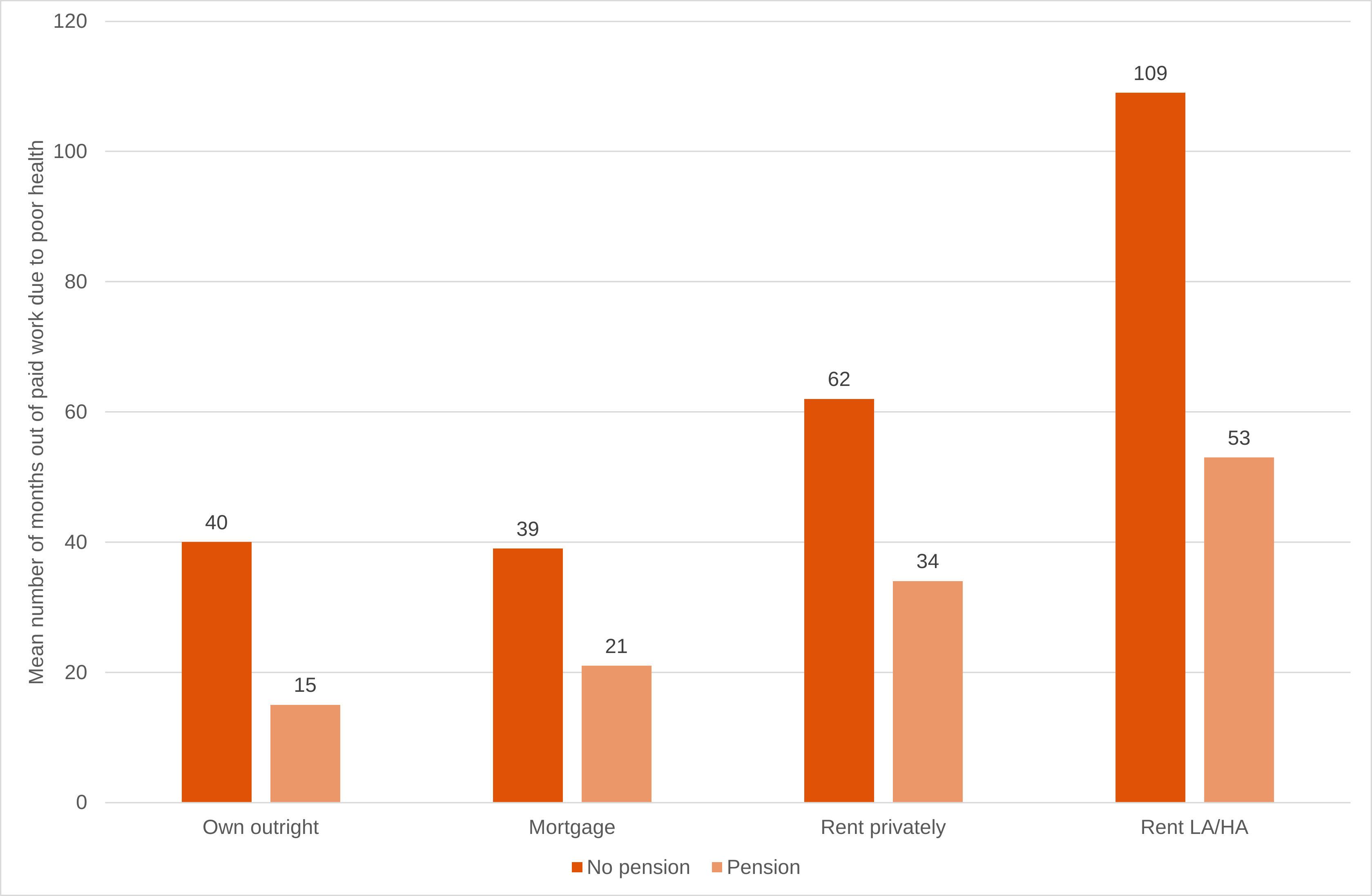
Base: all study members (n=7802)
Chapter 8: State Pension awareness and reliance
In this chapter we focus on State Pension awareness and expectations. Section 8.1 State Pension Awareness reports on whether study members expect to receive a State Pension, and if so, their knowledge of the year or age when they would first expect to get the State Pension. Section 8.2 How much State Pension study members expect to receive, reports on their understanding of the amount they expect to receive. In Section 8.3 Who is reliant on the State Pension for most of their income, we calculate how reliant on the State Pension a study member will be after considering their possible retirement income (private pensions and financial wealth). In all three sections we highlight differences in awareness and reliance of the State Pension by study members current characteristics, lifecourse experiences and financial resources.
Key Findings
Just 1 in 25 (4%) of all study members do not expect to receive a State Pension (SP).
State Pension Literacy
Among the majority of study members who did expect to receive a SP,
-
4 in 5 (80%) expected to receive their SP at age 66, meaning 1 in 5 (20%) did not know the age when they would receive it
-
1 in 3 (36%) did not know the value of the SP they expected to get
-
when asked to approximate the amount of SP based on a range of values that were presented to them, 1 in 6 (18%) still reported they did not know
Of those study members who gave an expected value for their State Pension, 3 in 10 (29%) gave a value between the average and full 2022 to 2023 nSP (£9,026 to £9,628); nearly half (47%) gave a value below the average nSP and a quarter (24%) above the full nSP.
Reliance on the State Pension
Based on our estimation,
-
1 in 2 (47%) study members would be mostly reliant (67% to 100%) on the State Pension system
-
a third (33%) would be moderately reliant (34% to 66%), and
-
20% not reliant (33% or less) on their SP
Those who we estimated to be mostly reliant (compared to those estimated to not be reliant) were more likely to be women and socio-economically disadvantaged. For example, they were:
-
less educated, self-employed or rented their home
-
more likely to have experienced a longstanding illness or low household income across the lifecourse, and
-
had fewer financial resources to draw on
8.1 State Pension Awareness
8.1.1 Expectation of receiving a State Pension
Study members, were asked ‘Do you expect to receive any income from a State Pension?’ Among the 1958 cohort, just 1 in 25 (4%) of all study members did not expect to receive a State Pension, with there being no difference between men and women. However, this small group of study members who did not expect to receive a State Pension were very disadvantaged across a wide range of current and lifecourse socio-economic characteristics. (See Appendix Table A8.1 for the full set of results.)
Current characteristics
Compared to those who expected to receive a State Pension, those that did not were more likely to:
-
have no or low level (NVQ 1) qualifications (42% to 25%)
-
be out of work due to poor health (34% to 11%) and less likely to be a full-time employee (13% to 26%)
-
rent their home from a LA/HA (24% to 13%)
Lifecourse experiences
Compared to those who expected to receive a State Pension, those that did not were more likely to have:
-
experienced persistent low household income (46% to 22%)
-
ever experienced symptoms of depression (33% to 22%)
-
had a LSLI on two or more occasions (26% to 11%)
They also had less attachment to the labour market, having spent
-
over five years less in paid work (270 to 333 months), and
-
over three years more out of work due to poor health (68 to 30 months)
Financial resources
Study members who did not expect a State Pension had fewer financial resources available to them. Compared to those who expected to receive a State Pension,
-
twice as many had a low household income (47% to 25%)
-
twice as many also had no housing wealth (41% to 21%), and
-
four in 10 (40%) had no savings compared to 15% of those who expected to receive a SP
Relatively few of those who did not expect to receive a State Pension had any kind of private pension provision. For example,
-
less than half (47%) had any private pensions compared to 8 in 10 (80%) of those who expected to receive a State Pension, and
-
just 1 in 8 (13%) had a DB pension compared to 1 in 3 (36%) of those who expected to receive a State Pension
8.1.2 Awareness of the State Pension age
Eligible adults born in 1958 could start to receive their State Pension at age 66, which for this cohort fell in March 2024. The 96% of study members who expected to receive a State Pension, were asked ‘When do you expect to receive the State Pension?’ They could give their answer in age, or year and month. 1 in 5 (20%) did not say they would receive the SP at age 66, and there was again no difference by sex (21% men, 19% women). However, given the extended fieldwork period, there was a big variation in the proportion expecting to receive their State Pension at age 66 by the tax year they were interviewed. For example, the highest proportion not knowing (33%) were interviewed in the tax year 2019 to 2020[footnote 24] when aged around 61, and the lowest proportion not knowing (13%) were interviewed during the tax year 2023 to 2024 when aged around 65 years. Essentially, the closer a study member was to their State Pension age, the more likely they were to know the expected age.
Table 8.1: A higher % expect to receive their State Pension at age 66 in later (tax) year of interview
| - | 2019 to 2020 | 2020 to 2021 | 2022 to 2023 | 2023 to 2024 |
|---|---|---|---|---|
| Expect at age 66 | 67% | 77% | 83% | 87% |
| Expected at other ages | 33% | 23% | 17% | 13% |
| Earlier age | 5% | 2% | 3% | 3% |
| Later age | 27% | 20% | 13% | 10% |
| Don’t know | 1% | 1% | 1% | 0% |
Base: study members who expect to receive a State Pension (n=7490)
Compared to the 4 in 5 (80%) who gave age 66 as their expected State Pension age, more of the study members who did not:
-
were self-employed [full-time] (13% to 8%)
-
had spent nearly two years less (21 months) in paid work over the lifecourse (314 to 335 months)
-
had a mortgage (21% to 15%)
-
had no housing wealth (27% to 20%)
-
had a high current household income (27% to 21%) – as more remained in paid work – although more had experienced persistent low household income over the lifecourse (29% to 21%)
More of those who expected to receive their State Pension at age 66 had already fully retired from paid work (26% to 16%), owned their home outright (63% to 51%), had savings of more than £100,000 (25% to 20%) and no experience of a low household income across the lifecourse (41% to 35%). The full set of results are included in Appendix Table A8.2.
8.2 How much State Pension they expect to receive
8.2.1 Giving an expected State Pension value or not
We now examine how much SP study members expected to receive. In April 2016 significant reform changed the structure of the SP to a single tier flat rate dependent on National Insurance Contributions and an individual’s date of birth – introducing a nSP related to only years of economic activity. The previous structure was a two-tier system comprising a basic State Pension and a second State Pension related to earnings. If the study members (who were aged 58 when the legislation was introduced) had been in work and paid National Insurance before 6 April 2016, their nSP will be calculated under transitional arrangements[footnote 25]. In broad terms this means that even if the study member has 35 years on their National Insurance record this may not equate to the new full SP – study members could get less or more than the full rate. The calculations will differ depending on individual circumstances which makes awareness of the expected value of SP for study members more challenging than previously.
Of those that expected to receive a SP, more than 1 in 3 (36%) did not know the value of the SP they expected to get. The initial question was ‘How much do you expect to receive from your State Pension? Please answer in today’s money.’ Those who did not know were additionally asked to approximate the amount based on a range of values that were presented to them[footnote 26]. However, even when presented with different values, 1 in 6 (18%) still reported that they did not know. (The full set of results are provided in Appendix Tables A8.3 and A8.4).
Current circumstances
Compared to study members who gave an expected value (unprompted) for the SP, a higher proportion of the 1 in 6 who did not know even after being presented with a range of values to help them:
-
had lower qualification levels: 1 in 3 (34%) had no or low level (NVQ 1) qualifications compared to 1 in 5 (21%) who gave a value (see Figure 8.1)
-
rented their home: more than 1 in 5 (22%) rented their home from their local authority or a housing association compared to 1 in 10 (10%) of those who gave a value; and twice as many (12% to 6%) rented from a private landlord (see Figure 8.2)
-
were out of work due to poor health: more than 1 in 5 (22%) were out of work due to poor health compared to 1 in 13 (8%) of those who gave a value
-
were not married: around half (55%) compared to two-thirds (67%) of those that did give a value were currently married
Figure 8.1: More of those who didn’t know how much State Pension to expect had no or low level qualifications
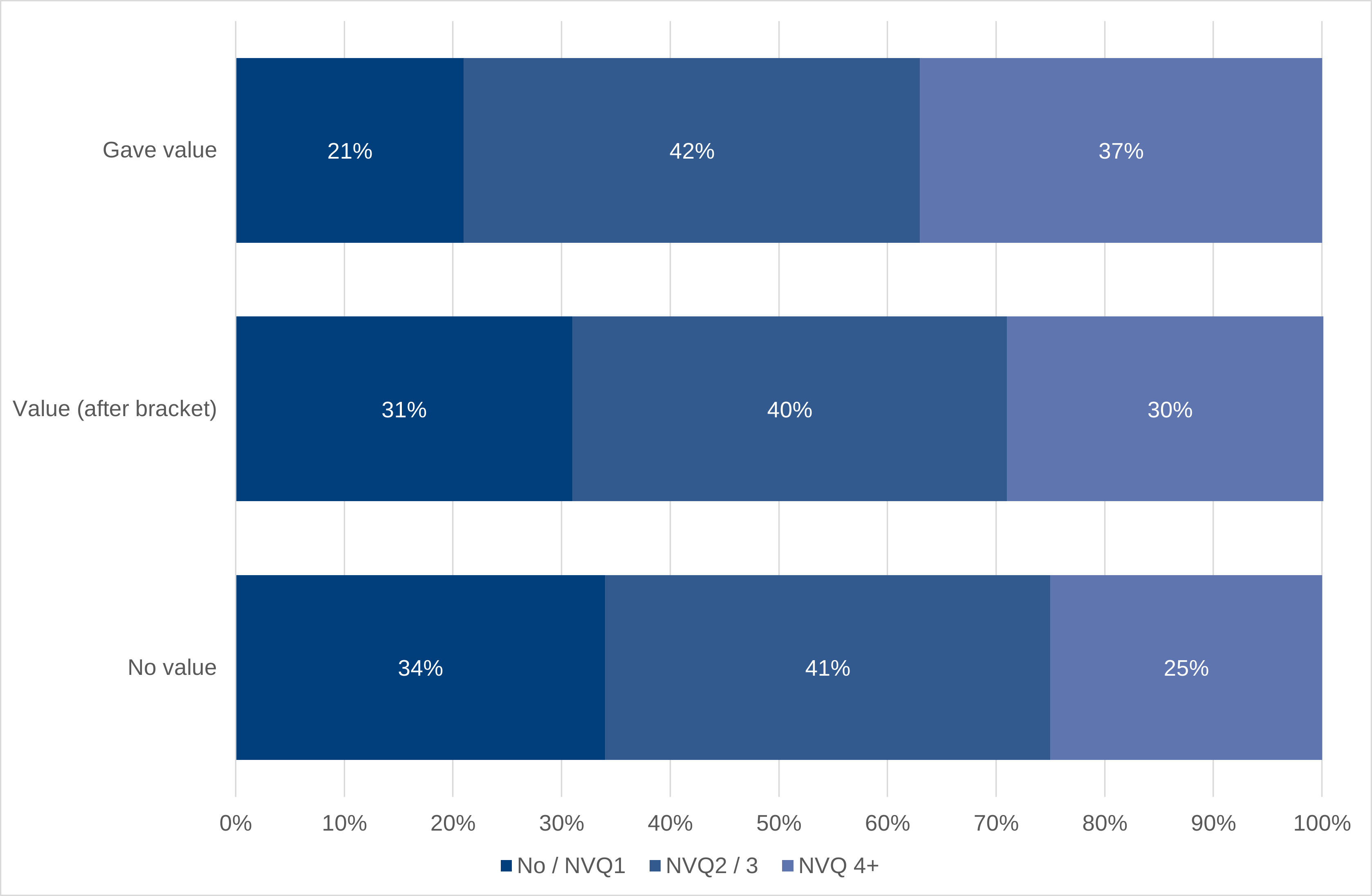
Note: Qualifications: No qualification or NVQ 1 is the equivalent to no or grade 1 to 3 or G to D GCSE; NVQ 2 or NVQ 3 is the equivalent to GCSE 4 to 9 or C to A* or A’level; NVQ 4 or above is the equivalent to Degree or higher.
Base: study members who expect to receive a State Pension (n=7490)
Figure 8.2: More of those who didn’t know how much State Pension to expect rented their home
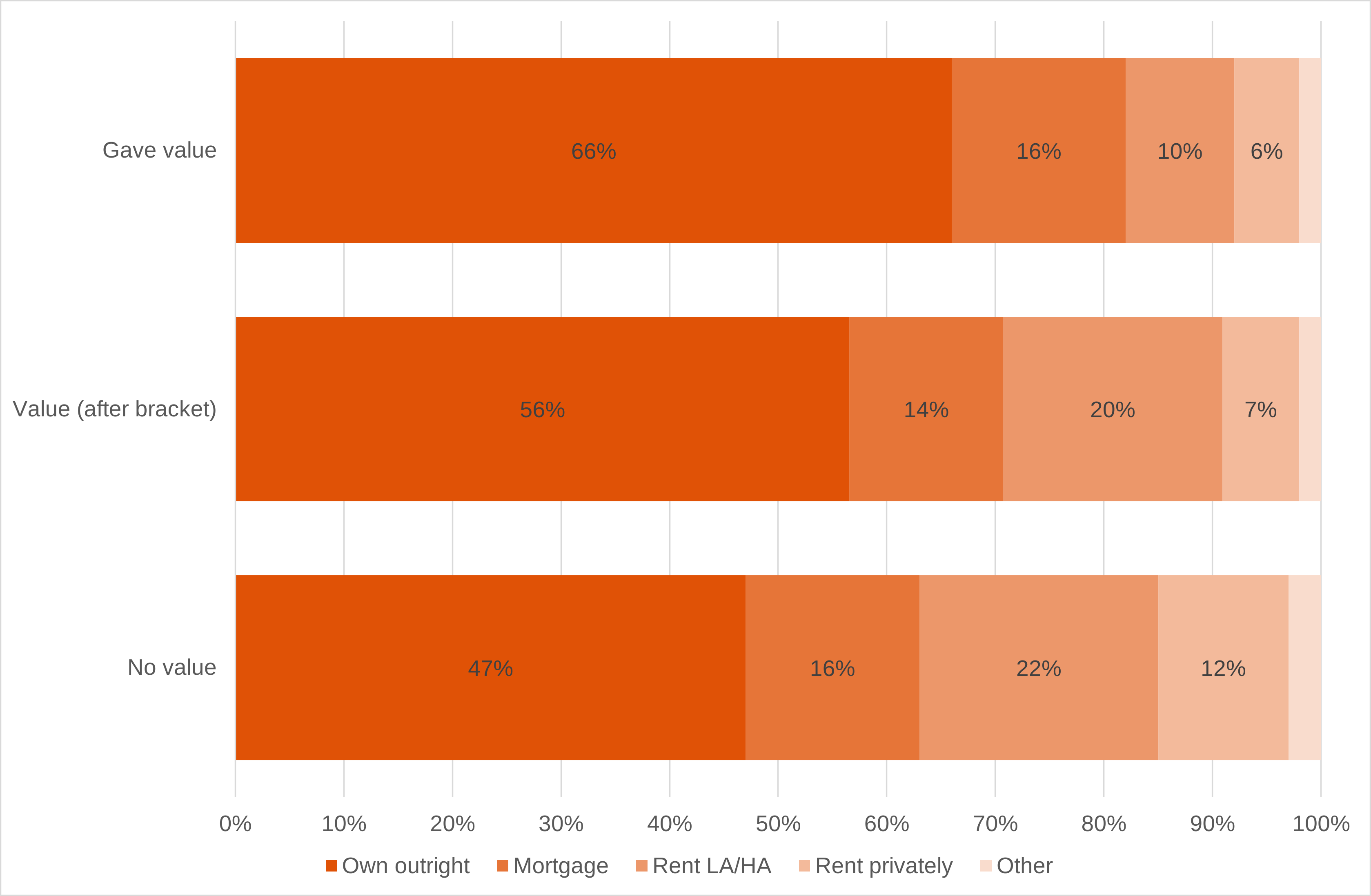
Note: Rent LA/HA = Rent from Local Authority or Housing Association.
Base: study members who expect to receive a State Pension (n=7490)
Lifecourse experiences
When examining economic activity histories between age 20 to age 55, the study members who did not know an expected value (after being presented with a range of values) had spent, on average:
-
3 and a half years less in paid work than those who gave a value (302 to 345 months), and
-
over two years more out of work due to poor health (51 to 23 months)
The don’t knows were also far more likely than those that gave an expected value to have experienced episodes of poor health and wellbeing:
-
just 6 in 10 (59%) had never reported a longstanding limiting illness (LSLI) compared to more than 7 in 10 (74%) of those who gave a value, with 1 in 6 (18%) having a LSLI on 2 or more occasions compared to (8%) (see Figure 8.3)
-
1 in 10 (11%) had experienced poor mental wellbeing on 2 or more occasions compared to 1 in 14 (7%) of those that gave a value
Figure 8.4 shows that the don’t knows were also more likely than those that gave an expected value to have been part of a low income household, with 1 in 3 (34%) having experienced persistent low household income compared to just 1 in 6 (17%) of those that gave a value. Twice as many who did not know had also never lived with a partner (10% to 5%).
Figure 8.3: More of those who did not know how much State Pension to expect had more experience of a longstanding limiting illness over the lifecourse
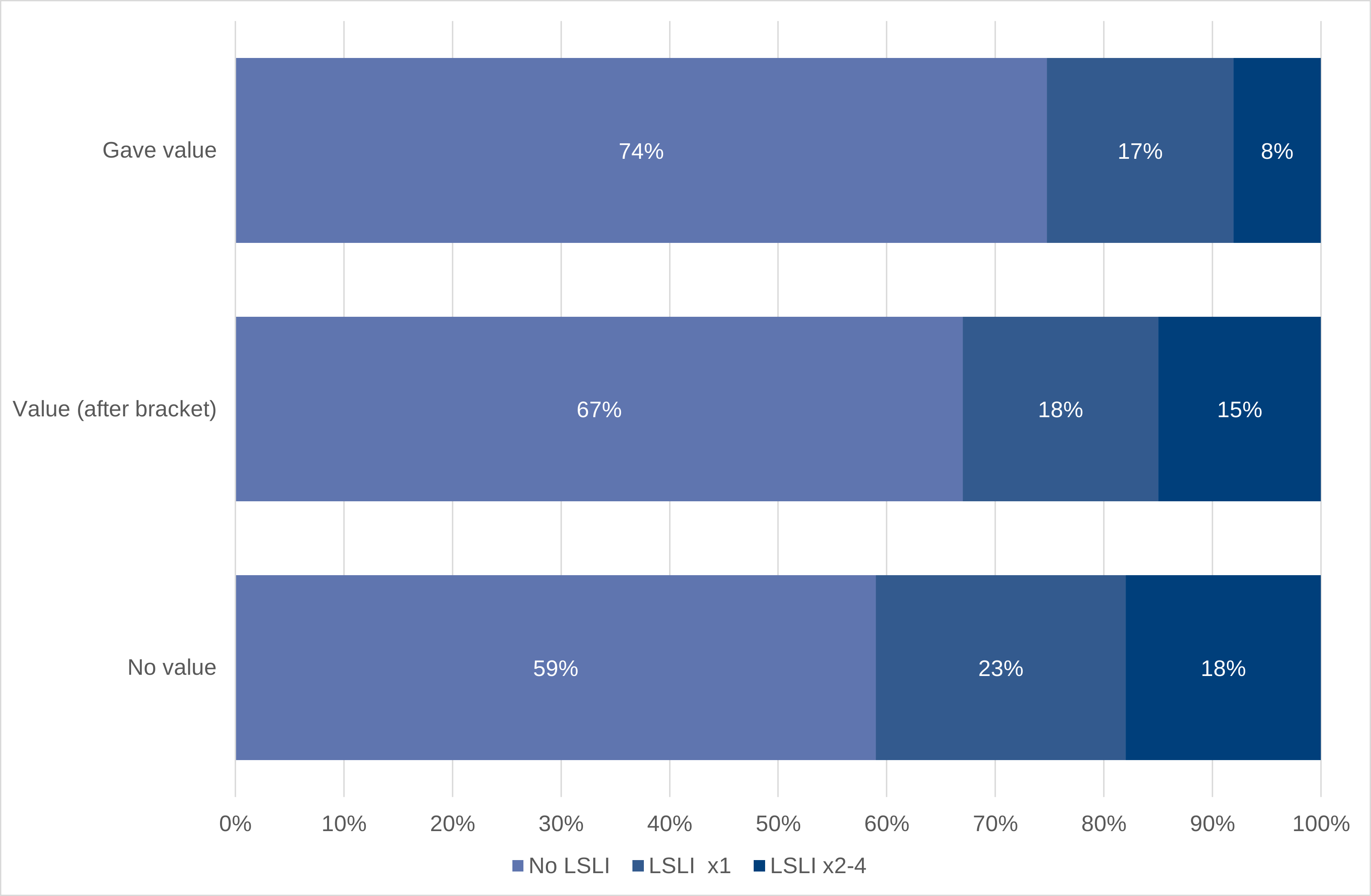
Note: LSLI = Longstanding limiting illness
Base: study members who expect to receive a State Pension (n=7490)
Figure 8.4: More of those who did not know how much State Pension to expect had been part of a persistent low income household over the lifecourse
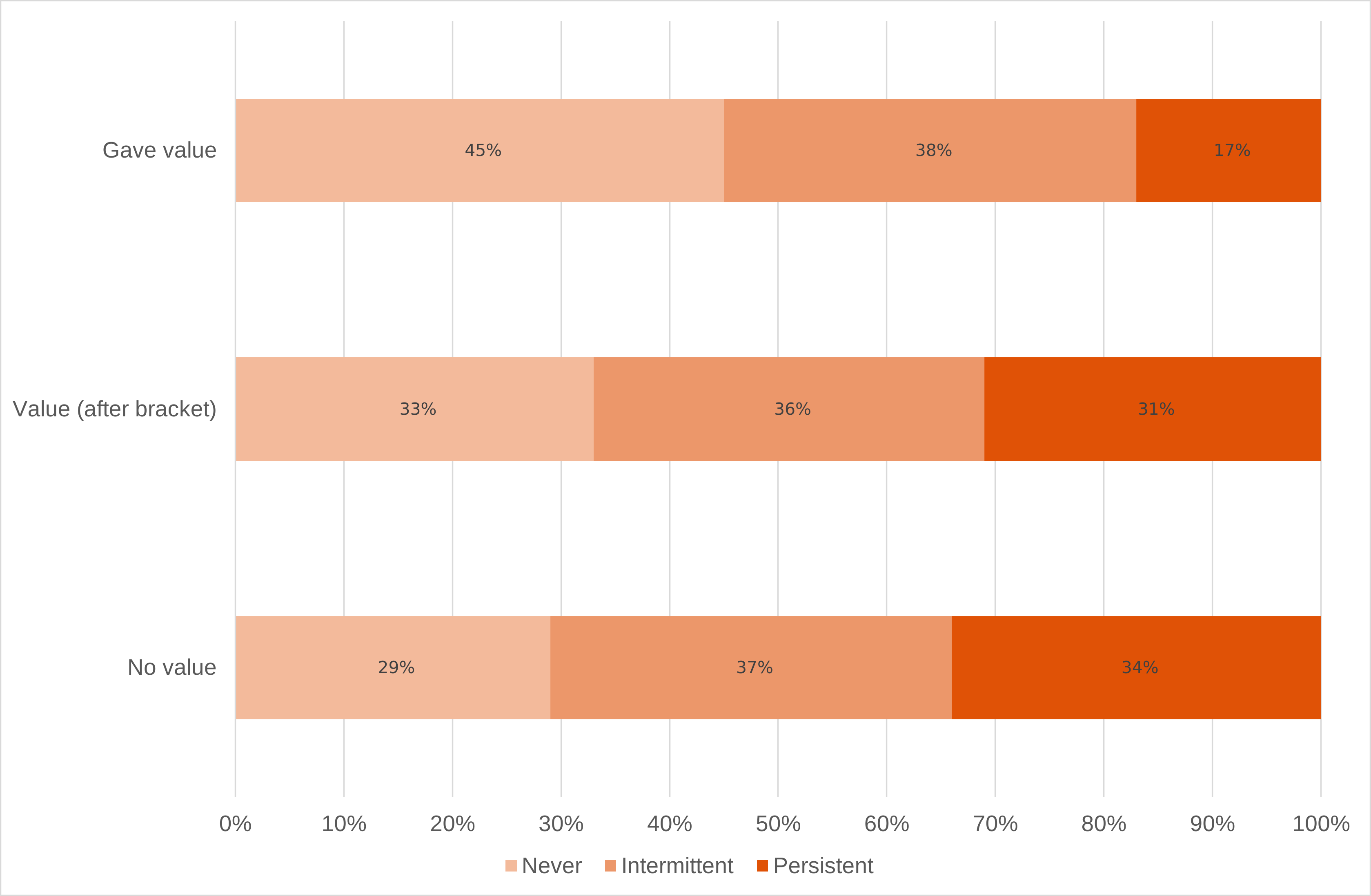
Base: study members who expect to receive a State Pension (n=7490)
Financial resources
The don’t knows were less likely than those that gave an expected value to have financial resources to draw on. They were more than:
-
twice as likely to have no savings (28% to 11%) and less than half as likely to have savings of more than £100,000 (13% to 29%), and
-
twice as likely to have no housing wealth: 35% to 16%
8.2.2 How much State Pension they expected to receive
We next examined the amount of income individuals expected to receive from the State Pension. We included all study members who gave an exact figure or a bounded value (from unfolding brackets) for their expected SP value.
These values were grouped into three categories, which were bounded by the average nSP value received of £9,026 per annum and the full nSP of £9,628 per annum, both in tax year 2022 to 2023[footnote 27], whereby:
-
‘Lower’ included all study members whose expected SP was less than the average SP received (less than £9,026) in 2022 to 2023
-
‘Average-full’ included study members whose expected SP fell between the average received and full SP in 2022 to 2023 (£9,026 to £9,628), and
-
‘Higher’ included all study members who expected to receive more than the full SP in 2022 to 2023 (more than £9,628)
Of those study members who gave an expected value for their SP, half (47%) expected to receive a SP lower than the average, 29% between the average and full SP, and a quarter (24%) higher than the full SP. We compare the characteristics of these three SP expectation groups. See Appendix Table A8.5 for full results.
Current circumstances
Compared to study members with an expected SP to be either average-full or higher, study members who expected a lower SP were:
- less likely to be in full-time employment (20% compared to 29% average-full and 31% higher) and more likely to have a home-care role (9% compared to 6% average-full and 4% higher)
Lifecourse experiences
Looking at low household income: 1 in 4 (24%) of the lower SP group expected had experienced persistent low household income compared to 14% of the higher expected SP.
The economic activity histories were very similar for those who expected their SP to be average-full or higher. However, the study members expecting their SP to be lower had spent
-
2 years less in paid work (on average) compared to the higher SP (350 to 325 months), and just under 2 years less than the average-full (345 months)
-
a year more in a home-care role (on average), compared to the average-full or higher (44 to 33 months)
-
at least 6 months more out of paid work due to poor health than the average-full (31 to 24 months) and higher (31 to 22 months)
There were few differences in health across the lifecourse, although the higher expected SP (82%) were more likely than the lower SP (77%) to have no experience of symptoms associated with depression.
Financial resources
The financial resources of the average-full and higher expected SP were similar. However, a higher proportion of the lower expected SP had:
-
a lower current household income (29% lower expected SP, 23% average-full, 18% higher expected SP), and
-
no savings (17% lower expected SP, 12% average-full, 9% higher expected SP)
8.3 Who is reliant on the State Pension for most of their income
We defined the individuals who were expected to be reliant on the SP for most of their income by using information on the value of the average nSP received in a given tax year[footnote 28] and the information study members provided about any private pensions they were currently receiving or expected to receive. We calculated a person’s reliance rate on the SP by computing the proportion of study member’s total expected net pension income per annum that the average nSP per annum, in the tax year when they were interviewed, constitutes. We assumed individuals would receive the average nSP to provide a broad guide, and used the average nSP because many study members did not know what the value of their expected SP would be or values given were hard to verify given the study members varying National Insurance records and transitional arrangements. Total expected pension income was the sum of both the average nSP and total net private pensions. We included both private pension amounts in current receipt of and any expected to be received in the future. All values were converted to an annual amount and then summed[footnote 29]. We also calculated total expected retirement income which was estimated by summing the total expected net pension income value as described above, plus the addition of their financial wealth[footnote 30]. No other income (for example, state benefits) was included in this calculation, hence this measure indicates the reliance on SP only and not reliance on state support more generally.
Proportions were then grouped into three categories for each tax-year. Using tax year 2022 to 2023 as an example, the average nSP received was £9,026 per annum and the study member would be 100% reliant on their SP if this was their only source of retirement income, while an expected retirement income of £13,467 would mean the study member was 67% reliant on the SP. The total expected retirement income values for the three reliant groups ranged (approximately) as follows:
-
67% to 100% reliant (mostly reliant): £9,026 to £13,467
-
34% to 66% reliant (moderately reliant): £13,477 to £26,526
-
33% or less reliant (not reliant): more than £26,527
Based on these groupings and using total expected pension income, Figure 8.5 shows that over half (56%) of study members would be expected to be mostly reliant on the State Pension system, just under a third (30%) would be moderately reliant and 15% not reliant on their SP. Using total expected retirement income (private pension and financial wealth) fewer – just under half (47%) of study members would be expected to be mostly reliant on the State Pension system, with more being moderately reliant (33%) or not reliant (20%) on their SP.
Figure 8.5: 1 in 2 study members would expect to be mostly reliant on the SP for their retirement income
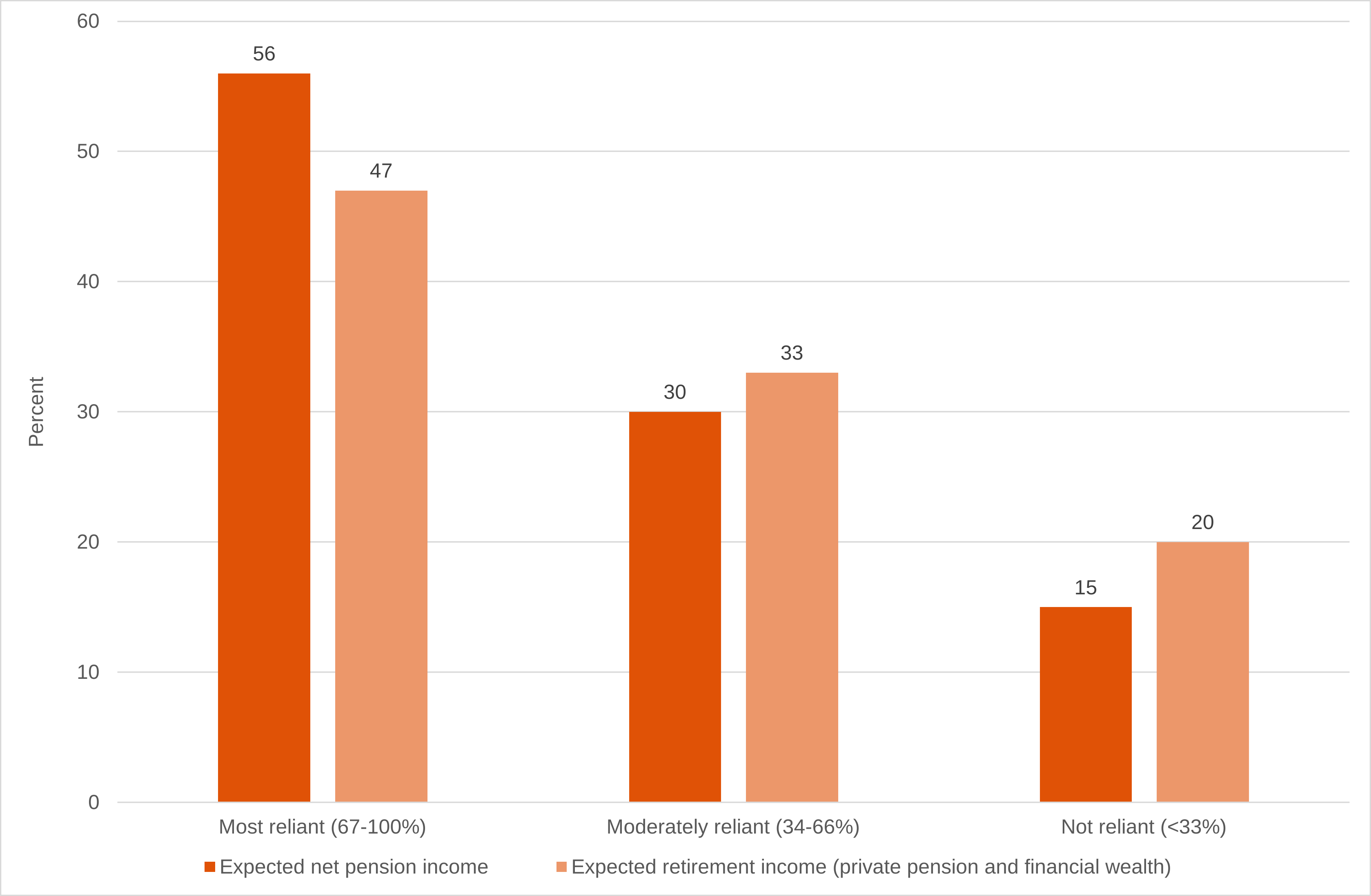
Base: all study members (n=7802)
We focus here on reliance on the SP using total expected retirement income. All tables of results for reliance on SP using total expected retirement income and also pension income are included in the Appendix (see Tables A8.6 and A8.7).
Current circumstances
Compared to moderately and not reliant study members, more of those mostly reliant on the SP were women, those with lower education levels (see Figure 8.6), divorced or single, rented their home (Figure 8.7), were self-employed, in a home-care role or not in paid work due to poor health. They were also far less likely to have fully-retired – just 12%, compared to 29% of the moderately and 44% of the not reliant.
Figure 8.6: 4 in 10 of the mostly reliant had no or lower level qualifications
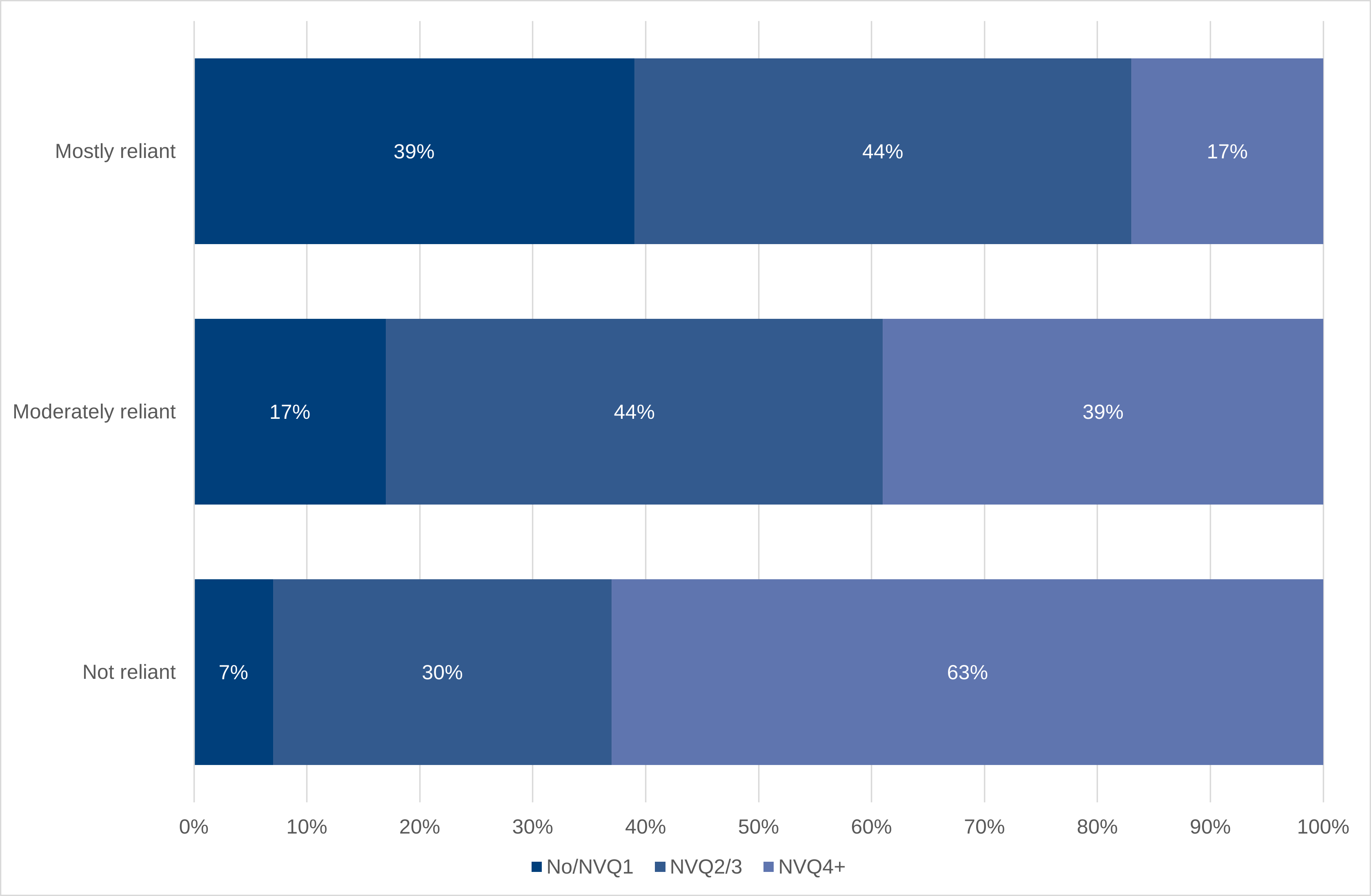
Note: Qualifications: No qualification or NVQ 1 is the equivalent to no or grade 1 to 3 or G to D GCSE; NVQ 2 or NVQ 3 is the equivalent to GCSE 4 to 9 or C to A* or A’level; NVQ 4 or above is the equivalent to Degree or higher.
Base: all study members (n=7802)
Figure 8.7: Those mostly reliant on the SP are more likely to rent their home
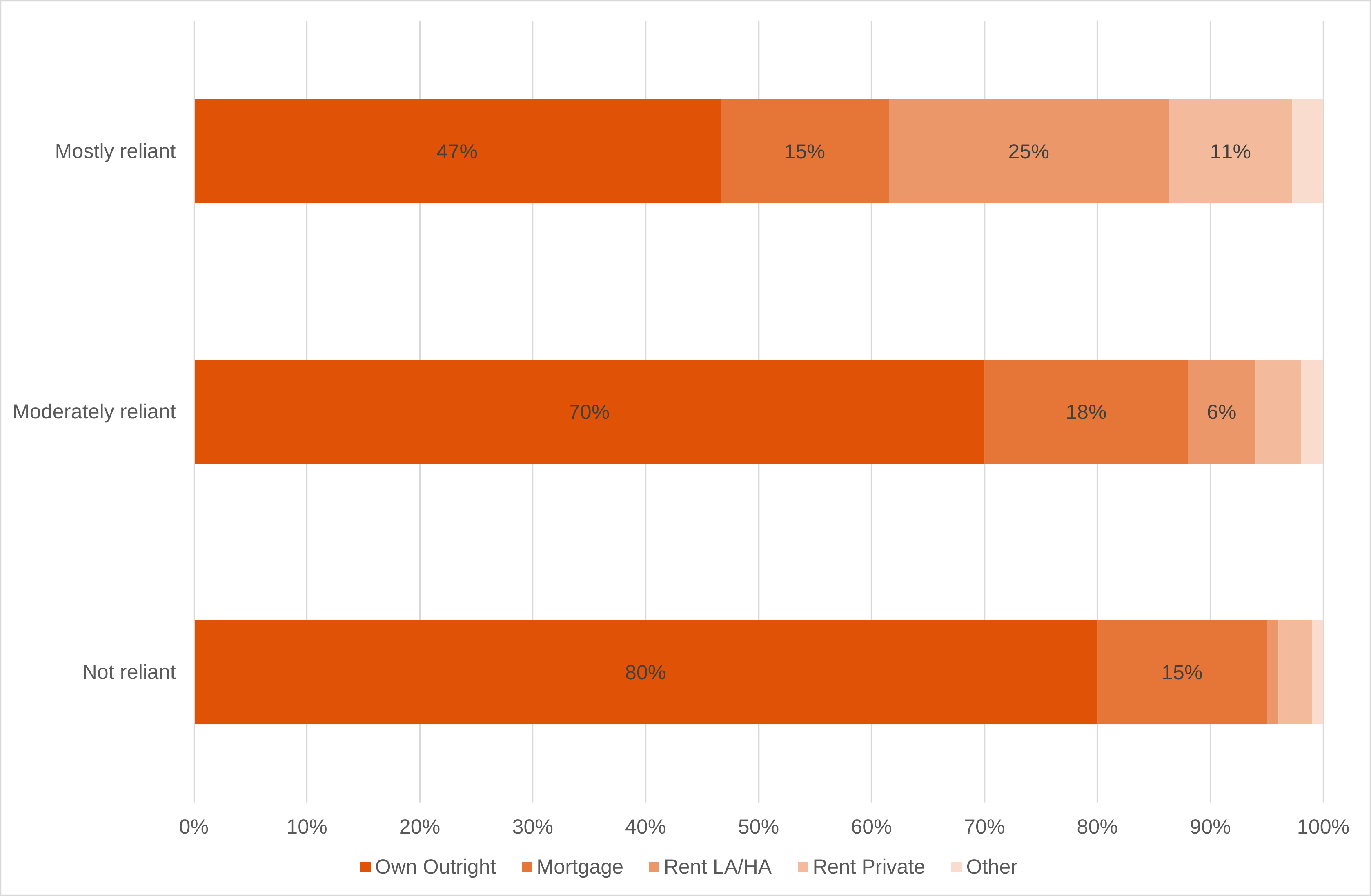
Note: Rent LA/HA = Rent from Local Authority or Housing Association.
Base: all study members (n=7802)
Lifecourse experiences
Focusing on health, the mostly reliant were more likely to have experienced an episode of poor health across the lifecourse:
-
just over 1 in 5 (18%) of the mostly reliant had a LSLI on two or more occasions compared to three times as few moderately reliant (6%) and four times as few of the not reliant (4%)
-
3 in 10 (29%) of the mostly reliant had experience of a high number of symptoms associated with depression at least once during the lifecourse compared to 19% of the moderately reliant, and 13% of the not reliant
Looking at low household income
-
68% of the not reliant had no experience of low income compared to 49% of the moderately reliant and 23% of the mostly reliant, and
-
4 in 10 (40%) of mostly reliant and 1 in 10 (10%) of the moderately reliant had experienced persistent low income compared to only 2% of the not reliant
The economic activity histories varied considerably by reliance on SP. Figure 8.8 shows that compared to the not reliant, the most reliant had spent (on average) Nearly 8 years less in paid work, four times as long in a home-care role and over 3 more years out of paid work due to poor-health. The moderately reliant occupied the middle space between these two extremes.
Figure 8.8 the most reliant had spent far less time in paid work over the lifecourse
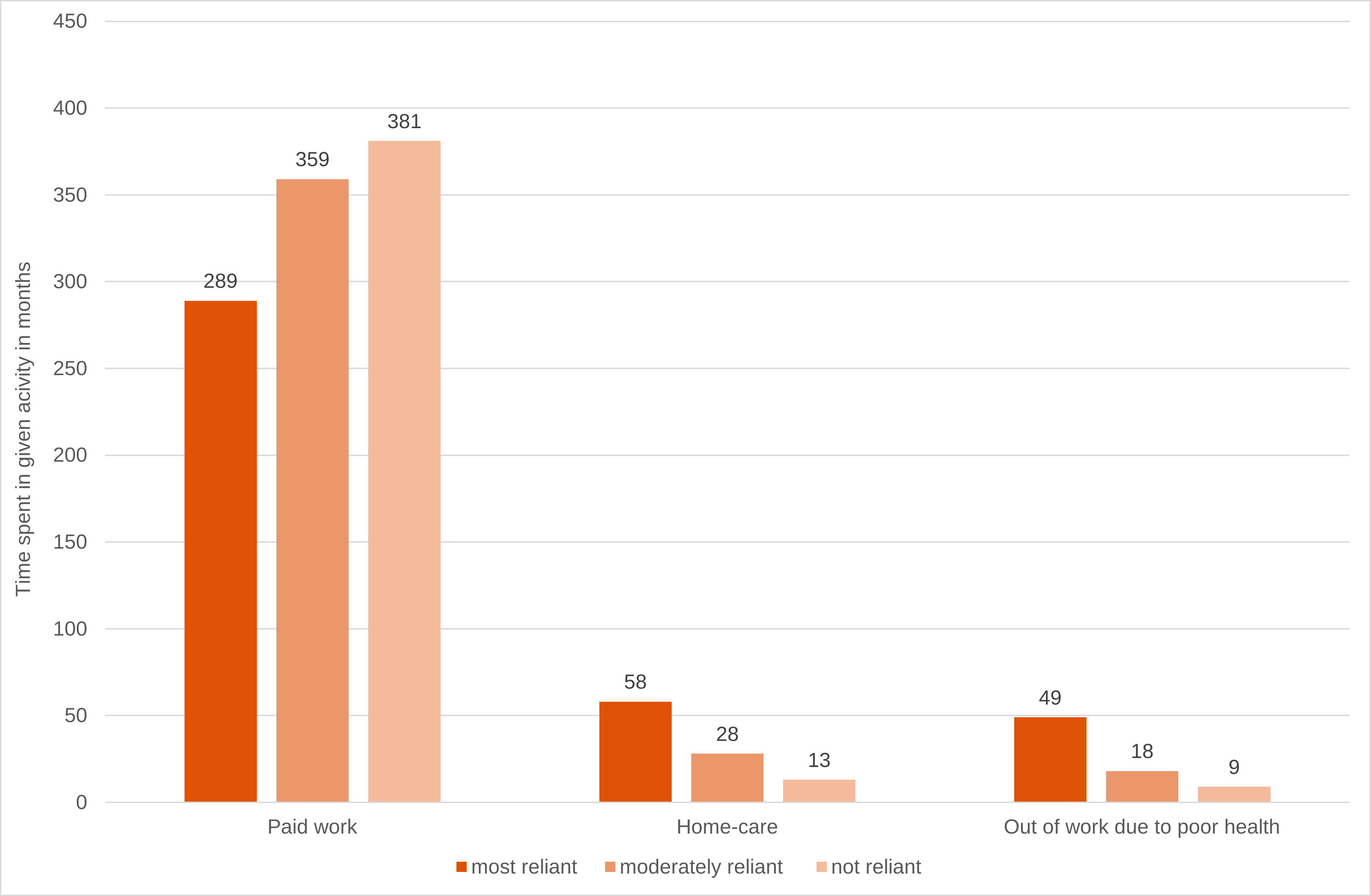
Base: all study members (n=7802)
In terms of having a partnership over their lifetime, the mostly reliant were twice as likely than the not reliant to have never had a partner (8% to 4%).
Financial resources
Not surprisingly the mostly reliant had fewer financial resources to draw on, than the moderately and not reliant. This was also true of the moderately reliant compared to the not reliant. The mostly reliant were more likely to have:
-
a lower current household income (38% mostly reliant, 20% moderately, 8% not reliant)
-
no household savings or household savings of less than £25,000[footnote 31] (74% mostly reliant, 34% moderately, 14% not reliant)
-
no or lower (less than £200,000) levels of housing wealth: 6 in 10 (59%) of the mostly reliant, 1 in 3 (33%) moderately and 15% not reliant, and
-
9% of the mostly reliant, 17% moderately and 35% not reliant had housing wealth over £600,000
Chapter 9: Concluding Remarks
Extensive legislative changes introduced over the last 20 years transformed the landscape for retirement and pension provision in the UK. Building on information provided by the 1958NCDS study members over the last 65 years, this report investigated how members of this cohort navigated transition from work to retirement.
Since its introduction in 2012, automatic enrolment into workplace pension schemes has been regarded as a success by ensuring many more people save for their retirement. Having been eligible to enter the labour force after leaving full-time compulsory education in 1974, members of the 1958 birth cohort have spent a significant portion of their working lives having to actively opt into having private pensions. Our investigation of their accumulation of financial resources for retirement showed that the vast majority of study members had (at least one) private pensions and highlighted substantial gender gaps in average pension fund, with women’s DB and DC pensions holding a much lower value than men’s. While these gender disparities are likely to reduce among younger generations, given they would have spent a greater proportion of their working lives automatically enrolled to a pension scheme, future research should monitor this and gain a better understanding of the drivers behind these gaps.
The pension freedoms introduced in 2015 allowed greater flexibility in how and when individuals could access their pensions at retirement, especially DC pensions. Our investigation of how those born in 1958 decumulate their resources revealed that three-quarters of those with a private pension had accessed or planned to access their pension by their SPa, with the average age for first access estimated at 61 (age 60 for DB pensions and 64 for DC pensions). While many study members chose to spread their withdrawals from DC pensions over time, in the form of an adjustable income or annuity, lump sum withdrawals were the most common with a sizeable minority withdrawing all of their pension fund. Further research is needed to better understand the long-term implications of different withdrawal strategies and initiatives aimed to improve public understanding of the complex world of pension types and access.
The introduction of AE supported employees but did not cover the self-employed. This means they are far less likely to have a pension and may be at financial risk. This is a sizable group of the 1958 cohort, with 1 in 3 study members self-employed at some point over the 35-year period between age 20 to 55. Among those who spent the majority of their working lives self-employed, 3 in 10 did not hold any private pension. This group was more likely to remain economically active in their early 60s and expected to still be in paid work at age 68 or later. Those who spent the majority of their working lives self-employed were, however, more likely to have accrued financial wealth through housing assets, as they were more likely than long-term employees to own multiple properties and to have higher average levels of housing wealth. Acknowledging the self-employed are a very heterogenous group, more research is needed to better understand how different subgroups of the self-employed manage their financial resources in later life.
The pension landscape has also been significantly shaped by increases in the SPa, effectively extending individuals’ working lives. Our research into working in later life showed that individuals who were financially advantaged throughout their lives were more likely to have retired before reaching SPa, with the most advantaged households being where both partners had retired early. Working part-time at age 62 was also associated with greater financial security. We also show that once retired, very few returned to paid work, raising the need for further research into ways of encouraging labour market participation amongst this age group.
Our analysis of TRRs shows that half of 1958 study members were not on track to maintain their working-life standard of living in retirement. Similarly, among those living alone, 6 in 10 did not meet the minimum RLS. We also found that undersavers were more likely to have experienced persistent low income throughout their lives, along with symptoms of depression and long-term limiting illness, indicating a potential reliance on state support. Further research is needed to understand how undersaving patterns may differ for younger cohorts.
Awareness of the SPa and the value of the SP is important when planning for retirement. Among the 1958 study members, there were knowledge gaps for some regarding the SP. One in five did not know the age at which they would become eligible, and 1 in 3 how much they would receive. Estimated reliance on the nSP was high, with half of all study members reliant on the SP for between 67% and 100% of their total pension income. This reliance was particularly high among women, the self-employed, those who had experienced a persistent low income, and those with interrupted work histories, often due to long-term illness or caring responsibilities.
Our report identified gaps in awareness and planning for retirement among those born in 1958 and illuminated the groups within this cohort that were at risk of entering retirement unprepared and under-provided for. It also highlighted the areas where more research is needed to better inform targeted support and policy action, such as research into what constitutes transparent and efficient guidance. This study establishes a benchmark for comparisons with future generations.
-
Our analytic sample was n=7,802, based on the completed interviews available at the time of analysis. ↩
-
For the purposes of weighting the data, the target population was defined as individuals born in the same week in 1958 in Great Britain and who, at the start of fieldwork, were alive and residing in the UK (n =14,591). More details on implementation and derivation of the non-response weights can be found in Chapter 8 of the User Guide. See CLS - NCDS Age 62 Sweep ↩
-
For details on the latest version of the qualification classification which now has eight levels see What qualification levels mean ↩
-
We use the exact values provided in first instance. If these are not available, we use the midpoint between the minimum and maximum value obtained from unfolding brackets instead. If the study member mentions that they have savings of a given type, but the amount is not reported we use multiple imputation to obtain an estimate. ↩
-
We use the exact values provided in first instance. If these are not available, we use midpoint between the minimum and maximum value obtained from unfolding brackets instead. If the study member mentions that that have debts of a given type, but the amount is not reported we use multiple imputation to obtain an estimate. Due to issues with collinearity, total debt for each study member is summed prior to the main imputation stage. ↩
-
We use the exact values provided in first instance. If these are not available, we use midpoint between the minimum and maximum value obtained from unfolding brackets instead. If the study member mentions they have a property and/or mortgage, but the amount is not reported we use multiple imputation to obtain an estimate ↩
-
Number of pensions includes all pensions (excluding State Pension). Any pension which had been combined into a single pension by transferring pension pots to a new or existing pension were counted as one pension. Details were then asked for each private pension scheme the study member had. ↩
-
The net annual value of DB pensions was calculated as the sum of any DB pension currently receiving, any DB pension expected to receive, and any DB expected lump sum (assumed to be in addition to DB expected fixed annual pension). The DB receiving and DB expected values were collected net (after tax). The expected DB lump sum was collected as total gross value. This was annualised by dividing the total fund value by the life expectancy for men and women at the appropriate age in the National Life Tables (ONS). In addition, to convert the expected DB lump sum to net, we assume that 25% of these values were tax free and taxed the remaining 75% at the basic income tax rate of 20%. ↩
-
The value of the DC pensions was the sum of the values of all current (at time of interview) DC pension funds. ↩
-
Study members were asked to report their partners pension provision, where partners were defined as those who were currently living with the study member. In this section we report whether they had any pensions, and the types of pensions their partners had. ↩
-
This is higher than the overall 8 in 10 cited earlier, as the 9 in 10 excludes the men and women who were economically inactive. ↩
-
Study members who had already accessed or intended to access a private pension before SPa were grouped together due to the extended period of fieldwork, as detailed in Chapter 2. ↩
-
The economic activity history data is currently available from age 16 to age 55. This will be extended up to age 62 with information collected in the age 62 interview. The updated dataset will be available to download from the UK Dataservice by the end of 2025. ↩
-
This ranged from 30% when comparing the self-employed versus majority employed, to 38% when comparing the majority self-employed versus majority employed, to 47% when comparing the later self-employed versus majority employed. ↩
-
In this section we included the following pension types: Defined Benefit (DB) pensions expected and received, annuities from Defined Contribution pensions (DC), DC total fund value, DB expected lump sum (assumed to be in addition to DB expected fixed pension) and any pension of unknown type (where DC or DB was undefined) received and expected. We excluded any pension amount which had been withdrawn prior to data collection. All pension amounts were transformed to an annual value. For lump sums or total fund values, we annualise by dividing the total fund value by the life expectancy for men and women at the appropriate age in the National Life Tables (ONS). The total private pension value was then summed, and we convert pension income to the 2022 to 2023 tax year prices using the ONS Consumer Prices Index Before Housing Costs (BHC) were deducted. When then add the mean value of the nSP for men and women (ref: DWP), averaged over four quarters from May 2022 to February 2023 (tax year 2022 to 2023), resulting in a total pension income value. ↩
-
Net (after tax) values were collected for DB receiving, DB expected to receive, DC annuities, pensions unknown received and expected. Current total value (£) – therefore gross (before tax) – were provided for DC total fund value and DB lump sum not yet received. For the gross pension income applied in the TRR calculation we convert all net values to gross. We uplift each of the net pensions (DB receiving, DB expected to receive, DC annuities, and pensions unknown received and expected) by 20% to account for tax at the lower income tax bracket. For the net pension income used to compare RLS, all lump sums (collected as gross values) were converted to net, applying the assumption that 25% of these values were tax free and taxed the remaining 75% at the basic income tax rate of 20%. ↩
-
Financial wealth was asked at the household level (partner and study member) and calculated as total savings minus total debt. It was also converted to the 2022 to 2023 tax year prices using the ONS Consumer Prices Index Before Housing Costs (BHC) were deducted. Here, if the study member was cohabiting the value of financial wealth was divided by 2. Financial wealth was transformed to an annual value, by dividing the value of financial wealth by the life expectancy for men and women at the appropriate age in the National Life Tables (ONS). ↩
-
For employees, we use reported gross earnings. Where these are not available, we utilise the midpoint between the minimum and maximum obtained from a series of unfolding brackets questions. Where neither of these are available, but study members provided information about net pay, we fit a quadratic model estimating the relationship between log of gross and log of net earnings and use this equation to predict gross earnings. For the self-employed we use reported gross earnings in the first instance and unfolding brackets in the second instance. If neither is available but the self-employed reported net profits, we follow a similar procedure as described above to convert net profit into gross earnings. We also compute total earnings from second job (odd jobs and/or casual work). These earnings are reported as net and converted to gross using the same equation as the one used for employees. Both earnings from the main and second job are top and bottom coded at 1st and 99th percentile. All those who do not report to be employed, self-employed or to have regular income from a second job, are allocated earnings of zero. Both earnings variables (earning from main and second job(s)) are then imputed (together with other auxiliary variables) and summed to obtain total gross earnings. ↩
-
DWP usually takes an average of earnings from age 50 to pre-SPa. At the time of writing the NCDS age 62 survey earnings were not available, and also a large proportion of study members had retired, making the calculation complex for this report. We acknowledge using earnings at age 50 will therefore likely overestimate the earnings need to reach the TRR’s in this report. ↩
-
The proportion of total gross target TRR were then calculated based on the TRR band the total annual gross earnings fell into and the appropriate TRR proportion as shown above i.e. if the total gross earnings were £10,000, the BHC threshold earnings would be in band 1 with a TRR of 80% – so the TRR would be £8,000. ↩
-
Further analysis is required to gain a better understanding of differences between study members in Band 1. ↩
-
This includes net private pension income – the State Pension and financial wealth are included in this calculation as gross £. The assumption is 1) the average State Pension is lower than the standard Personal Allowance and therefore with no private pension income the study member is unlikely to reach the basic income tax rate (we assume the CM receives no other income), and 2) the savings included in financial wealth will not in the main be subject to income tax. For example, Premium Bond wins and ISA’s are tax-free, and we assume for most returns on investments and savings (interest and dividends) will fall below the personal savings allowance. We acknowledge that capital gains tax (CGT) may be liable on profit when selling some of these assets for example, stocks and shares. ↩
-
Study members are asked if they or their partner had ever received an inheritance or been given substantial assets in the form of a trust. Here we only consider the inheritances received by the study member. The year the inheritance was received is also collected. We include inheritances received after 1976 (when the study member was 18 years old) and derive two binary variables: 1) whether the study member has received an inheritance and 2) whether the study member received an inheritance in the last 10 years (i.e. since 2014). This is because inheritances received in the more recent period are considered to have greater potential contribution to retirement funds. ↩
-
This includes the n=79 study members who were interviewed during the tax year 2018 to 2019 as part of the pilot stage fieldwork before the mainstage interviewing started in 2020. ↩
-
Transitional Arrangements for receipt of the nSP: 1) People with no existing National Insurance record before 6 April 2016 will receive the full rate of the nSP (£221.20 a week, 2024 to 2025) when they reach their State Pension age, if they then have 35 years on their National Insurance record; 2) Current workers (those who have paid National Insurance before 6 April 2016) - will get the nSP calculated under transitional arrangements: 35 years does not usually equal full rate. Some get less, others more than full rate at SPa; 3) Each post-2016 Qualifying Year of contributions or credits, is equal to one-thirtyfifth of the full rate. (£6.32 per week in 2024 to 2025). More details are available at: The new State Pension – transitional issues ↩
-
For study members who replied ‘don’t know’ or ‘refused’ when asked the value of the state pension they expected to receive, they were subsequently asked a series of questions known as ‘unfolding brackets’ that attempt to elicit the range in which the answer lies. The study member was asked whether their expected state pension was more than, less than or about the amount from a given set of four values – £100 a week, £130 a week, £160 a week and £200 a week. The start is random, and a series of questions are asked depending on their response until an approximate or bounded response is achieved. We take the midpoint of the final bounded responses. ↩
-
For expected State Pension (SP) value, we used all study members who gave an exact figure or a bounded value (from unfolding brackets) for their expected SP. To adjust for the time of data collection between 2018 and 2023, we use the average of actual SP data provided by the DWP - Mean of Weekly Amount of Benefit, Gender and Category of Pension by Quarter for the period, equating the annual mean of the nSP to tax years. We create deflators based on the average annual State Pension for men and women received per tax year, and set at the average 2022 to 2023 tax year, which is the year when responses for over 50% of the study members were collected, as follows: Tax year (2018 to 2019) - Men (1.12 ) - Women (1.18 ), Tax year ( 2019 to 2020 ) - Men (1.09 ) - Women (1.14 ), Tax year (2020 to 2021 ) - Men (-) - Women (-), Tax year (2021 to 2022) - Men (1.03 ) - Women (1.05 ), Tax year (2022 to 2023 ) - Men (1) - Women (1), Tax year (2023 to 2024 ) - Men (0.9 ) - Women (0.89 ). We use the deflated annual SP values and created a three-level categorical variable. ↩
-
We use the average annual nSP for each tax year at time of interview, as follows: Tax year (2018 to 2019) - Average annual nSP received (£8,052), Tax year ( 2019 to 2020 ) - Average annual nSP received (£8,227 ), Tax year (2020 to 2021 ) - Average annual nSP received (-), Tax year (2021 to 2022) - Average annual nSP received (£8,756 ), Tax year (2022 to 2023 ) - Average annual nSP received (£9,026 ), Tax year (2023 to 2024 ) - Average annual nSP received (£9,938 ), Source: Department for Work and Pensions ↩
-
In this section we included the following pension types – Defined Benefit (DB) pensions expected and received, annuities from defined contribution pensions (DC), DC total fund value, DB expected lump sum (assumed to be in addition to DB expected fixed pension) and any pension of unknown type (where DC or DB was undefined) received and expected. We excluded any pension amount which had been withdrawn prior to data collection. All pension amounts were transformed to an annual value. For lump sums or total fund values, we annualise by dividing the total fund value by the life expectancy for men and women at the appropriate age in the National Life Tables (ONS). Net (after tax) values were asked for DB receiving, DB expected to receive, DC annuities, and pensions unknown received and expected, whereas DC total fund value and DB lump sum not yet received were provided as the current total value (£) – therefore gross (before tax). To convert all lump sums to net, we assume that 25% of these values were tax free and taxed the remaining 75% at the basic income tax rate of 20%. The total private pension value was then summed, and we convert net pension income to the 2022 to 2023 tax year prices using the ONS Consumer Prices Index Before Housing Costs (BHC) were deducted. When then add the mean value of the nSP for men and women (ref: DWP), averaged over four quarters from May 2022 to February 2023 (tax year 2022 to 2023), resulting in a total (State and private) pension income value. ↩
-
We calculated a further retirement income value, by summing the total pension income value as described above and financial wealth (no other income was included). Financial wealth was asked at the household level (partner and study member) and calculated as total savings minus total debt. If the study member was cohabiting the value of financial wealth was divided by 2. Financial wealth was transformed to an annual value, by dividing the value of financial wealth by the life expectancy for men and women at the appropriate age in the National Life Tables (ONS). ↩
-
The difference will in part be determined by the reliance category which includes financial wealth as an income stream in the calculation ↩