NCSP incident reporting policy: June 2026
Updated 1 July 2026
Applies to England

© Crown copyright 2026
This publication is licensed under the terms of the Open Government Licence v3.0 except where otherwise stated. To view this licence, visit nationalarchives.gov.uk/doc/open-government-licence/version/3 or write to the Information Policy Team, The National Archives, Kew, London TW9 4DU, or email: psi@nationalarchives.gov.uk.
Where we have identified any third party copyright information you will need to obtain permission from the copyright holders concerned.
This publication is available at https://www.gov.uk/government/publications/ncsp-incidents-reporting-policy/ncsp-incident-reporting-policy-june-2026
Introduction and scope
Introduction
This policy sets out the process for reporting serious incidents occurring during delivery of the National Chlamydia Screening Programme (NCSP) in England.
The UK Health Security Agency (UKHSA) must be informed of incidents in any setting. This enables national oversight, shared learning, and identification of emerging national issues. UKHSA is committed to reducing incident occurrence by disseminating lessons learned.
This policy adheres to definitions as described by the NHS screening programmes. Even though the definitions and examples given refer to NHS-funded services, they are equally applicable to clinical services commissioned by any public sector body, including local authorities.
The Sexual health: clinical governance (Department of Health and UKHSA (previously Public Health England), October 2013) provides the key principles to assist service commissioners and providers to operate clinical governance systems in sexual health services.
Scope
This policy applies to all chlamydia testing providers in England and complements existing local and national governance policies. Commissioners and providers should reference this policy in local procedures and contracts. Patient complaints received by UKHSA will be redirected to the appropriate commissioner or provider. For advice on whether to report an incident, contact the regional UKHSA Sexual Health Facilitator by emailing NcspTeam@ukhsa.gov.uk
NCSP incident reporting procedure
Reporting an incident
UKHSA encourages reporting of serious incidents and near misses to support national learning and potential updates to guidance.
When an incident occurs:
- follow local and/or regional reporting procedures, including notifying commissioners
- inform UKHSA as soon as key details are known by emailing NcspTeam@ukhsa.gov.uk – providers may submit local incident documentation or an email summary
- UKHSA will log the incident, obtain relevant details, and advise whether a lessons‑learned report is needed
In exceptionally serious cases (for example, patient harm, service suspension, reputational risk), UKHSA must be informed within 2 working days of identification of the incident.
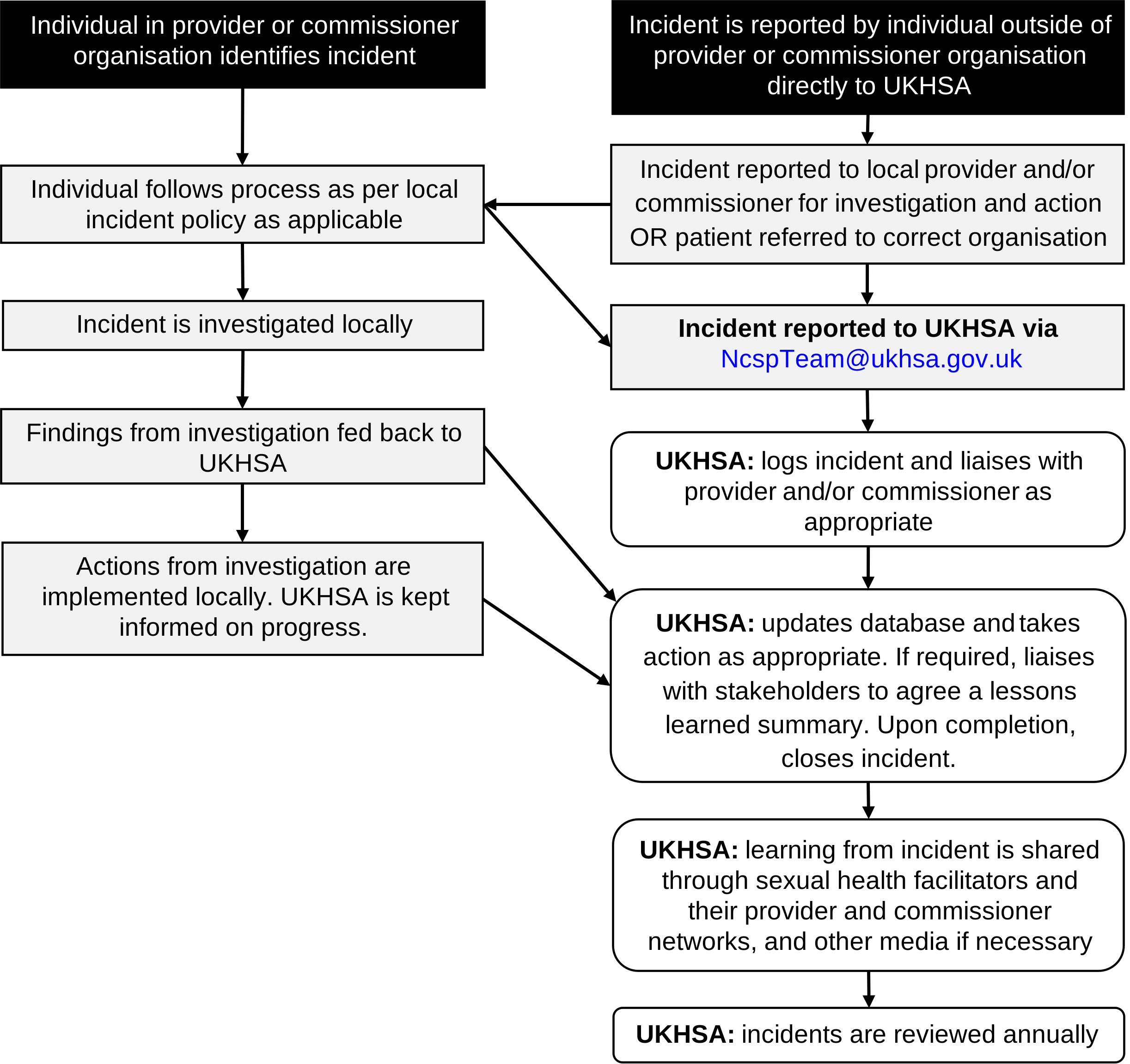
The reporting procedure is presented in Flowchart 1 below, and an accessible text description is also available.
Flowchart 1. NCSP incident reporting procedure
Investigation and closure
Providers and/or commissioners are responsible for investigating incidents, identifying root causes, and implementing improvements. It is important that incidents are appropriately investigated so that the root cause is identified, and any learning recognised and improvements implemented. The outcome of the investigation, including follow-up action, should be fed back to UKHSA. Upon completion of the incident, the case will be closed on the UKHSA database.
Dissemination of learning
Where wider learning is identified, UKHSA will share information through Sexual Health Facilitators, commissioners, and providers. Anonymous lessons‑learned reports may be published on the NCSP webpage on GOV.UK.
Monitoring
UKHSA will monitor reported incidents and issue periodic summaries and lessons‑learned reports as appropriate.
Communications
The organisation where the incident occurred is responsible for patient communication. Where communications with the media are needed as the result of an incident, a member of the UKHSA communications team will support the commissioner or provider communications teams as appropriate.
Any queries received from members of the press or media should be passed on to the UKHSA press office through the following routes:
- email ukhsa-pressoffice@ukhsa.gov.uk
- see media enquiries
- national press office: 020 7654 8400
Responsibilities
Commissioners and providers will:
- maintain effective incident reporting policies
- ensure incidents are investigated and responded to appropriately
- provide UKHSA with current contact details for sexual health/chlamydia leads
- ensure contracts require providers to follow local governance and report serious incidents to the NCSP
- monitor providers’ compliance and assure the quality of investigations and action plans
UKHSA will:
- maintain the national incident log and update incident status and outcomes
- provide updates on incident trends
- share learning through SHF networks and publish anonymised reports where appropriate
UKHSA communications team will:
- work with provider and commissioner communication teams to deliver clear, coordinated messaging when required
Additional information
Microsoft Copilot was used for conciseness of this policy.
Next review of the policy: April 2029
Accessible text description: NCSP incident reporting procedure flowchart
Individual in provider or commissioner organisation identifies incident
- Individual follows process as per local incident policy as applicable and reports incident to UKHSA via NCSPTeam@ukhsa.gov.uk
- Incident is investigated locally. UKHSA logs the incident and liaises with provider and/or commissioner as appropriate.
- Findings from local investigation fed back to UKHSA. UKHSA updates database and takes action as appropriate. If required, liaises with stakeholders to agree a lessons learned summary. Upon completion, UKHSA closes incident.
- Actions from investigation are implemented locally. UKHSA is kept informed on progress.
- UKHSA shares learning from incident through sexual health facilitators and their provider and commissioner network, and other media if necessary.
- UKHSA reviews incidents annually.
Incident is reported by individual outside of provider or commissioner organisation directly to UKHSA
- Incident is reported to local provider and/or commissioner for investigation and action, or patient is referred to correct organisation.
- The local provider and commissioner follow process as per local incident policy as applicable.
- Incident is investigated locally. UKHSA logs incident and liaise with provider and or commissioner as appropriate.
- Findings are fed back to UKHSA. UKHSA updates data base and takes action as appropriate. If required, liaise with stakeholders to agree a lessons learned summary. Upon completion, UKHSA closes incident.
- Actions from investigation are implemented locally. UKHSA is kept informed on progress.
- UKHSA shares learning from incident through sexual health facilitators and their provider and commissioner network, and other media if necessary.
- UKHSA reviews incidents annually.