National Audit on Group-based Child Sexual Exploitation and Abuse (accessible)
Updated 15 January 2026

© Crown copyright 2026
This publication is licensed under the terms of the Open Government Licence v3.0 except where otherwise stated. To view this licence, visit nationalarchives.gov.uk/doc/open-government-licence/version/3 or write to the Information Policy Team, The National Archives, Kew, London TW9 4DU, or email: psi@nationalarchives.gov.uk.
Where we have identified any third party copyright information you will need to obtain permission from the copyright holders concerned.
This publication is available at https://www.gov.uk/government/publications/national-audit-on-group-based-child-sexual-exploitation-and-abuse/national-audit-on-group-based-child-sexual-exploitation-and-abuse-accessible
Acknowledgements
Baroness Casey of Blackstock and team are grateful to all of those who gave their time and expertise during the course of this audit. We have drawn on the knowledge, information and experience of those working across central and local government, policing and the criminal justice system and the voluntary and community sector, as well as the independent expertise of many people.
Many people gave up their time at short notice, shared honest feedback and responded to numerous data and fact requests at speed. There are too many individuals and organisations to list here, but their contributions have been vital.
Our particular thanks must go to the survivors of group-based child sexual exploitation, and their families. Both to those survivors who gave their time to speak to this audit and to those whose stories are included in this report.
We would also like to acknowledge the contribution of the brave and compassionate journalist Andrew Norfolk who sadly died while we were undertaking this work.
Foreword
‘Group-based child sexual exploitation’, rare though it may be, is one of the most heinous crimes in our society.
That term ‘group-based child sexual exploitation’ is actually a sanitised version of what it is. I want to set it out in unsanitised terms: we are talking about multiple sexual assaults committed against children by multiple men on multiple occasions; beatings and gang rapes. Girls having to have abortions, contracting sexually transmitted infections, having children removed from them at birth.
When those same girls get older, they face long-term physical and mental health impacts. Sometimes they have criminal convictions for actions they took while under coercion. They have to live with fear and the constant shadow over them of an injustice which has never been righted – the shame of not being believed. And, with a criminal justice system that can re-traumatise them all over again, often over many years. With an overall system that compounds and exacerbates the damage; rarely acknowledges its failures to victims. They never get to see those people who were in positions of power and let them down be held accountable.
What makes child sexual exploitation particularly reprehensible, is that is consists of both formal and informal groups of men preying on girls, coercing, manipulating and deceiving them in pursuit of sexual gratification and power. Their victims often have a range of things that make them vulnerable in addition to their young age; they might be in care, have a physical or mental disability, have already suffered neglect or abuse in earlier years. Their predators see them as ideal victims, ready to be tricked into thinking they are loved, worthy of their attention – before turning that against them.
That is why I want the legislation on rape tightened up so that an adult having penetrative sex with a child under 16 is rape, no excuses, no defence. I believe many jaws across the country would drop if it was widely known that doing so is called anything but that.
The British public are rightly appalled when they hear of group-based child sexual exploitation and expect it to be investigated thoroughly, offenders brought to justice and punished severely. They, undoubtedly, also expect that this country has the right systems in place to understand child sexual exploitation: why it is happening, where it is happening and who is perpetrating it, so we can seek not only to tackle it when it occurs but so that we can prevent it from happening in the first place.
To prevent it we have to understand it. We have failed in our duty to do that to date.
The appalling lack of data on ethnicity in crime recording alone is a major failing over the last decade or more. Questions about ethnicity have been asked but dodged for years. Child sexual exploitation is horrendous whoever commits it, but there have been enough convictions across the country of groups of men from Asian ethnic backgrounds to have warranted closer examination.
Instead of examination, we have seen obfuscation. In a vacuum, incomplete and unreliable data is used to suit the ends of those presenting it. The system claims there is an overwhelming problem with White perpetrators when that can’t be proved. This does no one any favours at all, and least of all those in the Asian, Pakistani or Muslim communities who needlessly suffer as those with malicious intent use this obfuscation to sow and spread hatred.
Debates take place while the victims are left forgotten, a sideshow as data is used to suit each sides’ own ends. No one in the last decade has established the truth one way or another, eroding the very trust in our institutions which we need.
Institutions which bear responsibility for how these crimes were handled then fail to give victims the accountability they seek. We’re in a vicious circle; it is this lack of clarity and transparency which leads to people feeling they have no choice but to call for statutory inquiries.
In too many cases, we have seen state and church institutions, residential care and medical settings, all pressured to hold inquiries into historic failings. We should expect more of our own public institutions than that they should have to be dragged kicking and screaming by the media, victims and campaigners to carry out their own reviews or inquiries into what happened.
We should be above resorting to defensiveness and litigation to avoid acknowledging what happened, apologising, and making it right.
Our response should, of course, be proportionate: it cost £5million for one local inquiry and that took almost five years. A police squad in one area following through on tracking down and bringing these heinous criminals to justice costs around the same. A balance will need to be struck, but we must right the wrongs of the past.
If we’d got this right years ago – seeing these girls as children raped rather than ‘wayward teenagers’ or collaborators in their abuse, collecting ethnicity data, and acknowledging as a system that we did not do a good enough job - then I doubt we’d be in this place now.
Ultimately, it is the perpetrators who bear responsibility for these crimes. Child sexual abuse, rape and group-based child exploitation is, overwhelmingly, committed by men on girls. We all know the vast majority of men are good men but, if boys grew up into men who did not commit violence against women and girls, then we would not be in this position – so we must make it our shared endeavour to help those boys as they navigate the world.
And most importantly there are far too many perpetrators walking freely today who have evaded justice for too long and we should seek to put that right.
It’s time that we drew a line in the sand and took definitive action. We are a country that should rightly pride itself on the way it cares for and protects children - all our children - and we have an opportunity here to reassert those values as a nation.
Executive summary
This audit is focused on group-based child sexual exploitation (CSE) by ‘grooming gangs’. It is rare, but is one of the most horrendous crimes in our society: it involves multiple perpetrators coercing, manipulating and deceiving children into sex, to create an illusion of consent.
While public attitudes have shifted and children who used to be called ‘child prostitutes’ are now understood to be victims of child sexual exploitation, there continues to be an awkwardness in society with acknowledging and discussing child sexual abuse and there remains a tendency to apportion blame to adolescent children for their own abuse.
This audit is the latest in a long line of initiatives and measures looking into child sexual exploitation undertaken since the government adopted its first definition in 2009. Reviews, recommendations and strategies on child sexual exploitation raise the same issues repeatedly: system failures in information sharing, the need for more training, understanding of risk factors of victims, and the importance of collecting better data and information on perpetrators, including on ethnicity.
The policy and delivery landscape for child sexual abuse and exploitation is spread across government departments and statutory bodies and therefore requires strong leadership, common purpose and above all a grip on the policy. But what emerges instead over at least the last decade is a repeating cycle: seminal moments of scandal and public outrage which lead to bursts of government focus and activity but no sustained improvement, leaving victims and the public with insufficient justice, action, accountability or answers.
The scale of child sexual exploitation
We were unable to provide an assessment on the scale of group-based child sexual exploitation. There is no recent study of the prevalence of child sexual abuse and exploitation in the population. Confusing and inconsistently applied definitions and incomplete data across the police, local authorities, health and the criminal justice system, obscure it. The concept of ‘grooming gangs’, while well-known to the public, is not captured clearly in any official data set.
The data we were able to identify shows that:
- Around 500,000 children a year are likely to experience child sexual abuse (of any kind). However, for the vast majority, their abuse is not identified, and it is not reported to the police either at the time or later.
- Police recorded crime data shows just over 100,000 offences of child sexual abuse and exploitation recorded in 2024, with around 60% of these being contact offences (and the remainder online offences).
- Of these contact offences, an estimated 17,100 are ‘flagged’ by police as child sexual exploitation in police recorded crime data.
- The only figure on group-based child sexual exploitation comes from a new police dataset (called the Complex and Organised Child Abuse Dataset - COCAD) which, while suffering a number of limitations, has identified around 700 recorded offences of group-based child sexual exploitation in 2023.
Given how under-reported child sexual exploitation is, the flaws in the data collection and the confusing and inconsistently applied definitions, it is highly unlikely that this accurately reflects the true scale of child sexual exploitation, or group-based exploitation. It is a failure of public policy over many years that there remains such limited, reliable data in this area.
The nature of group-based child sexual exploitation
The grooming gangs model remains similar to well-known cases like those in Rotherham, with often a man targeting a vulnerable adolescent child - often those in care, or children with learning or physical disabilities - grooming them into thinking they are their ‘boyfriend’ showering them with love and gifts and taking them out.
Subsequently, they pass them to other men for sex, using drugs and alcohol to make children compliant, often turning to violence and coercion to control them. This model has not changed significantly over time, although the grooming process is now as likely to start online, and hotspots might have moved from parks to vape shops and the use of hotels with anonymous check-in facilities.
Grooming gangs are often loosely interconnected, based around existing social connections and so are often broadly homogenous in age, ethnic background and socioeconomic status. Acting in a group likely has a disinhibiting effect on the perpetrators, while misogyny or ‘othering’ allows them to disregard victims.
Other patterns of sexual exploitation that this audit was also made aware of includes sexual exploitation of girls within street gangs where the motive is sexual gratification of gang members, but also to lure girls into working for them. Child sexual exploitation has also emerged as a key feature in children who are victims of modern slavery (a term that includes any form of human trafficking, slavery, servitude or forced labour).
The nature of child sexual abuse in general has been changed by the growth of online sexual abuse offending which now accounts for 40% of all sexual abuse crime. This has altered the age profile of offenders and to an extent the gender profile too, making it harder to see the profile of both perpetrators and victims of group-based child sexual exploitation.
The growth in reporting of child criminal exploitation might have affected how child sexual exploitation is identified. It is easier for a police officer to realise a child is being criminally exploited, for example, through finding them with a significant amount of drugs or money, than it would be to spot the often subtle signs that the same child was also being sexually exploited. This audit is concerned that, because of this, patterns of child sexual exploitation may be obscured.
Victims and perpetrators of group-based child sexual exploitation
National police data confirms that the majority of victims of child sexual exploitation are girls (78% in 2023) with the most common age for victims being between 10 and 15 years old (57% in 2023).
Most perpetrators are men (76% in 2023).
The data suggests that the age profile of perpetrators varies, with 39% of suspects aged 10 to 15 and 18% aged 18 to 29. This younger age profile is likely to be resulting from an increase in reporting of online and child-on-child offending.
The ethnicity data collected for victims and perpetrators of group-based child sexual exploitation is not sufficient to allow any conclusions to be drawn at the national level.
There are flaws in the way data is collected and then presented. The latest data (COCAD) covers all child sexual abuse and exploitation committed by two or more perpetrators. It therefore includes a wide range of offending including familial abuse, child-on-child abuse, abuse in institutions as well as group-based child sexual exploitation. That obscures the picture.
Ethnicity of perpetrators
The question of the ethnicity of perpetrators has been a key question for this audit, having been raised in inquiries and reports going back many years. We found that the ethnicity of perpetrators is shied away from and is still not recorded for two-thirds of perpetrators, so we are unable to provide any accurate assessment from the nationally collected data.
Despite the lack of a full picture in the national data sets, there is enough evidence available in local police data in three police force areas which we examined which show disproportionate numbers of men from Asian ethnic backgrounds amongst suspects for group-based child sexual exploitation, as well as in the significant number of perpetrators of Asian ethnicity identified in local reviews and high-profile child sexual exploitation prosecutions across the country, to at least warrant further examination.
More effort is required to identify the nature of group-based child sexual exploitation and, in particular, the ethnicity of perpetrators and offender motivations, in order to understand it better, and to tackle it more effectively.
Data about child sexual exploitation in other services
The identification of child sexual abuse and exploitation is falling in children’s services despite a rise in police recording of child sexual abuse. Child protection plans (where children have been identified as needing protection from significant harm) on the grounds of sexual abuse, have fallen to their lowest level in 30 years. There is no data published by children’s services about group-based child sexual exploitation. There has also been a decline in the number of serious case reviews about child sexual exploitation in recent years.
In policing, data and intelligence for identifying and investigating child sexual exploitation is stored across multiple systems which do not communicate either within a force, between police forces or with partners.
National data or analysis on group-based child sexual exploitation was not found in health services. Criminal justice data on prosecutions, while showing an upward trend in prosecutions, do not distinguish between different forms of child sexual abuse or on offenders operating in groups.
Despite this, some police forces have developed more approaches to better investigate group-based child sexual exploitation, pursue the perpetrators and bring them to justice. Successful methods include treating group-based child sexual exploitation investigations like major crime, using organised crime tactics in investigations, working with partners to proactively and sensitively seek victims based on known risk factors and data within their own systems; and providing specialist support for victims to get cases through the courts.
Denial
Our collective failure to address questions about the ethnicity of grooming gangs has dominated political and institutional focus, with energy devoted to proving the point on one hand, or avoiding or playing it down on the other, and still with no definitive answer at the national level.
Despite reviews, reports and inquiries raising questions about men from Asian or Pakistani backgrounds grooming and sexually exploiting young White girls, the system has consistently failed to fully acknowledge this or collect accurate data so it can be examined effectively.
Instead, flawed data is used repeatedly to dismiss claims about ‘Asian grooming gangs’ as sensationalised, biased or untrue. This does a disservice to victims and indeed all law-abiding people in Asian communities and plays into the hands of those who want to exploit it to sow division.
On top of the avoidance of ethnicity issues, we also retain an ambivalent attitude to adolescent girls both in society and in the culture of many organisations. We too often judge them as adults (so-called ‘adultification’) especially those in local authority care, who too often are fast-tracked into ‘growing up’ before their time.
Nevertheless, they cannot consent to their own abuse – they remain children. One effect of this is that children are still criminalised for offences they committed while being groomed.
Adults who were victims of abuse as children, are still fighting today to be believed and there is palpable frustration that the organisations, their leaders or sometimes the individuals working for them, are so rarely held to account for wrongdoing. In most areas where reviews and inquiries have been held there has been, at best a reluctance to accept the need for people to understand what has happened. Until this is done, it will be hard to move on.
Blindness, ignorance, prejudice, defensiveness and even good but misdirected intentions, all play a part in a collective failure to properly deter and prosecute offenders or to protect children from harm.
Taxis
As a key part of the nighttime economy, taxis have historically been identified as a way children can be at risk of sexual exploitation. Local authorities issue taxi licenses in line with statutory guidance issued by the government but in some areas especially those who have recognised problems of child sexual exploitation, local authorities go above and beyond this statutory guidance to provide additional protection for children.
However, they are being hindered by a lack of stringency elsewhere in the country, and legal loopholes which mean drivers can apply for a license anywhere in the country and then operate in another area. The Department for Transport should close this loophole immediately and introduce more rigorous standards.
Age of consent
Despite the age of consent being 16, we have found too many examples of child sexual exploitation criminal cases being dropped or downgraded from rape to lesser charges where a 13 to15 year-old had been ‘in love with’ or ‘had consented to’ sex with the perpetrator.
This is due to a ‘grey area’ in the law where, although any sexual activity with 13–15- year-olds is unlawful, the decision on whether to charge, and which offence to charge with, is left more open to interpretation.
The purpose is largely aimed at avoiding criminalising someone who reasonably believed a child was older than they were or criminalising relationships between teenagers. But in practice, this nuance in law is being used to the benefit of much older men who had groomed underage children for sex.
The law should be changed so adult men who groom and have sex with 13–15-year- olds received mandatory charges of rape, mirroring the approach taken in countries like France.
Recommendations
We set out twelve recommendations from this audit to:
- Tighten the law and to make clear that children cannot consent when they have been raped.
- Implement a more vigorous approach to right the wrongs of the past, bringing more perpetrators to justice, holding agencies to account for past failings and delivering justice for victims.
- Improve the information and intelligence we collect and use to inform our approaches to tackling child sexual exploitation.
- Ensure we share information more effectively, use information smartly, and apply the best operational approaches across safeguarding agencies.
Victims and survivors - A personal note from Baroness Casey
I met many victims of child sexual exploitation when I conducted the inspection of Rotherham Council in 2016. I was outraged, shocked and appalled at their treatment – not only at the hands of their vile abusers, but at the treatment afforded them by those who were supposedly there to help, and to be accountable, such as their police force and their council. Those responsible in Rotherham denied any wrongdoing and tried to shirk accountability. I did the absolute most I could do with the power apportioned to me – the council taken over by Commissioners from central government, the council leadership resigned en masse upon receiving the report, and I passed on the names of perpetrators who had yet to be uncovered to the police.
Alexis Jay ensured that South Yorkshire Police could no longer have control over investigating the appalling crimes where there were over 1,400 girls estimated to have been abused. They had been incompetent at best - sometimes turning a blind eye but often actively enabling abuse - and corrupt at worst. The National Crime Agency was brought in and Operation Stovewood took command whilst I was inspecting the Council. By its own acknowledgement, Stovewood had a slow and frustrating start, but has worked to achieve over 39 convictions so far, those already sentenced have been jailed for a total of around 470 years and the operation has kept a particular focus on guiding and supporting the victims.
Perhaps I was complacent that the message the intervention in Rotherham had sent would ensure that victims would be treated better in future. Coupled with the public outcry over what has been uncovered elsewhere – in places such as Telford, Greater Manchester, Oxfordshire – I assumed we would all wake up to the fact that these were abused children and it would mean that the police, councils, health and other agencies would do their damnedest to make sure these victims were given as much care, respect and chance at justice as possible. I am not naive; these cases are difficult. They take a long time to investigate, if they are even reported, let alone to see justice done in court. And these children, who are often adults by the time they are going through the criminal justice system, are often ‘difficult’ too – wouldn’t you be if you had been through what they had been?
Maggie Oliver, of the Maggie Oliver Foundation, kindly brought together a group of survivors. Before meeting them, I had at least a small hope that these women, who had so kindly travelled from far and wide, would reassure me that some progress had been made. I was so disappointed that what I had heard about the treatment of victims in Rotherham, ten years ago, was still being experienced in the present day.
These women were rightly angry at what had been allowed to happen to them as children, but they seemed equally traumatised by their current treatment by statutory agencies. They told me they:
- Had been asked to support the reopening of their case for prosecution, re- living their experiences only to have no progress and no explanation (in one case for over six years after agreeing to take part).
- Were offered reassurances that arrests and charges would be made but continue to see the abusers walk free.
- Are unable to live the lives they wanted, sometimes with criminal convictions they had received whilst children and being groomed. This blighted their chances, for example, leaving some unable to get a bank account or go on their kids’ school trips.
- Have their abusers break anonymity orders with impunity, circulating their names and images on social media. When reported, no explanation is given as to why it isn’t prosecuted.
- Waited years for their cases to come to court while being promised meetings with the Crown Prosecution Service that never happen.
- Told they couldn’t receive full trauma counselling in case it compromised their evidence.
- Watched as people in power who denied their abuse go on to get promotions or take early retirement with no accountability for their actions.
I can’t verify every single thing these women told me, but I believe them, and one thing is abundantly clear; we as a society owe these women a debt. They should never have been allowed to have suffered the appalling abuse and violence they went through as children. This is especially so for those who were in the ‘care’ of local authorities, where the duty to protect them was left in the hands of professionals on the state’s behalf. I can only thank Maggie Oliver for the support she has offered these women and their families, often at great personal cost.
As a result of this audit, I will insist that the cases of these women are looked into and not by those who are part of the problem. I can only thank them and offer an apology on behalf of us all. This audit has been conducted with the victims front and centre of my mind.
Louise Casey
Chapter 1: Introduction
Chapter summary:
-
This audit is focused on group-based child sexual exploitation of girls by ‘grooming gangs’. This is one of the most horrendous crimes in our society: it involves multiple perpetrators coercing, manipulating and deceiving children into sex, to create an illusion of consent.
-
Public attitudes to child sexual abuse have shifted over the years as a result of campaigning by small, brave organisations and charities. It was only in 2015 that the term ‘child prostitution’ was removed from legislation and replaced with ‘child sexual exploitation’.
-
There continues to be difficulty and awkwardness in society with acknowledging and discussing child sexual abuse. It remains tougher to spot and stop in adolescents and we are still more likely to apportion blame to older children for their own abuse.
-
New types of child sexual abuse, such as online offending and abuse linked to child criminal exploitation have increased, but grooming gangs and child sexual exploitation have not gone away.
This report sets out the results and conclusions of the rapid National Audit of Group- Based Child Sexual Exploitation by Baroness Casey of Blackstock DBE CB. This introduction describes the process we adopted to conduct this audit and what we found, and sets the scene for the rest of the report by discussing the recent history of child sexual abuse in this country.
1.1. The Audit
This audit was commissioned by the Prime Minister and Home Secretary in February 2025 to evaluate our understanding of the scale, nature and drivers of group-based child sexual exploitation and abuse (CSEA) at a national and local level. The terms of reference were published on 20 February 2025[footnote 1].
The field work for this audit was carried out in March, April and May 2025.
Reviewers conducted visits, met with survivors, police, local authorities and other organisations and individuals. This audit reviewed a raft of material including serious case reviews, police problem profiles, a range of published research and data, and conducted some further reviews and analysis of national and local reports, data and other information provided from local agencies as part of this audit.
It is important at the outset to highlight that although there are different forms of child sexual abuse, we do not seek to prioritise one form over another. They are all abhorrent, but the focus of this audit is group-based child sexual exploitation.
1.2. Public attitudes and society’s response to child sexual abuse
Public attitudes to child sexual abuse have changed over the years.
In the early 20th century, archaic language was used to describe child sexual abuse, including phrases such as “immoral relations”, “indiscreet fondling” and “fooling”, framing it as a contravention of social norms around marriage and relationships[footnote 2].
Even in the mid-20th century, child sexual abuse was not believed to be widespread and to only affect certain groups such as the “lower social classes”. Beliefs that there was such a thing as a “seductive child” and that child sexual abuse was “not harmful” persisted.
In the late 1980s, individuals involved in political, legal and social-work spheres criticised responses to child sexual abuse as “over-zealous”, constituting a “moral panic” or “witch hunt”[footnote 3]. These accusations continued to minimise the scale of the problem and harmful sexual behaviour, with some groups arguing that the age of consent should be lowered.
Shocking as it may be now, until the early years of the 21st Century, most child sexual exploitation was referred to as ‘child prostitution’ and was a crime for which children could be, and were, arrested. The contradiction in a child being seen as a victim of sexual abuse when it happened within the home but as a criminal when it happened on the street, was highlighted by Barnardo’s and the Children’s Society in the 1990s[footnote 4]. Drawing on their frontline work in their Bradford Streets and Lanes project with ‘child prostitutes’ they found that children were not seen as victims but as criminals, despite being below the legal age of consent[footnote 5]. Between 1989 and 1995, almost 4,000 police cautions were given to children between 10 and 18 for offences relating to prostitution[footnote 6].
Over this time and into the 2000s, small youth services - such as the Streets and Lanes project, Link to Change, a Bedfordshire-based charity, Safe and Sound, a Derbyshire-based charity (which supported Operation Retriever), the Ivison Trust, formerly Parents Against Child Exploitation (Pace), and Risky Business in Rotherham – all pioneered work to help children who were experiencing sexual exploitation. This is not exhaustive list. There were and are, thankfully, others who continue to support, advocate and help families and victims of child sexual exploitation.
Some individuals and organisations went on to use their services to campaign nationally for change while others were driven to respond to the needs of the children coming to their services; sharing information with the police and local authorities about what they were seeing and helping to provide critical intelligence on perpetrators. They were sometimes dismissed by those in authority and the blame placed upon the children, but local organisations like these have played a vital part as ‘whistle blowers’, shining a spotlight on the exploitation of children they worked with.
Government guidance[footnote 7] issued in 2000 explained that in cases of children involved in ‘prostitution’ the focus should be on those who coerced or abused children, and that children should be treated primarily as the victims of abuse. But, it took until 2015, for the term ‘child prostitution’ to be dropped and replaced with the term ‘child sexual exploitation’ when the legislation was changed in the Serious Crime Act[footnote 8] following campaigning, including from former MP Anne Cryer, over many years.
It is as a result of these brave organisations and individuals that understanding about and attitudes towards child sexual abuse have become more sensitive and victim focussed over the years.
Nevertheless, some of the difficulty and awkwardness society has in acknowledging, discussing and accepting the extent of child sexual abuse persists. In an attitudes survey of the public in Scotland in 2018[footnote 9], Barnardo’s found that public understanding of child sexual exploitation is complex; that while people acknowledge it is an issue, they are less likely to think it’s an issue in their area.
It can still be seen in some of the systems we have put in place to protect children and deliver justice when they are abused, as we discuss more in Chapter 5. For example, the decline in the number of child sexual abuse cases identified by local authority children’s services and the perceived lack of credibility of adolescent victims as witnesses still plays a part in prosecution decisions.
The recent history of child sexual exploitation and other child exploitation sheds light on the fact that some forms of child sexual abuse seem to be much harder not only to spot, but to recognise and acknowledge as sexual abuse of children.
Some of this might be explained by the way our public services are structured. For example, society has more ‘eyes’ on young children in the form of involvement of the state in their lives, such as support from midwives, health visitors and health development checks. In these situations, professionals are trained to spot signs of abuse. For children aged four and five onwards, child-teacher ratios in nurseries and primary schools allow a level of oversight and pastoral care, allowing teachers and staff to be able to spot when things are not right.
As children grow into adolescence, seek more independence and learn to take more responsibility and children have multiple teachers in schools, it can be harder for those children to be ‘known’ and be seen. In this environment, adolescents can become the ‘targets’ for child sexual exploitation and it can often go undetected.
A child is still a child whether they are four or 14. Abuse of any child must be sought out, stopped, prosecuted, and the child must be protected. This is not to under- estimate how hard it is to protect children in these situations – it is almost certainly harder at 14 than at four but our public services need to treat these children with the same urgency.
1.3. Grooming and coercion
Group-based child sexual exploitation of girls by ‘grooming gangs’ or however we choose to describe predatory groups of men, whoever they are, is one of the most horrendous crimes imaginable.
As Alexis Jay CBE, said in her 2014 Inquiry into child sexual exploitation in Rotherham[footnote 10]:
“It is hard to describe the appalling nature of the abuse that child victims suffered. They were raped by multiple perpetrators, trafficked to other towns and cities in the north of England, abducted, beaten, and intimidated. There were examples of children who had been doused in petrol and threatened with being set alight, threatened with guns, made to witness brutally violent rapes and threatened they would be next if they told anyone. Girls as young as 11 were raped by large numbers of male perpetrators.”
Alexis Jay went on to Chair the Independent Inquiry into Child Sexual Abuse (IICSA) which highlighted the importance of the coercion, manipulation and deception of victims by perpetrators within the definition of child sexual exploitation. These are key features of ‘grooming’; the process by which the perpetrator or perpetrators develop total control over their victims. It might start by showering a child with gifts, telling the victim they want to be their boyfriend, treating them kindly, giving them attention, sharing secrets with them. In this way they isolate children from friends and family, making them more reliant on their abuser, who they might regard as their ‘boyfriend’. Drugs and alcohol might be offered to create further dependency and to offer ‘in exchange’ for sex with one or more men.
Coercion and violence may follow to increase their control: following Operation Bullfinch in Oxford, the Crown Prosecution Service[footnote 11] outlined the grooming process in the court case as:
‘… the orchestrated ‘incremental steps’ by which any wish of the girls was squashed by the men through a progression of gifts and attention, getting physical for sex, pestering, threats, orders and “doing by force despite protestation – despite physically being incapable through drink, drugs, or despite an unwilling body and fatigued beyond endurance…. The lack of true
consent was clear, or why would the groups escalate their tactics to ever more controlling, threatening methods?’
Later, during the trial of three men who were subsequently jailed for sexual exploitation of a schoolgirl, the prosecutor told the jury[footnote 12] that the men had created the notion that sexual activity was part of the deal, something to be provided by the girls in return for what the males gave them, adding that:
“There had been grooming behaviour designed to extinguish freedom of choice, to create an illusion of consent. “
Furthermore, the evidence shows that many of the children who have been subject to sexual exploitation come from backgrounds which lead them to be more vulnerable to demonstrations of affection or attention from others. Often, children have been removed from their familial home and placed in care to protect them. All of this is clear to exploiters who have actively targeted children’s homes or residential care, seeking out those who most desperately seek love. As was observed in Rotherham:
“How could those entrusted with the care of vulnerable children not see how vulnerable the children were, when it what was so obvious to those that sought to abuse children?”.
The Independent Inquiry into Child Sexual Abuse’s thematic report into Child Sexual Exploitation in Organised Networks[footnote 13] criticised the current definition of child sexual exploitation because it includes reference to an: “exchange for something that the victim needs or wants”. The report said this downplays the manipulation and coercion implicit in grooming, because the exchange might actually mean things like ‘love’ and affection which are less clear cut than a transactional exchange. It offered a practical example of how strict adherence to definitions can impact how cases are understood: one of the police forces whose practices it scrutinised logged cases as child sexual ‘abuse’ rather than ‘exploitation’ unless the ‘exchange’ between the victim and perpetrator was “abundantly clear from the outset”.
In recent years, the country has faced new and different types of child sexual exploitation. While new types of offending are emerging - such as the massive uplift in reporting of online child sexual abuse, child-on-child offending and links to gang- related child criminal exploitation - grooming gangs and child sexual exploitation across the country have not gone away.
We go on in Chapter 2 to examine the timeline of responses – national and local – to group-based child sexual exploitation before discussing our assessment of the available data and research on the scale and nature of the problem.
Chapter 2: A Timeline on Child Sexual Exploitation
Chapter summary:
-
There has been no shortage of initiatives and measures on child sexual exploitation since the government first defined it in 2009.
- This audit is the latest in a long line of reports, reviews, recommendations and strategies into child sexual exploitation. All of which say the same things about system failures on information sharing, training and other processes, risk factors for victims and a need to collect data and information on the perpetrators, including on ethnicity and culture.
- What emerges is a picture of a repeating cycle: seminal moments of scandal and public outrage which lead to bursts of government focus and activity but no sustained improvement, leaving victims and the public with insufficient justice, action, accountability or answers.
- The landscape of policy and delivery responsibilities across government departments and statutory bodies may be complex, but strong leadership, collaboration and grip has been lacking.
2.1 Introduction
There has been no shortage over the last decade and a half of cases of child sexual exploitation being uncovered, reported in the media, some portrayed on television, reviewed locally and nationally, covered in official reports, acknowledged by government, statutory organisations and other bodies, and translated into strategies, action plans and guidance, overseen or supported by new bodies and initiatives.
This audit has looked at the timeline of actions and reactions to child sexual exploitation and identified a repeating cycle of failures and recommendations for change. Our progress as a society in tackling child sexual exploitation, sadly, has not matched the level of public concern that has existed, or the energy put into the countless reviews, reports and plans that have been written for more than a decade. The delivery has not matched our intent. Ultimately, it has let down the children who have been victims of child sexual exploitation.
There is no definitive list or history of action taken in response to child sexual exploitation. Government does not hold one. We start our own review of the timeline in 2009, when the first definition of child sexual exploitation was published, because this appears to be the point at which government had acknowledged it.
We have tried to be thorough in our analysis of actions along the timeline since 2009 and have covered over one hundred high-profile prosecutions, reviews, inquiries and reports (local and national), examples of media coverage and portrayals, and government actions to set up new bodies, launch new initiatives, or publish strategies, action plans and guidance. Even at this level, the list is illustrative rather than comprehensive.
Some of the reports, announcements and initiatives have been prompted by wider child protection issues, for example, in response to the high-profile death of a child known to social services or in response to wider institutional failings around child sexual abuse, but they have had important implications for child sexual exploitation and how it is viewed, prevented and tackled.
Some of the action taken has stood the test of time and led to positive changes in how child sexual exploitation is dealt with by agencies, whereas other initiatives have been dropped or superseded, or simply faded away, never to be heard from again.
The list is lengthy, but it is important to capture as it reflects the position the issue of child sexual exploitation and grooming gangs has held in public consciousness over that period. Despite this concern and the long list of reactions, survivors and the public do not feel sufficient justice, action, accountability or answers have been forthcoming, and yet this audit is being required, in 2025, being asked to look at many of the same issues.
Timeline of Child Sexual Exploitation Policy and Events (2009–2025)
2009
External context:
- March 2009: Lord Laming independent review into child protection
Government action:
- July 2009: Government sets up National Safeguarding Delivery Unit led by Chief Adviser on the Safety of Children
- August 2009: Safeguarding Children and Young People from Sexual Exploitation published (first statutory definition of CSE)
2010
External context:
- May 2010: Coalition government formed
- Nov 2010: Convictions in Operation Retriever (Derbyshire) and Operation Central (Rotherham)
Government action:
- June 2010: Independent Munro review of child protection commissioned by Home Secretary
2011
External context:
- Jan 2011: Andrew Norfolk’s first story on grooming gangs in The Times; Barnardo’s publish Puppet on a String report
- Oct 2011: Office of the Children’s Commissioner launches inquiry into CSE in gangs and groups
Government action:
- June 2011: Munro independent review of child protection
- Nov 2011: DfE publishes Tackling Child Sexual Exploitation Action Plan
2012
External context:
- May 2012: Convictions in Operation Span (Rochdale)
- June 2012: Home Affairs Select Committee begins evidence on localised grooming in response to Rochdale
- July 2012: Office of the Children’s Commissioner publishes 1st interim report
- Oct 2012: Jimmy Savile scandal reported
- Nov 2012: Office of the Children’s Commissioner publishes 2nd interim report
Government action:
- July 2012: DfE publishes Tackling Child Sexual Exploitation Action Plan: Progress Report
2013
External context:
- May 2013: Convictions in Operation Bullfinch (Oxfordshire) and Operation Chalice (Telford)
- June 2013: Home Affairs Committee publishes report on CSE and grooming
- Oct 2013: Rotherham Council commissions independent inquiry
- Nov 2013: Office of the Children’s Commissioner publishes final report of Inquiry into CSE in Gangs and Groups
Government action:
- April 2013: Home Office takes over CSE policy from DfE; Sexual Violence against Children and Vulnerable People National Group established delivering its first action plan July
- June 2013: Victims’ Right to Review Scheme established (includes Child Sexual Abuse Review Panel for pre-2013 cases);
- Sept 2013: Government responds to Home Affairs Committee report
- Oct 2013: CPS publishes Child Sexual Abuse: Guidelines on Prosecuting Cases of Child Sexual Abuse; Rape and Serious Sexual Offences units established in each CPS Area;
2014
External context:
- Jan 2014: Operation Sanctuary (Northumbria) set up; Convictions in Operation Erle (Peterborough)
- Sept 2014: Independent Inquiry into CSE in Rotherham (1997–2013) published
- Nov 2014: Convictions in Operation Brooke (Bristol); OFSTED inspection report published
Government action:
- July 2014: Theresa May announces independent panel to review Child Sexual Abuse (later IICSA)
- Aug 2014: Operation Hydrant established
2015
External context:
- Feb 2015: Casey Rotherham Report of Inspection; OCC inquiry one-year follow-up report
- April 2015: West Midlands Police publish CSE problem profile
- July 2015: Convictions in Aylesbury
- Oct 2015: Serious Case Review into Newcastle-upon-Tyne CSE commissioned
Government action:
- March 2015: David Cameron hosts CSE summit; launches HO Tackling CSE Action Plan; IICSA established as formal inquiry; Sexual Violence National Group publishes 2nd action plan; DfE updates Working Together to Safeguard Children guidance and publishes What to do if you’re worried a child is being abused; Convictions in Banbury CSA ring; Operation Bullfinch SCR published
2016
External context:
- Feb 2016: Convictions in Keighley, Bradford
- June 2016: Safeguarding review into Operation Erle, Peterborough published
- July 2016: Theresa May becomes Prime Minister
- Nov 2016: Convictions in Operation Fenestra, Somerset
Government action:
- Jan 2016: Government announces five-year reform plan for Children’s Social Care
- Sept 2016: DfE funds CSE Response Unit delivered by NWG Network
2017
External context:
- May 2017: BBC airs TV drama Three Girls on the Rochdale abuse
- July 2017: BBC airs TV documentary The Betrayed Girls (Rochdale abuse); Greater Manchester commissions independent review into CSE
- Aug 2017: Convictions in Operation Sanctuary and Operation Shelter (Newcastle)
- Sep 2017: Andy Burnham announces the Independent Assurance Reviews into CSE in Greater Manchester.
- Nov 2017: Serious Case Review into Operation Fenestra, Somerset published
Government action:
- Feb 2017: Home Office funds Centre of Expertise on Child Sexual Abuse; DfE publishes revised CSE definition in new guidance
2018
External context:
- Feb 2018: SCR for Newcastle-upon-Tyne published
- Apr 2018: Telford and Wrekin Council commissions independent CSE inquiry into Telford
- Oct 2018: First convictions in Operation Tendersea, Huddersfield
- Dec 2018: Convictions in Operation Lenten, Wrexham
2019
External context:
- Feb 2019: Convictions in Bradford and Keighley
- July 2019: Boris Johnson becomes Prime Minister
- Nov 2019: Andy Burnham accepts Oldham Council request for Greater Manchester-led independent review
Government action:
- March 2019: DfE announces Tackling Child Exploitation Support Programme
- April 2019: Home Office publishes Child Exploitation Disruption Toolkit for professionals
2020
External context:
- Jan 2020: Part One of Greater Manchester independent review findings published
Government action:
- Dec 2020: Home Office publishes Group-Based CSE: Characteristics of Offending report
2021
External context:
- Jan 2021: Convictions in Bradford and Keighley;
- July 2021: Bradford publishes Child Safeguarding Practice Review into CSE
Government action:
- Jan 2021: Home Office publishes Tackling Child Sexual Abuse Strategy; DfE launches independent review into children’s social care
- 2021/2022: Home Office-funded police Tackling Organised Exploitation Programme piloted across three regional organised crime units
2022
External context:
- Feb 2022: IICSA publishes CSE by Organised Networks report
- May 2022: Independent review of children’s social care published
- June 2022: Part Two of Greater Manchester assurance review published
- July 2022: Telford independent inquiry published;
- Sept 2022: Liz Truss becomes Prime Minister
- Oct 2022: Rishi Sunak becomes Prime Minister; IICSA publishes final report
Government action:
- July 2022: Home Office updates Child Exploitation Disruption Toolkit
2023
External context:
- April 2023: Convictions in Operation Satchel (Walsall and Wolverhampton);
- Dec 2023: HMICFRS publishes inspection report into effectiveness of police and law enforcement response to group-based CSE
Government action:
- March 2023: DfE extends Tackling Child Exploitation programme for a further year to develop Practice Principles
- April 2023: Prime Minister meets with CSE survivors in Leeds and Greater Manchester and announces Tackling Child Sexual Exploitation Taskforce and new legislation introducing grooming gang statutory aggravating factor in sentencing
- May 2023: Government publishes response to IICSA recommendations; establishes Child Protection Ministerial Group
2024
External context:
- Jan 2024: Greater Manchester assurance review Part Three report published
- March 2024: CSE convictions in Newcastle
- July 2024: HMICFRS and OFSTED take lead on Greater Manchester fourth assurance review
- July 2024: General Election: change of administration from Conservative to Labour;
- Dec 2024: HMICFRS publishes National Child Protection Inspection into Greater Manchester Police
2025
External context:
- Feb 2025: CSE convictions in Bolton
Government action:
- Jan 2025: Government announces support for local areas to carry out local inquiries; commissions three-month rapid audit; introduces new route for victims to request review of closed or “No Further Action” cases by independent criminal justice review panel; asks all police forces to review past cases
- April 2025: Home Office publishes updated Tackling Child Sexual Abuse Strategy (in response to IICSA recommendations)
2.2 The Timeline
The formatting in this section differs from the published report and has been amended to make it accessible. The themes from the table below are reflected in square brackets within the text.
The use of colour throughout the following timeline text highlights recurring themes. These have been grouped in the following way:
| System failures or improvements | Where training, information sharing, intelligence, data collection and other process are referenced as shortcomings or in recommendations for improvement. |
|---|---|
| Risk and vulnerability factors of victims | Where vulnerabilities and risk factors for victims of abuse have been identified. |
| Perpetrator ethnicity | Where information or commentary has been included on the ethnicity and/or culture of perpetrators. |
2009
Lord Laming publishes a major report, The Protection of Children in England: A Progress Report[footnote 14] in response to the death of Peter Connelly, known as ‘Baby P’. It tracks the progress of the implementation of reforms introduced after the Victoria Climbié Inquiry in 2003, with proposals to accelerate systematic improvement across the country. The review focused on improving the protection of children across the entirety of the system. It recommends: [(System failures or improvements) that the staffing, training and status of police child protection teams should be addressed by the Home Office; that steps are taken to ensure that all professionals involved in keeping a child safe share information, assess risk, and make decisions effectively together to keep children safe; that systems are put in place to ensure that health staff have the right information and training to identify and protect a child they fear may be at risk, especially across organisational boundaries; and that the Serious Case Review process is revised so that it supports swift, effective learning of lessons when a child suffers serious harm, and that Ofsted inspect Serious Case Reviews on how well they learn these lessons.]
In response to the Laming review, the government sets up a cross-government National
Safeguarding Delivery Unit[footnote 15] led by the Chief Adviser on the Safety of Children. The National Safeguarding Delivery Unit was tasked with ensuring a coordinated approach to improving child protection across the system. It was to run for three years but was disbanded in 2010.
The Department for Children, Schools and Families, now Department for Education (DfE), publish statutory guidance, Safeguarding Children & Young People from Sexual Exploitation.
Supplementary guidance to Working Together to Safeguard Children[footnote 16], which includes the first statutory definition of child sexual exploitation. The statutory guidance was prompted by a growing recognition from safeguarding professionals, policymakers and charities, like Barnardo’s, about cases of child sexual exploitation.
[(System failures or improvements) It highlights the importance of identifying and recording information to disrupt and prosecute perpetrators, sharing information and joint working between agencies, and treating children as the victims of sexual abuse rather than as criminals themselves.]
[(Risk and vulnerability factors of victims) It also notes children who are more vulnerable to child sexual exploitation include those who have a history of going missing, are in care, have disengaged from education, and who are abusing alcohol and/or drugs. It highlights the use of the ‘boyfriend model’ as a common method of initiating child sexual exploitation and talks about perpetrators targeting children in town centres, takeaways and at taxi ranks.] [(System failures or improvements) It says that, given the under-reporting and hidden nature of child sexual exploitation, all areas should start from the basis that there is a problem to be addressed in their area.]
2010
The public see 11 men convicted in Derbyshire as part of Operation Retriever. All of those convicted were men, aged between 24-38, and were [(Perpetrator ethnicity)predominantly of British Pakistani ethnicity, with one White British offender]. They are convicted of systematically grooming and sexually abusing 26 teenage girls. Offences range from rape, sexual assault, sexual activity with a child, perverting the course of justice, and false imprisonment. This operation was prompted by the Safe and Sound charity led by Sheila Taylor who uncovered widespread exploitation of girls in Derbyshire. A Serious Case Review is undertaken after the trial.
Five men are convicted in Rotherham for sexual offences against girls as young as 12, including rape and sexual activity with a child. [(Perpetrator ethnicity) The men, all described in reports as of Asian ethnic background], developed relationships with three teenage girls - having sex with them in cars and parks in the Rotherham area, as well as raping one girl in her own home. The girls believed they were in ‘relationships’ with the men.
The new coalition government commissions an Independent Review of the Child Protection System, to be carried out by Professor Eileen Munro. The Munro review is a fundamental review of children’s social work and frontline child protection practice. It would go on to have implications for child protection and how child sexual exploitation is dealt with.
2011
In January 2011, the profile of child sexual exploitation is raised further as Andrew Norfolk’s first story runs in The Times on grooming gangs. He highlights numbers of prosecutions in northern towns and cities of “localised grooming” where [(Perpetrator ethnicity) many of the defendants were men of British Pakistani ethnicity] and the victims were girls of White ethnicity aged 12-16.
In the same year the programme ‘Britain’s Sex Gangs’ airs on Channel 4, focusing on child sexual exploitation in Bradford and London.
Barnardo’s publish the national report Puppet on a string: the urgent need to cut children free from sexual exploitation[footnote 17] which examines the ‘scale and nature of child sexual exploitation’. It highlights a worrying trend across the country that grooming children for sexual exploitation is on the rise and becoming more sophisticated - with 21 out of 22 of their local services flagging incidents of children being moved around the country to be abused by groups of men. [(Risk and vulnerability factors of victims) It notes the risk factors for children including: multiple missing episodes; being under local authority care; being disengaged from education; sexual health issues; unexplained gifts; and evidence of drugs and alcohol misuse. On perpetrators, it highlights examples of older men using takeaways or taxi services as a cover for their abuse and the use of the boyfriend model.]
[(System failures or improvements) It asserts that victims of child sexual exploitation are vastly under-estimated and calls for: a national action plan to tackle child sexual exploitation (CSE); better training to recognise CSE; new specialist services to respond and ‘an urgent need to improve data on prevalence of CSE to strengthen the evidence base’. It calls on the Home Office to develop national reporting mechanisms to get a more accurate picture of CSE. It also highlights the Crown Prosecution Service assessing victims as unreliable witness’s and juries seeing children as consenting to their own abuse.]
The Office of the Children’s Commissioner (OCC) launches a two-year Inquiry into child sexual exploitation in gangs and groups. The inquiry is announced in response to the high-profile cases of child sexual exploitation in Derby and Rochdale and amid fears that the problem is more widespread across the country.
The Child Exploitation and Online Protection Centre (CEOP) publishes Out of Mind, Out of Sight; breaking down the barriers to understanding child sexual exploitation[footnote 18]. A thematic assessment into ‘localised grooming’ it sought to identify patterns of offending victimisation or vulnerability and draw out lessons. [(System failures or improvements) Its findings and recommendations included: inadequate data on the size and scale; local areas not taking a proactive approach to the issue; a need for a commitment to multi-agency working to tackle the problem; and the Crown Prosecution Service need to identify the barriers to taking cases forward successfully.]
The DfE publish the Tackling Child Sexual Exploitation: Action Plan[footnote 19]. The foreword talks of a “wake up call” and sets out 46 cross-government actions. [(System failures or improvements) These include: improving training and communications campaigns; funding for a number of voluntary and community groups and broad commitments to ‘continue efforts’ to improve the number of prosecutions. On the poor prevalence of data, it says local areas will be encouraged to use a University of Bedfordshire data monitoring tool and self-assessment tool on child sexual exploitation and feed in their data nationally.]
A follow-up report[footnote 20] is published the following year with many of the actions recorded as “in progress” although no further updates are published after this. [(System failures or improvements)Addressing the issue of poor data, it said the University of Bedfordshire and CEOP were planning to review the data gathered locally in the Autumn of 2012]. This was funded by Comic Relief rather than the Home Office. [(Perpetrator ethnicity)The progress report says perpetrators “are far from being exclusive to any one community, race or religion”, citing the 2012 Children’s Commissioner report (more below).]
The Munro Review of Child Protection: Final Report ‘A child-centred system’[footnote 21] is published. [(System failures or improvements) It finds a heavily bureaucratised, process-driven system which is an obstacle for frontline professionals in delivering timely and effective provision of help to children and families. Proposals for reform are set out, although it does not explicitly address child sexual exploitation]
2012
The Times reports Andrew Norfolk’s investigation into child sexual exploitation in Rotherham. Several more reports will go on to be published by the newspaper.
A spate of high-profile convictions that the public are made aware of include [(Perpetrator ethnicity) nine men of Asian ethnicity convicted for sex offences (including rape, trafficking girls for sex and conspiracy to engage in sexual activity with a child) in Rochdale as part of Operation Span. In addition, eight men, predominantly of Pakistani ethnicity, are also convicted in Telford as part of Operation Chalice]. Offences included rape, sexual activity with a child, and controlling child prostitution. Telford & Wrekin Council would go on to establish an inquiry into child sexual exploitation five years later, in 2018, which reported in 2022 in four volumes (more below).
The Home Affairs Select Committee starts taking evidence on the issue of localised grooming in response to the Rochdale abuse.
The Jimmy Savile sexual abuse case is first reported in the media. Although not specifically linked to the issue of ‘grooming gangs’ or group-based child sexual exploitation, the allegations of sexual abuse and institutional failings lead to a number of announcements and changes with impacts on child sexual exploitation and wider child protection policy.
The Office of the Children’s Commissioner publishes two interim reports from its Inquiry into Child Sexual Exploitation in Gangs and Groups[footnote 22]: a briefing requested by the Secretary of State Michael Gove following the convictions of the Rochdale abusers, and a report entitled ’I thought I was the only one. The only one in the world’[footnote 23].
The interim report finds victims are overwhelmingly female and generally aged 10-19. [(Perpetrator ethnicity) It notes large inconsistencies in the recording of ethnicity. It says it is not possible to quantify statistics around ethnicity due to inconsistencies in recording. Later in the report however, it notes that “both perpetrators and victims are ethnically diverse”.]
[(Perpetrator ethnicity) The second report says “the vast majority of the perpetrators of this terrible crime are male. They range in age from as young as fourteen to old men. They come from all ethnic groups and so do their victims – contrary to what some may wish to believe.” It finds the largest group of perpetrators are White and the second largest group are those recorded as being ‘Asian’. It makes its findings based on evidence submissions where only 3% could provide full perpetrator data, and 68% of submissions did not provide any perpetrator data.]
It finds the victims were aged 4-19, with a peak age of 15, were predominantly girls and were from a range of ethnic backgrounds. [(System failures or improvements) It calls for police forces to agree a method for recording ethnicity, disability and sexual orientation of victims and perpetrators and for police to improve their recording of child sexual exploitation.]
2013
Again, there are widely covered court cases of child sexual exploitation in various parts of the country. [(Perpetrator ethnicity) Seven men, of Pakistani ethnicity, are convicted in Oxfordshire as part of Operation Bullfinch]. Offences include rape, trafficking, and arranging or facilitating prostitution.
Northumbria Police set up Operation Sanctuary to investigate claims of sexual exploitation of girls and young women in Newcastle between 2010 and 2014. [(Perpetrator ethnicity) The men investigated were of Albanian, Kurdish, Bangladeshi, Turkish, Iranian, Iraqi, Eastern European, and Pakistani ethnicity aged between 27 and 44]. The victim’s ranged in age from 13 to 25.
Rotherham Council commissions an independent inquiry led by Professor Alexis Jay to consider whether young people were adequately protected from child sexual exploitation from 1997 to 2013, and, if not, to identify the factors that led to the failure to adequately protect them. This includes the part played by other agencies and to consider specifically whether there is any evidence of the Council, or any other agency, not taking appropriate action as a consequence of concerns regarding racial or ethnic sensitivities.
The Home Affairs Committee publishes its report Child Sexual Exploitation and the response to localised grooming[footnote 24], containing 26 [(System failures or improvements) recommendations including ensuring there is better recording of data to help agencies to understand the scale and nature of child sexual exploitation in local areas]. The inquiry was initiated following the Rochdale convictions, which it notes had come to epitomise the wider phenomenon of localised grooming; in that it involved a large network, [(Risk and vulnerability factors of victims) the victims were vulnerable girls aged 12-16] and [(Perpetrator ethnicity) the abusers were of Asian or Asian British ethnicity and passed the victims around from one abuser to another. The report encouraged official agencies to acknowledge a model of localised grooming “of Pakistani heritage men targeting young White girls”, while cautioning against focusing just on one particular model and not stereotyping offenders at the risk of missing other patterns of abuse taking place, and doing further work to ensure children of all races are supported to report child sexual exploitation].
The Office of the Children’s Commissioner publishes “If only someone had listened”[footnote 25]. [(System failures or improvements) The report had eight recommendations which included: reviewing the definition of child sexual exploitation; delivering nationally and locally agreed information-sharing protocols; ensuring relationship and sex education to be taught in all schools as part of PHSE programme; ensuring local-level compliance with the statutory DfE Working Together to Safeguard Children guidance; and the importance of collecting prevalence data to enable local level planning. The report notes some local good practice but identifies that there remain serious issues to tackle child sexual exploitation. It proposes a new framework, ‘See Me, Hear Me’, for those who commission, plan or provide protective services.]
The Home Office takes over responsibility for child sexual exploitation policy from DfE and a new group is set up to lead cross-government work on it, the Sexual Violence against Children and Vulnerable People National Group (SVACV). Co-ordinated by the Home Office, membership of the group includes key partners such as the police, the Crown Prosecution Service (CPS), government departments and experts such as Child Exploitation and Online Protection Centre, Barnardo’s, Rape Crisis and the NSPCC. SVACV produce an action plan in July 2013 with 46 actions[footnote 26] including: [(System failures or improvements) more work to understand the attitudes of offenders perpetrating CSE and recurring themes of CSE offending; raising awareness of CSE; trialling new ways of supporting victims; supporting specific communities affected by CSE; and the delivery of a joint Her Majesty’s Inspectorate of Constabulary (HMIC) Her Majesty’s Crown Prosecution Service Inspectorate (HMCPSI) inspection on investigation and prosecution of CSE. A second and final action plan in 2015[footnote 27] set out plans to 2017 (more below).]
The Victims Right to Review Scheme is established, including the Child Sexual Abuse Review Panel for cases before 2013 Child Sexual Abuse: Guidelines on Prosecuting Cases of Child Sexual Abuse[footnote 28] is published and Rape and Serious Sexual Offences (RASSO) units are established within each CPS area.
The government responds to the 2013 Home Affairs Committee report[footnote 29] by committing to follow through with many of the recommendations [(System failures or improvements) including: better data collection and information sharing, better training on child sexual exploitation for those within the criminal justice system so victims are not seen as collaborators in their abuse, and better support for victims.]
[(System failures or improvements) On the committee’s recommendation about ensuring consistency in data, it says it is for individual Local Safeguarding Children Boards to decide how to collect and collate local data. On the recommendation that local areas publish an annual report to assess the scale and nature of child sexual exploitation in their local area, the government says this would be a duplication of effort as work on this area would be included in their annual report.] [(Perpetrator ethnicity) On its findings on ethnicity, the government says it notes the Committee’s findings.]
In response to a Munro review recommendation the government updates Working Together to Safeguard Children[footnote 30].
Channel 4 release a follow-up documentary entitled “The Hunt for Britain’s Sex Gangs”. The programme tracked the work of the Operation Chalice team in Telford between 2010 and the conclusion of the trials in 2012. This follows their 2011 Dispatches documentary ‘Britain’s Sex Gangs’.
2014
Peterborough has five separate criminal trials across 2014 – 2015 that result in 10 defendants being found guilty of 59 offences, including rape and sexual assault, against 15 children. [(Perpetrator ethnicity) The men, who were from Asian and Eastern European ethnic backgrounds, are convicted via Operation Erle]. This is a joint initiative by Cambridgeshire Police and Peterborough City Council, which began in 2013 following the Rotherham and Rochdale cases, where police were alerted to similar abuse happening in Peterborough. The Chair of the Peterborough Safeguarding Children Board carries out an independent review of the multi-agency response, reporting in 2016.
Seven men are convicted in Bristol as part of Operation Brooke. Offences include rape, causing or inciting child prostitution, sexual acts with children and trafficking. A Serious Case Review[footnote 31] is undertaken which does not find endemic failings, but identifies a number of strengths and some areas for improvement. [(Perpetrator ethnicity) On the perpetrators, it says they are all of a Somalian ethnic background, and it was “not possible to explore the impact of this background context on their own development but it is an area that should be considered. However, the review could find no evidence that their ethnic origin was a key feature; they were a diverse group who had no obvious connections.”]
Following the Jimmy Savile sexual abuse case and the ensuing investigations into prominent figures and institutions for their involvement in sexual abuse, a cross-party group of MPs calls for the government to set up an independent inquiry into historic child sex abuse within government and other institutions.
Professor Alexis Jay’s Independent Inquiry into Child Sexual Exploitation in Rotherham 1997 – 2013[footnote 32] is published. [(Perpetrator ethnicity) The report finds at least 1,400 underage girls have been abused between 1997 and 2013 predominantly by men of Pakistani ethnicity.] [(Risk and vulnerability factors of victims) She states “in just over a third of cases, children affected by sexual exploitation were previously known to services because of child protection and neglect”.]
Ofsted publishes an inspection report of eight local authorities, The sexual exploitation of children: it couldn’t happen here, could it?[footnote 33]. The report focusses on building a clearer picture of how well local authorities and their partners are carrying out their duty to prevent child sexual exploitation in their area. It calls the Jay report into child sexual exploitation in Rotherham a “wake- up call”. [(System failures or improvements) It identifies challenges relating to the lack of local child sexual exploitation strategies, the need for national and local data on child sexual exploitation, the lack of partnership delivery and poor information sharing, and the need for improved child sexual exploitation training.]
The Home Secretary, Theresa May, announces an independent panel into whether institutions and organisations had taken seriously their duty of care to protect children from sexual abuse. In 2015, this is converted into a statutory inquiry (more below).
Operation Hydrant is launched to co-ordinate multiple non-recent child sexual abuse investigations across the UK. This follows the influx of allegations of historic abuse following the Jimmy Savile scandal and growing evidence of the failings of multiple institutions.
2015
[(Perpetrator ethnicity) Six men of Asian ethnicity are sentenced for child sexual exploitation in Aylesbury including offences of rape and child prostitution carried out from 2006 – 2012.] A Serious Case Review is initiated by Buckinghamshire County Council in 2013, alongside a ‘Serious Case Review: Child Sexual Exploitation 1998–2016’.
The Banbury child sex abuse ring is prosecuted - a group of six men who committed serious sexual offences against under-aged girls, uncovered by a member of Operation Kingfisher. They are found guilty of offences including rape and sexual activity with a child over a period extending from 2009 to 2014. [(Perpetrator ethnicity) In news reports there is no mention of the ethnicity of the defendants but in the photos one of the defendants is White and the rest are not.] No specific Serious Case Review is undertaken.
A Serious Case Review into child sexual exploitation in Newcastle-upon-Tyne is commissioned after it emerges there are possibly hundreds of victims of sexual exploitation including children and vulnerable adults.
A Serious case review by Oxfordshire Safeguarding Children’s Partnership is published into child sexual exploitation uncovered through Operation Bullfinch[footnote 34]. It finds as many as 373 children could have been victims of child sexual exploitation and [(System failures or improvements) finds serious errors in the actions of police and social services]. [(Perpetrator ethnicity) The report recommends further research into why a significant proportion of people convicted were of “Pakistani and/or Muslim heritage”]. It finds that there was little understanding of child sexual exploitation in Oxfordshire from 2005-2010 and little action to stop street grooming. [(Perpetrator ethnicity) The SCR recommends researching the possible reasons for the disproportionate involvement of perpetrators from a Pakistani and/or Muslim ethnic or cultural background in group-based child sexual exploitation, stating “with a significant proportion of those found guilty nationally of group CSE being from a Pakistani and/or Muslim heritage, relevant government departments should research why this is the case, in order to guide prevention strategies.”]
Following on from a campaign in the Birmingham Mail, West Midlands Police publish a Child Sexual Exploitation Problem Profile (‘Problem Profile, Operation Protection’)[footnote 35] with information from the region’s seven local authorities. It details how on-street grooming gangs and online grooming has ‘significant similarities’ with Rotherham. [(Perpetrator ethnicity) Of the 75 grooming suspects identified, a large proportion are from a Pakistani ethnic background (62%), 12% are White and 5% African Caribbean.] [(Risk and vulnerability factors of victims) The report also identifies that almost 500 children in Birmingham and the West Midlands were identified as victims of child sexual exploitation or being at risk of child sexual exploitation Local media reports state “Police knew grooming gangs were targeting Birmingham schools five years ago but did not alert the public.] [(Perpetrator ethnicity) Confidential documents also show West Midlands force was concerned about community tensions because of links to Pakistani men.”][footnote 36]
The Office of the Children’s Commissioner publish a one-year follow up report, “If it’s not better, it’s not the end”[footnote 37]. Reviewing progress against the previous recommendations, the report finds: “Many agencies have taken steps towards the full implementation of the recommendations and we are confident that measures to protect children from sexual exploitation are much more robust as a result. [(System failures or improvements) However, there remain a number of recommendations which have not been implemented at all or where progress is unsatisfactory meaning children and young people remain at risk.] All recommendations must be implemented in full to afford the greatest possible level of protection for children.” [(System failures or improvements) The report identifies problems with sharing information between agencies which are putting children at risk.] A letter is sent by the government to leaders of local authorities, Directors of Children’s Services, Police and Crime Commissioners, Local Safeguarding Children’s Boards and Health and Wellbeing Boards and GPs to make clear when and how personal information can and should be shared with other agencies for the purposes of child protection. The report also notes the occurrence of [(System failures or improvements) “criminalising children for minor offences.”]
Nationally, the Independent Inquiry into Child Sexual Abuse (IICSA) announces 12 separate investigations including one into child exploitation by organised networks.
Louise Casey’s Report of Inspection of Rotherham Metropolitan Borough Council[footnote 38] is published. It finds the Council is ‘not fit for purpose’ in part due to its past and present failures to accept, understand and combat child sexual exploitation and permitting a culture of bullying and denial. The Council’s cabinet immediately resigns, and the council is taken under control of Commissioners appointed by government.
The Prime Minister, David Cameron, hosts a summit on child sexual exploitation and publishes a Home Office report/action plan Tackling child sexual exploitation[footnote 39]. [(System failures or improvements) The action plan announces a number of steps the government will take. This includes the establishment of a new national taskforce to help local authorities when child sexual abuse is a particular concern with specialist advice on social work, law enforcement and health. It also establishes a new centre of expertise to identify and share high quality evidence on what works to tackle child sexual abuse.] The new programme of work is incorporated into the existing Sexual Violence against Children and Vulnerable People National Group (SVACV) and overseen by Ministers. A progress report on the Action Plan is published in 2017[footnote 40]. It states that 90 percent of all 2015 actions had been delivered and claims that “[we have] achieved a step change in the response to child sexual exploitation.” and “we have tackled the culture of denial within professions about the scale and nature of this crime. More victims and survivors of abuse are now being identified and are getting the protection and support that they need. Cultural attitudes have shifted so that victims are no longer being blamed for their abuse.”
In the same year SVACV publishes a second and final action plan[footnote 41]. [(System failures or improvements) This includes actions to: review the definition of child sexual exploitation in professional practice; ensure all agencies are collecting the same data to create local profiles to help them target disruption and investigate offending; review the Police child sexual exploitation action plan; and review what we know about child sex offenders and motivations for offending.]
The DfE publish statutory guidance Working Together to Safeguard Children. This says areas should conduct regular assessments on the effectiveness of Board partners’ responses to child sexual exploitation and include in the report information on the outcome of these assessments.
The DfE publish the guidance What to do if you’re worried a child is being abused. Advice for practitioners[footnote 42] . This is to help practitioners identify the signs of child abuse and neglect and understand what action to take. It includes a section on child sexual abuse and exploitation.
2016
Peterborough Safeguarding Children’s Board publishes ‘An overview of the multi-agency response to child sexual exploitation in Peterborough’[footnote 43] between 2010-16 to identify learnings from Operation Erle. Findings are broadly positive with [(System failures or improvements) recommendations focusing on ensuring a child-centred approach, an audit of current interventions and reviewing ‘missing from home procedures’.]
Telford Wrekin Council Scrutiny Committee, publishes ‘Multi-Agency working against CSE’[footnote 44], which acknowledged that “despite the success of Operation Chalice, it is clear that CSE is still taking place in Telford Wrekin”. The local MP calls for a government led public inquiry into child sexual exploitation in Telford. This prompts a letter from the council leader to the Home Secretary to say a further inquiry is “not necessary” as IICSA have already committed to looking at Telford as part of their wider inquiry and the area have had recent Ofsted inspections. The letter is counter- signed by the Chief Officer of Telford Wrekin’s Clinical Commissioning Group, the Chair of Telford Wrekin’s Local Safeguarding Children’s Board and West Mercia’s Police and Crime Commissioner.
[(Perpetrator ethnicity) Two Turkish men are jailed for sexual offences (rape and sexual assault) against six girls in Somerset.] Operation Fenestra found offences occurring between 2010 – 2014. The victims were subjected to physical, sexual and emotional abuse as part of a controlling relationship. Two children gave birth to one of the perpetrators children in 2012. A Serious Case Review is commissioned to review the multi-agency response.
[(Perpetrator ethnicity) Twelve men of Asian ethnicity from Keighley in Bradford are convicted of raping a vulnerable young girl] who was 13 when the abuse began and was repeatedly assaulted over a period of 13 months, between 2011 and 2012.
Following resignations of the first three Chairs, Alexis Jay is appointed to Chair the national Independent Inquiry into Child Sexual Abuse.
The government announces a five-year reform plan for children’s social care (building on recommendations from the Munro Review). It publishes Putting children first: our vision for children’s social care[footnote 45] which [(System failures or improvements) highlights the importance of responding to the emerging threat of gang-based sexual exploitation.]
The DfE announce it will fund the CSE Response Unit, delivered by NWG Network[footnote 46] (formerly The National Working Group for Sexually Exploited Children and Young People). This is a three- year initiative offering tailored help, support and resource to local areas, supporting them to respond appropriately to child sexual exploitation. It includes a helpline, online knowledge portal, and training courses.
2017
BBC broadcasts the television drama Three Girls, on the Rochdale abuse.
BBC broadcasts documentary The Betrayed Girls focusing on the Rochdale abuse.
The Mayor of Greater Manchester Andy Burnham commissions an independent review to examine the handling of child sexual exploitation cases in the Greater Manchester area. The reviews were carried out by Malcolm Newsam, leading child protection specialist and Gary Ridgway, former senior police officer, and were published in three parts (more below).
In Newcastle, Operation Sanctuary and Operation Shelter convict 18 people (including one woman) for sexually abusing teenage girls and young women between 2010 to 2014. [(Perpetrator ethnicity) The men are of Albanian, Kurdish, Bangladeshi, Turkish, Iranian, Iraqi, Eastern European and Pakistani] ethnicity aged between 27 and 44. The victim’s range in age from 13 to 25. The gang is convicted of nearly 100 total offences including rape, child prostitution, supplying drugs to victims and trafficking for sexual exploitation. The Newcastle Safeguarding Child Board and Safeguarding Adults Board commission a joint Serious Case Review.
Somerset’s Operation Fenestra Serious Case Review[footnote 47] is published. It follows from the child sexual exploitation between 2010 and 2014 which led to convictions for sexual offences against 6 children in 2016. It finds that there were 14 missed opportunities to uncover child sexual exploitation, and criticised social services for not investigating concerns when the girls were repeatedly made pregnant. One girl was visited by her abuser while she was an inpatient at a mental health hospital in Somerset and became pregnant as a result.
Buckinghamshire County Council’s Serious Case Review[footnote 48] is published following prosecutions for child sexual exploitation in Aylesbury in 2015, and finds [(System failures or improvements) agencies were not equipped to provide advice or support to young people], and that there was a focus on young people’s behaviour, rather than the process of grooming. The council also did not respond adequately to referrals from Barnardo’s.
Following a commitment in the Home Office’s 2015 Child Sexual Exploitation Action Plan, The Centre of Expertise on Child Sexual Abuse is set up. Funded by the Home Office and hosted by Barnardo’s, the Centre (which remains in place today) collates and analyses existing research, policy, practice, and the experiences of survivors to inform future work.
Also delivering on a previous government commitment, following a public consultation, the DfE publishes a revised definition for child sexual exploitation in new guidance Child sexual exploitation: definition and a guide for practitioners[footnote 49] that is aimed at local leaders and decision makers working to protect children from child sexual exploitation.
The DfE guidance, Working Together to Safeguard Children[footnote 50], is republished to add the definition of child sexual exploitation and is substantially updated a further two times. It states [(System failures or improvements) “Tackling child sexual exploitation must be a shared effort. Government can lead the national response. Local authorities, police, children’s and health services have a statutory duty to work together to identify and stamp it out in their area.”]
2018
[(Perpetrator ethnicity) 20 men, all of British Asian and predominantly Pakistani ethnicity, are convicted in Huddersfield as part of Operation Tendersea.] Convictions include rape, sexual assault, trafficking for sexual exploitation and child abduction. The Kirklees Safeguarding Children Board commissions the NWG CSE Response Unit to undertake a review of the current partnership response to child sexual exploitation.
[(Perpetrator ethnicity) In Wrexham, Operation Lenten secures the convictions of two men from a White Traveller ethnic background] for rape, sexual assault and sex trafficking. The investigation began in 2014 following concerns raised by Flintshire Justice Service and Social Services about children going missing and being picked up by vans. The offenders were known to the police for crimes such as fraud, burglary, and vehicle offences, but not for child sexual abuse and exploitation. No Serious Case Review is undertaken.
A Serious Case Review into child sexual exploitation in Newcastle-upon-Tyne[footnote 51] is published. It makes a series of recommendations including calling for more focus on the motivations of perpetrators. [(Perpetrator ethnicity) It finds that “with this particular model of abuse, whilst the individual beliefs of the perpetrators are not known, all appear to come from a non-white, predominantly Asian/British Minority Ethnic culture or background.” It recommends that the government commission research on profiles, motivations and cultural and background influences of perpetrators of sexual exploitation of children and vulnerable adults.]
The Sunday Mirror run a front-page news story on Telford entitled “Worst Ever Child Abuse Scandal Exposed”. The story includes estimates of prevalence and duration of child sexual exploitation in the town and claimed that “up to 1,000 girls” may have been subjected to sexual exploitation in Telford over a 40-year period. Media interest prompts the Council to write to IICSA, asking them to bring forward a review of Telford, who IICSA have already committed to looking into as part of their wider investigation, and ask them to consider whether a more focussed institutional specific investigation into the area is needed. The council leader also writes to the Home Secretary to ask them to begin an independent inquiry into child sexual exploitation in Telford. As neither IICSA or the Home Office agree, the council decide to commission an independent inquiry into child sexual exploitation in Telford themselves.
2019
[(Perpetrator ethnicity) In Bradford and Keighley nine Asian men are sentenced to a total of over 132 years’ imprisonment for the rape and exploitation of two girls] who were living in a children’s home in 2008. The Bradford Partnership: Working Together to Safeguard Children, commission a review into five child sexual exploitation cases over two decades within the Bradford District. It reports in 2021.
In Oldham, the leader of Oldham Council and the chair of Oldham Safeguarding Partnership, writes jointly to the Mayor of Greater Manchester and the Greater Manchester Safeguarding Standards Board’s independent chair, to request that a review into safeguarding practices in the borough of Oldham be combined with the Greater Manchester independent review team’s assurance work on historic child sexual exploitation. This was accepted with the review first considering allegations made on social media and a particular website, which set out a range of documentary evidence.
In response to rising concerns about ‘county lines gangs’, the DfE announces it is setting up [(System failures or improvements) the Tackling Child Exploitation (TCE) Support programme to strengthen the strategic multi-agency approach to child exploitation and extra-familial harm at local level. The programme provided support to local areas and although focuses on disrupting county lines. The DfE extended the Tackling Child Exploitation (TCE) Support programme for a further year until 2022-23 to develop the Practice Principles[footnote 52] which are for all professionals working with children around effective partnership working when responding to child exploitation and extra-familial harm. The programme is now closed.]
The Home Office publishes its Child Exploitation Disruption Toolkit[footnote 53] with the purpose of [(System failures or improvements) providing frontline professionals with information about criminal and sexual exploitation and the legislative options for tackling it, widening the framework to exploitation in general. The toolkit is updated in 2022[footnote 54]. It highlights the importance of building an accurate picture of the nature and extent of child exploitation in local areas and across multiple locations, and provides advice on how to do so, including through effective, proactive sharing of information between partners.] [(Perpetrator ethnicity) It notes that information on suspected offenders including age and ethnicity can be useful in developing a problem profile.]
2020
Findings of part one of the Independent assurance review of the effectiveness of multi-agency responses to child sexual exploitation in Greater Manchester[footnote 55], is published. The Newsam and Ridgway report considers the operation launched after the death of 15-year-old girl, Victoria Agoglia, after years of abuse. It finds that Operation Augusta was prematurely closed down due to resourcing problems and that children were not sufficiently protected. There were significant failings in the investigation and response to Victoria’s abuse and death, with [(Risk and vulnerability factors of victims) failures in meeting the original objective of tackling the widespread and serious sexual exploitation of looked after children due to local services not acting.] It also found that there were very few criminal justice outcomes resulting from the operation. To date, no agency has been held to account for these failures.
The Home Office publishes its report Group-based Child Sexual Exploitation characteristics of offending[footnote 56]. [(Perpetrator ethnicity) The report finds “research on offender ethnicity is limited and tends to rely on poor quality data. It is therefore difficult to draw conclusions about differences in ethnicity of offenders, but it is likely that no one community or culture is uniquely predisposed to offending. A number of studies have indicated an over-representation of Asian and Black offenders in group-based child sexual exploitation. Most of the same studies show that the majority of offenders are White.
Community and cultural factors are, however, relevant to understanding and tackling offending. An approach to deterring, disrupting, and preventing offending that is sensitive to the communities in which offending occurs is needed.” In her foreword, the Home Secretary Priti Patel says the limited research and data collection on the ethnicity of offenders is “disappointing”] and says [(System failures or improvements) a commitment to improve data collection on characteristics of offenders will be included in the Tackling Child Sexual Abuse Strategy.]
2021
[(Perpetrator ethnicity) In Bradford and Keighley the last of eight men of Asian ethnicity are sentenced to a total of 78 years’ imprisonment for the rape and exploitation of a 14-year-old girl in 2008/9.] Bradford also publishes a Child Sexual Exploitation Thematic Child Safeguarding Practice Review[footnote 57]. The Review made 10 [(System failures or improvements) recommendations including better cross-agency working, better understanding of the role of drugs and alcohol, proper assessment of the vulnerability of disabled children and better support for victims.] It said that the review provided an opportunity to reframe how victims and perpetrators of child sexual exploitation are currently perceived and responded to by the multi- agency system, and that more is learnt and understood about the perpetrators of child sexual exploitation. [(Perpetrator ethnicity) It also recommended that practitioners are aware that changes in cultural identity of children may be a sign of coercion, exploitation and/or radicalisation and that appropriate professional curiosity should be displayed to recognise any potential risks (after two of the victims were coerced into converting to Islam during their abuse) although there was no mention of curiosity around the perpetrator’s culture.]
The Home Office publish the Tackling Child Sexual Abuse Strategy[footnote 58] setting out [(System failures or improvements) “a whole system response” to tackling all forms of child sexual abuse. It notes that “the quality and extent of data that is collected on offender and victim characteristics, including, but not limited to, age, gender and ethnicity, is inadequate” and commits to engaging with “criminal justice partners, academics, think tanks, charities and frontline professionals on improving the range of data currently collected, the quality of data collected, and drawing out insights from the data to help protect children by preventing and detecting offending”.]
Following a 2019 manifesto commitment, that pledged to look at the care system to make sure children and young adults get the support they need; the government launch an independent review of children’s social care. This aims to raise the bar for vulnerable children across the country. The review is undertaken by Josh MacAlister.
The Tackling Organised Exploitation (TOE ) Programme is piloted across three police regional organised crime units. It is set up to provide an intelligence capability to help police forces tackle adult and child sexual exploitation and abuse, modern slavery and human trafficking, organised immigration crime and county lines activities. It is later rolled out nationally.
2022
The Independent Inquiry into Child Sexual Abuse publish the Child sexual exploitation by organised networks[footnote 59] investigation report. [(System failures or improvements) It finds that an accurate picture of the prevalence of child sexual exploitation could not be gleaned from either criminal justice or children’s social care data. It recommends the government should publish an enhanced version of its Child Exploitation Disruption Toolkit], [(Risk and vulnerability factors of victims) ban the placement of 16 and 17-year-olds at risk of child sexual exploitation in semi-independent and independent settings] and [(System failures or improvements) that police forces and local authorities must collect specific data – disaggregated by sex, ethnicity and disability – on all known or suspected cases of child sexual exploitation.]
The Final Report of the Independent Inquiry into Child Sexual Abuse[footnote 60], is published. Amongst many other things it calls for a redress scheme to compensate victims, it finds that there was a [(System failures or improvements) flawed assumption by areas that group-based child sexual exploitation was ‘on the wane’ based on confused, inconsistent data] and [(Perpetrator ethnicity) it found the data on ethnicity of victims and alleged perpetrators was rarely recorded.]
Findings of part two of the Newsam and Ridgway Independent assurance review of the effectiveness of multi-agency responses to child sexual exploitation in Greater Manchester[footnote 61], looking at historic safeguarding practices in the borough of Oldham is published. The report finds flaws in Greater Manchester Police and the Oldham Council’s safeguarding systems but no evidence of a cover-up of child sexual exploitation.
The Telford Independent Inquiry[footnote 62] is published in four volumes and finds up to 1,000 children may have been sexually exploited across four decades with failings across agencies. [(System failures or improvements) It finds that early attitudes towards child sexual exploitation were dismissive and responses uncoordinated and inadequate, with a lack of resources and expertise. There were consistent failures by agencies in sharing information and acting on concerns and missed opportunities to investigate child sexual exploitation and protect children from further harm.]
The Independent (MacAlister) Review of children’s social care is published[footnote 63]. It finds that a radical reset of the care system is needed with a move away from the current flawed system that focusses on crisis intervention with unacceptable outcomes for children. Recommendations include: implementing a national children’s social care framework to set direction; improving multi- agency contributions to child protection; improving the quality and consistency of decision-making in courts; and making proceedings less adversarial. [(System failures or improvements) It also acknowledges that a more tailored and coherent response is needed to address harms outside of the home, like county lines, criminal or sexual exploitation or abuse between peers recommending a bespoke child protection pathway – through a Child Community Safety Plan – so that the police, social care and others can provide a robust child protection response.]
Operation Hydrant is converted into the ‘Hydrant programme’ with a new wider remit across all child sexual abuse and exploitation.
2023
[(Perpetrator ethnicity) 21 perpetrators are convicted for sexual offences against seven children aged 12 and under, spanning almost a decade in Walsall and Wolverhampton. All perpetrators are of a White ethnic background.] Operation Satchel began in 2014 after a hospital visit by one of the victim’s raised concerns. West Midlands Police said it is the largest child sex abuse case in the force’s history. No Serious Case Review is undertaken.
HMICFRS publishes An inspection of the effectiveness of the police and law enforcement bodies’ response to group-based child sexual exploitation in England and Wales[footnote 64]. It states that cultural attitudes towards child sexual exploitation victims is still a live issue and that child sexual exploitation remains a problem, suggesting that the claims made in the 2017 update on the 2015 Action Plan have not been realised. It also says it is [(System failures or improvements) “disappointed” to see that “an accurate view of group‑based child sexual exploitation still wasn’t available to the police service, data collection was unreliable and intelligence gathering wasn’t prioritised.” It also says, “chief constables should satisfy themselves that they are correctly sharing information and making referrals to their statutory partners.”]
[(Perpetrator ethnicity) On the recorded ethnicity of suspected offenders, the HMICFRS report says it agrees with the Home Office’s 2020 paper that ethnicity data is poor and it is difficult to draw conclusions about differences in ethnicity of offenders. It also says that “any public perception that those responsible are predominantly from the Pakistani or South Asian community may be influenced by national media coverage” and that it didn’t find that this public perception was supported by the 27 group- based child sexual exploitation investigations examined during the inspection.]
The government publishes its response to the Independent Inquiry into Child Sexual Abuse[footnote 65]. To oversee delivery against the recommendations the government establishes the Child Protection Ministerial Group[footnote 66], which commits to embedding scrutiny from victims, survivors, and wider partners. There is also a commitment to keep Parliament as well as victims and survivors regularly updated on progress.
Meeting with survivors and local police partners in Leeds and Greater Manchester, the Prime Minister, Rishi Sunak, announces a new [(System failures or improvements) Child Sexual Exploitation Taskforce (led by the Hydrant programme) to enhance the policing response to group-based child sexual exploitation and abuse]. He also announced that legislation will be introduced to “make being the leader of or involved in a grooming gang, a statutory aggravating factor during sentencing”. The Home Office also updates the Child Exploitation Disruption Toolkit.
2024
Members of a Newcastle grooming gang are jailed for raping a 13-year-old girl. [(Perpetrator ethnicity) The four attackers were aged between 15 and 21 when they abused the victim between August 2018 and April 2019. Three of the men were from Syria and one from Kuwait.]
Part three of The Independent assurance review of the effectiveness of multi-agency responses to child sexual exploitation in Greater Manchester[footnote 67] is published. It looks at Operation Span and the investigation of non-recent child sexual exploitation in Rochdale. The report specifically considers the allegations made by whistleblowers in 2017, health worker Sara Rowbotham and former Greater Manchester Police Detective Maggie Oliver, who both raised concerns despite facing vocal criticism from authorities. The review finds widespread child sexual exploitation in Rochdale from 2004-2013 and significant failings in the past response to these crimes, including not addressing the emerging threat of child sexual exploitation between 2004- 2007.
Newsam and Ridgway were due to complete a fourth review, assessing improvements made by GMP and all the Greater Manchester Councils, and the effectiveness of multi-agency responses to child sexual exploitation. However, in July 2024, it was announced that HMICFRS would lead the final instalment of the independent review process with support from Ofsted. HMICFRS publish interim findings of part 4 of the independent assurance reviews[footnote 68]. The final report into Greater Manchester’s response to child sexual exploitation is due for publication in June 2025.
HMICFRS publish the findings of its National Child Protection Inspection (NCPI)[footnote 69] into Greater Manchester Police. It finds the force’s performance in safeguarding children at risk is generally positive, with good leadership and collaboration with safeguarding partners. [() Areas needing improvement include responding to children at risk, assessing risk, making appropriate referrals, and investigating reports of abuse, neglect, and exploitation.]
2025
Eight members of a Bolton-based grooming gang convicted of multiple sexual offences (including rape, attempted rape and sexual activity) against a teenage girl over two years between 2016-18. [(Perpetrator ethnicity) In news reports there is no mention of the ethnicity of the defendants but all photos used are of White men.]
The government announces a number of measures in response to child sexual exploitation including support for local areas to carry out local inquiries into grooming gangs, and the commissioning of this three-month rapid audit into the current scale and nature of group-based child sexual exploitation and abuse. It also announces a new route for victims to ask for closed or cases that have been marked No Further Action, to be reviewed by an independent criminal justice review panel. They also asked all police forces to look again at closed group- based child sexual abuse and exploitation cases to see if any should be reopened.
In response to the Independent Inquiry into CSA, the government publishes an update report on the[footnote 70] Tackling Child Sexual Abuse Strategy[footnote 71]. The government establishes a dedicated Interministerial Group on child sexual abuse, led by the Minister for Safeguarding, to monitor government action to implement the IICSA recommendations, as well as broader cross-government work to address all elements of child sexual abuse. There will be Cabinet level oversight by the Secretary of State for Education and the Home Secretary through the Keeping Children Safe and Safer Streets Missions.
The Home Office is in the process of establishing a victim and survivor panel to support and inform government work on child sexual abuse.
2.3 Conclusion
While progress has been made in recognising group-based child sexual exploitation, in seeing and supporting the children exploited as victims instead of complicit, and in prosecuting the perpetrators, we are not where we should be.
The timeline set out above shows a pattern of case after case of offending that is prosecuted, reviewed and then recommendations for improvement made and repeated, but not followed through. We become so used to hearing about these issues that they become more about justifications for failures rather than problems that need to be fixed.
The themes that have been colour coded in the timeline seem persistent and not addressed.
i) Data, information sharing, training and other processes
Time after time, failures are identified in the ways services follow established processes, gather, use and share intelligence and data, or ensure staff have the awareness, knowledge and skills necessary for the job. Repeated recommendations are made for improvements across these areas. In response, new bodies are set up to provide support or oversee improvements, or to collect and analyse new data.
Guidance is updated and local processes reviewed and strengthened. They seem to fade over time as new priorities emerge, improvements trickle through rather than wash over, but information is still not sufficiently shared on vulnerable children.
ii) Victim risk factors
All too often, the victims of group-based child sexual exploitation are adolescent girls who have had a history of living in care and/or having repeated episodes of going missing – with exceptions always present and some victims coming from relatively stable backgrounds. And still, services fail too often to spot these factors and evidence of grooming and exploitation taking place – despite some very obvious signs such as unexplained gifts or older men picking girls up from care homes – and don’t intervene in time to prevent girls who may be well known to them from falling prey to the men who target them.
iii) Ethnicity
Many cases of group-based child sexual exploitation have involved men from Asian or Pakistani ethnic backgrounds (with exceptions always present and offenders from a diverse range of backgrounds prosecuted). Yet report after report criticises the lack of ethnicity data and calls for better data collection and research into ethnicity and cultural issues that might improve our understanding of offending and increase our chances of tackling it. That remains a gap.
While the language of the police, children’s services, criminal justice agencies and others has moved on from a past era of victim blaming and even regarding teenagers as ‘child prostitutes’, some of the behaviours and lack of intervention speak to a remaining culture of ‘adultification’ of adolescent girls, on which more needs to be done.
There has been a wealth of evidence about child sexual exploitation, about system failures and improvements needed to tackle child sexual exploitation more effectively.
But this is a complex policy area with separate and inter-connecting delivery parts and it requires drive and focus to keep it moving forward. This in some senses conflicts with the wider approach taken by the previous government to step back from centrally driven policy in this area. The policy of government since 2012 of devolving responsibility for crime matters to individual forces led by Police and Crime Commissioners as locally elected representatives has left the Home Office with fewer levers to drive delivery through policing.
While the Home Office is funding some of the new approaches and programmes being adopted by the police (for example Hydrant and TOEX), as the lead department for the policy area it needs to also provide national co-ordination, direction, and persistent tracking to ensure policy is implemented fully and effectively.
This is a policy area that can so easily drift due to the many players involved and it needs ‘grip’ to be successful and to move it on. We should be doing better.
Chapter 3: The Scale of Group-Based Child Sexual Exploitation
Chapter summary:
-
While this audit intended to bring clarity to the current scale of group-based child sexual exploitation, we found that a confusing picture of inconsistently applied definitions and data sets, across the police, local authorities, health and the criminal justice system, obscure it.
-
The concept of ‘grooming gangs’, while well-known to the public, is not captured clearly in any official data set.
-
Police recorded crime data shows just over 100,000 offences of child sexual abuse and exploitation recorded annually, with around two thirds (60%) of these being contact offences.
-
Of these contact offences, an estimated 17,100 are ‘flagged’ as child sexual exploitation in police recorded crime data.
-
New police data, the Complex Organised Child Abuse Dataset (COCAD), while suffering a number of limitations, has identified around 700 recorded offences of group-based child sexual exploitation in 2023.
-
Given the lack of a prevalence survey and how under-reported child sexual exploitation is, the flaws in the data and confusing and inconsistently applied definitions and data sets, it is highly unlikely that this accurately reflects the true scale of child sexual exploitation, or group-based exploitation.
-
It is a failure of public policy over many years that there remains such limited reliable data in this area.
3.1 Introduction
The Terms of Reference for this audit were to examine the scale and nature of group-based child sexual exploitation. This chapter starts by looking at what group- based child sexual exploitation is, how it is defined, and how it relates to wider child sexual abuse. It brings together the different sources of data which are available to try to assess the scale (how much is it occurring). Chapter 4 examines the nature and characteristics of group-based child sexual exploitation (who does it, who is harmed and what characteristics are associated with perpetrators and victims).
As awareness of different forms of child sexual abuse has grown, so too has the need to develop the right strategic, operational and service responses. These responses should differ according to whether abuse is occurring in the family home, in institutional settings, through sharing of indecent images online, sexual exploitation of teenagers by older men, individually or in groups, or exploitation involving the trafficking of girls between towns and cities. An understanding of the scale of different forms of child sexual abuse is an important part of this.
The intention of this audit was to bring clarity to the overall picture of group-based child sexual exploitation. However, on reviewing the data sources that exist, the type of data collected, how it compares to other data and the definitions and how these are interpreted, we found that the results tend to obscure rather than clarify the picture of group-based child sexual exploitation. In many ways it is invisible, sitting behind confusing and inconsistently applied definitions and data sets.
Despite a range of data being collected, and reports over many years highlighting the absence of accurate data, there remains no accurate assessment of the scale of child sexual abuse, child sexual exploitation or group-based child sexual exploitation.
In this chapter we explain how and why we have come to this conclusion.
3.2 What is group-based child sexual exploitation?
In order to understand the scale of group-based child sexual exploitation it is important to begin from an understanding that such offending is facet of a wider range of offences involving child sexual abuse. These different categorisations of similar offences are not uncommon across crime where, for example, burglary is one form of theft, alongside shoplifting, pickpocketing, mugging or stealing vehicles. We explored the definitions and distinctions in order to help understand what the various data sets we examined were actually recording.
We start with the overarching expression, child sexual abuse, and then examine the definitions applied to identify abuse that is sexual exploitation and, within that, group- based child sexual exploitation.
3.2.1 What is child sexual abuse?
Child sexual abuse is an umbrella term described by the Independent Inquiry into Child Sexual Abuse[footnote 72] in its 2022 Final Report as:
“…. any act that involves a child in sexual activity for the purpose of sexual gratification of another person, including both contact and non-contact activities.”
Government last defined child sexual abuse in a Department for Education publication Working Together to Safeguard Children 2023[footnote 73] as:
“forcing or enticing a child or young person to take part in sexual activities, not necessarily involving a high level of violence, whether or not the child is aware of what is happening. The activities may involve physical contact, including assault by penetration (for example, rape or oral sex) or non-penetrative acts, such as masturbation, kissing, rubbing, and touching outside of clothing. They may also include non-contact activities, such as involving children in looking at, or in the production of, sexual images, watching sexual activities, encouraging children to behave in sexually inappropriate ways, or grooming a child in preparation for abuse. Sexual abuse can take place online, and technology can be used to facilitate offline abuse. Sexual abuse is not solely perpetrated by adult males. Women can also commit acts of sexual abuse, as can other children.”
There are different types or ‘models’ of abuse that come under the umbrella of child sexual abuse. The Home Office-funded Centre of Expertise of Child Sexual Abuse has developed a typology[footnote 74] of nine different forms of child sexual abuse based on research and insight from policing, health, social care and third sector organisations to help practitioners and others recognise different forms of abuse and its contexts.
The different models include for example:
- Sexual abuse within the family, most commonly a father or stepfather.
- Sexual abuse within an institution – such as that seen within certain schools, care homes and the religious institutions such as the Church of England.
- Sexual abuse when someone establishes a personal connection with a child or young person and grooms or coerces them into sexual abuse (also known as a boyfriend model).
- Exclusively online abuse where a child is forced or encouraged to take part in online sexualised acts, and photos or videos are taken that they share with the perpetrator online.
- Sexual abuse by groups or networks – which is more commonly referred to as child sexual exploitation by grooming gangs as seen in Rotherham, Rochdale, Telford and elsewhere over the years.
The full list of the Centre of Expertise’s typologies is reproduced at Annex A.
It is recognised that the different models are heavily interlinked – for example the ‘boyfriend’ model might develop into other forms of abuse such as being passed around to associates for sex, selling a child for sex or distributing images to others.
Research also points to the fact that children experiencing abuse by their parents or carers at a young age can also go on to experience other forms of abuse from other people[footnote 75]. As we discuss later in this report, many victims of child sexual exploitation are or have been in care, some on the grounds of abuse perpetrated against them by their families within their home.
Recording and analysing different types of sexual abuse can help us to understand the ways in which abuse happens in the context of the relationship between child and abuser(s). It may reveal the modus operandi (method of doing) and motivations of a perpetrator, enabling local agencies to better understand how they can protect children and deter or catch perpetrators.
3.2.2 What is child sexual exploitation?
As discussed in Chapter 1, understanding of child sexual exploitation first emerged in the 1990s, partly as a result of the Streets and Lanes project in Bradford working with “child prostitutes” as they were then called, and a growing realisation that the reality of the problem was not being recognised, with children below the age of consent being treated as criminals instead of child victims who were being exploited.
Government’s first official definition of child sexual exploitation was published in 2009 following the work of a National Working Group. The current statutory definition appears in Working Together to Safeguard Children 2023[footnote 76], as set out below. It attempts to distinguish exploitation from abuse by including the concepts of a power imbalance (although this is inherent in all forms of abuse) and an exchange with the child of something she or he needs or wants:
“Child sexual exploitation is a form of child sexual abuse. It occurs where an individual or group takes advantage of an imbalance of power to coerce, manipulate or deceive a child or young person under the age of 18 into sexual activity (a) in exchange for something the victim needs or wants, and/or (b) for the financial advantage or increased status of the perpetrator or facilitator.
The victim may have been sexually exploited even if the sexual activity appears consensual. Child sexual exploitation does not always involve physical contact; it can also occur through the use of technology.”
Even in the relatively short history of definitions of child sexual exploitation, there have been numerous changes in the definition and variations of the definition used for different purposes or agencies, as set out in Annex B.
This audit found inconsistency and a poor understanding of the importance of the definition of child sexual exploitation as a subset of child sexual abuse.
3.2.3 What is group-based child sexual exploitation?
Group-based child sexual exploitation is where there is more than one perpetrator with some form of connection – relatives, work connections, or people who share an interest, including having a sexual interest in children. The Centre of Expertise on Child Sexual Abuse[footnote 77] currently describes it as:
“a social group, gang or network that meets in person, or a group or network in which members interact online and remain anonymous. The abuse may include contact abuse and/or the creation/sharing of images of CSA. It is facilitated and encouraged through the perpetrators’ membership of the group/network, i.e. the members may jointly plan and/or incite each other to commit abuse or escalate the abuse”.
In 2013, the Children’s Commissioner[footnote 78] described group-based as:
“Two or more people of any age, connected through formal or informal associations or networks, including, but not exclusive to, groups.”
If child sexual abuse encompasses all forms of abuse, and child sexual exploitation is a subset of this that involves power imbalance, it should follow that group-based child sexual exploitation is a further subset of child sexual exploitation where two or more perpetrators are involved.
In practice, however, this is not always how the definition is applied.
Some police officers and other contributors to this audit said they defined child sexual exploitation as non-familial sexual abuse and child sexual abuse as familial abuse, and didn’t refer to definitions in their day-to-day work.
Individual police forces apply different categories in recording child sexual abuse and child sexual exploitation offending locally. For example, one police force also records child sexual abuse cases which involve either multiple offenders or multiple victims.
There is wide variation in the approaches taken by police forces across the country in compiling local intelligence assessments (police problem profiles) on child sexual exploitation, which we discuss later in this report.
The concept of ‘grooming gangs’, while captured in reporting of court cases by the media, sometimes in local inquiries, and recognised by the public, is not captured clearly in any official data set.
We are not the first to have found this problem, successive reports have also done so previously, including as recently as in 2023 when the HMICFRS[footnote 79] said:
“as a starting point, we looked for a common understanding of the term ‘group-based child sexual exploitation’; we didn’t find it.”
3.2.4 Child sexual abuse and exploitation offences
The definitions of child sexual abuse, child sexual exploitation and group-based exploitation describe different patterns of sexual abuse of children. But when a suspect is charged with any form of child abuse or exploitation, they are actually charged with very specific offences such as sexual assault with a child, sexual activity with a child, obscene publications (for taking, making and sharing indecent images of children), and sometimes rape of a child. The different offences with which perpetrators are charged in relation to all forms of child sexual abuse are listed in Annex C. This includes both the Home Office codes and Ministry of Justice codes used when defendants are prosecuted.
These codes identify child sexual offences by examining sexual offence codes where the victim is under 16 years old. There is no single code for all types of child sexual abuse, so some cases may not be captured in the data, such as rape involving 16- and 17-year-olds, which falls under the code for rape of a person over 16. Therefore, perpetrators of child sexual abuse might be charged under different offence codes, including those for rape of individuals over 16.
3.3 Data on the scale of child sexual abuse and exploitation
All of the complexity in definitions of child sexual abuse and exploitation and how they are applied makes it hard to understand the volume of different types of abuse that are recorded by the police.
This audit has found that there is limited data on child sexual abuse in England and Wales. As child sexual exploitation is a subset of child sexual abuse, by definition there is even less data on child sexual exploitation and, within that, less on child sexual exploitation committed by groups of perpetrators. Child sexual exploitation is almost invisible in data collected by services. We return to this topic in Chapter 6.
The most up to date information is set out and discussed further below. We have drawn on data from different sources but in our discussion in this chapter, we focus mainly on police data and intelligence from four sources:
i) Police recorded crime statistics for child sexual abuse offences for 2024, published by the Office for National Statistics (ONS)[footnote 80].
ii) The National analysis of police recorded child sexual abuse and exploitation crimes report for England and Wales[footnote 81], published since 2024 by the National Police Chiefs’ Council’s Vulnerability Knowledge and Practice Programme (VKPP).
The VKPP was set up in 2018 to improve and coordinate policing’s collective response to the protection of individuals experiencing vulnerability from abuse, neglect and exploitation, as well as improving partnership responses. The VKPP joined the College of Policing in April 2024 and, from April 2025, has been part of a new National Centre for Violence Against Women and Girls and Public Protection (NCVPP).
The VKPP report uses data from a Child Protection and Abuse Investigation (CPAI) dataset, which is based on quarterly returns from police forces in England and Wales on reported child sexual abuse and exploitation offences. Although the ONS police recorded crime data is also based on reports to police, the CPAI database differs in a few ways, including additional offences of sexual abuse against all children under 18 (specifically, offences of rape where victims are aged 16 and 17 years, and sexual assault of children aged 13 years), and differences in the recording of Indecent Images of Children Offences.
iii) The Group-Based Offending Publication, November 2024, published by the National Police Chiefs’ Council’s CSE Taskforce[footnote 82].
The Hydrant Programme is a national policing programme supporting the work of the NPCC Child Protection and Abuse Investigation Working Group. Originally established in 2014 to coordinate the response to non- recent child sexual abuse, but now supporting forces across all child protection and abuse investigation issues.
The Child Sexual Exploitation (CSE) Taskforce was established by the then Prime Minister in March 2023[footnote 83] to enhance the policing response to group-based child sexual exploitation and abuse and were set up as part of the Hydrant Programme.
The CSE Taskforce use the CPAI dataset to provide a quarterly snapshot picture of complex and organised child abuse data (COCAD), with data for the 2023 calendar year set out in the November 2024 publication. The COCAD dataset covers all child sexual abuse contact crimes including familial, institutional and child sexual exploitation crime, in the CPAI data, where two or more perpetrators have been identified.
iv) Police problem profiles. These are produced by police forces to improve their effectiveness in understanding and tackling a variety of serious crimes. Each police force in England and Wales was asked by HMICFRS to produce a problem profile for child sexual exploitation, including an assessment of the nature and extent of group-based child sexual exploitation.
Policing collects more information on child sexual abuse than any other public service. However, much of this information is not specific to child sexual exploitation and even less to group-based child sexual exploitation, so only a very limited proportion helps our understanding of the scale of group-based child sexual exploitation which this audit was asked to examine.
This audit had hoped that a further source of data might have been available through the recently completed police problem profiles, and that analysis of the problem profiles would provide a new estimate for the scale of group-based child sexual exploitation. However, forces took a wide range of approaches, and the audit team were unable to use them as it hoped. While the problem profiles have been interesting, this is a further missed opportunity to provide a more robust assessment of the scale of child sexual exploitation. Further detail on the problem profiles is set out later in this chapter.
Other (non-police) sources of data
This audit has also looked at the data collected by local authority children’s services in England and Wales, covering children at risk and children who have child protection arrangements in England. The data is based on the children who come to the attention of services, it does not include data on group-based child sexual exploitation. There is an apparent mismatch between the scale of child sexual abuse reported to police forces, and the number of children identified by children’s services as being at risk of sexual abuse.
We also sought data from the Department of Health and Social Care (DHSC - England) regarding the number of cases of child sexual abuse or exploitation identified in health services. However, we were able to obtain published data on Sexual Assault Referral Centres (England and Wales)[footnote 84].
The Ministry of Justice publish data on prosecutions and convictions for child sexual abuse offences in England and Wales, but it is not possible to identify from the data whether the cases are child sexual exploitation as opposed to child sexual abuse.
The Crown Prosecution Service do not record data on child sexual exploitation and neither does the Court Service.
Police, local authority and health data is not shared effectively between agencies. It is collected differently and across different geographical boundaries and it was not possible to cross reference the data sources to understand the extent of child sexual abuse or exploitation across police, local authority or health areas, or to understand which services are seeing which children. The introduction of unique reference numbers for children in the Children’s Wellbeing and Schools Bill 2024[footnote 85] might improve opportunities in future for agencies to better share their information about children at risk of child sexual abuse[footnote 86].
We explore children’s services, health and prosecution data further in Chapter 6.
In the rest of this Chapter, we explore the strengths and limitations of each of the main national police data sources.
3.4 Prevalence of child abuse
The paucity of data starts with the absence of a regular and up-to-date prevalence study – there is no survey that reliably measures what number or proportion of the population currently experiences child sexual abuse, or how that is changing.
Some crimes, like murder, violent offences involving guns and knives, and robbery, are better captured by police records than surveys. But for others, such as those that are frequently unreported – like domestic violence, fraud, computer misuse and sexual offences, where victims may be hesitant to report due to shame, fear or mistrust – surveys may provide an important source of intelligence.
That should be the starting point for developing appropriate policy and service responses. In the absence of prevalence data, we are reliant on data from services. Those data are limited to what is reported to police, local authorities and health services, and what the criminal justice system sees.
In 2018/19, the Crime Survey for England and Wales (CSEW)[footnote 87] asked a representative sample of adults (not children) about their experience of abuse when they were children. It found that 7.5% of adults in England and Wales said they experienced child sexual abuse before they were 16.
The most recent prevalence study of child maltreatment was undertaken by NSPCC in 2009 and found that 24.1% of adult participants described experiences of some form of child sexual abuse up to the age of 18[footnote 88]. However, this is now considered to be outdated.
The Centre for Expertise for Child Sexual Abuse has estimated that around 500,000 children experience sexual abuse each year[footnote 89]. This is an estimate of all forms of child sexual abuse before the age of 18 and does not measure child sexual exploitation.
Since 2019, the Office for National Statistics have been developing a new survey to measure the current scale and nature of child abuse and neglect, including child sexual abuse and exploitation[footnote 90]. This is due to be piloted in 2025-26.
3.5 Under-reporting of child sexual abuse
It might be considered that with crimes as serious as sexual abuse or exploitation, reporting rates would be very high but in fact the opposite is true. Estimates of reporting rates for rape or assault by penetration before age 16 suggest that only around 7% of victims and survivors inform the police at the time of the offence, with only 18% informing the police at any point[footnote 91]. While not directly comparable, because of the different ways of measuring these offences, reporting rates for burglary are around 58%, 34% for theft, 18% for domestic abuse and 16% for adult rape[footnote 92].
Offences such as burglary often have higher reporting rates because a crime reference number is necessary for insurance claims.
Most children do not tell anyone about their abuse at the time it is taking place, and many do not speak about it until they are adults. The CSEW[footnote 93] estimates that 76% of adults who experienced rape or assault by penetration as a child did not tell anyone about their experience at the time. It also found that around one in five who had experienced sexual abuse as a child had never told anyone[footnote 94]. The most common reasons for not telling were embarrassment, fear of not being believed, and fear of humiliation.
Child sexual abuse that is spotted around the time it is occurring is more often identified by an adult who might recognise the signs or that things are ‘not right’ and take action accordingly.
Some groups are less likely than others to report child sexual abuse.
Boys are less likely than girls to disclose abuse during childhood[footnote 95], although this under-reporting might be linked to sexual abuse of boys being under-identified by professionals rather than lower overall prevalence.
Research has highlighted that people from ethnic minority groups might also be even more reluctant to disclose abuse or report it to the authorities, although it is not thought that the likelihood of being sexually abused varies significantly between ethnic groups.
-
The Independent Inquiry into Child Sexual Abuse (IICSA)[footnote 96] found that cultural stereotypes, racism, shame, stigma, and gender expectations hinder the identification, disclosure, and response to child sexual abuse in some ethnic minority communities, while a lack of cultural competence and diversity among professionals further exacerbates this, despite some improvements in awareness.
- The Centre of Expertise on Child Sexual Abuse commented that children of African, Asian and Caribbean heritage are under-represented in police- recorded child sexual abuse offence data and that research has highlighted the difficulties that professionals face in identifying sexual abuse and acting on concerns about children from minority ethnic backgrounds[footnote 97].
- A pilot study by the Muslim Women’s Network[footnote 98] found that Asian and/or Muslim children and women have specific vulnerabilities associated with their culture which are exploited by abusers – such as stigma around shame and honour also constituting a barrier to disclosure and reporting. Disclosure can bring shame and damage to the family[footnote 99].
In cases of child sexual exploitation, which largely affects children over ten, victims and survivors said they did not report because they did not think they would be believed, they did not believe they were being abused, they thought they were in love with their ‘boyfriend’, they were terrified of the consequences of reporting which might result in further violence to themselves and others, or they were terrified they would be criminalised themselves for other crimes their abusers had involved them in. It is also clear from testimony of victims and survivors that children who did report have been ignored, treated like criminals and often arrested themselves.
Many victims and survivors are so traumatised by their abuse they will not talk about their experience with anyone for a long time and may not disclose it to any statutory service until much later in their lives, if at all.
3.6 Police data on child sexual abuse and exploitation
The reporting of child sexual abuse has significantly increased in recent years, similar to other crimes involving violence against women and children.
The main source for reporting of child sexual abuse and, within that, child sexual exploitation and group-based child sexual exploitation, is data from the police about crimes reported to them. The headline police data is set out in more detail, including this audit’s analysis of flaws with the data, in the following sections of this Chapter.
Official statistics on police-recorded crime[footnote 100], published by the Office for National Statistics (ONS) show that:
- 1.56% of the total 6.6 million crimes recorded were child sexual abuse crimes in 2024.
- Therefore, there were 102,878 child sexual abuse offences in total recorded in England and Wales in 2024[footnote 101].
- Of these, 60% (61,845) were contact sexual abuse offences and 40% (41,033) were indecent images of children (IIOC) offences[footnote 102].
This contrasts with the 27,300 crimes of child sexual abuse recorded in 2013. In the eleven years since, recording of child sexual abuse has risen by 276%.
The VKPP report is based on the Child Protection and Abuse Investigation dataset (CPAI). This is not directly comparable with the police recorded crime statistics above and is a relatively new dataset. It shows that:
- There were 115,489 child sexual abuse and exploitation offences in England and Wales in 2023.
- Of these, 68% (78,224) involved contact offences (such as rape and sexual assault) against children, 27% (31,134) involved offences related to indecent images of children and 5% (6,131) were sexual communications with a child.
This data is not directly comparable to that published by the ONS. The CPAI collects data on CSA offences using a broader definition. This is because CPAI has access to more granular case-level data, including both the specific offence codes and the age of the victim. This allows them to identify a wider range of CSA offences. For example, they can include cases of rape involving 16- and 17-year-olds, provided the victim’s age is recorded. In contrast, ONS statistics uses a narrower set of offence codes for under 16s, limiting comparability.
Various factors have driven the increase in numbers reported. High-profile cases of abuse such as the crimes committed by Jimmy Savile and other high-profile figures, TV dramas and documentaries which tell the story of victims and survivors of abuse and the bravery of survivors who have spoken publicly about their experiences, have all raised awareness of child sexual abuse in different forms.
Good journalism and media reporting of successful prosecutions are powerful tools in boosting public confidence and helping victims and witnesses both of past and current abuse to come forward. Increased reporting may also be driven by victims realising their experiences were abusive, wanting to protect others and wanting to bring offenders to justice.
Finally, the increase in online sexual abuse has driven up the volume of child sexual abuse reported exponentially – including indecent images of children, which now accounts for nearly 40% all child sexual abuse offences[footnote 103].
3.6.2 What proportion is child sexual exploitation?
There is no offence of child sexual exploitation. Around 15% of police-recorded contact child sexual abuse offences have been flagged by police as child sexual exploitation - approximately 17,100 crimes in the year to March 2024[footnote 104].
However, this figure is still thought to be an under-estimate due to the way that different police forces interpret and flag child sexual exploitation.
Starting in 2014, the then-Home Secretary, Theresa May, used her statutory powers to require police forces to record child sexual abuse and exploitation within the Annual Data Requirement[footnote 105] (the data police must submit to the Home Office on crimes). To comply, most police forces added a ‘flag’ to sexual offences involving children where the offence alone was not sufficient to understand the type of offending involved (including for example where there were sexual offences against 16- and 17-year-olds). It also should have provided a way to distinguish between child sexual abuse and child sexual exploitation patterns of abuse.
More than ten years on, the Home Office still report that this figure is likely to be an underestimate, due to inconsistent application of the flag across police forces. There is no flag for group-based child sexual exploitation.
3.6.3 What proportion is group-based child sexual exploitation?
The CSE Taskforce has tried to get a picture of group-based child sexual abuse offences and, within that, group-based child sexual exploitation.
The COCAD dataset analyses group-based offending (where there are two or more offenders). They exclude all non-contact offending (largely indecent images of children). This shows that in 2023, there were 4,228 group-based contact child sexual abuse offences across England and Wales, of which 719 reported offences (17% of all group-based child sexual abuse offences) were classified as child sexual exploitation.
The other group-based offences were categorised as familial (26%), institutional such as churches, schools and sports clubs (9%), other (39%) or unknown (9%). ‘Other’ in this category is largely attributable to children abusing children which we discuss below.
Caveats on the COCAD data
The COCAD dataset is the first to provide any estimate of recorded group-based child sexual exploitation, which is certainly a step forward.
However, due to the multitude of different data systems used by the 43 police forces the different interpretations of the current definition of child sexual abuse and the difficulty in identifying cases with two or more offenders, group-based cases are identified via a manual review of the cases by CSE Taskforce analysts.
Data is collected at the end of each quarter of a year, including any crimes recorded in that quarter. The data is not updated subsequently so can only provide a ‘snapshot’ picture of the information as it stands at the end of each quarter. This means the ‘oldest’ a case can be is three months (most will be newer), when investigations will still be in their infancy and limited in the amount of information that has been captured. The consequence of this on the data is that it may be an under- count of group-based offending, as the presence of additional offenders – and demographic information about them or the victims - might only come to light as an investigation progresses.
A key feature of group-based child sexual exploitation is that it does not turn up ‘fully formed’ and often the nature of the sexual abuse and who is involved only becomes clear after extensive investigation. The categorisation applied by the Hydrant programme (CSE, familial, institutional, etc) might also change as investigations progress, and the proportions of the different categories might change.
A notable amount of data is missing. For example, data on ethnicity of victims and perpetrators continues to be very poor (an issue explored in Chapter 4).
Analysis of data held at a local level by some police forces confirms that the quality of that data and the level of detail available improves over time as the investigations into the offending progressed, this therefore confirms the weaknesses of only relying on the national, quarterly snapshot data.
As outlined throughout this report, there have been numerous recommendations to improve the quality of data and information on group-based child sexual exploitation. While the work of the CSE Taskforce is an important step forward, the COCAD data remains heavily caveated.
3.6.4. Police problem profiles
At the request of the then-Home Secretary, in 2023, HMICFRS were asked to conduct an inspection of forces on how they were tackling group-based child sexual exploitation[footnote 106]. A key recommendation of this report was:
“By 31 December 2024, all chief constables should make sure that their forces have problem profiles for child sexual exploitation, each of which should include an assessment of the nature and extent of group-based child sexual exploitation. This should include relevant data from local partner agencies and should be updated frequently, at least annually.”
Police problem profiles are intelligence reports produced by forces in respect of specific crime threats. The reports have been shared with the audit team: we have reviewed 33 problem profiles.
While HMICFRS recommended that problem profiles look specifically at “child sexual exploitation, each of which should include an assessment of the nature and extent of group-based child sexual exploitation” forces chose different approaches.
This audit had hoped that analysis of the problem profiles would provide a revised estimate for the scale of group-based child sexual abuse and exploitation. We hoped they would provide a force-by-force, district-by-district picture of how child sexual exploitation was manifesting around the country, and that, put together, they would allow us to look at the combined threat.
However, forces took a wide range of different approaches, and audit was unable to use them to more accurately assess the scale of group-based child sexual exploitation and abuse.
Most forces did look at group-based child sexual exploitation. However, not all were able to sufficiently isolate child sexual exploitation and instead explored all child sexual abuse and exploitation more broadly.
Other forces’ problem profiles combined analysis of child sexual exploitation with child criminal exploitation and two forces provided problem profiles that only addressed online offending. Others looked at group-based abuse and exploitation, but did not narrow this down to child sexual exploitation cases and, therefore, included other case types such as familial and institutional abuse involving multiple offenders.
There were some examples where forces appear to use the terms child sexual abuse and exploitation interchangeably. Given the expectation from HMICFRS that problem profiles would look at child sexual exploitation, it is notable that there is such a range in what they cover and include.
Overall, this audit could not draw together a national picture of group-based child sexual exploitation and how it is addressed by police from the problem profiles. The lack of consistency also makes it difficult to compare forces to see where there are successes or areas for improvement. Many forces acknowledge the potential missing data and the fact that child sexual exploitation is generally under-reported.
3.7 Conclusion on scale
As we have discussed in this chapter:
- Child sexual abuse as a whole is under-reported.
- An estimate suggests that 500,000 children experience sexual abuse each year.
- Police recorded crime shows just over 100,000 offences of child sexual abuse and exploitation recorded annually, with around two thirds (68%) of these being contact offences.
- Of these contact offences an estimated 17,100 are ‘flagged’ as child sexual exploitation in police recorded crime data.
- The COCAD dataset, while suffering a number of limitations, has identified around 700 recorded offences of group-based child sexual exploitation in 2023.
It is highly unlikely that these data reflect the true scale of child sexual exploitation, or group-based exploitation.
This audit has looked at other available sources such as children’s services data, health data and criminal justice system data and have concluded that there is no available national data to help to better determine the scale and nature of group- based child sexual exploitation.
Concerns about the need for better data have been raised by successive inspections and reports for many years. The police are the only organisation that consistently collect data and have put some effort into improving their methods. While the Home Office are funding some of the new approaches and programmes being adopted by the police (for example VKPP and Hydrant), greater direction, collaboration and analytical expertise could also be given to achieve more.
Commitments have been made to improve our understanding of child abuse crimes since at least 2013 when the government responded to a Home Affairs Select Committee report agreeing they must collect better data.
There is limited reliable data in this area, and this has been the case for well over a decade.
Chapter 4: The Nature and characteristics of Group-Based Child Sexual Exploitation
Chapter summary:
Nature
The ‘grooming gangs’ model remains similar to well-known cases like that in Rotherham, with the targeting of vulnerable children, who are often in care, have experienced abuse, episodes of going missing, or may have learning or physical disabilities.
Offenders use drugs and alcohol to make children compliant, may increasingly start the grooming process online, and move children from one place to another to be exploited, using hotels to take advantage of anonymous checking in and out facilities.
Victims often don’t view the relationship as abusive, may become involved in criminal activities, and may ‘recruit’ additional children.
Grooming gangs are often loosely interconnected, based around existing social connections and so are often broadly homogenous in age, ethnic background and socioeconomic status. Acting in a group has a disinhibiting effect on the perpetrators, whether through misogyny or ‘othering’ which allows them to disregard victims.
Characteristics
National data on the demography of victims and perpetrators is poor.
Most victims are girls (78% in 2023, based on 88% of sex recorded, COCAD).
The most common age of victims is between 10 – 15 years old (57% in 2023, based on 91% of age recorded for victims, COCAD).
Most perpetrators are men (76% in 2023, based on 72% of gender recorded, COCAD).
In 2023, 39% of suspects were aged 10-15, while 18% were aged 18-29. This younger age profile is likely to be a result of the increase in online offending, child- on-child offending, and increased reporting of offences through schools. Therefore, it may not reflect a change in the age profile of members of ‘grooming gangs’.
Ethnicity is shied away from despite being a question for many years and is still not recorded for two-thirds of perpetrators.
Rates of collection and accuracy of ethnicity data were much higher in police data from Greater Manchester, South Yorkshire and West Yorkshire. Their data shows there has been a disproportionality of group-based child sexual exploitation offending by men of Asian ethnicity in these police force areas.
Chapter 3 considered the wide range of child sex abuse offending, how group-based exploitation is defined and recorded, and the clouded picture that data and research show on the extent of all forms of child sexual abuse offending, but especially on group-based child sexual exploitation.
This chapter sets out what we found in examining data and research, and in discussions with statutory agencies and other organisations, about the nature and characteristics of group-based child sexual exploitation.
We first set out this audit’s findings on the nature of grooming gangs and child sexual exploitation including methods and motivations for offending which have been identified in research, inquiries and reviews.
We go on to examine the characteristics of victims and perpetrators of group-based child sexual exploitation, including demography.
4.1 Nature
The nature of the group sexual exploitation of victims and survivors is well documented and continues to the present day.
As the Jay report set out, in Rotherham young men would make contact with victims, and groom them into thinking they were their ‘boyfriend’. It would appear as a genuine romantic relationship. The girls would be given gifts, be driven around and given drugs and alcohol. They would be introduced to other, usually older men and expected to have sex with them. Two-thirds of suspects offended within groups but the groups were unsophisticated and informal, based largely on pre-existing relationships – mainly being brothers or cousins. There were also lone offenders who were loosely associated to group-offenders, for example via employment. The men were therefore connected by their offending rather than any organised criminal structure.
Gradually victims would be exposed to greater methods of control, particularly alcohol and drugs in exchange for sex plus violence and intimidation. Use of mobile phones for tracking victims and sharing images and videos was also part of the coercion and control (although not to the extent that it is used today). Around 70% of the group-based offenders were employed in the nighttime economy, which gave easy access to victims. Girls were frequently moved around in cars and taxis, facilitated by poor taxi licencing arrangements, including taxis used by the local authority to carry vulnerable passengers.[footnote 107] Girls went missing frequently often for days at a time, picked up from care homes or school. When they were placed out of the area for their safety, cars would come and collect them. Several victims had children by the perpetrators of their abuse.
The National Crime Agency (NCA) established Operation Stovewood in 2014 to prosecute the perpetrators of the abuse. To date, 1,100 victims have been identified and 42 people have been convicted on charges including rape, sexual assault and trafficking of children[footnote 108]. A number of active investigations remain ongoing.
This pattern has been repeated in different parts of the country over the years, and it is a pattern that continues today in current investigations and recent convictions.
One key difference though, is that online platforms and social media now play a significant role in many current grooming and exploitation cases. Where previously initial contact with the victim might have started in the shopping centre, the park or takeaway, contact today is as likely to start on a social media platform and then lead to contact offences.
As we were told by an NCA officer from Operation Stovewood: “If Rotherham were to happen today it would start online”.
In other ways, while locations for grooming and exploitation may have changed, the model is similar: frequent missing episodes, moving around of children from one place to another to be exploited, the use of drugs and alcohol to make them compliant, using hotels and AirBnBs, taking advantage of anonymous checking in and out facilities, and hot spots that attract children such as vape shops and shops selling alcohol to underage children. This is highlighted in the examples below[footnote 109]:
Case 1: Abusers contact victims through social media and arrange to collect the victims who are asked to bring friends with them. They are then driven around by the suspects, exposed to crime and taken to flats or houses where they are provided with alcohol, and drugs. Images and videos are taken of the girls engaging in sexual activity and are kept on a suspect’s phone and shared among the group.
Case 2: An organised group of older males known to each other who are contacting teenage females via Snapchat and then meeting them in person; often collecting them in vehicles from public car parks or recreation grounds. Drugs and alcohol are provided to the victims and in some cases, the victims have been taken to brothels where they are forced to engage in sexual activity.
Case 3: An investigation concerns the allegation of rape made by a 14-year-old girl living in care. They met online and the victim thought she was in a loving consensual relationship with one of the males concerned. She had frequent and ongoing missing episodes. He ‘passed her around’ his friends for their sexual gratification and charges include rape of a child, sexual activity with a child, and modern slavery offences.
Case 4: Sexual exploitation of a sixteen-year-old child trafficked to a location and paid for spending time with a male before being moved to a hotel elsewhere in the country. The child was advertised on an adult sex work website and more than 25 men were thought to have visited her over four days. Organised crime group involvement suspected.
Case 5: Sexual exploitation of a girl who was raped by her boyfriend (who was also a child) and threatened with further rape if she failed to share sexual images of herself with him. The indecent images were then being circulated among his peers. This case is illustrative of the rise in child-on-child contact crime and the rise in the number of indecent image offences.
This audit was also made aware of sexual exploitation of girls within street gangs. Again, this is a pattern that is not new but has more recently been brought to light through research. Sexual exploitation of girls by drug-dealing street gangs and networks happens where the motive is sexual gratification of gang members, but also used to lure girls into working for them.
Gangs use social media, such as Snapchat or Facebook Messenger, to advertise ‘parties’ where teenage girls are recruited. Drugs and alcohol are available at the parties and many are sexually exploited. Male gang members use social media to facilitate coercive control. Male gang members enter into ‘relationships’ with the girls and then persuade or force their victims to film sexual acts or share photographs.
These are then circulated among the gang, sometimes with the girls’ mobile numbers being shared alongside the images, with girls targeted by multiple men trying to get them to meet-up.
In a report[footnote 110] outlining the above, the author comments:
“Women stay silent because they fear retribution and because they may be culpable in the gang’s crimes. Practitioners described in vivid detail young women’s generalised fear of physical and sexual abuse, economic abuse through debt bondage and being exposed on social media for their ‘promiscuity’.”
A study[footnote 111] of those working with young women from Asian and Muslim ethnic and cultural backgrounds, reiterated that many of the same methods used to groom and sexually exploit girls applied in these communities.
Those affected very rarely came forward.
The report suggests that blackmail connected with shame and dishonour appeared to be a key and unique method of control for victims from Asian and Muslim ethnic and cultural backgrounds. As the author describes it, that abuse is exacerbated among people from Asian and Muslim backgrounds by “a culture of honour and shame that it so powerful as to mask the reality of lived experiences”.
4.1.1. Child sexual exploitation as Modern Slavery
Child sexual exploitation has also emerged as a key feature of modern slavery (a term that includes any form of human trafficking, slavery, servitude or forced labour, as set out in the Modern Slavery Act 2015)[footnote 112]. As we have referred to before, one of the features of child sexual exploitation where multiple offenders are involved is the trafficking of children from one place to another, sexually abusing them and passing them to others. Increasingly, potential victims of modern slavery who come to the attention of authorities (known as authorised first responder organisations) are referred to the National Referral Mechanism (NRM) which ensures children and adults have sufficient support.
In 2024[footnote 113], there were 6,001 referrals of children to the NRM. Of these, 947 (16%) reported sexual exploitation as at least one exploitation type. This is a 49% (311) increase in referrals since 2020 when there were 636 referrals. The proportion of referrals reporting sexual exploitation as at least one type of exploitation has remained broadly similar over the past five years.
First responders include local authorities, specified non-governmental organisations, police forces and specified government agencies. While adults must consent to a referral to the NRM, children aged 17 and under do not need to consent. Adults who were exploited as children may also be referred.
4.1.2. What do we know about the nature of group-based child sexual exploitation?
Features of victims:
- Victims are vulnerable, are often in care or have had previous experience of abuse.
- Some victims have learning or physical disabilities.
- Victims often don’t view the ‘relationship’ as abusive.
- Offenders often involve victims in criminal activities leaving victims fearful of the police.
- Victims may be encouraged to ‘recruit’ additional young people for the offenders to abuse.
- Victims may fear repercussions if they do speak to the police, their family or others.
- Age - all children are vulnerable by virtue of their age, and they might not always have the kinds of risk factors/vulnerabilities that might be expected.
- Going ‘missing’ sometimes for hours but in other cases for days on end – a key warning sign.
Features of offender groups:
- Offender networks are often loosely interconnected and based around existing social connections. This means they are often broadly homogenous in age, ethnic background and socioeconomic status. Acting within a group is likely to have a disinhibiting effect on the perpetrators.
- A 2020 Home Office paper[footnote 114] noted that in several cases they examined, offenders and victims came from different communities, and officers suggested that disregard for victims from outside the perpetrators’ own community may be an enabling factor for offenders.
- It also noted that empathy with victims is a likely barrier to offending behaviour, and therefore disregard for victims - whether through misogyny or so-called ‘othering’ - enables offenders to overcome this barrier. Operation Stovewood consider this to have been a factor at play in Rotherham, where nearly two-thirds of offenders were from a Pakistani ethnic background, and the majority of the girls were White.
- There are also examples of cases of group-based child sexual exploitation within communities.
- Investigations have uncovered cases where child sexual exploitation is linked with and overlaps with organised criminal networks’ criminal activities.
- However, networks are not generally viewed as organised, for example, in having a ringleader or hierarchy except in relation to other crimes that offenders might be involved in such as the serious and organised supply of drugs.
4.1.3. The growth of online abuse and exploitation
In the last ten years there has been a huge increase in reporting of online child sexual abuse offences which has changed what police recorded crime data shows about the nature of child sexual abuse and exploitation, the volume and the profile of victims and perpetrators.
The most significant trend in this respect has been the growth of indecent images of children offences (IIOC)[footnote 115] which have increased by 863% between December 2014 when there were 4,261 offences to December 2024 when there were 41,033 offences[footnote 116]. Most IIOC offences will occur online.
One of the effects of this volume increase has been to reduce the average age of perpetrators of child sexual abuse offences. VKPP’s data[footnote 117] covering all child sexual abuse and exploitation states that 52% of perpetrators are now under 18 as those making and sharing images are likely to be younger in age profile. It has also had an effect on the gender profile of sexual abuse increasing the proportion of boys within the victim profile and increasing the proportion of girls as perpetrators. Those making the images and those sharing are both classified as offenders in the figures.
The rapid growth of online abuse has further clouded how police and others interpret definitions of child sexual exploitation. For example, some forces recording crimes referred to as ‘sextortion’ - where the offender, often operating in groups or networks, encourages a child to make or share an image of themselves and then blackmails them to stop them circulating the image - as child sexual exploitation. In some cases, offenders use indecent images to blackmail children, coercing them into further abuse, including acts involving their siblings. While technically meeting the definition of group-based child sexual exploitation, the often financial motive of the offenders in seeking images of victims, did not seem to this audit to reflect the motives or the modus operandi (MO) of ‘grooming gangs’.
Police forces also reported that they were struggling with the number of online child sexual abuse images being referred into them by the NCA from international sources, said to number around 800 a week. This was creating a heavy, additional workload on officers and staff.
This audit was also told by police forces about large, sometimes sprawling, international networks engaged in sexually exploiting children for their own sexual gratification. Individuals in these networks might meet online, share images and discuss ways to meet children online, grooming their victim into a relationship, getting them to share images and videos to then be shared across networks, and using coercion, control and blackmail to live stream sexual acts and sometimes to abuse other siblings.
Officers told us of their frustration that these terrible crimes, with the extreme coercion and control exercised by perpetrators, were sometimes being directed from many thousands of miles away, often putting enforcement beyond the reach of police.
One study[footnote 118] on the motivations of convicted offenders of group-based child sexual exploitation, found those who had largely operated online, tended to have a long- standing sexual attraction to children and to lead ‘double lives’ maintaining the outward appearances of normality while engaging extensively in online activity connected to child sexual exploitation. Some of these offenders had gone on to commit contact sexual abuse on victims with other men they met online.
4.1.4. Growth of reporting of child criminal exploitation
This audit heard that greater awareness of child criminal exploitation (CCE, of which county lines and other drug dealing is only one aspect) has affected how child sexual exploitation is identified. We have noted a gradual move away from talking about sexual exploitation to ‘child exploitation’ in general which we have seen reflected in government documents as well as the services available to support victims.
There is a clearly a significant overlap between the two: children subjected to child criminal exploitation often experience sexual exploitation as well. Sexual abuse can be used as a means of control, coercion, or initiation into criminal activities, further entrenching the child’s victimisation. In 2021, Barnardo’s[footnote 119] asked practitioners working in their exploitation services about the ways in which young people were being criminally exploited. After selling drugs (75%), sexual exploitation was the second most prevalent exploitation (55%).
Data from Wales shows that child sexual exploitation remains the most frequent form of exploitation identified by Children’s Services in Wales[footnote 120] (similar data is not available for England), but that the coincidence of both criminal and sexual exploitation was significant.
This audit is concerned that - because child criminal exploitation might be easier to identify than child sexual exploitation – patterns of child sexual exploitation may be obscured. It has been observed that some professionals find it easier to discuss and respond to child criminal exploitation compared to child sexual exploitation[footnote 121]. It is also much easier for a police officer to realise a child is being criminally exploited, for example, through finding them with a significant amount of drugs or money, than it would be to spot the often subtle signs that the same child was also being sexually exploited. As one police officer said to us: “it is almost easier when the commodity is drugs or weapons or stolen goods than when the commodity is human.”
The Centre of Expertise on Child Sexual Abuse[footnote 122] also found that specialist support services for victims of child sexual exploitation have been closing at a faster rate than other support services indicating a move away from the specialism involved in supporting survivors of sexual exploitation.
The risk is that, in gaining a greater focus and understanding of child criminal exploitation, child sexual exploitation by groups or networks obscures another group of victims.
4.2. Characteristics
In this section, we examine the national data and local records to see what conclusions can be drawn about the characteristics of both victims and perpetrators of group-based child sexual exploitation in terms of sex, age and ethnicity.
As the previous chapter has shown, child sexual abuse as a whole is an under- identified and under-reported crime, creating uncertainty as to whether analysis of the data recorded matches the ‘true’ profile of offending.
On top of under-reporting, the recording of data on child sexual exploitation (and group-based child sexual exploitation) is subject to additional flaws in definitions, methodology and consistency of application, as well as high levels of missing data. This casts an even longer shadow on the veracity of any analysis drawn from it and is further complicated by the fact that people may make reports many years after the abuse has occurred.
Some police forces and agencies we visited during this audit have begun to tackle child sexual exploitation with more rigour, bringing historical and recent cases to prosecution and – in doing so – have been able to capture more information than is available at a national level.
4.2.1. Victims of Group-Based Child Sexual Exploitation
We start with the 2020 Home Office paper, ‘Group-based Child Sexual Exploitation: Characteristics of Offending’[footnote 123], which serves as the most recent summary of research in this area and identifies some predominant characteristics of perpetrators and victims. The paper reviewed of existing research and reports and identified that:
“the factors which have the clearest documented association with the risk of child sexual exploitation, indicating vulnerabilities that abusers might seek to exploit, include: being in care; experiencing episodes of going missing; and having a learning disability[footnote 124]. Other documented factors which may be exploited by abusers include drug/alcohol dependency, mental health issues, and experience of previous abuse[footnote 125]”
This section will draw on data published by the VKPP[footnote 126] and CSE Taskforce[footnote 127].
4.2.2. Victim Sex
The published national data, discussed in Chapter 2, indicates that most victims of child sexual abuse and exploitation are girls. Child sexual abuse and child sexual exploitation are predominantly offences committed by men on girls.
The VKPP report identifies that 79% of victims of all child sexual abuse and exploitation (CSAE) recorded crimes in 2023 across England and Wales (from the CPAI dataset discussed in chapter 1) were females, with sexual offending involving male victims more common in offences involving indecent images and younger children. Sex was recorded for 76% of victims.
This is also true of group-based child sexual exploitation. The CSE Taskforce’s Complex and Organised Child Abuse Data, COCAD, had identified 78% of victims in 2023 as female and 22% as male, from 88% of victims for whom sex was recorded.
4.3.3. Victim Age
Published national police data indicates that the most common age of victims of group-based child sexual abuse and exploitation is between 10 and 15 years old.
The VKPP report for 2023 identified that the most common age for victims of all CSAE offences was 14 to 15 years old (29% of victims). Age was recorded for 77% of victims.
The 2023 CSE Taskforce COCAD report identified that 57% of victims (n. 2284/4006) of group-based child sexual abuse and exploitation contact offences were aged 10 to 15 at the time of the offence, with age recorded for 91% of victims.
4.3.4. Victim Ethnicity
Published reports based on national police data indicate that most victims of child sexual abuse and child sexual exploitation are White despite there being more victims for whom ethnicity is not recorded than those for whom ethnicity is known, which means this conclusion cannot be reached on the basis of this data alone.
Ethnicity in the VKPP report was only recorded for 35% of victims, with nearly two- thirds unknown. Despite that, the report shows that for victims of CSAE with self- identified ethnicity that, in 2023:
87% of identified victims were recorded as White or White British; 4% as Black or Black British;
4% as Asian or Asian British;
3% as Chinese or Other ethnic group; and 3% as Mixed.
The VKPP report compares these figures with Crime Survey and Census ethnicity data and notes that:
“White British victims continued to be the most common self-defined ethnicity group in police-recorded CSAE, which is reflective of the ethnicity profile of all victims of crime. There continued to be an under-representation of Asian or Asian British victims compared to the Census and proportion of Asian or Asian British victims of all crimes.”
However, this audit believes it is not accurate to make this statement when two-thirds of the victims had not identified ethnicity.
The CSE Taskforce COCAD report says self-defined ethnicity data was available for less than half (47%) of victims recorded in and “should be treated with caution”.
That said, the CSE Taskforce COCAD report identifies that, in 2023, of those victims of group-based contact CSAE with a recorded self-defined ethnicity, 85% (n.1744/2058) were White, 3% (n72) were Asian, 4% (n88) were Black, 4% (n75) were Mixed and 4% (n79) were Other.
This audit does not believe it is accurate to make this statement given the low levels of ethnicity recorded, even with the note of caution that has been included.
With nearly two thirds of ethnicity data missing for victims in the VKPP report and over half data missing in COCAD, it is not possible to draw any conclusions on the representation of ethnic groups from this published data set.
This audit took the same published data set and reconfigured it. If victims for whom ethnicity was not known or declared are included in the data and percentage breakdowns, the figures look very different with victims known to be White accounting for 39% of all victims.
| Ethnicity | Number | Percentage |
|---|---|---|
| White | 1,744 | 39% |
| Asian | 72 | 2% |
| Black | 88 | 2% |
| Mixed | 75 | 2% |
| Other | 79 | 2% |
| Unknown | 2,364 | 53% |
| Totals | 4,422 | 100% |
Local data
In local police force areas where ethnicity data had been completed to a greater extent (not relying on the quarterly ‘snapshot’ data used in the CPAI and COCAD data sets) a clearer picture could be seen and indicates a predominantly ‘White’ ethnic profile amongst victims.
Greater Manchester Police provided this audit with data obtained over a 3-year period from January 2022 to May 2025 inclusive, covering 35 group-based child sexual exploitation operations (matching the CSE Taskforce’s definition of group- based offending). Within the 35 investigations, there are 317 known victims. The victim ethnicity is as follows:
| Asian | Black | White | Other | Total | |
|---|---|---|---|---|---|
| Female Victims | 8 | 5 | 250 | 4 | 267 |
| Male Victims | 1 | 1 | 48 | 0 | 50 |
| Total | (3%) | 6 (2%) | 2 8 ( 4%) | 4 (1%) | 317 |
West Yorkshire Police also provided a breakdown of the ethnicity of group-based child sexual exploitation victims across its area between 2020 and 2024, which is summarised in the following table:
| Ethnicity | Number | % |
|---|---|---|
| Asian | 44 | 5 |
| Black | 15 | 2 |
| Mixed | 28 | 3 |
| Other | 2 | 0 |
| White | 471 | 51 |
| Unknown | 359 | 39 |
| Totals | 1 | 100 |
4.3.5. Perpetrators of Group-Based Child Sexual Exploitation
The 2020 Home Office paper, ‘Group-based Child Sexual Exploitation: Characteristics of Offending’[footnote 128] identifies some predominant characteristics of perpetrators. Beyond these basic characteristics, there is considerable variation. Individuals committing group-based child sexual exploitation have appeared to be:
- predominantly male;
- generally older than those operating in gangs, but younger than those operating alone; and
- often under the age of 30, although some groups do involve much older offenders.
4.3.6. Perpetrator Sex
Published national police data indicates that most perpetrators of child sexual abuse and child sexual exploitation, individually or in groups, are males. Child sexual abuse and child sexual exploitation are predominantly offences committed by men on girls.
The VKPP report identified that 82% of all suspects of child sexual abuse and exploitation recorded crimes in 2023 across England and Wales were males (with sex identified in 62% of records). For contact CSAE offences, 90% of suspects were males.
The COCAD report identifies 76% of suspects for group-based CSAE offences in 2023 as male and 24% as female (from 72% of suspects for whom sex was recorded).
4.3.7. Perpetrator Age
Recent national police data is indicating a lower average age amongst child sexual abuse and exploitation perpetrators than previously seen in data and research on this subject. This trend is likely to be a result of the increase in on-line offending, child-on-child offending, and increased reporting of offences through schools. For example, in cases where children have shared indecent images of themselves, and it is reported to the police, one child is recorded as a suspect. This is also more likely to be picked up and reported to teachers.
The VKPP Report for 2023 identified that the average age of all child sexual abuse and exploitation offenders was 24 years, although there is a higher proportion of adult perpetrators across contact offences. Age was recorded for 63% of perpetrators.
The COCAD report identifies that, in 2023, 39% (n.1862/4768) of suspects were between the ages of 10 and 15 at the time an offence took place (reflecting child-on- child offending), while 18% (n.843/4768) were between the ages of 18 and 29 (57% were under 18 and 43% were 18 or older). The most common age range for suspects was 14-15 (20%, n945). Age was identified for 71% of suspects.
4.3.8. Perpetrator Ethnicity
The national data on ethnicity recorded against suspects is poor, whether collected through self-definition or ethnic appearance[footnote 129]. It is not good enough to support any statements about the ethnicity of group-based child sexual exploitation offenders at the national level.
In its 2022 final report, repeating a finding made in numerous previous reports, the Independent Inquiry into Child Sexual Abuse (IICSA)[footnote 130] noted that data relating to the ethnicity of perpetrators were lacking and recommended improvements should be made by children’s social services and criminal justice agencies.
Since then, the National Police Chief’s Council has taken a number of steps to improve the collection of data on child sexual abuse and exploitation, including the NPCC’s Vulnerability Knowledge Practice Programme annual publication on all CSAE recorded crimes and the CSE Taskforce’s Complex and Organised Child Abuse Dataset (COCAD), widely referenced already in this report. We found the
NPCC’s VKPP and COCAD reports to have advanced the data on CSAE offending and certainly more so than other criminal justice agencies or children’s services data.
The VKPP Report for 2023[footnote 131] notes that ethnicity was recorded for only 31% of perpetrators, but goes on to record the ethnicity breakdown (88% ‘White’, 5% as ‘Asian’, 3% as ‘Black’, 2% as ‘Mixed’ and 1% as ‘Chinese or other’) and compare it with Census ethnic distribution in the general population.
In the November 2024 CSE Taskforce COCAD report, self-defined ethnicity data was published for all ‘contact’ group-based child sexual exploitation and abuse crimes in 2023 where two or more suspects had been identified (including offending in family, institutional and other settings). It also outlined an ethnicity profile for suspects that aligns fairly closely with 2021 Census data for the general population in England and Wales[footnote 132] (88% White, 7% Asian, 5% Black, 3% Mixed and 2% Other), with a caveat noted in the report that self-defined ethnicity was only recorded for 34% of suspects.
With over two thirds of ethnicity data missing for perpetrators in the VKPP report and nearly two thirds missing in COCAD, it is not possible to draw any conclusions on the representation of ethnic groups amongst perpetrators from this published data set.
This audit took the same published data set and reconfigured it. If perpetrators for whom ethnicity was not known or declared are included in the data and percentage breakdowns, the figures look very different, with 28% of perpetrators identifying as White:
| Ethnicity | Number | Percentage |
|---|---|---|
| White | 1,884 | 28% |
| Asian | 165 | 2% |
| Black | 110 | 2% |
| Mixed | 60 | <1% |
| Other | 47 | <1% |
| Not declared | 4,404 | 66% |
| Totals | 6,670 | 100% |
Presenting the data without the ‘unknowns’ where the identification of ethnicity is at such a low level is misleading.
4.4. What more could other data and reports tell us?
In the absence of accurate statistics to identify the ethnicity profile of group-based child sexual exploitation at a national level, we have looked at a wide range of published reports and research on this issue to see whether they enable any conclusions to be reached.
Given the flaws in national data in providing an accurate picture of ethnicity for perpetrators of group-based child sexual exploitation and abuse we have also looked in closer detail at other data sources to see what light they can throw on this. We report here on police forces we visited and the National Crime Agency.
Independent Inquiry into Child Sexual Abuse
The Independent Inquiry into Child Sexual Abuse (IICSA)[footnote 133] examined ethnicity issues in relation to child sexual abuse as a whole and in its more focussed report on child sexual exploitation by organised networks[footnote 134]. Like many other preceding reviews, it found a paucity of data on ethnicity.
Extract from the Independent Inquiry into Child Sexual Abuse Final Report, 2022
“19. Accurate data on the ethnicity of victims and perpetrators play an important part in enhancing understanding of child sexual abuse and the context in which such abuse occurs. The data assist the relevant statutory agencies to target resources appropriately, including, for example, enabling the police to engage with communities where child sexual abuse and child sexual exploitation occur. Victims and survivors may require culturally sensitive support from the statutory authorities.
20. However, data recording the ethnicity of victims and survivors are not easily available. As set out in the Inquiry’s Child Sexual Exploitation by Organised Networks Investigation Report, there were “widespread failures” to record data about the ethnicity of victims in six case study areas, resulting in the police and other agencies being “unable to identify local patterns and trends of child sexual exploitation in respect of ethnicity”. The CSA Centre (Centre of Expertise on Child Sexual Abuse) notes that “it is common for children’s ethnicity not to be recorded in agency data”.
21. Data relating to the ethnicity of perpetrators are also lacking. In the Inquiry’s Child Sexual Exploitation by Organised Networks Investigation Report, the six case study areas also failed to properly record the ethnicity of perpetrators: “Many of the high-profile child sexual exploitation prosecutions have involved groups of men from minority ethnic communities. This has led to polarised debate about whether there is any link between ethnicity and child sexual exploitation networks. Poor or non-existent data collection makes it impossible to know whether any particular ethnic group is over-represented as perpetrators of child sexual exploitation by networks.”
The Home Office 2020 paper: ‘Group-based Child Sexual Exploitation: Characteristics of Offending’
The Home Office 2020 paper, ‘Group-based Child Sexual Exploitation: Characteristics of Offending’[footnote 135], found research on offender ethnicity is limited and tends to rely on poor quality data. It concluded that it is difficult to draw conclusions about differences in ethnicity of offenders, but went on to assert that it is likely no one community or culture is uniquely predisposed to offending. It found that a number of studies had indicated an over-representation of Asian and Black offenders in group- based child sexual exploitation and that most of the same studies stated that the majority of offenders were White. The following text is an extract from the Home Office paper.
The Home Office 2020 paper, ‘Group-based Child Sexual Exploitation
Characteristics of Offending’ summarises the findings from a number of papers which have reported on offender ethnicity in group-based child sexual exploitation, typically as part of wider research in this space:
“a. CEOP (2011) undertook a data collection with police forces, children’s services and specialist providers from the voluntary sector, looking at those allegedly involved in ‘street grooming’ and CSE. Data was returned on approximately 2,300 possible offenders, but approximately 1,100 were excluded from analysis due to a lack of basic information. In the remaining 1,200 cases, ethnicity data was unknown for 38% of them. Where data was available 30% of offenders were White, while 28% were Asian. Due to the amount of missing data, both basic offender information and ethnicity specifically, these figures should be treated with caution.
b. Berelowitz et al. (2012) collected data from a range of agencies including local authorities, police forces and voluntary sector organisations on individuals known to be exploiting children. Around 1,500 individuals were identified, but there was no data on ethnicity for 21% of them. Where data was available, ‘White’ was the largest category. However, it should be noted that this data relates to a time period at least ten years ago when many agencies were less familiar with CSE. This work also did not distinguish between groups and gangs.
c. In 2013 CEOP undertook a second piece of work in this space. Data was requested from all police forces in England and Wales on contact CSA, and responses were received from 31. Of the 52 groups where data provided was useable, half of the groups consisted of all Asian offenders, 11 were all White offenders, 4 were all Black, and 2 were exclusively Arab. There were nine groups where offenders came from a mix of ethnic backgrounds. Looking at the offenders across all groups, of the 306 offenders 75% were Asian. However, as with CEOP (2011) these figures should be treated with caution due to the amount of missing data.
d. The Children’s Commissioner for England carried out work in 2014 looking at police data on CSE offenders (Berelowitz et al., 2015). Data was provided by 19 out of 43 police forces, showing nearly 4,000 offenders, 1,200 of whom were involved in group-based CSE. This study found that 42% were White or White British, 17% were Black or Black British, 14% were Asian or Asian British, and 4% had another ethnicity. No data on ethnicity was recorded in 22% of cases. As above (Berelowitz et al., 2012), it should be noted that when this work was carried out when many agencies were less familiar with CSE, and very little was recognised or recorded about this kind of offence or offender by police at the time.
e. Lastly, the Police Foundation (Skidmore, 2016) looked at group-based CSE in Bristol, and found that those from ethnic minority backgrounds were over- represented compared to the local area. However, they note that this is likely magnified by skewed and incomplete data.
In addition, returns from police forces in July 2020 suggested that the nationalities and ethnicities of offenders and suspects in group-based CSE investigations varied considerably, including American, Angolan, Bangladeshi, Bengali, British, Bulgarian, Congolese, Dutch, Eritrean, Indian, Iranian, Jamaican, Lithuanian, Pakistani, Portuguese, Somali, Syrian, and Zimbabwean. Unfortunately, the data was not sufficiently robust to allow for comparisons to be made in terms of proportions across these groups.
…
While some of the research set out above suggests that there are high numbers of offenders of Asian or Black ethnicities committing group-based CSE offences, it is not possible to say whether these groups are over- represented in this type of offending. As set out in paragraph 75, research to date has relied on poor-quality data with a number of weaknesses. It remains difficult to compare the make-up of the offender population with the local demography of certain areas, in order to make fully informed assessments of whether some groups are over-represented. Based on the existing evidence, and our understanding of the flaws in the existing data, it seems most likely that the ethnicity of group-based CSE offenders is in line with CSA more generally and with the general population, with the majority of offenders being White.”
The Home Office paper went on to say that, while there is no evidence to suggest that efforts to identify and prevent group-based child sexual exploitation offending should be limited to focusing on one particular community or culture, this does not mean that cultural characteristics of offender groups are irrelevant or should be ignored by local agencies.
VKPP and COCAD reports on child sexual abuse and exploitation data were not available at the time the Home Office published their paper but, as discussed earlier in this chapter, their data does not include sufficient ethnicity data to conclude that the majority of offenders are White.
Given this, we also find it hard to understand how the Home Office reached the conclusion in their paper that the ethnicity of group-based child sexual exploitation offenders is likely to be in line with child sexual abuse more generally and with the general population i.e. “with the majority of offenders being White”.
The Home Office paper also noted that, “in several of the cases we examined, offenders and victims appeared largely to come from different local communities, and officers suggested that disregard for victims from outside their own community may be an enabling factor for offenders.” This issue was further highlighted in the 2013 Overview Report of the Serious Case Review into historical cases of child sexual exploitation in Rochdale which said:
“What is absent is any evidence that practitioners attempted to understand why the fact that the men were ‘Asian’ might in fact have been relevant and legitimate for consideration… The degree to which workers understood the communities they worked in may also have contributed to the failure to recognise the unusual patterns of interaction between these two groups.”
The Home Office paper concluded that the significance of social networks to offending and the prevalence of ethnically and demographically homogenous groups suggests that an approach to deterring, disrupting, and preventing offending must be tuned in to the communities in which offending occurs.
As far as this audit is aware, no one has taken forward any further work on it.
Local Serious Case Reviews and prosecutions
In our review of 50 local Serious Case Reviews and Child Safeguarding Practice Reviews (discussed further in Chapter 5) which arose from cases of child sexual exploitation involving multiple offenders.
The ethnicity of perpetrators could be identified in fifteen cases, either by the review itself, or open-source research. These are listed in Annex E:
-
ten involved perpetrators of predominantly Asian or Pakistani ethnicity (in Buckinghamshire, Bradford, Calderdale, Derby, Oxfordshire, Peterborough, three cases in Rochdale, and Rotherham);
- one case involved perpetrators predominantly from a range of ethnic minority backgrounds including Pakistani, Bangladeshi, Indian, Iranian, Iraqi, Kurdish, Turkish, Albanian and Eastern European (in Newcastle);
- one case involved Black perpetrators (in West Sussex);
- one involved Turkish perpetrators (in Somerset);
- one involved Somali perpetrators (in Bristol); and
- one involved White perpetrators (in Torbay).
While not representative of a national picture, it was notable that the majority of these involved perpetrators from Asian and Pakistani ethnic backgrounds.
In addition to these Serious Case Reviews, other high profile prosecutions of which we are aware, include: Barrow-in-Furness, Blackburn with Darwen, Burnley, Carlisle, Chelmsford, Coventry, Craven, East Staffordshire, Ipswich, Kirklees, Leicester, Middlesbrough, Nottingham, Plymouth, Sheffield, Telford and Wrekin and Wirral.
These cases indicate a wide geographical spread of cases involving Asian/Pakistani perpetrators across the country.
Local police force data and intelligence
We received more specific data on victim, offender and suspect ethnicity from a number of sources to see how that compared with national data. The local data had significantly higher rate of completion on the ethnicity of perpetrators and victims.
While the data below is not nationally representative, the more significantly disproportionate over-representation of suspects of Asian ethnicity compared to the local population demography warrants further investigation.
Greater Manchester
Following a number of major child sexual exploitation cases in local authority areas across Greater Manchester (e.g. in Rochdale and Oldham), the Greater Manchester Police Force established a Major Investigations Team (MIT) to oversee complex cases.
Following an audit team visit to Greater Manchester Police, the MIT shared data with us on the cases it had been overseeing. The MIT apply a different definition for child sexual exploitation to the one applied by Hydrant for COCAD data. The MIT record cases where child sexual exploitation involves either multiple (two or more) offenders or multiple victims. Nevertheless, the MIT were able to provide data in three ways to shed more light on the nature of offending they were prosecuting, as set out below, covering:
a) all live and archived multi-victim/multi-offender child sexual exploitation cases (January 2022 to May 2025); and
b) all live and archived group-based child sexual exploitation cases, matching the Hydrant COCAD data definition (January 2022 to May 2025).
Their data identified the following ethnicity profiles for suspects in these operations and cases across Greater Manchester. This data therefore reflects operational decision making.
Within 61 multi-victim/multi-offender child sexual exploitation investigations, there are 269 known suspects. The suspect ethnicity[footnote 136] is as follows:
| Asian | Black | White | Other | Total | |
|---|---|---|---|---|---|
| Female Suspects | 1 | 0 | 4 | 0 | 5 |
| Male Suspects | 140 | 7 | 97 | 20 | 264 |
| Total | 141 (52%) | 7 (3%) | 101 (38%) | 20 (7%) | 26 |
Within 35 group-based child sexual exploitation investigations, there are 243 known suspects. The suspect ethnicity is as follows:
| Asian | Black | White | Other | Total | |
|---|---|---|---|---|---|
| Female Suspects | 0 | 0 | 4 | 0 | 4 |
| Male Suspects | 131 | 7 | 81 | 20 | 23 |
| Total | 131 (54%) | 7 (3%) | 85 (35%) | 20 (8%) | 243 |
There is a disproportionately higher Asian ethnicity and disproportionately lower White ethnicity identified in suspects across Greater Manchester Police MIT and District investigations (drawn from the tables above) compared with the Census data on the general population of Greater Manchester, and in comparison with COCAD[footnote 137] data for all police forces. These comparisons are set out in the table below:
CSE Offender ethnicity data comparisons
| Ethnicity | COCAD 2023[footnote 138] | GMP1 | GMP2 | Census 2021 Greater Manchester[footnote 139] |
|---|---|---|---|---|
| White | 83% | 38% | 35% | 56.8% White |
| Asian | 7% | 52% | 54% | 20.9% Asian, Asian British, Asian Welsh |
| Black | 5% | 3% | 3% | 11.9% Black, Black British, Black Welsh, Caribbean or African |
| Mixed | 3% | 7% | 8% | 5.3% Mixed or Multiple ethnic groups |
| Other | 2% | 0% | 0% | 5.1% Other ethnic group |
COCAD = suspect ethnicity data for group-based child sexual exploitation across all English and Welsh police forces
GMP1 = suspect ethnicity data for GMP multi-victim/multi-offender child sexual exploitation operations GMP2 = suspect ethnicity data for GMP group-based child sexual exploitation cases
These data show that child sexual exploitation suspects in Greater Manchester are more than twice as likely to be of Asian ethnicity compared to the proportion of the Asian population in the area (52% to 54% in GMP suspect data compared to 20.9% in Census 2021 data for Greater Manchester).
Child sexual exploitation suspects in Greater Manchester are also over seven times more likely to be of Asian ethnicity compared to all suspects of Asian ethnicity for group-based CSAE in COCAD data across England and Wales for whom ethnicity is recorded (52% to 54% compared to 7%), although the very low recording of ethnicity in the COCAD data is likely to have an impact on that comparison.
Notably, in relation to comparison with the COCAD data, the Greater Manchester data has recorded ethnicity for all suspects, compared with 34% for COCAD 2023 data.
Greater Manchester Police also provided data on the ethnicity of suspects for all open child sexual abuse crimes across the Greater Manchester area (May 2025) with a recorded date between January 2022 and February 2025. These totalled 781 cases, with 594 individual victims and 908 individual suspects.
The ethnicity breakdown for suspects is shown in the table below. This suggests that, in Greater Manchester at least, there is an over-representation of suspects of Asian ethnicity in cases of group-based child sexual exploitation, whereas when you look more broadly across all child sex abuse offences, the ethnicity profile is much closer to that of the local population.
| Suspect Ethnicity | Total | % of Ethnicity |
|---|---|---|
| White - British, Irish, Gypsy or Irish Traveller, Roma, Other | 396 | 44% |
| Unknown ethnicity | 298 | 32% |
| Asian - British, Pakistani, Bangladeshi, Chinese, Other | 143 | 16% |
| Black - British, Caribbean, African, Other | 40 | 7% |
| Mixed/Multiple | 17 | 2% |
| Other - Any Other Ethnic Group | 14 | 2% |
| Total | 08 | 100% |
West Yorkshire
The West Yorkshire Police Force provided a detailed report on child sexual exploitation offending across the force area examining offending between 2020 and 2024. This data reflects operational decision making. Self-defined ethnicity was recorded for a total of 1,173 suspects (just over three-quarters) identified over the period, of whom 1,061 were male and 106 female.
The high-level ethnicity groupings can be summarised as:
| Suspect Ethnicity | Total | % of Ethnicity |
|---|---|---|
| Asian | 429 | 35% |
| White | 413 | 34% |
| Blank entry/ not stated | 281 | 24% |
| Black | 46 | 4% |
| Mixed | 33 | 3% |
| Arab and Other | 19 | 1% |
| Gypsy or Irish Traveller | 1 | 0% |
| Total[footnote 140] | 1222 | 100% |
The percentage of suspects of Asian ethnicity (35%) and White ethnicity (34%) compares with an ethnicity profile for West Yorkshire[footnote 141] of 16% Asian and 77% White, suggesting a disproportionate over-representation of people of Asian ethnic background (roughly double) and disproportionately under-representation of people of White ethnicity (roughly half) amongst child sexual exploitation suspects in West Yorkshire over the period examined.
National Crime Agency – Operation Stovewood (Rotherham)
The National Crime Agency’s Operation Stovewood pursues historical cases of child sexual abuse and exploitation (CSAE) in Rotherham. They were able to provide us with the following data on the ethnicity of perpetrators in their investigations.
The first pie chart below shows the ethnic breakdown for a total of 323 designated CSAE suspects in Operation Stovewood, with nearly two-thirds recorded as coming from a Pakistani ethnic background, significantly higher than the proportion of South Yorkshire’s or Rotherham’s Pakistani ethnic population (2.4%[footnote 142] and 4%[footnote 143] respectively):

323 Designated CSAE Suspects in Operation Stovewood: Ethnicity description
The second pie chart, below, shows the ethnic breakdown for a total of 42 individuals convicted for CSAE offences under Operation Stovewood, again with nearly two- thirds recorded as coming from a Pakistani ethnic background:

42 convicted CSAE suspects in Operation Stovewood: ethnicity description
Live police operations
During the course of this audit, we saw evidence of around a dozen live, complex, group-based child sexual exploitation police operations, the full details of which cannot be included in this report so as not to prejudice any future criminal justice outcomes.
While the future outcomes of these investigations remain unknown, and the number of live, open cases we had access to was limited, this audit noted that a significant proportion of these cases appear to involve suspects who are non-UK nationals and/or who are claiming asylum in the UK. A number of live operations, including some of those reported to us by the Metropolitan Police Service, report an overlap between child sexual exploitation and child criminal exploitation.
We cannot and should not draw any conclusions from individual nationalities or cultures alone. The profile of these cases, both in relation to the nationality and ethnicity of perpetrators and links to other forms of crime and exploitation, are important reminders of the need to continually examine and improve our understanding of the nature of offending, in order to see it, prevent it and tackle it effectively.
4.5. Conclusions on ethnicity of perpetrators
Many inquiries and reports have been saying more needs to be done to examine the ethnicity issues associated with group-based child sexual exploitation. It plays into the hands of groups with divisive political agendas not to examine or deal with these issues conclusively. This does everyone a disservice, including Asian and Pakistani communities.
Far more importantly, it is continuing to let down the victims and survivors of such abuse, many of whom have already been failed multiple times by the people who are there to protect them.
Despite the lack of a full picture in the national data sets, there was and is enough evidence available in local police data in three areas which we examined which show disproportionate numbers of suspects from Asian ethnic backgrounds, as well as in the significant number of perpetrators of Asian ethnicity identified in local reviews and child sexual exploitation prosecutions across the country, to warrant further examination. More effort is required to identify the nature of group-based child sexual exploitation and why it appears men of Asian and Pakistani ethnicity are disproportionately represented in some areas, in order to understand it better, and to tackle it more effectively.
Chapter 5: The state safety net – joining the dots on Group-Based Child Sexual Exploitation
Chapter summary:
-
Identification of child sexual abuse and exploitation is falling in children’s services despite a rise in police reports of child sexual abuse, sexual abuse child protection plans have fallen to their lowest level in 30 years and reviews intended to bring about change raise the same issues again and again.
-
National data or analysis on group-based child sexual exploitation was not found in health services and criminal justice data.
-
In policing, data and intelligence for identifying and investigating child sexual exploitation is stored across multiple systems which do not communicate either within or across police forces or with partners.
-
Despite this, some police forces have taken an approach to assess the scale of group-based child sexual exploitation, pursue the perpetrators and bring them to justice.
-
Successful methods include - treating group-based child sexual exploitation like a serious and organised crime investigation, working proactively with partners and charities to find likely victims based on known risk factors, and providing specialist support to get cases through the courts.
Responsibility for protecting children of course is the role of us all in society, starting with parents, but in terms of legal duties it lies with those responsible for ‘safeguarding’ - local authorities, police, health, schools and other statutory providers - to act on our behalf.
Frontline workers know only too well the horrendous trauma this type of crime does to the children in their care and have often been part of exposing some of the most complex cases of group-based child sexual exploitation in recent years.
This audit did not inspect or review the performance of services responsible for safeguarding. We looked at both government departments and other statutory bodies to seek data for this audit on the scale and nature of group-based sexual exploitation.
However, we found it difficult to find data and, in exploring the reasons why, we became concerned that children at risk of or being harmed might not be being identified and that, as a consequence, perpetrators might not be being brought to justice.
There is a mismatch between police recorded cases of child sexual abuse and English local authority children’s services records of children either on child protection plans or requiring assessment for child sexual abuse and child sexual exploitation. One is going up (police) and one is going down (children’s services in England).
Across both the healthcare and criminal justice system, there is limited national data to improve the national picture. In policing, where better data exists, the data available to help investigate cases is often spread across multiple systems which cannot be searched easily and cannot be shared across force boundaries.
The onus should not be on child victims to identify that they are being abused and bring it to the attention of the relevant authorities. Or to make the case that they are children and cannot give consent. The very fact that they are children means that it is the responsibility of adults to spot it, stop it, protect them and punish the perpetrators. A lack of self-reporting of abuse and exploitation does not mean it is not taking place.
When a child cannot remain safely at home for whatever reason, the state can step in to provide a safety net. But in many cases it cannot replace what a stable loving home environment can provide for children, despite the best efforts of those who care for them. It is these gaps in the safety net that perpetrators seek to exploit and what makes children in these situations vulnerable.
Services need to be doubly vigilant in these cases. Are policing and children’s services professionals working systematically through their missing children data or their children ‘at risk’ of child sexual exploitation records to stop them moving from an ‘at risk’ child to one who has been harmed? Are policing and children’s services professionals working systematically through their data on missing children or their children ‘at risk’ of child sexual exploitation records to stop them moving from an ‘at risk’ child to one who has been harmed?
Are agencies looking carefully, together, at the children repeatedly going missing, found drunk or intoxicated, being found with older men or expensive gifts? Are agencies joining that up with what health services know about visits to sexual health clinics, abortion procedures and hospital admissions?
And when cases are put together for charge, are the Crown Prosecution Service and the courts affording victims the careful and priority treatment they deserve when seeking justice?
This chapter starts by setting out the respective national and local responsibilities for children affected by group-based child sexual exploitation, what information and data is held and what concerns it raises about the visibility of children who might be affected by child sexual exploitation.
It then goes on to identify how some areas and specialist support services are working together to combat these problems, offering cause for optimism and a potential route forward for other areas of the country.
5.1. Recognising child sexual abuse and exploitation in other services
5.1.1. The complexity of group-based child sexual exploitation responsibility in central government
The central government landscape on child sexual exploitation is complex with responsibilities split across several departments, public sector organisations, arm’s length bodies (ALBs) and the voluntary sector.
Prior to 2013, The Department for Education (DfE) were the cross-government policy lead for child sexual abuse and exploitation and led the national CSE action plan from 2011 to mid-2013. From 2013, the Home Office took on lead responsibility for child sexual abuse and exploitation while DfE retained responsibility for all child abuse and safeguarding children matters. The Department of Health and Social Care retain overall policy responsibility for health services which would include those related to child sexual abuse. Health and social services are devolved matters in Wales.
When it comes to the responsibility for safeguarding children, it is at a local authority level that partnerships come together. Every local authority, Integrated Care Board and constabulary in England must be covered by a multi-agency safeguarding arrangement[footnote 144]. These safeguarding partnerships must “ensure that, at a local level, organisations and agencies are clear about how they will work together to safeguard children and promote their welfare”.
In Wales, the National Independent Safeguarding Board and six Regional Safeguarding Boards (RSBs)[footnote 145] oversee safeguarding, including that of children. Each board includes the local authority, chief officer of police, local health board NHS trust and provider of probation services that falls within the safeguarding board area.
While it can be seen as positive that so many organisations have an active role to play in tackling child abuse and within that child sexual exploitation, the multitude of organisations and splits in responsibilities do present challenges for clear, decisive leadership, effective partnership working and sharing of information. There is no single home for the national picture: data is spread across departments and is not being drawn together to understand what it is telling us and where the priorities should be.
5.1.2. Children’s services responsibilities on child sexual abuse and exploitation (lead Department DfE)
Local authorities hold some of the most important of statutory responsibilities in relation to safeguarding children. They are responsible for children who, through no fault of their own, do not live with their own parents and are placed in their care.
They also have wider responsibilities for the safeguarding of children in their area. When a concern is raised about possible child sexual abuse or exploitation – from health, a school, the police or a member of the public - the local authority’s children’s services will make initial inquiries which might lead to:
- An early help assessment if the child is not currently at risk of sexual abuse but is identified as being vulnerable to possible abuse or neglect.
- An assessment of their needs to see if they are in need of care and support. A child is ‘in need’ if it is ‘unlikely that they can achieve or maintain a reasonable level of health and development without support’ (section 17 Children Act 1989)[footnote 146].
- A child protection enquiry (section 47 Children Act 1989)[footnote 147] to determine whether the child is suffering or likely to suffer significant harm. If they have an ongoing risk of significant harm due to neglect or abuse, they are put on a child protection plan.
- If an assessment or enquiry concludes that the child cannot safely live with their family or relatives, they may be taken into local authority care, either with parental consent or through care proceedings. Children are usually placed with a foster family but could also be placed in a residential children’s home. These children are referred to as ‘looked-after children’.
While policing’s role is to ensure the safety of the child largely through disrupting and pursuing perpetrators through investigations, arrests and prosecutions, children’s services have a critical role in safeguarding children who are at risk and who have been harmed under the responsibilities set out above.
As we have set out throughout this report, direct disclosure of either sexual abuse or sexual exploitation by a child is rare. Despite this, recorded child sexual abuse offences by the police have increased over recent years to over 102,000 in 2024[footnote 148], and prosecutions are also going up. Increases in identification and reporting should be seen as positive signs of a greater awareness of and willingness to recognise child sexual abuse.
However, published children’s services data in England from the Department for Education, shows a very different picture.
Identification of child sexual abuse and exploitation is falling in children’s services
In 2023/24 there was a decline in the overall identification of child sexual abuse and child sexual exploitation by children’s services in England[footnote 149]. Although there was barely any drop during the year in the overall number of child in need (CIN) assessments, local authority children’s services in England recorded the lowest number of child needs assessments related to any form of sexual abuse in nine years.
In 2023/4, of over 3 ,500 assessments, there were
- 30, 70 assessments about children recording child sexual abuse concerns
- 13,860 assessments recording concerns about child sexual exploitation
In England, the number of assessments identifying child sexual exploitation has fallen every year since 2017/8 and is now over 30% lower than six years ago. This data is not available in Wales.
Child protection plans on the grounds of sexual abuse have fallen to their lowest level in 30 years
In 2023/4, in England, 2,160 children were placed on child protection plans under the category of sexual abuse (which, for child protection plans, includes child sexual exploitation), the lowest figure recorded in the 30 years that this data has been published and representing only 3.5% of all new child protection plans[footnote 150].
Sexual abuse concerns might be a feature for those children on child protection plans under the ‘multiple’ category (see table below), but no data is published on the different abuse types in this category.
In Wales, in 2023/4, there were 131 children on child protection registers (the equivalent of child protection plans in England) for child sexual abuse as a single factor, a fall from the previous year (140 in 2022/3) and form 3.3% of the overall total and, therefore, is a similar pattern to local authorities in England[footnote 151]. Including sexual abuse concerns listed under the ’multiple’ category increases the overall proportion to 5%.
The Centre of Expertise on Child Sexual Abuse[footnote 152] notes that it is hard to measure the variation in the number of children placed on child protection plans because the numbers tend to be too low to calculate as a proportion of the child population in specific areas. But it notes:
“two-thirds (103 out of 152) of local authorities in England placed no or very few children on child protection plans because of sexual abuse.”
Children in England are now placed on child protection plans predominantly for ‘neglect’ more than any other category, including child sexual abuse.
The table below shows that, in 1993/4, there were equal numbers of children placed on child protection plans for neglect (6,400) and sexual abuse (6,400)[footnote 153]. Thirty years later, the number of children on child protection plans for neglect has risen to 30,950 while those on child protection plans for sexual abuse has fallen to 2,160.

Children placed on child protection plans per year, by category of abuse, 1993/94 - 2023/24
Previous research[footnote 154] has found that in cases where a child sexual abuse offence is recorded by the police and the victim is also the subject of a protection plan, there is a significant mismatch: with only 20% recorded in the ‘sexual abuse’ category; while 32% were recorded under neglect, 29% under emotional abuse, 5% under physical abuse and 14% under multiple forms of abuse.
Similarly, research analysing 44 cases in Wales[footnote 155], found that only one in five children whose case files recorded child sexual abuse were on the child protection register under the category of sexual abuse, or under the ‘multiple’ category where sexual abuse was one of the concerns.
During this audit, a recent example of this issue was raised with us where a 13-year- old girl had been raped by three different men but was on a child protection plan for neglect.
It might be argued that it does not matter which category of abuse a child is recorded under as long as they are protected. However, where sexual abuse is not identified as a category of abuse, they may not be receiving the right kind of protection.
In a Local Child Safeguarding Practice Review[footnote 156] from Dorset about siblings who suffered serious sexual abuse as well as exploitation, the reviewer noted:
“…previous serious case reviews/ child safeguarding practice reviews have identified that professionals are often unclear about the signs and indicators of child sexual abuse, do not always feel confident to ask children about child sexual abuse or to support children to talk about sexual abuse and are often reluctant to pursue concerns of child sexual abuse when an alternative hypothesis, often neglect, is present….”
The same review also made references to the consequences of professionals not seeing child sexual abuse and focusing on neglect:
“There was evidence of traumatic sexualisation, with one of the siblings being ensnared in online chat rooms and adult dating sites. This was viewed by some as her active choice, despite being aged 12/13, rather than being explored in the context of both possible coercion and control, or a trauma response to the sexual abuse already experienced. The lack of early discussion and exploration of this meant that the siblings ongoing sexualised behaviours, which were exploited by others, were not well understood as a traumatic impact which needed sensitive attention”
The Child Safeguarding Practice Review Panel[footnote 157] has recently published a review about familial child sexual abuse which uncovered significant and long-standing issues with how sexual abuse is tackled including the lack of skills and confidence of the workforce and many of the lessons contained within it apply to sexual abuse outside as well within the home.
The mismatch between police reports and children’s services reports
There is a significant mismatch between the high volume of reports of child abuse being made to the police and the number of assessments which identify child sexual abuse coming into children’s services in England.
The rate of child sexual abuse and exploitation identified by children’s services (per head of population) compared to the rates of police recorded crime for contact child sexual abuse (per head of population) shows that the rates identified and recorded by the police are much higher than those identified by children’s services[footnote 158].
For example, between March 2023 – March 24:
- The Metropolitan Police Service have recorded 2.77 contact child sexual abuse cases per 1,000 children, whereas London local authorities only have
1.3 child in need (CINs) assessments for child sexual exploitation and 1.79 for child sexual abuse per 1,000 children.
- Durham Constabulary have recorded 8.19 contact child sexual abuse cases per 1,000 children, whereas the local authority in Durham only has 1.59 child in need assessments for child sexual exploitation and 2.78 for child sexual abuse per 1,000 children.
-
Hampshire Constabulary have recorded 5.24 contact child sexual abuse cases per 1,000 children, whereas the local authority in Hampshire only has 0.34 child in need assessments for child sexual exploitation and 1.14 for child sexual abuse per 1,000 children.
- West Midlands Police have recorded 4.63 contact child sexual abuse cases per 1,000 children, whereas West Midlands local authorities only have 0.71 child in need assessments for child sexual exploitation and 1.97 for child sexual abuse per 1,000 children.
A full table comparison is available in Annex D.
There will be many reported offences that do not require a children’s services assessment – a proportion of offences involving the making and sharing indecent images between adolescents will not require either a criminal justice or children services response. But the mismatch between rates across the country merits further investigation.
One force visited during this audit used data about children who have come to their attention using known risk factors such as missing persons data to assess their vulnerability to child sexual abuse and exploitation and have proactively engaged with local authority children’s services to ensure they are also aware of those children’s vulnerabilities for child protection purposes. They found that children identified by police had in many cases not been recorded as being at risk by children’s services. They were working with them to address this. This is almost certain to the be the case elsewhere and suggests questions still need to be asked nationally (as they have so many times before) about how joined up the system is across children’s and policing services.
There has been an overall fall in Serious Incident Notifications and a fall in Serious Case Reviews and LCSPRs on child sexual exploitation
Data in relation to serious incidents relating to children was provided to this audit by the National Child Safeguarding Panel. This data is not available in Wales.
In England, when a child dies or comes to serious harm where abuse or neglect is known or suspected (and any death of a looked after child), the local authority must inform the Department for Education through a ‘Serious Incident Notification’ and undertake a rapid review of the circumstances. Following the rapid review, the local authority considers whether the threshold has been met for a local child safeguarding practice review (LCSPR).
The purpose of an LCSPR is to identify lessons for practice improvements. This means the three local partners – local authority, health and the police - must decide whether a case is likely to highlight lessons to be learnt about the way in which local agencies and professionals work together. Prior to 2017, these were known as Serious Case Reviews.
The National Child Safeguarding Panel are undertaking work to understand why there has been a fall in the overall number of Serious incident Notifications. It is understood that local authorities do not always notify the department of all incidents that might meet the definition for a serious incident and, therefore, this might also under-estimate the number of serious incidents on the grounds of child sexual
abuse. The Panel also examined rapid reviews that arise out of every serious incident notification and found that, in 2023/4, there were only four that involved child sexual exploitation out of a total of 160[footnote 159]. This audit has had sight of some recent, child sexual exploitation cases which, in our view, would meet the threshold for a rapid review but do not appear to have resulted in one.
This audit has also examined all Serious Case Reviews and LCSPRs that we could identify covering multiple instances of child sexual exploitation from 1978 to 2023. It is notable that between 2010 and 2018, there were 15 reviews conducted following a named police operation focused on child sexual exploitation. However, it is a cause of concern that, since 2018, only one review that this audit identified has been initiated as a result of a police operation into child sexual exploitation, giving cause for concern about whether child sexual exploitation is the subject of local attention.
This audit recognises that local authority children’s services face significant challenges in meeting their obligations and that there are many competing priorities and significant financial pressures placed on them by a period of austerity. But, protecting vulnerable children at risk of sexual abuse and exploitation has to be a priority throughout all that it does.
Serious Case Reviews and Local Child Safeguarding Practice Reviews continually raise the same issues
As part of this audit, we reviewed what information was available on child sexual exploitation within child safeguarding reviews (Serious Case Reviews and LCSPRs). Using an NSPCC database, we searched for all Local Reviews marked as Child Sexual Exploitation that involved multiple perpetrators and we reviewed the 50 results. From this list, we have identified 31 reviews that relate to group-based child sexual exploitation and abuse, and a further 19 that highlight children that were victims of multiple instances of child sexual exploitation. A full breakdown of the reviews can be found at Annex E.
We analysed these reviews and found identical themes to those that arise out of the other national, local and government responses highlighted earlier in this report in Chapter 2. They are:
- Missing: It is well-documented that regular missing episodes are supposed to be a ‘red flag’ for child sexual exploitation. 7 in 10 children who have been sexually exploited have also been reported missing[footnote 160]. Yet successive local reviews make recommendations on improving both the recording and action taken in response to missing episodes. One of the key findings of the Rotherham Independent Inquiry 2014[footnote 161] was that children who went missing from care were treated with less urgency because ‘they always came back’ rather than seeing regular and escalating episodes as an indicator of serious harm. Recent inspections have found that these attitudes towards children in care going missing persist[footnote 162].
This audit is concerned about the apparent lack of national oversight of the issue: the government’s last strategy on Missing Children was over a decade ago in 2014. Most parents are able to track their children’s whereabouts on their phone at any given time, but our systems for logging and tracking children in care do not set off the same alarm bells that a parent might feel on losing contact with their child.
- Several reviews that focused on practices between 2004 and 2014 observe that social work has been oriented to the protection of infants and younger children within the home environment, rather than with adolescents when harm came from outside the home, such as peers, school, and community. This was a key finding of the MacAlister Independent Review of Children’s Social Care of 2022, which concluded that that the existing child protection framework was not working for tackling extra familial harms.[footnote 163]
- Many reviews noted that children had been blamed for their exploitation as a ‘lifestyle choice’. As a result, reviews frequently make recommendations for training of professionals across multiple agencies to spot the signs of child sexual exploitation, a focus on the ‘voice of the child’ and the importance of avoiding victim-blaming language.
- The training of practitioners in children’s services, as well as in other safeguarding partners so they have the knowledge, skills and tools to identify and address children experiencing child sexual exploitation. It was noted by a children’s services expert that in the 1990s and early 2000s that social workers would go on a two-week training course with police and paediatricians on achieving best evidence for court in child sexual abuse cases. This does not happen today.
- Improving the way data is shared and gathered locally was a recurring theme, not only in relation to child sexual exploitation but across many tragic and high-profile cases.[footnote 164] There are particular references to the need for GPs and sexual health services to share information about safeguarding risks.
The Children’s Wellbeing and Schools Bill 2024 will create a new information- sharing duty providing a clear legal basis for partners to share information for the purposes of safeguarding and promoting the welfare of children. The Bill will also provide a power for agencies to use a single unique identifier to be able to share information about a child. This is most likely to be their NHS number. All previous efforts to make sharing of information regarding children at risk have not worked effectively, therefore there is a significant danger that this initiative fails too. This would be a huge, missed opportunity.
- Successive reviews have identified the importance of understanding and managing risk within and between agencies. This includes cumulative risks (where a child displays multiple risks but might not reach the threshold of individual agencies to trigger action).
- Also evident, is that there are significant variations in risk thresholds between agencies that persistently undermine effective joint approaches to safeguarding children – an issue noted above where police are coming across children who are at risk and who are not on the radar of children’s services.
- The absence of information on perpetrators and on disruption activities – which are central to keeping children safe from significant harm.
There is a public expectation that, when there is a serious incident of harm to a child, all efforts are made to understand what went wrong, to learn lessons and ensure that mistakes made are not repeated, and to hold agencies and leaders to account for decisions taken and, in some cases, to ensure appropriate action is taken where any malpractice or criminality has occurred.
Though SCRs and LPSRs are an established part of how safeguarding boards seek to improve their practice to better protect children, there is mismatch between public expectation of what should happen after a serious incident, and what the sector uses these reviews to deliver.
5.1.3. Health services responsibilities on child sexual abuse and exploitation (lead Department DHSC)
Health services are key delivery partners in tackling child sexual exploitation at national and local levels. They will see many of the awful consequences of children being sexually abused and exploited even where it’s not yet known to the police or local authorities. Children will present in GP surgeries, community and mental health services, sometimes at maternity care and sexual health clinics, as well as at Sexual Assault Referral Centres, as a result of the crimes perpetrated against them.
The Department of Health and Social Care holds policy responsibility and NHS England is responsible for the delivery of health services in England, including those that relate to child sexual abuse and exploitation. Health services are also statutory partner in local safeguarding partnerships arrangements.
Health services are devolved in Wales and NHS Wales is headed by the Health, Social Care and Early Years Group in the Welsh Government. NHS Wales is structured around seven Local Health Boards (LHBs) which are responsible for planning and delivering healthcare services in their area; three NHS trusts, and two special health authorities.
It is well documented that health services can and have played a key role in uncovering and providing evidence and intelligence in child sexual abuse and exploitation cases. An early example is that of Sara Rowbotham and her colleagues at the Crisis Intervention Team, an NHS sexual health service, operating in Rochdale in the early 2000s[footnote 165]. They repeatedly shared their significant concerns with the police and children’s social care about the organised sexual exploitation of children in the area: over 100 referrals of children were made to police, about sexually transmitted diseases and other health issues.
This illustrates how health services can serve as vital eyes and ears, seeing and acting for those who do not fully understand their abuse or are frightened to communicate what is happening to them but need help.
There is a lack of national data available from health services
Given the important delivery role assigned to health services by successive cross government strategies on child sexual exploitation, this audit expected to find greater levels of data on child sexual abuse or exploitation collected and analysed by DHSC, the NHS and other healthcare providers than we did.
This audit did not receive any national level data from health services about child sexual abuse and exploitation. It was suggested that it would be locally held and not be seen or held centrally.
DHSC were able though, to provide numerical data from Sexual Assault Referral Centres (SARCs) in England.
Data from Sexual Assault Referral Centres (SARCs) does not provide information on group-based child sexual exploitation
SARCs provide care for anyone (adults and children) who has been raped, sexually assaulted or abused including crisis care, medical and forensic examinations, emergency contraception and testing for sexually transmitted infections. SARCs are co-commissioned by health services and Police and Crime Commissioners and provide medical care and a safe place for evidence to be taken and to report sexual assault.
SARCs are an incredibly important service in supporting victims of sexual assault, to enable a safe and effective way to collect evidence and to enable prosecutions against those who have committed these crimes.
In England, there are 47 SARCs but it is a mixed, inconsistent picture of the type of provision available across the country. Many are embedded in hospitals or other centres, providing cover 24 hours a day but may be a long distance from many victims. Some are smaller facilities, for example, operating in a pharmacy. Some SARCs faced a long wait to access paediatricians out of hours for children. This can leave children who have been sexually assaulted waiting long periods of time to be seen.
Published data from SARCs in from the Centre of Expertise of Child Sexual Abuse covering 2023/4 has done an analysis of 2023/4 show[footnote 166]:
- The 47 SARCs in England recorded a total of 9,533 initial contacts with under- 18s;
- Of these 2,679 were medical examinations (28%) and 65% were remote (not face-to-face) consultations, up from one in five in 2021/2;
- 16% of children supported by a SARC in England were aged five or under at the time of their first consultation, and another sixth (16%) were six–ten years old;
- 68% of those seen were between 11-18, with nearly a fifth (19%) aged 11–13 and nearly a half (49%) were aged 14–17; and
- In Wales, the eight SARCs supported 1,021 under-18s (NHS Wales, 2025).
The main referrals to SARCS come from policing and local authority children’s services. One-third (35%) of contacts with under-18s were made following a referral from the police, and more than two-fifths (43%) came from children’s services.
Referrals from children’s services have almost quadrupled in the past two years, from 1,066 in 2021/22 to 4,096 in 2023/24. The authors of the report informed this audit that when they approached NHS England to comment on the rise in referrals when drafting the report, NHS England were not able to identify the cause of the rise in referrals.
While concerning, the national SARC data is focused on all victims of child sexual abuse and so does not further our understanding specifically on victims or perpetrators of child sexual exploitation, or more specifically group-based child sexual exploitation.
However, research from St Mary’s Children’s SARC in Manchester, published in 2019, provides analysis of nearly 1,000 case files between 2012-2015[footnote 167] confirms the known and predictable risk factors about children most at risk to abuse and exploitation:
- Victims were predominantly female;
- A significant proportion had a learning or physical disability (when compared to the local population);
- More than a quarter (26%, 194) of the children and young people were at the time or had been previously on a child protection plan or identified as a ‘child in need’; and
- Abuse of younger children (0-11) was more likely to be intra-familial whereas abuse of older children (12-17) was more likely to be extra- familial.
The information collected also includes data on the perpetrators, reflecting the vital but incomplete intelligence that health services have:
- The overwhelming majority of suspected perpetrators were male;
- The ethnicity of perpetrators is often missing from the data, so inferences could not be drawn (to note SARCs should collect ethnicity data for medical reasons);
- Abuse by multiple perpetrators was reported by 16% (77) of older children using the service; and
- While the largest group of sexual assaults were by others of a similar age, those classified as acquaintances and strangers tended to be older men and it is these groups who are more likely to be acting in pairs or in groups.
SARCs are just one clear example of a healthcare setting where children who have been assaulted and abused may be referred to for help. They have offered an important window into the scale of child sexual abuse. It also demonstrates it should be possible for the NHS and healthcare providers to collect and analyse similar data sets across other healthcare settings to build a greater understanding of the scale and nature of child sexual abuse nationally and the circumstances in which it happens.
Concerns are repeatedly raised about health services not sharing information on group-based child sexual exploitation
During this audit, and in multiple reviews and reports, we have repeatedly seen the vital role health workers and managers play in supporting and safeguarding children and, where needed, assisting in the prosecution of perpetrators of child sexual exploitation. Their impact cannot be underestimated.
We heard from health practitioners whose practice had changed considerably after working with children who had been sexually exploited.
In Bradford, health practitioners working with the child sexual exploitation team and police knew to look for: ‘boyfriends/partners’ presenting with more than one young girl; checking whether a child was always accompanied; whether there were multiple pregnancies and no break; and terminations. They talked about the importance of collecting evidence by keeping samples, such as products of conception, for use in criminal justice prosecutions.
This audit also heard from a senior midwife who talked about the “unbelievable” training they had received on child sexual exploitation from a survivor which had “opened the eyes and ears of midwives”.
However, throughout all of the initiatives and reports outlined in chapter 2, and in our review of Serious Case Reviews, health services are relentlessly cited as a key safeguarding partner which does not share information as easily and frequently as it should.
The Chair of the Inquiry into historic child sexual exploitation in Telford reported in relation to health services[footnote 168]:
“Many witnesses I heard from were looking for a ‘way out’ and wanted someone to uncover what they were going through, without having to make an official complaint.”
That Inquiry heard evidence from witnesses that health services did not help them:
“Medical support was sought by under-aged children for abortions and sexually transmitted infections from GPs and sexual health clinics and no questions were asked…
“she repeatedly visited the same GP practice for the morning after pill. No one ever asked any questions about her age or why she needed the morning after pill; the witness said it felt like no one really cared. She was 14 years old…
“during 2015 and 2016, the Council conducted its (own) Scrutiny Review of multi-agency working against CSE in Telford…. Findings included: Victims and survivors were also critical about how easy it can be to obtain emergency contraception or abortion services without appropriate questions being asked. Concern was raised that these services can be obtained from a range of providers (sexual health clinics, GPs and pharmacies) without any questions being raised of familiar faces.”
There are numerous examples echoing these findings.
The same problems raised elsewhere in this report on data sharing have left many healthcare colleagues frustrated and resorting to ‘workarounds’ to raise the alarm about children who are at risk.
This ‘ambivalence’ about sharing information is reflected in the Telford Inquiry findings[footnote 169] which said:
“There is a balance to be struck between making sure children feel comfortable accessing services without fear of repercussions, and being professionally curious and ensuring the duty to safeguard is being met”
The Telford Inquiry report also expressed concerns that a move to requiring services to refer any child under 16 accessing sexual health services to safeguarding could deter children from seeking important healthcare support. However, it also highlighted how health services had let down children, citing the testimony of witnesses that “no questions were asked of them although they were so young”.
One healthcare professional told this audit their experience working with children who have been sexually exploited had made them aware of the vital role of sharing information but that barriers remained, with GPs often not doing so.
One said: “I would prefer to give details and beg forgiveness afterwards if it’s going to support or save someone”.
We should not be putting professionals in a situation where they worry about sharing information that might affect the safety of a child, but it seems clear that many practitioners fear just that. Some in the medical profession and the leadership of the health service should step in to end this ‘ambivalence’.
In too many circumstances, identified in too many inquiries and reviews, too many children are not identified and helped, even when they are in health care settings. It is therefore welcome and vitally important that the proposed new information-sharing duty related to the safeguarding and promoting the welfare of children will apply to integrated care boards and NHS and Foundation Trusts. This and the new mandatory duty to report child abuse concerns are legal provisions which together create the opportunities for improvement.
However, the cultural reluctance to share information as can be seen in the above examples, is as powerful as perceived legal impediments and will need to be addressed if these provisions are to have the transformative impact that is needed. Otherwise, these changes will be added to the long list of policy initiatives that have failed to protect at risk children adequately.
In addition, despite the efforts of many frontline workers and managers working in partnership with children’s services and police, the absence of any national data sets and analysis of those data sets is a missed opportunity to better understand and prevent child abuse and exploitation.
5.1.4 Policing
As outlined elsewhere in this report, most of the data used in the analysis of this audit has been provided by the police and policing partners. However, in operational terms, information and data from safeguarding partners is vital to build a local picture of risk and threat.
However, the evidence from policing problem profiles and the accompanying self- assessments on child sexual exploitation[footnote 170] suggest that in some cases police were often relying primarily on their own data and systems, with limited integration of data from partners. A sizeable proportion of problem profiles did not include partnership data.
It appeared that information would be shared at multi agency meetings, but these were case by case rather than strategic and systematised. We heard regularly that frontline staff had to resort to showing each other their laptops in meetings in order to share sensitive information about children. Structural barriers, such as incompatible IT systems and delays in data processing, also hinder the timely and complete sharing of information. Sample excerpts from problem profiles and self-assessments:
“Although there are effective data sharing arrangements, joint analysis is not routine, and is done differently across all of the local authorities.”
“Information sharing protocols and processes are in place and there is limited joint analysis of threat, scale and risk and the partnership tends to rely on the police for that assessment.”
“Data sharing is effective but largely limited to information exchanged within case- specific multi-agency meetings or pro-active intelligence sharing.”
The lack of a critical component of intelligence for policing was of concern to this audit, given the number of times it has been identified as central to tackling child sexual exploitation.
However, in addition this audit was concerned to learn about the challenges still facing policing itself in accessing and utilising the data from their own systems and also of partner forces and other agencies in the investigation of child sexual abuse and exploitation crimes.
Police data and intelligence is stored across multiple systems which do not communicate
Police data and intelligence is stored across multiple systems, with some forces reportedly having around 100 different systems, many of which do not communicate with each other, and so need to be searched individually, manually - impeding the building of an intelligence picture. In many cases, officers ‘can’t see the wood for the trees’.
A lot of information is held in local or individual systems. Rules and guidance, such as only placing data on one system so it is not duplicated, means that intelligence continually gets missed. This means, for example, that data on a crucial issue such as missing persons is absent and not recorded in many other data sets that the police are maintaining, so unless a police officer or analyst manually searches multiple systems they might not be able to capture the intelligence required on a missing child.
As one force reported in its self-assessment on tackling child sexual exploitation: “Intelligence is available from a range of sources but we are yet to identify and implement an effective process so this can be done by one singular progress.”
In addition, national systems designed, in theory, to promote the flow of intelligence are further undermining this process.
Limitations with the Police National Database and other intelligence systems
The Police National Database (PND) established in 2011 after the Soham Inquiry in 2004, was created as a national system to improve policing’s ability to share intelligence and other operational information across forces. Though it was last upgraded in 2019, there has been no significant improvement in the PND for a long time. Intelligence shared on the system should be accessible to an officer within or in another police force to help with investigations.
Officers are required to have a licence to access the PND. The number of officers who can use the PND is limited due to a lack of capacity in the system. This audit understands access to the system is rationed and there are very long waiting lists of up to 18 months to access the PND system.
In practice, access to licences is so limited, that if an officer wants to use the PND they need to find someone in the force who has a licence and ask them to search it.
Another consequence of the lack of licenses, is that there a small number of people who we are reliant on to manually upload data. A list of police forces with their use of the PND provided to this audit indicated that some forces use and upload data more than others and one force had not uploaded any data onto the PND for over a year.
For investigations such as group-based child sexual exploitation, the ability of investigators to look for patterns is heavily reliant on picking up intelligence from multiple, different sources and putting them together. For example, children might be trafficked from one area or town to another and perpetrators will work across force boundaries. The ability of forces to access intelligence from neighbouring areas would seem to be a basic requirement for investigation. Yet officers are frequently unable to access this information automatically, instead reduced to ringing round colleagues in other forces.
Officers from regional organised crime units also told us that they had to travel long distances to other force areas to ‘look’ at information on the screen of an officer as they did not have a way of sharing it in any other way.
Agency and partner management information system (APMIS) stores records of serious and organised crime threat assessments and disruption activity against these threats and is owned and managed by the National Crime Agency. Forces, Regional Organised Crime Units and other law enforcement agencies, such as His Majesty’s Revenue and Customs, can also access and share information on it. It was suggested to this audit that here was an opportunity to look at using APMIS more to record public protection threats (where child sexual exploitation offences sit) - a theme repeated in Forces’ self-assessments.
The current poor state of police intelligence systems means that it does far too little to assist police forces with the gathering and sharing of information about perpetrators and potential victims. This audit was concerned that important information about children at risk of being harmed might remain unidentified because of these problems, so missing opportunities for timely intervention and disruption.
We have commented earlier in this report on the problems with data collection and variations between police problem profiles and understanding of child sexual exploitation and abuse. There is scope for improvements by:
-
improving data collection and analysis about child sexual exploitation and abuse;
-
raising the quality of intelligence and understanding of child sexual exploitation and abuse across forces; and
-
bringing 21st century technology to policing capabilities across all they do including investigating child sexual exploitation and abuse.
5.1.5. The Criminal Justice System
This audit looked at the prosecution of child sexual abuse and exploitation cases by the Crown Prosecution Service (CPS) and the role of the courts when trials are held.
The CPS prosecutes criminal cases that have been brought together by the police and other investigative organisations in England and Wales. The CPS determines which cases should be prosecuted, decides on the appropriate charges, advises the police during early-stage investigations, and prepares and presents cases in court.
The police will pass all evidence to the CPS. The CPS decide whether there is sufficient evidence to proceed to a trial, whether the suspect should be charged, and if there is a realistic chance of the suspect being found guilty. If there is not, the CPS will close the case.
Police forces refer cases to one of 14 local CPS areas. Within local areas, child sex abuse cases might be handled by the Rape and Other Serious Sexual Offences (RASSO) or Complex Case teams.
The CPS also has a dedicated central prosecution team - the Organised Child Sexual Abuse Unit (OCSAU) – which handles particularly complex child abuse cases.
Cases involving child sexual abuse are marked with a ‘CSA flag’ on the CPS case management system. The flag is applied to the case rather than the offence and the flag remains even if child abuse charges are dropped. There is no specific flag for child sexual exploitation. This means that it is currently not possible to identify child sexual exploitation cases in the system held by the CPS.
His Majesty’s Court and Tribunal Service (HMCTS) is the executive agency which runs the courts system in England and Wales, including the Magistrates and Crown Courts.
If a suspect is charged and pleads not guilty in a child abuse case, there will usually be a trial and victims will be asked to give evidence in court. Most trials involving child sexual abuse and exploitation will be heard in a Crown Court.
Data is not available on prosecutions and convictions for group-based child sexual exploitation
This audit requested data on prosecutions and convictions for child sexual abuse and exploitation.
Information on prosecutions and convictions of child sexual abuse offences is published by the Ministry of Justice (MoJ)[footnote 171]. It is not possible to identify from the data whether the cases involve child sexual exploitation as opposed to child sexual abuse. It is also not possible to know whether there were multiple offenders since the MoJ data is recorded by defendant, and there is no way to robustly identify cases with multiple defendants.
The prosecutions and convictions can be broken down into contact and non-contact offences, (the latter being measured by the indecent image of children offences). The data below shows prosecutions and convictions over a ten-year period allowing us to see trends over time.
There were 5,751 prosecutions of contact child sexual abuse offences in the year to June 2024, 10% higher than June 2014 (despite significant falls between 2016 and 2020).
There were 4,207 defendants convicted of contact CSA in the year to June 2024, this is a 46% increase in convictions since the year to June 2014 where there were 2,875. This is the highest number of convictions for contact child sexual abuse offences since the start of the time series in 2014.
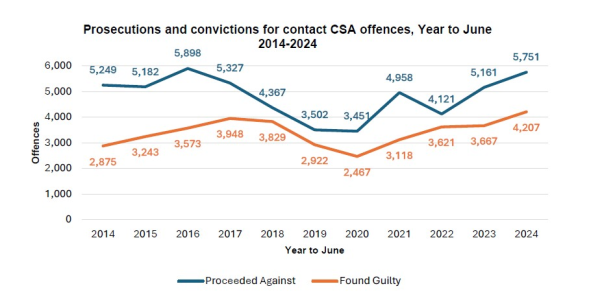
Prosecutions and convictions for contact CSA offences, year to June 2014-2024
In comparison to contact child sexual abuse offences, there has been an even larger, 87% increase in indecent image of children (IIOC) offences, from 2,162 in the year to June 2014 to 4,052 in the year to June 2024.
The number of convictions has increased by 7% from 1,789 in the year to June 2014 to 3,523 in the year to June 2024.
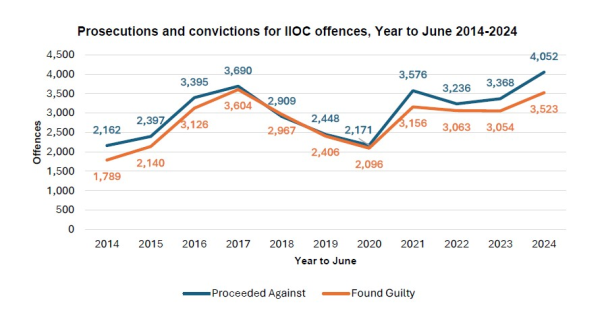
Prosecutions and convictions for IIOC offences, year to June 2014-2024
The tables above illustrate how the internet and social media are changing the shape of child sexual abuse prosecutions and convictions (and we must assume within that, child sexual exploitation), with a big increase in overall child sexual abuse offending. Over 40% of prosecutions are for indecent images of children offences.
The data shows an improvement in both prosecutions and convictions for child sexual abuse and this audit heard that, in many instances, there was a close working relationship between specialist police and specialist CPS teams. A significant number of forces’ self-assessments cited the use of Early Investigative Advice where a force works with CPS early in the investigation, to make the best case.
Nevertheless, early advice did not always seem to be available in child sexual exploitation cases and was reserved for other priorities.
We also heard about some persisting problems, for example, disclosure standards, a reluctance to charge cases, as well as where the courts hindered successful resolution of cases which we set out below.
This audit asked for data related to child sexual exploitation from the Ministry of Justice, His Majesty’s Court and Tribunal Service and the Crown Prosecution Service.
No data was available on numbers of child sexual exploitation or group-based child sexual exploitation cases in the criminal justice system. The CPS were able to provide some management information on child sexual abuse cases involving multiple defendants, but it was heavily caveated and not considered reliable in identifying group-based child sexual exploitation cases.
The Organised Child Sexual Abuse Unit (OCSAU) which is responsible for handling particularly complex and large cases involving allegations of child sexual abuse including group-based child sexual exploitation reported they had dealt with 301 cases since their inception in 2022. They were unable to report what proportion of their cases were group-based child sexual exploitation without manually checking all the case files. However, they did note that of their 179 live cases, 81 involve multiple offenders. These cases, however, might cover familial, institutional or online abuse as well as group-based child sexual exploitation.
HMCTS do not keep data on group-based child sexual exploitation and were unable to provide an estimate of the scale of the cases that had come through the courts in previous years. They asked court staff to identify cases from memory related to group-based child sexual exploitation from the past 10 years but this did not provide any usable data.
There are issues affecting successful prosecution of child sexual exploitation cases
Although we were unable to access data from these criminal justice system organisations on the scale of group-based child sexual exploitation, during this audit several issues emerged which were said to affect how group-based child sexual exploitation was prosecuted.
The presence of these means, even if the problems with data were addressed, we would remain concerned that prosecution data would not accurately illustrate the scale of group-based child sexual exploitation, or the number of victims affected.
Witnesses/victims
In some of the earliest cases of group-based child sexual exploitation, the CPS followed guidelines that emphasised the importance of the reliability of witnesses and consistency of their stories. This led to cases being dropped. For example, where children had been plied with alcohol and drugs while they were sexually abused, their accounts sometimes had gaps. It is obvious from what we understand about these group-based exploitation cases that this was an integral part of the abuse itself, making children more compliant to their abusers and indeed making it harder for them to recall what had happened. The rules on this were changed in 2013[footnote 172] which allowed more cases to be prosecuted effectively.
During the course of this audit, recent cases were brought to our attention where charges had been dropped or significantly reduced where there were concerns about witness testimony, and in relation to a broader point on prosecution for rape of 13-15 year olds where a defence of ‘consent’ is available. This audit heard that prosecution for rape of a 13–15-year-old was less likely to succeed for a number of reasons, including how children of this age are more likely to be viewed as adults who are capable of giving consent. This audit notes that conviction data on rape supports this. We explore this issue more in Chapter 8.
Data from the Ministry of Justice[footnote 173] shows that, in 2024, prosecutions for rape of a child under 16 are less likely to result in a conviction than rape of a child under 13 (35% compared to 67%). Prosecutions for both are less likely to result in a conviction than sexual activity with a child under 16 (80%).
Case Study: Downgrading of Rape Charges to Lesser Offences
This audit was given an account of one case, where a male in his 20s had groomed a child online and arranged for him and his adult friend to meet her and her two friends (also children) for sex. When they met up, two of the children were raped and sexually assaulted. The two suspects were arrested shortly after the alleged offences and were initially charged and remanded as follows:
Suspect 1:
- Two counts of rape of a female aged 13, 14, 15
Suspect 2:
-
Two counts of rape of a female aged 13, 14, 15
- One count of attempted rape of a female aged 13, 14, 15
- One count of engaging in penetrative sexual assault with a female aged 13, 14, 15
- One count of intentional strangulation
However, the prosecution for rape failed once the case made it to court. We were told this happened for a number of reasons which demonstrate the difficulties with prosecuting men for raping children under 16, and how ‘grey areas’ in the law around whether children aged 13-15 can ‘consent’ are used.
First, the defence were able to show that one of the children had had suggestive, sexual conversations with one of the alleged perpetrators before they met up. She had not originally disclosed this due to shame and embarrassment around what had later occurred.
Second, when in court, one of the victims gave evidence that one of the suspects had tried to anally rape her during the attack. As she hadn’t reported this specific incident to the police along with the other allegations of rape, it was seen as damaging to her case.
Third, in a video which was taken of sexual activity between one of the victims and suspects, when the victim asks the suspect to stop, he does so.
Finally, a key witness became very nervous in court.
The charges were downgraded to sexual activity with a child (Suspect 1) and taking/making an indecent image (Suspect 2). Both received custodial sentences of less than five years each.
This is not an isolated case.
‘Trading down’ in the prosecution of all crime is not unusual to secure convictions, however, ‘trading down’ in relation to crimes of child rape is not in the public interest.
While attitudes have improved over the years with a much greater understanding of grooming and sexual abuse and exploitation, we heard of outdated attitudes among those charged with bringing perpetrators to justice, which means that the treatment of victims is still inconsistent.
This audit team was told of a child sexual exploitation case in 2024 involving multiple suspects connected to a 13-year-old victim. The judge in this case remarked that the girl “appeared older than 13” and pointed out her “promiscuous’ behaviour”. The judge’s recusal (removal) was requested by the police, but this was not permitted.
His Majesty’s Court and Tribunal Service
In 2023/24, the average time from the police’s first submission to the issuing of a charging decision in a child sexual abuse case was 123 days[footnote 174] – nine days longer than in 2022/23. There was wide variation between CPS divisions, with the average ranging from 53 days in London South to 202 days in the South East.
The CPS’ Central Casework Division, which deals with particularly complex cases, took 19 months – 556 days – on average to issue a decision, almost double the time taken a year earlier.
Even when cases are decided they must be scheduled for a trial and current delays in the court system mean unprecedented delays for victims waiting for their trials to go ahead.
During our visits, we heard that serious child sexual exploitation cases which are ready to be tried are being scheduled for trial as late as 2027.
We heard from voluntary sector practitioners who work with victims and witnesses, that they are now advising some victims not to go through with prosecutions because they delays are now so extensive and the impact of these delays on victims’ lives are sometimes too high of a price to pay.
In group-based child sexual exploitation cases, these delays are compounded by the physical capacity of the courts to accommodate a large number of defendants, their legal teams as well as the large volumes of evidence required for each trial. Cases have to be broken up to accommodate groups of offenders but the victim often has to be present at each and every case and against each defendant.
Judges can use special measures for survivors in these cases, which include pre- recording cross-examination and re-examination, often referred to as section 28 measures[footnote 175]. This can be used in multiple trials and avoids the victim (referred to as a witness in court cases) having to give their testimony numerous times, with all the consequences for reliving those experiences that this entails.
We have heard that in some cases, judges and barristers are still reticent about the use of section 28 measures, despite evidence that they are effective – in one example, a barrister referred to it as “watching Match of the Day rather than a live match”.
We also heard that ironically, where a section 28 measure is used, this may become a reason for listing a case even later, so prolonging the wait for a victim and increasing the risk of victim drop-out.
The impact on victims of delays at this stage of the process cannot be overstated, and some will not be able to continue; extended wait times increase the likelihood of victims withdrawing from the proceedings. In some areas, particularly with a history of group-based child sexual exploitation cases, specialist support services for victims have been established – however, even these services have noted a decline in victim participation due to the lengthy duration before cases reach court.
It is not unusual for victims to come forward many years later to report the crimes committed against them, or for cases to be reopened which did not proceed at the time. In such situations, defendants might be on bail and living near the victim – the longer the cases take to come to trial, the greater the risk of bumping into their abusers. Some have reported being threatened by defendants, or a defendant’s family, in the run up to the court proceedings. This has resulted in victims withdrawing from the process and has deterred other victims from coming forward.
It is much more difficult and traumatic for a victim to be a witness in a trial involving multiple perpetrators many of whom have raped or abused the victim multiple times.
From the initial delays in listings due to the size of trials, to the intimidation that must be felt in a court room with many defendants, their defence teams and often their supporters; the way in which evidence is tested and the witness is cross examined on a defendant by defendant basis so that the witness has to go through it time and time again; through to the greater risks of seeing one of the defendants or their families in the street between sitting days. This must be difficult enough for someone facing a single abuser in court, but for those facing multiple defendants, their experience can be hugely traumatic.
The impact on victims
This audit was very concerned about the cumulative pressure on the victims of historic abuse and the impact on them as witnesses used in the criminal justice process. Some who are still waiting for their cases to come to court are also pursuing complaints with the IOPC in relation to the conduct of police officers who, in their view, have also failed them. The IOPC process is legalistic, with the procedures around misconduct a quasi-judicial process. This audit was concerned that this represented a further significant burden on individual victims often without any source of legal support.
5.2 Joining the dots
Seeking out information from different sources and cross referencing and integrating those sources will help to raise the visibility of victims and those at risk and help to create a clearer picture.
There are some examples of police forces across the country which have learnt lessons over the years and have developed innovative and effective methods that have been shown to work: identifying victims through a shared understanding of risk and acting on them, providing support for victims and using data to connect victims and perpetrator networks.
It is time that a consistent approach is taken to historic and current victims of child sexual exploitation based on the good practice that is readily available.
5.2.1. Examples of effective group-based child sexual exploitation investigations
During this audit, we met some police forces with a history of group-based child sexual exploitation cases had learned how best to investigate this particular type of crime using investigative techniques, specialist and multi-disciplinary teams.
First, effective investigations treat these crimes as major investigations, often using similar tactics to combatting serious and organised crime. This audit was told how investigations into group-based child sexual exploitation are some of the most complex. They can sometimes start with one victim or one perpetrator and build out to multiple victims and multiple perpetrators and therefore require the use of an investigating tool for major crimes - HOLMES[footnote 176]. Officers from the Metropolitan Police Service and Greater Manchester Police agreed that using organised crime tactics and capabilities, bringing in specialist organised crime officers in addition to public protection specialists, can benefit their investigations. Operation Stovewood has been able to take advantage of NCA capabilities for dealing with organised crime.[footnote 177]
Second, cases require proactive investigation – piecing information together from different sources to create a picture and follow up leads. This underscores the need for cases to be regarded as major crimes to allow for extensive investigations.
Learning from previous investigations shows that victims may not want to come forward, and officers need to make comprehensive efforts to identify victims and sensitively approach them, sometimes finding them through cross referencing social care records and crime recording and intelligence systems.
Third, building trust with victims is critical and it might take time and require specialist support. Some forces noted the importance of progressing at the victims’ pace to achieve successful prosecutions in contrast to many reactive investigations where there is pressure to get cases completed as soon as possible. Victims may be reluctant as they may have been let down in the past by the police and criminal justice system. Specialist support and help is necessary to bring victims with them and help through the criminal justice system process, which can take years. For example, the Trauma and Resilience Service (TRS), operating within Operation Stovewood, is a multi-disciplinary team supporting victims including professionals from Clinical Psychology, Child Psychotherapy, Adult Mental Health Nursing, and Social Care. The service provides essential support to victims, which includes counselling, housing assistance and access to additional help.
Finally, it is important to have strong working arrangements with specialist services within the Crown Prosecution Service to get cases to trial. For example, CPS staff are integrated within the multi-disciplinary Stovewood team, along with the Trauma and Resilience Service described above. In addition, the central specialist CPS team, the Organised Child Sexual Abuse Unit (OCSAU), handles complex child abuse cases from across the country. This has improved criminal justice outcomes for example, for Stovewood, out of 83 individuals charged in total, 42 have been convicted, 2 died before trial, and 12 were acquitted - resulting in a conviction rate of 73%[footnote 178].
‘The Smith algorithm’
In 2016 after the extent of child sexual abuse cases in a neighbouring police force area - Rotherham - became known, Paul Smith, an analyst from West Yorkshire Police created an ‘algorithm’ of likely victims of group-based child sexual exploitation between 2007 – 2014. This involved searching records for any under 18-year-old during that time period who had been a regular missing child, who had been a victim of sexual crime or who the police or partners had an intelligence record for related to sexual activity.
The ‘algorithm’ revealed hundreds of people who were in scope as possible victims and they then used different vulnerabilities to score and rank who would be most to least at risk. The offences they have subsequently investigated include those from the 1960s up until 2013 with the busiest period being 1990 – 2010. West Yorkshire Police have secured 210 convictions with total sentences of over 2,331 years through 24 operations with the help of this approach.
Operation Stovewood
The National Crime Agency’s (NCA) Operation Stovewood started in 2014. It is the UK’s largest investigation of non-familial child sexual exploitation and abuse, focusing on incidents in Rotherham between 1997 and 2013.
Stovewood was established to take over the investigation of cases of group-based child sexual exploitation, partly due to the lack of credibility and trust in South Yorkshire Police following the Jay report which outlined the scale of CSE in the town. The Stovewood team have had to win the trust of victims over time and have built a multi-disciplinary team to do so and also to support victims through the criminal justice process.
It has been able to develop specialist knowledge and make use of specialist capabilities available to the NCA in their investigations. It has identified over 1,100 victims and have secured 42 convictions[footnote 179]. This approach could be a model for investigation and prosecution of historic cases of child sexual exploitation.
5.2.2. How children’s services can protect children in care
One of the key tactics used by perpetrators grooming children for sex is their active targeting of the children most vulnerable to abuse. All children are of course vulnerable by virtue of their age, but children in care are already more vulnerable because of being outside of a safe, family environment and sometimes because of the abuse or neglect they have already experienced.
One enduring lesson from the history of child sexual exploitation by groups of male perpetrators, is the heightened vulnerability of children in care to grooming and exploitation. Review after review and investigation after investigation has shown children in residential care homes have been targeted by perpetrators searching for vulnerable children. In Rotherham[footnote 180], frontline workers reported that at times they were being ‘overwhelmed’ by child sexual exploitation. In over two thirds of the sample of serious case reviews we looked at, children were experiencing sexual exploitation while they were in care, and it often started in care - so after they were placed in the ‘care’ of the state to presumably keep them safe.
We met police officers during this audit who were undertaking major investigations into non-recent child sexual exploitation by working with children’s social care departments. They were tracking down children with a history of residential and other care settings on the basis that it was likely they had experienced or witnessed child sexual exploitation. So on this basis, being in care is a ‘risk factor’ for exploitation not a protective factor.
There are of course many cases that show that child sexual exploitation can happen to any child, including those from loving homes. But that is not a reason not to maintain maximum vigilance and attention on those in the care system to keep them safe. As a ‘corporate parent’, children’s social care services have an influence over whether or not perpetrators are successful in targeting these children. It is not suggested that children’s services should do this on their own: their safeguarding partners in policing, health, schools and other local authority services are critical actors too, as are local businesses, community organisations and indeed train, bus and taxi operators. But it is children’s services’ role to make it their priority.
5.2.3. How specialist policing capabilities can help to uncover group-based child sexual exploitation
In recognition of the particular challenges around child sexual abuse and organised crime and exploitation, there are now specialist policing capabilities to support investigations and help improve forces’ capability in areas such as complex child sexual abuse and exploitation, and trafficking.
The Hydrant Programme set up in 2014, discussed earlier in the report, funded by the Home Office, provides support for forces in the area of child sexual exploitation including complex investigations where they provide peer reviews, peer support and debrief. It is a resource provided to forces to improve individual investigations. Their knowledge of significant child sexual exploitation investigations also helps them to keep on top of activity across the country and to identify areas that might need help and support.
The Tackling Organised Exploitation Programme (TOEX), first piloted in 2021, also funded by the Home Office, offers dedicated intelligence and analytical expertise to assist forces with individual investigation by providing additional capacity, capability, data and technical expertise, providing additional intelligence to support forces with effective disruption activity and arrests. They have access to all UK law enforcement databases and a range of other resources and can use AI approaches to find location hotspots, high-risk victims and perpetrators, and can track perpetrators who have moved across force boundaries.
Both programmes provide good support and capability to police force’s efforts to tackle group-based child sexual exploitation.
5.2.4. How specialist criminal justice support can help to secure convictions
For some victims, the court process marks the first time those close to them have heard details of the abuse. Victims have their credibility publicly scrutinised, their private experiences dissected, and their motives questioned, and this might be magnified where there are multiple suspects. While protections such as restrictions on press reporting exist, these do not guarantee anonymity in practice. Identities may still be known or guessed, leaving victims exposed to judgement, or even retaliation. The ongoing impact of the abuse also creates significant and ongoing vulnerabilities, compounding the challenges of the criminal justice system.
The experience of those working with survivors shows the importance of specialist support but there remains a shortage of this for specialist sexual violence help. The Trauma and Resilience Services (Operation Stovewood) is unusual, even unique in its offer to non-recent victims from Rotherham. The lack of availability of specialist advocates for sexual violence for those that required help came up again and again during visits this audit conducted. Voluntary sector support is patchy. In their absence, police officers and staff were often an ongoing source of support for victims, now witnesses, heading into the court process. The lack of good quality specialist support available remains an ongoing failure.
The importance of specialist prosecutors such as the Organised Child Sexual Abuse Unit (OCSAU) and Rape and Other Serious Sexual Offences (RASSO) teams in the CPS and specialist services that provide highly effective victim care, cannot be underestimated. The OCSAU Team in the CPS reflects the importance of a highly specialised prosecutorial function for handling a small number of very challenging and complex child sexual abuse in the same way it is recognised for serious and organised crime cases. We noted that OCSAU had handled cases from a large number of forces as well as the National Crime Agency and its specialist Child Exploitation and Online Protection Command (CEOP).
We also noted the absence of specialist legal advocacy for victims who were dealing not only with the criminal justice system, but with complaints to professional bodies such as the Independent Office for Police Conduct (IOPC). Some were relying on the support of third sector or charitable organisations and other just on friends or family members. There was an absence of legal support available in what are largely legal processes. This is a gap.
5.2.5. How the third sector can help to identify and respond to group-based child sexual exploitation
Charities and third sector organisations have been instrumental in identifying and responding to child sexual exploitation and abuse. Their contributions have been essential in raising awareness, providing specialised support, and influencing policy and practice and on many occasions blowing the whistle where services have failed to protect victims or take their accounts seriously. Small, sometimes one-person services have worked alongside exploited children and been fierce advocates for victims and their families where statutory services have failed to protect them and pursue perpetrators.
Charities and campaign groups have also shaped public views. For example, campaigns informed by the Streets and Lanes project in Bradford led to attitudes changing from seeing children as child prostitutes to seeing them as victims of sexual exploitation.
Some charities have been able to conduct public education campaigns to highlight the signs of child sexual exploitation and reduce the stigma associated with reporting abuse. Some are funded to offer training for professionals such as teachers, police officers, and health workers on recognising indicators of sexual exploitation and responding appropriately. In schools, some charities provide preventative education and peer-led sessions that educate children on topics such as grooming, consent, and where to seek assistance.
Due to limitations in their funding, charities are limited in the types of support they can offer to victims of sexual exploitation. Charities and victims say they need one- to-one therapeutic support, counselling, legal advocacy, and help navigating complex systems such as social care or the justice system. Ideally, they would also be able to engage with young people in the community; on the streets, in parks, or online, where they may not be in contact with statutory services.
5.3 Conclusion
There is no single place where the national picture on child sexual exploitation comes together, and the landscape is confusing.
Information on child sexual exploitation is limited and spread across national and local systems. While policing problem profiles are designed to bring together a
picture at force level of child sexual exploitation, partnership data, one of the key components is not always included (although systems for sharing on a case-by-case basis will usually be in place).
Children’s services data shows a decline in assessments where child sexual abuse or child sexual exploitation is identified, at the same time as police identification and reports of child sexual abuse are rising. The reasons for this mismatch are not clear.
There is very limited national data available from healthcare settings on group-based child sexual exploitation, and concerns continue to be raised about issues with information sharing from healthcare partners.
Even in policing, where data on group-based child sexual exploitation is better, we remain concerned about how this data is shared and analysed within forces and between partner forces and other agencies: police intelligence systems are hopelessly out of date.
No data is available on numbers of child sexual exploitation or group-based child sexual exploitation cases in the criminal justice system. While prosecutions and convictions of child sexual abuse are increasing, there remains some concern about how the criminal justice system treats adolescents.
This audit was also struck about the particularly traumatic experiences that victims face in court when there are multiple perpetrators to face and what we ask of victims in these circumstances often with limited support.
Children’s services, policing, health and the criminal justice system have been central to the exposure of some of the most complex and harmful cases of group- based child sexual exploitation in recent years and these have been successful when services share and act on intelligence because, it is in this way that an understanding of what is happening is created. Many problems of the past arose because services did not do that. Frontline workers know only too well the horrendous trauma this type of crime does to the children in their care and want to work with their partners to protect children from sexual exploitation.
However, the data available suggests that there is less capacity and capability to maintain the vigilance necessary to do this.
More positively, we have also seen that that there are a number of organisations, nationally and locally, which can help to deliver a better response to child sexual exploitation. We have seen innovative and caring approaches being taken to overcome barriers and to offering support; the voluntary sector continuing to stand up for and beside victims.
Where strong partnerships exist, with effective sharing of information, a good understanding of the nature of offending, offending groups’ characteristics and victims’ vulnerabilities, better results can and should be achieved.
Chapter 6: Denial
Chapter summary:
-
Despite reviews, reports and inquiries raising questions about men from Asian or Pakistani ethnic backgrounds grooming and sexually exploiting young White girls, the system has consistently failed to fully acknowledge this or collect accurate data so the issue can be examined effectively.
-
Instead, flawed data is used repeatedly to dismiss claims about ‘Asian grooming gangs’ as sensationalised, biased or untrue. This does a disservice to victims and indeed all law-abiding people in Asian communities.
-
The collective failure to properly address these questions has meant that this issue has dominated political and institutional focus. This plays into the hands of those who want to exploit it to sow division.
-
Perpetrators of these crimes exploit gaps in the ‘state safety net’ there to protect children and we, as society, sometimes treat these vulnerable children as adults making ‘poor choices’. Too many wait for justice or even – in some cases – are criminalised for offences committed under coercion.
-
The organisations, their leaders or sometimes the individuals working for them, are rarely held to account when things go wrong. Inquiries focus on systems and procedures rather than on those who have done wrong, and recommendations for change are not driven through with sufficient determination.
-
Blindness, ignorance, prejudice, defensiveness and even good but misdirected intentions, all play a part in a collective failure to properly deter and prosecute offenders or to protect children from harm. Injustice prevails.
6.1. Introduction
This audit has identified a number of factors which appear to be hampering our efforts to protect children from group-based child sexual exploitation.
In this chapter, we discuss three of these factors, which we have touched on in previous chapters and which we believe have been significant. They are:
-
the ethnicity of perpetrators;
-
the adultification of child victims; and
-
lack of accountability
These three factors combine to create institutional weaknesses, a blind-spot in the way we tackle child sexual exploitation - to avoid its true extent and allow injustices to prevail - which is all too obvious to a public who care about fairness, justice and the protection of vulnerable people.
6.2. Ethnicity of perpetrators
Questions about the ethnicity of ‘grooming gangs’ – and specifically, whether they are predominantly men of Pakistani or Asian ethnicity - have dominated discussion of group-based child sexual exploitation for many years. Those questions have been fundamental to the work of this audit. We have examined all the evidence on this and set it out, alongside our examination of other characteristics of perpetrators and victims, in Chapter 4 of this report.
6.2.1. Ethnicity data
It remains impossible to provide a definitive assessment of the ethnic profile of the perpetrators of group-based child sexual exploitation, a failure of successive politicians and policymakers over many years. The data – particularly on ethnicity – remains inadequate at the national level. Limited improvements have been made, and several police forces themselves hold better local data. Also, in the process of this audit, we have come across several examples of poor use and presentation of the available data, locally and nationally.
Senior officials in the police, local authorities and other agencies writing in reports or in public statements to the media conclude from the flawed available data that the majority of group-based child sexual exploitation offending is committed by White perpetrators or that the ethnic profile is ‘mixed’. Some also portray or even dismiss concerns about Asian offenders as either a ‘media coverage’ issue or ‘historical offending’, which risks detracting attention from all types of child sexual abuse. This is misleading. The seniority of the officials making these statements also makes it far more difficult for frontline staff to feel they can challenge them.
As discussed in chapter 4, the VKPP and the CSE Taskforce reports on the relatively new CPAI and COCAD datasets – which do present better data on child sexual abuse and exploitation offences than any previous datasets – have produced ethnicity profiles, despite acknowledging that ethnicity was only declared for a third of perpetrators, excluding the large majority of ‘unknowns’ in the analysis. It would have been more appropriate to include the large number of unknowns in the data, given the sensitivity of this issue and the very low proportion of known ethnicity.
Presenting the data with a large percentage of unknown data skews the figures (as we show in chapter 4). For example, in the COCAD data for perpetrators of group- based offending in 2023, self-defined ethnicity is 88% White when ‘unknowns’ are excluded, but 28% White when the unknowns are included. We can be confident that at least 28% of group-based offenders are White; but we cannot reach a conclusion that 88% are White overall.
6.2.2. Discussion of ethnicity in local reviews and inquiries
In our examination of local Serious Case Reviews, which we discuss in chapters 4 and 5, twelve out of the fifty reviews we considered included information about the ethnicity perpetrators of child sexual exploitation. Of these reviews, only five examined the ethnicity of perpetrators as a potential factor in the offending behaviour.
Where ethnicity was identified as a potential factor in the offending, two reviews recommend undertaking national research on the profiles, motivations, and cultural and background influences of perpetrators involved in the sexual exploitation of children. These reviews also suggest publishing guidance for practitioners on the most effective methods to reduce such offences.
A number of the reviews were conducted following serious harm identified as part of a police operation and ensuing prosecutions. In most cases, we were able to use open-source data to pull out the ethnicity of the perpetrators, as discussed in chapter 4. From this, we identified that, while perpetrators came from a mix of ethnic backgrounds and nationalities, a high proportion of the perpetrators in these cases were from Asian ethnic backgrounds. A table of child safeguarding reviews and perpetrator ethnicity details can be found at Annex E.
More often than not, the official reports do not discuss the perpetrators, let alone their ethnicity or any cultural drivers. There is a palpable discomfort in any discussion of ethnicity in most of them. Where ethnicity is mentioned, it is referred to in euphemisms such as ‘the local community’, or it is buried deep in the report and only vaguely referenced in any contents index or executive summary. Most choose to reside in more comfortable territory of examination and discussion of systems, processes and multi-agency partnerships. These are important, and it is essential to identify and learn lessons from failures. But it is also vital to be rigorous in trying to understand the nature of and motivations for offending if agencies are to better protect children.
If the ethnic or other backgrounds of offenders are not examined, it will be less easy to identify cultural or other drivers behind particular patterns of offending. That can create additional barriers to spotting, reporting and prosecuting crimes.
The 2013 Overview Report[footnote 181] of the serious case review of the Rochdale case commented that:
“What is absent is any evidence that practitioners attempted to understand why the fact that the men were ‘Asian’ might in fact have been relevant and legitimate for consideration… The degree to which workers understood the communities they worked in may also have contributed to the failure to recognise the unusual patterns of interaction between these two groups.”
Local reviews are often held up subsequently as justifications for not conducting further inquiry, but in this respect, serious case reviews have not usually addressed any factors of ethnicity that are present and what role it might have played either in what happened or in how the system responded.
There are some exceptions to this.
The Jay report[footnote 182] in Rotherham was notable in its directness in identifying the ethnicity of the (mainly) Pakistani men who were offending in that town, calling for more action to be taken to investigate and understand what lay behind this and what role ethnicity took in how the system responded. This eventually led to the councillors who presided over these failures to stand down.
Similarly, in a thematic review carried out into child sexual exploitation committed in Newcastle by perpetrators from a diverse range of backgrounds including Pakistani, Bangladeshi, Indian, Iranian, Iraqi, Kurdish, Turkish, Albanian and Eastern European, it recommended government conduct research into the cultural drivers of offending. It also sought to try and understand the motivations behind offending by interviewing an offender who agreed to contribute to the review.
In some reviews where ethnicity is identified as a factor, specific action to address this may be recommended, but follow-up lacks rigour.
This audit sourced materials produced by one local authority which had a significant number of cases of group-based child sexual exploitation carried out predominantly by members of the Pakistani community. Following a number of convictions, the local authority produced a plan aimed at tackling child sexual exploitation, which included a commitment to developing work and training materials directly aimed at communicating with the local Pakistani community. The commitment is repeated in subsequent council plans before disappearing 18 months later and being replaced with a broad commitment to developing “resources to address the impact of CSE in its varied manifestations across the District’s communities.”
In July 2022 the Telford Independent Inquiry[footnote 183] found up to 1,000 children may have been sexually exploited between 1989 to 2017, with a high proportion of offenders identified as coming from Asian or Pakistani ethnic backgrounds. Like the Jay report years before, the Inquiry was notable for its directness on ethnicity. They said they were unable to examine this prevalence further due to the absence of any evidence submitted by offenders and on a lack of engagement from the Asian community.
The Telford inquiry report commented on the apparent concern of agencies to tread carefully in order to avoid stirring up racial or community tensions and made strong recommendations about the need for transparency in the future. However, in the positive progress report published two years later, there was still a high proportion of missing data on the ethnicity of perpetrators.
We heard from police forces that local authorities would discourage them from publicising the successful conviction of perpetrators of group-based child sexual exploitation due to fears of raising tensions. Publicising successful prosecutions is a well-established method for police to encourage other victims to come forward, especially those that are historically under-reported like child sexual abuse and exploitation.
Instead of examining whether there is disproportionality in ethnicity or cultural factors at play in certain types of offending, we found many examples of organisations avoiding the topic altogether for fear of appearing racist, raising community tensions or causing community cohesion problems. It is right for police forces and local authorities in particular to pay attention to potential impacts of any investigation on community cohesion, particularly given the history of riots and other disturbances based on racial tensions in many cities that happened in the early part of the 2000’s and subsequently. Issues which challenge community cohesion need careful and sensitive handling and a level of honesty which will not come with ignoring uncomfortable issues or taking what might be deemed an easy way out. And it does no community any good to ignore disproportionately in any form of offending, be that amongst perpetrators or victims.
6.2.3. Research on ethnicity of Child Sexual Exploitation perpetrators
The 2020 Home Office paper[footnote 184], ‘Group-based Child Sexual Exploitation: Characteristics of Offending’, which we discuss in chapter 4, reached a conclusion that “it seems most likely that the ethnicity of group-based CSE offenders is in line with CSA more generally and with the general population, with the majority of offenders being White.” It is quoted and requoted in official reports, the media and elsewhere as proof that claims made about ‘Asian grooming gangs’ are sensationalised or untrue, although this audit found it hard to understand how the Home Office paper reached that conclusion, which does not seem to be evidenced in research or data.
Media reporting at the time the Home Office paper was published included headlines that “most child sexual abuse gangs made up of white men” [footnote 185] and the report continues to be referred to in the media as proof that the claim has been ‘debunked’. One 2020 article published in a newspaper and written by academics said the report meant that “a powerful modern racial myth has been exploded” by quoting the paper and going on to say that “research has found that group-based offenders are most commonly White”[footnote 186].
Only the Independent Inquiry into Child Sexual Abuse’s 2022 report into group-based child sexual exploitation[footnote 187] seemed to reflect on the report with any balance, noting that the Home Office 2020 report in fact found “that there were ‘significant limitations’ to what can be said about links between ethnicity and child sexual exploitation. As this paper recognised, there is limited research and that which has been done tends to rely on poor quality data. There are significant challenges in obtaining accurate data.”
Other reports on perpetrator ethnicity which we reviewed as part of this audit seemed motivated by a desire to dismiss media coverage or other reports as selective, biased and part of a divisive political agenda, and/or to suggest that such coverage has led to bias in reporting by the public and investigation by the police (e.g. the notion that the BBC ‘Three Girls’ docu-drama on Rochdale led to a spike in reporting of offending of a similar profile), thereby skewing police records of reported offences.
A report by Quilliam[footnote 188], which had claimed that 84% of group-based CSA was committed by Asian heritage men, was dismissed by researchers because the methodology and selection process used by Quilliam was not stated. This dismissal was then endorsed by the Home Office in their 2020 report.
Some organisations and researchers have tried to examine the role culture may play in the motivations of offenders, and the evidence on this has been discussed in more detail in chapter 4, but they are few and far between.
The review into child sexual exploitation in Newcastle[footnote 189] mentioned earlier in this chapter recognised the lack of research which had been undertaken into any potential cultural drivers of offending. It took an unusual step to try and understand this as far as possible by interviewing one of the offenders who had claimed asylum in the UK. In the interview, the offender spoke in a derogatory way about lack of morals in British girls and the ease with which he was able to access sex, drugs and alcohol. The review noted it was “unfortunate that there were not more opportunities to meet with perpetrators and further attempts, if successful, might lead to greater understanding.”
This audit also received representations about the need to examine further cultural and religious drivers behind child sexual exploitation including concerns that Sikh and Hindu children had been targeted for abuse because they were ‘easy targets’ and who would never tell anyone about being exploited because of the shame.
A 2020 ‘explorative study on perpetrators of child sexual exploitation convicted alongside others’[footnote 190] conducted for the Independent Inquiry into Child Sexual Abuse, sought to explore some of the motivations behind perpetrators of child sexual exploitation but did not explore whether or not cultural beliefs played a role.
Some – but far less - research[footnote 191] touches lightly on potential cultural drivers, for example regressive and misogynistic attitudes towards women, but only speculatively, or as a potential issue alongside other motivations such as sexual gratification or money.
6.2.4. Why ethnicity matters
It is not racist to want to examine the ethnicity of offenders. The examination of ethnicity in crime (for offenders and victims) should be about seeing how offending can be better understood and tackled. Effective crime prevention, disruption and prosecution is based on a good understanding of the context, nature and profile of offending, offenders and victims. That is one of the reasons that recording ethnicity has been a feature of crime statistics for many years.
There is less apparent discomfort in public discussion of racial and ethnic issues in relation to ‘stop and search’ policies, hate crime or knife crime, where it is felt important to highlight disproportionate impacts in order to better engage affected communities in addressing concerns and preventing serious harm.
We need more maturity and honesty in debate about the ethnicity of perpetrators of group-based child sexual exploitation. Assertions that the majority of child sexual abuse offenders are White, even if true, are at best misleading. In a population with over of 80% of people of White ethnicity[footnote 192], it should always be a significant issue when people from a White background are not in the majority of victims or perpetrators of crime. It should also be a significant issue when any community or social group appears disproportionately over-represented as victims or perpetrators of crime. In such cases, the underlying factors that have contributed to that situation deserve investigation.
The people who downplay the ethnicity of perpetrators are continuing to let down society, local communities and victims – past and future - by not looking harder at the nature of offending in order to better understand it and better prevent it. Ignoring the issues, not examining and exposing them to the light, allows the criminality and depravity of a minority of men to be used to marginalise whole communities rather than opening up the possibility of understanding it better.
They are also providing ammunition to a minority of people who pretend to be on the side of victims but are using them – and others who genuinely care about the plight of victims and the need for tougher action - to spread division and hate across communities. As Gabrielle Shaw of the National Association for People Abused in Childhood was reported to say in January 2025[footnote 193].
“The weaponisation of people’s trauma is reprehensible. Someone’s trauma should not be used to score political points, or as clickbait.”
6.3. Adultification of child victims
For those fortunate enough to grow up in a loving and stable family environment, adolescence is an often painful process of negotiation with parents; children pushing the boundaries and seeking greater responsibility over decision making while parents resist, continuing to see them as the children who require safety and protection at all times. Many parents track their children on their phones, so they know the precise whereabouts of their children every minute of the day.
However, many of the children affected by child sexual exploitation have not always been afforded the status of a child that is available to someone from a stable supportive home environment. Being in care almost fast-tracks children into adulthood – living in residential settings, or ‘semi-independent housing’ long before a child whose family is able to take care of them would do so.
Sometimes the services who are there to protect these children, often mistake them for adults, as does wider society. This is not to diminish the skilled care that those who dedicate their lives to caring for very challenging teenagers provide, but perpetrators seek out and exploit the gaps in the safety net provided by the state for children who cannot stay safely at home.
It is important to recognise that they are still children, however they behave or present themselves: they cannot make choices for themselves or consent to their abuse. When this is forgotten, children, and particularly in this case adolescent children, are made ever more vulnerable.
The DfE statutory guidance, Working Together to Safeguard Children[footnote 194], defines a child as anyone under the age of 18. Adultification can occur when people – including professionals – view a child as more ‘grown up’ or ‘adult’. It is described by safeguarding experts[footnote 195] as occurring when notions of innocence and vulnerability always grounded in bias, where aspects of a child’s personal characteristics, socio- economic background or experiences are met with discriminatory responses. Rather than being seen as a child experiencing abuse or exploitation, for example, they may be viewed as responsible, complicit, or more resilient and able to withstand maltreatment.
Adultification can lead to safeguarding protections not being fully applied and children experiencing a higher risk of harm, or even to receiving a criminal justice response rather than a safeguarding one. That in turn may lead to children suffering further abuse and trauma, distrusting the people and agencies who are supposed to be there to protect them, feeling less able to report abuse or ask for help, and experiencing poorer life outcomes in the longer term – for example through missed education, experiencing mental ill-heath or entering the criminal justice system.
There has been an increasing focus on training and other support for professionals in safeguarding – in children’s services, education and criminal justice agencies – to understand the consequences of adultification and how to avoid it.
6.3.1. Adultification in the context of child sexual exploitation
In earlier chapters of this report, we have discussed the growing awareness of child sexual exploitation emerging from frontline organisations’ work with children who as recently as the 1990s were viewed as “child prostitutes” rather than victims of exploitation.
We have discussed in chapter 6 the apparent mismatch between levels of child sexual abuse and exploitation as a risk identified by children’s services when compared with the growing number of cases of child sexual abuse crimes reported to the police. While financial pressures on councils have arguably led to raising the thresholds at which councils intervene with support for children, adultification might have made it easier for local authorities to make decisions that children can make their own decisions.
We have been concerned in our fieldwork for this audit that there remains an uneasiness and awkwardness in the practice of some professionals when confronted with cases of teenage girls who may be experiencing child sexual exploitation, which seem less easy to deal with without applying judgements or stereotypes than, for example, exploitation involving non-human commodities such as drugs, knives or money.
This might not be unconnected with those professionals’ views and experiences of cases of child sexual exploitation being taken through the criminal justice system, where there remains a focus – despite positive steps on the part of the police and Crown Prosecution Service – on potential judgements and challenges about the lifestyles, behaviours and choices of victims, and whether they will be ‘credible’ witnesses. For example, as discussed in chapter 5, cases may be dropped where gaps exist in the accounts of children who had been plied with alcohol and drugs while they were sexually abused, while prosecutions for rape of a 13–15-year-old may be less likely to succeed because children of this age are more likely to be viewed as ‘adults’ capable of giving consent.
Clearer solutions are needed to tackle more forthrightly these areas of bias and greyness that weaken the protection and justice afforded to child victims abused and exploited by adults.
Children who are being sexually exploited might be groomed or coerced into committing offences by their abusers as part of their exploitation, such as carrying drugs, to avert further abuse. Or they might seemingly ‘recruit’ others into exploitation. Abusers might use the fact that their victims have committed crimes to prevent them disclosing abuse to the police or others. Victims might also commit crimes to find safety or in direct response to their abuse, or as an expression of internal trauma, such as damaging property belonging to someone who has harmed them.
Where people are sexually exploited as children and have criminal records into adulthood, they might be prevented from getting jobs and have to live with the constant reminder and often shame of having to explain their criminal record. Some victims are on the sex offenders register, preventing them from working with children or even attending their own children’s school trips.
Some survivors of child sexual exploitation have campaigned on behalf of victims who have been groomed into committing crimes at the direction of their abuser to remove offences committed under coercion from their criminal records. This would be an important step to redressing past wrongs done to victims.
With greater awareness of the exploitation process, police forces are now advised to look beyond the obvious facts when a child or young person is presented to them as an offender, or has been arrested for a criminal offence, and that children who are subject to exploitation should not be ‘indefensibly criminalised’. Prosecutors too are advised to provide an explanation to the jury about the circumstances of any relevant offending by the witness, rather than it coming up in a cross examination. There is, however, as we cover in chapter 5, a long way to go for these improvements to be felt.
In a sign of further change, the Crime and Policing Bill creates a new offence of criminal exploitation of a child in order that we can prosecute those adults who coerce children into committing offences. However, as we have seen throughout this audit, sexual exploitation is often not identified and disclosure of sexual abuse and exploitation might take many years, so a child may still be prosecuted for an offence but be too afraid or traumatised to disclose their sexual abuse and exploitation.
6.4. Accountability and justice for victims
Some victims have seen perpetrators brought to justice for their appalling crimes.
However, we heard palpable frustration from survivors about the ongoing injustice of the lack of accountability of the services that had dismissed them, failed to act on reports or provide the protection they sought and which in some cases meant their abuse continued for longer than it should. We also heard from frontline workers and police officers their frustrations with a lack of action in the system.
It has been survivors, campaigners, whistleblowers, and journalists who have often brought to light child sexual exploitation, not always the public services who are charged with tackling it. Instead, some services have persisted in denying problems through indifference, hostility and the threat of legal action.
We examine two cases here as examples of the lack of accountability that remains at issue for many. These are Rotherham which with the benefit of the passage of time provides an opportunity to look at what happened to those services who had led children down.
We also looked at Rochdale where we have been able to see through the independent assurance reviews, called by the Greater Manchester Mayor in response to serious allegations by Whistleblowers, how services responded to the need for light to be thrown on a traumatic chapter in the area’s history.
While these are only two examples, the issues they expose can be seen across many of the other local reviews and inquiries covered in the timeline in chapter 2 and in discussion across this report.
Local statutory bodies, including the police and local authorities, have been resistant to undertaking reviews, and the need for an honest look at previous and current practice. Sometimes it takes partners years to be persuaded for the need of an independent public inquiry or review. Often, they come about because of media pressure and the campaigning of victims and survivors.
6.4.1. Resistance and denial in Rotherham
Rotherham Council and South Yorkshire Police avoided problems of sexual abuse over many years. Jayne Senior who ran Risky Business, a small project funded by the Rotherham Council, continually raised the widespread sexual abuse to her funders. She felt belittled by South Yorkshire police officers when she provided names, addresses and car registrations of suspects, who said that it wasn’t ‘real intelligence’. This same material went on to be used by the NCA’s Operation Stovewood.
In the face of mounting allegations about widespread child sexual exploitation in the town by Andrew Norfolk of The Times, Rotherham council sought an injunction to prevent them from publishing, claiming reporting would endanger the girls and young women. He published many articles about Rotherham, but when he ran the story of Amy, a victim of child sexual abuse in 2012, Andrew Norfolk said “We’d thought that Rotherham Council and South Yorkshire Police would have to respond by saying, ‘this is appalling, we will take action’,” he said. “Instead, what they did was ask South Yorkshire Police to launch a criminal inquiry into who had leaked the material to me”.[footnote 196]
Professor Alexis Jay’s report commissioned by Rotherham Council laid bare that an estimated 1,400 children had been sexually exploited between 1997-2013, mainly by men of Asian ethnicity and provided detailed evidence. Even after this, when the government commissioned a Best Value Inspection into the fitness of the council, investigators found that it demonstrated ‘resolute denial’ of the ‘scale and scope’ of child sexual exploitation[footnote 197].
Change was forced on Rotherham Council. On the publication of the Best Value Inspection, the council’s entire political leadership resigned[footnote 198]. In 2015, the Secretary of State exercised his powers of intervention and appointed a team of Commissioners to take over all of the council’s executive functions, licensing powers and to begin a rapid improvement programme which resulted in their powers being returned in 2016 and new local elections which resulted in the election of 35 new councillors.
As part of its efforts to ensure improvement, the council commissioned several investigations[footnote 199] to determine whether there were grounds for disciplinary or capability proceedings against any current employee or to refer anyone to a regulator on grounds of professional misconduct. It concluded “on the evidence available to us …. the way in which the Council responded to CSE in Rotherham was not the responsibility or fault of any one person. It was the product of multiple and systemic failures”. As far as this audit is aware, no action was taken against any individual in the council.
The South Yorkshire Police and Crime Commissioner at the time that the Jay report was published in 2014 was forced to step down but was referred to the then Independent Police Complaints Commission (IPCC, now the Independent Office of Police Conduct - IOPC) following complaints about statements he had made about meeting survivors. The IPCC found there was insufficient evidence to progress with the case.
In 2016, a damning report commissioned into South Yorkshire police[footnote 200] found “serious failings of policing in Rotherham.” As well as this, in 2014 following the Jay report, the IOPC started Operation Linden, an independent investigation into complaints and conduct relating to South Yorkshire Police’s handling of child sexual abuse and exploitation in Rotherham, between 1997 and 2013.
The final report was not published until eight years later in 2022[footnote 201]. It confirmed that despite 265 separate allegations being made by more than 50 complainants no officer lost their job. The new Police and Crime Commissioner (Alan Billings) commented the “eight years of costly investigations” had resulted in “few new findings or accountability”. He said most of the report’s recommendations had already been made and implemented after previous investigations, and that the latest had failed “to identify any individual accountability… and as result…. it lets down victims and survivors”.[footnote 202]
Rotherham is now a completely different council to what it was when it presided over failures in the late 1990s and early 2000s, while South Yorkshire Police has since been commended for its handling of child sexual exploitation by HMICFRS[footnote 203].
However, across years of failure, no single individual has been held accountable for what everyone accepts were injustices.
Meanwhile, victims of child sexual exploitation from Rotherham and elsewhere, continue their battle to overturn the criminal convictions they received while police criminalised them rather than the perpetrators.
6.4.2. Resistance and legal wrangling: Assurance Reviews in Rochdale
In 2017, the television drama Three Girls, and the documentary The Betrayed Girls described how the police and the local authorities failed to investigate allegations of child abuse and rape because the victims were perceived as unreliable witnesses and through fear of being accused of racism.
Following the TV programmes, further serious allegations were made by Maggie Oliver and Sara Rowbotham who had both worked in Rochdale at the time (the former as a police officer and the latter as head of the Crisis Intervention Team, a sexual health project run by Pennine NHS Trust). The Mayor of Greater Manchester, Andy Burnham, commissioned an assurance review to examine the handling of child sexual exploitation cases in the Greater Manchester area at that time and to provide assurance about how cases were being handled today.
Three reports were published, and one covered the period from 2004-2013[footnote 204].
One part of the review looked into the already much criticised Operation Span for which the CPS and Greater Manchester Police (GMP) had issued an apology in 2012.
There was at best a reluctance by the statutory authorities, in this case GMP and Rochdale council, to openly review the events of the previous years, and to work co- operatively to bring past issues to light. Instead, there was a suggestion that everything was now much better: in short ‘it was time to move on.’
“In the early days of our review, it was put to the review team on many occasions by senior officers of both GMP and Rochdale Council that, as mistakes had been publicly acknowledged, apologies provided and standards of practice improved, there was little merit in a further review of these well-documented events”.
The review required negotiating access to records held by social care, the health trust and police. The review team formally requested access to Rochdale’s records in March 2018 and the authority “agreed to consider the legal position in respect of data protection”. However, a data sharing agreement to supply the records was not made until February 2021, nearly three years later. It seemed that Rochdale Council were reluctant to give access to their records and used lawyers to support their stance.
Meanwhile, the review team also asked GMP for details on a number of children named by the Crisis Intervention Team. GMP said they said they were unable to share the information due to “the potential adverse impact upon any live investigation as a consequence of a non-statutory or judicial external review being given access to sensitive and confidential data from an active operation’.
This was challenged by the review team and the report states that GMP took legal advice in December 2020 which stated “there is a legal basis for disclosure by the GMP to the RT [review team] and that there is no limitation on the extent of the material requested, provided of course that the disclosure is done in an appropriate manner and with appropriate safeguards.”
Even though GMP’s legal advice was that it was safe and appropriate to disclose information to the review team, this advice was not shared with the review team nor was the information requested disclosed. It was not until Stephen Watson took up his position as Chief Constable that this legal advice was made available to the review team.
Among the findings that GMP and Rochdale Council had said that there would be nothing further to learn from, the review’s findings included that:
- The serious allegations made by both Maggie Oliver and Sara Rowbotham were substantiated.
- Throughout the period of this review, GMP and Rochdale Council failed to prioritise the protection of children who were being sexually exploited by a significant number of men within the Rochdale area.
- Successive police operations were insufficiently resourced to match the scale of the widespread organised exploitation within the area. As a result, children were left at risk and many of their abusers to this day have not been apprehended.
- The information provided by the Crisis Intervention Team to the police and social care should have sparked a major investigation, but did not, and police and the Chair of the Local Safeguarding Board had misrepresented the actions of the Crisis Intervention Team.
The new Chief Constable made a formal apology to victims for their treatment.
When the reviewers were first appointed to their roles, it had been planned that they would consider current arrangements across Greater Manchester for reporting on the quality of multi-agency practice to address the risk of child sexual exploitation.
However, disputes about access to key documentation arose and, when resolution of these issues failed to materialise, the reviewers felt compelled to resign. The Mayor has asked HMICFRS to give him an assurance on current practice in respect of child sexual exploitation across Greater Manchester.
Meanwhile, many years on, victims from Rochdale and Greater Manchester are still cooperating with the police and CPS to be witnesses in trials that have not yet been scheduled.
These two areas are not the only areas who have shown a ‘reluctance’ to review past events. During the course of this audit, we saw a similar reluctance in areas to conduct reviews or establish an inquiry. They pointed to the fact that they were confident that practice had improved or that issues had been ‘covered elsewhere’ (often citing serious case reviews).
Until we are able to acknowledge the problem fully, apologise and make good on the wrongs, it will be hard to ‘move on’.
6.5. Conclusion
Our collective failure to address questions about the ethnicity of grooming gangs – has led to this issue dominating the political and institutional focus, with energy devoted to proving the point on one hand, or avoiding or playing it down on the other, and still with no definitive answer at the national level.
When we looked at data held in three local areas, there is evidence that men of Asian ethnicity are over-represented as perpetrators in group-based child sexual exploitation in those areas. Taken together with the significant number of prosecutions of men from Asian ethnic backgrounds evident in local reviews and prosecutions across the country, this should have, and indeed still does, warrant further examination.
Justice might also have been better served in the past if children’s services, the police and other criminal justice agencies had applied fewer stereotypes and judgements to the victims of child sexual exploitation, to have given them the protection and safeguarding response they deserved instead of treating or seeing them as complicit adults.
The defensive behaviours of organisations responsible when challenged on their handling of child sexual exploitation has added to the misery and suffering of victims and further hampered efforts to tackle child sexual exploitation more effectively.
Resistance and reluctance to review and acknowledge past mistakes, apologise and take action is unnecessary and leaves wounds unhealed.
The result of all of this has been a blind-spot in the way institutions have addressed child sexual exploitation, with too many of the most important people at the heart of this crime – the victims – many still waiting for justice. This pattern will be repeated in the present day unless change happens.
Chapter 7: Taxi licensing
Chapter summary:
-
As a key part of the nighttime economy, taxis have historically been identified as a way children can be at risk of sexual exploitation.
-
Local authorities issue taxi licences in line with statutory guidance issued by the government. Some go above and beyond this statutory guidance as a means of combating child sexual exploitation but they are being hindered by a lack of stringency in other local authorities, and legal loopholes which mean drivers can apply for a licence anywhere in the country.
-
Proper safeguards in the licensing of taxis is as much about protecting the drivers as the passengers.
-
The Department for Transport should close this loophole immediately and introduce more rigorous standards.
In chapter 5 we looked at the ways in which children who are at risk of or come to harm from sexual exploitation come to the attention of police, children’s services and health services. We concluded that their presence was often not visible and, in these circumstances, it is much harder for local authorities, health and police to see where children are and if they are at risk. This is particularly the case with children who are looked after by the state but also for other adolescent children who become more vulnerable to exploitation whether that is online, in parks or shopping centres, in takeaways, buses or in taxis.
While the subject of taxi licensing might seem to be just one dimension of local authority responsibility, which could have been placed into chapter 5 of this audit, the ability of local authorities to control and regulate who is a fit and proper person to drive a taxi in their area has the potential to be an important lever to safeguard children and others who are vulnerable to child sexual exploitation. In this audit’s visits to police forces and local authorities, we found that issues around taxi licensing – which have featured in several past reviews as a facilitator of child sexual exploitation, and on which some action has been taken - continued to be of concern and warranted the attention we give it here.
To be absolutely clear, most taxi drivers are law-abiding people providing an important service to the public. There are many occasions where taxi drivers have gone above and beyond to protect members of the public and to support the police and other emergency services in their duties.
As a key part of the nighttime economy, taxis have historically been identified in a minority of cases as a way children can be at risk of sexual exploitation, both as a potential way for perpetrators to meet their victims, as well as a means of trafficking victims to different locations and introducing them to other perpetrators.
Many cases of group-based child sexual exploitation have highlighted links with taxis. In her 2014 report, Professor Jay said the role of taxi drivers was a ‘common thread’ in child sexual exploitation cases across England and noted that their involvement was evident from an early stage in Rotherham[footnote 205]. The same concerns have been highlighted in independent reports into child sexual exploitation cases across the country including Telford, Oldham and Newcastle, and repeated to this audit.
Taxi licences are issued by local authorities who are required to make sure that taxis and private hire vehicle services are safe and accessible for all passengers. Proper safeguards also protects drivers. The Department for Transport sets the statutory guidance local authorities must have regard to when issuing taxi licences[footnote 206]. The Department for Transport also complements this with best practice guidance which is encouraged but not mandatory[footnote 207].
Some areas have gone far beyond this guidance in efforts to ensure taxis cannot be used to commit group-based child sexual exploitation again.
Rotherham Borough Council told us that, since the Jay report and Casey inspection, it had transformed its approach to taxi licencing, introducing new, more rigorous approaches that went beyond the statutory and good practice guides and were applied retrospectively to ensure all drivers on their books met the same standard.
In some cases, their good practice improvements had been included in updated statutory guidance. Improvements included:
- Introduction of taxi cameras which must be capable of capturing every passenger and driver from the chest upwards.
- Setting out a clear definition of a ‘fit and proper person’.
- Proper training and a knowledge test on 3-year refresh.
- A 100% pass mark requirement for the safeguarding test.
- Using novel legal approaches to ensure those accused of serious sexual offences have their licences repealed if the evidence available meets the civil threshold.
Rotherham council applied the new standards retrospectively and revoked a number of licences as a result. Their hope was that the higher standards they applied could be mandated nationally.
However, several areas we visited which were imposing rigorous standards were left frustrated by seeing taxi drivers freely operating in their areas having been licensed by other authorities who were perceived to operate less rigorous processes.
This is allowed to happen as, under existing legislation, taxi drivers do not need to apply to the local authority area in which they live or work to obtain a license. Taxi drivers may operate in areas well beyond the area in which a licence has been issued.
In 2023, the Mayor of Greater Manchester, Andy Burnham, expressed concerns that a high proportion of taxis operating across Greater Manchester were licensed outside the area and were undermining public safety. He was reported to have said that other authorities’ checks were not as stringent. In 2025, he launched a campaign ‘Backing our taxis: Local. Licensed. Trusted’[footnote 208] with aims to put a stop to ‘out of area’ licensing amid figures which GMCA said showed that more than 11% of England’s private hire vehicles are licensed by a single local authority, up from below 0.5% less than a decade ago.
A BBC news report in on 2 October 2024[footnote 209] said, based on figures obtained by the GMB Union, that the same single local authority had issued 8,563 new taxi licences in the first five months of the year, over 30 times more than all of its neighbouring authorities over the same period; and that up to 96% of the taxi driver licences issued by that local authority in in the 2023-24 financial year were for drivers who lived elsewhere.
The local authority was reported to have said that they did not actively encourage applications from drivers outside the city, and that existing legislation required that if an application is submitted and requirements are met, then the application must be granted, adding that it supported further standardisation but that government legislation would be required to introduce any changes.
Given the extent of the reporting on the role taxis can play in child sexual exploitation, it is unacceptable that local areas are unable to oversee and account for the taxis on their streets. A lack of stringency means that drivers who are unscrupulous can apply to a lax neighbouring borough. The Department for Transport should close these loopholes urgently.
Chapter 8: Age of consent
Chapter summary:
-
Despite the age of consent being 16, we have found too many examples of child sexual exploitation criminal cases being dropped or downgraded from rape to lesser charges where a 13-15 year old had been ‘in love with’ or ‘had consented to’ sex with the perpetrator.
-
This is due to a ‘grey area’ in the law where, although any sexual activity with 13–15-year-olds is unlawful, the decision on whether to charge, and which offence to charge with, is left more open to interpretation.
-
The intention behind this is largely aimed at avoiding criminalising someone who reasonably believed a child was older than they were or criminalising relationships between teenagers.
-
In practice, this nuance in law is being used to the benefit of much older men who had groomed vulnerable children for sex.
-
The law should be changed so adult men who groom and have sex with 13–15-year-olds receive mandatory charges of rape, mirroring the approach taken in countries such as France.
Throughout this audit, we heard examples of both historic and recent child sexual exploitation cases being dropped because the child involved – typically aged 13 to 15 - had been ‘in love with’ or ‘had consented to’ sex with the adult. There were also examples of perpetrators being charged with the lesser offence of ‘sexual activity with a child’ rather than rape because of a belief that the child involved had ‘consented’ to having sex.
We were concerned by this ‘grey’ area of the law and how it is being interpreted, as were several of the agencies we discussed this with.
8.1 What the law says
The age of consent in the United Kingdom is 16. The Sexual Offences Act 2003 Section 9 and Section 10 state that any sexual activity involving children under 16 is unlawful[footnote 210].
For sexual offences against children under 13, the law in England and Wales applies strict liability; any sexual activity with an under 13 is automatically illegal whatever the perpetrator knew, believed or intended at the time. Whether they believed an under 13 was older is irrelevant. Sexual offences involving under 13s can lead to life imprisonment.
For cases involving 13–15-year-olds, the law is less clearcut. Although any sexual activity with a 13–15-year-old is unlawful, the decision on whether to charge, and which offence to charge a perpetrator with, is left more open to interpretation.
The intention behind this is largely aimed at avoiding criminalising relationships between teenagers or people who are very close in age, or criminalising someone who reasonably believed a child was older than they were, while still protecting children from exploitation.
However, in practice, this audit saw this nuance in law being used to the benefit of much older men who had groomed vulnerable children for sex.
8.2. Deciding whether to charge someone with rape
In England and Wales, a man having sex with a 13–15-year-old child is not automatically classed as rape. Instead, a CPS prosecutor will consider whether the 13–15-year-old ‘consented’ when deciding whether to charge with rape or the lesser offence of sexual activity with a child.
Section 74 of the 2003 Sexual Offences Act[footnote 211], defines consent as when a person “agrees by choice, and has the freedom and capacity to make that choice.”
The law distinguishes between consent which is freely given and someone merely submitting, acquiescing or complying to having sex. We assumed that this would mean that any case where a child under the age of consent had been groomed by an adult into having sex would be a clearcut example of consent not being ‘freely given’.
However, CPS guidance[footnote 212] notes that “determining whether to select; consensual or non-consensual offences may be complex”.
Caselaw (R v Sean Robinson)[footnote 213] has established that “not all grooming will vitiate consent” - meaning the fact a child has been groomed does not automatically invalidate consent in every instance.
Instead, prosecutors consider whether the victim of grooming has the capacity to understand the full significance of what they are doing when they have sex. They do this by considering:
i. The age and maturity of the complainant especially in relation to the suspect;
ii. The history of the relationship between complainant and suspect;
iii. The presence of any other vulnerability of the complainant such as a learning disability;
iv. The existence of grooming through the provision of gifts, alcohol, insincere compliments, apparent security, a more exciting way of life, attention and false promises;
v. The provision of alcohol and drugs and the effect on the complainant;
vi. The use and/or threat of violence and intimidation;
vii. The use of other means of control such as emotional or situation control.
If the prosecutor considers there to be sufficient evidence that the child has been led to acquiesce rather than give real consent, then the prosecutor would consider charging with rape.
If there is not sufficient evidence of grooming/child sexual exploitation, or the child is maintaining they consented, then the prosecutor would consider charging with other child sex offences. If they do this, they can still use the evidence of grooming and child sexual exploitation to argue for a harsher sentence for the perpetrator.
Conversely, the defence may advance the fact the complainant consented as mitigation for the defendant.
In practice, this audit saw these nuances lead to perverse outcomes.
We heard about too many cases of child sexual exploitation during our visits to local police forces that highlighted examples of girls between 13 and 16 who: remain under the age of consent and have been raped but who are not automatically seen as victims of rape. These issues seemed to cloud decisions about pursuing prosecutions and many of the agencies we spoke to felt this was an issue that required clarification.
We were told of one case involving a 15-year-old vulnerable child who had been sexually exploited by an older man who had used the ‘boyfriend model’ to groom her. Their relationship was well known to local services and the police who tried to disrupt it, but she was insistent she was in love with the older man and did not want to leave him or support a prosecution. Despite having substantial evidence that they were having sex, including images on both of their phones and hotel room bookings, the fact she was ‘in love’ with him, said she had consented and would not support the prosecution led to the case not making it to court. Several years on, and now an adult who has realised she was a victim of child sexual exploitation, she has come back to the police to make allegations against him.
R v Sean Robinson [2011] EWCA Crim 1 16
The presence of these grey areas has led to people across the UK legal system having to routinely debate whether children have consented to sex with adults.
Just one example of this can be seen writ large by reading the same piece of caselaw referred to earlier in this chapter.
The case relates to an appeal made by convicted paedophile and rapist Sean Robinson. Robinson had been convicted in 2010 of raping and indecently assaulting a girl when she was aged 12 and 13. He had groomed her by befriending her, telling her how beautiful and clever she was and encouraging her to watch pornography before assaulting her.
The appeal itself was dismissed and he remains a convicted rapist. But, what is shocking is the window the ruling offers into the type of daily discussions police officers, prosecutors, barristers, judges and juries are having about children under the age of consent having sex with adults.
While arguing that the charge of rape should have been dismissed, the counsel for Sean Robinson referred the court to passages from the original trial which demonstrated that the child was “infatuated” with Robinson, “that she thought he had fallen in love with her and that she wanted to be with him”.
It was also noted that the judge at the original trial – when weighing up whether to dismiss the charge of rape - “recognised that she (the child) was comparatively sexually mature for her age. She had started her periods at the age of 11 and grown breasts. She was a bright girl, she had no learning difficulties and he describes her as intelligent, attractive and sensible. But he concluded,
nonetheless, that there were passages in the interview, some of which we have now referred to, which were consistent with her submitting to the intercourse rather than consenting to it.”
The counsel for Sean Robinson submitted that there was no evidence that the 12- year-old child had merely submitted rather than consented to sex with Sean Robinson. “He (counsel) accepts that, with respect at least to the first alleged act of intercourse when the complainant was 12, age is potentially relevant when considering whether there is true consent” but argues “she never expressed any lack of enthusiasm for sex and did not at any stage say she was an unwilling participant”.
When discussing the role grooming plays in determining whether a child has consented to sex, the court of appeal noted that “not all relationships with underage children can fairly be characterised as involving grooming, although many will. But even where they can, the fact of grooming plainly does not necessarily vitiate consent. Many a seducer achieves his objectives with the liberal and cynical employment of gifts, insincere compliments and false promises. But such manipulative and deceitful methods could not be relied upon to establish a lack of consent whenever the seduction was successful. The situation will often be no different where the complainant is underage.”
8.3 International comparators
The age of consent in England and Wales is broadly similar to other European countries - higher than in France (15) and Germany (14), lower than in the Republic of Ireland (17) and the same as in Spain, Norway and the Netherlands (16).
In some countries, the age of consent is linked to the age of marriage. For example, there is no age of consent in Iran, Libya, the Maldives, Pakistan, Saudi Arabia and Qatar as it is illegal to engage in sexual activity outside of marriage. The legal marriage age in these countries varies.
Some countries have so-called ‘Romeo and Juliet clauses’ which make it a lesser offence for people to have sex who are close in age. For example, in the US state of Tennessee the age of consent for penetrative sex is 18, but people who have sex with a 13–17-year-old face a lesser sentence if they are less than 4 years older than the child.
Whether having sex with someone under the age of consent is automatically classed as rape also differs around the world. Many countries have a similar system to England and Wales, where sex with older children is not automatically classed as rape.
However, some European countries have adopted a clearer stance on sex with children.
In 2021, France adopted legislation which characterised all sex with a child under the age of consent (15) as rape. Previously prosecutors had been required to prove sex was non-consensual. The French Government introduced a ‘Romeo and Juliet’ clause allowing for sexual relations between a child and an individual up to five years older.
Similarly, in Sweden, if a person has sex with someone under 15 it’s legally defined as “rape against a child” even if the child agreed at the time. There are some close- in-age exemptions.
8.4 Adultification
As we have discussed earlier in this report, there have been numerous reports which have guarded against the adultification of children – when preconceptions held about children lead them to being treated and perceived as more adult-like and having more agency and autonomy than they do[footnote 214].
Despite this, we are left with a contradictory situation where our age of consent is 16 but legal professionals are left debating whether a 13–15-year-old consented to sex.
In 2013, the Home Affairs Select Committee[footnote 215] recommended that “it should be the fundamental, working assumption of all frontline staff working with children and young people that sexual relations between an adult and a child under the legal age of consent are non-consensual, unlawful and wrong”.
In consulting on the definition of child sexual exploitation in 2016, the government[footnote 216] initially proposed wording on the issue of consent that said:
“Consent is irrelevant, even where a child may believe they are voluntarily engaging in sexual activity with the person who is exploiting them.”
However, this changed subsequently in the current, statutory definition published by the Department for Education[footnote 217] to:
“The victim may have been sexually exploited even if the sexual activity appears consensual.”
We have come a long way from when exploited children were routinely referred to as “wayward” or “child prostitutes” but it remains the case in our legal system that debates about 13-15 year olds consenting to sex are taking place.
Given we know that ‘the boyfriend model’ - encouraging a child to believe they are in a loving, caring relationship as a means of coercing them into sex - is one of the most common methods used to groom children, it’s counter-intuitive that our legal system rewards perpetrators who effectively use this model by allowing them to avoid prosecution for one of the most serious offences: rape.
In the same country where a shopkeeper has to prove they have checked someone’s age before they sell beer to them, we have a legal system which allows an adult man to argue he thought a child was older when he had sex with them. And while we are having public debates about not allowing children to have mobile phones until they are 16 to protect their vulnerability, we have a legal system which allows a much older man to argue a 13-year-old consented to having sex.
Conclusions and Recommendations
This report on group-based child sexual exploitation results from a rapid audit of available data and literature, backed up by fieldwork in a number of areas. We have found that there has been a lot of attention paid to the issue and numerous reviews, inquiries and reports have made recommendations for improvements over many years.
Despite this, gaps remain in the data and in work to properly understand the nature of group-based child sexual exploitation, the motivations and drivers of offenders and the impacts on victims.
Improvements have not been implemented with sufficient rigour or determination, have been allowed to drift, or have not been acted on.
This audit presents an opportunity for the government, for our policing, justice and safeguarding agencies and the country as a whole, to draw a line in the sand between all of the previous reviews and a new commitment to take a series of significant actions to make sure we do not end up back here again in a few years’ time.
These actions need to be accompanied by commitments to honest, transparency and to prioritising the safety of children above all else; by an apology to all the victims of child sexual exploitation who have been let down in the past and by a more rigorous and relentless pursuit of the minority of men who have preyed on vulnerable children and looked for gaps in our safeguarding systems to commit heinous crimes.
Unless government and all the organisations involved are able to stand up and acknowledge the failures of the past, to apologise for them unreservedly, and to act now to put things right, including current cases, we will not move on as a society.
The list of recommendations set out below are important and should be acted on swiftly. They are not a comprehensive list of actions from this audit. There are a number of findings throughout this report which require further consideration and work to better understand the problems and their solutions. That will require the collective energy, curiosity and commitment of a number of government departments and agencies and we urge the Home Office to lead the action on this.
We are enormously conscious of the pressure on colleagues across statutory services; in police, local government, health and the criminal justice system. That said, these offences are at the most severe end, leaving child victims scarred for life and so need to be afforded the priority they deserve.
Before setting out this audit’s recommendations, we want to acknowledge the importance of the recommendations made by the Independent Inquiry on Child Sexual Abuse (IICSA) in their final report to improve how child sexual abuse as a whole, should be tackled. Our recommendations are therefore made on the basis that their proposals for change are being implemented.
First, we need to see children as children. We let them down when we treat or see them as adults, especially in relation to safeguarding issues and the treatment of children in the criminal justice system. We must tighten up the law to reduce uncertainty which adults can exploit to avoid or reduce the punishments that should be imposed for their crimes.
Recommendation 1: The law in England and Wales should be changed so adults who intentionally penetrate the vagina, anus or mouth of a child under 16 receive mandatory charges of rape.
This approach would mirror that taken in countries like France and reduce uncertainty around consent. We recommend the consideration of a ‘Romeo and Juliet clause’ to prevent criminalising teenagers in relationships with each other.
Second, we need a vigorous approach to righting the wrongs of the past, using known vulnerability factors to identify and bring perpetrators of these terrible offences to justice; holding agencies to account for any part they played in allowing these crimes to go undetected and unpunished in the past; and delivering justice for more victims.
Recommendation 2: A national police operation and national inquiry, co- ordinating a series of targeted investigations should be launched into child sexual exploitation in England and Wales.
Step one: A national criminal investigation
A police operation to prosecute the perpetrators of Child Sexual Education should be scoped and planned in detail by the Home Office, with the National Crime Agency (NCA) and National Police Chiefs’ Council (NPCC), with delivery overseen by the NCA who should determine the level of support or intervention necessary to supplement local forces’ capabilities.
Having scoped the operation at a national level, every local police force in England and Wales should review records to identify cases of child sexual exploitation that have not been acted on through:
ii) A review of cases that have been reported but which have not resulted in prosecutions over the last ten years (building on the Home Secretary’s existing commission to review cases where No Further Action has been identified).
ii) A review of police and children’s services records to identify children who have been at risk of or harmed by sexual exploitation over the last ten years. Following the good practice approach of the ‘Smith algorithm’ applied by West Yorkshire Police, it would identify children in care, children with repeated episodes of going missing, and children who have come to the attention of the police or children’s services for being involved in or at risk of sexual abuse. Access to children services records will require an agreement of mandatory sharing of information to avoid legal delays.
Following procedures established in Operation Stovewood, and elsewhere, potential victims identified from police and children’s services records should be approached and investigations taken forward on their behalf to prosecution where appropriate (these approaches are designed to be undertaken sensitively, with the support of partner agencies, taking full account of potential victims’ circumstances and vulnerability).
Crown Courts should play their part in this exercise to ensure these complex and traumatic cases are listed quickly to stop perpetrators evading justice and bring closure to victims.
Step 2: A national inquiry co-ordinating a series of targeted local investigations
This would be overseen by an Independent Commission which has full statutory inquiry powers, is time limited, targeted and proportionate to the numbers of victims.
Based on findings from the criminal investigation above, and submissions from victims and witnesses, an Independent Commission should review cases of failures or obstruction by statutory services to identify localities where local investigations should be instigated.
There would need to be a process to identify instances and allegations of statutory agencies’ failures, and we recommend that the government develops a list of criteria to determine the types and extent of failures which should be used to assess the triggering of a hearing.
The Independent Commission would set strict timescales and terms of reference for the local investigations which would have a single appointed legal team, with full statutory powers available to them, able to compel witnesses where they refuse to cooperate. Each investigation will call witnesses to give evidence and will require records to be submitted. Local authorities, police forces and other relevant agencies should in the meantime be required not to destroy any relevant records.
There should be a charter for victims about what they should reasonably expect from this process as they are once again asked to relive their experiences.
Local investigations could commence sooner in areas where the Independent Commission and Home Office agree that sufficient evidence already exists.
Recommendation 3: Review the criminal convictions of victims of child sexual exploitation. Quash any convictions where the government finds victims were criminalised instead of protected.
This will help to restore some justice to victims who may have been treated inappropriately in the past, receiving criminal justice sanctions where safeguarding protections should have been applied.
Third, we need to be 100% clear about what information we collect about people who commit offences in this country and those they victimise. We need to revise and improve the collection of ethnicity and nationality data of both suspects and victims for all sexual abuse and exploitation cases.
Recommendation 4: The government should make mandatory the collection of ethnicity and nationality data for all suspects in child sexual abuse and criminal exploitation cases and work with the police to improve the collection of ethnicity data for victims.
Policing should be held to account for its performance in collecting this data, including through the new police performance framework.
This reiterates an IICSA recommendation that police forces and local authorities in England and Wales must collect data on all cases of known or suspected child sexual exploitation and child sexual exploitation by networks. They recommended that these data should be separated from other data sets, including data on child sexual abuse, and be disaggregated by the sex, ethnicity and disability of both the victim and perpetrator.
Finally, we have to ensure much more effective sharing of information regarding children in all child abuse cases. Sharing of information to prevent harm to children should trump all data protection issues. We should also ensure that safeguarding agencies (including the police, local authorities, schools and health services) are using information and intelligence smartly, making the best use of technology to stay ahead of criminals, that police forces are applying the best operational
approaches to preventing, disrupting and prosecuting groups committing child sexual exploitation, and that local authorities are fully focused on child sexual exploitation alongside other forms of harm, and how their safeguarding and broader powers can be utilised to prevent it.
Recommendation 5: Mandatory sharing of information should be enforced between all statutory safeguarding partners in cases of child sexual abuse and exploitation. Compliance should be monitored by the inspectorates and overseen by the proposed Child Protection Authority.
The new duty to share information for the purposes of safeguarding and promoting the welfare of children proposed in the Children’s Wellbeing and Schools Bill needs to be assessed against the extent to which it will prevent agencies from not sharing information where the safety of children is potentially at risk.
Recommendation 6: The Department for Education should move swiftly to introduce unique reference numbers for children to improve opportunities for agencies to better share their information about children at risk of child sexual abuse.
Recommendation 7: Police information systems should be upgraded. These systems should also provide for the use of the unique reference numbers for children which are being introduced by the Department for Education.
Child Sexual Exploitation exemplifies the case for policing to be able to search its own systems, to track intelligence to make links between the hundreds of different pieces of information that might help build an intelligence picture.
There is an urgent need to enable police to be able to do this to improve investigations about children at risk including across boundaries. In some areas, AI tools are being used to search across multiple systems and capabilities like TOEX can help areas in this respect. This does not require a whole new IT system for policing – it can be done quickly and incrementally.
Recommendation 8: Child Sexual Exploitation investigations should be approached like Serious and Organised Crime.
Police forces should apply the best operational practices applied in major investigations into serious and organised crime in their approaches to past, current and future group-based child sexual exploitation. The Home Office should consider whether the ways in which police forces are supported to ensure they are applying best practice could be better co-ordinated through the NCA or other body. The forthcoming Police Reform White Paper is an opportunity to ensure there are strong national standards around the policing of Child Sexual Education.
Recommendation : The Department for Education should urgently interrogate child protection data to identify the causes of the decline in child sexual abuse and exploitation representation in child in need assessment data; examine the reasons for variations across local authorities; and review the effectiveness of Serious Incident Notifications in relation to child sexual abuse and exploitation.
Recommendation 10: The government should commission research into the drivers for group-based child sexual exploitation, including online offending, cultural factors and the role of the group.
This reiterates the numerous calls that have been made for further research to be undertaken to examine potential cultural drivers for offending, to address a long- standing gap in the response to group-based child sexual exploitation, and to ensure the response evolves with newly emerging methods of offending.
Recommendation 11: The Department for Transport should take immediate action to put a stop to ‘out of area taxis’ and bring in more rigorous statutory standards for local authority licensing and regulation of taxi drivers.
This remains an area that can be exploited by individuals and groups intent on sexually exploiting children and more rigorous approaches – and consistency in those approaches across local authorities – is necessary.
Recommendation 12: The government should commit to fully resourcing the implementation of these recommendations over multiple years and to tracking their implementation across departments and other organisations, with regular reports to Parliament.
In implementing the recommendations, there is scope to consider reconfiguration and greater rationalisation of policing and other organisations and capabilities that play a part in tackling group-based child sexual exploitation.
While there may be further actions arising from this audit, the victims of child sexual exploitation in England and Wales deserve nothing less than full and swift implementation of these twelve recommendations, decisive leadership and a collective determination to fix past failings and build a strong approach for the future.
Annex A: The Centre of Expertise on Child Sexual Abuse typologies
| Description | |
|---|---|
| 1.Child sexual abuse within the family environment | Sexual abuse by an adult family member, or by an adult who is connected to the family or to one of its members. |
| 2.Child sexual abuse through trusted relationships outside the family environment | Sexual abuse by someone who holds a position of authority over the child as a result of a professional or vocational role. In these environments, the perpetrator is able to establish a position of power (in relation to the child or young person, their family and/or the local community) through the trust implied by their role. |
| 3.Child sexual abuse through an intermediary | Sexual abuse of a child or young person which is carried out by more than one perpetrator: the perpetrator who initiates the abuse seeks to gain access to the child, or to images of the child, through another perpetrator (the intermediary perpetrator). The intermediary perpetrator may believe they are in an intimate relationship with the initiating perpetrator, or they may be coerced into facilitating and/or committing the abuse. |
| 4.Child sexual abuse through online interaction | Situations where a perpetrator, operating online, encourages/deceives/coerces a child or young person to take part in online sexualised conversations or sexual acts, and/or to produce images (photos or videos) of themselves that they share with the perpetrator online. |
| 5.Child sexual abuse through viewing, sharing or possessing images | Viewing images of child sexual abuse that have already been created. This can include viewing, possessing and sharing images (photos or videos) with others, generally (but not exclusively) online. |
| 6.Child sexual abuse through groups and networks | Sexual abuse committed by perpetrators who are part of a group or network. This may be a social group, gang or network that meets in person, or a group or network in which members interact online and remain anonymous. The abuse may include contact abuse and/or the creation/sharing of images of CSA. It is facilitated and encouraged through the perpetrators’ membership of the group/network, i.e. the members may jointly plan and/or incite each other to commit abuse or escalate the abuse. |
| 7.Child sexual abuse arranged and perpetrated for payment | The sexual abuse of a child or young person by one or more perpetrators where, in return for payment (either financial or other), one perpetrator (‘the seller’) offers other perpetrators (‘buyers’) access to the child or young person for contact abuse and/or creates and sells images (photos or videos) of abuse, e.g. via live- streaming. |
| 8.Child sexual abuse through a personal connection | Abuse committed by a perpetrator who establishes a personal connection with a child or young person and grooms or coerces them into sexual abuse (also known as a boyfriend model). |
| 9.Child sexual abuse through attack by an unknown person | This type of abuse describes situations where a perpetrator, who is unknown to the child or young person, attacks and sexually assaults them. |
Annex B: Development of definitions of child sexual exploitation in recent years
The first definition of child sexual exploitation was devised by the National Working Group in 2008, following one of the early group-based child sexual exploitation police operations in Derbyshire (Operation Retriever). The National Working Group is an organisation comprising professionals from across policing, social work, health and voluntary sector organisations working in the area of child sexual exploitation. They described it as follows:
“The sexual exploitation of children and young people under 18 involves exploitative situations, contexts, and relationships where young people (or a third person or persons) receive ‘something’ (e.g. food, accommodation, drugs, alcohol, cigarettes, affection, gifts, money) as a result of performing, and/or others performing on them, sexual activities. Child sexual exploitation can occur through the use of technology without the child’s immediate recognition, for example by persuading them to post sexual images on the
internet/mobile phones with no immediate payment or gain. In all cases, those exploiting the child/young person have power over them by virtue of their age, gender, intellect, physical strength and/or economic or other resources.
Violence, coercion, and intimidation are common, involvement in exploitative relationships being characterised in the main by the child or young person’s limited availability of choice resulting from their social/economic and/or emotional vulnerability.”
This definition was adopted and published in the Department for Children, Schools and Families’ 2009 statutory guidance ‘Safeguarding Children and Young People from Sexual Exploitation’[footnote 219].
This definition remained in use but, in March 2015, the Department for Education[footnote 220] produced another definition in guidance for practitioners which was welcomed as more straightforward and user friendly:
“Child sexual exploitation is a form of sexual abuse where children are sexually exploited for money, power or status. It can involve violent, humiliating and degrading sexual assaults. In some cases, young people are persuaded or forced into exchanging sexual activity for money, drugs, gifts, affection or status. Consent cannot be given, even where a child may believe they are voluntarily engaging in sexual activity with the person who is exploiting them. Child sexual exploitation doesn’t always involve physical contact and can happen online. A significant number of children who are victims of sexual exploitation go missing from home, care and education at some point.”
In March of the same year, 2015, following on from Professor Jay and Baroness Casey’s work in Rotherham, the Government made a commitment in their policy document ‘Tackling Child Sexual Exploitation’[footnote 221] to:
“make sure that for the first time all professionals work to the same definition of child sexual exploitation, so that they can more easily create joint risk assessments and work together to target disruption and investigate offending”.
The Department for Education’s 2016 consultation[footnote 222] on a new definition followed, in which a clearer statement on consent appeared but was subsequently changed to the wording in the current statutory definition, as discussed in Chapter 2.
This audit found several other definitions used by different organisations, including that used by Research into Practice, NSPCC, the Metropolitan Police, various local authorities, the Children’s Society, and the Safeguarding Network. For example: Telford Wrekin Council’s independent inquiry into non-recent child sexual exploitation defined child sexual exploitation as:
“a type of modern slavery when a male or female under 18 is sexually exploited for the benefit or gain of someone else. The benefit or gain can come in many forms such as increased social status or financial gain. Some victims are also trafficked for the purpose of exploitation. […] Children can be at risk of online abuse from people they know or from strangers. It might be part of other abuse which is taking place offline, like bullying or grooming[footnote 223].”
In 2019 the UK National Crime Agency (NCA)[footnote 224] defined online child sexual exploitation as involving “the grooming, coercion, or manipulation of a child into sexual activity via technology, often leading to further abuse or trafficking.”
And His Majesty’s Inspectorate of Constabulary and Fire Rescue Services (HMICFRS)[footnote 225] which inspects police forces on their performance of child sexual exploitation, describes child sexual exploitation on its website as “A form of child sexual abuse where an individual or group takes advantage of an imbalance of power (such as age or physical strength) to coerce, manipulate or deceive a child into sexual activity. This may be in exchange for something the victim needs or wants, and/or so the perpetrator achieves financial advantage or increased status. It may involve physical contact and take place in person, such as sexual assault. Or it may include non-contact activities and can involve technology, such as forcing children to view sexual content online. The victim may have been sexually exploited even if the sexual activity appears consensual.”
Annex C: Home Office and Ministry of Justice offence codes for child sexual abuse offending
Home Office Codes
| 17B | Sexual assault on a male child under 13 |
| 19D | Rape of a female child under 16 |
| 19E | Rape of a female child under 13 |
| 19G | Rape of a male child under 16 |
| 19H | Rape of a male child under 13 |
| 20B | Sexual assault on a female child under 13 |
| 21 | Sexual activity involving a child under 13 |
| 22B | Sexual activity involving child under 16 |
| 71 | Abuse of children through sexual exploitation (formerly prostitution or pornography) |
| 73 | Abuse of position of trust of a sexual nature |
| 88A | Sexual grooming |
| 86 | Obscene publications etc |
Ministry of Justice Codes
| 17B.1 | Sexual assault of a male child under 13 – penetration |
| 17B.2 | Sexual assault of a male child under 13 |
| 17C | Indecent assault on male under 16 (historic offence) |
| 19D | Rape of a female aged under 16 |
| 19E | Rape of a female child under 13 by a male |
| 19G | Rape of a male aged under 16 |
| 19H | Rape of a male child under 13 by a male |
| 20B.1 | Sexual assault of a female child under 13 – penetration |
| 20B.2 | Sexual assault of a female child under 13 |
| 20C | Indecent assault on female under 16 (historic offence) |
| 21.1 | Sexual activity with a child under 13 - indictable only |
| 21.2 | Sexual activity with a child under 13 - offender aged under 18 - triable either way |
| 21.3 | Sexual activity with a child under 13 - offender aged 18 or over or age of offender unspecified - triable either way |
| 22.1 | Sexual activity involving a child under 16 - indictable only |
| 22.2 | Sexual activity involving a child under 16 - offender aged under 18 - triable either way |
| 22.3 | Sexual activity involving a child under 16 - offender aged 18 or over - triable either way |
| 23.1 | Familial sexual offences (incest) with a child family member aged under 13 - indictable only |
| 23.2 | Familial sexual offences (incest) with a child family member aged under 13 - offender aged under 18 - triable either way |
| 23.3 | Familial sexual offences (incest) with a child family member aged under 13 - offender aged 18 or over - triable either way |
| 23.4 | Familial sexual offences (incest) with a child family member aged 13 to 17 - indictable only |
| 23.5 | Familial sexual offences (incest) with a child family member aged 13 to 17 - offender aged under 18 - triable either way |
| 23.6 | Familial sexual offences (incest) with a child family member aged 13 to 17 - offender aged 18 or over - triable either way |
| 71.1 | Abuse of children through prostitution and pornography - indictable only |
| 71.2 | Abuse of children through prostitution and pornography - triable either way |
| 73 | Abuse of trust- sexual offences |
| 74 | Gross Indecency with Children (historic offence) |
| 86.1 | Taking, permitting to be taken or making, distributing or publishing indecent photographs or pseudo photographs of children |
| 86.2 | Possession of indecent photograph of a child |
| 86.3 | Possessing prohibited images of children |
| 88A | Sexual grooming |
For the purposes of data collection most offences charged under the ‘obscene publications’ offence will in practice relate to online making, taking and sharing of indecent images of children but others are all ‘contact’ offences i.e. those that involve physical contact.
Annex D: Rates of child sexual exploitation, child sexual abuse, and contact child sexual abuse: comparison of Child in Need and recorded crime data by police force area (March 2023–2024)
| Police Force Area | Rate per 1,000 child population: Child in Need, Child Sexual Exploitation | Rate per 1,000 child population: Child in Need, Child Sexual Abuse | Rate per 1,000 child population: Police Recorded Crime, Contact Child Sexual Abuse |
|---|---|---|---|
| Avon and Somerset | 1.15 | 2.56 | 5.32 |
| Bedfordshire | 1.46 | 2.38 | 3.38 |
| Cambridgeshire | 1.44 | 3.10 | 4.06 |
| Cheshire | 1.33 | 3.67 | 6.44 |
| Cleveland | 1.73 | 3.76 | 8.10 |
| Cumbria | 1.55 | 2.57 | 7.57 |
| Derbyshire | 3.51 | 4.27 | 5.01 |
| Devon and Cornwall | 0.69 | 2.94 | 5.77 |
| Dorset | 0.58 | 2.38 | 4.70 |
| Durham | 1.59 | 2.78 | 8.19 |
| Essex | 0.51 | 1.33 | 4.45 |
| Gloucestershire | 1.79 | 2.73 | 5.42 |
| Greater Manchester | 1.38 | 3.21 | 5.77 |
| Hampshire | 0.34 | 1.14 | 5.24 |
| Hertfordshire | 0.68 | 0.93 | 3.12 |
| Humberside | 1.00 | 4.89 | 6.12 |
| Kent | 0.55 | 3.04 | 5.23 |
| Lancashire | 1.09 | 2.27 | 6.39 |
| Leicestershire | 0.53 | 1.35 | 4.54 |
| Lincolnshire | 0.39 | 3.32 | 5.89 |
| Merseyside | 1.38 | 2.37 | 5.23 |
| Metropolitan Police | 1.30 | 1.79 | 2.77 |
| Norfolk | 1.38 | 2.11 | 6.44 |
| North Yorkshire | 1.17 | 3.80 | 5.20 |
| Northamptonshire | 2.40 | 4.14 | 5.79 |
| Northumbria | 1.20 | 2.75 | 5.72 |
| Nottinghamshire | 0.99 | 3.37 | 4.90 |
| South Yorkshire | 1.17 | 4.17 | 5.80 |
| Staffordshire | 1.90 | 2.93 | 5.43 |
| Suffolk | 0.70 | 1.61 | 6.05 |
| Surrey | 0.89 | 1.05 | 2.99 |
| Sussex | 0.91 | 3.30 | 4.86 |
| Thames Valley | 1.10 | 2.40 | 3.44 |
| Warwickshire | 0.81 | 2.56 | 5.76 |
| West Mercia | 1.06 | 2.56 | 5.40 |
| West Midlands | 0.71 | 1.97 | 4.63 |
| West Yorkshire | 1.51 | 3.49 | 6.43 |
| Wiltshire | 1.00 | 2.01 | 3.85 |
Annex E: Child Safeguarding Reviews where perpetrator ethnicity and/or nationality identified
| Review | Local Area | Date | Perpetrator ethnicity and/ or nationality from review | Perpetrator ethnicity and/ or nationality from review and open source information |
|---|---|---|---|---|
| Serious case review: Child A, B, C and D: an executive summary. | Westminster Local Safeguarding Children Board | 2007 | Not stated | Not stated |
| Serious case review: Child A. Executive summary. | Manchester Safeguarding Partnership | 2007 | Not stated | Not stated |
| Serious case review BD09 executive summary. | Derby Safeguarding Children Board | 2010 | Not stated | Asian |
| Executive summary of serious case review: Child S. | Rotherham Safeguarding Children Board | 2011 | Not stated | Asian |
| Review of multi-agency responses to the sexual exploitation of children. | Rochdale Borough Safeguarding Children Partnership | 2012 | Not stated | Included Asian males |
| Serious case review: in respect of Child Z. | Ceredigion Local Safeguarding Children Board | 2012 | Not stated | Not stated |
| Serious case review: executive summary: Case 26 [executive summary]. | Torbay Safeguarding Children Partnership | 2013 | White | White |
| The overview report of the serious case review in respect of Young People 1,2,3,4,5 6. | Rochdale Borough Safeguarding Children Partnership | 2013 | Asian | Asian |
| The overview report of the serious case review in respect of Young Person 7 | Rochdale Borough Safeguarding Children Partnership | 2013 | Asian | Asian |
| Executive summary: serious case review of the circumstances concerning Child P [executive summary]. | Bridgend Local Safeguarding Children Board | 2013 | Not stated | Not stated |
| Serious case review into child sexual exploitation in Oxfordshire: from the experiences of Children A, B, C, D, E, and F [overview]. | Oxfordshire Safeguarding Children Board | 2015 | Asian- Pakistani | Asian- Pakistani |
| Serious case review: Child N: overview report. | Salford Safeguarding Children Board | 2015 | Not stated | Not stated |
| Child Q and S serious case review: executive summary. | Knowsley Safeguarding Children Partnership | 2016 | Not stated | Not stated |
| Serious case review: overview report in respect of Jeanette. | Calderdale Safeguarding Children Board | 2016 | Asian- Pakistani | Asian - Pakistani |
| The Brooke serious case review into child sexual exploitation. | Bristol Safeguarding Children Partnership | 2016 | Somali | Somali |
| An overview of the multi- agency response to child sexual exploitation in Peterborough. | Peterborough Safeguarding Children Board | 2016 | Not stated | Multiple including Asian, Czech, Slovak Roma and Kurdish |
| A serious case review: ‘Jaiden’: final overview report. | Stockport Safeguarding Children Partnership | 2016 | Not stated | Not stated |
| Overview report: serious case review: Child GG. | Surrey Safeguarding Children Partnership | 2017 | Not stated | Not stated |
| Serious case review key: a serious case review into child sexual exploitation in West Sussex [full overview report]. | West Sussex Safeguarding Children Board | 2017 | Black | Black |
| The Fenestra serious case review into child sexual exploitation: identifying the strengths and gaps in the multi- agency responses to child sexual exploitation in order to learn and improve [full overview report]. | Somerset Safeguarding Children Partnership | 2017 | Turkish | Turkish |
| Serious case review: considering child sexual exploitation [full overview report]. | Unnamed local safeguarding children board | 2017 | Not stated | Not stated |
| Serious case review: child sexual exploitation 1998 - 2016 [full overview report]. | Buckinghamshire Safeguarding Children Partnership | 2017 | Multiple including White, Asian and Black | Multiple including White, Asian and Black |
| Serious case review overview report: Jack. | Bradford Children Safeguarding Partnership | 2017 | Not stated | Not stated |
| Serious case review: Young Person Rachel [full overview report]. | Sunderland Safeguarding Children Partnership | 2017 | Not stated | Not stated |
| Serious case review: ‘A’ [full overview report]. | Brighton and Hove Safeguarding Children Partnership | 2017 | Not stated | Not stated |
| Serious case review: Charlie and Sam. | Unnamed local safeguarding children board | 2018 | Not stated | Not stated |
| Joint serious case review concerning sexual exploitation of children and adults with needs for care and support in Newcastle-upon-Tyne [full overview report]. | Newcastle Safeguarding Children Partnership | 2018 | From a diverse range of background s including Pakistani, Bangladeshi, Indian, Iranian, Iraqi, Kurdish, Turkish, Albanian and Eastern European. | From a diverse range of background s including Pakistani, Bangladeshi, Indian, Iranian, Iraqi, Kurdish, Turkish, Albanian and Eastern European. |
| Serious case review of the circumstances concerning Child G [full overview report]. | Blackburn with Darwen Safeguarding Children Board | 2018 | Not stated | Not stated |
| Serious case review: Katie. | Unnamed local safeguarding children board | 2019 | Not stated | Not stated |
| Child sexual exploitation review. | Kirklees Local Safeguarding Children Board | 2019 | Not stated | Not stated |
| Overview report: serious case review of the circumstances concerning ‘Peter’. | Nottinghamshire Safeguarding Children Partnership | 2019 | Not stated | Not stated |
| Serious case review: BR19: review report. | Unnamed local safeguarding children board | 2020 | Not stated | Not stated |
| Child Z: serious case review [full overview report] | Unnamed local safeguarding children board | 2020 | Not stated | Not stated |
| Child B. | St Helens Safeguarding Children Partnership | 2020 | Not stated | Not stated |
| Serious case review: Child CH: review report | Cumbria Local Safeguarding Children Board | 2020 | Not stated | Not stated |
| Multi agency local learning review: Child D: learning theme: repeat missing episodes between 2017 and 2019: “if you take me home, I’ll just go missing again” | Dudley Safeguarding People Partnership | 2020 | Not stated | Not stated |
| Lauren: serious case review | Gloucestershire Safeguarding Children Partnership | 2020 | Not stated | Not stated |
| Child X1 serious case review | Unnamed safeguarding children partnership | 2021 | Not stated | Not stated |
| Child sexual exploitation thematic child safeguarding practice review | Bradford Partnership | 2021 | Multiple including Asian | Multiple including Asian |
| Local child safeguarding practice review: C81 | Torbay Safeguarding Children Partnership | 2021 | Not stated | Not stated |
| Overview report: child safeguarding practice review in respect of: Sarah. | Worcestershire Safeguarding Children Partnership | 2021 | Not stated | Not stated |
| Child practice review report: extended child practice review: re: WG CPR S54 2019. | West Glamorgan Safeguarding Children Board | 2022 | Not stated | Not stated |
| Child 9: local safeguarding practice review (LSCPR): full document: final version. | Unnamed safeguarding children partnership | 2022 | Not stated | Not stated |
| Historical CPR 022019. | Cardiff and Vale of Glamorgan Regional Safeguarding Children Board | 2022 | Not stated | Not stated |
| Child safeguarding practice review: ‘Lena’. | Luton Safeguarding Children Partnership | 2022 | Not stated | Not stated |
| Young Person “Joe”: child safeguarding case review. | Unnamed safeguarding children partnership | 2022 | Not stated | Not stated |
| Serious Case Review ‘Pippa’ | Unnamed safeguarding children partnership | 2022 | Not stated | Not stated |
| A serious case review: ‘Lola Grace’ [full overview report]. | Blackburn with Darwen Safeguarding Children Board | 2022 | Not stated | Not stated |
| Child safeguarding practice review: learning identified from considering Willow. | Southampton Safeguarding Children Partnership | 2023 | Not stated | Not stated |
| Operation ACORNE key findings and actions | Gloucestershire Safeguarding Children Partnership | 2024 | Not stated | Not stated |
Reference List
Barnardo’s. (2011). Puppet on a string: the urgent need to cut children free from sexual exploitation. Barkingside: Barnardo’s. Available at: https://gnorfolklscp.org.uk/media/qn1nbv5a/puppet-on-a-string-believe-in-children-barnardos.pdf
Barnardo’s. (2014). Not just a girl thing: A large-scale comparison of male and female users of child sexual exploitation services in the UK. Available at: https://www.barnardos.org.uk/research/not-just-girl-thing-large-scale-comparison- male-and-female-users-child-sexual-exploitation-services
Barnardo’s. (2015). Unprotected, overprotected: meeting the needs of young people with learning disabilities who experience, or are at risk of, sexual exploitation. Barnardo’s. Available at: https://www.barnardos.org.uk/sites/default/files/uploads/Unprotected%2C%20overprotected%20-%20meeting%20the%20needs%20of%20young%20people%20with%20learning%20disabilities%20who%20experience%2Cor%20are%20at%20risk%20of%2C%20sexual%20exploitation%202015.pdf
Barnardo’s. (2016). ‘I Never Spoke About It’… Supporting sexually exploited boys and young men in Wales. Cardiff: Barnardo’s Cymru. Available at: https://www.barnardos.org.uk/sites/default/files/uploads/%E2%80%98I%20Never%2 0Spoke%20About%20It%E2%80%99…Supporting%20sexually%20exploited%20boy s%20and%20young%20men%20in%20Wales%20July%202016%20%28PDF%29.p df
Barnardo’s Scotland. (2019). Public Understanding of Child Sexual Exploitation. [Online]. Barnardo’s Scotland. Available from: https://www.barnardos.org.uk/sites/default/files/uploads/Public%20Understanding%2 0of%20Child%20Sexual%20Exploitation%20-%202019.pdf
Barnardo’s. (2021). Exploited and criminalised: What can the Police, Crime, Sentencing and Courts Bill do to ensure that children who are criminally exploited receive the care and support they need? London: Barnardo’s. Available at: https://www.barnardos.org.uk/sites/default/files/2021- 10/Exploited%20and%20Criminalised%20report.pdf
BBC News. (2012). Carlisle man jailed for grooming and sexual activity with girl. Available at: https://www.bbc.co.uk/news/uk-england-cumbria-18068516
BBC News. (2013). ‘Predator’ Mohammed Imran Amjad jailed for grooming teen. Available at: https://www.bbc.co.uk/news/uk-england-lancashire-22316359
BBC News. (2013). Operation Chalice: Child sex abuse case concludes. Available at: https://www.bbc.co.uk/news/uk-england-shropshire-22379414
BBC News. (2013). Ipswich men jailed for grooming and abusing teenage girls. Available at: https://www.bbc.co.uk/news/uk-england-suffolk-21048865
BBC News. (2013). Leicester men jailed for grooming and abusing girls. Available at: https://www.bbc.co.uk/news/uk-england-leicestershire-23545028
BBC News. (2014). Teesside men jailed for grooming and abusing girls. Available at: https://www.bbc.co.uk/news/uk-england-tees-26167790
BBC News. (2017). ‘Despicable rats’ Coventry sex abuse ring jailed. Available at: https://www.bbc.co.uk/news/uk-england-coventry-warwickshire-38759383
BBC News. (2017). Merseyside brothers jailed: Shop workers groomed girls. Available at: https://www.bbc.co.uk/news/uk-england-merseyside-39926556
BBC News. (2020). South Yorkshire grooming gang guilty of raping girl. Available at: https://www.bbc.co.uk/news/uk-england-south-yorkshire-51740608
BBC News (2020). ‘Oxford grooming trial: Three men jailed for sexually abusing girl’, BBC News, 13 February. Available at: https://www.bbc.co.uk/news/uk-england- oxfordshire-51476329
BBC News. (2021). Three Nottingham men convicted of abusing vulnerable girls. Available at: https://www.bbc.co.uk/news/uk-england-nottinghamshire-56434480
BBC News (2022) Rotherham abuse scandal: Operation Linden report ‘lets victims down’, 22 June. Available at: https://www.bbc.co.uk/news/uk-england-south- yorkshire-61881000
BBC News. (2024). Three men found guilty of raping girls in Plymouth. Available at https://www.bbc.co.uk/news/articles/cd6yg667nl7o
BBC News (2024). Council issues 8,563 taxi licences in five months. BBC News. Available at: https://www.bbc.co.uk/news/articles/crkdld58nv6o
BBC News. (2025). Brothers jailed for sexually abusing girls in Barrow and Leeds. Available at: https://www.bbc.co.uk/news/articles/c5y9jyp7wpeo
Bichard, M. (2004). The Bichard Inquiry Report: A Public Inquiry Report on Child Protection Procedures in Humberside Police and Cambridgeshire Constabulary. London: The Stationery Office. Available at: https://dera.ioe.ac.uk/id/eprint/6394/1/report.pdf
Brooks, Y. (2000). Streets with no shame. Tes Magazine, 15 December. Available at: https://www.tes.com/magazine/archive/streets-no-shame
Brown, S., Brady, G., Franklin, A., Bradley, L., Kerrigan, N., and Sealey, C. (2016). Child sexual abuse and exploitation: understanding risk and vulnerability. London: Early Intervention Foundation. Available at: https://www.eif.org.uk/report/child-sexual- abuse-and-exploitation-understanding-risk-and-vulnerability
Beckett, H., Holmes, D., and Walker, J. (2017). Child sexual exploitation: Definition and Guide for Professionals: Extended text. Luton: University of Bedfordshire.
Available at: https://www.beds.ac.uk/media/86735/uob-rip-cse-guidancefeb2017.pdf
Blackburn with Darwen Safeguarding Children Board. (2018). Serious Case Review of the Circumstances Concerning Child G [Full Overview Report]. Blackburn with Darwen: Blackburn with Darwen Safeguarding Children Board. Available at: https://library.nspcc.org.uk/HeritageScripts/Hapi.dll/search2?searchterm=%22Serious%20case%20review%20of%20the%20circumstances%20concerning%20Child%20G%20%5Bfull%20overview%20report%5D.%20%20%20%22 Fields=%40 Media=%23 Bool=AND
Blackburn with Darwen Safeguarding Children Board. (2022). A Serious Case Review: ‘Lola Grace’ [Full Overview Report]. Blackburn with Darwen: Blackburn with Darwen Safeguarding Children Board. Available at: https://library.nspcc.org.uk/HeritageScripts/Hapi.dll/search2?searchterm=%22A%20serious%20case%20review%3A%20%27Lola%20Grace%27%20%5Bfull%20overview%20report%5D.%20%20%20%22 Fields=%40 Media=%23 Bool=AND
Bradford Children Safeguarding Partnership. (2017). Serious Case Review Overview Report: Jack. Bradford: Bradford Children Safeguarding Partnership. Available at: https://library.nspcc.org.uk/HeritageScripts/Hapi.dll/search2?searchterm=%22Seriou s%20case%20review%20overview%20report%3A%20Jack.%20%20%20%22 Field s=%40 Media=%23 Bool=AND.
Bradford Partnership. (2021). Child Sexual Exploitation Thematic Child Safeguarding Practice Review. Bradford: Bradford Partnership. Available at: https://library.nspcc.org.uk/HeritageScripts/Hapi.dll/filetransfer/2021BradfordChildSexualExploitationOverview.pdf?filename=CC18C70DB7C8C3D49403BB94EB176F95207E5F66235DCA89651F5ED2BA5DA9311A353B626CC31241A3DF9A46C647A65A1BB2CB4558532681B9D126643BD5313E5F996EA714158D36B010A0837A82E27AE7762158BC417DA2F0029FB02DED7EDA9FBB7A51264F679566C537E2262005B7 DataSetName=LIVEDATA
Bridgend Local Safeguarding Children Board. (2013). Executive Summary: Serious Case Review of the Circumstances Concerning Child P [Executive Summary]. Bridgend: Bridgend Local Safeguarding Children Board. Available at: https://library.nspcc.org.uk/HeritageScripts/Hapi.dll/search2?searchterm=%22Executi ve%20summary%3A%20serious%20case%20review%20of%20the%20circumstanc es%20concerning%20Child%20P%20%5Bexecutive%20summary%5D.%20%20%2 0%22 Fields=%40 Media=%23 Bool=AND
Brighton and Hove Safeguarding Children Partnership. (2017). Serious Case Review: ‘A’ [Full Overview Report]. Brighton and Hove: Brighton and Hove Safeguarding Partnership. Available at: https://library.nspcc.org.uk/HeritageScripts/Hapi.dll/search2?searchterm=%22Serious%20case%20review%3A%20%27A%27%20%5Bfull%20overview%20report%5D.% 20%20%20%22 Fields=%40 Media=%23 Bool=AND
Bristol Safeguarding Children Partnership. (2016). The Brooke Serious Case Review into Child Sexual Exploitation. Bristol: Bristol Safeguarding Children Partnership. Available at: https://library.nspcc.org.uk/HeritageScripts/Hapi.dll/retrieve2?SetID=F1744CEB-C73D4300A313 searchterm=The%20Brooke%20serious%20case%20review%20intecision=40 SortOrder=Y1 Offset=13 Direction=%2E Dispfmt=F Dispfmt_b=B27Dispfmt_f=F13 DataSetName=LIVEDATA.
Buckinghamshire Safeguarding Children Partnership. (2017). Serious Case Review: Child Sexual Exploitation 1998-2016 [Full Overview Report]. Buckingham: Buckinghamshire. Available at: https://library.nspcc.org.uk/HeritageScripts/Hapi.dll/retrieve2?SetID=748FE6A7-1764-4D2A-8BBB-B59C1A9659AF searchterm=Serious%20case%20review%3A%20child%20sexual%20exploitation%201998%20-%202016%20%5Bfull%20overview%20report%5D.%20%20 Fields=T Media=%23Bool=AND SearchPrecision=40 SortOrder=Y1 Offset=5 Direction=%2E Dispfm t=F Dispfmt_b=B27 Dispfmt_f=F13 DataSetName=LIVEDATA
Calderdale Safeguarding Children Board. (2016). Serious Case Review: Overview Report in Respect of Jeanette. Calderdale: Calderdale Safeguarding Children Board. Available at: https://library.nspcc.org.uk/HeritageScripts/Hapi.dll/retrieve2?SetID=6F01B37B- 112C-442A-AFDD-
3E862B798EE1 searchterm=jeanette Fields=%40 Media=%23 Bool=AND Searc hPrecision=40 SortOrder=Y1 Offset=15 Direction=%2E Dispfmt=F Dispfmt_b=B 27 Dispfmt_f=F13 DataSetName=LIVEDATA
Cardiff and Vale of Glamorgan Regional Safeguarding Children Board. (2022). Historical CPR 022019. Cardiff and Vale of Glamorgan: Cardiff and Vale of Glamorgan Regional Safeguarding Children Board. Available at: https://library.nspcc.org.uk/HeritageScripts/Hapi.dll/search2?searchterm=Historical% 20CPR%20022019.%20%20 Fields=T Media=%23 Bool=AND
Casey, L. (2015). Report of inspection of Rotherham Metropolitan Borough Council. London: Department for Communities and Local Government. Available at: https://assets.publishing.service.gov.uk/media/5a8152f4ed915d74e33fd945/46966_ Report_of_Inspection_of_Rotherham_WEB.pdf
Casey, L. (2015). Reflections on child sexual exploitation. London: Department for Communities and Local Government. Available at: https://assets.publishing.service.gov.uk/media/5a74eb6fe5274a59fa715ff0/Louise_C [asey_report_into_CSE_template_format 4.pdf](https://assets.publishing.service.gov.uk/media/5a74eb6fe5274a59fa715ff0/Louise_Casey_report_into_CSE_template_format__4.pdf)
Centre for Expertise on Child Sexual Abuse. (2019). Improving agency data on child sexual abuse: A pilot study of the child sexual abuse data collection template.
Available at: https://www.csacentre.org.uk/app/uploads/2023/10/Data-collection- template-pilot-English.pdf
Centre of Expertise on Child Sexual Abuse. (2019). Characteristics and experiences of children and young people attending Saint Mary’s Sexual Assault Referral Centre, Greater Manchester: A review of 986 case files. Available at: https://www.csacentre.org.uk/app/uploads/2023/09/St-Marys-Report-English.pdf
Centre of Expertise on Child Sexual Abuse. (2021). The scale and nature of child sexual abuse: Review of evidence. Available at:
https://www.csacentre.org.uk/app/uploads/2023/09/Scale-and-nature-review-of- evidence-2021.pdf
Centre of Expertise on Child Sexual Abuse. (2023). A new typology of child sexual abuse offending. Available at: https://www.csacentre.org.uk/app/uploads/2023/10/New-typology-of-child-sexual- abuse-offending.pdf
Centre of Expertise on Child Sexual Abuse. (2023). Improving your data on child sexual abuse: A practical guide for organisations. Available at: https://www.csacentre.org.uk/app/uploads/2023/09/Improving-your-data-on-child- sexual-abuse-May-2023-update.pdf
Centre of Expertise on Child Sexual Abuse. (2024). Setting the story straight on Cleveland. Available at: https://www.csacentre.org.uk/blog/setting-the-story-straight- on-cleveland/
Centre of Expertise on Child Sexual Abuse. (2024). Child sexual abuse of African, Asian and Caribbean heritage children: A knowledge review. Available at: https://www.csacentre.org.uk/app/uploads/2024/07/Child-sexual-abuse-of-African- Asian-and-Caribbean-heritage-children-A-knowledge-review.pdf
Centre of Expertise on Child Sexual Abuse. (2024). Child sexual abuse in 2022/23: Trends in official data. Available at: https://www.csacentre.org.uk/app/uploads/2024/02/Trends-in-Offical-Data-2022-23- FINAL.pdf
Centre of Expertise on Child Sexual Abuse. (2025). Child sexual abuse in 2023/24: Trends in official data. Available at: https://www.csacentre.org.uk/app/uploads/2025/03/Child-sexual-abuse-in-2023-24- Trends-in-official-data.pdf
Centre of Expertise on Child Sexual Abuse. (2025). Support Matters 2025: Update on child sexual abuse support services in England and Wales. Available at: https://www.csacentre.org.uk/app/uploads/2025/05/Support-Matters-2025.pdf
Ceredigion Local Safeguarding Children Board. (2012). Serious Case Review: In Respect of Child Z. Ceredigion: Ceredigion Local Safeguarding Children Board. Available at: https://library.nspcc.org.uk/HeritageScripts/Hapi.dll/retrieve2?SetID=CEB8C721- 8FAF-476E-82E2-
55706B51FC91 searchterm=Ceredigion Fields=%40 Media=%23 Bool=AND Se archPrecision=40 SortOrder=Y1 Offset=4 Direction=%2E Dispfmt=F Dispfmt_b= B27 Dispfmt_f=F13 DataSetName=LIVEDATA
Child Exploitation and Online Protection Centre (CEOP). (2011) Out of Mind, Out of Sight. London. Available at: https://childhub.org/sites/default/files/library/attachments/1303_Thematic_Assessme nt_280611c_original.pdf
Child Exploitation and Online Protection (CEOP). (2013). Threat Assessment of Child Sexual Exploitation. London: The Child Exploitation and Online Protection Command. Available at: https://www.tiverton-coventry.org.uk/wp- content/uploads/2019/11/CEOP_TACSEA2013_240613-FINAL.pdf
Child Safeguarding Practice Review Panel. (2022). National review into the murders of Arthur Labinjo-Hughes and Star Hobson. London: Department for Education.
Available at: https://www.gov.uk/government/publications/national-review-into-the- murders-of-arthur-labinjo-hughes-and-star-hobson
Child Safeguarding Practice Review Panel. (2024). Child Safeguarding Practice Review Panel Annual Report 2022 to 2023: Patterns in practice, key messages and 2023/24 work programme. Available at: https://assets.publishing.service.gov.uk/media/65bce1df7042820013752116/Child_S afeguarding_Review_Panel_annual_report_2022_to_2023.pdf
Child Safeguarding Practice Review Panel. (2024). Annual report 2023 to 2024: patterns in practice, key messages and 2024 to 2025 work programme. London: Department for Education. Available at:
https://assets.publishing.service.gov.uk/media/67c97b1dd0fba2f1334cf300/Child_Saf eguarding_Practice_Review_Panel_annual_report_2023_to_2024.pdf
Child Safeguarding Practice Review Panel. (2024). “I wanted them all to notice”: Protecting children and responding to child sexual abuse within the family environment. Available at: [https://assets.publishing.service.gov.uk/media/67446a8a81f809b32c8568d3/CSPRP_-I_wanted_them_all_to_notice.pdf](https://assets.publishing.service.gov.uk/media/67446a8a81f809b32c8568d3/CSPRP-_I_wanted_them_all_to_notice.pdf)
Child Safeguarding Practice Review Panel. (2025). “It’s Silent”: Race, racism and safeguarding children – Panel Briefing 4. Available at: https://assets.publishing.service.gov.uk/media/67cb0a9d5993d41513a45c5b/Race_ Racism_Safeguarding_March_2025.pdf
Cockbain, E., Brayley, H., and Ashby, M. (2017). ‘Immaterial boys? A large-scale exploration of gender-based differences in child sexual exploitation service users’, Sexual Abuse: A Journal of Research and Treatment. Available at: https://discovery.ucl.ac.uk/id/eprint/1474531/1/Cockbain,%20Ashby,%20Brayley%20 2015%20UCL%20Discovery%20version.pdf
Cockbain, E. and Tufail, W. (2020). ‘Failing victims, fuelling hate: challenging the harms of the “Muslim grooming gangs” narrative’, Race & Class, 61(3), pp. 3–32. Available at: https://doi.org/10.1177/0306396819895727
Cockbain, E. and Tufail, W. (2020). A new Home Office report admits grooming gangs are not a ‘Muslim problem’, The Guardian, 19 December. Available at: https://www.theguardian.com/commentisfree/2020/dec/19/home-office-report- grooming-gangs-not-muslim
Colley, S. (2019). Perpetrators of organised child sexual exploitation (CSE) in the UK: a review of current research, Journal of Sexual Aggression. Available at: https://www.tandfonline.com/doi/full/10.1080/13552600.2019.1673493
Crown Prosecution Service. (2024). CPS Area Level Data Tables Q4 2023–2024. London: CPS. Available at: https://www.cps.gov.uk/sites/default/files/documents/publications/CPS-Area-Level- Data-Tables-Q4.xlsx
Crown Prosecution Service. (2024). Rape and Sexual Offences – Chapter 6: Consent. Available at: https://www.cps.gov.uk/legal-guidance/rape-and-sexual- offences-chapter-6-consent
Crown Prosecution Service. (2025). Child Sexual Abuse: Guidelines on Prosecuting Cases of Child Sexual Abuse. Available at: https://www.cps.gov.uk/legal- guidance/child-sexual-abuse-guidelines-prosecuting-cases-child-sexual-abuse
Cumbria Local Safeguarding Children Board. (2020). Serious Case Review: Child CH: Review Report. Cumbria: Cumbria Local Safeguarding Children Board.
Available at: https://library.nspcc.org.uk/HeritageScripts/Hapi.dll/search2?searchTerm0=%22Serio us%20case%20review:%20Child%20CH:%20review%20report%22
Davis, J. and Marsh, N. (2020). ‘Boys to men: the cost of “adultification” in safeguarding responses to Black boys’, Critical and Radical Social Work, 8(2), pp. 255–259. Available at: https://bristoluniversitypressdigital.com/abstract/journals/crsw/8/2/article-p255.xml
Department for Children, Schools and Families. (2009). Safeguarding Children and Young People from Sexual Exploitation. Available at: https://dera.ioe.ac.uk/id/eprint/9329/1/00689-2009BKT-EN.pdf.
Department for Children, Schools and Families. (2009). The Protection of Children in England: Action Plan. [Online]. London: The Stationery Office. Available from: https://assets.publishing.service.gov.uk/media/5a7e4a9840f0b6230268a6a6/The_pr [otection_of_children_in_England_-action_plan.pdf](https://assets.publishing.service.gov.uk/media/5a7e4a9840f0b6230268a6a6/The_protection_of_children_in_England-_action_plan.pdf)
Department for Education. (2011). Tackling Child Sexual Exploitation Action Plan. London: Department for Education. Available at: https://assets.publishing.service.gov.uk/media/5a7b7327e5274a319e77f60a/DFE- 00246-2011.pdf
Department for Education. (2012). Tackling Child Sexual Exploitation Action Plan Progress Report. London: Department for Education. Available at: https://assets.publishing.service.gov.uk/media/5a75abc4e5274a4368299116/DFE- 00072-2012.pdf.
Department for Education. (2013). Working Together to Safeguard Children. Department for Education. Available at: https://webarchive.nationalarchives.gov.uk/ukgwa/20130403204422/https:/www.educ ation.gov.uk/publications/eOrderingDownload/Working%20Together%202013.pdf.
Department for Education. (2014) Children who run away or go missing from home or care: Statutory guidance for local authorities and their partners to stop children going missing and to protect those who do. London: Department for Education. Available at: https://assets.publishing.service.gov.uk/media/5a7e089340f0b62302688bd0/Statutory_Guidance_-Missing_from_care 3.pdf
Department for Education. (2015). Working Together to Safeguard Children. Department for Education. Available at: https://library.college.police.uk/docs/Working-Together-to-Safeguard-Children-2015.pdf
Department for Education. (2015). What to Do If You’re Worried a Child Is Being Abused Advice for Practitioners. Department for Education. Available at: https://www.gov.uk/government/publications/what-to-do-if-youre-worried-a-child-is-being-abused–2.
Department for Education. (2016). Putting Children First Delivering Our Vision for Excellent children’s Social Care. London: Department for Education. Available at: https://assets.publishing.service.gov.uk/media/5a804b0f40f0b62305b8a4d6/Putting_children_first_delivering_vision_excellent_childrens_social_care.pdf.
Department for Education. (2017). Child Sexual exploitation: Definition and Guide for Practitioners. Department for Education. Available at: https://www.gov.uk/government/publications/child-sexual-exploitation-definition-and- guide-for-practitioners.
Department for Education. (2017). Working Together to Safeguard Children: A Guide to Inter-Agency Working to Safeguard and Promote the Welfare of Children. London: Department for Education. Available from: https://www.gov.uk/government/publications/working-together-to-safeguard-children–2
Department for Education. (2020). Complexity and challenge: A triennial analysis of serious case reviews 2014–2017. Available at: https://assets.publishing.service.gov.uk/media/5e5ce103e90e07110f9f6cab/TRIENNIAL_SCR_REPORT_2014_to_2017.pdf
Department for Education. (2023). Working together to safeguard children. Department for Education. Available at: https://www.gov.uk/government/publications/working-together-to-safeguard-children–2#full-publication-update-history.
Department for Education. (2024). Information Sharing Advice for Practitioners Providing Safeguarding Services for children, Young people, Parents and Carers. Department for Education. Available at: https://assets.publishing.service.gov.uk/media/66320b06c084007696fca731/Info_sharing_advice_content_May_2024.pdf.
Department for Education. (2024) Keeping children safe, helping families thrive. London: Department for Education. Available at: https://assets.publishing.service.gov.uk/media/67375fe5ed0fc07b53499a42/Keeping_Children_Safe Helping_Families_Thrive_.pdf
Department for Education. (2024). Children in Need: Reporting year 2024. Available at: https://explore-education-statistics.service.gov.uk/find-statistics/children- in-need/2024
Department for Education. (2025). Children’s Wellbeing and Schools Bill 2024: policy summary notes (as amended in the House of Commons). London: Department for Education. Available at: https://assets.publishing.service.gov.uk/media/67dd2b17a18f580c277f7887/CWS_Bill_Policy Summary notes_as_amended_in_the_House_of Commons.pdf
Department for Transport. (2020). Statutory taxi and private hire vehicle standards. Available at: https://www.gov.uk/government/publications/statutory-taxi-and-private-hire-vehicle-standards
Department for Transport. (2023). Taxi and private hire vehicle licensing: best practice guidance for licensing authorities in England. Available at: https://www.gov.uk/government/publications/taxi-and-private-hire-vehicle-licensing-best-practice-guidance/taxi-and-private-hire-vehicle-licensing-best-practice-guidance-for-licensing-authorities-in-england
Department of Health, Home Office, Department for Education and Employment, and National Assembly for Wales. (2000). Safeguarding Children Involved in Prostitution: Supplementary Guidance to Working Together to Safeguard Children. London: Department of Health. Available at: https://lx.iriss.org.uk/sites/default/files/resources/055.%20Safeguarding%20Children%20Involved%20in%20Prostitution.pdf
Derby Safeguarding Children Board. (2010). Serious Case Review BD09 Executive Summary. Derby: Derby Safeguarding Children Board. Available at: https://library.nspcc.org.uk/HeritageScripts/Hapi.dll/search2?searchterm=Review%20following%20sexual%20exploitation%20of%20two%20looked%20after%20adolescent%20girls.%20A%20police%20investigation%20%5BOperation%20Retriever%5D%20identified%2025%20more%20young%20people%20living%20in%20the%20community%20as%20having%20been%20abused%20in%20similar%20ways Fields=BMedia=%23 Bool=AND
Dixon, S. (2024). Child sexual exploitation (CSE) networks: reassembling structure and activity. Journal of Sexual Aggression. Available at: https://www.tandfonline.com/doi/full/10.1080/13552600.2024.2374076
Drew, J. (2016). An Independent Review into South Yorkshire Police’s Handling of Child Sexual Exploitation 1997–2016. South Yorkshire Police and Crime Commissioner. Available at: http://www.drewreview.uk/wp-content/uploads/2016/03/SYP030-Final-report.pdf
Dudley Safeguarding People Partnership. (2020). Multi-Agency Local Learning Review: Child D: Learning Theme: Repeat Missing Episodes Between 2017 and 2019: “If you take me home, I’ll just go missing again”. Dudley: Dudley Safeguarding People Partnership. Available at: https://library.nspcc.org.uk/HeritageScripts/Hapi.dll/search2?searchterm=Multi%20agency%20local%20learning%20review%3A%20Child%20D%3A%20learning%20theme%3A%20repeat%20missing%20episodes%20between%202017%20and%202019%3A%20%22if%20you%20take%20me%20home%2C%20I%27ll%20just%20go%20missing%20again%22 Fields=%40 Media=%23 Bool=AND
Evening Standard. (2017). Jailed: Men who groomed girl, 13, and exploited her to have sex for drugs and money. Evening Standard. Available at: https://www.standard.co.uk/news/crime/jailed-men-who-groomed-girl-13-and-exploited-her-to-have-sex-for-drugs-and-money-a3439736.html
Firmin, C. (2015). A Strategic Needs Assessment: Interim Report. University of Bedfordshire: CSE and Policing Knowledge Hub. Available at: https://www.uobcsepolicinghub.org.uk/assets/documents/Needs-assessment-FINAL-VERSION.pdf
Fletcher, H. (2020). ‘Victims, Perpetrators and Witnesses’: Tackling child criminal exploitation in Essex. Essex: Healthwatch Essex. Available at: https://healthwatchessex.org.uk/wp-content/uploads/2020/10/Final-digital-version-BR.pdf
Gloucestershire Safeguarding Children Partnership. (2020). Lauren: Serious Case Review. Gloucester: Gloucestershire. Available at: https://proceduresonline.com/trixcms1/media/10550/scr-0219-lauren-v9-final-20200817.pdf
Gloucestershire Safeguarding Children Partnership. (2024). Operation ACORNE Key Findings and Actions. Gloucester: Gloucestershire Safeguarding Children Partnership. Available at: https://library.nspcc.org.uk/HeritageScripts/Hapi.dll/search2?searchterm=Operation%20ACORNE%20key%20findings%20and%20actions Fields=T Media=%23 Bool=AND
Goff, P.A., Jackson, M.C., Di Leone, B.A.L., Culotta, C.M. and DiTomasso, N.A. (2014). ‘The essence of innocence: consequences of dehumanizing Black children’, Journal of Personality and Social Psychology, 106(4), pp. 526–545. Available at: https://www.apa.org/pubs/journals/releases/psp-a0035663.pdf
Greater Manchester Combined Authority. (2024). Mayor of Greater Manchester calls for fix to England’s ‘broken’ taxi licensing system. Available
Greenburgh, M., O’Reilly, J. Lowton, A. (2017). Summary – Performance, Practice and Conduct. Rotherham Metropolitan Borough Council. Available at: https://www.rotherham.gov.uk/downloads/file/1603/summary-performance-practice-and-conduct
Grierson, J. (2020). ‘Most child sexual abuse gangs made up of white men, Home Office report says’, The Guardian, 15 December. Available at: https://www.theguardian.com/politics/2020/dec/15/child-sexual-abuse-gangs-white-men-home-office-report
Havard, T.E., Densley, J.A., Whittaker, A. and Wills, J. (2021) ‘Street gangs and coercive control: The gendered exploitation of young women and girls in county lines’. Criminology Criminal Justice, 23(3), pp. 313–329. Available at: https://doi.org/10.1177/17488958211051513
Hayes, D. (2016). ‘Government launches specialist CSE response unit’, Children & Young People Now, 13 September. Available at: https://www.cypnow.co.uk/content/news/government-launches-specialist-cse-response-unit/
House of Commons Library. (2021). Looked after children: out of area, unregulated and unregistered accommodation (England). Available at: https://commonslibrary.parliament.uk/research-briefings/cbp-7560/
HM Courts Tribunals Service. (2020). Section 28 for vulnerable victims and witnesses in Crown Courts. GOV.UK. Available at: https://www.gov.uk/government/news/section-28-for-vulnerable-victims-and-witnesses-in-crown-courts
HM Inspectorate of Constabulary and Fire Rescue Services (HMICFRS). (2015). In harm’s way: the Role of the Police in Keeping Children Safe. HMIC. Available at: https://assets-hmicfrs.justiceinspectorates.gov.uk/uploads/in-harms-way.pdf.
HM Inspectorate of Constabulary and Fire Rescue Services (HMICFRS). (2020). National child protection inspections: 2019 thematic report. HMICFRS. Available at: https://assets-hmicfrs.justiceinspectorates.gov.uk/uploads/national-child-protection-inspections-2019-thematic-report.pdf
HM Inspectorate of Constabulary and Fire Rescue Services (HMICFRS). (2020). Safeguarding: How effective is the National Crime Agency at protecting vulnerable people? Available at: https://hmicfrs.justiceinspectorates.gov.uk/publication-html/safeguarding-how-effective-is-the-national-crime-agency-at-protecting-vulnerable-people/
HM Inspectorate of Constabulary and Fire Rescue Services (HMICFRS). (2021). Disproportionate use of police powers: Spotlight on stop and search and use of force. Available at: https://assets-hmicfrs.justiceinspectorates.gov.uk/uploads/disproportionate-use-of-police-powers-spotlight-on-stop-search-and-use-of-force.pdf
HM Inspectorate of Constabulary and Fire Rescue Services (HMICFRS). (2023). An inspection of the effectiveness of the police and law enforcement bodies’ response to group-based child sexual exploitation in England and Wales. Available at: https://hmicfrs.justiceinspectorates.gov.uk/publication-html/effectiveness-of-police-and-law-enforcement-response-to-group-based-child-sexual-exploitation/
HM Inspectorate of Constabulary and Fire Rescue Services (HMICFRS). (2023). An Inspection of How Well the Police and National Crime Agency Tackle the Online Sexual Abuse and Exploitation of Children. HMICFRS. Available at: https://hmicfrs.justiceinspectorates.gov.uk/publications/inspection-of-how-well-police-and-national-crime-agency-tackle-online-sexual-abuse-and-exploitation-of-children/.
HM Inspectorate of Constabulary and Fire Rescue Services (HMICFRS). (2024). The Metropolitan Police Service’s handling of the sexual and criminal exploitation of children. London: HMICFRS. Available at: https://hmicfrs.justiceinspectorates.gov.uk/publications/metropolitan-police-service-handling-of-sexual-and-criminal-exploitation-of-children/
HM Inspectorate of Constabulary and Fire Rescue Services (HMICFRS). (2024). Update on our inspection of Greater Manchester Police and its safeguarding partners’ approach to child criminal and sexual exploitation. Available at: https://hmicfrs.justiceinspectorates.gov.uk/publication-html/update-on-inspection-of-greater-manchester-police-safeguarding-partners-approach-to-child-criminal-and-sexual-exploitation/
HM Inspectorate of Constabulary and Fire Rescue Services (HMICFRS). (2024). National child protection inspections: Greater Manchester Police. HIMCFRS. Available at: https://s3-eu-west-2.amazonaws.com/assets-hmicfrs.justiceinspectorates.gov.uk/uploads/national-child-protection-inspections-greater-manchester.pdf.
HM Inspectorate of Constabulary and Fire Rescue Services (HMICFRS). (2025). Terms of reference: Report on the progress made against recommendations in our 2023 inspection of the police response to child sexual exploitation in England and Wales. Available at: https://hmicfrs.justiceinspectorates.gov.uk/publication-html/terms-of-reference-progress-against-recommendations-2023-inspection-police-response-to-child-sexual-exploitation/
HM Inspectorate of Probation. (2012). Looked after children: An inspection of the work of Youth Offending Teams with children and young people who are looked after and placed away from home. Available at: https://www.justiceinspectorates.gov.uk/hmiprobation/inspections/looked-after-children-an-inspection-of-the-work-of-youth-offending-teams-with-children-and-young-people-who-are-looked-after-and-placed-away-from-home/
HM Government. (1989). Children Act 1989, s.17. Available at: https://www.legislation.gov.uk/ukpga/1989/41/section/17
HM Government. (1989). Children Act 1989, s.47. Available at: https://www.legislation.gov.uk/ukpga/1989/41/section/47
HM Government. (2003). Sexual Offences Act 2003, London: The Stationery Office. Available at: https://www.legislation.gov.uk/ukpga/2003/42/contents
HM Government. (2003). Sexual Offences Act 2003 – Section 74. Available at: https://www.legislation.gov.uk/ukpga/2003/42/section/74
HM Government. (2015). Serious Crime Act 2015: Explanatory Notes, Section 68. London: The Stationery Office. Available from: https://www.legislation.gov.uk/ukpga/2015/9/section/68/notes
HM Government. (2015). Modern Slavery Act 2015. c.30. Available at: https://www.legislation.gov.uk/ukpga/2015/30/contents
HM Government. (2015). Our joint commitment to share information effectively for the protection of children. Available at: https://assets.publishing.service.gov.uk/media/5a7f42fa40f0b62305b86111/info_sharing_letterv5.pdf
HM Government. (2015). Tackling Child Sexual Exploitation. London: Cabinet Office. Available at: https://assets.publishing.service.gov.uk/government/uploads/system/uploads/attachment_data/file/408604/2903652_RotherhamResponse_acc2.pdf.
HM Government The Rt Hon Karen Bradley MP and Edward Timpson CBE KC. (2016). Consultation on a new child sexual exploitation definition. London: GOV.UK. Available at: https://www.gov.uk/government/news/consultation-on-a-new-child-sexual-exploitation-definition
HM Government. (2020). Prime Minister’s virtual summit on hidden harms. Available at: https://www.gov.uk/government/publications/prime-ministers-virtual-summit-on-hidden-harms
HM Government. (2021). Tackling Child Sexual Abuse Strategy 2021. Home Office. Available at: https://assets.publishing.service.gov.uk/media/605c82328fa8f545dca2c643/Tackling_Child_Sexual_Abuse_Strategy_2021.pdf.
Home Affairs Select Committee. (2013). Child sexual exploitation and the response to localised grooming. Available at: https://publications.parliament.uk/pa/cm201314/cmselect/cmhaff/68/6802.htm
Home Office. (2013). Child Sexual Exploitation and the Response to Localised Grooming. The government response to the second report from the Home Affairs Committee session 2013-14 HC 68. Home Office. Available at: https://assets.publishing.service.gov.uk/media/5a75ad2d40f0b67f59fcebde/8705.pdf.
Home Office. (2013). Sexual Violence against Children and Vulnerable People National Group. National Group Progress Report and Action Plan. Available at: https://www.gov.uk/government/publications/sexual-violence-against-children-and-vulnerable-people-national-group
Home Office. (2015). Sexual Violence against Children and Vulnerable People National Group Progress Report and Action Plan 2015. Home Office. Available at: https://assets.publishing.service.gov.uk/media/5a7f634e40f0b6230268f321/Sexual_Abuse_Action_plan_5th.pdf.
Home Office and Department for Education. (2017). Government consultation response: Statutory definition of child sexual exploitation. Available at: https://assets.publishing.service.gov.uk/media/5a7f5c68ed915d74e33f5f4d/HO_DfE_consultation_response_on_CSE_definition_FINAL_13Feb_2017__2.pdf
Home Office. (2017). Tackling Child Sexual Exploitation Progress Report. London: Home Office. Available at: https://assets.publishing.service.gov.uk/government/uploads/system/uploads/attachment_data/file/592588/Tackling_Child_Sexual_Exploitation_-Progress_Report web.pdf.
Home Office. (2019). Child Exploitation Disruption Toolkit. London: Home Office. Available at: https://www.oscb.org.uk/wp-content/uploads/2019/05/6.5120_Child_exploitation_disruption_toolkit.pdf
Home Office (2020). Group-based child sexual exploitation characteristics of offending. London: Home. Office. Available at: https://www.gov.uk/government/publications/group-based-child-sexual-exploitation-characteristics-of-offending.
Home Office. (2022). Child Exploitation Disruption Toolkit. London: Home Office. Available at: https://assets.publishing.service.gov.uk/media/63106669e90e076ebfb7f419/Child_Exploitation_Disruption_Toolkit_082022.pdf
Home Office. (2023). Government Response to the Final Report of the Independent Inquiry into Child Sexual Abuse. Home Office. Available at: https://assets.publishing.service.gov.uk/media/646b715aa726f60013cebbaa/Government_Response_to_IICSA_FINAL.pdf.
Home Office. (2025). National audit on group-based child sexual exploitation and abuse: terms of reference. [online] GOV.UK. Available at: https://www.gov.uk/government/publications/national-audit-on-group-based-child-sexual-exploitation-and-abuse-terms-of-reference/national-audit-on-group-based-child-sexual-exploitation-and-abuse-terms-of-reference
Home Office. (2025). Tackling Child Sexual Abuse Progress Update. Home Office. Available at: [https://assets.publishing.service.gov.uk/media/67f6177e563cc9c84bacc39a/Tackling_Child_Sexual_Abuse_-Progress_Update-FINAL_FOR_PUBLICATION.pdf](https://assets.publishing.service.gov.uk/media/67f6177e563cc9c84bacc39a/Tackling_Child_Sexual_Abuse-Progress_Update-_FINAL_FOR_PUBLICATION.pdf).
Home Office. (2025). National Referral Mechanism and Duty to Notify Statistics, 2014-2025, [data collection], UK Data Service, 16th Edition. Available at: http://doi.org/10.5255/UKDA-SN-8910-16
Home Office. (2025). Police recorded crime open data tables: Year ending March 2013 onwards. Available at: https://www.gov.uk/government/statistics/police-recorded-crime-open-data-tables
House of Commons Health Committee. (1998). Second Report: Children Looked After by Local Authorities. HC 319. London: The Stationery Office. Available at: https://publications.parliament.uk/pa/cm199798/cmselect/cmhealth/319/31914.htm
Hydrant Programme. (2024). Group-Based Offending Publication. London: Hydrant Programme. Available at: https://www.hydrantprogramme.co.uk/assets/Documents/CSE-Taskforce-Group-Based-Offending-Publication-November-2024.pdf
Independent Inquiry into Child Sexual Abuse. (2020). An explorative study on perpetrators of child sexual exploitation convicted alongside others. Available at: https://www.iicsa.org.uk/reports-recommendations/publications/research/perpetrators-child-sexual-exploitation-convicted-alongside-others/executive-summary/perpetrators.html
Independent Inquiry into Child Sexual Abuse. (2020). “People don’t talk about it”: Child sexual abuse in ethnic minority communities. Available at: https://www.iicsa.org.uk/reports-recommendations/publications/research/child-sexual-abuse-ethnic-minority-communities.html
Independent Inquiry into Child Sexual Abuse. (2022). Child sexual exploitation by organised networks investigation report. Available at: https://webarchive.nationalarchives.gov.uk/ukgwa/20221214211258/https://www.iicsa.org.uk/key-documents/28314/view/child-sexual-abuse-organised-networks- investigation-report-february-2022.pdf.
Independent Inquiry into Child Sexual Abuse. (2022). The Report of the Independent Inquiry into Child Sexual Abuse. London: IICSA. Available at: https://webarchive.nationalarchives.gov.uk/ukgwa/20221215051709/https://www.iics a.org.uk/key-documents/31216/view/report-independent-inquiry-into-child-sexual- abuse-october-2022_0.pdf
Independent Inquiry into Telford Child Sexual Exploitation. (2022a). Report of the Independent Inquiry Telford Child Sexual Exploitation: Volume One. Available at: https://www.sath.nhs.uk/wp-content/uploads/2022/07/IITCSEREPORT-VOLUMEONE.pdf
Independent Inquiry into Telford Child Sexual Exploitation. (2022b). Report of the Independent Inquiry Telford Child Sexual Exploitation: Volume Two. Available at: https://www.sath.nhs.uk/wp-content/uploads/2022/07/IITCSEREPORT-VOLUMETWO.pdf
Independent Inquiry into Telford Child Sexual Exploitation. (2022c). Report of the Independent Inquiry Telford Child Sexual Exploitation: Volume Three. Available at: https://www.sath.nhs.uk/wp-content/uploads/2022/07/IITCSEREPORT-VOLUMETHREE.pdf
Independent Inquiry into Telford Child Sexual Exploitation. (2022d). Report of the Independent Inquiry Telford Child Sexual Exploitation: Volume Four. Available at: https://www.sath.nhs.uk/wp-content/uploads/2022/07/IITCSEREPORT-VOLUMEFOUR.pdf
Independent Inquiry into Telford Child Sexual Exploitation. (2024). Chair’s Two-Year Review Report of the Independent Inquiry into Telford Child Sexual Exploitation. Available at: https://www.iitcse.com/documents/chairs-two-year-review-report
Independent Office for Police Conduct (IOPC). (2022). The Operation Linden report, June 2022. Independent Office for Police Conduct. Available at: https://www.policeconduct.gov.uk/publications/operation-linden-report-june-2022
Jassal, V. (2020). South Asian child sexual abuse and what we need to know. Centre for Research on Families and Relationships. Available at: https://www.crfr.ac.uk/south-asian-child-sexual-abuse-what-we-need-to-know/
Jay, A. (2014). Independent Inquiry into Child Sexual Exploitation in Rotherham (1997–2013). London: Rotherham Metropolitan Borough Council. Available at: https://www.rotherham.gov.uk/downloads/file/279/independent-inquiry-into-child-sexual-exploitation-in-rotherham
Kirklees Local Safeguarding Children Board. (2019). Child Sexual Exploitation Review. Kirklees: Kirklees Local Safeguarding Board. Available at: https://library.nspcc.org.uk/HeritageScripts/Hapi.dll/search2?searchterm=%20over%20two%20sites%20in%20January%202019.%20Commissioned%20following%20an%20Ofsted%20inspection%20of%20children%27s%20services%20and%20subsequent%20monitoring%20visits.%20 Fields=%40 Media=%23 Bool=AND
Knowsley Safeguarding Children Partnership. (2016). Child Q and S Serious Case Review: Executive Summary. Knowsley: Knowsley Safeguarding Children Partnership. Available at: https://library.nspcc.org.uk/HeritageScripts/Hapi.dll/search2?searchTerm0=%22Child%20Q%20and%20S%20serious%20case%20review:%20executive%20summary.%20%20%20%22
Laming, L. (2009). The Protection of Children in England: A Progress Report The Lord Laming. [online] Available at: https://assets.publishing.service.gov.uk/media/5a7eb005e5274a2e8ab478fb/The_PRotection_of_Children_in_England.pdf.
Lancashire Telegraph. (2007). Men jailed for abducting underage girls for sex. Available at: https://www.lancashiretelegraph.co.uk/news/1610611.Men_jailed_for_abducting_underage_girls_for_sex/
Luton Safeguarding Children Partnership. (2022). Child Safeguarding Practice Review: ‘Lena’. Luton: Luton Safeguarding Children Partnership. Available at: https://library.nspcc.org.uk/HeritageScripts/Hapi.dll/retrieve2?SetID=AFC3F615-F970-453A-AEE6-1EDA3DD55A91 searchterm=luton Fields=%40 Media=%23 Bool=AND SearchPrecision=40 SortOrder=Y1 Offset=3 Direction=%2E Dispfmt=F Dispfmt_b=B27Dispfmt_f=F13 DataSetName=LIVEDATA
MacAlister, J. (2022). Independent Review of Children’s Social Care: Final Report. London: Department for Education. Available at: https://assets.publishing.service.gov.uk/media/640a17f28fa8f5560820da4b/Independent_review_of_children_s_social_care_-_Final_report.pdf
Manchester Safeguarding Partnership. (2007). Serious Case Review: Child A. Executive Summary. Manchester: Manchester Safeguarding Partnership. Available at: https://library.nspcc.org.uk/HeritageScripts/Hapi.dll/search2?searchterm=Child%20A%20was%20killed%20in%20a%20road%20traffic%20accident%20in%20November%202006%2C%20aged%2015.%20Child%20A%20was%20living%20in%20a%20children%27s%20home%20following%20parental%20drug%20 Fields=B Media=%23Bool=AND.
Mooney, V. (2021). A systematic review of the United Kingdom’s contact child sexual exploitation perpetrator literature: Pointing a way forward for future research and practice. Journal of Investigative Psychology and Offender Profiling. Available at: Asystematic review of the United Kingdom’s contact child sexual exploitation perpetrator literature: Pointing a way forward for future research and practice - CLOK - Central Lancashire Online Knowledge
Ministry of Justice. (2025) Outcomes by Offence Tool 2017–2024. [Excel spreadsheet] Available at: https://assets.publishing.service.gov.uk/media/6824a4f6b9226dd8e81ab893/Outcomes-by-offence-tool-2017-2024.xlsx
Munro, E. (2011). The Munro Review of Child Protection: Final Report a child- centred System. Department for Education. Available at: https://assets.publishing.service.gov.uk/government/uploads/system/uploads/attachment_data/file/175391/Munro-Review.pdf.
Muslim Women’s Network UK. (2013) .Unheard voices: The sexual exploitation of Asian girls and young women. Available at: https://www.mwnuk.co.uk/go_files/resources/UnheardVoices.pdf
National Assembly for Wales. (2014). Social Services and Well-being (Wales) Act 2014, anaw 4. Available at: https://www.legislation.gov.uk/anaw/2014/4/contents https://www.legislation.gov.uk/anaw/2014/4/contents
Newcastle Safeguarding Children Partnership. (2018). Joint Serious Case Review Concerning Sexual Exploitation of Children and Adults with Needs for Care and Support in Newcastle-Upon-Tyne [Full Report]. Newcastle: Newcastle Safeguarding Children Partnership. Available at: https://library.nspcc.org.uk/HeritageScripts/Hapi.dll/search2?searchterm=Joint%20serious%20case%20review%20concerning%20sexual%20exploitation%20of%20children%20and%20adults%20with%20needs%20for%20care%20and%20support%20in%20Newcastle-upon-Tyne%20%5Bfull%20overview%20report%5D.%20%20 Fields=T Media=%23 Bool=AND.
Newsam, M. Ridgway, G. (2020). Operation Augusta: an independent assurance review. Available at: https://www.greatermanchester-ca.gov.uk/media/2569/operation_augusta_january_2020_digital_final.pdf
Newsam, M. Ridgway, G. (2022). The review into historic safeguarding practices in Oldham. Available at: https://www.greatermanchester-ca.gov.uk/media/6198/final-oldham-assurance-report-8-june-2022-14-digital-version.pdf
Newsam, M. Ridgway, G. (2024). Operation Span: an independent assurance review. Available at: https://www.greatermanchester-ca.gov.uk/media/9148/operation-span-report-january-2024-v3.pdf
National Crime Agency. (2019). National Strategic Assessment of Serious and Organised Crime 2019. Available at: https://www.nationalcrimeagency.gov.uk/images/campaign/NSA/2024/nsa-2019.pdf
National Society for the Prevention of Cruelty to Children (NSPCC). (2011). Child abuse and neglect in the UK today. London: NSPCC. Available at: https://learning.nspcc.org.uk/media/1042/child-abuse-neglect-uk-today-research-report.pdf
National Society for the Prevention of Cruelty to Children (NSPCC). (2019). The NSPCC’s Protect & Respect child sexual exploitation programme: a discussion of the key findings from programme implementation and service use. London: NSPCC. Available at: https://learning.nspcc.org.uk/research-resources/2019/helping-children-recover-from-child-sexual-exploitation
National Society for the Prevention of Cruelty to Children (NSPCC). (2019). Falling short? A snapshot of young witness policy and practice. London: NSPCC. Available at: https://assets.nspcc.org.uk/documents/research-reports/falling-short-snapshot-young-witness-policy-practice-full-report.pdf
National Society for the Prevention of Cruelty to Children (NSPCC). (2023). Child sexual exploitation: learning from case reviews. Available at: https://learning.nspcc.org.uk/research-resources/learning-from-case-reviews/child-sexual-exploitation
National Society for the Prevention of Cruelty to Children (NSPCC). (2024). Child protection system for Wales. Available at: https://learning.nspcc.org.uk/child-protection-system/wales
National Police Chiefs’ Council. (2023). Children Who Go Missing from Care Framework. London: NPCC. Available at: https://www.npcc.police.uk/SysSiteAssets/media/downloads/publications/publications-log/national-crime-coordination-committee/2023/children-who-go-missing-from-care-framework.pdf
National Police Chiefs’ Council. (2023). Annual Data Requirement Notice 2023/24. Available at: https://www.npcc.police.uk/SysSiteAssets/media/downloads/publications/disclosure-logs/dei-coordination-committee/2023/274-2023-adr-notice-2023-24.pdf
Nottinghamshire Safeguarding Children Partnership. (2019). Overview Report: Serious Case Review of the Circumstances Concerning ‘Peter’. Nottingham: Nottinghamshire Safeguarding Children Partnership. Available at: https://library.nspcc.org.uk/HeritageScripts/Hapi.dll/search2?searchterm=%22Overview%20report%3A%20serious%20case%20review%20of%20the%20circumstances%20concerning%20%27Peter%27.%20%20%20%22 Fields=%40 Media=%23 Bool=AND
Office for National Statistics. (2020). Child sexual abuse in England and Wales: year ending March 2019. London: Office for National Statistics. Available at: https://www.ons.gov.uk/peoplepopulationandcommunity/crimeandjustice/articles/childsexualabuseinenglandandwales/yearendingmarch2019
Office for National Statistics. (2020). Child sexual abuse in England and Wales: year ending March 2019. London: Office for National Statistics. Available at: https://www.ons.gov.uk/peoplepopulationandcommunity/crimeandjustice/articles/childsexualabuseinenglandandwales/yearendingmarch2019
Office for National Statistics. (2020). Child sexual abuse in England and Wales: year ending March 2019. London: Office for National Statistics. Available at: https://www.ons.gov.uk/peoplepopulationandcommunity/crimeandjustice/articles/childsexualabuseinenglandandwales/yearendingmarch2019
Office for National Statistics. (2022). Population and household estimates, England and Wales: Census 2021. [online] Office for National Statistics. Available at: https://www.ons.gov.uk/peoplepopulationandcommunity/populationandmigration/populationestimates/bulletins/populationandhouseholdestimatesenglandandwales/census2021
Office for National Statistics. (2022). Census 2021: Area changes for Manchester. Available at: https://www.ons.gov.uk/visualisations/censusareachanges/E08000018/
Office for National Statistics. (2022). Ethnic group, England and Wales: Census 2021. [online] Office for National Statistics. Available at: https://www.ons.gov.uk/peoplepopulationandcommunity/culturalidentity/ethnicity/bulletins/ethnicgroupenglandandwales/census2021
Office for National Statistics. (2023). How life has changed in Manchester: Census 2021. Available at: https://www.ons.gov.uk/visualisations/censusareachanges/E08000003/
Office for National Statistics. (2024). Crime in England and Wales: Annual Trend and Demographic Tables. Table 10. London: Office for National Statistics. Available at: https://www.ons.gov.uk/peoplepopulationandcommunity/crimeandjustice/datasets/crimeinenglandandwalesannualtrendanddemographictables
Office for National Statistics. (2024). Exploring the feasibility of a survey measuring child abuse in the UK: June 2024. [Online]. Available at: https://www.ons.gov.uk/peoplepopulationandcommunity/crimeandjustice/articles/exploringthefeasibilityofasurveymeasuringchildabuseintheuk/june2024
Office for National Statistics. (2024). Lookup table for the UK authority codes for 2024 [Excel spreadsheet]. Available at: https://www.ons.gov.uk/file?uri=/aboutus/transparencyandgovernance/freedomofinformationfoi/lookuptableforukauthoritycodes2024/lookuptablefortheukauthoritycodesfor2024.xlsx
Office for National Statistics. (2024). ONS look-up tables: Local Authority to Police Force Area. [online] Available at: https://www.ons.gov.uk/aboutus/transparencyandgovernance/freedomofinformationfoi/lookuptableforukauthoritycodes2024
Office for National Statistics. (2025). Crime in England and Wales: Other related tables. Available at: https://www.ons.gov.uk/peoplepopulationandcommunity/crimeandjustice/datasets/crimeinenglandandwalesotherrelatedtables
Office of the Children’s Commissioner. (2012). Office of the Children’s Commissioner: Briefing for the Rt Hon Michael Gove MP, Secretary of State for Education, on the Emerging Findings of the Office of the Children’s Commissioner’s Inquiry into Child Sexual Exploitation in Gangs and Groups, with a Special Focus on Children in Care. Office of the Children’s Commissioner. Available at: https://assets.childrenscommissioner.gov.uk/wpuploads/2017/07/Accelerated_Report_for_the_Secretary_of_State_for_Education.pdf.
Office of the Children’s Commissioner. (2012). ‘I Thought I Was the Only one. The Only One in the world’ Interim Report. London: Office of the Children’s Commissioner. Available at: https://assets.childrenscommissioner.gov.uk/wpuploads/2017/07/I-thought-I-was-the-only-one-in-the-world.pdf.
Office of the Children’s Commissioner. (2013). If only someone had listened: Inquiry into Child Sexual Exploitation in Gangs and Groups – Final Report. Available at: https://www.childrenscommissioner.gov.uk/wp-content/uploads/2017/07/If_only_someone_had_listened.pdf
Office of the Children’s Commissioner. (2015). “If it’s not better, it’s not the end” − Inquiry into Child Sexual Exploitation in Gangs and Groups: One year on. London: Office of the Children’s Commissioner. Available at: https://assets.childrenscommissioner.gov.uk/wpuploads/2017/07/If-its-not-better-its-not-the-end.pdf
Office of the Children’s Commissioner. (2015). Protecting children from harm: A critical assessment of child sexual abuse in the family network in England and priorities for action. London: Office of the Children’s Commissioner. Available at: https://assets.childrenscommissioner.gov.uk/wpuploads/2017/06/Protecting-children-from-harm-full-report.pdf
Office of the Children’s Commissioner. (2017). Investigating child sexual abuse: The length of criminal investigations. Available at: https://www.childrenscommissioner.gov.uk/wp-content/uploads/2017/06/Investigating-Child-Sexual-Abuse-CCO-April-2017-1.2-1.pdf
Office of the Children’s Commissioner. (2017). Preventing child sexual abuse: The role of schools. Available at: https://assets.childrenscommissioner.gov.uk/wpuploads/2017/06/Preventing-CSA-The-Role-of-Schools-CCO-April-2017-1.2-1.pdf
Office of the Children’s Commissioner. (2020). Unregulated: Children in care living in semi-independent accommodation. Available at: https://assets.childrenscommissioner.gov.uk/wpuploads/2020/09/cco-unregulated-children-in-care-living-in-semi-independent-accommodation.pdf
Office of the Children’s Commissioner. (2024). Analysis of Achieving Best Evidence interviews with children. Available at: https://assets.childrenscommissioner.gov.uk/wpuploads/2024/05/Analysis-of-Achieving-Best-Evidence-interviews-with-children.pdf
Ofsted. (2014). The Sexual Exploitation of children: It couldn’t Happen here, Could it? Manchester: Ofsted. Available at: https://assets.publishing.service.gov.uk/media/5a7e18b8e5274a2e8ab45d19/The_20sexual_20exploitation_20of_20children_20it_20couldn_E2_80_99t_20happen_20here_2C_20could_20it.pdf.
Ofsted, Care Quality Commission, HM Inspectorate of Constabulary and Fire Rescue Services, and HM Inspectorate of Probation. (2016). Time to listen: a joined- up response to child sexual exploitation and missing children. Available at: https://assets.publishing.service.gov.uk/media/5a81dd5c40f0b62305b91382/Timetolisten ajoinedupresponsetochildsexualexploitationandmissing_children.pdf
Ofsted, Care Quality Commission, HM Inspectorate of Constabulary and Fire Rescue Services, and HM Inspectorate of Probation. (2020). The multi-agency response to child sexual abuse in the family environment: Joint targeted area inspections (JTAIs). Available at: https://www.gov.uk/government/publications/the-multi-agency-response-to-child-sexual-abuse-in-the-family-environment
Oldham, J. (2015). ‘Police knew grooming gangs were targeting Birmingham schools five years ago but did not alert public’, Birmingham Mail, 24 June. Available at: https://www.birminghammail.co.uk/news/midlands-news/police-knew-grooming-gangs-were-9518461
Oxfordshire Safeguarding Children Board. (2015). Serious Case Review into Child Sexual Exploitation in Oxfordshire: from the Experiences of Children A, B, C, D, E and F. Oxfordshire Safeguarding Children Board. Available at: https://www.oscb.org.uk/wp-content/uploads/Serious-Case-Review-into-Child-Sexual-Exploitation-in-Oxfordshire-FINAL-Updated-14.3.15.pdf.
Peterborough Safeguarding Children Board. (2016). An Overview of the Multi- Agency Response to Child Sexual Exploitation in Peterborough. Peterborough: Peterborough Safeguarding Children Board. Available at: https://library.nspcc.org.uk/HeritageScripts/Hapi.dll/search2?searchterm=%22An%20overview%20of%20the%20multi-agency%20response%20to%20child%20sexual%20exploitation%20in%20Peterborough.%20%20%20%22 Fields=%40 Media=%23 Bool=AND.
Prime Minister’s Office, 10 Downing Street. (2023). ‘PM to clamp down on Grooming Gangs’. GOV.UK, 2 April. Available at: https://www.gov.uk/government/news/pm-to-clamp-down-on-grooming-gangs
Radcliffe, P., Roy, A. N., Barter, C. A., Tompkins, C. and Brooks, M. (2020). ‘A qualitative study of the practices and experiences of staff in multidisciplinary child sexual exploitation partnerships in three English coastal towns’, Social Policy & Administration, 54(7), pp. 1215–1230. Available at: https://clok.uclan.ac.uk/33006/1/Ali%20Roy.pdf
Rafiq, H., Adil, M. (2017). Group-based child sexual exploitation: Dissecting ‘grooming gangs’. Quilliam Foundation
Research in Practice. (2023). Practice Principles for Responding to Child Exploitation and Extra-Familial Harm. Available at: https://tce.researchinpractice.org.uk/practice-principles-for-responding-to-child-exploitation-and-extra-familial-harm/
Rochdale Borough Safeguarding Partnership. (2012). Review of Multi-Agency Responses to the Sexual Exploitation of Children. Rochdale: Rochdale Borough Safeguarding Children Partnership. Available at: https://library.nspcc.org.uk/HeritageScripts/Hapi.dll/retrieve2?SetID=68EA361F-DDC4-41E1-A5B4-76ACF205EBFB searchterm=Review%20of%20multi-agency%20responses%20to%20the%20sexual%20exploitation%20of%20children.%20%20 Fields=T Media=%23 Bool=AND SearchPrecision=40 SortOrder=Y1 Offset=10 Direction=%2E Dispfmt=F Dispfmt_b=B27 Dispfmt_f=F13 DataSetName=LIVEDATA
Rochdale Borough Safeguarding Children Partnership. (2013). The Overview Report of the Serious Case Review in Respect of Young People 1,2,3,4,5 & 6. Rochdale: Rochdale Children Safeguarding Partnership. Available at: https://library.nspcc.org.uk/HeritageScripts/Hapi.dll/search2?searchterm=The%20overview%20report%20of%20the%20serious%20case%20review%20in%20respect%20of%20Young%20People%201%2C2%2C3%2C4%2C5%20%26%206.%20%20 Fields=T Media=%23 Bool=AND
Rochdale Borough Safeguarding Children Partnership. (2013). The Overview Report of the Serious Case Review in Respect of Young Person 7. Rochdale: Rochdale Children Safeguarding Partnership. Available at: https://library.nspcc.org.uk/HeritageScripts/Hapi.dll/filetransfer/2013RochdaleYoungPerson7Overview.pdf?filename=CC18C70DB7C8C3D49403BB94EB176F95207E5F66235DCA89651F5ED2BA5DA9311A353B626FC11241A3DF9A45C457BB5817B0C55B5949219DBBD2256431D33F3C2DAE68AE090A9032B357BF895332EC7AF95204DED25E3B727B9DD1304991BB7E776B11DD24 DataSetName=LIVEDATA
Rotherham Safeguarding Children Board. (2011). Executive Summary of Serious Case Review: Child S. Rotherham: Rotherham Safeguarding Children Board.
Salford Safeguarding Children Board. (2015). Serious Case Review: Child N: Overview Report. Salford: Salford Safeguarding Children Board. Available at: https://library.nspcc.org.uk/HeritageScripts/Hapi.dll/search2?searchterm=Overdose%20by%20a%2017-year-old%20female%20leading%20to%20a%20profound%20brain%20injury.%20Review%20examines%20services%20provided%20to%20Child%20N%20between%20the%20ages%20of%2014%20and%2017-years-old%20across%20two%20local%20authorities.%20N%20was%20a%20%27Child%20in%20need%27%20at%20the%20time%20but%20children%27s%20services Fields=B Media=%23 Bool=AND.
Safeguarding Board for Northern Ireland. (2015). Getting focused and staying focused: ‘Looked after children’, going missing and child sexual exploitation – A thematic review. Available at: https://www.health-ni.gov.uk/publications/sbni- thematic-review-publication-review-report
Shaw, G. (2025). ‘This is a watershed moment for survivors of child sexual abuse. These reforms recognise the long-term impact of trauma and ensure survivors are not excluded from seeking redress simply because of the time taken to come forward.’ Sky News, 16 January. Available at: https://news.sky.com/story/wrong-to-say-group-based-child-abuse-is-predominantly-committed-by-pakistani-men-police-chiefs-13286550
Social Care Wales. (2025). The Wales Safeguarding Procedures for children and adults at risk of abuse and neglect. Available at: https://www.safeguarding.wales/en/int-i/int-i-i1/i1-p1/
Somerset Safeguarding Children Partnership. (2017). The Fenestra Serious Case Review Into Child Sexual Exploitation: Identifying the Strengths and Gaps in the Multi-Agency Responses to Child Sexual Exploitation In Order to Learn and Improve [Full Overview Report]. Somerset: Somerset Safeguarding Children Partnership.
Southampton Safeguarding Children’s Partnership. (2023). Child safeguarding practice review: Learning identified from considering Willow. Southampton: Southampton Safeguarding Children’s Partnership. https://library.nspcc.org.uk/HeritageScripts/Hapi.dll/retrieve2?SetID=9AD3B6CA-50FB-4242-BD35-00B9655B54A7 searchterm=Child%20safeguarding%20practice%20review%3A%20learning%20identified%20from%20considering%20Willow.%20%20 Fields=T Media=%23 Bool=AND SearchPrecision=40 SortOrder=Y1 Offset=4 Direction=%2EDispfmt=F Dispfmt_b=B27 Dispfmt_f=F13 DataSetName=LIVEDATA
South Yorkshire Mayoral Combined Authority. (n.d.). South Yorkshire Region Demographics. Available at: https://locate.southyorkshire-ca.gov.uk/demographics.html?icTool=demographics geoId=r1422
Stockport Safeguarding Children Partnership. (2016). A Serious Case Review: ‘Jaiden’ Final Overview Report. Stockport: Stockport Safeguarding Children Partnership. Available at: https://library.nspcc.org.uk/HeritageScripts/Hapi.dll/search2?searchterm=%22A%20serious%20case%20review%3A%20%27Jaiden%27%3A%20final%20overview%20report.%20%20%20%22 Fields=%40 Media=%23 Bool=AND.
Sunderland Safeguarding Children Partnership. (2017). Serious Case Review: Young Person Rachel [Full Overview Report]. Sunderland: Sunderland Safeguarding Children Partnership. Available at: https://library.nspcc.org.uk/HeritageScripts/Hapi.dll/search2?searchterm=%22Serious%20case%20review%3A%20Young%20Person%20Rachel%20%5Bfull%20overview%20report%5D.%20%20%20%22 Fields=%40 Media=%23 Bool=AND
Surrey Safeguarding Children Partnership. (2017). Overview Report: Serious Case Review: Child GG. Surrey: Surrey Safeguarding Children Partnership. Available at: https://library.nspcc.org.uk/HeritageScripts/Hapi.dll/filetransfer/2017SurreyChildGGOA89651F5ED2BA5DA9311A353B626FC51241A3DF9A45C056A1490DB1DD745479228C92F23A7726D2263B7F9630BB1F1AD77A5ECE0AD7C4B487C575CF15CE6CFEFD087A4DABE0F567 DataSetName=LIVEDATA.
Staffordshire Police. (2022). Seven men jailed for total of 51 years for child sexual offences. Available at: https://www.staffordshire.police.uk/news/staffordshire/news/2022/august/seven-men-jailed-for-total-of-51-years-for-child-sexual-offences/
St Helens Safeguarding Children Partnership. (2020). Child B. St Helens: St Helens Safeguarding Children Partnership. Available at: https://library.nspcc.org.uk/HeritageScripts/Hapi.dll/retrieve2?SetID=31640C95-096F-4DE3-AD50-A8CDCED2726E searchterm=st%20helens Fields=%40 Media=%23 Bool=ANDSearchPrecision=40 SortOrder=Y1 Offset=3 Direction=%2E Dispfmt=F Dispfmt_b=B27 Dispfmt_f=F13 DataSetName=LIVEDATA.
Tackling Child Exploitation Support Programme. (2023). Multi-agency Practice Principles for responding to child exploitation and extra-familial harm. Available at: https://tce.researchinpractice.org.uk/
Telegraph Argus. (2009). Sex gang jailed for abuse of girl, 14. Available at: https://www.thetelegraphandargus.co.uk/news/skiptonnews/4500139.Sex_gang_jailed_for_abuse_of_girl 14/
Telford Wrekin Council (no date) What is child sexual exploitation (CSE). Available at: https://www.telford.gov.uk/info/21863/what_is_child_sexual_exploitation_cse
Telford Wrekin Council. (2016). Final report: Scrutiny review of multi-agency working against CSE. https://www.telford.gov.uk/downloads/file/4499/final_report_scrutiny_review_of_multi-agency_working_against_cse
The Children’s Society. (2019). No place at home: Risks facing children and young people who go missing from out of area placements. Available at: https://www.childrenssociety.org.uk/sites/default/files/2020-10/no-place-at-home.pdf
The Children’s Society. (2022). Child Exploitation: Appropriate Language Guide 2022. Available at: https://www.childrenssociety.org.uk/sites/default/files/2022-04/Child%20Exploitation%20Appropriate%20Language%20Guide%202022.pdf
The Police Foundation. (2016). Organised crime and child sexual exploitation in local communities. Available at: https://www.police-foundation.org.uk/wp-content/uploads/2017/06/organised_crime_and_cse.pdf
The Police Foundation. (2017). Assessing child sexual exploitation from police and partner agency records: A confused and partial picture. Available at: https://www.police-foundation.org.uk/2017/01/assessing-child-sexual-exploitation-from-police-and-partner-agency-records-a-confused-and-partial-picture/
Torbay Safeguarding Children Partnership. (2013). Serious Case Review: Executive Summary: Case 26 [Executive Summary]. Torbay: Torbay Safeguarding Children Partnership. Available at: https://library.nspcc.org.uk/HeritageScripts/Hapi.dll/search2?searchterm=%22Serious%20case%20review%3A%20executive%20summary%3A%20Case%2026%20%5Bexecutive%20summary%5D.%20%20%20%22 Fields=%40 Media=%23 Bool=AND
Torbay Safeguarding Children Partnership. (2021). Local Child Safeguarding Practice Review: C81. Torbay: Torbay Safeguarding Children Partnership. Available at:https://library.nspcc.org.uk/HeritageScripts/Hapi.dll/retrieve2?SetID=B166FD86-B5A3-44F2-9C90-FBCC36351972 searchterm=torbay Fields=%40 Media=%23 Bool=AND SearchPrecision=40 SortOrder=Y1 Offset=9 Direction=%2E Dispfmt=F Dispfmt_b=B27Dispfmt_f=F13 DataSetName=LIVEDATA
UK Parliament. (2025). Children’s Wellbeing and Schools Bill. [Online] Available at: https://bills.parliament.uk/bills/3909 Unnamed Local Safeguarding Children Board. (2017). Serious Case Review: Considering Child Sexual Exploitation [Full Overview Report]. Unnamed Local Safeguarding Children Board. Available at: https://library.nspcc.org.uk/HeritageScripts/Hapi.dll/search2?searchterm=Child%20sexual%20exploitation%20of%20three%20girls%20by%20a%20young%20adult%20female%20who%20was%20involved%20in%20sexual%20activity%20with%20them%20and%20additionally%20recruited%20them%20in%20abusive%20sexual%20behaviours%20by%20a%20number%20of%20older%20adult%20males%20between%20January%202013%20and%20August%202015.%20 Fields=B Media=%23 Bool=AND
Unnamed Local Safeguarding Board. (2018). Serious Case Review: Charlie and Sam. Unnamed Local Safeguarding Board. Available at: https://library.nspcc.org.uk/HeritageScripts/Hapi.dll/search2?searchterm=%22Serious%20case%20review%3A%20Charlie%20and%20Sam.%20%20%20%22 Fields=%40 Media=%23 Bool=AND.
Unnamed Local Safeguarding Children Board. (2019) Serious Case Review: Katie/ Unnamed Local Safeguarding Children Board. Available at: https://library.nspcc.org.uk/HeritageScripts/Hapi.dll/search2?searchterm=%22Serious%20case%20review%3A%20Katie.%20%20%20%22 Fields=%40 Media=%23 Bool=AND
Unnamed Local Safeguarding Children Board. (2020). Serious Case Review: BR19: Review Report. Unnamed Local Safeguarding Board. Available at: https://library.nspcc.org.uk/HeritageScripts/Hapi.dll/search2?searchterm=%22Serious%20case%20review%3A%20BR19%3A%20review%20report.%20%20%20%22 Fields=%40 Media=%23 Bool=AND.
Unnamed Local Safeguarding Board. (2020). Child Z: Serious Case Review [Full Overview Report]. Unnamed Local Safeguarding Board. Available at: https://library.nspcc.org.uk/HeritageScripts/Hapi.dll/retrieve2?SetID=3D5DB79A-5428-40BB-909F-F41E50321AE5 searchterm=Sexual%20assault%20and%20sexual%20exploitation%20of%20an%20adolescent%20girl%20between%20the%20ages%2014-18-years-old Fields=%40 Media=%23 Bool=AND SearchPrecision=40 SortOrder=Y1 Offset=1 Direction=%2E Dispfmt=F Dispfmt_b=B27 Dispfmt_f=F13 DataSetName=LIVEDATA.
Unnamed Local Safeguarding Board. (2021). Child X1 Serious Case Review. Unnamed Local Safeguarding Board. Available at: https://library.nspcc.org.uk/HeritageScripts/Hapi.dll/retrieve2?SetID=B8743A62-32DA-407F-977B-71A1C070C308 searchterm=Sexual%20abuse%20and%20sexual%20exploitation%20of%20a%20girl%20whilst%20she%20was%20looked%20after%20by%20the%20local%20authority.%20Child%20X1%20was%20one%20of%20 Fields=B Media=%23 Bool=AND SearchPrecision=40 SortOrder=Y1 Offset=1 Direction=%2E Dispfmt=F Dispfmt_b=B27 Dispfmt_f=F13 DataSetName=LIVEDATA
Unnamed Local Safeguarding Board. (2022). Child 9: Local Safeguarding Practice Review (LSCPR): Full Document: Final Version. Unnamed Local Safeguarding Board. Available at: https://library.nspcc.org.uk/HeritageScripts/Hapi.dll/search2?searchterm=%22Child%209%3A%20local%20safeguarding%20practice%20review%20%28LSCPR%29%3A
%20full%20document%3A%20final%20version.%20%20%20%22 Fields=%40 Media=%23 Bool=AND.
Unnamed Local Safeguarding Board. (2022). Young Person “Joe”. Child Safeguarding Case Review. Unnamed Local Safeguarding Board. Available at: https://library.nspcc.org.uk/HeritageScripts/Hapi.dll/search2?searchTerm0=%22Young%20Person%20Joe%20child%20safeguarding%20case%20review.%20%20%20%22.
Unnamed Local Safeguarding Board. (2022). Serious Case Review ‘Pippa’. Unnamed Local Safeguarding Board. Available at: https://library.nspcc.org.uk/HeritageScripts/Hapi.dll/retrieve2?SetID=533354C1-2C07-4A61-AB9C-AEF26CE63D22 searchterm=pippa Fields=%40 Media=%23 Bool=AND SearchPrecision=40 SortOrder=Y1 Offset=3 Direction=%2E Dispfmt=F Dispfmt_b=B27Dispfmt_f=F13 DataSetName=LIVEDATA
Vulnerability Knowledge and Practice Programme. (2024). National Analysis of Police-Recorded Child Sexual Abuse and Exploitation (CSAE) Crimes Report 2022. London: Vulnerability Knowledge and Practice Programme. Available at: https://www.vkpp.org.uk/assets/Files/Publications/National-Analysis-of-police-recorded-CSAE-Crimes-Report-2022-external.pdf
Vulnerability Knowledge and Practice Programme. (2025). National analysis of police recorded child sexual abuse and exploitation (CSAE) crimes report 2023. London: Vulnerability Knowledge and Practice Programme. Available at: https://www.vkpp.org.uk/assets/Totality-year-2-report-National-Analysis-of-Police-Recorded-CSAE-Crimes-Report-2023_compressed.pdf
Welsh Government. (2019). National action plan: Preventing and responding to child sexual abuse. Available at: https://www.gov.wales/preventing-and-responding-child- sexual-abuse-national-action-plan
Welsh Government. (2024). Number of children reported during the year where child exploitation was a factor, by local authority. StatsWales. Available at: https://statswales.gov.wales/Catalogue/Health-and-Social-Care/Social-Services/social-services-performance-and-improvement-framework/children-and-families/childrens-safeguarding/numberofchildrenreportedduringtheyearwherechildexploitationwasafactor-by-localauthority
Welsh Government. (2024). Children placed on the child protection register during the year by local authority, category of abuse and age. StatsWales. Available at: https://statswales.gov.wales/Catalogue/Health-and-Social-Care/Social-Services/social-services-performance-and-improvement-framework/children-and-families/childrens-safeguarding/childrenplacedonthechildprotectionregisterduringtheyear-by-localauthority-categoryofabuse-age
West Glamorgan Safeguarding Children Board. (2022). Child Practice Review Report: Extended Child Practice Review re: WG CPR S54 2019. Unnamed: Unnamed Local Safeguarding Board. Available at:
%3A%20re%3A%20WG%20CPR%20S54%202019.%20%20%20%22 Fields=%40Media=%23 Bool=AND.
West Sussex Safeguarding Children Board. (2017). Serious Case Review Key: A Serious Case Review into Child Sexual Exploitation in West Sussex [Full Overview Report]. West Sussex: West Sussex Safeguarding Children Board. Available at: https://library.nspcc.org.uk/HeritageScripts/Hapi.dll/search2?searchterm=%22Serious%20case%20review%20key%3A%20a%20serious%20case%20review%20into%20child%20sexual%20exploitation%20in%20West%20Sussex%20%5Bfull%20overview%20report%5D.%20%20%20%22 Fields=%40 Media=%23 Bool=AND
West Yorkshire Combined Authority. (2022). Census 2021: Ethnicity, Language & Religion. Available at: https://www.westyorks-ca.gov.uk/media/9683/census-2021-ethnicity-language-religion.pdf
West Yorkshire Police. (2024). Sentences of almost 400 years for non-recent sexual abuse in Kirklees. Available at: https://www.westyorkshire.police.uk/news-appeals/sentences-almost-400-years-non-recent-sexual-abuse-kirklees
Westminster Local Safeguarding Children Board. (2007). Serious Case Review: Child A, B, C and D: An Executive Summary. Westminster: Westminster Local Safeguarding Children Board. Available at: https://library.nspcc.org.uk/HeritageScripts/Hapi.dll/search2?searchterm=%22Serious%20case%20review%3A%20Child%20A%2C%20B%2C%20C%20and%20D%3A%20an%20executive%20summary.%20%20%20%22 Fields=%40 Media=%23 Bool=AND
Worcestershire Safeguarding Children Partnership. (2021). Overview Report: Child Safeguarding Practice Review in Respect of Sarah. Worcester: Worcestershire Safeguarding Children Partnership. Available at: https://library.nspcc.org.uk/HeritageScripts/Hapi.dll/retrieve2?SetID=048D25D7-12D0-48A7-8225-75414F840FB4 searchterm=Worcestershire Fields=%40 Media=%23 Bool=ANDSearchPrecision=40 SortOrder=Y1 Offset=3 Direction=%2E Dispfmt=F Dispfmt_b=B27 Dispfmt_f=F13 DataSetName=LIVEDAThttps://library.nspcc.org.uk/HeritageScripts/Hapi.dll/retrieve2?SetID=048D25D7-12D0-48A7-8225-75414F840FB4 searchterm=Worcestershire Fields=%40 Media=%23 Bool=ANDSearchPrecision=40 SortOrder=Y1 Offset=3 Direction=%2E Dispfmt=F Dispfmt_b=B27 Dispfmt_f=F13 DataSetName=LIVEDATA
13 February. Available at: https://www.bbc.co.uk/news/uk-england-oxfordshire-51476329
Available at: https://bristolsafeguarding.org/media/1213/brooke-overview.pdf
Guide for Practitioners. Department for Education. Available at: https://www.gov.uk/government/publications/child-sexual- exploitation-definition-and-guide-for-practitioners
Newcastle Safeguarding Children Board and Newcastle Safeguarding Adults Board. Available at: https://www.newcastle.gov.uk/sites/default/files/Final%20JSCR%20Report%20160218%20PW.PDF
https://assets.publishing.service.gov.uk/media/67dd2b17a18f580c277f7887/CWS_Bill_Policy Summ ary notes_as_amended_in_the_House_ofCommons.pdf
London: Barnardo’s. Available at: https://www.barnardos.org.uk/sites/default/files/2021- 10/Exploited%20and%20Criminalised%20report.pdf
Available at: https://www.eif.org.uk/report/child-sexual-abuse-and-exploitation-understanding-risk-and- vulnerability
Child Exploitation and Online Protection (CEOP). (2013). Threat Assessment of Child Sexual Exploitation. London: The Child Exploitation and Online Protection Command. Available at: https://www.tiverton-coventry.org.uk/wp-content/uploads/2019/11/CEOP_TACSEA2013_240613- FINAL.pdf Beckett, H., Holmes, D., and Walker, J. (2017) Child sexual exploitation: Definition and Guide for Professionals: Extended text. Luton: University of Bedfordshire. Available at: https://www.beds.ac.uk/media/86735/uob-rip-cse-guidancefeb2017.pdf
Hydrant Programme. Available at: https://www.hydrantprogramme.co.uk/assets/Documents/CSE-Taskforce-Group-Based- Offending-Publication-November-2024.pdf
ca.gov.uk/demographics.html?icTool=demographics geoId=r1422
Available at: https://explore-education-statistics.service.gov.uk/find-statistics/children-in-need/2024
official data. Available at: https://www.csacentre.org.uk/app/uploads/2025/03/Child-sexual-abuse-in- 2023-24-Trends-in-official-data.pdf
Department for Education. (2024) Characteristics of children in need: Reporting year 2024, Table D2. [Online] Available at: https://explore-education-statistics.service.gov.uk/find-statistics/characteristics- of-children-in-need Department for Education. (2012). Children in need census 2012, Table D2. London: Department for Education. Department for Education. (2011). Children in need census 2011, Table 19. London: Department for Education. Department for Education. (2010). Children in need census 2010, Table 15. London: Department for Education. Department for Education. Archived safeguarding statistics pre-2010. [Online] Available at: https://webarchive.nationalarchives.gov.uk/20130411081546/https://www.education.gov.uk/researcha ndstatistics/statistics/statistics-by-topic/childrenandfamilies/safeguarding
Practice Review. Pan-Dorset Safeguarding Children Partnership. Available at: https://pdscp.co.uk/wp- content/uploads/2022/09/FINAL-LCSPR-Report-The-Siblings-05.08.2022-1.pdf
Office for National Statistics. (2024). ONS look-up tables: Local Authority to Police Force Area. [online] Available at: https://www.ons.gov.uk/aboutus/transparencyandgovernance/freedomofinformationfoi/lookuptableforu kauthoritycodes2024 Home Office. (2024). Police recorded crime: Contact CSA, year ending March 2024. [online] Available at: https://www.gov.uk/government/statistics/police-recorded-crime Department for Education. (2024). Children in Need: 2023 to 2024 – Factors identified at end of assessment. In: Statistics: children in need and child protection. Available at: https://www.gov.uk/government/collections/statistics-children-in-need
official data. Available at: https://www.csacentre.org.uk/app/uploads/2025/03/Child-sexual-abuse-in- 2023-24-Trends-in-official-data.pdf
at: https://bristoluniversitypressdigital.com/abstract/journals/crsw/8/2/article-p255.xml
Independent Office for Police Conduct. Available at: https://www.policeconduct.gov.uk/publications/operation-linden-report-june-2022
Goff, P.A., Jackson, M.C., Di Leone, B.A.L., Culotta, C.M. and DiTomasso, N.A. (2014). ‘The essence of innocence: consequences of dehumanizing Black children’ , Journal of Personality and Social Psychology, 106(4), pp. 526–545. Available at: https://www.apa.org/pubs/journals/releases/psp- a0035663.pdf
London: House of Commons. Available at: https://publications.parliament.uk/pa/cm201314/cmselect/cmhaff/68/6804.htm
Office for National Statistics. (2024) ONS look-up tables: Local Authority to Police Force Area. [online] Available at: https://www.ons.gov.uk/aboutus/transparencyandgovernance/freedomofinformationfoi/lookuptableforu kauthoritycodes2024 Home Office (2024) Police recorded crime: Contact CSA, year ending March 2024. [online] Available at: https://www.gov.uk/government/statistics/police-recorded-crime Department for Education (2024) Children in Need: 2023 to 2024 – Factors identified at end of assessment. In: Statistics: children in need and child protection. Available at: https://www.gov.uk/government/collections/statistics-children-in-need
-
Home Office. (2025). National audit on group-based child sexual exploitation and abuse: terms of reference. GOV.UK. Available at: https://www.gov.uk/government/publications/national-audit-on-group- based-child-sexual-exploitation-and-abuse-terms-of-reference/national-audit-on-group-based-child- sexual-exploitation-and-abuse-terms-of-reference ↩
-
Independent Inquiry into Child Sexual Abuse. (2022). The Report of the Independent Inquiry into Child Sexual Abuse. London: IICSA. Available at: https://webarchive.nationalarchives.gov.uk/ukgwa/20221215051709/https://www.iicsa.org.uk/key- documents/31216/view/report-independent-inquiry-into-child-sexual-abuse-october-2022_0.pdf ↩
-
Independent Inquiry into Child Sexual Abuse. (2022). The Report of the Independent Inquiry into Child Sexual Abuse. London: IICSA. Available at: https://webarchive.nationalarchives.gov.uk/ukgwa/20221215051709/https://www.iicsa.org.uk/key- documents/31216/view/report-independent-inquiry-into-child-sexual-abuse-october-2022_0.pdf ↩
-
House of Commons Health Committee. (1998). Second Report: Children Looked After by Local Authorities. HC 319. London: The Stationery Office. Available at: https://publications.parliament.uk/pa/cm199798/cmselect/cmhealth/319/31914.htm ↩
-
Brooks, Y. (2000). Streets with no shame. Tes Magazine, 15 December. Available at: https://www.tes.com/magazine/archive/streets-no-shame ↩
-
Independent Inquiry into Child Sexual Abuse. (2022). Child sexual exploitation by organised networks investigation report. Available at: https://webarchive.nationalarchives.gov.uk/ukgwa/20221214211258/https://www.iicsa.org.uk/key- documents/28314/view/child-sexual-abuse-organised-networks-investigation-report-february-2022.pdf ↩
-
Department of Health, Home Office, Department for Education and Employment, and National Assembly for Wales. (2000). Safeguarding Children Involved in Prostitution: Supplementary Guidance to Working Together to Safeguard Children. London: Department of Health. Available at: https://lx.iriss.org.uk/sites/default/files/resources/055.%20Safeguarding%20Children%20Involved%20i n%20Prostitution.pdf ↩
-
HM Government. (2015). Serious Crime Act 2015: Explanatory Notes, Section 68. London: The Stationery Office. Available from: https://www.legislation.gov.uk/ukpga/2015/9/section/68/notes ↩
-
Barnardo’s Scotland. (2019). Public Understanding of Child Sexual Exploitation. Barnardo’s Scotland. Available from: https://www.barnardos.org.uk/sites/default/files/uploads/Public%20Understanding%20of%20Child%20 Sexual%20Exploitation%20-%202019.pdf ↩
-
Jay, A. (2014). Independent Inquiry into Child Sexual Exploitation in Rotherham (1997–2013). Rotherham: Rotherham Metropolitan Borough Council. Available at: https://www.rotherham.gov.uk/downloads/file/279/independent-inquiry-into-child-sexual-exploitation-in- rotherham ↩
-
Oxfordshire Safeguarding Children Board. (2015). Serious Case Review into Child Sexual Exploitation in Oxfordshire: from the Experiences of Children A, B, C, D, E and F. Oxfordshire Safeguarding Children Board. Available at: https://www.oscb.org.uk/wp-content/uploads/Serious- Case-Review-into-Child-Sexual-Exploitation-in-Oxfordshire-FINAL-Updated-14.3.15.pdf. ↩
-
BBC News. (2020). ‘Oxford grooming trial: Three men jailed for sexually abusing girl’, BBC News, ↩
-
Independent Inquiry into Child Sexual Abuse. (2022). Child Sexual Exploitation by Organised Networks: Investigation Report. London: IICSA. Available at: https://www.iicsa.org.uk/reports- recommendations/publications/investigation/cs-organised-networks.html ↩
-
Laming, L. (2009). The Protection of Children in England: A Progress Report The Lord Laming. [online] Available at: https://assets.publishing.service.gov.uk/media/5a7eb005e5274a2e8ab478fb/The_Protection_of_Child ren_in_England.pdf ↩
-
Department for Children, Schools and Families. (2009). The Protection of Children in England: Action Plan. [Online]. London: The Stationery Office. Available from: https://assets.publishing.service.gov.uk/media/5a7e4a9840f0b6230268a6a6/The_protection_of_childr en_in_England_-_action_plan.pdf ↩
-
Department for Children, Schools and Families. (2009). Safeguarding Children and Young People from Sexual Exploitation. [online] Available at: https://dera.ioe.ac.uk/id/eprint/9329/1/00689-2009BKT- EN.pdf ↩
-
Barnardo’s. (2011). Puppet on a string: the urgent need to cut children free from sexual exploitation. Barkingside: Barnardo’s. Available at: https://norfolklscp.org.uk/media/qn1nbv5a/puppet-on-a-string- believe-in-children-barnardos.pdf ↩
-
Child Exploitation and Online Protection Centre (CEOP). (2011). Out of Mind, Out of Sight. London. Available at: https://childhub.org/sites/default/files/library/attachments/1303_Thematic_Assessment_280611c_origi nal.pdf ↩
-
Department for Education. (2011). Tackling Child Sexual Exploitation Action Plan. London: Department for Education. Available at: https://assets.publishing.service.gov.uk/media/5a7b7327e5274a319e77f60a/DFE-00246-2011.pdf ↩
-
Department for Education. (2012). Tackling Child Sexual Exploitation Action Plan Progress Report. London: Department for Education. Available at: https://assets.publishing.service.gov.uk/media/5a75abc4e5274a4368299116/DFE-00072-2012.pdf ↩
-
Munro, E. (2011). The Munro Review of Child Protection: Final Report a child-centred System. Department for Education. Available at: https://assets.publishing.service.gov.uk/government/uploads/system/uploads/attachment_data/file/175 391/Munro-Review.pdf ↩
-
Office of the Children’s Commissioner. (2012). Office of the Children’s Commissioner: Briefing for the Rt Hon Michael Gove MP, Secretary of State for Education, on the Emerging Findings of the Office of the Children’s Commissioner’s Inquiry into Child Sexual Exploitation in Gangs and Groups, with a Special Focus on Children in Care. Office of the Children’s Commissioner. Available at: https://assets.childrenscommissioner.gov.uk/wpuploads/2017/07/Accelerated_Report_for_the_Secret ary_of_State_for_Education.pdf ↩
-
Office of the Children’s Commissioner. (2012). ‘I Thought I Was the Only one. The Only One in the world’ Interim Report. London: Office of the Children’s Commissioner. Available at: https://assets.childrenscommissioner.gov.uk/wpuploads/2017/07/I-thought-I-was-the-only-one-in-the- world.pdf ↩
-
Home Affairs Select Committee. (2013). Child sexual exploitation and the response to localised grooming. Available at: https://publications.parliament.uk/pa/cm201314/cmselect/cmhaff/68/6802.htm ↩
-
Office of the Children’s Commissioner. (2013). If only someone had listened: Inquiry into Child Sexual Exploitation in Gangs and Groups – Final Report. Available at: https://www.childrenscommissioner.gov.uk/wp- content/uploads/2017/07/If_only_someone_had_listened.pdf ↩
-
Home Office. (2013). Sexual Violence against Children and Vulnerable People National Group. National Group Progress Report and Action Plan. Available at: https://www.gov.uk/government/publications/sexual-violence-against-children-and-vulnerable-people- national-group ↩
-
Home Office. (2015). Sexual Violence against Children and Vulnerable People National Group Progress Report and Action Plan 2015. Home Office. Available at: https://assets.publishing.service.gov.uk/media/5a7f634e40f0b6230268f321/Sexual_Abuse_Action_pla n_5th.pdf. ↩
-
Crown Prosecution Service. (2025) Child Sexual Abuse: Guidelines on Prosecuting Cases of Child Sexual Abuse. Available at: https://www.cps.gov.uk/legal-guidance/child-sexual-abuse-guidelines- prosecuting-cases-child-sexual-abuse ↩
-
Home Office (2013). Child Sexual Exploitation and the Response to Localised Grooming. The government response to the second report from the Home Affairs Committee session 2013-14 HC 68. Home Office. Available at: https://assets.publishing.service.gov.uk/media/5a75ad2d40f0b67f59fcebde/8705.pdf. ↩
-
Department for Education (2013). Working Together to Safeguard Children. Department for Education. Available at: https://webarchive.nationalarchives.gov.uk/ukgwa/20130403204422/https:/www.education.gov.uk/publ ications/eOrderingDownload/Working%20Together%202013.pdf ↩
-
Bristol Safeguarding Children Board. (2016). The Brooke Serious Case Review into Child Sexual Exploitation Identifying the strengths and gaps in the multi-agency responses to child sexual exploitation in order to learn and improve. Final Report. Bristol Safeguarding Children Board. ↩
-
Jay, A. (2014). Independent Inquiry into Child Sexual Exploitation in Rotherham (1997–2013). London: Rotherham Metropolitan Borough Council. Available at: https://www.rotherham.gov.uk/downloads/file/279/independent-inquiry-into-child-sexual-exploitation-in- rotherham ↩
-
Ofsted. (2014). The Sexual Exploitation of children: It couldn’t Happen here, Could it? Manchester: Ofsted. Available at: https://assets.publishing.service.gov.uk/media/5a7e18b8e5274a2e8ab45d19/The_20sexual_20exploitation_20of_20children_20it_20couldn_E2_80_99t_20happen_20here_2C_20could_20it.pdf ↩
-
Oxfordshire Safeguarding Children Board. (2015). Serious Case Review into Child Sexual Exploitation in Oxfordshire: from the Experiences of Children A, B, C, D, E and F. Oxfordshire Safeguarding Children Board. Available at: https://www.oscb.org.uk/wp-content/uploads/Serious- Case-Review-into-Child-Sexual-Exploitation-in-Oxfordshire-FINAL-Updated-14.3.15.pdf ↩
-
This report is no longer publicly available. ↩
-
Oldham, J. (2015) ‘Police knew grooming gangs were targeting Birmingham schools five years ago but did not alert public’, Birmingham Mail, 24 June. Available at: https://www.birminghammail.co.uk/news/midlands-news/police-knew-grooming-gangs-were-9518461 ↩
-
Office of the Children’s Commissioner. (2015). “If it’s not better, it’s not the end” − Inquiry into Child Sexual Exploitation in Gangs and Groups: One year on. London: Office of the Children’s Commissioner. Available at: https://assets.childrenscommissioner.gov.uk/wpuploads/2017/07/If-its- not-better-its-not-the-end.pdf ↩
-
Casey, L. (2015). Report of inspection of Rotherham Metropolitan Borough Council. London: Department for Communities and Local Government. Available at: https://assets.publishing.service.gov.uk/media/5a8152f4ed915d74e33fd945/46966_Report_of_Inspect ion_of_Rotherham_WEB.pdf ↩
-
HM Government. (2015). Tackling Child Sexual Exploitation. London: Cabinet Office. Available at: https://assets.publishing.service.gov.uk/government/uploads/system/uploads/attachment_data/file/408 604/2903652_RotherhamResponse_acc2.pdf. ↩
-
Home Office. (2017). Tackling Child Sexual Exploitation Progress Report. London: Home Office. Available at: https://assets.publishing.service.gov.uk/government/uploads/system/uploads/attachment_data/file/592 588/Tackling_Child_Sexual_Exploitation_-Progress_Report web.pdf ↩
-
Home Office. (2015). Sexual Violence against Children and Vulnerable People National Group Progress Report and Action Plan 2015. Home Office. Available at: https://assets.publishing.service.gov.uk/media/5a7f634e40f0b6230268f321/Sexual_Abuse_Action_pla n_5th.pdf ↩
-
Department for Education. (2015). What to do if you’re worried a child is being abused: Advice for practitioners. London: Department for Education. Available from: https://assets.publishing.service.gov.uk/media/5a80597640f0b62302692fa1/What_to_do_if_you_re_w orried_a_child_is_being_abused.pdf ↩
-
Peterborough Safeguarding Children Board. (2016). An overview of the multi-agency response to child sexual exploitation in Peterborough. Peterborough Safeguarding Children Board. Available at: https://democracy.peterborough.gov.uk/documents/s29356/8%20-%20App%201%20An-Overview-of- the-Multi-agency-response-to-CSE-in-Peterborough%20-%20COTISC.pdf ↩
-
Telford Wrekin Council. (2016). Final report: Scrutiny review of multi-agency working against CSE. https://www.telford.gov.uk/downloads/file/4499/final_report_scrutiny_review_of_multi- agency_working_against_cse ↩
-
Department for Education (2016). Putting Children First Delivering Our Vision for Excellent children’s Social Care. London: Department for Education. Available at: https://assets.publishing.service.gov.uk/media/5a804b0f40f0b62305b8a4d6/Putting_children_first_deli vering_vision_excellent_childrens_social_care.pdf ↩
-
Hayes, D. (2016). ‘Government launches specialist CSE response unit’, Children & Young People Now, 13 September. Available at: https://www.cypnow.co.uk/content/news/government-launches- specialist-cse-response-unit/ ↩
-
Somerset Safeguarding Children Board. (2017). The Fenestra Serious Case Review into Child Sexual exploitation: Identifying the Strengths and Gaps in the multi-agency Responses to Child Sexual Exploitation in Order to Learn and improve. NSPCC. Available at: https://library.nspcc.org.uk/HeritageScripts/Hapi.dll/filetransfer/2017SomersetFenestraOverview.pdf?filename=CC18C70DB7C8C3D49403BB94EB176F95207E5F66235DCA89651F5ED2BA5DA9311A353B626FC51241A3DF9A45C056BB561AA6D75248562B86B0C6017322EF2637689777AE0C528933A231F4B660AFC7F9D1FF6C519DBD8C00E28C8865B4DF129A1F DataSetName=LIVEDATA ↩
-
Buckinghamshire Safeguarding Children Partnership. (2017). Serious Case Review: Child Sexual Exploitation 1998-2016 [Full Overview Report]. Buckingham: Buckinghamshire. Available at: https://library.nspcc.org.uk/HeritageScripts/Hapi.dll/retrieve2?SetID=748FE6A7-1764-4D2A-8BBB- B59C1A9659AFsearchterm=Serious%20case%20review%3A%20child%20sexual%20exploitation%201998%20%202016%20%5Bfull%20overview%20report%5D.%20%20 Fields=T Media=%23 Boo l=AND SearchPrecision=40 SortOrder=Y1 Offset=5 Direction=%2E Dispfmt=F Dispfmt_b=B27 Dispfmt_f=F13 DataSetName=LIVEDATA ↩
-
Department for Education. (2017). Child Sexual exploitation: Definition and ↩
-
Department for Education. (2017). Working Together to Safeguard Children: A Guide to Inter- Agency Working to Safeguard and Promote the Welfare of Children. London: Department for Education. Available from: https://www.gov.uk/government/publications/working-together-to- safeguard-children–2 ↩
-
Newcastle Safeguarding Children Board. (2018). Joint Serious Case Review Concerning Sexual Exploitation of Children and Adults with Needs for Care and Support in Newcastle-upon-Tyne. ↩
-
Research in Practice. (2023). Practice Principles for Responding to Child Exploitation and Extra- Familial Harm. Available at: https://tce.researchinpractice.org.uk/practice-principles-for-responding-to- child-exploitation-and-extra-familial-harm/ ↩
-
Home Office. (2019). Child Exploitation Disruption Toolkit. London: Home Office. Available at: https://www.oscb.org.uk/wp-content/uploads/2019/05/6.5120_Child_exploitation_disruption_toolkit.pdf ↩
-
Home Office. (2022). Child Exploitation Disruption Toolkit. London: Home Office. Available at: https://assets.publishing.service.gov.uk/media/63106669e90e076ebfb7f419/Child_Exploitation_Disrup tion_Toolkit_082022.pdf ↩
-
Newsam, M. Ridgway, G. (2020). Operation Augusta: an independent assurance review. Greater Manchester Combined Authority. Available at: https://www.greatermanchester- ca.gov.uk/media/2569/operation_augusta_january_2020_digital_final.pdf ↩
-
Home Office (2020). Group-based child sexual exploitation characteristics of offending. London: Home. Office. Available at: https://www.gov.uk/government/publications/group-based-child-sexual- exploitation-characteristics-of-offending ↩
-
Bradford Partnership. (2021). Child Sexual Exploitation Thematic Child Safeguarding Practice Review. Bradford Partnership. Available at: https://saferbradford.co.uk/media/fphljk3i/scr-cse- thematic-v7.pdf ↩
-
HM Government. (2021). Tackling Child Sexual Abuse Strategy 2021. Home Office. Available at: https://assets.publishing.service.gov.uk/media/605c82328fa8f545dca2c643/Tackling_Child_Sexual_A buse_Strategy_2021.pdf ↩
-
Independent Inquiry into Child Sexual Abuse. (2022). Child sexual exploitation by organised networks investigation report. Available at: https://webarchive.nationalarchives.gov.uk/ukgwa/20221214211258/https://www.iicsa.org.uk/key- documents/28314/view/child-sexual-abuse-organised-networks-investigation-report-february-2022.pdf ↩
-
Independent Inquiry into Child Sexual Abuse. (2022). The Report of the Independent Inquiry into Child Sexual Abuse. London: IICSA. Available at: https://webarchive.nationalarchives.gov.uk/ukgwa/20221215051709/https://www.iicsa.org.uk/key- documents/31216/view/report-independent-inquiry-into-child-sexual-abuse-october-2022_0.pdf ↩
-
Newsam, M. Ridgway, G. (2022). The review into historic safeguarding practices in Oldham. Greater Manchester Combined Authority. Available at: https://www.greatermanchester- ca.gov.uk/media/6198/final-oldham-assurance-report-8-june-2022-14-digital-version.pdf ↩
-
Crowther, T. (2022a). Report of the Independent Inquiry Telford Child Sexual Exploitation: Volume One. Available at: https://www.sath.nhs.uk/wp-content/uploads/2022/07/IITCSEREPORT- VOLUMEONE.pdf ↩
-
MacAlister, J. (2022). Independent Review of Children’s Social Care: Final Report. London: Department for Education. Available at: https://assets.publishing.service.gov.uk/media/640a17f28fa8f5560820da4b/Independent_review_of_c hildren_s_social_care_-_Final_report.pdf ↩
-
His Majesty’s Inspectorate of Constabulary and Fire Rescue Services (HMICFRS). (2023). An inspection of the effectiveness of the police and law enforcement bodies’ response to group-based child sexual exploitation in England and Wales. Available at: https://hmicfrs.justiceinspectorates.gov.uk/publication-html/effectiveness-of-police-and-law- enforcement-response-to-group-based-child-sexual-exploitation/ ↩
-
Home Office. (2023). Government Response to the Final Report of the Independent Inquiry into Child Sexual Abuse. Home Office. Available at: https://assets.publishing.service.gov.uk/media/646b715aa726f60013cebbaa/Government_Response_ to_IICSA_FINAL.pdf ↩
-
Prime Minister’s Office, 10 Downing Street. (2023). ‘PM to clamp down on Grooming Gangs’. GOV.UK, 2 April. Available at: https://www.gov.uk/government/news/pm-to-clamp-down-on-grooming- gangs ↩
-
Newsam, M. Ridgway, G. (2024). Operation Span: an independent assurance review. Greater Manchester Combined Authority. Available at: https://www.greatermanchester- ca.gov.uk/media/9148/operation-span-report-january-2024-v3.pdf ↩
-
His Majesty’s Inspectorate of Constabulary and Fire Rescue Services (HMICFRS). (2024). Update on our inspection of Greater Manchester Police and its safeguarding partners’ approach to child criminal and sexual exploitation. Available at: https://hmicfrs.justiceinspectorates.gov.uk/publication-html/update-on-inspection-of-greater- manchester-police-safeguarding-partners-approach-to-child-criminal-and-sexual-exploitation/ ↩
-
His Majesty’s Inspectorate of Constabulary and Fire Rescue Services (HMICFRS). (2024). National child protection inspections: Greater Manchester Police. HIMCFRS. Available at: https://s3- eu-west-2.amazonaws.com/assets-hmicfrs.justiceinspectorates.gov.uk/uploads/national-child- protection-inspections-greater-manchester.pdf ↩
-
Home Office. (2025). Tackling Child Sexual Abuse Progress Update. Home Office. Available at: https://assets.publishing.service.gov.uk/media/67f6177e563cc9c84bacc39a/Tackling_Child_Sexual_A buse_-Progress_Update-_FINAL_FOR_PUBLICATION.pdf ↩
-
Home Office. (2025). Tackling Child Sexual Abuse Progress Update. Home Office. Available at: https://assets.publishing.service.gov.uk/media/67f6177e563cc9c84bacc39a/Tackling_Child_Sexual_A buse_-Progress_Update-_FINAL_FOR_PUBLICATION.pdf ↩
-
Independent Inquiry into Child Sexual Abuse. (2022). The Report of the Independent Inquiry into Child Sexual Abuse. London: IICSA. Available at: https://webarchive.nationalarchives.gov.uk/ukgwa/20221215051709/https://www.iicsa.org.uk/key- documents/31216/view/report-independent-inquiry-into-child-sexual-abuse-october-2022_0.pdf ↩
-
Department for Education. (2023). Working together to safeguard children. Department for Education. Available at: https://www.gov.uk/government/publications/working-together-to-safeguard- children–2#full-publication-update-history ↩
-
Centre of Expertise on Child Sexual Abuse. (2023). A new typology of child sexual abuse offending. Available at: https://www.csacentre.org.uk/app/uploads/2023/10/New-typology-of-child-sexual-abuse- offending.pdf ↩
-
National Society for the Prevention of Cruelty to Children (NSPCC). (2011). Child abuse and neglect in the UK today. London: NSPCC. Available at: https://learning.nspcc.org.uk/media/1042/child-abuse-neglect-uk-today-research-report.pdf ↩
-
Department for Education. (2023). Working together to safeguard children. Department for Education. Available at: https://www.gov.uk/government/publications/working-together-to-safeguard- children–2#full-publication-update-history ↩
-
Centre of Expertise on Child Sexual Abuse. (2023). A new typology of child sexual abuse offending. Available at: https://www.csacentre.org.uk/app/uploads/2023/10/New-typology-of-child-sexual-abuse- offending.pdf ↩
-
Office of the Children’s Commissioner. (2013). If only someone had listened: Inquiry into Child Sexual Exploitation in Gangs and Groups – Final Report. Available at: https://www.childrenscommissioner.gov.uk/wp- content/uploads/2017/07/If_only_someone_had_listened.pdf ↩
-
HM Inspectorate of Constabulary and Fire Rescue Services (HMICFRS). (2023). An inspection of the effectiveness of the police and law enforcement bodies’ response to group-based child sexual exploitation in England and Wales. HMICFRS. Available at: https://assets- hmicfrs.justiceinspectorates.gov.uk/uploads/inspection-police-law-enforcement-response-group- based-child-sexual-exploitation-2.pdf ↩
-
These are sexual offences where the offence code denotes the victim is a child/under 18. ↩
-
National Police Chiefs’ Council. (2024). National Analysis of Police-Recorded Child Sexual Abuse and Exploitation (CSAE) Crimes Report 2022. London: Vulnerability Knowledge and Practice Programme. Available at: https://www.vkpp.org.uk/assets/Files/Publications/National-Analysis-of- police-recorded-CSAE-Crimes-Report-2022-external.pdf ↩
-
The CSE Taskforce is led by the Hydrant Programme. It brings together multiple police programmes: Hydrant, Tackling Organised Exploitation (TOEX) programme and the National Centre for Violence Against Women and Girls and Public Protection, as well as the Crown Prosecution Service, National Crime Agency, National Association for People Abused in Childhood (NAPAC), National Society for Prevention of Cruelty to Children (NSPCC), The Children’s Society and Police Forces. ↩
-
HM Government. (2023). PM to clamp down on grooming gangs. Available at: https://www.gov.uk/government/news/pm-to-clamp-down-on-grooming-gangs ↩
-
Centre of Expertise on Child Sexual Abuse. (2025) Child sexual abuse in 2023/24: Trends in official data. Available at: https://www.csacentre.org.uk/app/uploads/2025/03/Child-sexual-abuse-in-2023-24- Trends-in-official-data.pdf ↩
-
“The Secretary of State may by regulations specify a description of consistent identifier for the purposes of this section. (2) “Consistent identifier” means any identifier (such as, for example, a number or code used for identification purposes) that— (a) relates to a child, and (b) forms part of a set of similar identifiers that is of general application.” UK Parliament. (2025). Children’s Wellbeing and Schools Bill. [Online] Available at: https://bills.parliament.uk/bills/3909 ↩
-
Practitioners will be able to use the new information sharing duty as a clear legal basis to both disclose and request information about a child for the purposes of safeguarding and promotion of welfare. This will promote a more seamless sharing of information so that practitioners can consider the full picture of a child’s life. A consistent identifier (or ‘Single Unique Identifier’) is a consistent number or code for each individual that is included across multiple sets of data to link information together more quickly and accurately. It contributes to ensuring reliable, efficient data linking across systems, improving service delivery and outcomes.” Department for Education. (2025) Children’s Wellbeing and Schools Bill 2024: policy summary notes (as amended in the House of Commons). London: Department for Education. Available at: ↩
-
Office for National Statistics. (2020). Child sexual abuse in England and Wales: year ending March 2019. London: Office for National Statistics. Available at: https://www.ons.gov.uk/peoplepopulationandcommunity/crimeandjustice/articles/childsexualabuseinen glandandwales/yearendingmarch2019 ↩
-
National Society for the Prevention of Cruelty to Children (NSPCC). (2011). Child abuse and neglect in the UK today. London: NSPCC. Available at: https://learning.nspcc.org.uk/media/1042/child-abuse-neglect-uk-today-research-report.pdf ↩
-
Centre of Expertise on Child Sexual Abuse. (2025) Child sexual abuse in 2023/24: Trends in official data. Available at: https://www.csacentre.org.uk/app/uploads/2025/03/Child-sexual-abuse-in-2023-24- Trends-in-official-data.pdf ↩
-
Office for National Statistics (ONS). (2024). Exploring the feasibility of a survey measuring child abuse in the UK: June 2024. [Online]. Available at: https://www.ons.gov.uk/peoplepopulationandcommunity/crimeandjustice/articles/exploringthefeasibility ofasurveymeasuringchildabuseintheuk/june2024 ↩
-
Office for National Statistics. (2020). Child sexual abuse in England and Wales: year ending March 2019. London: Office for National Statistics. Available at:https://www.ons.gov.uk/peoplepopulationandcommunity/crimeandjustice/articles/childsexualabuseinen glandandwales/yearendingmarch2019 ↩
-
Office for National Statistics. (2024). Crime in England and Wales: Annual Trend and Demographic Tables. Table 10. London: Office for National Statistics. Available at: https://www.ons.gov.uk/peoplepopulationandcommunity/crimeandjustice/datasets/crimeinenglandand walesannualtrendanddemographictables ↩
-
Office for National Statistics. (2020). Child sexual abuse in England and Wales: year ending March 2019. London: Office for National Statistics. Available at: https://www.ons.gov.uk/peoplepopulationandcommunity/crimeandjustice/articles/childsexualabuseinen glandandwales/yearendingmarch2019 ↩
-
Office for National Statistics. (2020). Child sexual abuse in England and Wales: year ending March 2019. London: Office for National Statistics. Available at: https://www.ons.gov.uk/peoplepopulationandcommunity/crimeandjustice/articles/childsexualabuseinen glandandwales/yearendingmarch2019 ↩
-
HM Government. (2021). Tackling Child Sexual Abuse Strategy. Home Office. Available at: https://www.gov.uk/government/publications/tackling-child-sexual-abuse-strategy ↩
-
Independent Inquiry into Child Sexual Abuse. (2020). “People don’t talk about it”: Child sexual abuse in ethnic minority communities. Independent Inquiry into Child Sexual Abuse. Available at: https://www.iicsa.org.uk/document/%E2%80%9Cpeople-dont-talk-about-it%E2%80%9D-child-sexual- abuse-ethnic-minority-communities.html ↩
-
Centre of Expertise on Child Sexual Abuse. (2025) Child sexual abuse in 2023/24: Trends in official data. Available at: https://www.csacentre.org.uk/app/uploads/2025/03/Child-sexual-abuse-in-2023-24- Trends-in-official-data.pdf ↩
-
Muslim Women’s Network UK. (2013). Unheard Voices: The Sexual Exploitation of Asian Girls and Young Women. Muslim Women’s Network UK. Available at: https://www.mwnuk.co.uk/go_files/resources/UnheardVoices.pdf ↩
-
Jassal, V. (2020). South Asian child sexual abuse and what we need to know. Centre for Research on Families and Relationships. Available at: https://www.crfr.ac.uk/south-asian-child-sexual-abuse- what-we-need-to-know/ ↩
-
Office for National Statistics. (2025). Crime in England and Wales: Other related tables. Available at: https://www.ons.gov.uk/peoplepopulationandcommunity/crimeandjustice/datasets/crimeinenglandand walesotherrelatedtables ↩
-
There is no one offence of “Child Sexual Abuse”. Instead, offence codes where victim age is stated as under 16 are used to identify contact CSA offences, as well as indecent image of children. The offence codes used can be found in Annex B. ↩
-
Obscene publications are used as a proxy for indecent images of children. ↩
-
41,033 out of 102,878 offences. Home Office. (2025). Police recorded crime open data tables: Year ending March 2013 onwards. Available at: https://www.gov.uk/government/statistics/police-recorded- crime-open-data-tables ↩
-
Office for National Statistics. (2025). Crime in England and Wales: Other related tables. Available at: https://www.ons.gov.uk/peoplepopulationandcommunity/crimeandjustice/datasets/crimeinenglandand walesotherrelatedtables ↩
-
Annual Data Requirement 240. ↩
-
HM Inspectorate of Constabulary and Fire Rescue Services (HMICFRS). (2023). An inspection of the effectiveness of the police and law enforcement bodies’ response to group-based child sexual exploitation in England and Wales. Available at: https://hmicfrs.justiceinspectorates.gov.uk/publication- html/effectiveness-of-police-and-law-enforcement-response-to-group-based-child-sexual-exploitation/ ↩
-
53 of 75 group-based offenders were employed in the nighttime economy. Data provided to this Audit by the National Crime Agency. ↩
-
Data provided to this audit by the National Crime Agency. ↩
-
These cases were provided by police forces we visited as part of this audit. ↩
-
Havard, T.E., Densley, J.A., Whittaker, A. and Wills, J. (2021). ‘Street gangs and coercive control: The gendered exploitation of young women and girls in county lines’, Criminology & Criminal Justice, 23(3), pp. 313–329. Available at: https://doi.org/10.1177/17488958211051513 ↩
-
Muslim Women’s Network UK. (2013). Unheard voices: The sexual exploitation of Asian girls and young women. Available at: https://www.mwnuk.co.uk/go_files/resources/UnheardVoices.pdf ↩
-
HM Government. (2015). Modern Slavery Act 2015. c.30. Available at: https://www.legislation.gov.uk/ukpga/2015/30/contents ↩
-
Home Office. (2025). National Referral Mechanism and Duty to Notify Statistics, 2014-2025, [data collection], UK Data Service, 16th Edition. Available at: http://doi.org/10.5255/UKDA-SN-8910-16 ↩
-
Home Office. (2020). Group-based child sexual exploitation characteristics of offending. London: Home. Office. Available at: https://www.gov.uk/government/publications/group-based-child-sexual- exploitation-characteristics-of-offending ↩
-
Obscene publications are used a proxy for indecent image offence codes as Office for National Statistics don’t regularly publish the Indecent Images of Child (IIOC) offence code data. ↩
-
Home Office. (2025). Police recorded crime open data tables: Year ending March 2013 onwards. Available at: https://www.gov.uk/government/statistics/police-recorded-crime-open-data-tables ↩
-
Vulnerability Knowledge and Practice Programme. (2025). National analysis of police recorded child sexual abuse and exploitation (CSAE) crimes report 2023. London: Vulnerability Knowledge and Practice Programme. Available at: https://www.vkpp.org.uk/assets/Totality-year-2-report-National- Analysis-of-Police-Recorded-CSAE-Crimes-Report-2023_compressed.pdf ↩
-
Independent Inquiry into Child Sexual Abuse. (2020). An explorative study on perpetrators of child sexual exploitation convicted alongside others. Available at: https://webarchive.nationalarchives.gov.uk/ukgwa/20221214225943/https://www.iicsa.org.uk/key- documents/18725/view/an-explorative-study-perpetrators-child-sexual-exploitation-convicted- alongside-others.pdf ↩
-
Barnardo’s. (2021). Exploited and criminalised: What can the Police, Crime, Sentencing and Courts Bill do to ensure that children who are criminally exploited receive the care and support they need? ↩
-
Welsh Government. (2024). Number of children reported during the year where child exploitation was a factor, by local authority. StatsWales. Available at: https://statswales.gov.wales/Catalogue/Health-and-Social-Care/Social-Services/social-services- performance-and-improvement-framework/children-and-families/childrens- safeguarding/numberofchildrenreportedduringtheyearwherechildexploitationwasafactor-by- localauthority ↩
-
Centre of Expertise on Child Sexual Abuse. (2021). Identifying and responding to child sexual abuse within complex safeguarding approaches: An exploratory study. Available at: https://www.csacentre.org.uk/app/uploads/2023/10/Identifying-and-responding-to-child-sexual-abuse- within-complex-safeguarding-approaches-September-2021.pdf ↩
-
Centre of Expertise on Child Sexual Abuse. (2025). Support Matters 2025: Update on child sexual abuse support services in England and Wales. Available at: https://www.csacentre.org.uk/app/uploads/2025/05/Support-Matters-2025.pdf ↩
-
Home Office. (2020). Group-based child sexual exploitation characteristics of offending. London: Home. Office. Available at: https://www.gov.uk/government/publications/group-based-child-sexual- exploitation-characteristics-of-offending ↩
-
Barnardo’s. (2015). Unprotected, overprotected: meeting the needs of young people with learning disabilities who experience, or are at risk of, sexual exploitation. Barnardo’s. Available at: https://www.barnardos.org.uk/sites/default/files/uploads/Unprotected%2C%20overprotected%20-%20meeting%20the%20needs%20of%20young%20people%20with%20learning%20disabilities%20who%20experience%2Cor%20are%20at%20risk%20of%2C%20sexual%20exploitation%202015.pdf Brown, S., Brady, G., Franklin, A., Bradley, L., Kerrigan, N., and Sealey, C. (2016). Child sexual abuse and exploitation: understanding risk and vulnerability. London: Early Intervention Foundation. ↩
-
Barnardo’s. (2011). Puppet on a string: the urgent need to cut children free from sexual exploitation. Barkingside: Barnardo’s. Available at: https://norfolklscp.org.uk/media/qn1nbv5a/puppet- on-a-string-believe-in-children-barnardos.pdf ↩
-
Vulnerability Knowledge and Practice Programme. (2025). National analysis of police recorded child sexual abuse and exploitation (CSAE) crimes report 2023. London: Vulnerability Knowledge and Practice Programme. Available at: https://www.vkpp.org.uk/assets/Totality-year-2-report-National- Analysis-of-Police-Recorded-CSAE-Crimes-Report-2023_compressed.pdf ↩
-
Hydrant Programme. (2024). Group-Based Offending Publication. London: Hydrant Programme. Available at: https://www.hydrantprogramme.co.uk/assets/Documents/CSE-Taskforce-Group-Based- Offending-Publication-November-2024.pdf ↩
-
Home Office. (2020). Group-based child sexual exploitation characteristics of offending. London: Home. Office. Available at: https://www.gov.uk/government/publications/group-based-child-sexual- exploitation-characteristics-of-offending ↩
-
In police forces across England and Wales, both self-defined ethnicity and officer-identified ethnic appearance are recorded for different purposes. Self-defined ethnicity, based on how individuals identify themselves using standard UK Census categories, is collected during interactions such as stops and arrests to support equality monitoring and compliance with the Equality Act 2010. In contrast, ethnic appearance, often referred to as “IC codes”, is based on an officer’s visual assessment and is used for operational purposes, such as suspect descriptions. ↩
-
Independent Inquiry into Child Sexual Abuse. (2022). The Report of the Independent Inquiry into Child Sexual Abuse. London: IICSA. Available at: https://webarchive.nationalarchives.gov.uk/ukgwa/20221215051709/https://www.iicsa.org.uk/key- documents/31216/view/report-independent-inquiry-into-child-sexual-abuse-october-2022_0.pdf ↩
-
Vulnerability Knowledge and Practice Programme. (2025). National analysis of police recorded child sexual abuse and exploitation (CSAE) crimes report 2023. London: Vulnerability Knowledge and Practice Programme. Available at: https://www.vkpp.org.uk/assets/Totality-year-2-report-National- Analysis-of-Police-Recorded-CSAE-Crimes-Report-2023_compressed.pdf ↩
-
Office for National Statistics. (ONS). (2022) Population and household estimates, England and Wales: Census 2021. [online] Office for National Statistics. Available at: https://www.ons.gov.uk/peoplepopulationandcommunity/populationandmigration/populationestimates/ bulletins/populationandhouseholdestimatesenglandandwales/census2021 ↩
-
Independent Inquiry into Child Sexual Abuse. (2022) The Report of the Independent Inquiry into Child Sexual Abuse. London: IICSA. Available at: https://webarchive.nationalarchives.gov.uk/ukgwa/20221215051709/https://www.iicsa.org.uk/key- documents/31216/view/report-independent-inquiry-into-child-sexual-abuse-october-2022_0.pdf ↩
-
Independent Inquiry into Child Sexual Abuse. (2022). Child sexual exploitation by organised networks investigation report. Available at: https://webarchive.nationalarchives.gov.uk/ukgwa/20221214211258/https://www.iicsa.org.uk/key- documents/28314/view/child-sexual-abuse-organised-networks-investigation-report-february-2022.pdf ↩
-
Home Office. (2020). Group-based child sexual exploitation characteristics of offending. London: Home. Office. Available at: https://www.gov.uk/government/publications/group-based-child-sexual- exploitation-characteristics-of-offending ↩
-
The ethnicity data provided by Greater Manchester Police uses both self-defined ethnicity and ethnic appearance data. ↩
-
The COCAD dataset analyses group-based offending (where there are two or more offenders). Data is collected at the end of each quarter of a year, including any crimes recorded in that quarter. The data is not updated subsequently so can only provide a ‘snapshot’ picture of the information as it stands at the end of each quarter. More detail is set out in Chapter 3. ↩
-
Hydrant Programme. (2024). Group-Based Offending Publication. London: ↩
-
Office for National Statistics. (2023). How life has changed in Manchester: Census 2021. Available at: https://www.ons.gov.uk/visualisations/censusareachanges/E08000003/ ↩
-
The sum of figures in the table may differ to the 1,173 individuals identified in West Yorkshire Police Force data. We understand this is due to recording discrepancies that arise, for example, where records are associated with suspects for multiple offences. ↩
-
West Yorkshire Combined Authority (2022) Census 2021: Ethnicity, Language & Religion. Available at: https://www.westyorks-ca.gov.uk/media/9683/census-2021-ethnicity-language-religion.pdf ↩
-
South Yorkshire Mayoral Combined Authority. (n.d.). South Yorkshire Region Demographics. Available at: https://locate.southyorkshire- ↩
-
Office for National Statistics. (2022). Census 2021: Area changes for Manchester. Available at: https://www.ons.gov.uk/visualisations/censusareachanges/E08000018/ ↩
-
Department for Education. (2023). Working together to safeguard children. Department for Education. Available at: https://www.gov.uk/government/publications/working-together-to-safeguard- children–2#full-publication-update-history ↩
-
National Assembly for Wales. (2014). Social Services and Well-being (Wales) Act 2014, anaw 4. Available at: https://www.legislation.gov.uk/anaw/2014/4/contents ↩
-
HM Government. (1989). Children Act 1989, s.17. Available at: https://www.legislation.gov.uk/ukpga/1989/41/section/17 ↩
-
HM Government. (1989). Children Act 1989, s.47. Available at: https://www.legislation.gov.uk/ukpga/1989/41/section/47 ↩
-
Home Office. (2025). Police recorded crime open data tables: Year ending March 2013 onwards. Available at: https://www.gov.uk/government/statistics/police-recorded-crime-open-data-tables ↩
-
Department for Education. (2024). Children in Need: Reporting year 2024. ↩
-
Centre of Expertise on Child Sexual Abuse. (2025) Child sexual abuse in 2023/24: Trends in ↩
-
Welsh Government. (2024). Children placed on the child protection register during the year by local authority, category of abuse and age. StatsWales. Available at: https://statswales.gov.wales/Catalogue/Health-and-Social-Care/Social-Services/social-services- performance-and-improvement-framework/children-and-families/childrens- safeguarding/childrenplacedonthechildprotectionregisterduringtheyear-by-localauthority- categoryofabuse-age ↩
-
Centre of Expertise on Child Sexual Abuse. (2025). Child Sexual Abuse in 2023/24: Trends in Official Data. London: Centre of Expertise on Child Sexual Abuse. Available at: https://www.csacentre.org.uk/app/uploads/2025/03/Child-sexual-abuse-in-2023-24-Trends-in-official- data.pdf ↩
-
Data provided to this Audit by the Centre of Expertise on Child Sexual Abuse, published data by the Department for Education: ↩
-
Children’s Commissioner for England. (2015). Protecting children from harm: A critical assessment of child sexual abuse in the family network in England and priorities for action. London: Office of the Children’s Commissioner. Available at: https://assets.childrenscommissioner.gov.uk/wpuploads/2017/06/Protecting-children-from-harm-full- report.pdf ↩
-
Centre of Expertise on Child Sexual Abuse. (2020) Responding to child sexual abuse: Learning from children’s services in Wales. London: Centre of Expertise on Child Sexual Abuse. Available at: https://www.csacentre.org.uk/app/uploads/2023/09/CSA-in-Wales-childrens-services-full-report.pdf ↩
-
Pan-Dorset Safeguarding Children Partnership. (2022). The Siblings: Local Child Safeguarding ↩
-
Child Safeguarding Practice Review Panel. (2024). “I wanted them all to notice”: Protecting children and responding to child sexual abuse within the family environment. Available at: https://assets.publishing.service.gov.uk/media/67446a8a81f809b32c8568d3/CSPRP_-_I_wanted_them_all_to_notice.pdf ↩
-
Data sources: Office for National Statistics. (2024). Lookup table for the UK authority codes for 2024 [Excel spreadsheet]. Available at: https://www.ons.gov.uk/file?uri=/aboutus/transparencyandgovernance/freedomofinformationfoi/lookupt ableforukauthoritycodes2024/lookuptablefortheukauthoritycodesfor2024.xlsx ↩
-
Child Safeguarding Practice Review Panel. (2024). Annual report 2023 to 2024: patterns in practice, key messages and 2024 to 2025 work programme. London: Department for Education. Available at: https://assets.publishing.service.gov.uk/media/67c97b1dd0fba2f1334cf300/Child_Safeguarding_Practi ce_Review_Panel_annual_report_2023_to_2024.pdf ↩
-
Missing People. Key information about missing people. Available at: https://www.missingpeople.org.uk/for-professionals/policy-and-research/information-and- research/key-information ↩
-
Jay, A. (2014). Independent Inquiry into Child Sexual Exploitation in Rotherham (1997–2013). London: Rotherham Metropolitan Borough Council. Available at: https://www.rotherham.gov.uk/downloads/file/279/independent-inquiry-into-child-sexual-exploitation-in- rotherham ↩
-
HM Inspectorate of Constabulary and Fire Rescue Services (HMICFRS). (2024). The Metropolitan Police Service’s handling of the sexual and criminal exploitation of children. London: HMICFRS. Available at: https://hmicfrs.justiceinspectorates.gov.uk/publications/metropolitan-police- service-handling-of-sexual-and-criminal-exploitation-of-children/ ↩
-
MacAlister, J. (2022). Independent Review of Children’s Social Care: Final Report. London: Department for Education. Available at: https://assets.publishing.service.gov.uk/media/640a17f28fa8f5560820da4b/Independent_review_of_c hildren_s_social_care_-_Final_report.pdf ↩
-
Child Safeguarding Practice Review Panel. (2022). National review into the murders of Arthur Labinjo-Hughes and Star Hobson. London: Department for Education. Available at: https://www.gov.uk/government/publications/national-review-into-the-murders-of-arthur-labinjo- hughes-and-star-hobson ↩
-
Newsam, M. Ridgway, G. (2024). Operation Span: an independent assurance review. Available at: https://www.greatermanchester-ca.gov.uk/media/9148/operation-span-report-january-2024-v3.pdf ↩
-
Centre of Expertise on Child Sexual Abuse. (2025). Child sexual abuse in 2023/24: Trends in ↩
-
Centre of Expertise on Child Sexual Abuse. (2019). Characteristics and experiences of children and young people attending Saint Mary’s Sexual Assault Referral Centre, Greater Manchester: A review of 986 case files. London: Centre of Expertise on Child Sexual Abuse. Available at: https://www.csacentre.org.uk/app/uploads/2023/09/St-Marys-Report-English.pdf ↩
-
Independent Inquiry into Telford Child Sexual Exploitation. (2022a). Report of the Independent Inquiry Telford Child Sexual Exploitation: Volume One. Available at: https://www.sath.nhs.uk/wp- content/uploads/2022/07/IITCSEREPORT-VOLUMEONE.pdf ↩
-
Independent Inquiry into Telford Child Sexual Exploitation. (2022b). Report of the Independent Inquiry Telford Child Sexual Exploitation: Volume Two. Available at: https://www.sath.nhs.uk/wp- content/uploads/2022/07/IITCSEREPORT-VOLUMETWO.pdf ↩
-
Self-assessments are a tool developed by Hydrant to help police forces benchmark their approach to tackling group-based child sexual abuse and exploitation against a set of national standards. This Audit was provided with access to these by the CSE Taskforce. ↩
-
Ministry of Justice. (2025). Outcomes by Offence Tool 2017–2024. [Excel spreadsheet] Available at: https://assets.publishing.service.gov.uk/media/6824a4f6b9226dd8e81ab893/Outcomes-by- offence-tool-2017-2024.xlsx ↩
-
Crown Prosecution Service. (2025). Child Sexual Abuse: Guidelines on Prosecuting Cases of Child Sexual Abuse. Available at: https://www.cps.gov.uk/legal-guidance/child-sexual-abuse-guidelines- prosecuting-cases-child-sexual-abuse. ↩
-
Ministry of Justice. (2025). Outcomes by Offence Tool 2017–2024. (Excel spreadsheet) Available at: https://assets.publishing.service.gov.uk/media/6824a4f6b9226dd8e81ab893/Outcomes-by- offence-tool-2017-2024.xlsx This has been calculated using Ministry of Justice Offence codes: Rape of a child under 16: offence code 19D and 19G; Rape of a child under 13: offence codes 19E and 19H and Sexual activity with a child under 16: offence code 22.1, 22.2 and 22.3. The percentages have been calculated by comparing the number of prosecutions to convictions in 2024. This therefore is not a true conviction rate. ↩
-
Crown Prosecution Service. (2024). CPS Area Level Data Tables Q4 2023–2024. London: CPS. Available at: https://www.cps.gov.uk/sites/default/files/documents/publications/CPS-Area-Level-Data- Tables-Q4.xlsx ↩
-
HM Courts Tribunals Service. (2020). Section 28 for vulnerable victims and witnesses in Crown Courts. GOV.UK. Available at: https://www.gov.uk/government/news/section-28-for-vulnerable-victims- and-witnesses-in-crown-courts ↩
-
Home Office large major enquiry system (HOLMES) is a computer system used by the police to manage serious and complex crime investigations. It gives senior officers a real-time view of live operations to help them decide how to best use police resources. It improves collaboration across forces and other agencies during investigations, helping them find previously hidden links between cases. ↩
-
HM Inspectorate of Constabulary and Fire Rescue Services (HMICFRS). (2020). Safeguarding: How effective is the National Crime Agency at protecting vulnerable people? Available at: https://hmicfrs.justiceinspectorates.gov.uk/publication-html/safeguarding-how-effective-is-the-national- crime-agency-at-protecting-vulnerable-people/. ↩
-
Data provided to this audit by the National Crime Agency. ↩
-
Data provided to this audit by the National Crime Agency. ↩
-
Jay, A. (2014). Independent Inquiry into Child Sexual Exploitation in Rotherham (1997–2013). London: Rotherham Metropolitan Borough Council. Available at: https://www.rotherham.gov.uk/downloads/file/279/independent-inquiry-into-child-sexual-exploitation-in- rotherham ↩
-
Rochdale Borough Safeguarding Children Board. (2012). Review of Multi-Agency Responses to the Sexual Exploitation of Children. Rochdale: Rochdale Borough Safeguarding Children Partnership. Available at: https://library.nspcc.org.uk/HeritageScripts/Hapi.dll/retrieve2?SetID=68EA361F-DDC4- 41E1-A5B4-76ACF205EBFB searchterm=Review%20of%20multi- agency%20responses%20to%20the%20sexual%20exploitation%20of%20children.%20%20 Fields= T Media=%23 Bool=AND SearchPrecision=40 SortOrder=Y1 Offset=10 Direction=%2E Dispfmt=F Dispfmt_b=B27 Dispfmt_f=F13 DataSetName=LIVEDATA ↩
-
Jay, A. (2014). Independent Inquiry into Child Sexual Exploitation in Rotherham (1997–2013). London: Rotherham Metropolitan Borough Council. Available at: https://www.rotherham.gov.uk/downloads/file/279/independent-inquiry-into-child-sexual-exploitation-in- rotherham ↩
-
Independent Inquiry into Telford Child Sexual Exploitation. (2022a). Report of the Independent Inquiry Telford Child Sexual Exploitation: Volume One. Available at: https://www.sath.nhs.uk/wp- content/uploads/2022/07/IITCSEREPORT-VOLUMEONE.pdf ↩
-
Home Office (2020). Group-based child sexual exploitation characteristics of offending. London: Home. Office. Available at: https://www.gov.uk/government/publications/group-based-child-sexual- exploitation-characteristics-of-offending. ↩
-
Grierson, J. (2020). ‘Most child sexual abuse gangs made up of white men, Home Office report says’. The Guardian, 15 December. Available at: https://www.theguardian.com/politics/2020/dec/15/child-sexual-abuse-gangs-white-men-home-office- report ↩
-
Cockbain, E. and Tufail, W. (2020) A new Home Office report admits grooming gangs are not a ‘ Muslim problem’ , The Guardian, 19 December. Available at: https://www.theguardian.com/commentisfree/2020/dec/19/home-office-report-grooming-gangs-not- muslim ↩
-
Independent Inquiry into Child Sexual Abuse. (2022). Child sexual exploitation by organised networks investigation report. Available at: https://webarchive.nationalarchives.gov.uk/ukgwa/20221214211258/https://www.iicsa.org.uk/key- documents/28314/view/child-sexual-abuse-organised-networks-investigation-report-february-2022.pdf ↩
-
Rafiq, H., Adil, M. (2017). Group-based child sexual exploitation: Dissecting ‘grooming gangs’. Quilliam Foundation ↩
-
Newcastle Safeguarding Children Partnership. (2018). Joint Serious Case Review Concerning Sexual Exploitation of Children and Adults with Needs for Care and Support in Newcastle-Upon-Tyne [Full Report]. Newcastle: Newcastle Safeguarding Children Partnership. Available at: https://library.nspcc.org.uk/HeritageScripts/Hapi.dll/search2?searchterm=Joint%20serious%20case% 20review%20concerning%20sexual%20exploitation%20of%20children%20and%20adults%20with%2 0needs%20for%20care%20and%20support%20in%20Newcastle-upon- Tyne%20%5Bfull%20overview%20report%5D.%20%20 Fields=T Media=%23 Bool=AND ↩
-
Independent Inquiry into Child Sexual Abuse. (2020). An explorative study on perpetrators of child sexual exploitation convicted alongside others. Available at: https://webarchive.nationalarchives.gov.uk/ukgwa/20221214225943/https://www.iicsa.org.uk/key- documents/18725/view/an-explorative-study-perpetrators-child-sexual-exploitation-convicted- alongside-others.pdf ↩
-
Muslim Women’s Network UK. (2013). Unheard voices: The sexual exploitation of Asian girls and young women. Available at: https://www.mwnuk.co.uk/go_files/resources/UnheardVoices.pdf ↩
-
Office for National Statistics. (2022). Ethnic group, England and Wales: Census 2021. [online] Office for National Statistics. Available at: https://www.ons.gov.uk/peoplepopulationandcommunity/culturalidentity/ethnicity/bulletins/ethnicgroup englandandwales/census2021 ↩
-
Shaw, G. (2025). ‘This is a watershed moment for survivors of child sexual abuse. These reforms recognise the long-term impact of trauma and ensure survivors are not excluded from seeking redress simply because of the time taken to come forward.’ Sky News, 16 January. Available at: https://news.sky.com/story/wrong-to-say-group-based-child-abuse-is-predominantly-committed-by- pakistani-men-police-chiefs-13286550 ↩
-
Department for Education (2023). Working together to safeguard children. Department for Education. Available at: https://www.gov.uk/government/publications/working-together-to-safeguard- children–2#full-publication-update-history. ↩
-
Davis, J. and Marsh, N. (2020). ‘Boys to men: the cost of “adultification” in safeguarding responses to Black boys’, Critical and Radical Social Work, 8(2), pp. 255–259. Available ↩
-
BBC News. (2024) ‘Rotherham: How scale of abuse shocked even the man who exposed it’, BBC News, 26 August. Available at: https://www.bbc.co.uk/news/uk-england-south-yorkshire-61881000 ↩
-
Jay, A. (2014). Independent Inquiry into Child Sexual Exploitation in Rotherham (1997–2013). London: Rotherham Metropolitan Borough Council. Available at: https://www.rotherham.gov.uk/downloads/file/279/independent-inquiry-into-child-sexual-exploitation-in- rotherham ↩
-
Casey, L. (2015) Report of inspection of Rotherham Metropolitan Borough Council. London: Department for Communities and Local Government. Available at: https://assets.publishing.service.gov.uk/media/5a8152f4ed915d74e33fd945/46966_Report_of_Inspect ion_of_Rotherham_WEB.pdf ↩
-
Greenburgh, M., O’Reilly, J. Lowton, A. (2017). Summary – Performance, Practice and Conduct. Rotherham Metropolitan Borough Council. Available at: https://www.rotherham.gov.uk/downloads/file/1603/summary-performance-practice-and-conduct ↩
-
Drew, J. (2016). An Independent Review into South Yorkshire Police’ s Handling of Child Sexual Exploitation 1997–2016. South Yorkshire Police and Crime Commissioner. Available at: http://www.drewreview.uk/wp-content/uploads/2016/03/SYP030-Final-report.pdf ↩
-
Independent Office for Police Conduct (IOPC). (2022). The Operation Linden report, June 2022. ↩
-
BBC News (2022) Rotherham abuse scandal: Operation Linden report ‘lets victims down’, 22 June. Available at: https://www.bbc.co.uk/news/uk-england-south-yorkshire-61881000 ↩
-
HM Inspectorate of Constabulary and Fire Rescue Services (HMICFRS). (2023) An inspection of the effectiveness of the police and law enforcement bodies’ response to group-based child sexual exploitation in England and Wales. Available at: https://hmicfrs.justiceinspectorates.gov.uk/publication- html/effectiveness-of-police-and-law-enforcement-response-to-group-based-child-sexual-exploitation/ ↩
-
Newsam, M. Ridgway, G. (2024). Operation Span: an independent assurance review. Available at: https://www.greatermanchester-ca.gov.uk/media/9148/operation-span-report-january-2024-v3.pdf ↩
-
Jay, A. (2014). Independent Inquiry into Child Sexual Exploitation in Rotherham (1997–2013). London: Rotherham Metropolitan Borough Council. Available at: https://www.rotherham.gov.uk/downloads/file/279/independent-inquiry-into-child-sexual-exploitation-in- rotherham ↩
-
Department for Transport. (2020). Statutory taxi and private hire vehicle standards. Available at: https://www.gov.uk/government/publications/statutory-taxi-and-private-hire-vehicle-standards ↩
-
Department for Transport. (2023). Taxi and private hire vehicle licensing: best practice guidance for licensing authorities in England. Available at: https://www.gov.uk/government/publications/taxi-and- private-hire-vehicle-licensing-best-practice-guidance/taxi-and-private-hire-vehicle-licensing-best- practice-guidance-for-licensing-authorities-in-england ↩
-
Greater Manchester Combined Authority. (2024). Mayor of Greater Manchester calls for fix to England’ s ‘broken’ taxi licensing system. Available at: https://www.greatermanchester- ca.gov.uk/news/mayor-of-greater-manchester-calls-for-fix-to-england-s-broken-taxi-licensing-system/ ↩
-
BBC News. (2024). Council issues 8,563 taxi licences in five months. BBC News. Available at: https://www.bbc.co.uk/news/articles/crkdld58nv6o ↩
-
HM Government. (2003). Sexual Offences Act 2003, London: The Stationery Office. Available at: https://www.legislation.gov.uk/ukpga/2003/42/contents ↩
-
HM Government. (2003). Sexual Offences Act 2003 – Section 74. Available at: https://www.legislation.gov.uk/ukpga/2003/42/section/74 ↩
-
Crown Prosecution Service. (2024). Rape and Sexual Offences – Chapter 6: Consent. Available at: https://www.cps.gov.uk/legal-guidance/rape-and-sexual-offences-chapter-6-consent ↩
-
R v Sean Robinson [2011] EWCA Crim 1916 ↩
-
Davis, J. and Marsh, N. (2020). ‘Boys to men: the cost of “adultification” in safeguarding responses to Black boys’, Critical and Radical Social Work, 8(2), pp. 255–259. Available at: https://bristoluniversitypressdigital.com/abstract/journals/crsw/8/2/article-p255.xml ↩
-
Home Affairs Committee. (2013). Child sexual exploitation and the response to localised grooming. ↩
-
HMG, The Rt Hon Karen Bradley MP and Edward Timpson CBE KC. (2016). Consultation on a new child sexual exploitation definition. London: GOV.UK. Available at: https://www.gov.uk/government/news/consultation-on-a-new-child-sexual-exploitation-definition ↩
-
Department for Education. (2017). Child Sexual Exploitation: Definition and Guide for Practitioners. London: Department for Education. Available at: https://www.gov.uk/government/publications/child- sexual-exploitation-definition-and-guide-for-practitioners ↩
-
Centre of Expertise on Child Sexual Abuse. (2023). A new typology of child sexual abuse offending. Available at: https://www.csacentre.org.uk/app/uploads/2023/10/New-typology-of-child-sexual-abuse-offending.pdf ↩
-
Department for Children, Schools and Families. (2009). Safeguarding Children and Young People from Sexual Exploitation. Available at: https://dera.ioe.ac.uk/id/eprint/9329/1/00689-2009BKT-EN.pdf. ↩
-
Department for Education. (2015). What to Do If You’re Worried a Child Is Being Abused Advice for Practitioners. Department for Education. Available at: https://www.gov.uk/government/publications/what-to-do-if-youre-worried-a-child-is-being-abused–2 ↩
-
HM Government. (2015). Tackling Child Sexual Exploitation. London: Cabinet Office. Available at: https://assets.publishing.service.gov.uk/government/uploads/system/uploads/attachment_data/file/408 604/2903652_RotherhamResponse_acc2.pdf ↩
-
Home Office and Department for Education. (2017). Government consultation response: Statutory definition of child sexual exploitation. Available at: https://assets.publishing.service.gov.uk/media/5a7f5c68ed915d74e33f5f4d/HO_DfE_consultation_res ponse_on_CSE_definition_FINAL_13Feb_2017 2.pdf ↩
-
Telford Wrekin Council. (no date). What is child sexual exploitation (CSE). Available at: https://www.telford.gov.uk/info/21863/what_is_child_sexual_exploitation_cse ↩
-
National Crime Agency. (2019). National Strategic Assessment of Serious and Organised Crime 2019. Available at: https://www.nationalcrimeagency.gov.uk/images/campaign/NSA/2024/nsa- 2019.pdf ↩
-
HM Inspectorate of Constabulary Fire and Rescue Services (HMICFRS). (2024). Child sexual exploitation. Available at: https://hmicfrs.justiceinspectorates.gov.uk/glossary/child-sexual-exploitation/ ↩
-
Data sources: Office for National Statistics. (2024) Lookup table for the UK authority codes for 2024 [Excel spreadsheet]. Available at: https://www.ons.gov.uk/file?uri=/aboutus/transparencyandgovernance/freedomofinformationfoi/lookupt ableforukauthoritycodes2024/lookuptablefortheukauthoritycodesfor2024.xlsx ↩