Country bulletin: security situation, Lebanon, May 2026
Updated 8 May 2026

© Crown copyright 2026
This publication is licensed under the terms of the Open Government Licence v3.0 except where otherwise stated. To view this licence, visit nationalarchives.gov.uk/doc/open-government-licence/version/3 or write to the Information Policy Team, The National Archives, Kew, London TW9 4DU, or email: psi@nationalarchives.gov.uk.
Where we have identified any third party copyright information you will need to obtain permission from the copyright holders concerned.
This publication is available at https://www.gov.uk/government/publications/lebanon-country-policy-and-information-notes/country-bulletin-security-situation-lebanon-may-2026
Reference number: LBN-001-05-26
May 2026
Summary of bulletin: Impact of the conflict inside Lebanon on civilians (2 March 2026 to 17 April 2026)
Summary
On 2 March 2026, Hezbollah launched missiles and drones at northern Israel in retaliation for US-Israeli strikes on Tehran 2 days prior that killed Iran’s supreme leader. Israel construed the attack, which came after more than a year of Israeli strikes on Hezbollah despite a ceasefire ending their last war in November 2024, as a declaration of war. Israel responded by launching air strikes across Lebanon, targeting Hezbollah, and other Iran-backed groups’, headquarters and military sites.
Israel named various Hezbollah targets which included its missile infrastructure, command centres, fighters, leaders, businesses that finance its military operations, and bridges used to move combatants and weaponry over the Litani river in southern Lebanon. Israel’s stated aims were to disarm Hezbollah and create a ‘security zone’ in southern Lebanon, to protect Israeli communities from Hezbollah attacks.
By 6 April 2026, the Israel Defense Forces (IDF) struck over 3,500 Hezbollah targets, mainly in the Hezbollah strongholds of Beirut’s southern suburbs, southern Lebanon and the eastern Bekaa Valley. The IDF also claimed to have killed over 1,100 Hezbollah operatives. Senior US and Israeli officials stated that Lebanon did not form part of a US-Iran ceasefire, announced on 7 April 2026. On 8 April 2026, the IDF conducted its heaviest airstrikes, hitting over 100 targets and reportedly killing over 250 fighters and commanders.
The IDF continued both its airstrikes across the country and its ground operations in southern Lebanon, including further advancement into southeastern Lebanon, until 16 April 2026 when a 10-day ceasefire was announced and came into effect. While several violations were reported on 17 April 2026, the ceasefire has brought a lull in the fighting. Within the terms of the agreement, Israel retains its right to self-defence. Israel also announced that its troops will remain stationed in the security buffer zone it established during the hostilities, 8 to 10 kilometres inside southern Lebanon.
While IDF operations had focused on southern Lebanon, the Bekaa Valley, and southern Beirut, some strikes extended to parts of northern Lebanon, Mount Lebanon, and central Beirut. Civilian sites were struck including residential buildings, health facilities, and shelters for displaced people. Data on conflict-related casualties provided by the Lebanese authorities and IDF figures on the number of militants killed, indicate that approximately 25% to 35% of 2,294 (574 to 803) recorded conflict-related deaths, were civilians. In an estimated population of 5.88 million, this represents approximately 0.009% to 0.14% (or 0.09 per 1,000) of the population.
This, taken alongside the very high threshold set out by Judgment of the ECJ (Grand Chamber) in Elgafaji (EUECJ C-465/07) [43] and the domestic courts in QD (Iraq) [36] and KH (Iraq), indicates that the security situation is such that there are not substantial grounds for believing there is a real risk of serious harm because there exists a serious and individual threat to a civilian’s life or person by reason of indiscriminate violence in a situation of international or internal armed conflict as within paragraphs 339C and 339CA(iv) of the Immigration Rules.
By 2 weeks into the conflict, an estimated 1.05 million people became newly displaced, representing approximately 18% of the population, and numbers remained at this level as the ceasefire took effect in mid-April 2026.
All cases must be considered on their individual facts, with the onus on the person to demonstrate they face persecution or serious harm.
Country information
This bulletin contains publicly available or disclosable country of origin information (COI) which has been gathered, collated and analysed in line with the research methodology. It provides the basis for the summary.
The topic, structure and content are designed to provide a summary of the current security situation in Lebanon. It focusses on who or what is being impacted by the war and whether there is ‘indiscriminate violence at such a high level that a civilian faces a real risk to life or person simply by being there’.
This document is intended to be comprehensive but not exhaustive. If a particular event, person or organisation is not mentioned this does not mean that the event did or did not take place or that the person or organisation does or does not exist.
The COI included covers the period from 2 March 2026 to 17 April 2026. Any event taking place or report published after this date will not be included.
Decision makers must use relevant COI as the evidential basis for decisions.
This bulletin has been developed with assistance from Artificial Intelligence (AI). Where AI has been used, it has been reviewed by a human editor.
NOTE: The use of any maps are not intended to reflect the UK Government’s views of any boundaries.
1. Background to renewed hostilities
1.1.1 An article entitled ‘A Sprawling Middle East War Explodes’ was published on 6 March 2026 by the International Crisis Group (ICG), ‘a transnational, independent, non-profit organization, working through field-based analysis and high-level advocacy to prevent, mitigate or resolve deadly conflict’.[footnote 1] The article stated:
‘Around 48 hours into the latest Israeli-U.S. war with Iran [which began on 28 February 2026[footnote 2]], Tehran’s Lebanese ally Hizbollah (which doubles as a Shiite militia and a political party) stepped in. Since November 2024, when Israel and Lebanon ended a year of hostilities between Israel and a greatly weakened Hizbollah by signing a fragile ceasefire, the party-cum-militia had not fired upon Israel, despite persistent Israeli breaches of truce terms – including bombings and the occupation of some Lebanese territory. Early on 2 March [2026], the group switched to attack mode, lobbing missiles and drones toward the Israeli coastal city of Haifa. Hizbollah claimed that the projectiles, none of which hit their targets, were retribution for the killing of Ayatollah Khamenei on the [US/Israel-Iran] war’s first day [28 February 2026].
‘Israel’s response to these ineffectual salvoes was swift and devastating. Within an hour, Israeli warplanes started pummelling alleged Hizbollah targets in Lebanon’s south, the Bekaa Valley and Beirut’s southern suburbs.’[footnote 3]
1.1.2 On 2 March 2026, SARI Global, a US-registered ‘privately owned risk intelligence firm’[footnote 4], published an emergency flash situation report on the escalation in the Israel and Hezbollah conflict which stated: ‘Israel Defense Forces (IDF) have calculated the scale of the [projectile] barrage [launched from Lebanon toward northern Israel] as constituting a de facto declaration of war. Operations are officially underway at full force. The Israeli Air Force has initiated extensive pre planned strikes …’[footnote 5]
1.1.3 The Institute for the Study of War (ISW), ‘a policy think tank based in Washington, D.C. that seeks to inform US military strategy’[footnote 6], and the Critical Threats Project (CTP), ‘a project run by the US think tank American Enterprise Institute (AEI)’[footnote 7] (jointly, ISW-CTP), citing various sources, publish a daily ‘Iran Update’ which includes updates for other countries in the region including Lebanon. Since the first day of the US-Israeli conflict with Iran, on 28 February 2026, ISW-CTP published its updates in the form of ‘special reports’ on a bi-daily basis, until 14 March 2026, when it reverted to daily special reports. Its morning update of 2 March 2026 stated: ‘The IDF struck dozens of Hezbollah headquarters across Lebanon, including a headquarters belonging to Iranian forces. The IDF also struck Hezbollah weapons depots and other Hezbollah military sites across Lebanon.’[footnote 8]
1.1.4 A BBC News article ‘Israel pounds Beirut suburbs and south Lebanon after Hezbollah rocket barrage’, published on 12 March 2026, stated:
‘Lebanon was pulled into the conflict between Iran, Israel and the US 10 days ago [on 2 March 2026], when Hezbollah launched rockets and drones into Israel in retaliation for the assassination of Iran’s supreme leader and repeated Israeli strikes since a ceasefire ended their last war in 2024. Israel said Hezbollah’s attack justified launching a broader campaign against the group, including intense air strikes and commando raids inside Lebanese territory. It has said the campaign will continue until Hezbollah is disarmed.’[footnote 9]
2. Military actions
2.1 Targets
2.1.1 The SARI Global emergency flash situation report, published on 2 March 2026, noted that Israeli strikes were ‘… targeting strategic missile infrastructure and command centers in Beirut, the Bekaa Valley, and southern Lebanon.’[footnote 10]
2.1.2 A BBC News article entitled ‘Israel strikes Lebanon after Hezbollah rocket fire as Iran conflict widens, published on 2 March 2026, stated: ‘[Israeli Defense Minister[footnote 11],] Israel Katz said he had ordered the Israeli military to “act forcefully” against the [Hezbollah] militia and political party, and that its leader Naim Qassem was now a “marked target for elimination”.’[footnote 12]
2.1.3 A BBC News article originally published on 5 March 2026 and updated on 6 March 2026, entitled ‘Israel strikes Beirut after evacuation warning sparks panic’ stated: ‘The Israeli military says it is targeting Hezbollah across Lebanon, with Beirut’s south seen as a stronghold for the Iran-backed armed group … The Israeli military [also] said it targeted … [a Hamas official] because he was a commander of Hamas’s military wing and was responsible for training its fighters in Lebanon.’[footnote 13]
2.1.4 A BBC News article published on 6 March 2026 stated: ‘The Israel Defense Forces Chief of Staff Eyal Zamir has said the objective in Lebanon is disarming Hezbollah and that he will not let up until that is done.’[footnote 14]
2.1.5 The ICG article, published on 6 March 2026, stated: ‘Now it [Israel] is targeting the senior [Hezbollah] party figures who remain with precision strikes, on top of going after the group’s remaining military assets across the country.’[footnote 15]
2.1.6 An article published by Amnesty International on 12 March 2026 stated: ‘Since 2 March [2026], the Israeli military has announced that it would target all branches of al-Qard al-Hassan [a non-profit financial institution associated with Hezbollah[footnote 16]] across Lebanon …’[footnote 17]
2.1.7 An article published by BBC News on 18 March 2026 stated: ‘Israel says it is targeting not only Hezbollah fighters and leaders, but also businesses it claims are linked to the group and help finance its military operations, including the Al Qard Al Hassan organisation …’[footnote 18]
2.1.8 The same BBC News article also stated that ‘… the Israeli military said it would target [bridge] crossings [over the Litani river] it alleged were being used by the Hezbollah armed group to move fighters and weapons.’[footnote 19]
2.1.9 On 24 March 2026, BBC News published an article entitled ‘Israel says it will take control of large buffer zone in southern Lebanon’ which stated: ‘Israeli officials say the aim is to protect communities in northern Israel from Hezbollah attacks … In his briefing with defence chiefs on Tuesday [24 March 2026], Israel Katz added that the aim would be “to create a defensive space and keep the threat away”.’[footnote 20]
2.2 Developments
2.2.1 The BBC News article published on 2 March 2026 stated: ‘There were more heavy Israeli strikes in Beirut and southern Lebanon on Monday [2 March 2026] afternoon [after the initial exchange early on 2 March 2026, see Background to renewed hostilities], which the IDF said hit more than 70 weapons storage facilities, launch sites and missile launchers.’[footnote 21]
2.2.2 In its evening update of 2 March 2026, the ISW-CTP stated: ‘The IDF also struck several al Qard al Hassan branches across Lebanon. Al Qard al Hassan is Hezbollah’s main financial institution and operates approximately 30 branches across Lebanon. Hezbollah uses funds transferred via al Qard al Hassan to finance its military operations, pay its fighters, and purchase weapons.’[footnote 22]
2.2.3 The same evening update also stated: ‘There are varying reports about whether Israeli airstrikes killed certain senior Hezbollah leaders … [However, t]he IDF confirmed that Israeli airstrikes killed Hussein Mekeld, who served as the head of Hezbollah’s intelligence headquarters in Beirut.’[footnote 23]
2.2.4 In its morning update of 3 March 2026, the ISW-CTP stated:
‘Israeli Defense Minister Israel Katz and Israeli Prime Minister Benjamin Netanyahu authorized the IDF on March 3 [2026] to advance into southern Lebanon to seize “controlling areas” to prevent Hezbollah attacks on northern Israel.
‘… The IDF stated on March 3 [2026] that it struck over 160 Hezbollah targets, including Radwan fighters [‘Hezbollah’s most elite unit, tasked with special operations and positioned at the forefront of the organization’s military engagements’[footnote 24]] and military command centers, in southern Lebanon over the past day … The IDF [also] confirmed that it killed:
- ‘Adham Adnan al Othman … a Palestinian Islamic Jihad (PIJ) commander in PIJ’s Lebanon sector …
- ‘Reza Khazai … the Chief of Staff of the IRGC Quds Force’s Lebanon Corps and served as Hezbollah’s “military buildup chief.” …’[footnote 25] The Quds Force is the overseas operations arm of the Islamic Revolutionary Guard Corps (IRGC) in Iran.[footnote 26]
2.2.5 The ICG article, published on 6 March 2026, stated: ‘On 3 March [2026], Israel sent more soldiers into the country’s [Lebanon’s] south with a view to establishing a permanent “security zone” there.’[footnote 27]
2.2.6 On 3 March 2026, the International Medical Corps, ‘a private, voluntary, nonpolitical, nonsectarian organization … [whose] mission is to improve the quality of life through health interventions and related activities’[footnote 28], published ‘Middle East Regional Response Situation Report #1’ which stated: ‘Cross-border [fighting] has escalated into sustained fighting across Lebanon.’[footnote 29]
2.2.7 In its evening update of 3 March 2024, the ISW-CTP stated: ‘The IDF … confirmed that it killed the IRGC Quds Force’s Lebanon Corps Commander Daoud Ali Zada … [who] was the most senior Iranian commander in charge of Iranian activity in Lebanon, according to the IDF.’[footnote 30]
2.2.8 In its morning update of 4 March 2024, the ISW-CTP stated: ‘The IDF has struck more than 250 targets in Lebanon since March 2 [2026]. The IDF announced on March 4 [2026] that it struck multiple sites in southern Lebanon, as well as buildings that included underground Hezbollah weapons depots and headquarters in Beirut.’[footnote 31]
2.2.9 In its evening update of 4 March 2026, the ISW-CTP stated: ‘The Lebanese Armed Forces (LAF) has reportedly conducted operations to disarm Hezbollah in southern Lebanon …’[footnote 32]
2.2.10 The BBC News article, originally published on 5 March 2026 and updated on 6 March 2026, stated:
‘The Israeli military said on Thursday [5 March 2026] that it had carried out strikes overnight on several Hezbollah command centres in Beirut, which it alleged were intended to be used to plan and carry out attacks on Israeli troops and civilians … The Israeli military … [said] that it had killed “several Hezbollah terrorists” who were operating in southern Lebanon overnight. Lebanon’s state-run National News Agency later reported that the mukhtar, or mayor, of the southern town of Kfour and his wife were killed in an air strike on their home. It said a Hamas official, Wasim Attallah al-Ali, and his wife were also killed in the Baddawi Palestinian refugee camp near the northern city of Tripoli.’[footnote 33]
2.2.11 A BBC News article published on 6 March 2026 noted that in southern Lebanon, beside Israel’s northern border fence, ‘… there has been a significant military build-up …’[footnote 34]
2.2.12 Another BBC News article published on 6 March 2026 stated that the Israeli military, ‘… said … strikes had hit “an executive council’s command centre and a facility storing UAVs (unmanned aerial vehicles) utilised by Hezbollah for conducting attacks” against Israel.’[footnote 35]
2.2.13 In its evening update of 8 March 2026, the ISW-CTP stated: ‘The IDF confirmed that it killed … [5] IRGC Quds Force officers in Beirut …’[footnote 36]
2.2.14 In its morning update of 10 March 2026, the ISW-CTP stated: ‘The IDF has continued to conduct airstrikes targeting Hezbollah across Lebanon to degrade Hezbollah’s ability to launch attacks targeting Israeli forces and positions in northern Israel and southern Lebanon. The IDF has reportedly continued to advance into southern Lebanon on three separate axes since ISW-CTP’s last data cutoff on March 9 [2026].’[footnote 37]
2.2.15 An article published by BBC News on 10 March 2026 noted that the IDF claimed that 5 men killed in a strike which hit a hotel in central Beirut on 10 March 2026 (see paragraph 2.3.5) worked for Iran’s elite Quds Force …’[footnote 38]
2.2.16 The Amnesty International article, published on 12 March 2026, stated that ‘… by 10 March [2026, the Israeli military] said that it had struck “around 30 branches [of al-Qard al-Hassan offices]” during the past week … Israel’s attacks on the branches of al-Qard al-Hassan were carried out in two major rounds on 2 and 9 March [2026].’[footnote 39] See also paragraphs 2.1.6 and 3.3.5.
2.2.17 An article published by Reuters on 13 March 2026 stated: ‘The U.N. Interim Force in Lebanon [UNIFIL] told … [a Geneva press] briefing its operations had been limited by the ongoing hostilities … [and that] its troops had observed Israeli troop incursions, saying they had travelled up to 7 kilometres inside Lebanon and erected roadblocks restricting access.’[footnote 40]
2.2.18 An article published by Reuters on 16 March 2026 stated:
‘Over the weekend, Israeli troops encircled the key southern Lebanese town of Khiyam and were advancing west toward the Litani River, a move that could leave large swathes of southern Lebanon under Israeli control, Lebanese security sources told Reuters.
‘Israeli troops battled Hezbollah fighters in southern Lebanon throughout the day on Monday [16 March 2026], and advanced towards Bint Jbeil, a Lebanese village and Hezbollah stronghold located about 4 km from the border with Israel, the sources said.’[footnote 41]
2.2.19 A BBC News article, originally published on 16 March 2026 and updated on 17 March 2026, entitled ‘Israel says “limited” ground operations under way in Lebanon’ stated:
‘Israel’s military says its troops have begun “limited and targeted ground operations” against the Iran-backed armed group Hezbollah in southern Lebanon. The military said operations had targeted “key Hezbollah strongholds” in recent days with the aim of strengthening the defence of Israeli border communities.
‘Israeli fighter jets have continued to strike towns and villages across southern Lebanon …
‘… Israeli media reported that three Israeli divisions - amounting to thousands of troops - were now operating in southern Lebanon …
‘… Hezbollah has refused to disarm in full and vowed to carry on its fight against Israel.’[footnote 42]
2.2.20 The ISW-CTP special update of 20 March 2026 stated:
‘The IDF said that it has targeted and destroyed over 2,000 Hezbollah sites in Lebanon since March 2 [2026], including around 120 headquarters, over 100 weapons depots, and 130 rocket launchers. The IDF said that it has also eliminated over 570 Hezbollah fighters, including about 220 Radwan Force members, about 150 rocket unit fighters, two “major general”-equivalent commanders, four “brigadier general”-equivalent commanders, and 22 “battalion commanders.” The IDF said that … [3 of its] divisions are continuing to conduct raids against Hezbollah infrastructure in southern Lebanon.’[footnote 43]
2.2.21 The ISW-CTP special report of 23 March 2026 stated: ‘The IDF has continued to conduct airstrikes and ground operations targeting Hezbollah infrastructure across Lebanon … [and] IDF forces continued to advance deeper into southern Lebanon on March 22 and 23 [2026].’[footnote 44]
2.2.22 The BBC News article, published on 24 March 2026, stated:
‘[Israeli Defence Minister, Israel] Katz said troops had blown up bridges on the Litani River, about 30km (19 miles) from the Lebanon-Israel border, and a security zone would be established …
‘Five bridges “used by Hezbollah for the passage of terrorists and weapons” had been blown up, he said.
‘… Katz said the Israel Defense Forces (IDF) was now “manoeuvring into Lebanese territory to seize a front line of defence, eliminating Hezbollah terrorists and destroying the terrorist infrastructures that were established there”, as well as houses which he said were used by Hezbollah near the border.’[footnote 45]
2.2.23 The ISW-CTP special report of 27 March 2026 stated:
‘Hezbollah claimed that it conducted 99 attacks targeting Israeli forces and positions in northern Israel and southern Lebanon … This marks the highest number of attacks that Hezbollah has claimed in a 24-hour period since the group joined the war on March 1 [2026]. Fifty-seven percent of these claimed attacks targeted Israeli forces in southern Lebanon. Hezbollah launched anti-tank guided missiles, drones, and rockets at Israeli forces attempting to advance into al Biyyadah, Tyre District.’[footnote 46]
2.2.24 An article published by Reuters on 27 March 2026 stated:
‘More than 400 fighters from Hezbollah have been killed since the Lebanese armed group launched the opening salvoes of a new war with Israel on March 2 [2026], two sources familiar with Hezbollah’s count told Reuters. The figure was the first overall toll provided of Hezbollah fighters killed in Israel’s expanding air and ground campaign in Lebanon. The group has issued sporadic notices for a few individual fighters but has not provided an official overall toll … The Israeli military gave a higher toll of the group’s latest losses than the sources, saying this week it has killed at least 700 Hezbollah fighters in Lebanon, including hundreds of members of the group’s elite Radwan Force.’[footnote 47]
2.2.25 The ISW-CTP special report of 28 March 2026 stated: ‘Hezbollah has … continued to attempt to defend against Israeli ground activity in Lebanon. Hezbollah claimed on March 27 [2026] that it fired rocket-propelled grenades (RPG), mortars, and drones targeting IDF forces attempting to advance …’[footnote 48]
2.2.26 An article published by The Times of Israel on 29 March 2026 stated: ‘The IDF … has advanced deeper into the western sector of southern Lebanon as part of efforts to establish a new buffer zone aimed at pushing away the threat of Hezbollah from the border.’[footnote 49]
2.2.27 The ISW-CTP special report of 31 March 2026 stated: ‘IDF spokesperson Brigadier General Effie Defrin said on March 31 [2026] that the Israeli Air Force has struck over 2,500 Hezbollah targets in Lebanon, killing at least 900 Hezbollah members … The IDF … destroyed dozens of Hezbollah rocket launchers in southern Lebanon on March 31 [2026 and] … said it has destroyed more than 180 launchers across Lebanon since March 2 [2026].’[footnote 50]
2.2.28 The ISW-CTP special report of 4 April 2026 noted that on 3 April 2026, the IDF struck IRGC Quds Force Lebanon Corps headquarters and 2 Palestinian Islamic Jihad (PIJ) headquarters in Beirut.[footnote 51]
2.2.29 The ISW-CTP special report of 5 April 2026 stated: ‘The IDF has struck over 3,500 Hezbollah targets, including hundreds of command centers, weapon depots, and rocket and missile launchers, in Lebanon since the start of the Israeli campaign in Lebanon on March 2 [2026].’[footnote 52]
2.2.30 An article published by The Times of Israel on 6 April 2026 stated: ‘The Israeli military has killed around 1,100 Hezbollah operatives in Lebanon since hostilities escalated [on 2 March 2026] amid the war with Iran, IDF Spokesman Brig[adier] Gen[eral] Effie Defrin says in a press conference.’[footnote 53]
2.2.31 The ISW-CTP special report of 6 April 2026 stated:
‘The IDF has continued to conduct airstrikes and ground operations targeting Hezbollah infrastructure across Lebanon … Multiple IDF divisions are continuing ground operations across southern Lebanon … The IDF … has destroyed over 300 Hezbollah sites, including weapons depots, killed dozens of Hezbollah fighters, and located over 10 underground tunnels and hundreds of Hezbollah weapons in southern Lebanon since it started its ground operations.’[footnote 54]
2.2.32 A BBC News article, originally published on 28 February 2026 and updated on 8 April 2026 stated: ‘The US and Iran have … agreed to a conditional two-week ceasefire starting on 7 April [2026] … A few hours after the ceasefire was announced by Trump, Israeli Prime Minister Benjamin Netanyahu said … that the “ceasefire does not include Lebanon”.’[footnote 55]
2.2.33 The ISW-CTP special report of 8 April 2026 stated:
‘Senior US and Israeli officials stated on April 7 and 8 [2026] that the Israeli campaign in Lebanon is not a part of the US-Iran ceasefire deal …
‘The IDF conducted the largest number of airstrikes against Hezbollah personnel and infrastructure throughout Lebanon, including central Beirut, since the start of the Israeli campaign in Lebanon. The IDF struck over 100 Hezbollah headquarters, command-and-control centers, missile launch sites, and Hezbollah drone unit and Radwan Force sites in Beirut, southern Lebanon, and the Bekaa Valley.’[footnote 56]
2.2.34 The ISW-CTP special report of 13 April 2026 stated: ‘The IDF confirmed that it killed over 250 Hezbollah fighters and commanders in its April 8 [2026] strikes on Beirut, the Bekaa Valley, and southern Lebanon … The IDF confirmed that it killed the following Hezbollah commanders:
- ‘Hassan Mustafa Nasser … Hezbollah’s Logistics Support Staff Commander …
- ‘Ali Qassem (“Abu Ali Abbas”) … a senior commander in Hezbollah’s Intelligence Unit …
- ‘Ali Hijazi … a senior commander in Hezbollah’s Intelligence Unit …
- ‘“Abu Muhammad Habib.” … the deputy commander of Hezbollah’s Missile Unit …’[footnote 57]
2.2.35 The ISW-CTP special report of 9 April 2026 reported that Ali Youssef Harshi, the personal secretary to Hezbollah Secretary General, Naim Qassem, was [also] among those killed in Israeli strikes on 8 April 2026.[footnote 58]
2.2.36 An article published by BBC News on 13 April 2026 stated:
‘Israeli air strikes and Hezbollah rocket attacks intensified over the weekend in southern Lebanon and northern Israel, as both sides signalled the war would continue despite diplomatic efforts …
‘Fighting has continued despite a ceasefire between the US and Iran, which Israel says does not apply to its campaign in Lebanon.
‘Lebanese, Israeli and US officials are due to hold talks in Washington on Tuesday [14 April 2026].
‘The Lebanese president’s office told the BBC that the discussions would focus on conditions for a ceasefire, and that formal negotiations could follow if an agreement was reached.
‘… Israel has previously announced [on 11 April 2026[footnote 59]] the creation of what it described as a security buffer zone extending eight to 10km (five to six miles) inside Lebanese territory, saying the move was necessary to protect Israeli communities from Hezbollah attacks.’[footnote 60]
2.2.37 The ISW-CTP special report of 14 April 2026 stated: ‘The IDF has continued to advance into the operationally and symbolically significant town of Bint Jbeil in southeastern Lebanon … Israeli forces have also continued to conduct ground operations in other areas of southern Lebanon … [and t]he IDF has continued to conduct airstrikes targeting Hezbollah infrastructure and fighters across Lebanon.’[footnote 61]
2.2.38 The ISW-CTP special report of 15 April 2026 stated: ‘The Israeli Security Cabinet reportedly held a meeting on April 15 [2026] to discuss a possible ceasefire in Lebanon, amid recent direct talks between Israel and Lebanon under US auspices. Israeli officials have not announced the outcome of the security cabinet meeting at the time of this writing … The IDF [however] has continued to conduct airstrikes targeting Hezbollah infrastructure and fighters across Lebanon.’[footnote 62]
2.2.39 A BBC News article, also published on 17 April 2026, stated:
‘US President Donald Trump announced on Thursday [16 April 2026] that the leaders of Israel and Lebanon have agreed to a 10-day ceasefire, which took effect from 17:00 [Eastern Standard Time] EST (21:00 [Greenwich Mean Time] GMT; midnight local time) on 16 April [2026].
‘… The terms of the deal specify that the ceasefire will last for 10 days, with the possibility of it being “extended by mutual agreement” if negotiations show signs of progress.
‘According to further details provided by the US State Department:
- ‘Israel retains its “right to take all necessary measures in self-defence, at any time, against planned, imminent, or ongoing attacks”
- ‘Lebanon must take “meaningful steps” to prevent Hezbollah and all other “rogue non-state armed groups” from carrying out attacks against Israeli targets
- ‘Those involved recognise that Lebanon’s security forces have exclusive responsibility for Lebanon’s security
- ‘Israel and Lebanon requested that the US continues to facilitate further direct talks with the objective of “resolving all remaining issues”
‘… Despite the agreement, Benjamin Netanyahu said Israeli troops would remain stationed 10km-deep (6.2 miles) into southern Lebanon.’[footnote 63]
2.2.40 Another BBC news article published on 17 April 2026 stated: ‘A ceasefire between Israel and Lebanon has just come into effect, now bringing a lull to the conflict that has left a dire humanitarian toll … It forms a separate agreement to the US-Iran truce and comes after Israel continued attacking Lebanon with Netanyahu arguing the country was not included in the wider Middle East ceasefire’.[footnote 64]
2.2.41 An article published by Al Jazeera on 17 April 2026 stated:
‘On Friday [17 April 2026], the Lebanese military said there had already been a number of ceasefire violations, “with several Israeli attacks recorded, in addition to intermittent shelling targeting a number of villages”.
‘… In a statement on X, [Israeli military spokesperson Avichay] Adraee said that while the ceasefire agreement has entered its implementation phase, Israeli forces are maintaining their current positions to counter what he described as “ongoing terrorist activities” by Hezbollah.
‘… Reporting from Lebanon, Al Jazeera’s Zeina Khodr said that currently, both the Lebanese government and Israel have very different positions …’[footnote 65]
2.3 Extent and locations
2.3.1 A BBC News article published on 4 March 2026 stated: ‘The Israeli military responded [to the launch of rockets towards Israel by Hezbollah] with air strikes and sent troops into southern Lebanon … In Beirut, strikes this week have largely targeted the Dahieh area, but one early on Wednesday [4 March 2026] hit a hotel in an upscale suburb in the east of the city.’[footnote 66]
2.3.2 The BBC News article originally published on 5 March 2026 and updated on 6 March 2026, stated: ‘Israeli aircraft have carried out waves of strikes targeting Hezbollah in Beirut’s southern suburbs, southern Lebanon and the eastern Bekaa Valley since Monday [2 March 2026].’[footnote 67]
2.3.3 The Norwegian Refugee Council (NRC) published a press release on 6 March 2026 which stated: ‘According to Lebanese authorities … more than 529 Israeli attacks [have been] recorded across the country.’[footnote 68]
2.3.4 In its evening update of 8 March 2026, the ISW-CTP stated: ‘The IDF has conducted over 100 strikes in Lebanon in the past 24 hours and a total of 600 strikes using 820 munitions in Lebanon since the war began …’[footnote 69]
2.3.5 An article published by Human Rights Watch (HRW) on 9 March 2026 stated:
‘Human Rights Watch verified and geolocated eight images showing airburst white phosphorus [‘a chemical substance dispersed in artillery shells, bombs, and rockets that ignites when exposed to oxygen’[footnote 70]] munitions being deployed over a residential part of the [southern Lebanese] town [of Yohmor] and civil defense workers responding to fires in at least two homes and one car in that area … Ramzi Kaiss, Lebanon researcher at Human Rights Watch … [said} “The incendiary effects of white phosphorous can cause death or cruel injuries that result in lifelong suffering.” … Human Rights Watch has not verified whether people were in the area or injured as a result of white phosphorus use.’[footnote 71]
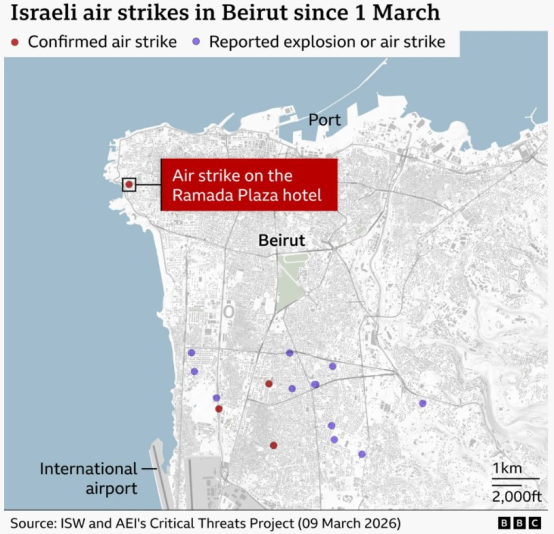
2.3.6 A BBC News article published on 10 March 2026 stated that an ‘… Israeli strike on the four-star Ramada Plaza hotel [where, the Israeli military said, was a secret meeting of Iranian operatives] marked the first time in this war that Israel’s bombing campaign had struck the city centre [of Beirut] - a bustling coastal area full of restaurants and hotels …’[footnote 72]
2.3.7 The BBC News article also included the below map, showing locations of Israeli air strikes in Beirut since 1 March 2026[footnote 73]:
2.3.8 In its evening update of 11 March 2026, ISW-CTP stated: ‘The [Israeli Air Force] IAF reported on March 11 [2026] that it had conducted 200 strikes targeting Hezbollah infrastructure in Beirut since February 28 [2026].’[footnote 74]
2.3.9 The BBC News article, published on 12 March 2026, stated: ‘An IDF spokesperson said Hezbollah’s cross-border attack on Wednesday [11 March 2026] was its biggest so far in this conflict, with approximately 200 rockets and 20 drones launched by the group …’[footnote 75]
2.3.10 The Reuters article, published on 13 March 2026, stated: ‘Israel has been carrying out daily strikes on Lebanon since March 2 [2026] …’[footnote 76]
2.3.11 A BBC News article that was published on 14 March 2026 referred to ‘… hundreds of strikes the Israeli military has carried out in Lebanon since the war with Hezbollah resumed almost two weeks ago. Most have focused on southern Lebanon, the eastern Bekaa Valley, and the southern suburbs of the capital Beirut, known as the Dahieh - the heartlands of Hezbollah and of Lebanon’s Shia Muslim community. Some have also hit the centre of Beirut.’[footnote 77]
2.3.12 The Reuters article published on 16 March 2026 stated that, ‘… Israeli troops pushed into new parts of southern Lebanon.’[footnote 78]
2.3.13 The BBC News article, originally published on 16 March 2026 and updated on 17 March 2026, stated: ‘Lebanese media … reported clashes between Hezbollah fighters and Israeli troops around the Lebanese border towns of Khiam, Aadaysit Marjayoun and Taybeh on Monday [16 March 2026].’[footnote 79]
2.3.14 On 18 March 2026, the International Medical Corps published ‘Middle East Regional Response Situation Report #3’, which stated:
‘Hostilities in Lebanon have intensified significantly since March 2 [2026], evolving into a sustained and large-scale military campaign. Though the frequency of strikes in Beirut and the Bekaa region has decreased relative to last week, strikes have now targeted Aramoun in Mount Lebanon and areas within the Saida Caza. Military activity remains heavily concentrated in the south, with conflict intensifying south of the Litani River and extending further north.’[footnote 80]
2.3.15 The BBC News article, published on 18 March 2026, stated:
‘Israeli strikes hit multiple locations in Beirut … Lebanese authorities said. The escalation marks a widening of Israeli strikes beyond the southern suburbs into central Beirut.
‘… It is … continuing relentless bombardment of the Hezbollah stronghold in south Beirut known as Dahieh … [and] is now [also] targeting other parts of Beirut - sometimes with prior warning, on other occasions without, in what appear to be targeted assassinations including at least two strikes on hotels.’[footnote 81]
2.3.16 The ISW-CTP special report of 19 March 2026 stated: ‘The IDF reported that it has struck approximately 2,000 Hezbollah targets in Lebanon, including 100 high-value targets and 220 time-sensitive targets, with over 2,200 munitions and 1,000 sorties [‘short, quick attack[s] by a military force, such as a small group of soldiers or an aircraft …’[footnote 82]] since March 2 [2026].’[footnote 83]
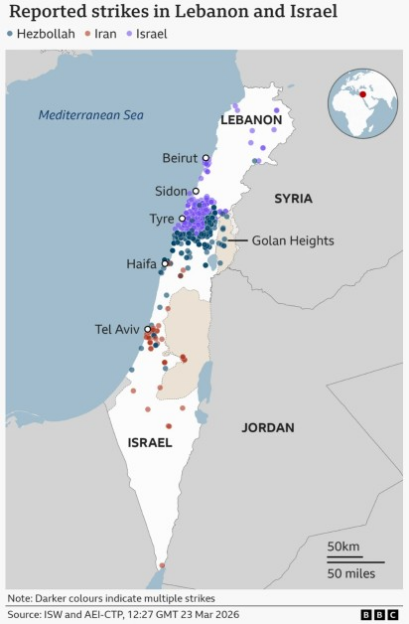
2.3.17 In an article originally published by BBC News on 28 February and updated on 23 March 2026, entitled ‘In maps: Attacks across the Middle East’, the below map was included, showing the locations of reported strikes in Lebanon (and Israel), carried out by Israel, Hezbollah, and Iran[footnote 84]:
2.3.18 On 24 March 2026, the UN High Commissioner for Refugees (UNHCR) published its 3rd flash update on the situation in Lebanon due to the conflict, covering the period from 16 to 22 March 2026. It stated: ‘Intense air and artillery strikes continued across Lebanon over the past week, including in densely populated residential areas of Beirut outside the southern suburbs.’[footnote 85]
2.3.19 The ISW-CTP special report of 31 March 2026 stated: ‘The IDF said on March 31 [2026] that IDF artillery had fired over 700 shells at Hezbollah positions in southern Lebanon in recent days.’[footnote 86]
2.3.20 The ISW-CTP special report of 3 April 2026 stated: ‘The IDF said that it has attacked more than 3,500 targets since the start of Israeli operations in Lebanon on March 2 [2026].’[footnote 87]
2.3.21 An article published by Amnesty International on 8 April 2026 stated: ‘At around 2:30pm [on 8 April 2026], within just 10 minutes the Israeli military launched a series of attacks on at least 48 areas, including on crowded residential neighbourhoods and civilian infrastructure, in the south of Lebanon, north of Lebanon, Mount Lebanon, Bekaa, Beirut suburbs and central Beirut.’[footnote 88]
2.3.22 On 8 April 2026, Armed Conflict Location & Event Data (ACLED), ‘an independent, impartial global monitor that collects, analyses, and maps data on conflict and protest’[footnote 89], published a ‘Middle East Overview: April 2026’ which, citing various sources, stated:
‘In March [2026], political violence involving Israeli military forces in Lebanon intensified. Violence in the country reached its highest levels since the November 2024 ceasefire, with over 2,300 recorded events. Around 100 airstrikes hit Beirut and its southern suburbs, targeting high-rise buildings and sites linked to Hezbollah, including command centers, infrastructure, communication equipment, commanders, IRGC liaison units, and financial institutions such as Al-Qard Al-Hassan. In southern Lebanon, Israel’s strikes focused on al-Nabatieh, Bint Jbeil, Marjayoun, and Tyre, also destroying bridges along the Litani River …
‘Meanwhile, Israeli ground forces advanced into southern Lebanon, reaching up to 8 kilometers north of the Israeli border in some areas. Nearly 45 armed clashes between the IDF and Hezbollah took place across several locations. Most clashes concentrated in the eastern sector of southern Lebanon, especially around al-Khiam, Taybeh, and Deir Siriane. Clashes were also recorded in the western sector near Ras al-Naqoura, as well as in the central area of Bint Jbeil. The majority of confrontations between Hezbollah and Israeli forces, though, took the form of remote attacks, as Hezbollah targeted advancing troops with missiles, drones, and anti-tank rockets.’[footnote 90]
2.3.23 An article published by ACLED on 13 April 2026 stated: ‘… [O]n April 8 [2026] — now labeled in Lebanon as “Black Wednesday” … the Israeli Air Force carried out an extensive bombardment campaign involving 50 fighter jets, 108 airstrikes across the country in 10 minutes, and around 160 bombs.’[footnote 91]
2.3.24 The ISW-CTP special report of 10 April 2026 stated:
‘Hezbollah claimed that it conducted 49 attacks targeting Israeli forces in southern Lebanon between 2:00 PM [Eastern Time] ET on April 9 [2026] and 2:00 PM ET on April 10 [2026]. This marks the highest number of attacks Hezbollah has claimed against IDF forces in Lebanon since March 29 [2026]. Hezbollah claimed 25 attacks against Israeli forces in the vicinity of Bint Jbeil and Ainata, both in the Bint Jbeil District, southeastern Lebanon. An Israeli journalist confirmed that Israeli units directly engaged Hezbollah fighters in Bint Jbeil on April 9 [2026], after the IDF recently isolated the town.’[footnote 92]
2.3.25 The ISW-CTP special report of 11 April 2026 stated:
‘The IDF has limited its strikes in Beirut and Beirut’s southern suburbs in recent days, possibly in response to US requests. An Israeli Army Radio correspondent reported on April 11 [2026] that the IDF has not conducted strikes in Beirut or Beirut’s southern suburbs in the past 48 hours. ISW-CTP has not observed any reported Israeli strikes in Beirut or its suburbs since April 8 [2026], despite the IDF issuing an evacuation order for Beirut’s southern Suburbs on April 9 [2026].’[footnote 93]
2.3.26 The ISW-CTP special report of 12 April 2026 stated:
‘Hezbollah fighters continued to defend against Israeli advances in Bint Jbeil [in southeastern Lebanon] and surrounding towns on April 11 and 12 [2026] … The IDF continued to operate in southwestern Lebanon on April 12 [2026] … The IDF continued to operate near Khiam and Taybeh, southeastern Lebanon, on April 12 … [and t]he IDF has continued to conduct air operations targeting Hezbollah infrastructure and fighters across southern Lebanon.’[footnote 94]
2.3.27 The BBC News article, published on 13 April 2026, stated: ‘Heavy Israeli air strikes were reported across dozens of towns in southern Lebanon on Sunday [12 April 2026] …’[footnote 95]
2.3.28 The ISW-CTP special report of 14 April 2026 stated: ‘The IDF has continued to advance into the operationally and symbolically significant town of Bint Jbeil in southeastern Lebanon.’[footnote 96]
2.3.29 A BBC News article published on 17 April 2026 stated: ‘Trump announced the 10-day truce today [17 April 2026] … However, Israel has said it will not be removing troops from southern Lebanon while Hezbollah has stressed the deal would be contingent on “a comprehensive halt to attacks across all Lebanese territory”’.[footnote 97]
2.3.30 See also Developments and, for maps showing the geographical locations of Hezbollah attacks in southern Lebanon (and northern Israel) and the locations of Israeli strikes in Lebanon by 24 hour periods, see individual ISW-CTP updates (see Bibliography).
3. Civilian impacts
3.1 Deaths and injuries
3.1.1 The below table was produced by CPIT using data published by the UNHCR in a series of flash updates which, citing Lebanese Ministry of Public Health figures, provided the aggregate number of deaths and injuries in Lebanon due to the current hostilities (Note: no breakdown of civilian versus militant deaths and injuries was provided)[footnote 98] [footnote 99] [footnote 100] [footnote 101] [footnote 102] [footnote 103] [footnote 104] [footnote 105]:
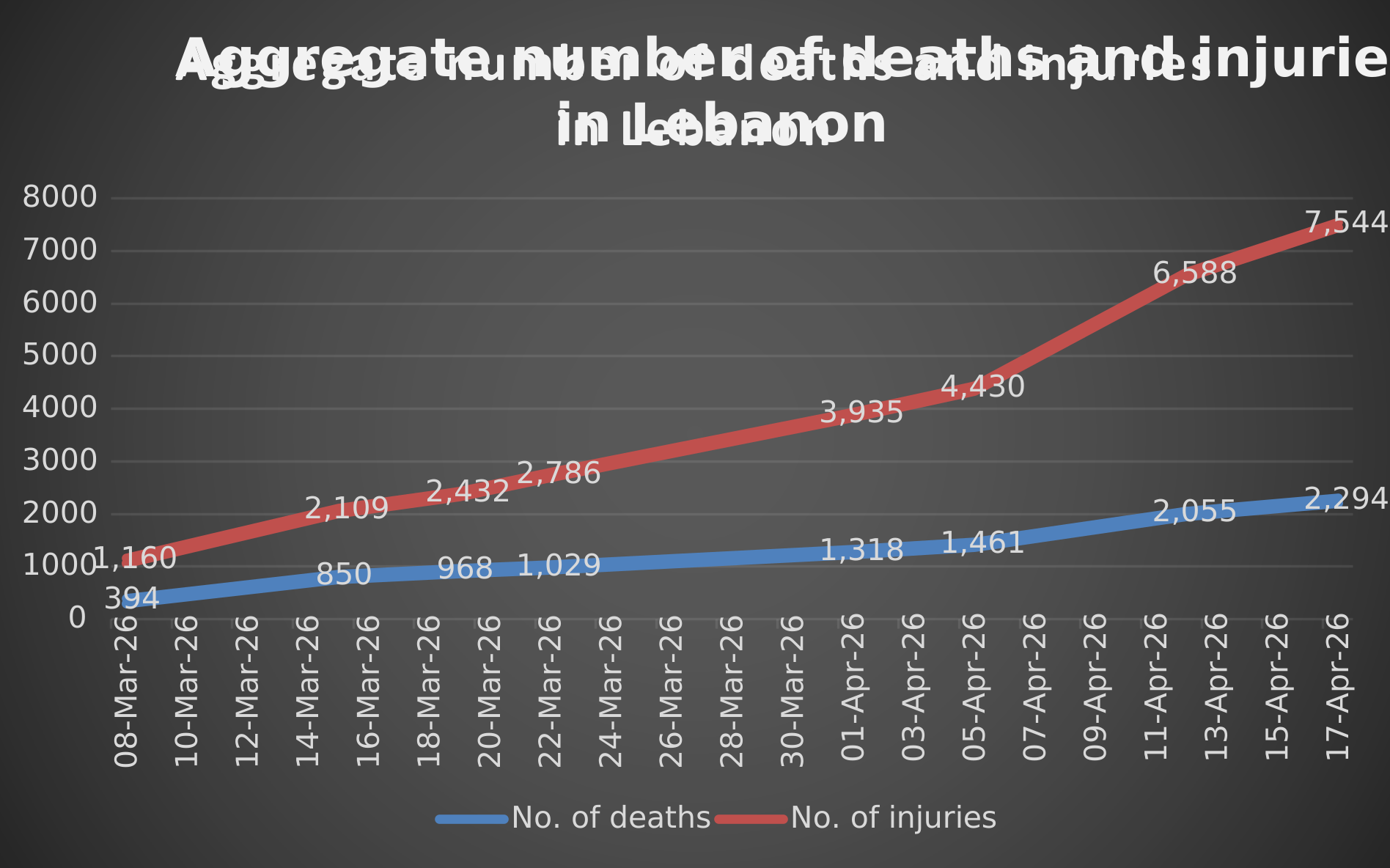
3.1.2 The above graph shows that as of 17 April 2026, the day the ceasefire in Lebanon was declared (see paragraphs 2.2.39 and 2.2.40), 2,294 people were recorded as having been killed during the hostilities, with a further 7,544 injured. While no distinction was made between civilian versus military deaths and injuries, as of 5 April 2026, 97 women and 129 children were recorded by the Lebanese authorities to be among the 1,461 people killed and 4,430 injured.[footnote 106] Further, on 6 April 2026 the IDF claimed that it had killed approximately 1,100 Hezbollah operatives in Lebanon since the renewed hostilities began on 2 March 2026 (see paragraph 2.2.30).[footnote 107] The 1,100 figure for the number of Hezbollah operatives killed was reported also by BBC News on 8 April 2026 which, on the same date, reported a total 1,700 deaths (see paragraph 3.1.16). Taking the above figures as the basis for an estimation of the proportionate number of militant versus civilian deaths, militant deaths are estimated to represent between approximately 65% and 75% of all deaths in Lebanon during the renewed hostilities. Civilian deaths, therefore, are estimated to comprise the remaining 25% to 35% of all deaths in Lebanon during the renewed hostilities. The absolute number of civilian deaths as of 17 April 2026 is therefore estimated to have been between approximately 574 and 803. These figures should be viewed in the context of an estimated Lebanese population of approximately 5.88 million.[footnote 108] Therefore, of the 2,294 reported deaths between 2 March and 17 April 2026, between approximately 0.009% (or 0.09 per 1,000 of the population) and 0.014% (or 0.14 per 1,000 of the population) are estimated to have been civilian deaths.
3.1.3 On 10 March 2026, the International Medical Corps published ‘Middle East Regional Response Situation Report #2’ which stated: ‘According to the Ministry of Public Health, as of March 8 [2026], at least 394 people had been killed and 1,130 injured. Children account for 22% of casualties, with 83 killed and 254 injured.’[footnote 109]
3.1.4 In reference to a strike that hit a hotel in central Beirut on 10 March 2026 (see paragraph 2.3.5), BBC News stated: ‘While the strike hit only a small area of the sprawling hotel, bystanders were among those injured …’[footnote 110]
3.1.5 The BBC News article, published on 14 March 2026, stated: ‘… [T]he BBC visited the remains of a home where eight members of a family, including three children, were killed in a strike … Israel accuses Hezbollah of embedding its military infrastructure in civilian areas … The Lebanese health ministry described the eight people killed as civilians, and a local official confirmed [a relative’s] account that the Lebanese military had inspected the scene and found “no military items or weapons”.’[footnote 111]
3.1.6 The Reuters article published on 16 March 2026 stated: ‘More than 880 people in Lebanon have been killed by Israeli attacks, according to Lebanon’s health ministry, whose figures do not distinguish between fighters and civilians.’[footnote 112] The same article also noted that, ‘Hezbollah rarely discloses its casualty figures.’[footnote 113]
3.1.7 On 17 March 2026, the UN Office of the High Commissioner for Human Rights (OHCHR) published a press briefing note which stated: ‘Since 2 March [2026], at least 886 people have been killed, including at least 111 children, according to Lebanese authorities … with multiple members of the same family, including women and children, often killed together … in recent days, at least 16 medical staff have been killed.’[footnote 114]
3.1.8 The BBC News article, published on 18 March 2026, stated: ‘The Lebanese health ministry says that 968 people, including at least 111 children, have been killed since 2 March [2026].’[footnote 115]
3.1.9 The same BBC News article stated: ‘Civilians are frequently killed in … [Israeli] attacks. One reported Israeli “double tap” airstrike - where a location is hit twice in quick succession - on a car near Beirut’s Corniche seafront last week killed at least 12 people, many of them said to be displaced civilians from elsewhere in the country who had been sheltering in tents.’[footnote 116]
3.1.10 On 18 March 2026, the UN Population Fund (UNFPA) published a situation report on Lebanon, covering the period from 10 to 17 March 2026. The report, which cited various sources, noted that women accounted for 20% of the casualties in Lebanon.[footnote 117]
3.1.11 A press release published by Médecins Sans Frontières (Doctors Without Borders, MSF), ‘an international humanitarian organisation providing medical care’[footnote 118], on 24 March 2026 noted that the 63 attacks on healthcare facilities reported as of 23 March 2026 caused the deaths of 40 healthcare workers and a further 91 to be injured.[footnote 119]
3.1.12 The Reuters article published on 27 March 2026 stated: ‘Lebanon’s health ministry said on Friday that Israeli strikes and ground operations had killed 1,142 people in Lebanon. They include 122 children, 83 women and 42 medical personnel. The health ministry does not otherwise distinguish between civilians and combatants.’[footnote 120]
3.1.13 A BBC News article originally published on 28 March 2026 and updated on 30 March 2026, stated:
‘Three Lebanese journalists were killed in a targeted Israeli strike in southern Lebanon on Saturday [28 March 2026], their employers have said … The Israel Defense Forces (IDF) confirmed it killed … [two of them] describing them as “terrorists” from Hezbollah’s military wing. It said they both operated “under the guise” of journalists. It also said it was aware of reports a female journalist was killed.
‘… This is the second time Israel has been accused of targeting journalists in Lebanon since the US-Israel war against Iran began a month ago. On 18 March [2026], Al Manar reported its presenter Mohammad Sherri and his wife had been killed in an Israeli strike in Beirut while they were sleeping.’[footnote 121]
3.1.14 Another BBC News article published on 28 March 2026, about a 11-year-old boy and his uncle who were killed by an Israeli airstrike in southern Lebanon, referred to ‘… civilians increasingly [being] caught in the crossfire’, and stated ‘Israel says its operations are aimed at Hezbollah targets, but civilians are frequently among those killed.’[footnote 122]
3.1.15 A BBC News article published on 8 April 2026 stated: ‘More than 1,700 people have been killed, including at least 130 children, so far as a result of the war, the Lebanese health ministry says, without distinguishing combatants from civilians. Israel says it has killed around 1,100 Hezbollah fighters.’[footnote 123]
3.1.16 Varying numbers of deaths were initially reported in respect of the large wave of attacks on 8 April 2026; BBC News reported on 8 April 2026 at least 182 people to have been killed according to the Lebanese Health Ministry.[footnote 124] Al Jazeera, in an article also published on 8 April 2026, but which was updated on 9 April 2026, reported at least 203 people to have been killed according to the Lebanese Health Ministry, though it also noted that ‘the country’s Civil Defence’ had put the death toll at more than 250.[footnote 125] On 9 April 2026, the UNHCR reported, in ‘Emergency Flash Update #11’ on the Middle East situation, that the strikes resulted ‘… in over 200 fatalities and more than 1,000 injuries, with search-and-rescue operations ongoing, according to the Minister of Health.’[footnote 126]
3.1.17 Published on 10 April 2026, an HRW article subsequently stated: ‘The Israeli military said on April 8 [2026] that it had launched over 100 strikes “within ten minutes and across multiple areas (in Lebanon) simultaneously,” including in densely populated areas in Beirut, killing at least 303 people and injuring over 1,150 according to Lebanon’s Health Ministry. It was the deadliest day in Lebanon since the escalation of hostilities between Israel and Hezbollah on March 2 [2026].’[footnote 127]
3.1.18 The same HRW article stated: ‘Israeli attacks have killed more than 1,888 people in Lebanon since March 2 [2026], according to Lebanon’s Health Ministry. This includes more than 130 children, 102 women, and 57 medical workers, as of April 7 [2026].’[footnote 128]
3.1.19 The same BBC News article, referring to Israeli airstrikes that were carried out on 12 April 2026, stated:
‘The Israel Defense Forces (IDF) said troops had killed more than 20 Hezbollah fighters operating from a hospital compound in Bint Jbeil. Lebanon’s health ministry denied the claim, accusing Israel of targeting civilians and medical facilities.
‘The weekend strikes also hit emergency responders, killing a Lebanese Red Cross rescuer. The organisation said its team had been “directly targeted by an Israeli drone” while carrying out a humanitarian mission … The death marks the second killing of a Red Cross volunteer in recent weeks. Lebanese authorities say more than 80 rescuers and medical personnel have been killed in Israeli strikes since the start of the war.’[footnote 129]
3.1.20 The ISW-CTP special report of 13 April 2026 stated: ‘The Lebanese Health Ministry reported that the IDF’s April 8 [2026] strikes killed 357 individuals.’[footnote 130] The report did not specify how many of those killed were militants or civilians, however, it is noted that the IDF claimed 250 of those killed to have been militants (see paragraph 2.2.34).
3.1.21 A BBC News article published on 17 April 2026 stated: ‘More than 2,100 people have been killed and 7,000 others wounded in Israel’s attacks on Lebanon since 2 March [2026], according to the Lebanese health ministry, which does not distinguish between combatants and civilians. The number includes at least 260 women and 172 children.’[footnote 131]
3.2 Internal displacements
3.2.1 The below graph was produced by CPIT using data published by the UN High Commissioner for Refugees (UNHCR) in a series of fact sheets, situation maps, and press releases, which cited various sources, showing the number of internally displaced people (IDPs) in Lebanon due to the current hostilities[footnote 132] [footnote 133] [footnote 134] [footnote 135] [footnote 136] [footnote 137] [footnote 138] [footnote 139] [footnote 140] [footnote 141] [footnote 142] [footnote 143] [footnote 144] [footnote 145] [footnote 146] [footnote 147] [footnote 148] [footnote 149] [footnote 150] [footnote 151] [footnote 152] [footnote 153]:
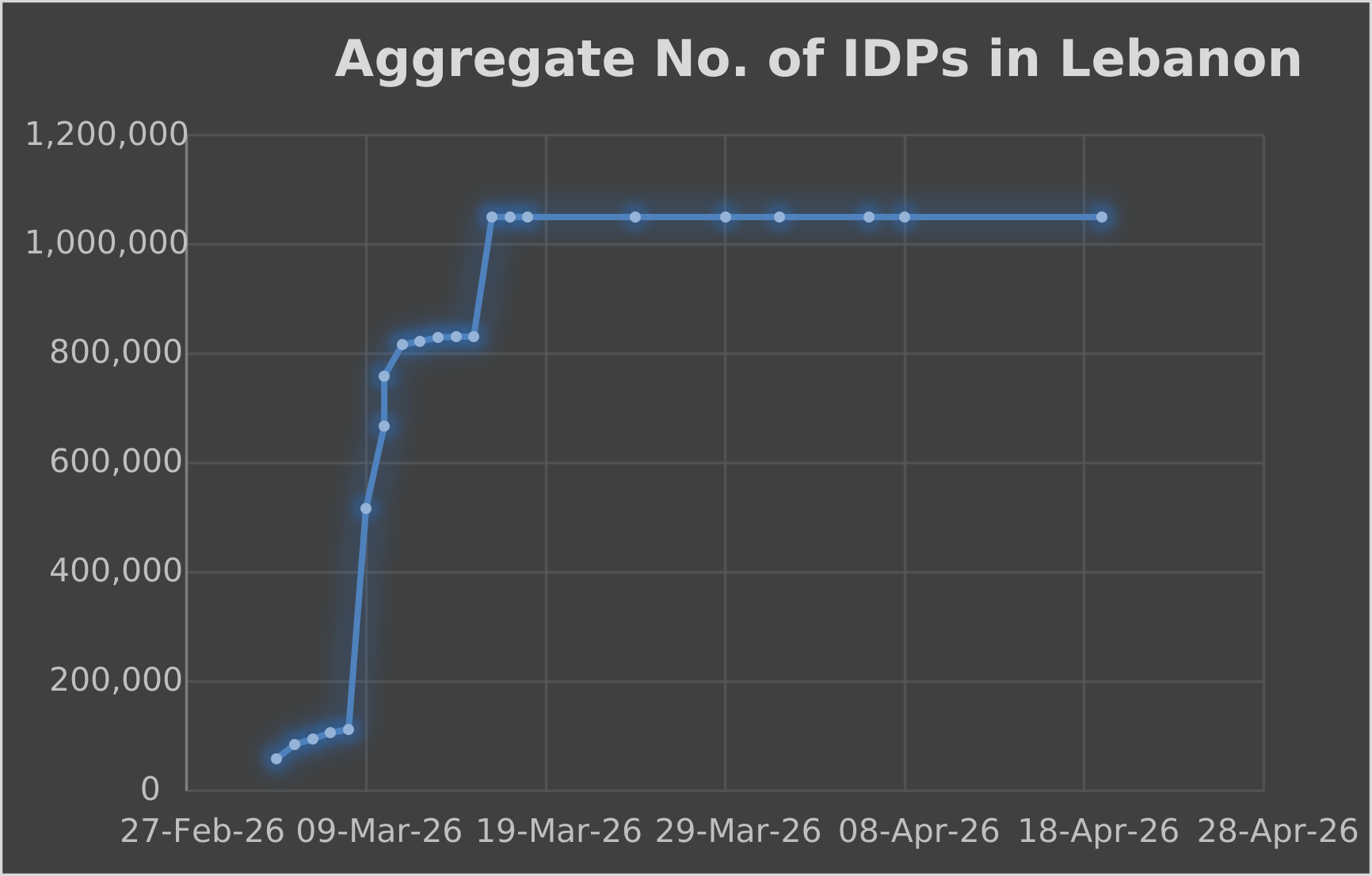
3.2.2 The above graph shows that since 16 March 2026, and as of 19 April 2026, 2 days after the ceasefire in Lebanon came into effect (see paragraphs 2.2.39 to 2.2.40), there have been approximately 1.05 million IDPs in Lebanon. In the context of an estimated Lebanese population of approximately 5.88 million[footnote 154], approximately 18% of the country’s population have been internally displaced due to the renewed hostilities that began on 2 March 2026.
3.2.3 The SARI Global emergency flash situation report, published on 2 March 2026, stated: ‘Amid widespread reports of imminent Israeli retaliation [to dozens of precision guided missiles and unmanned aerial systems that were launched from Lebanon to northern Israel[footnote 155], SARI Global sources confirm that mass displacement has already commenced. Hundreds of families have begun hastily evacuating the South Lebanon and Nabatieh governorates, heading north toward perceived safe zones.’[footnote 156]
3.2.4 An HRW article published on 2 March 2026 stated: ‘The Israeli military issued at least 18 evacuation warnings on March 2 [2026] ahead of what it said were incoming strikes targeting the Hezbollah-affiliated financial institution al-Qard al-Hassan in Lebanon.’[footnote 157]
3.2.5 On 3 March 2026, UN Population Fund (UNFPA) published a flash update on the situation in Lebanon within the regional conflict. It stated:
‘Israeli forced evacuation orders on 3 March 2026 for over 50 villages have triggered a massive displacement wave, with residents fleeing South Lebanon and Beirut’s southern suburbs to overcrowded public schools repurposed as collective shelters. More than 58,000 internally displaced people have been registered within two days and thousands more still remain in transit. This new wave is on top of 65,000 people who still remain displaced from the 2024 conflict, which previously saw displacement figures peak at 1 million.’[footnote 158]
3.2.6 The BBC News article published on 4 March 2026 stated:
‘The Israeli military has told civilians living in a large swathe of southern Lebanon to leave their homes immediately and move north of the Litani River because of intended military action against Hezbollah.
‘… Tens of thousands of people in Lebanon have already been displaced since fighting erupted on Monday [2 March 2026].
‘… In the capital, Beirut, displaced civilians have been sleeping in shelters, on roadsides, in parks and in their cars.
‘… Those displaced have fled from southern Lebanon, the eastern Bekaa Valley, and the Dahieh suburbs of southern Beirut - the heartlands of Hezbollah and of Lebanon’s Shia Muslim community.
‘… Everyone the BBC spoke to had been displaced multiple times before by hostilities between Israel and Hezbollah …’[footnote 159]
3.2.7 An HRW article published on 5 March 2026 stated:
‘On March 2 [2026], after the escalation of hostilities between Hezbollah and Israel, the Israeli military first called for the evacuation of over 50 southern Lebanese villages and towns. A few hours later, an Israeli military spokesperson called on residents who evacuated their homes not to return, repeating the statement the following day. By March 3 [2026], the Israeli military had called for the evacuation of over 100 villages and towns in southern Lebanon and the Bekaa Valley, according to United Nations Under-Secretary-General for Humanitarian Affairs and Emergency Relief Coordinator Tom Fletcher. Tens of thousands of people have been displaced in Lebanon since.’[footnote 160]
3.2.8 A BBC News article published on 6 March 2026 stated: ‘The [evacuation] orders are unprecedented in their scale, with hundreds of thousands of people affected.’[footnote 161] The same article noted that ‘… almost 96,000 people [were] officially registered at displacement centres across the country.’[footnote 162]
3.2.9 The NRC press release, published on 6 March 2026, stated:
‘According to NRC’s estimates, 300,000 people have already been displaced, less than 100 hours after Israel launched a wave of airstrikes and evacuation orders in South Lebanon, Beirut, and other areas … The new Israeli mass evacuation orders engulf hundreds of villages in South Lebanon, as well as villages in the Bekaa and the entire southern suburbs of Beirut, constituting a large area of Lebanese territory, with the number of people who could be displaced potentially exceeding one million.’[footnote 163]
3.2.10 An HRW article published on 6 March 2026 stated:
‘… Kristine Beckerle, Deputy Regional Director for the Middle East and North Africa at Amnesty International said today: “… [O]verly broad [evacuation] warnings covering vast areas of Lebanon … provide no meaningful information about where or when the Israeli military might strike and offer civilians nowhere near the level of guidance needed to make informed decisions about whether, or for how long, to flee. Many civilians, including older people, children, people with disabilities, cannot evacuate, or may have nowhere safe to go …”’[footnote 164]
3.2.11 On 9 March 2026, the UNHCR published its first flash update on the situation in Lebanon due to the conflict, covering the period from 2 to 8 March 2026. It stated:
‘Since the launch of the Government’s relief platform where people can self-register the number of displaced persons who registered via the link reached approximately 517,000 people, including non Lebanese. Within the first week, the Government already had to expand the number of collective shelters for IDPs, from the initially activated 325 to 700. These collective shelters should be open to all nationalities, including non-Lebanese, within an inclusive emergency response. At the fast pace of displacement, shelters are quickly reaching maximum capacity. As of 8 March [2026], more than 117,000 displaced people are sheltering in 538 collective shelters; but as illustrated by the overall displacement figures, they only account for about 23% of those displaced as others are staying with relatives, renting apartments, sleeping in their cars or on the streets. Government hotlines are open to help direct people to available support.’[footnote 165]
3.2.12 The first flash update also stated: ‘Of the 21 Community Development Centres (CDCs) UNHCR supports nationwide, 13 remain operational while eight, located in Baalbek, the South, and Beirut’s Southern Suburbs, are closed due to the security. CDCs are receiving displaced refugee and Lebanese families …’[footnote 166]
3.2.13 The BBC News article, published on 12 March 2026, stated that the Israeli military ‘… expanded a blanket evacuation order for southern Lebanon, almost doubling the size of the zone it has said residents should leave for their safety. It now covers almost the entire area south of the Zahrani river, which flows east to west about 40km (25 miles) from the Israeli border, according to a map posted online.’[footnote 167]
3.2.14 The same article included the below map of southern Lebanon, illustrating the expansion of the evacuation order by Israel on 12 March 2026[footnote 168]:
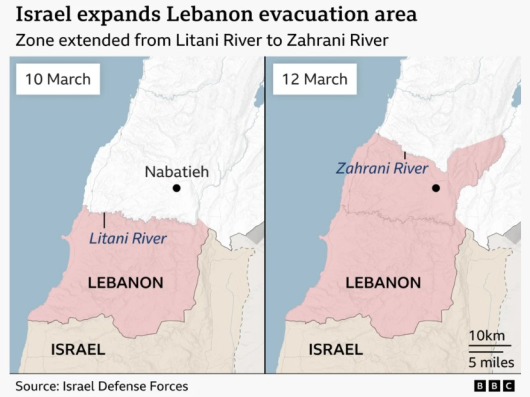
3.2.15 The NRC published a press release on 13 March 2026 which stated: ‘At least 816,000, or 14 per cent of Lebanon’s population, have been displaced, according to official figures … Israel’s evacuation orders have now engulfed 1,470 square kilometres, or 14 per cent of Lebanon, including South Lebanon, Beirut’s Southern Suburb, and parts of Bekaa.’[footnote 169]
3.2.16 An article published by MSF on 13 March 2026 added:
‘People from nearly 200 villages and towns were forced to evacuate in less than two weeks.
‘We have witnessed people fleeing areas that fall below Zahrani River towards the north and are closely monitoring the impact of these new evacuation orders. This time though, more people have decided not to evacuate, often because shelters are full, routes are unsafe, they have no means to move again, or they simply have nowhere else to go – which likely contributes to higher civilian exposure and rising casualties.
At the same time, families are carrying the financial and psychological toll of repeated displacement: the loss of homes and livelihoods, mounting debt, exhaustion, trauma, and a lack of access to care, are all making it harder to cope.’[footnote 170]
3.2.17 The Reuters article published on 16 March 2026 stated: ‘Israel on Monday [16 March 2026] warned that displaced Lebanese driven from their homes by its military campaign would not be able to return until the safety of Israelis living near the border was ensured …’[footnote 171]
3.2.18 On 16 March 2026, the UNHCR published its 2nd flash update on the situation in Lebanon which stated:
‘As displacement increases, the Government continues to activate collective shelters with 620 open of the 700 identified … Government representatives have reaffirmed an inclusive emergency shelter policy, open to all nationalities, including refugees. Collective shelters are currently hosting 130,715 displaced persons, with newly opened shelters quickly reaching full capacity, especially those in Beirut and Mount Lebanon. However, most of the displaced people are staying with relatives, renting temporary accommodation, or sheltering in cars or on the streets. Overcrowding is increasingly common, with multiple families sharing single apartments to reduce costs amid soaring living expenses and limited housing options.’[footnote 172]
3.2.19 The OHCHR press briefing note, published on 17 March 2026, stated: ‘Entire families are sleeping in makeshift tents on the streets, exposed to harsh weather such as the recent storms … People displaced by the fighting and living in tents along Beirut’s seafront have … been hit [by Israeli airstrikes] …’[footnote 173]
3.2.20 The UNFPA situation report, published on 18 March 2026, noted that 1.05 million people were reported by the government of Lebanon as displaced due to them being registered as displaced, but that many families remained unregistered.[footnote 174]
3.2.21 An article published by HRW on 23 March 2026 stated:
‘On March 22 [2026], Israel’s defense Minister, Israel Katz, issued a statement announcing that he and Israel’s Prime Minister Benjamin Netanyahu have “ordered the acceleration of the demolition of Lebanese houses in the border villages in order to thwart threats to Israeli communities …”
‘… Displacement orders issued by the Israeli military to residents of the southern suburbs of Beirut between March 11 and 15 [2026] … stated that the Israeli military “will not hesitate to target anyone who is present near Hezbollah members, facilities, or means of combat.”’[footnote 175]
3.2.22 The same HRW article also stated: ‘The Israeli defense minister’s statement (see paragraph 3.2.17), indicating that Shiite residents of southern Lebanon will be prevented from returning to their homes until an undetermined safety standard for Israel’s northern residents is guaranteed, signals that Israel will prevent residents from returning to their homes for an indefinite period.’[footnote 176]
3.2.23 The UNHCR 3rd flash update on the situation in Lebanon, published on 24 March 2026, stated:
‘One … attack … took place in a neighbourhood – Zuqaq al-Blat – where several collective shelters hosting internally displaced people are located, adding to the fear and trauma many of them are already feeling …
‘… Displacement has been propelled by repeated evacuation orders across southern Lebanon, parts of Beirut and the Bekaa, including a new geographic evacuation warning issued to all of Tyre, covering Palestinian refugee camps and surrounding areas. While hundreds of collective shelters have been activated, most displaced people stay outside shelters, with an estimated half of the displaced refugees identified being hosted by family or friends, 31% renting temporary accommodation, and 13% staying in open or improvised spaces.’[footnote 177]
3.2.24 The BBC News article, originally published on 28 February 2026 and updated on 8 April 2026, stated: ‘More than a million people - roughly one in every six in the country - have been displaced from their homes, Lebanon’s government said.’[footnote 178]
3.2.25 The BBC News article published on 8 April 2026 stated:
‘Over 1.2 million people have been displaced [so far as a result of the war], or one in five of the population, most of them from Shia Muslim communities. Villages near the border have been destroyed, as invading Israeli troops aim to create what the Israeli authorities call a security buffer zone, to destroy Hezbollah’s infrastructure and push its fighters away. This has raised concerns that some areas may be occupied even after the end of the war, and that many residents may never be able to return.’[footnote 179]
3.2.26 The UNHCR emergency flash update #11 on the Middle East situation, published on 9 April 2026, stated: ‘The strikes [on 8 April 2026, see Developments] created widespread panic and triggered new displacement across Beirut, Bekaa, and the South. The [US-Iran 2 week] ceasefire announcement had briefly prompted some families to return, only to face renewed attacks.’[footnote 180]
3.2.27 The same flash update stated: ‘In Lebanon, more than 1.05 million people remain internally displaced — 35 per cent of them children — with over 138,700 staying in 678 government-designated collective shelters.’[footnote 181]
3.2.28 A BBC News article published on 17 April 2026 stated: ‘Despite the [Israel –Lebanon ceasefire] agreement, Lebanese officials and Hezbollah urged residents in affected areas not to return to their homes immediately’.[footnote 182]
3.2.29 The Al Jazeera article published on 17 April 2026 stated:
‘… [D]isplaced people in downtown Beirut told Al Jazeera they didn’t trust the Israelis to uphold the ceasefire and would wait before returning to their homes – if they have homes to return to at all.
‘… In a post on X, the Lebanese army also renewed its call for citizens to “exercise caution in returning to southern villages and towns” as the ceasefire takes effect in Lebanon.
‘… Israeli military spokesperson Avichay Adraee issued an “urgent message” to the residents of southern Lebanon, warning them to remain north of the Litani River despite the commencement of the ceasefire.
‘… In a statement carried by Lebanon’s National News Agency on Thursday [16 April 2026], Hezbollah had also urged displaced people to remain cautious amid uncertainty over the truce.
‘… But people are eager to return to their homes in the south despite … ceasefire violations.’[footnote 183]
3.2.30 On 20 April 2026, the UNHCR published a fact sheet on displacement due to the hostilities in the Middle East which noted that, as of 19 April 2026, 1.05 million remained displaced in Lebanon of which, 35% were estimated to be children and 111,600 were registered in 659 collective shelters nationwide.[footnote 184]
3.3 Other impacts
3.3.1 The International Medical Corps situation report #1, published on 3 March 2026, stated: ‘The escalation has disrupted access to primary healthcare in multiple areas. Several primary healthcare centers have suspended operations due to insecurity, access constraints, staff displacement, road closures, fuel shortages and movement restrictions.’[footnote 185]
3.3.2 The NRC press release, published on 6 March 2026, stated: ‘Children remain among those most affected [by the conflict]. With schools turned into shelters and families uprooted again, education has been disrupted and children are facing renewed trauma and uncertainty. “The psychological impact of renewed violence cannot be overstated,” [said Maureen] Philippon [the country director for NRC in Lebanon] …’[footnote 186]
3.3.3 The UNHCR first flash update on the conflict situation in Lebanon, published on 9 March 2026, stated: ‘The hostilities are driving extreme fear, anxiety, and psychological distress, particularly among communities already worn down by years of instability and repeated displacement.’[footnote 187]
3.3.4 An article published by the UN World Health Organization (WHO) on 11 March 2026 stated: ‘In Lebanon, 49 primary health care centres and five hospitals have shut following evacuation orders issued by Israel’s military, reducing the availability of essential services as medical needs rise.’[footnote 188]
3.3.5 The Amnesty International article, published on 12 March 2026, stated: ‘Many al-Qard al-Hassan offices are located within residential buildings or in crowded neighbourhoods. The attacks across [its branches in] Beirut’s southern suburbs, south Lebanon and the Beqaa, have destroyed facilities used by tens of thousands of civilians to access financial services, including loans to pay for school fees, healthcare expenses and vehicles to commute to work.’[footnote 189]
3.3.6 On 13 March 2026, the WFP published situation report #2 on the emergency response in the Middle East, which stated: ‘Tensions are rising across Lebanon, driven by mass displacement, misinformation, and pressure on host communities. Host areas are experiencing growing pressure, regulatory restrictions, and localized disputes.’[footnote 190]
3.3.7 The OHCHR press briefing note, published on 17 March 2026, stated:
‘Israeli airstrikes have destroyed hundreds of homes and civilian infrastructure, including healthcare facilities …
‘In many instances, Israeli airstrikes have destroyed entire residential buildings in dense urban environments …’[footnote 191]
‘… With … [the level of] displacement [seen in Lebanon] comes a wide array of human rights concerns: proper healthcare, sufficient food and drinking water are lacking. Education has been interrupted for another academic year, freedom of movement no longer exists, and livelihoods have now been lost. And while people are displaced, Israeli attacks are destroying and damaging their houses, farmland, and other civilian infrastructure.
‘We have also received reports of discrimination against displaced people in the Lebanese rental market, alongside a rise in hateful rhetoric targeting certain communities on social media.
‘Those who have stayed in southern Lebanon now face heightened isolation and growing obstacles to access humanitarian aid, as Israeli airstrikes have destroyed bridges linking the south to the rest of the country.’[footnote 192]
3.3.8 The UNFPA situation report, published on 18 March 2026, stated: ‘Large-scale displacement and disruptions to health services are leaving women and girls without access to life-saving sexual and reproductive healthcare and protection services.’[footnote 193]
3.3.9 On 19 March 2026, the UN World Food Programme (WFP) published situation report #3 on the emergency response in the Middle East, which stated: ‘During the second week of March [2026], essential food prices continued to rise in Lebanon, increasing pressure on household purchasing power.’[footnote 194]
3.3.10 On 27 March 2026, the UNHCR published a briefing note, providing a summary of the words of Karolina Lindholm Billing, a UNHCR representative for Lebanon, at a press briefing of the same date, which stated:
‘Overcrowding, shared classrooms and limited access to sanitation and other basic services [in collective shelters, mostly schools] significantly increase protection risks, including exposure to exploitation and gender-based violence. Older people and those with disabilities are particularly affected, struggling to sleep on classroom floors or use facilities designated for children. Stress and trauma intensify in these cramped, substandard conditions.’[footnote 195]
3.3.11 A situation update published by WHO on 24 March 2026 noted that since 2 March 2026, 64 attacks on healthcare were reported in Lebanon, 5 hospitals were closed, 9 hospitals were partially damaged, and 50 Primary Health Care centres (PHCs) were closed, which limited access to essential services.[footnote 196]
3.3.12 The MSF press release, published on 24 March 2026, stated:
‘Despite forced displacement orders, many people have chosen to stay [south of the Litani river], rather than abandon their homes and villages. Others have had no choice due to socio-economic and medical vulnerabilities. This has made it extremely difficult for them to access medical care, and similarly difficult for medical and humanitarian workers to reach them. “Hospital staff in Nabatiyeh, who decided to continue working there, have no choice but to shelter inside the hospital, avoiding car travel, and in search of safety,” says Dr Luna Hammad, MSF medical coordinator.’[footnote 197]
3.3.13 The UNHCR emergency flash update #9 on the Middle East situation, published on 2 April 2026, noted that,
‘Following airstrikes near shelters in Beirut, UNHCR and partners conducted immediate follow-up, including site visits, safety assessments, and referrals for injured and highly distressed individuals. Partners report heightened fear, acute stress reactions, and sleep disturbances, particularly among children. Damage to windows and shelter infrastructure in sites hosting more than 1,200 displaced people reduced safety and weatherproofing, prompting urgent repairs prioritizing older persons, children, and individuals with specific needs.’[footnote 198]
3.3.14 The HRW article published on 10 April 2026 noted that the 8 April 2026 Israeli airstrikes ‘… damaged the last main bridge linking southern Lebanon with the rest of the country … threaten[ing] to sever tens of thousands of people in southern Lebanon from access to humanitarian aid, food, and health care.’[footnote 199]
3.3.15 A BBC News article published on 17 April 2026 stated: ‘On Thursday [16 April 2026], the Israeli military destroyed the last bridge linking the south to the rest of the country, further isolating the region …’[footnote 200]
Research methodology
The country of origin information (COI) in this note has been carefully selected in accordance with the general principles of COI research as set out in the Common EU [European Union] Guidelines for Processing Country of Origin Information (COI), April 2008, and the Austrian Centre for Country of Origin and Asylum Research and Documentation’s (ACCORD), Researching Country Origin Information – Training Manual, 2024. Namely, taking into account the COI’s relevance, reliability, accuracy, balance, currency, transparency and traceability.
Sources and the information they provide are carefully considered before inclusion. Factors relevant to the assessment of the reliability of sources and information include:
- the motivation, purpose, knowledge and experience of the source
- how the information was obtained, including specific methodologies used
- the currency and detail of information
- whether the COI is consistent with and/or corroborated by other sources
Commentary may be provided on source(s) and information to help readers understand the meaning and limits of the COI.
Wherever possible, multiple sourcing is used and the COI compared to ensure that it is accurate and balanced, and provides a comprehensive and up-to-date picture of the issues relevant to this note at the time of publication.
The inclusion of a source is not, however, an endorsement of it or any view(s) expressed.
Each piece of information is referenced in a footnote.
Full details of all sources cited and consulted in compiling the note are listed alphabetically in the bibliography.
Bibliography
Sources cited
Al Jazeera:
-
What we know about the Israel-Lebanon ceasefire, 17 April 2026. Accessed: 20 April 2026
-
World reacts to ‘brutal’ Israeli attacks on Lebanon after US-Iran truce, 8 April 2026, updated 9 April 2026. Accessed: 17 April 2026
Amnesty International:
-
Lebanon: Israeli air strikes on al-Qard al-Hassan financial institution must be investigated as war crimes, 12 March 2026. Accessed: 14 April 2026
-
Lebanon: Urgent call to protect civilians as death toll mounts following brutal escalation in Israeli attacks, 8 April 2026. Accessed: 17 April 2026
Armed Conflict Location & Event Data (ACLED):
-
About ACLED, no date. Accessed: 7 May 2026
-
Bassel Doueik on escalation of Israeli attacks over Lebanon after “Black Wednesday”, 13 April 2026. Accessed: 17 April 2026
-
Middle East Overview: April 2026, 8 April 2026. Accessed: 17 April 2026
BBC News:
-
At least 182 killed across Lebanon in large wave of Israeli strikes, 8 April 2026. Accessed: 17 April 2026
-
BBC visits aftermath of Israeli strike on Lebanon that killed family as IDF targets Hezbollah, 14 March 2026. Accessed: 13 April 2026
-
Ceasefire in Lebanon comes into force as Iran truce enters final week, 17 April 2026. Accessed: 20 April 2026
-
Israel destroys river bridges in southern Lebanon, 18 March 2026. Accessed: 10 April 2026
-
Israeli troops push into Lebanon for yet another war with Iran’s proxy Hezbollah, 6 March 2026. Accessed: 15 April 2026
-
Israel pounds Beirut suburbs and south Lebanon after Hezbollah rocket barrage, 12 March 2026. Accessed: 14 April 2026
-
Israel says it will take control of large buffer zone in southern Lebanon, 24 March 2026. Accessed: 10 April 2026
-
Israel says ‘limited’ ground operations under way in Lebanon, 16 March 2026, updated 17 March 2026. Accessed: 13 April 2026
-
Israel steps up strikes on Lebanon and Hezbollah attacks continue as talks loom, 13 April 2026. Accessed: 14 April 2026
-
Israel strikes Beirut after evacuation warning sparks panic, 5 March 2026, updated 6 March 2026. Accessed: 15 April 2026
-
Israel strikes Lebanon after Hezbollah rocket fire as Iran conflict widens, 2 March 2026. Accessed: 15 April 2026
-
Israel tells people in large parts of southern Lebanon to leave ahead of attacks, 4 March 2026. Accessed: 15 April 2026
-
Tears and defiance as Lebanese family bury child, 11, killed in Israeli strike, 28 March 2026. Accessed: 17 April 2026
-
Three Lebanese journalists killed in Israeli strike, say broadcasters, 28 March 2026, updated 30 March 2026. Accessed: 17 April 2026
-
War expands to central Beirut as Israeli strike kills Iranians in luxury hotel, 10 March 2026. Accessed: 14 April 2026
-
‘We couldn’t sleep because of fear’: Residents flee as Israel pounds south Beirut, 6 March 2026. Accessed: 15 April 2026
-
What we know about the Israel-Lebanon ceasefire, 17 April 2026. Accessed: 20 April 2026
-
Why did US and Israel attack Iran and how long could the war last?, 28 February 2026, updated 8 April 2026. Accessed: 14 April 2026
Cambridge Dictionary, Sortie, no date. Accessed: 21 April 2026
Ecoi.net:
-
Source description: Critical Threats Project (CTP), 26 January 2023. Accessed: 20 April 2026
-
Source description: Institute for the Study of War (ISW), 30 May 2023. Accessed: 20 April 2026
-
Source description: International Crisis Group, 1 December 2021. Accessed: 14 April 2026
Human Rights Watch (HRW):
-
Israeli Military Calls for Evacuating Southern Lebanon, 5 March 2026. Accessed: 15 April 2026
-
Israeli Officials Signal Stepped-Up Atrocities in Lebanon, 23 March 2026. Accessed: 10 April 2026
-
Lebanon/Israel: Civilians at Grave Risk of Abuse, 2 March 2026. Accessed: 15 April 2026
-
Lebanon: Israeli military’s overly broad mass evacuation orders sowing panic and fuelling humanitarian suffering, 6 March 2026. Accessed: 15 April 2026
-
Lebanon: Israeli Strikes Kill Hundreds, Damage Vital Bridge, 10 April 2026. Accessed: 17 April 2026
-
Lebanon: Israel Unlawfully Using White Phosphorus, 9 March 2026. Accessed: 14 April 2026
Institute for the Study of War and the Critical Threats Project (ISW-CTP):
-
Iran Update Evening Special Report, March 11, 2026, 11 March 2026. Accessed: 17 April 2026
-
Iran Update Evening Special Report, March 2, 2026, 3 March 2026. Accessed: 17 April 2026
-
Iran Update Evening Special Report, March 3, 2026, 3 March 2026. Accessed: 17 April 2026
-
Iran Update Evening Special Report, March 4, 2026, 4 March 2026. Accessed: 17 April 2026
-
Iran Update Evening Special Report, March 8, 2026, 8 March 2026. Accessed: 17 April 2026
-
Iran Update Morning Special Report, March 10, 2026, 10 March 2026. Accessed: 17 April 2026
-
Iran Update Morning Special Report, March 2, 2026, 2 March 2026. Accessed: 17 April 2026
-
Iran Update Morning Special Report, March 3, 2026, 3 March 2026. Accessed: 17 April 2026
-
Iran Update Morning Special Report, March 4, 2026, 4 March 2026. Accessed: 17 April 2026
-
Iran Update Special Report, April 10, 2026, 10 April 2026. Accessed: 16 April 2026
-
Iran Update Special Report, April 11, 2026, 11 April 2026. Accessed: 16 April 2026
-
Iran Update Special Report, April 12, 2026, 12 April 2026. Accessed: 16 April 2026
-
Iran Update Special Report, April 13, 2026, 13 April 2026. Accessed: 16 April 2026
-
Iran Update Special Report, April 14, 2026, 14 April 2026. Accessed: 16 April 2026
-
Iran Update Special Report, April 15, 2026, 15 April 2026. Accessed: 16 April 2026
-
Iran Update Special Report, April 3, 2026, 3 April 2026. Accessed: 16 April 2026
-
Iran Update Special Report, April 4, 2026, 4 April 2026. Accessed: 16 April 2026
-
Iran Update Special Report, April 5, 2026, 5 April 2026. Accessed: 16 April 2026
-
Iran Update Special Report, April 6, 2026, 6 April 2026. Accessed: 16 April 2026
-
Iran Update Special Report, April 8, 2026, 8 April 2026. Accessed: 16 April 2026
-
Iran Update Special Report, April 9, 2026, 9 April 2026. Accessed: 16 April 2026
-
Iran Update Special Report, March 19, 2026, 19 March 2026. Accessed: 16 April 2026
-
Iran Update Special Report, March 20, 2026, 20 March 2026. Accessed: 16 April 2026
-
Iran Update Special Report, March 23, 2026, 23 March 2026. Accessed: 16 April 2026
-
Iran Update Special Report, March 27, 2026, 27 March 2026. Accessed: 16 April 2026
-
Iran Update Special Report, March 28, 2026, 28 March 2026. Accessed: 16 April 2026
-
Iran Update Special Report, March 31, 2026, 31 March 2026. Accessed: 16 April 2026
-
International Crisis Group (ICG), A Sprawling Middle East War Explodes, 6 March 2026. Accessed: 14 April 2026
International Medical Corps:
-
Middle East Regional Response Situation Report #1, 3 March 2026. Accessed: 13 April 2026
-
Middle East Regional Response Situation Report #2, 10 March 2026. Accessed: 13 April 2026
-
Middle East Regional Response Situation Report #3, 18 March 2026. Accessed: 10 April 2026
Israel Ministry of Defense, Defense Minister – Israel Katz, no date. Accessed: 10 April 2026
Médecins Sans Frontières (Doctors Without Borders, MSF):
-
About us, no date. Accessed: 22 April 2026
-
Lebanon: Families face uncertainty under bombardment and new evacuation orders, 13 March 2026. Accessed: 13 April 2026
-
People in Lebanon are being cut off from care as Israeli attacks intensify, 24 March 2026. Accessed: 10 April 2026
Mental Health Innovation Network (MHIN), International Medical Corps, no date. Accessed: 21 April 2026
Norwegian Refugee Council (NRC):
-
Lebanon: One in seven displaced, 1,500 square kilometres under evacuation orders, 13 March 2026. Accessed: 21 April 2026
-
Lebanon: 300,000 already displaced as Israel issues mass evacuation orders, 6 March 2026. Accessed: 15 April 2026
Reuters:
-
Israeli evacuation orders affect 14% of Lebanon, NGO says, 13 March 2026. Accessed: 13 April 2026
-
Israel says Lebanese displaced won’t return until its own citizens are safe, 16 March 2026. Accessed: 16 April 2026
-
More than 400 Hezbollah fighters killed in new war with Israel so far, sources say, 27 March 2026. Accessed: 16 April 2026
SARI Global:
-
About Us, no date. Accessed: 15 April 2026
-
Emergency Flash Sitrep; Major Escalation: Israel and Hezbollah Conflict, 2 March 2026. Accessed: 15 April 2026
The Jerusalem Post, Inside Hezbollah’s elite Radwan Force: Structure, strategy, and operations – explainer, 20 September 2024. Accessed: 20 April 2026
The Times of Israel:
-
IDF advances deeper into south Lebanon, takes control of strategic positions, 29 March 2026. Accessed: 17 April 2026
-
IDF says it has killed 1,100 Hezbollah operatives since start of war, 6 April 2026. Accessed: 16 April 2026
UN High Commissioner for Refugees (UNHCR):
-
Emergency Flash Update #11; Middle East Situation; 9 April 2026, 9 April 2026. Accessed: 10 April 2026
-
Emergency Flash Update #6; Middle East Situation; 19 March 2026, 20 March 2026. Accessed: 8 April 2026
-
Emergency Flash Update #9; Middle East Situation; 02 April 2026, 2 April 2026. Accessed: 9 April 2026
-
Lebanon - Flash Update #1; 2 - 8 March 2026, 9 March 2026. Accessed: 8 April 2026
-
Middle East Situation as of 1 April 2026, 2 April 2026. Accessed: 9 April 2026
-
Middle East Situation as of 10 March 2026, 11pm GMT, 11 March 2026. Accessed: 8 April 2026
-
Middle East Situation as of 11 March 2026, 12 March 2026. Accessed: 8 April 2026
-
Middle East Situation as of 12 March 2026 5pm GMT, 13 March 2026. Accessed: 8 April 2026
-
Middle East Situation as of 13 March 2026 11pm GMT, 14 March 2026. Accessed: 8 April 2026
-
Middle East Situation as of 14 March 2026 11pm GMT, 15 March 2026. Accessed: 8 April 2026
-
Middle East Situation as of 15 March 2026, 16 March 2026. Accessed: 8 April 2026
-
Middle East Situation as of 16 March 2026, 11pm GMT, 17 March 2026. Accessed: 8 April 2026
-
Middle East Situation as of 17 March 2026, 11pm GMT, 18 March 2026. Accessed: 8 April 2026
-
Middle East Situation as of 18 March 2026, 19 March 2026. Accessed: 8 April 2026
-
Middle East Situation as of 19 April 2026, 20 April 2026. Accessed: 21 April 2026
-
Middle East Situation as of 24 March 2026, 25 March 2026. Accessed: 9 April 2026
-
Middle East Situation as of 29 March 2026, 30 March 2026. Accessed: 9 April 2026
-
Middle East Situation as of 4 March 2026, 4 March 2026. Accessed: 8 April 2026
-
Middle East Situation as of 6 April 2026, 7 April 2026. Accessed: 10 April 2026
-
Middle East Situation as of 6 March 2026, 6 March 2026. Accessed: 8 April 2026
-
Middle East Situation as of 7 March 2026 5pm GMT, 7 March 2026. Accessed: 8 April 2026
-
Middle East Situation as of 8 April 2026, 9 April 2026. Accessed: 10 April 2026
-
Middle East Situation as of 8 March 2026 5pm GMT, 8 March 2026. Accessed: 8 April 2026
-
Middle East Situation as of 9 March 2026 5pm GMT, 9 March 2026. Accessed: 8 April 2026
-
Middle East Situation; Lebanon - Flash Update #3; 16 - 22 March 2026, 24 March 2026. Accessed: 8 April 2026
-
Middle East Situation; Lebanon – Flash Update #5; 30 March – 5 April 2026, 7 April 2026. Accessed: 21 April 2026
-
Middle East Situation; Lebanon - Flash Update #6; 6 - 12 April 2026, 14 April 2026. Accessed: 21 April 2026
-
Middle East Situation; Lebanon – Flash Update #7; 13 – 19 April 2026, 20 April 2026. Accessed: 21 April 2026
-
Over 330,000 displaced by recent hostilities in Middle East and beyond, 5 March 2026. Accessed: 8 April 2026
-
UNHCR: almost 700,000 displaced in a week across Lebanon as crisis deepens, 10 March 2026. Accessed: 8 April 2026
-
UNHCR calls for urgent support in Lebanon as humanitarian catastrophe looms, 27 March 2026. Accessed: 9 April 2026
UN Office of the High Commissioner for Human Rights (OHCHR), Situation in Lebanon, 17 March 2026. Accessed: 13 April 2026
UN Population Fund (UNFPA):
-
Lebanon Crisis; Regional Conflict; Flash Update, 3 March 2026. Accessed: 15 April 2026
-
Situation Report; Lebanon Crisis, 18 March 2026. Accessed: 13 April 2026
UN World Food Programme (WFP):
-
WFP Middle East Regional Escalation Emergency Response External Situation Report #2, 13 March 2026, 13 March 2026. Accessed: 10 April 2026
-
WFP Middle East Regional Escalation Emergency Response External Situation Report #3, 19 March 2026, 19 March 2026. Accessed: 10 April 2026
UN World Health Organization (WHO):
-
Conflict deepens health crisis across Middle East, WHO says, 11 March 2026. Accessed: 14 April 2026
-
Lebanon: Health Emergency; Situation update #13, 24 March 2026. Accessed: 22 April 2026
Worldometer, Lebanon Population, no date (live updates). Accessed: 21 April 2026
Sources consulted but not cited
Amnesty International, Lebanon: Israel must halt attacks on healthcare workers, medical facilities and first responders, 19 March 2026. Accessed: 10 April 2026
Arab News, Israel renews Lebanon strikes, forces Syria border crossing closed, 6 April 2026. Accessed: 16 April 2026
BBC News:
-
Battered and isolated, Hezbollah drags Lebanon into another war, 3 March 2026. Accessed: 15 April 2026
-
Dozens killed as Israeli special forces raid Lebanese village in search of 40-year-old remains, 7 March 2026. Accessed: 14 April 2026
-
Israel to expand ground and air attacks against Hezbollah in Lebanon, 22 March 2026. Accessed: 10 April 2026
-
Lebanon calls for talks with Israel on plan to end Hezbollah conflict, 10 March 2026. Accessed: 14 April 2026
Institute for the Study of War and the Critical Threats Project (ISW-CTP):
-
Iran Update Evening Special Report, March 10, 2026, 10 March 2026. Accessed: 17 April 2026
-
Iran Update Evening Special Report, March 12, 2026, 12 March 2026. Accessed: 17 April 2026
-
Iran Update Evening Special Report, March 13, 2026, 13 March 2026. Accessed: 17 April 2026
-
Iran Update Evening Special Report, March 5, 2026, 5 March 2026. Accessed: 17 April 2026
-
Iran Update Evening Special Report, March 6, 2026, 6 March 2026. Accessed: 17 April 2026
-
Iran Update Evening Special Report, March 7, 2026, 7 March 2026. Accessed: 17 April 2026
-
Iran Update Evening Special Report: March 9, 2026, 9 March 2026. Accessed: 17 April 2026
-
Iran Update Morning Special Report, March 11, 2026, 11 March 2026. Accessed: 17 April 2026
-
Iran Update Morning Special Report, March 12, 2026, 12 March 2026. Accessed: 17 April 2026
-
Iran Update Morning Special Report, March 13, 2026, 13 March 2026. Accessed: 17 April 2026
-
Iran Update Morning Special Report, March 5, 2026, 5 March 2026. Accessed: 17 April 2026
-
Iran Update Morning Special Report, March 6, 2026, 6 March 2026. Accessed: 17 April 2026
-
Iran Update Morning Special Report, March 8, 2026, 8 March 2026. Accessed: 17 April 2026
-
Iran Update Morning Special Report, March 9, 2026, 9 March 2026. Accessed: 17 April 2026
-
Iran Update Special Report, April 1, 2026, 1 April 2026. Accessed: 16 April 2026
-
Iran Update Special Report, April 2, 2026, 2 April 2026. Accessed: 16 April 2026
-
Iran Update Special Report, April 7, 2026, 7 April 2026. Accessed: 16 April 2026
-
Iran Update Special Report, March 14, 2026, 14 March 2026. Accessed: 17 April 2026
-
Iran Update Special Report, March 15, 2026, 15 March 2026. Accessed: 16 April 2026
-
Iran Update Special Report, March 16, 2026, 16 March 2026. Accessed: 16 April 2026
-
Iran Update Special Report, March 17, 2026, 17 March 2026. Accessed: 16 April 2026
-
Iran Update Special Report, March 18, 2026, 18 March 2026. Accessed: 16 April 2026
-
Iran Update Special Report, March 21, 2026, 21 March 2026. Accessed: 16 April 2026
-
Iran Update Special Report, March 22, 2026, 22 March 2026. Accessed: 16 April 2026
-
Iran Update Special Report, March 24, 2026, 24 March 2026. Accessed: 16 April 2026
-
Iran Update Special Report, March 25, 2026, 25 March 2026. Accessed: 16 April 2026
-
Iran Update Special Report, March 26, 2026, 26 March 2026. Accessed: 16 April 2026
-
Iran Update Special Report, March 29, 2026, 29 March 2026. Accessed: 16 April 2026
-
Iran Update Special Report, March 30, 2026, 30 March 2026. Accessed: 16 April 2026
Radio Free Europe/Radio Liberty (RFE/RL), Air Strikes Continue Amid Uncertainty Over Iran Peace Plans, 26 March 2026. Accessed: 10 April 2026
SARD (published by ReliefWeb), Flash Report 01; Cross-border influx from Lebanon, 3 March 2026. Accessed: 15 April 2026
The Times of Israel:
-
IDF says failed assassination attempt on Hezbollah operative instead killed opposition official, 6 April 2026. Accessed: 16 April 2026
-
Katz: Over 200 Hezbollah operatives killed yesterday, group is ‘pleading for a ceasefire’, 9 April 2026. Accessed: 16 April 2026
-
Lebanon’s Aoun: IDF bridge strikes mark ‘dangerous escalation,’ signal unwanted ground invasion, 22 March 2026. Accessed: 16 April 2026
UN High Commissioner for Refugees (UNHCR):
-
Emergency Flash Update #10; Middle East Situation; 7 April 2026, 7 April 2026. Accessed: 9 April 2026
-
Emergency Flash Update #3; Middle East Situation; 9 March 2026, 10 March 2026. Accessed: 8 April 2026
-
Emergency Flash Update #4; Middle East Situation; 12 March 2026, 12 March 2026. Accessed: 8 April 2026
-
Emergency Flash Update #7; Middle East Situation; 25 March 2026, 25 March 2026. Accessed: 9 April 2026
-
Emergency Flash Update #8; Middle East Situation; 30 March 2026, 30 March 2026. Accessed: 9 April 2026
-
Middle East Situation; Lebanon - Flash Update #2; 9 - 15 March 2026, 16 March 2026. Accessed: 8 April 2026
-
Middle East Situation; Lebanon - Flash Update #4; 23 - 29 March 2026, 30 March 2026. Accessed: 9 April 2026
-
UNHCR: Over 200,000 people cross into Syria after a month of hostilities in Lebanon, 31 March 2026. Accessed: 9 April 2026
UN Office of the High Commissioner for Human Rights (OHCHR):
-
Amid protection crisis in Lebanon, UN experts warn bombing civilians to force displacement is unlawful, 13 March 2026. Accessed: 13 April 2026
-
Lebanon: Israeli blanket displacement orders bring more misery to civilians, 6 March 2026. Accessed: 15 April 2026
UN World Food Programme (WFP):
-
WFP Middle East Regional Escalation Emergency Response External Situation Report #1, 08 March 2026, 8 March 2026. Accessed: 10 April 2026
-
WFP Middle East Regional Escalation Emergency Response External Situation Report #5, 2 April 2026, 2 April 2026. Accessed: 10 April 2026
-
WFP Middle East Regional Escalation External Situation Report, 26 March 2026, 26 March 2026. Accessed: 10 April 2026
-
WFP Middle East Regional Escalation External Situation Report #6, 9 April 2026, 9 April 2026. Accessed: 10 April 2026
Version control and feedback
Clearance
Below is information on when this note was cleared:
- valid from 8 May 2026
Official – sensitive: Not for disclosure – Start of section
The information in this section has been removed as it is restricted for internal Home Office use only.
Official – sensitive: Not for disclosure – End of section
Feedback to the Home Office
Our goal is to provide accurate, reliable and up-to-date COI and clear guidance. We welcome feedback on how to improve our products. If you would like to comment on this note, please email the Country Policy and Information Team.
Independent Advisory Group on Country Information
The Independent Advisory Group on Country Information (IAGCI) was set up in March 2009 by the Independent Chief Inspector of Borders and Immigration to support them in reviewing the efficiency, effectiveness and consistency of approach of COI produced by the Home Office.
The IAGCI welcomes feedback on the Home Office’s COI material. It is not the function of the IAGCI to endorse any Home Office material, procedures or policy. The IAGCI may be contacted at:
Independent Advisory Group on Country Information
Independent Chief Inspector of Borders and Immigration
3rd Floor
28 Kirby Street
London
EC1N 8TE
Email: chiefinspector@icibi.gov.uk
Information about the IAGCI’s work and a list of the documents which have been reviewed by the IAGCI can be found on the Independent Chief Inspector’s pages of the GOV.UK website.
-
Ecoi.net, Source description: International Crisis Group, 1 December 2021 ↩
-
ICG, A Sprawling Middle East War Explodes, 6 March 2026 ↩
-
ICG, A Sprawling Middle East War Explodes, 6 March 2026 ↩
-
SARI Global, Emergency Flash Sitrep … Israel and Hezbollah Conflict (page 1), 2 March 2026 ↩
-
Ecoi.net, Source description: Institute for the Study of War (ISW), 30 May 2023 ↩
-
Ecoi.net, Source description: Critical Threats Project (CTP), 26 January 2023 ↩
-
ISW-CTP, Iran Update Morning Special Report, March 2, 2026 (Axis of …), 2 March 2026 ↩
-
BBC News, Israel pounds Beirut suburbs and south Lebanon after Hezbollah …, 12 March 2026 ↩
-
SARI Global, Emergency Flash Sitrep … Israel and Hezbollah Conflict (page 1), 2 March 2026 ↩
-
Israel Ministry of Defense, Defense Minister – Israel Katz, no date ↩
-
BBC News, Israel strikes Lebanon after Hezbollah rocket fire as Iran conflict widens, 2 March 2026 ↩
-
BBC News, Israel strikes Beirut …, 5 March 2026, updated 6 March 2026 ↩
-
BBC News, Israeli troops push into Lebanon for yet another war with … Hezbollah, 6 March 2026 ↩
-
ICG, A Sprawling Middle East War Explodes, 6 March 2026 ↩
-
Amnesty International, … Israeli air strikes on al-Qard al-Hassan …, 12 March 2026 ↩
-
Amnesty International, … Israeli air strikes on al-Qard al-Hassan …, 12 March 2026 ↩
-
BBC News, Israel destroys river bridges in southern Lebanon, 18 March 2026 ↩
-
BBC News, Israel destroys river bridges in southern Lebanon, 18 March 2026 ↩
-
BBC News, Israel says it will take control of large buffer zone in southern Lebanon, 24 March 2026 ↩
-
BBC News, Israel strikes Lebanon after Hezbollah rocket fire as Iran conflict widens, 2 March 2026 ↩
-
ISW-CTP, … Evening … March 2, 2026 (Key Takeaways and US and Israeli), 3 March 2026 ↩
-
ISW-CTP, Iran Update Evening Special Report, March 2, 2026 (US and Israeli …), 3 March 2026 ↩
-
The Jerusalem Post, Inside Hezbollah’s elite Radwan Force …, 20 September 2024 ↩
-
ISW-CTP, Iran Update Morning Special Report, March 3, 2026 (Lebanon), 3 March 2026 ↩
-
BBC News, War expands to central Beirut as Israeli strike kills Iranians in … hotel, 10 March 2026 ↩
-
ICG, A Sprawling Middle East War Explodes, 6 March 2026 ↩
-
MHIN, International Medical Corps, no date ↩
-
International Medical Corps, … Regional Response Situation Report #1 (page 1), 3 March 2026 ↩
-
ISW-CTP, Iran Update Evening Special Report, March 3, 2026 (Lebanon), 3 March 2026 ↩
-
ISW-CTP, Iran Update Morning Special Report, March 4, 2026 (Axis of …), 4 March 2026 ↩
-
ISW-CTP, Iran Update Evening Special Report, March 4, 2026 (Axis of …), 4 March 2026 ↩
-
BBC News, Israel strikes Beirut …, 5 March 2026, updated 6 March 2026 ↩
-
BBC News, Israeli troops push into Lebanon for yet another war with … Hezbollah, 6 March 2026 ↩
-
BBC News, ‘We couldn’t sleep because of fear’: Residents flee …, 6 March 2026 ↩
-
ISW-CTP, Iran Update Evening Special Report, March 8, 2026 (Axis of …), 8 March 2026 ↩
-
ISW-CTP, Iran Update Morning Special Report, March 10, 2026 (Key Takeaways), 10 March 2026 ↩
-
BBC News, War expands to central Beirut as Israeli strike kills Iranians in … hotel, 10 March 2026 ↩
-
Amnesty International, … Israeli air strikes on al-Qard al-Hassan …, 12 March 2026 ↩
-
Reuters, Israeli evacuation orders affect 14% of Lebanon, NGO says, 13 March 2026 ↩
-
Reuters, Israel says Lebanese displaced won’t return until its own citizens are safe, 16 March 2026 ↩
-
BBC News, Israel says ‘limited’ ground operations …, 16 March 2026, updated 17 March 2026 ↩
-
ISW-CTP, Iran Update Special Report, March 20, 2026 (Israeli Campaign …), 20 March 2026 ↩
-
ISW-CTP, Iran Update Special Report, March 23, 2026 (Israeli Campaign …), 23 March 2026 ↩
-
BBC News, Israel says it will take control of large buffer zone in southern Lebanon, 24 March 2026 ↩
-
ISW-CTP, Iran Update Special Report, March 27, 2026 (Israeli Campaign …), 27 March 2026 ↩
-
Reuters, More than 400 Hezbollah fighters killed in new war with Israel so far …, 27 March 2026 ↩
-
ISW-CTP, Iran Update Special Report, March 28, 2026 (Israeli Campaign …), 28 March 2026 ↩
-
The Times of Israel, IDF advances deeper into south Lebanon …, 29 March 2026 ↩
-
ISW-CTP, Iran Update Special Report, March 31, 2026 (Israeli Campaign …), 31 March 2026 ↩
-
ISW-CTP, Iran Update Special Report, April 4, 2026 (Israeli Campaign Against …), 4 April 2026 ↩
-
ISW-CTP, Iran Update Special Report, April 5, 2026 (Israeli Campaign Against …), 5 April 2026 ↩
-
The Times of Israel, IDF says it has killed 1,100 Hezbollah operatives …, 6 April 2026 ↩
-
ISW-CTP, Iran Update Special Report, April 6, 2026 (Israeli Campaign Against …), 6 April 2026 ↩
-
BBC News, Why did US and Israel attack Iran and …?, 28 February 2026, updated 8 April 2026 ↩
-
ISW-CTP, Iran Update Special Report, April 8, 2026 (Key Takeaways), 8 April 2026 ↩
-
ISW-CTP, Iran Update Special Report, April 13, 2026 (Israeli Campaign Against …), 13 April 2026 ↩
-
ISW-CTP, Iran Update Special Report, April 9, 2026 (Israeli Campaign Against …), 9 April 2026 ↩
-
ISW-CTP, Iran Update Special Report, April 11, 2026 (Israeli Campaign Against …), 11 April 2026 ↩
-
BBC News, Israel steps up strikes on Lebanon and Hezbollah attacks continue …, 13 April 2026 ↩
-
ISW-CTP, Iran Update Special Report, April 14, 2026 (Israeli Campaign Against …), 14 April 2026 ↩
-
ISW-CTP, Iran Update Special Report, April 15, 2026 (Key Takeaways, Israeli …), 15 April 2026 ↩
-
BBC News, What we know about the Israel-Lebanon ceasefire, 17 April 2026 ↩
-
BBC News, Ceasefire in Lebanon comes into force as Iran truce enters final week, 17 April 2026 ↩
-
Al Jazeera, What we know about the Israel-Lebanon ceasefire, 17 April 2026 ↩
-
BBC News, Israel tells people in … southern Lebanon to leave ahead of attacks, 4 March 2026 ↩
-
BBC News, Israel strikes Beirut …, 5 March 2026, updated 6 March 2026 ↩
-
NRC, Lebanon: 300,000 already displaced as Israel issues mass evacuation orders, 6 March 2026 ↩
-
ISW-CTP, Iran Update Evening Special Report, March 8, 2026 (Key Takeaways), 8 March 2026 ↩
-
HRW, Lebanon: Israel Unlawfully Using White Phosphorus, 9 March 2026 ↩
-
HRW, Lebanon: Israel Unlawfully Using White Phosphorus, 9 March 2026 ↩
-
BBC News, War expands to central Beirut as Israeli strike kills Iranians in … hotel, 10 March 2026 ↩
-
BBC News, War expands to central Beirut as Israeli strike kills Iranians in … hotel, 10 March 2026 ↩
-
ISW-CTP, Iran Update Evening Special Report, March 11, 2026 (Axis of …), 11 March 2026 ↩
-
BBC News, Israel pounds Beirut suburbs and south Lebanon after Hezbollah …, 12 March 2026 ↩
-
Reuters, Israeli evacuation orders affect 14% of Lebanon, NGO says, 13 March 2026 ↩
-
BBC News, BBC visits aftermath of Israeli strike on Lebanon that killed family …, 14 March 2026 ↩
-
Reuters, Israel says Lebanese displaced won’t return until its own citizens are safe, 16 March 2026 ↩
-
BBC News, Israel says ‘limited’ ground operations …, 16 March 2026, updated 17 March 2026 ↩
-
International Medical Corps, … Regional Response Situation Report #3 (page 1), 18 March 2026 ↩
-
BBC News, Israel destroys river bridges in southern Lebanon, 18 March 2026 ↩
-
ISW-CTP, Iran Update Special Report, March 19, 2026 (Israeli Campaign …), 19 March 2026 ↩
-
BBC News, In maps: Attacks across the Middle East, 28 February 2026, updated 23 March 2026 ↩
-
UNHCR, Middle East Situation; Lebanon - Flash Update #3; 16 - 22 March 2026, 24 March 2026 ↩
-
ISW-CTP, Iran Update Special Report, March 31, 2026 (Israeli Campaign …), 31 March 2026 ↩
-
ISW-CTP, Iran Update Special Report, April 3, 2026 (Israeli Campaign Against …), 3 April 2026 ↩
-
Amnesty International, Lebanon: Urgent call to protect civilians as death toll mounts …, 8 April 2026 ↩
-
ACLED, About ACLED, no date ↩
-
ACLED, Middle East Overview: April 2026, 8 April 2026 ↩
-
ACLED, … escalation of Israeli attacks over Lebanon after “Black Wednesday”, 13 April 2026 ↩
-
ISW-CTP, Iran Update Special Report, April 10, 2026 (Israeli Campaign Against …), 10 April 2026 ↩
-
ISW-CTP, Iran Update Special Report, April 11, 2026 (Israeli Campaign Against …), 11 April 2026 ↩
-
ISW-CTP, Iran Update Special Report, April 12, 2026 (Israeli Campaign Against …), 12 April 2026 ↩
-
BBC News, Israel steps up strikes on Lebanon and Hezbollah attacks continue …, 13 April 2026 ↩
-
ISW-CTP, Iran Update Special Report, April 14, 2026 (Israeli Campaign Against …), 14 April 2026 ↩
-
BBC News, Ceasefire in Lebanon comes into force as Iran truce enters final week, 17 April 2026 ↩
-
UNHCR, Lebanon - Flash Update #1; 2 - 8 March 2026 (page 1), 9 March 2026 ↩
-
UNHCR, … Lebanon - Flash Update #2; 9 - 15 March 2026 (page 1), 16 March 2026 ↩
-
UNHCR, Emergency Flash Update #6 … 19 March 2026 (page 3), 20 March 2026 ↩
-
UNHCR, … Lebanon - Flash Update #3; 16 - 22 March 2026 (page 1), 24 March 2026 ↩
-
UNHCR, Emergency Flash Update #9; Middle East Situation; 02 April 2026, 2 April 2026 ↩
-
UNHCR, … Lebanon – Flash Update #5; 30 March – 5 April 2026 (page 1), 7 April 2026 ↩
-
UNHCR, … Lebanon - Flash Update #6; 6 - 12 April 2026 (page 1), 14 April 2026 ↩
-
UNHCR, … Lebanon – Flash Update #7; 13 – 19 April 2026 (page 1), 20 April 2026 ↩
-
UNHCR, … Lebanon – Flash Update #5; 30 March – 5 April 2026 (page 1), 7 April 2026 ↩
-
The Times of Israel, IDF says it has killed 1,100 Hezbollah operatives …, 6 April 2026 ↩
-
Worldometer, Lebanon Population, no date (live updates), accessed 21 April 2026 ↩
-
International Medical Corps, … Regional Response Situation Report #2 (page 2), 10 March 2026 ↩
-
BBC News, War expands to central Beirut as Israeli strike kills Iranians in … hotel, 10 March 2026 ↩
-
BBC News, BBC visits aftermath of Israeli strike on Lebanon that killed family …, 14 March 2026 ↩
-
Reuters, Israel says Lebanese displaced won’t return until its own citizens are safe, 16 March 2026 ↩
-
Reuters, Israel says Lebanese displaced won’t return until its own citizens are safe, 16 March 2026 ↩
-
OHCHR, Situation in Lebanon, 17 March 2026 ↩
-
BBC News, Israel destroys river bridges in southern Lebanon, 18 March 2026 ↩
-
BBC News, Israel destroys river bridges in southern Lebanon, 18 March 2026 ↩
-
UNFPA, Situation Report; Lebanon Crisis) (page 1), 18 March 2026 ↩
-
MSF, People in Lebanon are being cut off from care as Israeli attacks intensify, 24 March 2026 ↩
-
Reuters, More than 400 Hezbollah fighters killed in new war with Israel so far …, 27 March ↩
-
BBC News, Three Lebanese journalists killed …, 28 March 2026, updated 30 March 2026 ↩
-
BBC News, Tears and defiance as Lebanese family bury child, 11 …, 28 March 2026 ↩
-
BBC News, At least 182 killed across Lebanon in large wave of Israeli strikes, 8 April 2026 ↩
-
BBC News, At least 182 killed across Lebanon in large wave of Israeli strikes, 8 April 2026 ↩
-
Al Jazeera, … attacks on Lebanon after US-Iran truce, 8 April 2026, updated 9 April 2026 ↩
-
UNHCR, Emergency Flash Update #11; Middle East Situation; 9 April 2026 (page 1), 9 April 2026 ↩
-
HRW, Lebanon: Israeli Strikes Kill Hundreds, Damage Vital Bridge, 10 April 2026 ↩
-
HRW, Lebanon: Israeli Strikes Kill Hundreds, Damage Vital Bridge, 10 April 2026 ↩
-
BBC News, Israel steps up strikes on Lebanon and Hezbollah attacks continue …, 13 April 2026 ↩
-
ISW-CTP, Iran Update Special Report, April 13, 2026 (Israeli Campaign Against …), 13 April 2026 ↩
-
BBC News, What we know about the Israel-Lebanon ceasefire, 17 April 2026 ↩
-
UNHCR, Middle East Situation as of 4 March 2026, 4 March 2026 ↩
-
UNHCR, Over 330,000 displaced by recent hostilities in Middle East and beyond, 5 March 2026 ↩
-
UNHCR, Middle East Situation as of 6 March 2026, 6 March 2026 ↩
-
UNHCR, Middle East Situation as of 7 March 2026 5pm GMT, 7 March 2026 ↩
-
UNHCR, Middle East Situation as of 8 March 2026 5pm GMT, 8 March 2026 ↩
-
UNHCR, Middle East Situation as of 9 March 2026 5pm GMT, 9 March 2026 ↩
-
UNHCR, … almost 700,000 displaced in a week across Lebanon …, 10 March 2026 ↩
-
UNHCR, Middle East Situation as of 10 March 2026, 11pm GMT, 11 March 2026 ↩
-
UNHCR, Middle East Situation as of 11 March 2026, 12 March 2026 ↩
-
UNHCR, Middle East Situation as of 12 March 2026 5pm GMT, 13 March 2026 ↩
-
UNHCR, Middle East Situation as of 13 March 2026 11pm GMT, 14 March 2026 ↩
-
UNHCR, Middle East Situation as of 14 March 2026 11pm GMT, 15 March 2026 ↩
-
UNHCR, Middle East Situation as of 15 March 2026, 16 March 2026 ↩
-
UNHCR, Middle East Situation as of 16 March 2026, 11pm GMT, 17 March 2026 ↩
-
UNHCR, Middle East Situation as of 17 March 2026, 11pm GMT, 18 March 2026 ↩
-
UNHCR, Middle East Situation as of 18 March 2026, 19 March 2026 ↩
-
UNHCR, Middle East Situation as of 24 March 2026, 25 March 2026 ↩
-
UNHCR, Middle East Situation as of 29 March 2026, 30 March 2026 ↩
-
UNHCR, Middle East Situation as of 1 April 2026, 2 April 2026 ↩
-
UNHCR, Middle East Situation as of 6 April 2026, 7 April 2026 ↩
-
UNHCR, Middle East Situation as of 8 April 2026, 9 April 2026 ↩
-
UNHCR, Middle East Situation as of 19 April 2026, 20 April 2026 ↩
-
Worldometer, Lebanon Population, no date (live updates), accessed 21 April 2026 ↩
-
SARI Global, Emergency Flash Sitrep … Israel and Hezbollah Conflict (page 1), 2 March 2026 ↩
-
SARI Global, Emergency Flash Sitrep … Israel and Hezbollah Conflict (page 1), 2 March 2026 ↩
-
HRW, Lebanon/Israel: Civilians at Grave Risk of Abuse, 2 March 2026 ↩
-
UNFPA, Lebanon Crisis; Regional Conflict; Flash Update (page 1), 3 March 2026 ↩
-
BBC News, Israel tells people in … southern Lebanon to leave ahead of attacks, 4 March 2026 ↩
-
HRW, Israeli Military Calls for Evacuating Southern Lebanon, 5 March 2026 ↩
-
BBC News, ‘We couldn’t sleep because of fear’: Residents flee …, 6 March 2026 ↩
-
BBC News, ‘We couldn’t sleep because of fear’: Residents flee …, 6 March 2026 ↩
-
NRC, Lebanon: 300,000 already displaced as Israel issues mass evacuation orders, 6 March 2026 ↩
-
HRW, … Israeli military’s overly broad mass evacuation orders sowing panic …, 6 March 2026 ↩
-
UNHCR, Lebanon - Flash Update #1; 2 - 8 March 2026 (page 2), 9 March 2026 ↩
-
UNHCR, Lebanon - Flash Update #1; 2 - 8 March 2026 (page 3), 9 March 2026 ↩
-
BBC News, Israel pounds Beirut suburbs and south Lebanon after Hezbollah …, 12 March 2026 ↩
-
BBC News, Israel pounds Beirut suburbs and south Lebanon after Hezbollah …, 12 March 2026 ↩
-
NRC, … One in seven displaced, 1,500 square kilometres under evacuation …, 13 March 2026 ↩
-
MSF, … Families face uncertainty under bombardment and new evacuation …, 13 March 2026 ↩
-
Reuters, Israel says Lebanese displaced won’t return until its own citizens are safe, 16 March 2026 ↩
-
UNHCR, … Lebanon - Flash Update #2; 9 - 15 March 2026 (page 2), 16 March 2026 ↩
-
OHCHR, Situation in Lebanon, 17 March 2026 ↩
-
UNFPA, Situation Report; Lebanon Crisis (page 2), 18 March 2026 ↩
-
HRW, Israeli Officials Signal Stepped-Up Atrocities in Lebanon, 23 March 2026 ↩
-
HRW, Israeli Officials Signal Stepped-Up Atrocities in Lebanon, 23 March 2026 ↩
-
UNHCR, … Lebanon - Flash Update #3; 16 - 22 March 2026 (page 1), 24 March 2026 ↩
-
BBC News, Why did US and Israel attack Iran and …?, 28 February 2026, updated 8 April 2026 ↩
-
BBC News, At least 182 killed across Lebanon in large wave of Israeli strikes, 8 April 2026 ↩
-
UNHCR, Emergency Flash Update #11; Middle East Situation; 9 April 2026 (page 1), 9 April 2026 ↩
-
UNHCR, Emergency Flash Update #11; Middle East Situation; 9 April 2026 (page 1), 9 April 2026 ↩
-
BBC News, Ceasefire in Lebanon comes into force as Iran truce enters final week, 17 April 2026 ↩
-
Al Jazeera, What we know about the Israel-Lebanon ceasefire, 17 April 2026 ↩
-
UNHCR, Middle East Situation as of 19 April 2026 (pages 2 and 3), 20 April 2026 ↩
-
International Medical Corps, … Regional Response Situation Report #1 (page 2), 3 March 2026 ↩
-
NRC, Lebanon: 300,000 already displaced as Israel issues mass evacuation orders, 6 March 2026 ↩
-
UNHCR, Lebanon - Flash Update #1; 2 - 8 March 2026 (page 2), 9 March 2026 ↩
-
WHO, Conflict deepens health crisis across Middle East, WHO says, 11 March 2026 ↩
-
Amnesty International, … Israeli air strikes on al-Qard al-Hassan …, 12 March 2026 ↩
-
WFP, … External Situation Report #2, 13 March 2026 (page 2), 13 March 2026 ↩
-
OHCHR, Situation in Lebanon, 17 March 2026 ↩
-
OHCHR, Situation in Lebanon, 17 March 2026 ↩
-
UNFPA, Situation Report; Lebanon Crisis (page 1), 18 March 2026 ↩
-
WFP, … External Situation Report #3, 19 March 2026 (page 2), 19 March 2026 ↩
-
UNHCR, UNHCR calls for urgent support in Lebanon …, 27 March 2026 ↩
-
WHO, Lebanon: Health Emergency; Situation update #13 (page 3), 24 March 2026 ↩
-
MSF, People in Lebanon are being cut off from care as Israeli attacks intensify, 24 March 2026 ↩
-
UNHCR, Emergency Flash Update #9; Middle East Situation; 02 April 2026 (page 3), 2 April 2026 ↩
-
HRW, Lebanon: Israeli Strikes Kill Hundreds, Damage Vital Bridge, 10 April 2026 ↩
-
BBC News, What we know about the Israel-Lebanon ceasefire, 17 April 2026 ↩