Invasive Meningococcal Disease outbreak 2026: technical briefing 2
Updated 12 May 2026
Applies to England

© Crown copyright 2026
This publication is licensed under the terms of the Open Government Licence v3.0 except where otherwise stated. To view this licence, visit nationalarchives.gov.uk/doc/open-government-licence/version/3 or write to the Information Policy Team, The National Archives, Kew, London TW9 4DU, or email: psi@nationalarchives.gov.uk.
Where we have identified any third party copyright information you will need to obtain permission from the copyright holders concerned.
This publication is available at https://www.gov.uk/government/publications/invasive-meningococcal-disease-outbreak-2026-technical-briefings/invasive-meningococcal-disease-outbreak-2026-technical-briefing-2
Part 1. Summary and Assessment
1.1 Summary
This is the second technical briefing on invasive meningococcal disease following the outbreak in Kent in March 2026. It is published to share data on the outbreak response for the use of government and academic partners. It includes evidence and preliminary analyses which may be subject to change.
Data reported in this technical briefing is as of 24 April 2026.
The Kent outbreak was caused by serogroup B meningococci (MenB), the most common serogroup in the UK. The outbreak strain is within clonal complex 41/44, the predominant lineage in the UK; it has Life Identification Number (LIN) code 6_0_0_0_1_27_4_18_0_0_0_0_0. The outbreak strain is distinctive and research to understand its properties has commenced. A case identified in Austria was also found to have the outbreak strain. No further cases of the outbreak strain have been detected in England and the wider epidemiology of meningococcal disease in England remains within normal bounds, including some unrelated small clusters.
Assessment
Likelihood assessments are made using the Probability Yardstick, outlined below.
Figure 1. Probability yardstick.
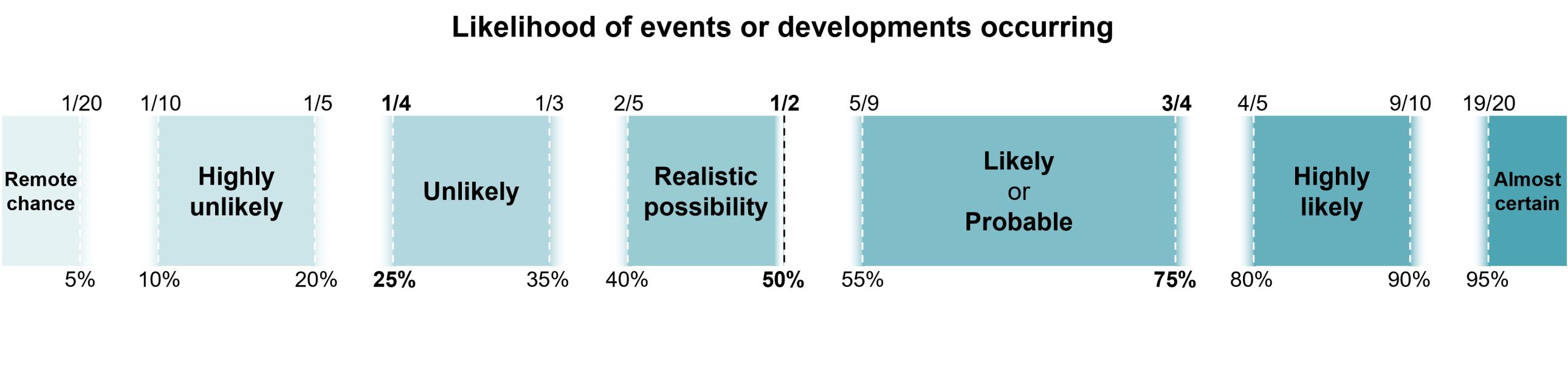
These terms convey judgement in plain language while avoiding the impression of unwarranted precision. Assessments are made in the absence of certainty, and each assessment is associated with a confidence rating:
High: Uncertainties remaining should have negligible or no effect on the key judgements.
Moderate: Uncertainties remain that could expose the key judgements to change.
Low: Critical uncertainties remain that could invalidate the key judgements.
Drivers of the outbreak and future risks
Drivers of the outbreak may be:
- Biological properties of the outbreak bacterial strain
- Immunity in the affected population
- Social and environmental factors including close contact, shared fomites
It is likely that properties of the outbreak strain were a contributing factor to the outbreak (moderate confidence). This is likely to be a combination of virulence factors which have been observed in strains causing similar outbreaks (low confidence).
Immunity to meningococci and behaviour are expected to be relatively common across the country. They are therefore highly unlikely to be the primary drivers of the outbreak (low confidence) although it is almost certain (high confidence) that population immunity and social and environmental factors will have contributed to its speed and scale.
Given the case detected in Austria was also found to have the outbreak strain, it is almost certain (moderate confidence) that the specific subtype that caused the Kent outbreak has circulated more widely than the cases involved in Kent. However, given the extremely high degree of similarity between the genome of that case and those seen in Kent it is unlikely (low confidence) that this represents long chains of community transmission and therefore a large pool of undetected cases or an increased risk to the UK population.
There is no evidence currently that the national epidemiology of MenB is atypical compared to recent years.
Should there be a future combination of this outbreak strain and the particular social and environmental factors encountered in Kent, it is likely (low confidence) that an outbreak would occur of equivalent scale and speed.
Over the next 6 months there is a realistic possibility (low confidence) of this occurring and risk will be higher during periods of greater mixing in key age groups (for example,. around return to schools/universities post-holiday periods).
These assessments take into account public health measures that have been implemented up to the 28 April. They do not account for any further public health measures that may be implemented in the future. All assessments may be reviewed in the light of emerging evidence and are subject to change.
Part 2: Data
2.1 Epidemiology
Current national epidemiology of invasive meningococcal disease in England
The first meningococcal vaccine programme was introduced in November 1999 with Meningococcal group C (MenC) vaccination routinely offered in infancy and a catch-up component for everyone up to 18 years of age during 1999/2000. In the preceding academic year (running from 1 September 1998 to 31 August 1999) there had been over 2,500 cases of invasive meningococcal disease which more than halved in 10 years to just over 1,000 cases in 2008/2009. The introduction of the MenB infant and MenACWY teenage vaccine programmes in 2015 have resulted in further reductions, alongside accelerated control of MenC, MenW and MenY disease due to COVID-19 population control measures, with 374 cases of invasive meningococcal disease in 2024/2025.
Invasive meningococcal disease incidence in 2025/2026 is currently low and in line with the overall rate of 0.6 per 100,000 population in 2024/2025. There were 259 cases of laboratory-confirmed invasive meningococcal disease between 1 September 2025 to 20 April 2026 of which 230 (88.8%) were MenB disease. These 230 MenB cases are similar in number to the 232 confirmed in the same period in 2024/2025 and 207 in 2023/2024, with 51 cases in young people aged 15 to 19 years in 2025/2026, 49 in 2024/2025 and 38 in 2023/2024 in this timeframe.
2.2 Laboratory data
Population seroprevalence survey
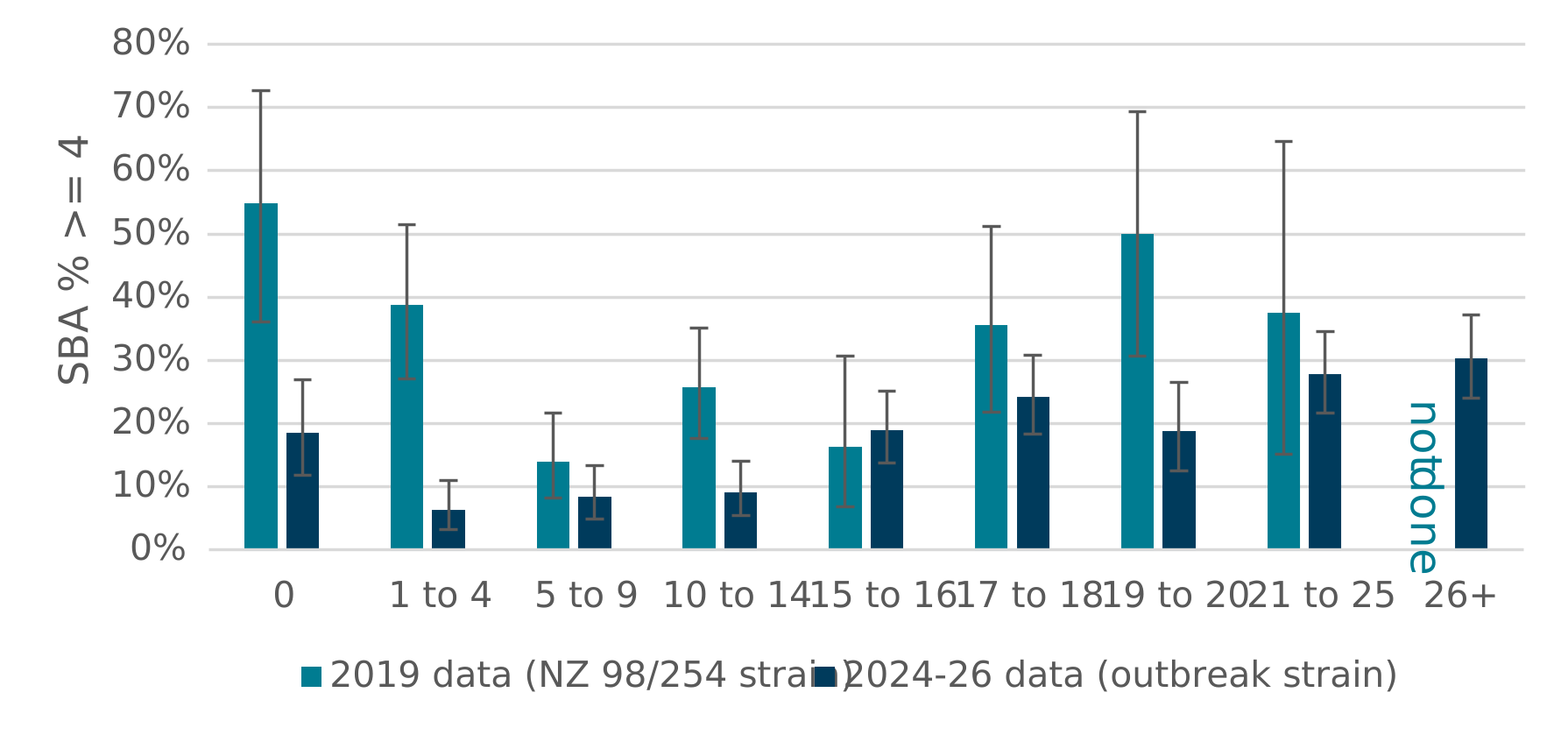
The aim of this study was to assess the seroprevalence to the Kent outbreak strain across different age strata. Serum samples covering the period January 2024 and March 2026 were sourced from the UKHSA Seroepidemiology Unit (SEU) residual hospital sample collection (for ages less than 19 years) and Royal College of General Practitioners collection (for ages up to and including 19 years). The target sample size was 200 in each age group (age in years: under 1, 1 to 4, 5 to 9, 10 to 14, 15 to 16, 17 to 18, 19 to 20, 21 to 25, over 26). Functional antibodies within the serum samples were analysed at the SEU using a standardised serum bactericidal antibody (SBA) assay against the outbreak strain. Geometric mean titres (GMT) and proportion positive (SBA greater than or equal to 4) were calculated with 95% confidence intervals and compared to titres seen in 2019 samples against NZ 98/254 (Bexsero reference strain for PorA).
Figure 2 shows the seroprevalence (SBA greater than or equal to 4) to the outbreak strain and NZ 98/254 strain by age. A similar pattern was seen when comparing geometric mean titres by age between the outbreak and NZ 98/254 strains. The results indicate much lower seroprevalence for the outbreak strain, compared to the 2019 assessment of the NZ 98/254 vaccine strain, in those aged under 5 years. Seroprevalence was also lower in most older age groups and showed an increase from the lowest level in 1 to 4 year-olds at 6% to 30% in those aged >26 years. In the 15 to 16 year-olds and 19 to 20 year-olds seroprevalence was 19% and 24%, respectively. The higher prevalence in those aged less than 1 year was in those less than 10 weeks old and likely reflected maternal antibody. The results in 1 to 4 year-olds suggest low outbreak strain titres are produced in response to 2+1 doses of the Bexsero vaccine in this age group. Further assessment using post-vaccination sera is needed. The results in older children and adolescents also indicate somewhat lower levels of naturally acquired antibodies through childhood to the outbreak strain than seen for the NZ 98/254 strain.
Figure 2: Seroprevalence (SBA greater than or equal to 4) results by age and sample period/strain. Bars show 95% CI intervals. Outbreak strain is shown in light blue and the 2019 data for the NZ strain in orange
Part 3. Further studies
Risk factor survey
The survey aims to understand factors driving transmission during the superspreading events at Club Chemistry using retrospective cohort analysis. The survey is seeking non-identifiable responses from attendees at the venue between 5 and 7 March and/or during comparator periods and from first-year students at the University of Kent and Canterbury Christ Church University regardless of whether or not they had attended the club.
Carriage studies
A proposed carriage study aims to estimate the prevalence of the outbreak strain among student populations in the local area.
A national carriage study is also being considered, with a number of likely aims (including to compare current carriage prevalence of Neisseria meningitidis with previous, pre-pandemic adolescent carriage studies).
Invasive Meningococcal Disease Technical Group
The Invasive Meningococcal Disease Technical Group includes members with expertise in clinical infectious diseases, clinical research, epidemiology, genomics and microbiology:
Aleksandra Marek, Andre Charlett, Andrew Smith, Caroline Trotter, Charlene Rodrigues, Charles Beck, Christophe Fraser, David Goldblatt, Gayatri Amirthalingam, Helen Campbell, Henry E. Simkins, Irene Gonsalvez, James Gilbert, Jay Lucidarme, Kate Agami, Luke McGeogh, Martin Maiden, Mary Ramsay, Meera Chand (Chair), Miriam Hunt, Nabil-Fareed Alikhan, Natalie Groves, Nick Andrews, Nick Croucher, Obaghe Edeghere, Ray Borrow, Richard Myers, Richard Pebody, Roisin Ure, Shona Arora, Stephen Clark, Susan Hopkins, Wei Shen Lim, William Welfare
Contributing organisations
UKHSA, Imperial College London, Joint Committee on Vaccination and Immunisation, Scottish Microbiology Reference Laboratories, University College London, The University of Cambridge, The University of Glasgow, The University of Oxford