HMRC's annual report and accounts 2025 to 2026: Our accountability
Published 9 July 2026

© Crown copyright 2026
This publication is licensed under the terms of the Open Government Licence v3.0 except where otherwise stated. To view this licence, visit nationalarchives.gov.uk/doc/open-government-licence/version/3 or write to the Information Policy Team, The National Archives, Kew, London TW9 4DU, or email: psi@nationalarchives.gov.uk.
Where we have identified any third party copyright information you will need to obtain permission from the copyright holders concerned.
This publication is available at https://www.gov.uk/government/publications/hmrc-annual-report-and-accounts-2025-to-2026/hmrcs-annual-report-and-accounts-2024-to-2025-our-accountability
Governance statement
Introduction and Compliance with the code of good practice
This statement sets out our governance, risk management and internal control arrangements for the financial year 1 April 2025 to 31 March 2026 and up to the date of approval of the annual report and accounts, by HM Treasury guidance.
The HMRC Board follows the principles and spirit set out in the Corporate Governance in Central Government Departments’ Code of Good Practice (2017). There are elements which are not directly relevant to HMRC due to our statutory framework.
Read the Corporate governance in the central government departments code of good practice 2017 on GOV.UK.
Ministerial arrangements
HMRC is a department established by the Commissioners for Revenue and Customs Act 2005. This gives legal powers and responsibilities for managing the tax and customs system to the Commissioners for Revenue and Customs, appointed by the King. Our status is intended to ensure that administration of the tax system is fair, impartial and does not bring political decision-making into individual taxpayer affairs. HMRC is a non-ministerial department.
The Exchequer Secretary to the Treasury is the sponsoring departmental minister responsible for HMRC. He chairs the HMRC Board and, on behalf of the Chancellor, sets the department’s budgets, targets and priorities and remit. Until 1 September 2025, the Chancellor delegated responsibility for overseeing HMRC to James Murrary MP as Exchequer Secretary to the Treasury. From this date onwards, this has been delegated to Dan Tomlinson MP as Exchequer Secretary to the Treasury.
HMRC and HM Treasury work in partnership together to advise ministers on developing and delivering tax policy. HM Treasury leads on strategic policy development, supported by HMRC. HMRC leads on policy maintenance and delivery, supported by HM Treasury. This policy partnership covers taxes and duties, National Insurance, tax credits and Child Benefit, for which HMRC has administrative responsibility.
Commissioners for Revenue and Customs
The commissioners are responsible for collecting and managing revenue and payments and managing tax credits. They conduct business according to the Commissioners for Revenue and Customs Act 2005 and are entitled to appoint officers of Revenue and Customs, who must comply with their directions. Between April 2025 to March 2026, we had 10 commissioners — Sir Jim Harra (until 6 April 2025), JP Marks (from 22 May 2025), Angela MacDonald, Jonathan Athow, Carol Bristow, Penny Ciniewicz, Justin Holliday, Myrtle Lloyd, Helen Pickles (from 22 May 2025) and Daljit Rehal (from 22 May 2025).
First and Second Permanent Secretaries
Our current First Permanent Secretary and Chief Executive, John-Paul Marks, is HMRC’s Principal Accounting Officer. He is responsible for delivering our strategy and is accountable to Parliament for managing our resources. He chairs the Executive Committee (ExCom) and is a member of HMRC’s Board. In 2025 to 2026 our Second Permanent Secretary and Deputy Chief Executive was Angela MacDonald.
Tax Assurance Commissioner
The Tax Assurance Commissioner (TAC) has an explicit challenge role and provides assurance in HMRC’s largest and most sensitive disputes, and a sample of smaller cases. Justin Holliday is the TAC. Decisions about how to resolve our largest and most sensitive cases are considered by a panel of 3 commissioners, usually chaired by the TAC, who reports publicly each year in the annual TAC’s report.
Non-executive directors
Non-executive directors sit on the HMRC Board. They bring external experience and expertise to HMRC, providing advice, challenge and scrutiny. Dame Jayne-Anne Gadhia is our Lead Non-Executive Director. She meets regularly with other non-executive directors, the Exchequer Secretary and the First Permanent Secretary. She liaises with lead non-executive directors across government and develops non-executives as effective board members. Additionally, there are 2 non-executive sub-committee members who sit on our Audit and Risk Committee.
A comprehensive list of board members’ interests (both executive and non-executive) are reported on GOV.UK.
Independent Advisers
Independent Advisers sit on particular sub-committees of the board and ExCom, where additional external expertise is required to support executive and non-executive members. They use their skills and personal experience in their field to contribute to the work of the sub-committees and to wider departmental objectives. From April 2025 to March 2026, Independent Advisers sat on the Customer Service Committee, the Closing the Tax Gap Committee and the Professional Standards Committee.
Valuation Office Agency
HMRC had 1 arm’s length body up to 31 March 2026: Valuation Office Agency (VOA), an executive agency of HMRC. Since 1 April 2026 VOA has been a full part of HMRC. I am satisfied that during 2025 to 2026 and since it has systems in place which meet appropriate standards of governance, decision-making and financial management.
Figure 17: HMRC accountability system
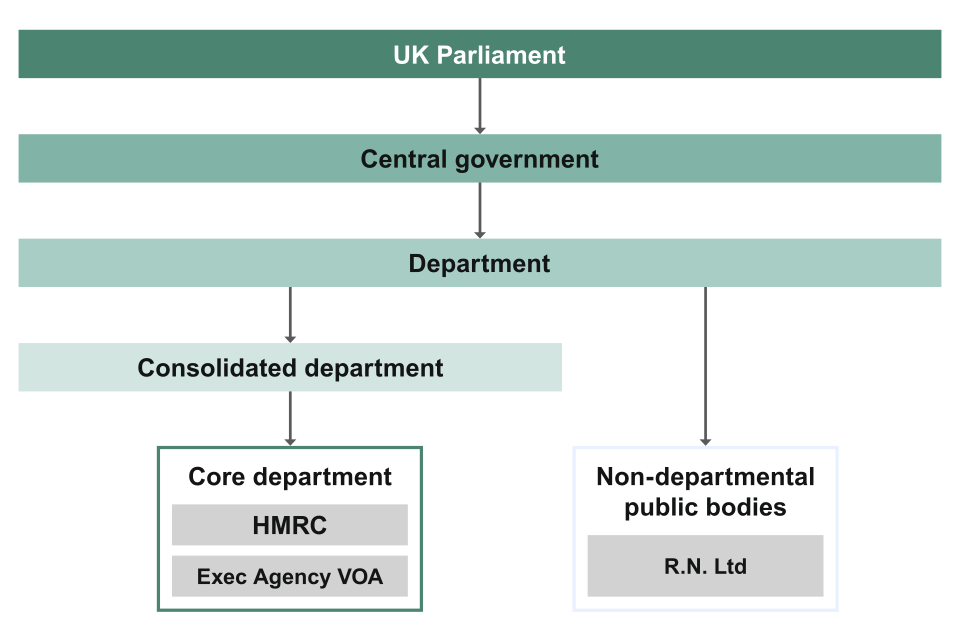
The VOA was an executive agency of HMRC which provided valuations and property advice to the government and local authorities in England, Scotland and Wales. The VOA received its funding to undertake valuations for local taxation and benefits purposes from HMRC through the Parliamentary supply process. It also recovered elements of its expenditure from other government departments where it has provided valuation services. In April 2025 the government announced that the VOA would be brought into HMRC by 1 April 2026 ceasing as an executive agency, and instead becoming a new Valuation Office business group. The VOA transitioned successfully on 1 April 2026; the integration was overseen by a Steering Group, consisting of senior VOA and HMRC colleagues.
Performance monitoring
Jonathan Russell was the VOA’s Chief Executive and Accounting Officer up until 31 March 2026 and from 1 April 2026 became the HMRC Valuation Office Director General. He is also a member of HMRC’s ExCom.
HMRC’s board provided advice, scrutiny, and challenge to both HMRC and the VOA, and is chaired by the Exchequer Secretary to the Treasury. HMRC’s ExCom performance hub and transformation performance pack included VOA data and VOA performance was included in the Finance and Delivery Reports to the HMRC Board.
HMRC’s performance teams work closely with VOA on reporting, and HMRC had a dedicated sponsor team for the VOA and ExCom sponsor, Justin Holliday. The teams had a good understanding of the VOA and I am content that our oversight worked well. I hold quarterly Business Reviews with Jonathan Russell, and he attended the HMRC Board at least twice a year and other specific meetings upon request.
Accountability for spending
Jonathan Russell was accountable to Parliament for the propriety and regularity of the public finance within his charge, meeting the requirements of Managing Public Money, HM Treasury and Cabinet Office guidance, Public Accounts Committee and other Parliamentary select committees or authorities. As Principal Accounting Officer, I was accountable for ensuring a high standard of financial management by strategic oversight of the VOA and following the integration of VOA into HMRC, the Accounting Officer responsibilities transferred to me as the Principal Accounting Officer.
R.N. Ltd
R.N. Ltd is a private company limited by shares held by the Treasury Solicitor on trust for the HMRC Commissioners. R.N. Ltd acts as a nominee for the commissioners and the company holds charges over assets that secure tax debts owing to HMRC. It holds registered title over assets assigned to HMRC in settlement of tax liabilities. R.N. Ltd had 4 directors on 31 March 2026. The Accounting Officer is Alison Bexfield, HMRC Chief Risk Officer, who has authority delegated by the HMRC Commissioners to give directions to the Treasury Solicitor on the shareholding of R.N. Ltd.
There is a formal agreement between HMRC and R.N. Ltd and ExCom-level sponsorship from Justin Holliday. R.N. Ltd has no employees. The Accounting Assurance and Reporting Team within HMRC’s Risk, Control and Financial Accounting directorate provides case work administration, accounts production and secretarial services. The running costs of R.N. Ltd are met by HMRC.
Our governance structure
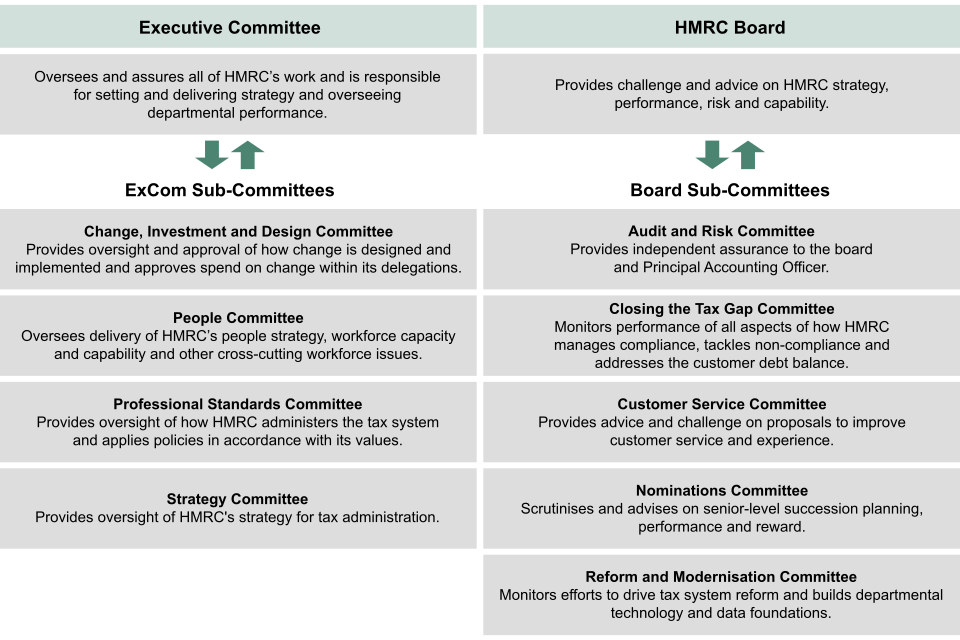
HMRC has 2 top-level governance committees, which are HMRC Board and HMRC ExCom. The chart below sets out the structure of the department’s senior boards and committees for 2025 to 2026. This framework enables ExCom to make decisions effectively, with appropriate support, challenge and assurance from our non-executives. Earlier this year we established a new sub-committee of the board to provide it with greater assurance on HMRC’s Security and Resilience agenda. The Committee will begin its work in spring/summer 2026.
Figure 18: HMRC Committee structure during 2025 to 2026
Report by Dame Jayne-Anne Gadhia, HMRC’s Lead Non-Executive Director
It has been another productive year for HMRC’s board. The board has continued to work constructively with the Exchequer Secretary to the Treasury as Chair, the Chief Executive, and the wider executive team, providing challenge, support and advice as the department has progressed its strategic objectives in a demanding operating environment.
The board has benefited from an effective working relationship with the chair, and I would like to thank James Murray MP and Dan Tomlinson MP for their leadership of the board over the year.
The refreshed board governance arrangements set up last year are now well embedded. The Customer Service, Closing the Tax Gap, and Reform and Modernisation Committees have each played an important role in supporting delivery of the department’s priorities, tracking progress and testing assumptions. Underpinning this, our Nominations Committee continued to support on talent management and succession planning. Similarly, the Audit and Risk Committee maintained its focus on strengthening the department’s risk and control environment and scrutinising the integrity of our financial statements.
A key area of focus for the board this year has been HMRC’s ongoing transformation and modernisation. The board has taken a close interest not only in the ambition set out in HMRC’s Transformation Roadmap, but pushed to understand how HMRC’s transformation is translating into practical change for customers and the wider tax system. Through the Reform and Modernisation Committee, the board has scrutinised delivery milestones, tested the department’s approach to risk and pace, and sought assurance that reform is improving outcomes while maintaining system resilience.
The board has also paid a keen interest in the integration of the Valuation Office into HMRC’s governance and operating model. We welcome the opportunities this creates for closer alignment and shared capability. The board will continue to monitor how opportunities are realised and support better outcomes over time.
This year saw a period of transition for the board. In July, we said farewell to 2 long-serving non-executive directors, Paul Morton and Pat Gallan, who both concluded their terms after making significant contributions to HMRC’s governance and oversight. Paul brought deep tax expertise, while Pat’s background in policing and enforcement provided valuable perspective. I would like to thank them both for their service and for the professionalism they brought to the board.
We concluded recruitment of additional members of the non-executive team, welcoming Heather Self, Sachin Jogia and Sir Craig Mackey to round out the board. They bring a complementary mix of tax, digital, and policing experience. All 3 have stepped into the role admirably and, with the rest of the non-executive team, are making a strong contribution to board discussions, offering independent perspective, challenge and support.
We also look ahead to the departure later this year of Michael Hearty, who is concluding his time as Chair of the Audit and Risk Committee (ARC). Michael has been a dedicated public servant and an exemplary ARC Chair, providing robust assurance and thoughtful challenge across financial reporting, risk and internal control. His contribution has strengthened the department’s assurance framework, and I thank him for his commitment and leadership.
I want to thank Angela MacDonald for her time on the board, ahead of her concluding her time with the department as Second Permanent Secretary. Angela has made an outstanding contribution to HMRC’s transformation programme and operational excellence. I know the board has always valued her insights, and I thank her for exceptional contribution to the Civil Service, including most recently her leadership of the Civil Service Pensions Taskforce.
I would like to thank my fellow board members and the executive for a constructive working relationship. The board remains focused on supporting HMRC as it continues to transform, improve performance and deliver its vital role on behalf of the public.
Looking ahead, the board is preparing to consider the findings of the 2026 Board Effectiveness Review, which will be discussed at the board in July. Regular effectiveness reviews are an important part of good governance, helping the board to reflect on how it operates and where it can continue to improve. I would like to thank Beverley Tew for her work in supporting this year’s review and look forward to discussing the outcomes. I am confident that this, coupled with the firm foundations laid this year position, will set the board up well for the challenges and opportunities ahead.
Dame Jayne-Anne Gadhia
Lead Non-Executive Director
Attendance tables (end of March 2026)
The tables below present attendance data for the Chair of the Board, Non-Executive Directors, members of the Audit and Risk Committee and Executive Directors.
The figure presented reflects attendance relative to the period during which the member held the role; for example, 5/7 indicates that the member attended 5 of the 7 meetings held during their tenure. The total number of meetings will therefore vary where a member commenced or ceased their role partway through the financial year.
Table 7a: Board and committee chairs
| Board | ARC | NC | CSC | CTGC | R&MC | ExCom |
|---|---|---|---|---|---|---|
| Dan Tomlinson MP | Michael Hearty | Dame Jayne-Anne Gadhia | Jennifer Tippin | Heather Self | Dame Jayne-Anne Gadhia | John-Paul Marks |
Table 7b: Meeting attendance by Chair of the Board (note)
| Chair of the Board | Date started or left role | Board (7) | ARC (6) | NC (3) | CSC (5) | CTGC (5) | R&MC (5) |
|---|---|---|---|---|---|---|---|
| James Murray MP | September 2025 (left) | 2/2 | - | - | - | - | - |
| Dan Tomlinson MP | September 2025 (joined) | 4/5 | - | - | - | - | - |
Note: ‘-‘ indicates the individual was not a member of the board/committee.
Table 7c: Meeting attendance by non-executive directors (note)
| Non-executive directors | Date started or left role | Board (7) | ARC (6) | NC (3) | CSC (5) | CTGC (5) | R&MC (5) |
|---|---|---|---|---|---|---|---|
| Dame Jayne-Anne Gadhia | 6/7 | - | 3/3 | - | - | 5/5 | |
| Mike Bracken | April 2025 (left) | 1/1 | - | - | - | - | - |
| Bill Dodwell | 7/7 | - | - | - | 5/5 | - | |
| Patricia Gallan | July 2025 (left) | 2/2 | - | 0/1 | - | - | 1/1 |
| Sachin Jogia | September 2025 (joined) | 4/5 | - | - | - | - | 3/3 |
| Michael Hearty | 6/7 | 6/6 | - | 5/5 | - | - | |
| Sir Craig Mackey | September 2025 (joined) | 5/5 | 2/3 | - | - | - | - |
| Paul Morton | July 2025 (left) | 1/2 | 2/2 | - | - | 1/1 | - |
| Heather Self | September 2025 (joined) | 4/5 | - | - | - | 3/3 | - |
| Jennifer Tippin | 4/7 | - | 2/2 | 5/5 | - | - |
Note: ‘-‘ indicates the individual was not a member of the board/committee.
Table 7d: Meeting attendance by members of the Audit and Risk Committee (note)
| Member | Date started or left role | Board (7) | ARC (6) | NC (3) | CSC (5) | CTGC (5) | R&MC (5) |
|---|---|---|---|---|---|---|---|
| Charlotte Moar | - | 6/6 | - | - | - | - | |
| Andre Katz | - | 5/6 | - | - | - | - |
Note: ‘-‘ indicates the individual was not a member of the board/committee.
Table 7e: Meeting attendance by executive directors (note 1)
| Executives | Date started or left role | Board (7) | ExCom (27) |
|---|---|---|---|
| Sir Jim Harra KCB | April 2025 (left) | - | - |
| John-Paul Marks | April 2025 (joined) | 7/7 | 23/26 |
| Angela MacDonald (note 2) | 6/7 | 19/27 | |
| Jonathan Athow | - | 24/27 | |
| Carol Bristow | - | 22/27 | |
| Penny Ciniewicz | - | 22/27 | |
| Alan Evans | - | 24/27 | |
| Justin Holliday | 7/7 | 25/27 | |
| Myrtle Lloyd | - | 22/27 | |
| James Mitton | - | 22/27 | |
| Suzanne Newton | - | 25/27 | |
| Andrew Pemberton | - | 22/27 | |
| Helen Pickles | - | 21/27 | |
| Lucy Pink | - | 23/27 | |
| Daljit Rehal | 7/7 | 20/27 | |
| Jonathan Russell | - | 20/27 |
Notes:
- ‘-‘ indicates the individual was not a member of the board/committee.
- From January 2026 Angela MacDonald began leading a taskforce to manage casework backlog as part of a cross-government taskforce following the Civil Service Pension Scheme’s change of administration.
HMRC Board and sub-committees
HMRC Board
Over the past year the board continued to monitor and challenge on overall performance, strategy, risk and capability. This included the delivery of HMRC’s priorities, the integration of the Valuation Office, building a high-performing organisation and a broad range of strategic risks such as security and data protection. The board also discussed strategic documents, including its Business Plan and the Transformation Roadmap. The board was chaired by the Exchequer Secretary to the Treasury. Between April 2025 and March 2026, it met 7 times.
Board effectiveness
The board conducts an annual effectiveness review in line with best practice. In 2026 the board undertook its review, this included independent input by a Lead Non-Executive Director from another government department. The review found that the Board was operating effectively, in line with best practice, that it received appropriate and accurate information on departmental performance and members understood their roles and the responsibilities of the board. Examples of areas identified for further consideration and potential improvement by the board included: striking the right balance on informal vs formal engagement, development and training opportunities, and greater alignment between board and Executive committees. The board will take stock of these ideas later this year.
HMRC Board sub-committees
Audit and Risk Committee
The Audit and Risk Committee (ARC) continued its work to provide assurance to the board and Accounting Officer on the integrity of the financial statements and the comprehensiveness and reliability of assurances on governance, risk management and the control environment.
The committee assured the integrity of the 2025 to 2026 accounts for the VOA, National Insurance Fund for Great Britain, the National Insurance Fund for Northern Ireland, and the Account of Duties Collected in the Isle of Man. The committee has an integral role in the development and scrutiny of the annual report and accounts. ARC was chaired by Michael Hearty and met 6 times from April 2025 to March 2026.
Nominations Committee
The Nominations Committee (NC) provided strategic oversight and scrutiny on talent development and pipelines, succession planning, performance and reward arrangements of ExCom. It was chaired by Jayne-Anne Gadhia and met 3 times from April 2025 to March 2026.
Customer Service Committee
The Customer Service Committee (CSC) supported the board by providing advice and challenge to the department on its work to improve day-to-day performance and overall customer experience in line with HMRC’s Charter. During 2025 to 2026 the Committee focused on stabilising core performance, strengthening customer service performance while accelerating the shift to digital and the Digitising Post Programme.
CSC was chaired by Jennifer Tippin and met 5 times from April 2025 to March 2026.
Closing the Tax Gap Committee
The Closing the Tax Gap Committee (CTGC) supported the board by providing support, scrutiny and challenge on the approaches available to close the tax gap, a key Ministerial priority. In 2025 to 2026 it focused on the key risks and opportunities associated with small businesses, the application of third-party data and Artificial Intelligence in compliance.
The committee was chaired by Bill Dodwell (until September 2025) and Heather Self (from September 2025) and met 5 times from April 2025 to March 2026.
Reform and Modernisation Committee
The Reform and Modernisation Committee (R&MC) supported the board by monitoring and providing assurance on progress against the full range of priorities across HMRC’s reform and modernisation agenda. During 2025 to 2026 the committee considered progress against the deliverables in the Transformation Roadmap, including reform of how HMRC delivers change, the development of regime ownership and the overall operating model.
R&MC was chaired by Jayne-Anne Gadhia and met 5 times from April 2025 to March 2026.
ExCom and sub-committees
In May 2025, ExCom considered the executive governance arrangements in HMRC, the findings were implemented over the year.
ExCom agreed to meet in distinct modes across its regular meetings: Strategy, People, Delivery and Transformation, which facilitated enhanced focus on key priorities and issues critical to HMRC’s overall mission and performance. ExCom also agreed to create a new People Committee to provide greater oversight of crosscutting workforce matters and delivery of HMRC’s People Strategy.
ExCom also agreed to stand down 2 sub-committees — Enterprise Data Committee and Risk and Control Committee — allowing ExCom to take direct oversight of HMRC’s key risks. It also stood down the Making Tax Digital Executive Oversight Group, whereby the Making Tax Digital (MTD) Programme Board remained in place and ExCom retained oversight of MTD through its Transformation Mode meetings.
ExCom
ExCom provides the executive leadership and management of the department. As the senior decision-making body it is responsible for delivering HMRC’s strategic objectives, day-to-day performance and the transformation agenda. In 2025 to 2026 it routinely reviewed HMRC’s performance and the delivery of major programmes and initiatives. It assessed the most significant corporate risks and risks to the tax system, agreeing mitigations. It also shaped and refined HMRC’s strategy, the Business Plan as well as the Transformation Roadmap.
It was chaired by John-Paul Marks and met 27 times from April 2025 to March 2026.
ExCom sub-committees
Change Investment and Design Committee
The Change Investment and Design Committee (CIDC) ensures that the change plan approved by ExCom is funded and executed effectively, including signing off key decision and investment decisions. In 2025 to 2026 the committee approved our most significant business cases. It also developed, supported and assured design principles and standards for use across HMRC.
CIDC was chaired by Justin Holliday and met 18 times from April 2025 to March 2026.
People Committee
The People Committee was established in October 2025, to drive delivery of the HMRC People Strategy and advise ExCom on the impact of significant changes to HMRC-wide HR policy. It agreed the annual workforce and location plans and provided direction to workforce capability and capacity, including terms and conditions and learning and development.
The committee was chaired by Helen Pickles and met 4 times from October 2025 to March 2026.
Professional Standards Committee
The Professional Standards Committee (PSC) provides oversight of how HMRC administers the tax system and applies policies in accordance with its values. In 2025 to 2026 the committee discussed HMRC’s operations, focusing on technology, fairness, trust and transparency. This included the use of AI, customer service improvements, and data use.
PSC is chaired by Jonathan Athow and met 4 times from April 2025 to March 2026.
Strategy Committee
The Strategy Committee supports ExCom by coordinating the different elements of HMRC’s strategy, ensuring coherence across totality of our strategic policy work. In 2025 to 2026 the committee continued to support robust strategy development this included discussions on: the development of the Transformation Roadmap, the Stakeholder Strategy and supported ways to embed the Charter.
The committee was chaired by Jonathan Athow and met 7 times from April 2025 to March 2026.
Read more about HMRC’s governance on GOV.UK.
Risk management and assurance
Our approach to risk management
HMRC has established a proactive risk culture with a risk and control framework aligned to HM Treasury’s guidance — ‘The Orange Book’, which enables the management of risks across the organisation.
Our risk and control framework
We continually review and refine how we manage risk so we can understand and keep improving the effectiveness of our strategic delivery, processes and controls. This year we delivered a targeted improvement plan, which included the development of key forward looking risk indicators into our reporting processes and updating our risk appetite around key risk we are managing, also we will continue to strengthen control design and application and the effectiveness of assurance, and reinforcing clear accountability for risk control and management.
The Chief Risk Officer Alison Bexfield who reports to Justin Holliday, has oversight of departmental assurance activity including governance, risk, and control. Alignment of these activities across HMRC is helping to create a more consolidated picture of risk and control with further opportunity to streamline activity and to take advantage of advances in technology tooling. The Chief Risk Officer, supported by the HMRC Process Risk and Control Board which brings together risk and assurance leads from across HMRC, continues to support ExCom to further improve our risk and control framework, setting improvement priorities to contribute to safer and more efficient processes that support the delivery of our strategic objectives.
The HMRC Process Risk and Control Board focusses on the effectiveness of the HMRC risk and control framework and management of associated risk and control issues, including identifying and providing targeted oversight to remediate any weaknesses, and escalating to ExCom where necessary. The board plays a key role in strengthening the HMRC Risk and Control Framework, for example it approved a new risk model to enhance the management of the HMRC Security risk theme. The HMRC Security risk theme assesses and reports the overarching security risk for HMRC, a diverse organisation providing critical services and holding assets that are significantly attractive to organised crime and nation state actors. Although the risk is owned by HMRC Security, the accountability regarding risk management and the application of security controls is localised in taking actions to reduce security risk, and also the crosscutting nature of security risk is not effectively captured, which results in a partial overall enterprise security risk picture.
The board agreed a new component risk model which provides assessment of the ‘right’ risks across HMRC to feed the overarching security risk theme, providing a more dynamic risk picture based on current threats and control vulnerabilities. It provides a structure for risk to move in and out of prominence, for example an identity component risk might be necessary in the current climate, but once within tolerance can move out, which provides more effective senior risk management oversight.
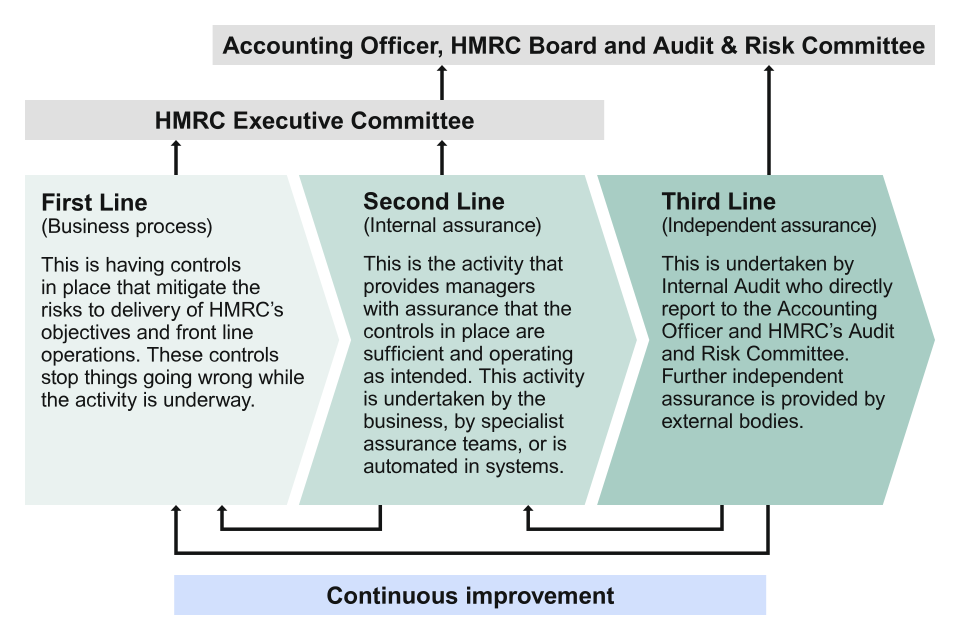
Our risk and control framework is based on the ‘Three Lines Model’. This assurance model facilitates the effective management of risk throughout the reporting period, by clearly defining roles and activities for front-line operations, internal assurance, and independent assurance; and by supporting regular monitoring and review of the consolidated picture of assurance to identify areas for improvement. The front-line operates controls to mitigate risks to delivery and internal assurance provides management with confidence as to whether the controls in place are effective. An independent view of the effectiveness of controls including our internal assurance is provided by Internal Audit and external bodies. Crucially, this includes National Audit Office (NAO) reports which contribute to the overall independent assurance from which HMRC benefits.
These activities provide the Accounting Officer, ExCom and the board with assurance about the delivery of HMRC’s overall strategy and objectives.
Figure 19: HMRC’s Three Lines Model
Our risk and control framework covers:
- governance: ensuring that authorities and accountabilities are clear, appropriate strategies and plans are in place and our success in operating the control framework is reflected in the annual governance statements
- process management: taking the necessary action to ensure our processes are effective, efficient, well-controlled and easy for our customers and staff to use
- risk management: identifying, assessing, reporting and managing the risks to the delivery of our objectives
- controls: embedding effective controls in our business processes to ensure risks are managed and objectives are met
- management assurance: assuring the controls in place are sufficient and operating as intended, and taking the necessary action to address any weaknesses
- independent assurance: gaining internal and external audit views as to the effectiveness of our control framework
- data: ensuring that the data on which our business relies is secure and accurate
An organisation of HMRC’s size and complexity will always have multiple risks to manage at any one time. The governance arrangements in place throughout 2025 to 2026 have been sufficient to continue managing risks effectively.
HMRC’s key risks in 2025 to 2026
Our ExCom manages 8 key risks, which helps us to ensure we can deliver on our key priorities: to close the tax gap, improve day-to-day performance and modernise and reform the UK tax and customs system.
Our most significant risks remain in Security, Digital and Technology and Data. In 2025 to 2026, we made progress in managing these risks by advancing our IT improvement plan and strengthening key data and security controls. However, we continue to carry substantial risk due to our legacy IT estate, and we have therefore invested heavily in modernising our IT infrastructure and migrating to new, more resilient platforms. Our risks are further heightened by an increasingly volatile external environment, particularly ongoing conflict in the Middle East, which is driving economic uncertainty and supply chain instability. In response, we are closely monitoring developments and strengthening contingency planning, assessing a range of scenarios, options, and trigger points for action.
Addressing our most significant risks is dependent on the delivery of our ambitious change portfolio and we have therefore focused on mitigating risks that could delay or disrupt delivery — improving planning and dependency management and ensuring we have the technical capability needed to deliver change.
| Principal Risk | Risk description | Risk Rating | Risk Trend |
|---|---|---|---|
| Security | Ineffective operation of security processes and controls, which lead to the potential failure of business-critical services and/or failure to protect HMRC, its people and assets from harm or misuse. | Red | Stable |
To mitigate we have:
- strengthened controls to detect and respond to insider threat risks arising from employee system and data access. We have enhanced governance, policy frameworks and cross-functional coordination
- maintained a 99.99% cyber-attack containment rate, continuing to protect systems against an increasingly complex and evolving threat landscape
- strengthened security policies, including introducing a dedicated policy for the secure use of artificial intelligence
- implemented a centralised supplier security assurance and procurement function to eliminate inconsistencies in supply chain security management and strengthen assessment of new and existing suppliers
- formed a new Resilience Directorate to enhance our operational resilience, crisis response and recovery capability
- modernised Identity and Access Management services, establishing a central Fraud Prevention Centre, monitoring, responding to threats and actively supporting customers and intermediaries
| Principal Risk | Risk description | Risk Rating | Risk Trend |
|---|---|---|---|
| Digital and technology | Failure to deliver and maintain a resilient IT estate, which lead to reduced productivity, security vulnerabilities and the potential failure of critical business services. | Red | Improving |
To mitigate we have:
- delivered major elements of the IT improvement plan, including retiring key legacy systems such as the VAT Mainframe
- began enabling work to migrate the Enterprise Tax Management Platform to a cloud–hosted environment, improving stability and usability, and reducing dependence on ageing systems
- enhancements to Time to Pay (TTP) digital services including affordability assessments, wider regime coverage and new TTP features, have increased customer self-serve and strengthened payments-estate resilience
- made strong early progress on modernising legacy infrastructure, with initial migrations underway and strengthened cloud controls enhancing service resilience
- expanding cloud-based capabilities through the Data Lakehouse and Hybrid Integration Platform programmes, boosting scalability, resilience and security
| Principal Risk | Risk description | Risk Rating | Risk Trend |
|---|---|---|---|
| Data and information | Failure to appropriately store, maintain, access and protect data, which limit HMRC’s ability to effectively exploit information and/or comply with regulatory requirements, leading to poor performance and potential reputational damage. | Red | Improving |
To mitigate we have:
- accelerated migration of legacy systems to a more secure cloud platform to strengthen security controls, improve resilience and protect customer data
- modernised identity and access management to improve protection and regulatory compliance and strengthened core data controls with enhanced encryption
- introduced new digital solutions to improve customer support and service delivery, reducing errors and operational data risks
- invested in building our data governance capacity to support colleagues carrying out Data Protection Impact Assessments and to improve SharePoint use
- continued to ensure that staff complete compulsory data protection training
- improved our response times for subject access requests
| Principal Risk | Risk description | Risk Rating | Risk Trend |
|---|---|---|---|
| Change — Design and delivery | Failure to plan, resource and deliver change effectively, which could limit HMRC’s ability to deliver its transformation ambitions and achieve its future operating state. | Amber | Stable |
To mitigate we have:
- published and embedded a Transformation Roadmap to drive alignment of programmes with a clear, shared view of priorities, outcomes and transformation objectives
- strengthened portfolio-wide planning and dependency management, including critical-path mapping and clearer delivery baselines, improving visibility of sequencing, delivery pressures and future risks
- improved resource and capability management through targeted recruitment, skills development, enhanced demand planning and prioritisation controls on constrained legacy platforms
- reinforced scope control and delivery discipline through clearer entry-point prioritisation, stronger governance and increased use of agile delivery approaches to support pace and flexibility
- strengthened design capability and accountability through the Design Review, with clearer enterprise design leadership and increased collaboration
- strengthened enterprise change frameworks and rationalised planning and delivery artefacts, improving consistency, reducing duplication and providing clearer assurance over how change is delivered
- enhanced Enterprise Change Management Tools capability and insight through improved system integrations, functionality and targeted user training
- a Quarterly Portfolio Review process, providing more structured, regular oversight of delivery progress, financial performance and prioritisation, enabling earlier intervention and improved control of portfolio-level risks
| Principal Risk | Risk description | Risk Rating | Risk Trend |
|---|---|---|---|
| Customer | Failure to deliver HMRC’s customer service priority impacting customer experience | Amber | Improving |
To mitigate we have:
- published the HMRC Transformation Roadmap, setting out a clear direction for the enhancement of our digital services
- made significant progress in improving telephony and post turnaround times through targeted investment in frontline services
- improved our ability to identify customers needing extra support, improving safeguarding and ensured more customers receive the right help at the right time
- digital Self Assessment (SA) improvements have enabled SA customers to resolve debts more efficiently through Digital Pay Here, enhancing customer experience and streamlining processes
- PAYE improvements now provide clearer tax code information and explanations to all PAYE web customers, with further enhancements planned
- targeted improvements have been made to GOV.UK guidance in areas that drive the highest levels of customer demand and dissatisfaction. This has focused on simplifying content and improving clarity to help customers self-serve more effectively and reduce avoidable contact
| Principal Risk | Risk description | Risk Rating | Risk Trend |
|---|---|---|---|
| People and workplace | Failure to attract and engage an appropriately skilled workforce, and to provide a safe and efficient workplace. | Amber | Improving |
To mitigate we have:
- strengthened strategic workforce planning and organisational capacity to better manage recruitment pressures and deploy critical skills more effectively
- advanced key capability programmes, including the launch of the Tax, Customs and Compliance Academy, to build sustainable technical and professional capability
- improved workforce stability, through increased employee retention and higher levels of staff engagement, with the Employee Engagement Index reaching its highest recorded level
- enhanced organisational capability through targeted leadership and change skills development, supported by modernised workplaces
- invested in digital infrastructure, including the wider adoption of artificial intelligence and digital tools, to improve delivery capability and colleague experience
| Principal Risk | Risk description | Risk Rating | Risk Trend |
|---|---|---|---|
| Finance | Failure to plan strategically, prioritise effectively and deliver efficiencies, which lead to missed opportunities to improve operations and reputational damage. | Amber | Stable |
To mitigate we have:
- continued to drive efficiency and demand-reduction measures to improve customer service and reduce operational costs
- set up a programme to reduce our reliance on paper correspondence, whilst retaining paper post provision for critical correspondence and for the digitally excluded, delivering permanent savings and improving long-term sustainability
- aligned legacy system decommissioning and IT modernisation milestones with the single IT plan, supported by monthly progress reviews and supplier engagement to prevent escalating technology costs and ensure efficiencies can be tracked and monitored
- continued to integrate the planning process, aligning forecasts with performance to track and monitor budget variances
| Principal Risk | Risk description | Risk Rating | Risk Trend |
|---|---|---|---|
| Stakeholders | Failure to effectively engage key stakeholders (including other government departments), which limit HMRC’s ability to deliver and lead to loss of trust in the organisation. | Amber | Stable |
To mitigate we have:
- developed a strategic delivery roadmap setting out our long-term vision for Intermediary services
- worked with agents and third-party stakeholders to reinforce HMRC’s long-term commitment to intermediation via the delivery of our strategic stakeholder engagement and communications plan
- developed a more open and collaborative engagement approach, including setting up new working groups, to ensure we listen and effectively respond to stakeholder feedback
Insider risk
HMRC takes the risk of insider risk very seriously, undertaking regular assessments of our defences in this area and learning from other organisations. We are clear that we have a zero-tolerance approach to insider risk and, where criminal wrongdoing is identified, we take swift action to dismiss and will pursue criminal prosecutions.
In recent years we have been delivering a transformation of our insider threat capability. We have invested to develop our security capabilities and resilience as a critical priority. Our board now has a dedicated Security and Resilience sub-Committee (from April 2026) to ensure that these issues are assured at the highest level in HMRC’s governance. We’ve also stood up a new Insider Risk Management Service and have brought in leading security experts to help us aspire to industry best practice. This sits alongside new digital systems, changes to HR policies and processes, and more robust employment vetting.
We know that our people are our greatest asset in mitigating this risk: we require all new starters to complete fraud learning, and we provide accessible internal guidance on how to report concerns. These training packages are now mandatory for everyone in HMRC, regardless of their role.
Human rights
We have procedures in place to ensure that all our policies and legislation are compliant with the Human Rights Act. Our approach is underpinned by understanding our customers and their needs, treating everyone with respect, recognising that we have privileged access to information (and need to protect that information), and behaving professionally with integrity.
Our conflict of interest policy
Within our policies on conduct, we have a ‘conflict of interest’ policy which is aligned to the Civil Service Management Code (section 4.3). This applies to all employees and non-executive directors. The policy explains what a conflict of interest is, and provides information on declaring, recording and managing outside interests.
A conflict of interest arises when personal interests, activities or relationships may potentially interfere, or be perceived to interfere, with business decisions, may compromise the ability to remain fair and objective, or may result in a personal gain or advantage.
Individuals are responsible for notifying their managers of any conflicts. The relevant manager or business area must determine whether there is in fact a conflict (actual, potential or perceived) and what mitigating action is to be taken, and the manager is responsible for recording this information. If the individual moves to another team or business area, they must assess whether a new notification needs to be made in relation to the new role.
In high-risk areas, conflicts are recorded on a register, which is maintained at a business unit level.
Senior Civil Service (SCS) colleagues are required to complete an annual declaration of interest via a central register which is held securely by SCS HR team. The information required for the register is a high-level record of the conversations already held with line managers to confirm that declarations of interest are up to date and includes nil returns. All SCS in HMRC were asked to complete their annual declaration of interest in December 2025 and HMRC is fully compliant with the Civil Service HR guidance. The declaration of interest form covers the period from 1 April 2025 until 31 March 2026. If circumstances during this period have changed after the form has been submitted a new entry must be completed. As a reminder a declaration of interest can be submitted at any time during the year.
HMRC Board members and non-executive members of committees are required to declare real and potential conflicts of interest on appointment and to notify of any arising during their term. This is in accordance with The Code of Good Practice para 4.15.
Non-executive directors and members are required to declare any interests which they hold to the Permanent Secretary. They are asked to update this information twice a year. At the beginning of every departmental board and its sub-committees all members are asked to declare any new potential conflicts of interest and agree any mitigating action if needed which can include removing themselves from the discussion. There were no conflict of interest registered during board meetings this year.
SCS outside remuneration as at 31 March 2026, agreed through the process of declaration and management of outside interests, is reported on GOV.UK in accordance with The Code of Good Practice 2017 para 4.15 and HM Treasury Public Expenditure System (PES) guidance paras 19.4 and 19.8.
Appointments made by the commissioners
From April 2025 to March 2026, the Commissioners of Revenue and Customs made the following public appointments to the departmental board and sub-committees:
- April 2025 — Jane McCormick and Caroline Turnbull-Hall were appointed to the Professional Standards Committee, following an open recruitment process
- April 2025 — Paul Aplin was appointed to the Closing the Tax Gap Committee, following an open recruitment process
- July 2025 — John Harding was appointed to the Closing the Tax Gap Committee, following an open recruitment process
- July 2025 — Michael Hearty’s full term on the HMRC departmental board and as chair of its Audit and Risk Committee was extended until July 2026, having originally being appointed in July 2019, to provide continuity on the board
- September 2025 — Bill Dodwell, Sachin Jogia, Sir Craig Mackey and Heather Self were appointed to the HMRC departmental board for 3 years, following an open recruitment process. Bill Dodwell had previously been appointed on an interim basis for 1 year
- September 2025 — Gary Richards was appointed as the General Anti Abuse Regulations (GAAR) panel chair, following an open recruitment process
- January 2026 — Jen Tippin was reappointed to the HMRC departmental board for a further 3 years, having been originally appointed in January 2023
- February 2026 — Marek Fletcher, Michael Stean and David Taylor were reappointed to the GAAR panel for 1 year, having been originally appointed in February 2020
- March 2026 — Jayne-Anne Gadhia was reappointed to the HMRC departmental board for a further 3 years, having been originally appointed in January 2021
Recommendations made by external scrutiny bodies
We monitor the implementation of recommendations by external scrutiny bodies including the NAO, Public Accounts Committee (PAC) and National Infrastructure and Service Transformation Authority. In the 2025 to 2026 financial year, we received PAC recommendations from the following inquiries that our Accounting Officer provided evidence to.
Table 8: Committee of Public Accounts inquiries, reports and responses
| Inquiry and hearing date | Government response |
|---|---|
| Collecting the right tax from wealthy individuals Hearing: 12 June 2025 — Report published: 16 July 2025 | Published — 22 September 2025 |
We accepted 8 recommendations from NAO value for money reports published after 1 April 2025, and accepted 18 recommendations from the NAO management letter 2024 to 2025, subdivided into 43 sub-components, of which 9 were implemented by 1 April 2026. We also implemented 54 recommendations from the National Infrastructure and Service Transformation Authority.
Further detail on the status of all NAO recommendations the department has accepted since April 2019 can be found via the NAO recommendations tracker.
Statement of Accounting Officer’s Responsibilities
How we prepare the accounts
HMRC is responsible for collecting the majority of the UK’s tax revenue, including Income Tax for the Scottish and Welsh governments, and its financial information is reported in 2 separate accounts.
Trust Statement
The Trust Statement reports the revenues, expenditures, assets and liabilities related to the taxes and duties receivable and payable for the financial year. The majority of taxes and duties are accounted for on an accruals basis. As agreed with HM Treasury, some tax elements are accounted for on a partial accruals basis, or cash basis where not enough information is known to accrue fully and reliably for the revenue.
The HM Treasury ‘Accounts Direction’, issued under section 2 of the Exchequer and Audit Departments Act 1921, requires HMRC to prepare the Trust Statement to give a true and fair view of the state of affairs of the collection and allocation of taxes and duties, the revenue and expenditure, and cash flows for the financial year.
Resource Accounts
The Resource Accounts report the costs of running HMRC, including making payments of Child Benefit, corporation tax reliefs and other payments to customers reportable to Parliament via HMRC’s Supply Estimate. The VOA is consolidated into the Resource Accounts. The Resource Accounts are prepared on an accruals basis.
The HM Treasury ‘Accounts Direction’, issued under the Government Resources and Accounts Act (GRAA) 2000, requires HMRC to prepare consolidated Resource Accounts to give a true and fair view of the state of affairs of HMRC and the departmental group and of the income and expenditure, Statement of Financial Position and cash flows of the departmental group for the financial year.
Principal Accounting Officer’s responsibilities
HM Treasury has appointed me, as HMRC’s Chief Executive, to be Principal Accounting Officer of HMRC and VOA, with overall responsibility for preparing the Trust Statement and Resource Accounts and for providing them to the Comptroller and Auditor General. In preparing these accounts, I am required to comply with the requirements of the Government Financial Reporting Manual and in particular to:
- observe the Accounts Directions issued by HM Treasury, including the relevant accounting standards and disclosure requirements, applying suitable accounting policies on a consistent basis
- ensure that HMRC has in place appropriate and reliable systems and procedures to carry out the consolidation process
- make judgements and estimates on a reasonable basis, including those judgements involved in consolidating the accounting information provided by the Valuation Office Agency
- state whether applicable accounting standards as set out in the Government Financial Reporting Manual have been followed, and disclose and explain any material departures in the accounts
- prepare the accounts on a going concern basis
As Principal Accounting Officer, I take personal responsibility for the annual report and accounts and confirm that I have judged it to be fair, balanced and understandable.
Accounting officers for the Resource Accounts
For the financial year 2025 to 2026, I John-Paul Marks, was the Principal Accounting Officer.
Jonathan Russell, Chief Executive of the VOA, was an Additional Accounting Officer and was accountable for the parts of HMRC’s accounts relating to specified lines of the Estimate and the associated assets, liabilities and cash flows. This appointment does not detract from my overall responsibility for the department’s accounts.
The allocation of Accounting Officer responsibilities in the department was as follows:
- Estimate sections A, C to K and N to Q: John-Paul Marks, Chief Executive and Permanent Secretary
- Estimate sections B, L and M: Jonathan Russell, Chief Executive of the Valuation Office Agency
I will be signing off VOA’s 2025 to 2026 ARA as Principal Accounting Officer, as Jonathan Russell’s roles as Chief Executive and Accounting Officer no longer existed when the Agency ceased after 31 March 2026.
As Accounting Officer of HMRC I am responsible, through the use of appropriate systems and controls, for ensuring that any grants we make to our sponsored bodies are applied for the purposes intended. I also ensure that such expenditure and the other income and expenditure of the sponsored bodies are properly accounted for, for the purposes of consolidation within the Resource Accounts. As Accounting Officer, I am accountable for the use, including the regularity and propriety, of the grants received and the other income and expenditure of the sponsored bodies.
My responsibilities as Accounting Officer — which include the propriety and regularity of the public finances for which I am answerable, keeping proper records and safeguarding the assets of the department or non-departmental public body for which I am responsible — are set out in Managing Public Money, published by HM Treasury.
Auditors
As the Accounting Officer, I have taken all the necessary steps to make myself aware of any relevant audit information and to establish that the auditors are aware of that information. As far as I am aware, there is no relevant audit information of which the auditors are unaware.
Principal Accounting Officer’s report
HMRC’s Chief Executive, John-Paul Marks, has been appointed by HM Treasury as Principal Accounting Officer for HMRC. In this report, he reviews the effectiveness of the governance, risk management and internal controls in place for our accounts. This report also contains the elements required for HMRC’s Accounting Officer System Statement.
Our Framework of risk management and control
HMRC’s risk and control framework is designed to support the department in operating safely and effectively in delivering its objectives. As Principal Accounting Officer, I rely on this framework and on appropriate delegations across the organisation to maintain effective governance, risk management, and internal control. This report sets out the principal sources of assurance that I receive, which enable me to conclude on the effectiveness of HMRC’s overall risk and control framework.
Delegated accountabilities within HMRC
As HMRC’s Principal Accounting Officer, I delegate financial authority to each of HMRC’s directors general through annual letters of delegation (issued by my Chief Finance Officer) to manage the budget for their business areas within agreed financial limits and Managing Public Money guidelines and operate their activity with an effective risk and control framework. The directors general are supported by their finance directors and finance business partners. They cascade delegations of the financial authorities within their business areas, at each stage setting the limits of financial authority and our policy requirements.
This Scheme of Delegations is supported by our control framework, which ensures that we adhere to financial control standards. The HMRC Risk and Control Board oversees the development and administration of our control standards, ensuring that financial risks are managed effectively and efficiently through proportionate risk-based controls. The effectiveness of the controls is subject to regular specialist financial control assurance review, and independent review by Internal Audit and the NAO.
Statements and reports made by ExCom members
Each member of ExCom provides an annual governance statement, setting out the control framework arrangements (governance, risk, control, assurance, process and data) in their business areas. These statements are reviewed by Audit and Risk Committee, Internal Audit, Risk and Control Board and the Corporate Risk Team, as well as teams that lead on different aspects of our control framework. HMRC’s Audit and Risk Committee draws on the statements, alongside other sources of evidence, including compliance with HMRC’s Customer Charter and progress against HMRC’s Transformation Roadmap, to provide overall assurance to the Accounting Officer and the board.
Assurance from other accounting officers
I receive assurance from HMRC’s Additional Accounting Officers:
- Jonathan Russell had responsibility for VOA administration until 31 March 2026
- Jonathan Athow has responsibility for the Scottish and Welsh rates of Income Tax
- Justin Holliday has responsibility for the account of duties attributable to the Isle of Man
- Alison Bexfield has responsibility for the administration of R.N. Limited
The VOA provided a separate governance statement, and I took assurance from this and from the review which underpins it.
National Insurance funds
There are 2 National Insurance Funds: one for Great Britain and one for Northern Ireland. Each Fund has its own financial statements, including a governance statement, which I sign separately. Many of the activities relating to the transactions of the 2 Funds are carried out by other departments and agencies (for example, Department for Work and Pensions in Great Britain and Department for Communities in Northern Ireland), and I receive letters of assurance from the accounting officers of each of these entities every year.
Approach to risk management
ExCom manages 8 key risks to support delivery of HMRC’s core priorities — closing the tax gap, improving operational performance, and modernising the tax and customs system — with the most significant risks relating to Security, Digital and Technology, and Data. During 2025 to 2026, progress was made through advancing IT improvements and strengthening data and security controls, although substantial risk remains due to the legacy IT estate, driving continued investment in modernisation and migration to more resilient platforms. Effective management of these risks depends on the successful delivery of an ambitious change portfolio, with a sustained focus on mitigating potential delays or disruptions through stronger planning, improved dependency management, and ensuring sufficient technical capability to deliver change.
Assurance on compliance with Government Functional Standards
UK Government Functional Standards set expectations for improved and consistent ways for functions to work across government. This includes the planning, delivery, and assurance of functional work as well as support for continuous improvement and professional development. HMRC fully supports the embedding of functional standards.
In line with HM Treasury/Cabinet Office requirements, HMRC functional leads are required to complete a self-assessment of how well they were meeting the requirements of their functional standard. Between 2022 to 2026, the third line Internal Audit team conducted a programme of assurance to test our approach to managing Functional Standards. Building on Internal Audit’s work, in 2026 to 2027 the Chief Risk Officer will develop a risk-based assurance approach to Functional Standards, focused on key processes in our Core Services and having sufficient assurance over the effectiveness of the key controls.
Assurance on business-critical models
HMRC has a departmental framework and central guidance to underpin quality assurance of business-critical analytical models (BCMs). BCMs are our most important analytical models. They affect HMRC or government decisions of significant financial scale, play a key role in fulfilling HMRC’s business plan, or underpin high profile publications. We maintain a register of these models, consistent with recommendations from the 2013 MacPherson review. We have 104 BCMs on the register. This number changes because the register is regularly updated.
Management and quality assurance of the analytical models are monitored in our annual review of BCMs, which is assessed by the Audit and Risk Committee. The quality assurance framework is promoted through regular training. We have a team which independently reviews a sample of BCMs, to provide assurance and share best practice. We have also improved model and quality assurance documentation. We have developed our assurance of BCMs by strengthening governance and more clearly defining quality assurance standards in our guidance.
Read the MacPherson review of government models on GOV.UK.
Assurance on major contracts and outsourced services
HMRC’s commercial teams manage our contracts and outsourced services that support our delivery of our objectives. Appropriate internal controls are in place to ensure that these services are resilient and deliver as intended, with key controls subject to regular assurance work.
IT contracts and strategic IT approach
HMRC manages a diverse portfolio of IT contracts spending approximately £1.5 billion in 2025 to 2026, underpinning the delivery of core services and supporting our digital transformation. Our strategic approach is reflected in substantial investment in cloud technologies, operational resilience, and security, working with a range of leading suppliers to ensure access to specialist expertise and innovative solutions.
A balanced mix of short-term and long-term contracts enables HMRC to maintain operational continuity while driving forward modernisation. Our focus on cloud adoption, robust support services, and enhanced security ensures that our IT estate remains resilient, flexible, and capable of meeting the evolving needs of taxpayers and government.
These investments strengthen HMRC’s ability to deliver reliable digital services, improve operational resilience, and achieve better value for the public.
Facilities management and security contracts
In May 2025, following a detailed review and tender process we awarded 2 new facilities management (FM) contracts that bundle soft and hard FM. These contracts are for an initial 5-year term, with extension options, at a combined total value of £304.5 million, excluding VAT. Both contracts mobilised in May 2025.
The new delivery model unlocked savings of £64 million during the initial contract term and establishes a more efficient approach to management and operations.
Physical operational security services across our premises are provided under a single national contract agreement, focused on protecting people, assets and information. The 5-year contract is valued at £101.6 million, excluding VAT. Our relationship with the supplier is well established, underpinned by our Strategic Supplier Relationship Management scores, which rank among the top 3 within HMRC.
These contracts are essential to supporting our operations across regional centres and other locations.
Grants
In 2025 and 2026, HMRC provided grant schemes in accordance with the relevant guidelines, to the Voluntary and Community Sector, and to the National Trading Standards. The Voluntary and Community Sector provide advice and assistance to vulnerable clients on their tax affairs, and the National Trading Standards provide help to seize, at a retail level, the illicit distribution of tobacco.
Resolving historical issues for customers
We are improving customer experience and performance across our core operational responsibilities, while accelerating our transformation. We have made tangible progress in recovering service standards, shifting more customers to digital channels and strengthening the foundations of a modern tax, customs and valuation system. Despite these and other improvements, some customers still face delays and friction and that is not good enough. But with demand and capacity better balanced, stronger technology foundations in place and clearer momentum behind our continued transformation and reform, we are increasingly able to proactively address historical and structural issues in the tax system, in the interests of customers, colleagues and the nation.
Class 2 National Insurance Registration
HMRC is taking action to address a long-standing issue with the registration status of a minority of self-employed customers within the Self Assessment system going back to 2015. The issue, which HMRC publicly acknowledged in 2019, relates to some customers not being correctly registered as self-employed for National Insurance purposes, with consequent impacts on their Class 2 National Insurance contributions. Incorrect Class 2 National Insurance position could result in gaps in a customer’s National Insurance record, with potential impacts on their State Pension and pension-related benefits.
To date HMRC had focused on helping customers get it right and a fix has been implemented that ensures all self-employed customers submitting Self Assessment returns from 2024 to 2025 onwards will have the correct Class 2 National Insurance position reflected on their records.
Whilst this has not impacted most customers there is a significant minority (around 800,000 customers) who may have gaps in their National Insurance record linked to this issue and we are now in a position to help customers correct their position and potentially enhance their State Pension entitlement.
Up to 160,000 are estimated to be above or within 2 years of State Pension age. Customers above or within 2 years of State Pension age, will receive a joint letter from HMRC and DWP. This letter will contain instructions on how to fill these gaps voluntarily. Customers who are not within 2 years of State Pension age will have the opportunity to fill these gaps via a digital route, which is being developed and will be ready in 2027.
State Pension taxation
HMRC is taking action to address an issue affecting the State Pension amounts used in some tax calculations, where an incorrect figure has been applied in end-of-year PAYE reconciliations, since 2010 to 2011, and carried through into Self Assessment pre population since 2015 to 2016, and Simple Assessment since 2016 to 2017. This issue results in a difference between the correct State Pension figure for tax purposes and the figure actually used in the calculation. Where an overcharge arises, it reflects the marginal rate of tax on the difference between one week of State Pension at the previous and uprated rates.
Due to the volume of data, HMRC’s analysis has focused on the period between 2021 to 2022 and 2024 to 2025. At its peak in 2024 to 2025, around 1.4 million PAYE customers paid too much tax, and up to 955,000 Self Assessment customers, and around 760,000 Simple Assessment customers, also had an incorrect State Pension figure used and may have paid too much tax. The average loss in any one tax year since 2021 to 2022 for a basic rate taxpayer is estimated to be £1.76 where they receive the full basic State Pension and £2.30 where they receive the full new State Pension.
HMRC will deliver a solution this summer to correct future tax calculations. As well as preventing this error from recurring, the solution will ensure that the last tax year, 2025 to 2026, is subject to the correct calculations for those in PAYE and Simple Assessment and will enable HMRC to correct the returns for those who have already filed Self Assessment returns for 2025 to 2026.
Control challenges
Control incidents in financial year 2025 to 2026
Over the past year, we have actively managed the following issues that posed a risk to delivery of our core work.
Corporation Tax research and development tax relief error and fraud
The Comptroller and Auditor General has qualified his opinion on HMRC’s Resource Account to include error and fraud in Corporation Tax research and development (R&D) tax reliefs. These estimates are based on updated data from the third Mandatory Random Enquiry Program (MREP3) and a new methodology for R&D expenditure credit (RDEC) claims from the Large Business population.
The overall estimate of the level of error and fraud in 2023 to 2024 is 6.4% (£493 million) of the estimated cost of the reliefs. The level of error and fraud in 2023 to 2024 is 11.1% (£347 million) for the SME scheme and 3.2% (£146 million) for the RDEC scheme. The overall rate of error and fraud in total R&D expenditure across the SME and RDEC schemes for 2023 to 2024 is lower than estimates since 2020 to 2021, reflecting legislative and operational changes to tackle error and fraud, notably the mandation of digital claims and additional information requirements introduced in 2023.
Figure 20: Corporation Tax research and development error and fraud rates by year

For illustrative purposes, we have considered the possible error and fraud position for 2024 to 2025 and 2025 to 2026 expenditure to take account of the ongoing impact of legislative changes and operational measures. The legislative changes include new information requirements and the replacement of the old RDEC and SME schemes having been replaced by the merged RDEC and ERIS. New information requirements have enabled HMRC to better identify and target risk and we have significantly increased resource dedicated to compliance activity since 2021 to 2022. We estimate that the policy and operational measures that have been implemented have reduced error and fraud for expenditure in 2024 to 2025 and 2025 to 2026 to overall levels of 5.3% for both years.
Child Benefit error and fraud
The Comptroller and Auditor General has qualified his opinion on HMRC’s Resource Account for payments that we make that are not in accordance with Parliamentary intent, due to error and fraud in Child Benefit. This is the third year that HMRC’s Resource Account has been qualified due to levels of error and fraud in Child Benefit, and the third year that the estimate has been produced under an improved methodology using monthly samples of Child Benefit data.
The central estimate of the error and fraud overpayment rate is 2.0% (£270 million), which is unchanged from the rate and monetary estimate for 2024 to 2025. The main reasons for error and fraud are broadly consistent with the 2024 to 2025 assessment, such as customers not reporting when 16 to 19 year olds included on their claim drop out of full-time non advanced education and changes to their residency and immigration status.
HMRC continues to have strong controls for restricting error and fraud for new claims. Our compliance strategy is primarily focused on addressing subsequent changes in circumstance that go unreported.
To address error and fraud arising from unreported changes, HMRC has quadrupled Child Benefit compliance resources through an additional 180 compliance officers secured for 5 years, through investment announced at Autumn Budget 2024. This supports the recent acquisition of 3 additional data sources:
- data from the Home Office to identify customers who are no longer resident in the UK
- data from the Department for Work and Pensions to identify when older children claim benefits in their own right
- data from Student Finance England to detect changes in the young person’s further education status
HMRC’s focus is now on embedding the operational utilisation of this new data, including through several improvements to the customer experience for the identification of unreported changes to customer’s residency status. However, it will take time for the interventions to impact the overall level of error and fraud due to the time taken to work compliance cases and our measurement approach. We would expect to see an impact from the 2027 to 2028 Resource Account.
Personal data-related incidents
All government departments are required to publish information about any serious data-related incidents, which must be reported to the Information Commissioner’s Office (ICO). A summary of these incidents is shown in Table 9.
Table 9: Summary of protected personal data-related incidents reported to the Information Commissioner’s Office
| Nature of incident | Number of breaches 2025-26 | Number of breaches 2024-25 |
|---|---|---|
| Personal information used to make changes to customer records on HMRC systems without authorisation | 5 | 6 |
| Loss of inadequately protected electronic equipment, devices or paper documents from secured government premises | - | 1 |
| Loss of inadequately protected electronic equipment, devices or paper documents from outside secured government premises | - | 1 |
| Insecure disposal of inadequately protected electronic equipment, devices or paper documents | - | - |
| Unauthorised disclosure | 6 | 11 |
| Other | 5 | 1 |
We have notified the ICO of 16 instances of personal data breaches affecting individual customers during 2025 to 2026 (2024 to 2025: 20). The number of customers potentially affected by these ICO notifiable incidents is 2,009 (2024 to 2025: 6,503). This figure could still change over time, as new information becomes available because of further enquiries and ongoing security incident investigations. The ‘other’ incidents referenced above were identified through HMRC’s established fraud prevention and detection controls.
The number of personal data breaches reported to the ICO decreased in 2025 to 2026 due to ongoing data security training and enhanced General Data Protection Regulation (GDPR) awareness across the department. Security controls are always improving as lessons are learned from previous incidents. We take all these incidents seriously and are acting to address them.
Other protected personal data-related incidents
Incidents which did not require reporting to the Information Commissioner are recorded centrally within HMRC. The overall number of centrally recorded incidents remains low and the number of customers affected has reduced from last year.
The number of centrally managed security incidents impacting on protected personal data in HMRC increased from 2 (2024 to 2025) to 3 in 2025 to 2026. These incidents potentially affected 8,825 customers (2024 to 2025: 3), although this figure may change as further enquiries are completed and security incident investigations continue.
Regularity of expenditure
Our system of internal controls provides me with adequate assurance that there is no material irregular or improper use of funds by the department or material non-compliance in its use of funds. To the date of this statement, apart from the control challenges related to the department’s estimates of error and fraud, there have been no instances of material irregularity, impropriety or funding non-compliance discovered during the financial year. This statement is subject to external audit.
Internal audit assurance
Each year HMRC Internal Audit undertake a full programme of assurance work across the organisation to provide an independent view on the management of risk.
Summary of internal audit findings
The Internal Audit Director has provided me as Principal Accounting Officer, and the board, with limited assurance that HMRC has an adequate and effective framework for governance, risk management and internal control.
The opinions for governance and risk management are broadly positive. HMRC has a well-established governance framework, and internal audit works demonstrates ongoing progress in corporate risk management. However, the assessment of internal control highlights ongoing challenges in achieving an effective control framework, some of which are linked to long standing issues for which there are no easy fixes. These issues disproportionately impact the opinion because many of the underlying risks are enterprise-wide and affect the wider control environment across HMRC. Nevertheless, some progress is evident, compliance with functional standards mainly positive, implementation of agreed audit actions generally good and there is a firm leadership commitment to enhancing controls across the organisation. The Internal Audit Director concludes that although improvement is real, it is not yet sufficient to move the organisation out of a limited overall position.
Audit and Risk Committee assurance
The Audit and Risk Committee regularly review the progress HMRC is making in improving its overall risk management framework, taking note of reports from internal audit, from HMRC’s Chief Risk Officer and hearing from management directly. The Committee has provided me, as Accounting Officer, with its view of HMRC’s arrangements. The Committee is satisfied that, in general, HMRC’s risks and controls are being managed properly with shortcomings identified and improvement plans in place.
Conclusion
Based on the review outlined above, I am satisfied that HMRC has robust governance, risk management and internal control arrangements in place that support the department’s aims and objectives for 2025 to 2026.
We are clear on the areas we need to focus on to strengthen risk and control. Internal Audit has highlighted challenges and areas that would benefit from improvement, and I have considered their opinion with my Executive leadership team to determine the most effective response. With focused leadership, I am confident we will deliver our planned mitigations and reduce our risk exposure. We have secured the necessary investment through the latest Spending Review to support this work.
Our transformation plans set out how we will modernise and reform tax and customs administration over the Spending Review 2025 period, becoming a digital-first organisation. As we do this, we will make full use of the opportunities it creates to further reduce our risk exposure. Following the refresh of our approach to Risk Reporting, our most critical risks are much more closely aligned to our five strategic objectives and enable ExCom to hold robust conversation on the biggest threats to HMRC delivering its core purpose.
John-Paul Marks
Accounting Officer
1 July 2026
HMRC Charter
Our Charter is central to everything we do. It defines the service standards and behaviours that our customers have a right to expect from us. By applying the Charter in our daily work, we’re building a truly customer-centric organisation.
The Customer Service Committee
“As Chair of the Customer Service Committee, I am pleased to again reflect on this year’s HMRC Charter performance.
As a committee, we continue to assist and push the organisation to improve its customer experience. This year, we focused on customer service performance and oversight of the transformation plan as key priorities. In this context, we were pleased with the introduction of the Chief Customer Officer role. This role, alongside a more mature end‑to‑end customer journey approach, is helping to strengthen accountability for customer experience and support more consistent delivery of the Charter. However, the committee encourages HMRC to continue deepening its use of external feedback and insight, particularly at a journey level, to better understand customer needs and target improvements where they will have the greatest impact.
I was also pleased to see HMRC reaffirm its Charter commitment this year. As part of HMRC’s commitment, we fully support the introduction of the multi-year delivery plan to embed the HMRC Charter right across HMRC. The HMRC Charter is a powerful tool for maintaining and building customer trust, but a commitment to its delivery, not just awareness, is needed at all levels. The committee believes sustained improvement will depend not only on plans and performance, but on leadership at all levels role‑modelling Charter behaviours, using consistent language and bringing the Charter to life through practical examples.
I was pleased the organisation achieved its telephony service standards this year — its best performance position for some time — and improved its correspondence performance over the last year. Being responsive is a key element of the Charter, so HMRC should take confidence from the progress they have made in this area. Ongoing discipline is required to further enhance this level of performance, and I support plans to clear long standing work which generates avoidable customer contact, and to better balance workforce availability against customer demand throughout the day.
Making things easy for customers is also a principal element of the HMRC Charter and we fully endorse HMRC’s digital-first ambitions. We have closely monitored HMRC’s digital channel performance this year and are pleased to note the increase in digital customer interactions throughout the reporting year. This is a significant step towards achieving the target of at least 90% digital self-serve interactions by 2030. However, HMRC must deliver all its customer service priorities to be recognised as a customer-centric digital-first organisation. It is also important that digital-first aspirations are balanced with adviser support and, through the pursuit of granular feedback from those who are unable to use digital services, HMRC provides suitable alternative means of contact.
The committee has also seen progress against HMRC’s Transformation Roadmap, including the development of a Single Customer View. We will also continue to provide robust challenge and constructive support to HMRC by scrutinising performance, advising on transformation plans, championing customer‑centric design and ensuring HMRC delivers a good customer experience, in line with the Charter standards.”
Jen Tippin
Chair of the Customer Service Committee (CSC)
The Independent Adjudicator
Mike McMahon is the Independent Adjudicator for HMRC. He provides an independent and impartial review of HMRC complaints that have not been resolved through HMRC’s internal complaints process.
“I have seen a significant step-change this year in HMRC’s approach to customer service. It is clear to me that the department is really gripping the Charter; and that it sees its significant value in helping HMRC become the trusted, customer-centric department it aspires to be. Messages from the very top of the department are clear and consistent and it feels to me that HMRC’s leaders have firmly decided upon its path.
The challenge for HMRC is seeing all of that translate into meaningful change for customers. It must feel different. There are signs that its approach is translating into real change — satisfaction scores are improving and generally service standards (though not in all areas) are better. For example, the time it takes for HMRC’s Interest Review Unit to consider cases has dropped dramatically. HMRC managed the Self Assessment peak in January 2026 better than it has in years, perhaps ever.
But my casework shows that still too many customers find dealing with HMRC challenging when it comes to issues that should be simple.
Two worlds
Take Marriage Allowance (MA) claims. Currently, if someone who is married or in a civil partnership wants to take advantage of MA — and the Charter talks about making sure customers get the right benefits and other entitlements — the journey might often look like this:
I have to know I can claim in the first place. Is this information that is universally understood? Probably not. But I find out I can claim. I go to GOV.UK and sign in. I fill in the form and wait. I might have got some information wrong — HMRC’s forms can be confusing — so HMRC contact me and I correct it. I wait. HMRC decide it needs to undertake a compliance check. So, I wait. The check is complete and I am told I will receive £x. I wait. The money is sent and received.
We have seen cases where this can be quite a quick process and others where it can take months and end up in complaints.
Another scenario might include the use of an agent to undertake the process for me. With a good agent, the additional step is the significant percentage they will take for the service — up to around 50%. A worse scenario is an agent claiming the money without my knowledge. I might get some money back less the fee or, in the worst-case scenario, I might not get anything because the agent is essentially acting fraudulently.
But is there another way that speaks fully to the Charter and what it stands for?
I have the HMRC app. I am prompted — because HMRC know my income — to ask if I want to claim MA. I say yes in the app. HMRC’s systems can talk to each other so it can check, almost immediately, if me and my partner have the right profile. The calculation is done immediately and the money is paid.
No agent, no forms and far less compliance activity because HMRC are proactively running the numbers based on information it has. Complaints are significantly less because it’s easy. And complaints are expensive.
Without going into detail, it’s difficult to see how a simplified approach would not tick the boxes of the main Charter standards we routinely consider; Getting things right, Making things easy, Being responsive, Treating you fairly and Being aware of your personal situation.
Of course, there will be a lot someone like me hasn’t thought through, from challenges with legacy systems to GDPR considerations. But with a culture set to embrace the Charter, I believe all are surmountable.
With a tax system grounded in customer needs, underpinned by the Charter, the customer in the second scenario will surely have a very different view of HMRC. So, when it comes to that same customer interacting with HMRC in the future, I am willing to bet they will go into it with trust levels far higher than might normally be the case. This is the challenge for HMRC and one I believe it can meet. But I do not under-estimate how hard this is; it requires a significant cultural shift; it needs a hand in glove approach with government to ensure simplicity in the system and it needs a digital transformation that allows it to do the things it needs to now and into the future.
I am seeing those issues aligning, with the customer at the centre. But it will take time and determination.”
Mike McMahon
Independent Adjudicator and CSC member
The Charter Stakeholder Group
The Charter Stakeholder Group assists the Customer Service Committee (CSC), by evaluating the extent to which HMRC has delivered against the Charter. Membership is made up of representatives from professional payroll and taxation bodies.
As in previous years, the group based this year’s assessment on a survey of taxpayers and agents, receiving 719 responses.
Survey findings indicated that HMRC’s performance against key charter standards must continue to improve. In particular:
- getting things right — the group urged HMRC to improve advisor training so they can better support agents and taxpayers with queries and provide consistent advice
- making things easy — the survey raised concerns about HMRC’s continued push towards online services being responsive — HMRC need to focus on delays and case tracking, as well as ensuring a better balance between our response times and deadlines we impose
- being aware of your personal situation — the survey signalled a need for HMRC to recognise the needs of non-digital and elderly taxpayers and the emotional side of dealing with HMRC
- treating you fairly, Recognising that someone can represent you, and Keeping your data secure — while performance across these standards remained broadly positive, agents reiterated concerns about limited access to client information and the availability of comparable digital services for agents
Our performance against the Charter: insights and assessment
The HMRC Charter sits at the heart of everything we do. It sets out the standards and behaviours our customers have a right to expect. Applying it consistently in our day-to-day work is central to building a genuinely customer centric organisation.
We draw on a range of customer and stakeholder feedback to improve customer experience. This includes large scale customer surveys (such as HMRC’s annual customer surveys), social research, customer feedback on our services (such as phone and digital services) and complaints insight.
These sources provide a consistent and corroborated view of customer experience. They highlight areas where customer experience is improving, as well as ongoing challenges where further action is needed.
In terms of improvements, as set out in the performance section of this report, in 2025 to 2026 we met our telephony service standards. Customer exit survey feedback from telephone calls shows that many customers also found our front-line advisers to be knowledgeable, empathetic and professional.
Digital services continue to grow so customers can pay their taxes more easily online; recent delivery includes improvements to PAYE online services and new digital functionality for Child Benefit customers, including the ability to track claims and confirm education status online.
This year HMRC also made 4,000 updates and improvements to guidance on GOV.UK, helping customers understand what they need to do and how to do it. The ‘Tax Confident’ education website was launched in March 2026, which provides basic tax information, with a particular focus on tax education for pensioners and new small businesses. Across channels, we have taken steps to improve consistency of service and to use insight more effectively to prioritise changes that matter most to customers.
To reinforce our commitment to deliver for our customers in line with the Charter, this year we launched and began delivering against our Transformation Roadmap. The Charter underpins this work, acting as a key enabler to ensure reform and digital transformation deliver services that are right, easy and fair for customers. Progress against Strategic Objective 2 (SO2) has further supported delivery of the Charter standards, with a focus on improving end-to-end customer journeys, expanding and improving digital services, and providing more targeted support to those who require it.
This year we established the Customer Experience Directorate to support Myrtle Lloyd as Chief Customer Officer. This leadership places customer experience at the heart of delivery across HMRC, in line with the Charter standards. Operational initiatives such as Customer Services Group’s Service Excellence Programme and Customer Compliance Group’s (CCG) Compliance Professional Standards have continued to use the Charter as the foundation for delivering good customer service.
Whilst we have made improvements to customer experience, our feedback from customers and stakeholders tell us we have more to do. The annual customer surveys, results of which are published alongside this report, provide rich insight from customer segments for us to act on in the future. External scrutiny is a critical part of how we assess our delivery of the Charter. This year, feedback from the Customer Service Committee, the Adjudicator and the Charter Stakeholder Group highlight both progress and ongoing challenges.
Conclusion
This year has seen real improvements to customer experience, with stabilised customer service performance and more and improved digital services. With a new Chief Customer Officer driving a customer centric approach we are confident that customer service will continue to improve in line with our charter commitments. We are committed to become a customer centric organisation, where the charter is a part of our DNA. This will take time and we continue to be grateful to all our stakeholders for the valuable feedback and scrutiny they provide.
Tax Assurance Commissioner’s report
Foreword
This report sets out HMRC’s performance in the 2025 to 2026 reporting year on tax disputes and assurance. As the Tax Assurance Commissioner, my priority is to provide confidence to the public that HMRC applies robust scrutiny, challenge, and oversight to its largest and most complex tax disputes.
To support this, I chair a panel of 3 commissioners responsible for making decisions on our most significant tax cases, as well as reviewing a sample of smaller cases, in line with our Code of Governance. This governance framework ensures that decisions are taken impartially, transparently, and with the full consideration such cases demand.
This year, we continued our work to strengthen the frameworks that underpin HMRC’s dispute resolution approach. A key priority has been leading a comprehensive review of the Litigation and Settlement Strategy (LSS). Working collaboratively with internal and external stakeholders, we are focusing on opportunities to simplify and clarify the strategy, so it is easier for both caseworkers and customers to understand and apply. While streamlining its application, we are being careful to preserve the core principles at the heart of the LSS. These principles ensure HMRC acts consistently, resolves disputes at the earliest appropriate point, and secures outcomes in accordance with the law. We are aiming to publish an update in autumn 2026.
We have reviewed the criteria governing access to Alternative Dispute Resolution (ADR) to strengthen the service we provide. As a result, we are introducing greater clarity about the circumstances in which ADR is and is not appropriate. This refinement will widen the scope of ADR and ensure that decisions about ADR are made consistently. Our commitment remains to offer ADR whenever it can meaningfully add value or help progress a case to resolution.
We have made substantial progress in addressing cases that have been open for too long, helping to reduce delays in compliance checks and release capacity for caseworkers. Since April 2025, we have reduced the number of aged cases (defined as over 3 years old) by 38%, demonstrating significant improvement. We have also introduced a range of measures to support managers in strengthening the monitoring and review of aged cases to ensure they continue to progress in a timely and efficient manner.
To help close the tax gap, HMRC is expanding its compliance workforce by recruiting an additional 5,500 new compliance caseworkers by the end of spending review period 2029 to 2030, improving the strength of our compliance operations. As we expand, we remain committed to maintaining quality and have in place the structured learning, oversight and assurance arrangements to ensure we meet the professional standards expected of us. Across our whole workforce we are also investing in building the skills we will need for the longer-term as we continue to transform our services, sustaining tax gap closure and improving customer experience.
I am pleased that colleagues across HMRC have continued to work more openly. HMRC will continue to consider whether publishing information it holds would be in the public interest and whether it would help to close the tax gap. For example, HMRC publishes information about avoidance schemes to educate our customers about how to avoid these schemes or how to exit from them. We have now published over 220 schemes and named over 110 individuals involved with the promotion of these schemes.
Some key milestones this year include:
- naming the first legal professional under section 86 Finance Act 2022. This publication was supported by a press release
- naming the first employment agency under section 86 Finance Act 2022
Following the publication of the ‘Independent Loan Charge Review 2025’, at Budget 2025 the government announced a final ‘Settlement Opportunity’ for those individuals and employers who have used disguised remuneration tax avoidance arrangements and are affected by the Loan Charge. The government legislated in Finance Act 2026 to give HMRC the power to administer the new opportunity and HMRC has written to tens of thousands of eligible customers to make them aware.
This year, the NAO report on HMRC’s approach to taxing large businesses gave a positive recognition of our governance processes for resolving tax disputes. The report acknowledged that since 2012, we have strengthened our processes to reduce the risk of unfair settlements, including clear separation between case teams and those approving settlements in higher value cases. The report found strong adherence to governance requirements, with case teams demonstrating commitment to the LSS.
The findings from the Casework Assurance Review (CAR) programme indicate a slight decline in overall casework compliance performance when compared across the past 3 years. CAR results are distributed via individual Directorate and CCG wide reports, with dedicated standing agenda slots at senior compliance professionalism committee and forum meetings to drive continuous improvement. Where applicable, recommendations and/or management actions will be created and tracked to strengthen improvement delivery. The Tax Settlement Assurance Programme (TSAP) section of the report details findings and counter measures underway to address gaps in performance.
Together, our actions this year reflect our ongoing commitment to maintaining our standards of governance and assurance, focusing on continuous improvement. I remain dedicated to ensuring that HMRC’s approach to resolving tax disputes is fair, principled, and trusted, and that the public can continue to have confidence in the decisions we make.
Read the Loan charge announcement on GOV.UK.
Justin Holliday
Tax Assurance Commissioner and Chief Finance Officer
Our approach to tax disputes
HMRC’s framework for resolving tax disputes
The HMRC Charter defines the standard of service and behaviour that customers should expect when dealing with us. It explains how we aim to get things right, make things easy for customers and be fair, responsive and aware of their personal situations. We are committed to meeting our Charter commitments and improving our customer experience.
We aim to support our customers to get their tax right from the outset by designing a framework of policy and guidance to help them navigate the tax system. Where they need additional help to meet their tax obligations we aim to resolve issues at first contact, whether using digital or traditional channels.
There are occasions where we need to conduct a compliance check because there is a risk that a customer’s tax returns are not correct. Our Compliance Professional Standards, which are based on the HMRC Charter, set out how we will behave and act when conducting any form of compliance activity. We closely monitor performance against our Standards and take steps to implement further improvements where necessary. We aim to continue to improve the quality of our compliance casework, including strengthening our controls and assurance activities.
This is underpinned by our LSS, the framework within which we resolve tax disputes through civil law processes and procedures. It applies whether the dispute is resolved by agreement with the customer or through litigation. We aim to apply the law fairly and consistently to secure the best practicable return for the Exchequer.
Read HMRC’s Charter on GOV.UK.
Read HMRC’s Litigation and Settlement Strategy on GOV.UK.
Read HMRC’s Compliance Professional Standards on GOV.UK.
Our collaborative approach to handling and resolving tax disputes
We aim to work collaboratively with customers and their agents to establish the correct tax position. During a compliance check, we call or write to customers or their agent if they have one, to say what we want to check and why. Customers can authorise someone else to deal with the matter on their behalf throughout the check, such as an accountant, friend or a relative. During the check, we may ask customers to send us any information or documents that we need or to meet with us to discuss their tax affairs.
We provide extra support to customers who may have a health condition or personal circumstances that make it difficult for them to deal with the compliance check. We consider a number of factors when deciding whether to pursue a tax dispute but generally, we will only pursue disputes where we believe that we will secure the best practicable return for the Exchequer.
Read HMRC’s Code of governance for resolving tax disputes on GOV.UK.
How we resolve tax disputes
We seek to resolve any dispute as quickly and cost-effectively as possible, in accordance with the law, our LSS and our ‘Code of Governance for resolving tax disputes’. We resolve disputes in a way that secures the best practicable return for the Exchequer and ensure that both the substance of the resolution and the way that resolution is put into effect are in accordance with the law.
Where we cannot reach an agreement, there are several options that a customer or HMRC can take to agree a resolution, including mediation through Alternative Dispute Resolution, a statutory review of the matter and litigation, where an independent tax tribunal is asked to determine the dispute.
Alternative Dispute Resolution
ADR in HMRC is a flexible resolution process which can be used by HMRC and customers at any stage of a compliance check. It involves an impartial and neutral HMRC mediator actively assisting parties to work towards resolving a tax dispute outside of the tribunal or court. Even when a case cannot be fully resolved, ADR can be used to progress a case by assisting the parties to overcome an area of disagreement which is inhibiting progress.
Figure 21: ADR process in HMRC
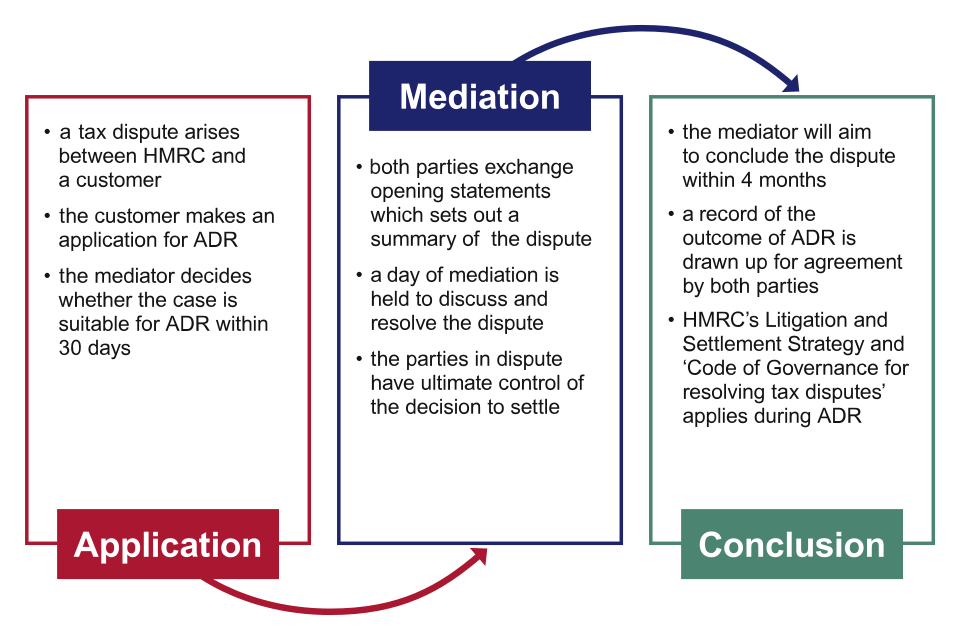
Most ADR applications are submitted once we have made a decision on the amount of tax due and the customer has appealed — but it is possible to consider ADR at any point during a compliance check. Customers can apply for ADR via telephone or online through GOV.UK. We have set up an internal route for HMRC caseworkers to apply directly for ADR which will only be accepted with the customer’s agreement. The mediator will decide within 30 days of receiving the application whether the case is suitable for ADR.
The types of case which are excluded from ADR can be found in the published ADR guidance on GOV.UK. These are usually cases where ADR cannot add value to the dispute because, for example, legal precedent is set and there is no apparent scope for HMRC to amend the decision. If the mediator has concerns about whether the case is suitable for ADR or whether ADR can add value, the case is referred to an internal governance panel for consideration.
Read HMRC’s ADR Guidance on GOV.UK.
If we agree to enter into ADR, the mediator will work with the HMRC caseworker and the customer to try to resolve the dispute. The mediator will aim to conclude the process within 4 months. The parties in dispute have ultimate control over the decision on whether to settle.
ADR continues to have a positive impact on nearly 90% of the cases which are accepted into the process. In this instance, positive impact means that the case has been progressed, either by fully or partially resolving the dispute, or by clarifying both sides’ positions and enabling them to make an informed decision on how to move forward. The majority of mediations take place via video which helps provide greater operational flexibility and reduce costs.
Table 10: Alternative dispute referrals
| 2025-26 | 2024-25 | |
|---|---|---|
| Total applications for ADR (either side can propose ADR) | 1,563 | 1,653 |
| Cases accepted into ADR | 559 | 663 |
| Cases rejected by governance panels | 434 | 434 |
| Cases rejected as being Out of Scope | 225 | 191 |
| Cases withdrawn by applicant | 220 | 213 |
| Cases awaiting triage decision | 125 | 246 |
| Total | 1,563 | 1,653 |
| Cases closed | 533 (note) | 521 |
| Of which: cases resolved | 474 (note) | 462 |
| Percentage of cases resolved | 88.9% | 88.7% |
| Live cases | 291 | 253 |
Note: This figure includes applications from a previous tax year.
Reviews and appeals
If a customer disputes an appealable tax decision, they can request a statutory review of the decision and appeal to the independent tax tribunal. Reviews usually settle disputes and are quicker and more cost-effective than appeals. It can therefore be beneficial to customers to seek a review in the first instance. If a customer requests a review and does not agree with the outcome, they can still make an appeal to the tribunal.
Reviews
All HMRC reviews are principally overseen by tax, legal or accountancy professionals working in our Legal group. To ensure an objective and impartial review service, HMRC ensures that these officers were not involved in the original decision.
The statutory review process provides an additional opportunity to resolve disputes without the need for tribunal proceedings. The statutory review process checks whether the decision is in line with legislation and technical guidance, policy, and practice. The review is also an opportunity to provide feedback internally to HMRC caseworkers and improve decision making.
We carry out the review ensuring:
- a transparent review of decisions
- quality and consistency in our review conclusions
- even-handed dealing with taxpayers at review
- as many disputes as possible are resolved without tribunal proceedings
Statutory reviews of automated penalties and default surcharge
Automated penalties occur when a taxpayer fails to meet a deadline, such as those for filing a tax return or payment. HMRC issues information to customers on how they can appeal these if they have a reasonable excuse as to why they were unable to meet their obligations. Coupled with the introduction of penalty reform in previous years, HMRC now allows those customers to appeal through their Online Account. This makes the process easier, and more likely that customers will use the service where they have a reasonable excuse for missing their obligations and allows HMRC to quickly and efficiently remove those penalties.
Table 11: Overview of outcomes of statutory reviews of automated penalties and default surcharge
| Statutory reviews of automated penalties and default surcharge (note) | 2025-26 | 2024-25 |
|---|---|---|
| Dealt with in the year | 74,738 | 69,341 |
| HMRC original decision upheld | 26,371 | 22,786 |
| HMRC decision varied | 178 | 289 |
| HMRC decision cancelled | 48,189 | 46,266 |
| Percentage where original HMRC decision was upheld | 35% | 33% |
Note: In 2025 to 2026, HMRC issued 8,128,750 automated penalties, penalty points and default surcharges (2024 to 2025: 9,070,279).
Statutory reviews of other matters
These reviews concern substantive HMRC decisions rather than automated penalties or surcharges and are typically more complex, requiring detailed analysis of legislation, technical interpretation, and case-specific facts.
Table 12: Overview of outcomes of reviews of other matters
| Statutory reviews of other matters | 2025-26 | 2024-25 |
|---|---|---|
| Dealt with in the year | 5,755 | 5,834 |
| HMRC original decision upheld | 3,873 | 4,246 |
| HMRC decision varied | 956 | 900 |
| HMRC decision cancelled | 926 | 688 |
| Percentage where original HMRC decision was upheld | 67% | 73% |
Appeals
Most tax decisions by HMRC carry a right for the customer to appeal against the decision to the First-tier Tribunal (FTT). Where there is no right to appeal to the FTT, or where a customer disputes the lawfulness of a decision, then they may also request a Judicial Review (JR). A request for JR will normally be made to the High Court. HMRC will seek, wherever possible, to work with the customer to avoid the need for disputes to go to the tribunal or court. Where agreement cannot be reached the tribunal or court can determine the outcome of the dispute. If either the customer or HMRC are dissatisfied with the outcome, then they can seek to appeal it to a higher jurisdiction. The tribunals and courts are independent of both HMRC and the customer.
Table 13: Overview of tax appeals
| 2025-26 | 2024-25 | |
|---|---|---|
| New appeals made to the FTT | 4,512 | 9,093 |
| Appeals in progress | 23,500 | 48,500 |
| Of which have been stood over | 17,000 | 41,500 |
| Settled appeals (by formal hearing or by agreement before the hearing) | 29,475 | 7,276 |
| Tax protected | £20.7 bn | £6.4 bn |
| Decided appeals (note) | 2,989 | 2,082 |
| Success rate for decided appeals1 | 91.4% | 92.6% |
Note: These figures do not include the thousands of appeals stayed behind a group of connected lead appeals struck out as explained in the paragraph below.
For appeals that were stood over 17,000 (2024 to 2025: 41,500), this was generally where HMRC and the customer agreed to put the appeal on hold while waiting for a decision in a related lead case being litigated.
The FTT has the power to strike out (‘dismiss’) either party’s entire case or parts of it prior to the appeal proceeding to a full hearing. A strike out, depending on which issues in dispute are struck out, can end an appeal or a set of proceedings. In 2025 to 2026 the Tribunal struck out thousands of appeals stayed behind a group of connected lead appeals. This explains the difference in figures for stood over appeals and settled appeals between 2025 to 2026 and 2024 to 2025.
Tax protected is an estimate of the tax at risk in litigation where HMRC has successfully defended its decisions. This will vary from year to year depending on the timing and nature of the litigation. If a specific appeal is challenging an aspect of law that would have implications for a large number of cases, then the tax protected figure will include an estimate of this wider tax at risk. Tax protected in any year is usually a reflection of a small number of cases that have a large amount of tax at stake.
HMRC’s success rate recorded in table 14 below is calculated as the percentage of hearings where the decision is in our favour or substantive elements of our case succeeded.
Table 14: Data relating to decided appeals
Due to the amount of data presented, only part of the table below is visible. Please use the scrollbar at the bottom of the table to view all the columns.
| First-tier Tribunal 2025-26 | Upper Tribunal 2025-26 | High Court 2025-26 | Court of Appeal 2025-26 | Supreme Court 2025-26 | First-tier Tribunal 2024-25 | Upper Tribunal 2024-25 | High Court 2024-25 | Court of Appeal 2024-25 | Supreme Court 2024-25 | |
|---|---|---|---|---|---|---|---|---|---|---|
| Total | 2,910 | 51 | 5 | 19 | 4 | 1,997 | 58 | 4 | 19 | 4 |
| Decision for HMRC | 2,584 | 38 | 4 | 16 | 4 | 1,766 | 36 | 4 | 14 | 3 |
| Decision where substantive elements of HMRC’s case succeeded | 81 | 4 | - | 1 | - | 99 | 5 | - | - | - |
| Decision for customer | 245 | 9 | 1 | 2 | - | 132 | 17 | - | 5 | 1 |
| HMRC success rate | 92% | 82% | 80% | 89% | 100% | 93% | 71% | 100% | 74% | 75% |
There is a difference between FTT appeals recorded by Ministry of Justice and the statistics reported in tables 13 and 14. These differences relate to the timing of when appeals are counted and whether or not HMRC is a party to the proceedings.
Governance for resolving tax disputes
Governing the resolution of disputes
The role of the Tax Assurance Commissioner (TAC) was first introduced in 2012, as part of a package of measures to strengthen HMRC’s governance and assurance of tax disputes. The TAC has ultimate responsibility for civil dispute governance across HMRC, and for the LSS. They provide assurance and transparency to Parliament and the public that HMRC handles disputes in a fair and even-handed manner.
The TAC has no involvement in the management of the tax affairs of specific customers and no line management responsibility for caseworkers, maintaining a clear separation of responsibilities. The TAC chairs a panel of 3 HMRC commissioners who make decisions on the largest and most sensitive cases, as well as a sample of smaller cases. A further sample of cases is also checked through our TSAP to assure how cases are managed and disputes resolved.
Read HMRC’s Litigation and Settlement Strategy on GOV.UK.
In line with our Code of Governance for resolving tax disputes, the majority of case resolution decisions are taken by caseworkers with the oversight of their managers and, where relevant, advice from specialists. Where tax at risk on a dispute exceeds £5 million (non-Large Business customers) or £15 million (Large Business customers), referral to a dispute resolution board is required, as set out in HMRC’s Code of Governance for resolving tax disputes.
Read HMRC’s ‘Code of Governance for Resolving Tax Disputes on GOV.UK.
Figure 22: Summary of TAC oversight dispute resolution governance (note)
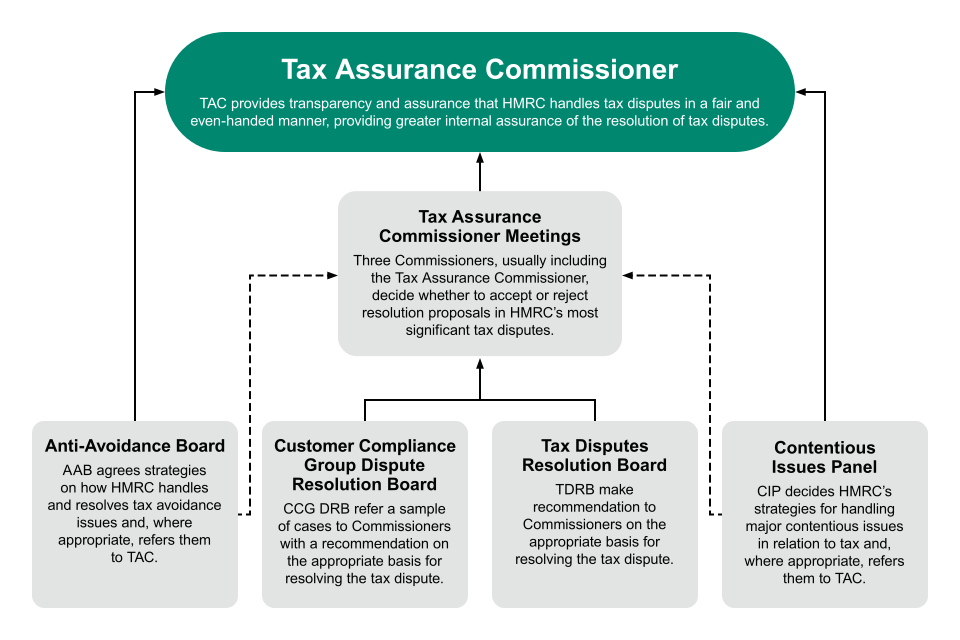
Note: Dotted lines represent where cases are referred to TAC Meetings on an Ad Hoc basis.
Table 15: HMRC commissioners: outcome of referrals
| 2025-26 | 2024-25 | |
|---|---|---|
| Total number of meetings held (including via correspondence) | 25 | 15 |
| Total referrals to the commissioners | 64 (note 1) | 46 |
| Reason for referrals | ||
| £100 million plus tax or £500 million adjustment | 45 | 30 |
| Decisions on sensitive case or risk | 2 | 1 |
| Decisions on sample cases | 13 | 11 |
| Penalty only referrals | 2 | 4 |
| Director referral | 2 | - |
| Director re-referral following remittance for further work | 0 | - |
| Outcome of referral (note 2) | ||
| Taxpayer’s filed position accepted | 9 | 9 |
| Taxpayer’s revised proposal accepted | 15 | 12 |
| Taxpayer’s position rejected | 33 | 20 |
| Remitted for further work | 5 | 1 |
Notes:
- Referrals from Contentious Issues Panel (CIP)/Anti-Avoidance Board (AAB) are not included within these figures.
- Outcome of referral does not include penalty only referrals (2 for 2025 to 2026).
Table 16: Tax Dispute Resolution Board (TDRB): outcome of referrals
| 2025-26 | 2024-25 | |
|---|---|---|
| Total referrals to TDRB | 53 | 44 |
| Taxpayer’s filed position accepted | 7 | 7 |
| Taxpayer’s revised proposal accepted | 12 | 10 |
| Taxpayer’s position rejected | 27 | 20 |
| Penalty only referral | 0 | 3 |
| Total | 46 | 40 |
| Of which: referred to commissioners | 42 | 36 |
| Remitted for further work | 5 | 3 |
| Guidance provided | 0 | 1 |
| Decision taken by TDRB under its remit | 4 | 4 |
| Penalty only referral | 2 (note) | 0 |
| Total not referred to commissioners | 11 | 8 |
Note: In 2025 to 2026 penalty only referrals went to TDRB only.
Table 17: The Customer Compliance Group Dispute Resolution Board (CCG DRB): outcome of the total referrals to the CCG DRB
| 2025-26 | 2024-25 | |
|---|---|---|
| Total referrals to CCG DRB | 105 | 113 |
| Taxpayer’s filed position accepted | 16 | 13 |
| Taxpayer’s revised proposal accepted | 15 | 29 |
| Taxpayer’s position rejected | 51 | 50 |
| Penalty only referral | 15 | 14 |
| Board remitted for further work before re-referral | 7 | 7 |
| Total | 104 (note)1 | 113 |
| Of which: Sample cases referred to commissioners | 9 | 11 |
Note: Case referred onto TDRB for a decision not included in total (2025 to 2026).
Issues governance
We have governance processes in place to determine our approach to issues that affect multiple taxpayers to ensure they are treated in a consistent and even-handed manner. In general, policy and compliance teams refer avoidance issues to the Anti-Avoidance Board (AAB) and any other issues involving points of law or practice to the Contentious Issues Panel (CIP). Both these bodies include senior operational, legal and policy experts.
During 2025 to 2026:
- the CIP met on 7 occasions and considered 9 issues (5 occasions and 7 issues in 2024 to 2025) involving Personal tax and Business tax
- the AAB met on 9 occasions and considered 11 issues (7 occasions and 10 issues in 2024 to 2025)
Two issues were referred to the commissioners from the CIP (no issues were referred to the commissioners in 2024 to 2025). No issues were referred to the commissioners from the AAB (no issues referred to the commissioners in 2024 to 2025).
General Anti-Abuse Rule (GAAR) and GAAR Advisory Panel
The purpose of the GAAR is to discourage taxpayers from entering into abusive arrangements, and to deter the promotion and enabling of such arrangements. The GAAR Advisory Panel is an independent body made up of experts with legal, accountancy and commercial backgrounds. It provides an opinion on whether tax arrangements are unreasonable. This year we said farewell to John Whiting who has been the chairperson of the GAAR Advisory Panel since April 2020 and welcomed Gary Richards who formally took over the position from October 2025.
We are legally required to consider the opinions issued by the advisory panel in reaching a final decision on whether to use the GAAR to address the tax advantage arising from the arrangements, or whether to apply penalties to enablers who facilitated the use of those arrangements. Courts must also take into account the panel’s opinion if the tax arrangements are considered by them. The panel’s opinions are published on GOV.UK to help taxpayers recognise abusive tax avoidance schemes. An opinion can relate to arrangements used by multiple taxpayers leading to the issue of opinion notices.
In 2025 to 2026 the panel provided an opinion in 2 cases (3 in financial year 2024 to 2025). In each of the cases considered, the opinion of the panel was that entering into and carrying out the arrangements was not a reasonable course of action. Since 2018, we have issued over 5,700 GAAR opinion notices (applying GAAR Advisory Panel opinions) to taxpayers who have used these arrangements. Taxpayers have the right to appeal against any adjustments made under the GAAR and any penalties that may be due if their case is settled under the GAAR.
Read more about the GAAR on GOV.UK.
Ensuring a standard approach to penalties for inaccuracy and failure to notify chargeability
We charge our customers inaccuracy penalties when we find that they have filed an inaccurate tax return, claim or document, and the inaccuracy occurred because of careless or deliberate behaviour on their part. We charge our customers failure to notify penalties when we find that they have not told HMRC about a new liability to tax or other duties, and do not have a reasonable excuse for not doing so.
We work hard to ensure consistency in our decisions to charge these penalties. We do this by maintaining effective controls to make sure decisions are considered and authorised at the appropriate level, taking into account both the size and complexity of the tax at stake and the corresponding penalty. Our operational guidance, line manager authorisation checks and specific governance boards for the most complex cases all support decision making on the appropriateness of any penalty we charge. In addition, we use networks of senior tax professionals to support our caseworkers with advice and assurance.
The government consulted last year on options to simplify and strengthen HMRC’s behavioural inaccuracy and failure to notify penalties. A summary of the consultation responses was published alongside Budget 2025, announcing the government’s intention to develop draft legislation for reform of these penalties.
Our approach to dealing with fraud
HMRC’s approach is to support the vast majority who try to get their tax right through guidance, educational material and responsive customer service. However, we will respond robustly to those who try to cheat or attack the tax system. Our approach to dealing with fraud usually involves using our civil powers to assess tax and impose penalties and fines of up to 200% of the tax liable. Where appropriate, we also pursue criminal investigations, seeking prosecutions and confiscations in circumstances where:
- HMRC needs to send a strong deterrent message
- only a criminal sanction is appropriate
- a civil compliance approach will not be effective
Read HMRC’s approach to fraud on GOV.UK.
Tax Settlement Assurance Programme
Since 2013, under the TSAP, a specialist team independent of operational casework has reviewed a sample of settled civil compliance cases. The purpose is to assess whether we have met our internal case quality standards and appropriately governed decisions relating to disputes. This includes evaluating adherence to the Charter standards, as explained in our Compliance Professional Standards (CPS), and core internal processes.
Since 2021 to 2022, casework has been tested via our CAR. This expanded testing to incorporate CPS elements not previously included in the TSAP whilst ensuring that governance and reporting metrics, such as yield claiming accuracy were maintained. CAR results identify areas for improvement in our management of tax administration and disputes.
In 2025 to 2026, the CAR reviewed 400 settled cases. The cases provide robust evidence of the quality of compliance casework across each directorate and tax regime. Internal Audit has positively validated the Assurance Team’s methodology and findings. The NAO report on HMRC’s approach to taxing large businesses acknowledged that HMRC’s Tax Settlement and Assurance Programme, which provides an independent review of a sample of interventions, indicates a high level of assurance within large business.
We test 9 standards in our case sample, and the chart below presents average results by theme for 2025 to 2026, compared with the previous 2 years. The themes reflect the lifecycle of a case, including the financial impact for both the customer and HMRC. A composite indicator is derived from the average across all themes. Compared to 2024 to 2025, the results show improvement in 2 themes and a decline in 7. Overall, performance declined by 3 percentage points to a compliance rate of 81%. The 3-year comparison indicates an overall performance decline of 6 percentage points for the last 2 years.
Figure 23: Three-year summary of theme scoring for 2023 to 2024 to 2025 to 2026
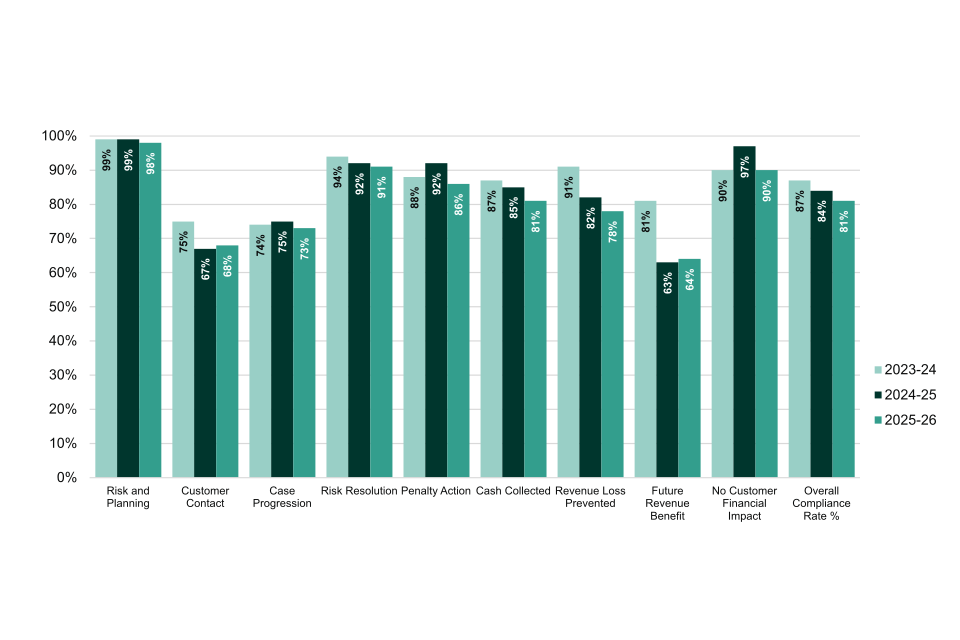
The following summary shows the results at individual case level. These do not equate to the overall percentage compliance rate shown above due to the averaging both within and across the 9 themes:
- overall, 20.75% (83/400) of the cases reviewed met or exceeded all our required governance and quality standards
- 68.75% (275/400) fell short of HMRC’s internal governance and quality standards, however with no financial impact on the customer
- 10.5% (42/400) fell short of our governance and quality standards with a customer financial impact. Of the 42 cases, 15 were identified where the customer had been charged too much tax. Corrective actions have been initiated, and we check to ensure appropriate actions are completed. This represents a decline from 2024 to 2025
During 2024 to 2025 we designed a framework to further strengthen our approach to assuring our work, placing greater focus on the essential elements of casework that have the greatest impact on customers; protecting customer data, making customers aware of their rights and safeguards available to them, and being financially accurate in all our calculations of tax liability. The chart below represents results for the 3 categories for 2025 to 2026.
Figure 24: Essential Elements of Casework Performance
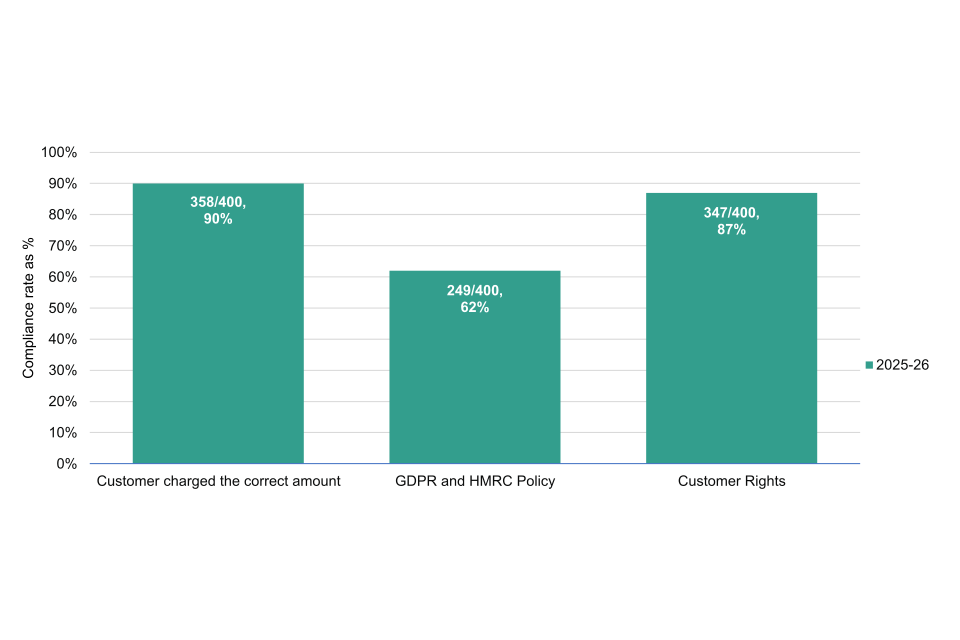
The Compliance Professional Standards set a clear benchmark for how HMRC compliance activity should be conducted. However, current assurance evidence shows that these standards are not yet being applied consistently across all casework.
Our enhanced focus on the Essential Elements of quality — particularly the protection of customer information, the effective operation of safeguards and the accuracy of financial outcomes — has provided a sharper and more transparent view of performance. This has enabled us to move beyond high-level assurance to identify specific, recurring risks in delivery where the impact on customers falls short of the standards we expect.
In response, we are taking a structured, evidence-led approach to improvement. We have strengthened our quality assurance framework by aligning front-line and independent assurance around the Essential Elements and embedding these more explicitly within our professionalism assessments. This provides a more consistent and reliable view of performance, enabling earlier identification of risk and more targeted intervention.
Alongside these changes, we are implementing practical measures to support improved performance, including clearer guidance, enhanced learning provision and targeted support for caseworkers and managers. In 2027 to 2028, we will also introduce Secure Digital Exchange Communications (SDEC) to make sharing information and documents easier and safer for customers who wish to communicate with us in this way. These actions are designed to drive more consistent application of the Standards in day-to-day work and to strengthen the quality of outcomes delivered for customers.
For the small number of the largest risks, which require governance at a Dispute Resolution Board (the remits of the Dispute Resolution Boards are summarised in the relevant section of the TAC report), the TSAP monitors whether the appropriate governance procedures have been followed. Where cases do not require a referral to a formal case governance board, the TSAP confirms whether the settlement was authorised at the appropriate level. For 2025 to 2026, our checks have revealed that 100% (7/7 cases) were referred to the relevant board at the appropriate time.
Table 18: Three-year annual comparison of governance and authorisation
| 2023-24 | 2024-25 | 2025-26 | |
|---|---|---|---|
| Settlement authorised at appropriate level | 94% (88 out of 94 cases) | 86% (90 out of 105 cases) | 90% (102 out of 114 cases) |
| Dispute Resolution Board governance followed, where required | 100% (8 out of 8 cases) | 100% (6 out of 6 cases) | 100% (7 out of 7 cases) |
Remuneration and staff report
This report provides details on the size and shape of our workforce, the cost of our staff and leadership team and how we manage their health, safety and wellbeing.
HMRC is proud to reflect the nation we serve. As the UK’s third largest government department we employ around 70,000 full-time equivalent (FTE) employees from all backgrounds, working in towns and cities across the UK. In our workplaces you can expect to find customer service advisers and compliance caseworkers, but also experts in data, digital technology, policy, finance, and the law, along with other highly skilled professionals who make up our corporate service teams.
Remuneration report for Senior Civil Servants
The government is committed to building a Senior Civil Service (SCS) that reflects the nation it serves, can recruit and retain specialist skills and continue growing its capabilities. This report contains information about HMRC’s senior employees and covers our policies on salaries, bonuses and benefits in kind, as well as performance assessment and contract termination.
Remuneration policy
The SCS is made up of senior leaders employed across government, with a common framework of terms and conditions. SCS pay and conditions are not delegated to individual departments. Our SCS performance management system is governed by the Cabinet Office and recommendations on SCS pay are provided by the Independent Review Body on Senior Salaries in an annual report to the Prime Minister. The government responds to its recommendations, and the Cabinet Office sets out the approach departments must follow in SCS pay guidance. In line with Cabinet Office guidance, SCS pay and non-consolidated awards at HMRC are then decided by ExCom.
SCS employee numbers and approved posts
As of the 31 March 2026, we have 584 SCS employees made up of 558 HMRC and 26 VOA SCS employees. The total number of SCS approved posts was 606, made up of 580 HMRC and 26 VOA SCS posts. This figure includes both filled, vacant and job shared posts.
Table 19: HMRC Senior Civil Service (SCS) employee numbers comparison
| Number at 31 March 2026 | Number at 31 March 2025 | Percentage change | |
|---|---|---|---|
| Permanent Secretary | 2 | 2 | 0% |
| SCS3 | 10 | 10 | 0% |
| SCS2 | 74 | 69 | 7% |
| SCS1 | 463 | 447 | 4% |
| On loan/ secondment | 9 | 8 | 13% |
| Total | 558 | 536 | 4% |
SCS structure and recruitment
There are 3 levels of SCS below the posts of Permanent Secretary: Director General, Director and Deputy Director. These are underpinned by a job evaluation which assesses the demands of each job relative to others. A total of 54 HMRC and VOA SCS posts were advertised last year. Qualified individuals from both within and outside the Civil Service were appointed through level moves and promotions.
SCS performance
The performance of deputy directors and directors is moderated by directors general and ExCom signs-off the overall departmental year-end performance group distribution. Performance for directors general is moderated by the permanent secretaries with advice from an independent observer. Performance and pay arrangements for permanent secretaries are managed by Cabinet Office.
Senior Civil Service base pay awards
The SCS Pay 2025 Practitioner Guidance sets out the Senior Civil Service (SCS) pay framework and award for 2025 to 2026. SCS pay is set centrally and is determined on an annual cycle through the Senior Salaries Review Body, an advisory independent pay review body.
This meant that from 1 April 2025, we implemented the following elements, as set out in the Cabinet Office guidance:
- an across-the-board base pay increase for all SCS of 3.25%
- increase to the minimum salary for all SCS pay ranges: £81,000 (2024 to 2025: £76,000) (SCS1); £100,000 (2024 to 2025: £98,000) (SCS2); and £130,000 (2024 to 2025: £128,000) (SCS3)
- in-year non-consolidated performance bonuses for exceptional performance during 2025 to 2026 to colleagues in accordance with the criteria set out in the Cabinet Office guidance
Senior Civil Service non-consolidated performance awards
Exceptional performance against objectives is rewarded through non-consolidated end-of-year and in-year performance awards. In line with Cabinet Office guidance, non-consolidated end of year and in-year performance awards are funded from an agreed allocation of 3.30% of the SCS basic paybill and subject to a pay control limit of £25,000.
182 awards were paid to ‘Exceeding/High-Performing’ colleagues on 1 April 2025, for the 2024 to 2025 performance year:
- end of year non-consolidated performance awards of £9,000/£5,700 (SCS1 Exceeding/High Performing), £10,500/£6,000 (SCS2 Exceeding/High Performing), and £12,500/£6,250 (SCS3 Exceeding/High-Performing)
- in-year awards ranging from £250 to £4,250 have been paid to 350 SCS members based on performance from April 2025 to the end of March 2026
- awards that are above and beyond the control limit of £25,000 are agreed in non-standard contracts, in line with the HM Treasury senior pay approval process — non-consolidated performance award decisions are monitored to guard against bias or discrimination
Policy on notice periods and termination payments for the Senior Civil Service
We follow standard policy for SCS notice periods and termination payments in the Civil Service Management Code.
Service contracts
There is a legal requirement that all Civil Service appointments must be made on merit, and on the basis of fair and open competition. Recruitment principles published by the Civil Service Commission explain the limited circumstances when other appointments can be made. Executive members hold open-ended appointments, unless otherwise stated in the governance statement. Early termination, other than for misconduct, would result in the individual receiving compensation as set out in the Civil Service Compensation Scheme. No compensation payments were made to ExCom members during 2025 to 2026.
Read Civil Service Commission recruitment principles on the Civil Service Commission website.
Business Appointment Rules
In compliance with Business Appointment Rules (BAR), the department is transparent in the advice given to individual applications for senior staff. Advice regarding specific business appointments is published on a quarterly basis on GOV.UK. Since 2022, the BAR Governance Panel has provided central oversight of full Senior Civil Service (SCS) BAR applications and is responsible for assessing and reaching a decision on all full SCS BAR applications. A quarterly paper on the BAR is provided to the Audit and Risk Committee to support them in their role monitoring HMRC’s application of the rules.
In 2022, HMRC introduced a new BAR assurance tool to help the SCS community to identify whether a full BAR application is needed when leaving HMRC. In 2023 a supplementary tool was launched for delegated grades, which helps colleagues identify where a BAR application must be made and makes it easier for BAR applications to be associated with their central employee record.
Statistics cover the period 1 April 2025 to 31 March 2026:
Table 20: Statistics on the application of business appointment rules
| SCS1 Population | SCS2 Population | For AA-G6 population | |
|---|---|---|---|
| Number of exits from Crown Service (civil servants and special advisers) | 52 | 11 | - |
| Number of exits where Business Appointment Rules (BAR) applications were submitted | 7 | 5 | 72 |
| Number of BAR applications approved | 7 | 5 | 72 |
| Number of BAR applications where conditions were set | 7 | 5 | 11 |
| Number of BAR applications that were found to be unsuitable for the applicant to take up the new role | - | - | - |
| Number of breaches of the rules | - | - | [No detail available] |
Read advice regarding specific business appointments on GOV.UK.
ExCom and non-executive members remuneration and pension benefits
The following table provides details of salaries and pension entitlements of the department’s most senior officials.
Table 21: Senior officials’ single total figure of remuneration and pension benefits (note 1)
Due to the amount of data presented, only part of the table below is visible. Please use the scrollbar at the bottom of the table to view all the columns.
| Senior officials | Salary (full year equivalent) (£000) 2025-26 | Salary (full year equivalent) (£000) 2024-25 | Bonus payments (£000) 2025-26 | Bonus payments (£000) 2024-25 | Benefits in kind (to the nearest £100) 2025-26 | Benefits in kind (to the nearest £100) 2024-25 | Pension benefits (to the nearest £000) 2025-26 | Pension benefits (to the nearest £000) 2024-25 | Total (£000) 2025-26 | Total (£000) 2024-25 |
|---|---|---|---|---|---|---|---|---|---|---|
| John-Paul Marks (note 2) | 195-200 (195-200) | - | - | - | - | - | 81 | - | 275-280 | - |
| Angela MacDonald | 180-185 | 175-180 | - | - | - | - | 69 | 67 | 245-250 | 240-245 |
| Alan Evans | 160-165 | 155-160 | 5-10 | 10-15 | 100 | 100 | 20 | 125 (note 3) | 190-195 | 295-300 |
| Andrew Pemberton | 150-155 | 145-150 | 0-5 | 5-10 | - | - | 58 | 57 | 210-215 | 210-215 |
| Carol Bristow | 150-155 | 145-150 | 0-5 | - | 200 | 100 | 68 | 100 | 220-225 | 245-250 |
| Daljit Rehal | 210-215 | 215-220 | 60-65 | 60-65 | - | - | 80 | 80 | 355-360 | 360-365 |
| Helen Pickles | 160-165 | 30-35 (150-155) | 5-10 | - | - | - | 218 | 45 | 380-385 | 75-80 |
| James Mitton | 150-155 | 120-125 (140-145) | - | - | - | - | 59 | 47 (note 3) | 210-215 | 165-170 (note 4) |
| Jonathan Athow | 150-155 | 145-150 | 0-5 | 15-20 | - | 100 | - | - | 155-160 | 160-165 |
| Jonathan Russell | 150-155 | 145-150 | - | 10-15 | - | - | 59 | 62 (note 3) | 210-215 | 220-225 (note 4) |
| Justin Holliday | 190-195 | 185-190 | 0-5 | 0-5 | 200 | 100 | 37 | 156 | 230-235 | 345-350 |
| Lucy Pink | 125-130 | 110-115 | 10-15 | 5-10 | - | 100 | 73 | 64 | 205-210 | 185-190 |
| Myrtle Lloyd | 150-155 | 145-150 | 0-5 | 10-15 | - | - | 63 | 108 | 215-220 | 265-270 |
| Penny Ciniewicz | 160-165 | 155-160 | 5-10 | 0-5 | 400 | 100 | 63 | 30 (note 7) | 230-235 | 190-195 (note 4) |
| Suzanne Newton | 150-155 | 145-150 | 0-5 | - | 400 | 200 | 58 | 93 | 210-215 | 235-240 |
| Jim Harra (note 5) | 0-5 (200-205) | 205-210 | - | - | - | 100 | 1 | 77 (note 3) | 0-5 | 280-285 (note 4) |
Notes:
- This section has been subject to external audit.
- Joined the department 6 April 2025.
- Figure restated where the Civil Service Pension Scheme have made an update to the data.
- Total restated to reflect update made to the pension benefit figure.
- Left the department April 2025.
Pension figures show pension earned in PCSPS or CSOPS (alpha) as appropriate. Where the official has benefits in both PCSPS and alpha the figure is the combined value of benefits in the 2 schemes — but part of the pension may be payable from different ages. The accrued pension is the pension the member is entitled to receive when they reach pension age, or immediately on ceasing to be an active member of the scheme if they are already at or over pension age.
Due to the amount of data presented, only part of the table below is visible. Please use the scrollbar at the bottom of the table to view all the columns.
| Senior officials | Scheme | Accrued annual pension at pension age and related lump sum (£000) as at 31 March 2026 | Real increase in pension and related lump sum at pension age (£000) | Cash Equivalent Transfer Value (CETV) (to the nearest £000) as at 31 March 2026 | Cash Equivalent Transfer Value (CETV) (to the nearest £000) as at 31 March 2025 | Cash Equivalent Transfer Value (CETV) (to the nearest £000) Real increase | Employer contribution to partnership pension account (to the nearest £100) |
|---|---|---|---|---|---|---|---|
| John-Paul Marks | [alpha] | 75-80 | 2.5-5 | 1,292 | 1,171 | 47 | - |
| Angela MacDonald | alpha | 60-65 | 2.5-5 | 1,024 | 927 | 49 | - |
| Alan Evans | alpha | 100-105 | 0-2.5 | 2,125 | 2,035 (note 1) | 2 | - |
| Andrew Pemberton | alpha | 15-20 | 2.5-5 | 241 | 183 | 40 | - |
| Carol Bristow | alpha | 85-90 | 2.5-5 | 1,807 | 1,653 | 55 | - |
| Daljit Rehal | alpha | 25-30 | 2.5-5 | 491 | 396 | 64 | - |
| Helen Pickles | alpha | 65-70 | 10-12.5 | 1,265 | 1,011 | 190 | - |
| James Mitton | alpha | 50-55 | 2.5-5 | 747 | 677 (note 1) | 38 | - |
| Jonathan Athow | partnership pension scheme | - | - | - | - | - | 22,600 |
| Jonathan Russell | alpha | 5-10 | 2.5-5 | 145 | 81 (note 1) | 49 | - |
| Justin Holliday | alpha | 105-110 | 2.5-5 | 2,210 | 2,072 | 13 | - |
| Lucy Pink | alpha | 40-45 Plus lump sum of 90-95 | 2.5-5 Plus lump sum of 2.5-5 | 780 | 686 | 50 | - |
| Myrtle Lloyd | alpha | 60-65 | 2.5-5 | 1,232 | 1,117 | 46 | - |
| Penny Ciniewicz | alpha (note 2) | 5-10 | 2.5-5 | 95 | 31 (note 2) | 51 | - |
| Suzanne Newton | alpha | 70-75 | 2.5-5 | 1,348 | 1,234 | 38 | - |
| Jim Harra | alpha | 20-25 | 0-2.5 | 397 | 397 (note 1) | 1 | - |
Notes:
- Figure restated where the Civil Service Pension Scheme have made an update to the data.
- Figure not previously supplied by the Civil Service Pension Scheme provider.
Explanatory notes for tables 21 and 22
Salary
Salary covers both pensionable and non-pensionable amounts and includes gross salary, overtime, recruitment and retention allowances, reserved rights to other allowances and any other allowance that is subject to UK taxation.
Bonus payments
Bonus payments are paid while serving on ExCom for exceptional work in the performance year. Year-end performance awards are based on performance achieved in posts held in the previous year and are made as part of the performance and pay award process. Bonus payments are considered non-consolidated pay awards.
Benefits in kind
The monetary value of benefits in kind covers any benefits provided by HMRC and treated as taxable, such as hospitality provided at external development events.
Pension benefits
Pension benefits are calculated by Capita on behalf of HMRC in accordance with their interpretation of the FREM. The values supplied by Capita for the remuneration statement are different and higher than the amounts supplied to individual employees for them to calculate their remuneration for tax purposes.
Pension Benefits accrued are calculated as follows:
Real increase in pension x 20
add Real increase in any lump sum
less Contributions made by the individual
= The value of pension benefits accrued during the period
The real increases exclude increases due to inflation or any increases or decreases due to the transfer of pension rights. The value of pension benefits can vary from year to year, due to things like the date that an individual joined or left, or an individual receiving a higher pay increase in one year to another.
Accrued pension benefits included in table 21 for any individual affected by the Public Service Pensions Remedy have been calculated based on their inclusion in the legacy scheme for the period between 1 April 2015 and 31 March 2022, following the McCloud judgment. The Public Service Pensions Remedy applies to individuals that were members, or eligible to be members, of a public service pension scheme on 31 March 2012 and were members of a public service pension scheme between 1 April 2015 and 31 March 2022.
The basis for the calculation reflects the legal position that impacted members have been rolled back into the relevant legacy scheme for the remedy period and that this will apply unless the member actively exercises their entitlement on retirement to decide instead to receive benefits calculated under the terms of the alpha scheme for the period from 1 April 2015 to 31 March 2022.
Cash equivalent transfer values
The Cash Equivalent Transfer Value (CETV) is the actuarially assessed capitalised value of the pension scheme benefits accrued by a member at a point in time. The benefits valued are the member’s accrued benefits and any contingent spouse’s pension payable from the scheme.
A CETV payment is made by a pension scheme (or arrangement) when a member leaves a scheme and chooses to transfer the pension benefit they have accrued in that scheme to secure pension benefits in another pension scheme (or arrangement).
The value shown relates to the benefits the individual has accrued because of their membership of the pension scheme, not just their service in a senior capacity.
The figures include the value of any pension benefit in another scheme or arrangement which the member has transferred to the Civil Service pension arrangements. They also include any additional pension benefit accrued to the member as a result of their buying additional pension benefits at their own cost.
CETVs are calculated in accordance with the Occupational Pension Schemes (Transfer Values) (Amendment) Regulations 2008.
Real increase in CETV
This reflects the increase in CETV that is funded by the employer. It does not include the increase in accrued pension due to inflation, contributions paid by the employee (including the value of any benefits transferred from another pension scheme or arrangement) and uses common market valuation factors for the start and end of the period.
Non-executive directors’ single total figure of remuneration
The fees of the external appointees, which include any other allowance that is subject to UK taxation, are detailed below.
Table 22: Non-executive directors’ single total figure of remuneration (note 1)
| Senior officials | Fees (full year equivalent) (£000) 2025-26 | Fees (full year equivalent) (£000) 2024-25 | Benefits in kind (to the nearest £100) 2025-26 | Benefits in kind (to the nearest £100) 2024-25 | Total (£000) 2025-26 | Total (£000) 2024-25 |
|---|---|---|---|---|---|---|
| Dame Jayne-Anne Gadhia | 25-30 | 25-30 | – | – | 25-30 | 25-30 |
| Patricia Gallan (note 2) | 5-10 (20-25) | 20-25 | – | – | 5-10 | 20-25 |
| Michael Hearty | 25-30 | 25-30 | – | – | 25-30 | 25-30 |
| Paul Morton (note 2) | 5-10 (15-20) | 15-20 | – | – | 5-10 | 15-20 |
| Jennifer Tippin | 35-40 (note 3) | 20-25 | – | – | 35-40 | 20-25 |
| Mike Bracken (note 4) | 0-5 (20-25) | 10-15 (20-25) | – | – | 0-5 | 10-15 |
| Bill Dodwell | 20-25 | 10-15 (20-25) | – | – | 20-25 | 10-15 |
| Andre Katz | 15-20 | 5-10 (15-20) | – | – | 15-20 | 5-10 |
| Charlotte Moar | 15-20 | 5-10 (15-20) | – | – | 15-20 | 5-10 |
| Heather Self (note 5) | 10-15 (20-25) | – | – | – | 10-15 | – |
| Sachin Jogia (note 5) | 10-15 (15-20) | – | – | – | 10-15 | – |
| Sir Craig Mackey (note 5) | 10-15 (15-20) | – | – | – | 10-15 | – |
Notes:
- This section has been subject to external audit.
- Left the department July 2025.
- Undertook additional work to support and advise HMRC officials on a range of activities and received an additional fee of £16,500 for this work.
- Left the department April 2025.
- Joined the department September 2025.
Fair pay (note 1)
Reporting bodies are required to disclose the relationship between the remuneration of the highest-paid director in their organisation and the lower quartile, median and upper quartile remuneration of the organisation’s workforce.
The banded remuneration of the highest-paid director in HMRC and VOA in the financial year 2025 to 2026 was £275,001 to £280,000 (2024 to 2025, £280,000 to £285,000) (table 21 on page 136). This was 7.36 times (2024 to 2025, 7.77) the median remuneration of the workforce, which was £37,682 (2024 to 2025, £36,345).
In 2024 to 2025 and 2025 to 2026 no employees received remuneration in excess of the highest paid director. Remuneration ranged from £27,774 to £280,000 (2024 to 2025 £25,730 to £285,000).
Total remuneration includes salary, non-consolidated performance-related pay and benefits-in-kind. It does not include severance payments, employer pension contributions and the cash equivalent transfer value of pensions.
In 2025 to 2026 most employees received average base pay awards of approximately 3.25%, with an additional 0.5% targeted at specific workforce issues, in accordance with the Civil Service Pay guidance 2025 for delegated grades and the Senior Civil Service pay guidance 2025.
Table 23a: Pay ratio
| 2025-26 | 2024-25 | |
|---|---|---|
| 25th percentile pay ratio | 9.01 | 9.58 |
| Median pay ratio | 7.36 | 7.77 |
| 75th percentile pay ratio | 6.00 | 6.17 |
Table 23b: Total pay and benefits and salary component for the employees at the 25th percentile, median and 75th percentile
| 2025-26 | 2024-25 | |
|---|---|---|
| 25th percentile pay — Total pay and benefits | £30,805 | £29,475 |
| 25th percentile pay — Salary components | £30,679 | £29,475 |
| Median pay — Total pay and benefits | £37,682 | £36,345 |
| Median pay — Salary component | £37,682 | £36,320 |
| 75th percentile pay — Total pay and benefits | £46,229 | £45,759 |
| 75th percentile pay — Salary component | £46,229 | £45,759 |
Note: This section has been subject to external audit.
The change in the pay ratio is driven by movements in both median and senior remuneration across the organisation. Median remuneration has increased as a result of the 2025 pay award and at the same time, remuneration for the highest-paid director has reduced slightly, leading to a narrowing of the overall pay ratio.
Table 23c: Annual percentage change in remuneration of directors and employees from prior year
| 2024-25 to 2025-26 | Salary and allowances | Performance pay and bonus payable | Total remuneration |
|---|---|---|---|
| Highest paid director | -2.3% | 0.0% | -1.8% |
| Employees | 3.1% | 0.9% | 3.1% |
The table above shows the percentage change in both the highest paid director and employees salary and allowances, performance pay and bonuses payable and non-cash benefits between 2024 to 2025 and 2025 to 2026.
Staff numbers
As an operational department, we need the right number of people in the right places to serve our customers and deliver our objectives.
Our departmental group, including the VOA, had 70,456 full-time equivalent (FTE) employees at the end of financial year 2025 to 2026. This included 66,416 in HMRC and 4,040 in VOA. These figures exclude contingent labour, which was 2,379 for HMRC and 270 for VOA as of 31 March 2026.
Staffing figures for VOA within this report are consistent with the approach adopted by HMRC. However, VOA has adopted a marginally different approach for staffing figures within the VOA 2025 to 2026 annual report and accounts.
Recruitment
This year we recruited 9,769 FTE roles to ensure we have the skills we need in our key strategic locations, by replacing people who leave and facilitating organisational growth. This included 9,149 in HMRC, and 620 in VOA. We recruited 1,479 FTE from other government departments. This included 1,414 in HMRC and 65 in VOA.
Leavers and exits
In 2025 to 2026, 5,286 full-time equivalent employees either left HMRC’s departmental group, transferred to other government departments, or retired. This included 5,015 (8.1% of staff) in HMRC and 271 (6.7% of staff) in VOA.
Average number of full-time equivalent persons employed
The table below shows the average number of FTE for 2025 to 2026.
Table 24: Average number of full-time equivalent persons employed (note 1)
| Permanently employed staff — Operational | Permanently employed staff — Capital (note 2) | Others — Operational | Others — Capital (note 2) | 2025-26 Total | 2024-25 Total | |
|---|---|---|---|---|---|---|
| Core department | 61,938 | 738 | 1,318 | - | 63,995 | 61,138 |
| VOA (note 3) | 3,570 | - | 321 | - | 3,891 | 3,730 |
| Departmental group total | 65,508 | 738 | 1,639 | - | 67,886 | 64,868 |
Notes:
- This section has been subject to external audit.
- Capital relates to staff building capital assets.
- The basis for calculating the average FTE for VOA within this report is consistent with the approach adopted by HMRC. However, VOA has adopted a marginally different approach for the average FTE calculation within the VOA 2025 to 2026 annual report and accounts.
Staff costs (note 1)
Our staff costs figures only include officials. The salary of the minister who has responsibility for HM Revenue and Customs is paid out of central funds and can be found in the Resource Accounts of HM Treasury.
Table 25: The costs of people employed during the year and reconciliation from total net costs to ‘Staff and Related’ costs in the SoCNE (£m)
| Permanently employed staff | Others | 2025-26 £m | 2024-25 £m | |
|---|---|---|---|---|
| Wages and salaries | 2,762.9 | 58.5 | 2,821.4 | 2,520.8 |
| Social security costs (note 2) | 375.2 | 5.0 | 380.2 | 283.7 |
| Other pension costs | 767.8 | 11.9 | 779.7 | 721.7 |
| Sub Total | 3,905.9 | 75.4 | 3,981.3 | 3,526.2 |
| Less recoveries in respect of outward secondments | (3.3) | - | (3.3) | (3.5) |
| Total net costs | 3,902.6 | 75.4 | 3,978.0 | 3,522.7 |
| Recoveries in respect of outward secondments | 3.3 | 3.5 | ||
| Less net costs charged to capital budgets | (62.0) | (62.5) | ||
| Travel, subsistence and hospitality | 46.2 | 44.7 | ||
| Recruitment and training | 36.1 | 26.9 | ||
| Early severance schemes | 2.9 | (0.1) | ||
| Staff and related costs in Consolidated Statement of Comprehensive Net Expenditure | 4,004.5 | 3,535.2 |
Notes:
- This section has been subject to external audit.
- Social security costs include the Apprenticeship Levy which is £14.1 million for 2025 to 2026 (2024 to 2025: £13 million).
Civil Service Pensions
Alongside their salary, a Civil Service pension is one of the most important benefits available to HMRC employees. It provides financial security and options when an employee retires, as well as benefits for their family and loved ones.
HMRC group
Pension benefits are provided through Civil Service schemes, including the Principal Civil Service Pension Scheme (PCSPS) and ‘alpha’, Civil Servant and Other Pension Scheme (CSOPS) — both unfunded multi-employer defined benefit schemes. Our share of these funds’ assets and liabilities is not identifiable. The PCSPS was last valued by the scheme actuary on 31 March 2020 (see Cabinet Office resource accounts for details).
Read more on Civil Service pension arrangements on GOV.UK.
For 2025 to 2026, employers’ contributions of £773.9 million will be paid to the PCSPS (2024 to 2025: £716.2 million). Since all active members switched to alpha from 1 April 2022, the salary-based structure was replaced with a flat rate employer contribution rate of 28.97%.
Accrued pensions affected by the Public Service Pension Remedy are based on legacy scheme membership between 1 April 2015 and 31 March 2022, following the McCloud judgment. This remedy covers those who were public service scheme members on 31 March 2012 and between 1 April 2015 and 31 March 2022. Members can choose, upon retirement, to receive benefits under either the legacy or the alpha scheme for this period.
The scheme actuary reviews employer contribution rates every 4 years after full valuations (excluding 2020 due to the Public Service Pension Scheme consultations). Contribution rates fund future benefit accruals, not current pension payments. Pensions under classic, premium, classic plus, nuvos and alpha are annually increased as per legislation.
Partnership Pensions
Employees can open a partnership pension account, which is a stakeholder pension with an employer contribution. Employer contributions of £5.5 million (£5.1 million in 2024 to 2025) were paid to one or more of the 3 appointed stakeholder pension providers. The size of the employer contribution depends on the employee/member and ranged from 8% to 14.75% of pensionable earnings.
Employers also match the rate of employee contributions up to a maximum of 3% of their pensionable earnings. Additionally, employer contributions of £0.2 million (2024 to 2025: £0.2 million), 0.5% of pensionable pay, were payable to the PCSPS to cover the future cost of providing lump sum benefits on death in service or ill-health retirement. Contributions due to the partnership pension provider at the reporting date were nil. In 2025 to 2026, 90 employees (44 in 2024 to 2025) retired early on ill-health grounds, resulting in additional accrued pension liabilities of £0.6 million (2024 to 2025: £0.3 million).
Valuation Office Agency
A number of VOA’s employees are members of the London Pensions Fund Authority (LPFA) which is a Local Government Pension Scheme. Contributions into this scheme for 2025 to 2026 were £0.5 million (2024 to 2025: £0.3 million).
Read full information about the VOA employee contributions in the VOA annual report and accounts on GOV.UK.
Exit packages (note)
We pay redundancy and other departure costs in accordance with the provisions of the Civil Service Compensation Scheme, a statutory scheme under the Superannuation Act 1972. Exit costs are accounted for in full in the year in which the obligation becomes binding on HMRC.
Where the department has agreed early retirements, those costs in excess of obligations usually met by the Civil Service Pension Scheme, are met by the department. Ill-health retirement costs are met by the pension scheme and are not included in the table.
The cost of early retirements reflects the excess cost of any payment due to the individual on retirement and, in certain circumstances, the cost associated with the increase in future liability to pay pension.
Read full details about the VOA staff exit packages in the VOA annual report and accounts on GOV.UK.
Table 26: Exit packages 2025 to 2026
| Exit package cost band | Number of compulsory redundancies 2025-26 | Number of compulsory redundancies 2024-25 | Number of other departures agreed 2025-26 | Number of other departures agreed 2024-25 | Total number of exit packages by cost band 2025-26 | Total number of exit packages by cost band 2024-25 |
|---|---|---|---|---|---|---|
| <£10,000 | - | - | 5 | 3 | 5 | 3 |
| £10,000 - £25,000 | - | - | 1 | 3 | 1 | 3 |
| £25,000 - £50,000 | - | - | 3 | 3 | 3 | 3 |
| £50,000 - £100,000 | - | - | 6 | - | 6 | - |
| £100,000 - £150,000 | - | - | - | - | - | - |
| £150,000 - £200,000 | - | - | 1 | 1 | 1 | 1 |
| Total number of exit packages by type | - | - | 16 | 10 | 16 | 10 |
| Of which: | ||||||
| Core department and agency | - | - | 16 | 10 | 16 | 10 |
| Total resource cost (£000s) | - | - | 765 | 287 | 765 | 287 |
Note: These disclosures have been subject to external audit.
People off-payroll
HMRC has reviewed all relevant off-payroll engagements during the financial year 2025 to 2026. Where engagements have been within the scope of the off-payroll (IR35) legislation, both worker and the paying agency have been advised of this determination meaning appropriate deductions are made at source from payments made in respect of the engagement. We confirm that no tax liabilities have been incurred, or penalties imposed due to any failure to comply with IR35 legislation.
The tables below provide details of the off-payroll engagements for 2025 to 2026, including those from the VOA.
Table 27: Temporary off-payroll worker engagements as of 31 March 2026, earning £245 a day or greater (note)
| HMRC | VOA | |
|---|---|---|
| Number of existing engagements as of 31 March 2026 | 205 | 2 |
| Of which: | ||
| Number that have existed for less than 1 year at time of reporting | 142 | 1 |
| Number that have existed for between 1 and 2 years at time of reporting | 54 | 1 |
| Number that have existed for between 2 and 3 years at time of reporting | 7 | - |
| Number that have existed for between 3 and 4 years at time of reporting | 2 | - |
| Number that have existed for 4 or more years at time of reporting | - | - |
Note: Including engagements through umbrella companies.
Table 28: All temporary off-payroll workers engaged at any point during the year ended 31 March 2026, earning £245 per day or greater (note)
| HMRC | VOA | |
|---|---|---|
| Number of off-payroll workers engaged during the year ended 31 March 2026 | 404 | 6 |
| Of which: | ||
| Not subject to off-payroll legislation | 384 | 6 |
| Subject to off-payroll legislation and determined as in-scope of IR35 | 20 | - |
| Subject to off-payroll legislation and determined as out-of-scope of IR35 | - | - |
| Number of engagements reassessed for compliance or assurance purposes during the year | 386 | - |
| Of which: Number of engagements that saw a change to IR35 status following review | - | - |
Note: Including engagements through umbrella companies.
Table 29: Board members and/or senior officials with significant financial responsibility, between 1 April 2025 and 31 March 2026
| HMRC | VOA | |
|---|---|---|
| Number of off-payroll engagements of board members, and, senior officials with significant financial responsibility, during the financial year | - | - |
| Total number of such individuals, including both on payroll and off-payroll engagements | 96 | 6 |
Consultancy and temporary employees
We engage agency workers to support our operational work where there is a peak of demand, and contingent labour to resolve other temporary specialist capacity gaps (together these are temporary employees). We only use professional service providers to help with specialist work, including consultancy. We limit this to when we do not have the necessary skills internally, or where a complex issue requires an independent, expert opinion.
HMRC robustly controls expenditure on consultancy via Government Commercial Spend Controls as mandated by Cabinet Office Governance Procedures, which has decreased from £0.2 million (excluding VOA) in financial year 2024 to 2025 to £0.0 million (including VOA) in financial year 2025 to 2026. The department continues to follow Cabinet Office guidelines to reduce the use of consultancy across central government.
Read more on Consultancy and professional services spend controls on GOV.UK.
Table 30: Consultancy and contingent labour expenditure in accordance with HM Treasury definitions (£m)
| Consultancy 2025-26 | Contingent labour 2025-26 | Consultancy 2024-25 | Contingent labour 2024-25 | |
|---|---|---|---|---|
| HMRC | 0.0 | 119.3 | 0.2 | 133.1 |
| VOA | 0.0 | 9.4 | 0.0 | 2.5 |
How we manage health and safety
Recognising that colleague wellbeing also depends on having effective health and safety (H&S) arrangements in place, we continued providing access to practical learning, specialist support and advice. This year, we worked with our stakeholders to refresh our Health and Safety Policy Statement, endorsed by the Chief Executive.
We used insight from our central incident reporting and learning systems to keep managers, colleagues and trade union safety representatives informed with real-time H&S performance data. We introduced and embedded an Awareness Tool to provide structured support for managers in developing their Team Health and Safety Risk Assessments.
This year we continued to develop ways to protect our colleagues from abusive customers, including undertaking research to better prevent and reduce future abusive interactions.
Our modern estate continues to provide award winning workplaces. We update Occupied Building Risk Assessments annually to ensure buildings remain safe, including effective management of fire safety risks. Assurance activities provide management oversight of all safety processes across our estate, and lessons learned have reinforced the importance of regular H&S inspections in keeping our workplaces safe and secure. This work is underpinned by our cross-functional Health and Safety Committee, made up of property and qualified H&S experts who oversee and monitor our key responsibilities and legal obligations.
We encourage colleagues to report all accidents and instances of work-related ill health. As an employer, we report incidents in specific categories to the Health and Safety Executive (HSE), under the Reporting of Injuries, Diseases and Dangerous Occurrences Regulations (RIDDOR).
We monitor incident reports and in 2025 to 2026 we reported 12 incidents to HSE (compared to 15 in 2024 to 2025). The number of non-RIDDOR incidents reported decreased to 1,703 (compared to 1,732 last year).
We negotiated a new contract to provide colleagues with the offer of a free eyesight test (and spectacles, where solely required for use with display screen equipment), ensuring access to a UK-wide network of opticians for colleagues, and HMRC’s continued compliance with statutory obligations.
Supporting colleague wellbeing
We recognise the importance of a culture that values diversity and supports the wellbeing of our people, and we aim to create an environment where everyone can work at their best and deliver effectively for our customers. In 2025 to 2026 we strengthened our approach to colleague health and wellbeing by:
- launching a new Wellbeing Strategy to embed positive wellbeing across HMRC, by improving access to support, strengthening line manager capability, and integrating wellbeing into business and change activity
- enhancing our Employee Assistance Programme offer through the introduction of a digital health and wellbeing assessment tool and app, enabling quicker access to tailored mental and physical health support
- delivering a programme of national health and wellbeing campaigns, including Active Wellbeing and Mental Health Awareness initiatives, to promote awareness and uptake of available support
- delivering a targeted winter flu vaccination programme to support workforce resilience during the seasonal flu period
- refreshing health and wellbeing guidance to improve accessibility and consistency of information for colleagues
- refreshing the Wellbeing Matters Intranet Hub following external research into best practice, making it easier for colleagues to access the right support at the right time by aligning content to the colleague lifecycle and presenting the HMRC wellbeing offer through ‘moments that matter’
- completing a procurement exercise for a new Occupational Health contract to ensure HMRC remains commercially compliant and continues to secure value for money while maintaining high-quality support for colleagues
Building on last year’s work to improve Workplace Adjustment policies and processes, we have broadened our approach to improve the overall workplace experience for disabled colleagues. Insight and data helped us identify the barriers affecting their experience. Work is now underway to further improve workplace adjustment processes, equip managers to better support and identify needs, and ensure our processes from recruitment through to onboarding attracts and retains talent from disabled applicants and colleagues.
Sickness absence data
| Year | Average Working Days Lost |
|---|---|
| 2021-22 | 8.26 |
| 2022-23 | 8.75 |
| 2023-24 | 8.47 |
| 2024-25 | 9.05 |
| 2025-26 | 8.80 |
Employee engagement
We increased our Employee Engagement Index in 2025 to 2026 by 3 percentage points to 60% reversing a 5-year downward trend. This improvement reflects our continued investment in colleagues, helping them deliver better outcomes for our customers, and our commitment to listening and acting on feedback. We improved communication about the benefits available and ran organisation wide sessions to help colleagues understand how their work supports HMRC’s purpose. These steps contributed to higher engagement across every business group and grade.
All five of the core employee engagement questions improved for HMRC this year. The strongest increase was in colleagues saying they would “recommend HMRC as a great place to work”, which rose by 8 percentage points. Colleagues also reported higher levels of being inspired “to do the best in my job” and motivated “to help achieve HMRC’s objectives”, both increasing by 6 percentage points.
Eight of the nine Core Themes improved compared to 2024 (note). The exception was My Team, which saw a small decrease of one percentage point. Satisfaction with pay and benefits increased markedly (up 8 percentage points), and more colleagues reported they were fully aware of the benefits available to them (up 3 percentage points).
Note: Following extensive stakeholder consultation the 2025 survey was streamlined, removing 73 questions and simplifying others. The Core Theme scores for 2024 have therefore been recalibrated to ensure valid like-for-like comparison with 2025.
Figure 26: Employee engagement index
| Year | Employee engagement |
|---|---|
| 2021 | 59% |
| 2022 | 59% |
| 2023 | 56% |
| 2024 | 56% |
| 2025 | 60% |
Figure 27: Fairness and respect scores
| Year | I am treated fairly at work | I am treated with respect by the people I work with |
|---|---|---|
| 2021 | 84% | 90% |
| 2022 | 84% | 89% |
| 2023 | 83% | 88% |
| 2024 | 82% | 88% |
| 2025 | 83% | 88% |
Workforce diversity characteristics
We publish workforce diversity data and equality information in our report on compliance with the public sector equality duties on GOV.UK.
Table 31: Workforce diversity characteristics
| Characteristic and grade | 2021-22 | 2022-23 | 2023-24 | 2024-25 | 2025-26 |
|---|---|---|---|---|---|
| Ethnic Minority (note 1): all staff | 17% | 18% | 19% | 21% | 23% |
| Ethnic Minority (note 1): SCS | 11% | 10% | 10% | 11% | 11% |
| Disability: all staff | 13% | 14% | 14% | 14% | 14% |
| Disability: SCS | 6% | 7% | 8% | 7% | 7% |
| Woman: all staff | 52% | 52% | 52% | 52% | 52% |
| Woman: SCS | 47% | 47% | 46% | 44% | 42% |
| Sexual Orientation (note 2): all staff | 6% | 7% | 7% | 5% | 7% |
| Sexual Orientation (note 2): SCS | 7% | 8% | 7% | 6% | 8% |
Notes:
- The term ethnic minority includes colleagues who declared their ethnicity as Black, Asian, Chinese or mixed ethnic background. White ethnic minority backgrounds are not included in this data category.
- This chart shows the percentage of people who declare their sexual orientation as gay man, gay woman/lesbian, bisexual or other.
Read HMRC’s equality objectives and gender pay gap report on GOV.UK.
Our approach to whistleblowing
We aim to provide our colleagues with an environment where they feel able to speak up if they believe that something is not right. Over the last year HMRC has:
- updated the Whistleblowing Policy to better align with our standards for people content and make it easier for colleagues to use
- introduced regular After-Action Reviews of how whistleblowing cases are handled, with a clear feedback loop into the business to drive improvements based on lessons learned
- continued to promote the role of nominated officers, who provide advice and support to colleagues raising whistleblowing concerns
- introduced a single senior whistleblowing champion to provide visible oversight and accountability for whistleblowing arrangements
Table 32: Whistleblowing cases
| Financial year | 2025-26 | 2024-25 |
|---|---|---|
| Total cases | 75 | 98 |
| Number categorised as whistleblowing | 18 (note) | 22 |
Note: As reported cases are still being processed this figure may increase.
John-Paul Marks
Accounting Officer
1 July 2026
Parliamentary Accountability
Consolidated Statement of Outturn against Parliamentary Supply (SOPS)
In addition to the primary statements prepared under International Financial Reporting Standards (IFRS), the Government Financial Reporting Manual requires us to prepare a Statement of Outturn against Parliamentary Supply (SOPS) and supporting notes.
The SOPS is a key accountability statement that shows, in detail, how an entity has spent against their Supply Estimate. Supply is the monetary provision (for resource and capital purposes) and cash (drawn primarily from the Consolidated Fund), that Parliament gives statutory authority for entities to utilise. The Estimate details supply and is voted on by Parliament at the start of the financial year.
Should an entity exceed the limits set by their Supply Estimate, called control limits, their accounts will receive a qualified opinion, to enable comparability between what Parliament approves and the final outturn.
The format of the SOPS mirrors the Supply Estimates, published on GOV.UK. The SOPS contains a summary table, detailing performance against the control limits that Parliament have voted on, cash spent (budgets are compiled on an accruals basis and so outturn won’t exactly tie to cash spent) and administration.
The supporting notes detail the following: Outturn by Estimate line, providing a more detailed breakdown (SOPS 1); a reconciliation of outturn to net operating expenditure in the Consolidated Statement of Comprehensive Net Expenditure (CSoCNE), to tie the SOPS to the financial statements (SOPS 2); correlation between budgetary outturn and that presented in the CSoCNE (SOPS 2.1); a reconciliation of outturn to net cash requirement (SOPS 3); and, an analysis of income payable to the Consolidated Fund (SOPS 4).
The SOPS and Estimates are compiled against the budgeting framework, which is similar to IFRS. An understanding of the budgeting framework and an explanation of key terms is provided in the financial review section of the Annual Report. Further information on the Public Spending Framework and the reasons why budgeting rules are different to IFRS can also be found in chapter 1 of the Consolidated Budgeting Guidance, available on GOV.UK.
The SOPS provides a detailed view of financial performance, in a form that is voted on and recognised by Parliament. The financial review, in the Our performance section of the Annual Report, provides a summarised discussion of outturn against estimate and functions as an introduction to the SOPS disclosures.
The SOPS and related notes are subject to audit, as detailed in the Certificate and Report of the Comptroller and Auditor General to the House of Commons.
Table 33: Summary of Resource and Capital outturn
Due to the amount of data presented, only part of the table below is visible. Please use the scrollbar at the bottom of the table to view all the columns.
| Type of spend | SOPS note | Estimate Voted (2025-26) £000 | Estimate Non-voted (2025-26) £000 | Estimate Total (2025-26) £000 | Outturn Voted (note 1) (2025-26) £000 | Outturn Non-voted (2025-26) £000 | Outturn Total (2025-26) £000 | Outturn vs. Estimate, saving Voted (note 1) (2025-26) £000 | Outturn vs. Estimate, saving Total (2025-26) £000 | Outturn vs. Estimate, Total Outturn (2024-25) £000 |
|---|---|---|---|---|---|---|---|---|---|---|
| Departmental Expenditure Limit | ||||||||||
| – Resource | 1.1 | 6,496,554 | 239,810 | 6,736,364 | 6,233,954 | 317,713 | 6,551,667 | 262,600 | 184,697 | 5,833,866 |
| – Capital | 1.2 | 899,233 | – | 899,233 | 875,721 | – | 875,721 | 23,512 | 23,512 | 728,071 |
| Total | 7,395,787 | 239,810 | 7,635,597 | 7,109,675 | 317,713 | 7,427,388 | 286,112 | 208,209 | 6,561,937 | |
| Annually Managed Expenditure | ||||||||||
| – Resource | 1.1 | 16,169,892 | 12,461,540 | 28,631,432 | 15,258,720 | 10,608,134 | 25,866,854 | 911,172 | 2,764,578 | 27,775,259 |
| – Capital | 1.2 | 22,010 | – | 22,010 | 6,040 | – | 6,040 | 15,970 | 15,970 | 2 |
| Total | 16,191,902 | 12,461,540 | 28,653,442 | 15,264,760 | 10,608,134 | 25,872,894 | 927,142 | 2,780,548 | 27,775,261 | |
| Total | 23,587,689 | 12,701,350 | 36,289,039 | 22,374,435 | 10,925,847 | 33,300,282 | 1,213,254 | 2,988,757 | 34,337,198 | |
| Of which: | ||||||||||
| Total Resource | 1.1 | 22,666,446 | 12,701,350 | 35,367,796 | 21,492,674 | 10,925,847 | 32,418,521 | 1,173,772 | 2,949,275 | 33,609,125 |
| Total Capital | 1.2 | 921,243 | – | 921,243 | 881,761 | – | 881,761 | 39,482 | 39,482 | 728,073 |
| Total | 23,587,689 | 12,701,350 | 36,289,039 | 22,374,435 | 10,925,847 | 33,300,282 | 1,213,254 | 2,988,757 | 34,337,198 |
Note: For detail on the control limits voted by Parliament, refer to the Supply Estimates guidance manual on GOV.UK.
| SOPS note | Estimate | Outturn | Outturn vs Estimate, saving 2025-26 £000 | Total Outturn 2024-25 £000 | |
|---|---|---|---|---|---|
| Net cash requirement | 3 | 24,048,667 | 21,481,158 | 2,567,509 | 20,652,885 |
| Administration costs | 1.1 | 1,253,717 | 1,179,822 | 73,895 | 1,066,756 |
Although not a separately voted control, any overspend of the administration budget would still be treated as unauthorised and require retrospective Parliamentary approval.
Notes to the Statement of Outturn against Parliamentary Supply
SOPS 1. Outturn detail by Estimate line
We are required to ensure that our expenditure remains within the voted limits set by Parliament. This note provides details of how we performed against each line of the Estimate.
Voted expenditure includes the costs of running HMRC as well as Cost of Living. It also includes payments to individuals for social benefits, payments in lieu of tax relief and certain rates payments, shown as line L, made by the Valuation Office Agency.
HMRC also makes payments for which the funding is not subject to the vote system. This non‑voted expenditure mainly relates to certain corporation tax reliefs, other reliefs including personal tax credits and our costs related to the National Insurance Fund.
HM Treasury requires us to further analyse our income and expenditure between administration, which relates to running the department (for example: human resources, finance, estates management) and programme, which relates to our frontline services (for example: parts of HMRC that interact directly with our customers).
The following tables record our actual outturn expenditure for Departmental Expenditure Limit (DEL) and Annually Managed Expenditure (AME), voted and non-voted, against the limits set by Parliament for each line of the Estimate. SOPS 1.1 (table 34) provides analysis of resource expenditure and SOPS 1.2 (table 35) capital expenditure.
Full information about the Valuation Office Agency activities can be found within their accounts).
SOPS 1.1 Analysis of resource outturn by Estimate line
Table 34: Analysis of resource outturn by Estimate line
Due to the amount of data presented, only part of the table below is visible. Please use the scrollbar at the bottom of the table to view all the columns.
| Type of spend (resource) | Estimate Net Total (2025-26) £000 | Adjusted for Virements (note 2) (2025-26) £000 | Outturn Administration Gross (2025-26) £000 | Outturn Administration Income (2025-26) £000 | Outturn Administration Net (2025-26) £000 | Outturn Programme Gross (2025-26) £000 | Outturn Programme Income (2025-26) £000 | Outturn Programme Net (2025-26) £000 | Outturn Net Total (2025-26) £000 | Outturn vs Estimate: Saving/(excess) (2025-26) £000 | Outturn (note 1) Total (2024-25) £000 |
|---|---|---|---|---|---|---|---|---|---|---|---|
| Spending in Departmental Expenditure Limit (note 3) | |||||||||||
| Voted: | |||||||||||
| A HMRC | 6,251,789 | 6,251,789 | 1,235,383 | (132,888) | 1,102,495 | 5,062,039 | (169,599) | 4,892,440 | 5,994,935 | 256,854 | 5,362,896 |
| B VOA | 244,764 | 244,764 | – | – | – | 304,386 | (63,293) | 241,093 | 241,093 | 3,671 | 201,708 |
| C Cost of Living | 1 | 1 | – | – | – | (2,074) | – | (2,074) | (2,074) | 2,075 | (5,248) |
| Total voted | 6,496,554 | 6,496,554 | 1,235,383 | (132,888) | 1,102,495 | 5,364,351 | (232,892) | 5,131,459 | 6,233,954 | 262,600 | 5,559,356 |
| Non-voted | |||||||||||
| D National Insurance Fund | 239,810 | 239,810 | 77,327 | – | 77,327 | 240,386 | – | 240,386 | 317,713 | (77,903) | 274,510 |
| Total non-voted | 239,810 | 239,810 | 77,327 | – | 77,327 | 240,386 | – | 240,386 | 317,713 | (77,903) | 274,510 |
| Total spending in Departmental Expenditure Limit | 6,736,364 | 6,736,364 | 1,312,710 | (132,888) | 1,179,822 | 5,604,737 | (232,892) | 5,371,845 | 6,551,667 | 184,697 | 5,833,866 |
| Spending in Annually Managed Expenditure | |||||||||||
| Voted: | |||||||||||
| E Child Benefit | 14,402,477 | 14,254,216 | – | – | – | 13,438,890 | – | 13,438,890 | 13,438,890 | 815,326 | 13,302,821 |
| F Tax-Free Childcare | 662,417 | 662,417 | – | – | – | 599,978 | – | 599,978 | 599,978 | 62,439 | 617,876 |
| G Gift Aid small donations scheme | 40,000 | 40,000 | – | – | – | 25,038 | - | 25,038 | 25,038 | 14,962 | 35,000 |
| H Stakeholder pensions | 176,166 | 176,456 | – | – | – | 176,456 | – | 176,456 | 176,456 | – | 157,610 |
| I Lifetime ISA | 681,274 | 693,702 | – | – | – | 693,702 | – | 693,702 | 693,702 | – | 624,403 |
| J Help to Save | 44,609 | 44,609 | – | – | – | 41,053 | – | 41,053 | 41,053 | 3,556 | 45,031 |
| K HMRC | 64,369 | 199,912 | – | – | – | 199,912 | – | 199,912 | 199,912 | – | 112,590 |
| L VOA — Business rates for Diplomatic Missions and organisations | 96,970 | 96,970 | – | – | – | 88,885 | (5,169) | 83,716 | 83,716 | 13,254 | 82,778 |
| M VOA | 1,500 | 1,500 | – | – | – | 764 | – | 764 | 764 | 736 | 898 |
| N COVID-19 | 110 | 110 | – | – | – | (789) | – | (789) | (789) | 899 | (1,140) |
| Total voted | 16,169,892 | 16,169,892 | – | – | – | 15,263,889 | (5,169) | 15,258,720 | 15,258,720 | 911,172 | 14,977,867 |
| Non-voted: | |||||||||||
| O Personal tax credits | 1 | 1 | – | – | – | (160,155) | – | (160,155) | (160,155) | 160,156 | 2,669,737 |
| P Corporation tax reliefs | 12,456,846 | 12,456,846 | – | – | – | 10,764,061 | – | 10,764,061 | 10,764,061 | 1,692,785 | 10,123,349 |
| Q Guardian’s Allowance | 4,693 | 4,693 | – | – | – | 4,228 | – | 4,228 | 4,228 | 465 | 4,306 |
| Total non-voted | 12,461,540 | 12,461,540 | – | – | – | 10,608,134 | – | 10,608,134 | 10,608,134 | 1,853,406 | 12,797,392 |
| Total spending in Annually Managed Expenditure | 28,631,432 | 28,631,432 | – | – | – | 25,872,023 | (5,169) | 25,866,854 | 25,866,854 | 2,764,578 | 27,775,259 |
| Total voted | 22,666,446 | 22,666,446 | 1,235,383 | (132,888) | 1,102,495 | 20,628,240 | (238,061) | 20,390,179 | 21,492,674 | 1,173,772 | 20,537,223 |
| Total non-voted | 12,701,350 | 12,701,350 | 77,327 | – | 77,327 | 10,848,520 | – | 10,848,520 | 10,925,847 | 1,775,503 | 13,071,902 |
| Total | 35,367,796 | 35,367,796 | 1,312,710 | (132,888) | 1,179,822 | 31,476,760 | (238,061) | 31,238,699 | 32,418,521 | 2,949,275 | 33,609,125 |
Figures in the areas outlined in thick line are the amounts that comprise the department’s consolidation position but have been separately identified in alignment with the Estimate and internal governance.
Notes:
- Certain lines previously reported in 2024 to 2025 have been restructured for clarity. ‘Utilised provisions’ are now included in ‘HMRC’. ‘Providing payments in lieu of tax relief to certain bodies’ is now split into ‘Gift Aid small donations scheme’ and ‘Stakeholder pensions’. ‘Other reliefs and allowances’ is now reported as ‘Corporation tax reliefs’ and ‘Guardian’s Allowance’. Overall totals remain unchanged.
- Virements constitute: £148,261,000 reduction against line E, £290,000 increase against line H, £12,428,000 increase against line I and £135,543,000 increase against line K. This has no impact on the overall budgetary position.
- Pressures arising on non-voted Departmental Expenditure Limit (DEL) lines are managed within the overall DEL position and do not represent a breach of Parliamentary control.
Full information about VOA payments of Local Authority rates can be found on VOA.GOV.UK.
SOPS 1.2 Analysis of capital outturn by Estimate line
Table 35: Analysis of capital outturn by Estimate line
Due to the amount of data presented, only part of the table below is visible. Please use the scrollbar at the bottom of the table to view all the columns.
| Type of spend (capital) | Estimate Net total (2025-26) £000 | Outturn Gross (2025-26) £000 | Outturn Income (2025-26) £000 | Outturn Net total (2025-26) £000 | Outturn vs Estimate Saving/(excess)(2025-26) £000 | Outturn (note 1) Total (2024-25) £000 |
|---|---|---|---|---|---|---|
| Spending in Departmental Expenditure Limit | ||||||
| Voted: | ||||||
| A HMRC | 854,210 | 847,842 | (15,293) | 832,549 | 21,661 | 686,362 |
| B VOA | 45,023 | 43,223 | (51) | 43,172 | 1,851 | 41,709 |
| C Cost of Living | – | – | – | – | – | – |
| Total voted | 899,233 | 891,065 | (15,344) | 875,721 | 23,512 | 728,071 |
| Non-voted: | ||||||
| D National Insurance Fund | – | – | – | – | – | – |
| Total non-voted | – | – | – | – | – | – |
| Total spending in Departmental Expenditure Limit | 899,233 | 891,065 | (15,344) | 875,721 | 23,512 | 728,071 |
| Spending in Annually Managed Expenditure | ||||||
| Voted: | ||||||
| E Child Benefit | 10 | 1 | – | 1 | 9 | 2 |
| F Tax-Free Childcare | – | – | – | – | – | – |
| G Gift Aid small donations scheme | – | – | – | – | – | – |
| H Stakeholder pensions | – | – | – | – | – | – |
| I Lifetime ISA | – | – | – | – | – | – |
| J Help to Save | – | – | – | – | – | – |
| K HMRC | 20,000 | 4,076 | – | 4,076 | 15,924 | – |
| L VOA – Business rates for Diplomatic Missions and oganisations | – | – | – | – | – | – |
| M VOA | 2,000 | 1,963 | – | 1,963 | 37 | – |
| N COVID-19 | – | – | – | – | – | – |
| Total voted | 22,010 | 6,040 | – | 6,040 | 15,970 | 2 |
| Non-voted: | ||||||
| O Personal tax credits (note 2) | – | 46,874 | (46,874) | – | – | – |
| P Corporation Tax reliefs | – | – | – | – | – | – |
| Q Guardian’s Allowance | – | – | – | – | – | – |
| Total non-voted | – | 46,874 | (46,874) | – | – | – |
| Total spending in Annually Managed Expenditure | 22,010 | 52,914 | (46,874) | 6,040 | 15,970 | 2 |
| Total voted | 921,243 | 897,105 | (15,344) | 881,761 | 39,482 | 728,073 |
| Total non-voted | – | 46,874 | (46,874) | – | – | – |
| Total | 921,243 | 943,979 | (62,218) | 881,761 | 39,482 | 728,073 |
Figures in the areas outlined in thick line are the amounts that comprise the department’s consolidation position but have been separately identified in alignment with the Estimate and Internal Governance.
Notes:
- Certain lines previously reported in 2024 to 2025 have been restructured for clarity. ‘Utilised provisions’ are now included in ‘HMRC’. ‘Providing payments in lieu of tax relief to certain bodies’ is now split into ‘Gift Aid small donations scheme’ and ‘Stakeholder pensions’. ‘Other reliefs and allowances’ is now reported as ‘Corporation Tax reliefs’ and ‘Guardian’s Allowance’. Overall totals remain unchanged.
- The transfer of personal tax credit receivables balance to DWP results in capital grant in kind entries that net to nil.
SOPS 2. Reconciliation of outturn to net operating expenditure
As noted in the introduction to the SOPS, outturn and the Estimates are compiled against the budgeting framework, which is similar to, but different from, IFRS. Therefore, this reconciliation bridges the resource outturn to net operating expenditure, linking the SOPS to the financial statements.
Table 36: Reconciliation of net resource outturn to net operating expenditure
| Reference | Outturn (2025-26) £000 | Outturn (2024-25) £000 | |
|---|---|---|---|
| Statement of Parliamentary Supply: Total resource outturn | |||
| Departmental Expenditure Limit | SOPS 1.1 | 6,551,667 | 5,833,866 |
| Annually Managed Expenditure | SOPS 1.1 | 25,866,854 | 27,775,259 |
| 32,418,521 | 33,609,125 | ||
| Excluded from SOPS total resource outturn: | |||
| Expenditure: | |||
| Transfer of personal tax credits receivables to DWP | 46,874 | 411,948 | |
| Expenditure meeting ESA10 R&D criteria | 2,148 | 1,497 | |
| Adjustments for ESA10 capitalisations | – | 4,000 | |
| Non-current asset costs outside of budgeting | 5,675 | 304 | |
| Income: | |||
| Grant capital income and non-current assets received | (7,233) | (5,740) | |
| Payable to the Consolidated Fund | SOPS 4 | (753) | (872) |
| Excluded from Consolidated Statement of Comprehensive Net Expenditure (CSoCNE) net operating expenditure: | |||
| Expenditure: | |||
| Service concession arrangements liability repayment | (8,642) | (4,736) | |
| Financing income and expenditure | (13,718) | (11,952) | |
| Child Benefit (Child Trust Fund) | SOPS 1.2 | 1 | 2 |
| (22,359) | (16,686) | ||
| Consolidated Statement of Comprehensive Net Expenditure: Net operating expenditure | 32,442,873 | 34,003,576 |
Explanation of reconciling items
Transfer of personal tax credits receivables to Department for Work and Pensions (DWP)
Personal tax credits closed on 5 April 2025, with remaining eligible customers moving to Universal Credit, administered by the DWP. Detail is presented in Resource Accounts Note 3.1.2.
Expenditure meeting ESA10 R&D criteria
This represents expenditure that does not meet the criteria for capitalisation under IFRS but satisfies the ESA10 definition of R&D and is therefore treated as expenditure in the Statement of Comprehensive Net Expenditure, but as capital within budgets. The adjustment of £4 million represents historic values previously added to non-current assets which had been removed in 2024 to 2025 following reassessment.
Non-current asset costs outside of budgeting and service concession arrangements
The department has capitalised certain properties that were sold to private sector contractors and subsequently leased back under a Private Finance Initiative (PFI) contract as leases under IFRIC 12 Service Concession Arrangements. Budgetary treatment for these arrangements is determined in accordance with national accounts methodology to ensure that budgets reflect the fiscal impacts of the transactions.
Grant capital income and non-current assets received
For 2025 to 2026, Grant capital income relates largely to Government Property agency grants received in support of decarbonisation and net zero targets, and developer contributions and Modernising Retained Services. For 2024 to 2025 this related to IFRS 16 properties and represents the value provided on a peppercorn basis.
Income payable to the Consolidated Fund
Income that is either in excess of limits included in the voted estimates or is outside the scope of what is allowed to be retained. For these reasons, this income is excluded from the SOPS.
SOPS 2.1 SOPS aligned to the SOCNE
SoPS 2.1 has been included to provide further transparency on the correlation between budgeting, as shown in the Statement of Parliamentary Supply, and expenditure, as shown in the Statement of Consolidated Net Expenditure.
Table 37: SOPS aligned to the SOCNE
Due to the amount of data presented, only part of the table below is visible. Please use the scrollbar at the bottom of the table to view all the columns.
| Cash items | Note | Annually Managed Expenditure 2025-26 (£m) | Departmental Expenditure Limit 2025-26 (£m) | Non-budget 2025-26 (£m) | Department 2025-26 (£m) | Annually Managed Expenditure 2024-25 (£m) | Departmental Expenditure Limit 2024-25 (£m) | Non budget (note 1) 2024-25 (£m) | Department 2024-25 (£m) |
|---|---|---|---|---|---|---|---|---|---|
| Child Benefit | – | 13,443.1 | – | – | 13,443.1 | 13,307.1 | – | – | 13,307.1 |
| Corporation tax reliefs | 3.1.3 | 10,764.1 | – | – | 10,764.1 | 10,123.3 | – | – | 10,123.3 |
| Personal tax credits | 3.1.1 | (93.4) | – | – | (93.4) | 2,460.4 | – | – | 2,460.4 |
| Tax-Free Childcare | – | 600.0 | – | – | 600.0 | 617.9 | – | – | 617.9 |
| Lifetime ISA | – | 693.7 | – | – | 693.7 | 624.4 | – | – | 624.4 |
| Payments in lieu of tax relief and rates | – | 290.4 | – | – | 290.4 | 280.3 | – | – | 280.3 |
| Help to Save | – | 41.1 | – | – | 41.1 | 45.0 | – | – | 45.0 |
| Staff and related costs | – | – | 4,004.5 | – | 4,004.5 | – | 3,535.2 | – | 3,535.2 |
| Goods and services | – | – | 1,739.8 | 2.2 | 1,742.0 | – | 1,533.6 | 1.5 | 1,535.1 |
| Service charges | – | – | 154.1 | – | 154.1 | – | 137.1 | – | 137.1 |
| Other cash expenditure | – | (0.8) | 285.6 | – | 284.8 | (1.1) | 282.3 | – | 281.2 |
| Non-cash items: | |||||||||
| Transfer of personal tax credit receivables to DWP | – | – | – | 46.9 | 46.9 | – | – | 412.0 | 412.0 |
| Amortisation | 6 | – | 566.5 | – | 566.5 | – | 470.8 | – | 470.8 |
| Depreciation | 5, 7.1 | 16.1 | 120.7 | 6.5 | 143.3 | 11.6 | 124.8 | 5.9 | 142.3 |
| Personal tax credit provisions | – | (66.8) | – | – | (66.8) | 209.3 | – | – | 209.3 |
| Other provisions | 13 | 185.5 | – | – | 185.5 | 109.6 | 2.6 | – | 112.2 |
| Other | – | 8.7 | 13.6 | (0.8) | 21.5 | 0.3 | 105.4 | (1.6) | 104.1 |
| Total expenditure | – | 25,881.7 | 6,884.8 | 54.8 | 32,821.3 | 27,788.1 | 6,191.8 | 417.8 | 34,397.7 |
| Total operating income | – | (5.2) | (365.8) | (7.4) | (378.4) | (5.0) | (383.3) | (5.8) | (394.1) |
| Net operating expenditure | – | 25,876.5 | 6,519.0 | 47.4 | 32,442.9 | 27,783.1 | 5,808.5 | 412.0 | 34,003.6 |
| Finance income | – | – | – | (0.7) | (0.7) | – | – | (0.8) | (0.8) |
| Finance expense | – | – | 14.4 | – | 14.4 | – | 12.7 | – | 12.7 |
| Net expenditure for the year | – | 25,876.5 | 6,533.4 | 46.7 | 32,456.6 | 27,783.1 | 5,821.2 | 411.2 | 34,015.5 |
| Reconciliation to SOPS 1.1 & SOPS 2 (note 2): | AME 2025-26 | DEL 2025-26 | Non-budget 2025-26 | AME 2024-25 | DEL 2024-25 | Non-budget 2024-25 |
|---|---|---|---|---|---|---|
| SoCNE Net expenditure for the year | 25,876.5 | 6,533.4 | 46.7 | 27,783.1 | 5,821.2 | 411.2 |
| Service concession arrangements liability repayment | – | 8.6 | – | – | 4.7 | – |
| Provision utilisation | (9.6) | 9.6 | – | (8.0) | 8.0 | – |
| SOPS 1.1 (£m) | 25,866.9 | 6,551.6 | – | 27,775.1 | 5,833.9 | – |
| SOPS 2 Excluded from SOPS total resource outturn (£m) | – | – | 46.7 | – | – | 411.2 |
Notes:
- Comparative values have been restated to reflect the correct budgeting treatment of consolidation adjustments.
- The totals may differ to the information in the Statement of Parliamentary Supply due to rounding.
SOPS 3. Reconciliation of net resource outturn to net cash requirement
As noted in the introduction to the SOPS, the outturn and Estimates are compiled against the budgeting framework, not on a cash basis. Therefore, this reconciliation bridges the resource and capital outturn to the net cash requirement.
Table 38: Reconciliation of net resource outturn to net cash requirement
| SOPS note | Estimate £000 | Outturn £000 | Outturn compared to Estimate: saving/ (excess) £000 | |
|---|---|---|---|---|
| Resource outturn | 1.1 | 35,367,796 | 32,418,521 | 2,949,275 |
| Capital outturn | 1.2 | 921,243 | 881,761 | 39,482 |
| Accruals to cash adjustments: | ||||
| Remove non-cash items: | ||||
| Depreciation and amortisation | – | (860,112) | (703,359) | (156,753) |
| New provisions and adjustments to existing provisions | – | (85,460) | (185,407) | 99,947 |
| Other non-cash items | – | (10,000) | (22,460) | 12,460 |
| Reflect movement in working balances: | ||||
| Increase/(decrease) in inventories | – | – | – | – |
| Increase/(decrease) in receivables | – | (6,135) | 181,906 | (188,041) |
| (Increase)/decrease in payables | – | 1,392,685 | (323,952) | 1,716,637 |
| Use of provisions | – | 30,000 | 152,300 | (122,300) |
| Other adjustments: | ||||
| Remove non-voted budget items: | ||||
| Funded outside the vote (note 1) | – | (12,701,350) | (10,925,848) | (1,775,502) |
| Other | – | – | 7,696 | (7,696) |
| Net cash requirement | – | 24,048,667 | 21,481,158 | 2,567,509 |
Note 1: Of the outturn included in SOPS 3, this represents the extent of non-voted expenditure. The overall outturn remains within the Departmental Expenditure Limit control totals authorised by Parliament. The resulting net cash requirement therefore only relates to voted expenditure.
SOPS 4. Income payable to the Consolidated Fund
SOPS 4.1 Analysis of income payable to the Consolidated Fund
In addition to income retained by us, the following income is payable to the Consolidated Fund. This is income which is outside the ambit of the Supply Estimate and is required to be paid over to HM Treasury.
Table 39: Analysis of income payable to the Consolidated Fund
| Reference | Outturn 2025-26 Accruals £000 | Outturn 2025-26 Cash basis £000 | Outturn 2024-25 Accruals £000 | Outturn 2024-25 Cash basis £000 | |
|---|---|---|---|---|---|
| Income outside the ambit of the Estimate | SOPS 2 | 753 | 753 | 872 | 872 |
| [Excess] cash surrenderable to the Consolidated Fund | – | – | – | – | – |
| Total amount payable to the Consolidated Fund | (In section Consolidated Statement of Changes in Taxpayers’ Equity) | 753 | 753 | 872 | 872 |
SOPS 4.2 Consolidated Fund income
Consolidated Fund income shown in SOPS note 4.1 above does not include any amounts collected by the department where it was acting as agent of the Consolidated Fund rather than as principal. Full details of income collected as agent for the Consolidated Fund are in the department’s Trust Statement.
Losses and special payments
These losses and special payments relate to the running of the department, including benefits and credits paid from the department’s budget. Full details on revenue losses can be found in HMRC’s Trust Statement.
Losses statement (note)
Losses are made up of remissions and write-offs. Remissions are generated by the process used to identify and treat as foregone money owed to HMRC which we have decided not to pursue — for example, on the grounds of value for money. Write-offs is the term used to describe money owed to HMRC that is considered to be irrecoverable — for example, because there are no practical means for pursuing it.
Table 40: Losses statement
| 2025-26 Department group cases | 2025-26 Department group £ million | 2024-25 Department group cases | 2024-25 Department group £ million | |
|---|---|---|---|---|
| Personal tax credits remissions and write-offs | 411,382 | 155.8 | 671,782 | 360.5 |
| Child Benefit remissions and write‑offs | 66,644 | 20.0 | 71,929 | 18.2 |
| Exchange rate losses | 19 | – | 30 | – |
| Others | 3,477 | 12.5 | 185 | 3.5 |
| Total | 481,522 | 188.3 | 743,926 | 382.2 |
In 2025 to 2026 £155.8 million of personal tax credit debt was remitted/written off as it was uncollectable (2024 to 2025 £360.5 million). For further information see the Resource Accounts (notes 3.1.1 and 3.1.2).
In 2025 to 2026 the department wrote off £20 million of Child Benefit debt that was uncollectable (2024 to 2025 £18.2 million).
There were no individual cases of more than £300,000.
Special payments (note)
These include compensation and ex-gratia payments in respect of personal injury, damage to property and those which result from the department’s redress policy. For further information on reporting requirements please see guidance in Managing Public Money, Annex 4.13.
Table 41: Special payments
| 2025-26 Department group cases | 2025-26 Department group £ million | 2024-25 Department group cases | 2024-25 Department group £ million | |
|---|---|---|---|---|
| Payments and accruals | 15,302 | 5.1 | 18,918 | 4.2 |
| Transitional Support Scheme loans | 238 | 0.9 | – | – |
Severance payments are included within special payments shown above. These are paid under certain circumstances to employees, contractors, and others outside of normal statutory or contractual requirements, when leaving employment in the public service, whether they resign, are dismissed, or reach an agreed termination of contract. For 2025 to 2026, we made 9 payments totalling £144,370.32 (2024 to 2025 9 payments totalling £85,534.94) in respect of severance cases. The highest payment was £40,000 (2024 to 2025 £25,000) and the lowest payment was £828 (2024 to 2025 £34.94). The median payment was £9,000 (2024 to 2025 £6,000).
Additionally, this year, HMRC issued Transitional Support Scheme Loans to individuals facing financial hardship due to delays in pension payments being made by Capita, which are recognised here and as receivables on the SOFP.
There were no individual cases of more than £300,000.
Remote contingent liabilities (note)
In addition to contingent liabilities reported within the meaning of IAS 37, the department also reports liabilities for which the likelihood of a transfer of economic benefit in settlement is too remote to meet the definition of contingent liability.
The department has the following quantifiable remote contingent liabilities.
Table 42: Indemnities
| 1 April 2025 (£ million) | Increase in year (£ million) | Liabilities crystallised in year (£ million) | Obligation expired in year (£ million) | 31 March 2026 (£ million) | Amount reported to Parliament by departmental minute (£ million) | |
|---|---|---|---|---|---|---|
| Indemnities | 26.8 | – | – | (19.3) | 7.5 | – |
Managing Public Money requires that the full potential costs of indemnified contracts be reported to Parliament.
Reconciliation of contingent liabilities included in the supply estimate to the Resource Accounts
Quantifiable contingent liabilities:
| Description of contingent liabilities | Supply Estimate (£000) | Amount disclosed in Resource Accounts (£000) | Variance (Estimate vs amount disclosed in Resource Accounts) (£000) |
|---|---|---|---|
| Legal claims | 140,500 | 145,300 | (4,800) |
| Guaranteed costs | 500 | 200 | 300 |
| Dilapidations | 63,100 | 61,700 | 1,400 |
| Other | 100,000 | 84,200 | 15,800 |
Unquantifiable contingent liabilities
The department has unquantifiable contingent liabilities relating to some legal claims. The department has no remote unquantifiable contingent liabilities.
John-Paul Marks
Accounting Officer
1 July 2026