HMPPS Annual Reports and Accounts 2025 to 26: Performance
Published 29 October 2026
Applies to England and Wales

© Crown copyright 2026
This publication is licensed under the terms of the Open Government Licence v3.0 except where otherwise stated. To view this licence, visit nationalarchives.gov.uk/doc/open-government-licence/version/3 or write to the Information Policy Team, The National Archives, Kew, London TW9 4DU, or email: psi@nationalarchives.gov.uk.
Where we have identified any third party copyright information you will need to obtain permission from the copyright holders concerned.
This publication is available at https://www.gov.uk/government/publications/hmpps-annual-report-and-accounts-2025-to-2026/hmpps-annual-reports-and-accounts-2025-to-26-performance
Accounts presented to the House of Commons pursuant to section 7 of the Government Resources and Accounts Act 2000.
Report presented to the House of Commons by Command of His Majesty.
Ordered by the House of Commons to be printed on 29 October 2026.
ISBN 978-1-5286-6517-9
HC 701
© Crown copyright 2026
Performance report
The performance report provides an understanding of our purpose and aims, with an overview of performance throughout the financial year.
Foreword by the Chief Executive Officer
I am pleased to present HM Prison and Probation Service’s (HMPPS’) annual report and accounts for 2025 to 26. This has been a year of significant challenge and important progress for HMPPS. Across prisons, probation, youth custody and headquarters, we have continued to deliver vital public services in a complex and demanding environment. Throughout the year, we operated under sustained pressure on prison capacity and probation workloads, while also responding to serious operational issues, including our response to the independent review into releases in error. At the same time, we have been starting to implement major reforms following the Sentencing Act, through the Prison Implementation Programme, the Our Future Probation Service Programme, and changes to electronic monitoring and community accommodation. These changes are intended not only to address immediate pressures, but also to support a more modern and sustainable system over the longer term.
We have made progress in a number of important areas. We continued to increase prison capacity, including through the opening of HMP Millsike and the delivery of additional places elsewhere in the estate. We invested in prison safety, security and maintenance, while continuing work to improve the condition of the estate. In probation, the Our Future Probation Service Programme began to set a clearer direction for long-term improvement. This has been supported by action to reduce unnecessary pressures on staff and by investment in the systems and tools colleagues need to work effectively.
We also continued to focus on the wider work that supports rehabilitation and reduces reoffending, including accommodation, employment, education, health and treatment services. We know how essential these are in helping people move away from crime and in supporting safer communities. We know that prison safety continues to be under strain, with violence, self-harm and the impact of drugs and organised crime presenting ongoing risks. We also know that probation performance is not consistent enough in all areas, and that further improvement is needed in public protection and service quality. In youth custody, the needs of children in our care are increasingly complex. It is important that we are open about these challenges and clear in our determination to address them.
What continues to stand out to me is the dedication of HMPPS staff. Throughout the year, colleagues have carried out their duties with professionalism, resilience and commitment, often in challenging circumstances. Their work protects the public, supports rehabilitation and helps people to build better futures. Their contributions can be seen across every part of our organisation: from those working on the frontline each day in probation settings, prisons and youth custody services, to colleagues in specialist and support roles whose expertise is essential to effective delivery. Whether managing risk, supporting rehabilitation, improving systems, maintaining the estate, or strengthening safeguarding and public protection, staff across HMPPS make an extraordinary contribution. We also value the vital contribution of our partners across government, the wider justice system, local services and the voluntary sector, whose collaboration helps us protect the public, support rehabilitation and improve outcomes for the people in our care.
The year ahead will bring further changes, and there is still much to do. We will continue to focus on delivery and remain transparent about where improvement is needed but I am confident in the commitment of our staff and in our ability to continue building a safer, more effective and sustainable service for the future.
James McEwen
Chief Executive Officer
22 October 2026
Performance summary
Overview
This section sets out the agency’s purpose, vision, principles and outcomes and provides an understanding of our purpose and aims, with an overview of our structure and factors affecting performance throughout the financial year.
Statement of purpose
HM Prison and Probation Service (HMPPS) is an executive agency of the Ministry of Justice (MoJ). The role of HMPPS is to carry out sentences given by the courts, in custody and the community, and to rehabilitate people in our care by addressing education, employment, accommodation, and health and substance misuse needs.
Responsibilities
The agency is made up of HM Prison Service, the Probation Service, the Youth Custody Service (YCS) and headquarters. Within England and Wales, we manage probation delivery, public sector prisons and youth custody settings, and the contracts for private prisons.
Our priority outcomes
As part of the criminal justice system, HMPPS plays a crucial role in society. HMPPS protects the public, maintains safe and secure prisons, and reduces the risk that people will reoffend. We work together to help people to live law-abiding and positive lives. We continue to improve the quality of frontline delivery, investing in and enhancing the offer to our workforce.
In 2025 to 26 we delivered against ‘Punishment that cuts crime’, our strategic outcome that contributes to the key objectives through the government’s mission outcomes and Plan for Change.[footnote 1] These aim to rebuild confidence in the criminal justice system by protecting the public and reducing reoffending with a sustainable and effective prison and probation service.
How our services were structured in 2025 to 26 (as at 31 March 2026)
Prison and probation area map
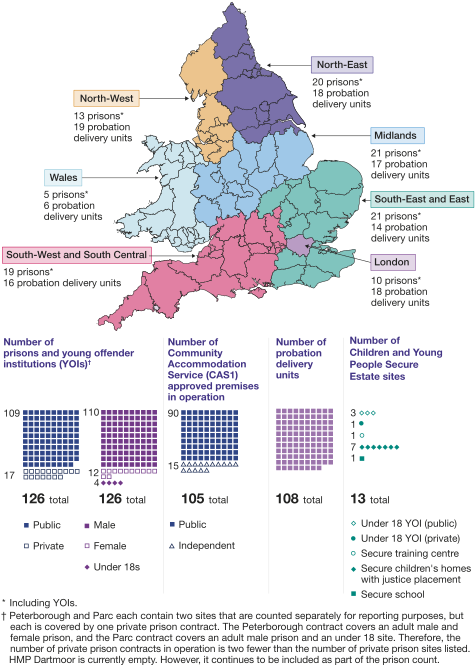
An infographic showing how our services were structured in 2025 to 26, as of 31 March 2026.
A map of England and Wales is divided into seven prison and probation areas, with the number of prisons (including YOIs) and probation delivery units in each area:
-
North-West: 13 prisons (including YOIs) and 19 probation delivery units.
-
North-East: 20 prisons (including YOIs) and 18 probation delivery units.
-
Midlands: 21 prisons (including YOIs) and 17 probation delivery units.
-
Wales: 5 prisons (including YOIs) and 6 probation delivery units.
-
South-West and South Central: 19 prisons (including YOIs) and 16 probation delivery units.
-
South-East and East: 21 prisons (including YOIs) and 14 probation delivery units.
-
London: 10 prisons (including YOIs) and 18 probation delivery units.
Below the map are summary figures.
-
There are 126 prisons and young offender institutions in total: 109 are public and 17 are private. By population, there are 110 male, 12 female and 4 under-18 young offender institutions.[footnote 2]
-
There are 105 Community Accommodation Service approved premises, of which 90 are public and 15 are independent sites.
-
There are 108 probation delivery units.
-
The Children and Young People Secure Estate has 13 sites: 3 public under-18 young offender institutions, 1 private under-18 young offender institution, 1 secure training centre, 7 secure children’s homes with justice placement, and 1 secure school.
System challenges and reforms
Through 2025 to 26, HMPPS delivered its strategic outcomes against a backdrop of significant operational pressures. We have taken decisive steps towards longer-term reforms and a sustainable system which will modernise our services, strengthen safety, and improve outcomes for those in our care and the communities we serve.
The adult male prison estate has been under acute pressure since September 2022 and managing prison and probation capacity has been a top priority for the department. From January 2023 to July 2025, the adult male prison estate regularly operated at over 98% of capacity, meaning a number of contingency and demand reduction measures were required to manage these pressures. The Probation Service was also experiencing high workloads following unification in 2021, which were exacerbated by changes to release arrangements for some prisoners. This pressure meant that some temporary mitigations had to be put in place from 2024-25 to reduce the increased probation workload pressures.
The publication of the Independent Sentencing Review, alongside the government’s response in May 2025, marked a significant moment for the criminal justice system. The review made a series of recommendations that will have a major impact on how prisons and probation operate, most of which the government has accepted either in full or in principle. For HMPPS, this represents both a challenge and an opportunity: to relieve pressure on the system in the short term while laying the foundations for a more modern and sustainable system in the longer term.
The Sentencing Bill, developed following the Independent Sentencing Review, received Royal Assent in January 2026. Reforms introduced a new structure for the Standard Determinate Sentence (SDS), known as the Progression Model, changes to recall arrangements, and increased use of suspended sentence orders alongside a presumption against short sentences of under 12 months. The first elements implemented in spring 2026 were the presumption against short sentences, which will be applied through judicial sentencing decisions, and changes to recall arrangements, which standardised the prison recall period in most cases to 56 days.
Delivery of these reforms is being co-ordinated through the Capacity Delivery Portfolio Board, bringing together the Our Future Probation Service Programme, the Prison Implementation Programme, and changes to electronic monitoring and community accommodation. The measures will be phased in over the next two years, with HMPPS playing a central delivery role as part of a wider programme of criminal justice reform, particularly in probation where significant additional investment is being made. Further reform across HMPPS, in partnership with HM Courts and Tribunals Service, MoJ policy and others, follows the publication of Dame Lynne Owens’ independent review into releases in error (see ‘Number of prisoners released in error’).
Delivering these reforms and managing ongoing operational pressures is underpinned by a skilled, supported and sustainable workforce. Our people are fundamental to delivering services across prisons, probation, youth custody and headquarters, and we continue to value the professionalism, commitment and expertise they bring across HMPPS. During 2025 to 26, we invested in recruitment, retention, wellbeing, leadership and professional development, while taking action to address workforce pressures and build resilience across the organisation. We recognise that recruitment, retention and workload challenges remain in some areas and are implementing measures to strengthen workforce capacity and support colleagues to deliver high-quality services. Further information on our workforce, including staffing levels, pay, diversity, wellbeing and development initiatives, is provided in the remuneration and staff report in the accountability report.
The following graphic provides an overview of the major reform programmes that will form part of HMPPS’ longer-term transformation, illustrating how responses to current operational pressures support wider strategic change across prisons and probation.
Pressures and reforms: the changing landscape
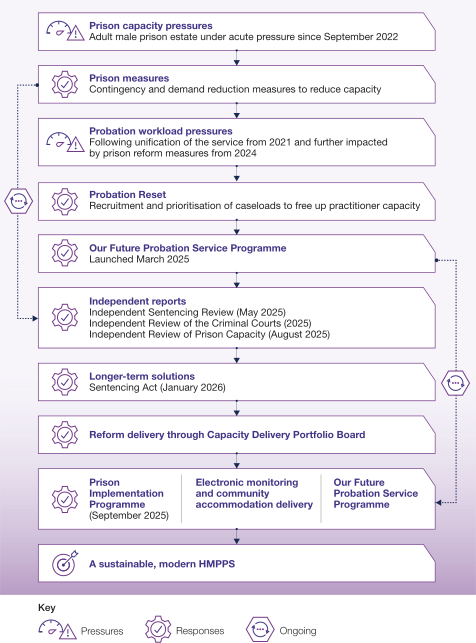
A vertical flow diagram showing the changing landscape of pressures and reforms on the prison and probation system.
The sequence begins with prison capacity pressures: the adult male prison estate has been under acute pressure since September 2022. This leads to prison measures, including contingency and demand-reduction measures to reduce capacity.
Next are probation workload pressures, following unification of the service from 2021 and further impacted by prison reform measures from 2024. Responses include Probation Reset, with recruitment and prioritisation of caseloads to free up practitioner capacity, and the Our Future Probation Service Programme which launched in March 2025.
Independent reports include the Independent Sentencing Review (May 2025), Independent Review of the Criminal Courts (2025), and Independent Review of Prison Capacity (August 2025). Longer-term solutions include the Sentencing Act in January 2026, followed by reform delivery through the Capacity Delivery Portfolio Board.
Implementation programmes include the Prison Implementation Programme (September 2025), electronic monitoring and community accommodation delivery, and the Our Future Probation Service Programme.
The final outcome is a sustainable, modern HMPPS.
Reviews supporting system improvement
During the year, HMPPS continued to engage with a significant programme of independent reviews. These reports have informed our understanding of key operational risks and improvement priorities, including prison capacity, probation resilience, youth custody safeguarding, professional standards and electronic monitoring. HMPPS is responding through published action plans, government responses and wider reform programmes.
-
Independent Sentencing Review was published in May 2025: www.gov.uk/government/publications/independent-sentencing-review-final-report
-
Professional Standards Review was published in May 2025: www.gov.uk/government/publications/hmpps-professional-standards-review
-
Independent Review of Prison Capacity by Dame Anne Owers was published in August 2025: www.gov.uk/government/publications/independent-prison-capacity-review-final-report
-
National Audit Office report on the Probation Service was published in October 2025: www.nao.org.uk/reports/building-an-effective-and-resilient-probation-service
-
Government response to the Independent Girls Review by Susannah Hancock was published in November 2025: www.gov.uk/government/publications/delivering-the-best-for-girls-in-custody-government-response
-
Prisons and Probation Ombudsman report into historic abuse at Medomsley Detention Centre was published in November 2025: https://ppo.gov.uk/news/ppo-publish-investigation-report-into-abuse-of-young-men-at-medomsley-detention-centre
-
National Audit Office value for money report on the costs of tackling drug harms in prisons was published in February 2026: www.nao.org.uk/reports/the-costs-of-tackling-drug-harms-in-prisons
-
Response to the Independent Review of Separation Centres led by Jonathan Hall KC was published in February 2026: www.gov.uk/government/publications/response-to-the-independent-review-of-separation-centres
-
Public Accounts Committee report on the Probation Service was published in February 2026: https://publications.parliament.uk/pa/cm5901/cmselect/cmpubacc/1235/report.html
-
Response to Dame Lynne Owens’ independent review into releases in error was published in April 2026: www.gov.uk/government/publications/response-to-the-independent-review-into-releases-in-error
-
Independent youth custody safeguarding review chaired by Isabelle Trowler was published in July 2026: www.gov.uk/government/publications/trowler-review-into-youth-custody-safeguarding
-
Independent review of the prison system led by Amber Rudd published its terms of reference in July 2026: www.gov.uk/government/publications/independent-review-of-the-prison-system-terms-of-reference
-
National Audit Office value for money study on electronic monitoring was published in July 2026: www.nao.org.uk/reports/electronic-monitoring-improving-resilience-to-meet-increasing-demand
Prison and YCS capacity
The Prison Implementation Programme was launched in September 2025 to deliver changes from the Independent Sentencing Review affecting the prison estate. The programme is implementing two major changes.
During 2025 to 26, a number of short-term measures remained in place to help manage and reduce pressure on prison capacity.
-
From 31 March 2026, most people serving standard prison sentences who break their licence conditions will be recalled to prison for a set period of 56 days, replacing shorter and less consistent recall arrangements.
-
From 1 October 2026, eligible prisoners serving an SDS will move to a new sentence structure known as the Progression Model. Under the new arrangements, the automatic release point for eligible SDS prisoners will change from 40% to 33% of the sentence, while the release point for eligible SDS+ prisoners will change from 66% to 50%. The overall sentence length will remain unchanged, with a greater proportion of the sentence served in the community under supervision. This will be supported by enhanced licence conditions and, in most cases, electronic monitoring. Certain offences are excluded from these changes.
The programme is supported by additional workstreams including:
-
a new custodial sentence management model which will govern how the custodial part of the sentence is administered and managed, including sentence planning, identifying interventions and risk management from reception to release
-
the Estate Configuration Review which will develop a new offender flow model to ensure the right people are in the right place to receive the right services and a new set of cohort strategies outlining how each group within custody will progress through the system and how they will be managed
-
updates to digital services so sentences and recalls can be calculated and managed accurately under the new rules
-
an Operational Impact Assessment which will be delivered in 2027 to assess the impact of the new sentence structure on prison estate systems and services
The number of girls in custody is small, accounting for less than 3.5% of all children in custody during 2025‑26. They are often highly vulnerable and have complex needs, which can make finding suitable placements challenging. In November 2025, the government published its response to Susannah Hancock’s Independent Girls Review, setting out the long-term measures we are putting in place to improve outcomes for girls in custody.[footnote 3]
Following the temporary closure of Oasis Restore Secure School in August 2024 due to infrastructure concerns, a programme of remedial works was initiated to address the issue and the school reopened in June 2026. In 2025 to 26, the YCS completed commissioning activity and progressed contract awards for secure children’s homes, securing continuity of provision and maintaining geographical resilience across the sector.
Prison capacity data
| 2021 to 22 | 2022 to 23 | 2023 to 24 | 2024 to 25 | 2025 to 26 | |
|---|---|---|---|---|---|
| Prison supply/demand gap | 2,008 | 1,131 | 944 | 1,006 | 2,503 |
Notes: The prison supply/demand gap is the difference between available, useable prison cell capacity (supply) and the total prison population (demand). As of 30 March 2026, the prison supply/demand gap stood at 2,503 places, up from 1,006 places at 31 March 2025. The adult male estate had 2,071 places while the women’s estate had 334. Headroom was above the operational buffer, providing additional resilience to respond to shocks and capacity pressures. This increase in headroom was driven by the fixed term recall scheme. However, the prison population continues to grow, and the change to the Progression Model releases are likely to affect future capacity resilience. Prison population statistics are available at: www.gov.uk/government/collections/prison-population-statistics. Data is taken from the last published weekly population bulletin in the financial year.
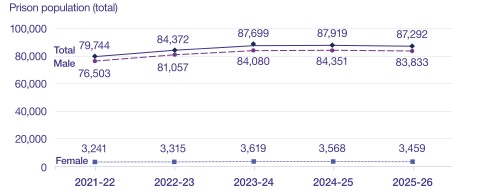
A graph showing the total prison population from 2021-22 to 2025 to 26.
-
In 2021 to 22, the population was 79,744 (76,503 male and 3,241 female).
-
In 2022 to 23, the population was 84,372 (81,057 male and 3,315 female).
-
In 2023 to 24, the population was 87,699 (84,080 male and 3,619 female).
-
In 2024 to 25, the population was 87,919 (84,351 male and 3,568 female).
-
In 2025 to 26, the population was 87,292 (83,833 male and 3,459 female).
Notes: Prison population statistics are available at: www.gov.uk/government/collections/prison-population-statistics. Data is taken from the last published weekly population bulletin in the financial year.
| 2021 to 22 | 2022 to 23 | 2023 to 24 | 2024 to 25 | 2025 to 26 | ||
|---|---|---|---|---|---|---|
| Children and Young People Secure Estate population (year average) | Under 18s | 454 | 441 | 430 | 418 | 379 |
| Including over 18s | 522 | 504 | 580 | 528 | 455 |
Notes: Youth custody data is available at: www.gov.uk/government/publications/youth-custody-data. Average data for each year is based on 12 snapshot dates.
Probation capacity measures
There were 258,332 offenders (234,483 males and 23,849 females) under probation supervision as at 31 March 2026. (Due to a break in the probation caseload series, figures are not directly comparable with those published for earlier periods.)[footnote 4]
Recent operational changes, including Probation Reset and Impact (an approach to working with lower-risk offenders) have helped ease some pressure on probation services by allowing staff to focus on earlier engagement with the people they supervise. While these measures have provided short‑term relief, they are not enough on their own to close the gap between the demand on probation and the capacity available. To address this, the Our Future Probation Service Programme launched in March 2025 and aims to build a more resilient and effective Probation Service in part by delivering the probation‑related changes set out in the Sentencing Act.
Through the programme, we are working to ensure that probation staff have the time, tools and support they need to protect the public and support rehabilitation. To do this, we have worked closely with probation regions and stakeholders to build a clear understanding of the challenges facing probation and design and deliver ways to reduce probation workload.
In alignment with recommendations from the Sentencing Act, we will achieve this by:
Simplifying processes and removing unnecessary tasks such as streamlining induction and sentence management and replacing rehabilitation activity requirements
Investing in new technology to free up staff time for more meaningful work, including nationwide rollout of the Justice Transcribe tool and greater use of online check-ins
Ensuring time is spent where it can have the greatest impact, so probation staff spend more time supervising cases where they can make the most difference
In October 2025 the National Audit Office published a report on efficiency and resilience in the Probation Service.[footnote 5] In February 2026, the Public Accounts Committee published a report which broadly echoed its findings. While both reports highlighted ongoing challenges, particularly around sentence management, they also recognised the crucial role of probation in protecting the public and acknowledged the professionalism and resilience of probation staff. The National Audit Office’s report noted the progress made through Probation Reset and Impact and described the Our Future Probation Service Programme as “bold and innovative”, providing a strong endorsement of its strategic direction.
Digital and technology
Improving our use of technology is vital to making wider reforms work and to building a sustainable and resilient prison and probation system. In 2025 to 26, we have introduced a number of digital tools to better support staff, prisoners and people on probation.
A pilot initiative for online remote check‑ins to monitor offenders alongside existing in-person supervision is being trialled in four probation regions before being considered for further rollout.
July 2025 saw the launch of the AI action plan for justice which sets out how artificial intelligence (AI) can be used to make the justice system faster, more efficient and more accessible.[footnote 6] This plan underpins our work to streamline systems in HMPPS, freeing up staff to focus on frontline work.
We continued the design of our new digital service for the assessment of risks, needs and strengths for people on probation and in prison that will eventually replace the current system. It aims to reduce paperwork and maximise time spent with people in appointments, with the first phase of the new service going live nationally from April 2026.
Justice Transcribe is a new tool that helps probation officers spend more time supporting people on probation. The tool securely records and transcribes conversations, removing the need for officers to handwrite notes and then re‑enter them into IT systems. The tool is being tested within public sector YOIs to understand if this is suitable for youth justice workers, allowing for the reinvestment of time into working directly with children.
Between 7 October 2025 and 29 July 2026, over 1,200,000 meetings were summarised using Justice Transcribe[footnote 7]
The Intelligence Management Service is now live in all prisons in England and Wales. It is a modern digital system that has an intuitive user interface, with feedback being consistently positive. By the end of April 2027 all prison offender managers will be able to access the Intelligence Management Service – a huge step to improving intelligence sharing between prisons and probation and ensuring that risk assessment and management decisions are informed by intelligence.
Manage People on Probation went live nationally in April 2026. The service brings together information about a person on probation from multiple digital systems into one place.
Semantic search is an AI‑enabled search capability that helps probation staff find relevant case information more quickly and accurately using natural language queries. Unlike traditional keyword search, it understands context and intent, reducing the need to try multiple search terms. Probation practitioners work with large volumes of unstructured information, and searching for the right material can be time consuming. Semantic search improves the relevance of results returned on the first attempt, freeing up staff time and supporting better informed decision-making. The capability will be scaled across relevant digital services as part of wider work to modernise digital tools and reduce administrative burden.
How we spent our money in 2025 to 26
HMPPS committed gross resource expenditure of £6.3 billion and received £0.3 billion of income in 2025 to 26, an increase of £0.4 billion in net resource expenditure since the period 2024 to 25. In addition to this, £1.5 billion of capital spend was incurred. Capital spend refers to investment in assets and infrastructure that provide long‑term benefits, such as building and refurbishing prisons, investing in IT systems and improving the estate, rather than day‑to‑day running costs. This expenditure represents continued investment in our prison and probation services.
Improving conditions and performance in prisons remains a primary focus, alongside a drive to implement reform across probation. As well as continuing progress on the prison place programme, significant capital expenditure has been invested in prisons under our commitment to build additional prison places across our estates and through local initiatives linked to agreed spending priorities – for example, on safety, decency and security. This includes work on accelerated houseblocks delivery, small secure houseblocks, construction at HMP Welland Oaks, fire safety improvements and capital refurbishments across the estate.
Within resource expenditure, spend reflected a combination of workforce investment and cost pressures. This included pay awards for prison and probation staff, increases in employer National Insurance contributions following rate changes, and continued recruitment, including the onboarding of trainee probation officers. Inflationary pressures remained evident across key areas such as utilities, food, offender learning and wider contractual costs, consistent with trends seen in previous years. Expenditure also increased due to the mobilisation and operation of HMP Millsike, which opened in April 2025. Additionally, HMPPS continued to invest significantly in building improvement and maintenance works to support safety, decency and operational performance across the estate.
How we are financed
We are primarily financed by funding from the MoJ as our parent department. We also generated £0.3 billion of operating income in 2025 to 26 from various initiatives to increase revenue, in addition to recharges of costs incurred.
The retail prison shop income comes from a contract providing prisoners with a weekly opportunity to make purchases with their own funds for food, hobby materials and other items. It is a self-funding contract, where purchases and the margin made on these are used to offset the total cost of the contract. Regional packing workshops are run by the service provider but are mainly staffed by prisoners. This presents a quality, purposeful activity that allows prisoners to develop transferable skills. We also recover costs from local authorities for children held on remand and from the Home Office for their use of our electronic monitoring contracts for the immigration cohort.
HMPPS received funding in 2024-25 from the European Union via the European Social Fund managing authority (Department for Work and Pensions) for delivery of resettlement services. The funding was released over the life of the project and used to support those who may be disengaged from mainstream activity, in both custody and community settings, to increase employability and provide opportunities to access mainstream services.
We also recover costs from funding partners as follows:
-
provision of custodial services to foreign national prisoners, providing immigration detention and counter terrorism activities (Home Office)
-
provision of healthcare services (NHS England, private sector and Welsh Government)
The operating structure of the MoJ is for key areas which span multiple entities within the department to be managed centrally. These include estates, people and HR, finance, legal, commercial and digital. Expenditure relating to these centrally managed functions is not included in HMPPS management reporting or budgetary information but is included in the agency’s statutory financial statements through recharges from the MoJ. Accordingly, the chart below presents resource expenditure on the management reporting (budgetary) basis and excludes these recharges. A reconciliation to the Statement of Comprehensive Net Expenditure is provided in the table below.
Reconciliation between net resource expenditure on the management reporting (budgetary) basis to expenditure reported in the Statement of Comprehensive Net Expenditure
| 2025 to 26 £m | |
|---|---|
| Net resource expenditure as reported to the board per chart | 6,017 |
| Centrally budgeted net expenditure attributable to HMPPS | 1,508 |
| Differences in accounting treatment including Annually Managed Expenditure (AME) | (39) |
| Net expenditure per Statement of Comprehensive Net Expenditure (SoCNE) | 7,486 |
Financial management
The MoJ receives authority to incur expenditure via the supply estimates process. The estimate is published twice in each financial year. The main estimate is published at the beginning of the financial year, and the supplementary estimate is published towards the end of the third quarter of the financial year. The supplementary estimate provides an opportunity for the MoJ to reflect changes in the budgets internally and any movements of funding with other government departments.
At the start of the financial year, budgets are delegated from the MoJ Permanent Secretary as Principal Accounting Officer to the HMPPS Chief Executive Officer. The Chief Executive Officer may then make sub-delegations to other budget holders within HMPPS directorates. Budget holders are required to meet the conditions of their delegation letters and the requirements of the MoJ’s Financial Control Framework.
Finance function
2025 to 26 was the seventh full year where the agency’s financial management was provided through the MoJ functional leadership model. This model brings together specialists into a single, unified team across the department with the vision of putting finance at the heart of decision-making, with finance business partners working alongside operational colleagues and centres of excellence established to support the production of financial and management accounts.
The split of resource departmental expenditure between custodial and community services and support services
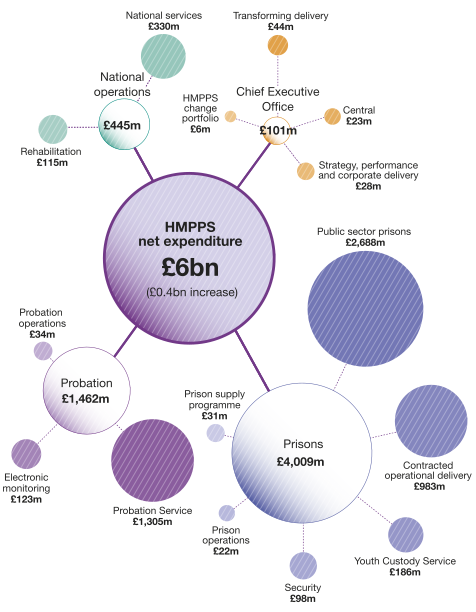
A bubble chart showing the split of resource departmental expenditure between custodial and community services and support services.
-
HMPPS net expenditure is £6 billion, which is a £0.4 billion increase.
-
Prisons account for £4,009 million. Within this, £2,688 million is for public sector prisons, £983 million is for contracted operational delivery, £186 million is for the Youth Custody Service, £98 million is for security, £22 million is for prison operations, and £31 million is for the prison supply programme.
-
Probation accounts for £1,462 million. Within this, £34 million is for probation operations, £1,305 million is for the Probation Service and £123 million is for electronic monitoring.
-
National operations account for £445 million. Within this, £330 million is for national services and £115 million is for rehabilitation.
-
The Chief Executive Office accounts for £101 million. £44 million is for transforming delivery, £6 million is for the HMPPS change portfolio, £23 million is for central, and £28 million is for strategy, performance and corporate delivery.
Risk analysis
HMPPS is going through a period of significant change as it responds to complex pressures across prisons, probation and the wider justice system. Innovative approaches are being developed and introduced to support system-wide reform, strengthen delivery and improve how risk is managed across the organisation. The aim is to create a more sustainable, joined-up system that can respond more effectively to current and future challenges.
The risks and issues in this report have been identified through HMPPS’ established risk management processes, including the corporate risk register and annual assurance statements. These risks sit within the wider set of principal risks and provide a framework for understanding where reform activity, innovation and stronger controls are most needed. This supports clear accountability, focuses attention on priority areas, and helps ensure action is targeted to reduce the likelihood and impact of system-wide failure. In line with Task Force on Climate-Related Financial Disclosures guidance, our climate risks, analysis and management are reported in our sustainability report in the accountability report.
| Risk description | Examples of main controls and activities to manage risks |
|---|---|
|
R1: People resource and culture Failure to recruit and retain the workforce necessary to deliver HMPPS core business. Movement since last year Risk has worsened Failure to have a work environment that supports a positive culture to enable staff to perform at their best. Movement since last year Risk remains unchanged |
People (resource): Meeting resourcing requirements across prisons and probation remains challenging, with recruitment, retention and onboarding pressures affecting HMPPS’ ability to maintain a stable workforce. Probation staffing remains below the level needed. Delays in pre-employment checks, including vetting, and onboarding can slow the pace at which vacancies are filled, reducing the impact of recruitment activity and adding pressure to workloads and resilience, particularly in areas already experiencing recruitment and retention challenges. In prisons, changes to right-to-work rules and uncertainty about whether staff will choose to remain at HMPPS continue to affect recruitment and retention, even with exemptions and targeted campaigns. Although overall staff turnover is fairly low, staffing gaps are likely to continue in the short term. HMPPS has a range of actions in place to improve recruitment, streamline onboarding and recruitment processes, including vetting arrangements, while maintaining the robust checks necessary to support public protection, operational security and workforce resilience. People (culture): Helping staff to do well at work is essential to how HMPPS performs. Current signs show ongoing pressure on workplace culture, wellbeing and behaviour. Heavy workloads and high sickness levels, especially in probation, increase the risk of disputes with unions and affect organisational resilience. Reports of bullying, discrimination and poor conduct, along with findings from recent external reviews, highlight the need for stronger leadership capability and consistency in management practice. Work is progressing to support wellbeing and implement the findings of the Professional Standards Review, including establishing an independent complaints unit, to foster a safe, inclusive and positive working environment. |
|
R2: Security for serious and organised crime Ineffective management of high-harm serious and organised crime offenders. Movement since last year Risk remains unchanged |
Serious and organised crime continues to pose a significant threat to prison safety, stability and public protection. High‑harm offenders have been able to influence activity from custody, enabled by illicit phones, contraband and organised conveyance methods including drones. This can fuel violence, exploitation and an illegal prison economy, with impacts across prisons, probation and the wider criminal justice system. Leadership, intelligence sharing and co-ordination across the system are not always consistent, and technology can move faster than current countermeasures. Work is under way to strengthen the national approach, improve how intelligence is handled and collaborate more closely with law enforcement so that risks are managed more consistently and criminal activity is disrupted. |
|
R3: Cyber and information security Failure to manage appropriate access to online data. Movement since last year Risk remains unchanged Failure to protect the confidentiality of HMPPS information. Movement since last year Risk remains unchanged |
Cyber risk: HMPPS faces heightened cyber security risk due to legacy technology, increased reliance on digital systems across the estate, and increasingly sophisticated attacks that could disrupt core operations. Weaknesses in older infrastructure, inconsistent access controls, and developing continuity and recovery plans mean a major incident could cause prolonged disruption across prisons and probation. Pressures also include supply-chain risk, skills gaps and emerging threats such as AI-enabled attacks. With support from MoJ digital and security teams, work is under way to strengthen oversight, clarify incident response, modernise key systems, and improve identity and access management. Information security risk: Keeping HMPPS information safe and available remains challenging given the volume and sensitivity of data held, and the changing ways it is accessed and shared. Key risks include insider threat, inconsistent data-handling, third-party assurance and ageing systems that are being modernised over time. Work is under way to raise staff awareness, strengthen supply‑chain checks, tighten access controls, reduce reliance on outdated systems, and improve incident handling and governance. |
|
R4: System capacity Inability to balance capacity and demand leads to service failure across HMPPS. Movement since last year Risk has worsened |
HMPPS is implementing the Sentencing Act, which aims to ease long-term pressure on prison places. The first changes were introduced between late March and May 2026, with further measures implemented from 1 October 2026. Prison capacity pressure continues to be driven primarily by the relationship between demand and available supply, with the current sentencing framework in England and Wales creating a need for prison places that exceeds the capacity that can be safely provided. Alongside investment in additional places, HMPPS must also replace and maintain parts of the estate (including fire safety compliance activity), meaning new capacity is needed both to respond to demand and to support a safe and sustainable prison system. Staffing pressures are also a contributing factor in maintaining safe and effective prison operations. Probation capacity remains under pressure from workload demand exceeding available workforce capacity. HMPPS is taking forward work to reduce frontline probation workload, while also being responsive to the measures introduced through the Sentencing Act to increase the proportion of sentences served in the community and expand requirements such as electronic monitoring and victim liaison services. HMPPS is taking a joined-up approach across prisons, probation, electronic monitoring and accommodation to balance demand, improve day-to-day capacity, and keep services safe and sustainable. |
|
R5: Estates Poor standards of accommodation and maintenance impact on the health and safety of service users and place additional demands on capacity. Movement since last year Risk remains unchanged |
The prison and probation estate continues to face major challenges, particularly around fire safety compliance and wider asset deterioration. Several sites require substantial remedial work, and some areas remain unusable due to maintenance needs, fire safety upgrades, and issues such as reinforced autoclaved aerated concrete (RAAC) and radon. Pressure on capacity makes it hard to move people out of areas while work is done, which keeps operational risk high. HMPPS has steps in place to reduce these risks. This includes targeted fire safety programmes, stronger compliance work and a forward-looking maintenance list to help prioritise work. Investment programmes should improve things in the longer term, but continued funding is still needed. |
|
R6: Drone ingress Failure to effectively respond to ingress including via drones across the custodial estate. Movement since last year Risk remains unchanged |
Drones remain a major and changing problem across the prison estate. The risk is increasing as the technology becomes easier to access and methods become more sophisticated. Drones can quickly drop banned items into prisons and can get past traditional security measures. This increases safety, security and operational pressures. The threat is spreading, and some incidents are linked to organised crime. New technologies may develop faster than current methods used to combat drones. Work continues to strengthen the national response. This includes better intelligence sharing, targeted physical security measures, changes to legislation, closer work with law enforcement and rolling out the HMPPS Counter Drones Taskforce to support a more co‑ordinated and effective approach. |
|
R7: Safety delivery in prisons High levels of assaults, self-harm and self-inflicted deaths impact adversely on the safety and wellbeing of staff and prisoners. Movement since last year Risk remains unchanged |
Safety outcomes across the prison estate remain under sustained pressure. Levels of violence, self‑harm and self‑inflicted deaths are influenced by factors such as population pressures, overcrowding, staff-prisoner relationships, staff experience, inconsistent regimes and the supply and trade of illegal items in prisons. Governors treat safety as a top priority. They are using local data and evidence to create practical plans to tackle the main causes of violence and self-harm. There is also an emphasis on checking the quality of safety case management and making sure that departments in prisons work collaboratively, bringing safety, security and drug strategy staff together. A comprehensive safety plan is in place. It includes stronger local safety plans, better training and targeted support for higher-risk prisons. It also includes actions to reduce harm linked to drugs and other substances, and to improve daily routines and key‑worker support. |
|
R8: Probation delivery We are unable to improve performance and quality to support the delivery of probation reforms and protect the public. Movement since last year Risk remains unchanged |
Probation services are improving, but progress is inconsistent. There are still risks in sustaining change, particularly in areas linked to public protection. HM Inspectorate of Probation (HMI Probation) ratings and findings from recent inspections highlight continued variability in performance and the need for strengthened assurance, capability and oversight. Pressures on capacity, capability and the impact of managing multiple changes continue. These pressures are affected by staffing problems, delays in vetting and rising demand ahead of, and during, sentencing reforms. A wide range of quality improvement activity is under way, including strengthened assurance processes, enhanced learning and development, implementation of the Public Protection Strategy, and the Our Future Probation Service Programme, to support more consistent practice and improve outcomes. |
|
R9: YCS delivery The YCS is unable to provide a suitable safe environment to meet the increasingly complex needs of children in custody. Movement since last year Risk remains unchanged |
The YCS is under ongoing pressure. Demand, limits on the estate and fragile secure provision make it difficult to place children in accommodation that suits their age, gender and location. Delays and uneven stability across existing homes add to the challenge. Safety remains a challenge. Violence remains high, and we continue to address safeguarding concerns and security weaknesses. In addition, outcomes for education, care and resettlement vary between sites. To address this, the YCS is running a programme of targeted improvements. This includes stronger oversight, building professional skills, updating ways of working and investing in digital systems to help stabilise the service. |
|
R10: Long-Term and High Security Estate Failure to provide a safe and secure custodial environment for the highest-risk prisoners. Movement since last year New risk added post year‑end. |
The Long-Term and High Security Estate continues to face heightened risks to safety and security. This is due to weaknesses in older buildings, growing technological threats (especially drones) and the influence of organised crime groups, alongside escalating pressures on capacity and a deteriorating staffing position across prisons. The people held in this part of the estate present higher risk than elsewhere, which is reflected in higher levels of violence, including serious assaults on staff. The Long-Term and High Security Estate Taskforce is leading a co-ordinated set of improvements. This includes upgrades to physical security, stronger disruption activity, targeted staffing actions and safety measures. Subject to funding decisions and cross-government support, these actions should reduce risk over time. |
Performance report
The following sections will provide a further overview of activity against each of HMPPS’ areas of delivery focus for 2025 to 26.
Sentence management
Effective sentence management ensures people on probation receive targeted, effective supervision that protects the public and supports rehabilitation. Strengthening how sentences are managed allows resources to be focused where they have the greatest impact and supports more consistent, high‑quality delivery across the probation system.
To reduce pressure on practitioners and prioritise resource on the highest-risk offenders, Probation Reset was introduced from April 2024 onwards. It focused practitioner time on the first two‑thirds of a person’s sentence, where support is most effective. In April 2025, Impact was launched as a further measure to free up practitioner capacity through a new approach to support our work with people on probation who are assessed as a lower risk of reoffending or serious reconviction. Overall, practitioner workloads have reduced as a result, supporting an increase in contact with the highest‑risk offenders. The Our Future Probation Service Programme is building on Probation Reset and Impact, with the aim of reducing probation workloads by a further 25% by April 2027.
| 2021 to 22 | 2022 to 23 | 2023 to 24 | 2024 to 25 | 2025 to 26 | |
|---|---|---|---|---|---|
| Proportion of cases where requirements are delivered by probation before sentence expires | N/A | 75.8% | 78.7% | 76.3% | 75.8% |
Notes: Percentage of completions of community orders and suspended sentence orders including any combination of an accredited programme, rehabilitation activity requirement or unpaid work, where those requirements were completed successfully. Data on Probation Service performance is available at: https://data.justice.gov.uk/probation/ps-performance
Work was undertaken through 2025 to 26 to determine the design of the new probation requirement to replace the existing rehabilitation activity requirement. Under the new model, probation practitioners, rather than the sentencing courts, will determine the volume and type of interventions required. This simplifies processes, removes complex recording requirements and allows practitioners to focus more directly on addressing individual needs.
Accredited programmes are structured offender behaviour programmes that have been independently assessed and approved to reduce reoffending. Guidance issued in 2025 improved prioritisation of higher‑risk cases, clarified use of alternative interventions and brought demand to more manageable levels, supported by a new dashboard monitoring regional capacity. The Building Choices Programme was fully rolled out, with new training resources in place. In the community, the single programme model, prioritisation framework and dashboard have improved scheduling efficiency and resource management. Completion rates increased from 49.1% in 2023 to 24 to 54.2% in 2025 to 26.
Unpaid work continues to combine punishment with reparation by requiring individuals to contribute to their communities. Approximately 4.5 million hours of unpaid work are credited each year. We strive to improve completion rates for unpaid work requirements within 12 months. However, this remains challenging due to capacity pressures, recruitment issues and court backlogs. From April 2026, Sentencing Act reforms removed the 12‑month requirement, providing greater flexibility, supporting engagement and reducing administrative burden.
The Probation Service provides advice to courts to support the sentencing process through pre-sentence reports. In 2025 to 26 we delivered 105,410 pre-sentence reports (to magistrates’ and Crown courts) – an increase of 5.6% on the previous year. We have worked to improve the timeliness and quality of reports, and to design and test a range of reforms to processes and digital services used by probation court teams which will be implemented in 2026 to 27. Our annual Judicial Survey shows national judicial satisfaction in probation services is 71%, up one percentage point on the previous year.
Alongside work on the new structure for eligible SDS prisoners, known as the Progression Model, work has commenced on a new Custodial Sentence Management model to replace the Offender Management in Custody model work. The new model is intended to improve sentence management during the custodial phase, including how sentence planning, interventions and risk management are delivered from reception to release. It will also support the wider ambition to streamline frontline probation work, recognising that a significant proportion of current offender management activity in prisons is delivered by probation staff. This change gives the opportunity to streamline workloads and clarify roles for prison and probation staff, which is an issue identified in findings by HM Inspectorate of Prisons (HMI Prisons) and other scrutiny bodies.
Commissioned Rehabilitative Services are a specialist provision working in partnership with probation practitioners and community interventions teams to achieve positive outcomes for people subject to a community order or those on post-sentence supervision. They provide flexible, responsive services in housing, personal wellbeing, finance, recovery and dependency, and women’s services to help break the cycle of reoffending. The recommissioning programme for the future community support services is under way. Once in place, it will strengthen delivery through a more person-centred, evidence-led and strengths‑based approach.
Protecting the public and safeguarding
Public protection and safeguarding are at the heart of our work. We aim to keep the public, people in prison, people on probation and children in our care safe through strong risk management, effective oversight and consistent action to prevent harm.
A serious further offence (SFO) occurs when someone on probation is charged and subsequently convicted of murder or other serious offence, which was committed during their period of supervision. While fewer than 0.5% of people on probation are convicted of an SFO, every single one has a devastating impact on the victims, and these cases can significantly undermine confidence in the justice system. This is why we undertake a review to identify any significant practice or systemic failings and the actions to remedy them. Ministers are kept fully informed of cases of particular public concern. In February 2026, we published our action plan in response to HMI Probation’s annual report on SFOs to ensure that all reviews take account of individual victims’ needs.[footnote 8]
The Public Protection Taskforce, established in 2023-24, continues to strengthen risk assessment and management, with a particular focus on domestic abuse and safeguarding. Domestic abuse and safeguarding enquiries are now being routinely obtained from police and social care to inform assessments and plans, strengthening the quality of information available to practitioners.
In February 2025, HMPPS introduced a new management oversight framework to strengthen staff support and oversight, streamlining processes so that managers and probation practitioners can focus more on work quality. The framework was embedded across all regions by August 2025. An evaluation is being undertaken to assess impact and identify further improvements.
Following the high‑profile release in error of Hadush Kebatu in October 2025, the government commissioned Dame Lynne Owens to undertake an independent review into releases in error. Immediate action was taken to restore public confidence in the system through a five-point action plan, including stronger mandatory release checks and increased oversight with investment now focused on how technology can further reduce errors. The government’s response to the review was published in April 2026.[footnote 9]
| 2021 to 22 | 2022 to 23 | 2023 to 24 | 2024 to 25 | 2025 to 26 | |
|---|---|---|---|---|---|
| Number of prisoners released in error | 54 | 85 | 121 | 312 | 192 |
Notes: In the 12 months to March 2026, 192 prisoners were released in error. This is a 26% decrease from 258 recorded within the reporting period in the previous year. Some releases in error are only identified after the end of the reporting period. A further 54 incidents were recorded after the reporting period for the previous year, giving an updated total of 312 releases in error for the year ending March 2025. Releases in error should be interpreted with due caution in the context of trends in releases and changes in the operational environment, as relatively small numerical changes can have a disproportionate impact on apparent trend. Further insights are available at: www.gov.uk/government/statistics/hmpps-annual-digest-april-2025-to-march-2026
Following extensive stakeholder engagement, the Adult Safeguarding Charter was published in January 2026.[footnote 10] It signposts staff to existing policies and guidance setting out safeguarding responsibilities across adult prison and probation settings, and includes considerations for women and specialist cohorts such as young adults and foreign nationals.
A new compulsory safeguarding and child protection eLearning course for youth custody staff was launched in February 2026 as part of the work undertaken to strengthen safer recruitment in youth custody. Developed with Barnardo’s, NHS England and the Welsh Government, it ensures a shared understanding of safeguarding responsibilities. Wider improvements include more frequent enhanced Disclosure and Barring Service renewals, updated job descriptions, an internal staff register and improved compliance tracking, which also extends to establishments in the women’s estate with mother and baby units.
The IPP prison population was 5,040 in June 2015, decreasing to 2,329 by March 2026.
We continue to support people serving imprisonment for public protection (IPP) sentences to reduce their risk and enable them to progress safely through the system using the IPP action plan. In July 2026 the IPP annual report was published outlining the progress made in 2025 to 26.[footnote 11] In June 2026, changes to the IPP licence termination process reduced the eligibility period for licence termination, introducing an option for those serving IPP sentences to apply for an additional Parole Board review to consider licence termination.
Following the publication of the Prisons and Probation Ombudsman’s report into historic abuse at Medomsley Detention Centre, the government issued a formal apology.[footnote 12] An independent youth custody safeguarding review, chaired by Isabelle Trowler, was established to review safeguarding arrangements across all youth custody settings.[footnote 13] Following the panel’s recommendations in July 2026, the YCS has developed an implementation plan to take these forward.
Electronic monitoring
Electronic monitoring provides a robust alternative to custody and evidence suggests that it has a positive behavioural impact on individuals while they are wearing the device.
The number of individuals assigned with electronic monitoring equipment was 28,687 as at 31 March 2026.[footnote 14] The March 2026 caseload statistics are not directly comparable with figures published for previous years. Published official statistics were paused during the 2024-25 electronic monitoring contract transition, and subsequent changes were made to both the definition and the methodology used from June 2025.
Through the Stabilise and Transform Electronic Monitoring (STEM) approach, HMPPS has continued to work with criminal justice partners to strengthen readiness and embed electronic monitoring within sentencing and operational reform. STEM brings together technology, service design, operating models and governance to ensure electronic monitoring can operate safely, consistently and at scale, ahead of increased caseloads under the Sentencing Act.
Changes introduced by the Sentencing Act to ease system pressures include the new structure for the SDS, known as the Progression Model, changes to recall arrangements and increased use of suspended sentence orders. Electronic monitoring is central to delivery, and during 2025 to 26 work focused on modelling increased demand and service impact. This includes a new presumption for electronic monitoring, under which prison leavers will be considered for electronic monitoring, and a period of monitoring will apply unless one of a small number of exclusions is met. Wider use of electronic monitoring conditions, including curfews and exclusion zones, will support the management of eligible people in the community and those subject to suspended sentence orders.
In March 2026, the government announced the expansion of electronic monitoring, including wider use of enhanced GPS and alcohol monitoring for offenders such as domestic abusers, thieves and burglars. New technology will give probation staff real-time access to location data for certain individuals, supporting earlier identification of escalating risk. A pilot tagging domestic abusers who pose a risk to former partners, family members or children continued through 2025 and 2026 and is now being rolled out nationally.[footnote 15]
Evidence is increasingly proving the effectiveness of tags in cutting crime. Published research shows that tags enforcing curfews in community sentences and GPS tags for those convicted of acquisitive crime offences can reduce reoffending by around 20%, and alcohol monitoring orders have compliance rates above 97%.[footnote 14]
The National Audit Office’s value for money study, ‘Electronic monitoring: improving resilience to meet increasing demand’, was published on 10 July 2026.[footnote 16] The report highlights both the progress made in expanding the use of electronic monitoring and stabilising performance, as well as setting out the challenges and areas where further improvements are required. We welcome the National Audit Office’s recognition of the progress made so far, while also acknowledging the scale of the challenge ahead. We remain committed to supporting our staff, investing in digital transformation, and working closely with partners across the criminal justice system to deliver a more resilient and effective service.
Expanding the prison estate
The expansion of the prison estate remains essential to supporting a sustainable and modern system. Delivering more prison places has faced pressures due to challenging market conditions and shock events such as contractor insolvency in 2024 and increased construction costs. Major infrastructure projects can be affected by external factors that impact delivery timelines. However, these will be streamlined as a result of the planning reforms introduced by this government, and we expect to be able to achieve our commitment to deliver 14,000 new places by 2031.
The 2025 annual statement on prison capacity, published in January 2026, shows how the Sentencing Act is expected to ease demand for prison places under the original delivery plan.[footnote 17] However, the prison estate remains under considerable pressure and will require ongoing investment, especially if prisoner numbers rise towards the upper end of expected projections. The next annual statement is planned for publication in December 2026.
Between July 2024 and 31 March 2026, we delivered around 3,100 places, through a combination of new prisons, expansion and refurbishment of the existing estate, and temporary accommodation. In 2025 to 26, around 2,150 places were delivered, including:
-
1,468 places through the opening of HMP Millsike in April 2025, the UK’s first all‑electric and most sustainable prison
-
245 places with a new houseblock at HMP Fosse Way in December 2025
-
110 places at HMP Cookham Wood in February 2026
Future places in the pipeline include:[footnote 18]
HMP Highpoint
750 places
Work began November 2025
HMP Welland Oaks
Around 1,700 places
Construction began July 2025
Rapid deployment cells
100 places
Online summer 2026
Accelerated houseblocks
Around 600 places
Three sites by January 2027
HMP Grendon
Around 1,468 places
Enabling works contract funding and award October 2026
Construction starts February 2028
HMP Garth
1,175 places
Enabling work contract July 2026
Construction starts November 2028
Prison maintenance and fire safety
We remain focused on maintaining and improving prison conditions across HMPPS, despite the challenges created by ongoing capacity and funding pressures. A number of initiatives are having a positive impact, including projects that improve decency and give prisoners opportunities to develop practical skills through activities such as painting, decorating and flooring work, which also support rehabilitation. In 2025 to 26 we continued to invest in prison and probation service maintenance to improve conditions and keep prisons safe and secure.
We continue to deliver fire safety improvements across the estate, utilising the investment and capacity available. However, updated supply and demand forecasts indicate that not all fire safety work can be completed by the end of 2027, as originally planned. We are working to bring the estate into fire safety compliance as quickly as possible and to keep staff and prisoners safe in the meantime via mitigating actions.
Despite these pressures, HMPPS has successfully retained its BS 9997 Fire Safety Management accreditation, maintaining our position as the only government department to hold this nationally recognised standard. This reflects the strength and maturity of our fire safety management arrangements and our continued commitment to improvement.
A new vaping device, designed to reduce fire risk and deter illicit drug use, was rolled out across the prison estate in 2025. Purpose‑built to prevent fire‑setting and minimise misuse as drug paraphernalia, the device has delivered significant safety improvements: since deployment, no fires have been attributed to it, despite vape pens previously accounting for up to 90% of all fires. Overall fire rates across the estate have fallen by an unprecedented 50%, alongside impacting incidents involving prisoners under the influence of drugs. The success of the initiative has attracted interest from other prison services, and the NHS is now adopting the device for use in secure clinical settings.
Prison safety
Making prisons safer for staff and prisoners remains a key priority. We recognise the impact that a range of factors including crowded prisons, staff experience and the delivery of a consistent regime can have on providing a safe environment. We know that the risk of suicide and self-harm is higher in the early days in custody and we have developed new resources for prisons to support prisoners in this period.
Additional frontline support is provided through the safety support approach, which complements wider prison improvement activity through support to targeted prisons. This approach provides bespoke safety support for prisons to help address specific safety concerns, and was introduced in May 2025. Joint work is now being undertaken with security, drug and psychology teams to strengthen this support.
We held safety forums with academics and senior leaders, including colleagues from other jurisdictions, to challenge HMPPS on our plans and gain further insights on drivers of violence and action that can improve safety in prisons.
In the 12 months to March 2026, the overall rate of self-harm incidents decreased by 10% and fell in both the male and female estates, falling by 11% to 610 incidents per 1,000 prisoners in male establishments and by 4.5% to 5,643 incidents per 1,000 prisoners in female establishments. However, self-harm rates remain substantially higher in the female estate.
The overall rate of assaults decreased slightly (0.5%) but the rate of assaults on staff decreased by 7% to 113 incidents per 1,000 prisoners, reflecting improvements across the estate. However, the rate of prisoner-on-prisoner assaults increased by 2.9% to 244 incidents per 1,000 prisoners.
Following the launch of a young adult pilot in two women’s prisons in 2024, a phase one evaluation was completed in 2025 and found largely positive feedback from young adults and staff about a dedicated young adult unit or hub. These findings informed recommendations that will be tested in phase two in 2026.
Work is ongoing to better understand the underlying causes of violence, including the role debt can play as a driver of assaults. A research study examining these factors concluded in 2025, and we await the findings in a final report.
Following the successful implementation of electric shavers in 31 adult male closed prisons in 2024-25, we have extended the replacement of wet shave razors with electric shavers in the remaining public sector adult male closed prisons in England and Wales. This is an important milestone to make our prisons safer by reducing the risks of assaults.
We have maintained a focus on making better use of data to inform local safety strategies, maintain core safety standards and manage risk effectively. This was supported by strengthened security, investment in staff capability, more predictable regimes and effective key work arrangements to improve safety outcomes.
The operating environment in the Children and Young People Secure Estate remains particularly challenging. Continued reductions in the number of children entering custody have resulted in a smaller but more complex cohort. Activity in 2025 to 26 focused on strengthening safeguarding arrangements, improving governance and oversight of safety risks, and implementing learning from inspections and reviews. This included strengthening separation and non‑association arrangements, improving scrutiny and assurance of use of force, and enhancing multi‑disciplinary management of children with the most complex needs.
Safety data
| Self-harm (adult)[footnote 19] | 2021 to 22 | 2022 to 23 | 2023 to 24 | 2024 to 25 | 2025 to 26 |
|---|---|---|---|---|---|
| Self-harm incidents – male (per 1,000 prisoners) | 550 | 523 | 652 | 684 | 610 |
| Self-harm incidents – female (per 1,000 prisoners) | 3,846 | 5,826 | 5,577 | 5,907 | 5,643 |
| Self-inflicted deaths (adult)[footnote 20] | |||||
| Self-inflicted deaths in custody | 79 | 86 | 91 | 91 | 67 |
| Rate per 1,000 prisoners | 1.0 | 1.1 | 1.0 | 1.1 | 0.8 |
| Assaults (adult)[footnote 21] | |||||
| Prisoner‑on‑prisoner assaults (per 1,000 prisoners) | 163 | 185 | 217 | 237 | 244 |
| Assaults on staff (per 1,000 prisoners) | 97 | 92 | 114 | 122 | 113 |
| Self-harm (children and young people)[footnote 22] | |||||
| Self-harm incidents per 100 children and young people (CYP) | 288.8 | 383.2 | 367.0 | 328.5 | 324.4 |
| Self-harm individuals (CYP) | 253 | 228 | 241 | 233 | 221 |
| Self-inflicted deaths (CYP)[footnote 21] | 0 | 0 | 0 | 0 | 0 |
| Assaults (children and young people)[footnote 21] | |||||
| Assaults per 100 CYP | 401.3 | 385.2 | 375.6 | 382.5 | 423.9 |
| Serious assaults per 100 CYP | 25.8 | 34.6 | 28.5 | 30.5 | 24.2 |
| Assaults on staff per 100 CYP | 213.1 | 174.9 | 188.4 | 182.0 | 209.5 |
Prison security
Effective security is fundamental to a safe and stable rehabilitative prison environment.
In April 2025, ministers announced that PAVA spray has been authorised for use as an absolute last resort in three YOI sites for a 12-month period. This sits alongside wider safety measures in the youth estate, including expanding the role of conflict resolution practitioners and strengthening our Framework for Integrated Care.
In July 2025, HMPPS launched a trial on the use of tasers in prisons. Tasers were issued to a specialist national unit which responds to complex and serious incidents across the prison estate. Plans are in place to train local response teams across the Long-Term and High Security Estate to deploy tasers, if required, in response to serious incidents. We have also introduced protective body armour for all staff working in close supervision centres, separation centres and segregation units in the estate, with a view to extend this to all officers working in the Long-Term and High Security Estate.
Drones pose a serious threat to prison security. Our counter drone strategy has been refreshed, and we are now collaborating with the National Crime Agency, National Police Chiefs’ Council and Regional Organised Crime Units to combat the growing threat posed by drones being used to smuggle contraband into prisons. This joint approach has led to over 200 drone related arrests, disrupting the activity of serious and organised crime networks. Data published in July 2026 showed a 13% decrease in recorded drone incidents compared with the previous year.[footnote 23]
Counter drone enforcement, HMP Manchester: Between October and December 2025, the Counter Drones Taskforce, working with Greater Manchester Police and HMP Manchester, disrupted a sustained drone delivery operation. This joint approach led to the identification of the drone pilot, recovery and forensic analysis of a crashed drone, and links to further incidents across multiple prisons. Counter Drones Taskforce intelligence was central to the investigation, resulting in the arrest and charging of an individual for conspiracy to convey List A articles into prison. He was sentenced to five years and seven months’ imprisonment in March 2026, demonstrating the effectiveness of intelligence‑led, multi‑agency working in tackling drone‑enabled organised crime and protecting prison security.
The Counter Terrorism Policy Framework launched in June 2025 and sets out requirements and guidance for staff managing terrorist, terrorist-connected and terrorist-risk offenders in custody and in the community.
We rolled out new counter terrorism training this year to help our staff understand, identify and report concerns on potential terrorist risk in custody and the community.
Jonathan Hall KC was commissioned to lead an independent review into a serious violent incident in HMP Frankland’s separation centre. His report and recommendations were published in February 2026 along with the government response which accepted all recommendations. A dedicated project team will deliver on the commitments made in the government response.
Effective intelligence sharing remains central to managing serious and organised crime risks.[footnote 24] A new criminal justice partnership with the National Police Chiefs’ Council has been developed, supported by strengthened governance covering corruption, prison‑based crime, and serious and organised crime, to improve strategic alignment and joint enforcement. A new clinical partnership with psychology services has also been developed to support the end‑to‑end management of high‑risk serious and organised crime offenders.
Prison education
Education in prisons supports rehabilitation by helping people build essential skills and qualifications, addressing low literacy and numeracy, and improving their chances of positive progress in custody and after release.
The new progressive Prisoner Education Service core education contracts launched in 10 regions in October 2025, with the final one commencing in September 2026.
The new service means that each prison now delivers a two‑layered curriculum. This combines core English and maths with a common offer including English for speakers of other languages, digital skills, life skills, and vocational training to give people the tools they need to live independently and reintegrate into society when they leave prison. New key performance indicators strengthen accountability, including a contractual requirement to comply with the Public Sector Equality Duty. Rising costs across education services have reduced how much can be delivered under existing contracts. To keep spending in line with available budgets, planned delivery was reduced nationally by 21% in October 2025, taking into account differences in prison roles, population sizes and regional costs.
HMPPS is focusing on improving allocations and attendance to ensure the maximum possible impact for learners. A robust evaluation of the Prisoner Education Service has also commenced. This will be alongside the new Careers Information, Advice and Guidance Service which launched in April 2025 and provides tailored support to help prisoners develop learning and work plans with achievable goals.
New digital services are being introduced in prisons as part of the Prisoner Education Service to support learning and work from reception to release, and improve employment outcomes after custody. The services help ensure learning is meaningful, progress is recorded and shared, and prisoners are better prepared for work on release. Controlled access to the internet for teachers has improved teaching delivery, enabled better data sharing between prisons, supported an increase in online examinations, and strengthened performance monitoring through improved data collection.
In youth custody, education provision continued to adapt to increasingly complex needs. Nurture pathways are now embedded across YOIs, supporting vulnerable children to engage in mainstream learning. Access to employment and work-based learning was also expanded, while a new school Management Information System improved oversight of progress and engagement.
Path to sustainable employment: Jay (not his real name) arrived at HMP Haverigg disengaged from education and unsure whether employment support was relevant to him. Through the Learning and Work Progress Service, structured careers conversations helped him understand the support available and set personalised goals linked to his interests. Ongoing support meant these goals were revisited as his confidence grew, helping him see that prison activities were designed to prepare him for sustainable employment on release. By the time he reached release planning, Jay was fully engaged, clear about his goals and confident in the support network available to help him achieve them.
Ofsted inspection findings are covered in the section ‘Ofsted and Estyn’.
Community Accommodation Service
Our Community Accommodation Service (CAS)
HMPPS provides a three-tier transitional Community Accommodation Service (CAS) for specific cohorts of prison leavers, enabling them to engage with rehabilitative services and prepare for longer-term housing provision.
-
CAS1: Approved premises provide a monitored environment for the highest-risk offenders (and medium-risk women).
-
CAS2: CAS2 principally provides accommodation for low-risk and medium-risk bailees and those eligible for home detention curfew.
-
CAS3: CAS3 provides up to 12 weeks of basic accommodation for prison leavers subject to probation supervision who would otherwise be homeless.
Having stable accommodation is key to reducing reoffending, as people with a suitable place to live are less likely to return to custody. Progress depends on a strong, joined-up approach. HMPPS provides temporary accommodation for some prison leavers, but long‑term housing is led by local authorities with support from the Ministry of Housing, Communities and Local Government, Welsh Government and other partners. A joint action plan is being developed with the Ministry of Housing, Communities and Local Government to support the National Plan to End Homelessness, including shared targets for first night and settled accommodation. This includes joint actions by the MoJ and Ministry of Housing, Communities and Local Government on promoting practice, governance, digital improvement, better use of our data, and performance and accountability. In Wales, HMPPS is supporting the UK government’s ambition to halve prison leaver homelessness, while working within the devolved Welsh housing and homelessness framework and forthcoming legislation, in collaboration with the Welsh Government.
We are monitoring the measures being introduced by the Sentencing Act to assess how this impacts on community accommodation demand and delivery. We have continued to expand the community accommodation offer with 206 new CAS3 places brought online this year.
In 2025 to 26 we re-commissioned our independent approved premises provision, with 10 new contracts awarded. The programme has also opened three new male independent approved premises in London and the South-West, increasing the number of approved premises beds available in areas of significant demand.
In 2025 to 26, the percentage of prison leavers in settled accommodation three months after release was 81.0% compared to 80.6% from May 2024 to March 2025.[footnote 25] This metric was adapted for Probation Reset, which altered the cohorts, meaning data is not directly comparable with years prior to 2024 to 25. Our work with key national and local partners remains central to driving progress.
Case study: Suzie (not her real name) was initially accepted into CAS3 accommodation as a high risk of serious harm placement, with significant and complex mental health needs. She also has a history of overdose and suicide attempts. The homelessness prevention team was able to source CAS3 accommodation suited to Suzie’s needs, in her local area. Following her move into CAS3 accommodation, CAS3 supplier staff have established a very positive and supportive relationship with Suzie. She has continued to engage well and is now in a position to look at securing move-on accommodation via the local authority.
Employment
Having a stable job significantly reduces the likelihood of reoffending and gives people the foundation they need to rebuild their lives and reintegrate into their communities.
In 2025 to 26, 36.5% of prison leavers were in employment within six months of their release compared to 34.5% from May 2024 to March 2025.[footnote 26] This metric was adapted for Probation Reset, which altered the cohorts, meaning data is not directly comparable with years prior to 2024 to 25, but we have continued to see improved outcomes. Our work with key partners remains central to driving progress.
Our established agreements with the Department for Work and Pensions are now enabling better joint working to support people into employment and strengthen public protection. Department for Work and Pensions prison work coaches can now process prisoners’ Universal Credit claims on their day of release at 50 prisons. This provides early access to funds through a Universal Credit advance payment which, for most, removes the need to attend a same-day Jobcentre appointment.
To provide continued support to get prisoners into employment on release, we began rolling out digital tools, including a digitalised jobs board and candidate matching service from November 2025. This has been live in 93 prisons since March 2026.
Prison industries manufacture and provide goods and services for HMPPS and other organisations, saving taxpayers money and providing purposeful activity places for prisoners. To support the growth of prison industries, the Working Week project launched in August 2025 and seeks to extend the hours prisoners spend out of cell, so that work in custody mirrors work in the community. The project is live in three sites, developing prisoner employability skills and increasing the range and volume of products produced within prison workshops. An ongoing evaluation will determine any decision to expand the Working Week project in the future.
Drug and alcohol testing and treatment
Tackling the harms caused by drugs and alcohol is essential to improving health and wellbeing outcomes and reducing reoffending among prisoners and people on probation. We want to make the best use of alternatives to custody where appropriate, to ensure that more people on probation with vulnerabilities are diverted to treatment in the community rather than custody. We are working with health partners to improve the use and quality of community sentence treatment requirements, which aim to tackle offending behaviour through structured treatment and regular testing to monitor recovery.
| 2021 to 22 | 2022 to 23 | 2023 to 24 | 2024 to 25 | 2025 to 26 | |
|---|---|---|---|---|---|
| Continuity of care for prison leavers | 37% | 42% | 53% | 57% | – |
Notes: Plans for publication of 2025 to 26 data are to be confirmed. This data is the percentage of adults with a need for substance use treatment who successfully engage in community-based structured treatment within three weeks of release from prison.[footnote 27]
In 2025 to 26, we recruited 17 prison group drug and alcohol leads providing strategic leadership, oversight and assurance for drug strategy delivery, working together with drug strategy leads, health partners and community stakeholders.
Following a previous pilot, a second multi-year pilot phase on wastewater‑based surveillance testing was launched in April 2025 to assess the accuracy and operational value of wastewater data.
Lifesaving nasal Naloxone, for use in an expected opioid overdose, is now available in all prisons, probation delivery units and approved premises. Training is now embedded for new prison officers and over 10,000 prison staff have been trained.
Incentivised Substance-Free Living Units have been funded in 88 prisons. The MoJ’s findings from a randomised control trial (December 2025) showed that these units can reduce the level of violence and improve safety.[footnote 28],[footnote 29] We are also improving access to mutual aid groups such as Alcoholics Anonymous, Narcotics Anonymous and SMART Recovery through the creation of new dedicated forums for mutual aid organisations involved in prison work.
The intensive supervision court pilot diverts individuals from short custodial sentences of up to two years into enhanced community-based sentences. The MoJ’s process evaluation report (November 2025) found good levels of compliance, with positive participant-reported outcomes, including motivation to stop offending and reduced substance misuse. The pilot is scheduled for expansion from 2026 and an evaluation will follow.
Following the launch of the Justice Select Committee’s 2024 inquiry into tackling drugs in prisons, we are implementing measures to strengthen our approach to tackle drugs and promote recovery in prisons.[footnote 30] We will align our response to the action plan currently in development to respond to the National Audit Office’s report on the costs of tackling drug harms in prisons (February 2026), in partnership with the Department of Health and Social Care and NHS England.
Health and social care
The National Partnership Agreement for Health and Social Care in England has shared objectives with health partners to provide equivalence of access to services that improve health outcomes for people in custody and supervised in the community. The current agreement has been extended to 2027 to take account of system changes, particularly in light of NHS commissioning arrangements.
In November 2025, the Chief Medical Officer for England published a review of the health of people in prison, on probation and in the secure NHS estate. The review identified many areas of good practice as well as recommending partnership actions to improve health outcomes for this population. The recommendations are being considered by the cross-departmental National Health, Care and Justice Partnership which supports the National Partnership Agreement as well as by individual partner agencies as part of a multi-year response.
Significant improvements, funded through NHS England, have included the opening of a health hub at HMP/YOI New Hall and an acquired brain injury pilot at HMP Send, showing significant improvements in women’s understanding of brain injury, self-advocacy and emotional regulation.
The HMPPS and NHS offender personality disorder pathway continued its joint programme of work throughout 2025, delivering services to support those with highly complex needs. New treatment services were introduced at HMP Ranby, HMP Holme House and HMP Lancaster Farms, as well as in Bath and North Somerset and Cheshire probation areas.
A joint pilot scheme with NHS England to deliver co-located, joined-up, community-based support for people on probation through ‘hubs’ was also launched this year in Middlesbrough, Cambridge, Hammersmith and Ilfracombe and will continue into 2026 to 27.
Excellent partnership working, at local and national levels, continued through 2025 to 26 to prioritise the implementation of the recommendations made by the joint NHS England and HMPPS women’s health and social care report.
Promoting equality in HMPPS
Equality in HMPPS means ensuring respectful and decent behaviour from staff, prisoners, children, people on probation and others we work with. This also means ensuring that our services are provided equitably and fairly, and respond to individual needs. We recognise that discrimination, harassment, bullying and victimisation can still happen and we must take appropriate action whenever we find them.
Continuing our work to reduce the disproportionality in use of force between white and ethnic minority people, in 2025 to 26 we have been considering the findings from the use of force evaluation published in April 2025.[footnote 31] Our race disproportionality measure allows us to track progress and drive action among our prison leaders. In May 2025, the Use of Force Intervention Development Group was introduced to develop interventions at pace and directly support prisons to evaluate and address disproportionality in the use of force.
A review of the discrimination incident reporting form process found inconsistency between prisons, with the strongest practice linked to clear senior leadership and effective oversight. The review identified improvements needed to build confidence in the process, and good progress has been made across all areas. This includes strengthened governance to improve oversight and assurance. A new training package will be introduced through 2026-27, alongside a directory of partner organisations to support independent reviews of discrimination incident reporting forms. Reporting discrimination in the Probation Service continues to be through the standard complaints process.
We have made early progress to ensure we uphold our Prevent duties under the Workers Protection Act. More than 6,000 staff have completed a new training package.
Following a successful pilot, we have introduced sunflower lanyards nationally to support colleagues with hidden disabilities.
The annual staff equalities report provides data on prison and probation staff numbers and processes split by protected characteristics.
Our lived experience reverse mentoring scheme has shown the value of engaging with individuals who have direct experience of the criminal justice system – an approach we encourage leaders to adopt in their decision-making. We have also launched the Professional Standards External Advisory Board to support our efforts in upholding high standards of professional behaviour and addressing shortfalls.
HMPPS is a Level 3 Disability Confident Employer, demonstrating our commitment to ensuring disabled employees have equal access to learning, career development and promotion opportunities. Applications from disabled candidates are given full and fair consideration based on their skills, abilities and suitability for the role. Where an employee is, or becomes, disabled during their employment, HMPPS provides support through reasonable adjustments and a range of workplace support initiatives, driven by our senior champions for disability and neurodiversity.
These include workplace adjustment passports, guidance for managers, the Sunflower Lanyard Scheme for hidden disabilities, a neurodiversity handbook for managers and direct support for our line managers and disabled staff, via the staff disability, advocacy, wellbeing network (DAWN). In 2026-27, the HMPPS Disability Action Plan and the DAWN staff network strategy will build on progress made in 2025 to 26 by:
-
delivering workplace adjustments training and guidance aligned with the forthcoming MoJ policy
-
taking a more strategic approach to neurodiversity, including the development of a dedicated probation action plan
-
improving recruitment processes for neurodiverse candidates, informed by the Questions in Advance pilot
-
producing a handbook to support deaf and hard of hearing colleagues
External scrutiny
We welcome the findings from the independent scrutiny bodies, and value the transparency and accountability they bring. Scrutiny bodies undertake regular inspections, monitoring visits and investigations, with their resulting reports highlighting key concerns and recommendations for improvement.
HMI Probation
In 2025 to 26, HMI Probation inspection activity covered probation delivery units, approved premises, regional inspections and thematic work, with outcomes highlighting continued pressures on the probation system alongside some areas of strong practice in public protection.
HMI Probation commenced a four‑year programme of approved premises inspections across England and Wales in July 2025. 11 inspections were completed during the year, with the majority resulting in positive outcomes: over two thirds of approved premises inspected were rated ‘good’ or ‘outstanding’ for public protection. One operational alert was issued at Joyce Meggie House, highlighting immediate concerns which required urgent remedial action.
Inspection reports for 19 probation delivery units were published during the year, all of which were rated either ‘inadequate’ or ‘requires improvement’. In addition, three regional probation delivery unit inspections and one national inspection were undertaken, reporting a consistent picture of system‑wide challenge. Inspection findings pointed to sustained pressures in public protection, leadership grip and workload sustainability, underlining the need for co-ordinated, system‑level improvement.
Across probation delivery units, approved premises and thematic inspections, HMI Probation identified several areas of effective practice. These included strong senior leadership oversight of public protection, effective engagement with Multi‑Agency Public Protection Arrangements (MAPPA), proactive risk management in approved premises, and the use of supervision and quality assurance processes to identify and address risks early.
However, inspections also highlighted common weaknesses. These related to the quality and consistency of risk assessment and recording, professional curiosity and challenge, workforce capacity and experience, and the extent to which learning from serious incidents is embedded in practice.
In response to inspection findings, action is being taken at national and regional level, including the implementation of inspection‑led action plans and the introduction of dynamic inspections of public protection. This will provide more timely and targeted scrutiny, strengthened governance and assurance arrangements, increased focus on workforce development and supervision, and clearer accountability for delivery against recommendations.
Information on HMI Probation’s standards and ratings tables are available at: https://hmiprobation.justiceinspectorates.gov.uk/about-us/our-inspections/ratings
HMI Prisons
In 2025 to 26, HMI Prisons published 68 inspection reports, including full inspections, independent reviews of progress and thematic inspections. Healthy Prison Test outcomes showed a mixed picture, but the majority of prisons saw either improvement or no change. The strongest improvements were recorded in ‘purposeful activity’ and ‘rehabilitation and release planning’, while ‘safety’ continued to present the greatest level of challenge.
An Urgent Notification can be issued if report findings are particularly concerning. We take Urgent Notifications seriously and publish an action plan within 28 days. The Lord Chancellor responded to four Urgent Notifications in 2025 to 26, and we are taking steps to improve the situation in each of those prisons.
HMI Prisons’ key and priority concerns continue to focus on interrelated systemic pressures, particularly restricted regimes driven by staffing shortages and inconsistent leadership. These limit access to purposeful activity and impact education, work and health provision, especially mental health. Inspectors raised ongoing concerns about safety, including violence and the impact of drones and drugs on prison stability and rehabilitation. An action plan in response to concerns raised is published for each inspection.
A number of areas of good practice were identified. At HMP Haverigg, inspectors highlighted strong leadership, describing it as one of the most impressive in the country. An inspection at HMP Lincoln noted that it was the best performing reception prison nationally. HMP Exeter, which had previously been subject to two Urgent Notifications, showed improvements across all Healthy Prison Test areas. At HMP Doncaster, inspectors commended innovative practice, including the appointment of a former drug user as a drug and alcohol specialist, and creative initiatives supporting family relationships. Independent reviews of progress at HMP Erlestoke identified reduced levels of violence, while HMP Guys Marsh demonstrated improvements in safety, decency and purposeful activity.
HMI Prisons also undertook several thematic inspections during the year. ‘The contribution of families, friends and community ties to safer prisons and effective resettlement’ highlighted the positive impact of strong leadership and high‑quality family provision. ‘Just passing time: a review of work and training provision in adult prisons’ recognised progress where strong local leadership, new specialist roles and targeted employment initiatives were in place. Finally, ‘Reading for rehabilitation’ highlighted strong examples of leadership and collaboration in developing positive reading cultures. Learning from this will support improvements and a consistent provision across the prison estate.
HMI Prisons also published findings papers, including ‘Hardly working out: barriers to physical education in prisons’, which identified positive practice such as mobility clinics for older prisoners and specialist physical education provision for prisoners with health conditions.
While prison leaders continue to drive improvement locally, a strengthened national approach is being developed to better target support to prisons with the greatest performance challenges. This will ensure lessons from inspection findings are translated into sustained improvement across the estate.
Children and Young People Secure Estate
In 2025 to 26, there were four full inspections carried out by HMI Prisons across the Children and Young People Secure Estate. Across the public YOIs, HMI Prisons’ scores were either maintained or improved, with purposeful activity receiving the lowest scores and without improvement from previous inspections. Consistent findings across the sites included education delivery being too low with poor attendance, a lack of meaningful progress and teacher quality. Safety issues existed at each site with violence often undermining attempts to improve regime delivery, and the way children perceive staff was noted as requiring focus.
Resettlement activity was consistently reported to be good, as were induction and safeguarding processes and collaborative multi‑agency working within these. The Inspectorate noted strength in leadership across each site, with solid diagnostics and associated improvement plans in place. In March 2026, an inspection was conducted at HMP/YOI Parc, which resulted in excellent feedback and acknowledgement of HMP/YOI Parc as the nation’s leading YOI, earning top marks for its performance. Strong leadership, stable staffing and embedded partnership work contribute significantly to these outcomes.
HMI Prisons published their thematic report ‘Building trust: The importance of positive relationships in young offender institutions’, which highlighted the importance of consistent and positive relationships with frontline staff.
Information on HMI Prisons’ standards and ratings are available at: www.gov.uk/government/publications/hm-chief-inspector-of-prisons-annual-report-2025-to-2026–2
The Independent Monitoring Board
The Independent Monitoring Board published 116 reports in 2025 to 26. All reports were responded to, addressing the concerns raised. Recurring concerns highlighted through reports included prisoner property, mental health transfers, levels of self-harm and violence, safety and security, living conditions and staffing levels. However, areas of good practice highlighted include HMP High Down being used as a good practice model for introducing therapy dogs into other establishments. At HMP New Hall, the breadth of the education and skills offer, alongside robust resettlement provision, is helping women to progress and reintegrate. HMP/YOI Thorn Cross demonstrates positive interactions between staff and men, reflecting the strong rehabilitative culture running through the prison. The Board at HMP Channings Wood reference the Hard Hat Academy and the onsite Hillbrush workshop as examples of good, innovative practice.
The Prisons and Probation Ombudsman
The Prisons and Probation Ombudsman investigates deaths in custody and their reports are a vital tool to ensure lessons are learned following deaths. In 2025 to 26, we received 494 reports relating to deaths in custody and deaths under supervision. HMPPS continues to accept the vast majority of recommendations made by the Ombudsman and share the learning from them across the estate. For further detail on deaths in custody, please see the ‘Safety data table’.
National Audit Office
The National Audit Office reports on the progress of recommendations published in their reports to increase transparency on the outcomes of our recommendations and promote scrutiny and parliamentary accountability for government spending. Their tracker can be found at: www.nao.org.uk/recommendations-tracker
Ofsted and Estyn
Ofsted works alongside HMI Prisons to independently assess the quality of education, skills and work provision in prisons and YOIs in England. In 2025 to 26, Ofsted carried out 40 full inspections and 17 independent reviews of progress in England. In addition, the education group commissioned two full and seven focused test visits to support Ofsted’s proposed new inspection framework, launching in prisons in 2026 to 27.
Overall effectiveness outcomes in adult prisons continued to improve during the year, with HMP Wayland notably improving by two grades, from inadequate to good. Ofsted identified three main areas for improvement: allocations, attendance and punctuality, as well as curriculum and qualification opportunities for short-stay prisoners and those working in industries. Quality assurance is being strengthened through a more consistent approach.
In the YCS, of Ofsted’s eight full inspections across Oakhill Secure Training Centre and secure children’s homes (and Care Inspectorate Wales’ inspection of Hillside Secure Children’s Home), sites primarily either maintained or improved on their scores. Oakhill Secure Training Centre received an inadequate rating and was issued with an Urgent Notification in July 2025 due to safeguarding, staffing and leadership concerns. A monitoring visit in February 2026 noted no significant concerns and highlighted widespread improvement. Secure children’s home inspections were largely positive, noting child-centred care, staff-to-child relationships and child personal development as areas of success.
Education in prisons in Wales is devolved to the Welsh Government. Estyn inspections highlighted strengths including strong teacher-learner relationships, effective vocational provision and peer mentoring, and learning approaches informed by an understanding of neurodiversity. Areas for improvement include digital learning access, attendance, and the consistency of Welsh‑language provision.
Internal assurance and improvement
HMPPS undertakes an internal but independent programme of audits on an annual basis.
Our programme of community assurance audits assesses the quality of probation practice, drawing on statistically valid samples of casework in each probation region. The results of these audits populate the relevant quality measures in the prison performance dashboard and probation scorecard and identify further areas for improvement across HMPPS.
HMPPS supports continuous probation improvement against external scrutiny standards by providing and maintaining guidance, resource packs and evidence-based tools, sharing effective practice and direct support where needed, aligned with Chief Probation Officer priorities. Up to five of the most challenged probation delivery units per year (based on priority need) are provided support via the probation place-based support programme. Aimed at senior probation officer staff, this 23-week support offer builds resilience and effectiveness in leadership, including one-to-one support to improve cohesive probation delivery unit management relationships. A National Quality Group also provides direct strategic support to regional performance and quality leads, as well as supporting specific thematic projects of national relevance and responding to HMI Probation and Government Internal Audit Agency (GIAA) recommendations.
The custodial assurance team evaluates the quality and compliance of custodial practice, drawing on structured sampling and review of key operational areas within establishments. The programme is aligned with operational priorities.
HMPPS supports continuous prison improvement, initially through the operational line. We have revised our national approach to supporting prisons to improve by:
-
recognising most prisons can improve with information, advice and guidance, as well as line management support through a ‘foundation’ offer – for the first time, all officers will receive a copy of the 2026 Prison Officer Pocket Guide
-
deploying support to a targeted group of prisons with performance concerns – for example, we have developed a new decentralised approach to frontline mentoring for prison officers for testing in 2026-27
-
focusing central support on a small group of six prisons where sustained change has proved challenging over time
James McEwen
Chief Executive Officer
22 October 2026
-
References to 2025 to 26 refer to the reporting year 1 April 2025 to 31 March 2026 throughout this report. ↩
-
A footnote outlines that Peterborough and Parc each contain two sites that are counted separately for reporting purposes, but each is covered by one private prison contract. The Peterborough contract covers an adult male and female prison, and the Parc contract covers an adult male prison and an under 18 site. Therefore, the number of private prison contracts in operation is two fewer than the number of private prison sites listed. HMP Dartmoor is currently empty. However, it continues to be included as part of the prison count. ↩
-
Ministry of Justice (2025): Government response to the independent review: Delivering the best for girls in custody. Available at: www.gov.uk/government/publications/delivering-the-best-for-girls-in-custody-government-response ↩
-
Ministry of Justice (2026): Offender management statistics quarterly: January to March 2026. Available at: www.gov.uk/government/statistics/offender-management-statistics-quarterly-january-to-march-2026 ↩
-
National Audit Office (2025): Building an effective and resilient Probation Service. Available at: www.nao.org.uk/reports/building-an-effective-and-resilient-probation-service ↩
-
Ministry of Justice (2025): AI action plan for justice. Available at: www.gov.uk/government/publications/ai-action-plan-for-justice ↩
-
Ministry of Justice (2026): Justice Transcribe data. Available at: https://assets.publishing.service.gov.uk/media/6a78c8f50a700895e2d79fe8/Justice-transcribe-report-29-july-2026.pdf ↩
-
HM Prison and Probation Service (2026): Serious further offence annual report 2024-25: HMPPS action plan. Available at: www.gov.uk/government/publications/serious-further-offence-annual-report-2024-to-25-hmpps-action-plan ↩
-
Ministry of Justice (2026): Response to the independent review into releases in error. Available at: www.gov.uk/government/publications/response-to-the-independent-review-into-releases-in-error ↩
-
HM Prison and Probation Service (2026): Adult Safeguarding Charter. Available at: www.gov.uk/government/publications/keeping-adult-prisoners-safe-psi-162015 ↩
-
HM Prison and Probation Service (2026): HMPPS annual report on the IPP sentence 2025 to 26. Available at: www.gov.uk/government/publications/hmpps-annual-report-on-the-ipp-sentence-2025-to-26 ↩
-
Ministry of Justice (2025): Government apologises for historical abuse at Medomsley Detention Centre. Available at: www.gov.uk/government/news/government-apologises-for-historical-abuse-at-medomsley-detention-centre ↩
-
Ministry of Justice (2026): Trowler review into youth custody safeguarding. Available at: www.gov.uk/government/publications/trowler-review-into-youth-custody-safeguarding ↩
-
Published electronic monitoring data is available at: www.gov.uk/government/collections/electronic-monitoring-statistics-publication ↩ ↩2
-
Ministry of Justice (2025): Assessing the effectiveness of radio frequency electronic monitoring for community and suspended sentence orders. Available at: https://assets.publishing.service.gov.uk/media/687108d981dd8f70f5de3eba/Electronic_Monitoring_research_report_updated_acknowledgement_.pdf ↩
-
National Audit Office (2026): Electronic monitoring: improving resilience to meet increasing demand. Available at www.nao.org.uk/reports/electronic-monitoring-improving-resilience-to-meet-increasing-demand/ ↩
-
Ministry of Justice (2026): Annual statement on prison capacity: 2025. Available at: www.gov.uk/government/publications/annual-statement-on-prison-capacity-2025 ↩
-
New prisons next to existing sites at HMPs Grendon and Garth. ↩
-
The self-harm trends vary significantly by gender, with the rate in female prisons being nine times higher than in male prisons. The rate is mainly driven by a small number of women, often with complex needs who account for a high proportion of self-harm incidents. Safety in custody statistics are available at: www.gov.uk/government/collections/safety-in-custody-statistics ↩
-
The rate of self-inflicted deaths has remained broadly stable at around 1.0 deaths per 1,000 prisoners since the 12 months to March 2018. The data does not include the Children and Young People Secure Estate. Safety in custody statistics are available at: www.gov.uk/government/statistics/safety-in-custody-quarterly-update-to-december-2025/safety-in-custody-statistics-england-and-wales-deaths-in-prison-custody-to-march-2026-assaults-and-self-harm-to-december-2025 ↩
-
The current performance is driven by challenges in the system, such as overcrowding and staff inexperience and the delivery of a consistent regime. The illicit economy including drugs and resultant debt also drives violence. Prisons had trajectories in place for 2025 to 26 to help drive improved performance in this metric. Safety in custody statistics are available at: www.gov.uk/government/collections/safety-in-custody-statistics ↩ ↩2 ↩3
-
Youth justice statistics are available at: www.gov.uk/government/collections/youth-justice-statistics ↩
-
HM Prison and Probation Service (2026) Official statistics: HMPPS Annual Digest 2025 to 2026. Available at: www.gov.uk/government/statistics/hmpps-annual-digest-april-2025-to-march-2026/hmpps-annual-digest-2025-to-2026#finds-in-prison ↩
-
Ministry of Justice (2026): Response to the independent review of separation centres. Available at: www.gov.uk/government/publications/response-to-the-independent-review-of-separation-centres ↩
-
Ministry of Justice (2026): Offender accommodation outcomes, update to March 2026. Available at: www.gov.uk/government/statistics/offender-accommodation-outcomes-update-to-march-2026 ↩
-
Ministry of Justice (2026): Offender employment outcomes, update to March 2026. Available at: www.gov.uk/government/statistics/offender-employment-outcomes-update-to-march-2026 ↩
-
Office for Health Improvement and Disparities (2026): Alcohol and drug treatment in secure settings 2024 to 2025: report. Available at: www.gov.uk/government/statistics/substance-misuse-treatment-in-secure-settings-2024-to-2025/alcohol-and-drug-treatment-in-secure-settings-2024-to-2025-report#treatment-outcomes ↩
-
Ministry of Justice (2025): Evaluation of incentivised substance-free living wings in prisons. Available at: www.gov.uk/government/publications/evaluation-of-incentivised-substance-free-living-wings-in-prisons ↩
-
Ministry of Justice (2025): Process evaluation of drug recovery wings. Available at: www.gov.uk/government/publications/process-evaluation-of-drug-recovery-wings ↩
-
UK Parliament (2024): Justice Committee launches new inquiry into tackling drugs in prisons. Available at: https://committees.parliament.uk/committee/102/justice-committee/news/204442/justice-committee-launches-new-inquiry-into-tackling-drugs-in-prisons ↩
-
HM Prison and Probation Service (2025): Use of force review: An exploratory analysis of use of force in prisons 2018 to 2023. Available at: www.gov.uk/government/publications/use-of-force-review-an-exploratory-analysis-of-use-of-force-in-prisons-2018-to-23 ↩