HMPPS Annual Digest 2025 to 2026
Published 30 July 2026
Applies to England and Wales

© Crown copyright 2026
This publication is licensed under the terms of the Open Government Licence v3.0 except where otherwise stated. To view this licence, visit nationalarchives.gov.uk/doc/open-government-licence/version/3 or write to the Information Policy Team, The National Archives, Kew, London TW9 4DU, or email: psi@nationalarchives.gov.uk.
Where we have identified any third party copyright information you will need to obtain permission from the copyright holders concerned.
This publication is available at https://www.gov.uk/government/statistics/hmpps-annual-digest-april-2025-to-march-2026/hmpps-annual-digest-2025-to-2026
HMPPS Annual Digest 2025-26
Main points
| Number of escapes has increased | There were 14 escapes in the 12 months to March 2026, 4 of which remained still at large 30 days after escape. This is an increase from 12 escapes the previous year, 2 of which remained still at large 30 days after escape. |
| The number of absconds and temporary release failures have increased | In the year ending March 2026, there were 78 absconds, a 37% increase when compared with the previous 12-month period. There were 925 temporary release failures in the year ending March 2026, of which 51 were failures to return, and 12 of these were still at large after 30 days. The number of temporary release failures increased by 6% from the previous year. |
| The number of releases in error has decreased | There were 192 prisoners released in error in the latest year, a 26% decrease from 258 recorded within the corresponding reporting period in the previous year. A further 54 incidents were recorded after the reporting period for the previous year, giving an updated total of 312 releases in error for the year ending March 2025. |
| rMDT testing levels were not consistently met by a sufficient number of prisons to produce reliable estimates | In the 12 months to March 2026, there were 56,679 random mandatory drug tests (rMDT) carried out nationally across all types of drugs, an increase from 53,362 the previous year. Nevertheless, there were an insufficient number of prisons consistently meeting their required testing level in the latest year for robust estimates of drug prevalence in prison. |
| Barricade/prevention of access incidents and incidents at height decreased | In the 12 months to March 2026, there were 1,740 barricade/prevention of access incidents, a decrease of 11% when compared with the previous year. There were 7,213 incidents at height in the 12 months to March 2026, a decrease of 15% compared to the previous 12 months. |
| Finds of drugs and weapons increase, but mobile phones and alcohol have decreased | In the 12 months to March 2026 there were 26,630 incidents of drug finds, and 13,284 incidents of weapons finds, increases of 1% and 2% respectively from the previous year. There were 11,916 incidents of mobile phone finds, and 7,449 incidents of alcohol finds, decreases of 2% and 12% over the same period. |
| 24% of prisoners were in crowded conditions | In the 12 months to March 2026, the crowding rate at establishments across England and Wales was 24%, down from 25% in the previous 12-month period. |
| The net sum earned by prisoners before the Prisoners’ Earnings Act (PEA) levy was applied increased by 8% compared with the same period last year | In the 12 months ending March 2026, an average of 1,131 active prisoners earned a net sum of £23.8 million before the Prisoners’ Earnings Act (PEA) levy was applied. This compares with £22.0 million earned in the previous year. A total of £4.1 million was raised through the PEA levy, up from £3.9 million last year. |
| The number of CAS-2 referrals increased by 27% in the latest year | There were 6,751 referrals for the Community Accommodation Service in the 12 months to March 2026, an increase of 27% on the 5,308 referrals made in the previous year. |
This publication covers reporting up to and including the 2025-26 financial year. Data for the current reporting year covers the period between 1 April 2025 and 31 March 2026; and is referenced as “the 12 months to March 2026”, “the year ending March 2026” or “the latest year”.
Introduction
His Majesty’s Prison and Probation Service (HMPPS) is an executive agency of the Ministry of Justice (MoJ), with the goal of helping prison and probation services work together to manage offenders through their sentences. This HMPPS Annual Digest 2025-26 publication provides a compendium of data across prisons and probation for the 12 months to March 2026.
The HMPPS Annual Digest 2025-26 contains:
- A statistical bulletin, containing headline figures and further commentary.
- Data tables and tools, containing the underlying data for each topic.
- A technical guide, providing further technical details on the data
Note: while not included in the bulletin, data tables are available for Crowding (Tables 5.1 to 5.6), Prisoners’ Earnings (Tables 6.1 to 6.2) and Community Accommodation Service (CAS-2) referrals (Tables 7.1 to 7.2).
Related publications
- The Offender management statistics quarterly publication[footnote 1] provides information on offenders held in custody and on probation. It includes detailed breakdowns of the prison population, prison receptions and releases. It also covers statistics on adjudications and license recalls.
- The Safety in custody statistics publication[footnote 2] cover deaths, self-harm and assaults in prison custody in England and Wales.
- The HMPPS annual offender equalities report[footnote 3] provides protected characteristic breakdowns of various prison metrics, including the incentives scheme, mother and baby units, accredited programmes and prison education. It also includes data on pregnant prisoners and births, transgender prisoners and sexual orientation breakdowns of the prison population.
- Prison and community performance data[footnote 4] is also published by MoJ. These publications cover all performance metrics from prison and community performance frameworks, at a national level and broken down to lower levels of geography where appropriate.
Summary of changes to the HMPPS Annual Digest
This HMPPS Annual Digest 2025-26 publication provides a compendium of data across prisons and probation for the 12 months to March 2026.
A number of changes are being made to the HMPPS Annual Digest in response to the Government Internal Audit Agency’s recommendation to consolidate equality data in the HMPPS Annual Offender Equalities Report, and to rationalise the remaining chapters. As a result, there is no intention to release an HMPPS Annual Digest publication from 2026-27.
Plans for the placement of data formerly included in the Digest are summarised below. We welcome user views on these changes; contact details are available on the last page of the bulletin.
- Mother and Baby Units, Pregnant Prisoners and Births: this chapter will be incorporated into the HMPPS Annual Offender Equalities Report[footnote 5] (next publication 26 November 2026).
- Incentives: this chapter will be incorporated into the HMPPS Annual Offender Equalities Report (next publication 26 November 2026).
- Staff in post: this chapter was incorporated into the HMPPS Workforce Statistics[footnote 6] publication.
- Prison crowding: 2025-26 data tables are published without additional commentary in the HMPPS Annual Digest bulletin. From 2026-27, these data tables will be published alongside other prison population and capacity data[footnote 7].
- Prisoner earnings: 2025-26 data tables are published without additional commentary in the HMPPS Annual Digest bulletin. From 2026-27, these data tables will be published in the Offender Employment Outcomes publication[footnote 8].
-
Community Accommodation Service (CAS-2) referrals: 2025-26 data tables are published without additional commentary in the HMPPS Annual Digest bulletin. Subject to public consultation, these data tables will no longer be published after 2025-26, as it was identified that there was little demand for these data. Similar statistics can be found in the Offender Accommodation Outcome Statistics[footnote 9] publication.
Please get in touch if you would like to share your views on the future of the CAS-2 referrals statistics by 24 September 2026. Contact details are available on the last page of the bulletin. - The process for publishing the remaining chapters on prison security is under review. Future publications will be pre-announced on the GOV.UK research and statistics calendar.
1. Escapes, Absconds, Failure to Return from ROTL and Releases in Error
| The number of escapes has increased | There were 14 escapes in the 12 months to March 2026, 4 of which remained still at large 30 days after escape. This is an increase from 12 escapes the previous year, 2 of which remained still at large 30 days after escape. | ||
| The number of absconds has increased | There were 78 absconds in the year to March 2026, a 37% increase from 57 absconds in the previous 12 months. Of the 78 prisoners who absconded, 38% (30 prisoners) remained at large for over 30 days, an increase from 26% in the previous 12 months (15 out of 57 prisoners). | ||
| The number of Release on Temporary Licence (ROTL) failures has increased | There were 925 temporary release failures in the year to March 2026, of which, 51 were failures to return, and 12 of these were still at large after 30 days. The number of temporary release failures increased by 6% from 869 the previous year. In the same period ROTL increased by 6% from the previous year (from 381,983 to 404,005). |
||
| The number of releases in error has decreased | There were 192 prisoners released in error in the latest year, a 26% decrease from 258 recorded within the corresponding reporting period in the previous year. A further 54 incidents were recorded after the reporting period for the previous year, giving an updated total of 312 releases in error for the year ending March 2025. |
The number of escapes increased from 12 to 14 in the 12 months to March 2026 (Table 1.1, Figure 1.1)[footnote 10][footnote 11]
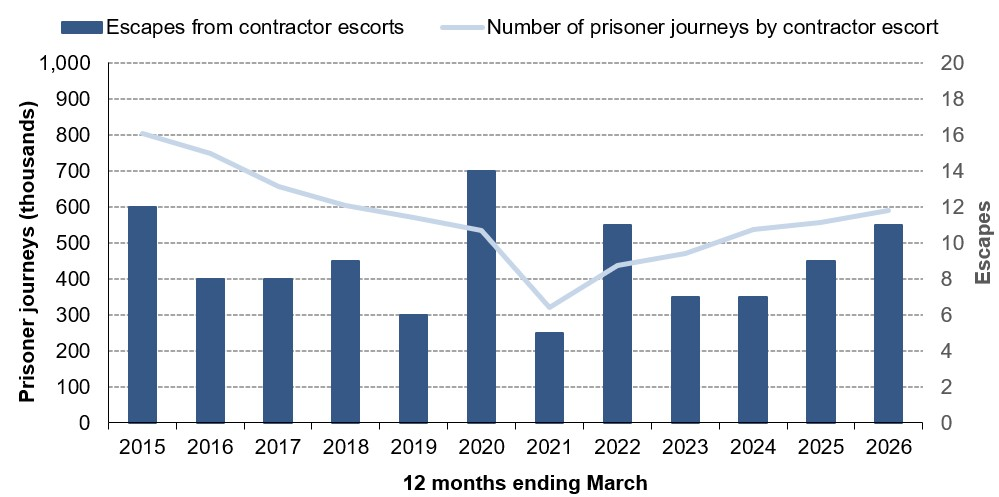
In the 12 months ending March 2026, there were a total of 14 escapes, 11 of which occurred from contractor escorts and 3 occurred from HMPPS escorts. This is an increase from 12 escapes in the year ending March 2025. Four of the 14 escapees in the latest year remained at large 30 days after their escape, an increase from 2 of the 12 escapees in the previous year.
There were no Category A prisoner escapes from prisons or escorts. In the last 29 years (since the financial year ending March 1997), there have been two Category A escapes, occurring in the 12 months ending March 2012 and 2013.
There were no escapes from prison in the latest year. The number of escapes from prison has remained very low, not exceeding 4 in any financial year since the 12 months ending March 2005.
There were 3 escapes from HMPPS escort in the latest year. The number of escapes from HMPPS escorts has remained very low, not exceeding 4 in any financial year since the year ending March 2007.
Due to the relatively low numbers, year-on-year changes should be interpreted with caution.
Figure 1.1 shows the number of contractor escort journeys and escapes from contractor escorts. There were 589,420 contractor escort journeys in the financial year to March 2026, a 6% increase from 557,822 the previous year. Of the 589,420 journeys in the latest year, 11 resulted in an escape, giving a rate of 1 escape per 54,000 contractor escort journeys in the latest year. The rate of escape from contractor escorts has remained consistently low at below 1 escape per 30,000 prisoner journeys each year since this series began in 2013.
Figure 1.1: Contractor escort journeys and escapes from contractor escorts, the 12 months ending March 2016 to the 12 months ending March 2026
The number of absconds increased in the 12 months to March 2026 (Table 1.1 and Escapes data tool, Figure 1.2)[footnote 12]
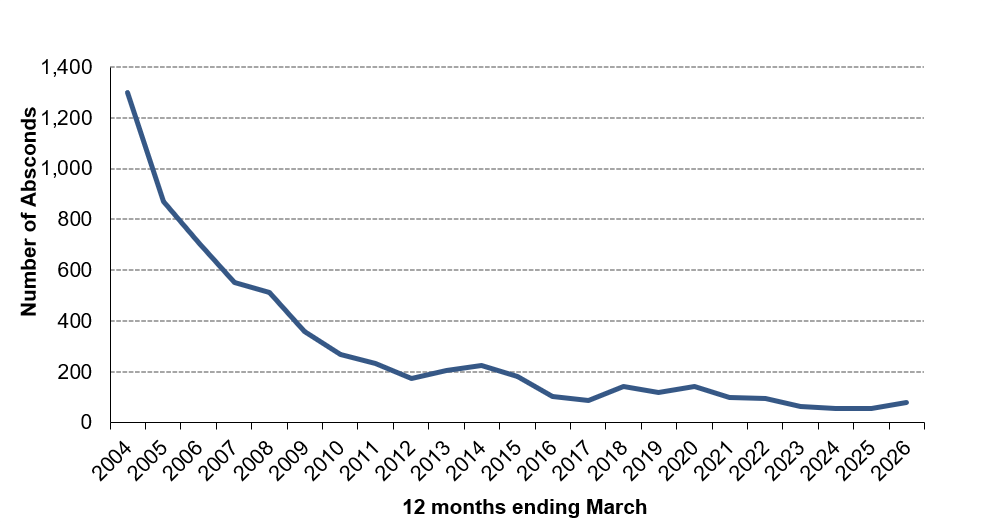
There were 78 absconds in the year ending March 2026, a 37% increase from 57 absconds in the previous year. Absconds had previously decreased substantially between the year ending March 2004 (1,301 absconds) and 2017 (88 absconds), and decreased again between the year ending March 2020 (143 absconds) and 2025 (57 absconds), before increasing in the latest year.
Of those who absconded in the 12 months to March 2026, 30 were still at large after 30 days. The percentage of prisoners who were at large after 30 days increased from 26% in the 12 months ending March 2025 to 38% in the 12 months to March 2026.
Most abscond incidents in the 12 months to March 2026 were for prisoners whose main offence was theft offences (27 absconds) or violence against the person offences (20 absconds), with the highest rates of absconds per 1,000 prisoners in open prisons being for prisoners with theft offences or robbery offences (112 absconds per 1,000 prisoners with theft offences in open prisons and 41 absconds per 1,000 prisoners with robbery offences in open prisons)[footnote 13][footnote 14].
Figure 1.2: Absconds, the 12 months ending March 2004 to the 12 months ending March 2026
The number of release failures from releases on temporary licence (ROTL) increased in the 12 months to March 2026 (Table 1.1, Table 1.3, Figure 1.3)[footnote 15]
In the year ending March 2026, there were 404,005 incidents of ROTL, a 6% increase from 381,983 incidents in the previous year. Of those 404,005 incidents of ROTL, 925 resulted in temporary release failures, where prisoners who have been released on temporary licence fail to fulfil all of the conditions of their release. Temporary release failures increased by 6% from 869 temporary release failures in the year ending March 2025 to 925 temporary release failures in the year ending March 2026.
Of the 925 temporary release failures, 20 were known to have had a primary reason of committing an offence during their release, 275 of returning late back to the prison, and 51 of being failures to return, resulting in prisoners being unlawfully at large[footnote 16].
Of the 51 failures to return in the year ending March 2026, 12 prisoners were still at large after 30 days.
Figure 1.3: Temporary release failures from the 12 months ending March 2005 and failures to return from the 12 months ending March 2012, to the 12 months ending March 2026[footnote 17]
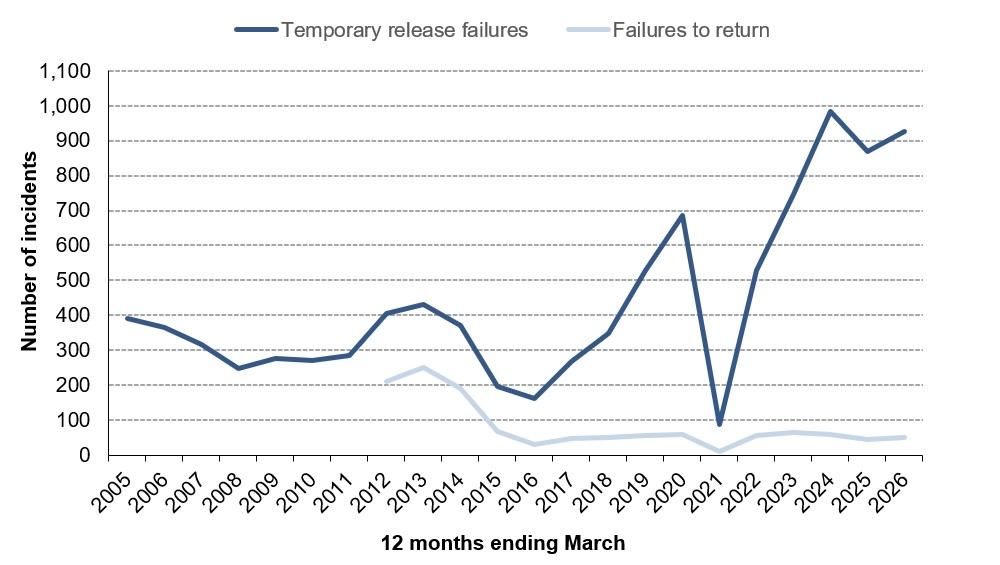
Figure 1.3 shows that the number of prisoners that fail to return from ROTL generally mirrored the trend for all temporary release failures prior to the pandemic, but has been broadly stable at a lower proportion of total failures in recent years. The proportion of ROTL failures relating to prisoners who fail to return from ROTL remained relatively steady at 6% in the year ending March 2026 (51 out of 925), compared to 5% in the year ending March 2025 (44 out of 869).
Most failure to return incidents in the year ending March 2026 were for prisoners whose main offence was violence against the person offences (31%), robbery offences (18%) and drug offences (18%).
Between 2013 and 2015 a series of changes were made to tighten ROTL policy, with the result that incidences of release fell dramatically. In 2019, the MOJ issued a new ROTL policy framework, which aimed to allow prison governors to consider ROTL earlier and more frequently because of its resettlement benefits. A large-scale MOJ study published in 2018 showed that increased use of ROTL in suitable cases was associated with a small but statistically significant reduction in reoffending.
These policy changes are reflected in both incidences of release and failure. There was a decrease in the number of incidences of release on temporary licence from 530,886 in the 2013/14 financial year to 320,582 in the 2015/16 financial year, before gradually increasing to 438,117 in the 2019/20 financial year. There was a large drop to 114,856 in the 2020/21 financial year due to COVID-19 restrictions, before increasing to 301,003 in the 2021/22 financial year and 425,095 in the 2023/24 financial year. This number dropped again to 381,983 in the 2024/25 financial year, before increasing to 404,005 in the most recent 2025/26 financial year. The proportion of releases completed successfully without failure remains well over 99% [footnote 18].
The number of releases in error decreased in the 12 months to March 2026 (Table 1.1)
In the 12 months to March 2026, 192 prisoners were released in error. This is a 26% decrease from 258 recorded within the reporting period in the previous year[footnote 19][footnote 20]. Some releases in error are only identified after the end of the reporting period. A further 54 incidents were recorded after the reporting period for the previous year, giving an updated total of 312 releases in error for the year ending March 2025.
Data on releases in error is based on the information available at the time. It may be the case in some circumstances that information on a case is brought to light that either confirms or disproves a release in error. Consequently, figures may change over time, and particularly in the most recent months reported each publication, as there has been less time for such cases to be detected. In the past, these revisions have tended to be upwards.
Releases in error should be interpreted with due caution in the context of trends in releases and changes in the operational environment, as relatively small numerical changes can have a disproportionate impact on apparent trends[footnote 21].
A prisoner is released in error if they are released when they should otherwise have remained in HMPPS custody and the prisoner or a third party has not deliberately played a part in the error. This data is inclusive of releases in error from prisons and Prisoner Escort Custody Services, but does not include any incidents where HMPPS carried out the terms of an order but the order did not reflect the lawful order made by the court due to a HMCTS administrative error, or where the individual was not in HMPPS custody[footnote 22][footnote 23].
The Dame Lynne Owens independent review into releases in error found that statistics on releases in error could be improved to better reflect the totality of releases in error, and that there is currently limited understanding of the true extent of risk presented by releases in error. MoJ will continue to work, including with ONS, to improve how our recording and reporting reflect the true position.
2. Random Mandatory Drug Testing
There were an insufficient number of prisons meeting the required testing level of rMDT in 2025-26.
In the 12 months to March 2026, there were 56,679 random mandatory drug tests (rMDT) carried out nationally. This was an increase from 53,362 the previous year. In the 12 months to March 2026 test volumes averaged 4,700 tests per month, compared to 4,500 in the 12 months to March 2019, pre-pandemic, and 4,400 in the 12 months to March 2025. However, in the 12 months to March 2026, there were still an insufficient number of prisons meeting their required testing level: in this period only 82 prisons met their required testing levels each month.
Due to an insufficient number of prisons meeting the required testing level, the data is currently not sufficient to robustly estimate the prevalence of drug use in prisons. Any changes in the monthly percentage positive levels could be driven by certain prisons reaching their required levels rather than underlying levels of drug use. Since we do not have a robust estimate, there are no tables accompanying this chapter of the HMPPS Digest.
Management of rMDT
As part of HMPPS’s comprehensive drug testing regime, a random sample of prisoners (5%, or 10% in prisons with under 400 prisoners) are subject to rMDT each month. This translated to over 54,000 tests completed in the year to March 2020, across all prisons. However, because of the COVID-19 pandemic, testing was suspended across prisons from April 2020 and only partially resumed from September 2020. Establishments were required to resume testing when they were operating at Stages 1 or 2 rather than at Stages 3 and 4 of the National Framework for managing COVID-19. This resulted in a significant drop in the number of completed tests throughout 2020-21, continuing into 2021-22. In April 2022 formal performance expectations around rMDT volumes were reinstated. Since then, testing levels have increased, with there being 6% more tests in the 12 months to March 2026, than the previous 12 months. A more detailed explanation of how rMDT operates is given in the Guide to the HMPPS Digest.
Testing Panel
The extent to which the testing panel covers the drugs that are prevalent in prisons, in particular the latest compounds of Psychoactive Substances (PS) in use, is another determinant of the reliability of rMDT estimates. Time lags in updating the testing panel with new substances lead to underestimation of drug use because they cannot be detected.
Historically, it has not been possible to draw conclusions about the level of misuse of drugs including PS for 2018-19 and 2019-20 because of two new compounds of PS in circulation in prisons which could not at the time be identified by the rMDT test. However, steps have been taken to reduce considerably the time lags in updating the rMDT testing panel for new drugs. The improvements to this process are set out in the Annex alongside panel changes.
Because of the pause and subsequent disruption to testing since 2020-21 and underestimation of drug use in 2018-19 and 2019-20 due to time lags in updating the testing panel for new PS, readers are referred to the findings in the HMPPS Digest for the period 2017-2018[footnote 24]. In 2017-18, the percentage of positive drug tests (including PS) was 21%.
3. Protesting Behaviour
| Barricade/prevention of access incidents decreased | In the 12 months to March 2026 there were 1,740 barricade/prevention of access incidents, a decrease of 11% from 1,964 in the previous 12-month period. | ||
| Hostage incidents decreased | In the 12 months to March 2026 there were 41 incidents where prisoners took someone hostage, a decrease of 21% from 52 in the previous 12 months. | ||
| Concerted indiscipline incidents decreased | In the 12 months to March 2026, the number of incidents of concerted indiscipline decreased by 5% to 208. The number of these incidents which are counted as active, incidents involving aggression or violence, decreased by 39% over the same period from 140 to 85 (41% of all concerted indiscipline incidents). | ||
| Incidents at height decreased | In the 12 months to March 2026, the number of incidents at height in prisons decreased by 15% to 7,213 (compared with 8,451 in the previous year). |
Incidents at height continue to be the most common form of protesting behaviour (Figure 3.1, Table 3.1)[footnote 25]
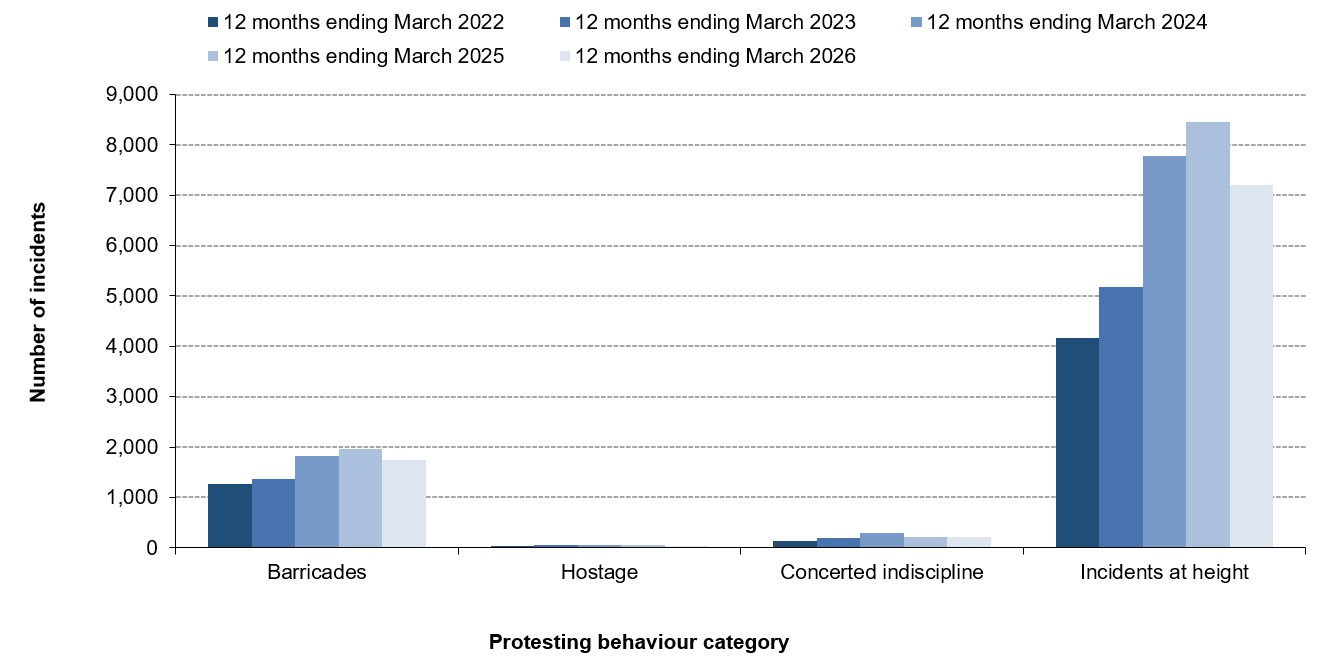
In the 12 months to March 2026, the most common type of incidents of protesting behaviour were incidents at height (7,213 incidents), followed by barricades or prevented access (1,740 incidents), concerted indiscipline (208 incidents), and hostages (41 incidents). All types of incidents of protesting behaviour decreased in the 12 months to March 2026 compared to the previous 12 months.
The decreases in the latest year mark a break in the upward trends previously observed for incidents at height and barricades or prevented access. Despite these recent decreases, the number of incidents at height was more than 2.5 times higher in the 12 months to March 2026 (7,213 incidents) than in the 12 months to March 2016 (2,685 incidents), and the number of incidents involving barricades or prevented access was 42% higher in the 12 months to March 2026 (1,740 incidents) than in the 12 months to March 2016 (1,229 incidents). In comparison, the number of concerted indiscipline incidents was 25% lower in the 12 months to March 2026 (208 incidents) than in the 12 months to March 2016 (276 incidents), and hostage incidents had more than halved, decreasing from 129 incidents in the 12 months to March 2016 to 41 incidents) in the 12 months to March 2026.
Figure 3.1: Number of incidents in each category of protesting behaviour, 12 months ending March 2022 to 12 months ending March 2026 (Source: Table 3.1)
The number of incidents of prisoners using barricades or preventing access decreased (Source: Table 3.1)
There were 1,740 incidents in the 12 months to March 2026 where prisoners used barricades or prevented access. This represents a decrease of 11% from the peak of 1,964 in the previous year.
Over the same period, the rate of barricade incidents per 1,000 prisoners, which takes account of the changes in the prison population, decreased 12% from 22.6 per 1,000 prisoners in the previous 12 months to 19.9 per 1,000 prisoners in the 12 months to March 2026.
The number of hostage incidents decreased (Source: Table 3.1)
The number of incidents where prisoners took someone hostage in prisons decreased by 21% to 41 in the 12 months to March 2026 (compared with 52 in the previous year). This is a decrease of 68% from the peak of 129 incidents in the 12 months to March 2016.
The rate of hostage incidents in the 12 months to March 2026 decreased from 0.6 to 0.5 incidents per 1,000 prisoners in comparison to the previous year. The rate remains 69% lower than the peak of 1.5 incidents per 1,000 prisoners first seen in the 12 months to March 2016.
Of the 41 hostage incidents, the majority (31 incidents) only involved prisoners as hostages.
The number of incidents of concerted indiscipline decreased (Source: Table 3.1)
The number of incidents of concerted indiscipline decreased by 5% to 208 incidents in the 12 months to March 2026. The number of incidents had decreased by 45% from the peak of 380 incidents in the 12 months to March 2017.
The number of incidents of concerted indiscipline described as active decreased by 39%, from 140 to 85 incidents in the 12 months to March 2026, while the number of incidents of described as passive increased by 54%, from 80 to 123 incidents in the same period. The proportion of incidents of concerted indiscipline described as active decreased from 64% in the previous year to 41% in the latest year, the lowest it has been since the 12 months to March 2021.
The rate of concerted indiscipline incidents per 1,000 prisoners decreased from 2.5 in the 12 months to March 2025 to 2.4 in the 12 months to March 2026, and is 47% lower than the peak of 4.5 in the 12 months to March 2017.
The number of incidents at height decreased (Source: Table 3.1)
The number of incidents at height decreased by 15% to 7,213 incidents in the 12 months to March 2026 (compared with the peak of 8,451 in the previous year).
The rate of incidents at height per 1,000 prisoners decreased 15% from 97.1 in the 12 months to March 2025 to 82.6 in the 12 months to March 2026.
4. Finds in Prison
| Total number of find incidents increased | In the 12 months to March 2026, the number of incidents of finds increased to 76,740 from 74,764 in the previous 12-month period, an increase of 3%. | ||
| Number of drug finds in prisons increased | In the 12 months to March 2026, the number of incidents where drugs were found in prisons increased to 26,630 from 26,359 in the previous 12-month period, an increase of 1%. | ||
| Number of mobile phone and SIM card finds decreased | In the 12 months to March 2026, there were 11,916 incidents where mobile phones were found in prisons and 5,285 incidents where SIM cards were found. These are decreases of 2% and 4% respectively, compared with the previous 12-month period. | ||
| Number of incidents where weapons were found increased | In the 12 months to March 2026, there were 13,284 incidents where weapons were found. This is an increase of 2% compared to the previous year. | ||
| Number of tobacco finds decreased | In the 12 months to March 2026, there were 4,507 incidents where tobacco was found in prisons. This is a decrease of 15% compared to the previous year. | ||
| Number of alcohol finds and distilling equipment finds decreased | In the 12 months to March 2026, there were 7,449 incidents where alcohol was found in prisons and 541 incidents where distilling equipment was found. This is a decrease of 12% for alcohol finds and a decrease of 19% for distilling equipment finds, compared with the previous 12-month period. | ||
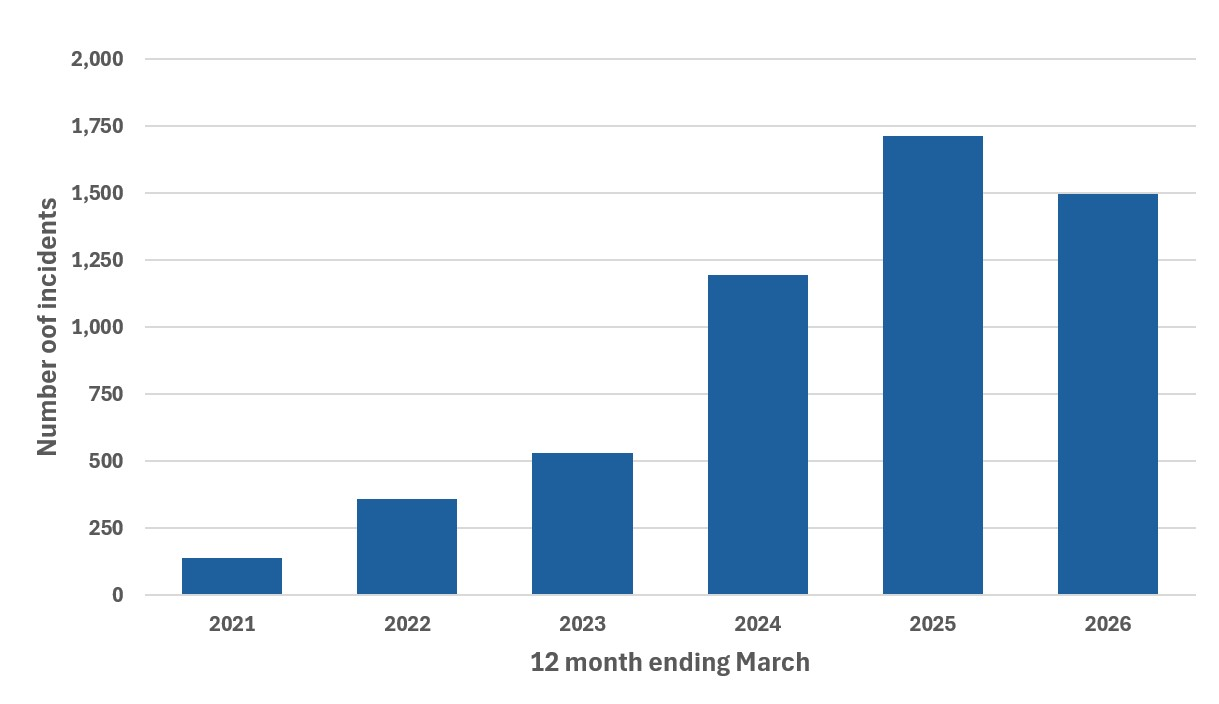
| Number of drone incidents in prisons decreased[footnote 26] | In the 12 months to March 2026, the number of recorded drone incidents in prisons decreased to 1,497 from 1,712 in the previous 12-month period, a decrease of 13%. |
This chapter covers incidents where illicit items have been found in prisons. It is important to consider with incidents of finds in prisons, that an increase in numbers may be as a result of more items being found, although not necessarily attributable to any one particular security counter-measure, rather than more items being present in prisons.
The total number of incidents where items were found increased in the 12 months to March 2026 (Table 4.1)[footnote 27]
In the 12 months ending March 2026, there were 76,740 find incidents; an increase of 3% from the 74,764 in the 12 months to March 2025. Find incidents had been on an upwards trend, peaking at 63,764 in the 12 months to March 2020, and had then been on a downwards trend during the pandemic period until the 12 months to March 2022. Since then, find incident levels have been steadily increasing, reaching the highest level they have been within the timeseries in the latest 12-month period.
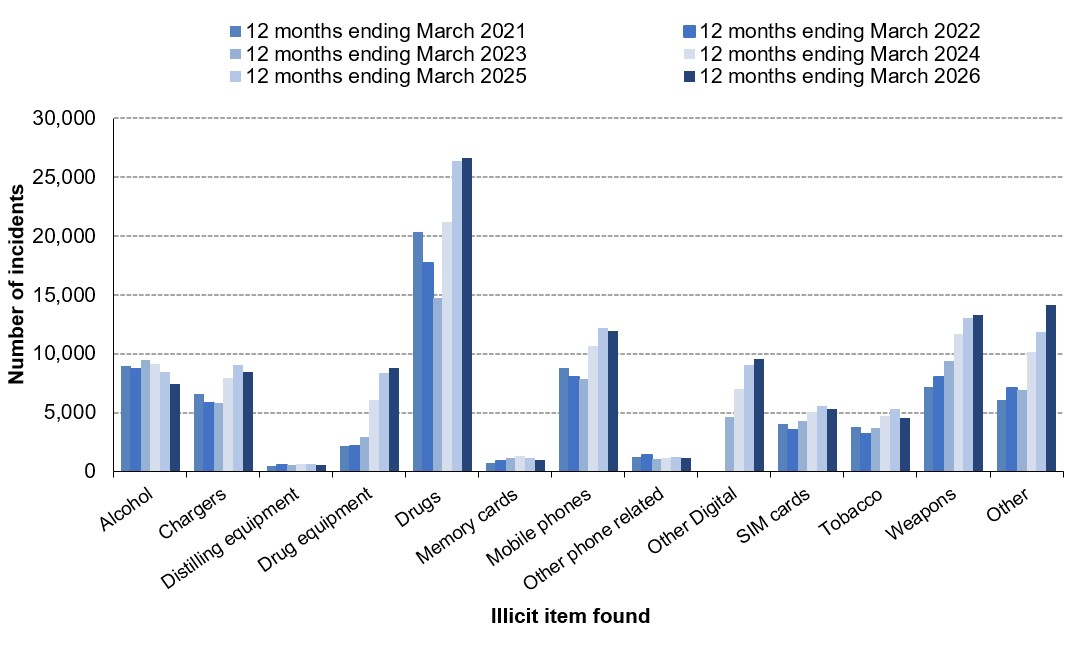
In the year to March 2026, the most common types of illicit items[footnote 28] found in prisons were drugs (26,630 incidents of finds); weapons (13,284); and mobile phones (11,916). There were increases in the numbers of finds of drugs and weapons in the latest year, by 1%, and 2% respectively, while incidents of mobile phone finds decreased by 2%.
Figure 4.1: Number of incidents where illicit items were found in prisons, 12 months ending March 2021 to 12 months ending March 2026 (Source: Table 4.1)
The number of finds of drugs increased in the 12 months to March 2026 (Figure 4.1, Finds data tool)
In the 12 months ending March 2026, there were 26,630 finds of drugs in prisons; an increase of 1% from the 26,359 in the 12 months to March 2025. Incidents of drug finds have increased in each of latest three years and are now at their highest levels in the time series.
The number of incidents where drug equipment was found in prisons increased by 5% from 8,331 incidents in the 12 months to March 2025 to 8,765 incidents in the 12 months to March 2026.
The drug type accounting for the largest number of incidents where drugs were found [footnote 29] in the 12 months to March 2026 was psychoactive substances (Table 4.2)
The largest drug category is where the drug type was unknown, at 7,898 find incidents, a 7% decrease from 8,449 in the 12 months to March 2025. This is potentially due to a change in the way finds were recorded in March 2022, since when a response order effect may have led to a higher proportion of ‘unknown’ responses. This may also be associated with falls in individual drug categories[footnote 30].
There was an increase in finds of Class A drugs, by 28%, to 1,005 finds. This is the largest proportionate increase of all drug types, though finds of Class A drugs remain relatively low volume. In contrast, there was a decrease in finds of Class B drugs, decreasing by 8% to 7,063 finds.
Psychoactive substances (PS), as defined in the Psychoactive Substances Act 2016[footnote 31], were found in 7,772 incidents in the 12 months to March 2026, making it the largest drug category (besides the Unknown category) over the period. The number of finds of psychoactive substances had increased by 12% compared with the 12 months to March 2025.
There was a 9% increase in ‘other’ types of drugs found, to 3,852 finds.
The number of incidents where mobile phones were found and other mobile phone related items[footnote 32] were found decreased (Figure 4.1, and Table 4.3)
The number of incidents where mobile phones were found in prisons decreased by 2%, from 12,166 in the 12 months to March 2025 to 11,916 incidents in the 12 months to March 2026.
The quantity of mobile phones found in prisons decreased by 3%, from 15,901 in the 12 months to March 2025 compared with 15,375 in the 12 months to March 2026.
The number of incidents where other mobile phone related items were found in prisons decreased 8%, from 1,200 in the 12 months ending March 2025 to 1,108 in the 12 months ending March 2026.
The number of incidents where SIM cards were found decreased (Figure 4.1 and Table 4.4)
The number of incidents where SIM cards were found in prisons decreased by 4% from 5,533 in the 12 months to March 2025, to 5,285 incidents in the 12 months to March 2026.
The quantity of SIM cards found decreased by 7%, from 7,907 SIM cards found in the 12 months to March 2025 compared with 7,322 in the latest 12-months.
The numbers of incidents where memory cards and chargers were found decreased, while the number of incidents where other digital items were found increased (Figure 4.1)
The number of incidents where memory cards were found in prisons decreased 12%, from 1,114 in the 12 months ending March 2025 to 985 in the 12 months ending March 2026.
The number of incidents where chargers were found in prisons decreased 7%, from 9,065 in the 12 months ending March 2025 to 8,418 in the 12 months ending March 2026.
The number of incidents where other digital items were found increased by 6%, from 9,030 in the 12 months ending March 2025 to 9,539 in the 12 months to March 2026.
The number of incidents where alcohol was found has decreased, as has the number of incidents where distilling equipment was found (Figure 4.1)
The number of incidents where alcohol was found in prisons decreased by 12%, from 8,450 in the year ending March 2025 to 7,449 in the year ending March 2026.
The number of incidents where distilling equipment was found decreased 19%, from 672 in the year ending March 2025 to 541 in the year ending March 2026.
The number of incidents where tobacco was found decreased (Figure 4.1)
The number of incidents where tobacco was found decreased 15%, from 5,331 in the year ending March 2025 to 4,507 in the year ending March 2026.
The number of incidents where weapons were found increased (Figure 4.1)
The number of incidents where weapons were found in prisons increased 2% from 13,017 in the year ending March 2025 to a new peak of 13,284 in the year ending March 2026. After a sharp drop from 11,267 in the 12 months to March 2020 to 7,178 in the 12 months to March 2021, the number of weapon finds incidents have increased year-on-year to a new peak in the 12 months to March 2026.
The number of reported drone incidents decreased (Table 4.1)
The number of reported drone incidents in prisons decreased by 13% from 1,712 in the year ending March 2025 to 1,497 in the year ending March 2026.
Figure 4.2: Number of drone incidents in prisons, 12 months ending March 2021 to 12 months ending March 2026 (Source: Table 4.1)[footnote 33]
Further information
General information about the official statistics system of the UK is available from: uksa.statisticsauthority.gov.uk/about-the-authority/uk-statistical-system
Ministry of Justice publishes data relating to offender management in England and Wales. Equivalent statistics for Scotland and Northern Ireland can be found at:
www.gov.scot/statistics-and-research
www.justice-ni.gov.uk/topics/statistics-and-research-justice
Contact
Press enquiries should be directed as per the Ministry of Justice Press Enquiries webpage:
https://www.gov.uk/government/organisations/ministry-of-justice/about/media-enquiries
Other enquiries about these statistics should be directed to the Offender Equalities Statistics Team at the Ministry of Justice:
Responsible Statistician: Danielle House
Email: OffenderEqualitiesStatistics@justice.gov.uk
A copy of this report, the Technical Guide and accompanying tables can be found online:
www.gov.uk/government/collections/prison-and-probation-trusts-performance-statistics
© Crown copyright
Produced by the Ministry of Justice
Alternative formats are available on request from OffenderEqualitiesStatistics@justice.gov.uk
-
https://www.gov.uk/government/collections/offender-management-statistics-quarterly ↩
-
https://www.gov.uk/government/collections/safety-in-custody-statistics ↩
-
https://www.gov.uk/government/collections/hmpps-annual-offender-equalities-report ↩
-
https://www.gov.uk/government/collections/prison-and-probation-trusts-performance-statistics ↩
-
https://www.gov.uk/government/collections/hmpps-annual-offender-equalities-report ↩
-
https://www.gov.uk/government/statistics/hm-prison-probation-service-workforce-quarterly-march-2026 ↩
-
https://www.gov.uk/government/collections/prison-population-statistics ↩
-
https://www.gov.uk/government/collections/offender-employment-outcome-statistics ↩
-
https://www.gov.uk/government/collections/offender-accommodation-outcome-statistics ↩
-
Unlawfully-at-large incidents are categorised by the level of security measures the prisoner had to overcome to gain their liberty. A prisoner escapes from prison if they unlawfully gain their liberty by breaching the secure perimeter of a closed prison. A prisoner escapes from an escort if they are able to pass beyond the control of escorting staff and leave the escort, the vehicle or the premises (such as a court or hospital), please see the Guide to HMPPS Annual Digest for more information. ↩
-
We report all unlawfully-at-large incidents according to the most recent reporting period. Recapture dates, which determine unlawfully-at-large incidents, are sometimes reported late and so may be recorded only after the end of the reporting period for the financial year. Therefore, unlawfully-at-large incidents included as published statistics in previous reporting periods are liable to change and be updated. ↩
-
An abscond is an escape that does not involve overcoming a physical security barrier or restraint. It is only possible to abscond from open prison conditions ↩
-
Rates are based on the latest prison population data published in Offender Management Statistics Bulletin within the following link: www.gov.uk/government/collections/offender-management-statistics-quarterly. Please refer to the HMPPS Annual Digest Guidance Document for further information about how rates are compiled. ↩
-
The rates exclude summary motoring and summary non-motoring offences due to small numbers ↩
-
A temporary release failure occurs when a prisoner fails to adhere to any condition written into the licence that permits their temporary release. Failures to return after release on temporary licence are the subset of temporary release failures, where an offender has not returned to the establishment by midnight on the designated return date ↩
-
The figures only include one type of failure for each temporary release failure incident. Where an incident includes multiple types of failure, only one type is reported here, with ‘offence’ taking priority, followed by ‘failure to return’, ‘late return’, ‘other’, and ‘unknown’ ↩
-
Data on the type of temporary release failure is not available for the full time series presented in figure 1.3. Data on failures to return was first available for the 12 months ending March 2012. ↩
-
Data on the number of incidences of temporary release and individuals released, and the number of failures are reported within the Offender Management Statistics Quarterly bulletin: www.gov.uk/government/collections/offender-management-statistics-quarterly ↩
-
The reporting period covers incidents that occurred during the financial year and were reported during the time period from the start of that financial year to 7th June (when the data is extracted for the publication) in the following financial year, so the reporting period for 2025-26 incidents covers 1st April 2025 to 7th June 2026. Any incidents recorded after this time period are counted as being reported after the reporting period. ↩
-
Small numbers of incidents are routinely revised to other incident types from year to year following further information coming to light. As a result of this, the release in error figure recorded within the reporting period for the previous year has changed slightly (from 262 to 258). ↩
-
The Offender Management Statistics Quarterly bulletin gives an indication of the number of prisoners routinely released in any given period via the following link: www.gov.uk/government/collections/offender-management-statistics-quarterly. ↩
-
Releases in error from HMPPS happen due to a variety of issues. Examples of releases in error may include misplaced warrants for imprisonment or remand, recall notices not acted upon or sentence miscalculation, where a prisoner is released earlier than their correct release date, or where there is an error at the point of final discharge. ↩
-
If the person released is not aware of the error and makes no attempt to evade arrest, then they have committed no additional offence and in that sense, they may not be at fault. If it is believed that the situation was manipulated by the prisoner, for example by taking the identity of another person, then this will be classified as an escape, and not a release in error. ↩
-
The latest data including for 2017/18 and past trends are given in HMPPS Annual Digest: April 2019 to March 2020 edition: www.gov.uk/government/statistics/hmpps-annual-digest-april-2019-to-march2020. This includes full details of data quality which are summarised in the Guide to this year’s HMPPS Digest ↩
-
Please see the Guide to HMPPS Annual Digest for protesting behaviour definitions ↩
-
Drone incidents include all drone sightings, including UAV landings, crashes, recovery or conveying unauthorised articles into the establishment restricted fly zone or is believed to be photographing prisoners, staff or parts of the building’s fabric. To be reportable as a drone sighting incident, the drone must have been seen by staff (rather than heard or observed by a third party). Where multiple drones are seen at the same time this should be recorded as one drone incident. ↩
-
There was a change in the way Finds were recorded in March 2022, please see the Guide to HMPPS Annual Digest for more information. ↩
-
Finds categorised as “Other” have also increased by 20% to 14,159 incidents, which is in part due to a change in the types of vape permitted in prison establishments. ↩
-
Excluding the “Unknown” drug category. ↩
-
There was a change in the way Finds were recorded in March 2022, please see the Guide to HMPPS Annual Digest for more information. ↩
-
In this Act “psychoactive substance” means any substance which is capable of producing a psychoactive effect in a person who consumes it, and is not an exempted substance. Exempted substances are: controlled drugs, medicinal products, alcohol or alcoholic products, nicotine, tobacco products, caffeine or caffeine products or any substance which is ordinarily consumed as food, and does not contain a prohibited ingredient: www.legislation.gov.uk/ukpga/2016/2/contents ↩
-
Following improvements made in 2022 to the reporting of finds incidents, we have identified that a subset of finds incidents were not included correctly in the “other mobile phone related” finds subcategory. This has led to an underestimate of “other mobile phone related” finds while leaving the overall count of finds incidents unimpacted. The count of the subcategory has now been corrected, which has led to an increase in figures from April 2022 to March 2025 compared to what has been previously published. ↩
-
It is important to consider with incidents of sightings in prisons that an increase in numbers does not necessarily indicate more drone incursions. It may simply indicate more focused reporting. Trends should not be directly attributed to any one particular security counter-measure. ↩