Annual Report and Accounts of HM Treasury - Year to the 31 March 2026
Updated 6 August 2026

© Crown copyright 2026
This publication is licensed under the terms of the Open Government Licence v3.0 except where otherwise stated. To view this licence, visit nationalarchives.gov.uk/doc/open-government-licence/version/3 or write to the Information Policy Team, The National Archives, Kew, London TW9 4DU, or email: psi@nationalarchives.gov.uk.
Where we have identified any third party copyright information you will need to obtain permission from the copyright holders concerned.
This publication is available at https://www.gov.uk/government/publications/hm-treasury-annual-report-and-accounts-2025-to-2026/annual-report-and-accounts-of-hm-treasury-year-to-the-31-march-2026
1. Foreword by the Treasury Lords Minister
This Government has the right economic plan to build a stronger and a more secure economy for Britain.
The latest figures show that our plan is the right one. Britain’s economy was the fastest growing in the G7 for the first quarter of this year. Borrowing last year was £20 billion lower than the previous year. Interest rates have been cut six times since the general election.
But the conflict in the Middle East is putting pressure on energy markets, and creating renewed fragility in trade and supply chains. The Government did not start this war, and the Government did not join it, but it will have consequences for our country. That is why the government’s approach will continue to be responsive to a changing world and responsible in the national interest.
The Government have already taken action to deal with the costs being felt by families, including by taking £150 off energy bills, extending the 5p cut for fuel duty until next year, and cutting the rate of VAT on summer attractions from 20% to 5%.
The Government are supporting businesses with energy costs – through the British Industry Supercharger and the expanded British Industrial Competitiveness Scheme – and the Government have reduced duty on red diesel by over a third, granted a 12-month road tax holiday for HGVs, and provided targeted support to the ceramics and chemicals sector.
But as well as support with the immediate economic costs, the Government must also continue to drive long-term growth through our economic plan.
Strong economic foundations are the cornerstone of the economic plan, and they are delivered through our non-negotiable fiscal rules, which keep a tight grip on day-to-day spending and get debt on a downward path. In the Budget last November, the Government doubled the headroom against the stability rule and cut borrowing as a share of GDP in every year of the forecast.
The Government are also raising public investment, to deliver growth-driving infrastructure and to crowd-in private investment, including through an additional £120 billion in growth-driving infrastructure like roads, rail and record levels of R&D.
And the Government are reforming the economy, to systematically remove the barriers to growth faced by businesses, including by overhauling the planning system, better protecting infrastructure projects from judicial review and cutting red tape and bureaucracy for firms.
In her Mais lecture in March, the Chancellor set out three strategic choices that will guide the next part of our economic plan over the decade ahead.
An active and strategic state, working in partnership with business, will empower regional growth, it will embrace AI and innovation, and it will establish a closer economic relationship with the European Union, to strengthen resilience and reduce unnecessary trade frictions for business.
These choices build on the responsible choices this government has already taken over the last two years. Because of those choices, and because of the hard work and commitment of Treasury staff, Britain’s economy today is in a better position to withstand whatever uncertainty comes our way. Our responsibility now is to go further, to continue to drive forward our economic plan, and to build a stronger and a more secure economy for Britain’s future.
Lord Livermore
Financial Secretary to the Treasury
10 July 2026
1.1 HM Treasury at a glance
- 0.8% GDP Growth per Capita in 2025-26
- (0.3)% Real Household Disposable Income Growith per Capita in 2025-26
- 1.5% Current budget deficit as a percentage of GDP in 2025-26
- 83.2% Net Financial Debt as percentage of GDP in 2025-26
- 3.4% CPI inflation in 2025-26
- 147% Aggregate Liquidity Coverage Ratio for Major UK Banks in 2025-26
- 0.6% Public Services Productivity year-on-year change in 2025
- 14.7% Aggregate Capital Ratio for UK Banking Sector (common equity Tier 1) in 2025-26
2. Performance Report
2.1 Statement by the Permanent Secretary
This year, HM Treasury has delivered tangible progress against its objectives. As recorded in the Spring Forecast, growth is rising and we have taken decisive action to put the public finances on a stronger footing, with borrowing falling this year and taking steps to increase the headroom buffer against the fiscal rules. The subsequent conflict in the Middle East and its impact on energy will affect these objectives but makes the progress made more important.
The department has continued to demonstrate professionalism, resilience and adaptability in supporting the government’s priorities. Against a backdrop of global uncertainty and domestic challenge, colleagues across the department have worked with commitment and agility to support economic stability while advancing an ambitious programme for growth and reform.
Over the course of 2025–26, we have helped deliver our agenda through key fiscal events: the Autumn Budget 2025, the 2026 Spring Statement and the 2025 Spending Review, which together set a clear and credible path for the public finances while prioritising investment and long-term reform.
We have strengthened the fiscal framework to support confidence and stability, including increasing fiscal headroom at Budget 2025, providing greater resilience to shocks and stronger foundations for investment. We have also reinforced fiscal discipline and transparency, including through reforms to ensure a single major fiscal event each year supported by independent scrutiny from the Office for Budget Responsibility.
Despite challenging global and domestic conditions, we have continued to support households through ongoing cost of living pressures, with measures including action on energy bills, transport costs and fuel duty.
Alongside this, we have delivered a significant Spending Review, setting multi-year budgets for public services across government within the allocated spending envelope, thus translating macroeconomic policy into detailed departmental plans. This has provided greater certainty for departments and enabled a more strategic approach to public spending, focused on value for money, efficiency and long-term outcomes. The delivery of the Office for Value for Money further strengthened our focus on driving productivity and ensuring that public money delivers the greatest possible benefit.
These foundations have enabled the government to take forward its growth strategy. Guided by the principles of stability, investment and reform, HM Treasury has supported a step change in both public and private investment, including through the National Wealth Fund, as well as a programme of supply side reforms to remove barriers to growth. We have also played a leading role in implementing the strategic choices set out in the Chancellor’s 2026 Mais Lecture, including empowering regional growth, embracing innovation and AI, and strengthening the UK’s economic relationship with international partners.
Following the Chancellor’s Mansion House speech in July 2025, HM Treasury has supported delivery of the Financial Services Growth and Competitiveness Strategy, taking forward reforms to improve the competitiveness of the regulatory framework, modernise markets and strengthen the UK’s position as a leading global financial centre including publishing a Bill currently before Parliament.
We have also supported major reforms to the UK’s infrastructure and delivery landscape, including through the first year of operations of the National Infrastructure and Service Transformation Authority (NISTA), bringing together expertise to drive delivery of major projects more effectively across government. At the same time, we have advanced reforms in financial services, pensions, and planning, alongside continued progress on the government’s Industrial Strategy, all aimed at improving productivity and long-term growth prospects.
Internationally, HM Treasury has continued to play a leading role in promoting economic and financial stability. We have engaged actively through the G7, G20 and international financial institutions, responding to geopolitical developments and supporting global resilience. Our support for Ukraine has remained steadfast, alongside broader efforts to strengthen economic security, tackle illicit finance and deepen international partnerships.
Internally, we have continued to evolve as a department. We are becoming more focused and agile as we become smaller, supported by reforms to our structure, strengthened delivery capability and increased use of data and technology. We have executed a Voluntary Exit Scheme and published a new Vision for the Treasury on how we want to work going forward. The expansion of our presence beyond London, particularly through the Darlington Economic Campus, reflects our commitment to building a more diverse and representative organisation, drawing on talent from across the UK.
Our people remain at the heart of everything we do. Throughout a demanding year, colleagues across HM Treasury have demonstrated exceptional dedication, expertise and professionalism. Their work has enabled the department not only to respond effectively to immediate challenges but also to lay the foundations for long-term economic strength.
As we look ahead, the economic environment remains uncertain. However, the actions we have taken over the past year to strengthen the fiscal framework, advance key reforms and invest in the UK’s long-term growth, mean that HM Treasury is well placed to continue supporting the government’s priorities and delivering for the public.
Thank you to all colleagues for all your hard work over the past year.
James Bowler CB
Permanent Secretary to the Treasury
10 July 2026
2.2 Performance Overview
The overview section provides a summary about our organisation, how we are structured, its purpose, key activities and how we have performed.
It sets out the department’s vision, mission, and strategic objectives, and explains the main factors that have shaped our work over the past year.
About us
Who we are
HM Treasury is the UK government’s economic and finance ministry. We set the direction of the UK’s economic policy and work to achieve strong and sustainable economic growth. We maintain control over public spending. We have strategic oversight of the UK tax system.
Our Vision
For the Treasury to be a world-leading economics and finance ministry, attracting a talented team which delivers excellent advice and outcomes for ministers.
Our Mission
To drive sustainable economic growth and maintain robust public finances by providing expert financial management and policy direction, ensuring transparency and value for money, and enhancing the prosperity and stability of every region and nation in the UK.
Our Values:
At the heart of our actions and interactions
- Collaborative
- Integrity
- Open
- Appreciative
We live our values in the way that we approach our work and in the way that we interact with each other. Read more about what we do here. In addition, over the course of 2025-26 we developed our Future Treasury Vision, which sets the department’s organisational strategy for the Spending Review period beginning in 2026-27.
2.3 How we are structured
The Permanent Secretary to HM Treasury is the Principal Accounting Officer (PAO) for HM Treasury Group. The Permanent Secretary is supported by two Second Permanent Secretaries and seven Directors General, including the CEO of NISTA.
HM Treasury Group is made up of the core department and its arm’s length bodies (ALBs) which are a combination of executive agencies, non-departmental public bodies (NDPBs), companies and additional bodies. Details of HM Treasury group can be found in the Governance Statement.
The 7 pillars of the department:
- Economics and Fiscal
- Enterprise and Growth Unit
- Financial Services
- International
- NISTA
- Public Spending
- Tax and Welfare
The Directors General lead the 7 pillars of the department. Reporting to them are director-led groups, each aligned with the department’s strategic objectives. These groups are supported by central functions that operate across all areas, enabling flexible and coordinated delivery of our priorities.
The central functions are our essential enablers:
| Corporate Centre | Provides corporate systems, services, solutions and facilities to enable HM Treasury Group to deliver effectively and efficiently. Including practical delivery of the government’s operational financing needs, met through the Exchequer Funds team. |
| Ministerial and Communications | Directly supports Ministers and its Executive Management Board, coordinating parliamentary business and professional communications function, and its ownership of Treasury governance structures. |
| Treasury Legal Advisors | (TLA) Provides advisory and other legal services across HM Treasury and certain other agencies and departments. |
Our structure as at 31 March 2026 is shown below. Refer to the governance report and the remuneration report for changes to the senior leadership in the year.
Our organisation chart can be found on GOV.UK.
Director General-led groups
| Economics and Fiscal | Economics Group: Provides economic surveillance and macroeconomic advice to inform policy decisions, and promotes professionalism and economic research across government. |
| Fiscal Group: Ensures fiscal policy supports economic objectives and public finance sustainability, overseeing key financial assets and liabilities and meeting the government’s financing needs. | |
| Enterprise and Growth Unit | Enterprise & Growth Unit (EGU): Responsible for growth-related policy and spending, encouraging private sector investment, innovation, enterprise and the transition to a low carbon economy. |
| Public Investment, Infrastructure, and Environment: The Public Investment, Infrastructure and Environment (PIIE) Directorate oversees public investment priorities, including via sponsorship of the National Wealth Fund, leading the implementation of the infrastructure strategy and working with Defra on planning and environmental regulation reforms. | |
| Growth, Transport and Innovation: The Growth, Transport and Innovation (GTI) Directorate leads the Treasury’s growth and productivity agenda, including direct policy responsibility across science, technology and innovation, transport, and place-based growth. | |
| Business and Energy: The Business and Energy (BE) Directorate supports HM Treasury’s growth agenda by overseeing business-facing policy and spending, energy policy and spending and culture, media and sport policy and spending, working closely with DBT, DESNZ and DCMS. | |
| Financial Services | Financial Services Group: Sets the financial services policy for the UK to ensure that the UK’s financial services sector supports economic growth and meets the needs of consumers and businesses across the country. It also works to keep the UK competitive as a leading global financial centre. |
| Financial Stability Group: Ensures the UK’s financial system remains stable and resilient. By doing this, it supports sustainable economic growth and strong public finances. | |
| International | Economic Crime and Sanctions: Develops and implements economic sanctions policy and tackles economic crime and illicit finance. The Office of Financial Sanctions Implementation ensures financial sanctions are properly understood, implemented and enforced |
| International Economics: Manages bilateral relationships with key economies including the EU, analyses global economic impacts on the UK, and strengthens UK trading relationships. | |
|
International Finance: Represents HM Treasury at major international forums (G7, G20, IMF) to address global economic challenges including climate, development and debt. It also leads policy on China, Ukraine and international economic security. |
|
| NISTA | Strategy & Systems Change: Leads delivery of key commitments through the 10 Year Infrastructure Strategy and champions system-wide improvements such as the Social Infrastructure Roadmap and prioritisation of place-based investment based on our spatial planning model, Align. |
| Market & Sector Engagement: Drives improved outcomes focussed on enhancing jobs, skills, innovation investment from the supply chain, working across the regulatory system to reduce barriers for infrastructure delivery, and partnering with the Public Financial Institutions to support private sector investment across the UK infrastructure pipeline. | |
| Portfolio & Delivery: Strengthens capability and delivery outcomes through leadership of the Government Project Delivery Function, delivering effective and robust assurance across critical projects included in the Government Major Projects Portfolio (GMPP), and delivers expert advice supporting effective delivery across the GMPP as well as other broader Growth-critical infrastructure outcomes across the UK. | |
| Project Finance: Leads the expert advisory team supporting existing PFI and PF2 contractual outcomes in support of the public sector client side, drawing together lessons learned and publishing guidance enabling ongoing improvements in delivery, and delivering on recent PPP commitments including Neighbourhood Healthcare PPPs, Public Sector Estate Decarbonisation through PPP arrangements, and work related to delivery of Euston station financing arrangements. | |
| Public Spending | Public Services Group: Oversees public service spending to ensure high quality and value for money, working directly with departments responsible for service delivery. |
| Public Spending Group: Leads on public spending strategy and public sector pay policy, controlling and reporting on spending, value for money and efficiency, and supporting improvements in government finance and capability. | |
| Tax and Welfare | Business and International Tax Group: Provides strategic oversight of taxes and customs duties, delivering policy change in consultation with stakeholders and managing the UK’s international tax relationships and risks to the tax base. |
| Personal Tax, Welfare and Pensions Group: Leads on tax, benefits, pensions and labour market policy, working closely with departments such as DWP and HMRC to shape the government’s relationship with the public. | |
| Strategy, Planning and Budget Group (SPB): Acts as the central policy function, leading on strategy, resourcing and prioritisation, and supporting the Executive Management Board to bring together departmental objectives into a coherent strategy. |
Snapshot of activity in 2025-26
| April | IMF Spring Meetings |
| May | Publication of Main Estimates |
| Government exit from NatWest shareholding | |
| June | Pension Schemes Bill introduced |
| Spending Review 2025 publication | |
| Green book review 2025 | |
| Industrial and Trade Strategies publication | |
| 10 Year Infrastructure Strategy publication | |
| July | National risk assessment of money laundering and terrorist financing publication |
| Financial Services Growth and Competitiveness Strategy publication | |
| 10-Year Infrastructure Pipeline published | |
| Third review of state pension age announced | |
| August | |
| September | Defence Industrial Strategy publication |
| October | IMF Annual Meetings |
| Regulation Action Plan publication | |
| November | Budget 2025 |
| Office for Value for Money final report publication | |
| R&D tax relief advance clearances consultation outcome publication | |
| December | Final Report of the Covid Counter Fraud Commissioner |
| January | |
| February | Supplementary Estimates 2025-26 publication |
| Updated Green Book publication | |
| March | Spring Statement 2026 |
| Mais Lecture delivered by Chancellor |
2.4 Our Strategic Outcomes
Our Strategic Outcomes, agreed with Ministers, guide everything we do, articulating the medium-term, real-world outcomes we exist to achieve. They guide our priorities and provide a framework to assess progress in managing the UK’s public finances and supporting the economy.
- SO1: Growth Deliver economic growth and raise living standards in every region and nation of the UK
- SO2: Public Finances Build and maintain strong public finances while rebuilding and reforming public services to improve public sector productivity and deliver value for money
- SO3: Stability Deliver economic and financial stability to provide certainty for firms and households
2.5 Our performance against KPIs
This section highlights significant developments, achievements, and risks faced during the year, offering important context for the detailed performance and financial information that follows. The department operates in a complex and uncertain economic and fiscal environment. The delivery of our strategic objectives is subject to a range of external and internal risks. Some of our leading risks facing the department in its ability to meet its performance objectives over the reporting period are set out below.
These are actively managed through our Risk Management Framework including ministerial oversight, Executive Management Board monitoring, and coordination with key partners such as the Bank of England, the Office for Budget Responsibility and other government departments.
SO1: Growth Deliver economic growth and raise living standards in every region and nation of the UK
The government is focused on taking long-term decisions to strengthen the economy across all counties and regions, by boosting productivity and increasing the number of people in good jobs. Sustainable economic growth is at the heart of everything HM Treasury is working to achieve.
HM Treasury supported the government at Spring Statement 2026, Budget 2025, Mais Lecture and at the 2025 Spending Review to deliver a substantial package of measures in support of growing the UK’s economy. The OBR estimates that the combined supply-side effects of policy announced across the Parliament will raise the level of GDP by over 0.6% after 10 years.
KPI: Real Household Disposable Income per Capita
This measures the average amount of money each person has available to spend or save after taxes and benefits, adjusted for inflation. This KPI shows real income of the average person in the UK. Rising RHDI per capita means real incomes are rising, giving households more to spend and save in real terms, while a fall suggests living standards are under pressure.
| 2025-26 | 2024-25 | |
|---|---|---|
| Real Household Disposable Income (RHDI) per capita (%) | (0.3%) | 3.0% |
RHDI per capita grew by 3.0% in 2024-25 but falling by 0.3% in 2025-26. Growth in 2024-25 primarily reflected strong labour income growth, meaning growth in wages and salaries, and constitutes a rebound from previous living standards contractions. However, the fall in 2025-26 reflects weaker growth in Q3 2025 and a fall in Q1 2026, due to lower income from sources other than wages and salaries (such as dividends or rental income), and higher taxes.
KPI: Gross Domestic Product per capita (GDP per capita) growth
This measures the change in the average economic output produced per person in the UK over time. This KPI takes into account both the growth of the economy and changes in the population. Rising GDP per capita typically means, on average, people are better off and living standards are improving. If GDP per capita falls, it suggests that economic growth is not keeping pace with population growth, which can put pressure on living standards.
| 2025-26 | 2024-25 | |
|---|---|---|
| GDP per capita growth (%) | 0.8% | 0.6% |
GDP per capita rose by 0.6% in 2024-25 and by a further 0.8% in 2025-26.
Source: Office for National Statistics, Labour Force Survey, Office for Budget Responsibility
Related Issues and risks
The risk of uncertainty and volatility in global markets and among international investors has been assessed as having the greatest potential impact on the delivery of HM Treasury’s Growth objective.
| Risk | Description | Mitigations |
| Delivery of the Growth Strategy | The government is committed to delivering economic growth and raising living standards. Growth is the only long-term solution to helping households with the cost of living. Rising geopolitical tensions, including conflict in the Middle East, risk disrupting energy markets, supply chains and investor confidence. Unpredictable global energy prices could undermine the competitiveness of UK industry, deter investment and drive-up commodity prices and inflation. Persistent inflation risks could constrain household spending and impact the cost of living. |
The government’s Growth Strategy is based on the following key principles: • Stability: taking tough decisions to shore up public services, getting borrowing down and increasing the government’s fiscal buffers to better protect against shocks. • Investment: matching stability with a step-change in investment – to de-risk new opportunities, shape markets and crowd in private capital, addressing chronic underinvestment in the UK economy. • Reform: removing the blockages that hold back investment in the UK. In addition, given the current challenging international context, the Growth Strategy needs to be resilient to external shocks and recognise interdependencies with global factors. The government is working to strengthen international partnerships (including the EU and US), work closely with DESNZ on the implications of the Middle East conflict on energy security and household bills, build industrial and supply chain resilience, protect strategic advantage (steel, Buy British) and enhance defence and security capabilities to build economic resilience. Key focuses will include driving forward the three ‘big choices’ outlined in the Chancellor’s 2026 Mais lecture, across AI and innovation, the EU relationship and regional growth. Taken together, these choices reflect a deliberate and strategic approach to growth: one that prioritises security and resilience, backs long-term investment, and makes active decisions about how and where the UK economy grows. We established a robust growth policy, strategy and delivery architecture, including a Growth Delivery Unit within HM Treasury who rigorously track and drive delivery of priority growth policies. |
SO2: Public Finances Build and maintain strong public finances while rebuilding and reforming public services to improve public sector productivity and deliver value for money
As part of the wider economic strategy, the government’s fiscal strategy is focused on delivering the stability required to underpin growth while increasing investment to grow the economy.
In 2025-26, the government continued to deliver on its plan to bring down borrowing and debt, keep the public finances on a sustainable path and support the independent Bank of England to bring down inflation. This is the right thing to do; debt servicing costs were over £100 billion in 2023-24 and 2024-25, meaning £1 in every £10 of public sector spending goes on servicing previously borrowed money, instead of supporting public services or investment.
Borrowing fell to the lowest level for six years, after having been stuck at around 5% GDP for the last four years. Borrowing in 2025-26 was over £23bn lower than in 2024-25, and the OBR forecast it will continue falling in every year. The International Monetary Fund forecast that this year (2026), for the first time since 2004, the UK would have lower borrowing than the G7 on average and would bring borrowing down more than any other country in the G7 from 2025 to 2030.[footnote 1] The government’s plans will also bring down debt; in the OBR’s March 2026 forecast, net financial debt (PSNFL) as a percentage of GDP was forecast to fall from 2028-29, a year earlier than Budget 2025.
The government’s fiscal rules, introduced at Budget 2024, keep debt on a sustainable path while allowing borrowing for infrastructure and growth, with the government increasing capital investment by over £120 billion over the Parliament. To deliver greater stability, at Budget 2025, the government increased its buffer against the fiscal rules: the OBR’s March 2026 forecast shows headroom against the stability rule to be £23.6 billion in 2029-30, and headroom against the investment rule to be £27.1 billion. This will help provide more certainty and stability to taxpayers and businesses and increases our resilience against shocks.
In 2025-26 the government further strengthened the fiscal framework to deliver on the government’s commitment to hold one major fiscal event per year, supporting the economy with greater policy certainty. Responding to recommendations made by the IMF, the government legislated to ensure the OBR assesses performance against the fiscal rules once a year at the Budget.
KPI: Current Budget Deficit (£bn)
This measures how much more the government spends on day-to-day spending than it receives in receipts; it therefore excludes government borrowing for investment. It helps show if government spending is sustainable compared to the size of the economy.
| 2025-26 | 2024-25 | |
|---|---|---|
| Current Budget Deficit as a percentage of GDP | 1.5% | 2.6% |
The OBR’s March forecast showed the current budget deficit improving in each year of the forecast to a surplus of 0.8% GDP 2030-31.
KPI: Public Sector Net Financial Liabilities (PSNFL or Net Financial Debt) as a percentage of GDP
This shows the total amount of money the government owes, after subtracting its financial assets, compared to the size of the UK economy (GDP). It helps indicate how manageable the government’s debt is in relation to the country’s overall economic output.
| 2025-26 | 2024-25 | |
|---|---|---|
| Public sector net financial liabilities (PSNFL or net financial debt) as a % of GDP | 83.2% | 81.1% |
The OBR’s March forecast showed PSNFL to be falling as a share of GDP from 28-29 onwards, meeting the investment rule one year early.
KPI: Annualised Total Public Service Productivity (TPSP) UK estimate
Public Services Productivity is a measure of the outputs and quality of public services, relative to the resources used to produce them. It is an official statistic in development and is subject to revision and quality adjustments.
| 2025 | 2024 | |
|---|---|---|
| Annualised Total Public Service Productivity (TPSP) UK estimate | 0.6&% | 0.4%% |
TPSP grew by 0.6% in 2025, following growth of 0.4% in 2024.
Related Issues and risks
Alongside HM Treasury’s Risk Management Framework, the independent Office for Budget Responsibility (OBR) is responsible for analysing “the sustainability of the public finances and the risks thereto”, as set out in the Charter for Budget Responsibility. The government published its response to the OBR’s 2025 Fiscal Risks and Sustainability report at Budget 2025, setting out the actions the government is taking to improve fiscal sustainability over time and address long-term sustainability challenges.
| Risk | Description | Mitigations |
| Fiscal sustainability | Risks to fiscal sustainability would put the public finances on a path where government debt and borrowing levels may no longer be affordable, credible or fair across generations. Fiscal sustainability is important because it reduces the burden passed on to future generations, allows the government to support households and businesses when economic shocks occur, supports lower government borrowing costs, and helps to drive economic growth by strengthening stability and confidence in the UK. | • Reforms to the fiscal framework: including legislating for a fiscal lock to ensure all fiscally significant measures are subject to independent OBR assessment, as well as requiring the OBR to report on the long-term economic impacts of capital investment and government policies. • Maintaining public investment at its highest level in four decades: this is supported by over £120bn of additional departmental capital spending over the Parliament. The OBR estimates that sustaining this investment could raise the level of GDP by over 0.4% after 10 years and 1.4% over the long term. • Strengthening balance sheet management: broadening the debt measure used in fiscal rules to capture all financial assets and liabilities recognised in the national accounts and establishing a new Financial Transaction Control Framework to support the government to invest responsibly. Budget 2025 went further on this by introducing further reforms to balance sheet management, including the new Balance Sheet Framework and updated guidance on managing the government’s implicit liabilities. • Acting now to address long-term sustainability challenges: this includes, but is not limited to, areas examined by this year’s Fiscal Risks and Sustainability Report (FRS). For example, the government has taken action to strengthen the tax base by introducing Electric Vehicle Excise Duty (eVED) to respond to the long-term decline in fuel duty receipts, which the OBR noted in the FRS is the “single-largest component of the fiscal cost of net zero across both tax and spending”. |
SO3: Stability Deliver economic and financial stability to provide certainty for firms and households
HM Treasury’s management of the macroeconomic framework – including independent monetary policy, responsible fiscal policy, supply side reforms, and robust financial regulation – is central to maintaining macroeconomic stability and supporting sustainable economic growth.
HM Treasury’s work internationally
HM Treasury upholds the UK’s interests in global macroeconomic and financial stability by promoting an open, fiscally sustainable economic model that works and is consistent with our vision for the global economy, and international collaboration.
HM Treasury represents the UK in major multilateral groupings (G7, G20, Financial Stability Board (FSB)) and international financial institutions (International Monetary Fund, European Bank for Reconstruction and Development, Asian Infrastructure Investment Bank), addressing global economic crises and issues such as climate, development and debt, promoting trade and inward investment, and leading on financial sanctions policy and tackling economic crime.
Through these activities, HM Treasury ensures that global and domestic policy priorities are aligned, delivering tangible benefits for the UK.
Financial Stability
HM Treasury has a central and ongoing role in maintaining the financial stability of the UK. The Department is responsible for maintaining the overall regulatory framework, ensures that the authorities have clear responsibilities and objectives with effective powers to understand risks and address them where needed, and maintains oversight of crisis preparedness.
HM Treasury works closely with the Bank of England, the Prudential Regulation Authority, the Financial Conduct Authority, the intelligence agencies and international partners, to support this work. This includes working in international forums, such as the FSB, G20 and G7, to develop a shared understanding and policies to mitigate financial stability risks.
KPI: CPI Inflation
CPI inflation measures how much the prices of everyday goods and services (like food, clothing, and transport) are rising or falling over time. It is based on the Consumer Prices Index (CPI), which tracks the average change in prices paid by households. This KPI helps show how the cost of living is changing and is an important indicator of the health of the UK economy.
| 2025-26 | 2024-25 | |
|---|---|---|
| CPI inflation | 3.5% | 2.4% |
In 2024-25, the rate at which prices increased (CPI inflation) was 2.4%, close to the Bank of England’s target of 2%. In 2025-26, CPI inflation rose to 3.5% driven primarily by services inflation, alongside more moderate positive contributions from core goods and food and drinks inflation.
2.6 KPI: Aggregate Capital Ratio for Major UK Banks (Common Equity Tier 1 Capital Ratio)[footnote 2]
This KPI shows how strong and secure UK banks are by measuring the amount of their safest, highest-quality capital (called Common Equity Tier 1 capital) compared to the loans and other assets they hold. A higher ratio means banks are better able to cope with financial shocks and are less likely to get into trouble. This helps protect people’s savings and supports the stability of the UK’s financial system.
| 2025 | 2024 | |
|---|---|---|
| Aggregate Capital ratio for Major UK banks (using Common Equity tier 1 capital ratios)[footnote 2] | 14.7% | 14.5% |
The latest figures show that Major UK banks had a Common Equity Tier 1 capital ratio of 14.7% at the end of 2025, slightly below the level it was at the end of 2024. This key measure of bank strength is more than three times higher than it was during the financial crisis, and it is well above the minimum required by regulators. This shows that Major UK banks remain strong and able to cope with financial shocks.
KPI: 14.7% at the end of 2025, slightly below the level it was at the end of 2024. This key measure of bank strength is more than three times higher than it was during the financial crisis, and it is well above the minimum required by regulators. This shows that Major UK banks remain strong and able to cope with financial shocks.
This KPI shows how resilient banks are to significant cash outflows by showing how many High-Quality Liquid Assets (HQLA) they have as a percentage of net cash outflows over a 30-day period severe stress scenario. A higher percentage means banks are better able to meet any cash outflows during a financial shock and are less likely to get into trouble. This helps protect people’s savings and supports the stability of the UK’s financial system.
| 2025 | 2024 | |
|---|---|---|
| Aggregate Liquidity Coverage Ratio for major UK banks | 147.0% | 151.3% |
Major UK banks’ LCR remained strong at 147%, well above minimum requirements of 100% at the end of 2025, compared to 151.3% at the end of 2024. This shows that the UK banking sector remains strong and able to cope with financial shocks.
Source: Office for National Statistics, Bank of England
Key issues and risks
The below risks relating to macroeconomic stability, international outlook, cost of living/inflation, cyber security and technological failures have been assessed as having the greatest potential impact on the delivery of HM Treasury’s Stability objective.
| Risk | Description | Mitigations |
| Macroeconomic stability | The government has introduced new fiscal rules to support long-term economic growth and maintain stable public finances, including measures to ensure public spending remains affordable. However, the deterioration in the global risk environment and ongoing economic uncertainty, as highlighted by the Financial Policy Committee (BOE), pose challenges for the UK and heighten the risk of adverse shocks that could undermine macroeconomic stability. | We are sticking to strong fiscal rules, regularly checking economic data, and working with experts to be ready for any new risks. The government is promoting stability in a risky global environment by maintaining robust standards and a resilient financial system, which supports growth and competitiveness and provides firms, customers, and counterparties with reassurance that they can do business safely and with confidence. |
| International Outlook | International events continue to impact the UK economy. The war in Iran is impacting energy markets and the ongoing conflict in Ukraine has prompted the UK to provide military, humanitarian and economic aid. There is also an ongoing risk that disruptions to global trade, including from changing tariff regimes, impact businesses and households in the UK. | We are leading international efforts through engagement with other finance ministers and international organisations to monitor and assess the economic impacts of these conflicts, coordinate our domestic responses to avoid negative spillovers, and ensure the right support is available to affected countries. Economic Crime Plan 2 has strengthened our response to illicit finance, with 2,701 system-wide illicit finance disruptions and £284.5m recovered in criminal assets in 2024-25. We are also co-leading the development of the new Economic Crime Plan 2026-29 to build on the progress made to date. |
| Cost of Living/Inflation | High inflation reduces households’ purchasing power and creates uncertainty for households and businesses. Inflationary pressure gradually eased over the financial year 2025-26 falling to around 3% at the start of Q4 2025-26, before a slight rise to 3.3% at the end of the financial year. However, the escalation of conflict in the Middle East has impacted on the UK inflation outlook. | The government will remain responsive to the situation as it evolves, providing temporary and targeted support to ease cost of living pressures, help support businesses most exposed to the crisis, and continue to support the Bank of England as it tackles inflation. The government’s fiscal strategy reduces borrowing in every year of the forecast to reduce inflationary pressures. Additionally, at the 2025 Budget the government took action to bear down on prices, with measures from April 2026 on energy bills, transport costs and fuel duty, to bring inflation down in 2026-27. The impact of these measures, and the Ofgem price cap, is reflected in the fall in headline inflation from 3.3% to 2.8% in April. These policies, alongside reforming the energy market to break the influence of gas on electricity prices and providing support to households reliant on heating oil through the Crisis and Resilience Fund, will help to moderate this shock. |
| Cyber or Malicious Attack on UK Financial Critical National Infrastructure | Financial sector Critical National Infrastructure (CNI) provides essential services to the UK economy, such as banking or enabling financial transactions to take place. There is a risk that a malicious attack resulting in protracted system failure could threaten the financial stability of the UK or cause significant disruption to the wider UK economy and to consumers. | We are continuing work to strengthen the resilience of the financial sector – as one of the UK’s CNI sectors – to risks such as cyber-attacks. We work closely with the other financial authorities, the National Cyber Security Centre, the National Protective Security Authority, industry, and international partners to prepare and respond to incidents causing disruption, including participating in and deriving lessons from exercises. We have detailed plans in place and work with our key stakeholders to make sure we can respond quickly under the UK’s Authorities’ Response Framework (ARF). We also work to strengthen the security and reliability of the financial sector’s critical systems. The new Critical Third Parties regime will deliver its first designations before November 2026, further supporting the wider sector against cyber and operational risks. |
| Technological Failure of UK Financial Critical National Infrastructure | A sustained outage of these systems could threaten the UK’s financial stability, disrupting financial activity and access to financial services for consumers. Impacts would be felt across the UK economy, and there could also be significant international implications due to the cross-border nature of financial systems, including potential impacts on confidence in financial markets. | We are continuing work to strengthen the resilience of the financial sector to risks such as technological failure. As above, we have detailed plans in place at both local and national levels, regularly practise how to respond to incidents, and work with other authorities to make sure we can respond quickly under the UK’s Authorities’ Response Framework (ARF). |
2.7 Performance Analysis
This section provides an overview of HM Treasury’s performance during the reporting period, focusing on progress made towards our strategic objectives. It presents an analysis of key achievements and challenges, supported by relevant data and evidence. The aim is to give a clear and balanced assessment of how we have delivered against our objectives, the factors influencing our performance, and the actions we are taking to drive further improvement.
SO1: Growth Deliver economic growth and raise living standards in every region and nation of the UK
Lead Minister
Chancellor of the Exchequer
Lead Officials
Second Permanent Secretary
Director General, Growth & Productivity
CEO NISTA
2.8 The plan
The government’s central economic goal is to raise living standards by sustainably growing the economy. The government’s growth strategy is guided by three principles: boosting investment from the public and private sectors, catalysed by supply-side reform, and underpinned by economic stability.
Stability: the government has taken tough decisions to put the public finances on a sound footing and create the conditions in which households and businesses can plan, invest and grow with confidence.
Investment: the government is delivering a step-change in public and private investment, including over £120bn of additional departmental capital spending over the Parliament, while catalysing private investment, for example through the National Wealth Fund (NWF) as well as through regular published updates to NISTA’s dynamic infrastructure pipeline.
Alongside direct policy levers, HM Treasury has strengthened the overall public investment ecosystem to support growth by improving how public finance institutions operate collectively to crowd in private capital. During 2025-26, HM Treasury established the Public Investment Roundtable (PIR), bringing together the CEOs of the UK’s public financial institutions (PuFIns) for the first time to drive strategic alignment and practical collaboration across the landscape. This has helped ensure institutions with distinct remits – including the National Wealth Fund, the British Business Bank and UK Export Finance – work together more effectively to improve access to finance, support priority projects and unlock regionally significant investment, contributing to growth across the UK.
Reform: the government is implementing reforms to remove barriers that hold back growth and investment. This includes reforms to the National Policy Planning Framework, which have been certified by the Office for Budget Responsibility (OBR) to increase housebuilding and boost economic growth, reducing the regulatory burden by 25% by the end of the Parliament, and fast-tracking planning decisions on major infrastructure.
Building on this foundation, the Chancellor set out in her 2026 Mais Lecture three strategic choices to drive stronger and more secure growth over the decade ahead.
First, empowering regional growth, moving away from an economic model that concentrates prosperity in too few places and instead unlocking the economic potential of cities, towns and regions across the UK. This includes backing local leaders with long-term investment, improving connectivity and housing, and supporting region specific strengths through the Industrial Strategy.
Second, embracing Artificial Intelligence (AI) and innovation, making the UK the best place for innovative firms to start, scale, and stay, and making the UK the fastest adopter of AI in the G7.
Third, establishing a closer economic relationship with the European Union, recognising the strategic imperative of deeper cooperation to strengthen resilience and reduce trade frictions for business, while being clear there are red lines in the national interest.
Taken together, these choices reflect a deliberate and strategic approach to growth: one that prioritises security and resilience, backs long-term investment, and makes active decisions about how and where the UK economy grows.
HM Treasury is responsible for leading this work, but it is a shared effort with other government departments, public sector bodies, and private sector partners. These priorities have been developed in partnership with business and are backed by a continuous focus on delivery.
2.9 What we are doing to achieve the plan
Regional growth
The government is taking a more active approach to regional growth, moving away from an economic model in which prosperity is concentrated in too few places and instead unlocking growth across cities, towns and regions throughout the UK. Stronger regional economies are central to raising productivity, improving connectivity and spreading opportunity, and the government is backing this through long‑term investment, devolution and targeted support for places with clear growth potential. As part of this approach, in October 2025 the NWF launched its Regional Project Accelerator, providing long-term embedded advisory support in Strategic Partnerships, alongside enhanced support for regionally significant projects in Mayoral Strategic Authorities and city regions across the country.
A key focus is accelerating delivery in high potential growth corridors. In the Oxford–Cambridge Growth Corridor, the government is making over £800 million available for upfront land acquisition and enabling infrastructure, more than doubling its initial commitment, in order to unlock housing, commercial development and innovation in one of the UK’s most productive economic areas. Alongside this, the government is supporting delivery in major city regions elsewhere through new City Investment Funds, providing £2.3 billion of grant, loan and patient capital funding, with up to £1.7 billion flowing directly to mayors in the North to support city centre housing, regeneration and transport led growth; and investing over £150 million through the ‘Industrial Strategy 8 cluster programme’ into five areas across the North and North East, backing growth-driving sectors where they already excel. Tom Riordan has also been appointed as the government’s first envoy dedicated to northern growth. Tom will work across government departments, with Mayors and other external partners to co-develop a plan to support growth and investment across the north. This is a key part of the government’s overall growth agenda and mirrors the approach the government is taking to the Oxford-Cambridge growth corridor. NISTA continue to work closely with Office for Investments, NWF and others to support effective progress across critical regional investments.
These measures sit alongside wider investment in regional transport, housing and skills, and a renewed focus on backing existing regional strengths through the Modern Industrial Strategy. The government is also developing a roadmap for future fiscal devolution, which will set out plans to give regional leaders control of how they allocate a share of some national taxes, and which will be guided by four key principles: empowerment, accountability, sustainability, and fairness. By giving local leaders greater certainty, flexibility and tools to act, the government aims to raise regional productivity, reduce longstanding disparities and ensure that growth is broader, more resilient and more sustainable.
Artificial Intelligence (AI) and innovation
Innovation is central to the government’s plan to drive long-term growth and address the UK’s productivity challenge. The UK is a global leader in research, science and technology, but productivity gains depend on supporting innovative firms to scale and ensuring that new technologies are adopted widely across the economy. The government is therefore taking a more strategic and active approach to backing innovation, while maintaining high standards of safety, trust and responsibility, including through work led by our world-leading technical institutes like the AI Security Institute and National Cyber Security Centre.
The government’s ambition is for the UK to be the best place in the world for AI and other innovative firms to start, scale and stay, and to achieve the fastest adoption of AI in the G7. To support this, the government is establishing a £500 million Sovereign AI Unit to back high potential UK AI companies, alongside regulatory reforms, including a new Growth Lab, to unlock the safe and trustworthy deployment of innovative products and services. The government is accelerating AI adoption across public services, including planning and service delivery, to improve efficiency and outcomes, and setting up a new AI Economics Institute to work with the Future of Work Unit to understand the impact of AI on productivity and labour markets. The government is also making a commitment of up to £2 billion to invest in quantum technologies over the next decade.
By combining targeted investment, regulatory reform and a focus on diffusion as well as invention, the government aims to boost productivity, support high quality job creation and ensure that the benefits of technological change are felt across the whole economy.
European Union
In a more uncertain global environment, reducing unnecessary trade frictions and strengthening economic resilience are essential to supporting growth. It is particularly important to have a stable, pragmatic relationship with the European Union as the UK’s nearest and largest trading parter, and deeper cooperation has the potential to support supply chains, improve the trading environment for businesses and provide greater certainty for firms operating across borders.
Following the Common Understanding agreed at the first UK-EU Leaders Summit on 19 May 2025, the UK and EU commenced negotiations on establishing a common Sanitary and Phytosanitary Area; linking the UK and the EU’s emissions trading systems; deepening people-to-people ties, through association to the Erasmus+ programme and a youth experience scheme; and boosting cooperation in areas such as supporting Ukraine, security and defence initiatives and mobility of military materiel and personnel through the Security and Defence Partnership.
Any closer relationship will be guided by the national interest. The government is prepared to pursue closer alignment where it delivers long-term growth, is compatible with UK policy objectives, and strengthens the UK’s security and economic resilience. This principles based approach recognises the economic costs of unnecessary divergence while preserving flexibility in strategically important areas.
By working constructively with European partners and engaging closely with business, the government aims to strengthen the UK’s role as a reliable trading partner, reduce barriers that weigh on investment and exports, and support a more stable and predictable environment for growth.
2.10 Wider reforms
National Wealth Fund (NWF)
The NWF, launched by the Chancellor in October 2024, invests in a range of capital-intensive projects, businesses and assets, addressing market weaknesses and crowding in private investment in support of the UK’s growth and clean energy missions. Its three strategic ambitions are to:
- Unlock growth opportunities on the pathway to clean energy;
- Accelerate place-based investment across all four nations of the UK; and
- Strengthen the UK’s sovereign and strategic capabilities.
The NWF is capitalised with £27.8 billion total, including £5.8 billion committed at Autumn Budget 2024, enabling it to support major projects across the UK. Since its inception as the UK Infrastructure Bank (UKIB), the NWF has accelerated its pace of deployment, closing £5.8 billion in deals as of March 2026. The investments have mobilised over £6.6 billion in private capital and directly supported more than 19,200 jobs. HM Treasury continues to oversee the governance and performance of the NWF, ensuring value for money and alignment with the government’s strategic economic objectives.
The Chancellor’s Strategic Steer to the NWF in March 2025 set out clear priorities, with a strong emphasis on deepening partnerships with regional, local and devolved authorities. In October 2025, the NWF launched its Regional Project Accelerator as a core delivery mechanism for accelerating regional growth, providing longer-term, embedded advisory support alongside enhanced support for complex and regionally significant projects. Strategic Partnerships are now in place with Greater Manchester, West Yorkshire, West Midlands and Glasgow City Region. This included NWF backing Greater Manchester with £500m to support the city region in identifying projects which the ability to attract high levels of private capital.
The NWF published its first Five-Year Strategic Plan in January 2026, identifying 25 sectors where it expects to be active in delivering its strategic ambitions – including the power grid, battery manufacturing and Electric Vehicle supply chains, nuclear and transport infrastructure. The NWF are also coordinating their objectives in alignment with the other Public Finance Institutions.
Infrastructure and Planning
On 1 April 2025, the government established and operationalised the National Infrastructure and Service Transformation Authority (NISTA), bringing together the functions of the National Infrastructure Commission and the Infrastructure and Projects Authority. NISTA is a joint unit at the heart of government, reporting to both HM Treasury and the Cabinet Office.
NISTA was created to address long-standing, well known systemic barriers in UK infrastructure and project delivery. NISTA’s role is to support a different approach to delivery by: reforming institutions and delivery approaches; providing confidence, stability and certainty and; helping remove barriers to delivery. NISTA will ensure government’s strategy for infrastructure and the delivery approach to service transformation deliver the growth and opportunity the country needs, bringing key decision making closer to spending decisions in HM Treasury and giving ministers the levers they need to drive improvements.
NISTA has a unique strategic remit across the infrastructure space and a clear transformative remit across project delivery. This requires NISTA to work in collaboration with departments and their delivery bodies in priority cross-cutting areas. It leads central government engagement with key industry sectors to facilitate robust infrastructure delivery and enable major capital investment. Its work will be supported by an Expert Advisory Council, and its functions, operations and governance are set out in a Memorandum of Understanding between HM Treasury and the Cabinet Office.
NISTA is responsible for implementing the recommendations in UK Infrastructure: a 10 Year Strategy (‘10YIS’), published in June 2025. The strategy sets out government’s vision for the next decade of infrastructure and is backed by a commitment of at least £725bn of funding. NISTA’s dynamic infrastructure pipeline is a digital publication summarising key aspects of capital commitments across the UK, including associated jobs and skills information and capturing the geographical reach of that investment. A refresh of the 10YIS is due to be published in 2027 – in line with biannual spending review sequencing. The ambition is for this to cement and build on the existing strategy, rather than reinvent it. Additions will include setting out national spatial priorities for England for the first time and updating on progress on the social infrastructure roadmap. The strategy is part of wider HM Treasury reforms to improve infrastructure delivery, including the Planning and Infrastructure Act, which will reduce excessive consultation duties, reduce delays from Judicial Review, introduce a more strategic approach to nature’s recovery, and support capacity in the planning system.
Financial services
HM Treasury has made progress in delivery of the Financial Services Growth and Competitiveness Strategy, as set out in the Chancellor’s July 2025 Mansion House speech, to support long term economic growth and the UK’s position as a leading global financial centre.
The department progressed work to modernise wholesale and capital markets through settlement reform and greater use of digital technologies. Action to strengthen payments and digital finance continued, alongside measures to support investment and increase listings in UK markets. Two AI Champions were appointed from the Financial Services sector, to spearhead the rollout of AI adoption in the sector to boost growth and the Women in Finance Charter Annual Report was published.
Reforms were advanced which included to improve the operation of the Financial Ombudsman Service, the competitiveness of the regulatory framework, including streamlining elements of the Senior Managers and Certification Regime and consolidating the Payment Systems Regulator with the Financial Conduct Authority with a view to delivering these through a Financial Services and Markets Bill during 2026-27.
Key delivery milestones during the year included laying legislation for a new regulatory regime for cryptoassets, publishing the strategy for next generation retail payments infrastructure, building on the Government’s National Payments Vision and bringing the Berne Financial Services Agreement into force. In addition, together with the Department for Work & Pensions, HM Treasury is implementing the reforms announced in the Pensions Investment Review: Final Report, published in May 2025 along with supporting the passage of the Pensions Schemes Act.
Internationally, HM Treasury continued engagement with key financial services jurisdictions. This included taking forward work on the Transatlantic Taskforce for Markets of the Future, hosting the 13th UK–India Economic and Financial Dialogue and supporting the Prime Minister’s visit to China.
Together, these actions demonstrate progress against the Strategy and HM Treasury’s focus on delivery, supporting households, businesses and investment across the UK through a strong and competitive financial services sector.
Building a dynamic labour market
HM Treasury has supported measures that are central to building a dynamic and inclusive labour market that supports economic growth across all parts of the UK. A thriving labour market is essential to ensure that businesses have access to the skills and talent they need, whilst enabling everyone to find good jobs and the opportunity to progress, wherever they choose to live. HM Treasury has supported increasing total spending on employment support to £3.75bn by 2028-29.
The Department for Work & Pensions (DWP) has set out how it will help young people earn or learn through the Youth Guarantee. This includes developing the new Youth Jobs Grant, a Jobs Guarantee, and an apprenticeship incentive for Small and Medium-sized Enterprises (SMEs). This is expected to support almost a million young people and delivering almost 500,000 opportunities to earn and learn.
DWP also announced details around investments in and reforms to the apprenticeship levy to support a more flexible growth and skills levy, to support more apprenticeships for young people and deliver greater flexibility for employers to invest in a wider range of high-quality training.
From 1 April 2026, the National Living Wage was increased by 4.1% to £12.71 per hour for eligible workers aged 21 and over. This is expected to benefit around 2.4 million low-paid workers. This increase ensures that the government supports the lowest-paid workers whilst balancing the affordability for employers, and opportunities for employment. The Department for Business and Trade has published a new remit to guide the minimum wage recommendations of the Low Pay Commission – reflecting the government’s emphasis on employment outcomes and assessment of economic risks.
We will continue to monitor the impact of these actions to ensure they deliver improved outcomes for individuals and support long-term economic growth, including strengthening detail and opportunities for jobs and skills development through NISTA’s dynamic infrastructure pipeline.
Modern Industrial Strategy
HM Treasury has continued to play a key role in developing the government’s new Industrial Strategy, working closely with the Department for Business and Trade. In June 2025, we jointly published the UK’s Modern Industrial Strategy, a 10-year plan to increase business investment and grow the industries of the future in the UK. In July 2025 we published the Financial Services Growth and Competitiveness Strategy, one of eight ambitious Sector Plans.
Delivery of the Industrial Strategy is overseen by the Department for Business and Trade, who publish quarterly updates of progress on GOV.UK. We will continue to work closely with the Department for Business and Trade, supported by the Industrial Strategy Advisory Council, to ensure the Strategy can adapt to changing circumstance over the next decade. These steps support our aim of delivering sustainable, inclusive economic growth across the UK.
Trade
HM Treasury has played a central role in advancing the government’s trade agenda, supporting negotiations on free trade agreements by leading on financial services provisions and providing expertise in areas such as customs, tax, and investment. The government has secured a new Free Trade Agreement with India, and an updated Free Trade Agreement (FTA) with Korea. Alongside the Comprehensive and Progressive Agreement for Trans-Pacific Partnership (CPTPP) accession, we have also agreed recent deals with the EU and US, and talks are continuing with the Gulf Cooperation Council, Switzerland, and Canada.
The government also launched a new Trade Strategy to support businesses to trade globally. This includes expanding UK Export Finance’s capacity to £80bn, unlocking funding to remove regulatory barriers, strengthening UK trade defence, and delivering targeted trade agreements to boost growth. These actions underpin our commitment to promoting economic growth, enhancing the UK’s global competitiveness, and ensuring the benefits of trade are realised across the economy. We will continue to monitor the impact of these initiatives and adapt our approach where needed.
Clean Energy and Green Growth
Net Zero: HM Treasury supports the government’s ambition to make Britain a Clean Energy Superpower by delivering clean power by 2030 and accelerating to net zero across the economy. In the Spending Review 2025, this government committed £63bn in capital funding for clean energy, climate and nature, including nuclear, until the 2029-30 financial year – putting the UK on the path to clean power, bringing bills down in the long-term, creating thousands of good jobs for the UK and tackling the climate crisis. At Autumn Budget, HM Treasury announced an additional £1.3bn funding to support uptake of electric vehicles (EVs) via the Electric Car Grant and £200m for EV charging infrastructure. We also announced plans to move 75% of the legacy Renewables Obligation levy off electricity bills and onto the Exchequer for 2026–29, reducing electricity prices to allow people and businesses to take advantage of the clean power system being built.
Green Growth: HM Treasury is supporting the government’s Industrial Strategy by enabling investment in growth-driving sectors such as clean energy. Creating an environment that drives investment, including into the transition to net zero, and over £90bn of private investment announced in the clean energy industries in this Parliament. Action has also been taken to boost investment by reversing the de-facto ban on new onshore wind in England, approving major solar projects, and supporting airport expansion in line with climate obligations. Recent planning reforms—including the introduction of simpler Environmental Outcome Reports, the Nature Restoration Fund and Marine Recovery Fund—are designed to create a planning system that will work better for both delivering growth and for nature. These measures underpin HM Treasury’s commitment to sustainable economic growth and the transition to Net Zero, and HM Treasury will continue to monitor their impact to ensure they deliver long-term benefits for the UK economy.
Defence
HM Treasury has supported the government’s commitment to increase North Atlantic Treaty Organization (NATO)-qualifying defence spending to 2.6% of GDP from April 2027, with an ambition to reach 3% in the next Parliament as economic and fiscal conditions allow. In doing so, it has worked with the Ministry of Defence to ensure that the increase in defence spending contributes to the government’s growth mission wherever possible, to translates into long-term sustainable economic growth across all nations and regions of the UK. Alongside this, the Treasury has been supporting the Ministry of Defence in progressing their Defence Reform programme, which aims to improve accountability, reduce waste, and maximise value for taxpayers.
Case Study: Mansion House
On 15 July 2025, the Chancellor set out the Leeds reforms and in a speech at Mansion House, the government’s economic plan to unleash the vast potential of the UK’s world-leading financial services sector.
As part of the government’s Industrial Strategy, the Chancellor published the Financial Growth and Competitiveness Strategy which sets out a bold new vision for kickstarting growth in the financial services sector over the next 10 years. It puts a laser focus on making the UK the global location of choice for domestic and international financial services firms to invest, innovate, grow and sell their services throughout the UK and to the world.
The Leeds Reforms will make the UK the number one destination for financial services businesses by 2035, by attracting inward investment and creating good skilled jobs across the UK through the Plan for Change. Announcements included an industry-led campaign to explain the benefits of investing and roll out of Targeted Support; a new concierge service within the Office for Investment to promote the UK and provide tailored investment support for businesses; returning the Financial Ombudsman Service to its original purpose as an impartial dispute resolution service; streamlining the Senior Managers and Certification Regime to reduce burdens on firms by 50% and bespoke support for new firms to start and scale up in the UK.
SO2: Public finances Build and maintain strong public finances while rebuilding and reforming public services to improve public sector productivity and deliver value for money
Lead Minister
Chancellor of the Exchequer for period of this report
Lead Officials
Second Permanent Secretary
Director General Public Spending
Director General Tax & Welfare
2.11 The Plan
The government is delivering the strategy set out at its first Budget in 2024, setting the foundations for growth by stabilising and improving the public finances, while enabling growth-driving investment.
This year, the government published Spending Review 2025 (SR25), setting out the government’s plans to invest in Britain’s renewal: its security, health and economy. SR25 set departmental budgets for day-to-day spending until 2028-29, and until 2029-30 for capital investment, with total departmental budgets growing by 2.1% across the Spending Review (SR) period. It also sets devolved government block grants for the same period.
Following the Spending Review, the government took action at Budget 2025 to bring down inflation, create the conditions for growth and bring down debt and borrowing.
2.12 What we are doing to achieve the plan:
Setting efficient budgets
Strengthening the UK fiscal framework
HM Treasury has strengthened the UK’s fiscal framework to maintain strong public finances and deliver value for money. In Autumn 2024, the government introduced new fiscal rules to ensure borrowing is only for investment and debt falls as a share of the economy.
The Office for Budget Responsibility’s March 2026 forecast confirmed that the government is on track to meet these rules with increased headroom, providing a stable foundation for investment in public services while safeguarding fiscal sustainability for future generations.
Managing public expenditure
HM Treasury has taken significant steps to strengthen the public finances and improve value for money. In May 2025 Spending Review 2025 was published, taking a long-term approach to public spending by setting multi-year budgets that give departments certainty to plan.
HM Treasury published a new version of the Green Book in February 2026, which is shorter, clearer and more accessible to use. The new Green Book is a practical example of how the government is changing the way the state makes decisions, ensuring spending decisions consider the full range of impacts of different investment options to achieve higher and more balanced growth across the whole of the UK.
We are also driving efficiencies and cutting waste across government spending. At Spending Review 2025 all departments identified at least 5% savings and efficiencies by 2028-29, with funding repurposed towards core priorities.
Office for Value for Money
The government formally launched the Office for Value for Money (OVfM) at the Autumn Budget 2024 (30 October). The OVfM has successfully delivered on its remit, including identifying almost £14bn per year of efficiencies by 2028-29, four reforms to the spending framework which aim to leave a legacy of concrete improvements to value for money, and identifying improvements to two high-risk areas of public spending. Having fulfilled its remit, the OVfM has now closed.
The OVfM’s budget in 2025-26 was £1,052k and its total spend was £1,057k. Its spend consisted of pay and non-pay spend. It did not procure any external consultancy services.
| £’000 | Total |
|---|---|
| Budget | 1,052 |
| Spend: | |
| Pay | 1,052 |
| Of which for chair | 51 |
| Non-Pay | 5 |
| Total spend: | 1,057 |
| Overspend | 5 |
At Budget 2025, the government then announced that each department will appoint a Non-Executive Board Member (NEBM) to identify opportunities for additional efficiencies and savings. They will use their external experience to challenge how things can be done better and with fewer resources, whilst protecting outcomes for the public. In addition, we are also delivering a suite of reviews to drive better value for money across government spending, led by the Chief Secretary to the Treasury.
Delivering the commitment to one major fiscal event per year
This government is committed to a single major fiscal event: the Budget. This provides certainty to households and businesses about the government’s tax and spending policy, supporting investment and growth. As announced at Budget 2025, in line with recommendations made by the IMF, the government legislated so that the OBR will only assess the fiscal rules once per year at the Budget, when the government will set out its fiscal strategy. The OBR will still produce two annual forecasts and the fiscal rules will be assessed at each Budget in the usual way, alongside the government’s fiscal plans.
Public Sector Fraud
Fraud and error divert vital funding from public services, and HM Treasury continues to take targeted action to strengthen controls and protect taxpayer’s money. To better mitigate fraud risk, HM Treasury and the Public Sector Fraud Authority assessed Initial Fraud Impact Assessments (IFIAs) for the largest government programmes as part of the Spending Review 2025. High-risk areas received additional scrutiny by a dedicated Counter Fraud Panel. SR25 settlement letters subsequently required departments to develop full Fraud Risk Assessments for all programmes where IFIAs were submitted during phases 1 and 2 of the review.
In December 2024, the Chancellor appointed a Covid Counter-Fraud Commissioner to lead efforts to recover public money lost to pandemic-related fraud, with an initial focus on Personal Protective Equipment (PPE) procurement. The Commissioner’s final report, Pursuing Recoveries and Preventing Reoccurrence, was laid in Parliament on 9th December 2025. The report makes a number of recommendations for the recovery of pandemic related fraud and the prevention of fraud in future national crises.
The Public Authorities Fraud Investigation and Enforcement Service (PAFIES) has been established within the Public Sector Fraud Authority, a joint HM Treasury and Cabinet Office business unit tasked with combatting fraud against the public sector. PAFIES will pursue the recovery of Covid-related fraud through new powers granted to government in the Public Authorities (Fraud, Error and Recovery) Act 2025. HM Treasury also continues to support the UK COVID-19 Inquiry, providing evidence and maintaining transparency to help learn lessons for the future.
Public Sector Pay
A robust public sector pay strategy is central to maintaining strong public finances and rebuilding public services. The government accepted the majority of Pay Review Bodies’ recommendations in full for 2025-26 and has started to respond to recommendations for 2026-27.
This supports recruitment and retention, providing a foundation for workforce reform. HM Treasury has taken steps to ensure future pay awards remain fiscally sustainable, underpinning value for money and long-term public service improvement.
Tax policy
HM Treasury and HMRC have delivered significant tax reforms to raise revenue and support the government’s priorities. Budget 2025 introduced measures to improve fairness, modernise the tax system and promote fiscal sustainability – including announcing increases to taxes on property, dividends and savings income from assets, the introduction of the Electric Vehicle Excise Duty, and the introduction of the High Value Council Tax surcharge.
Steps were taken to fix longstanding issues and address unequal and unfair treatment, including measures to tackle tax reliefs that had grown in cost and ensure they remain targeted and proportionate. Further steps were taken to tackle the tax gap by pursuing those who try to bend or break the rules, collecting more unpaid taxes and modernising the tax system.
There was support for innovative, young companies through an entrepreneurship tax package, including a significant expansion of the Enterprise Management Incentives tax-advantaged share scheme and the introduction of a UK Listing Relief to Stamp Duty Reserve Tax for new companies listing in the UK. These changes, many of which were enacted through the Finance Act 2026,[footnote 3] improve fairness, modernise the tax system and strengthen fiscal sustainability.
Government Finance Function
HM Treasury sponsors the Government Finance Function (GFF), supporting finance professionals across government to strengthen financial management and deliver value for money.
In 2025-26, the GFF embedded its Strategy 2030, moving from launch to measurable impact. The Government Finance Academy reached over 4,500 colleagues, the Innovation Committee was established to drive digital transformation, and the first regional roadshow programme brought the Strategy directly to finance teams across the UK. The function developed the Strategic Outcome Framework to track progress, piloted AI and automation initiatives, and delivered successful recruitment campaigns that improved diversity outcomes at Senior Executive Officer (SEO) level.
The Government Debt Management Function
The Government Debt Management Function (GDMF) has supported the recovery of over £100bn of debt by government departments and launched the 2026-30 Government Debt Management Strategy in 2025. The GDMF has also launched the Debt Management Profession to over 8,000 civil servants working in debt management, including a new career framework, delivered training initiatives and issued guidance for departments on ‘ability to pay’ tools, acceptance of Income and Expenditure from the debt advice sector and write-off.
The Risk Management Centre of Excellence
The Risk Centre of Excellence works with the centre of Government and others on risk profiling of government priorities to help address blockers and accelerate delivery. It provides consulting support to departments and helps them take appropriate risk through upskilling risk specialists and sharing tools and training for non-risk specialists too.
Supporting Scotland, Wales and Northern Ireland
During 2025–26, HM Treasury supported strong public finances across the UK by delivering funding settlements for the Scottish Government (£48.1bn), Welsh Government (£21.5bn), and Northern Ireland Executive (£19.2bn), each receiving at least 20% more funding per person than comparable UK government spending in the rest of the UK. There have also been targeted investments, including up to £20m from the Growth Mission Fund for the redevelopment of Kirkcaldy town centre and seafront, at least £445m of rail investment in Wales announced at Spending Review 2025 and £16.6m over the next three years for an Internal Market Package to boost trade between Northern Ireland and Great Britain. HM Treasury engaged regularly with devolved governments through the Finance: Interministerial Standing Committee, strengthening intergovernmental collaboration.
SO3: Stability Deliver economic and financial stability to provide certainty for firms and households
Lead Minister
Chancellor of the Exchequer for period of this report
Lead Officials
Chief Economic Adviser
Director General Financial Services
Director General International
2.13 The plan
The government’s plan to deliver economic and financial stability focuses on maintaining low and stable inflation, supporting sustainable growth, and strengthening the resilience of the UK’s financial system. By working closely with the Bank of England, regulatory bodies, and international partners, the government aims to ensure that firms and households can operate with greater certainty, even in the face of global challenges.
The approach includes robust macroeconomic management, advancing international standards, targeted regulatory reforms, and proactive measures to address emerging risks. Through ongoing monitoring and agile policy responses, HM Treasury remains committed to safeguarding economic security and promoting confidence across the UK economy.
2.14 What we are doing to achieve the plan
Macroeconomic Framework Management
Inflationary pressure gradually eased over 2025-26, reaching 3.3% at the end of this year. The government is delivering its fiscal strategy to reduce debt and borrowing, which has led to borrowing falling by almost 1 ppt, its lowest level in 6 years at 4.3% in 2025-26. This supports the actions of the Monetary Policy Committee (MPC) to return inflation sustainably to target, by reducing inflationary pressures while protecting investment to boost productivity. The government has also taken action to bear down on prices, such as through measures from April 2026 on energy bills, transport costs and fuel duty, estimated to bring inflation down by 0.4ppt in 2026-27.
In 2025-26, the Bank of England’s MPC cut the Bank Rate 3 times, to 3.75% by the end of 2025 where it was held in Q4 2025-26. The MPC’s March 2026 decision to hold the Bank Rate at 3.75% was taken following the initial escalation of conflict in the Middle East. However, since then the impact of the conflict has materially shifted the UK inflation outlook upwards.
Across 2025 overall, despite headwinds including trade tensions and tight and volatile global financial conditions, growth was resilient at 1.3%, the fastest among European G7 countries. Following this, growth accelerated notably in Q4 2025-26 to 0.6%, driven primarily by services, with modest contributions from production and construction.
The near-term outlook of the UK economy is uncertain, as the economic impact of ongoing geopolitical tensions depends on their severity and duration. In April the Monetary Policy Committee (MPC) voted to hold the Bank Rate at 3.75%, judging it was appropriate to hold the Bank Rate in the context of high uncertainty, especially around how wage and price setting behaviour will evolve in response to the energy price shock. They signalled clearly that they will act to keep inflation down. The government remains focussed on long-term sustainable growth and will continue to monitor economic impacts closely and work with industry and allies to respond to any impacts.
International Standards and Partnerships
International Leadership
In 2025-26, HM Treasury worked with other government departments and major economies to support UK growth and monitor global economic developments, responding to emerging risks to strengthen economic resilience and financial stability – this includes at multilateral fora such as the IMF, G7 and G20 meetings, where the UK has been a leading voice in the global response to the conflict in the Middle East. The UK will be using its G20 presidency in 2027 to drive global growth that is secure and resilient, including on the global financial system. HM Treasury also holds regular Economic and Financial Dialogues (EFDs) with key economies, at both Ministerial and senior official level.
Economic security and resilience
HM Treasury remains committed to safeguarding the UK’s economic security and resilience. In her Mais lecture in March 2026, the Chancellor set out her strategy for building secure and resilient growth by increasing public and private investment, through an active and strategic state which works in partnership with business, steps up its role in expanding the supply side of the economy, and makes conscious and deliberate choices about the sectors we pursue leadership in and the capabilities we must protect for growth.
In 2025-26 UK Government has set out the steps we are taking to support the resilience of critical mineral supply chains in our recent Critical Minerals Strategy. This looks to increase our domestic production of minerals, developing recycling capabilities; work with international partners encouraging emerging and developing economies to provide alternative sources of production and processing; and mobilise public and private capital. With HM Treasury’s support, the government has committed £215m for strategic critical minerals projects to support our vision for UK critical mineral supply chains to 2035.
In the G7 and G20, HM Treasury has advanced UK priorities on economic resilience and international cooperation in response to the economic disruption that followed the conflict in the Middle East. HM Treasury has also started intensive preparations ahead of 2027, when it will have a leading role in shaping global economic developments and driving global growth that is secure and resilient – including via the UK’s presidencies of the Financial Action Task Force and the G20, to then be followed by the UK presidency of the G7 in 2028.
Russia and Ukraine
The UK’s support for Ukraine has been ironclad since the beginning of Russia’s full-scale invasion in 2022. HM Treasury has played a leading role in the G7’s Extraordinary Revenue Acceleration initiative, which will provide approximately $50bn for the benefit of Ukraine, through a series of bilateral loans from the G7 to be repaid by extraordinary revenues stemming from immobilised Russian sovereign assets held in the EU’s jurisdiction. The UK’s ERA loan provides £2.26bn to bolster Ukrainian military capability. These efforts, alongside committing to provide £3bn in annual military aid and £3.5bn in UK Export Finance-backed support, have enhanced Ukraine’s resilience and contributed to global stability. As of 31st March 2026, £1,506m of cash had been advanced to Ukraine under the ERA agreement. A further £753m to Ukraine was drawn in April 2026. See the financial statements for more information.
The £3.5bn cover limit has been made available through UK Export Finance to facilitate investment in reconstruction and defence-related projects, helping to lay the foundations for Ukraine’s economic recovery and future stability. Since Russia’s full-scale invasion of Ukraine, the UK has hit Russia with the most severe package of sanctions ever imposed on any major economy. The UK has sanctioned over 3,200 individuals and entities under the Russia sanctions regime as of May 2026, over 3000 of which were sanctioned since Putin’s full-scale invasion. The UK and G7 partners have introduced sweeping sanctions on Russian oil to limit the revenue Russia is able to gain from these exports. Overall, sanctions have deprived Russia of over $450bn since they illegally invaded Ukraine, equivalent to three more years of funding for the invasion.
The Office of Financial Sanctions Implementation (OFSI) has made transformative improvements in its tools, processes, and intelligence to enhance its implementation and enforcement capabilities. These investments in our capability have resulted in OFSI strengthening its licensing, enforcement and intelligence functions and deepening international partnerships, whilst continuously supporting firms to comply with the UK’s evolving sanctions regimes.
In total, the UK has committed £21.8bn in assistance since the outbreak of the
full-scale invasion; this includes £13bn in military support, encompassing HM Treasury’s £2.26bn contribution to the Extraordinary Revenue Acceleration (ERA) Loans initiative. Alongside this, the UK has committed up to £5.3bn in non-military assistance, including bilateral aid and fiscal guarantees designed to support Ukraine’s public finances and essential services.
Financial Stability Framework
During 2025-26, HM Treasury continued to advance regulatory reforms with the Bank of England and FCA to safeguard the UK’s financial system, including to address risks in market-based finance.
At Mansion House 2025 the Chancellor committed to upholding the ring-fencing regime to protect financial stability, safeguard depositors and to take forward meaningful reform to support the government’s growth agenda. HM Treasury has worked closely with the Bank of England to undertake a short review of the regime alongside the Financial Policy Committee’s review of bank capital requirements.
HM Treasury has also worked closely with the financial authorities following the enactment of the Bank Resolution (Recapitalisation) Act 2025, which came into force in July 2025, to ensure the Bank’s expanded toolkit can be used effectively. HM Treasury also passed legislation to enable Bank of England reforms to its approach to setting the Minimum Requirement for Own Funds and Eligible Liabilities (MREL) and approved the PRA’s decision to increase the depositor protection limit from £85,000 to £120,000. Collectively these changes will ensure the UK continues to maintain an effective and proportionate toolkit for responding to banking failure, enhancing financial stability, limiting risks to taxpayers and supporting public confidence in our financial system.
During the financial year HM Treasury fully exited its shareholding in NatWest Group, achieving the policy objective of returning the bank to full private ownership. The final sales of shares occurred on 30 May 2025.
HM Treasury has continued work to strengthen the resilience of the financial sector – as one of the UK’s Critical National Infrastructure sectors – to risks such as hostile state activity, cyber-attacks, and technological failure. HM Treasury worked closely with the other financial authorities, the National Cyber Security Centre, National Protective Security Authority, industry, and international partners to prepare and respond to incidents causing disruption, including participating in and deriving lessons from previous exercises. The new Critical Third Parties regime will deliver its first designations before November 2026, further supporting the wider sector against cyber and operational risks.
2.15 Organisational Strategy
Future Treasury Vision
At HM Treasury, we are constantly internally improving to make sure we have the people, tools, and ways of working needed to deliver the best outcomes for the UK public. These improvements are in service of our aim to remain a world-leading economics and finance ministry.
We have developed the Future Treasury Vision in partnership with staff. The Vision focuses on four themes:
- Clear Strategy – We are a highly responsive organisation with a bias to action. In an increasingly complex environment, we must further strengthen our strategic outlook, providing excellent advice underpinned by a still more sophisticated understanding of the medium-term opportunities and threats to our economic prosperity – including by learning from the past and external experts.
- Better Prioritisation – As we reduce in size, we will prioritise our most important work and continue to establish clearer, stronger relationships with our partners. In a fast-moving external environment, having an agile resourcing model is crucial, while new AI and digital tools will help us deliver higher-value, higher-quality work.
- Facilitating Performance and Progression – One of HM Treasury’s most distinctive qualities is the extent to which we empower our people. We want to continue exposing staff to the most interesting policy and analytical questions, supporting the development of exceptional public servants. Ensuring we remain a department of high performers is critical.
- Great Team Spirit – Being an enjoyable place to work matters. It strengthens our culture and the relationships on which we rely to deliver for the country. We will continue embedding a strong sense of shared purpose across the department: including by finding the right unifying and in-person moments cross-Treasury, becoming more representative of the country we serve and refreshing the way we communicate and engage internally.
Our ambitions align with plans for the wider Civil Service, including the Future Civil Service programme and productive and agile state agenda. HM Treasury will continue to be a department which embodies the Civil Service values of honesty, integrity, impartiality and objectivity.
People Strategy
HM Treasury is committed to building a skilled, inclusive, and flexible workforce which meets future needs. Our People Strategy prioritises investment in staff capability, wellbeing, and diversity, ensuring all colleagues can thrive in a flexible and empowering environment. Policy and corporate functions are strengthened through collaboration across disciplines, drawing on diverse perspectives to support effective ministerial advice. Over 2025-26, People Strategy priority activities included a refresh to our performance management processes for delegated grades, implementing a digital assistant to streamline access to HR support, and delivering a workforce transformation programme.
Innovation, technology and data
In 2025-26, the Data Hub has continued strengthening data quality and analytical capability across HM Treasury. Hawkeye, our core economic data platform, now covers over 80 live pages while a Power BI training programme has been delivered to over 100 colleagues to democratise analysis.
In support of the Autumn Budget, two new digital tools were launched: the Fiscal Events Database for tracking development of policy measures and the Digital Scorecard for real-time visibility of budget package impacts.
AI adoption has moved from early experimentation to organisation-wide use. The Executive Management Board endorsed a centralised orchestration model, establishing a single Digital & Data function, a Digital, Data & AI Board, and an AI Champions group to prioritise high-value use cases and scale solutions.
Microsoft 365 Copilot was rolled out to all staff in April 2026 after a successful trial, adding to productivity gains seen with HMT-GPT (our internal tool giving staff access to cutting edge large language models). Around 1,000 staff have attended “Introduction to AI” training sessions to build capability, supported by a Prompt Guide, Use Case Library, Community of Practice and AI Portal to signpost tools and guidance.
Beyond general productivity tools, structured deep dives are mapping AI opportunities across policy teams and targeted AI and automation work is driving efficiencies across operations including correspondence triage and drafting, delivery assurance in NISTA, case management in OFSI, and corporate processes like handling HR queries and onboarding.
This year, we will continue to target and embed the use of AI, further building capability, trialling new tools and continue be rolling out agentic AI to support coding and analysis, policy development and key processes across HM Treasury.
Delivery, evaluation and collaboration
HM Treasury aims for all government policy, programmes and projects to be evaluated proportionately and effectively, using robust analysis to inform decision making.
With a renewed focus on delivery, HM Treasury has prioritised translating strategic growth ambitions into measurable outcomes through driving accountability, unblocking barriers and sustaining momentum with rigorous oversight and cross-government coordination. This includes close collaboration with departments across government to ensure delivery is not only tracked but actively supported and accelerated.
The Growth Delivery Unit (GDU) was established in July 2024 to help drive delivery of the UK Government’s growth priorities. It works with departments to monitor delivery progress via regular reporting and timely data, and provides data-driven insights into performance, risks and milestones. When blockers or issues arise, GDU uses established escalation routes to address them. By ensuring accountability, pace and impact, the GDU supports ministers to deliver measures which will underpin sustained economic growth and rising living standards across the UK.
Workforce and skills
Workforce transformation programme
Our Spending Review settlement requires us to reduce in size. This year, we initiated a workforce transformation programme, moving toward our longer-term goal of becoming a leaner, more efficient and flexible organisation. Elements of this programme include recruitment controls, reorganisation, redeployment and a Voluntary Exit Scheme (VES), which was launched in June 2025.
Health, safety and wellbeing
HM Treasury actively promotes the health, safety and wellbeing of its staff. Mental wellbeing guidance and details of support available are regularly communicated to all HM Treasury employees.
Fewer than seven work-related accidents, near misses or ill health reports were received in the reporting period. None were reportable to the Health & Safety Executive under the Reporting of Injuries, Diseases, or Dangerous Occurrence Regulations 2013.
The Employee Assistance Programme contract has been extended for another year, until the new Wellbeing Strategy is implemented and a full tender process will begin. The current eyecare contract has been renewed to ensure HM Treasury remain compliant with the Health and Safety (Display Screen Equipment (DSE)) Regulations 1992 and three staff have been trained as DSE assessors.
A new evacuation procedure is coming into effect to bring most buildings for HM Treasury in line with one procedure for its buildings. Alongside that, new menopause strategy and guidance will help to support staff and educate line managers on the effects of menopause.
Reward and recognition
HM Treasury used the pay award in 2025‑26, ensuring all eligible colleagues at delegated grades received a pay award of 3.25%, whilst using the additional flexibility within the remit to address departmental challenges.
HM Treasury complied with the independent Senior Salaries Review Body (SSRB) recommendations and applied an across-the-board increase for all SCS of 3.25% from 1 April 2025, using the anomalies flexibility to target colleagues who were comparably low in their pay band relative to their experience.
HM Treasury used end of year performance awards to reward staff that had met and exceeded their performance targets. During 2025-26 HM Treasury transitioned from a predominantly end-of-year performance award system to an in-year performance system, in line with most other government departments. The new approach is providing greater flexibility for the department to reward contributions throughout the year and ensure staff can be rewarded in real time. HM Treasury recognises in-year performance through:
- Special non-consolidated awards paid in-year, to recognise exceptional ways of working or exceptional performance for specific contributions or pieces of work.
- A reward and recognition voucher scheme which allows managers to provide instant recognition in the form of lower value vouchers for excellent pieces of work.
Commitment to Fair Pay and Diversity
HM Treasury annually publishes the gender pay gap report for the core department and HM Treasury Group. Although HM Treasury core’s mean pay gap has slightly widened, with a modest increase of 2.1 percentage points to 6.2%, the median pay gap has narrowed by 3.8 percentage points to 6.7%. Whilst this is the lowest reported position for HM Treasury core, we remain committed to improving the gender pay gap and continue to analyse the drivers and develop our action plan in 2026-27. HM Treasury is also considering this position alongside wider pay gap statistics ahead of the anticipated Ethnicity and Disability Pay Gap reporting requirements in 2026-27.
Diversity and inclusion are embedded across HR practices, with actions on gender pay, inclusive recruitment, and targeted talent programmes. Workforce diversity is actively monitored in line with Civil Service benchmarks.
All candidates can request reasonable adjustments to enable them to participate fully in the recruitment process. Candidates do not have to apply through the Disability Confident Scheme (DCS) to request adjustments. We are committed to creating an open and accessible recruitment process and supporting adjustments for all candidates is a key driver for promoting diversity and inclusivity within our recruitment practices.
HM Treasury has developed a capability and talent offer ringfenced to colleagues from underrepresented groups, including colleagues with disabilities. The offer, which combines HM Treasury specific and Civil Service wide programmes is made available to staff annually.
HM Treasury’s capability and talent offer looks to accommodate the accessibility requirements of staff with learning resources and e-learning modules presented in different formats, and a variety of facilitation styles and adjustments available for facilitator‑led sessions.
Recruitment and Expanding Opportunities
Recruitment in the last year included 391 recruitment campaigns launched between 6 April 2025 and 31 March 2026, covering 432 available posts. 80% (344) of these posts were available in Darlington. Notable campaigns included:
- 4 new permanent Director appointments at SCS2
- 1 new permanent Second Permanent Secretary appointment (1 permanent secretary exit)
- 1 new permanent Chief Economic Adviser appointment at SCS3
Following the Machinery of Government change to establish the National Infrastructure and Service Transformation Authority (NISTA), 215 individuals transferred to HM Treasury. The setup of NISTA has changed HM Treasury’s location profile, with some colleagues now based in offices in Leeds and Birmingham.
As part of our graduate recruitment, we inducted our latest cohort of Higher Executive Officers (HEO) policy advisers in September 2025, welcoming 34 new starters, of which 62% (21) are based in Darlington. 27 Fast Streamers entered the department through placement and rotation, and we retained 5 graduate Economic Degree Apprentices. Applications to the Graduate Development Programme (GDP) increased by 10% on last year, with one in every five applications being made to Darlington.
Recruitment has been carefully considered throughout the year with a recruitment panel chaired by a Second Permanent Secretary looking at external recruitment requests to ensure that we maintain our reducing headcount, and also maximise our attraction of key skills, particularly in specialist areas like digital and data.
Investing in Skills and Development
HM Treasury invests in its people to develop the skills and capabilities required to respond to the evolving needs of the organisation, and to become more effective by using the latest technology and systems at our disposal. Throughout 2025-26 a range of corporate Learning and Development initiatives were delivered. The department continues to invest in policy-making capability with flagship programmes including Policy Basecamp, the Policy Leadership Programme and the Graduate Development programme. The department offers a range of external qualifications in policy, economics and analytics. The department has also developed a central Artificial Intelligence (AI) and Digital offer, with opportunities and resources aiming at different levels of expertise, to help colleagues become more confident and skilled using AI tools to support them to be more effective and impactful in their roles.
The department has developed a central leadership and management offer, providing managers with opportunities to develop skills in people management, decision making, and leading change.
HM Treasury has met the target set for departments around uptake of apprenticeships. We will continue to invest in AI, digital and leadership and management in 2026-27 and expand its Apprenticeship offer.
Listening to Our People
Alongside our regular internal Pulse Survey, HM Treasury uses the results of the annual Civil Service People Survey as an indicator of progress. The Employee Engagement Index, a key indicator of staff opinion, was 65% (compared to 69% in the prior year) and meeting the Civil Service benchmark. This slight drop was not unexpected given the level of change in the organisation, notably a Machinery of Government change impacting some scores during the transition. We consistently score well on pride in being part of the organisation (76% compared to 65% Civil Service benchmark). Devolution knowledge also remains higher than the Civil Service benchmark at 68% compared to 63%. This year has seen a decrease in the response rate and changes to the broader make-up of the department have challenged our results, but change has also delivered benefits such as 77% of respondents feeling they have saved time by using AI tools.
Locations strategy: enabling a smaller, more flexible Treasury
As part of our wider transformation programme, we are reshaping our locations footprint to support a leaner, more flexible organisation. Our strategy aligns office provision with reducing headcount and modern hybrid working, ensuring more efficient use of space while maintaining a high-quality working environment. This approach supports the government’s Places for Growth agenda by redistributing roles and decision-making beyond London. We are consolidating our London estate within 1 Horse Guards Road, while continuing to build our presence at the Darlington Economic Campus (DEC) as a second main office and a key cross-government hub.
We met our Darlington headcount target ahead of March 2025 and are now focused on strengthening capability, including improving grade and skills mix and increasing Senior Civil Service presence. We have also expanded our regional footprint this year through two new NISTA locations, meaning we now operate offices in Norwich, Birmingham and Leeds alongside Darlington. Together, this approach supports access to talent across the UK, strengthens regional growth, and ensures our estate and workforce are aligned to deliver long-term value for money.
2.16 Sustainability
HM Treasury is committed to the Government’s climate and environmental objectives and works to embed these considerations across economic policy and fiscal decision making. This is underpinned by statutory and policy frameworks, including the Climate Change Act 2008 and the Environment Act 2021, and reflects the Treasury’s broader responsibility for maintaining sustainable public finances and boosting economic growth while supporting departments to deliver on our climate and environment targets.
Developing sustainability and climate related reporting in the public sector
HM Treasury plays a central role in setting and overseeing sustainability reporting frameworks across government, including requirements aligned with the Task Force on Climate-related Financial Disclosures (TCFD), as well as wider reporting mechanisms such as the Adaptation Reporting Power and Greening Government Commitments. These frameworks improve the availability of data on climate risks and opportunities and support more informed decision making.
Embedding sustainability in policy making HM Treasury works closely with other departments and public bodies to embed climate and environmental considerations into fiscal events, including Spending Reviews and Budgets. Assessments are fed into ministerial advice and, in some cases, aggregated to provide an overall view of impacts across decisions. Across fiscal events, this approach is intended to ensure that climate and environmental considerations are embedded alongside economic and fiscal analysis, and that they inform both individual decisions and the overall direction of public spending and taxation.
Task Force on Climate-related Financial Disclosures Framework (TCFD) Compliance Statement
HM Treasury has prepared climate-related financial disclosures for 2025–26 in accordance with the Financial Reporting Manual (FReM), HM Treasury’s Sustainability Reporting Guidance (SRG), and TCFD-aligned application guidance for the UK public sector.
In line with this guidance, HM Treasury has assessed the applicability of climate-related disclosure requirements in the context of its operating model and risk profile. The department does not identify climate change as a standalone Principal Risk within its Outcome Delivery Plan risk framework. Instead, climate-related factors are recognised as cross-cutting drivers influencing a range of operational, strategic and external risks.
Accordingly, HM Treasury has applied the TCFD-aligned disclosure framework on a comply or explain basis, with disclosures provided proportionately. Governance and Risk Management disclosures are presented in line with the applicable requirements. Certain Strategy and Metrics and Targets disclosures are provided on a proportionate or explanatory basis, reflecting the department’s current assessment of climate risk, reporting maturity and the absence of a standalone Principal Risk classification.
These disclosures are intended to support transparency and provide insight into the department’s approach to climate-related risks, resilience and sustainability performance. A detailed mapping of disclosures, including areas where a proportionate or explanatory approach has been applied, is provided in the Sustainability and Climate-related Financial Disclosures Annex.
HM Treasury will continue to develop its climate-related reporting capability in line with evolving government guidance, reporting standards and organisational maturity.
2.17 Other corporate reporting – Transparency and scrutiny of performance
HM Treasury welcomes scrutiny from Internal Audit, the National Audit Office, Parliament and the public. We use this insight to identify crosscutting themes and target improvements to our underlying control environment. Findings and actions are tracked and overseen by management and the Audit and Risk Committee, with progress regularly reviewed to ensure effective and sustained remediation.[footnote 4]
| Detail | Performance |
|
Scrutiny by internal audit – the Government Internal Audit Agency (GIAA). The 2025-26 annual internal audit plan for the department was developed through consultation with HM Treasury’s senior management team and discussed by Directors and Executive Management Board. The Audit and Risk Committee approved the audit plan for 2026-27 in March 2026. |
The Internal Audit Plan for 2025-26 was agreed upon with Executive Management and endorsed by the Audit and Risk Committee, incorporating any changes approved through formal change control processes. GIAA delivered 14 engagements in the 2025-26 Internal Audit Plan this year, 10 assurance and four advisory reports. In response to changing priorities, two audits were deferred to 2026-27, two audits were cancelled, and one new assurance audit was added. All 14 reports were delivered to the Department, at least to draft report stage, by 31 March 2026, seven of which (four assurance and three advisory reports) were finalised, providing 13 actions. The four completed assurance reports were: • Accounting Officer System Statement and Assurance Framework • Provision of Assurance to Arm’s Length Bodies on services provided under the Memorandum of Understanding • Whistleblowing • Technology Reliability & Resilience The six remaining assurance reports and one remaining advisory reports have since been finalised in 2026-27*. The outcomes of this work are used to inform the Chief Internal Auditors Annual Report and Opinion. Updates on the assurance reports and the implementation of actions have been provided to ARC on a six-monthly basis. * Additionally, five assurance audit reports from the 2024-25 audit plan were published during 2025-26, resulting in 36 actions. One of these reports, which included 16 recommendations, is jointly owned by the Cabinet Office. The five reports finalised from the 2024-25 audit plan were as follows: 1. OSCAR II 2. Contract Management in a Multi-Vendor Environment 3. UK GDPR 4. Models and Spreadsheets 5. Contract Management and HR Key Controls: Pay Awards |
|
The National Audit Office The department welcomes the NAO’s objective and independent commentary on its work and is diligent in responding to recommendations arising from Public Accounts Committee hearings following NAO reports. |
During the year, the National Audit Office completed and published several cross-government reports and the following reports specifically relevant to HM Treasury: • Financial management of fees and charges (value for money)(1) • Using data analytics to tackle fraud and error (value for money)(2) • Whole of Government Accounts 2023-24 (financial audit)(3) • HM Treasury Accounts 2024-25 (financial audit)(4) • Government exits and redundancies (Insight – good practice guides)(5) • HM Treasury 2024-25 (Departmental overview)(6) • National Savings & Investments’ Business Transformation Programme(6) • Implementation of climate-related reporting in central government annual reports (Value for money)(8) • Regulating for growth (Value for money)(9) • Managing government’s financial investments: the Financial Transaction Control Framework(10) • Improving government’s productivity through better cost information (Value for Money) • Accountability in small bodies (Value for Money)(11) The NAO’s published recommendation tracker(12), which is updated twice a year, shows the response of bodies to NAO recommendations where they are named as a lead body. Responses are usually provided for recommendations in the tracker once six months have passed from either publication of the report, or any associated PAC report that followed the NAO work. For recommendations where HMT was named as a lead body, 30 in 2025-26, HMT fully or partially accepted 14. Work is in progress to deliver against these recommendations in 2026-27. |
|
Scrutiny by Parliament Ministers and officials are committed to account to parliamentary scrutiny promptly and openly. |
From 1 April 2025 to 31 March 2026 HM Treasury ministers responded to 97% of the 5,989 Parliamentary Questions received on or before their parliamentary deadlines (2024-25: Ministers responded to 98.7% of the 3,393 Parliamentary Questions received on or before their parliamentary deadlines.) Ministers responded to debates, oral questions and urgent questions through the year. During the year ministers and officials also gave evidence to a range of inquiries conducted by the Treasury, Public Accounts, Lords Economic Affairs, Industry and Regulators and Financial Services Regulation Committees. |
|
Scrutiny by Public Treasury ministers and officials are committed to providing a timely and quality response to all correspondence and enquiries. |
In the calendar year of 2025, HM Treasury replied to 7,454 enquiries from MPs (ministerial correspondence) and of those 40% of replies to MPs were within HM Treasury’s 20 working day deadline.(13) We plan to improve our performance here.HM Treasury replied to 1,732 enquiries direct from members of the public (treated as official correspondence) and of those 65% of replies were within HM Treasury’s 20 working day deadline. |
|
Data Subject Access Requests (SAR) Individuals have the right to access and receive a copy of their personal data.This is commonly referred to as a subject access request or ‘SAR’. |
In the calendar year of 2025, HM Treasury received 40 data subject access requests (2024: 23) which were considered under the terms of the UK General Data Protection Regulation (UK GDPR) and Data Protection Act 2018 (DPA 2018). Of these requests, 84% were completed within the statutory deadline. This represents a 74% increase in the volume of SARs compared with 2024, alongside a 10% improvement in statutory compliance. |
|
Parliamentary and Health Service Ombudsman The Parliamentary and Health Service Ombudsman (PHSO) can investigate complaints about the administrative actions of a wide range of government departments and other public bodies, or the actions of organisations acting on their behalf. |
8 complaints were made to the PHSO regarding HM Treasury during 2025-26 (2024-25: 10), but none of these were taken forward for investigation. |
| Non-financial information | During the 2025-26 financial year, HM Treasury had no reportable incidents relating to anti-corruption and anti-bribery matters. (2024-25: nil) Issues of social matters and respect for human rights are addressed through this report’s separate disclosures on diversity and disability. |
In addition to questions from individual Members of Parliament during the period from 1 April 2025 to 31 March 2026, ministers and officials appeared at various Committee sessions, including:
| House of Commons Treasury Committee | |
|---|---|
| Spring Statement 2025 | 2 April 2025 |
| Lifetime ISA | 23 April 2025 |
| Spending Review 2025 | 25 June 2025 |
| National Wealth Fund | 1 July 2025 |
| AI in financial services | 4 November 2025 |
| Budget 2025 | 10 December 2025 |
| Affordability of Home Ownership | 10 February 2026 |
| Business rates | 11 February 2026 |
| Work of HM Treasury | 11 February 2026 |
| Spring Statement 2026 | 11 March 2026 |
Source: Treasury Committee
| House of Commons Public Accounts Committee | |
|---|---|
| Local Government Financial Sustainability | 3 April 2025 |
| Work of the Department for Business and Trade | 7 April 2025 |
| Government’s use of private finance for infrastructure | 12 May 2025 |
| Governance and decision-making on major projects | 26 June 2025 |
| Government services: Identifying costs and generating income | 16 & 20 October 2025 |
| Whole of Government Accounts 2023-2024 | 11 December 2025 |
| Government’s use of external consultants | 15 December 2025 |
| NS&I’s transformation programme | 18 December 2025 |
| Government use of data analytics on fraud | 15 January 2026 |
| Accountability in small government bodies | 26 January 2026 |
| Regulating for growth | 16 March 2026 |
| NAO financial audit insights 2024-25 | 19 March 2026 |
Source: Public Accounts Committee
| House of Lords Economic Affairs Committee | |
|---|---|
| Chancellor’s Annual Scrutiny Session for 2024-25 | 22 July 2025 |
| Preparing for an Ageing Society | 14 October 2025 |
| The UK’s fiscal framework | 3 February 2026 |
Source: Economic Affairs Committee
| House of Lords Financial Services Regulation Committee | |
|---|---|
| Growth of private markets in the UK following reforms introduced after 2008 | 19 November 2025 |
Source: Financial Services Regulation Committee
3. Financial Review[footnote 5]
This section provides an overview of HM Treasury’s finances for the 2025-26 financial year. It explains how public money has been managed, spent, and allocated within the department. The review highlights key financial results, major areas of expenditure, and how HM Treasury has worked to ensure value for money for taxpayers. Our aim is to present a clear picture of our financial position and performance, and to show how our resources have supported the department’s priorities and the wider public good.
3.1 HM Treasury’s Balance sheet[footnote 6]
A balance sheet, also known as the Statement of Financial Position, is a financial statement that shows what an organisation owns and owes at a specific point in time. It gives a snapshot of the organisation’s financial position.
A balance sheet is divided into three main sections:
- Assets – These are things HM Treasury owns or controls that have value. i.e cash, buildings, equipment and money owed to HM Treasury.
- Liabilities – These are amounts HM Treasury owes to others i.e loans, unpaid bills, and money owed to suppliers.
- Equity (referred to as “net assets” in Public sector) – This is the value left over after liabilities are subtracted from assets.
Over the past decade, HM Treasury’s balance sheet has shifted from showing more assets than liabilities to a position where liabilities have increased. This change is mainly due to government actions taken to support economic stability and other policy decisions.
Before the financial crisis, HM Treasury’s balance sheet was relatively small, with assets between £1.5 billion and £2 billion, mostly made up of investments in the shares of Bank of England. During the financial crisis, the government made large financial interventions, increasing assets to £125 billion by 2009-10.[footnote 7]
Since then, most of these assets have been disposed of, with the final sale of HM Treasury’s shares in NatWest Group taking place in this reporting period, on 30 May 2025. At 31 March 2026 assets within the departmental group mostly consist of cash and cash equivalents, equity investments, loans and investment securities and trade and other receivables. For more information see the Statement of Financial Position and the associated notes in the financial statements section.
A key factor affecting the balance sheet is the Bank’s quantitative easing programme. Since 2015-16, this has been the largest single item on HM Treasury’s balance sheet, and from 2021-22, it moved from being an asset to a liability. At 31 March 2026 the derivative balance is £167.0bn, for more information see Note 14 – Derivatives. Additionally, the UK’s exit from the European Union has had a significant impact on the balance sheet. HM Treasury is responsible for managing the financial rights and obligations with the EU that were set out in the Withdrawal Agreement, covering the transition period and beyond. At 31 March 2026 the net liability is £6.2bn, for more information see Note 16 – EU Financial Settlement.
How to account for Quantitative Easing (QE):
Quantitative easing is managed by the Bank of England Asset Purchase Facility Fund (BEAPFF), which bought gilts and some corporate bonds using central bank reserves loaned by the Bank of England; as the Bank unwinds QE by selling/maturing those assets, the proceeds repay the Bank’s loan.
HM Treasury indemnifies the Bank for any losses (and receives any profits), and this indemnity is accounted for by HM Treasury as a derivative liability or asset measured at fair value – effectively the difference, at the year-end market prices, between the BEAPFF’s assets (mainly gilts at market value) and its liabilities (mainly the Bank loan at Bank Rate), with movements driven by gilt price changes and interest rate differentials.
Actual cash payments under the indemnity are made through quarterly transfers between HM Treasury and the BEAPFF as needed to cover cash shortfalls during unwind, and these transfers (and any final settlement) are recorded through Supply as Capital AME (CAME) budget lines; the ultimate cost is only known once all assets are sold and the loan fully repaid.
At 31 March 2026 the derivative balance is £167.0bn, for more information see Note 14 – Derivatives.
Figure 1: History of HM Treasury balance sheet £m
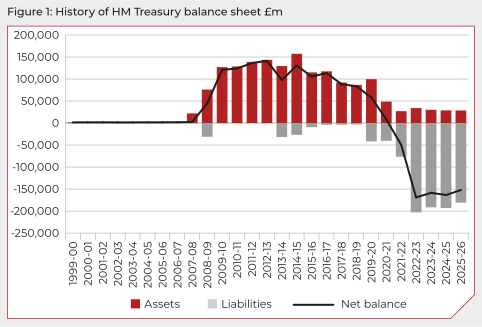
3.2 Financial risks
As part of its work, HM Treasury faces a range of risks, including financial risks linked to the activities mentioned earlier.
Careful monitoring and management of these risks help us achieve our aim of keeping the UK’s economy and financial system stable. HM Treasury uses a Risk Management Framework, which means we have processes in place to identify, assess, and reduce these risks wherever possible.
The table below gives a summary of the main financial risks HM Treasury faced during the reporting year. More information about how we manage these risks can be found in the Governance Statement and in Note 18 – Financial Risk.
3.3 Summary of key financial risks
| Type of risk | Relates to | Carrying amount (£bn) | Note to the Accounts |
|---|---|---|---|
| Credit risk | Loans and investment Securities | 13.3 | 13 |
| Credit risk | Financial guarantees | (0.1) | 17 |
| Market risk | Bank of England Asset Purchase Facility Fund | (167.0) | 14 |
| Market and currency risk | EU financial settlement net financial assets | 2.1 | 16 |
Figure 2 & 3 shows the total assets, liabilities and net asset position for 31 March 2026 and the prior year (totals may not sum due to rounding).
Figure 2: HM Treasury Group Assets as at 31 March 2026 (£bn)
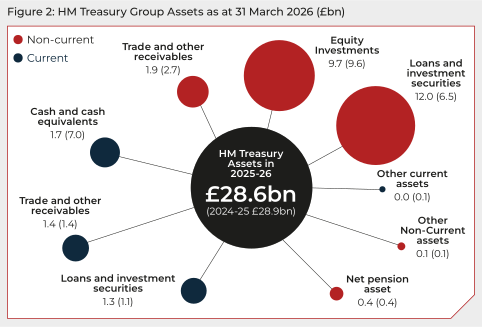
Figure 3: HM Treasury Group Liabilities as at 31 March 2026 (£bn)
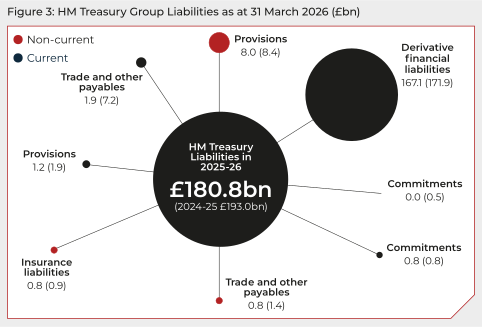
Where HM Treasury spent its money in 2025-26
Each year, HM Treasury receives permission from Parliament to use public money to run the department. This includes both money for day-to-day spending and for longer-term investments. Parliament reviews and approves these plans twice a year through a process called Supply Estimates.
HM Treasury also provides funding to several organisations that work at arm’s length from the department. These include, the Office for Budget Responsibility (OBR), the Debt Management Office (DMO), the Government Internal Audit Agency (GIAA), UK Asset Resolution (UKAR), UK Government Investments (UKGI), and the National Wealth Fund (NWF). In addition, HM Treasury funds the Royal Household through the Sovereign Grant. More information about these organisations can be found in the Corporate Governance Report and Note 1.3 – Basis of consolidation.
Figure 4: Grant in Aid funding (£m)[footnote 8]
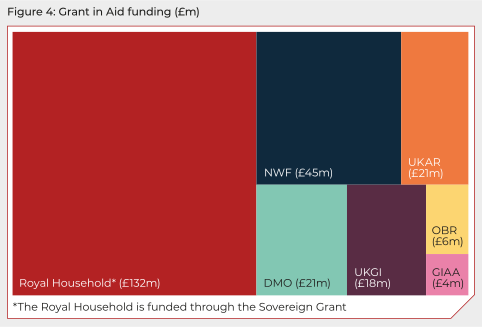
The money HM Treasury spends is divided into two main types:
- Departmental Expenditure Limits (DEL): This is money set aside for planned, regular spending over several years. It covers things like running the department and supporting key organisations.
- Annually Managed Expenditure (AME): This is money for costs that are harder to predict or control, such as changes in the value of government assets or payments related to the UK’s exit from the European Union.
In 2025-26, most of the Resource DEL budget was used to fund the core activities of HM Treasury Group (73%), with the rest supporting the department’s arm’s length bodies (27%). Within the core department, the largest proportion of spending went on staff costs (72%), with the remainder used for other activities including supporting government ministers at international events, taking part in the COVID Inquiry, strengthening the UK’s sanctions regime, supporting key industries, funding innovation in finance and technology, and maintaining HM Treasury offices around the country.
A significant amount of AME spending was used to support financial stability through the Bank of England’s Asset Purchase Facility (BEAPFF). Other AME transactions included managing financial arrangements with the European Union and the final sale of the government’s shares in NatWest Group.
A summary of spending and income by DEL and AME is shown below.
Figure 5: Summary of spending and income by DEL and AME (£m)
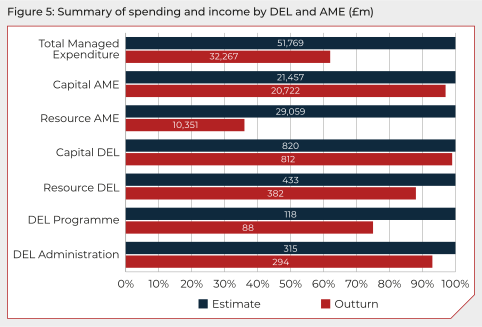
Five-year net expenditure analysis
The below figures show the net expenditure for HM Treasury Group across the last five years.
DEL net expenditure
Figure 6: Five-year trend analysis - DEL net expenditure (£m)
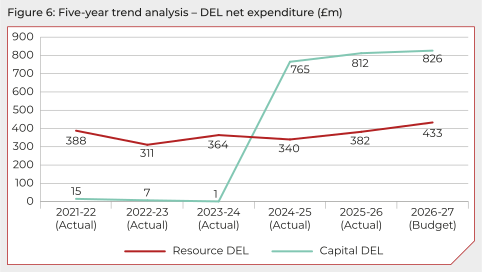
Figure 6 shows the five-year trend analysis of DEL expenditure with negative figures being net income.
The Resource DEL budget was used to fund the core activities of HM Treasury Group – this has increased due to the addition of the National Infrastructure and Service Transformation Authority (NISTA). The increase in capital DEL is due to the Extraordinary Revenue Acceleration (ERA) support to Ukraine. See Note 13 – Loans and investment securities for more information.
Figure 7: Five-year trend analysis - AME net expenditure (£m)
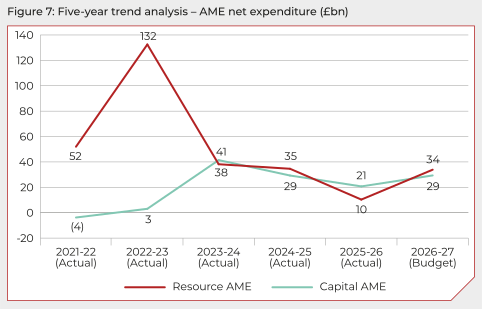
Figure 7 shows the five-year trend analysis of AME expenditure with negative figures being net income
Resource AME is volatile to market values of the gilt and corporate bond holdings held within the Bank of England’s Asset Purchase Facility (BEAPFF).
AME net expenditure
Figure 8: Five-year trend analysis - AME net expenditure excluding BEAPFF (£m)
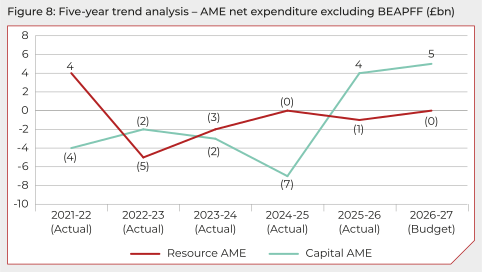
Figure 8 shows the five-year trend analysis of AME expenditure excluding BEAPFF with negative figures being net income
HM Treasury Group’s income and expenditure is reported in the Statement of Comprehensive Net Expenditure (SoCNE), and the Statement of Outturn against Parliamentary Supply (SOPS).
For the year ending 31 March 2026, HM Treasury Group reported a net expenditure after tax of £11.3bn. HM Treasury and its agencies reported net expenditure of £11.5bn, which was offset by net income of £0.2bn from the arm’s length bodies (ALBs) in the Group.
Detail of the entities which are consolidated into HM Treasury Group can be found on Note 1.3 – Basis of consolidation.
James Bowler CB
Permanent Secretary
10 July 2026
4. Accountability Report
The Accountability Report demonstrates how we fulfil our key accountability obligations to Parliament. It comprises three sections:
The Corporate Governance Report:
- Outlines the department’s governance framework, highlighting key roles and the principal activities undertaken during the year.
- Provides information on ministers and senior directors responsible for oversight of the department.
- Summarises the risks faced by the department and the measures taken to manage them.
The Remuneration and Staff Report:
- Details the salaries, bonuses, pension entitlements, and other benefits received by ministers, board members, and the most senior officials.
- Presents information on staff numbers and other key workforce statistics.
- Explains the processes and frameworks used to determine pay and remuneration.
The Parliamentary Accountability and Audit Report:
- Sets out the department’s expenditure in relation to the budgets approved by Parliament.
- Includes the auditor’s report and opinion on the department’s financial statements.
4.1 Corporate governance report
The Corporate governance report explains the composition and organisation of HM Treasury’s governance structures and how they support the achievement of HM Treasury’s priority outcomes.
Lead Non-Executive Board Members (NEBM) report
Since joining HM Treasury as Lead Non‑Executive Board Member (NEBM) in September 2025, I have been consistently impressed by the department’s professionalism, resilience, and strong public service ethos. This has been an exceptionally eventful year, with teams navigating rising pressures on public services and limited fiscal headroom. HM Treasury colleagues have shown remarkable agility, stabilising public finances amid inflationary pressures while adapting to shifting political conditions and increasing demands on government delivery.
I have particularly valued colleagues continued focus on fiscal sustainability, public spending control, and long-term economic growth, delivered alongside day-to-day operational pressures. Throughout the year, the Treasury Board Sub-Committee (TBSC) and Audit and Risk Committee (ARC) have provided rigorous oversight and constructive challenge, strengthening decision making on the department’s growth agenda, governance, financial stewardship, and performance. The candid and collaborative relationship between executives and non-executives has been central to ensuring balanced and well-informed decisions.
NEBM contributions have also extended beyond formal governance. Cross departmental work on growth, digital and data, and organisational change, including efficiencies and the department’s growing use of Artificial Intelligence (AI) has supported HM Treasury modernisation. The department’s progress in strengthening risk management and embedding more advanced AI tools is already improving analytical capability and allowing staff to focus on higher value work.
This year saw significant leadership changes. We said farewell to Dan York Smith, Director General for Tax and Welfare, and welcomed his successor, Will Macfarlane, whose extensive strategic finance and leadership experience includes previous roles within HM Treasury and the Department for Culture, Media and Sport. We also welcomed Dharmesh Nayee as Director of Strategy, Planning and Budget, bringing further leadership strength including through his experience at the Ministry of Housing, Communities and Local Government.
Within the NEBM cohort, we said farewell to Zarin Patel (NEBM and ARC Chair) and Jane Hanson (NEBM and ARC member), whose leadership greatly strengthened governance and risk oversight. The arrival of new NEBMs, Edward Twiddy, Jenny Scott and Dex Hunter-Torricke, has brought fresh perspectives and renewed energy to the board.
Looking ahead, the department will continue to face global uncertainty, domestic fiscal pressures, and wider structural challenges. NEBMs remain committed to providing strong external insight and support to help the organisation navigate these demands, drive forward the government’s growth ambitions, and maintain sustainable economic outcomes.
Above all, I am grateful for the warm welcome I’ve received since joining the Board, and for the dedication, professionalism, and integrity shown by NEBMs past and present. It has been a year of transition, challenge, and meaningful progress, and HM Treasury is in a strong position for the year ahead thanks to the commitment and capability of its people.
Sir Charlie Mayfield
Lead Non-Executive Board Member
4.2 HM Treasury Group
HM Treasury Group is made up of the core department and its arm’s length bodies (ALBs) which are a combination of executive agencies, non-departmental public bodies (NDPBs), companies and additional bodies. The wider organisations of HM Treasury Group play a vital role in supporting the government’s economic and fiscal strategy.
Core Department & Agencies
The Agencies function as an arm of the Core Department.
Core Department:
- HM Treasury
- Office of Financial Sanctions Implementation (OFSI)
- Office for Value for Money (OVFM)[footnote 9]
Executive agencies:
- UK Debt Management Office (DMO)
- Government Internal Audit Agency (GIAA)
Departmental group
These bodies are within our accounting boundary and consolidated into the Group accounts.
Non-Departmental Public Bodies:
- Office for Budget Responsibility (OBR)
Companies:
- UK Government Investments Limited (UKGI)
- UK Asset Resolution Ltd (UKAR)
- Reclaim Fund Ltd
- National Wealth Fund Limited (NWF)[footnote 10]
- IUK Investments Holdings Ltd
- HM Treasury UK Sovereign Sukuk plc
- Pool Reinsurance Company Ltd
Additional bodies:
- Sovereign Grant
- Royal Mint Advisory Committee (RMAC)
- Financial Reporting Advisory Board (FRAB)
Partner Organisations (audited)
HM Treasury has policy responsibility for several public corporations and non-ministerial departments not consolidated in the Group accounts.
Public corporations:
- Bank of England (and its subsidiaries)
- Financial Conduct Authority (FCA)
- NatWest Group plc (and its subsidiaries)[footnote 12]
- Crown Estate
- Royal Mint Trading Fund (and its subsidiary)
- Local Partnerships LLP
- Financial Services Compensation Scheme (FSCS)
Non-Ministerial Departments:
- Government Actuary’s Department (GAD)
- National Savings and Investments (NS&I)
- HM Revenue & Customs (HMRC)
Additional bodies (Dual HM Treasury & Cabinet Office reporting):
- Public Sector Fraud Authority (PSFA)
Directors have a key role in managing HM Treasury’s relationships with its arm’s length bodies (ALBs) and other associated entities, and in understanding and addressing the risks they present, working alongside second permanent secretaries and relevant directors who also hold significant oversight and accountability for specific entities. This includes maintaining sufficient oversight to ensure robust risk management arrangements are in place and that risks to delivery and budgets are effectively managed across ALBs and other sponsored entities.
Internal HM Treasury Group assurances have been provided by the Accounting Officers of the following bodies: the UK Debt Management Office, the Government Internal Audit Agency, UK Asset Resolution Ltd, Pool Reinsurance Company Ltd, the Royal Household, Reclaim Fund Ltd, UK Government Investments Ltd, and National Wealth Fund Limited.
Regular reporting through the relevant teams supports central oversight and enables the Executive Management Board, the Operating Committee and the Audit and Risk Committee to assess performance and risk.
4.3 Leadership – HM Treasury Ministers
As of 31 March 2026, the department had seven ministers:
1. Rachel Reeves MP
Chancellor of the Exchequer
The Chancellor of the Exchequer, Rachel Reeves MP was appointed on 5 July 2024.
The Chancellor of the Exchequer is the governments chief financial minister and as such is responsible for growing the UK economy, raising revenue through taxation or borrowing and for controlling public spending. She has overall responsibility for the work of HM Treasury.[footnote 11]
2. James Murray MP
Chief Secretary to the Treasury
The Chief Secretary to the Treasury, James Murray MP was appointed on 1 September 2025.[footnote 12]
The Chief Secretary to the Treasury is responsible for public expenditure including spending reviews and strategic planning, in-year spending controls, and driving efficiency and value for money. He has responsibility for capital investment, driving private sector investment in infrastructure and value for money on large national infrastructure projects. This includes being the HM Treasury lead on housing and infrastructure reform, working closely with Financial Secretary to the Treasury on planning reform. He is the minister responsible for the National Infrastructure and Service Transformation Authority (NISTA).
3. Lord Livermore
Financial Secretary to the Treasury
The Financial Secretary to the Treasury, Lord Livermore was appointed on 8 July 2024.
The Financial Secretary to the Treasury is the Growth Minister and is responsible for leading on HM Treasury’s input to regional growth, Net Zero, Industrial Strategy and Trade and Innovation, Economic and business regulation and competition, leading on the Treasury’s interest in inward and foreign direct investment, business engagement, the Crown Estate, leading on procurement and commercial strategy and HM Treasury business in the House of Lords. He is also responsible for supporting the Chancellor on reforms to the UK’s Public Financial Institutions, economic security and resilience. He is HM Treasury’s Group Departmental Minister (including responsibility for the Darlington campus).
4. Dan Tomlinson MP
Exchequer Secretary to the Treasury
The Exchequer Secretary to the Treasury, Daniel Tomlinson MP was appointed on 1 September 2025.
The Exchequer Secretary to the Treasury is responsible for the UK tax system. He is Departmental Minister for HM Revenue and Customs (HMRC), the Valuation Office Agency (VOA), and the Government’s Actuary’s Department (GAD).
5. Lucy Rigby KC MP
Economic Secretary to the Treasury and City Minister[footnote 13]
The Economic Secretary to the Treasury and City Minister, Lucy Rigby KC MP was appointed on 6 September 2025.
The Economic Secretary to the Treasury is responsible for financial services policy, reform and regulation. She also supports the Chancellor on multilateral international policy and engagement.
6. Lord Stockwood
Minister of State (Minister for Investments)
The Minister of State (Minister for Investment), Lord Stockwood was appointed on 6 September 2025.
The Minister for Investment is joint with the Department for Business and Trade. His portfolio includes for Office for Investment, Investor relations, investment events and investment delivery.
7. Torsten Bell MP
Parliamentary Secretary (Minister for Pensions)
The Parliamentary Secretary (Minister for Pensions), Torsten Bell MP, was appointed on 14 January 2025.
The Minister for Pensions is joint with the Department for Work and Pensions.
At HM Treasury he is responsible for pension tax policy, pensions freedom policy, pensions investment review and public sector pensions. He is the Parliamentary deputy on economy issues.
More information of the changes in HM Treasury’s Ministerial team since the previous report are set out in the Remuneration section of this report.
4.4 Leadership – Permanent Secretaries
1. James Bowler CB
Permanent Secretary and Principal Accounting Officer
James Bowler CB is the Permanent Secretary and Principal Accounting Officer (PAO) for HM Treasury.
As the Permanent Secretary and PAO for HM Treasury Group, James is responsible for the delivery of the department’s strategy and is accountable to Parliament for the organisation and management of the department. This includes its use of public money and stewardship of assets. He also has overall responsibility for the delivery of the priorities of ministers, and the decisions and actions taken by Treasury officials. James also directly oversees the Director Generals for Financial Services and International.
As at 31 March 2026, the Permanent Secretary is supported by the department’s Second Permanent Secretaries Beth Russell CB and Jim O’Neil.[footnote 14]
2. Beth Russell CB
Tax, spending and regional growth
Beth Russell CB supports the Permanent Secretary in the running and oversight of the department. Beth is responsible for Tax, spending and regional growth, as well as leadership of the Darlington Economic Campus.
3. Jim O’Neil
Sustainable growth
Jim O’Neil supports the Permanent Secretary in the running and oversight of the department. Jim is responsible for policies to create sustainable growth across the UK.
4.5 Composition of the Non-Executive Board Members (NEBMs)[footnote 15]
1. Sir Charlie Mayfield
Lead Non-Executive Board Member
Expertise: High-level retail, technology, governance, growth, productivity, strategic change, workforce and military leadership.
2. Edward Twiddy
Non-Executive Board Member and Audit and Risk Committee (ARC) Chair
Expertise: Financial technology innovation, economic policy, environmental expertise, and regional development leadership.
3. Sir Edward Braham
Non-Executive Director and member of the Audit and Risk Committee (ARC)
Expertise: Professional services businesses, law, mergers & acquisitions and financial services.
4. Jenny Scott
Non-Executive Board Member
Expertise: Economic policy making, strategic communications, senior central banking experience, and media professionalism.
5. Dex Hunter-Torricke
Non-Executive Board Member
Expertise: Communications, technology, artificial intelligence, regulation, geopolitics and society.
4.6 Register of interests
The department requires all employees to disclose any actual or perceived conflict of interest. Conflicts of interest may be financial and can also stem from the interests of household members or other associates; all potential conflicts must be declared and assessed to ensure they do not undermine integrity, reputation or decision-making of HM Treasury.
Staff receive clear guidance on how to identify and manage conflicts, and what to do if one arises. There is a strong process in place for declaring, reviewing, approving, mitigating and recording both actual and perceived conflicts. With proportionate measures put in place to manage them and sanctions (up to contract termination) for failure to declare or comply, whether intentional or not.
The department’s declarations process utilises a digital system, which has enhanced both the efficiency and accessibility of declaring conflicts across the department.
Ministers’ interests
The register of ministers’ interests is held by Parliament.
Board interests
Other Board member interests are shown below. Non-Executive Board Members (NEBMs) interests are set out in this document.
Sir Charlie Mayfield
Other roles:
- British Museum (Deputy Chair, Term appointed 1 June 2020 – 31 May 2026)
- Chair, Be the Business
- Lead reviewer, Keep Britain Working
- Chairman and Director, QA Limited (part-time, paid role)
- Senior Board Advisor, Wren Labs Ltd (part-time, paid role)
- Chairman, Sparx Learning (from 1 October 2025)
Previous role:
- Chairman, John Lewis Partnership
Edward Twiddy
Other roles:
- Chair, Northstar Ventures Ltd
- Director, Straight Bat Advice Ltd
- Board advisor to McLaren Property and Arlington Real Estate
- Director, ESG, Atom Bank
- Independent Convenor, Only Rainwater Into Windermere
Previous role:
- Chair, Finpact, (stood down on 31 August 2025)
- Member of Northeast Combined Authority Business Board (stood down on 31 August 2025)
Jenny Scott
Other roles:
- Director and Partner, Apella Advisors.
Dex Hunter-Torricke
Other roles:
- Chair, The Centre for Tomorrow
- Speaker on technology and business
Sir Edward Braham
Other roles:
- Chair, M&G plc (14 March 2022 to date).
- Chair, Lord Mayors Appeal (2025 – date)
- Trustee and Chair-elect, Charities Aid Foundation (2025-date)
- Warden, Goldsmith’s Company (2027)
- Trustee of the Goldsmiths’ Charity (2018 to 2025).
- The City UK:
- Chair of its International Trade and Investment Group and member of its Nominations and Remuneration Committee (2018 to date)
- Chair, Next Generation Leadership Council, (2025-date).
- Director (2018-2024),
- Commissioner, Global Commission on Modern Slavery and Human Trafficking (2023 to date).
- City of London Corporation:
- Member, competitiveness Advisory Board (2021-date)
- Mayoral and Shrieval Independent Panel for (2021 to date).
- Member of the Advisory Council at Capital as a Force for Good (2021 to date).
- Member, European Financial Services Roundtable (2022-date)
- Member of the Court of the Goldsmiths Company (2011 to date).
Zarin Patel
(until 31 July 2025)
Other roles:
- Non-Executive and Senior Independent Director; Chair of ARC; Member of Environment, Social and Governance, Remuneration and Nominations Committees at Pets at Home Group PLC (2021 to date).
- Non-Executive Director and Chair of ARC at Hays plc (2023 to date).
- Non-Executive Director, Chair of ARC, Member of Nominations and Remuneration Committee and Senior Independent Director Anglian Water Services Limited (2018 to date).
- Trustee and Chair of Audit and Risk Committee at National Trust (2018 to date).
Jane Hanson CBE
(in post until 31 December 2025)
Other roles:
- Welsh Water plc
- Chair (Jan 2025 – date)
- Chair of Audit Committee and Non-Executive Director of (2021 to date).
- John Lewis Partnership
- Independent Advisor (Nov 2023 – date)
- Royal BAM Group
- Non-Executive Director (November 2024 to date)
- Chair of the Audit Committee (May 2025 – date)
- Chair Bardi Symphony Orchestra (2020 to date).
Previous role:
- Chair of Audit Committee at the Civil Aviation Authority (2021 to January 2025)
Conflicts and mitigations, including the recusal of discussions and receiving redacted papers and minutes, were put in place in relation to potential perceived conflicts of interest for the department’s Non-Executive Board Members.
- Sir Charlie Mayfield: mitigations were put in place to avoid any conflicts/perceived conflicts with his role as Deputy Chair at the British Museum, and as Chair at QA Limited.
- Edward Twiddy: mitigations were put in place to avoid any conflicts/perceived conflicts in relation to matters on NS&I’s market positioning or on other savings providers, being a member of Northeast Combined Authority Business Board and Chair, Northstar Ventures Ltd, Director, Straight Bat Advice Ltd and Co-founder and Chief Innovation Officer at Atom Bank.
- Dex Hunter-Torricke: mitigations were put in place to avoid any conflicts/perceived conflicts in relation to his role as keynote speaker for events and occasional consulting projects relating to Communications and Strategy.
- Jenny Scott: mitigations were put in place to avoid any conflicts/perceived conflicts in relation to her role at Apella.
- Sir Edward Braham: mitigations have been put in place to avoid any real or perceived conflict with his role as Director and Chair at the Municipal & General Securities Company Ltd (M&G) as well for his role as a Non-Director Commissioner at Global Commission on Modern Slavery and Human Trafficking.
- Zarin Patel: mitigations were put in place to avoid any perceived or real conflict with her role at Hays plc.
- Jane Hanson CBE: mitigations were put in place to avoid any perceived or real conflict with her roles at: the Civil Aviation Authority; her partner’s role at the Department for Work and Pensions and her role as Non-Executive Director at Welsh Water and includes her new appointment as Chair of Welsh Water as of 1st January 2025.
Executive Management Board interests
No member of Executive Management Board held company directorships or other interests which may have conflicted with their official responsibilities.
Special Adviser interests
In line with the current Declaration of Interests policy for special advisers, all special advisers have declared any relevant interests or confirmed they do not consider they have any relevant interests. The Permanent Secretary has considered these returns, and the following relevant interests are set out in public.
| Name | Interest | Outside Employment |
| Shadi Brazell | Ms Brazell is a Trustee of Cambridge House. She must recuse herself from any funding decision relating to her role as a Trustee of Cambridge House. As of 14 May 2026 Ms Brazell has since left her position as Special Adviser at HM Treasury. | Trustee, Cambridge House |
| John VanReenen | Mr VanReenen remains employed by London School of Economics (LSE). He splits his time between LSE and his position as Special Adviser at HM Treasury. Mr VanReenen therefore recuses himself from all matters relating to higher education policy and funding. As of 16 March 2026, Mr VanReenen has since left his position as Special Adviser at HM Treasury. |
Remains employed by LSE |
| Anna Valero | Ms Valero is on a career break from LSE, although she continues to be employed by them. Ms Valero therefore recuses herself from all matters relating to higher education policy and funding. Ms Valero has also declared her position as an elected council member of the Royal Economic Society Council. It is recommended that Ms Valero recuse herself from any funding or investment decisions related to this organisation. As of 21 August 2025 Ms Valero has since left her position as a Special Adviser at HM Treasury. |
Remains employed by LSE even though she is currently on a career break. |
4.7 Personal data incidents
HM Treasury is required under the UK General Data Protection Regulation (UK GDPR) and the Data Protection Act 2018 to notify the Information Commissioner’s Office (ICO) without undue delay when it becomes aware of a personal data breach, unless the breach is unlikely to result in a risk to the rights and freedoms of individuals.
During 2025-26 the department reported one personal data breach to the Information Commissioner’s Office (ICO). The ICO reviewed the incident and closed the case with advice and no further action.
4.8 Statement of Accounting Officer’s responsibilities
Under the Government Resources and Accounts Act 2000 (the GRAA), HM Treasury (Government Financial Reporting team) has directed HM Treasury, as the core department, to prepare, for each financial year, consolidated resource accounts detailing the resources acquired, held or disposed of, and the use of resources, during the year by the department (inclusive of its executive agencies) and its sponsored non-departmental and other arm’s length public bodies designated by order made under the GRAA by Statutory Instrument 2025 number 268 and 1336 (together known as the ‘departmental group’, consisting of the department and sponsored bodies listed at Note 1.3 – Basis for consolidation to the financial statements).
The accounts are prepared on an accruals basis and must give a true and fair view of the state of affairs of the department and the departmental group and of the income and expenditure, Statement of Financial Position and cash flows of the departmental group for the financial year.
In preparing the accounts, the Accounting Officer of the department is required to comply with the requirements of the Government Financial Reporting Manual and to:
- observe the Accounts Direction issued by HM Treasury, including the relevant accounting and disclosure requirements, and apply suitable accounting policies on a consistent basis;
- ensure that the department has in place appropriate and reliable systems and procedures to carry out the consolidation process;
- make judgements and estimates on a reasonable basis, including those judgements involved in consolidating the accounting information provided by non-departmental and other arm’s length public bodies;
- state whether applicable accounting standards as set out in the Government Financial Reporting Manual have been followed, and disclose and explain any material departures in the accounts;
- prepare the accounts on a going concern basis; and
- confirm that the Annual Report and Accounts as a whole is fair, balanced and understandable and take personal responsibility for the Annual Report and Accounts and the judgements required for determining that it is fair, balanced and understandable.
HM Treasury appointed the Permanent Secretary of the department as Principal Accounting Officer of the department. James Bowler CB was appointed as the Permanent Secretary and Principal Accounting Officer for HM Treasury on 17 October 2022.
The Principal Accounting Officer of the department has also appointed the Chief Executives or equivalents of its sponsored non-departmental and other arm’s length public bodies, as Accounting Officers of those bodies.
The Principal Accounting Officer of the department is responsible for ensuring that appropriate systems and controls are in place to ensure that any grants that the department makes to its sponsored bodies are applied for the purposes intended and that such expenditure and the other income and expenditure of the sponsored bodies are properly accounted for, for the purposes of consolidation within the resource accounts.
Under their terms of appointment, the Accounting Officers of the sponsored bodies are accountable for the use, including the regularity and propriety, of the grants received and the other income and expenditure of the sponsored bodies.
The responsibilities of an Accounting Officer, including responsibility for the propriety and regularity of the public finances for which the Accounting Officer is answerable, for keeping proper records and for safeguarding the assets of the department or non-departmental or other arm’s length public body for which the Accounting Officer is responsible, are set out in Managing Public Money published by HM Treasury.
4.9 Statement regarding the disclosure of information to the auditors
As the Principal Accounting Officer, I have taken all the steps that I ought to have taken to make myself aware of any relevant audit information and to establish that HM Treasury’s auditors are aware of that information. So far as I am aware, there is no relevant audit information of which the auditors are unaware.
I also confirm that the Annual Report and Accounts are fair, balanced and understandable, and I take personal responsibility for the Annual Report and Accounts and the judgements required for determining that they are fair, balanced and understandable.
4.10 Governance Statement
Scope of responsibility and purpose of the Governance statement
As Accounting Officer, it is my responsibility to ensure that there is a sound system of governance, risk management and internal control in place. Our business is conducted in accordance with Managing Public Money to ensure public money is safeguarded, properly accounted for and used economically, efficiently and effectively. As part of the preparation of this report, the department has undertaken an assessment of its compliance with the Corporate Governance Code for Central Government Departments. This assessment has provided assurances that the department complies with the principles of the code.
The Governance statement, for which I, as Accounting Officer, take personal responsibility, gives a clear understanding of the dynamics of HM Treasury. Its control structures provide an adequate insight into the business and resources of the department to enable me to make informed decisions about progress towards our strategic objectives, drive a programme of continual improvement and, if necessary, steer performance back on track. In doing this, I am supported by a governance structure that includes the Treasury Board, Treasury Board Sub Committee, its Executive Management Board along with its sub committees, the Audit and Risk Committee and a robust assurance framework.
During 2025-26, as Accounting Officer, I have placed increased emphasis on strengthening the maturity, documentation and consistency of this framework, informed by internal audit insights and evolving operational risks. This reflects a continued focus on ensuring that our control environment remains proportionate, responsive and capable of evidencing assurance to me as accounting officer, in addition to Parliament and other stakeholders.
Internal audit provides an independent internal function forming a key part of the department’s overall framework of governance, risk management and internal control. It provides objective assurance to me as Accounting Officer, on whether controls are properly designed and operating effectively. The Audit and Risk Committee approves the annual Internal Audit Plan, which is risk based, forward looking and aligned to the department’s strategic objectives.
All Boards and Committees are provided with a range of management information to enable adequate review of the department’s performance, risk and capability. Boards and committees receive standardised management information on performance, risk, capability and resource impacts. The risk and performance framework sets clear escalation routes and risk flows, focusing papers and time on the highest‑priority issues. Quarterly Performance Dashboards track progress against the Outcome Delivery Plan, alongside a Quarterly Risk Note on high‑priority risks.
This statement explains how HM Treasury has complied with the principles of good governance and reviews the effectiveness of these arrangements and how, in my opinion, the department continues to maintain a robust framework of governance, risk management and internal control which provides a sound basis for the effective stewardship of public funds.
For more information on our governance please see Our governance – HM Treasury – GOV.UK.
James Bowler
Principal Accounting Officer
4.11 HM Treasury governance structure
Figure 9: The Treasury Board and its committees
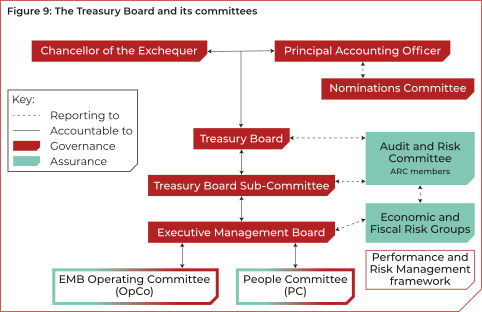
4.12 The role of the Treasury Board
The Treasury Board is the most senior of the department’s committees and provides strategic oversight of the department. It provides advice, support and challenge on the effective running of the department.
The Boards membership brings together its ministerial and department leaders, alongside external experts in economic policy, strategic communications, technology, and corporate law, through our nonexecutive board members
The board is chaired by the Chancellor and meets on an annual basis.
4.13 The role of the Treasury Board Sub-Committee
The Treasury Board Sub-Committee is the second most senior board and supports the Treasury Board by providing focused strategic oversight of the department’s performance, delivery and key risks. Acting under delegated authority from the Treasury Board, it considers issues in greater depth, reviews quarterly performance and risk reports, oversees progress against Strategic Outcomes and the Outcome Delivery Plan, and provides constructive challenge to the Executive on the effective management of the department. The board is chaired by the Lead Non-Executive Board Member (NEBM) and met four times during 2025‑26. This year the Treasury Board Sub-Committee particularly focused on growth measures and risk management in the department.
The role of the Audit and Risk Committee (ARC)
The Audit and Risk Committee provides advice to the Treasury Board, the Permanent Secretary (Principal Accounting Officer) and HM Treasury’s additional Accounting Officers in order to effectively discharge their duties and responsibilities. This includes managing risk, internal control and governance. The Committee considers the integrity of the financial statements and the Treasury Group’s Annual Report and Accounts in relation to the, Exchange Equalisation Account, National Loans Fund, Consolidated Fund, Contingencies Fund and Whole of Government Accounts.
The department welcomes scrutiny, whether from internal audit, the National Audit Office (NAO), Members of Parliament[footnote 16] or members of the public.
In accordance with the ARC Handbook [footnote 17] the Committee provides independent challenge on the robustness of the mechanisms in place, and the evidence provided, to deliver the assurance needed by the Board and departmental Accounting Officer. Representatives from both GIAA and NAO attend each meeting and provide updates on their respective programmes of work, including reporting on key controls and undertakes independent scrutiny of the department’s performance. The Committee provides oversight of activity performed by the Government Internal Audit Agency (GIAA) and the National Audit Office (NAO).
The department recognises the importance of maintaining an appropriate balance of skills, experience and capacity across its governance structures. In line with the Audit and Risk Assurance Handbook, the Audit and Risk Committee will consider the adequacy of skills, experience and capacity across the Committee and will undertake a formal skills audit in 2026-27 to assess whether any capability gaps exist and to inform future Committee composition.
Members of the Committee are appointed by the Chair along with the Principal Accounting Officer. The committee met six times during 2025-26.
4.14 The role of the Nominations Committee
The Nominations Committee considers succession planning, performance and remuneration of the senior civil servants within the department.
The committee brings together the Permanent Secretary, the Second Permanent Secretaries, and the NonExecutive Board Members. It is chaired by the Permanent Secretary and met once during 2025–26.
4.15 Attendance of members at board and committee meetings
| Attendance | Treasury Board | Treasury Board Sub Committee | Audit and Risk Committee (ARC) | Nominations Committee |
|---|---|---|---|---|
| Ministers | ||||
| Rachel Reeves – Chancellor of the Exchequer | 1/1 | – | – | – |
| Darren Jones – Chief Secretary to 01/09/2025 | – | – | – | – |
| James Murray – Exchequer Secretary to the Treasury to 01/09/2025 and Chief Secretary to the Treasury from 01/09/2025 | 1/1 | – | – | – |
| Lord Livermore – Financial Secretary | 0/1 | – | – | – |
| Daniel Tomlinson – Exchequer Secretary from 01/09/2025 | 1/1 | – | – | – |
| Emma Reynolds – Economic Secretary and City Minister to 05/09/2025 | – | – | – | – |
| Lucy Rigby KC – Economic Secretary and City Minister from 06/09/2025 | 1/1 | – | – | – |
| Baroness Gustafsson of Chesterton CBE – Minister for Investment to 05/09/2025 | – | – | – | – |
| Lord Stockwood – Minister for Investment from 06/09/2025 | 1/1 | – | – | – |
| Torsten Bell – Parliamentary Secretary | 0/1 | – | – | – |
| Non-Executive Board Members | ||||
| Sir Charlie Mayfield from 01/09/25 | 1/1 | 4/4 | – | 1/1 |
| Edward Twiddy from 01/09/25 | 1/1 | 4/4 | 4/4 | 1/1 |
| Sir Edward Braham | 1/1 | 4/4 | 5/6 | 1/1 |
| Jenny Scott from 01/09/25 | 1/1 | 3/4 | – | 1/1 |
| Dex Hunter-Torricke from 01/09/25 | 0/1 | 4/4 | – | 1/1 |
| Zarin Patel to 31/07/2025 | – | – | 2/2 | – |
| Jane Hanson CBE to 31/12/2025 | – | 2/2 | 4/4 | – |
| ARC members | ||||
| Catherine Vaughan CB from 15/10/2025 | – | – | 4/4 | – |
| Executive Management Board (EMB) | ||||
| James Bowler CB | 1/1 | 4/4 | – | 1/1 |
| Jim O’Neil from 14/07/2025 | 1/1 | 4/4 | – | 1/1 |
| Sam Beckett CB to 22/01/2026 | – | 2/2 | – | – |
| Beth Russell CB | 1/1 | 4/4 | – | 1/1 |
| Professor Brian Bell from 09/03/2026 | 1/1 | 1/1 | – | |
| Gwyneth Nurse CB | – | 3/4 | – | – |
| Lindsey Whyte CB | – | 3/4 | – | – |
| Dan York-Smith CB to 07/09/2025 | – | – | – | – |
| Jessica Glover CB | – | 3/4 | – | – |
| Conrad Smewing | 0/1 | 3/4 | – | – |
| Will Macfarlane to 24/04/2025 and from 08/09/2025 | – | 4/4 | – | – |
| Sarah Whitehead | 1/1 | 4/4 | – | – |
| Rebecca Coady | – | 4/4 | – | – |
| Simon Man | – | 3/4 | – | – |
| Dharmesh Nayee from 23/06/2025 | – | 2/4 | – | – |
4.16 The role of the Executive Management Board (EMB)
The Executive Management Board (EMB) leads the department and meets at least weekly to oversee HM Treasury’s core functions and delivery of ministerial priorities, to manage risk and internal controls, and to allocate and manage resources. The Board also meets regularly with directors to consider the strategic direction of specific Treasury policy areas. The Board oversees annual business planning to set priorities and resources and proactively reviews these throughout the year.
Board membership changed during the year; full details of staff changes are set out in the Remuneration chapter.
The Board draws on specialist expertise and regular management information to provide effective oversight and decision making. It uses a structured cycle of reporting to identify emerging issues, challenge delivery confidence, agree mitigations and track progress against actions at subsequent meetings.
This includes expertise and reporting on quarterly performance and risk the Outcome Delivery Plan, fiscal events, financial services the international agenda, the growth plan, business and workforce planning, health and safety, security (including cyber) and counter fraud, resourcing, pay and performance, staff networks, and departmental people survey results.
The Executive Management Board has two sub committees, Operations Committee and People Committee, delegating responsibility for specific departmental operational areas.
Through regular periods in the year, the Executive Management Board (EMB) addressed the key risks escalated from Operations Committee and People Committee, including operational delivery of the Voluntary Exit Scheme and Cyber Security.
Sub-committee to the Executive Management Board – Operating Committee (OpCo)
This Committee takes operational decisions on the department’s financial, administrative and organisational riskmanagement matters across the wider Treasury Group and advises on finance and management information. It ensures robust business processes operate effectively in support of the department’s strategy and business needs.
Committee members as at 31 March 2026
Second Permanent Secretary
Finance Director
Director of Operations
Director Strategy, Planning and Budget
Commercial Director for Cabinet Office and HM Treasury
4-5 Directors from policy teams in HM Treasury on 1–2-year rotation
5-6 Deputy Directors on a 1–2-year rotation
GIAA has access to the board papers and attends on occasion
The Committee welcomes officials with expertise in: operational delivery, budget and financial management, IT and estates, commercial, business case evaluation, data science, operational performance and risk, business planning, resourcing and headcount, controls and assurance, internal audit, Business Appointment Rules (BARS).
This Committee meets monthly and was chaired by Sam Beckett CB (Head of the Government Economic Service and Second Permanent Secretary) up until her retirement on the 22 January 2026. Jim O’Neil, Second Permanent Secretary, succeeded as chair from January 2026.
Sub-committees to the Executive Management Board – People Committee
The People Committee (PC) makes decisions on the form and delivery of HM Treasury’s people agenda. It oversees all aspects of people issues including the People Strategy, people policies and people risks.
The Committee welcomes officials with expertise from across the department including; people and capability performance, staff networks, bullying, harassment and discrimination, graduate development, workforce reorganisation/restructuring, leadership and management offer, wellbeing, diversity and inclusion, conduct policy and recruitment.
Committee members as at 31 March 2026
PC Chair and EMB Diversity Champion (Second Permanent Secretary)
Director of People and Operations
Chair of the Diversity Inclusion Board
Deputy Finance Director
Deputy Director Strategy, Planning and Projects
HR Operations, Policy and Strategy
3-5 additional Senior Civil Servants on a 1-2-year rotation
The People Committee meets monthly and is chaired by Beth Russell CB (Second Permanent Secretary).
Throughout 2025-26 the HM Treasury Operating and People Committees held discussions on the risk landscape and high-priority risks flagged through the quarterly reporting system: these processes have produced tangible recommendations for teams to improve the department’s resilience. Risks assessed this year in detail during ‘deep dives’ include cyber security and departmental oversight of Arm’s Length Bodies (ALBs).
Board Effectiveness Evaluation
Conducting an annual review of board processes and practices is recognised as standard good corporate governance. The Cabinet Office coordinates this evaluation, following the procedures outlined in the Corporate governance in central government departments: Code of Good Practice.
For this year’s review, the Board Effectiveness Evaluation covers both the Treasury Board Sub-Committee, which has delegated responsibility from the Treasury Board to support the work of the main Board, and the Audit and Risk Committee. Feedback was sought from all current Treasury Board Sub Committee members and members from the Executive team, and recommendations from the 2025-26 evaluations will be implemented in the 2026-27 reporting year.
The Corporate Governance team will take forward recommendations to strengthen governance arrangements to support greater focus on strategic planning and, and long-term decision-making that supports the department’s future priorities, improve accountability for agreed actions, and work closely with the NEBMs to ensure the department makes full and effective use of their expertise.
In 2026-27 the Audit and Risk Committee will consider the adequacy of skills, experience and capacity across members and undertake a skills audit to assess whether any capability gaps exist and to inform the future composition of the Audit and Risk Committee.
4.17 Risk Management – Macroeconomic and Fiscal risks
Alongside the Executive Management Board sub‑committees, the Economic Risk Group and Fiscal Risk Group provide specialist risk oversight. They identify and track indicators, horizon‑scan for emerging issues, and assess likelihood, impact and mitigations. The Economic Risk Group meets quarterly, and more often when significant or urgent risks arise, co‑chaired by the Director of Economics and the Director of Financial Stability. The Fiscal Risk Group, chaired by the Director of Fiscal, typically meets quarterly.
4.18 Managing risks to our objectives
The department operates within a complex and dynamic risk environment, reflecting its dual roles as the UK’s economics and finance ministry, as well as a central government department and employer. It is exposed to both macroeconomic and operational risks, many of which are driven by external factors beyond its direct control, though not beyond its influence. The department must respond to domestic and international events, leading cross-government efforts to safeguard UK prosperity and ensure the sustainability of the public finances. Operationally, the department is committed to allocating its budget effectively to meet its objectives, deliver value for money and uphold its duty of care to both staff and stakeholders.
A robust system is in place to identify and assess risks, challenge underlying assumptions, and provide advice on appropriate mitigation measures. Specific accountabilities for risk management are assigned to key roles within this structure.
This year HM Treasury has had an increased focus on strengthening our approach to risk management, partly informed by internal audit insights and evolving operational risks. Risk management is embedded across the department’s governance, leadership, and operational activities. The ARC supports the Accounting Officer in overseeing the Risk Management Framework.
4.19 Our risk management framework
HM Treasury’s risk management framework supports the identification and management of risks to the department’s strategic objectives and aligns to Orange Book principles. Directors, specialist Risk Groups, the Operating and People Committees and EMB are responsible for monitoring, challenging and reporting on performance against risks and objectives.
Performance and risk are assessed using a trajectory-based approach, focusing on direction of travel, underlying drivers and mitigating actions, rather than static ratings. This supports a clearer understanding of emerging risks and progress over time.
Material risks are escalated to senior managers via quarterly risk reporting, for appropriate action and review.
An Enterprise Risk Management continuous improvement review was undertaken in 2025-26 to further strengthen prioritisation and monitoring of risks and align with strategic planning to aid decision making. These improvements are designed to ensure that risk management is not only effective in practice but is also clearly evidenced and aligned to best practice expectations. Governance and assurance arrangements have been strengthened, including clarifying roles and responsibilities, enhancing reporting and escalation mechanisms and improving the quality and consistency of assurance received.
This work will continue into 2026-27 through the implementation of an updated risk management framework, including enhanced taxonomy, scoring and risk register processes to improve consistency and coverage across the department. Alongside this, we are reinforcing the maturity and consistency of the control environment with enhanced oversight and assurance of ALBs. In line with internal audit recommendations, work to increase technology resilience and further maturing effective whistleblowing arrangements is well underway as well as embedding the quality and timeliness of risk insight through improved data, reporting and dashboard capability.
The Audit and Risk Committee has led the review of the Governance Statement on behalf of the Board. The Committee has considered the robustness of the department’s governance, risk management and internal control framework and the evidence supporting this statement, including the extent to which it presents a fair, balanced and comprehensive view.
With clearer senior accountability and enhanced Board and ARC oversight of key risks and mitigations, these actions demonstrate the department’s commitment to continuous improvement in its governance, risk management and internal control framework. While recognising that elements of the framework continue to develop, the Accounting Officer is satisfied that appropriate controls are in place and that a clear programme of improvement is being delivered.
Figure 10: Risk management framework
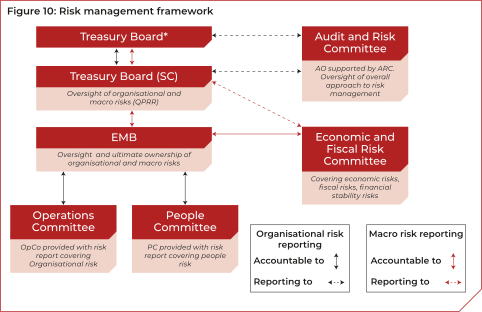
4.20 Organisational risk – areas of focus
During 2025-26 the Board and executive sub committees have considered key organisational risks and areas of focus relevant to the delivery of HM Treasury’s objectives and the protection of the department’s integrity and reputation. In doing so, they have drawn on a range of assurance, including internal audit findings and insights to inform their assessment of priorities for actions.
GIAA has been commissioned to undertake targeted work in specific high-risk areas, supporting the department to strengthen controls, address emerging risks and drive continuous improvement. Some of the key areas of operational risk focus considered during the year are set out below.
Technology resilience and information security
Technology resilience and information security remain a core departmental risk. HM Treasury’s security and technology team continues to enhance the department’s capabilities across cyber, personnel and protective security, working with partners across government to maintain an effective understanding of the evolving risk landscape.
Our security monitoring and response functions have continued to mature, supported by improvements in tooling, processes and assurance activity. We have re-enforced our approach to the management and oversight of departmental systems and maintained a timely and effective response to guidance and alerts issued through cross-government security mechanisms. Information security remains a priority. We have continued to mature our investigative capability and processes for managing information security incidents and unauthorised disclosures. Following the Budget Information Review in February 2026, we are tightening our internal information security for the most sensitive Budget information, so that fewer officials will have access to sensitive information and the sharing of that information will be significantly restricted.
The department has implemented a planned programme of cyber assurance activities, including work aligned to cross-government frameworks, and has continued to review and optimise key security controls across our technology and data environment. The Government Cyber Action Plan sets out how government will operate differently to manage the cyber security and resilience threat we face. Following recommendations from internal audit, we are taking steps to further improve the reliability of our key systems and ensure we have the capabilities to minimise the adverse impact of a cyber security incident on our functions, building on the action areas highlighted in an audit on technology resilience.
In parallel we continue to provide regular updates to our boards and committees, and we support ALBs on sensitive matters. Work continues to enhance our Business Continuity arrangements, including scenario-based exercising, to ensure that the department remains resilient to potential operational disruptions.
Raising a Concern – Whistleblowing
The department is committed to fostering an environment in which staff are aware of how to raise concerns and feel supported in doing so through the appropriate channels, including in cases that may constitute whistleblowing.
Results from the Department’s staff survey indicate a gradual improvement in the area. In 2025, 66% of staff said they were aware of how to raise a concern under the Civil Service Code, a small increase from 65% in 2024.
Confidence that concerns would be properly investigated remains high at 75%. While this is slightly lower than 78% in 2023 and 2024, overall the results suggest steady progress, with some small year‑to‑year changes.
An internal audit conducted by the Government Internal Audit Agency (GIAA) of HM Treasury’s Whistleblowing Policy and procedures, highlighted areas of the process that could be improved. We have taken these findings seriously and have acted on the recommendations to address the identified weaknesses framework and processes now strengthened.
The department has eight nominated officers responsible for investigating staff concerns that are raised confidentially. During 2025-26 the department did not receive any cases which fall within the scope of whistleblowing.
ALB oversight
Strengthening oversight of the department’s Arm’s Length Bodies (ALBs) has been an area of focus for the Board and its sub committees. Consideration has been given to the effectiveness of monitoring ALB performance, risk and assurance, with particular attention to the consistency and quality of risk reporting and escalation.
Work is now underway to improve the coherence of ALB oversight, including developing a more systematic approach to sources of assurance and improving consistency of sponsorship arrangements and reporting of ALB performance and risk.
Workforce
HM Treasury’s greatest asset is its workforce. We are renowned for our talented, high-performing staff who consistently show their flexibility to deliver domestic and international priorities in the context of the changing global landscape.
Developing policy in such an uncertain context requires resilience, adaptability, and a keen understanding of the wider economic landscape, which the HM Treasury workforce continues to demonstrate. Economic growth and the route to a stronger economy, fiscal position, and living standards, remains both the primary mission of the government and this department. Policy development and its implementation is at the heart of this objective.
While our Spending Review settlement requires us to reduce in size, it is an opportunity to take advantage of new ways of working and pursue greater productivity. This year, we initiated a workforce transformation programme, moving toward our longer-term goal of becoming a leaner, more efficient and flexible organisation. This workforce transformation programme includes recruitment controls, reorganisation, redeployment and a Voluntary Exit Scheme (VES), which was launched in June 2025.
The size of HM Treasury’s workforce in 2025–26 increased slightly due to the onboarding of the National Infrastructure and Service Transformation Authority (NISTA) in April 2025. Excluding NISTA, HM Treasury saw a steady reduction in headcount in 2025-26, in particular in the latter half of the year. We expect to realise further reductions in 2026–27 due to leavers via the VES and reduced external recruitment. These reductions are balanced with continued development of the Darlington Economic Campus (DEC), and our investment in strengthening priority skills such as digital and delivery.
Further information on workforce data including staff numbers and remuneration, sickness absence, off payroll engagements and staff pension costs is within the Staff Report.
4.21 Business Appointment Rules (BARs)
The department has established procedures to ensure all staff are aware of and comply with Business Appointment Rules (BARs). All officials are required to obtain written permission before undertaking any external work, whether remunerated or not. In addition, officials must submit an application under the BARs if they intend to leave the civil service, to ensure any potential conflicts of interest can be identified and managed and, where necessary, mitigated. Information on the Rules is included in all employee contracts and further guidance is available.
Within HM Treasury, applications under the BARs are reviewed by the Permanent Secretary. For applications from Permanent Secretaries and Senior Civil Service Pay Band 3 (SCS3), the Civil Service Commission is responsible, as standard practice across the civil service. The BARs continue to apply for one year after leaving Crown service for junior officials and for two years for members of the Senior Civil Service.
Approval (and any conditions or mitigations) are shared with line managers and applicants by the Permanent Secretary’s office. A letter is also sent to the new employer outlining any conditions that have been imposed.
| Total number of leavers from the Civil Service | 147 |
| Total number of BARs applications received | 36 |
| Total number of BARs with conditions | 36 |
| Number of breaches | – |
|---|
The total number of applications assessed under BARS by grade is as follows:
| Number of BAR applications | Number of BAR applications (2025-26) | Number of BAR applications with set conditions (2025-26) | Unsuitable applications (2025-26) | Breaches of rules (2025-26) |
|---|---|---|---|---|
| Executive Officer | – | – | – | – |
| Higher Executive Officer/Senior Executive Officer | 6 | 6 | – | – |
| Grade 7 | 13 | 13 | – | – |
| Grade 6 | 6 | 6 | – | – |
| Special Adviser | 3 | 3 | – | – |
| SCS 1 | 3 | 3 | – | – |
| SCS 2 | 5 | 5 | – | – |
| SCS 3 | – | – | – | – |
| SCS 4 | – | – | – | – |
| Total | 36 | 36 | – | – |
The Operating Committee regularly reviews the BARs and Audit and Risk Committee provides annual scrutiny of the process.
In accordance with the rules, the department is transparent in the advice given to individual applications for senior staff, including special advisers. Advice regarding specific business appointments has been published on HM Treasury’s website.
For reasons of data protection, decisions are not published for applications made by junior officials.
4.22 Head of Internal Audit’s annual opinion
The Director of Internal Audit at the Government Internal Audit Agency, has provided his Annual Report and Opinion. This report covers the adequacy and effectiveness of HM Treasury’s framework of governance, risk management, and control.
The overall internal audit opinion reflects cumulative findings of audit work undertaken across key control areas during the year. Individual reviews provided varying levels of assurance which have informed the Head of Internal Audit’s overall audit opinion.
A Moderate opinion was provided for the period 2025-26.
Internal Audit work during the year confirms that, in general, core controls are in place and operating effectively while identifying opportunities to strengthen governance, documentation and consistency across the control framework.
Group Chief Internal Auditor’s Report
HM Treasury has maintained a Moderate opinion for 2025-26, which is consistent with the last four years. This year, however, we have issued an increase in the number of audits with Limited opinions. That said, the Department has introduced an internal control improvement plan this year and, if fully implemented in 2026-27, should further strengthen the framework of governance, risk management and control.
The annual internal audit opinion is a key element of the assurance framework, which the Accounting Officer needs to inform his annual Governance Statement. It does not detract from the Principal Accounting Officer’s personal responsibility for the framework of governance, risk management and control, on the effectiveness of which he takes assurance from his senior management and format controls, as well as from internal audit.
The planned internal audit programme, including revisions to the programme during the year, was reviewed and endorsed by the Department’s Audit and Risk Committee and Principal Accounting Officer. GIAA has delivered a wide programme of challenging internal audit engagements throughout 2025-26, using the Risk Control Framework as a basis for the plan. Our work was largely focused on key areas of risk around core controls including Key Financial Systems, Business Continuity, Technology Resilience and Information Security and Arm’s Length Body Assurance, as well as work around the Exchequer Funds Accounts.
Liam Orme
Director of Internal Audit, Centre of Government for 2025-26
Government Internal Audit Agency
4.23 Ministerial directions
The Accounting Officer is accountable to Parliament for ensuring that all expenditure complies with the standards set out in Managing Public Money (MPM). If the Accounting Officer concludes that one or more of the four standards – regularity, propriety, value for money and feasibility cannot be met, they must seek a written direction from the senior departmental minister before the expenditure is committed.
No written directions were sought in the department during 2025-26.
4.24 Principal Accounting Officer’s (PAO) review – James Bowler – Principal Accounting Officer[footnote 18]
Delegation
I have delegated to each Director responsibility for policy delivery and risk management within their group. Directors must also ensure that policy and operational risks are communicated across the department, supporting the active management of cross‑cutting risks facing HM Treasury.
Assurances
During the year, the department benefited from several sources of independent assurance, including the work of the Non-Executive Board Members, the Head of the Treasury Legal Advisers (Government Legal Department) and other bodies such as the Office of the Civil Service Commissioners.
In addition, directors across HMT are providing annual assurance statements for their group, through the completion of an annual questionnaire, introduced for the first time this year. Directors’ assurance statement’s cover areas such as governance, budget oversight, compliance with policies and procedures and risk monitoring.
The Group Chief Internal Auditor has provided assurance to the Audit and Risk Committee and me. In turn the Committee has challenged and endorsed the Government Internal Audit Agency’s work programme throughout the year, including monitoring the implementation of key internal audit actions by management to ensure they are delivered.
The Group Annual Accounts are audited by the Comptroller and Auditor General under the requirements of the Government Resources and Accounts Act 2000. The cost of the external audit is disclosed in Note 26 – Auditor’s Remuneration of the financial statements.
The Director of Analysis and Economic Director has confirmed that an appropriate quality assurance framework is in place for business-critical models. Officials have put in place measures to strengthen the framework and its application across the department and is actively working with GIAA to consider further actions to support compliance.
Other internal HM Treasury Group assurances have been provided by Arm’s Length Bodies, the Executive Management Board and the Group Finance Director.
Monitoring governance performance and effectiveness
Through a programme of continuous improvement, the department is strengthening governance effectiveness and sharpening its focus on higher-risk areas. This is to ensure assurance, oversight and enhancement activity are targeted where they can add the most value. This risk-based approach is intended to support more effective deployment of resources, enhance visibility of control effectiveness, and reinforce accountability across the organisation.
Internal Audit has undertaken targeted reviews across key areas of the control environment during the year, including business continuity and business resilience. The department has worked more closely with Internal Audit this year to ensure that higher risk areas are included in the audit programme. These reviews confirmed that core controls are in place and operating effectively in practice with strong operational awareness across teams. However, they also identified opportunities to enhance, documentation and governance of certain elements of the framework.
The department has accepted these findings and is implementing a structured programme of improvement to address weaknesses in the control environment.
Assurance mapping across higher risk control areas is being developed with the purpose of identifying areas of key controls which should be under greater focus. This is complemented by Directors’ Assurance Statements for 2025–26 which provide a clear assurance landscape.
These actions reflect a clear trajectory towards a mature, evidenced based and auditable control framework and will continue to be monitored through departmental governance structures and internal audit follow up activity.
Additional Accounting Officers
To assist in the stewardship of public funds, and to maintain the system of internal control, additional accounting officers have been appointed across the HM Treasury Group – see the list of Accounting Officers appointed by HM Treasury.
I am also Accounting Officer for the Consolidated Fund (CF) and the National Loans Fund (NLF). The Consolidated Fund, established in 1787, operates in a similar manner to the government’s current account. It receives tax revenues and other government income, which are used to finance public spending. The National Loans Fund, created in 1968, serves as the government’s primary account for borrowing and lending. Most of the National Loan Fund’s borrowing is met indirectly through the Debt Management Office and National Savings and Investments, which borrow on its behalf.
The financial activities of the Consolidated Fund and National Loans Fund, alongside the Whole of Government Accounts, are reported on separately from this Annual Report and Accounts. Each has a separate governance statement for their respective account.
Conclusion
Overall, I have considered the evidence provided with regards to the production of this Governance Statement, I conclude that HM Treasury has satisfactory governance, internal control and risk management structures in place, with effective plans to ensure continuous improvement.
James Bowler CB
Permanent Secretary
10 July 2026
4.25 Remuneration and staff report
4.26 Remuneration report[footnote 19]
Overview
This remuneration and staff report sets out the department’s approach to pay, as well as amounts awarded to ministers, directors and members of the departmental Board. The report is an important element in demonstrating accountability to Parliament and includes information on staff numbers and costs.
Remuneration policy
Senior civil servants are members of the UK Senior Civil Service (SCS), the government’s executive leadership cadre. They are responsible for providing strategic leadership, delivering government priorities, and offering impartial advice to Ministers. The Senior Civil Service comprises roles from Deputy Director up to Permanent Secretary. The pay of senior civil servants (SCS) is set by the Prime Minister following independent advice from the Review Body on Senior Salaries. From time to time, the Review Body advises the Prime Minister on the pay, pensions and allowances of ministers and others whose pay is determined by the Ministerial and Other Salaries Act 1975.
In making its recommendations, the Review Body considers:
- the need to recruit, retain and motivate suitably able and qualified people to exercise their different responsibilities
- regional and local variations in labour markets and their effects on the recruitment and retention of staff
- government policies for improving public services, including the requirement on departments to meet the output targets for the delivery of departmental services
- the funds available to departments as set out in the government’s departmental expenditure limits
- the government’s inflation target, wider economic considerations, and the affordability of its recommendations
Remuneration for the Permanent Secretary and Second Permanent Secretaries is set by the Prime Minister on the recommendation of the Permanent Secretaries’ Remuneration Committee. Remuneration is determined by the Treasury’s Pay Committee in line with this central guidance for the remaining executive members of the Treasury Board and the Chief Executives of the Debt Management Office and Government Internal Audit Agency.
Salary and bonuses
Salary covers both pensionable and non-pensionable amounts and includes gross salary; overtime; reserved rights to London weighting or London allowances; recruitment and retention allowances; private office allowances; and any other allowance to the extent that it is subject to UK taxation. This report is based on accrued payments made by the department and thus recorded in these accounts.
Senior civil service bonuses are based on performance levels achieved during the previous year. In this report, they relate to performance in 2024-25 and comparative bonuses on those achieved in 2023-24. Annual bonuses are paid following the appraisal process.
Benefits in kind
The monetary value of benefits in kind covers any benefits provided by the department and treated by HM Revenue and Customs as a taxable emolument.
Service contracts
The Constitutional Reform and Governance Act 2010 requires civil service appointments to be made on merit on the basis of fair and open competition. The Recruitment Principles published by the Civil Service Commission specify the circumstances when appointments may be made otherwise.
Unless otherwise stated below, the officials covered by this report hold appointments which are open-ended. Early termination, other than for misconduct, would result in the individual receiving compensation as set out in the Civil Service Compensation Scheme. No such compensation payments were made to senior managers during the year.
Further information about the work of the Civil Service Commission can be found on their website.
Pay committees
Dependent on the grade of senior manager, the pay committees responsible for reviewing pay comprise either the Permanent Secretary, or the Second Permanent Secretaries and Director Generals.
Senior management – single total figure of remuneration (audited)
| Salary (FYE) | Bonuses | Pension benefits [footnote 21] | Total | Salary (FYE) | Bonuses | Pension benefits [footnote 22] | Total | |
|---|---|---|---|---|---|---|---|---|
| £000 [footnote 20] | 2025-26 | 2025-26 | 2025-26 | 2025-26 | 2024-25 | 2024-25 | 2024-25 | 2024-25 |
| Current Management | ||||||||
| James Bowler CB Permanent Secretary (from 17/10/22) | 205-210 | – | 70 | 275-280 | 195-200 | 15-20 | 133 | 345-350 |
| Beth Russell CB Second Permanent Secretary (from 17/10/22) | 170-175 | 5-10 | 58 | 235-240 | 165-170 | – | 42 | 205-210 |
| Jim O’Neil Second Permanent Secretary (from 14/07/25) | 140-145 (200-205) | – | 55 | 195-200 | – | – | – | |
| Conrad Smewing Director General, Public Spending (from 11/04/23) | 150-155 | 5-10 | 63 | 220-225 | 145-150 | – | 89 | 230-235 |
| Jessica Glover Director General, Productivity and Growth (from 09/07/23) | 155-160 | 10-15 | 64 | 230-235 | 145-150 | 10-15 | 117 | 275-280 |
| Gwyneth Nurse CB Director General, Financial Services (from 01/01/22) | 150-155 | 5-10 | 65 | 220-225 | 145-150 | – | 93 | 235-240 |
| Lindsey Whyte CB Director General, International Finance (from 22/11/21) | 150-155 | 0-5 | 68 | 220-225 | 145-150 | – | 1 | 150-155 |
| Professor Brian Bell Director General, Economics and Fiscal and Chief Economic Adviser (from 09/03/26) | 10-15 (170-175) | – | 4 | 15-20 | – | – | – | – |
| Will Macfarlane Director, Strategy, Planning and Budget (from 30/08/23 to 27/04/25) and Director General, Tax and Welfare (from 08/09/25) [footnote 23] | 90-95 (145-150) | 10-15 | 73 | 175-180 | 135-140 | 10-15 | 81 | 225-230 |
| Dharmesh Nayee Director, Strategy, Planning and Budget (from 23/06/25) | 85-90 (110-115) | 0-5 | 34 | 120-125 | – | – | – | – |
| Sarah Whitehead Director, Finance (from 20/05/24) | 125-130 | 5-10 | 50 | 180-185 | 100-105 (110-115) | – | 53 | 155-160 |
| Rebecca Coady Director, Operations (from 14/03/23) | 120-125 | 5-10 | 42 | 170-175 | 115-120 | – | 36 | 150-155 |
| Simon Man, Treasury Legal Adviser (from 27/01/25) [footnote 24] | – | – | – | – | – | – | – | – |
| Former Management | ||||||||
| Sam Beckett CB Second Permanent Secretary (from 31/05/2023 to 22/01/26) | 380-385 (170-175) | – | – | 380-385 | 170-175 | – | – | 170-175 |
| Dan York-Smith CB Director General, Tax and Welfare (from 02/03/23 to 07/09/25) | 65-70 (140-145) | – | – | 65-70 | 140-145 | 5-10 | 83 | 230-235 |
| Peter King, Treasury Legal Adviser (from 13/09/22 to 31/01/25) [footnote 25] | – | – | – | – | – | – | – | – |
| Catherine Little CB Second Permanent Secretary (from 17/10/22 to 31/03/24) [footnote 26] | – | – | – | – | 0-5 | – | – | 0-5 |
| Veda Poon Director, International (from 23/10/20 to 27/07/23) [footnote 27] | – | – | – | – | – | 5-10 | – | 5-10 |
Following recommendations of the Senior Salaries Review Body, the level of pay increase and bonus awards for all senior civil servants is set by Cabinet Office.
The senior civil service bonus awards made in HM Treasury in the current year reflect the previous year’s performance and all bonus payments were within the thresholds set by Cabinet Office.
Senior management – pension benefits (audited)[footnote 28]
| £’000 | Accrued pension at pension age as at 31/03/26 and related lump sum | Real increase in pension at pension age [footnote 29] | CETV at 31/03/26 | CETV at 31/03/25 [footnote 30] | Real increase in CETV [footnote 31] |
|---|---|---|---|---|---|
| Current management | |||||
| James Bowler CB Permanent Secretary (from 17/10/22) | 85 – 90 plus a lump sum of 210 – 215 | 2.5 – 5 plus a negative lump sum of (0-2.5) | 1,881 | 1,731 | 44 |
| Beth Russell CB Second Permanent Secretary (from 17/10/22) | 70 – 75 plus a lump sum of 160 – 165 | 2.5 – 5 plus a negative lump sum of (0-2.5) | 1,447 | 1,328 | 36 |
| Jim O’Neil Second Permanent Secretary (from 14/07/2025) | 0 – 5 | 2.5 – 5 | 53 | - | 42 |
| Professor Brian Bell Director General, Economics and Fiscal and Chief Economic Adviser (from 09/03/2026) | 0 – 5 | 0 – 2.5 | 4 | - | 3 |
| Conrad Smewing Director General, Public Spending (from 11/04/23) | 60 – 65 | 2.5 – 5 | 1,020 | 925 | 37 |
| Jessica Glover Director General, Productivity and Growth (from 09/07/23) | 55 – 60 plus a lump sum of 120 – 125 | 2.5 – 5 plus a lump sum of 0 – 2.5 | 1,103 | 999 | 42 |
| Gwyneth Nurse CB Director General, Financial Services (from 01/01/22) | 65 – 70 plus a lump sum of 155 – 160 | 2.5 – 5 plus a lump sum of 0 – 2.5 | 1,507 | 1,372 | 50 |
| Lindsey Whyte CB Director General, International Finance (from 22/11/21) | 65 – 70 plus a lump sum of 10 – 15 | 2.5 – 5 plus a lump sum of 0 – 2.5 | 1,185 | 1,074 | 44 |
| Will Macfarlane Director General, Tax and Welfare (from 08/09/2025) | 50 – 55 | 2.5 – 5 | 821 | 721 | 40 |
| Dharmesh Nayee Director, Strategy, Planning and Budget (from 23/06/2025) | 25 – 30 | 0 – 2.5 | 333 | 305 | 16 |
| Sarah Whitehead Director, Finance (from 20/05/2024) | 30 – 35 | 2.5 – 5 | 386 | 341 | 24 |
| Rebecca Coady Director, Operations (from 14/03/23) | 20 – 25 | 2.5 – 5 | 250 | 214 | 20 |
Civil service pensions
Pension benefits are provided through the Civil Service pension arrangements. Before 1 April 2015, the only scheme was the Principal Civil Service Pension Scheme (PCSPS), which is divided into a few different sections – classic, premium, and classic plus provide benefits on a final salary basis, whilst nuvos provides benefits on a career average basis.
From 1 April 2015 a new pension scheme for civil servants was introduced – the Civil Servants and Others Pension Scheme or alpha, which provides benefits on a career average basis. All newly appointed civil servants, and the majority of those already in service, joined the new scheme.
The PCSPS and alpha are unfunded statutory schemes. Employees and employers make contributions (employee contributions range between 4.6% and 8.05%, depending on salary). The balance of the cost of benefits in payment is met by monies voted by Parliament each year. Pensions in payment are increased annually in line with the Pensions Increase legislation. Instead of the defined benefit arrangements, employees may opt for a defined contribution pension with an employer contribution, the partnership pension account.
In alpha, pension builds up at a rate of 2.32% of pensionable earnings each year, and the total amount accrued is adjusted annually in line with a rate set by HM Treasury. Members may opt to give up (commute) pension for a lump sum up to the limits set by the Finance Act 2004. All members who switched to alpha from the PCSPS had their PCSPS benefits ‘banked’, with those with earlier benefits in one of the final salary sections of the PCSPS having those benefits based on their final salary when they leave alpha.
The accrued pensions shown in this report are the pension the member is entitled to receive when they reach normal pension age, or immediately on ceasing to be an active member of the scheme if they are already at or over normal pension age. Normal pension age is 60 for members of classic, premium, and classic plus, 65 for members of nuvos, and the higher of 65 or State Pension Age for members of alpha. The pension figures in this report show pension earned in PCSPS or alpha – as appropriate. Where a member has benefits in both the PCSPS and alpha, the figures show the combined value of their benefits in the two schemes but note that the constituent parts of that pension may be payable from different ages.
When the Government introduced new public service pension schemes in 2015, there were transitional arrangements which treated existing scheme members differently based on their age. Older members of the PCSPS remained in that scheme, rather than moving to alpha. In 2018, the Court of Appeal found that the transitional arrangements in the public service pension schemes unlawfully discriminated against younger members (the “McCloud judgement”).
As a result, steps are being taken to remedy those 2015 reforms, making the pension scheme provisions fair to all members. The public service pensions remedy is made up of two parts. The first part closed the PCSPS on 31 March 2022, with all active members becoming members of alpha from 1 April 2022. The second part removes the age discrimination for the remedy period, between 1 April 2015 and 31 March 2022, by moving the membership of eligible members during this period back into the PCSPS on 1 October 2023. This is known as “rollback”.
For members who are in scope of the public service pension remedy, the calculation of their benefits for the purpose of calculating their Cash Equivalent Transfer Value and their single total figure of remuneration, as of 31 March 2025 and 31 March 2026, reflects the fact that membership between 1 April 2015 and 31 March 2022 has been rolled back into the PCSPS. Although members will in due course get an option to decide whether that period should count towards PCSPS or alpha benefits, the figures show the rolled back position i.e., PCSPS benefits for that period.
The partnership pension account is an occupational defined contribution pension arrangement which is part of the Legal & General Mastertrust. The employer makes a basic contribution of between 8% and 14.75% (depending on the age of the member). The employee does not have to contribute but, where they do make contributions, the employer will match these up to a limit of 3% of pensionable salary (in addition to the employer’s basic contribution). Employers also contribute a further 0.5% of pensionable salary to cover the cost of centrally provided risk benefit cover (death in service and ill health retirement).
Further details about the Civil Service pension arrangements can be found at the Civil Service Pension Scheme website.
Cash Equivalent Transfer Value (CETV)
CETV is the actuarially assessed capitalised value of the pension scheme benefits accrued by a member at a particular point in time. The benefits valued are the member’s accrued benefits and any contingent spouse’s pension payable from the scheme. A CETV is a payment made by a pension scheme or arrangement to secure benefits in another scheme or arrangement when the member leaves a scheme and chooses to transfer the benefits accrued in their former scheme.
The pension figures shown relate to the benefits that the individual has accrued because of their total membership of the pension scheme, not just their service in a senior capacity to which the disclosure applies (or, for ministers, their current appointment as minister).
The figures include the value of any pension benefit in another scheme or arrangement which the member has transferred to the civil service pension arrangements. They also include any additional pension benefit accrued to the member as a result of their buying additional pension benefits at their own cost.
CETVs are calculated in accordance with The Occupational Pension Scheme (Transfer Values) (Amendment) Regulations 2008 and do not take account of any actual or potential reduction to benefits resulting from Lump Sum Allowance Tax and Lump Sum Death Benefit Allowance Tax which may be due when pension benefits are taken.
Real increase in CETV
This is the element of the increase in accrued pension funded by the Exchequer. It excludes increases due to inflation and contributions paid by the minister or staff member. It is worked out using common market valuation factors for the start and end of the period.
Fair pay (audited)[footnote 32]
In accordance with reporting requirements, HM Treasury is required to disclose the ratio between the remuneration of the highest paid director and the lower quartile, median and upper quartile remuneration of its workforce. This disclosure encompasses HM Treasury core department and its agencies.
For the financial year 2025-26, the highest paid director at HM Treasury received a salary within the band of £205,000 to £210,000 and no bonus was paid (2024-25: Salary £195,000 to £200,000 in addition to a bonus of £15,000). This equates to 3.4 times (2024-25: 3.8 times) the median remuneration of the workforce, which was £60,925 (2024-25: £56,155).
The decrease in the pay ratio for 2025-26 is primarily attributable to the highest paid director receiving a bonus in the previous year alongside the changes in the department’s grade mix discussed below. The median pay ratio for 2025-26 is 3.4, which represents a reduction from the 2024-25 figure of 3.8 and is broadly consistent with recently reported positions. The median pay ratio continues to reflect the pay, reward and progression policies within the organisation. The consistency of the recently reported figures, an average of 3.6 since 2022-23, is driven by our fair application of remuneration policies for consolidated and performance related pay, and the alignment of the 2024-25 approach to pay increase, for all levels of the organisation.
In 2025-26, 5 employees received total remuneration exceeding that of the highest paid director (2024-25: no employees). Remuneration ranged from £25,500 to £224,000. (2024-25: £24,400 to £214,400).
Total remuneration comprises contractual salary, non-consolidated performance-related pay and benefits-in-kind. It excludes severance payments, employer pension contributions and the cash-equivalent transfer value of pensions.
| 2025-26 £’000 | 2024-25 £’000 | Movement % | |
|---|---|---|---|
| Highest paid director | |||
| Salary and allowances | 205-210 | 195-200 | 5% |
| Performance pay and bonuses | – | 15 | -100% |
| 2025-26 £ | 2024-25 £ | Movement % | |
|---|---|---|---|
| Average (mean) remuneration of other employees | |||
| Salary and allowances | 62,224 | 57,042 | 9% |
| Performance pay and bonuses | 1,006 | 725 | 39% |
Average salaries and allowance have risen 9% (2024-25: 5.6%). This is mainly driven by the onboarding of commercial specialist staff from the National Infrastructure and Service Transformation Authority (NISTA), who command a higher pay rate for their specialist skills. This has also been influenced by pay increases, a change in the grade mix with a higher proportion of staff at higher grades and the removal of industry placements for students in 2025-26.
| Total pay and benefits | Lower Quartile (25%) | Median (50%) | Upper Quartile (75%) | Lower Quartile (25%) | Median (50%) | Upper Quartile (75%) |
|---|---|---|---|---|---|---|
| 2025-26 | 2025-26 | 2025-26 | 2024-25 | 2024-25 | 2024-25 | |
| Remuneration | £44,810 | £60,925 | £73,502 | £39,821 | £56,155 | £67,089 |
| Ratio | 4.6 | 3.4 | 2.8 | 5.3 | 3.8 | 3.2 |
| Salary only | Lower Quartile (25%) | Median (50%) | Upper Quartile (75%) | Lower Quartile (25%) | Median (50%) | Upper Quartile (75%) |
|---|---|---|---|---|---|---|
| 2025-26 | 2025-26 | 2025-26 | 2024-25 | 2024-25 | 2024-25 | |
| Remuneration | £43,198 | £58,910 | £70,551 | £38,765 | £55,760 | £62,614 |
| Ratio | 4.8 | 3.5 | 2.9 | 5.1 | 3.5 | 3.2 |
Fees paid to Non-Executive Board and Audit and Risk Committee members (audited)
| £000 [footnote 33] | Fees (FYE) | Benefits in kind | Fees (FYE) | Benefits in kind |
|---|---|---|---|---|
| 2025-26 | 2025-26 | 2024-25 | 2024-25 | |
| Sir Charlie Mayfield Lead Non-Executive from 01/09/2025 | 10–15 (20–25) | – | – | – |
| Sir Edward Braham Non-Executive Director and member of the Audit and Risk Committee from 01/01/2022 | 15–20 | – | 15–20 | – |
| Edward Twiddy Non-Executive Director and Chair of the Audit and Risk Committee from 01/09/2025 | 10–15 (20–25) | – | – | – |
| Jenny Scott Non-Executive Director from 01/09/2025 | 10–15 (15–20) | – | – | – |
| Dex Hunter-Torricke Non-Executive Director from 01/10/2025 | 5–10 (15–20) | – | – | – |
| £000 [footnote 33] | Fees (FYE) | Benefits in kind | Fees (FYE) | Benefits in kind |
|---|---|---|---|---|
| 2025-26 | 2025-26 | 2024-25 | 2024-25 | |
| Former Non Executive Board Members | ||||
| Lord Hill of Oareford CBE Lead Non-Executive for HM Treasury (from 01/03/2019 to 05/09/2024) | – | – | 5–10 (20–25) | – |
| Zarin Patel Non-Executive Director and Chair of the Audit and Risk Committee (from 01/03/2017 to 31/07/2025) | 5–10 [footnote 34] (20–25) | – | 20–25 | – |
| Jane Hanson CBE Non-Executive Director and member of the Audit and Risk Committee (from 01/09/2022 to 31/12/2025) | 15–20 (20–25) | – | 20–25 | – |
| Gay Huey Evans CBE Non-Executive Board member (from 01/01/2019 to 31/12/2024) | – | – | 15–20 [footnote 35] (15–20) | – |
Ministerial salaries
In respect of ministers in the House of Commons, departments bear only the cost of the additional ministerial remuneration. The salary for their services as an MP £93,904 (from 1 April 2025)[footnote 36] and various allowances to which they are entitled are borne centrally.
However, the arrangement for ministers in the House of Lords is different in that they do not receive a salary but rather an additional remuneration, which cannot be quantified separately from their ministerial salaries. This total remuneration, as well as the allowances to which they are entitled, is paid by the department and is therefore shown in full in this report.
Ministerial benefits in kind
The monetary value of benefits in kind covers any benefits provided by the department and treated by HMRC as taxable. The Chancellor and Prime Minister have the use of their official residences at Downing Street. Expenses relating to its use, such as heating and lighting, are chargeable to tax under the terms of the Income Tax (Earnings and Pensions) Act 2003. The benefit in kind is capped at 10% of salary.
Ministerial pensions
Pension benefits for ministers are provided by the Parliamentary Contributory Pension Fund (PCPF). The scheme is made under statute and the rules are set out within the Ministerial Pension Scheme 2015.
Those ministers who are Members of Parliament may also accrue an MPs’ pension under the PCPF (details of which are not included in this report).
Benefits for ministers are payable from State Pension age under the 2015 scheme. Pensions are re-valued annually in line with Pensions Increase legislation both before and after retirement. The contribution rate from May 2015 is 11.1% and the accrual rate is 1.775% of pensionable earnings.
The figure shown for pension value includes the total pension payable to the member under both the pre- and post-2015 ministerial pension schemes.
Treasury ministers – single total figures of remuneration (audited)
| £ [footnote 37] | Salary (FYE) | Benefits in kind | Pension benefits [footnote 38] | Total | Salary (FYE) | Benefits in kind | Pension benefits [footnote 38] | Total |
|---|---|---|---|---|---|---|---|---|
| 2025-26 | 2025-26 | 2025-26 | 2025-26 | 2024-25 | 2024-25 | 2024-25 | 2024-25 | |
| Current Ministers | ||||||||
| Rachel Reeves Chancellor of the Exchequer From 05/07/2024 | 67,505 | 6,000 | 17,000 | 91,000 | 49,721 (67,505) | 5,000 | 13,000 | 68,000 |
| James Murray Exchequer Secretary to the Treasury from 09/07/2024 to 01/09/2025 and Chief Secretary to the Treasury from 01/09/2025 [footnote 39] | 27,803 (31,680) | – | 7,000 | 35,000 | 16,300 (22,375) | – | 4,000 | 20,000 |
| Daniel Tomlinson Exchequer Secretary to the Treasury from 01/09/2025 | 13,052 (22,375) | – | 3,000 | 16,000 | – | – | – | – |
| Lord Livermore Financial Secretary to the Treasury from 08/07/2024 | 85,515 | – | – | 86,000 | 59,580 (81,485) | – | – | 60,000 |
| Lucy Rigby KC Economic Secretary to the Treasury from 06/09/2025 | 11,187 (22,375) | – | 3,000 | 15,000 | – | – | – | – |
| Lord Jason Stockwood Minister for Investment from 06/09/2025 | – | – | – | – | – | – | – | |
| Torsten Bell Parliamentary Secretary in the Treasury from 14/01/2025 | 22,375 | – | 6,000 | 28,000 | 4,752 (22,375) | – | 1,000 | 6,000 |
| Former Ministers | ||||||||
| Darren Jones Chief Secretary to the Treasury from 05/07/2024 to 01/09/2025 [footnote 41] | 13,200 (31,680) | – | 3,000 | 16,000 | 23,334 (31,680) | – | 6,000 | 29,000 |
| Emma Reynolds Parliamentary Secretary in HM Treasury from 09/07/2024 to 14/01/2025 and Economic Secretary to the Treasury from 14/01/2025 [footnote 42] to 05/09/2025 | 11,187 (22,375) | – | 2,000 | 13,000 | 16,300 (22,375) | – | 4,000 | 20,000 |
| Baroness Gustafsson of Chesterton CBE Minister for Investment from 10/10/2024 [footnote 43] to 05/09/2025 | – | – | – | – | – | – | – | – |
| Tulip Siddiq Economic Secretary to the Treasury from 09/07/2024 to 14/01/2025 [footnote 44] | – | – | – | – | 11,548 (22,375) | – | 3,000 | 15,000 |
| Jeremy Hunt Chancellor of the Exchequer from 14/10/2022 to 05/07/2024 | – | – | – | – | 17,784 (67,505) | 1,800 | 4,000 | 24,000 |
| Gareth Davies Exchequer Secretary to the Treasury from 21/04/2023 to 05/07/2024 | – | – | – | – | 5,894 (22,375) | – | 1,000 | 7,000 |
| Laura Trott MBE Chief Secretary to the Treasury from 13/11/2023 to 05/07/2024 | – | – | – | – | 8,346 (31,680) | – | 2,000 | 10,000 |
| Nigel Huddleston Financial Secretary to the Treasury from 13/11/2023 to 05/07/2024 | – | – | – | – | 8,555 (31,680) | – | 2,000 | 11,000 |
| Bim Afolami Economic Secretary to the Treasury from 13/11/2023 to 05/07/2024 | – | – | – | – | 5,894 (22,375) | – | 1,000 | 7,000 |
| Baroness Vere of Norbiton Treasury Lords Minister from 15/11/2023 to 05/07/2024 | – | – | – | – | 18,805 (70,969) | – | 4,000 | 23,000 |
Treasury ministers – severance payments[footnote 45] (audited)
| £ [footnote 46] | Actual Severance Received | Severance Entitlement | Actual Severance Received | Severance Entitlement |
|---|---|---|---|---|
| 2025-26 | 2025-26 | 2024-25 | 2024-25 | |
| Tulip Siddiq Economic Secretary to the Treasury (from 09/07/2024 to 14/01/2025) | – | – | 5,594 | 5,594 |
| Jeremy Hunt Chancellor of the Exchequer from (14/10/2022 to 05/07/2024) | – | – | 16,876 | 16,876 |
| Gareth Davies Exchequer Secretary to the Treasury (from 21/04/2023 to 05/07/2024) | – | – | 5,593 | 5,593 |
| Laura Trott MBE Chief Secretary to the Treasury (from 13/11/2023 to 05/07/2024) | – | – | 7,920 | 7,920 |
| Nigel Huddleston Financial Secretary to the Treasury (from 13/11/2023 to 05/07/2024) | – | – | 7,920 | 7,920 |
| Bim Afolami Economic Secretary to the Treasury (from 13/11/2023 to 05/07/2024) | – | – | 5,593 | 5,593 |
| Baroness Vere of Norbiton Treasury Lords Minister (from 15/11/2023 to 05/07/2024) | – | – | 17,742 | 17,742 |
Treasury ministers – pension benefits (audited)
| £’000 | Accrued pension at pension age as at 31/3/26 | Real increase in pension at pension age | CETV at 31/3/26 | CETV at 31/3/25 [footnote 47] | Real increase in CETV |
|---|---|---|---|---|---|
| Current Ministers | |||||
| Rachel Reeves Chancellor of the Exchequer | 0-5 | 0-2.5 | 30 | 12 | 10 |
| James Murray Chief Secretary to the Treasury | 0-5 | 0-2.5 | 11 | 4 | 3 |
| Daniel Tomlinson Exchequer Secretary to the Treasury | 0-5 | 0-2.5 | 3 | 0 | 1 |
| Lord Livermore Financial Secretary to the Treasury | N/A | N/A | N/A | N/A | N/A |
| Lord Jason Stockwood Minister for Investment | N/A | N/A | N/A | N/A | N/A |
| Lucy Rigby KC Economic Secretary to the Treasury | 0-5 | 0-2.5 | 14 | 10 | 2 |
| Torsten Bell Parliamentary Secretary in the Treasury | 0-5 | 0-2.5 | 7 | 1 | 3 |
| Former Ministers | |||||
| Darren Jones Chief Secretary to the Treasury | 0-5 | 0-2.5 | 8 | 5 | 1 |
| Emma Reynolds Economic Secretary to the Treasury | 0-5 | 0-2.5 | 7 | 4 | 1 |
| Baroness Gustafsson of Chesterton CBE Minister for Investment | N/A | N/A | N/A | N/A | N/A |
Additional ministerial remuneration borne by HM Treasury (audited)
In addition to HM Treasury’s departmental ministers, the department also bears the following ministerial salaries:
| £000 | 2025-26 (FYE) | 2024-25 (FYE) |
|---|---|---|
| Current Ministers | ||
| Sir Keir Starmer Prime Minister (from 05/07/2024) [footnote 48] | 75–80 | 55–60 (75–80) |
| Jonathan Reynolds MP Chief Whip, Commons (from 05/09/2025) | 30–35 (65–70) | – |
| Sir Mark Tami MP Deputy Chief Whip, Commons (from 10/07/2024) | 30–35 | 20–25 (30–35) |
| Lord Kennedy of Southwark Chief Whip, Lords (from 10/07/2024) | 115–120 | 85–90 (115–120) |
| Baroness Wheeler MBE Deputy Chief Whip, Lords (from 10/07/2024) | 105–110 | 75–80 (105–110) |
| Former Ministers | ||
| Sir Alan Campbell MP Chief Whip, Commons (from 05/07/2024 to 05/09/2025) | 15–20 (30–35) | 20–25 (30–35) |
| Rishi Sunak MP50 Prime Minister (from 25/10/22 to 05/07/2024) | – | 15–20 (75–80) |
| Simon Hart Chief Whip, Commons (from 25/10/22 to 05/07/2024) | – | 5–10 (30–35) |
| Marcus Jones Deputy Chief Whip, Commons (from 27/10/22 to 05/07/2024) | – | 5–10 (30–35) |
| Baroness Williams of Trafford Chief Whip, Lords (from 07/09/22 to 05/07/2024) | – | 30–35 (115–120) |
| The Earl of Courtown Deputy Chief Whip, Lords (from 16/07/16 to 05/07/2024) | – | 25–30 (105–110) |
| Baronesses and Lords-in-Waiting | 475–480 | 455–460 |
| Government and Assistant Government Whips | 250–255 | 245–250 |
Baroness and Lords-in-Waiting as at 31 March 2026 comprise[footnote 49]
10 posts: Lord Collins of Highbury,[footnote 50] Baroness Anderson of Stoke-on-Trent, Baroness Taylor of Stevenage, Baroness Twycross, Lord Lemos, Lord Katz, Lord Wilson of Sedgefield, Lord Leong, Baroness Blake of Leeds, Baroness Lloyd of Effra
Former: Lord Ponsonby of Shulbrede, Baroness Jones of Whitchurch, Lord Moraes of Hawkhill
Government and Assistant Government Whips as at 31 March 2026 comprise
Current – 14 posts: Sir Nicholas Dakin MP, Nesil Caliskan MP, Taiwo Owatemi MP, Christian Wakeford MP, Stephen Morgan MP, Claire Hughes MP, Lilian Greenwood MP, Gen Kitchen MP, Mark Ferguson MP, Gregor Poynton MP, Imogen Walker MP, Jade Botterill MP, Deirdre Costigan MP, Jake Richards MP
Former: Christopher Elmore MP, Samantha Dixon MP, Jeff Smith MP, Anna Turley MP, Vicky Foxcroft MP, Keir Mather MP, Gerald Jones MP, Anna McMorrin MP, Martin McCluskey MP, Kate Dearden MP
Additional ministers – severance payments[footnote 51] (audited)
The table below represents the severance payments made to former ministers.
| £ [footnote 52] | Actual Severance Received | Severance Entitlement | Actual Severance Received | Severance Entitlement |
|---|---|---|---|---|
| 2025-26 | 2025-26 | 2024-25 | 2024-25 | |
| Jeff Smith Government Whip (from 10/07/2024 to 07/09/2025) | 4,479 | 4,479 | – | – |
| Gerald Jones Assistant Government Whip (from 10/07/2024 to 07/09/2025) | 4,479 | 4,479 | – | – |
| Vicky Foxcroft Government Whip (from 10/07/2024 to 19/06/2025) | 4,479 | 4,479 | – | – |
| Simon Hart Chief Whip, Commons (from 25/10/22 to 05/07/2024) | – | – | 7,920 | 7,920 |
| Marcus Jones Deputy Chief Whip, Commons (from 27/10/22 to 05/07/2024) | – | – | 7,920 | 7,920 |
| Baroness Williams of Trafford Chief Whip, Lords (from 07/09/2022 to 05/07/2024) | – | – | – | 20,371 |
| Rebecca Harris MP Comptroller of HM Household, Government Whip (from 10/01/2018 to 05/07/2024) | – | – | – | 4,479 |
| Dame Amanda Milling DBE Lord Commissioner of HM Treasury, Government Whip (from 15/11/2023 to 05/07/2024) | – | – | 4,479 | 4,479 |
| Amanda Solloway Lord Commissioner of HM Treasury, Government Whip (from 20/09/2022 to 05/07/2024) | – | – | 4,479 | 4,479 |
| Joy Morrissey MP Lord Commissioner of HM Treasury, Government Whip (from 08/07/2022 to 05/07/2024) | – | – | 4,479 | 4,479 |
| Stuart Anderson MP Vice Chamberlain of HM Household, Government Whip (from 08/07/2022 to 05/07/2024) | – | – | – | 4,479 |
| Suzanne Webb OBE Assistant Government Whip (from 15/11/2023 to 05/07/2024) | – | – | 4,479 | 4,479 |
| Mark Jenkinson Assistant Government Whip (from 15/11/2023 to 05/07/2024) | – | – | 4,479 | 4,479 |
| Michael Wood OBE Lord Commissioner of HM Treasury, Government Whip (from 28/10/2022 to 05/07/2024) | – | – | 4,479 | 4,479 |
| Robert Largen Assistant Government Whip (from 27/10/2022 to 05/07/2024) | – | – | 4,479 | 4,479 |
| Scott Mann Lord Commissioner of HM Treasury, Government Whip (from 28/10/2022 to 05/07/2024) | – | – | 4,479 | 4,479 |
| Ruth Edwards Assistant Government Whip (from 07/02/2023 to 25/04/2024) | – | – | 4,322 | 4,479 |
| Gagan Mohindra MP Assistant Government Whip (from 18/09/2023 to 05/07/2024) | – | – | 4,479 | 4,479 |
| Mark Fletcher Assistant Government Whip (from 15/11/2023 to 05/07/2024) | – | – | 4,479 | 4,479 |
| Aaron Bell Assistant Government Whip (from 15/11/2023 to 05/07/2024) | – | – | 4,479 | 4,479 |
| Paul Holmes MP Assistant Government Whip (from 26/04/2024 to 05/07/2024) | – | – | 4,479 | 4,479 |
| Lord Harlech, Lord in Waiting (from 22/09/2022 to 05/07/2024) | – | – | 16,406 | 16,406 |
| Lord Caine, Lord in Waiting (from 24/11/2022 to 05/07/2024) | – | – | 16,406 | 16,406 |
| Lord Evans of Rainow, Lord in Waiting (from 01/01/2023 to 05/07/2024) | – | – | 16,406 | 16,406 |
| Lord Gascoigne, Lord in Waiting (from 15/11/2023 to 05/07/2024) | – | – | 16,406 | 16,406 |
4.27 Staff Report
This part of the Remuneration and Staff Report provides details of staff numbers and costs, including pension costs and exit packages for the HM Treasury Group in 2025-26.
Except where the table presents average staff numbers, all figures are reported on an actual basis as at the reporting date. Unless otherwise stated, information is provided as headcount; figures shown as full-time equivalent (FTE) is clearly indicated in the relevant headings.
For information on staff matters, such as recruitment, Civil Service People Survey results and diversity see workforce and skills.
Analysis of staff costs (audited)
The following disclosures on staff costs, average number of persons employed and exit packages have been audited.
Staff Costs
| In £m | Permanent Staff | Other | Ministers | Special advisers | 2025–26 Total | 2024–25 Total |
|---|---|---|---|---|---|---|
| Wages and salaries | 273 | 14 | 1 | – | 288 | 246 |
| Social security costs | 38 | – | – | – | 38 | 28 |
| Staff pension costs | 42 | – | – | – | 42 | 39 |
| Sub total | 353 | 14 | 1 | – | 368 | 313 |
| Less recoveries in respect of outward secondments | (2) | – | – | – | (2) | (1) |
| Total net costs | 351 | 14 | 1 | – | 366 | 312 |
| Core department and agencies | 248 | 9 | 1 | – | 258 | 211 |
| Departmental group | 105 | 5 | – | – | 110 | 102 |
| Total costs | 353 | 14 | 1 | – | 368 | 313 |
Average number of full-time equivalent persons employed
| Ministers | Special advisers | Permanent staff | Others | 2025–26 Total | 2024–25 Total | |
|---|---|---|---|---|---|---|
| Core Treasury and agencies | 6 | 9 | 2,610 | 55 | 2,680 | 2,652 |
| ALBs and other bodies | – | – | 1,084 | 85 | 1,169 | 1,093 |
| Total persons employed | 6 | 9 | 3,694 | 140 | 3,849 | 3,745 |
Special advisers are temporary civil servants. To improve efficiency, the administration of staff costs for all special advisers across government is managed by the Cabinet Office, with corresponding budget cover transfers. Therefore, all special adviser costs are reported in the Cabinet Office Annual Report and Accounts. Special advisers remain employed by the respective department of their appointing Minister.
Staff pension costs
Staff pension costs for permanent staff totalled £42m in 2025-26 (2024-25: £39m), primarily comprising employer contributions. This includes:
- £43.9m (2024-25: £40.9m) payable to the Civil Service Pension schemes,[footnote 53]
- £8.6m (2024-25: £7.7m) payable to defined contribution schemes.
- There is a £13.7m net credit (2024‑25: £9.9m net credit) for UK Asset Resolution (UKAR) pension schemes and post-retirement healthcare benefits.
The UKAR schemes are in surplus at the reporting date and the credit reflects the net interest income on the schemes.
Ahead of the proposed transfer of the pension schemes to government, UKAR undertook legal due diligence that highlighted areas needing further work to ensure consistency with scheme rules. When the 2024-25 HM Treasury Group accounts were prepared, these legal investigations were still ongoing and no conclusions had been reached with the trustees, so no provision was recognised in the Group accounts.
Since then, UKAR has obtained a clear Kings Counsel (KC) opinion on the most financially significant area of these investigations, and agreed an approach to resolving this matter with the trustees, which is in line with that opinion. UKAR adjusted for this in its 2024-25 accounts which were finalised after the HM Treasury Group, recognising an additional liability reserve of £6m. For the 2025-26 accounts, an additional, smaller reserve has now been included to reflect the finalisation of the legal due diligence process and agreement reached during the year with the trustees to make minor updates to the schemes’ administration practice to reflect the remaining legal findings.
These areas of investigation were in relation to the consistency of the schemes’ administration practice with their rules, and in particular are not related to confirmations under Section 37 of the Pensions Schemes Act 1993.
Details regarding the transition arrangements between alpha and the Principal Civil Service Pension Scheme (PCSPS) are provided in the Accountability Report. The PCSPS was valued by the scheme actuary as at 31 March 2020, with further information available in the valuation report prepared by the Government Actuary Department.
For 2025-26, employer contributions of £43.9m (2024-25: £40.9m) were payable to the PCSPS at a rate of 28.97% of pensionable earnings. The scheme actuary reviews employer contribution rates typically every four years, following a full scheme valuation. Contribution rates are set to fund the cost of benefits accrued during the reporting period, which will be paid upon members’ retirement, rather than the benefits paid to current pensioners during the period.
Employees may choose to open a partnership pension account, which is a stakeholder pension with employer contributions. During 2025-26, employer contributions of £0.3m (2024-25: £0.3m) were paid to one or more of a panel of three appointed stakeholder pension providers. These contributions are age-related and, since 1 October 2015, have ranged from 8.0% to 14.75% of pensionable pay. In addition, employer contributions of 0.5% of pensionable pay, amounting to £24,600 (2024-25: £36,200), were payable to the Civil Service Pension schemes to cover the future provision of lump sum benefits in the event of death in service or ill health retirement for these employees.
Further details of the HM Treasury Group’s pension schemes are provided in Note 11 – Net pension asset.
Workforce dynamics[footnote 54]
Core Treasury: five-year staff turnover trend
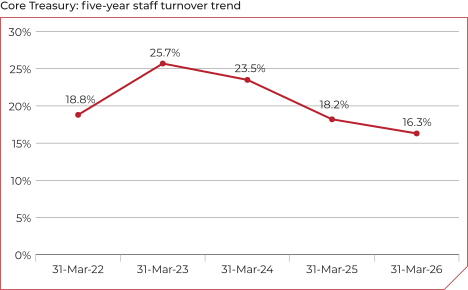
Turnover within the department is on a downward trend but remains higher than the Civil Service average of 7%. This is not unexpected given the nature of our work and our status as an accelerator department, with faster progression routes than most other government departments. Turnover is most pronounced at more junior grades, and a significant driver is pay and career progression – staff frequently leave on promotion to roles elsewhere. Strategic workforce planning, a vibrant internal labour market, improvements to staff experience and wellbeing, alongside efforts to remain competitive on pay, will help us retain staff for longer and continue to reduce turnover where possible.
As part of the workforce transformation programme which was initiated in 2025-26, HM Treasury opened a Voluntary Exit Scheme (VES) in June 2025. This process continued through the end of the financial year and into 2026-27. HM Treasury will use VES as an opportunity to reorganise and reshape, and where necessary bring in new skills and capabilities. The changes will provide opportunities for stretch, development and progression for staff and reinvigorate the internal labour market as it moves towards a leaner and more flexible organisation.
Core Treasury 2025-26: Number (FTE) of staff by gender
Core Treasury 2025-26: Number of senior civil service staff by band
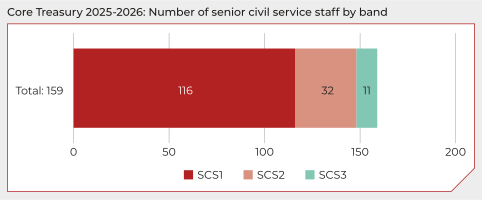
Core Treasury – Diversity
At a glance: Our diversity data for 2025-26. See the performance report for the Treasury’s work on diversity, inclusion and belonging during the year.
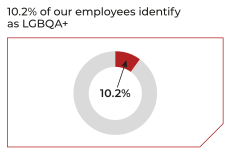
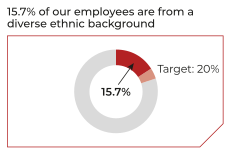
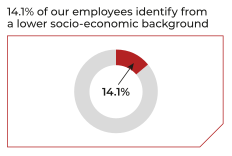
| 31-Mar-22 | 31-Mar-23 | 31-Mar-24 | 31-Mar-25 | 31-Mar-26 | |
|---|---|---|---|---|---|
| Workforce Diversity (%) | |||||
| Diverse Ethnic Background | 19.2 | 18.4 | 17.5 | 16.8 | 15.7 |
| Women | 50.1 | 49.3 | 50.4 | 50.9 | 50.8 |
| Disabled person | 10.2 | 10.2 | 10.7 | 10 | 10.3 |
| Part time | 7.9 | 7 | 7.6 | 7.9 | 8.8 |
| Lesbian, gay, bisexual, other (LGBO) | 8.5 | 9.2 | 10.3 | 10.8 | 10.2 |
| Lower socio-economic background (LSEB) | 16.6 | 16.5 | 16.6 | 15.1 | 14.1 |
| Diversity of Senior Civil Servants only | |||||
| Diverse Ethnic Background | 14.5 | 13.4 | 10.5 | 9.8 | 8.6 |
| Women | 50 | 50 | 51.7 | 51 | 48.5 |
| Disabled person | 6.6 | 6.3 | 8.4 | 9.8 | 6.7 |
| Part time | 18.4 | 17.6 | 19.6 | 16.1 | 12.9 |
| LGBO | 6.6 | n/a | n/a | n/a | 4.9 |
| LSEB | n/a | n/a | n/a | n/a | 12.3 |
It is important to note that the overall size of the department has reduced, which has had a consequential impact on our diversity statistics. While some of the changes in representation are a result of this contraction, we remain fully committed to increasing diversity and inclusion across all areas of the department. We continue to monitor trends closely and to implement initiatives that support a more diverse and inclusive workforce.
Recent diversity trends within the department also reflect a degree of intersectionality, particularly in relation to working patterns and gender representation. For example, the reduction in the number of part-time roles has contributed to a decrease in the proportion of female staff. This highlights the interconnected nature of diversity characteristics and the importance of considering these relationships when analysing workforce data.
With regard to statistics on staff from lower socio-economic backgrounds (LSEB), we are aware that our reported figures may not fully reflect the actual composition of the department. This is likely due to lower disclosure rates, as many staff either choose not to disclose or are unsure of their socio-economic background. We are working to improve disclosure rates and encourage more accurate reporting, so that we can better understand our workforce and target our efforts to support socio-economic diversity
Health, safety and wellbeing
Sickness absence
During the calendar year, the average working days lost (AWDL) per employee across the department was 3.8 days (2024: 3.6). This remains below the latest available Civil Service average of 8.2 (as at 31 March 2025).
Exit Packages (audited)
Redundancy and other departure costs have been paid in accordance with the provisions of the Civil Service Compensation Scheme (CSCS), a statutory scheme made under the Superannuation Act 1972.
Where the department has agreed early retirements, the additional costs are met by the department and not by the Civil Service pension scheme. Ill-health retirement costs are met by the pension scheme and are not included in the table.
The tables below show the total exit packages for the period ended 31 March 2026. Figures for the period ending 31 March 2025 are shown in brackets.
Core Treasury and Agencies
Core and Agency:
| Exit package cost band | Compulsory Redundancies | Other Exit Packages | Total Number of Exit Packages | |||
|---|---|---|---|---|---|---|
| Less than £10,000 | – | – | 4 | (5) | 4 | (5) |
| £10,001 – £25,000 | – | – | 29 | – | 29 | – |
| £25,001 – £50,000 | – | – | 67 | – | 67 | – |
| £50,001 – £100,000 | – | – | 96 | – | 96 | – |
| £100,001 – £150,000 | – | – | 1 | (1) | 1 | (1) |
| £150,001 – £200,000 | – | – | – | – | – | – |
| Over £200,000 | – | – | 1 | – | 1 | – |
| Total Number of exit packages | – | – | 198 | (6) | 198 | (6) |
| Total cost (£’000) | – | – | 10,591 | (126) | 10,591 | (126) |
Prior year values are shown in (brackets)
Group[footnote 55]
HMT Group:
| Exit package cost band | Compulsory Redundancies | Other Exit Packages | Total Number of Exit Packages | |||
|---|---|---|---|---|---|---|
| Less than £10,000 | – | – | 5 | (5) | 5 | (5) |
| £10,001 – £25,000 | 1 | – | 29 | – | 30 | – |
| £25,001 – £50,000 | 2 | – | 67 | – | 69 | – |
| £50,001 – £100,000 | – | – | 96 | – | 96 | – |
| £100,001 – £150,000 | – | – | 1 | (1) | 1 | (1) |
| £150,001 – £200,000 | – | – | – | – | – | – |
| Over £200,000 | – | – | 1 | – | 1 | – |
| Total Number of exit packages | 3 | – | 199 | (6) | 202 | (6) |
| Total cost (£’000) | 103 | – | 10,597 | (126) | 10,700 | (126) |
Prior year values are shown in (brackets)
Sam Beckett stepped down as Second Permanent Secretary on 22 January 2026. She received a voluntary exit payment of £262k, £52k of which was outstanding at the year end. In addition, Sam Beckett received a payment in lieu of a waiting period of £44k, £14k was outstanding at the year end. The paid amounts are included in the 2025-26 salary disclosure for Sam Beckett.
Special Adviser termination benefits
In line with the Constitutional Reform and Governance Act 2010 and the Model Contract for Special Advisers, a special adviser’s appointment automatically ends when their appointing Minister leaves office. Special advisers are not entitled to a notice period but receive contractual termination benefits to compensate for this. Termination benefits are based on length of service and capped at six months’ salary. If a special adviser returns to work for HM Government following the receipt of a severance payment, the payment is required to be repaid, less a deduction in lieu of wages for the period until their return. Termination costs for special advisers are reported in the Cabinet Office Annual Report and Accounts.
Consultancy
Consultancy and contingent labour
| In £m | Core Treasury and agencies | Group | Core Treasury and agencies | Group |
|---|---|---|---|---|
| 2025-26 | 2025-26 | 2024-25 | 2024-25 | |
| Consultancy | 1 | 12 | 4 | 15 |
| Contingent labour | 8 | 12 | 4 | 14 |
| Total | 9 | 24 | 8 | 29 |
HM Treasury, its agencies and arm’s length bodies use professional service providers to support specialist work. This includes consultancy, contingent labour (temporary workers), legal advice and IT expertise.
Off-payroll
Off-payroll arrangements are those where the worker provides services through an intermediary. This includes through a personal service company (PSC); a partnership; an individual via an agency and any other controlled intermediary arrangement. Payments are made gross by the employer.
The tables below show off-payroll engagements for all bodies which are consolidated into the HM Treasury Group. Entities with nil return for all tables are not included for disclosure.
Since the prior year off payroll engagements have increased significantly in Core Treasury due to the onboarding of the National Infrastructure and Service Transformation Authority (NISTA) in April 2025. NISTA undertakes several off‑payroll engagements throughout the year as part of its operating model, employing contractors to deliver specific infrastructure projects and undertake assurance reviews. NISTA needs a flexible resource pool to respond quickly to changing priorities, emerging risks, and time limited programmes without creating long term fixed costs. This flexibility enables the organisation to access specialist skills when required while maintaining value for money and operational resilience.
Off-payroll engagements as of 31 March 2026, earning £245[footnote 56] per day or greater
| Core Treasury | DMO | NWF | RFL | |
|---|---|---|---|---|
| The total number of existing engagements | 230 | 22 | 2 | 3 |
| Of which: | ||||
| No. that have existed for less than 1 year at time of reporting | 7 | 11 | 1 | 2 |
| No. that have existed for between 1 and 2 years at time of reporting | 223 | 5 | – | 1 |
| No. that have existed for between 2 and 3 years at time of reporting | – | 1 | 1 | – |
| No. that have existed for between 3 and 4 years at time of reporting | – | – | – | – |
| No. that have existed for 4 or more years at time of reporting | – | 5 | – | – |
All off-payroll engagements at any point during the year ended 31 March 2026 and earning £245 per day or greater
| Core Treasury | DMO | NWF | RFL | |
|---|---|---|---|---|
| The total number of engagements | 237 | 31 | 12 | 3 |
| Of which: | ||||
| Not subject to off-payroll legislation [footnote 57] | – | – | – | – |
| Subject to off-payroll legislation and determined in-scope of IR35 | 235 | 31 | 12 | – |
| Subject to off-payroll legislation and determined as out-of-scope of IR35 | 2 | – | – | 3 |
| No. of engagements reassessed for compliance or assurance purposes during the year | – | – | – | – |
| Of which: | ||||
| No. of engagements that saw a change to the IR35 status following review | – | – | – | – |
None of these engagements were direct (via PSC, contracted to the department) and they are not on the payroll.
Off-payroll engagements between 1 April 2025 and 31 March 2026 for board members, and/or senior officials with significant financial responsibility
| Core Treasury | NWF | |
|---|---|---|
| No. of off-payroll engagements of board members, and/or senior officials with significant financial responsibility during the financial year | – | 2 [footnote 58] |
| Total no. of individuals on payroll and off payroll that have been deemed “board members and/or senior officials with significant financial responsibility,” during the financial year. This figure includes both on-payroll and off-payroll engagements. | 22 | 23 |
James Bowler CB
Permanent Secretary
10 July 2026
4.28 Parliamentary Accountability and Audit Report
The Parliamentary Accountability and Audit Report presents the department’s expenditure against the budgets set by Parliament and the audit opinion on the financial statements prepared by the National Audit Office.
Statement of Outturn against Parliamentary Supply (audited)
In addition to the primary statements prepared under IFRS, the Government Financial Reporting Manual (FReM) requires HM Treasury to prepare a Statement of Outturn against Parliamentary Supply (SOPS) and supporting notes.
The SOPS and related notes are subject to audit, as detailed in the Certificate and Report of the Comptroller and Auditor General to the House of Commons.
The SOPS is a key accountability statement that explains how the department has used the spending limits approved by Parliament (the ‘Supply Estimate’). Parliament votes on these limits at the start of the financial year. They cover day‑to‑day (resource) spending, investment (capital) spending and the cash the department is authorised to draw from government funds (mainly the Consolidated Fund). Should an entity exceed the limits set by their Supply Estimate, called control limits, the accounts will receive a qualified opinion.
The format of the SOPS mirrors the Supply Estimates, published on gov.uk, to enable comparability between what Parliament approves and the final outturn.
The SOPS contains a summary table, detailing performance against the control limits that Parliament has voted on, cash spent (budgets are compiled on an accruals basis and so outturn will not exactly tie to cash spent) and administration.
The supporting notes detail the following:
- Outturn by Estimate line, providing a more detailed breakdown (SOPS1);
- a reconciliation of outturn to net operating expenditure in the Statement of Comprehensive Net Expenditure (SOCNE), to tie the SOPS to the financial statements (SOPS2);
- a reconciliation of outturn to net cash requirement (SOPS3);
- and an analysis of income payable to the Consolidated Fund (SOPS4).
The SOPS and Estimates are prepared under the budgeting framework, which is broadly aligned with – but not identical to- IFRS. HM Treasury sets the budgetary framework for government spending.
Figure 11: The budgeting system
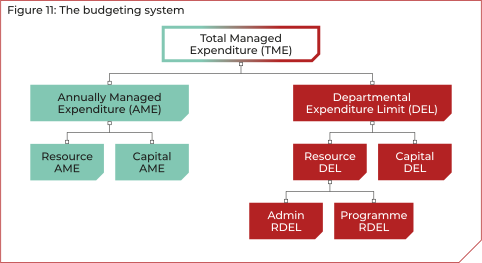
The total amount a department spends is referred to as the Total Managed Expenditure (TME); which is split into:
- Annually Managed Expenditure (AME)
- Departmental Expenditure Limit (DEL)
AME budgets are volatile or demand-led in a way the department cannot control. The department monitors AME forecasts closely and updates them annually.
HM Treasury set firm limits for DEL budgets, as DEL budgets are understood and controllable. The limit is set at spending reviews which are usually reviewed every two years.
Budgets are also split into resource and capital categories:
- ‘Resource’ captures current expenditure.
- ‘Capital’ captures new investment and financial transactions.
Resource DEL includes a further split into:
- ‘programme’ budgets for frontline service provision
- ‘admin’ budgets such as back-office functions, rent and IT
Further information on the Public Spending Framework and the reasons why budgeting rules are different to IFRS can also be found in Chapter 1 of the Consolidated Budgeting Guidance.
Summary table
Summary table, 2025-26, all figures presented in £000’s
| Type of spend | SOPS note | Outturn | Estimate | Outturn vs Estimate, saving/ (excess) | Prior Year Outturn Total 2024-25 | |||||
|---|---|---|---|---|---|---|---|---|---|---|
| Voted | Non-Voted | Total | Voted | Non-Voted | Total | Voted | Total | Total | ||
| Departmental Expenditure Limit (DEL) | ||||||||||
| Resource | 1.1 | 379,307 | 2,380 | 381,687 | 430,248 | 2,375 | 432,623 | 50,941 | 50,936 | 339,543 |
| Capital | 1.2 | 812,050 | 812,050 | 820,166 | 820,166 | 8,116 | 8,116 | 765,302 | ||
| Total Departmental Expenditure Limit (DEL) | 1,191,357 | 2,380 | 1,193,737 | 1,250,414 | 2,375 | 1,252,789 | 59,057 | 59,052 | 1,104,845 | |
| Total Annually Managed Expenditure (AME) | ||||||||||
| Resource | 1.1 | 10,346,274 | 5,059 | 10,351,333 | 29,054,352 | 4,980 | 29,059,332 | 18,708,078 | 18,707,999 | 34,606,456 |
| Capital | 1.2 | 20,721,520 | 20,721,520 | 21,456,587 | 21,456,587 | 735,067 | 735,067 | 29,296,161 | ||
| Total AME | 31,067,794 | 5,059 | 31,072,853 | 50,510,939 | 4,980 | 50,515,919 | 19,443,145 | 19,443,066 | 63,902,617 | |
| Total Budget | ||||||||||
| Resource | 1.1 | 10,725,581 | 7,439 | 10,733,020 | 29,484,600 | 7,355 | 29,491,955 | 18,759,019 | 18,758,935 | 34,945,999 |
| Capital | 1.2 | 21,533,570 | 21,533,570 | 22,276,753 | 22,276,753 | 743,183 | 743,183 | 30,061,463 | ||
| Total Budget Expenditure | 32,259,151 | 7,439 | 32,266,590 | 51,761,353 | 7,355 | 51,768,708 | 19,502,202 | 19,502,118 | 65,007,462 | |
| Non-Budget Expenditure | - | - | - | - | - | - | - | - | - | |
| Total Budget and Non-budget | 32,259,151 | 7,439 | 32,266,590 | 51,761,353 | 7,355 | 51,768,708 | 19,502,202 | 19,502,118 | 65,007,462 |
Figures in the areas outlined in thick line cover the voted control limits vote by Parliament. Refer to Supply Estimates guidance manual available on gov.uk, for detail on the control limits voted by Parliament.
Net cash requirement 2025-26, all figures presented in £000’s
| Type of spend | SOPS note | Outturn | Estimate | Outturn vs Estimate, saving/(excess) | Prior Year Outturn Total 2024-25 |
|---|---|---|---|---|---|
| Net Cash Requirement | 3 | 22,670,822 | 25,625,581 | 2,954,759 | 30,849,500 |
Administration costs 2025-26, all figures presented in £000’s
| Type of spend | SOPS note | Outturn | Estimate | Outturn vs Estimate, saving/(excess) | Prior Year Outturn Total 2024-25 |
|---|---|---|---|---|---|
| Administration Costs | 1.1 | 293,512 | 314,919 | 21,407 | 328,007 |
Although not a separate voted limit, any breach of the administration budget will also result in an excess vote.
4.29 Notes to the Statement of Outturn against Parliamentary Supply, 2025‑26 (£000’s)
SOPS1 Outturn detail, by Estimate Line
SOPS1.1 Analysis of resource outturn by Estimate Line (in £000’s)
| Type of spend (Resource) | Resource Outturn | Estimate | Outturn vs Estimate, saving/(excess) | Prior Year Outturn Total 2024-25 | ||||||||
|---|---|---|---|---|---|---|---|---|---|---|---|---|
| Administration | Programme | Total | Virements | Total inc. virements | ||||||||
| Gross | Income | Net | Gross | Income | Net | Total | ||||||
| Spending in Department Expenditure Limit (DEL) | ||||||||||||
| Voted expenditure | ||||||||||||
| A Core Treasury | 247,948 | (9,942) | 238,006 | 25,116 | (14,477) | 10,639 | 248,645 | 254,010 | – | 254,010 | 5,365 | 230,831 |
| B Debt Management Office | – | – | – | 24,322 | (7,299) | 17,023 | 17,023 | 20,825 | – | 20,825 | 3,802 | 16,711 |
| C Government Internal Audit Agency | 44,620 | (44,364) | 256 | – | – | – | 256 | 2,903 | – | 2,903 | 2,647 | (1,893) |
| D National Infrastructure and Service Transformation Authority | 30,794 | (2,108) | 28,686 | – | – | – | 28,686 | 32,513 | – | 32,513 | 3,827 | – |
| E UK Asset Resolution Ltd (net) | 4,854 | – | 4,854 | – | – | – | 4,854 | 5,188 | – | 5,188 | 334 | 5,047 |
| F Office for Budget Responsibility (net) | 5,659 | – | 5,659 | – | – | – | 5,659 | 6,370 | – | 6,370 | 711 | 5,129 |
| I HM Treasury UK Sovereign Sukuk plc (net) | – | – | – | (4) | – | (4) | (4) | 1 | – | 1 | 5 | (4) |
| J Royal Mint Advisory Committee (net) | – | – | – | – | – | – | – | 1 | – | 1 | 1 | – |
| - National Infrastructure Commission | – | – | – | – | – | – | – | – | – | – | – | 4,550 |
| K UK Government Investments Limited (Net) | 16,051 | – | 16,051 | – | – | – | 16,051 | 21,103 | – | 21,103 | 5,052 | 17,675 |
| L National Wealth Fund (net) | – | – | – | 58,137 | – | 58,137 | 58,137 | 87,334 | – | 87,334 | 29,197 | 59,152 |
| Total Voted DEL | 349,926 | (56,414) | 293,512 | 107,571 | (21,776) | 85,795 | 379,307 | 430,248 | – | 430,248 | 50,941 | 337,198 |
| Non-voted expenditure | ||||||||||||
| M Banking and gilts registration services | – | – | – | 18,859 | (16,479) | 2,380 | 2,380 | 2,375 | – | 2,375 | (5) | 2,345 |
| Total Non-voted DEL | – | – | – | 18,859 | (16,479) | 2,380 | 2,380 | 2,375 | – | 2,375 | (5) | 2,345 |
| Total spending in DEL | 349,926 | (56,414) | 293,512 | 126,430 | (38,255) | 88,175 | 381,687 | 432,623 | – | 432,623 | 50,936 | 339,543 |
| Spending in Annually Managed Expenditure (AME) | ||||||||||||
| Voted expenditure | ||||||||||||
| N Core Treasury (AME) | – | – | – | (35,299) | (758,043) | (793,342) | (793,342) | (522,729) | (417) | (523,146) | 270,196 | 220 |
| O Debt Management Office | – | – | – | 6,239 | (1,856) | 4,383 | 4,383 | 4,460 | – | 4,460 | 77 | 3,092 |
| P UK circulating coinage | – | – | – | 20,931 | (1,320) | 19,611 | 19,611 | 19,194 | 417 | 19,611 | – | 3,376 |
| - Investment in Bank of England | – | – | – | – | (20,000) | (20,000) | (20,000) | – | – | – | 20,000 | – |
| R Assistance to financial institutions, businesses and individuals | – | – | – | 11,737,560 | (4,380) | 11,733,180 | 11,733,180 | 28,902,620 | – | 28,902,620 | 17,169,440 | 34,689,552 |
| S Royal Household (net) | – | – | – | 117,151 | – | 117,151 | 117,151 | 121,926 | 4,858 | 121,926 | 4,775 | 84,910 |
| T UK Asset Resolution Ltd (net) | – | – | – | (1,561) | – | (1,561) | (1,561) | 9,879 | – | 9,879 | 11,440 | 3,929 |
| U Help to Buy Schemes | – | – | – | 7,188 | (16,610) | (9,422) | (9,422) | (14,280) | – | (9,422) | – | (14,533) |
| V EU Withdrawal Agreement Financial Settlement | – | – | – | (185,944) | – | (185,944) | (185,944) | 890,552 | – | 890,552 | 1,076,496 | 289,683 |
| W Reclaim Fund Ltd (net) | – | – | – | 124,994 | – | 124,994 | 124,994 | (33,706) | 158,700 | 124,994 | – | (14,072) |
| X National Wealth Fund (net) | – | – | – | (108,033) | – | (108,033) | (108,033) | 140,154 | (158,700) | (18,546) | 89,487 | 23,793 |
| Y Pool Reinsurance Company Limited (net) | – | – | – | (305,476) | – | (305,476) | (305,476) | (270,324) | – | (270,324) | 35,152 | (275,538) |
| Z Provisions | – | – | – | (229,267) | – | (229,267) | (229,267) | (193,394) | (4,858) | (198,252) | 31,015 | (193,021) |
| Total Voted AME | – | – | 11,148,483 | (802,209) | 10,346,274 | 10,346,274 | 29,054,352 | – | 29,054,352 | 18,708,078 | 34,601,391 | |
| Non-voted expenditure | ||||||||||||
| AA Royal Household Pensions | – | – | – | 5,302 | (243) | 5,059 | 5,059 | 4,980 | – | 4,980 | (79) | 5,065 |
| Total Non-voted AME | – | – | – | 5,302 | (243) | 5,059 | 5,059 | 4,980 | – | 4,980 | (79) | 5,065 |
| Total spending in AME | – | – | – | 11,153,785 | (802,452) | 10,351,333 | 10,351,333 | 29,059,332 | – | 29,059,332 | 18,707,999 | 34,606,456 |
| Total Resource | 349,926 | (56,414) | 293,512 | 11,280,215 | (840,707) | 10,439,508 | 10,733,020 | 29,491,955 | – | 29,491,955 | 18,758,935 | 34,945,999 |
SOPS1.2 Analysis of capital outturn by Estimate line (in £000’s)
| Type of spend (Capital) | Outturn | Estimate | Outturn vs Estimate, saving/(excess) | Prior Year Outturn Total 2024-25 | ||||
|---|---|---|---|---|---|---|---|---|
| Gross | Income | Net total | Total | Virements | Total inc. virements | |||
| Spending in Departmental Expenditure Limits (DEL) | ||||||||
| Voted expenditure | ||||||||
| A Core Treasury | 812,358 | (1,896) | 810,462 | 815,245 | – | 815,245 | 4,783 | 753,631 |
| B Debt Management Office | 493 | – | 493 | 630 | – | 630 | 137 | 332 |
| C Government Internal Audit Agency | 763 | – | 763 | 2,127 | – | 2,127 | 1,364 | 26 |
| D National Infrastructure and Service Transformation Authority | – | – | – | 1,192 | – | 1,192 | 1,192 | – |
| F Office for Budget Responsibility (net) | (21) | – | (21) | – | – | – | 21 | – |
| G IUK Investments Limited (net) | – | – | – | 1 | – | 1 | 1 | – |
| H IUK Investments Holdings Limited (net) | – | – | – | 1 | – | 1 | 1 | – |
| National Infrastructure Commission | – | – | – | – | – | – | – | 192 |
| L National Wealth Fund (net) | 353 | – | 353 | 970 | – | 970 | 617 | 11,121 |
| Total voted DEL | 813,946 | (1,896) | 812,050 | 820,166 | – | 820,166 | 8,116 | 765,302 |
| Total spending in DEL | 813,946 | (1,896) | 812,050 | 820,166 | – | 820,166 | 8,116 | 765,302 |
| Spending in Annually Managed Expenditure (AME) | ||||||||
| Voted expenditure | ||||||||
| N Core Treasury | 2,352 | – | 2,352 | – | 2,352 | 2,352 | – | – |
| Q Sale of shares | – | (1,397,748) | (1,397,748) | (1,397,748) | – | (1,397,748) | – | (8,155,898) |
| R Assistance to financial institutions, businesses and individuals | 16,660,171 | (8,500) | 16,651,671 | 16,660,172 | – | 16,660,172 | 8,501 | 36,322,915 |
| S Royal Household (net) | 14,769 | – | 14,769 | 7,663 | 7,106 | 14,769 | – | 10,975 |
| U Help to Buy Schemes | 89,352 | – | 89,352 | 109,610 | (9,458) | 100,152 | 10,800 | 117,734 |
| V EU Withdrawal Agreement Financial Settlement | – | (260,903) | (260,903) | (260,903) | – | (260,903) | – | (250,818) |
| W Reclaim Fund Ltd (net) | 13,459 | – | 13,459 | 52,264 | – | 52,264 | 38,805 | 136,104 |
| X National Wealth Fund (net) | 5,695,800 | – | 5,695,800 | 6,322,022 | – | 6,322,022 | 626,222 | 1,147,503 |
| Y Pool Reinsurance Company (net) | (87,233) | – | (87,233) | (36,493) | – | (36,493) | 50,740 | (32,354) |
| Total voted AME | 22,388,670 | (1,667,151) | 20,721,519 | 21,456,587 | – | 21,456,587 | 735,068 | 29,296,161 |
| Total spending in AME | 22,388,670 | (1,667,151) | 20,721,519 | 21,456,587 | – | 21,456,587 | 735,068 | 29,296,161 |
| Total Capital | 23,202,616 | (1,669,047) | 21,533,569 | 22,276,753 | – | 22,276,753 | 743,184 | 30,061,463 |
The total Estimate columns include virements which are reallocations of provision within Estimates that do not require separate parliamentary authority as Parliament delegates this level of detail to HM Treasury. Further information on virements is provided in the Supply Estimates Manual.
The Outturn vs Estimate column is based on the total including virements. The Estimate total before virements is also shown to enable users to reconcile the figures with those laid before Parliament.
Explanation of key variances between Estimates and net resource outturn as at 31 March 2026
SOPS 1.1 Analysis of resource outturn by Estimate line
Spending in Department Expenditure Limit (DEL)
A: Core Treasury
Underspends against budget are primarily due to lower Voluntary Exit Scheme costs than forecast, reflecting conservative assumptions and some costs slipping into 2026-27. The remaining variance is largely driven by project-related expenditure, including lower than expected legal costs including reduced COVID inquiry spend.
L: National Wealth Fund (NWF)
The underspend against budget of £29m was primarily attributable to lower-than-expected staff costs and savings on recruitment, as well as reduced spend on non-staff cost categories, including legal fees and other professional services.
Spending in Annually Managed Expenditure (AME)
N: Core Treasury (AME)
The classification of liabilities under Decommissioning Relief Deeds (DRDs) changed during 2025-26 from provisions to insurance contract liabilities, upon the initial application of IFRS 17 Insurance Contracts (see Note 23 – Insurance and reinsurance contracts and Note 28 – Prior period restatements). Amounts budgeted in AME line Z (Provisions) for expenditure relating to movements in DRD liabilities have consequently been vired to AME line N (Core Treasury (AME)).
There is still a significant variance, because under IFRS 17, HM Treasury recognised a Liability for Remaining Coverage for the first time (in addition to the Liability for Incurred Claims, which was previously classified as a provision and now forms part of the insurance contract liability), resulting in a significant increase in expenditure relating to movements in DRD liabilities.
R: Assistance to Financial Institutions, businesses and individuals
Budget cover of £28.9bn was sought at the Supplementary Estimate 2025-26 for a potential decrease in the fair value of the Bank of England Asset Purchase Facility Fund (BEAPFF). For more information see Note 14 – Derivatives.
V: EU Withdrawal Agreement Financial Settlement
The variance reflects changes in provisions, payables, and receivables relating to the Financial Settlement following the UK’s exit from the European Union (see Note 16 – EU Financial Settlement). To mitigate the risk of breaching control totals amid exchange rate and asset/liability uncertainty, budgetary cover was set at a £0.9 billion net increase in liability, resulting in the disclosed variance.
W: Reclaim Fund Ltd (RFL)
The variance is primarily driven by an update to RFL’s Capital and Reserving Strategy in 2025-26, which has led to a higher provision being recognised in 2025‑26 to reflect a one-off additional distribution of £187m to be paid in 2026‑27.
X: National Wealth Fund
The underspend in the National Wealth Fund is primarily due to the deferral of project drawdowns relative to profile beyond 2025-26, reflecting the long-term nature of complex infrastructure projects and resulting in a variance against the Capital AME budget. Additionally, Resource AME has been affected by lower than anticipated credit losses.
Z: Provisions
See AME line N (Core Treasury (AME)) above.
SOPS 1.2 Analysis of capital outturn by Estimate line
Spending in Department Expenditure Limit (DEL)
A: Core Treasury
The final capital position has come in within control totals. The departmental Capital DEL budget largely consists of funding the £2.2bn Extraordinary Revenue Acceleration (ERA) loan to Ukraine. The first tranche of this (£753m) was paid in 2024-25 and the second tranche (£753m) in 2025-26. HM Treasury, alongside other shareholders, have subscribed for additional ‘paid in capital’ in the European Bank for Reconstruction and Development (EBRD) to be paid in annual instalments of €69m until 2029.
Spending in Annually Managed Expenditure (AME)
Q: Sale of Shares
By the 30 May 2025 the NatWest Group was returned to full private ownership. The 2025-26 budget figure is therefore income to this date, as included at Supplementary, with no variance as there were no further sales in the remainder of the financial year.
W: Reclaim Fund Ltd (RFL)
See above.
X: National Wealth Fund
See above.
Y: Pool Reinsurance Company Limited “Pool Re”
Pool Re’s Capital AME budget provided for a net sales position of debt and equity securities of £36m. This was based on forecasted cash requirements, with variances arising from factors such as the performance of Pool Re’s investment fund. The final outturn was £87m of income, reflecting a net sales position rather than a net purchase.
SOPS2 Reconciliation of outturn to net operating expenditure (in £000’s)
| Item | Note | Outturn total 2025-26 | Prior Year Outturn Total 2024-25 |
|---|---|---|---|
| Total Resource outturn | SOPS 1.1 | 10,733,020 | 34,945,999 |
| Add: Capital Provisions | 89,353 | 117,734 | |
| Non-budget Commitments | – | 1,277,667 | |
| Capital Insurance | 2,352 | – | |
| Capital grants distributed | – | 455,667 | |
| Capital Research | – | 190 | |
| Call of Guarantees | 265 | 1,059 | |
| Restatements due to new accounting standards | – | (92,737) | |
| Total | 91,970 | 1,759,580 | |
| Less: Income payable to the Consolidated Fund | (275,681) | (264,626) | |
| On balance sheet commitments distributed | 752,666 | – | |
| Total | 476,985 | (264,626) | |
| Net Operating Expenditure in Consolidated Statement of Comprehensive Net Expenditure | SoCNE | 11,301,975 | 36,440,953 |
HM Treasury uses one system to plan and track spending (the budgeting framework) and another system for official financial reporting (IFRS). These two systems work in similar ways, but there are some important differences between them; because of this, we provide a reconciliation that helps show how the spending figures in our budget reports match up with the numbers in our financial statements. This makes it clear how the money we plan to spend compares to what is reported in our annual accounts. Some examples of this are included below:
When HM Treasury issues a financial guarantee (a promise to pay if certain events happen), the expected cost is included in the budget as Resource Annually Managed Expenditure (AME) and shown as expenditure in the financial statement at that time. If the guarantee is called upon and the government must pay out if called upon, the earlier cost in Resource AME is cancelled, and the actual payment is recorded as Capital AME instead.
Capital grants are accounted for as expenditure in the financial statements but are budgeted for as Capital Departmental Expenditure Limit (DEL). The capital grants arising from provisions are Help to Buy ISA bonus payments which are charged against Capital AME within the SOPS capital outturn.
Income payable to the Consolidated Fund[footnote 59] does not appear within the budgetary framework but is accounted for as expenditure in the financial statements. The income payable to the Consolidated Fund primarily relates to £273m (2024‑25[footnote 60]: £262m) fees from the Pool Re retrocession agreement, which will be paid over to the Consolidated Fund when they have been received by HM Treasury.
Capital grants distributed and on balance sheet commitments distributed relate to the element of current and future distributions to Ukraine under the ERA (Extraordinary Revenue Acceleration) scheme, that pass through the Statement of Comprehensive Net Expenditure (SOCNE). These are recorded as Capital AME in the year that each tranche of funds is distributed.
SOPS3 Reconciliation of net resource outturn to net cash requirement (in £000’s)
| Item | Note | Outturn total | Estimate | Outturn vs Estimate, saving/ (excess) |
|---|---|---|---|---|
| Resource Outturn | SOPS 1.1 | 10,733,020 | 29,491,955 | 18,758,935 |
| Capital Outturn | SOPS 1.2 | 21,533,569 | 22,276,753 | 743,184 |
| Adjustments for ALBs and other bodies: | ||||
| Remove voted resource and capital | (106,644) | (6,434,354) | (6,327,710) | |
| Add cash grant-in-aid | 222,720 | 6,714,920 | 6,492,200 | |
| Adjustments to remove non-cash items: | ||||
| Depreciation | (7,373) | (9,980) | (2,607) | |
| Derivative fair value movements | (11,756,171) | (28,910,000) | (17,153,829) | |
| New provisions and adjustments to previous provisions | (123,924) | (697,158) | (573,234) | |
| Other non-cash items | 1,161,216 | 524,800 | (636,416) | |
| Adjustments to reflect movements in working balances | ||||
| Increase in inventory | (7,136) | – | 7,136 | |
| Increase in receivables | (805,967) | – | 805,967 | |
| Increase in payables | 285,418 | – | (285,418) | |
| Use of provisions | 1,549,532 | 2,676,000 | 1,126,468 | |
| Total | (9,588,329) | (26,135,772) | (16,547,443) | |
| Removal of non-voted budget items: | ||||
| Banking and gilts registration service | (2,380) | (2,375) | 5 | |
| Royal Household Pension Scheme | (5,059) | (4,980) | 79 | |
| Total | (7,439) | (7,355) | 84 | |
| Net cash requirement | 22,670,821 | 25,625,581 | 2,954,760 |
As noted in the introduction to the SOPS above, outturn and the Estimates are compiled against the budgeting framework, not on a cash basis. Therefore, this reconciliation bridges the resource and capital outturn to the net cash requirement.
SOPS4 Amounts of income to the Consolidated Fund
SOPS4.1 Analysis of income payable to the Consolidated Fund (in £000’s)
| Item | Note | Outturn total | Prior Year, 2024-25 | ||
|---|---|---|---|---|---|
| Accruals | Cash basis | Accruals | Cash basis | ||
| Operating income outside the scope of the Estimate | 275,681 | 282,821 | 264,626 | 171,666 | |
| Capital receipts outside the scope of the Estimate | 13 | – | 79,210 | – | – |
| Total amount payable to the Consolidated Fund | 275,681 | 362,031 | 264,626 | 171,666 |
Capital receipts outside the scope of the Estimate include the loan repayments from the Extraordinary Revenue Acceleration (ERA) initiative. See also Note 13 – Loans and investment securities.
Operating income outside the scope of the Estimate includes the inter-company income from Pool Re under the retrocession agreement, which eliminates at group level, and the income received to the government as a gift to the nation. See also Note 3 – Other operating income.
SOPS4.2 Consolidated Fund income
Consolidated Fund income shown in the table above does not include any amounts collected by the department where it was acting as agent of the Consolidated Fund rather than as principal. Full details of income collected as agent for the Consolidated Fund are in the department’s Trust Statement in this Annual Report and Accounts.
We act as custodians of taxpayers’ funds and have a duty to Parliament to ensure the regularity and propriety of all activities and expenditure. Public funds are managed in accordance with the principles set out in Managing Public Money.
The Accounting Officer is responsible for ensuring the regularity, propriety, efficiency, economy, effectiveness, and prudence in the administration of public resources, as detailed in Managing Public Money. This includes accountability for the proper use of public finances.
To support this responsibility and to ensure that control totals are not breached, we have established the following controls:
- Formal delegation of budgets
- Detailed monitoring of expenditure
- Monthly management reporting against control totals
Additionally, we apply the three lines of defence model within our risk management framework, (1) business areas own and manage risks, (2) central risk and compliance functions provide oversight and challenge, and (3) internal audit provides independent assurance.
During the year, no breaches of control totals occurred. Further details are provided in the Statement of Outturn against Parliamentary Supply.
These disclosures apply to the bodies identified in Note 1.3 – Basis for consolidation.
Losses and special payments (audited)
Reportable losses and special payments during 2025-26 exceeding £300,000 are detailed in the table below.
| Losses | Value |
|---|---|
| Foreign exchange rate movements on the amounts invoiced under the EU Financial Settlement. These are paid as they fall due at the prevailing rate at that time. [footnote 61] | £10m (2024-25: £5m) |
| During 2015-16, HM Treasury issued a financial guarantee contract under the UK Guarantees Scheme in relation to a loan facility provided to Countesswells Development Limited (CDL) for the purpose of constructing a housing development near Aberdeen. The guarantee was called and settled in full, resulting in a total payment of £87.2m in January 2022, which was reported in HM Treasury’s 2021-22 financial statements. | The expected value of the loss reported in 2025-26 is between £0.7m and £0.8m. This represents the difference between the amounts expected to be realised in relation to the loans to CDL, net of the costs of realisation, and the total amounts owing to HM Treasury, comprising loan principal plus accumulated interest. |
| In order to maximise value for the taxpayer arising out of the administration, HM Treasury made loans to the administrators for a total of £9.4m to fund the administration and make land purchases to increase the saleability of development land. Sales of development land completed during 2025-26, meaning that the process of administration has reached the stage where HM Treasury can calculate and report an expectation of the net recoveries in relation to its loans. | |
| Special payments | |
| Payments relating to an indemnity to the Royal Mint to reimburse historic employer’s liability claims. | £0.5m |
Fees and charges (audited)
The HM Treasury Group receives the below fees and charges for services.
| Fees and charges (Core Treasury) | Strategic Outcome | Income (£m) 2025-26 | Income (£m) 2024-25 |
|---|---|---|---|
| Reinsurance fees [footnote 62] | SO 3 Deliver economic and financial stability to provide certainty for firms and households. | 273 | 262 |
| UK Guarantee Scheme | SO 1 Deliver economic growth and raise living standards in every region and nation of the UK. | 4 | (2) |
| Mortgage Guarantees | SO 1 Deliver economic growth and raise living standards in every region and nation of the UK. | 17 | 20 |
| Fees and charges (Group) | |||
| Pool Re commercial reinsurance fees | SO 3 Deliver economic and financial stability to provide certainty for firms and households. | 266 | 263 |
| GIAA audit fees | SO 2 Build and maintain strong public finances while rebuilding and reforming public services to improve public sector productivity and deliver value for money. | 44 | 46 |
| DMO fees and charges | SO 2 Build and maintain strong public finances while rebuilding and reforming public services to improve public sector productivity and deliver value for money. | 7 | 6 |
| NWF guarantee fees | SO 1 Deliver economic growth and raise living standards in every region and nation of the UK. | 8 | 4 |
Fees for guarantees and reinsurance fees provided by core Treasury and the commercial reinsurance premiums charged by Pool Re are set based on the risk of a call on the underlying guarantees and insurance activities and are entered into to achieve specific policy objectives rather than to achieve a financial objective of recovering the annual costs of a service being provided. There is no material administration cost incurred in providing these services.
All other details regarding income from fees and charges received by arm’s length bodies can be found in the relevant bodies’ annual reports and accounts.
Income in the above tables is reflected within the Statement of Comprehensive Net Expenditure (SoCNE), and is allocated between:
- Income from sale of goods and services (Note 2)
- Other operating income (Note 3)
- Insurance revenue (Note 4)
- Finance income (Note 5)
Auditor
The Comptroller and Auditor General undertakes the audit of the consolidated accounts of the HM Treasury Group under the Government Resources and Accounts Act 2000.
Central Funds
HM Treasury has oversight and administrative responsibility for the government’s Central Funds, namely the Consolidated Fund, National Loans Fund, Contingencies Fund and Exchange Equalisation Account. The annual report and accounts for these funds are produced separately and should be viewed alongside those of the departmental group.
Functional Standards
Our corporate functions are aligned with agreed cross-functional standards as appropriate and drive a culture of compliance with legislative demands and the general good practice expected of an effective government department.
Remote contingent liabilities (audited)
In addition to contingent liabilities reported under IAS 37 Provisions, Contingent Liabilities and Contingent Assets in Note 22, HM Treasury is required to disclose liabilities for which the likelihood of a transfer of economic benefit in settlement is too remote to meet the disclosure requirements of the Standard.
Contingent liabilities otherwise outside the scope of IAS 37 Provisions, Contingent Liabilities and Contingent Assets, such as financial guarantees, derivatives and insurance contracts, are not included in this section and the risks relating to these instruments are detailed in Note 14 – Derivatives, Note 17 – Financial guarantees and Note 18 – Financial risk.
These disclosures are required by Managing Public Money to ensure parliamentary accountability. HM Treasury must provide a brief description of each contingent liability and, where possible, an estimate of its financial effect. Contingent liabilities often enable the government to pursue policy objectives without an immediate call on public funds, though there remains a risk that payment may be required if the liability crystallises. HM Treasury discloses these items either due to its central finance and economics role or where no other public sector body is responsible for the disclosure.
A remote contingent liability is the maximum potential exposure if trigger events occur, and the liability crystallises. If this happens, HM Treasury would settle the obligation through the Supply Estimates process. These contingent liabilities include indemnities, financial guarantees, and letters of support, as described below.
EU Withdrawal Agreement
The UK left the European Union on 31 January 2020. HM Treasury continues to implement the financial settlement set out in the financial provisions of the Withdrawal Agreement. This settlement covers both the UK’s financial commitments to the EU and the EU’s financial commitments to the UK arising from the UK’s participation in the EU budget, and other commitments relating to our former EU membership.
HM Treasury’s financial statements and related disclosures set out the accounting implications of the financial settlement for the department See Note 16 – EU Financial Settlement for further detail.
HM Treasury also has a remote contingent liability in respect of the UK’s contingent liability to the European Investment Bank (EIB). As defined in Article 150 of the Withdrawal Agreement, this is limited to the callable and returned paid-in capital the UK held as a member state. The remote contingent liability is valued at £32.6bn as at 31 March 2026 (2024-25: £31.1bn) and does not meet the threshold for disclosure in the financial statements.
Further information on the financial impact of EU Withdrawal Agreement is included in the “European Union Finances” publication series.[footnote 63]
UK Asset Resolution (UKAR): Bradford & Bingley plc and NRAM Ltd financial assets
To facilitate each sale of UKAR’s B&B and NRAM assets, UKAR has offered certain fundamental market-standard warranties which have created remote contingent liabilities. The crystallisation of any liability is dependent on the occurrence and identification of any defects covered by the warranties. Given their nature, such occurrence is considered remote.
Each of these sales and the associated remote contingent liabilities are listed below:
On 13 November 2015, the Chancellor announced the sale of a portfolio of UKAR’s NRAM loan book assets to Cerberus Capital Management L.P. The proceeds of the sale were £13.3bn. The maximum value of remote contingent liabilities is £13.3bn.
On 26 February 2021 the Economic Secretary to the Treasury announced the sale of Bradford & Bingley plc (B&B), NRAM Limited and their remaining assets to a consortium of Citibank and Davidson Kempner Capital Management. The proceeds from the sale were £5.1bn.
Maximum value of remote contingent liabilities arising from:
| Other warranties | £4.8bn |
| Capped indemnities | £290m |
| Tax covenant | £290m |
In addition to this list, UKAR also has several other remote contingent liabilities relating to previous asset sales where the likelihood is near zero due to the time elapsed since the relevant sales.
Reclaim Fund Limited (RFL) – Dormant Assets
RFL acts as a dormant assets account fund operator. Under the Dormant Bank and Building Society Accounts Act 2008 and the Dormant Assets Act 2022, participating financial institutions may transfer money from eligible dormant accounts – such as bank and building society accounts with no customer transactions for 15 years or more – to RFL.
The legislation requires RFL to manage dormant funds prudently so it can meet anticipated customer reclaim claims. HM Treasury has a power under the Dormant Assets Act 2022 to provide RFL with a loan if it is, or is likely to become, unable to meet the reclaim obligations and would otherwise become insolvent.
At 31 March 2026, the total remaining exposure that RFL may be required to settle, over and above amounts already set aside, is £1,573m (£1,189m at 31 March 2025).
Bank of England capital framework
HM Treasury and the Bank of England agreed reforms to the Bank’s financial framework in June 2018, and published an updated Memorandum of Understanding (MoU) following the five‑year review in February 2025. Under the formal agreement that HM Treasury will recapitalise the Bank in the event of a major capital loss, HM Treasury recognises a remote contingent liability. This is currently unquantifiable because the circumstances required for crystallisation are unprecedented and cannot be reliably modelled, and the framework is not time limited.
The Bank of England maintains a strong capital position, and the risk of a major capital loss that would require recapitalisation by HM Treasury is considered remote.
Asian Infrastructure Investment Bank
The Asian Infrastructure Investment Bank (AIIB) was established in December 2015, with the UK as a shareholder, to support sustainable development by financing for infrastructure projects in Asia. The UK’s investment, consistent with other shareholders, comprises 20% paid-in capital and 80% callable capital.
A remote contingent liability arises in relation to the US$2.4bn (approximately £1.9bn) of callable capital. This is not paid in; the AIIB could call on it if the bank were unable to meet its obligations.
While the AIIB has the right to call capital in the event of a crisis affecting its assets, the equity base of the bank is currently more than sufficient to meets its financial objectives by absorbing risk from its own resources, protecting member countries from a possible call. Three major credit ratings agencies reaffirmed the bank’s AAA ratings in 2025-26, and historically callable capital has not been called at any major multilateral development bank. If a call were made, provision for any payment would be sought through the Supply Estimates procedure.
European Bank for Reconstruction and Development
The European Bank for Reconstruction and Development (EBRD) was established in March 1991 with the UK as a shareholder alongside several other countries, to support transition in Central and Eastern Europe, post the Cold war era.
On 2 December 2024, the UK subscribed to an additional 34,360 paid-in shares. The total consideration of €344m will be settled in five equal instalments from 2025-26 to 2029-30. This subscription rebalanced the UK’s capital mix to 30.2% (2024-25: 30.2%) ‘paid-in capital’ and 69.8% (2024-25: 69.8%) callable capital.
A remote contingent liability arises in respect of €2.0bn (approximately £1.8bn) of callable capital. This capital has not been paid up and would only be called by the EBRD if the bank were unable to meet its obligations.
Although the ERBD may call this capital in the event of a crisis affecting its assets or loans, the bank’s equity base is currently sufficient to absorb risk from its own resources, protecting member countries from a possible call. Three major credit ratings agencies reaffirmed the bank with AAA ratings in 2025-26, and historically no major multilateral development bank has called this capital. If the liability were to be called, provision for any payment would be sought through the normal Supply Estimates procedure.
Royal Mint Pensions indemnity
HM Treasury has provided an indemnity to the Cabinet Office in respect of employer contributions payable to the Civil Service Pensions Scheme arising from the transfer of the Royal Mint’s pensions under ‘new fair deal’. This indemnity would only materialise in the unlikely event that the Royal Mint failed to make the required payments to the pension scheme. The potential liability is unquantifiable, as the scheme is expected to operate for the foreseeable future and the timing and scale of any possible default by the Royal Mint cannot be predicted.
Director indemnities
HM Treasury employees and others may be asked to serve as directors of incorporated companies within the HM Treasury Group or other wholly owned companies. HM Treasury has granted those directors indemnities against losses or liabilities incurred in the course of their duties while the companies remain in public ownership. The crystallisation of any liability is dependent on the actions of the directors.
In addition, employees of the National Wealth Fund (NWF) may be appointed as directors of companies in which the NWF holds equity investments. The NWF has issued indemnities to those directors against certain personal liabilities and expenses arising out of, or in connection with, their roles as directors of the investee companies.
It is not practicable to quantify the potential financial effect of these director indemnities, as there is currently no evidence on which to base a meaningful estimate.
Service provider indemnities
HM Treasury provided an investment management company with a capped indemnity of up to £3m for its support in designing the Bounce Back Loan Scheme, which was established to support small businesses during the COVID-19 pandemic. The indemnity is limited to covering the risk that the company could become liable to third parties for claims arising from its engagement.
UK Asset Resolution (UKAR): Other
The Bradford & Bingley plc Transfer of Securities and Property etc Order 2008 requires HM Treasury to provide a guarantee or make other arrangements to ensure the assets of the remaining section of the B&B Pension Scheme are sufficient to meet its liabilities. Accordingly, HM Treasury guarantees to pay or procure payment of, any benefit payments due from the remaining section at any time when there are insufficient assets to meet those payments. As at 31 March 2026, there is no contingent liability to report (2024-25: £nil).
HM Treasury Group’s former lending and other consumer credit activities are governed by consumer credit law and related regulations. If customer claims concerning potential breaches are upheld, this could result in costs to HM Treasury Group. It is not possible to provide any meaningful estimate or range of the possible cost.
Reconciliation of contingent liabilities included in the Supply Estimate to the accounts
Quantifiable Contingent Liabilities
| Description of CLs £m | Supply Estimate (up to) | Amount disclosed in ARA | Variance (Estimate – Amount disclosed in ARA) |
|---|---|---|---|
| Bank of England Asset Purchase Facility Fund | 555,000 | 555,000 | – |
| EU Withdrawal Agreement – Article 150 EIB callable capital | 31,075 | 32,562 | (1,487) |
| EU Withdrawal Agreement – Article 136 Traditional own resources | 58 | 19 | 39 |
| EU Withdrawal Agreement – Article 147 legal cases | 13 | 70 | (57) |
| UKAR: Bradford & Bingley plc and NRAM Ltd mortgage assets sales: | |||
| March 2015 – intermediate warranties | 13,300 | 13,300 | – |
| April 2018 – corporate warranties | 5,400 | – | 5,400 |
| April 2019 – corporate warranties | 4,960 | – | 4,960 |
| February 2021 – fundamental warranties | 4,800 | – | 4,800 |
| February 2021 – intermediate warranties | 960 | – | 960 |
| February 2021 – other warranties | 4,800 | 4,800 | – |
| February 2021 – capped indemnities | 290 | 290 | – |
| February 2021 – tax covenant | 290 | 290 | – |
| RFL Dormant Assets | 1,222 | 1,573 | (351) |
| European Bank for Reconstruction and Development Callable Capital Guarantee [footnote 64] | 1,700 | 1,767 | (67) |
| Asian Infrastructure Investment Bank Callable Capital Guarantee [footnote 64] | 1,800 | 1,854 | (54) |
| Service Provider Indemnities | 3 | 3 | – |
| Mortgage Guarantee Scheme | 3,200 | 988 | 2,212 |
| Sovereign Infrastructure Guarantee | 2,472 | 2,822 | (350) |
| UK Guarantees Scheme | 574 | 574 | – |
| Royal Mint Trading Fund MOU | 36 | 36 | – |
| No-interest Loan Scheme guarantee | 10 | – | 10 |
Unquantifiable Contingent Liabilities
| Description of CLs | Included in Supply Estimate (Yes/No) | Included in these financial statements (Yes/No) | Explanation of difference |
|---|---|---|---|
| Bank of England Recapitalisation Guarantee | Yes | Yes | Not Applicable |
| Royal Mint Pension indemnity | Yes | Yes | Not Applicable |
| Decommissioning Relief Deeds | Yes | Yes | Not Applicable |
| Litigation activity | Yes | Yes | Not Applicable |
| Director indemnities | Yes | Yes | Not Applicable |
| UK Government Investments indemnities | Yes | No | ALB disclosure change |
| UKAR: Bradford & Bingley plc and NRAM Ltd mortgage warranties and indemnities | Yes | Yes | Not Applicable |
| UKAR: Bradford & Bingley plc and NRAM Ltd pension guarantees | Yes | Yes | Not Applicable |
| Pool Re reinsurance activity | Yes | Yes | Not applicable |
The £1.4bn variance relating to the EU Withdrawal Agreement contingent liability is largely due to exchange rate movements on an exposure held in Euros and an additional annual repayment of the UK’s share of paid-in capital of the EIB during the year.
The variances relating to UKAR warranties of £16.12bn are due to changes in the expected maximum exposure to the HM Treasury Group at the reporting date after the supplementary estimate was finalised.
The variance relating to the Mortgage Guarantee Scheme of £2.2bn reflects the difference between the maximum amount of losses covered by the scheme at 31 March and the maximum liability allowed under the scheme rules.
James Bowler CB
Permanent Secretary
10 July 2026
4.30 The Certificate and Report of the Comptroller and Auditor General to the House of Commons
Opinion on financial statements
I certify that I have audited the financial statements of HM Treasury and of its Departmental Group for the year ended 31 March 2026 under the Government Resources and Accounts Act 2000. The Department comprises the core Department and its agencies. The Departmental Group consists of the Department and the bodies designated for inclusion under the Government Resources and Accounts Act 2000 (Estimates and Accounts) Order 2025. The financial statements comprise: the Department’s and the Departmental Group’s:
- Consolidated Statement of Financial Position as at 31 March 2026;
- Consolidated Statement of Comprehensive Net Expenditure, Consolidated Statement of Cash Flows and Consolidated Statement of Changes in Taxpayers’ Equity for the year then ended; and
- the related notes including the significant accounting policies.
The financial reporting framework that has been applied in the preparation of the Group financial statements is applicable law and UK adopted international accounting standards.
In my opinion, the financial statements:
- give a true and fair view of the state of the Department and the Departmental Group’s affairs as at 31 March 2026 and their Total net expenditure after tax for the year then ended; and
- have been properly prepared in accordance with the Government Resources and Accounts Act 2000 and HM Treasury directions issued thereunder.
Opinion on regularity
In my opinion, in all material respects:
- the Statement of Outturn against Parliamentary Supply properly presents the outturn against voted Parliamentary control totals for the year ended 31 March 2026 and shows that those totals have not been exceeded; and
- the income and expenditure recorded in the financial statements have been applied to the purposes intended by Parliament and the financial transactions recorded in the financial statements conform to the authorities which govern them.
Basis for opinions
I conducted my audit in accordance with International Standards on Auditing (UK) (ISAs UK), applicable law and Practice Note 10 Audit of Financial Statements and Regularity of Public Sector Bodies in the United Kingdom (2024). My responsibilities under those standards are further described in the Auditor’s responsibilities for the audit of the financial statements section of my certificate.
Those standards require me and my staff to comply with the Financial Reporting Council’s Revised Ethical Standard 2024. I am independent of HM Treasury and its Group in accordance with the ethical requirements that are relevant to my audit of the financial statements in the UK. In applying the Ethical Standards, I have considered the potential implications for my audit arising from the extension of a loan staff arrangement with the Office for Value for Money within HM Treasury to November 2025. The loan staff arrangement concerned one of my directors and was for an initial period of 12 months from September 2024. The arrangement was extended by a further two months so that the secondee was able to support the completion of the Office for Value for Money’s work. I am satisfied that appropriate safeguards have been implemented to protect my and the NAO team’s independence and objectivity throughout the audit. My staff and I have fulfilled our other ethical responsibilities in accordance with these requirements.
I believe that the audit evidence I have obtained is sufficient and appropriate to provide a basis for my opinion.
The framework of authorities described in the table below has been considered in the context of my opinion on regularity.
| Framework of authorities | |
|---|---|
| Authorising legislation | Government Resources and Accounts Act 2000 |
| European Union (Withdrawal Agreement) Act 2020 | |
| Parliamentary authorities | Supply and Appropriations Act |
| HM Treasury and related authorities | Managing Public Money |
Conclusions relating to going concern
In auditing the financial statements, I have concluded that HM Treasury and its Group’s use of the going concern basis of accounting in the preparation of the financial statements is appropriate.
Based on the work I have performed, I have not identified any material uncertainties relating to events or conditions that, individually or collectively, may cast significant doubt on HM Treasury or its Group’s ability to continue as a going concern for a period of at least twelve months from when the financial statements are authorised for issue.
My responsibilities and the responsibilities of the Accounting Officer with respect to going concern are described in the relevant sections of this certificate.
The going concern basis of accounting for HM Treasury and its Group is adopted in consideration of the requirements set out in HM Treasury’s Government Financial Reporting Manual, which requires entities to adopt the going concern basis of accounting in the preparation of the financial statements where it is anticipated that the services which they provide will continue into the future.
Overview of my audit approach
Key audit matters
Key audit matters are those matters that, in my professional judgment, were of most significance in the audit of the financial statements of the current period and include the most significant assessed risks of material misstatement (whether or not due to fraud) identified by the auditor, including those which had the greatest effect on: the overall audit strategy; the allocation of resources in the audit; and directing the efforts of the engagement team.
These matters were addressed in the context of the audit of the financial statements as a whole, and in forming my opinion thereon. I do not provide a separate opinion on these matters.
This is not a complete list of all risks identified through the course of my audit but only those areas that had the greatest effect on my overall audit strategy, allocation of resources and direction of effort. I have not, for example, included information relating to the work I have performed around management override of controls and HM Treasury’s rights and obligations under the contracts for the Extraordinary Revenue Acceleration Loan (to Ukraine) as these are areas where my work has not identified any matters to report.
The key audit matters were discussed with the Audit and Risk Committee; their report on matters that they considered to be significant to the financial statements is set out in the Governance Statement.
In this year’s report the following changes to the risks identified have been made compared to my prior year report:
- addition of ‘Insurance – IFRS 17’;
- change to ‘NWF – Loan Investments’ to include loans made by HM Treasury to the National Wealth Fund (NWF); and
- removal of ‘UK Asset Resolution Limited (UKAR) Defined Benefit Pension Liability’.
Key audit matter 1 – EU Financial Settlement
Description of risk
The UK left the European Union (EU) on 31 January 2020 under terms defined by the Withdrawal Agreement. The Agreement includes a Financial Settlement and sets out the various rights and obligations of the UK and EU during the transition period and beyond. These include financial rights and obligations that fall to HM Treasury. The transition period ended on 31 December 2020. Key judgements and sensitivities are disclosed in note 16 – EU Financial Settlement. I have identified a significant risk of material misstatement in HM Treasury accounts because of the underlying complexity and sensitivity of judgements surrounding interpretation of the Withdrawal Agreement. I consider this area to be a key audit matter.
The specific areas of risk identified by my audit are:
- Classification: HM Treasury receives invoices and reporting from the European Commission, in accordance with the terms of the Withdrawal Agreement. If HM Treasury does not sufficiently scrutinise EU data and understand the Commission’s process for classification, or identify where changes in circumstances affect classification, and assess against International Financial Reporting Standards (IFRS) requirements, there is a risk of subsequent misclassification in HM Treasury’s accounts. Separately, there is a risk that balances in the accounts are misclassified where invoiced amounts to be paid are known at year end or subsequent to the reporting date;
- Valuation: the valuation of items arising from the Withdrawal Agreement requires the use of different estimation techniques, with varying degrees of complexity, that utilise a range of inputs and assumptions with differing degrees of sensitivity. For some of these estimates, there is a high level of estimation uncertainty and input data has to be derived from limited sources. Reports received from the European Commission, in accordance with the requirements of the Withdrawal Agreement, may also provide additional information over time that HM Treasury will need to consider when preparing these estimates. Due to non-coterminous reporting periods, there is a risk HM Treasury will not obtain data from the European Commission in time or obtain sufficient assurance over the completeness and accuracy of these reports. Additionally, there is a risk that some of the data being relied upon to derive assumptions will become outdated or may no longer be fit for purpose.
- Disclosures: there is a risk that the estimation uncertainty and other disclosures for fair value measurements and other balances are not sufficient or accurate, due to the risks of using inappropriate methodologies, assumptions or data sources. There is also a risk of insufficient disclosure if information received after the reporting date, such as the publication of the European Commission’s annual accounts, provides additional evidence in relation to events or conditions in existence at 31 March; and
- Regularity: HM Treasury is making payments to the European Commission under the Withdrawal Agreement with limited visibility over the underlying data underpinning the transaction value. I have identified a risk that HM Treasury needs to obtain sufficient assurance over the amounts to confirm these are in line with the framework of authorities.
My response to addressing the risk of material misstatement in this area included:
- assessing the governance processes and the design of controls in place:
- to confirm the classification of assets and liabilities;
- over the models used to prepare the estimates and their translation into the financial statements; and
- to gain assurance over information provided to the UK by the EU.
- observing and assessing the design and implementation of controls over the completeness and accuracy of invoiced amounts, payments processes and also the ‘truing up’ mechanism for adjusting amounts when agreed by the UK and EU in accordance with the terms of the Withdrawal Agreement. I have not relied on these controls;
- reviewing and challenging management’s assessment of the classification of assets and liabilities against IFRS requirements;
- reviewing each model used in preparing the estimates, to assess whether the estimates drawn from these models are reasonable, including that:
- management apply an appropriate recognition and measurement methodology;
- models are based on information that is the most relevant and recently available;
- information is appropriately adapted where necessary, e.g. for non-coterminous year-ends; and
- assumptions are supported and are updated.
- identifying where management have used experts and evaluating the competence, capabilities and experience of those experts. This has included confirming that the scope of their work is appropriate and sufficient for the purposes relied upon by management;
- engaging my own experts in modelling, corporate finance and actuarial science to support my work evaluating the methodology, logical integrity and assumptions applied in the estimates performed by management;
- reviewing the quality of management’s assessment of the level of uncertainty present within these estimates and the processes in place to address this uncertainty;
- considering the assurances obtained over amounts included within invoices received from the European Commission to confirm that these conform to the authorities that govern them and are appropriately supported;
- evaluating and challenging management’s assessment of information received after the reporting date, including additional reporting under the Withdrawal Agreement as well as information published within the European Commission’s own accounts. This included requesting and reviewing management’s comparison of the balances reported in the European Commission’s 2025 accounts with their own assessment; and
- assessing the accuracy and completeness of the proposed disclosures required under the Government Financial Reporting Manual and Managing Public Money to ensure that these are adequate and sufficient for readers to be able to gauge the level of estimation uncertainty within the amounts recognised and disclosed.
Key observations
The outcomes of the procedures I performed in response to this risk were satisfactory. I noted no material issues arising from my work.
Key audit matter 2 – Bank of England Asset Purchase Facility Fund (BEAPFF) derivative valuation
Description of risk
HM Treasury provides an indemnity to the BEAPFF over its functions as a holding vehicle for debt securities purchased under the Quantitative Easing programme. Under this agreement, any losses incurred by BEAPFF on these assets are indemnified by HM Treasury, while any gains accrue to HM Treasury. This indemnity is therefore recognised as a derivative financial liability and, as presented in note 14 – Derivatives, was valued at £171.9bn at 31 March 2025. As at 31 March 2026, this liability position had decreased to £167.0bn.
The BEAPFF prepares its financial statements to 28 February, one month before HM Treasury’s reporting date. HM Treasury uses BEAPFF’s March management accounts to establish the value of the derivative at year end. Due to the non-coterminous year ends, the magnitude of the debt security holdings (with a market value of £363bn at 31 March 2026), scope for market price movements and risk of non-compliance with the financial reporting framework, I identified the valuation of the indemnity as a significant risk and key audit matter.
How the scope of my audit responded to the risk
My response to addressing the risk of material misstatement included:
- Assessing the design and implementation of controls carried out by HM Treasury, to ensure that the figures reported in the BEAPFF management accounts for March 2026 are sufficiently accurate to use for the valuation of the BEAPFF derivative liability in HM Treasury’s accounts;
- Confirming BEAPFF asset holdings at year-end to independent sources to ensure that those included in the valuation are complete and accurate;
- Independently confirming that the asset valuation derived from quoted market prices used by HM Treasury to value the derivative is within a reasonable variance using an independent market source;
- Recalculating the 31 March 2026 BEAPFF liability figures from independent sources;
- Confirmation and review of settlement transactions, which occur on a quarterly basis between HM Treasury and BEAPFF, to assess whether they are accurately recorded and complete;
- Confirming that management have performed the calculations and processes underpinning the valuation of the derivative appropriately and applied these accurately. This included confirming completeness and accuracy of the data used in valuing the BEAPFF derivative; and
- Considering whether additional post-balance sheet event disclosures are appropriate in respect of movements in valuations after year-end and before certification of HM Treasury’s financial statements.
Key observations
The outcomes of the procedures I performed in response to this risk were satisfactory. I noted no material issues arising from my work.
Key audit matter 3 – Extraordinary Revenue Acceleration Loan (to Ukraine)
Description of risk
With other G7 nations, the UK Government agreed to the Extraordinary Revenue Acceleration (ERA) proposal in June 2024. The relevant UK legislation received royal assent in January 2025 and the loan agreement between HM Treasury and Ukraine was signed in March 2025. As disclosed in note 13 - Loans and investment securities, under this arrangement, HM Treasury is lending £2.258bn to Ukraine in three equal instalments of £753m, with the first instalment being paid March 2025, the second instalment on April 2025 and the final instalment paid April 2026. Repayments of capital and interest are to be made every six months from the profits of Russian Sovereign Assets (RSAs) held in Euroclear. As disclosed in note 13.1, £79m was repaid to HM Treasury in 2025-26.
The lending arrangement is unique and contractually complex, involving multiple parties (UK, Ukraine, G7, EU). As disclosed in note 13, HM Treasury has a £452m financial asset for the fair value of the loan tranches issued to 31 March 2026. As management consider the loan to have been issued at below-market rate, the expected loss to HM Treasury for all three tranches was recognised immediately as grant expenditure of £1,734m as disclosed in 2024-25 (Note 7 Operating costs). At 31 March 2026, a £753m liability is recognised for the expected future loss as a result of the final instalment of the loan paid after year-end (note 13.2).
Key judgements and sensitivities are disclosed in note 13. There is significant uncertainty regarding the recoverability of the amounts lent and the timing of future repayments, which impacts the fair valuation of the asset recognised by HM Treasury for the loan to Ukraine. These are affected not only by the profitability of the RSAs, but also by developments in the war between Ukraine and Russia, proposed changes to the EU’s sanctions legislation, and wider geopolitical factors.
I have recognised a key audit matter and a significant risk of material misstatement over the valuation of the asset and the liability, and the sufficiency and accuracy of the accompanying disclosures, especially with regard to the level of estimation uncertainty.
How the scope of my audit responded to the risk
My response to addressing the risk of material misstatement in this area included:
- Assessing the design and implementation of controls in place over the model used to prepare the fair value of the loan asset and the loan commitment liability, as well as the process in place to ensure the disclosures derived from the model are appropriately included in the financial statements. I have not relied on these controls;
- Assessing the models used in preparing the fair value of the loan asset and loan commitment liability, to confirm the estimates drawn from these models are reasonable, based on relevant information (including using any market-based assumptions and matters arising from any relevant changes in the external environment), and follow an appropriate measurement methodology;
- Evaluating the competence, capabilities and experience of experts used by management to estimate the fair value of the loan asset and loan commitment liability. This has included confirming that the scope of their work is appropriate and sufficient for the purposes relied upon by management;
- Reviewing the quality of management’s assessment of the level of uncertainty present within these fair value estimates and the processes in place to address this uncertainty; and
- Assessing the accuracy and completeness of the proposed disclosures required under the Government Financial Reporting Manual to ensure that these are adequate and sufficient for readers to be able to gauge the level of estimation uncertainty within the amounts recognised and disclosed.
Key observations
The outcomes of the procedures I performed in response to this risk were satisfactory. I noted no material issues arising from my work.
Key audit matter 4 – Insurance IFRS 17
Description of risk
IFRS 17 – Insurance contracts replaces IFRS 4 – Insurance contracts for entities reporting under the Government Financial Reporting Manual from 2025-26. HM Treasury has needed to develop accounting policies that comply with IFRS 17, implement a process to account for its insurance contracts under the new standard, and prepare disclosures on the impact of its adoption. HM Treasury has also needed to apply the requirements of IFRS 17 retrospectively, adjusting the 2024-25 comparatives.
As presented in note 23 – Insurance and reinsurance contracts, HM Treasury has applied IFRS 17 to the retrocession agreement with Pool Reinsurance Company Limited (Pool Re) in its own parent accounts. In the Departmental group accounts, the retrocession agreement is eliminated on consolidation and presents the insurance contracts issued (and other reinsurance contracts held) by Pool Re are brought in. In its own financial statements, Pool Re has accounted for its insurance contracts under IFRS 17 since 2023-24. Pool Re has entered a new reinsurance treaty with member insurers from 2025-26. There is, therefore, an inherent risk of material misstatement over the valuation of insurance-related balances under the retrocession agreement at year-end as well as contracts issued by Pool Re.
HM Treasury has also assessed whether its other contracts, including guarantees, indemnities and commitments, fall within the scope of IFRS 17. Management has determined that Decommissioning Relief Deeds (DRDs) held by North Sea oil and gas companies also fall within the scope of IFRS 17. As presented in note 23, HM Treasury has now recognised a liability for remaining coverage of £686m for the value of future payments it expects to make to deedholders where their counterparties fail to meet their share of decommissioning liabilities. In such cases, companies can claim against HM Treasury for the portion that would otherwise have been recoverable from the defaulting partner via the tax reliefs available from HMRC. It is this element of DRDs which is in scope of IFRS 17.
There is significant uncertainty regarding the value and timing of future DRD payments, which impacts the valuation of the liability recognised by HM Treasury. This is affected by the value and timing of decommissioning expenditure, as well as the credit risk and future profitability of North Sea oil and gas companies. As presented in note 23.1, and per the terms of the deeds, HM Treasury deducts an estimate of tax relief which will be obtained by DRD holders from HMRC before they make a claim to HM Treasury. This estimate is based on HM Treasury’s historical experience of actual DRD claims received, because information on individual taxpayers’ tax capacity is confidential and not provided to HM Treasury by HMRC.
I have recognised a key audit matter and a significant risk of material misstatement over the classification and presentation of contractual arrangements falling under the definition of IFRS 17 in the accounts; the valuation of insurance-related balances; and the completeness and accuracy of the accompanying disclosures (including over the transition to IFRS 17 and the level of estimation uncertainty in the valuation of insurance-related balances) in the parent and group accounts.
How the scope of my audit responded to the risk
My response to addressing the risk of material misstatement in this area included:
- Assessing the design and implementation of controls in place to review:
- the completeness and disclosure of insurance-related balances; and
- to recognise and value insurance-related balances (including significant models and data);
- Evaluating whether management’s accounting policies comply with IFRS 17;
- Reviewing HM Treasury’s assessment of other contracts that could fall within the scope of IFRS 17;
- Reviewing HM Treasury’s and Pool Re’s assessment of the new reinsurance treaty with member insurers, to confirm the accounting treatment reflected the contractual terms and is in accordance with IFRS 17;
- Evaluating the relevance and reliability of data used as the basis for valuing the insurance balances (including restated prior year balances), as well as the reasonableness of assumptions, the appropriateness of management’s measurement methodology, and the accuracy of calculations completed to determine the valuation of insurance-related balances;
- Evaluating the competence, capabilities and experience of experts used by management to estimate the valuation of DRD liabilities for remaining coverage. This has included confirming that the scope of their work is appropriate and sufficient for the purposes relied upon by management;
- Reviewing the quality of management’s assessment of the level of uncertainty present within the valuation of DRD liabilities for remaining coverage and the processes in place to address this uncertainty;
- Reviewing contracts and other relevant documents to determine whether insurance revenue has been appropriately recognised; and
- Assessing the disclosures (including transition disclosures) and the presentation of balances (including comparatives) and transactions against the requirements of the reporting framework.
Key observations
For my audit of the group accounts, I have reviewed my component auditor’s work over insurance balances and the insurance and reinsurance contracts held by Pool Re. The outcomes of the procedures I performed in response to this risk were satisfactory. Following management’s adjustments to update the financial statements presented for audit, all material issues arising from my work have been concluded.
Key audit matter 5 – Existence and Valuation of Pool Reinsurance Company Limited’s (Pool Re’s) Debt Instruments
Description of risk
Pool Re receives premiums and invests these in a managed portfolio to generate returns and expand its asset base. Where claims are subsequently made under the reinsurance contracts Pool Re has issued, Pool Re is able to pay against these claims out of its investment portfolio, reducing the risk that the Departmental Group will need to call upon taxpayer funding via Supply to meet its liabilities.
Included within note 13.1 – Group Loans and investment securities, Pool Re’s portfolio of fixed income investment securities as at 31 March 2026 is valued at £5.6bn, in large part corporate bonds and gilts, and these are material to the group. These assets are actively traded, with £4.6 billion of sales and maturities, and £4.7 billion of purchases recorded in the 2025-26 financial year. The trading values are also many times the materiality for the Departmental Group. There is an inherent risk of material misstatement in relation to the valuation and existence of these assets arising from: their scale in context of the group financial statements; the transfer of assets to a new custodian during the period; and, the implementation of a new investment accounting system in Pool Re.
There is also a risk of material misstatement that the related disclosures in the Departmental Group financial statements, including those on financial risk and classification in the fair value hierarchy, may be inadequate or inaccurately prepared.
How the scope of my audit responded to the risk
I issued group audit instructions to the Pool Re component audit team, and reviewed the work performed in response. I directed my Pool Re audit team to complete testing which included:
- Evaluating the design and implementation of controls over the existence and valuation of financial instruments in Pool Re’s investment portfolio. This included assessing those controls:
- operating at service organisations, via review of service auditor reports, and Pool Re’s complementary controls; and
- over the implementation of the new investment accounting system;
- Obtaining independent custodian statements for financial assets and reconciling these to investment manager reports and the general ledger to confirm the existence and completeness of the portfolio;
- Recalculation of valuation of financial instruments held by Pool Re utilising third party pricing data and evaluating whether Pool Re have made appropriate judgments regarding their classification in the fair value hierarchy;
- Reviewing samples of sales and purchases of corporate bonds and gilts to confirm they have been accurately recorded; and
- Confirming that the related disclosures have been prepared accurately based on the underlying records and are complete.
Key observations
I have reviewed my component auditor’s work over financial instruments and the investment portfolio held by Pool Re. Based upon the work I directed my component audit team to complete, I am satisfied that the amounts recognised within the financial statements relating to the investment portfolio held by Pool Re are not materially misstated.
Key audit matter 6 – NWF Loan Investments
Description of risk
The National Wealth Fund (NWF) was established to support the government’s growth and clean energy ambitions through investment in new infrastructure projects; it also provides advice and finance for local authority projects. It does this through direct lending, financial guarantees, direct equity investment, and convertible debt instruments.
NWF’s loan investments classified at amortised cost have increased from £1,451m to £6,750 million at 31 March 2026 (note 13.1). As presented in note 24 – commitments, NWF has a £33,797 million contractual commitment to issue loans after 31 March 2026. Of these balances, £4,322m of amortised cost loans and £32,278m of undrawn loan commitments relate to the new facilities agreed with Sizewell C during the year. These facilities are financed by HM Treasury through loans (held at amortised cost) made to NWF.
Classification
Under IFRS 9, the presentation and valuation of financial assets depends on their classification. Due to the large increase in new loan investments and NWFs public policy remit, there is an inherent risk of material misstatement if management’s classification of NWF’s new loan investments as amortised cost is incorrect.
Expected credit losses
For financial assets held at amortised cost and undrawn loan commitments, IFRS 9 requires HM Treasury and its Group to recognise credit losses expected over the lifetime of loans if credit risk has increased significantly since the loan contracts were agreed; or, within on losses within the next 12 months if credit risk has not increased significantly.
As set out in note 18.3 - Financial risk: management objectives, policies and sensitivity analysis (Group), Expected Credit Losses (ECLs) on NWF’s loans held at amortised cost were £56 million at 31 March 2026 (£57 million 2024-25).
There is an inherent risk of material misstatement in the completeness of ECLs arising from the judgement exercised by management in determining if there has been a significant increase in credit risk of, or default on, the loans issued. NWF has used external expertise to select the best sources of data to support ECL modelling and develop a bespoke model to estimate ECLs. The ECL calculation requires the judgemental use of forward-looking information (such as borrowers credit rating outlook) and assumptions (such as macroeconomic variables, including interest rates).
Fair value considerations
Regardless of classification, IFRS 9 requires a financial asset to be measured initially at its fair value, which must be the value of an orderly transaction between market participants at the date it is recognised. There is an inherent risk of material misstatement where NWF need to reliably determine whether any of these loans have been issued at a below-market rate and, if so, assess the liability for the loan commitment that should be recognised on the statement of financial position.
IFRS 9 also requires disclosure of the fair value of loan investments where this is materially different to amortised cost. The fair value of HM Treasury group’s loans and investments is disclosed as £7,063 million in note 19 ‘Group financial instruments – fair value’ and most of this value relates to NWF’s loan investments. The fair value of NWF’s loan investments is based on NWF’s assessment of current market interest rates, which requires specialist expertise to interpret, and judgements must be made by NWF to select the best sources of data.
HM Treasury’s loan investment in NWF (Parent)
The increase in NWF’s loan investments has, as presented in notes 13.1 – Group loans and investment securities, resulted in HM Treasury’s loan investment in NWF increasing to £3,067m at 31 March 2026 (£983m at 31 March 2025). Given the inherent risk over ECLs and fair value measurement of NWF’s loan investments, there is an inherent risk of material misstatement in reliably assessing the ECLs and fair value of HM Treasury’s own loan investment in NWF.
I have recognised a key audit matter and a significant risk of material misstatement in respect of the audit of the Departmental Group, over the classification of, measurement of expected credit losses on, and fair value of, NWF’s loan investments. I have also recognised a key audit matter and a significant risk of material misstatement over the measurement of expected credit losses on, and fair value of, HM Treasury’s loan investments in NWF as parent.
How the scope of my audit responded to the risk
My response to the material risk of misstatement included:
- Evaluating the design and implementation of NWF’s and HM Treasury’s controls over estimating ECLs;
- Evaluating the design and implementation of NWF’s and HM Treasury’s controls over the fair valuation of loan investments held at amortised cost;
- Reviewing NWF’s and HMT’s proposed classification for new loan investments and assessing whether it complies with the requirements of the financial reporting framework;
- Reviewing whether there has been significant increases in credit risk and testing the effectiveness of key operating controls over NWF’s credit risk assessment process;
- Evaluating the relevance and reliability of data used in ECL estimates, as well as the reasonableness of assumptions and appropriateness of the credit risk rating methodology;
- Engaging with my own corporate finance experts to obtain assurance over the reasonableness of key assumptions, including market interest rates, used by management in calculating the fair value;
- Performing procedures to obtain assurance over the accuracy of calculations completed to determine the ECL on, and fair value of the loan investments; and
- Confirming that the related disclosures have been prepared accurately based on the underlying records and are complete.
Key observations
The outcomes of the procedures I performed in response to this risk were satisfactory. Following management’s adjustments to update the financial statements presented for audit, all material issues arising from my work have been concluded.
Application of materiality
Materiality
I applied the concept of materiality in both planning and performing my audit, and in evaluating the effect of misstatements on my audit and on the financial statements. This approach recognises that financial statements are rarely absolutely correct, and that an audit is designed to provide reasonable, rather than absolute, assurance that the financial statements are free from material misstatement or irregularity. A matter is material if its omission or misstatement would, in the judgement of the auditor, reasonably influence the decisions of users of the financial statements.
Based on my professional judgement, I determined overall materiality for the HM Treasury and its group’s financial statements as a whole as follows:
| Departmental Group | Department Parent | |
| Materiality | £1,801mn | £1,791mn |
| Basis for determining overall account materiality | 1% of gross liabilities of £180.8bn (2024-25: 1% of gross Liabilities of £192.3bn). | 1% of gross liabilities of £179.1bn (2024-25: 1% of gross liabilities of £190.9bn). |
| Rationale for the benchmark applied | HM Treasury’s and the Departmental Group’s gross liabilities in 2025‑26 contain the BEAPFF derivative. The derivative is volatile and is the most significant item by value in the financial statements. A number of other policy activities also lead to large liabilities on the HM Treasury’s and the Departmental Group’s statement of financial position. Overall, due to the parliamentary and public profile of these, I have judged gross liabilities to be the area of most interest to users of the HM Treasury’s and the Departmental Group’s financial statements. | |
| Particular classes of transactions, account balances and disclosures where an additional level of materiality has been applied | All classes of transactions, account balances, and disclosures excluding the BEAPFF derivative balances. The materiality level is set at £211m. | All classes of transactions, account balances, and disclosures excluding the BEAPFF derivative balances. The materiality level is set at £154m. |
| Basis for determining residual account materiality | ~0.75% of gross assets of £28.6bn(2024-25:0.75% of gross liabilities excluding the BEAPFF derivative, of £20.4bn). | 0.75% of gross assets of £20.6bn(2024-25:0.75% of gross liabilities excluding the BEAPFF derivative, of £19.0bn). |
| Rationale for the benchmark applied | Despite the dominance of the BEAPFF derivative within HM Treasury’s and the Departmental Group’s financial statements, I consider that readers would also have a significant level of interest in other items that reflect HM Treasury’s delivery of wider activities. I do not believe that this interest is diminished by the presence of the BEAPFF derivative. Therefore, it is appropriate to adopt an additional materiality for other items in the HM Treasury’s and Departmental Group’s financial statements. Excluding the BEAPFF derivative, the focus of users has shifted at both the parent and group levels. Historically, attention centred on the UK’s obligations to the EU under the Withdrawal Agreement; however, as these obligations have reduced, user interest has moved towards HMT’s investment in NWF (at the parent level) and NWF’s underlying investments (within the Departmental Group). This is evidenced by group gross assets of £28.6bn at 31 March 2026 (£28.8bn at 31 March 2025) significantly exceeding remaining liabilities of £13.6bn (£20.4bn at 31 March 2025), reflecting the continued settlement of EU obligations. I have, therefore, changed the benchmark applied for residual materiality from remaining liabilities (excluding the BEAPFF derivative) used in 2024-25 to gross assets because these balances represent the most relevant information for users of HM Treasury’s and the Group’s financial statements. |
|
Performance Materiality
I set performance materiality at a level lower than materiality to reduce the probability that, in aggregate, uncorrected and undetected misstatements exceed the materiality of the financial statements as a whole. Group performance materiality was set at 75% of Group materiality for the 2025-26 audit (2024-25: 75%). In determining performance materiality, we have also considered the uncorrected misstatements identified in the previous period.
Other Materiality Considerations
There were revisions to the materiality threshold as the audit progressed. The value of the BEAPFF derivative has moved from an opening liability value of £171.9bn to a liability of £167.0bn by the reporting date, with significant variations in intervening periods. This is reflected in the overall materiality level.
Apart from matters that are material by value (quantitative materiality), there are certain matters that are material by their very nature and would influence the decisions of users if not corrected. Such an example is any errors reported in the Related Parties note in the financial statements. Assessment of such matters needs to have regard to the nature of the misstatement and the applicable legal and reporting framework, as well as the size of the misstatement.
I applied the same concept of materiality to my audit of regularity. In planning and performing my audit work to support my opinion on regularity and in evaluating the impact of any irregular transactions, I considered both quantitative and qualitative aspects that would reasonably influence the decisions of users of the financial statements.
Error Reporting Threshold
I agreed with the Audit and Risk Committee that I would report to it all uncorrected misstatements identified through my audit in excess of £1 million, as well as uncorrected misstatements in aggregate whose individual values are between £300,000 and £1 million. I undertook to report differences below this threshold that in my view warranted reporting on qualitative grounds. I also report to the Audit and Risk Committee on disclosure matters that I identified when assessing the overall presentation of the financial statements.
Total unadjusted audit differences reported to the Audit and Risk Committee have decreased net expenditure and liabilities by £65 million.
Audit scope
The scope of my Group audit was determined by obtaining an understanding of HM Treasury and its Group and its environment, including Group-wide controls, and assessing the risks of material misstatement at the Group level.
I identified six components with risks of material misstatement for my audit of the Departmental Group: HM Treasury (Parent); Pool Reinsurance Company Ltd (Pool Re); National Wealth Fund (NWF); UK Sovereign Sukuk plc (Sukuk); UK Asset Resolution Ltd (UKAR); and Reclaim Fund Ltd (RFL). Together these represent over 99% of the group’s gross assets.
I carried out a full audit of HM Treasury as part of my audit of the Departmental Group and had regular involvement in my statutory audits of Pool Re, UKAR and RFL, particularly in respect of the key audit matter that I identified in relation to the existence and valuation of Pool Re’s financial instruments. I have performed sufficient audit work on NWF and Sukuk to support my opinions, particularly in respect of the key audit matter that I identified in relation to NWF’s loan investments.
This work covered substantially all of the Group’s assets and net expenditure, and together with the procedures performed at group level, gave me the evidence I needed for my opinion on the group financial statements as a whole.
Other Information
The other information comprises the information included in the Annual Report, but does not include the financial statements and my auditor’s certificate and report thereon. The Accounting Officer is responsible for the other information.
My opinion on the financial statements does not cover the other information and, except to the extent otherwise explicitly stated in my certificate, I do not express any form of assurance conclusion thereon.
My responsibility is to read the other information and, in doing so, consider whether the other information is materially inconsistent with the financial statements or my knowledge obtained in the audit or otherwise appears to be materially misstated.
If I identify such material inconsistencies or apparent material misstatements, I am required to determine whether this gives rise to a material misstatement in the financial statements themselves. If, based on the work I have performed, I conclude that there is a material misstatement of this other information, I am required to report that fact.
I have nothing to report in this regard.
Opinion on other matters
In my opinion the part of the Remuneration and Staff Report to be audited has been properly prepared in accordance with HM Treasury directions issued under the Government Resources and Accounts Act 2000.
In my opinion, based on the work undertaken in the course of the audit:
- the parts of the Accountability Report subject to audit have been properly prepared in accordance with HM Treasury directions issued under the Government Resources and Accounts Act 2000;
- the information given in the Performance and Accountability Reports for the financial year for which the financial statements are prepared is consistent with the financial statements and is in accordance with the applicable legal requirements.
Matters on which I report by exception
In the light of the knowledge and understanding of the HM Treasury and its Group and its environment obtained in the course of the audit, I have not identified material misstatements in the Performance and Accountability Report.
I have nothing to report in respect of the following matters which I report to you if, in my opinion:
- Adequate accounting records have not been kept by HM Treasury and its Group or returns adequate for my audit have not been received from branches not visited by my staff; or
- I have not received all of the information and explanations I require for my audit; or
- the financial statements and the parts of the Accountability Report subject to audit are not in agreement with the accounting records and returns; or
- certain disclosures of remuneration specified by HM Treasury’s Government Financial Reporting Manual have not been made or parts of the Remuneration and Staff Report to be audited is not in agreement with the accounting records and returns; or
- the Governance Statement does not reflect compliance with HM Treasury’s guidance.
Responsibilities of the Accounting Officer for the financial statements
As explained more fully in the Statement of Accounting Officer’s Responsibilities, the Accounting Officer is responsible for:
- maintaining proper accounting records;
- providing the C&AG with access to all information of which management is aware that is relevant to the preparation of the financial statements such as records, documentation and other matters;
- providing the C&AG with additional information and explanations needed for his audit;
- providing the C&AG with unrestricted access to persons within HM Treasury and its Group from whom the auditor determines it necessary to obtain audit evidence;
- ensuring such internal controls are in place as deemed necessary to enable the preparation of financial statements to be free from material misstatement, whether due to fraud or error;
- preparing financial statements which give a true and fair view and are in accordance with HM Treasury directions issued under the Government Resources and Accounts Act 2000;
- preparing the annual report, which includes the Remuneration and Staff Report, in accordance with HM Treasury directions issued under the Government Resources and Accounts Act 2000; and
- assessing HM Treasury and its Group’s ability to continue as a going concern, disclosing, as applicable, matters related to going concern and using the going concern basis of accounting unless the Accounting Officer anticipates that the services provided by the HM Treasury and its Group will not continue to be provided in the future.
Auditor’s responsibilities for the audit of the financial statements
My responsibility is to audit, certify and report on the financial statements in accordance with the Government Resources and Accounts Act 2000.
My objectives are to obtain reasonable assurance about whether the financial statements as a whole are free from material misstatement, whether due to fraud or error, and to issue a certificate that includes my opinion. Reasonable assurance is a high level of assurance but is not a guarantee that an audit conducted in accordance with ISAs (UK) will always detect a material misstatement when it exists. Misstatements can arise from fraud or error and are considered material if, individually or in the aggregate, they could reasonably be expected to influence the economic decisions of users taken on the basis of these financial statements.
Extent to which the audit was considered capable of detecting non-compliance with laws and regulations including fraud
I design procedures in line with my responsibilities, outlined above, to detect material misstatements in respect of non-compliance with laws and regulations, including fraud. The extent to which my procedures are capable of detecting non-compliance with laws and regulations, including fraud is detailed below.
Identifying and assessing potential risks related to non-compliance with laws and regulations, including fraud
In identifying and assessing risks of material misstatement in respect of non-compliance with laws and regulations, including fraud, I:
- considered the nature of the sector, control environment and operational performance including the design of HM Treasury and its Group’s accounting policies, key performance indicators and performance incentives.
- inquired of management, HM Treasury’s head of internal audit and those charged with governance, including obtaining and reviewing supporting documentation relating to the HM Treasury and its Group’s policies and procedures on:
- identifying, evaluating and complying with laws and regulations;
- detecting and responding to the risks of fraud; and
- the internal controls established to mitigate risks related to fraud or non-compliance with laws and regulations including HM Treasury and its Group’s controls relating to HM Treasury’s compliance with the Government Resources and Accounts Act 2000, Managing Public Money and Supply and Appropriation Acts.
- inquired of management, HM Treasury’s head of internal audit and those charged with governance whether:
- they were aware of any instances of non-compliance with laws and regulations;
- they had knowledge of any actual, suspected, or alleged fraud,
- discussed with the engagement team including audit teams of components within scope of the group audit and the relevant internal and external specialists, including Modelling, IT, Corporate Finance and Actuaries regarding how and where fraud might occur in the financial statements and any potential indicators of fraud.
As a result of these procedures, I considered the opportunities and incentives that may exist within the HM Treasury and its Group for fraud and identified the greatest potential for fraud in the following areas: revenue recognition, posting of unusual journals, complex transactions and bias in management estimates. In common with all audits under ISAs (UK), I am required to perform specific procedures to respond to the risk of management override.
I obtained an understanding of HM Treasury and its Group’s framework of authority and other legal and regulatory frameworks in which HM Treasury and its Group operates. I focused on those laws and regulations that had a direct effect on material amounts and disclosures in the financial statements or that had a fundamental effect on the operations of HM Treasury and its Group. The key laws and regulations I considered in this context included Government Resources and Accounts Act 2000, Managing Public Money, Supply and Appropriation Acts, European Union (Withdrawal Agreement) Act 2020, Bank of England Act 1998, Financial Assistance to Ukraine Act 2025, employment law, pensions legislation and tax legislation.
Audit response to identified risk
To respond to the identified risks resulting from the above procedures:
- I reviewed the financial statement disclosures and testing to supporting documentation to assess compliance with provisions of relevant laws and regulations described above as having direct effect on the financial statements;
- I enquired of management, the Audit and Risk Committee and in-house legal counsel concerning actual and potential litigation and claims;
- I reviewed minutes of meetings of those charged with governance and the Board and internal audit reports;
- I confirmed compliance with Managing Public Money where this is relevant to my audit of the financial statements and of the parts of the Accountability Report that are described in that report as having been audited. I performed this by confirming that relevant approvals required under Managing Public Money have been obtained by management and that disclosures required by Managing Public Money have been appropriately included within the financial statements and are complete;
- I addressed the risk of fraud through management override of controls by testing the appropriateness of journal entries and other adjustments; assessing whether the judgements on estimates are indicative of a potential bias; and evaluating the business rationale of any significant transactions that are unusual or outside the normal course of business; and
- I confirmed that HM Treasury has complied with the parliamentary control totals set out in the Supply and Appropriation (Main Estimates) Act 2025 and Supply and Appropriation (Adjustments) Act 2025 by confirming that outturn is within the limits approved by Parliament, that the allocation of amounts to those parliamentary control categories is appropriate and that management have not vired amounts inappropriately between control totals approved by Parliament. I also performed work to confirm that journals which move amounts in favourable directions, from a parliamentary control total perspective, were appropriate and did not indicate fraud through management override of controls.
I communicated relevant identified laws and regulations and potential risks of fraud to all engagement team members including internal specialists and audit teams of components within scope of the group audit and remained alert to any indications of fraud or non-compliance with laws and regulations throughout the audit.
A further description of my responsibilities for the audit of the financial statements is located on the Financial Reporting Council’s website. This description forms part of my certificate.
Other auditor’s responsibilities
I am required to obtain appropriate evidence sufficient to give reasonable assurance that the Statement of Outturn against Parliamentary Supply properly presents the outturn against voted Parliamentary control totals and that those totals have not been exceeded. The voted Parliamentary control totals are Departmental Expenditure Limits (Resource and Capital), Annually Managed Expenditure (Resource and Capital), Non-Budget (Resource) and Net Cash Requirement.
I am required to obtain sufficient appropriate audit evidence to give reasonable assurance that the expenditure and income recorded in the financial statements have been applied to the purposes intended by Parliament and the financial transactions recorded in the financial statements conform to the authorities which govern them.
I communicate with those charged with governance regarding, among other matters, the planned scope and timing of the audit and significant audit findings, including any significant deficiencies in internal control I identify during my audit.
Report
I have no observations to make on these financial statements.
Gareth Davies
Comptroller and Auditor General
15 July 2026
National Audit Office
157-197 Buckingham Palace Road
Victoria
London
SW1W 9SP
5. Financial Statements
5.1 Consolidated Statement of Comprehensive Net Expenditure (SoCNE) for the period ended 31 March 2026
| In £m | Note | Core Department & Agencies | Departmental Group | Core Department & Agencies (Restated) [footnote 65] | Departmental Group (Restated) |
|---|---|---|---|---|---|
| 2025-26 | 2025-26 | 2024-25 | 2024-25 | ||
| Income from sales of goods and services | 2 | (45) | (45) | (48) | (48) |
| Other operating income | 3 | (80) | (389) | (68) | (274) |
| Insurance revenue | 4/23 | (253) | (267) | (312) | (264) |
| Total operating income | (378) | (701) | (428) | (586) | |
| Staff costs | 6 | 258 | 368 | 211 | 313 |
| Operating costs | 7 | 368 | 378 | 1,890 | 1,900 |
| Movement in provisions | 20 | 124 | 537 | 740 | 920 |
| Total operating expenditure | 750 | 1,283 | 2,841 | 3,133 | |
| Net operating costs/(income) before financing | 372 | 582 | 2,413 | 2,547 | |
| Finance income | 5 | (185) | (505) | (256) | (561) |
| Finance expense | 5 | (14) | (67) | 8 | 100 |
| Revaluation of financial assets and liabilities | 15 | 11,345 | 11,180 | 34,456 | 34,297 |
| Net expenditure before tax | 11,518 | 11,190 | 36,621 | 36,383 | |
| Taxation | – | 112 | – | 56 | |
| Total net expenditure after tax | 11,518 | 11,302 | 36,621 | 36,439 | |
| Other comprehensive net (income)/expenditure | |||||
| Items that will not be reclassified to net operating expenditure | |||||
| Net (gain)/loss on assets recognised in reserves | SoCTE | (1,609) | (1,089) | (3,175) | (3,240) |
| Actuarial (gain)/loss on pension scheme liabilities | SoCTE | – | 8 | – | (7) |
| Total other comprehensive net (income)/expenditure | (1,609) | (1,081) | (3,175) | (3,247) | |
| Net comprehensive expenditure for the year | 9,909 | 10,221 | 33,446 | 33,192 |
The Notes to the Resource Accounts form part of these accounts.
5.2 Consolidated Statement of Financial Position (SoFP) as at 31 March 2026
| In £m | Note | Core Department & Agencies | Departmental Group | Core Department & Agencies | Departmental Group | Core Department & Agencies | Departmental Group |
|---|---|---|---|---|---|---|---|
| 31 March 2026 | 31 March 2026 | 31 March 2025 (Restated) | 31 March 2025 (Restated) | 1 April 2024 (Restated) | 1 April 2024 (Restated) | ||
| Non-current assets | |||||||
| Property, plant and equipment | 10 | 39 | 9 | 38 | 10 | 41 | |
| Intangible assets | 6 | 6 | 8 | 7 | 7 | 8 | |
| Right of use assets | 51 | 77 | 57 | 78 | 63 | 66 | |
| Trade and other receivables | 8 | 1,882 | 1,926 | 2,101 | 2,650 | 2,612 | 3,159 |
| Net pension asset | 11 | - | 358 | – | 351 | – | 331 |
| Equity investments | 12 | 13,107 | 9,711 | 9,385 | 9,618 | 14,145 | 14,112 |
| Loans and investment securities | 13 | 2,359 | 12,006 | 586 | 6,510 | 24 | 5,000 |
| Insurance contract assets | 23 | 503 | - | 238 | - | 156 | – |
| Total non-current assets | 17,918 | 24,123 | 12,384 | 19,252 | 17,017 | 22,717 | |
| Current assets | |||||||
| Inventory | 16 | 17 | 23 | 24 | 27 | 28 | |
| Trade and other receivables | 8 | 700 | 1,378 | 1,153 | 1,256 | 2,194 | 2,351 |
| Loans and investment securities | 13 | 1,165 | 1,294 | 707 | 1,128 | 131 | 1,480 |
| Derivative financial assets | 14 | – | 21 | – | 98 | – | 10 |
| Cash and cash equivalents | 9 | 826 | 1,730 | 6,129 | 7,015 | 2,545 | 3,483 |
| Insurance contract assets | 23 | – | – | 272 | – | 200 | – |
| Reinsurance contract assets | 23 | – | 1 | – | – | – | 4 |
| Total current assets | 2,707 | 4,441 | 8,284 | 9,521 | 5,097 | 7,356 | |
| Total assets | 20,625 | 28,564 | 20,668 | 28,773 | 22,114 | 30,073 | |
| Current liabilities | |||||||
| Lease liabilities | (6) | (8) | (9) | (10) | (6) | (7) | |
| Trade and other payables | 10 | (1,144) | (1,854) | (6,836) | (7,038) | (3,942) | (4,215) |
| Provisions | 20 | (614) | (1,197) | (1,591) | (1,930) | (1,856) | (2,173) |
| Derivative financial liabilities | 14 | (167,004) | (167,106) | (171,908) | (171,930) | (173,389) | (173,414) |
| Loan commitments | 13.2 | (753) | (753) | (753) | (753) | – | – |
| Financial guarantees | 17 | (13) | (16) | (14) | (10) | (19) | (19) |
| Insurance contract liabilities | 23 | – | (2) | – | (66) | – | (65) |
| Reinsurance contract liabilities | 23 | – | (4) | – | (5) | – | – |
| Onerous insurance contracts | 23.1 | (15) | (15) | (6) | (6) | (12) | (12) |
| Total current liabilities | (169,549) | (170,955) | (181,117) | (181,748) | (179,224) | (179,905) | |
| Non-current liabilities | |||||||
| Lease liabilities | (46) | (69) | (49) | (70) | (59) | (61) | |
| Trade and other payables | 10 | (617) | (811) | (468) | (1,132) | (314) | (964) |
| Provisions | 20 | (7,993) | (7,994) | (8,442) | (8,444) | (9,331) | (9,334) |
| Commitments | 13.2 | – | – | (525) | (525) | – | – |
| Financial guarantees | 17 | (127) | (127) | (150) | (214) | (173) | (218) |
| Onerous insurance contracts | 23.1 | (814) | (814) | (854) | (854) | (1,037) | (1,037) |
| Total non-current liabilities | (9,597) | (9,815) | (10,488) | (11,239) | (10,914) | (11,614) | |
| Total assets less liabilities | (158,521) | (152,206) | (170,937) | (164,214) | (168,024) | (161,446) | |
| Taxpayers’ Equity | |||||||
| General fund | SoCTE | (162,605) | (154,862) | (173,242) | (165,607) | (163,113) | (155,558) |
| Fair value reserve | SoCTE | 4,082 | 2,654 | 2,303 | 1,391 | (4,913) | (5,890) |
| Revaluation reserve | SoCTE | 2 | 2 | 2 | 2 | 2 | 2 |
| Total taxpayers’ equity | (158,521) | (152,206) | (170,937) | (164,214) | (168,024) | (161,446) |
The Notes to the Resource Accounts form part of these accounts.
James Bowler CB
Permanent Secretary
10 July 2026
5.3 Consolidated Statement of Changes in Taxpayers’ Equity[footnote 66] (SoCTE) for the period ended 31 March 2026
Group
| In £m | Note | General Fund (Restated) | Fair Value Reserve | Revaluation Reserve | Total Reserves (Restated) |
|---|---|---|---|---|---|
| Balance at 1 April 2024 | (155,558) | (5,890) | 2 | (161,446) | |
| Net income/(expenditure) after tax | (36,441) | – | – | (36,441) | |
| Change in CFERs[footnote 67] payable to the Consolidated Fund | (156) | – | – | (156) | |
| CFERs paid to the Consolidated Fund | SOPS 4.1 | (172) | – | – | (172) |
| Supply payable adjustment | 10 | (6,129) | – | – | (6,129) |
| Net parliamentary funding – drawn down | 34,434 | – | – | 34,434 | |
| Net parliamentary funding – deemed | 2,545 | – | – | 2,545 | |
| Consolidated Fund standing services | 5 | – | – | 5 | |
| Actuarial gains and losses on pension schemes | 7 | – | – | 7 | |
| Dividends paid [footnote 68] | (97) | – | – | (97) | |
| Other movements | (4) | – | – | (4) | |
| Revaluation gains/(losses) | – | 3,240 | – | 3,240 | |
| Transfers | (4,041) | 4,041 | – | – | |
| Balance at 31 March 2025 | (165,607) | 1,391 | 2 | (164,214) | |
| Net income/(expenditure) after tax | (11,302) | – | – | (11,302) | |
| Change in CFERs payable to the Consolidated Fund | 10 | 7 | – | – | 7 |
| CFERs paid to the Consolidated Fund | SOPS 4.1 | (362) | – | – | (362) |
| Supply payable adjustment | 10 | (826) | – | – | (826) |
| Net parliamentary funding – drawn down | 17,368 | – | – | 17,368 | |
| Net parliamentary funding – deemed | 6,129 | – | – | 6,129 | |
| Consolidated Fund standing services | 5 | – | – | 5 | |
| Actuarial gains and losses on pension schemes | (8) | – | – | (8) | |
| Dividends paid | (82) | – | – | (82) | |
| Other movements | (10) | – | – | (10) | |
| Revaluation gains/(losses) | – | 1,089 | – | 1,089 | |
| Transfers | (174) | 174 | – | – | |
| Balance at 31 March 2026 | (154,862) | 2,654 | 2 | (152,206) |
The Notes to the Resource Accounts form part of these accounts.
5.4 Consolidated Statement of Changes in Taxpayers’ Equity (SoCTE) for the period ended 31 March 2026
Core Department and Agencies
| In £m | Note | General Fund (Restated) | Fair Value Reserve | Revaluation Reserve | Total Reserves (Restated) |
|---|---|---|---|---|---|
| Balance at 1 April 2024 | (163,113) | (4,913) | 2 | (168,024) | |
| Net income/(expenditure) after tax | (36,621) | – | – | (36,621) | |
| Change in CFERs payable to the Consolidated Fund | (156) | – | – | (156) | |
| CFERs paid to the Consolidated Fund | SOPS 4.1 | (172) | – | – | (172) |
| Supply payable adjustment | 10 | (6,129) | – | – | (6,129) |
| Net parliamentary funding – drawn down | 34,434 | – | – | 34,434 | |
| Net parliamentary funding – deemed | 2,545 | – | – | 2,545 | |
| Consolidated Fund standing services | 5 | – | – | 5 | |
| Other movements | 6 | – | – | 6 | |
| Revaluation gains/(losses) | 12 | – | 3,175 | – | 3,175 |
| Transfers | (4,041) | 4,041 | – | – | |
| Balance at 31 March 2025 | (173,242) | 2,303 | 2 | (170,937) | |
| Net income/(expenditure) after tax | (11,518) | – | – | (11,518) | |
| Change in CFERs payable to the Consolidated Fund | 10 | 7 | – | – | 7 |
| CFERs paid to the Consolidated Fund | SOPS 4.1 | (362) | – | – | (362) |
| Supply payable adjustment | 10 | (826) | – | – | (826) |
| Net parliamentary funding – drawn down | 17,368 | – | – | 17,368 | |
| Net parliamentary funding –deemed | 6,129 | – | – | 6,129 | |
| Consolidated Fund standing services | 5 | – | – | 5 | |
| Other movements | 4 | – | – | 4 | |
| Revaluation gains/(losses) | 12 | – | 1,609 | – | 1,609 |
| Transfers | (170) | 170 | – | – | |
| Balance at 31 March 2026 | (162,605) | 4,082 | 2 | (158,521) |
The Notes to the Resource Accounts form part of these accounts.
5.5 Consolidated Statement of Cashflows (SoCF) for the period ended 31 March 2026
| In £m | Note | Core Department & Agencies | Departmental Group | Core Department & Agencies (Restated) | Departmental Group (Restated) |
|---|---|---|---|---|---|
| 2025-26 | 2025-26 | 2024-25 | 2024-25 | ||
| Cash flows from operating activities | |||||
| Net operating income/(expenditure) before financing | SoCNE | (372) | (582) | (2,413) | (2,547) |
| Adjustments for non-cash transactions | 27 | 155 | 561 | 2,030 | 2,235 |
| Changes in working capital | 738 | 674 | 698 | 962 | |
| Corporation tax paid | – | (117) | – | (79) | |
| Use of provisions | 20 | (1,550) | (1,717) | (1,893) | (2,063) |
| Net cash flows from operating activities | (1,029) | (1,181) | (1,578) | (1,492) | |
| Cash flows from investing activities | |||||
| Proceeds/(payments): derivatives | 14 | (16,660) | (16,538) | (36,323) | (36,271) |
| Proceeds: sale of shares UK listed entities | 12 | 1,398 | 1,398 | 8,156 | 8,156 |
| Proceeds: disposal of investment securities and other assets | 1,188 | 5,452 | 230 | 7,327 | |
| Proceeds: interest, dividend and other finance income | 249 | 614 | 434 | 645 | |
| Purchases: financial assets | (7,449) | (11,809) | (1,589) | (9,037) | |
| Other investing activities | (4) | (134) | (7) | 42 | |
| Net cash flows from investing | (21,278) | (21,017) | (29,099) | (29,138) | |
| Cash flows from financing activities | |||||
| Cash from the Consolidated Fund (non-supply) | 5 | 5 | 5 | 5 | |
| Cash from the Consolidated Fund (supply) – current year | 17,368 | 17,368 | 34,950 | 34,950 | |
| Advances from the Contingencies Fund [footnote 69] | 753 | 753 | 753 | 753 | |
| Repayments to the Contingencies Fund | (753) | (753) | (753) | (753) | |
| Dividends paid | – | (82) | – | (97) | |
| Capital element of leases | (7) | (16) | (6) | (8) | |
| Net cash flows from financing | 17,366 | 17,275 | 34,949 | 34,850 | |
| Net increase/(decrease) in cash and cash equivalents before adjustments | (4,941) | (4,923) | 4,272 | 4,220 | |
| Payments of receipts due to the Consolidated Fund | (362) | (362) | (172) | (172) | |
| Supply returned to the Consolidated Fund | – | – | (516) | (516) | |
| Net increase/(decrease) in cash and cash equivalents after adjustments | 9 | (5,303) | (5,285) | 3,584 | 3,532 |
| Cash and cash equivalents at the beginning of the period | 9 | 6,129 | 7,015 | 2,545 | 3,483 |
| Cash and cash equivalents at the end of the period | 9 | 826 | 1,730 | 6,129 | 7,015 |
The Notes to the Resource Accounts form part of these accounts.
5.6 Notes to the Resource Accounts
1. Statement of accounting policies
The following notes form an integral part of these financial statements, providing additional detail and explanation of the reported figures. They set out the accounting policies applied, key judgements and estimates, and further analysis of material balances.
1.1 Basis of preparation
These financial statements have been prepared in accordance with the Government Financial Reporting Manual 2025-26 (FReM) and the Government Resources and Accounts Act 2000. The accounting policies contained in the FReM apply International Financial Reporting Standards (IFRS) as adapted and interpreted for public sector context. Where the FReM permits a choice of accounting policy, for the purpose of giving a true and fair view, the accounting policy which is judged to be most appropriate to the circumstances of HM Treasury group has been selected. The policies adopted by HM Treasury are described below and are included throughout.
Accounting Policy:
We have included signposting which may be helpful in understanding the nature of the financial information in the accounts:
- Information which provides more detail about transactions and balances.
- Provides further information regarding the key contractual terms and/or underlying mechanism which influence transactions or balances.
HM Treasury is a UK government department, domiciled in the United Kingdom and its principal place of business is at 1 Horse Guards Road, London. The presentational and functional currency is the pound sterling.
1.2 Accounting convention
These accounts have been prepared on an accruals basis under the historical cost convention, modified to account for the revaluation of land and buildings and certain financial instruments to fair value, as determined by the relevant accounting standards and the bespoke accounts direction issued by HM Treasury. The bespoke accounts direction directs HM Treasury to account for income received from the financial settlement of the EU Withdrawal Agreement within the consolidated group accounts, rather than in a trust statement.
1.3 Basis of consolidation
These accounts consolidate HM Treasury, our Executive Agencies and those entities which fall within the departmental boundary as defined in the FReM and listed in the Designation Order 2025-26 issued by HM Treasury.
Transactions between entities included in the reporting boundary are eliminated on consolidation. All entities have a 31 March reporting date.
| Entity name | Principal activity |
|---|---|
| Core Department and Executive Agencies | Government Resources and Accounts Act 2000 |
| HM Treasury | Core department (includes the Office of Financial Sanctions Implementation, National Infrastructure and Service Transformation Authority (NISTA) [footnote 70] and the Office for Value for Money [footnote 71]) |
| UK Debt Management Office | Supporting government financing activities |
| Government Internal Audit Agency | Internal audit services to government bodies |
| Additional entities consolidated into the Departmental Group | |
| National Wealth Fund Ltd (NWF) | Investment in infrastructure projects |
| Pool Reinsurance Company Ltd [footnote 72] (Pool Re) | Reinsuring terrorism risk |
| Reclaim Fund Ltd (RFL) | Distribution of dormant assets |
| UK Asset Resolution Ltd (UKAR) | Asset and liability management |
| Royal Household Sovereign Grant | Public funding for the Royal Household |
| UK Government Investments Ltd (UKGI) | Manage government shareholdings |
| Office for Budget Responsibility (OBR) | Independent fiscal watchdog |
| HM Treasury UK Sovereign Sukuk plc | Issue of Sukuk |
| IUK Investments Holdings Ltd [footnote 73] | Investment in Private Finance 2 projects |
| Royal Mint Advisory Committee | Advice on design of coins, seals & medals |
| Financial Reporting Advisory Board | Advice on government financial reporting |
For details on HM Treasury’s ownership interests in other entities which are not consolidated, refer to Note 12 – Equity Investments.
1.4 Going concern
In common with other government departments, the financing of the department is to be met by future grants of Supply and the application of future income, approved annually by Parliament. Parliament has authorised spending for 2026-27 and there is no reason to believe that future approvals will not be made. It has been considered appropriate to adopt a going concern basis for the preparation of these financial statements.
1.5 Adoption of new accounting standards
IFRS 17 Insurance contracts
The Group has adopted IFRS 17 with effect from 1 April 2025. Prior periods have been restated as required by the Government Financial Reporting Manual 2025-26 (FreM).
IFRS 17 Insurance contracts represents a significant change in accounting, increasing the transparency of entities’ financial positions and performance and making financial statements across different entities more comparable. IFRS 4 Insurance contracts was an interim standard which was only intended to be in place until the International Accounting Standards Board completed its project on insurance contracts.
IFRS 17 Insurance contracts addresses these limitations by introducing a more comprehensive and standardised approach to accounting for insurance contracts. It establishes principles for the recognition, measurement, presentation, and disclosure of insurance contracts issued. It also requires similar principles to be applied to reinsurance contracts held and sets strict criteria that should be met before unbundling can be done.
See Note 28 – Prior period restatements which summarises the impacts of adopting IFRS 17 on the Group’s financial statements.
1.6 Standards in issue but not yet effective
Several new accounting standards have been issued but are not yet effective. The HM Treasury Group will apply new and revised standards once they have been adopted by the public sector as set out in the Government Financial Reporting Manual (FReM). Dates for adoption by the public sector of IFRS 18 Presentation and Disclosure of Financial Statements and IFRS 19 Subsidiaries without Public Accountability: Disclosures have not yet been published.
IFRS 18 Presentation and Disclosure in Financial Statements
IFRS 18 Presentation and Disclosure of Financial Statements was issued in April 2024 and applies to annual reporting periods beginning on or after 1 January 2027. IFRS 18 Presentation and Disclosure of Financial Statements sets out general and specific requirements for the presentation and disclosure of information in general purpose financial statements.
The objective of IFRS 18 Presentation and Disclosure of Financial Statements is to improve comparability of financial performance between organisations applying IFRS. Once effective, it will replace IAS 1 Presentation of Financial Statements. The HM Treasury Group does not intend to early adopt IFRS 18 Presentation and Disclosure of Financial Statements.
IFRS 19 Subsidiaries without Public Accountability: Disclosures
IFRS 19 Subsidiaries without Public Accountability: Disclosures was issued in May 2024 and applies to annual reporting periods beginning on or after 1 January 2027. The Standard permits certain eligible subsidiaries to apply reduced disclosure requirements when preparing their financial statements. The HM Treasury Group does not intend to early adopt IFRS 19 Subsidiaries without Public Accountability: Disclosures.
There are no other IFRS or International Financial Reporting Interpretations Committee (IFRIC) interpretations not yet effective that would be expected to have a material impact on the HM Treasury Group.
1.7 Significant judgements and estimates
The preparation of financial statements requires management to make estimates and judgements. Actual results could differ from estimates. Information about these judgements and estimates is contained in the relevant accounting policies and notes to the accounts. The key areas of estimation uncertainty and judgement are:
- Equity investments and valuation of unlisted equity investments (Note 12 – Equity investments)
- Provisions (Note 20 – Provisions)
- Provisions related to EU Financial Settlement (Article 140 and 142) and receivables and payables related to EU financial operations in the financial settlement with the EU (Article 143 and 144) (Note 16 – EU Financial Settlement)
- Extraordinary Revenue Acceleration funding to Ukraine (Note 13 – Loans and investment securities)
- Expected credit losses (‘ECL’) on guarantees (Note 17 – Financial guarantees)
- Defined Benefit Pension Liabilities (Note 11 – Net pension asset)
- Fair value hierarchy (Note 19 – Group financial instruments – fair value)
- Insurance and reinsurance contracts (Note 23 – Insurance and reinsurance contracts)
1.8 Heritage Assets
The Sovereign Grant is used to maintain the land and buildings that are held by The King in trust for the nation and cannot be sold without the authority of the Department for Culture, Media and Sport.
Owing to the incomparable nature of these properties, it is considered that conventional valuation techniques lack sufficient reliability and that, even if valuations could be obtained, the costs would be onerous compared with the additional benefits derived by the users of the accounts. As a result, no value is reported for these assets in the Statement of Financial Position (SoFP).
For details on the management of heritage assets, see the Sovereign Grant Annual Report.
1.9 Tax
Value Added Tax (VAT)
Many activities of HM Treasury are outside the scope of VAT and, in general, output tax does not apply and input tax on purchases is not recoverable. Irrecoverable VAT is charged to the relevant expenditure category or included in the capitalised purchase cost of non-current assets. Where output tax is charged or input VAT is recoverable, the amounts are stated net of VAT.
Corporation Tax
The core department and its agencies are exempt from corporation tax by way of Crown exemption. Some consolidated bodies are subject to corporation tax on taxable profits. Current tax assets and liabilities are measured at the amount expected to be recovered from or paid to HM Revenue and Customs, based on tax rates and laws that are enacted or substantively enacted by the reporting date.
1.10 Management Information
The Statement of Outturn against Parliamentary Supply (SOPS) and its supporting notes show net resource and capital spending on the same basis as the funding limits approved by Parliament. HM Treasury Group uses these limits as its internal performance targets, and the figures in SOPS 1.1 show the income and expenditure totals that underpin the HM Treasury business plan and the management information reported to the Board throughout the year.
1.11 Foreign currencies
Transactions which are not denominated in pounds sterling are translated at the spot rate of exchange on the date of the transaction. Monetary assets and liabilities which are not denominated in pound sterling are translated at the closing rate of exchange at the reporting date. Foreign exchange gains and losses resulting from the restatement and settlement of such transactions are recognised in the Statement of Comprehensive Net Expenditure (SoCNE).
Revenue
Accounting Policy: Revenue recognition
Revenue is measured based on the consideration specified in a contract with a customer and excludes amounts collected on behalf of third parties.
Revenue from contracts with customers recognised under IFRS 15 are shown in Note 2 – Income from sale of goods and services. The HM Treasury Group recognises revenue when it transfers control over a product or service to a customer.
Note 5 – Finance income and expenses shows income to which HM Treasury is entitled from the financial assets held under IFRS 9 Financial Instruments, covered by accounting policies.
Note 3 – Other operating income shows income recognised in line with other standards or for which IAS 8 Accounting Policies, Changes in Accounting Estimates and Errors has been used to determine the most appropriate accounting policy to serve as the basis for recognition, as discussed below.
IFRS 15 Revenue from contracts with customers is not applicable to Dormant account monies received by Reclaim Fund Ltd. In the absence of a standard or an interpretation that specifically applies to a transaction, other event or condition, management has used its judgement in developing and applying an accounting policy that results in information that is relevant and reliable in accordance with IAS 8 Accounting Policies, Changes in Accounting Estimates and Errors. The HM Treasury Group recognises receipts from participants of dormant account monies, when it is virtually certain that future economic benefits will flow to the Group and these benefits can be measured reliably, and judges this to have occurred when the cash is received in is therefore under the Group’s control, and is the point where there are rights and obligations associated with the income.
Dividend Income is recognised in profit and loss on the date on which the right to receive payment is established. For quoted equity securities, this is the ex-dividend date. For unquoted equity securities, this is the date on which the shareholders approve the payment of a dividend.
Note 4 – Insurance revenue shows revenue which HM Treasury is entitled to from insurance contracts under IFRS 17 Insurance contracts. Refer to Note 23 – Insurance and reinsurance contracts for more details.
2. Income from sales of goods and services
| In £m | Core Department & Agencies | Departmental Group | Core Department & Agencies | Departmental Group |
|---|---|---|---|---|
| 2025-26 | 2025-26 | 2024-25 | 2024-25 | |
| Internal audit fees | (44) | (44) | (46) | (46) |
| Other income from sale of goods and services | (1) | (1) | (2) | (2) |
| Total | (45) | (45) | (48) | (48) |
3. Other operating income
| In £m | Core Department & Agencies | Departmental Group | Core Department & Agencies | Departmental Group |
|---|---|---|---|---|
| 2025-26 | 2025-26 | 2024-25 | 2024-25 | |
| Fees and Charges | (30) | (38) | (25) | (30) |
| Dormant accounts | – | (272) | – | (173) |
| Recoveries and recharges | (25) | (40) | (20) | (35) |
| Other operating income | (25) | (39) | (23) | (36) |
| Total | (80) | (389) | (68) | (274) |
Dormant accounts income relates to funds received by Reclaim Fund Ltd (RFL) from dormant assets within participating banks, building societies and financial services firms. For more information see RFL’s annual report and accounts.
4. Insurance revenue
| In £m | Core Department & Agencies | Departmental Group | Core Department & Agencies | Departmental Group |
|---|---|---|---|---|
| 2025-26 | 2025-26 | 2024-25 | 2024-25 | |
| Insurance Revenue | (253) | (267) | (312) | (264) |
| Total | (253) | (267) | (312) | (264) |
Insurance revenues are related to Pool Re’s principal activity which is reinsurance in respect of losses arising from damage to, or destruction of, commercial property resulting from Acts of Terrorism within England, Wales and Scotland.
HM Treasury core department also receives insurance revenue in relation to the retrocession agreement with Pool Re which is surrendered to the Consolidated Fund. This is eliminated on consolidation.
5. Finance income and expenses
Finance income
| In £m | Core Department & Agencies | Departmental Group | Core Department & Agencies | Departmental Group |
|---|---|---|---|---|
| 2025-26 | 2025-26 | 2024-25 | 2024-25 | |
| Interest income from loans and fixed income securities | (144) | (460) | (89) | (382) |
| Dividend income | (20) | (45) | (154) | (179) |
| Interest income from insurance contracts issued | (21) | – | (13) | – |
| Total | (185) | (505) | (256) | (561) |
Interest income from loans and fixed income securities mainly comprises £254m (2024-25: £213m) of interest from Pool Re’s investment holdings and £117m from National Wealth Fund’s (NWF) investment holdings.
Dividend income received from NatWest was £nil in 2025-26 (2024-25: £154m). The decrease is because HM Treasury sold its final shares and returned NatWest Group to full private ownership.
Interest income from insurance contracts issued is the interest earned from the retrocession agreement.
Finance expenses
| In £m | Core Department & Agencies | Departmental Group | Core Department & Agencies | Departmental Group |
|---|---|---|---|---|
| 2025-26 | 2025-26 | 2024-25 | 2024-25 | |
| Impairments (impairment reversals) of financial Assets | (19) | (77) | 1 | 91 |
| Interest expense | 4 | 8 | 6 | 8 |
| Interest element of leases | 1 | 2 | 1 | 1 |
| Total | (14) | (67) | 8 | 100 |
Operating Expenditure
6. Staff costs
HM Treasury Group had staff costs of £368m related to salaries, social security and pension costs. More detail alongside staff numbers can be found in the remuneration and staff report.
7. Operating Expenditure
| In £m | Core Department & Agencies | Departmental Group | Core Department & Agencies | Departmental Group |
|---|---|---|---|---|
| 2025-26 | 2025-26 | 2024-25 | 2024-25 | |
| ERA grant | – | – | 1,734 | 1,734 |
| Grants in aid to ALBs | 223 | – | 184 | – |
| Movements in Insurance contracts | (29) | (29) | (180) | (180) |
| Professional and office services | 69 | 141 | 74 | 143 |
| Reinsurance expense | – | 58 | – | 49 |
| Insurance expense | – | – | – | 3 |
| Other purchase of goods and services | 55 | 131 | 38 | 102 |
| Other operating expenditure | 50 | 77 | 40 | 49 |
| Total | 368 | 378 | 1,890 | 1,900 |
Operating costs were significantly higher in the prior year due to the ERA grant. In the prior year this represented the difference between the £753m cash advanced to Ukraine under the first tranche of the Extraordinary Revenue Acceleration (ERA) initiative and the fair value of the associated loan asset recognised. This also represents the fair value of the below market rate loan commitment liability arising from the second tranche now issued of £753m, and third tranche payment still due of £753m. Upon entering the loan agreement HM Treasury recognised there was a degree of risk in repayment, given the novel nature of this loan. However, HM Treasury concluded that this structure represented the best value for money in support of HM Treasury’s policy objectives in relation to the conflict in Ukraine. HM Treasury considered the difference between transaction price and fair value to be a government grant. See Note 13 – Loans and investment securities for more detail on the accounting of these payments and the associated inflows. See also Note 29 – Events After the Reporting Period.
Grant-in-aid payments are provided by HM Treasury to finance all, or part of, Arm’s Length Bodies’ (ALBs) operating costs. These payments are eliminated on consolidation.
Working Capital
Accounting Policies: Financial assets and liabilities – Policies relevant to trade and other receivables and trade and other payables are set out on in Note 11 and Note 13.
8. Trade and other receivables
| In £m | Core Department & Agencies | Departmental Group | Core Department & Agencies | Departmental Group |
|---|---|---|---|---|
| 2025-26 | 2025-26 | 2024-25 | 2024-25 | |
| Amounts falling due within one year: | ||||
| Trade receivables | 20 | 22 | 22 | 25 |
| Sukuk deposit | – | 500 | – | – |
| Accrued interest and dividend income | 44 | 82 | 108 | 166 |
| EU financial settlement | 624 | 624 | 1,010 | 1,010 |
| Other | 12 | 150 | 13 | 55 |
| Total current | 700 | 1,378 | 1,153 | 1,256 |
| Amounts falling due after more than one year: | ||||
| EU Financial Settlement | 1,882 | 1,882 | 2,101 | 2,101 |
| Sukuk Deposit | – | – | – | 500 |
| Other | – | 44 | – | 49 |
| Total non-current | 1,882 | 1,926 | 2,101 | 2,650 |
| Total Receivables | 2,582 | 3,304 | 3,254 | 3,906 |
Sukuk Deposit
HM Treasury Sovereign Sukuk PLC made an issuance of £500m of Sukuk certificates (Islamic financial certificates, similar to a bond, which are compliant with Sharia law). The certificates issued on 1 April 2021 are due to be redeemed on 22 July 2026. The issuer of the Sukuk is contractually bound to buy back the certificate at par value (this liability is disclosed in Note 10 – Trade and other payables). The certificates were sold to investors based in the UK and across major hubs for Islamic finance around the world and the money received was deposited with the National Loans Fund.
As at the date these financial statements were authorised for issue, the company directors of HM Treasury Sovereign Sukuk PLC intend to cease trading following redemption of the certificates issued in 2021 with a maturity of July 2026. This is a consequence of Ministerial decisions that the company will not issue further Sukuk certificates in the foreseeable future. Notwithstanding the intention to cease trading, no adjustments have been made to the measurement or recognition basis for items in these financial statements related to the company, because the remaining balances are expected to be settled and realised in an orderly manner prior to ceasing trading.
For more information on the issuance please see the HM Treasury Sovereign Sukuk PLC Accounts which are available on Companies House.
Other receivables Includes £109m of Pool Re investment debtors.
For EU Financial Settlement receivables see Note 16 – EU Financial Settlement for details.
9. Cash and cash equivalents
Accounting Policy: Cash and cash equivalents
Cash and cash equivalents include cash in hand and deposits held with financial institutions.
Highly liquid investments that are readily convertible to known amounts of cash and which are subject to an insignificant risk of change in value are also included. Such investments are normally those with less than 3 months’ maturity from the date of acquisition.
| In £m | Core Department & Agencies | Departmental Group | Core Department & Agencies | Departmental Group |
|---|---|---|---|---|
| 2025-26 | 2025-26 | 2024-25 | 2024-25 | |
| Balance at 1 April | 6,129 | 7,015 | 2,545 | 3,483 |
| Net change in cash balance and cash equivalents balances | (5,303) | (5,285) | 3,584 | 3,532 |
| Total balances at 31 March | 826 | 1,730 | 6,129 | 7,015 |
| The following balances were held at 31 March | ||||
| Government Banking Service | 826 | 945 | 6,129 | 6,215 |
| Bank of England | – | 534 | – | 427 |
| Commercial banks, cash in hand and cash equivalents | – | 251 | – | 373 |
| Total | 826 | 1,730 | 6,129 | 7,015 |
Cash and cash equivalents includes £8m (2024-25: £62m) of encumbered cash collateral positions in respect of foreign exchange derivative contracts held by Pool Re at year end.
Detail on cash movements can be found in the Consolidated Statement of Cashflows (SoCF).
10. Trade and other payables
| In £m | Core Department & Agencies | Departmental Group | Core Department & Agencies | Departmental Group |
|---|---|---|---|---|
| 2025-26 | 2025-26 | 2024-25 | 2024-25 | |
| Amounts falling due within one year: | ||||
| Trade Payables | (2) | (12) | (1) | (7) |
| Accrued expenditure | (36) | (74) | (19) | (58) |
| Deferred income | (1) | (71) | (1) | (9) |
| CFERs payable to the Consolidated Fund | – | – | (272) | (272) |
| Sukuk certificates | – | (500) | – | – |
| Corporation tax payable | – | – | – | (11) |
| EU Financial Settlement | (266) | (266) | (403) | (403) |
| Amounts issued from the Consolidated Fund for supply but not spent at year end | (826) | (826) | (6,129) | (6,129) |
| Other | (13) | (105) | (11) | (149) |
| Total | (1,144) | (1,854) | (6,836) | (7,038) |
| Amounts falling due after one year: | ||||
| CFERs payable to the Consolidated Fund | (503) | (503) | (238) | (238) |
| Sukuk Certificates | – | – | – | (500) |
| Deferred Tax | – | (184) | – | (155) |
| EU Financial Settlement | (104) | (104) | (220) | (220) |
| Other | (10) | (20) | (10) | (19) |
| Total | (617) | (811) | (468) | (1,132) |
| Total Payables | (1,761) | (2,665) | (7,304) | (8,170) |
Amounts issued from the Consolidated Fund for supply but not spent at year end represents the balance of the cash held in the department’s bank account at year end that will become available for use on voted activities in the following year when it becomes ‘Deemed Supply’.
CFER payables to the Consolidated Fund mainly relate to insurance premium income from Pool Re, for further detail on this– see Note 23 – Insurance and Reinsurance Contracts.
For details of the EU Financial Settlement related payables see Note 16 – EU Financial Settlement. For details of the Sukuk certificates see Note 8 – Trade and other receivables.
Deferred Income primarily relates to commitment fees received by the National Wealth Fund ahead of their due date.
Other payables contain £84m Pool Re investment creditors.
Pensions
Accounting Policy: Pensions
The HM Treasury Group operates several retirement benefit plans for its employees, including defined benefit plans, defined contribution plans and post-retirement healthcare benefits.
Defined contribution schemes
A defined contribution plan is a pension arrangement where the employer pays fixed contributions into a separate fund. UK Government Investments Ltd (UKGI), Reclaim Fund Ltd (RFL), Pool Reinsurance Company Limited (Pool Re) and the Royal Household operate defined contribution schemes.
Defined benefit schemes
UK Asset Resolution (UKAR), and the Royal Household operate defined benefit schemes that are separate from the civil service pension schemes and accounted for under IAS 19 Employee Benefits.
Core Treasury, its Executive Agencies, the Office for Budget Responsibility (OBR) and the Royal Household (in addition to its funded defined benefit, and defined contribution schemes) participate in unfunded defined benefit schemes which are accounted for as defined contribution schemes. This is because the share of the underlying assets and liabilities of the scheme attributable to employees funded by the employer,[footnote 74] on a consistent and reasonable basis, is not possible.
Pension benefits provided through civil service pension arrangements are detailed in the Remuneration Report. HM Treasury recognises the expected cost of future pension liabilities over the period during which it benefits from employees’ service, by payment to civil service pension schemes of amounts calculated on an accruing basis. Liability for payment of future benefits is a charge on the scheme.
The costs of defined contribution schemes are recognised as an expense in the Statement of Comprehensive Net Expenditure (SoCNE) as incurred. Prepaid contributions are recognised as an asset, to the extent that a cash refund or a reduction in future payments is available.
Significant judgements and estimates
The pension costs and obligations of the Group’s defined benefit pension schemes are calculated in accordance with IAS 19 Employee Benefits on a range of actuarial assumptions including the discount rate, inflation rate and mortality. A small change in assumptions can have a significant impact on the valuation of the liabilities.
11. Net pension asset
Defined benefit schemes
| In £m | Departmental Group | Departmental Group |
|---|---|---|
| 2025-26 | 2024-25 | |
| Reconciliation of fair value employer assets | ||
| Balance at 1 April | 1,279 | 1,424 |
| Interest income | 72 | 67 |
| Contributions paid by employer | 7 | 1 |
| Introduction of insured pensioner liabilities | – | – |
| Remeasurements: | ||
| – Return on plan assets excluding interest income | (31) | (153) |
| Administrative expenses | (6) | (6) |
| Benefits paid from plan | (51) | (54) |
| Balance at 31 March | 1,270 | 1,279 |
| Reconciliation of defined benefit obligations | ||
| Balance at 1 April | (928) | (1,093) |
| Interest cost | (53) | (51) |
| Introduction of insured pensioner liabilities | – | – |
| Remeasurements: | ||
| – effect of GMP equalisation | – | – |
| – effect of changes in demographic assumptions | 6 | 29 |
| – effect of changes in financial assumptions | 5 | 124 |
| – effect of experience adjustments | 7 | 9 |
| Transfer payments | – | – |
| Benefits paid from plan | 51 | 54 |
| Balance at 31 March | (912) | (928) |
| Closing net pension assets | 358 | 351 |
The above table shows a reconciliation of the net pension asset for the UKAR and Royal Household defined benefit pension schemes. Further details of these schemes, including valuation assumptions for the defined benefit schemes, are included in their respective annual report and accounts.[footnote 75]
The Royal Household operate funded defined benefit schemes. The amount recognised in the Statement of Financial Position is a net asset of £1.7m (2024-25: net asset of £0.5m).
UKAR operate several retirement benefit plans for the former employees of Northern Rock (NRAM) and Bradford & Bingley (B&B), including defined benefit pension plans and post-retirement healthcare benefits. The current service cost of the HM Treasury Group’s defined benefit schemes is £nil (2024-25: £nil), as the UKAR schemes are now closed to future service accrual.
The amount recognised in the Statement of Financial Position relating to UKAR for the former B&B defined benefit scheme is a net asset of £253m (2024-25: £246m). In addition to a net liability for post-retirement medical benefits and unfunded defined benefit obligations of £4.0m (2024-25: £4.7m). The amount recognised relating to UKAR for the former Northern Rock defined benefit scheme is a net asset of £116.5m and a net liability for unfunded defined benefit obligations of £9.0m. (2024-25: net asset of £118m and a net liability for unfunded defined benefit obligations of £9.0m).
The latest formal triennial valuation of the B&B scheme, prepared by the scheme actuaries as at 30 June 2024 and agreed in September 2025, showed a surplus of £173m on a Trustee’s valuation basis. The latest formal triennial valuation of the NRAM scheme, prepared by the scheme actuaries at 5 April 2024 and agreed in August 2025, showed a surplus of £89m on a Trustee’s valuation basis.
In March 2022 the Public Service Pensions and Judicial Offices Act received Royal Assent. This gives HM Treasury powers to establish new pension schemes to house the pension liabilities of UKAR, and to transfer the assets and liabilities of the schemes to the government. The preparations for an orderly transfer continue.
Financial Assets and Liabilities
The balances and transactions in Notes 8,10, and 12-16 apply the accounting policies for financial assets and the accounting policies for financial liabilities.
Accounting Policy: Financial instruments: financial assets
Initial recognition, measurement and classification
Regular purchases and sales of financial assets are recognised on the trade-date, which is the date on which HM Treasury commits to purchase or sell the asset. HM Treasury determines the classification of financial assets under IFRS 9 Financial Instruments with reference to the business model and its contractual cash flow characteristics.
Amortised cost assets
These represent loans and other debt instruments, on the basis that these instruments are only held to collect contractual payments of principal and interest on specified dates. These assets are recognised initially at fair value and subsequently measured at amortised cost using the effective interest rate (EIR) method. Changes in the carrying amount of associated impairment allowance set out below are recognised in the Statement of Comprehensive Net Expenditure (SoCNE).
Assets classified as Fair Value Through Other Comprehensive Income (FVOCI)
Equity Investments for which the election has been made to hold at FVOCI represent HM Treasury Group’s strategic equity investments, which are not held for trading. The basis for designation as Fair Value Through Profit or Loss (FVTPL) or FVOCI is based on criteria set out in IFRS 9 Financial Instruments. Fair value movements for FVOCI assets are taken to the Fair Value Reserve, until realised, when they are reclassified to the General Fund.
Financial assets at Fair Value Through Profit or Loss (FVTPL)
Financial assets are measured initially at fair value plus transaction costs unless measured at fair value through profit or loss, in which case transaction costs are charged to net expenditure for the year. Financial assets measured at FVTPL includes derivatives and loans and debt instruments which are not classified as amortised cost. There are also some equity investments, where an irrevocable election has not been made on initial recognition to recognise subsequent changes in FVOCI. Judgements made regarding classification are discussed in Notes 12 – Equity investments and 13 – Loans and investment securities.
Expected Credit Loss– Amortised cost assets
An allowance for estimated impairment on amortised cost assets is based on the Expected Credit Loss (ECL). The ECL is charged to the Statement of Comprehensive Net Expenditure (SoCNE) and reduces the carrying value in the Statement of Financial Position (SoFP). Each financial asset is categorised as ‘stage 1’, ‘stage 2’ or ‘stage 3’ depending on whether there has been a default event or a significant increase in credit risk since initial recognition. See the diagram below for further information:
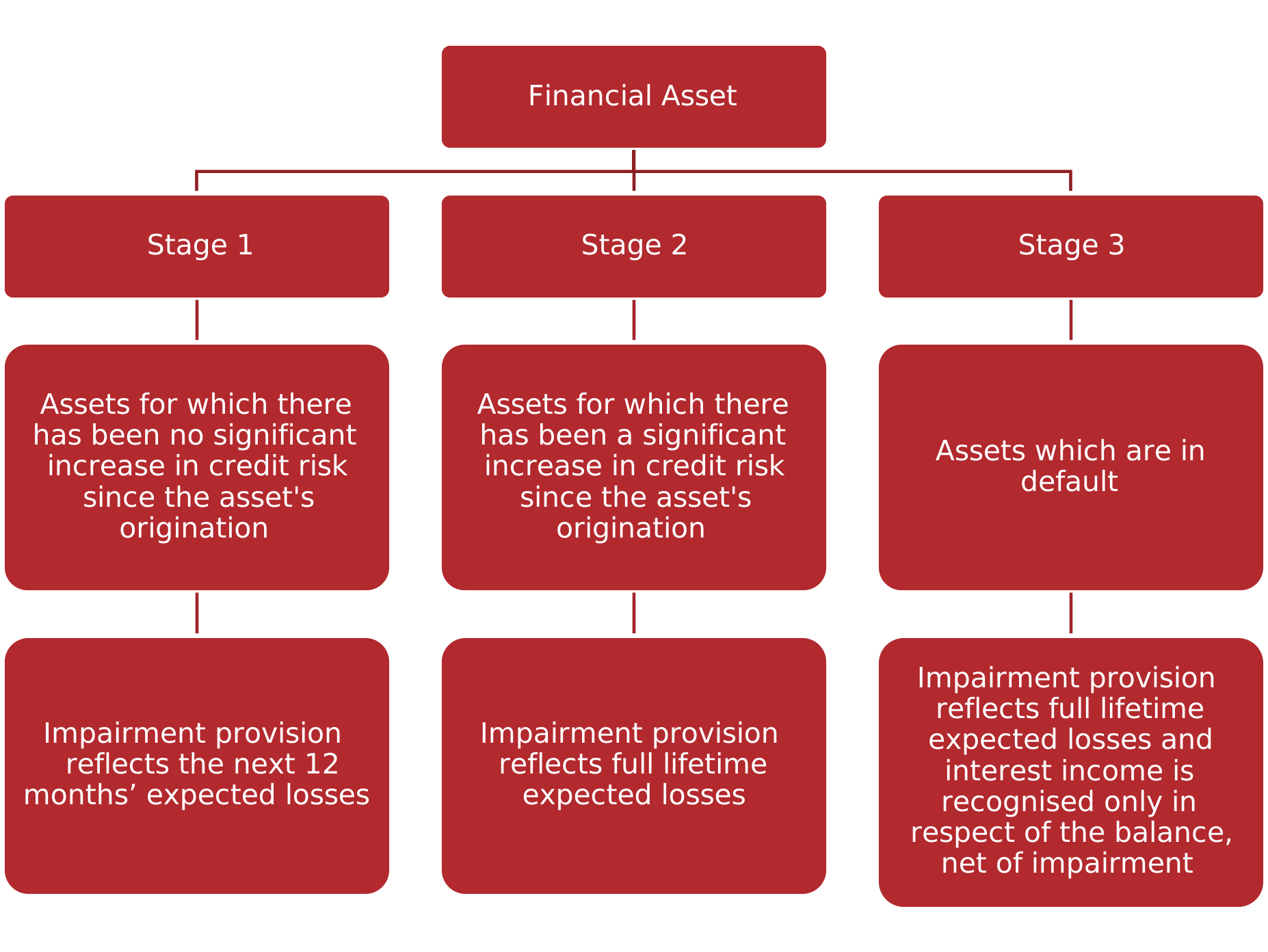
For trade receivables, contract receivables and lease receivables, the HM Treasury Group recognises impairment losses using the simplified approach as required by FReM. Under this approach, a lifetime ECL is recognised for all assets.
The amount of any impairment is measured as the difference between the asset’s carrying amount and the present value of estimated future cash flows taking account of potential defaults.[footnote 76] The present value of estimated future cashflows is based on a probability-weighted evaluation of a range of possible outcomes, based on historic, current and forward-looking information.
For loans and investment securities, the HM Treasury Group considers the probability of future delinquency in contractual payments of principal and interest, or cash flow difficulties experienced by the borrower. The likelihood of breach of loan covenants or conditions or any future deterioration in the value of collateral are also considered.
Derecognition
Financial assets are derecognised when the rights to receive cash flows from the financial assets have expired or the HM Treasury Group has transferred substantially all the risks and rewards of ownership.
12. Equity investments
Significant judgements and estimates
Equity investment – classification and measurement
Under IFRS 9 Financial Instruments, strategic investments in equity instruments which are not held for trading can be classified as held at Fair Value through Other Comprehensive Income (FVOCI) and all changes in fair value are taken to the Fair Value Reserve.[footnote 77] All equity investments held by HM Treasury Core and Agencies are classified in this category as these are held for the long term benefit of their operational activity to HM Treasury Group’s aims and objectives, and therefore changes in the fair value of these entities are not a measure of the entities’ contribution to the performance of the department.
The adjusted net asset value method has been used to measure fair value in the valuation of HM Treasury’s unlisted equity investments.[footnote 78] The fair value of the individual assets and liabilities recognised in each investee’s statement of financial position, adjusted where relevant for assets and liabilities whose carrying value differs from fair value and for the fair value of any unrecognised assets and liabilities at the measurement date, represent the fair value of the investee’s equity.
The Articles of Agreement of the European Bank for Reconstruction and Development (EBRD) specify that the net asset value is the value that HM Treasury would receive on the dissolution of the EBRD, though if HM Treasury were to unilaterally exit its involvement in the bank, this would be capped at the original purchase price of the UK’s shareholding. HM Treasury considers that in absence of a principal market, the adjusted net asset value provides the best information on the performance of the asset and value to the department.
Non-strategic portfolio equity investments, and rights to the residual net assets on wind up of entities with a limited life, are investments held for their return-generating potential. These have been classified to the held at Fair Value Through Profit or Loss (FVTPL) category. This means fair value movements go through profit or loss. See Note 15 – Revaluation of financial assets and liabilities in the SoCNE. The Group Portfolio investments arising from the activities of Pool Re and the National Wealth Fund (NWF) are classified in this category.
Equity investment – assessment of control
NWF’s equity and equity-like investments may result in gaining significant influence or joint control over the investee. Significant influence relates to the NWF’s ability to participate in the financial and operating policy decisions of the investee’s business.
Joint control is the contractually agreed sharing of control of an arrangement, which exists only when decisions about the relevant activities require the unanimous consent of the parties sharing the control.
In assessing whether or not significant influence or joint control exists, NWF considers the combined rights attached to the investment. Where rights are protective in nature, these do not meet the criteria for joint control over an investment. Board representation, specific consent or veto rights over relevant activities of the investee, combined with the NWF’s status as a cornerstone or a lead investor, are often indicative of significant influence even when NWF does not hold a minimum 20% of voting interest in the investee.
Each investment is considered individually to determine whether the Company is deemed to have significant influence over the investee. The NWF has elected to take the permitted scope exemption under IAS 28 Investments in Associates and Joint Ventures available for venture capital organisations and similar entities, which allows for the investments in the associates and joint ventures to be measured at Fair Value Through Profit or Loss in accordance with IFRS 9, instead of using the equity method of accounting when it is determined control exists.
The principal activities of NWF are aligned with the characteristics of venture capital organisations or similar entities: for instance, the NWF provides equity finance to unquoted companies and makes its returns mainly through medium-term capital gain. These activities might include startup and other early-stage expansion, management buy-out or management buy-in investment which includes an ‘equity type’ return.
Group – Equity Investments
| In £m | Core Department & Agencies | Reconciliation Core Department & Agencies to Departmental Group | Total Departmental Group | |||||||||
|---|---|---|---|---|---|---|---|---|---|---|---|---|
| Listed Entities | Unlisted Entities | Group Entities | Total Core Department & Agencies | |||||||||
| NatWest ordinary shares | Bank of England share capital | Asian Infrastructure Investment Bank (AIIB) | European Bank for Reconstruction and Development (EBRD) | Other Shareholdings | UK Asset Resolution Ltd (UKAR) | National Wealth Fund Ltd (NWF) | Reclaim Fund Ltd (RFL) | Remove: Intra-group eliminations | Add: Group portfolio investments | |||
| As at 1 April 2024 | 6,788 | 3,247 | 534 | 1,668 | 12 | 288 | 1,054 | 554 | 14,145 | (1,896) | 1,863 | 14,112 |
| Additions, disposals & transfers | (8,156) | – | – | – | – | – | 220 | – | (7,936) | (220) | 380 | (7,776) |
| Fair Value Adjustments | 2,685 | 395 | 16 | 144 | – | 7 | (86) | 15 | 3,176 | 64 | 42 | 3,282 |
| As at 31 March 2025 | 1,317 | 3,642 | 550 | 1,812 | 12 | 295 | 1,188 | 569 | 9,385 | (2,052) | 2,285 | 9,618 |
| Additions, disposals & transfers | (1,398) | – | – | 59 | – | – | 3,452 | – | 2,113 | (3,452) | 205 | (1,134) |
| Fair Value Adjustments | 81 | 798 | 12 | 200 | 1 | 5 | 636 | (124) | 1,609 | (517) | 135 | 1,227 |
| As at 31 March 2026 | – | 4,440 | 562 | 2,071 | 13 | 300 | 5,276 | 445 | 13,107 | (6,021) | 2,625 | 9,711 |
All equity investments are classed as non-current.
Equity investments – Information which provides more detail about transactions and balances
HM Treasury purchased shares in NatWest as part of the financial stability interventions made during the global financial crisis in 2008 and 2009. The shares in NatWest were not purchased for commercial reasons. The purchase of the shares and the resulting injection of capital were necessary to ensure the financial survival of the entity and to avoid a collapse of the UK banking sector. HM Treasury had been reducing the shareholdings in NatWest in line with the ‘trading plan’.
The trading plan involved selling shares in the market through an appointed broker, in an orderly way at market prices over the duration of the plan. UKGI, under the UKGI Framework Agreement, was responsible for the development and execution of an investment strategy for disposing of the investment in the NatWest Group, within the context of protecting and creating value for the taxpayer. The final shares were sold through the trading plan on 30 May 2025.
As a result of sales made during the financial year, the shareholding of HM Treasury has reduced from 3.6% of the ordinary share capital (291m shares) of NatWest Group at 31 March 2025 to nil by 30 May 2025, with NatWest Group returned to full private ownership.
The £0.2bn cumulative lifetime loss on disposal of these shares sold during 2025-26 has been released from the fair value reserve to the General Fund (see Statement of Changes in Taxpayers’ Equity).
The prior year fair value of the NatWest shareholding as at 31 March 2025 was based on the closing share price (which reflects the most recent trade at market close) of 451.8p.
HM Treasury, alongside other shareholders, have subscribed for additional ‘paid in capital’ in the European Bank for Reconstruction and Development (EBRD) to be paid in annual instalments until 2029. See Note 24 – Commitments. The investment is designed to improve the EBRD’s financial capacity in order to increase lending to support Ukraine’s resilience and reconstruction while maintaining activity in all its countries of operation.
Group portfolio investments contain the portfolios of equity investment holdings held by Pool Re and the National Wealth Fund and are measured at Fair Value Through Profit or Loss (FVTPL). Most of the Pool Re’s equity portfolio is public traded shares, plus mutual funds and venture capital, and the National Wealth Fund’s portfolio consists of investments in limited life funds, direct equity investments and convertible debt instruments.
See Note 5 – Finance income and expenses for dividends generated by equity investments.
Group shareholdings
In accordance with the FReM, additional details of significant shareholdings are shown below:
| In £m | Stake % | Total net assets | Entity’s reported profit/(loss) | Stake % | Total net assets | Entity’s reported profit/(loss) |
|---|---|---|---|---|---|---|
| 2025-26 | 2025-26 | 2025-26 | 2024-25 | 2024-25 | 2024-25 | |
| Bank of England | 100 | 5,977 | 132 | 100 | 5,604 | 105 |
The reported profit/(loss) and net assets is disclosed for the Bank of England’s reporting period to the end of February.
Financial risks from equity investments
Departmental Group
Group portfolio investments primarily relate to:
- Pool Re’s equity portfolio of public traded shares, plus mutual funds and venture capital.
- National Wealth Fund’s portfolio of investments in limited life funds, direct equity investments and convertible debt instruments.
Each of these entities invest in a variety of financial assets. Financial risk is managed at a portfolio level giving consideration to financial assets and liabilities held as outlined in Note 18 – Financial and Insurance Risk and Note 19 – Group financial instruments – fair value.
Financial risks held by HM Treasury core department which impact the group risk position are discussed below.
Core Department and Agencies
Market Risk – Currency Risk
Valuations of Asian Infrastructure Investment Bank (AIIB) and European Bank for Reconstruction and Development (EBRD) are denominated in foreign currency (USD and EUR respectively) so are subject to currency risk. However, no asset sales which would lead to the realisation of the fair value, or dividends are anticipated. HM Treasury also hold commitments which could lead to further investment in the EBRD and AIIB – disclosed in Note 24 – Commitments and Remote Contingent Liabilities – to which currency risk would apply.
13. Loans and investment securities
Significant judgements and estimates
In 2024-25 HM Treasury entered an agreement to provide £2.258bn to Ukraine under the Extraordinary Revenue Acceleration (ERA) initiative. The agreement has been accepted into the European Union’s Ukraine Loan Cooperation Mechanism (ULCM). As of 31st March 2026, £1,506m[footnote 79] of cash had been advanced to Ukraine under this agreement. At 31st March 2026, a further £753m was due to be drawn in April 2026, subject to qualifying conditions being met. This criterion was met in April 2026 – see Note 29 – Events after the reporting period for further details.
To the extent that such funds are generated, HM Treasury is entitled to receive a share of profits generated from the reinvestment of cash arising from Russian Sovereign assets held by International Central Securities Depositories in the EU (primarily Euroclear), or any reparation payments received by Ukraine. The extent to which the loan advanced to date, and future loans, are repaid to HM Treasury will be dependent on:
- The performance of assets in which cash from Russian Sovereign assets are invested;
- The duration of the application of the Ukraine Loan Cooperation Mechanism legislation; and
- The outcome of the war, including its timing and the terms and conditions agreed regarding Russian Sovereign assets and the level of reparation payments.
HM Treasury has made the judgement that the cashflow entitlements are not solely payments of principal and interest, and so the loan is held at fair value through profit and loss, consistent with IFRS definitions. The terms of the loans are considered to be below market rate, and so the fair value of future loan commitments require recognition in the Statement of Financial Position (SoFP).
HM Treasury is required to determine the fair value for the loan and future loan commitments at initial recognition and as at the reporting date. A fair value is determined by applying assumptions that would be adopted by market participants to determine a set of future income receipts, which are then discounted using discount rates set out in the FReM. Assumptions regarding whether future loans will be drawn is also required for loan commitments.
The events which will impact risk adjusted cashflows and loan draw down are highly uncertain and have a significant risk of resulting in a material adjustment to the carrying amounts of any loan asset or loan commitment liability within the next financial reporting year.
For the purposes of valuation, HM Treasury has adopted a set of assumptions that a hypothetical market participant might reasonably make in the current circumstances. These assumptions do not represent the position of the UK Government on the renewal of EU sanctions or anticipated outcomes regarding the war or related sanctions. Rather, they reflect HM Treasury’s assessment that the level of uncertainty beyond the short term is so significant that a market participant would be unlikely to ascribe value to longer-term cashflows. In determining the assumed timing for the resolution of the war and associated sanctions, HM Treasury has relied on publicly available information from the International Monetary Fund (IMF), which presents a ‘base case scenario’ and ‘downside’ scenarios assuming resolution of the conflict by the end of 2026 and 2027, alongside other publicly available assessments.
No ‘market’ currently exists for such assets; one would only arise if the UK or other participants in the UCLM began to trade these or similar loans. Therefore, it is assumed that a theoretical market participant would apply an income approach to fair value measurement. The market approach is not applicable due to the absence of comparable market data, and the cost approach is not appropriate given the nature of the asset as a non-recourse loan. Other government debt instruments, such as gilts and bonds, are not comparable due to their different terms and direct recourse to the issuing government.
Sensitivity analysis relating to these assumptions can be found in the Financial Risks from Loans and Investment Securities section below.
The above assumptions lead to a fair value for the advanced loan that is significantly lower than the transaction price (cash advanced). HM Treasury considered this difference to be a government grant, in line with the FReM interpretation, and is recognised in the Statement of Comprehensive Net Expenditure (SoCNE) immediately in 2024-25. This can be seen in Note 7 – Operating Costs.
The fair value upon entering the commitment to advance a future loan tranche is reflected in the Statement of Financial Position (SoFP) as a liability at year end and associated expense is reflected in Note 7 – Operating Costs. In line with the above assumptions, the liability and expense represent the expected loss on the April 2025 and April 2026 commitment.
13.1 Group Loans and investment securities
| In £m | Core Department & Agencies | Reconciliation Core Department & Agencies to Departmental Group | Departmental Group | |||||||
|---|---|---|---|---|---|---|---|---|---|---|
| Loans held at amortised cost | ERA loan held at FVTPL | Total Core Department & Agencies | Remove: Intragroup Eliminations | Add: Loans held at amortised cost by consolidated entities | Loans held at amortised cost | ERA loan held at FVTPL | Fixed income investment securities held at amortised cost | Fixed income investment securities held at FVTPL | Total Departmental Group | |
| At 1 April 2024 | 155 | – | 155 | (141) | 593 | 607 | – | 328 | 5,545 | 6,480 |
| Advances and purchases | 1,072 | 297 | 1,369 | (1,072) | 899 | 899 | 297 | 240 | 6,626 | 8,062 |
| Redemptions, repayments & transfers | (230) | – | (230) | 230 | (9) | (9) | – | (104) | (6,730) | (6,843) |
| Revaluations | – | – | – | – | (32) | (32) | – | – | (29) | (61) |
| At 31 March 2025 | 997 | 297 | 1,294 | (983) | 1,451 | 1,465 | 297 | 464 | 5,412 | 7,638 |
| Advances and purchases | 3,185 | – | 3,185 | (3,185) | 5,720 | 5,720 | – | 183 | 4,730 | 10,633 |
| Redemptions, repayments & transfers | (1,110) | (79) | (1,189) | 1,101 | (357) | (366) | (79) | (170) | (4,567) | (5,182) |
| Revaluations | – | 234 | 234 | – | (64) | (64) | 234 | 5 | 36 | 211 |
| At 31 March 2026 | 3,072 | 452 | 3,524 | (3,067) | 6,750 | 6,755 | 452 | 482 | 5,611 | 13,300 |
For the Departmental Group: As of 31 March 2026, £1,294m (2024-25: £1,128m) of loans and investment securities are classed as expected to be received within 1 year. £12,006m (2024-25: £6,510m) are expected to be received in greater than 1 year.
For the Core Department and Agencies: As of 31 March 2026, £1,165m (2024-25: £707m) of loans and investment securities are classed as expected to be received within 1 year. £2,359m (2024-25: £586m) are expected to be received in greater than 1 year.
Of the loan assets held at amortised cost by the core department, £3,067m (2024-25: £983m) relate to intercompany loans made to the National Wealth Fund (NWF), which eliminate at group level. All the drawdowns and repayments during the year relate to these loans.
The NWF in turn holds loans, recognised at amortised cost, and Fair Value Through Profit and Loss (FVTPL), helping deliver the government’s growth and clean energy missions, generating a return for the taxpayer and crowding in private capital. During the year, the NWF advanced £5,720m in respect of loans across the private and public sector (2024-25: £899m), of which £4,322m related to drawdowns on its loan to Sizewell C[footnote 80] (2024-25: £nil).
Fixed income investment securities held at amortised cost are held by Reclaim Fund Ltd as part of the ongoing investment strategy. A highly liquid, secure position is maintained, with maturing bonds and coupons generated from the portfolio being re-invested.
Fixed income investment securities held at fair value through profit and loss (FVTPL) are held by Pool Re as part of its ongoing investment strategy. The majority of the holdings are government and corporate bonds. The financial risks associated with these assets and management of them is outlined in Note 18.3 Financial and Insurance Risk: group.
Financial Risks from Loans and investment securities
Departmental Group
Exposure to financial risk is managed across each of NWF, Reclaim Fund and Pool Re’s portfolio of financial assets and liabilities, as outlined in Note 18 – Financial and Insurance Risk and Note 19 – Group financial instruments – fair value.
Core Department and Agencies
HM Treasury’s loan to the National Wealth Fund exposes the core department to the underlying financial risks associated with NWFs activities.
HM Treasury’s Loan under the Extraordinary Revenue Acceleration (ERA) initiative to Ukraine exposes HM Treasury to a number of risks, including market risk. The significant judgements made in reaching a valuation of the loan asset and associated loan commitment liability are discussed in the significant judgements and estimates section above. The impact of the following assumptions are discussed below.
| Assumption | Degree of uncertainty | Sensitivity of output to change in input |
|---|---|---|
| EU Sanction End Date | High | High |
| Market Risk – Rate of Return | Medium | High |
| Reparation Payments | High | High |
EU Sanction End Dates
The total undiscounted value outstanding on the loans advanced and associated accrued interest to date, currently due to HM Treasury at year end was £1,515m (2024-25: £756m).
The undiscounted value of cash still to be advanced at year end for the loan commitment is £753m (2024-25: £1,505m).
The fair value of the loan asset and loan commitment liability are considered from a market participant’s perspective and are produced using a risk-weighted probability method applied to expected cashflows. Probabilities have been assigned to:
- the present value of cash inflows that HM Treasury expects to receive based on current modelled profit expectations at a number of different EU sanction receipt dates; and
- the present value of cash expected to be paid in respect of year end loan commitments.
There remains a high level of uncertainty in the assigned risk-weighted probabilities, and the valuation of the loan asset and liability are highly sensitive to changes in these.
The table below shows the present value of cumulative expected cashflows, assuming that between now and the date shown, current EU sanctions continue, all loans are advanced and no other status changes occur.
Based on current predicted returns on immobilised Russian Sovereign assets, HM Treasury may reasonably expect full repayment of the £2.26bn within approximately fourteen years.
The table below shows the current total predicted cash inflows HM Treasury expects to receive if sanctions are not renewed beyond the dates shown. The timing and value of actual cashflows received by HM Treasury may differ due to rate of return, see market risk discussion below.
For all the dates shown, the total cash outflow for HM Treasury will be £2,259m, as all three tranches of the loan have been advanced (see Note 29 – Events after the reporting date).
EU Sanctions not renewed in:
| £m | July 2026 | January 2027 | January 2028 | January 2031 | January 2036 | January 2040 |
|---|---|---|---|---|---|---|
| Cash inflow | 137 | 198 | 333 | 813 | 1,685 | 2,266 |
Market Risk
The timing and amount of interest and principal repayments will depend on the return generated on immobilised Russian Sovereign assets. This would impact the present value of the cash inflows to which the risk-weighted average probability method is applied. Modelling an expected return rate that is 1% lower, would change the value of the loan asset recognised at 31 March 2026 to £305m, a decrease of £147m (2024-25: £190m with a decrease of £107m).
Reparation payments
The agreement of reparation payments could lead to a range of possible future income amounts, including full repayment of the accrued interest and the cash value advanced as a loan. HM Treasury would be entitled to reparation payments from the point they are provided to Ukraine.
Accounting Policy: Financial Instruments: financial liabilities
Initial recognition, measurement and classification
Financial liabilities are initially recognised, at fair value, on the date on which HM Treasury becomes party to the contractual provisions of the instrument.
Financial liabilities are classified on initial recognition as either at Fair Value Through Profit or Loss (FVTPL), or financial liabilities measured at amortised cost:
| Financial liabilities at FVTPL | Financial liabilities at FVTPL are liabilities that are: – derivatives, which are always required to be measured on this basis – those held for trading because the investment strategy involves managing and evaluating performance on a fair value basis – those designated as at FVTPL because it would reduce a measurement inconsistency from measuring related assets and liabilities on different bases, including a loan commitment related to the ERA loan. |
| Financial liabilities measured at amortised cost | Financial liabilities measured at amortised cost include non-derivative financial liabilities with fixed or determinable payments intended to be held to maturity, trade and other payables, borrowings and bank overdrafts. |
Loan commitment recognition
Where a commitment is made to provide a loan at below market rates, the fair value of the commitment is recognised on the Statement of Financial Position when the agreement is entered into. These fair values are disclosed in Note 13.2 – Below market rate commitments. These commitments can be subsequently measured at the higher of expected credit loss and the amounts initially recognised less, where appropriate, the cumulative amount of income recognised in accordance with the principles of IFRS 15, or designated as Fair Value Through Profit or Loss (FVTPL).
Under IFRS 9 Financial Instruments an impairment provision for expected credit losses is required to be held against all other undrawn loan commitments. The impairment provision for each loan considers the expected drawdown on the loan commitment. The impairment provision is reflected in the statement of financial position as a liability and included in Note 10 – Trade and Other Payables.
Loan commitments are also reported in Note 24 – Commitments. The value of the cash promised to be available for draw down when called (i.e. without adjustment for any on-balance sheet amounts) is disclosed within this note.
Subsequent Measurement
Non-derivative financial liabilities are subsequently measured at amortised cost using the effective interest rate (EIR) method or at FVTPL.
Derivatives are measured initially at fair value and subsequently re-measured to reflect changes in fair value. Fair values are obtained from quoted market bid prices in active markets and, where these are not available, from other valuation techniques including discounted cash flow models. See also Note 19 – Group financial instruments – fair value.
Derecognition
Financial liabilities are derecognised if the HM Treasury Group’s obligations specified in the contract expire, are discharged or cancelled.
13.2 Below market rate loan commitments
| In £m | Core Department & Agencies | Departmental Group | Core Department & Agencies | Departmental Group |
|---|---|---|---|---|
| 2025-26 | 2025-26 | 2024-25 | 2024-25 | |
| ERA loan commitments | (753) | (753) | (1,278) | (1,278) |
| Total | (753) | (753) | (1,278) | (1,278) |
| Current | (753) | (753) | (753) | (753) |
| Non-current | – | – | (525) | (525) |
14. Derivatives
| In £m | Note | Core Department & Agencies | Departmental Group | Core Department & Agencies | Departmental Group |
|---|---|---|---|---|---|
| 2025-26 | 2025-26 | 2024-25 | 2024-25 | ||
| Balance at 1 April | (171,908) | (171,832) | (173,389) | (173,404) | |
| Cash movements | 16,660 | 16,538 | 36,323 | 36,271 | |
| Fair value gain/(loss) | 15 | (11,756) | (11,791) | (34,842) | (34,699) |
| Balance at 31 March | (167,004) | (167,085) | (171,908) | (171,832) | |
| Current derivative financial assets | – | 21 | – | 98 | |
| Current derivative financial liabilities | (167,004) | (167,106) | (171,908) | (171,930) |
£167.0bn (2024-25: £171.9bn) is attributable to the Bank of England Asset Purchase Facility Fund Ltd (BEAPFF) derivative liability. Pool Re holds derivative assets of £21m (2024-25: £98m) and £102m of derivative liabilities (2024-25: £22m).
The BEAPFF is a wholly owned subsidiary of the Bank of England that was set up to implement quantitative easing in the UK at the direction of the Bank’s Monetary Policy Committee (MPC) under its statutory responsibilities. The BEAPFF purchased UK government gilts and corporate bonds from the secondary market. This was financed by the creation of central bank reserves which were loaned from the Bank of England to the BEAPFF – with a maximum authorised size as of 31 March 2026 of £555.0bn. The Bank is currently unwinding the BEAPFF, reducing the assets and liabilities held in the fund, through a programme of gilt sales. As assets held in the APF mature, or are sold back to the market, the proceeds are used to repay the Bank of England loan originally used to purchase those assets. Further information can be found in BEAPFF’s Annual Report and Accounts and the Asset Purchase Facility Quarterly Reports.
HM Treasury provides an indemnity to the Bank of England for any losses and entitles HM Treasury to any profits, which arise from operating the BEAPFF.
The indemnity is a derivative, and it is valued based on the difference between the fair value of the BEAPFF’s assets and liabilities (excluding the indemnity itself) at 31 March prices. This represents the theoretical amount due from HM Treasury to the BEAPFF at 31 March, if all assets were sold at current prices on that date and the current unrealised losses based on market valuations were therefore crystallised, resulting in an immediate shortfall of cash that would be paid from HM Treasury to BEAPFF to settle the Bank of England loan.
The derivative value is impacted by:
Fair value movements in underlying assets and liabilities – during the year there was a downwards fair value adjustment of £11.8bn (2024-25: downwards £34.8bn) arising from changes in the fair value of underlying assets and liabilities.
The underlying assets, other than the derivative itself, mainly comprise the portfolio of gilts held by the BEAPFF and are valued at market rates. The fair value adjustment is mainly driven by the decrease in the market value of the gilt holdings held within the BEAPFF.
The fair value of assets are derived from quoted prices from commercial providers, the market value of the gilt portfolio held by BEAPFF at 31 March 2026 was £363bn. A 5 percent increase in the quoted price would lead to a 5 percent (£18bn) increase in the fair value of the portfolio. The exposure to market risk associated with this derivative is discussed below.
The company’s liabilities mainly consist of the loan from the Bank of England. The outstanding loan totalled £553bn at 31 March 2026 (2024-25 £655bn).
Interest rate differentials between the yields on the asset holdings and the loan from the Bank of England at Bank Rate also contributed to the fair value adjustment.
Cash transfers – The indemnity agreement between HM Treasury and the Bank of England requires any excess funds held by the Asset Purchase Facility (APF), to be transferred to HM Treasury, and for HM Treasury to transfer funds to the APF when it expects a cash shortfall. As the BEAPFF portfolio continues to unwind, the quarterly cash transfers, which had historically been from the BEAPFF to HM Treasury, now flow from HM Treasury to the BEAPFF. This is when BEAPFF needs cash to repay its loan from the Bank of England that financed the underlying assets that have been disposed of. This was expected as quantitative easing was unwound, and gilts were sold back into the market.
| In £bn | Cash transfers |
|---|---|
| Lifetime cash transfers from BEAPFF to HMT 1 April 2024 | 74.3 |
| Cash transfers from HMT to BEAPFF 2024-25 | (36.3) |
| Lifetime cash transfers from BEAPFF to HMT 31 March 2025 | 38.0 |
| Cash transfers from HMT to BEAPFF 2025-26 | (16.7) |
| Lifetime cash transfers from BEAPFF to HMT 31 March 2026 | 21.3 |
Cash transfers to HM Treasury received in previous years were paid from interest payments on purchased gilts, net of interest and other costs.
The quarterly cash transfers to the BEAPFF, and any residual settlement of the derivative, are accounted for via HM Treasury’s Supply Estimate and are recorded as Capital Annually Managed Expenditure (Capital AME).
Ultimate cost
The total ultimate cost of the scheme falling to HM Treasury based on market prices at 31 March 2026 is £146bn (2024-25: £134bn). This represents the difference in the value of the liability of the BEAPFF derivative for HM Treasury and net cash transfers to HM Treasury over its life. The actual cost of the scheme to HM Treasury will only be known once the BEAPFF has sold all of its assets, the related market gains and losses have crystallised and the bank loan has been repaid. The amount due to or from HM Treasury under the indemnity however does not indicate whether the public sector as a whole made a profit or loss from the operations of the BEAPFF.
Financial Risks from derivatives
Departmental Group
Financial risks associated with Group derivatives arise primarily on BEAPFF derivate held by HM Treasury core department discussed below. Pool Re’s financial risks are managed over its portfolio of financial assets and liabilities; more information can be found in Note 18 – Financial and Insurance risk.
Core department and agencies
The core department considers the following financial risks arising from the BEAPFF derivative:
Market risk
Market risk is the risk that the fair value of a financial instrument will fluctuate due to changes in market prices. It is difficult to predict the movement in the BEAPFF derivative because the fair value of its financial assets are re-priced in response to market changes such as market gilt yields. During the year, the BEAPFF derivative experienced fair value losses of £11.8bn (2024-25: £34.8bn), with fair value movements driven by £11.4bn of losses during the year generated by the interest rate differential between the gilt assets and bank loan liability of the BEAPFF (2024-25: £19.3bn loss) and £0.3bn of market-value losses within its portfolio (2024-25: £15.5bn loss).
Market risk is not managed to obtain a specific return from amounts invested or with a primary purpose of preserving asset value. The Bank of England manages risk associated with BEAPFF on HM Treasury’s behalf. Subject to the policy objectives, the aim is to minimise overall risk through the appropriate choice of portfolio and risk management practices. A set of high-level financial risk parameters are in place for the BEAPFF’s operations, including eligible asset classes, investment limits and interest rate risk. Whilst the Monetary Policy Committee (MPC) retains independence for setting monetary policy, HM Treasury can provide views to the MPC on the design of the schemes within the BEAPFF as they may affect the government’s broader objectives.
The table below summarises the maximum authorised size of the BEAPFF at 31 March 2026.[footnote 81] The Chancellor and Governor agreed that the authorised maximum size of the APF would be reduced every 6 months in line with the reduction of assets. The size of the Bank of England loan to the BEAPFF will reduce gradually as the BEAPFF unwinds.
| In £bn | 31 March 2026 | 31 March 2025 |
|---|---|---|
| Government bond purchases | 555.0 | 654.5 |
| Total quantitative easing package | 555.0 | 654.5 |
Market risk associated with the BEAPFF derivative arises as a natural consequence of its policy objectives, principally through market changes re-pricing its assets. Interest rate risk is monitored in the form of a risk sensitivity measure, known as a delta. The delta is a change in valuation of BEAPFF underlying assets with a 50-basis point increase in market interest rates. The delta on 31 March 2026 was £13.4bn (2024-25: £15.8bn).
Risk is also monitored through value at risk, given the historic volatility on the returns of assets, and the correlation between their returns. Value at risk estimates the potential loss that might arise if existing positions were unchanged for 10 business days under normal market conditions. The value at risk at 31 March 2026 was £14.2bn (2024‑25: £11.7bn), the increase reflecting the increased market volatility at the end of the reporting period.
Credit risk
There is minimal credit risk arising on the indemnity itself because BEAPFF is wholly owned by the Bank of England and the value of the indemnity on wind up will be equal to the cash held in the company.
Liquidity risk
Liquidity risk is the risk that the Group is unable to meet its payment obligations associated with its financial liabilities as they fall due.
HM Treasury is required to make payments to the BEAPFF when the BEAPFF’s short-term cash needs are greater than its cash reserves. This happens if losses arise from gilt sales and redemptions below the initial purchase price funded by the Bank loan or the Bank Rate exceeds the coupon rate for the gilt holdings.[footnote 82]
Due to the magnitude of the financial stability interventions, liquidity requirements can fluctuate significantly. HM Treasury’s liquidity management controls include monitoring cash flows to ensure that daily cash requirements are met, assessing the net cash requirement on a regular basis and reporting this to Parliament through Estimates. HM Treasury is not exposed to significant liquidity risk because it can apply for Parliamentary approval for additional cover to pay for any liquidity gap.
15. Revaluation of financial assets and liabilities in the Statement of Comprehensive Net Expenditure (SoCNE)
| In £m | Core Department & Agencies | Departmental Group | Core Department & Agencies | Departmental Group |
|---|---|---|---|---|
| 2025-26 | 2025-26 | 2024-25 | 2024-25 | |
| Fair value (gain)/loss on derivatives | 11,756 | 11,791 | 34,842 | 34,699 |
| Fair value (gain)/loss on financial assets and liabilities held at fair value through profit or loss (FVTPL) | (359) | (559) | (420) | (436) |
| FX movements on financial instruments held at amortised cost | (52) | (52) | 34 | 34 |
| Total | 11,345 | 11,180 | 34,456 | 34,297 |
For an explanation of the change in the fair value on derivatives refer to Note 14 – Derivatives.
The fair value gain in financial assets held at FVTPL primarily relates to elements of the EU Financial Settlement. See also Note 16 – EU Financial Settlement, Note 8 – Trade and other receivables, Note 12 – Equity investments and Note 10 – Trade and other payables.
16. EU Financial Settlement
Accounting Policies: The accounting policies relating to Financial Instruments and Provisions are applicable to the EU Financial Settlement transactions and balances.
Summary
The UK left the European Union (EU) on 31 January 2020 under terms defined by the Withdrawal Agreement. The Agreement includes a Financial Settlement and sets out the various rights and obligations of the UK and EU during the transition period and beyond. These include financial rights and obligations that fall to HM Treasury.
The UK is the counterparty to the Withdrawal Agreement, and HM Treasury is the department with responsibility for managing the Financial Settlement, and so balances and transactions relating to the EU Financial Settlement sit within the core department and group figures disclosed within the financial statements. This note to the accounts discusses the Withdrawal Agreement element of the following notes to the Financial Statements:
Note 8 – Trade and other receivables,
Note 10 – Trade and other payables,
Note 20 – Provisions,
Note 21 – Contingent Assets; and
Note 22 – Contingent Liabilities
Remote contingent liabilities (unquantifiable and quantifiable) are discussed in the parliamentary accountability disclosures.
The tables and narrative below detail the financial rights and obligations that fall to HM Treasury and are contained in the notes referenced above. Details of expected timing of receipts and payments are provided to illustrate exposure to liquidity risk.
EU Financial Settlement – Summary
| Article | Brief Description | SoFP Area | Gross discounted payments (£m) 2025-26 | Gross discounted payments (£m) 2024-25 | Expected time period for receipt/payment | ||||||||||||||||||
| 2026 | 2027 | 2028 | 2029 | 2030 | 2031 | 2032 | 2033 | 2034 | 2035 | 2036 | 2037 | 2038 | 2039 | 2040 | 2041 | 2042 | 2050 onwards | 2064 onwards | |||||
| 136 | Own resources | Receivables | – | 106 | FVtPL asset | FVtPL asset | FVtPL asset | FVtPL asset | |||||||||||||||
| Payables | (94) | (99) | FVtPL liability | FVtPL liability | |||||||||||||||||||
| 140 | Reste à Liquider | Receivables | 136 | 123 | FVtPL asset | FVtPL asset | FVtPL asset | FVtPL asset | FVtPL asset | FVtPL asset | FVtPL asset | FVtPL asset | FVtPL asset | FVtPL asset | FVtPL asset | FVtPL asset | FVtPL asset | FVtPL asset | FVtPL asset | FVtPL asset | FVtPL asset | ||
| Payables | (148) | (379) | Amortised cost liability | ||||||||||||||||||||
| Provision | (1,375) | (2,400) | Provision | Provision | Provision | Provision | Provision | ||||||||||||||||
| 141 | Fine Revenue | Receivables | 153 | 407 | FVtPL asset | ||||||||||||||||||
| 142 | Pension Liabilities | Payables | (126) | (143) | Amortised cost liability | Amortised cost liability | Amortised cost liability | Amortised cost liability | Amortised cost liability | Amortised cost liability | |||||||||||||
| Provision | (6,952) | (7,043) | Provision | Provision | Provision | Provision | Provision | Provision | Provision | Provision | Provision | Provision | Provision | Provision | Provision | Provision | Provision | Provision | Provision | Provision | Provision | ||
| 143 | Loans | Receivables | 608 | 657 | FVtPL asset | FVtPL asset | FVtPL asset | FVtPL asset | FVtPL asset | FVtPL asset | FVtPL asset | FVtPL asset | FVtPL asset | FVtPL asset | FVtPL asset | FVtPL asset | FVtPL asset | FVtPL asset | FVtPL asset | FVtPL asset | FVtPL asset | FVtPL asset | |
| Payables | (1) | (2) | FVtPL liability | FVtPL liability | FVtPL liability | FVtPL liability | FVtPL liability | FVtPL liability | FVtPL liability | FVtPL liability | FVtPL liability | FVtPL liability | FVtPL liability | FVtPL liability | FVtPL liability | FVtPL liability | FVtPL liability | FVtPL liability | FVtPL liability | ||||
| 144 | Financial Instruments | Receivables | 280 | 304 | FVtPL asset | FVtPL asset | FVtPL asset | FVtPL asset | FVtPL asset | FVtPL asset | FVtPL asset | FVtPL asset | FVtPL asset | FVtPL asset | |||||||||
| 145 & 146 | Assets | Receivables | – | 36 | |||||||||||||||||||
| 147 | Legal Cases | Provision | (27) | (87) | Provision | ||||||||||||||||||
| 150 | European Investment Bank | Receivables | 1,328 | 1,478 | Amortised cost asset | Amortised cost asset | Amortised cost asset | Amortised cost asset | Amortised cost asset | Amortised cost asset | |||||||||||||
| SoFP Totals | Receivables (Note 8) | 2,505 | 3,111 | ||||||||||||||||||||
| Payables (Note 10) | (369) | (623) | |||||||||||||||||||||
| Provisions (Note 20) | (8,354) | (9,530) | |||||||||||||||||||||
| Total | (6,218) | (7,042) | |||||||||||||||||||||
| Quantified Contingent assets and liabilities | |||||||||||||||||||||||
| Assets (141) | 709 | 832 | |||||||||||||||||||||
| Liabilities (136 & 147) | (89) | (71) | |||||||||||||||||||||
| Remote liabilities (150) | (32,562) | (31,075) | |||||||||||||||||||||
Article 136 – “Provisions applicable after 31 December 2020 in relation to own resources” known as ‘Own Resources’
The UK remains party to corrections and adjustments to VAT and gross national income contributions which were historically included in the calculation of future years’ EU budget contributions. These are now met through the Withdrawal Agreement. The fair value of the net liability arising from this element is £94m (2024-25 £7m net asset).
Under the Withdrawal Agreement Act 2020, sums required to be paid to the EU to meet obligations in respect of Traditional Own Resources (TOR) are charged on and paid out of the Consolidated Fund. In the event there are net cash flows from the EU to the UK rather than the usual payment to the EU, the Consolidated Fund does not have the legal basis to settle the TOR obligation for months where the liability is offset by funds flowing into the UK. When there is a net payment due to the EU, the equivalent TOR obligations for the period will always be met by the Consolidated Fund.
HM Treasury holds a contingent liability of £19m (2024-25: £58m) in respect of this. This represents the maximum exposure of future payments in respect of the TOR and can only crystallise if there are further net cash flows from the EU to the UK while the TOR is outstanding.
Article 140 – “Outstanding Commitments” known as the Reste à Liquider (RAL)
The UK remains responsible for its share of the EU Budget commitments made during the UK’s participation in the EU Budget over the 2014-20 Multiannual Financial Framework (MFF) (ending December 2020).
The RAL represents EU budgetary commitments that have been made and are expected to result in payments by the EU in the future. Budgetary commitments that are subsequently decommitted, for example where the underlying programme does not go ahead, are removed from the RAL. The UK is only liable to pay a share of RAL at the end of 2020 to the extent it crystallises as payments by the EU.
Significant judgements and estimates
The obligation in respect of the RAL is estimated based on information in EU Budgets adopted on or before 31 March 2026 and associated budgetary implementation data provided to Member States and the UK. The post 2020 financing share is applied to commitments in EU Budgets up to 2020 and adjusted for forecast implementation.
Under the Withdrawal Agreement (Article 140) the UK is only liable for EU obligations that materialise under the RAL, i.e. the UK pays for the level of commitments actually spent by the EU. HM Treasury improves and adjusts its decommitment adjustment to reflect new data provided to the UK on outturn levels of decommitments. The estimated level of decommitments (i.e. commitments that do not lead to payments) is based upon historical decommitment rates for the relevant programmes at the end of a MFF period, with an experience adjustment applied as new outturn data on the current framework period is received. This results in an assumed average rate of 10.5%, which is consistent with outturn over 2021-25.
Alternative approaches are available. For example, the European Union publish their own expectations for decommitments for programmes under the previous MFF, and modelling based on these assumptions would result in an assumed annual rate of 50.4%. However, the levels of decommitments estimated are an area of forecast uncertainty, with limited data available for analysis. HM Treasury considers the historical decommitment rate-based approach to be the best available, as it overcomes issues in uncertainty in forecast methodology and further judgements, such as distribution of decommitments over future years.
To provide further clarity for illustrative purposes, the outstanding value of Gross UK-specific RAL commitments at the end of 2025 is estimated at £2,019m, of which HM Treasury estimates £261m will be decommitted. As mentioned above, the UK does not pay the ‘Gross RAL’ value to the EU as the amount paid is relative to the value of RAL less decommitments in arrears, based on the EU’s actual spend. Further analysis on the sensitivity around decommitments is provided below.
The RAL liability represented most of the provisioned settlement.
Current forecasting estimates that the liability represented by the provision in the accounts will be fulfilled within eight years of the first payment. The payment obligations with the greatest amounts crystallised in the earliest years, with payments reducing sharply as time passes, with a provision of £1.4bn remaining at 31 March 2026 (2024-25: £2.4bn).
The sensitivity of the total EU related provision value to key assumptions which are relevant to all Articles are outlined in Note 16 – EU Financial Settlement.
Specific to RAL is the assumption relating to decommitments as set out above. The impact on the valuation of provisions from this assumption is:
| Assumption | Change | Degree of Uncertainty | Sensitivity of output to change in input | Financial impact in £m |
|---|---|---|---|---|
| Decommitments – the proportion of EU Budgetary commitments in the RAL that are not implemented | A decrease of 5 percentage points | High | Moderate | An increase of £11m |
The UK’s liability will be reduced by a number of items. For instance; the amount of net financial corrections; the proceeds of any Member State Making Available Resources infringements; and Traditional Own Resources adjustments. The fair value of the asset arising is estimated to be £136m (2024-25: £123m).
£148m (2024-25: £379m) is payable from the UK to the EU. This represents the amounts payable from formal notification of the amounts due at 31 March and transferred from the provision for this article.
Article 141 – “Fines decided upon before or on 31 December 2020” known as ‘Fines’
The UK is entitled to a share of EU fine income that relates to activity up to, and in exceptional cases after, 31 December 2020. This includes circumstances where collection of the fine income arises post UK exit. The fair value of the fine income asset is estimated to be £153m (2024-25: £407m). The decrease is mainly driven by a large competition penalty becoming definitive during the prior year.
A contingent asset is disclosed in relation to the fine income where the likelihood of cash inflow is dependent on the EU successfully winning the case and this likelihood is assessed to be probable. Previous contingent assets under this article that are no longer the subject of ongoing litigation and are therefore no longer contingent appear in the fine income asset.
The estimated value of the contingent asset is based on fines issued by the EU, but not yet definitive and adjusted for fines expected to be issued relating to past performance. HM Treasury’s current best estimate of the contingent asset related to fine income is £709m (2024-25: £832m). The timing and amount of the contingent asset is sensitive to the final judgments on a small number of very large competition fines. The largest two cases make up 76% of the contingent asset.
Article 142 – “Union liabilities at the end of 2020” known as ‘Pension Liabilities’
The UK will pay a share of the EU’s payments for the employment and other related benefits accrued by EU employees up to the end of 2020. Specifically, these benefits are materially comprised of pensions schemes and the Joint Sickness Insurance Scheme (JSIS).
Significant judgements and estimates
The remaining UK obligation in respect of EU pensions is estimated based on full membership and salary data supplied by the EU to the UK as at 31 December 2022. Projected forward to the assumed date of scheme members’ exit, applying the UK post-2020 financing share to the remaining end-2020 EU pension obligations, and discounted. Specifically, these benefits are materially comprised of pensions schemes for EU high-level public officials.
The obligation in respect of JSIS is an estimate based on the UK’s post-2020 financing share of the employer contributions to JSIS made on payment of the pension, to the extent the pension was accrued prior to 31 December 2020. This obligation therefore follows the same profile as estimated for the EU pensions. The contribution rate applied to the pre-tax pension payments as at 31 March 2026 was 3.4% as set out by legislation.
The Withdrawal Agreement provides the UK with an option of early settlement on a different valuation basis. Management has valued the provision using the default calculation basis set out at the beginning of paragraph 6 of Article 142 of the Withdrawal Agreement. This assumes that HM Treasury will not invoke the early settlement option, as this is considered to be management’s current best estimate of how this obligation will be settled.
The accounting valuations for the pension related liabilities are sensitive to actuarial assumptions (e.g. life expectancy, inflation, retirement age) for defined benefit pension obligations. Life expectancy is drawn from the most recent Eurostat mortality expectations for scheme members in 2023, adjusted for Office for National Statistics (ONS) changes to mortality data since then. The inflation assumption is based on central government rates set by HM Treasury and promulgated in Public Expenditure System papers. The retirement age assumption is drawn from the EU’s 2025 assessment of the Pension Scheme for EU Officials (PSEO) population retirement ages.
Expenditure to settle in-year benefits is incurred by the EU and accordingly by all Member States as part of budget contributions. As the UK left the EU, the Withdrawal Agreement in effect created a liability for the UK. HM Treasury is required to make provisions for the future cash outflow. The provision value at 31st March 2026 was £7.0bn (2024-25: £7.0bn).
Inherently the pensions liability has a long-term cashflow profile as the liability is underpinned by the EU’s cash requirements for EU staff pensions. We currently estimate that payments will last until 2064, with the vast majority being paid later than 5 years from the reporting date. The payment obligations will rise gradually year on year over the short and medium term as more scheme members retire but then begin to fall gradually over the remaining decades as they are linked to payments made to final beneficiaries.
The sensitivity of the total value of EU related provisions to key assumptions impacting all Articles for which there is an associated provision, are outlined in Note 16 – EU Financial Settlement.
Specific to Article 142 obligation are the assumption relating to life expectancy, salary changes and retirement age as set out above. The impact on the valuation of provisions from these assumptions are:
| Assumption | Change | Degree of Uncertainty | Sensitivity of output to change in input | Financial impact in £m |
|---|---|---|---|---|
| Salary changes – the assumption about salary changes used when calculating the provision in respect of the Pension Scheme for European Officials | Expected “salary increases” higher by 0.1 percentage point | Moderate | Moderate | An increase of £108m |
| Retirement age – the assumption about the retirement age used when calculating the provision in respect of the Pension Scheme for European Officials | 1 year lower | Low | Low | A decrease of £66m |
| Life expectancy – the assumption about life expectancy used when calculating the provision in respect of the Pension Scheme for European Officials | 1 year higher | Low | High | An increase of £203m |
An increase in assumed salary increases results in individuals receiving larger pensions at the point of retirement for final salary schemes. The main component of the salary increase assumption is inflation, with a long-term rate of 2% used.
A decrease in retirement age results in individuals receiving pensions for a longer period, which in isolation would result in an increase to the liability. However, retiring earlier reduces the amount of accrual at the special rates available to those who remain working after pensionable age. This increases the reductions applied to the pensions of those who retire before pensionable age.
Overall, the effect of retiring earlier is to reduce the liability. The retirement age assumptions used are those used in the EU 2025 accounts (the earlier of the protected Normal Retirement Age (NRA) and the age at which they can retire with maximum pension).
An increase in life expectancy results in individuals receiving pensions for a longer period, resulting in an increase to the liability. The life expectancies are based on Eurostat assessments of the scheme, adjusted for mortality improvements. The life expectancies at the age of 65 in 2026 and 2040 are 23 and 24 years respectively for men, and 25 and 27 years respectively for women.
The liabilities arising from Article 142 also include £126m (2024-25: £143m) shown within EU financial settlement payables. These relate to Article 142 (5), the UK’s share of liabilities for certain EU pension schemes as recognised by the EU as at 31 December 2020.
Article 143 – “Contingent financial liabilities related to loans for financial assistance, European Fund for Strategic Investments (EFSI), European Fund for Sustainable Development (EFSD) and the external lending mandate” and Article 144 – “Financial Instruments under direct or indirect implementation financed by the programmes of the 2014-20 Multiannual Financial Framework (MFF) or under earlier financial perspectives” known as ‘Loans’ and ‘Financial Instruments’
Under Article 143, the UK is entitled to receive a return of cash which the EU has used to support guarantees for loans and investments that were originally funded through the UK’s former contributions as a Member State. Cash is returned when the guarantee is not called because the underlying loan or investment is repaid. Under Article 143, the UK is also liable for any cash required when guarantees are called and the funds held by the EU are not sufficient to cover these.
There are three separate elements across two distinct categories:
- Non-prefunded instruments, specifically loans to member states. As these are not prefunded, any under recovery results in a loss and cash outflow for the UK.
- Prefunded instruments, specifically European Fund for Strategic Investment (EFSI) which provides access to finance for small companies and external lending to third countries. As these are prefunded with associated guarantee funds, they only result in net cash outflows where defaults in the underlying instruments, exceed the prefunded provisioning for the instrument and associated revenue inflows.
Where instruments are expected to result in net cash inflows, HM Treasury have recognised a receivable. Where net cash outflows are expected, we recognise a payable.
HM Treasury estimate the fair value of Article 143 instrument asset is £608m (2024-25: £657m).
In addition to the UK’s entitlement to a share of receipts in relation to these instruments, the UK remains responsible for its share of the contingent financial liabilities made during the UK’s membership of the EU. HM Treasury’s best estimate of the forecast future cash outflows arising from these instruments is £1m (2024-25: £2m).
HM Treasury’s estimate of the fair value of potential receipts under Article 144 is £280m (2024-25: £304m). Similar to Article 143, the UK is entitled to receive a return of cash provided to guarantee loans and investments. Where the guarantee is not called because the underlying loan or investment is repaid, HM Treasury will receive previously provided funding.
HM Treasury’s best estimate of the forecast future cash flows arising from these instruments is based on financial modelling developed with the Government Actuary Department. This modelling considers a number of forecast activities in arriving at an overall value for each financial instrument.
Significant judgements and estimates
Articles 143 and 144 are accounted for as financial instruments under IFRS 9 Financial Instruments and measured at fair value. To measure the fair value of Article 143 and 144 instruments HM Treasury has made assumptions about the financial performance of the underlying instruments in order to forecast future cashflows. These are then discounted by applying the financial instrument rate set by HM Treasury, in accordance with the Government Financial Reporting Manual (FReM).
The level of granular data on the underlying EU operations (such as the ultimate counterparty, terms of the investments and credit risk) that is available either publicly or directly to HM Treasury under the terms of the Withdrawal Agreement is minimal, therefore HM Treasury make simplifying assumptions. This includes key assumptions in respect of the repayment profiles, risk of default, rate of recovery given default, as well as the revenue generated by the EU in relation to these underlying operations. Under Article 143, the final counterparties for these operations include both sovereign and corporate entities.
Sovereigns
For those operations with sovereign counterparties and those within the Guarantee Fund for External Actions (GFEA), the default and recovery assumptions are primarily sourced from published reports by credit rating agencies S&P and Moody’s. Treasury’s assumption is that the probability of default on a repayment is linked to the sovereign credit rating and that recovery amounts are in line with historical recoveries on sovereign defaults. The default probability by rating assumption uses estimated default rates in line with the Sovereign issuers, average 12-month rating migration rates in S&Ps Annual Global Sovereign Default and Rating Transition Study 2024. The default rates assumption uses the latest S&P credit ratings of countries as at March 2026.
The S&P data referred to above is backwards-looking and historic and therefore do not consider market expectations around future defaults at the end of the reporting period. These backward-looking historical average probabilities of default are therefore adjusted for market conditions by comparing credit spreads at March 2026 to historical average credit spreads on suitable proxy indices for sovereign debt of a similar credit quality, with an experience adjustment applied to reflect historic defaults on the portfolio.
The recovery rates assumptions for sovereigns use estimated rates of recovery of 80% for countries currently rated B and higher, and an estimated rate of recovery of 50% for other countries, based on historic recovery rates on defaulted Sovereign bond issuers in the Moody’s Sovereign Default and Recovery Rates 1983-2025 report and the rating at time of default.
No additional risk premium adjustment is made to the estimate of expected future cashflows as there is no principal market for these unique types of instruments.
Details on the sensitivity on movements in the default rates are presented below.
Corporates
In respect of the European Fund for Strategic Investments (under Article 143), the European Investment Bank collects revenue from the underlying operations. These are assigned back to the Guarantee Fund via the EU’s budget, the model assumes that there will be sufficient revenues to cover expected losses.
The final counterparties for these operations are corporate entities. For corporates (in the absence of specific data) credit quality is assumed based on the type of finance and depending on the EU programme being modelled. Assumptions about the composition of the portfolios of corporates is based on the policy documentation produced by the EU for the associated programmes and information in the EU’s accounts. These sources represent the most detailed (and in the case of the EU accounts, third party assured) information on these instruments that are available to Member States of the EU.
The provisioning rates used in the model are based on those communicated under the Withdrawal Agreement to HM Treasury in March 2026. The financial modelling has been cross checked against information reported to the UK under the terms of the Withdrawal Agreement.
Sensitivity analysis: EU Financial Settlement Payables and Receivables
The fair value of financial instruments recognised in HM Treasury accounts in respect of the EU Withdrawal Agreement are sensitive to certain key assumptions which include performance of the underlying financial operations (market risk), the sterling/euro exchange (currency risk) and the discount rate applied to future cash flows.
The table below sets out the sensitivity of the fair value to changes in these key assumptions. The provisioning rates used in the Articles 143 and 144 model are not included in the list of the key assumptions below as they are based on those communicated under the Withdrawal Agreement to HM Treasury in March 2026.
The sensitivity of the total EU related payables and receivables to key assumptions which impacting all Articles are outlined in Note 16 – EU Financial Settlement.
Specific to Article 143 and 144 obligation are the assumptions relating to market risks and EU budgetary risk. The impact on the valuation of EU Financial Statement Receivables and Payable from these assumptions are:
| In £m | Assumption | Change | Degree of uncertainty | Sensitivity | Financial impacts on receivables £m | Financial impacts on payables £m |
|---|---|---|---|---|---|---|
| Market risk – the valuation of these instruments is sensitive to the credit risk of the underlying operations which affects their hypothetical market price | A significant and permanent increase in the probability of default (50% increase) and fall in the rate of recoveries (15% fall), representing a long-term deterioration in economic conditions | High | Medium | A decrease of £176m | An increase of £2m | |
| Market risk – probability of default | A significant and permanent increase in the probability of default of 50% | High | Medium | A decrease of £67m | An increase of £1m | |
| Market risk – rate of recoveries | A 15% fall in the rate of recoveries | High | Medium | A decrease of £81m | An increase of £1m | |
| EU Budgetary risk – the valuation of Article 143 is sensitive to the revenue collected by the European Investment Bank (EIB) to fund the European Fund for Strategic Investments. | EIB collected revenue is halved | High | Medium | A decrease of £23m | No impact |
The future cash flows arising from the Article 143 and 144 instruments are sensitive to the likelihood of default in the underlying operations (probability of default) and the extent to which defaulted payments can be subsequently recovered (the rate of recovery). The table above applies significant changes in both assumptions. The 50% increase in the probability of default is based on analysis of economic growth and insolvencies, where changes in insolvencies are taken as a broad proxy for changes in the probability of default. A 50% increase was taken as illustrative of a permanent 1% reduction in long-term trend economic growth. The 15% reduction in recovery rates is based on historical corporate recovery data and represents the upper end in the distribution of historic movements.
Article 145 “European Coal and Steel Community (ECSC)” and Article 146 “Union Investment in the European Investment Fund (EIF)” known as ‘Assets’
The UK received its share of the net assets of the ECSC in liquidation as at 31 December 2020. Alongside its share of the investment in paid-in capital of the EIF as at 31 December 2020. The final payments due under these articles were received during 2025-26 and therefore an asset is no longer held for Article 145 and 146 (2024-25: £36m).
Article 147 “Contingent liabilities related to legal cases” known as ‘Legal Cases’
The UK will pay a share of costs incurred by the EU in relation to certain legal cases around the EU Budget and financial interests where the facts forming the subject matter of those cases occurred before 31 December 2020. A provision of £27m (2024-25: £87m) is recognised in this regard.
In addition to the provision above, the EU disclose contingent liabilities related to legal cases in the 2020 accounts. This includes cases where a reliable estimate cannot be made and instead the damages being sought are disclosed. If these contingent liabilities crystallised as obligations for the EU, which depends on future events, and were they to fall within the scope of this article they could give rise to a liability for HM Treasury in the future. The UK share of these disclosed items is estimated at £70m (2024-25: £13m).
Article 150 – EIB known as ‘European Investment Bank’
Under Article 150 “Continued liability of the United Kingdom and reimbursement of the paid-in capital”, the UK is entitled to receive an amount equal to the UK’s share of the paid-in subscribed capital of the European Investment Bank (EIB). HM Treasury’s estimate of the receipts under Article 150 is £1.3bn (2024-25: £1.5bn).
Financial Risk from EU Financial Settlement
Group
All financial risks relating to the EU Financial Settlement (EUFS) arises in the Core Department and are present also at Group Level.
HM Treasury Core Department and Agencies
The financial risks for the Core Department are set out below.
Market risk
The fair value of financial instruments recognised in respect of Articles 143 and 144 of the EU Withdrawal Agreement is sensitive to changes in the probability of default, and the rate of recoveries, of the underlying operations within the scope of the relevant EU financial instruments as outlined above. Such sensitivities would affect the price a hypothetical market participant would pay for such instruments, and as such create exposure to market risk. Sensitivities for market risk are set out in Note 16 – EU Financial Settlement.
The EU is responsible for managing the financial risks associated with their exposures arising from the underlying instruments. This includes lending and guarantees in regions with heightened geopolitical tensions, and which determine the UK’s exposure to financial operations approved before the UK’s withdrawal. The EU is required to manage such risks in accordance with the requirements of the “EU’s Financial Regulation applicable to the general budget of the Union (2018)”.
The fair value of financial instruments and the value of provisions relating to the EU Financial Settlement within the accounts are calculated based on discounting expected cashflows by discount rates which are set by HM Treasury, in accordance with the Financial Reporting Manual. Sensitivity to the discounts rates are shown below:
| Assumption | Change | Degree of uncertainty | Sensitivity of output to change in input | Financial impacts on receivables £m | Financial impacts on payables £m | Financial impacts on provision £m |
|---|---|---|---|---|---|---|
| Discount rate – as applied to future cash flows to account for the time value of money | A decrease of 0.1 percentage point | High | Moderate | An increase of £3m | An increase of less than £1m | An increase of £109m |
The interest rate intrinsic for EUFS financial instruments is judged to be zero and therefore the HM Treasury financial instrument rate of 2.45% is applied to future cash flows. Changes to this discount rate do not affect the amount the UK pays under the financial settlement, only the valuation of the financial instruments for financial reporting purposes. Excluding discounting would result in a financial asset of £2.7bn and financial liability of £0.4bn.
Provisions discount rates are based on the yields of gilts issued by the government; cash flows within 5 years (3.64%), between 6-10 years (4.22%), between 11-40 years (5.32%) and more than 40 years (5.07%). The 0.1% sensitivity decrease illustrated above is based on application to each of the spot rates set for different time horizons. Changes to this discount rate do not affect the amount the UK pays under the financial settlement, only the valuation of the liability for financial reporting purposes. Excluding discounting would result in a provision of £19.7bn.
Currency risk
Future cash flows arising from all financial instruments and provisions recognised are denominated in Euros. The sterling value of these instruments is sensitive to changes in the Sterling/Euro exchange rate. Cash outflows will be funded through Parliamentary Supply and inflows will be returned to the Exchequer.
Sensitivity to exchange rate changes are set out below:
| Assumption | Change | Degree of uncertainty | Sensitivity of output to change in input | Financial impacts on receivables £m | Financial impacts on payables £m | Financial impacts on provision £m |
|---|---|---|---|---|---|---|
| Exchange rate – the Sterling/Euro exchange rate | Sterling appreciation of 1% | High | Moderate | A decrease of £25m | A decrease of £4m | A decrease of £84m |
An appreciation of Sterling against the Euro results in the value of the EU financial settlement decreasing. A depreciation of Sterling has the opposite effect. This models a depreciation of 1% from the 31 March 2026 exchange rate (GBP 1: EUR 1.15). The exchange rate exposure is unhedged and payment obligations will be met through funds provided by Parliament, through the Supply process.
Liquidity risk and credit risk
The EU is the UK’s (HM Treasury’s) counterparty to the cash flows arising from all financial instruments recognised in respect of the EU Withdrawal Agreement, and is AAA rated. Liquidity and credit risks are immaterial. The timing of EU related provisions, liabilities and assets are set out in the summary table included in Note 16 – EU Financial Settlement.
17. Financial guarantees
Accounting Policy: Financial guarantees
HM Treasury and the National Wealth Fund (NWF) issue financial guarantee contracts to support significant infrastructure projects and individual homeowners.
Financial guarantee contracts (guarantees) require the issuer (HM Treasury or the NWF) to make specified payments to reimburse lenders in the event that beneficiaries (companies undertaking infrastructure projects or owners of mortgaged properties) fail to make payment when due.
Upon issue of a guarantee, a financial liability is recognised at fair value. HM Treasury and NWF guarantees are issued to unrelated parties in stand-alone arm’s-length transactions, with the exception of Sovereign Infrastructure Guarantee (SIG). The fair value of the liability at inception is measured at the amount of up-front premium received, which in some cases is £nil. The initial guarantee liability is subsequently measured at the amount initially recognised less, when appropriate, the cumulative amount of income recognised in accordance with the principles of IFRS 15 Revenue from Contracts with Customers, unless this carrying amount is exceeded by total losses (see below).
Total losses on issued guarantees comprise the following (taking into account default events and claims on the guarantee that are possible either within the 12-month period after the reporting date or else within the expected lifetime of the guarantee, depending on whether or not there has been a significant increase in credit risk in the guarantee since initial recognition):
- the level of expected payments of future claims on guarantees issued to date;
- plus fees due in accordance with issued guarantees which are not expected to be received.
Where total losses are expected to exceed the value initially recognised for the guarantee liability (or, for guarantees where the value initially recognised is £nil and where total losses are expected to be material, or there are actual claims), a probability-weighted estimate of such losses is recognised as a loss allowance in expenditure and, as appropriate, a corresponding increase in the guarantee liability or reduction in the fee receivable.
Where premiums are due over the life of the guarantee (either in addition to or instead of up-front premiums), these are recognised progressively as fee receivables and corresponding fee income in a pattern which materially reflects the benefit of the beneficiary’s continuing to enjoy credit as a consequence of that credit being under guarantee. This reflects the amount of credit risk to which the issuer is subject over time, as implied by the drawdown profile or outstanding loan balance on the guaranteed instrument. Depending on the fee terms and payment profile, this pattern may be approximated by recognition of income over the period of the guarantee on a cash basis, where this is not materially different from the pattern in which fees are earned.
In relation to the respective portfolios of guarantees held by HM Treasury and the NWF:
- Guarantees issued under the UK Guarantees Scheme[footnote 83] have been fully drawn down: all bonds which are subject to existing guarantees have been issued, and new guarantees are no longer being issued. The initial guarantee liability at fair value is measured at the amount of up-front arrangement fees, which represent the up-front premiums on the guarantees issued. Infrastructure project companies make regular payments as a fixed percentage of the outstanding loan balance. Fee receivables are progressively recognised as these fees are earned, and income correspondingly recognised to reflect the degree of credit risk held by HM Treasury at any particular time. For each of the remaining guarantees, total future expected claims exceed the initial guarantee liability, so the guarantee liabilities are subsequently measured at the value of the loss allowance.
- Guarantees were issued under the 2021 Mortgage Guarantee Scheme (MGS) but the 2021 Scheme is now closed to new loan applications. A permanent scheme, the 2025 Mortgage Guarantee Scheme, was introduced from July 2025. Lenders are invoiced for the full fee due upon HM Treasury’s issuing each batch of guarantees. These charges represent the up-front premium on the guarantees issued, so the initial guarantee liability at fair value is measured at the fee charged. The guarantee liability is then reduced by the cumulative amount of income recognised in accordance with the principles of IFRS 15 Revenue from Contracts with Customers. This fee income is recognised on a straight-line basis over the period of the guarantee (seven years). Total future expected claims are estimated to be immaterial and lower than the carrying value of MGS guarantee liabilities, so no loss allowance is recognised.
- Guarantees issued by the NWF[footnote 84] are subject to ongoing variable fees covering both undrawn commitments and drawn guarantees. Since no up-front premium is received, the initial guarantee liability measured at fair value is £nil. Consequently, the guarantee liabilities are all subsequently measured at the value of the loss allowance representing total future expected claims. The fees received over the period of the guarantee vary in proportion to the amount of the guarantee facility drawn down by the beneficiary. Fee receivables and income are progressively recognised on a cash basis, since this is not materially different from the pattern in which fees are earned by the NWF’s taking on the variable amount of credit risk over time.
- No fee is charged on the Sovereign Infrastructure Guarantee (SIG) issued by HM Treasury to the NWF. Total future claims under the SIG are expected to be immaterial, so no loss allowance is recognised and the value of the guarantee liability is £nil.
Significant judgements and estimates
The allowance for expected credit losses (ECL) on guarantees is management’s estimate of losses expected at the reporting date, based on a probability-weighted evaluation of a range of possible outcomes, from historic, current and forward-looking information. Where the ECL calculated on a guarantee liability is higher than the amount recorded, the guarantee liability is valued at the ECL.
–
Details of HM Treasury’s obligations relating to these financial guarantees are discussed below.
Financial Risk from Financial Guarantees
Departmental Group and Core Department and Agencies.
Guarantees do not involve direct cash support, but they do expose HM Treasury Group to potential liabilities if the guarantees are called. As such, HM Treasury Group is exposed to credit risk for guarantees provided to external counterparties by both the core department and the NWF.
Credit Risk
The credit risk of each guarantee and the consolidated entity who has issued the guarantee is outlined below:
Mortgage Guarantee Schemes (Core Department)
Guarantees were issued under the 2021 Mortgage Guarantee Scheme (MGS), but the 2021 Scheme closed to new loan applications in June 2025. A permanent scheme, the 2025 Mortgage Guarantee Scheme, was introduced from July 2025. The 2021 Scheme offered lenders the option to purchase a guarantee on mortgages where a borrower had a deposit of 5% on any properties in the UK up to the value of £600,000. Mortgages offered through the 2025 Scheme will enable eligible first-time buyers and home movers to buy a home of any value with a deposit as small as 5%.
Under the MGS, a portion of the maximum liability (set out below) would crystallise if the following events occurred: 1) a borrower defaults on their mortgage 2) the sale proceeds from property are less than the outstanding principal and interest repayments owing; and 3) the lender makes a claim to HM Treasury for the difference. A scheme liability limit was in place under the MGS 2021; no such limit is in place in respect of the MGS 2025, which has been designed as a permanent scheme.
The maximum exposure (reflecting the current balance on covered mortgages) in relation to guarantees issued as at 31 March 2026 is £1,112m (2024-25: £1,149m).
UK Guarantees Scheme (Core Department)
The UK Guarantees Scheme, announced in 2012, is a scheme now closed to new entrants aimed at supporting infrastructure projects that may have stalled because of adverse credit conditions limiting the ability to raise finance in the financial markets. As at 31 March 2026, three projects were guaranteed (2024-25: three projects).
If a guaranteed obligor defaults under an obligation which is guaranteed, HM Treasury will have to pay in full the guaranteed obligations, including any unpaid interest (depending on the terms of the guaranteed obligation). As a secured guarantor, HM Treasury would try to recover as much as possible from the security and is legally entitled to recover as much as possible from the borrower. The NWF is responsible for monitoring the UK Guarantees Scheme portfolio and providing regular risk updates on projects to HM Treasury.
NWF guarantees under Sovereign Infrastructure Guarantee (Core Department and National Wealth Fund)
The NWF is an arm’s length body of HM Treasury. Under the framework agreement, NWF is authorised to provide guarantees to enable investment in infrastructure up to a total of £10bn. As at 31 March 2026, nine projects were guaranteed (31 March 2025: six), of which eight were financial guarantee contracts (31 March 2025: six) and one was a credit enhancement guarantee, which is treated as a loan commitment (31 March 2025: nil).
The Sovereign Infrastructure Guarantee (SIG) agreement was signed between NWF and HM Treasury on 2 February 2023. This agreement sets out the terms under which HM Treasury backs NWF’s guarantees. The purpose of the agreement is to enable NWF to be provided a sovereign credit rating by rating agencies. No fees are charged to NWF for this guarantee.
HM Treasury core, under the SIG arrangement, is exposed to credit risk that NWF cannot fund. Any possible outflow is considered remote for HM Treasury core, given that NWF will manage its capital position through its economic capital framework with an appropriate buffer, as well as through the institution’s wider liquidity and operational risk management. As per NWF’s framework agreement, the default position is for NWF to meet any calls on its guarantees from its existing funded financial capacity. This liability eliminates at group level, as NWF is consolidated into the HM Treasury group.
Maximum exposure for financial guarantee contracts is as follows (this table does not include guarantees issued under the SIG which do not meet the definition of financial guarantee contracts, such as credit enhancement guarantees):
| Project | Description | Maximum exposure £m [footnote 86] | ||
|---|---|---|---|---|
| March 2026 | March 2025 | Projected end date | ||
| Mortgage guarantees | Guarantees eligible household mortgages. | 1,112 | 1,149 | Mar-2033 |
| Total for mortgage guarantee schemes | 1,112 | 1,149 | ||
| Mersey Gateway | Guarantee that underpins the issuance of bonds to fund the construction of a bridge over the River Mersey. The guarantee was issued in April 2014. | 260 | 266 | Mar-2043 |
| “Uliving@ Gloucestershire” | Guarantees debt issued to finance the construction of a student village at the University of Gloucestershire’s Pittville Campus and the refurbishment of existing student facilities at the site. The guarantee was issued in January 2016. | 42 | 39 | Sep-2051 |
| University of Northampton | Guarantee for public bonds and Local Authority loans raised to finance the construction of the University’s campus at the Waterside site near Northampton town centre. The guarantee was issued in November 2014. | 256 | 267 | Mar-2056 |
| Total for UK Guarantees Scheme | 558 | 572 | ||
| National Wealth Fund financial guarantee contracts | Guarantees providing credit substitution for an underlying debt instrument, which can support and encourage banks, insurers and pension funds to invest in key projects. | 2,822 | 1,640 | Sept-2046 |
| Total for NWF Guarantees with HM Treasury backing | 2,822 | 1,640 | ||
| Other | The Royal Mint Trading Fund has a Memorandum of Understanding arrangement with the National Loans Fund by which it can draw down against a financing facility. If the Royal Mint Trading Fund were unable to repay any drawdowns against this commitment, the National Loans Fund funding conditions dictate that the amount outstanding would have to be met by HM Treasury. The prior year comparative (exposure at March 2025) includes a guarantee for the No-Interest Loans Scheme pilot run by Fair4All Finance. This guarantee expired in March 2026. | 36 | 37 | Various |
| Total for other guarantees | 36 | 37 |
18. Financial risk: management objectives, policies and sensitivity analysis
18.1 Introduction
HM Treasury’s financial statements include multiple financial assets and liabilities. These financial assets and liabilities expose the HM Treasury Group to financial risks, which are: market risk, liquidity risk, insurance risk and credit risk. These risks are discussed below.
Credit risk is the risk that arises from the failure of a counterparty to perform its financial obligations, including a failure to perform those obligations in a timely manner.
Market risk is the risk that the fair value or future cash flows of a financial instrument will fluctuate because of changes in market prices.
Liquidity risk is the risk that the Group is unable to meet its payment obligations associated with its financial liabilities as they fall due.
The HM Treasury Board is responsible for the establishment and oversight of the HM Treasury Group’s risk management programme. Risk management forms a core part of day-to-day operations for HM Treasury’s policy teams and sub-committees. More information on how HM Treasury manages risk can be found in the Accountability Report.
18.2 Core Department and Agencies
Financial Risks
Risk disclosure relating to transactions within HM Treasury core department and agencies are included within relevant notes:
- Note 12 – Equity Investments
- Note 14 – Derivatives
- Note 16 – EU Financial Settlement
- Note 17 – Financial guarantees
- Note 23 – Insurance and reinsurance risk
- Note 24 – Commitments
18.3 Group
This section focuses on the risks that are associated with Pool Re, NWF and the credit risk for the remainder of the HM Treasury Group, which are not covered in other notes to the accounts.
In addition to the below, the following note discusses risks arising from entities consolidated only at Group level: Note 17 – Financial guarantees.
Pool Re financial risks
Further information on the below financial risks of Pool Re are published in Pool Re’s annual report.
Market risk – Pool Re
Equity price risk – Pool Re
Pool Re is exposed to equity price risk from changes in the value of its holdings in direct equity and equity derivative instruments.
To mitigate its exposure to the risk of changes in the prices of individual equities, Pool Re has a broadly diversified portfolio of global equities managed on a passive basis against well-established market indices.
The table below shows the profit/loss impact should equity market indices increase/decrease by 10%, with all other market variables held constant.
| In £m | At 31 March 2026 | At 31 March 2025 |
|---|---|---|
| Notional exposure to equity markets | 991 | 941 |
| Sensitivity to 10% movement in value of equities | 99 | 92 |
| Total equity market exposure | 13.9% | 13.4% |
Interest rate risk – Pool Re
Pool Re is exposed to interest rate risk arising primarily from investments in fixed interest securities held at fair value reflecting that they are actively managed to ensure the portfolios overall market value is sufficient to settle claims as they fall due.
Modified duration has been used as the measure of sensitivity of Pool Re’s fixed interest portfolio to changes in interest rates. Modified duration is the weighted average of the duration of each holding in the portfolio, considering the key characteristics of the coupon, maturity and cash flows.
Pool Re uses certain derivatives to mitigate this interest rate risk. Investments in derivatives are governed by specific provisions within the investment mandates and can only be made for the purposes of efficient portfolio management.
The table below shows the value of Pool Re’s holdings of financial assets and liabilities exposed to interest rate risk at the year end and shows the profit/loss impact of a 50-basis point, parallel decrease/increase in interest rates assuming all other assumptions remain unchanged:
| In £m | At 31 March 2026 | At 31 March 2025 |
|---|---|---|
| Notional exposure of assets to interest rate risks | 4,599 | 6,228 |
| Sensitivity to 0.5% movement in interest rates | 61 | 81 |
| Average modified duration | 2.67 years | 2.59 years |
Currency risk – Pool Re
Pool Re is exposed to currency risk in respect of investments denominated in a currency other than Sterling.
Pool Re’s policy is to manage its exposure to non-Sterling currencies using forward contracts.
The table below shows the value of assets denominated in currencies other than Sterling not covered by foreign exchange contracts at the year end. 59% of unhedged investments are denominated in 5 currencies. The table also shows the profit/loss if Sterling had weakened/strengthened by 25% against the mix of currencies within the uncovered portion of Pool Re’s investment fund, with all other variables held constant:
| In £m | At 31 March 2026 | At 31 March 2025 |
|---|---|---|
| Unhedged investments | 548 | 576 |
| Sensitivity to 25% weakening in value of Sterling in unhedged investments | 175 | 197 |
| Sensitivity to 25% strengthening in value of Sterling in unhedged investments | (110) | (112) |
Credit risk – Pool Re
Pool Re’s investment assets are held at fair value through P&L, as such credit risk is reflected within the fair value. Pool Re’s investment policies are designed to restrict the level of credit risk in the fund by setting limits on individual investments, groups of investments and amounts held at individual financial depositories. Such limits are set by reference to the credit ratings determined by established credit rating agencies and individual issuer limits. It also mitigates counterparty credit risk by concentrating debt and fixed income investments in a portfolio of high quality, investment grade, corporate and government bonds, which are considered to have low credit risk.
Pool Re receives reports from its investment managers detailing any breaches of mandates including those resulting from defaults and past due items. No financial assets of material value were past due or impaired at the year end.
The total exposure of the investment fund to credit risk at the reporting date was £6,641m (2024-25: £6,583m). Of this total, 30% (2024-25: 35%) was invested in UK government gilts and other AAA/AA rated securities. A full analysis is set out below:
| In £m | At 31 March 2026 | At 31 March 2025 |
|---|---|---|
| Equities and investment funds | 656 | 633 |
| Debt and fixed income holdings | 5,610 | 5,469 |
| Derivative financial instruments | 21 | 98 |
| Short-term deposits | 185 | 305 |
| Cash at bank and in hand | 47 | 42 |
| Other debtors | 122 | 36 |
| Total assets bearing credit risk | 6,641 | 6,583 |
| In £m | At 31 March 2026 | At 31 March 2026 | At 31 March 2025 | At 31 March 2025 |
|---|---|---|---|---|
| AAA | 553 | 8% | 940 | 14% |
| AA | 1,492 | 22% | 1,314 | 20% |
| A | 2,237 | 34% | 2,079 | 32% |
| BBB | 969 | 15% | 941 | 14% |
| BB | 175 | 3% | 162 | 2% |
| B | 287 | 4% | 305 | 5% |
| CCC and below | 68 | 1% | 58 | 1% |
| Not rated | 860 | 13% | 784 | 12% |
| Total assets bearing credit risk | 6,641 | 100% | 6,583 | 100% |
At the reporting date, excluding UK government gilts and US government securities, the maximum credit risk exposure to a single counterparty amounted to 1.60% (2024-25: 1.38%) of the net asset value of Pool Re’s investments.
Liquidity risk – Pool Re
Pool Re’s overall financial risk management objective is to invest the assets against the contingency that they may be required in the short term to deal with a claim or series of claims, but with recognition that they may not be called upon for long periods. At 31 March 2026, 27% of the Company’s investment assets were held in bonds with maturities of less than 26 months. The contractual maturity profile of the fair value of these securities is as follows:
| In £m | Within 1 year | 1 to 2 years | 2 to 5 years | Over 5 years | At 31 March 2026 | At 31 March 2025 |
|---|---|---|---|---|---|---|
| Debt and fixed income holdings | 862 | 748 | 3,053 | 947 | 5,610 | 5,412 |
| Short-term deposits | 185 | – | – | – | 185 | 304 |
| Cash at bank and in hand | 47 | – | – | – | 47 | 41 |
| Total | 1,094 | 748 | 3,053 | 947 | 5,842 | 5,757 |
Pool Re has financial liabilities in respect of creditors, foreign exchange derivatives, equity derivatives, bond futures, interest rate derivatives and credit default swaps. The table below is a maturity analysis of Pool Re’s financial liabilities. Cash flows in respect of derivative liabilities are shown on an undiscounted basis.
| In £m | Within 1 year | 1 to 2 years | 2 to 5 years | Over 5 years | At 31 March 2026 | At 31 March 2025 |
|---|---|---|---|---|---|---|
| Derivatives | 97 | – | 3 | 2 | 102 | 21 |
| Claims outstanding | – | – | – | – | – | – |
| Deferred tax | 92 | – | – | – | 92 | 64 |
| Creditors arising from reinsurance operations | 249 | 258 | – | – | 507 | 615 |
| Other creditors, including investment and lease creditors | 94 | – | – | – | 94 | 151 |
| Total | 532 | 258 | 3 | 2 | 795 | 851 |
National Wealth Fund (NWF) financial risk
Further information on the below financial risks of NWF will be published in the upcoming NWF annual report.
Market risk – NWF
Interest rate risk
NWF’s investments include fixed and variable interest rate loans. NWF’s exposure to interest rate risk is not significant for the financial period 2025-26. NWF uses asset and liability matching and not derivatives to hedge interest rate risk.
The impact of a 150 basis points (bps) increase/(decrease) in the effective interest rate applicable to loan investments would be an approximate increase/(decrease) in interest income for the period of +/−£24.7 million. This impact has been calculated by applying a 150bps sensitivity to the interest rate applicable to each interest income-deriving investment. Investments based on a floating rate of interest only have been factored into the sensitivity calculation; the relationship between the basis points and interest income is linear. It is assumed that a fixed rate investment would not be impacted by a change in interest rate from a net interest income perspective.
One of NWF’s loans has a margin determined by a market index, so the level of NWF’s interest income is exposed to this index. The impact of a 10 bps increase/(decrease) in the index margin would be an approximate increase/(decrease) in interest income for the period of +/-£11.7 million.
Price risk
NWF is subject to certain risks associated with the ownership of infrastructure and infrastructure-related assets. For example, local, national and economic conditions; the supply and demand for services from and access to infrastructure; availability of funds which may render the purchase, sale or refinancing of infrastructure assets difficult or impracticable. These risks could cause fluctuations in the valuation of the investments and negatively affect the returns. Price risk arises from NWF’s holdings of unlisted direct equity investments and convertible preference shares, but the sensitivity of these investments to unobservable inputs is not material to the HM Treasury Group.
Liquidity risk – NWF
NWF closely monitors its liquidity position through cash flow forecasting and reporting, taking into consideration all financial commitments.
The table below provides detail on NWF’s liquidity position, evaluated by comparing its financial assets and liabilities on a stand-alone basis, including balances with HM Treasury, into relevant maturity groupings.
| In £m | On demand | Up to 3 months | 3 to 12 months | 1 to 5 years | Over 5 years | At 31 March 2026 |
|---|---|---|---|---|---|---|
| Total financial assets | 43 | 5 | 55 | 1,622 | 6,076 | 7,801 |
| Total financial liabilities | (11) | (1,040) | (11) | (65) | (1,984) | (3,111) |
| Total | 32 | (1,035) | 44 | 1,557 | 4,092 | 4,690 |
The table below reflects the anticipated drawdowns on lending and capital commitments after 31 March 2026 based on a cashflow forecast and also reflects the element of total commitments that is expected to expire without being drawn. For guarantees, this shows the contractual commitment that can be called (and subsequently paid) at the earliest possible date.
| In £m | On demand | Up to 3 months | 3 to 12 months | 1 to 5 years | Over 5 years | At 31 March 2026 |
|---|---|---|---|---|---|---|
| Contractual lending commitments | – | 460 | 2,228 | 6,018 | 25,391 | 34,097 |
| Capital commitments | – | 41 | 117 | 237 | 9 | 404 |
| Issued financial guarantee contracts | 1,533 | – | – | – | – | 1,533 |
| Total | 1,533 | 501 | 2,345 | 6,255 | 25,400 | 36,034 |
Credit risk – NWF
NWF holds loans and loan commitments; the expected credit loss allowance recognised in the accounts for these is £56m (2024-25: £57m). All loans and loan commitments held by NWF as at 31 March 2026 are at ECL Stage 1, except loans and loan commitments at Stage 2 with maximum exposures totalling £84m, and one loan with a maximum exposure of £122m which is a purchased or originated credit-impaired financial asset.
NWF is also exposed to credit risk from its infrastructure guarantees. This risk is discussed in Note 17 – Financial guarantees.
Consolidated structured entities – NWF
As at 31 March 2026, NWF does not consolidate any interests in structured entities, as NWF is not considered to have control rights over these entities.
Unconsolidated structured entities – NWF
NWF has £251m of interests in the form of debt investments in structured entities as at 31 March 2026 (2024-25: £187m). For equity investments through limited partnerships considered to be structured entities, NWF has £476m (2024-25: £438m) of interests that were measured at fair value through profit or loss.
Maximum exposure to loss from interests in unconsolidated structured entities represents the maximum loss NWF could incur as a result of its involvement with these entities, regardless of the probability of the loss being incurred. For both debt and equity investments in unconsolidated structured entities, the maximum exposure to loss is the total carrying value of on-balance sheet positions and off-balance sheet arrangements, being loan and capital commitments, at the reporting date.
NWF’s interests in, and the maximum exposure to, unconsolidated structured entities are set out below.
| £m | 2025–26 | 2025–26 | 2024–25 (restated) | 2024–25 (restated) |
|---|---|---|---|---|
| Nature of interest | Debt | Equity | Debt | Equity |
| Private Fund Partnerships | – | 476 | – | 438 |
| Assets held at amortised cost | 251 | – | 188 | – |
| Total on-balance sheet exposures | 251 | 476 | 188 | 438 |
| Total off-balance sheet exposures | 300 | 331 | 63 | 384 |
| Maximum exposure to loss | 551 | 807 | 251 | 822 |
| Total assets of the structured entity | 2,141 | 1,354 | 1,780 | 1,173 |
Reclaim Fund Limited (RFL) financial risk
Credit risk – RFL
Material investment securities are held by RFL, exposing the HM Treasury Group to credit risk. The associated credit risk is managed by RFL’s investment manager as part of the ongoing investment strategy. RFL’s business model is to hold assets to maturity, investing in a mix of UK Government securities, high quality agency securities and corporate bonds, with initial purchases being restricted to investments graded no lower than BBB+. The expected credit loss recognised in the accounts is £104k (2024-25: £109k).
Market risk – RFL
RFL investment securities are held at amortised cost within the HM Treasury Group accounts, as they are fixed income and entered into with the intention to hold until maturity, this limits the exposure to market risk.
The fair value of these investment securities held by RFL and other group entities will differ from the carrying value due to movements in market rates of interest and market expectations. See Note 13 – Loans and investment securities.
Liquidity risk – RFL
Liquidity risk would crystalise if unexpectedly high levels of reclaims are received, through crystallisation of the provision and contingent liability for reclaims of dormant assets (See Note 20 – Provisions), and RFL does not have sufficient liquid assets to meet this obligation. RFL’s policy is to ensure that it has sufficient funds to meet its liabilities as they fall due through effective cash management. RFL operates to a strict investment mandate, which ensures that, at all times, a substantial proportion of RFL’s assets are held in a highly liquid form. RFL assets totalled £1,029m (2024-25: £906m), of this £546m (2024-25: £438m) was held as cash and cash equivalents and £294m (2024-25: £166m) of a total of £482m (2024-25: £464m) investment securities were due to mature in less than 12 months from the reporting date.
19. Group financial instruments – fair value
Significant judgements and estimates
Significant judgement is required to categorise Pool Re’ s investment holdings under the fair value hierarchy classifications defined in IFRS 13 Fair Value Measurement.
The group exercises judgement in determining whether a market is active and if valuations in these markets reliably reflect the price of an arm’s length transaction. The fair value of financial instruments that are not traded in an active market are determined by using valuation techniques utilising observable and unobservable inputs, as outlined in the level 2 and level 3 descriptions included below.
The risks related to these judgements are set out in Note 18 – Financial and Insurance Risk.
The accounting policies for financial instruments have been applied to the line items shown in the tables below. Within this note, disclosed values for trade and other receivables, and trade and other payables are shown net of non-financial assets and liabilities.
Comparison of fair value to carrying value for financial instruments not held at fair value:
- The Group holds, at amortised cost, cash and cash equivalents, trade and other receivables and loans and investment securities with a carrying value of £11,016m (2024-25: £11,206m).
- The Group holds trade and other payables at amortised cost and financial guarantees, with a carrying value of £2,448m (2024-25: £8,152m).
The carrying amount for financial instruments on the Statement of Financial Position, which are classified and measured at amortised cost, is considered to be a reasonable approximation of fair value, except for the items in the table below:
| In £m | Carrying Value | Fair Value | Carrying Value | Fair Value |
|---|---|---|---|---|
| 2025-26 | 2025-26 | 2024-25 | 2024-25 | |
| Financial Asset | ||||
| Departmental Group | ||||
| Trade and other receivables | 2,048 | 2,089 | 2,262 | 2,313 |
| Loans and investment securities | 7,238 | 7,077 | 1,929 | 1,865 |
| Financial Asset | ||||
| Core Department & Agencies | ||||
| Trade and other receivables | 1,397 | 1,443 | 2,167 | 2,242 |
| Loans and investment securities | 3,072 | 3,072 | 996 | 996 |
For amortised cost assets, valuation techniques used to derive fair value would be classed as Level 2 and 3 in the Fair Value hierarchy. Investment securities are valued using information from pricing providers. Where pricing information is not available, fair value for amortised cost assets are estimated by discounting expected future cash flows using market interest rates. Expected future cash flows take account of estimated future losses.
All financial assets and liabilities which are measured at fair value in the Statement of Financial Position, after initial recognition, are categorised within the fair value hierarchy, described below. The categorisation is based on the lowest level input that is significant to the fair value measurement as a whole.
In the year, various assets held by National Wealth Fund were transferred from level 2 into level 3, due to the changes in valuation techniques used to derive the fair value. The valuation technique for these assets in previous years, ‘Price of Recent Investment’ did not include unobservable inputs.
The 2025-26 valuations were based on a milestone analysis, supported by secondary valuation techniques and incorporating unobservable inputs such as discount rates and expected exit dates.
NWF assets transferred from level 3 into level 2 during 2025-26 relate to follow-on funding for previous investments, which occurred close to the year-end, so the valuation at 31 March 2026 used the ‘Price of Recent Investment’ technique.
There are other assets that cannot be classified within the fair value hierarchy below because the Government Financial Reporting Manual (FReM) requires them to be held at historical cost. These amounts, £6m in 2025-26 (2024-25: £6m), are not shown in the table on the basis of materiality.
Group
| In £m | 2025-26 | Level 1 | Level 2 | Level 3 | 2024-25 | Level 1 | Level 2 | Level 3 |
|---|---|---|---|---|---|---|---|---|
| Financial assets: fair value through OCI | ||||||||
| Equity investments | 7,080 | – | 7,080 | – | 7,327 | 1,316 | 6,011 | – |
| Financial assets: fair value through SOCNE | ||||||||
| Equity investments | 2,625 | 714 | 1,017 | 894 | 2,285 | 748 | 785 | 752 |
| Loans and investment securities | 6,063 | 970 | 4,641 | 452 | 5,709 | 799 | 4,613 | 297 |
| Trade and other receivables | 1,177 | – | – | 1,177 | 1,633 | – | 36 | 1,597 |
| Derivative financial assets | 22 | 5 | 17 | – | 98 | 5 | 93 | – |
| Financial liabilities: fair value through SOCNE | ||||||||
| Trade and other payables | (95) | – | – | (95) | (101) | – | – | (101) |
| Derivative financial liabilities | (167,106) | (11) | (167,095) | – | (171,930) | – | (171,930) | – |
| Commitments | (753) | – | – | (753) | (1,278) | – | – | (1,278) |
A reconciliation from the opening balances to the closing balances of recurring fair value measurements within Level 3 of the fair value hierarchy is given in the table below:
| In £m | EU financial settlement receivables | EU financial settlement payables | ERA loan asset | ERA commitment | Unlisted equity investments |
|---|---|---|---|---|---|
| Balance at 1 April 2024 | 2,587 | (10) | – | – | 519 |
| Additions | – | – | 297 | (1,278) | 166 |
| Disposals | (1,507) | – | – | – | (5) |
| Gains and losses recognised in SoCNE | 517 | (92) | – | – | (41) |
| Transfer from level 2 | – | – | – | – | 113 |
| Balance at 31 March 2025 | 1,597 | (102) | 297 | (1,278) | 752 |
| Additions | – | – | – | – | 176 |
| Disposals | (766) | – | (79) | 753 | (5) |
| Gains and losses recognised in SoCNE | 346 | 6 | 234 | (228) | (81) |
| Transfer from level 2 | – | – | – | – | 74 |
| Transfer to level 2 | – | – | – | – | (22) |
| Balance at 31 March 2026 | 1,177 | (96) | 452 | (753) | 894 |
Description of basis of valuations in the above table:
| Level 1 | The value is determined using quoted prices (unadjusted) in active markets for identical assets and liabilities the entity can access at the measurement date. |
| Level 2 | The value is determined using inputs other than quoted prices included within Level 1 that are observable for the asset and liability, either directly or indirectly. Unlisted entities use net assets as a proxy for their fair value. Derivatives are calculated by reference to underlying net asset value. Loans and investment securities are estimated by discounting expected future cash flows using market interest rates. Investment securities are based on prices providers cannot guarantee are based on actual trades in the market. Net assets are considered to be a good proxy for fair value for unlisted entities because the underlying assets of each entity are held at fair value with reference either to market value or, when this is not available, discounted cashflows. The fair value of the BEAPFF derivative is calculated by reference to the underlying net assets which are all in turn measured at fair value with reference to market information or discounted cashflows. Receivables held at fair value through profit and loss were recognised in the prior year in respect of Article 145 “European Coal and Steel Community in liquidation”, and Article 146 “Union investment in the European Investment Fund” of the EU Withdrawal Agreement. These were fixed tranches of payments of the UK’s share of EU assets as at 31 December 2020. The fair value of the financial assets had been estimated on the basis of the value of the instruments as reported in the EU’s annual accounts, discounted at the financial instrument rate set by HM Treasury under the Government Financial Reporting Manual (FReM) to account for the timing of the cash flows as specified under the articles. For corporate bonds, emerging market government and semi-government bonds, asset backed securities, loans, mutual funds and over the counter (OTC) derivatives that have no active market, fair value is established using a valuation technique. The techniques applied incorporate relevant information and reflect appropriate adjustment for the risks of the instrument. These valuation techniques maximise the use of observable market data where available and rely as little as possible on entity specific estimates. |
| Level 3 | Values are not based on observable market data or have significant unobservable inputs. Portfolio equity investments measured at fair value through profit and loss use a variety of market standard valuation techniques including non-public net asset valuation, earnings multiples with reference to comparable companies, discounted cashflows, industry valuation benchmarks and scenario analysis. For Further detail on these valuation techniques will be published in Pool Re and National Wealth Fund’s annual reports and accounts. Receivables and payables held at fair value through profit and loss are recognised in respect of Article 136 “Provisions applicable after 31 December 2020 in relation to own resources”, Article 140 “Outstanding Commitments”, Article 141 “Fines decided upon before or on 31 December 2020”, Article 143 “Contingent financial liabilities related to loans for financial assistance, European Fund for Strategic Investments (EFSI), European Fund for Sustainable Development (EFSD) and the external lending mandate”, and Article 144 “Financial Instruments under direct or indirect implementation financed by the programmes of the 2014-20 MFF or under earlier financial perspectives” of the EU Withdrawal Agreement. The fair value of the financial assets and liabilities have been estimated on the basis of the value of the instruments in the reporting period received under the Withdrawal Agreement and other relevant available information from the EU’s annual accounts and associated EU policy documentation for the instruments. Forecast future cash flows are discounted at the financial instrument rate set by HM Treasury under the Financial Reporting Manual (FReM) to account for the timing of the cash flows as specified under the articles. Sensitivity to valuation inputs are outlined in Note 16 – EU Financial Settlement |
The Group assesses the need for transfers between levels in the hierarchy by considering whether a lack of observable information existed for factors relevant to the value of its instruments.
Provisions, contingent liabilities and contingent assets
The accounting policies set out in this section are applicable to balances included in Notes 16 – EU Financial Settlement, 20 – Provisions, 21 – Contingent assets and 21 – Contingent liabilities
Accounting Policy: Provisions
HM Treasury recognise a provision when there is:
- a present obligation arising from past event
- it is probable that a transfer of economic benefits will be required, and
- a reliable estimate can be made.
Where the future payment amount is unknown, provisions are set at a level which covers the best estimate of the number of future payments and the average payment amount. In calculating provisions, future payments may be subject to discount rates depending on the expected timing of cash flows and whether the impact of discounting is material. Provisions are calculated using the best available information, but the actual utilisations may differ from expectations.
Accounting Policy: Contingent Liabilities
HM Treasury disclose a contingent liability in the notes to the accounts when there is:
- a possible obligation arising from a past event, the existence of which will be confirmed by the occurrence or non-occurrence of one or more uncertain future events, or;
- a present obligation arising from a past event but it is not recognised because either an outflow of economic benefits is not probable to settle the obligation, or the amount of the obligation cannot be reliably estimated.
Accounting Policy: Contingent Assets
HM Treasury discloses a contingent asset in the notes to the accounts when there is a possible asset whose existence will be confirmed by the occurrence or non-occurrence of one or more uncertain future events, not wholly within the control of HM Treasury. Where the time value of money is material, contingent liabilities and assets are stated at discounted amounts.
20. Provisions
Group
| In £m | EU Financial Settlement | Equitable Life | Help to Buy ISA | Reclaim Fund | Other | Total (restated) |
|---|---|---|---|---|---|---|
| Balance at 1 April | (9,530) | (153) | (349) | (329) | (10) | (10,371) |
| Provided during the year | – | – | – | (420) | – | (420) |
| Provisions not required | 63 | 1 | 151 | – | 7 | 222 |
| Exchange rate movements | (374) | – | – | – | – | (374) |
| Unwind of discount and changes in the discount rate | 48 | (5) | (8) | – | – | 35 |
| Provisions utilised in year | 1,438 | 21 | 90 | 167 | 1 | 1,717 |
| Balance at 31 March | (8,355) | (136) | (116) | (582) | (2) | (9,191) |
| of which: | ||||||
| Within one year | (478) | (20) | (116) | (582) | (1) | (1,197) |
| Between one and five years | (2,385) | (60) | – | – | (1) | (2,446) |
| Later than five years | (5,492) | (56) | – | – | – | (5,548) |
| of which: | ||||||
| Core Department & Agencies | (8,355) | (136) | (116) | – | – | (8,607) |
| ALBs and other bodies | – | – | – | (582) | (2) | (584) |
Further detail on EU Financial Settlement provision can be found in Note 16 – EU Financial Settlement, details of other material provisions can be found below.
The movement in provisions reflected on the Statement of Comprehensive Net Expenditure (SoCNE) are made up of: Provided during the year, provisions not required, exchange rate movement, unwinding of discount and changes in the discount rate above, excluding aspects which are capitalised due to their relationship with right of use assets, property, plant and equipment or financial instruments.
Provisions are discounted in accordance with the requirements of the Government Financial Reporting Manual and the rates set centrally by HM Treasury, they are set at the following for cash flows within 5 years (3.64%), between 6-10 years (4.22%), between 11-40 years (5.32%) and more than 40 years (5.07%).
| Equitable Life Payments Scheme (ELPS) | The Equitable Life Payments Scheme (ELPS) is for eligible policy holders who purchased an Equitable Life pension policy between 1 September 1992 and 31 December 2000. In 2010 the government committed to pay in the region of £1.5bn to policy holders in the scheme. As at the reporting date £1.4bn had been paid. The scheme was closed to new entrants from 31 December 2015 but continues to make payments to ‘with annuities’ policyholders. |
| Help to Buy (HTB) ISA | The Help to Buy ISA scheme commenced on 1 December 2015 and offers first time buyers government bonuses to be claimed on completion of a successful property purchase. The government will award a 25% bonus based on an individual’s total savings in an HTB ISA account. There is a minimum £400 bonus and a maximum £3,000 bonus. The scheme closed to new entrants in November 2019, and all bonuses must be claimed by December 2030. The value of the provision of £116m (2024-25: £350m) represents the best estimate of the outstanding cost to settle the HTB ISA provision. This has been calculated based on forecast utilisations in future years. The year-on-year reduction primarily reflects the orderly run-off of the scheme. Since the scheme closed to new applicants in 2019, the participant base has not grown and remaining participants have aged, leading to lower expected utilisations and, consequently, a smaller provision. There is significant uncertainty in relation to forecast bonus volumes which drive the forecast utilisations and the HTB ISA provision. For the 2025-26 provision, HM Treasury has estimated that approximately 17% of current eligible deposits will be utilised. There is significant variability over the timing of when the provided funds would be drawn on by homebuyers, dependent on factors including the housing market and the level of savings accrued prior to joining the scheme. Although homebuyers can draw on the bonus at any point, this is likely to be spread over the lifetime of the scheme. |
| Reclaim Fund Ltd (RFL) | Upon transfer of dormant account monies from UK financial institutions to the Reclaim Fund Ltd (RFL), the obligation to repay dormant account holders who subsequently reclaim their money is also transferred to the Fund. The element of the provision relating to dormant account holders is £212m (2024-25: £187m). Although account holders can reclaim their dormant balances at any point, in practice this is likely to be spread over several years. The Dormant Bank and Building Society Accounts Act 2008 dictates that the RFL is obliged to pay over the excess of dormant account monies received, after deduction of running costs, to the National Lottery Community Fund (NLCF) for ongoing distribution to the benefit of the community. The element of the provision relating to future distributions to the NLCF is £370m (2024-25: £143m). Following changes to RFL’s capital and reserving strategy a one-off additional distribution of £187m was paid in 2026-27, which is reflected in the increased provision. Further details on the estimates can be found in the RFL’s Annual Report and Accounts, within the accounting policies note. |
21. Contingent assets
Contingent assets are not recognised in the financial statements but require disclosure under IAS 37 Provisions, Contingent Liabilities and Contingent Assets where an inflow of economic benefit is probable. Once the realisation of income is certain, the asset is no longer a contingent asset and is recognised in the Statement of Financial Position at that point.
EU financial Settlement
As a result of the UK’s withdrawal from the European Union, Article 141 within the Withdrawal Agreement is considered to meet the definition of a contingent asset for HM Treasury. See Note 16 – EU Financial Settlement (Article 141) for details.
22. Contingent liabilities
HM Treasury has recognised the following contingent liabilities. which meet the definition of contingent liabilities under IAS 37 Provisions, Contingent Liabilities and Contingent Assets.
The core department and its agencies have the following contingent liabilities:
| Legal action | HM Treasury is currently engaged in litigation activity as the defendant. This may result in costs or damages being ordered against HM Treasury. HM Treasury has not disclosed all information that is ordinarily required under IAS 37 Provisions, Contingent Liabilities and Contingent Assets on the grounds that it may be prejudicial to legal privilege and the outcome of the litigation. This election is made in accordance with IAS 37.92. |
Whilst remote contingent liabilities do not require disclosure under IAS 37 Provisions, Contingent Liabilities and Contingent Assets, in accordance with Managing Public Money and the Government Financial Reporting Manual (FreM), they are required to be disclosed, where material and not disclosed elsewhere in the financial statements. They have been separately disclosed in the Parliamentary accountability report.
For details of contingent liabilities arising from the EU Financial settlement see Note 16 – EU Financial settlement.
Other disclosures
23. Insurance and reinsurance contracts
The HM Treasury Group has adopted IFRS 17 with effect from 1 April 2025. Prior periods have been restated as required by the Government Financial Reporting Manual (FReM). See Note 28 - Prior period restatements which summarises the impacts of adopting IFRS 17 on the Group’s financial statements in prior years.
Accounting Policy: Insurance and reinsurance contracts
The accounting policy set out below is applicable to insurance and reinsurance contracts that are issued by HM Treasury core department alongside insurance contracts held by the Group.
Transition
On transition date, 1 April 2025 the HM Treasury Group:
- Has identified, recognised, and measured each group of insurance contracts issued and reinsurance contracts held as if IFRS 17 had always applied;
- Derecognised any existing balances that would not exist had IFRS 17 always applied; and
- Recognised any net difference in equity.
Definition and classification
Insurance contracts are defined as those contracts under which the Group accepts significant insurance risk from a policyholder. Significant insurance risk criteria are met if, and only if, an insured event could cause HM Treasury to make significant additional payments to the holder.
HM Treasury has reviewed its contracts and determined that the following are in the scope of IFRS 17 Insurance contracts.
- The Oil and Gas insurance liability – the Decommissioning Relief Deeds (the DRDs) - entered between eligible oil and gas companies and HM Treasury, which acts in a role analogous to an insurer. See 23.1 The Oil and Gas insurance liability
- A retrocession agreement in place with Pool Reinsurance Company Ltd (Pool Re), to provide funds if they didn’t have sufficient funds to service an insurance claim. HM Treasury has not made any payments under the retrocession agreements to date. See 23.3 retrocession agreement
- The HM Treasury Group also consolidates Pool Reinsurance Company Ltd (Pool Re). Its principal activity is to provide reinsurance in respect of losses arising from damage to, or destruction of, commercial property resulting from Acts of Terrorism within England, Wales and Scotland. As such these IFRS 17 insurance contracts are reflected in HM Treasury’s group financial statements. See 23.2 Pool Reinsurance Company Ltd Insurance contracts.
HM Treasury Group’s portfolio of insurance contracts
| Insurance contract portfolios | Note | Measurement model [footnote 86] | Core Department & Agencies | Departmental Group | Core Department & Agencies | Departmental Group |
|---|---|---|---|---|---|---|
| 2025-26 | 2025-26 | 2024-25 (Restated) | 2024-25 (Restated) | |||
| Net insurance contract assets/(liabilities) (£m) | Net insurance contract assets/(liabilities) (£m) | Net insurance contract assets/(liabilities) (£m) | Net insurance contract assets/(liabilities) (£m) | |||
| Oil and gas (Decommissioning Relief Deeds) | 23.1 | GMM (onerous) | (829) | (829) | (859) | (859) |
| Insurance contracts held by Pool Re | 23.2 | PAA | – | (2) | – | (66) |
| Reinsurance contracts held by Pool Re | 23.2 | PAA | – | (3) | – | (5) |
| Retrocession agreement between HM Treasury and Pool Re | 23.3 | PAA | 503 | – | 510 | – |
| Total | (326) | (834) | (349) | (930) |
Maximum exposures
Oil and gas: HM Treasury’s exposure under DRDs is a proportion of future decommissioning costs for the UK Continental Shelf , which were projected as £45bn as at 31 March 2026. HM Treasury’s liabilities would arise from any of these costs being imposed on a party other than the original operator, and HM Treasury is required to pay a portion of such costs to relevant DRD holders, at a rate of:
- 50% of allowable decommissioning costs in relation to the Ring-fenced Corporation Tax and the Supplementary Charge ‘Corporation Tax relief’;
- plus a variable amount in relation to Petroleum Revenue Tax relief;
- less Corporation Tax relief and Petroleum Revenue Tax relief obtained by the claimant from HMRC.
Retrocession Agreement with Pool Re: HM Treasury is exposed to the downside risk of major terrorist incidents which may give rise to claims exceeding Pool Re’s capacity (represented by its investment fund of financial assets with a fair value of £7.4bn and private sector reinsurance programme of £2.75bn). Claims over and above this capacity would give rise to payment obligations on HM Treasury, and the total value of property and business interruption cover thus reinsured is £2,300bn, comprising £1,900bn of commercial property (buildings, machinery/plant and contents, and stock) and £400bn business interruption exposure (covering loss of revenue, profit, fees or increased cost of working following insured terrorism damage) – these are amounts covered by commercial property insurance policies written by Pool Re’s member insurance companies and backed by Pool Re.
Reconciliations of insurance contract liabilities
Amounts relating to oil and gas (DRDs) (see Note 23.1)
Onerous insurance contracts issued measured under the general measurement model
| In £m | Core Treasury and Agencies | Core Treasury and Agencies | Core Treasury and Agencies | Group | Group | Group | Core Treasury and Agencies | Core Treasury and Agencies | Core Treasury and Agencies | Group | Group | Group |
|---|---|---|---|---|---|---|---|---|---|---|---|---|
| 2025-26 | 2025-26 | 2025-26 | 2025-26 | 2024-25 | 2024-25 | 2024-25 | 2024-25 | |||||
| Liability for Remaining Coverage [footnote 87] | Liability for Incurred Claims | Total | Liability for Remaining Coverage | Liability for Incurred Claims | Total | Liability for Remaining Coverage | Liability for Incurred Claims | Total (restated) | Liability for Remaining Coverage | Liability for Incurred Claims | Total (restated) | |
| Opening insurance contract liabilities | (723) | (136) | (859) | (723) | (136) | (859) | (817) | (232) | (1,049) | (817) | (232) | (1,049) |
| Net balance at 1 April | (723) | (136) | (859) | (723) | (136) | (859) | (817) | (232) | (1,049) | (817) | (232) | (1,049) |
| Insurance revenue | – | – | – | – | – | – | – | – | – | – | – | – |
| Insurance service expenditure | 53 | (6) | 47 | 53 | (6) | 47 | 111 | 91 | 202 | 111 | 91 | 202 |
| Insurance Service Results | 53 | (6) | 47 | 53 | (6) | 47 | 111 | 91 | 202 | 111 | 91 | 202 |
| Finance expenses from insurance contracts issued | (16) | (3) | (19) | (16) | (3) | (19) | (17) | (5) | (22) | (17) | (5) | (22) |
| Total amounts recognised in comprehensive income | 37 | (9) | 28 | 37 | (9) | 28 | 94 | 86 | 180 | 94 | 86 | 180 |
| Cash flows | ||||||||||||
| Claims Settled | – | 2 | 2 | – | 2 | 2 | – | 10 | 10 | – | 10 | 10 |
| Total Cashflows | – | 2 | 2 | – | 2 | 2 | – | 10 | 10 | – | 10 | 10 |
| Net balance at 31 March | (686) | (143) | (829) | (686) | (143) | (829) | (723) | (136) | (859) | (723) | (136) | (859) |
| Closing insurance contract liabilities | (686) | (143) | (829) | (686) | (143) | (829) | (723) | (136) | (859) | (723) | (136) | (859) |
| Net Balance | (686) | (143) | (829) | (686) | (143) | (829) | (723) | (136) | (859) | (723) | (136) | (859) |
Amounts relating to contracts held by Pool Re (see Note 23.2) and retrocession agreement (see Note 23.3)
Insurance contracts issued measured under the premium allocation approach
| In £m | Core Treasury & Agencies | Departmental Group | Core Treasury & Agencies (restated) | Departmental Group (restated) |
|---|---|---|---|---|
| 2025-26 | 2025-26 | 2024-25 | 2024-25 | |
| Opening insurance contract liabilities | – | (66) | – | (65) |
| Opening insurance contract assets | 510 | – | 356 | – |
| Net balance at 1 April | 510 | (66) | 356 | (65) |
| Insurance revenue | 253 | 266 | 312 | 263 |
| Insurance service expenditure | – | – | – | (3) |
| Insurance service results | 253 | 266 | 312 | 260 |
| Finance income (expenditure) from insurance contract assets issued | 21 | – | 12 | – |
| Total amounts recognised in comprehensive income | 274 | 266 | 324 | 260 |
| Cash flows | ||||
| Premiums received | (281) | (202) | (170) | (261) |
| Total cash flows | (281) | (202) | (170) | (261) |
| Net balance at 31 March | 503 | (2) | 510 | (66) |
| Closing insurance contract liabilities | – | (2) | – | (66) |
| Closing insurance contract assets | 503 | – | 510 | – |
| Net Balance at 31 March | 503 | (2) | 510 | (66) |
Reinsurance contracts held measured under the premium allocation approach
| In £m | Core Treasury & Agencies | Departmental Group | Core Treasury &Agencies (restated) | Departmental Group (restated) |
|---|---|---|---|---|
| 2025-26 | 2025-26 | 2024-25 | 2024-25 | |
| Opening reinsurance contract liabilities | – | (5) | – | – |
| Opening reinsurance contract assets | – | – | – | 4 |
| Net balance at 1 April | – | (5) | – | 4 |
| Reinsurance premiums paid | – | (58) | – | (49) |
| Net (income)/expenditure from reinsurance contracts held | – | (58) | – | (49) |
| Finance income (expenditure) from insurance contract assets issued | – | – | – | – |
| Total amounts recognised in comprehensive income | – | (58) | – | (49) |
| Cash flows | ||||
| Premiums paid | – | 60 | – | 40 |
| Total cash flows | – | 60 | – | 40 |
| Net balance at 31 March | – | (3) | – | (5) |
| Closing reinsurance contract liabilities | – | (4) | – | (5) |
| Closing reinsurance contract assets | – | 1 | – | – |
| Net Balance at 31 March | – | (3) | – | (5) |
23.1 The Oil and Gas insurance liability
Under, the Decommissioning Relief Deeds (“DRDs” or “the Deeds”) HM Treasury provides two principal forms of cover:
- Tax change cover (policy protection): the Deeds effectively insure companies against certain changes in tax legislation that would reduce the amount of tax relief available for decommissioning costs. If such a change occurs, HM Treasury compensates companies for the resulting shortfall. Changes to tax legislation are within HM Treasury’s control, so this element of cover is not within scope of IFRS 17 and any claims paid under this element of DRDs would not be accounted for as insurance transactions.
- Counterparty default cover: the Deeds also provide protection against the risk that counterparties fail to meet their share of decommissioning liabilities. In such cases, companies can claim against HM Treasury for the portion that would otherwise have been recoverable from the defaulting partner via the tax system (i.e. from HMRC). It is this element of cover which is in scope of IFRS 17.
As a condition of holding a licence in the UK or UK Continental Shelf, companies have a statutory obligation to decommission their oil and gas infrastructure once production ceases.
The Deeds therefore operate as long-term insurance arrangements that provide certainty over how the “claims settlement” (tax relief) will be determined when those obligations crystallise. Eligibility for these contracts is broad: any company that has carried on a UK ring-fenced oil and gas trade, along with its associates, may enter into a Deed. By doing so, companies obtain greater certainty over recoveries and are better able to structure financing arrangements.
The Government’s fiscal approach for oil and gas aims to balance supporting investment and growth with ensuring a fair return for the nation in exchange for the use of its resources.
In 2013, the Government announced it would begin signing DRDs. These deeds are designed to be a contractual approach to provide oil and gas companies with certainty on the level of tax relief they will receive on future decommissioning costs. As of 31 March 2026, there were 110 such contracts in force (31 March 2025: 109). By reducing uncertainty, they lower the need for companies to hold precautionary capital reserves against adverse tax outcomes - freeing up capital for reinvestment.
As at March 2026, this effect is estimated by Offshore Energies UK, at around £13.5bn in total. They provide DRD holders with insurance-style protection against counterparty non-performance risk associated with decommissioning.
However, the extent to which HM Treasury ultimately incurs a liability under these arrangements is contingent on trigger events, particularly the financial health of the insured companies and their joint-venture partners. In insurance terms, liabilities only crystallise where an insured event (termed an ‘imposition’ of decommissioning costs on a party other than the original operator) occurs and HM Treasury is required to make payment in relation to decommissioning costs so incurred.
Level of aggregation
DRDs signed with individual companies are based on a common template[footnote 88]. HM Treasury has therefore treated all DRDs as a single portfolio of contracts, since they are subject to similar risks and managed together.
Within the portfolio, IFRS 17 requires that HM Treasury not include contracts issued more than one year apart in the same group. However, since it is self-evident that all DRD insurance contracts are onerous at initial recognition (because HM Treasury charges no fee to DRD holders), for practical purposes, HM Treasury nevertheless accounts for DRDs as though they formed a single group of contracts that are onerous at initial recognition.
Contract boundaries
For the purposes of IFRS 17, the contract boundary of the DRDs reflects the period over which HM Treasury has substantive obligations to provide insurance coverage.
The DRDs do not specify a fixed coverage period or contractual end date. In substance, coverage is expected to continue for as long as qualifying oil and gas activities persist within the UK Continental Shelf. Consistent with IFRS 17, the assessment of the contract boundary therefore considers whether HM Treasury has the practical ability to reassess risk and reprice the coverage to fully reflect that risk.
In practice, the DRDs provide ongoing cover without regular repricing mechanisms that fully reflect updated risk at an individual contract level. Accordingly, the contract boundary is not limited by contractual repricing points.
In estimating the period over which cash flows arise, management has considered external forecasts of decommissioning activity, including those produced by HMRC and the relevant regulator, which currently extend to approximately 2067. While such forecasts provide an indicative horizon for expected cash flows, the inherent uncertainty associated with long-term decommissioning activity means that they do not represent a definitive contractual limit.
Accordingly, the contract boundary is assessed as extending over the full period during which substantive obligations exist, with cash flow projections based on the best estimate of the duration of underlying decommissioning activity.
Onerous contract loss
The group of insurance contracts relating to DRDs is onerous, because HM Treasury charges no fees to DRD holders and so expected cash outflows will always exceed cash inflows (for the same reason, there is no contractual service margin on DRD insurance contracts). Accordingly, an onerous contract loss is recognised within insurance service expenses at the value of the fulfilment cash flows, since there are no cash inflows and a risk adjustment of £nil.
Risk adjustment for non-financial risk
HM Treasury has applied a risk adjustment of £nil to the estimate of the present value of future cash flows for non-financial risk (2024-25: £nil).
This reflects the judgement that, in the specific case of DRDs, HM Treasury does not require compensation for bearing uncertainty in the amount and timing of cash flows. The overall effect of DRDs is to redistribute risk within government, between HMRC and HM Treasury.
Given HM Treasury’s responsibility for managing overall public spending, HM Treasury considers it reasonable that we would be agnostic to whether liabilities for decommissioning tax relief through the tax system for decommissioning costs are borne by HM Treasury or HMRC. On this basis, a nil risk adjustment has been judged appropriate by HM Treasury.
Significant judgements made in applying IFRS 17 to DRD insurance contracts, including estimation uncertainty
HM Treasury has concluded that DRDs fall within the scope of IFRS 17 because they expose the department to significant insurance risk. Specifically, HM Treasury agrees to compensate DRD holders if an uncertain future event occurs – namely, if the holder incurs additional decommissioning costs due to another party failing to meet its obligations. This means HM Treasury is taking on risk that could adversely affect the holder.
Although DRDs are structured as legal deeds rather than contracts, IFRS 17 defines a contract as any legally enforceable agreement between parties. On this basis, DRDs meet the definition of, and can be treated as, insurance contracts under the standard.
A key judgement in this assessment is that DRDs transfer significant non-financial risk – the risk that DRD holders incur decommissioning costs as a result of default of the obligations of the original operators and cannot obtain tax relief from HMRC in respect of all of those costs. HM Treasury considers this to be insurance risk because it is not linked to changes in specified financial or non-financial variables.
For measurement, HM Treasury applies the IFRS 17 General Measurement Model (GMM). The simplified Premium Allocation Approach (PAA) is not appropriate because it would give a materially different result. This is due to two main factors: HM Treasury does not charge DRD holders a fee, but it may still incur variable future cash outflows; and the coverage period of each DRD exceeds one year.
HM Treasury estimates future cash flows arising from DRD insurance contracts as follows:
- For the Liability for Incurred Claims, HM Treasury uses information provided by the claimant, along with corresponding information provided by HM Revenue & Customs (HMRC) on Corporation Tax relief and Petroleum Revenue Tax relief obtained by the claimant on imposed decommissioning expenditure, to project future cash flows associated with the claims received.
- For the Liability for Remaining Coverage, HM Treasury uses projections of future decommissioning costs provided by the North Sea Transition Authority and applies a probability of default (based on publicly-available credit ratings for companies operating oil and gas installations in the UK Continental Shelf and default probabilities associated with these credit ratings) to project values for decommissioning costs which will be imposed on DRD holders as a result of the default of an operator company. HM Treasury then deducts an estimate of the Corporation Tax relief and Petroleum Revenue Tax relief which will be obtained by DRD holders from HMRC – this is based on HM Treasury’s historical experience of actual DRD claims received, because information on individual taxpayers’ tax capacity is confidential[footnote 89] and not provided to HM Treasury by HMRC.
- Both projections of future cash flows are discounted to present value using the financial instrument discount rate promulgated by HM Treasury’s Government Financial Reporting team, as prescribed by the FReM.
Sensitivity analysis
In estimating future cash flows relating to the Liability for Remaining Coverage on DRD insurance contracts, HM Treasury makes assumptions about the future and is subject to sources of estimation uncertainty which arise from limitations in the information available to HM Treasury. These assumptions and sources of estimation uncertainty principally relate to:
- the amount and timing of future decommissioning costs which will be incurred by DRD holders;
- the probability of defaults by companies operating oil and gas installations in the UK Continental Shelf, which may give rise to impositions of decommissioning expenditure on DRD holders; and
- the aggregate amounts of Corporation Tax relief and Petroleum Revenue Tax relief which will be obtained by DRD holders from HMRC (which would be deducted from the amount of any claim to be paid by HM Treasury under a DRD).
- The amount of aggregate relief available is sensitive to the future profitability of deedholders which is directly influenced by oil prices. For example, when oil prices rise, deedholders’ profitability is likely to increase, which in turn reduces expected claims under the deeds. Conversely, when oil prices fall, profitability decreases and claims on the deeds are likely to increase.
The following analysis shows the sensitivity of the Liability for Remaining Coverage to changes in risk variables arising from DRD insurance contracts.
| Input | Value used in estimate | Change | Impact on LRC (£m) |
|---|---|---|---|
| Future decommissioning costs for the UK Continental Shelf | £43bn spread over 50 years | 10% increase | 69 |
| 10% decrease | (69) | ||
| Deferment of cash flows for lag between incurring of decommissioning costs and payment of claims | Cash flows occur two years after associated decommissioning costs | Cash flows brought forward five years [footnote 90] | (247) |
| Cash flows deferred a further five years [footnote 91] | 221 | ||
| Average percentage deduction for CT and PRT relief obtained from HMRC | Deduction of 16.7% of the Reference Amount [footnote 92] | Increase deduction by 5 percentage points | (41) |
| Decrease deduction by 5 percentage point | 41 | ||
| Credit ratings used to estimate probability of default | Individual credit ratings for DRD holders where available | One rating higher | (200) |
| One rating lower | 224 | ||
| Coverall rating (used for companies with no credit rating available) – unweighted average of all with a published rating | Two ratings higher | (87) | |
| Two ratings lower | 99 | ||
| Discount rate | 2.45% | Decrease discount rate by 0.1 percentage point | 11 |
| Increase discount rate by 0.1 percentage point | (11) | ||
| No discounting | 343 |
Nature and extent of risks arising from DRD insurance contracts
| Risk type | HM Treasury’s exposure to risks and how they arise | HM Treasury’s objectives, policies and processes for managing the risks and the methods used to measure the risks |
| Insurance risk | HM Treasury is exposed to the risk that actual claims will exceed its estimates for future amounts expected to be claimed. DRD claims are infrequent but may be individually of high value, so a small number of individual defaults may have a disproportionate impact on the outturn of payments made. HM Treasury’s risk exposure is concentrated on the performance of the oil and gas industry operating in the UK Continental Shelf. |
HM Treasury monitors developments in the industry and engages with DRD holders as part of the department’s business-as-usual policy work. HM Treasury maintain a clear and timely view of insolvencies and transfers of key licence interests among companies operating in the UK and UK Continental Shelf, with a focus on scenarios most likely to trigger claims under DRDs. |
| Credit risk | HM Treasury is exposed indirectly to credit risk from companies operating in the UK Continental Shelf, because defaults of operator companies may give rise to an imposition of decommissioning expenditure, which may in turn lead to DRD claims. These risks are reflected in the estimate of future cash flows as described above. HM Treasury is not exposed to direct credit risk from DRD holders, because the department charges no fees for DRDs. The amount that best represents HM Treasury’s maximum exposure to credit risk at the end of the reporting period in respect of DRD insurance contracts is £23,242m (calculated as the total liability to HM Treasury in a 100% default rate scenario with no deductions for relief provided by HMRC). |
|
| Liquidity risk | HM Treasury is not exposed to significant liquidity risk in relation to DRD insurance contracts. The department is able to meet its liabilities through Supply voted by Parliament. See below for a separate maturity analysis for the onerous insurance contract. | There is no specific process for managing these risks due to HM Treasury’s limited exposure. |
| Market risk | Movements in market prices do not directly affect HM Treasury’s exposure under DRD insurance contracts in isolation. However, general economic conditions and market prices can have both direct and indirect effects on that exposure. In particular, the estimated cost of future decommissioning – identified above as a key source of estimation uncertainty – is influenced by market prices (for example, oil prices and industry conditions). Changes in these factors can therefore directly affect the expected value of future cash outflows under DRDs. Wider economic conditions may increase the likelihood of operator default, which would in turn increase the level of future DRD claims, representing an indirect impact on HM Treasury’s exposure. In addition there is climate change transition risk. In particular, scenarios involving a faster or slower transition could affect both the timing of decommissioning activity and the risk of counterparty default. |
Maturity analysis
IFRS 17 requires an analysis of the best estimate cashflows that are assumed in the calculations for the next 5 years and in aggregate thereafter. This covers both the LIC and LRC and is presented on an undiscounted basis. To note, the probability of pay-outs on the LRC is considered remote.
| Year | From LRC (£m) | From LIC (£m) | Total (£m) |
|---|---|---|---|
| 2026 | – | 15 | 15 |
| 2027 | – | 15 | 15 |
| 2028 | 3 | 23 | 26 |
| 2029 | 9 | 21 | 30 |
| 2030 | 17 | 21 | 38 |
| 2031 and after | 999 | 63 | 1,062 |
| Total (undiscounted) | 1,028 | 158 | 1,186 |
Claims development
| Year ending 31 March | Claims paid (£m) | Current element of Liability for Incurred Claims (or IAS 37 provision) as at preceding 31 March (£m) |
|---|---|---|
| 2026 | 2 | 5 |
| 2025 | 10 | 14 |
| 2024 | 87 | 64 |
| 2023 | 16 | 81 |
| 2022 | 47 | 198 |
| 2021 | 49 | 136 |
| 2020 | 55 | 95 |
| 2019 | 43 | 68 |
| 2018 | 45 [footnote 93] | 40 |
| 2017 | 5 | 10 |
| 2016 and earlier | – | – |
23.3 Pool Reinsurance Company Ltd insurance and reinsurance contracts
Level of aggregation
Pool Re contracts are aggregated into the following portfolios:
- Insurance contracts issued by Pool Re covering property damage and business interruption;
- Insurance contracts issued by Pool Re covering non-damage business interruption; and
- Commercial reinsurance contracts held by Pool Re.
Significant judgements made in applying IFRS 17 to Pool Re insurance and reinsurance contracts, including estimation uncertainty
The HM Treasury Group applies the PAA to all insurance contracts issued and reinsurance contracts held by Pool Re, because:
- the coverage period of each contract in the group is 12 months or less; or
- for contracts longer than 12 months, HM Treasury has reviewed Pool Re’s assessment of possible future scenarios and agrees with Pool Re’s reasonable expectation that the measurement of the LRC for the group containing those contracts under the PAA does not differ materially from the measurement that would be produced applying the GMM.
Onerous contract loss
In using the PAA, the HM Treasury Group assumes that no contracts are onerous at initial recognition unless facts and circumstances indicate otherwise.
The HM Treasury Group has considered the contracts issued to Pool Re’s members, which require government support through the retrocession agreement, implying that they could be or could become onerous. These have been assessed against the key facts and circumstances relating to the insurance contracts issued, including historical profitability, expected loss and expense ratios and the current threat environment, and determined that it is a reasonable assumption that these contracts are not onerous.
Risk adjustment for non-financial risk
A risk adjustment for non-financial risk is determined to reflect the compensation that Pool Re would require for bearing non-financial risk and its degree of risk aversion. The risk adjustment will be determined for each ‘loss event’, since each loss event is rare and unique, and allocated to the relevant group of contracts. The risk adjustment for non-financial risk is determined using a scenario-based technique. The risk adjustment is applied to the LIC but not to the LRC under the PAA.
The process of determining a best estimate liability generates a discrete probability distribution of plausible loss scenarios for each ‘loss event’, covering both favourable and unfavourable outcomes. From this distribution, a plausible unfavourable scenario is selected consistent with Pool Re’s risk appetite established over the normal course of business. The risk adjustment is the difference between the best estimate liability and the value of the undiscounted future cash flows of the unfavourable scenario. The confidence level is derived by reading the percentile at the chosen unfavourable scenario from the discrete probability distribution, allowing for diversification, if any, between the loss events and between groups of contracts.
Consistent with the risk adjustment calculation approach, the confidence level will be disclosed at an overall entity level, i.e. a single confidence level for both inwards and outwards contracts. In case of multiple loss events, the confidence level will be derived from a combined discrete probability distribution, allowing for diversification (if any) between the loss events and between groups of contracts.
Nature and extent of risks arising from Pool Re insurance contracts
Pool Re is exposed to insurance risk as a primary consequence of its business.
| Pool Re insurance risks | |
|
Underwriting risk This is the risk that future claims experience on business written is materially different from the results expected, including adverse changes in the value of insurance liabilities resulting from significant uncertainty of pricing, underwriting and provisioning assumptions related to extreme or exceptional circumstances. |
Pool Re’s approach to the management of underwriting risk is influenced by the commitments contained in the agreements which form the foundations of the scheme. Pool Re undertakes to accept all risks presented to it which meet the criteria of the scheme. Under the PRA capital regime, the Group has a capital resource requirement set equal to zero. These arrangements and the retrocession agreement with HM Treasury are designed to ensure that Pool Re can accept all exposures presented to it without limit. In turn, these arrangements ensure that Pool Re can provide primary insurers with the reinsurance protection they need to enable them to provide terrorism cover to all clients upon request to the full extent of their policy programme. Hence, it is not an objective to limit the assumption of insurance risk but to ensure that: • risks accepted fall within the criteria set by the scheme and fall within the scope of the Retrocession Agreement; • pricing is fair between the Members of the scheme; and • administration arrangements are in place in the event of a major claim.Pool Re’s appetite for underwriting risk is therefore unlimited, provided that losses will ultimately be met by its funds and its retrocessional cover. Pool Re is exposed to concentration risk, including business line and geographic concentration, on the insurance contracts it writes by the very nature of its business. Pool Re is a monoline reinsurer, with its principal activity to provide reinsurance for losses arising from damage to, or destruction of, commercial property resulting from Acts of Terrorism within England, Wales and Scotland. |
|
Reserve risk Reserve risk relates to both premium and claims. There is a risk of understatement or overstatement of reserves arising from: • The uncertain nature of claims, in particular low frequency events such as terrorism • Data issues in the claims reporting process • Operational failures • Changes in claims trends, including a slowdown in processing of reinsurance recoveries • Changes in underwriting and business written |
Understatement of reserves may result in not being able to pay claims when they fall due, while overstatement of reserves can lead to a surplus of funds being retained, resulting in opportunity cost; for example, lost investment return. Given the very low frequency of claims impacting the Group, there is not a material exposure to reserve risk. |
|
Reinsurance risk This is the risk of inappropriate selection and/or placement of reinsurance arrangements, with either individual or multiple reinsurers, which renders the transfer of insurance risk to the reinsurer(s) inappropriate and/or ineffective. |
Key risks relating to reinsurance risk include: • Reinsurance concentration risk – the risk of excessive credit risk exposure to any given counterparty • Reinsurance capacity being reduced and/or withdrawn • Reinsurance contract terms being inappropriate or ineffective resulting in classes of business not being appropriately reinsured • Non-adherence to reinsurance policy terms and conditions, resulting in reinsurance recoveries not being made in full • Inappropriate or inaccurate management information and/or modelling being used to determine the value for money and purchasing of reinsurance Pool Re uses reinsurance to protect the underwriting result against low-frequency, high-severity losses through the transfer of catastrophe claims volatility to reinsurers. Pool Re reduces its sensitivity to insurance risk through the purchase of commercial retrocessional reinsurance: • Pool Re entered into a three-year agreement which incepted on 1 March 2025. The cover is placed across two layers totalling £2.75bn attaching at £1.00bn. To align with the flexible retention choice offered annually to Members under the new Reinsurance Treaty, from 2025 the attachment point is ‘ground up losses to Pool Re Members’. This affords retrocessional partners greater certainty around their probability of attachment over a three-year period. The commercial retrocessional reinsurance cover is fully back-to-back with the cover the Group provides to Members. The minimum credit rating for reinsurers accepted is A- and the contract incorporates a downgrade clause allowing the Group to remove a reinsurer if its rating is downgraded. • On 5 March 2026, the Group entered into a new retrocession programme with 65 international reinsurers and the 2025 retrocession arrangement was cancelled. The 36-month placement provides £2.75bn of aggregate excess of loss cover, unchanged from 2025. |
Claims development
Pool Re had a single claim over the nine years preceding the current reporting period, for a total of £0.8m in 2017, which was paid in full within one year after the reporting date.
As at 31 March 2026, there were no outstanding claims. On 23 March 2026, an arson attack in Golders Green took place and a claim was subsequently submitted by a member to Pool Re. The claim value was significantly within the member retention and therefore did not result in any financial impact.
A Liability for Incurred Claims of £nil is recognised as at 31 March 2026 (2024-25: £nil). There are no other known loss events or circumstances that might reasonably be expected to give rise to a claim.
23.3 Retrocession agreement
The retrocession agreement, between HM Treasury and Pool Re, which is an on-going agreement entered into on 25 March 2015, amended 12 February 2019 and further amended on 1 April 2025, still makes funding available should Pool Re’s own resources be insufficient to pay out on claims it receives.
Under the HM Treasury Retrocession Agreement, 50% of the value of gross premiums written incepting during the year is payable as outward reinsurance premiums from Pool Re to HM Treasury. For the 12 months to 31 March 2026, this amounted to £132m (2024–25: £129m).
In addition, further premium is payable in accordance with the Retrocession Agreement. This is calculated as 25% of the surplus reported by Pool Re, calculated as profit for the year before the 25% further premium payable to HM Treasury. In the reporting period, this amounted to £99.7m (2024–25: £86.4m). Hence the total of outward premium to HM Treasury totalled £232m (2024-25: £218m).
The HMT Retrocession Agreement specifies circumstances in which amounts paid by HMT will be repayable by Pool Re, which would be subject to agreement between the parties. However, in certain circumstances when the HM Treasury Retrocession Agreement is terminated, HM Treasury is not entitled to repayment of amounts it has paid to Pool Re.
To note transactions between entities included in the reporting boundary (such as Pool Re and HM Treasury) are eliminated on consolidation.
Revenue recognition
The amount of insurance revenue recognised in the reporting period measures the transfer of promised services at an amount that reflects the portion of consideration HM Treasury expects to be entitled to in exchange for those services. As the retrocession agreement is measured under the PAA, HM Treasury recognises insurance revenue based on the passage of time over the coverage period. The amount of revenue recognised is calculated by using the most appropriate basis available, which is considered to be income recognised on an even basis across the 12-month coverage period
Premiums for HM Treasury’s retrocession cover are only payable by Pool Re once the total funds held by Pool Re-across its Insurance Fund and Investment Fund, as defined in the HM Treasury Retrocession Agreement - exceed £1 billion.
Pool Re’s funds broadly comprise premiums received, investment income and gains, less any investment losses, claims paid, taxes and expenses (with some differences in timing of when these are recognised). In certain circumstances, however, the retrocession premium can become payable immediately - for example, if Pool Re does not comply with the terms of the HM Treasury Retrocession Agreement. See Note 4 – Insurance revenue for more information.
Level of aggregation
The retrocession agreement is one contract with an individual company (Pool Re). HM Treasury has therefore treated this as a single portfolio.
Contract boundaries
The time between the start and end date of an insurance contract is critical for identifying and recognising the insurance revenue, claims and other cashflows relevant to the contract.
The retrocession agreement between HM Treasury and Pool Re was most recently amended on 1 April 2025 and is ongoing. Either party can terminate this contract by giving 120 days’ notice expiring at midnight on 31 December of any year. The coverage period would be a maximum of two years due to the risk attaching nature of the contract. It covers contracts attached during the financial year plus one further year to cover claims as any run-off clause on the inwards contract can theoretically incept up to the year-end.
Significant judgements made in applying IFRS 17 to the retrocession agreement, PAA, onerous contract loss and estimation of future cash flows and discount rates
IFRS 17 allows the Premium Allocation Approach (PAA) to be used where a contract has a coverage period of one year or less, or where the Liability for Remaining Coverage (LRC) produced is not materially different from that calculated using the General Measurement Model (GMM).
The retrocession agreement has a coverage period of more than 12 months, so it does not automatically qualify for the PAA. HM Treasury therefore applies judgement to assess whether the LRC under the PAA would be materially different from the GMM. Materiality is a key part of this assessment. The internal PAA eligibility framework considers both the relative difference between PAA and GMM results and absolute materiality thresholds, aligned to audit materiality and error reporting levels. IFRS 17 also requires consideration of reasonably possible changes in assumptions over the coverage period that could affect the LRC.
Management has identified a range of plausible scenarios that could affect key assumptions, including loss ratios, discount rates and the risk adjustment. It has also considered factors that could affect cash flows, such as additional premiums under the HMT Retrocession Agreement.
Based on this analysis, the retrocession agreement between HM Treasury and Pool Re is considered eligible for the PAA. Management expects that the LRC calculated under the PAA would not differ materially from that under the GMM. Changes to the underlying inwards contracts from 1 April 2025 are the main source of potential cash flow variability. However, claims are now expected to arise within a 12-month period, reducing both the risk of extended payment profiles and overall uncertainty.
On initial recognition, HM Treasury measures the LRC as premiums received. Any insurance acquisition cash flows would be deferred and recognised over the coverage period; however, HM Treasury does not currently incur acquisition costs for this agreement.
When applying the PAA, HM Treasury assumes that contracts are not onerous unless there is evidence to the contrary. The insurance risk in the retrocession agreement is considered very low for three reasons: Pool Re has not had a material claim since 2017; it holds £7.4bn of funds invested largely in high-quality assets; and it has additional private retrocession cover that would be drawn before HM Treasury support. In addition, Pool Re’s funding arrangements, including its investment fund, retrocession programme and insurance-linked securities, further reduce reliance on HM Treasury support.
The Group applies the PAA to simplify measurement. In estimating future cash flows, HM Treasury uses all reasonable and supportable information available at the reporting date, including both internal and external data. These estimates reflect current market conditions but remain uncertain in both timing and amount.
A key uncertainty relates to “further premium” income, which is calculated as 25% of Pool Re’s surplus. Because this depends on Pool Re’s profitability, the amount and timing of future cash flows are inherently uncertain. Under IFRS 17, further premium is recognised in the period in which the related insurance service is provided, based on expected cash flows and the probability of payment. This differs from member distributions, which are recognised only when declared and paid. In the current period, further premium was £99,711k (March 2025: £86,382k).
Premiums are payable by 30 June in the third year after the relevant underwriting year. Outstanding amounts are recognised as reinsurance contract assets in the Statement of Financial Position.
Because premiums are paid in arrears with interest, discounting is required. IFRS 17 allows either a “bottom-up” or “top-down” approach. HM Treasury uses the bottom-up approach, starting with risk-free rates and adding an illiquidity premium where appropriate. The Bank of England nominal risk-free yield curve has been used as a proxy. Management has assessed the liabilities as relatively liquid, due to their short duration, and therefore no illiquidity premium is applied. The FReM includes a rebuttable presumption to use the Public Expenditure System (PES) discount rate, but this is not mandatory. As HM Treasury is effectively operating in an insurance capacity, it is permitted to use Pool Re’s discount rate. This is not expected to be materially different and ensures consistency across financial statements. Pool Re’s shorter maturity assumption is also considered more appropriate, as it better reflects the duration of the underlying liabilities.
Risk adjustment for non-financial risk
HM Treasury has applied a risk adjustment of £nil to the estimate of the present value of future cash flows for non-financial risk (2024–25: £nil). HM Treasury does not require compensation for bearing uncertainty in the amount and timing of cash flows associated with the retrocession agreement with Pool Re. While it is acknowledged that uncertainty could, in principle, give rise to an opportunity cost – for example through impacts on budgeting – this is not considered material in this context. In contrast to commercial insurers, HM Treasury is funded through Parliamentary Supply and is not required to hold capital to protect policyholders against the risk of insolvency.
Insurance risk – retrocession agreement
Insurance risk is a pre-existing risk transferred from the policyholder to the insurer.
The insurance risk associated with the retrocession agreements is considered very remote for three reasons: Firstly, Pool Re has received 2 claims within the last 10 years. The first in 2017 was under £1m and the second was in 2026 and was significantly within the member retention. Secondly, Pool Re has £7.4bn worth of funds, which are largely invested in high quality corporate and government bonds and a diversified portfolio of equities. Thirdly, Pool Re had a commercial retrocession agreement providing an additional £2.75bn worth of cover at the year end, which would be used before HM Treasury would provide any funds. Details of Pool Re’s investments and commercial agreements can be found in the Insurance risk – Pool Re section of Note 18.3 and in Pool Re’s 2025-26 annual report.
As set out in the ‘Maximum exposures’ section earlier in Note 23, the retrocession agreement with Pool Re ultimately exposes HM Treasury to Pool Re’s underlying commercial property reinsurance exposure relating to material damage to commercial property worth £1,900bn and business interruption cover of £400bn. Despite the risk being very remote, the retrocession agreement exposes HM Treasury to the possibility of funding very large losses incurred by Pool Re following a major terrorist event. While no payments have been required to date, rare but catastrophic scenarios, remain a real possibility. Such events have the potential to incur losses running into billions of pounds for Pool Re, which, if they exceed Pool Re’s available reserves, could lead to a multi-billion-pound claim being made to HM Treasury. HM Treasury does not hold any investments to fund claims under the retrocession agreement and is funded for any potential payments through the Consolidated Fund via the Supply process as set out in the Reinsurance (Acts of Terrorism) Act 1993.
Claims development
Pool Re had a single claim over the nine years preceding the current reporting period, for a total of £0.8m in 2017 – this did not require a claim on the retrocession agreement.
A Liability for Incurred Claims of £nil is recognised as at 31 March 2026 (2024-25: £nil). There are no other known loss events or circumstances that might reasonably be expected to give rise to a claim.
24. Commitments
Accounting Policy: Off-balance sheet loan commitments
Off-balance sheet loan commitments reported below comprise commitments to advance cash sums as loans.
Under IFRS 9 Financial Instruments an impairment provision for expected credit losses (ECL) is required to be held against undrawn loan commitments. The ECL impairment provision for each commitment considers the expected drawdown on the loan commitment. The ECL impairment provision is included within Note 10 – Trade and other payables.
| In £m | Core Department & Agencies | Departmental Group | Core Department & Agencies | Departmental Group |
|---|---|---|---|---|
| 2025-26 | 2025-26 | 2024-25 | 2024-25 | |
| Capital commitments | 320 | 643 | 379 | 708 |
| Loan commitments | 4,105 | 34,293 | 6,768 | 1,656 |
| Total | 4,425 | 34,936 | 7,147 | 2,364 |
The commitments above primarily consist of:
| Capital commitments | |
| Core Department & Agencies | |
| Charging Infrastructure Investment Fund (CIIF) investment commitments£81m (2024-25: £84m) | The CIIF was legally committed to provide a total of £200m worth of investment to the relevant fund managers from financial years 2019-20 to 2023-24, with further investment available to support the existing portfolio until 2029-30. The commitment shown relates to the undrawn element of the committed investment. |
| European Bank for Reconstruction and Development (EBRD) share subscription €275m (£239m) (2024-25: €344m (£287m)) |
HM Treasury subscribed for 34,360 additional paid in shares in the EBRD to be paid in five annual instalments of €69m (£57m), which commenced in April 2025. The commitment shown relates to the amounts not yet paid as at 31 March 2026 |
| Departmental Group | |
| National Wealth Fund (NWF) undrawn equity investment commitments £404m (2024-25: £330m) |
The NWF has equity fund commitments, direct equity commitments and convertible debt commitments. |
| Loan commitments | |
| Core Department & Agencies | |
| Northern Line extension standby refinancing facility £196m (2024-25: £750m) |
HM Treasury has provided the Greater London Authority (GLA) with a standby refinancing facility covering up to £750m of its borrowing from approved lenders for the Northern Line Extension (NLE), within an overall facility cap of £1bn. The GLA cannot access the facility for the initial “first loss” portion of NLE debt (originally £250m). In 2025-26, the GLA agreed a partial cancellation of the facility with HM Treasury, in return for a reduced guarantee fee. As at 31 March 2026, the remaining principal of £250m was covered up to £196m by HM Treasury, with the GLA’s first loss portion reducing to £54m. |
| Core Department & Agencies (intra-group and eliminated within the HM Treasury Group) | |
| Undrawn loan commitments from HM Treasury to the NWF£3,909m (2024-25: £6,017m) | HM Treasury provides fixed and floating rate loan facilities to the NWF. As at 31 March 2026, the total facility available for the NWF was £7bn (2024-25: £7bn). The commitment shown relates to the undrawn portion of the facility. |
| Departmental Group | |
| National Wealth Fund (NWF) undrawn loan commitments £34,097m (2024-25: £905m) |
Of the NWF’s undrawn loan commitments, £32,278m relates to the Sizewell C project (2024-25: £nil). |
Financial Risk from commitments:
Currency risk – Future cash flows relating to the EBRD share purchase are denominated in Euros. The Sterling value will be sensitive to changes in the Sterling/Euro exchange rate.
25. Related party transactions
The entities listed in Note 1.3 – Basis of Consolidation, are regarded as related parties to HM Treasury.
In line with the Government Financial Reporting Manual (FReM), the Bank of England, the Royal Mint and Local Partnerships are not consolidated, though their share capital is either wholly owned or partially owned by HM Treasury. HM Treasury’s equity interests are shown within Note 12 – Equity investments.
In addition, HM Treasury and its Group entities have transactions with other government departments and central government bodies.
No minister, board member, key manager or other related party has undertaken any material transaction with HM Treasury during the year.
Details of compensation for key management personnel can be found in the Remuneration Report.
26. Auditor’s remuneration
Remuneration for the audit of the HM Treasury Group accounts was a notional cost of £1,080k (2024-25: £1,110k). In addition, £2,199k (2024-25: £1,967k) was charged by the NAO for other audit services, of which £204k (2024-25: £249k) was notional. £258k (2024‑25: £113k) was paid to the NAO in respect of non-audit services.
27. Adjustments for non-cash transactions
| In £m | Core Department & Agencies | Departmental Group | Core Department & Agencies | Departmental Group |
|---|---|---|---|---|
| 2025-26 | 2025-26 | 2024-25 | 2024-25 | |
| Adjustments for non-cash transactions | ||||
| ERA commitment | – | – | 1,278 | 1,278 |
| Net provisions provided in year | 125 | 537 | 741 | 921 |
| (Impairments)/impairment reversals of non-financial assets | 19 | 19 | – | – |
| Depreciation and amortisation | 7 | 15 | 8 | 14 |
| Non-voted – Banking and gilts registration services | 2 | 2 | 2 | 2 |
| Other non-cash adjustments | 2 | (12) | 1 | 20 |
| Total | 155 | 561 | 2,030 | 2,235 |
28. Prior period restatements
Changes to presentation and disclosure
The presentation in the Statement of Comprehensive Net Expenditure (SoCNE) changes under IFRS 17, with premium and claims figures being replaced with insurance revenue, insurance service expenses and insurance finance income and expenses. Gross and net written premium is no longer presented on the face of the Statement of Comprehensive Net Expenditure.
For presentation in the Statement of Financial Position (SoFP), the Group aggregates portfolios of insurance contracts issued and reinsurance contracts held and presents separately:
- Portfolios of insurance contracts that are assets.
- Portfolios of reinsurance contracts held that are assets.
- Portfolios of insurance contracts that are liabilities.
- Portfolios of reinsurance contracts held that are liabilities.
The portfolios referred to above are those established at initial recognition in accordance with the IFRS 17 requirements (IFRS 17.14-24) and the FReM. The Group provides disaggregated qualitative and quantitative information in Note 23 – Insurance and reinsurance contracts about:
- The amounts recognised in its financial statements from insurance contracts issued and reinsurance contracts held.
- Significant judgements, and changes in those judgements made when applying the standard.
The following tables summarise the prior period impacts of adopting IFRS 17 on the Group’s financial statements for the adoption of IFRS 17 for the first time.
The Oil and Gas insurance liability
The first-time adoption of IFRS 17 resulted in material changes to the recognition, measurement and presentation of the Oil and Gas insurance liability within the financial statements. In particular, provisions previously recognised for claims already incurred (equivalent to liabilities for incurred claims under IFRS 17) were derecognised and replaced with insurance contract liabilities.
As the deeds are onerous contracts, with no premium or fee charged to counterparties, a material liability for remaining coverage is now recognised. This represents the present value of expected future claims and associated fulfilment cash flows over the remaining coverage period of the deeds, rather than only obligations relating to claims that have already been incurred and reported.
Core and Group Statement of Comprehensive Net Expenditure (SoCNE) for the period ended 31 March 2025
| In £m | As previously stated – IFRS 4 | Adjustments | As restated – IFRS 17 |
|---|---|---|---|
| Movements in provisions | (88) | 88 | – |
| Movements in insurance contracts | – | (180) | (180) |
| Total operating income | (88) | (92) | (180) |
| Net comprehensive expenditure for the year | (88) | (92) | (180) |
Core and Group Statement of Financial Position (SoFP) as at 31 March 2025
| In £m | As previously stated – IAS 37 | Adjustments | As restated – IFRS 17 |
|---|---|---|---|
| Onerous insurance contract liability | – | (6) | (6) |
| Provisions | (6) | 6 | – |
| Total current liabilities | (6) | – | (6) |
| Onerous insurance contract liability | – | (854) | (854) |
| Provisions | (124) | 124 | – |
| Total non-current liabilities | (124) | (730) | (854) |
| General Fund | – | (730) | (730) |
| Total taxpayers’ equity | – | (730) | (730) |
Core and Group Statement of Financial Position (SoFP) as at 1 April 2024
| In £m | As previously stated – IAS 37 | Adjustments | As restated – IFRS 17 |
|---|---|---|---|
| Insurance contract liabilities | – | (12) | (12) |
| Provisions | (13) | 13 | – |
| Total current liabilities | (13) | 1 | (12) |
| Insurance contract liabilities | – | (1,038) | (1,038) |
| Provisions | (214) | 214 | – |
| Total non-current liabilities | (214) | (824) | (1,038) |
| General Fund | – | (823) | (823) |
| Total taxpayers’ equity | – | (823) | (823) |
Retrocession Agreement with Pool Re
The adoption of IFRS 17 for the first time resulted in material presentational changes to the retrocession agreement disclosed in the financial statements, with insurance-related balances being substantially reclassified from receivables, payables and deferred income balances into insurance contract and reinsurance contract assets and liabilities.
Group Consolidated Statement of Comprehensive Net Expenditure (SoCNE) for the period ended 31 March 2025
| In £m | As previously stated – IAS 4 | Adjustments | As restated – IFRS 17 |
|---|---|---|---|
| Insurance premiums | (263) | 263 | – |
| Insurance revenue | – | (263) | (263) |
| Total operating income | (263) | – | (263) |
| Reinsurance expense | 49 | – | 49 |
| Other operating expenditure | 3 | (3) | – |
| Insurance service expenditure | – | 3 | 3 |
| Total operating expenditure | 52 | – | 52 |
| Net comprehensive expenditure for the year | (211) | – | (211) |
Reclassifications
Under IFRS 17 £263m previously presented as other operating income (Insurance premiums) reclassified as Insurance revenue. £3m operating expenditure related to insurance activities are reclassified as insurance service expenditure.
Group Consolidated Statement of Financial Position (SoFP) as at 31 March 2025
| In £m | As previously stated – IFRS 4 | Adjustments | As restated – IFRS 17 |
|---|---|---|---|
| Trade and other receivables | 53 | (53) | – |
| Reinsurance contract asset | 47 | (47) | – |
| Total assets | 100 | (100) | – |
| Trade and other payables | (381) | 109 | (272) |
| Insurance contract liabilities | – | (66) | (66) |
| Reinsurance contract liabilities | – | (5) | (5) |
| Total current liabilities | (381) | 38 | (343) |
| Trade and other payables | (288) | 50 | (238) |
| Total non-current liabilities | (288) | 50 | (238) |
| General Fund | – | 12 | 12 |
| Total taxpayers’ equity | – | 12 | 12 |
Reclassifications
Under IFRS 17, several balances have been reclassified:
- Accrued premium income previously held in trade and other receivables (£53m) is now included within insurance contract liabilities.
- Reinsurance assets (£47m), representing the unearned premium reserve for commercial insurance agreements, are now classified as reinsurance contract liabilities.
- Unearned reinsurance premiums (£119m) held in trade and other payables are now included within insurance contract liabilities.
- Reinsurance creditors previously held in trade and other payables (£53m) are now included within reinsurance contract liabilities.
- The liability to the Consolidated Fund, presented in trade and other payables changed in value by £13m
Time Value of Money Adjustment
IFRS 17 requires insurance contract balances to be discounted to reflect the time value of money. This has resulted in an £13m increase to the non-current and current trade and other payables.
General Fund Movement
The general fund has decreased by £12m. This reflects additional amounts due to the Consolidated Fund (CFERs) arising from income earned by HM Treasury under the Retrocession Agreement (see note below). This movement is recorded through reserves. At group level, it does not offset against the elimination of intra-group income arising from the Retrocession Agreement.
Core Statement of Comprehensive Net Expenditure (SoCNE) for the period ended 31 March 2025
| In £m | As previously stated – IFRS 4 | Adjustments | As restated – IFRS 17 |
|---|---|---|---|
| Fees and charges | (218) | 218 | – |
| Insurance revenue | – | (311) | (311) |
| Total operating income | (218) | (93) | (311) |
| Finance income | (43) | 31 | (12) |
| Net comprehensive expenditure for the year | (261) | (62) | (323) |
Reclassifications and Adjustments to Insurance Revenue
Under IFRS 17, several balances have been reclassified:
- £218m previously reported as other operating income (fees and charges) is now classified as insurance revenue under IFRS 17.
- £43m of finance income arising from the Retrocession Agreement has been reclassified as insurance revenue.
- £12m of finance income relating to the Retrocession Agreement premium has been recognised.
- Insurance revenue has increased by £60m following a change in how unearned premium balances are treated.
- Insurance revenue has decreased by £10m as a result of the time value of money adjustment required under IFRS 17.
Core Statement of Financial Position (SoFP) as at 31 March 2025
| In £m | As previously stated – IFRS 4 | Adjustments | As restated – IFRS 17 |
|---|---|---|---|
| Pool Re accrued income | 288 | (288) | – |
| Insurance contract assets | – | 238 | 238 |
| Total non-current assets | 288 | (50) | 238 |
| Pool Re accrued income | 269 | (269) | – |
| Insurance contract assets | – | 272 | 272 |
| Total current assets | 269 | 3 | 272 |
| Total assets | 557 | (47) | 510 |
| Trade and other payables | (269) | (3) | (272) |
| Total current liabilities | (269) | (3) | (272) |
| Trade and other payables | (288) | 50 | (238) |
| Total non-current liabilities | (288) | 50 | (238) |
| General Fund | – | – | – |
| Total taxpayers’ equity | – | – | – |
Reclassifications and Adjustments
Accrued income from Pool Re, previously split between current (£238m) and non-current (£272m) balances, is reclassified in full as insurance contract assets.
Unearned premium reserves of £60m are netted off against the reinsurance contract assets. These assets are then remeasured under IFRS 17. The CFERs payable to the Consolidated Fund is adjusted to match changes, resulting in overall trade and other payables changes of £47m.
Time Value of Money Adjustment
IFRS 17 requires insurance contract balances to be discounted to reflect the time value of money. This has resulted in a £47m reduction applied to both the reinsurance contract assets and the trade and other payables.
Group Consolidated Statement of Financial Position (SoFP) as at 1 April 2024
| In £m | As previously stated – IFRS 4 | Adjustments | As restated – IFRS 17 |
|---|---|---|---|
| Trade and other receivables | 60 | (60) | – |
| Reinsurance contract assets | 41 | (37) | 4 |
| Total assets | 101 | (97) | 4 |
| Unearned reinsurance premiums | (125) | 125 | – |
| Trade and other payables | (37) | 37 | – |
| Insurance contract liabilities | – | (65) | (65) |
| Trade and other payables | (131) | (69) | (200) |
| Total current liabilities | (293) | 28 | (265) |
| Trade and other payables | (273) | 117 | (156) |
| Total non-current liabilities | (273) | 117 | (156) |
| General Fund | – | (48) | (48) |
| Total taxpayers’ equity | – | (48) | (48) |
Reclassifications
Under IFRS 17, several balances have been reclassified:
- Accrued premium income previously held in trade and other receivables (£60m) is now included within insurance contract liabilities.
- Reinsurance assets (£41m), representing the unearned premium reserve for commercial insurance agreements, are now classified within reinsurance contract assets.
- Unearned reinsurance premiums (£125m) are now included within insurance contract liabilities.
- Reinsurance creditors previously held in trade and other payables (£37m) are now included within reinsurance contract assets.
Time Value of Money Adjustment
IFRS 17 requires insurance contract balances to be discounted to reflect the time value of money. This has resulted in a £48m reduction to the trade and other payables.
General Fund Movement
The general fund has increased by £48m. This reflects additional amounts in the trade and other payables arising from income earned by HM Treasury under the Retrocession Agreement (see note below). This movement is recorded through reserves. At group level, it does not offset against the elimination of intra-group income arising from the Retrocession Agreement.
Core Statement of Financial Position (SoFP) as at 1 April 2024
| In £m | As previously stated – IFRS 4 | Adjustments | As restated – IFRS 17 |
|---|---|---|---|
| Pool Re accrued income | 273 | (273) | – |
| Insurance contract assets | – | 156 | 156 |
| Total non-current assets | 273 | (117) | 156 |
| Pool Re accrued income | 193 | (193) | – |
| Insurance contract assets | – | 200 | 200 |
| Total current assets | 193 | 7 | 200 |
| Total assets | 466 | (110) | 356 |
| Unearned reinsurance premiums | (62) | 62 | – |
| Trade and other payables | (131) | (69) | (200) |
| Total current liabilities | (193) | (7) | (200) |
| Trade and other payables | (273) | 117 | (156) |
| Total non-current liabilities | (273) | 117 | (156) |
| General Fund | – | – | – |
| Total taxpayers’ equity | – | – | – |
Reclassifications and Adjustments
Accrued income from Pool Re, previously split between current (£191m) and non-current (£273m) balances, is reclassified in full as reinsurance contract assets.
Unearned premium reserves of £62m are netted off against the reinsurance contract assets. These assets are then remeasured under IFRS 17, and the trade and other payables are adjusted to match.
Time Value of Money Adjustment
IFRS 17 requires insurance contract balances to be discounted to reflect the time value of money. This has resulted in two adjustments:
A £117m reduction applied to both the non-current reinsurance contract assets and the trade and other payables.
A £7m reduction applied to both the current reinsurance contract assets and the trade and other payables.
29. Events after the reporting period
Bank of England Asset Purchase Facility (BEAPFF)
On 5 May 2026 the Chancellor and the Governor of the Bank of England agreed to further reduce the authorised maximum size of the BEAPFF from £555.0bn to £524.9bn, entirely composed of government gilts. The reduction reflects the continuing reduction in assets supported by the BEAPFF as part of the Bank’s continuing programme to unwind the BEAPFF.
Extraordinary Revenue Acceleration
On 13 April 2026 HM Treasury made a final £753m tranche payment to Ukraine under the Extraordinary Revenue Acceleration scheme. See Note 7 – Operating costs and Note 13 – Loans and investment securities for more details on the scheme.
EU Financial Settlement – Fines
On 2 July 2026 the European Court of Justice dismissed Google’s final appeal of a €4.1bn (£3.6bn) competition fine issued by the EU.[footnote 94] This means that the share of the fine that the UK is entitled to of £445m under the withdrawal agreement has become definitive and the contingent asset recognised in respect of this fine in the 2025-26 accounts has crystalised and will be received by the UK in 2027.
30. Date authorised for issue
The financial statements were authorised for issue on the date of the Comptroller and Auditor General’s signature.
6. Annexes
6.1 Annex A: Additional spending data
Treasury core tables
Total resource and capital spending for the HM Treasury Group
The tables in the following section provide a summary of HM Treasury’s net expenditure outturn for 2025-26, the four prior years and the planned expenditure for 2026-27. The data relates to the department’s expenditure and budget, on the same basis as the Supply Estimates.[footnote 95]
The tables are a requirement for government departments and provide additional accountability. The format of the tables is determined by HM Treasury, and the disclosures follow that of the Supply Estimate functions.
The outturn and planned expenditure are recorded on the same basis as the information in the Statement of Outturn against Parliamentary Supply. They represent the spending incurred collectively across the departmental group in meeting its strategic outcomes as detailed in the Performance Report.
Resource
| In £m | Outturn | Budget | ||||
|---|---|---|---|---|---|---|
| 2021-22 | 2022-23 | 2023-24 | 2024-25 | 2025-26 | 2026-27 | |
| Resource DEL | ||||||
| Core Treasury | 321 | 216 | 254 | 231 | 249 | 264 |
| Debt Management Office | 23 | 22 | 17 | 17 | 17 | 19 |
| Government Internal Audit Agency | 1 | 3 | 3 | (2) | – | 3 |
| Office of Tax Simplification | 1 | 1 | – | – | – | – |
| National Infrastructure and Service Transformation Authority | – | – | – | – | 29 | 30 |
| UK Asset Resolution Ltd | – | 5 | 5 | 5 | 5 | 5 |
| Office for Budget Responsibility | 4 | 4 | 5 | 5 | 6 | 6 |
| National Wealth Fund | 12 | 36 | 55 | 59 | 58 | 92 |
| IUK Investments Limited | (1) | – | – | – | – | – |
| UK Government Investments Limited | 20 | 17 | 18 | 18 | 16 | 12 |
| National Infrastructure Commission | 5 | 5 | 5 | 5 | – | – |
| Non-voted: Banking & gilts registration | 2 | 2 | 2 | 2 | 2 | 2 |
| Total Resource DEL | 388 | 311 | 364 | 340 | 382 | 433 |
| Resource AME | ||||||
| Core Treasury | 11 | (9) | (12) | – | (793) | 13 |
| Debt Management Office | – | – | 3 | 3 | 4 | 5 |
| Provisions | (516) | (397) | 237 | (193) | (229) | – |
| UK circulating coinage | 17 | 11 | 1 | 3 | 20 | 16 |
| Investment in the Royal Mint | (6) | (6) | 1 | – | – | – |
| Investment in Bank of England | – | – | – | – | (20) | – |
| Financial stability | 47,220 | 137,220 | 39,774 | 34,690 | 11,733 | 34,100 |
| Sovereign Grant | 103 | 107 | 89 | 85 | 117 | 128 |
| Pool Reinsurance Company | – | (65) | (345) | (276) | (305) | (191) |
| Reclaim Fund Ltd | (9) | (50) | (88) | (14) | 125 | (33) |
| UK Asset Resolution | 51 | – | 1 | 4 | (2) | 10 |
| Help to Buy Schemes | 7 | 6 | 3 | (15) | (9) | 5 |
| National Wealth Fund | (131) | (23) | 17 | 24 | (108) | (190) |
| EU Withdrawal Agreement Financial Settlement | 4,825 | (4,322) | (1,503) | 290 | (186) | – |
| Non voted: Royal Household Pensions | 4 | 4 | 5 | 5 | 5 | 5 |
| Total Resource AME | 51,576 | 132,476 | 38,183 | 34,606 | 10,352 | 33,868 |
| Total Resource DEL and AME (net) | 51,964 | 132,787 | 38,547 | 34,946 | 10,734 | 34,301 |
Note: data for years beyond 2025-26 is not held, so only 5 historic years and one future year is included.
Resource DEL
Resource DEL in Core Treasury peaked in 2021-22 predominantly due to a payment of £114.3m, in relation to the London Capital and Finance Compensation Scheme.
Resource AME
In 2025-26, the Treasury issued the second tranche of the Extraordinary Revenue Acceleration loan to Ukraine. This resulted in the derecognition of the associated commitment liability, giving rise to a reversal of Resource AME expenditure, offset by a corresponding increase in Capital DEL, see below. See also Note 13 – loans and investment securities.
Financial stability comprises fair value movements in derivatives, changes to financial stability provisions, fees and interest arising from financial stability interventions and impairments of financial instruments.
EU Withdrawal Agreement Financial Settlement includes the movements in provisions and receivables recognised for the UK’s share of EU’s assets and liabilities following the UK’s exit from the European Union.
Provisions relate primarily to bonus payments under the Help to Buy ISA scheme, and the Equitable Life Payment Scheme.
Capital
| In £m | Outturn | Budget | ||||
|---|---|---|---|---|---|---|
| 2021-22 | 2022-23 | 2023-24 | 2024-25 | 2025-26 | 2026-27 | |
| Capital DEL | ||||||
| Core Treasury | 13 | 3 | 1 | 754 | 810 | 823 |
| Debt Management Office | – | – | – | – | – | 1 |
| Government Internal Audit Agency | – | – | – | – | 1 | – |
| National Wealth Fund | 1 | 3 | (1) | 11 | – | 1 |
| National Infrastructure Commission | 1 | 1 | – | – | – | – |
| National Infrastructure and Service Transformation Authority | – | – | – | – | – | 1 |
| Total Capital DEL | 15 | 7 | – | 765 | 811 | 826 |
| Capital AME | ||||||
| Core Treasury | – | – | – | – | 2 | – |
| Assistance to Financial Institutions | (3,780) | 2,863 | 41,065 | 28,167 | 15,254 | 24,200 |
| Sovereign Grant | 2 | (4) | 4 | 11 | 15 | 2 |
| Reclaim Fund Ltd | 28 | 14 | (118) | 136 | 13 | 109 |
| Help to Buy Schemes | 172 | 138 | 112 | 118 | 89 | 96 |
| Pool Reinsurance Company | – | 86 | 26 | (32) | (87) | 224 |
| National Wealth Fund | 52 | 245 | 604 | 1,148 | 5,696 | 5,000 |
| EU Withdrawal Agreement Financial Settlement | (253) | (259) | (260) | (251) | (261) | (262) |
| Total Capital AME | (3,779) | 3,083 | 41,433 | 29,297 | 20,721 | 29,369 |
| Total Capital DEL and AME (Net) | (3,764) | 3,090 | 41,433 | 30,062 | 21,532 | 30,195 |
| Total Departmental Spending | 48,200 | 135,877 | 79,980 | 65,008 | 32,266 | 64,496 |
Capital DEL
In 2024-25 HM Treasury made the first payment under the ERA scheme to Ukraine. The second tranche was made in 2025-26 – See also Note 7 – Operating Costs.
In 2025-26 HM Treasury, alongside other shareholders, have subscribed for additional ‘paid in capital’ in the European Bank for Reconstruction and Development (EBRD).
In 2024-25 the National Wealth Fund signed a fifteen-year lease for its office in Leeds.
Capital AME
Assistance to financial institutions can fluctuate considerably due to the nature of the activity being driven by market conditions providing value for money. This consists of capital income proceeds from the sale of NatWest shares, and from 2022-23 onwards, capital expenditure on cash transfers to the Bank of England to part settle the Bank of England Asset Purchase Facility Fund Ltd (BEAPFF) derivative.
In 2021-22 the UK Infrastructure Bank (now the National Wealth Fund) opened for business. From 2021-22 capital expenditure has accelerated, as the organisation gears up towards its full lending capacity. In 2024-25 the National Wealth Fund (NWF) signed a deal to fund the Sizewell C nuclear power station and issued its first tranche of loans.
Analysis of administration costs
An analysis of administration income and expenditure is provided below.
| In £m | Outturn | Budget | ||||
|---|---|---|---|---|---|---|
| 2021-22 | 2022-23 | 2023-24 | 2024-25 | 2025-26 | 2026-27 | |
| Core Treasury | 211 | 221 | 222 | 221 | 238 | 248 |
| Debt Management Office | 17 | 17 | 17 | 17 | – | – |
| Government Internal Audit Agency | 1 | 3 | 3 | (2) | – | 3 |
| Office of Tax Simplification | 1 | 1 | – | – | – | – |
| National Infrastructure and Service Transformation Authority | – | – | – | – | 29 | 30 |
| UK Asset Resolution | – | 5 | 5 | 5 | 5 | 5 |
| Office for Budget Responsibility | 4 | 4 | 5 | 5 | 6 | 6 |
| National Wealth Fund | 12 | 36 | 55 | 59 | – | – |
| UK Government Investments | 20 | 17 | 18 | 18 | 16 | 12 |
| National Infrastructure Commission | 5 | 5 | 5 | 5 | – | – |
| Total net administration costs | 271 | 309 | 330 | 328 | 294 | 304 |
| Of which: | ||||||
| Staff costs | 210 | 208 | 231 | 232 | 254 | |
| Other expenditure | 122 | 151 | 160 | 166 | 96 | |
| Income | (61) | (50) | (61) | (70) | (56) |
Staff costs and other expenditure
From 2025-26 the Infrastructure and Projects Authority transferred from Cabinet Office to HM Treasury to form the National Infrastructure and Service Transformation Authority (NISTA), increasing Administration staff costs.
From 2025-26, DEL spend by the Debt Management Office (DMO) and the National Wealth Fund (NWF) were reclassified from Administration spend to Programme spend, reducing other expenditure.
Income
Income has reduced in 2025-26 as a result of a one-off recovery of costs relating to the disposal of part of the NatWest shareholding in the prior year.
Disaggregated information on arm’s length bodies
The following table provides a breakdown of total operating income, total operating expenditure, net expenditure for the year, staff numbers and staff costs in respect to arm’s length bodies.[footnote 96]
| In £m | Total operating income | Total operating expenditure | Net expenditure for the year (including financing) | Permanently employed staff | Other staff | ||
|---|---|---|---|---|---|---|---|
| Number of employees | Staff costs | Number of employees | Staff costs | ||||
| Debt Management Office | (9) | 31 | 21 | 111 | 13 | 29 | 4 |
| Government Internal Audit Agency | (44) | 45 | – | 430 | 37 | 2 | 4 |
| UK Asset Resolution Ltd | (1) | (1) | 3 | – | (13) | – | – |
| UK Government Investments Ltd | (6) | 22 | 16 | 114 | 18 | 33 | 1 |
| National Wealth Fund Ltd | (8) | 67 | (50) | 301 | 50 | 34 | 2 |
| Office for Budget Responsibility | – | 6 | 6 | 44 | 5 | – | – |
| Pool Reinsurance Company Ltd | (267) | 97 | (579) | 50 | 10 | 1 | – |
| Reclaim Fund Ltd | (272) | 427 | 125 | 20 | 2 | 3 | – |
| Royal Household Sovereign Grant | (21) | 138 | 117 | 563 | 34 | 27 | 2 |
| HM Treasury UK Sovereign Sukuk | (2) | – | – | – | – | – | – |
| Total | (630) | 832 | (341) | 1,633 | 156 | 129 | 13 |
Figures may not agree directly to the published Arm’s Length Body’s (ALBs) accounts, due to the Government Financial Reporting Manual (FReM) alignment, intergroup eliminations, timing differences and other consolidation adjustments.
6.2 Annex B: Sustainability and Climate-related Financial Disclosures
1. Introduction and Reporting Boundary
Purpose of this Report
This Sustainability and Climate-related Financial Disclosures report forms part of HM Treasury’s Annual Report and Accounts 2025-26. The report supports transparency and accountability in relation to environmental sustainability and climate-related matters and should be read alongside the Performance Report and Accountability Report, which provide further information on HM Treasury’s objectives, governance arrangements, principal risks and organisational performance.
Reporting Frameworks
This report has been prepared in accordance with the sustainability reporting requirements set out within the Financial Reporting Manual (FReM), and HM Treasury’s Sustainability Reporting Guidance (SRG). Climate-related disclosures have been prepared with reference to the four pillars of the TCFD framework: Governance, Strategy, Risk Management, and Metrics and Targets.
The report brings together environmental performance information, climate-related financial disclosures, sustainability governance arrangements, and information on climate risk and resilience within a single reporting framework. This approach is intended to provide a coherent view of how sustainability considerations are managed within HM Treasury and how they support wider organisational objectives.
Reporting Boundary
The quantitative environmental performance data presented within this report primarily relates to HM Treasury’s core departmental operations and is consistent with the sustainability reporting boundary used for environmental performance reporting.
Entities consolidated within the HM Treasury Group for financial reporting purposes publish their own sustainability information through their respective Annual Report and Accounts. Accordingly, detailed operational sustainability performance for those organisations is not generally included within the core environmental performance disclosures presented in this report.
Recognising the increasing importance of sustainability considerations across Treasury Group, selected examples and additional contextual information from Group entities are included where appropriate. This includes selected examples and contextual information intended to support understanding of sustainability impacts and reporting developments across Treasury Group.
Reporting Period
Unless otherwise stated, information contained within this report relates to the period 1 April 2025 to 31 March 2026 and aligns with HM Treasury’s financial reporting period.
Comparative information has been included where appropriate to support understanding of trends and performance over time.
2. Sustainability Governance
Governance Arrangements
Climate and environmental considerations are integrated into HM Treasury’s wider governance, policy development, risk management and operational decision-making arrangements. Responsibility for sustainability is embedded within the department’s established governance framework, reflecting the cross-cutting nature of climate-related opportunities and risks.
Executive, Non-Executive and Ministerial responsibilities, together with the department’s wider governance and risk management arrangements, are described within the Accountability Report. Climate-related matters are considered through these structures alongside other strategic, operational and financial priorities.
Operational oversight of sustainability performance, climate-related risks and environmental management is provided through a departmental governance structure comprising the Permanent Secretary-led Operations Committee, the SCS-led CASE-Ops Working Group, and supporting mitigation and adaptation groups.
The Operations Committee provides strategic oversight of operational sustainability matters, including consideration of performance, risks and delivery priorities where appropriate. Supporting this, the CASE-Ops Working Group provides operational leadership, oversight of delivery activity and coordination across departmental functions.
Working-level delivery is supported through specialist mitigation and adaptation groups which bring together colleagues from relevant business areas to coordinate activity, identify emerging issues and support implementation of agreed actions.
Sustainability Management Framework
During 2025-26, HM Treasury continued to strengthen the way sustainability is managed and delivered through the development of a Sustainability Management Framework.
The framework is intended to provide a structured approach to sustainability governance, planning, risk management, performance monitoring, data management and reporting. It brings together previously separate sustainability activities into a more coherent management system, supporting improved oversight, accountability and continuous improvement.
The framework also supports the department’s longer-term ambition to strengthen sustainability capability, improve data quality and reporting, and enhance organisational resilience to climate-related risks and opportunities.
Integration into Departmental Decision-Making
Climate and environmental considerations are integrated into departmental decision-making processes through established governance and business planning arrangements.
During 2025-26, all governance papers submitted to departmental boards and committees were required to consider climate and environmental impacts. This approach helps ensure that environmental considerations form part of routine decision-making processes and that potential impacts are either addressed within proposals or explicitly assessed as not material to the decision being taken.
The department also continued to embed climate-related responsibilities within wider organisational structures. During the year, organisational changes integrated climate-related functions within broader policy and spending teams while retaining dedicated climate governance arrangements through the Climate Board. These changes reflected the increasing integration of climate considerations into mainstream business planning, policy development and decision-making processes.
Assurance and Oversight
HM Treasury seeks to ensure that sustainability information is subject to appropriate governance, challenge and review processes.
Environmental performance data, greenhouse gas emissions calculations and climate-related disclosures are developed using documented methodologies and subject to internal review and quality assurance processes. Oversight is provided through established governance structures and assurance arrangements, supported by specialist sustainability, finance and operational expertise where appropriate.
The department continued to strengthen the governance and reporting arrangements supporting sustainability disclosures during 2025-26, including the further development of reporting methodologies, documentation and supporting evidence.
Independent assurance is provided through established audit and assurance arrangements. A review of the department’s net zero arrangements undertaken by the Government Internal Audit Agency during 2024-25 identified opportunities for continuous improvement, the outcomes of which have informed the development of HM Treasury’s sustainability management arrangements.
3. Strategic Priorities and Progress[footnote 97]
Strategic Context
During 2025–26, HM Treasury strengthened its approach to sustainability management in the context of increasing expectations on climate risk, environmental performance and reporting. Activity focused on improving understanding of climate-related risks and resilience, enhancing reporting capability, and integrating sustainability considerations across departmental operations and Treasury Group.
While future government sustainability targets and reporting requirements continue to develop, including the next phase of the Greening Government Commitments, HM Treasury has continued to invest in the governance, risk management, reporting and delivery capabilities necessary to support long-term sustainability performance and organisational resilience.
The department’s sustainability activity during the year focused on:
- Strengthening Climate Resilience and Adaptation Capability: a key area of focus during 2025-26 was strengthening the department’s understanding of climate-related risks and resilience requirements, through a climate risk assessment, scenario analysis and adaptation planning. Further information on climate-related risks and resilience is provided in Section 4.
- Developing a Treasury Group Perspective: during the year, HM Treasury began developing a broader understanding of sustainability impacts across Treasury Group, recognising that individual organisations remain responsible for their own reporting. Further information is provided in Section 7.
- Supporting Wider Government Sustainability Objectives: As outlined in the Performance Report, climate and sustainability considerations informed work supporting the government’s growth mission, delivery of the National Wealth Fund, implementation of the Clean Energy Superpower mission, and development of the 10-Year Infrastructure Strategy. Additionally the work of the department contributes to the United Nation’s Sustainable Development Goals including SDG 8: Decent Work and Economic Growth; SDG9: Industry Innovation and Infrastructure, and SDG 16: Peace, Justice and Strong Institutions.
These disclosures are intended to provide contextual insight into the strategic relevance of climate-related considerations and do not represent a comprehensive TCFD-aligned assessment of impacts on strategy or financial planning.
4. Climate Risk and Resilience
Understanding Climate-Related Risks
Climate change may affect HM Treasury’s operations and resilience through physical, transition and systemic pathways. This section focuses on operational risks; wider economic and fiscal risks are considered through broader departmental processes and discussed elsewhere in the Performance Report and Accountability Report.
HM Treasury has strengthened its understanding of climate-related risks to its operations, estate, people and critical dependencies through risk assessment, adaptation planning and scenario analysis.
The department’s climate risk assessment has identified a range of potential climate-related impacts relevant to its operational activities. These included potential impacts associated with extreme heat, flooding, infrastructure disruption, supply chain resilience, workforce wellbeing and the increasing frequency and severity of weather-related events.[footnote 98]
While individual risks vary in their likelihood, impact and timeframe, the assessment reinforced the importance of considering climate-related factors within wider organisational planning, resilience and risk management processes.
Climate Risk within HM Treasury’s Risk Framework
Climate-related factors have the potential to influence a range of operational, strategic and external risks relevant to the department. Climate change is therefore recognised as a cross-cutting risk driver which can affect multiple departmental objectives and activities rather than a discrete risk category in isolation.
Accordingly, climate-related risks are managed through HM Treasury’s existing risk management, planning and governance processes, where climate factors are considered alongside other operational, financial and strategic risks.
Risk Assessment and Scenario Analysis
During 2025-26, conducted structured risk assessment and scenario analysis activity.
The department’s Climate Risk Assessment considered potential impacts across estates, operations, infrastructure dependencies and wider organisational resilience. The assessment was informed by recognised government guidance and sought to identify both current and future risks under a range of climate conditions.
Scenario analysis was used to explore how climate-related risks could evolve over time and to support consideration of longer-term resilience requirements. This work provided additional insight into the potential consequences of climate change for departmental operations and informed the development of adaptation and resilience planning activities.
The assessment highlighted the importance of maintaining organisational resilience in the face of increasing climate uncertainty and reinforced the need for climate considerations to be reflected within future planning and decision-making processes.
Adaptation and Resilience
Alongside efforts to reduce environmental impacts, the department sought to improve its understanding of how changing climate conditions may affect its people, operations, estate and critical dependencies.
The 2025-26 Climate Risk Assessment, informed by the Cabinet Office Estates Adaptation Framework, highlighted the importance of maintaining organisational resilience in the face of increasing climate uncertainty and reinforced the need for climate considerations to be reflected within future planning and decision-making processes.
As a result the department further developed its adaptation planning arrangements, including the establishment of climate adaptation registers and the identification of adaptation actions designed to improve organisational resilience over time.
Identified actions are incorporated into departmental planning, for example estate management discussions with the GPA on staff wellbeing during heatwaves, and in 2026-27 will be included in business continuity processes where appropriate. Progress will be monitored through established governance and assurance arrangements.
Integration into Planning and Decision-Making
Embedding climate considerations within existing organisational planning, decision making and risk management processes remains an important element of the department’s approach to managing climate-related risks. This approach recognises that climate change is not a standalone issue but a factor that may influence a broad range of organisational activities and objectives.
5. Environmental Performance
Interpreting Environmental Performance Data
The environmental performance data presented in this report provides an important indication of the environmental impacts associated with HM Treasury’s operations. However, the department’s operating model differs from that of many operational departments and agencies. HM Treasury occupies primarily Government Property Agency (GPA) managed buildings and has limited direct control over many aspects of estate management and building infrastructure.
As a result, some environmental impacts reported under government sustainability reporting requirements are attributable to HM Treasury’s activities but are not directly controlled by the department. Environmental performance should therefore be considered in the context of both reporting attribution and operational influence.
The department also recognises that historical comparisons require careful interpretation. The current reporting baseline predates significant organisational, estate and reporting boundary changes. Subject to future government reporting requirements, HM Treasury intends to review its approach to environmental baselining and performance measurement as sustainability reporting continues to mature.
This chapter therefore presents both the environmental performance information required under government reporting guidance and additional commentary intended to support a clearer understanding of those areas where HM Treasury is able to exercise the greatest operational influence.
Estate and Resource Consumption
HM Treasury continues to monitor and report energy consumption, water use and waste generation in line with government reporting requirements. For 2025-26 this reflects office use in London, Norwich, Darlington and, for Q2-Q4, Birmingham.
Environmental performance in these areas is influenced by a combination of departmental activity, estate utilisation, occupancy patterns and the performance of GPA-managed buildings and infrastructure. Performance should therefore be considered alongside wider estate management arrangements and changes in workplace utilisation over time. See Core tables in Note 8 of Annex B for more information.
During 2025-26, the department continued to work with the Government Property Agency and other delivery partners to support environmental performance improvements across the estate where appropriate. This included engagement relating to energy performance, sustainability reporting and climate resilience considerations.
Greenhouse Gas Emissions
HM Treasury reports greenhouse gas emissions in accordance with government sustainability reporting requirements and following the DEFRA methodology for Greening Government Commitments reporting.
| Tonnes CO2e | 2017-18 | 2022-23 | 2023-24 | 2024-25 | 2025-26 |
|---|---|---|---|---|---|
| Scope 1 (direct) (1) | 7 | 14 | 14 | 15 | 14 |
| Scope 2 (energy indirect) (2) | 1,092 | 904 | 927 | 901 | 700 |
| Scope 3 (energy indirect & official business travel – domestic) (3, 4) | 142 | 137 | 151 | 175 | 184 |
| Total excl. International Travel for GGC | 1,241 | 1,055 | 1,092 | 1,091 | 898 |
| 1 Scope 1: direct emissions from consumption of Gas |
| 2 Scope 2: indirect emissions from consumption of purchased Electricity and Whitehall District Heating System (WDHS) |
| 3 Scope 3: other indirect emissions occurring due to HMT operations, but not directly owned or controlled by HMT i.e. electricity |
| 4 Scope 3: official business domestic only. International business travel is not reported within Greening Government Commitments |
Total reported greenhouse gas emissions for GGC purposes in 2025-26 were 898tCO₂e.
The department’s emissions profile reflects its operating model as a predominantly office-based policy department. As a result, emissions associated with building occupation, energy use and business travel account for the majority of reported emissions.
Reported emissions have varied over time due to a range of factors including changes in organisational activity, workplace utilisation, travel patterns, reporting methodologies, emissions factors and reporting boundaries. Care should therefore be taken when interpreting year-on-year changes, particularly when comparing current performance against historic baseline years established under different organisational and reporting circumstances.
The department continues to review the suitability of existing baselines and recognises the need for future reporting approaches to reflect evolving organisational structures, reporting requirements and Treasury Group sustainability ambitions.
Operational Influence and Control
While government sustainability reporting requirements attribute certain emissions to HM Treasury, the department’s ability to directly influence these emissions varies significantly.
In particular, the department exercises limited direct control over emissions associated with GPA-managed buildings and infrastructure. By contrast, HM Treasury has greater ability to influence emissions arising from areas such as business travel, procurement decisions and operational behaviours.
To support understanding of this distinction, the department also considers a complementary view of emissions based on operational influence and control and following the methodology of the Greenhouse Gas Protocol.
Core HM Treasury Greenhouse Gas Emissions Inventory (tCO₂e)1
Emissions Source 2017-18 Baseline 2023-24 (Restated) 2024-25 (Restated) 2025-26 (Restated)
| Emissions Source | 2017-18 Baseline | 2023-24 (Restated) | 2024-25 (Restated) | 2025-26 (Restated) |
|---|---|---|---|---|
| Scope 1 – Direct GHG emissions | 7 | – | – | – |
| Scope 2 – Indirect GHG emissions from purchased energy | 1,092 | – | – | – |
| Scope 3 Category 5 – Waste generated in operations2 | – | – | – | 1 |
| Scope 3 Category 6 – Business travel | 737 | 1,141 | 1,633 | 560 |
| Scope 3 Category 7 – Employee commuting3 | – | – | – | 459 |
| Scope 3 Category 8 – Upstream leased assets4 | – | 1,306 | 1,300 | 978 |
| Operational emissions subtotal | 1,836 | 2,447 | 2,933 | 1,998 |
| Scope 3 Category 1 – Purchased goods and services | – | – | – | 5,229 |
| Total greenhouse gas emissions | 1,836 | 2,447 | 2,933 | 7,227 |
| 1 From 2023-24 onwards, emissions associated with Government Property Agency-managed buildings are reported within Scope 3 Category 8 (Upstream leased assets) rather than Scope 1 and Scope 2, reflecting HM Treasury’s role as a tenant rather than the owner/operator of building energy systems. |
| 2 Includes emissions associated with waste generated within Government Property Agency-managed buildings occupied by HM Treasury and reported by the Government Property Agency. |
| 3 Includes emissions associated with employee homeworking. |
| 4 Includes emissions associated with energy supplied through Government Property Agency-managed buildings occupied by HM Treasury, including electricity, natural gas and Whitehall District Heating System consumption. |
This perspective provides additional insight into those areas where departmental decisions are most likely to affect environmental performance outcomes. During 2025‑26, business travel remained one of the most significant areas of direct operational influence, reflecting the nature of HM Treasury’s responsibilities and the importance of domestic and international engagement in support of government objectives.
The department will continue to develop its understanding of influence-based emissions and wider value-chain impacts as sustainability reporting capability matures.
Looking Beyond Operational Emissions
As reporting capability develops, the department is seeking to improve its understanding of sustainability impacts associated with broader value chains, significant procurement activities and HM Treasury Group operations.
A particular area of focus during 2025-26 was improving understanding of emissions associated with the UK Coinage Contract delivered through The Royal Mint.
While emissions associated with coin production are not included within HM Treasury’s reported operational greenhouse gas emissions, the activity represents a significant supply-chain impact associated with the department’s responsibilities. During the year, HM Treasury worked with The Royal Mint to develop an initial estimate of emissions associated with the contract.
Based on information provided by The Royal Mint, estimated emissions attributable to the UK Coinage Contract were approximately 5,229 tCO₂e during 2025-26. This estimate has been derived using a supplier-based methodology that allocates emissions based on the proportion of contract expenditure relative to organisational revenue.
The estimate provides an initial indication of the scale of emissions associated with the contract and represents an important step in improving understanding of material value-chain impacts. HM Treasury will continue to explore opportunities to strengthen methodologies and improve understanding of significant indirect emissions sources over time.
The Royal Mint estimate highlights the importance of understanding sustainability impacts that arise beyond direct operational activities. For HM Treasury, areas identified for further development include major ICT and digital service contracts, wider procurement activity and other material value-chain impacts.
While operational emissions remain an important measure of environmental performance, they provide only a partial view of wider sustainability impacts. Improving understanding of these impacts will remain an important area of focus as sustainability reporting capability matures.
6. People, Capability and Procurement
Building Sustainability Capability
Delivering effective sustainability management requires appropriate governance, systems, data and organisational capability.
During 2025-26, HM Treasury continued to strengthen the capabilities required to support sustainability delivery across the department. This included the development of new governance arrangements, reporting methodologies, risk assessment approaches and data management processes described elsewhere in this report.
The department also continued to develop its Sustainability Management Framework, providing a more structured approach to sustainability governance, delivery and performance management. This work has helped establish clearer roles, responsibilities and processes to support sustainability activities across the organisation.
To support longer-term capability development, the department developed a sustainability skills framework to help identify the knowledge and competencies required to support effective sustainability management across different functions and roles. The framework is supported by online training on sustainability and environmental policy and complemented by the work of the Green Champions’ Network and outreach by the Chief Sustainability Officer such as internal speaking events.
Procurement and Supply Chains
Procurement and supply-chain activities represent an increasingly important component of HM Treasury’s sustainability agenda.
During 2025-26, the department continued to improve its understanding of sustainability impacts associated with purchased goods and services and wider supply-chain activities. This included work with The Royal Mint to develop an initial estimate of emissions associated with the UK Coinage Contract and broader work to strengthen carbon accounting methodologies and Scope 3 reporting capability.
These activities have improved understanding of how procurement decisions and supplier relationships can influence sustainability outcomes and support future development of supply-chain reporting and engagement approaches.
The department will continue to work with suppliers and delivery partners to improve understanding of sustainability impacts and support wider government sustainability objectives where appropriate.
7. Treasury Group Sustainability
This chapter describes the steps being taken to develop a broader understanding of sustainability impacts across HM Treasury Group and the long-term ambition to align sustainability reporting more closely with the HM Treasury Group reporting boundary used for financial reporting.
Treasury Group Sustainability
The environmental performance and climate-related disclosures presented within this report primarily relate to HM Treasury’s operational activities and reporting boundary.
However, HM Treasury Group comprises a diverse range of organisations with different functions, operating models, sustainability impacts and reporting obligations. These organisations remain responsible for managing and reporting their own sustainability performance and many publish sustainability information through their own Annual Report and Accounts.
Understanding Material Indirect Impacts
During 2025-26, HM Treasury continued to strengthen its understanding of material indirect emissions sources and wider value-chain impacts.
Work undertaken with The Royal Mint to develop an initial estimate of emissions associated with the UK Coinage Contract demonstrated that significant sustainability impacts can arise from activities that sit outside traditional operational reporting boundaries. Similar considerations apply to other areas of departmental activity, including major ICT and digital service contracts, wider procurement activity and supply-chain relationships.
At HM Treasury Group level, sustainability impacts may also arise through investment activities and other indirect emissions sources that are not captured through traditional operational emissions reporting.
- National Wealth Fund: The National Wealth Fund are demonstrating how sustainability considerations can be integrated into investment activity and reporting. Alongside reporting its own operational environmental performance, the organisation has developed approaches to understanding and disclosing financed emissions associated with investment activity.
- Bank of England Asset Purchase Facility Fund: The Bank of England, as steward of the Asset Purchase Facility, includes the APF within the scope of its Climate-related Financial Disclosure. In doing so the Bank publishes information on the climate impact linked to APF holdings, and the climate-related risks that could affect the value or performance of those holdings over time.
- UK Debt Management Office: The sale and administration of green gilts by the DMO will give rise to operational emissions associated with the activities needed to issue and manage government debt. Under the UK Government Green Financing Framework, HM Treasury commits to annual allocation reporting and, where relevant and feasible, impact reporting on the environmental impacts and social co-benefits of allocated eligible green expenditures.
Building a Treasury Group Sustainability Capability
The work undertaken during 2025-26 represents an important first step towards developing a broader HM Treasury Group sustainability perspective.
Activity has focused on improving understanding of emissions sources that sit beyond traditional operational reporting boundaries and testing approaches that may support future reporting development. This includes work to better understand emissions associated with significant purchased goods and services, alongside the continued development of financed emissions reporting by HM Treasury Group organisations where appropriate.
While methodologies, data availability and reporting capability continue to mature, these activities provide an important foundation for future development of sustainability reporting across HM Treasury Group.
8. Future Direction
The sustainability reporting and management arrangements described throughout this report represent an important stage in HM Treasury’s sustainability journey. Significant progress has been made in strengthening governance, improving understanding of climate-related risks, enhancing environmental reporting and developing the foundations for broader HM Treasury Group sustainability reporting.
At the same time, the department recognises that sustainability reporting and management continue to evolve rapidly. Expectations relating to climate risk, environmental performance, data quality, transparency and organisational accountability are increasing, while understanding of sustainability impacts continues to mature.
The department’s focus is therefore not solely on improving compliance with existing reporting requirements, but on developing the governance, data, systems and organisational capabilities necessary to support more informed decision-making over time.
- From Compliance to Management: Historically, sustainability reporting within government has often focused on demonstrating compliance with reporting requirements and performance targets. While compliance will remain important, HM Treasury’s longer-term ambition is to develop sustainability information that can support management decision-making, organisational planning and risk management activities. This includes strengthening the quality, consistency and usefulness of sustainability information so that it can increasingly be considered alongside other forms of organisational performance information.
- From Operational Emissions to Material Impacts: Operational environmental performance remains important. However, some of the most material sustainability impacts associated with HM Treasury Group may arise beyond traditional operational reporting boundaries. Work undertaken during 2025-26 has begun to improve understanding of emissions associated with purchased goods and services, supply chains and investment activities. Future development will continue to focus on improving understanding of these wider impacts as methodologies and data availability mature.
- From Departmental Reporting to HM Treasury Group Reporting: This report primarily reflects HM Treasury’s operational reporting boundary. Over time, the department intends to strengthen understanding of sustainability performance across HM Treasury Group and, where appropriate and practicable, align sustainability reporting more closely with the HM Treasury Group consolidation boundary used for financial reporting. The work undertaken during 2025-26 represents a step towards that objective.
- From Reporting to Assurance: As sustainability reporting continues to mature, increasing attention is being given to the quality, consistency and reliability of sustainability information. HM Treasury expects assurance, governance and data quality considerations to become increasingly important over time, reflecting broader developments in sustainability reporting standards and stakeholder expectations. Future activity will therefore focus not only on expanding reporting coverage, but also on strengthening the controls, methodologies and governance arrangements that support sustainability information and disclosures.
The department will continue to develop its sustainability management arrangements during 2026-27 and beyond, building on the foundations established during the year.
Key areas of focus include strengthening climate adaptation and resilience capability, improving sustainability data and reporting processes, developing HM Treasury Group reporting approaches, enhancing understanding of material indirect impacts and continuing to embed sustainability considerations within wider organisational planning and decision-making.
Core Tables
Energy use
| 2017-18 | 2022-23 | 2023-24 | 2024-25 | 2025-26 | |
|---|---|---|---|---|---|
| mWh | |||||
| Electricity: non-renewable | – | – | – | – | – |
| Electricity: renewable (scope 2&3) | 2,547 | 2,731 | 2,714 | 2,493 | 2,459 |
| Gas (Scope 1) | 36 | 76 | 79 | 84 | 79 |
| Whitehall District Heating System (WDHS) (scope 2) | 742 | 1,417 | 1,374 | 1,447 | 995 |
| Total related energy use | 3,325 | 4,224 | 4,167 | 4,024 | 3,533 |
| Tonnes CO2e | |||||
| Electricity: non-renewable | – | – | – | – | – |
| Electricity: renewable (scope 2&3) | 979 | 576 | 611 | 562 | 481 |
| Gas (Scope 1) | 7 | 14 | 14 | 15 | 14 |
| Whitehall District Heating System (WDHS) (scope 2) | 197 | 376 | 365 | 384 | 264 |
| Total related energy use | 1,183 | 966 | 990 | 961 | 759 |
| £’000 | |||||
| Electricity: non-renewable | – | – | – | – | – |
| Electricity: renewable (scope 2/3) | 327 | 538 | 744 | 845 | 698 |
| Gas (Scope 1) | 1 | 12 | 13 | 124 | 10 |
| Whitehall District Heating System (WDHS) (scope 2) | 144 | 379 | 57 | 105 | 138 |
| Gross energy expenditure | 472 | 929 | 814 | 1,074 | 846 |
| Energy per FTE | |||||
| mWh per FTE | 1.71 | ||||
| Tonnes CO2e per FTE | 0.37 | ||||
| £’000 per FTE | 0.41 |
Travel
Domestic Travel (air, rail, hire car, taxi, private, GCS (£cost only) and Eurostar), and International flights
| 2017-18 | 2022-23 | 2023-24 | 2024-25 | 2025-26 | |
|---|---|---|---|---|---|
| km (1) | |||||
| Domestic air travel (scope 3) | 147,935 | 103,590 | 65,058 | 88,913 | 79,257 |
| International air travel (other travel) | 3,842,194 | 3,665,015 | 5,147,923 | 6,194,410 | 4,521,349 |
| Rail/underground/tram (scope 3) | 619,494 | 1,938,913 | 2,359,317 | 3,061,964 | 3,291,530 |
| Hire car/taxi (scope 3) | 21,509 | 4,726 | 15,801 | 14,013 | 11,509 |
| Fleet/private car/private motorbike (scope 3) | 29,913 | 34,058 | 39,595 | 27,299 | 55,156 |
| Other travel – Eurostar (other travel) | 643,862 | 195,567 | 101,786 | 184,877 | 170,502 |
| Total business travel | 5,304,907 | 5,941,869 | 7,729,480 | 9,571,476 | 8,129,303 |
| Tonnes CO2e without RF | |||||
| Domestic air travel (scope 3) | 21 | 13 | 10 | 14 | 11 |
| International air travel (other travel) | 671 | 375 | 1,038 | 1,457 | 420 |
| Rail/underground/tram (scope 3) | 29 | 69 | 84 | 109 | 117 |
| Hire car/taxi (scope 3) | 3 | – | 2 | 2 | 2 |
| Fleet/private car/private motorbike (scope 3) | 6 | 6 | 7 | 5 | 9 |
| Other travel – Eurostar (other travel) | 8 | 1 | – | 1 | 1 |
| Total business travel | 738 | 464 | 1,141 | 1,588 | 560 |
| £’000 (2) | |||||
| Domestic travel | 650 | 709 | 886 | 1,030 | 1,065 |
| International flights | 975 | 852 | 1,201 | 1,367 | 982 |
| Total business travel | 1,625 | 1,561 | 2,087 | 2,397 | 2,047 |
| Travel per FTE | |||||
| KM per FTE | 3924.02 | ||||
| Tonnes CO2e without RF per FTE | 0.27 | ||||
| £’000 per FTE | 0.99 |
| 1 Data for the Km’s travelled and CO2 emissions from travel providers and staff expenses for private mileage. |
| 2 Includes the costs of Fleet (including Government Car Service), Rail, Domestic Flights and Taxis |
No. of flights
| 2017-18 | 2022-23 | 2023-24 | 2024-25 | 2025-26 | |
|---|---|---|---|---|---|
| No of Flights | |||||
| Domestic flights | 175 | 130 | 86 | 98 | 102 |
| International flights | 722 | 499 | 685 | 685 | 597 |
| Total No of Flights | 897 | 629 | 771 | 783 | 699 |
Waste[footnote 99]
3 sites (HGR, Norwich and Darlington) for Full FY and Birmingham from Q2
| 2017-18 | 2022-23 | 2023-24 | 204-25 | 2025-26 | |
|---|---|---|---|---|---|
| Tonnes | |||||
| Waste recycled (excl. ICT waste) | 77 | 36 | 30 | 29 | 24 |
| Waste composted/ anaerobic digestion | 9 | 2 | 6 | 8 | 11 |
| Waste incinerated with energy recovery | 59 | 26 | 23 | 27 | 26 |
| Total waste arising | 145 | 64 | 59 | 64 | 61 |
| £’000 | |||||
| Waste expenditure | 3 |
Water
3 sites (HGR, Norwich and Darlington) for Full FY and Birmingham from Q2
| 2017-18 | 2022-23 | 2023-24 | 2024-25 | 2025-26 | |
|---|---|---|---|---|---|
| m3 | |||||
| Water consumption | 11,603 | 2,529 | 2,272 | 2,850 | 3,149 |
| Water consumption per FTE | 9 | 1 | 1 | 1 | 2 |
| £’000 | |||||
| Water expenditure | 33 | 7 | 7 | 11 | 15 |
TCFD Mapping and Disclosure Index
The following index summarises HM Treasury’s assessment of compliance with the TCFD-aligned disclosure requirements applicable during 2025-26. Where disclosures have been reported on a proportionate or explanatory basis, this reflects the department’s assessment that climate change is not a standalone Principal Risk and the application of the “comply or explain” approach set out within the TCFD Application Guidance for the UK public sector.
| TCFD Ref | Disclosure Requirement | Status | Explanation (Comply or Explain) | Future Development | Disclosure Location |
|---|---|---|---|---|---|
| Governance (a) | Board oversight of climate-related risks and opportunities | Full | Governance arrangements are described through existing departmental structures, including Operations Committee and supporting groups integrating climate oversight into wider governance. | Continued refinement of Sustainability Management Framework to strengthen oversight and reporting clarity. | Section 2 – Sustainability Governance |
| Governance (b) | Management’s role in assessing and managing climate-related risks | Full | Management responsibilities are embedded across operational and policy structures, supported by governance forums and specialist working groups. | Further definition of roles through Sustainability Management Framework. | Section 2 – Sustainability Governance |
| Strategy (a) | Identify climate-related risks and opportunities (short, medium, long term) | Partial (proportionate) | HM Treasury has identified a range of potential climate-related impacts relevant to its operational activities. A full materiality assessment and classification across short, medium and long-term time horizons has not been undertaken, reflecting the department’s proportionate application of TCFD guidance based on its assessment that climate is not a standalone principal risk. | Development of structured materiality assessment and time horizon framework during 2026–27 building on existing climate risk assessment work. | Section 4 – Climate Risk and Resilience |
| Strategy (b) | Impact of risks and opportunities on operations, strategy, and financial planning | Partial (proportionate) | The report provides qualitative discussion of climate-related considerations in operational planning and resilience activity. A comprehensive assessment of impacts on strategy and financial planning, consistent with full TCFD requirements, has not been undertaken, reflecting the department’s proportionate approach and risk classification. | Further integration of climate risk outputs into business planning, resilience planning and financial considerations over 2026–27. | Sections 3–4 |
| Strategy (c) | Resilience of strategy under different climate scenarios | Explain (proportionate to risk classification) | Scenario analysis has been undertaken to support internal understanding; however, full TCFD-aligned resilience disclosure has not been completed, reflecting the department’s proportionate approach and current reporting scope. | Further development of scenario analysis capability and potential alignment with external analytical scenarios (e.g. OBR) for future disclosure. | Section 4 – Risk Assessment and Scenario Analysis |
| Risk Management (a) | Processes for identifying and assessing risks | Partial (proportionate) | Climate risk identification and assessment has been undertaken using structured assessments informed by government frameworks; however, full end-to-end process articulation (e.g. scoring, prioritisation and escalation within core risk systems) is still maturing. | Further integration into departmental risk framework and clearer process definition during 2026–27. | Section 4 – Climate Risk and Resilience |
| Risk Management (b) | Processes for managing risks | Full (proportionate) | Climate-related risks are managed through HM Treasury’s existing risk management, planning and governance processes rather than a standalone framework, reflecting their treatment as cross-cutting risk drivers. | Continued development of adaptation registers and integration into business continuity and risk processes. | Section 4 – Adaptation and Resilience |
| Risk Management (c) | Integration into overall risk management | Full (proportionate) | Climate-related risks are treated as cross-cutting risk drivers and are integrated into wider risk management processes rather than treated as a standalone Principal Risk. | Embedding of climate considerations in planning and risk processes. | Section 4 |
| Metrics & Targets (a) | Metrics used to assess climate-related risks and opportunities | Explain (proportionate to risk classification) | HM Treasury’s climate-related metrics currently focus on operational environmental performance, in line with Sustainability Reporting Guidance requirements. As climate change is not identified as a standalone Principal Risk, the department has not developed a full suite of strategy-linked climate risk metrics. This reflects a proportionate application of TCFD-aligned guidance based on the department’s current risk profile and reporting maturity. | The department will continue to consider the development of additional metrics alongside work to strengthen climate risk assessment and sustainability management capability. | Section 5 – Environmental Performance |
| Metrics & Targets (b) | Scope 1, 2 and 3 emissions | Partial (proportionate) | Scope 1 and 2 emissions are fully reported. Relevant Scope 3 emissions are partially reported, including initial estimation of emissions from the UK Coinage Contract. | Further development of Scope 3 methodologies and expansion to additional value-chain categories. | Section 5 – GHG Emissions |
| Metrics & Targets (Scope 3 materiality) | Disclosure of material Scope 3 emissions | Partial (proportionate) | HM Treasury recognises that emissions beyond operational boundaries may be material; however, data and methodologies are currently under development. Initial estimates (e.g. Royal Mint) are included to improve transparency. | Continued expansion of Scope 3 coverage and refinement of materiality assessment. | Section 5 – Looking Beyond Operational Emissions |
| Metrics & Targets (c) | Targets and performance against targets | Explain (proportionate to risk classification) | Government sustainability targets are evolving (including future GGC frameworks). While performance data is reported, comprehensive forward targets aligned with climate risk management are not fully defined reflecting the department’s proportionate approach and current reporting scope. | Alignment with future government targets and development of internal targets where appropriate. | Section 5 |
| Consistency | Consistency with wider ARA and Treasury Group context | Partial (proportionate) | The report reflects HM Treasury’s operational boundary and includes selected Treasury Group context; however, cross-referencing to ALB specific disclosures is limited due to publication timeframes. | Further development of Treasury Group reporting approach. | Section 7 – Treasury Group Sustainability |
7. Trust Statement
7.1 Foreword to the Trust Statement
Introduction
This Trust Statement provides an account of the collection of revenues which by statute or convention, are due to the Consolidated Fund, where the entity undertaking the collection acts as agent, rather than as principal. The legislative requirement for the Statement is set out in the Exchequer and Audit Departments Act 1921.
Basis for the preparation and scope of the Trust Statement
An accounts direction (see Annex A) was issued by HM Treasury on 18th December 2025, in accordance with Section 2 of the Exchequer and Audit Departments Act 1921, and requires HM Treasury to prepare a Trust Statement for the financial year ended 31 March 2026.
The direction requires the Trust Statement to give a true and fair view of the state of affairs relating to the collection and allocation of taxes and duties. Including the revenue, expenditure and cash flows for the financial year. Regard shall be given to all relevant accounting and disclosure requirements given in the Government Financial Reporting Manual (FReM), Managing Public Money and other guidance issued by HM Treasury. For HM Treasury, this revenue comprises:
Fines
The Financial Services and Markets Act 2000 mandates that the Financial Conduct Authority (FCA) and Prudential Regulation Authority (PRA) pay its penalty receipts, minus enforcement costs, to HM Treasury. HM Treasury has sent directions to both the FCA and PRA in relation to the collection of penalties and the enforcement costs. Similarly, the Competition Act 1998 mandates that the Payment Systems Regulator (PSR) remit penalty receipts, minus enforcement costs, to HM Treasury. The Policing and Crime Act 2017 authorises HM Treasury to impose penalties for serious sanctions breaches, on individuals and bodies, through the Office of Financial Sanctions Implementation (OFSI), for offences post 1 April 2017. The Banking Act 2009, section 198, allows the Bank of England (BoE) to issue penalties for compliance failures, and the Financial Services Act 2012 mandates that the BoE pay its penalty receipts, minus enforcement costs, to HM Treasury.
Levies
Additionally, the Financial Services and Markets Act 2000 requires the FCA to collect Financial Guidance Levies, which, after costs, are transferred to HM Treasury. Following the transfer of the Money Advice Service’s functions to the Department for Work and Pensions (DWP) and the devolved administrations in 2019, the Money and Pensions Advice Service Levies and Devolved Administrations Debt Advice Levies were created. The Money and Pensions Advice Service Levies and Devolved Administrations Debt Advice Levies are collected by the FCA and transferred to HMT.
HM Treasury pay all the above receipts to the Consolidated Fund. The Money and Pensions Advice Service and Devolved Administrations Debt Advice Levies are paid into the Consolidated Fund so they can be issued via supply to DWP, as well as devolved administrations, to fund the provision of financial guidance to the public.
The table below summarises the fines and levies collected. More information on penalties and levies can be found on the respective websites of the FCA, PSR, PRA, and gov.uk for OFSI.
Figure 12: Sources of Trust Statement Revenue
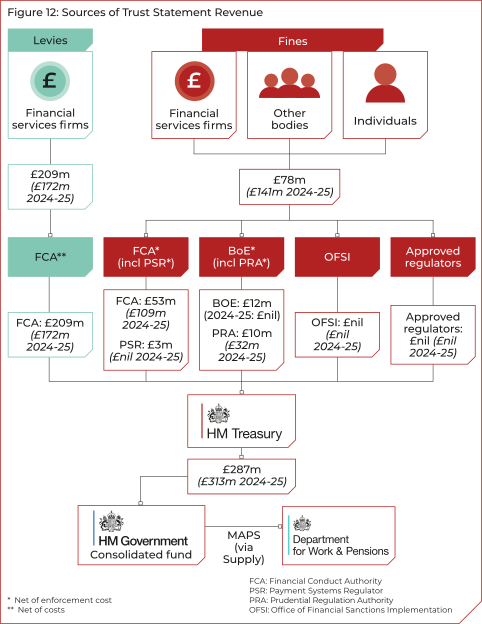
Figure 13: 5 Year Trend Analysis of fine and levy income
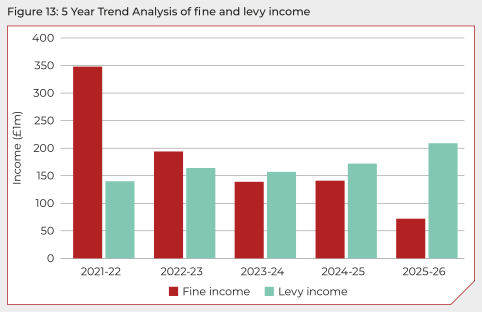
Fine income is dependent on penalties imposed on financial services firms, other bodies and individuals. This leads to large changes in the fines collected each financial year.
Levy income is based on the Money and Pensions Advice Service Levy and Devolved Administrations Debt Advice Levy, which is calculated by the FCA and imposed on the relevant financial services firms every year. The amount charged and the number of firms in scope of the levy do not change by large amounts every year, leading to small changes from this income source.
The costs of running HM Treasury are reported in the Core Treasury and Agencies’ balances in the financial statements. The governance statement and statement of Accounting Officer responsibilities applicable to both the Trust Statement and HM Treasury’s financial statements is included within the main body of the report.
Auditor
The Trust Statement is audited by the Comptroller and Auditor General under the Exchequer and Audit Departments Act 1921. The auditor’s remuneration for this is included in HM Treasury’s Annual Report and Accounts above. No non-audit work was carried out by the auditor for HM Treasury on the Trust Statement.
James Bowler CB
Permanent Secretary
10 July 2026
7.2 The Certificate and Report of the Comptroller and Auditor General to the House of Commons
Opinion on financial statements
I have audited the financial statements of the HM Treasury Trust Statement for the year ended 31 March 2026 under the Exchequer and Audit Departments Act 1921.
The financial statements comprise: the HM Treasury Trust Statement’s
- Statement of Financial Position as at 31 March 2026;
- Statement of Revenue and Expenditure and Statement of Cash Flows for the year then ended; and
- the related notes including the significant accounting policies.
The financial reporting framework that has been applied in the preparation of the financial statements is applicable law and UK adopted international accounting standards.
In my opinion, the financial statements:
- give a true and fair view of the state of the HM Treasury Trust Statement’s affairs as at 31 March 2026 and its net revenue for the year then ended; and
- have been properly prepared in accordance with the Exchequer and Audit Departments Act 1921 and HM Treasury directions issued thereunder.
Opinion on regularity
In my opinion, in all material respects, the income recorded in the financial statements have been applied to the purposes intended by Parliament and the financial transactions recorded in the financial statements conform to the authorities which govern them.
Basis for opinions
I conducted my audit in accordance with International Standards on Auditing (UK) (ISAs UK), applicable law and Practice Note 10 Audit of Financial Statements and Regularity of Public Sector Bodies in the United Kingdom (2024). My responsibilities under those standards are further described in the Auditor’s responsibilities for the audit of the financial statements section of my report.
Those standards require me and my staff to comply with the Financial Reporting Council’s Revised Ethical Standard 2024. I am independent of the HM Treasury Trust Statement in accordance with the ethical requirements that are relevant to my audit of the financial statements in the UK. In applying the Ethical Standards, I have considered the potential implications for my audit arising from the extension of a loan staff arrangement with the Office for Value for Money within HM Treasury to November 2025. The loan staff arrangement concerned one of my directors and was for an initial period of 12 months from September 2024. The arrangement was extended by a further two months so that the secondee was able to support the completion of the Office for Value for Money’s work. I am satisfied that appropriate safeguards have been implemented to protect my and the NAO team’s independence and objectivity throughout the audit. My staff and I have fulfilled our other ethical responsibilities in accordance with these requirements.
I believe that the audit evidence I have obtained is sufficient and appropriate to provide a basis for my opinion.
Conclusions relating to going concern
In auditing the financial statements, I have concluded that the HM Treasury Trust Statement’s use of the going concern basis of accounting in the preparation of the financial statements is appropriate.
Based on the work I have performed, I have not identified any material uncertainties relating to events or conditions that, individually or collectively, may cast significant doubt on the HM Treasury Trust Statement’s ability to continue as a going concern for a period of at least twelve months from when the financial statements are authorised for issue.
My responsibilities and the responsibilities of the Accounting Officer with respect to going concern are described in the relevant sections of this certificate.
The going concern basis of accounting for the HM Treasury Trust Statement is adopted in consideration of the requirements set out in HM Treasury’s Government Financial Reporting Manual, which requires entities to adopt the going concern basis of accounting in the preparation of the financial statements where it is anticipated that the services which they provide will continue into the future.
Other information
The other information comprises information included in the Performance Report, Accountability Report and Foreword to the Trust Statement, but does not include the financial statements and my auditor’s report thereon. The Accounting Officer is responsible for the other information.
My opinion on the financial statements does not cover the other information and, except to the extent otherwise explicitly stated in my report, I do not express any form of assurance conclusion thereon.
My responsibility is to read the other information and, in doing so, consider whether the other information is materially inconsistent with the financial statements or my knowledge obtained in the audit, or otherwise appears to be materially misstated.
If I identify such material inconsistencies or apparent material misstatements, I am required to determine whether this gives rise to a material misstatement in the financial statements themselves. If, based on the work I have performed, I conclude that there is a material misstatement of this other information, I am required to report that fact.
I have nothing to report in this regard.
Opinion on other matters
In my opinion, based on the work undertaken in the course of the audit:
- the parts of the Accountability Report subject to audit have been properly prepared in accordance with HM Treasury directions issued under the Exchequer and Audit Departments Act 1921;
- the information given in the Performance Report, Accountability Report and Foreword to the Trust Statement for the financial year for which the financial statements are prepared is consistent with the financial statements and is in accordance with the applicable legal requirements.
Matters on which I report by exception
In the light of the knowledge and understanding of the HM Treasury Trust Statement and its environment obtained in the course of the audit, I have not identified material misstatements in the Performance and Accountability Reports.
I have nothing to report in respect of the following matters which I report to you if, in my opinion:
- adequate accounting records have not been kept by the HM Treasury Trust Statement or returns adequate for my audit have not been received from branches not visited by my staff; or
- I have not received all of the information and explanations I require for my audit; or
- the financial statements and the parts of the Accountability Report subject to audit are not in agreement with the accounting records and returns; or
- the Governance Statement does not reflect compliance with HM Treasury’s guidance.
Responsibilities of the Accounting Officer for the financial statements
As explained more fully in the Statement of Accounting Officer’s Responsibilities, the Accounting Officer is responsible for:
- maintaining proper accounting records;
- providing the C&AG with access to all information of which management is aware that is relevant to the preparation of the financial statements such as records, documentation and other matters;
- providing the C&AG with additional information and explanations needed for his audit;
- providing the C&AG with unrestricted access to persons within the HM Treasury from whom the auditor determines it necessary to obtain audit evidence;
- ensuring such internal controls are in place as deemed necessary to enable the preparation of financial statements to be free from material misstatement, whether due to fraud or error;
- preparing financial statements which give a true and fair view and are in accordance with HM Treasury directions issued under the Exchequer and Audit Departments Act 1921;
- preparing the annual report in accordance with HM Treasury directions issued under the Exchequer and Audit Departments Act 1921; and
- assessing the HM Treasury Trust Statement’s ability to continue as a going concern, disclosing, as applicable, matters related to going concern and using the going concern basis of accounting unless the Accounting Officer anticipates that the services provided by the HM Treasury Trust Statement will not continue to be provided in the future.
Auditor’s responsibilities for the audit of the financial statements
My responsibility is to audit, certify and report on the financial statements in accordance with the Exchequer and Audit Departments Act 1921.
My objectives are to obtain reasonable assurance about whether the financial statements as a whole are free from material misstatement, whether due to fraud or error, and to issue a report that includes my opinion. Reasonable assurance is a high level of assurance but is not a guarantee that an audit conducted in accordance with ISAs (UK) will always detect a material misstatement when it exists. Misstatements can arise from fraud or error and are considered material if, individually or in the aggregate, they could reasonably be expected to influence the economic decisions of users taken on the basis of these financial statements.
Extent to which the audit was considered capable of detecting non-compliance with laws and regulations, including fraud
I design procedures in line with my responsibilities, outlined above, to detect material misstatements in respect of non-compliance with laws and regulations, including fraud. The extent to which my procedures are capable of detecting non-compliance with laws and regulations, including fraud is detailed below.
Identifying and assessing potential risks related to non‑compliance with laws and regulations, including fraud
In identifying and assessing risks of material misstatement in respect of non‑compliance with laws and regulations, including fraud, I:
- considered the nature of the sector, control environment and operational performance including the design of the HM Treasury Trust Statement’s accounting policies.
- inquired of management, the HM Treasury’s head of internal audit and those charged with governance, including obtaining and reviewing supporting documentation relating to the HM Treasury Trust Statement’s policies and procedures on:
- identifying, evaluating and complying with laws and regulations;
- detecting and responding to the risks of fraud; and
- the internal controls established to mitigate risks related to fraud or non-compliance with laws and regulations including the HM Treasury Trust Statement’s controls relating to the HM Treasury Trust Statement’s compliance with the Exchequer and Audit Departments Act 1921, Financial Services (Banking Reform) Act 2013, Financial Services and Market Act 2000, Competition Act 1998, Legal Services Act 2007, Financial Services Act 2012, Policing and Crime Act 2017 and Financial Guidance and Claims Act 2018.
- inquired of management, the HM Treasury’s head of internal audit and those charged with governance whether:
- they were aware of any instances of non-compliance with laws and regulations;
- they had knowledge of any actual, suspected, or alleged fraud,
- discussed with the engagement team regarding how and where fraud might occur in the financial statements and any potential indicators of fraud.
As a result of these procedures, I considered the opportunities and incentives that may exist within the HM Treasury Trust Statement for fraud and identified the greatest potential for fraud in the following areas: revenue recognition, posting of unusual journals and complex transactions. In common with all audits under ISAs (UK), I am required to perform specific procedures to respond to the risk of management override.
I obtained an understanding of the HM Treasury Trust Statement’s framework of authority and other legal and regulatory frameworks in which the HM Treasury Trust Statement operates. I focused on those laws and regulations that had a direct effect on material amounts and disclosures in the financial statements or that had a fundamental effect on the operations of the HM Treasury Trust Statement. The key laws and regulations I considered in this context included the Exchequer and Audit Departments Act 1921, Financial Services (Banking Reform) Act 2013, Financial Services and Market Act 2000, Competition Act 1998, Legal Services Act 2007, Financial Services Act 2012, Policing and Crime Act 2017 and Financial Guidance and Claims Act 2018.
Audit response to identified risk
To respond to the identified risks resulting from the above procedures:
- I reviewed the financial statement disclosures and testing to supporting documentation to assess compliance with provisions of relevant laws and regulations described above as having direct effect on the financial statements;
- I enquired of management, the Audit and Risk Committee concerning actual and potential litigation and claims;
- I reviewed minutes of meetings of those charged with governance and the Board; and internal audit reports;
- I addressed the risk of fraud through management override of controls by testing the appropriateness of journal entries and other adjustments; assessing whether the judgements on estimates are indicative of a potential bias; and evaluating the business rationale of any significant transactions that are unusual or outside the normal course of business; and
- I reviewed the accounts and underlying evidence to ensure the operation of the HM Treasury Trust Statement is within the legal framework under which it was established.
I communicated relevant identified laws and regulations and potential risks of fraud to all engagement team members and remained alert to any indications of fraud or non-compliance with laws and regulations throughout the audit.
A further description of my responsibilities for the audit of the financial statements is located on the Financial Reporting Council’s website at: www.frc.org.uk/auditorsresponsibilities. This description forms part of my certificate.
Other auditor’s responsibilities
I am required to obtain sufficient appropriate audit evidence to give reasonable assurance that the expenditure and income recorded in the financial statements have been applied to the purposes intended by Parliament and the financial transactions recorded in the financial statements conform to the authorities which govern them.
I communicate with those charged with governance regarding, among other matters, the planned scope and timing of the audit and significant audit findings, including any significant deficiencies in internal control I identify during my audit.
Report
I have no observations to make on these financial statements.
Gareth Davies
Comptroller and Auditor General
15 July 2026
National Audit Office
157-197 Buckingham Palace Road
Victoria
London
SW1W 9SP
7.3 Statement of Revenue and Expenditure
For the period ended 31 March 2026
| In £m | Note | 2025-26 | 2024-25 |
|---|---|---|---|
| Net fine income | 2 | 78 | 141 |
| Net levy income | 3 | 209 | 172 |
| Revenue for the Consolidated Fund | 4 | 287 | 313 |
7.4 Statement of Financial Position
As at 31 March 2026
| In £m | Note | 2025-26 | 2024-25 |
|---|---|---|---|
| Current assets | |||
| Receivable from the FCA/PRA | 33 | 15 | |
| Cash and cash equivalents | – | – | |
| Total Assets | 33 | 15 | |
| Balance on Consolidated Fund account | 4 | 33 | 15 |
The Notes to the Trust Statement form part of this statement.
James Bowler
Permanent Secretary
10 July 2026
7.5 Statement of Cash Flows
| In £m | Note | 2025-26 | 2024-25 |
|---|---|---|---|
| Net cash flow from operating activities | A | 269 | 294 |
| Cash paid to the Consolidated Fund | (269) | (354) | |
| Increase in cash in this period | – | (60) |
7.6 A: Reconciliation of net cash flow to movement in net funds
| In £m | Note | 2025-26 | 2024-25 |
|---|---|---|---|
| Revenue for the Consolidated Fund | 287 | 313 | |
| Changes in working capital | (18) | (19) | |
| Net cash flow from operating activities | 269 | 294 |
The Notes to the Trust Statement form part of this statement.
7.7 Notes to the Trust Statement
1. Statement of accounting policies
Notes to the financial statements provide additional information required by statute and accounting standards to explain a particular feature of the financial statements.
1.1 Basis of accounting
The Trust Statement is prepared in accordance with:
- the accounts direction issued by HM Treasury under the Exchequer and Audit Departments Act 1921
- the 2025-26 FReM issued by HM Treasury
- reference to UK adopted international accounting standards as adapted or interpreted for the public sector context
- the accounting policies detailed in subsequent notes
The accounting policies have been developed by HM Treasury and have been reviewed during 2025-26. These policies have been applied consistently in dealing with items considered material in relation to the accounts. The Trust Statement is prepared on a going concern basis.
The financial information presented is rounded to the nearest £m.
1.2 Standards issued but not yet effective
Several new accounting standards have been issued but are not yet effective. The Trust statement will apply new and revised standards once they have been adopted by the public sector as set out in the Government Financial Reporting Manual (FReM). Their application is not expected to have any impact on the Trust Statement financial statements in the period of the initial application. The Trust Statement does not intend to early adopt the following standards.
IFRS 18 Presentation and Disclosure in Financial Statements
IFRS 18 was issued in April 2024 and applies to annual reporting periods beginning on or after 1 January 2027.
IFRS 19 Subsidiaries without Public Accountability: Disclosures
IFRS 19 was issued in May 2024 and applies to annual reporting periods beginning on or after 1 January 2027.
There are no other IFRS or IFRIC interpretations not yet effective that would be expected to have a material impact on the Trust Statement.
1.3 Accounting convention
The Trust Statement has been prepared on an accruals basis under the historical cost convention.
1.4 Revenue recognition
Fine income is accounted for in accordance with the FReM adaptation of IFRS 15 Revenue from Contracts with Customers, net of enforcement costs where these are deductible by legislation. It is recognised when the revenue can be measured reliably, and it is probable that the economic benefits from the taxable event will flow to HM Treasury.
Similarly, levy income is accounted for in accordance with the FReM adaptation of IFRS 15 Revenue from Contracts with Customers, net of enforcement costs. It is recognised when all, or substantially all, of the consideration promised by the levy payer has been received by the FCA and is non-refundable.
1.5 Receivables
Receivables are accounted for in accordance with the requirements of IFRS 9 Financial Instruments. Accrued revenue receivable represents the amount due from the FCA, PSR and PRA, where penalties and levies have been received by the regulators, but the cash has not been transferred to HM Treasury as at the reporting date.
1.6 Payables
Payables are accounted for in accordance with the requirements of the IFRS 9 Financial instruments. Payables represent the amount due to the FCA, PRA and other enforcement bodies where enforcements costs exceed the fines collected. This expenditure is expected to be covered by future fines within 12 months of the reporting date.
1.7 Balance on the Consolidated Fund Account
This represents Trust Statement receipts recognised as due to the Consolidated Fund but not yet paid over at the reporting date. It comprises the opening balance, plus net receipts recognised for the year from the collecting bodies, less amounts remitted to the Consolidated Fund, giving the closing balance at 31 March. The balance is presented as the Trust Statement’s net assets because HM Treasury acts as an agent and is required to pay these receipts to the Consolidated Fund.
2. Net fine income
| In £m | 2025-26 | 2024-25 |
|---|---|---|
| Fine income from Bank of England | 12 | – |
| Fine income from Financial Conduct Authority | 53 | 109 |
| Fine income from Prudential Regulation Authority | 10 | 32 |
| Fine income from Payment Systems Regulator | 3 | – |
| Fine income from Legal Services Regulators | – | – |
| Fine Income from sanctions breaches | – | – |
| Net fine income | 78 | 141 |
Detailed information on fines collected can be found in the audited accounts of the PSR, the FCA and the Bank of England (of which the PRA is part).
Less than £1m (2024-25: less than £1m) was received in relation to penalties from sanctions breaches issued by OFSI and penalties from approved regulators empowered by Legal Services Act 2007.
3. Net levy income
| In £m | 2025-26 | 2024-25 |
|---|---|---|
| Levy income from FCA for financial guidance | 209 | 172 |
| Net levy income | 209 | 172 |
Detailed information on levies collected can be found in the audited accounts of the FCA (www.fca.org.uk).
4. Balance on Consolidated Fund Account
| In £m | 2025-26 | 2024-25 |
|---|---|---|
| Balance on Consolidated Fund Account as at 1 April | 15 | 56 |
| Revenue for the Consolidated Fund | 287 | 313 |
| Less amount paid to the Consolidated Fund | (269) | (354) |
| Balance on Consolidated Fund Account as at 31 March | 33 | 15 |
5. Events after the reporting period
There were no events after the reporting period.
6. Date authorised for issue
The financial statements were authorised for issue on the date of the Comptroller and Auditor General’s signature.
7.8 Annex A: Accounts direction given by HM Treasury in accordance with section 2 of the Exchequer and Audit Departments Act 1921
This direction applies to those government departments listed in appendix 2.
The Department shall prepare a Trust Statement (“the Statement”) for the financial year ended 31 March 2026 for the revenue and other income, as directed by the Treasury, collected by the department as an agent for others, in compliance with the accounting principles and disclosure requirements of the edition of Government Financial Reporting Manual (“FReM”) 2025-26.
The Statement shall be prepared, as prescribed in appendix 1, so as to give a true and fair view of (a) the state of affairs relating to the collection and allocation of taxes, licence fees, fines and penalties and other income by the Department as agent and of the expenses incurred in the collection of those taxes, licence fees, fines and penalties insofar as they can properly be met from that revenue and other income; (b) the revenue and expenditure; and (c) the cash flows for the year then ended.
The Statement shall also be prepared so as to provide disclosure of any material expenditure or income that has not been applied to the purposes intended by Parliament or material transactions that have not conformed to the authorities which govern them.
When preparing the Statement, the Department shall comply with the guidance given in the FReM (Chapter 11). The Department shall also agree with HM Treasury the format of the Principal Accounting Officer’s Foreword to the Statement, and the supporting notes, and the accounting policies to be adopted, particularly in relation to revenue recognition. Regard shall also be given to all relevant accounting and disclosure requirements in Managing Public Money and other guidance issued by HM Treasury, and to the principles underlying International Financial Reporting Standards.
Compliance with the requirements of the FReM will, in all but exceptional circumstances, be necessary for the accounts to give a true and fair view. If, in these exceptional circumstances, compliance with the requirements of the FReM is inconsistent with the requirement to give a true and fair view, the requirements of the FReM should be departed from only to the extent necessary to give a true and fair view. In such cases, informed and unbiased judgement should be used to devise an appropriate alternative treatment which should be consistent with both the economic characteristics of the circumstances concerned and the spirit of the FReM. Any material departure from the FReM should be discussed in the first instance with HM Treasury.
The Statement shall be transmitted to the Comptroller and Auditor General for the purpose of his examination and report by a date agreed with the Comptroller and Auditor General and HM Treasury to enable compliance with the administrative deadline for laying the audited accounts before Parliament.
The Statement, together with this direction (but with the exception of the related appendices) and the Report produced by the Comptroller and Auditor General under section 2 of the Exchequer and Audit Departments Act 1921 shall be laid before Parliament at the same time as the Department’s Resource Accounts for the year unless the Treasury have agreed that the Trust Statement may be laid at a later date.
Charlotte Goodrich
Deputy Director, Government Financial Reporting
HM Treasury
18 December 2025
-
World Economic Outlook’, International Monetary Fund (IMF), October 2025. ‘World Economic Outlook’, IMF, October 2024. ↩
-
Major UK banks are Barclays, HSBC, Lloyds, Nationwide, NatWest, Santander UK and Standard Chartered. ↩ ↩2
-
Which achieved Royal Assent on 18 March 2026. ↩
-
In the calendar year of 2024, HM Treasury replied to 6,373 enquiries from MPs (ministerial correspondence) and of those 52% of replies to MPs were within HM Treasury’s 20 working day deadline. HM Treasury replied to 2,123 enquiries direct from members of the public treated as official correspondence and of those 70% of replies were within HM Treasury’s 20 working day deadline. ↩
-
The Financial review is not subject to audit. ↩
-
HM Treasury also administers the central funds which includes producing annual accounts for the Consolidated Fund, the National Loans Fund, the Contingencies Fund and the Exchange Equalisation Account. These do not feature in the financial review below. ↩
-
This increase was largely due to the acquisition of shares in banks including, NatWest, Lloyds, Northern Rock, and Bradford & Bingley, as well as significant loans to some of these institutions. ↩
-
The funding provided to the Royal Household is referred to as a sovereign support grant rather than grant-in-aid under the Sovereign Grant Bill. ↩
-
The National Infrastructure Commission (NIC) combined with the Infrastructure and Projects Authority (IPA) to become the National Infrastructure & Service Transformation Authority (NISTA) on 1 April 2025. ↩
-
HM Treasury fully exited its shareholding in NatWest on 30 May 2025. ↩
-
James Murray MP previously held the office of Exchequer Secretary to the Treasury. He was appointed as Secretary of State for Health and Social Care on 15 May 2026. ↩ ↩2
-
The Chancellor’s responsibilities cover: Delivering the government’s growth mission, Economic and fiscal policy (including the presenting of the annual Budget), oversight of the monetary framework, setting inflation remit, Women in the economy and gender pay gap, UK growth and productivity, the National Wealth Fund, Capital markets and listings, Economic security and resilience policy, Leading on international economic and financial affairs including at the G7 and G20 and acting as the UK Governor of the IMF, EBRD and AIIB, and ministerial arrangements (in her role as Second Lord of the Treasury). ↩
-
Lucy Rigby was appointed as Chief Secretary to the Treasury on 14 May 2026, following the move of James Murray MP. Rachel Blake MP was appointed as Economic Secretary to the Treasury. ↩
-
Sam Beckett CB, Second Permanent Secretary, Chief Economic Adviser and Head of the Government Economic Service retired from HM Treasury on 22 January 2026. ↩
-
Zarin Patel retired from her post as Non-Executive Board member and Chair of the Audit and Risk Committee on the 31 July 2025. Jane Hanson CBE’s term ended on 31 December 2025, after it was extended for four months for continuity of experience during a period of change. Catherine Vaughan CB joined as an Independent Member of the Audit and Risk Committee on 15 October 2025. ↩
-
Several parliamentary committees, including the Public Accounts Committee (PAC) and the Treasury Select Committee have invited witnesses from across the HM Treasury Group to provide evidence on key issues. The department values the oversight, challenge and scrutiny this process provides, and responds constructively to their recommendations implementing them where appropriate. ↩
-
Further information on how the department manages risk can be found in the Accountability Report. ↩
-
More detail on the control system is given in the Accounting Officer System Statement ↩
-
Certain disclosures within the remuneration report have been audited as per the FReM 6.2.1. ↩
-
The value of pension benefits accrued during the year is calculated as (the real increase in pension multiplied by 20) plus (the real increase in any lump sum) less (the contributions made by the individual). The real increases exclude increases due to inflation or any increase or decreases due to a transfer of pension rights. For some older pension schemes the increase in pension due to extra service may not be sufficient to offset the effect of inflation so that, in real terms, the pension value can reduce. ↩
-
Accrued pension benefits included in this table for any individual affected by the Public Service Pensions Remedy have been calculated based on their inclusion in the legacy scheme for the period between 1 April 2015 and 31 March 2022, following the McCloud judgment. The Public Service Pensions Remedy applies to individuals that were members, or eligible to be members, of a public service pension scheme on 31 March 2012 and were members of a public service pension scheme between 1 April 2015 and 31 March 2022. The basis for the calculation reflects the legal position that impacted members have been rolled back into the relevant legacy scheme for the remedy period and that this will apply unless the member actively exercises their entitlement on retirement to decide instead to receive benefits calculated under the terms of the Alpha scheme for the period from 1 April 2015 to 31 March 2022. ↩
-
Salary and full year equivalent (FYE), bonuses and totals are presented in £5,000 bands. FYE is shown in brackets. Benefits in kind are presented to the nearest £100, pension benefits and total remuneration to the nearest £1,000. There were no benefits in kind for 2025-26 or 2024-25. ↩
-
Will Macfarlane was Director, Strategy, Planning and Budget from 30 August 2023 to 27 April 2025 and Director General, Tax and Welfare from 8 September 2025. FYE has been calculated by pro-rating the salary whilst Director General, Tax and Welfare. ↩
-
Simon Man sits on the Executive Management Board but is paid by the Government Legal Department. ↩
-
Peter King sat on the Executive Management Board but is paid by the Government Legal Department. ↩
-
Catherine Little received an annual leave adjustment payment in April 2024 ↩
-
Veda Poon received a non-consolidated performance related bonus in August 2024 ↩
-
Accrued pension benefits included in this table for any individual affected by the Public Service Pensions Remedy have been calculated based on their inclusion in the legacy scheme for the period between 1 April 2015 and 31 March 2022, following the McCloud judgment. The Public Service Pensions Remedy applies to individuals that were members, or eligible to be members, of a public service pension scheme on 31 March 2012 and were members of a public service pension scheme between 1 April 2015 and 31 March 2022. The basis for the calculation reflects the legal position that impacted members have been rolled back into the relevant legacy scheme for the remedy period and that this will apply unless the member actively exercises their entitlement on retirement to decide instead to receive benefits calculated under the terms of the Alpha scheme for the period from 1 April 2015 to 31 March 2022. ↩
-
For some older pension schemes the increase in pension due to extra service may not be sufficient to offset the effect of inflation so that, in real terms, the pension value can reduce. ↩
-
Figures are restated where the Civil Service Pension Scheme have made retrospective updates to their data. Opening balances for pension disclosures for some members are not consistent with the closing balances reported in the prior year. This is due to the availability in 2025-26 of more up to date data relevant to the calculation of the prior year benefits. ↩
-
The value of pension benefits accrued during the year is calculated as (the real increase in pension multiplied by 20) plus (the real increase in any lump sum) less (the contributions made by the individual). The real increases exclude increases due to inflation or any increase or decreases due to a transfer of pension rights. ↩
-
2024-25 figures have been restated. ↩
-
Fees are presented in £5,000 bands. Benefits in kind are presented to the nearest £100. ↩ ↩2
-
Zarin Patel was overpaid for the period 1 August to 31 October and repaid this before the year end. The above disclosure reflects the net position. ↩
-
Gay Huey Evans CBE was overpaid for the period from the 1 January to 31 March and this is reflected in the above disclosure. She repaid this after the year-end on the 13 May 2025. After the repayment her net fee relating to 2024-25 was in the £10-15k band. ↩
-
Salary and full year equivalent (FYE) are presented to the nearest £1. FYE is shown in brackets. Benefits in kind are presented to the nearest £100, pension benefits and total remuneration to the nearest £1,000. ↩
-
The value of pension benefits accrued during the year is calculated as (the real increase in pension multiplied by 20) plus (the real increase in any lump sum) less (the contributions made by the individual). The real increase excludes increases due to inflation or any increase or decrease due to a transfer of pension rights. Where nil values are shown Ministers either opted out of the scheme or were unpaid. ↩ ↩2
-
James Murray was Exchequer Secretary to the Treasury from 9 July 2024 to 1 September 2025 and promoted to Chief Secretary to the Treasury from 1 September 2025. ↩
-
Darren Jones did not receive a severance payment due to changing roles (Chief Secretary to the Prime Minister, Chancellor of the Duchy of Lancaster, and Minister for Intergovernmental Relations). ↩
-
Emma Reynolds was Parliamentary Secretary in HM Treasury from 9 July 2024 until 14 January 2025 when she was replaced by Torsten Bell as Parliamentary Secretary in HM Treasury. Emma Reynolds did not receive a severance payment due to changing roles (Secretary of State for Environment, Food and Rural Affairs). ↩
-
Baroness Gustafsson of Chesterton OBE was appointed as an unpaid Minister of State (Minister for Investment) jointly in the Department for Business and Trade and HM Treasury on 10 October 2024 and left on 5 September 2025. ↩
-
On 14 January 2025 Tulip Siddiq was replaced by Emma Reynolds as Economic Secretary to the Treasury. ↩
-
Ministers who have not attained the age of 65 and are not appointed to a relevant ministerial or other paid office within 3 weeks of the last day of service, are eligible for a severance payment of one quarter of the annual ministerial salary being paid. ↩
-
The majority of severance payments in the previous year are due to a loss at the general election. Severance payments are presented to the nearest £1. ↩
-
Figures have been restated where the administrator has made retrospective updates to the data. ↩
-
In addition to the ministerial salary listed above, serving Prime Ministers receive a benefit in kind in respect of the use of the official Downing Street residence. Keir Starmer received a benefit of £6,700 in 2025-26 in his role as Prime Minister (2024-25: Keir Starmer received a benefit of £5,600 and Rishi Sunak received a benefit of £2,000 in 2024-25 in respect of their roles as Prime Minister) ↩
-
These are peers who hold office in HM Household of the sovereign of the United Kingdom. ↩
-
Lord Collins of Highbury was a Lord in Waiting from 9 July 2024 to 31 December 2024. Lord Collins of Highbury was reappointed as a Lord in Waiting on 7 September 2025. ↩
-
Ministers who have not attained the age of 65 and are not appointed to a relevant ministerial or other paid office within 3 weeks of the last day of service, are eligible for a severance payment of one quarter of the annual ministerial salary being paid. ↩
-
Severance payments are presented to the nearest £1. ↩
-
The Civil Service Pension schemes are unfunded multi-employer defined benefit schemes; however as the department is unable to identify the share of the underlying assets and liabilities they are treated as defined contribution schemes. ↩
-
HM Treasury does not publish diversity data where it relates to a group of less than 5 people, on the basis that it may identify individuals. This is represented in the tables as blank or n/a. ↩
-
Exit packages are paid, where applicable, in accordance with the terms of the Civil Service Compensation Scheme. Some group entities, such as UKAR do not make payments under the above scheme but under other schemes. ↩
-
The £245 threshold is set to approximate the minimum pay scale for a Senior Civil Servant ↩
-
A worker that provides their services through their own limited company or another type of intermediary to the client will be subject to off-payroll legislation and the department must undertake an assessment to determine whether that worker is in-scope of intermediary’s legislation (IR35) or out-of-scope for tax purposes. ↩
-
One of these off-payroll engagements related to the shareholder representative director from UK Government Investments, who sits on NWF’s Board on behalf of HM Treasury - this position was filled throughout 2025-26. The other related to one of NWF’s non-executive directors, who was not remunerated by NWF between 1 October 2025 and 31 January 2026 because they were employed full-time within the Civil Service. ↩
-
The Consolidated Fund is where most public money is held and from where it is distributed, under the authority of Parliament, to fund government activities. ↩
-
Previous years’ Supply and budget totals are not restated following changes in accounting standards, so the comparative figure reflects the income recognised prior to restatement following the adoption of IFRS 17. ↩
-
This is a business-as-usual transaction and there have been £1m net gains on foreign exchange rate movements on amounts invoiced over the lifetime of the EU Financial Settlement. ↩
-
Including interest due on receivable. This charge eliminates at group level. ↩
-
Supply Estimate only quantifies the EBRD and AIIB contingent liabilities at local currency. These have been translated to GBP at 31 March rates ↩ ↩2
-
See Note 28 – Prior period restatements for more information. ↩
-
This statement shows the movement in the year on the different reserves held by HM Treasury Group, analysed into ‘general fund reserves’ (i.e. those reserves that reflect a contribution from the Consolidated Fund). The Fair Value Reserve reflects the change in financial instrument asset values that have not been recognised as income or expenditure. The Revaluation Reserve reflects the change in other asset values that have not been recognised as income or expenditure. The General Fund represents the total assets less liabilities of a department, to the extent that the total is not represented by other reserves and financing items. ↩
-
Consolidated Fund Extra Receipts (CFERs). ↩
-
Dividend paid by Pool Re to its members. ↩
-
Ukraine: Extraordinary Revenue Acceleration Second Tranche Disbursal ↩
-
National Infrastructure and Service Transformation Authority (NISTA) was formed on 1 April 2025 when it brought together the functions of the National Infrastructure Commission (NIC) and the Infrastructure and Projects Authority (IPA). ↩
-
The Office for Value for Money closed, as planned, following Budget 2025. ↩
-
Including Pool Re’s subsidiaries Pool Re Services Ltd and Pool Re Solutions Ltd. ↩
-
Including IUK Investments Holdings Ltd’s subsidiary, IUK Investments Ltd ↩
-
Or its equivalent in previous years. ↩
-
UK Asset Resolution Financial Reports and The Royal Household Financial Reports ↩
-
Discounted at the effective interest rate applicable at the inception of the loan. ↩
-
See Statement of Changes in Taxpayers’ Equity (SoCTE). ↩
-
With the exception of £6m of public dividend capital held in the Royal Mint Trading Fund at historical cost, in line with the Government Financial Reporting Manual (FReM) ↩
-
£753m was advanced in March 2025 and a further £753m advanced in April 2025. ↩
-
Details of the National Wealth Fund’s financing for the Sizewell C project are available on the NWF’s website ↩
-
In May 2026 the authorised size of the BEAPFF reduced to £524.9bn, entirely composed of government gilts. See also Note 29 – Events after the reporting period. ↩
-
As the interest falling due on the APF loan exceeds the interest earned from the coupon payments. ↩
-
Issued by HM Treasury and managed by the NWF ↩
-
Not including UK Guarantee Scheme contracts the NWF manages on behalf of HM Treasury. ↩
-
General Measurement Model (GMM) or Premium Allocation Approach (PAA). ↩ ↩2
-
Because HM Treasury charges no fee to DRD holders, the Liability for the Remaining Coverage consists entirely of the loss component. ↩
-
A copy of the model DRD template is available here: Decommissioning Relief Deed ↩
-
Under Section 18 of the Commissioners for Revenue and Customs Act, HMRC is not permitted to disclose information to anyone without lawful authority to do so – including other government departments. ↩
-
All costs within 5 years assumed to be at the reporting date. ↩
-
With a back stop of 2075. ↩
-
Under the terms of a DRD, the Reference Amount is the guaranteed relief available to the claimant, from which Corporation Tax (CT) relief and Petroleum Revenue Tax (PRT) relief obtained via HMRC is deducted to arrive at the amount payable to the claimant by HM Treasury (the Difference Payment). In relation to imposition decommissioning expenditure, the Reference Amounts include a CT element of 50% of allowable decommissioning expenditure (30% for Ring Fence Corporation Tax plus 20% for Supplementary Charge) and a PRT element equal to the 50% of relief that would arise under enacted legislation for the relevant field, assuming decommissioning expenditure were offset against the remaining available profits. ↩
-
This figure was later revised down by £11.8 million, with the amount having been fully recovered, together with interest, in the 2018-19 financial year. ↩
-
Court of Justice of the European Union Press Release No 93/26 ↩
-
Financial Reporting Advisory Board, IUK Investments Holdings Ltd, IUK Investments Ltd and Royal Mint Advisory Committee are excluded from the table as nil for all columns. ↩
-
Consistent with HM Treasury’s assessment that climate change is not a standalone Principal Risk, these Strategy-related disclosures are proportionate and focus on operational resilience and capability development. Accordingly, a comprehensive assessment of the impacts of climate-related risks and opportunities on overall strategy and financial planning, consistent with full TCFD Strategy disclosure requirements, has not been undertaken at this stage. ↩
-
These risks have not been formally categorised across short, medium and long-term time horizons for disclosure purposes. This reflects the department’s current proportionate approach to climate risk management and its assessment that climate is not a standalone Principal Risk. ↩
-
As at 2025-26 some waste reporting data is not available at the time of publication. Waste cost and other data has been requested from the Government Property Agency, currently it is not separately identifiable from the overall building costs paid to GPA. The Department continues to provide feedback to the GPA to facilitate improved detailed reporting in future years. ↩