Heat Network Technical Assurance Scheme (HNTAS): technical feedback process - guidance (accessible webpage)
Published 16 February 2026
Applies to England, Scotland and Wales

© Crown copyright 2026
This publication is licensed under the terms of the Open Government Licence v3.0 except where otherwise stated. To view this licence, visit nationalarchives.gov.uk/doc/open-government-licence/version/3 or write to the Information Policy Team, The National Archives, Kew, London TW9 4DU, or email: psi@nationalarchives.gov.uk.
Where we have identified any third party copyright information you will need to obtain permission from the copyright holders concerned.
This publication is available at https://www.gov.uk/government/publications/heat-network-technical-assurance-scheme-hntas-technical-feedback-process/heat-network-technical-assurance-scheme-hntas-technical-feedback-process-guidance-accessible-webpage
1. Introduction
The Department for Energy Security and Net Zero (DESNZ) has recently published draft versions of a number of technical documents which set out the Technical Requirements and Assessment Procedures for New Build and Existing Heat Networks under the proposed Heat Network Technical Assurance Scheme (HNTAS). DESNZ have also published the draft Heat Network Technical Standard (TS1) and the draft Heat Network Metering and Monitoring Standard (MMS).
The development of these documents has involved extensive engagement with industry stakeholders (further details can be found at Annex B).
To further develop these documents and ensure that wider industry feedback is captured prior to Scheme launch, DESNZ is now welcoming feedback on these documents from all industry stakeholders via the HNTAS Technical Feedback Process. This is an open process which is designed to ensure that industry feedback is incorporated into the development of final Code documents.
The outcomes of this feedback process, including the rationale for decisions made, will be summarised in a document at the end of the HNTAS Technical Feedback Process which will be made publicly available. Actions from this process will be subsequently implemented as part of the HNTAS Change Management Process.
Once the Technical Feedback Process has concluded and final Code and Standards documents have been published, there will be further opportunity to provide feedback once the Scheme is operational through an ongoing formal change management process.
The HNTAS Technical Feedback Process has been developed by adopting a set of key principles which are set out in Section 2 of this document.
All draft Code and technical standard documents are open to feedback through this process. A structured method for providing feedback, including a set of template feedback forms, has been developed to make this process easier. The method for providing feedback is set out in Section 3 of this document.
The forms and processes have been designed so feedback can be processed more effectively. DESNZ can provide support to help you in understanding and meeting these guidelines, should you need it.
Any feedback which is received will be subject to a formalised process of review and industry engagement prior to consideration and a final determination. This process is set out in Section 4 of this document.
Feedback submitted through the HNTAS Technical Feedback Process will be considered alongside responses to the Heat Network Technical Standards policy consultation, which is available here and closes on 15th April. Feedback will also be considered alongside findings from the HNTAS technical pilot programme and the outputs from the sector‑wide industry working group announced by the UK District Energy Association (UKDEA).
Each of these input channels forms part of the wider HNTAS Change Management Process which will be used to determine the final form of the Scheme that will be implemented through regulation .
Feedback on the technical documents can be provided until 15th May by sending a populated feedback form to HNTAS.TechnicalFeedback@energysecurity.gov.uk.
2. Aims of the HNTAS Technical Feedback Process
Since the end of 2022, DESNZ has been working with the contracted Technical Author (FairHeat) to develop a draft technical Code which sets out the draft technical requirements that will be mandated under the Heat Network Technical Assurance Scheme (HNTAS) in upcoming regulation, as well as a scheme of assessment and certification to ensure that conformity with these technical requirements can be demonstrated. 86 draft Code documents have now been released to give the sector early sight of materials.
We have endeavoured to have wide reaching engagement and reflect the diversity of the sector during this time, which has involved engaging over 200 industry stakeholders from over 120 organisations (at the time of launch of the HNTAS Technical Feedback Process). This has been a valuable process which has resulted in many meaningful improvements, corrections and clarifications to draft documents.
We are keen to ensure that all stakeholder voices, including those who have not yet had a chance to input to date, are heard and have a chance to provide feedback on technical content prior to regulatory commencement of HNTAS. This is one key aspect of a wider period of reflection and market engagement to ensure that we strike the right balance in delivering technical standards that work for both heat network consumers and the industry.
As such, we are pleased to be opening all draft technical documents released to date for feedback through the HNTAS Technical Feedback Process. This process runs in parallel to other feedback streams, and the interaction between these is set out in Section 2.1.
The overarching aim of the HNTAS Technical Feedback Process is to provide an open and meaningful feedback route for the sector to further shape the draft Code Documents and standards, and to consider this against the objectives of the Scheme.
To achieve this aim, the HNTAS Technical Feedback Process has been designed with the following objectives:
- be open and transparent;
- allow individuals to easily provide feedback through templates;
- provide an appropriate window for receiving feedback;
- record the feedback received and changes which are or are not made; and
- be underpinned by a robust governance structure for decision making.
To support the aim and objectives of this feedback process, the following key principles have been adopted in the development of the processes for receiving feedback on the draft technical documents:
- The interaction between the HNTAS Technical Feedback Process, the HNTAS Technical Standards policy consultation, and sector-wide feedback forums should be made clear to the public, to ensure that stakeholders can submit their feedback to the correct channel .
- The process should transparently respond to factual errors, gaps and changes in thinking from sector feedback and reflect this in changes to the draft documentation.
- Technical rigour should be upheld as the draft Code and Standards documents are further developed. The industry engagement process followed to date is set out in Annex B to provide further context to this principle.
- Learnings from market engagement during the development of HNTAS to date should be incorporated into the design of the process.
- The feedback provided by stakeholders should aim to be constructive and a proposed alternative should be provided, wherever possible and relevant.
- Proposed changes should be evidence-based and justified.
- The implementation of the outputs from the HNTAS Technical Feedback Process should be compatible with HNTAS policy objectives and regulatory implementation timelines.
- The decisions made throughout the process should be clear and transparent.
2.1 Interaction of HNTAS Technical Feedback Process with other feedback routes
The HNTAS Draft Technical Document Feedback Process seeks views and comments on all draft technical documents and items within HNTAS.
This process is being run alongside:
- the HNTAS Technical Standards policy consultation which seeks views on the overarching policy framework of HNTAS, such as the governance arrangements for the scheme, the assurance scheme that the sector will need to engage with to demonstrate compliance, and the overarching technical requirements that Heat Networks will be required to comply with; and
- the sector-wide industry working group announced by the UKDEA, the purpose of which is to look beyond the specific questions in the HNTAS Technical Standards policy consultation and develop and agree any issues the sector has which you feel need to be raised.
Decisions on the final policy position will be made by Ministers and then set out in a formal Government Response to the consultation. Where the final policy position differs from the original policy proposals in the consultation, this may impact the contents of the draft Code and Standards documents. Where this is the case, policy changes will be inputted into the wider HNTAS Change Management process to ensure that the final Code and Standards documents align with approved government policy .
The findings from the UKDEA sector-wide industry working group will also be considered, in addition to findings from the technical pilot programmes as part of the wider HNTAS Change Management Process.
The overall HNTAS Change Management Process refers to the structured process by which identified changes to the Scheme are tracked, assessed, and actioned. This includes a defined escalation process within the HNTAS governance structure, with proposed changes escalated to the Technical Standards Committee and/or Code Management Committee as appropriate.
3. Method for providing feedback
To date, the following draft technical documents have been developed and issued in draft format:
- 58 Technical Specifications & Assessment Procedures for “New Build” Heat Networks.
- 26 Technical Specifications & Assessment Procedures for “Existing” Heat Networks.
- Heat Network Technical Standard (TS1).
- Heat Network Metering and Monitoring Standard (MMS).
All draft technical and Code documents are open for feedback. A structured method for providing feedback will help DESNZ assess and meaningfully review and address changes within wider HNTAS policy and regulatory implementation timelines.
This includes:
- a clear scope;
- a set of guidelines; and
- a set of structured feedback form template documents.
3.1 Guidelines for providing feedback
We have worked hard over many years to develop draft technical documents, and we are keen to ensure that these are accurate and benefit from the views of experts and practitioners from as wide a cross section of the heat network sector as possible. We therefore actively encourage and welcome all feedback on the draft technical documents.
To ensure that this feedback process is as effective as possible in meeting its aims, we have set out the following guidelines for providing feedback.
1. Feedback should be given against individual items, rather than in an open-ended format. Examples of an individual item include: - a Minimum Requirement within TS1 or MMS; - an individual Technical Requirement within a Technical Specification; - an individual Assessment Procedure within an Assessment Procedures document; - the description of a Key Performance Indicator (KPI); - the value of a Key Performance Indicator (KPI) threshold.
Where a piece of feedback impacts multiple items (e.g. a KPI definition), this only needs to be provided once, accompanied by a note detailing the other items affected.
2. Feedback should aim to focus on technical content. More open-ended feedback on the proposed scheme structure is welcome through the HNTAS Technical Standards policy consultation (see Section 2.1). 3. Feedback should be provided through use of the HNTAS Technical Feedback Process feedback form templates. 4. Feedback should aim to be constructive. 5. Feedback should aim to be justified and evidence-based, ideally with supporting evidence provided. 6. A proposal for an alternative should be provided where there is disagreement. 7. The name of the individual(s) and organisation providing feedback should be provided. Where feedback is provided by a consortium or a trade association, the key contributors to this feedback should be listed. This information may be used to engage with respondents for further clarity, as outlined in Section 4.2.
3.2 Feedback forms
A set of feedback form templates has been developed to help you in drafting comments and to help DESNZ assess these.
Feedback form structure
A set of four feedback forms has been developed which correspond to the draft documents in the following four workstreams, as illustrated in Figure 1.
- Technical Specifications and Assessment Procedures for New Build Heat Networks.
- Technical Specifications and Assessment Procedures for Existing Heat Networks.
- Heat Network Technical Standard (TS1).
- Heat Network Metering and Monitoring Standard (MMS).
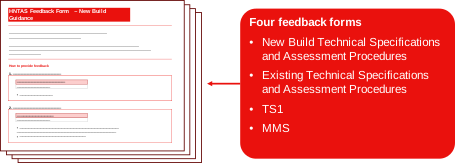
Figure 1: Set of feedback forms
How to provide feedback
Feedback may be provided on only one workstream, or on all workstreams.
Feedback may be provided at any time during the open feedback window. For example, feedback for the Metering and Monitoring Standard may be submitted first, and feedback for TS1 may be submitted a few weeks later.
Feedback provided through the following steps will help DESNZ assess your comments most effectively:
8. Specify the document and item within that document, as illustrated in Figure 2.
Note that the TS1 and MMS feedback forms only need the item to be selected.
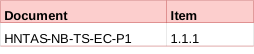
Figure 2: Selecting the document and item for feedback
9. Select the category of feedback, as illustrated in Figure 3.
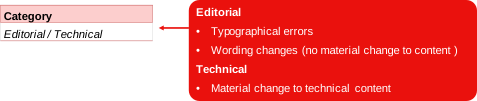
Figure 3: Selecting the category of feedback
10. Leave a comment, a proposed alternative, justification for the proposed alternative, and a link to supporting evidence where applicable.
Completion of feedback is indicated through its status, as illustrated in Figure 4.

Figure 4: Required fields for providing feedback
Note on formatting
Throughout the forms, yellow shading is used to indicate that a cell is ready for input, as illustrated in Figure 5.

Figure 5: Formatting of cells ready for input
4. Process for actioning technical and editorial feedback
The process for actioning feedback received broadly consists of:
- review of feedback;
- industry engagement on proposed changes;
- implementation of changes identified as part of the industry engagement process; and
- recording of all decisions made with supporting justification.
This is illustrated in Figure 6.
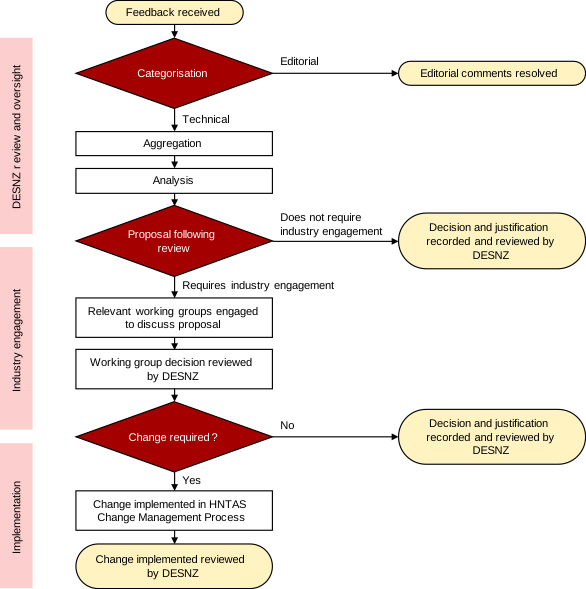
Figure 6: Illustration of HNTAS Technical Feedback Process for actioning feedback
4.1 Review of feedback
The review of feedback will consist of the following .
- Categorisation of feedback (Technical/Editorial).
Editorial comments (e.g. a typographical error) will be resolved by the HNTAS Technical Author without further industry engagement where practicable.
Technical comments will be fed through for aggregation and analysis.
- Aggregation.
Where many comments are received which are similar in nature, these will be aggregated by the HNTAS Technical Author and reviewed by DESNZ. This is to allow DESNZ to understand the extent to which particular views have been expressed in the feedback provided across the sector.
- Analysis.
Where necessary, further analysis on the technical content discussed will be carried out by the HNTAS Technical Author and outcomes shared with DESNZ prior to a proposal being produced.
At the end of the review, a proposal will be produced by the HNTAS Technical Author and agreed with DESNZ before further action is taken. This will outline if there is an initial assessment/recommendation that a change could be required, the details of the potential change (if applicable), together with advice and a recommendation as to whether industry engagement could be helpful. This proposal will be justified, assessed, and any final decisions relating to this will be made and recorded by DESNZ.
4.2 Industry engagement
Feedback might be taken to industry working groups where:
- a technical error is identified;
- the extent of feedback received across the sector indicates that the content in the draft documentation does not align with industry practice;
- the interpretation of draft documentation indicates that it is not sufficiently clear;
- DESNZ determines that further engagement with a wider cross section of stakeholders would better inform a final decision.
Proposed changes which have been identified through the technical pilot programmes (for New Build networks and for Existing networks) will also be taken to industry working groups following a similar process to proposed changes received through the HNTAS Technical Feedback Process.
Working group representation
DESNZ intends to engage a wide range of organisations to participate in working groups. DESNZ will invite input from the UKDEA and the Association for Decentralised Energy (ADE) to review the types of representation within working groups and ensure that the sector has been sufficiently represented. Where needed, changes will be made to proposed WG membership to ensure representativeness.
Members will then be invited by DESNZ for engagement with these working groups.
Process for industry engagement
Industry engagement is a key element of the HNTAS Technical Feedback Process for draft documentation. It gives DESNZ the chance to hear a broad range of views from a wide cross section of the sector to help make more fully informed decisions.
The process for industry engagement broadly consists of:
- a proposal being set out by the HNTAS Technical Author with oversight from DESNZ, including:
- the public feedback received (including justification and evidence provided);
- a proposal drafted by the Technical Author and reviewed by DESNZ (which might be a proposed change, or a proposal to not implement any changes), including justification behind the proposal;
- the working groups providing their comments through a structured process;
- working group discussion through structured meetings;
- a decision being made within the working group(s) with sufficient time provided for a discussion, with opportunities for all participants to have their say.
It should be expected that the name of the individual(s) and organisation providing feedback may be used in working group discussions.
The working group decision, together with a summary of views presented, will be reviewed by DESNZ. Where a change is required, this will be implemented as part of the HNTAS Change Management Process. Changes made to draft Code documents will also be reviewed by DESNZ prior to publication of final Code documents. DESNZ may wish to convene further working groups if the issues are contentious, or if the rationale/ recommendations are insufficiently clear. The outcomes of the working group processes will be made available to the relevant working group members, including final wording of changes to be made to documentation.
The outcomes of this feedback process, including the rationale for decisions made, will be summarised in a document at the end of the HNTAS Technical Feedback Process which will be made publicly available.
4.3 Outputs and interaction within HNTAS Change Management Process
The findings from the HNTAS Technical Feedback Process will be considered alongside the HNTAS Technical Standards policy consultation and technical pilot programmes, as part of the wider HNTAS Change Management Process.
For example, proposed changes involving interaction between multiple feedback streams might include (for illustrative purposes only):
- a response provided through the HNTAS Technical Feedback Process regarding whether a KPI should be reported or assessed, which would impact the policy position;
- a submission to the sector-wide industry working group announced by the UKDEA regarding the structure of HNTAS, for example the inclusion of a particular Assurance Phase;
- a response to the Technical Standards policy consultation regarding the timing of Milestones for Existing Heat Networks, which would impact the Code documents for Existing Heat Networks to ensure alignment.
A document will be produced at the end of the HNTAS Technical Feedback Process which details the outcomes of the process. This document will be made publicly available.
5. Key details for providing feedback
5.1 Dates
Feedback can be provided until 25th May 2026.
5.2 Feedback submission email address
To provide feedback, send a populated feedback form to HNTAS.TechnicalFeedback@energysecurity.gov.uk including the name of the individual(s) and organisation providing feedback.
If you wish to be involved in the UKDEA sector-wide industry working group, the UKDEA can be contacted at secretary@ukdea.org.uk. Note that you do not have to be a UKDEA Member to take part.
5.3 Feedback submission support
DESNZ is able to provide extra support to help you in understanding and meeting the submission guidelines outlined in this document, should you need it.
6. Annex A: Glossary
| Term | Definition |
|---|---|
| Heat Network | A network that, by distributing a liquid or a gas, enables the transfer of thermal energy for the purpose of supplying heating, cooling, or hot water to a building or persons in that building (and includes any appliance the main purpose of which is to heat or cool the liquid or gas). |
| New Build Heat Network | A Heat Network that does not exist at HNTAS launch |
| Existing Heat Network | A Heat Network that is operational (supplying heat to consumers) and is pre-authorised by Ofgem when HNTAS launches. Sub network types within this category include: - Heat Networks subject to the Heat Network (Metering and Billing) Regulations 2014 (HNMBR) metering requirements; - Heat Networks not subject to HNMBR metering requirements |
| Technical Specification | A document which details the technical obligations to be fulfilled as part of the Scheme, including the: - Technical Requirements to be met; - Performance Monitoring requirements to be met; - Key Failures to be avoided; - Evidence Requirements to be provided to demonstrate conformity with HNTAS. |
| Assessment Procedures | A document which details the assessment activities to be undertaken to provide assurance that the obligations in the Technical Specifications are fulfilled. There is Assessment Procedures document associated with each Technical Specification. |
| Heat Network Technical Standard (TS1) | The standard which will supersede the Heat Networks: Code of Practice for the UK (CP1) once published in its final version. The standard is largely based on the content from CP1 (2020), but it transitions from a code of practice to a formal standard, and introduces new requirements in several key technical areas. TS1 will serve as the principal technical reference point for HNTAS, supporting the sector’s move to regulation by providing robust technical standards to ensure high performance and good consumer outcomes. |
| Heat Network Metering and Monitoring Standard (MMS) | The standard which sets out requirements for the metering and the monitoring of Heat Networks. MMS will serve as the principal reference point regarding: - Monitoring Points; - Automatic and Remote Monitoring Systems; - “Smart metering” / advanced meter infrastructure; - Metering and Monitoring Strategies. |
| Technical Author | Responsible for the development of draft Code document and technical standards with oversight from DESNZ and the HNTAS Programme Board. |
7. Annex B: Industry engagement process during development of draft technical documents
The Scheme and draft technical standards have been designed and developed with engagement from the Shadow HNTAS Code Management Committee (CMC), Technical Standards Committee (TSC), and specialist Technical Sub-Working Groups (TSWG) for individual technical areas.
The individuals engaged for the development of technical contents within each document can be found in each document’s authors list, and the Code Management Committee included representation from DESNZ, the Scottish Government, and Ofgem.
The engagement processes for the CMC, TSC, and specialist Technical Sub-Working Groups involved a process of:
- reviewing proposed materials;
- providing feedback through structured methods for review and commentary;
- discussion of feedback and proposed changes in structured meetings; and
- reaching final agreement of specific materials, which was made available to those engaged.