Final overarching evaluation of the Know Your Neighbourhood Fund
Published 15 April 2026
Applies to England

© Crown copyright 2026
This publication is licensed under the terms of the Open Government Licence v3.0 except where otherwise stated. To view this licence, visit nationalarchives.gov.uk/doc/open-government-licence/version/3 or write to the Information Policy Team, The National Archives, Kew, London TW9 4DU, or email: psi@nationalarchives.gov.uk.
Where we have identified any third party copyright information you will need to obtain permission from the copyright holders concerned.
This publication is available at https://www.gov.uk/government/publications/final-overarching-evaluation-of-the-know-your-neighbourhood-fund/final-overarching-evaluation-on-the-know-your-neighbourhood-fund
1. Executive summary
1.1. Background of the Know Your Neighbourhood Fund
Between January 2023 and March 2025, the Know Your Neighbourhood (KYN) Fund invested up to £30 million to widen participation in volunteering and tackle loneliness in 27 disadvantaged areas across England. Originally scheduled to end in March 2025, in April 2025 the KYN Fund was extended to run until March 2026, with up to an additional £4.5 million of funding. This report explores evaluation findings from KYN Fund delivery between January 2023 and March 2025.
The objectives of the KYN Fund were:
-
To increase the proportion of people in targeted high-deprivation local authorities who volunteer at least once a month.
-
To reduce the proportion of chronically lonely people in targeted high-deprivation local authorities who lack a desired level of social connections.
-
To build the evidence to identify scalable and sustainable place-based interventions that work in increasing regular volunteering and reducing chronic loneliness.
-
To enable targeted high-deprivation local authorities, and the local voluntary and community sector in these places, to implement sustainable systems and processes that encourage volunteering and tackling loneliness.
The KYN Fund was split into three funding streams. Its structure is shown in Figure 1:
-
Up to £5 million of government funding was invested in supporting people to participate in volunteering and connect with others through expanding the existing offer of arts, culture and heritage activities across the 27 KYN Fund target areas. This funding was delivered by Arts Council England (ACE) and The National Lottery Heritage Fund, in partnership with Historic England.
-
Up to £15 million of the total £20 million government funding was delivered by UK Community Foundations (UKCF) and a consortium of local Community Foundations (CFs) across 9 areas.
-
The National Lottery Community Fund invested up to £10 million of their own funding to top up existing projects that supported the KYN Fund objectives, working across the same 27 target areas.
Figure 1 – KYN Fund structure, 2022 to 2025

Diagram showing how the KYN funding is split into three funding streams: Arm’s length body (ALB) distributed funding and UKCF distributed funding
1.2. Purpose of this evaluation
This evaluation was conducted in accordance with HM Treasury’s Green Book and Magenta Book guidance. It examined the effectiveness of the KYN Fund in achieving its stated objectives, assessed its value for money (VfM), and identified opportunities to support learning and strengthen accountability in the use of grant funding. This evaluation report is split into process, impact and VfM findings and builds upon the findings from the interim evaluation report.[footnote 1]
1.3. Data used in this report
The findings and recommendations made in this report draw on the following data sources:
-
In depth interviews – 101 interviews were conducted with KYN Fund Delivery Partners (DPs), funded projects and with Department for Culture Media and Sport (DCMS) staff, between March 2023-February 2025. These interviews explored process, impact and VfM themes.
-
Impact evaluation surveys – A survey conducted with participants at baseline and endline. Surveys asked respondents about the following outcomes: volunteering, loneliness, wellbeing, skills, confidence and feelings towards their local area. The data from the surveys were then analysed utilising statistical techniques (linear and logistic regressions) to assess whether the KYN Fund projects had an impact on these outcomes.
-
Community Life Survey (CLS) 2023/24 data – CLS data was used to establish a comparison group for KYN Fund participants. The CLS is an annual government survey of adults (16+) in England that provides key insights into community engagement, volunteering, and social cohesion. It has been run by DCMS since 2012/13, using a self-completion online and paper method.
-
Other KYN Fund evaluation reports – To maximise learning from the KYN Fund, DCMS commissioned multiple research projects (see Figure 2). The content of these reports was analysed qualitatively to draw findings from across the papers, to answer evaluation questions.
Using the evidence set out above, this evaluation explored 21 research questions (see section 9.1.1 in the appendices).
1.4. Key findings and recommendations
The KYN Fund encouraged people who had not volunteered before to regularly volunteer.
52% of respondents to the baseline survey (n = 2,391) reported that they had not volunteered before participating in KYN Fund projects. Projects found that an effective way to engage people in regular volunteering roles was to first get them to take part in activities other than volunteering, then gradually support them to progress into a volunteering role. Additionally, some projects reported that people had negative connotations of volunteering. This led some projects to avoid the word ‘volunteering’. Instead, these projects used phrases such as “social action”. Once people started to volunteer, they generally continued to volunteer - and most indicated they would continue to volunteer after the KYN Fund projects ended.
The KYN Fund effectively reached people at risk of, or experiencing chronic loneliness.
14% of baseline survey respondents (n=5,352) reported that they felt lonely “often or always”. This proportion is double the rate found in the general population (7% of n=170,255 in 2023/24). The KYN Fund was also effective at reaching groups at risk of loneliness. For example, 48% of baseline survey respondents (of n=5,558) reported having any kind of disability or condition lasting, or expected to last more than 12 months. In comparison, in the population of England, 18% reported having any kind of disability or condition lasting or expected to last more than 12 months in the Census 2021.[footnote 2]
The evaluation found that social prescribers can be a key facilitator to recruiting people at risk of, or experiencing chronic loneliness. KYN Fund projects delivered a wide range of interventions that helped these participants to feel less lonely. Projects did this by creating opportunities for social interaction between participants and with staff. This allowed participants to develop new friendships, which in some cases, continued outside of project activities. Most endline survey respondents (89%) reported building social connections, indicating that KYN Fund projects fostered social engagement. However, quasi-experimental analysis did not find evidence that KYN Fund participation had a positive impact on reducing loneliness. Due to the complexities of measuring loneliness caution should be taken when interpreting these findings, and the range of quantitative and qualitative findings should be viewed collectively. The analysis could only account for a limited set of characteristics (which may mean there are unobserved factors that account for or influence the findings), and there are recognised limitations in measuring loneliness which mean it can be challenging to capture impact in this area.
Many KYN Fund projects demonstrated that their activities were both scalable and sustainable but were reliant on securing additional grant funding.
Projects highlighted that multi-year funding facilitates the scalability of their activities, as multi-year funding (of up to five years) enhances their ability to support individuals experiencing chronic loneliness, allowing for deeper and more sustained impact. However, projects said that they need grant funding to do so. Some projects started to use evidence gathered through the delivery of the KYN Fund to secure additional grant funding.
DPs expressed that the KYN Fund could also be geographically scalable. These DPs noted that while the selected local authority areas were appropriate for the KYN Fund’s objectives, similar activities could be effectively delivered in other areas where they already operate.
Through the KYN Fund, projects implemented sustainable systems and processes that encourage volunteering and tackling loneliness, which can continue following the conclusion of the KYN Fund.
Primarily, projects did this by recruiting and upskilling volunteers, so that volunteers could continue to deliver activities with less reliance on paid staff. Projects felt it was likely this would allow activities to continue in a more sustainable, cost-effective way. Projects said that they benefited from collaboration with other KYN Fund projects and were positive about their ability to maintain relationships with other local organisations following the conclusion of the KYN Fund. For some projects, this includes cross-referring beneficiaries, co-delivering activities or submitting joint proposals for grant funding. Projects said that utilising local physical assets helped to promote collaboration within their local area, as different organisations using the physical assets became familiar with each other, allowing them to form connections.
Taken together, the evidence suggests that the KYN Fund was effective in meeting its objectives set out above, up to March 2025.
1.5. Value for money
The average cost per participant supported across the KYN Fund was £78.03.[footnote 3] The KYN Fund demonstrated economy, with admin costs limited to 5% of the total budget. Using the responses to the baseline and endline participant surveys, the KYN Fund generated wellbeing improvements across several metrics. The estimated wellbeing value of the respondents who the KYN Fund lifted out of chronic loneliness was in the range of between £1,452,294 and £2,595,156. The baseline and endline survey responses were also used to estimate the wellbeing value of all reductions in loneliness among KYN Fund survey respondents. The estimated wellbeing value calculated was £7,918,760.07.[footnote 4] Using the endline survey, the estimated wellbeing value of regular volunteering for survey respondents was £2,982,582. These estimated wellbeing values are the estimates for survey respondents only. Therefore, actual wellbeing values across all KYN Fund participants are likely to be higher. These figures should be treated with some caution as they rely on several assumptions (see section 9.2.4). The KYN Fund reached a diverse group of participants.
1.6. Recommendations
Below is a list of the recommendations arising from this report. Additional detail on the rationale for each recommendation can be found in section 7.2.
Recommendations for DPs
Recommendation 1: When delivering place-based interventions, DPs should ensure they have facilitated introductions between their projects.
Recommendations for funders
Recommendation 2: When delivering interventions in-place, funders should commission grant managers that are knowledgeable of the needs of their local area, have strong connections with local Voluntary, Community and Social Enterprise organisations (VCSEs) and have sufficient capacity and experience to provide onward grants to projects.
Recommendation 3: Where possible, ensure that DPs have sufficient time for application and setup stages.
Recommendation 4: Funders and DPs should explore whether social prescribers can be engaged and integrated into the delivery structure of Funds that aim to reduce the prevalence of chronic loneliness. Additionally, funders and DPs should work together to make social prescribers aware of the benefits of projects that aim to reduce chronic loneliness and increase volunteering.
Recommendation 5: Provide multi-year grant funding, which has flexibility in how funding can be spent by projects, where spending review cycles allow for public authorities.
Recommendations for evaluations
Recommendation 6: When an intervention aims to reach a diverse audience, it is important that an easy read version of the survey is available from the outset and that stakeholders are prepared for high take-up of paper-based surveys versus online surveys.
Recommendation 7: Include questions around demographic characteristics of respondents in endline surveys to facilitate analysis even when respondents do not respond to both baseline and endline surveys.
Recommendation 8: Participatory methods should be used when designing evaluations of Funds, which reach a wide range of beneficiaries with varying needs.
Recommendation 9: When designing surveys that can be distributed by email, funders and evaluators should explore the possibility of sharing the names of respondents with projects, considering data protection requirements.
2. Introduction and background
Between January 2023 and March 2025, the Know Your Neighbourhood (KYN) Fund invested up to £30 million to widen participation in volunteering and tackle loneliness in 27 disadvantaged areas across England. Originally scheduled to end in March 2025, in April 2025 the KYN Fund was extended to run until March 2026, with up to an additional £4.5 million of funding. Fortia Insight (formerly the Strategy, Economics and Policy Consulting department of RSM UK Consulting LLP) and the National Centre for Social Research (NatCen) were commissioned by the Department for Culture, Media and Sport (DCMS) to undertake an overarching evaluation of the KYN Fund in January 2023. Fortia Insight and NatCen were responsible for delivering an impact, process and Value for Money (VfM) evaluation at a Fund level.
This report explores findings related to KYN Fund processes, the reach of the KYN Fund, the impact of the KYN Fund and the VfM analysis of the KYN Fund. This section outlines the background to the KYN Fund, including its structure.
2.2. Background to the KYN Fund
The objectives of the KYN Fund were:
- to increase the proportion of people in targeted high-deprivation local authorities who volunteer at least once a month
- to reduce the proportion of chronically lonely people in targeted high-deprivation local authorities who lack desired level of social connections
- to build the evidence to identify scalable and sustainable place-based interventions that work in increasing regular volunteering and reducing chronic loneliness
- to enable targeted high-deprivation local authorities, and the local voluntary and community sector in these places, to implement sustainable systems and processes that encourage volunteering and tackling loneliness
The funding between January 2023 and March 2025 was split into three funding streams, as follows and shown in Figure 1.
- Up to £5 million of government funding was invested in supporting people to participate in volunteering and connect with others through expanding the existing offer of arts, culture and heritage activities across the 27 KYN target areas. This funding was delivered by Arts Council England (ACE) and The National Lottery Heritage Fund, in partnership with Historic England.
- Up to £15 million of the total £20 million government funding was delivered by UK Community Foundations (UKCF) and a consortium of local Community Foundations (CFs) across 9 areas.
- The National Lottery Community Fund invested up to £10 million of their own funding to top up existing projects that support the KYN Fund objectives, working across the same 27 target areas.
The 27 target areas in scope for the KYN Fund were identified as high-need areas based on the English Index of Multiple Deprivation and the Community Needs Index. Eligible areas included; Barnsley, Barrow-in-Furness, Blackpool, Bolsover, Burnley, Cannock Chase, County Durham, Doncaster, Fenland, Great Yarmouth, Halton, Hartlepool, King’s Lynn and West Norfolk, Kingston upon Hull, Knowsley, Middlesbrough, Rochdale, Sandwell, South Tyneside, Stoke-on-Trent, Sunderland, Tameside, Tendring, Thanet, Torridge, Wakefield and Wolverhampton.
In April 2025, the KYN Fund was extended to run until March 2026, with an additional up to £4.5 million of government funding. This is out of scope for this evaluation.
2.2.1. Arm’s length body (ALB) projects
Up until March 2025, DCMS provided £5 million in grant funding to support people to participate in volunteering and connect with others in their communities through arts, culture and heritage activities. This funding was delivered by ACE and The National Lottery Heritage Fund, in partnership with Historic England. It built on existing local interventions and expertise in target disadvantaged areas to boost meaningful and impactful volunteering opportunities, to bring people together, and to maximise learning about what works.
The £5 million breaks down as follows. ACE distributed £4.3 million across three schemes, using Cultural Partners to provide onward grants, that utilised existing community assets like libraries and museums to bring people together, including through volunteering:
- Libraries Connected received £2,450,000. This was used to support libraries to engage additional volunteers and host activities such as craft groups or family sessions in the 27 target areas, through 26 library services. Libraries Connected also contracted Economic Research Services Limited (ERS) to undertake an evaluation of all three ACE Cultural Partners.
- Association for Independent Museums (AIM) received £950,000. This was used to support local museums to create new volunteering roles, help people to connect (for example through educational programmes aimed at widening participation through storytelling), and to strengthen local museums’ ability to run future programmes that tackle loneliness and support volunteering. AIM funded five projects in Round 1 and seven projects in Round 2 (see Table 8 in the glossary).
- Creative Lives received £900,000. This was used to support voluntary arts groups to deliver arts activities that help people to connect with others. This included funding for community choirs, music and drama clubs, and intergenerational creative activities. Creative Lives funded 10 projects in the Pilot Round and 51 projects in Round 1 (see Table 8 in the glossary).
In addition, The National Lottery Heritage Fund, in partnership with Historic England, received £550,000 to support existing projects being delivered through their High Street Heritage Action Zones programme in 11 eligible high streets. These were Barnsley, Blackpool, Barrow, Burnley, Hull, Middlesbrough, Stalybridge, Wednesbury, Stoke, Great Yarmouth and Ramsgate. Historic England had a focus on additional activities that bring people together and create volunteering opportunities connected to their local high street. The funding also supported the delivery of cultural activities that help people feel proud of and connected to where they live and their local community.
2.2.2. UKCF projects
Up until March 2025, £15 million of KYN Fund funding was delivered by UKCF and a consortium of local CFs across 9 areas. The funding supported activities that enabled volunteering and tackled loneliness in nine targeted disadvantaged areas in England. The £15 million funded projects in the following areas: Wolverhampton, South Tyneside, Kingston-Upon-Hull, Blackpool, Stoke-On-Trent, Great Yarmouth, Fenland, County Durham, and Barrow-in-Furness. UKCF used their existing networks and expertise to ensure that funding was tailored to the specific local communities it served.
This funding aimed to support people who had not had opportunities to volunteer before, or who may be at risk of loneliness, to access enriching opportunities to connect locally. This funding aimed to help these people to improve their wellbeing, skills, confidence and social connections.
The UKCF funding was scheduled to run until 31st March 2025, with various projects closing at different stages. The smaller first phase of the funding up until March 2023 focused on learning (UKCF Test and Learn Phase - 95 projects funded), before opening to a larger grant-making phase in April 2023 (UKCF Phase 2 - 115 projects funded).
2.2.3. The National Lottery Community Funding
The National Lottery Community Fund invested up to £10 million to support their existing projects working across the same target areas and working to similar objectives as the KYN Fund. This funding was out of scope of this evaluation.
2.3. Evaluation structure and objectives
The KYN Fund had the following evaluation structure to ensure lessons learned were captured across all funding streams.
Figure 2 – KYN evaluation structure[footnote 5]

The KYN Fund evaluation structure, which shows six evaluation activities: ACE funding stream evaluation, HE funding stream evaluation, UKCF funding stream evaluation, three place-based depth evaluations of UKCF funded projects, two quasi-experimental design (QED) evaluations of UKCF funded projects and a thematic evaluation of UKCF funded projects.
This final evaluation report brings together evidence across the KYN Fund to provide an evaluation of process, impact and VfM. A set of research questions (RQs) were designed to assess the extent to which the KYN Fund has met its objectives and whether it has provided VfM. Process questions relate to Fund set up and implementation, project delivery, and project reach. Impact questions relate to the outcomes that projects achieve and the impacts these outcomes lead to, for both KYN Fund projects and their participants. VfM questions relate to the cost-effectiveness, scalability and transferability of the KYN Fund. The full list of RQs is available in section 9.1.1, in the appendices.
3. Evaluation methodology
3.1. Overview
This evaluation report draws on findings from interviews, baseline and endline survey data from participants of ACE and UKCF funded projects, and ACE and UKCF monitoring information and outputs (e.g., final reports) from the various other evaluation activities undertaken by KYN Fund evaluation partners (see figure 2). This section briefly describes these data collection activities and details notes on interpretation of the findings. Section 9.1, in the appendices provides full details on the methodology, including data collection and analysis approaches. Section 9.4, in the appendices provides further detail on the theoretical basis for the evaluation.
3.2. Survey: data collection
Volunteers and beneficiaries were asked to fill out surveys at the beginning and end of their time on KYN Fund projects. Responses to the survey were also collected at midline in some instances. The impact analysis was based exclusively on endline data, as midline responses may not have been collected within a timeframe sufficient to capture measurable effects. Surveys asked respondents about the following outcomes: volunteering, loneliness, wellbeing, skills, confidence and feelings towards their local area.
3.3. Survey: data analysis
The data from the surveys were analysed utilising statistical techniques to assess whether the KYN Fund projects had an impact on the outcomes outlined in section 3.2. Analyses were conducted using the most robust techniques to assess impact where possible, with quasi-experimental methods for impact assessment prioritised as they allowed for more robust claims of causal impact:
- For outcomes where Community Life Survey (CLS) comparison data was available, statistical weighting was used to establish a comparison group similar to KYN Fund survey respondents (used for volunteering, loneliness, wellbeing, and feelings towards their local area). Outcomes at endline were compared for these two groups (KYN Fund respondents and comparison group) to understand if there had been a causal impact.
- For outcomes where CLS data was not available, pre-post analysis was used to compare changes in outcomes between baseline and endline. This was used for skills and confidence outcomes only.
No descriptive comparisons between baseline and endline were conducted for outcomes where CLS data existed, as statistical weighting provides a more robust estimate than pre-post or descriptive comparisons.
As CLS data was only available for some outcomes, the causal impact of the KYN Fund could be assessed using quasi-experimental methods for these outcomes. For other outcomes (i.e., confidence and skills), only pre-post analysis was possible, which does not allow for claims about causal impact of the KYN Fund. The evaluation therefore cannot consider the causal impact of KYN Fund participation on all outcomes.
For statistical weighting, a comparison group for KYN Fund participants was established using a nationally representative sample from the CLS collected in 2023-2024. Covariate balancing propensity score (CBPS) weighting was applied so that the comparison group is statistically similar to KYN Fund participants in terms of observed characteristics (please refer to section 9.2 in the appendices for additional details). This approach applies weights to the comparison group so that, on average, they resemble the KYN Fund participants on key observed variables. This enabled the estimation of a ‘counterfactual’ (i.e., what outcomes KYN Fund participants might have experienced had they not taken part in the programme).
Findings are reported based on statistical significance thresholds of 5% and 2.5%, depending on the outcome.[footnote 6] In this context, ‘statistically significant’ means the observed differences are unlikely to be due to chance alone, based on these predefined thresholds.
Although statistical weighting is more robust than descriptive comparisons and pre-post analysis, it is limited to outcomes where CLS data exists and relies on observed characteristics for weighting. Unobserved factors (e.g., employment status, income and household composition) may differ systematically between groups and could bias results. In particular, analyses could not account for differences in baseline levels of outcomes between KYN participants and CLS respondents that could explain observed patterns at endline. Additional sensitivity analyses were conducted on the results from statistical weighting to assess the potential bias in findings. These analyses estimate how strong unmeasured confounding would need to be to nullify observed effects. Sensitivity checks were applied only to a targeted set of outcomes: those significantly associated with the intervention, those with the smallest effect size within each outcome dimension, and those showing inconsistent effects across measures within the same dimension. For example, volunteering results were highly robust (unobserved factors would need to be 84 to 85 times stronger than a key observed variable[footnote 7] to overturn findings), whereas outcomes like anxiety or chronic loneliness were more sensitive (requiring only 2 to 6 times stronger association). Further details are provided in section 9.3, in the appendices.
The approach is summarised in the table below and for a more detailed methodology, please see section 9.1, in the appendices.
Table 1: Overview of survey analysis methodology
| Step | What we did | Why it matters |
|---|---|---|
| Survey data | Collected baseline and endline data from KYN Fund volunteers and beneficiaries. | Captures the prevalence of outcomes for KYN Fund participants at each timepoint. |
| Comparison group with Balancing method | Used CLS 2023/24 dataset and applied covariate balancing propensity score (CBPS) weighting to adjust the CLS group to resemble KYN Fund participants. | Creates a more valid comparison by aligning observed characteristics, using this to estimate ‘counterfactual’ outcomes of what would have happened without the KYN Fund. |
| Sensitivity tests | Assessed how strong unknown or unmeasured factors would need to be to overturn any statistically significant results. | Shows which findings are more robust and which are less certain. |
3.4. Interview data collection
The evaluation team conducted 101 interviews with KYN Fund Delivery Partners (DPs) and KYN Fund projects (as set out in Table 2) and two group interviews held with DCMS staff (conducted in July 2024 and February 2025):
Table 2 – Interview breakdown
| Interviewee group | Interviews conducted March 2023 | Interviews conducted November 2023 to January 2024 | Interviews conducted August 2024 to January 2025 |
|---|---|---|---|
| Delivery Partners (DPs) | 14 | 15 | 8 |
| Funded projects | 0 | 25 | 39 |
3.5. Interview data analysis
All interviews were fully transcribed and coded deductively using a thematic framework to draw out key themes against the agreed RQs. The qualitative framework was updated iteratively to identify emerging themes and address thematic gaps. Interviews explored both process and impact related themes.
3.6. Notes on interpreting the findings
This overarching evaluation did not conduct interviews directly with participants.
- This was to reduce duplication with other KYN Fund evaluations, which did conduct interviews with participants. The synthesis approach used in this evaluation considers these participant views captured through the other KYN Fund evaluations (set out in Figure 2). When reporting findings, phrases such as ‘projects interviewed said’ refer to the key project staff who participated in the interviews.
The evaluation could not assess the causal impact of the KYN Fund for all outcomes.
- The impact evaluation was based on a survey designed by NatCen and Fortia Insight and administered by ACE and UKCF. Causal impact was assessed only for outcomes with CLS comparison data (e.g., wellbeing, loneliness and volunteering) using quasi-experimental methods. For other outcomes (e.g., confidence and skills), only pre-post analysis was possible, which does not allow conclusions to be made about causal impact.
Findings about causal impact are indicative and should be interpreted with caution.
- While weighting improves robustness, it cannot account for unobserved differences between groups. Sensitivity analysis suggests findings for some outcomes (e.g., volunteering) are more robust to unobserved confounding, whereas others (e.g., anxiety, chronic loneliness) are more sensitive to potential bias from unobserved factors that may drive some of the observed results.
Quantitative findings may not speak to impacts for all participants, as analysis is limited to those captured in the data.
- Therefore, findings may be biased if the likelihood of response was associated with outcomes. In addition, as findings only relate to those participants with survey responses at both baseline and endline, systematic differences in non-response likelihood between the CLS and KYN Fund surveys that are related with the outcomes of interest may bias impact findings. The sensitivity analysis may capture some of these differences in non-response between the groups too.
3.7. Report synthesis approach
Alongside primary data collection, this evaluation synthesised data from reports produced by evaluation partners. These included evaluations of specific sources of funding and evaluations conducted in specific places. The content of these reports was analysed qualitatively to draw findings from across the papers and answer evaluation questions.
4. Process evaluation findings
Process at a glance
Project reach
- The KYN Fund successfully reached projects that targeted chronic loneliness and volunteering outcomes – objectives that complement each other well, as participating in volunteering can help people feel less lonely. This was helped by strong alignment in objectives between funders, DPs and projects. See section 4.3.2.4 and section 4.3.2.5.
Collaboration
- KYN Fund projects collaborated with each other and with other local organisations to recruit people and offer diverse activities. DPs actively facilitated this collaboration. See section 4.3.2.1.
Structure and delivery of the KYN Fund
- Projects expressed the importance of multi-year funding for interventions aiming to tackle chronic loneliness due to the time required to recruit and build confidence in people experiencing chronic loneliness. See section 4.3.6.
Recruitment (loneliness)
- Projects used strong local networks, engaged social prescribers and avoided using stigmatising language to recruit participants at risk of or experiencing chronic loneliness. See section 4.3.3.
- 14% of baseline survey respondents reported feeling lonely ‘often or always’. This is much higher than the prevalence of chronic loneliness in the general population (7% of n = 170,255 in 2023/24).[footnote 8]
- This suggests the KYN Fund effectively reached people at risk of, or experiencing chronic loneliness
Recruitment (volunteering)
- Projects found that encouraging beneficiaries to progress into volunteering roles was an effective method of recruiting people new to volunteering. Some projects found that people had negative connotations of volunteering, with many younger people viewing it as ‘not for them’. These projects used alternative wording, such as ‘social action’. See section 4.3.3.
- Over half of the baseline survey respondents who were volunteers, were volunteering for the first time as part of the KYN Fund.
Asset based community development
- Projects were able to leverage local physical assets (e.g., community centres) and staff with relevant lived experience to deliver their projects effectively. Utilising local physical assets can promote collaboration within an area, as different organisations using the physical assets become familiar with each other, and form connections. See section 4.3.7.
4.1. Introduction
This section presents key findings and lessons learned against each of the process evaluation questions (see section 9.1, in the appendices for full list of research questions). It draws on findings from 101 interviews with KYN Fund DPs, KYN Fund projects and DCMS, held between March 2023 and February 2025. A detailed breakdown of how these interviews were split is available in section 3.4. Monitoring information from UKCF and ACE, and baseline survey data was used to assess the reach of the KYN Fund.
4.2. Set up and implementation
4.2.1. How was the KYN Fund set up and how effectively was funding distributed
4.2.1.1. Selection of the Intermediary Grant Maker, ALBs, Cultural Partners and
Key finding:Delivery partners were selected based on their strong alignment with the KYN Fund objectives.
Following stakeholder consultations, DCMS decided the KYN Fund would be best delivered by a mix of ALBs and an Intermediary Grant Maker (IGM). DCMS collaborated with ALBs to select ACE and the National Lottery Heritage Fund, in partnership with Historic England for arts, culture, and heritage funding, as it was determined they would be able to provide flexibility in terms of being able to deliver within funding and timing constraints. UKCF was appointed as the IGM through an open competition.
ACE identified AIM, Creative Lives, and Libraries Connected as Cultural Partners due to their strong community networks and project delivery systems. UKCF selected nine CFs from a pool of 12 to 13, based on their alignment with the KYN Fund objectives. ACE and UKCF focused on DPs’ ability to learn from delivery and to support volunteering and people at risk of loneliness.
4.2.1.2. Cultural Partner and CF experience of project application and selection processes
Key findings: Cultural Partners used tailored application approaches to reach projects that supported the KYN Fund’s objectives. UKCF funded projects benefited from two funding rounds which allowed them to test and improve their approaches over time to help meet KYN Fund objectives.
The Cultural Partners had predominantly positive opinions on their application and selection processes.[footnote 9] Their only major concern regarded the time it took to set up the KYN Fund and launch applications, which was longer than expected. This impacted projects’ delivery timelines, by up to a few months.
During interviews, CFs noted that most of the projects they selected in the UKCF Test and Learn Phase were delivered by organisations the CF had worked with in the past. CFs noted that these organisations’ applications demonstrated good capability and capacity to deliver effectively and quickly. For UKCF Phase 2 funding, CFs held competitive, open calls for applications. Most of the projects who participated in the UKCF Test and Learn Phase tested delivery approaches and explored community needs, which allowed them to gather lessons learned to ‘hit the ground running’ in UKCF Phase 2.
Lessons learned: A short test and learn phase, which allows projects to conduct community consultations and trial activities before committing to longer-term funding enables projects to demonstrate capability to deliver to funders, and make adjustments to their activities, before longer term delivery.
During interviews, CFs fed back that the KYN Fund could have benefitted from more clarity in the Test and Learn Phase on its priority outcomes and a clearer distinction between its focus on volunteering on the one hand and chronic loneliness on the other hand. Understanding of chronic loneliness was not fully developed from the outset for projects and some DPs. DCMS recognised that the sector may benefit from discussion around the differences between loneliness, chronic loneliness and social isolation. To facilitate this discussion, DCMS held an event with programme, delivery, evaluation and learning partners to discuss these topics in March 2023. This was well received by interviewees, who said they further developed their understanding of loneliness.
Lesson learned: DPs should ensure that Fund objectives are clearly communicated to projects, in a way that they can fully understand. In cases where there is one lead DP who works with multiple other partners to deliver a Fund, the lead DP should take all steps necessary so that their partners also fully understand the objectives. Where there is a perceived lack of clarity around Fund objectives, DPs should seek to clarify their understanding with funders as early as possible.
4.2.1.3. Grant distribution
Key findings:Early engagement between Cultural Partners enabled them to refine their onward grantmaking approach effectively.
ACE felt their grantmaking with the Cultural Partners worked well. They partially attributed this to having early discussions with the three Cultural Partners in advance of accepting the grant from DCMS. Cultural Partners interviewed said this gave them a few months to prepare their project plans before they were awarded the grant.
In contrast, many CFs expressed frustrations with payment timelines. Some CFs had to disburse grants before receiving funding, using their own reserves, while others delayed sending funding to their projects. The grant disbursement process involved multiple parties, with scrutiny required by each party to ensure public money was effectively managed. CFs and projects interviewed felt the grant disbursement timelines were lengthy.
Lesson learned: Payment processes are lengthy. They involve multiple layers of scrutiny from each organisation that handles the money (DCMS, UKCF and CFs) to ensure the effective management of public money. Government and DPs should work together to clearly set out adequate timelines in advance, for funding to reach grantholders.
4.2.2. How did the different delivery/funding models compare and what worked well/less well
Key findings: ALB and UKCF funding models effectively addressed their respective objectives. However, both found that the funding structures led to longer than expected decision-making timelines.
ACE felt that one of the strengths of their delivery model was the differences between their three selected Cultural Partners. ACE said this allowed the funding to reach organisations from different arts and culture backgrounds, and organisations of different sizes. CFs interviewed said their local knowledge and relationships helped select, grant, and support projects that were aligned with KYN Fund objectives.
Cultural Partners had worked with ACE previously and were familiar with their ways of working, as was the case for UKCF and CFs. However, Cultural Partners and CFs interviewed also said that involving multiple parties (DCMS, ACE and Cultural Partners, UKCF and CFs, and projects) complicated communications and slowed decision-making.
Lessons learned:Multiple parties in a funding model can complicate decision-making processes. Funders should explore if further decision-making responsibilities could be delegated to DPs, whilst balancing this with the need for appropriate scrutiny and oversight of public funds. DPs highlighted that it would be useful to have more autonomy over reallocation of small underspends, monitoring frequency, and press announcements, so that they can be more reactive during delivery.
4.2.3. What was the experience of organisations applying for funding
Most projects interviewed found their CF’s application process was in line with their expectations. Projects that applied for UKCF’s Test and Learn Phase found UKCF Phase 2 application rounds easier to complete because they knew what to expect. Whilst projects said that the KYN Fund application form was slightly different from typical CF application forms, most found the additions made for the KYN Fund were not onerous.
Lesson learned: CFs were able to utilise their local knowledge and connections to give support to prospective projects that were experiencing difficulties during their application. This helped projects who may have struggled with the application to gain access to funding.
4.2.4. What types of organisations were successful and unsuccessful in securing KYN funding
Key findings:The KYN Fund reached a range of different organisations, varying in size and background.
Cultural Partners funded organisations that varied in size and were from a range of different subsectors. One Cultural Partner noted that they received a roughly even split of applications from arts organisations and community organisations, with both organisation types receiving a similar number of grants.
Community organisations were often already working with people who were lonely and therefore scored well on that front, whereas [they were] not as strong on creative ideas, and vice versa for arts organisations.
- Cultural Partner.
Cultural Partners said that art organisations who submitted “opportunistic” applications, which did not focus on the outcomes of loneliness and volunteering, were unsuccessful. Cultural Partners interviewed also said that their funding did not reach grass roots organisations as even their smallest grants were too large for these organisations to manage. Cultural Partners also noted there would be an additional administrative burden on them to allocate a larger quantity of smaller grants to smaller projects and organisations.
Lesson learned: To reach grassroots organisations, grant sizes should be smaller, and delivery DPs would require additional administrative time to support the administration of these smaller grants.
CFs interviewed funded organisations of various sizes and backgrounds. CFs noted that they avoided funding multiple projects that proposed delivering similar activities in similar areas to avoid duplication.
4.3. Delivery
4.3.1. What interventions were delivered by KYN funded projects
Key findings: Most projects interviewed delivered activities that aimed to both reduce loneliness for people at risk of, or experiencing chronic loneliness and increase regular volunteering.
A wide variety of activities were delivered, including, arts, culture and heritage activities, health and wellbeing activities, social activities, mental health support activities and training and development activities.
Whilst projects were only required to target one of either the loneliness or volunteering objectives, most projects interviewed chose to deliver activities that aimed to both reduce loneliness for people at risk of, or experiencing chronic loneliness and increase regular volunteering. Most projects interviewed said that these two outcome areas complemented each other well as participating in volunteering can help people feel less lonely. In contrast to this, a few projects noted that people experiencing extreme chronic loneliness were not able to participate in volunteering during the KYN Fund delivery period as it was too daunting for them. These projects said that it would take multiple years of development for someone who is chronically lonely to be comfortable with taking on a volunteering role.
Lessons learned:There is a demand from the sector for funding that targets both increasing sustained volunteering and reducing chronic loneliness, as they complement each other as objectives. The KYN Fund objectives aligned well with the needs of the local authority areas eligible for the KYN Fund.
4.3.2. What worked well/less well in how interventions were delivered, both within and across ALB and UKCF funded projects
4.3.2.1. Collaboration between projects
Key findings: Most projects interviewed collaborated with local organisations, either formally or informally, to extend their reach and provide holistic support. Projects viewed this as a key facilitator to delivery.
DPs interviewed encouraged collaboration. Some made formal partnerships part of their grant requirements. This was particularly prevalent for arts, culture and heritage projects, where specialist arts organisations partnered with organisations that specialise in supporting vulnerable people to meet the requirements of the KYN Fund objectives. DPs interviewed also promoted informal collaboration between projects through regular meetings and online forums. DPs interviewed said that whilst they had a role in making initial introductions and facilitation, the strength of the networks was driven by their projects’ eagerness to collaborate.
Lesson learned: DPs hold a key role in facilitating collaboration between grantholder organisations. DPs should ensure they facilitate introductions between grantholders and implement mechanisms that facilitate regular and meaningful interactions between grantholders.
Projects interviewed identified multiple benefits of their collaboration. One of the key benefits cited was increased reach, particularly when collaborating with social prescribers. Where collaboration was strong between KYN Fund projects in a geographic area, they were able to cross-refer participants to each other. These projects said that the cross-referrals helped them to better meet their target audience and offer a more comprehensive support offer to people in their area. Projects interviewed said that another key benefit of collaboration was that they were able to access a wider range of expertise, enabling them to offer a more holistic support offering to participants. These projects felt that this facilitated stronger outcomes for participants.
It helps if you work in partnership with other organisations because then you can develop future projects with them. It shares resources and expertise. [It shares] access to certain segments of the population and we’re all signposting to each other’s projects or developing stuff [together].
- Project.
4.3.2.2. Staff roles
Key findings: Projects interviewed found that staff with lived experience were a key facilitator to delivery, though recruitment of staff was difficult.
Projects interviewed said a strong volunteer coordinator facilitated delivery by overseeing volunteer experience and wellbeing, which aided recruitment and retention. Senior project staff interviewed who oversaw but were not always directly involved in project delivery on the ground said they aimed to recruit staff that were representative of the local community in terms of demographics and lived experience.
We’ve got three or four members of staff now who have lived experience and that’s really valuable…because sometimes a [staff member with] lived experience can actually say to someone ‘hang on a minute, I’ve been there, I know’.
- Project.
Lesson learned: Projects with staff that have lived experience, and strong knowledge of the local area can facilitate effective delivery as they know the challenges faced by people in the area and can tailor activities that help address these challenges. Community consultation can also help tailor activities.
4.3.2.3. Recruitment of participants
Projects interviewed were positive about their ability to recruit participants, which is reflected in the reach figures set out in section 4.3.3. Some of the key strategies used by groups were referral routes, advertising in-person and on social media, community events, leafleting and ‘door knocking’.
4.3.2.4. Identifying and recruiting people at risk of, or experiencing chronic loneliness
Key findings: Projects interviewed found that people at risk of, or experiencing chronic loneliness were difficult to identify and recruit. However, projects were able to identify various mechanisms such as social prescribing and community outreach to better recruit this target audience.
Projects interviewed identified multiple barriers to reaching and recruiting people at risk of, or experiencing chronic loneliness. Projects said their target beneficiaries were socially isolated, making them difficult to reach as they were less likely to leave the house and view project marketing, such as posters. Additionally, when projects interviewed were able to find people experiencing chronic loneliness, there were further barriers to recruitment. Projects said that people experiencing chronic loneliness tended to have low confidence, so required multiple interactions with project staff before they felt comfortable participating in activities. A few projects also noted that it could be difficult to ascertain whether someone was experiencing chronic loneliness when meeting them for the first time.
In spite of these barriers, multiple projects found methods to effectively identify and recruit participants at risk of, or experiencing chronic loneliness. One of the key facilitators cited by projects interviewed was using referral routes, such as GPs, social prescribers and local support workers. Projects explained that these referrers had regular access to people at risk of, or experiencing chronic loneliness and were trained to be able to identify the signs of chronic loneliness. However, a few projects noted difficulties in getting recognised by social prescribers, so were unable to utilise this effective recruitment method.
We haven’t been able to develop a really good relationship with a social prescribing team [within the local council], who I think would be a route into a lot more people. I suspect that is because they are stretched so thin that they haven’t found the time to be able to go through and identify clients who we could work with.
- Project.
Projects interviewed recognised the importance of community outreach, as people with low confidence were unlikely to seek out the projects themselves. Local project staff with lived experience were well placed to do this outreach, using their local-level knowledge to target areas (such as GP practices, post offices, schools, charity shops and supermarkets) where people at risk of, or experiencing chronic loneliness were likely to be. Some projects interviewed used data to identify the best places to focus their community outreach and recruitment, such as health inequality and unemployment data. Projects interviewed said that having a persistent presence in these types of locations helped to recruit more people at risk of, or experiencing chronic loneliness as they became familiar with the project staff.
There are a number of communities that we work with that we actually had to go to [in order] to make sure we engage them in their own environment because it’s very difficult when people are suffering from loneliness to get them to travel and move to different place.
- Project.
Finally, projects interviewed also stressed the importance of not advertising activities as specifically targeted at people experiencing chronic loneliness as this would “label” them, making them less likely to join. Instead, projects advertised the activities they were delivering, and the positive social effects of participating in their activities.
Lesson learned: Social prescribers are a key facilitator for recruiting people at risk of, or experiencing chronic loneliness. Funders and DPs should explore whether social prescribers can be engaged and integrated into Fund design and delivery.
Lesson learned: In addition to social prescribing, community outreach is effective in recruiting people at risk of, or experiencing chronic loneliness.
Lesson learned: Community outreach was particularly effective when projects used their lived experience to identify specific areas / venues where people at risk of, or experiencing chronic loneliness frequently visit, and establish a persistent presence there.
Lesson learned: Avoiding the word ‘lonely’ when advertising the projects helped to avoid labelling participants and discouraging participation.
Lesson learned: Using local-level data can help projects identify potential ‘hotspots’ for people at risk of, or experiencing chronic loneliness. Targeting persistent community outreach at these ‘hotspots’ can help projects recruit people at risk of, or experiencing chronic loneliness.
4.3.2.5. Identifying and recruiting people new to volunteering
Key findings: Projects said they needed to try new recruitment methods to target people new to volunteering. These projects found encouraging beneficiaries to progress into volunteering roles was an effective way to recruit people new to volunteering.
Projects found they had to actively target and recruit people new to volunteering. Some projects interviewed targeted younger people (aged 16-25) as they found that this group were less likely to have previously volunteered. Projects were able to target this group by forming relationships and holding events at sixth forms, colleges and universities.
Many projects interviewed said that their participants would be unlikely to join straight into a volunteering role due to preconceptions around volunteering, and the associated commitment required. Multiple projects reported that people had negative connotations of volunteering, with many younger people viewing it as ‘not for them’. This led some projects to avoid the word ‘volunteering’ to avoid any negative connotations. Instead, these projects used phrases such as “social action”.
Instead of actively targeting people for volunteering roles, projects found recruiting people as beneficiaries and then supporting them over time to progress into a volunteering role was an effective way of recruiting volunteers with no previous volunteering experience. As a result of this, some projects interviewed noted that they had people actively volunteering, who did not realise they were volunteers.
We had probably half [volunteers who were volunteering for the first time] and half [volunteers who had previous experience volunteering] …we have had people who’ve come in because they were struggling with social isolation. They have come in as clients and move on to be a volunteer as well, which we find quite satisfying.
- Project.
Lesson learned: Engaging beneficiaries with the intention of supporting them into volunteering roles can be an effective way to introduce new people to volunteering.
Lesson learned: Targeting young people can be an effective method of recruiting people new to volunteering.
4.3.3. Who did the funding/support reach, who did it fail to reach, and why? To what extent did it reach those organisations, communities and individuals that it was intended to reach?
Key findings: Projects were successful in achieving, and in some cases over-achieving, their participant recruitment targets. The profile of baseline survey respondents also indicates the KYN Fund was successful in reaching people at risk of, or experiencing chronic loneliness, and people new to, or returning to volunteering.
The baseline survey was completed by 5,619[footnote 10] respondents out of 144,632[footnote 11] total participants of KYN Fund projects from September 2023 up to April 2025, which gives a 4% response rate. The full data tables for this initial profile of beneficiaries and volunteers are available in section 9.5, in the appendices. Table 3 below provides a summary overview of some key demographic characteristics and compares this to an England-wide benchmark.
Table 3 – Demographic overview of KYN Fund baseline survey respondents and general population of England
| Characteristic | KYN Fund survey respondents | England population (benchmark) | Notes |
|---|---|---|---|
| Age | 88% (of n = 5,591) aged 16 to 74; most common 55 to 64 (18%); least common 85+ (2%); 27% aged 16 to 34. | 72% aged 16-74; 24% aged 16 to 34.[footnote 12][footnote 13] | KYN Fund survey respondents were slightly younger than the national average. |
| Ethnicity | 77% White British; 5% Other White; 7% Asian/Asian British; 5% Black/Black British; 2% Mixed; 3% Other. | England and Wales 2021 Census: 75% White British, 6% Other White, 9% Asian/Asian British, 4% Black/Black British, 3% Mixed; 2% Other. | KYN Fund survey respondents had a similar ethnic diversity to England and Wales defined as proportion of White versus non-White. |
| Sex at birth | 66% female; 32% male. | ~51% female; 49% male. | Female overrepresented in KYN Fund survey respondents. |
| Gender identity | 95% same as sex at birth, 3% different gender identity to sex assigned at birth, 2% did not respond. | – | Very few KYN Fund survey respondents reported a different gender identity to that assigned at birth. |
Most projects decided to target their activities at specific demographics, that, based on DCMS guidance and their own local knowledge, were at increased risk of experiencing chronic loneliness. Project recruitment figures are set out in the Table below.
Table 4 – Participant recruitment
| DP | Target participant recruitment | Actual participant recruitment |
|---|---|---|
| ACE[footnote 14] | 36,460 | 103,918 |
| UKCF | 35,766 | 40,714 |
| Total[footnote 15] | 72,226 | 144,632 |
The KYN Fund aimed to support people at risk of, or experiencing loneliness. ONS Loneliness measures[footnote 16] were used in the KYN Fund survey to assess frequency of feelings (directly and indirectly) linked to loneliness. Of those involved in projects at baseline, 14% (of n = 5,352) of respondents reported feeling lonely often or always (suggesting “chronic loneliness”[footnote 17]). This is much higher than the prevalence of chronic loneliness in the general population (7% of n = 170,255 in 2023/24).[footnote 18]
In terms of indirect loneliness measures, nearly a fifth of respondents (18% of n = 5,307) reported often lacking companionship, 15% (of n = 5,477) reported often feeling left out, and 18% (of n = 5,469) often felt isolated from others. Responses to these three questions can be combined to give an overarching picture of indirect loneliness.[footnote 19][footnote 20] 16% (of n= 5,112) of respondents scored 8 or 9 (more frequent loneliness), compared to 10% (of n=159,897) of the general population.[footnote 21]
DCMS provided guidance on groups of people that are at risk of experiencing loneliness, identifying 10 key groups based on the available research and evidence on loneliness, as detailed below:
-
Young people (aged 16 to 34);
-
People who identify as LGBT;
-
People who recently moved to their current address;
-
People who live alone;
-
People in the lowest income quintile;
-
People with a mental health condition;
-
People with a disability or long-term health condition;
-
New parents;
-
People who are widowed; and
-
People who are unemployed.
Due to the types of demographic questions asked, the baseline survey allows for a comparison of the proportion of KYN Fund survey respondents who fall into three of these groups with the respective proportions in the general population. These three groups are: people who have a disability or condition lasting or expected to last more than 12 months, people who experience a mental health problem, and people aged 16 to 34. Baseline survey responses suggest that projects were reaching people in these three groups at risk of chronic loneliness, compared with the general population:
-
Slightly less than half of baseline survey respondents (48% of n=5,558) reported having any kind of disability or condition lasting or expected to last more than 12 months. In the population of England, 18% reported having any kind of disability or condition lasting or expected to last more than 12 months in the Census 2021.[footnote 22]
-
The proportion of KYN Fund baseline survey respondents reporting that they experienced mental health problems was 25% (of n=5,558). 30% of people who responded at baseline and were aged 16 to 64 reported having a mental health condition. This was in line with the general population in 2023/24, where the proportion was 23% of 16-64 year olds, who identified with a common mental health condition (n=5,327, NatCen’s Adult Psychiatric Morbidity Survey).[footnote 23]
- A slightly higher proportion of baseline survey respondents were aged 16 to 34 (27% of n=5,591) compared to the estimated number of adults in England in the same age bracket in 2023 (24%).[footnote 24]
Taken together, these findings suggest the KYN Fund was successful at reaching those at risk of, or experiencing, chronic loneliness.
The KYN Fund aimed to increase volunteering opportunities in targeted disadvantaged areas and encourage people to volunteer for the first time or return to volunteering. Nearly half (44% of n = 5,495) of the baseline survey respondents were taking part in the KYN Fund projects as volunteers.[footnote 25] Half (52% of n = 2,391) of these KYN Fund volunteers were volunteering for the first time. Of those who had volunteered before their experience in KYN Fund projects (n = 1,130), over a third (36%) had done so in the past month, 20% less than a year ago, 12% between one and two years ago, and 26% more than two years. Of those who were taking part as a volunteer who responded to the baseline survey, 70% (n = 2,391)[footnote 26] had either never volunteered before, or had not volunteered for over a year. This demonstrates success in engaging volunteers, including those doing so for the first time.
4.3.4. Retention of participants
Key findings: Projects reported that participants, especially those at risk of, or experiencing chronic loneliness, needed targeted support to stay engaged in project activities. This included regular check-ins via emails or texts to confirm attendance and follow-ups when sessions were missed, which helped maintain high retention. Without this support, participants were likely to not attend any future sessions after missing one.
Projects interviewed said that participants at risk of, or experiencing chronic loneliness were more likely to have fragile confidence, so any “knocks” to their confidence would result in them dropping out of project activities. In recognition of this, projects developed strategies to support retention. Many projects interviewed recognised the importance of first impressions with participants. Creating a positive, welcoming environment in the first activity attended by participants was vital according to projects interviewed, as projects said that between the first and second session was when participants were most likely to leave the project.
Other projects interviewed found that regular focus on retention methods was needed to keep participants at risk of, or experiencing chronic loneliness attending. This included following up with participants through a phone call or text message if they did not attend a session.
If [participants] don’t come [to a session], we’ll ring them to say ‘We missed you yesterday. Are you alright?’ Then people who thought that the world doesn’t care if they live or die, then they know that actually we care.
- Project.
Lesson learned: Encouraging strong retention amongst participants at risk of, or experiencing chronic loneliness can be difficult. Projects should implement tailored retention strategies to ensure these participants continue to engage in activities.
A few projects interviewed that were targeting specific demographic groups noted attrition was an unavoidable issue. For instance, projects working with refugees and asylum seekers noted that participants would sometimes have to move to a new geographic location at short notice, often in circumstances outside of their control.
4.3.5. To what extent did the KYN Fund support the delivery of interventions that were tailored to the areas and communities that they were working in?
Key findings: Projects interviewed said that they had strong knowledge of challenges faced by people in their local area and were able to tailor their activities in response to these challenges.
Projects interviewed were acutely aware of the challenges faced by their target participants in their local area. For some projects interviewed, this was institutional knowledge from previous delivery or lived experience. Some UKCF funded projects interviewed used the Test and Learn Phase to hold consultations to learn about the needs of their community.
Projects interviewed said they tailored their activities to the needs of their community. This included adjusting their activities to consider challenges such as language requirements, transport needs, the cost-of-living crisis and digital literacy. Projects interviewed also said that they were able to continually evolve their activities to ensure that they can meet emerging community needs. This targeted approach enabled more people to participate in projects and volunteering.
4.3.6. To what extent did the structure and delivery of the KYN Fund support impact? How did this funding model compare to other sources of funding delivery organisations receive? How was the KYN Fund / support experienced at different levels, and how satisfied were these different projects with how the KYN Fund operated?
4.3.6.1. Structure and delivery of funds
Key findings: Most projects interviewed found that the size and flexibility of their grant allowed them to meet their objectives. However, some projects interviewed felt they needed a longer delivery period to be able to affect levels of chronic loneliness in their participants.
Some projects interviewed noted that their KYN Fund grant was the largest grant (by size and duration) they had received, which added to their level of financial security. This helped them employ staff on longer contracts, adding to the capability of their organisations to deliver impact. Additionally, projects interviewed noted that the KYN Fund was less prescriptive on how funds had to be spent, compared with other grants they had received. Projects interviewed said that this allowed them to spend money efficiently on what was most needed, and be able to react flexibly to continue delivery despite unforeseen challenges.
It has been quite flexible funding and I think it has to be because things change all the time, artists costs go up, venues can have a flood and shut, so then those costs are different.
- Project.
Projects interviewed said that achieving outcomes like lifting people out of chronic loneliness and sustaining their achievements takes more time than was available through the KYN Fund. These projects said that another 6-12 months of delivery would help some of their activities to become more sustainable, as volunteers could become further integrated into their activities, and further funding can be attracted.[footnote 27]
Lesson learned: Flexible funding allows projects to be responsive to changing circumstances.
Lesson learned: Recruiting and establishing trust with participants at risk of, or experiencing chronic loneliness is a time-consuming process. Projects require multi-year funding, of at least the same length as the KYN Fund, to be able to recruit and help participants reduce their levels of loneliness.
4.3.6.2. Experience of grant monitoring
Key findings: DPs and projects interviewed found that grant monitoring requirements were generally reasonable, though would have found less frequent reporting more manageable.
DPs interviewed generally found grant monitoring requirements reasonable, though some felt reporting intervals were slightly too frequent (e.g., quarterly). These DPs noted that collecting monitoring data from projects was time-consuming and required frequent communication. Strong relationships with projects helped DPs encourage timely reporting. Most projects interviewed found the monitoring requirements clear and appropriate, though a few initially struggled with frequency and understanding. These issues typically resolved over time.
4.3.6.3. Experience of grant monitoring
Key findings: Most DPs and projects interviewed understood the importance of evaluation to the KYN Fund and were keen to understand the impact of their activities. However, some projects encountered barriers to participating in aspects of the evaluation, such as the surveys.
CFs and Cultural Partners interviewed felt the evaluation approach was complex due to the various evaluation partners involved, and the various types of evaluations commissioned. CFs interviewed felt that this meant multiple evaluation partners were requesting different information from projects, which could have been better streamlined to make requests more manageable.
Across both UKCF and ACE funded strands, DPs felt that the complex structure and multiple layers of scrutiny led to lengthy timelines for decision making and signoff.
A few projects interviewed felt that the evaluation requirements were more time intensive than they expected, which affected their capacity to deliver activities. A few DPs interviewed said that a contributing factor to this could be that the evaluation requirements for all projects were the same, regardless of grant size.[footnote 28]
Lessons learned: Funders should look to streamline evaluation structures to reduce confusion and duplication and, where possible, scale evaluation requirements to the size of grants. This approach ensures that smaller projects are not overburdened with excessive evaluation demands, while larger projects receive the necessary scrutiny to assess their impact effectively. However, this also needs to be balanced with the data and research objectives of the programme. Funders could also explore how to better integrate evaluation expectations with programme design.
A few projects interviewed appreciated that the evaluation requirements were clear from the outset as this allowed them to set aside appropriate resource to fully engage in the evaluation. A few projects also had positive experiences with the survey, citing that the online link was easy to use, and that beneficiaries and volunteers were willing to complete the survey once its purpose was explained to them.
However, the majority of projects interviewed had mixed or negative experiences with the survey:
Sensitive nature of the questions: Projects interviewed said that whilst they appreciated why sensitive questions around loneliness and wellbeing were included in the survey, some participants found these questions “triggering”. Therefore, they were hesitant to give participants baseline surveys in their first session as they did not want to deter continued participant engagement. Instead, they gave them the survey in a second or third session.
Time burden of completing surveys: A few projects said that there were too many questions in the survey, which intimidated recipients and led to long completion times.[footnote 29] Some participants struggled to understand the survey, which further increased the time taken to complete it. For instance, this affected people with learning disabilities or those for whom English was a second language. To aid accessibility, evaluation partners developed an Easy Read version of the survey. Projects interviewed also said that using the paper-based survey increased their administrative burden. DCMS and UKCF worked together, up to March 2025 to offer additional support to help UKCF funded projects complete surveys.
Difficulty tracking responses: Projects interviewed which used the online survey link noted that they could not identify which participants to follow-up with for survey completion.
Lesson learned: When delivering a place-based intervention, projects and their participants can have a diverse range of needs. Therefore, it is important that evaluation tools (such as surveys) are co-designed with a sample of projects to ensure a high level of engagement in the evaluation process.
Lesson learned: When designing surveys that can be distributed by email, funders and evaluators should explore the possibility of sharing the names of respondents who have completed the survey with projects. This will help projects to improve response rates to evaluation surveys.
Lesson learned: Decision-makers should recognise the limitations of current loneliness metrics, ensure evaluations include beneficiary narratives to capture broader outcomes, and continue to explore alternative ways of measuring loneliness.
4.3.7. To what extent did local people help identify relevant skills, activities and resources locally through an asset-based community development (ABCD) approach? To what extent were existing local physical assets better utilised for community use?
Key findings: Most projects interviewed used local community venues to deliver their activities, which projects said had a range of benefits for their participants and their own organisations.
Most projects interviewed used community-based assets for their KYN Fund activities. While many used community centres, others utilised churches, sports venues, community gardens, and local parks. Projects interviewed cited multiple benefits of using these community assets, including:
Access to potential participants: Projects interviewed found that they were able to recruit people for their activities that were already using the community-based asset regularly.
Flexibility of use: A few projects interviewed said that using community-based assets allowed them to be more reactive to demand from participants by accessing different sized rooms. Some projects found that this was a key facilitator in growing the number of participants they were able to engage with.
More holistic support for participants: Projects interviewed that were based in community centres said that participants were able to access activities offered by other organisations in the community centre. Projects said this helped make community centres a “one stop shop” for support, including loneliness, mental wellbeing, physical health, financial wellbeing and life skills.
Connecting to other local organisations: A few projects interviewed said that hosting activities in community venues allowed them to foster relationships and collaboration with other local organisations.
We’ve decided to focus on one venue that is really easy for people to get to right in the centre [of our local area]…you’re so much more visible to a group of people who wouldn’t necessarily access you.
- Project.
Projects interviewed demonstrated an effective ability to leverage the skills and experience of their staff to support successful delivery. In particular, staff with prior experience working in, or originating from, the local area played a key role in facilitating project outcomes. Their existing knowledge of the community and established networks enabled stronger collaboration and more targeted recruitment efforts, ensuring support reached those most in need.
Lesson learned: Utilising community-based assets, particularly community centres, as part of project delivery can help attract participants, and give them access to further support, outside of funded projects.
4.4. Summary
The KYN Fund delivery model demonstrated several strengths across its setup and implementation. The use of a Test and Learn phase allowed projects to refine their approaches and better align themselves with KYN Fund objectives, particularly in addressing chronic loneliness and promoting volunteering. Both DPs and projects leveraged their local knowledge and networks effectively. Projects benefited from the flexibility of the KYN Fund grants, and tailored support, which enabled them to adapt to local needs and challenges. Projects were successful in achieving, and in some cases over-achieving, their participant recruitment targets. The profile of baseline survey respondents also indicates the KYN Fund was successful in reaching people at risk of, or experiencing chronic loneliness, and people new to, or returning to volunteering.
However, several areas for improvement emerged. The complexity of the funding structure and involvement of multiple parties led to some delays in decision-making and grant disbursement. Monitoring and evaluation requirements, while generally reasonable, were sometimes burdensome, especially for smaller projects, and could benefit from being scaled to grant size. Future funds should consider streamlining evaluation processes and enhancing support for social prescriber engagement, which proved vital in reaching those experiencing chronic loneliness.
Projects found that persistence in recruiting both people experiencing chronic loneliness and those new to volunteering was important. Effective recruitment strategies included community outreach, avoiding stigmatising language, and supporting beneficiaries to transition into volunteer roles over time. Staff with lived experience and strong local ties played a crucial role in building trust and tailoring interventions. Projects delivered a range of activities that were suited to helping people experiencing loneliness develop social connections, and encourage volunteering, which contributed to a range of wellbeing outcomes.
These findings suggest that future funds should continue to prioritise locally embedded delivery models, multi-year funding, and flexible approaches that allow organisations to respond to evolving community needs.
5. Impact evaluation findings
Impact at a Glance
Volunteering (see section 5.2.1.2)
-
New volunteers: Half were first-time volunteers.
-
Regular volunteering: KYN Fund participation was associated with a significantly higher likelihood of regular volunteering at endline (18 times more likely than similar non-participants).
-
This outcome reflects volunteering within the KYN Fund itself, and may not indicate broader behavioural change. This evaluation could not assess impacts on sustained or non-KYN Fund related volunteering as no comparable measure was available in the CLS dataset. While correlations suggest that regular volunteering within the KYN Fund may be linked to intentions to continue volunteering regularly in future projects, this evidence is descriptive and does not support causal conclusions about impacts on sustained future volunteering behaviour.
-
The KYN Fund successfully opened the door to new volunteers and supported regular volunteering.
Loneliness (see section 5.2.1.1)
-
Chronic loneliness: KYN Fund participation was associated with significantly higher experiences of chronic loneliness (6% difference compared to similar non-participants).
-
Combined measure of loneliness: Results were less conclusive, with no statistically significant evidence of impacts.
-
While the programme fostered social engagement (see section 5.2.1.1), quasi-experimental analysis did not find that KYN Fund participation reduced loneliness, though findings may have been driven by unobserved factors.
Wellbeing (see section 5.2.1.3)
-
Life satisfaction: KYN Fund participation was associated with significantly higher life satisfaction (10% difference compared to similar non-participants).
-
Happiness: KYN Fund participation was associated with significantly increased happiness (8% difference compared to similar non-participants).
-
Feeling things done in life are worthwhile: KYN Fund participation was associated with significantly increased feeling that things in life are worthwhile (8% difference compared to similar non-participants).
-
Anxiety: KYN Fund participation was associated with significantly increased anxiety (3% difference compared to similar non-participants) although the sensitivity analysis suggested more uncertainty about the nature of impacts on anxiety than on other wellbeing outcomes.
-
Though the quasi-experimental analysis was limited by not being able to account for baseline levels of outcomes, findings showed that KYN participation was associated with higher wellbeing overall, although some participants experienced higher anxiety, relative to a comparison group.
Skills and Confidence (see section 5.2.1.5)
-
Skills: 8 in 10 participants said they gained new skills.
-
Confidence: Confidence grew across communication, problem-solving, creativity, and responsibility.
-
Projects built participants’ capacity to contribute and thrive in community settings. These findings only show changes over time. Due to a lack of comparison data, it was not possible to assess whether or not these changes were due to KYN Fund participation.
Pride in the local area (see section 5.2.1.4)
-
Neighbourhood belonging: KYN Fund participation was associated with significantly higher feelings of belonging (9% difference compared to similar non-participants).
-
Neighbourhood collaboration: KYN Fund participation was associated with significantly higher feelings of neighbours pulling together to improve their neighbourhood (12% difference compared to similar non-participants).
-
Local area satisfaction: KYN Fund participation was associated with significantly higher satisfaction (6% difference compared to similar non-participants).
-
The Fund boosted local pride and strengthened community bonds.
Overall message:
The KYN Fund increased volunteering, improved wellbeing and pride in the local area, and gave people new skills. While the programme reached those at risk of, or experiencing, chronic loneliness (see section 4.3.3) and fostered social engagement (see section 5.2.1.1), quasi-experimental analysis did not find evidence that participation reduced loneliness. It is important to view these findings collectively, given the limited set of characteristics that the quasi-experimental analysis is able to account for (increasing the risk of bias due to unobserved factors) and recognised limitations of quantitative loneliness metrics.
5.1 Overview of data used
This chapter draws on three survey datasets, interviews conducted with project staff, and a synthesis of wider evaluation reports.[footnote 30]
The evaluation draws on the following analyses:
-
Quasi-experimental impact analysis: the quasi-experimental impact analysis utilised survey data from 1,648 respondents who answered both baseline and endline surveys. This data was compared to the CLS 2023-24 dataset. Findings from the impact analysis are reported in section 5.2.
-
Pre-post analysis: For outcomes which were not comparable to CLS data (i.e., skills and confidence), the statistical significance of the change from baseline to endline was analysed using pre-post analysis. Due to the absence of a valid comparison group, we cannot infer causal impacts from this analysis.
-
Descriptive analysis: Quantitative findings describing survey responses are included for outcomes only asked at endline (i.e., social connection and skills). In addition, descriptive analysis of volunteering-related outcomes (such as sustained or non-KYN Fund volunteering) in section 5.2.1.2 is provided to contextualise quasi-experimental findings on KYN Fund volunteering. Section 5.3 includes descriptive analysis of volunteering and loneliness outcomes to illustrate who the projects reached. Full descriptive tables for all outcomes, included to support interpretation of quantitative impact analysis, are available in section 9.2.5, in the appendices.
-
Qualitative interviews: Findings from qualitative interviews provide insights about perceived impacts from the perspective of project staff but are not intended to be representative or describe any quantifiable impact.
-
Report synthesis: Finally, findings from the synthesis describe overall conclusions of wider evaluation reports. Findings from qualitative and quantitative methods have been incorporated, but analysed and reported qualitatively to present the range of findings and experiences.[footnote 31] The methodologies and detailed findings used can be found in the individual reports.
Note that quantitative analyses were prioritised by robustness. Where CLS comparison data was available, quasi-experimental impact analysis was conducted in preference to pre-post or descriptive analysis (see section 3.2). This chapter reports on impacts at the overarching level. Data on impacts for some projects can be found on the Know Your Neighbourhood Fund page.
5.2. Outcomes
5.2.1. Evaluation of the impact objectives by key KYN Fund outcomes
This section presents the findings for the key KYN Fund outcomes emerging from the quantitative impact assessment and descriptive quantitative analysis, the synthesis of evaluation reports produced by individual projects, Forever Consulting and ERS, and the qualitative interviews with projects.
5.2.1.1. Loneliness
Key findings: While most survey respondents at endline reported making new connections through the KYN Fund, the quasi-experimental analysis did not find evidence that KYN Fund participation improved loneliness outcomes. Participants at endline reported higher levels of chronic loneliness than a similar comparison group, whereas there was no evidence of differences in indirect loneliness for participants, highlighting the complexity of subjective loneliness.
In section 4.3.3, it is noted that the KYN Fund was able to successfully engage people experiencing chronic loneliness. This section explores whether the KYN Fund had an impact on experiences of loneliness for those that it did engage. Quasi-experimental analysis, which compared KYN Fund survey respondents at endline with a comparable group of non-participants from the CLS, did not establish a causal impact of KYN Fund participation on reducing loneliness. Specifically, the evaluation finds the following for chronic loneliness and the combined score of indirect loneliness:
Direct loneliness measure
The quasi-experimental analysis suggests that participation in the KYN Fund was associated with a statistically significant higher level of chronic loneliness compared to the comparison group (0.17 points higher, which corresponds to a 6% difference relative to the weighted comparison group mean). This finding suggests a negative impact of participation in the KYN Fund on chronic loneliness measured using the direct measure of loneliness.
As noted in section 3.3, statistical weighting relies on observed characteristics to ensure that the CLS comparison group is sufficiently similar to the KYN Fund survey respondent group. This similarity enables the analysis to attribute differences in outcomes between the groups (after weighting) to participation in the KYN Fund. However, the analysis may be sensitive to unobserved factors (e.g., employment status, income and household composition) which could have driven differences between the KYN Fund and CLS groups. If these unobserved factors were 5 to 6 times more strongly correlated with direct loneliness than the most influential observed characteristic used in the weighting model (namely, having a long-term health condition that significantly impacts daily activities), they would be strong enough to fully offset the estimated impact. In that case, the negative estimated impact of the KYN Fund on chronic loneliness could become statistically non-significant or could even reverse direction. Existing evidence suggests that having a long-term disability, alongside never being married or in a civil partnership, are two of the most important risk factors for chronic loneliness across all age groups. This suggests that while unobserved confounding has some potential to drive these results, a key risk factor for chronic loneliness has been included in this analysis, limiting the degree to which these findings may be potentially biased. Though this limits the extent of expected bias, it is also worth noting that the analysis did not account for baseline levels of loneliness (due to lack of comparable data for CLS respondents), which would be expected to be higher among KYN Fund participants.[footnote 32] Further details of this sensitivity analysis are provided in section 9.3, in the appendices.
Combined score for indirect loneliness measures:
The quasi-experimental analysis suggests that the KYN Fund was linked to a lower level of combined loneliness scores measured using the UCLA Loneliness Scale, being 2% (0.08-points) lower in KYN Fund respondents compared to the comparison group; however, this result was not statistically significant. The evaluation therefore finds limited evidence to suggest that projects had an impact on loneliness measured using the combined loneliness scores.
Descriptive analysis found that nearly nine out of ten (89%) respondents at endline agreed that they had built social connections through participating in the project, 8% neither agreed nor disagreed, and 2% disagreed.
The evaluation does not find strong evidence that participation in the KYN Fund had positive impacts on reducing loneliness, through either the direct loneliness or indirect (combined) loneliness measures. While the quasi-experimental analysis shows a statistically significant association between KYN Fund participation and higher chronic loneliness scores compared to the CLS comparison group, this finding should be interpreted with caution. Sensitivity analysis indicates that the estimated effect could be nullified if unobserved factors were substantially stronger than those included in the weighting model (see above and section 9.3, in the appendices). For the combined loneliness score, the analysis suggests a small difference in the opposite direction (lower loneliness among participants), but this was not statistically significant, providing only limited evidence of impact.
These different patterns between the two loneliness measures may reflect both methodological and practical factors. First, the two measures capture different dimensions of loneliness, which may have been affected differently by the intervention. Second, the direct measure explicitly asks about chronic loneliness, whereas the combined UCLA score uses indirect questions designed to approach the topic more sensitively. As highlighted in section 4.3.6.3, projects reported that some participants found direct questions on loneliness “triggering”. The sensitive nature of questions may have influenced how participants responded to direct questions compared to indirect ones—an effect that is unobservable and could not be accounted for through statistical weighting. Overall, differences in the dimensions of loneliness captured by the two measures, combined with the potential influence of unobserved factors, may also contribute to the patterns observed. This report discusses this in more detail when discussing limitations around the impact analysis in section 9.3, in the appendices.
Reports highlighted that projects successfully engaged individuals experiencing loneliness or isolation.[footnote 33][footnote 34][footnote 35][footnote 36][footnote 37][footnote 38] Reports and projects interviewed pointed to opportunities for social interaction, which helped participants meet and connect with new people.[footnote 39][footnote 40] There was anecdotal evidence of friendships forming,[footnote 41] with some continuing beyond the activities themselves.[footnote 42][footnote 43] One project noted that by bringing people together locally, the activities fostered more meaningful everyday connections, such as interactions on the high street or in shops.
Lessons learned: Providing opportunities for social interaction helps people meet and connect with others. However, our analysis suggests this may not be enough to reduce experiences of loneliness.
5.2.1.2. Volunteering
Key findings: Projects successfully created new volunteering opportunities and drew in people who had never volunteered before. The quasi-experimental analysis found that participants were far more likely to have reported being regular volunteers than similar people in the wider population (CLS comparison group). However, this outcome reflects volunteering within the KYN Fund itself and may not indicate broader behavioural change. This evaluation could not assess impacts on sustained or non-KYN Fund volunteering as no comparable measure was available in the CLS dataset. While correlations suggest that regular volunteering within the KYN Fund may be linked to intentions to continue volunteering regularly in future projects, this evidence is descriptive and does not support causal conclusions about impacts on sustained future volunteering behaviour. Projects provided benefits to volunteers that are likely to last beyond the initial period of participation, with feedback suggesting that it increased social connections, skills, confidence (subsequently improving employability prospects) and wellbeing.
The quasi-experimental analysis indicates that participation in the KYN Fund was associated with a statistically significant higher likelihood of being a regular volunteer (i.e., volunteering at least once a month). Compared to the comparison group, participants were 18 times more likely to volunteer regularly. The full results from analysis are provided in section 9.2, in the appendices. Sensitivity analyses indicated that these findings were fairly robust to bias from unobserved factors, suggesting a higher level of certainty around the nature of impacts on the likelihood of regular volunteering (which was not a pre-requisite for participation in the KYN Fund).[footnote 44]
However, it is important to acknowledge a key limitation of this outcome. The KYN Fund itself was a volunteering programme, and the question used in the analysis was asked only to those who had volunteered, specifically about their volunteering within KYN Fund projects.[footnote 45] This outcome may therefore reflect participation in the KYN Fund, rather than a broader behavioural change. However, as the KYN Fund did not specify a minimum level of volunteering engagement required, the observed effect can be viewed as a success, which may not be entirely mechanical or driven solely by the design of the KYN Fund.
Due to the lack of comparable questions in the CLS, we were unable to assess impacts on sustained or non-KYN Fund volunteering. Nonetheless, descriptive findings offer some indicative insights. Among participants included in the quasi-experimental analysis (n = 571), the majority reported being regular volunteers (n = 523) on projects at endline (the outcome considered above). Of these regular volunteers at endline, 61% (n = 318) reported that they intended to volunteer on their next project at least once a month (consistent with the Theory of Change [ToC] definition of regular volunteering).[footnote 46] Additionally, 76% (n = 395) stated they would volunteer again after their participation.[footnote 47] We further observed a strong and statistically significant positive correlation between regular volunteering for the KYN Fund and the intention to volunteer regularly on their next project after KYN Fund participation.[footnote 48] However, no statistically significant correlation was found between regular volunteering for the KYN Fund and whether people intended to volunteer again after participation.[footnote 49] This evidence is also descriptive and does not speak to causal impact.
Reports and projects interviewed highlighted that activities created more opportunities for volunteering,[footnote 50][footnote 51] attracted new volunteers,[footnote 52] and engaged individuals who intended to continue volunteering.[footnote 53] Some beneficiaries became volunteers during project delivery,[footnote 54][footnote 55][footnote 56] which one report noted enhanced the sustainability of activities beyond the conclusion of the KYN Fund.[footnote 57] Offering informal commitments was felt to support greater engagement.[footnote 58] Conversely, another report found limited opportunities due to practical limitations like delays in access to venues.[footnote 59]
The evaluation also looked at the benefits for individuals deriving from their involvement in volunteering:
-
Developing skills and confidence: In line with KYN Fund objectives, synthesised findings from reports and interviewed projects stated that volunteering helped volunteers develop skills (e.g., communication skills[footnote 60]) and increase their confidence.[footnote 61][footnote 62][footnote 63][footnote 64][footnote 65] Projects interviewed explained that, in turn, this improved employability prospects. Some volunteers also received training in disability awareness[footnote 66] and mental health first aid[footnote 67] as part of their participation and gained increased confidence to apply for both paid employment and other volunteering roles.[footnote 68][footnote 69]
-
Building connections and friendships: Reports and projects interviewed also noted that volunteering was beneficial due to the connections and friendships made, in particular with other volunteers.[footnote 70][footnote 71][footnote 72] Projects interviewed felt this was important to reduce risk of loneliness in the future. Reports highlighted that volunteering brought together diverse groups of people,[footnote 73] focused on shared interests.[footnote 74]
-
Improving wellbeing: Volunteering was felt to improve wellbeing by those who took part.[footnote 75] Further reports identified evidence of contributing factors which included: satisfaction from supporting other people, mutual support among volunteers,[footnote 76] gaining or developing a sense of belonging, purpose and self-worth.[footnote 77] Volunteers were also cited as making a positive contribution,[footnote 78] with opportunities to have their voices and opinions, and the voices and opinions of those in their community, heard in respect of project and community decisions.[footnote 79] Projects interviewed particularly discussed the benefits of volunteering for older people, highlighting the opportunity to use and share skills/knowledge after retirement. Projects interviewed also observed that volunteering prompted a renewed sense of purpose for some people, including those who had recently lost a loved one, those who lived alone, and those who were retired or semi-retired.
A lot of the volunteers we’ve met have been at a loose end or they’re at a time in their life where they’re no longer working, but they still have got mental energy, physical energy and they want to do something for their community. A lot of them are single and it gives them a chance to come out of the house to do something useful because I think most humans like to feel useful.
- Project.
Lessons learned: Promoting and developing volunteering activities produces benefits that are likely to last beyond the initial period of participation, with feedback suggesting that it increases social connections, skills, confidence (subsequently improving employability prospects) and wellbeing.
5.2.1.3. Wellbeing
Key findings: The KYN Fund contributed to improvements in wellbeing for many participants, with increases in life satisfaction, happiness, and feelings of purpose. Reported anxiety was also higher compared to a comparison group. Sensitivity analysis indicated that findings around higher anxiety were less robust to bias arising from unobserved factors, compared to the findings around feeling worthwhile. This suggests greater uncertainty about the nature of impacts on anxiety than on other wellbeing outcomes. Further exploration using more detailed data would be needed to understand the reason for these mixed results.
Overall, respondents’ wellbeing was higher compared to a comparison group. As recommended by the ONS, personal wellbeing was measured by the following dimensions:[footnote 80][footnote 81]
-
Life satisfaction: The quasi-experimental analysis finds that participants had statistically significantly higher levels of life satisfaction compared to the matched group of CLS respondents, by 0.73 points (a 10% difference relative to the weighted comparison group mean);
-
Feeling things done in life are worthwhile: The quasi-experimental analysis finds that participants were statistically significantly more likely to feel that the things they do in their lives were worthwhile, compared to CLS respondents, showing higher levels by 0.60 points (an 8% difference relative to the weighted comparison group mean);
-
Happiness: The quasi-experimental analysis finds that participants had statistically significantly higher levels of happiness compared to the comparison group (an 8% difference relative to the weighted comparison group mean), showing evidence of positive impact; and
-
Feeling anxious: The quasi-experimental analysis finds that participation in the KYN Fund was associated with statistically significantly higher levels of anxiety, with participants’ anxiety scores 0.16 points higher on average compared to the comparison group (a 3% difference relative to the weighted comparison group mean). This suggests that the evaluation does not find evidence of impact of participation in the KYN Fund on reducing levels of anxiety.
Results from sensitivity analyses suggest that the findings related to feeling things done in life are worthwhile are more robust to unobserved confounding than those related to anxiety. Unobserved factors would only need to be twice as strongly correlated with the anxiety outcome as having a long-term illness, to offset the observed negative impacts. In contrast, they would need to be at least thirteen times as strongly correlated with the feeling of things done in life being worthwhile to offset the observed positive impacts. Due to limited availability of data on individual characteristics, analysis accounted for a small set of differences between the groups. Sensitivity analysis therefore quantified how much unobserved factors may have explained impact estimates and therefore the extent to which results may be sensitive to bias. These analyses were meant to contextualise the impact findings as a whole, but did not on their own discount specific findings as being fully explained by unobserved factors.
Reports and projects interviewed highlighted the role of activities in enhancing mental and physical wellbeing.[footnote 82][footnote 83][footnote 84][footnote 85][footnote 86] Some initiatives promoted physical activity, such as walking or gym use. Projects were also reported to provide structure, motivation, a sense of accomplishment, and opportunities to relax.[footnote 87]
Lessons learned: Activities can promote wellbeing directly and indirectly (e.g., through secondary benefits such as motivation and sense of accomplishment). However, the outcome of the anxiety measure does not find evidence that project activities were able to improve more complex elements of people’s wellbeing, such as anxiety.
5.2.1.4. Pride in local area
Key findings: The KYN Fund contributed to strengthening community ties and enhancing participants’ sense of place.
Respondents were asked how strongly they felt they belonged to their immediate neighbourhood. The impact evaluation finds from the quasi-experimental analysis that there is evidence of positive impact of the KYN Fund on feelings of neighbourhood belonging, which was statistically significantly higher in the KYN Fund group by 0.24 points, compared to similar CLS respondents (i.e., a 9% difference relative to the weighted comparison group mean).
Respondents were asked if the people in the neighbourhood pull together to improve the neighbourhood, the quasi-experimental analysis finds evidence of positive impact of the KYN Fund on feelings that people in the neighbourhood pull together, which were statistically significantly higher among KYN Fund respondents compared to CLS respondents by 0.41 points (i.e., a 12% difference relative to the weighted comparison group mean).
Respondents were also asked how satisfied or dissatisfied they were with their local area as a place to live. Findings from the quasi-experimental analysis show evidence of a positive impact for KYN Fund respondents, whose satisfaction with their local area was statistically significantly higher by 0.24 points compared to CLS respondents (i.e., a 6% difference relative to the weighted comparison group mean).
Sensitivity analyses suggest that these positive impacts on pride in local areas are fairly robust to unobserved confounding, with unobserved factors needing to be 32 times as strongly correlated with the sense of neighbourhood belonging than having a long-term health condition to offset these results. Full analysis results are provided in section 9.2, in the appendices.
Reports and projects interviewed also described the impact of the KYN Fund on local communities in these three main areas:
-
Building community: Projects were reported to foster a sense of community and belonging,[footnote 88][footnote 89][footnote 90] including among volunteers.[footnote 91] One report highlighted that training volunteers in disability and neurodiversity awareness helped make activities more inclusive.[footnote 92] Some reports emphasised the role of projects in bridging generational gaps, for example through intergenerational activities involving school children and older adults.[footnote 93][footnote 94][footnote 95] By bringing people together in cultural,[footnote 96] safe and neutral spaces, projects welcomed diverse participants.[footnote 97] Breaking down language barriers and hosting cultural events were identified as ways to further promote inclusivity and foster a shared local identity.[footnote 98]
-
Community hubs and ‘Third Spaces’: Some projects interviewed said their venues evolved into informal community hubs, where people continued to gather for socialising or accessing local services. These spaces helped nurture a sense of community by enabling ongoing conversations and relationship-building. Although not explicitly described this way by projects interviewed, their accounts align with the concept of ‘Third Spaces’ – places outside of home, work, or school where people can meet informally, connect, and share experiences.
-
Local improvements and pride: Activities aimed at enhancing local areas or community spaces, such as creative initiatives, benefited wider residents and businesses.[footnote 99] One report indicated that improving community spaces strengthened local pride.[footnote 100] Another project increased pride of place by encouraging engagement with community identity.[footnote 101] Activities also reminded participants of their area’s history,[footnote 102] fostered a shared sense of cultural heritage, and provided opportunities to celebrate local culture.[footnote 103] Broader reports linked increased local pride to participants feeling part of something,[footnote 104] gaining increased sense of belonging,[footnote 105][footnote 106] taking ownership of projects,[footnote 107][footnote 108] and feeling empowered to make local changes.[footnote 109]
Lessons learned: Bringing local people together around a shared activity has the ability to create positive social impacts at individual and community levels. Several enablers to support and deepen community connections can be created through targeted interventions including measures to improve accessibility of activities, drawing attention to local heritage or identity and establishing or improving spaces for people to come together.
5.2.1.5. Skills and confidence
Key findings: Participants reported clear gains in skills and confidence, from working with others to problem-solving and creativity. These improvements were significant, though it cannot be said with certainty that they were directly caused by participation in the KYN Fund rather than other factors.
Descriptive analysis found that, at endline, more than eight out of ten (82% of n = 1,618) respondents reported that they developed their skills through participation in the project,[footnote 110] 14% neither agreed nor disagreed, and 2% disagreed that their skills had developed.
The survey also asked respondents about confidence in their ability to work and communicate with others, deal with problems, use creativity, and take on responsibilities. For each of these dimensions, respondents were asked to rate their confidence from 0 (not at all) to 10 (completely).
Because of limited data availability on a comparison group, a pre-post analysis was conducted to assess changes in confidence over time, controlling for demographic characteristics (i.e., age, gender and ethnicity), long-term health condition, and baseline scores for each outcome. This analysis compared confidence at baseline and endline for participants who responded to both surveys. Therefore, the analysis can assess whether, on average, changes in respondents’ confidence corresponded to statistically significant improvements in confidence for individual participants.
The results indicate statistically significant improvements in confidence scores along a 0-10 scale among participants from baseline to endline:
-
Ability to work with others: increased by 6.45 points;
-
Ability to deal with problems: increased by 6.18 points;
-
Ability to communicate with others: increased by 6.44 points;
-
Ability to use creativity in everyday life: increased by 6.18 points; and
-
Ability to take on responsibility in their daily life: increased by 6.35 points
However, due to the absence of a valid comparison group, we cannot infer that these observed changes resulted from participation in the KYN Fund. Detailed results are presented in section 9.2, in the appendices.
Reports also emphasised that participating in projects helped people build their confidence[footnote 111][footnote 112][footnote 113][footnote 114] and enabled participants to develop social and practical skills such as gardening[footnote 115] which they could take pride in.[footnote 116][footnote 117]
Lessons learned: Being involved in social activities may support the development not just of those skills at the centre of the activity itself, but also of more general life skills and confidence (such as working with others, dealing with problems or taking on new responsibilities). However, further analysis using a comparison group would be needed in future projects to confirm whether these improvements in skills and confidence resulted from participation in these activities (and should be built into future evaluation plans).
5.2.2. Spillover impacts to the wider community
Key findings: Projects created the conditions for the development of self-sustaining networks of people (beneficiaries and volunteers) as well as organisations. Projects also promoted greater involvement of the local community and interest in volunteering which can be beneficial for the long-term sustainability of activities and organisations.
As well as the benefits highlighted at section 5.2.1, reports and interviewed projects highlighted ways in which activities led to indirect, unintended, or longer-term change in the community.
5.2.2.1. Self-sustaining networks and community hubs
Some projects interviewed explained that their activities created communities of volunteers and beneficiaries, which transformed into self-sustaining networks where people socialised and engaged in shared activities. In some cases, the premises (e.g., shops, libraries, churches) where funded activities took place became community hubs where people would go to find information on services (e.g., housing or benefits), play games or just have a chat.
I think the shops are truly hubs. So, you might go into a shop and they’re playing chess and then they’ll get the customers as they come in and say, which move do you think I should make…So, they really feel part of the community. I think that kind of continuous conversation and building of relationships and trust is the kind of true foundation on which we operate.
- Project.
5.2.2.2. Benefits extending outside the participant groups
Some projects also had positive impacts for those outside the intended participant groups. One report noted benefits to relatives or those who support participants by providing opportunities for respite.[footnote 118] Furthermore, projects interviewed were noted to have improved local areas, for example by planting flowers to bring colour to the high street, which benefitted local businesses and others using the area.
5.2.2.3. Participants becoming more confident and independent
Having participated in activities through the KYN Fund, reports noted that participants’ increased confidence and independence motivated them to volunteer in the future and create further projects and activities of their own.[footnote 119]
5.2.2.4. Intercultural and intergenerational relations
Further benefits of the KYN Fund to wider communities came from cultural activities, which were felt to promote the development of intercultural and intergenerational understanding and inclusivity.[footnote 120] Projects interviewed also felt that bringing together people with different cultural backgrounds and from different age groups improved the relationship between different groups (beyond the activities):
The older group originally would kind of blame [anti-social behaviour] on the kids… But because they’ve had multiple opportunities to be together in the same space, they’re all friends now and they’ve realised that the kids aren’t all that bad. They’re quite good and they’ve been reminded of what they were like when they were kids.
- Project.
5.2.2.5. Promotion of sustainable practices
One report found that sharing of resources (in this case local shops donating food for workshops) resulted in reduced waste within the community and promoted sustainable practices.[footnote 121]
Lessons learned: Investing in initiatives that promote activities led by local organisations and communities has ripple effects that extend beyond the circle of volunteers and beneficiaries. Supporting these community initiatives can generate the creation of self-sustaining activities and promote further benefits for individuals and communities.
5.2.3. Ability of hyperlocal community initiatives to access local infrastructure and funding support
Key findings: Some hyperlocal community initiatives were able to access local spaces, utilise and strengthen local networks and access wider funding sources.
Reports and projects interviewed described ways in which projects performed as hyperlocal community initiatives, in terms of infrastructure access and funding support. However, there was limited evidence of how the KYN Fund impacted access to these local enablers. Examples included:
5.2.3.1. Infrastructure
Projects explained that they made use of community spaces (e.g., churches, libraries and museums) to hold their activities / offer services. Projects also utilised (and strengthened) networks with local organisations, groups, and businesses through the creation and delivery of activities.[footnote 122][footnote 123]
5.2.3.2. Funding support
One report found that after an activity was established, this attracted further funding via donations and grant funding to sustain the project beyond initial funding,[footnote 124] and another reported receiving food donations from local businesses to support funded activities.[footnote 125]
5.2.4. Development of social and physical infrastructure to support volunteering and / or loneliness focused activities in identified high deprivation areas
Key findings: The KYN Fund strengthened local networks and partnerships, improved volunteering infrastructure, and enhanced the use and condition of existing community spaces. It also fostered sustainable infrastructure for community projects, enabling organisations to execute postponed activities and secure further funding by demonstrating successful models and outcomes.
5.2.4.1. Local networks and partnerships
Reports and projects interviewed highlighted that their activities involved strengthening local networks and partnerships. This included creating positive links with local businesses who supported the activities,[footnote 126] community organisations who referred people to activities and organisations like schools and care homes who facilitated activities.[footnote 127] In some cases, this improved how broader / ‘business-as-usual’ services were offered.[footnote 128]
In many ways, the Know Your Neighbourhood project has had a transformative effect on how we approach service development and community partnerships. It has taught us the importance of co-locating our offerings in accessible, community-centred spaces. The funding and connections established through this project enabled us to engage with local people, listen to their ideas, and scale these into larger, impactful initiatives.
- Project.
5.2.4.2. Volunteering infrastructure
The KYN Fund also supported development of local volunteering infrastructure, with projects fostering a supportive environment for volunteering by creating new roles[footnote 129] and encouraging those involved to lead and deliver their own projects and develop sustainable activities.[footnote 130][footnote 131] Furthermore, projects were reported to give local organisations the opportunity to utilise and explore the benefits of volunteering.[footnote 132]
5.2.4.3. Physical infrastructure and existing community spaces
With regards to physical infrastructure, the KYN Fund supported activities to make use of (and improve) existing community spaces, such as local outdoor areas,[footnote 133] libraries,[footnote 134] historic buildings,[footnote 135] local high streets,[footnote 136] and local markets.[footnote 137] Projects found it beneficial to use spaces that were familiar and accessible to those involved,[footnote 138][footnote 139] and holding activities at historically significant venues subsequently increased the number of visitors to these spaces.[footnote 140] The use of existing spaces helped people reconnect with high streets, town centres and their local community.[footnote 141] Reports found that this supported projects to become integrated and embedded into communities.[footnote 142] In some cases, projects also improved local spaces (e.g., through creative activities[footnote 143] or efforts to improve green spaces[footnote 144]) and made them more appealing which was felt to improve pride in place.[footnote 145]
5.2.4.4. Creating a more sustainable infrastructure
Projects interviewed highlighted examples of how funding was the catalyst for more sustainable infrastructure for community projects. In some cases, funding enabled organisations to execute planned activities that had been postponed due to financial uncertainty or to improve existing activities. This improvement in service delivery was felt to enhance organisations’ abilities to secure further funding.
I think it’s that we’ve got that evidence base as well off the back of the project and it’s just about finding a willing funder now. And that’s where we sort of concentrate in our resources. But we now know how to replicate the model. […] But actually, that’s then landed into sustainability. This project going forward… We’ve been able to use a lot of the things we pulled together through this Fund. So, a lot of the research, a lot of the materials. I’d say we created new materials off the back of the [KYN] Fund and this then led to further bids that we’re looking at to really expand this project.
- Project.
Lessons learned: Funding can act as a catalyst for the strengthening and development of social and physical infrastructure to support volunteering and loneliness focused activities, including development of more integrated services and established community spaces.
5.3. Summary
5.3.1. Overall impact of the KYN Fund
The evidence demonstrates that the KYN Fund met some key objectives, making a positive and meaningful contribution to promoting volunteering, strengthening community ties, improving wellbeing, and enhancing local pride. However, while most survey respondents reported making new connections, the statistical analysis does not show that the KYN Fund reduced chronic loneliness.
This may be due in part to the complexities of tackling loneliness. Whilst volunteering outcomes can be straightforward to measure and demonstrate (e.g., by capturing numbers of new volunteers), loneliness is a more complex concept and reducing this is likely to require more long-term multi-faceted support or intervention. It is also worth noting that all impact findings relate to participants with both baseline and endline responses, and may therefore be affected by biases arising due to differences in non-response that are related to the outcomes considered.
5.3.2. Loneliness and social connections
There is evidence that the KYN Fund targeted a higher proportion of chronically lonely people compared to the national average. 14% (of n = 5,352) of participants reported chronic loneliness at baseline – double the national average of 7% (of n = 170,255 in 2023/24). The KYN Fund successfully reached some of the at-risk groups for chronic loneliness, that is: people with disabilities, those with mental health issues, and young adults aged 16 to 34. This shows that the KYN Fund was effective in engaging vulnerable populations, even if there was no evidence of a positive impact on loneliness.
Projects facilitated socialising and friendships, contributing to the creation of more meaningful connections. Descriptive analysis showed that survey respondents reported making new connections. However, the quasi-experimental analysis did not find evidence of participation contributing to a reduction in loneliness. Findings showed no evidence of impacts on indirect loneliness, whereas participants at endline reported higher levels of chronic loneliness than a similar comparison group, highlighting the complexity of subjective loneliness (as distinct from measures such as number of connections or social isolation).
It is important to view these findings collectively, given the limited set of characteristics that the quasi-experimental analysis is able to account for (increasing the risk of bias due to unobserved factors) and recognised limitations of quantitative loneliness metrics.
5.3.3. Volunteering outcomes
Descriptive analysis suggests that 52% (of n = 2,391) of volunteers were new to volunteering, and a large proportion engaged regularly in projects. Participation in the KYN Fund was linked to a statistically significantly higher likelihood of being a regular volunteer, compared to the CLS comparison group. However, this outcome reflects volunteering within the KYN Fund itself and may not indicate broader behavioural change. This evaluation could not assess impacts on sustained or non-KYN Fund volunteering as no comparable measure was available in the CLS dataset. While correlations suggest that regular volunteering within the KYN Fund may be linked to intentions to continue volunteering regularly in future projects, this evidence is descriptive and does not support causal conclusions about impacts on sustained future volunteering behaviour.
Projects provided benefits to volunteers that are likely to last beyond the initial period of participation, with feedback suggesting that it increased social connections, skills, confidence (subsequently improving employability prospects) and wellbeing.
5.3.4. Wellbeing improvements
Projects improved participants’ mental and physical wellbeing through, for example, social connection, sense of purpose, relaxation, and physical activity. The quasi-experimental analysis showed statistically significant gains in life satisfaction, happiness, and people’s feelings that their daily life activities were worthwhile, which could be attributed to participation in the KYN Fund. However, reported anxiety levels were higher among participants compared to non-participants, suggesting that the KYN Fund may not have improved all aspects of wellbeing.
5.3.5. Community building and pride in the local area
Activities brought together diverse communities and developed a stronger sense of community and belonging. Some places involved in the projects subsequently became hubs for the local community. Pride in the local area was also felt to be enhanced by improvements to local spaces, focus on local heritage and community identity. The quasi-experimental analysis showed evidence of statistically significant and positive impacts of participation in the KYN Fund on neighbourhood belonging, community cohesion, and satisfaction with local areas.
5.3.6. Skills and confidence
Participants reported clear gains in skills and confidence from working with others to problem-solving and creativity. These improvements were statistically significant, though the evaluation cannot say with certainty that they were directly caused by the KYN Fund, rather than other factors, due to the absence of a valid comparison group to estimate the counterfactual (i.e., what would have happened without the KYN Fund).
5.3.7. Organisational collaboration
More broadly, the KYN Fund encouraged collaboration and improved working relationships between organisations, including government bodies and local health and social care networks, while strengthening connections with other local entities like local business, schools, and care homes. Organisations delivering the activities experienced positive impacts, such as reaching a wider audience and increasing outreach efforts. The KYN Fund supported the use of existing community spaces, such as outdoor areas, libraries, historic buildings, high streets, and markets.
5.3.8. Sustainability
Projects interviewed also revealed that funding catalysed sustainable infrastructure for community projects, enabling postponed activities, increasing tailored activities, raising awareness of volunteering opportunities, and enhancing the ability to secure further funding. The experience gained contributed to the sustainability of their work by demonstrating their capabilities for future funding applications.
5.3.9. Long-term community impact
Reports and interviews highlighted that projects also led to longer-term changes in the community, including self-sustaining networks where people socialise and engage in shared activities and volunteers subsequently create their own projects to support the community.
6. Value for Money, scalability, transferability and sustainability
VfM at a glance
Economy (see section 6.2.)
- The KYN Fund spent 5% of its budget on administrative costs. This is a relatively low proportion, meaning that the KYN Fund operated economically.
Efficiency (see section 6.3.)
- On average, KYN Fund activities cost £78.03 per participant.
Effectiveness (see section 6.4.)
-
Wellbeing values were calculated for KYN Fund survey respondents only. These could not be extrapolated across the population of KYN Fund participants (see section 6.4. for details).
-
The wellbeing value generated from lifting KYN Fund survey respondents out of chronic loneliness was estimated to be between £1,452,294 and £2,595,156.
-
The wellbeing value generated from reducing KYN Fund survey respondents’ levels of loneliness was estimated to be £7,918,760.
-
The wellbeing value generated from KYN Fund survey respondents’ regular volunteering was estimated to be £2,982,582.
Equity (see section 6.5.)
-
The KYN Fund reached a diverse group of participants.
-
The proportion of respondents reporting a disability was substantially higher than the England average of 18% , with 45% in ACE funded projects and 50% in UKCF funded projects.
-
The age profile varied by DP, with ACE funded projects skewing older (32% aged 65 and above) and UKCF funded projects including a higher proportion of younger adults (16% aged 16 to 24).
-
Across both ACE and UKCF funded projects, the KYN Fund engaged participants from minority ethnic backgrounds at rates broadly comparable to or lower than the national average for England (18% in the 2021 Census).
Scalability (see section 6.6.)
- Most projects interviewed said that their projects are scalable, subject to attracting further funding.
Transferability (see section 6.7.)
- Delivery Partners interviewed said the KYN Fund activities could be delivered in other locations where they already work.
Sustainability (see section 6.8.)
-
Whilst still largely dependent on grant funding, projects looked to increase their sustainability through their volunteers.
-
Projects have started to attract grant funding using evidence gathered through the KYN Fund.
6.1. Overview
The VfM assessment focuses on the economy, efficiency, effectiveness, and equity of the delivery of the KYN Fund. The assessment is conducted on an overarching level, with breakdowns between ACE and UKCF funded projects, where relevant and follows the National Audit Office (NAO) 4Es framework VfM assessment.[footnote 146] This section draws on monitoring information, impact survey data, and expenditure data to assess:
-
Economy: Whether the KYN Fund was designed and delivered in a way that minimised administrative costs.
-
Efficiency: How efficiently the KYN Fund converted inputs into outputs, including the average cost per participant supported across the KYN Fund and broken down by ACE / UKCF funded projects.
-
Effectiveness: The extent to which the KYN Fund achieved its intended outcomes, focusing on the wellbeing value generated through reductions in chronic and moderate loneliness and increases in regular volunteering.
-
Equity: Whether the KYN Fund promoted fair and inclusive access, examining participant demographics compared to national benchmarks for England.
The VfM assessment covers financial years 2023/24 and 2024/25 and therefore excludes the UKCF Test and Learn Phase of the KYN Fund. The National Lottery Heritage Fund and Historic England projects were also out of scope for this VfM assessment.
6.2. Economy assessment
The KYN Fund maintained relatively low administrative costs, with 5% of the total budget spent on administration across ACE and UKCF funded projects. This is comparable to the 3% of total budget on administration costs spent on DCMS’s Social Enterprise Boost Fund and 5% on DCMS’s and The National Lottery Community Fund’s Community Organisations Cost of Living Fund.[footnote 147][footnote 148]
6.3. Efficiency assessment
Key findings: The average cost per participant supported across the KYN Fund was £78.03, reflecting a low unit cost, though this figure does not account for differences in the intensity or type of support provided.
For ACE funded projects, the cost per participant supported was £36.54, based on a total spend of £3,797,203 across 103,918 participants. For UKCF funded projects, the cost per participant supported was £277.20, based on a total spend of £11,285,999 across 40,714 participants. Across the whole KYN Fund, the combined cost per participant supported was £78.03, calculated from a total spend of £15,083,202 across 144,632 participants. It should be noted that the figures used here are lower than the £19 million government investment as complete data was not available at the time this analysis was conducted. These unit costs are comparable to those of the Coronavirus Community Support Fund, which had a mean average spend per beneficiary of £235 and a median spend of £98.[footnote 149]
It should be noted that these figures represent simple averages and do not account for differences in the intensity or type of support received by participants across the KYN Fund. As such, these figures should be interpreted as indicative averages rather than precise unit costs for all types of support.
Direct benchmarks generated from other programmes are fairly limited, and subject to issues of comparability. Nottingham Trent University’s (NTU’s) evaluation of the DCMS/Nesta 50+ Volunteering Programme,[footnote 150] unit costs per participant were shown to vary enormously between projects, from under £100 per participant in some cases to several thousand pounds in others. This highlights how programme design, delivery model, and intensity of support can lead to substantial variation in cost-effectiveness across initiatives.
6.4. Effectiveness assessment
Key findings: The KYN Fund delivered measurable wellbeing improvements for participants, both by reducing chronic loneliness and supporting regular volunteering.[footnote 151]
6.4.1. Wellbeing value of reducing chronic loneliness
6.4.1.1. Methodology
This section explores the effectiveness of the KYN Fund by estimating the wellbeing value generated by the KYN Fund in lifting KYN Fund survey respondents out of chronic loneliness (section 6.4.1.2), and thereafter, any levels of reduced loneliness (section 6.4.1.3). The estimates provided in this section show the monetised marginal impact on life satisfaction as a result of reduced levels of loneliness.
The estimated wellbeing values used were drawn from the Loneliness Monetisation Report (2020),[footnote 152] which estimates that someone moving out of chronic loneliness (moving from experiencing loneliness “often/always” to less frequently) results in an annual wellbeing value between £9,537 (lower bound) and £17,042 (upper bound) per participant. These values are based on using regression analysis, which explores and monetises the link between reduced levels of loneliness and increased levels of life satisfaction.
Matched baseline and endline impact survey data allowed us to identify the number of survey respondents who moved out of chronic loneliness during the KYN Fund period, using the direct measure of loneliness. The matched baseline and endline surveys also allowed us to identify the number of people who reported any level of reduction in loneliness during the KYN Fund period.
The methodology used to assess the effectiveness of the KYN Fund in relation to lifting KYN Fund participants out of (chronic) loneliness has the following limitations:
-
This analysis does not extrapolate the estimated wellbeing value generated from lifting survey respondents out of chronic loneliness across the KYN Fund population. This approach was taken due to the potential differences in profile between survey respondents and the KYN Fund participant population. Given the range of intensity of KYN funded activities, survey respondents likely took part in relatively high intensity activities.[footnote 153] Therefore, extrapolating these estimates could overestimate the wellbeing value generated from lifting survey respondents out of chronic loneliness. Consequently, this analysis does not compare the wellbeing value generated to the overall cost of the KYN Fund, as this would compare the wellbeing value of a sample of participants to the overall cost of the KYN Fund.
-
The estimates presented only capture the wellbeing value of reduced loneliness (related to life satisfaction), and do not capture wider social, health, or community benefits that may result from reduced loneliness, nor do they account for the potential persistence of wellbeing improvements beyond the one-year period assessed. In addition to direct wellbeing improvements, reducing loneliness may also generate wider benefits such as lower health and social care costs and improved productivity, which are not captured in this analysis.
-
Over the period from the KYN Fund, 62 respondents moved from less frequent levels of loneliness at baseline to reporting “often/always” lonely at endline. This is equivalent to approximately 33% of the number of respondents who were lifted out of chronic loneliness during the KYN Fund period.[footnote 154] While this figure is reported for completeness, the Loneliness Monetisation Report (2020)[footnote 155] does not provide an estimate for the negative wellbeing value associated with individuals moving into chronic loneliness. As a result, it is not possible to monetise this impact or compare it substantively with the value generated for those lifted out of chronic loneliness within this analysis.
-
It is not possible to combine the survey respondents’ estimated wellbeing value of reduced loneliness and the wellbeing value of volunteering (section 6.4.2). This is because these two wellbeing values are likely interlinked, so combining them would double count some wellbeing value, leading to an overestimate.
6.4.1.2. Estimates – Wellbeing value of reduced levels of chronic loneliness
Table 5 shows that the estimated wellbeing value of the survey respondents lifted out of chronic loneliness ranged from £1,792,956 to £3,203,896.
Table 5: Chronic loneliness wellbeing value by ACE and UKCF funded projects
| Delivery Partner | Survey respondents lifted out of chronic loneliness | Associated wellbeing value of survey respondents (lower bound) | Associated wellbeing value of survey respondents (upper bound) |
|---|---|---|---|
| ACE | 54 | £514,998 | £920,268 |
| UKCF | 134 | £1,277,958 | £2,283,628 |
| KYN Fund-wide | 188 | £1,792,956 | £3,203,896 |
To account for a proportion of respondents who may have experienced a reduction in loneliness, regardless of taking part in KYN Fund activities, the Loneliness Monetisation Report (2020) suggests applying a deadweight factor of 19%.[footnote 156] Applying this to the table above, the wellbeing value of reduced levels of chronic loneliness for KYN Fund survey respondents is estimated to be between £1,452,294 and £2,595,156.
6.4.1.3. Estimates - Wellbeing value of reducing all levels of loneliness
Using guidance from the Loneliness Monetisation Report (2020),[footnote 157] the VfM analysis also estimated the wellbeing value of all survey respondents who reported experiencing reduced loneliness at endline, compared with baseline, as set out in Table 14 in the appendices. This gave an estimate of £9,776,247 wellbeing value of reduced loneliness for KYN Fund survey respondents. To account for a proportion of respondents who may have experienced a reduction in loneliness, regardless of taking part in KYN Fund activities, the Loneliness Monetisation Report (2020) suggests applying a deadweight factor of 19%.[footnote 158] Applying this to the estimate above, the total wellbeing value of a reduction in loneliness for KYN Fund impact survey respondents is estimated to be £7,918,760.07.[footnote 159]
This figure should be viewed with caution, as 357 respondents with matched baseline and endline responses reported an increase in loneliness. This equates to 24% of matched impact survey responses. As stated above, there is no guidance on how to calculate the negative wellbeing value of an increase in loneliness.
6.4.2. Wellbeing value of volunteering
6.4.2.1. Methodology
The wellbeing value generated by regular formal volunteering was estimated and compared to the KYN Fund costs for both ACE and UKCF funded projects, as well as the overall KYN Fund. The wellbeing values used in this analysis are drawn from the Housing Associations’ Charitable Trust (HACT),[footnote 160] which estimates that volunteering at least once per month for a minimum of two months is associated with an annual wellbeing value of £3,249 per person.
Matched baseline and endline impact survey data allowed us to identify the number of respondents who volunteered regularly during the KYN Fund period. Regular formal volunteering was defined as volunteering at least once per month for at least two months, based on responses to the relevant impact survey questions. The analysis was conducted separately for ACE and UKCF funded projects and then combined for the total KYN Fund.
The methodology used to assess the effectiveness of the KYN Fund in relation to regular volunteering has the following limitation:
- As there are potential differences between the sample of KYN Fund survey respondents, and the profile of KYN Fund participants, it is not possible to extrapolate the wellbeing estimates presented Table 6 across the KYN Fund population. Therefore, the estimates presented in Table 6 are likely underestimates for the population of KYN Fund participants.
6.4.2.2. Estimates – Wellbeing value of regular volunteering
Table 6 shows that the estimated wellbeing value of regular volunteering for survey respondents was £2,982,582.
Table 6: Volunteering wellbeing value and VfM ratios by ACE and UKCF funded projects
| Delivery Partner | Regular formal volunteer respondents | Associated wellbeing value |
|---|---|---|
| ACE | 135 | £438,615 |
| UKCF | 783 | £2,543,967 |
| KYN Fund-wide | 918 | £2,982,582 |
In total, KYN Fund projects delivered 13,463 volunteering opportunities (including regular and infrequent volunteering opportunities).
6.5. Equity assessment
Key findings: The KYN Fund successfully reached a diverse participant base, engaging individuals from a wide range of ethnic backgrounds, age groups, and with disabilities at rates above national averages, and provided substantial support to those experiencing chronic loneliness. Compared to averages in England, the KYN Fund engaged a higher proportion of disabled and chronically lonely individuals and achieved broadly representative ethnic diversity.
The equity assessment examined whether the KYN Fund was delivered in a way that promoted fair and inclusive access to opportunities and benefits across demographic groups. Baseline survey data indicates that the KYN Fund reached a somewhat diverse range of participants, including individuals from a variety of age groups, ethnic backgrounds, as well as those with disabilities or experiencing chronic loneliness.
Across both ACE and UKCF funded projects, the KYN Fund engaged participants from minority ethnic backgrounds at rates broadly comparable to or lower than the national average for England (18% in the 2021 Census)[footnote 161].The proportion of respondents reporting a disability was substantially higher than the England average of 18%,[footnote 162] with 45% in ACE funded projects and 50% in UKCF funded projects, indicating effective engagement of individuals who may face greater barriers to participation. Process evaluation findings show that DPs implemented targeted outreach and adapted activities to address barriers to participation, such as accessibility needs.
The age profile varied by DP, with ACE funded projects skewing older (32% aged 65 and above) and UKCF funded projects including a higher proportion of younger adults (16% aged 16 to 24). Notably, the KYN Fund also supported significant numbers of chronically lonely individuals, with at least 217 in ACE funded projects and 543 in UKCF funded projects identified as “often/always” lonely at baseline.
6.6. Scalable – i.e., would KYN Fund projects be scalable
Key findings: Projects interviewed said that their activities were scalable, with further financial and networking support.
Most projects interviewed said that their activities were scalable. Some projects interviewed said that they would like to scale up by delivering more activities to more people from their community. Given that KYN Fund projects recruited more than their target number of participants (see section 4.3.3), this is a potentially viable method of scaling. The process section explored how the integration of social prescribers into the KYN Fund structure could further projects’ ability to attract participants at risk of, or experiencing chronic loneliness.
Other projects interviewed were content with the scale of the activities they delivered through the KYN Fund but wanted to deliver for a longer period of time. These projects said that if they were able to deliver their activities for up to five years, they would be better able to reach and help people experiencing chronic loneliness.
Projects interviewed identified further funding as the key factor which would enable scalability. These projects said that further funding would primarily be used to increase their capacity, particularly staff time. However, other potential forms of support that could enable scalability were highlighted by projects in interviews, such as access to a network of social prescribers.
6.7. Transferable – i.e., would they work in other settings
Key findings: Whilst the DPs interviewed said the areas selected for the KYN Fund were appropriate, they also said they work in many other geographies where the KYN Fund could have been effectively delivered.
DPs interviewed were confident that the KYN Fund structure and mechanisms would be transferable to other geographic areas. Whilst DPs interviewed said the 27 geographic areas selected for the KYN Fund were appropriate for what the KYN Fund wanted to achieve, they also expressed that they work with organisations from many other areas that have a great appetite and need for this type of funding.
A few CFs interviewed noted that as the KYN funding was flexible on how funds could be spent, this would aid transferability, as it would allow for projects to be tailored to the unique needs of their local communities. This was echoed by projects interviewed that felt whilst their activities could be replicated in other places, the activities would have to be tailored to the needs of the community. Some of the projects interviewed said that they would like to expand their activities to nearby areas themselves, but this would require further resources.
6.8. Sustainable – i.e., would benefits persist
Key findings: Most projects interviewed were taking steps to improve the sustainability of their activities. A few projects noted that the sustainability of their activities was reliant on securing additional funding.
Follow on/legacy funding
Many projects interviewed highlighted their reliance on securing grants to continue their activities. Some had already been successful in obtaining future funding. These projects attributed their success to the KYN Fund, which provided valuable evidence and lessons learned, enabling them to write more compelling and substantiated proposals.
DCMS and Historic England agreed that a minor underspend could be reallocated to projects to ensure the legacy of their activities. This was well received by projects interviewed, which undertook activities that upskilled their volunteers and set up volunteer networks. Projects interviewed said that these activities allowed them to increase the sustainability of their activities.
Two of the volunteer groups have formalised into becoming a CIC (Community Interest Company)…this legacy funding was around supporting that process and then giving them tools to recruit more volunteers.
- Historic England.
Going forward, Historic England said that they will explore incorporating ‘legacy funding style’ tranches of funding into their grants as a result of how effectively this worked during the delivery of the KYN Fund.
Lesson learned: Legacy funding can enhance project sustainability by giving projects dedicated time and budget to focus on sustainability, which can be difficult when the emphasis is usually on delivering the project.
Sustainability of activities
Several projects interviewed mentioned that they are transitioning their activities to be volunteer-led instead of staff-led to ensure their continuation. In some cases, groups of volunteers have established Community Interest Companies (CICs) to maintain the continuity of activities after the KYN Fund concludes. For a few of those projects unable to transfer the responsibility to volunteers, a small participation fee will be introduced to sustain their activities post-KYN Fund.
Sustainability of relationships and collaboration
Most projects interviewed expressed optimism about the sustainability of the relationships and networks developed through the KYN Fund. These projects planned to continue engaging and collaborating with local organisations they connected with during the KYN Fund. Some projects interviewed were considering joint grant applications with these local organisations.
However, a few projects interviewed were uncertain about their ability to sustain some relationships following the conclusion of the KYN Fund. These projects noted that the KYN Fund provided their staff with the capacity to engage with local organisations, a capacity they might lose once the KYN Fund concludes.
7. Conclusions and recommendations
7.1. Conclusions about the objectives of KYN Fund
7.1.1. To increase the proportion of people in targeted high-deprivation local authorities who volunteer at least once a month.
The KYN Fund was successful at a number of levels regarding volunteering:
Attraction of new volunteers: The KYN Fund was successful in attracting new volunteers, with 52% (of n=2,391) respondents to the baseline survey being new to volunteering. Nearly four out of ten (38% of n=1,130) volunteers who had volunteered before at baseline had not volunteered for over a year, at the time of participating in the KYN Fund.
Impact of the KYN Fund: The impact evaluation revealed that participation in the KYN Fund was associated with a statistically significant higher likelihood of being a regular volunteer compared to the comparison group. Participants were 18 times more likely to volunteer regularly, highlighting the positive influence of the KYN Fund on encouraging regular volunteering in high deprivation local authorities.
However, it is important to note that this outcome reflects volunteering activity within the KYN Fund itself and may not indicate broader behavioural change beyond the scope of the intervention. Due to data limitations, the evaluation could not assess whether participants continued volunteering outside of the KYN Fund or after the programme ended, and no comparable measure of sustained volunteering was available in the CLS dataset.
While descriptive findings show that many KYN Fund volunteers expressed intentions to continue volunteering beyond the KYN Fund project, particularly on a regular basis, these insights do not support causal conclusions about future volunteering behaviour. Therefore, while the KYN Fund was clearly effective in promoting regular volunteering during its operation, further evidence would be needed to assess its long-term impact on volunteer engagement beyond the conclusion of the KYN Fund.
7.1.2. To reduce the proportion of chronically lonely people in targeted high-deprivation local authorities who lack desired level of social connections.
Targeting / engaging with people experiencing loneliness: The KYN Fund successfully reached individuals experiencing chronic loneliness. At baseline, 14% (of n=5,352) of respondents involved in KYN Fund projects reported feeling lonely often or always, which is higher than the prevalence of chronic loneliness in the general population (7% of n= 170,255 in 2023/24).[footnote 163] Additionally, the baseline survey shows that the KYN Fund effectively targeted groups at risk of experiencing chronic loneliness, including people with a disability or health condition, mental health problems, and young people aged 16 to 34. Together, this indicates that the KYN Fund effectively targeted those in need of support regarding loneliness.
Opportunities for socialising: Projects created valuable opportunities for socialising, and these led to the formation of friendships and more meaningful everyday connections. This suggests that the KYN Fund played a crucial role in fostering social interactions among participants.
Impact on experiences of loneliness for participants: Most survey respondents reported making new connections, but the statistical analysis measuring impact did not show a significant reduction in loneliness. While the programme reached those at risk of, or experiencing, chronic and fostered social engagement, quasi-experimental analysis did not find evidence that participation reduced loneliness. It is important to view these findings collectively, given the limited set of characteristics that the quasi-experimental analysis is able to account for (increasing the risk of bias due to unobserved factors) and recognised limitations of quantitative loneliness metrics.
7.1.3. To build the evidence to identify scalable and sustainable place-based interventions that work in increasing regular volunteering and reducing chronic loneliness.
Projects that work in increasing regular volunteering and reducing chronic loneliness: Projects that included a period of co-design and community consultation were able to effectively recognise and target local needs. This included recognition of potential ‘hotspots’ to target people in, and what type of activities would be most beneficial. Many effective projects used collaboration with local organisations and social prescribers to recruit their target audience and deliver activities that promoted the outcomes of interest. Additionally, projects with staff from their local area, or with lived experience (of their target audience) were able to use their knowledge to deliver effective interventions relating to volunteering and loneliness. Projects that were aiming to increase regular volunteering found that using alternative wording to ‘volunteering’ helped attract new audiences to volunteering, who may have preconceptions about what volunteering is, and who it is for. Similarly, projects that aimed to reduce the prevalence of chronic loneliness avoided using the word ‘loneliness’ in their recruitment techniques, due to the stigma that can be attached to loneliness. Many projects found that an effective way to recruit people new to volunteering was to recruit people as beneficiaries of their activities, and support them into progressing to a volunteering role.
Scalable projects: Projects interviewed said that the activities they delivered through the KYN Fund could be scalable to deliver to their current beneficiaries more intensely or reach new beneficiaries, or by delivering over a longer period of time. This indicates that if they were able to deliver over a longer period of time, they would be better able to reach and help people experiencing chronic loneliness.
Scalable interventions: Whilst DPs said that the local authority areas selected for the KYN Fund were appropriate for the KYN Fund objectives, DPs also said that they operate in many other areas that have demand for, and could effectively deliver projects in line with KYN Fund objectives.
Sustainable projects: Several projects interviewed are shifting to volunteer-led models to ensure sustainability beyond the KYN Fund. In some cases, volunteers have formed CICs to continue activities, while others plan to introduce small participation fees where volunteer transition is not feasible. This shows that projects started taking steps to ensure their sustainability.[footnote 164]
Required support to make projects scalable and sustainable: Multiple projects highlighted that the scalability and sustainability of their projects was reliant on securing further funding. A few projects interviewed were already able to secure further funding, using evidence they gathered through delivery of the KYN Fund. Whilst some projects said they already had the demand to justify scaling their projects, others said that connecting with social prescribers would allow them to reach a wider audience.
Many projects delivered through the KYN Fund were well suited to increasing regular volunteering and reducing chronic loneliness. Whilst some projects made steps that evidenced their scalability and sustainability, for many projects this was reliant on securing further funding and support.
7.1.4. To enable targeted high-deprivation local authorities, and the local voluntary and community sector in these places, to implement sustainable systems and processes that encourage volunteering and tackling loneliness.
Sustainable networks: Most projects interviewed expressed confidence in the long-term sustainability of relationships and networks formed through the KYN Fund, with plans to continue collaboration and pursue joint funding opportunities with local organisations. However, a minority of projects raised concerns about maintaining these connections post-funding, citing potential loss of staff capacity previously supported by the KYN Fund. Nevertheless, this shows that the KYN Fund promoted outcomes on creating sustainable networks that encourage volunteering and tackling loneliness in high-deprivation local authorities.
Upskilling: Some projects interviewed looked to ensure the sustainability of their activities by upskilling volunteers so that they could continue to deliver activities that were previously delivered by paid staff. This made their activities sustainable and resilient to changing levels of available grant funding.
Evidence of delivery: Projects interviewed were able to secure grants from other funders using evidence gathered through KYN Fund delivery, evidencing increased sustainability of attracting funding in places.
Through the KYN Fund, projects were able to implement numerous systems and processes that will be sustained beyond the conclusion of the KYN Fund, including networks, staff and volunteer skillsets, and enhanced ability to attract further funding.
7.2. Recommendations
7.2.1. Recommendations for delivery partners
Recommendation 1
Action: When delivering place-based interventions, delivery partners should ensure they have facilitated introductions between their projects.
Why it is important: Projects said that they benefited from collaboration with other KYN Fund projects. Introductions and events facilitated by CFs and Cultural Partners could better facilitate this collaboration, allowing for effective and timely sharing of lessons learned. The format of collaboration can be flexible, from information sharing to webinars or other joint events. This type of collaboration could help promote the building of sustainable systems and processes that encourage volunteering and tackle loneliness.
7.2.2. Recommendations for funders
Recommendation 2
Action: When delivering interventions in-place, funders should commission grant managers that are knowledgeable of the needs of their local area, have strong connections with local VCSEs and have sufficient capacity and experience to provide onward grants to projects.
Why it is important: Grant managers with these characteristics have the experience and knowledge required to effectively onward grant projects that have strong alignment to Fund objectives. Additionally, as local VCSEs have relationships with these types of organisations, they are familiar with their application processes and can access help and guidance with relative ease.
Recommendation 3
Action: Where possible, ensure that delivery partners have sufficient time for application and setup stages.
Why it is important: Having sufficient time for setup and application stages increases the ability of delivery partners to reach a wider range of organisations. Where this is not possible, multiple application rounds can be used to help delivery partners reach projects they did not reach in previous application rounds. Delivery partners are also well positioned to feed into whether a structure of one application round versus multiple application rounds would better meet their own, and their projects’ needs.
Recommendation 4
Action: Funders and delivery partners should explore whether social prescribers can be engaged and integrated into the delivery structure of Funds that aim to reduce the prevalence of chronic loneliness. Additionally, funders and delivery partners should work together to make social prescribers aware of the benefits of projects that aim to reduce chronic loneliness and increase volunteering.
Why it is important: Social prescribers can be a key facilitator for recruiting people at risk of, or experiencing chronic loneliness. However, some projects struggled to engage with social prescribers, which limited their ability to engage with people at risk of, or experiencing chronic loneliness.
Recommendation 5
Action: Provide multi-year grant funding, which has flexibility in how funding can be spent by projects, where spending review cycles allow for public authorities.
Why it is important: Flexible funding allows projects to allocate their funding to have the greatest impact for their participants (e.g. staff costs), and allows projects to be responsive to the changing needs of their participants (e.g. making tweaks to their planned activities). Longer-term funding allows projects to better promote positive outcomes around reducing the risk and prevalence of chronic loneliness in disadvantaged areas.
7.2.3. Recommendations for evaluations
Recommendation 6
Action: When an intervention aims to reach a diverse audience, it is important that an easy read version of the survey is available from the outset and that stakeholders are prepared for high take-up of paper-based surveys versus online surveys.
Why it is important: When an intervention targets a diverse audience, it is likely that they will have a diverse range of needs. Ensuring that easy read surveys and capacity to handle paper-based surveys are in place from the outset helps ensure that as many participants as possible are able to participate in the evaluation, which will lead to better evidence building. Strategies that reduce the time burden of using paper-based surveys should be explored (such as machine-readable response forms), to reduce the capacity requirements of engaging in evaluations.
Recommendation 7
Action: Include questions around demographic characteristics of respondents in endline surveys to facilitate analysis even when respondents do not respond to both baseline and endline surveys.
Why it is important: Including demographic characteristic questions at both baseline and endline can reduce the reliance of participants needing to complete both the baseline and endline surveys.
Recommendation 8
Action: Participatory methods should be used when designing evaluations of Funds, which reach a wide range of beneficiaries with varying needs.
Why it is important: Using participatory methods when co-designing evaluations helps ensure that the evaluation methods are suitable to the interventions that will be delivered. Additionally, using participatory methods promotes buy-in and better understanding of evaluation requirements from delivery partners, which will lead to better evidence building. Participatory methods can be used to help refine a pre-existing theory of change and to help develop research tools for use in an evaluation.
Recommendation 9
Action: When designing surveys that can be distributed by email, funders and evaluators should explore the possibility of sharing the names of respondents with projects, considering data protection requirements.
Why it is important: Projects struggled to know which beneficiaries to follow-up with to promote completion of the survey. Giving projects this information could help improve survey response rates.
8. Glossary
Table 7: Glossary of KYN related terms used
| Term | Explanation |
|---|---|
| ACE | Arts Council England. |
| AIM | Association of Independent Museums. |
| Arm’s length bodies (ALBs) | ALBs are a specific category of central government public bodies that are administratively classified by the Cabinet Office. DCMS’s ALBs have a wide range of policy and operational responsibilities and are all governed by their own independent boards. ALBs were responsible for delivering £5 million of the Know Your Neighbourhood Fund up to March 2025, before receiving an extension to March 2026. This £5 million was delivered by Arts Council England (ACE) and The National Lottery Heritage Fund, in partnership with Historic England. |
| Beneficiary | An individual who uses the services that Know Your Neighbourhood (KYN) funded projects deliver using their KYN funding but does not volunteer for that KYN funded project. |
| CIC | Community Interest Company. |
| CLS | Community Life Survey - a nationally representative annual Department for Culture, Media and Sport (DCMS) survey of adults (16+) in England that aims to track the latest trends and developments across areas that are key to encouraging social action and empowering communities. |
| Community Foundations (CFs) | A CF is a charitable grant-making organisation focused on supporting a defined geographical area. It does this by building socially-focused endowments and generating funds to support individuals, voluntary groups and local organisations that make a difference. As part of the KYN Fund, they provide onward grants to projects in their local area. |
| Community Needs Index | The Community Needs Index is an index produced by Local Trust and Oxford Consultants for Social Inclusion, which measures the relative community need of geographical areas in England. It was used to help determine which local authority areas would be eligible for KYN funding. |
| Cultural partners | Organisations selected by ACE that distribute grants to projects as part of the Know Your Neighbourhood Fund: Association of Independent Museums (AIM), Creative Lives and Libraries Connected. |
| DCMS | Department for Culture, Media and Sport. |
| Delivery Partners | Organisations that provide onward grants to Cultural Partners, Community Foundations (CFs) or projects. KYN Fund Delivery Partners include: ACE, National Lottery Heritage Fund, Historic England, UK Community Foundations (UKCF) and nine CFs. |
| Economic Research Services Ltd (ERS) | Organisation appointed by Libraries Connected to evaluate ACE funded projects. |
| English Index of Multiple Deprivation | The English Index of Multiple Deprivation is an index produced by the Ministry of Housing, Communities and Local Government in 2019, which measures the relative deprivation of geographical areas in England. It was used to help determine which local authority areas would be eligible for KYN funding. |
| Forever Consulting (FC) | Organisation appointed by UKCF to evaluate their funded projects. |
| Overarching evaluation | Evaluation of the entire programme, including ALB and UKCF funded projects’ delivery. This is independent of the ALB and UKCF project evaluations. |
| IGM | Intermediary Grant Maker. |
| Impact evaluation | An impact evaluation provides information about the observed changes produced by an intervention. The KYN Fund impact evaluation assesses whether, and to what extent the funds have: 1) Supported an increase in regular volunteering; and 2) Reduced and/or alleviated chronic loneliness (amongst other outcomes) in areas of high deprivation. |
| KYN Fund | Know Your Neighbourhood Fund. |
| Magenta Book | HM Treasury guidance on what to consider when designing an evaluation. |
| NAO | National Audit Office. |
| ONS4 | Office for National Statistics personal wellbeing questions. |
| Participant | An individual who benefits from the activities that KYN funded projects deliver. This includes both volunteers and beneficiaries. |
| Process evaluation | Process evaluations aim to explain how interventions work. The KYN Fund process evaluation conducts primary research to understand the delivery and reach of the KYN Fund, as well as analyse and synthesise Fund monitoring information. |
| Projects | Organisations that received KYN Fund grants. |
| Qualitative data | Non-numerical data (e.g., data from interviews). |
| Quantitative data | Numerical data (e.g., age). |
| RQs | Research Questions. |
| Survey | Surveys are administered at baseline (beginning), mid-point (during), and endline (end) of an individual’s participation in the project. |
| ToC | Theory of Change. This is a framework that shows how and why a desired change is expected to occur in a specific context, linking an intervention to outcomes and impacts. |
| UCLA-LS | University of California, Los Angeles Loneliness Scale. |
| UKCF | UK Community Foundations. |
| VCSE | Voluntary, community and social enterprise. |
| Volunteer | An individual who offers their time to work for a KYN funded project, without monetary remuneration. |
Table 8: Funding rounds
| Funding round | Description |
|---|---|
| Libraries Connected grants | Libraries Connected provided onwards grants for one round of funding, which was delivered from August 2023-March 2025. |
| Creative Lives Pilot | The first round of Creative Lives’ onward grants, which began delivery July-September 2023, and concluded in September 2024. |
| Creative Lives Round 1 | The second round of Creative Lives’ onward grants, which began delivery December 2023-January 2025, and concluded in January 2025. |
| AIM Round 1 | The first round of AIM onward grants, which began delivery in October 2023, and concluded in January 2025. |
| AIM Round 2 | The second round of AIM onward grants, which began delivery in February 2024, and concluded in January 2025. |
| Historic England Grants | Historic England provided onward grants for one round of funding, which concluded in August 2024. |
| UKCF Test and Learn Phase | The smaller, first phase of the UKCF funding up until March 2023 which focused on learning. |
| UKCF Phase 2 | The larger UKCF grantmaking phase opened in April 2023, and concluded in March 2025. |
9. Appendices
9.1. Detailed methodology
9.1.1. Overview
This evaluation report draws on findings from interviews, baseline and endline survey data from participants of ACE and UKCF funded projects, ACE and UKCF monitoring information and outputs (e.g., final reports) from the various other evaluation activities undertaken by KYN Fund evaluation partners, to explore the following research questions:
Process evaluation research questions
-
How were the funds set up and how effectively was funding distributed (to delivery partners and onward grant recipients?)
-
How did the different delivery/funding models of the ALB funding and the UKCF funding compare, and what worked well/ less well within both approaches?
-
What was the experience of organisations applying for funding?
-
What types of organisations were successful and unsuccessful in securing funding from the KYN funds?
-
What interventions were delivered by KYN funded projects?
-
What worked well/less well in how interventions were delivered, both within and across ALB and UKCF funded projects?
-
Who did the funding/support reach, who did it fail to reach, and why? To what extent did it reach those organisations, communities and individuals that it was intended to?
-
How was the fund/support experienced at different levels (e.g., by Delivery Partners, projects, local areas, and end beneficiaries), and how satisfied were these different projects with how the fund(s) operated?
-
To what extent did the funds support the delivery of interventions that were tailored to the areas and communities that they were working in?
-
To what extent did the structure and delivery of these funds support impact?
-
How did this funding model compare to other sources of funding delivery organisations receive?
-
To what extent did local people help identify relevant skills, activities and resources locally through an asset-based community development (ABCD) approach?
-
To what extent were existing local physical assets better utilised for community use?
Impact and VfM evaluation questions
-
To what extent did the funds meet their respective objectives?
-
What difference did the funds make to the target areas in which they were delivered?
-
For the ALB funded projects, how effective were arts, culture, and heritage interventions in delivering intended outcomes?
-
To what extent were hyperlocal community initiatives better able to access local infrastructure and funding support?
-
To what extent did the Fund support development of social and physical infrastructure to support volunteering and/or loneliness focused activities in identified high deprivation areas? E.g., through building links between voluntary and community organisations and the health system to enable social prescribing.
-
To what extent did the projects meet their intended impact objectives (i.e., increasing volunteering and/or reducing loneliness through targeting those at risk of/experiencing chronic loneliness) among those engaged by the projects?
-
To what extent did the projects have spillover impacts to the wider community including on wellbeing and pride in local area?
-
How far are the different initiatives:
- cost effective – i.e., are benefits commensurate to costs?
- b) scalable – i.e., would it be feasible to use them in the next spending review cycle to reach enough project participants to meaningfully contribute to Levelling Up objectives?
- c) transferable – i.e., would they work in other settings?
9.2. Data collection and analysis
9.2.1. Impact evaluation survey
The evaluation team co-developed a survey with DCMS and the evaluation partners to understand the outcomes that beneficiaries and volunteers experienced as a result of KYN Fund projects, and the impacts that these contributed to.
9.2.1.1. Data collection
Survey data was collected by ERS for ACE funded projects and by UKCF for projects they fund through CFs. Projects distributed surveys to participants, either online or via a printed form. Participants were sent up to three email reminders to fill in the surveys if they had provided an email address to the project organisation. Participants without an email address were offered the opportunity to fill in a paper survey and their responses were subsequently entered into Salesforce by the project organisation.
The survey was administered at baseline, when participants joined the project,[footnote 165] at mid-point and endline of their participation in the project. Respondents were asked consistent (or nearly consistent) questions at each wave to compare outcomes at different points in their journey. Baseline, mid-point and endline survey collection was completed 13 April 2025.
ACE and UKCF funded projects started using this survey in September 2023. HE did not use this survey because the activities delivered by their funded projects are not designed for longer term engagement by participants and therefore cannot collect multiple rounds of data.
The descriptive overview of Fund beneficiaries is drawn from the survey conducted at baseline with 5,619[footnote 166] project volunteers and beneficiaries. This dataset included 3,594 respondents from UKFC funded projects and 2,025 from ACE funded projects. The impact analysis utilised survey data from 1,648 respondents who answered both baseline and endline surveys. This dataset included 1,128 from UKCF funded projects and 520 from ACE funded projects. This data was compared to the CLS 2023 to 2024 dataset.
9.2.1.2. Survey questions
The survey questions covered loneliness, wellbeing, pride in local area, confidence and skills, data on type of participation (if beneficiary or volunteer) and demographics (age, sex and gender identity, ethnicity, disability, and types of health conditions). Full name, surname and date of birth were also collected for data linkage purposes, but this information was not shared with DCMS, Fortia Insight or NatCen to guarantee respondents’ confidentiality and anonymity. A summary of the types of questions asked and the rationale for their inclusion is listed below, while a full list of questions is included in section 9.6.
The questions to cover each area of interest for the impact evaluation were developed as follows:
-
ONS recommended measures for loneliness: The recommended questionnaire includes four subjective, self-reported measures of loneliness.[footnote 167] The first three questions are from the University of California, Los Angeles Loneliness Scale (UCLA-LS)[footnote 168] and aim to indirectly measure loneliness by asking the respondent how frequently they experience feelings of lack of companionship, being left out, and being isolated from others. This is an established and tested scale, widely used in the UK context, whose reliability and validity has been assessed and confirmed. As suggested by the ONS, the survey also includes a fourth question. This question has the purpose of measuring loneliness in a more direct way by asking how often participants feel lonely. There are some limitations to using this short question set. While loneliness is defined as a subjective experience,[footnote 169] it can be beneficial to also examine wider dimensions that may be influenced by loneliness itself. However, scales that measure all (or most) loneliness dimensions are usually long, impractical to apply and burdensome for respondents, such as the UCLA-LS.[footnote 170] A further limitation regards the measurement of “chronic loneliness”, a key outcome area for this fund. There are currently no well-established measures for chronic loneliness. Scales such as the UCLA-LS[footnote 171] measure the frequency of loneliness, but it is unclear after how long this becomes chronic (some suggest one year). The Campaign to End Loneliness uses the responses “often/always” to the direct question (“How often do you feel lonely?”) as a way to determine who is experiencing chronic loneliness.[footnote 172] This evaluation has followed the same approach; therefore, when the expression “chronic loneliness” is used in the report it refers to the experience of those who responded reported feeling lonely often or always.
-
ONS Personal wellbeing questions (ONS4): This four-item questionnaire[footnote 173] is commonly used in longitudinal studies to explore changes in personal wellbeing over time. The first two items measure the general life satisfaction of the respondent and how worthwhile they perceive their daily activities. The two other items measure happiness and anxiety in the day before the completion of the questionnaire. Two new measures (“Hope for the future” and “Fair treatment”) were introduced by the ONS in March 2023.[footnote 174] However, these were still under review when the survey was designed for this evaluation (Summer/Autumn 2023) and therefore, it was not possible to include them.
-
Neighbourhood and local area perception from the Community Life Survey (CLS): The CLS provides information on behaviours and attitudes within communities (including volunteering, charitable giving, community engagement, wellbeing, and loneliness).[footnote 175] Three questions from the CLS questionnaire were included to measure the strength of the respondent’s feeling of belonging to their immediate area, their satisfaction with this area, and their perception of the neighbourhood involvement in the improvement of this area.
-
Skills and confidence:
- Skills: The survey uses a general question (“Which of the following skills do you think you will use during the project?”) followed by a short list of broad skill categories (e.g., communication skills) to record the respondents’ expectations about the skills they will use as part of funded projects. In the second and third wave of the survey, respondents were also asked whether they feel there has been any change in their skills.
- Confidence: A set of five questions were developed with a clear definition of the type of confidence the projects are likely to help develop and that are central to the purposes of the Fund.[footnote 176]
It should be noted that there are several challenges to the measurement of skills and confidence. These concepts have very general definitions which usually apply to a wide range of different contexts.[footnote 177] For example, the concept of skill can refer to life skills, soft skills, manual dexterity, cognitive skills etc. Each one of these examples of “skills in context” often presents a variable number of dimensions that need to be further operationalised to be measured. Similarly, there are several dimensions of confidence, such as self-esteem (regard or respect a person has for oneself), self-efficacy (trust in your own abilities to complete a task or achieve a goal), self-concept (the way we think about ourselves, evaluate our appearance, thoughts, and behaviours), trust in people, and so on.[footnote 178] Most of these concepts have been operationalised and measured using scales with at least ten items. From a review of existing literature, the two concepts have not been operationalised into a small number of measurable variables (the same way wellbeing has, e.g., the ONS4). The approaches used in the survey to measure skills and confidence are grounded in previous research so far as possible, however the specific measures have not been subject to testing and validation.
-
Skills: As a possible partial solution to quantitatively “measure” this outcome the survey uses a general question (“Which of the following skills do you think you will use during the project?”) followed by a short list of broad skill categories (e.g., communication skills) to record the respondents’ expectations about the skills they will use as part of funded projects and – from the second and third wave of the survey – whether they feel there has been any change in their skills. However, this scale has not been tested, which is a major limitation.
-
Participation and demographic characteristics: The survey collected data on some of the main demographic characteristics of the respondents: age bracket, sex at birth, gender identity,[footnote 179] ethnic group, disability, and types of health conditions.[footnote 180] These questions followed the harmonised standards suggested by the Government Statistical Service and Statistician Group (GSS).[footnote 181] Respondents were also asked when they joined the funded project and whether they were taking part in it as a beneficiary or a volunteer. Those who selected the volunteer option were then asked to respond to four additional questions on their experience with volunteering. The first of them asked whether the respondent’s experience with the funded project was their first time volunteering. Where respondents gave an affirmative response, it was followed by a further question asking how long ago they last volunteered. The remaining two questions (asked to all volunteers) explored expectations in terms of length of the current volunteering experience and its frequency.
9.2.1.3. Data management
The completed anonymised survey data was gathered by UKCF and transferred to Forever Consulting (FC) who shared them with NatCen and Fortia Insight for data management and analysis using Excel and R (version 4.5.0). Table 9 illustrates data management approaches by variable involved in the analysis.
Table 9: Data management
| Variable in the analysis | Question | Coding |
|---|---|---|
| Across all variables | Across all questions | Duplicate data identified by FC was removed from the compiled survey answers. String answers were converted to numerical values and assigned value labels for easier analysis in R. An analysis sample dataset was created including only the responses from those who completed both baseline and endline surveys. This dataset was used for the impact analysis. The total sample of respondents who completed the baseline survey was used as an informative basis for primary outcomes and to show who was reached by the KYN Fund. Tables of frequencies were produced in R. |
| Skills: Communication, leadership, problem solving, creativity, teamwork, and other | Which of the following skills do you think you will use during the project? (baseline) Which of the following skills did you use during the project? (endline) |
Answers to these questions (answer format is select all that apply) were disaggregated to allow for analysis of each answer provided. |
| Health conditions affecting…: Dexterity, hearing, learning or understanding or concentrating, memory, mental health, mobility, stamina or breathing or fatigue, social or behavioural, vision, other. | Do you have any health conditions or illnesses which affect you in any of the following areas? | Answers to this question (answer format is select all that apply) were disaggregated to allow for analysis of each answer provided. |
| Long-term health condition affecting daily activity. | Do you have any physical or mental health conditions or illnesses lasting or expected to last for 12 months or more? Does your condition or illness reduce your ability to carry out day-to-day activities? |
The two questions were combined and recoded as “No condition; No impact”, “Has Condition; No impact”, “Has condition; a little impact”, and “Has condition; a lot impact” |
| Wellbeing: Life satisfaction, things done in life are worthwhile, happiness, anxious | How satisfied are you with your life nowadays? To what extent do you feel that the things you do in your life are worthwhile? | |
| How happy did you feel yesterday? How anxious did you feel yesterday? | Variables were re-coded in R in accordance with the ONS thresholds.[footnote 182] | |
| Total loneliness | Composite score to three questions: ‘How often do you feel that you lack company?’, ‘How often do you feel isolated from others?’, ‘How often do you feel left out?’ | A loneliness total variable was derived combining the three-item UCLA-LS. The combined scores were determined by using the ONS’ recommendations for this scale. Respondents (n = 27) who did not respond to any of the three UCLA-LS questions were removed given that it was impossible to calculate the correct score for them. |
| Ethnicity | What is your ethnic group? | A new ethnicity variable (grouping ethnic group at the main category level)[footnote 183] was derived in R to avoid disclosure as some ethnic groups had very small samples. |
9.2.1.4. Data analysis
A comparison group for KYN participants was established using covariate balancing propensity score (CBPS) weighting, applied to a nationally representative sample of participants who had taken part in the Community Life Survey (CLS) in 2023 to 2024. CBPS weighting is a statistical weighting technique that improves causal inference by directly incorporating covariate balance into the estimation of propensity scores. Unlike traditional propensity score methods—which first estimate the likelihood of treatment and then assess balance—CBPS simultaneously optimises both the treatment assignment model and the balance of observed covariates. This approach reduces sensitivity to model misspecification and enhances the credibility of comparisons between groups (Imai & Ratkovic, 2014).
In this evaluation, CBPS weighting was used as a pre-processing step to adjust the CLS comparison group so that, on average, it resembled the KYN participant group in terms of key observed characteristics (listed below). The analysis used the Average Treatment effect on the Treated (ATT) estimand, focusing on estimating the programme’s effect specifically for those who participated.
By applying CBPS weights to the comparison group, the evaluation team obtained an estimate of a counterfactual—that is, what outcomes KYN participants might have experienced had they not taken part in the programme. This method strengthens the validity of the impact estimates by ensuring that differences in outcomes are more likely attributable to programme participation rather than pre-existing differences between groups.
Linear and logistic regression models were employed to estimate the causal impact of the KYN intervention, depending on the nature of the outcome variable (continuous or binary, respectively). Analyses were conducted where comparable data were available for both the CLS and KYN survey groups at baseline and endline. Each model included a binary indicator for participation in the KYN intervention as the primary predictor, alongside covariates for age, gender, ethnicity, and the presence of a long-term health condition affecting daily activity. For certain secondary outcomes (e.g., confidence, skills), comparable data from the CLS group were not available. In these cases, pre-post analyses were conducted to assess changes in outcomes between baseline and endline within the KYN group. These models included the same demographic covariates, as well as baseline scores for each outcome. It is important to note that these analyses do not support causal inference due to the absence of a valid counterfactual. Table 10 illustrates the analysis strategy by outcome.
Table 10: Analysis strategy by outcome
| Outcome | Analysis | Reporting of programme effect |
|---|---|---|
| Primary outcome - Loneliness | Linear regression including a treatment indicator (i.e. KYN participant or not), with CBPS weighting. | Regression coefficients, with Bonferroni correction of p-values to account for testing two primary outcomes (significance level: 2.5%). |
| Primary outcome - Volunteering. | Logistic regression including a treatment indicator (i.e. KYN participant or not), with CBPS weighting. | Odds ratios, with Bonferroni correction of p-values to account for testing two primary outcomes (significance level: 2.5%). |
| Wellbeing and chronic loneliness | Linear regression including a treatment indicator (i.e. KYN participant or not), with CBPS weighting. | Regression coefficients and p-values (significance level: 5%). |
| Skills and confidence | Pre-post analysis. | Changes in intercept and p-values. |
| Pride in local area | Linear regression including a treatment indicator (i.e. KYN participant or not), with CBPS weighting. | Regression coefficients and p-values (significance level: 5%). |
The use of statistical weighting techniques allowed for the identification of the causal impact of the programme whilst accounting for the inherent differences between participants and non-participants of the KYN Fund. In the absence of randomised allocation to KYN programmes, participants are likely to be systematically different from non-participants, hence the need for a counterfactual group (created with the CLS group). Statistical weighting (i.e. CBPS weighting) was used to address selection bias where the characteristics used (e.g., age) sufficiently capture factors associated with different outcomes between groups:
The following characteristics[footnote 184] were used in weighting and analysis;[footnote 185]
-
age category (16 to 24, 25 to 34, 35 to 44, 45 to 54, 55 to 64, 65 to 74. 75 to 84, 85+)
-
sex (female, male)
-
ethnicity (white, non-white)
-
whether respondent has a long-term health condition and its impact on ability to carry out daily activities (no condition, has a condition that does not impact, has a condition with a little impact, has a condition that has a lot of impact).
Analysis revealed systematic differences between KYN and CLS respondents. In the unadjusted data, standardised differences averaged 13% of variation (standard deviations) across all characteristics. After applying CBPS weighting, balance was achieved across all characteristics, with standardised differences reduced to below 10% and close to zero (see Figure 3). This indicates that CBPS weighting was successful in aligning the groups on observed characteristics.
Figure 3 - Covariate balance before and after statistical weighting[footnote 186]

It is important to note that statistical weighting does not account for unobserved factors, which may still influence causal claims (see section 9.3 for limitations). Sensitivity analyses were conducted to assess the potential influence of such confounders. In some cases, findings were deemed statistically insignificant. Statistical significance is defined by a confidence threshold of 95% (p-value of < 0.05).[footnote 187]
9.2.2. Interviews
9.2.2.1. Interviews conducted
The evaluation team conducted 101 interviews to inform the evaluation, as set out below.
Table 11: Evaluation interviews by stakeholder
| Interviewee group | Interviews conducted March 2023 | Interviews conducted November 2023 – January 2024 | Interviews conducted August 2024 – January 2025 |
|---|---|---|---|
| Delivery partners | 14 | 15 | 8 |
| Funded projects | 0 | 25 | 39 |
9.2.2.2. Topics covered in interviews
Project interviews
-
Experience of application and receiving funding;
-
What interventions were designed, delivered, and how including use of collaborative methods (e.g., other partners, local communities, etc);
-
Experience of setting up and delivering the projects (challenges and lessons learned);
-
Who was reached by the activities and how did this compare to the intended participant profile;
-
Appropriateness of the activities to the areas and communities they are working in and how the fund supported this;
-
Impact of their activities on participants;
-
Impact of KYN funding on them as an organisation; and
-
Sustainability and transferability of project activities.
Delivery Partner Interviews
-
Experience of selecting projects and lessons learned;
-
Who was and was not funded (organisation and project type) and why, including any types of organisations that didn’t apply;
-
Appropriateness of the KYN Fund to achieving outcomes compared to other funding approaches;
-
Whether the activities funded, and support provided supported the development of social and physical infrastructure to support volunteering and/or loneliness focused activities in identified high deprivation areas;
-
Impact of the funding;
-
Experience of monitoring and evaluation approach; and
-
Sustainability and transferability of project activities.
DCMS Interviews
-
Delivery partner selection process;
-
Experience of grant application phases;
-
Experience of grant disbursement; and
-
Process of setting up a robust and complex evaluation.
9.2.2.3. Sampling
The team used a purposive sampling approach to achieve a sample of funded projects. Sampling criteria included:
-
different geographies reached;
-
the size of grant funding;
-
the number of targeted volunteers; and
-
the number of beneficiaries.
9.2.2.4. Analysis
Interviews were conducted online over MS Teams and lasted between 45 minutes to 1 hour depending on the stakeholder group. These were recorded for transcription purposes. Interview recordings were transcribed directly into the analysis framework with relevant sections from the interviews transcribed to corresponding sections in the framework. The data was then coded deductively using an analysis framework with separate spreadsheets dedicated to each stakeholder group. This framework was structured around the interview guides for each stakeholder group which were driven by the KYN research questions and objectives. Themes and trends were identified for each section of the framework for different stakeholder groups with keyword search employed to draw out evidence against specific outcomes. The qualitative framework was updated iteratively as interviews were conducted to find new themes.
9.2.3. Impact synthesis
Alongside primary data collection, data from reports produced by evaluation partners (see Table 12 below) were synthesised. These included evaluations of specific sources of funding and evaluations conducted in specific places.
Table 12: Report synthesis
| Report title | Author | Date |
|---|---|---|
| Place Based Report (Barrow-in-Furness) | Dr Sue Wilbraham | 17 July 2025 |
| Place Based Report (Great Yarmouth) | Norfolk Community Foundation | 30 June 2025 |
| KYN Impact Evaluation Report (UKCF Projects) | UKCF | 30 July 2025 |
| Know Your Neighbourhood Evaluation Final Report | Fortia Insight (formerly ERS) | - |
| KYN Fund: Monitoring Report (Blackpool) | - | - |
| Great Yarmouth KYN Heritage Legacy Project FINAL report | - | - |
| Hull Minster Know Your Neighbourhood Cultural Programme Whitefriargate Live | Hull Minster | - |
| Welcome Burnley: Know Your Neighbourhood Project: Final Evaluation Report | Welcome Burnley | - |
| Project Closure Report for Historic England Know Your Neighbourhood Fund | Multistory | February 2025 |
| Navigator North: Summary Report and Evaluation | Make It More Middlesbrough | June 2024 |
| Happy Mondays Feedback Report | - | - |
| Stalybridge: Know your Neighbour Legacy Fund Evaluation | - | - |
| Summary of Successes and Lessons learned from the KYN Legacy Programme B Arts Communities Connect Legacy Project | - | - |
| CCA QED | Fortia Insight (formerly RSM) and NatCen | - |
| Emmaus NE QED | Fortia Insight (formerly RSM) and NatCen | - |
To synthesise data, an extraction framework was developed, whereby each row represented one report and each column represented an evaluation question or sub-question. Members of the research team read the papers closely and extracted information into the corresponding cells. The advantage of this presentation method is that it links the synthesised evidence explicitly to the thematic areas, allowing for the evidence of each research question to be easily viewed and interpreted. Data was then analysed using a method analogous to thematic qualitative data analysis, whereby findings drawn from across the papers were organised into coherent narratives to respond to the evaluation questions. Given the wealth of data available, the synthesis focused on filling gaps in the primary data collection (e.g. qualitative research with project volunteers and beneficiaries) and understanding the overall picture provided by the data (i.e., if reports supported, conflicted or explained each other.)
9.2.4. VfM analysis
9.2.4.1. Fund level cost per participant supported
To estimate the Fund-level cost per participant supported, total KYN Fund costs for both ACE and UKCF funded projects (comprising administration and grant funding for financial years 2023/24 and 2024/25, and excluding evaluation and pilot phase expenditure) were divided by the total number of participants supported during the same period, as recorded in the management information data. This calculation was performed separately for ACE and UKCF funded projects, and for the combined total across the KYN Fund. The resulting figures represent a simple average cost per participant and do not account for differences in the intensity or type of support received by individuals.
9.2.4.2. Wellbeing value of reducing loneliness of survey respondents
The analysis quantifies the wellbeing value generated by lifting KYN Fund survey respondents out of chronic loneliness and moderate loneliness and compares this to overall KYN Fund costs, following the approach set out in the Loneliness Monetisation Report (2020)[footnote 188] and Green Book supplementary guidance.[footnote 189]
Data sources
-
Survey data: Matched baseline and endline survey responses from participants in ACE funded projects and UKCF funded projects.
-
Financial data: KYN Fund costs for ACE funded projects and UKCF funded projects, covering administration and grant funding for financial years 2023/24 and 2024/25.
-
Wellbeing values: Monetised estimates from the Loneliness Monetisation Report (2020) and Green Book supplementary guidance.
Analysis approach
-
Identifying respondents lifted out of chronic loneliness: The first stage of the analysis involved identifying respondents who were lifted out of chronic loneliness. For the purpose of this analysis, chronic loneliness is defined as reporting “often/always” lonely at baseline, based on responses to the five-point frequency scale question: “How often do you feel lonely?”. Respondents were classified as ‘lifted out’ if their endline response indicated any category less frequent than “often/always”. This calculation was performed separately for ACE and UKCF funded projects. In total, 473 ACE funded project survey respondents and 1,108 UKCF funded project survey respondents provided valid responses to the loneliness question at both time points.
-
Monetisation of wellbeing gains: For each respondent identified as lifted out of chronic loneliness, an annual wellbeing value was assigned based on the Loneliness Monetisation Report (2020). The lower bound value was set at £9,537 per person per year, and the upper bound at £17,042 per person per year. The total wellbeing value for both ACE and UKCF funded projects was calculated by multiplying the number of respondents lifted out by each of these unit values. The same calculation was then repeated for the combined total across both ACE and UKCF funded projects.
-
Calculation of KYN Fund costs: KYN Fund costs were calculated as the sum of administration and grant funding for FY 2023/24 and FY 2024/25.
-
Estimation of wellbeing value for reducing all levels of loneliness: In addition to the chronic loneliness analysis, the methodology included an assessment of the wellbeing value generated by moving respondents from a higher to a lower level of loneliness. The number of respondents making this transition was calculated for both ACE and UKCF funded projects and for the combined total, and the total wellbeing value was reported. This is set out in the table below.
Table 13: Wellbeing value of reducing all levels of loneliness
| Baseline to endline responses | Associated wellbeing value | Total respondents | Total wellbeing value of respondents |
|---|---|---|---|
| Often/always to some of the time | £9,537 | 79 | £753,423 |
| Often/always to occasionally | £19,074 | 54 | £1,029,996 |
| Often/always to hardly ever | £27,231 | 41 | £1,116,471 |
| Often/always to never | £33,660 | 14 | £471,240 |
| Some of the time to occasionally | £9,537 | 105 | £1,001,385 |
| Some of the time to hardly ever | £17,694 | 127 | £2,247,138 |
| Some of the time to never | £24,123 | 48 | £1,157,904 |
| Occasionally to hardly ever | £8,157 | 119 | £970,683 |
| Occasionally to never | £14,586 | 48 | £700,128 |
| Hardly ever to never | £6,429 | 51 | £327,879 |
| Total | - | 1,158 | £9,776,247 |
9.2.4.3. Wellbeing value of regular volunteering for survey respondents
The analysis quantifies the wellbeing value generated by regular volunteering and compares this to KYN Fund costs, following the approach set out by the Housing Associations’ Charitable Trust (HACT).[footnote 190]
Data sources
As with the approach for calculating loneliness, we used matched baseline and endline survey responses from volunteers in ACE and UKCF funded projects, as well as KYN Fund cost data.
Analysis approach
-
Identification of eligible respondents: Respondents who reported volunteering at least once a month, once every fortnight, once a week, or twice a week or more, and who volunteered for at least two months, were classified as regular formal volunteers. Responses indicating less frequent or ad hoc volunteering, or ambiguous frequency, were excluded.
-
Calculation of wellbeing value: The annual wellbeing value per regular formal volunteer was set at £3,249, in line with HACT guidance. Total wellbeing value for respondents was calculated by multiplying the number of eligible volunteers by this unit value, for both ACE and UKCF funded projects and combined.
9.2.5. Descriptive summaries of outcomes
In addition to the quantitative impact analysis carried out as described in section 5.1, this section also describes survey responses at baseline and endline (for those who responded to the survey at both timepoints) for all outcomes. These findings offer indicative evidence of the prevalence of outcomes at baseline and endline time but are not used to assess whether there was statistically meaningful change in outcomes over time.
9.2.5.1. Loneliness
Descriptive analysis showed that twelve per cent of respondents (n = 1,554) at baseline reported that they feel lonely often or always (chronic loneliness).[footnote 191] Seven per cent of respondents (n = 1,636) reported feeling so at endline. The proportion of people scoring 8 or 9 on the combined score for loneliness[footnote 192] (indicating more frequent loneliness using the indirect measure of loneliness) was 16% (of n= 1,513) at baseline and 8% (of n = 1,559) at endline.
Descriptive analysis also found that nearly nine out of ten (89%) respondents at endline agreed that they had built social connections through participating in the project, 8% neither agreed nor disagreed, and 2% disagreed.
9.2.5.2. Volunteering
While many volunteers indicated their intentions to continue volunteering regularly beyond the KYN programme, the evidence provided is descriptive and does not establish a causal impact. Descriptive findings provided indicative evidence that, among KYN participants included in the quasi-experimental analysis (n = 571), the majority reported being regular volunteers (n = 523) on KYN projects at endline (the outcome considered above). Of these regular volunteers at endline, 61% (n = 318) reported that they intended to volunteer on their next project at least once a month (consistent with the ToC definition of regular volunteering).[footnote 193]
9.2.5.3. Wellbeing
As recommended by the ONS, personal wellbeing was measured by the following dimensions:[footnote 194][footnote 195]
-
Life satisfaction: Descriptive analysis indicated that, at baseline, half of respondents (51% of n = 1,624) reported high or very high satisfaction, and two respondents out of ten (21%) reported their satisfaction as low. At endline, three quarters of respondents (75% of n = 1,642) reported their satisfaction as high or very high, and 6% as low.
-
Feeling things done in life are worthwhile: Just over half of respondents (56% of n = 1,616) at baseline reported feeling that the things they do in their life are highly or very highly worthwhile, and 17% reported a low score. At endline, 77% of respondents (n = 1,640) reported a high or very high score, and only 5% reported a low score.
-
Happiness: When asked how happy they felt the day before, around half of respondents at baseline (51% of n = 1,611) reported high or very high happiness, and 23% reported low happiness. At endline, the proportion of respondents scoring high or very high for happiness was 73%, and 9% reported a low score.
-
Feeling anxious: Respondents were also asked how anxious they felt the day before, and at baseline, almost four out of ten (39% of n = 1,599) reported a low or very low score. 38% reported a high score. At endline, nearly half (49% of n = 1,635) reported low or very low scores and 30% reported a high score.
9.2.5.4. Pride in local area
Descriptive analysis found the following in relation to skills and confidence:
-
Respondents were asked how strongly they felt they belonged to their immediate neighbourhood. Around half of respondents (54% of n = 1,610) at baseline felt strongly that they belonged. At endline, 71% (of n = 1,634) felt this way.
-
When asked if the people in the neighbourhood pull together to improve the neighbourhood, the proportion of respondents at baseline who agreed was 49%[footnote 196] (of n = 1,608). At endline, this proportion was 66% (of n = 1,631).
-
Respondents were also asked how satisfied or dissatisfied they were with their local area as a place to live. At baseline, six out of ten respondents were satisfied.[footnote 197] At endline, this proportion was 73%.[footnote 198]
9.2.5.5. Skills and confidence
Descriptive analysis found the following in relation to skills and confidence:
- At endline, more than eight out of ten (82% of n = 1,618) respondents reported that they developed their skills through participation in the project,[footnote 199] 14% neither agreed nor disagreed, and 2% disagreed that their skills had developed.
- At baseline, 17% of respondents (n = 1,615) felt completely confident in their ability to work with others and more than six out of ten (62%) rated their confidence in this area as 7 or higher. At endline, 23% (of n = 1,635) reported complete confidence in their ability to work with others, and eight out of ten (80%) rated their confidence as 7 or higher.
- Regarding dealing with problems, at baseline 11% of respondents (n = 1,607) felt completely confident, and just over half of respondents (54%) rated 7 or higher. At endline, 14% of respondents (n = 1,627) reported feeling completely confident, and more than seven out of ten (74%) rating their confidence 7 or higher.
- 16% of respondents at baseline (n = 1,605) felt completely confident in communicating with others, and fewer than half of the respondents (46%) rated their confidence 7 or higher. At endline, a quarter of respondents (n = 1,630) felt completely confident, and more than eight out of ten (81%) rated their confidence 7 or higher.
- Regarding their ability to use creativity in everyday life, 12% of respondents (n = 1,601) felt completely confident at baseline, and just over half (51%) rated their confidence 7 or higher. At endline, nearly a fifth of respondents (19% of n = 1,615) felt completely confident, and more than seven out of ten respondents (73%) rated their confidence 7 or higher.
- Lastly, 18% of respondents at baseline (n = 1,607) reported feeling completely confident in their ability to take on responsibility in their daily life, and 59% rated their confidence 7 or higher. At endline, nearly a quarter of respondents (23% of n = 1,634) felt completely confident; 78% rated their confidence 7 or higher.
9.2.6. Data tables
9.2.6.1. Loneliness (Loneliness & Lonely)
Table 14: Coefficient estimates from weighted linear regression – Loneliness outcome
| Term | Statistic | Loneliness |
|---|---|---|
| Intercept | Estimate | 4.77 |
| p-value | <0.001 | |
| KYN Treatment (Yes) | Estimate | -0.08 |
| p-value | 0.081 | |
| Age (25 to 34) | Estimate | -0.09 |
| p-value | 0.297 | |
| Age (35 to 44) | Estimate | -0.03 |
| p-value | 0.731 | |
| Age (45 to 54) | Estimate | -0.08 |
| p-value | 0.343 | |
| Age (55 to 64) | Estimate | -0.32 |
| p-value | <0.001 | |
| Age (65 to 74) | Estimate | -0.57 |
| p-value | <0.001 | |
| Age (75 to 84) | Estimate | -0.73 |
| p-value | <0.001 | |
| Age (85+) | Estimate | -0.09 |
| p-value | 0.593 | |
| Sex (Female) | Estimate | -0.09 |
| p-value | 0.089 | |
| Ethnicity (White) | Estimate | -0.27 |
| p-value | 0.002 | |
| Long-term health condition (has condition, no impact) | Estimate | 0.20 |
| p-value | 0.016 | |
| Long-term health condition (has condition, a little impact) | Estimate | 0.73 |
| p-value | <0.001 | |
| Long-term health condition (has condition, a lot of impact) | Estimate | 1.49 |
| p-value | <0.001 | |
| Num. Obs. | 146,697 | |
| R2 | 0.125 |
Reference group: Age (16 to 24), Sex (Male), Long term health condition (no condition, no impact)
Table 15: Coefficient estimates from weighted linear regression – Lonely outcome
| Term | Statistic | Lonely |
|---|---|---|
| Intercept | Estimate | 2.72 |
| p-value | <0.001 | |
| KYN Treat (Yes) | Estimate | 0.17 |
| p-value | <0.001 | |
| Age (25 to 34) | Estimate | -0.03 |
| p-value | 0.639 | |
| Age (35 to 44) | Estimate | -0.01 |
| p-value | 0.825 | |
| Age (45 to 54) | Estimate | -0.10 |
| p-value | 0.089 | |
| Age (55 to 64) | Estimate | -0.24 |
| p-value | <0.001 | |
| Age (65 to 74) | Estimate | -0.44 |
| p-value | <0.001 | |
| Age (75 to 84) | Estimate | -0.50 |
| p-value | <0.001 | |
| Age (85+) | Estimate | -0.26 |
| p-value | 0.017 | |
| Sex (Female) | Estimate | -0.12 |
| p-value | 0.001 | |
| Ethnicity (White) | Estimate | -0.13 |
| p-value | 0.020 | |
| Long-term health condition (has condition, no impact) | Estimate | 0.10 |
| p-value | 0.095 | |
| Long-term health condition (has condition, a little impact) | Estimate | 0.49 |
| p-value | <0.001 | |
| Long-term health condition (has condition, a lot of impact) | Estimate | 0.93 |
| p-value | <0.001 | |
| Num. Obs. | 154,840 | |
| R2 | 0.119 |
Reference group: Age (16 to 24), Sex (Male), Long term health condition (no condition, no impact)
9.2.6.2. Volunteering
Table 16: Odds ratio estimates from weighted logistic regression – Volunteering outcome
| Term | Statistic | Volunteering |
|---|---|---|
| Intercept | Odds ratio | 0.58 |
| p-value | <0.001 | |
| KYN Treatment (Yes) | Odds ratio | 18.81 |
| p-value | <0.001 | |
| Age (25 to 34) | Odds ratio | 0.59 |
| p-value | 0.001 | |
| Age (35 to 44) | Odds ratio | 0.74 |
| p-value | 0.048 | |
| Age (45 to 54) | Odds ratio | 0.94 |
| p-value | 0.653 | |
| Age (55 to 64) | Odds ratio | 1.29 |
| p-value | 0.055 | |
| Age (65 to 74) | Odds ratio | 1.43 |
| p-value | 0.014 | |
| Age (75 to 84) | Odds ratio | 2.05 |
| p-value | <0.001 | |
| Age (85+) | Odds ratio | 2.14 |
| p-value | 0.022 | |
| Sex (Female) | Odds ratio | 0.75 |
| p-value | 0.002 | |
| Ethnicity (White) | Odds ratio | 1.07 |
| p-value | 0.632 | |
| Long-term health condition (has condition, no impact) | Odds ratio | 1.40 |
| p-value | 0.009 | |
| Long-term health condition (has condition, a little impact) | Odds ratio | 1.39 |
| p-value | 0.001 | |
| Long-term health condition (has condition, a lot of impact) | Odds ratio | 1.52 |
| p-value | 0.002 | |
| Num. Obs. | 7,765 |
Reference group: Age (16 to 24), Sex (Male), Long term health condition (no condition, no impact)
9.2.6.3. Wellbeing
Table 17: Coefficient estimates from weighted linear regression – Wellbeing outcome
| Term | Statistic | Life satisfaction | Worthwhile | Happy | Anxious |
|---|---|---|---|---|---|
| Intercept | Estimate | 7.75 | 7.82 | 7.76 | 5.37 |
| p-value | <0.001 | <0.001 | <0.001 | <0.001 | |
| KYN Treatment (Yes) | Estimate | 0.73 | 0.60 | 0.60 | 0.16 |
| p-value | <0.001 | <0.001 | <0.001 | 0.039 | |
| Age (25 to 34) | Estimate | -0.06 | 0.10 | 0.06 | -0.18 |
| p-value | 0.505 | 0.322 | 0.572 | 0.200 | |
| Age (35 to 44) | Estimate | 0.03 | 0.22 | 0.03 | -0.19 |
| p-value | 0.753 | 0.020 | 0.801 | 0.183 | |
| Age (45 to 54) | Estimate | -0.03 | 0.29 | 0.03 | -0.41 |
| p-value | 0.735 | 0.003 | 0.802 | 0.003 | |
| Age (55 to 64) | Estimate | 0.29 | 0.53 | 0.39 | -0.79 |
| p-value | 0.001 | <0.001 | <0.001 | <0.001 | |
| Age (65 to 74) | Estimate | 0.63 | 0.84 | 0.61 | -1.22 |
| p-value | <0.001 | <0.001 | <0.001 | <0.001 | |
| Age (75 to 84) | Estimate | 0.85 | 1.02 | 0.97 | -1.37 |
| p-value | <0.001 | <0.001 | <0.001 | <0.001 | |
| Age (85+) | Estimate | 0.81 | 0.65 | 1.01 | -1.13 |
| p-value | <0.001 | 0.018 | <0.001 | 0.003 | |
| Sex (Female) | Estimate | 0.15 | 0.11 | 0.13 | -0.11 |
| p-value | 0.005 | 0.046 | 0.023 | 0.154 | |
| Ethnicity (White) | Estimate | 0.16 | 0.09 | 0.08 | -0.24 |
| p-value | 0.041 | 0.260 | 0.363 | 0.073 | |
| Long-term health condition (has condition, no impact) | Estimate | -0.15 | -0.08 | -0.09 | 0.19 |
| p-value | 0.058 | 0.364 | 0.313 | 0.212 | |
| Long-term health condition (has condition, a little impact) | Estimate | -0.78 | -0.71 | -0.76 | 0.91 |
| p-value | <0.001 | <0.001 | <0.001 | <0.001 | |
| Long-term health condition (has condition, a lot of impact) | Estimate | -1.65 | -1.56 | -1.75 | 1.49 |
| p-value | <0.001 | <0.001 | <0.001 | <0.001 | |
| Num. Obs. | 155,211 | 154,759 | 155,332 | 154,703 | |
| R2 | 0.132 | 0.113 | 0.119 | 0.090 |
Reference group: Age (16 to 24), Sex (Male), Long term health condition (no condition, no impact)
9.2.6.4. Confidence and skills
Table 18: Estimates of change from pre-post linear regression– Confidence and skills outcome
| Statistic type / Outcome | Work with others | Deal with problems | Communicate with others | Creativity daily | Responsibility daily |
|---|---|---|---|---|---|
| Estimate of change between baseline and endline scores | 6.45 | 6.18 | 6.44 | 6.18 | 6.35 |
| p-value | <0.001 | <0.001 | <0.001 | <0.001 | <0.001 |
| Num. Obs. | 1,302 | 1,292 | 1,294 | 1,283 | 1,292 |
| R2 | 0.57 | 0.50 | 0.54 | 0.51 | 0.50 |
| R2 Adj. | 0.56 | 0.50 | 0.53 | 0.51 | 0.50 |
Covariates include age, sex, ethnicity, long-term health condition affecting daily activity and Baseline score for each outcome
9.2.6.5. Pride in local area
Table 19: Coefficient estimates from weighted linear regression - Pride in local area outcome
| Term | Statistic | Neighbourhood Belonging | Neighbourhood Pulling Together | Neighbourhood satisfaction |
|---|---|---|---|---|
| Intercept | Estimate | 2.62 | 3.25 | 3.84 |
| p-value | <0.001 | <0.001 | <0.001 | |
| KYN Treatment (Yes) | Estimate | 0.24 | 0.41 | 0.24 |
| p-value | <0.001 | <0.001 | <0.001 | |
| Age (25 to 34) | Estimate | 0.10 | 0.10 | 0.04 |
| p-value | 0.264 | 0.057 | 0.534 | |
| Age (35 to 44) | Estimate | 0.21 | 0.27 | 0.12 |
| p-value | 0.028 | <0.001 | 0.048 | |
| Age (45 to 54) | Estimate | 0.17 | 0.28 | 0.15 |
| p-value | 0.062 | <0.001 | 0.006 | |
| Age (55 to 64) | Estimate | 0.24 | 0.33 | 0.30 |
| p-value | 0.005 | <0.001 | <0.001 | |
| Age (65 to 74) | Estimate | 0.40 | 0.38 | 0.37 |
| p-value | <0.001 | <0.001 | <0.001 | |
| Age (75 to 84) | Estimate | 0.53 | 0.41 | 0.44 |
| p-value | <0.001 | <0.001 | <0.001 | |
| Age (85+) | Estimate | 0.66 | 0.52 | 0.48 |
| p-value | <0.001 | <0.001 | <0.001 | |
| Sex (Female) | Estimate | -0.03 | 0.02 | -0.03 |
| p-value | 0.509 | 0.535 | 0.258 | |
| Ethnicity (White) | Estimate | -0.04 | -0.06 | 0.00 |
| p-value | 0.612 | 0.145 | 0.956 | |
| Long-term health condition (has condition, no impact) | Estimate | -0.01 | -0.10 | -0.06 |
| p-value | 0.915 | 0.035 | 0.217 | |
| Long-term health condition (has condition, a little impact) | Estimate | -0.20 | -0.10 | -0.13 |
| p-value | <0.001 | 0.002 | <0.001 | |
| Long-term health condition (has condition, a lot of impact) | Estimate | -0.31 | -0.23 | -0.34 |
| p-value | <0.001 | <0.001 | <0.001 | |
| Num. Obs. | 152,722 | 157,459 | 157,418 | |
| R2 | 0.032 | 0.030 | 0.050 |
Reference group: Age (16 to 24), Sex (Male), Long term health condition (no condition, no impact)
9.3. Limitations
9.3.1. Impact evaluation survey
Some respondents were not asked questions 5, 6, and 7 at the endline survey. Therefore, it was not possible to compare findings from baseline and endline for these questions (see section 9.6 for a full list of the survey questions at baseline, midline and endline).
For some secondary outcomes (including confidence and skills), there was not sufficient data in the CLS to use the CLS group as a counterfactual. Therefore, pre-post descriptive analysis was performed, comparing survey results from baseline to endline using the analysis sample dataset. This set of analyses are subject to a well-known issue called ‘regression to the mean’. This occurs when individuals with unusually high or low scores at baseline tend to have scores closer to the average when measured again, simply due to natural variation or chance (Barnett et. al., 2005).[footnote 200] This effect is particularly problematic when there is no comparison group or national benchmark data to adjust for baseline differences. Without such comparisons, it becomes difficult to determine whether observed changes are due to the programme or would have occurred anyway. Therefore, while the pre-post analyses are useful for understanding trends, they do not allow us to infer causal impact of the KYN Fund on these secondary outcomes.
Due to the limited availability of characteristics for weighting analysis (restricted to variables present in both the KYN Fund and CLS datasets and not directly affected by the intervention), there may be other unobserved characteristics (e.g. employment status, relationship status, income, household composition etc.) that differ systematically between the CLS and KYN Fund respondent groups and may be correlated with outcomes. In other words, the use of weighted statistical techniques does not account for wider unobserved factors (confounders). Therefore, even though weighting analysis provides more robust estimates of causal impact, there remains a risk of bias from unobserved characteristics, which limits the validity of causal claims. Sensitivity analysis using the “sensemakr” package in R[footnote 201] was used to be able to report estimates of the required strength of unobserved confounding to invalidate estimates alongside the impact estimates to indicate how robust results are likely to be.
Because of the number of outcomes examined, sensitivity analysis was conducted only for:
(a) Outcomes significantly associated with the intervention,
(b) Outcomes with the smallest effect size within each outcome dimension, where multiple outcomes were significant,
(c) Outcomes showing inconsistent effects across different measures within the same dimension.
Table 20 shows how strong unobserved factors would need to be - compared to a key observed factor (i.e., a long-term health condition that significantly reduces respondents’ ability to carry out day-to-day activities, which was the characteristic most strongly associated with outcomes and KYN Fund participation, except for the pride in local area outcome) – in order to significantly alter the results. These results suggest that some findings (like those for volunteering and neighbourhood belonging) are quite robust, while others (such as anxiety and chronic loneliness) are more sensitive to unobservable differences between groups. Note that sensitivity analysis can only be conducted for linear regression models. Therefore, the volunteering model was re-estimated using a linear regression instead of the original logistic model for the sensitivity analysis, meaning that they may not correspond exactly to the impact estimates reported above.
Table 20: Bounds on the strength of unobserved factors needed to overturn results by outcome
| Outcome | Bounds on strength of unobserved factors needed to overturn results (relative to long-term health condition with a lot of impact) | Regression coefficient: long-term health condition → outcome | Regression coefficient: long-term health condition → likelihood of KYN participation |
|---|---|---|---|
| Volunteering | 84 to 85 times stronger | 0.070 | 0.530 |
| Chronic loneliness (one-item measure) | 5 to 6 times stronger | 0.93 | 0.17 |
| Wellbeing: Feeling things done in life are worthwhile | 13–14 times stronger | -1.56 | 0.60 |
| Wellbeing: Anxiety | 2 to 3 times stronger | 1.49 | 0.16 |
| Pride in local area: Neighbourhood belonging | 32–33 times stronger | -0.31 | 0.24 |
Additionally, as CLS data is available only at one time point, it is not possible to weight individuals on baseline characteristics observed in the KYN Fund data (such as levels of loneliness and wellbeing at baseline) as there is no suitable comparison data available for baseline for CLS respondents. This means that even though information is available on characteristics such as mental wellbeing, as these are measured at endline, they may potentially be different between the groups.
For the loneliness outcome, the evaluation finds evidence that KYN Fund participants experienced statistically significantly higher levels of chronic loneliness compared to comparable non-participants. However, the evaluation does not find evidence that there were any differences in combined loneliness between the two groups. Several factors may explain the differences in findings between the chronic loneliness and combined loneliness measures:
-
Intervention design, delivery, and differences in measurement tools: Chronic loneliness[footnote 202] may reflect deeper, more persistent emotional states, and the UCLA Loneliness Scale more transient or situational feelings. Therefore, the intervention may have reduced short-term or surface-level experiences of loneliness but may not have sufficiently tackled the underlying emotional or psychological factors contributing to chronic loneliness. Measuring chronic loneliness also involves directly asking about feeling of loneliness (in contrast to the indirect questions included in the UCLA scale), and so responses may be more influenced by the stigma around loneliness.[footnote 203]
-
Biased estimates due to unobservable cofounders: The statistical weighting successfully achieved balance across all observed characteristics between groups, reducing standardised differences from an average of 13% in the unadjusted data to below 10% and close to zero (see section 9.3.1). However, as discussed in section 3.3, the weighting analysis is sensitive to unobserved differences between the intervention and comparison groups. Unmeasured factors such as employment status, household composition, social network support, or recent life events could influence both the likelihood of experiencing loneliness[footnote 204] and the probability of participating in the intervention. These unobserved factors may have resulted in discrepancies between these findings where they are more important for determining levels of chronic loneliness than combined loneliness scores (or vice versa).
Furthermore, CLS data offers limited information on characteristics such as ethnicity, which is only available as a binary indicator of being white/non-white. Wider research has shown that belonging to specific ethnic minority groups may be associated with outcomes such as loneliness.[footnote 205] The analysis is also restricted to observed KYN survey respondents and therefore may not represent the characteristics of all KYN Fund participants. On average across all KYN Fund projects, response rates were about 4% at baseline (though there was significant variation across projects) so KYN Fund survey respondents are not likely to be representative of all participants.
9.3.2. Report synthesis and interviews
Evidence gathered through the qualitative analysis of reports and interviews does not provide a quantifiable measure of the impact of the KYN Fund but gives depth to and expands the findings emerging from the survey. Where reports provided quantitative data, these were based on non-weighted samples, and the analysis did not include any test to determine the statistical significance of the results. Therefore, quantitative evidence derived from the analysis of reports should be considered exclusively descriptive. Similarly, although interviews provided examples and depth to the findings, the evidence derived from their analysis has the purpose of illustrating and exploring the impact of the KYN Fund on the funded local areas but not of measuring the scale of the impact.
9.4. Theory of Change
The KYN Fund Theory of Change (ToC) was developed following a consultative process with delivery partners and DCMS through a 5-stage process.
-
Initial review: An initial review of the pre-existing Fund ToC was conducted for both UKCF and ALB funded projects alongside other Fund documentation provided by DCMS and delivery partners to establish a clear understanding of objectives and target outcomes.
-
Introductory calls: The evaluation team followed-up individually with delivery partners through a series of 1-hour virtual meetings. These calls were intended to introduce Fortia Insight and NatCen to each stakeholder and covered in detail the process and timelines for project selection, plans for project level evaluation via any other appointed evaluator, and ways of working.
-
ToC Workshops: Following the desk review and introductory calls, the initial ToCs were developed further and outlined key areas where input was needed from ALBs and UKCF. These draft ToCs were presented in two ToC Workshops across February 2023. The workshops involved attendees reviewing each stage of the draft ToC followed by a discussion to highlight areas of agreement and any gaps. The workshops also prompted a discussion on what is realistic to measure for Delivery Partners.
-
DCMS Workshop: A draft ToC was developed following the ALB and UKCF workshops which was presented to DCMS over 2 1-hour workshops. As with the ALB and UKCF workshops, each element of the ToC was discussed and feedback from Delivery Partners was shared with DCMS along with the rationale for any changes to the original ToC. The draft ToC was developed further following this meeting into a final draft that was shared with DCMS for feedback.
-
Finalise ToC: Following DCMS’ review of the final draft of the ToC, a final version was developed and shared back with DCMS and all KYN Fund implementation partners.
The finalised ToC diagram is combined for both ALB and UKCF grants. Initially there were separate ToCs for each, however following the initial desk review it was ascertained that there is enough alignment between the overall objectives of each that it would be prudent to combine the ToCs into one overarching Fund-level ToC. This chapter explores each of the component sections of the ToC, highlighting the rationale behind each element and specifying where an element is specific to ALB or UKCF grants.
Figure 4: ToC diagram
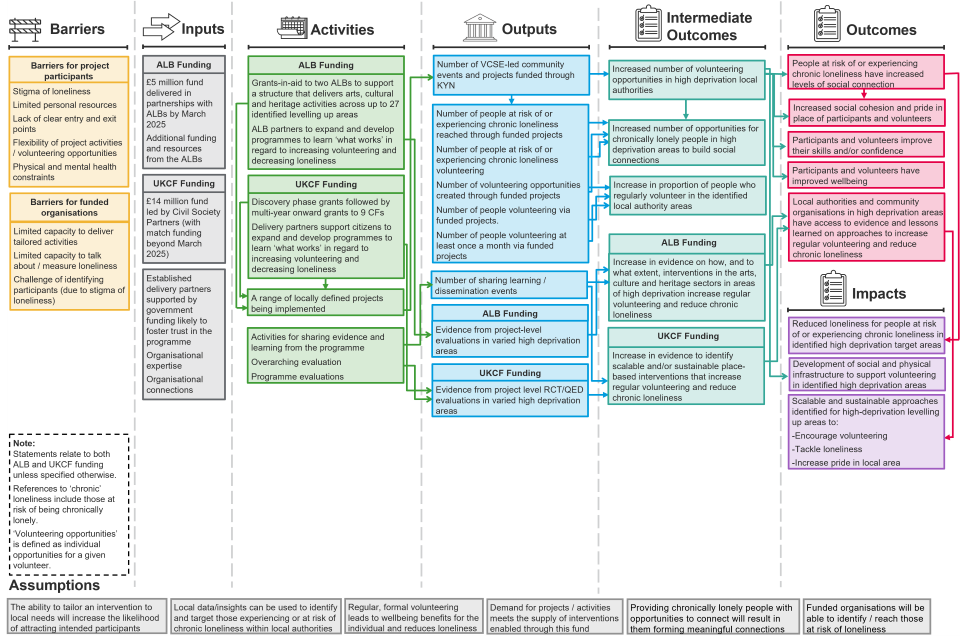
KYN Fund Theory of Change diagram
9.5. Data tables
Table 20: Table of all baseline responses (n = 5,619)
| Demographic | Baseline survey (%) | Baseline survey (n) | |
|---|---|---|---|
| Age | 16 to 24 | 13.0 | 726 |
| 25 to 34 | 14.0 | 785 | |
| 35 to 44 | 14.7 | 821 | |
| 45 to 54 | 13.8 | 769 | |
| 55 to 64 | 17.5 | 979 | |
| 65 to 74 | 15.4 | 862 | |
| 75 to 84 | 8.3 | 464 | |
| 85+ | 2.3 | 127 | |
| Prefer not to say | 1.0 | 58 | |
| Total | 100 | 5591 | |
| Sex | Female | 66.3 | 3700 |
| Male | 32.2 | 1796 | |
| Prefer not to say | 1.6 | 89 | |
| Total | 100.1~ | 5585 | |
| Whether the gender they identify with is the same as the sex registered at birth | Yes | 94.6 | 3491 |
| No | 3.4 | 124 | |
| Prefer not to say | 2.0 | 75 | |
| Total | 100 | 3690 | |
| Ethnicity | Asian and Asian British | 7.3 | 405 |
| Black and Black British | 4.3 | 237 | |
| Mixed ethnic background | 2.0 | 108 | |
| White British | 77.0 | 4272 | |
| White other (including Irish) | 5.2 | 286 | |
| Any other ethnic group | 2.6 | 145 | |
| Prefer not to say | 1.7 | 93 | |
| Total | 100.1~ | 5546 | |
| Disability and health conditions | Yes | 48.3 | 2687 |
| No | 44.6 | 2478 | |
| Prefer not to say | 7.1 | 393 | |
| Total | 100 | 5558 | |
| Impact on carrying out day-to-day activities | Yes, a lot | 35.8 | 941 |
| Yes, a little | 47.3 | 1243 | |
| No | 14.1 | 370 | |
| Prefer not to say | 2.8 | 74 | |
| Total | 100 | 2628 | |
| Types of disabilities and health conditions[footnote 206] | Dexterity (for example lifting and carrying objects, using a keyboard) | 9.3 | 523 |
| Hearing (for example deafness or partial hearing) | 8.1 | 456 | |
| Learning or understanding or concentrating | 13.1 | 735 | |
| Memory | 11.5 | 647 | |
| Mental health | 24.8 | 1391 | |
| Mobility (for example walking short distances or climbing stairs) | 19.6 | 1102 | |
| Stamina or breathing or fatigue | 12.9 | 727 | |
| Socially or behaviourally (for example associated with autism spectrum disorder (ASD) which includes Asperger’s, or attention deficit hyperactivity disorder (ADHD)) | 9.0 | 503 | |
| Vision (for example blindness or partial sight) | 7.0 | 393 | |
| Other | 5.6 | 312 | |
| Prefer not to say | 4.8 | 272 | |
| Volunteering activity | |||
| Volunteer | Yes | 43.5 | 2391 |
| No | 56.5 | 3104 | |
| Total | 100 | 5495 | |
| First time volunteer | Yes | 52.2 | 1249 |
| No | 47.8 | 1142 | |
| Total | 100 | 2391 | |
| Last volunteered | In the past month | 35.8 | 405 |
| Less than a year ago | 20.4 | 231 | |
| 1-2 years ago | 11.5 | 130 | |
| More than 2 years ago | 26.0 | 294 | |
| Can’t remember/Not sure | 6.2 | 70 | |
| Total | 99.9~ | 1130 | |
| Planned duration | Less than a month | 6.5 | 153 |
| 1-2 months | 5.4 | 129 | |
| 3-6 months | 10.6 | 250 | |
| More than 6 months | 29.5 | 935 | |
| Don’t know/Not sure | 38.1 | 903 | |
| Total | 100.1~ | 2370 | |
| Frequency | Twice a week or more | 26.9 | 643 |
| Once a week | 34.8 | 831 | |
| Once every fortnight | 4.6 | 110 | |
| Once a month | 5.2 | 125 | |
| Every two months | 0.8 | 19 | |
| Less frequently than every two months, or ad hoc | 1.09 | 26 | |
| Depends or varies | 13.2 | 315 | |
| Don’t know / Not sure | 13.4 | 321 | |
| Total | 100 | 2390 | |
| Wellbeing | |||
| Life satisfaction | Low | 17.7 | 975 |
| Medium | 25.8 | 1419 | |
| High | 34.5 | 1899 | |
| Very high | 20.4 | 1121 | |
| Prefer not to say | 1.7 | 94 | |
| Total | 100.1~ | 5508 | |
| Worthwhile | Low | 15.6 | 854 |
| Medium | 23.4 | 1277 | |
| High | 33.3 | 1817 | |
| Very High | 25.8 | 1411 | |
| Prefer not to say | 1.9 | 103 | |
| Total | 100 | 5462 | |
| Happiness | Low | 20.1 | 1100 |
| Medium | 24.0 | 1311 | |
| High | 30.3 | 1654 | |
| Very High | 24.2 | 1323 | |
| Prefer not to say | 1.4 | 74 | |
| Total | 100 | 5462 | |
| Anxiety | Very low | 21.7 | 1175 |
| Low | 18.1 | 982 | |
| Medium | 20.3 | 1100 | |
| High | 37.8 | 2048 | |
| Prefer not to say | 2.0 | 109 | |
| Total | 99.9~ | 5413 | |
| Loneliness | |||
| Lacking companionship | Hardly ever or never | 33.4 | 1838 |
| Some of the time | 44.6 | 2456 | |
| Often | 18.4 | 1013 | |
| Prefer not to say | 3.7 | 203 | |
| Total | 100.1~ | 5510 | |
| Feeling left out | Hardly ever or never | 38.3 | 2099 |
| Some of the time | 43.0 | 2356 | |
| Often | 15.3 | 838 | |
| Prefer not to say | 3.4 | 184 | |
| Total | 100 | 5477 | |
| Feeling isolated from others | Hardly ever or never | 38.5 | 2105 |
| Some of the time | 40.7 | 2228 | |
| Often | 17.7 | 966 | |
| Prefer not to say | 3.1 | 170 | |
| Total | 100 | 5469 | |
| Feeling lonely | Never | 12.4 | 662 |
| Hardly ever | 18.8 | 1007 | |
| Occasionally | 23.0 | 1229 | |
| Some of the time | 31.5 | 1687 | |
| Often/Always | 14.3 | 767 | |
| Prefer not to say | - | - | |
| Total | - | - | |
| Loneliness total (Score 3-9)[footnote 207] | 3 | 24.9 | 1273 |
| 4 | 11.7 | 596 | |
| 5 | 12.8 | 655 | |
| 6 | 26.5 | 1356 | |
| 7 | 8.3 | 423 | |
| 8 | 6.9 | 352 | |
| 9 | 8.9 | 457 | |
| Total | 100 | 5112 | |
| Skills | |||
| Skills | Communication skills | 51.1 | 3595 |
| Leadership skills | 14.3 | 1006 | |
| Problem solving | 28.6 | 2012 | |
| Using your creativity | 37.9 | 2666 | |
| Working with others OR team-working skills | 29.6 | 2048 | |
| Other | 6.15 | 433 | |
| Confidence | |||
| Work with other people | 0 (Not at all) | 1.09 | 60 |
| 1 | 1.24 | 68 | |
| 2 | 2.61 | 143 | |
| 3 | 4.05 | 222 | |
| 4 | 4.47 | 245 | |
| 5 | 11.29 | 619 | |
| 6 | 10.05 | 551 | |
| 7 | 14.39 | 789 | |
| 8 | 17.55 | 962 | |
| 9 | 11.69 | 641 | |
| 10 (Completely) | 20.36 | 1116 | |
| Prefer not to say | 1.2 | 66 | |
| Total | 100 | 5482 | |
| Deal with problems | 0 (Not at all) | 1.21 | 66 |
| 1 | 1.52 | 83 | |
| 2 | 2.87 | 157 | |
| 3 | 5.16 | 282 | |
| 4 | 6.08 | 332 | |
| 5 | 13.42 | 733 | |
| 6 | 11.33 | 619 | |
| 7 | 15.72 | 859 | |
| 8 | 19.48 | 1064 | |
| 9 | 10.01 | 547 | |
| 10 (Completely) | 11.99 | 655 | |
| Prefer not to say | 1.21 | 66 | |
| Total | 100 | 5463 | |
| Communicate with others | 0 (Not at all) | 0.86 | 47 |
| 1 | 1.34 | 73 | |
| 2 | 2.19 | 119 | |
| 3 | 4.50 | 245 | |
| 4 | 5.68 | 309 | |
| 5 | 10.75 | 585 | |
| 6 | 10.65 | 580 | |
| 7 | 13.34 | 726 | |
| 8 | 18.02 | 981 | |
| 9 | 12.80 | 697 | |
| 10 (Completely) | 18.77 | 1022 | |
| Prefer not to say | 1.1 | 60 | |
| Total | 100 | 5444 | |
| Use your creativity | 0 (Not at all) | 1.71 | 93 |
| 1 | 1.42 | 77 | |
| 2 | 3.19 | 173 | |
| 3 | 4.72 | 256 | |
| 4 | 7.18 | 390 | |
| 5 | 12.93 | 702 | |
| 6 | 12.41 | 674 | |
| 7 | 14.50 | 787 | |
| 8 | 15.64 | 849 | |
| 9 | 10.11 | 549 | |
| 10 (Completely) | 14.63 | 794 | |
| Prefer not to say | 1.57 | 85 | |
| Total | 100 | 5429 | |
| Take responsibility | 0 (Not at all) | 1.08 | 59 |
| 1 | 1.08 | 59 | |
| 2 | 2.61 | 142 | |
| 3 | 3.52 | 192 | |
| 4 | 5.83 | 318 | |
| 5 | 10.83 | 590 | |
| 6 | 10.31 | 562 | |
| 7 | 13.23 | 721 | |
| 8 | 17.03 | 928 | |
| 9 | 12.75 | 695 | |
| 10 (Completely) | 20.51 | 1118 | |
| Prefer not to say | 1.21 | 66 | |
| Total | 100 | 5450 | |
| Pride of place | |||
| Feeling of belonging to neighbourhood | Not at all strongly | 11.9 | 623 |
| Not very strongly | 28.2 | 1477 | |
| Fairly strongly | 41.5 | 2175 | |
| Very strongly | 18.4 | 965 | |
| Prefer not to say | - | - | |
| Total | - | - | |
| People in the neighbourhood pull together to improve it | Definitely agree | 13.2 | 715 |
| Tend to agree | 40.5 | 2192 | |
| Nothing needs improving | 3.4 | 182 | |
| Tend to disagree | 22.9 | 1240 | |
| Definitely disagree | 12.0 | 647 | |
| Prefer not to say | 8.0 | 435 | |
| Total | 100 | 5411 | |
| Satisfaction with the local area as a place to live | Very satisfied | 25.3 | 1380 |
| Fairly satisfied | 39.6 | 2154 | |
| Neither satisfied nor dissatisfied | 18.7 | 1017 | |
| Fairly dissatisfied | 8.6 | 469 | |
| Very dissatisfied | 4.1 | 225 | |
| Prefer not to say | 3.7 | 200 | |
| Total | 100 | 5445 |
~ Due to rounding figures to one decimal place, some percentages do not total 100%. Counts lower than three for responses to individual items, including zero, have been suppressed, indicated by ‘-‘.
Table 22: Table of responses respondents who completed both baseline and endline surveys (n = 1,648)
| Baseline % | Baseline n | Endline % | Endline n | ||
|---|---|---|---|---|---|
| Age[footnote 208] | 16 to 24 | 14.6 | 240 | ||
| 25 to 34 | 14.8 | 243 | |||
| 35 to 44 | 12.9 | 212 | |||
| 45 to 54 | 14.0 | 230 | |||
| 55 to 64 | 18.2 | 298 | |||
| 65 to 74 | 16.0 | 262 | |||
| 75 to 84 | 7.4 | 121 | |||
| 85+ | 1.5 | 24 | |||
| Prefer not to say | 0.6 | 9 | |||
| Total | 100.0 | 1639 | |||
| Sex | Female | 63.8 | 1,048 | ||
| Male | 34.7 | 570 | |||
| Prefer not to say | 1.5 | 25 | |||
| Total | 100.0 | 1621 | |||
| Gender identity same as sex registered at birth? | Yes | 96.5 | 1,564 | ||
| No | 1.7 | 28 | |||
| Prefer not to say | 1.8 | 29 | |||
| Total | 100.0 | 1621 | |||
| Ethnicity | Asian and Asian British | 6.4 | 105 | ||
| Black and Black British | 3.3 | 53 | |||
| Mixed ethnic background | 2.0 | 32 | |||
| White British | 81.6 | 1,333 | |||
| White other (including Irish) | 3.9 | 64 | |||
| Any other ethnic group | 1.8 | 29 | |||
| Prefer not to say | 1.0 | 17 | |||
| Total | - | - | |||
| Disability/health condition | Yes | 53.7 | 880 | ||
| No | 39.9 | 653 | |||
| Prefer not to say | 6.4 | 105 | |||
| Total | 100.0 | 1638 | |||
| Impact on carrying out day-to-day activities | Yes, a lot | 34.7 | 298 | ||
| Yes, a little | 48.5 | 417 | |||
| No | 14.2 | 122 | |||
| Prefer not to say | 2.7 | 23 | |||
| Total | 100.1~ | 860 | |||
| Types of disabilities and health conditions[footnote 209] | Dexterity | 9.5 | 156 | ||
| Hearing | 8.1 | 133 | |||
| Learning/understanding/concentrating | 15.7 | 259 | |||
| Memory | 12.2 | 201 | |||
| Mental health | 29.6 | 487 | |||
| Mobility | 19.6 | 323 | |||
| Stamina/breathing/fatigue | 13.1 | 215 | |||
| Socially or behaviourally (e.g. ASD, ADHD) | 11.0 | 182 | |||
| Vision | 6.3 | 103 | |||
| Other | 6.3 | 103 | |||
| Prefer not to say | 5.1 | 84 | |||
| Volunteering activity | |||||
| Volunteer | Yes | 47.2 | 758 | 59.9 | 675 |
| No | 52.8 | 848 | 40.2 | 453 | |
| Total | 100.0 | 1606 | 100.0 | 1128 | |
| First time volunteer | Yes | 54.6 | 412 | 55.9 | 377 |
| No | 45.4 | 343 | 44.1 | 297 | |
| Total | 100.0 | 755 | 100.0 | 674 | |
| Last volunteered | In the past month | 34.8 | 120 | 36.9 | 108 |
| Less than a year ago | 20.5 | 70 | 20.5 | 60 | |
| 1 to 2 years ago | 8.8 | 30 | 13.7 | 40 | |
| More than 2 years ago | 28.7 | 98 | 17.8 | 52 | |
| Can’t remember / Not sure | 7.3 | 25 | 11.3 | 33 | |
| Total | 100.1~ | 343 | 100.2~ | 293 | |
| Planned duration | Less than a month | 6.3 | 47 | 6.8 | 52 |
| 1 to 2 months | 5.0 | 27 | 8.2 | 63 | |
| 3 to 6 months | 9.9 | 74 | 22.8 | 175 | |
| More than 6 months | 41.1 | 306 | 53.8 | 414 | |
| Don’t know / Not sure | 37.7 | 281 | 8.5 | 65 | |
| Total | 100.0 | 745 | 100.1~ | 769 | |
| Frequency | Twice a week or more | 32.4 | 254 | 30.9 | 239 |
| Once a week | 32.1 | 251 | 38.0 | 294 | |
| Once every fortnight | 4.0 | 31 | 6.6 | 51 | |
| Once a month | 4.6 | 36 | 6.7 | 52 | |
| Every two months | 0.8 | 6 | 0.7 | 5 | |
| Less frequently / ad hoc | 0.8 | 6 | 6.7 | 52 | |
| Depends or varies | – | – | – | – | |
| Don’t know/Not sure | 11.8 | 92 | 7.5 | 58 | |
| Total | 100.2~ | 783 | 100.1~ | 774 | |
| Plan to volunteer again (endline only) | Yes – regularly | 40.9 | 315 | ||
| Yes – sometimes | 34.5 | 266 | |||
| No | 5.7 | 44 | |||
| Don’t know/Not sure | 18.9 | 146 | |||
| Total | 100 | 771 | |||
| Volunteer duration of next project (endline only) | Twice a week or more | 18.0 | 127 | ||
| Once a week | 27.8 | 196 | |||
| Once every fortnight | 6.0 | 42 | |||
| Once a month | 6.5 | 46 | |||
| Every two months | 0.4 | 3 | |||
| Less frequently than every two months, or ad hoc | 5.8 | 41 | |||
| Depends or varies | 17.6 | 124 | |||
| Don’t know/Not sure | 18.0 | 127 | |||
| Total | 100.1~ | 706 | |||
| Wellbeing | |||||
| Life satisfaction | Low | 20.6 | 334 | 6.3 | 104 |
| Medium | 27.4 | 445 | 17.3 | 284 | |
| High | 33.1 | 538 | 44.2 | 726 | |
| Very high | 17.7 | 288 | 31.2 | 512 | |
| Prefer not to say | 1.2 | 19 | 1.0 | 16 | |
| Total | 100.0 | 1624 | 100.0 | 1642 | |
| Worthwhile | Low | 17.0 | 275 | 5.4 | 89 |
| Medium | 25.7 | 415 | 16.8 | 276 | |
| High | 33.0 | 533 | 39.4 | 646 | |
| Very high | 22.7 | 366 | 37.3 | 612 | |
| Prefer not to say | 1.7 | 27 | 1.0 | 17 | |
| Total | 100.1~ | 1616 | 99.9~ | 1640 | |
| Happiness | Low | 23.1 | 372 | 8.9 | 146 |
| Medium | 24.6 | 396 | 17.3 | 282 | |
| High | 30.1 | 485 | 38.6 | 631 | |
| Very high | 20.9 | 336 | 34.1 | 557 | |
| Prefer not to say | 1.4 | 22 | 1.1 | 18 | |
| Total | 100.1~ | 1611 | 100.0 | 1634 | |
| Anxiety | Very low | 18.8 | 300 | 27.2 | 444 |
| Low | 19.9 | 318 | 22.6 | 369 | |
| Medium | 21.3 | 341 | 18.7 | 305 | |
| High | 38.3 | 613 | 30.2 | 494 | |
| Prefer not to say | 1.7 | 49 | 1.4 | 23 | |
| Total | 100.0 | 1599 | 100.1~ | 1635 | |
| Loneliness | |||||
| Lacking companionship | Hardly ever or never | 31.4 | 509 | 45.6 | 747 |
| Some of the time | 45.7 | 742 | 42.9 | 703 | |
| Often | 18.6 | 301 | 9.5 | 156 | |
| Prefer not to say | 4.4 | 71 | 2.1 | 34 | |
| Total | 100.1~ | 1623 | 100.1~ | 1640 | |
| Feeling left out | Hardly ever or never | 37.5 | 606 | 53.3 | 870 |
| Some of the time | 42.9 | 693 | 35.8 | 584 | |
| Often | 16.7 | 270 | 8.7 | 141 | |
| Prefer not to say | 3.0 | 48 | 2.2 | 36 | |
| Total | 100.1~ | 1617 | 100.0 | 1631 | |
| Feeling isolated from others | Hardly ever or never | 35.5 | 575 | 53.0 | 862 |
| Some of the time | 43.2 | 699 | 35.8 | 583 | |
| Often | 17.9 | 290 | 8.9 | 144 | |
| Prefer not to say | 3.3 | 54 | 2.3 | 38 | |
| Total | 99.9~ | 1618 | 100.0 | 1627 | |
| Feeling lonely | Never | 10.4 | 161 | 14.2 | 232 |
| Hardly ever | 19.1 | 296 | 27.5 | 450 | |
| Occasionally | 23.8 | 370 | 21.8 | 357 | |
| Some of the time | 32.1 | 499 | 27.4 | 449 | |
| Often/Always | 11.9 | 185 | 7.1 | 116 | |
| Prefer not to say | 2.8 | 43 | 2.0 | 32 | |
| Total | 100.1~ | 1554 | 100.0 | 1636 | |
| Loneliness total (Score 3-9)[footnote 210] | 3 | 22.8 | 345 | 37.1 | 578 |
| 4 | 12.1 | 183 | 15.8 | 246 | |
| 5 | 13.1 | 198 | 11.9 | 185 | |
| 6 | 26.8 | 406 | 22.1 | 345 | |
| 7 | 9.1 | 137 | 5.3 | 83 | |
| 8 | 6.9 | 104 | 3.9 | 60 | |
| 9 | 9.3 | 140 | 4.0 | 62 | |
| Total | 100.1~ | 1,513 | 100.1~ | 1,559 | |
| Skills | |||||
| Skills | Communication skills | 64.4 | 1,061 | 72.9 | 1,202 |
| Leadership skills | 19.1 | 315 | 22.3 | 368 | |
| Problem solving | 36.7 | 604 | 40.2 | 663 | |
| Using your creativity | 49.2 | 810 | 51.6 | 650 | |
| Team‑working skills | 59.3 | 977 | 65.7 | 1,083 | |
| Other | 8.1 | 28 | 9.5 | 52 | |
| Were skills developed (endline only) | Strongly agree | 35.0 | 56 | ||
| Agree | 47.4 | 767 | |||
| Neither agree nor disagree | 14.0 | 227 | |||
| Disagree | 1.7 | 28 | |||
| Strongly disagree | 0.3 | 5 | |||
| Prefer not to say | 1.6 | 25 | |||
| Total | 100 | 1618 | |||
| Were improvements made to local area (endline only) | Strongly agree | 23.8 | 384 | ||
| Agree | 39.7 | 640 | |||
| Neither agree nor disagree | 26.8 | 432 | |||
| Disagree | 6.5 | 105 | |||
| Strongly disagree | 0.7 | 12 | |||
| Prefer not to say | 2.4 | 39 | |||
| Total | 99.9~ | 1612 | |||
| Were connections built (endline only) | Strongly agree | 44.6 | 721 | ||
| Agree | 44.1 | 713 | |||
| Neither agree nor disagree | 8.4 | 135 | |||
| Disagree | 1.2 | 19 | |||
| Strongly disagree | 1.2 | 9 | |||
| Prefer not to say | 1.2 | 20 | |||
| Total | 100.1~ | 1617 | |||
| Confidence | |||||
| Work with other people | 0 (Not at all) | 1.3 | 21 | 0.2 | 3 |
| 1 | 1.2 | 20 | 0.2 | 4 | |
| 2 | 2.6 | 42 | 0.2 | 4 | |
| 3 | 4.8 | 78 | 1.2 | 19 | |
| 4 | 5.0 | 80 | 1.7 | 27 | |
| 5 | 12.5 | 201 | 6.2 | 102 | |
| 6 | 10.0 | 162 | 8.9 | 145 | |
| 7 | 15.7 | 253 | 13.5 | 221 | |
| 8 | 18.2 | 294 | 24.0 | 392 | |
| 9 | 10.7 | 172 | 20.3 | 332 | |
| 10 (Completely) | 17.0 | 275 | 22.6 | 369 | |
| Prefer not to say | 1.1 | 17 | 1.0 | 17 | |
| Total | 100.1~ | 1615 | 100.0 | 1635 | |
| Deal with problems | 0 (Not at all) | 1.4 | 22 | 0.4 | 7 |
| 1 | 1.4 | 22 | 0.3 | 5 | |
| 2 | 3.6 | 58 | 0.8 | 13 | |
| 3 | 6.3 | 101 | 1.7 | 28 | |
| 4 | 7.7 | 124 | 2.4 | 39 | |
| 5 | 13.8 | 222 | 9.4 | 153 | |
| 6 | 10.5 | 169 | 10.5 | 170 | |
| 7 | 15.3 | 246 | 16.9 | 275 | |
| 8 | 19.4 | 311 | 24.1 | 392 | |
| 9 | 9.1 | 146 | 18.2 | 296 | |
| 10 (Completely) | 10.6 | 170 | 14.3 | 233 | |
| Prefer not to say | 1.0 | 16 | 1.0 | 16 | |
| Total | 100.1~ | 1607 | 100.0 | 1627 | |
| Communicate with others | 0 (Not at all) | 1.1 | 17 | 0.3 | 4 |
| 1 | 1.7 | 27 | – | – | |
| 2 | 2.2 | 35 | 0.6 | 9 | |
| 3 | 5.7 | 92 | 1.3 | 21 | |
| 4 | 5.7 | 92 | 1.8 | 29 | |
| 5 | 11.2 | 179 | 5.8 | 94 | |
| 6 | 11.8 | 189 | 8.7 | 142 | |
| 7 | 13.3 | 213 | 13.7 | 223 | |
| 8 | 18.8 | 301 | 22.0 | 358 | |
| 9 | 11.9 | 190 | 19.8 | 322 | |
| 10 (Completely) | 15.9 | 254 | 25.3 | 412 | |
| Prefer not to say | 1.0 | 16 | 0.9 | 14 | |
| Total | 100.3~ | 1605 | – | – | |
| Use your creativity | 0 (Not at all) | 2.0 | 32 | 0.4 | 7 |
| 1 | 1.9 | 30 | 0.2 | 3 | |
| 2 | 3.8 | 61 | 0.6 | 10 | |
| 3 | 6.0 | 96 | 1.5 | 24 | |
| 4 | 7.8 | 125 | 3.0 | 49 | |
| 5 | 12.4 | 199 | 9.8 | 160 | |
| 6 | 13.2 | 212 | 10.8 | 176 | |
| 7 | 15.2 | 243 | 16.0 | 261 | |
| 8 | 14.9 | 239 | 21.6 | 353 | |
| 9 | 9.5 | 152 | 16.2 | 265 | |
| 10 (Completely) | 11.7 | 188 | 18.8 | 307 | |
| Prefer not to say | 1.5 | 24 | 1.2 | 19 | |
| Total | 99.9~ | 1601 | 100.1~ | 1634 | |
| Take responsibility | 0 (Not at all) | 1.1 | 18 | 0.3 | 5 |
| 1 | 1.4 | 22 | 0.4 | 6 | |
| 2 | 2.6 | 42 | 1.1 | 18 | |
| 3 | 4.7 | 75 | 1.3 | 21 | |
| 4 | 7.2 | 116 | 1.9 | 31 | |
| 5 | 11.9 | 191 | 7.4 | 121 | |
| 6 | 10.8 | 174 | 8.5 | 139 | |
| 7 | 14.1 | 226 | 14.6 | 238 | |
| 8 | 16.1 | 258 | 21.5 | 352 | |
| 9 | 11.0 | 176 | 19.2 | 313 | |
| 10 (Completely) | 18.0 | 289 | 22.7 | 371 | |
| Prefer not to say | 1.2 | 20 | 1.2 | 19 | |
| Total | 100.1~ | 1607 | 100.1~ | 1634 | |
| Pride in place | |||||
| Feeling of belonging to neighbourhood | Not at all strongly | 13.4 | 216 | 5.3 | 87 |
| Not very strongly | 27.6 | 445 | 18.3 | 299 | |
| Fairly strongly | 38.7 | 623 | 47.5 | 776 | |
| Very strongly | 15.0 | 241 | 23.5 | 384 | |
| Prefer not to say | 5.3 | 85 | 5.4 | 88 | |
| Total | 100.0 | 1610 | 100.0 | 1634 | |
| People in the neighbourhood pull together to improve it | Definitely agree | 11.8 | 189 | 16.4 | 267 |
| Tend to agree | 36.9 | 593 | 50.0 | 816 | |
| Nothing needs improving | 2.5 | 40 | 2.3 | 37 | |
| Tend to disagree | 25.8 | 415 | 17.1 | 279 | |
| Definitely disagree | 13.4 | 215 | 5.7 | 93 | |
| Prefer not to say | 9.7 | 156 | 8.5 | 139 | |
| Total | 100.1~ | 1608 | 100.0 | 1631 | |
| Satisfaction with the local area as a place to live | Very satisfied | 22.5 | 362 | 28.3 | 461 |
| Fairly satisfied | 37.4 | 601 | 45.2 | 737 | |
| Neither satisfied nor dissatisfied | 20.5 | 329 | 15.2 | 248 | |
| Fairly dissatisfied | 10.2 | 164 | 4.6 | 75 | |
| Very dissatisfied | 4.6 | 74 | 2.2 | 35 | |
| Prefer not to say | 4.9 | 79 | 4.5 | 74 | |
| Total | 100.1~ | 1609 | 100.0 | 1630 |
~ Due to rounding figures to one decimal place, some percentages do not total 100%. Counts lower than three for responses to individual items, including zero, have been suppressed, indicated by ‘-‘.
9.6. Survey questionnaires[footnote 211]
9.6.1. Baseline survey
Thank you for agreeing to take part in the Know Your Neighbourhood evaluation by completing this short survey.
We want to understand if your feelings change during your time on the project, and so we would like to ask you questions again at the end – and maybe in the middle too.
These first questions are only included to help us link your answers from the start, middle and end surveys. They will be stored separately from the rest of your responses and will not be used to identify you.
1. What is your first name?
2. What is your surname?
3. What is your date of birth?
4. Roughly when did you join the project? Please use your best guess if you can’t remember exactly.
5. Some people may be taking part in the project as a volunteer. By ‘volunteer’ we mean someone who willingly offers their time for free to carry out tasks that will benefit others. Are you taking part in this project as a volunteer? Please select one
- Yes - Please go to Q6.
- No - Please go to Q10.
These questions are about volunteering.
6. Is this your first time volunteering? Please select one.
- Yes - Please go to Q8.
- No - Please go to Q7.
7. When did you last volunteer? Please select one.
- In the past month
- Less than a year ago
- 1 to 2 years ago
- More than 2 years ago
- Can’t remember / Not sure
8. How long do you think you will volunteer on this project? Please select one.
- Less than a month
- 1 to 2 months
- 3 to 6 months
- More than 6 months
- Don’t know / Not sure
9. How often do you think you will volunteer with this project? Please select one.
- Twice a week or more
- Once a week
- Once every fortnight
- Once a month
- Every two months
- Less frequently than every two months, or ad hoc
- Depends or varies
- Don’t know / Not sure
The next questions are about how you feel about different aspects of your life and your experiences on the project.
On a scale of 0 to 10, where 0 is ‘not at all’ and 10 is ‘completely’, overall…
10. How satisfied are you with your life nowadays? Please circle one.
- 0 Not at all
- 1
- 2
- 3
- 4
- 5
- 6
- 7
- 8
- 9
- 10 Completely
- Prefer not to say
11. To what extent do you feel that the things you do in your life are worthwhile? Please circle one.
- 0 Not at all
- 1
- 2
- 3
- 4
- 5
- 6
- 7
- 8
- 9
- 10 Completely
- Prefer not to say
12. How happy did you feel yesterday? Please circle one.
- 0 Not at all
- 1
- 2
- 3
- 4
- 5
- 6
- 7
- 8
- 9
- 10 Completely
- Prefer not to say
13. How anxious did you feel yesterday? Please circle one.
- 0 Not at all
- 1
- 2
- 3
- 4
- 5
- 6
- 7
- 8
- 9
- 10 Completely
- Prefer not to say
14. How often do you feel you lack companionship? Please select one.
- Hardly ever or never
- Some of the time
- Often
- Prefer not to say
15. How often do you feel left out? Please select one.
- Hardly ever or never
- Some of the time
- Often
- Prefer not to say
16. How often do you feel isolated from others? Please select one.
- Hardly ever or never
- Some of the time
- Often
- Prefer not to say
17. How often do you feel lonely? Please select one.
- Often / always
- Some of the time
- Occasionally
- Hardly ever
- Never
- Prefer not to say
18. Which of the following skills do you think you will use during the project? Please select all that apply to you.
- Communication skills
- Leadership skills
- Problem solving
- Using your creativity
- Working with others OR Team-working skills
- Other
- Prefer not to say
On a scale of 0 to 10, where 0 is ‘not confident at all’ and 10 is ‘extremely confident’, these days, how confident do you feel about your ability to…
19. Work with other people Please circle one.
- 0 Not confident at all
- 1
- 2
- 3
- 4
- 5
- 6
- 7
- 8
- 9
- 10 Extremely confident
- Prefer not to say
20. Deal with problems Please circle one.
- 0 Not confident at all
- 1
- 2
- 3
- 4
- 5
- 6
- 7
- 8
- 9
- 10 Extremely confident
- Prefer not to say
21. Communicate with others Please circle one.
- 0 Not confident at all
- 1
- 2
- 3
- 4
- 5
- 6
- 7
- 8
- 9
- 10 Extremely confident
- Prefer not to say
22. Use your creativity in daily life Please circle one.
- 0 Not confident at all
- 1
- 2
- 3
- 4
- 5
- 6
- 7
- 8
- 9
- 10 Extremely confident
- Prefer not to say
23. Take on responsibility in your daily life Please circle one.
- 0 Not confident at all
- 1
- 2
- 3
- 4
- 5
- 6
- 7
- 8
- 9
- 10 Extremely confident
- Prefer not to say
24. How strongly do you feel you belong to your immediate neighbourhood? Please think of the area within a few minutes walking distance from your home. Please select one.
- Very strongly
- Fairly strongly
- Not very strongly
- Not at all strongly
- Prefer not to say
25. To what extent would you agree or disagree that people in your neighbourhood pull together to improve the neighbourhood? Please select one.
- Definitely agree
- Tend to agree
- Tend to disagree
- Definitely disagree
- Nothing needs improving
- Prefer not to say
26. Overall, how satisfied or dissatisfied are you with your local area as a place to live? Please think of the area within 15-20 minutes walking distance from your home. Please select one.
- Very satisfied
- Fairly satisfied
- Neither satisfied or dissatisfied
- Fairly dissatisfied
- Very dissatisfied
- Prefer not to say
27. Please let us know why you joined the project, and how you hope you will benefit from being involved
-
I joined the project because…
-
I hope to benefit from being involved by…
About you
We want to understand whether feelings and experiences vary between different types of people. Therefore, these last few questions are about you. Completing these questions is really important to help us understand which projects work best for different types of people. Therefore, we hope you will answer them all, but please select the ‘prefer not to say’ option if you do not want to respond.
28. How old are you? Please select one.
- 0 to 15
- 16 to 24
- 25 to 34
- 35 to 44
- 45 to 54
- 55 to 64
- 65 to 74
- 75 to 84
- 85+
- Prefer not to say
29. What is your sex? Please select one. A question about gender identity follows next.
- Female
- Male
- Prefer not to say
30. Is the gender you identify with the same as your sex registered at birth? Please select one.
- Yes - Please go to Q32.
- No - Please go to Q31.
- Prefer not to say
31.If the gender you identify with is not the same as your sex registered at birth, please let us know your gender identity:
32. What is your ethnic group? Please select one.
- Asian/ Asian British: Bangladeshi
- Asian/ Asian British: Chinese
- Asian/ Asian British: Indian
- Asian/ Asian British: Pakistani
- Asian/ Asian British: Any other background
- Black/black British: African
- Black/black British: Caribbean
- Black/black British: Any other black background
- Mixed race: white and Asian
- Mixed race: white and black African
- Mixed race: white and black Caribbean
- Mixed race: Any other mixed background
- White British
- White Irish
- White: Any other background
- Any other ethnic group
- Prefer not to say
33. Do you have any physical or mental health conditions or illnesses lasting or expecting to last 12 months or more? Please select one.
- Yes - Please go to Q34.
- No - Please go to Q35.
- Prefer not to say - Please go to Q35.
34. Does your condition(s) or illness(es) reduce your ability to carry out day-to-day activities? Please select one.
- Yes, a lot
- Yes, a little
- No
- Prefer not to say
- Not applicable
35. Do any of these conditions or illnesses affect you in any of the following areas? Please select all that apply.
- Vision (for example blindness or partial sight)
- Hearing (for example deafness or partial hearing)
- Mobility (for example walking short distances or climbing stairs)
- Dexterity (for example lifting and carrying objects, using a keyboard)
- Learning or understanding or concentrating
- Memory
- Mental health
- Stamina or breathing or fatigue
- Socially or behaviourally (for example associated with autism spectrum disorder (ASD) which includes Asperger’s, or attention deficit hyperactivity disorder (ADHD))
- Other
- None of the above
- Prefer not to say
Thank you so much for answering these questions, we really appreciate your time. Please place your survey in an envelope named ‘KYN evaluation survey’ and give it to a member of the project team.
We have created a list of wellbeing and financial support services – these are being provided to everyone taking part in the project. We hope you, or someone you know, may find them useful. Please ask a member of staff if you would like a copy of them.
9.6.2. Midpoint survey
Thank you for agreeing to take part in the Know Your Neighbourhood evaluation by completing this short survey.
You may remember completing a similar survey at the start of the project. We want to understand if your feelings are changing during your time on the project, and so we would also like to ask you some of these questions again. We will also ask you these questions at the end of your time on the project.
These first questions are only included to help us link your answers from the start, middle and end surveys. They will be stored separately from the rest of your responses and will not be used to identify you.
1. What is your first name?
2. What is your surname?
3. What is your date of birth?
The next question helps us understand how you were involved in the project.
4. Some people may be taking part in the project as a volunteer. By ‘volunteer’ we mean someone who willingly offers their time for free to carry out tasks that will benefit others. Are you taking part in this project as a volunteer? Please select one.
- Yes - Please go to Q5.
- No - Please go to Q10.
These questions are about volunteering.
5. Is this project your first time volunteering? Please select one.
- Yes - Please go to Q7.
- No - Please go to Q6.
6. When did you last volunteer? Please select one.
- In the past month
- Less than a year ago
- 1 to 2 years ago
- More than 2 years ago
- Can’t remember / Not sure
7. How long did you volunteer on this project? Please select one.
- Less than a month
- 1 to 2 months
- 3 to 6 months
- More than 6 months
- Don’t know / Not sure
8. How often do you think you will volunteer on this project? Please select one.
- Twice a week or more
- Once a week
- Once every fortnight
- Once a month
- Every two months
- Less frequently than every two months, or ad hoc
- Depends or varies
- Don’t know / Not sure
9. Do you plan to volunteer again after the current experience? Please select one.
- Yes – sometimes / not regularly
- Yes – regularly
- No
- Don’t know / not sure
The next questions are about how you feel about different aspects of your life and your experiences on the project.
On a scale of 0 to 10, where 0 is ‘not at all’ and 10 is ‘completely’, overall…
10. How satisfied are you with your life nowadays? Please circle one.
- 0 Not at all
- 1
- 2
- 3
- 4
- 5
- 6
- 7
- 8
- 9
- 10 Completely
- Prefer not to say
11. To what extent do you feel that the things you do in your life are worthwhile? Please circle one.
- 0 Not at all
- 1
- 2
- 3
- 4
- 5
- 6
- 7
- 8
- 9
- 10 Completely
- Prefer not to say
12. How happy did you feel yesterday? Please circle one.
- 0 Not at all
- 1
- 2
- 3
- 4
- 5
- 6
- 7
- 8
- 9
- 10 Completely
- Prefer not to say
13. How anxious did you feel yesterday? Please circle one.
- 0 Not at all
- 1
- 2
- 3
- 4
- 5
- 6
- 7
- 8
- 9
- 10 Completely
- Prefer not to say
14. How often do you feel you lack companionship? Please select one.
- Hardly ever or never
- Some of the time
- Often
- Prefer not to say
15. How often do you feel left out? Please select one.
- Hardly ever or never
- Some of the time
- Often
- Prefer not to say
16. How often do you feel isolated from others? Please select one.
- Hardly ever or never
- Some of the time
- Often
- Prefer not to say
17. How often do you feel lonely? Please select one.
- Often / always
- Some of the time
- Occasionally
- Hardly ever
- Never
- Prefer not to say
18. Which of the following skills have you used during the project? Please select all that apply to you.
- Communication skills
- Leadership skills
- Problem solving
- Using your creativity
- Working with others OR Team-working skills
- Other
- Prefer not to say
Thinking about the above skills, how much do you agree with the following statements?
19. I have developed my skills as a result of this project. Please select one.
- Strongly agree
- Agree
- Neither agree nor disagree
- Disagree
- Strongly disagree
- Prefer not to say
20. I have made improvements to my local area as a result of the skills I have developed on this project. Please select one.
- Strongly agree
- Agree
- Neither agree nor disagree
- Disagree
- Strongly disagree
- Prefer not to say
21. I have built connections with new people through this project. Please select one.
- Strongly agree
- Agree
- Neither agree nor disagree
- Disagree
- Strongly disagree
- Prefer not to say
On a scale of 0 to 10, where 0 is ‘not confident at all’ and 10 is ‘extremely confident’, these days, how confident do you feel about your ability to…
22. Work with other people Please circle one.
- 0 Not confident at all
- 1
- 2
- 3
- 4
- 5
- 6
- 7
- 8
- 9
- 10 Extremely confident
- Prefer not to say
23. Deal with problems Please circle one.
- 0 Not confident at all
- 1
- 2
- 3
- 4
- 5
- 6
- 7
- 8
- 9
- 10 Extremely confident
- Prefer not to say
24. Communicate with others Please circle one.
- 0 Not confident at all
- 1
- 2
- 3
- 4
- 5
- 6
- 7
- 8
- 9
- 10 Extremely confident
- Prefer not to say
25. Use your creativity in daily life Please circle one.
- 0 Not confident at all
- 1
- 2
- 3
- 4
- 5
- 6
- 7
- 8
- 9
- 10 Extremely confident
- Prefer not to say
26. Take on responsibility in your daily life Please circle one.
- 0 Not confident at all
- 1
- 2
- 3
- 4
- 5
- 6
- 7
- 8
- 9
- 10 Extremely confident
- Prefer not to say
27. How strongly do you feel you belong to your immediate neighbourhood? Please think of the area within a few minutes walking distance from your home. Please select one.
- Very strongly
- Fairly strongly
- Not very strongly
- Not at all strongly
- Prefer not to say
28. To what extent would you agree or disagree that people in your neighbourhood pull together to improve the neighbourhood? Please select one.
- Definitely agree
- Tend to agree
- Tend to disagree
- Definitely disagree
- Nothing needs improving
- Prefer not to say
29. Overall, how satisfied or dissatisfied are you with your local area as a place to live? Please think of the area within 15-20 minutes walking distance from your home. Please select one.
- Very satisfied
- Fairly satisfied
- Neither satisfied or dissatisfied
- Fairly dissatisfied
- Very dissatisfied
- Prefer not to say
30. Please let us know how you benefited from being involved in the project.
Thank you so much for answering these questions, we really appreciate your time. Please place your survey in an envelope named ‘KYN evaluation survey’ and give it to a member of the project team.
We have created a list of wellbeing and financial support services – these are being provided to everyone taking part in the project. We hope you, or someone you know, may find them useful. Please ask a member of staff if you would like a copy of them.
9.6.3. Endline survey
Thank you for agreeing to take part in the Know Your Neighbourhood evaluation by completing this short survey.
You may remember completing a similar survey at the start of the project. You may also have completed another survey mid-way through your time on the project.
This is the final survey that we would like you to complete now your time on the project has come to an end. The survey is about how you feel since being involved in the project.
These first questions are only included to help us link your answers from the start, middle and end surveys. They will be stored separately from the rest of your responses and will not be used to identify you.
1. What is your first name?
2. What is your surname?
3. What is your date of birth?
The next question helps us understand how you were involved in the project.
4. Some people took part in the project as a volunteer. By ‘volunteer’ we mean someone who willingly offers their time for free to carry out tasks that will benefit others. Did you take part in this project as a volunteer? Please select one.
- Yes - Please go to Q5.
- No - Please go to Q11.
These questions are about volunteering.
5. Was this project your first time volunteering? Please select one.
- Yes - Please go to Q7.
- No - Please go to Q6.
6. When did you last volunteer? Please select one.
- In the past month
- Less than a year ago
- 1 to 2 years ago
- More than 2 years ago
- Can’t remember / Not sure
7. How long did you volunteer on this project? Please select one.
- Less than a month
- 1 to 2 months
- 3 to 6 months
- More than 6 months
- Don’t know / Not sure
8. How often did you volunteer on this project? Please select one.
- Twice a week or more
- Once a week
- Once every fortnight
- Once a month
- Every two months
- Less frequently than every two months, or ad hoc
- Depends or varies
- Don’t know / Not sure
9. Do you plan to volunteer again after the current experience? Please select one.
- Yes – sometimes / not regularly
- Yes – regularly
- No - Please go to Q11.
- Don’t know / Not sure
10. How often do you think you will volunteer on your next project? Please select one.
- Twice a week or more
- Once a week
- Once every fortnight
- Once a month
- Every two months
- Less frequently than every two months, or ad hoc
- Depends or varies
- Don’t know / Not sure
The next questions are about how you feel about different aspects of your life and your experiences on the project.
On a scale of 0 to 10, where 0 is ‘not at all’ and 10 is ‘completely’, overall…
11. How satisfied are you with your life nowadays? Please circle one.
- 0 Not at all
- 1
- 2
- 3
- 4
- 5
- 6
- 7
- 8
- 9
- 10 Completely
- Prefer not to say
12. To what extent do you feel that the things you do in your life are worthwhile? Please circle one.
- 0 Not at all
- 1
- 2
- 3
- 4
- 5
- 6
- 7
- 8
- 9
- 10 Completely
- Prefer not to say
13. How happy did you feel yesterday? Please circle one.
- 0 Not at all
- 1
- 2
- 3
- 4
- 5
- 6
- 7
- 8
- 9
- 10 Completely
- Prefer not to say
14. How anxious did you feel yesterday? Please circle one.
- 0 Not at all
- 1
- 2
- 3
- 4
- 5
- 6
- 7
- 8
- 9
- 10 Completely
- Prefer not to say
15. How often do you feel you lack companionship? Please select one.
- Hardly ever or never
- Some of the time
- Often
- Prefer not to say
16. How often do you feel left out? Please select one.
- Hardly ever or never
- Some of the time
- Often
- Prefer not to say
17. How often do you feel isolated from others? Please select one.
- Hardly ever or never
- Some of the time
- Often
- Prefer not to say
18. How often do you feel lonely? Please select one.
- Often / always
- Some of the time
- Occasionally
- Hardly ever
- Never
- Prefer not to say
19. Which of the following skills have you used during the project? Please select all that apply to you.
- Communication skills
- Leadership skills
- Problem solving
- Using your creativity
- Working with others OR Team-working skills
- Other
- Prefer not to say
Thinking about the above skills, how much do you agree with the following statements?
20. I have developed my skills as a result of this project. Please select one.
- Strongly agree
- Agree
- Neither agree nor disagree
- Disagree
- Strongly disagree
- Prefer not to say
21. I have made improvements to my local area as a result of the skills I have developed on this project. Please select one.
- Strongly agree
- Agree
- Neither agree nor disagree
- Disagree
- Strongly disagree
- Prefer not to say
22. I have built connections with new people through this project. Please select one.
- Strongly agree
- Agree
- Neither agree nor disagree
- Disagree
- Strongly disagree
- Prefer not to say
On a scale of 0 to 10, where 0 is ‘not confident at all’ and 10 is ‘extremely confident’, these days, how confident do you feel about your ability to…
23. Work with other people Please circle one.
- 0 Not confident at all
- 1
- 2
- 3
- 4
- 5
- 6
- 7
- 8
- 9
- 10 Extremely confident
- Prefer not to say
24. Deal with problems Please circle one.
- 0 Not confident at all
- 1
- 2
- 3
- 4
- 5
- 6
- 7
- 8
- 9
- 10 Extremely confident
- Prefer not to say
25. Communicate with others Please circle one.
- 0 Not confident at all
- 1
- 2
- 3
- 4
- 5
- 6
- 7
- 8
- 9
- 10 Extremely confident
- Prefer not to say
26. Use your creativity in daily life Please circle one.
- 0 Not confident at all
- 1
- 2
- 3
- 4
- 5
- 6
- 7
- 8
- 9
- 10 Extremely confident
- Prefer not to say
27. Take on responsibility in your daily life Please circle one.
- 0 Not confident at all
- 1
- 2
- 3
- 4
- 5
- 6
- 7
- 8
- 9
- 10 Extremely confident
- Prefer not to say
28. How strongly do you feel you belong to your immediate neighbourhood? Please think of the area within a few minutes walking distance from your home. Please select one.
- Very strongly
- Fairly strongly
- Not very strongly
- Not at all strongly
- Prefer not to say
29. To what extent would you agree or disagree that people in your neighbourhood pull together to improve the neighbourhood? Please select one.
- Definitely agree
- Tend to agree
- Tend to disagree
- Definitely disagree
- Nothing needs improving
- Prefer not to say
30. Overall, how satisfied or dissatisfied are you with your local area as a place to live? Please think of the area within 15-20 minutes walking distance from your home. Please select one.
- Very satisfied
- Fairly satisfied
- Neither satisfied or dissatisfied
- Fairly dissatisfied
- Very dissatisfied
- Prefer not to say
31. Please let us know how you benefited from being involved in the project.
Thank you so much for answering these questions, we really appreciate your time. Please place your survey in an envelope named ‘KYN evaluation survey’ and give it to a member of the project team.
We have created a list of wellbeing and financial support services – these are being provided to everyone taking part in the project. We hope you, or someone you know, may find them useful. Please ask a member of staff if you would like a copy of them.
-
DCMS (2025), Interim overarching evaluation on the Know Your Neighbourhood Fund. ↩
-
Office for National Statistics (2023) Disability, England and Wales: Census 2021. ↩
-
Projects delivered activities of varying levels of budget and intensity. This average cost per participant shows the total cost of the activities in scope for the VfM analysis, divided by the number of participants reached by these activities. ↩
-
Estimated wellbeing value ranges are based on a lower bound and upper bound of £9,537 and £17,042, which represent estimates of the annual wellbeing generated from lifting a person out of chronic loneliness. ↩
-
University of Central Lancashire place based depth evaluation report not published. ↩
-
Significance levels were set at 2.5% for the two primary outcomes — loneliness (measured using the UCLA Loneliness Scale) and volunteering — to account for multiple testing. For all other outcomes, a 5% significance level was applied. ↩
-
Sensitivity comparisons used as benchmark the variable indicating the presence of a long-term health condition that has a lot of impact on the ability to carry out day-to-day activities. This variable was selected because it showed the strongest correlation with most of the outcomes in the analysis (except those related to pride in the local area), making it a useful benchmark for assessing the potential impact of unmeasured confounding. ↩
-
DCMS (2024) Community Life Survey 2023/24: annual publication. ↩
-
See section 4.2.1 of the KYN Fund evaluation interim report for further detail on the application and selection processes. DCMS (2025), Interim overarching evaluation on the Know Your Neighbourhood Fund. ↩
-
Participants did not have to respond to all questions and could choose to skip any they did not wish to answer. Where this was the case, responses were recorded as missing and were not included in the population size (n) for the related characteristic. Hence, percentages included in this section reflect the percentage of participants who did respond to each of the questions. For clarity, the number of respondents is stated at the beginning of each section (n) and change between sections. ↩
-
ACE funded programmes: 103,918; UKCF funded programmes: 40,714. Participants figures from Historic England funded programmes were not included because their participants did not complete impact surveys. They had a total of 34,537 participants. ↩
-
Office for National Statistics (2024) Estimates of the population for the UK, England, Wales, Scotland, and Northern Ireland. ↩
-
Only adults (16 years of age or older) were asked to take part in the survey. ↩
-
Most ACE funded project met or exceeded their participant recruitment targets. However, a handful of projects greatly exceeded their targets, for example by c.20,000 participants. This has caused ACE funded projects to recruit substantially more participants than expected. ↩
-
Historic England figures are not included ↩
-
Office for National Statistics (2018) Measuring loneliness: guidance for use of the national indicators on surveys. ↩
-
Defined as responses of “often/always” to the direct question (“How often do you feel lonely?”). Please refer to section 8.2.1 in the appendices for more detail. ↩
-
DCMS (2024) Community Life Survey 2023/24: annual publication. ↩
-
Respondents’ responses were associated to scores from 1 to 3 (respectively “hardly ever or never”, “some of the time”, and “often”) and then combined in a total score from 3 to 9, where 3 (respondent answered “hardly ever or never” to all three questions) indicates less frequent loneliness and 9 (respondent answered “often” to all three questions) indicates more frequent loneliness. ↩
-
Office for National Statistics (2018) Measuring loneliness: guidance for use of the national indicators on surveys. ↩
-
DCMS (2024) Community Life Survey 2023/24: annual publication. ↩
-
Office for National Statistics (2023) Disability, England and Wales: Census 2021. ↩
-
NatCen Social Research (2025) Adult Psychiatric Morbidity Survey 2023/4. ↩
-
Office for National Statistics (2024) Estimates of the population for the UK, England, Wales, Scotland, and Northern Ireland. ↩
-
By endline, more people may have started volunteering due to changing from being a beneficiary to being a volunteer, but this information was not specifically captured. ↩
-
Please note that 4645 respondents did not answer the questions on volunteering experience. ↩
-
The extension of the KYN Fund up to March 2026 was announced after all project interviews were completed. ↩
-
KYN Fund grants ranged from c.£7,000 to c.£960,000. ↩
-
It was estimated that the survey would take approximately 5 minutes to complete. Projects interviewed said that in many cases the surveys took longer to complete, with some reporting it took a few respondents up to an hour to complete. ↩
-
Please refer to section 9.1 in the appendices for a detailed description of the methodology. ↩
-
Quantitative findings from reports have not been reproduced in this section, but have been reported qualitatively (e.g., as evidence that some people made social connections). ↩
-
DCMS, 2022: Investigating factors associated with loneliness in adults in England ↩
-
Wilbraham, s. (n.d.). A Local evaluation of Furness for You: A community intervention for loneliness and social isolation in Barrow-in-Furness. ↩
-
25-07-30 KYN Impact Evaluation Report (UKCF Projects) DRAFT FINAL ↩
-
Know Your Neighbourhood: Great Yarmouth Place-Based Research. (n.d.). ↩
-
Know Your Neighbourhood Fund Monitoring Report (Hull). (n.d.). ↩
-
Project Closure Report for Historic England Know Your Neighbourhood Fund. (n.d.). ↩
-
Summary of successes and lessons learned from the KYN Legacy Programme B arts Communities Connect Legacy Project (Stoke). (n.d.). ↩
-
Know Your Neighbourhood: Great Yarmouth Place-Based Research. (n.d.). ↩
-
As measured by a survey conducted before and after participation. The responses were analysed descriptively and it is therefore not possible to know if the reduction was because of the funded activities. Know Your Neighbourhood Fund: Outcome Evaluation of UKCF-Funded Projects (draft). (n.d.). ↩
-
Know Your Neighbourhood Heritage Legacy Project (Great Yarmouth). (n.d.). ↩
-
Wilbraham, s. (n.d.). A Local evaluation of Furness for You: A community intervention for loneliness and social isolation in Barrow-in-Furness. ↩
-
Know Your Neighbourhood Fund Monitoring Report (Blackpool). (2025). ↩
-
Sensitivity analyses showed that unobserved confounding factors related to volunteering and individual characteristics would need to be around 84 times as strongly correlated with volunteering as the most influential observed covariate in analysis (having a long-term illness) to fully offset the observed impacts on volunteering. This is despite the QED analysis only being able to account for a small number of observed covariates, as it requires that unobserved factors linked to regular volunteering outweigh the importance of having a long-term illness by a large degree, which is assumed unlikely. ↩
-
The question is “How often did you volunteer with this project?” ↩
-
The question is “How often do you think you will volunteer on your next project?” ↩
-
The question is “Do you plan to volunteer again after the current experience?” ↩
-
Cramer’s v = 0.57, p < 0.001. ↩
-
Cramer’s v = 0.06, p = 0.297. ↩
-
Know Your Neighbourhood Fund Monitoring Report (Blackpool). (2025). ↩
-
Know Your Neighbourhood Heritage Legacy Project (Great Yarmouth). (n.d.). ↩
-
As measured by a survey conducted before and after participation. The responses were analysed descriptively and it is therefore not possible to know if the reduction was because of the funded activities. Know Your Neighbourhood Fund: Outcome Evaluation of UKCF-Funded Projects (draft). (n.d.). ↩
-
Know Your Neighbourhood Fund: Outcome Evaluation of UKCF-Funded Projects (draft). (n.d.). ↩
-
Know Your Neighbourhood Fund: Outcome Evaluation of UKCF-Funded Projects (draft). (n.d.). ↩
-
Know Your Neighbourhood: Great Yarmouth Place-Based Research. (n.d.). ↩
-
Know Your Neighbourhood Fund Monitoring Report (Blackpool). (2025). ↩
-
Know Your Neighbourhood: Great Yarmouth Place-Based Research (Great Yarmouth). (n.d.). ↩
-
Know Your Neighbourhood: Great Yarmouth Place-Based Research. (n.d.). ↩
-
Know Your Neighbourhood Fund Monitoring Report (Burnley). (n.d.). ↩
-
Know Your Neighbourhood Arts Council England Funded Projects: Final Report. (2025). ↩
-
Know Your Neighbourhood: Great Yarmouth Place-Based Research. (n.d.). ↩
-
Know Your Neighbourhood Fund: Outcome Evaluation of UKCF-Funded Projects (draft). (n.d.). ↩
-
Know Your Neighbourhood Arts Council England Funded Projects: Final Report. (2025). ↩
-
Know your Neighbour Legacy Fund Evaluation (Stalybridge). (n.d.). ↩
-
Summary of successes and lessons learned from the KYN Legacy Programme B arts Communities Connect Legacy Project (Stoke). (n.d.). ↩
-
Know Your Neighbourhood Fund Monitoring Report (Hull). (n.d.). ↩
-
Summary of successes and lessons learned from the KYN Legacy Programme B arts Communities Connect Legacy Project (Stoke). (n.d.). ↩
-
Know Your Neighbourhood Fund: Outcome Evaluation of UKCF-Funded Projects (draft). (n.d.). ↩
-
Know Your Neighbourhood Fund: Outcome Evaluation of UKCF-Funded Projects (draft). (n.d.). ↩
-
Know Your Neighbourhood Fund: Outcome Evaluation of UKCF-Funded Projects (draft). (n.d.). ↩
-
Know Your Neighbourhood: Great Yarmouth Place-Based Research. (n.d.). ↩
-
Know Your Neighbourhood Arts Council England Funded Projects: Final Report. (2025). ↩
-
Know Your Neighbourhood Fund Monitoring Report (Hull). (n.d.). ↩
-
Summary of successes and lessons learned from the KYN Legacy Programme B arts Communities Connect Legacy Project (Stoke). (n.d.). ↩
-
Know Your Neighbourhood Arts Council England Funded Projects: Final Report. (2025). ↩
-
Know Your Neighbourhood: Great Yarmouth Place-Based Research. (n.d.). ↩
-
Know Your Neighbourhood Fund: Outcome Evaluation of UKCF-Funded Projects (draft). (n.d.). ↩
-
Know Your Neighbourhood Fund Monitoring Report (Hull). (n.d.). ↩
-
Project Closure Report for Historic England Know Your Neighbourhood Fund. (n.d.). ↩
-
Office for National Statistics (2025) Personal well-being user guidance. ↩
-
Respondents were asked to give a score between 0-10, with 0 being the lowest, and 10 being the highest. For life satisfaction, worthwhile and happiness, results were categorised as a value of 0-4 reaching a score of low, 5-6 medium, 7-8 high and 9-10 a score of very high. For anxious, 0-1 was a score of very low, 2-3 was low, 4-5 was medium, and 6-10 was a score of very high. ↩
-
Wilbraham, s. (n.d.). A Local evaluation of Furness for You: A community intervention for loneliness and social isolation in Barrow-in-Furness. ↩
-
Know Your Neighbourhood: Great Yarmouth Place-Based Research. (n.d.). ↩
-
Project Closure Report for Historic England Know Your Neighbourhood Fund. (n.d.). ↩
-
Know Your Neighbourhood Fund: Outcome Evaluation of UKCF-Funded Projects (draft). (n.d.). ↩
-
Know your Neighbour Legacy Fund Evaluation (Stalybridge). (n.d.). ↩
-
Wilbraham, s. (n.d.). A Local evaluation of Furness for You: A community intervention for loneliness and social isolation in Barrow-in-Furness. ↩
-
Know Your Neighbourhood Heritage Legacy Project (Great Yarmouth). (n.d.). ↩
-
Know Your Neighbourhood Fund Monitoring Report (Hull). (n.d.). ↩
-
Happy Mondays Know Your Neighbourhood Report (Ramsgate). (n.d.). ↩
-
Know Your Neighbourhood Fund: Outcome Evaluation of UKCF-Funded Projects (draft). (n.d.). ↩
-
Know Your Neighbourhood Fund Monitoring Report (Hull). (n.d.). ↩
-
Know your Neighbour Legacy Fund Evaluation (Stalybridge). (n.d.). ↩
-
Know Your Neighbourhood Fund Monitoring Report (Burnley). (n.d.). ↩
-
Know your Neighbour Legacy Fund Evaluation (Stalybridge). (n.d.). ↩
-
Navigator North Summary Report and Evaluation. (2024). ↩
-
Know Your Neighbourhood Fund Monitoring Report (Burnley). (n.d.). ↩
-
Know Your Neighbourhood: Great Yarmouth Place-Based Research (Great Yarmouth). (n.d.). ↩
-
Project Closure Report for Historic England Know Your Neighbourhood Fund. (n.d.). ↩
-
Know Your Neighbourhood: Great Yarmouth Place-Based Research. (n.d.). ↩
-
Know Your Neighbourhood Fund Monitoring Report (Burnley). (n.d.). ↩
-
Know Your Neighbourhood Fund Monitoring Report (Hull). (n.d.). ↩
-
Know your Neighbour Legacy Fund Evaluation (Stalybridge). (n.d.). ↩
-
Project Closure Report for Historic England Know Your Neighbourhood Fund. (n.d.). ↩
-
Know Your Neighbourhood Fund Monitoring Report (Burnley). (n.d.). ↩
-
Navigator North Summary Report and Evaluation. (2024). ↩
-
Know Your Neighbourhood Fund Monitoring Report (Blackpool). (2025). ↩
-
Project Closure Report for Historic England Know Your Neighbourhood Fund. (n.d.). ↩
-
Navigator North Summary Report and Evaluation. (2024). ↩
-
The survey presented a list of areas of skills: communication, leadership, problem solving, creativity and teamwork. Respondents could select all the skills they expected to and did use during their participation. ↩
-
Wilbraham, s. (n.d.). A Local evaluation of Furness for You: A community intervention for loneliness and social isolation in Barrow-in-Furness. ↩
-
Know Your Neighbourhood: Great Yarmouth Place-Based Research. (n.d.). ↩
-
Know Your Neighbourhood Fund: Outcome Evaluation of UKCF-Funded Projects (draft). (n.d.). ↩
-
Project Closure Report for Historic England Know Your Neighbourhood Fund. (n.d.). ↩
-
Project Closure Report for Historic England Know Your Neighbourhood Fund. (n.d.). ↩
-
Know Your Neighbourhood Fund Monitoring Report (Blackpool). (2025). ↩
-
Wilbraham, s. (n.d.). A Local evaluation of Furness for You: A community intervention for loneliness and social isolation in Barrow-in-Furness. ↩
-
Happy Mondays Know Your Neighbourhood Report (Ramsgate). (n.d.). ↩
-
Wilbraham, s. (n.d.). A Local evaluation of Furness for You: A community intervention for loneliness and social isolation in Barrow-in-Furness. ↩
-
Know Your Neighbourhood: Great Yarmouth Place-Based Research. (n.d.). ↩
-
Know Your Neighbourhood Fund Monitoring Report (Blackpool). (2025). ↩
-
Know Your Neighbourhood: Great Yarmouth Place-Based Research. (n.d.). ↩
-
Know Your Neighbourhood Fund Monitoring Report (Blackpool). (2025). ↩
-
Know Your Neighbourhood Fund Monitoring Report (Hull). (n.d.). ↩
-
Know Your Neighbourhood Fund Monitoring Report (Blackpool). (2025). ↩
-
Know Your Neighbourhood Fund Monitoring Report (Blackpool). (2025). ↩
-
Know your Neighbour Legacy Fund Evaluation (Stalybridge). (n.d.). ↩
-
Know Your Neighbourhood Arts Council England Funded Projects: Final Report. (2025). ↩
-
Know your Neighbour Legacy Fund Evaluation (Stalybridge). (n.d.). ↩
-
Navigator North Summary Report and Evaluation. (2024). ↩
-
Know Your Neighbourhood: Great Yarmouth Place-Based Research (Great Yarmouth). (n.d.). ↩
-
Know Your Neighbourhood Arts Council England Funded Projects: Final Report. (2025). ↩
-
Know Your Neighbourhood Fund Monitoring Report (Burnley). (n.d.). ↩
-
Know Your Neighbourhood Arts Council England Funded Projects: Final Report. (2025). ↩
-
Know Your Neighbourhood Fund Monitoring Report (Hull). (n.d.). ↩
-
Navigator North Summary Report and Evaluation. (2024). ↩
-
Summary of successes and lessons learned from the KYN Legacy Programme B arts Communities Connect Legacy Project (Stoke). (n.d.). ↩
-
Know Your Neighbourhood: Great Yarmouth Place-Based Research. (n.d.). ↩
-
Know Your Neighbourhood Heritage Legacy Project (Great Yarmouth). (n.d.). ↩
-
Know Your Neighbourhood Fund Monitoring Report (Hull). (n.d.). ↩
-
Navigator North Summary Report and Evaluation. (2024). ↩
-
Know Your Neighbourhood: Great Yarmouth Place-Based Research. (n.d.). ↩
-
Know Your Neighbourhood Heritage Legacy Project (Great Yarmouth). (n.d.). ↩
-
Navigator North Summary Report and Evaluation. (2024). ↩
-
Know Your Neighbourhood Heritage Legacy Project (Great Yarmouth). (n.d.). ↩
-
National Audit Office (2022), Evaluating Government Spending: an Audit Framework. Insight – Good Practice Guide. ↩
-
DCMS (2025), Evaluation of the Social Enterprise Boost Fund. ↩
-
DCMS (2025), Evaluation of the Community Organisations Cost of Living Fund: Full Report. Available at: Evaluation of the Community Organisations Cost of Living Fund: Full Report - GOV.UK ↩
-
The National Lottery Community Fund (2021), Evaluation of the Coronavirus Community Support Fund: Value for Money Report. Available at: Ipsos MORI report ↩
-
Nottingham Trent University (2021), Evaluation of the DCMS 50+ Volunteering Programme: Final Report. ↩
-
This VfM analysis does not explore attribution of KYN Fund activities on participants’ level of loneliness, or regular volunteering. This is explored in section 5. ↩
-
Simetrica, Jacobs (2020), Loneliness Monetisation Report. ↩
-
Based on feedback in qualitative interviews from projects. ↩
-
A few projects interviewed felt they were less likely to receive an honest survey response at baseline, compared with endline because participants would feel more comfortable giving an honest response once they built relationships with project staff. ↩
-
Simetrica, Jacobs (2020), Loneliness Monetisation Report. ↩
-
Simetrica, Jacobs (2020), Loneliness Monetisation Report. ↩
-
Simetrica, Jacobs (2020), Loneliness Monetisation Report. ↩
-
Simetrica, Jacobs (2020), Loneliness Monetisation Report. ↩
-
This includes survey respondents lifted out of chronic loneliness. ↩
-
HACT (2015), Health Impacts of Housing Associations’ Community Investment Activities: Measuring the Indirect Impact of Improved Health on Wellbeing. ↩
-
Office for National Statistics (2022), Ethnic group, England, and Wales: Census 2021. ↩
-
Office for National Statistics (2023), Disability, England, and Wales: Census 2021. ↩
-
DCMS (2024) Community Life Survey 2023/24: annual publication. ↩
-
Noting that projects were interviewed before the conclusion of the KYN Fund in March 2025. ↩
-
Some participants received the questionnaire only some time after having already joined funded projects. They were asked to think about the time right before joining the project and respond to the questionnaire as if they were completing it at that time ↩
-
See section 9.6.1. ↩
-
Office for National Statistics (2018a) Measuring loneliness: guidance for use of the national indicators on surveys. ↩
-
Russell, D, Peplau, L. A,. & Ferguson, M. L. (1978). Developing a measure of loneliness. Journal of Personality Assessment, 42, 290-294. ↩
-
HM Government (2018). A connected society: A Strategy for tackling loneliness. ↩
-
Russell, D, Peplau, L. A,. & Ferguson, M. L. (1978). Developing a measure of loneliness. Journal of Personality Assessment, 42, 290-294. ↩
-
Russell, D, Peplau, L. A,. & Ferguson, M. L. (1978). Developing a measure of loneliness. Journal of Personality Assessment, 42, 290-294. ↩
-
Campaign to End Loneliness (2023) The State of Loneliness 2023: ONS data on loneliness in Britain June 2023. ↩
-
Office for National Statistics (2018b) Personal well-being user guidance. ↩
-
Office for National Statistics (2023) Review of the UK Measures of National Well-being, October 2022 to March 2023. ↩
-
Department for Culture, Media and Sport (2023) Community Life Survey. ↩
-
This approach draws on the following paper, aiming to provide a temporal frame focused on respondents’ recent activities. Stajkovic, A.D. (2006) Development of a Core Confidence–Higher Order Construct. Journal of Applied Psychology, 91(6): 1208–1224 ↩
-
Allen, J. & van der Velden, R. (2005) The Role of Self-Assessment in Measuring Skills. REFLEX Working paper 2, March 2005. ↩
-
Burns KM, Burns NR, Ward L (2016) Confidence—More a Personality or Ability Trait? It Depends on How It Is Measured: A Comparison of Young and Older. Frontiers in Psychology, 7. DOI: 10.3389/fpsyg.2016.00518. ↩
-
This survey used the same gender identity question as in the 2021 Census. Analysis suggests that some Census respondents (particularly those with lower English proficiency) may not have interpreted the gender identity question as intended. Similar respondent error may have occurred in this survey and there it is important to treat results with caution. ↩
-
Based on a previous version of the GSS Harmonisation workplan no longer in use. ↩
-
Government Statistical Service and Statistician Group, Harmonised standards and guidance. ↩
-
Office for National Statistics (2025). Personal well-being user guidance. ↩
-
The six ethnicity categories include Asian and Asian British; Black and Black British; Mixed ethnic background; White British; White other (including Irish); and any other ethnic group. ↩
-
Missing responses were treated as separate categories for each characteristic. ↩
-
Information on date of completing the surveys was not available for ERS data and was not included in this scoping. ↩
-
This graph shows standardised mean differences between the KYN Fund and CLS respondents on characteristics used for weighting. Standardised mean differences between respondents in the original sample are plotted as ‘unadjusted’ differences, whereas differences between the sample after CBPS weights are applied are plotted as ‘adjusted’ differences. ↩
-
For the primary outcomes of volunteering and loneliness, we used a higher threshold of 97.5% confidence for statistical significance to account for multiple primary hypotheses being tested. ↩
-
Simetrica, Jacobs (2020), Loneliness Monetisation Report. ↩
-
HM Treasury (2021), Wellbeing Guidance for Appraisal: Supplementary Green Book Guidance. ↩
-
HACT (2015), Health Impacts of Housing Associations’ Community Investment Activities: Measuring the Indirect Impact of Improved Health on Wellbeing. ↩
-
Office for National Statistics (2018) Measuring loneliness: guidance for use of the national indicators on surveys. ↩
-
The total score combines responses for lacking companionship, feeling left out, and feeling isolated from others. Please refer to section 8.3.1.2 in the appendices for more detail. ↩
-
The question is “How often do you think you will volunteer on your next project?” ↩
-
Office for National Statistics (2025) Personal well-being user guidance. ↩
-
Respondents were asked to give a score between 0-10, with 0 being the lowest, and 10 being the highest. For life satisfaction, worthwhile and happiness, results were categorised as a value of 0-4 reaching a score of low, 5-6 medium, 7-8 high and 9-10 a score of very high. For anxious, 0-1 was a score of very low, 2-3 was low, 4-5 was medium, and 6-10 was a score of very high. ↩
-
This was made up of respondents who tended to agree (37%) and who definitely agreed (12%) that people in their neighbourhood pull together to improve their neighbourhood at baseline and those who tended to agree (50%) and who definitely agreed (16%) at endline. ↩
-
This was made up of those who were fairly satisfied (37%) and who were very satisfied (23%) at baseline. ↩
-
This was made up of those who were fairly satisfied (45%), and who were very satisfied (28%) at endline. ↩
-
The survey presented a list of areas of skills: communication, leadership, problem solving, creativity and teamwork. Respondents could select all the skills they expected to and did use during their participation. ↩
-
Barnett, A. G., van der Pols, J. C., & Dobson, A. J. (2005). Regression to the mean: What it is and how to deal with it. International Journal of Epidemiology, 34(1), 215–220. ↩
-
Cinelli, C. and Hazlett, C. (2020). Making sense of sensitivity: extending omitted variable bias. Journal of the Royal Statistical Society: Series B (Statistical Methodology), 82(1), pp.39–67. doi: ↩
-
Chronic loneliness was assessed using a single-item, capturing persistent or long-term feelings of loneliness whereas the combined score of loneliness measured by UCLA Loneliness Scale, is a multi-item psychometric tool that captures a broader and more nuanced picture of social connectedness and perceived isolation. ↩
-
ONS. (2018). Measuring loneliness: guidance for use of the national indicators on surveys. Available from: Measuring loneliness: guidance for use of the national indicators on surveys - Office for National Statistics ↩
-
For example see Domènech-Abella, J., Gabarrell-Pascuet, A., Mundó, J., Haro, J. M., & Varga, T. V. (2024). Chronic and Transient Loneliness in Western Countries: Risk Factors and Association With Depression. A 2-Year Follow-Up Study. The American Journal of Geriatric Psychiatry, 32(4), 412–423. ↩
-
DCMS. (2022). Investigating factors associated with loneliness in adults in England. ↩
-
These percentages present at face value the proportion of people who reported having the stated health conditions out of all people who responded at baseline (therefore, including those who did not respond to this question at all on health conditions). This is because the survey utilised a ‘select all that apply’ question, making it difficult to identify those who did not respond. Similarly, percentages here do not add up to 100% because respondents were allowed to select more than one type of disability – the percentages represent how many people selected each, but as it was a ‘select all that apply’ question, they are not mutually exclusive. ↩
-
This category only includes respondents who answered all three loneliness questions to create the combined score. ↩
-
Demographic data for respondents who answered both baseline and endline surveys will be the same for both baseline and endline. ↩
-
Percentages here do not add up to 100% because respondents were allowed to select more than one type of disability – the percentages represent how many people selected each, but as it was a ‘select all that apply’ question, they are not mutually exclusive. ↩
-
This category only includes respondents who answered all three loneliness questions to create the combined score. ↩
-
To note, these are the survey scripts used for UKCF funded projects. ACE funded projects receive a different survey script, designed by ERS. ↩