AMR engagement guide: introduction
Published 3 September 2026

© Crown copyright 2026
This publication is licensed under the terms of the Open Government Licence v3.0 except where otherwise stated. To view this licence, visit nationalarchives.gov.uk/doc/open-government-licence/version/3 or write to the Information Policy Team, The National Archives, Kew, London TW9 4DU, or email: psi@nationalarchives.gov.uk.
Where we have identified any third party copyright information you will need to obtain permission from the copyright holders concerned.
This publication is available at https://www.gov.uk/government/publications/engagement-guide-for-infection-and-antimicrobial-resistance-amr/amr-engagement-guide-introduction
Purpose of this guide
As part of the UK 5-Year Action Plan for Antimicrobial Resistance 2024 to 2029 (NAP), commitment 2.3 states:
We will publish an engagement guide covering communications approaches for AMR, which has been co-created by and for government, civil societies and local partners, to improve public understanding of the risk, and the individual actions they can take to reduce the spread of infections. Applies to people and animals.
This guide has been developed in line with commitment 2.3 to support effective public communication on nature and risks associated with antimicrobial resistance (AMR). It provides a range of approaches, examples, and considerations to help improve the understanding of AMR and to encourage behaviours that reduce infections and slow the development of resistance.
Methodology
The engagement guide was developed through an iterative and collaborative process using the Framework for developing a communication and engagement guide on antimicrobial resistance to inform its structure and content. Early drafts were refined through feedback from a wide range of stakeholders, including the NHS England AMR Programme team, Veterinary Medicines Directorate, the UK Health Security (UKHSA) HCAI & AMR Division, UKHSA Communications, regional colleagues, representatives from the 4 UK nations, and the NHS England Healthcare Inequalities Improvement Forum. Surveys, stakeholder consultations, and focus groups were used to gather views, identify priorities, and strengthen the guide. This approach ensured the final guide was shaped by diverse perspectives and is practical, relevant, and applicable across a range of settings.
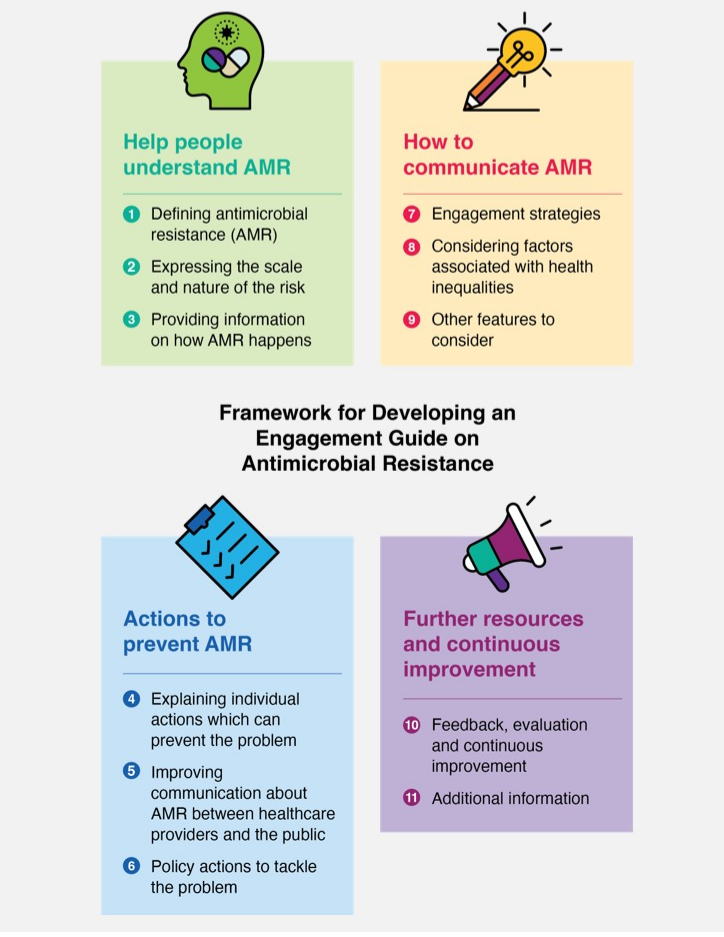
Figure 1 summarises the framework developed for the engagement guide, including its overall structure and key content areas.
Figure 1. The framework for developing a communication and engagement guide on antimicrobial, UKHSA, September 2024
Text version of Figure 1
This infographic presents a framework for developing an engagement guide on AMR. It is organised into 4 themes:
Help people understand AMR
1. Defining antimicrobial resistance (AMR)
2. Expressing the scale and nature of the risk
3. Providing information on how AMR happens
Actions to prevent AMR
4. Explaining individual actions which can explain the problem
5. Improving communication about AMR between healthcare providers and the public
6. Policy actions to tackle the problem
How to communicate AMR
7. Engagement strategies
8. Considering factors associated with health inequalities
9. Other features to consider
Further resources and continuous improvement
10. Feedback, evaluation and continuous improvement
11. Additional information
End of text version of Figure 1
Intended audience
This resource is designed for use by government bodies and agencies responsible for health, public health and social care and partners including voluntary groups and non-governmental organisations across the 4 nations. The guide is relevant across all sectors connected to human health, social care, animal health, agriculture, food production, and the environment. It supports a One Health approach by encouraging shared understanding and coordinated communication across these settings.
Background
Antimicrobial resistance (AMR) is increasingly a threat to human health, animal health, plant health, food security and ecosystem health, and everyone has a part to play in tackling it. Across the 4 UK nations AMR is described as a substantial and growing threat requiring sustained attention across the whole wider ecosystem, reinforcing that infections continue to evolve around our countermeasures and demand coordinated action.
While the public is crucial in reducing the spread of infections, research shows that understanding of AMR varies across different population groups. National surveys (1) show that people from lower socioeconomic backgrounds, minority ethnic communities, and those with lower levels of education or health literacy have significantly lower awareness and understanding of AMR.
As part of the ‘UK 5-Year Action Plan for Antimicrobial Resistance 2024 to 2029’ public engagement is a core priority within ‘Outcome 2: Public engagement and education’, which emphasises the need to improve public understanding and awareness of AMR to drive behaviour change. The plan also sets out commitments to strengthen communication and increase public facing AMR education across sectors. This includes the commitment to produce an engagement guide to support consistent, high quality messaging across organisations.
The report emphasises that AMR is “everybody’s problem”, underscoring the importance of consistent engagement and effective antimicrobial stewardship across all health and care professions. It also highlights the importance of consistent, accessible AMR communication across all sectors. Clear and coordinated messages can help increase public awareness of the risks, the scale of the problem, and the practical steps people can take to protect themselves and others. This approach is closely aligned with the Chief Medical Officer for England’s call for strengthened communication and systemwide responsibility in addressing this escalating threat.
Importantly, the NAP recognises that AMR does not affect all communities equally. People experiencing the greatest health inequalities such as those facing deprivation and limited access to healthcare may be disproportionately impacted by infections and have reduced access to timely treatment, while those with language and communication barriers may have fewer opportunities to access accurate AMR information. Embedding equity into AMR communication and engagement is therefore essential to ensure that all communities are supported to understand the risks, take preventive action, and access the care they need.
How to use
This is a practical and adaptable resource. Readers can engage with the sections most relevant to their context, role, or experience.
For example, it can be used to:
- inform approaches to AMR engagement and communication
- support the design and delivery of public AMR awareness campaigns
- develop educational and training materials on AMR and antimicrobial stewardship (AMS)