Early learning for 2-year-olds for families with no recourse to public funds: assessing eligibility
Updated 7 July 2026
Applies to England

© Crown copyright 2026
This publication is licensed under the terms of the Open Government Licence v3.0 except where otherwise stated. To view this licence, visit nationalarchives.gov.uk/doc/open-government-licence/version/3 or write to the Information Policy Team, The National Archives, Kew, London TW9 4DU, or email: psi@nationalarchives.gov.uk.
Where we have identified any third party copyright information you will need to obtain permission from the copyright holders concerned.
This publication is available at https://www.gov.uk/government/publications/early-years-entitlements-for-foster-children-and-nrpf-families/early-learning-for-2-year-olds-for-families-with-no-recourse-to-public-funds-assessing-eligibility
Summary
Eligibility for the 2-year-old early education entitlement includes disadvantaged children in households with no recourse to public funds (NRPF), subject to maximum-income thresholds. This entitlement is known as early learning for 2-year-olds.
This guidance explains how local authorities can verify a child’s eligibility for an early learning place if a parent (in a single-parent family) or both the child’s parents (in a 2-parent family) have NRPF. It relates only to early learning for 2-year-olds.
Local authorities cannot use the eligibility checking system (ECS) or eligibility checking engine (ECE) to confirm the eligibility of parents with NRPF.
Eligibility
Parents with NRPF will be eligible for the early learning for 2-year-olds from 1 September, 1 January or 1 April following their child’s second birthday if:
- the parent (or both parents in a 2-parent household) is subject to NRPF, and
- their total household income from all sources does not exceed the maximum-income threshold for their area, and
- they do not have capital (including savings and investments) of over £16,000, either jointly or as a single parent
Providing an application form
We have provided an application form template, which includes a self-declaration section for the parent to sign. Local authorities can use this to verify eligibility.
The form is designed for the parent to complete themselves, but we appreciate that individual circumstances may make this difficult. A local authority or childcare provider can assist the parent to complete it, if required.
We encourage local authorities to stick as closely as possible to the template to promote consistency across all local authorities.
The parent should complete and sign the self-declaration form to confirm:
- they have NRPF
- on what basis they have NRPF
- that they do not have a total household net income above the maximum-income threshold for their area
- that they do not have capital (including savings and investments) of over £16,000, either jointly or as a single parent
Confirming a parent has NRPF
In most cases, local authorities will be able to confirm whether a parent or carer has NRPF through either the:
- online immigration checking service, using an eVisa share code provided by the parent, or
- right to public funds (RTPF) checker, by inputting specific credentials such as the parent’s National Insurance number, passport number or UK Visas and Immigration (UKVI) account number – this service requires the local authority to pay a fee
Some people do not have access to the online service – for example, if they are yet to have their first UK immigration application assessed. In such cases, a local authority may use its discretion and accept other documents to determine whether a parent has NRPF.
Biometric residence permits (BRPs) were also previously used to confirm if an individual had NRPF. However, BRPs have been phased out and replaced with eVisas, which function as digital proof of immigration status.
Some parents may still have their expired BRP, but local authorities should not rely on a BRP to establish that they have NRPF. If a parent presents an expired BRP but still has valid permission to stay in the UK, encourage them to set up a UKVI account and provide a share code so their status can be checked online.
Online immigration checking service
Other parents will be able to provide digital proof of their immigration status. Those with an eVisa can share this if they sign in to get an eVisa share code. Each person who needs to be checked will need to provide an individual share code. The share code, and the person’s date of birth as an additional security measure, allow a local authority to check their immigration status via the Home Office’s check someone’s immigration status by using their share code service.
Figures 1, 2, and 3 show what a local authority will see when accessing this page. You will be prompted to enter:
- the parent’s share code
- the parent’s date of birth
- your name
- the name of your local authority
- your reason for checking the parent’s status
Figure 1
Figure 1 is a screenshot of the start page. It shows a button labelled ‘Start now’. The page instructions explain that the share code will expire after 30 days and you will need the person’s date of birth.
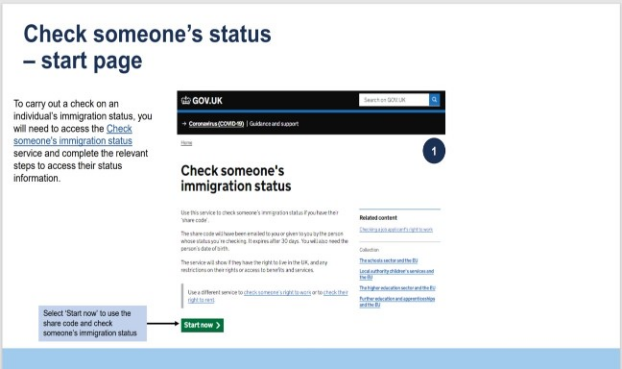
Figure 2
Figure 2 shows 2 screenshots of the checker authentication page. The first has the heading ‘What is the share code?’ and shows a field in which to enter the share code and a button labelled ‘Continue’. You are invited to contact UK Visas and Immigration if you need help using this service.
The second has the heading ‘What is their date of birth?’ and shows a field in which to enter the person’s date of birth in the format DDMMYY and a button labelled ‘Continue’.
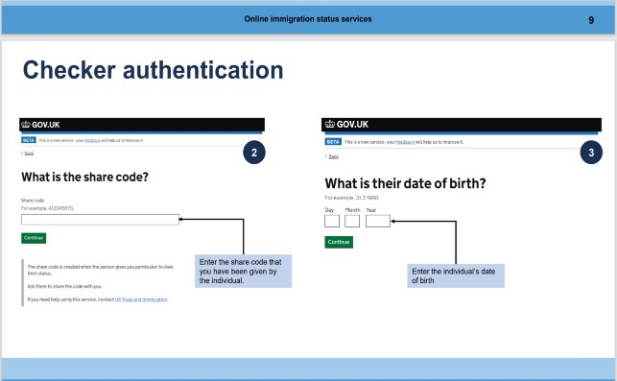
Figure 3
Figure 3 shows 2 more screenshots of the checker authentication page. The first has the heading ‘Who is doing this check?’ and shows a field in which to enter your job title and another in which to enter your organisation name, and a button labelled ‘Continue’.
The second has the heading ‘Why are you checking this person’s status?’ and you are invited to select from one of 5 radio buttons, labelled ‘benefits or tax credits’, ‘homelessness or council housing’, ‘hospital treatment’, ‘ a new bank or building society account’ and ‘a new loan or credit card’, before selecting the button labelled ‘Continue’.
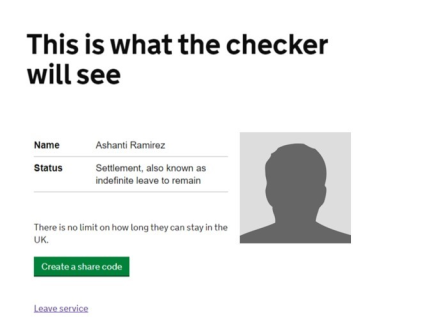
On completion, you will see the following screens, which will confirm whether the parent has recourse to public funds (RTPF).
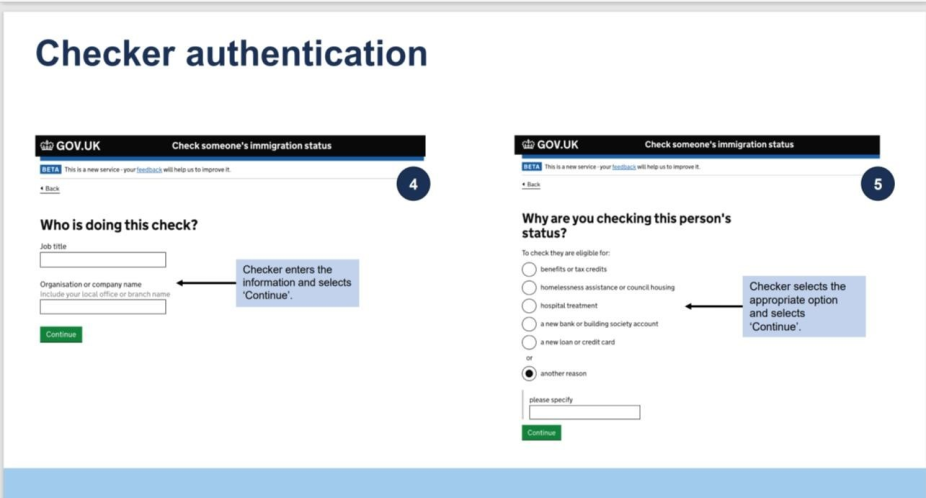
Figure 4
Figure 4 shows a screenshot of what you will see when a parent has NRPF. It shows the person’s photograph, name and status, and the ‘valid from’ and ‘valid to’ dates related to what they can do in the UK. In this case, they are a skilled worker and can live and also study in the UK until the expiry date, but they cannot get public funds. There is a button at the bottom of the screen labelled ‘Create a share code’.
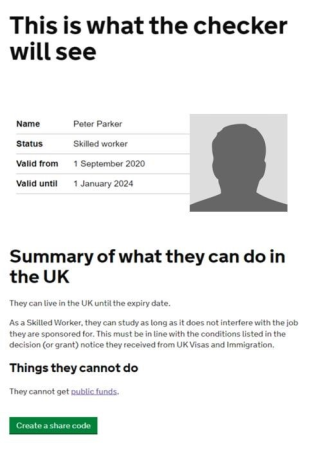
Figure 5
Figure 5 shows a screenshot of what you will see when a parent has RTPF. It shows the person’s photograph, name and status. In this case, they have settlement status, also known as indefinite leave to remain, and it states that there is no limit on how long they can stay in the UK. There is a button at the bottom of the screen labelled ‘Create a share code’.
The share code is valid for 90 days from the time it is issued. It can be used as many times as needed within that period, unless the parent’s status changes, in which case it will no longer work. This is to ensure the parent views their new status before it is shared. Bear this in mind when checking their status. It is straightforward for a parent to provide an up-to-date code.
Share codes can only be used for their originally selected purpose. All codes begin with a letter indicating that purpose. Codes requested for evidence of NRPF should begin with the letter S (general immigration status).
Individuals with a European Union Settlement Scheme (EUSS) family permit vignette sticker or ink stamp in their passport, and either indefinite leave to enter or indefinite leave to remain, could make a ‘no time limit’ application to get access to the eVisa system. Vignette stickers are expected to remain in circulation until September 2026.
Recourse to public funds checker
Local authorities can use the RTPF checker to verify:
- the type of leave the parent now has or has held within the past 2 years
- whether the leave is valid
- whether the parent can access public funds (social security benefits and local authority housing assistance).
Asylum-seeker applicants
Parents receiving support under section 95 or 98 of the Immigration and Asylum Act 1999
If a parent is receiving support under section 95 or 98 of the Immigration and Asylum Act 1999, their child is eligible for the early learning for 2-year-olds and there is no need to check their income or capital.
The parent should be able to provide their support grant letter from the Home Office as evidence of their support. This letter will be dated to indicate when the support application was decided.
If they cannot present this grant letter, or there are reasons to believe their support has stopped, they can request a proof-of-support letter from the Home Office via Migrant Help by emailing ProofOfSupport@migranthelpuk.org.
A parent housed in Home Office asylum accommodation may be able to request written confirmation of their residence from their accommodation provider.
In some cases, a local authority may already have access to occupancy lists supplied by Home Office providers. If such arrangements are in place, it may be able to verify directly whether a household is receiving asylum support.
Parents receiving support under section 4 of the Immigration and Asylum Act 1999
If a parent is not receiving section 95 or 98 support, their income and capital should be assessed. However, if they can show they are receiving support under section 4 of the Immigration and Asylum Act 1999, there is no need for any further assessment because the Home Office has already assessed them as destitute.
To prove they are receiving support under section 4, the parent can request a proof-of-support letter or provide a section 4 support grant letter.
Parents receiving support under paragraph 9 of Schedule 10 to the Immigration Act 2016
A non-asylum-seeking parent may also be receiving Home Office-provided accommodation and support under paragraph 9 of Schedule 10 to the Immigration Act 2016, which is similar to that provided under section 4. This includes short-term accommodation that can be provided in exceptional circumstances to people who have been granted immigration bail. Parents receiving Schedule 10 accommodation and support will have NRPF.
To prove that their support is ‘live’, a parent can request a proof-of-support letter from the Home Office via Migrant Help by emailing ProofOfSupport@migranthelpuk.org.
A foreign-national offender receiving support should email the Home Office payments team at FNORCAspenPayments@homeoffice.gov.uk to request a letter confirming that support.
A parent housed in Home Office asylum accommodation may be able to request written confirmation of their residence from their accommodation provider.
Parents with pre-settled status or a pending valid EUSS application
A parent has RTPF if they have:
- pre-settled status, or
- a certificate of application confirming a pending valid EUSS application, including:
- a pending administrative review
- an appeal against a refusal decision
Their digital status will show they can access public funds if they are eligible for them. However, they need a qualifying right to reside to claim Universal Credit – for example, they are:
- working
- self-sufficient
- obtained pre-settled status via a family member with pre-settled status who is working or self-sufficient
They should make an application for Universal Credit and the local authority should apply the £15,400 annual-income threshold that applies to parents on Universal Credit.
If a person with pre-settled status or a pending valid EUSS application does not have a qualifying right to reside so cannot claim Universal Credit, they should be assessed under the criteria for parents with NRPF. The local authority will need to ask the parent to self-declare that they cannot claim.
However, if they have pre-settled status or a pending valid EUSS application and have previously claimed Universal Credit, housing benefit or child benefit and are now found to be ineligible, they should have a letter confirming this from:
- the local authority
- the Department for Work and Pensions
- HM Revenue and Customs
- a benefits adviser
If a parent cannot claim Universal Credit because they do not have a qualifying right to reside, the local authority will still need to confirm that they do not have more than:
- the maximum-income threshold
- £16,000 in capital (including savings and investments)
Parents with an EUSS family permit
A parent who is joining a family member who is an EEA-citizen-status holder can travel to and remain in the UK on an EUSS family permit, which is valid for 6 months.
They may be eligible to claim Universal Credit in the first 3 months of living in the UK if they satisfy both the eligibility criteria, which are that the relevant:
- EEA-citizen family member holds status under the EUSS (unless they are an eligible Irish citizen, person of Northern Ireland or naturalised British citizen, or a frontier worker)
- EEA citizen or other family member they are joining holds pre-settled status and is exercising a qualifying right to reside, as well as meeting all other eligibility requirements
If the relevant EEA-citizen family member has pre-settled status, is exercising a qualifying right to reside, and meets the relevant eligibility requirements, the:
- parent should make an application for Universal Credit
- local authority should apply the £15,400 annual-income threshold that applies to parents on Universal Credit
If the relevant EEA citizen does not meet the eligibility criteria, the local authority will need to ask the individual to self-declare that they cannot claim Universal Credit.
If the EUSS family permit expires without the parent having made a valid application to the EUSS, they will no longer be eligible for RTPF. However, they may be able to apply after the deadline if they can prove there were reasonable grounds for their delay in making the application.
If a parent falls into this category, they should provide the local authority with the relevant dates of when their permit began and expired, and confirmation that no further application was made.
Parents without specific proof of NRPF
Some parents will not have any official proof that specifically confirms they have NRPF. This could include, but is not limited to, those:
- who have made an application for leave to remain that has not yet been determined
- whose visa has expired
Some parents in this group will be undocumented migrants, who may have limited documentation to establish that they have NRPF.
Alternative proof of NRPF could include either:
- a letter from a charity that is providing them with financial support
- confirmation of positive reasonable grounds or conclusive grounds decisions under the national referral mechanism for potential victims of modern slavery and human trafficking
- an immigration bail 201 form
- a solicitor’s confirmation letter
- healthcare records from primary or emergency health services
- a letter from children’s social care services or the NRPF team, if the family are being provided with accommodation and financial support under section 17 of the Children Act 1989
The Windrush Scheme supports people who are settled in the UK but do not have evidence of their immigration status. Under the scheme, individuals may be eligible to apply for confirmation of their right to live and work in the UK if one of the following applies:
- they came to the UK from a Commonwealth country before 1973
- their parents came to the UK from a Commonwealth country before 1973
- they came to the UK from any country before 31 December 1988 and are now settled in the UK
If a parent meets one of these criteria, the local authority should advise them to visit Windrush Scheme: get proof of your right to be in the UK for further information. Information and support are also available by emailing commonwealthtaskforce@homeoffice.gov.uk
Local authorities should exercise their discretion in considering whether the available supporting evidence is sufficient. They should consider whether, overall, it demonstrates that it is more likely than not that the parent has NRPF and has income and capital below the relevant threshold.
In all cases, the parent should complete and sign the self-declaration form, regardless of the documents presented. The local authority must confirm that the family’s total household income from all sources does not exceed the threshold for:
- annual maximum income
- capital (including savings and investments)
Income thresholds
A parent (or both parents in a 2-parent household) with NRPF will be eligible for the early learning for 2-year-olds if their total household income from all sources does not exceed the annual household net income threshold.
This includes earned income as well as unearned income, such as regularly received payments from a charity, a local authority, or friends and family. The annual household income thresholds are:
- £26,500 for families outside of London with one child
- £30,600 for families outside of London with 2 or more children
- £34,500 for families within London with one child
- £38,600 for families within London with 2 or more children
Whether a family is considered to be within or outside London is determined by their address. If they live in one of the 32 London boroughs or the City of London, the within-London thresholds will apply. If they do not live in one of these areas, the outside-of-London thresholds will apply.
If the parent or parents are receiving support under sections 95 or 98 of the Immigration and Asylum Act 1999, there is no need to assess their household income or capital, as the child is automatically eligible.
Capital thresholds
Local authorities need to confirm that the parent (or parents in a 2-parent household) do not have more than £16,000 combined in capital (this includes savings and investments).
Confirming income
To assess total household net income from all sources, we suggest local authorities consider all income received over the previous 3-month period to determine whether the maximum-income threshold has been met.
To verify this, for both the parent (and their partner, if relevant), we suggest a local authority asks to see either a:
- payslip
- P60 end-of-year tax certificate
- bank statement
- letter from:
- their bank
- their employer
- the local authority confirming support, if applicable
- a charity or person providing financial support
You will still need to confirm that the parent (and their partner, if relevant) does not have more than £16,000 in capital (including savings and investments). They should complete a self-declaration form to declare capital.