Independent Case Examiner for the Department for Work and Pensions: annual report 1 April 2025 to 31 March 2026
Published 24 September 2026

© Crown copyright 2026
This publication is licensed under the terms of the Open Government Licence v3.0 except where otherwise stated. To view this licence, visit nationalarchives.gov.uk/doc/open-government-licence/version/3 or write to the Information Policy Team, The National Archives, Kew, London TW9 4DU, or email: psi@nationalarchives.gov.uk.
Where we have identified any third party copyright information you will need to obtain permission from the copyright holders concerned.
This publication is available at https://www.gov.uk/government/publications/dwp-complaints-annual-report-by-the-independent-case-examiner-2025-to-2026/independent-case-examiner-for-the-department-for-work-and-pensions-annual-report-1-april-2025-to-31-march-2026
Our Purpose
We provide an independent review service for customers of the Department for Work and Pensions (DWP) and organisations delivering contracted DWP services (for example those providing work programmes or health assessments).
Our main objectives are:
-
to deliver a tailored service to people bringing complaints to us and make fair evidence-based decisions
-
to influence DWP service improvements by providing valuable insight from what we see
Our Mission
To investigate complaints thoroughly ensuring rules, guidance, and standards have been applied correctly and fairly, based on evidence from both sides. We explain things clearly, so people understand our decisions.
Our Vision
To continue delivering a high-quality complaint handling service which adapts and improves and shapes DWP services improvements by helping them learn from complaints.
Introduction from the Independent Case Examiner
The number of customers coming to us and the number of decisions we complete for them has increased markedly. Year ending March 2020 we received 3,835 complaints, accepted 1,130 and cleared 1,269 total cases. Five years later, we received 10,965 complaints, accepted 3,215 and cleared 2,653 – both new highs, with approaches to us almost tripling in that time and our clearances more than doubling.
This general pattern is not unique to ICE. Across government departments, independent complaint reviewers and ombudsmen there has been a sustained rise in both the volume and complexity of complaints. Formal complaints still remain a small proportion of overall service use, but the absolute numbers are significant and growing year on year – for DWP fewer than 1% of its approximately 23 million customers complain, yet that equates to almost 32,000 in 2025 to 2026.
The handling of complaints has important impact on public trust. We see customers are more willing to challenge decisions and for perceived unfairness and poor communications to be issues, along with emotionally driven concerns such as frustration, anxiety and loss of control. And customers readily use escalation from DWP businesses to our office if they feel the final response from DWP has not recognised all that went wrong or the impact on them.
I believe our customers need 3 things from us – excellent service (including a timely conclusion to concerns), thorough investigation to get to the bottom of their worries, and a final decision that is clearly explained and easy to understand. We can’t sacrifice any one of those to the others, as it is that trinity that delivers quality, overall, to our customers.
While the size of our team has varied somewhat since year end 2020 and year end 2026, we started and finished that period with exactly the same number of staff.
Unsurprisingly, we have had to make many changes to how we work.
The last reporting year was the final year in which we used resolution and settlement to conclude cases – both involved ‘brokering’ an agreement to a decision and remedy between DWP and the customer. Whilst that could be a very satisfying process, both were time intensive, and could end with a customer rejecting a proposed solution and then finding our ultimate decision to be the same. We felt that was a poor experience and in the coming year all cases will be resolved through investigation and decision.
In the last year we also started to triage cases as they come into the office, to see whether we readily had the information to investigate and reach a decision, or whether there was more evidence to collect. This has allowed us to address complaints for some customers very much more quickly than before, when we broadly used a simple ‘taxi rank’ queue - all cases waited in order regardless whether they needed more evidence or not.
To ensure the quality of our investigation is the same for both groups we have the same quality standards and checks at both points, and I personally work closely with our teams on both what turn out to be our most complex and high impact cases, and those we can deal with at triage. We have talented investigators at both points and working across the 2 allows me to ensure our quality, curiosity and thoroughness are the same no matter the stage a case is completed.
So our report this year is set out to reflect this journey through our office. As ever the stories of our customers and how we resolve things for them say more than we could ever explain about how we help. I hope we have also shown how thorough we can be at the point of triage and how getting to issues early can help avoid bad outcomes for often vulnerable customers.
We have again shared some of the thanks we have had from customers – it’s such a boost to all of us when customers tell us the impact our decisions have made for them. And that leads me to thank our incredible team – our Head of Office Emma Smith and Business Support Leader Maxine Macken, our new recruits (of which we have many) and all our longstanding colleagues. I rely on their diligence and skill at all stages of our process, and I am so very proud of them.
Finally, thanks also to those in DWP we interface with to collect evidence, understand procedures and deliver the remedies for customers, and who are so open to our constructive feedback from the cases we see. There are remarkable people everywhere.
Joanna Wallace OBE
Independent Case Examiner
Our approach to casework
The data and figures included in this report are based on casework undertaken by ICE in the 12-month period between 1 April 2025 and 31 March 2026
Gateway and acceptance
When we receive a complaint, we first establish if we can accept it for examination. To be accepted, a complaint must be about maladministration or service failure. The customer bringing the complaint to us must be able to provide a final response to their complaint from DWP dated within the last 6 months, as ICE cannot examine any complaint that DWP has not previously had the opportunity to resolve.
Triage
Once accepted, complaints are triaged by ICE investigators to understand the nature of the complaint and its complexity so we can identify the best way to handle each one.
Resolution
In this reporting year, in some cases we attempted to broker an agreement between the customer and DWP that satisfied the customer, without needing to request evidence to inform an investigation. We called this resolution. We only did this when a customer was in full agreement that this approach resolved their complaint satisfactorily.
Settlement
In this reporting year, having considered all available evidence, we attempted in some cases to agree actions between the customer and DWP to settle their complaint. We only did this when a customer was in full agreement that this approach resolved their complaint satisfactorily.
Investigations
Some complaints can be handled quickly as they require minimal additional evidence to establish the facts so we can start our investigation right at the point of triage.
Others though require more evidence to support our investigation, so we have to gather that before we start investigating – those complaints then wait for an investigator to start work.
Regardless of the point investigation starts, our team of highly skilled investigators examine the facts of each complaint and establish whether DWP fairly and consistently applied its own standards, process or procedures. We consider all the relevant information necessary to reach our conclusions.
All our investigations are summarised in an ICE decision letter for the customer, once our work is complete. Decision letters are clear, succinct and easy to read. They include a summary of what we have seen happened, our findings and any recommendations to set things straight.
When we find a complaint has merit, we consider it to be ‘upheld’, and we may recommend redress such as an apology, corrective actions or a consolatory payment. Recommendations for redress are considered carefully on a case-by-case basis based on the impact for the customer. When we find that DWP handled things as they should have done, we reach a ‘not upheld’ finding and explain our reasons for that.
Whatever the outcome of our investigation, customers are told how to escalate their complaint further if they are still unhappy once our work for them is done.
Withdrawn cases
Sometimes customers approach ICE with a complaint but later decide to withdraw it. There can be many reasons for this, for example, DWP may address the customers concerns separately despite our involvement.
Findings of the Parliamentary and Health Service Ombudsman (PHSO)
Customers who are dissatisfied with an ICE investigation or the service we provide can ask an MP to escalate their complaint to the PHSO on their behalf.
PHSO did not uphold any complaints about ICE in the 2025 to 2026 reporting year.
Continuous improvement
ICE is proud to have achieved Customer Service Excellence accreditation again during the 2025 to 2026 reporting year. We are also a Complaint Handler member of the Ombudsman Association and value sharing best practice and discussing common themes with other organisations who do work similar to our own.
Our year in numbers
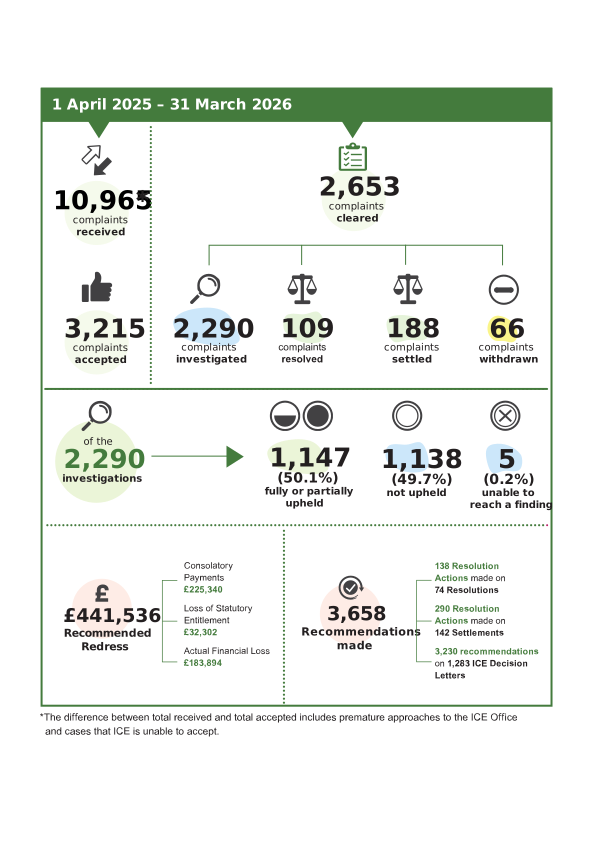
Between 1 April 2025 and 31 March 2026, ICE received 10,965 complaints. Of these, 3,215 complaints were accepted and 2,653 complaints were cleared. During the year, 2,290 complaints were investigated, with 109 complaints resolved, 188 complaints settled and 66 complaints withdrawn.
Of the 2,290 investigations completed, 1,147 (50.1%) were fully or partially upheld, 1,138 (49.7%) were not upheld and 5 (0.2%) were unable to reach a finding.
The ICE Office recommended £441,536 in redress. This comprised £225,340 in consolatory payments, £32,302 for loss of statutory entitlement and £185,894 for actual financial loss.
A total of 3,658 recommendations were made during the year, including 138 resolution actions across 74 resolutions, 290 resolution actions across 142 settlements, and 3,230 recommendations contained within 1,283 ICE Decision Letters.
The difference between total complaints received and total complaints accepted includes premature approaches to the ICE Office and cases that ICE is unable to accept.
Our service
Our service 2025 to 2026
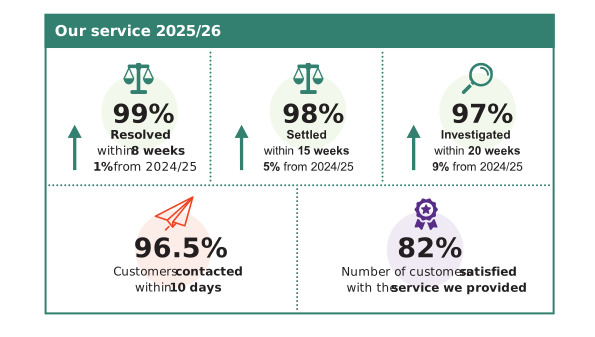
During 2025 to 2026:
-
99% of complaints were resolved within 8 weeks, 1% higher than 2024 to 2025
-
98% of complaints were settled within 15 weeks, 5% higher than 2024 to 2025
-
97% of complaints were investigated within 20 weeks, 9% higher than 2024 to 2025
-
96.5% of customers were contacted within 10 days
-
82% of customers were satisfied with the service provided
Service standards in weeks
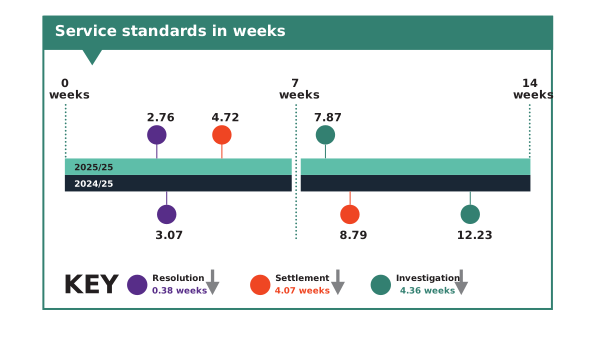
During 2025 to 2026:
-
complaints were resolved in an average of 2.76 weeks, compared with 3.07 weeks in 2024 to 2025
-
complaints were settled in an average of 4.72 weeks, compared with 8.79 weeks in 2024 to 2025
-
investigations were completed in an average of 7.87 weeks, compared with 12.23 weeks in 2024 to 2025
Case studies
Here are summaries of some of the cases we were able to deal with for customers soon after triage, as we had the information we needed to do that.
Customer A
In this case we were able to quickly untangle what had happened and end the worry for a partially sighted customer who was concerned an unidentified person had been in their home.
When customers move to Universal Credit (UC) from Tax Credits (or any other legacy benefits) DWP should notify HM Revenue and Customs (HMRC) of the UC claim, so they can stop payments. Before that happens though, the customer needs to verify their ID. Customer A was vulnerable and several appointments were made for them to attend a jobcentre to do that but they couldn’t attend due to their health. They contacted UC several times to tell them that, and to explain that they’d had a home visit from DWP (within days of their UC claim) and already verified their ID then. It took several weeks for the ID to be verified, and the notification sent to HMRC – resulting in a significant Tax Credit overpayment.
Throughout that time, and during their investigation of Customer A’s complaints, DWP didn’t pick up on the customer telling them that their ID had already been verified during a home visit. Customer A, who was partially sighted, became extremely anxious, confused and worried about who had been in their home. It wasn’t until the complaint escalated to this office and we followed up, that DWP identified Customer A had indeed been seen by a DWP Visiting Officer when they said they had. Our recommendations included an apology, a consolatory payment and for a manager to call Customer A to explain the home visit and reassure the customer.
Customer B
We have seen a higher number of complaints about delays for Child Disability Living Allowance (DLA) Mandatory Reconsiderations (MR) and Access to Work (AtW) than usual, as there have been increases in applications to both, and processing has been slower. We expect DWP to communicate with customers when operational challenges such as this arise, so they know the position. We understand that waits for decisions and MR are stressful but generally don’t uphold complaints simply on the basis of waiting longer than a customer would like. In these next 2 cases, the first shows how we have looked at most such delays – the second is a case in which there were other administrative failures which led DWP to take longer than it otherwise would to reach the final decision.
AtW aims to help people with health conditions or disabilities to start or stay in work. There has been a significant increase in demand for AtW over the past few years which has led to delays in processing applications and more complaints, one of which we received from Customer B. When they approached us, they had been waiting around 8 months for their application to be dealt with and were upset they were not receiving updates.
We knew AtW were working to reduce their backlog and that some applications (for those about to start new jobs or new self-employment) were being prioritised (Customer B didn’t meet these criteria), and that they didn’t have the resources to regularly update people.
During our investigation we found that DWP had written to Customer B to tell them that cases were delayed and were being reviewed in date order, and the date they were working from. We recognised this delay was frustrating but didn’t think that there was anything further DWP could have done, and so didn’t uphold this complaint.
The Investigator was amazing and was thorough with his investigation.
– Customer B
Customer C
If a customer isn’t happy with a benefit entitlement decision, they should challenge it through the MR process (which can in turn lead to an Appeal with HM Courts and Tribunals Services (HMCTS). Customers C’s child was receiving DLA; but following a review, the amount they were receiving reduced. Customer C immediately asked for an MR, but it took DWP nearly 2 months to register it, then a further 4 months to complete the MR – with no change to the original decision. Customer C had provided additional medical evidence for DWP to consider, but they didn’t consider it. Customer C repeatedly contacted DWP about this over the following 5 months, but DWP did not do anything with the complaint until Customer C went to their MP. When the additional medical evidence was considered the benefit award was increased and arrears of approximately £3,000 were paid.
DWP apologised and awarded a consolatory payment of £200. Whilst ICE can’t comment on entitlement or MR decisions, the failure to consider the evidence in this case was an administrative one and so its consequence fell in ICE’s remit. We didn’t feel the £200 was adequate redress for the overall stress and delay that the error had caused and upheld the complaint, recommending an additional consolatory payment of £100 (bringing the total payment to £300).
Investigator was sensitive to the issues raised and listened to the issues of the complaint.
– Customer C
Customer D
If personal information is sent to the wrong person, as well as making sure the proper security processes have been followed, we consider what information has been shared incorrectly, as that very much affects the impact of the error. In this case there was no disagreement that very personal medical and financial information was sent by email to the wrong person. Our award, which was higher than DWP had offered, reflected the embarrassment, worry and stress such errors can cause based on the circumstances of each case
When DWP send correspondence to the wrong person, and it includes a customer’s personal details, there is a security process to follow. An email meant for Customer D was sent to a Third Party which included a significant amount of information about their financial and personal circumstances. The following day Customer D told DWP of this mistake (as they’d been contacted by the Third Party) and DWP started to follow the security process. Customer D also complained.
There was a delay in DWP replying to Customer D’s complaint and although they apologised for the error and awarded a consolatory payment of £200, we didn’t feel this was adequate as it didn’t recognise the steps that Customer D had had to take to put matters right, or acknowledge the stress and anxiety caused by an unknown third party having such personal information. We upheld the complaint and recommended an additional consolatory payment of £300 (bringing the total payment to £500).
Investigator was very human about the whole complaint which made me feel like I was heard and listened too.
– Customer D
Customer E
In this case, having the information to investigate a case at triage meant we could see there was an imminent problem for a vulnerable customer in keeping their benefits in payment, and were able to reach out to DWP to get extra support for the customer and make sure they kept getting paid.
All legacy income-related claims for Employment and Support Allowance (ESA) are being replaced by UC and customers must move to UC when they are asked to do so, or risk losing their entitlement to benefit. Customer E was receiving ESA and had been asked to move to UC; however, they thought they met the very restricted criteria to stay on ESA. DWP decided that they didn’t, so Customer E escalated their complaint to this office and asked if there were grounds for them to continue claiming ESA.
When we started our investigation, we found DWP were following the correct process, but there was less than a week left for Customer E, who was extremely vulnerable, to claim UC if they were to avoid losing their benefit entitlement. We spoke to Customer E immediately to discuss why they didn’t feel able to claim UC and then contacted DWP’s Advanced Customer Support Team to see how they could support a claim. With our help Customer E received additional support and did make their UC claim, so they weren’t left without benefit payments.
The Investigator was sensitive and showed a lot of empathy and care. She gave a listening ear and took time to listen and then fully explained about the delays and complaint during the settlement.
– Customer E
Customer F
We handled these next 2 cases as settlements which meant that whilst all available evidence was considered, we didn’t need to investigate any further or issue a decision letter as both the customer and DWP were content with our proposed remedies.
The Child Maintenance Service (CMS) work out how much maintenance should be paid, using a formula set out in legislation. However, a Variation allows CMS to factor in some circumstances that aren’t covered by the basic maintenance calculation rules. If a customer believes that CMS have calculated their maintenance incorrectly, they can ask CMS to complete a MR, which, once completed, gives the customer access to HMCTS to appeal the decision. There are no set timescales for CMS to complete a variation or an MR so if a customer complains to this office about the delay in either of these, I will consider whether the time taken by CMS to complete the work was ‘reasonable’.
Customer F complained to this office about significant delays in completing Variations and then MRs that they’d asked for – they also said CMS hadn’t considered evidence they’d provided. Customer F had also been given incorrect information in the final complaint response. From the evidence, we could see there had been delays of between 6 and 18 months completing the Variations and then delays of between 2 and 11 months in completing the MRs. Customer F had to contact their MP for the complaint to be dealt with; DWP had provided an apology to Customer F but hadn’t considered further redress. We liaised with DWP and Customer F to see if the case could be settled based on that key information and DWP agreed to make a consolatory payment of £375.00 recognising the impact of the delays. Customer F agreed to this, which closed their complaint with us.
Customer G
Customer G claimed Pension Credit (PC) but they hadn’t provided their bank account details. Instead of contacting Customer G to ask for bank account details as they should, DWP instead used bank details from one of Customer G’s previous claims. Unfortunately, these were the bank details for the Local Authority, as Customer G had been having money for their rent paid to the Local Authority as part of their UC claim. Despite Customer G contacting DWP regularly to say they weren’t receiving their PC payments, DWP didn’t investigate thoroughly for almost 10 months. When DWP corrected it, they paid Customer G arrears of £2,750.
Although they apologised for the delay, when Customer G complained, DWP didn’t consider any financial redress. DWP said Customer G had benefitted financially because the money paid to the Local Authority could be used to pay for their housing costs. We didn’t agree, as the money had been paid in error and Customer G did not have access to the funds held by the Local Authority. We also noted that Customer G had needed to raise this repeatedly with DWP before the error was corrected. On the basis of this argument DWP agreed to make a consolatory payment of £400 for the inconvenience caused – Customer G agreed to this which closed the complaint with us.
I would like to take this opportunity to thank you for investigating my case and also your efforts for pursuing and providing clarity which has resulted in a sense of final closure.
– Customer G
Customer H
For these following cases we had to get more information than we had at the point we triaged them to be able to thoroughly investigate. The case below demonstrates that sometimes that evidence is not as complete as we would hope it to be, and a balance of probability decision must be made to conclude a complaint.
When Customer H claimed Personal Independence Payment, they were asked to provide evidence including their valid passport to show their residence status (to confirm whether they were entitled to receive benefits whilst living in this country). DWP provided an envelope for them to send it in. Customer H posted a ‘large letter’ noted by the Post Office as weighing 0.050kg (the average weight of a passport is 0.042kg) – the Post Office also provided a tracking number.
When DWP receive a valuable document through the post, their Mail Opening Unit (MOU) should record receipt, scan the document on to the system, notify the relevant part of DWP, and return the valuable document to the customer.
When Customer H contacted DWP to request the passport back so they could travel to visit their ill mother, DWP told them that they hadn’t received a passport, only a letter. A search was completed of the MOU, but they decided that as there was nothing showing in their records, they didn’t believe the passport had been received.
Customer H complained and asked for compensation so that they could replace their passport. When the final response was sent, they were told that DWP hadn’t received the passport and that Customer H should contact Royal Mail.
When Customer H escalated their complaint to this office they said that due to the lost passport and delays in getting another, their mother had died before they were able to see her.
When we considered the evidence, we noted the weight of the ‘large letter’ Customer H had sent to DWP was consistent with the average weight of a passport. So, on the balance of probability I believed it was more likely than not, that DWP had received the passport, but lost it. When upholding this complaint, I recommended that DWP make a consolatory payment of £400 and consider reimbursing Customer H the cost of purchasing a new passport if they showed evidence of purchasing one.
Customer I
This UC case ran over several years, during which DWP failed to spot what they should have done for the customer meaning a substantial overpayment was made. All UC overpayments are recoverable no matter their cause – this and other cases with similar overpayments often receive higher consolatory amounts, as while a customer has had the benefit of money they shouldn’t have had, they may have made important choices based on incorrect information and then find themselves in debt to DWP through no fault of their own.
Customer I was a full-time student, claiming UC which included an element for their children. In early 2021 they told UC that the Child Benefit was now being claimed by their estranged partner, but they shared the care of the children equally. At that point DWP should have decided who the main carer was (as only the main carer would be entitled to the UC child element and if that was not Customer I, they wouldn’t be entitled to UC whilst they were a full-time student). This carer decision didn’t happen and Customer I continued to receive the UC child element.
Customer I contacted UC on several occasions about other issues and was repeatedly told that their UC claim was correct – it was on that basis that later in 2021, Customer I decided to proceed with a costly PhD.
Throughout 2022 and 2023 Customer I continued to check they were receiving the correct amount of UC and were repeatedly told that they were.
In September 2023, aware that DWP had still not yet made a formal decision as to the primary carer for his children, Customer I asked their MP to complain – DWP apologised that a decision hadn’t been made and awarded a consolatory payment of £50 for the delay. They assured the MP a decision would be made imminently – but nothing was done.
Customer I’s MP contacted UC again about this in January 2024 – and the decision was finally completed in May 2024. Customer I wasn’t entitled to UC from July 2020. Notification of this was sent to Customer I but didn’t say how much they had been overpaid. So, in July 2024 Customer I contacted UC again. During this call they incorrectly told Customer I that they’d been overpaid by approx. £34,000, but this had been wiped and they didn’t owe anything. At that time, the overpayment hadn’t been fully calculated. Later that month the overpayment calculations were completed, and it was confirmed that Customer I had been overpaid by approx. £34,100.
Customer I complained to their MP and as well as explaining the distress this had caused, they said they were no longer able to complete their PhD and would need to return to work. In their response the Complaints Team recognised that DWP had missed several opportunities to act on the information Customer I had given. However, they didn’t apologise for this – an apology and a consolatory payment (of £100) was only given for the delay in calculating the overpayment and the incorrect information given in July 2024 (about the overpayment not being owed any longer).
When we investigated Customer I’s complaint, we identified several missed opportunities to put things right much sooner, which would have significantly reduced, if not prevented, the overpayment. DWP could also have made sure that Customer I was properly informed when they decided whether to start their PhD. Although DWP had made consolatory payments totalling £150 to them I didn’t believe this fully took into account the impact of the errors, including the financial commitments that Customer I had made, so I recommended an additional £350 consolatory payment to be paid to Customer I and not offset against the overpayment.
I wish to thank you and your office for the time and care taken in reviewing the matter. I appreciate the clarity with which you have explained the relevant policies and procedures, and I accept your findings.
– Customer I
Customer J
Customers on ‘legacy benefits’ such as Jobseekers Allowance or Employment Support Allowance, and those on Tax Credits, have been moving on to Universal Credit over the last few years as those old benefits are wound down. We have seen a larger number of cases about this transition in the last reporting year than we have before, in part as staying on the old benefits is no longer an option for the vast majority of customers and the transition from a benefit they knew and were comfortable with, can be hard. In other cases, we have seen mistakes in following the process to ensure the right amount of benefit is paid on new claims. This case is an example of those we have seen arising from this transition.
Customer J (whose first language is not English) was receiving Tax Credits and Income Support – they were raising their 4 children.
These ‘legacy benefits’ are being replaced by UC. However, customers should not make the move and claim UC until they receive a Migration Notice letter telling them to do that – if they claim UC before receiving this letter, they aren’t entitled to Transitional Protection, which protects customers from dropping to a lower benefit entitlement when they move over to UC. In 2023 DWP launched an advertising campaign to raise awareness that Tax Credits were ending – this included a leaflet which was sent to Tax Credit customers. The leaflet explained that customers would only be eligible for Transitional Protection if they claimed UC after receiving the Migration Notice letter.
Jobcentres were aware of the confusion being caused by this leaflet as they received contacts from customers asking what they should do next. DWP had a call script which anticipated this issue for telephone customers and explained the need to wait for the letter and I would have expected staff to explain the consequences of making a UC claim before they received the Migration Notice letter to customers helped in person.
After receiving the leaflet, but not a Migration Notice, Customer J went to the Jobcentre in October 2023 and made a UC claim. As the claim was made before Customer J had received the Migration Notice letter, they weren’t entitled to Transitional Protection.
After Customer J started to receive their UC payments, they repeatedly contacted UC as they were getting a lot less than they expected. They explained that English wasn’t their first language, that Jobcentre staff had helped them claim UC in October 2023 and that they were struggling financially due to the reduced payments. DWP should have investigated Customer J’s claims that they had been given incorrect advice from a member of staff. They didn’t.
It wasn’t until Customer J’s representative complained in March 2024, that this happened but by that time, the member of staff who had spoken to Customer J had left DWP, so they weren’t able to speak to them about what happened in October 2023. DWP’s complaint response relied on the fact that Customer J had received the leaflet and should have researched what they were entitled to and when they should claim. They didn’t believe that customer J had been misdirected. Customer J wasn’t happy with this response.
After we investigated the complaint, I felt that on the balance of probability, that when Customer J attended the Jobcentre in October 2023, instead of telling them to wait for the Migration Notice letter, the member of staff helped them to make their UC claim. This meant Customer J missed out on Transitional Protection for 2 years and had to manage on an unnecessarily limited income for that time.
I recommended that DWP pay Customer J arrears of UC Transitional Protection from the start of their claim, totalling around £6,000 and make a consolatory payment of £500.
The investigator was amazing and I was extremely happy with the settlement consolatory payment and the speed it took you.
– Customer J
Customer K
As benefits become more established, we generally find that staff become familiar with how they work and the number of customer issues decreases. Some cases though are about parts of the benefit that are less often used and staff may be less familiar with them. This case is about how DWP should handle the temporary absence of a child who is on a UC claim – such as if they are in hospital, for example. The circumstances of this case were unusual and the sympathy of Jobcentre staff with the customer may paradoxically explain why the correct handling of the case was overlooked.
Customer K had a UC claim which included their 2 children. In December 2022 they told UC that their children had gone to visit their other parent in October 2022 but hadn’t returned as they should. If a UC claim includes an allowance for a child, but the child is temporarily absent from the household, the allowance is not payable if the child’s absence is longer than 6 months. UC should note the absence on the claim and review it regularly – in this case UC didn’t do that. Between January and September 2023 Customer K repeatedly referred to their children not being in the household and discussed how they were trying to get them back; but it wasn’t until September 2023 that their claim was updated. As well as removing the allowance for the children, Customer K’s housing entitlement was also reduced. This meant there was an overpayment of approximately £7,000 which had accrued between October 2022 and September 2023.
However, before calculating that DWP should have decided whether the absence from October 2022 was a temporary absence (which would have meant Customer K was entitled to keep the child allowances for up to 6 months from October 2022).
In September 2023 Customer K followed the MR process but the overpayment decision wasn’t changed so they appealed and whilst waiting for the Tribunal hearing they started to repay the overpayment.
When the Tribunal was heard, they were only able to consider the overpayment (as the temporary change decision hadn’t been made) and weren’t able to change that decision; they noted the overpayment had been caused by DWP delay, but UC legislation meant that DWP could still recover it.
The Tribunal signposted Customer K to complain to DWP, and in that they explained the significant impact that the debt had on them, as well as the impact on their mental health as they hadn’t seen their children since October 2022 and this was continually reminding them of the situation.
When DWP responded, they didn’t identify that they had missed the temporary change decision. Instead, they said that Customer K should have been told in December 2022 to update their claim. They apologised for this, made a consolatory payment of £150 and explained Customer K could ask Debt Management to consider waiving the debt.
As we investigated it was clear that Customer K had repeatedly told DWP what was happening with their children. No official decision was made as to whether this was a temporary change, so when Customer K later reported the children were no longer with them, they had missed the entitlement to the 6-month temporary change eligibility. I didn’t feel that the consolatory payment and apology were sufficient redress and didn’t recognise that missed temporary change.
I recommended that DWP should calculate and make a financial loss payment for the 6-month October 2022 to April 2023 period, to cover the housing and child element - this was to be offset against the outstanding balance of the overpayment, reducing the amount owed. I also recommended a consolatory payment of £450.
The Investigator was extraordinary, helpful, patient, kind, friendly, and professional. The investigator made her feel heard, and was very patient when speaking to her, enabling her to discuss with ease the issues she had experienced.
– Customer K
Customer L
UC pays health premiums if, after a health assessment a customer is found to have not just limited capability to work, but also a limited capability to carry out any activities in preparation for, or related to, work. No health premiums can be paid unless this ‘health journey’ is completed. We have seen a number of cases in which, for various reasons, this health journey has been missed – here is one example.
When a UC customer declares they have a health condition affecting their ability to look for or take up work and provides a Fit Note, they should be referred to the ‘health journey’ for a Work Capability Assessment (WCA) to be carried out.
If the customer is found to have Limited Capability for Work and Work Related Activities (LCWRA) they will be awarded an additional component (the health element) after a 3- month relevant period is served (this period usually runs from the day their Fit Note started).
Customer L claimed UC in April 2023 and declared their health conditions, which included that they were blind and had anxiety – they didn’t provide a Fit Note, instead they marked their claim that they ‘self certified’. As Customer L was blind, UC should have spoken to them to explain the health journey and the need to provide Fit Notes.
Over the next 16 months UC missed several opportunities to notice that Customer L’s health conditions were still noted as self-certified and prompt them to provide a Fit Note to start the health journey. It was only in August 2024, after Customer L complained, that DWP explained this.
In September 2024 Customer L provided a Fit Note and in early 2025 they were awarded the health element, effective from August 2024 (the start date on their Fit Note), and were paid approximately £1,800 arrears – this was incorrect. The arrears should have only been paid from November 2024 (after the 3-month relevant period had ended).
When DWP investigated Customer L’s complaint, they awarded a consolatory payment of £200. Customer L wasn’t happy with this and came to this office – they wanted the health element backdated to the beginning of their UC claim.
Customer L thought they had not been paid the benefit they should in line with legislation which wasn’t the case, but we identified that DWP hadn’t followed the correct process from the start of their claim and missed several opportunities to explain the health journey and the need to provide a Fit Note.
It was clear that if Customer L had been told about this from the beginning of their claim, they would have started on the health journey much sooner, and likely been awarded the health element.
I recommended that DWP make a payment for the Loss of Statutory Entitlement for August 2023 to December 2024 (taking into consideration the payment they had already made) – Customer L received approximately £4,500, as well as a consolatory payment of £500.
I am writing simply to say thank you. I know you handle many complaints every day, but for me and my family, your work has made a real difference. You treated my concerns with seriousness and fairness, and you took the time to look at the evidence and explain your findings clearly.
I deeply appreciate the balance and care you brought to your decision. You recognised the mistakes made by DWP, you upheld the points that truly mattered, and you made recommendations to put some things right. That means a great deal to us.
I would also like to thank you for the clarity and dignity of your letter. In situations like mine, where stress and confusion can overwhelm, clear words and steady reasoning are invaluable. Your work has helped my family feel heard, and that alone is an achievement worth recognising.
– Customer L
Customer M
Finally, we have 2 examples of cases from the CMS that required more information to resolve – as CMS cases can run for many years they can take quite some unpicking. This first case shows the significant impact of a couple of errors, one in progressing the wrong case when both parents try to open one, that we don’t often see, but also the over-reliance on Child Benefit being in payment as a basis for primary carer decisions. This is something we see often, we have flagged with CMS and that they are working to avoid.
Customer M had clearly tried to do the right thing and make sure payments were made for the children, but CMS then repeatedly failed to consider the information sent to them. Resolving the errors was made very much harder than it should have been, even with the MP’s help.
Customer M applied for a case with the CMS in October 2023 and CMS contacted the other parent to let them know the claim had been opened. When they were made aware of this, they made their own application for the same child. CMS’ guidance states that when this happens, and both parents have parental responsibility, then the earlier application should take priority. This didn’t happen in Customer M’s case – CMS incorrectly closed their claim and moved forward with the other parent’s (later) claim, meaning Customer M was deemed to be the Paying Parent.
CMS’ reason for this was that the other parent was receiving Child Benefit for the child (Customer M wasn’t receiving Child Benefit because of their income); however, CMS shouldn’t solely rely on who is receiving Child Benefit to determine who would be considered the ‘primary (main) carer’ of the child or children.
When parents have equal care of their children (day-to-day and overnight) CMS’ guidance is to ask a series of questions to both parents, to identify whether there is a primary carer if there isn’t, the case should be closed. Parents can supply evidence to support their stance. Despite Customer M providing a significant amount of evidence, CMS decided that because Child Benefit was in payment to the other parent, they would be classed as the primary carer. Customer M was liable to pay maintenance to the other parent.
Between December 2023 and November 2024 Customer M challenged this via the Mandatory Reconsideration and Appeal process, with the Appeal Tribunal deciding that Customer M shouldn’t have been the Paying Parent, resulting in the case being closed back to the start date. When HMCTS change a decision, they aren’t necessarily saying the original decision was made in error, but that further evidence, information or insight into the law has allowed them to make a different decision.
After the case was closed, CMS calculated that Customer M had overpaid maintenance of approximately £7,000. Customer M contacted CMS repeatedly to ask for them to reimburse the money that they’d paid to the other parent.
It’s not an automatic right for the Paying Parent to be reimbursed overpaid maintenance. Reimbursements are a discretionary decision and when making the decision (whether to reimburse) CMS should make sure that several criteria are met. Of significance to this case, CMS should agree that the overpayment was caused by CMS error. However, CMS decided not to reimburse Customer M as they didn’t believe the error had been CMS’.
After we investigated Customer M’s complaint, we established that as well as an over-reliance on who was being paid Child Benefit, CMS had incorrectly closed Customer M’s claim. Then, when making a reimbursement decision, CMS didn’t consider the fundamental fact that they should never have progressed the other parent’s claim at all, instead they should have moved forward with Customer M’s claim. I recommended that DWP make a consolatory payment of £350, as well as reimburse the overpaid maintenance – in completing these recommendations a payment of approximately £7,000 was made to Customer M.
Customer N
In this second case CMS didn’t properly consider the points a customer was making and the evidence they sent in, which led to long-running errors, unwarranted collection fees and a maintenance overpayment.
In 2020 Customer N was making payments of maintenance directly to the Receiving Parent but then notified CMS that they weren’t working, so their liability was reduced to nil per week.
However, within a week Customer N contacted CMS again to tell them they were once more in work. Despite providing evidence of their wages, CMS didn’t review Customer N’s liability until May 2021 so Customer N continued to make regular payments directly to the Receiving Parent until then.
After CMS reviewed the maintenance liability Customer N provided evidence of the payments they had been making since the start, but CMS didn’t consider that which meant arrears of approx. £2,000 showed on the case. Customer N continued to dispute the arrears balance throughout 2021 and CMS did not investigate, which meant Customer N was being asked to make incorrectly inflated payments.
At the beginning of 2022, following a request from the Receiving Parent, CMS changed the case to Collect and Pay (meaning they’d collect the payments from the Paying Parent and pay them to the Receiving Parent). This meant collection fees were added to Customer N’s case.
From 2022 to 2024 Customer N continued to ask CMS to investigate the payments they’d made in 2020 to 2021 and provided bank statements as evidence. CMS again didn’t do that.
In 2024 Customer N asked for an account breakdown but CMS’ guidance states that they will only do that if a Paying Parent has shown that the arrears balance might be wrong, if CMS believe the debt is wrong or an MP has asked for it.
Despite Customer N providing their bank statements to show why they believed the debt was wrong, CMS refused to complete an account breakdown and even when Customer N’s MP became involved, and challenged the arrears balance, CMS still didn’t do it, ignoring the numerous times that Customer N had provided their bank statements.
After we had investigated it was clear that CMS had repeatedly missed opportunities to put matters right for a significant period, despite Customer N raising the issues and providing evidence. CMS’ failings also meant that fees were added to the case inappropriately and Customer N had paid far more than they needed to.
I recommended that DWP make a consolatory payment of £750 to recognise the significant service failures.
I also asked them to refund the collection fees that had been inappropriately collected and review the account balance to calculate how much had been overpaid. Customer N was paid approximately £640 for the refund of the collection fees and it was established that they’d overpaid by approximately £2,300 – as they still pay Child Maintenance, CMS will reduce their future payments until this amount is recovered.
I do want to take a moment to thank you. Throughout what has been an extremely difficult period, your role, independence, and willingness to examine the matter properly did make a difference. Being heard, and having the facts finally acknowledged, mattered more than I can easily put into words. Thank you for being there when it counted, and for carrying out your work with care and integrity.
– Customer N
Appendix 1
Universal Credit
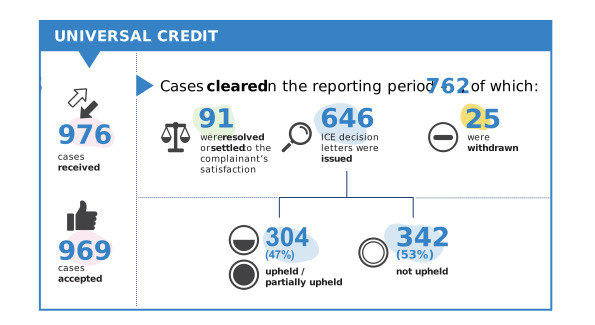
During the reporting period, Universal Credit received 976 complaints, of which 969 were accepted. A total of 762 cases were cleared. Of these, 91 cases were resolved or settled to the complainant’s satisfaction, 646 resulted in ICE decision letters being issued and 25 were withdrawn. Of the 646 decision letters issued, 304 cases (47%) were upheld or partially upheld and 342 cases (53%) were not upheld.
Other Working Age Benefits
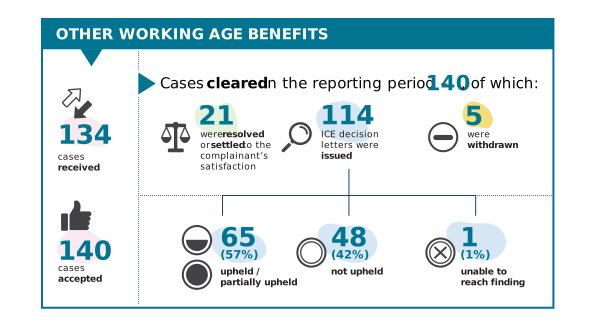
During the reporting period, Other Working Age Benefits received 134 complaints, with 140 complaints accepted. A total of 140 cases were cleared. Of these, 21 cases were resolved or settled to the complainant’s satisfaction, 114 resulted in ICE decision letters being issued and 5 were withdrawn. Of the 114 decision letters issued, 65 cases (57%) were upheld or partially upheld, 48 cases (42%) were not upheld and 1 case (1%) was unable to reach a finding.
The difference between the number of complaints received and accepted reflects cases accepted during the reporting period that were received in the previous reporting year.
Disability Benefits
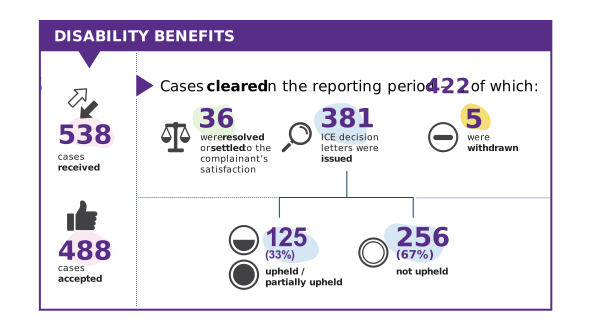
During the reporting period, Disability Benefits received 538 complaints, of which 488 were accepted. A total of 422 cases were cleared. Of these, 36 cases were resolved or settled to the complainant’s satisfaction, 381 resulted in ICE decision letters being issued and 5 were withdrawn. Of the 381 decision letters issued, 125 cases (33%) were upheld or partially upheld, while 256 cases (67%) were not upheld.
Counter Fraud and Compliance and Debt
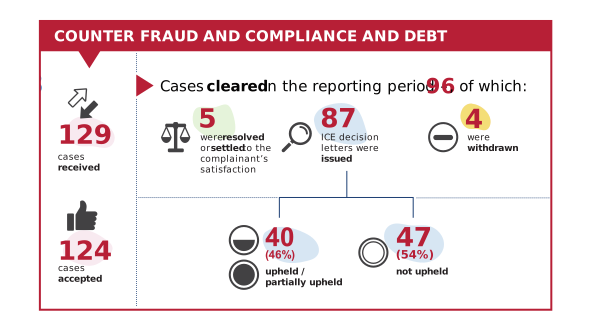
During the reporting period, Counter Fraud and Compliance and Debt received 129 complaints, of which 124 were accepted. A total of 96 cases were cleared. Of these, 5 cases were resolved or settled to the complainant’s satisfaction, 87 resulted in ICE decision letters being issued and 4 were withdrawn. Of the 87 decision letters issued, 40 cases (46%) were upheld or partially upheld, while 47 cases (54%) were not upheld.
Retirement Services
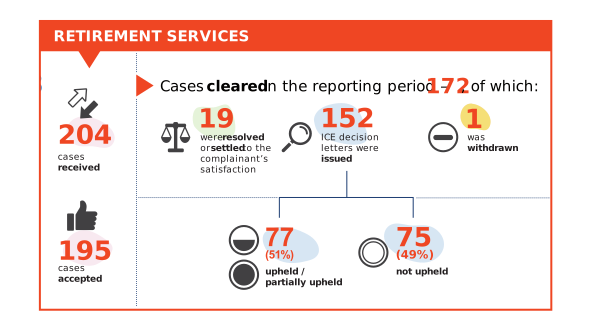
During the reporting period, Retirement Services received 204 complaints, of which 195 were accepted. A total of 172 cases were cleared. Of these, 19 cases were resolved or settled to the complainant’s satisfaction, 152 resulted in ICE decision letters being issued and 1 was withdrawn. Of the 152 decision letters issued, 77 cases (51%) were upheld or partially upheld, while 75 cases (49%) were not upheld.
Child Maintenance Service
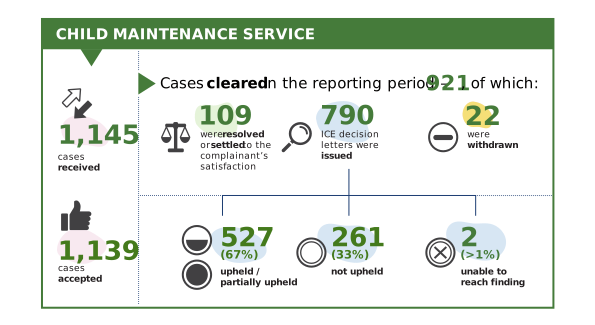
During the reporting period, Child Maintenance Service received 1,145 complaints, of which 1,139 were accepted. A total of 921 cases were cleared. Of these, 109 cases were resolved or settled to the complainant’s satisfaction, 790 resulted in ICE decision letters being issued and 22 were withdrawn. Of the 790 decision letters issued, 527 cases (67%) were upheld or partially upheld, 261 cases (33%) were not upheld and 2 cases (less than 1%) were unable to reach a finding.
Contracted DWP Services
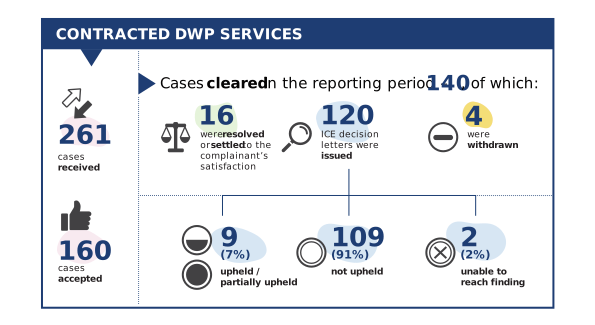
During the reporting period, Contracted DWP Services received 261 complaints, of which 160 were accepted. A total of 140 cases were cleared. Of these, 16 cases were resolved or settled to the complainant’s satisfaction, 120 resulted in ICE decision letters being issued and 4 were withdrawn. Of the 120 decision letters issued, 9 cases (7%) were upheld or partially upheld, 109 cases (91%) were not upheld and 2 cases (2%) were unable to reach a finding.
I wanted to extend my sincere thanks to you and your team for the thorough and dedicated investigation into my case. I was truly overwhelmed by the outcome, and I can’t express my gratitude enough.
Thank you again for your support and commitment throughout this process.
Appendix 2 - Service Improvement Observations (SIO)
If an investigation identifies a service issue as a consequence of a DWP procedure, or lack of one, which could cause a problem for other customers, ICE send a SIO letter to DWP to share the details of the case and the process or procedure they may wish to consider changing. The SIOs identified in 2025 to 2026 are summarised below, along with DWP’s response to them.
| Summary of issue from ICE | Response from DWP |
|---|---|
| Attendance Allowance guidance states a medical assessment should be completed, but DWP told us there is no process in place to allow that to happen for this benefit. | DWP have confirmed that improvements and a change to guidance and process are now in place. |
| On CMS arrears-only cases, Receiving Parents aren’t sent a payment schedule, so don’t know if they are receiving what they should be. | CMS have confirmed that this issue will be addressed through a review of its letters and work should be completed by end of September 2026. |
| CMS Annual Review notifications don’t explain there is a maximum income level that can be taken into account when calculating a Paying Parent’s liability, which may be less than they earn. | CMS have confirmed that this issue will be addressed through a review of its notifications and work should be completed by end of September 2026. |
| Attendance Allowance guidance for making a Right of Access Request (RAR) is contradictory to DWP guidance (in writing only and 40 days to respond, compared to online or phone and 30 days to respond). | Attendance Allowance RAR guidance has been updated to align with other DWP RAR guidance. |
| UC customers living in commercial accommodation (for example Bed and Breakfasts or hotels) can claim housing costs by providing invoices showing the accommodation’s address. The guidance doesn’t align so the customer didn’t receive housing costs for 8 months. | UC guidance has been updated to cover this situation. |
| For a CMS Receiving Parent in a case opened by the Paying Parent, the standard letters incorrectly tell Receiving Parents that if they don’t respond the case will not progress. For cases in which the Paying Parent is the applicant, this is not the case. | Two letters were impacted by this issue. CMS have removed one and plan to make improvements to the other by December 2026, as part of their review of all their letters. |
| A CMS Receiving Parent was a victim of serious domestic abuse and had been rehoused and had their identity changed by the Police. Their new name was disclosed to the Paying Parent causing extreme distress and the need to relocate and change their name again. Given previous assurances that such breaches can never happen, a fresh approach is needed. | CMS are reviewing all customer letters to ensure they are clear and accurate by end of March 2027 and propose a change to this letter. In the interim, a manual process was introduced in February 2026 to mitigate the risk of further issues. Guidance will also be updated to support caseworkers and minimise the risk of verbal data breaches. |
| UC claimant who had a child under the age of 3 was told not to supply fit notes from her GP as it wouldn’t affect her UC claim (because she didn’t have to look for work with a child under 3 ). However, this prevented her going on the health journey and she was later awarded LCWRA - impacting her UC claim. Guidance for claimants with children under 3 and declaring a health condition are not cross-referenced, and this isn’t the first case ICE has seen where a customer lost out financially because they were told there was no need to supply fit notes. | DWP confirmed its system prompts customers to provide evidence and in this ICE case, the failure was due to the misadvice of the agent. As there is no design or process error, DWP will take no further action at this time. |
| When ESA customers migrate to UC, their WCA result is transferred to UC but any other arrangements, including third party deductions, are ended when ESA ends, which is not made clear on GOV.UK. | DWP reviewed the information on GOV.UK and added clearer guidance which now explains that third party deductions don’t automatically continue when moving to UC, along with practical advice on how to arrange deductions. |
| Customers with complex mental health issues and considered to be vulnerable were notified of extremely large UC overpayments by letter, with no consideration for their vulnerabilities, despite guidance for staff to consider mental health conditions and vulnerabilities when informing customers of large overpayments. | DWP is reviewing staff guidance and instructions to identify any improvements it can make to prevent a recurrence. This work is currently ongoing. |
| At annual uprating, benefits that customers receive in addition to UC routinely cause overpayments. This is a known issue with no anticipated fix and leads to customers being overpaid and distressed by the debt that causes. | UC has already introduced a tactical work around to mitigate the impact of this issue and will work on a more strategic solution as part of a broader piece of work across the Department. |
| It’s not clear to UC customers with long-term and/or non-variable health conditions that prevent them from working and for which they don’t routinely need or have fit notes, that health premiums rely critically on them providing fit notes, and the health journey won’t be started without them. | DWP considers that the instructions for customers to report fit notes are clear. From a design and process perspective, the issue was caused by a failure to adhere to the process, rather than a systemic process error. In view of this, DWP will not implement a design change at this time. |
| CMS letters and GOV.UK don’t tell Paying Parents how they can move back to a Direct Pay arrangement once they have been put on Collect and Pay. A customer paid collections fees for over 4 years, unaware of the possibility to move back to Direct Pay. | CMS are gathering information to understand how best to improve and will provide further updates on progress and next steps in due course. |
| CMS staff aren’t considering guidance in the Child Maintenance Decision Maker’s Guide which says they should consider reasonable explanations for late or missed payments when changing a case to Collect and Pay. The operational instructions don’t prompt consideration of this and simply instruct staff to apply a Deduction from Earnings Order when a payment is late or missed. | CMS are gathering information to understand how best to improve and will provide further updates on progress and next steps in due course. |
| A lack of clarity in UC stolen identity cases has led to confusion about whether a RAR can or can’t be sent. | RAR guidance has been updated and clarifies when RAR requests can be answered in these circumstances. |