Independent Case Examiner for the Department for Work and Pensions: annual report 1 April 2024 to 31 March 2025
Updated 6 November 2025

© Crown copyright 2025
This publication is licensed under the terms of the Open Government Licence v3.0 except where otherwise stated. To view this licence, visit nationalarchives.gov.uk/doc/open-government-licence/version/3 or write to the Information Policy Team, The National Archives, Kew, London TW9 4DU, or email: psi@nationalarchives.gov.uk.
Where we have identified any third party copyright information you will need to obtain permission from the copyright holders concerned.
This publication is available at https://www.gov.uk/government/publications/dwp-complaints-annual-report-by-the-independent-case-examiner-2024-to-2025/independent-case-examiner-for-the-department-for-work-and-pensions-annual-report-1-april-2024-to-31-march-2025
Our purpose
We provide an independent review service for customers of the Department for Work and Pensions (DWP) and organisations delivering contracted DWP services (for example those providing work programmes or health assessments).
Our main objectives are:
-
to deliver a tailored service to people bringing complaints to us and make fair evidence-based decisions
-
to influence DWP service improvements by providing valuable insight from what we see
Our mission
To investigate complaints thoroughly ensuring rules, guidance, and standards have been applied correctly and fairly, based on evidence from both sides. We explain things clearly, so people understand our decisions.
Our vision
To continue delivering a high-quality complaint handling service which adapts and improves and which shapes DWP service improvements by helping them learn from complaints.
Introduction from the Independent Case Examiner
Our main job is to resolve complaints and concerns for DWP customers. We try to do that as soon as we can by explaining what has happened, or negotiating to get a resolution as soon as possible, if a customer is happy to do that. We go on to make evidence-based decisions for customers when those other means haven’t been appropriate.
The important second part of our role is to feed back to DWP what we see, so they can learn from it. We never see a complaint that DWP have not already had chance to respond to and address, but our fresh-eyes approach can make things clear that haven’t been before. As our work is solely driven by the complaints that come to us, we are experts in the stories of our customer’s lived experience with DWP. I believe these stories are a really valuable compliment to the more systematic data that DWP can collect and help to give real shape and meaning to the issues they are working on.
In this year’s report I have chosen to tell nine customer stories, as examples of the kinds of cases we see and to explain some of the common factors in resolving them. The first one shows how we can work closely with DWP when we find a customer at risk, and the second why it takes some time to conclude a case if the outcome turns on details that have to be teased out. Our third customer story shows how we link into DWP when we see a spike in cases about similar issues, to be sure they have spotted it too and are making changes to stop any further similar problems.
The stories after that explain some of the ways in which we look at complaints to reach fair decisions, two showing how we sit alongside HM Courts and Tribunal Service (HMCTS) with some cases needing input from both to be fully resolved. Customers can be surprised to find a Judge at Tribunal saying they can see errors have been made, but the Tribunal can’t resolve the impact of them as they can only consider legislation, and poor service has to be resolved through a complaint. I’ve also picked a case which shows the concepts of financial loss versus financial disappointment, as that distinction can be counter-intuitive for customers. That story contrasts with the next, which looks at what happens when someone acts on incorrect advice from DWP, rather than just being given it, and how we recognise that difference in impact.
The penultimate story shows how we handle cases in which a customer has suffered detriment from service errors, but has also had unexpected gains and the final one really sums our work up, as it shows how a service issue that affected many people led to particular upset for a couple who lost control over the very careful choices they had been making with their finances.
And that is the point of what we do; we listen to and properly hear each customer’s story, and resolve things for each person, based on the impact for them, as well as we can.
I hope the customer stories in this report give a real insight into our work and make it clear why I am so proud of what we do. I end with huge thanks to everyone in the ICE Team, to our customers, and to the very many in DWP who help us do our work, and value our feedback.
Joanna Wallace OBE
Independent Case Examiner
1. When urgent action is needed
Most complaints are from customers who feel that poor service in the past has not been properly recognised or resolved. If we find merit in what the customer says our settlement or recommendations usually ask several things from DWP to set things straight – we make DWP aware of the remedies before contacting the customer to be sure they can do as we ask. Occasionally though, we find a case in which there are ongoing risks to the customer, and we work alongside DWP to make sure they get things sorted for them as soon as possible, rather than as a result of ICE recommendations at the end of an investigation, as is usual.
The customer in this case was vulnerable, with very poor physical health and housing problems; we identified a substantial sum of arrears payable to them due to errors in their pension and benefits. The ICE Team worked closely with DWP, and with Visiting Officer support together set things straight for the customer as quickly as we could.
DWP’s processes for Disability Living Allowance (DLA)/Personal Independence Payment (PIP) recognise that customers may need extra support – if so, a marker should be added to the case. This marker alerts staff to take extra steps, such as processing the case even if there is no contact from the customer, or arranging a Visiting Officer to help with completing a claim. DWP also have a legal duty to make sure that reasonable adjustments are in place for customers who need help to access their services.
Our customer had significant health issues and was deaf – they had been in receipt of DLA for years when in 2018 DWP started the process to move their case to PIP. DWP wrote explaining that they needed to claim PIP by a certain date, or their DLA payments would stop. As they didn’t make contact, DWP needed to consider whether our customer needed additional support with their claim, including a home visit – that didn’t happen though and eventually the claim closed.
Our customer wrote to DWP to explain why they hadn’t claimed PIP and provided additional information, including that they had moved address. DWP did nothing with this though – they should have reconsidered the DLA closure decision which may have allowed it to be reinstated whilst a claim for PIP was progressed. Critically, they also failed to update the address on DWP records, which would have meant that other benefit areas would have the customer’s new address.
The failure to update the address impacted our customer’s State Pension and Pension Credit claims. An important letter went to the incorrect address and when it was returned, DWP didn’t follow that up as they should. Instead, payments were suspended and then DWP failed to review the suspension as they should, so it just continued.
As a result, from 2019 our customer didn’t receive any payments of pension or benefit. DWP then missed a chance to rectify this in 2020 when our customer contacted them and explained the issues they were having.
In 2023 our customer complained to DWP and told them how they’d been impacted by the lack of benefit payments (including a significant deterioration in their physical and mental health, as well as being homeless). However, DWP continued to miss putting things right – they provided a claim form (for Attendance Allowance, as our customer was no longer able to claim PIP due to their age), but didn’t consider any further reasonable adjustments to support them and also failed to review the suspended State Pension.
Our customer had to contact DWP again in 2023 about their State Pension, and it was only through that prompting that State Pension was reinstated, with arrears of just under £30,000 being paid for the period 2019 to 2023. There is no evidence that DWP apologised for this delay, or the impact of it – they also failed to consider the Pension Credit claim.
Whilst a Pension Credit claim was processed later that year, and arrears of just over £2,000 paid to our customer for a six-month period, this amount was incorrect as DWP had applied a tariff to the sum awarded, as they had treated the State Pension arrears as capital, rather than disregarding them as they should have done.
The complaint was escalated to my office by a representative, and the significant effect of all that had gone wrong became clear to us. We took the exceptional step of reaching out to DWP immediately so we could work together urgently to put things right for our customer, rather than wait for the usual report process to run through.
This led to DWP making a payment of nearly £55,000 for:
-
Loss of Statutory Entitlement to DLA from 2018 to 2023 and Pension Credit from 2019 to 2023
-
Erosion of the Monetary Value of DLA, State Pension and Pension Credit arrears
-
Money incorrectly deducted from the Pension Credit award when DWP applied the tariff
In my recommendations for this case when it was concluded, I had to consider the errors and lack of vital support to an extremely vulnerable customer, which had clearly exacerbated the long-term issues with their health and their housing situation. DWP continued to miss opportunities to put things right. It was an exceptional case, and I recommended that DWP make a consolatory payment of £3,000 to recognise the hardship caused, and the impact of their service failures.
2. When ‘the devil is in the detail’
Some of our investigations are lengthy and complex to allow us to get to the heart of a customer’s concern and make a fair decision. We often need a customer’s help to get all the relevant evidence, and we very much value the efforts many take to find evidence for us, and their patience then in allowing us the time to do our work for them.
The following story shows a unique complaint and a very detailed investigation – we often went back to the customer for evidence, which could have felt intrusive, but was essential for us to make an informed decision on an important issue for them. We also show the changes DWP made after I reached my decision to make sure that such an error wouldn’t happen again for another customer.
Our customer’s son was receiving the highest rates of both DLA components, which allowed them to lease a vehicle from the Motability Scheme (not part of DWP). In 2018 DWP decided this award would be in place until 2025. The following month, our customer called to tell DWP that they were planning a move to Jersey later that year. They were advised to contact DWP closer to the move date, at which point their DLA claim would be closed, requiring them to return the Motability vehicle.
They then wrote to DWP later that month to complain as they thought what they’d been told in that call was different to the information on GOV.UK, which amongst other things, said ‘Usually to qualify for DLA for children, the child must:
-
be under 16
-
need extra looking after or have walking difficulties
-
have lived in Great Britain for two of the last three years, if over three years old
-
be habitually resident in the UK, Ireland, Isle of Man or the Channel Islands’
Our customer said this guidance said they needed to be habitually resident in the Channel Islands to be eligible for DLA, which was one of the main factors in planning to move, as they relied on DLA for the Motability vehicle and extra support for their son.
After getting technical advice, DWP wrote to our customer to say that they would continue to receive DLA when they moved to Jersey and could keep the Motability vehicle. This was incorrect, but having received the advice in writing our customer went ahead and moved to Jersey with their family and DWP continued to pay DLA.
Once in Jersey our customer found they were liable to pay Tax and Emissions Duty on the Motability vehicle because the disability benefits were paid by DLA and not by Jersey. They thought this unfair, and in 2021 a media article was published about it, DWP were contacted by the provider of the Motability vehicle and began to review the case.
Based on guidance from its Decision Making and Appeals Team, DWP decided that there had been an error in law and our customer’s son hadn’t in fact been entitled to DLA since 2018, when they’d moved to Jersey. This meant that our customer had been overpaid several thousands of pounds (which they weren’t asked to repay, as the overpayment was classed as official error), but their expectation had been to have payment until 2025, as that was the date to which the DLA award had been made.
Our customer complained to DWP – they apologised for the incorrect information our customer had received, acknowledging that their incorrect advice had been one of the main factors in the family’s decision to move to Jersey, but said there wasn’t anything more DWP could do. DWP signposted them to the Jersey Benefit Department for help.
Our customer approached them, and their son was exceptionally awarded benefits in 2022, following a Ministerial decision in their favour. Our customer then received equivalent amounts in benefit to those they’d had in the UK, but there had been a gap of around a year during which no benefits had been paid.
They escalated their complaint to this office and explained that DWP’s mis-advice, that DLA would be paid until 2025, was material in their decision to move to Jersey. When DLA stopped the financial impact had been hard for them and they wouldn’t have moved had they known that would happen. They felt they had suffered financial loss and hardship as they’d acted on DWP’s advice and then been without benefits for their son for 12 months from 2021 to when they were awarded benefits in Jersey.
This was a complex case, and I carefully considered when our customer had made a firm decision to move to Jersey, as opposed to when they had been researching it, as I would expect any family planning such a move to do in some detail. Their housing and employment as well as DWP’s advice were looked at to determine when they had actually committed to the move.
Based on all the evidence, it became clear that our customer had relied on DWP’s written confirmation (in August 2018), that their son would continue to receive DLA after moving, in making the final decision to relocate.
In coming to this view, I put weight on two key factors:
-
our customer’s offer of employment was a zero-hour contract and they could have stepped away from it without letting the employer down
-
when DWP gave the incorrect information, our customer had researched but not yet secured accommodation, and didn’t have a signed rental agreement
As such I felt that our customer could have stepped away from the planned move without any great difficulty or financial loss, had they had correct information from DWP.
In deciding on redress, I considered the significant overpayment our customer had received, and that Jersey had (in 2022) started to pay benefits for their son. However, I concluded that DWP should pay them an amount of £8,762.00 – equivalent to their son’s DLA entitlement for the year, when they weren’t in receipt of any benefits, as their decision to move had been based on the promise of an award to 2025 and it being confirmed they would receive that – I also recommended that a consolatory payment of £500 was made.
After DWP had set things straight for this customer, they changed several aspects of the information online to remove ambiguities, and specifically the residence information to make it clear that a child DLA customer had to be living in England or Wales.
Our customer contacted us after the investigation had concluded and told us: ‘We tried tirelessly with the DWP to challenge the initial decision which had caused us financial hardship, even taking it to Tribunal. We really felt an injustice had been done to our son. The ICE office was our very last chance.
We are so grateful to the Investigator and the ICE for working so incredibly hard on what must have been a very difficult case. It took a long time due to the complexity of it, but you kept going and always kept us updated. You got an amazing outcome for our son and it will benefit him immensely with his future. You are all wonderful.’
3. When we see a ‘spike’ in complaints
We sometimes see a spike in complaints about a particular issue, which will prompt us to share what we are seeing with the relevant part of DWP, to be sure they have spotted it too and taken action. This year in the Child Maintenance Service (CMS) we saw multiple cases relating to recognising equal shared care versus equal day to day care – a critical difference as the latter definition means there is no primary carer for a child and often leads to a case closing.
CMS told us they had recognised this issue and put things in place to stop further errors, including Smart Instructions for staff, and asking the customer questions to understand if they were reporting a change to shared care, or to the primary carer. This customer story is an example of several similar ones this year.
For CMS to proceed with a claim for maintenance there must be a Qualifying Child, and CMS need to establish who should be considered the Receiving / Paying Parent. The Receiving Parent is normally the parent classed as the primary carer (has the most parental and financial responsibility for the child(ren)). CMS can also reduce a Paying Parent’s maintenance liability with an allowance for overnight shared care (where a Qualifying Child stays overnight with them for at least 52 nights per year).
CMS have two service types, Direct Pay where CMS calculate the maintenance and the payment schedule but do not collect payments, and Collect and Pay where they do both. If CMS are told that a parent isn’t paying in line with the payment schedule they can change the service type to Collect and Pay but before they do this, they need to contact the Paying Parent about the missing/short payments. CMS also need to consider whether any changes have been reported (by either parent) which could affect the amount of maintenance to be paid.
Our customer was the Paying Parent and complained to my office as they didn’t believe that CMS had established the primary carer of one of their children at the correct time. They also felt that CMS hadn’t correctly considered the overnight shared care that they’d repeatedly reported. Due to CMS’ delays Collect and Pay was put in place which our customer believed was inappropriate.
Our customer’s CMS case was opened in 2023 when they reported that one of the Qualifying Children was no longer living with the Receiving Parent, and there was shared overnight care in place for the other Qualifying Children. CMS didn’t take any action to investigate but then in 2024, after CMS had been told our customer wasn’t making payments in line with the schedule, they changed the case to Collect and Pay, despite there being outstanding actions for them to review the liability. And although CMS subsequently reviewed the case to include an allowance for shared care, they didn’t investigate who should be the primary carer of one of the Qualifying Children, and the case remained Collect and Pay.
Our customer continually raised these issues in 2024, including escalating their complaint to their Member of Parliament (MP). Eventually CMS reviewed the primary carer and one of the Qualifying Children was removed from the case from the initial effective date. At the same time, CMS also reviewed the shared care decisions and revised them, also back to the initial effective date. CMS’ delay also prevented our customer from making their own claim for maintenance (as a Receiving Parent) but in their complaint responses CMS didn’t acknowledge these issues.
After our customer escalated the complaint to my office and we’d considered the evidence, it was clear that CMS didn’t investigate the issues our customer was raising at the appropriate times and missed opportunities to put matters right sooner than they did.
This resulted in our customer:
-
being moved to Collect and Pay inappropriately and incurring collection charges
-
having to pay more maintenance than they should have
-
not being able to open their own maintenance claim as soon as they should
CMS also failed to fully recognise their errors and the impact they’d had.
To put matters right I recommended that CMS apologise and make a consolatory payment of £350 to recognise the poor service and the financial impact they had on our customer. I also asked that CMS reimburse the collection fees paid, along with financial loss, recognising the delay our customer experienced in being able to make their own application for maintenance.
4. Maladministration or Legislative Appeal?
Our remit at ICE is limited to customer issues about service and administration – did DWP do what they said they would (in their guidance, processes or procedures)? I have no remit over decisions in regard to benefits, pensions or child maintenance liabilities under CMS – if a customer is unhappy about those, they can with some exceptions, be looked at through the Mandatory Reconsideration (MR) process, and then appealed to a Tribunal as part of HMCTS. Some decisions which cannot be appealed can be taken to HMCTS for Judicial Review.
It remains the case though, that a Judge can then only act in line with legislation, and if they believe that a service error has led to an injustice, they can’t just set that right if legislation doesn’t provide for that. Whilst the law can’t fix that problem, our decisions can – a point that is often misunderstood from a misplaced assumption that ‘the law has the final word’. It is not unusual for us to see Tribunal records which show the Judge signposting a customer to raise a complaint and use our service, to set the impact of administrative failures right, as the Tribunal can’t. The first customer story below shows exactly this and is about Universal Credit (UC), but we see similar comment from Judges in CMS, and other parts of DWP’s Business.
UC customers have to pay for Childcare Costs up front, but if they report them, UC can pay some of the money back – there is a maximum limit (85% of the costs – in our customer’s case, at that time this was around £1,000). Customers only get money back from UC after the childcare has actually happened, and there are other detailed rules which then cover which UC Assessment Period costs will be paid in.
Our customer had difficulty receiving invoices from their childcare provider and this meant there was a delay in them being able to pay the costs. However, in one month, they paid the provider for the previous three months. They contacted UC on several occasions to ask how they should provide the invoices to ensure they received the correct and maximum reimbursement. They were incorrectly told to provide all the invoices together and UC would arrange for them to be paid for in separate Assessment Periods.
When the invoices were presented, UC applied them as they should, all to one Assessment Period. This meant the amount reported exceeded the cap, and our customer received several hundred pounds less than they would otherwise. Our customer followed the MR and Appeal process to dispute this. At the Tribunal the Judge explained that they couldn’t change the UC decision to allocate all the costs to one Assessment Period, as that was what the legislation said should happen.
But the Judge said that clearly our customer had been placed at a disadvantage because of the incorrect advice from UC and signposted them to make a complaint to DWP and, if necessary, escalate on to an Ombudsman.
Our customer complained and asked DWP to compensate them for the reduced reimbursement (so financial loss) due to the incorrect advice. DWP agreed they had misadvised our customer but didn’t believe there had been an impact – they offered a small consolatory payment given the incorrect advice.
After considering the evidence, it was clear there had been impact, as if our customer had been told to wait until the next Assessment Period to report one of their monthly childcare payments, the claim would have been made in arrears and paid at the maximum limit. To put matters right, I recommended that DWP:
-
make a financial loss payment of several hundred pounds to recognise our customer’s Loss of Statutory Entitlement, as they had acted on DWP’s incorrect advice
-
apologise and make a consolatory payment of £150 to recognise the customer’s time and trouble, and the length of time they had been without this money
The same distinction between what the complaint process and the law can resolve applies when I see a service error that has prevented a benefit decision being made. I can’t simply impose my view to set that straight – I must refer a customer to use the DWP decision route, then MR and Appeal rights, to try to get the outcome on a benefit decision that they want. In this second example, DWP were sadly unable to provide backdated decisions for a customer who had missed out on them at the right time, because of service failures. I was left, given the restrictions of my role, only able to recognise that the decisions might have led to significant payments, though we would never know, and that a critical benefit decision had been irretrievably missed with an understandable sense of injustice for the customer.
When a UC customer reports a health condition that restricts their ability to take up or look for work, they should be asked to provide medical evidence. Once received, the customer should be referred for a Work Capability Assessment (WCA) which determines whether they have limited capability for work (LCW) or limited capability for work related activity (LCWRA).
If the customer is found to have LCWRA, they will receive an additional amount (known as the health element) in their UC award after the ‘relevant period’ (three months from the date the customer provided medical evidence) has passed.
Our customer claimed UC in 2018 and as well as declaring they were working full time, they told UC that they had a health condition which affected their ability to work – they should have been asked to provide a Fit Note, but they weren’t. They received UC payments in line with their circumstances at the time. Between then and early 2022 our customer told UC on several occasions about their ill health and asked if they should provide a Fit Note – UC didn’t respond to them.
Eventually, in February 2022 UC provided the correct information but it wasn’t until May that our customer sent in Fit Notes, which after a WCA, led to them being awarded LCWRA in September. This decision was only effective from 2022 – when the Fit Notes had been provided. Whilst our customer followed the MR and Appeal process, legislation could not support the effective date being any earlier than 2022.
Following Appeal, our customer complained to DWP and said they’d not responded to queries since 2018. They asked for compensation of £14,000 – the value of the additional LCWRA payments they believed they had missed from 2018 to 2022. In response, DWP apologised they hadn’t been given information about providing Fit Notes sooner and awarded a Consolatory Payment of £250.
Our customer escalated their complaint to my office – based on the evidence it was clear that DWP had failed to respond to their questions about providing Fit Notes, there had been other delays and I did not believe the consolatory payment appropriately reflected the service failures we’d identified.
To put matters right, I initially asked DWP to retrospectively assess our customer’s entitlement to establish if there had been financial loss, but they said they simply couldn’t determine what our customer’s eligibility would have been in 2018.
As I am not able to determine a customer’s entitlement to LCWRA, in this instance I was only able to make a consolatory payment which reflected the significant impact of DWP’s service failures. I believed that on the balance of probability, had DWP asked our customer to provide Fit Notes from the beginning of the claim, they would have provided them. I recommended that DWP apologise and make a consolatory payment of £2,500 to recognise:
-
repeated engagement with DWP with no or incomplete responses, when our customer was struggling with their mental health, domestic violence and difficult family circumstances
-
the frustration and injustice our customer felt as they believed they had been deprived of £14,000, although I recognised whether or not that was the case simply couldn’t be determined
-
the time and trouble our customer had to go through to resolve this
5. Financial loss vs financial disappointment
We often see cases in which a customer believes DWP has denied them money, based on what they have been told or sent in a letter or journal message from DWP. If a customer hasn’t acted on what they have been told, we distinguish between a loss, and disappointment – with financial disappointment describing a situation in which a customer has been misled to believe they’d receive an amount of money that they simply had no entitlement to. We do recognise the impact of that disappointment, but most often not at a level close to the amount the customer wants to cover the payment that was never going to happen.
Some customers think that even if the information they were given was wrong, it has to be honoured, which is not the case. The following example shows how a customer had their expectations raised by poor advice from DWP, but as their plans had been set before DWP were involved, the customer had no financial loss at all, but did experience disappointment.
UC customers who want to temporarily leave the United Kingdom (UK), can remain entitled to UC as long as:
-
they notify UC of their intention to go abroad before they leave the UK
-
were entitled to UC immediately before they travelled abroad
-
their absence won’t exceed one month
-
they continue to satisfy their work-related requirements and meet their customer commitment whilst they are out of the country
There are a small number of circumstances under which an absence can be extended, including bereavement and medical treatment, but otherwise a customer won’t be entitled to UC from the beginning of the Assessment Period in which they left the UK, and the claim will be closed (they could make a new claim upon their return to the UK).
Our customer came to us as they felt DWP hadn’t given them the correct information about the time they were allowed to spend outside the UK and because of that, they had lost UC and accrued rent arrears. They wanted DWP to pay them the ‘lost’ UC.
Our customer was receiving UC, and their housing costs were paid directly to their landlord. Before travelling, they spoke to their Work Coach three times over a period of two months and each time referred to travelling outside the UK for longer than a month (none of the exceptions applied) and asked whether this would be allowed/have an impact on their UC. At no point did the Work Coach explain the rules on temporary absence from the UK, despite knowing that the customer planned to be away for more than a month.
Whilst the customer was abroad, their UC claim was correctly closed because their absence exceeded one month. Notifications were sent to them explaining what had happened and how they could challenge the decision, and that they could apply for a new claim when they returned to the UK.
Although the customer challenged their claim closure, the decision did not change when it was reconsidered, and HMCTS found that DWP had made the correct decision (to close the claim). However, during the hearing the Judge, (as noted in earlier Customer Stories), suggested that the customer follow DWP’s complaints process as they believed the Work Coach had incorrectly led them to believe they would remain entitled to UC, despite their absence exceeding a month.
The customer complained to DWP. When they responded, DWP explained the UC guidance for customers travelling abroad and said that the decision to close the claim was correct. However, they agreed that the Work Coach hadn’t clearly explained the guidance before the customer had left the UK, giving them the impression that their claim would remain open while they were away. In recognition of the maladministration, they apologised to the customer and awarded a consolatory payment of £100. The customer wasn’t happy with this and escalated their complaint to my office.
After analysing the evidence, it was clear that the customer had several conversations with their Work Coach about the trip and had been led to believe their UC claim would stay open while they were away. However, it was also clear from the evidence that the customer had already committed to the trip, including booking flights, prior to first speaking to the Work Coach about it, so when they booked the trip they weren’t acting on information from DWP at all. Because of this I didn’t consider that the customer had incurred any financial loss due to DWP error, albeit the customer had without doubt been financially disappointed, as whilst they’d been led to believe the claim would stay open, legislation directed that this couldn’t be the case – the claim would have always needed to close.
Although DWP had apologised and provided a consolatory payment of £100, I didn’t think this was sufficient remedy for the significant disappointment that DWP’s service failure had caused them in believing their claim would continue when in fact it never could. I recommended that DWP make a further apology and additional consolatory payment of £100 (bringing the total award to £200).
6. Failing to provide valuable evidence
It is for a customer to research the benefits available to them and to decide which or whether to claim and when – it is not DWP’s responsibility to tell customers whether or when to claim. Generally, when a customer complains about DWP advice, we look to see that they have been appropriately signposted to online information on GOV.UK or to benefits calculators, or third parties such as Citizens Advice.
We do see cases though in which DWP information has led customers to reasonably believe they do know what to claim, and others in which benefit information available by one channel (such as through an online claim) has not been available to those who claim by other means, such as phone. I expect DWP to provide the same service whatever means of contact or claim a customer uses. In this example, adverts designed to ensure customers didn’t claim UC too late, led a customer instead to claim too early, and although DWP included the same information that was available online in the notes for telephone claim call handlers to use, the chance to share it with the customer was missed.
UC was introduced to replace several income-related benefits including Working and Child Tax Credits, with a process called ‘Move to UC’ to handle the transition to UC for Tax Credits customers (amongst others). Customers selected for UC through this process were sent migration notifications by post telling them their Tax Credit would be ending, and they’d need to claim UC by a specific date – a minimum of three months and one day from the date the notification was sent to them.
When a UC claim was made, the customer’s entitlement to the Tax Credits ended. If a ‘Move to UC’ customer claimed UC within the deadline they could be considered for Transitional Protection (TP) and if they were entitled to it, and their UC entitlement would be lower than the Tax Credits they were moving from, they’d be given an additional amount to make sure they didn’t lose out. If a customer claimed UC before they received their migration notification though, it was classed as a ‘voluntary migration’ and didn’t include any entitlement to TP.
DWP launched an advertising campaign in 2023 with digital advertising, leaflets and radio adverts to raise awareness that Tax Credits were ending and help customers prepare for the move to UC. The following month, HM Revenue and Customs (HMRC), on behalf of DWP, sent leaflets to all Tax Credit customers explaining that Tax Credits were ending and the need to move to UC. Amongst other things the leaflet told customers that they should ‘look out for’ the migration notice. Neither the leaflet nor the radio campaign mentioned that it was crucial to wait for the migration notice to be eligible for TP.
Information about TP was available on GOV.UK which, amongst other things, said customers could only receive it if they’d had their migration notification and then claimed UC by the deadline date. DWP also produced guidelines for staff to use when customers called with questions about migration; those guidelines specified that staff should ask the customers whether they’d received the migration notification and if not, tell them that they needed to wait for it before claiming. Our customer came to us and said DWP gave them incorrect advice which meant they hadn’t received the TP and had suffered a financial loss, and they wanted to be put back in the financial position they would have been in if they’d received the TP.
Our customer and their partner were receiving Tax Credits as a couple. In 2023 they started to make a claim for UC and telephoned DWP to ask for advice. During this call the customer clearly said that they hadn’t received the migration notification, but they had received the leaflet (from HMRC) and said they thought they may as well ‘just get the change to UC’ made. The call handler didn’t explain that the customer needed to wait for the migration notification to be eligible for the TP, as their script said they should. Instead, they went ahead and helped the customer with the claim.
After UC was awarded and the customer began to receive their payments, they complained as they were financially worse off on UC than they had been before.
DWP’s responses explained that our customer hadn’t waited to receive the migration notification before claiming UC, and that information about the migration process and TP on GOV.UK was ‘clear and concise’ – Tax Credit customers needed to wait until the migration notification was received. They acknowledged that our customer may not have considered that web information, as they’d already decided to claim UC, and recognised that neither the radio advert nor the leaflet referenced the migration notification.
DWP also referred to the call the customer made and that the call handler could have explained the migration process but said that as our customer had already decided to claim UC, the issue really was that they didn’t realise the significance of the migration notification.
After analysing the evidence, I didn’t feel that the radio advert or the leaflet made clear the importance of waiting for the migration notification, or the difference this would make to entitlement to the TP. Given the communications campaign and its focus on not forgetting to claim, I felt that our customer may never have felt a need to check GOV.UK, or question the information in the leaflet. I believed that the guidelines prepared by DWP for staff, which the call handler failed to follow, showed they had anticipated that customers might not check GOV.UK and that if our customer had been given the correct information when they called in 2023, they wouldn’t have completed their UC claim until after they’d received the migration notification.
I recommended that DWP make an apology and a consolatory payment of £250 to recognise their service failure in that call, and the anxiety and upset our customer had been caused. I also recommended that DWP calculate and make a payment of Loss of Statutory Entitlement for the amount of TP our customer would have been eligible for if they’d claimed UC after getting their migration notification. To date this was just under £11,000, with ongoing payments.
7. Considering a complaint ‘in the round’
Customers come to us with a specific concern, which must have been considered fully by DWP before we accept it. We do not accept complaints so broadly expressed that they could be considered a ‘fishing expedition’ – or a request for an unfocused review of DWP’s actions – just to see if there was error. Nonetheless, during our investigations we can find other things have gone wrong that the customer may be unaware of.
I consider cases ‘in the round’, so take into account all we see, which can mean there are both ‘wins’ and ‘losses’ in a case for a customer. The following example shows how we considered a customer’s complaint that they felt they had lost out on UC, in the course of which we found they had been overpaid another benefit – both issues needed addressing in our recommendations.
UC and Employment and Support Allowance Income Related (ESA IR) are both means tested benefits, which means they are both affected by the amount of capital that a customer has. If a customer has less than £6,000 their capital will be disregarded; anything between £6,000.01 and £16,000 will be treated as producing an income of £1.00 for each £250 between those limits. Means tested benefits can’t be paid to anyone with more than £16,000 capital. Because UC has now replaced ESA IR, if an ESA IR claim is stopped or suspended due to a change in circumstances it can’t then be reinstated, and the customer would instead need to claim UC.
In 2022 our customer notified DWP that they’d received a significant inheritance which meant they were no longer entitled to receive any ESA IR payments. Although DWP suspended their payments (instead awarding National Insurance credits towards State Pension), DWP didn’t consider whether our customer had been overpaid ESA IR (as DWP were unaware they’d in fact had the inheritance some time before they got in touch).
At the beginning of 2023 our customer contacted DWP, and they were correctly told that once their capital reduced to below £16,000, they wouldn’t be able to return to ESA IR but could claim UC. However, in calls after their capital was below this level later in 2023, our customer was given unclear and potentially incorrect advice, which meant they didn’t claim UC as soon as they could have.
When they eventually claimed UC, later in 2023, our customer asked, via a MR, for it to be backdated to the point in time they would have been able to claim UC (when their capital reduced below £16,000) but the decision didn’t change.
Our customer then escalated their complaint via their MP several times. In DWP’s responses, they acknowledged that our customer had been given confusing information and apologised, awarding a consolatory payment of £150.
After considering the evidence and the case as a whole, we identified both that DWP hadn’t considered whether our customer had been overpaid ESA IR in 2022, and that they’d been given incorrect advice which had delayed their UC claim in 2023.
To put things right we recommended that DWP make a payment for Loss of Statutory Entitlement to UC from when our customer initially told DWP their capital had reduced, until they had actually claimed UC, as I believed the customer would have claimed sooner had they been properly advised. However, as I was aware of the potential ESA IR overpayment, I asked DWP to calculate that too and offset the two amounts, to make sure the customer was paid all they were entitled to, but no more.
8. Impact is personal
Some complaints arise from issues that affect many people, but each individual customer can have very particular circumstances or concerns that are personal to them. I have seen many cases related to Category B pensions and the exercise carried out by DWP in 2020 to set right errors in Category B payments for those affected. This case shows how a very particular concern for a customer arose from circumstances that affected many people.
Customers who reached State Pension age prior to 6 April 2016 could be entitled to two categories of State Pension: Category A was payable to a customer based on their own National Insurance contributions and Category B was payable to married persons/civil partners and survivors based on the National Insurance contributions of their spouse/civil partner.
When the spouse of a State Pension customer reached State Pension age prior to 17 March 2008, a claim needed to be made by the married person or civil partner in order to receive the top-up payments. However, from 17 March 2008 the entitlement to a Category B increase was automatic and DWP could revise a customer’s Category A State Pension to include the Category B top up when their spouse claimed their own State Pension – as long as the date of entitlement to Category B was on or after 17 March 2008.
In 2020 DWP were made aware that some people hadn’t had their State Pension increased automatically, so began to review State Pension claims and contact customers if they’d been underpaid.
Our customer escalated their complaint to my office as they didn’t believe that DWP had followed the correct process for them in 2011 when their spouse had claimed their State Pension, and then DWP failed to address their questions until their MP became involved.
Our customer reached State Pension age in 2005 when they claimed their State Pension and their husband reached State Pension age in 2011 and claimed their State Pension. DWP failed to automatically apply the Category B top up to our customer’s State Pension until it was reviewed in December 2022 – our customer was entitled to arrears of approximately £21,000.
Our customer wrote to DWP several times in 2023 to raise concerns about the tax implications (managed by HMRC) of receiving the lump sum. Over previous years the couple had worked hard to manage their income to make the most of their Personal Allowances, drawing carefully on private pensions to avoid their income leading to them paying any tax at all, as that was their main priority. They didn’t believe it was fair for them to have to pay a tax bill from the lump sum of arrears they had been paid due to DWP’s errors. They also said they incurred financial loss of approximately £1,100 (which included approximately £880 tax paid to HMRC) but DWP failed to respond.
It wasn’t until 2024, when our customer’s MP escalated their complaint, that DWP replied apologising for the lack of response and inconvenience – they said though that if our customer had been paid the correct amount of State Pension at the right time, they’d have been liable to pay additional tax throughout that period. The customer was unhappy and brought their complaint to ICE.
I considered the significant volume of evidence the customer provided to my office showing how the couple had managed their finances for many years with a main objective to avoid paying tax, drawing precisely on their private pensions to ensure their income did not pass the tax threshold. I entirely understood their sense of injustice about the lump sum arrears payment and the tax that was then due on that.
Whilst it was right that they had to pay tax on the lump sum they received, I did recognise that the delay in payment had impacted on their ability to manage their finances generally, and their tax responsibilities in particular, as they would otherwise clearly have chosen. Whilst I did not find there had been any financial loss, I recommended that DWP apologise and make a consolatory payment of £350 to recognise delay in the complaint process and the impact on our customer’s opportunity to manage their finances and tax as they would have preferred, over and above the obvious delay in receiving the lump sum arrears.
Our year in numbers
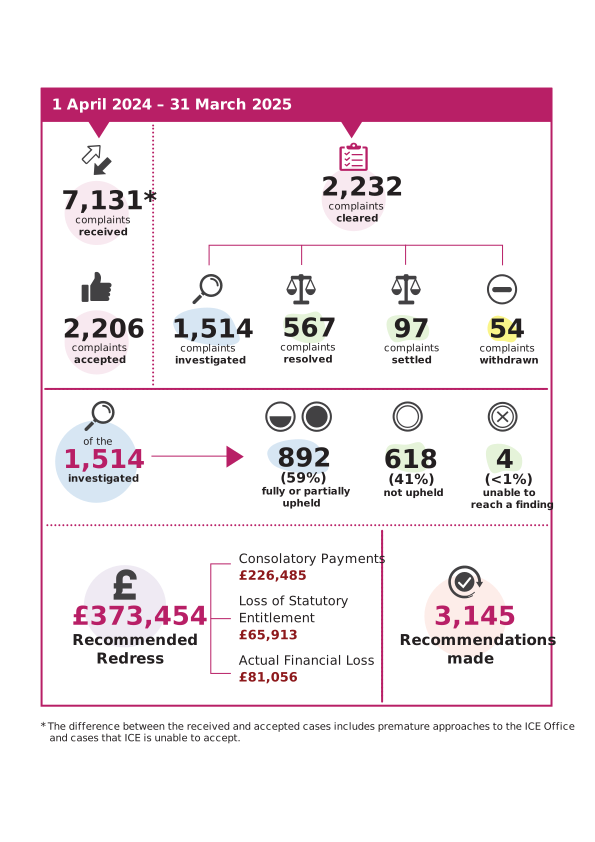
The image shows a breakdown of ICE’s year in numbers from 1 April 2024 to 31 March 2025. 7,131 complaints were received; 2,206 complaints were accepted. The difference between the received and accepted cases includes premature approaches to the ICE office and cases that ICE is unable to accept. 2,232 complaints were cleared, of which 1,514 complaints were investigated, 567 complaints resolved, 97 complaints settled, and 54 complaints withdrawn. Of the 1,514 investigated, 892 complaints were fully or partially upheld, 618 complaints were not upheld, and 4 complaints ICE were unable to reach a finding. £373,454 was recommended in redress, broken down into £226,485 in consolatory payments, £65,913 in Loss of Statutory Entitlement and £81,056 in Actual Financial Loss. Overall, 3,145 recommendations were made.
Our service
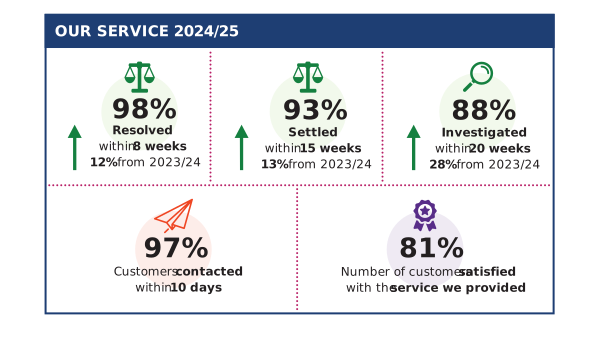
The image shows a breakdown of ICE’s service completion rate for reporting year 2024/2025. 98% of cases were resolved 8 weeks of allocation, a 12% increase from 2023/2024. 93% of cases were settled within 15 weeks of allocation, a 13% increase from 2023/2024. 88% of cases were investigated within 20 weeks, a 28% increase from 2023/2024. 97% of customers were contacted within 10 days of receipt of case, and 81% of customers were satisfied with the service we provide.
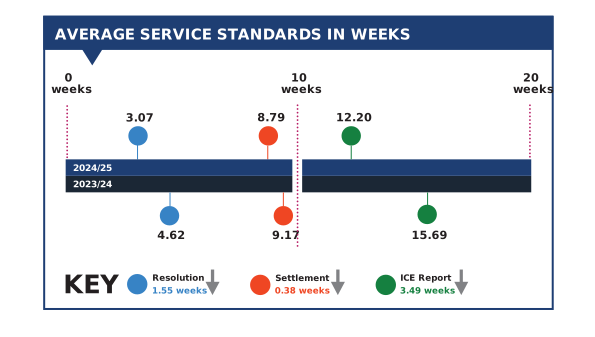
The image shows ICE’s average service standards in weeks, comparing reporting year 2024/2025 to 2023/2024. In 2024/2025, ICE averaged 3.07 weeks to resolve a complaint, which is a reduction of 1.55 weeks compared to 4.62 weeks in 2023/2024. In 2024/2025, ICE averaged 8.79 weeks to settle a complaint, which is a reduction of 0.38 weeks compared to 9.17 weeks in 2023/2024. Finally, in 2024/2025, ICE averaged 12.20 weeks to complete an investigation, which is a reduction of 3.49 weeks compared to 15.69 weeks in 2023/2024.
Our casework
The data and figures included in this report are based on casework in the twelve-month period between 1 April 2024 and 31 March 2025.
Our approach to casework
When we receive a complaint, we first establish if we can accept it for examination; the complaint must be about maladministration (service failure) and the customer must have had a final response to their complaint from the relevant DWP Business within the last six months.
Resolved cases
Once we accept a complaint, we may attempt to broker an agreement (resolution) between the customer and the Business that satisfies the customer, without having to request evidence to inform an investigation.
Investigations
If we are unable to resolve a complaint, the complaint is allocated to an Investigator who examines the facts of the case and establishes if the Business complained about fairly and consistently applied its published standards. During their examination the Investigator will contact customers to ask for information.
If a complaint can be settled:
After reviewing the evidence, the Investigator may be able to agree actions between the customer and the Business to satisfy the customer that their complaint has been settled. We will only settle a complaint with a customer’s full agreement. Once they have given that, the Investigator will confirm the agreed action in writing and explain when that will be complete.
If a complaint cannot be settled:
If the Investigator is unable to settle the complaint, they will conduct an investigation, for which there are several possible outcomes. Where we find that the complaint has merit which wasn’t properly recognised before it was escalated to the ICE Office, we’ll recommend appropriate redress (for example an apology, corrective actions and/or a consolatory payment).
Withdrawn cases
Complaints can be withdrawn for several reasons, for example, some customers decide to withdraw their complaint when we explain the Appeal route for legislative decisions. Occasionally people also withdraw their complaint because the Business addresses their concerns after they have come to us.
If we find there were service failures or errors by the Business which were put right before the complaint was brought to us, we’ll explain what went wrong and how we have seen things were put right.
Where we find that the Business handled a case as we would expect to see, we’ll explain why no fault or error was found.
We’ll send the customer a report which tells them the outcome, timescales for any recommended actions, and what to do next.
Findings of the Parliamentary and Health Service Ombudsman
Customers who are dissatisfied with the outcome of an ICE investigation or the service provided by ICE, can ask an MP to escalate their complaint to the Parliamentary and Health Service Ombudsman. The Ombudsman did not uphold any complaints about ICE in the 2024/25 reporting year.
Continuous improvement
In this reporting year we held both Customer Service Excellence and British Standards Institute accreditation.
The ICE Office is a Complaint Handler member of the Ombudsman Association and staff from the ICE Office attend working group meetings to share best practice and discuss common themes with other public and private sector Alternate Dispute Resolution Organisations.
Appendix 1
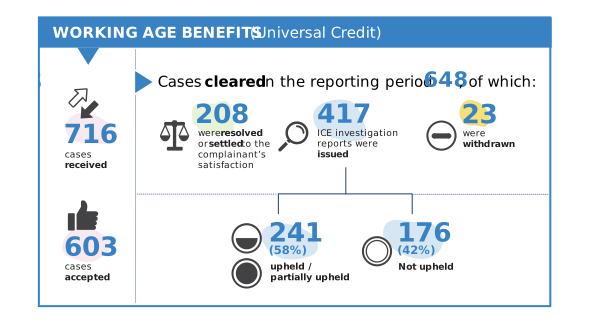
The image shows a breakdown of data relating to Working Age Benefits (Universal Credit) cases with ICE in 2024/2025. 716 cases were received, and 603 cases were accepted. 648 cases were cleared in the reporting period, of which 208 were resolved or settled to the complainant’s satisfaction, 417 ICE investigation reports were issued (of which 241 cases were upheld or partially upheld and 176 cases not upheld), and 23 cases were withdrawn.
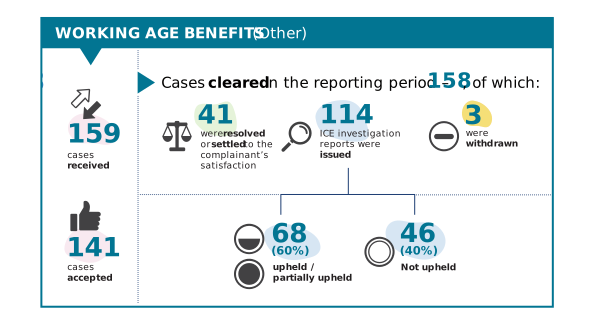
The image shows a breakdown of data relating to Working Age Benefits (other) cases with ICE in 2024/2025. 159 cases were received, and 141 cases were accepted. 158 cases were cleared in the reporting period, of which 41 were resolved or settled to the complainant’s satisfaction, 114 ICE investigation reports were issued (of which 68 cases were upheld or partially upheld and 46 cases not upheld), and 3 cases were withdrawn.
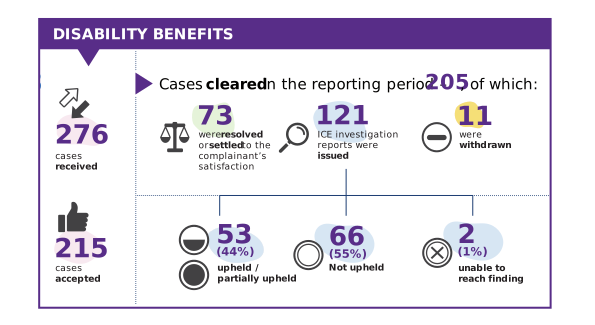
The image shows a breakdown of data relating to Disability Benefits cases with ICE in 2024/2025. 276 cases were received, and 215 cases were accepted. 205 cases were cleared in the reporting period, of which 73 were resolved or settled to the complainant’s satisfaction,121 ICE investigation reports were issued (of which 53 cases were upheld or partially upheld, 66 cases not upheld and 2 cases where ICE were unable to reach a finding), and 1 case was withdrawn.
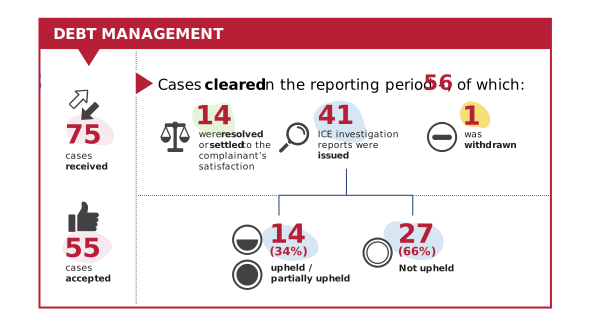
The image shows a breakdown of data relating to Debt Management cases with ICE in 2024/2025. 75 cases were received, and 55 cases were accepted. 56 cases were cleared in the reporting period, of which 14 were resolved or settled to the complainant’s satisfaction, 41 ICE investigation reports were issued (of which 14 cases were upheld or partially upheld and 27 cases not upheld), and 1 case was withdrawn.
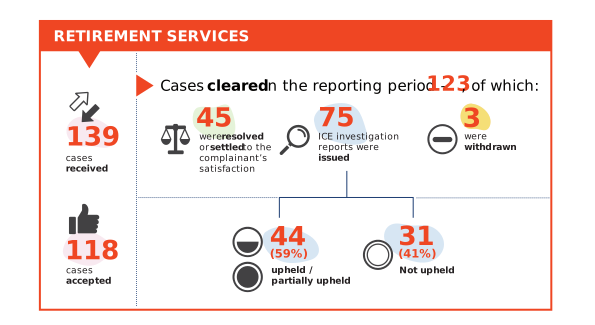
The image shows a breakdown of data relating to Retirement Services cases with ICE in 2024/2025. 139 cases were received, and 118 cases were accepted. 123 cases were cleared in the reporting period, of which 45 were resolved or settled to the complainant’s satisfaction, 75 ICE investigation reports were issued (of which 44 cases were upheld or partially upheld and 31 cases not upheld), and 3 cases were withdrawn.
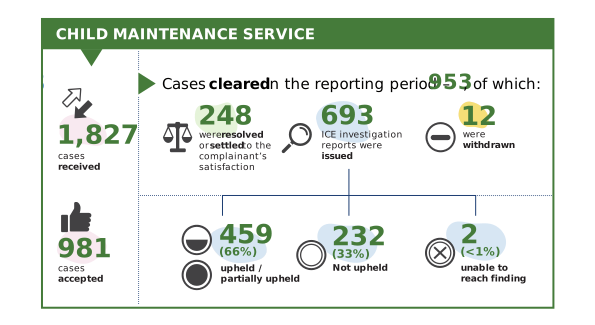
The image shows a breakdown of data relating to Child Maintenance Service cases with ICE in 2024/2025. 1,827 cases were received, and 981 cases were accepted. 953 cases were cleared in the reporting period, of which 248 were resolved or settled to the complainant’s satisfaction, 693 ICE investigation reports were issued (of which 459 cases were upheld or partially upheld, 232 cases not upheld and 2 cases where ICE were unable to reach a finding), and 12 cases were withdrawn.
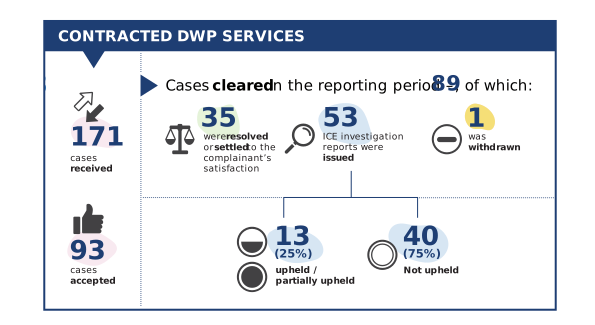
The image shows a breakdown of data relating to Contracted DWP Services cases with ICE in 2024/2025. 171 cases were received, and 93 cases were accepted. 89 cases were cleared in the reporting period, of which 35 were resolved or settled to the complainant’s satisfaction, 53 ICE investigation reports were issued (of which 13 cases were upheld or partially upheld and 40 cases not upheld), and 1 case was withdrawn.
Appendix 2 - Service Improvement Observations (SIO)
If an investigation identifies a service issue as a consequence of a DWP procedure, or lack of one, which could cause a problem for other customers, ICE send a SIO letter to DWP to share the details of the case and the process or procedure they may wish to consider changing. The SIOs identified in 2024/25 are summarised below, along with DWP’s response to them.
| Summary of issue from ICE | Response from DWP |
|---|---|
| A backdated decision to award Limited Capability for Work Related Activity led to the customer being underpaid. The letter explaining that gave two figures; the total underpayment and the amount still owed to them which confused the customer and led to them believing there had been fraudulent activity | No plans to change letter at this stage as no broader evidence of causing similar confusion to other customers. Focus has been put into improving UC payment statements, changes can now be viewed in statements. |
| UC claim closed when DWP received an incorrect Tell Us Once notification informing them incorrectly that the customer had passed away causing a great deal of distress. There is no mechanism to reverse Tell Us Once notifications, and the customer had to contact multiple areas within DWP and other Departments to reverse the actions caused by the incorrect notification. | We are currently looking at improvements to prevent any data mismatch and to support a customer to reset their records following an error caused by DWP. These details are subject to change as solutions are still being finalised. |
| Personal Independence Payment (PIP) arrears were paid into an incorrect account (customer provided an incorrect account number) but DWP’s verification of bank details only checks that the sort code aligns with banking provider – not that the account number aligns with the name on account as would happen in other sectors. | Feedback sent to Team leading the ongoing PIP modernisation process to consider as a system improvement. In the meantime, a reminder of the importance of checking bank details has been sent to staff in the weekly update. |
| Customer made a claim to Employment and Support Allowance (ESA) but it was never in payment. A subsequent UC claim was made which identified the ESA claim and deducted ESA payments from UC, despite no ESA payments ever being made. When the ESA claim closed, UC was paid with deductions for 12 more months before it was noticed, resulting in a substantial UC underpayment. | The UC system already takes account of information from other benefits. In this case a known issue caused the anomaly and is being addressed as a priority. |
| Customer made a claim to Employment and Support Allowance (ESA) but it was never in payment. A subsequent UC claim was made which identified the ESA claim and deducted ESA payments from UC, despite no ESA payments ever being made. When the ESA claim closed, UC was paid with deductions for 12 more months before it was noticed, resulting in a substantial UC underpayment. | The UC system already takes account of information from other benefits. In this case a known issue caused the anomaly and is being addressed as a priority. |
| Customers starting or returning to studies must telephone DWP to report the change of circumstances (it is not possible to do this online), although UC is a digital benefit. Telephony contact for this purpose is anomalous and a barrier for this customer group. | The UC Design Team are currently exploring changes to the system and possible implementation dates. These details are subject to change as solutions are still being finalised. |
| Access to Work instructions for staff tell them to request a business plan from all self-employed customers, but the fact sheet available on GOV.UK only refers to customers above State Pension age requiring a business plan. | DWP Customer Communications Team updated the Access to Work: factsheet for customers on GOV.UK on 24 July 2025. |
| Reasonable Adjustments not clearly visible on the Customer Information System – manual intervention is required to find notes of customers’ requirements. | Improvements including updates to guidance, call scripts and applications have been made to support the Reasonable Adjustment information. |
| DWP incorrectly applied the Minimum Income Floor to the customer’s UC claim and were unable to remove it due to system limitations. The customer had to redeclare being self-employed (when they weren’t) leading to their belief that they had been the victim of fraud. | UC are exploring system changes to negate the need for customers to manually remove the Minimum Income Floor and the cost of this and timeframes are being considered. These details are subject to change as solutions are still being finalised. |
| Customer had a dual claim to UC and ESA when ESA payments were suspended. Despite the suspension, deductions continued to be made from UC to reflect ESA payments which led to a substantial underpayment of ESA and overpayment of UC. | Changes in this area will be considered as part of the New Style Benefit Transformation Programme. |
| Customer had a live claim to UC when they declared a health condition. No signposting was provided to GOV.UK or information about eligibility to other benefits. ESA guidance makes it mandatory to signpost to UC, but not the other way around. | Changes in this area will be considered as part of the New Style benefit transformation programme. |
| Misunderstanding of difference between ‘parental responsibility’ and ‘legal parentage’, particularly in relation to same sex couples. The different guidance and legislation for cases involving same sex couples was overlooked in this case. | CMS Guidance was updated in August 2024 and communicated to CMS staff in October 2024. |
| The Paying Parent received War Disablement Pension, which is classed as a benefit, but also earnings. A system limitation prevents CMS scheduling anything towards arrears when a Paying Parent is in receipt of any kind of benefit, despite that in this case the Paying Parent was in a position to make some payment. | CMS have confirmed that as part of their Service Modernisation they will continue to look at other opportunities to update guidance to Paying Parent to explain if they still have arrears and how they can be paid. |
| Following a dispute of the initial calculation, the Mandatory Reconsideration notice did not make it clear that the Paying Parent should pay in accordance with the schedule previously issued by CMS, but used ambiguous wording that led to incorrect payment. | As part of Service Modernisation all outbound communications to customer are being reviewed and modernised. This feedback has been passed to the Team leading on this activity so it can be acted on. |
| Paying Parents in prison who have earnings (such as rental income) and want to pay to avoid arrears accruing are unable to make payments. There is nothing in procedures to facilitate payments from a Paying Parent in prison. | CMS are reviewing caseworker guidance to ensure information is available to support caseworkers in managing circumstances where a Paying Parent is in prison but still has a responsibility to pay child maintenance. These details are subject to change as solutions are still being finalised. |