DESNZ annual report 2025 to 2026: Accountability report (HTML)
Updated 19 August 2026

© Crown copyright 2026
This publication is licensed under the terms of the Open Government Licence v3.0 except where otherwise stated. To view this licence, visit nationalarchives.gov.uk/doc/open-government-licence/version/3 or write to the Information Policy Team, The National Archives, Kew, London TW9 4DU, or email: psi@nationalarchives.gov.uk.
Where we have identified any third party copyright information you will need to obtain permission from the copyright holders concerned.
This publication is available at https://www.gov.uk/government/publications/desnz-annual-report-and-accounts-2025-to-2026/accountability-report
Purpose of the accountability report
The accountability report sets out how DESNZ meets the key accountability requirement to Parliament. It comprises of the 3 reports below:
The corporate governance report provides the names of ministers and directors with oversight for the department, and explains the governance structures in place and activities during the year.
The staff and remuneration report presents staff numbers and costs, and other employee matters, and discloses the remuneration of our ministers and directors.
The Parliamentary accountability and audit report presents the department’s expenditure against the budgets set by Parliament, and the auditor’s report and opinion on the financial statements.
Corporate governance report
Statement of Accounting Officer’s responsibilities
Under the Government Resources and Accounts Act 2000 (GRAA), HM Treasury has directed the Department for Energy Security and Net Zero to prepare, for each financial year, consolidated resource accounts detailing resources acquired, held or disposed of, and the use of resources, during the year by the department and its sponsored non-departmental public bodies and other arm’s length public bodies designated by order made under the GRAA by Statutory Instruments 2025 No. 268 and 2025 No. 1336 (together known as the ‘departmental group’, consisting of the core department and sponsored bodies listed in note 26 to the accounts).
The accounts are prepared on an accruals basis and must give a true and fair view of the state of affairs of the department and departmental group, and of the income and expenditure, statement of financial position and cash flows of the departmental group for the financial year.
In preparing the accounts, the accounting officer is required to comply with the requirements of Government Financial Reporting Manual and in particular to:
- observe the Accounts Direction issued by the Treasury, including the relevant accounting and disclosure requirements, and apply suitable accounting policies on a consistent basis
- ensure that the department has in place appropriate and reliable systems and procedures to carry out the consolidation process
- make judgements and estimates on a reasonable basis, including those judgements involved in consolidating the accounting information provided by non-departmental and other arm’s‑length public bodies
- state whether applicable accounting standards as set out in the Government Financial Reporting Manual have been followed and disclose and explain any material departures in the accounts
- prepare the accounts on a going concern basis
- confirm that the annual report and accounts is fair, balanced and understandable and take personal responsibility for the annual report and accounts and the judgements required for determining that it is fair, balanced and understandable
HM Treasury has appointed the permanent head of the department as Accounting Officer of the Department for Energy Security and Net Zero. The Accounting Officer of the department has also appointed the chief executives (or equivalents) of its sponsored non-departmental and other arm’s length public bodies as Accounting Officers of those bodies.
The Accounting Officer of the department is responsible for ensuring appropriate systems and controls are in place to ensure any grants the department makes to its sponsored bodies are applied for the purposes intended and that such expenditure and the other income and expenditure of the sponsored bodies are properly accounted for, for the purposes of consolidation within the resource accounts. Under their terms of appointment, the Accounting Officers of the sponsored bodies are accountable for the use, including the regularity and propriety, of the grants received and the other income and expenditure of the sponsored bodies.
The responsibilities of an Accounting Officer, including responsibility for the propriety and regularity of the public finances for which the Accounting Officer is answerable, for keeping proper records and for safeguarding the assets of the department or non-departmental or other arm’s length public body for which the Accounting Officer is responsible, are set out in Managing Public Money published by HM Treasury.
Accounting Officer’s confirmation
As Accounting Officer, I have taken all the steps I ought to have taken to make myself aware of any relevant audit information and to establish that the Department for Energy Security and Net Zero’s auditors are aware of that information. So far as I am aware, there is no relevant audit information of which the auditors are unaware.
I also confirm that this annual report and accounts is fair, balanced and understandable.
Jonathan Brearley
Permanent Secretary and Principal Accounting Officer
13 July 2026
Directors’ report
The directors’ report covers the period from 1 April 2025 to 31 March 2026. It provides names and ministerial titles of those who served as ministers. It also provides names of non-executive board members and executive directors.
Joiners and leavers refer to those who joined or left relevant posts. In the case of executive directors, they may not have left the department, particularly if they served as interim executive directors.
Conflicts of interest
Board members are required to declare personal or business interests which may influence (or be perceived to influence) their judgement, when performing their duties.
DESNZ has an established Conflicts of Interest (CoI) procedure, including declaring interests at the start of board meetings. No CoIs were declared during board meetings in 2025-26.
The Register of Board Members’ Interests is published on GOV.UK.
Management of ministers outside interests:
Ministers are required to declare personal or business interests which may influence (or be perceived to influence) their judgement, when performing their duties.
The Register of Ministers’ Interests (pages 43 to 48) is recorded and published on GOV.UK by the Cabinet Office.
Ministers:
- The Rt Hon Ed Miliband MP, Secretary of State for Energy Security and Net Zero – from 5 July 2024
- Michael Shanks MP, Parliamentary Under Secretary of State (Minister for Energy) – from 9 July 2024
- Lord Vallance, Minister of State (Minister for Science, Innovation, Research and Nuclear) – from 6 September 2025
- Lord Whitehead, Minister of State (Minister for Energy Security and Net Zero) – from 11 November 2025
- Katie White OBE MP, Parliamentary Under-Secretary of State (Minister for Climate) – from 7 September 2025
- Martin McCluskey MP, Parliamentary Under-Secretary of State (Minister for Energy Consumers – from 7 September 2025
- Chris McDonald MP, Parliamentary Under-Secretary of State (Minister for Industry) – from 11 September 2025
- Sarah Jones MP, Minister of State (Minister for Industry) – to 6 September 2025
- The Rt Hon Lord Hunt of Kings Heath OBE, Minister of State (Minister for Energy Security and Net Zero) – to 22 May 2025
- Kerry McCarthy MP, Parliamentary Under Secretary of State (Minister for Climate) – to 7 September 2025
- Miatta Fahnbulleh MP, Parliamentary Under Secretary of State (Minister for Energy Consumers) – to 6 September 2025
Non-Executive Board Members (NEBM):
- Ravi Gurumurthy, Lead NEBM, Board and NomCo Chair – from 1 May 2025
- Vikas Shah, Departmental Board, ARAC Chair – from 1 May 2021 (reappointed on 26 April 2024)
- Sue Ferns, Departmental Board – from 1 May 2025
- Humphrey Cadoux-Hudson, Lead NEBM, Board and NomCo Chair – to 1 May 2025
- Mary Archer, Departmental Board – to 1 May 2025
Non-Executive Independent Members:
- Andre Katz, ARAC
- Anne Marie Millar, ARAC
- David Scott, ARAC
- Tristan Morgan, ARAC
- Anthony Palmer, ARAC
- David Isenegger, ARAC
- Elaine Clements – to 9 October 2025
- Erik Wilson, POpCo
- Paul Methven, InvestCo (non-remunerated)
- Sam Ulyatt, InvestCo (non-remunerated)
- Jill Adam, InvestCo (non-remunerated)
Executive Directors:
- Jonathan Brearley, Permanent Secretary – from 23 March 2026
- Clive Maxwell CBE, Second Permanent Secretary – from February 2023 (Interim Permanent Secretary – from November 2025 to 22 March 2026)
- Jonathan Mills CB, Director General, Energy Markets and Supply – from February 2023
- Sarah Redwood, Interim Director General, Energy Infrastructure – from March 2026
- Lee McDonough, Director General, Net Zero, Nuclear and International – from February 2023
- David Thomas, Interim Director General, Net Zero Buildings and Industry – from February 2026 (Chief Financial Officer – to February 2026)
- Paro Konar, Director General, Major Decarbonisation Projects – from April 2025
- Professor Emily Shuckburgh CBE, Chief Scientific Adviser – from November 2025
- Martin Gaunt, Interim Chief Financial Officer – from February 2026
- Jeremy Pocklington, Permanent Secretary – from February 2023 to November 2025
- Paul Monks, Chief Scientific Adviser – to October 2025
- Joanne Ellman-Brown, Chief Portfolio and Data Officer
- Alice Hurrell, Chief People Officer
- Donna Leong, Director of Analysis and Chief Economist
- Johanna Cowan, Director Strategy
- Wendy Hardaker, Legal Director (Standing Member)
- Ashley Ibbett, Director General Energy Infrastructure – to March 2026
- Ben Rimmington, Director General Net Zero, Buildings and Industry – to March 2026
Our governance structure
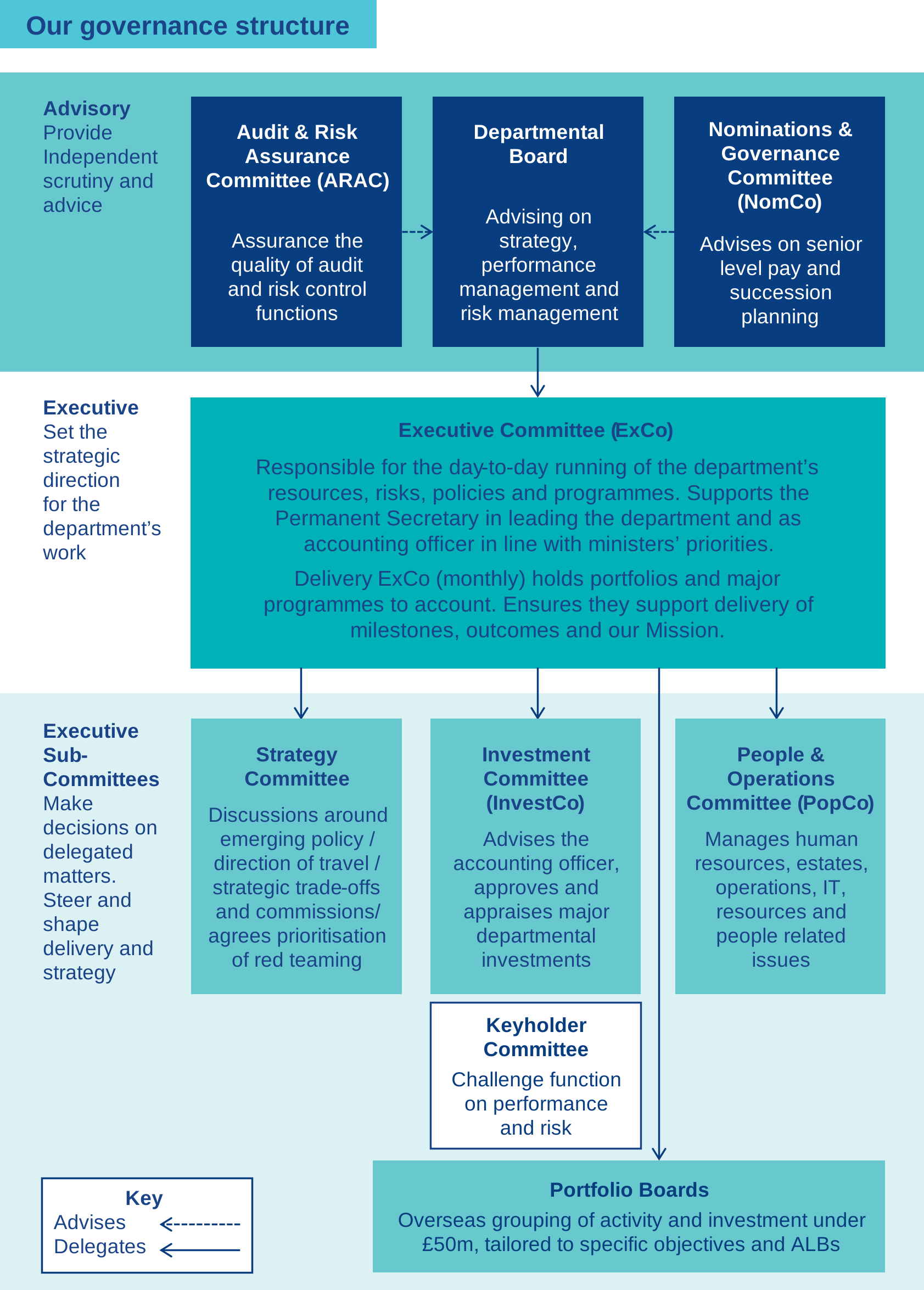
Our governance: diagram data
Advisory:
Provide independent scrutiny and advice.
- Audit & Risk Assurance Committee (ARAC) - Assurance the quality of audit and risk control functions
- Departmental Board - Advising on strategy, performance management and risk management
- Nominations & Governance Committee (NomCo) - Advises on senior level pay and succession planning
Executive:
Set the strategic direction for the department’s work.
-
Executive Committee (ExCo) - Responsible for the day-to-day running of the department’s resources, risks, policies and programmes. Supports the Permanent Secretary in leading the department and as accounting officer in line with ministers’ priorities.
Delivery ExCo (monthly) holds portfolios and major programmes to account. Ensures they support delivery of milestones, outcomes and our Mission.
Executive Sub-Committees:
- Strategy Committee - Discussions around emerging policy / direction of travel / strategic trade-offs and commissions/ agrees prioritisation of red teaming
-
Investment Committee (InvestCo) - Advises the accounting officer, approves and appraises major departmental investments
- Keyholder Committee - Challenge function on performance and risk
- People & Operations Committee (POpCo) - Manages human resources, estates, operations, IT, resources and people related issues
- Portfolio Boards- Oversees grouping of activity and investment under £50m, tailored to specific objectives and ALBs
Departmental Board
Chair: Rt Hon Ed Miliband MP, Secretary of State and Chair, Departmental Board
Meeting Attendance:
Total number of meetings held: 2
(x/x = number attended /number eligible to attend.)
| Ministers | No. of meetings attended |
|---|---|
| Secretary of State, Ed Miliband | 2/2 |
| Minister Fahnbulleh | 0/2 |
| Minister White | 1/2 |
| Lord Whitehead | 0/2 |
| Non-executive board members | No. of meetings attended |
|---|---|
| Ravi Gurumurthy | 2/2 |
| Sue Ferns | 2/2 |
| Vikas Shah | 2/2 |
| Senior officials | No. of meetings attended |
|---|---|
| Jeremy Pocklington | 1/2 |
| Clive Maxwell | 2/2 |
| David Thomas (to February 2026) | 2/2 |
| Johanna Cowan | 0/2 |
| Jonathan Mills | 2/2 |
| Lee McDonough | 1/2 |
Role:
The Departmental Board provides expert advice, support and challenge on the overall direction on strategy, performance and risk management. It is chaired by the Secretary of State and its members are non-executive board members, selected ministers and selected executives, including the Permanent Secretaries. The Departmental Board is supported by 2 delegated committees: the Audit and Risk Assurance Committee (ARAC) and the Nominations and Governance Committee (NomCo).
Compliance with the Corporate Governance Code:
Our approach to governance is in line with ‘the code’ – Corporate Governance in central government departments: Code of Good Practice. We were compliant with the Code in all areas except for the requirement that the Board meets at least quarterly. The Board only met twice during the year. However, there was ongoing engagement between non-executive board members, ministers and the executive during the period.
Board Appointments:
Lord Vallance was appointed Minister of State on 6 September 2025, Lord Whitehead was appointed Minister of State on 11 November 2025, Katie White OBE MP was appointed Parliamentary Under-Secretary of State on 7 September 2025, Martin McCluskey MP was appointed Parliamentary Under-Secretary of State on 7 September 2025 and Chris McDonald MP was appointed Parliamentary Under-Secretary of State on 11 September 2025. Previous appointments can be found at the above table.
At the end of 2026, the gender split was 8 men (61.5%) and 5 women (38.5%). The ethnicity split was 10 white (76.9%) and 3 ethnic minority (23.1%).
Board Effectiveness:
A board effectiveness review is currently underway. This is expected to conclude later in the year, with the outcomes to be reported in next year’s annual report.
Quality of Data Used by the Board:
The papers received by the board were of high quality. The meetings were held in person and were efficiently chaired. Challenge and discussion were encouraged.
The Departmental Board received quarterly data on performance and delivery reporting which identified priority milestones, delivery, financial and staff updates in the department for discussion by members.
The DESNZ governance team provided a comprehensive secretariat service to the Departmental Board and committees. This ensured the effective and efficient administration of the board and its activities.
Biographies of Board Members:
Departmental board member biographies
Nominations and Governance Committee
Chair: Ravi Gurumurthy, Lead Non-Executive and Chair, Nominations and Governance Committee
Meeting Attendance:
Total number of meetings held: 1
(x/x = number attended /number eligible to attend.)
| Non-executive board members | No. of meetings attended |
|---|---|
| Ravi Gurumurthy | 1/1 |
| Sue Ferns | 1/1 |
| Senior officials | No. of meetings attended |
|---|---|
| Jeremy Pocklington | 1/1 |
| Clive Maxwell | 1/1 |
| Alice Hurrell | 1/1 |
Role:
The Nominations and Governance Committee is an advisory committee of the Departmental Board, providing assurance and input to key decisions and processes. Its purpose is to provide assurance on the department’s strategies and plans for talent management; succession planning; capability building; senior performance management and incentives and rewards.
Key Areas of Discussion:
- Senior performance
- Organisational planning
- Directors General development
- Oversight of leadership
Audit and Risk Assurance Committee
Chair: Vikas Shah, Non-Executive Board Member and Chair, Audit and Risk Assurance committee
Meeting Attendance:
Total number of meetings held: 6
(x/x = number attended /number eligible to attend.)
| Non-executive members | No. of meetings attended |
|---|---|
| Vikas Shah | 6/6 |
| Anthony Palmer | 6/6 |
| David Isenegger | 6/6 |
| Andre Katz | 5/6 |
| Anne Marie Millar | 6/6 |
| David Scott | 5/6 |
| Tristan Morgan | 6/6 |
| Elaine Clements (to 9 October 2025) | 3/3 |
| Senior officials | No. of meetings attended |
|---|---|
| Jeremy Pocklington | 3/6 |
| Clive Maxwell | 5/6 |
| David Thomas (to February 2026) | 4/6 |
| Martin Gaunt (from February 2026) | 1/6 |
| Joanne Ellman-Brown | 1/1 |
| National Audit Office representative | 6/6 |
| Government Internal Audit Agency representative | 6/6 |
| Arm’s Length Bodies (ALB) ARAC Chairs | No. of meetings attended |
|---|---|
| Civil Nuclear Police Authority (CNPA) | 0/6 |
| Mining Remediation Authority (MRA) (formerly Coal Authority) | 0/6 |
| Committee on Climate Change (CCC) | 0/6 |
| Low Carbon Contracts Company (LCCC) | 2/6 |
| Nuclear Decommissioning Authority (NDA) | 1/6 |
| North Sea Transition Authority (NSTA) (formerly Oil and Gas Authority) | 1/6 |
| UK Atomic Energy Authority (UKAEA) | 1/6 |
| Salix Finance | 1/6 |
| UK National Nuclear Laboratory | 0/6 |
| OFGEM | 0/6 |
| Great British Energy-Nuclear (GBE-N) | 0/6 |
| Great British Energy (GBE) | 0/6 |
Role:
The Audit and Risk Assurance Committee (ARAC) is an advisory committee of the Departmental Board. It assures the quality of audit and risk control functions within the department. During 2025-26, 2 ALB ARAC Chair meetings took place, which were scheduled on a bi-annual basis.
Key Areas of Discussion:
- The preparation of the Annual Report and Accounts
- The work of internal and external audit
- The management of departmental risks, the risk management framework, and the departmental risk appetite
- Deep dives into each of the departmental risks covering:
- People risks
- Security of supply
- Public Sector Equality Duty
- The loss of sensitive information
- Supply/Network Resilience
- Critical infrastructure
- Near-term disruption to gas/electricity/fuel
- The Clean Energy Superpower Mission
- The use of advance payment bonds in the Public Sector Decarbonisation Scheme
- The response to poor quality solid wall insulation installed under ECO 4 and GBIS
- Portfolio Management
- Health and Safety risks, ALBs, physical security, reputational risk management and Integrated Corporate Services
- Corporate assurance including whistleblowing, functional standards, the Annual Assurance Process and the governance assurance process
Executive Committee
Chair:
- Jonathan Brearley, Permanent Secretary and Chair, Executive Committee (from 23 March 2026)
- Clive Maxwell, Interim Permanent Secretary and Chair, Executive Committee (from 24 November 2025 until 22 March 2026)
- Jeremy Pocklington, Permanent Secretary and Chair, Executive Committee (until 23 November 2025)
Total number of meetings held: 38
(x/x = number attended /number eligible to attend.)
| Executive directors | No. of meetings attended |
|---|---|
| Jeremy Pocklington (until 23 November 2025) | 24/26 |
| Clive Maxwell (from 24 November 2025 until 22 March 2026) | 35/38 |
| Jonathan Brearley (from 23 March 2026) | 1/1 |
| David Thomas | 33/38 |
| Martin Gaunt (from 9 February 2026) | 6/6 |
| Simon Hulme (until 30 August 2025) | 14/18 |
| Paul Monks (until 30 September 2025) | 15/22 |
| Emily Shuckburgh (from 3 November 2025) | 11/14 |
| Jonathan Mills | 36/38 |
| Johanna Cowan | 34/38 |
| Ashley Ibbett (until 28 February 2026) | 32/35 |
| Sarah Redwood (from 2 March 2026) | 3/3 |
| Lee McDonough | 29/38 |
| Ben Rimmington (until 30 January 2026) | 27/32 |
| Alice Hurrell | 32/38 |
| Donna Leong | 34/38 |
| Paro Konar | 34/38 |
| James Sorene (Standing Member until 06 June 2025) | 5/9 |
| James Staff (Standing Member from 09 June 2025 to 30 September 2025) | 11/13 |
| Wendy Hardaker (Standing Member) | 23/38 |
Role:
The Executive Committee (ExCo) is the senior decision‑making body responsible for the day‑to‑day running of the department, supporting the Permanent Secretary in leading the organisation in line with the mission and ministers’ priorities. ExCo develops and delivers the department’s vision, sets strategic direction, and provides leadership on cross‑cutting and corporate issues.
Key Areas of Discussion:
ExCo provides senior oversight of delivery, performance and risk, the delivery of the mission and major programmes, and considers progress across the department through a monthly review of performance, including against key milestones and outcomes. ExCo also considers ad hoc issues requiring collective decision‑making and delegates defined responsibilities to its sub‑committees, including people, change and operational management to the People and Operations Committee (POpCo) and investment approval to the Investment Committee (InvestCo).
Executive Committee sub-committees
Investment Committee (InvestCo):
Chair: Clive Maxwell, Second Permanent Secretary
Role: The Investment Committee (InvestCo) is a sub-committee of ExCo. It is responsible for approving and appraising large departmental investments. InvestCo is supported by a number of project-specific sub-committees that are established, as necessary, to support the department and the committee.
Key areas of focus: InvestCo advises the Accounting Officer and approves and appraises major departmental investments.
People and Operations Committee:
Chair: Alice Hurrell, People and Operations Committee
Role: The People and Operations Committee (POpCo) is a delegated committee of ExCo and considers matters relating to operations, Human Resources (HR), accommodation, security, Equality, Diversity and Inclusion (ED&I), and Information Technology (IT).
Key Areas of Discussion: The Committee’s specific responsibilities include:
- Monitoring the delivery, communication and direction of people/operational related strategies as agreed by ExCo
- Scrutinising and deciding the direction and communication of programmes, activities and workstreams delegated by ExCo. To this end, POpCo has a specific responsibility of overseeing office moves and Places for Growth (PfG)
- Offering assurance through challenge and scrutiny of the delivery of the main operational strategies and programmes
- Considering people and operational risks on the departmental risk register and the corporate risk register
Key Areas of Focus: The Committee’s key areas of focus include:
- Places for Growth
- People Survey results and actions
- HR matters
- Office management
- Equality, diversity and inclusion, including DESNZ as a workplace.
- Building capability
- Culture and values
Net Zero and Energy Governance
Our governance is designed to support successful delivery. Most of our work affects several of our priorities.
The department continued to manage its work through DG groups, with governance and controls gradually updated during the year with a focus on the Clean Energy Superpower Mission.
Management of Outside Interests
Register of interests for Directors
See directors’ report on page 93.
Process for Managing Outside Interests
The department has a policy in place for the management and declaration of outside interests for all staff. This was updated following new Cabinet Office guidance issued in November 2024. The policy provides a framework to deal with any actual, potential or perceived conflicts of interest between staff, suppliers, and other stakeholders.
It provides guidance to employees holding any outside employment, work or appointment (paid or otherwise remunerated). The policy follows Cabinet Office guidance with a particular focus on political interest and aligning recruitment practices to ensure that Conflicts of Interests (CoI) are addressed as early as the onboarding stage.
All staff must ensure declarations are made when they become aware that a CoI may exist. Once a declaration is made, line managers must ensure they review and agree any mitigating actions, if required escalate declarations that are particularly contentious or poses risk to the reputation of the department.
All senior civil servants (SCS) are required to complete a CoI declaration annually. Nil returns are also declared. The annual collation of SCS conflicts of interest declarations is conducted by HR, and we have steps in place to ensure central examination of all SCS declarations.
The DESNZ 25/26 SCS annual collation process concluded in May 2026. DESNZ had 2 SCS colleagues with remunerated outside employment during the monitoring period 2025-26. Details of remunerated outside employment held by SCS are published on GOV.UK.
Special Advisers
In line with the current Declaration of Interests Policy for special advisers, all special advisers have declared any relevant interests or confirmed they do not consider they have any relevant interests. The Permanent Secretary has considered these returns, and the following relevant interests are set out in public:
| Full name | Details of interest |
|---|---|
| Grace Pritchard | Ms Pritchard held a part-time paid role with the Labour Party between the 2 February and 26 February 2026. Ms Pritchard’s work for this organisation was performed outside of their hours as a Special Adviser in DESNZ. Ms Pritchard’s work as a Special Adviser was under a temporary part-time contract during this period. |
| Tobias Garnett | Mr Garnett is recused from involvement in discussions or matters relating to Apple Inc. |
Business Appointment Rules
The Business Appointment Rules are designed to uphold the core values in the Civil Service Code of integrity, honesty, objectivity and impartiality. All DESNZ employees must understand and comply with these rules, which have recently been updated following the closure of the Advisory Committee on Business Appointments (ACOBA) on 13 October 2025.
Before accepting any new appointment or employment, individuals must consider whether an application under the rules is required. If it is required, they should not accept or announce a new appointment or offer of employment before it has been approved. Countersigned applications are sent to the Human Resources function for assessment and action. Human Resources have a process in place for handling business appointment applications in line with the updated process set out on 13 October 2025. This involves completion of the appropriate application form and mitigations, countersigned as necessary by an appropriate person within the line management chain. The outcome is also shared with the new employers HR function.
In line with updated cross‑government arrangements following the closure of ACOBA, all SCS3 and equivalent applications are now considered by the Civil Service Commission, with departmental HR responsible for initial assessment and case preparation. Applications from special advisers continue to follow the relevant routes.
The department remains transparent in the advice issued in respect of senior staff, including special advisers, and publishes advice relating to specific cases on GOV.UK.
To raise awareness, the department includes information on Business Appointment Rules in staff contracts, induction packs, leaver guidance and the departmental intranet pages.
Number of exits from the Senior Civil Service (SCS): 32
Number of BARs applications submitted to the department over the year (by grade): 15
| Grade | No. submitted |
|---|---|
| SCS2 | 0 |
| SCS1 | 2 |
| SpAd | 3 |
| Delegated Grade | 10 |
Number of BARs applications approved by the department over the year (by grade): 12
| Grade | No. approved |
|---|---|
| SCS2 | 0 |
| SCS1 | 2 |
| SpAd | 0 |
| Delegated Grade | 10 |
Number of BARs applications where conditions were set by the department over the year (by grade): 12
| Grade | No. approved |
|---|---|
| SCS2 | 0 |
| SCS1 | 2 |
| SpAd | 0 |
| Delegated Grade | 10 |
Number of applications that were found to be unsuitable for the applicant to take up by the department over the year (by grade): 0
Number of breaches of the rules in the preceding year: 0
Governance statement
Overview
The governance statement sets out how the department was governed by management during the year and provides an outline of our risk management and internal control systems.
Risk management
Risk Management Responsibilities:
The department is responsible for having a Risk and Issue Management Framework and reviewing its effectiveness. The framework includes the standard process of identify, assess, address, review and report risks. Effectiveness reviews take the form of regular engagement with portfolio and programme risk leads, Heads of Risk for DESNZ public bodies, sponsor teams of individual public bodies and an annual consultation on the risk framework’s drafting.
The department also completes an annual Risk Control Framework assessment against 75 criteria, which is cross-referenced to the risk elements of the various Government Functional Standard self-assessments. This brings about continuous improvement and allows the risk framework to respond to changes in departmental structure and governance.
Processes and structure:
Our principal risks in 2025-26, as owned and managed by ExCo (strategic delivery risks) and POpCo (corporate enabling risks) on the Departmental Strategic Risk Register (DSRR), are disclosed in the performance report, under risks affecting delivery of our objectives. The process to identify these risks involves formal horizon scanning by ExCo on an annual basis, and escalations from portfolio level, as appropriate throughout the year.
Additionally, each of the risks on the DSRR are reviewed through individual deep dives at ExCo or POpCo and, where this reveals gaps in our risk coverage, either new risks or new mitigations to the existing risks are added to the DSRR. Both the regular DSRR reporting and the ExCo/POpCo deep dives are discussed at the Audit and Risk Assurance Committee to provide additional, independent assurance that risk processes are robust.
During the year, we updated our Risk and Issue Management Framework and Risk Appetite Statement to ensure consistency with government best practice in the Orange Book and its annexes, and to the evolving environment in which the department operates. When changes are made, they are communicated through a range of risk and project delivery networks, and versions of both documents are available to all staff through the departmental intranet, as are screen-reader accessible versions of the documents.
Monitoring and assurance of risk:
All risks, regardless of level, are evaluated and managed monthly using the department’s online reporting systems; and the outputs from this are reported to key governance boards. The information provided for risks on the DSRR is assured by the corporate risk team, who review the portfolio and DSRR risks and consider and flag potential escalations to the departmental leadership teams at ExCo and POpCo. Risks at the programme level are managed locally through programme and portfolio management boards, with the corporate risk team and the Portfolio Risk Leads ensuring best practice in their portfolio areas.
Effectiveness reviews:
ExCo has reviewed and monitored the risks on the DSRR on a quarterly basis, with escalation of risk discussion added to the agenda between quarterly reports when required. Deep dives review each of the risks on the DSRR to ensure that their scope remains valid, they are correctly assessed and that they are mitigated robustly. During the year we continued to improve the online risk management tool to drive monthly reporting.
Compliance:
The department’s risk management practices are compliant with the requirements of the Orange Book’s 5 principles. DESNZ complies with 61 of the 75 Risk Control Framework (RCF) assessment criteria, with partial compliance for the remaining 14. We will include activity to address the areas of partial compliance under the principles of governance & leadership, collaboration & information, processes, and continuous improvement in our 2025-26 Risk Management Improvement Plan. We will also review each of the department’s functional self‑assessments, to identify areas to improve risk management in those functions and where there are shared improvement themes across functions.
Priorities will be to:
- Improve the consistency of risk management capability and reporting across the DESNZ delivery portfolios
- Review a wider range of evidence of risk management capability at the programme level, to better target capability and process improvement activity
- Improve links to strategic planning and decision making
Government Internal Audit Agency
The Government Internal Audit Agency (GIAA) provides the internal audit service for DESNZ. For 2025-26, the Group Chief Internal Auditor provided an overall moderate opinion on the framework of governance, risk management and control within DESNZ for the year ending March 2026. As in the previous year they provided 2 sub-opinions: one for the core department and one for the Integrated Corporate Service (ICS) function. The opinion is based on audit work undertaken during the year, wider interactions with the department, interactions with other assurance providers and wider knowledge of the department’s activities and risks.
The moderate sub-opinion for the core department reflects the relatively stable position of the core programmes, changes in senior leadership and maturing controls. Core governance, controls and assurance processes have remained broadly effective.
The limited sub opinion for ICS reflects the relatively new and changing nature of the function. Governance and assurance processes have continued to evolve, and although these have been enhanced over the course of the year, they still require further improvement, particularly in terms of setting more distinct boundaries between the department and ICS.
National Audit Office and the Public Accounts Committee
The National Audit Office (NAO) have shown continued interest in the work of the department, publishing 2 studies focusing on DESNZ-specific activities as well as one overview of the department between April 2025 and March 2026:
- 30 June 2025 – UK Emissions Trading Scheme
- 14 October 2025 – Energy efficiency installations under the Energy Company Obligation
- 11 November 2025 – DESNZ departmental overview 2024-25
DESNZ has also been involved in the following cross-government studies, published between April 2025 and March 2026:
- 28 November 2025 – Implementation of climate-related reporting in central government annual reports
- 21 January 2026 – Regulating for growth
- 20 March 2026 – Resilience to severe space weather
Given the significance of DESNZ priorities, there have been 2 Public Accounts Committee (PAC) hearings drawn from DESNZ value for money studies and involving DESNZ witnesses, whose hearings were held between April 2025 and March 2026:
- 13 November 2025 – Faulty energy efficiency installations
- 16 March 2026 – Regulation of growth
DESNZ provides responses to the PAC after each hearing via the HM Treasury minutes process, and twice a year via the HM Treasury minutes progress updates. These are published on GOV.UK: HM Treasury Minutes and HM Treasury Minutes Progress Update.
DESNZ also provides responses to National Audit Office (NAO) recommendations twice a year through the recommendation’s tracker updates, which are published on the NAO website.
Project assurance
A project assurance review is a key requirement within the department before submitting a business case for approval. Timely and proportionate assurance reviews are conducted for projects/programmes throughout the lifecycle.
In 2025-26, programmes and projects continued to follow the department’s Integrated Assurance and Approvals Framework. During 2025-26, 40 assurance reviews were conducted. The department currently has 12 projects/programmes on Government Major Projects Portfolio (GMPP). The department works closely with the National Infrastructure and Service Transformation Authority (NISTA) to manage assurance requirements for GMPP projects/programmes.
Project teams review the assurance report recommendations and record actions against each to address these. The actions against recommendations are reviewed by the Investment Committee as part of the approvals process. The Assurance Team conducts regular analysis of the DESNZ Assurance Reports, drawing key themes out and working with the wider department to identify initiatives to bring about improvements. Both the analysis and actions identified are reported to InvestCo on an annual basis.
Quality assurance of analytical models
The department uses analytical models to inform its policy making, evaluation and operations. The models are assured to ensure they are fit for purpose and comply with the government’s Analytical Quality Assurance (AQuA) Book. The Modelling Integrity (MI) Team’s system tracks the 72 models in use in DESNZ as at March 2026. Over 90% had the required very high level of assurance, with plans in place to achieve the required level of assurance for all models. The MI Team’s second line assurance programme reinforces the established system of active monitoring.
The department also requires ALBs undertaking modelling to assure us that they have AQuA Book compliant quality assurance processes.
Data protection
No personal data breaches were reported to the Information Commissioner’s Office (ICO). Our focus on security risk management across the department continues, working closely on cross-government initiatives and with National Technical Authorities to ensure best practice is adopted.
We continue to evolve and respond to mitigate emerging risks through local and cross-government awareness campaigns, targeted advisories, advanced tools and senior level briefings and advice. Our security culture programme is in full swing, increasing colleagues’ awareness of threats and improving ability to respond.
Ministerial directions
Ministerial directions are formal, technical instructions from the Secretary of State which allow the department to proceed with a spending proposal in a situation where the Accounting Officer has raised an objection.
The Accounting Officer is accountable to Parliament for ensuring that all expenditure meets the standards under Managing Public Money (MPM). They have a duty to seek a direction if they believe one of the 4 Accounting Officer standards cannot be met – regularity, propriety, value for money and feasibility.
There were no ministerial directions during 2025-26.
Effectiveness of our whistle blowing arrangements
Internal Whistle Blowing:
In DESNZ, we encourage our employees to speak up and raise any concerns they may have about a potential wrongdoing. We are committed to fostering a ‘Speak up’ culture where colleagues feel ‘safe to challenge’. This is reinforced by messages from our senior leaders on the importance of speaking up; the avenues for doing this; and reassurance that concerns would be listened to and action taken where appropriate.
Our values are at the heart of everything we do and are reflected in our approach. This includes a learning package and resources to support colleagues to sustain a speak-up culture.
Our procedures for raising concerns are accessible to all DESNZ employees and we offer 6 different escalation routes including via an external anonymous whistleblowing hotline. To reinforce the importance that we place on people speaking up we have a cadre of 4 Whistleblowing Nominated Officers who are members of our Senior Management Team and whose role is to provide confidential support and signposting to employees who raise concerns.
In 2025-26 we had no whistleblowing concerns raised by DESNZ employees. The 2025 People Survey highlighted that 77% of employees had confidence that any concerns raised under the Civil Service Code would be properly investigated (the same as the previous year). The Whistleblowing policy was reviewed and updated in September 2025.
This information relates to the DESNZ core department only. ALBs disclose their own performance on whistleblowing in their respective annual reports. The Permanent Secretary, as Accounting Officer, ensures accountability throughout the Group as any whistleblowing cases in ALB’s are handled by DESNZ whistleblowing nominated officers and logged on a central tracker.
External whistle blowing:
In 2025-26, DESNZ received no direct reports of external whistleblowing.
Any reports of external whistleblowing relating to ALBs will be disclosed in their respective annual reports and accounts.
Although DESNZ has received no reports of external whistleblowing, ALBs are able to approach the DESNZ Permanent Secretary, and any concerns would be investigated. We will continue to promote our Whistleblowing Nominated Officers and the importance of a speak-up culture to ALBs.
Governance of DESNZ’s public bodies
The department sponsors 14 public bodies which underpin the delivery of essential government schemes, services, and regulatory functions. They are governed by their own independent boards, supported by appropriate governance and internal assurance structures. Details of these can be found in the annual reports and accounts for each organisation.
Over the past year we have focused on strong assurance and scrutiny of DESNZ public bodies to ensure value for money, operational effectiveness and efficiency, as well as alignment with the government’s missions and priorities. Central to this is the implementation of a standardised design for sponsorship, which builds in the controls and governance we need as the accountable department. Our efforts have focused on developing clearer expectations for sponsors, providing them with practical tools and resources. Independent ARAC members rotate attendance at DESNZ’s public body ARAC meetings.
For the 2025-26 reporting year, assurance over the effective operation of our public bodies for has been supported by:
- A rigorous annual assurance exercise reviewing governance, accountability and sponsorship practices for DESNZ public bodies. Insights from this activity will help guide further capability building and targeted improvements throughout 2026-27
- An assessment of the department’s alignment with the principles and standards of the Cabinet Office Sponsorship Code
- A review of public bodies’ governance statements to ensure that the essential criteria have been met and to identify any significant risks and issues for inclusion in the consolidated 2025-26 DESNZ governance statement
- A GIAA review of DESNZ sponsorship arrangements for 2025-26
- Work undertaken in response to the Cabinet Office review of the arm’s length body landscape. This resulted in the reclassification of the Committee on Fuel Poverty and the Committee on Radioactive Waste Management, both formerly advisory non-departmental public bodies, as expert committees
- An annual audit for 2024-25 by the Commissioner for Public Appointments. This confirmed that all appointments by DESNZ ministers to the boards of public bodies were made in accordance with the government’s Principles of Public Appointments and Governance Code
- A quarterly review of public bodies’ top-level risks by the departmental Executive Committee
- Discussions on cyber security and business continuity at the DESNZ forum for Audit and Risk Assurance Committee chairs
- Revised governance arrangements for scrutinising investments via the new departmental Investment Committee and Portfolio Boards
- A departmental review of Ofgem, the recommendations of which will result in a more focused regulator that is better equipped to deliver on the government’s priorities
For 2026–27, we will be looking at how we can further evolve and shape our sponsorship and oversight arrangements to provide the optimum conditions for effective delivery, while also strengthening the quality, timeliness and robustness of the information underpinning annual reports and accounts to support clear, transparent and reliable reporting. We will also enhance our induction and support offer to new chairs and non-executive members to DESNZ public body boards.
Governance Assurance Exercise:
A governance assurance exercise took place at the end of the financial year to reflect on the effectiveness of governance arrangements, internal controls and risk management.
Building on the outcomes from 2024-25, the Governance Assurance Process (GAP) has been streamlined to be more risk‑focused. The changes made were intended to reduce burden, sharpen senior challenge and ensure the process focused on areas of greatest risk and impact.
The panels were chaired by the ARAC Chair and supported by non-executive members and internal auditors. The outcomes of the panels were presented to ARAC in May. Based on the evidence gathered through the GAP and other assurance activities considered by ARAC in 2025‑26, in ARAC’s opinion the Department has an overall sound system of governance, assurance and internal control, within the scope and limitations of the assurance evidence available for the year.
Key improvements included greater engagement from senior stakeholders, focus on closure of internal audit actions, and further work to identify and report control breaches for clearer accountability and strengthened assurance.
Accounting Officer’s conclusion:
Having reviewed the Annual Governance Statement, the findings of the Government Internal Audit Agency (GIAA), and the independent scrutiny and advice of the Audit and Risk Assurance Committee (ARAC), I have considered the adequacy and effectiveness of the department’s governance, risk management and internal control arrangements during the year ended 31 March 2026.
The department has continued to deliver against an ambitious and complex portfolio of programmes, whilst strengthening its internal governance and assurance processes in response to evolving risks and challenges. In line with the GIAA annual opinion, the department’s overall assurance rating for 2025-26 is ‘moderate’.
This rating reflects 2 component opinions: a ‘moderate’ opinion for the core department, underpinned by maturing controls and progress in tailoring inherited governance processes to the department’s specific needs; and a ‘limited’ opinion for Integrated Corporate Services (ICS), which, despite noted improvements over the year, continues to require further development to meet the demands of its expanding remit.
The internal audit work and ARAC’s oversight have highlighted key areas requiring continued focus in 2025-26, including:
- Embedding and strengthening data governance and oversight mechanisms
- Improving grant oversight and ensuring consistent governance across the department’s arm’s‑length bodies
- Completing and embedding improvements in ICS core processes, including financial planning, business continuity and governance maturity
- Developing the portfolio management framework further to support effective delivery of departmental priorities
I am satisfied that the department has made meaningful progress in strengthening its governance, assurance, and risk management arrangements this year, and responding to recommendations from internal and external assurance providers. I recognise that work remains to fully embed and mature controls, particularly in the areas identified above, and I am committed to maintaining this focus through the coming year.
I am satisfied that the department has made meaningful progress in strengthening its governance, assurance, and risk management arrangements this year, and responding to recommendations from internal and external assurance providers. I recognise that work remains to fully embed and mature controls, particularly in the areas identified above, and I am committed to maintaining this focus through the coming year.
The department will build on the progress made to date, adapting and enhancing its governance and control arrangements to support the effective delivery of its priorities, ensure value for money, and respond to current and emerging risks.
Jonathan Brearley
Permanent Secretary and Principal Accounting Officer
13 July 2026
Staff report
Number of senior civil service staff by band
The table below shows the number of senior civil servants grouped by their salary bands. Salary bands represent actual salary rates. Bonuses are not included.
The numbers are based on the full year equivalent as at 31 March 2026. They include both permanent and fixed term contracts. It includes active workers only, and exclude inactive workers such as those on maternity leave, outward loans etc.
| Range | As at 31 March 2026 | As at 31 March 2025 |
|---|---|---|
| SCS 3 (£125,000 - £210,000) | 7 | 7 |
| SCS 2 (£95,000 - £175,000) | 47 | 41 |
| SCS 1 (£70,000 - £135,000) | 162 | 172 |
| Total | 216 | 220 |
Staff numbers (audited information)
The table below shows numbers based on the full year equivalent average. The figures include both permanent and fixed term contracts. It includes active workers only, and excluded inactive workers such as those on maternity leave, outward loans etc.
| Permanently employed staff | Others | Ministers | Special advisers | 2025‑26 Total |
2024‑25 Total |
|
|---|---|---|---|---|---|---|
| Core department | 4,700 | 80 | 6 | 5 | 4,791 | 4,505 |
| Non-departmental public bodies (NDPBs) | 5,861 | 688 | - | - | 6,549 | 4,981 |
| Total | 10,561 | 768 | 6 | 5 | 11,340 | 9,486 |
Staff costs (audited information)
| Permanently employed staff £m |
Others £m |
2024‑25 Total £m |
2023‑24 Total £m |
|
|---|---|---|---|---|
| Wages and salaries (£m) | 580 | 65 | 645 | 575 |
| Social security costs (£m) | 78 | - | 78 | 68 |
| Other pension costs (£m) | 130 | - | 130 | 115 |
| Sub total (£m) | 788 | 65 | 853 | 758 |
| Less recoveries in respect of outward secondments (£m) | (1) | - | (1) | (2) |
| Total net costs (£m) | 787 | 65 | 852 | 756 |
| Core department (£m) | 404 | 16 | 420 | 377 |
| NDPBs and other designated bodies (£m) | 383 | 49 | 432 | 379 |
| Total net costs (£m) | 787 | 65 | 852 | 756 |
Staff costs have increased by £96m during the current financial year. This is primarily due to an increase in staff numbers during the year.
Capitalised staff costs
In the departmental group, £68,215,987 of staff costs were capitalised (2024–25: £11,072,683). 1164 employees were engaged on capital projects (2024–25: 108 employees).
The reason for the year on year increase in capitalised staff costs is due to the following:
Sizewell C – capitalised staff costs have increased by £50.1m in the current financial year. In the prior year, capitalised staff costs related only to Board members and Managing Directors. The current-year costs reflect the onboarding of employees directly by the Company, rather than reliance on contractors and legacy employment contracts previously held by EDF.
UKAEA – capitalised staff costs have increased by £3.7m during the current financial year. The increase is largely due to continuation of the LIBRTI (Neutron Source) and Tritium Loop projects alongside new strategic investment and development for Energy and AI (STRIDE).
Great British Energy – Nuclear – capitalised staff costs have increased by £3.7m during the current financial year compared to £nil in the prior year. This increase reflects the capitalisation of staff costs directly attributable to the development of the Small Modular Reactor (SMR) programme and its associated Asset-Under-Construction.
Liverpool Bay – capitalised staff costs of £11.3m were recognised in the current financial year, reflecting the first year of consolidation for the entity. These staff costs relate directly to the development of the Carbon Capture Transport and Storage Network and its associated Asset‑Under-Construction.
Staff severance costs are included in wages and salaries. For further details on staff severance costs, see exit packages in the staff report.
Total net costs of ‘others’ includes ministers’ total net costs of £168,429 (2024–25: £181,693).
Staff numbers and costs included in utilisation of provisions – Nuclear Site Licence Companies, Civil Nuclear Police Authority and UK Atomic Energy Authority (audited information)
Staff costs of nuclear site licence companies (SLCs) and partially for Civil Nuclear Police Authority and UK Atomic Energy Authority for staff that are engaged in decommissioning activities for which provisions were recognised in prior periods are disclosed separately. They are included in the amounts shown for utilisation in the Nuclear Decommissioning Authority’s (NDA) and UK Atomic Energy Authority nuclear decommissioning provisions in note 18, rather than being reported as staff costs in the Statement of Comprehensive Net Expenditure (SoCNE).
| Permanently employed staff | Others | 2025‑26 Total |
2024‑25 Total |
|
|---|---|---|---|---|
| Number of staff (full time equivalent) | 17,374 | 943 | 18,317 | 18,273 |
| Costs | ||||
| Wages and salaries (£m) | 1,261 | 46 | 1,307 | 1,222 |
| Social security costs (£m) | 163 | - | 163 | 132 |
| Other pension costs (£m) | 185 | - | 185 | 198 |
| Total costs (£m) | 1,609 | 46 | 1,655 | 1,552 |
Principal Civil Service Pension Scheme
Nuclear Site Licence Companies (SLCs) are not included in these pension schemes. Details of those are provided in note 19.
The Principal Civil Service Pension Scheme (PCSPS) and the Civil Servant and Other Pension Scheme (CSOPS), known as ‘alpha’, are unfunded multi-employer defined benefit schemes in which the department is unable to identify its share of the underlying assets and liabilities. The scheme actuary valued the PCSPS as at 31 March 2020. Further details about the civil service pension arrangements can be found at the website: www.civilservicepensionscheme.org.uk
For 2025–26, employer contributions of £98,660,220 were payable to the PCSPS (2024–25: £90,420,656) at one of 4 rates in the range 26.6% to 30.3% (2024–25: 26.6% to 30.3%) of pensionable pay, based on salary bands.
The scheme’s actuary reviews employer contributions usually every 4 years following a full scheme valuation. The contribution rates are set to meet the cost of the benefits accruing during 2025–26 to be paid when the member retires and not the benefits paid during this period to existing pensioners.
Employees can opt to open a partnership pension account, a stakeholder pension with an employer contribution. Employers’ contributions of £695,967 (2024–25: £626,214) were paid to one or more of the panel of 3 appointed stakeholder pension providers. Employer contributions are age-related and range from 8% to 14.75%. Employers also match employee contributions up to 3% of pensionable earnings. In addition, employer contributions of £22,227 (2024–25: £20,022), 0.5% (2024–25: 0.5%) were payable to the PCSPS to cover the cost of the future provision of lump sum benefits on death in service and ill health retirement of these employees.
Contributions due to/ (from) the partnership pension providers as at 31 March 2026 were £6,886 (31 March 2025: £5,404). Contributions prepaid at that date were £nil (31 March 2025: £nil).
Ill-health retirement
In 2025–26, 12 persons (2024–25: 21 persons) across the departmental group retired early on ill‑health grounds; the total additional accrued pension liabilities in the year amounted to £273,950 (2024–25: £1,225,611).
Other pension schemes
Employer contributions to other pension schemes in 31 March 2026, amounted to £43,890,308 (31 March 2025: £37,580,525). Employer contributions include employers’ contributions, current service costs and where appropriate past service costs of funded pension schemes. Further details can be found in the accounts of the department’s NDPBs and other designated bodies. A list of these bodies is provided in note 26.
Staff composition
The table below shows the core department’s staff composition as at 31 March 2026.
The numbers are based on headcount and include both permanent and fixed term contracts. It includes active workers, and inactive workers such as those on maternity leave and outward loans. It excludes all contingent labour.
| Gender | 2025-26 | 2024-25 |
|---|---|---|
| All employees | 4,942 | 4,781 |
| Men | 49% | 51% |
| Women | 51% | 49% |
| Off-Payroll | 396 | 359 |
| Men | 51% | 54% |
| Women | 49% | 46% |
| Senior civil servants | 224 | 236 |
| Men | 54% | 54% |
| Women | 46% | 46% |
| Executive committee | 12 | 14 |
| Men | 58% | 57% |
| Women | 42% | 43% |
| Disability | 2025-26 | 2024-25 |
|---|---|---|
| Declaration rate | 77% | 79% |
| No | 80% | 80% |
| Yes | 14% | 13% |
| Prefer not to say | 7% | 6% |
| Ethnicity | 2025-26 | 2024-25 |
|---|---|---|
| Declaration rate | 84% | 86% |
| White | 73% | 74% |
| Ethnic minority | 22% | 22% |
| Prefer not to say | 4% | 4% |
| Sexual orientation | 2025-26 | 2024-25 |
|---|---|---|
| Declaration rate | 84% | 86% |
| Straight | 79% | 80% |
| LGBT+ | 11% | 11% |
| Prefer not to say | 9% | 9% |
*Please note that percentages may not add up to 100% due to rounding
Sickness absence data
The table below shows average working days lost to sickness absence in the core department.
| 2025-26 | 2024-25 | |
|---|---|---|
| Core department | 3.9% | 3.85% |
Staff turnover percentage
The table below shows the staff turnover percentage in 2025-26 for the core department as defined for Civil Service statistics collection.
‘Departmental turnover’ includes employees who left the department. ‘Turnover’ refers those who also left the Civil Service.
| 2025-26 Departmental turnover |
2025-26 Turnover |
2024-25 Departmental turnover |
2024-25 Turnover |
|
|---|---|---|---|---|
| Core department | 15.5% | 6.0% | 9.9% | 5.4% |
Civil service people survey staff engagement scores
| 2025-26 | 2024-25 | |
|---|---|---|
| Engagement score | 67% | 67% |
The Civil Service People Survey ran from September to October 2025. The department achieved a response rate of 84% and an engagement index of 67%. This is DESNZ’s third departmental people survey since the machinery of government change in 2023.
The department has met or exceeded the Civil Service benchmark score in 5 key areas, namely:
- inclusion and fair treatment (84%) is 4 points higher than the Civil Service benchmark, and 1 point lower than 2024 results
- leadership and managing change (60%) is 7 points above the Civil Service benchmark, and 1 point lower than 2024 results
- resources and workload (75%) is the same as the Civil Service benchmark, and 1 point higher than the 2024 results
- organisational objectives and purpose (87%) are 4 points above the Civil Service benchmark and 1 point higher than our 2024 results
- my manager (80%) is 2 points above the Civil Service benchmark and the same as the 2024 results
Staff policies applied for disabled persons
Supporting disabled people at recruitment and throughout their employment is important to DESNZ.
Applications for employment
We are accredited under the Disability Confident Leader scheme. The department welcomes applications from disabled candidates and candidates with long-term health conditions, and fully supports reasonable adjustments throughout the recruitment process.
Continuing employment
We offer reasonable adjustments where practical for both office and home working environments. We support staff with disabilities or long-term health conditions by conducting assessments, providing equipment and training and endeavouring to make workplaces accessible. We work with our ‘CAN’ disability staff network to ensure suitable awareness sessions are promoted to understand health conditions and to ensure knowledge of the reasonable adjustments scheme. In addition, disability leave, a form of special leave, is available as part of our attendance management policy to support staff whose absence is directly related to their disability rather than sickness, with this absence not counting towards sickness review points or sick pay calculations. We also support the mental health and wellbeing of staff through our Employee Assistance programme and Occupational Health provision. Wellbeing sessions are available for staff including information on stress, resilience, and change management.
Training, career development and promotion
Disabled participants of the Future Leaders Scheme (FLS) are offered additional support through the Disability Empowers Leadership Talent (DELTA) scheme. DELTA is an accelerated development programme aimed at supporting disabled participants. A percentage of places on internal talent programmes are ring-fenced for those declaring a disability.
Health, safety and wellbeing
We continue to provide a safe work environment. We ensure staff have the correct equipment and training to perform their duties safely for all activities whether in the office, at home or in other locations.
In 2025-26, there were no reported accidents within ‘Reporting of Injuries, Diseases and Dangerous Occurrences Regulations 2013’.
The wellbeing offers during the year included:
- stress management guidance
- resilience and mental health training
- health, wellbeing and disability campaigns
- access to the Employee Assistance Programme for confidential counselling
- 264 trained Mental Health First Aiders
- staff networks to provide peer support
Equality, diversity and inclusion
Equality, diversity and inclusion matter to DESNZ. By drawing on a diverse range of skills, backgrounds and perspectives, we will be able to benefit from different experiences and ideas as well as transform to achieve our mission. During the year we have:
- continued to deliver our first multi-year equality, diversity and inclusion strategy
- published our departmental Equality Objectives
- published our departmental gender pay gap report, as well as disability pay gap data and ethnicity pay gap data
- achieved an ‘inclusion and fair treatment’ score of 84% in the People Survey
- made progress against our goals to support under-represented groups of colleagues at more senior grades, including women, disabled colleagues and ethnic minority colleagues
- launched a departmental sponsorship scheme alongside mentoring and reverse mentoring schemes, aimed at colleagues from underrepresented groups
- entered the Social Mobility Employer Index and ranked in the top 75 employers at 66
- achieved the Carer Confident benchmark of ‘level 2 accomplished’
- continued to enable our staff networks to support and represent colleagues
- continued to embed public sector equality duty obligations through implementing clear guidance and standards, incorporating equalities risks and issues into departmental governance arrangements, working strategically across the department on shared challenges, and providing regular training and bespoke support across policy areas
Meeting the Public Sector Equality Duty (PSED)
Assurance arrangements
The ultimate responsibility for meeting the requirements of equalities legislation in policy and decision making lies with ministers. They are supported by the policy and corporate services teams in the department that undertake the equality analysis process, who are in turn supported by the Culture and Engagement team in Human Resources by raising awareness and capability among staff through training modules and signposting to authoritative guidance (for example, from the Government Equalities Office and the Equality and Human Rights Commission). The department also has information and further guidance on meeting the equality duties on the intranet, which is available to all staff. We will continue to improve the capability and understanding of the PSED in the department to make better policy decisions that have equality considerations at the centre.
There are 2 lead senior civil servants responsible for raising the awareness of embedding equality considerations into the department’s decision-making process. They regularly report into the governance boards (such as the Executive Committee, Audit and Risk Assurance Committee) on the department’s progress on embedding equality considerations into all policy and corporate services workstreams.
We are also embedding equality duty governance at a local level to support delivery of our equality objectives. We aim to integrate equality reporting into existing group-level governance, senior boards, and forums. This is to ensure that all levels of seniority are involved in supporting our objectives.
When working on policy, our officials are expected to look at the impact each option might have on people sharing any of the nine protected characteristics. They also consider the need to avoid or mitigate against any negative impact on any group. Ministers are advised of the impact that the proposed options may have on various groups of people, and this is considered when a policy decision is made.
We seek input from external stakeholders to gain a broader insight into our decisions. We will continue to build and develop our relationships with stakeholders and the public, including those that represent groups with protected characteristics, to improve how we carry out our public functions.
Directors and Directors General are required to consider compliance with the PSED and progress of Equality Objectives on a quarterly basis, to which all senior civil servants contribute.
We aim to continue to improve the department’s assurance processes to ensure the PSED is considered throughout the policy development process, and it is clearly set out how we have paid due regard to the PSED.
Staff redeployments
The table below shows the number of staff loaned and hosted as at 31 March 2026.
Staff loaned (outward staff loans) were staff permanently employed by the core department, who were on loan to another organisation. Staff hosted (inward staff loans) were those attached to the core department, who were on loan from other organisations.
As the home department, short-term costs relating to outward staff loans were charged to the administration budget, if the core department paid the cost.
The department does not currently hold information centrally to support the disclosure of average likely durations of redeployments.
Loans in
| Non‑Payroll Short‑term |
Non‑Payroll Long‑term |
Payroll Short‑term |
Payroll Long‑term |
Total Short‑term total |
Total Long‑term total |
|
|---|---|---|---|---|---|---|
| EO | 1 | - | - | 1 | 1 | 1 |
| HEO | - | 4 | 3 | 5 | 3 | 9 |
| SEO | - | 7 | 1 | 7 | 1 | 14 |
| G7 | 1 | - | 3 | 9 | 4 | 9 |
| G6 | - | 1 | 3 | 9 | 3 | 10 |
| SCS | 1 | 1 | - | 3 | 1 | 4 |
| Total | 3 | 13 | 10 | 34 | 13 | 47 |
Loans out
| Non‑Payroll Short‑term |
Non‑Payroll Long‑term |
Payroll Short‑term |
Payroll Long‑term |
Total Short‑term total |
Total Long‑term total |
|
|---|---|---|---|---|---|---|
| EO | - | - | - | - | - | - |
| HEO | - | 2 | - | - | - | 2 |
| SEO | - | 6 | 1 | - | 1 | 6 |
| G7 | 1 | 1 | - | - | 1 | 1 |
| G6 | - | 2 | - | - | - | 2 |
| SCS | 1 | 1 | - | - | 1 | 1 |
| Total | 2 | 12 | 1 | - | 3 | 12 |
Consultancy and temporary staff expenditure
The departmental group’s expenditure on consultancy in 2025‑26 was £59.4m (2024‑25: £160.9m). The consultancy expenditure relating to arm’s length bodies was £17.7m (2024‑25: £31.3m) of which £8.9m (2024‑25: £11.2m) was related to Site Licence Companies (SLCs).
During the year, the Department undertook a comprehensive review of its expenditure classification, in line with Cabinet Office guidance, to ensure a more consistent and accurate distinction of consultancy spend. This review identified instances where expenditure had previously been classified as consultancy that more appropriately sits within other categories, resulting in a reclassification of costs in the year. As a result of these improvements, the 2024‑25 and 2025‑26 consultancy figures are not directly comparable. It is not practicable to restate prior year figures on a consistent basis, as doing so would require an onerous review of individual contracts and transactions across the Department and its arm’s length bodies.
Consultants are hired to work on projects in a number of specific situations:
- where the department/body does not have the skill set required
- where the requirement falls outside the core business of civil servants
- where an external, independent perspective is required
When used appropriately, consultancy can be a cost effective and efficient way of getting the temporary and skilled external input that the department needs.
The departmental group’s expenditure on temporary staff in 2025‑26 was £65m (2024‑25: £84m), as detailed in the staff costs note below.
Off-payroll engagements
Off-payroll engagements refer to workers paid off-payroll, without deducting tax and national insurance at source, typically contractors.
Site Licence Companies (SLCs) are subsidiaries of the NDA and fall within the departmental accounting boundary. However, SLCs operate with a high degree of autonomy. SLCs’ high number of off-payroll workers represent a small proportion of the overall workforce. There is a need to bring in unique skills and experience which cannot be found in-house, due to the specialised, project driven nature of their work. Further information about NDA can be found within their annual report and accounts.
Table 1: Highly paid off-payroll worker engagements as at 31 March 2026, earning £245 per day or greater
| Core department | Others in the departmental group (no SLCs) | Others in the departmental group (SLCs only) | Entities outside the departmental group | |
|---|---|---|---|---|
| No. of existing engagements as of 31 Mar 2026 | 76 | 353 | 616 | 1 |
| Of which, no. that existed for | ||||
| less than 1 year | 10 | 150 | 143 | 1 |
| between 1 and 2 years | 22 | 44 | 115 | - |
| between 2 and 3 years | 2 | 57 | 51 | - |
| between 3 and 4 years | 16 | 35 | 29 | - |
| 4 or more years | 26 | 67 | 278 | - |
Table 2: All highly paid off-payroll workers engaged at any point during the year ended 31 March 2026, earning £245 per day or greater
| Core department | Others in the departmental group (no SLCs) | Others in the departmental group (SLCs only) | Entities outside the departmental group | |
|---|---|---|---|---|
| No. of temporary off-payroll workers engaged during the year ended 31 March 2026 | 76 | 527 | 769 | 1 |
| Of which | ||||
| Not subject to off-payroll legislation | - | 101 | 660 | - |
| Subject to off-payroll legislation and determined as in-scope of IR35 | 75 | 399 | 75 | - |
| Subject to off-payroll legislation and determined as out-of-scope of IR35 | 1 | 27 | 34 | 1 |
| No. of engagements reassessed for compliance or assurance purposes during the year | - | 23 | 65 | - |
Table 3: For any off-payroll engagements of board members, and/or, senior officials with significant financial responsibility, between 1 April 2025 and 31 March 2026
| Core department | Others in the departmental group (no SLCs) | Others in the departmental group (SLCs only) | Entities outside the departmental group | |
|---|---|---|---|---|
| No. of off-payroll engagements of board members, and/or, senior officials with significant financial responsibility, during the financial year | - | 23 | - | 18 |
| Total no. of individuals on payroll and off-payroll that have been deemed “board members and/or senior officials with significant financial responsibility”, during the financial year. This figure should include both on payroll and off-payroll engagements. | - | 62 | 15 | - |
Details of the exceptional circumstances that led to the off-payroll engagement of board members/ senior officials with significant financial responsibility
AEA Insurance Ltd
AEA Insurance Ltd (AEAIL) is a captive insurance company registered in the Isle of Man and subject to their tax and NI legislation. AEAIL does not employ anyone, so directors are off-payroll by default.
Exit packages – Civil Service and other compensation schemes (audited information)
Redundancy and other departure costs have been paid in accordance with the provisions of the Civil Service Compensation Scheme (CSCS), a statutory scheme made under the Superannuation Act 1972.
Under the terms of section 4 of the Ministerial and Other Pensions and Salaries Act 1991, ministers who cease to hold office are entitled to receive a statutory payment equivalent to one quarter of their annual salary.
Where the department has agreed early retirements, the additional costs are met by the department and not by the Civil Service pension scheme. Ill-health retirement costs are met by the pension scheme and are not included in the table.
The table below shows the total cost of exit packages (including compulsory redundancies and other departures) for permanently employed staff and ministers, agreed and accounted for in 2025-26. Of this, £29,732,473 exit costs were paid during the year (2024-25: £1,265,256).
The increase in exit packages in 2025-26 is due to operating a Mutually Agreed Voluntary Exit (MAVE) scheme across the NDA group which totalled £65.4m.
| 2025‑26 Number of compulsory redundancies |
2025‑26 Number of other departures agreed |
2025‑26 Total number of exit packages by cost band |
2024‑25 Number of compulsory redundancies |
2024‑25 Number of other departures agreed |
2024‑25 Total number of exit packages by cost band |
|
|---|---|---|---|---|---|---|
| Less than £10,000 | - | 23 | 23 | 1 | 21 | 22 |
| £10,000 - £25,000 | 1 | 55 | 56 | 1 | 8 | 9 |
| £25,000 - £50,000 | 1 | 109 | 110 | - | 4 | 4 |
| £50,000 - £100,000 | - | 658 | 658 | 1 | 11 | 12 |
| £100,000 - £150,000 | 3 | 22 | 25 | - | - | - |
| £150,000 - £200,000 | 1 | 4 | 5 | - | - | - |
| More than £200,000 | 2 | 1 | 3 | - | 1 | 1 |
| Total number | 8 | 872 | 880 | 3 | 45 | 48 |
| Of which | ||||||
| Core department | - | 107 | 107 | - | 14 | 14 |
| NDPBs and other designated bodies | 8 | 765 | 773 | 3 | 31 | 34 |
| Total number | 8 | 872 | 880 | 3 | 45 | 48 |
| Total cost (£) | 886,654 | 73,240,936 | 74,127,590 | 58,005 | 1,353,053 | 1,411,058 |
| Of which | ||||||
| Core department | - | 6,719,541 | 6,719,541 | - | 567,135 | 567,135 |
| NDPBs and other designated bodies | 886,654 | 66,521,395 | 67,408.049 | 58,005 | 785,918 | 843,923 |
| Total cost (£) | 886,654 | 73,240,936 | 74,127,590 | 58,005 | 1,353,053 | 1,411,058 |
Remuneration report
Overview
The remuneration report sets out the remuneration policy and the amounts awarded to DESNZ ministers and directors. Just like the staff report, it is fundamental to demonstrating transparency and accountability to Parliament.
Service contracts
The Constitutional Reform and Governance Act 2010 requires Civil Service appointments to be made on merit on the basis of fair and open competition. The Recruitment Principles published by the Civil Service Commission specify the circumstances when appointments may be made otherwise.
Unless otherwise stated below, the officials covered by this report hold appointments which are open-ended. Early termination, other than for misconduct, would result in the individual receiving compensation as set out in the Civil Service Compensation Scheme.
Further information about the work of the Civil Service Commission can be found at www.civilservicecommission.org.uk
Remuneration policy
Ministers
Remuneration of ministers is determined in accordance with the provisions of the Ministerial and other Salaries Act 1975 (as amended by The Ministerial and other Salaries Order 1996) and the Ministerial and other Pensions and Salaries Act 1991.
Executive directors
The Senior Salaries Review Body provides independent advice to the Prime Minister on the remuneration of senior civil servants. The review body considers economic considerations such as local variations in labour markets and funds available to departments. Further information about the work of the review body can be found at www.gov.uk/government/organisations/review-body-on-senior-salaries.
Ministers – single total figure of remuneration (audited information)
The table below shows each component, and the single total figure of remuneration for each minister in 2025-26. For members of the House of Commons, this only reflects their pay as a minister, separate from their pay as an MP. However, the arrangement for ministers in the House of Lords is different in that they do not receive a salary but rather an additional remuneration, which cannot be quantified separately from their ministerial salaries. This total remuneration, as well as the allowances to which they are entitled, is paid by the department, and is therefore shown in full in the figures below.
Where ministers have moved to or from another department during the year, details of any remuneration relating to their subsequent or prior roles will be in that department’s remuneration report. Ministers who transfer from another department continue being paid at the appropriate rate of pay with effect from the first day of the month following the date of appointment. Former ministers who transfer to other departments are paid at their current rate of pay up to the end of the month. Any increase in ministers’ salaries on transfer from the date of appointment is paid by their new department.
Secretary of State:
| 2025‑26 Salary [Note 1] £ |
2025‑26 Full year equivalent salary if different £ |
2025‑26 Pension benefits [Note 2] to nearest £1,000 |
2025‑26 Total to nearest £1,000 |
2024‑25 Salary [Note 1] £ |
2024‑25 Full year equivalent salary if different £ |
2024‑25 Pension benefits [Note 2] to nearest £1,000 |
2024‑25 Total to nearest £1,000 |
|
|---|---|---|---|---|---|---|---|---|
| The Rt Hon Ed Miliband MP | 67,505 | - | 17,000 | 85,000 | 49,903 | 67,505 | 13,000 | 63,000 |
Ministers of State:
| 2025‑26 Salary [note 1] £ |
2025‑26 Full year equivalent salary if different £ |
2025‑26 Pension benefits [note 2] to nearest £1,000 |
2025‑26 Total to nearest £1,000 |
2024‑25 Salary [note 1] £ |
2024‑25 Full year equivalent salary if different £ |
2024‑25 Pension benefits [note 2] to nearest £1,000 |
2024‑25 Total to nearest £1,000 |
|
|---|---|---|---|---|---|---|---|---|
| Michael Shanks MP (from 6 Sep 2025) [note 3] | 27,544 | 31,680 | 7,000 | 35,000 | 16,300 | 22,375 | 4,000 | 20,000 |
| Lord Patrick Vallance (from 6 Sep 2025) [note 4] | - | - | - | - | - | - | - | - |
| Lord Whitehead (from 11 Nov 2025) [note 5] | - | - | - | - | - | - | - | - |
| Sarah Jones MP (to 8 Sep 2025) [note 6] | 15,840 | 31,680 | 3,000 | 19,000 | 23,079 | 31,680 | 6,000 | 29,000 |
| Baroness Curran (from 23 May to 6 Jun 2025) [note 7] | - | - | - | - | - | - | - | - |
| The Rt Hon Lord Hunt of Kings Heath OBE (to 22 May 2025) [note 8] | - | - | - | - | - | - | - | - |
Parliamentary Under-Secretaries of State
| 2025‑26 Salary [note 1] £ |
2025‑26 Full year equivalent salary if different £ |
2025‑26 Pension benefits [note 2] to nearest £1,000 |
2025‑26 Total to nearest £1,000 |
2024‑25 Salary [note 1] £ |
2024‑25 Full year equivalent salary if different £ |
2024‑25 Pension benefits [note 2] to nearest £1,000 |
2024‑25 Total to nearest £1,000 |
|
|---|---|---|---|---|---|---|---|---|
| Martin McClusky MP (from 7 Sep 2025) [note 9] | 11,485 | 22,375 | 3,000 | 14,000 | - | - | - | - |
| Katie White OBE MP (from 7 Sep 2025) | 12,679 | 22,375 | 3,000 | 16,000 | - | - | - | - |
| Chris McDonald MP (from 11 Sep 2025) [note 10] | 12,431 | 22,375 | 3,000 | 15,000 | - | - | - | - |
| Miatta Fahnbulleh MP (to 6 Sep 2025) | 11,187 | 22,375 | 2,000 | 13,000 | 16,300 | 22,375 | 4,000 | 20,000 |
| Kerry McCarthy MP (to 7 Sep 2025) [note 11] | 15,351 | 22,375 | 2,000 | 17,000 | 16,300 | 22,375 | 4,000 | 20,000 |
Notes:
- Salary information excludes employer national insurance contributions. None of the ministers of the department received benefits in kind during the year. Minsters in the House of Commons are remunerated on a different basis to those in the House of Lords as explained in notes to the remuneration report. 2 The value of pension benefits accrued during the year is calculated as (the real increase in pension multiplied by 20) less (the contributions made by the individual). The real increase excludes increases due to inflation or any increase or decrease due to a transfer of pension rights.
- Michael Shanks MP Minister of State for DESNZ from 11 September 2025. Previously Jointly Minister of State at Department for Business and Trade but paid by DESNZ from 6 to 10 September 2025 and Parliamentary Under Secretary of State for DESNZ from 9 July 2024 to 5 September 2025.
- Lord Patrick Vallance jointly Minister of State at Department for Energy Security and Net Zero (DESNZ), but paid by Department for Science, Innovation and Technology.
- Lord Whitehead does not draw salary or pension benefits.
- Sarah Jones MP was jointly Minister of State at Department for Business and Trade but paid by DESNZ.
- Baroness Curran did not draw salary or pension benefits.
- The Rt Hon Lord Hunt of Kings Heath OBE did not draw salary or pension benefits.
- Martin McCluskey MP for DESNZ from 6 September 2025. Previously Assistant Government Whip at HM Treasury.
- Chris McDonald MP Jointly Parliamentary Under Secretary of State at Department for Business and Trade but (was) paid by DESNZ.
- Kerry McCarthy MP salary includes £5,593 statutory payment on cessation of ministerial office.
Ministers – pension benefits (audited information)
The table below shows the pension entitlements for each minister.
Secretary of State:
| Pension benefits at age 65 as at 31 March 2026 £’000 |
Real increase in pension at age 65 £’000 |
CETV at 31 March 2026 [Note 1] £’000 |
CETV at 31 March 2025 [note 1] £’000 |
Real increase in CETV £’000 |
|
|---|---|---|---|---|---|
| The Rt Hon Ed Miliband MP (from 5 Jul 2024) | 15-20 | 0-2.5 | 354 | 317 | 13 |
Ministers of State
| Pension benefits at age 65 as at 31 March 2026 £’000 |
Real increase in pension at age 65 £’000 |
CETV at 31 March 2026 [Note 1] £’000 |
CETV at 31 March 2025 [note 1] £’000 |
Real increase in CETV £’000 |
|
|---|---|---|---|---|---|
| Michael Shanks MP (from 6 Sep 2025) | 0-5 | 0-2.5 | 10 | 4 | 3 |
| Lord Patrick Vallance (from 6 Sep 2025) [note 2] | - | - | - | - | - |
| Lord Whitehead (from 11 Nov 2025) [note 2] | - | - | - | - | - |
| Sarah Jones MP (to 8 Sep 2025) | 0-5 | 0-2.5 | 11 | 7 | 2 |
| Baroness Curran (from 23 May to 6 Jun 2025) [note 2] | - | - | - | - | - |
| The Rt Hon Lord Hunt of Kings Heath OBE (to 22 May 2025) [note 2] | - | - | - | - | - |
Parliamentary Under-Secretaries of State
| Pension benefits at age 65 as at 31 March 2026 £’000 |
Real increase in pension at age 65 £’000 |
CETV at 31 March 2026 [Note 1] £’000 |
CETV at 31 March 2025 [note 1] £’000 |
Real increase in CETV £’000 |
|
|---|---|---|---|---|---|
| Martin McCluskey MP (from 7 Sep 2025) | 0-5 | 0-2.5 | 8 | 4 | 2 |
| Katie White OBE MP (from 7 Sep 2025) | 0-5 | 0-2.5 | 3 | - | 2 |
| Chris McDonald MP (from 11 Sep 2025) | 0-5 | 0-2.5 | 4 | - | 2 |
| Miatta Fahnbulleh MP (to 6 Sep 2025) | 0-5 | 0-2.5 | 6 | 4 | 1 |
| Kerry McCarthy MP (to 7 Sep 2025) | 0-5 | 0-2.5 | 29 | 25 | 2 |
Notes:
- Where ministers joined or left during the year, their CETV opening or closing amounts are as at their joining or leaving dates. See Notes to the Remuneration report for explanation of CETV.
- Does not draw a salary or pension benefits from DESNZ.
Senior officials – single total figure of remuneration (audited information)
The table below shows each component, and the single total figure of remuneration for each senior official in 2025-26. Senior officials comprise members of the departmental board.
Where officials have moved to or from a similar senior role in another department during the year, details of any remuneration relating to their subsequent or prior roles will be in that department’s remuneration report.
Permanent secretary
| Salary [note 1] £’000 |
Full [note 7] year equivalent salary if different £’000 |
Bonus £’000 |
Pension [note 2] to nearest £1,000 |
Total £’000 |
Salary [note 1] £’000 |
Full [note 7] year equivalent salary if different £’000 |
Bonus £’000 |
Pension[note 2] to nearest £1,000 |
Total £’000 |
|
|---|---|---|---|---|---|---|---|---|---|---|
| Jonathan Brearley (from 23 Mar 2026) [note 3] | 5-10 | 205-210 | - | 1 | 5-10 | - | - | - | - | - |
| Jeremy Pocklington (to 23 Nov 2025) | 120-125 | 185-190 | 15-20 | 35 | 170-175 | 180-185 | - | 15-20 | 97 | 295-300 |
| Clive Maxwell [note 4] | 180-185 | - | - | 134 | 315-320 | 165-170 | - | - | 41 | 210-215 |
Director General
| Salary [note 1] £’000 |
Full [note 7] year equivalent salary if different £’000 |
Bonus £’000 |
Pension [note 2] to nearest £1,000 |
Total £’000 |
Salary [note 1] £’000 |
Full [note 7] year equivalent salary if different £’000 |
Bonus £’000 |
Pension [note 2] to nearest £1,000 |
Total £’000 |
|
|---|---|---|---|---|---|---|---|---|---|---|
| Lee McDonough [note 5] | 155-160 | - | 0-5 | 53 | 210-215 | 150-155 | - | 10-15 | 103 | 235-240 |
| Jonathan Mills | 165-170 | - | 10-15 | 63 | 240-245 | 160-165 | - | 5-10 | 95 | 260-265 |
Director
| Salary [note 1] £’000 |
Full [note 7] year equivalent salary if different £’000 |
Bonus £’000 |
Pension [note 2] to nearest £1,000 |
Total £’000 |
Salary [note 1] £’000 |
Full [note 7] year equivalent salary if different £’000 |
Bonus £’000 |
Pension [note 2] to nearest £1,000 |
Total £’000 |
|
|---|---|---|---|---|---|---|---|---|---|---|
| Martin Gaunt (from 2 Feb 2026) [note 6] | 15-20 | 105-110 | - | 6 | 20-25 | - | - | - | - | - |
| David Thomas (to 1 Feb 2026) | 105-110 | 140-145 | 10-15 | 53 | 170-175 | 125-130 | 135-140 | 10-15 | 84 | 220-225 |
Notes:
- Salary information excludes employer national insurance contributions. Departure costs have been paid in accordance with the provisions of the Civil Service Compensation Scheme, a statutory scheme made under the Superannuation Act 1972. Exit costs are accounted for in full in the year of departure. Where officials have moved to or from a similar senior role in another department during the year, details of any remuneration relating to their subsequent or prior roles will be in that department’s remuneration report.
- The value of pension benefits accrued during the year is calculated as (the real increase in pension multiplied by 20) plus (the real increase in any lump sum) less (the contributions made by the individual). The real increases exclude increases due to inflation or any increase or decreases due to a transfer of pension rights.
- Jonathan Brearley, Permanent Secretary from 23 March 2026. Previously Chief Executive Officer of Office of Gas and Electricity Markets.
- Clive Maxwell, interim Permanent Secretary from 24 November 2025 to 26 March 2026.
- Lee McDonough, Director General pension results disclosure has been restated as prior year were on pre 2015 remedy basis.
- Martin Gaunt, interim Chief Financial Officer from 2 February 2026, therefore 2025-26 salary received was not reflective of a full year.
- The ‘full year equivalent salary’ represents the salary for a full year, full time role and is presented alongside actual salary to provide a consistent basis for comparison. Differences arise where individuals worked part-time or for part of the year.
Senior officials – pension benefits (audited information)
The table below shows the pension entitlements for each senior official for the year ending 2026. Senior officials comprise members of the departmental board.
Permanent secretary
| Accrued pension at pension age as at 31 March 2026 and related lump sum [note 3] (£’000) |
Real increase in pension and related lump sum at pension age (£’000) |
CETV at 31 March 2026 [note 1] (£’000) |
CETV at 31 March 2025 [notes 1, 2] (£’000) |
Real increase in CETV (£’000) |
Employer contribution to partnership pension account (Nearest £100) |
|
|---|---|---|---|---|---|---|
| Jonathan Brearley (from 23 Mar 2026) | 60 - 65 plus a lump sum of 130 - 135 | 0 - 2.5 plus a lump sum of 0 | 1,300 | 1,299 | - | - |
| Jeremy Pocklington (to 23 Nov 2025) | 90 - 95 plus a lump sum of 35 - 40 | 0 - 2.5 plus a lump sum of 0 | 1,768 | 1,672 | 20 | - |
| Clive Maxwell | 80 - 85 plus a lump sum of 200 - 205 | 5 - 7.5 plus a lump sum of 7.5 - 10 | 1,851 | 1,639 | 113 | - |
Director General
| Accrued pension at pension age as at 31 March 2026 and related lump sum [note 3] (£’000) |
Real increase in pension and related lump sum at pension age (£’000) |
CETV at 31 March 2026 [note 1] (£’000) |
CETV at 31 March 2025 [notes 1, 2] (£’000) |
Real increase in CETV (£’000) |
Employer contribution to partnership pension account (Nearest £100) |
|
|---|---|---|---|---|---|---|
| Lee McDonough | 75 - 80 plus a lump sum of 185 - 190 | 2.5 - 5 plus a lump sum of 0 | 1,730 | 1,651 | 42 | - |
| Jonathan Mills | 60 - 65 plus a lump sum of 140 - 145 | 2.5 - 5 plus a lump sum of 0 | 1,236 | 1,126 | 39 | - |
Director
| Accrued pension at pension age as at 31 March 2026 and related lump sum [note 3] (£’000) |
Real increase in pension and related lump sum at pension age (£’000) |
CETV at 31 March 2026 [note 1] (£’000) |
CETV at 31 March 2025 [notes 1, 2] (£’000) |
Real increase in CETV (£’000) |
Employer contribution to partnership pension account (Nearest £100) |
|
|---|---|---|---|---|---|---|
| Martin Gaunt (from 2 Feb 2026) | 30-35 | 0 - 2.5 | 437 | 433 | 3 | - |
| David Thomas (to 1 Feb 2026) | 65-70 | 2.5 - 5 | 1,137 | 1,050 | 31 | - |
Notes:
- Where senior officials joined or left during the year, their CETV opening or closing amounts are as at their joining or leaving dates. See Notes to the Remuneration report for explanation of CETV.
- Taking account of inflation, the CETV funded by the employer has decreased in real terms.
- Accrued pension benefits included in this table for any individual affected by the Public Service Pensions Remedy have been calculated based on their inclusion in the legacy scheme for the period between 1 April 2015 and 31 March 2022, following the McCloud judgment. The Public Service Pensions Remedy applies to individuals that were members, or eligible to be members, of a public service pension scheme on 31 March 2012 and were members of a public service pension scheme between 1 April 2015 and 31 March 2022. The basis for the calculation reflects the legal position that impacted members have been rolled back into the relevant legacy scheme for the remedy period and that this will apply unless the member actively exercises their entitlement on retirement to decide instead to receive benefits calculated under the terms of the Alpha scheme for the period from 1 April 2015 to 31 March 2022.
- Lee McDonough, Director General pension results disclosure has been restated as prior year were on pre 2015 remedy basis.
Non-executive board members – fee entitlements (audited information)
The table below shows fee entitlements for non-executive directors who were members of the departmental board.
| 2025-26 Fee entitlement £’000 |
2025-26 Full year equivalent if different £’000 |
2024-25 Fee entitlement £’000 |
2024-25 Full year equivalent if different £’000 |
|
|---|---|---|---|---|
| Ravi Gurumurthy (from 1 May 2025) [note 1] | 20-25 | - | - | - |
| Humphrey Cadoux-Hudson (to 28 May 2025) [note 1] | 0-5 | 20-25 | 20-25 | - |
| Vikas Shah [note 2] | 15-20 | 20-25 | 30-35 | 20-25 |
| Sue Ferns (from 1 May 2025) | 10-15 | 15-20 | - | - |
| Dame Mary Archer (to 2 May 2025) | 0-5 | 15-20 | 15-20 | - |
Notes:
- Lead Non-Executive Board Member for Department for Energy Security and Net Zero (DESNZ).
- Audit Risk and Assurance Committee Chair for DESNZ.
Fair pay disclosure (audited information)
The narrative below shows the relationship during the year ending 31 March 2026 between the remuneration of the highest-paid director and the median remuneration of the workforce across DESNZ. Remuneration figures include salary, non-consolidated performance-related pay and benefits-in-kind. They do not include severance payments, employer pension contributions and the cash equivalent transfer value of pensions.
Reporting bodies are required to disclose the relationship between the remuneration of the highest-paid director in their organisation and the median remuneration of the organisation’s workforce.
The banded remuneration of the highest-paid director in DESNZ in 2025-26 was £205,000 - £210,000 (2024-25: £195,000-£200,000). This was 3.50 times (2024-25: 3.44) the median remuneration of the workforce, which was £59,355 (2024-25: £57,447).
In 2025-26, 2 (2024-25: 21) employees received remuneration in excess of the highest-paid director. Remuneration ranged from £27,430 to £322,575 (2024-25: £18,465 - £323,840).
The median pay ratio for the relevant financial year is consistent with the pay, reward and progression policies for the entity’s employees taken as a whole. The increase in median remuneration of the workforce is due to the full reflection of a prior year pay increase, plus the in year pay increase for employees. This impacted principally medium to lower pay scales in the department.
The tables below show the percentage change from previous year in total salary and allowances and performance pay and bonuses for the highest paid director and for staff average.
2025-26
| Highest paid director | Staff average | |
|---|---|---|
| Salary and allowances | 5% | 1% |
| Performance pay & bonuses | 0% | 13% |
2024-25
| Highest paid director | Staff average | |
|---|---|---|
| Salary and allowances | 3% | 10% |
| Performance pay & bonuses | 0% | (14)% |
The below table shows the ratio between the highest paid directors’ total remuneration and the lower, median, and upper quartile for staff total pay and benefits for 2025-26, with comparatives for 2024-25. The slight increase in ratio is due to pay award implementation in 2025-26, which included updates to Allowances.
| 2025-26: Lower quartile |
2025-26: Median |
2025-26: Upper quartile |
2024-25: Lower quartile |
2024-25: Median |
2024-25: Upper quartile |
|
|---|---|---|---|---|---|---|
| Total pay & benefits | 46,360 | 59,355 | 68,556 | 45,021 | 57,447 | 66,714 |
| Ratio | 4.48:1 | 3.50:1 | 3.03:1 | 4.39:1 | 3.44:1 | 2.96:1 |
| Salary | 44,791 | 56,900 | 65,331 | 43,162 | 51,540 | 62,955 |
Notes to the remuneration report
The information in the remuneration report relates solely to the core department. Similar information relating to chief executives and most senior managers of other bodies of the departmental family is given in the individual annual reports and accounts of the relevant bodies.
Single total figure of remuneration
Salary:
‘Salary’ includes gross salary; overtime; reserved rights to London weighting or London allowances; recruitment and retention allowances; private office allowances and any other allowance to the extent that it is subject to UK taxation. This report is based on accrued payments made by the Department and thus recorded in these accounts.
In respect of ministers in the House of Commons, departments bear only the cost of the additional ministerial remuneration; the salary for their services as an MP £93,904 (from 1 April 2025) and various allowances to which they are entitled are borne centrally. However, the arrangement for ministers in the House of Lords is different in that they do not receive a salary but rather an additional remuneration, which cannot be quantified separately from their ministerial salaries. This total remuneration, as well as the allowances to which they are entitled, is paid by the Department, and is therefore shown in full in the figures above.
Bonuses:
Bonuses are based on performance levels attained and are made as part of the appraisal process. Bonuses relate to the performance in the year in which they become payable to the individual. The bonuses reported in 2025-26 relate to performance in 2024-25 and the comparative bonuses reported for 2024-25 relate to performance in 2023-24.
Pension benefits
Ministerial pensions:
Pension benefits for ministers are provided by the Parliamentary Contributory Pension Fund (PCPF). The scheme is made under statute, and the rules are set out in the Ministers’ etc. Pension Scheme 2015, available at Parliamentary Contributory Pension Fund (PCPF).
Those ministers who are Members of Parliament may also accrue an MP’s pension under the PCPF (details of which are not included in this report).
Benefits for ministers are payable from State Pension age under the 2015 scheme. Pensions are re-valued annually in line with Pensions Increase legislation both before and after retirement. The contribution rate from May 2015 is 11.1% and the accrual rate is 1.775% of pensionable earnings.
The figure shown for pension value includes the total pension payable to the member under both the pre and post-2015 ministerial pension schemes.
Ministerial pensions – the Cash Equivalent Transfer Value (CETV):
This is the actuarially assessed capitalised value of the pension scheme benefits accrued by a member at a particular point in time. The benefits valued are the member’s accrued benefits and any contingent spouse’s pension payable from the scheme. A CETV is a payment made by a pension scheme or arrangement to secure pension benefits in another pension scheme or arrangement when the member leaves a scheme and chooses to transfer the pension benefits, they have accrued in their former scheme.
The pension figures shown relate to the benefits that the individual has accrued as a consequence of their total ministerial service, not just their current appointment as a minister. CETVs are calculated in accordance with The Occupational Pension Schemes (Transfer Values) (Amendment) Regulations 2008 and do not take account of any actual or potential reduction to benefits resulting from Lifetime Allowance Tax which may be due when pension benefits are taken.
Ministerial pensions – the real increase in the value of the CETV:
This is the element of the increase in accrued pension funded by the Exchequer. It excludes increases due to inflation and contributions paid by the minister. It is worked out using common market valuation factors for the start and end of the period.
Civil Service pensions:
Pension benefits are provided through the Civil Service pension arrangements. Before 1 April 2015, the only scheme was the Principal Civil Service Pension Scheme (PCSPS), which is divided into a few different sections – classic, premium, and classic plus provide benefits on a final salary basis, whilst nuvos provides benefits on a career average basis. From 1 April 2015 a new pension scheme for civil servants was introduced – the Civil Servants and Others Pension Scheme or alpha, which provides benefits on a career average basis. All newly appointed civil servants, and the majority of those already in service, are in alpha.
The PCSPS and alpha are unfunded statutory schemes. Employees and employers make contributions (employee contributions range between 4.6% and 8.05%, depending on salary). The balance of the cost of benefits in payment is met by monies voted by Parliament each year. Pensions in payment are increased annually in line with the Pensions Increase legislation. Instead of the defined benefit arrangements, employees may opt for a defined contribution pension with an employer contribution, the partnership pension account.
In alpha, pension builds up at a rate of 2.32% of pensionable earnings each year, and the total amount accrued is adjusted annually in line with a rate set by HM Treasury. Members may opt to give up (commute) pension for a lump sum up to the limits set by the Finance Act 2004. All members who switched to alpha from the PCSPS had their PCSPS benefits ‘banked’, with those with earlier benefits in one of the final salary sections of the PCSPS having those benefits based on their final salary when they leave alpha.
The accrued pensions shown in this report are the pension the member is entitled to receive when they reach normal pension age, or immediately on ceasing to be an active member of the scheme if they are already at or over normal pension age. Normal pension age is 60 for members of classic, premium, and classic plus, 65 for members of nuvos, and the higher of 65 or State Pension Age for members of alpha. The pension figures in this report show pension earned in PCSPS or alpha – as appropriate. Where a member has benefits in both the PCSPS and alpha, the figures show the combined value of their benefits in the 2 schemes but note that the constituent parts of that pension may be payable from different ages.
When the government introduced new public service pension schemes in 2015, there were transitional arrangements which treated existing scheme members differently based on their age. Older members of the PCSPS remained in that scheme, rather than moving to alpha. In 2018, the Court of Appeal found that the transitional arrangements in the public service pension schemes unlawfully discriminated against younger members.
As a result, steps are being taken to remedy those 2015 reforms, making the pension scheme provisions fair to all members. The public service pensions remedy is made up of 2 parts. The first part closed the PCSPS on 31 March 2022, with all active members becoming members of alpha from 1 April 2022. The second part removes the age discrimination for the remedy period, between 1 April 2015 and 31 March 2022, by moving the membership of eligible members during this period back into the PCSPS on 1 October 2023. This is known as ‘rollback’.
For members who are in scope of the public service pension remedy, the calculation of their benefits for the purpose of calculating their Cash Equivalent Transfer Value and their single total figure of remuneration, as of 31 March 2025 and 31 March 2026, reflects the fact that membership between 1 April 2015 and 31 March 2022 has been rolled back into the PCSPS. Although members will in due course get an option to decide whether that period should count towards PCSPS or alpha benefits, the figures show the rolled back position, meaning, PCSPS benefits for that period.
Further details about the Public Service Pensions Remedy can be found at the website: www.gov.uk/government/collections/how-the-public-service-pension-remedy-affects-your-pension
The partnership pension account is an occupational defined contribution pension arrangement which is part of the Legal & General Mastertrust. The employer makes a basic contribution of between 8% and 14.75% (depending on the age of the member). The employee does not have to contribute but, where they do make contributions, the employer will match these up to a limit of 3% of pensionable salary (in addition to the employer’s basic contribution). Employers also contribute a further 0.5% of pensionable salary to cover the cost of centrally provided risk benefit cover (death in service and ill health retirement).
Further details about the Civil Service pension arrangements can be found at the website: www.civilservicepensionscheme.org.uk
Civil service pensions – Cash Equivalent Transfer Values:
A Cash Equivalent Transfer Value (CETV) is the actuarially assessed capitalised value of the pension scheme benefits accrued by a member at a particular point in time. The benefits valued are the member’s accrued benefits and any contingent spouse’s pension payable from the scheme. A CETV is a payment made by a pension scheme or arrangement to secure pension benefits in another pension scheme or arrangement when the member leaves a scheme and chooses to transfer the benefits accrued in their former scheme. The pension figures shown relate to the benefits that the individual has accrued as a consequence of their total membership of the pension scheme, not just their service in a senior capacity to which disclosure applies.
The figures include the value of any pension benefit in another scheme or arrangement which the member has transferred to the Civil Service pension arrangements. They also include any additional pension benefit accrued to the member as a result of their buying additional pension benefits at their own cost.
CETVs are worked out in accordance with The Occupational Pension Schemes (Transfer Values) (Amendment) Regulations 2008 and do not take account of any actual or potential reduction to benefits resulting from Lifetime Allowance Tax which may be due when pension benefits are taken.
Civil service pensions – Real increase in CETV:
This reflects the increase in CETV that is funded by the employer. It does not include the increase in accrued pension due to inflation, contributions paid by the employee (including the value of any benefits transferred from another pension scheme or arrangement) and uses common market valuation factors for the start and end of the period.
Compensation for loss of office
Ministers:
One minister left under severance terms on 7 September 2025. They received a compensation payment of £5,593.
Parliamentary accountability report
Statement of Outturn against Parliamentary Supply (audited information)
Overview
In addition to the primary statements prepared under IFRS, the Government Financial Reporting Manual (FReM) requires the Department for Energy Security and Net Zero to prepare a Statement of Outturn against Parliamentary Supply (SOPS) and supporting notes.
The SOPS and related notes are subject to audit, as detailed in the certificate and report of the Comptroller and Auditor General to the House of Commons.
The SOPS is a key accountability statement that shows, in detail, how an entity has spent against their supply estimate. Supply is the monetary provision (for resource and capital purposes) and cash (drawn primarily from the Consolidated Fund), that Parliament gives statutory authority for entities to utilise. The estimate details supply and is voted on by Parliament at the start of the financial year.
Should an entity exceed the limits set by their supply estimate, called control limits, their accounts will receive a qualified opinion.
The format of the SOPS mirrors the supply estimates, published on gov.uk, to enable comparability between what Parliament approves and the final outturn.
The SOPS contain a summary table, detailing performance against the control limits that Parliament have voted on, cash spent (budgets are compiled on an accruals basis and so outturn will not exactly tie to cash spent) and administration.
Non-voted budgets generally comprise Consolidated Fund Extra Receipts (CFERs) that represent operating income or expenditure financed directly from the Consolidated Fund as a standing service or from the National Insurance Fund. Non-voted expenditure does not require Parliamentary authority, but is included within budgets set by HMT for completeness.
Estimates and outturn spend are disclosed gross (gross expenditure and income) for activities of the core department and net for the activities of the departmental group’s arm’s length bodies.
The supporting notes on pages 147 to 155 detail the following: outturn by estimate line, providing a more detailed breakdown (note 1); a reconciliation of outturn to net operating expenditure in the SoCNE, to tie the SOPS to the financial statements (note 2); a reconciliation of outturn to net cash requirement (note 3); and an analysis of income payable to the Consolidated Fund (note 4).
The SOPS and estimates are compiled against the budgeting framework, which is similar to, but different from, IFRS. An understanding of the budgeting framework and an explanation of key terms is provided on page 47, in the financial review section of the performance report. Further information on the public spending framework and the reasons why budgeting rules are different to IFRS can also be found in chapter 1 of the Consolidated Budgeting Guidance, available on GOV.UK.
The SOPS provides a detailed view of financial performance, in a form that is voted on and recognised by Parliament. The financial review, in the performance report, provides a summarised discussion of outturn against estimate and functions as an introduction to the SOPS disclosures.
Summary table 2025-26
Figures in the areas outlined in thick line cover the voted control limits voted by Parliament. Refer to the Supply Estimates guidance manual, available on gov.uk, for detail on the control limits voted by Parliament. Significant variances between Outturn and the Estimate are explained in the financial review on pages 48 to 50.
Departmental Expenditure Limit:
| SOPS note | Outturn: Voted £’000 |
Outturn: Non-voted £’000 |
Outturn: Total £’000 |
Estimate: Voted £’000 |
Estimate: Non-voted £’000 |
Estimate: Total £’000 |
Outturn vs Estimate: saving/ (excess): Voted £’000 |
Outturn vs Estimate: saving/ (excess): Total £’000 |
2024-25 Outturn: Total £’000 |
|
|---|---|---|---|---|---|---|---|---|---|---|
| Resource | Note 1.1 | 2,930,583 | (1,006,651) | 1,923,932 | 3,067,922 | (998,000) | 2,069,922 | 137,339 | 145,990 | 193,800 |
| Capital | Note 1.2 | 11,456,651 | - | 11,456,651 | 11,728,226 | - | 11,728,226 | 271,575 | 271,575 | 549,646 |
| Total DEL | - | 14,387,234 | (1,006,651) | 13,380,583 | 14,796,148 | (998,000) | 13,798,148 | 408,914 | 417,565 | 743,446 |
Annually Managed Expenditure
| SOPS note | Outturn: Voted £’000 |
Outturn: Non-voted £’000 |
Outturn: Total £’000 |
Estimate: Voted £’000 |
Estimate: Non-voted £’000 |
Estimate: Total £’000 |
Outturn vs Estimate: saving/ (excess): Voted £’000 |
Outturn vs Estimate: saving/ (excess): Total £’000 |
2024-25 Outturn: Total £’000 |
|
|---|---|---|---|---|---|---|---|---|---|---|
| Resource | Note 1.1 | 28,508,151 | - | 28,508,151 | 81,018,335 | - | 81,018,335 | 52,510,184 | 52,510,184 | 47,125,166 |
| Capital | Note 1.2 | (13,749) | - | (13,749) | 80,413 | - | 80,413 | 94,162 | 94,162 | 169,825 |
| Total AME | - | 28,494,402 | - | 28,494,402 | 81,098,748 | - | 81,098,748 | 52,604,346 | 52,604,346 | 47,294,991 |
Total budget
| SOPS note | Outturn: Voted £’000 |
Outturn: Non-voted £’000 |
Outturn: Total £’000 |
Estimate: Voted £’000 |
Estimate: Non-voted £’000 |
Estimate: Total £’000 |
Outturn vs Estimate: saving/ (excess): Voted £’000 |
Outturn vs Estimate: saving/ (excess): Total £’000 |
2024-25 Outturn: Total £’000 |
|
|---|---|---|---|---|---|---|---|---|---|---|
| Resource | Note 1.1 | 31,438,734 | (1,006,651) | 30,432,083 | 84,086,257 | (998,000) | 83,088,257 | 52,647,523 | 52,656,174 | 47,318,966 |
| Capital | Note 1.2 | 11,442,902 | - | 11,442,902 | 11,808,639 | - | 11,808,639 | 365,737 | 365,737 | 719,471 |
| Total budget expenditure | - | 42,881,636 | (1,006,651) | 41,874,985 | 95,894,896 | (998,000) | 94,896,896 | 53,013,260 | 53,021,911 | 48,038,437 |
| Non-budget expenditure | - | (31,194) | - | (31,194) | - | - | - | 31,194 | 31,194 | - |
Total budget and non-budget
| SOPS note | Outturn: Voted £’000 |
Outturn: Non-voted £’000 |
Outturn: Total £’000 |
Estimate: Voted £’000 |
Estimate: Non-voted £’000 |
Estimate: Total £’000 |
Outturn vs Estimate: saving/ (excess): Voted £’000 |
Outturn vs Estimate: saving/ (excess): Total £’000 |
2024-25 Outturn: Total £’000 |
|
|---|---|---|---|---|---|---|---|---|---|---|
| Total budget and non-budget | - | 42,850,442 | (1,006,651) | 41,843,791 | 95,894,896 | (998,000) | 94,896,896 | 53,044,454 | 53,053,105 | 48,038,437 |
Net cash requirement 2025–26
| SOPS note | Outturn £’000 |
Estimate £’000 |
2025‑26 Outturn vs Estimate: saving/(excess) £’000 |
2024‑25 Outturn total £’000 |
|
|---|---|---|---|---|---|
| Net cash requirements | 3 | 7,415,604 | 10,598,794 | 3,183,190 | 9,198,480 |
Administration costs 2025-26
| SOPS note | Outturn £’000 |
Estimate £’000 |
2025‑26 Outturn vs Estimate: saving/(excess) £’000 |
2024‑25 Outturn total restated £’000 |
|
|---|---|---|---|---|---|
| Administration costs | 1.1 | 431,679 | 445,116 | 13,437 | 399,650 |
Although not a separate voted limit, any breach of the administration budget, will also result in an excess vote.
Notes to the SOPS 2025–26 (audited information)
SOPS 1. Outturn detail, by estimate line
SOPS 1.1 Analysis of resource outturn by estimate line
Significant variances between outturn and estimate are explained in the financial review on pages 48 to 50.
Spending in Departmental Expenditure Limits (DEL)
| Resource outturn: Administration, Gross £’000 |
Resource outturn: Administration, Income £’000 |
Resource outturn: Administration, Net £’000 |
Resource outturn: Programme, Gross £’000 |
Resource outturn: Programme, Income £’000 |
Resource outturn: Programme, Net £’000 |
Resource outturn: Total £’000 |
Estimate: Total £’000 |
Estimate: Virements £’000 |
Estimate: Total inc. virements £’000 |
2025‑26 Outturn vs Estimate: saving/ (excess) £’000 |
2024‑25 Total £’000 |
|
|---|---|---|---|---|---|---|---|---|---|---|---|---|
| Voted expenditure | ||||||||||||
| A: Affordable energy | - | - | - | 177,693 | (3,463) | 174,230 | 174,230 | 204,826 | - | 204,826 | 30,596 | 190,614 |
| B: Energy system | - | - | - | 47,532 | (10,009) | 37,523 | 37,523 | 53,514 | - | 53,514 | 15,991 | 92,378 |
| C: Climate change and decarbonisation | - | - | - | 213,476 | (7,136) | 206,340 | 206,340 | 244,725 | (25,961) | 218,764 | 12,424 | 174,070 |
| D: Energy legacy | - | - | - | 164,779 | (3,476) | 161,303 | 161,303 | 166,150 | - | 166,150 | 4,847 | 158,329 |
| E: Science and research | - | - | - | 2,958 | - | 2,958 | 2,958 | 3,000 | - | 3,000 | 42 | 3,036 |
| F: Capability | 472,153 | (80,976) | 391,177 | 211,777 | (1,168) | 210,612 | 601,789 | 617,794 | - | 617,794 | 16,005 | 385,934 |
| G: Energy system (ALB) net | - | - | - | 9,379 | - | 9,379 | 9,379 | 28,214 | - | 28,214 | 18,835 | 5,816 |
| H: Climate change and decarbonisation (ALB) net | 2,824 | - | 2,824 | 71,463 | - | 71,463 | 74,287 | 54,345 | 25,961 | 80,306 | 6,019 | 41,295 |
| I: Energy legacy (ALB) net | 5,678 | - | 5,678 | 63,233 | - | 63,233 | 68,911 | 73,688 | - | 73,688 | 4,777 | 60,410 |
| J: Science and research (ALB) net | - | - | - | 43,780 | - | 43,780 | 43,780 | 54,679 | - | 54,679 | 10,899 | 13,299 |
| K: Government as shareholder (ALB) net | 2 | - | 2 | - | - | - | 2 | 50 | - | 50 | 48 | 8 |
| L: NDA and SLC expenditure (ALB) net | 31,998 | - | 31,998 | 1,518,086 | - | 1,518,086 | 1,550,084 | 1,566,937 | - | 1,566,937 | 16,853 | 1,484,362 |
| Total voted DEL | 512,655 | (80,976) | 431,679 | 2,524,156 | (25,252) | 2,498,904 | 2,930,583 | 3,067,922 | - | 3,067,922 | 137,339 | 2,609,551 |
| Non-voted expenditure | ||||||||||||
| M: Nuclear Decommissioning Authority income (CFER) | - | - | - | (6,497) | (1,000,154) | (1,006,651) | (1,006,651) | (998,000) | - | (998,000) | 8,651 | (1,146,825) |
| Total non-voted DEL | - | - | - | (6,497) | (1,000,154) | (1,006,651) | (1,006,651) | (998,000) | - | (998,000) | 8,651 | (1,146,825) |
| Total spending in DEL | 512,655 | (80,976) | 431,679 | 2,517,659 | (1,025,406) | 1,492,253 | 1,923,932 | 2,069,922 | - | 2,069,922 | 145,990 | 1,462,726 |
Spending in Annually Managed Expenditure (AME)
| Resource outturn: Administration, Gross £’000 |
Resource outturn: Administration, Income £’000 |
Resource outturn: Administration, Net £’000 |
Resource outturn: Programme, Gross £’000 |
Resource outturn: Programme, Income £’000 |
Resource outturn: Programme, Net £’000 |
Resource outturn: Total £’000 |
Estimate: Total £’000 |
Estimate: Virements £’000 |
Estimate: Total inc. virements £’000 |
2025‑26 Outturn vs Estimate: saving/ (excess) £’000 |
2024‑25 Total £’000 |
|
|---|---|---|---|---|---|---|---|---|---|---|---|---|
| Voted expenditure | ||||||||||||
| N: Affordable energy | - | - | - | (1,594) | (3) | (1,597) | (1,597) | 5,400 | - | 5,400 | 6,997 | (74,413) |
| O: Energy system | - | - | - | 1,192 | (5,481) | (4,289) | (4,289) | 932,000 | (37,154) | 894,846 | 899,135 | (45,422) |
| P: Climate change and decarbonisation | - | - | - | (4,178) | - | (4,178) | (4,178) | 99,000 | - | 99,000 | 103,178 | 11,009 |
| Q: Energy legacy | - | - | - | (109,120) | 7,623 | (101,497) | (101,497) | (74,789) | - | (74,789) | 26,708 | (149,893) |
| R: Science and research | - | - | - | 208,049 | - | 208,049 | 208,049 | 304,608 | (13,936) | 290,672 | 82,623 | 18,929 |
| S: Capability | - | - | - | 29,554 | - | 29,554 | 29,554 | (7,600) | 37,154 | 29,554 | - | (4,450) |
| T: Renewable Heat Incentive | - | - | - | 1,226,870 | - | 1,226,870 | 1,226,870 | 1,243,000 | - | 1,243,000 | 16,130 | 1,213,370 |
| Resource outturn: Administration, Gross £’000 |
Resource outturn: Administration, Income £’000 |
Resource outturn: Administration, Net £’000 |
Resource outturn: Programme, Gross £’000 |
Resource outturn: Programme, Income £’000 |
Resource outturn: Programme, Net £’000 |
Resource outturn: Total £’000 |
Estimate: Total £’000 |
Estimate: Virements £’000 |
Estimate: Total inc. virements £’000 |
2025‑26 Outturn vs Estimate: saving/ (excess) £’000 |
2024‑25 Total £’000 |
|
|---|---|---|---|---|---|---|---|---|---|---|---|---|
| Voted expenditure | ||||||||||||
| N: Affordable energy | - | - | - | (1,594) | (3) | (1,597) | (1,597) | 5,400 | - | 5,400 | 6,997 | (74,413) |
| O: Energy system | - | - | - | 1,192 | (5,481) | (4,289) | (4,289) | 932,000 | (37,154) | 894,846 | 899,135 | (45,422) |
| P: Climate change and decarbonisation | - | - | - | (4,178) | - | (4,178) | (4,178) | 99,000 | - | 99,000 | 103,178 | 11,009 |
| Q: Energy legacy | - | - | - | (109,120) | 7,623 | (101,497) | (101,497) | (74,789) | - | (74,789) | 26,708 | (149,893) |
| R: Science and research | - | - | - | 208,049 | - | 208,049 | 208,049 | 304,608 | (13,936) | 290,672 | 82,623 | 18,929 |
| S: Capability | - | - | - | 29,554 | - | 29,554 | 29,554 | (7,600) | 37,154 | 29,554 | - | (4,450) |
| T: Renewable Heat Incentive | - | - | - | 1,226,870 | - | 1,226,870 | 1,226,870 | 1,243,000 | - | 1,243,000 | 16,130 | 1,213,370 |
| U: Energy system (ALB) net | - | - | - | 8,762 | - | 8,762 | 8,762 | 11,980 | - | 11,980 | 3,218 | 8,571 |
| V: Climate change and decarbonisation (ALB) net | - | - | - | 21,490,826 | - | 21,490,825 | 21,490,825 | 45,523,000 | - | 45,523,000 | 24,032,175 | 2,413,619 |
| W: Energy legacy (ALB) net | - | - | - | (132,299) | - | (132,299) | (132,299) | 344,321 | - | 344,321 | 476,620 | 118,672 |
| X: Science and research (ALB) net | - | - | - | 16,351 | - | 16,351 | 16,351 | 2,415 | 13,936 | 16,351 | - | (1,815) |
| Y: Government as shareholder (ALB) net | - | - | - | (86,611) | - | (86,611) | (86,611) | (80,000) | - | (80,000) | 6,611 | (83,577) |
| Z: Nuclear Decommissioning Authority (ALB) net | - | - | - | 5,858,211 | - | 5,858,211 | 5,858,211 | 32,715,000 | - | 32,715,000 | 26,856,789 | 5,573,594 |
| Total voted AME | - | - | - | 28,506,013 | 2,139 | 28,508,151 | 28,508,151 | 81,018,335 | - | 81,018,335 | 52,510,184 | 8,998,194 |
| Total spending in AME | - | - | - | 28,506,013 | 2,139 | 28,508,151 | 28,508,151 | 81,018,335 | - | 81,018,335 | 52,510,184 | 8,998,194 |
| Total resource before prior period adjustments | 512,655 | (80,976) | 431,679 | 31,023,672 | (1,023,267) | 30,000,404 | 30,432,083 | 83,088,257 | - | 83,088,257 | 52,656,174 | 10,460,920 |
| Non-budget: voted | ||||||||||||
| Prior Period Adjustments | - | - | - | (31,194) | - | (31,194) | (31,194) | - | - | - | 31,194 | - |
| Total Resource and non-budget spending | 512,655 | (80,976) | 431,679 | 30,992,478 | (1,023,267) | 29,969,210 | 30,400,889 | 83,088,257 | - | 83,088,257 | 52,687,368 | 10,460,920 |
The total Estimate columns include virements. Virements are the reallocation of provision in the Estimates that do not require parliamentary authority (because Parliament does not vote to that level of detail and delegates to HM Treasury). Further information on virements is provided in the Supply Estimates Manual, available on gov.uk. The Outturn vs Estimate column is based on the total including virements. The Estimate total before virements have been made is included so that users can tie the Estimate back to the Estimates laid before Parliament.
SOPS 1.2. Analysis of capital outturn by estimate line:
Spending in Departmental Expenditure Limit (DEL)
| Capital Outturn: Gross £’000 |
Capital Outturn: Income £’000 |
Capital Outturn: Net total £’000 |
Estimate: Total £’000 |
Estimate: Virements £’000 |
Estimate: Total inc. virements £’000 |
2025-26 Outturn vs Estimate, savings/ (excess) £’000 |
2024-25 Outturn Total £’000 |
|
|---|---|---|---|---|---|---|---|---|
| Voted expenditure | ||||||||
| A: Affordable energy | 1,484,013 | (52,489) | 1,431,524 | 1,483,825 | - | 1,483,825 | 52,301 | 1,259,371 |
| B: Energy system | 116,012 | - | 116,012 | 115,150 | 862 | 116,012 | - | (2,025,259) |
| C: Climate change and decarbonisation | 867,942 | (20,235) | 847,707 | 1,153,870 | (232,452) | 921,418 | 73,711 | 706,288 |
| D: Energy legacy | 9,255 | (185) | 9,070 | 12,314 | - | 12,314 | 3,244 | 17,130 |
| E: Science and research | 9,172 | - | 9,172 | 8,985 | 187 | 9,172 | - | 70,464 |
| F: Capability | 181,496 | (226) | 181,270 | 71,918 | 109,352 | 181,270 | - | 26,012 |
| G: Energy system (ALB) net | 4,725,127 | - | 4,725,127 | 4,277,000 | 448,127 | 4,725,127 | - | 1,688,707 |
| H: Climate change and decarbonisation (ALB) net | 1,043,243 | - | 1,043,243 | 1,487,330 | (387,889) | 1,099,441 | 56,198 | 446,064 |
| I: Energy legacy (ALB) net | 44,245 | - | 44,245 | 46,294 | - | 46,294 | 2,049 | 31,711 |
| J: Science and research (ALB) net | 514,836 | - | 514,836 | 453,023 | 61,813 | 514,836 | - | 382,791 |
| L: NDA and SLC expenditure (ALB) net | 2,534,445 | - | 2,534,445 | 2,618,517 | - | 2,618,517 | 84,072 | 2,637,432 |
| Total voted DEL | 11,529,786 | (73,135) | 11,456,651 | 11,728,226 | - | 11,728,226 | 271,575 | 5,240,711 |
| Non-voted expenditure | ||||||||
| M: Nuclear Decommissioning Authority income (CFER) | - | - | - | - | - | - | - | (74) |
| Total non-voted DEL | - | - | - | - | - | - | - | (74) |
| Total spending in DEL | 11,529,786 | (73,135) | 11,456,651 | 11,728,226 | - | 11,728,226 | 271,575 | 5,240,637 |
Spending in Annually Managed Expenditure (AME)
| Capital Outturn: Gross £’000 |
Capital Outturn: Income £’000 |
Capital Outturn: Net total £’000 |
Estimate: Total £’000 |
Estimate: Virements £’000 |
Estimate: Total inc. virements £’000 |
2025-26 Outturn vs Estimate, savings/ (excess) £’000 |
2024-25 Outturn Total £’000 |
|
|---|---|---|---|---|---|---|---|---|
| Voted expenditure | ||||||||
| O: Energy system | 175,000 | (175,000) | - | - | - | - | - | - |
| Q: Energy legacy | (7,623) | - | (7,623) | - | (390) | (390) | 7,233 | - |
| S: Capability | (7) | - | (7) | - | - | - | 7 | - |
| U: Energy system (ALB) net | (1,857) | - | (1,857) | 79,897 | - | 79,897 | 81,754 | 51,967 |
| V: Climate change and decarbonisation (ALB) net | 168 | - | 168 | - | 168 | 168 | - | - |
| W: Energy legacy (ALB) net | 738 | - | 738 | 516 | 222 | 738 | - | - |
| X: Science and research (ALB) net | (5,168) | - | (5,168) | - | - | - | 5,168 | (3,674) |
| Total voted AME | 161,251 | (175,000) | (13,749) | 80,413 | - | 80,413 | 94,162 | 48,293 |
| Total spending in AME | 161,251 | (175,000) | (13,749) | 80,413 | - | 80,413 | 94,162 | 48,293 |
| Total capital | 11,691,037 | (248,135) | 11,442,902 | 11,808,639 | - | 11,808,639 | 365,737 | 5,288,930 |
| Total capital and non-budget spending | 11,691,037 | (248,135) | 11,442,902 | 11,808,639 | - | 11,808,639 | 365,737 | 5,288,930 |
Notes:
The total Estimate columns include virements. Virements are the reallocation of provision in the Estimates that do not require parliamentary authority (because Parliament does not vote to that level of detail and delegates to HM Treasury). Further information on virements is provided in the Supply Estimates Manual, available on gov.uk. The Outturn vs Estimate column is based on the total including virements. The Estimate total before virements have been made is included so that users can tie the Estimate back to the Estimates laid before Parliament.
Significant variances between Outturn and Estimate are explained in the financial review on pages 48 to 50.
SOPS 2. Reconciliation of outturn to net operating expenditure
As noted in the overview to the SOPS, outturn and the estimates are prepared in accordance with the budgeting framework, which is similar to, but differs from, IFRS. Therefore, this reconciliation bridges the resource outturn to net operating expenditure, linking the SOPS to the financial statements.
The prior year comparatives present the net operating expenditure as reported at 31 March 2025.
| SOPS note | 2025‑26: Outturn total £’000 |
2024‑25: Restated outturn total £’000 |
|
|---|---|---|---|
| Total resource Outturn in Statement of Outturn against Parliamentary Supply | SOPS 1.1 | 30,400,889 | 10,460,921 |
| Add | |||
| NDA remedial decommissioning costs which are capital in budgets but taken through the SoCNE | - | 2,535,334 | 2,623,050 |
| Capital grants | - | 2,290,486 | 1,809,090 |
| Share of profit/loss of joint ventures, associates and non-controlling interests | - | (31,589) | (76,588) |
| Other non-budget | - | (20,010) | 26,114 |
| Prior period adjustments | - | 31,194 | (31,194) |
| Research and development costs | - | 469,872 | 773,583 |
| Utilisation of provisions | - | 25,548 | 63,312 |
| Total | - | 5,300,836 | 5,187,367 |
| Less | |||
| NDA income scored in SOPS only | - | - | (61,506) |
| Capital income in SoCNE | - | (360,906) | (844) |
| Research and development income | - | (39,471) | (52,648) |
| Other | |||
| Impact of intra group transactions | - | (1,239) | 82,542 |
| Total | - | (401,616) | (32,456) |
| Net operating expenditure for the period in Consolidated Statement of Comprehensive Net Expenditure | SoCNE | 35,300,109 | 15,615,832 |
Some NDA decommissioning utilisations are capital in nature and therefore not included in resource outturn, this results in them being a reconciling item.
Capital grants are budgeted for as capital departmental expenditure limit (CDEL) but accounted for as expenditure and income in the SoCNE, and therefore function as a reconciling item between resource and net operating expenditure.
Share of profit/loss of joint ventures and associates is accounted for in the SoCNE as a non-budget item and therefore function as a reconciling item.
Other non-budget includes intra group transactions where the cash payment is eliminated and the budget impact is therefore recognised as a reconciling item.
Research and development is budgeted for as CDEL but accounted for as income and expenditure in the SoCNE and therefore function as a reconciling item.
For more detail on the prior period adjustment in SOPS 2, please see note 25.
SOPS 3. Reconciliation of net resource outturn to net cash requirement
As noted in the overview to the SOPS, outturn and the estimates are compiled against the budgeting framework, rather than on a cash basis. Therefore, this reconciliation bridges the resource and capital outturn to the net cash requirement.
| SOPS note | Outturn £’000 |
Estimate £’000 |
Outturn vs Estimate: £’000 |
|
|---|---|---|---|---|
| Total Resource Outturn | SOPS 1.1 | 30,400,889 | 83,088,257 | 52,687,368 |
| Total Capital Outturn | SOPS 1.2 | 11,442,902 | 11,808,639 | 365,737 |
| Adjustments for ALBs | ||||
| Remove voted resource and capital | - | (37,757,460) | (89,257,206) | (51,499,746) |
| Removal of intra-group transactions | - | (101,936) | - | 101,936 |
| Add cash in grant-in-aid | - | 4,581,503 | 4,976,114 | 394,611 |
| Add share purchase and loans | - | 2,904,416 | - | (2,904,416) |
| Less loan repayment | - | (502) | - | 502 |
| Less share disposals | - | (5,133,216) | - | 5,133,216 |
| Other ALB cash adjustments | - | - | - | - |
| Adjustments to remove non‑cash items | ||||
| Depreciation and amortisation | - | (18,118) | (1,052,709) | (1,034,591) |
| New provisions and adjustments to previous provisions | - | (222,225) | (415,233) | (193,008) |
| Other non-cash items | - | (22,506) | (1,271) | 21,235 |
| Lease payments | - | (13,654) | - | 13,654 |
| Prior period adjustment | - | 31,194 | - | (31,194) |
| Adjustments to reflect movements in working balances | ||||
| Increase/(decrease) in receivables | - | 83,267 | 250,000 | 166,733 |
| (Increase)/decrease in payables | - | 21,512 | - | (21,512) |
| Use of provisions | - | 138,567 | 204,203 | 65,636 |
| Cash transactions added back | - | 74,320 | - | (74,320) |
| Total | - | (35,434,838) | (85,296,102) | (49,861,264) |
| Removal of non-voted budget items | ||||
| Other non-voted budget items | - | 1,006,651 | 998,000 | (8,651) |
| Total | - | 1,006,651 | 998,000 | (8,651) |
| Net cash requirement | - | 7,415,604 | 10,598,794 | 3,183,190 |
SOPS 4. Amounts of income to the Consolidated Fund
SOPS 4.1 – Analysis of income payable to the Consolidated Fund
In addition to the income retained by the department, the following income is payable to the consolidated fund (cash receipts being shown in italics).
The type of income allowed to be retained by the department is set out in the ambit of the Supply Estimate. Income of a type not included in the Estimate, or in excess of amounts agreed with HM Treasury, is required to be surrendered to the Consolidated Fund. This includes the commercial income of the Nuclear Decommissioning Authority and receipts arising from Coal Pension surpluses, which forms the bulk of the amounts shown below, together with other miscellaneous receipts.
| 2025‑26 Outturn total: Accruals £’000 |
2025‑26 Outturn total: Cash basis £’000 |
2024‑25 Outturn total: Accruals £’000 |
2024‑25 Outturn total: Cash basis £’000 |
|
|---|---|---|---|---|
| Operating income of the NDA within the Ambit | 486,783 | 453,817 | 549,162 | 684,943 |
| Income outside the ambit of the Estimate | 13,634 | 13,634 | 20,881 | 20,889 |
| [Excess] cash surrenderable to the Consolidated Fund | - | - | - | - |
| Total amount payable to the Consolidated Fund | 500,417 | 467,451 | 570,043 | 705,832 |
SOPS 4.2: Consolidated Fund income
DESNZ also collects income as an agent for the consolidated fund. This income is disclosed separately in the trust statement, and is not included in SOPS 4.1 – income payable to the consolidated fund.
Other parliamentary disclosures (audited)
Losses statement
| 2025‑26 Core department |
2025‑26 Departmental group |
2024‑25 Core department |
2024‑25 Departmental group |
|
|---|---|---|---|---|
| Total number of losses | 689 | 176,463 | 980 | 515,980 |
| Total value of losses – £m | 1 | 41 | 2 | 133 |
Losses over £300,000 – core department: There were no losses over £300,000 for the core department 2025-26.
Losses over £300,000 – departmental group: Nuclear Decommissioning Authority had a constructive loss of £8,968,000 related to the premature closure of the Berkeley Blower House Remediation Project at the NRS Berkeley site. Constructive losses in 2024-25 related to the change in approach of the Sellafield Replacement Analytical Project. As the project is not proceeding in its original form, costs were incurred which cannot be utilised in the revised approach.
Nuclear Decommissioning Authority had a fruitless payment of £1,659,313 related to late payment interest in respect of changes to the NDAs corporation tax status which was retrospectively applied to years 2021-22 and 2024-25 and accrued interest against the original payment deadlines for each financial year. Also included in fruitless payments is an equipment purchase of £784,470 which failed during commissioning due to a design failure.
United Kingdom Atomic Energy Authority had an administrative loss over £300,000 regarding an impairment of £26.2m following a review of the future value of work delivered to date on the design and build of a complex, first of a kind, test rig.
There were no other losses over £300,000 for the departmental group.
Special payments
| 2025‑26 Departmental group |
2024‑25 Departmental group |
|
|---|---|---|
| Total number of special payments | 1,539 | 2 |
| Total value of special payments – £m | 10 | 5 |
Special payments include extra-contractual, ex gratia, compensation, special severance payments, extra-statutory and extra-regulatory.
Special payments over £300,000 – core department: A special payment of £9m was made to Ofgem in relation to its administration of the Non‑Domestic Renewable Heat Incentive scheme.
Special payments over £300,000 – departmental group: Nuclear Decommissioning Authority had special payment of £465,541 resulting from a voluntary disclosure to HMRC due to an underpayment of tax, affecting a large number of employees due to a payroll error.
Gifts
Managing Public Money requires annual reports to report on gifts made by departments if their total value exceeds £300,000. Gifts with a value of more than £300,000 should be noted individually. During 2025–26, the core department did not give any reportable gifts above £300,000.
Fees and charges
Core department: The core department has no material fees and charges to report in the financial year 2025‑26.
Details of charging polices relating to arm’s length bodies can be found in their respective published accounts.
Remote contingent liabilities
In addition to contingent liabilities reported in the financial statements, under IAS 37, the department also reports remote contingent liabilities. These are liabilities that have a small, remote likelihood of resulting in a transfer of economic benefit by the department. The department has given the following guarantees, indemnities, or letters of comfort:
Quantifiable remote contingent liabilities
| 1 April 2025 £m |
Increase / (decrease) in year £m |
Crystallised in year £m |
Expired in year £m |
31 March 2026 £m |
Amount reported to Parliament by Departmental Minute £m |
|
|---|---|---|---|---|---|---|
| The core department has indemnified the Mining Remediation Authority against potential claims arising from remunerated advisory work undertaken for other public sector bodies where settlement exceeds the Authority’s professional indemnity insurance. | 3 | (3) | - | - | - | - |
| Total | 3 | (3) | - | - | - | - |
Unquantifiable remote contingent liabilities – core department
Statutory indemnities:
- Indemnities have been given to the UK Atomic Energy Authority (UKAEA) to cover certain indemnities provided by the authority to carriers and British Nuclear Fuels plc against certain claims for damage caused by nuclear matter in the course of carriage
- A statutory liability will arise under the Nuclear Installations Act 1965 (as amended by the Nuclear Installations (Liability for Damage) Order 2016) for third party claims in excess of the operator’s liability in the event of a nuclear accident in the UK
- Indemnities have been provided to the Nuclear Decommissioning Authority (NDA) in respect of their nuclear third party liability requirements under the Nuclear Installations Act 1965
- A contingent liability exists in relation to the possibility of claims for any exposure to ionising radiation arising from the fusion activities of the UKAEA
Legal costs:
- A contingent liability exists in relation to various ongoing legal cases. The cost is dependent on the outcome of cases which currently cannot be estimated
Indemnities against personal liability:
- Indemnities have been given to the directors appointed by the core department to wholly owned subsidiaries. These indemnities are against personal liability following any legal action against the companies
- Indemnities have been provided to directors appointed to the Low Carbon Contracts Company Limited (LCCC) and Electricity Settlements Company Limited (ESC) against personal liability following any legal action against the companies, to be triggered only after all other means have been exhausted (meaning company and directors’ insurance and recovery of costs through their levies)
- Indemnities have been provided to the LCCC and ESC in respect of their officers, to be triggered only after all other means have been exhausted (meaning company and directors’ insurance and recovery of costs through their levies)
- Indemnities have been provided to trustees of the Nuclear Liabilities Fund (NLF) appointed by the Secretary of State against personal liability in the event of legal action against the Fund
- Indemnities have been provided to trustees of the NLF appointed by British Energy (now EDF Energy) against personal liability in the event of legal action against the Fund, to be triggered only in the event of failed recourse to indemnities from EDF Energy
- Indemnities have been provided to the Oil and Gas Authority (OGA) who operate as the North Sea Transition Authority (NSTA), in respect of certain liabilities that could arise from the actions or omissions of its directors and otherwise arising from a director holding or having held office in the company
- An indemnity has been provided to Elexon Limited against third party claims relating to the design and/or implementation of the Contracts for Difference and Capacity Markets settlement systems which are not covered by insurance and/or guarantees by their sub‑contractors
- Indemnities have been provided to the MCS Service Company Limited and trustees of the MCS Charitable Foundation for any liability that might arise as a result of actions taken and decisions made for which the Core Department was ultimately responsible prior to transfer to the Company and Charitable Foundation of responsibility for the Microgeneration Certification Scheme (MCS) in April 2018
- An indemnity has been provided to the Official Receiver, appointed as liquidator of Prax Lindsey Oil Refinery Ltd, for actions he undertakes as Receiver and claims and proceedings that are made against the company or him personally in relation to his appointment. The indemnity does not extend to any costs which may legitimately be charged to the company in liquidation. The indemnity was provided in June 2025 and may be terminated by the government not giving less than 14 days’ notice
Environmental clean-up:
- A contingent liability exists in relation to the costs of retrieving and disposing of sealed radioactive sources under the Environmental Permitting (England and Wales) Regulations 2016 in the event that a company keeping such sources becomes insolvent
- A contingent liability arises in relation to the remediation of land contaminated by a nuclear occurrence as the Secretary of State is deemed to be the appropriate person to bear responsibility under section 9 of The Radioactive Contaminated Land (Modification of Enactments) (England) (Amendment) Regulations 2007 SI 2007/3245
- Under the United Nations Convention on the Law of the Sea (UNCLOS) 1982, OSPAR decision 98/3, the Energy Act 2004 and the Petroleum Act 1998, the Department would become responsible for decommissioning most oil, gas and renewable energy installations in the event that operators are unable to fulfil their decommissioning commitments
- The department inherited responsibility from British Coal to reimburse certain third parties for costs incurred meeting statutory environmental standards in the restoration of particular coal‑related sites
Others:
- The Secretary of State Investor Agreement (SOSIA) provides protections in certain scenarios where the Hinkley Point C nuclear plant is shut down for reasons that are political or due to certain changes in insurance arrangements or certain changes in the law. Payments under the SOSIA would be expected in the first instance to be made using funds from the Supplier Obligation but in certain circumstances they could also come direct from the Secretary of State, relying on spending powers granted under the relevant Appropriation Act or, if payments were to be made over a period longer than 2 years seeking a new spending power at the time. The payments could be up to around £22bn excluding non-decommissioning operational costs that may be incurred after any shutdown. However, the liability to make payments under the SOSIA is almost entirely within the control of HM government
- The Supplemental Compensation Agreement (SCA) provides protections against leakage risks at the geological store during operations and post closure period of the CCUS and T&SCo. SCA covers certain high impact, but low probability risks beyond those which are manageable by operation of the Economic Regulatory Regime and the Revenue Support Agreement which the investors and/or supply chain, including insurers, of which T&SCo cannot take, or cannot price at an efficient level which is good value for money for UK taxpayers, consumers and users
- The Discontinuation Agreement provides a right for the Secretary of State to discontinue support to the CCUS T&SCo and entitles investors to be compensated for their investment in certain circumstances
- The Decommissioning Shortfall Agreement covers potential CCUS T&SCo decommissioning fund shortfall which might arise if decommissioning is required before the fund has been fully built-up
- A contingent liability exists in the remote scenario that HMG decides to discontinue the Sizewell C project and is required to compensate Sizewell C accordingly
- A contingent liability exists in the remote scenario that HMG is required to provide operational property insurance or NTPL insurance to Sizewell C in the event that this cannot be covered by the market
- A contingent liability exists in the remote circumstance that the Higher Regulatory Threshold (HRT) is breached and shareholders are unable to provide additional finance meaning HMG chooses to provide contingent finance to Sizewell C
- A contingent liability exists in relation to the remote scenario whereby the prudent provisions in Sizewell C’s Funded Decommissioning Programme are insufficient and HMG may need to meet any outstanding decommissioning
- A contingent liability exists in the remote scenario that the Nuclear Administration and Statutory Transfers Agreement (NASTA) is triggered and the costs for implementation of the Administration and Transfer of assets is required
- The department has agreed to permit UK Industrial Fusion Solutions Ltd (UKIFS), a wholly owned subsidiary of the UKAEA, to offer indemnities to third party landowners as part of its Intrusive and Non-intrusive Survey Access Licences for the Spherical Tokamak for Energy Production (STEP) site characterisation programme. The indemnities relate to loss or damage that may arise directly from UKIFS authorised survey activity undertaken on third party land. An indemnity cap of up to £5m per licence has been approved, replacing the previously approved £1m cap
- Indemnities arising from UKIFS’ occupation of the Modular Units site at West Burton, including a £1,000,000 capped lease indemnity that flows down from UKAEA to UKIFS under the underlease, alongside standard work related and breach-linked liabilities owed to EDF
- Following the UK’s accession to the convention on supplementary compensation for nuclear damage (CSC), the UK is obliged to make a contribution to the CSC’s shared international fund of supplementary compensation for victims of a nuclear incident. In 2026, the UK’s contribution to the fund is £6.6m, which could be called upon in the event of a nuclear incident in a contracting party to the convention. The UK’s contribution may vary each year, based on the UK’s installed rate of capacity and United Nations rate of assessment
- A contingent liability exists in relation to the funding of critical operating costs of the Prax Lindsey Oil Refinery
Unquantifiable remote contingent liabilities – departmental group
Civil Nuclear police Authority (CNPA):
- CNPA undertakes a detailed review of potential legal claims and where appropriate a provision is made. However, there could be potential liabilities in respect of claims from employees that are yet unknown or unlikely to succeed. These liabilities have not been provided for as the CNPA believes that any potential claims are unlikely to be successful and unlikely to lead to a transfer of economic benefits
NDA:
- The NDA has non-quantifiable contingent liabilities arising from indemnities given as part of the contracts for the management of the nuclear site licence companies. These indemnities are in respect of the uninsurable residual risk that courts in a country which is not party to the Paris and Brussels Conventions on third party liability in the field of nuclear energy, may accept jurisdiction to determine liability in the event of a nuclear incident. Indemnities are provided to the previous Parent Body Organisations (PBOs) of LLWR, Magnox, Sellafield and Dounreay covering the periods of their ownership. Post the PBO arrangement, Magnox and Dounreay have now joined to form Nuclear Restoration Services and LLWR with Radioactive Waste Management have joined to form Nuclear Waste Services
Sellafield:
- A potential financial obligation may have arisen inadvertently from historic regulatory changes. There is considerable uncertainty whether any outflow of cash will be required and not currently possible to reliably measure any potential amount because of the uncertainty in application of the relevant legislation and evaluation of the estimated financial effect would be speculative and unreliable
LCCC:
- LCCC has a non-quantifiable contingent liability arising from the Discontinuation of Capture Project Contract. The contract allows for payment of compensation to capture projects for specified costs and losses due to a qualifying change in law or prolonged CO₂ transport and storage unavailability. This contingent liability expires at the end of the business model contract, which is up to 15 years from the date that the capture project becomes operational. The exposure of the contingent liability reduces over time as the termination compensation amount decreases throughout the duration of the contract, due to debt repayment and equity capital recovery
Other potential or expected liabilities (unaudited)
The department has entered into the following arrangements below, the details of which are provided in the interests of transparency. They are not contingent liabilities which require disclosure under IAS 37 or Managing Public Money, as the obligating events did not exist at the reporting date.
Hinkley Point C Funded Decommissioning Programme (FDP) and Waste Transfer Contracts (WTCs): The contract with NNB Generation Company Limited (NNB) to build Hinkley Point C (HPC) nuclear power plant includes a Contract for Difference between NNB and the Low Carbon Contracts Company Ltd, an FDP and associated FDP documents including WTCs between NNB and the Core Department.
The FDP and related documents including WTCs require NNB to make prudent provision for their waste and decommissioning liabilities. To meet their liabilities, the operator must set up a fund with an independent governance framework and will pay into it so that it is on track to fund the liabilities that arise from decommissioning and waste management. The fund will report annually to the Secretary of State and a full review will be conducted every 5 years to ensure that the fund is on track to meet all its liabilities. If it is off track, the operator will be required to take corrective action. These liabilities are strictly the operator’s responsibility and the probability of taxpayers picking up these liabilities is remote.
Alongside the FDP, the government has entered into 2 WTCs. These set out terms on which the government will take title to and liability for the spent fuel and intermediate level waste (ILW) from the site after decommissioning in order to dispose of the waste safely. The WTCs have generally been prepared in line with the government’s published waste transfer pricing methodology.[footnote 1]
Although the WTCs provide a default price based on today’s best estimate, they allow the waste transfer price to be set after a specified later date. The final price agreed is subject to a cap, but the likelihood of the future costs exceeding the agreed cap is considered remote.
Capacity agreements: A capacity agreement is a regulatory and rule-based arrangement between National Energy System Operator and a successful applicant in a capacity market auction. The capacity agreement provides a regular retainer payment to the successful applicant or ‘capacity provider’.
At a capacity auction, applicants who offer the lowest bid can win a capacity agreement. A capacity auction relates to delivery of capacity approximately 4 years ahead (T-4). For instance, the capacity agreements resulting from the 2026 T-4 capacity auction will require capacity to be delivered in the delivery year commencing 2030-31.
As at 31 March 2026 there were 13 live capacity auctions out of a total of 24, which have been awarded from the start of the scheme in 2014 for the delivery year commencing 2016-17, and 10 active auctions in financial year 2025-26.
The department has responsibility for administering the settlement process. This role is undertaken by the Electricity Settlements Company (ESC). The obligation for ESC to make capacity payments only arises when the respective levy is received from licensed suppliers and the generator provides the agreed level of capacity.
| As at 31 Mar 2026 Due within 1 year £m |
As at 31 Mar 2026 Due within 2-5 years £m |
As at 31 Mar 2026 Due over 5 years £m |
As at 31 Mar 2026 Total £m |
As at 31 Mar 2025 Due within 1 year £m |
As at 31 Mar 2025 Due within 2-5 years £m |
As at 31 Mar 2025 Due over 5 years £m |
As at 31 Mar 2025 Total £m |
|
|---|---|---|---|---|---|---|---|---|
| Capacity Market – ESC | 2,937 | 11,807 | 11,465 | 26,209 | 1,741 | 12,413 | 11,844 | 25,998 |
| Income from levy – ESC | (2,937) | (11,807) | (11,465) | (26,209) | (1,741) | (12,413) | (11,844) | (25,998) |
| Total | - | - | - | - | - | - | - | - |
Reconciliation of contingent liabilities included in the supply estimate to the accounts (unaudited)
A reconciliation of differences between contingent liabilities reported in the supply estimates and those reported in the annual report and accounts are set out below. Further detail on the contingent liabilities can be found in note 23 and in the Supplementary Estimates 2025-26.
The list of Written Ministerial Statements and departmental minutes which notify parliament of the departmental contingent liabilities during the reporting period can be found by following the link: Find written statements – UK Parliament
Quantifiable contingent liabilities
| Description | Amount per supply estimate £’000 |
Amount disclosed in ARA £’000 |
Variance |
|---|---|---|---|
| Core department – Convention on Supplementary Compensation for Nuclear Damage (CSC) | 6,600 | Unquantifiable | The amount included in the Supplementary estimates represents the maximum exposure. The value of the contingent liability is highly uncertain and on this basis is presented in the Annual Report as unquantifiable. |
| Core department – SSEN Transmission Orkney Link | 20,000 | Not disclosed | A legal agreement has not yet been drafted by 31 March 26. |
| Core department - Sizewell C Funded Decommissioning Programme | 12,000 | Unquantifiable | The value of the contingent liability is highly uncertain and on this basis presented in the Annual Report as unquantifiable. |
| LCCC - Carbon Capture Usage and Storage – Contingent liabilities Track-1 – Padeswood | 447,000 | Unquantifiable | The amount included in the Supplementary estimates represents the maximum exposure. The value of the contingent liability is highly uncertain and on this basis is presented in the Annual Report as unquantifiable. |
| UKAEA – Contingent Liabilities in relation to indemnities provided on land access licences at adjoining farmland to the West Burton site | Not disclosed | 6,000 | This contingent liability was notified to the department after the Supplementary Estimates. |
Unquantifiable contingent liabilities
| Description | Included in Supply Estimate | Disclosed in the ARA? | Explanation |
|---|---|---|---|
| Sellafield – Guarantees and other transactions | Yes | No | Contingent liability expired |
| UKAEA – Eurofusion audit 2014-2022 | Yes | No | The contingent liability has been reclassified as an accrual and is reflected in the 2025-26 financial statements |
| Sizewell C – IR35 | Yes | No | The contingent liability has been reclassified as a provision and is reflected in the 2025-26 financial statements |
| Sellafield – Historic Regulatory Change | No | Yes | This contingent liability was notified to the department after the Supplementary Estimates |
| NDA – Legislative Changes | No | Yes | This contingent liability was notified to the department after the Supplementary Estimates |
The certificate and report of the Comptroller and Auditor General to the House of Commons
Qualified opinion on financial statements
I certify that I have audited the financial statements of the Department for Energy Security and Net Zero and of its departmental group for the year ended 31 March 2026 under the Government Resources and Accounts Act 2000. The departmental group consists of the core department and the bodies designated for inclusion under the Government Resources and Accounts Act 2000 (Estimates and Accounts) (Amendment) Order 2025. The financial statements comprise: the department’s and the departmental group’s:
- Consolidated Statement of Financial Position as at 31 March 2026;
- Consolidated Statement of Comprehensive Net Expenditure, Consolidated Statement of Cash Flows, Statement of Changes in Taxpayers’ Equity (core department) and Statement of Changes in Taxpayers’ Equity (departmental group) for the year then ended; and
- the related notes including the significant accounting policies
The financial reporting framework that has been applied in the preparation of the Group financial statements is applicable law and UK adopted international accounting standards.
In my opinion, except for the possible effects of the matter described in the basis for qualified opinion on the group financial statements and regularity section below, the financial statements:
- give a true and fair view of the state of the department and the departmental group’s affairs as at 31 March 2026 and their net expenditure for the year then ended; and
- have been properly prepared in accordance with the Government Resources and Accounts Act 2000 and HM Treasury directions issued thereunder
Qualified opinion on regularity
In my opinion, except for the effects of the matters described in the Basis for qualified opinion on the group financial statements and regularity, in all material respects:
- the Statement of Outturn against Parliamentary Supply properly presents the outturn against voted Parliamentary control totals for the year ended 31 March 2026 and shows that those totals have not been exceeded; and
- the income and expenditure recorded in the financial statements have been applied to the purposes intended by Parliament and the financial transactions recorded in the financial statements conform to the authorities which govern them
Basis for qualified opinion the group financial statements and regularity
I have been unable to obtain sufficient appropriate evidence with regards to the transactions and balances managed by Liverpool Bay CCS Limited (Liverpool Bay). The following material balances from Liverpool Bay have been consolidated into the departmental group Consolidated Statement of Comprehensive Expenditure and Statement of Financial Position for 2025-26:
| Financial statement line | £ millions |
|---|---|
| Assets: Property, plant and Equipment | 637.4 |
| Liabilities: Long term borrowings | (352.7) |
| Reserves: Non-controlling interests | (197.5) |
| Disclosures: Capital commitments | 351.7 |
The above table includes £197.5 million in respect of non-controlling interests. While the Government Resources and Accounts Act 2000 (Estimates and Accounts) Order 2025 requires the department to consolidate Liverpool Bay as a subsidiary, the net assets are attributable to the company’s shareholders.
I was unable to use the work of the external auditors of Liverpool Bay and at the date of my report, I have not been able to perform alternative procedures. I have been unable to determine whether any adjustments to these amounts are necessary or whether these balances include material levels of irregularity. Consequently, there is a limitation of the scope of my audit opinion on the group financial statements and on regularity in respect of Liverpool Bay’s transactions and balances.
While I have not been able to reliably quantify the effect of this matter due to the limitations described, I consider the effect of this issue to be potentially material to the group financial statements for 2025-26.
My assessment of the matter giving rise to a qualified opinion
Consolidated results of Liverpool Bay
Matter giving rise to qualification:
Liverpool Bay is a limited Company wholly owned by Eni S.p.A and operates under licence from Ofgem, supported by the department through a Government Support Package. As a result of the Government Resources and Accounts Act 2000 (Estimates and Accounts) Order 2025, in 2025-26, the department is required to consolidate the results and balances of Liverpool Bay into the departmental group financial statements for the first time.
Under ISA (UK) 600 Special Considerations – Audits of Group Financial Statements (Including the Work of Component Auditors), component auditors are required to confirm whether they comply with the FRC’s Ethical Standard as it applies to the group audit engagement. The external auditors of Liverpool Bay, who accepted the audit appointment before the company was brought within the departmental group accounting boundary, were unable to confirm their independence from the department. I have therefore not been able to use their work and do not currently have access to audit Liverpool Bay directly.
Scope of my audit work:
In responding to the above, my procedures included:
- Meeting with the external auditors of Liverpool Bay and issued draft group instructions;
- Obtaining and assessing the extent of potential independence conflicts;
- Assessing the scope of audit procedures required to be performed to gain assurance; and
- Reviewing the balances consolidated into the departmental group accounts
Why I was unable to obtain sufficient appropriate audit evidence:
At the date of my audit report, I have been unable to perform alternative procedures to obtain sufficient appropriate evidence over the transactions and balances, and their regularity, of Liverpool Bay.
The department are taking steps to ensure that suitable arrangements are in place for the 2026‑27 financial statements.
Basis for qualified opinions
I conducted my audit in accordance with International Standards on Auditing (UK) (ISAs UK), applicable law and Practice Note 10 Audit of Financial Statements and Regularity of Public Sector Bodies in the United Kingdom (2024). My responsibilities under those standards are further described in the Auditor’s responsibilities for the audit of the financial statements section of my certificate.
Those standards require me and my staff to comply with the Financial Reporting Council’s Revised Ethical Standard 2024. I am independent of the department and its group in accordance with the ethical requirements that are relevant to my audit of the financial statements in the UK. My staff and I have fulfilled our other ethical responsibilities in accordance with these requirements.
I believe that the audit evidence I have otherwise obtained is sufficient and appropriate to provide a basis for my qualified opinions.
The framework of authorities described in the table below has been considered in the context of my qualified opinion on regularity.
Framework of authorities
- Authorising legislation: Government Resources and Accounts Act 2000
- Parliamentary authorities: Supply and Appropriation Acts
- HM Treasury and related authorities: Managing Public Money
Conclusions relating to going concern
In auditing the financial statements, I have concluded that the department and its group’s use of the going concern basis of accounting in the preparation of the financial statements is appropriate.
Based on the work I have performed, I have not identified any material uncertainties relating to events or conditions that, individually or collectively, may cast significant doubt on the department or its group’s ability to continue as a going concern for a period of at least 12 months from when the financial statements are authorised for issue.
My responsibilities and the responsibilities of the Accounting Officer with respect to going concern are described in the relevant sections of this certificate.
The going concern basis of accounting for the department and its group is adopted in consideration of the requirements set out in HM Treasury’s Government Financial Reporting Manual, which requires entities to adopt the going concern basis of accounting in the preparation of the financial statements where it is anticipated that the services which they provide will continue into the future.
Overview of my audit approach
Key audit matters
Key audit matters are those matters that, in my professional judgment, were of most significance in the audit of the financial statements of the current period and include the most significant assessed risks of material misstatement (whether or not due to fraud) identified by the auditor, including those which had the greatest effect on: the overall audit strategy; the allocation of resources in the audit; and directing the efforts of the engagement team.
These matters were addressed in the context of the audit of the financial statements as a whole, and in forming my opinion thereon. I do not provide a separate opinion on these matters.
Except for the matter described in the Basis for Qualified Opinions section, I have determined that there are no other key audit matters to communicate in my certificate and report.
This is not a complete list of all risks identified through the course of my audit but only those areas that had the greatest effect on my overall audit strategy, allocation of resources and direction of effort. I have not, for example, included information relating to the work I have performed around the presumed risks of management override of controls and fraud in revenue recognition.
The key audit matters were discussed with the Audit and Risk Assurance Committee; their report on matters that they considered to be significant to the financial statements is set out on page 100.
In this year’s report the following changes to the risks identified have been made compared to my prior year report:
- I no longer consider the group accounting for Low Carbon Hydrogen Agreements (LCHA) to be a Key Audit Matter. I have reviewed the accounting treatment for these agreements during 2024-25 and, through the Low Carbon Contracts Company (LCCC), the department has signed agreements with a fair value at 31 March 2026 of £2.2 billion which I do not consider to be material to the accounts as a whole
- The department has completed the financial close of Sizewell C, including the disposal and acquisition of material financial assets and the signing of a Government Support Package. Due to the size and scope of these activities, I have recognised a Key Audit Matter in relation to their accounting treatment
Group valuation of Nuclear Provisions
Description of risk:
The departmental group holds nuclear decommissioning provisions from the Nuclear Decommissioning Authority (NDA) which are comprised of several individual estimates of the decommissioning costs associated with the group’s subsidiaries and for several additional sites and entities. In its Statement of Financial Position, the department recognised nuclear provisions totalling £115.6 billion as at 31 March 2026 (31 March 2025 restated: £111.0 billion), representing discounted expected cashflows. See note 18 to the financial statements.
The valuation of the nuclear provision is highly material to the departmental group financial statements.
I treat this as a significant matter for audit because of the high degree of estimation and uncertainty inherent in the valuation of the nuclear provision. The nature of the work performed is in many ways unique as management must estimate the cost of decommissioning facilities of uncertain content and condition over long timescales as the programme of decommissioning work is currently planned to take until 2150.
The provision also contains updates in respect of the valuation of the Geological Disposal Facility (GDF) affected by Nuclear Waste Service Limited’s progress with the siting process. The timing of the completion of construction works may have a material impact on the provision.
How the scope of my audit responded to the risk:
I designed my procedures on the nuclear decommissioning provision valuation to allow me to evaluate the reasonableness of management’s estimate. I performed the following procedures:
- Reviewed the design and implementation of key controls surrounding the nuclear provision estimate;
- Performed testing of the Lifetime Plans underpinning each site’s estimate, including refreshes of the Sellafield and NRS plans;
- Reviewed the new Sellafield SQL model including the design of the model, application and model reperformance;
- Assessed management’s processes for challenging key assumptions across the nuclear provisions;
- Reviewed the peer review process over the nuclear provision model;
- Tested the supporting evidence for key judgements and assumptions made by management in valuing nuclear provisions, including management’s response to changes in circumstances since the prior year;
- Assessed and challenged management on the key assumptions in respect of material amounts recognised, including using external experts to assess the reasonableness of the more technical assumptions, in relation in updates to the Sellafield & Nuclear Restoration Services lifetime plans which required a change in assumptions supporting the estimate;
- Assessed and challenged management on the key assumptions within the GDF estimate including whether the model represents the best estimate given current government policy;
- Agreed a sample of the inputs to the nuclear provision to supporting evidence;
- Assessed the appropriateness of discount and inflation rates used within the provision;
- Assessed the NDA’s approach to addressing estimation uncertainty in its cost estimates in the provision by taking a granular approach to assess the merits of the approaches used across the different elements of the provision;
- Assessed the accuracy and completeness of utilisation of the provision as reported within the financial statements;
- Assessed the completeness of the provision, by reference to change approvals and other developments;
- Assessed the disclosures over the provision within the financial statements, particularly in how the disclosures address estimation uncertainty; and
- Tested the consolidation of the NDA into the group financial statements.
Key observations:
I did not identify material misstatements in relation to the valuation of the nuclear decommissioning provision as a result of the work I have performed.
I draw attention to the disclosures made in note 18 to the financial statements concerning the uncertainties inherent in the nuclear decommissioning provisions. As set out in these notes, given the very long timescales involved and the complexity of the plants and materials being handled, a considerable degree of uncertainty remains over the value of the liability for decommissioning nuclear sites designated by the Secretary of State. Significant changes to the liability could occur as a result of subsequent information and events which are different from the current assumptions adopted by the department. My opinion is not modified in respect of this matter.
Group valuation of Contracts for Difference
Description of risk:
The Statement of Financial Position contains highly material Contracts for Difference (CfD) assets and liabilities, which present a risk of material misstatement arising from both their significant value and the degree of uncertainty inherent in forecasting generation volumes and wholesale prices into the future. Their estimation requires significant, complex, and subjective judgements. I consider the fair value measurement of CfDs could be materially misstated due to: the use of inappropriate data; the application of inappropriate assumptions; errors in the design or operation of the valuation model; or insufficient or inappropriate disclosure of estimation uncertainty.
The risk is inherently greater for the Hinkley Point C (HPC) CfD than for ‘standard’ CfDs due to: its significance to the financial statements; it relying on forecasting over a much longer timescale in comparison to ‘standard’ CfDs; and the contract containing numerous clauses and conditions whose forecasted impact can materially alter the lifetime valuation of the HPC CfD.
Following the results of Hydrogen Allocation Round 1 (HAR1), LCCC signed 5 of the 11 HAR1 contracts in 2024-25, and the remaining 6 have been signed in 2025-26. At 31 March 2026, the department has reported a net liability for the fair value of CfDs of £110.9 billion (31 March 2025: £90.4 billion), including £3.0 billion of contracts in an asset position (31 March 2025: £3.0 billion), and £113.9 billion (31 March 2025: £93.4 billion) in a liability position. The department has disclosed undiscounted valuations of CfDs of £79.2 billion (excluding Hinkley Point C) and £86.9 billion (Hinkley Point C)
In note 9.1 to the financial statements, the department has further disclosed the approach to valuing CfDs, including observable and unobservable inputs, the forecasting of significant assumptions and an analysis of the sensitivity of the valuation. In note 21, the Department further disclose risks impacting the valuation of CfDs.
How the scope of my audit responded to the risk:
I designed my procedures on the valuation of Contracts for Difference to allow me to evaluate the reasonableness of management’s estimate. I performed the following procedures:
- Assessed the design and implementation of the group’s controls over the valuation of CfDs. This included both the controls operated by the company’s shared service provider, E M R Settlement Limited, over the completeness and accuracy of generation data used in management’s model, and the controls operated by the Group over the governance of changes to the model and selection of assumptions.
- Assessed the accuracy of management’s model through independent reperformance, utilising our in-house modelling experts.
- Reviewed the appropriateness of the forecast future cashflows estimated by management, including consideration of management bias in selecting inputs and assumptions;
- Verified contractual inputs, including the initial recognition of new Allocation Round 7 contracts, back to source documentation.
- Reviewed management’s assessment of the impact of changes in estimate due to improvements in modelling and assumptions in-year;
- Assessed and challenged, including in consultation with independent industry experts for a selection of assumptions:
- The reasonableness of the future electricity market price model input;
- appropriateness of load factors for non-nuclear CfDs.
- the reasonableness of generation estimates, including the forecast HPC generation schedule, and assumptions around the load factors for HPC; and
- the reasonableness of the company’s assumptions around the H P C start date and the likelihood of the occurrence of the Sizewell C strike price adjustment.
- Tested the consolidation of LCCC into the group financial statements, including adjustments made to the I F R S based valuations to comply with the requirements of the Government Financial Reporting Manual; and
- Evaluated the accuracy and sufficiency of CfD disclosures, including sensitivity disclosures.
Key observations:
While I found that the controls supporting the implementation of the new valuation model were not adequately designed and implemented, I did not identify material misstatements in relation to the valuation of Contracts for Difference as a result of the work I have performed.
I draw attention to the disclosures made in notes 1.18 and 9 to the financial statements concerning the measurement of liabilities relating to CfDs. As set out in these notes, there is a high degree of estimation uncertainty inherent in forecasting electricity generation volumes and wholesale electricity prices into the late 2030s (and 2060s for the purposes of the Hinkley Point C CfD) and there is a great deal of subjectivity involved in selecting a wholesale electricity price forecast input that conforms to the principles of fair value. Significant changes to the liability could occur as a result of subsequent information and events which are different from the current assumptions adopted. My opinion is not modified in respect of this matter.
Group accounting for Carbon Capture Usage and Storage (CCUS)
Description of risk:
In 2025-26, through its subsidiary the LCCC, the department signed contracts to become the counter-party to a number of new schemes, including the Industrial Carbon Capture (ICC) and Industrial Carbon Capture Waste (ICCW) schemes. The accounting treatment for these new schemes has been assessed for the first time in 2025-26.
This assessment includes whether the appropriate recognition point, valuation method, and disclosures have been identified for each scheme. These valuations, where quantifiable, employ a series of inputs and assumptions with increased complexity arising from relative infancy of the underlying markets in which the schemes operate, and therefore a lack of historic data to inform management’s judgements. The accounting treatment of these new schemes has been determined by the relevant contractual terms, principally whether these schemes are recognised or only disclosed in the 2025-26 financial statements.
This risk over the ICC and ICCW has been recognised due to: the contracts being novel and containing differences to existing schemes; the contracts and associated accounting requiring a full assessment in-year; and the risk that 2025-26 financial statements may include inappropriate accounting, recognition, valuation and disclosure. This also includes the risk to the Statement of Parliamentary Supply.
How the scope of my audit responded to the risk:
I designed my procedures on the recognition and accounting treatment for CCUS to allow me to evaluate the reasonableness of management’s accounting policies, balances and disclosures. I performed the following procedures:
- Assessed the design and implementation of the group’s controls relevant to the assessment of accounting treatments and development of valuations pertaining to the ICC and ICCW contracts;
- Considered management’s review of contractual terms to ensure all those with potential accounting and reporting implications have been identified;
- Used the work of auditors’ experts to evaluate management’s contractual reviews and accounting assessments;
- Reviewed LCCC’s model and assessed the inputs and assumptions;
- Used the work of external market expert to assess the reasonableness of key subjective assumptions that require more specialist knowledge;
- Reviewed accounting entries and the disclosures;
- Assessed the department’s budgeting treatment and the impact on the Statement of Parliamentary Supply; and
- Tested the consolidation of LCCC into the group financial statements.
Key observations:
I did not identify material misstatements in relation to the accounting for CCUS as a result of the work I have performed.
Accounting for Sizewell C
Description of risk:
The department group includes the balances and results of the Sizewell C group of companies responsible for the construction and subsequent operation of a nuclear power plant on the South-East coast. Following a Final Investment Decision in July 2025, plans for completing Sizewell C involved a Financial Close process, involving the securing of external finance, comprising of both equity and debt, restructuring of the core department’s existing holding in the Sizewell C group, and the signing of a Government Support Package (GSP) comprising of several agreements with the department. Financial Close for Sizewell C was concluded in November 2025.
The risk over Sizewell C has been recognised due to: the department recognising the disposal of £5.1 billion and acquisition of £1.1 billion of financial assets in relation to financial close which could lead to material misstatement; the GSP and associated accounting requiring a full assessment in-year; and that the equity and loan interests of other parties are not adequately reflected in the 2025-26 financial statements.
How the scope of my audit responded to the risk:
- Assessed the design and implementation of the core department’s controls over the accounting for Sizewell C. This included how the core department identified the required accounting over the financial close and Government Support Package;
- Reviewed the June 2025 Spending Review and July 2025 Final Investment Decision;
- Reviewed the new Shareholder and Investment agreements, each of the Government Support Package agreements and the payment direction issued;
- Obtained, reviewed and challenged management’s assessment on the accounting for the agreements;
- Assessed the impact of changes to the Designation Orders to the group account;
- Reviewed the journals posted by reference to the agreements and filings at Companies House;
- Tested the consolidation of the Sizewell C group into the group financial statements, including consolidation adjustments made; and
- Reviewed all disclosures made related to Sizewell C for compliance with the Government Financial Reporting Manual (FReM).
Key observations:
While I found that the controls supporting the accounting for Sizewell C were adequately designed, I found that they had not been adequately implemented. The department had initially classified the shareholder loans as investments in public sector companies despite the substance of arrangements in the revised agreements being consistent with a loan. As a result of my audit work, this has been corrected before the financial statements were signed by the Accounting Officer. I have not identified any further material misstatements as a result of my audit work.
Application of materiality
Materiality
I applied the concept of materiality in both planning and performing my audit, and in evaluating the effect of misstatements on my audit and on the financial statements. This approach recognises that financial statements are rarely absolutely correct, and that an audit is designed to provide reasonable, rather than absolute, assurance that the financial statements are free from material misstatement or irregularity. A matter is material if its omission or misstatement would, in the judgement of the auditor, reasonably influence the decisions of users of the financial statements.
Based on my professional judgement, I determined overall materiality for the department and its group’s financial statements as a whole as follows. Since the prior year, I have revised my assessment on group materiality by including the department’s other managed liabilities – the UK Atomic Energy Agency (UKAEA) site restoration provision, and the Mining Remediation Authority (MRA) provision – within group materiality as they demonstrate similar risks to the group accounts as the NDA nuclear decommissioning provision and the net value of LCCC’s derivatives due to estimation through models, use of experts and estimation uncertainty. I have also revised my assessment on the residual account and department parent materialities by including other budgetary capital expenditure with adjusted gross operating expenditure as this is also an outturn activity that the department reports against as part of the Statement of Parliamentary Supply.
| Departmental group | Department parent | |
|---|---|---|
| Materiality | £4.6 billion (2024-25: £4.0 billion on an equivalent basis) | £146.6 million (2024-25: £146.2 million on an equivalent basis) |
| Basis for determining overall account materiality | Approximately 2% of the reported value of the NDA nuclear decommissioning, UKAEA site restoration and MRA provisions and LCCC derivatives net fair value as at 31 March 2026 of £231.3 billion (31 March 2025: £204.7 billion on an equivalent basis) | Approximately 1.5% of gross operating expenditure and other budgetary capital expenditure, capped by additional group materiality during 2025-26, of £9,774 million (2024-25: £9,748 million on an equivalent basis) |
| Rationale for the benchmark applied | The NDA nuclear decommissioning, UKAEA site restoration and MRA provisions and the net value of LCCC’s derivatives include the largest items in the departmental group Statement of Financial Position and are of primary interest to users of the accounts as the largest and most complex balances managed by the department. Their valuation is subject to significant uncertainty arising from the complexity of work to be performed, the forecasting of future cashflows, and the long timescales involved. | To reflect the sensitivity of financial statement users to transactions and balances reflecting taxpayer-backed financial activity. Capital expenditure is included since this reflects additional spend. |
| Particular classes of transactions, account balances and disclosures where an additional level of materiality has been applied | Additional materiality of £209.2 million applies to all transactions, balances and disclosures except for those identified above (2024-25: £141.6 million on an equivalent basis) | N/A |
| Basis for determining residual account materiality | 1.5% of adjusted gross operating expenditure and other budgetary capital expenditure during 2025‑26, of £13,949 million (2024‑25: £9,442 million on an equivalent basis) | N/A |
| Rationale for the benchmark applied | To reflect the sensitivity of financial statement users to transactions and balances reflecting taxpayer‑backed financial activity. Capital expenditure is included since this reflects additional spend. Provision and derivatives expenditure is excluded as they are assessed against the departmental group materiality. | N/A |
Performance Materiality
I set performance materiality at a level lower than materiality to reduce the probability that, in aggregate, uncorrected and undetected misstatements exceed the materiality of the financial statements as a whole. Group performance materiality was set at 75% of Group materiality for the 2025-26 audit (2024-25: 70%). I consider the risk of uncorrected and undetected misstatements exceeding materiality has reduced compared with last year due to there being fewer residual issues arising from the Machinery of Government (MoG) changes on 1 April 2023 and adjustments made on consolidation of group components. In determining performance materiality, we have also considered the uncorrected misstatements identified in the previous period.
Other Materiality Considerations
There were significant revisions compared to the prior period, primarily arising from the increase in capital expenditure through Sizewell C and the CCUS Transport & Storage Companies. This reflects the increase in activities at these components as construction activities get underway.
Apart from matters that are material by value (quantitative materiality), there are certain matters that are material by their very nature and would influence the decisions of users if not corrected. Such an example is any errors reported in the Related Parties note in the financial statements. Assessment of such matters needs to have regard to the nature of the misstatement and the applicable legal and reporting framework, as well as the size of the misstatement.
I applied the same concept of materiality to my audit of regularity. In planning and performing my audit work to support my opinion on regularity and in evaluating the impact of any irregular transactions, I considered both quantitative and qualitative aspects that would reasonably influence the decisions of users of the financial statements.
Error Reporting Threshold
I agreed with the Audit and Risk Assurance Committee that I would report to it all uncorrected misstatements identified through my audit in excess of £1 million, as well as differences below this threshold that in my view warranted reporting on qualitative grounds. I also report to the Audit and Risk Assurance Committee on disclosure matters that I identified when assessing the overall presentation of the financial statements.
Total unadjusted audit differences reported to the Audit and Risk Assurance Committee would further decrease reserves as at 31 March 2025 by £3.7 billion, decrease comprehensive net expenditure for the year by £3.5 billion and increase net assets as at 31 March 2026 by £283 million.
Audit scope
The scope of my group audit was determined by obtaining an understanding of the department and its group’s and its environment, including group-wide controls, and assessing the risks of material misstatement at the group level.
I have audited the full financial information in the core department, as well as the group consolidation, with the exception of the information in respect of Liverpool Bay which forms the basis of my qualified opinion. The audit of balances and disclosures managed by components required for me to obtain material assurance over the group’s consolidated results were complete at the time of my completion of the group audit.
The department has total liabilities of £253.3 billion (2024-25 restated: £217.5 billion). This includes liabilities of £118.4 billion managed by the Nuclear Decommissioning Agency (N D A), £110.1 billion managed by the Low Carbon Contracts Company (LCCC) and £5.9 billion managed by the core department. This also includes liabilities of £505.1 million in respect of Liverpool Bay.
As group auditor, with the exception of Liverpool Bay, I have used the work of the component auditors of these balances and disclosures and engaged regularly on the group key audit matters and significant risks. I obtained assurance over the risks of non-compliance with the entity’s framework of authorities through enquiries of component auditors. I also reviewed departmental board minutes and considered finalised audit opinions for evidence of material non-compliance. This gave me the assurances I required for my qualified opinions on the group financial statements and regularity.
I also reviewed the Statement of Parliamentary Supply, which includes figures derived from the group financial statements. I obtained assurance over the classification of items within this statement and confirmed that these had been properly disclosed and classified. I also tested reconciling items.
Through my direct audit procedures and the work of component auditors, I have gained assurance over 98% of the group’s liabilities and 88% of the group’s total operating and budgetary capital expenditure through audit work on balances and disclosures managed by components required for me to obtain sufficient assurance over the group’s consolidated results. Together with my audit work on consolidation adjustments, except for matters covered by the basis for qualified opinion the group financial statements and regularity section above, this work covered substantially all of the group’s assets and net expenditure, and together with the procedures performed at group level, gave me the evidence I needed for my qualified opinion on the group financial statements as a whole.
Departmental group liabilities by component (as at 31 March 2026)
Liabilities by component: diagram data
| % | |
|---|---|
| Nuclear Decommissioning Authority | 47% |
| Low Carbon Contracts Company | 44% |
| Sizewell C group | 5% |
| Core department | 2% |
| Other components | 2% |
Departmental group operating and budgetary capital expenditure by component (y/e 31 March 2026)
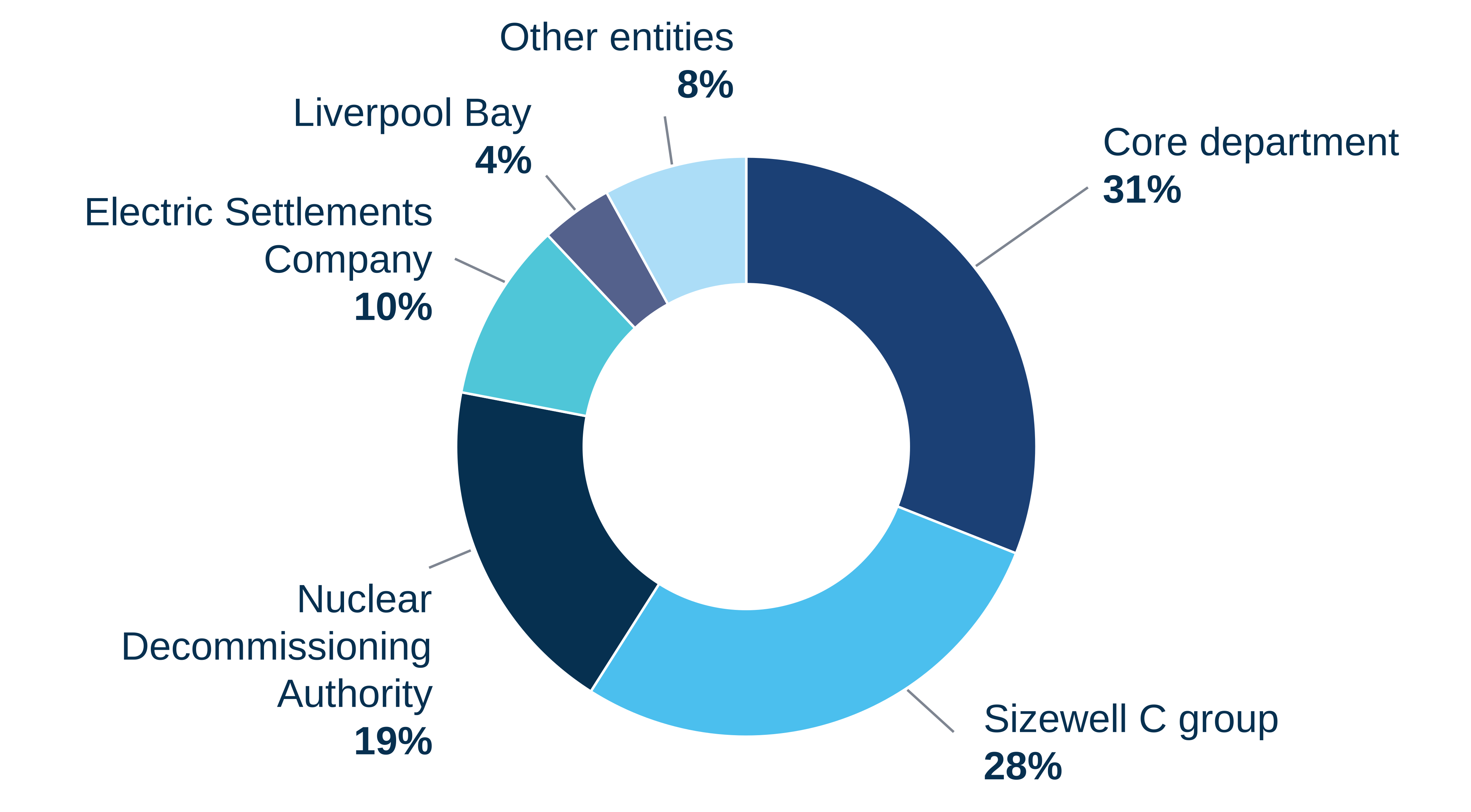
Operating and budgetary capital expenditure by component: diagram data
| % | |
|---|---|
| Core department | 31% |
| Sizewell C group | 28% |
| Nuclear Decommissioning Authority | 19% |
| Electric Settlements Company | 10% |
| Liverpool Bay | 4% |
| Other entities | 8% |
Other Information
The other information comprises the information included in the Annual Report, but does not include the financial statements and my auditor’s certificate and report thereon. The Accounting Officer is responsible for the other information.
My opinion on the financial statements does not cover the other information and, except to the extent otherwise explicitly stated in my certificate, I do not express any form of assurance conclusion thereon. My responsibility is to read the other information and, in doing so, consider whether the other information is materially inconsistent with the financial statements or my knowledge obtained in the audit or otherwise appears to be materially misstated.
If I identify such material inconsistencies or apparent material misstatements, I am required to determine whether this gives rise to a material misstatement in the financial statements themselves. If, based on the work I have performed, I conclude that there is a material misstatement of this other information, I am required to report that fact.
As stated under the basis of qualified opinion on the group financial statements and regularity, I have been unable to obtain sufficient appropriate evidence with regards to the transactions and balances managed by Liverpool Bay. Where other information refers to these balances, it may be materially misstated for the same reason.
Opinion on other matters
In my opinion the part of the Remuneration and Staff Report to be audited has been properly prepared in accordance with HM Treasury directions issued under the Government Resources and Accounts Act 2000.
In my opinion, based on the work undertaken in the course of the audit:
- the parts of the Accountability Report subject to audit have been properly prepared in accordance with HM Treasury directions issued under the Government Resources and Accounts Act 2000;
- the information given in the Performance and Accountability Reports for the financial year for which the financial statements are prepared is consistent with the financial statements and is in accordance with the applicable legal requirements
Matters on which I report by exception
In the light of the knowledge and understanding of the department and its group and their environment obtained in the course of the audit, except for the possible effect of the matter described above under the basis for qualified opinions on the group financial statements and regularity, I have not identified material misstatements in the Performance and Accountability Report.
As described in the basis for qualified opinions on the group financial statements and regularity, I have not received all of the information and explanations I require for my audit.
In all other respects, I have nothing to report in respect of the following matters which I report to you if, in my opinion:
- Adequate accounting records have not been kept by the department and its group or returns adequate for my audit have not been received from branches not visited by my staff; or
- the financial statements and the parts of the Accountability Report subject to audit are not in agreement with the accounting records and returns; or
- certain disclosures of remuneration specified by HM Treasury’s Government Financial Reporting Manual have not been made or parts of the Remuneration and Staff Report to be audited is not in agreement with the accounting records and returns; or
- the Governance Statement does not reflect compliance with HM Treasury’s guidance
Responsibilities of the Accounting Officer for the financial statements
As explained more fully in the Statement of Accounting Officer’s Responsibilities, the Accounting Officer is responsible for:
- maintaining proper accounting records;
- providing the C&AG with access to all information of which management is aware that is relevant to the preparation of the financial statements such as records, documentation and other matters;
- providing the C&AG with additional information and explanations needed for his audit;
- providing the C&AG with unrestricted access to persons within the department and its group from whom the auditor determines it necessary to obtain audit evidence;
- ensuring such internal controls are in place as deemed necessary to enable the preparation of financial statements to be free from material misstatement, whether due to fraud or error;
- preparing financial statements which give a true and fair view and are in accordance with HM Treasury directions issued under the Government Resources and Accounts Act 2000;
- preparing the annual report, which includes the Remuneration and Staff Report, in accordance with HM Treasury directions issued under the Government Resources and Accounts Act 2000; and
- assessing the department and its group’s ability to continue as a going concern, disclosing, as applicable, matters related to going concern and using the going concern basis of accounting unless the Accounting Officer anticipates that the services provided by the department and its group will not continue to be provided in the future
Auditor’s responsibilities for the audit of the financial statements
My responsibility is to audit, certify and report on the financial statements in accordance with the Government Resources and Accounts Act 2000.
My objectives are to obtain reasonable assurance about whether the financial statements as a whole are free from material misstatement, whether due to fraud or error, and to issue a certificate that includes my opinion. Reasonable assurance is a high level of assurance but is not a guarantee that an audit conducted in accordance with ISAs (UK) will always detect a material misstatement when it exists. Misstatements can arise from fraud or error and are considered material if, individually or in the aggregate, they could reasonably be expected to influence the economic decisions of users taken on the basis of these financial statements.
Extent to which the audit was considered capable of detecting non-compliance with laws and regulations including fraud
I design procedures in line with my responsibilities, outlined above, to detect material misstatements in respect of non-compliance with laws and regulations, including fraud. The extent to which my procedures are capable of detecting non-compliance with laws and regulations, including fraud is detailed below.
Identifying and assessing potential risks related to non-compliance with laws and regulations, including fraud
In identifying and assessing risks of material misstatement in respect of non-compliance with laws and regulations, including fraud, I:
- considered the nature of the sector, control environment and operational performance including the design of the department and its group’s accounting policies, and strategic key performance indicators.
- inquired of management, the department’s head of internal audit and those charged with governance, including obtaining and reviewing supporting documentation relating to the department and its group’s policies and procedures on:
- identifying, evaluating and complying with laws and regulations;
- detecting and responding to the risks of fraud; and
- the internal controls established to mitigate risks related to fraud or non-compliance with laws and regulations including the department and its group’s controls relating to the department’s compliance with the Government Resources and Accounts Act 2000, Managing Public Money, the Energy Acts, The Energy Price Act 2022, The Contracts for Difference Order and Regulations 2014, The Coal Industry Act 1994, and Supply and Appropriation Acts;
- inquired of management, the department’s head of internal audit and those charged with governance whether:
- they were aware of any instances of non-compliance with laws and regulations;
- they had knowledge of any actual, suspected, or alleged fraud,
- discussed with the engagement team including components within scope of the group audit, regarding how and where fraud might occur in the financial statements and any potential indicators of fraud.
As a result of these procedures, I considered the opportunities and incentives that may exist within the department and its group for fraud and identified the greatest potential for fraud in the following areas: revenue recognition, posting of unusual journals, complex transactions, bias in management estimates and proximity to control totals. In common with all audits under ISAs (UK), I am required to perform specific procedures to respond to the risk of management override.
I obtained an understanding of the department and group’s framework of authority and other legal and regulatory frameworks in which the department and group operates. I focused on those laws and regulations that had a direct effect on material amounts and disclosures in the financial statements or that had a fundamental effect on the operations of the department and its group. The key laws and regulations I considered in this context included Government Resources and Accounts Act 2000, Managing Public Money, the Energy Acts, The Energy Price Act 2022, The Contracts for Difference Order and Regulations 2014, The Coal Industry Act 1994, Supply and Appropriation Acts, and relevant laws and pensions legislation.
Audit response to identified risk
To respond to the identified risks resulting from the above procedures:
- I reviewed the financial statement disclosures and testing to supporting documentation to assess compliance with provisions of relevant laws and regulations described above as having direct effect on the financial statements;
- I enquired of management, the Audit and Risk Assurance Committee and in-house legal counsel concerning actual and potential litigation and claims;
- I reviewed minutes of meetings of those charged with governance and the Board and internal audit reports;
- I addressed the risk of fraud through management override of controls by testing the appropriateness of journal entries and other adjustments; assessing whether the judgements on estimates are indicative of a potential bias; and evaluating the business rationale of any significant transactions that are unusual or outside the normal course of business;
- I assessed the methodology used by the department to determine an estimate of the level of fraud and error in its grant streams, including performing a sample test grant expenditure recorded during the year;
- I assessed the department’s proximity to control totals and the extent to which journal entries could be used to avoid budgetary breaches; and
- I addressed the risk of fraud in relation to the issuance of new decommissioning activity contracts by assessing whether prescribed group procedures and authorisations were in place for contracts issued or extended in year
I communicated relevant identified laws and regulations and potential risks of fraud to all engagement team members including internal specialists and components within scope of the group audit and remained alert to any indications of fraud or non-compliance with laws and regulations throughout the audit.
A further description of my responsibilities for the audit of the financial statements is located on the Financial Reporting Council’s website at: www.frc.org.uk/auditorsresponsibilities. This description forms part of my certificate.
Other auditor’s responsibilities
I am required to obtain appropriate evidence sufficient to give reasonable assurance that the Statement of Outturn against Parliamentary Supply properly presents the outturn against voted Parliamentary control totals and that those totals have not been exceeded. The voted Parliamentary control totals are Departmental Expenditure Limits (Resource and Capital), Annually Managed Expenditure (Resource and Capital), Non-Budget (Resource) and Net Cash Requirement.
I am required to obtain sufficient appropriate audit evidence to give reasonable assurance that the expenditure and income recorded in the financial statements have been applied to the purposes intended by Parliament and the financial transactions recorded in the financial statements conform to the authorities which govern them.
I communicate with those charged with governance regarding, among other matters, the planned scope and timing of the audit and significant audit findings, including any significant deficiencies in internal control I identify during my audit.
Report
I have no further observations to make on these financial statements.
Gareth Davies
Comptroller and Auditor General
15 July 2026
National Audit Office
157-197 Buckingham Palace Road
Victoria
London
SW1W 9SP
Next:
Financial statements
Previous:
Performance report