Guidance on designing and constructing new builds to be smart-meter-ready (accessible webpage)
Published 24 March 2026
Applies to England, Scotland and Wales

© Crown copyright 2026
This publication is licensed under the terms of the Open Government Licence v3.0 except where otherwise stated. To view this licence, visit nationalarchives.gov.uk/doc/open-government-licence/version/3 or write to the Information Policy Team, The National Archives, Kew, London TW9 4DU, or email: psi@nationalarchives.gov.uk.
Where we have identified any third party copyright information you will need to obtain permission from the copyright holders concerned.
This publication is available at https://www.gov.uk/government/publications/design-and-construct-new-builds-to-enable-smart-meter-installations/guidance-on-designing-and-constructing-new-builds-to-be-smart-meter-ready-accessible-webpage
Guidance to create successful smart meter installations in domestic and non-domestic new builds
Smart meters are used to measure electricity or gas usage and send this information directly to the energy supplier of a building. Smart meters should be installed in all new build premises as standard. Consumers expect smart meters to be present in their new property, as they provide access to tariffs and services that help reduce energy usage and save money.
This guidance provides advice to the construction industry on how to design and construct new build dwellings and non-domestic buildings to be suitable for smart meter installation and commissioning from the outset (“smart-meter-ready”).
To note: smart meters are provided and installed at no additional cost by the energy supplier.
Who is this guidance for?
Those responsible for building design.
Those responsible for site management and the choice of metering locations.
Design principles for deciding smart meter position
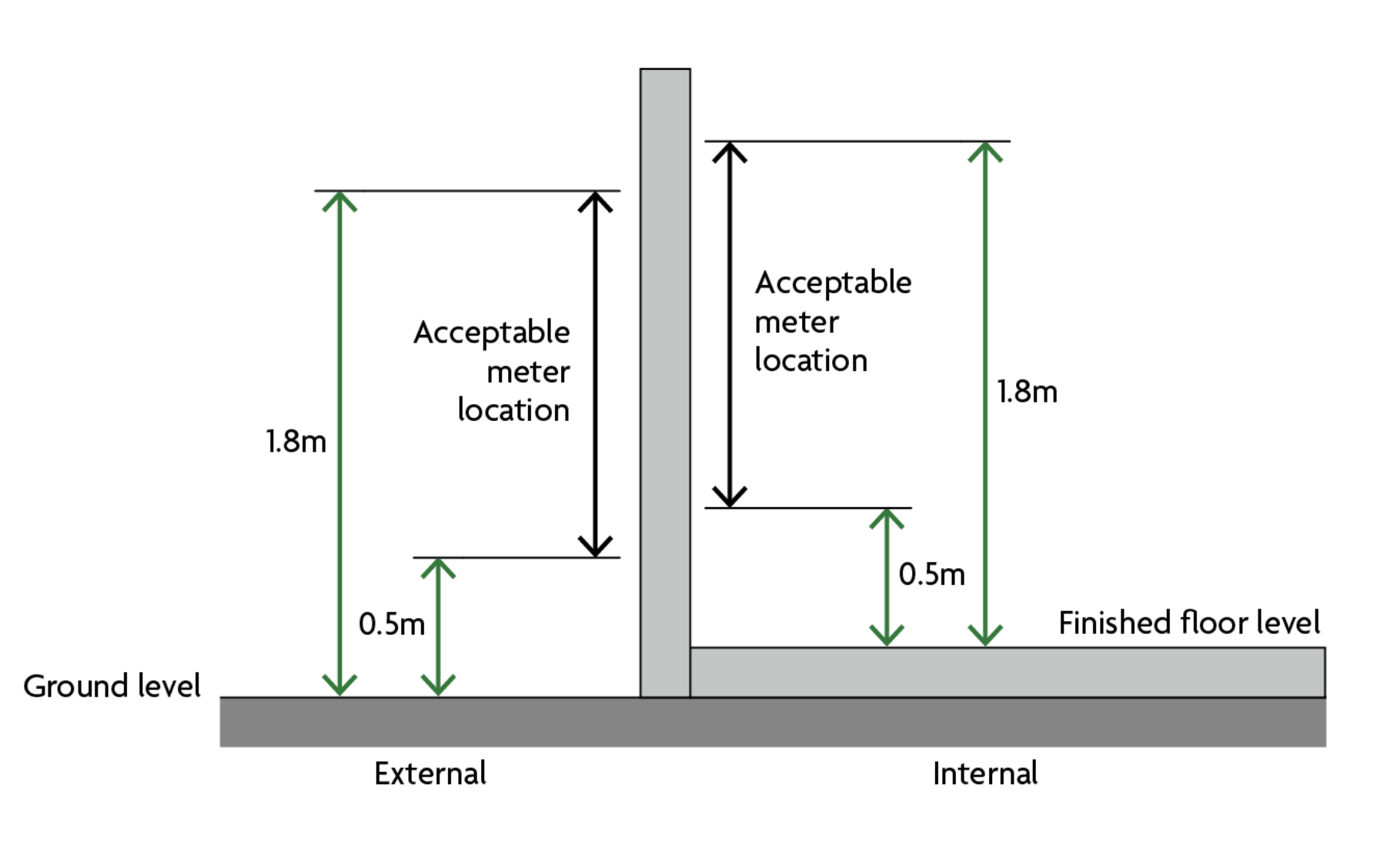
1.1 You should consider appropriate metering locations early in the design process (as laid out in diagram 1).
1.2 You should engage with energy suppliers to ensure the correct positioning of meter points (as laid out in diagram 1).
1.3 You should position both the electricity meter and the gas meter (if present) close by one another, and near the front door of the premises (inside or outside). Meters should not be installed in a central meter room where possible.
- 1.4 The gas as well as electricity meter placement should satisfy both of the following criteria (see diagram 1):
- a. Be readily accessible
- b. Be located between 0.5m and 1.8m above the:
- i. Finished floor for internal meters
- ii. Ground level for external meters
Diagram 1 - Acceptable meter location (Diagram not to scale)
This diagram illustrates that internal meters should be located between 0.5 metres and 1.8 metres above finished floor level, and external meters between 0.5 metres and 1.8 metres above ground level.
Spacing requirements
- 1.5 Smart electricity meter installations have specific spacing requirements. You should ensure there is enough space for the following:
- a. Smart electricity meter: measuring electricity usage in the premises.
- b. Communications hub: a device to connect the smart gas and electricity meters to the Data Communication Company’s (DCC’s) smart metering communications network and to allow smart meters and in-home displays to communicate with each other.
- c. Cable space should be left under the smart electricity meter.
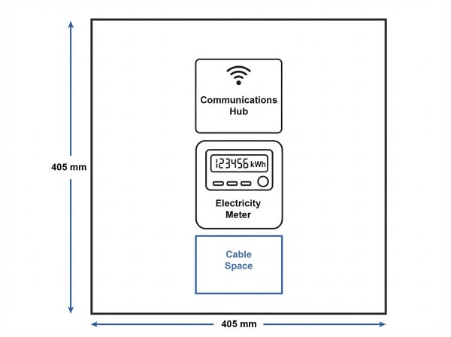
1.6 As shown in Diagram 2, a minimum clear space of 405 millimetres by 405 millimetres is required for a smart electricity meter installation.
1.7 As shown in Diagram 2, you should provide spacing around the smart electricity meter to ensure all extra equipment and cables can be installed. This space cannot overlap between meter installations of other electricity meters. A gas meter should not be installed in this space. You should ensure that no other equipment is placed in this space, other than that defined in industry guidance. [footnote 1]
Diagram 2 - Minimum space requirements for smart electricity meter installation (Diagram not to scale)
This diagram illustrates that a minimum clear space of 405 millimetres by 405 millimetres is required for a smart electricity meter installation. The diagram also depicts the smart electricity meter within this space, with the communications hub positioned above it and the cable space below it, and space to the left and right of these.
1.8 In addition, you should ensure there is no permanent obstruction in front of an installed gas or electricity meter. Enough space should be provided for an energy supplier to install and maintain equipment safely.
1.9 Special gas or electricity meter spacing considerations may also be given by the energy supplier. You should follow all additional guidance given.
Materials Blocking Signals to the Communications Hub
- 1.10 Metal objects such as trunking and foil backed plaster board can block signals to the communications hub. You should make sure that the smart meters can work correctly by checking that the site of installation of the communications hub [footnote 2] is:
- a. In a location that will not act as a Faraday cage (i.e. not surrounded by metal on all sides).
- b. In a location where at least three faces of the communications hub (excluding the back and bottom faces) have a minimum clearance of 18cm from any metal object larger than 32cm.
Logistics and Co-ordination
1.11 You should discuss metering arrangements with the energy supplier. There should be the expectation that all gas and electricity meters installed on the premises will be smart. The installation of smart meters is a joint responsibility for energy suppliers and developers.
1.12 You should discuss the order of installation and commissioning of the gas and electricity meters with energy suppliers prior to work beginning on site. In particular, energy suppliers may wish to connect the electricity and gas smart meters to the communications network at the same time.
1.13 You should confirm with the energy supplier that the meters are operating in ‘smart mode’ before handing the property over to the customer. This will avoid repeated visits from the energy supplier and consumer inconvenience.
1.14 Meters can only be installed by meter operators or energy suppliers. If meters are to be installed using units assembled off-site, engagement should be undertaken directly with the meter operator or energy supplier, or through an appropriate broker.
Safety
1.15 You should ensure any installations comply with safety regulations.
-
Energy Networks Association: Engineering Recommendation G87. ↩
-
As defined in DCC: Communications hub supporting information (PDF, 2024). ↩